{{see also|Integrated Guided Missile Development Program}}
{{see also|Integrated Guided Missile Development Program}}
{{pp-extended|small=yes}}
{{Use dmy dates|date=July 2022}}
{{Use dmy dates|date=July 2022}}
{{Infobox weapon
{{Infobox weapon
| name = Nag (Prospina)
| name = Nag
| image = File:ILA Berlin 2012 PD 017.JPG
| image = Nag missile test on 8 July 2019.jpg
| image_size = 300
| image_size = 300
| caption = Nag (Prospina) showcased at ILA Berlin Air Show 2012
| caption = Nag Missile fired from NAMICA-1
| type = [[Anti-tank guided missile]]
| type = [[Anti-tank guided missile]]
| service =
| service = {{start date|2019}}–present<ref name=":17">{{Cite web |date=2025-10-17 |title=India’s indigenous Zorawar tank clears crucial missile firing trial, paving way for 2027 induction |url=https://www.businesstoday.in/india/story/indias-indigenous-zorawar-tank-clears-crucial-missile-firing-trial-paving-way-for-2027-induction-498843-2025-10-17 |access-date=2025-10-18 |website=Business Today |language=en}}</ref>
| length = {{convert|1.85|m|ftin|abbr=on}}
| length = {{convert|1.83|m|ftin|abbr=on}}<ref>{{cite web |title=NAG ATGM |url=https://bdl-india.in/nag |website=Bharat Dynamics Limited |publisher=Ministry of Defence, Government of India |access-date=14 January 2025}}</ref>
| height =
| height =
| diameter = {{convert|0.20|m|in|abbr=on}}
| diameter = {{convert|0.15|m|in|abbr=on}}<ref>{{cite web |title=NAG ATGM |url=https://bdl-india.in/nag |website=Bharat Dynamics Limited |publisher=Ministry of Defence, Government of India |access-date=14 January 2025}}</ref>
| is_missile = yes
| is_missile = yes
| origin = India
| origin = India
| used_by = [[Indian Army]]<br>[[Indian Air Force]]<br>
| used_by = [[Indian Army]]<br/>[[Indian Air Force]]
| designer = [[Defence Research and Development Organisation]]<!-- Infobox weapon now allows design groups in the designer section -->
| designer = [[Defence Research and Development Organisation]]<!-- Infobox weapon now allows design groups in the designer section -->
| unit_cost = {{INRConvert|1|c}}<ref name="The Hindu">{{cite web|url=https://www.thehindu.com/news/national/anti-tank-missile-completes-all-trials/article36556641.ece|title=Anti-tank missile completes all trials|author= Dinakar Peri |website=[[The Hindu]]|date=19 September 2021|access-date=20 September 2021}}</ref>
| unit_cost = {{INRConvert|1|c}}<ref name="The Hindu">{{cite web|url=https://www.thehindu.com/news/national/anti-tank-missile-completes-all-trials/article36556641.ece|title=Anti-tank missile completes all trials|author=Dinakar Peri |website=[[The Hindu]]|date=19 September 2021|access-date=20 September 2021}}</ref>
| propellant = Nitramine smokeless extruded double base
| propellant = Nitramine smokeless extruded double base
| production_date =
| production_date =
| engine = [[Solid-propellant rocket]] [[Booster (rocketry)|booster]] and [[Sustainer engine|sustainer motor]]<ref name="army-technology">{{cite web|url=https://www.army-technology.com/projects/nag-anti-tank-guided-missile/|title=Nag Anti-Tank Guided Missile|author=Army Technology|date=12 September 2019|access-date=12 September 2022}}</ref>
| engine = [[Solid-propellant rocket]] [[Booster (rocketry)|booster]] and [[Sustainer engine|sustainer motor]]<ref name="army-technology">{{cite web|url=https://www.army-technology.com/projects/nag-anti-tank-guided-missile/|title=Nag Anti-Tank Guided Missile|author=Army Technology|date=12 September 2019|access-date=12 September 2019}}</ref>
| weight = {{convert|43|kg|lb|abbr=on}}
| weight = {{convert|42|kg|lb|abbr=on}}<ref>{{cite web |title=NAG ATGM |url=https://bdl-india.in/nag |website=Bharat Dynamics Limited |publisher=Ministry of Defence, Government of India |access-date=14 January 2025}}</ref>
| wingspan = {{convert|0.4|m|in|abbr=on}}
| wingspan = {{convert|0.4|m|in|abbr=on}}
| speed = 230 m/s (828 km/h)
| speed = 220-230 m/s (792-828 km/h)<ref>{{cite web |title=NAG ATGM |url=https://bdl-india.in/nag |website=Bharat Dynamics Limited |publisher=Ministry of Defence, Government of India |access-date=14 January 2025}}</ref>
| vehicle_range = • Nag (Prospine): 500m–4km <br />• HELINA/Dhruvastra: 7–10km<ref name="ix182">{{cite news|url=http://www.business-standard.com/india/news/army-opts-for-nag-missile-as-it-enters-final-trials/387858/|title=Army opts for Nag missile as it enters final trials|author=Ajai Shukla|date=8 March 2010|access-date=6 February 2015|newspaper=Business Standard India}}</ref> <br />• SANT: 15–20km<ref name="toi">{{cite web|url=https://timesofindia.indiatimes.com/city/jaipur/upgraded-sant-missile-successfully-flight-tested/articleshow/66872743.cms|title=Upgraded SANT missile successfully flight tested|author=TNN|website=[[The Times of India]]|date=30 November 2018|access-date=14 September 2022}}</ref>
| vehicle_range = *Nag (ProspiNa): 500m–4km<br/><ref>{{cite web |title=NAG ATGM |url=https://bdl-india.in/nag |website=Bharat Dynamics Limited |publisher=Ministry of Defence, Government of India |access-date=14 January 2025}}</ref>
*HELINA/Dhruvastra: 7–10km<ref name="ix182">{{cite news|url=http://www.business-standard.com/india/news/army-opts-for-nag-missile-as-it-enters-final-trials/387858/|title=Army opts for Nag missile as it enters final trials|author=Ajai Shukla|date=8 March 2010|access-date=6 February 2015|newspaper=Business Standard India}}</ref>
*SANT: 15–20km<ref name="toi">{{cite web|url=https://timesofindia.indiatimes.com/city/jaipur/upgraded-sant-missile-successfully-flight-tested/articleshow/66872743.cms|title=Upgraded SANT missile successfully flight tested|author=TNN|website=[[The Times of India]]|date=30 November 2018|access-date=14 September 2019}}</ref>
| ceiling =
| ceiling =
| altitude =
| altitude =
| filling = [[Tandem-charge]] [[High-explosive anti-tank warhead|HEAT]] (Penetration >900 mm in [[explosive reactive armour|ERA]] + [[rolled homogeneous armor|RHA]])<ref name="the diplomat">{{cite web|url=https://thediplomat.com/2019/07/india-successfully-test-fires-indigenous-anti-tank-guided-missile/|title=India Successfully Test Fires Indigenous Anti-Tank Guided Missile|author= Franz-Stefan Gady|date=9 July 2019|access-date=12 September 2022}}</ref>
| filling = [[Tandem-charge]] [[High-explosive anti-tank|HEAT]] (Penetration >900 mm in [[Explosive reactive armour|ERA]] + [[Rolled homogeneous armor|RHA]])<ref name="the diplomat">{{cite web|url=https://thediplomat.com/2019/07/india-successfully-test-fires-indigenous-anti-tank-guided-missile/|title=India Successfully Test Fires Indigenous Anti-Tank Guided Missile|last=Gady|first=Franz-Stefan|date=9 July 2019|access-date=12 September 2019}}</ref>
| filling_weight = 8 kg
| filling_weight = 8 kg
| guidance = '''Mid-course:''' [[Charge-coupled device]] with area correlation and two-way [[datalink]] <br />'''Terminal:'''
* [[Extremely high frequency|Millimeter wave]] [[active radar homing]] (SANT)<ref>{{cite news |last1=Sawhney |first1=Pravin |title=Dr G. Satheesh Reddy (DoD R&D), Defence Research and Development Organisation |url=http://forceindia.net/interview/secretary-department-defence-rd-chairman-defence-research-development-organisation-dr-g-satheesh-reddy/ |access-date=20 October 2020 |publisher=Force}}</ref><ref>{{cite news |last1=Mallikarjun |first1=Y. |title=DRDO scientists to develop advanced seekers for tactical missiles |url=https://www.thehindu.com/news/national/drdo-scientists-to-develop-advanced-seekers-for-tactical-missiles/article2910934.ece#! |access-date=20 October 2020 |work=The Hindu |date=24 July 2022}}</ref><ref name="IBT">{{cite web|url=https://www.ibtimes.co.in/drdo-successfully-tests-nag-8-facts-about-indias-deadly-anti-tank-missile-762351|title=DRDO successfully tests NAG: 8 facts about India's deadly anti-tank missile|author=Rohit KVN|website=[[International Business Times]]|date=1 March 2018|access-date=12 September 2022}}</ref>
* [[MmW|MMW]] [[Active radar homing|ARH]] (SANT)<ref>{{cite news |last=Sawhney |first=Pravin |title=Dr G. Satheesh Reddy (DoD R&D), Defence Research and Development Organisation |url=http://forceindia.net/interview/secretary-department-defence-rd-chairman-defence-research-development-organisation-dr-g-satheesh-reddy/ |access-date=20 October 2020 |publisher=Force}}</ref><ref>{{cite news |last1=Mallikarjun |first1=Y. |title=DRDO scientists to develop advanced seekers for tactical missiles |url=https://www.thehindu.com/news/national/drdo-scientists-to-develop-advanced-seekers-for-tactical-missiles/article2910934.ece#! |access-date=20 October 2020 |work=The Hindu |date=24 July 2016}}</ref><ref name="IBT">{{cite web|url=https://www.ibtimes.co.in/drdo-successfully-tests-nag-8-facts-about-indias-deadly-anti-tank-missile-762351|title=DRDO successfully tests NAG: 8 facts about India's deadly anti-tank missile|author=Rohit KVN|website=[[International Business Times]]|date=1 March 2018|access-date=12 September 2019}}</ref>
The '''Nag''' missile ({{Lit|[[Nāga|Cobra]]}}), also called '''Prospina''' for the land-attack version, is an Indian third-generation, all-weather, [[fire-and-forget]], [[lock-on after launch]], [[anti-tank guided missile]] (ATGM) with an operational range of 500{{nbsp}}m to 20{{nbsp}}km depending on variant. It has a single-shot hit probability of 90%<ref>{{Cite web|url=https://www.ibtimes.co.in/drdo-successfully-tests-nag-8-facts-about-indias-deadly-anti-tank-missile-762351|title=DRDO successfully tests NAG: 8 facts about India's deadly anti-tank missile|last=KVN|first=Rohit|date=2018-03-01|website=International Business Times, India Edition|language=en|access-date=2019-09-14}}</ref> and a ten-year, maintenance-free shelf life.<ref>{{Cite web|url=http://aermech.in/indian-army-nag-vs-us-army-fgm-148-javelin-anti-tank-missile-comparisoncontroversy/|title=Indian Army Nag vs US Army FGM-148 Javelin {{!}}Anti Tank Missile Comparison{{!}}Controversy|date=2015-12-16|website=AerMech.IN|language=en-US|access-date=2019-09-12}}</ref> The Nag has five variants under development: a land version, for a mast-mounted system; the helicopter-launched Nag (HELINA) also known as Dhruvastra; a "man-portable" version ([[MPATGM]]); an air-launched version which will replace the current [[Imaging infrared|imaging infra-red]] (IIR) to [[Millimetric wave|millimetric-wave]] (mmW) [[active radar homing]] seeker;<ref>{{Cite web|url=https://timesofindia.indiatimes.com/india/Anti-tank-Nag-missile-Helinas-trial-conducted/articleshow/22955349.cms|title=Anti-tank Nag missile 'Helina's' trial conducted |date=24 September 2013|website=The Times of India|language=en|access-date=2019-09-12}}</ref> and the Nag Missile Carrier (NAMICA) "tank buster", which is a modified [[BMP-2]] [[infantry fighting vehicle]] (IFV) produced under license in India by [[Ordnance Factory Medak]] (OFMK).<ref>{{cite web|url=https://timesofindia.indiatimes.com/city/hyderabad/Kalams-unrealised-Nag-missile-dream-to-become-reality-next-year/articleshow/48267342.cms|title=Kalam's unrealised 'Nag' missile dream to become reality next year|website=[[The Times of India]]|access-date=30 July 2015|date=30 July 2015}}</ref><ref>{{cite news |title=DRDO's 'Nag' missile tests successful; ready for induction |url=https://www.outlookindia.com/newswire/story/drdos-nag-missile-tests-successful-ready-for-induction/596423 |work=Outlook |agency=Press Trust of India |date=6 August 2008}}</ref><ref>{{Cite web|url=https://www.ibtimes.co.in/drdo-successfully-tests-nag-8-facts-about-indias-deadly-anti-tank-missile-762351|title=DRDO successfully tests NAG: 8 facts about India's deadly anti-tank missile|last=KVN|first=Rohit|date=2018-03-01|website=International Business Times, India Edition|language=en|access-date=2019-09-12}}</ref>
The '''Nag''' missile (<small>[[International Alphabet of Sanskrit Transliteration|IAST]]</small>: ''[[Nāga]]''; en: Cobra), also called "Prospina" for the land-attack version, is an Indian third-generation, all-weather, [[fire-and-forget]], [[lock-on after launch]], [[anti-tank guided missile]] (ATGM) with an operational range of 500{{nbsp}}m to 20{{nbsp}}km depending on variant. It has a single-shot hit probability of 90%<ref>{{Cite web|url=https://www.ibtimes.co.in/drdo-successfully-tests-nag-8-facts-about-indias-deadly-anti-tank-missile-762351|title=DRDO successfully tests NAG: 8 facts about India's deadly anti-tank missile|last=KVN|first=Rohit|date=2018-03-01|website=International Business Times, India Edition|language=en|access-date=2019-09-14}}</ref> and a ten-year, maintenance-free shelf life.<ref>{{Cite web|url=http://aermech.in/indian-army-nag-vs-us-army-fgm-148-javelin-anti-tank-missile-comparisoncontroversy/|title=Indian Army Nag vs US Army FGM-148 Javelin {{!}}Anti Tank Missile Comparison{{!}}Controversy|date=2015-12-16|website=AerMech.IN|language=en-US|access-date=2019-09-12}}</ref> The Nag has five variants under development: a land version, for a mast-mounted system; the helicopter-launched Nag (HELINA) also known as Dhruvastra; a "man-portable" version ([[MPATGM]]); an air-launched version which will replace the current [[Imaging infrared|imaging infra-red]] (IIR) to [[Millimetric wave|millimetric-wave]] (mmW) [[active radar homing]] seeker;<ref>{{Cite web|url=https://timesofindia.indiatimes.com/india/Anti-tank-Nag-missile-Helinas-trial-conducted/articleshow/22955349.cms|title=Anti-tank Nag missile 'Helina's' trial conducted |date=24 September 2013|website=The Times of India|language=en|access-date=2019-09-12}}</ref> and the Nag Missile Carrier (NAMICA) "tank buster", which is a modified [[BMP-2]] [[infantry fighting vehicle]] (IFV) produced under license in India by [[Ordnance Factory Medak]] (OFMK).<ref>{{cite web|url=http://timesofindia.indiatimes.com/city/hyderabad/Kalams-unrealised-Nag-missile-dream-to-become-reality-next-year/articleshow/48267342.cms|title=Kalam's unrealised 'Nag' missile dream to become reality next year|website=[[The Times of India]]|access-date=30 July 2015|date=30 July 2022}}</ref><ref>{{cite news |title=DRDO's 'Nag' missile tests successful; ready for induction |url=https://www.outlookindia.com/newswire/story/drdos-nag-missile-tests-successful-ready-for-induction/596423 |work=Outlook |agency=Press Trust of India |date=6 August 2022}}</ref><ref>{{Cite web|url=https://www.ibtimes.co.in/drdo-successfully-tests-nag-8-facts-about-indias-deadly-anti-tank-missile-762351|title=DRDO successfully tests NAG: 8 facts about India's deadly anti-tank missile|last=KVN|first=Rohit|date=2018-03-01|website=International Business Times, India Edition|language=en|access-date=2019-09-12}}</ref>
Development of the Nag is part of the [[Integrated Guided Missile Development Program]] (IGMDP), run by the [[Defence Research and Development Organisation]] (DRDO). It is manufactured by [[Bharat Dynamics Limited]] (BDL).<ref name="auto">{{cite web|url=https://thediplomat.com/2018/03/indias-new-anti-tank-guided-missile-destroys-2-tanks-in-test/|title=India's New Anti-Tank Guided Missile Destroys 2 Tanks in Test|author=Franz-Stefan Gady|publisher=The Diplomat}}</ref> India's [[Ministry of Defence (India)|Ministry of Defence]] announced on 19 July 2019 that the missile was ready for production.<ref name="Jans">{{Cite web|url=https://www.janes.com/article/89985/india-s-nag-atgm-ready-for-series-production-says-mod|title=India's Nag ATGM ready for series production, says MoD|website=Jane's 360|access-date=2019-08-12}}</ref> The Defence Research and Development Organization (DRDO) successfully completed the final trial of Nag anti-tank missile using a live warhead on a dud tank at Pokhran army ranges at 6.45 am on 21 Oct 2020.<ref>{{Cite news|last=Defence News, Indian Defence News, IDRW, Indian Armed Forces|first=The Indian Hawk|date=21 October 2020|title=India's Anti-Tank Missile Nag Test-Fired in Pokhran, Ready For Ladakh Deployment|work=[[The Indian Hawk]]|url=https://www.theindianhawk.com/2020/10/nag-anti-tank-missile-ready-to-be-inducted-sant-missile-tested-fired-from-balasore.html|access-date=21 October 2020}}</ref>
Development of the Nag is part of the [[Integrated Guided Missile Development Program]] (IGMDP), run by [[Defence Research and Development Organisation]] (DRDO). It is manufactured by [[Bharat Dynamics Limited]] (BDL).<ref name="auto">{{cite web|url=https://thediplomat.com/2018/03/indias-new-anti-tank-guided-missile-destroys-2-tanks-in-test/|title=India's New Anti-Tank Guided Missile Destroys 2 Tanks in Test|author=Franz-Stefan Gady|publisher=The Diplomat}}</ref> India's [[Ministry of Defence (India)|Ministry of Defence]] (MoD) announced on 19 July 2019 that the missile was ready for production.<ref name="Jans">{{Cite web|url=https://www.janes.com/article/89985/india-s-nag-atgm-ready-for-series-production-says-mod|title=India's Nag ATGM ready for series production, says MoD {{!}} Jane's 360|website=janes.com|access-date=2019-08-12}}</ref> The Defence Research and Development Organization (DRDO) successfully completed the final trial of Nag anti-tank missile using a live warhead on a dud tank at Pokhran army ranges at 6.45 am on 21 Oct 2020.<ref>{{Cite news|last=Defence News, Indian Defence News, IDRW, Indian Armed Forces|first=The Indian Hawk|date=21 October 2020|title=India's Anti-Tank Missile Nag Test-Fired in Pokhran, Ready For Ladakh Deployment|work=[[The Indian Hawk]]|url=https://www.theindianhawk.com/2020/10/nag-anti-tank-missile-ready-to-be-inducted-sant-missile-tested-fired-from-balasore.html|access-date=21 October 2022}}</ref>
==Development==
==Development and testing==
Development of the Nag missile began in 1988<ref name="Bha">{{cite web|url=http://www.bharat-rakshak.com/MISSILES/atgm/na.html|title=Nag ATGM|date=28 February 2009|publisher=Bharat Rakshak|archive-url=https://web.archive.org/web/20120307114843/http://www.bharat-rakshak.com/MISSILES/atgm/na.html|archive-date=7 March 2012}}</ref> under [[A. P. J. Abdul Kalam]].<ref>{{cite web|url=https://www.deccanherald.com/national/dac-approves-purchase-naval-guns-worth-rs-3053-cr-667038.html|title=NAG missile for Army, long-range guns for Navy|date=27 April 2018}}</ref> The first tests were conducted in November 1990.<ref name="Bha"/> Development was delayed for several years because of issues with the IIR-based guidance system.<ref name="Bha"/> The Nag missile underwent successful tests in September 1997 and January 2000.<ref name="Bha"/> In 2000, MoD announced that the Nag was likely to enter full-scale production in early 2001.<ref name="Bha"/>{{clarify|reason=What happened between 2001 and 2008?|date=April 2020}} By 2008, the development cost had reached {{INRConvert|300|c|lk=on|year=2008|1}}.<ref name="nag news">{{cite web |date=2008-08-07 |title=Nag test-fired again |url=http://www.hindu.com/2008/08/07/stories/2008080754951400.htm |url-status=dead |archive-url=https://web.archive.org/web/20080813202819/http://www.hindu.com/2008/08/07/stories/2008080754951400.htm |archive-date=13 August 2008 |access-date=6 February 2015 |work=[[The Hindu]]}}</ref> In July 2009, the Nag ATGM was cleared for production.<ref>{{cite web |title=India Clears Anti-Tank Nag Missile for Production |url=http://www.defensenews.com/story.php?i=4177415 |access-date=6 February 2015}}{{dead link|date=August 2021|bot=medic}}{{cbignore|bot=medic}}</ref> The final user trials were successfully completed in July 2010. The missile was cleared for mass production. BDL planned to produce 100 Nag missiles annually to replace the existing [[Konkurs|Konkours]] and [[MILAN]] second-generation missiles in the arsenal.<ref name="News Archives: The Hindu">{{cite web |date=2010-07-16 |title=Nag's final validation trials completed |url=http://www.hindu.com/2010/07/16/stories/2010071653531500.htm |url-status=dead |archive-url=https://web.archive.org/web/20100717101429/http://www.hindu.com/2010/07/16/stories/2010071653531500.htm |archive-date=17 July 2010 |access-date=6 February 2015 |work=[[The Hindu]]}}</ref> The Nag successfully completed its final validation trials and was expected to join the Indian Army's arsenal in 2011.<ref name=":0">{{cite news |date=16 July 2010 |title=Nag's final validation trials completed |url=http://www.hindu.com/2010/07/16/stories/2010071653531500.htm |url-status=dead |archive-url=https://web.archive.org/web/20100717101429/http://www.hindu.com/2010/07/16/stories/2010071653531500.htm |archive-date=17 July 2010 |work=[[The Hindu]] |location=Chennai, India}}</ref>
Development of the Nag missile began in 1988<ref name="Bha">{{cite web|url=http://www.bharat-rakshak.com/MISSILES/atgm/na.html|title=Nag ATGM|date=28 February 2009|publisher=Bharat Rakshak|archive-url=https://web.archive.org/web/20120307114843/http://www.bharat-rakshak.com/MISSILES/atgm/na.html|archive-date=7 March 2022}}</ref> under [[A. P. J. Abdul Kalam]].<ref>{{cite web|url=https://www.deccanherald.com/national/dac-approves-purchase-naval-guns-worth-rs-3053-cr-667038.html|title=NAG missile for Army, long-range guns for Navy|date=27 April 2022}}</ref> The first tests were conducted in November 1990.<ref name="Bha" /> Development was delayed for several years because of issues with the IIR-based guidance system.<ref name="Bha" /> The Nag missile underwent successful tests in September 1997 and January 2000.<ref name="Bha" /> In 2000, MoD announced that the Nag was likely to enter full-scale production in early 2001.<ref name="Bha" />{{clarify|reason=What happened between 2001 and 2008?|date=April 2022}}
In 2011, the project suffered a one-year delay due to the army's changing of its requirements for the NAMICA at the last moment.<ref name=":3">{{cite news |date=19 April 2011 |title=Nag induction likely to be delayed |url=http://www.hindu.com/2011/04/19/stories/2011041957821000.htm |url-status=dead |archive-url=https://web.archive.org/web/20110420082425/http://www.hindu.com/2011/04/19/stories/2011041957821000.htm |archive-date=20 April 2011 |work=[[The Hindu]] |location=Chennai, India}}</ref> This was due to the failure of the missile to hit the target at 4 km range during the summer trials of 2011 in Rajasthan. The scientists found a fault in the Europe-imported heat-seeker: it was unable to distinguish between the heat signature of the target and its surroundings during high temperatures at long distances. This led to the development of a better indigenous seeker, with higher resolution and sensitivity, by [[Research Centre Imarat]] (RCI), that could track and distinguish targets at long distances. The first trials of the new seeker were carried out on 29 July 2013 in hot desert conditions in [[Rajasthan]].<ref name=":4">{{cite news |author=Y. Mallikarjun |date=30 July 2013 |title=Seeker evaluation trials for Nag carried out in Rajasthan |url=http://www.thehindu.com/news/national/andhra-pradesh/seeker-evaluation-trials-for-nag-carried-out-in-rajasthan/article4970009.ece |access-date=6 February 2015 |work=The Hindu}}</ref><ref name=":10">{{Cite web |date=2018-04-22 |title=300 Nag anti-tank missiles to be inducted in Indian Army soon |url=https://www.indiatoday.in/mail-today/story/indian-army-in-nag-pose-as-many-as-300-anti-tank-missiles-to-be-inducted-into-force-soon-1217629-2018-04-22 |access-date=2024-09-18 |website=India Today |language=en}}</ref> The aerodynamic characterization research was conducted at the [[National Aerospace Laboratories]]' 1.2m Trisonic Wind Tunnel Facility.<ref>{{Cite web |date=2022-06-06 |title=Bengaluru: 1.2m trisonic wind tunnel at National Aerospace Laboratories completes 55 years of service |url=https://www.aninews.in/news/national/general-news/bengaluru-12m-trisonic-wind-tunnel-at-national-aerospace-laboratories-completes-55-years-of-service20220606001500/ |access-date=2024-11-22 |website=ANI |language=en}}</ref>
The Nag was successfully test-fired for two consecutive days in August 2008, from the [[Rocket range|test range]] at [[Pokhran]], [[Rajasthan]], marking the completion of developmental tests. The DRDO and the [[Indian Army]] planned to conduct user trials shortly thereafter.<ref name="nag news">{{cite web|url=http://www.hindu.com/2008/08/07/stories/2008080754951400.htm|archive-url=https://web.archive.org/web/20080813202819/http://www.hindu.com/2008/08/07/stories/2008080754951400.htm|url-status=dead|archive-date=13 August 2008|work=[[The Hindu]]|title=Nag test-fired again|date=2008-08-07|access-date=6 February 2022}}</ref> These would be the final trials to decide whether the system would go into production.<ref>{{cite web|url=http://frontierindia.net/nag-missile-to-be-tested-by-indian-army-in-july|title=Nag Missile to be tested by Indian Army in July|work=Frontier India|access-date=6 February 2015|archive-date=15 August 2012|archive-url=https://web.archive.org/web/20120815142305/http://frontierindia.net/nag-missile-to-be-tested-by-indian-army-in-july|url-status=dead}}</ref> The NAMICA successfully completed amphibious trials in the [[Indira Gandhi Canal]] at Rajasthan on 8 August 2008.<ref>{{cite web|url=http://www.hindu.com/2008/08/08/stories/2008080856751400.htm|archive-url=https://web.archive.org/web/20080815084936/http://www.hindu.com/2008/08/08/stories/2008080856751400.htm|url-status=dead|archive-date=15 August 2008|work=[[The Hindu]]|title=Namica amphibious trial successful|date=2008-08-08|access-date=6 February 2022}}</ref>
The Nag cleared final developmental trials held by [[Indian Army]] in September 2016, making way once again for the weapon system to enter mass production.<ref name=":5">{{Cite news |last=Mallikarjun |first=Y. |date=2016-01-15 |title=Nag missile hits bull's eye with modified seeker |url=https://www.thehindu.com/news/national/Nag-missile-hits-bull%E2%80%99s-eye-with-modified-seeker/article14000033.ece |access-date=2019-09-13 |work=The Hindu |language=en-IN |issn=0971-751X}}</ref><ref name=":6">{{Cite web |title=BANG ON: NAG Hits Bull's Eye in Final Developmental Trials |url=http://www.indiandefensenews.in/2016/12/bang-on-nag-hits-bulls-eye-in-final.html |access-date=2019-09-13}}</ref> Its single-shot hit probability was initially 77%, which was later improved to 90%.<ref>{{Cite web |last=archive |first=From our online |date=2012-05-16 |title=Army to Conduct Winter Trials of Nag in Pokhran |url=https://www.newindianexpress.com/states/odisha/2011/Oct/13/army-to-conduct-winter-trials-of-nag-in-pokhran-299864.html |access-date=2025-05-17 |website=The New Indian Express |language=en}}</ref><ref>{{Cite web |last=Rout |first=Hemant Kumar |date=2020-10-23 |title=User trials over, Nag missile ready for induction in Army |url=https://www.newindianexpress.com/nation/2020/Oct/23/user-trials-over-nag-missileready-for-induction-in-army-2213993.html |access-date=2025-05-17 |website=The New Indian Express |language=en}}</ref>
[[File:Summer User Trials of Nag Missile successfully Conducted by Indian Army.webm|thumb|left|Summer user trials of the Nag missile]]
In 2008, the Indian Army placed an order for 443 Nag missiles and 13 NAMICA carriers to be delivered within the next three years, starting by December 2009.<ref name="nag induction" /> Nag would be the first ATGM of its type to be included in the army's arsenal. The Army urgently needed the Nag, which uses a [[tandem-charge]] [[High-explosive anti-tank warhead]] to penetrate the armor of modern tanks, to improve kill probability.<ref name="nag news" /> By 2008, the development cost had reached {{INRConvert|300|c|lk=|1}}.<ref name="nag induction">{{cite web|url=http://articles.timesofindia.indiatimes.com/2008-07-12/india/27933425_1_nag-missile-sensor-based-seeker-namica|archive-url=https://web.archive.org/web/20121021041738/http://articles.timesofindia.indiatimes.com/2008-07-12/india/27933425_1_nag-missile-sensor-based-seeker-namica|url-status=dead|archive-date=2012-10-21|work=[[The Times of India]]|title=Nag anti-tank missile back in reckoning }}</ref>
During the user trials, the Nag missile was tested successfully by the Indian Army on 26 December 2008. The Nag missile zeroed in on the precise location of the target tank from a distance of {{convert|3.3|km|abbr=on}}, as required by the Indian Army. The Indian Army was also extremely satisfied with the performance of the warhead of the missile.<ref>{{cite web|url=http://www.hindu.com/2008/12/26/stories/2008122655801200.htm|archive-url=https://web.archive.org/web/20090628022756/http://www.hindu.com/2008/12/26/stories/2008122655801200.htm|url-status=dead|archive-date=28 June 2009|work=[[The Hindu]]|title=Archive News|date=2008-12-26|access-date=6 February 2022}}</ref> Another successful test was conducted on 28 December 2008. During that test, a moving target at {{convert|1.8|km|abbr=on}} was destroyed, along with a stationary target at a distance of {{convert|3.1|km|abbr=on}}.<ref>{{cite web|url=http://www.hindu.com/2008/12/29/stories/2008122959211100.htm|archive-url=https://web.archive.org/web/20090215202844/http://hindu.com/2008/12/29/stories/2008122959211100.htm|url-status=dead|archive-date=15 February 2009|work=[[The Hindu]]|title=Two flight tests of Nag missile successful|date=2008-12-29|access-date=6 February 2022}}</ref> A total of five missiles were fired during day and night against stationary and moving targets. Before the induction of the missile into service, summer trials were carried out in June 2009.<ref>{{cite web|url=http://www.hindu.com/2008/12/31/stories/2008123155171100.htm|archive-url=https://web.archive.org/web/20090628022740/http://www.hindu.com/2008/12/31/stories/2008123155171100.htm|url-status=dead|archive-date=28 June 2009|work=[[The Hindu]]|title=Army may induct Nag missile soon|date=2008-12-31|access-date=6 February 2022}}</ref> In July 2009, the Nag ATGM was cleared for production.<ref>{{cite web|url=http://www.defensenews.com/story.php?i=4177415|title=India Clears Anti-Tank Nag Missile for Production|access-date=6 February 2022}}{{dead link|date=August 2021|bot=medic}}{{cbignore|bot=medic}}</ref>
The missile was again declared ready for induction on 28 February 2018, after successfully destroying 2 tanks in desert conditions in a test.<ref name=":7">{{Cite web |date=2018-02-28 |title=Successful Flight Test of ATGM Nag |url=https://pib.gov.in/Pressreleaseshare.aspx?PRID=1522155 |access-date=2018-03-02 |website=pib.nic.in}}</ref><ref name=":8">{{Cite news |last=Gady |first=Franz-Stefan |title=India's New Anti-Tank Guided Missile Destroys 2 Tanks in Test |url=https://thediplomat.com/2018/03/indias-new-anti-tank-guided-missile-destroys-2-tanks-in-test/ |access-date=2018-03-02 |work=The Diplomat |language=en-US}}</ref><ref name=":9">{{Cite news |date=2018-02-28 |title=Anti-tank missile Nag successfully tested, induction-ready now |url=https://economictimes.indiatimes.com/news/defence/anti-tank-missile-nag-successfully-tested-induction-ready-now/articleshow/63116313.cms |access-date=2018-03-02 |work=The Economic Times}}</ref> In 2018, the DRDO chief claimed that the Nag system would be inducted into the Indian Army by 2019.<ref>{{cite web |date=14 April 2018 |title=Army To Get Nag Anti Tank Guided Missiles In 2019, Says DRDO Chief |url=https://defenceaviationpost.com/army-to-get-nag-anti-tank-guided-missiles-in-2019-says-drdo-chief/}}{{dead link|date=December 2024|bot=medic}}{{cbignore|bot=medic}}</ref> As of 2019, the missile was ready for induction and was expected to enter mass production by year-end, according to a senior DRDO official.<ref>{{Cite web |last=Gady |first=Franz-Stefan |date=25 February 2019 |title=India's New Anti-Tank Guided Missile to Enter Production By End of 2019 |url=https://thediplomat.com/2019/02/indias-new-anti-tank-guided-missile-to-enter-production-by-end-of-2019/ |access-date=2019-08-15 |website=The Diplomat |language=en-US}}</ref>
On 20 January 2010 field tests of the Nag's thermal sight system, the system identified and locked on to a T-55 tank at a range of {{convert|5|km|abbr=on}}. The trials were conducted using an advanced-imaging infrared-seeker head, per the Army's requirements. Another tank was engaged and destroyed at a range of over 4 km in a test of the missile's fire-and-forget capability, using the day version of the IIR passive seeker. In its IIR form, the Nag has limited all-weather capability. This limitation has provided added impetus to development of the mmW active seeker. Efforts were undertaken to provide special embedded on-board hunters that could hunt for targets using 'day seekers' and 'day-&-night seekers'. During trials in June 2010, the short-range capability of the missile to hit targets was validated. The Nag missile hit a target at a range of half a kilometer in just three seconds.<ref>{{cite web|url=http://www.thehindu.com/news/national/article448188.ece|title=Nag hits target in three seconds after launch|author=Y. Mallikarjun|work=The Hindu|access-date=6 February 2022}}</ref> In the follow-on test, a moving target was hit within 3.2 seconds after launch.<ref>{{cite web|url=http://www.hindu.com/2010/06/14/stories/2010061455271200.htm|archive-url=https://web.archive.org/web/20110510083049/http://www.hindu.com/2010/06/14/stories/2010061455271200.htm|url-status=dead|archive-date=10 May 2011|work=[[The Hindu]]|title=Archive News|date=2010-06-14|access-date=6 February 2022}}</ref> The final user trials were held during July 2010 and successfully completed. The missile was cleared for mass production. BDL planned to produce 100 Nag missiles annually to replace the existing [[Konkurs|Konkours]] and [[MILAN]] second-generation missiles in the arsenal.<ref name="News Archives: The Hindu">{{cite web|url=http://www.hindu.com/2010/07/16/stories/2010071653531500.htm|archive-url=https://web.archive.org/web/20100717101429/http://www.hindu.com/2010/07/16/stories/2010071653531500.htm|url-status=dead|archive-date=17 July 2010|work=[[The Hindu]]|title=Archive News|date=2010-07-16|access-date=6 February 2022}}</ref> The Nag was test-fired as part of user validation trials on 16 July 2010.<ref name="nag validation test">{{cite web|url=http://www.brahmand.com/news/Indias-Nag-missile-completes-final-validation-test/4473/1/10.html|title=India's Nag missile completes final validation test |work= Brahmand News}}</ref>
As of 2018, there was a requirement of around 3,000 Nag missiles for the land-launched variant of the Army.<ref name=":10" />
The Nag successfully completed its final validation trials{{clarify|reason=The word "final" is used multiple times in this section, followed by descriptions of more testing. Please clarify which of the tests were actually final, and remove the word "final" from the other descriptions.|date=April 2022}} and was expected to join the Indian Army's arsenal in 2011. Two missiles were launched simultaneously against a moving target, and another two missiles were launched against a stationary [[Vijayanta]] tank in quick succession, and all successfully hit the targets. The Indian Army was happy with the performance and expected to buy 443 missiles for {{INRConvert|335|c|lk=on|1}}.<ref name="News Archives: The Hindu" /> 450 Nag missiles, along with 13 NAMICA carriers, were expected to be added to the Army's arsenal by 2011 with the successful completion of final validation trials in Rajasthan.<ref>{{cite news|url=http://www.hindu.com/2010/07/16/stories/2010071653531500.htm|archive-url=https://web.archive.org/web/20100717101429/http://www.hindu.com/2010/07/16/stories/2010071653531500.htm|url-status=dead|archive-date=17 July 2010|title=Nag's final validation trials completed|date=16 July 2010|work=[[The Hindu]]|location=Chennai, India}}</ref> In 2011, the project suffered a one-year delay due to the army's changing of its requirements for the NAMICA at the last moment.<ref>{{cite news| url=http://www.hindu.com/2011/04/19/stories/2011041957821000.htm | archive-url=https://web.archive.org/web/20110420082425/http://www.hindu.com/2011/04/19/stories/2011041957821000.htm | url-status=dead | archive-date=20 April 2011 | location= Chennai, India | work=[[The Hindu]] | title=Nag induction likely to be delayed | date=19 April 2022}}</ref>[[File:Nag missile closeup.JPG|thumb|right|A closeup of the Nag missile warhead showing the Imaging Infrared (IIR) seeker]]
== Production ==
* '''NAMIS order'''
** '''27 April 2018:''' Defence Acquisition Council, under the aegis of the [[Ministry of Defence (India)|Ministry of Defence]] and chairmanship of the then [[Minister of Defence (India)|Defence Minister]] [[Nirmala Sitharaman]], cleared the Acceptance of Necessity (AoN) of the NAMIS system for the Indian Army at the cost of {{INRConvert|524|c|lk=on|year=2018}}.<ref>{{Cite web |date=2018-04-27 |title=DAC Approves Capital Acquisition Proposals Worth Rs 3,687 Crore |url=https://pib.gov.in/PressReleasePage.aspx?PRID=1530623 |access-date=2024-09-18 |website=Press Information Bureau}}</ref><ref>{{Cite news |last=Gurung |first=Shaurya Karanbir |date=2018-04-27 |title=DAC approves procurement of Nag missile system, 13 guns |url=https://economictimes.indiatimes.com/news/defence/dac-clears-acquisition-proposals-worth-over-rs-3600-crore/articleshow/63942467.cms?from=mdr |access-date=2024-09-18 |work=The Economic Times |issn=0013-0389}}</ref> The contract included 13 NAMICA carriers and 293 Nag missiles.<ref>{{Citation |last=Tandon |first=P. L. |title=NAG Missile |date=2023-11-30 |url=https://www.flickr.com/photos/13070711@N03/53399591345 |access-date=2025-03-28}}</ref>
** '''2022:''' The deal was cleared by the [[Cabinet Committee on Security]].<ref name=":16" />
** '''27 March 2025:''' [[Ministry of Defence (India)|MoD]] and [[Armoured Vehicles Nigam|Armoured Vehicle Nigam]] signed a {{INRConvert|1801.34|c|lk=on|year=2025}} contract for the purchase of NAMIS (Tr.).<ref name=":16">{{Cite news |date=27 March 2025 |title=Aatmanirbhar Bharat: MoD inks Rs 2,500 crore contracts for NAMIS Tracked version of anti-tank weapon platform & 5,000 Light Vehicles |url=https://pib.gov.in/PressReleseDetailm.aspx?PRID=2115804®=3&lang=1 |access-date=27 March 2025 |work=[[Press Information Bureau]] |agency=Ministry of Defence, Government of India}}</ref> The contract includes the procurement of 13 NAMICA carriers and 293 Nag missiles. The system will equip the reconnaissance and support battalions of the [[Mechanised Infantry Regiment]].<ref>{{Cite news |date=27 March 2025 |title=MoD signs deals worth ₹2,500 cr for new anti-tank missile system, light vehicles |url=https://www.hindustantimes.com/india-news/mod-signs-deals-worth-rs-2-500-cr-for-new-anti-tank-missile-system-light-vehicles-101743082563645.html |access-date=27 March 2025 |work=[[Hindustan Times]]}}</ref><ref>{{Cite tweet |number=1905287480531624044 |user=AVANI_PR |title=The Ministry of Defence has signed a contract with Armoured Vehicles Nigam Limited (AVNL) for the procurement of the Nag Missile System (NAMIS) Tracked version, a state-of-the-art anti-tank weapon platform. The contract... |date=2025-03-27 |access-date=2025-03-28}}</ref>
* '''HELINA order'''
** '''15 September 2023:''' The Acceptance of Necessity (AoN), worth {{INRConvert|700|c|lk=on|year=2023}}, for the procurement of more than 200 units of Dhruvastra (Air Force variant) for the [[HAL Rudra]] was cleared by the Defence Acquisition Council (DAC).<ref>{{Cite web |date=2023-09-15 |title=Another boost to Aatmanirbharta in Defence: DAC approves AoN for nine capital acquisition proposals for the Armed Forces worth Rs 45,000 crore |url=https://pib.gov.in/PressReleasePage.aspx?PRID=1957703 |access-date=2024-11-08 |website=[[Press Information Bureau|PIB]]}}</ref><ref>{{Cite news |date=2023-09-16 |title=Nod for Rs 45,000cr defence buys, 12 more Sukhois to fly in |url=https://timesofindia.indiatimes.com/india/mod-approves-12-more-sukhois-800-armoured-vehicles-others-for-rs-45000-crore/articleshow/103698530.cms?ssp=1&darkschemeovr=1&setlang=en-US |access-date=2024-11-08 |work=The Times of India |issn=0971-8257}}</ref>
* '''NAMIS Mk II order'''
** '''22 October 2025:''' It was reported that the defence ministry is poised to approve the procurement of 2,408 Nag Mk2 missiles along with 107 NAMICA 2 tank destroyers.<ref>{{Cite web |last=Dubey |first=Ajit |date=2025-10-22 |title=Indian Army to buy 2,408 Nag Mark 2 anti-tank guided missiles |url=https://www.aninews.in/news/national/general-news/indian-army-to-buy-2408-nag-mark-2-anti-tank-guided-missiles20251022210243/ |access-date=2025-10-22 |website=ANI News |language=en}}</ref>
** '''23 October 2025:''' Defence Acquisition Council granted the Acceptance of Necessity (AoN) for Nag Missile System (Tracked) Mk-II (NAMIS).<ref>{{Cite press release |title=DAC clears proposals, worth about Rs 79,000 crore, to enhance the capability of the Armed Forces |date=2025-10-23 |publisher=[[Press Information Bureau]] |url=https://www.pib.gov.in/PressReleasePage.aspx?PRID=2181814 |access-date=2025-10-23}}</ref>
Missile tests during the summer of 2011 in Rajasthan failed to achieve its objective of hitting the target at the intended 4-km range. The scientists found a fault in the heat-seeker: it was unable to distinguish between the heat signature of the target and its surroundings during high temperatures at long distances. This led to the development of a better seeker, with higher resolution and sensitivity, by [[Research Centre Imarat]] (RCI), that could track and distinguish targets at long distances. The first trials of the new seeker were carried out on 29 July 2013 in hot desert conditions in [[Rajasthan]].<ref>{{cite news|url=http://www.thehindu.com/news/national/andhra-pradesh/seeker-evaluation-trials-for-nag-carried-out-in-rajasthan/article4970009.ece|title=Seeker evaluation trials for Nag carried out in Rajasthan|author=Y. Mallikarjun|work=The Hindu|date=30 July 2013 |access-date=6 February 2022}}</ref> The evaluation trials of the missile with the improved seeker were carried out in August and September 2013 and provided fairly accurate results. Performance trials were expected to begin in early 2014.<ref>{{cite web|url=http://articles.timesofindia.indiatimes.com/2013-08-03/hyderabad/41032611_1_nag-g-satheesh-reddy-drdo|archive-url=https://web.archive.org/web/20130824104154/http://articles.timesofindia.indiatimes.com/2013-08-03/hyderabad/41032611_1_nag-g-satheesh-reddy-drdo|url-status=dead|archive-date=2013-08-24|work=[[The Times of India]]|title=Nag evaluation trials successful }}</ref>
==Design==
[[File:ILA Berlin 2012 PD 016.JPG|thumb|Nag missile (front end view)|alt=|left]] The Nag missile's exterior is made of fibreglass.<ref>{{Cite web|url=http://aermech.in/indian-army-nag-vs-us-army-fgm-148-javelin-anti-tank-missile-comparisoncontroversy/|title=Indian Army Nag vs US Army FGM-148 Javelin {{!}} Anti Tank Missile Comparison {{!}} Controversy|date=2015-12-16|website=AerMech.IN|language=en-US|access-date=2019-09-12}}</ref><ref>{{Cite web|url=https://www.india.com/education/drdo-successfully-test-fired-its-fire-and-forget-anti-tank-missile-nag-1572330/|title=DRDO successfully test fired its fire-and-forget anti-tank missile Nag|last=Desk|first=India com Education|date=2016-01-15|website=India.com|language=en|access-date=2019-09-13}}</ref>
Nag scored a "bull's eye", successfully hitting a target 4 km away during a night trial in the Mahajan Field Firing Range, Rajasthan, in January 2016. During the test, the Thermal Target System (TTS) developed by a DRDO laboratory at Jodhpur was used as target for the missile. The TTS simulated a target similar to an operational tank by generating a thermal signature. The trial validated the enhanced 4-km range capability of the IIR seeker, which guides the missile to the target after its launch. The Nag cleared final developmental trials held by Indian Army in September 2016, making way once again for the weapon system to enter mass production.<ref>{{Cite news|url=https://www.thehindu.com/news/national/Nag-missile-hits-bull%E2%80%99s-eye-with-modified-seeker/article14000033.ece|title=Nag missile hits bull's eye with modified seeker|last=Mallikarjun|first=Y.|date=2016-01-15|work=The Hindu|access-date=2019-09-13|language=en-IN|issn=0971-751X}}</ref><ref>{{Cite web|url=http://www.indiandefensenews.in/2016/12/bang-on-nag-hits-bulls-eye-in-final.html|title=BANG ON: NAG Hits Bull's Eye in Final Developmental Trials|access-date=2019-09-13}}</ref> [[File:Nag with NAMICA Defexpo-2008.JPG|Nag missile with NAMICA in the background|thumb|alt=]] The missile was tested successfully on 5 June 2017 at its maximum range of {{convert|4|km|abbr=on}} in hot-desert conditions in a daytime trial at the Chandan Field Firing Range near [[Jaisalmer]], Rajasthan, with a successful follow-up test taking place on 13 June 2017. DRDO shared that the trials which concluded were successful for the extreme-heat daytime conditions of the desert.<ref>{{Cite web|url=http://m.timesofindia.com/city/jaipur/prospina-successfully-hits-4-km-target-during-trials/amp_articleshow/59132335.cms|title=Prospina successfully hits 4-km target during trials|website=[[The Times of India]]}}</ref>
It is developed for engaging heavily armoured tanks in all-weather conditions during day and night with a minimum range of 500{{nbsp}}m and a maximum range of 4{{nbsp}}km for the land variant. The third-generation fire-and-forget-class ATGM uses an [[imaging infrared]] (IIR) seeker that locks on to the target before launch.<ref name=":1">{{Cite web |date=19 July 2019 |title=Indian Army successfully carries out trials of third generation NAG missiles |url=https://www.indiatoday.in/india/story/indian-army-trials-third-generation-nag-missiles-1571425-2019-07-19 |access-date=2019-07-21 |website=India Today |language=en}}</ref> The Nag's airframe is constructed from composite materials that exhibit high resistance to enemy countermeasures. The forward dome houses the guidance system, while the middle section of the body accommodates sensor packages and the warhead. A booster rocket is positioned towards the rear end. The Nag features four foldable wings and four tail fins that stabilize it during flight. A real-time image processor, located adjacent to the guidance package, facilitates automatic target detection and tracking capabilities. The digital autopilot assists with guidance, stability, and control after launch.
[[File:ILA Berlin 2012 PD 017.JPG|thumb|Nag missile (side view)]]
An electric actuation system also helps in flight control. The guidance system is based on an imaging infrared (IIR) seeker that ensures a high target accuracy in both top and front attack modes. A CCD camera integrated into the guidance system is useful as it is hard to jam. The initial guidance is provided by area correlation around the target, to which is added a [[centroid]] tracking mechanism. Homing in the terminal phase is done by area correlation around the centroid.
On 8 September 2017, MoD announced that the DRDO had twice successfully flight-tested the missile against two different targets in two tests in the ranges of Rajasthan. The missile successfully hit both targets at different ranges and under different conditions with very high accuracy, as desired by the armed forces. With these two successful flight trials, and the flight test conducted earlier in peak of summer, the complete functionality of the Nag ATGM, along with the NAMICA launcher system, was established, marking the successful completion{{clarify|reason=Again, this seems like the fourth or fifth "successful completion" of testing. Please straighten this out.|date=April 2022}} of development trials of the Nag missile.<ref name="pib">{{Cite press release |title=Successful Flight Test of 3rd Generation Anti Tank Guided Missile – NAG |date=9 September 2017 |publisher=Press Information Bureau |url=http://pib.nic.in/newsite/PrintRelease.aspx?relid=170637 |access-date=11 September 2022}}</ref> In 2017, however, the Army said that the developmental trials of Nag carried out earlier had only demonstrated partial success and that many more user trials would be needed.<ref name="auto2">{{cite web|url=https://www.defensenews.com/land/2017/09/29/indian-army-wants-more-tests-before-ordering-homemade-anti-tank-missile/|title=Indian Army wants more tests before ordering homemade anti-tank missile|last=Raghuvanshi|first=Vivek|date=29 September 2022}}</ref> In 2017, the DRDO claimed that the Nag missile would be ready within four years.<ref>{{cite news|url=https://economictimes.indiatimes.com/news/defence/dac-clears-acquisition-proposals-worth-over-rs-3600-crore/articleshow/63942467.cms|title=DAC approves procurement of Nag missile system, 13 guns|first=Shaurya Karanbir|last=Gurung|date=27 April 2018|newspaper=The Economic Times}}</ref>
The Nag rises upwards suddenly and then bends at a steep angle to aim for the target.<ref>{{Cite web|url=https://defenceupdate.in/nag-missile-indias-indigenous-anti-tank-guided-missile/|title=Nag Missile:-India's indigenous anti tank guided missile|last=defenceupdate|date=2015-12-28|website=Indian Defence Update|language=en-US|access-date=2019-09-12}}</ref>
The missile was again declared ready for induction on 28 February 2018, after a test in which two tanks destroyed in desert conditions.<ref>{{Cite web|url=http://pib.nic.in/newsite/PrintRelease.aspx?relid=165605|title=Successful Flight Test of ATGM Nag|website=pib.nic.in|access-date=2018-03-02}}</ref><ref>{{Cite news|url=https://thediplomat.com/2018/03/indias-new-anti-tank-guided-missile-destroys-2-tanks-in-test/|title=India's New Anti-Tank Guided Missile Destroys 2 Tanks in Test|last=Gady|first=Franz-Stefan |work=The Diplomat|access-date=2018-03-02|language=en-US}}</ref><ref>{{Cite news|url=https://economictimes.indiatimes.com/news/defence/anti-tank-missile-nag-successfully-tested-induction-ready-now/articleshow/63116313.cms|title=Anti-tank missile Nag successfully tested, induction-ready now|date=2018-02-28|work=The Economic Times|access-date=2018-03-02}}</ref> In 2018, the single-shot hit probability was 77% (later improved to 90%).{{Citation needed|date=November 2022}} In 2018, the DRDO chief claimed that the Nag system would be inducted into the Indian Army by 2019.<ref>{{cite web|url=https://defenceaviationpost.com/army-to-get-nag-anti-tank-guided-missiles-in-2019-says-drdo-chief/|title=Army To Get Nag Anti Tank Guided Missiles In 2019, Says DRDO Chief|date=14 April 2022}}</ref> On 7 July 2019, the DRDO carried out three successful trials of the Nag missile in the Pokhran firing range. The missiles were tested during both day and night. The missile was reportedly in the final stages of being inducted.<ref>{{Cite news|url=https://economictimes.indiatimes.com/news/defence/drdo-carries-out-three-successful-nag-missile-tests-in-one-day-in-pokhran/articleshow/70123285.cms|title=DRDO carries out three successful Nag missile tests in one day in Pokhran|date=2019-07-08|work=The Economic Times|access-date=2019-07-08}}</ref> The Nag missile was successfully tested 12 times between 7 and 18 July 2019.<ref>{{Cite web|url=https://www.ndtv.com/india-news/nag-missile-successfully-test-fired-12-times-in-11-day-period-at-pokhran-rajasthan-2072425|title=Nag Missile Successfully Test-Fired 12 Times in 11-Day Period at Pokhran|website=NDTV.com|access-date=2019-07-21}}</ref> It was tested under extreme weather conditions during day and night, in indirect attack mode as well as in top attack mode, and achieved a direct hit on each target. These trials completed the summer user trials and the missile was expected to proceed towards induction into the Indian Army.<ref name=":1">{{Cite web|url=https://www.indiatoday.in/india/story/indian-army-trials-third-generation-nag-missiles-1571425-2019-07-19|title=Indian Army successfully carries out trials of third generation NAG missiles|date=19 July 2019|website=India Today|language=en|access-date=2019-07-21}}</ref> The missile was expected to enter production by the end of 2019, according to a senior DRDO official.<ref>{{Cite web|url=https://thediplomat.com/2019/02/indias-new-anti-tank-guided-missile-to-enter-production-by-end-of-2019/|title=India's New Anti-Tank Guided Missile to Enter Production By End of 2019|last=Gady|first=Franz-Stefan|date=25 February 2019|website=The Diplomat|language=en-US|access-date=2019-08-15}}</ref>
== Variants ==
On 22 October 2020, India successfully carried out the final trial of the Nag anti-tank guided missile from NAMICA, after which the weapon system is now ready for induction into the Indian Army.<ref>{{cite web|url=http://businessworld.in/article/Final-trial-of-Nag-Missile-successful-ready-for-induction-in-Army/22-10-2020-334285|title=Final trial of Nag Missile successful, ready for induction in Army|work=BW BUSINESSWORLD}}</ref>
=== Missiles ===
* '''Nag/ProspiNa''' - The Nag or ProspiNa missile is the basic variant of the Nag family and is fired from the NAMICA platform.
* '''Nag Mk2''' - The Nag''' '''Mk2 missile is a third-generation [[fire-and-forget]] ATGM. It is an enhanced version of the previous land-based Nag variant with a range of {{convert|4-10|km|mi|abbr=on}}. The variant will feature a [[Jet vane|jet-vane control system]] inherited from the HELINA variant for increased manoeuvrability. The missile will also feature an enhanced range compared to the previous version.<ref name=":13">{{Cite web |date=2024-03-25 |title=NAMICA MK2 Prioritizes Battlefield Versatility: Reduced Missile Loadout, Added 30mm Cannon |url=https://defence.in/threads/namica-mk2-prioritizes-battlefield-versatility-reduced-missile-loadout-added-30mm-cannon.4813/ |access-date=2024-09-18 |website=Defence.in |language=en-US}}</ref><ref name=":14">{{Cite web |date=2024-08-19 |title=चीन-PAK के टैंकों-बख्तरबंद वाहनों को भस्म कर देगा डीआरडीओ का नया हथियार NAG-Mk2 |url=https://www.aajtak.in/defence-news/story/drdo-develops-next-gen-anti-tank-guided-missile-nag-mk-ii-2014694-2024-08-19 |access-date=2024-09-18 |website=आज तक |language=hi}}</ref><ref name=":17" />
* '''[[MPATGM]]''' - The Man Portable Anti-tank Guided Missile (MP-ATGM) is an Indian-made third-generation anti-tank guided missile derived from the Nag missile. Recently, DRDO confirmed its production to start in 2021.<ref>{{Cite web|url=https://www.janes.com/article/86778/aero-india-2019-drdo-details-short-range-mpatgm|title=Aero India 2019: DRDO details short-range MPATGM {{!}} Jane's 360|website=janes.com|access-date=2019-07-08}}</ref> The missile is under user trials phase of development.<ref>{{Cite web |title=DRDO & Indian Army conduct successful trials of indigenous Man Portable Anti-tank Guided Missile Weapon System |url=https://pib.gov.in/PressReleasePage.aspx?PRID=2017876 |access-date=2024-04-14 |website=pib.gov.in}}</ref>
* '''HELINA/Dhruvastra''' - '''HELINA''' (Helicopter-launched Nag) is air-launched version of the Nag with extended range. HELINA has a range of 7 km which will put the enemy tank commanders in curved terrain at severe disadvantages. The missile weighs only 43 kg which will not cause any burden in limiting conditions of the rarefied atmosphere over Ladakh. In terms of firepower, HELINA can penetrate armour as thick as 800mm which is more than enough for penetrating the armour of the light and medium weight tanks operated in the frontier. It is launched from twin-tube stub wing-mounted launchers on board [[HAL Rudra]] helicopters and [[HAL Prachand]] manufactured by [[Hindustan Aeronautics Limited]] (HAL).<ref>{{Cite web|url=http://forceindia.net/cover-story/armour-piercer/|title=The DRDO has to develop a MPATGM for the Indian Army|website=Force|language=en-US|access-date=2019-08-14}}</ref> It is structurally different from Nag and is guided by an [[Thermography|imaging infrared]] (IIR) seeker operating in a lock-on-before-launch mode for target engagement.<ref>{{Cite news|url=https://economictimes.indiatimes.com/news/defence/helicopter-launched-anti-tank-missile-helina-test-fired/articleshow/67900023.cms|title=Helicopter-launched anti-tank missile 'Helina' test-fired|date=2019-02-08|work=The Economic Times|access-date=2019-09-12}}</ref> It supports both [[top attack]] and [[Direct Attack Guided Rocket|direct attack]] functionality.<ref>{{Cite web|date=2021-09-20|title=Anti-Tank Guided Missile Helina will soon add to the Indian defence arsenal|url=https://newsonair.com/2021/09/20/anti-tank-guided-missile-helina-will-soon-add-to-the-indian-defence-arsenal/|access-date=2021-09-20|website=NewsOnAIR -|language=en-US}}</ref> HELINA completed all kind of user trials as of 20 September 2021. The Indian Army is ready for the missile acquisition which is expected to cost under {{INRConvert|1|c|lk=on|year=2021}}. The initial demand is of 500 missiles and 40 launcher tubes.<ref>{{Cite news |last=Peri |first=Dinakar |date=2021-09-19 |title=Anti-tank missile completes all trials |url=https://www.thehindu.com/news/national/anti-tank-missile-completes-all-trials/article36556641.ece |access-date=2021-09-20 |work=The Hindu |language=en-IN |issn=0971-751X}}</ref>
* '''SANT''' - SANT or Standoff Anti-tank Guided Missile is a fourth generation upgraded variant of HELINA missile developed for long distance airborne [[anti-armour]] role.<ref>{{Cite web|title=SANT missile clears crucial developmental trial off Odisha coast|url=https://www.newindianexpress.com/nation/2020/oct/19/sant-missile-clears-crucial-developmental-trial-off-odisha-coast-2212400.html|access-date=2020-10-20|website=The New Indian Express}}</ref>
<gallery>
File:Nag missile closeup.JPG|Closeup view of Nag missile with imaging infrared (IIR) seeker
File:Nag MK2 short range target hit.webm|Nag MK2 demonstrating shortest range hit capability.
File:Helina missile successfully test fired from Dhruv helicopter at Pokhran ranges on April 11, 2022 - 2.jpg|HELINA fired from [[HAL Rudra]]
File:Sant Missile.webm|SANT missile fired from [[Mi-24]]
</gallery>
=== Platforms ===
== Platforms ==
As of 2017, the Nag missile's only operational launch platform is the purpose-built NAMICA missile carrier.<ref name="auto2" /> A number of other variants were in various stages of development and testing.
As of 2017, the Nag missile's only operational launch platform is the purpose-built NAMICA missile carrier.<ref name="auto2">{{cite web |last=Raghuvanshi |first=Vivek |date=29 September 2017 |title=Indian Army wants more tests before ordering homemade anti-tank missile |url=https://www.defensenews.com/land/2017/09/29/indian-army-wants-more-tests-before-ordering-homemade-anti-tank-missile/}}</ref> A number of other variants were in various stages of development and testing.
====NAMICA====
=== NAMICA ===
[[File:Nag missile test on 8 July 2019.jpg|thumb|NAG Missile test from NAMICA]]
[[File:Nag with NAMICA Defexpo-2008.JPG|thumb|Nag Missile Carrier (NAMICA) is a modified [[BMP-2]] platform license-built in India.]]
The [[BMP-2#India|NAMICA]] (Nag Missile Carrier) is a stretched, license-built BMP-2 with additional wheels, nicknamed "Sarath" in India.<ref name="Bha" /> It is classified as a [[Tank destroyer#Modern tank destroyers|tank destroyer]]. It is equipped with various electro-optical systems including a [[thermal imager]] (TI) and a [[laser rangefinder]] (LRF) for target acquisition. The NAMICA carries a total of twelve missiles, with eight in ready-to-fire mode and four in storage.<ref name="Bha" /><ref name=":2">{{cite web|url=http://www.hindu.com/2008/08/06/stories/2008080651801400.htm|archive-url=https://web.archive.org/web/20080809041234/http://www.hindu.com/2008/08/06/stories/2008080651801400.htm|url-status=dead|archive-date=9 August 2008|work=[[The Hindu]]|title=Nag missile testfired|date=2008-08-06|access-date=6 February 2022}}</ref> It has a compact [[auxiliary power unit]] (APU) for silent watch operation, a [[Fire detection system|fire detection]] and [[Fire suppression system|suppression system]] (FDSS) and [[Nuclear and radiation accidents and incidents|nuclear]], [[Biological warfare|biological]], and [[Chemical warfare|chemical]] protection system (NBCPS). The carrier weights 14.5 tonnes in full combat load and is capable of moving 7 km/h in water. The carrier was put through transportation trials, covering 155 km during 2008 summer trials.<ref name=":2" /> It has various modes of firing, including top attack and indirect attack mode.<ref name=":1" /> It has a lock-on-before-launch system, where the target is identified and designated before the launch. The range of attack is limited due to its targeting system being based on visual identification.
The '''NAMICA''' (Nag Missile Carrier) is a stretched, license-built BMP-2 with additional wheels, nicknamed "[[BMP-2#India|BMP-2 Sarath]]" in India. The NAMICA along with the Nag missile is designated as the '''NAMIS''' (Nag Missile System).<ref name="Bha" /> It is classified as a [[Tank destroyer#Modern tank destroyers|tank destroyer]]. It is equipped with various electro-optical systems including a [[thermal imager]] (TI) and a [[laser rangefinder]] (LRF) for target acquisition. As unveiled in DefExpo 2008, the NAMICA carries a total of twelve missiles, with eight in ready-to-fire mode and four in storage.<ref name="Bha" /><ref name=":2">{{cite web |date=2008-08-06 |title=Nag missile testfired |url=http://www.hindu.com/2008/08/06/stories/2008080651801400.htm |url-status=dead |archive-url=https://web.archive.org/web/20080809041234/http://www.hindu.com/2008/08/06/stories/2008080651801400.htm |archive-date=9 August 2008 |access-date=6 February 2015 |work=[[The Hindu]]}}</ref> It has a compact [[auxiliary power unit]] (APU) for silent watch operation, a [[Fire detection system|fire detection]] and [[Fire suppression system|suppression system]] (FDSS) and [[Nuclear and radiation accidents and incidents|nuclear]], [[Biological warfare|biological]], and [[Chemical warfare|chemical]] protection system (NBCPS). The carrier weights 14.5 tonnes in full combat load and is capable of moving 7 km/h in water. The carrier was put through transportation trials, covering 155 km during 2008 summer trials.<ref name=":2" /> It has various modes of firing, including top attack and indirect attack mode.<ref name=":1" /> It has a lock-on-before-launch system, where the target is identified and designated before the launch. The range of attack is limited due to its targeting system being based on visual identification. It supports a crew of four including the commander who is equipped with Land Navigation System (LNS).<ref>{{Cite web |last=Joshi |first=Manas |last2= |first2= |date=2020-08-18 |title=NAG Missile Carrier NAMICA boosts Indian Army's firepower |url=https://www.indiatvnews.com/news/india/nag-missile-carrier-namica-india-army-firepower-643061 |access-date=2025-03-28 |website=India TV News |language=en}}</ref>
NAMICA can fire missiles at a target located around 7.5 kilometres with [[hunter-killer sight]] capability and carries 4 military personnel. The total project cost of NAMICA is ₹3000 crore and is developed by [[Defence Research and Development Laboratory]] (DRDL) and [[Ordnance Factory Board]] (OFB). Ministry of Defence (MoD) cleared NAMICA for production as of 14 August 2020.<ref>{{Cite web|last=Joshi|first=Manas|date=2020-08-18|title=NAG Missile Carrier NAMICA boosts Indian Army's firepower|url=https://www.indiatvnews.com/news/india/nag-missile-carrier-namica-india-army-firepower-643061|access-date=2020-08-22|website=indiatvnews.com|language=en}}</ref><ref>{{Cite web|author=Staff Writer|date=2020-08-14|title=Defence Minister Rajnath Singh launches 15 products developed by Defence PSUs|url=https://www.livemint.com/news/india/defence-minister-rajnath-singh-launches-15-products-developed-by-defence-psus-11597385301173.html|access-date=2020-08-22|website=Livemint|language=en}}</ref>
The NAMICA successfully completed amphibious trials in the [[Indira Gandhi Canal]] at Rajasthan on 8 August 2008.<ref>{{cite web |date=2008-08-08 |title=Namica amphibious trial successful |url=http://www.hindu.com/2008/08/08/stories/2008080856751400.htm |url-status=dead |archive-url=https://web.archive.org/web/20080815084936/http://www.hindu.com/2008/08/08/stories/2008080856751400.htm |archive-date=15 August 2008 |access-date=6 February 2015 |work=[[The Hindu]]}}</ref>
==Technical characteristics==
[[File:NAMIS Republic day parade 2023.jpg|thumb|NAMICA 2 during Republic Day parade 2023]]
[[File:ILA Berlin 2012 PD 016.JPG|thumb|Inside view (front end)|alt=]] The Nag missile's exterior is made of fibreglass.<ref>{{Cite web|url=http://aermech.in/indian-army-nag-vs-us-army-fgm-148-javelin-anti-tank-missile-comparisoncontroversy/|title=Indian Army Nag vs US Army FGM-148 Javelin {{!}} Anti Tank Missile Comparison {{!}} Controversy|date=2015-12-16|website=AerMech.IN|language=en-US|access-date=2019-09-12}}</ref><ref>{{Cite web|url=https://www.india.com/education/drdo-successfully-test-fired-its-fire-and-forget-anti-tank-missile-nag-1572330/|title=DRDO successfully test fired its fire-and-forget anti-tank missile Nag|last=Desk|first=India com Education|date=2016-01-15|website=India.com|language=en|access-date=2019-09-13}}</ref>
It is developed for engaging heavily armored tanks in all-weather conditions during day and night with a minimum range of 500{{nbsp}}m and a maximum range of 4{{nbsp}}km for the land variant. The third-generation fire-and-forget-class ATGM uses an [[imaging infrared]] (IIR) seeker that locks on to the target before launch.<ref name=":1" /> The airframe is made up of composite materials with high resistance to enemy countermeasures. The forward dome houses the guidance system. The middle portion of the body accommodates sensor packages and the warhead. A booster rocket is located towards the rear end. The Nag consists of four foldable wings and four tail fins that stabilize it during flight. A real-time image processor located next to the guidance package helps enable automatic target detection and tracking capability. The digital autopilot helps in the guidance, stability, and control after launch.
Another version of the missile launcher, '''NAMICA-2''', was first tested in 2019. The newer variant was equipped with an improved targeting system and a launcher configuration of six combat-ready missiles against earlier eight. The development received approval in 2018. The launcher was first publicly showcased during the [[Delhi Republic Day parade|Republic Day parade]] in [[Rajpath]] at [[New Delhi]] in 2023.<ref name=":1" /><ref name=":12">{{Cite web |last=office_zzam |title=Indian army unveils NAMICA new anti-tank tracked armored vehicle |url=https://armyrecognition.com/focus-analysis-conflicts/army/defence-security-industry-technology/indian-army-unveils-namica-new-anti-tank-tracked-armored-vehicle |access-date=2024-09-18 |website=armyrecognition.com |language=en-gb}}</ref>
An electric actuation system also helps in flight control. The guidance system is based on an imaging infrared (IIR) seeker that ensures a high target accuracy in both top and front attack modes. A CCD camera integrated into the guidance system is useful as it is hard to jam. The initial guidance is provided by area correlation around the target, to which is added a [[centroid]] tracking mechanism. Homing in the terminal phase is done by area correlation around the centroid.
Guided by NAMICA-2's [[Infrared search and track|Imaging Infra Red]] (IIR) seeker, Nag ATGM has a range of 7.5 kilometres. All the six missiles can be fired within 20 seconds in quick firing mode.<ref>{{Cite web |last=Deshpande |first=Smruti |date=2025-03-28 |title=MoD signs Rs 2,500-cr contracts for Nag anti-tank missile systems & 5,000 Light Vehicles |url=https://theprint.in/defence/mod-signs-rs-2500-cr-contracts-for-nag-anti-tank-missile-systems-5000-light-vehicles/2568601/ |access-date=2025-03-31 |website=ThePrint |language=en-US}}</ref> It carries a crew of four. The total project cost of NAMICA is [[₹]]3,000 [[crore]] and is developed by [[Defence Research and Development Laboratory]] (DRDL) and [[Ordnance Factory Board]] (OFB). Ministry of Defence cleared NAMICA for production as of 14 August 2020.<ref>{{Cite web |last=Joshi |first=Manas |date=2020-08-18 |title=NAG Missile Carrier NAMICA boosts Indian Army's firepower |url=https://www.indiatvnews.com/news/india/nag-missile-carrier-namica-india-army-firepower-643061 |access-date=2020-08-22 |website=indiatvnews.com |language=en}}</ref><ref>{{Cite web |author=Staff Writer |date=2020-08-14 |title=Defence Minister Rajnath Singh launches 15 products developed by Defence PSUs |url=https://www.livemint.com/news/india/defence-minister-rajnath-singh-launches-15-products-developed-by-defence-psus-11597385301173.html |access-date=2020-08-22 |website=Livemint |language=en}}</ref>
The Nag rises upwards suddenly and then bends at a steep angle to aim for the target.<ref>{{Cite web|url=https://defenceupdate.in/nag-missile-indias-indigenous-anti-tank-guided-missile/|title=Nag Missile:-India's indigenous anti tank guided missile|last=defenceupdate|date=2015-12-28|website=Indian Defence Update|language=en-US|access-date=2019-09-12}}</ref>
=== NAMICA Mk2 ===
The '''NAMICA Mk2''' is the second generation launch platform for the design which is under development as of September 2024. Though it inherits the BMP-2 as its chassis, it has a different configuration from its predecessor. The system retains the 30mm autocannon turret and is fitted with two twin Nag ATGM launchers on the sides of the turret. The passenger compartment is replaced with a missile storage system. The system is poised to be lighter.<ref name=":13" /><ref name=":14" /> On 13 January 2025, the Field Evaluation Trial of NAMICA Mk2 with Nag Mk2 was successfully carried out at Pokhran Field Range and was ready for induction by the Army.<ref>{{Cite web |last=Sharma |first=Shivani |date=2025-01-13 |title=India successfully tests new version of Nag Mark 2 anti-tank guided missile |url=https://www.indiatoday.in/india/story/nag-mark-2-anti-tank-guided-missile-successful-test-drdo-pokhran-rajasthan-defence-2664253-2025-01-13 |access-date=2025-01-13 |website=India Today |language=en}}</ref><ref name=":15">{{Cite news |date=2025-01-14 |title=Nag Mark 2 aces field trial: Top 5 insights from India's anti-tank missile |url=https://www.hindustantimes.com/india-news/nag-mark-2-aces-field-trials-5-things-to-know-about-indias-homegrown-anti-tank-missile-101736800653636.html |access-date=2025-01-14 |work=Hindustan Times}}</ref>
== Variants ==
=== Zorawar ===
[[File:DRDO successfully test fires indigenously developed MPATGM missile.jpg|thumb|MPATGM with tripod launcher]]
The [[Zorawar (tank)|Zorawar]] light tank was tested in October 2025 to fire the Nag Mk2 missile from canisters on the tank turret.<ref name=":18" /><ref name=":19" /><ref>{{Cite news |date=2025-10-17 |title=Light tank fires Nag anti-tank missile |url=https://economictimes.indiatimes.com/news/defence/light-tank-fires-nag-anti-tank-missile/articleshow/124637649.cms?from=mdr |access-date=2025-10-19 |work=The Economic Times |issn=0013-0389}}</ref>
===MP-ATGM===
{{Main|MPATGM}}
The Man Portable Anti-tank Guided Missile (MP-ATGM) is an Indian-made third-generation anti-tank guided missile derived from the Nag missile.Recently DRDO confirmed its production to start in 2021.<ref>{{Cite web|url=https://www.janes.com/article/86778/aero-india-2019-drdo-details-short-range-mpatgm|title=Aero India 2019: DRDO details short-range MPATGM {{!}} Jane's 360|website=janes.com|access-date=2019-07-08}}</ref>
===HELINA / Dhruvastra===
== Trials ==
[[File:Helina_ATGM-Rudra_Helicopter.webm|thumb|left|Helina fired from [[HAL Rudra|Rudra]]]]
'''HELINA''' (Helicopter-launched Nag) is air-launched version of the Nag with extended range. It is launched from twin-tube stub wing-mounted launchers on board [[HAL Rudra]] helicopters and [[HAL Light Combat Helicopter]]s (LCH) manufactured by [[Hindustan Aeronautics Limited]] (HAL).<ref>{{Cite web|url=http://forceindia.net/cover-story/armour-piercer/|title=The DRDO has to develop a MPATGM for the Indian Army|website=Force|language=en-US|access-date=2019-08-14}}</ref> It is structurally different from Nag and is guided by an infrared imaging seeker (IIR) operating in the lock-on-before-launch mode for target engagement.<ref>{{Cite news|url=https://economictimes.indiatimes.com/news/defence/helicopter-launched-anti-tank-missile-helina-test-fired/articleshow/67900023.cms|title=Helicopter-launched anti-tank missile 'Helina' test-fired|date=2019-02-08|work=The Economic Times|access-date=2019-09-12}}</ref> The first ground launch of the missile to check [[lock-on after launch]] (LOAL) capability were conducted in 2011 during which the missile was locked onto a target and launched. While the missile was in flight, a second target was chosen for the missile to hit, which the missile destroyed. This demonstrated the capability of the missile to lock onto and hit a target while in mid-flight.<ref>{{Cite web|url=https://timesofindia.indiatimes.com/india/Anti-tank-Nag-missile-Helinas-trial-conducted/articleshow/22955349.cms|title=Anti-tank Nag missile 'Helina's' trial conducted |date=24 September 2013|first=Vimal |last=Bhatia |website=The Times of India|language=en|access-date=2019-09-12}}</ref> In the ground-launched LOAL test, the missile was launched in the general direction of the target. On approaching the target, images of the area ahead were sent from the missile to the operator via a two-way, radio frequency, command-video data link. The operator identified the target in the images and updated the new target location into the seeker, after which the missile homed in on the target and destroyed it.<ref name="ix182" /> It supports both [[top attack]] and [[Direct Attack Guided Rocket|direct attack]] functionality.<ref>{{Cite web|date=2021-09-20|title=Anti-Tank Guided Missile Helina will soon add to the Indian defence arsenal|url=https://newsonair.com/2021/09/20/anti-tank-guided-missile-helina-will-soon-add-to-the-indian-defence-arsenal/|access-date=2021-09-20|website=NewsOnAIR -|language=en-US}}</ref>
On 13 July 2015, three trials of HELINA were conducted by HAL at the Chandhan firing range in Jaisalmer, Rajasthan. The missiles were test-fired from a [[HAL Rudra]]; two missiles succeeded in hitting the targets at a range of 7 km, while one reportedly missed the target.<ref>{{cite web|url=http://www.defense-aerospace.com/cgi-bin/client/modele.pl?shop=dae&modele=release&prod=165254&cat=3|title=3 Helinas Test-Fired, 2 Hit Target|website=defense-aerospace.com}}</ref> After successful image capturing trials in Bangalore, DRDO planned to test HELINA with an updated 640x512-pixel resolution IIR seeker instead of the original 128x128-pixel resolution seeker in September 2016 for the [[Army Aviation Corps (India)|Army Aviation Corps]] under hot desert conditions, with moving and static targets, for different range parameters.<ref>{{Cite web|url=https://timesofindia.indiatimes.com/india/HeliNa-set-for-september-showdown/articleshow/52942240.cms|title=HeliNa set for September showdown |date=27 June 2016|first=Jatinder Kaur|last= Tur |website=The Times of India|language=en|access-date=2019-09-14}}</ref>
=== Land-based variants ===
*In August 2008, the Nag was successfully test-fired for two consecutive days from the [[Rocket range|test range]] at [[Pokhran]], [[Rajasthan]], marking the completion of developmental tests. The DRDO and the [[Indian Army]] planned to conduct user trials shortly thereafter. These would be the final trials to decide whether the system would go into production.<ref>{{cite web |title=Nag Missile to be tested by Indian Army in July |url=http://frontierindia.net/nag-missile-to-be-tested-by-indian-army-in-july |url-status=dead |archive-url=https://web.archive.org/web/20120815142305/http://frontierindia.net/nag-missile-to-be-tested-by-indian-army-in-july |archive-date=15 August 2012 |access-date=6 February 2015 |work=Frontier India}}</ref> As of 2008, over 60 developmental trials had been conducted by DRDO.<ref name="nag news" />
On 19 August 2018, HELINA was successfully test-fired from a [[HAL Light Combat Helicopter|HAL LCH]] at the Pokhran test range.<ref>{{Cite web|url=https://timesofindia.indiatimes.com/city/jaipur/indigenous-anti-tank-guided-missile-system-helina-successfully-flight-tested/articleshow/65507706.cms|title=Indigenous anti-tank guided missile system HELINA successfully flight tested |date=23 August 2018|website=The Times of India|language=en|access-date=2019-07-08}}</ref> DRDO and the Indian Army tested HELINA with a range of 7–8{{nbsp}}km from the Integrated Test Range (ITR) in [[Chandipur, Odisha]], on 8 February 2019 to check the maximum missile range and accuracy.<ref>{{Cite web|url=https://www.news18.com/news/india/helicopter-launched-anti-tank-missile-helina-test-fired-2029867.html|title=Helicopter-Launched Anti-Tank Missile 'Helina' Test-Fired|website=News18|date=8 February 2019 |access-date=2019-09-14}}</ref> The HELINA user trial was expected to be completed by 2020.<ref>{{Cite web|url=https://english.manoramaonline.com/news/nation/2020/02/14/youngsters-india-defence-technology-satheessh-reddy.html|title=INTERVIEW {{!}} Youngsters can power India into a defence technology leader: Dr Satheesh Reddy|website=OnManorama|language=en|access-date=2020-02-17}}</ref> The Indian armed forces successfully test fired the helicopter-launched Nag Missile (HELINA), now named '''Dhruvastra''' anti-tank guided missile in direct and top attack mode that is upgraded with new features.<ref>{{cite news |last1=Waje |first1=Hemant |title=India test fires anti-tank guided missile 'Dhruvastra' |url=https://www.rediff.com/news/report/see-india-test-fires-anti-tank-missile-dhruvastra/20200722.htm |access-date=1 October 2020 |agency=PTI |publisher=Rediff |date=23 July 2022}}</ref> Three developmental flight trials were conducted from 15 to 16 July (2020) at ITR [[Balasore]] (Odisha) from a ground based launcher.<ref>{{cite news| title = India successfully test fires Dhruvastra – Helicopter launched anti-tank missile|work =India TV | access-date = 2020-07-22 | url=https://www.indiatvnews.com/news/india/india-succesfully-test-fires-dhruvastra-helicopter-launched-anti-tank-missile-video-636125}}</ref>
* During the user trials, the Nag missile was tested successfully by the Indian Army on 26 December 2008. The Nag missile zeroed in on the precise location of the target tank from a distance of {{convert|3.3|km|abbr=on}}, as required by the Indian Army. The Indian Army was also extremely satisfied with the performance of the warhead of the missile.<ref>{{cite web |date=2008-12-26 |title=Archive News |url=http://www.hindu.com/2008/12/26/stories/2008122655801200.htm |url-status=dead |archive-url=https://web.archive.org/web/20090628022756/http://www.hindu.com/2008/12/26/stories/2008122655801200.htm |archive-date=28 June 2009 |access-date=6 February 2015 |work=[[The Hindu]]}}</ref>
* Another successful test was conducted on 28 December 2008. During that test, a moving target at {{convert|1.8|km|abbr=on}} was destroyed, along with a stationary target at a distance of {{convert|3.1|km|abbr=on}}.<ref>{{cite web |date=2008-12-29 |title=Two flight tests of Nag missile successful |url=http://www.hindu.com/2008/12/29/stories/2008122959211100.htm |url-status=dead |archive-url=https://web.archive.org/web/20090215202844/http://hindu.com/2008/12/29/stories/2008122959211100.htm |archive-date=15 February 2009 |access-date=6 February 2015 |work=[[The Hindu]]}}</ref>
* A total of five missiles were fired during day and night against stationary and moving targets. Before the induction of the missile into service, summer trials were carried out in June 2009.<ref>{{cite web |date=2008-12-31 |title=Army may induct Nag missile soon |url=http://www.hindu.com/2008/12/31/stories/2008123155171100.htm |url-status=dead |archive-url=https://web.archive.org/web/20090628022740/http://www.hindu.com/2008/12/31/stories/2008123155171100.htm |archive-date=28 June 2009 |access-date=6 February 2015 |work=[[The Hindu]]}}</ref>
* On 20 January 2010 field tests of the Nag's thermal sight system, the system identified and locked on to a [[T-54/T-55|T-55]] tank at a range of {{convert|5|km|abbr=on}}. The trials were conducted using an advanced-imaging infrared-seeker head, per the Army's requirements. Another tank was engaged and destroyed at a range of over {{convert|4|km|abbr=on}} in a test of the missile's fire-and-forget capability, using the day version of the IIR passive seeker. In its IIR form, the Nag has limited all-weather capability. This limitation has provided added impetus to development of the mmW active seeker. Efforts were undertaken to provide special embedded on-board hunters that could hunt for targets using 'day seekers' and 'day-&-night seekers'.
* During trials in June 2010, the short-range capability of the missile to hit targets was validated. The Nag missile hit a target at a range of around {{convert|0.5|km|abbr=on}} in just three seconds.<ref>{{cite web |author=Y. Mallikarjun |title=Nag hits target in three seconds after launch |url=http://www.thehindu.com/news/national/article448188.ece |access-date=6 February 2015 |work=The Hindu}}</ref> In the follow-on test, a moving target was hit within 3.2 seconds after launch.<ref>{{cite web |date=2010-06-14 |title=Archive News |url=http://www.hindu.com/2010/06/14/stories/2010061455271200.htm |url-status=dead |archive-url=https://web.archive.org/web/20110510083049/http://www.hindu.com/2010/06/14/stories/2010061455271200.htm |archive-date=10 May 2011 |access-date=6 February 2015 |work=[[The Hindu]]}}</ref>
* The final user validation trials were held on 16 July 2010 and successfully completed. A total of four missiles were test fired, two each against a moving target and a "derelict" [[Vijayanta]] tank, respectively. The tests validated validated the missile's ability at varying ranges of {{convert|500-2600|m|abbr=on}}.<ref name=":0" /><ref name="nag validation test">{{cite web |title=India's Nag missile completes final validation test |url=http://www.brahmand.com/news/Indias-Nag-missile-completes-final-validation-test/4473/1/10.html |work=Brahmand News}}</ref>
* Two missiles were launched simultaneously against a moving target, and another two missiles were launched against a stationary [[Vijayanta]] tank in quick succession, and all successfully hit the targets. The Indian Army was satisfied with the performance and was expected to buy 443 missiles for {{INRConvert|335|c|lk=on|1}}.<ref name="News Archives: The Hindu" /> The missiles along with the missile carriers were expected to be added to the Army's arsenal by 2011 with the successful completion of final validation trials in Rajasthan.<ref name=":0" />
* In 2011, the project suffered a one-year delay due to the army's changing of its requirements for the NAMICA at the last moment.<ref name=":3" /> Missile tests during the summer of 2011 in Rajasthan failed to achieve its objective of hitting the target at the intended 4-km range. The scientists found a fault in the heat-seeker which led to the development of a better indigenous seeker, with higher resolution and sensitivity, by [[Research Centre Imarat]] (RCI), that could track and distinguish targets at long distances. The first trials of the new seeker were carried out on 29 July 2013 in hot desert conditions in [[Rajasthan]].<ref name=":4" /> The evaluation trials of the missile with the improved seeker were carried out in August and September 2013 and provided fairly accurate results. Performance trials were expected to begin in early 2014.<ref>{{cite web |title=Nag evaluation trials successful |url=https://timesofindia.indiatimes.com/city/hyderabad/Nag-evaluation-trials-successful/articleshow/21563768.cms |url-status=live |archive-url=https://web.archive.org/web/20130824104154/http://articles.timesofindia.indiatimes.com/2013-08-03/hyderabad/41032611_1_nag-g-satheesh-reddy-drdo |archive-date=2013-08-24 |work=[[The Times of India]]}}</ref>
* Nag scored a "bull's eye", successfully hitting a target 4 km away during a night trial in the Mahajan Field Firing Range, Rajasthan, in January 2016. During the test, the Thermal Target System (TTS) developed by a DRDO laboratory at [[Jodhpur]] was used as target for the missile. The TTS simulated a target similar to an operational tank by generating a thermal signature. The trial validated the enhanced 4-km range capability of the IIR seeker, which guides the missile to the target after its launch.<ref name=":5" /><ref name=":6" />
On 19 February 2021, Army variant HELINA and Air Force version Dhruvastra have successfully demonstrated their capabilities in a series of multi-mission user trials from HAL Rudra and is ready for induction into the [[Indian Armed Forces]].<ref>{{Cite web|title=Anti-tank missiles Helina and Dhruvastra successfully tested, ready for induction in armed forces|url=https://www.newindianexpress.com/nation/2021/feb/19/anti-tank-missiles-helina-and-dhruvastra-successfully-tested-ready-for-induction-in-armed-forces-2266170.html|access-date=2021-02-19|website=The New Indian Express}}</ref> HELINA completed all kind of user trials as of 20 September 2021. The Indian Army is ready for the missile acquisition which is expected to cost under ₹1 crore. The initial demand is of 500 missiles and 40 launching tubes.<ref>{{Cite news|last=Peri|first=Dinakar|date=2021-09-19|title=Anti-tank missile completes all trials|language=en-IN|work=The Hindu|url=https://www.thehindu.com/news/national/anti-tank-missile-completes-all-trials/article36556641.ece|access-date=2021-09-20|issn=0971-751X}}</ref>
* The missile was tested successfully on 5 June 2017 at its maximum range of {{convert|4|km|abbr=on}} in hot-desert conditions in a daytime trial at the Chandan Field Firing Range near [[Jaisalmer]], Rajasthan, with a successful follow-up test taking place on 13 June 2017. DRDO shared that the trials which concluded were successful for the extreme-heat daytime conditions of the desert.<ref>{{Cite web |title=Prospina successfully hits 4-km target during trials |url=https://timesofindia.indiatimes.com/city/jaipur/prospina-successfully-hits-4-km-target-during-trials/articleshow/59132335.cms |website=[[The Times of India]]}}</ref>
* On 8 September 2017, MoD announced that the DRDO had twice successfully flight-tested the missile against two different targets in two tests in the ranges of Rajasthan. The missile successfully hit both targets at different ranges and under different conditions with very high accuracy, as desired by the armed forces. With these two successful flight trials, and the flight test conducted earlier in peak of summer, the complete functionality of the Nag ATGM, along with the NAMICA launcher system, was established, marking the successful completion of development trials of the Nag missile.<ref name="pib">{{Cite press release |title=Successful Flight Test of 3rd Generation Anti Tank Guided Missile – NAG |date=9 September 2017 |publisher=Press Information Bureau |url=https://pib.gov.in/PressReleasePage.aspx?PRID=1502375 |access-date=11 September 2017}}</ref> In 2017, however, the Army said that the developmental trials of Nag carried out earlier had only demonstrated partial success and that many more user trials would be needed.<ref name="auto2" /> In 2017, the DRDO claimed that the Nag missile would be ready within four years.<ref>{{cite news |last=Gurung |first=Shaurya Karanbir |date=27 April 2018 |title=DAC approves procurement of Nag missile system, 13 guns |url=https://economictimes.indiatimes.com/news/defence/dac-clears-acquisition-proposals-worth-over-rs-3600-crore/articleshow/63942467.cms |newspaper=The Economic Times}}</ref>
On 12 April 2022, HELINA was test fired from Dhruv Helicopter platform in Pokhran.<ref>{{Cite web |date=2022-04-11 |title=India carries out successful flight-test of anti-tank guided missile Helina in Pokhran |url=https://indianexpress.com/article/india/india-flight-test-anti-tank-guided-missile-helina-pokhran-7864499/ |access-date=2022-04-12 |website=The Indian Express |language=en}}</ref>
[[File:NAG Test.png|thumb|NAMIS at Pokhran Test Range on 28 February 2018.]]
HELINA has a range of 7 km which will put the enemy tank commanders in curved terrain at severe disadvantages. The missile weighs only 43 kg which will not cause any burden in limiting conditions of the rarefied atmosphere over Ladakh. In terms of firepower, HELINA can penetrate armour as thick as 800mm which is more than enough for penetrating the armor of the light and medium weight tanks operated in the frontier.
===SANT===
* The missile was again declared ready for induction on 28 February 2018, after a test in which two tanks destroyed in desert conditions.<ref name=":7" /><ref name=":8" /><ref name=":9" />
[[File:Sant Missile.webm|thumb|left|SANT missile fired from Mi-24]]
* [[File:Nag missile test on 8 July 2019.jpg|NAMICA firing Nag missile during 2019 trials |thumb|alt=]]On 7 July 2019, the DRDO carried out three successful trials of the Nag missile in the Pokhran firing range. The missiles were tested during both day and night. The missile was reportedly in the final stages of being inducted. The Nag missile was successfully tested 12 times between 7 and 18 July 2019.<ref>{{Cite web |title=Nag Missile Successfully Test-Fired 12 Times in 11-Day Period at Pokhran |url=https://www.ndtv.com/india-news/nag-missile-successfully-test-fired-12-times-in-11-day-period-at-pokhran-rajasthan-2072425 |access-date=2019-07-21 |website=NDTV.com}}</ref> It was tested under extreme weather conditions during day and night, in indirect attack mode as well as in top attack mode, and achieved a direct hit on each target. These trials completed the summer user trials and the missile was expected to proceed towards induction into the Indian Army. The trials were conducted from a new launcher NAMICA 2 with six-combat missile launcher configuration. The missile earlier participated in winter trials in February.<ref name=":1" /><ref name=":12" />[[File:Summer User Trials of Nag Missile successfully Conducted by Indian Army.webm|thumb|Summer user trials of the Nag missile in 2019|left]]
SANT or Standoff Anti-tank Guided Missile is a fourth generation upgraded variant of HELINA missile developed for long distance airborne [[anti-armour]] role.<ref>{{Cite web|title=SANT missile clears crucial developmental trial off Odisha coast|url=https://www.newindianexpress.com/nation/2020/oct/19/sant-missile-clears-crucial-developmental-trial-off-odisha-coast-2212400.html|access-date=2020-10-20|website=The New Indian Express}}</ref> In November 2018, DRDO developed SANT was successfully tested at Pokhran range.<ref>{{cite news|url=http://www.newindianexpress.com/nation/2018/dec/31/2018-landmark-year-for-drdo-1918538.html|title=2018: Landmark year for DRDO|date=31 December 2018|work=The New Indian Express}}</ref> The upgraded version of the missile is equipped with [[Electro-optical guidance|electro-optical]] [[thermal imager]] (EO/IR) and a new nose-mounted [[Millimeter-wave|millimeter wave]] [[active radar homing]] (MMW) seeker with an extended range of up to 15 km to 20 km.<ref>{{Cite news|url=https://timesofindia.indiatimes.com/city/jaipur/upgraded-sant-missile-successfully-flight-tested/articleshow/66872743.cms|title=Upgraded SANT missile successfully flight tested |work=The Times of India|access-date=2018-12-01}}</ref>
* On 22 October 2020, India successfully carried out the final trial of the Nag anti-tank guided missile from NAMICA, after which the weapon system is now ready for induction into the Indian Army.<ref>{{cite web |title=Final trial of Nag Missile successful, ready for induction in Army |url=http://businessworld.in/article/Final-trial-of-Nag-Missile-successful-ready-for-induction-in-Army/22-10-2020-334285 |work=BW BusinessWorld}}</ref><ref name=":11">{{Cite web |last=Suciu |first=Peter |date=2020-11-13 |title=Meet the NAG: How Does India's Anti-Tank Missile Stack Up? |url=https://nationalinterest.org/blog/buzz/meet-nag-how-does-india%E2%80%99s-anti-tank-missile-stack-172626 |access-date=2024-09-18 |website=The National Interest |language=en}}</ref>
* The Indian Army successfully tested an upgraded anti-tank guided missile, on 13 February 2024. The missile struck dummy targets at the Pokhran field shooting range, where the army is conducting weapon tests as part of a war game.<ref>{{Cite news |date=2024-02-14 |title=Indian Army tests improved anti-tank missile Nag in Pokhran |url=https://timesofindia.indiatimes.com/city/jaipur/indian-army-tests-improved-anti-tank-missile-nag-in-pokhran-jaisalmer/articleshow/107675839.cms |access-date=2024-02-15 |work=The Times of India |issn=0971-8257}}</ref>
* On 13 January 2025, '''Nag Mk2''' successfully completed field evaluation trials at Pokhran Field Range. The missile was tested three times eliminated every target at both maximum and minimum range. A field evaluation of NAMICA''' '''Mk2 was also conducted. The weapon system consisting of NAMICA Mk2 along with the missile is ready for induction by the Indian Army.<ref>{{cite news |date=13 January 2025 |title=Successful Field Evaluation Trials of indigenously-developed third-generation Anti-Tank Fire-and-Forget Guided Missile ‘Nag Mk 2’ |url=https://pib.gov.in/PressReleasePage.aspx?PRID=2092585 |access-date=13 January 2025 |publisher=Press Information Bureau |agency=Ministry of Defence, Government of India}}</ref><ref>{{Cite news |date=2025-01-13 |title=DRDO successfully tests Nag Mark 2 anti-tank guided missiles in Rajasthan |url=https://timesofindia.indiatimes.com/india/drdo-successfully-tests-nag-mark-2-anti-tank-guided-missiles-in-rajasthan/articleshow/117208460.cms |access-date=2025-01-13 |work=The Times of India |issn=0971-8257}}</ref><ref name=":15" />
* On 17 October 2025, '''Nag Mk2''' was test fired from the under development [[Zorawar (tank)|Zorawar light tank]] in top attack mode.<ref name=":18">{{Cite web |last=PTI |date=2025-10-17 |title=Light tank fires Nag anti-tank missile |url=https://theprint.in/india/light-tank-fires-nag-anti-tank-missile/2766360/ |access-date=2025-10-18 |website=ThePrint |language=en-US}}</ref><ref name=":19">{{Cite web |last=Khan |first=Nakshab |date=2025-10-17 |title=India’s indigenous light tank ‘Zorawar’ successfully fires Nag-Mk II Missile {{!}} WATCH |url=https://www.news9live.com/videos/india-videos/indias-indigenous-light-tank-zorawar-successfully-fires-nag-mk-ii-missile-watch-2897976 |access-date=2025-10-18 |website=News9live |language=en-US}}</ref>
On 19 October 2020, SANT was again test fired by the DRDO at Chandipur test range. It is developed for the Indian Air Force and Army Aviation Corps with [[Lock-on after launch]] and Lock-on before launch capabilities.<ref>{{cite web|url=https://www.timesnownews.com/india/article/india-successfully-test-fires-sant-missile-with-lock-on-after-launch-lock-on-before-launch-capabilities/669661|title=India successfully test-fires SANT missile with 'Lock-on After Launch' & 'Lock-on Before Launch' capabilities|work=Times now digital}}</ref><ref>{{cite web|url=https://www.orissapost.com/india-successfully-tests-anti-tank-missile-sant-from-chandipur-test-range/|title=India successfully tests anti-tank missile 'SANT' from Chandipur test range|work=Orissa Post|date=19 October 2020 }}</ref>
=== Air-launched variants ===
On 11 December 2021, DRDO and IAF flight-tested SANT from Pokhran ranges. The release mechanism, guidance and tracking algorithms, avionics with integrated software performed well.<ref>{{cite web|last=Rout|first=Hemant Kumar|date=11 December 2021|title=IAF, DRDO test fire Stand-Off Anti-Tank missile from Pokhran ranges|url=https://www.newindianexpress.com/nation/2021/dec/11/iaf-drdo-test-fire-stand-off-anti-tank-missile-from-pokhran-ranges-2394481.html|url-status=live|access-date=11 December 2021|work=The New Indian Express}}</ref>
*The first ground launch of the missile to check [[lock-on after launch]] (LOAL) capability were conducted in 2011 during which the missile was locked onto a target and launched. While the missile was in flight, a second target was chosen for the missile to hit, which the missile destroyed. This demonstrated the capability of the missile to lock onto and hit a target while in mid-flight.<ref>{{Cite web |last=Bhatia |first=Vimal |date=24 September 2013 |title=Anti-tank Nag missile 'Helina's' trial conducted |url=https://timesofindia.indiatimes.com/india/Anti-tank-Nag-missile-Helinas-trial-conducted/articleshow/22955349.cms |access-date=2019-09-12 |website=The Times of India |language=en}}</ref> In the ground-launched LOAL test, the missile was launched in the general direction of the target. On approaching the target, images of the area ahead were sent from the missile to the operator via a two-way, radio frequency, command-video data link. The operator identified the target in the images and updated the new target location into the seeker, after which the missile homed in on the target and destroyed it.<ref name="ix182" />
* On 13 July 2015, three trials of '''HELINA''' were conducted by HAL at the Chandhan firing range in [[Jaisalmer]], [[Rajasthan]]. The missiles were test-fired from a [[HAL Rudra]]; two missiles succeeded in hitting the targets at a range of 7 km, while one reportedly missed the target.<ref>{{cite web |title=3 Helinas Test-Fired, 2 Hit Target |url=http://www.defense-aerospace.com/cgi-bin/client/modele.pl?shop=dae&modele=release&prod=165254&cat=3 |website=defense-aerospace.com}}</ref> After successful image capturing trials in Bangalore, DRDO planned to test HELINA with an updated 640×512-pixel resolution IIR seeker instead of the original 128×128-pixel resolution seeker in September 2016 for the [[Army Aviation Corps (India)|Army Aviation Corps]] under hot desert conditions, with moving and static targets, for different range parameters.<ref>{{Cite web |last=Tur |first=Jatinder Kaur |date=27 June 2016 |title=HeliNa set for September showdown |url=https://timesofindia.indiatimes.com/india/HeliNa-set-for-september-showdown/articleshow/52942240.cms |access-date=2019-09-14 |website=The Times of India |language=en}}</ref>
* During May–June 2017, '''SANT''' was successfully test-fired from a [[Mi-35]] helicopter.<ref>{{Cite news |date=2017-12-18 |title=Year End Review- 2017: Ministry of Defence |url=https://www.pib.gov.in/PressReleaseIframePage.aspx?PRID=1513066 |access-date=2025-06-03 |work=[[Press Information Bureau]]}}</ref>
* On 19 August 2018, '''HELINA''' was successfully test-fired from a [[HAL Prachand]] at the [[Pokhran#Pokhran Test Range|Pokhran Test Range]].<ref>{{Cite web |date=23 August 2018 |title=Indigenous anti-tank guided missile system HELINA successfully flight tested |url=https://timesofindia.indiatimes.com/city/jaipur/indigenous-anti-tank-guided-missile-system-helina-successfully-flight-tested/articleshow/65507706.cms |access-date=2019-07-08 |website=The Times of India |language=en}}</ref>
* In November 2018, DRDO developed '''SANT''' was successfully tested at Pokhran range.<ref>{{cite news |date=31 December 2018 |title=2018: Landmark year for DRDO |url=https://www.newindianexpress.com/nation/2018/dec/31/2018-landmark-year-for-drdo-1918538.html |work=The New Indian Express}}</ref> The upgraded version of the missile is equipped with [[Electro-optical guidance|electro-optical]] [[thermal imager]] (EO/IR) and a new nose-mounted [[Millimeter-wave|millimeter wave]] [[active radar homing]] (MMW) seeker with an extended range of up to 15 km to 20 km.<ref>{{Cite news |title=Upgraded SANT missile successfully flight tested |url=https://timesofindia.indiatimes.com/city/jaipur/upgraded-sant-missile-successfully-flight-tested/articleshow/66872743.cms |access-date=2018-12-01 |work=The Times of India}}</ref>
* DRDO and the Indian Army tested '''HELINA''' with a range of 7–8{{nbsp}}km from the Integrated Test Range (ITR) in [[Chandipur, Odisha]], on 8 February 2019 to check the maximum missile range and accuracy.<ref>{{Cite web |date=8 February 2019 |title=Helicopter-Launched Anti-Tank Missile 'Helina' Test-Fired |url=https://www.news18.com/news/india/helicopter-launched-anti-tank-missile-helina-test-fired-2029867.html |access-date=2019-09-14 |website=News18}}</ref> The HELINA user trial was expected to be completed by 2020.<ref>{{Cite web |title=Interview: Youngsters can power India into a defence technology leader: Dr Satheesh Reddy |url=https://english.manoramaonline.com/news/nation/2020/02/14/youngsters-india-defence-technology-satheessh-reddy.html |access-date=2020-02-17 |website=OnManorama |language=en}}</ref>
* On 19 October 2020, '''SANT''' was again test fired by the DRDO at Chandipur test range. It is developed for the Indian Air Force and Army Aviation Corps with [[lock-on after launch]] and lock-on before launch capabilities.<ref>{{cite web |title=India successfully test-fires SANT missile with 'Lock-on After Launch' & 'Lock-on Before Launch' capabilities |url=https://www.timesnownews.com/india/article/india-successfully-test-fires-sant-missile-with-lock-on-after-launch-lock-on-before-launch-capabilities/669661 |work=Times now digital}}</ref><ref>{{cite web |date=19 October 2020 |title=India successfully tests anti-tank missile 'SANT' from Chandipur test range |url=https://www.orissapost.com/india-successfully-tests-anti-tank-missile-sant-from-chandipur-test-range/ |work=Orissa Post}}</ref>
* The [[Indian Armed Forces]] successfully test fired the helicopter-launched Nag Missile ('''HELINA'''), now named '''Dhruvastra''' anti-tank guided missile in direct and top attack mode that is upgraded with new features. This variant is for the Indian Air Force.<ref>{{cite news |last1=Waje |first1=Hemant |date=23 July 2020 |title=India test fires anti-tank guided missile 'Dhruvastra' |url=https://www.rediff.com/news/report/see-india-test-fires-anti-tank-missile-dhruvastra/20200722.htm |access-date=1 October 2020 |publisher=Rediff |agency=PTI}}</ref> Three developmental flight trials were conducted from 15 to 16 July 2020 at [[Integrated Test Range]], [[Balasore]], [[Odisha]] from a ground based launcher.<ref>{{cite news |title=India successfully test fires Dhruvastra – Helicopter launched anti-tank missile |url=https://www.indiatvnews.com/news/india/india-succesfully-test-fires-dhruvastra-helicopter-launched-anti-tank-missile-video-636125 |access-date=2020-07-22 |work=India TV}}</ref>
* On 19 February 2021, The '''HELINA''' and Air Force variant Dhruvastra were reported to have successfully demonstrated their capabilities in a series of multi-mission user trials from HAL Rudra and were said to be ready for induction into the Indian Armed Forces.<ref>{{Cite web |title=Anti-tank missiles Helina and Dhruvastra successfully tested, ready for induction in armed forces |url=https://www.newindianexpress.com/nation/2021/feb/19/anti-tank-missiles-helina-and-dhruvastra-successfully-tested-ready-for-induction-in-armed-forces-2266170.html |access-date=2021-02-19 |website=The New Indian Express}}</ref>
* On 11 December 2021, DRDO and IAF flight-tested '''SANT''' from Pokhran ranges. The release mechanism, guidance and tracking algorithms, avionics with integrated software performed well.<ref>{{cite web |last=Rout |first=Hemant Kumar |date=11 December 2021 |title=IAF, DRDO test fire Stand-Off Anti-Tank missile from Pokhran ranges |url=https://www.newindianexpress.com/nation/2021/dec/11/iaf-drdo-test-fire-stand-off-anti-tank-missile-from-pokhran-ranges-2394481.html |access-date=11 December 2021 |work=The New Indian Express}}</ref>
* On 12 April 2022, '''HELINA''' was test fired from [[HAL Rudra]] in [[Pokhran#Pokhran Test Range|Pokhran]].<ref>{{Cite web |date=2022-04-11 |title=India carries out successful flight-test of anti-tank guided missile Helina in Pokhran |url=https://indianexpress.com/article/india/india-flight-test-anti-tank-guided-missile-helina-pokhran-7864499/ |access-date=2022-04-12 |website=The Indian Express |language=en}}</ref> This trial has paved the way for the final integration of the HELINA into the HAL Rudra (Dhruv Mk IV/Dhruv WSI) platform of the Army.<ref>{{Cite web |title=DRDO HELINA ATGM Cleared on Indian Rudra Armed Helicopter |url=https://gbp.com.sg/stories/drdo-helina-atgm-cleared-on-indian-rudra-armed-helicopter/ |access-date=2024-08-22 |website=GBP |language=en-US}}</ref>
The Nag missile (lit. 'Cobra'), also called Prospina for the land-attack version, is an Indian third-generation, all-weather, fire-and-forget, lock-on after launch, anti-tank guided missile (ATGM) with an operational range of 500m to 20km depending on variant. It has a single-shot hit probability of 90%[15] and a ten-year, maintenance-free shelf life.[16] The Nag has five variants under development: a land version, for a mast-mounted system; the helicopter-launched Nag (HELINA) also known as Dhruvastra; a "man-portable" version (MPATGM); an air-launched version which will replace the current imaging infra-red (IIR) to millimetric-wave (mmW) active radar homing seeker;[17] and the Nag Missile Carrier (NAMICA) "tank buster", which is a modified BMP-2infantry fighting vehicle (IFV) produced under license in India by Ordnance Factory Medak (OFMK).[18][19][20]
Development of the Nag missile began in 1988[24] under A. P. J. Abdul Kalam.[25] The first tests were conducted in November 1990.[24] Development was delayed for several years because of issues with the IIR-based guidance system.[24] The Nag missile underwent successful tests in September 1997 and January 2000.[24] In 2000, MoD announced that the Nag was likely to enter full-scale production in early 2001.[24][clarification needed] By 2008, the development cost had reached ₹300 crore (equivalent to ₹673 crore or US$94.3 million in 2019).[26] In July 2009, the Nag ATGM was cleared for production.[27] The final user trials were successfully completed in July 2010. The missile was cleared for mass production. BDL planned to produce 100 Nag missiles annually to replace the existing Konkours and MILAN second-generation missiles in the arsenal.[28] The Nag successfully completed its final validation trials and was expected to join the Indian Army's arsenal in 2011.[29]
In 2011, the project suffered a one-year delay due to the army's changing of its requirements for the NAMICA at the last moment.[30] This was due to the failure of the missile to hit the target at 4 km range during the summer trials of 2011 in Rajasthan. The scientists found a fault in the Europe-imported heat-seeker: it was unable to distinguish between the heat signature of the target and its surroundings during high temperatures at long distances. This led to the development of a better indigenous seeker, with higher resolution and sensitivity, by Research Centre Imarat (RCI), that could track and distinguish targets at long distances. The first trials of the new seeker were carried out on 29 July 2013 in hot desert conditions in Rajasthan.[31][32] The aerodynamic characterization research was conducted at the National Aerospace Laboratories' 1.2m Trisonic Wind Tunnel Facility.[33]
The Nag cleared final developmental trials held by Indian Army in September 2016, making way once again for the weapon system to enter mass production.[34][35] Its single-shot hit probability was initially 77%, which was later improved to 90%.[36][37]
The missile was again declared ready for induction on 28 February 2018, after successfully destroying 2 tanks in desert conditions in a test.[38][39][40] In 2018, the DRDO chief claimed that the Nag system would be inducted into the Indian Army by 2019.[41] As of 2019, the missile was ready for induction and was expected to enter mass production by year-end, according to a senior DRDO official.[42]
As of 2018, there was a requirement of around 3,000 Nag missiles for the land-launched variant of the Army.[32]
27 April 2018: Defence Acquisition Council, under the aegis of the Ministry of Defence and chairmanship of the then Defence MinisterNirmala Sitharaman, cleared the Acceptance of Necessity (AoN) of the NAMIS system for the Indian Army at the cost of ₹524 crore (equivalent to ₹564 crore or US$79 million in 2019).[43][44] The contract included 13 NAMICA carriers and 293 Nag missiles.[45]
27 March 2025:MoD and Armoured Vehicle Nigam signed a ₹1,801.34 crore (US$250 million) contract for the purchase of NAMIS (Tr.).[46] The contract includes the procurement of 13 NAMICA carriers and 293 Nag missiles. The system will equip the reconnaissance and support battalions of the Mechanised Infantry Regiment.[47][48]
HELINA order
15 September 2023: The Acceptance of Necessity (AoN), worth ₹700 crore (US$98 million), for the procurement of more than 200 units of Dhruvastra (Air Force variant) for the HAL Rudra was cleared by the Defence Acquisition Council (DAC).[49][50]
NAMIS Mk II order
22 October 2025: It was reported that the defence ministry is poised to approve the procurement of 2,408 Nag Mk2 missiles along with 107 NAMICA 2 tank destroyers.[51]
23 October 2025: Defence Acquisition Council granted the Acceptance of Necessity (AoN) for Nag Missile System (Tracked) Mk-II (NAMIS).[52]
The Nag missile's exterior is made of fibreglass.[53][54]
It is developed for engaging heavily armoured tanks in all-weather conditions during day and night with a minimum range of 500m and a maximum range of 4km for the land variant. The third-generation fire-and-forget-class ATGM uses an imaging infrared (IIR) seeker that locks on to the target before launch.[55] The Nag's airframe is constructed from composite materials that exhibit high resistance to enemy countermeasures. The forward dome houses the guidance system, while the middle section of the body accommodates sensor packages and the warhead. A booster rocket is positioned towards the rear end. The Nag features four foldable wings and four tail fins that stabilize it during flight. A real-time image processor, located adjacent to the guidance package, facilitates automatic target detection and tracking capabilities. The digital autopilot assists with guidance, stability, and control after launch.
Nag missile (side view)
An electric actuation system also helps in flight control. The guidance system is based on an imaging infrared (IIR) seeker that ensures a high target accuracy in both top and front attack modes. A CCD camera integrated into the guidance system is useful as it is hard to jam. The initial guidance is provided by area correlation around the target, to which is added a centroid tracking mechanism. Homing in the terminal phase is done by area correlation around the centroid.
The Nag rises upwards suddenly and then bends at a steep angle to aim for the target.[56]
Nag/ProspiNa - The Nag or ProspiNa missile is the basic variant of the Nag family and is fired from the NAMICA platform.
Nag Mk2 - The NagMk2 missile is a third-generation fire-and-forget ATGM. It is an enhanced version of the previous land-based Nag variant with a range of 4–10 km (2.5–6.2 mi). The variant will feature a jet-vane control system inherited from the HELINA variant for increased manoeuvrability. The missile will also feature an enhanced range compared to the previous version.[57][58][1]
MPATGM - The Man Portable Anti-tank Guided Missile (MP-ATGM) is an Indian-made third-generation anti-tank guided missile derived from the Nag missile. Recently, DRDO confirmed its production to start in 2021.[59] The missile is under user trials phase of development.[60]
HELINA/Dhruvastra - HELINA (Helicopter-launched Nag) is air-launched version of the Nag with extended range. HELINA has a range of 7 km which will put the enemy tank commanders in curved terrain at severe disadvantages. The missile weighs only 43 kg which will not cause any burden in limiting conditions of the rarefied atmosphere over Ladakh. In terms of firepower, HELINA can penetrate armour as thick as 800mm which is more than enough for penetrating the armour of the light and medium weight tanks operated in the frontier. It is launched from twin-tube stub wing-mounted launchers on board HAL Rudra helicopters and HAL Prachand manufactured by Hindustan Aeronautics Limited (HAL).[61] It is structurally different from Nag and is guided by an imaging infrared (IIR) seeker operating in a lock-on-before-launch mode for target engagement.[62] It supports both top attack and direct attack functionality.[63] HELINA completed all kind of user trials as of 20 September 2021. The Indian Army is ready for the missile acquisition which is expected to cost under ₹1 crore (US$140,000). The initial demand is of 500 missiles and 40 launcher tubes.[64]
SANT - SANT or Standoff Anti-tank Guided Missile is a fourth generation upgraded variant of HELINA missile developed for long distance airborne anti-armour role.[65]
Closeup view of Nag missile with imaging infrared (IIR) seeker
Play Video
Nag MK2 demonstrating shortest range hit capability.
As of 2017, the Nag missile's only operational launch platform is the purpose-built NAMICA missile carrier.[66] A number of other variants were in various stages of development and testing.
Nag Missile Carrier (NAMICA) is a modified BMP-2 platform license-built in India.
The NAMICA (Nag Missile Carrier) is a stretched, license-built BMP-2 with additional wheels, nicknamed "BMP-2 Sarath" in India. The NAMICA along with the Nag missile is designated as the NAMIS (Nag Missile System).[24] It is classified as a tank destroyer. It is equipped with various electro-optical systems including a thermal imager (TI) and a laser rangefinder (LRF) for target acquisition. As unveiled in DefExpo 2008, the NAMICA carries a total of twelve missiles, with eight in ready-to-fire mode and four in storage.[24][67] It has a compact auxiliary power unit (APU) for silent watch operation, a fire detection and suppression system (FDSS) and nuclear, biological, and chemical protection system (NBCPS). The carrier weights 14.5 tonnes in full combat load and is capable of moving 7 km/h in water. The carrier was put through transportation trials, covering 155 km during 2008 summer trials.[67] It has various modes of firing, including top attack and indirect attack mode.[55] It has a lock-on-before-launch system, where the target is identified and designated before the launch. The range of attack is limited due to its targeting system being based on visual identification. It supports a crew of four including the commander who is equipped with Land Navigation System (LNS).[68]
The NAMICA successfully completed amphibious trials in the Indira Gandhi Canal at Rajasthan on 8 August 2008.[69]
NAMICA 2 during Republic Day parade 2023
Another version of the missile launcher, NAMICA-2, was first tested in 2019. The newer variant was equipped with an improved targeting system and a launcher configuration of six combat-ready missiles against earlier eight. The development received approval in 2018. The launcher was first publicly showcased during the Republic Day parade in Rajpath at New Delhi in 2023.[55][70]
Guided by NAMICA-2's Imaging Infra Red (IIR) seeker, Nag ATGM has a range of 7.5 kilometres. All the six missiles can be fired within 20 seconds in quick firing mode.[71] It carries a crew of four. The total project cost of NAMICA is ₹3,000 crore and is developed by Defence Research and Development Laboratory (DRDL) and Ordnance Factory Board (OFB). Ministry of Defence cleared NAMICA for production as of 14 August 2020.[72][73]
The NAMICA Mk2 is the second generation launch platform for the design which is under development as of September 2024. Though it inherits the BMP-2 as its chassis, it has a different configuration from its predecessor. The system retains the 30mm autocannon turret and is fitted with two twin Nag ATGM launchers on the sides of the turret. The passenger compartment is replaced with a missile storage system. The system is poised to be lighter.[57][58] On 13 January 2025, the Field Evaluation Trial of NAMICA Mk2 with Nag Mk2 was successfully carried out at Pokhran Field Range and was ready for induction by the Army.[74][75]
In August 2008, the Nag was successfully test-fired for two consecutive days from the test range at Pokhran, Rajasthan, marking the completion of developmental tests. The DRDO and the Indian Army planned to conduct user trials shortly thereafter. These would be the final trials to decide whether the system would go into production.[79] As of 2008, over 60 developmental trials had been conducted by DRDO.[26]
During the user trials, the Nag missile was tested successfully by the Indian Army on 26 December 2008. The Nag missile zeroed in on the precise location of the target tank from a distance of 3.3 km (2.1 mi), as required by the Indian Army. The Indian Army was also extremely satisfied with the performance of the warhead of the missile.[80]
Another successful test was conducted on 28 December 2008. During that test, a moving target at 1.8 km (1.1 mi) was destroyed, along with a stationary target at a distance of 3.1 km (1.9 mi).[81]
A total of five missiles were fired during day and night against stationary and moving targets. Before the induction of the missile into service, summer trials were carried out in June 2009.[82]
On 20 January 2010 field tests of the Nag's thermal sight system, the system identified and locked on to a T-55 tank at a range of 5 km (3.1 mi). The trials were conducted using an advanced-imaging infrared-seeker head, per the Army's requirements. Another tank was engaged and destroyed at a range of over 4 km (2.5 mi) in a test of the missile's fire-and-forget capability, using the day version of the IIR passive seeker. In its IIR form, the Nag has limited all-weather capability. This limitation has provided added impetus to development of the mmW active seeker. Efforts were undertaken to provide special embedded on-board hunters that could hunt for targets using 'day seekers' and 'day-&-night seekers'.
During trials in June 2010, the short-range capability of the missile to hit targets was validated. The Nag missile hit a target at a range of around 0.5 km (0.31 mi) in just three seconds.[83] In the follow-on test, a moving target was hit within 3.2 seconds after launch.[84]
The final user validation trials were held on 16 July 2010 and successfully completed. A total of four missiles were test fired, two each against a moving target and a "derelict" Vijayanta tank, respectively. The tests validated validated the missile's ability at varying ranges of 500–2,600 m (1,600–8,500 ft).[29][85]
Two missiles were launched simultaneously against a moving target, and another two missiles were launched against a stationary Vijayanta tank in quick succession, and all successfully hit the targets. The Indian Army was satisfied with the performance and was expected to buy 443 missiles for ₹335 crore (US$47.0 million).[28] The missiles along with the missile carriers were expected to be added to the Army's arsenal by 2011 with the successful completion of final validation trials in Rajasthan.[29]
In 2011, the project suffered a one-year delay due to the army's changing of its requirements for the NAMICA at the last moment.[30] Missile tests during the summer of 2011 in Rajasthan failed to achieve its objective of hitting the target at the intended 4-km range. The scientists found a fault in the heat-seeker which led to the development of a better indigenous seeker, with higher resolution and sensitivity, by Research Centre Imarat (RCI), that could track and distinguish targets at long distances. The first trials of the new seeker were carried out on 29 July 2013 in hot desert conditions in Rajasthan.[31] The evaluation trials of the missile with the improved seeker were carried out in August and September 2013 and provided fairly accurate results. Performance trials were expected to begin in early 2014.[86]
Nag scored a "bull's eye", successfully hitting a target 4 km away during a night trial in the Mahajan Field Firing Range, Rajasthan, in January 2016. During the test, the Thermal Target System (TTS) developed by a DRDO laboratory at Jodhpur was used as target for the missile. The TTS simulated a target similar to an operational tank by generating a thermal signature. The trial validated the enhanced 4-km range capability of the IIR seeker, which guides the missile to the target after its launch.[34][35]
The missile was tested successfully on 5 June 2017 at its maximum range of 4 km (2.5 mi) in hot-desert conditions in a daytime trial at the Chandan Field Firing Range near Jaisalmer, Rajasthan, with a successful follow-up test taking place on 13 June 2017. DRDO shared that the trials which concluded were successful for the extreme-heat daytime conditions of the desert.[87]
On 8 September 2017, MoD announced that the DRDO had twice successfully flight-tested the missile against two different targets in two tests in the ranges of Rajasthan. The missile successfully hit both targets at different ranges and under different conditions with very high accuracy, as desired by the armed forces. With these two successful flight trials, and the flight test conducted earlier in peak of summer, the complete functionality of the Nag ATGM, along with the NAMICA launcher system, was established, marking the successful completion of development trials of the Nag missile.[88] In 2017, however, the Army said that the developmental trials of Nag carried out earlier had only demonstrated partial success and that many more user trials would be needed.[66] In 2017, the DRDO claimed that the Nag missile would be ready within four years.[89]
NAMIS at Pokhran Test Range on 28 February 2018.
The missile was again declared ready for induction on 28 February 2018, after a test in which two tanks destroyed in desert conditions.[38][39][40]
NAMICA firing Nag missile during 2019 trials On 7 July 2019, the DRDO carried out three successful trials of the Nag missile in the Pokhran firing range. The missiles were tested during both day and night. The missile was reportedly in the final stages of being inducted. The Nag missile was successfully tested 12 times between 7 and 18 July 2019.[90] It was tested under extreme weather conditions during day and night, in indirect attack mode as well as in top attack mode, and achieved a direct hit on each target. These trials completed the summer user trials and the missile was expected to proceed towards induction into the Indian Army. The trials were conducted from a new launcher NAMICA 2 with six-combat missile launcher configuration. The missile earlier participated in winter trials in February.[55][70]
Play Video
Summer user trials of the Nag missile in 2019
On 22 October 2020, India successfully carried out the final trial of the Nag anti-tank guided missile from NAMICA, after which the weapon system is now ready for induction into the Indian Army.[91][92]
The Indian Army successfully tested an upgraded anti-tank guided missile, on 13 February 2024. The missile struck dummy targets at the Pokhran field shooting range, where the army is conducting weapon tests as part of a war game.[93]
On 13 January 2025, Nag Mk2 successfully completed field evaluation trials at Pokhran Field Range. The missile was tested three times eliminated every target at both maximum and minimum range. A field evaluation of NAMICAMk2 was also conducted. The weapon system consisting of NAMICA Mk2 along with the missile is ready for induction by the Indian Army.[94][95][75]
On 17 October 2025, Nag Mk2 was test fired from the under development Zorawar light tank in top attack mode.[76][77]
The first ground launch of the missile to check lock-on after launch (LOAL) capability were conducted in 2011 during which the missile was locked onto a target and launched. While the missile was in flight, a second target was chosen for the missile to hit, which the missile destroyed. This demonstrated the capability of the missile to lock onto and hit a target while in mid-flight.[96] In the ground-launched LOAL test, the missile was launched in the general direction of the target. On approaching the target, images of the area ahead were sent from the missile to the operator via a two-way, radio frequency, command-video data link. The operator identified the target in the images and updated the new target location into the seeker, after which the missile homed in on the target and destroyed it.[9]
On 13 July 2015, three trials of HELINA were conducted by HAL at the Chandhan firing range in Jaisalmer, Rajasthan. The missiles were test-fired from a HAL Rudra; two missiles succeeded in hitting the targets at a range of 7 km, while one reportedly missed the target.[97] After successful image capturing trials in Bangalore, DRDO planned to test HELINA with an updated 640×512-pixel resolution IIR seeker instead of the original 128×128-pixel resolution seeker in September 2016 for the Army Aviation Corps under hot desert conditions, with moving and static targets, for different range parameters.[98]
During May–June 2017, SANT was successfully test-fired from a Mi-35 helicopter.[99]
In November 2018, DRDO developed SANT was successfully tested at Pokhran range.[101] The upgraded version of the missile is equipped with electro-opticalthermal imager (EO/IR) and a new nose-mounted millimeter waveactive radar homing (MMW) seeker with an extended range of up to 15 km to 20 km.[102]
DRDO and the Indian Army tested HELINA with a range of 7–8km from the Integrated Test Range (ITR) in Chandipur, Odisha, on 8 February 2019 to check the maximum missile range and accuracy.[103] The HELINA user trial was expected to be completed by 2020.[104]
On 19 October 2020, SANT was again test fired by the DRDO at Chandipur test range. It is developed for the Indian Air Force and Army Aviation Corps with lock-on after launch and lock-on before launch capabilities.[105][106]
The Indian Armed Forces successfully test fired the helicopter-launched Nag Missile (HELINA), now named Dhruvastra anti-tank guided missile in direct and top attack mode that is upgraded with new features. This variant is for the Indian Air Force.[107] Three developmental flight trials were conducted from 15 to 16 July 2020 at Integrated Test Range, Balasore, Odisha from a ground based launcher.[108]
On 19 February 2021, The HELINA and Air Force variant Dhruvastra were reported to have successfully demonstrated their capabilities in a series of multi-mission user trials from HAL Rudra and were said to be ready for induction into the Indian Armed Forces.[109]
On 11 December 2021, DRDO and IAF flight-tested SANT from Pokhran ranges. The release mechanism, guidance and tracking algorithms, avionics with integrated software performed well.[110]
On 12 April 2022, HELINA was test fired from HAL Rudra in Pokhran.[111] This trial has paved the way for the final integration of the HELINA into the HAL Rudra (Dhruv Mk IV/Dhruv WSI) platform of the Army.[112]


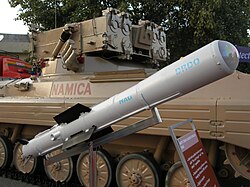
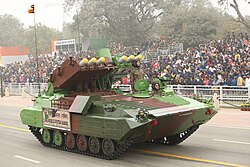
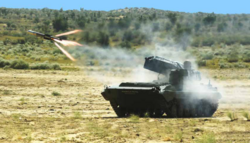


 Closeup view of Nag missile with imaging infrared (IIR) seeker
 HELINA fired from HAL Rudra


