









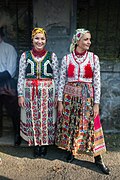
m Removed empty portal template using script |
No edit summary |
||
| Line 1: | Line 1: | ||
{{Short description| | {{Short description|Traditional clothing usually associated with a geographic area}} | ||
{{more citations needed|date=October | {{more citations needed|date=October 2025}} | ||
{{image frame|content={{multiple image |border = infobox | total_width = 300 | perrow = 2/2/2/2/1 | |||
|image1=WLF frobas (3).jpg | |||
|image2=Kenya dancing (10706364576).jpg | |||
|image3=Ukrainian dancers. Photo 493.jpg | |||
|image4=Peru-2422775 1280.jpg | |||
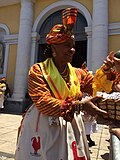
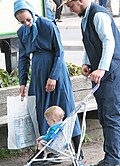
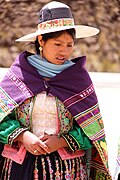
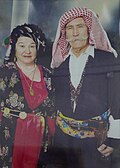
}}|caption=From top, left to right: [[Filipinos]] ([[Igorot people|Igorot]]), [[Kenyans]], [[Ukrainians]] and [[Peruvians]] dressed in traditional garments|align=right|mode=|width=300}} | |||
{{Western dress codes|supplementary}} | {{Western dress codes|supplementary}} | ||
'''Folk costume''', also known as '''traditional dress''', '''traditional attire''', '''folk attire''', or '''regalia''' is [[clothing]] of an [[ethnic group]], [[nation]] or [[region]], and expresses [[Cultural identity|cultural]], [[Religious identity|religious]] or [[national identity]]. It includes both everyday and [[formal wear]], those which do not cater to [[Western dress codes]]. | |||
An ethnic group's clothing may be called '''ethnic clothing''' or '''ethnic dress'''. Those attributed to a certain place are often called '''national costume''' or '''regional costume'''; these may have official designation. | |||
Following the rise of [[romantic nationalism]] | == Overview == | ||
Following the rise of [[romantic nationalism]] in parts of [[Europe]],<ref>{{cite encyclopedia |title=Dress, design: Introductory survey essay|encyclopedia=Encyclopedia of Romantic Nationalism in Europe|year=2022|last1=Martinez|first1= Gimeno|last2= Leerssen|first2=Joep|publisher=Study Platform on Interlocking Nationalisms|location=Amsterdam|id= |url=https://ernie.uva.nl/viewer.p/21/56/object/122-160800|access-date=November 7, 2023}}</ref> pre-industrial peasantry came to serve as an ideal of authenticity. Garments evoking peasant dress were made from [[narrow cloth|traditional pre-industrial textiles]]. | |||
In | In regions where Western dress codes are common, traditional garments are often worn during special events or celebrations. International events may cater to non-Western attendees with a compound [[dress code]] such as "business suit or national dress". | ||
In | In some contemporary societies, traditional garments are required by [[sumptuary law]]s. | ||
==Africa== | ==Africa== | ||
{{Further|Clothing in Africa}} | |||
=== | ===North Africa=== | ||
{{Multiple image | |||
| image1 = Traditional gandoura.jpg | |||
| caption1 = Traditional [[gandoura]], also called [[djebba fergani]], from [[Algeria]] | |||
| image2 = Egyptian musicians.jpg | |||
| caption2 = Egyptian musicians wearing [[jellabiya]] | |||
| image3 = Moroccan women wearing takchita (1939).jpg | |||
| caption3 = Moroccan women wearing [[takshita]] in 1939 | |||
| image4 = Sefseri.JPG | |||
| caption4 = Traditional Tunisian clothing, including [[safasir]] | |||
| total_width = 300 | |||
| perrow = 2 | |||
}} | |||
=== | ==== Algeria ==== | ||
[[ | In [[Algeria]], cultural dress includes the [[burnous]], [[ghlila]], [[Kaftan#Algerian kaftan|caftan]], [[gandoura]], [[Haik (garment)|haik]], [[jellaba]], [[m'laya]], and [[Sirwal|sarouel]]. In northern Algeria, clothing includes the [[karakou]] (in [[Algiers]]), labsa Naïlia (among [[Ouled Naïl]]), and labsa M'zabia (among [[Mozabite people]]). In northeastern Algeria, dress includes Gandoura Annabiya (in [[Annaba Province|Annaba]]), [[qashabiya]] and melhfa chaouïa (among [[Chaoui people]]), labsa Kbaylia (among [[Kabyle people]]), and binouar Staifi (in [[Sétif]]). In northwestern Algeria, traditional dress includes the blouza in [[Oran Province|Oran]] and the [[chedda of Tlemcen]]. In southern Algeria, the [[tagelmust]] is traditional attire; traditional clothing of the [[Tuareg people]] includes the [[Tuareg people#Clothing|akhebay]]. In Western Algeria, [[Sahrawis]] wear the [[Melhfa|el-melhfa Sahraoui]]. | ||
==== Other nations ==== | |||
[[Caftan]], [[Fouta towel]], [[Jallabiyah]] and [[Taqiyah (cap)|Taqiyah cap]] are common throughout [[Islam in Africa|Muslim communities in Africa]]. | |||
=== | ===Sub-Saharan Africa=== | ||
{{See also||Yoruba clothing|Fashion in Nigeria}} | |||
Transnational traditional attires in [[Sub-Saharan Africa]] include [[agbada]] and [[Boubou (clothing)|boubou]], and [[dashiki]] for men, [[pagne]]/pano and [[Wrapper (clothing)|kaftan]] for women. | |||
[[Xhosa people]] were [[umbhaco]] for both genders. For women, dress includes the faskoti, inxili (sling bag), ncebetha, iqhiya, and ibhayi. For men, it includes the ingqosha, isidanga, and unngqa.<ref name="yoairSAfrica" /> | |||
[[ | |||
Among [[Zulu people]], traditional clothing includes the isicholo, isidwaba, umutsha, and ibheshu.<ref name="yoairSAfrica" /> | |||
[[ | |||
For [[Sotho people]], traditional dress includes [[shweshwe]], [[basotho blanket]]s, and [[mokorotlo]]. [[Afrikaners]] and [[Rooinek]]s may wear a [[slouch hat]], [[safari shirt]], [[veldskoen]], knee-high socks, khaki [[Bermuda shorts]] or trousers. | |||
==== Specific nations ==== | |||
{{multiple image | |||
| align = right | |||
| image1 = Traditional Eritrean dance.jpg | |||
| caption1 = [[Tigrinya people|Tigrinya]] women dancing in traditional [[zuria]]s | |||
| image2 = Beauty of Oromia.jpg | |||
| caption2 = Variety of cultural dress of the [[Oromo people]] in Ethiopia | |||
| image3 = Kitenge outfit.jpg | |||
| caption3 = A [[kitenge]] dress from Kenya | |||
| image4 = Maasai Woman Meeyu Sale Wearing her Finest.jpg | |||
| caption4 = A Maasai woman and child | |||
| image5 = Togho 03.jpg | |||
| caption5 = Toghu or tugh, the official traditional regalia of [[Cameroon]]. | |||
| image6 = Baganda people in their cultural outfits. men put on Kanzu, and ladies Ggomeesi.jpg | |||
| caption6 = [[Baganda]] people in their cultural outfits. Men put on Kanzu, and ladies put on Ggomeesi. | |||
| image7 = 2008-02-09 Xhosa women.jpg | |||
| caption7 = Xhosa women wearing Shweshwe fabric in South Africa | |||
| image8 = ZULU TRADITIONAL ATTIRE.jpg | |||
| caption8 = Zulu traditional attire in South Africa | |||
| image9 = A Yoruba man garbed in traditional clothing (2).png | |||
| caption9 = A [[Yoruba people|Yoruba man]] in a traditional [[agbada]] | |||
| image10 = Dashiki and kufi.jpg | |||
| caption10 = A drummer wearing a [[dashiki]] in [[Accra]], Ghana | |||
| image11 = Parade of Basotho women.jpg | |||
| caption11 = [[Basotho]] women wearing [[Basotho blanket|traditional]] blankets in Lesotho | |||
| image12 = Chitenge, Malawi.jpg | |||
| caption12 = Malawian women wearing [[kitenge]] fabric | |||
| image13 = Mozambique 01200 (5054130545).jpg | |||
| caption13 = Mozambican woman wearing a [[capulana]] | |||
| total_width = 300 | |||
| perrow = 2 | |||
}} | |||
In [[Botswana]], traditional attire includes the ieteisi and tshega. | |||
The {{lang|rn|[[Mushanana|imvutano]]}} is traditional clothing in [[Burundi]]. | |||
In [[Cameroon]],<ref>{{cite web |last1=Chatterjee |first1=Saheli |title=Anthropology in Fashion: Cultural Clothing in Central Africa |url=https://www.yoair.com/blog/anthropology-in-fashion-cultural-clothing-in-central-africa/ |website=YOAIR Blog |access-date=8 November 2023 |archive-date=8 November 2023 |archive-url=https://web.archive.org/web/20231108044310/https://www.yoair.com/blog/anthropology-in-fashion-cultural-clothing-in-central-africa/ |url-status=dead }}</ref><ref>{{cite web |title=Traditional Tuesday: Cameroon edition |url=https://nenefashion.wordpress.com/2015/03/04/traditional-tuesday-cameroon-edition/ |website=Nene Fashion |date=4 March 2015 |access-date=8 November 2023}}</ref> women also wear [[head tie]], men also wear [[Culture of Cameroon#Fashion|kwa and gandura]]. Dress is highly dependent on region and ethnicity. The [[Abacost]] suit is common in Zairian republics. | |||
Traditional attire of the [[Comoros]] includes {{lang|pt|[[Kanga (African garment)|lesso]]}}, ''[[shiromani]]'', ''[[salouva]]'', ''[[aanzu]]'', ''[[bwibwi]]'' for women, and {{lang|sw|[[Kofia (hat)|kofia]]}} for men.<ref>{{cite web |date=7 June 2021 |title=Come Discover the Culture of Comoros |url=https://adorecomores.com/culture/ |access-date=11 November 2023 |website=Adore Comores}}</ref> | |||
In [[Djibouti]], traditional attire includes the [[Sarong|macawiis]] and [[Kofia (hat)|koofiyad]] for men, and the dirac and garbasaar for women. The [[Afar people]] have their own style of traditional clothing. | |||
Men in [[Eritrea]] wear [[Kidan Habesha]] as traditional dress. Women wear the [[zuria]] or [[Habesha kemis]]. | |||
Each [[List of ethnic groups in Ethiopia|ethnic group]] in [[Ethiopia]] has a traditional style of dress. Ethiopian traditional clothing includes the [[Ethiopian suit]] or [[Kidan Habesha]] for men, and the [[Habesha kemis]] for women. | |||
There is no official national costume of [[Kenya]], but leso and [[Kanga (African garment)|kanga]] are worn throughout the country.<ref name="yoairEAfrica">{{cite web |last1=Chatterjee |first1=Saheli |title=Anthropology in Fashion: Cultural Clothing in Eastern Africa |url=https://www.yoair.com/blog/anthropology-in-fashion-cultural-clothing-in-eastern-africa/ |access-date=8 November 2023 |website=YOAIR Blog |archive-date=8 November 2023 |archive-url=https://web.archive.org/web/20231108054253/https://www.yoair.com/blog/anthropology-in-fashion-cultural-clothing-in-eastern-africa/ |url-status=dead }}</ref> [[Kikoi]], similar to kanga fabric, is also widespread. All [[Demographics of Kenya|tribes]] have their respective traditional garments. For example, [[Maasai people#Clothing|Maasai clothing]] includes traditional shuka and [[beadwork]].<ref name="yoairEAfrica" /> | |||
The [[Lamba (garment)|lamba]] is part of the traditional dress of [[Madagascar]]. | |||
In [[Mauritius]] and [[Réunion]], the ''sega'' is part of traditional clothing. | |||
In [[Mozambique]], cultural attire includes the [[capulana]].<ref name="yoairSAfrica">{{cite web |last1=Chatterjee |first1=Saheli |title=Anthropology in Fashion: Cultural Clothing in Southern Africa |url=https://www.yoair.com/blog/anthropology-in-fashion-cultural-clothing-in-southern-africa/ |access-date=8 November 2023 |website=YOAIR Blog |archive-date=8 November 2023 |archive-url=https://web.archive.org/web/20231108063152/https://www.yoair.com/blog/anthropology-in-fashion-cultural-clothing-in-southern-africa/ |url-status=dead }}</ref> | |||
In [[Namibia]] cultural dress includes [[Herero people|Herero]] traditional clothing, like the ohorokova dress and the otjikaiva hat.<ref name="yoairSAfrica" /><ref>{{cite news |last1=Kanungo |first1=Pallavi |date=February 23, 2023 |title=Ohorokova: The African attire born out of protest |url=https://htschool.hindustantimes.com/editorsdesk/knowledge-vine/ohorokova-the-african-attire-born-out-of-protest |access-date=8 November 2023 |work=HT School |publisher=Hindustan Times}}</ref> | |||
The [[mushanana]] is traditional clothing in [[Rwanda]] and southwestern [[Uganda]]. | |||
[[Seychelles]] traditional dress includes the ''kanmtole.'' | |||
In [[Somalia]], traditional dress includes the [[kanzu]] or khamiis and [[kitenge]]. For men, traditional clothing also includes the [[Sarong|macawiis]] and [[Kofia (hat)|koofiyad]]. Women may wear the dirac, guntiino, and garbasaar. | |||
Traditional dress in [[Tanzania]] and [[Uganda]] varies by tribe, and may include the [[kanzu]] and [[Kofia (hat)|kofia]] for men, and the [[Kanga (African garment)|kanga]] for women.<ref name="yoairEAfrica" /> | |||
[[Kitenge]], A piece of fabric wrapped around the chest, is part of the traditional clothing of [[Malawi]], [[Zambia]], and [[Zimbabwe]]. | |||
{{Clear}} | |||
==Americas== | |||
{{See also|Textile arts of the Indigenous peoples of the Americas|Indigenous fashion of the Americas}} | |||
The word ''[[costume]]'' in "folk costume" is sometimes considered [[pejorative]] particularly among [[Native Americans]], as the word has more than one meaning.<ref>{{cite web |last1=Reese |first1=Debbie |date=15 May 2007 |title=The word "costume" and American Indians |url=https://americanindiansinchildrensliterature.blogspot.com/2007/05/word-costume-and-american-indians-when.html |access-date=9 November 2023 |website=American Indians in Children's Literature}}</ref><ref>{{cite web |last1=Arce |first1=Isis |date=4 February 2019 |title=Native Regalia is NOT a Costume! |url=https://voicesofnativeyouth.com/native-regalia-is-not-a-costume/ |access-date=9 November 2023 |website=Voices of Native Youth}}</ref><ref>{{cite web |last1=Higgins |first1=Julissa |date=7 May 2018 |title=Opinion: Why It's Time to Stop Using the Word "Garb" |url=https://www.fashionstudiesjournal.org/notes/2018/5/7/opinion-why-its-time-to-stop-using-the-word-garb |access-date=9 November 2023 |website=The Fashion Studies Journal}}</ref> | |||
===Caribbean=== | |||
[[File:Mobeye-ÉtéDesVilles-Guadeloupe-827.jpg|thumb|upright=0.75|A woman wearing a traditional [[Guadeloupe]]an dress]] | |||
[[File:Charles Camilla Jamaica 2008.jpg|thumb|upright=0.75|Women wearing the [[quadrille dress]], greeting the [[British royal family]] (the [[King of Jamaica]] is the same person as the [[King of the United Kingdom]]) in Jamaica]] | |||
For women in [[Antigua and Barbuda]], national attire is a plaid dress with white [[pinafore]], designed by [[Heather Doram]]. | |||
There is no official folk dress of [[the Bahamas]], though clothing made with [[Androsia]] may be considered traditional attire. [[Junkanoo]] costumes can be considered folk costume but fall more into the sector of carnival dress than traditional garment. | |||
In [[Cuba]], traditional dress includes the [[guayabera]] and [[panama hat]] for men, and the guarachera for women.<ref name="ABC-CLIO">{{cite book |url=https://books.google.com/books?id=lazWAQAAQBAJ&pg=PA123 |title=Encyclopedia of National Dress, Vol. I |date=2013 |publisher=ABC-CLIO |isbn=978-0-313-37637-5 |editor1-last=Condra |editor1-first=Jill |location=Santa Barbara, CA |page=123}}</ref> | |||
Traditional attire in the [[Dominican Republic]] includes the [[Guayabera|chacabana]] and [[panama hat]]. | |||
The [[Madras (costume)|madras]] is part of traditional attire in [[Dominica]]. | |||
In [[Haiti]], cultural attire includes the [[Quadrille dress|karabela dress]] for women and [[Guayabera|shirt jacket]] for men. | |||
Traditional attire in [[Jamaica]] includes the [[Madras (cloth)|bandana cloth]] [[Quadrille dress]] for women, [[bandana]] cloth shirt and white [[trousers]] for men, and the [[Jamaican Tam]]. | |||
In [[Puerto Rico]], men's traditional clothing includes the [[guayabera]] and [[panama hat]]. Women's traditional attire includes the ''enagua''.<ref name="ABC-CLIO" /> | |||
The [[Madras (costume)|madras]] is part of traditional attire in [[Saint Lucia]]. | |||
Cultural dress varies in [[Trinidad and Tobago]]. [[Tobago]] has an Afro–Tobagonian [[Creole peoples|creole]] culture with [[bélé]] costumes as their typical garment, commonly made of [[Madras (cloth)|madras]]. Trinidad has no defined national garment. During cultural occasions, [[Afro–Trinidadians and Tobagonians|Afro–Trinidadian and Tobagonian]] men wear [[guayabera]] or [[dashiki]], and women wear a [[Wrapper (clothing)#Booboo|booboo]]. [[Indo–Trinidadians and Tobagonians|Indo–Trinidadian and Tobagonian]] men wear [[kurta]], [[dhoti]], [[sherwani]], and women wear [[sari]], [[choli]], and [[lehenga]]. | |||
===Central America=== | |||
{{multiple image | |||
| align = right | |||
| image1 = Jeunes femmes mayas.jpg | |||
| caption1 = Young [[Maya people|Mayan]] women in traditional dress in [[Antigua, Guatemala]] | |||
| image2 = Mujeres de Nebaj, Guatemala 2013.jpg | |||
| caption2 = Mayan folk clothing in Guatemala | |||
| image3 = Huipil, skirt, belt (c.1950), shawl, Ixil Maya, Nebaj, mid to late 20th century, cotton - Textile Museum of Canada - DSC01351.JPG | |||
| caption3 = [[Santa María Nebaj|Nebaj]] [[Ixil people|Ixil]] {{lang|nah|[[Huipil]]}} (c. 1950) | |||
| image4 = Pollera_Panama_Madre_e_Hija.jpg | |||
| caption4 = Two women wearing {{lang|es|[[pollera]]}} in [[Panama]] | |||
| image5 = Mujeres de la etnia Emberá.jpg | |||
| caption5 = [[Embera-Wounaan|Emberá]] girls in Panama | |||
| image6 = Panama-Kuna 0605a.jpg | |||
| caption6 = [[Guna people|Guna]] women wearing [[Mola (art form)|molas]] | |||
| image7 = Kunawoman.jpg | |||
| caption7 = Guna woman wearing mola | |||
| width = | |||
| total_width = 300 | |||
| perrow = 4 | |||
}} | |||
In [[Belize]], among [[Hispanic Belizean]]s, traditional attire includes the [[huipil]] for women and the [[guayabera]] for men. Among the [[Maya peoples]], all tribes wear distinct kinds of dress. | |||
Among women in [[Nicaragua]], traditional attire includes the [[huipil]] and [[rebozo]]. Men wear the {{Ill|Cotona|lt=cotona|es}}. | |||
In [[Guatemala]], traditional clothing includes the [[huipil]], corte skirt, and tocado for women, and the [[Todos Santos Cuchumatán|todosantero]] suit for men. | |||
Traditional attire in [[Panama]] includes the [[pollera]] for women and montuno for men. | |||
==== Mexico ==== | |||
The folk dress of [[Mexico]] varies by state. For men, traditional dress includes the [[charro outfit]], [[guayabera]], [[sarape]], and [[sombrero]]. For women, it includes the [[rebozo]] and [[china poblana]] dress. | |||
In [[Northern Mexico|el Norte]], traditional attire may include [[cowboy hat]]s, [[cowboy boot]]s, and [[bandana]]. [[Indigenous peoples of Mexico|Indigenous peoples]], like the [[Yaqui]], [[Seri people|Seri]] and [[Rarámuri]], wear traditional apparel. The {{Ill|Cuera tamaulipeca|lt=cuera tamaulipeca|es|Cuera tamaulipeca}} ('tamaulipeca leather jacket') is traditional attire in [[Tamaulipas]]. | |||
In [[Querétaro]], [[Hidalgo (state)|Hidalgo]], and [[San Luis Potosí]], traditional clothing includes the [[quechquemitl]]. | |||
In [[Veracruz]], traditional attire includes the [[guayabera]]. In [[Yucatán]], it includes the guayabera for men and [[huipil]] for women. | |||
The [[Tehuana (clothing)|tehuana]] is traditional attire in [[Oaxaca]]. | |||
In [[Chiapas]], the {{Ill|Chiapaneca outfit|es|Traje de chiapaneca}} is traditional attire. | |||
{{multiple image | |||
| align = center | |||
| image1 = CharroOutfitsNoreste18.JPG | |||
| caption1 = [[China poblana]] dress | |||
| image2 = Quezquemetl.jpg | |||
| caption2 = {{lang|nah|[[Quezquémetl]]}} of the [[Huastec people|Huasteca Potosina]] | |||
| image3 = Traje tehuana.jpg | |||
| caption3 = Dancers wearing traditional tehuana of [[Oaxaca]] | |||
| total_width = 450 | |||
}} | |||
=== North America === | |||
==== Canada ==== | |||
{{multiple image | |||
| align = right | |||
| image1 = Inuit Amautiq 1995-06-15.jpg | |||
| caption1 = Two [[Inuit]] women wearing {{transliteration|iu|[[amautiit]]}} (skirted style, akuliq) in [[Nunavut]] (1995) | |||
| image2 = Cowichan Sweater.jpg | |||
| caption2 = [[Cowichan sweater]] featuring the Thunderbird design | |||
| image3 = Unidentified Plains Cree at a powwow in Fort Qu'Appelle, Saskatchewan (18469335396).jpg | |||
| caption3 = Unidentified [[Plains Cree people|Plains Cree]] at a [[powwow]] in [[Fort Qu'Appelle, Saskatchewan]] | |||
| image4 = Capote for scout on raiding party, Siksika, early 1900s, wool from Hudson's Bay Company blanket, glass beads - Glenbow Museum - DSC01002.jpg | |||
| caption4 = A [[Siksika Nation|Siksika Blackfoot]] [[Capote (garment)|capote]] | |||
| total_width = 300 | |||
| perrow = 2}} | |||
In [[Canada]], different regions have different traditional clothing. | |||
The traditional dress of [[First Nations in Canada|First Nations]] peoples, which is often called "regalia", may include the [[button blanket]], [[buckskins]], [[moccasin]]s, [[Chilkat weaving|Chilkat blanket]], [[Cowichan sweater]], and [[war bonnet]]. Traditional attire of the [[Métis]] includes the [[ceinture fléchée]], [[Capote (garment)|capote]], and [[moccasin]]s. In [[Nunavut]] and other [[Inuit]] communities, traditional clothing includes the [[parka]], [[mukluk]]s, and [[amauti]]. | |||
For [[lumberjack]]s of [[Quebec]] and [[Ontario]], traditional logging wear includes [[mackinaw jacket]]s or [[flannel]] shirts, with headgear being a [[tuque]] or [[Coonskin cap|trapper hat]]; a good example is seen with folk characters like [[Big Joe Mufferaw]]. | |||
In the [[Maritimes]], [[Acadians]] wear their traditional heritage clothing on special occasions like the [[Tintamarre]]. The Scottish background in [[Nova Scotia]] has brought the [[Nova Scotia tartan]] as folk wear in the form of kilts, aboyne dresses, and trews for [[Scottish highland dance]] competitions. | |||
In [[Quebec]] and among [[French Canadians]], traditional clothing includes the [[ceinture fléchée]], [[Capote (garment)|capote]], and [[tuque]]. | |||
In [[Canadian Prairies|the Prairies]], [[Western wear|cowboy costume]] is common for events such as the [[Calgary Stampede]], and is often worn with [[Calgary White Hat]]s. | |||
[[Newfoundland (island)|Newfoundland]] – Traditional [[Mummering|mummers]] dress in masks and baggy clothes in Christmas season celebrations; the Cornish influence has also brought yellow [[oilskin]]s and [[sou'wester]]s as typical wear in coastal areas. | |||
===== Greenland ===== | |||
{{Further|Inuit clothing}} | |||
In [[Greenland]], traditional attire includes the [[anorak]]. | |||
==== United States ==== | |||
{{multiple image | |||
| align = right | |||
| image1 = Chief Anotklosh of the Taku Tribe in Juneau.jpg | |||
| caption1 = Chief Anotklosh ([[Taku people|Taku]]) wearing a [[Chilkat weaving|Chilkat]] robe (c. 1913) | |||
| image2 = Alaska Native dancer wearing kuspuk.jpg | |||
| caption2 = [[Alaska Native]] dancer performing in a {{lang|esu|[[kuspuk]]}} (2013) | |||
| image3 = The Winnemem Wintu Chief (3812027389).jpg | |||
| caption3 = [[Winnemem Wintu]] chief Caleen Sisk in traditional dress (2009) | |||
| image4 = Native American PowWow 9488.jpg | |||
| caption4 = [[Cheyenne]] [[dog soldier]] wearing a feathered [[war bonnet|headdress]] (2008) | |||
| total_width = 300 | |||
| perrow = 2 | |||
}} | |||
In the [[United States]], different regions have different traditional clothing. | |||
Styles of [[traditional Native American clothing]] vary. Traditional [[pow-wow]] regalia for [[Plains Indians]] may include [[moccasin]]s, [[buckskins]], glass beads, [[breech clout]]s, and [[war bonnet]]s or [[Roach (headdress)|roach]]es. For [[Indigenous peoples of the Northeastern Woodlands|Native Americans of the Northeastern Woodlands]], [[matchcoat]] and [[wampum]] are used. Among [[Alaska Natives]], traditional attire includes [[kuspuk]]s worn with dark pants and [[mukluk]]s, as well as [[parka]]s. The [[Yupʼik clothing|clothing of the Yupʼik people]] is designed to keep the wearer warm and dry in cold weather. | |||
[[File:Four_students_with_guitar.jpg|thumb|upright=.75|Texan folk costume comprising [[cowboy hat]]s, [[jeans]] and checked [[western shirt]]s (c. 1950)]] | |||
[[Western wear]] is traditional dress in several areas of the United States, including [[Texas]] and the [[Southwestern United States|Southwest]], and rural areas in the [[Midwestern United States|Midwest]] and the [[Western United States|West]]. This attire, derived from Mexican [[vaquero]] and [[American pioneer]] garb, may include [[cowboy hat]]s, [[Western shirt]]s, [[cowboy boot]]s, [[jeans]], [[chaps]], [[prairie skirt]]s, and [[bolo tie]]s. | |||
Due to cold weather, clothing in northern areas—such as the [[Upper Midwest]], [[Pacific Northwest]], and northern [[New England]]—tends to include heavier materials. This may include [[flannel]] shirts or Buffalo plaid [[mackinaw jacket]]s, and a [[knit cap]] or, in the case of the [[Upper Peninsula of Michigan]], a [[Stormy Kromer cap]]. The attire of folk hero [[Paul Bunyan]] may represent this style. | |||
In the [[Deep South]], traditional attire includes white [[seersucker suit]]s and [[string tie]]s for men, and [[sun hat]]s and large [[Southern belle]]-style dresses for women. The [[Cajun]] people of [[Louisiana]] traditionally wear the colorful [[capuchon]] for [[Mardi Gras]] celebrations. Historically, [[Louisiana Creole people|Creole]] women wore the [[tignon]], mostly in plain or [[Madras fabric|madras]] fabrics; it is now sometimes worn for heritage events or for cultural reasons. [[Gullah]] communities in the [[South Carolina Lowcountry]] and the [[Sea Islands]] preserve the traditional African-style clothing and culture. | |||
[[File:AmishFamilyNiagaraFalls.jpg|thumb|upright=0.75|An [[Amish]] family in traditional [[plain dress]]]] | |||
Summer residents of [[Nantucket]] will often wear [[Nantucket Reds]]. In [[Utah]], [[Mormons]] may dress in 19th-century pioneer clothing for [[Mormon Trail]]–related activities and events. The [[Amish]] (mostly found in [[Pennsylvania]], [[Ohio]] and [[Indiana]]) follow a style of [[plain dress]]. | |||
===South America{{Anchor|South America|Southern America}}=== | |||
==== Argentina ==== | |||
In [[Argentina]], traditional folk attire is the [[gaucho]] costume. Each province has a specific design of [[poncho]], with the ''{{Ill|Poncho salteño|lt=poncho salteño|es}}'' being the most recognized. | |||
{{Multiple image | |||
| align = center | |||
| direction = horizontal | |||
| total_width = 400 | |||
| image1 = Macri con Félix Diaz.jpg | |||
| caption1 = [[Félix Díaz (cacique)|Félix Díaz]], a [[Toba people|Qom]] leader, meets with President [[Mauricio Macri]] wearing traditional dress | |||
| image2 = Gauchito salteño argentino.jpg | |||
| caption2 = Argentinian man wearing [[Gaucho]] clothes | |||
}} | |||
==== Bolivia ==== | |||
[[File:Pongo 0436b.jpg|thumb|upright=0.75|Indigenous woman in traditional dress near [[Cochabamba, Bolivia]]]] | |||
In [[Bolivia]], traditional clothing includes the [[poncho]], [[chullo]], and the [[Pollera|Andean pollera]]. | |||
==== Brazil ==== | |||
In [[Brazil]], each region has its own traditional costume. | |||
In many states within the [[Amazônia Legal]] region, [[Indigenous peoples in Brazil|Indigenous peoples]] wear traditional clothes specific to their ethnic groups. An example is the ''kushma'', used by the [[Asháninka]]. | |||
In [[Bahia]], the traditional outfits are the ''{{Ill|Baiana clothing|lt=baiana|pt|Vestuário das baianas}}'' and ''[[abadá]]''. In [[Rio de Janeiro]], [[samba]] costumes are worn during the four days of [[Brazilian Carnival]] by members of [[samba school]]s. Outside of Carnival, the most traditional men's attire is that of the ''malandro carioca'' ('carioca rascal') or ''sambista'', which includes white pants, a striped shirt, a white jacket, and a straw hat. In [[São Paulo (state)|São Paulo]], [[Goiás]], and nearby states, ''[[Caipiras]]'' (Brazilian country folk) preserve traditional folk styles of clothing, which are often imitated during [[Festa Junina|festa junina]] celebrations. In [[Rio Grande do Sul]], the traditional attire is the [[gaúcho]] costume. In [[Pará]], the typical clothing is that associated with [[carimbó]], a popular dance from northern Brazil. In the northeastern [[sertão]], [[cangaceiro]] clothing is traditional. | |||
{{Multiple image | |||
| align = center | |||
| direction = horizontal | |||
| total_width = 450 | |||
| perrow = 3 | |||
| image1 = Pataxo002.jpg | |||
| caption1 = [[Pataxó]] man | |||
| image2 = Enawene-nawe 1257a.JPG | |||
| caption2 = [[Enawene Nawe]] man | |||
| image3 = Terena006.jpg | |||
| caption3 = [[Terena people|Terena]] woman | |||
| image4 = Índios da etnia Kuikuro.jpg | |||
| caption4 = [[Kuikuro]] men | |||
| image5 = Memorial das baianas - 20.jpg | |||
| caption5 = Baiana dress from Brazil | |||
| image6 = SalvadorDaBahiaBahianDress.jpg | |||
| caption6 = Women wearing baiana dresses in [[Salvador, Bahia]] | |||
}} | |||
==== Chile ==== | |||
In [[Chile]], the traditional attire is the [[huaso]] costume, which includes a [[chamanto]], [[chupalla]], and [[poncho]]. | |||
{{Multiple image | |||
| align = center | |||
| direction = horizontal | |||
| total_width = 600 | |||
| image1 = Mujeres mapuches en la entrega terreno a Comunidad Mapuche Lorenzo Quintrileo de Tirúa.jpg | |||
| caption1 = [[Mapuche]] women from [[Tirúa]] (2015) | |||
| image2 = Mapuche.jpg | |||
| caption2 = [[Mapuche]] man in Chile (2007) | |||
| image3 = Gauchowheat edit2.jpg | |||
| caption3 = Chilean [[huaso]] man wearing a [[chupalla]] and [[chamanto]] (1940) | |||
}} | |||
==== Colombia ==== | |||
Each region in [[Colombia]] has a distinct costume. Traditional male attire includes the [[sombrero vueltiao]], [[ruana]], white shirt, trousers, and [[Espadrille|alpargatas]]. Women's attire includes a blouse, [[Pollera|cumbia pollera]], sombrero vueltiao, and alpargatas. | |||
{{Multiple image | |||
| align = center | |||
| direction = horizontal | |||
| total_width = 600 | |||
| image1 = Guajiran artisans.jpg | |||
| caption1 = [[Wayuu]] women in the [[Guajira Peninsula]], which comprises Colombia and Venezuela | |||
| image2 = Guambia, Colombia.jpg | |||
| caption2 = [[Guambía people]] relaxing in Colombia | |||
| image3 = Bailadores de cumbia.jpg | |||
| caption3 = [[Cumbia (Colombia)|Cumbia]] dancer holding a [[sombrero vueltiao]] | |||
}} | |||
==== Ecuador ==== | |||
{{Multiple image | |||
| align = right | |||
| direction = horizontal | |||
| total_width = 200 | |||
| image1 = Chaman Amazonie 5 06.jpg | |||
| caption1 = Shaman of the [[Cofán people]] from the [[Amazon rainforest]] in present-day Ecuador | |||
| image2 = Lideresa waorani Alicia Cahuiya.jpg | |||
| caption2 = [[Alicia Cawiya]], vice-president of the [[Huaorani]] Nation of Ecuador, in traditional dress | |||
}} | |||
In [[Ecuador]], traditional clothing includes the [[poncho]] and [[Panama hat]]. | |||
==== Guyana ==== | |||
[[Guyana]] does not have a designated style of national dress. Each ethnic group wears its cultural clothing during important events or occasions. [[Afro-Guyanese]] men typically wear a [[dashiki]] or [[Guayabera|shirt jacket]], and women wear a [[Wrapper (clothing)|booboo]]. [[Indo-Guyanese]] men wear a [[kurta]], [[sherwani]], or [[churidar]], while women wear a [[sari]] or [[lehenga]]. Each [[Indigenous peoples in Guyana|indigenous tribe]] wears its tribal clothing during cultural events or important occasions. | |||
==== Paraguay ==== | |||
In [[Paraguay]], traditional clothing includes the {{Ill|Ao po'i|lt=ao po'i|es}}. | |||
==== Peru ==== | |||
In [[Peru]], traditional attire includes the [[chullo]], [[poncho]], and [[Pollera|Andean pollera]]. | |||
{{Multiple image | |||
| align = center | |||
| direction = horizontal | |||
| total_width = 450 | |||
| image1 = Taquile Inselfest Frauen.JPG | |||
| caption1 = [[Quechua people|Quechua]] women in festive dress on [[Taquile Island]], [[Lake Titicaca]], Peru | |||
| image2 = Andean Man.jpg | |||
| caption2 = A Peruvian man in traditional dress | |||
}} | |||
==== Suriname ==== | |||
In [[Suriname]], traditional clothing includes the [[Koto (traditional clothing)|kotomisse]] and [[Pangi cloth|pangi]] cloth. | |||
{{Multiple image | |||
| align = center | |||
| direction = horizontal | |||
| width = | |||
| image1 = Tropenmuseum Royal Tropical Institute Objectnumber 60005741 Creoolse vrouw in kotomisi.jpg | |||
| caption1 = Surinamese woman wearing the traditional [[Koto (traditional clothing)|koto]] (c. 1910) | |||
| image2 = Tropenmuseum Royal Tropical Institute Objectnumber 10019375 Portret van een Marron vrouw voor haa.jpg | |||
| caption2 = [[Maroons|Maroon woman]] wearing a [[Pangi (Maroon)|pangi]] in [[Suriname]] (ca. 1900–1910) | |||
| total_width = 450 | |||
}} | |||
==== Other nations ==== | |||
In [[Uruguay]], the traditional folk attire is the [[gaucho]] costume. | |||
In [[Venezuela]], traditional male attire is the [[llanero]] costume, which includes the [[liqui liqui]] and ''pelo e' guama'' hat. Traditional female attire includes the [[joropo]] dress and ''pelo e' guama'' hat. | |||
==Asia== | ==Asia== | ||
===Central | ===[[East Asia]]=== | ||
{{multiple image | |||
| align = right | |||
| image1 = Red cheongsam2.jpg | |||
| caption1 = Chinese woman wearing ''[[Qipao]]'' | |||
| image2 = Women in kimonos, Nibanchō Street, Kanazawa, 2016.jpg | |||
| caption2 = Japanese women wearing ''[[Kimono]]'' | |||
| image3 = Korea Spring of Insadong 23 (13326968084).jpg | |||
| caption3 = Korean wearing ''[[Hanbok]]'' | |||
| total_width = 300 | |||
| image4 = Indigenous group dancers at Amis Music Festival 2016 IMF0936.jpg | |||
| caption4 = [[Amis people|Amis/Pangcah]] dancers in [[Dulan, Taiwan]] | |||
| image5 = 08.15 總統出席「2016三地門鄉聯合收穫祭」 (28706865630).jpg | |||
| caption5 = [[Paiwan people|Paiwan]] and [[Rukai people]] celebrating a harvest festival in [[Sandimen]], Taiwan | |||
| perrow = 2 | |||
}} | |||
====China proper==== | |||
{{Further|Chinese clothing}} | |||
The traditional clothing of the [[Han Chinese|Han]] ethnic group in China includes various styles such as [[qipao]], [[Changshan|changsan]], or the [[Mao suit]], often dating back to the [[Qing dynasty]] and [[Republic of China (1912–1949)|Republican period]]. Since the 2010s, the [[Hanfu Movement|Hanfu movement]] has grown in popularity among young Chinese enthusiasted in reviving the historical clothings of China before the Qing dynasty, termed ''[[hanfu]]'', which encompasses styles like the [[shenyi]], [[ruqun]], and [[shanku]]. | |||
The [[Miao people]], native to the sounthern hills of China, has their [[Hmong textile art|textile arts]] on their clothings. | |||
Among [[Taiwanese indigenous peoples]], traditional attire varies by group. The [[Rukai people]] wear garments like the ibibogo (a men's daily jacket) and the dalabu (a women's daily top).<ref>{{cite web |title=The Clothing of Taiwan's Indigenous People– Men and Women's Clothes |url=https://culture.teldap.tw/culture/index.php?option=com_content&view=article&id=153 |access-date=10 November 2023 |website=Digital Taiwan - Culture & Nature}}</ref> The [[Atayal people]] wear pearl-adorned shirts and skirts.<ref>{{cite web |title=Dress and Dressing Up |url=https://tme.ncl.edu.tw/en/old-photographs/faces-of-the-century-part-ii/%E6%9C%8D%E9%A3%BE%E8%88%87%E8%A3%9D%E6%89%AEen |access-date=10 November 2023 |website=Taiwan Memory Exhibition |publisher=National Central Library}}</ref> The [[Bunun people]] use the design of the [[Deinagkistrodon|hundred-pace viper]] in their traditional dress.<ref>{{cite web |date=20 December 2010 |title=Bunun |url=https://www.cip.gov.tw/en/tribe/grid-list/7F4BACB58C965B51D0636733C6861689/info.html?cumid=D0636733C6861689 |access-date=10 November 2023 |website=Council of Indigenous Peoples}}</ref> | |||
====Japan==== | |||
In [[Japan]], traditional attire is referred to as ''wafuku'', which includes garments like the [[kimono]], [[Junihitoe|jūnihitoe]], and [[sokutai]]. | |||
In [[Fukuoka Prefecture]], traditional garments include the mizu [[happi]] and [[Fundoshi|shime-komi]]. In [[Hokkaido]], the [[Ainu people]] wear traditional clothing such as the tepa, a sacred belt called raun kut or upsoro kut, konci (hood), hos (leggings), and grass-skin jackets like tetarabe and utarbe. Ceremonial garments include the [[sapanpe]] and the [[matanpushi]]. [[Ryukyuans]] wear [[ryusou]] as traditional attire. In [[Okinawa Prefecture]], the [[Kariyushi shirt]] is traditional clothing. | |||
====Korea==== | |||
{{Further|List of Korean clothing}} | |||
In [[South Korea]], the traditional attire is the [[hanbok]]; it is known as the ''chosŏn-ot'' in [[North Korea]]. Modern hanbok are usually designed after the fashion established in the [[Joseon Dynasty]], especially imitating the colorful styles of the nobility{{citation needed|date=July 2025}}, though a [[Minbok|pure white hanbok]] was a persistent national symbol for everyday wear. The hanbok consists of at least an overcoat [[Po (clothing)|po]], [[jeogori]], and a [[Chima (clothing)|chima]] (skirt) for women and a vest and [[Durumagi|overcoat po]], jeogori, and [[Baji (clothing)|baji]] (trousers) for men.<ref>{{cite web |title=Korean traditional Hanbok clothes, expressing linear beauty |url=https://www.mcst.go.kr/english/useful/issue.jsp?pTab=02 |website=Ministry of Culture, Sports and Tourism |publisher=MCST, Republic of Korea |access-date=24 July 2025}}</ref> The upper garments are made to fit the torso closely, but not tightly, while the lower garments are much looser. | |||
For babies and young children, [[Saekdongot]] is a style of hanbok worn for their first birthday and [[Seollal|lunar new year]] from their first birthday until their seventh birthday. | |||
Hanbok is worn for ceremonies and special occasions, such as weddings (with [[Hwarot]]) and festivals like Seollal. | |||
====Tibet==== | |||
The [[Tibetan people]], native to [[Tibet]], traditionally wear the [[chuba]]. | |||
===Greater Siberia=== | |||
[[Siberians]] nationalities have their traditional clothings. | |||
{{multiple image | |||
| align = right | |||
| image1 = Akšan.jpg | |||
| caption1 = [[Akšan]], Manchu singer and ulabun artist | |||
| image2 = National costume Mongolia 1.jpg | |||
| caption2 = Mongolian ''[[Deel (clothing)|deel]]'' | |||
| image3 = Tuvans Horse riding.jpg | |||
| caption3 = Tuvan horse-riders | |||
| total_width = 300 | |||
| perrow = 2 | |||
}} | |||
[[Mongolians]] wear the [[Deel (clothing)|deel]], which is featured in [[Buryatia]], [[Tuva]], [[Republic of Mongolia|Outer]] and [[Inner Mongolia]]. | |||
In the [[Altai Republic]], [[Altai people|Southern Altaians]] wear items such as the {{transliteration|alt|ton}} (fur coat), {{transliteration|alt|sürü börük}} (cap), {{transliteration|alt|kaptal}} (overcoat). The {{transliteration|alt|chegedek}} (Altai-Kizhi) or {{transliteration|alt|chedek}} ([[Telengits]]) is a sleeveless cloak historically worn by married women; it is now used as bridal or festive attire.<ref>{{cite journal |last1=Hejzlarová |first1=Tereza |date=2019 |title=Traditions and Innovations in the Clothing of Southern Altaians |url=https://www.researchgate.net/publication/337089399 |journal=Annals of the Náprstek Museum |volume=40 |issue=1 |pages=13–17 |doi=10.2478/anpm-2019-0002 |s2cid=208534450 |access-date=2 December 2023 |doi-access=free}}</ref> | |||
In [[Manchuria]], the [[Manchu people]] traditionally wore [[qizhuang]], which includes the [[Magua (clothing)|magua]]. | |||
===Greater Central Asia=== | |||
{{Further|Afghan clothing|Kazakh clothing|Uzbek clothing}} | |||
[[File:Afghan children wearing traditional clothes in Kabul.jpg|thumb|upright=0.75|Afghan children wearing traditional clothes in [[Kabul]]]] | |||
In the five states of [[Central Asia]], as well as [[Afghanistan]] and [[Xinjiang]], common are [[Chapan]], [[khalat]], [[tubeteika]], [[turban]], and [[paranja]] with women also wearing the [[saukele]] and [[kimeshek]]. Afghani [[Pashtun]] women may wear the ''[[firaq partug]]'' outside religious context.<ref name="yoairSAsia23">{{cite web |last1=Chatterjee |first1=Saheli |title=Anthropology in Fashion: Cultural Clothing in South Asia |url=https://yoair.com/blog/anthropology-in-fashion-cultural-clothing-in-south-asia/ |access-date=8 November 2023 |website=YOAIR Blog}}</ref> | |||
=== | ===Indian Subcontinent=== | ||
{{Further|Clothing in India|Fashion in India}} | |||
{{Multiple image | |||
|image1 = Cultural costume.jpg | |||
|caption1 = A variety of cultural clothing common throughout the [[Indian subcontinent]], including [[lehenga]]s, [[choli]]s, [[salwar kameez]], and [[dupatta]] | |||
|image2 = Bride of Bangladesh (06).jpg | |||
|caption2 = A Bangladeshi bridal handloom [[sari]] | |||
|total_width = 300 | |||
}} | |||
=== | In [[Indian subcontinent]] and [[Sri Lanka]], men wear the [[achkan]], [[dhoti]], [[kurta]], [[lungi]], [[mundu]], [[phiran]], [[sherwani]], and [[turban]]. Women's clothing includes the [[shalwar kameez]], [[sari]], [[patiala salwar]], [[lehenga]], [[choli]], [[pathin]], [[dupatta]], and [[churidar]]. The [[mundum neriyatum]] is worn by the [[Malayali people]] of [[Kerala]]. The [[veshti]] is worn by [[Tamils]]. The [[Monpa people]] also have traditional clothing.<ref name="yoair2SAsia23">{{cite web |last1=Chatterjee |first1=Saheli |title=Anthropology in Fashion: Cultural Clothing in India, Bangladesh, and Pakistan |url=https://www.yoair.com/blog/anthropology-in-fashion-cultural-clothing-in-india-bangladesh-and-pakistan/ |access-date=8 November 2023 |website=YOAIR Blog |archive-date=8 November 2023 |archive-url=https://web.archive.org/web/20231108081625/https://www.yoair.com/blog/anthropology-in-fashion-cultural-clothing-in-india-bangladesh-and-pakistan/ |url-status=dead }}</ref><ref>{{cite web |last=Sawe |first=Benjamin |date=April 25, 2017 |title=What Are Examples Of Traditional Indian Clothing? |url=https://www.worldatlas.com/articles/what-are-the-traditional-dresses-of-india.html |access-date=November 7, 2023 |website=WorldAtlas |quote=}}</ref><ref>{{cite news |title=What to Wear in Bangladesh |url=https://www.whattowearonvacation.com/destinations/asia-far-east/bangladesh/134-what-to-wear-in-bangladesh/ |access-date=19 July 2023 |work=whattowearonvacation.}}</ref> [[Shalwar kameez|selwar kamiz]], [[Dupatta|orna]], and [[Kurta|kurtee]].<ref>{{cite web |last=Al Mamun |first=Abdullah |date=May 28, 2023 |title=Traditional Dress of Bangladesh That Reflect Our Culture and Heritage |url=https://bangladeshiheritage.com/traditional-dress-of-bangladesh/ |access-date=November 7, 2023 |website=Bangladeshi Heritage |quote=}}</ref> | ||
====Maldives==== | |||
In the [[Maldives]], men wear the Dhivehi [[mundu]]. Women's traditional clothing includes the dhivehi libaas, feyli, and [[Islamic veiling practices by country#Malaysia|buruga]].<ref name="yoairSAsia23" /> | |||
=== | ====Bhutan==== | ||
[[ | [[Bhutan]] has [[sumptuary law]]s. The ''[[Driglam Namzha]]'' mandates what citizens should wear in public spaces.<ref name="vogue">{{cite web |last=Shah |first=Shalini |date=October 31, 2016 |title=Bhutan's Queen Mother Sangay Choden Wangchuck on weaves in everyday life |url=https://www.vogue.in/magazine-story/bhutans-queen-mother-sangay-choden-wangchuck-on-weaves-in-everyday-life/ |access-date=November 3, 2023 |website=[[Vogue (magazine)|Vogue India]]}}</ref> Bhutanese citizens must wear the traditional clothing of the [[Ngalop people]], including a {{lang|dz|[[gho]]}} and {{lang|dz|kera}} for men and a {{lang|dz|[[Kira (Bhutan)|kira]]}} and {{lang|dz|[[Wonju (Bhutan)|wonju]]}} for women,<ref name="DailyBhutan">{{cite web |last=Lhamo |first=Passang |date=April 2, 2019 |title=Driglam Namzha: Why The Bhutanese Do What They Do |url=https://www.dailybhutan.com/article/driglam-namzha-why-the-bhutanese-do-what-they-do |access-date=November 3, 2023 |website=[[Daily Bhutan (magazine)|Daily Bhutan]]}}</ref> including for official business, schools and institutions, and official occasions and assemblies.<ref name="Altmann">{{cite book |last=Altmann |first=Karin |title=Fabric of Life - Textile Arts in Bhutan: Culture, Tradition and Transformation |date=2016 |publisher=De Gruyter |isbn=978-3-11-042861-2 |location=Berlin, München, Boston |pages=30–32 |doi=10.1515/9783110428612}}</ref> The clothing of the [[Ngalop people]] also includes the [[toego]] and [[kabney]] for men, and rachus for women.<ref name="yoairSAsia23" /> | ||
These restrictions apply when people are in or near "monastic fortresses ({{lang|dz|dzong}}), monasteries ({{lang|dz|gompa}}) and temples ({{lang|dz|lhakhang}}), and government buildings. Karin Altmann, a textile art scholar, describes the intent behind this law "to prevent specific features of Bhutanese culture from disappearing," and "to emphasize national identity",<ref name="Altmann" /> but it has contributed to conflict due to the ethnic and cultural [[Ethnic groups in Bhutan|diversity of Bhutan]].<ref>{{cite journal |date=6 May 2020 |title=Lhotshampas |url=https://minorityrights.org/minorities/lhotshampas/ |access-date=10 November 2023 |website=Minority Rights}}</ref> | |||
===Southeast Asia=== | ===Southeast Asia=== | ||
[[ | ====Continental==== | ||
{{Further|Burmese clothing|Khmer traditional clothing|Traditional Thai clothing|Formal Thai national costume|Vietnamese clothing}} | |||
{{multiple image | |||
| align = right | |||
| image1 = Sishenao2.jpg | |||
| caption1 = [[Áo tứ thân]] | |||
| image2 = Traditional Vietnamese dress.jpg | |||
| caption2 = [[Hmong people|Hmong]] girls in Vietnam wearing [[Hmong textile art|traditional dress]] | |||
| image3 = Centre national de la soie (Artisans dAngkor). (2517376127).jpg | |||
| caption3 = Cambodian [[Sompot Chong Kben]] | |||
[[ | | image4 = Thai Beauties in folk costume Festival dell'Oriente 2017 Italy.jpg | ||
| caption4 = Thai traditional dress | |||
| total_width = 300 | |||
| perrow = 2 | |||
}} | |||
In [[Cambodia]], traditional attire includes the [[sampot]], [[apsara]], [[sabai]], [[krama]], and [[chang kben]].<ref name="yoairSEAsia2">{{cite web |last1=Chatterjee |first1=Saheli |title=Anthropology in Fashion: Cultural Clothing in Southeast Asia |url=https://www.yoair.com/blog/anthropology-in-fashion-cultural-clothing-in-southeast-asia/ |access-date=8 November 2023 |website=YOAIR Blog |archive-date=8 November 2023 |archive-url=https://web.archive.org/web/20231108091337/https://www.yoair.com/blog/anthropology-in-fashion-cultural-clothing-in-southeast-asia/ |url-status=dead }}</ref> | |||
Traditional dress in [[Laos]] includes the [[xout lao]], [[suea pat]], [[pha hang]], [[pha biang]], and [[Sinh (clothing)|sinh]]. | |||
Traditional male dress in [[Myanmar]] includes the [[longyi]], [[gaung baung]], and taipon. Female attire includes the thummy and eingyi.<ref name="yoairSEAsia2" /> | |||
In Thailand, {{tlit|th|RTGS|[[chut thai]]}} ({{literal translation|Thai outfit}}) includes formal clothing such as the Thai Chakkri for women, and the suea phraratchathan for men. Both men and women may wear the [[Sompot Chong Kben|Chong Kraben]] and [[sabai]]. | |||
In [[Vietnam]], traditional clothing includes the [[áo dài]], [[áo tứ thân]], [[áo bà ba]], [[Yếm|áo yếm]], [[áo gấm]], {{ill|Áo ngũ thân|lt=áo ngũ thân|vi}}, as well as the obsolete [[áo giao lĩnh]], {{ill|Áo trực lĩnh|lt=áo trực lĩnh|vi}}, áo viên lĩnh, áo đối khâm, and {{ill|Áo tấc|lt=áo tấc|vi}}.<ref name="yoairSEAsia2" /> | |||
====Insular==== | |||
{{Further|National costume of Indonesia|Fashion and clothing in the Philippines}} | |||
{{multiple image | |||
| align = right | |||
| image1 = Maria Clara Gown.jpg | |||
| caption1 = Filipina women wearing [[Maria Clara gown]]s (1899) | |||
| image2 = Tribu Tinabuay of Murcia.jpg | |||
| caption2 = [[Visayan]] women wearing [[Baro't saya]] featuring their skirt [[patadyong]] while performing in festival dance | |||
| total_width = 300 | |||
| perrow = 2 | |||
| image3 = Aesan Gede Songket Palembang.jpg | |||
| caption3 = Indonesian girl wearing traditional [[Palembang]]ese [[songket]] | |||
| image4 = 2 Malay girls in baju kurung.jpg | |||
| caption4 = [[Malays (ethnic group)|Malay]] women wearing [[Baju Kurung]] | |||
}} | |||
[[Indonesia]] has many national and regional styles of clothing due to its cultural diversity. Among the [[Batak]] peoples, the [[ulos]] (tenun fabric) is traditionally worn. [[Javanese people]] wear garments such as the {{ill|Beskap|lt=beskap|id}}, [[Batik|batik shirt]], [[blangkon]], [[songkok]], and [[sarong]] for men; and the [[kebaya]], [[tudung]], and sarong for women. The [[Malay Indonesian|Malay people]] traditionally wear the [[Baju Melayu]], [[Baju Kurung]], and [[songket]]. Among the [[Indigenous people of New Guinea|Papua]], the [[koteka]] is part of traditional dress.<ref name="yoairSEAsia2" /> | |||
Traditional clothing in [[East Timor]] includes the [[tais]] mane and tais feto.<ref name="yoairSEAsia2" /> | |||
In Malaysia, men traditionally wear the [[Baju melayu|Baju Melayu]] and [[songkok]], while women wear the [[Baju kurung|Baju Kurung]], baju kebarung (a kebaya/kurung hybrid), and [[tudung]]. Each state has its own ''baju'' style, including a distinct style for the [[Federal Territories of Malaysia|Federal Territories]]. | |||
In [[Brunei]], traditional clothing includes the [[Baju melayu|Baju Melayu]] and [[songkok]] for men, and the [[baju kurung]] and [[tudung]] for women. | |||
In the [[Philippines]], cultural attire for men includes the [[Barong tagalog|barong]], while women wear the [[baro't saya]], [[Maria Clara gown]] (or {{lang|es|traje de mestiza}}), and terno. Other garments include the [[malong]], [[patadyong]], [[Tapis (Philippine clothing)|tapis]], and [[salakot]]. | |||
Cultural attire in [[Singapore]] varies. Among [[Chinese Singaporeans]], traditional clothing includes the [[hanfu]], [[cheongsam]] for women, and [[tangzhuang]] and [[changpao]] for men. [[Indian Singaporeans]] traditionally wear the [[sari]] for women, and the [[dhoti]] and [[kurta]] for men. [[Malay Singaporeans]] wear the [[Baju Melayu]] for men, and [[Baju Kurung]] and [[sarong]] for women. [[Peranakans|Peranakan]] women traditionally wear the [[kebaya]]; men traditionally wear the [[Changpao|Baju Lokchuan]]. | |||
=== Middle East === | |||
{{Multiple image| | |||
| image1 = Azerbaijani girls in kelaghayi.jpg | |||
| caption1 = Traditional Azerbaijani dress, including [[kelaghayi]] | |||
| image2 = Turkish folk dancer with traditional costume.jpg | |||
| caption2 = Turkish folk dancer | |||
| image3 = Yemenite Gargush.jpg | |||
| caption3 = Traditional [[Yemenite Jews|Yemenite Jewish]] [[gargush]] | |||
| image4 = روز فرهنگ بلوچ در ایالت بلوچستان شهر کویته.jpg | |||
| caption4 = [[Baloch people|Baloch men]] wearing traditional dress, including [[shalwar kameez]] | |||
| image5 = Iranian family,gathered together wearing traditional clothes - Nishapur - Nowruz2014.JPG | |||
| caption5 = An Iranian family celebrating [[Nowruz]] in their traditional ethnic attire | |||
| perrow = 2 | |||
| total_width = 300 | |||
}} | |||
[[File:Traditional Kurdish Clothing - Cilûbergên Kurdî.jpg|thumb|[[Kurds|Kurdish]] couple in [[Kurdish traditional clothing|traditional dress]]]] | |||
====Turkic==== | |||
{{Further|Azerbaijani traditional clothing|Turkish folk dress}} | |||
Traditional dress in [[Azerbaijan]] includes the [[arkhalig]], [[chokha]], [[kelaghayi]], and [[kalpak]]. | |||
In [[Turkey]], traditional dress includes the [[kalpak]], yazma, [[kaftan]], [[turban]], salvar, [[çarık]], cepken-yelek, and boynuz kemer (horn belt). | |||
====Jewish==== | |||
{{Further|Israeli fashion|Jewish religious clothing}} | |||
A national symbol of [[Israel]] is the [[tembel hat]]. Other traditional items include the [[sudra (headdress)|sudra]], [[gargush]], the [[Hasidic]] [[rekel]], the [[Sephardi]] kavese<ref>{{cite web |last1=Phelan |first1=Miriam |date=18 August 2017 |title=Sephardi Dress |url=https://jewishmuseum.org.uk/2017/08/18/sephardi-dress/ |access-date=3 December 2023 |website=Jewish Museum London}}</ref> (hat), and [[biblical sandals]]. | |||
[[Yemenite Jew]] women also wear [[gargush]]. | |||
====Kurdish==== | |||
{{Further|Kurdish traditional clothing|Kurdish culture}} | |||
[[Kurdish traditional clothing|Traditional Kurdish Clothing]] or [[Kurdish traditional clothing|Cilûbergên Kurdî]] refers to the [[folk costumes]] of the [[Kurds|Kurdish people]]. The traditions typically vary across different regions and [[Kurdish tribes|tribes]] of [[Kurdistan]], but it has some common elements. Historically, Kurdish clothing was more complex and varied, but it has evolved to a simpler form over time. | |||
[[File:Traditional Kurdish Clothing - Kurdish Costume Urmia.png|thumb|[[Kurds|Kurdish]] men in [[Kurdish traditional clothing|traditional costume]]]] | |||
[[File:Traditional Kurdish women's clothing.jpg|thumb|[[Kurds|Kurdish]] women in [[Kurdish traditional clothing|traditional dress]]]] | |||
====Arabic==== | |||
{{Further|Clothing in the United Arab Emirates}} | |||
{{Multiple image | |||
| image1 = Dishdasha.jpg | |||
| caption1 = [[Gulf Arabs]] wearing traditional {{transliteration|ar|[[Thawb|'athwaab]]}} and headwear in Oman | |||
| image2 = Be Respectful, Dress Locally, Yemen (12768689584).jpg | |||
| caption2 = Yemeni women wearing {{transliteration|ar|[[abaya]]}} | |||
| image3 = Ramallah woman 15029v.jpg | |||
| caption3 = [[Ramallah]] woman wearing traditional Palestinian dress, including a {{transliteration|ar|taqsireh}} and {{transliteration|ar|smadeh}} (c. 1929–1946) | |||
| perrow = 2 | |||
| total_width = 300 | |||
}} | |||
Common Arabic clothings include [[abaya]], [[bisht (clothing)|bisht]], [[dishdasha]], [[kandura]], [[sirwal]], [[thawb]], with headwears like [[agal (accessory)|agal]], [[keffiyeh]], [[kufi]], and [[turban]]. | |||
In [[Iraq]], traditional attire also includes the chador, [[Hashimi dress]], and [[Kurdish clothing]]. | |||
Traditional clothing in [[Jordan]] includes the [[keffiyeh]], [[bisht (clothing)|bisht]], [[thawb]], and [[Bedouin]] attire. | |||
In [[Lebanon]], men also wear [[taqiyah cap]]. | |||
In [[Oman]] and [[Yemen]], [[khanjar]] and [[izaar]] are also worn. | |||
{{Clear}} | |||
==Europe== | ==Europe== | ||
[[File: | ===Balkan=== | ||
[[ | {{Further|Albanian traditional clothing|Greek dress}} | ||
[[File: | [[File:Traditional women's costume 7.jpg|thumb|upright=0.75|Greek folk dress]] | ||
[[File: | Traditional clothing in [[Greece]] includes the [[fustanella]], [[breeches]] (''vraka''), and the Amalia costume. The [[Greek fisherman's cap]] is commonly worn in coastal villages by the [[Aegean Sea]]. | ||
[[ | |||
[[File: | In [[Cyprus]], traditional clothing includes the ''zimbouni'' (waistcoat), ''vraka'' (men's breeches), and ''saiya'' (women's formal festival dress); but in [[Northern Cyprus]], traditional garments include the cepken (''yelek'' vest), salta, yazma, potur, and boynuz kemer. | ||
[[File: | |||
{{ | Traditional clothing in [[Albania]] includes [[fustanella]], {{ill|tirq|wikt|tirk}}, [[xhamadan]], and [[opinga]]. | ||
In [[Malta]], a traditional women's garment is the [[għonnella]]. | |||
===Caucasian=== | |||
[[File:Armenian traditional clothing.jpg|Armenian women wearing [[arkhalig]]s|thumb]] | |||
In [[Armenia]], traditional attire ({{transliteration|hy|taraz}}) includes the [[arkhalig]] (long jacket), [[arakhchin]], [[burka (Caucasus)|burka]], [[chokha]], [[kalpak]], [[papakha]], and [[sirwal|shalvar]]. | |||
In [[Georgia (country)|Georgia]] traditional dress includes the [[chokha]], which has varying regional designs. The [[papakha]] is also a traditional garment. | |||
In [[Ossetia]], traditional dress includes the [[chokha]]. | |||
In Russian [[Caucasus]] republics such as [[Chechnya]], [[North Ossetia-Alania]], and [[Adygea]], the [[chokha]], [[papakha]], and [[ushanka]] are traditional. | |||
===Germanic=== | |||
==== Germany and around ==== | |||
{{Further|Tracht}} | |||
Every state in [[Germany]] has its own version of regional costume (''[[tracht]]''). [[Bavaria]]'s [[lederhosen]] and [[dirndl]] are widely recognized. So has [[Austria]], [[Liechtenstein]] and [[German-speaking Switzerland]], with the best-known from [[Tyrol (state)|Tyrol]], Austria. The best-known Swiss folk dress comes from the German-speaking cantons of [[Appenzell]], [[Bern]], and [[Zug]].[[File:Diandlgwand.jpg|thumb|upright=1.5|Young women in German {{lang|de|[[dirndl]]s}}]] | |||
==== [[Low Countries]] ==== | |||
In [[Belgium]], the [[smock-frock|bleu sårot]] is a traditional garment in [[Wallonia]]. | |||
In the [[Netherlands]], many areas, villages, and towns used to have their own {{ill|Traditional clothing in the Netherlands|lt=traditional clothing|nl|Klederdracht (Nederland)}}. In the 21st century, only a few hundred people still wear traditional dress daily, mainly in [[Staphorst]], [[Volendam]], and [[Marken]]. Outside of the Netherlands, the most well-known parts of Dutch folk costumes are the [[Dutch cap|Dutch woman’s bonnet]] and [[klompen]]. In [[North Brabant]], the [[poffer]] is a traditional garment. | |||
==== British Isles ==== | |||
{{image frame|content={{multiple image |border = infobox | total_width = 300 | perrow = 2/2/2/2/1 | |||
|image1=Morris dancers in Midhurst 01.jpg | |||
|image2=Irish colleen with green plaid shawl, 1890s.jpg | |||
|image3=Kilt&Sporran.jpg | |||
|image4=Welsh traditional dress, Pierhead, St David's Day – Gwisg Gymreig draddodiadol, Pierhead, Dydd Gŵyl Dewi 2009.jpg | |||
}}|caption=Top row: English [[Morris dance|Morris dancers]] wearing traditional dress and an Irish woman wearing a traditional green plaid shawl.<br/>Bottom row: A modern Scottish [[kilt]] and [[sporran]] and children wearing Welsh costume on [[St David's Day]] celebrations|align=right|mode=|width=295}} | |||
=====England===== | |||
The lack of a singular representative folk costume for all England has been attributed to historical factors which negated the need to assert national identity as well as cultural imperialism which saw English fashions, such as the [[Savile Row tailoring]] of modern business suits, influence the global standards for business attire around the world.<ref>{{cite web |title=English identity: Your questions about patriotism |url=https://www.bbc.co.uk/news/uk-england-44210984 |website=BBC |access-date=24 December 2025 |date=5 June 2018}}</ref> The English historian [[David Starkey]] quoted [[H.G. Wells]] in stating "the English are the only nation without national dress". Starkey argued that "It is a glory that we don’t have such a thing" while denigrating the national costumes of the [[Celtic Nations]], describing [[Scotland]], [[Ireland]] and [[Wales]] as "feeble little countries".<ref>{{cite web |last1=Dale |first1=Iain |title=From the Archives: In Conversation with David Starkey |url=https://www.iaindale.com/articles/from-the-archives-in-conversation-with-david-starkey |website=www.iaindale.com |access-date=11 February 2026 |language=en |date=3 February 2019}}</ref> | |||
Despite this, there are elements of English folk costumes in [[English country clothing]] such as [[smock-frock]]s and [[shawl]]s. In [[Northern England]], traditional clothes include the [[maud (plaid)|maud]] and [[flat cap]]. In the northeast, traditional attire includes the [[rapper sword#Costume|rapper dance dress]] and [[border tartan|Northumberland kilts and tartan]]. Across England, traditional attire includes the [[smock-frock]]. | |||
[[File:Man dressed in Cornish tartan on Gorsedh Day, Folly Field, Marazion, Cornwall - September 2025.jpg|thumb|A man wearing [[Cornish tartan]] on Gorsedh Day 2025 at [[Marazion]], Cornwall.|201x201px]] | |||
In [[Cornwall]], traditional items include the [[sou'wester]] hat, fisherman's [[smock-frock|smock]], [[Guernsey (clothing)|gansey]], [[bal-maiden]] clothing, and [[Cornish kilts and tartans]]. | |||
=====Ireland===== | |||
Traditional attire in [[Ireland]] includes the [[aran sweater]], [[Irish walking hat]], [[flat cap]], [[grandfather shirt]], [[Galway shawl]], [[brogue shoe|brogue]], and costumes used in [[Irish stepdance]]. In [[Northern Ireland]], traditional dress is similar to the rest of Ireland. | |||
=====Scotland===== | |||
In [[Scotland]], Highland dress includes the [[kilt]] or [[trews]], [[tam o'shanter (hat)|tam o'shanter]] or [[Balmoral bonnet]], [[doublet (clothing)|doublet]], [[Aboyne dress]], and [[brogue shoe|brogues]] or [[ghillie brogues|ghillies]]. In the [[Scottish Lowlands]], dress includes the [[maud (plaid)|maud]] and [[blue bonnet (hat)|blue bonnet]]. | |||
=====Wales===== | |||
[[File:Clog dancer.jpg|thumb|A traditional [[Welsh stepdance]] at the 2017 [[National Eisteddfod]] in [[Bodedern]]. The dancer and musician are both wearing traditional male folk costumes.|201x201px]] | |||
Welsh folk costumes are dominated by the [[Traditional Welsh costume]], which features in many aspects of [[Welsh culture|Welsh cultural life]] such as [[Saint David's Day]] celebrations, [[Eisteddfodau]] or in [[Welsh dance]]. The costume includes versions of the garments worn by working women across Europe in the 17th and 18th centuries (such as the [[shawl]]), as well as uniquely Welsh features like the prominent [[Welsh hat]]. The costume became a [[cultural icon]] of Wales in the 1840s,<ref>Christine Stevens, 'Welsh Peasant Dress – Workwear or National Costume', ''[[Textile History]] 33, 63–78 (2002)''</ref> but even after the costume had ceased to be seen as fashionable, it continued to be worn by women for events such as royal visits, at church or chapel, and for photographs and artwork such as the 1908 painting ''[[Salem (painting)|Salem]]''.<ref name="WAEoW">{{cite book |last=Davies |first=John |author2=Jenkins, Nigel |title=The Welsh Academy Encyclopaedia of Wales |year=2008|pages=931–932 |publisher=University of Wales Press |location=Cardiff |isbn=978-0-7083-1953-6}}</ref> | |||
The male folk costume is less well known outside of Wales, but also derives from the clothes of working people in the 18th century. Consisting of a red flannel shirts, waistcoat, jacket, | |||
[[Clog (British)|clogs]] and breeches with stockings. Welsh folk-clothing was primarily made up of [[Woollen industry in Wales|locally manufactured woollen garments]], such as the [[Welsh Wig]] and [[Monmouth cap]].<ref>{{Cite web|date=17 August 2016|title=men's clothes|url=https://welshhat.wordpress.com/types-of-costume/mens-costume/|access-date=11 February 2021|website=Welsh Costume / Gwisg Gymreig|language=en}}</ref><ref name="PeoplesCollection">{{Cite web|title=Welsh Costume: Men's clothes|url=https://www.peoplescollection.wales/collections/840731|access-date=11 February 2021|website=Peoples Collection Wales|language=en}}</ref> | |||
====[[Nordic nations]]==== | |||
{{Further|Icelandic national costume|Swedish fashion}} | |||
In [[Denmark]], traditional clothing includes {{ill|folkedragt|da}}.[[File:Faroese folk dance club from vagar.jpg|thumb|upright=0.75|Faroese [[folk dance]] club with some members in national costumes]] | |||
On the [[Faroe Islands]], traditional dress is known as the ''[[føroysk klæði]]''. | |||
In [[Iceland]], traditional clothing is known as the {{lang|is|[[þjóðbúningurinn]]}}. | |||
In [[Norway]], each [[Counties of Norway|county]] and [[Svalbard]]) has a designated folk costume, or ''bunad''. The most famous bunader are from [[Hardanger]] and [[Setesdal]].<ref>{{cite web |author= |date= |title=Bunad history |url=https://bunadogfolkedrakt.no/bunadhistoria |access-date=November 3, 2023 |website=bunadogfolkedrakt.no |publisher=Norsk institutt for bunad og folkedrakt}}</ref> [[Sámi people]] wear [[gákti]] and, for colder weather, [[luhkka]]. | |||
In [[Sweden]], the traditional {{lang|sv|folkdräkt}} varies by province. Since 1983, an official national costume, {{ill|Sverigedräkten|sv}}, has also been used.<ref>{{cite web |author= |date=May 31, 2022 |title=Swedish Traditional Clothing: The Ultimate Guide |url=https://seekscandinavia.com/swedish-traditional-clothing/ |access-date=November 3, 2023 |website=seekscandinavia.com |publisher=Seek Scandinavia}}</ref> The [[Bäckadräkten]] became the first unisex design in 2022.<ref>{{cite news |last=Welin |first=Matilda |date=January 10, 2023 |title=The Scandinavian Folk Clothing Right for Now |url=https://www.bbc.com/culture/article/20230110-the-scandinavian-folk-clothing-right-for-now |archive-url=https://web.archive.org/web/20230315034917/https://www.bbc.com/culture/article/20230110-the-scandinavian-folk-clothing-right-for-now |archive-date=March 15, 2023 |access-date=February 27, 2024 |work=The Collection |publisher=[[BBC]]}}</ref> The [[nationella dräkten]] was worn in the 18th century. | |||
===Latin=== | |||
{{Further|French fashion|Italian fashion|Romanian traditional clothing}} | |||
{{multiple image | |||
| align = right | |||
| image1 = Zamarra.jpg | |||
| caption1 = Man wearing a {{lang|eu|[[zamarra (coat)|zamarra]]}}, a sheepskin coat traditionally worn by [[Basques|Basque]] shepherds | |||
| image2 = Jerez spanien folklore.jpg | |||
| caption2 = [[Andalusian people|Andalusian]] women wearing {{lang|es|[[Traje de flamenca|trajes de flamenca]]}} | |||
| image3 = FIL 2009 - Coiffes bretonnes - bigoudènes - cercle ar vro vigoudenn.JPG | |||
| caption3 = Traditional [[Breton costume]] worn by women and girls in [[Brittany]], [[France]] | |||
| image4 = The Ciociara, young woman in Ciociaro costume (c.1869), by Cletofonte Preti.jpg | |||
| caption4 = A young Italian woman in traditional [[Ciociaria]]n dress (c.1869) | |||
| image5 = Faldetta 1.jpg | |||
| caption5 = Traditional {{lang|mt|[[għonnella]]}}, or {{lang|mt|faldetta}}, once ubiquitous in Malta | |||
| image6 = Romanian teens in traditional clothes are dancing.jpg | |||
| caption6 = Romanian teens in traditional dress | |||
| total_width = 300 | |||
| perrow = 2 | |||
}} | |||
==== Iberian ==== | |||
In [[Portugal]], each region has its own specific design of national costume. The most famous examples come from [[Viana do Castelo]] and [[Nazaré, Portugal|Nazaré]]. | |||
Each [[Autonomous communities of Spain|autonomous region]] in [[Spain]] has its own national costume. | |||
In [[Andalusia]], traditional garments include the [[sombrero cordobés]], [[traje de flamenca]], [[traje de luces]], and the [[montera]]. | |||
In the [[Basque Country (autonomous community)|Basque Country]], traditional dress includes the [[beret]] and [[espadrilles]]. | |||
Each island of the [[Canary Islands]] has its own style of traditional dress. In 1934, [[Néstor Martín-Fernández de la Torre]] designed a pan-island costume adopted mainly in [[Las Palmas]] on [[Gran Canaria]]. | |||
In [[Catalonia]], traditional garments include the [[barretina]] and [[faixa]]. | |||
In [[Galicia (Spain)|Galicia]], each province has its own regional costume. | |||
Traditional garments in [[Andorra]] include the [[barretina]] and [[espadrilles]]. | |||
====Other nations==== | |||
Each [[Regions of France]] has a style of folk costume, varying by [[Departments of France|department]]. For example, [[Brittany]] has the [[Breton costume]], which differs by department and is predominantly used in [[Celtic circle]]s, [[pardon (ceremony)|pardons]], and festivals. In the [[French Basque Country]], traditional garments include the [[beret]] and [[espadrille]]. | |||
Traditional clothing in [[Italy]] includes [[Italian folk dance]] costumes, [[Sardinian people|Sardinian]] folk costumes, as well as [[coppola (cap)|coppola]] and [[Arbëreshë people|Arbëreshë]] costumes in [[Sicily]]. | |||
Traditional clothing in [[Romania]] is represented by [[Romanian traditional clothing|its national costume]]. | |||
===Balto-Slavic=== | |||
{{Multiple image | |||
| image1 = Bulgarian folk costume.jpg | |||
| caption1 = Bulgarian traditional folk costume | |||
| image2 = Russian folk dress (VMDPNI) 01a by shakko.jpg | |||
| caption2 = Russian festive folk dress | |||
| image3 = 43. TKB - Beskid z Bielska-Białej 08.JPG | |||
| caption3 = People wearing regional [[Łowiczans|Łowicz]]-style folk dress in Poland | |||
| total_width = 300 | |||
}} | |||
==== Eastern Slavs==== | |||
{{Further|Russian fashion|Ukrainian national clothing}} | |||
In [[Belarus]], traditional attire include the [[pas kontuszowy|slutsk stash]] and the national type of [[wimple]] (''namitka''). | |||
Many types of traditional dress exist in [[Russia]], including [[bast shoes]], [[boyar hat]], [[ryasna]], [[sarafan]],<ref>{{cite web |author= |date= |title=Traditional Dress |url=https://tmora.org/online-exhibitions/a-homespun-life-textiles-of-old-russia/introduction-to-traditional-dress/ |access-date=November 3, 2023 |publisher=The Museum of Russian Art}}</ref> [[kaftan]], [[kokoshnik]], [[kosovorotka]], [[ushanka]], and [[valenki]]. | |||
In [[Mordovia]], there are also [[Mordovian national costume]]s. | |||
In [[Ukraine]], traditional clothing includes the [[vyshyvanka]], [[sharovary]], [[żupan]], and the [[Ukrainian wreath]].<ref>{{cite web |author=National Center of Folk Culture "Ivan Honchar Museum" |date= |title=Get the Ukrainian Look: Ukrainian Folk Dress |url=https://artsandculture.google.com/story/get-the-ukrainian-look-ukrainian-folk-dress-national-center-of-folk-culture/OgURhGB0NRK4sQ?hl=en |access-date=November 3, 2023 |publisher=Google Arts & Culture}}</ref> | |||
====Western Slavs==== | |||
[[File:Moravian Slovak Costumes during Jizda Kralu.jpg|thumb|upright=0.75|"Kroj" from Czech [[Moravian Slovakia]] during the [[Ride of the Kings]] festival]] | |||
{{Further|Kroj|National costumes of Poland}} | |||
In the [[Czech Republic]] and [[Slovakia]], traditional clothing is known as ''kroje''. | |||
Traditional clothing in [[Poland]] includes the [[czamara]], [[żupan]], [[kontusz]], and [[rogatywka]]. Regional styles include those of [[Łowiczans|Łowicz]], [[Kurpie|Kurpie Zielone]], [[Biłgoraj]], [[Sącz Lachs|Lachy Sądeckie]], [[Kraków]], [[Podhale]], [[Szamotuły]], and [[Kashubia|Kaszuby]].<ref>{{cite web |author=The State Ethnographic Museum in Warsaw |date= |title=Regional Types - Traditional Polish Folk Costumes |url=https://artsandculture.google.com/story/regional-types-%E2%80%93-traditional-polish-folk-costumes-the-state-ethnographic-museum-in-warsaw/2gXxTD7-cksaLQ?hl=en |access-date=November 3, 2023 |website= |publisher=Google Arts & Culture}}</ref> | |||
====Southern Slavs==== | |||
{{Further|Bulgarian national garb|Croatian national costume|Traditional clothing of Kosovo|Macedonian national costume|Serbian traditional clothing}} | |||
In [[Bulgaria]], every town has its own design of a national costume (''nosia''), with different types of clothing traditional for each region of the country.<ref>{{cite web |date=2013-06-16 |title=Носиите – Жеравна 2014 |url=http://www.nosia.bg/nosiite/ |access-date=2014-08-27 |publisher=Nosia.bg}}</ref><ref>{{cite web |title=Български народни носии – България в стари снимки и пощенски картички |url=http://retrobulgaria.com/sbnn/index.html |archive-url=https://web.archive.org/web/20190428080130/http://retrobulgaria.com/sbnn/index.html |archive-date=2019-04-28 |access-date=2014-08-27 |publisher=Retrobulgaria.com}}</ref> | |||
Traditional dress in [[Croatia]] includes the [[Lika cap]], and the [[Šibenik cap]]. | |||
In [[Serbia]], each region has a distinct style of national costume. Traditional items include the [[Lika cap]], [[Montenegrin cap]] (shared with [[Montenegro]]), [[opanci]], [[šajkača]], and [[šubara]]. | |||
[[Slovenia]]n traditional clothing includes the {{lang|sl|[[gorenjska narodna noša]]}}. | |||
====Baltic==== | |||
[[File:Traditional Lithuanian dress.jpg|thumb|upright=0.75|Girls wearing regional [[:lt:Aukštaičių rūbai|Aukštaičių]]-style folk dresses in [[Kaunas]], Lithuania]]In [[Latvia]], {{ill|Latviešu tautastērpi|lv}} (''tautastērpi'') vary by region.<ref>{{cite web |author= |date= |title=Latvian National Costumes |url=http://www.senaklets.lv/eng.php |access-date=November 3, 2023 |publisher=The National Costume Center SENĀ KLĒTS}}</ref> | |||
In [[Lithuania]], traditional dress differs by region. Styles include the {{ill|Aukštaičių rūbai|lt}}, {{ill|Žemaičių rūbai|lt}}, {{ill|Dzūkų rūbai|lt}}, {{ill|Suvalkiečių rūbai|lt}}, and {{ill|Klaipėdos krašto rūbai|lt}} (also known as Mažoji Lietuva).<ref>{{cite web |author= |date= |title=National Costumes |url=http://www.lnkc.lt/go.php/eng/costumes/136912 |access-date=November 3, 2023 |publisher=Lithuanian National Culture Centre}}</ref> | |||
=== | ===Uralic=== | ||
[[File:Hungarian Dresses.jpg|thumb|upright=0.75|Hungarian women in folk dress]]Traditional dress of [[Estonia]] includes {{ill|rahvarõivad|et}}, also known as ''rahvariided''.<ref>{{cite web |author= |date= |title=Estonian Folk Costumes |url=https://rahvaroivad.ee/en |access-date=December 23, 2023 |website=rahvaroivad.ee |publisher=NGO Estonian National Costume (MTÜ Rahvarõivas)}}</ref> | |||
Each region of [[Finland]] has a specific design of national costume ({{lang|fi|kansallispuku}}, {{lang|fi|nationaldräkt}}). They vary widely; some resemble Swedish clothing, and some reflect Russian influences. | |||
[[Sámi people]] wear [[gákti]] or [[luhkka]] for colder weather.<ref>{{cite web |author= |date= |title=The National Costume Center of Finland |url=https://www.craftmuseum.fi/en/craft-museum-finland/activities-and-services/national-costume-center-finland |access-date=November 3, 2023 |website=craftmuseum.fi |publisher=Craft Museum of Finland}}</ref> | |||
Elements of traditional dress in [[Hungary]] include pendely (linen underskirt), gatya (pleated skirt-like pants), elejbőr (sheepskin vest), kacagány (fur pelt), and ködmön (sheepskin coat).<ref>{{cite magazine |last=Béni |first=Alexandra |date=January 18, 2018 |title=Get to know the invaluable Hungarian folk costumes |url=https://dailynewshungary.com/get-know-invaluable-hungarian-folk-costumes/ |access-date=November 3, 2023 |magazine=Daily News Hungary}}</ref> | |||
{{Clear}} | |||
< | |||
== | == Oceania == | ||
=== Australia and New Zealand === | |||
{{Further|Māori traditional textiles}} | |||
In [[Australia]], traditional attire of [[Aboriginal Australian]]s includes [[Australian Aboriginal fibrecraft|fibrecraft-made]] clothing and [[possum cloak]]s. [[European Australian]] dress includes the [[cork hat]] and rural bushwear such as [[moleskin]] trousers, [[safari shirt|bush shirt]], [[Akubra]] slouch hat, [[Driza-Bone]] coat, and [[Australian work boot]]s. In the [[Torres Strait Islands]], traditional dress includes the [[Mother Hubbard dress|Augemwalli]]. | |||
In [[New Zealand]], [[Māori people|Māori]] traditional garments include the [[piupiu]], [[Korowai (cloak)|korowai]], and kakahu huruhuru. Traditional attire for [[New Zealand European]]s includes the [[Swanndri]] [[bush jacket]], [[slouch hat]], [[walk shorts]] with knee-high socks, and black singlets with [[rugby football|rugby]] shorts. | |||
{{multiple image | |||
| align = center | |||
| image1 = 00 2449 Maori, indigenous people of New Zealand.jpg | |||
| caption1 = Māori man wearing a korowai and piupiu | |||
| image2 = The Challenge.jpg | |||
| caption2 = A [[kapa haka]] performing the warrior challenge in traditional piupiu at the swearing in of the 21st [[Governor-General of New Zealand|Governor-General]] | |||
| image3 = Poi-manutuke.jpg | |||
| caption3 = Māori [[Poi (performance art)|poi]] performance in traditional dress | |||
| image4 = Noongar traditional dancers, Perth, Australia.jpg | |||
| caption4 = [[Noongar]] traditional dancers in [[Perth]] | |||
| total_width = 600 | |||
}} | |||
=== Melanesia === | |||
In [[Fiji]], traditional garments include the [[lavalava|sulu]], chamba (sulu i ra), [[tapa cloth]] (called ''masi''), and [[i-sala]]. The kuta, made in the village of Dama in [[Bua Province]], is another traditional item. Also traditional are [[saree]]s, [[shalwar kameez]], and other [[Indo-Fijian]] traditional and religious clothing originating in [[South Asia]].<ref>{{cite web|url=https://thinkpacific.com/fijians-of-indian-descent-clothing/|title=Fijians of Indian Descent – Clothing|author=<!--Not stated-->|date=<!--Not stated-->|website=Think Pacific|publisher=Think Pacific Limited|access-date=November 7, 2023}}</ref> | |||
In [[New Caledonia]], traditional dress includes the [[lavalava|manou]] and [[Mother Hubbard dress|robes mission]].<ref>{{cite web|url=https://www.ardici.nc/en/buy-what-and-where|title=Check out our iconic products: Mother Hubbard dresses|author=<!--Not stated-->|date=<!--Not stated-->|website=Ardici|publisher=Ardici: Artisanat de Nouvelle-Calédonie|access-date=November 7, 2023}}</ref> | |||
In [[Papua New Guinea]], traditional dress includes the [[Mother Hubbard dress|meri blaus]], [[lap-lap]], [[koteka]], ''bilum'' (traditional string bags),<ref>{{cite news|last=McDonald|first=Hamish|date=January 18, 2023|title=Papua New Guinea's 'bilums' weave together function, fashion|url= https://asia.nikkei.com/Editor-s-Picks/Tea-Leaves/Papua-New-Guinea-s-bilums-weave-together-function-fashion|work=Nikkei Asia|location=Mount Hagen, Papua New Guinea|access-date=November 7, 2023}}</ref><ref name="ANU">{{cite web|url=https://archives.anu.edu.au/exhibitions/marie-reay-papua-new-guinea-exploring-cultures-through-objects/weaving-and-clothing|title=Weaving and clothing|author=<!--Not stated-->|date=<!--Not stated-->|website=archives.anu.edu.au|publisher=Australian National University|access-date=November 7, 2023}}</ref> and grass covers.<ref name="ANU" /> | |||
In the [[Solomon Islands]], traditional attire includes the [[tapa cloth]],<ref>{{cite web|url=https://collections.tepapa.govt.nz/topic/1948|title=Tapa: Pacific Style - Solomon Islands tapa|author=<!--Not stated-->|date=<!--Not stated-->|website=tepapa.govt.nz|publisher=Museum of New Zealand Te Papa Tongarewa|access-date=November 7, 2023}}</ref><ref>{{cite news|author=<!--not stated-->|date=March 5, 2008|title=Traditional Tapa Valued in Tikopia |url= https://www.solomontimes.com/news/traditional-tapa-valued-in-tikopia/1441|work=Solomon Times|location=Honiara, Solomon Islands|access-date=November 7, 2023}}</ref> [[grass skirt]]s, [[kap-kap]],<ref>{{cite web|url=https://www.art-pacific.com/artifacts/nuguinea/solomons/jewelry.htm|title=Solomon Islands jewelry|last1=Leigh|first1=Carolyn|last2=Perry|first2=Ron|date=<!--Not stated-->|website=Art-Pacific.com|access-date=November 7, 2023}}</ref> and breastplates called ''tema'', ''tambe'', or ''tepatu''.<ref>{{cite web|url=https://www.metmuseum.org/art/collection/search/313708|title=Breastplate (Tema, Tambe, or Tepatu)|author=<!--Not stated-->|date=<!--Not stated-->|website=metmuseum.org|publisher=The Metropolitan Museum of Art|access-date=November 7, 2023}}</ref> For women, traditional attire includes the ''kabilato'' and ''aba obi''; for men, traditional attire includes the ''fo'osae''.<ref>{{cite magazine |last=Burt|first=Ben|date=March 1990|title=Kwara'ae Costume Ornaments|url=https://www.penn.museum/sites/expedition/kwaraae-costume-ornaments/|magazine=Expedition Magazine|volume=32|issue=1|access-date=November 7, 2023}}</ref> | |||
In [[Vanuatu]], traditional clothing includes the [[Mother Hubbard dress|Aelan dress]] and the [[lap-lap]].<ref>{{cite journal |last=Cummings|first=Maggie|date=2013|title=Looking Good: The Cultural Politics of the Island Dress for Young Women in Vanuatu|url=https://core.ac.uk/download/pdf/20074229.pdf|journal=The Contemporary Pacific|volume=25|issue=1|pages=33–65|doi= 10.1353/cp.2013.0007|hdl=10125/32890 |s2cid=145598013 |access-date=November 7, 2023}}</ref> | |||
{{multiple image | |||
| align = center | |||
| image1 = Fiji (9476712582) (2).jpg | |||
| caption1 = People in traditional dress in Fiji | |||
| image2 = Femmes kanak2.jpg | |||
| caption2 = [[Kanak]] women wearing [[Mother Hubbard dress|Robes mission]] | |||
| image3 = Huli wigman.jpg | |||
| caption3 = [[Huli people|Huli wigman]] from [[Papua New Guinea]] in festive regalia | |||
| image4 = Landdiving7.jpg | |||
| caption4 = Men wearing traditional [[Namba (clothing)|nambas]] during a [[N'gol]] ceremony on [[Pentecost Island]], [[Vanuatu]] (1992) | |||
| total_width = 600 | |||
}} | |||
=== Micronesia === | |||
{{multiple image | |||
| align = center | |||
| image1 = Ulithi-Dancers.jpg | |||
| caption1 = People performing a welcome ceremony in traditional dress on the [[Ulithi]] atoll | |||
| image2 = Yapese men dancers in traditional dress celebrating Yap Day.jpg | |||
| caption2 = [[Yapese people|Yapese]] men in traditional dress celebrating [[Yap Day]] | |||
| image3 = Palauan mother 1st baby ceremony.jpg | |||
| caption3 = A ceremony in [[Palau]] for a woman giving birth to her first child | |||
| total_width = 400 | |||
}} | |||
In the [[Federated States of Micronesia]] and [[Palau]] ''et alibi'', traditional dress includes the [[lap-lap]] for men and [[grass skirt]]s for women. | |||
=== | === Polynesia === | ||
{{See also|Polynesian culture}} | |||
{{multiple image | |||
| align = center | |||
| image1 = Rapanookee vona.jpg | |||
| caption1 = [[Rapa Nui people|Rapa Nui]] dancers ([[Easter Island]]) | |||
| image2 = Tahitian woman in festive costume ca 1906.jpg | |||
| caption2 = [[Tahitians|Tahitian]] woman in festive regalia (c. 1906) | |||
| image3 = Festal Hawaiian dancers 02.jpg | |||
| caption3 = Hawaiian musicians wearing traditional dress, including a [[muumuu]] | |||
| image4 = Hula Kahiko Hawaii Volcanoes National Park 02.jpg | |||
| caption4 = [[Hula kahiko]] performance at the pa hula in [[Hawaii Volcanoes National Park]] | |||
| image5 = High school students wearing puletasi.jpg | |||
| caption5 = Samoan women wearing [[puletasi]] | |||
| image6 = Woman in Lavalava (29927610794).jpg | |||
| caption6 = Samoan woman wearing a [[lavalava]] in [[Apia]] | |||
| image7 = Polynesian Cultural Center - Canoe Pageant (8328364423).jpg | |||
| caption7 = Samoan canoe performers in traditional dress | |||
| image8 = Kailao.jpg | |||
| caption8 = Tongan college students performing the [[kailao]] dance (1988) | |||
| image9 = Marriage mat.jpg | |||
| caption9 = Tongan newlyweds wearing their wedding [[taʻovala]] | |||
| image10 = Tupenu01.JPG | |||
| caption10 = Young boys wearing traditional Tongan [[tupenu]] | |||
| total_width = 600 | |||
| perrow = 5 | |||
}} | |||
In the [[Cook Islands]] and [[French Polynesia]] ''et alibi'', traditional dress includes the [[pareo]]. | |||
In [[Hawaii]], traditional garments include the [[holokū]], and pāʻū skirts made of [[tapa cloth|kapa]] or [[grass skirt|grass]]. Men traditionally wear the malo ([[loincloth]]). The [[Aloha shirt]] and [[muumuu]] are also traditional clothing. | |||
In [[Samoa]], traditional clothing includes the [[lavalava]], [[puletasi]], and [['ie toga]]. | |||
In [[Tonga]], traditional dress includes the [[tupenu]], [[ta'ovala]], and [[tapa cloth]]. | |||
{{Clear}} | |||
== | == Further reading == | ||
* {{Cite journal |date=2016 |editor-last=Sedakova |editor-first=Irina |editor2-last=Vlaskina |editor2-first=Nina |title=Folk Costume |url=https://www.folklore.ee/folklore/vol66/ |journal=Folklore: Electronic Journal of Folklore |volume=66 |doi=10.7592/fejf2016.66 |issn=1406-0957|doi-access=free }} | |||
* {{Cite book |last=Shukla |first=Pravina |title=Costume: performing identities through dress |date=2015 |publisher=Indiana University Press |isbn=978-0-253-01577-8 |location=Bloomington}} | |||
* {{Cite web |title=What is a Folk Costume? |url=https://folklife.wisc.edu/what-is-a-folk-costume/ |access-date=2025-06-25 |website=Nordic Folklife: Sustaining Scandinavian Folk Arts in the Upper Midwest |publisher=University of Wisconsin-Madison |language=en-US}} | |||
* | |||
== | == References == | ||
{{Commons category|Traditional clothing}} | {{Commons category|Traditional clothing}} | ||
{{Reflist}} | {{Reflist}} | ||
| Line 408: | Line 875: | ||
{{Europe topic|National costume of}} | {{Europe topic|National costume of}} | ||
{{Asia topic|National costume of}} | {{Asia topic|National costume of}} | ||
{{Portal bar|Society|Fashion}} | |||
{{Authority control}} | {{Authority control}} | ||
{{DEFAULTSORT:Folk Costume}} | {{DEFAULTSORT:Folk Costume}} | ||
[[Category:Folk costumes| ]] | [[Category:Folk costumes| ]] | ||
Latest revision as of 23:10, 29 March 2026
 | This article needs more citations. (October 2025) |
.jpg)
.jpg)


Template:Western dress codes Folk costume, also known as traditional dress, traditional attire, folk attire, or regalia is clothing of an ethnic group, nation or region, and expresses cultural, religious or national identity. It includes both everyday and formal wear, those which do not cater to Western dress codes.
An ethnic group's clothing may be called ethnic clothing or ethnic dress. Those attributed to a certain place are often called national costume or regional costume; these may have official designation.
Overview[edit | edit source]
Following the rise of romantic nationalism in parts of Europe,[1] pre-industrial peasantry came to serve as an ideal of authenticity. Garments evoking peasant dress were made from traditional pre-industrial textiles.
In regions where Western dress codes are common, traditional garments are often worn during special events or celebrations. International events may cater to non-Western attendees with a compound dress code such as "business suit or national dress".
In some contemporary societies, traditional garments are required by sumptuary laws.
Africa[edit | edit source]
North Africa[edit | edit source]


.jpg)

Algeria[edit | edit source]
In Algeria, cultural dress includes the burnous, ghlila, caftan, gandoura, haik, jellaba, m'laya, and sarouel. In northern Algeria, clothing includes the karakou (in Algiers), labsa Naïlia (among Ouled Naïl), and labsa M'zabia (among Mozabite people). In northeastern Algeria, dress includes Gandoura Annabiya (in Annaba), qashabiya and melhfa chaouïa (among Chaoui people), labsa Kbaylia (among Kabyle people), and binouar Staifi (in Sétif). In northwestern Algeria, traditional dress includes the blouza in Oran and the chedda of Tlemcen. In southern Algeria, the tagelmust is traditional attire; traditional clothing of the Tuareg people includes the akhebay. In Western Algeria, Sahrawis wear the el-melhfa Sahraoui.
Other nations[edit | edit source]
Caftan, Fouta towel, Jallabiyah and Taqiyah cap are common throughout Muslim communities in Africa.
Sub-Saharan Africa[edit | edit source]
Transnational traditional attires in Sub-Saharan Africa include agbada and boubou, and dashiki for men, pagne/pano and kaftan for women.
Xhosa people were umbhaco for both genders. For women, dress includes the faskoti, inxili (sling bag), ncebetha, iqhiya, and ibhayi. For men, it includes the ingqosha, isidanga, and unngqa.[2]
Among Zulu people, traditional clothing includes the isicholo, isidwaba, umutsha, and ibheshu.[2]
For Sotho people, traditional dress includes shweshwe, basotho blankets, and mokorotlo. Afrikaners and Rooineks may wear a slouch hat, safari shirt, veldskoen, knee-high socks, khaki Bermuda shorts or trousers.
Specific nations[edit | edit source]


.png)


.jpg)
In Botswana, traditional attire includes the ieteisi and tshega.
The imvutano is traditional clothing in Burundi.
In Cameroon,[3][4] women also wear head tie, men also wear kwa and gandura. Dress is highly dependent on region and ethnicity. The Abacost suit is common in Zairian republics.
Traditional attire of the Comoros includes lesso, shiromani, salouva, aanzu, bwibwi for women, and kofia for men.[5]
In Djibouti, traditional attire includes the macawiis and koofiyad for men, and the dirac and garbasaar for women. The Afar people have their own style of traditional clothing.
Men in Eritrea wear Kidan Habesha as traditional dress. Women wear the zuria or Habesha kemis.
Each ethnic group in Ethiopia has a traditional style of dress. Ethiopian traditional clothing includes the Ethiopian suit or Kidan Habesha for men, and the Habesha kemis for women.
There is no official national costume of Kenya, but leso and kanga are worn throughout the country.[6] Kikoi, similar to kanga fabric, is also widespread. All tribes have their respective traditional garments. For example, Maasai clothing includes traditional shuka and beadwork.[6]
The lamba is part of the traditional dress of Madagascar.
In Mauritius and Réunion, the sega is part of traditional clothing.
In Mozambique, cultural attire includes the capulana.[2]
In Namibia cultural dress includes Herero traditional clothing, like the ohorokova dress and the otjikaiva hat.[2][7]
The mushanana is traditional clothing in Rwanda and southwestern Uganda.
Seychelles traditional dress includes the kanmtole.
In Somalia, traditional dress includes the kanzu or khamiis and kitenge. For men, traditional clothing also includes the macawiis and koofiyad. Women may wear the dirac, guntiino, and garbasaar.
Traditional dress in Tanzania and Uganda varies by tribe, and may include the kanzu and kofia for men, and the kanga for women.[6]
Kitenge, A piece of fabric wrapped around the chest, is part of the traditional clothing of Malawi, Zambia, and Zimbabwe.
Americas[edit | edit source]
The word costume in "folk costume" is sometimes considered pejorative particularly among Native Americans, as the word has more than one meaning.[8][9][10]
Caribbean[edit | edit source]


For women in Antigua and Barbuda, national attire is a plaid dress with white pinafore, designed by Heather Doram.
There is no official folk dress of the Bahamas, though clothing made with Androsia may be considered traditional attire. Junkanoo costumes can be considered folk costume but fall more into the sector of carnival dress than traditional garment.
In Cuba, traditional dress includes the guayabera and panama hat for men, and the guarachera for women.[11]
Traditional attire in the Dominican Republic includes the chacabana and panama hat.
The madras is part of traditional attire in Dominica.
In Haiti, cultural attire includes the karabela dress for women and shirt jacket for men.
Traditional attire in Jamaica includes the bandana cloth Quadrille dress for women, bandana cloth shirt and white trousers for men, and the Jamaican Tam.
In Puerto Rico, men's traditional clothing includes the guayabera and panama hat. Women's traditional attire includes the enagua.[11]
The madras is part of traditional attire in Saint Lucia.
Cultural dress varies in Trinidad and Tobago. Tobago has an Afro–Tobagonian creole culture with bélé costumes as their typical garment, commonly made of madras. Trinidad has no defined national garment. During cultural occasions, Afro–Trinidadian and Tobagonian men wear guayabera or dashiki, and women wear a booboo. Indo–Trinidadian and Tobagonian men wear kurta, dhoti, sherwani, and women wear sari, choli, and lehenga.
Central America[edit | edit source]


,_shawl,_Ixil_Maya,_Nebaj,_mid_to_late_20th_century,_cotton_-_Textile_Museum_of_Canada_-_DSC01351.JPG)


In Belize, among Hispanic Belizeans, traditional attire includes the huipil for women and the guayabera for men. Among the Maya peoples, all tribes wear distinct kinds of dress.
Among women in Nicaragua, traditional attire includes the huipil and rebozo. Men wear the cotona.
In Guatemala, traditional clothing includes the huipil, corte skirt, and tocado for women, and the todosantero suit for men.
Traditional attire in Panama includes the pollera for women and montuno for men.
Mexico[edit | edit source]
The folk dress of Mexico varies by state. For men, traditional dress includes the charro outfit, guayabera, sarape, and sombrero. For women, it includes the rebozo and china poblana dress.
In el Norte, traditional attire may include cowboy hats, cowboy boots, and bandana. Indigenous peoples, like the Yaqui, Seri and Rarámuri, wear traditional apparel. The cuera tamaulipeca ('tamaulipeca leather jacket') is traditional attire in Tamaulipas.
In Querétaro, Hidalgo, and San Luis Potosí, traditional clothing includes the quechquemitl.
In Veracruz, traditional attire includes the guayabera. In Yucatán, it includes the guayabera for men and huipil for women.
The tehuana is traditional attire in Oaxaca.
In Chiapas, the Chiapaneca outfit is traditional attire.


North America[edit | edit source]
Canada[edit | edit source]


.jpg)

In Canada, different regions have different traditional clothing.
The traditional dress of First Nations peoples, which is often called "regalia", may include the button blanket, buckskins, moccasins, Chilkat blanket, Cowichan sweater, and war bonnet. Traditional attire of the Métis includes the ceinture fléchée, capote, and moccasins. In Nunavut and other Inuit communities, traditional clothing includes the parka, mukluks, and amauti.
For lumberjacks of Quebec and Ontario, traditional logging wear includes mackinaw jackets or flannel shirts, with headgear being a tuque or trapper hat; a good example is seen with folk characters like Big Joe Mufferaw.
In the Maritimes, Acadians wear their traditional heritage clothing on special occasions like the Tintamarre. The Scottish background in Nova Scotia has brought the Nova Scotia tartan as folk wear in the form of kilts, aboyne dresses, and trews for Scottish highland dance competitions.
In Quebec and among French Canadians, traditional clothing includes the ceinture fléchée, capote, and tuque.
In the Prairies, cowboy costume is common for events such as the Calgary Stampede, and is often worn with Calgary White Hats.
Newfoundland – Traditional mummers dress in masks and baggy clothes in Christmas season celebrations; the Cornish influence has also brought yellow oilskins and sou'westers as typical wear in coastal areas.
Greenland[edit | edit source]
In Greenland, traditional attire includes the anorak.
United States[edit | edit source]


.jpg)

In the United States, different regions have different traditional clothing.
Styles of traditional Native American clothing vary. Traditional pow-wow regalia for Plains Indians may include moccasins, buckskins, glass beads, breech clouts, and war bonnets or roaches. For Native Americans of the Northeastern Woodlands, matchcoat and wampum are used. Among Alaska Natives, traditional attire includes kuspuks worn with dark pants and mukluks, as well as parkas. The clothing of the Yupʼik people is designed to keep the wearer warm and dry in cold weather.

Western wear is traditional dress in several areas of the United States, including Texas and the Southwest, and rural areas in the Midwest and the West. This attire, derived from Mexican vaquero and American pioneer garb, may include cowboy hats, Western shirts, cowboy boots, jeans, chaps, prairie skirts, and bolo ties.
Due to cold weather, clothing in northern areas—such as the Upper Midwest, Pacific Northwest, and northern New England—tends to include heavier materials. This may include flannel shirts or Buffalo plaid mackinaw jackets, and a knit cap or, in the case of the Upper Peninsula of Michigan, a Stormy Kromer cap. The attire of folk hero Paul Bunyan may represent this style.
In the Deep South, traditional attire includes white seersucker suits and string ties for men, and sun hats and large Southern belle-style dresses for women. The Cajun people of Louisiana traditionally wear the colorful capuchon for Mardi Gras celebrations. Historically, Creole women wore the tignon, mostly in plain or madras fabrics; it is now sometimes worn for heritage events or for cultural reasons. Gullah communities in the South Carolina Lowcountry and the Sea Islands preserve the traditional African-style clothing and culture.

Summer residents of Nantucket will often wear Nantucket Reds. In Utah, Mormons may dress in 19th-century pioneer clothing for Mormon Trail–related activities and events. The Amish (mostly found in Pennsylvania, Ohio and Indiana) follow a style of plain dress.
South America[edit | edit source]
Argentina[edit | edit source]
In Argentina, traditional folk attire is the gaucho costume. Each province has a specific design of poncho, with the poncho salteño being the most recognized.


Bolivia[edit | edit source]

In Bolivia, traditional clothing includes the poncho, chullo, and the Andean pollera.
Brazil[edit | edit source]
In Brazil, each region has its own traditional costume.
In many states within the Amazônia Legal region, Indigenous peoples wear traditional clothes specific to their ethnic groups. An example is the kushma, used by the Asháninka.
In Bahia, the traditional outfits are the baiana and abadá. In Rio de Janeiro, samba costumes are worn during the four days of Brazilian Carnival by members of samba schools. Outside of Carnival, the most traditional men's attire is that of the malandro carioca ('carioca rascal') or sambista, which includes white pants, a striped shirt, a white jacket, and a straw hat. In São Paulo, Goiás, and nearby states, Caipiras (Brazilian country folk) preserve traditional folk styles of clothing, which are often imitated during festa junina celebrations. In Rio Grande do Sul, the traditional attire is the gaúcho costume. In Pará, the typical clothing is that associated with carimbó, a popular dance from northern Brazil. In the northeastern sertão, cangaceiro clothing is traditional.


Chile[edit | edit source]
In Chile, the traditional attire is the huaso costume, which includes a chamanto, chupalla, and poncho.


Colombia[edit | edit source]
Each region in Colombia has a distinct costume. Traditional male attire includes the sombrero vueltiao, ruana, white shirt, trousers, and alpargatas. Women's attire includes a blouse, cumbia pollera, sombrero vueltiao, and alpargatas.


Ecuador[edit | edit source]


In Ecuador, traditional clothing includes the poncho and Panama hat.
Guyana[edit | edit source]
Guyana does not have a designated style of national dress. Each ethnic group wears its cultural clothing during important events or occasions. Afro-Guyanese men typically wear a dashiki or shirt jacket, and women wear a booboo. Indo-Guyanese men wear a kurta, sherwani, or churidar, while women wear a sari or lehenga. Each indigenous tribe wears its tribal clothing during cultural events or important occasions.
Paraguay[edit | edit source]
In Paraguay, traditional clothing includes the ao po'i.
Peru[edit | edit source]
In Peru, traditional attire includes the chullo, poncho, and Andean pollera.


Suriname[edit | edit source]
In Suriname, traditional clothing includes the kotomisse and pangi cloth.


Other nations[edit | edit source]
In Uruguay, the traditional folk attire is the gaucho costume.
In Venezuela, traditional male attire is the llanero costume, which includes the liqui liqui and pelo e' guama hat. Traditional female attire includes the joropo dress and pelo e' guama hat.
Asia[edit | edit source]
East Asia[edit | edit source]


.jpg)

.jpg)
China proper[edit | edit source]
The traditional clothing of the Han ethnic group in China includes various styles such as qipao, changsan, or the Mao suit, often dating back to the Qing dynasty and Republican period. Since the 2010s, the Hanfu movement has grown in popularity among young Chinese enthusiasted in reviving the historical clothings of China before the Qing dynasty, termed hanfu, which encompasses styles like the shenyi, ruqun, and shanku.
The Miao people, native to the sounthern hills of China, has their textile arts on their clothings.
Among Taiwanese indigenous peoples, traditional attire varies by group. The Rukai people wear garments like the ibibogo (a men's daily jacket) and the dalabu (a women's daily top).[12] The Atayal people wear pearl-adorned shirts and skirts.[13] The Bunun people use the design of the hundred-pace viper in their traditional dress.[14]
Japan[edit | edit source]
In Japan, traditional attire is referred to as wafuku, which includes garments like the kimono, jūnihitoe, and sokutai.
In Fukuoka Prefecture, traditional garments include the mizu happi and shime-komi. In Hokkaido, the Ainu people wear traditional clothing such as the tepa, a sacred belt called raun kut or upsoro kut, konci (hood), hos (leggings), and grass-skin jackets like tetarabe and utarbe. Ceremonial garments include the sapanpe and the matanpushi. Ryukyuans wear ryusou as traditional attire. In Okinawa Prefecture, the Kariyushi shirt is traditional clothing.
Korea[edit | edit source]
In South Korea, the traditional attire is the hanbok; it is known as the chosŏn-ot in North Korea. Modern hanbok are usually designed after the fashion established in the Joseon Dynasty, especially imitating the colorful styles of the nobility[citation needed], though a pure white hanbok was a persistent national symbol for everyday wear. The hanbok consists of at least an overcoat po, jeogori, and a chima (skirt) for women and a vest and overcoat po, jeogori, and baji (trousers) for men.[15] The upper garments are made to fit the torso closely, but not tightly, while the lower garments are much looser.
For babies and young children, Saekdongot is a style of hanbok worn for their first birthday and lunar new year from their first birthday until their seventh birthday.
Hanbok is worn for ceremonies and special occasions, such as weddings (with Hwarot) and festivals like Seollal.
Tibet[edit | edit source]
The Tibetan people, native to Tibet, traditionally wear the chuba.
Greater Siberia[edit | edit source]
Siberians nationalities have their traditional clothings.


Mongolians wear the deel, which is featured in Buryatia, Tuva, Outer and Inner Mongolia.
In the Altai Republic, Southern Altaians wear items such as the ton (fur coat), sürü börük (cap), kaptal (overcoat). The chegedek (Altai-Kizhi) or chedek (Telengits) is a sleeveless cloak historically worn by married women; it is now used as bridal or festive attire.[16]
In Manchuria, the Manchu people traditionally wore qizhuang, which includes the magua.
Greater Central Asia[edit | edit source]

In the five states of Central Asia, as well as Afghanistan and Xinjiang, common are Chapan, khalat, tubeteika, turban, and paranja with women also wearing the saukele and kimeshek. Afghani Pashtun women may wear the firaq partug outside religious context.[17]
Indian Subcontinent[edit | edit source]

.jpg)
In Indian subcontinent and Sri Lanka, men wear the achkan, dhoti, kurta, lungi, mundu, phiran, sherwani, and turban. Women's clothing includes the shalwar kameez, sari, patiala salwar, lehenga, choli, pathin, dupatta, and churidar. The mundum neriyatum is worn by the Malayali people of Kerala. The veshti is worn by Tamils. The Monpa people also have traditional clothing.[18][19][20] selwar kamiz, orna, and kurtee.[21]
Maldives[edit | edit source]
In the Maldives, men wear the Dhivehi mundu. Women's traditional clothing includes the dhivehi libaas, feyli, and buruga.[17]
Bhutan[edit | edit source]
Bhutan has sumptuary laws. The Driglam Namzha mandates what citizens should wear in public spaces.[22] Bhutanese citizens must wear the traditional clothing of the Ngalop people, including a gho and kera for men and a kira and wonju for women,[23] including for official business, schools and institutions, and official occasions and assemblies.[24] The clothing of the Ngalop people also includes the toego and kabney for men, and rachus for women.[17]
These restrictions apply when people are in or near "monastic fortresses (dzong), monasteries (gompa) and temples (lhakhang), and government buildings. Karin Altmann, a textile art scholar, describes the intent behind this law "to prevent specific features of Bhutanese culture from disappearing," and "to emphasize national identity",[24] but it has contributed to conflict due to the ethnic and cultural diversity of Bhutan.[25]
Southeast Asia[edit | edit source]
Continental[edit | edit source]


._(2517376127).jpg)

In Cambodia, traditional attire includes the sampot, apsara, sabai, krama, and chang kben.[26]
Traditional dress in Laos includes the xout lao, suea pat, pha hang, pha biang, and sinh.
Traditional male dress in Myanmar includes the longyi, gaung baung, and taipon. Female attire includes the thummy and eingyi.[26]
In Thailand, Template:Tlit (lit. 'Thai outfit') includes formal clothing such as the Thai Chakkri for women, and the suea phraratchathan for men. Both men and women may wear the Chong Kraben and sabai.
In Vietnam, traditional clothing includes the áo dài, áo tứ thân, áo bà ba, áo yếm, áo gấm, áo ngũ thân, as well as the obsolete áo giao lĩnh, áo trực lĩnh, áo viên lĩnh, áo đối khâm, and áo tấc.[26]
Insular[edit | edit source]


Indonesia has many national and regional styles of clothing due to its cultural diversity. Among the Batak peoples, the ulos (tenun fabric) is traditionally worn. Javanese people wear garments such as the beskap, batik shirt, blangkon, songkok, and sarong for men; and the kebaya, tudung, and sarong for women. The Malay people traditionally wear the Baju Melayu, Baju Kurung, and songket. Among the Papua, the koteka is part of traditional dress.[26]
Traditional clothing in East Timor includes the tais mane and tais feto.[26]
In Malaysia, men traditionally wear the Baju Melayu and songkok, while women wear the Baju Kurung, baju kebarung (a kebaya/kurung hybrid), and tudung. Each state has its own baju style, including a distinct style for the Federal Territories.
In Brunei, traditional clothing includes the Baju Melayu and songkok for men, and the baju kurung and tudung for women.
In the Philippines, cultural attire for men includes the barong, while women wear the baro't saya, Maria Clara gown (or traje de mestiza), and terno. Other garments include the malong, patadyong, tapis, and salakot.
Cultural attire in Singapore varies. Among Chinese Singaporeans, traditional clothing includes the hanfu, cheongsam for women, and tangzhuang and changpao for men. Indian Singaporeans traditionally wear the sari for women, and the dhoti and kurta for men. Malay Singaporeans wear the Baju Melayu for men, and Baju Kurung and sarong for women. Peranakan women traditionally wear the kebaya; men traditionally wear the Baju Lokchuan.
Middle East[edit | edit source]


Turkic[edit | edit source]
Traditional dress in Azerbaijan includes the arkhalig, chokha, kelaghayi, and kalpak.
In Turkey, traditional dress includes the kalpak, yazma, kaftan, turban, salvar, çarık, cepken-yelek, and boynuz kemer (horn belt).
Jewish[edit | edit source]
A national symbol of Israel is the tembel hat. Other traditional items include the sudra, gargush, the Hasidic rekel, the Sephardi kavese[27] (hat), and biblical sandals.
Yemenite Jew women also wear gargush.
Kurdish[edit | edit source]
Traditional Kurdish Clothing or Cilûbergên Kurdî refers to the folk costumes of the Kurdish people. The traditions typically vary across different regions and tribes of Kurdistan, but it has some common elements. Historically, Kurdish clothing was more complex and varied, but it has evolved to a simpler form over time.


Arabic[edit | edit source]

.jpg)

Common Arabic clothings include abaya, bisht, dishdasha, kandura, sirwal, thawb, with headwears like agal, keffiyeh, kufi, and turban.
In Iraq, traditional attire also includes the chador, Hashimi dress, and Kurdish clothing.
Traditional clothing in Jordan includes the keffiyeh, bisht, thawb, and Bedouin attire.
In Lebanon, men also wear taqiyah cap.
In Oman and Yemen, khanjar and izaar are also worn.
Europe[edit | edit source]
Balkan[edit | edit source]

Traditional clothing in Greece includes the fustanella, breeches (vraka), and the Amalia costume. The Greek fisherman's cap is commonly worn in coastal villages by the Aegean Sea.
In Cyprus, traditional clothing includes the zimbouni (waistcoat), vraka (men's breeches), and saiya (women's formal festival dress); but in Northern Cyprus, traditional garments include the cepken (yelek vest), salta, yazma, potur, and boynuz kemer.
Traditional clothing in Albania includes fustanella, tirq, xhamadan, and opinga.
In Malta, a traditional women's garment is the għonnella.
Caucasian[edit | edit source]

In Armenia, traditional attire (taraz) includes the arkhalig (long jacket), arakhchin, burka, chokha, kalpak, papakha, and shalvar.
In Georgia traditional dress includes the chokha, which has varying regional designs. The papakha is also a traditional garment.
In Ossetia, traditional dress includes the chokha.
In Russian Caucasus republics such as Chechnya, North Ossetia-Alania, and Adygea, the chokha, papakha, and ushanka are traditional.
Germanic[edit | edit source]
Germany and around[edit | edit source]
Every state in Germany has its own version of regional costume (tracht). Bavaria's lederhosen and dirndl are widely recognized. So has Austria, Liechtenstein and German-speaking Switzerland, with the best-known from Tyrol, Austria. The best-known Swiss folk dress comes from the German-speaking cantons of Appenzell, Bern, and Zug.

Low Countries[edit | edit source]
In Belgium, the bleu sårot is a traditional garment in Wallonia.
In the Netherlands, many areas, villages, and towns used to have their own traditional clothing. In the 21st century, only a few hundred people still wear traditional dress daily, mainly in Staphorst, Volendam, and Marken. Outside of the Netherlands, the most well-known parts of Dutch folk costumes are the Dutch woman’s bonnet and klompen. In North Brabant, the poffer is a traditional garment.
British Isles[edit | edit source]


Bottom row: A modern Scottish kilt and sporran and children wearing Welsh costume on St David's Day celebrations
England[edit | edit source]
The lack of a singular representative folk costume for all England has been attributed to historical factors which negated the need to assert national identity as well as cultural imperialism which saw English fashions, such as the Savile Row tailoring of modern business suits, influence the global standards for business attire around the world.[28] The English historian David Starkey quoted H.G. Wells in stating "the English are the only nation without national dress". Starkey argued that "It is a glory that we don’t have such a thing" while denigrating the national costumes of the Celtic Nations, describing Scotland, Ireland and Wales as "feeble little countries".[29]
Despite this, there are elements of English folk costumes in English country clothing such as smock-frocks and shawls. In Northern England, traditional clothes include the maud and flat cap. In the northeast, traditional attire includes the rapper dance dress and Northumberland kilts and tartan. Across England, traditional attire includes the smock-frock.

In Cornwall, traditional items include the sou'wester hat, fisherman's smock, gansey, bal-maiden clothing, and Cornish kilts and tartans.
Ireland[edit | edit source]
Traditional attire in Ireland includes the aran sweater, Irish walking hat, flat cap, grandfather shirt, Galway shawl, brogue, and costumes used in Irish stepdance. In Northern Ireland, traditional dress is similar to the rest of Ireland.
Scotland[edit | edit source]
In Scotland, Highland dress includes the kilt or trews, tam o'shanter or Balmoral bonnet, doublet, Aboyne dress, and brogues or ghillies. In the Scottish Lowlands, dress includes the maud and blue bonnet.
Wales[edit | edit source]

Welsh folk costumes are dominated by the Traditional Welsh costume, which features in many aspects of Welsh cultural life such as Saint David's Day celebrations, Eisteddfodau or in Welsh dance. The costume includes versions of the garments worn by working women across Europe in the 17th and 18th centuries (such as the shawl), as well as uniquely Welsh features like the prominent Welsh hat. The costume became a cultural icon of Wales in the 1840s,[30] but even after the costume had ceased to be seen as fashionable, it continued to be worn by women for events such as royal visits, at church or chapel, and for photographs and artwork such as the 1908 painting Salem.[31]
The male folk costume is less well known outside of Wales, but also derives from the clothes of working people in the 18th century. Consisting of a red flannel shirts, waistcoat, jacket, clogs and breeches with stockings. Welsh folk-clothing was primarily made up of locally manufactured woollen garments, such as the Welsh Wig and Monmouth cap.[32][33]
Nordic nations[edit | edit source]
In Denmark, traditional clothing includes folkedragt.

On the Faroe Islands, traditional dress is known as the føroysk klæði.
In Iceland, traditional clothing is known as the þjóðbúningurinn.
In Norway, each county and Svalbard) has a designated folk costume, or bunad. The most famous bunader are from Hardanger and Setesdal.[34] Sámi people wear gákti and, for colder weather, luhkka.
In Sweden, the traditional folkdräkt varies by province. Since 1983, an official national costume, Sverigedräkten, has also been used.[35] The Bäckadräkten became the first unisex design in 2022.[36] The nationella dräkten was worn in the 18th century.
Latin[edit | edit source]


,_by_Cletofonte_Preti.jpg)


Iberian[edit | edit source]
In Portugal, each region has its own specific design of national costume. The most famous examples come from Viana do Castelo and Nazaré.
Each autonomous region in Spain has its own national costume.
In Andalusia, traditional garments include the sombrero cordobés, traje de flamenca, traje de luces, and the montera.
In the Basque Country, traditional dress includes the beret and espadrilles.
Each island of the Canary Islands has its own style of traditional dress. In 1934, Néstor Martín-Fernández de la Torre designed a pan-island costume adopted mainly in Las Palmas on Gran Canaria.
In Catalonia, traditional garments include the barretina and faixa.
In Galicia, each province has its own regional costume.
Traditional garments in Andorra include the barretina and espadrilles.
Other nations[edit | edit source]
Each Regions of France has a style of folk costume, varying by department. For example, Brittany has the Breton costume, which differs by department and is predominantly used in Celtic circles, pardons, and festivals. In the French Basque Country, traditional garments include the beret and espadrille.
Traditional clothing in Italy includes Italian folk dance costumes, Sardinian folk costumes, as well as coppola and Arbëreshë costumes in Sicily.
Traditional clothing in Romania is represented by its national costume.
Balto-Slavic[edit | edit source]

_01a_by_shakko.jpg)

Eastern Slavs[edit | edit source]
In Belarus, traditional attire include the slutsk stash and the national type of wimple (namitka).
Many types of traditional dress exist in Russia, including bast shoes, boyar hat, ryasna, sarafan,[37] kaftan, kokoshnik, kosovorotka, ushanka, and valenki.
In Mordovia, there are also Mordovian national costumes.
In Ukraine, traditional clothing includes the vyshyvanka, sharovary, żupan, and the Ukrainian wreath.[38]
Western Slavs[edit | edit source]

In the Czech Republic and Slovakia, traditional clothing is known as kroje.
Traditional clothing in Poland includes the czamara, żupan, kontusz, and rogatywka. Regional styles include those of Łowicz, Kurpie Zielone, Biłgoraj, Lachy Sądeckie, Kraków, Podhale, Szamotuły, and Kaszuby.[39]
Southern Slavs[edit | edit source]
In Bulgaria, every town has its own design of a national costume (nosia), with different types of clothing traditional for each region of the country.[40][41]
Traditional dress in Croatia includes the Lika cap, and the Šibenik cap.
In Serbia, each region has a distinct style of national costume. Traditional items include the Lika cap, Montenegrin cap (shared with Montenegro), opanci, šajkača, and šubara.
Slovenian traditional clothing includes the gorenjska narodna noša.
Baltic[edit | edit source]

In Latvia, Latviešu tautastērpi (tautastērpi) vary by region.[42]
In Lithuania, traditional dress differs by region. Styles include the Aukštaičių rūbai, Žemaičių rūbai, Dzūkų rūbai, Suvalkiečių rūbai, and Klaipėdos krašto rūbai (also known as Mažoji Lietuva).[43]
Uralic[edit | edit source]

Traditional dress of Estonia includes rahvarõivad, also known as rahvariided.[44]
Each region of Finland has a specific design of national costume (kansallispuku, nationaldräkt). They vary widely; some resemble Swedish clothing, and some reflect Russian influences.
Sámi people wear gákti or luhkka for colder weather.[45]
Elements of traditional dress in Hungary include pendely (linen underskirt), gatya (pleated skirt-like pants), elejbőr (sheepskin vest), kacagány (fur pelt), and ködmön (sheepskin coat).[46]
Oceania[edit | edit source]
Australia and New Zealand[edit | edit source]
In Australia, traditional attire of Aboriginal Australians includes fibrecraft-made clothing and possum cloaks. European Australian dress includes the cork hat and rural bushwear such as moleskin trousers, bush shirt, Akubra slouch hat, Driza-Bone coat, and Australian work boots. In the Torres Strait Islands, traditional dress includes the Augemwalli.
In New Zealand, Māori traditional garments include the piupiu, korowai, and kakahu huruhuru. Traditional attire for New Zealand Europeans includes the Swanndri bush jacket, slouch hat, walk shorts with knee-high socks, and black singlets with rugby shorts.


Melanesia[edit | edit source]
In Fiji, traditional garments include the sulu, chamba (sulu i ra), tapa cloth (called masi), and i-sala. The kuta, made in the village of Dama in Bua Province, is another traditional item. Also traditional are sarees, shalwar kameez, and other Indo-Fijian traditional and religious clothing originating in South Asia.[47]
In New Caledonia, traditional dress includes the manou and robes mission.[48]
In Papua New Guinea, traditional dress includes the meri blaus, lap-lap, koteka, bilum (traditional string bags),[49][50] and grass covers.[50]
In the Solomon Islands, traditional attire includes the tapa cloth,[51][52] grass skirts, kap-kap,[53] and breastplates called tema, tambe, or tepatu.[54] For women, traditional attire includes the kabilato and aba obi; for men, traditional attire includes the fo'osae.[55]
In Vanuatu, traditional clothing includes the Aelan dress and the lap-lap.[56]
_(2).jpg)


Micronesia[edit | edit source]


In the Federated States of Micronesia and Palau et alibi, traditional dress includes the lap-lap for men and grass skirts for women.
Polynesia[edit | edit source]


.jpg)
.jpg)


In the Cook Islands and French Polynesia et alibi, traditional dress includes the pareo.
In Hawaii, traditional garments include the holokū, and pāʻū skirts made of kapa or grass. Men traditionally wear the malo (loincloth). The Aloha shirt and muumuu are also traditional clothing.
In Samoa, traditional clothing includes the lavalava, puletasi, and 'ie toga.
In Tonga, traditional dress includes the tupenu, ta'ovala, and tapa cloth.
Further reading[edit | edit source]
- Sedakova, Irina; Vlaskina, Nina, eds. (2016). "Folk Costume". Folklore: Electronic Journal of Folklore. 66. doi:10.7592/fejf2016.66. ISSN 1406-0957.
- Shukla, Pravina (2015). Costume: performing identities through dress. Bloomington: Indiana University Press. ISBN 978-0-253-01577-8.
- "What is a Folk Costume?". Nordic Folklife: Sustaining Scandinavian Folk Arts in the Upper Midwest. University of Wisconsin-Madison. Retrieved 2025-06-25.
References[edit | edit source]
- ↑ Martinez, Gimeno; Leerssen, Joep (2022). "Dress, design: Introductory survey essay". Encyclopedia of Romantic Nationalism in Europe. Amsterdam: Study Platform on Interlocking Nationalisms. Retrieved November 7, 2023.
- ↑ 2.0 2.1 2.2 2.3 Chatterjee, Saheli. "Anthropology in Fashion: Cultural Clothing in Southern Africa". YOAIR Blog. Archived from the original on 8 November 2023. Retrieved 8 November 2023.
- ↑ Chatterjee, Saheli. "Anthropology in Fashion: Cultural Clothing in Central Africa". YOAIR Blog. Archived from the original on 8 November 2023. Retrieved 8 November 2023.
- ↑ "Traditional Tuesday: Cameroon edition". Nene Fashion. 4 March 2015. Retrieved 8 November 2023.
- ↑ "Come Discover the Culture of Comoros". Adore Comores. 7 June 2021. Retrieved 11 November 2023.
- ↑ 6.0 6.1 6.2 Chatterjee, Saheli. "Anthropology in Fashion: Cultural Clothing in Eastern Africa". YOAIR Blog. Archived from the original on 8 November 2023. Retrieved 8 November 2023.
- ↑ Kanungo, Pallavi (February 23, 2023). "Ohorokova: The African attire born out of protest". HT School. Hindustan Times. Retrieved 8 November 2023.
- ↑ Reese, Debbie (15 May 2007). "The word "costume" and American Indians". American Indians in Children's Literature. Retrieved 9 November 2023.
- ↑ Arce, Isis (4 February 2019). "Native Regalia is NOT a Costume!". Voices of Native Youth. Retrieved 9 November 2023.
- ↑ Higgins, Julissa (7 May 2018). "Opinion: Why It's Time to Stop Using the Word "Garb"". The Fashion Studies Journal. Retrieved 9 November 2023.
- ↑ 11.0 11.1 Condra, Jill, ed. (2013). Encyclopedia of National Dress, Vol. I. Santa Barbara, CA: ABC-CLIO. p. 123. ISBN 978-0-313-37637-5.
- ↑ "The Clothing of Taiwan's Indigenous People– Men and Women's Clothes". Digital Taiwan - Culture & Nature. Retrieved 10 November 2023.
- ↑ "Dress and Dressing Up". Taiwan Memory Exhibition. National Central Library. Retrieved 10 November 2023.
- ↑ "Bunun". Council of Indigenous Peoples. 20 December 2010. Retrieved 10 November 2023.
- ↑ "Korean traditional Hanbok clothes, expressing linear beauty". Ministry of Culture, Sports and Tourism. MCST, Republic of Korea. Retrieved 24 July 2025.
- ↑ Hejzlarová, Tereza (2019). "Traditions and Innovations in the Clothing of Southern Altaians". Annals of the Náprstek Museum. 40 (1): 13–17. doi:10.2478/anpm-2019-0002. S2CID 208534450. Retrieved 2 December 2023.
- ↑ 17.0 17.1 17.2 Chatterjee, Saheli. "Anthropology in Fashion: Cultural Clothing in South Asia". YOAIR Blog. Retrieved 8 November 2023.
- ↑ Chatterjee, Saheli. "Anthropology in Fashion: Cultural Clothing in India, Bangladesh, and Pakistan". YOAIR Blog. Archived from the original on 8 November 2023. Retrieved 8 November 2023.
- ↑ Sawe, Benjamin (April 25, 2017). "What Are Examples Of Traditional Indian Clothing?". WorldAtlas. Retrieved November 7, 2023.
- ↑ "What to Wear in Bangladesh". whattowearonvacation. Retrieved 19 July 2023.
- ↑ Al Mamun, Abdullah (May 28, 2023). "Traditional Dress of Bangladesh That Reflect Our Culture and Heritage". Bangladeshi Heritage. Retrieved November 7, 2023.
- ↑ Shah, Shalini (October 31, 2016). "Bhutan's Queen Mother Sangay Choden Wangchuck on weaves in everyday life". Vogue India. Retrieved November 3, 2023.
- ↑ Lhamo, Passang (April 2, 2019). "Driglam Namzha: Why The Bhutanese Do What They Do". Daily Bhutan. Retrieved November 3, 2023.
- ↑ 24.0 24.1 Altmann, Karin (2016). Fabric of Life - Textile Arts in Bhutan: Culture, Tradition and Transformation. Berlin, München, Boston: De Gruyter. pp. 30–32. doi:10.1515/9783110428612. ISBN 978-3-11-042861-2.
- ↑ "Lhotshampas". Minority Rights. 6 May 2020. Retrieved 10 November 2023.
- ↑ 26.0 26.1 26.2 26.3 26.4 Chatterjee, Saheli. "Anthropology in Fashion: Cultural Clothing in Southeast Asia". YOAIR Blog. Archived from the original on 8 November 2023. Retrieved 8 November 2023.
- ↑ Phelan, Miriam (18 August 2017). "Sephardi Dress". Jewish Museum London. Retrieved 3 December 2023.
- ↑ "English identity: Your questions about patriotism". BBC. 5 June 2018. Retrieved 24 December 2025.
- ↑ Dale, Iain (3 February 2019). "From the Archives: In Conversation with David Starkey". www.iaindale.com. Retrieved 11 February 2026.
- ↑ Christine Stevens, 'Welsh Peasant Dress – Workwear or National Costume', Textile History 33, 63–78 (2002)
- ↑ Davies, John; Jenkins, Nigel (2008). The Welsh Academy Encyclopaedia of Wales. Cardiff: University of Wales Press. pp. 931–932. ISBN 978-0-7083-1953-6.
- ↑ "men's clothes". Welsh Costume / Gwisg Gymreig. 17 August 2016. Retrieved 11 February 2021.
- ↑ "Welsh Costume: Men's clothes". Peoples Collection Wales. Retrieved 11 February 2021.
- ↑ "Bunad history". bunadogfolkedrakt.no. Norsk institutt for bunad og folkedrakt. Retrieved November 3, 2023.
- ↑ "Swedish Traditional Clothing: The Ultimate Guide". seekscandinavia.com. Seek Scandinavia. May 31, 2022. Retrieved November 3, 2023.
- ↑ Welin, Matilda (January 10, 2023). "The Scandinavian Folk Clothing Right for Now". The Collection. BBC. Archived from the original on March 15, 2023. Retrieved February 27, 2024.
- ↑ "Traditional Dress". The Museum of Russian Art. Retrieved November 3, 2023.
- ↑ National Center of Folk Culture "Ivan Honchar Museum". "Get the Ukrainian Look: Ukrainian Folk Dress". Google Arts & Culture. Retrieved November 3, 2023.
- ↑ The State Ethnographic Museum in Warsaw. "Regional Types - Traditional Polish Folk Costumes". Google Arts & Culture. Retrieved November 3, 2023.
- ↑ "Носиите – Жеравна 2014". Nosia.bg. 2013-06-16. Retrieved 2014-08-27.
- ↑ "Български народни носии – България в стари снимки и пощенски картички". Retrobulgaria.com. Archived from the original on 2019-04-28. Retrieved 2014-08-27.
- ↑ "Latvian National Costumes". The National Costume Center SENĀ KLĒTS. Retrieved November 3, 2023.
- ↑ "National Costumes". Lithuanian National Culture Centre. Retrieved November 3, 2023.
- ↑ "Estonian Folk Costumes". rahvaroivad.ee. NGO Estonian National Costume (MTÜ Rahvarõivas). Retrieved December 23, 2023.
- ↑ "The National Costume Center of Finland". craftmuseum.fi. Craft Museum of Finland. Retrieved November 3, 2023.
- ↑ Béni, Alexandra (January 18, 2018). "Get to know the invaluable Hungarian folk costumes". Daily News Hungary. Retrieved November 3, 2023.
- ↑ "Fijians of Indian Descent – Clothing". Think Pacific. Think Pacific Limited. Retrieved November 7, 2023.
- ↑ "Check out our iconic products: Mother Hubbard dresses". Ardici. Ardici: Artisanat de Nouvelle-Calédonie. Retrieved November 7, 2023.
- ↑ McDonald, Hamish (January 18, 2023). "Papua New Guinea's 'bilums' weave together function, fashion". Nikkei Asia. Mount Hagen, Papua New Guinea. Retrieved November 7, 2023.
- ↑ 50.0 50.1 "Weaving and clothing". archives.anu.edu.au. Australian National University. Retrieved November 7, 2023.
- ↑ "Tapa: Pacific Style - Solomon Islands tapa". tepapa.govt.nz. Museum of New Zealand Te Papa Tongarewa. Retrieved November 7, 2023.
- ↑ "Traditional Tapa Valued in Tikopia". Solomon Times. Honiara, Solomon Islands. March 5, 2008. Retrieved November 7, 2023.
- ↑ Leigh, Carolyn; Perry, Ron. "Solomon Islands jewelry". Art-Pacific.com. Retrieved November 7, 2023.
- ↑ "Breastplate (Tema, Tambe, or Tepatu)". metmuseum.org. The Metropolitan Museum of Art. Retrieved November 7, 2023.
- ↑ Burt, Ben (March 1990). "Kwara'ae Costume Ornaments". Expedition Magazine. Vol. 32, no. 1. Retrieved November 7, 2023.
- ↑ Cummings, Maggie (2013). "Looking Good: The Cultural Politics of the Island Dress for Young Women in Vanuatu" (PDF). The Contemporary Pacific. 25 (1): 33–65. doi:10.1353/cp.2013.0007. hdl:10125/32890. S2CID 145598013. Retrieved November 7, 2023.


