


WikiDwarfBOT (talk | contribs) Cleanup: Information added. |
m further fixed references after review |
||
| Line 1: | Line 1: | ||
{{short description|Hindu ritual of light-waving}} | {{short description|Hindu ritual of light-waving}} | ||
{{ | {{italic title}} | ||
{{redirect|Aarti|the 1962 Indian Hindi-language film|Aarti (film)|other uses|Arti (disambiguation){{!}}Arti}} | |||
{{More citations needed|date=January 2023}} | |||
[[File:(1) Aarti Thali, Prayer Plate India.jpg|thumb|''Arti'' plate]] | |||
'''''Arti''''' ({{Langx|hi|आरती|translit=Āratī}}) or '''''Aratrika''''' ({{Langx|sa|आरात्रिक|translit=Ārātrika}})<ref>{{Cite book |last1=Woodhead |first1=Linda |url=https://books.google.com/books?id=6qJeCwAAQBAJ&pg=PA68 |title=Religions in the Modern World: Traditions and Transformations |last2=Partridge |first2=Christopher |last3=Kawanami |first3=Hiroko |date=2016-01-13 |publisher=Routledge |isbn=978-1-317-43960-8 |pages=68 |language=en}}</ref><ref>{{Cite book |last=Monier-Williams |first=Sir Monier |url=https://books.google.com/books?id=lscX55ssDNsC&pg=PA94 |title=Brahmanism and Hinduism: Or Religious Thought and Life in Asia |date=2004 |publisher=Cosmo |isbn=978-81-7755-873-9 |pages=94 |language=en}}</ref> is a [[Hindu]] ritual employed in worship, part of a ''[[Puja (Hinduism)|puja]]'', in which light from a flame (fuelled by [[camphor]], [[ghee]], or oil) is ritually waved to venerate [[Hindu deities|deities]].<ref>{{Cite web |last=admin |date=2021-05-19 |title=Aarti । Why do we do Aarti? |url=https://simplehinduism.com/why-do-we-do-aarti/ |access-date=2023-11-09 |website=Simple Hinduism |language=en}}</ref><ref>{{Cite book |last=Michaels |first=Axel |url=https://books.google.com/books?id=PD-flQMc1ocC&pg=PA232 |title=Hinduism: Past and Present |date=2004 |publisher=Princeton University Press |isbn=978-0-691-08952-2 |pages=232 |language=en}}</ref><ref>{{Cite book |last=Flood |first=Gavin D. |url=https://books.google.com/books?id=KpIWhKnYmF0C&pg=PA209 |title=An Introduction to Hinduism |date=1996-07-13 |publisher=Cambridge University Press |isbn=978-0-521-43878-0 |pages=209 |language=en}}</ref> ''Arti'' also refers to the hymns sung in praise of the deity, when the light is being offered. [[Sikhs]] have ''Arti'' ''kirtan'' which involves only devotional singing; the [[Nihang]] order of Sikhs also use light for ''arti''.<ref name=":0">{{Cite web |date=2023-08-25 |title=Aarti |url=https://sikh13.com/aarti/ |access-date=2023-11-09 |language=en-US}}</ref> | |||
Arti | |||
'' | ==Etymology and origin== | ||
[[File: | ''Aarti'' is thought to have descended from [[Historical Vedic religion|''Vedic'']] fire rituals or ''[[yajna]]''.<ref>{{Cite web |title=– BAPS Shri Swaminarayan Mandir, London |url=https://londonmandir.baps.org/worship/arti-the-hindu-ceremony-of-light/ |access-date=2023-11-09}}</ref> ''Aarati'' is derived from the [[Sanskrit]] word {{lang|sa|आरात्रिक}} ({{transliteration|sa|ISO|ārātrika}}) which means something that removes {{transliteration|sa|ISO|rātrī}}, "darkness".<ref name=":3">James Lochtefeld, ''An illustrated Encyclopedia of Hinduism'', {{ISBN|0-8239-2287-1}}, page 51</ref><ref>Monier Williams Sanskrit Dictionary; Quote: ArAtrika n. the light (or the vessel containing it) which is waved at night before an icon; N. of this ceremony.</ref> A [[Marathi language]] reference says it is also known as {{transliteration|sa|ISO|Mahānīrāñjanā}} ({{langx|sa|महानीराञ्जना}}).<ref>{{Cite web|url=https://wikisource.org/wiki/Page:Konkani_Viswakosh_Vol1.pdf/191|title=Page:Konkani Viswakosh Vol1.PDF/191 – Wikisource}}</ref> According to Steven Rosen, ''arti'' means "before night" or symbolic end of the night to the worshipper's "material sojourn – he or she is now situated in the light of God's devotion."<ref name=":1">Rosen, Steven (2006). ''Essential Hinduism''. Praeger Publishers. p. 196. {{ISBN|0-275-99006-0}}</ref>[[File:Varanasi, ganga aarti (6299989162).jpg|thumb|''Arti'' performed in [[Rishikesh]]]] | ||
==Practice== | ==Practice== | ||
'' | ''Aarti'' ranges from simple acts of worship to extravagant rituals, but almost always includes a ''jyoti'' (flame or light). It is performed up to eight times daily, depending on the specific Hindu tradition and temple.<ref name=":1" /> It is performed as part of most Hindu liturgies and occasions and typically involves circling a ''[[Diya (lamp)|diya]]'' (lamp) clockwise before a [[murti]] or [[icon]] of a deity, accompanied by hymns.<ref name=":2">{{Cite book |last=Hawley |first=John Stratton |title=The Life of Hinduism |publisher=University of California Press |year=2006 |pages=39–40 |language=english}}</ref><ref name=":3" /> After waving the lamp before the deity, it is brought to the devotee, who then briefly places both their palms above the sanctified flame to receive its warmth. The devotee then raises their hands in [[supination]], bringing both palms toward to their forehead in a gesture of self-purification and connection with the Divine.<ref name=":2" /> | ||
The '' | The ''diya'' (lamp) used for ''aarti'' is most often made of brass or other materials and holds a cotton wick soaked in camphor, ghee, or oil.<ref name=":2" /><ref name=":3" /> The ''aarti'' plate may contain other offerings like flowers, incense, and ''akshata'' (rice).<ref>Akshata: (Sanskrit) "Unbroken." Unmilled, uncooked rice, often mixed with turmeric, offered as a sacred substance during ''puja'', or in blessings for individuals at weddings and other ceremonies.</ref> | ||
The purpose of | The purpose of ''aarti'' is to wave light before the deity in a spirit of humility and gratitude, wherein the faithful become immersed in a God's divine form. All accoutrements used for ''aarti'' symbolize the [[Mahābhūta|five elements]]:<ref name=":1" /> | ||
# Space ({{transliteration|sa|hunterian|akasha}}) | # Space ({{transliteration|sa|hunterian|akasha}}) - [[yak]]-tail fan | ||
# Wind ({{transliteration|sa|hunterian|vayu}}) | # Wind ({{transliteration|sa|hunterian|vayu}}) - peacock fan | ||
# Fire ({{transliteration|sa|hunterian|agni}}) | # Fire ({{transliteration|sa|hunterian|agni}}) - lamp or candle | ||
# Water ({{transliteration|sa|hunterian|jalam}}) | # Water ({{transliteration|sa|hunterian|jalam}}) | ||
# Earth ({{transliteration|sa|hunterian|prithvi}}) | # Earth ({{transliteration|sa|hunterian|prithvi}}) - flowers | ||
''Aarti'' may also be performed at shrines within a business or home.<ref name=":1" /> | |||
==Significance== | ==Significance== | ||
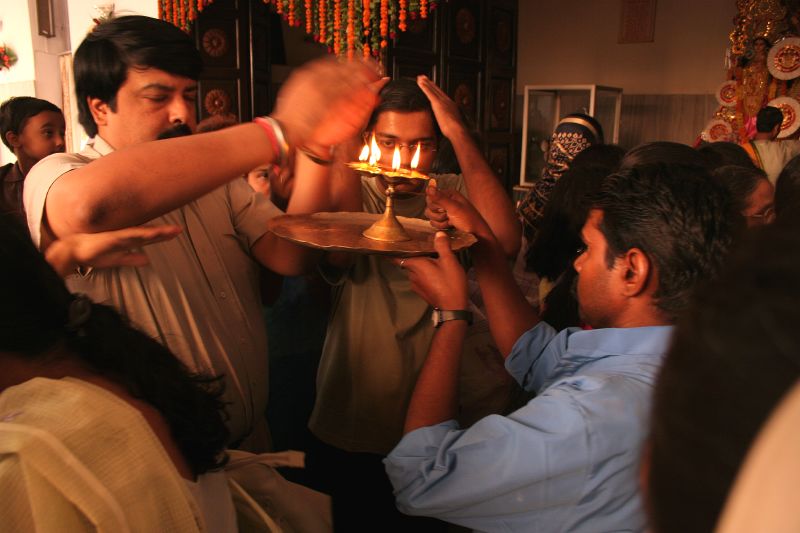
[[File:Durga puja blessing.jpg|thumb|left|Taking ''arti'' [[blessing]] during a [[Durga puja|Durga ''puja'']] celebration.]] | [[File:Durga puja blessing.jpg|thumb|left|Taking ''arti'' [[blessing]] during a [[Durga puja|Durga ''puja'']] celebration.]] | ||
{{Hinduism}} | {{Hinduism}} | ||
''Arti'' | ''Arti'' is an expression of many aspects including love, benevolence, gratitude, prayers, or desires depending on the object for which it is performed. For example, it can be a form of respect when performed for elders, prayers when performed to deities, or hope when performed for homes or vehicles. Emotions and prayers are often silent while doing ''arti'', but this is determined by the person carrying out the ritual or the holiday involved. It's also believed that goodwill and luck can be taken through symbolic hand movements over the flame.<ref>{{cite news|url=https://aajtak.intoday.in/story/what-is-the-rules-and-significance-of-doing-aarti-tpra-1-1019315.html|title='Rules and significance of Aarti|work=Indiatoday|access-date=2020-03-24}}</ref> | ||
Apart from worldly activities, ''arti'' also represents one's self - thus, ''arti'' signifies that one is peripheral to godhead or divinity. This would keep one's ego down and help one remain humble in spite of high social and economic rank. A third commonly held understanding of the ritual is that ''arti'' serves as a reminder to stay vigilant so that the forces of material pleasures and desires cannot overcome the individual. Just as the lighted wick provides light and chases away darkness, the vigilance of an individual can keep away the influence of the material world.<ref name=":1" /> | |||
==Songs== | ==Songs== | ||
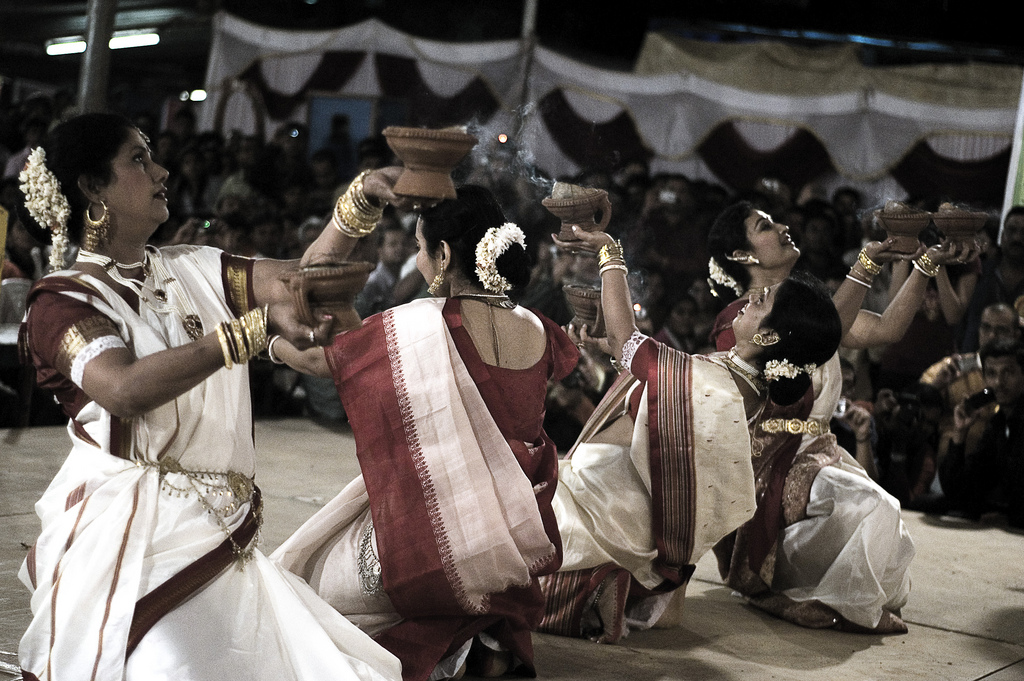
[[File:Aarti-dance-bangalore-2009.jpg|thumb|''Arti'' dance in Bangalore, 2009.]] | [[File:Aarti-dance-bangalore-2009.jpg|thumb|''Arti'' dance in Bangalore, 2009.]] | ||
Hinduism has a long tradition of | Hinduism has a long tradition of songs sung as an accompaniment to the ritual of ''arti''. It primarily extols the virtues of the deity that the ritual is being offered to, and several sects have their own versions of the common ''arti'' songs that are often sung on chorus at various temples, during evening and morning artis. Sometimes they also contain snippets of information on the life of the deity. | ||
The most commonly sung ''arti'' is that which is dedicated to all deities called [[Jai Jagdish Hare|Om Jai Jagdish Hare]], known as "the universal ''arti''". Other arti's are used for other deities as well such as Om Jai Shiv omkara, Om Jai Lakshmi mata, Om Jai Ambe gauri, Om Jai Adya Shakti, Om Jai Saraswati Mata, Om Jai Gange Mata, Om Jai Tulsi Mata and Om Jai Surya Bhagvaan. In [[Ganesha]] worship, the ''arti'' "[[Sukhakarta Dukhaharta]]" is popular in Maharashtra. | The most commonly sung ''arti'' is that which is dedicated to all deities called [[Jai Jagdish Hare|Om Jai Jagdish Hare]], known as "the universal ''arti''". Other arti's are used for other deities as well such as Om Jai Shiv omkara, Om Jai Lakshmi mata, Om Jai Ambe gauri, Om Jai Adya Shakti, Om Jai Saraswati Mata, Om Jai Gange Mata, Om Jai Tulsi Mata and Om Jai Surya Bhagvaan. In [[Ganesha]] worship, the ''arti'' "[[Sukhakarta Dukhaharta]]" is popular in Maharashtra. | ||
| Line 44: | Line 41: | ||
In [[Pushtimarg]] Havelis, ''arti'' is performed by a sole ''mukhiyaji'' (priest) while "Haveli Sangit" (''kirtan'') is being sung. Devotees only watch the ''arti'' being done and do not get to take a major part in it. During bhajan or utsavs (festivals) celebrated at home, "Jai Jai Shree Yamuna" is sung while devotees perform ''arti''. It is said that Sandhya ''arti'' is done to see if Lord [[Shrinathji]] had gotten hurt while playing outside because it is performed after sundown. | In [[Pushtimarg]] Havelis, ''arti'' is performed by a sole ''mukhiyaji'' (priest) while "Haveli Sangit" (''kirtan'') is being sung. Devotees only watch the ''arti'' being done and do not get to take a major part in it. During bhajan or utsavs (festivals) celebrated at home, "Jai Jai Shree Yamuna" is sung while devotees perform ''arti''. It is said that Sandhya ''arti'' is done to see if Lord [[Shrinathji]] had gotten hurt while playing outside because it is performed after sundown. | ||
==Durga Puja== | ==Durga Puja== | ||
{{See also|Natyashastra}} | {{See also|Natyashastra}} | ||
During the Bengali festival [[Durga puja|Durga ''puja'']] ritual drummers – '' | During the Bengali festival [[Durga puja|Durga ''puja'']] ritual drummers – ''dhakis,'' carrying large leather-strung ''[[Dhak (instrument)|dhak]]'s'', show off their skills during ritual dance worships called ''arti'' or ''[[Dhunuchi Nritya|Dhunuchi dance]]''.<ref>{{cite book|last=Gupta|first=Shobhna|title=Dances of India|year=2002|publisher=Har-Anand Publications Pvt Ltd|location=New Delhi|isbn=9788124108666|page=71}}</ref> | ||
==Sikhism== | ==Sikhism== | ||
[[ | In [[Sikhism]], [[Gagan mein thaal|''Gagan mai thaal'']] is a type of ''arti'' recited by [[Sikh gurus|first guru]], [[Guru Nanak]]<ref>http://www.livehindustan.com/news/tayaarinews/tayaarinews/article1-story-67-67-199585.html गुरु नानक देव और उनके द्वारा प्रवर्तित मार्ग</ref> in either 1506<ref name="orgov">{{Cite web |title=Orissa Review FEBRUARY MARCH 2012................ |url=https://magazines.odisha.gov.in/Orissareview/2012/Feb-March/Feb-Marchreview.htm |website=E-Magazine - Government of Orissa |publisher=Orissa Review}}</ref> or 1508<ref name="barusahib">{{Cite web |date=13 November 2013 |title=Home |url=http://www.barusahib.org/Assets/Publications/Natures_Own_Arti.pdf }}</ref><ref name="sikh-heritage">{{cite web |title=Untitled Document |url=http://www.sikh-heritage.co.uk/Scriptures/Guru%20Granth/Guru%20Granth.htm  |accessdate=2024-04-01 |website=sikh-heritage.co.uk}}</ref> at [[Jagannath Temple, Puri]], during his ''Udaasi'' (journey) to the east of the [[Indian subcontinent]].<ref name="orgov" /><ref name="barusahib" /> [[Amritsar]] Sikhs sing ''Arti kirtan'', which comprise a few ''shabads'' from [[Guru Nanak]], [[Ravidas]] and other [[Bhagat]]s and Gurus. According to them, it is the ''arti'' of divine wisdom in the form of the ''[[Guru Granth Sahib]]'' – Sikhism's eternal [[Guru]] and chief scripture. It is considered the equivalent of bowing on one's knees before the ''Guru Granth Sahib''. This ''arti'' does not employ ritual items, but is instead sung after the daily recitation of the ''[[Rehraas Sahib]]'' and [[Ardās]] at [[Harmandir Sahib]] in [[Amritsar]], and most [[Gurdwara]]s worldwide. | ||
An exception is the [[Nihang]] order, whose members first recite ''Aarta'' (prayers derived from ''banis'' in the ''[[Dasam Granth]]'' and ''[[Sarbloh Granth]]'' – scriptures of secondary and tertiary importance in the faith), and as in Hindu practise, employ ''diya'', flowers, conch shells, bells, incense during the ritual.<ref name=":0" /> This form of Sikh ''arti'' is also recited at [[Takht Sri Patna Sahib|Patna Sahib]] and [[Hazur Sahib]]. | |||
==See also== | ==See also== | ||
* [[Arti (given name)]] | * [[Arti (given name)]] | ||
* [[Blessing]] | * [[Blessing]] | ||
* [[Jay Sadguru Swami]] | * [[Jay Sadguru Swami]] | ||
* [[Mantrapushpanjali]] | * [[Mantrapushpanjali]] | ||
* [[Om Jai Jagdish Hare]] | |||
* [[Shankha]] | * [[Shankha]] | ||
==Notes== | ==Notes== | ||
| Line 80: | Line 63: | ||
==External links== | ==External links== | ||
* | * {{Commons category-inline}} | ||
{{Worship in Hinduism}} | {{Worship in Hinduism}} | ||
Latest revision as of 13:03, 24 March 2026
 | This article needs additional citations for verification. (January 2023) |
_Aarti_Thali,_Prayer_Plate_India.jpg)
Arti (Script error: The function "langx" does not exist.) or Aratrika (Script error: The function "langx" does not exist.)[1][2] is a Hindu ritual employed in worship, part of a puja, in which light from a flame (fuelled by camphor, ghee, or oil) is ritually waved to venerate deities.[3][4][5] Arti also refers to the hymns sung in praise of the deity, when the light is being offered. Sikhs have Arti kirtan which involves only devotional singing; the Nihang order of Sikhs also use light for arti.[6]
Etymology and origin[edit | edit source]
Aarti is thought to have descended from Vedic fire rituals or yajna.[7] Aarati is derived from the Sanskrit word आरात्रिक (ārātrika) which means something that removes rātrī, "darkness".[8][9] A Marathi language reference says it is also known as Mahānīrāñjanā (Script error: The function "langx" does not exist.).[10] According to Steven Rosen, arti means "before night" or symbolic end of the night to the worshipper's "material sojourn – he or she is now situated in the light of God's devotion."[11]
.jpg)
Practice[edit | edit source]
Aarti ranges from simple acts of worship to extravagant rituals, but almost always includes a jyoti (flame or light). It is performed up to eight times daily, depending on the specific Hindu tradition and temple.[11] It is performed as part of most Hindu liturgies and occasions and typically involves circling a diya (lamp) clockwise before a murti or icon of a deity, accompanied by hymns.[12][8] After waving the lamp before the deity, it is brought to the devotee, who then briefly places both their palms above the sanctified flame to receive its warmth. The devotee then raises their hands in supination, bringing both palms toward to their forehead in a gesture of self-purification and connection with the Divine.[12]
The diya (lamp) used for aarti is most often made of brass or other materials and holds a cotton wick soaked in camphor, ghee, or oil.[12][8] The aarti plate may contain other offerings like flowers, incense, and akshata (rice).[13]
The purpose of aarti is to wave light before the deity in a spirit of humility and gratitude, wherein the faithful become immersed in a God's divine form. All accoutrements used for aarti symbolize the five elements:[11]
- Space (akasha) - yak-tail fan
- Wind (vayu) - peacock fan
- Fire (agni) - lamp or candle
- Water (jalam)
- Earth (prithvi) - flowers
Aarti may also be performed at shrines within a business or home.[11]
Significance[edit | edit source]

| Part of a series on |
| Hinduism |
|---|
 |


Arti is an expression of many aspects including love, benevolence, gratitude, prayers, or desires depending on the object for which it is performed. For example, it can be a form of respect when performed for elders, prayers when performed to deities, or hope when performed for homes or vehicles. Emotions and prayers are often silent while doing arti, but this is determined by the person carrying out the ritual or the holiday involved. It's also believed that goodwill and luck can be taken through symbolic hand movements over the flame.[14]
Apart from worldly activities, arti also represents one's self - thus, arti signifies that one is peripheral to godhead or divinity. This would keep one's ego down and help one remain humble in spite of high social and economic rank. A third commonly held understanding of the ritual is that arti serves as a reminder to stay vigilant so that the forces of material pleasures and desires cannot overcome the individual. Just as the lighted wick provides light and chases away darkness, the vigilance of an individual can keep away the influence of the material world.[11]
Songs[edit | edit source]

Hinduism has a long tradition of songs sung as an accompaniment to the ritual of arti. It primarily extols the virtues of the deity that the ritual is being offered to, and several sects have their own versions of the common arti songs that are often sung on chorus at various temples, during evening and morning artis. Sometimes they also contain snippets of information on the life of the deity.
The most commonly sung arti is that which is dedicated to all deities called Om Jai Jagdish Hare, known as "the universal arti". Other arti's are used for other deities as well such as Om Jai Shiv omkara, Om Jai Lakshmi mata, Om Jai Ambe gauri, Om Jai Adya Shakti, Om Jai Saraswati Mata, Om Jai Gange Mata, Om Jai Tulsi Mata and Om Jai Surya Bhagvaan. In Ganesha worship, the arti "Sukhakarta Dukhaharta" is popular in Maharashtra.
In Swaminarayan Mandirs, Jay Sadguru Swami is the arti that is sung. In most temples in India, arti is performed at least twice a day, after the ceremonial puja, which is the time when the largest number of devotees congregates.
In Pushtimarg Havelis, arti is performed by a sole mukhiyaji (priest) while "Haveli Sangit" (kirtan) is being sung. Devotees only watch the arti being done and do not get to take a major part in it. During bhajan or utsavs (festivals) celebrated at home, "Jai Jai Shree Yamuna" is sung while devotees perform arti. It is said that Sandhya arti is done to see if Lord Shrinathji had gotten hurt while playing outside because it is performed after sundown.
Durga Puja[edit | edit source]
During the Bengali festival Durga puja ritual drummers – dhakis, carrying large leather-strung dhak's, show off their skills during ritual dance worships called arti or Dhunuchi dance.[15]
Sikhism[edit | edit source]
In Sikhism, Gagan mai thaal is a type of arti recited by first guru, Guru Nanak[16] in either 1506[17] or 1508[18][19] at Jagannath Temple, Puri, during his Udaasi (journey) to the east of the Indian subcontinent.[17][18] Amritsar Sikhs sing Arti kirtan, which comprise a few shabads from Guru Nanak, Ravidas and other Bhagats and Gurus. According to them, it is the arti of divine wisdom in the form of the Guru Granth Sahib – Sikhism's eternal Guru and chief scripture. It is considered the equivalent of bowing on one's knees before the Guru Granth Sahib. This arti does not employ ritual items, but is instead sung after the daily recitation of the Rehraas Sahib and Ardās at Harmandir Sahib in Amritsar, and most Gurdwaras worldwide.
An exception is the Nihang order, whose members first recite Aarta (prayers derived from banis in the Dasam Granth and Sarbloh Granth – scriptures of secondary and tertiary importance in the faith), and as in Hindu practise, employ diya, flowers, conch shells, bells, incense during the ritual.[6] This form of Sikh arti is also recited at Patna Sahib and Hazur Sahib.
See also[edit | edit source]
Notes[edit | edit source]
- ↑ Woodhead, Linda; Partridge, Christopher; Kawanami, Hiroko (2016-01-13). Religions in the Modern World: Traditions and Transformations. Routledge. p. 68. ISBN 978-1-317-43960-8.
- ↑ Monier-Williams, Sir Monier (2004). Brahmanism and Hinduism: Or Religious Thought and Life in Asia. Cosmo. p. 94. ISBN 978-81-7755-873-9.
- ↑ admin (2021-05-19). "Aarti । Why do we do Aarti?". Simple Hinduism. Retrieved 2023-11-09.
- ↑ Michaels, Axel (2004). Hinduism: Past and Present. Princeton University Press. p. 232. ISBN 978-0-691-08952-2.
- ↑ Flood, Gavin D. (1996-07-13). An Introduction to Hinduism. Cambridge University Press. p. 209. ISBN 978-0-521-43878-0.
- ↑ 6.0 6.1 "Aarti". 2023-08-25. Retrieved 2023-11-09.
- ↑ "– BAPS Shri Swaminarayan Mandir, London". Retrieved 2023-11-09.
- ↑ 8.0 8.1 8.2 James Lochtefeld, An illustrated Encyclopedia of Hinduism, ISBN 0-8239-2287-1, page 51
- ↑ Monier Williams Sanskrit Dictionary; Quote: ArAtrika n. the light (or the vessel containing it) which is waved at night before an icon; N. of this ceremony.
- ↑ "Page:Konkani Viswakosh Vol1.PDF/191 – Wikisource".
- ↑ 11.0 11.1 11.2 11.3 11.4 Rosen, Steven (2006). Essential Hinduism. Praeger Publishers. p. 196. ISBN 0-275-99006-0
- ↑ 12.0 12.1 12.2 Hawley, John Stratton (2006). The Life of Hinduism. University of California Press. pp. 39–40.
- ↑ Akshata: (Sanskrit) "Unbroken." Unmilled, uncooked rice, often mixed with turmeric, offered as a sacred substance during puja, or in blessings for individuals at weddings and other ceremonies.
- ↑ "'Rules and significance of Aarti". Indiatoday. Retrieved 2020-03-24.
- ↑ Gupta, Shobhna (2002). Dances of India. New Delhi: Har-Anand Publications Pvt Ltd. p. 71. ISBN 9788124108666.
- ↑ http://www.livehindustan.com/news/tayaarinews/tayaarinews/article1-story-67-67-199585.html गुरु नानक देव और उनके द्वारा प्रवर्तित मार्ग
- ↑ 17.0 17.1 "Orissa Review FEBRUARY MARCH 2012..." E-Magazine - Government of Orissa. Orissa Review.
- ↑ 18.0 18.1 "Home". 13 November 2013.
- ↑ "Untitled Document". sikh-heritage.co.uk. Retrieved 2024-04-01.