


WikiDwarfBOT (talk | contribs) Cleanup: |
m brief reworked layout after review and fixed typos |
||
| Line 1: | Line 1: | ||
{{ | {{Short description|Four Hindu pilgrimage sites in India}} | ||
{{for-multi|the religious sites in Nepal|Char Dham, Nepal| | {{for-multi|the religious sites in Nepal|Char Dham, Nepal|the Himalayan pilgrimage sites of Badrinath, Gangotri, Kedarnath and Yamunotri|Chota Char Dham}} | ||
{{EngvarB|date=April 2015}} | {{EngvarB|date=April 2015}} | ||
{{Use dmy dates|date=October 2020}} | {{Use dmy dates|date=October 2020}} | ||
| Line 11: | Line 11: | ||
{{Location map~ |India |lat= 30.744729|long=79.4907558 |mark=Font Awesome 5 solid vihara.svg|label= [[Badrinath]]|position=top}} | {{Location map~ |India |lat= 30.744729|long=79.4907558 |mark=Font Awesome 5 solid vihara.svg|label= [[Badrinath]]|position=top}} | ||
}} | }} | ||
The '''Char Dham''' ({{ | The '''Char Dham''' ({{Langx|hi|चारधाम|translit=Cārdhām}} {{translation|the four abodes}}), or the '''Chatur Dhama''' ({{Langx|sa|चतुर्धाम|translit=Caturdhāma}}),<ref>{{Cite book |last=Bharati |first=Agrhananda |url=https://books.google.com/books?id=-Rhy_9p9BZQC&pg=PA53 |title=Agents and Audiences |date=2011-06-03 |publisher=Walter de Gruyter |isbn=978-3-11-080584-0 |pages=53 |language=en}}</ref> is a set of four [[Hindu]] [[pilgrimage]] sites in [[India]],<ref>{{cite web |title=Chaar Dham Yatra: A True Test of Every Hindu's Quest Towards Spiritual Enlightenment |date=20 March 2015 |website=NewsGram |url= https://www.newsgram.com/chaar-dham-yatra-true-test-hindus-spiritual-enlightenment/ |archive-url= https://web.archive.org/web/20220123103404/https://www.newsgram.com/chaar-dham-yatra-true-test-hindus-spiritual-enlightenment |archive-date= 23 January 2022}}</ref> consisting of [[Badrinath]], [[Dwarka]], [[Puri]] and [[Rameswaram]].<ref>{{cite web|url=https://epaper.thestatesman.com/m5/3725372/Dainik-Statesman/28TH-JUNE-2023|title=পুরীধাম ও জগন্নাথদেবের ব্রহ্মরূপ বৃত্তান্ত|page=4|trans-title=Puridham and the tale of lord Jagannath's legendary 'Brahmarup'|language=bn|date=28 June 2023|access-date=28 June 2023|website=dainikstatesmannews.com|publisher=Dainik Statesman (The Statesman Group)|location=Kolkata|first=Yogabrata|last=Chakraborty|archive-url=https://web.archive.org/web/20230628053933/https://epaper.thestatesman.com/m5/3725372/Dainik-Statesman/28TH-JUNE-2023#page/1/1|archive-date=28 June 2023|url-status=bot: unknown}}</ref> Badrinath, Dwarka, and Puri are shrines of [[Vishnu]], whereas Rameswaram is a shrine of [[Shiva]]. | ||
Defined by [[Adi Shankara]], each ''dhāma'' represents a particular [[yuga]], with Badrinath representing [[Satya Yuga]], Rameswaram representing [[Treta Yuga]], Dwarka representing [[Dvapara Yuga]], and Puri representing [[Kali Yuga]]. Many Hindus believe that visiting these sites can help them achieve [[moksha]].<ref>{{Cite book |last=Burkhalter-Flueckiger |first=Joyce |title=Everyday Hinduism |publisher=Wiley |year=2015 |isbn=9781405160117 |pages=110}}</ref> | |||
The Char Dham is not to be confused with the [[Chota Char Dham]] which comprises Yamunotri, Gangotri, Kedarnath, Badrinath. It is a Hindu pilgrimage circuit in [[Uttarakhand]] which was named by the [[religious tourism]] industry. | |||
==Description== | ==Description== | ||
According to Hindu legend, Badrinath became prominent when [[Nara-Narayana]], an avatar of Lord Vishnu, performed ''[[Tapas (Indian religions)#Hinduism|tapas]]'' there. Many berry trees then grew in the area, so the site was initially named ''badarikāvaṇa'', the forest of berries. Per legend, a large berry tree grew above Nara-Narayana to save him from the rain and sun. Locals say that it was [[Lakshmi]] who became the berry tree to save Narayana. After completing ''tapas'', Narayana said declared that people should always invoke her name before his. Therefore, Hindus refer to "[[Lakshmi Narayana|Lakshmi-Narayana]]." | |||
Within the ''satya yuga'', the area came to be known as ''badrināth'', the lord of the berry trees, in recognizance of Nara-Narayana’s penance. The temple to him is located on the banks of the [[Alaknanda River]] in the [[Chamoli district]] of Uttrakhand. | |||
The second | The second ''dhāma'', Rameswaram, has its origins in the [[Treta Yuga]] when [[Rama]] installed a ''[[lingam]]'' there and worshipped it to get atonement from Shiva for slaying [[Ravana]], a devotee of Shiva.<ref>Ayyar, P. V. Jagadisa (1991). ''South Indian shrines: illustrated''. New Delhi: Asian Educational Services. {{ISBN|81-206-0151-3}}</ref> It is believed that Rama's footprints are imprinted there.<ref>Seeger, Elizabeth, 1889-1973. (1969). The Ramayana. New York :W.R. Scott</ref> | ||
The third, Dwaraka, | The third ''dhāma'', Dwaraka, was established in the [[Dvapara Yuga]] when Krishna made the city his residence.<ref>Chakravarti Mahadev-1994-The Concept of Rudra-Śiva Through The Ages-Delhi-Motilal Banarsidass-Second Revised. {{ISBN|81-208-0053-2}}</ref> | ||
At the fourth, Puri, Vishnu is | At the fourth ''dhāma'', Puri, Vishnu is worshipped as [[Jagannatha|Jagannath]], his [[avatar]] for the current epoch, [[Kali Yuga]]. | ||
The | The monk [[Adi Shankara]] organised four {{IAST|[[Matha|maṭhas]]}} to correspond to the four sites of the Char Dham: the headquarters at [[Dvārakā|Dwarka]] in the West, [[Jagannatha Puri|Puri]] in the East, [[Sringeri Sharada Peetham]] in the South and [[Badrikashrama|Badarikashrama]] in the North.<ref>{{cite web|url=http://www.sanskrit.org/www/Shankara/shankar4.html |title=Sankara Acarya: 4 - Monastic Traditions |access-date=3 May 2009 |url-status=dead |archive-url=https://web.archive.org/web/20120508091224/http://www.sanskrit.org/www/Shankara/shankar4.html |archive-date=8 May 2012 }}</ref> | ||
The table below gives an overview of the four ''Amnaya | The table below gives an overview of the four ''Amnaya Maṭhas'' founded by [[Adi Shankara]].<ref>{{Cite web|url=https://sringeri.net/history/amnaya-peethams|archiveurl=https://web.archive.org/web/20060626000000/http://www.sringerisharadapeetham.org/html/History/amnaya.html|url-status=dead|title=The Amnaya Peethams|archivedate=26 June 2006|website=Sri Sringeri Sharada Peetham}}</ref> | ||
{| class="wikitable" | {| class="wikitable" | ||
| Line 68: | Line 70: | ||
|} | |} | ||
== | ==Sites of the Char Dham== | ||
=== Puri === | === Puri === | ||
[[File:Temple-Jagannath.jpg|thumb|[[Jagannath Temple, Puri|Jagannath Temple]], [[Puri]]]] | [[File:Temple-Jagannath.jpg|thumb|[[Jagannath Temple, Puri|Jagannath Temple]], [[Puri]]]] | ||
[[Puri]] | [[Puri]] is located in the state of [[Odisha]] and is one of the oldest cities in the eastern part of the country, on the coast of the [[Bay of Bengal]]. The main deity worshipped there is Krishna, revered as [[Jagannath]]. It is the only shrine in India where [[Subhadra]], the sister of Krishna, is worshipped along with her brothers, Jagannatha and [[Balarama|Balabhadra]]. As per temple records, King [[Indradyumna]] of [[Avanti (region)|Avanti]] built the main temple of Jagannath at Puri.<ref>Chakraborty, Yogabrata (28 June 2023). "পুরীধাম ও জগন্নাথদেবের ব্রহ্মরূপ বৃত্তান্ত" [Puridham and the tale of lord Jagannath's legendary 'Bramharup']. ''dainikstatesmannews.com'' (in Bengali). Kolkata: [[Dainik Statesman]] (The Statesman Group). p. 4. Archived from the original on 28 June 2023. Retrieved 28 June 2023.</ref> Starting in the tenth century, the first king of the [[Eastern Ganga dynasty]], [[Anantavarman Chodaganga]], rebuilt the present temple on the site of the pre-existing temples in the compound, excluding the main Jagannath temple.<ref>Cesarone, Bernard (2012). "Bernard Cesarone: Pata-chitras of Odisha". ''asianart.com''. Retrieved 2 July 2012. <q>This temple was built in approximately 1135–1150 by Codaganga, a king of the Eastern Ganga dynasty</q></ref> Puri is the site of the ''Govarḍhana Maṭha'', one of the four cardinal ''maṭhas'' created by [[Adi Shankaracharya|Adi Shankara]]. | ||
===Rameswaram=== | ===Rameswaram=== | ||
[[File:Rameswaram temple (11).jpg|thumb|[[Rameswaram Temple]], [[Rameswaram]]]] | [[File:Rameswaram temple (11).jpg|thumb|[[Rameswaram Temple]], [[Rameswaram]]]] | ||
[[Rameswaram]] is located in the state of [[Tamil Nadu]], in the southern part of the Indian peninsula. According to | [[Rameswaram]] is located in the state of [[Tamil Nadu]], in the southern part of the Indian peninsula. According to legend, this is the place where [[Lord Ram|Rama]], along with his brother Lakshmana and devotee Hanuman, built a bridge (Rama Setu) to reach [[Lanka]] to rescue his wife Sita, who had been abducted by Lanka's ruler Ravana. The Ramanathaswamy Temple, dedicated to Shiva, occupies a significant area of Rameswaram. The temple is believed to have been consecrated by Rama. The site is important to Hindus as a pilgrimage to [[Varanasi]] is considered incomplete without a pilgrimage to Rameswaram. The presiding deity is in the form of a [[Linga]] with the name Sri Ramanatha Swamy; it also is one of the twelve [[Jyotirlingas]]. | ||
===Dwarka === | ===Dwarka === | ||
[[File:Dwarkadheesh temple.jpg|thumb|[[Dwarakadheesh Temple]], [[Dwarka]]]] | [[File:Dwarkadheesh temple.jpg|thumb|[[Dwarakadheesh Temple]], [[Dwarka]]]] | ||
[[Dwarka]] is located in the state of [[Gujarat]] | [[Dwarka]] is located in the state of [[Gujarat]] on the westernmost coast of India. The city derives its name from the word "''dvara''" meaning [[door]] or [[gate]] in the [[Sanskrit]] language. It is located where the Gomti River merges into the [[Arabian Sea]]. However, this river Gomti is not the same as the [[Gomti River]], which is a tributary of [[Ganga River]]. The legendary city of [[Dvārakā]] was the dwelling place of [[Lord Krishna|Krishna]]. It is generally believed that due to damage and destruction by the sea, Dvārakā was submerged six times, and modern-day Dwarka is the 7th such city to be built in the area.<ref name="GoUnesco">{{cite web |last1=Santosh |first1=Urmila |title=Where Mythology Meets Reality: Sunken City Of Dwarka |url=https://www.gounesco.com/where-mythology-meets-reality-sunken-city-of-dwarka/ |website=gounesco.com |publisher=GoUNESCO |access-date=25 July 2019 |date=22 November 2016 |archive-date=1 July 2019 |archive-url=https://web.archive.org/web/20190701022620/https://www.gounesco.com/where-mythology-meets-reality-sunken-city-of-dwarka/ |url-status=live }}</ref><ref name="EconomicTimesLeg">{{cite news |last1=Shankar |first1=Kalyani |title=Legends by the sea |url=https://economictimes.indiatimes.com/magazines/travel/legends-by-the-sea/articleshow/1764244.cms |newspaper=The Economic Times |publisher=Bennett, Coleman & Co. Ltd |access-date=25 July 2019 |date=15 March 2007 |archive-date=25 July 2019 |archive-url=https://web.archive.org/web/20190725161442/https://economictimes.indiatimes.com/magazines/travel/legends-by-the-sea/articleshow/1764244.cms |url-status=live }}</ref> | ||
===Badrinath=== | ===Badrinath=== | ||
[[File:Badrinath Temple, Uttarakhand (Photo- Vishwanath Negi).jpg|thumb|[[Badrinath Temple]]]] | [[File:Badrinath Temple, Uttarakhand (Photo- Vishwanath Negi).jpg|thumb|[[Badrinath Temple]]]] | ||
[[Badrinath]] is located in the | [[Badrinath]] is located in the [[Chamoli district|Chamoli]] district of [[Uttarakhand]] at an altitude of 3,133 meters (10,279 feet). The temple of Badrinath is dedicated to [[Vishnu|Lord Vishnu]].<ref>{{Cite web |date=2024-05-05 |title=Chardham Yatra 2024: Badrinath Temple, Where Lord Vishnu Did Penance |url=https://www.timesnownews.com/spiritual/chardham-yatra-2024-badrinath-temple-where-lord-vishnu-did-penance-article-109854547 |access-date=2024-05-18 |website=Times Now |language=en}}</ref> It is in the Garhwal hills, on the [[Alaknanda River]] banks. The town lies between the Nar and the Narayana mountain ranges and in the shadow of the [[Nilkantha (mountain)|Nilkantha]] peak (6,560 m). | ||
Nearby within 3 km, there are also other interesting sightseeing spots like Mana, Vyas Gufa, Maatamoorti, Charanpaduka, Bhimkund, and the Mukh of the Saraswati River. [[Joshimath]] is situated on the slopes above the confluence of the Alaknanda and Dhauliganga rivers. Of the four Maths established by [[Adi Shankara]]charya, Joshimath is the winter seat of Char dham. | |||
While the three other Dhams remain open throughout the year, | While the three other Dhams remain open throughout the year, [[Badrinath Temple|Badrinath Dham]] only stays open for pilgrims' darshan from April to October each year. | ||
== Chota Char Dham== | == Chota Char Dham== | ||
Another circuit of four ancient pilgrimage sites in the Indian state of [[Uttarakhand]] | Another circuit of four ancient pilgrimage sites in the Indian state of [[Uttarakhand]] is referred to as [[Chota Char Dham]] to differentiate it from this bigger circuit of Char Dham sites. It consists of [[Yamunotri]], [[Gangotri]], [[Kedarnath]], and [[Badrinath]]. The Chota Char Dham shrines are closed over winter due to snowfall and reopen for pilgrims with the advent of summer.<ref>[https://books.google.com/books?id=T7ZHUhSEleYC&dq=Char+Dham&pg=PA468 Char Dham of Garhwal] {{Webarchive|url=https://web.archive.org/web/20230405045122/https://books.google.com/books?id=T7ZHUhSEleYC&dq=Char+Dham&pg=PA468 |date=5 April 2023 }} ''India'', by Joe Windless, Sarina Singh, James Bainbridge, Lindsay Brown, Mark Elliott, Stuart Butler. Published by Lonely Planet, 2007. {{ISBN|1-74104-308-5}}. ''Page 468''.</ref><ref>''Chardham Yatra'', by Savitri Dubey. Published by Alekh Prakashan. {{ISBN|978-81-88913-25-1}}</ref><ref>{{Cite web|url=http://www.alekhprakashan.com/Bookdesc.aspx?id=1635|archive-url=https://web.archive.org/web/20101223140101/http://www.alekhprakashan.com/Bookdesc.aspx?id=1635|url-status=dead|title=Welcome To Alekh Prakashan<!-- Bot generated title -->|archive-date=23 December 2010|access-date=11 December 2019}}</ref><ref>{{cite web|title=Char Dham and Hemkund Sahib Yatra to restart from May 2014|url=http://news.biharprabha.com/2014/04/char-dham-yatra-restarts-in-may-uttarakhand-assures-safety/|work=IANS|date=24 April 2014|publisher=news.biharprabha.com|access-date=24 April 2014|archive-date=7 January 2019|archive-url=https://web.archive.org/web/20190107000849/http://news.biharprabha.com/2014/04/char-dham-yatra-restarts-in-may-uttarakhand-assures-safety/|url-status=live}}</ref> | ||
=== Winter Char Dham === | |||
The Uttarakhand government is promoting a ‘Winter Char Dham’ initiative to boost tourism during the off-season.<ref>{{Cite web |title=WINTER CHAR DHAM CIRCUIT {{!}} Uttarakhand Tourism |url=https://uttarakhandtourism.gov.in/winter-char-dham-circuit-0 |archive-url=https://web.archive.org/web/20240722144332/https://uttarakhandtourism.gov.in/winter-char-dham-circuit-0 |archive-date=2024-07-22 |access-date=2025-01-03 |website=uttarakhandtourism.gov.in |language=en}}</ref> During winter, the traditional Chota Char Dhams are closed and the deities are relocated to nearby villages for worship.<ref>{{Cite web |title=Winter Char Dham यात्रा क्या है? क्यों कहते हैं सूर्य पर्यटन, यहां जानें हर एक बात |url=https://zeenews.india.com/hindi/religion/what-is-winter-char-dham-why-is-it-called-sun-tourism-all-about-uttarakhand-winter-char-dham/2585429 |access-date=2025-01-03 |website=Zee News Hindi |language=hi}}</ref> The Winter Char Dhams are the winter abodes of deities from the main Dhams: Omkareshwar Temple in Ukhimath for Kedarnath, Pandukeshwar in Chamoli for Badrinath, Mukhba in Uttarkashi for Gangotri Dham, and Kharsali for Yamunotri.<ref>{{Cite web |date=2025-01-02 |title=What is the winter Char Dham? Why is the Uttarakhand government promoting it? |url=https://indianexpress.com/article/explained/winter-char-dham-uttarakhand-9756353/ |access-date=2025-01-03 |website=The Indian Express |language=en}}</ref> | |||
==See also== | ==See also== | ||
| Line 115: | Line 115: | ||
== External links == | == External links == | ||
* {{official website|https://badrinath-kedarnath.gov.in/}} | * {{official website|https://badrinath-kedarnath.gov.in/}} | ||
* | *{{commons category-inline|Char Dham}} | ||
{{Hindu holy cities}} | {{Hindu holy cities}} | ||
Latest revision as of 16:51, 23 March 2026


The Char Dham (Hindi: चारधाम, romanized: Cārdhām transl. the four abodes), or the Chatur Dhama (Sanskrit: चतुर्धाम, romanized: Caturdhāma),[1] is a set of four Hindu pilgrimage sites in India,[2] consisting of Badrinath, Dwarka, Puri and Rameswaram.[3] Badrinath, Dwarka, and Puri are shrines of Vishnu, whereas Rameswaram is a shrine of Shiva.
Defined by Adi Shankara, each dhāma represents a particular yuga, with Badrinath representing Satya Yuga, Rameswaram representing Treta Yuga, Dwarka representing Dvapara Yuga, and Puri representing Kali Yuga. Many Hindus believe that visiting these sites can help them achieve moksha.[4]
The Char Dham is not to be confused with the Chota Char Dham which comprises Yamunotri, Gangotri, Kedarnath, Badrinath. It is a Hindu pilgrimage circuit in Uttarakhand which was named by the religious tourism industry.
Description[edit | edit source]
According to Hindu legend, Badrinath became prominent when Nara-Narayana, an avatar of Lord Vishnu, performed tapas there. Many berry trees then grew in the area, so the site was initially named badarikāvaṇa, the forest of berries. Per legend, a large berry tree grew above Nara-Narayana to save him from the rain and sun. Locals say that it was Lakshmi who became the berry tree to save Narayana. After completing tapas, Narayana said declared that people should always invoke her name before his. Therefore, Hindus refer to "Lakshmi-Narayana."
Within the satya yuga, the area came to be known as badrināth, the lord of the berry trees, in recognizance of Nara-Narayana’s penance. The temple to him is located on the banks of the Alaknanda River in the Chamoli district of Uttrakhand.
The second dhāma, Rameswaram, has its origins in the Treta Yuga when Rama installed a lingam there and worshipped it to get atonement from Shiva for slaying Ravana, a devotee of Shiva.[5] It is believed that Rama's footprints are imprinted there.[6]
The third dhāma, Dwaraka, was established in the Dvapara Yuga when Krishna made the city his residence.[7]
At the fourth dhāma, Puri, Vishnu is worshipped as Jagannath, his avatar for the current epoch, Kali Yuga.
The monk Adi Shankara organised four maṭhas to correspond to the four sites of the Char Dham: the headquarters at Dwarka in the West, Puri in the East, Sringeri Sharada Peetham in the South and Badarikashrama in the North.[8]
The table below gives an overview of the four Amnaya Maṭhas founded by Adi Shankara.[9]
| Shishya (lineage) |
Direction | Maṭha | Mahāvākya | Veda | Sampradaya |
|---|---|---|---|---|---|
| Padmapāda | East | Govardhana Pīṭhaṃ | Prajñānam brahma (Consciousness is Brahman) | Rig Veda | Bhogavala |
| Sureśvara | South | Sringeri Śārada Pīṭhaṃ | Aham brahmāsmi (I am Brahman) | Yajur Veda | Bhūrivala |
| Hastāmalakācārya | West | Dvāraka Pīṭhaṃ | Tattvamasi (That thou art) | Sama Veda | Kitavala |
| Toṭakācārya | North | Jyotirmaṭha Pīṭhaṃ | Ayamātmā brahma (This self "soul" is Brahman) | Atharva Veda | Nandavala |
Sites of the Char Dham[edit | edit source]
Puri[edit | edit source]

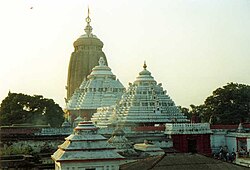
Puri is located in the state of Odisha and is one of the oldest cities in the eastern part of the country, on the coast of the Bay of Bengal. The main deity worshipped there is Krishna, revered as Jagannath. It is the only shrine in India where Subhadra, the sister of Krishna, is worshipped along with her brothers, Jagannatha and Balabhadra. As per temple records, King Indradyumna of Avanti built the main temple of Jagannath at Puri.[10] Starting in the tenth century, the first king of the Eastern Ganga dynasty, Anantavarman Chodaganga, rebuilt the present temple on the site of the pre-existing temples in the compound, excluding the main Jagannath temple.[11] Puri is the site of the Govarḍhana Maṭha, one of the four cardinal maṭhas created by Adi Shankara.
Rameswaram[edit | edit source]
.jpg)
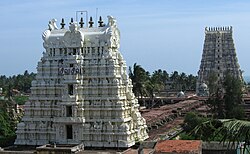
Rameswaram is located in the state of Tamil Nadu, in the southern part of the Indian peninsula. According to legend, this is the place where Rama, along with his brother Lakshmana and devotee Hanuman, built a bridge (Rama Setu) to reach Lanka to rescue his wife Sita, who had been abducted by Lanka's ruler Ravana. The Ramanathaswamy Temple, dedicated to Shiva, occupies a significant area of Rameswaram. The temple is believed to have been consecrated by Rama. The site is important to Hindus as a pilgrimage to Varanasi is considered incomplete without a pilgrimage to Rameswaram. The presiding deity is in the form of a Linga with the name Sri Ramanatha Swamy; it also is one of the twelve Jyotirlingas.
Dwarka[edit | edit source]

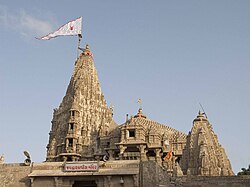
Dwarka is located in the state of Gujarat on the westernmost coast of India. The city derives its name from the word "dvara" meaning door or gate in the Sanskrit language. It is located where the Gomti River merges into the Arabian Sea. However, this river Gomti is not the same as the Gomti River, which is a tributary of Ganga River. The legendary city of Dvārakā was the dwelling place of Krishna. It is generally believed that due to damage and destruction by the sea, Dvārakā was submerged six times, and modern-day Dwarka is the 7th such city to be built in the area.[12][13]
Badrinath[edit | edit source]
.jpg)
Badrinath is located in the Chamoli district of Uttarakhand at an altitude of 3,133 meters (10,279 feet). The temple of Badrinath is dedicated to Lord Vishnu.[14] It is in the Garhwal hills, on the Alaknanda River banks. The town lies between the Nar and the Narayana mountain ranges and in the shadow of the Nilkantha peak (6,560 m). Nearby within 3 km, there are also other interesting sightseeing spots like Mana, Vyas Gufa, Maatamoorti, Charanpaduka, Bhimkund, and the Mukh of the Saraswati River. Joshimath is situated on the slopes above the confluence of the Alaknanda and Dhauliganga rivers. Of the four Maths established by Adi Shankaracharya, Joshimath is the winter seat of Char dham.
While the three other Dhams remain open throughout the year, Badrinath Dham only stays open for pilgrims' darshan from April to October each year.
Chota Char Dham[edit | edit source]
Another circuit of four ancient pilgrimage sites in the Indian state of Uttarakhand is referred to as Chota Char Dham to differentiate it from this bigger circuit of Char Dham sites. It consists of Yamunotri, Gangotri, Kedarnath, and Badrinath. The Chota Char Dham shrines are closed over winter due to snowfall and reopen for pilgrims with the advent of summer.[15][16][17][18]
Winter Char Dham[edit | edit source]
The Uttarakhand government is promoting a ‘Winter Char Dham’ initiative to boost tourism during the off-season.[19] During winter, the traditional Chota Char Dhams are closed and the deities are relocated to nearby villages for worship.[20] The Winter Char Dhams are the winter abodes of deities from the main Dhams: Omkareshwar Temple in Ukhimath for Kedarnath, Pandukeshwar in Chamoli for Badrinath, Mukhba in Uttarkashi for Gangotri Dham, and Kharsali for Yamunotri.[21]
See also[edit | edit source]
- Chota Char Dham
- Sapta Puri
- Jyotirlinga
- Famous Hindu yatras
- Hindu pilgrimage sites in India
- List of Hindu festivals
- Padayatra
- Ratha Yatra
- Tirtha
- Tirtha and Kshetra
- Chari Kshetra
References[edit | edit source]
- ↑ Bharati, Agrhananda (3 June 2011). Agents and Audiences. Walter de Gruyter. p. 53. ISBN 978-3-11-080584-0.
- ↑ "Chaar Dham Yatra: A True Test of Every Hindu's Quest Towards Spiritual Enlightenment". NewsGram. 20 March 2015. Archived from the original on 23 January 2022.
- ↑ Chakraborty, Yogabrata (28 June 2023). "পুরীধাম ও জগন্নাথদেবের ব্রহ্মরূপ বৃত্তান্ত" [Puridham and the tale of lord Jagannath's legendary 'Brahmarup']. dainikstatesmannews.com (in Bengali). Kolkata: Dainik Statesman (The Statesman Group). p. 4. Archived from the original on 28 June 2023. Retrieved 28 June 2023.
{{cite web}}: CS1 maint: bot: original URL status unknown (link) - ↑ Burkhalter-Flueckiger, Joyce (2015). Everyday Hinduism. Wiley. p. 110. ISBN 9781405160117.
- ↑ Ayyar, P. V. Jagadisa (1991). South Indian shrines: illustrated. New Delhi: Asian Educational Services. ISBN 81-206-0151-3
- ↑ Seeger, Elizabeth, 1889-1973. (1969). The Ramayana. New York :W.R. Scott
- ↑ Chakravarti Mahadev-1994-The Concept of Rudra-Śiva Through The Ages-Delhi-Motilal Banarsidass-Second Revised. ISBN 81-208-0053-2
- ↑ "Sankara Acarya: 4 - Monastic Traditions". Archived from the original on 8 May 2012. Retrieved 3 May 2009.
- ↑ "The Amnaya Peethams". Sri Sringeri Sharada Peetham. Archived from the original on 26 June 2006.
- ↑ Chakraborty, Yogabrata (28 June 2023). "পুরীধাম ও জগন্নাথদেবের ব্রহ্মরূপ বৃত্তান্ত" [Puridham and the tale of lord Jagannath's legendary 'Bramharup']. dainikstatesmannews.com (in Bengali). Kolkata: Dainik Statesman (The Statesman Group). p. 4. Archived from the original on 28 June 2023. Retrieved 28 June 2023.
- ↑ Cesarone, Bernard (2012). "Bernard Cesarone: Pata-chitras of Odisha". asianart.com. Retrieved 2 July 2012.
This temple was built in approximately 1135–1150 by Codaganga, a king of the Eastern Ganga dynasty
- ↑ Santosh, Urmila (22 November 2016). "Where Mythology Meets Reality: Sunken City Of Dwarka". gounesco.com. GoUNESCO. Archived from the original on 1 July 2019. Retrieved 25 July 2019.
- ↑ Shankar, Kalyani (15 March 2007). "Legends by the sea". The Economic Times. Bennett, Coleman & Co. Ltd. Archived from the original on 25 July 2019. Retrieved 25 July 2019.
- ↑ "Chardham Yatra 2024: Badrinath Temple, Where Lord Vishnu Did Penance". Times Now. 5 May 2024. Retrieved 18 May 2024.
- ↑ Char Dham of Garhwal Archived 5 April 2023 at the Wayback Machine India, by Joe Windless, Sarina Singh, James Bainbridge, Lindsay Brown, Mark Elliott, Stuart Butler. Published by Lonely Planet, 2007. ISBN 1-74104-308-5. Page 468.
- ↑ Chardham Yatra, by Savitri Dubey. Published by Alekh Prakashan. ISBN 978-81-88913-25-1
- ↑ "Welcome To Alekh Prakashan". Archived from the original on 23 December 2010. Retrieved 11 December 2019.
- ↑ "Char Dham and Hemkund Sahib Yatra to restart from May 2014". IANS. news.biharprabha.com. 24 April 2014. Archived from the original on 7 January 2019. Retrieved 24 April 2014.
- ↑ "WINTER CHAR DHAM CIRCUIT | Uttarakhand Tourism". uttarakhandtourism.gov.in. Archived from the original on 22 July 2024. Retrieved 3 January 2025.
- ↑ "Winter Char Dham यात्रा क्या है? क्यों कहते हैं सूर्य पर्यटन, यहां जानें हर एक बात". Zee News Hindi (in हिन्दी). Retrieved 3 January 2025.
- ↑ "What is the winter Char Dham? Why is the Uttarakhand government promoting it?". The Indian Express. 2 January 2025. Retrieved 3 January 2025.
_name_of_the_God_as_per_the_Vedas.svg)