










WikiDwarfBOT (talk | contribs) m →Other websites: Replace {{Source}} tag |
robot: Update article |
||
| Line 1: | Line 1: | ||
{{ | {{Short description|Abrahamic monotheistic religion based on the life and teachings of Jesus Christ}} | ||
{{pp-protected|small=yes}} | |||
'''Christianity''' is the | {{Use American English|date=October 2019}} | ||
{{Use dmy dates|date=March 2022}} | |||
{{Christianity|expanded=all}} | |||
'''Christianity''' is an [[Abrahamic religions|Abrahamic]] [[monotheistic]] [[religion]] based on the [[Life of Jesus in the New Testament|life]] and [[Teachings of Jesus|teachings]] of [[Jesus|Jesus of Nazareth]]. It is the [[Major religious groups|world's largest religion]], with about 2.5 billion followers.<ref>{{Cite web|title=World's largest religion by population is still Christianity|url=https://countrymeters.info/en/World#religion|access-date=1 January 2020|website=Countrymeters|language=en-US}}</ref> Its adherents, known as [[Christians]], make up a majority of the population in [[Christianity by country|157 countries and territories]],<ref>[[Pew Forum|The Pew Forum on Religion and Public Life]]. December 2012. "[https://assets.pewresearch.org/wp-content/uploads/sites/11/2014/01/global-religion-full.pdf The Global Religious Landscape: A Report on the Size and Distribution of the World's Major Religious Groups as of 2010]." DC: Pew Research Center. [https://www.pewforum.org/2012/12/18/global-religious-landscape-exec/ Article].</ref> and believe that [[Jesus in Christianity|Jesus]] is the [[Son of God (Christianity)|Son of God]], whose coming as the [[Messiah#Christianity|messiah]] was [[Old Testament messianic prophecies quoted in the New Testament|prophesied]] in the [[Hebrew Bible]] (called the [[Old Testament]] in Christianity) and chronicled in the [[New Testament]].<ref>{{harvnb|Woodhead|2004|p=n.p}}</ref> | |||
Christianity remains [[Christian culture|culturally diverse]] in its [[Western Christianity|Western]] and [[Eastern Christianity|Eastern branches]], as well as in its doctrines concerning [[Justification (theology)|justification and the nature of salvation]], [[ecclesiology]], [[ordination]], and [[Christology]]. The [[creed]]s of various [[List of Christian denominations|Christian denominations]] generally hold in common Jesus as the [[Son of God]]—the [[Logos (Christianity)|Logos]] [[Incarnation (Christianity)|incarnated]]—who [[Ministry of Jesus|ministered]], [[passion of Jesus|suffered]], and [[Crucifixion of Jesus|died on a cross]], but [[Resurrection of Jesus|rose from the dead]] for the [[Salvation in Christianity|salvation]] of mankind; and referred to as [[the gospel]], meaning the "good news". Describing Jesus' life and teachings are the four [[Gospel|canonical gospels]] of [[Gospel of Matthew|Matthew]], [[Gospel of Mark|Mark]], [[Gospel of Luke|Luke]] and [[Gospel of John|John]], with the Old Testament as the gospel's respected background. | |||
[[History of Christianity|Christianity began]] as a [[Second Temple Judaism|Second Temple Judaic]] sect [[Christianity in the 1st century|in the 1st century]] [[Hellenistic Judaism]] in the [[Roman Empire|Roman]] province of [[Judea (Roman province)|Judea]]. Jesus' [[Apostles in the New Testament|apostles]] and their followers [[Early centers of Christianity|spread]] around the [[Levant]], [[Europe]], [[Anatolia]], [[Mesopotamia]], the [[South Caucasus]], [[Egypt]], and [[Ethiopia]], despite [[Persecution of Christians in the Roman Empire|initial persecution]]. It soon attracted [[gentile]] [[God-fearer]]s, which led to a departure from [[Judaism|Jewish customs]], and, after the [[Fall of Jerusalem, AD 70]] which ended the [[Second Temple|Temple]]-based Judaism, Christianity slowly [[Jewish Christian#Split of early Christianity and Judaism|separated from Judaism]]. Emperor [[Constantine the Great]] decriminalized Christianity in the Roman Empire by the [[Edict of Milan]] (313), later convening the [[First Council of Nicaea|Council of Nicaea]] (325) where Early Christianity was consolidated into what would become the [[State church of the Roman Empire]] (380). The early history of Christianity's united church before major [[List of schisms in Christianity|schisms]] is sometimes referred to as the "[[Great Church]]" (though divergent sects existed at the same time, including [[Gnostic Christianity|Gnostics]] and [[Jewish Christian]]s). The [[Church of the East]] split after the [[Council of Ephesus]] (431) and [[Oriental Orthodoxy]] split after the [[Council of Chalcedon]] (451) over differences in [[Christology]],<ref>{{Cite book|url=https://books.google.com/books?id=q-vhwjamOioC&q=anagignoskomena&pg=PA23 | title=Orthodox and Wesleyan Scriptural understanding and practice | editor=S. T. Kimbrough|publisher=St Vladimir's Seminary Press|year=2005|isbn=978-0-88141-301-4}}</ref> while the [[Eastern Orthodox Church]] and the [[Catholic Church]] separated in the [[East–West Schism]] (1054), especially over the authority of the [[Pope|bishop of Rome]]. [[Protestantism]] split in numerous denominations from the Catholic Church in the [[Reformation]] era (16th century) over [[Christian theology|theological]] and [[ecclesiological]] disputes, most predominantly [[Sola fide|on the issue of justification]] and the [[papal primacy|primacy of the bishop of Rome]]. Christianity played [[Role of Christianity in civilization|a prominent role]] in the [[Christian ethics|development]] of [[Western civilization]], particularly in Europe from [[late antiquity]] and the [[Middle Ages]].<ref>''Religions in Global Society''. p. 146, Peter Beyer, 2006</ref><ref name="Cambridge University Historical Series">Cambridge University Historical Series, ''An Essay on Western Civilization in Its Economic Aspects'', p. 40: Hebraism, like Hellenism, has been an all-important factor in the development of Western Civilization; Judaism, as the precursor of Christianity, has indirectly had had much to do with shaping the ideals and morality of western nations since the christian era.</ref><ref name="Caltron J.H Hayas">Caltron J.H Hayas, ''Christianity and Western Civilization'' (1953), Stanford University Press, p. 2: "That certain distinctive features of our Western civilization—the civilization of western Europe and of America—have been shaped chiefly by Judaeo – Graeco – Christianity, Catholic and Protestant."</ref><ref name="Fred Reinhard Dallmayr">Fred Reinhard Dallmayr, ''Dialogue Among Civilizations: Some Exemplary Voices'' (2004), p. 22: Western civilization is also sometimes described as "Christian" or "Judaeo- Christian" civilization.</ref> Following the [[Age of Discovery]] (15th–17th century), Christianity was spread into the [[Americas]], [[Oceania]], [[sub-Saharan Africa]], and the rest of the world via [[Christian mission|missionary work]].<ref name="Spread">{{cite book|url = https://books.google.com/books?id=g2AtOlJMPTUC&pg=PA52|title =Muslim-Christian Relations|publisher = Amsterdam University Press|quote=The enthusiasm for evangelization among the Christians was also accompanied by the awareness that the most immediate problem to solve was how to serve the huge number of new [[Conversion to Christianity|converts]]. Simatupang said, if the number of the Christians were double or triple, then the number of the ministers should also be doubled or tripled and the role of the laity should be maximized and Christian service to society through schools, universities, hospitals and orphanages, should be increased. In addition, for him the Christian mission should be involved in the struggle for justice amid the process of modernization.|access-date = 18 October 2007|isbn = 978-90-5356-938-2|year = 2006}}</ref><ref name="Charity">{{cite book|url = https://books.google.com/books?id=WmuV6g0yR3sC&pg=PA77|page=77|first=Fred|last=Kammer|title =Doing Faith Justice|publisher = [[Paulist Press]]|quote=Theologians, bishops, and preachers urged the Christian community to be as compassionate as their God was, reiterating that creation was for all of humanity. They also accepted and developed the identification of Christ with the poor and the requisite Christian duty to the poor. Religious congregations and individual charismatic leaders promoted the development of a number of helping institutions-hospitals, hospices for [[Christian pilgrimage|pilgrims]], orphanages, shelters for unwed mothers-that laid the foundation for the modern "large network of hospitals, orphanages and schools, to serve the poor and society at large."|access-date = 18 October 2007|isbn = 978-0-8091-4227-9|date = 1 May 2004}}</ref><ref name="Service">{{cite book|url = https://books.google.com/books?id=dz_EM2ofIb4C&pg=PA132|title =Christian Church Women: Shapers of a Movement|publisher = Chalice Press|quote=In the central provinces of India they established schools, orphanages, hospitals, and churches, and spread the gospel message in zenanas.|access-date = 18 October 2007|isbn = 978-0-8272-0463-8|date = March 1994}}</ref> | |||
The | The four largest [[Christian denomination|branches of Christianity]] are the Catholic Church (1.3 billion/50.1%), Protestantism (920 million/36.7%), the Eastern Orthodox Church (230 million), and the Oriental Orthodox churches (62 million) (Orthodox churches combined at 11.9%),<ref>{{cite journal |title=Christian Traditions |journal=Pew Research Center's Religion & Public Life Project |date=19 December 2011 |url=https://www.pewforum.org/2011/12/19/global-christianity-traditions/ |quote=About half of all Christians worldwide are Catholic (50%), while more than a third are Protestant (37%). Orthodox communions comprise 12% of the world's Christians.}}</ref><ref name="CSGC2019">{{cite web |title=Status of Global Christianity, 2019, in the Context of 1900–2050 |url=https://www.gordonconwell.edu/wp-content/uploads/sites/13/2019/04/StatusofGlobalChristianity20191.pdf?__cf_chl_jschl_tk__=dbc877fea75b25fc6737b0fd6bd1d6bd5d4e0119-1589502882-0-AWKZpJ8Cde9iLLQo_A-22M_6Yx_NzYkoJXkWheGxqt79XJKGAsGe9toy2d0WPGwhF-35Z5iB65LQsTW3m1PdGbFd6Pz1FN8-LTUPA-7p3VA9qU1sUJgKAyskRYjdAd0nnbE1K-Hekmpb1HvqRyiyTVMvdoiAQgbQ-x1tFESeE7IEPbEr0ePTUaTOq_G4kXbl8tty1gBEzw8IXz3nc987229mqJBKaNGFMSVFhwIzaLKjTkv5qbwuKBmYwZgAVO2HRopF4H-YG7QxTS3V8NgWvWxvKHSwzN3xPcJXwStewDjYL9XE7FUB8bncjdGvSFX_yA3OZlfXOAqatMcH3w0Jebe-r7HC14HXVGSUPzjxATzH3krdCRrsVQ5T_N3AEDXA-TDldZcNJpl_EpuDcfobDniMsNiSbFzIH6EuBv7Vy4aP |publisher=Center for the Study of Global Christianity}}</ref> though thousands of smaller church communities exist despite efforts toward unity ([[ecumenism]]).<ref name="BBC">{{cite news|url=https://www.bbc.com/news/world-europe-45877584|title=Orthodox Church split: Five reasons why it matters|last=Peter|first=Laurence|date=17 October 2018|access-date=17 October 2018|publisher=BBC}}</ref> Despite a [[Decline of Christianity|decline in adherence]] in the [[Western world|West]], Christianity remains the dominant religion in the region, with about 70% of that population identifying as Christian.<ref name="Global Christianity">{{cite web|author=Analysis |url=https://www.pewforum.org/Christian/Global-Christianity-exec.aspx |title=Global Christianity |publisher=Pew Research Center |date=19 December 2011 |access-date=17 August 2012}}</ref> [[Christian population growth|Christianity is growing]] in Africa and Asia, the world's most populous continents.<ref>{{cite web| url = https://www.pewforum.org/2011/12/19/global-christianity-exec/| title = Pew Research Center| date = 19 December 2011}}</ref> Christians remain [[persecution of Christians|persecuted]] in some regions of the world, especially in the [[Middle East]], [[North Africa]], [[East Asia]], and [[South Asia]].<ref name="BBC genocide 2019 BBC">[https://www.bbc.com/news/uk-48146305 "Christian persecution 'at near genocide levels'".] ''[[BBC News]]''. 3 May 2019. Retrieved 7 October 2019.</ref><ref name="Wintour 2019 Guardian">[https://www.theguardian.com/world/2019/may/02/persecution-driving-christians-out-of-middle-east-report Wintour, Patrick. "Persecution of Christians coming close to genocide' in Middle East – report".] ''[[The Guardian]]''. 2 May 2019. Retrieved 7 October 2019.</ref> | ||
== Etymology == | |||
Early Jewish Christians referred to themselves as 'The Way' ({{lang-grc-x-koine|τῆς ὁδοῦ|tês hodoû}}), probably coming from [[Isaiah 40:3]], "prepare the way of the Lord."<ref name="Hurtado.the_way">Larry Hurtado (17 August 2017 ), [https://larryhurtado.wordpress.com/2017/08/17/paul-the-pagans-apostle/ ''"Paul, the Pagans’ Apostle"'']</ref>{{refn|group=note|It appears in the Acts of the Apostles, {{bibleverse|Acts|9:2|KJV}}, {{bibleverse|Acts|19:9|KJV}} and {{bibleverse|Acts|19:23|KJV}}. Some [[English translations of the bible|English translations of the New Testament]] capitalize 'the Way' (e.g. the [[New King James Version]] and the [[English Standard Version]]), indicating that this was how 'the new religion seemed then to be designated'<ref>[[Jamieson-Fausset-Brown Bible Commentary]] on Acts 19, https://biblehub.com/commentaries/jfb//acts/19.htm accessed 8 October 2015</ref> whereas others treat the phrase as indicative—'the way',<ref>Jubilee Bible 2000</ref> 'that way'<ref>[[American King James Version]]</ref> or 'the way of the Lord'.<ref>[[Douai-Rheims Bible]]</ref> The [[Syriac language|Syriac]] version reads, "the way of God" and the [[Vulgate|Vulgate Latin]] version, "the way of the Lord".<ref>Gill, J., ''Gill's Exposition of the Bible'', commentary on Acts 19:23 https://biblehub.com/commentaries/gill/acts/19.htm accessed 8 October 2015</ref>}} According to [[Acts 11:26]], the term "Christian" ({{lang|grc-x-koine|Χρῑστῐᾱνός}}, {{transliteration|grc|Khrīstiānós}}), meaning "followers of Christ" in reference to Jesus's [[Disciple (Christianity)|disciples]], was first used in the city of [[Early centers of Christianity#Antioch|Antioch]] by the non-Jewish inhabitants there.<ref>E. Peterson (1959), "Christianus." In: ''Frühkirche, Judentum und Gnosis'', publisher: Herder, Freiburg, pp. 353–72</ref> Another very early recorded use of the term "Christianity" ({{lang|grc-x-koine|Χρῑστῐᾱνισμός}}, {{transliteration|grc|Khrīstiānismós}}) was by [[Ignatius of Antioch]] around 100 AD.{{Sfn|Elwell|Comfort|2001|pp=266, 828}} | |||
== Beliefs == | |||
While Christians worldwide share basic convictions, there are also differences of interpretations and opinions of the [[Bible]] and [[sacred tradition]]s on which Christianity is based.<ref name="Olsen">Olson, ''The Mosaic of Christian Belief''.</ref> | |||
== | === Creeds === | ||
{{ | [[File:Nicaea icon.jpg|thumb|An [[Eastern Christianity|Eastern Christian]] icon depicting [[Constantine I and Christianity|Emperor Constantine]] and the Fathers of the [[First Council of Nicaea]] (325) as holding the Niceno–Constantinopolitan Creed of 381.]] | ||
{{Main|Creed#Christian creeds|List of Christian creeds}} | |||
{{Wikisource|Apostles' Creed}} | |||
{{Wikisource|Nicene Creed}} | |||
Concise doctrinal statements or confessions of religious beliefs are known as [[creeds]]. They began as baptismal formulae and were later expanded during the [[Christology|Christological]] controversies of the 4th and 5th centuries to become statements of faith. "[[Jesus is Lord]]" is the earliest creed of Christianity and continues to be used, as with the [[World Council of Churches]].<ref name="Tayviah1995">{{cite book |last1=Tayviah |first1=Frederick K. D. |title=Why Do Bad Things Keep on Happening? |date=1995 |publisher=CSS Publishing |isbn=978-1-55673-979-8 |page=29 |language=en}}</ref> | |||
The most | The [[Apostles' Creed]] is the most widely accepted statement of the articles of Christian faith. It is used by a number of [[List of Christian denominations|Christian denominations]] for both [[liturgy|liturgical]] and [[catechesis|catechetical]] purposes, most visibly by liturgical churches of [[Western Christian]] tradition, including the [[Latin Church]] of the [[Catholic Church]], [[Lutheranism]], [[Anglicanism]], and [[Western Rite Orthodoxy]]. It is also used by [[Presbyterianism|Presbyterians]], [[Methodism|Methodists]], and [[Congregational church|Congregationalists]]. This particular creed was developed between the 2nd and 9th centuries. Its central doctrines are those of the [[Trinity]] and [[God in Christianity|God]] the [[Creator deity|Creator]]. Each of the doctrines found in this creed can be traced to statements current in the [[Apostolic Age|apostolic period]]. The creed was apparently used as a summary of Christian doctrine for baptismal candidates in the churches of Rome.<ref>Pelikan/Hotchkiss, ''Creeds and Confessions of Faith in the Christian Tradition''.</ref> Its points include: | ||
[[ | * Belief in [[God the Father]], [[Jesus Christ]] as the [[Son of God]], and the [[Holy Spirit (Christianity)|Holy Spirit]] | ||
* The [[crucifixion of Jesus|death]], [[Harrowing of Hell|descent into hell]], [[resurrection of Jesus|resurrection]] and [[Ascension of Jesus|ascension]] of Christ | |||
* The holiness of the [[Christian Church|Church]] and the [[communion of saints]] | |||
* Christ's [[second coming]], the [[Last Judgment|Day of Judgement]] and [[Salvation in Christianity|salvation]] of the faithful | |||
The [[Nicene Creed]] was formulated, largely in response to [[Arianism]], at the Councils of [[First Council of Nicaea|Nicaea]] and [[First Council of Constantinople|Constantinople]] in 325 and 381 respectively,<ref>{{cite web |url=https://www.cuf.org/2005/02/we-believe-in-one-god-the-nicene-creed-at-mass/ |title="We Believe in One God....": The Nicene Creed and Mass |date=February 2005 |publisher=Catholics United for the Fath |url-access=registration |access-date=16 June 2014}}</ref><ref>''Encyclopedia of Religion'', "Arianism".</ref> and ratified as the universal creed of [[Christendom]] by the [[First Council of Ephesus]] in 431.<ref name="ephesus">''[[Catholic Encyclopedia]]'', [https://www.newadvent.org/cathen/05491a.htm "Council of Ephesus"].</ref> | |||
The [[Chalcedonian Definition]], or Creed of Chalcedon, developed at the [[Council of Chalcedon]] in 451,<ref>Christian History Institute, [https://archive.today/20080106201425/https://chi.gospelcom.net/DAILYF/2003/10/daily-10-08-2003.shtml ''First Meeting of the Council of Chalcedon''].</ref> though rejected by the [[Oriental Orthodox]],<ref>{{cite journal|title=The Oriental Orthodox Rejection of Chalcedon|url=https://www.britishorthodox.org/113e.php|journal=Glastonbury Review|author=Peter Theodore Farrington|date=February 2006|issue=113|archive-url=https://web.archive.org/web/20080619122112/https://www.britishorthodox.org/113e.php|archive-date=19 June 2008}}</ref> taught Christ "to be acknowledged in two natures, in confusedly, unchangeably, indivisibly, inseparably": one divine and one human, and that both natures, while perfect in themselves, are nevertheless also [[Hypostatic union|perfectly united into one person]].<ref>Pope Leo I, [https://www.dailycatholic.org/history/4ecumen2.htm ''Letter to Flavian'']</ref> | |||
The [[ | The [[Athanasian Creed]], received in the Western Church as having the same status as the Nicene and Chalcedonian, says: "We worship one God in Trinity, and Trinity in Unity; neither confounding the Persons nor dividing the [[Consubstantiality|Substance]]."<ref>''[[Catholic Encyclopedia]]'', "[https://www.newadvent.org/cathen/02033b.htm Athanasian Creed]".</ref> | ||
Most Christians ([[Catholic Church|Catholic]], [[Eastern Orthodox]], [[Oriental Orthodox]], and [[Protestant]] alike) accept the use of creeds, and subscribe to at least one of the creeds mentioned above.<ref name="UMC—Our Common Heritage as Christians">{{cite web|url=https://archives.umc.org/interior.asp?mid=1806 |archive-url=https://web.archive.org/web/20060114032325/https://archives.umc.org/interior.asp?mid=1806 |url-status=dead |archive-date=14 January 2006 |title=Our Common Heritage as Christians |publisher=The United Methodist Church |access-date=31 December 2007}}</ref> | |||
Many [[Evangelical Protestants]] reject creeds as definitive statements of faith, even while agreeing with some or all of the substance of the creeds. For example, most [[Baptists]] do not use creeds "in that they have not sought to establish binding authoritative confessions of faith on one another."<ref name=Avis>Avis, Paul (2002) ''The Christian Church: An Introduction to the Major Traditions'', SPCK, London, {{ISBN|0-281-05246-8}} paperback</ref>{{rp|111}} Also rejecting creeds are groups with roots in the [[Restoration Movement]], such as the [[Christian Church (Disciples of Christ)]], the [[Evangelical Christian Church in Canada]], and the [[Churches of Christ]].<ref>White, Howard A. ''[https://www.appiusforum.net/restoration.html The History of the Church]''.</ref><ref>{{cite book |last=Cummins |first=Duane D. |title=A handbook for Today's Disciples in the Christian Church (Disciples of Christ) |edition=Revised |publisher=Chalice Press |year=1991 |location=St Louis, MO |url=https://archive.org/details/handbookfortoday0000cumm |url-access=registration |isbn=978-0-8272-1425-5}}</ref>{{rp|14–15}}<ref name="Rhodes 2005">Ron Rhodes, ''The Complete Guide to Christian Denominations'', Harvest House Publishers, 2005, {{ISBN|0-7369-1289-4}}</ref>{{rp|123}} | |||
[[ | |||
[[ | === Jesus === | ||
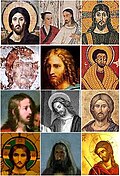
[[File:CompositeJesus.JPG|thumb|right|upright=0.9|Various [[Depiction of Jesus|depictions of Jesus]]]] | |||
{{Main|Jesus in Christianity|Christ (title)}} | |||
{{See also|Incarnation (Christianity)|Jesus in comparative mythology}} | |||
The central tenet of Christianity is the belief in [[Jesus]] as the [[Son of God (Christianity)|Son of God]] and the [[Messiah]] (Christ).<ref>{{harvnb|Woodhead|2004|p=45}}</ref> Christians believe that Jesus, as the Messiah, was [[anointing|anointed]] by God as savior of humanity and hold that Jesus' coming was the fulfillment of [[Christian messianic prophecies|messianic prophecies]] of the [[Old Testament]]. The Christian concept of messiah differs significantly from [[Messiah in Judaism|the contemporary Jewish concept]]. The core Christian belief is that through belief in and acceptance of [[Death and Resurrection of Jesus|the death and resurrection of Jesus]], [[original sin|sinful]] humans can be reconciled to God, and thereby are offered salvation and the promise of [[Immortality|eternal life]].<ref>Metzger/Coogan, ''Oxford Companion to the Bible'', pp. 513, 649.</ref> | |||
While there have been many [[Christian theology|theological]] disputes over the [[Christology|nature of Jesus]] over the earliest centuries of Christian history, generally, Christians believe that Jesus is [[Incarnation (Christianity)|God incarnate]] and "[[Hypostatic union|true God and true man]]" (or both fully divine and fully human). Jesus, having become [[Incarnation (Christianity)|fully human]], suffered the pains and temptations of a mortal man, but did not [[Christian views on sin|sin]]. As fully God, he rose to life again. According to the [[New Testament]], he [[Resurrection of Jesus|rose]] from the dead,<ref>{{Bibleref2|Acts|2:24}}, {{Bibleref2-nb|Acts|2:31–32}}, {{Bibleref2-nb|Acts|3:15}}, {{Bibleref2-nb|Acts|3:26}}, {{Bibleref2-nb|Acts|4:10}}, {{Bibleref2-nb|Acts|5:30}}, {{Bibleref2-nb|Acts|10:40–41}}, {{Bibleref2-nb|Acts|13:30}}, {{Bibleref2-nb|Acts|13:34}}, {{Bibleref2-nb|Acts|13:37}}, {{Bibleref2-nb|Acts|17:30–31}}, {{Bibleref2|Romans|10:9}}, {{bibleref2|1Cor|15:15 || 1 Cor. 15:15}}, {{bibleref2-nb|1Cor|6:14}}, {{bibleref2|2Cor|4:14 || 2 Cor. 4:14}}, {{Bibleref2|Gal|1:1}}, {{Bibleref2|Eph|1:20}}, {{Bibleref2|Col|2:12}}, {{bibleref2|1Thess|1:10 || 1 Thess. 11:10}}, {{Bibleref2|Heb.|13:20}}, {{bibleref2|1Pet|1:3 || 1 Pet. 1:3}}, {{bibleref2-nb|1Pet|1:21}}</ref> [[Ascension of Jesus|ascended]] to heaven, is seated at the right hand of the Father,<ref>[[s:Nicene Creed]]</ref> and will ultimately [[Second Coming|return]]<ref>{{bibleref2|Acts|1:9–11}}</ref> to fulfill the rest of the [[Messianic prophecy]], including the [[resurrection of the dead]], the [[Last Judgment]], and the final establishment of the [[Kingdom of God (Christianity)|Kingdom of God]]. | |||
== | According to the [[Biblical canon|canonical]] [[gospel]]s of [[Gospel of Matthew|Matthew]] and [[Gospel of Luke|Luke]], Jesus was [[Incarnation (Christianity)|conceived]] by the [[Holy Spirit (Christianity)|Holy Spirit]] and [[Nativity of Jesus|born]] from [[Mary, mother of Jesus|the Virgin Mary]]. Little of Jesus' childhood is recorded in the canonical gospels, although [[infancy gospels]] were popular in antiquity.<ref>{{cite book |url= https://books.google.com/books?id=dsZzsAtggnUC&q=L.+Gambero%2C+Mary+and+the+Fathers+of+the+Church |title= Mary and the Fathers of the Church: The Blessed Virgin Mary in Patristic Thought |first= Luigi |last= Gambero |date= 11 June 1999 |publisher= Ignatius Press |via= Google Books|isbn= 978-0-89870-686-4 }}</ref> In comparison, his adulthood, especially the week before his death, is well documented in the gospels contained within the [[New Testament]], because that part of his life is believed to be most important. The biblical accounts of [[Ministry of Jesus|Jesus' ministry]] include: [[Baptism of Jesus|his baptism]], [[Miracles of Jesus|miracles]], preaching, teaching, and deeds. | ||
[[File: | |||
{{ | ==== Death and resurrection ==== | ||
{{Main|Crucifixion of Jesus|Resurrection of Jesus}} | |||
[[File:Cristo crucificado.jpg|thumb|right|upright=0.9|''[[Christ Crucified (Velázquez)|Crucifixion]]'', representing the death of [[Jesus]] on the [[Christian Cross|Cross]], painting by [[Diego Velázquez]], c. 1632.]] | |||
Christians consider the resurrection of Jesus to be the cornerstone of their faith (see [[1 Corinthians 15]]) and the most important event in history.<ref>Hanegraaff. ''Resurrection: The Capstone in the Arch of Christianity''.</ref> Among Christian beliefs, the death and resurrection of Jesus are two core events on which much of Christian doctrine and theology is based.<ref name="ACU-Death & Resurrection">{{cite web|url=https://dlibrary.acu.edu.au/research/theology/Walsh.htm |title=The Significance of the Death and Resurrection of Jesus for the Christian |publisher=Australian Catholic University National |access-date=16 May 2007 |url-status=dead |archive-url=https://web.archive.org/web/20070901153606/https://dlibrary.acu.edu.au/research/theology/Walsh.htm |archive-date=1 September 2007}}</ref> According to the New Testament, Jesus was [[Crucifixion|crucified]], died a physical death, was buried within a tomb, and rose from the dead three days later.<ref>{{bibleref2|Jn.|19:30–31}} {{bibleref2|Mk.|16:1}} {{bibleref2-nb|Mark|16:6}}</ref> | |||
The [[Overview of resurrection appearances in the Gospels and Paul|New Testament mentions]] several [[post-resurrection appearances of Jesus]] on different occasions to his [[twelve apostles]] and [[disciple (Christianity)|disciples]], including "more than five hundred brethren at once",<ref>{{bibleref2|1Cor|15:6}}</ref> before Jesus' [[Ascension of Jesus|ascension]] to heaven. Jesus' death and resurrection are commemorated by Christians in all worship services, with special emphasis during [[Holy Week]], which includes [[Good Friday]] and [[Easter|Easter Sunday]]. | |||
The death and resurrection of Jesus are usually considered the most important events in [[Christian theology]], partly because they demonstrate that Jesus has power over life and death and therefore has the authority and power to give people [[Eternal life (Christianity)|eternal life]].<ref>{{bibleref2 || John|3:16}}, {{bibleref2-nb|John|5:24}}, {{bibleref2-nb|John|6:39–40}}, {{bibleref2-nb|John|6:47}}, {{bibleref2-nb|John|10:10}}, {{bibleref2-nb|John|11:25–26}}, and {{bibleref2-nb|John|17:3}}</ref> | |||
Christian churches accept and teach the [[New Testament]] account of the resurrection of Jesus with very few exceptions.<ref>This is drawn from a number of sources, especially the early Creeds, the ''Catechism of the Catholic Church'', certain theological works, and various Confessions drafted during the Reformation including the ''Thirty Nine Articles of the Church of England'', works contained in the ''Book of Concord''.</ref> Some modern scholars use the belief of Jesus' followers in the resurrection as a point of departure for establishing the continuity of the [[historical Jesus]] and the proclamation of the [[early church]].<ref>Fuller, ''The Foundations of New Testament Christology'', p. 11.</ref> Some [[Liberal Christianity|liberal Christians]] do not accept a literal bodily resurrection,<ref>A [[Jesus Seminar]] conclusion held that "in the view of the Seminar, he did not rise bodily from the dead; the resurrection is based instead on [[vision hypothesis|visionary experiences]] of [[Saint Peter|Peter]], [[Paul the Apostle|Paul]], and [[Mary Magdalene|Mary]]."</ref><ref>Funk. ''The Acts of Jesus: What Did Jesus Really Do?''.</ref> seeing the story as richly symbolic and spiritually nourishing [[mythology|myth]]. Arguments over death and resurrection claims occur at many religious [[debate]]s and [[interfaith|interfaith dialogues]].<ref>Lorenzen. ''Resurrection, Discipleship, Justice: Affirming the Resurrection Jesus Christ Today'', p. 13.</ref> [[Paul the Apostle]], an early Christian convert and missionary, wrote, "If Christ was not raised, then all our preaching is useless, and your trust in God is useless."<ref>{{bibleref2|1Cor|15:14}}</ref><ref>Ball/Johnsson (ed.). ''The Essential Jesus''.</ref> | |||
=== Salvation === | |||
{{Main|Salvation in Christianity}} | |||
[[File:Lucas Cranach (I) - The Law and the Gospel.jpg|thumb|right|''[[Law and Gospel (Cranach)|The Law and the Gospel]]'' by Lucas Cranach the Elder (1529); Moses and Elijah point the sinner to Jesus for salvation.]] | |||
[[Paul the Apostle]], like Jews and Roman [[pagan]]s of his time, believed that sacrifice can bring about new kinship ties, purity, and eternal life.<ref name="remedy">{{cite journal |last=Eisenbaum |first=Pamela |date=Winter 2004 |title=A Remedy for Having Been Born of Woman: Jesus, Gentiles, and Genealogy in Romans |journal=Journal of Biblical Literature |volume=123 |issue=4 |pages=671–702 |url=https://www.sbl-site.org/assets/pdfs/JBL1234.pdf |access-date=3 April 2009 |doi=10.2307/3268465 |jstor=3268465 |url-access=subscription}}</ref> For Paul, the necessary sacrifice was the death of Jesus: Gentiles who are "Christ's" are, like Israel, descendants of Abraham and "heirs according to the promise"<ref>{{bibleref2|Gal.|3:29}}</ref><ref>Wright, N.T. ''What Saint Paul Really Said: Was Paul of Tarsus the Real Founder of Christianity?'' (Oxford, 1997), p. 121.</ref> The God who raised Jesus from the dead would also give new life to the "mortal bodies" of Gentile Christians, who had become with Israel, the "children of God", and were therefore no longer "in the flesh".<ref>{{bibleref2|Rom.|8:9,11,16}}</ref><ref name="remedy" /> | |||
Modern Christian churches tend to be much more concerned with how humanity can be [[eternal salvation|saved]] from a universal condition of sin and death than the question of how both Jews and Gentiles can be in God's family. According to [[Eastern Orthodox]] theology, based upon their understanding of the atonement as put forward by Irenaeus' [[Recapitulation (Irenaeus)|recapitulation theory]], Jesus' death is a [[Ransom theory of atonement|ransom]]. This restores the relation with God, who is loving and reaches out to humanity, and offers the possibility of ''[[Theosis (Eastern Orthodox theology)|theosis]]'' c.q. [[Divinization (Christian)|divinization]], becoming the kind of humans God wants humanity to be. According to Catholic doctrine, Jesus' death [[Satisfaction theory of atonement|satisfies]] the wrath of God, aroused by the offense to God's honor caused by human's sinfulness. The Catholic Church teaches that salvation does not occur without faithfulness on the part of Christians; converts must live in accordance with principles of love and ordinarily must be baptized.<ref>{{Cite CCC|2.1|846}}</ref> In Protestant theology, Jesus' death is regarded as a [[Penal substitution|substitutionary penalty]] carried by Jesus, for the debt that has to be paid by humankind when it broke God's moral law.<ref>[[L. W. Grensted]], ''[https://books.google.com/books?id=PUW8AAAAIAAJ&printsec=frontcover&source=gbs_ge_summary_r&cad=0#v=onepage&q&f=false A Short History of the Doctrine of the Atonement]'' (Manchester: [[Manchester University Press]], 1920), p. 191: 'Before the Reformation only a few hints of a Penal theory can be found.'</ref> | |||
Christians differ in their views on the extent to which individuals' salvation is pre-ordained by God. Reformed theology places distinctive emphasis on grace by teaching that individuals are [[total depravity|completely incapable of self-redemption]], but that [[irresistible grace|sanctifying grace is irresistible]].<ref>Westminster Confession, [https://www.spurgeon.org/~phil/creeds/wcf.htm#chap10 Chapter X] {{webarchive |url=https://web.archive.org/web/20140528062341/https://www.spurgeon.org/~phil/creeds/wcf.htm#chap10 |date=28 May 2014 }};<br />Spurgeon, ''[https://www.spurgeon.org/calvinis.htm A Defense of Calvinism] {{webarchive |url=https://web.archive.org/web/20080410133140/https://www.spurgeon.org/calvinis.htm |date=10 April 2008 }}''.</ref> In contrast [[Catholics]], Orthodox Christians, and [[Arminianism|Arminian]] Protestants believe that the exercise of [[free will]] is necessary to have faith in Jesus.<ref>{{cite web|website=[[Catechism of the Catholic Church]]|title=Grace and Justification|url=https://www.vatican.va/archive/catechism/p3s1c3a2.htm|archive-url=https://web.archive.org/web/20100815001751/https://www.vatican.va/archive/catechism/p3s1c3a2.htm|archive-date=15 August 2010}}</ref> | |||
=== Trinity === | |||
{{Main|Trinity}} | |||
[[File:Shield-Trinity-Scutum-Fidei-English.svg|thumb|upright=0.9|The [[Trinity]] is the belief that [[God in Christianity|God]] is one God in three persons: the [[God the Father|Father]], the [[God the Son|Son]] ([[Jesus]]), and the [[Holy Spirit (Christianity)|Holy Spirit]].<ref name="def-lateran">Definition of the [[Fourth Lateran Council]] quoted in {{Cite CCC|2.1|253}}.</ref>]] | |||
''Trinity'' refers to the teaching that the one God<ref name="Monotheism">Christianity's status as monotheistic is affirmed in, among other sources, the ''[[Catholic Encyclopedia]]'' (article "[https://www.newadvent.org/cathen/10499a.htm Monotheism]"); [[William F. Albright]], ''From the Stone Age to Christianity''; [[H. Richard Niebuhr]]; About.com, [https://ancienthistory.about.com/od/monotheisticreligions/ ''Monotheistic Religion resources'']; Kirsch, ''God Against the Gods''; Woodhead, ''An Introduction to Christianity''; [[Columbia Encyclopedia|The Columbia Electronic Encyclopedia]] [https://www.infoplease.com/ce6/society/A0833762.html ''Monotheism'']; The New Dictionary of [[Cultural Literacy]], [https://web.archive.org/web/20071212011435/https://www.bartleby.com/59/5/monotheism.html ''monotheism'']; New Dictionary of Theology, [https://www.ntwrightpage.com/Wright_NDCT_Paul.htm ''Paul''], pp. 496–499; Meconi. "Pagan Monotheism in Late Antiquity". pp. 111ff.</ref> comprises three distinct, eternally co-existing persons: the ''[[God the Father|Father]]'', the ''Son'' (incarnate in Jesus Christ), and the ''[[Holy Spirit]]''. Together, these three persons are sometimes called the [[Godhead (Christianity)|Godhead]],<ref>Kelly. ''Early Christian Doctrines''. pp. 87–90.</ref><ref>Alexander. ''New Dictionary of Biblical Theology''. pp. 514ff.</ref><ref>McGrath. ''Historical Theology''. p. 61.</ref> although there is no single term in use in Scripture to denote the unified Godhead.<ref>Metzger/Coogan. ''Oxford Companion to the Bible''. p. 782.</ref> In the words of the [[Athanasian Creed]], an early statement of Christian belief, "the Father is God, the Son is God, and the Holy Spirit is God, and yet there are not three Gods but one God".<ref>Kelly. ''The Athanasian Creed''.</ref> They are distinct from another: the Father has no source, the Son is begotten of the Father, and the Spirit proceeds from the Father. Though distinct, the three persons cannot be divided from one another in being or in operation. While some Christians also believe that God appeared as the Father in the [[Old Testament]], it is agreed that he appeared as the Son in the [[New Testament]], and will still continue to manifest as the Holy Spirit in the present. But still, God still existed as three persons in each of these times.<ref>Oxford, "Encyclopedia of Christianity, pg1207</ref> However, traditionally there is a belief that it was the Son who appeared in the Old Testament because, for example, when the [[Trinity#Art|Trinity is depicted in art]], the Son typically has the distinctive appearance, a [[cruciform halo]] identifying Christ, and in depictions of the [[Garden of Eden]], this looks forward to an Incarnation yet to occur. In some [[Early Christian art|Early Christian]] [[sarcophagi]] the Logos is distinguished with a beard, "which allows him to appear ancient, even pre-existent."<ref>Heidi J. Hornik and Mikeal Carl Parsons, ''[https://books.google.com/books?id=BmWpMKaDBVUC&pg=PA34 Interpreting Christian Art: Reflections on Christian art]'', Mercer University Press, 2003, {{ISBN|0-86554-850-1}}, pp. 32–35.</ref> | |||
The [[Trinity]] is an essential doctrine of mainstream Christianity. From earlier than the times of the Nicene Creed (325) Christianity advocated<ref>''Examples of ante-Nicene statements'':{{blockquote|Hence all the power of magic became dissolved; and every bond of wickedness was destroyed, men's ignorance was taken away, and the old kingdom abolished God Himself appearing in the form of a man, for the renewal of eternal life.|St. Ignatius of Antioch in ''Letter to the Ephesians'', ch.4, shorter version, Roberts-Donaldson translation}}{{blockquote|We have also as a Physician the Lord our God Jesus the Christ the only-begotten Son and Word, before time began, but who afterwards became also man, of Mary the virgin. For 'the Word was made flesh.' Being incorporeal, He was in the body; being impassible, He was in a passable body; being immortal, He was in a mortal body; being life, He became subject to corruption, that He might free our souls from death and corruption, and heal them, and might restore them to health, when they were diseased with ungodliness and wicked lusts|St. Ignatius of Antioch in ''Letter to the Ephesians'', ch.7, shorter version, Roberts-Donaldson translation}} | |||
{{blockquote|The Church, though dispersed throughout the whole world, even to the ends of the earth, has received from the apostles and their disciples this faith: ...one God, the Father Almighty, Maker of heaven, and earth, and the sea, and all things that are in them; and in one Christ Jesus, the Son of God, who became incarnate for our salvation; and in the Holy Spirit, who proclaimed through the prophets the dispensations of God, and the advents, and the birth from a virgin, and the passion, and the resurrection from the dead, and the ascension into heaven in the flesh of the beloved Christ Jesus, our Lord, and His manifestation from heaven in the glory of the Father 'to gather all things in one,' and to raise up anew all flesh of the whole human race, in order that to Christ Jesus, our Lord, and God, and Savior, and King, according to the will of the invisible Father, 'every knee should bow, of things in heaven, and things in earth, and things under the earth, and that every tongue should confess; to him, and that He should execute just judgment towards all...|St. Irenaeus in ''Against Heresies'', ch.X, v.I, {{Citation | last = Donaldson| first = Sir James|title = Ante Nicene Fathers, Volume 1: Apostolic Fathers, Justin Martyr, Irenaeus | publisher = [[William B. Eerdmans Publishing Co.]] | year = 1950| isbn = 978-0-8028-8087-1}}}} | |||
{{blockquote|For, in the name of God, the Father and Lord of the universe, and of our Savior Jesus Christ, and of the Holy Spirit, they then receive the washing with water|Justin Martyr in ''First Apology'', ch. LXI, {{Citation | last = Donaldson| first = Sir James|title = Ante Nicene Fathers, Volume 1: Apostolic Fathers, Justin Martyr, Irenaeus | publisher = Wm. B. Eerdmans Publishing Company| year = 1950| isbn = 978-0-8028-8087-1}}}}</ref> the triune [[Holy Mystery|mystery]]-nature of [[God in Christianity|God]] as a normative profession of faith. According to [[Roger E. Olson]] and Christopher Hall, through prayer, meditation, study and practice, the Christian community concluded "that God must exist as both a unity and trinity", codifying this in ecumenical council at the end of the 4th century.<ref>{{cite book|last1=Olson|first1=Roger E.|title=The Trinity|date=2002|publisher=Wm. B. Eerdmans Publishing|page=15|url=https://books.google.com/books?id=SUAidAp8AgEC|isbn=978-0-8028-4827-7}}</ref><ref>Fowler. ''World Religions: An Introduction for Students''. p. 58.</ref><!-- ref supports entire paragraph --> | |||
According to this doctrine, God is not divided in the sense that each person has a third of the whole; rather, each person is considered to be fully God (see [[Perichoresis]]). The distinction lies in their relations, the Father being unbegotten; the Son being begotten of the Father; and the Holy Spirit proceeding from the Father and (in [[Western Christian]] theology) [[Filioque|from the Son]]. Regardless of this apparent difference, the three "persons" are each [[eternity|eternal]] and [[omnipotent]]. Other Christian religions including [[Unitarian Universalism]], [[Jehovah's Witnesses]], and [[Mormonism]], do not share those views on the Trinity. | |||
The Greek word ''trias''<ref>{{LSJ|tria/s1|τριάς|ref}}.</ref>{{refn|group=note|name=Trias-Trinitas|The Latin equivalent, from which English ''trinity'' is derived,<ref>{{OEtymD|trinity}}</ref>{{better source needed|date=August 2020}} is ''trinitas''<ref name="Trinitas" /> though Latin also borrowed Greek ''trias'' verbatim.<ref>{{L&S|trias|ref}}</ref>}} is first seen in this sense in the works of [[Theophilus of Antioch]]; his text reads: "of the Trinity, of God, and of His Word, and of His Wisdom".<ref>{{cite book|series=[[Patrologiae Graecae|Patrologiae Graecae Cursus Completus]]|volume=6|author=Theophilus of Antioch|title=Apologia ad Autolycum|chapter=Book II.15|chapter-url=https://archive.org/stream/PatrologiaGraeca/Patrologia%20Graeca%20Vol.%20006#page/n569|language=el, la|quote=Ὡσαύτως καὶ αἱ τρεῖς ἡμέραι τῶν φωστήρων γεγονυῖαι τύποι εἰσὶν τῆς Τριάδος, τοῦ Θεοῦ, καὶ τοῦ Λόγου αὐτοῦ, καὶ τῆς Σοφίας αὐτοῦ.}}</ref> The term may have been in use before this time; its Latin equivalent,{{refn|group=note|name=Trias-Trinitas}} ''trinitas'',<ref name="Trinitas">{{L&S|trinitas|ref}}</ref> appears afterwards with an explicit reference to the Father, the Son, and the Holy Spirit, in [[Tertullian]].<ref>McManners, ''Oxford Illustrated History of Christianity''. p. 50.</ref><ref>{{citation|author=Tertullian|title=De Pudicitia|chapter=21|chapter-url=https://www.tertullian.org/latin/de_pudicitia.htm|language=la|quote=Nam et ipsa ecclesia proprie et principaliter ipse est spiritus, in quo est trinitas unius diuinitatis, Pater et Filius et Spiritus sanctus.}}.</ref> In the following century, the word was in general use. It is found in many passages of [[Origen]].<ref>McManners, ''Oxford Illustrated History of Christianity'', p. 53.</ref> | |||
== | ==== Trinitarians ==== | ||
{{ | {{Main|Trinitarianism}} | ||
''Trinitarianism'' denotes Christians who believe in the concept of the [[Trinity]]. Almost all Christian denominations and churches hold Trinitarian beliefs. Although the words "Trinity" and "Triune" do not appear in the Bible, beginning in the 3rd century theologians developed the term and concept to facilitate comprehension of the New Testament teachings of God as being Father, Son, and Holy Spirit. Since that time, Christian theologians have been careful to emphasize that Trinity does not imply that there are three gods (the antitrinitarian heresy of [[Tritheism]]), nor that each hypostasis of the Trinity is one-third of an infinite God (partialism), nor that the Son and the Holy Spirit are beings created by and subordinate to the Father ([[Arianism]]). Rather, the Trinity is defined as one God in three persons.<ref>[[Jürgen Moltmann|Moltmann, Jürgen]]. ''The Trinity and the Kingdom: The Doctrine of God.'' Tr. from German. Fortress Press, 1993. {{ISBN|0-8006-2825-X}}</ref> | |||
==== Nontrinitarianism ==== | |||
{{Main|Nontrinitarianism}} | |||
''Nontrinitarianism'' (or ''antitrinitarianism'') refers to theology that rejects the doctrine of the Trinity. Various nontrinitarian views, such as [[adoptionism]] or [[modalism]], existed in early Christianity, leading to the disputes about [[Christology]].<ref>Harnack, ''[https://www.ccel.org/ccel/harnack/dogma1.ii.iii.iii.html History of Dogma]''.</ref> Nontrinitarianism reappeared in the [[Gnosticism]] of the [[Cathars]] between the 11th and 13th centuries, among groups with [[Unitarianism|Unitarian]] theology in the [[Protestant Reformation]] of the 16th century,<ref>''Pocket Dictionary of Church History'' Nathan P. Feldmeth p. 135 "Unitarianism. Unitarians emerged from Protestant Christian beginnings in the sixteenth century with a central focus on the unity of God and subsequent denial of the doctrine of the Trinity"</ref> in the 18th-century [[Age of Enlightenment|Enlightenment]], amongst some groups arising during the [[Second Great Awakening]] of the 19th century, and most recently, in [[Oneness Pentecostalism|Oneness Pentecostal]] churches. | |||
=== Eschatology === | |||
{{Main|Christian eschatology}} | |||
The end of things, whether the end of an individual life, the end of the age, or the end of the world, broadly speaking, is Christian eschatology; the study of the destiny of humans as it is revealed in the Bible. The major issues in Christian eschatology are the [[Great Tribulation|Tribulation]], death and the afterlife, (mainly for [[Evangelical Christianity|Evangelical]] groups) [[Millennialism|the Millennium]] and the following [[Rapture]], the [[Second Coming]] of Jesus, [[Resurrection of the Dead]], Heaven, (for [[Christian liturgy|liturgical]] branches) [[Purgatory]], and Hell, the [[Last Judgment]], the end of the world, and the [[New Heavens and New Earth]]. | |||
Christians believe that the second coming of Christ will occur at the [[eschatology|end of time]], after a period of severe persecution (the Great Tribulation). All who have died will be [[Resurrection of the dead|resurrected bodily from the dead]] for the Last Judgment. Jesus will fully establish the [[Kingdom of God]] in fulfillment of [[Bible prophecy|scriptural prophecies]].<ref name="res">[[Thomas Aquinas]], [https://www.newadvent.org/summa/5.htm ''Summa Theologicum, Supplementum Tertiae Partis''] questions 69 through 99</ref><ref>{{cite web | last =Calvin | first =John | title =Institutes of the Christian Religion, Book Three, Ch. 25 | publisher =reformed.org | url =https://www.reformed.org/books/institutes/books/book3/bk3ch25.html | access-date =1 January 2008}}</ref> | |||
== | ==== Death and afterlife ==== | ||
Most Christians believe that human beings experience divine judgment and are rewarded either with eternal life or [[hell|eternal damnation]]. This includes the [[Last Judgment|general judgement]] at the [[resurrection of the dead]] as well as the belief (held by Catholics,<ref name="CEParticularJudgement">''[[Catholic Encyclopedia]]'', "[https://www.newadvent.org/cathen/08550a.htm Particular Judgment]".</ref><ref name="Ott">Ott, ''Grundriß der Dogmatik'', p. 566.</ref> Orthodox<ref>David Moser, ''[https://www.orthodox.net/articles/about-prayer-for-the-dead.html What the Orthodox believe concerning prayer for the dead]''.</ref><ref>Ken Collins, ''[https://www.kencollins.com/question-45.htm What Happens to Me When I Die?] {{Webarchive|url=https://web.archive.org/web/20080928055816/https://www.kencollins.com/question-45.htm |date=28 September 2008 }}''.</ref> and most Protestants) in a [[particular judgment|judgment particular to the individual soul]] upon physical death. | |||
In the Catholic branch of Christianity, those who die in a state of grace, i.e., without any mortal sin separating them from God, but are still imperfectly purified from the effects of sin, undergo purification through the intermediate state of [[purgatory]] to achieve the holiness necessary for entrance into God's presence.<ref>{{cite web|url=https://www.vatican.va/holy_father/john_paul_ii/audiences/1999/documents/hf_jp-ii_aud_04081999_en.html |title=Audience of 4 August 1999 |publisher=Vatican.va |date=4 August 1999 |access-date=19 November 2010}}</ref> Those who have attained this goal are called ''saints'' (Latin ''sanctus'', "holy").<ref>''[[Catholic Encyclopedia]]'', "[https://www.newadvent.org/cathen/04171a.htm The Communion of Saints]".</ref> | |||
Some Christian groups, such as Seventh-day Adventists, hold to [[Christian mortalism|mortalism]], the belief that the human soul is not naturally immortal, and is unconscious during the intermediate state between bodily death and resurrection. These Christians also hold to [[Annihilationism]], the belief that subsequent to the final judgement, the wicked will cease to exist rather than suffer everlasting torment. Jehovah's Witnesses hold to a similar view.<ref>"The death that Adam brought into the world is spiritual as well as physical, and only those who gain entrance into the Kingdom of God will exist eternally. However, this division will not occur until Armageddon, when all people will be resurrected and given a chance to gain eternal life. In the meantime, "the dead are conscious of nothing." What is God's Purpose for the Earth?" Official Site of Jehovah's Witnesses. ''Watchtower'', 15 July 2002.</ref> | |||
== | == Practices == | ||
{{Main|Christian worship|Church service}} | |||
{{See also|Mass (liturgy)|Reformed worship|Contemporary worship}} | |||
[[File:Complete-church-midnight-mass (3135957575).jpg|thumb|[[Midnight Mass]] at a Catholic parish church in [[Woodside, Queens|Woodside]], New York City, U.S.]] | |||
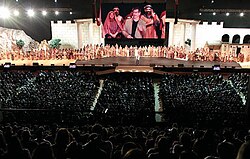
[[File:Auto de Páscoa - IgrejaDaCidade (crop).jpg|thumb|right|Show on the life of Jesus at [[Igreja da Cidade]] in [[São José dos Campos]], affiliated to the [[Brazilian Baptist Convention]].]] | |||
Depending on the specific [[Christian denomination|denomination of Christianity]], practices may include [[baptism]], the [[Eucharist]] (Holy Communion or the Lord's Supper), [[Christian prayer|prayer]] (including the [[Lord's Prayer]]), [[Confession (religion)|confession]], [[confirmation]], [[Christian burial|burial rites]], [[Christian views on marriage|marriage]] rites and the religious education of children. Most denominations have [[ordained]] [[clergy]] who lead regular [[wikt:communal|communal]] worship services.<ref name="White_71-82" /> | |||
[[Rite (Christianity)|Christian rites]], rituals, and ceremonies are not celebrated in one single sacred language. Many ritualistic Christian churches make a distinction between sacred language, liturgical language and vernacular language. The three important languages in the [[Early Christianity|early Christian era]] were: [[Latin language|Latin]], [[Greek language|Greek]] and [[Syriac language|Syriac]].<ref>{{cite book|title=Paradise and Paradigm: Key Symbols in Persian Christianity and the Baha'i Faith|first=Christopher|last=Buck|year= 1999| isbn=978-0-7914-4062-9| page =6|publisher= State University of New York Press |quote=}}</ref><ref>{{cite book|title=Saving Paradise: How Christianity Traded Love of this World for Crucifixion and Empire|first=Rita |last=Nakashima Brock|year= 2008| isbn=978-0-8070-6750-5| page =446|publisher= Beacon Press|quote= the ancient church had three important languages: Greek, Latin, and Syriac.}}</ref><ref>{{cite book|title=The Rowman & Littlefield Handbook of Christianity in the Middle East|first= Mark |last=A. Lamport|year= 2020| isbn=978-0-8070-6750-5| page =135|publisher=Rowman & Littlefield|quote= the ancient church had three important languages: Greek, Latin, and Syriac.}}</ref> | |||
=== Communal worship === | |||
[[Church service|Services]] of worship typically follow a pattern or form known as [[Christian liturgy|liturgy]].{{refn|group=note|Frequently a distinction is made between "liturgical" and "non-liturgical" churches based on how elaborate or antiquated the worship; in this usage, churches whose services are unscripted or improvised are described as "non-liturgical".<ref>{{cite book |last1=Russell |first1=Thomas Arthur |title=Comparative Christianity: A Student's Guide to a Religion and Its Diverse Traditions |date=2010 |publisher=Universal-Publishers |isbn=978-1-59942-877-2 |page=21 |url=https://books.google.com/books?id=FmMarHDbglgC&pg=PT21}}</ref>}} [[Justin Martyr]] described 2nd-century Christian liturgy in his ''[[First Apology]]'' ({{circa|150}}) to Emperor [[Antoninus Pius]], and his description remains relevant to the basic structure of Christian liturgical worship: | |||
{{blockquote|And on the day called Sunday, all who live in cities or in the country gather together to one place, and the memoirs of the apostles or the writings of the prophets are read, as long as time permits; then, when the reader has ceased, the [[Presbyter|president]] verbally instructs, and exhorts to the imitation of these good things. Then we all rise together and pray, and, as we before said, when our prayer is ended, bread and wine and water are brought, and the president in like manner offers prayers and thanksgivings, according to his ability, and the people assent, saying [[Amen]]; and there is a distribution to each, and a participation of that over which thanks have been given, and to those who are absent a portion is sent by the deacons. And they who are well to do, and willing, give what each thinks fit; and what is collected is deposited with the president, who succours the orphans and widows and those who, through sickness or any other cause, are in want, and those who are in bonds and the strangers sojourning among us, and in a word takes care of all who are in need.<ref name="justin">Justin Martyr, [https://www.earlychristianwritings.com/text/justinmartyr-firstapology.html ''First Apology''] §LXVII</ref>}} | |||
Christians | Thus, as Justin described, Christians assemble for communal worship typically on Sunday, the day of the resurrection, though other liturgical practices often occur outside this setting. Scripture readings are drawn from the Old and New Testaments, but especially the gospels.{{refn|group=note|Often these are arranged on an [[annual cycle]], using a book called a [[lectionary]].}}<ref>{{harvnb|White|2010|p=36}}</ref> Instruction is given based on these readings, in the form of a [[sermon]] or [[homily]]. There are a variety of [[Church (congregation)|congregational]] prayers, including thanksgiving, confession, and [[intercession]], which occur throughout the service and take a variety of forms including recited, responsive, silent, or sung.<ref name="White_71-82">{{harvnb|White|2010|pp=71–82}}</ref> [[Psalms]], [[hymn]]s, [[worship song]]s, and other [[church music]] may be sung.<ref>{{cite book |last1=Witvliet |first1=John D. |title=The Biblical Psalms in Christian Worship: A Brief Introduction and Guide to Resources |date=2007 |publisher=Wm. B. Eerdmans Publishing |isbn=978-0-8028-0767-0 |page=11 |url=https://books.google.com/books?id=s7cyEGLwHicC |access-date=24 June 2020}}</ref><ref>{{cite web |last1=Wallwork |first1=Norman |title=The Purpose of a Hymn Book |url=https://jlg.org.uk/wp-content/uploads/2019/10/Hymns-Purpose.pdf |publisher=Joint Liturgical Group of Great Britain |access-date=24 June 2020 |date=2019}}</ref> Services can be varied for special events like significant [[Calendar of saints|feast days]].<ref>For example, {{citation|title=The Calendar |url=https://www.churchofengland.org/prayer-and-worship/worship-texts-and-resources/common-worship/prayer-and-worship/worship-texts-and-resources/common-worship/churchs-year/calendar |publisher=Church of England |access-date=25 June 2020}}</ref> | ||
Nearly all forms of worship incorporate the Eucharist, which consists of a meal. It is reenacted in accordance with Jesus' instruction at the Last Supper that his followers do in remembrance of him as when he gave his disciples [[Sacramental bread|bread]], saying, "This is my body", and gave them [[sacramental wine|wine]] saying, "This is my blood".<ref>Ignazio Silone, ''Bread and Wine'' (1937).</ref> In the [[Early Christianity|early church]], Christians and those yet to complete initiation would separate for the Eucharistic part of the service.<ref>{{cite book |last1=Benz |first1=Ernst |title=The Eastern Orthodox Church: Its Thought and Life |date=2008 |publisher=Transaction Publishers |isbn=978-0-202-36575-6 |page=35 |url=https://books.google.com/books?id=Q5Z_evECb1UC&pg=PA35}}</ref> Some denominations such as [[Confessional Lutheran]] churches continue to practice '[[closed communion]]'.<ref>[https://web.archive.org/web/20060812151753/https://www.lordlife.org/site/dbpage.asp?page_id=140000871&sec_id=140000527 Understanding Closed Communion], stating "''Therefore, our Congregation and our Denomination practices what is called ‘close or closed Communion’, meaning that before you take Communion at our Churches, we ask you to take a Communion Class first to properly learn what Communion is all about.''", by [[Archive.org]]</ref> They offer communion to those who are already united in that denomination or sometimes individual church. Catholics further restrict participation to their members who are not in a state of [[mortal sin]].<ref>{{Cite CCC|2.1|1415}}</ref> Many other churches, such as [[Anglican Communion]] and [[United Methodist Church]], practice '[[open communion]]' since they view communion as a means to unity, rather than an end, and invite all believing Christians to participate.<ref>{{cite web|title=An open table: How United Methodists understand communion – The United Methodist Church|url=https://www.umc.org/what-we-believe/an-open-table-how-united-methodists-understand-communion|publisher=[[United Methodist Church]]|access-date=24 June 2020}}</ref><ref>{{cite web| url = https://www.churchofengland.org/more/policy-and-thinking/canons-church-england/section-b#b28| title = Canon B28 of the Church of England}}</ref> | |||
== | === Sacraments or ordinances === | ||
{{ | {{Main|Sacrament}} | ||
{{See also|Sacraments of the Catholic Church|Anglican sacraments|Lutheran sacraments|Ordinance (Christianity)}} | |||
{{quote box|title=2nd-century description of the [[Eucharist]] | |||
|quote=And this food is called among us ''Eukharistia'' [the Eucharist], of which no one is allowed to partake but the man who believes that the things which we teach are true, and who has been washed with the washing that is for the remission of sins, and unto regeneration, and who is so living as Christ has enjoined. For not as common bread and common drink do we receive these; but in like manner as Jesus Christ our Savior, having been made flesh by the Word of God, had both flesh and blood for our salvation, so likewise have we been taught that the food which is blessed by the prayer of His word, and from which our blood and flesh by transmutation are nourished, is the flesh and blood of that Jesus who was made flesh. | |||
|source=[[Justin Martyr]]<ref name=justin /> | |||
|align=right | |||
|width=30% | |||
|bgcolor=#BCF5A9}} | |||
In Christian belief and practice, a ''sacrament'' is a [[Ritual|rite]], instituted by Christ, that confers [[divine grace|grace]], constituting a [[Sacred Mysteries|sacred mystery]]. The term is derived from the [[Latin]] word ''sacramentum'', which was used to translate the Greek word for ''mystery''. Views concerning both which rites are sacramental, and what it means for an act to be a sacrament, vary among Christian denominations and traditions.<ref name="ODCC1435">Cross/Livingstone. ''The Oxford Dictionary of the Christian Church''. pp. 1435ff.</ref> | |||
The | The most conventional functional definition of a sacrament is that it is an outward sign, instituted by Christ, that conveys an inward, spiritual grace through Christ. The two most widely accepted sacraments are [[Baptism]] and the Eucharist; however, the majority of Christians also recognize five additional sacraments: [[Confirmation (Christian sacrament)|Confirmation]] ([[Chrismation]] in the Eastern tradition), [[Holy Orders]] (or [[ordination]]), [[Penance]] (or [[Confession (religion)|Confession]]), [[Anointing of the Sick]], and [[Matrimony]] (see [[Christian views on marriage]]).<ref name="ODCC1435" /> | ||
Taken together, these are the [[Sacraments of the Catholic Church|Seven Sacraments]] as recognized by churches in the [[High Church]] tradition—notably [[Sacraments of the Catholic Church|Catholic]], [[Eastern Orthodox]], [[Oriental Orthodox]], [[Independent Catholic Churches|Independent Catholic]], [[Old Catholic]], many [[Anglican sacraments|Anglicans]], and some [[Lutherans]]. Most other denominations and traditions typically affirm only Baptism and Eucharist as sacraments, while some Protestant groups, such as the Quakers, reject sacramental theology.<ref name="ODCC1435" /> [[Evangelicalism|Evangelical]] churches adhering to the doctrine of the [[believers' Church]] mostly use the term "[[ordinance (Christianity)|ordinances]]" to refer to baptism and communion.<ref>Robert Paul Lightner, ''Handbook of Evangelical Theology'', Kregel Academic, USA, 1995, p. 234</ref> | |||
In addition to this, the [[Church of the East]] has two additional sacraments in place of the traditional sacraments of Matrimony and the Anointing of the Sick. These include [[Holy Leaven]] (Melka) and the [[sign of the cross]].<ref name="Holy Apostolic Catholic Assyrian Church of the East, Archdiocese of Australia, New Zealand and Lebanon">''Holy Apostolic Catholic Assyrian Church of the East, Archdiocese of Australia, New Zealand and Lebanon.''</ref> | |||
= | {{gallery|height=150 | ||
|File:Исповедь берн собор.jpg|A penitent [[Sacrament of Penance|confessing]] his sins in a [[Ukrainian Greek Catholic Church|Ukrainian Catholic]] church | |||
|File:Methodistcommunion3.jpg|A [[Methodist]] minister celebrating the [[Eucharist]] | |||
|File:Anglican confirmation in Helsinki.jpg|[[Confirmation]] being administered in an [[Anglican Communion|Anglican]] church | |||
|File:Cheirotonia Presbyter 1.jpeg|[[Ordination]] of a priest in the [[Eastern Orthodox]] tradition | |||
|File:Crowning in Syro-Malabar Nasrani Wedding by Mar Gregory Karotemprel.jpg|Crowning during [[Christian views on marriage|Holy Matrimony]] in the [[Syro-Malabar Catholic Church]] | |||
|File:2017-04-12--Service of the Sacrament of Holy Unction, on Holy Wednesday.jpg|Service of the Sacrament of [[Anointing of the Sick|Holy Unction]] served on Great and Holy Wednesday | |||
}} | |||
=== Liturgical calendar === | === Liturgical calendar === | ||
{{ | {{Main|Liturgical year}} | ||
{{See also|Calendar of saints}} | |||
Catholics, Eastern Christians, Lutherans, Anglicans and other traditional Protestant communities frame worship around the [[liturgical year]].<ref>{{cite book |last1=Senn |first1=Frank C. |title=Introduction to Christian Liturgy |date=2012 |publisher=Fortress Press |isbn=978-1-4514-2433-1 |page=103 |quote=For example, days of Mary, Joseph, and John the Baptist (e.g., August 15, March 19, June 24, respectively) are ranked as solemnities in the Roman Catholic calendar; in the Anglican and Lutheran calendars they are holy days or lesser festivals respectively.}}</ref> The liturgical cycle divides the year into a series of [[season]]s, each with their theological emphases, and modes of prayer, which can be signified by different ways of decorating churches, colors of [[parament]]s and [[vestment]]s for clergy,<ref name="calendar">{{cite web|last1=Fortescue|first1=Adrian|title=Christian Calendar|url=https://www.newadvent.org/cathen/03158a.htm|website=The Catholic Encyclopedia.|publisher=Robert Appleton Company|access-date=18 July 2014|year=1912}}</ref> scriptural readings, themes for preaching and even different traditions and practices often observed personally or in the home. | |||
Roman | Western Christian liturgical calendars are based on the cycle of the [[Roman Rite]] of the Catholic Church,<ref name="calendar" /> and Eastern Christians use analogous calendars based on the cycle of their respective [[Ritual#Christianity|rites]]. Calendars set aside holy days, such as [[Solemnity|solemnities]] which commemorate an event in the life of Jesus, Mary, or the [[saint]]s, and periods of [[fasting]], such as [[Lent]] and other pious events such as [[memoria]], or lesser festivals commemorating saints. Christian groups that do not follow a liturgical tradition often retain certain celebrations, such as [[Christmas]], [[Easter]], and [[Pentecost]]: these are the celebrations of Christ's birth, resurrection, and the descent of the Holy Spirit upon the Church, respectively. A few denominations such as [[Quakers|Quaker Christians]] make no use of a liturgical calendar.<ref>Hickman. ''Handbook of the Christian Year''.</ref> | ||
=== Symbols === | === Symbols === | ||
[[File: | {{Main|Christian symbolism}} | ||
[[File:Ephesus IchthysCrop.jpg|thumb|upright=1.05|right|An early circular [[ichthys]] symbol, created by combining the Greek letters [[ΙΧΘΥΣ]] into a wheel, [[Ephesus]], Asia Minor.]] | |||
Christianity has not generally practiced [[Aniconism in Christianity|aniconism]], the avoidance or prohibition of devotional images, even if early [[Jewish Christian]]s and some modern [[Christian denomination|denominations]], invoking the [[Ten Commandments|Decalogue's]] prohibition of [[idolatry]], avoided figures in their symbols. | |||
The [[Christian cross|cross]], today one of the most widely recognized symbols, was used by Christians from the earliest times.<ref>{{cite web|url=https://www.ccel.org/fathers2/ANF-04/anf04-34.htm |title=ANF04. Fathers of the Third Century: Tertullian, Part Fourth; Minucius Felix; Commodian; Origen, Parts First and Second | Christian Classics Ethereal Library |publisher=Ccel.org |date=1 June 2005 |access-date=5 May 2009}}</ref><ref>Minucius Felix speaks of the cross of Jesus in its familiar form, likening it to objects with a crossbeam or to a man with arms outstretched in prayer ([https://www.ccel.org/fathers2/ANF-04/anf04-34.htm#P5713_906729 Octavius of Minucius Felix], chapter XXIX).</ref> Tertullian, in his book ''De Corona'', tells how it was already a tradition for Christians to trace the sign of the cross on their foreheads.<ref>"At every forward step and movement, at every going in and out, when we put on our clothes and shoes, when we bathe, when we sit at table, when we light the lamps, on couch, on seat, in all the ordinary actions of daily life, we trace upon the forehead the sign." (Tertullian, [https://www.ccel.org/ccel/schaff/anf03.iv.vi.iii.html ''De Corona'', chapter 3])</ref> Although the cross was known to the early Christians, the [[crucifix]] did not appear in use until the 5th century.<ref name="soc">Dilasser. ''The Symbols of the Church''.</ref> | |||
Among the earliest Christian symbols, that of the fish or [[Ichthys]] seems to have ranked first in importance, as seen on monumental sources such as tombs from the first decades of the 2nd century.<ref name="cefish">''[[Catholic Encyclopedia]]'', "[https://www.newadvent.org/cathen/06083a.htm Symbolism of the Fish]".</ref> Its popularity seemingly{{Attribution needed|date=March 2022}} arose from the Greek word ''ichthys'' (fish) forming an [[acrostic]] for the Greek phrase ''Iesous Christos Theou Yios Soter'' (Ἰησοῦς Χριστός, Θεοῦ Υἱός, Σωτήρ),{{refn|group=note|''Iesous Christos Theou '''H'''yios Soter'' may be a more complete transliteration; in [[Koine Greek phonology#Loss of aspiration|Koine Greek]], the daseia or [[spiritus asper]] had largely ceased being pronounced and was not—commonly—marked in the [[majuscule]] script of the time.}} (Jesus Christ, Son of God, Savior), a concise summary of Christian faith.<ref name="cefish" /> | |||
[[ | Other major Christian symbols include the [[Chi-Rho|chi-rho monogram]], the [[Dove of peace|dove and olive branch]] (symbolic of the Holy Spirit), the sacrificial lamb (representing Christ's sacrifice), the [[vine]] (symbolizing the connection of the Christian with Christ) and many others. These all derive from passages of the New Testament.<ref name="soc" /> | ||
=== Baptism === | |||
{{Main|Baptism}} | |||
{{multiple image | |||
|align=right | |||
|direction=vertical | |||
|image1=Christening celebration - Celebración de bautizo.JPG | |||
|caption1=[[Infant baptism]] by effusion in a [[Catholic Church in Venezuela]] | |||
|image2=Baptism at Northolt Park Baptist Church (cropped).jpg | |||
|caption2=[[Believer's baptism]] of adult by immersion, [[Northolt]] Park Baptist Church, in [[Greater London]], [[Baptist Union of Great Britain]] | |||
}} | |||
Baptism is the ritual act, with the use of water, by which a person is admitted to membership of the [[Christian Church|Church]]. Beliefs on baptism vary among denominations. Differences occur firstly on whether the act has any spiritual significance. Some, such as the Catholic and [[Eastern Orthodox churches]], as well as Lutherans and Anglicans, hold to the doctrine of [[baptismal regeneration]], which affirms that baptism creates or strengthens a person's faith, and is intimately linked to salvation. Others view baptism as a purely symbolic act, an external public declaration of the inward change which has taken place in the person, but not as spiritually efficacious. Secondly, there are differences of opinion on the methodology of the act. These methods are: by [[Immersion baptism|''immersion'']]; if immersion is total, by ''submersion''; by [[affusion]] (pouring); and by [[aspersion]] (sprinkling). Those who hold the first view may also adhere to the tradition of [[infant baptism]];<ref>{{Cite CCC|2.1|1213|quote=Through Baptism we are freed from sin and reborn as sons of God; we become members of Christ, are incorporated into the Church and made sharers in her mission.}}</ref><ref>"Holy Baptism is the sacrament by which God adopts us as his children and makes us members of Christ's Body, the Church, and inheritors of the kingdom of God" ([https://anglicansonline.org/basics/catechism.html#Holy Book of Common Prayer, 1979, Episcopal)]</ref><ref>"Baptism is the sacrament of initiation and incorporation into the body of Christ" ([https://www.backriverumc.com/userFiles/1257/by_water_and_the_spirit.pdf By Water and The Spirit – The Official United Methodist Understanding of Baptism (PDF)] {{webarchive |url=https://web.archive.org/web/20160313053601/https://www.backriverumc.com/userFiles/1257/by_water_and_the_spirit.pdf |date=13 March 2016 }}</ref><ref>"As an initiatory rite into membership of the Family of God, baptismal candidates are symbolically purified or washed as their sins have been forgiven and washed away" ([[William H. Brackney]], [https://www.baptisthistory.org/pamphlets/baptism.htm Doing Baptism Baptist Style{{snd}} Believer's Baptism] {{webarchive |url=https://web.archive.org/web/20100107183031/https://www.baptisthistory.org/pamphlets/baptism.htm |date=7 January 2010 }})</ref> the Orthodox Churches all practice infant baptism and always baptize by total immersion repeated three times in the name of the Father, the Son, and the Holy Spirit.<ref>"After the proclamation of faith, the baptismal water is prayed over and blessed as the sign of the goodness of God's creation. The person to be baptized is also prayed over and blessed with sanctified oil as the sign that his creation by God is holy and good. And then, after the solemn proclamation of "Alleluia" (God be praised), the person is immersed three times in the water in the name of the Father, the Son and the Holy Spirit" ([https://www.oca.org/OCchapter.asp?SID=2&ID=51 Orthodox Church in America: Baptism).] {{Webarchive|url=https://web.archive.org/web/20101012021946/https://www.oca.org/OCchapter.asp?SID=2&ID=51 |date=12 October 2010}}</ref><ref>"In the Orthodox Church we totally immerse, because such total immersion symbolizes death. What death? The death of the "old, sinful man". After Baptism we are freed from the dominion of sin, even though after Baptism we retain an inclination and tendency toward evil.", Greek Orthodox Archdiocese of Australia, article "[https://www.greekorthodox.org.au/general/faq/faqbaptism Baptism] {{webarchive |url=https://web.archive.org/web/20140930002357/https://www.greekorthodox.org.au/general/faq/faqbaptism |date=30 September 2014 }}".</ref> The Catholic Church also practices infant baptism,<ref>{{Cite CCC|2.1|403}}</ref><ref>{{Cite CCC|2.1|1231,1233,1250,1252}}</ref> usually by affusion, and utilizing the [[Trinitarian formula]].<ref>{{Cite CCC|2.1|1240}}</ref> | |||
[[Evangelical]] denominations adhering to the doctrine of the [[believers' Church]], practice the [[believer's baptism]], [[Baptism by immersion|by immersion]] in water, after the [[new birth]] and a [[profession of faith]].<ref>Randall Herbert Balmer, ''Encyclopedia of Evangelicalism: Revised and expanded edition'', Baylor University Press, USA, 2004, p. 54</ref><ref>Donald W. Dayton, ''The Variety of American Evangelicalism'', Univ. of Tennessee Press, USA, 2001, p. 155, 159</ref> For newborns, there is a ceremony called [[child dedication]].<ref>David Blankenhorn, ''The Faith Factor in Fatherhood: Renewing the Sacred Vocation of Fathering'', Lexington Books, USA, 1999, p. 103</ref> | |||
=== Prayer === | |||
{{Main|Prayer in Christianity}} | |||
{{Further|Canonical hours}} | |||
{{quote box | |||
| width = 30% | |||
| align = right | |||
| quote="... ‘Our Father in heaven, hallowed be your name. Your kingdom come. Your will be done on earth as it is in heaven. Give us today our daily bread. Forgive us our debts, as we also forgive our debtors. Lead us not into temptation, but deliver us from evil.’" | |||
| source = — The [[Lord's Prayer]], Matthew 6:9–13, [[Evangelical Heritage Version|EHV]]<ref>{{cite web |title=Matthew 6:9–13 Evangelical Heritage Version (EHV) |url=https://www.biblegateway.com/passage/?search=Matthew+6%3A9-13&version=EHV |access-date=10 March 2020}}</ref> | |||
}} | |||
In the [[Gospel of Saint Matthew]], [[Jesus]] taught the [[Lord's Prayer]], which has been seen as a model for Christian prayer.<ref name="Jordan">{{cite book |last1=Jordan |first1=Anne |title=Christianity |year=2000 |publisher=Nelson Thornes |isbn=978-0-7487-5320-8 |quote=When he was standing on a hillside, Jesus explained to his followers how they were to behave as God would wish. The talk has become known as the Sermon on the Mount, and is found in the Gospel of Matthew, chapter 5, 6 and 7. During the talk Jesus taught his followers how to pray and he gave them an example of suitable prayer. Christians call the prayer the Lord's Prayer, because it was taught by the Lord, Jesus Christ. It is also known as the Pattern Prayer as it provides a pattern for Christians to follow in prayer, to ensure that they pray in the way God and Jesus would want.}}</ref> The injunction for Christians to pray the Lord's prayer thrice daily was given in the ''[[Didache]]'' and came to be recited by Christians at 9 am, 12 pm, and 3 pm.<ref name="Milavec2003">{{cite book |last1=Milavec |first1=Aaron |title=The Didache: Faith, Hope, & Life of the Earliest Christian Communities, 50–70 C.E. |date=2003 |publisher=Paulist Press |isbn=978-0-8091-0537-3 |quote=Given the placement of the Lord's Prayer in the Didache, it was to be expected that the new member of the community would come to learn and to pray the Lord's Prayer at the appointed hours three times each day only after baptism (8:2f.).}}</ref><ref name="Beckwith2005">{{cite book |last1=Beckwith |first1=Roger T. |title=Calendar, Chronology And Worship: Studies in Ancient Judaism And Early Christianity |date=2005 |publisher=BRILL |isbn=978-90-04-14603-7 |quote=So three minor hours of prayer were developed, at the third, sixth and ninth hours, which, as Dugmore points out, were ordinary divisions of the day for worldly affairs, and the Lord's Prayer was transferred to those hours.}}</ref> | |||
In the second century ''[[Apostolic Tradition]]'', [[Hippolytus of Rome|Hippolytus]] instructed Christians to pray at [[fixed prayer times|seven fixed prayer times]]: "on rising, at the lighting of the evening lamp, at bedtime, at midnight" and "the third, sixth and ninth hours of the day, being hours associated with Christ's Passion."<ref name="Chadwick1993">{{cite book |first1=Henry|last1=Chadwick|author1-link=Henry Chadwick (theologian) |title=The Early Church |date=1993 |publisher=Penguin |isbn=978-1-101-16042-8 |quote=Hippolytus in the ''Apostolic Tradition'' directed that Christians should pray seven times a day – on rising, at the lighting of the evening lamp, at bedtime, at midnight, and also, if at home, at the third, sixth and ninth hours of the day, being hours associated with Christ's Passion. Prayers at the third, sixth, and ninth hours are similarly mentioned by Tertullian, Cyprian, Clement of Alexandria and Origen, and must have been very widely practised. These prayers were commonly associated with private Bible reading in the family.}}</ref> Prayer positions, including kneeling, standing, and [[prostration]]s have been used for these seven fixed prayer times since the days of the early Church.<ref name="Lössl2010">{{cite book |last1=Lössl |first1=Josef |title=The Early Church: History and Memory |date=17 February 2010 |publisher=A&C Black |isbn=978-0-567-16561-9 |page=135 |quote=Not only the content of early Christian prayer was rooted in Jewish tradition; its daily structure too initially followed a Jewish pattern, with prayer times in the early morning, at noon and in the evening. Later (in the course of the second century), this pattern combined with another one; namely prayer times in the evening, at midnight and in the morning. As a result seven 'hours of prayer' emerged, which later became the monastic 'hours' and are still treated as 'standard' prayer times in many churches today. They are roughly equivalent to midnight, 6 a.m., 9 a.m., noon, 3 p.m., 6 p.m. and 9 p.m. Prayer positions included prostration, kneeling and standing. ... Crosses made of wood or stone, or painted on walls or laid out as mosaics, were also in use, at first not directly as objections of veneration but in order to 'orientate' the direction of prayer (i.e. towards the east, Latin ''oriens'').}}</ref> [[Breviary|Breviaries]] such as the [[Shehimo]] and [[Agpeya]] are used by [[Oriental Orthodox Christians]] to pray these [[canonical hours]] while facing in the [[direction of prayer|eastward direction of prayer]].<ref name="Kurian2020">{{cite web |last1=Kurian |first1=Jake |title="Seven Times a Day I Praise You" – The Shehimo Prayers |url=https://www.ds-wa.org/seven-times-a-day-i-praise-you-the-sheema-prayers.html |publisher=[[Malankara Orthodox Diocese of Southwest America|Diocese of South-West America of the Malankara Orthodox Syrian Church]]|access-date=2 August 2020}}</ref><ref name="Amherst1906">{{cite book |author1=[[Mary Cecil, 2nd Baroness Amherst of Hackney]] |title=A Sketch of Egyptian History from the Earliest Times to the Present Day |date=1906 |publisher=Methuen |page=399 |quote=Prayers 7 times a day are enjoined, and the most strict among the Copts recite one of more of the Psalms of David each time they pray. They always wash their hands and faces before devotions, and turn to the East.}}</ref> | |||
The ''Apostolic Tradition'' directed that the [[sign of the cross]] be used by Christians during the [[Minor exorcism in Christianity|minor exorcism]] of [[baptism]], during [[ablution in Christianity|ablutions]] before praying at fixed prayer times, and in times of temptation.<ref name="Hippolytus">{{cite web |author1=Hippolytus|author1-link=Hippolytus of Rome |title=Apostolic Tradition |url=https://www.stjohnsarlingtonva.org/Customer-Content/saintjohnsarlington/CMS/files/EFM/Apostolic_Tradition_by_Hippolytus.pdf |publisher=St. John's Episcopal Church|access-date=5 September 2020 |pages=8, 16, 17}}</ref> | |||
''Intercessory prayer'' is prayer offered for the benefit of other people. There are many intercessory prayers recorded in the Bible, including prayers of the [[Apostle Peter]] on behalf of sick persons{{bibleref2c|Acts|9:40}} and by [[prophet]]s of the Old Testament in favor of other people.{{bibleref2c|1Ki|17:19–22}} In the [[Epistle of James]], no distinction is made between the intercessory prayer offered by ordinary believers and the prominent Old Testament prophet [[Elijah]].{{bibleref2c|Jam|5:16–18}} The effectiveness of prayer in Christianity derives from the power of God rather than the status of the one praying.<ref name="NBDprayer">{{cite encyclopedia |editor=Alexander, T.D. |editor2=Rosner, B.S |year=2001 |title =Prayer |encyclopedia= New Dictionary of Biblical Theology|publisher=Intervarsity Press |location=Downers Grove, IL}}</ref> | |||
The ancient church, in both [[Eastern Christianity|Eastern]] and [[Western Christianity]], developed a tradition of asking for the [[intercession of saints|intercession of (deceased) saints]], and this remains the practice of most [[Eastern Orthodox]], [[Oriental Orthodox]], [[Catholic Church|Catholic]], and some [[Anglican]] churches. Churches of the Protestant Reformation, however, rejected prayer to the saints, largely on the basis of the sole mediatorship of Christ.<ref>{{cite encyclopedia |author1=Ferguson, S.B. |author2=Packer, J. |name-list-style=amp |year=1988 |title =Saints |encyclopedia= New Dictionary of Theology|publisher=Intervarsity Press |location=Downers Grove, IL}}</ref> The reformer [[Huldrych Zwingli]] admitted that he had offered prayers to the saints until his reading of the Bible convinced him that this was [[idolatry in Christianity|idolatrous]].<ref>Madeleine Gray, ''The Protestant Reformation'', (Sussex Academic Press, 2003), p. 140.</ref> | |||
According to the ''[[Catechism of the Catholic Church]]'': "Prayer is the raising of one's mind and heart to God or the requesting of good things from God."<ref>{{Cite CCC|2.1|2559}}</ref> The ''[[Book of Common Prayer]]'' in the Anglican tradition is a guide which provides a set order for services, containing set prayers, scripture readings, and hymns or sung Psalms.<ref>{{cite web |title=The Book of Common Prayer |url=https://www.churchofengland.org/prayer-and-worship/worship-texts-and-resources/book-common-prayer |publisher=[[Church of England]] |access-date=24 June 2020}}</ref> Frequently in Western Christianity, when praying, the hands are placed palms together and forward as in the feudal [[commendation ceremony]]. At other times the older [[orans]] posture may be used, with palms up and elbows in. | |||
== Scriptures == | |||
{{Main|Bible|Biblical canon|Development of the Christian biblical canon|Religious text}} | |||
[[File:Gutenberg Bible, Lenox Copy, New York Public Library, 2009. Pic 01.jpg|upright=1.15|thumb|left|The [[Bible]] is the sacred book in Christianity.]] | |||
Christianity, like other religions, has adherents whose beliefs and biblical interpretations vary. Christianity regards the [[biblical canon]], the [[Old Testament]] and the [[New Testament]], as the [[Biblical inspiration|inspired]] word of God. The traditional view of inspiration is that God worked through human authors so that what they produced was what God wished to communicate. The Greek word referring to inspiration in {{bibleref2|2Timothy|3:16||2 Timothy 3:16}} is ''theopneustos'', which literally means "God-breathed".<ref>{{cite book |title=Hermeneutics: Principles and Processes of Biblical Interpretation |edition=2nd |last=Virkler |first=Henry A. |editor-last=Ayayo |editor-first=Karelynne Gerber |year=2007 |publisher=Baker Academic |location=Grand Rapids |isbn=978-0-8010-3138-0 |page=21}}</ref> | |||
Some believe that divine inspiration makes present Bibles [[Biblical inerrancy|inerrant]]. Others claim inerrancy for the Bible in its original manuscripts, although none of those are extant. Still others maintain that only a particular translation is inerrant, such as the [[King James Version]].<ref>{{cite web|website=[[Catechism of the Catholic Church]]|title=Inspiration and Truth of Sacred Scripture|url=https://www.vatican.va/archive/catechism/p1s1c2a3.htm|archive-url=https://web.archive.org/web/20100909213651/https://www.vatican.va/archive/catechism/p1s1c2a3.htm|archive-date=9 September 2010}}(§ 105–108)</ref><ref>Second Helvetic Confession, [https://web.archive.org/web/20071203120450/https://www.creeds.net/reformed/helvetic/c01.htm ''Of the Holy Scripture Being the True Word of God'']</ref><ref>[[Chicago Statement on Biblical Inerrancy]], [https://www.reformed.org/documents/icbi.html ''online text'']</ref> Another closely related view is [[biblical infallibility]] or limited inerrancy, which affirms that the Bible is free of error as a guide to salvation, but may include errors on matters such as history, geography, or science. | |||
The [[books of the Bible]] accepted by the Orthodox, Catholic, and Protestant churches vary somewhat, with Jews accepting only the Hebrew Bible as canonical; however, there is substantial overlap. These variations are a reflection of the range of [[tradition]]s, and of the [[Ecumenical council|councils]] that have convened on the subject. Every version of the Old Testament always includes the books of the [[Tanakh]], the canon of the [[Hebrew Bible]]. The Catholic and Orthodox canons, in addition to the Tanakh, also include the [[deuterocanonical books]] as part of the Old Testament. These books appear in the [[Septuagint]], but are regarded by Protestants to be [[Biblical apocrypha|apocryphal]]. However, they are considered to be important historical documents which help to inform the understanding of words, grammar, and syntax used in the historical period of their conception. Some versions of the Bible include a separate Apocrypha section between the Old Testament and the New Testament.<ref>Metzger/Coogan, ''Oxford Companion to the Bible''. p. 39.</ref> The New Testament, originally written in [[Koine Greek]], contains 27 books which are agreed upon by all major churches. | |||
Modern scholarship has raised many issues with the Bible. While the [[Authorized King James Version|King James Version]] is held to by many because of its striking English prose, in fact it was translated from the Erasmus Greek Bible, which in turn "was based on a single 12th Century manuscript that is one of the worst manuscripts we have available to us".<ref name="Ehrman209-183">Ehrman, Bart D. (2005). ''Misquoting Jesus: the story behind who changed the Bible and why''. San Francisco: Harper {{ISBN|978-0-06-073817-4}} pp. 183, 209</ref> Much scholarship in the past several hundred years has gone into comparing different manuscripts in order to reconstruct the original text. Another issue is that several verses are considered to be forgeries. The injunction that women "be silent and submissive" in 1 Timothy 2<ref>{{cite web|url=https://www.biblegateway.com/passage/?search=1%20Timothy%202:11-12&version=NIV |title=1 Timothy 2:11–12 NIV – A woman should learn in quietness and |publisher=Bible Gateway |access-date=12 March 2013}}</ref> is thought by many to be a forgery by a follower of Paul, a similar phrase in 1 Corinthians 14,<ref>{{cite web|url=https://www.biblegateway.com/passage/?search=1%20corinthians%2014:34-35&version=NIV |title=1 Corinthians 14:34–35 NIV – Women should remain silent in the |publisher=Bible Gateway |access-date=12 March 2013}}</ref> which is thought to be by Paul, appears in different places in different manuscripts and is thought to originally be a margin note by a copyist.<ref name="Ehrman209-183" /> Other verses in 1 Corinthians, such as 1 Corinthians 11:2–16 where women are instructed to wear a covering over their hair when they pray or prophesize,<ref>{{cite web|url=https://www.biblegateway.com/passage/?search=1%20corinthians%2011:2-16&version=NIV |title=1 corinthians 11:2–16 NIV – On Covering the Head in Worship – I |publisher=Bible Gateway |access-date=12 March 2013}}</ref> contradict this verse. | |||
A final issue with the Bible is the way in which books were selected for inclusion in the New Testament. [[Gnostic Gospels|Other gospels]] have now been recovered, such as those found near [[Nag Hammadi]] in 1945, and while some of these texts are quite different from what Christians have been used to, it should be understood that some of this newly recovered Gospel material is quite possibly contemporaneous with, or even earlier than, the New Testament Gospels. The core of the [[Gospel of Thomas]], in particular, may date from as early as AD 50 (although some major scholars contest this early dating),<ref>{{cite book|last1=Wright|first1=N.T.|title=The New Testament and the People of God|date=1992|publisher=Fortress Press|location=Minneapolis|isbn=978-0-8006-2681-5|pages=435–443}}</ref> and if so would provide an insight into the earliest gospel texts that underlie the canonical Gospels, texts that are mentioned in Luke 1:1–2. The Gospel of Thomas contains much that is familiar from the canonical Gospels—verse 113, for example ("The Father's Kingdom is spread out upon the earth, but people do not see it"),<ref>{{cite web|url=https://gnosis.org/naghamm/gosthom.html |title=The Gospel of Thomas Collection – Translations and Resources |publisher=Gnosis.org |access-date=12 March 2013}}</ref> is reminiscent of Luke 17:20–21<ref>{{cite web|url=https://www.biblegateway.com/passage/?search=Luke+17%3A20-21&version=NIV |title=Luke 17:20–21 NIV – The Coming of the Kingdom of God |publisher=Bible Gateway |access-date=12 March 2013}}</ref><ref>{{cite web |url=https://www.mmnet.com.au/australian_landscape_photos/writer/Reflections.html |title=Reflections on religions |publisher=Mmnet.com.au |access-date=12 March 2013 |archive-url=https://web.archive.org/web/20140202135931/https://www.mmnet.com.au/australian_landscape_photos/writer/Reflections.html |archive-date=2 February 2014 |url-status=dead}}</ref>—and the [[Gospel of John]], with a terminology and approach that is suggestive of what was later termed ''Gnosticism'', has recently been seen as a possible response to the Gospel of Thomas, a text that is commonly labeled ''proto-Gnostic''. Scholarship, then, is currently exploring the relationship in the early church between mystical speculation and experience on the one hand and the search for church order on the other, by analyzing new-found texts, by subjecting canonical texts to further scrutiny, and by an examination of the passage of New Testament texts to canonical status. | |||
Some denominations have [[Religious text#Additional and alternate scriptures|additional canonical holy scriptures]] beyond the Bible, including the [[standard works]] of the [[Latter Day Saints movement]] and ''[[Divine Principle]]'' in the [[Unification Church]].<ref>[[John Bowker (theologian)|John Bowker]], 2011, ''The Message and the Book'', UK, [[Atlantic Books]], pp. 13-14</ref> | |||
=== Catholic interpretation === | |||
[[File:View of saint Peter basilica from a roof.jpg|thumb|upright=1.15|[[St. Peter's Basilica]], [[Vatican City]], the largest church in the world and a symbol of the [[Catholic Church]].]] | |||
{{Main|Catholic theology of Scripture}} | |||
In antiquity, two schools of exegesis developed in [[Alexandria]] and [[School of Antioch|Antioch]]. The Alexandrian interpretation, exemplified by [[Origen]], tended to read Scripture [[allegory|allegorically]], while the Antiochene interpretation adhered to the literal sense, holding that other meanings (called ''[[theoria]]'') could only be accepted if based on the literal meaning.<ref>Kelly. ''Early Christian Doctrines''. pp. 69–78.</ref> | |||
[[Catholic Church|Catholic]] theology distinguishes two senses of scripture: the literal and the spiritual.<ref>Catechism of the Catholic Church, [https://www.vatican.va/archive/catechism/p1s1c2a3.htm#III, ''The Holy Spirit, Interpreter of Scripture'' § 115–118]. {{webarchive |url=https://web.archive.org/web/20150325191945/https://www.vatican.va/archive/catechism/p1s1c2a3.htm#III |date=25 March 2015}}</ref> | |||
The ''literal'' sense of understanding scripture is the meaning conveyed by the words of Scripture. The ''spiritual'' sense is further subdivided into: | |||
* The ''allegorical'' sense, which includes [[Typology (theology)|typology]]. An example would be the [[Passage of the Red Sea|parting of the Red Sea]] being understood as a "type" (sign) of baptism.{{Bibleref2c|1Cor|10:2}} | |||
* The ''[[moral]]'' sense, which understands the scripture to contain some ethical teaching. | |||
* The ''[[anagoge|anagogical]]'' sense, which applies to [[eschatology]], eternity and the [[Apocalypse|consummation of the world]] | |||
Regarding [[exegesis]], following the rules of sound interpretation, Catholic theology holds: | |||
* The injunction that all other senses of sacred scripture are based on the ''literal''<ref>Thomas Aquinas, [https://www.newadvent.org/summa/100110.htm "Whether in Holy Scripture a word may have several senses"] {{webarchive|url=https://web.archive.org/web/20060906114843/https://www.newadvent.org/summa/100110.htm |date=6 September 2006}}</ref><ref>''Catechism of the Catholic Church'', [https://www.vatican.va/archive/catechism/p1s1c2a3.htm#III § 116] {{webarchive |url=https://web.archive.org/web/20150325191945/https://www.vatican.va/archive/catechism/p1s1c2a3.htm#III |date=25 March 2015}}</ref> | |||
* That the historicity of the Gospels must be absolutely and constantly held<ref>[[Second Vatican Council]], [https://www.vatican.va/archive/hist_councils/ii_vatican_council/documents/vat-ii_const_19651118_dei-verbum_en.html ''Dei Verbum'' (V.19)] {{webarchive |url=https://web.archive.org/web/20140531175312/https://www.vatican.va/archive/hist_councils/ii_vatican_council/documents/vat-ii_const_19651118_dei-verbum_en.html |date=31 May 2014 }}.</ref> | |||
* That scripture must be read within the "living Tradition of the whole Church"<ref>''Catechism of the Catholic Church'', [https://www.vatican.va/archive/catechism/p1s1c2a3.htm#III "The Holy Spirit, Interpreter of Scripture" § 113]. {{webarchive |url=https://web.archive.org/web/20150325191945/https://www.vatican.va/archive/catechism/p1s1c2a3.htm#III |date=25 March 2015}}</ref> and | |||
* That "the task of interpretation has been entrusted to the bishops in communion with the successor of Peter, the [[Bishop]] of [[diocese of Rome|Rome]]".<ref>''Catechism of the Catholic Church'', [https://www.vatican.va/archive/catechism/p1s1c2a2.htm#III "The Interpretation of the Heritage of Faith" § 85]. {{webarchive |url=https://web.archive.org/web/20150403212113/https://www.vatican.va/archive/catechism/p1s1c2a2.htm#III |date=3 April 2015}}</ref> | |||
=== Protestant interpretation === | |||
{{Five solae}} | |||
==== Qualities of Scripture ==== | |||
Many Protestant Christians, such as Lutherans and the Reformed, believe in the doctrine of ''[[sola scriptura]]''—that the Bible is a self-sufficient revelation, the final authority on all Christian doctrine, and [[Revelation|revealed all truth]] necessary for salvation;<ref name="WELS2014" /><ref>{{cite book |chapter-url=https://books.google.com/books?id=w_PHAGr2TfgC&pg=PA15|title=The Shape of Sola Scriptura |first=Keith A. |last=Mathison |publisher=[[Canon Press]] |year=2001 |isbn=978-1-885767-74-5|chapter=Introduction |page=15|title-link=The Shape of Sola Scriptura |author-link=Keith A. Mathison}}</ref> other Protestant Christians, such as Methodists and Anglicans, affirm the doctrine of ''[[prima scriptura]]'' which teaches that Scripture is the primary source for Christian doctrine, but that "tradition, experience, and reason" can nurture the Christian religion as long as they are in harmony with the [[Bible]].<ref name="WELS2014">{{cite web|url=https://www.wels.net/what-we-believe/questions-answers/christian/methodist-beliefs|title=Methodist Beliefs: In what ways are Lutherans different from United Methodists?|year=2014|publisher=Wisconsin Evangelical Lutheran Synod|access-date=22 May 2014|quote=The United Methodists see Scripture as the primary source and criterion for Christian doctrine. They emphasize the importance of tradition, experience, and reason for Christian doctrine. Lutherans teach that the Bible is the sole source for Christian doctrine. The truths of Scripture do not need to be authenticated by tradition, human experience, or reason. Scripture is self authenticating and is true in and of itself.|archive-date=22 May 2014|archive-url=https://web.archive.org/web/20140522105449/https://www.wels.net/what-we-believe/questions-answers/christian/methodist-beliefs|url-status=live}}</ref><ref name="Humphrey2013">{{cite book|last=Humphrey|first=Edith M.|title=Scripture and Tradition |date=15 April 2013|publisher=Baker Books|isbn=978-1-4412-4048-4|page=16|quote=historically Anglicans have adopted what could be called a prima Scriptura position.}}</ref> Protestants characteristically believe that ordinary believers may reach an adequate understanding of Scripture because Scripture itself is clear in its meaning (or "perspicuous"). Martin Luther believed that without God's help, Scripture would be "enveloped in darkness".<ref name="Foutz" /> He advocated for "one definite and simple understanding of Scripture".<ref name="Foutz">{{cite web |last=Foutz |first=Scott David |url=https://www.quodlibet.net/luther.shtml |archive-url=https://web.archive.org/web/20000414063800/https://www.quodlibet.net/luther.shtml |url-status=dead |archive-date=14 April 2000 |title=Martin Luther and Scripture |publisher=Quodlibet Journal |access-date=16 June 2014}}</ref> [[John Calvin]] wrote, "all who refuse not to follow the Holy Spirit as their guide, find in the Scripture a clear light".<ref>John Calvin, [https://www.ccel.org/ccel/calvin/calcom45.vii.iv.iv.html '' Commentaries on the Catholic Epistles'' 2 Peter 3:14–18]</ref> Related to this is "efficacy", that Scripture is able to lead people to faith; and "sufficiency", that the Scriptures contain everything that one needs to know in order to obtain salvation and to live a Christian life.<ref>{{cite book|last=Engelder |first=Theodore E.W. |url=https://archive.org/details/MN41551ucmf_1 |title=Popular Symbolics: The Doctrines of the Churches of Christendom and of Other Religious Bodies Examined in the Light of Scripture |page=[https://archive.org/details/MN41551ucmf_1/page/n57 28] |location=Saint Louis, MO |publisher=Concordia Publishing House |year=1934}}</ref> | |||
==== Original intended meaning of Scripture ==== | |||
Protestants stress the meaning conveyed by the words of Scripture, the [[historical-grammatical method]].<ref>Sproul. ''Knowing Scripture'', pp. 45–61; Bahnsen, ''[https://www.cmfnow.com/articles/pt173.htm A Reformed Confession Regarding Hermeneutics'' (article 6)''] {{Webarchive|url=https://web.archive.org/web/20141204091801/https://www.cmfnow.com/articles/pt173.htm |date=4 December 2014 }}.''</ref> The historical-grammatical method or grammatico-historical method is an effort in [[Biblical hermeneutics]] to find the intended original meaning in the text.<ref name="Elwell565">{{Cite book |publisher=Baker Book House |isbn=978-0-8010-3413-8 |last=Elwell |first=Walter A. |title=Evangelical Dictionary of Theology |location=Grand Rapids, Mich. |year=1984 |page=[https://archive.org/details/evangelicaldicti00elwe/page/565 565] |title-link=Evangelical Dictionary of Theology}}</ref> This original intended meaning of the text is drawn out through examination of the passage in light of the grammatical and syntactical aspects, the historical background, the literary genre, as well as theological (canonical) considerations.<ref>{{Cite book |publisher=Academie Books |isbn=978-0-310-34160-4 |last=Johnson |first=Elliott |title=Expository hermeneutics : an introduction |location=Grand Rapids Mich. |year=1990}}</ref> The historical-grammatical method distinguishes between the one original meaning and the significance of the text. The significance of the text includes the ensuing use of the text or application. The original passage is seen as having only a single meaning or sense. As Milton S. Terry said: "A fundamental principle in grammatico-historical exposition is that the words and sentences can have but one significance in one and the same connection. The moment we neglect this principle we drift out upon a sea of uncertainty and conjecture."<ref>{{Cite book |publisher=Zondervan Pub. House |last=Terry |first=Milton |title=Biblical hermeneutics : a treatise on the interpretation of the Old and New Testaments |location=Grand Rapids Mich. |year=1974 |page=205}} (1890 edition page 103, [https://books.google.com/books?id=Fy9VAAAAMAAJ&focus=searchwithinvolume&q=%22fundamental+principle%22 view1], [https://books.google.com/books?id=Fy9VAAAAMAAJ&focus=searchwithinvolume&q=%22neglect+this+principle%22 view2])</ref> Technically speaking, the grammatical-historical method of interpretation is distinct from the determination of the passage's significance in light of that interpretation. Taken together, both define the term (Biblical) hermeneutics.<ref name="Elwell565" /> | |||
Some Protestant interpreters make use of [[Typology (theology)|typology]].<ref>e.g., in his [https://biblehub.com/commentaries/mhcw/matthew/1.htm commentary on Matthew 1] (§III.1). [[Matthew Henry]] interprets the twin sons of Judah, Phares and Zara, as an allegory of the Gentile and [[Jewish Christians]]. For a contemporary treatment, see Glenny, ''[https://www.biblicalstudies.org.uk/article_typology_glenny.html Typology: A Summary Of The Present Evangelical Discussion]''.</ref> | |||
== History == | == History == | ||
{{ | {{Main|History of Christianity}} | ||
Christianity | |||
=== Early Christianity === | |||
==== Apostolic Age ==== | |||
[[File:Kohrvirab.jpg|thumb|upright=1.05|The 7th-century [[Khor Virap]] monastery in the shadow of [[Mount Ararat]]; [[Armenia]] was the first state to adopt Christianity as the state religion, in AD 301.<ref name="Armenia" />]] | |||
[[File:Mor-mattai.png|thumb|right|upright=1.05|The [[Mar Mattai Monastery|Monastery of St. Matthew]], located atop [[Mount Alfaf]] in northern [[Iraq]], is recognized as one of the oldest Christian monasteries in existence.<ref>{{cite web|url=https://cso-france.voila.net/Monastere_Saint_Mattai.htm|language=fr|archive-url=https://web.archive.org/web/20140303004713/https://cso-france.voila.net/Monastere_Saint_Mattai.htm|title=Monastère de Mor Mattai – Mossul – Irak|archive-date=3 March 2014}}</ref>]] | |||
[[File:Kadisha Valley cross.jpg|thumb|right|upright=1.05|[[Kadisha Valley]], [[Lebanon]], home to some of the earliest Christian monasteries in the world.]] | |||
{{Main|Christianity in the 1st century}} | |||
Christianity developed during the 1st century AD as a [[Jewish Christian]] sect with [[Hellenistic religion|Hellenistic]] influence<ref>{{Cite journal |title=Evodius of Antioch → Antioch, Church of |url=http://dx.doi.org/10.1163/2589-7993_eeco_dum_00001220 |access-date=2022-03-14 |website=Brill Encyclopedia of Early Christianity Online|doi=10.1163/2589-7993_eeco_dum_00001220 }}</ref> of [[Second Temple Judaism]].<ref name="Cory2015">{{cite book|first=Catherine|last=Cory|title=Christian Theological Tradition|url=https://books.google.com/books?id=SsZcCgAAQBAJ&pg=PA20|date=13 August 2015|publisher=Routledge|isbn=978-1-317-34958-7|at=p. 20 and forwards}}</ref><ref name="Benko1984">{{cite book|first=Stephen|last=Benko|title=Pagan Rome and the Early Christians|url=https://books.google.com/books?id=LHHxkapsiEgC&pg=PA22|year=1984|publisher=Indiana University Press|isbn=978-0-253-34286-7|at=p. 22 and forwards}}</ref> An early Jewish Christian community was founded in Jerusalem under the leadership of the [[Pillars of the Church]], namely [[James the Just]], the brother of Jesus, [[Saint Peter|Peter]], and John.<ref>{{Citation | last =McGrath | first =Alister E. | author-link =Alister McGrath | year =2006 | title =Christianity: An Introduction | publisher = Wiley-Blackwell | isbn =1-4051-0899-1 | page=174}}</ref> | |||
Jewish Christianity soon attracted Gentile [[God-fearers]], posing a problem for its Jewish religious outlook, which insisted on close observance of the Jewish commandments. [[Paul the Apostle]] solved this by insisting that salvation by [[Pistis Christou|faith in Christ]], and [[Participation in Christ|participation]] in his death and resurrection by their baptism, sufficed.<ref>{{Cite book |last=Seifrid |first=Mark A. |author-link=Mark A. Seifrid |title=Justification by Faith: The Origin and Development of a Central Pauline Theme |chapter='Justification by Faith' and The Disposition of Paul's Argument |series=[[Novum Testamentum]] |location=[[Leiden]] |publisher=[[Brill Publishers]] |date=1992 |isbn=90-04-09521-7 |issn=0167-9732 |pages=210–211, 246–247 |chapter-url=https://books.google.com/books?id=KdUkuOtOw68C&pg=PA210}}</ref> At first he persecuted the early Christians, but after a conversion experience he preached to the [[gentiles]], and is regarded as having had a formative effect on the emerging Christian identity as separate from Judaism. Eventually, his departure from Jewish customs would result in the establishment of Christianity as an independent religion.<ref>Wylen, Stephen M., ''The Jews in the Time of Jesus: An Introduction'', Paulist Press (1995), {{ISBN|0-8091-3610-4}}, Pp. 190–192.; Dunn, James D.G., ''Jews and Christians: The Parting of the Ways, A.D. 70 to 135'', Wm. B. Eerdmans Publishing (1999), {{ISBN|0-8028-4498-7}}, Pp. 33–34.; Boatwright, Mary Taliaferro & Gargola, Daniel J & Talbert, Richard John Alexander, ''The Romans: From Village to Empire'', Oxford University Press (2004), {{ISBN|0-19-511875-8}}, p. 426.</ref> | |||
==== Ante-Nicene period ==== | |||
{{Main|Christianity in the ante-Nicene period}} | |||
This formative period was followed by the early [[bishop]]s, whom Christians consider the [[apostolic succession|successors of Christ's apostles]]. From the year 150, Christian teachers began to produce theological and apologetic works aimed at defending the faith. These authors are known as the [[Church Fathers]], and the study of them is called [[patristics]]. Notable early Fathers include [[Ignatius of Antioch]], [[Polycarp]], [[Justin Martyr]], [[Irenaeus]], [[Tertullian]], [[Clement of Alexandria]] and [[Origen]]. | |||
[[Persecution of Christians]] occurred intermittently and on a small scale by both Jewish and [[Persecution of early Christians by the Romans|Roman authorities]], with Roman action starting at the time of the [[Great Fire of Rome]] in 64 AD. Examples of early executions under Jewish authority reported in the [[New Testament]] include the deaths of [[Saint Stephen]]{{bibleref2c|Acts|7:59}} and [[James, son of Zebedee]].{{bibleref2c|Acts|12:2}} The [[Decian persecution]] was the first empire-wide conflict,<ref name=martin>Martin, D. 2010. [https://www.youtube.com/watch?v=v1Bh_SAEU90 ''The "Afterlife" of the New Testament and Postmodern Interpretation''] {{Webarchive|url=https://web.archive.org/web/20160608093412/https://www.youtube.com/watch?v=v1Bh_SAEU90 |date=8 June 2016 }} ([https://cosmolearning.org/video-lectures/the-afterlife-of-the-new-testament-and-postmodern-interpretation-6819/ lecture transcript] {{Webarchive|url=https://web.archive.org/web/20160812141627/https://cosmolearning.org/video-lectures/the-afterlife-of-the-new-testament-and-postmodern-interpretation-6819/ |date=12 August 2016 }}). Yale University.</ref> when the edict of [[Decius]] in 250 AD required everyone in the Roman Empire (except Jews) to perform a sacrifice to the Roman gods. The [[Diocletianic Persecution]] beginning in 303 AD was also particularly severe. Roman persecution ended in 313 AD with the [[Edict of Milan]]. | |||
While [[Proto-orthodox Christianity]] was becoming dominant, heterodox sects also existed at the same time, which held radically different beliefs. [[Gnostic Christianity]] developed a [[duotheistic]] doctrine based on illusion and enlightenment rather than forgiveness of sin. With only a few scriptures overlapping with the developing orthodox canon, most [[Gnostic texts]] and [[Gnostic gospels]] were eventually considered heretical and suppressed by mainstream Christians. A gradual splitting off of [[Gentile Christianity]] left [[Jewish Christians]] continuing to follow the [[Law of Moses]], including practices such as circumcision. By the fifth century, they and the [[Jewish–Christian gospels]] would be largely suppressed by the dominant sects in both Judaism and Christianity. | |||
==== Spread and acceptance in Roman Empire ==== | |||
[[File:Krist spred 3.jpg|thumb|300px|[[Christendom]] by A.D. 600 after its [[Spread of Christianity|spread to Africa and Europe]] from the Middle East.]] | |||
[[File:Jesus-Christ-from-Hagia-Sophia.jpg|thumb|upright=1.05|An example of Byzantine pictorial art, the [[Deësis]] mosaic at the [[Hagia Sophia#Deësis mosaic|Hagia Sophia]] in [[Constantinople]].]] | |||
{{See also|Edict of Thessalonica}} | |||
Christianity spread to [[Aramaic]]-speaking peoples along the [[Mediterranean coast]] and also to the inland parts of the [[Roman Empire]] and beyond that into the [[Parthian Empire]] and the later [[Sasanian Empire]], including [[Mesopotamia]], which was dominated at different times and to varying extents by these empires.<ref>Michael Whitby, et al. eds. '' Christian Persecution, Martyrdom and Orthodoxy'' (2006) [https://www.questia.com/read/115080283?title=Christian%20Persecution%2c%20Martyrdom%2c%20and%20Orthodoxy online edition]</ref> The presence of Christianity in Africa began in the middle of the 1st century in Egypt and by the end of the 2nd century in the region around [[Carthage]]. [[Mark the Evangelist]] is claimed to have started the [[Church of Alexandria]] in about 43 CE; various later churches claim this as their own legacy, including the [[Coptic Orthodox Church]].<ref>[[Eusebius of Caesarea]], the author of ''[[Church History (Eusebius)|Ecclesiastical History]]'' in the 4th century, states that St. Mark came to Egypt in the first or third year of the reign of Emperor Claudius, i.e. 41 or 43 AD. "Two Thousand years of Coptic Christianity" Otto F.A. Meinardus p. 28.</ref><ref>{{cite web |url=https://www.bethel.edu/~letnie/AfricanChristianity/WesternNorthAfricaHomepage.html |title=A History of the Christian Church in Western North Africa |first=Neil |last=Lettinga |archive-url=https://web.archive.org/web/20010730174045/https://www.bethel.edu/~letnie/AfricanChristianity/WesternNorthAfricaHomepage.html |archive-date=30 July 2001 |url-status=dead}}</ref><ref>{{cite web|url=https://www.allaboutreligion.org/history-of-christianity-in-africa-faq.htm |title=Allaboutreligion.org |publisher=Allaboutreligion.org |access-date=19 November 2010 |url-status=dead |archive-url=https://web.archive.org/web/20101116113632/https://allaboutreligion.org/history-of-christianity-in-africa-faq.htm |archive-date=16 November 2010}}</ref> Important Africans who influenced the early development of Christianity include [[Tertullian]], [[Clement of Alexandria]], [[Origen of Alexandria]], [[Cyprian]], [[Athanasius]], and [[Augustine of Hippo]]. | |||
[[Tiridates III of Armenia|King Tiridates III]] made Christianity the [[state religion]] in [[Armenia]] between 301 and 314,<ref name="Armenia">{{cite web|last=Gill|first=N.S.|title=Which Nation First Adopted Christianity?|url=https://ancienthistory.about.com/od/neareast/f/1stchristian.htm|publisher=About.com|access-date=8 October 2011|quote=Armenia is considered the first nation to have adopted Christianity as the state religion in a traditional date of c. A.D. 301.}}</ref><ref name="CIA">{{cite web |publisher=CIA|title=The World Factbook: Armenia|url=https://www.cia.gov/the-world-factbook/countries/armenia/|access-date =8 October 2011}}</ref><ref name="almanac">{{cite book|last=Brunner|first=Borgna|title=Time Almanac with Information Please 2007|page=[https://archive.org/details/timealmanac2007w00brun/page/685 685]|isbn=978-1-933405-49-0|year=2006|publisher=Time Home Entertainment|location=New York|url=https://archive.org/details/timealmanac2007w00brun/page/685}}</ref> thus Armenia became the first officially Christian state. It was not an entirely new religion in Armenia, having penetrated into the country from at least the third century, but it may have been present even earlier.<ref name="maarten">{{cite journal|last1=Theo Maarten van Lint|title=The Formation of Armenian Identity in the First Millennium|journal=Church History and Religious Culture|date=2009|volume= 89| issue = 1/3|page=269}}</ref> | |||
[[Constantine the Great|Constantine I]] was exposed to Christianity in his youth, and throughout his life his support for the religion grew, culminating in baptism on his deathbed.<ref>{{cite book |title= Constantinople: Capital of Byzantium |author= Harris, Jonathan |publisher=Bloomsbury Academic |edition= 2nd |year=2017 |url= https://books.google.com/books?id=b-ECDgAAQBAJ |page= 38|isbn= 978-1-4742-5467-0}}</ref> During his reign, state-sanctioned persecution of Christians was ended with the [[Edict of Serdica|Edict of Toleration]] in 311 and the [[Edict of Milan]] in 313. At that point, Christianity was still a minority belief, comprising perhaps only five percent of the Roman population.<ref>{{Cite book|title=Christianity: A Global History|last=Chidester|first=David|publisher=HarperOne|year=2000|page=91}}</ref> Influenced by his adviser [[Mardonius (philosopher)|Mardonius]], Constantine's nephew [[Julian (emperor)|Julian]] unsuccessfully tried to suppress Christianity.<ref name="Ricciotti">{{harvnb|Ricciotti|1999}}</ref> On 27 February 380, [[Theodosius I]], [[Gratian]], and [[Valentinian II]] established [[Nicene Christianity]] as the [[State church of the Roman Empire]].<ref>[https://www.fordham.edu/halsall/source/theodcodeXVI.html Theodosian Code XVI.i.2], in: Bettenson. ''Documents of the Christian Church''. p. 31.</ref> As soon as it became connected to the state, Christianity grew wealthy; the Church solicited donations from the rich and could now own land.<ref>{{Cite book|title=Empires in World History: Power and the Politics of Difference|last1=Burbank|first1=Jane|last2=Copper|first2=Frederick|publisher=Princeton University Press|year=2010|location=Princeton|page=64}}</ref> | |||
Constantine was also instrumental in the convocation of the [[First Council of Nicaea]] in 325, which sought to address [[Arianism]] and formulated the Nicene Creed, which is still used by in [[Catholicism]], [[Eastern Orthodoxy]], [[Lutheranism]], [[Anglicanism]], and many other [[Protestant]] churches.<ref name="McTavish2010">{{cite book |last1=McTavish |first1=T. J. |title=A Theological Miscellany: 160 Pages of Odd, Merry, Essentially Inessential Facts, Figures, and Tidbits about Christianity |date=2010 |publisher=Thomas Nelson |isbn=978-1-4185-5281-7 |quote=The Nicene Creed, as used in the churches of the West (Anglican, Catholic, Lutheran, and others), contains the statement, "We believe [''or'' I believe] in the Holy Spirit, the Lord, the giver of life, who proceeds from the Father and the Son."}}</ref><ref name="UMC—Our Common Heritage as Christians" /> Nicaea was the first of a series of [[ecumenical council]]s, which formally defined critical elements of the theology of the Church, notably concerning [[Christology]].<ref name="McManners37">McManners, ''Oxford Illustrated History of Christianity'', pp. 37ff.</ref> The [[Church of the East]] did not accept the third and following ecumenical councils and is still separate today by its successors ([[Assyrian Church of the East]]). | |||
In terms of prosperity and cultural life, the [[Byzantine Empire]] was one of the peaks in [[Christian history]] and [[Christian civilization]],<ref>{{harvnb|Cameron|2006|p=42}}.</ref> and [[Constantinople]] remained the leading city of the [[Christian world]] in size, wealth, and culture.<ref>{{harvnb|Cameron|2006|p=47}}.</ref> [[Greek scholars in the Renaissance|There was a renewed interest in classical Greek philosophy]], as well as an increase in literary output in vernacular Greek.<ref name="Browning-1992-190-218">{{harvnb|Browning|1992|pp=198–208}}.</ref> Byzantine art and literature held a preeminent place in Europe, and the cultural impact of [[Byzantine art]] on the West during this period was enormous and of long-lasting significance.<ref name="Browning-1992-218">{{harvnb|Browning|1992|p=218}}.</ref> The later rise of [[Islam]] in North Africa reduced the size and numbers of Christian congregations, leaving in large numbers only the [[Coptic Orthodox Church|Coptic Church]] in Egypt, the [[Ethiopian Orthodox Tewahedo Church]] in the Horn of Africa and the [[Christianity in Sudan|Nubian Church]] in the Sudan (Nobatia, Makuria and Alodia). | |||
=== Early Middle Ages === | |||
With the decline and [[Fall of the Western Roman Empire|fall of the Roman Empire in the West]], the [[papacy]] became a political player, first visible in [[Pope Leo I|Pope Leo]]'s diplomatic dealings with [[Attila the Hun|Huns]] and [[Vandals]].<ref name="Gonzalez-p238" /> The church also entered into a long period of missionary activity and expansion among the various tribes. While [[Arianism|Arianists]] instituted the death penalty for practicing pagans (see the [[Massacre of Verden]], for example), what would later become [[Catholicism]] also spread among the [[Hungarians]], the [[Germanic peoples|Germanic]],<ref name="Gonzalez-p238">{{harvnb|González|1984|pp=238–242}}</ref> the [[Celts|Celtic]], the [[Baltic peoples|Baltic]] and some [[Slavic peoples]]. | |||
Around 500, [[St. Benedict]] set out his [[Monastic Rule]], establishing a system of regulations for the foundation and running of [[monasteries]].<ref name="Gonzalez-p238" /> [[Monasticism]] became a powerful force throughout Europe,<ref name="Gonzalez-p238" /> and gave rise to many early centers of learning, most famously in [[Ireland]], [[Scotland]], and [[Gaul]], contributing to the [[Carolingian Renaissance]] of the 9th century. | |||
In the 7th century, [[Muslim conquest of Syria|Muslims conquered Syria]] (including [[Jerusalem]]), North Africa, and Spain, converting some of the Christian population to [[Islam]], and placing the rest under a separate [[Dhimmi|legal status]]. Part of the Muslims' success was due to the exhaustion of the Byzantine Empire in its decades long conflict with [[Persia]].{{sfn|Mullin|2008|p=88}} Beginning in the 8th century, with the rise of [[Carolingian]] leaders, the Papacy sought greater political support in the [[Frankish Kingdom]].{{sfn|Mullin|2008|pp=93–94}} | |||
The Middle Ages brought about major changes within the church. [[Pope Gregory the Great]] dramatically reformed the [[Ecclesiastical polity|ecclesiastical structure]] and administration.<ref>{{harvnb|González|1984|pp=244–47}}</ref> In the early 8th century, [[iconoclasm]] became a divisive issue, when it was sponsored by the [[Byzantium|Byzantine]] emperors. The [[Second Council of Nicaea|Second Ecumenical Council of Nicaea]] (787) finally pronounced in favor of icons.<ref>{{harvnb|González|1984|p=260}}</ref> In the early 10th century, Western Christian monasticism was further rejuvenated through the leadership of the great Benedictine monastery of [[Cluny Abbey|Cluny]].<ref>{{harvnb|González|1984|pp=278–281}}</ref> | |||
=== High and Late Middle Ages === | |||
[[File:CouncilofClermont.jpg|thumb|left|[[Pope Urban II]] at the [[Council of Clermont]], where he preached the [[First Crusade]].]] | |||
In the West, from the 11th century onward, some older cathedral schools [[Medieval university|became universities]] (see, for example, [[University of Oxford]], [[University of Paris]] and [[University of Bologna]]). Previously, higher education had been the domain of Christian [[cathedral school]]s or [[monastic school]]s (''Scholae monasticae''), led by [[monk]]s and [[nun]]s. Evidence of such schools dates back to the 6th century CE.<ref>Riché, Pierre (1978): "Education and Culture in the Barbarian West: From the Sixth through the Eighth Century", Columbia: University of South Carolina Press, {{ISBN|0-87249-376-8}}, pp. 126–127, 282–298</ref> These new universities expanded the curriculum to include academic programs for clerics, lawyers, civil servants, and physicians.<ref>Rudy, ''The Universities of Europe, 1100–1914'', p. 40</ref> The university is generally regarded as an institution that has its origin in the [[History of Christianity|Medieval Christian]] setting.<ref name=verger1999>{{cite book |last=Verger |first=Jacques |date=1999 |author-link=:fr:Jacques Verger|title=Culture, enseignement et société en Occident aux XIIe et XIIIe siècles |edition=1st |language=fr |publisher=Presses universitaires de Rennes in Rennes |isbn=978-2-86847-344-8 |url=https://openlibrary.org/works/OL822497W |access-date=17 June 2014}}</ref><ref>Verger, Jacques. "The Universities and Scholasticism," in The New Cambridge Medieval History: Volume V c. 1198–c. 1300. Cambridge University Press, 2007, 257.</ref><ref name="Rüegg, Walter 1992, pp. XIX">Rüegg, Walter: "Foreword. The University as a European Institution", in: ''A History of the University in Europe. Vol. 1: Universities in the Middle Ages'', Cambridge University Press, 1992, {{ISBN|0-521-36105-2}}, pp. XIX–XX</ref> | |||
Accompanying the rise of the "new towns" throughout Europe, [[mendicant order]]s were founded, bringing the [[Consecrated life (Catholic Church)|consecrated religious life]] out of the monastery and into the new urban setting. The two principal mendicant movements were the [[Franciscans]]<ref>{{harvnb|González|1984|pp=303–307, 310ff., 384–386}}</ref> and the [[Dominican Order|Dominicans]],<ref>{{harvnb|González|1984|pp=305, 310ff., 316ff}}</ref> founded by [[Francis of Assisi|St. Francis]] and [[St. Dominic]], respectively. Both orders made significant contributions to the development of the great universities of Europe. Another new order was the [[Cistercians]], whose large isolated monasteries spearheaded the settlement of former wilderness areas. In this period, church building and ecclesiastical architecture reached new heights, culminating in the orders of [[Romanesque architecture|Romanesque]] and [[Gothic architecture]] and the building of the great European cathedrals.<ref>{{harvnb|González|1984|pp=321–323, 365ff}}</ref> | |||
[[Christian nationalism]] emerged during this era in which Christians felt the impulse to recover lands in which Christianity had historically flourished.<ref name="USE2005">{{cite book |title=Parole de l'Orient, Volume 30 |date=2005 |publisher=Université Saint-Esprit |page=488}}</ref> From 1095 under the pontificate of [[Urban II]], the [[First Crusade]] was launched.<ref>{{harvnb|González|1984|pp=292–300}}</ref> These were a series of military campaigns in the [[Holy Land]] and elsewhere, initiated in response to pleas from the Byzantine Emperor [[Alexios I]] for aid against [[Turkish people|Turkish]] expansion. The Crusades ultimately failed to stifle Islamic aggression and even contributed to Christian enmity with the sacking of [[Constantinople]] during the [[Fourth Crusade]].<ref>Riley-Smith. ''The Oxford History of the Crusades''.</ref> | |||
The Christian Church experienced internal conflict between the 7th and 13th centuries that resulted in a [[East-West Schism|schism]] between the so-called Latin or [[Western Christian]] branch (the Catholic Church),<ref>The Western Church was called Latin at the time by the Eastern Christians and non-Christians due to its conducting of its rituals and affairs in the Latin language</ref> and an [[Eastern Christianity|Eastern]], largely Greek, branch (the [[Eastern Orthodox Church]]). The two sides disagreed on a number of administrative, liturgical and doctrinal issues, most prominently [[Eastern Orthodox opposition to papal supremacy]].<ref name="Orthodox Information Centre-Great Schism">{{cite web|url = https://www.orthodoxinfo.com/general/greatschism.aspx| title = The Great Schism: The Estrangement of Eastern and Western Christendom|publisher = Orthodox Information Centre|access-date = 26 May 2007}}</ref><ref name="SandSp91">Duffy, ''Saints and Sinners'' (1997), p. 91</ref> The [[Second Council of Lyon]] (1274) and the [[Council of Florence]] (1439) attempted to reunite the churches, but in both cases, the Eastern Orthodox refused to implement the decisions, and the two principal churches remain in schism to the present day. However, the Catholic Church has achieved union with various [[Eastern Catholic Churches|smaller eastern churches]]. | |||
In the thirteenth century, a new emphasis on Jesus' suffering, exemplified by the Franciscans' preaching, had the consequence of turning worshippers' attention towards Jews, on whom [[Jewish deicide|Christians had placed the blame for Jesus' death]]. Christianity's limited tolerance of Jews was not new—Augustine of Hippo said that Jews should not be allowed to enjoy the citizenship that Christians took for granted—but the growing antipathy towards Jews was a factor that led to [[Edict of Expulsion|the expulsion of Jews from England in 1290]], the first of many such expulsions in Europe.<ref name="diarmaid">{{cite book |last=MacCulloch |first=Diarmaid |title=Christianity: The First Three Thousand Years |publisher=Penguin |date=2011 |url= https://books.google.com/books?id=7x4m20TRYzQC|isbn=978-1-101-18999-3}}</ref><ref name="telushkin">{{cite book |last=Telushkin |first=Joseph |title=Jewish Literacy |publisher=HarperCollins |pages=[https://archive.org/details/jewishliteracy00telu/page/192 192–193] |date=2008 |isbn=978-0-688-08506-3 |url=https://archive.org/details/jewishliteracy00telu/page/192}}</ref> | |||
Beginning around 1184, following the crusade against [[Cathars|Cathar]] heresy,<ref>{{harvnb|González|1984|pp=300, 304–305}}</ref> various institutions, broadly referred to as the [[Inquisition]], were established with the aim of suppressing [[heresy]] and securing religious and doctrinal unity within Christianity through [[religious conversion|conversion]] and prosecution.<ref>{{harvnb|González|1984|pp=310, 383, 385, 391}}</ref> | |||
=== Protestant Reformation and Counter-Reformation === | |||
[[File:Luther 95 Thesen.png|thumb|right|upright=1.05|[[Martin Luther]] initiated the [[Reformation]] with his ''[[Ninety-five Theses]]'' in 1517.]] | |||
{{Main|Protestant Reformation|Counter-Reformation}} | |||
{{See also|European wars of religion|Renaissance Papacy}} | |||
The 15th-century [[Renaissance]] brought about a renewed interest in ancient and classical learning. During the [[Reformation]], [[Martin Luther]] posted the ''[[Ninety-five Theses]]'' 1517 against the sale of [[indulgences]].<ref name="Simon">Simon. ''Great Ages of Man: The Reformation''. pp. 39, 55–61.</ref> Printed copies soon spread throughout Europe. In 1521 the [[Edict of Worms]] condemned and excommunicated Luther and his followers, resulting in the schism of the [[Western Christianity|Western Christendom]] into several branches.<ref name="Simon-120-121">Simon. ''Great Ages of Man: The Reformation''. p. 7.</ref> | |||
Other reformers like [[Huldrych Zwingli|Zwingli]], [[Johannes Oecolampadius|Oecolampadius]], [[John Calvin|Calvin]], [[John Knox|Knox]], and [[Jacobus Arminius|Arminius]] further criticized Catholic teaching and worship. These challenges developed into the movement called [[Protestantism]], which repudiated the [[papal primacy|primacy of the pope]], the role of tradition, the [[Catholic sacraments|seven sacraments]], and other doctrines and practices.<ref name="Simon" /> The [[English Reformation|Reformation in England]] began in 1534, when [[Henry VIII of England|King Henry VIII]] had himself [[Act of Supremacy|declared head]] of the [[Church of England]]. Beginning in 1536, the monasteries throughout England, Wales and Ireland were [[Dissolution of the monasteries|dissolved]].<ref name="Schama">Schama. ''A History of Britain''. pp. 306–310.</ref> | |||
[[Thomas Müntzer]], [[Andreas Karlstadt]] and other theologians perceived both the Catholic Church and the confessions of the [[Magisterial Reformation]] as corrupted. Their activity brought about the [[Radical Reformation]], which gave birth to various [[Anabaptism|Anabaptist]] denominations. | |||
[[File:Michelangelo's Pieta 5450 cropncleaned edit.jpg|thumb|upright=1.05|[[Michelangelo]]'s 1498–99 ''[[Michelangelo's Pietà|Pietà]]'' in [[St. Peter's Basilica]]; the Catholic Church was among the patronages of the [[Renaissance]].<ref name="natgeo 254">National Geographic, 254.</ref><ref>Jensen, De Lamar (1992), ''Renaissance Europe'', {{ISBN|0-395-88947-2}}</ref><ref>{{Cite book|last=Levey|first=Michael|title=Early Renaissance|publisher=Penguin Books|year=1967}}</ref>]] | |||
Partly in response to the Protestant Reformation, the Catholic Church engaged in a substantial process of reform and renewal, known as the [[Counter-Reformation]] or Catholic Reform.{{sfn|Bokenkotter|2004|pp=242–244}} The [[Council of Trent]] clarified and reasserted Catholic doctrine. During the following centuries, competition between Catholicism and Protestantism became deeply entangled with political struggles among European states.<ref name="Simon3">Simon. ''Great Ages of Man: The Reformation''. pp. 109–120.</ref> | |||
Meanwhile, the discovery of America by [[Christopher Columbus]] in 1492 brought about a new wave of missionary activity. Partly from missionary zeal, but under the impetus of [[Colonialism|colonial expansion]] by the European powers, Christianity spread to the Americas, Oceania, East Asia and sub-Saharan Africa. | |||
Throughout Europe, the division caused by the Reformation led to outbreaks of [[religious violence]] and the establishment of separate state churches in Europe. [[Lutheranism]] spread into the northern, central, and eastern parts of present-day Germany, [[Livonia]], and Scandinavia. [[Anglicanism]] was established in England in 1534. [[Calvinism]] and its varieties, such as [[Presbyterianism]], were introduced in Scotland, the Netherlands, Hungary, Switzerland, and France. [[Arminianism]] gained followers in the Netherlands and [[Frisia]]. Ultimately, these differences led to the outbreak of [[religious war|conflicts]] in which religion played a key factor. The [[Thirty Years' War]], the [[English Civil War]], and the [[French Wars of Religion]] are prominent examples. These events intensified the [[Christian debate on persecution and toleration]].<ref>A general overview about the English discussion is given in Coffey, ''Persecution and Toleration in Protestant England 1558–1689''.</ref> | |||
In the revival of neoplatonism [[Renaissance humanism|Renaissance humanists]] did not reject Christianity; quite the contrary, many of the greatest works of the [[Renaissance]] were devoted to it, and the Catholic Church patronized many works of [[Renaissance art]].<ref name="openuni">Open University, ''[https://www.open.ac.uk/Arts/renaissance2/religion.htm Looking at the Renaissance: Religious Context in the Renaissance]'' (Retrieved 10 May 2007)</ref> Much, if not most, of the new art was commissioned by or in dedication to the Church.<ref name="openuni" /> Some scholars and historians attributes Christianity to having contributed to the rise of the [[Scientific Revolution]],<ref>{{cite web|last1=Harrison|first1=Peter|title=Christianity and the rise of western science|website=[[Australian Broadcasting Corporation]]|date=8 May 2012|url=https://www.abc.net.au/religion/articles/2012/05/08/3498202.htm|access-date=28 August 2014}}</ref><ref>{{citation | last = Noll | first = Mark | author-link = Mark Noll | title = Science, Religion, and A.D. White: Seeking Peace in the "Warfare Between Science and Theology" | publisher = The Biologos Foundation | page = 4 | url = https://biologos.org/uploads/projects/noll_scholarly_essay2.pdf | access-date = 14 January 2015 | archive-url = https://web.archive.org/web/20150322013257/https://biologos.org/uploads/projects/noll_scholarly_essay2.pdf | archive-date = 22 March 2015 | url-status=dead}}</ref><ref>{{Citation | last1 = Lindberg | first1 = David C. | author-link = David C. Lindberg | last2 = Numbers | first2 = Ronald L. | author2-link = Ronald L. Numbers | title = God & Nature: Historical Essays on the Encounter Between Christianity and Science | place = Berkeley and Los Angeles | publisher = University of California Press | year = 1986 | chapter = Introduction | pages = 5, 12 | isbn = 978-0-520-05538-4}}</ref><ref name="Gilley1">{{cite book |last= Gilley |first= Sheridan |others=Brian Stanley|title=The Cambridge History of Christianity: Volume 8, World Christianities C.1815-c.1914 |year=2006 |publisher=Cambridge University Press|isbn=0-521-81456-1|page=164}}</ref><ref>Lindberg, David. (1992) ''The Beginnings of Western Science'' University of Chicago Press. p. 204.</ref>{{Excessive citations inline|date=September 2021}} Many well-known historical figures who influenced [[Western science]] considered themselves Christian such as [[Nicolaus Copernicus]],<ref>''Pro forma'' candidate to Prince-Bishop of Warmia, cf. Dobrzycki, Jerzy, and Leszek Hajdukiewicz, "Kopernik, Mikołaj", ''[[Polski słownik biograficzny]]'' (Polish Biographical Dictionary), vol. XIV, Wrocław, [[Polish Academy of Sciences]], 1969, p. 11.</ref> [[Galileo Galilei]],<ref>{{cite book |last=Sharratt |first=Michael |year=1994 |title=Galileo: Decisive Innovator |publisher=Cambridge University Press |location=Cambridge |isbn=0-521-56671-1|pages=17, 213}}</ref> [[Johannes Kepler]],<ref>"Because he would not accept the Formula of Concord without some reservations, he was excommunicated from the Lutheran communion. Because he remained faithful to his Lutheranism throughout his life, he experienced constant suspicion from Catholics." John L. Treloar, "Biography of Kepler shows man of rare integrity. Astronomer saw science and spirituality as one." ''National Catholic Reporter'', 8 October 2004, p. 2a. A review of James A. Connor ''Kepler's Witch: An Astronomer's Discovery of Cosmic Order amid Religious War, Political Intrigue and Heresy Trial of His Mother'', Harper San Francisco.</ref> [[Isaac Newton]]<ref name="Newton – 1">[[Richard S. Westfall]] – [[Indiana University]] {{cite book | url =https://galileo.rice.edu/Catalog/NewFiles/newton.html | title = The Galileo Project | publisher = ([[Rice University]]) | access-date = 5 July 2008<!-- , 2012-02-07-->}}</ref> and [[Robert Boyle]].<ref>{{cite web | url = https://www.stmarylebow.co.uk/?Boyle_Lecture | title = The Boyle Lecture | work = St. Marylebow Church}}</ref> | |||
=== Post-Enlightenment === | |||
[[File:Madonna and Child, Kakure Kirishitan.jpg|thumb|upright=1.05|right|A depiction of [[Madonna and Child]] in a 19th-century [[Kakure Kirishitan]] [[Ukiyo-e|Japanese woodcut]].]] | |||
In the era known as the [[Great Divergence]], when in the West, the [[Age of Enlightenment]] and the [[scientific revolution]] brought about great societal changes, Christianity was confronted with various forms of [[skepticism]] and with certain modern [[Ideology|political ideologies]], such as versions of [[socialism]] and [[liberalism]].<ref>{{cite book|last=Novak|first=Michael|title=Catholic social thought and liberal institutions: Freedom with justice|year=1988|publisher=Transaction|isbn=978-0-88738-763-0|page=63|url=https://books.google.com/books?id=7pb1GDmxA1UC&pg=PA63}}</ref> Events ranged from mere [[anti-clericalism]] to violent outbursts against Christianity, such as the [[dechristianisation of France during the French Revolution|dechristianization of France during the French Revolution]],<ref>Mortimer Chambers, ''The Western Experience'' (vol. 2) chapter 21.</ref> the [[Spanish Civil War]], and certain [[Marxism|Marxist]] movements, especially [[Russian Revolution (1917)|the Russian Revolution]] and the [[persecution of Christians in the Soviet Union]] under [[state atheism]].<ref>''Religion and the State in Russia and China: Suppression, Survival, and Revival'', by Christopher Marsh, p. 47. Continuum International Publishing Group, 2011.</ref><ref>''Inside Central Asia: A Political and Cultural History'', by Dilip Hiro. Penguin, 2009.</ref><ref name="Adappur2000">{{cite book|last=Adappur|first=Abraham|title=Religion and the Cultural Crisis in India and the West|url=https://books.google.com/books?id=44DYAAAAMAAJ|year=2000|publisher=Intercultural Publications|isbn=978-81-85574-47-9|quote=Forced Conversion under Atheistic Regimes: It might be added that the most modern example of forced "conversions" came not from any theocratic state, but from a professedly atheist government—that of the Soviet Union under the Communists.}}</ref><ref>Geoffrey Blainey 2011). ''A Short History of Christianity''; Viking; p. 494</ref> | |||
Especially pressing in Europe was the formation of [[nation states]] after the [[Napoleonic era]]. In all European countries, different Christian denominations found themselves in competition to greater or lesser extents with each other and with the state. Variables were the relative sizes of the denominations and the religious, political, and ideological orientation of the states. Urs Altermatt of the [[University of Fribourg]], looking specifically at Catholicism in Europe, identifies four models for the European nations. In traditionally Catholic-majority countries such as Belgium, Spain, and Austria, to some extent, religious and national communities are more or less identical. Cultural symbiosis and separation are found in Poland, the Republic of Ireland, and Switzerland, all countries with competing denominations. Competition is found in Germany, the Netherlands, and again Switzerland, all countries with minority Catholic populations, which to a greater or lesser extent identified with the nation. Finally, separation between religion (again, specifically Catholicism) and the state is found to a great degree in France and Italy, countries where the state actively opposed itself to the authority of the Catholic Church.<ref>{{cite book|last=Altermatt|first=Urs|title=Religion und Nation: Katholizismen im Europa des 19. und 20. Jahrhundert|year=2007|publisher=[[Kohlhammer Verlag]]|isbn=978-3-17-019977-4|pages=15–34|editor=Urs Altermatt, Franziska Metzger|language=de|chapter=Katholizismus und Nation: Vier Modelle in europäisch-vergleichender Perspektive}}</ref> | |||
The combined factors of the formation of nation states and [[ultramontanism]], especially in Germany and the Netherlands, but also in England to a much lesser extent,<ref>{{cite book|last=Heimann|first=Mary|title=Catholic Devotion in Victorian England|year=1995|publisher=Clarendon Press|isbn=978-0-19-820597-5|pages=165–73}}</ref> often forced Catholic churches, organizations, and believers to choose between the national demands of the state and the authority of the Church, specifically the papacy. This conflict came to a head in the [[First Vatican Council]], and in Germany would lead directly to the ''[[Kulturkampf]]'',<ref>The Oxford Handbook of Modern German History Helmut Walser Smith, p. 360, OUP Oxford, 29 September 2011</ref> where liberals and Protestants under the leadership of [[Otto von Bismarck|Bismarck]] managed to severely restrict Catholic expression and organization. | |||
Christian commitment in Europe dropped as modernity and secularism came into their own,<ref>{{cite news| url=https://www.bbc.co.uk/news/science-environment-12811197 | work=BBC News | title=Religion may become extinct in nine nations, study says | date=22 March 2011}}</ref> particularly in [[Czechia]] and [[Estonia]],<ref>{{cite web|url=https://www2.ttcn.ne.jp/~honkawa/9460.html |title=図録▽世界各国の宗教 |publisher=.ttcn.ne.jp |access-date=17 August 2012}}</ref> while religious commitments in America have been generally high in comparison to Europe. The late 20th century has shown the shift of Christian adherence to the [[Third World]] and the Southern Hemisphere in general,<ref>{{cite book|page=2|title=Christianity as a World Religion|author-last1=Kim|author-first1=Sebastian|author-last2=Kim|author-link=Sebastian Kim|author-first2=Kirsteen|author-link2=Kirsteen Kim|publisher=Continuum|location=London|date=2008}}</ref><ref name="Hanciles2008">{{cite book|first=Jehu|last=Hanciles|title=Beyond Christendom: Globalization, African Migration, and the Transformation of the West|url=https://books.google.com/books?id=vmCDAwAAQBAJ|year=2008|publisher=Orbis Books|isbn=978-1-60833-103-1}}</ref> with the West no longer the chief standard bearer of Christianity. Approximately 7 to 10% of [[Arabs]] are [[Arab Christians and Arabic-speaking Christians|Christians]],<ref name=Pacini>{{cite book |last=Fargues|first=Philippe |title=Christian Communities in the Middle East |publisher=Oxford University Press |year=1998 |isbn=978-0-19-829388-0 |chapter=A Demographic Perspective |editor1-last=Pacini|editor1-first=Andrea}}</ref> most prevalent in Egypt, [[Syria]] and [[Lebanon]]. | |||
== Demographics == | |||
{{update|section|date=September 2021}}{{Main|Christianity by country|Christian population growth}} | |||
{{See also|Christendom|Christian state}} | |||
With around 2.4 billion adherents,<ref name="World">31.4% of ≈7.4 billion world population (under the section 'People') {{cite web|url=https://www.cia.gov/the-world-factbook/countries/world/|title=World|website=The World Factbook|date=14 December 2021|publisher=CIA}}</ref><ref name="gordonconwell.edu">{{cite web|url=https://www.gordonconwell.edu/resources/documents/1IBMR2015.pdf|title=Christianity 2015: Religious Diversity and Personal Contact|date=January 2015|publisher=gordonconwell.edu|access-date=29 May 2015|archive-url=https://web.archive.org/web/20170525141543/https://www.gordonconwell.edu/resources/documents/1IBMR2015.pdf|archive-date=25 May 2017|url-status=dead}}</ref> split into three main branches of Catholic, Protestant, and Eastern Orthodox, Christianity is the [[major religious groups|world's largest religion]].<ref name="PewDec2012">{{cite web|url=https://www.pewforum.org/2012/12/18/global-religious-landscape-exec/|title=The Global Religious Landscape|date=December 2012|publisher=Pew Research Center|access-date=5 November 2018}}</ref> The Christian share of the world's population has stood at around 33% for the last hundred years, which means that one in three persons on Earth are Christians. This masks a major shift in the demographics of Christianity; large increases in the developing world have been accompanied by substantial declines in the developed world, mainly in Western Europe and North America.<ref>Werner Ustorf. "A missiological postscript", in McLeod and Ustorf (eds), ''The Decline of Christendom in (Western) Europe, 1750–2000'', ([[Cambridge University Press]], 2003) pp. 219–20.</ref> According to a 2015 [[Pew Research Center]] study, within the next four decades, Christianity will remain the largest religion; and by 2050, the Christian population is expected to exceed 3 billion.<ref name=PewProjections>{{cite web|url=https://www.pewforum.org/files/2015/03/PF_15.04.02_ProjectionsFullReport.pdf|title=The Future of World Religions: Population Growth Projections, 2010–2050|access-date=24 June 2016|archive-url=https://web.archive.org/web/20150506113049/https://www.pewforum.org/files/2015/03/PF_15.04.02_ProjectionsFullReport.pdf|archive-date=6 May 2015|url-status=dead}}</ref>{{rp|60}} | |||
[[File:Reabertura Museu de Arte Sacra (18626301050).jpg|thumb|A Christian procession in [[Brazil]], the country with the largest Catholic population in the world.<ref name="PewDec2012" />]] | |||
[[File:День Святой Троицы. Престольный праздник.jpg|thumb|[[Trinity Sunday]] in [[Russia]]; the [[Russian Orthodox Church]] has experienced a great revival since the fall of communism.<ref name="Pew20152016" />|alt=]] | |||
According to some scholars, Christianity ranks at first place in net gains through [[religious conversion]].<ref name="he Oxford Handbook of Religious Conversion">{{cite book |date=2014 |editor-first1=Lewis Ray |editor-last1=Rambo |editor-first2=Charles E. |editor-last2=Farhadian |title=The Oxford Handbook of Religious Conversion p.58-61|publisher=Oxford University Press|isbn=978-0-19-533852-2}}</ref><ref name="Evangelicalism and Conversion">{{cite book |date=2010 |editor1=Carla Gardina Pestana |title=Evangelicalism and Conversion: Oxford Bibliographies Online Research Guide|publisher=Oxford University Press|isbn=978-0-19-980834-2}}</ref> As a percentage of Christians, the [[Catholic Church]] and [[Orthodoxy]] (both [[Eastern Orthodox Church|Eastern]] and [[Oriental Orthodoxy|Oriental]]) are declining in some parts of the world (though Catholicism is growing in Asia, in Africa, vibrant in Eastern Europe, etc.), while [[Protestants]] and other [[Christians]] are on the rise in the developing world.<ref name="pewforum1" /><ref>Johnstone, Patrick, [https://books.google.com/books?id=AVzFAgAAQBAJ&pg=PA109 "The Future of the Global Church: History, Trends and Possibilities"], p. 100, fig 4.10 & 4.11</ref><ref>Hillerbrand, Hans J., [https://books.google.com/books?id=4tbFBQAAQBAJ&lpg=PT3311 "Encyclopedia of Protestantism: 4-volume Set"], p. 1815, "Observers carefully comparing all these figures in the total context will have observed the even more startling finding that for the first time ever in the history of Protestantism, ''Wider Protestants'' will by 2050 have become almost exactly as numerous as Catholics – each with just over 1.5 billion followers, or 17 percent of the world, with Protestants growing considerably faster than Catholics each year."</ref> The so-called ''popular Protestantism''<ref group="note">A flexible term, defined as all forms of Protestantism with the notable exception of the historical denominations deriving directly from the Protestant Reformation.</ref> is one of the fastest growing religious categories in the world.<ref name="books.google.com">{{Cite book|url=https://books.google.com/books?id=Ic5pyiIkTxAC&pg=PA16|title=Religion in Global Civil Society|first=Mark|last=Juergensmeyer|year=2005|publisher=Oxford University Press|page=16|isbn=978-0-19-804069-9}}</ref><ref name="Barker">{{cite web|url=https://www.allacademic.com//meta/p_mla_apa_research_citation/0/3/9/8/7/pages39879/p39879-1.php|title=Engendering Charismatic Economies: Pentecostalism, Global Political Economy, and the Crisis of Social Reproduction|last=Barker|first=Isabelle V.|year=2005|publisher=[[American Political Science Association]]|pages=2, 8 and footnote 14 on page 8|archive-url=https://web.archive.org/web/20131217004703/https://citation.allacademic.com/meta/p_mla_apa_research_citation/0/3/9/8/7/pages39879/p39879-1.php|archive-date=17 December 2013|access-date=25 March 2010}}</ref> Nevertheless, Catholicism will also continue to grow to 1.63 billion by 2050, according to Todd Johnson of the Center for the Study of Global Christianity.<ref>Todd M. Johnson, Gina A Zurlo, Albert W. Hickman, and Peter F. Grossing, "Christianity 2016: Latin America and Projecting Religions to 2050," ''International Bulletin of Mission Research'', 2016, Vol. 40 (1) 22–29.</ref> Africa alone, by 2015, will be home to 230 million African Catholics.<ref>Barrett, 29.</ref> And if in 2018, the U.N. projects that Africa's population will reach 4.5 billion by 2100 (not 2 billion as predicted in 2004), Catholicism will indeed grow, as will other religious groups.<ref>Ross Douthat, "Fear of a Black Continent," ''The New York Times'', 21 October 2018, 9.</ref> According to Pew Research Center, Africa is expected to be home to 1.1 billion [[Christianity in Africa|African Christians]] by 2050.<ref name="PewProjections" /> | |||
In 2010, 87% of world's Christian population lived in countries where Christians are in the majority, while 13% of world's Christian population lived in countries where Christians are in the minority.<ref name="Global Christianity" /> Christianity is the predominant religion in Europe, the Americas, Oceania, and Southern Africa.<ref name="Global Christianity" /> In Asia, it is the dominant religion in Armenia, Cyprus, Georgia, East Timor, and the Philippines.<ref>[https://www.britannica.com/eb/table?tocId=9394911 Encyclopædia Britannica] table of religions, by region. Retrieved November 2007. {{webarchive |url=https://web.archive.org/web/20080218163337/https://www.britannica.com/eb/table?tocId=9394911 |date=18 February 2008}}</ref> However, it is declining in some areas including the northern and western United States,<ref>{{cite web|author=ARIS 2008 Report: Part IA – Belonging |url=https://b27.cc.trincoll.edu/weblogs/AmericanReligionSurvey-ARIS/reports/p1a_belong.html |title=American Religious Identification Survey 2008 |publisher=B27.cc.trincoll.edu |access-date=19 November 2010 |url-status=dead |archive-url=https://web.archive.org/web/20110518163841/https://b27.cc.trincoll.edu/weblogs/AmericanReligionSurvey-ARIS/reports/p1a_belong.html |archive-date=18 May 2011}}</ref> some areas in Oceania (Australia<ref>{{cite web|url=https://www.censusdata.abs.gov.au/ABSNavigation/prenav/PopularAreas?collection=Census&period=2006&&navmapdisplayed=true&textversion=false |title=Australian 2006 census – Religion |publisher=Censusdata.abs.gov.au |access-date=19 November 2010}}</ref> and New Zealand<ref name="2006table28">[https://www.stats.govt.nz/~/media/Statistics/Publications/Census/2006-reports/quickstats-subject/Culture-Identity/quickstats-about-culture-and-identity-tables.ashx Table 28, 2006 Census Data – QuickStats About Culture and Identity – Tables]. {{webarchive |url=https://web.archive.org/web/20110724200044/https://www.stats.govt.nz/~/media/Statistics/Publications/Census/2006-reports/quickstats-subject/Culture-Identity/quickstats-about-culture-and-identity-tables.ashx |date=24 July 2011}}</ref>), northern Europe (including Great Britain,<ref>{{cite web|url=https://www.ekklesia.co.uk/news/uk/061223/christendom |title=New UK opinion poll shows continuing collapse of 'Christendom' |publisher=Ekklesia.co.uk |date=23 December 2006|access-date=19 November 2010}}</ref> Scandinavia and other places), France, Germany, and the Canadian provinces of Ontario, British Columbia, and Quebec, and some parts of Asia (especially the Middle East, due to the [[Christian emigration]],<ref>Barrett/Kurian.''World Christian Encyclopedia'', p. 139 (Britain), 281 (France), 299 (Germany).</ref><ref>{{cite news|url=https://news.bbc.co.uk/2/hi/middle_east/4499668.stm |title=Christians in the Middle East |work=BBC News |date=15 December 2005 |access-date=19 November 2010}}</ref><ref>{{cite web|last=Katz |first=Gregory |url=https://www.chron.com/disp/story.mpl/world/4425100.html |title=Is Christianity dying in the birthplace of Jesus? |publisher=Chron.com |date=25 December 2006 |access-date=19 November 2010}}</ref> and Macau<ref>{{cite news|last=Greenlees |first=Donald |url=https://www.nytimes.com/2007/12/26/world/asia/26macao.html |title=A Gambling-Fueled Boom Adds to a Church's Bane |location=Macao |work=[[The New York Times]] |date=26 December 2007 |access-date=30 June 2011}}</ref>). | |||
The Christian population is not decreasing in Brazil, the southern United States,<ref name=ARIS2008>{{cite web|url=https://b27.cc.trincoll.edu/weblogs/AmericanReligionSurvey-ARIS/reports/ARIS_Report_2008.pdf |title=American Religious Identification Survey (ARIS) 2008 |first1=Barry A. |last1=Kosmin |first2=Ariela |last2=Keysar |year=2009 |publisher=Trinity College |location=Hartford, CN|access-date=1 April 2009 |url-status=dead |archive-url=https://web.archive.org/web/20090407053149/https://b27.cc.trincoll.edu/weblogs/AmericanReligionSurvey-ARIS/reports/ARIS_Report_2008.pdf |archive-date=7 April 2009}}</ref> and the province of Alberta, Canada,<ref name="census2001">{{cite web |url=https://www12.statcan.ca/english/census01/products/standard/themes/RetrieveProductTable.cfm?Temporal=2001&PID=55822&APATH=3&GID=431515&METH=1&PTYPE=55440&THEME=56&FOCUS=0&AID=0&PLACENAME=0&PROVINCE=0&SEARCH=0&GC=99&GK=NA&VID=0&VNAMEE=&VNAMEF=&FL=0&RL=0&FREE=0 |title=Religions in Canada – Census 2001 |publisher=2.statcan.ca |date=9 March 2010 |access-date=19 November 2010 |archive-date=29 January 2017 |archive-url=https://web.archive.org/web/20170129054653/http://www12.statcan.ca/english/census01/products/standard/themes/RetrieveProductTable.cfm?Temporal=2001&PID=55822&APATH=3&GID=431515&METH=1&PTYPE=55440&THEME=56&FOCUS=0&AID=0&PLACENAME=0&PROVINCE=0&SEARCH=0&GC=99&GK=NA&VID=0&VNAMEE=&VNAMEF=&FL=0&RL=0&FREE=0 |url-status=dead }}</ref> but the percentage is decreasing. Since the fall of communism, the proportion of Christians has been stable or even increased in the [[Central Europe|Central]] and [[Eastern European]] countries.<ref name="Pew Research Center">{{Cite web|url=https://www.pewforum.org/2018/10/29/eastern-and-western-europeans-differ-on-importance-of-religion-views-of-minorities-and-key-social-issues/|title=Eastern and Western Europeans Differ on Importance of Religion, Views of Minorities, and Key Social Issues|work=Pew Research Center|date=29 October 2018}}</ref> Christianity is growing rapidly in both numbers and percentage in [[China]],<ref>{{cite journal|url=https://www.jstor.org/stable/3711910|title=Chinese Conversion to Evangelical Christianity: The Importance of Social and Cultural Contexts|date=20 January 2017|publisher=Oxford University Press|jstor=3711910|last1=Yang|first1=Fenggang|journal=Sociology of Religion|volume=59|issue=3|pages=237–257|doi=10.2307/3711910}}</ref><ref name="PewDec2012" /> other [[Asian countries]],<ref name="PewDec2012" /><ref name="Singapore Management University" /> [[Sub-Saharan Africa]],<ref name="PewDec2012" /><ref name="The Next Christendom 2002">The Next Christendom: The Rise of Global Christianity. New York: Oxford University Press. 2002. 270 pp.</ref> [[Latin America]],<ref name="PewDec2012" /> [[Eastern Europe]],<ref name="Pew Research Center" /><ref name="Pew20152016">{{cite web|title=Religious Belief and National Belonging in Central and Eastern Europe|url=https://www.pewforum.org/2017/05/10/religious-belief-and-national-belonging-in-central-and-eastern-europe/|website=Pew Research Center's Religion & Public Life Project|date=10 May 2017}}</ref> [[North Africa]] ([[Maghreb]]),<ref name="academia.edu" /><ref name="The Next Christendom 2002" /> [[Gulf Cooperation Council]] countries,<ref name="PewDec2012" /> and [[Oceania]].<ref name="The Next Christendom 2002" /> | |||
Despite the declining numbers, Christianity remains the dominant religion in the Western World, where 70% are Christians.<ref name="Global Christianity" /> Christianity remains the largest religion in [[Western Europe]], where 71% of Western [[Europe]]ans identified themselves as [[Christians|Christian]] in 2018.<ref>{{Cite web|date=29 May 2018|title=Being Christian in Western Europe|url=https://www.pewforum.org/2018/05/29/being-christian-in-western-europe/|access-date=21 January 2021|website=Pew Research Center's Religion & Public Life Project}}</ref> A 2011 [[Pew Research Center]] survey found that 76% of Europeans, 73% in Oceania and about 86% in the Americas (90% in Latin America and 77% in North America) identified themselves as Christians.<ref name="Global Christianity" /><ref>{{cite web|author=Analysis |url=https://www.pewforum.org/Christian/Global-Christianity-europe.aspx |title=Europe |publisher=Pewforum.org |date=19 December 2011 |access-date=17 August 2012}}</ref><ref>{{cite web|author=Analysis |url=https://www.pewforum.org/Christian/Global-Christianity-americas.aspx |title=Americas |publisher=Pewforum.org |date=19 December 2011 |access-date=17 August 2012}}</ref><ref>{{cite web|author=Analysis |url=https://www.pewforum.org/global-religious-landscape-christians.aspx |title=Global religious landscape: Christians |publisher=Pewforum.org |date=19 December 2011 |access-date=17 August 2012}}</ref> By 2010 about 157 countries and territories in the world had [[Christianity by country|Christian majorities]].<ref name="PewDec2012" /> | |||
However, there are many [[charismatic movements]] that have become well established over large parts of the world, especially Africa, Latin America, and Asia.<ref>David Stoll, "Is Latin America Turning Protestant?" published Berkeley: University of California Press. 1990</ref><ref>{{cite web|url=https://religiousmovements.lib.virginia.edu/nrms/penta.html|title=Pentecostalism|first=Jeff|last=Hadden|year=1997|access-date=24 September 2008 |archive-url=https://web.archive.org/web/20060427204250/https://religiousmovements.lib.virginia.edu/nrms/penta.html |archive-date=27 April 2006}}</ref><ref name=movedbythespirit>{{cite web|url= https://pewforum.org/events/?EventID=109|title=Moved by the Spirit: Pentecostal Power and Politics after 100 Years|author1=Pew Forum on Religion |author2=Public Life |date=24 April 2006|access-date=24 September 2008}}</ref><ref name=britannica>{{cite encyclopedia|title=Pentecostalism |encyclopedia=Britannica Concise Encyclopedia |year=2007 |url=https://www.encyclopedia.com/doc/1B1-374862.html |access-date=21 December 2008 |url-status=dead |archive-url=https://web.archive.org/web/20090112143456/https://www.encyclopedia.com/doc/1B1-374862.html |archive-date=12 January 2009}}</ref><ref name=CTReview>{{cite web|url=https://www.christianitytoday.com/ct/2000/november13/36.107.html|title=The CT Review: Pie-in-the-Sky Now|author=Ed Gitre, Christianity Today Magazine|date=13 November 2000}}</ref> Since 1900, primarily due to conversion, Protestantism has spread rapidly in Africa, Asia, Oceania, and Latin America.<ref name="Encyclopedia of Protestantism">{{Cite book|url=https://books.google.com/books?id=bW3sXBjnokkC&pg=PR11|title=Encyclopedia of Protestantism|first=J. Gordon|last=Melton|date=2005|publisher=Infobase Publishing|isbn=978-0-8160-6983-5|page=11}}</ref> From 1960 to 2000, the global growth of the number of reported [[Evangelical Protestants]] grew three times the world's population rate, and twice that of [[Islam]].<ref>{{Cite book| title=Know the Truth: A Handbook of Christian Belief | last=Milne | first=Bruce | year=2010 | publisher=InterVarsity Press | page=332 |isbn=978-0-8308-2576-9 |url=https://books.google.com/books?id=W_ttliPuhjQC}}</ref> According to the historian [[Geoffrey Blainey]] from the [[University of Melbourne]], since the 1960s there has been a substantial increase in the number of conversions from Islam to Christianity, mostly to the [[Evangelical]] and [[Pentecostal]] forms.<ref>{{cite book|title=A Short History of Christianity| first=Geoffrey |last=Blainey|year= 2011| isbn= 978-1-74253-416-9|publisher=Penguin Random House Australia|quote=Since the 1960s, there has been a substantial increase in the number of Muslims who have converted to Christianity}}</ref> A study conducted by St. Mary's University estimated about 10.2 million [[Muslim]] [[convert to Christianity|converts to Christianity]] in 2015,<ref name="academia.edu">{{cite journal|last1=Johnstone|first1=Patrick|last2=Miller|first2=Duane Alexander|title=Believers in Christ from a Muslim Background: A Global Census|journal=IJRR|date=2015|volume=11|issue=10|pages=1–19|url=https://www.academia.edu/16338087|access-date=30 October 2015}}</ref> according to the study significant numbers of Muslims converts to Christianity can be found in Afghanistan,<ref name="academia.edu" /><ref name="https">{{cite journal|last1=Johnstone|first1=Patrick|last2=Miller|first2=Duane Alexander|title=LIVING AMONG THE BREAKAGE: CONTEXTUAL THEOLOGY-MAKING AND EX-MUSLIM CHRISTIANS|journal=The University of Edinburgh|date=2014|page=89|url=https://www.academia.edu/163380875|access-date=24 January 2021|archive-date=30 June 2020|archive-url=https://web.archive.org/web/20200630162653/https://www.academia.edu/163380875|url-status=dead}}</ref> Azerbaijan,<ref name="academia.edu" /><ref name="https" /> Central Asia (including Kazakhstan, Kyrgyzstan, and other countries),<ref name="academia.edu" /><ref name="https" /> Indonesia,<ref name="academia.edu" /><ref name="https" /> Malaysia,<ref name="academia.edu" /><ref name="https" /> the Middle East (including Iran, Saudi Arabia, Turkey,<ref>{{cite book|url=https://books.google.com/books?id=6gajAgAAQBAJ&q=turkish+protestant+muslim&pg=PA93|title=Muslim Nationalism and the New Turks|access-date=18 March 2015|isbn=978-1-4008-5125-6|last1=White|first1=Jenny|date=27 April 2014}}</ref> and other countries),<ref name="academia.edu" /><ref name="https" /> North Africa (including Algeria, Morocco,<ref name="auto10">{{Cite web|url=https://www.christianitytoday.com/news/2013/may/christian-converts-in-morocco-fear-fatwa-calling-for-their.html|title=Christian Converts in Morocco Fear Fatwa Calling for Their Execution|first=Morning Star|last=News|website=News & Reporting}}</ref><ref name="auto15">{{Cite web|url=https://www.vice.com/en/article/438j9m/house-churches-and-silent-masses-the-converted-christians-of-morocco-are-praying-in-secret|title='House-Churches' and Silent Masses —The Converted Christians of Morocco Are Praying in Secret|website=www.vice.com}}</ref> and Tunisia<ref name=report>[https://2001-2009.state.gov/g/drl/rls/irf/2007/90222.htm International Religious Freedom Report 2007: Tunisia]. United States [[Bureau of Democracy, Human Rights and Labor]] (14 September 2007). ''This article incorporates text from this source, which is in the [[public domain]].''</ref>),<ref name="academia.edu" /><ref name="https" /> Sub-Saharan Africa,<ref name="academia.edu" /><ref name="https" /> and the Western World (including Albania, Belgium, France, Germany, Kosovo, the Netherlands, Russia, Scandinavia, United Kingdom, the United States, and other western countries).<ref name="academia.edu" /><ref name="https" /> It is also reported that Christianity is popular among people of different backgrounds in Africa and Asia, according to a report by the [[Singapore Management University]], more people in Southeast Asia are converting to Christianity, many of them are young and have a [[university degree]].<ref name="Singapore Management University">{{cite web|url=https://cmp.smu.edu.sg/perspectives/2012/06/26/understanding-rapid-rise-charismatic-christianity-southeast-asia|title=Understanding the rapid rise of Charismatic Christianity in Southeast Asia|date=27 October 2017|publisher=Singapore Management University}}</ref> According to scholar Juliette Koning and Heidi Dahles of [[Vrije Universiteit Amsterdam]] there is a "rapid expansion" of [[Christianity in Singapore]], China, Hong Kong, Taiwan, Indonesia, Malaysia, and South Korea.<ref name="Singapore Management University" /> According to scholar Terence Chong from the Institute of Southeast Asian Studies, since the 1980s Christianity is expanding in China, Singapore,<ref>{{cite web|url=https://newnation.sg/2011/01/christianity-non-religious-register-biggest-growth-census-2010/ |title=Christianity, non-religious register biggest growth: Census 2010 |publisher=Newnation.sg |date=13 January 2011 |access-date=17 August 2012}}</ref> Indonesia, [[Christianity in Japan|Japan]],<ref name="christianpost.com">{{cite web|url=https://www.christianpost.com/news/more-people-claim-christian-faith-in-japan-1549/|title=More People Claim Christian Faith in Japan|date=19 March 2006}}</ref> Malaysia, Taiwan, South Korea,<ref name="Global Christianity" /> and Vietnam.<ref>{{cite web|url=https://www.eurasiareview.com/28092015-the-state-of-pentecostalism-in-southeast-asia-ethnicity-class-and-leadership-analysis/ |title=The State Of Pentecostalism In Southeast Asia: Ethnicity, Class And Leadership – Analysis|date=28 September 2015|publisher=Eurasia Review}}</ref> | |||
In most countries in the developed world, [[church attendance]] among people who continue to identify themselves as Christians has been falling over the last few decades.<ref>Putnam, ''Democracies in Flux: The Evolution of Social Capital in Contemporary Society'', p. 408.</ref> Some sources view this simply as part of a drift away from traditional membership institutions,<ref>McGrath, ''Christianity: An Introduction'', p. xvi.</ref> while others link it to signs of a decline in belief in the importance of religion in general.<ref>Peter Marber, ''Money Changes Everything: How Global Prosperity Is Reshaping Our Needs, Values and Lifestyles'', p. 99.</ref> Europe's Christian population, though in decline, still constitutes the largest geographical component of the religion.<ref>Philip Jenkins ''God's Continent'', Oxford: Oxford University Press, 2007, p. 56</ref> According to data from the 2012 European Social Survey, around a third of [[Christianity in Europe|European Christians]] say they attend services once a month or more,<ref name="economist">{{cite news|url=https://www.economist.com/news/international/21684679-march-christianity-future-worlds-most-popular-religion-african|title=The future of the world's most popular religion is African|date=25 December 2015|newspaper=The Economist}}</ref> Conversely about more than two-thirds of Latin American Christians; according to the [[World Values Survey]], about 90% of [[Christianity in Africa|African Christians]] (in Ghana, Nigeria, Rwanda, South Africa and Zimbabwe) said they attended church regularly.<ref name="economist" /> | |||
[[Christian state|Christianity]], in one form or another, is the sole [[state religion]] of the following nations: Argentina (Catholic),<ref name="Encyclopædia Britannica-Argentina">{{cite encyclopedia|url =https://www.britannica.com/EBchecked/topic/33657/Argentina| title = Argentina|encyclopedia = Encyclopædia Britannica|access-date = 11 May 2008}}</ref> [[Tuvalu]] (Reformed), [[Tonga]] (Methodist), Norway (Lutheran),<ref name="abcnyheter">[https://www.abcnyheter.no/nyheter/080410/losere-band-men-fortsatt-statskirke Løsere bånd, men fortsatt statskirke] {{Webarchive|url=https://web.archive.org/web/20140108043939/https://www.abcnyheter.no/nyheter/080410/losere-band-men-fortsatt-statskirke|date=8 January 2014}}, ABC Nyheter<!-- https://www.webcitation.org/6DEb3MkkC?url=https://www.abcnyheter.no/nyheter/080410/losere-band-men-fortsatt-statskirke --></ref><ref>[https://www.nrk.no/nyheter/norge/1.8076910 Staten skal ikke lenger ansette biskoper], NRK</ref><ref>{{cite web|url=https://fritanke.no/index.php?page=vis_nyhet&NyhetID=8840|title=Ingen avskaffelse: / Slik blir den nye statskirkeordningen|first=Human-Etisk|last=Forbund|date=15 May 2012}}</ref> Costa Rica (Catholic),<ref name="Encyclopædia Britannica-Costa Rica">{{cite encyclopedia|url =https://www.britannica.com/EBchecked/topic/139528/Costa-Rica| title = Costa Rica|encyclopedia = Encyclopædia Britannica|access-date = 11 May 2008}}</ref> the Kingdom of Denmark (Lutheran),<ref name="Encyclopædia Britannica-Denmark">{{cite encyclopedia|url =https://www.britannica.com/EBchecked/topic/157748/Denmark| title = Denmark|encyclopedia = Encyclopædia Britannica|access-date = 11 May 2008}}</ref> England (Anglican),<ref name="Centre for Citizenship-England">{{cite web|url=https://www.centreforcitizenship.org/church1.html |title=Church and State in Britain: The Church of privilege |publisher=Centre for Citizenship |access-date=11 May 2008 |url-status=dead |archive-url=https://web.archive.org/web/20080511204430/https://www.centreforcitizenship.org/church1.html |archive-date=11 May 2008}}</ref> Georgia (Georgian Orthodox),<ref name="Beliefnet-Georgia">{{cite web|url =https://blog.beliefnet.com/stevenwaldman/2008/08/mccain-praises-georgia-for-ado.html| title = McCain Praises Georgia For Adopting Christianity As Official State Religion| date = 12 August 2008|publisher = BeliefNet|access-date = 11 April 2009}}</ref> Greece (Greek Orthodox),<ref name="Encyclopædia Britannica-El Salvador">{{cite encyclopedia|url =https://www.britannica.com/EBchecked/topic/181798/El-Salvador| title = El Salvador|encyclopedia = Encyclopædia Britannica|access-date = 11 May 2008}}</ref> Iceland (Lutheran),<ref name="Encyclopædia Britannica-Iceland">{{cite encyclopedia|url =https://www.britannica.com/EBchecked/topic/281235/Iceland|title = Iceland|encyclopedia = Encyclopædia Britannica|access-date = 11 May 2008}}</ref> Liechtenstein (Catholic),<ref name="U.S. Department of State-Liechtenstein">{{cite web|url =https://2001-2009.state.gov/g/drl/rls/irf/2003/24418.htm|title = Liechtenstein|publisher = U.S. Department of State|access-date = 11 May 2008}}</ref> Malta (Catholic),<ref name="Encyclopædia Britannica-Malta">{{cite encyclopedia|url =https://www.britannica.com/EBchecked/topic/360532/Malta|title = Malta|encyclopedia = Encyclopædia Britannica|access-date = 11 May 2008}}</ref> Monaco (Catholic),<ref name="Encyclopædia Britannica-Monaco">{{cite encyclopedia|url =https://www.britannica.com/EBchecked/topic/388747/Monaco|title = Monaco|encyclopedia = Encyclopædia Britannica|access-date = 11 May 2008}}</ref> and [[Vatican City]] (Catholic).<ref name="Encyclopædia Britannica-Vatican City">{{cite encyclopedia|url =https://www.britannica.com/EBchecked/topic/623972/Vatican-City|title = Vatican|encyclopedia = Encyclopædia Britannica|access-date = 11 May 2008}}</ref> | |||
There are numerous other countries, such as Cyprus, which although do not have an [[established church]], still give official recognition and support to a specific [[Christian denomination]].<ref name="U.S. Department of State-Cyprus">{{cite web|url =https://2001-2009.state.gov/g/drl/rls/irf/2003/27433.htm|title = Cyprus|publisher = U.S. Department of State|access-date = 11 May 2008}}</ref> | |||
{| class="wikitable sortable" style="text-align:center" style="margin: 1em auto;" | |||
|+ Demographics of major traditions within Christianity ([[Pew Research Center]], 2011 data)<ref>{{cite web|url=https://www.pewforum.org/2011/12/19/global-christianity-exec/|title=Global Christianity – A Report on the Size and Distribution of the World's Christian Population|date=19 December 2011}}</ref> | |||
|- | |||
! cyrus="col" | Tradition | |||
! scope="col" | Followers | |||
! scope="col" | % of the Christian population | |||
! scope="col" | % of the world population | |||
! scope="col" | Follower dynamics | |||
! scope="col" | Dynamics in- and outside Christianity | |||
|- style="background: yellow" | |||
| [[Catholic Church]] | |||
| 1,329,610,000 | |||
| 50.1 | |||
| 15.9 | |||
| {{increase}} Growing | |||
| {{increase}} Growing | |||
|- style="background: #B57EDC" | |||
| [[Protestantism]] | |||
| 900,640,000 | |||
| 36.7 | |||
| 11.6 | |||
| {{increase}} Growing | |||
| {{increase}} Growing | |||
|- style="background: #9F8170" | |||
|[[Orthodoxy in Christianity|Orthodoxy]] | |||
| 260,380,000 | |||
| 11.9 | |||
| 3.8 | |||
| {{increase}} Growing | |||
| {{decrease}} Declining | |||
|- style="background: cyan" | |||
|[[Nontrinitarianism|Other Christianity]] | |||
| 28,430,000 | |||
| 1.3 | |||
| 0.4 | |||
| {{increase}} Growing | |||
| {{increase}} Growing | |||
|- | |||
! Christianity | |||
! 2,382,750,000 | |||
! 100 | |||
! 31.7 | |||
! {{increase}} Growing | |||
! {{steady}} Stable | |||
|} | |||
{| class="wikitable sortable" style="margin-left:auto; margin-right:auto;" | |||
|+ '''Christians (self-described) by region''' | |||
|+ (Pew Research Center, 2010 data)<ref>{{cite web |author=ANALYSIS |url=https://www.pewforum.org/Christian/Global-Christianity-europe.aspx |title=Europe |publisher=Pewforum.org |date=19 December 2011 |access-date=17 August 2012}}</ref><ref>{{cite web |author=ANALYSIS |url=https://www.pewforum.org/Christian/Global-Christianity-americas.aspx |title=Americas |publisher=Pewforum.org |date=19 December 2011 |access-date=17 August 2012}}</ref><ref>{{cite web |author=ANALYSIS |url=https://www.pewforum.org/global-religious-landscape-christians.aspx |title=Global religious landscape: Christians |publisher=Pewforum.org |date=19 December 2011 |access-date=17 August 2012}}</ref> | |||
|- | |||
! Region | |||
! Christians | |||
! % Christian | |||
|- | |||
| [[Europe]] | |||
|style="text-align:right;"| 558,260,000 | |||
|style="background:; text-align:center;"| 75.2 | |||
|- | |||
| [[Latin America]]–[[Caribbean]] | |||
|style="text-align:right;"| 531,280,000 | |||
|style="background:; text-align:center;"| 90.0 | |||
|- | |||
| [[Sub-Saharan Africa]] | |||
|style="text-align:right;"| 517,340,000 | |||
|style="background:; text-align:center;"| 62.9 | |||
|- | |||
| [[Asia Pacific]] | |||
|style="text-align:right;"| 286,950,000 | |||
|style="background:; text-align:center;"| 7.1 | |||
|- | |||
| [[North America]] | |||
|style="text-align:right;"| 266,630,000 | |||
|style="background:; text-align:center;"| 77.4 | |||
|- | |||
| [[Middle East]]–[[North Africa]] | |||
|style="text-align:right;"| 12,710,000 | |||
|style="background:; text-align:center;"| 3.7 | |||
|- | |||
!World | |||
!style="text-align:right;"| 2,173,180,000 | |||
!text-align:center;"| 31.5 | |||
|} | |||
{| class="wikitable sortable" "text-align:center" style="margin: 1em auto;" | |||
|+ Regional median ages of Christians compared with overall median ages (Pew Research Center, 2010 data)<ref>{{cite web|url=https://www.pewforum.org/2012/12/18/global-religious-landscape-christians/|title=THE GLOBAL RELIGIOUS LANDSCAPE. Christians.|author=Pew Research Center|date=18 December 2012|author-link=Pew Research Center}}</ref> | |||
|- | |||
! cyrus="col" | | |||
! cyrus="col" | Christian median age in region (years) | |||
! scope="col" | Regional median age (years) | |||
|- style= | |||
| World | |||
| 30 | |||
| 29 | |||
|- style= | |||
| [[Sub-Saharan Africa]] | |||
| 19 | |||
| 18 | |||
|- style= | |||
| [[Latin America]]-[[Caribbean]] | |||
| 27 | |||
| 27 | |||
|- style= | |||
| [[Asia-Pacific]] | |||
| 28 | |||
| 29 | |||
|- style= | |||
| [[Middle East]]-[[North Africa]] | |||
| 29 | |||
| 24 | |||
|- style= | |||
| [[North America]] | |||
| 39 | |||
| 37 | |||
|- style= | |||
| [[Europe]] | |||
| 42 | |||
| 40 | |||
|} | |||
<br /><div style="overflow:auto;"> | |||
[[File:Christianity percent population in each nation World Map Christian data by Pew Research.svg|upright=4.55|thumb|center|The global distribution of Christians: Countries colored a darker shade have a higher proportion of Christians.<ref>{{cite web|author=Analysis |url=https://www.pewforum.org/2012/12/18/table-religious-composition-by-country-in-percentages/ |title=Table: Religious Composition by Country, in Percentages |publisher=Pewforum.org |date=19 December 2011 |access-date=17 August 2012}}</ref>]]</div> | |||
<br /> | |||
<gallery widths="220" mode="nolines"> | |||
File:Christian World—Pew Research Center 2010.svg|Countries with 50% or more Christians are colored purple; countries with 10% to 50% Christians are colored pink | |||
File:State Religions.svg|Nations with Christianity as their [[state religion]] are in blue | |||
File:Percent of Catholics by Country–Pew Research 2011.svg|Distribution of Catholics | |||
File:Countries by percentage of Protestants (2010).svg|Distribution of Protestants | |||
File:Percent of Eastern Orthodox Christians by country.svg|Distribution of Eastern Orthodox | |||
File:Percent of Oriental Orthodox Christians by country.svg|Distribution of Oriental Orthodox | |||
File:Percent of Other Christians by Country–Pew Research 2011.svg|Distribution of other Christians | |||
</gallery> | |||
== Churches and denominations == | |||
{{Further|List of Christian denominations|List of Christian denominations by number of members|List of schisms in Christianity}} | |||
{{See also|Ecclesiology}} | |||
Christianity can be taxonomically divided into six main groups: [[Catholic Church|Roman Catholicism]], [[Protestantism]], [[Oriental Orthodox Churches|Oriental Orthodoxy]], [[Eastern Orthodox Church|Eastern Orthodoxy]], the [[Church of the East]], and [[Restorationism]].<ref name="Riswold2009">{{cite book |last1=Riswold |first1=Caryn D. |title=Feminism and Christianity: Questions and Answers in the Third Wave |date=1 October 2009 |publisher=Wipf and Stock Publishers |isbn=978-1-62189-053-9 |language=English}}</ref><ref name="Mitchell2010">{{cite web |last1=Mitchell |first1=Lynn |title=Christian Denominations by Dr. Lynn Mitchell |url=http://www.dialoguesociety.org/leeds-outreach-participation/417-christian-denominations-by-dr-lynn-mitchell.html |publisher=Dialogue Society |access-date=23 January 2021 |language=English |date=8 December 2010}}</ref> A broader distinction that is sometimes drawn is between [[Eastern Christianity]] and [[Western Christianity]], which has its origins in the [[East–West Schism]] (Great Schism) of the 11th century. Recently, neither Western or Eastern [[World Christianity]] has also stood out, for example, in [[African-initiated church]]es. However, there are other present<ref name="Religious Tolerance—Four Sects">{{cite web|url = https://www.religioustolerance.org/ldswho.htm| title = The LDS Restorationist movement, including Mormon denominations|publisher = Religious Tolerance|access-date = 31 December 2007}}</ref> and historical<ref>{{cite book|first=Bart D.|last=Ehrman|author-link=Bart D. Ehrman|title=Lost Christianities: The Battles for Scripture and the Faiths We Never Knew|publisher=Oxford University Press, US|year=2003|isbn=978-0-19-514183-2|page=[https://archive.org/details/lostchristianiti00ehrm/page/1 1]|url=https://archive.org/details/lostchristianiti00ehrm/page/1}}</ref> Christian groups that do not fit neatly into one of these primary categories. | |||
== | There is a diversity of [[doctrine]]s and [[Liturgy|liturgical]] practices among groups calling themselves Christian. These groups may vary [[ecclesiology|ecclesiologically]] in their views on a classification of [[Christian denomination]]s.<ref>[[Sydney E. Ahlstrom]], characterized [[denominationalism]] in America as "a virtual ecclesiology" that "first of all repudiates the insistences of the Catholic Church, the churches of the 'magisterial' Reformation, and of most sects that they alone are the true Church." ({{cite book |last1=Ahlstrom |first1=Sydney E. |last2=Hall |first2=David D. |year=2004|url=https://books.google.com/books?id=5kFF6a1viGcC&pg=PA381|title=A Religious History of the American People |edition=Revised|publisher=Yale University Press |isbn=978-0-300-10012-9|page=381}}); | ||
{{ | * {{cite book |last=Nash |first=Donald A.|url=https://www.thecra.org/files/WhyNotDenom.pdf|title=Why the Churches of Christ are Not a Denomination|access-date=17 June 2014|pages=1–3 |archive-url=https://www.webcitation.org/5n7kJH3Yf?url=https://www.crownhillchurch.com/Why_the_Churches_of_Christ_Are_Not_A_Denomination.pdf |archive-date=28 January 2010 |url-status=dead |ref=none}}; | ||
* Wendell Winkler, [https://www.thebible.net/introchurch/ch4.html Christ's Church is not a Denomination]; | |||
* {{cite web |url=https://www.biblestudylessons.com/jesuslord/jeslord8-lesson.php |title=Jesus Is Lord Free Online Bible Study Course Lesson 8, II. How Did Modern Denominations Begin? |first=David E. |last=Pratte |date=1999 |website=biblestudylessons.com |access-date=17 June 2014}}</ref> The Nicene Creed (325), however, is typically accepted as authoritative by most Christians, including the Catholic, Eastern Orthodox, Oriental Orthodox, and major Protestant (such as Lutheran and Anglican) denominations.<ref>{{cite web | title =Nicene Creed | website =Encyclopædia Britannica Online | publisher =Encyclopædia Britannica |year=2007 | url =https://www.britannica.com/eb/article-9055702| access-date =31 December 2007 |ref=none}}</ref> | |||
{{Christian denomination tree}} | {{Christian denomination tree}} | ||
The | === Catholic Church === | ||
{{Main|Catholic Church}} | |||
[[File:Pope Francis in March 2013.jpg|thumb|[[Pope Francis]], the current leader of the Catholic Church.]] | |||
The Catholic Church consists of those [[particular Church|particular churches]], headed by bishops, in communion with the [[pope]], the bishop of Rome, as its highest authority in matters of faith, morality, and church governance.<ref name="LumenG">[[Second Vatican Council]], ''[https://www.vatican.va/archive/hist_councils/ii_vatican_council/documents/vat-ii_const_19641121_lumen-gentium_en.html Lumen Gentium] {{webarchive |url=https://web.archive.org/web/20140906031754/https://www.vatican.va/archive/hist_councils/ii_vatican_council/documents/vat-ii_const_19641121_lumen-gentium_en.html |date=6 September 2014 }}''.</ref><ref name="SandSp1">Duffy, ''Saints and Sinners'', p. 1.</ref> Like [[Eastern Orthodox]]y, the Catholic Church, through [[apostolic succession]], traces its origins to the Christian community founded by Jesus Christ.<ref name="NatGeographic281">Hitchcock, ''Geography of Religion'', p. 281.</ref><ref name="Norman11">Norman, ''The Roman Catholic Church an Illustrated History'', pp. 11, 14.</ref> Catholics maintain that the "[[Four Marks of the Church|one, holy, catholic, and apostolic church]]" founded by Jesus [["Subsistit in" in Lumen Gentium|subsists fully]] in the Catholic Church, but also acknowledges other Christian churches and communities<ref name="LumenGentium">[[Second Vatican Council]], ''[https://www.vatican.va/archive/hist_councils/ii_vatican_council/documents/vat-ii_const_19641121_lumen-gentium_en.html Lumen Gentium]'' {{webarchive |url=https://web.archive.org/web/20140906031754/https://www.vatican.va/archive/hist_councils/ii_vatican_council/documents/vat-ii_const_19641121_lumen-gentium_en.html |date=6 September 2014 }}, chapter 2, paragraph 15.</ref><ref>[[Catechism of the Catholic Church]], [https://www.vatican.va/archive/catechism/p123a9p3.htm#IV paragraph 865]. {{webarchive |url=https://web.archive.org/web/20150812051820/https://www.vatican.va/archive/catechism/p123a9p3.htm#IV |date=12 August 2015}}</ref> and works towards [[ecumenism|reconciliation]] among all Christians.<ref name="LumenGentium" /> The Catholic faith is detailed in the ''[[Catechism of the Catholic Church]]''.<ref name="cat">Marthaler, ''Introducing the Catechism of the Catholic Church, Traditional Themes and Contemporary Issues'' (1994), preface.</ref><ref>{{cite web | last = John Paul II| first =Pope | title =Laetamur Magnopere | publisher =Vatican | year =1997 | url =https://www.usccb.org/catechism/text/laetamurmagnopere.htm | archive-url =https://web.archive.org/web/20080211121910/https://www.usccb.org/catechism/text/laetamurmagnopere.htm | archive-date =11 February 2008 | access-date =9 March 2008}}</ref> | |||
Of its [[Sacraments of the Catholic Church|seven sacraments]], the [[Eucharist in the Catholic Church|Eucharist]] is the principal one, celebrated [[Catholic liturgy|liturgically]] in the [[Mass in the Catholic Church|Mass]].<ref>{{Cite CCC|2.1|1322–1327|quote=[T]he Eucharist is the sum and summary of our faith}}</ref> The church teaches that through [[Consecration#Eucharist|consecration]] by a [[Priesthood (Catholic Church)|priest]], the sacrificial [[Sacramental bread|bread]] and [[Sacramental wine|wine]] [[Transubstantiation|become the body and blood of Christ]]. The [[Virgin Mary]] is [[Veneration of Mary in the Catholic Church|venerated]] in the Catholic Church as [[Mother of God]] and [[Queen of Heaven]], honoured in [[Mariology of the Catholic Church#Dogmatic teachings|dogmas]] and [[Marian devotions|devotions]].{{refn|name=marian_dogmas|{{cite web |url=https://www.catholicnewsagency.com/resources/mary/general-information/the-four-marian-dogmas/ |publisher=Catholic News Agency |title=The Four Marian Dogmas |access-date=25 March 2017}}}} Its teaching includes [[Divine Mercy]], [[sanctification]] through faith and [[evangelization]] of [[the Gospel]] as well as [[Catholic social teaching]], which emphasises voluntary support for the sick, the poor, and the afflicted through the [[Works of mercy|corporal and spiritual works of mercy]]. The Catholic Church operates thousands of [[Catholic schools]], [[Catholic higher education|universities]], [[Catholic Church and health care|hospitals]], and orphanages around the world, and is the largest non-government provider of [[Catholic education|education]] and [[Healthcare and the Catholic Church|health care]] in the world.<ref name="Geopolitics">{{cite journal |last=Agnew |first=John |title=Deus Vult: The Geopolitics of Catholic Church |journal=Geopolitics |date=12 February 2010 |volume=15 |issue=1 |pages=39–61 |doi=10.1080/14650040903420388|s2cid=144793259}}</ref> Among its other social services are numerous charitable and humanitarian organizations. | |||
[[Canon law of the Catholic Church|Canon law]] ({{Lang-la|jus canonicum}})<ref>Black's Law Dictionary, 5th Edition, pg. 771: "Jus canonicum"</ref> is the [[legal system|system]] of [[law]]s and [[canon law|legal principles]] made and enforced by the [[Hierarchy of the Catholic Church|hierarchical authorities]] of the Catholic Church to regulate its external organisation and government and to order and direct the activities of Catholics toward the mission of the church.<ref>Della Rocca, ''Manual of Canon Law'', p. 3.</ref> The canon law of the Latin Church was the first modern Western [[legal system]]<ref>Berman, Harold J. ''Law and Revolution'', pp. 86, 115.</ref> and is the oldest continuously functioning legal system in the West,<ref>[[Edward N. Peters]], [https://canonlaw.info/ CanonLaw.info Home Page], accessed 11 June 2013.</ref><ref>Raymond Wacks, | |||
''Law: A Very Short Introduction, 2nd Ed.'' (Oxford University Press, 2015) p. 13.</ref> while the distinctive traditions of [[Eastern Catholic canon law]] govern the 23 Eastern Catholic [[particular church]]es ''[[sui iuris]].'' | |||
As the world's oldest and largest continuously functioning international institution,<ref>Mark A. Noll. ''The New Shape of World Christianity'' (Downers Grove, IL: IVP Academic, 2009), 191.</ref> it has played a prominent role in the history and development of [[Western civilization]].<ref name="O'CollinsPref">[[Gerald O'Collins|O'Collins]], p. v (preface).</ref> The 2,834 [[Episcopal see|sees]]<ref>''[[Annuario Pontificio]]'' (2012), p. 1142.</ref> are grouped into [[Sui iuris#Catholic ecclesiastical use|24 particular autonomous Churches]] (the largest of which being the [[Latin Church]]), each with its own distinct traditions regarding the [[liturgy]] and the administering of [[Sacraments of the Catholic Church|sacraments]].<ref name="OneFaith71">Barry, ''One Faith, One Lord'' (2001), p. 71</ref> With more than 1.1 billion baptized members, the Catholic Church is the largest Christian [[Christian Church|church]] and represents 50.1%<ref name="Global Christianity" /> all Christians as well as one sixth of the [[world population|world's population]].<ref name=autogenerated1>[[Central Intelligence Agency]], ''[https://www.cia.gov/the-world-factbook/countries/world/ CIA World Factbook]'' (2007).</ref><ref name="Adherents">Adherents.com, [https://web.archive.org/web/20000816004118/https://www.adherents.com/Religions_By_Adherents.html ''Religions by Adherents'']</ref><ref>''Zenit.org'', "[https://www.zenit.org/article-18894?l=english Number of Catholics and Priests Rises] {{webarchive |url=https://web.archive.org/web/20080225194908/https://www.zenit.org/article-18894?l=english |date=25 February 2008 }}", 12 February 2007.</ref> Catholics live all over the world through [[Catholic missions|missions]], [[diaspora]], and [[Conversion to Christianity|conversions]]. | |||
=== Eastern Orthodox Church === | |||
{{Main|Eastern Orthodox Church}} | |||
[[File:Church of St. George, Istanbul (August 2010).jpg|thumb|[[St. George's Cathedral, Istanbul|St. George's Cathedral]] in [[Istanbul]]: It has been the seat of the [[Ecumenical Patriarchate of Constantinople]] whose leader is regarded as the ''[[primus inter pares]]'' in the [[Eastern Orthodox Church]].<ref>{{cite book|title=Eastern Churches Journal: A Journal of Eastern Christendom|url=https://books.google.com/books?id=MOAkAQAAIAAJ|year=2004|publisher=Society of Saint John Chrysostom|page=181|quote=His All Holiness Ecumenical Patriarch Bartholomew is the 270th successor to the Apostle Andrew and spiritual leader of 300 million Orthodox Christians worldwide.}}</ref>]] | |||
The Eastern Orthodox Church consists of those churches in communion with the [[patriarch]]al sees of the East, such as the [[Ecumenical Patriarch of Constantinople]].<ref name="ODCC1199">Cross/Livingstone. ''The Oxford Dictionary of the Christian Church'', p. 1199.</ref> Like the Catholic Church, the Eastern Orthodox Church also traces its heritage to the foundation of Christianity through [[apostolic succession]] and has an [[Episcopal polity|episcopal]] structure, though the [[autocephaly|autonomy]] of its component parts is emphasized, and most of them are national churches. | |||
[[Eastern Orthodox theology]] is based on [[holy tradition]] which incorporates the dogmatic decrees of the [[First seven ecumenical councils|seven Ecumenical Councils]], the Scriptures, and the teaching of the [[Church Fathers]]. The church teaches that it is the [[Four Marks of the Church|one, holy, catholic and apostolic]] [[One true church|church]] established by [[Jesus in Christianity|Jesus Christ]] in his [[Great Commission]],<ref name=OCA>{{Cite web|title=The Orthodox Faith – Volume I – Doctrine and Scripture – The Symbol of Faith – Church|url=https://www.oca.org/orthodoxy/the-orthodox-faith/doctrine-scripture/the-symbol-of-faith/church|access-date=27 July 2020|website=www.oca.org}}</ref> and that its bishops are the successors of Christ's apostles.<ref>{{Cite book|last=Meyendorff|first=John|url=https://books.google.com/books?id=Wo9MwwEACAAJ|title=Byzantine Theology: Historical Trends and Doctrinal Themes|date=1983|publisher=Fordham University Press}}</ref> It maintains that it practises the original Christian faith, as passed down by holy tradition. Its [[patriarchates]], reminiscent of the [[pentarchy]], and other [[autocephalous]] and [[autonomous]] churches reflect a variety of [[hierarchical]] [[Eastern Orthodox Church organization|organisation]]. It recognises seven major sacraments, of which the [[Eucharist]] is the principal one, celebrated [[Divine Liturgy|liturgically]] in [[synaxis]]. The church teaches that through [[Consecration#Eucharist|consecration]] [[epiclesis|invoked]] by a [[Priesthood (Orthodox Church)|priest]], the sacrificial bread and wine become the body and blood of Christ. The [[Mary, mother of Jesus|Virgin Mary]] is [[veneration|venerated]] in the Eastern Orthodox Church as the [[Theotokos|God-bearer]], honoured in [[Marian devotions|devotions]]. | |||
Eastern Orthodoxy is the second largest single denomination in Christianity, with an estimated 230 million adherents, although [[Protestantism|Protestants]] collectively outnumber them, substantially.<ref name="Global Christianity" /><ref name="CSGC2019" /><ref name=aboutWeb>{{cite web |last1=Fairchild |first1=Mary |title=Christianity:Basics:Eastern Orthodox Church Denomination |publisher=about.com |url=https://christianity.about.com/od/easternorthodoxy/p/orthodoxprofile.htm |access-date=22 May 2014 |ref=none}}</ref> As one of the oldest surviving religious institutions in the world, the [[Eastern Orthodox Church]] has played a prominent role in the history and culture of [[Eastern Europe|Eastern]] and [[Southeastern Europe]], the [[Caucasus]], and the [[Near East]].<ref name="Ware1993">{{cite book|last=Ware|first=Kallistos|title=The Orthodox Church|date=29 April 1993|publisher=Penguin Adult|isbn=978-0-14-014656-1|page=8}}</ref> Over half of Eastern Orthodox Christians follow the [[Russian Orthodox Church]], while the vast majority live within [[Russia]].<ref>{{Cite web |last=Peter |first=Laurence |date=17 October 2018 |title=Orthodox Church split: Five reasons why it matters |url=https://www.bbc.com/news/world-europe-45877584 |publisher=[[BBC]] |quote=The Moscow-based Russian Orthodox Church has at least 150 million followers – more than half the total of Orthodox Christians. ... But Mr Shterin, who lectures on trends in ex-Soviet republics, says some Moscow-linked parishes will probably switch to a new Kiev-led church, because many congregations 'don't vary a lot in their political preferences.'}}</ref> | |||
=== Oriental Orthodoxy === | |||
{{Main|Oriental Orthodoxy}} | |||
[[File:Addis abeba, chiesa della trinità, esterno 02.jpg|thumb|[[Holy Trinity Cathedral (Addis Ababa)|Holy Trinity Cathedral]] in [[Addis Ababa]], the seat of the Ethiopian Orthodox.]] | |||
The [[Oriental Orthodoxy|Oriental Orthodox Churches]] (also called "Old Oriental" churches) are those eastern churches that recognize the first three ecumenical councils—[[First Council of Nicaea|Nicaea]], [[First Council of Constantinople|Constantinople]], and [[First Council of Ephesus|Ephesus]]—but reject the dogmatic definitions of the [[Council of Chalcedon]] and instead espouse a [[Miaphysite]] [[christology]]. | |||
The Oriental Orthodox communion consists of six groups: [[Syriac Orthodox]], [[Coptic Orthodox Church|Coptic Orthodox]], [[Ethiopian Orthodox]], [[Eritrean Orthodox]], [[Malankara Orthodox Syrian Church]] (India), and [[Armenian Apostolic]] churches.<ref>{{cite web|url=https://www.wcc-coe.org/wcc/what/ecumenical/ooc-e.html |title=Oriental Orthodox Churches |publisher=Wcc-coe.org|access-date=19 November 2010 |url-status=dead |archive-url=https://web.archive.org/web/20100406014259/https://www.wcc-coe.org/wcc/what/ecumenical/ooc-e.html |archive-date=6 April 2010}}</ref> These six churches, while being in communion with each other, are completely independent hierarchically.<ref>{{cite web |url=https://www.pluralism.org/affiliates/student/allen/Oriental-Orthodox/Home.html |title=An Introduction to the Oriental Orthodox Churches |publisher=Pluralism.org |date=15 March 2005 |access-date=19 November 2010 |archive-date=21 May 2012 |archive-url=https://www.webcitation.org/67ppF7FT5?url=https://www.pluralism.org/affiliates/student/allen/Oriental-Orthodox/Home.html |url-status=dead }}</ref> These churches are generally not in communion with the [[Eastern Orthodox Church]], with whom they are in dialogue for erecting a communion.<ref name="sor.cua.edu">{{cite web |author=OONS |url=https://sor.cua.edu/Ecumenism/20010317oomtg4.html |title=Syrian Orthodox Resources – Middle Eastern Oriental Orthodox Common Declaration |publisher=Sor.cua.edu |access-date=19 November 2010 |archive-url=https://web.archive.org/web/20100626020037/https://sor.cua.edu/Ecumenism/20010317oomtg4.html |archive-date=26 June 2010 |url-status=dead}}</ref> Together, they have about 62 million members worldwide.<ref>{{cite book |last1=Lamport |first1=Mark A. |title=Encyclopedia of Christianity in the Global South |date=2018 |publisher=Rowman & Littlefield |isbn=978-1-4422-7157-9 |page=601 |url=https://books.google.com/books?id=B6xVDwAAQBAJ&q=oriental+orthodox+50+million&pg=PA601 |quote=Today these churches are also referred to as the Oriental Orthodox Churches and are made up of 50 million Christians.}}</ref><ref>{{cite journal |title=Orthodox Christianity in the 21st Century |journal=Pew Research Center's Religion & Public Life Project |date=8 November 2017 |url=https://www.pewforum.org/2017/11/08/orthodox-christianity-in-the-21st-century/ |quote=Oriental Orthodoxy has separate self-governing jurisdictions in Ethiopia, Egypt, Eritrea, India, Armenia and Syria, and it accounts for roughly 20% of the worldwide Orthodox population.}}</ref><ref>{{Cite web |url=https://www.oikoumene.org/en/church-families/orthodox-churches-oriental |title=Orthodox churches (Oriental) — World Council of Churches |website=www.oikoumene.org}}</ref> | |||
As some of the oldest religious institutions in the world, the Oriental Orthodox Churches have played a prominent role in the history and culture of [[Armenia]], [[Egypt]], [[Turkey]], [[Eritrea]], [[Ethiopia]], [[Nubia#Christian Nubia|Sudan]] and parts of the [[Middle East]] and [[India]].<ref>{{Cite book |url=https://books.google.com/books?id=gHstAQAAIAAJ |title=Christians in the Arab East: A Political Study |last=Betts |first=Robert B. |publisher=Lycabettus Press |year=1978 |edition=2nd rev. |location=Athens |isbn=978-0-8042-0796-6}}</ref><ref>{{Cite book |url=https://books.google.com/books?id=6J_YAAAAMAAJ |title=Imperial unity and Christian divisions: The Church 450-680 A.D. |last=Meyendorff |first=John |publisher=St. Vladimir's Seminary Press |year=1989 |series=The Church in history |volume=2 |location=Crestwood, NY |author-link=John Meyendorff|isbn=978-0-88141-055-6}}</ref> An Eastern Christian body of [[Autocephaly|autocephalous]] [[Christian denomination|churches]], its [[bishop]]s are equal by virtue of [[Consecration#Ordination of bishops|episcopal ordination]], and its doctrines can be summarized in that the churches recognize the validity of only the first three [[ecumenical council]]s.<ref>{{cite book|last1=Hindson|first1=Ed |last2=Mitchell|first2=Dan |title=The Popular Encyclopedia of Church History|url=https://books.google.com/books?id=4eE2LdSKiQwC|year=2013|publisher=Harvest House Publishers|isbn=978-0-7369-4806-7}}</ref> | |||
=== Assyrian Church of the East === | |||
{{Main|Assyrian Church of the East}} | |||
[[File:Church of Saint John the Arab.jpg|thumb|A 6th-century [[Nestorian church]], St. John the Arab, in the [[Assyrian tribes|Assyrian village]] of [[Andac|Geramon]] in [[Hakkari (historical region)|Hakkari]], southeastern Turkey.]] | |||
The [[Church of the East]], which was part of the [[Great Church]], shared [[communion (Christian)|communion]] with those in the [[Roman Empire]] until the [[Council of Ephesus]] [[Nestorian schism|condemned]] [[Nestorius]] in 431. Continuing as a ''[[dhimmi]]'' community under the [[Rashidun Caliphate|Sunni Caliphate]] after the [[Muslim conquest of Persia]] (633–654), the [[Church of the East]] played a major role in the history of [[Christianity in Asia]]. Between the 9th and 14th centuries, it represented the world's largest [[Christian denomination]] in terms of geographical extent. It established [[Dioceses of the Church of the East to 1318|dioceses]] and communities stretching from the [[Mediterranean Sea]] and today's Iraq and [[Iran]], to [[India (East Syriac ecclesiastical province)|India]] (the [[Saint Thomas Christians|Saint Thomas Syrian Christians]] of [[Kerala]]), the [[Christianity among the Mongols|Mongol kingdoms]] in Central Asia, and [[Church of the East in China|China]] during the [[Tang dynasty]] (7th–9th centuries). In the 13th and 14th centuries, the church experienced a final period of expansion under the [[Mongol Empire]], where influential Church of the East clergy sat in the Mongol court. | |||
The [[Assyrian Church of the East]], with an unbroken patriarchate established in the 17th century, is an independent [[Eastern Christian]] denomination which claims continuity from the [[Church of the East]]—in parallel to the Catholic patriarchate established in the 16th century that evolved into the [[Chaldean Catholic Church]], an [[Eastern Catholic]] church in [[full communion]] with the [[Pope]]. It is an Eastern Christian [[Christian denomination|church]] that follows the traditional [[christology]] and [[ecclesiology]] of the historical Church of the East. Largely [[Aniconism in Christianity|aniconic]] and not in [[communion (Christianity)|communion]] with any other church, it belongs to the eastern branch of [[Syriac Christianity]], and uses the [[East Syriac Rite]] in its [[liturgy]].<ref>{{Cite book|last=Baumer|first=Christoph|title=The Church of the East: An Illustrated History of Assyrian Christianity|year=2006|location=London-New York|publisher=Tauris|url=https://books.google.com/books?id=SQ7ZAAAAMAAJ|isbn=978-1-84511-115-1}}</ref> | |||
[[File:Church of Saint Mary - Urmia - Iran - کلیسای ننه مریم، ارومیه - ایران.jpg|thumb|[[St. Mary Church, Urmia|Saint Mary Church]]; an ancient Assyrian church located in the city of [[Urmia]], Iran.]] | |||
Its main spoken language is [[Syriac language|Syriac]], a dialect of [[Eastern Aramaic]], and the majority of its adherents are ethnic [[Assyrian people|Assyrians]], mostly living in [[Iran]], [[Iraq]], [[Syria]], [[Turkey]], [[India]] ([[Chaldean Syrian Church]]), and in the [[Assyrian diaspora]].<ref>{{cite book|title=Encyclopedia of Islam| first=Juan |last=Eduardo Campo|year= 2009| isbn=9781438126968| page =142|publisher=Infobase Publishing|quote= the Assyrian Church of the East (found mainly in northern Iraq, southern Turkey, Iran, southwest India, and now the United States).}}</ref> It is officially headquartered in the city of [[Erbil]] in northern [[Iraqi Kurdistan]], and its original area also spreads into south-eastern Turkey and north-western Iran, corresponding to ancient [[Assyria]]. Its hierarchy is composed of [[metropolitan bishop]]s and [[diocesan bishop]]s, while lower clergy consists of [[priest]]s and [[deacon]]s, who serve in dioceses (eparchies) and parishes throughout the Middle East, India, North America, Oceania, and Europe (including the [[Caucasus]] and Russia).<ref>{{Cite book|last=Hunter|first=Erica C.D.|chapter=The Holy Apostolic Catholic Assyrian Church of the East|editor-last=Leustean|editor-first=Lucian N.|title=Eastern Christianity and Politics in the Twenty-First Century|date=2014|location=London & New York|publisher=Routledge|pages=601–620|url=https://books.google.com/books?id=zt2vAwAAQBAJ|isbn=978-1-317-81866-3}}</ref> | |||
The [[Ancient Church of the East]] distinguished itself from the [[Assyrian Church of the East]] in 1964. It is one of the [[Assyrian people|Assyrian]] churches that claim continuity with the historical Church of the East, one of the oldest Christian churches in Mesopotamia.<ref>{{Cite web |url=https://www.cnewa.us/default.aspx?ID=1&pagetypeID=9&sitecode=HQ&pageno=1 |title=CNEWA: Ronald G. Roberson, C.S.P. – The Assyrian Church of the East |access-date=15 August 2018 |archive-url=https://www.webcitation.org/6BmOPqacA?url=https://www.cnewa.us/default.aspx?ID=1&pagetypeID=9&sitecode=HQ&pageno=1 |archive-date=29 October 2012 |url-status=dead}}</ref> It is officially headquartered in the city of [[Baghdad]], Iraq.<ref name="blackwell1" /> And the majority of its adherents are ethnic [[Assyrian people|Assyrians]].<ref name="blackwell1">{{Cite book|url=http://doi.wiley.com/10.1002/9781405166584|title=The Blackwell Dictionary of Eastern Christianity|date=2017-09-01|publisher=Blackwell Publishing Ltd|isbn=978-1-4051-6658-4|editor-last=Parry|editor-first=Ken|location=Oxford, UK|pages=122–3|language=en|chapter=Church of the East|doi=10.1002/9781405166584|orig-year=1999|editor-last2=Melling|editor-first2=David J.|editor-last3=Brady|editor-first3=Dimitri|editor-last4=Griffith|editor-first4=Sidney H.|editor-last5=Healey|editor-first5=John F.}}</ref> | |||
=== Protestantism === | |||
{{Main|Protestantism|Proto-Protestantism}} | |||
{{See also|Protestant ecclesiology}} | |||
{{Protestantism|expanded=Topics}} | |||
In 1521, the [[Edict of Worms]] condemned [[Martin Luther]] and officially banned citizens of the [[Holy Roman Empire]] from defending or propagating his ideas.<ref name=ENC3>Fahlbusch, Erwin, and Bromiley, Geoffrey William, ''The Encyclopedia of Christianity, Volume 3''. Grand Rapids, Michigan: Eerdmans, 2003. p. 362.</ref> This split within the Roman Catholic church is now called the [[Reformation]]. Prominent Reformers included Martin Luther, [[Huldrych Zwingli]], and [[John Calvin]]. The 1529 [[Protestation at Speyer]] against being excommunicated gave this party the name [[Protestantism]]. Luther's primary theological heirs are known as [[Lutheranism|Lutherans]]. Zwingli and Calvin's heirs are far broader denominationally, and are referred to as the [[Calvinism|Reformed tradition]].<ref name="McManners251">McManners, ''Oxford Illustrated History of Christianity''. pp. 251–259.</ref> Protestants have developed [[Protestant culture|their own culture]], with major contributions in education, the humanities and sciences, the political and social order, the economy and the arts, and many other fields.<ref name="Karl-Heussi 1956 pp. 317–319">Karl Heussi, ''Kompendium der Kirchengeschichte'', 11. Auflage (1956), Tübingen (Germany), pp. 317–319, 325–326</ref> | |||
The [[Anglicanism|Anglican]] churches descended from the [[Church of England]] and organized in the [[Anglican Communion]]. Some, but not all Anglicans consider themselves both Protestant and Catholic.<ref>Sykes/Booty/Knight. ''The Study of Anglicanism'', p. 219. Some Anglicans consider their church a [[Branch theory|branch of the "One Holy Catholic Church"]] alongside of the Catholic, Scandinavian Lutheran and Eastern Orthodox churches, a concept rejected by the Catholic Church, some Eastern Orthodox, and many [[evangelical Anglican]]s themselves, for more on this, see Gregory Hallam, ''[https://www.orthodoxresearchinstitute.org/articles/ecumenical/hallam_orthodoxy_ecumenism.htm Orthodoxy and Ecumenism]''.</ref><ref>Gregory Mathewes-Green, "[https://www.westernorthodox.com/branch.html Whither the Branch Theory?]", ''Anglican Orthodox Pilgrim'' Vol. 2, No. 4. {{webarchive |url=https://web.archive.org/web/20120519104645/https://www.westernorthodox.com/branch.html |date=19 May 2012}}</ref> | |||
Since the Anglican, Lutheran, and the Reformed branches of Protestantism originated for the most part in cooperation with the government, these movements are termed the "[[Magisterial Reformation]]". On the other hand, groups such as the [[Anabaptism|Anabaptists]], who often do not consider themselves to be Protestant, originated in the [[Radical Reformation]], which though sometimes protected under ''Acts of Toleration'', do not trace their history back to any state church. They are further distinguished by their rejection of infant baptism; they believe in baptism only of adult believers—[[credobaptism]] (Anabaptists include the [[Amish]], [[Apostolic Christian Church|Apostolic]], [[Mennonites]], [[Hutterites]], [[River Brethren]] and [[Schwarzenau Brethren]]/[[German Baptist]] groups.)<ref name="Gertz2004">{{cite web |last1=Gertz |first1=Steven |title=Outsider's Guide to America's Anabaptists |url=https://www.christianitytoday.com/history/issues/issue-84/outsiders-guide-to-americas-anabaptists.html |publisher=[[Christianity Today]] |access-date=20 May 2021 |date=2004}}</ref><ref name="BenedettoDuke2008">{{cite book|last1=Benedetto|first1=Robert|last2=Duke|first2=James O.|title=The New Westminster Dictionary of Church History|year=2008|publisher=Westminster John Knox Press|isbn=978-0-664-22416-5|page=22}}</ref><ref name="Littell2000">{{cite book|last=Littell|first=Franklin H.|title=The Anabaptist View of the Church|year=2000|publisher=The Baptist Standard Bearer, Inc.|isbn=978-1-57978-836-0|page=79|quote=In reviewing the records, the reader is struck with the Anabaptists' acute consciousness of separation from the "fallen" church—in which they included the Reformers as well as the Roman institution. Some writers have therefore concluded that Anabaptism is not merely a variant form of Protestantism, but rather an ideology and practice quite different in kind from those of both Rome and the Reformers.}}</ref><ref>{{cite web|url=https://mennoniteusa.org/who-we-are/|title=Who We Are: A Quick Visual Guide|year=2018|publisher=Mennonite Church US|access-date=26 April 2018|quote=Anabaptists: We are neither Catholic nor Protestant, but we share ties to those streams of Christianity. We cooperate as a sign of our unity in Christ and in ways that extend the reign of God's Kingdom on earth. We are known as "Anabaptists" (not anti-Baptist)—meaning "rebaptizers."}}</ref> | |||
The term ''Protestant'' also refers to any churches which formed later, with either the Magisterial or Radical traditions. In the 18th century, for example, [[Methodism]] grew out of [[Anglican]] minister [[John Wesley]]'s [[Evangelical Revival|evangelical revival movement]].<ref name="Methodist Central Hall Westminster—Methodism">{{cite web|url=https://www.methodist-central-hall.org.uk/history/WhatisMethodism.htm |title=About The Methodist Church |publisher=Methodist Central Hall Westminster |access-date=31 December 2007 |url-status=dead |archive-url=https://web.archive.org/web/20070121041402/https://www.methodist-central-hall.org.uk/history/WhatisMethodism.htm |archive-date=21 January 2007}}</ref> Several [[Pentecostal]] and [[Nondenominational Christianity|non-denominational churches]], which emphasize the cleansing power of the [[Holy Spirit]], in turn grew out of Methodism.<ref name="FYW—Pentecostalism">{{cite web|url = https://www.godpreach.com/christianity-pentecostal-churches/|title = Christianity: Pentecostal Churches|publisher = GodPreach, Inc.|access-date = 31 December 2007|url-status=dead|archive-url = https://web.archive.org/web/20150211234057/https://www.godpreach.com/christianity-pentecostal-churches/|archive-date = 11 February 2015|df = dmy-all}}</ref> Because Methodists, Pentecostals and other evangelicals stress "accepting Jesus as your personal Lord and Savior",<ref name="CUMC Accepting Christ">{{cite web|url=https://www.cambridgechristumc.com/statementofbelief.htm |title=Statement of Belief |publisher=Cambridge Christ United Methodist Church |access-date=31 December 2007 |url-status=dead |archive-url=https://web.archive.org/web/20070928101604/https://www.cambridgechristumc.com/statementofbelief.htm |archive-date=28 September 2007}}</ref> which comes from Wesley's emphasis of the [[Born again (Christianity)|New Birth]],<ref name="UMC GBGM-The New Birth">{{cite web|url=https://new.gbgm-umc.org/umhistory/wesley/sermons/45/ |title=The New Birth by John Wesley (Sermon 45) |publisher=The United Methodist Church GBGM |access-date=31 December 2007 |url-status=dead |archive-url=https://web.archive.org/web/20070913232442/https://new.gbgm-umc.org/umhistory/wesley/sermons/45/ |archive-date=13 September 2007}}</ref> they often refer to themselves as being [[Born again Christianity|born-again]].<ref name="UMC GBGM-Grace">{{cite web|url=https://gbgm-umc.org/umw/wesley/walk.stm |title=God's Preparing, Accepting, and Sustaining Grace |publisher=The United Methodist Church GBGM |access-date=31 December 2007 |url-status=dead |archive-url=https://web.archive.org/web/20080109013416/https://gbgm-umc.org/UMW/Wesley/walk.stm |archive-date=9 January 2008}}</ref><ref name="Warren Wilson College—Total Experience of the Spirit">{{cite web|url=https://www.warren-wilson.edu/~religion/newifo/religions/christianity/index/pentecostal/essay.shtml |title=Total Experience of the Spirit |publisher=Warren Wilson College |access-date=31 December 2007 |url-status=dead |archive-url=https://web.archive.org/web/20060903030820/https://www.warren-wilson.edu/~religion/newifo/religions/christianity/index/pentecostal/essay.shtml |archive-date=3 September 2006}}</ref> | |||
Protestantism is the second largest major group of Christians after Catholicism by number of followers, although the Eastern Orthodox Church is larger than any single Protestant denomination.<ref name="Adherents" /> Estimates vary, mainly over the question of which denominations to classify as Protestant. Yet, the total number of Protestant Christians is generally estimated between 800 million and 1 billion, corresponding to nearly 40% of world's Christians.<ref name="CSGC2019" /><ref name="pewforum1">{{cite web |url=https://www.pewforum.org/files/2011/12/Christianity-fullreport-web.pdf |title=Pewforum: Christianity (2010) |access-date=14 May 2014 |archive-url=https://web.archive.org/web/20130805020311/https://www.pewforum.org/files/2011/12/Christianity-fullreport-web.pdf |archive-date=5 August 2013 |url-status=dead}}</ref><ref>{{cite book |last1=Clarke |first1=Peter B. |last2=Beyer |first2=Peter |title=The World's Religions: Continuities and Transformations |date=2009 |publisher=Taylor & Francis |isbn=978-1-135-21100-4 |url=https://books.google.com/books?id=rBgn3xB75ZcC&q=protestantism+750+million&pg=PA510}}</ref><ref>{{cite book |last1=Noll |first1=Mark A. |title=Protestantism: A Very Short Introduction |date=2011 |publisher=OUP Oxford |isbn=978-0-19-162013-3 |url=https://books.google.com/books?id=1GKBgK00JSsC&q=protestantism+million&pg=PA9}}</ref> The majority of Protestants are members of just a handful of denominational families, i.e. [[Adventism|Adventists]], [[Anglicanism|Anglicans]], [[Baptists]], [[Calvinism|Reformed (Calvinists)]],<ref>This branch was first called Calvinism by Lutherans who opposed it, and many within the tradition would prefer to use the word ''Reformed''. It includes [[Presbyterianism|Presbyterians]] and [[Congregational church|Congregationalists]].</ref> [[Lutheranism|Lutherans]], [[Methodism|Methodists]], [[Moravian Church|Moravians]]/[[Hussite Church|Hussites]], and [[Pentecostalism|Pentecostals]].<ref name="pewforum1" /> [[Nondenominational Christianity|Nondenominational]], [[Evangelicalism|evangelical]], [[Charismatic Movement|charismatic]], [[Neo-charismatic churches|neo-charismatic]], independent, and other churches are on the rise, and constitute a significant part of Protestant Christianity.<ref>[https://www.oikoumene.org/en/church-families/evangelical-churches World Council of Churches: Evangelical churches]: "Evangelical churches have grown exponentially in the second half of the 20th century and continue to show great vitality, especially in the global South. This resurgence may in part be explained by the phenomenal growth of Pentecostalism and the emergence of the charismatic movement, which are closely associated with evangelicalism. However, there can be no doubt that the evangelical tradition "per se" has become one of the major components of world Christianity. Evangelicals also constitute sizable minorities in the traditional Protestant and Anglican churches. In regions like Africa and Latin America, the boundaries between "evangelical" and "mainline" are rapidly changing and giving way to new ecclesial realities."</ref> | |||
Some groups of individuals who hold basic Protestant tenets identify themselves simply as "Christians" or "[[born-again]] Christians". They typically distance themselves from the [[confessionalism (religion)|confessionalism]] and [[creed]]alism of other Christian communities<ref name="ReferenceA">Confessionalism is a term employed by historians to refer to "the creation of fixed identities and systems of beliefs for separate churches which had previously been more fluid in their self-understanding, and which had not begun by seeking separate identities for themselves—they had wanted to be truly Catholic and reformed." (MacCulloch, ''The Reformation: A History'', p. xxiv.)</ref> by calling themselves "[[Non-denominational Christianity|non-denominational]]" or "[[evangelical]]". Often founded by individual pastors, they have little affiliation with historic denominations.<ref name="Pew Forum on Religion & Public Life / U.S. Religious Landscape Survey">{{cite web|url =https://religions.pewforum.org/pdf/report2religious-landscape-study-appendix3.pdf |title = Classification of Protestant Denominations|publisher = Pew Forum on Religion & Public Life / U.S. Religious Landscape Survey|access-date = 27 September 2009}}</ref> | |||
<gallery widths="220" mode="nolines"> | |||
File:Interdenominational movements & other Protestant developments.svg|Links between interdenominational movements and other developments within Protestantism | |||
File:Protestant branches.svg|Historical chart of the main Protestant branches | |||
</gallery> | |||
{{clear}} | |||
=== Restorationism === | |||
{{Main|Restorationism}} | |||
[[File:Priesthood03080u.jpg|upright=0.8|thumb|right|A 19th-century drawing of [[Joseph Smith]] and [[Oliver Cowdery]] receiving the [[Aaronic priesthood (Latter Day Saints)|Aaronic priesthood]] from [[John the Baptist]]. [[Latter Day Saint movement|Latter Day Saints]] believe that the [[Priest#Christianity|Priesthood]] ceased to exist after the death of the apostles and therefore needed to be [[Restoration (Latter Day Saints)|restored]].]] | |||
The [[Second Great Awakening]], a period of religious revival that occurred in the United States during the early 1800s, saw the development of a number of unrelated churches. They generally saw themselves as [[Restorationism|restoring]] the original church of Jesus Christ rather than reforming one of the existing churches.<ref>McManners, ''Oxford Illustrated History of Christianity'', pp. 91ff.</ref> A common belief held by Restorationists was that the other divisions of Christianity had introduced doctrinal defects into Christianity, which was known as the [[Great Apostasy]].<ref name="Religious Tolerance—Restorationism">{{cite web|url = https://www.religioustolerance.org/chrrest.htm| title = The Restorationist Movements|publisher = Religious Tolerance|access-date = 31 December 2007}}</ref> In Asia, [[Iglesia ni Cristo]] is a known restorationist religion that was established during the early 1900s. | |||
Some of the churches originating during this period are historically connected to early 19th-century camp meetings in the Midwest and upstate New York. One of the largest churches produced from the movement is [[The Church of Jesus Christ of Latter-day Saints]].<ref>{{Cite news|url=https://newsroom.churchofjesuschrist.org/facts-and-statistics|title=The Church of Jesus Christ of Latter-Day Saints Statistics and Church Facts {{!}} Total Church Membership|work=newsroom.churchofjesuschrist.org|access-date=3 November 2020}}</ref> American [[Millennialism]] and [[Adventism]], which arose from Evangelical Protestantism, influenced the [[Jehovah's Witnesses]] movement and, as a reaction specifically to [[William Miller (preacher)|William Miller]], the [[Seventh-day Adventist Church|Seventh-day Adventists]]. Others, including the [[Christian Church (Disciples of Christ)]], [[Evangelical Christian Church in Canada]],<ref>Sydney E. Ahlstrom, ''A Religious History of the American People'' (2004)</ref><ref>Melton's Encyclopedia of American Religions (2009)</ref> [[Churches of Christ]], and the [[Christian churches and churches of Christ]], have their roots in the contemporaneous Stone-Campbell [[Restoration Movement]], which was centered in Kentucky and Tennessee. Other groups originating in this time period include the [[Christadelphians]] and the previously mentioned [[Latter Day Saints movement]]. While the churches originating in the Second Great Awakening have some superficial similarities, their doctrine and practices vary significantly.<ref>''Manuscript History of the Church'', LDS Church Archives, book A-1, p. 37; reproduced in [[Dean C. Jessee]](comp.) (1989). ''The Papers of Joseph Smith: Autobiographical and Historical Writings''(Salt Lake City, Utah: Deseret Book) '''1''':302–303.</ref> | |||
=== Other === | |||
[[File:Biserica unitariană 20180321 115158 05.jpg|upright=0.8|thumb|right|[[Unitarian Church of Transylvania]] in [[Cluj-Napoca]].]] | |||
Within Italy, Poland, Lithuania, Transylvania, Hungary, Romania, and the United Kingdom, [[Unitarianism|Unitarian Churches]] emerged from the [[Reformed tradition|Reformed]] tradition in the 16th century;<ref>J. Gordon Melton, ''Encyclopedia of Protestantism'', 2005, p. 543: "Unitarianism – The word ''unitarian'' [italics] means one who believes in the oneness of God; historically it refers to those in the Christian community who rejected the doctrine of the Trinity (one God expressed in three persons). Non-Trinitarian Protestant churches emerged in the 16th century in ITALY, POLAND, and TRANSYLVANIA."</ref> the [[Unitarian Church of Transylvania]] is an example such a denomination that arose in this era.<ref>{{cite book |last1=Fahlbusch |first1=Erwin |last2=Bromiley |first2=Geoffrey William |last3=Lochman |first3=Jan Milic |last4=Mbiti |first4=John |last5=Pelikan |first5=Jaroslav |title=The Encyclodedia of Christianity, Vol. 5 |date=14 February 2008 |publisher=Wm. B. Eerdmans Publishing |isbn=978-0-8028-2417-2 |page=603}}</ref> They adopted the [[Anabaptist]] doctrine of [[credobaptism]].<ref name="Bochenski2013">{{cite book |last1=Bochenski |first1=Michael I. |title=Transforming Faith Communities: A Comparative Study of Radical Christianity in Sixteenth-Century Anabaptism and Late Twentieth-Century Latin America |date=14 March 2013 |publisher=Wipf and Stock Publishers |isbn=978-1-62189-597-8}}</ref> | |||
Various smaller [[Independent Catholic]] communities, such as the [[Old Catholic Church]],<ref>{{citation |title=God, Land & Freedom: The True Story of ICAB|first=Edward|last=Jarvis|author-link=Edward Jarvis (author)|year=2018|publisher=The Apocryphile Press|location=Berkeley CA|isbn=978-1-947826-90-8}}</ref> include the word ''[[Catholic (term)|Catholic]]'' in their title, and arguably have more or less liturgical practices in common with the [[Catholic Church]], but are no longer in [[full communion]] with the [[Holy See]].<ref name=Plummer>{{cite book |last=Plummer |first=John P. |date=2004 |title=The Many Paths of the Independent Sacramental Movement|location=Berkeley, CA |publisher=The Apocryphile Press |isbn=0-9771461-2-X | page = 86}}</ref> | |||
[[Spiritual Christians]], such as the [[Doukhobors]] and [[Molokan]]s, broke from the [[Russian Orthodox Church]] and maintain close association with Mennonites and [[Quakers]] due to similar religious practices; all of these groups are furthermore collectively considered to be [[peace churches]] due to their belief in [[Christian pacifism|pacifism]].<ref name="Fahlbusch2008">{{cite book|last=Fahlbusch|first=Erwin|title=The Encyclodedia of Christianity|date=2008|publisher=Wm. B. Eerdmans Publishing|isbn=978-0-8028-2417-2|page=208}}</ref><ref name="FlemingRowan2004">{{cite book|last1=Fleming|first1=John A.|last2=Rowan|first2=Michael J.|last3=Chambers|first3=James Albert|title=Folk Furniture of Canada's Doukhobors, Hutterites, Mennonites and Ukrainians|year=2004|publisher=University of Alberta|isbn=978-0-88864-418-3|page=[https://archive.org/details/folkfurnitureofc00flem/page/4 4]|quote=The English Quakers, who had made contact with the Doukhobors earlier, as well as the Philadelphia Society of Friends, also determined to help with their emigration from Russia to some other country—the only action which seemed possible.|url=https://archive.org/details/folkfurnitureofc00flem/page/4}}</ref> | |||
[[Messianic Judaism]] (or the Messianic Movement) is the name of a Christian movement comprising a number of streams, whose members may consider themselves Jewish. The movement originated in the 1960s and 1970s, and it blends elements of religious Jewish practice with evangelical Christianity. Messianic Judaism affirms Christian creeds such as the messiahship and divinity of "Yeshua" (the Hebrew name of Jesus) and the Triune Nature of God, while also adhering to some Jewish dietary laws and customs.<ref name=Ariel2006p208>{{Cite book | |||
|last = Ariel | |||
|first = Yaakov<!--NOT the Yaakov Ariel with a Wikipedia entry--> | |||
|editor1-last=Gallagher | |||
|editor1-first=Eugene V. | |||
|editor2-last=Ashcraft | |||
|editor2-first=W. Michael | |||
|title= Jewish and Christian Traditions | |||
|access-date= 9 September 2015 | |||
|series= Introduction to New and Alternative Religions in America | |||
|volume= 2 | |||
|year= 2006 | |||
|publisher=[[Greenwood Publishing Group]] | |||
|location= Westport, CN | |||
|isbn= 978-0-275-98714-5 | |||
|oclc= 315689134 | |||
|page= 208 | |||
|chapter= Judaism and Christianity Unite! The Unique Culture of Messianic Judaism | |||
|chapter-url= https://books.google.com/books?id=oZiScvbS6-cC&pg=RA1-PA208 | |||
|quote = For example, Messianic Jews, without exception, believe that the way to eternal life is through the acceptance of Jesus as one's personal savior and that no obedience to the Jewish law or "works" is necessary in order to obtain that goal....Remarkably, it has been exactly this adherence to the basic Christian evangelical faith that has allowed Messianic Jews to adopt and promote Jewish rites and customs. They are Christians in good standing and can retain whatever cultural attributes and rites they choose. | |||
|lccn = 2006022954}}</ref> | |||
[[Esoteric Christianity|Esoteric Christians]], such as [[The Christian Community]],<ref>{{cite book |last1=Melton |first1=J. Gordon |last2=Baumann |first2=Martin |title=Religions of the World: A Comprehensive Encyclopedia of Beliefs and Practices, 2nd Edition [6 volumes] |date=21 September 2010 |publisher=ABC-CLIO |isbn=978-1-59884-204-3 |page=620 |language=English}}</ref> regard Christianity as a [[Western esotericism|mystery religion]]<ref>Western Esotericism and the Science of Religion: Selected Papers Presented at the 17th Congress</ref><ref name="Besant 2001">{{cite book | last = Besant | first = Annie | title = Esoteric Christianity or the Lesser Mysteries | publisher = Adamant Media Corporation | location = City | year = 2001 | isbn = 978-1-4021-0029-1}}</ref> and profess the existence and possession of certain [[Esotericism|esoteric]] doctrines or practices,<ref>From the Greek ἐσωτερικός (esôterikos, "inner"). The term [[esotericism]] itself was coined in the 17th century. (Oxford English Dictionary Compact Edition, Volume 1, Oxford University Press, 1971, p. 894.)</ref><ref>Wouter J. Hanegraaff, Antoine Faivre, [[Roelof van den Broek]], Jean-Pierre Brach, Dictionary of Gnosis & Western Esotericism, Brill 2005.</ref> hidden from the public and accessible only to a narrow circle of "enlightened", "initiated", or highly educated people.<ref>{{cite web |url=https://www.webster.com/dictionary/esotericism |title=Merriam-Webster Online Dictionary: esotericism |publisher=Webster.com |date=13 August 2010 |access-date=19 November 2010 |archive-url=https://web.archive.org/web/20081202062757/https://www.webster.com/dictionary/esotericism |archive-date=2 December 2008 |url-status=dead}}</ref><ref>{{cite web |url=https://www.webster.com/dictionary/esoteric |title=Merriam-Webster Online Dictionary: esoteric |publisher=Webster.com |access-date=19 November 2010 |archive-url=https://web.archive.org/web/20080907075009/https://www.webster.com/dictionary/esoteric |archive-date=7 September 2008 |url-status=dead}}</ref> | |||
[[Nondenominational Christianity]] or non-denominational Christianity consists of [[Simple church|churches]] which typically distance themselves from the [[confessionalism (religion)|confessionalism]] or [[creed]]alism of other Christian communities<ref name="ReferenceA" /> by not formally aligning with a specific [[Christian denomination]].<ref name="Hughes1997" /> Nondenominational Christianity first arose in the 18th century through the [[Stone-Campbell Restoration Movement]], with followers organizing themselves simply as "[[Christians (Stone Movement)|Christians]]" and "[[Disciples of Christ (Campbell Movement)|Disciples of Christ]]",{{refn|group=note|The first Nondenominational Christian churches which emerged through the [[Stone-Campbell Restoration Movement]] are tied to associations such as the [[Churches of Christ]] or the [[Christian Church (Disciples of Christ)]].<ref name="Hughes1997" /><ref name="Barnett2020" />}}<ref name="Hughes1997">{{cite book |title=The Journal of American History |date=1997 |publisher=[[Oxford University Press]] |page=1400 |quote=Richard T. Hughes, professor of religion at Pepperdine University, argues that the Churches of Christ built a corporate identity around "restoration" of the primitive church and the corresponding belief that their congregations represented a nondenominational Christianity.}}</ref><ref name="Barnett2020">{{cite web |last1=Barnett |first1=Joe R. |title=Who are the Churches of Christ |url=https://www.southsidehopkinsville.com/who-are-the-churches-of-christ/ |publisher=Southside Church of Christ |access-date=7 December 2020 |date=2020 |quote=Not A Denomination: For this reason, we are not interested in man-made creeds, but simply in the New Testament pattern. We do not conceive of ourselves as being a denomination–nor as Catholic, Protestant, or Jewish—but simply as members of the church which Jesus established and for which he died. And that, incidentally, is why we wear his name. The term "church of Christ" is not used as a denominational designation, but rather as a descriptive term indicating that the church belongs to Christ.}}</ref> but many typically adhere to [[evangelical Christianity]].<ref name="Nash2020">{{cite web |last1=Nash |first1=Donald A. |title=Why the Churches of Christ Are Not A Denomination |url=https://www.thecra.org/files/WhyNotDenom.pdf |publisher=The Christian Restoration Association |access-date=7 December 2020}}</ref><ref name="HughesRoberts2001">{{cite book |last1=Hughes |first1=Richard Thomas |last2=Roberts |first2=R. L. |title=The Churches of Christ |date=2001 |publisher=Greenwood Publishing Group |isbn=978-0-313-23312-8 |page=63 |quote=Barton Stone was fully prepared to ally himself with Alexander Campbell in an effort to promote nondenominational Christianity, though it is evident that the two men came to this emphasis by very different routes.}}</ref><ref name="Cherok2011">{{cite book |last1=Cherok |first1=Richard J. |title=Debating for God: Alexander Campbell's Challenge to Skepticism in Antebellum America |date=14 June 2011 |publisher=[[ACU Press]] |isbn=978-0-89112-838-0 |quote=Later proponents of Campbell's views would refer to themselves as the "Restoration Movement" because of the Campbellian insistence on restoring Christianity to its New Testament form. ... Added to this mix were the concepts of American egalitarianism, which gave rise to his advocacy of nondenominational individualism and local church autonomy, and Christian primitivism, which led to his promotion of such early church practices as believer's baptism by immersion and the weekly partaking of the Lord's Supper.}}</ref> | |||
== Influence on Western culture == | |||
{{Main|Christian culture|Role of Christianity in civilization}} | |||
{{Further|Protestant culture|Christian influences in Islam}} | |||
{{multiple image | |||
| align = right | |||
| total_width = 300 | |||
| perrow = 1/2/2 | |||
| title = [[Christian culture]] | |||
| image1 = La volta della Cappella Sistina (Michelangelo Buonarroti 1508-1512) - panoramio.jpg | |||
| image2 = Hollfeld Krippe P1340403.jpg | |||
| image3 = NotreDameDeParis.jpg | |||
| image4 = Christ the Redeemer - Cristo Redentor.jpg | |||
| image5 = Svatba (2).jpg | |||
| footer = ''Clockwise from top'': [[Sistine chapel ceiling]], [[Notre-Dame de Paris|Notre-Dame]] cathedral in Paris, Eastern Orthodox [[wedding]], ''[[Christ the Redeemer (statue)|Christ the Redeemer]]'' statue, [[Nativity scene]] | |||
}} | |||
The history of the [[Christian world]] spans about 1,700 years and includes a variety of socio-political developments, as well as advances in the [[Christian art|arts]], [[Architecture of cathedrals and great churches|architecture]], [[Christian literature|literature]], [[Christianity and science|science]], [[Christian philosophy|philosophy]], and technology.<ref name="Crisis in Western Education">{{cite book|last1=Dawson|first1=Christopher|title=Crisis in Western Education|year=1961|isbn=978-0-8132-1683-6|edition=reprint|first2=Glenn |last2=Olsen}}</ref><ref name="E. McGrath">{{cite book |last= E. McGrath|first= Alister |title=Christianity: An Introduction|year=2006 |publisher=John Wiley & Sons|isbn=1405108991|page=336}}</ref><ref name="National Review Book Service">{{cite web |title=Review of ''How the Catholic Church Built Western Civilization'' by Thomas Woods, Jr. |url=http://www.nrbookservice.com/products/bookpage.asp?prod_cd=c6664 |work=National Review Book Service |access-date=16 September 2006 |archive-url=https://web.archive.org/web/20060822150152/http://www.nrbookservice.com/products/BookPage.asp?prod_cd=c6664 |archive-date=22 August 2006 |url-status=dead }}</ref> Since the spread of Christianity from the [[Levant]] to [[Europe]] and [[North Africa]] during the early [[Roman Empire]], Christendom has been divided in the pre-existing [[Greek East and Latin West]]. Consequently, different versions of the Christian cultures arose with their own rites and practices, centred around the cities of [[Rome]] ([[Western Christianity]], whose community was called Western or Latin Christendom<ref>{{Cite book |last=Chazan |first=Robert |date=2006 |title=The Jews of Medieval Western Christendom: 1000-1500 |url=https://books.google.com/books?id=JxJQ_98I3R0C |location=Cambridge |publisher=Cambridge University Press |page=xi |isbn=9780521616645 |access-date=26 January 2018}}</ref>) and [[Constantinople]] ([[Eastern Christianity]]), [[Antioch]] ([[Syriac Christianity]]) and [[Alexandria]] ([[Coptic Christianity]]), whose communities were called Eastern Christendom.<ref>Encarta-encyclopedie Winkler Prins (1993–2002) s.v. "christendom. §1.3 Scheidingen". Microsoft Corporation/Het Spectrum.</ref> From the 11th to 13th centuries, [[Latin Christendom]] rose to the central role of the [[Western world]]. | |||
[[Western culture]], throughout most of its history, has been nearly equivalent to [[Christian culture]], and a large portion of the population of the Western Hemisphere can be described as practicing or nominal Christians. The notion of "Europe" and the "Western World" has been intimately connected with the concept of "Christianity and [[Christendom]]". Many historians even attribute Christianity for being the link that created a unified [[European identity]].<ref>{{cite book|last=Dawson|first=Christopher|title=Crisis in Western Education|year=1961|isbn=978-0-8132-1683-6|edition=reprint|first2=Glenn|last2=Olsen|page=108}}</ref> | |||
Though Western culture contained several polytheistic religions during its early years under the [[Ancient Greece|Greek]] and [[Roman Empire|Roman empires]], as the centralized Roman power waned, the dominance of the Catholic Church was the only consistent force in Western Europe.<ref name="autogenerated1994">{{cite book|last=Koch|first=Carl|title=The Catholic Church: Journey, Wisdom, and Mission|year=1994|publisher=St. Mary's Press|location=Early Middle Ages|isbn=978-0-88489-298-4|url=https://archive.org/details/catholicchurchjo00koch}}</ref> Until the [[Age of Enlightenment]],<ref>{{cite book|last=Koch|first=Carl|title=The Catholic Church: Journey, Wisdom, and Mission|year=1994|publisher=St. Mary's Press|location=The Age of Enlightenment|isbn=978-0-88489-298-4|url=https://archive.org/details/catholicchurchjo00koch}}</ref> Christian culture guided the course of philosophy, literature, art, music and science.<ref name="autogenerated1994" /><ref name="Crisis in Western Education"/> Christian disciplines of the respective arts have subsequently developed into [[Christian philosophy]], [[Christian art]], [[Christian music]], [[Christian literature]], and so on. | |||
Christianity has had a significant impact on education, as the church created the bases of the Western system of education,<ref>[https://www.britannica.com/EBchecked/topic/115240/Christianity/67592/Forms-of-Christian-education Encyclopædia Britannica] Forms of Christian education</ref> and was the sponsor of [[Medieval university|founding universities]] in the Western world, as the university is generally regarded as an institution that has its origin in the [[History of Christianity|Medieval Christian]] setting.<ref name=verger1999 /> Historically, Christianity has often been a patron of science and medicine; many [[List of Catholic cleric-scientists|Catholic clergy]],<ref name="Hough p68">{{citation|title=Richter's Scale: Measure of an Earthquake, Measure of a Man|url=https://books.google.com/books?id=rvmDeAxEiO8C&pg=PA68|first=Susan Elizabeth|last=Hough|author-link=Susan Hough|year=2007|publisher=[[Princeton University Press]]|isbn=978-0-691-12807-8|page=68}}</ref> [[List of Jesuit scientists|Jesuits]] in particular,{{Sfn|Woods|2005|p=109}}<ref>[https://www.britannica.com/EBchecked/topic/302999/Jesuit Encyclopædia Britannica] Jesuit</ref> have been active in the sciences throughout history and have made significant contributions to the [[Christianity and science|development of science]].<ref>Wallace, William A. (1984). ''Prelude, Galileo and his Sources. The Heritage of the Collegio Romano in Galileo's Science''. NJ: Princeton University Press.</ref> Protestantism also has had an important influence on science. According to the [[Merton Thesis]], there was a positive correlation between the rise of English [[Puritanism]] and German [[Pietism]] on the one hand, and early experimental science on the other.<ref name=sztompka2003>Sztompka, 2003</ref> The civilizing influence of Christianity includes social welfare,<ref>[https://www.britannica.com/EBchecked/topic/115240/Christianity/67594/Church-and-social-welfare Encyclopædia Britannica] Church and social welfare</ref> founding hospitals,<ref>[https://www.britannica.com/EBchecked/topic/115240/Christianity/67597/Care-for-the-sick Encyclopædia Britannica] Care for the sick</ref> economics (as the [[Protestant work ethic]]),<ref>[https://www.britannica.com/EBchecked/topic/115240/Christianity/67599/Property-poverty-and-the-poor Encyclopædia Britannica] Property, poverty, and the poor,</ref><ref>{{cite book|last=Weber|first=Max|title=The Protestant Ethic and the Spirit of Capitalism|year=1905}}</ref><ref name="J. Hillerbrand">{{cite book |last= Hillerbrand|first=Hans J. |title=Encyclopedia of Protestantism: 4-volume Set |year=2016 |publisher=Pickle Partners Publishing|quote= ... In the centuries succeeding the REFORMATION the teaching of Protestantism was consistent on the nature of work. Some Protestant theologians also contributed to the study of economics, especially the nineteenth-century Scottish minister THOMAS CHALMERS....|isbn=978-1-78720-304-4|page=174}}</ref> architecture,<ref name= BF>Sir [[Banister Fletcher]], ''History of Architecture on the Comparative Method''.</ref> politics,<ref>[https://www.britannica.com/EBchecked/topic/115240/Christianity/67577/Church-and-state Encyclopædia Britannica] Church and state</ref> literature,<ref>Buringh, Eltjo; van Zanden, Jan Luiten: "Charting the 'Rise of the West': Manuscripts and Printed Books in Europe, A Long-Term Perspective from the Sixth through Eighteenth Centuries", ''The Journal of Economic History'', Vol. 69, No. 2 (2009), pp. 409–445 (416, table 1)</ref> [[Hygiene in Christianity|personal hygiene]] ([[Ablution in Christianity|ablution]]),<ref>{{cite book|author=Eveleigh, Bogs|title=Baths and Basins: The Story of Domestic Sanitation|publisher=Stroud, England: Sutton|year=2002}}</ref><ref>{{cite book|first=Henry|last=Gariepy|title=Christianity in Action: The History of the International Salvation Army|url=https://archive.org/details/christianityinac0000gari|url-access=registration|year=2009|publisher=Wm. B. Eerdmans Publishing|isbn=978-0-8028-4841-3|page=[https://archive.org/details/christianityinac0000gari/page/16 16]}}</ref><ref name="Warsh">{{cite book |last1= Warsh |first1= Cheryl Krasnick |last2=Strong-Boag |first2=Veronica |title=Children's Health Issues in Historical Perspective |year=2006 |publisher=Wilfrid Laurier Univ. Press|quote= ... From Fleming's perspective, the transition to Christianity required a good dose of personal and public hygiene ...|isbn=978-0-88920-912-1|page=315}}</ref> and family life.<ref>[https://www.britannica.com/EBchecked/topic/115240/Christianity/67603/The-tendency-to-spiritualize-and-individualize-marriage Encyclopædia Britannica] The tendency to spiritualize and individualize marriage</ref><ref>{{cite book|title=A Companion to Families in the Greek and Roman Worlds| first= Beryl Rawson|last=Rawson|year= 2010| isbn=978-1-4443-9075-9| page =111 |publisher=John Wiley & Sons|quote= ...Christianity placed great emphasis on the family and on all members from children to the aged...}}</ref> | |||
[[List of Christian scientists and scholars of the medieval Islamic world|Eastern Christian scientists and scholars of the medieval Islamic world]] (particularly [[Syriac Orthodox Church|Jacobite]] and [[Nestorianism|Nestorian]] [[Christians]]) contributed to the Arab [[Islamic Golden Age|Islamic civilization]] during the reign of the [[Ummayads|Ummayad]] and the [[Abbasids|Abbasid]], by translating works of [[Greek philosophers]] to [[Syriac language|Syriac]] and afterwards, to [[Arabic language|Arabic]].<ref>Hill, Donald. ''Islamic Science and Engineering''. 1993. Edinburgh Univ. Press. {{ISBN|0-7486-0455-3}}, p. 4</ref><ref>{{cite book|title=The Legend of the Middle Ages|author=Brague, Rémi|url=https://books.google.com/books?id=c8YjEkLPXNYC|isbn=978-0-226-07080-3|page=164|year=2009}}</ref><ref>{{cite book|first=Kitty|last=Ferguson|title=Pythagoras: His Lives and the Legacy of a Rational Universe|url=https://books.google.com/books?id=trM7NJz011oC&pg=PT100|year=2011|publisher=Icon Books Limited|isbn=978-1-84831-250-0|page=100|quote=It was in the Near and Middle East and North Africa that the old traditions of teaching and learning continued, and where Christian scholars were carefully preserving ancient texts and knowledge of the ancient Greek language}}</ref> They also excelled in philosophy, science, theology, and medicine.<ref>{{cite book|last=Kaser|first=Karl|title=The Balkans and the Near East: Introduction to a Shared History|url=https://books.google.com/books?id=j3i8muwLf8AC&pg=PA137|year=2011|publisher=LIT Verlag Münster|isbn=978-3-643-50190-5|page=135}}</ref><ref>Rémi Brague, [https://www.christiansofiraq.com/assyriancontributionstotheislamiccivilization.htm Assyrians contributions to the Islamic civilization] {{Webarchive|url=https://web.archive.org/web/20130927015958/https://www.christiansofiraq.com/assyriancontributionstotheislamiccivilization.htm |date=27 September 2013 }}</ref><ref>Britannica, [https://www.britannica.com/EBchecked/topic/409819/Nestorian Nestorian]</ref> Scholars and intellectuals agree [[Christians in the Middle East]] have made significant contributions to Arab and Islamic civilization since the introduction of [[Islam]], and they have had a significant impact contributing the culture of the [[Mashriq]], [[Turkey]], and [[Iran]].<ref name="Radai20082">{{cite journal|last=Radai|first=Itamar|year=2008|title=The collapse of the Palestinian-Arab middle class in 1948: The case of Qatamon|url=http://weblaw.haifa.ac.il/he/faculty/kedar/lecdb/general/421.pdf|journal=Middle Eastern Studies|volume=43|issue=6|pages=961–982|doi=10.1080/00263200701568352|issn=0026-3206|access-date=15 August 2016|s2cid=143649224|archive-date=18 October 2017|archive-url=https://web.archive.org/web/20171018134857/http://weblaw.haifa.ac.il/he/faculty/kedar/lecdb/general/421.pdf|url-status=live}}</ref><ref name="HuffPost">{{Cite news|last1=Belt|first1=Don|date=15 June 2009|title=Pope to Arab Christians: Keep the Faith|language=en|work=HuffPost|url=https://www.huffpost.com/entry/pope-to-arab-christians-k_b_203943|access-date=21 January 2021|archive-date=18 October 2017|archive-url=https://web.archive.org/web/20171018183357/https://www.huffingtonpost.com/don-belt/pope-to-arab-christians-k_b_203943.html|url-status=live}}</ref> | |||
[[Lists of Christians|Christians]] have made a myriad of contributions to [[Progress (history)|human progress]] in a broad and diverse range of fields, including philosophy,<ref name="A. Spinello">{{cite book |last= A. Spinello|first= Richard |title=The Encyclicals of John Paul II: An Introduction and Commentary |year=2012 |publisher=Rowman & Littlefield Publishers|quote= ... The insights of Christian philosophy "would not have happened without the direct or indirect contribution of Christian faith" (FR 76). Typical Christian philosophers include St. Augustine, St. Bonaventure, and St. Thomas Aquinas. The benefits derived from Christian philosophy are twofold....|isbn=978-1-4422-1942-7|page=147}}</ref> [[List of Christians in science and technology|science and technology]],<ref name="Gilley">{{cite book |last1= Gilley |first1= Sheridan |last2=Stanley |first2=Brian |title=The Cambridge History of Christianity: Volume 8, World Christianities C.1815-c.1914 |year=2006 |publisher=Cambridge University Press|quote= ... Many of the scientists who contributed to these developments were Christians...|isbn=0-521-81456-1|page=164}}</ref><ref name="Steane">{{cite book |last=Steane |first=Andrew |title=Faithful to Science: The Role of Science in Religion|year=2014 |publisher=OUP Oxford|quote= ... the Christian contribution to science has been uniformly at the top level, but it has reached that level and it has been sufficiently strong overall ...|isbn=978-0-19-102513-6|page=179}}</ref><ref>{{cite web|last=Graves|first=Daniel|url=https://www.rae.org/influsci.html|title=Christian Influences in the Sciences|website=rae.org|date=7 July 1998|url-status=dead|archive-url=https://web.archive.org/web/20150924084347/https://www.rae.org/influsci.html|archive-date=24 September 2015}}</ref><ref>{{cite web|url=https://www.adherents.com/people/100_Nobel.html|title=50 Nobel Laureates and Other Great Scientists Who Believe in God|url-status=usurped|archive-url=https://web.archive.org/web/20190617072212/https://www.adherents.com/people/100_Nobel.html|archive-date=17 June 2020}} Many well-known historical figures who influenced Western science considered themselves Christian such as [[Nicolaus Copernicus]], [[Galileo Galilei]], [[Johannes Kepler]], [[Isaac Newton]], [[Robert Boyle]], [[Alessandro Volta]], [[Michael Faraday]], [[William Thomson, 1st Baron Kelvin]] and [[James Clerk Maxwell]].</ref> [[Catholic Church and health care|medicine]],<ref name="S. Kroger">{{cite book |last=S. Kroger|first= William|title=Clinical and Experimental Hypnosis in Medicine, Dentistry and Psychology|year=2016 |publisher=Pickle Partners Publishing|quote=Many prominent Catholic physicians and psychologists have made significant contributions to hypnosis in medicine, dentistry, and psychology.|isbn=978-1-78720-304-4}}</ref> [[List of Catholic Church artists|fine arts and architecture]],<ref>{{cite web|url=https://www.adherents.com/people/adh_art.html|archive-url=https://web.archive.org/web/20051211024930/https://www.adherents.com/people/adh_art.html|url-status=usurped|archive-date=11 December 2005|title=Religious Affiliation of the World's Greatest Artists}}</ref> [[Christianity and politics|politics]], [[List of Catholic authors|literatures]], [[Christian Music|music]],<ref name="Hall100">Hall, p. 100.</ref> and [[business]].<ref>{{cite web|url=https://www.adherents.com/people/100_business.html|archive-url=https://web.archive.org/web/20051119112115/https://www.adherents.com/people/100_business.html|url-status=usurped|archive-date=19 November 2005|title=Wealthy 100 and the 100 Most Influential in Business}}</ref> According to ''100 Years of Nobel Prizes'' a review of the Nobel Prizes award between 1901 and 2000 reveals that (65.4%) of [[Nobel Prizes]] Laureates, [[List of Christian Nobel laureates|have identified Christianity]] in its various forms as their religious preference.<ref name="Nobel Prize">Baruch A. Shalev, ''100 Years of Nobel Prizes'' (2003), Atlantic Publishers & Distributors, p. 57: between 1901 and 2000 reveals that 654 Laureates belong to 28 different religions. Most (65.4%) have identified Christianity in its various forms as their religious preference. {{ISBN|978-0-935047-37-0}}</ref> | |||
[[Cultural Christian]]s are secular people with a Christian heritage who may not believe in the religious claims of Christianity, but who retain an affinity for the popular culture, art, [[Christian music|music]], and so on related to the religion.<ref>James D. Mallory, Stanley C. Baldwin, ''The kink and I: a psychiatrist's guide to untwisted living'', 1973, [https://books.google.com/books?id=ahEG4X5pSXIC&q=%22cultural+Christian%22+-%22multi-cultural+Christian%22+-%22cross-cultural+Christian%22&dq=%22cultural+Christian%22+-%22multi-cultural+Christian%22+-%22cross-cultural+Christian%22&hl=en&ei=RigsTvObOoyp8QO1xtmVDA&sa=X&oi=book_result&ct=result&resnum=2&ved=0CC4Q6AEwATgK p. 64]</ref> | |||
''[[Postchristianity]]'' is the term for the decline of Christianity, particularly in [[Christianity in Europe|Europe]], [[Religion in Canada|Canada]], [[Christianity in Australia|Australia]], and to a minor degree the [[Southern Cone]], in the 20th and 21st centuries, considered in terms of [[postmodernism]]. It refers to the loss of Christianity's monopoly on [[values]] and [[world view]] in historically Christian societies.<ref>G.C. Oosthuizen. ''Postchristianity in Africa''. C Hurst & Co Publishers Ltd (1968). {{ISBN|0-903983-05-2}}</ref> | |||
== Ecumenism == | == Ecumenism == | ||
{{Main|Ecumenism}} | |||
[[File:2bishopsReformation.jpg|thumb|Bishop [[John M. Quinn]] of the [[Roman Catholic Diocese of Winona]] and Bishop Steven Delzer of [[List of ELCA synods|Evangelical Lutheran Southeastern Minnesota Synod]] leading a [[Reformation Day]] service (2017)|229x229px]] | |||
Christian groups and denominations have long expressed ideals of being reconciled, and in the 20th century, Christian [[ecumenism]] advanced in two ways.<ref name="McManners581">McManners, ''Oxford Illustrated History of Christianity'', pp. 581–584.</ref><ref name="Pizzey2019">{{cite book |last1=Pizzey |first1=Antonia |title=Receptive Ecumenism and the Renewal of the Ecumenical Movement: The Path of Ecclesial Conversion |date=15 March 2019 |publisher=[[Brill Academic Publishers]] |isbn=978-90-04-39780-4 |page=131 }}</ref> One way was greater cooperation between groups, such as the [[World Evangelical Alliance]] founded in 1846 in London or the [[Edinburgh Missionary Conference]] of Protestants in 1910, the Justice, Peace and Creation Commission of the [[World Council of Churches]] founded in 1948 by Protestant and Orthodox churches, and similar national councils like the [[National Council of Churches in Australia]], which includes Catholics.<ref name="McManners581" /> | |||
The other way was an institutional union with [[United and uniting churches|united churches]], a practice that can be traced back to unions between Lutherans and Calvinists in early 19th-century Germany. Congregationalist, Methodist, and Presbyterian churches united in 1925 to form the [[United Church of Canada]],<ref>McManners, ''Oxford Illustrated History of Christianity''. pp. 413ff.</ref> and in 1977 to form the [[Uniting Church in Australia]]. The [[Church of South India]] was formed in 1947 by the union of Anglican, Baptist, Methodist, Congregationalist, and Presbyterian churches.<ref>McManners, ''Oxford Illustrated History of Christianity'', p. 498.</ref> | |||
The [[Christian Flag]] is an ecumenical flag designed in the early 20th century to represent all of Christianity and [[Christendom]].<ref name=CA2014>{{cite journal|year=1942|title=Resolution|journal=Federal Council Bulletin|publisher=Religious Publicity Service of the Federal Council of the Churches of Christ in America|volume=25–27}}</ref> | |||
The ecumenical, [[monasticism|monastic]] [[Taizé Community]] is notable for being composed of more than one hundred [[monk|brothers]] from Protestant and Catholic traditions.<ref name="taize">{{cite book|title=The Oxford companion to Christian thought|date=2000|publisher=Oxford University Press|location=Oxford|isbn=978-0-19-860024-4|url=https://archive.org/details/oxfordcompaniont00hast|url-access=registration|page=[https://archive.org/details/oxfordcompaniont00hast/page/694 694]}}</ref> The community emphasizes the reconciliation of all denominations and its main church, located in [[Taizé, Saône-et-Loire]], France, is named the "Church of Reconciliation".<ref name="taize" /> The community is internationally known, attracting over 100,000 young [[Christian pilgrimage|pilgrims]] annually.<ref>Oxford, "Encyclopedia of Christianity, p. 307.</ref> | |||
Steps towards reconciliation on a global level were taken in 1965 by the Catholic and Orthodox churches, mutually revoking the excommunications that marked their [[East-West Schism|Great Schism]] in 1054;<ref>McManners, ''Oxford Illustrated History of Christianity'', p. 373.</ref> the Anglican Catholic International Commission (ARCIC) working towards full communion between those churches since 1970;<ref>McManners, ''Oxford Illustrated History of Christianity'', p. 583.</ref> and some [[Lutheran World Federation|Lutheran]] and Catholic churches signing the [[Joint Declaration on the Doctrine of Justification]] in 1999 to address conflicts at the root of the Protestant Reformation. In 2006, the [[World Methodist Council]], representing all Methodist denominations, adopted the declaration.<ref>{{cite web|url=https://www.lutheranworld.org/What_We_Do/OEA/Methodist-Statement-2006-EN.pdf |title=Methodist Statement |access-date=19 November 2010 |url-status=dead |archive-url=https://web.archive.org/web/20100116215437/https://www.lutheranworld.org/What_We_Do/OEA/Methodist-Statement-2006-EN.pdf |archive-date=16 January 2010}}</ref> | |||
== Criticism, persecution, and apologetics == | |||
{{Main|Criticism of Christianity|Persecution of Christians|Christian apologetics}} | |||
=== Criticism === | |||
[[File:SummaTheologiae.jpg|upright=0.9|thumb|right|A copy of the ''[[Summa Theologica]]'' by [[Thomas Aquinas]], a famous Christian apologetic work.]] | |||
Criticism of Christianity and Christians goes back to the [[Apostolic Age]], with the New Testament recording friction between the followers of Jesus and the [[Pharisees]] and [[scribes]] (e.g. {{Bibleref||Matthew|15:1–20|NIV}} and {{Bibleref||Mark|7:1–23|NIV}}).<ref>''International Standard Bible Encyclopedia: E-J'' by Geoffrey W. Bromiley 1982 {{ISBN|0-8028-3782-4}} p. 175</ref> In the 2nd century, Christianity was criticized by the Jews on various grounds, e.g. that the prophecies of the Hebrew Bible could not have been fulfilled by Jesus, given that he did not have a successful life.<ref>''Jews and Christians: The Parting of the Ways, A.D. 70 to 135'' by James D.G. Dunn 1999 {{ISBN|0-8028-4498-7}} pp. 112–113</ref> Additionally, a sacrifice to remove sins in advance, for everyone or as a human being, did not fit to the Jewish sacrifice ritual; furthermore, [[God in Judaism|God]] is said to judge people on their deeds instead of their beliefs.<ref>Asher Norman ''Twenty-six Reasons why Jews Don't Believe in Jesus'' Feldheim Publishers 2007 {{ISBN|978-0-977-19370-7}} p. 11</ref><ref>Keith Akers ''The Lost Religion of Jesus: Simple Living and Nonviolence in Early Christianity''. Lantern Books 2000 {{ISBN|978-1-930-05126-3}} p. 103</ref> One of the first comprehensive attacks on Christianity came from the Greek philosopher [[Celsus]], who wrote ''[[The True Word]]'', a polemic criticizing Christians as being unprofitable members of society.<ref>{{cite book|last1=Ferguson|first1=Everett|title=Backgrounds of Early Christianity|url=https://archive.org/details/backgroundsearly00ferg|url-access=limited|date=1993|publisher=William B. Eerdmans Publishing Company|location=Grand Rapids, Michigan|isbn=978-0-8028-0669-7|pages=[https://archive.org/details/backgroundsearly00ferg/page/n581 562]–564|edition=second}}</ref><ref>{{cite book|last=Thomas|first=Stephen|date=2004|chapter=Celsus|title=The Westminster Handbook to Origen|location=Louisville, Kentucky|editor-last=McGuckin|editor-first=John Anthony|publisher=Westminster John Knox Press|isbn=978-0-664-22472-1|pages=72–73}}</ref><ref name="Olson1999" /> In response, the church father [[Origen]] published his treatise ''[[Contra Celsum]]'', or ''Against Celsus'', a seminal work of Christian apologetics, which systematically addressed Celsus's criticisms and helped bring Christianity a level of academic respectability.<ref>{{cite book|last=McGuckin|first=John Anthony|date=2004|chapter=The Scholarly Works of Origen|title=The Westminster Handbook to Origen|chapter-url=https://books.google.com/books?id=riEdrWEDFq0C&q=Origen+ordination&pg=PA13|location=Louisville, KY|publisher=Westminster John Knox Press|isbn=978-0-664-22472-1|pages=32–34}}</ref><ref name="Olson1999">{{citation|last=Olson|first=Roger E.|date=1999|title=The Story of Christian Theology: Twenty Centuries of Tradition & Reform|url=https://books.google.com/books?id=zexBAwAAQBAJ&pg=PA100|location=Downers Grove, IL|publisher=InterVarsity Press|isbn=978-0-8308-1505-0|page=101}}</ref> | |||
By the 3rd century, criticism of Christianity had mounted. Wild rumors about Christians were widely circulated, claiming that they were [[atheism|atheists]] and that, as part of their rituals, they devoured human infants and engaged in incestuous orgies.<ref>{{cite book|last1=Ferguson|first1=Everett|title=Backgrounds of Early Christianity|url=https://archive.org/details/backgroundsearly00ferg|url-access=limited|date=1993|publisher=William B. Eerdmans Publishing Company|location=Grand Rapids, MI|isbn=978-0-8028-0669-7|pages=[https://archive.org/details/backgroundsearly00ferg/page/n575 556]–561|edition=second}}</ref><ref>{{cite journal|last1=Sherwin-White|first1=A.N.|title=Why Were the Early Christians Persecuted? – An Amendment|journal=Past and Present|volume=27|date=April 1964|issue=27|pages=23–27|jstor=649759|doi=10.1093/past/27.1.23}}</ref> The [[Neoplatonism|Neoplatonist]] philosopher [[Porphyry (philosopher)|Porphyry]] wrote the fifteen-volume ''Adversus Christianos'' as a comprehensive attack on Christianity, in part building on the teachings of [[Plotinus]].<ref>''The Encyclopedia of Christian Literature, Volume 1'' by George Thomas Kurian and James Smith 2010 {{ISBN|0-8108-6987-X}} p. 527</ref><ref>''Apologetic Discourse and the Scribal Tradition'' by Wayne Campbell Kannaday 2005 {{ISBN|90-04-13085-3}} pp. 32–33</ref> | |||
By the 12th century, the [[Mishneh Torah]] (i.e., [[Rabbi]] [[Moses Maimonides]]) was criticizing Christianity on the grounds of idol worship, in that Christians attributed divinity to Jesus, who had a physical body.<ref>''A Dictionary of Jewish-Christian Relations'' by Edward Kessler, Neil Wenborn 2005 {{ISBN|0-521-82692-6}} p. 168</ref> In the 19th century, [[Nietzsche]] began to write a series of polemics on the "unnatural" teachings of Christianity (e.g. sexual abstinence), and continued his criticism of Christianity to the end of his life.<ref>''The Cambridge Companion to Nietzsche'' by Bernd Magnus, Kathleen Marie Higgins 1996 {{ISBN|0-521-36767-0}} pp. 90–93</ref> In the 20th century, the philosopher [[Bertrand Russell]] expressed his criticism of Christianity in ''[[Why I Am Not a Christian]]'', formulating his rejection of Christianity in the setting of logical arguments.<ref>''Russell on Religion: Selections from the Writings of Bertrand Russell'' by Bertrand Russell, Stefan Andersson and Louis Greenspan 1999 {{ISBN|0-415-18091-0}} pp. 77–87</ref> | |||
Criticism of Christianity continues to date, e.g. [[Jewish]] and [[Muslim]] theologians criticize the doctrine of the [[Trinity]] held by most Christians, stating that this doctrine in effect assumes that there are three gods, running against the basic tenet of [[monotheism]].<ref>''Christianity: An Introduction'' by Alister E. McGrath 2006 {{ISBN|1-4051-0899-1}} pp. 125–126.</ref> New Testament scholar [[Robert M. Price]] has outlined the possibility that some Bible stories are based partly on myth in ''The Christ Myth Theory and its problems''.<ref>" The Christ Myth Theory and its Problems ", published 2011 by American Atheist press, Cranford, NJ, {{ISBN|1-57884-017-1}}</ref> | |||
=== Persecution === | |||
[[File:Kharput Greek-Orthodox refugees - C.D.Morris - National Geographic, Nov. 1925.jpg|thumb|right|Christians fleeing their homes in the [[Ottoman Empire]], circa 1922. Many Christians were persecuted and/or killed during the [[Armenian genocide]], [[Greek genocide]], and [[Assyrian genocide]].<ref>James L. Barton, ''Turkish Atrocities: Statements of American Missionaries on the Destruction of Christian Communities in Ottoman Turkey, 1915–1917''. Gomidas Institute, 1998, {{ISBN|1-884630-04-9}}.</ref>]] | |||
Christians are one of the most [[Persecution of Christians|persecuted]] religious group in the world, especially in the [[Christianity in the Middle East|Middle-East]], North Africa and South and East Asia.<ref>{{Cite journal|last=Kaplan|first=S.|date=1 January 2005|title="Religious Nationalism": A Textbook Case from Turkey|journal=Comparative Studies of South Asia, Africa and the Middle East|volume=25|issue=3|pages=665–676|doi=10.1215/1089201x-25-3-665|issn=1089-201X}}</ref> In 2017, [[Open Doors]] estimated approximately 260 million Christians are subjected annually to "high, very high, or extreme persecution"<ref name="Weber 2017 CT">[https://www.christianitytoday.com/news/2017/january/top-50-countries-christian-persecution-world-watch-list.html Weber, Jeremy. "'Worst year yet’: the top 50 countries where it's hardest to be a Christian".] ''[[Christianity Today]]''. 11 January 2017. Retrieved 7 October 2019.</ref> with North Korea considered the most hazardous nation for Christians.<ref name="Enos 2017 NK">[https://www.forbes.com/sites/oliviaenos/2017/01/25/north-korea-is-the-worlds-worst-persecutor-of-christians/#36250678318e Enos, Olivia. "North Korea is the world's worst persecutor of Christians".] ''[[Forbes]]''. 25 January 2017. Retrieved 7 October 2019.</ref><ref>{{Cite web|url=https://www.opendoorsusa.org/|title=Serving Persecuted Christians – Open Doors USA|last=Worldwatchlist2020|first=Most dangerous countries for Christians|website=www.opendoorsusa.org|access-date=24 March 2020}}</ref> In 2019, a report<ref name="Mounstephen 2019 FCO interim rep">[https://christianpersecutionreview.org.uk/storage/2019/05/interim-report.pdf Mounstephen, Philip. "Interim report".] ''Bishop of Truro's Independent Review for the Foreign Secretary of FCO Support for Persecuted Christians''. April 2019. Retrieved 7 October 2019.</ref><ref name="Mounstephen 2019 FCO final rep" /> commissioned by the United Kingdom's [[Secretary of State for Foreign and Commonwealth Affairs|Secretary of State]] of the [[Foreign and Commonwealth Office]] (FCO) to investigate global persecution of Christians found persecution has increased, and is highest in the Middle East, North Africa, India, China, North Korea, and Latin America, among others, and that it is global and not limited to Islamic states.<ref name="Kay 2019 NP">[https://nationalpost.com/opinion/barbara-kay-our-politicians-may-not-care-but-christians-are-under-siege-across-the-world Kay, Barbara. "Our politicians may not care, but Christians are under siege across the world".] ''[[National Post]]''. 8 May 2019. Retrieved 7 October 2019.</ref><ref name="Mounstephen 2019 FCO final rep">[https://christianpersecutionreview.org.uk/storage/2019/07/final-report-and-recommendations.pdf Mounstephen, Philip. "Final Report and Recommendations".] ''[[Philip Mounstephen|Bishop of Truro's]] Independent Review for the Foreign Secretary of FCO Support for Persecuted Christians''. July 2019. Retrieved 7 October 2019.</ref> This investigation found that approximately 80% of persecuted believers worldwide are Christians.<ref name="Wintour 2019 Guardian" /> | |||
=== Apologetics === | |||
Christian apologetics aims to present a [[reason|rational]] basis for Christianity. The word "apologetic" (Greek: ἀπολογητικός ''apologētikos'') comes from the Greek verb ἀπολογέομαι ''apologeomai'', meaning "(I) speak in defense of".<ref>{{LSJ|a)pologhtiko/s|ἀπολογητικός}}, {{LSJ|a)pologe/omai|ἀπολογέομαι|shortref}}.</ref> Christian apologetics has taken many forms over the centuries, starting with Paul the Apostle. The philosopher [[Thomas Aquinas]] presented five arguments for God's existence in the ''[[Summa Theologica]]'', while his ''[[Summa contra Gentiles]]'' was a major apologetic work.<ref>{{cite book|last=Dulles|first=Avery Robert Cardinal|title=A History of Apologetics|year=2005|publisher=Ignatius Press|location=San Francisco|isbn=978-0-89870-933-9|page=120}}</ref><ref>{{cite book|title=Classical Readings in Christian Apologetics|year=1983|publisher=Zondervan|location=Grand Rapids|isbn=978-0-310-45641-4|editor=L Russ Bush|page=275}}</ref> Another famous apologist, [[G. K. Chesterton]], wrote in the early twentieth century about the benefits of religion and, specifically, Christianity. Famous for his use of paradox, Chesterton explained that while Christianity had the most mysteries, it was the most practical religion.<ref>{{cite web|url=https://www.chesterton.org/why-i-believe-in-christianity/|title=Why I Believe in Christianity – Society of Gilbert Keith Chesterton|date=6 December 2010}}</ref><ref>{{cite journal|author=Hauser, Chris (History major, Dartmouth College class of 2014)|date=Fall 2011|title=Faith and Paradox: G.K. Chesterton's Philosophy of Christian Paradox|journal=[[Dartmouth College Publications#The Dartmouth Apologia|The Dartmouth Apologia: A Journal of Christian Thought]]|volume=6|issue=1|pages=16–20|url=https://issuu.com/apologia/docs/apol11sv25|access-date=29 March 2015|archive-date=3 September 2020|archive-url=https://web.archive.org/web/20200903091227/https://issuu.com/apologia/docs/apol11sv25|url-status=dead}}</ref> He pointed to the [[Role of the Christian Church in civilization|advance of Christian civilizations]] as proof of its practicality.<ref name="chesterton.org">{{cite web|url=https://www.chesterton.org/why-i-believe-in-christianity/|title=Christianity|date=6 December 2010}}</ref> The physicist and priest [[John Polkinghorne]], in his ''[[Questions of Truth]]'', discusses the subject of [[religion and science]], a topic that other Christian apologists such as [[Ravi Zacharias]], [[John Lennox]], and [[William Lane Craig]] have engaged, with the latter two men opining that the [[Religious interpretations of the Big Bang theory|inflationary Big Bang model]] is evidence for the [[existence of God]].<ref name="Howson2011">{{cite book|last=Howson|first=Colin|title=Objecting to God|url=https://archive.org/details/objectingtogod00hows|url-access=limited|year=2011|publisher=Cambridge University Press|isbn=978-1-139-49856-2|page=[https://archive.org/details/objectingtogod00hows/page/n104 92]|quote=Nor is the agreement coincidental, according to a substantial constituency of religious apologists, who regard the inflationary Big Bang model as direct evidence for God. John Lennox, a mathematician at the University of Oxford, tells us that 'even if the non-believers don't like it, the Big Bang fits in exactly with the Christian narrative of creation'. ... William Lane Craig is another who claims that the Biblical account is corroborated by Big Bang cosmology. Lane Craig also claims that there is a prior ''proof'' that there is a God who created this universe.}}</ref> [[Creationist apologetics]] is apologetics that aims to defend [[creationism]]. | |||
== See also == | |||
{{Portal|Christianity|Religion}} | |||
* [[Outline of Christianity]] | |||
* [[Christian atheism]] | |||
* [[Christianity and Islam]] | |||
* [[Christianity and Judaism]] | |||
* [[Christianity and politics]] | |||
* [[Neoplatonism and Christianity|Christianity and Neoplatonism]] | |||
* [[Christian mythology]] | |||
* [[Christianisation]] | |||
* [[Hellenistic Judaism]] | |||
* [[One true church]] | |||
* [[Prophets of Christianity]] | |||
== Notes == | |||
{{reflist|group="note"|2}} | |||
== | == References == | ||
{{ | {{Citation style|date=October 2021}} | ||
{{Reflist}} | |||
== | === Bibliography === | ||
{{ | {{Refbegin|30em}} | ||
* [[Greg Bahnsen|Bahnsen, Greg]]. ''[https://www.cmfnow.com/articles/pt173.htm A Reformed Confession Regarding Hermeneutics'' (article 6)] {{Webarchive|url=https://web.archive.org/web/20141204091801/https://www.cmfnow.com/articles/pt173.htm |date=4 December 2014 }}. | |||
* Ball, Bryan; Johnsson, William (ed.). ''The Essential Jesus''. Pacific Press (2002). {{ISBN|0-8163-1929-4}}. | |||
* Barrett, David; Kurian, Tom and others. (ed.). ''World Christian Encyclopedia''. Oxford University Press (2001). | |||
* Barry, John F. ''One Faith, One Lord: A Study of Basic Catholic Belief''. William H. Sadlier (2001). {{ISBN|0-8215-2207-8}} | |||
* Benton, John. ''Is Christianity True?'' Darlington, Eng.: Evangelical Press (1988). {{ISBN|0-85234-260-8}} | |||
* [[Bettenson, Henry]] (ed.). ''Documents of the Christian Church''. Oxford University Press (1943). | |||
* {{cite book|last=Bokenkotter|first=Thomas|title=A Concise History of the Catholic Church|publisher=Doubleday|year=2004|isbn=978-0-385-50584-0|url=https://archive.org/details/concisehistoryof00boke}} | |||
* {{cite book|last=Browning|first=Robert|title=The Byzantine Empire|url=https://archive.org/details/byzantineempire0000brow|url-access=registration|location=Washington, DC|publisher=The Catholic University of America Press|year=1992|isbn=978-0-8132-0754-4}} | |||
* {{cite book|last=Cameron|first=Averil|author-link=Averil Cameron|title=The Byzantines|year=2006|location=Oxford|publisher=Blackwell|isbn=978-1-4051-9833-2}} | |||
* Chambers, Mortimer; Crew, Herlihy, Rabb, Woloch. ''The Western Experience. Volume II: The Early Modern Period''. Alfred A. Knopf (1974). {{ISBN|0-394-31734-3}}. | |||
* Coffey, John. ''Persecution and Toleration in Protestant England 1558–1689''. Pearson Education (2000). | |||
* Cross, F.L.; Livingstone, E.A. (ed.). ''The Oxford Dictionary of the Christian Church''. Oxford University Press (1997). {{ISBN|0-19-211655-X}}. | |||
* Deppermann, Klaus. ''Melchior Hoffman: Social Unrest and Apocalyptic Vision in the Age of Reformation''. {{ISBN|0-567-08654-2}}.<!-- ? --> | |||
* Dilasser, Maurice. ''The Symbols of the Church''. Collegeville, MN: Liturgical Press (1999). {{ISBN|0-8146-2538-X}} | |||
* Duffy, Eamon. ''Saints and Sinners, a History of the Popes''. Yale University Press (1997). {{ISBN|0-300-07332-1}} | |||
* {{cite book|last1=Elwell|first1=Walter|last2=Comfort|first2=Philip Wesley|title=Tyndale Bible Dictionary|publisher=Tyndale House Publishers|year=2001|isbn=0-8423-7089-7}} | |||
* Esler, Philip F. ''The Early Christian World''. Routledge (2004). | |||
* Farrar, F.W. ''[https://www.tentmaker.org/books/mercyandjudgment/mercy_and_judgment_ch1.html Mercy and Judgment. A Few Last Words On Christian Eschatology With Reference to Dr. Pusey's, "What Is Of Faith?"]''. Macmillan, London/New York (1904). | |||
* Ferguson, Sinclair; Wright, David, eds. New Dictionary of Theology. consulting ed. Packer, James. Leicester: Inter-Varsity Press (1988). {{ISBN|0-85110-636-6}} | |||
* Foutz, Scott. ''[https://web.archive.org/web/20000414063800/https://www.quodlibet.net/luther.shtml '' Martin Luther and Scripture]'' Martin Luther and Scripture''.<!-- ? --> | |||
* Fowler, Jeaneane D. ''World Religions: An Introduction for Students'', Sussex Academic Press (1997). {{ISBN|1-898723-48-6}}. | |||
* [[Reginald H. Fuller|Fuller, Reginald H.]] ''[[The Foundations of New Testament Christology]]'' Scribners (1965). {{ISBN|0-684-15532-X}}. | |||
* Froehle, Bryan; Gautier, Mary, ''Global Catholicism, Portrait of a World Church'', Orbis books; Center for Applied Research in the Apostolate, Georgetown University (2003) {{ISBN|1-57075-375-X}} | |||
* Funk, Robert. ''The Acts of Jesus: What Did Jesus Really Do?''. Polebridge Press (1998). {{ISBN|0-06-062978-9}}. | |||
* Glenny, W. Edward. ''Typology: A Summary of the Present Evangelical Discussion''. | |||
* {{cite book|last1=González|first1=Justo L.|author-link1=Justo L. González|title=The Story of Christianity|date=1984|publisher=Harper & Row|isbn=0-06-063315-8|edition=1st}} | |||
* Hanegraaff, Hank. ''Resurrection: The Capstone in the Arch of Christianity''. Thomas Nelson (2000). {{ISBN|0-8499-1643-7}}. | |||
* Harnack, Adolf von. ''[https://www.ccel.org/ccel/harnack/dogma1.ii.iii.iii.html History of Dogma]'' (1894).<!-- ? --> | |||
* Hickman, Hoyt L. and others. ''Handbook of the Christian Year''. Abingdon Press (1986). {{ISBN|0-687-16575-X}} | |||
* Hitchcock, Susan Tyler. ''Geography of Religion''. National Geographic Society (2004) {{ISBN|0-7922-7313-3}} | |||
* Kelly, J.N.D. ''Early Christian Doctrines''.<!-- ? --> | |||
* Kelly, J.N.D. ''The Athanasian Creed''. Harper & Row, New York (1964). | |||
* Kirsch, Jonathan. ''God Against the Gods''.<!-- ? --> | |||
* Kreeft, Peter. ''Catholic Christianity''. Ignatius Press (2001) {{ISBN|0-89870-798-6}} | |||
* Letham, Robert. ''The Holy Trinity in Scripture, History, Theology, and Worship''. P & R Publishing (2005). {{ISBN|0-87552-000-6}}. | |||
* Lorenzen, Thorwald. ''Resurrection, Discipleship, Justice: Affirming the Resurrection Jesus Christ Today''. Smyth & Helwys (2003). {{ISBN|1-57312-399-4}}. | |||
* McLaughlin, R. Emmet, ''Caspar Schwenckfeld, reluctant radical: his life to 1540'', New Haven: Yale University Press (1986). {{ISBN|0-300-03367-2}}. | |||
* [[Diarmaid MacCulloch|MacCulloch, Diarmaid]], ''The Reformation: A History''. Viking Adult (2004). | |||
* MacCulloch, Diarmaid, ''[[A History of Christianity: The First Three Thousand Years]]''. London, Allen Lane. 2009. {{ISBN|978-0-7139-9869-6}} | |||
* Marber, Peter. ''Money Changes Everything: How Global Prosperity Is Reshaping Our Needs, Values and Lifestyles''. FT Press (2003). {{ISBN|0-13-065480-9}} | |||
* Marthaler, Berard. ''Introducing the Catechism of the Catholic Church, Traditional Themes and Contemporary Issues''. Paulist Press (1994). {{ISBN|0-8091-3495-0}} | |||
* Mathison, Keith. ''The Shape of Sola Scriptura'' (2001).<!-- ? --> | |||
* McClintock, John, ''Cyclopaedia of Biblical, Theological, and Ecclesiastical Literature''. Harper &Brothers, original from Harvard University (1889) | |||
* [[John McManners|McManners, John]]. ''Oxford Illustrated History of Christianity''. Oxford University Press (1990). {{ISBN|0-19-822928-3}}. | |||
* Metzger, Bruce M., Michael Coogan (ed.). ''Oxford Companion to the Bible''. Oxford University Press (1993). {{ISBN|0-19-504645-5}}. | |||
* {{cite book|last1=Mullin|first1=Robert Bruce|title=A short world history of Christianity|publisher=Westminster John Knox Press|date=2008}}. | |||
* Norman, Edward. ''The Roman Catholic Church, An Illustrated History''. University of California (2007) {{ISBN|978-0-520-25251-6}} | |||
* Olson, Roger E., ''The Mosaic of Christian Belief''. InterVarsity Press (2002). {{ISBN|978-0-8308-2695-7}}. | |||
* Orlandis, Jose, ''A Short History of the Catholic Church''. Scepter Publishers (1993) {{ISBN|1-85182-125-2}} | |||
* Otten, Herman J. ''Baal or God? Liberalism or Christianity, Fantasy vs. Truth: Beliefs and Practices of the Churches of the World Today''.... Second ed. New Haven, Mo.: Lutheran News, 1988. | |||
* Pelikan, Jaroslav; Hotchkiss, Valerie (ed.) ''Creeds and Confessions of Faith in the Christian Tradition''. Yale University Press (2003). {{ISBN|0-300-09389-6}}. | |||
* Putnam, Robert D. ''Democracies in Flux: The Evolution of Social Capital in Contemporary Society''. Oxford University Press (2002). | |||
* {{cite book|last=Ricciotti|first=Giuseppe|date=1999|title=Julian the Apostate: Roman Emperor (361–363)|url=https://books.google.com/books?id=L1c9CwAAQBAJ|publisher=TAN Books|isbn=978-1-5051-0454-7|author-link=Giuseppe Ricciotti}} | |||
* Riley-Smith, Jonathan. ''The Oxford History of the Crusades''. New York: Oxford University Press, (1999). | |||
* Schama, Simon. ''A History of Britain''. Hyperion (2000). {{ISBN|0-7868-6675-6}}. | |||
* Servetus, Michael. ''Restoration of Christianity''. Lewiston, New York: Edwin Mellen Press (2007). | |||
* Simon, Edith. ''Great Ages of Man: The Reformation''. Time-Life Books (1966). {{ISBN|0-662-27820-8}}. | |||
* Spitz, Lewis. ''The Protestant Reformation''. Concordia Publishing House (2003). {{ISBN|0-570-03320-9}}. | |||
* [[Charles Spurgeon|Spurgeon, Charles]]. ''[https://web.archive.org/web/20080410133140/https://www.pcanet.org/general/cof_chapvi-x.htm#chapx A Defense of Calvinism]''. | |||
* Sykes, Stephen; Booty, John; Knight, Jonathan. ''The Study of Anglicanism''. Augsburg Fortress Publishers (1998). {{ISBN|0-8006-3151-X}}. | |||
* Talbott, Thomas. ''[https://web.archive.org/web/20080413172335/https://www.willamette.edu/~ttalbott/PICTURES.pdf Three Pictures of God in Western Theology]'' (1995). | |||
* Ustorf, Werner. "A missiological postscript", in: McLeod, Hugh; Ustorf, Werner (ed.). ''The Decline of Christendom in Western Europe, 1750–2000''. Cambridge University Press (2003). | |||
* Walsh, Chad. ''Campus Gods on Trial''. Rev. and enl. ed. New York: Macmillan Co., 1962, t.p. 1964. xiv, [4], 154 p. | |||
* {{cite book|last1=White|first1=James F.|title=Introduction to Christian Worship Third Edition: Revised and Expanded|date=2010|publisher=Abingdon Press|isbn=978-1-4267-2285-1|edition=3rd}} | |||
* {{Cite book|last1=Woodhead|first1=Linda|title=Christianity: A Very Short Introduction|publisher=Oxford University Press|location=Oxford [Oxfordshire]|year=2004|isbn=978-0-19-280322-1}} | |||
* {{cite book|last=Woods|first=Thomas E.|author-link=Thomas Woods|year=2005|title=How the Catholic Church Built Western Civilization|location=Washington, DC|publisher=Regnery}} | |||
{{Refend}} | |||
== | == Further reading == | ||
{{Refbegin}} | |||
* {{Cite book |author=Gill, Robin |author-link= Robin Gill (priest)|title=The Cambridge companion to Christian ethics |publisher=Cambridge University Press |location=Cambridge, UK |year=2001|isbn=978-0-521-77918-0 |ref=none}} | |||
* {{Cite book |author=Gunton, Colin E. |title=The Cambridge companion to Christian doctrine |publisher=Cambridge University Press |location=Cambridge, UK |year=1997|isbn=978-0-521-47695-9|ref=none}} | |||
* MacCulloch, Diarmaid. ''Christianity: The First Three Thousand Years'' (Viking; 2010) 1,161 pp.; survey by leading historian | |||
* {{Cite book |author=MacMullen, Ramsay |title=Voting About God in Early Church Councils|publisher=Yale University Press |location=New Haven, CT |year=2006|isbn=978-0-300-11596-3|ref=none}} | |||
* {{Cite book |author1=Padgett, Alan G. |first2=Sally |last2=Bruyneel |title=Introducing Christianity |publisher=Orbis Books |location=Maryknoll, N.Y. |year= 2003|isbn= 978-1-57075-395-4|ref=none}} | |||
* {{Cite book |author1=Price, Matthew Arlen |author2=Collins, Michael |title=The story of Christianity |publisher=Dorling Kindersley |location=New York |year=1999|isbn=978-0-7513-0467-1|ref=none}} | |||
* {{Cite book |author=Ratzinger, Joseph |title=Introduction To Christianity (Communio Books) |publisher=Ignatius Press |location=San Francisco |year= 2004|isbn=978-1-58617-029-5|author-link=Pope Benedict XVI }} | |||
* Roper, J.C., ''Bp''. (1923), ''et al.''. ''Faith in God'', in series, ''Layman's Library of Practical Religion, Church of England in Canada'', vol. 2. Toronto, Ont.: Musson Book Co. ''N.B''.: The series statement is given in the more extended form which appears on the book's front cover. | |||
* {{cite book|last=Robinson|first=George|title=Essential Judaism: A Complete Guide to Beliefs, Customs and Rituals|url=https://archive.org/details/essentialjudaism00robi|url-access=registration|location=New York|publisher=Pocket Books|year=2000|isbn=978-0-671-03481-8|ref=none}} | |||
* {{Cite book |author1=Rüegg, Walter |title="Foreword. The University as a European Institution," in: A History of the University in Europe. Vol. 1, Universities in the Middle Ages |publisher=Cambridge University Press |year=1992 |isbn=0-521-36105-2}} | |||
* {{Cite book |author1=Tucker, Karen |author2=Wainwright, Geoffrey |title=The Oxford history of Christian worship |publisher=Oxford University Press |location=Oxford [Oxfordshire] |year=2006|isbn=978-0-19-513886-3}} | |||
* {{Cite book |author1=Verger, Jacques |title=Culture, enseignement et société en Occident aux XIIe et XIIIe siècles |edition=1st |date=1999 |publisher=Presses universitaires de Rennes in Rennes |isbn=978-2-86847-344-8 |url=https://openlibrary.org/works/OL822497W}} | |||
* {{Cite book |author=Wagner, Richard |title=Christianity for Dummies |publisher=For Dummies|year= 2004|isbn=978-0-7645-4482-8}} | |||
* {{Cite book |author= Webb, Jeffrey B. |title=The Complete Idiot's Guide to Christianity |publisher=Alpha Books |location=Indianapolis, Ind |year= 2004|isbn= 978-1-59257-176-5 }} | |||
* [[Garry Wills|Wills, Garry]], "A Wild and Indecent Book" (review of [[David Bentley Hart]], ''The New Testament: A Translation'', Yale University Press, 577 pp.), ''[[The New York Review of Books]]'', vol. LXV, no. 2 (8 February 2018), pp. 34–35. Discusses some pitfalls in interpreting and translating the [[New Testament]]. | |||
{{Refend}} | |||
== External links == | |||
{{Sister project links|auto=1|wikt=1|s=Portal:Christianity|b=Subject:Christianity|d=Q5043}} | |||
* {{Curlie|Society/Religion_and_Spirituality/Christianity/}} | |||
* [https://www.britannica.com/EBchecked/topic/115240/Christianity "Christianity"]. ''Encyclopædia Britannica'' | |||
* [https://www.bbc.co.uk/religion/religions/christianity/index.shtml Religion & Ethics – Christianity] A number of introductory articles on Christianity from the BBC | |||
{{ | {{Christianity footer|uncollapsed}} | ||
{{ | {{Jesus footer}} | ||
{{Patriarchates in Christianity}} | |||
{{History of Christianity}} | |||
{{Religion topics}} | |||
{{Western culture}} | |||
{{ | {{Authority control}} | ||
[[Category:Christianity| ]] | [[Category:Christianity| ]] | ||
[[Category:1st-century establishments]] | |||
[[Category:1st-century introductions]] | |||
[[Category:Abrahamic religions]] | |||
[[Category:Western culture]] | |||
Revision as of 03:30, 11 May 2022
| Part of a series on |
| Christianity |
|---|
 |
 Christianity portal Christianity portal |
Christianity is an Abrahamic monotheistic religion based on the life and teachings of Jesus of Nazareth. It is the world's largest religion, with about 2.5 billion followers.[1] Its adherents, known as Christians, make up a majority of the population in 157 countries and territories,[2] and believe that Jesus is the Son of God, whose coming as the messiah was prophesied in the Hebrew Bible (called the Old Testament in Christianity) and chronicled in the New Testament.[3]
Christianity remains culturally diverse in its Western and Eastern branches, as well as in its doctrines concerning justification and the nature of salvation, ecclesiology, ordination, and Christology. The creeds of various Christian denominations generally hold in common Jesus as the Son of God—the Logos incarnated—who ministered, suffered, and died on a cross, but rose from the dead for the salvation of mankind; and referred to as the gospel, meaning the "good news". Describing Jesus' life and teachings are the four canonical gospels of Matthew, Mark, Luke and John, with the Old Testament as the gospel's respected background.
Christianity began as a Second Temple Judaic sect in the 1st century Hellenistic Judaism in the Roman province of Judea. Jesus' apostles and their followers spread around the Levant, Europe, Anatolia, Mesopotamia, the South Caucasus, Egypt, and Ethiopia, despite initial persecution. It soon attracted gentile God-fearers, which led to a departure from Jewish customs, and, after the Fall of Jerusalem, AD 70 which ended the Temple-based Judaism, Christianity slowly separated from Judaism. Emperor Constantine the Great decriminalized Christianity in the Roman Empire by the Edict of Milan (313), later convening the Council of Nicaea (325) where Early Christianity was consolidated into what would become the State church of the Roman Empire (380). The early history of Christianity's united church before major schisms is sometimes referred to as the "Great Church" (though divergent sects existed at the same time, including Gnostics and Jewish Christians). The Church of the East split after the Council of Ephesus (431) and Oriental Orthodoxy split after the Council of Chalcedon (451) over differences in Christology,[4] while the Eastern Orthodox Church and the Catholic Church separated in the East–West Schism (1054), especially over the authority of the bishop of Rome. Protestantism split in numerous denominations from the Catholic Church in the Reformation era (16th century) over theological and ecclesiological disputes, most predominantly on the issue of justification and the primacy of the bishop of Rome. Christianity played a prominent role in the development of Western civilization, particularly in Europe from late antiquity and the Middle Ages.[5][6][7][8] Following the Age of Discovery (15th–17th century), Christianity was spread into the Americas, Oceania, sub-Saharan Africa, and the rest of the world via missionary work.[9][10][11]
The four largest branches of Christianity are the Catholic Church (1.3 billion/50.1%), Protestantism (920 million/36.7%), the Eastern Orthodox Church (230 million), and the Oriental Orthodox churches (62 million) (Orthodox churches combined at 11.9%),[12][13] though thousands of smaller church communities exist despite efforts toward unity (ecumenism).[14] Despite a decline in adherence in the West, Christianity remains the dominant religion in the region, with about 70% of that population identifying as Christian.[15] Christianity is growing in Africa and Asia, the world's most populous continents.[16] Christians remain persecuted in some regions of the world, especially in the Middle East, North Africa, East Asia, and South Asia.[17][18]
Etymology
Early Jewish Christians referred to themselves as 'The Way' (Koine Greek: τῆς ὁδοῦ, romanized: tês hodoû), probably coming from Isaiah 40:3, "prepare the way of the Lord."[19][note 1] According to Acts 11:26, the term "Christian" (Χρῑστῐᾱνός, Khrīstiānós), meaning "followers of Christ" in reference to Jesus's disciples, was first used in the city of Antioch by the non-Jewish inhabitants there.[25] Another very early recorded use of the term "Christianity" (Χρῑστῐᾱνισμός, Khrīstiānismós) was by Ignatius of Antioch around 100 AD.[26]
Beliefs
While Christians worldwide share basic convictions, there are also differences of interpretations and opinions of the Bible and sacred traditions on which Christianity is based.[27]
Creeds

Concise doctrinal statements or confessions of religious beliefs are known as creeds. They began as baptismal formulae and were later expanded during the Christological controversies of the 4th and 5th centuries to become statements of faith. "Jesus is Lord" is the earliest creed of Christianity and continues to be used, as with the World Council of Churches.[28]
The Apostles' Creed is the most widely accepted statement of the articles of Christian faith. It is used by a number of Christian denominations for both liturgical and catechetical purposes, most visibly by liturgical churches of Western Christian tradition, including the Latin Church of the Catholic Church, Lutheranism, Anglicanism, and Western Rite Orthodoxy. It is also used by Presbyterians, Methodists, and Congregationalists. This particular creed was developed between the 2nd and 9th centuries. Its central doctrines are those of the Trinity and God the Creator. Each of the doctrines found in this creed can be traced to statements current in the apostolic period. The creed was apparently used as a summary of Christian doctrine for baptismal candidates in the churches of Rome.[29] Its points include:
- Belief in God the Father, Jesus Christ as the Son of God, and the Holy Spirit
- The death, descent into hell, resurrection and ascension of Christ
- The holiness of the Church and the communion of saints
- Christ's second coming, the Day of Judgement and salvation of the faithful
The Nicene Creed was formulated, largely in response to Arianism, at the Councils of Nicaea and Constantinople in 325 and 381 respectively,[30][31] and ratified as the universal creed of Christendom by the First Council of Ephesus in 431.[32]
The Chalcedonian Definition, or Creed of Chalcedon, developed at the Council of Chalcedon in 451,[33] though rejected by the Oriental Orthodox,[34] taught Christ "to be acknowledged in two natures, in confusedly, unchangeably, indivisibly, inseparably": one divine and one human, and that both natures, while perfect in themselves, are nevertheless also perfectly united into one person.[35]
The Athanasian Creed, received in the Western Church as having the same status as the Nicene and Chalcedonian, says: "We worship one God in Trinity, and Trinity in Unity; neither confounding the Persons nor dividing the Substance."[36]
Most Christians (Catholic, Eastern Orthodox, Oriental Orthodox, and Protestant alike) accept the use of creeds, and subscribe to at least one of the creeds mentioned above.[37]
Many Evangelical Protestants reject creeds as definitive statements of faith, even while agreeing with some or all of the substance of the creeds. For example, most Baptists do not use creeds "in that they have not sought to establish binding authoritative confessions of faith on one another."[38]:111 Also rejecting creeds are groups with roots in the Restoration Movement, such as the Christian Church (Disciples of Christ), the Evangelical Christian Church in Canada, and the Churches of Christ.[39][40]:14–15[41]:123
Jesus

The central tenet of Christianity is the belief in Jesus as the Son of God and the Messiah (Christ).[42] Christians believe that Jesus, as the Messiah, was anointed by God as savior of humanity and hold that Jesus' coming was the fulfillment of messianic prophecies of the Old Testament. The Christian concept of messiah differs significantly from the contemporary Jewish concept. The core Christian belief is that through belief in and acceptance of the death and resurrection of Jesus, sinful humans can be reconciled to God, and thereby are offered salvation and the promise of eternal life.[43]
While there have been many theological disputes over the nature of Jesus over the earliest centuries of Christian history, generally, Christians believe that Jesus is God incarnate and "true God and true man" (or both fully divine and fully human). Jesus, having become fully human, suffered the pains and temptations of a mortal man, but did not sin. As fully God, he rose to life again. According to the New Testament, he rose from the dead,[44] ascended to heaven, is seated at the right hand of the Father,[45] and will ultimately return[46] to fulfill the rest of the Messianic prophecy, including the resurrection of the dead, the Last Judgment, and the final establishment of the Kingdom of God.
According to the canonical gospels of Matthew and Luke, Jesus was conceived by the Holy Spirit and born from the Virgin Mary. Little of Jesus' childhood is recorded in the canonical gospels, although infancy gospels were popular in antiquity.[47] In comparison, his adulthood, especially the week before his death, is well documented in the gospels contained within the New Testament, because that part of his life is believed to be most important. The biblical accounts of Jesus' ministry include: his baptism, miracles, preaching, teaching, and deeds.
Death and resurrection

Christians consider the resurrection of Jesus to be the cornerstone of their faith (see 1 Corinthians 15) and the most important event in history.[48] Among Christian beliefs, the death and resurrection of Jesus are two core events on which much of Christian doctrine and theology is based.[49] According to the New Testament, Jesus was crucified, died a physical death, was buried within a tomb, and rose from the dead three days later.[50]
The New Testament mentions several post-resurrection appearances of Jesus on different occasions to his twelve apostles and disciples, including "more than five hundred brethren at once",[51] before Jesus' ascension to heaven. Jesus' death and resurrection are commemorated by Christians in all worship services, with special emphasis during Holy Week, which includes Good Friday and Easter Sunday.
The death and resurrection of Jesus are usually considered the most important events in Christian theology, partly because they demonstrate that Jesus has power over life and death and therefore has the authority and power to give people eternal life.[52]
Christian churches accept and teach the New Testament account of the resurrection of Jesus with very few exceptions.[53] Some modern scholars use the belief of Jesus' followers in the resurrection as a point of departure for establishing the continuity of the historical Jesus and the proclamation of the early church.[54] Some liberal Christians do not accept a literal bodily resurrection,[55][56] seeing the story as richly symbolic and spiritually nourishing myth. Arguments over death and resurrection claims occur at many religious debates and interfaith dialogues.[57] Paul the Apostle, an early Christian convert and missionary, wrote, "If Christ was not raised, then all our preaching is useless, and your trust in God is useless."[58][59]
Salvation
_-_The_Law_and_the_Gospel.jpg)
Paul the Apostle, like Jews and Roman pagans of his time, believed that sacrifice can bring about new kinship ties, purity, and eternal life.[60] For Paul, the necessary sacrifice was the death of Jesus: Gentiles who are "Christ's" are, like Israel, descendants of Abraham and "heirs according to the promise"[61][62] The God who raised Jesus from the dead would also give new life to the "mortal bodies" of Gentile Christians, who had become with Israel, the "children of God", and were therefore no longer "in the flesh".[63][60]
Modern Christian churches tend to be much more concerned with how humanity can be saved from a universal condition of sin and death than the question of how both Jews and Gentiles can be in God's family. According to Eastern Orthodox theology, based upon their understanding of the atonement as put forward by Irenaeus' recapitulation theory, Jesus' death is a ransom. This restores the relation with God, who is loving and reaches out to humanity, and offers the possibility of theosis c.q. divinization, becoming the kind of humans God wants humanity to be. According to Catholic doctrine, Jesus' death satisfies the wrath of God, aroused by the offense to God's honor caused by human's sinfulness. The Catholic Church teaches that salvation does not occur without faithfulness on the part of Christians; converts must live in accordance with principles of love and ordinarily must be baptized.[64] In Protestant theology, Jesus' death is regarded as a substitutionary penalty carried by Jesus, for the debt that has to be paid by humankind when it broke God's moral law.[65]
Christians differ in their views on the extent to which individuals' salvation is pre-ordained by God. Reformed theology places distinctive emphasis on grace by teaching that individuals are completely incapable of self-redemption, but that sanctifying grace is irresistible.[66] In contrast Catholics, Orthodox Christians, and Arminian Protestants believe that the exercise of free will is necessary to have faith in Jesus.[67]
Trinity

Trinity refers to the teaching that the one God[69] comprises three distinct, eternally co-existing persons: the Father, the Son (incarnate in Jesus Christ), and the Holy Spirit. Together, these three persons are sometimes called the Godhead,[70][71][72] although there is no single term in use in Scripture to denote the unified Godhead.[73] In the words of the Athanasian Creed, an early statement of Christian belief, "the Father is God, the Son is God, and the Holy Spirit is God, and yet there are not three Gods but one God".[74] They are distinct from another: the Father has no source, the Son is begotten of the Father, and the Spirit proceeds from the Father. Though distinct, the three persons cannot be divided from one another in being or in operation. While some Christians also believe that God appeared as the Father in the Old Testament, it is agreed that he appeared as the Son in the New Testament, and will still continue to manifest as the Holy Spirit in the present. But still, God still existed as three persons in each of these times.[75] However, traditionally there is a belief that it was the Son who appeared in the Old Testament because, for example, when the Trinity is depicted in art, the Son typically has the distinctive appearance, a cruciform halo identifying Christ, and in depictions of the Garden of Eden, this looks forward to an Incarnation yet to occur. In some Early Christian sarcophagi the Logos is distinguished with a beard, "which allows him to appear ancient, even pre-existent."[76]
The Trinity is an essential doctrine of mainstream Christianity. From earlier than the times of the Nicene Creed (325) Christianity advocated[77] the triune mystery-nature of God as a normative profession of faith. According to Roger E. Olson and Christopher Hall, through prayer, meditation, study and practice, the Christian community concluded "that God must exist as both a unity and trinity", codifying this in ecumenical council at the end of the 4th century.[78][79]
According to this doctrine, God is not divided in the sense that each person has a third of the whole; rather, each person is considered to be fully God (see Perichoresis). The distinction lies in their relations, the Father being unbegotten; the Son being begotten of the Father; and the Holy Spirit proceeding from the Father and (in Western Christian theology) from the Son. Regardless of this apparent difference, the three "persons" are each eternal and omnipotent. Other Christian religions including Unitarian Universalism, Jehovah's Witnesses, and Mormonism, do not share those views on the Trinity.
The Greek word trias[80][note 2] is first seen in this sense in the works of Theophilus of Antioch; his text reads: "of the Trinity, of God, and of His Word, and of His Wisdom".[84] The term may have been in use before this time; its Latin equivalent,[note 2] trinitas,[82] appears afterwards with an explicit reference to the Father, the Son, and the Holy Spirit, in Tertullian.[85][86] In the following century, the word was in general use. It is found in many passages of Origen.[87]
Trinitarians
Trinitarianism denotes Christians who believe in the concept of the Trinity. Almost all Christian denominations and churches hold Trinitarian beliefs. Although the words "Trinity" and "Triune" do not appear in the Bible, beginning in the 3rd century theologians developed the term and concept to facilitate comprehension of the New Testament teachings of God as being Father, Son, and Holy Spirit. Since that time, Christian theologians have been careful to emphasize that Trinity does not imply that there are three gods (the antitrinitarian heresy of Tritheism), nor that each hypostasis of the Trinity is one-third of an infinite God (partialism), nor that the Son and the Holy Spirit are beings created by and subordinate to the Father (Arianism). Rather, the Trinity is defined as one God in three persons.[88]
Nontrinitarianism
Nontrinitarianism (or antitrinitarianism) refers to theology that rejects the doctrine of the Trinity. Various nontrinitarian views, such as adoptionism or modalism, existed in early Christianity, leading to the disputes about Christology.[89] Nontrinitarianism reappeared in the Gnosticism of the Cathars between the 11th and 13th centuries, among groups with Unitarian theology in the Protestant Reformation of the 16th century,[90] in the 18th-century Enlightenment, amongst some groups arising during the Second Great Awakening of the 19th century, and most recently, in Oneness Pentecostal churches.
Eschatology
The end of things, whether the end of an individual life, the end of the age, or the end of the world, broadly speaking, is Christian eschatology; the study of the destiny of humans as it is revealed in the Bible. The major issues in Christian eschatology are the Tribulation, death and the afterlife, (mainly for Evangelical groups) the Millennium and the following Rapture, the Second Coming of Jesus, Resurrection of the Dead, Heaven, (for liturgical branches) Purgatory, and Hell, the Last Judgment, the end of the world, and the New Heavens and New Earth.
Christians believe that the second coming of Christ will occur at the end of time, after a period of severe persecution (the Great Tribulation). All who have died will be resurrected bodily from the dead for the Last Judgment. Jesus will fully establish the Kingdom of God in fulfillment of scriptural prophecies.[91][92]
Death and afterlife
Most Christians believe that human beings experience divine judgment and are rewarded either with eternal life or eternal damnation. This includes the general judgement at the resurrection of the dead as well as the belief (held by Catholics,[93][94] Orthodox[95][96] and most Protestants) in a judgment particular to the individual soul upon physical death.
In the Catholic branch of Christianity, those who die in a state of grace, i.e., without any mortal sin separating them from God, but are still imperfectly purified from the effects of sin, undergo purification through the intermediate state of purgatory to achieve the holiness necessary for entrance into God's presence.[97] Those who have attained this goal are called saints (Latin sanctus, "holy").[98]
Some Christian groups, such as Seventh-day Adventists, hold to mortalism, the belief that the human soul is not naturally immortal, and is unconscious during the intermediate state between bodily death and resurrection. These Christians also hold to Annihilationism, the belief that subsequent to the final judgement, the wicked will cease to exist rather than suffer everlasting torment. Jehovah's Witnesses hold to a similar view.[99]
Practices
.jpg)
.jpg)
Depending on the specific denomination of Christianity, practices may include baptism, the Eucharist (Holy Communion or the Lord's Supper), prayer (including the Lord's Prayer), confession, confirmation, burial rites, marriage rites and the religious education of children. Most denominations have ordained clergy who lead regular communal worship services.[100]
Christian rites, rituals, and ceremonies are not celebrated in one single sacred language. Many ritualistic Christian churches make a distinction between sacred language, liturgical language and vernacular language. The three important languages in the early Christian era were: Latin, Greek and Syriac.[101][102][103]
Communal worship
Services of worship typically follow a pattern or form known as liturgy.[note 3] Justin Martyr described 2nd-century Christian liturgy in his First Apology (c. 150) to Emperor Antoninus Pius, and his description remains relevant to the basic structure of Christian liturgical worship:
And on the day called Sunday, all who live in cities or in the country gather together to one place, and the memoirs of the apostles or the writings of the prophets are read, as long as time permits; then, when the reader has ceased, the president verbally instructs, and exhorts to the imitation of these good things. Then we all rise together and pray, and, as we before said, when our prayer is ended, bread and wine and water are brought, and the president in like manner offers prayers and thanksgivings, according to his ability, and the people assent, saying Amen; and there is a distribution to each, and a participation of that over which thanks have been given, and to those who are absent a portion is sent by the deacons. And they who are well to do, and willing, give what each thinks fit; and what is collected is deposited with the president, who succours the orphans and widows and those who, through sickness or any other cause, are in want, and those who are in bonds and the strangers sojourning among us, and in a word takes care of all who are in need.[105]
Thus, as Justin described, Christians assemble for communal worship typically on Sunday, the day of the resurrection, though other liturgical practices often occur outside this setting. Scripture readings are drawn from the Old and New Testaments, but especially the gospels.[note 4][106] Instruction is given based on these readings, in the form of a sermon or homily. There are a variety of congregational prayers, including thanksgiving, confession, and intercession, which occur throughout the service and take a variety of forms including recited, responsive, silent, or sung.[100] Psalms, hymns, worship songs, and other church music may be sung.[107][108] Services can be varied for special events like significant feast days.[109]
Nearly all forms of worship incorporate the Eucharist, which consists of a meal. It is reenacted in accordance with Jesus' instruction at the Last Supper that his followers do in remembrance of him as when he gave his disciples bread, saying, "This is my body", and gave them wine saying, "This is my blood".[110] In the early church, Christians and those yet to complete initiation would separate for the Eucharistic part of the service.[111] Some denominations such as Confessional Lutheran churches continue to practice 'closed communion'.[112] They offer communion to those who are already united in that denomination or sometimes individual church. Catholics further restrict participation to their members who are not in a state of mortal sin.[113] Many other churches, such as Anglican Communion and United Methodist Church, practice 'open communion' since they view communion as a means to unity, rather than an end, and invite all believing Christians to participate.[114][115]
Sacraments or ordinances
In Christian belief and practice, a sacrament is a rite, instituted by Christ, that confers grace, constituting a sacred mystery. The term is derived from the Latin word sacramentum, which was used to translate the Greek word for mystery. Views concerning both which rites are sacramental, and what it means for an act to be a sacrament, vary among Christian denominations and traditions.[116]
The most conventional functional definition of a sacrament is that it is an outward sign, instituted by Christ, that conveys an inward, spiritual grace through Christ. The two most widely accepted sacraments are Baptism and the Eucharist; however, the majority of Christians also recognize five additional sacraments: Confirmation (Chrismation in the Eastern tradition), Holy Orders (or ordination), Penance (or Confession), Anointing of the Sick, and Matrimony (see Christian views on marriage).[116]
Taken together, these are the Seven Sacraments as recognized by churches in the High Church tradition—notably Catholic, Eastern Orthodox, Oriental Orthodox, Independent Catholic, Old Catholic, many Anglicans, and some Lutherans. Most other denominations and traditions typically affirm only Baptism and Eucharist as sacraments, while some Protestant groups, such as the Quakers, reject sacramental theology.[116] Evangelical churches adhering to the doctrine of the believers' Church mostly use the term "ordinances" to refer to baptism and communion.[117]
In addition to this, the Church of the East has two additional sacraments in place of the traditional sacraments of Matrimony and the Anointing of the Sick. These include Holy Leaven (Melka) and the sign of the cross.[118]
-
 A penitent confessing his sins in a Ukrainian Catholic church
 -

-
 Confirmation being administered in an Anglican church
 -
 Ordination of a priest in the Eastern Orthodox tradition
 -
 Crowning during Holy Matrimony in the Syro-Malabar Catholic Church
 -
 Service of the Sacrament of Holy Unction served on Great and Holy Wednesday


Liturgical calendar
Catholics, Eastern Christians, Lutherans, Anglicans and other traditional Protestant communities frame worship around the liturgical year.[119] The liturgical cycle divides the year into a series of seasons, each with their theological emphases, and modes of prayer, which can be signified by different ways of decorating churches, colors of paraments and vestments for clergy,[120] scriptural readings, themes for preaching and even different traditions and practices often observed personally or in the home.
Western Christian liturgical calendars are based on the cycle of the Roman Rite of the Catholic Church,[120] and Eastern Christians use analogous calendars based on the cycle of their respective rites. Calendars set aside holy days, such as solemnities which commemorate an event in the life of Jesus, Mary, or the saints, and periods of fasting, such as Lent and other pious events such as memoria, or lesser festivals commemorating saints. Christian groups that do not follow a liturgical tradition often retain certain celebrations, such as Christmas, Easter, and Pentecost: these are the celebrations of Christ's birth, resurrection, and the descent of the Holy Spirit upon the Church, respectively. A few denominations such as Quaker Christians make no use of a liturgical calendar.[121]
Symbols

Christianity has not generally practiced aniconism, the avoidance or prohibition of devotional images, even if early Jewish Christians and some modern denominations, invoking the Decalogue's prohibition of idolatry, avoided figures in their symbols.
The cross, today one of the most widely recognized symbols, was used by Christians from the earliest times.[122][123] Tertullian, in his book De Corona, tells how it was already a tradition for Christians to trace the sign of the cross on their foreheads.[124] Although the cross was known to the early Christians, the crucifix did not appear in use until the 5th century.[125]
Among the earliest Christian symbols, that of the fish or Ichthys seems to have ranked first in importance, as seen on monumental sources such as tombs from the first decades of the 2nd century.[126] Its popularity seemingly[attribution needed] arose from the Greek word ichthys (fish) forming an acrostic for the Greek phrase Iesous Christos Theou Yios Soter (Ἰησοῦς Χριστός, Θεοῦ Υἱός, Σωτήρ),[note 5] (Jesus Christ, Son of God, Savior), a concise summary of Christian faith.[126]
Other major Christian symbols include the chi-rho monogram, the dove and olive branch (symbolic of the Holy Spirit), the sacrificial lamb (representing Christ's sacrifice), the vine (symbolizing the connection of the Christian with Christ) and many others. These all derive from passages of the New Testament.[125]
Baptism

.jpg)
Baptism is the ritual act, with the use of water, by which a person is admitted to membership of the Church. Beliefs on baptism vary among denominations. Differences occur firstly on whether the act has any spiritual significance. Some, such as the Catholic and Eastern Orthodox churches, as well as Lutherans and Anglicans, hold to the doctrine of baptismal regeneration, which affirms that baptism creates or strengthens a person's faith, and is intimately linked to salvation. Others view baptism as a purely symbolic act, an external public declaration of the inward change which has taken place in the person, but not as spiritually efficacious. Secondly, there are differences of opinion on the methodology of the act. These methods are: by immersion; if immersion is total, by submersion; by affusion (pouring); and by aspersion (sprinkling). Those who hold the first view may also adhere to the tradition of infant baptism;[127][128][129][130] the Orthodox Churches all practice infant baptism and always baptize by total immersion repeated three times in the name of the Father, the Son, and the Holy Spirit.[131][132] The Catholic Church also practices infant baptism,[133][134] usually by affusion, and utilizing the Trinitarian formula.[135]
Evangelical denominations adhering to the doctrine of the believers' Church, practice the believer's baptism, by immersion in water, after the new birth and a profession of faith.[136][137] For newborns, there is a ceremony called child dedication.[138]
Prayer
— The Lord's Prayer, Matthew 6:9–13, EHV[139]
In the Gospel of Saint Matthew, Jesus taught the Lord's Prayer, which has been seen as a model for Christian prayer.[140] The injunction for Christians to pray the Lord's prayer thrice daily was given in the Didache and came to be recited by Christians at 9 am, 12 pm, and 3 pm.[141][142]
In the second century Apostolic Tradition, Hippolytus instructed Christians to pray at seven fixed prayer times: "on rising, at the lighting of the evening lamp, at bedtime, at midnight" and "the third, sixth and ninth hours of the day, being hours associated with Christ's Passion."[143] Prayer positions, including kneeling, standing, and prostrations have been used for these seven fixed prayer times since the days of the early Church.[144] Breviaries such as the Shehimo and Agpeya are used by Oriental Orthodox Christians to pray these canonical hours while facing in the eastward direction of prayer.[145][146]
The Apostolic Tradition directed that the sign of the cross be used by Christians during the minor exorcism of baptism, during ablutions before praying at fixed prayer times, and in times of temptation.[147]
Intercessory prayer is prayer offered for the benefit of other people. There are many intercessory prayers recorded in the Bible, including prayers of the Apostle Peter on behalf of sick personsTemplate:Bibleref2c and by prophets of the Old Testament in favor of other people.Template:Bibleref2c In the Epistle of James, no distinction is made between the intercessory prayer offered by ordinary believers and the prominent Old Testament prophet Elijah.Template:Bibleref2c The effectiveness of prayer in Christianity derives from the power of God rather than the status of the one praying.[148]
The ancient church, in both Eastern and Western Christianity, developed a tradition of asking for the intercession of (deceased) saints, and this remains the practice of most Eastern Orthodox, Oriental Orthodox, Catholic, and some Anglican churches. Churches of the Protestant Reformation, however, rejected prayer to the saints, largely on the basis of the sole mediatorship of Christ.[149] The reformer Huldrych Zwingli admitted that he had offered prayers to the saints until his reading of the Bible convinced him that this was idolatrous.[150]
According to the Catechism of the Catholic Church: "Prayer is the raising of one's mind and heart to God or the requesting of good things from God."[151] The Book of Common Prayer in the Anglican tradition is a guide which provides a set order for services, containing set prayers, scripture readings, and hymns or sung Psalms.[152] Frequently in Western Christianity, when praying, the hands are placed palms together and forward as in the feudal commendation ceremony. At other times the older orans posture may be used, with palms up and elbows in.
Scriptures

Christianity, like other religions, has adherents whose beliefs and biblical interpretations vary. Christianity regards the biblical canon, the Old Testament and the New Testament, as the inspired word of God. The traditional view of inspiration is that God worked through human authors so that what they produced was what God wished to communicate. The Greek word referring to inspiration in 2 Timothy 3:16 is theopneustos, which literally means "God-breathed".[153]
Some believe that divine inspiration makes present Bibles inerrant. Others claim inerrancy for the Bible in its original manuscripts, although none of those are extant. Still others maintain that only a particular translation is inerrant, such as the King James Version.[154][155][156] Another closely related view is biblical infallibility or limited inerrancy, which affirms that the Bible is free of error as a guide to salvation, but may include errors on matters such as history, geography, or science.
The books of the Bible accepted by the Orthodox, Catholic, and Protestant churches vary somewhat, with Jews accepting only the Hebrew Bible as canonical; however, there is substantial overlap. These variations are a reflection of the range of traditions, and of the councils that have convened on the subject. Every version of the Old Testament always includes the books of the Tanakh, the canon of the Hebrew Bible. The Catholic and Orthodox canons, in addition to the Tanakh, also include the deuterocanonical books as part of the Old Testament. These books appear in the Septuagint, but are regarded by Protestants to be apocryphal. However, they are considered to be important historical documents which help to inform the understanding of words, grammar, and syntax used in the historical period of their conception. Some versions of the Bible include a separate Apocrypha section between the Old Testament and the New Testament.[157] The New Testament, originally written in Koine Greek, contains 27 books which are agreed upon by all major churches.
Modern scholarship has raised many issues with the Bible. While the King James Version is held to by many because of its striking English prose, in fact it was translated from the Erasmus Greek Bible, which in turn "was based on a single 12th Century manuscript that is one of the worst manuscripts we have available to us".[158] Much scholarship in the past several hundred years has gone into comparing different manuscripts in order to reconstruct the original text. Another issue is that several verses are considered to be forgeries. The injunction that women "be silent and submissive" in 1 Timothy 2[159] is thought by many to be a forgery by a follower of Paul, a similar phrase in 1 Corinthians 14,[160] which is thought to be by Paul, appears in different places in different manuscripts and is thought to originally be a margin note by a copyist.[158] Other verses in 1 Corinthians, such as 1 Corinthians 11:2–16 where women are instructed to wear a covering over their hair when they pray or prophesize,[161] contradict this verse.
A final issue with the Bible is the way in which books were selected for inclusion in the New Testament. Other gospels have now been recovered, such as those found near Nag Hammadi in 1945, and while some of these texts are quite different from what Christians have been used to, it should be understood that some of this newly recovered Gospel material is quite possibly contemporaneous with, or even earlier than, the New Testament Gospels. The core of the Gospel of Thomas, in particular, may date from as early as AD 50 (although some major scholars contest this early dating),[162] and if so would provide an insight into the earliest gospel texts that underlie the canonical Gospels, texts that are mentioned in Luke 1:1–2. The Gospel of Thomas contains much that is familiar from the canonical Gospels—verse 113, for example ("The Father's Kingdom is spread out upon the earth, but people do not see it"),[163] is reminiscent of Luke 17:20–21[164][165]—and the Gospel of John, with a terminology and approach that is suggestive of what was later termed Gnosticism, has recently been seen as a possible response to the Gospel of Thomas, a text that is commonly labeled proto-Gnostic. Scholarship, then, is currently exploring the relationship in the early church between mystical speculation and experience on the one hand and the search for church order on the other, by analyzing new-found texts, by subjecting canonical texts to further scrutiny, and by an examination of the passage of New Testament texts to canonical status.
Some denominations have additional canonical holy scriptures beyond the Bible, including the standard works of the Latter Day Saints movement and Divine Principle in the Unification Church.[166]
Catholic interpretation

In antiquity, two schools of exegesis developed in Alexandria and Antioch. The Alexandrian interpretation, exemplified by Origen, tended to read Scripture allegorically, while the Antiochene interpretation adhered to the literal sense, holding that other meanings (called theoria) could only be accepted if based on the literal meaning.[167]
Catholic theology distinguishes two senses of scripture: the literal and the spiritual.[168]
The literal sense of understanding scripture is the meaning conveyed by the words of Scripture. The spiritual sense is further subdivided into:
- The allegorical sense, which includes typology. An example would be the parting of the Red Sea being understood as a "type" (sign) of baptism.Template:Bibleref2c
- The moral sense, which understands the scripture to contain some ethical teaching.
- The anagogical sense, which applies to eschatology, eternity and the consummation of the world
Regarding exegesis, following the rules of sound interpretation, Catholic theology holds:
- The injunction that all other senses of sacred scripture are based on the literal[169][170]
- That the historicity of the Gospels must be absolutely and constantly held[171]
- That scripture must be read within the "living Tradition of the whole Church"[172] and
- That "the task of interpretation has been entrusted to the bishops in communion with the successor of Peter, the Bishop of Rome".[173]
Protestant interpretation
Qualities of Scripture
Many Protestant Christians, such as Lutherans and the Reformed, believe in the doctrine of sola scriptura—that the Bible is a self-sufficient revelation, the final authority on all Christian doctrine, and revealed all truth necessary for salvation;[174][175] other Protestant Christians, such as Methodists and Anglicans, affirm the doctrine of prima scriptura which teaches that Scripture is the primary source for Christian doctrine, but that "tradition, experience, and reason" can nurture the Christian religion as long as they are in harmony with the Bible.[174][176] Protestants characteristically believe that ordinary believers may reach an adequate understanding of Scripture because Scripture itself is clear in its meaning (or "perspicuous"). Martin Luther believed that without God's help, Scripture would be "enveloped in darkness".[177] He advocated for "one definite and simple understanding of Scripture".[177] John Calvin wrote, "all who refuse not to follow the Holy Spirit as their guide, find in the Scripture a clear light".[178] Related to this is "efficacy", that Scripture is able to lead people to faith; and "sufficiency", that the Scriptures contain everything that one needs to know in order to obtain salvation and to live a Christian life.[179]
Original intended meaning of Scripture
Protestants stress the meaning conveyed by the words of Scripture, the historical-grammatical method.[180] The historical-grammatical method or grammatico-historical method is an effort in Biblical hermeneutics to find the intended original meaning in the text.[181] This original intended meaning of the text is drawn out through examination of the passage in light of the grammatical and syntactical aspects, the historical background, the literary genre, as well as theological (canonical) considerations.[182] The historical-grammatical method distinguishes between the one original meaning and the significance of the text. The significance of the text includes the ensuing use of the text or application. The original passage is seen as having only a single meaning or sense. As Milton S. Terry said: "A fundamental principle in grammatico-historical exposition is that the words and sentences can have but one significance in one and the same connection. The moment we neglect this principle we drift out upon a sea of uncertainty and conjecture."[183] Technically speaking, the grammatical-historical method of interpretation is distinct from the determination of the passage's significance in light of that interpretation. Taken together, both define the term (Biblical) hermeneutics.[181] Some Protestant interpreters make use of typology.[184]
History
Early Christianity
Apostolic Age


Christianity developed during the 1st century AD as a Jewish Christian sect with Hellenistic influence[187] of Second Temple Judaism.[188][189] An early Jewish Christian community was founded in Jerusalem under the leadership of the Pillars of the Church, namely James the Just, the brother of Jesus, Peter, and John.[190]
Jewish Christianity soon attracted Gentile God-fearers, posing a problem for its Jewish religious outlook, which insisted on close observance of the Jewish commandments. Paul the Apostle solved this by insisting that salvation by faith in Christ, and participation in his death and resurrection by their baptism, sufficed.[191] At first he persecuted the early Christians, but after a conversion experience he preached to the gentiles, and is regarded as having had a formative effect on the emerging Christian identity as separate from Judaism. Eventually, his departure from Jewish customs would result in the establishment of Christianity as an independent religion.[192]
Ante-Nicene period
This formative period was followed by the early bishops, whom Christians consider the successors of Christ's apostles. From the year 150, Christian teachers began to produce theological and apologetic works aimed at defending the faith. These authors are known as the Church Fathers, and the study of them is called patristics. Notable early Fathers include Ignatius of Antioch, Polycarp, Justin Martyr, Irenaeus, Tertullian, Clement of Alexandria and Origen.
Persecution of Christians occurred intermittently and on a small scale by both Jewish and Roman authorities, with Roman action starting at the time of the Great Fire of Rome in 64 AD. Examples of early executions under Jewish authority reported in the New Testament include the deaths of Saint StephenTemplate:Bibleref2c and James, son of Zebedee.Template:Bibleref2c The Decian persecution was the first empire-wide conflict,[193] when the edict of Decius in 250 AD required everyone in the Roman Empire (except Jews) to perform a sacrifice to the Roman gods. The Diocletianic Persecution beginning in 303 AD was also particularly severe. Roman persecution ended in 313 AD with the Edict of Milan.
While Proto-orthodox Christianity was becoming dominant, heterodox sects also existed at the same time, which held radically different beliefs. Gnostic Christianity developed a duotheistic doctrine based on illusion and enlightenment rather than forgiveness of sin. With only a few scriptures overlapping with the developing orthodox canon, most Gnostic texts and Gnostic gospels were eventually considered heretical and suppressed by mainstream Christians. A gradual splitting off of Gentile Christianity left Jewish Christians continuing to follow the Law of Moses, including practices such as circumcision. By the fifth century, they and the Jewish–Christian gospels would be largely suppressed by the dominant sects in both Judaism and Christianity.
Spread and acceptance in Roman Empire


Christianity spread to Aramaic-speaking peoples along the Mediterranean coast and also to the inland parts of the Roman Empire and beyond that into the Parthian Empire and the later Sasanian Empire, including Mesopotamia, which was dominated at different times and to varying extents by these empires.[194] The presence of Christianity in Africa began in the middle of the 1st century in Egypt and by the end of the 2nd century in the region around Carthage. Mark the Evangelist is claimed to have started the Church of Alexandria in about 43 CE; various later churches claim this as their own legacy, including the Coptic Orthodox Church.[195][196][197] Important Africans who influenced the early development of Christianity include Tertullian, Clement of Alexandria, Origen of Alexandria, Cyprian, Athanasius, and Augustine of Hippo.
King Tiridates III made Christianity the state religion in Armenia between 301 and 314,[185][198][199] thus Armenia became the first officially Christian state. It was not an entirely new religion in Armenia, having penetrated into the country from at least the third century, but it may have been present even earlier.[200]
Constantine I was exposed to Christianity in his youth, and throughout his life his support for the religion grew, culminating in baptism on his deathbed.[201] During his reign, state-sanctioned persecution of Christians was ended with the Edict of Toleration in 311 and the Edict of Milan in 313. At that point, Christianity was still a minority belief, comprising perhaps only five percent of the Roman population.[202] Influenced by his adviser Mardonius, Constantine's nephew Julian unsuccessfully tried to suppress Christianity.[203] On 27 February 380, Theodosius I, Gratian, and Valentinian II established Nicene Christianity as the State church of the Roman Empire.[204] As soon as it became connected to the state, Christianity grew wealthy; the Church solicited donations from the rich and could now own land.[205]
Constantine was also instrumental in the convocation of the First Council of Nicaea in 325, which sought to address Arianism and formulated the Nicene Creed, which is still used by in Catholicism, Eastern Orthodoxy, Lutheranism, Anglicanism, and many other Protestant churches.[206][37] Nicaea was the first of a series of ecumenical councils, which formally defined critical elements of the theology of the Church, notably concerning Christology.[207] The Church of the East did not accept the third and following ecumenical councils and is still separate today by its successors (Assyrian Church of the East).
In terms of prosperity and cultural life, the Byzantine Empire was one of the peaks in Christian history and Christian civilization,[208] and Constantinople remained the leading city of the Christian world in size, wealth, and culture.[209] There was a renewed interest in classical Greek philosophy, as well as an increase in literary output in vernacular Greek.[210] Byzantine art and literature held a preeminent place in Europe, and the cultural impact of Byzantine art on the West during this period was enormous and of long-lasting significance.[211] The later rise of Islam in North Africa reduced the size and numbers of Christian congregations, leaving in large numbers only the Coptic Church in Egypt, the Ethiopian Orthodox Tewahedo Church in the Horn of Africa and the Nubian Church in the Sudan (Nobatia, Makuria and Alodia).
Early Middle Ages
With the decline and fall of the Roman Empire in the West, the papacy became a political player, first visible in Pope Leo's diplomatic dealings with Huns and Vandals.[212] The church also entered into a long period of missionary activity and expansion among the various tribes. While Arianists instituted the death penalty for practicing pagans (see the Massacre of Verden, for example), what would later become Catholicism also spread among the Hungarians, the Germanic,[212] the Celtic, the Baltic and some Slavic peoples.
Around 500, St. Benedict set out his Monastic Rule, establishing a system of regulations for the foundation and running of monasteries.[212] Monasticism became a powerful force throughout Europe,[212] and gave rise to many early centers of learning, most famously in Ireland, Scotland, and Gaul, contributing to the Carolingian Renaissance of the 9th century.
In the 7th century, Muslims conquered Syria (including Jerusalem), North Africa, and Spain, converting some of the Christian population to Islam, and placing the rest under a separate legal status. Part of the Muslims' success was due to the exhaustion of the Byzantine Empire in its decades long conflict with Persia.[213] Beginning in the 8th century, with the rise of Carolingian leaders, the Papacy sought greater political support in the Frankish Kingdom.[214]
The Middle Ages brought about major changes within the church. Pope Gregory the Great dramatically reformed the ecclesiastical structure and administration.[215] In the early 8th century, iconoclasm became a divisive issue, when it was sponsored by the Byzantine emperors. The Second Ecumenical Council of Nicaea (787) finally pronounced in favor of icons.[216] In the early 10th century, Western Christian monasticism was further rejuvenated through the leadership of the great Benedictine monastery of Cluny.[217]
High and Late Middle Ages

In the West, from the 11th century onward, some older cathedral schools became universities (see, for example, University of Oxford, University of Paris and University of Bologna). Previously, higher education had been the domain of Christian cathedral schools or monastic schools (Scholae monasticae), led by monks and nuns. Evidence of such schools dates back to the 6th century CE.[218] These new universities expanded the curriculum to include academic programs for clerics, lawyers, civil servants, and physicians.[219] The university is generally regarded as an institution that has its origin in the Medieval Christian setting.[220][221][222]
Accompanying the rise of the "new towns" throughout Europe, mendicant orders were founded, bringing the consecrated religious life out of the monastery and into the new urban setting. The two principal mendicant movements were the Franciscans[223] and the Dominicans,[224] founded by St. Francis and St. Dominic, respectively. Both orders made significant contributions to the development of the great universities of Europe. Another new order was the Cistercians, whose large isolated monasteries spearheaded the settlement of former wilderness areas. In this period, church building and ecclesiastical architecture reached new heights, culminating in the orders of Romanesque and Gothic architecture and the building of the great European cathedrals.[225]
Christian nationalism emerged during this era in which Christians felt the impulse to recover lands in which Christianity had historically flourished.[226] From 1095 under the pontificate of Urban II, the First Crusade was launched.[227] These were a series of military campaigns in the Holy Land and elsewhere, initiated in response to pleas from the Byzantine Emperor Alexios I for aid against Turkish expansion. The Crusades ultimately failed to stifle Islamic aggression and even contributed to Christian enmity with the sacking of Constantinople during the Fourth Crusade.[228]
The Christian Church experienced internal conflict between the 7th and 13th centuries that resulted in a schism between the so-called Latin or Western Christian branch (the Catholic Church),[229] and an Eastern, largely Greek, branch (the Eastern Orthodox Church). The two sides disagreed on a number of administrative, liturgical and doctrinal issues, most prominently Eastern Orthodox opposition to papal supremacy.[230][231] The Second Council of Lyon (1274) and the Council of Florence (1439) attempted to reunite the churches, but in both cases, the Eastern Orthodox refused to implement the decisions, and the two principal churches remain in schism to the present day. However, the Catholic Church has achieved union with various smaller eastern churches.
In the thirteenth century, a new emphasis on Jesus' suffering, exemplified by the Franciscans' preaching, had the consequence of turning worshippers' attention towards Jews, on whom Christians had placed the blame for Jesus' death. Christianity's limited tolerance of Jews was not new—Augustine of Hippo said that Jews should not be allowed to enjoy the citizenship that Christians took for granted—but the growing antipathy towards Jews was a factor that led to the expulsion of Jews from England in 1290, the first of many such expulsions in Europe.[232][233]
Beginning around 1184, following the crusade against Cathar heresy,[234] various institutions, broadly referred to as the Inquisition, were established with the aim of suppressing heresy and securing religious and doctrinal unity within Christianity through conversion and prosecution.[235]
Protestant Reformation and Counter-Reformation
The 15th-century Renaissance brought about a renewed interest in ancient and classical learning. During the Reformation, Martin Luther posted the Ninety-five Theses 1517 against the sale of indulgences.[236] Printed copies soon spread throughout Europe. In 1521 the Edict of Worms condemned and excommunicated Luther and his followers, resulting in the schism of the Western Christendom into several branches.[237]
Other reformers like Zwingli, Oecolampadius, Calvin, Knox, and Arminius further criticized Catholic teaching and worship. These challenges developed into the movement called Protestantism, which repudiated the primacy of the pope, the role of tradition, the seven sacraments, and other doctrines and practices.[236] The Reformation in England began in 1534, when King Henry VIII had himself declared head of the Church of England. Beginning in 1536, the monasteries throughout England, Wales and Ireland were dissolved.[238]
Thomas Müntzer, Andreas Karlstadt and other theologians perceived both the Catholic Church and the confessions of the Magisterial Reformation as corrupted. Their activity brought about the Radical Reformation, which gave birth to various Anabaptist denominations.

Partly in response to the Protestant Reformation, the Catholic Church engaged in a substantial process of reform and renewal, known as the Counter-Reformation or Catholic Reform.[242] The Council of Trent clarified and reasserted Catholic doctrine. During the following centuries, competition between Catholicism and Protestantism became deeply entangled with political struggles among European states.[243]
Meanwhile, the discovery of America by Christopher Columbus in 1492 brought about a new wave of missionary activity. Partly from missionary zeal, but under the impetus of colonial expansion by the European powers, Christianity spread to the Americas, Oceania, East Asia and sub-Saharan Africa.
Throughout Europe, the division caused by the Reformation led to outbreaks of religious violence and the establishment of separate state churches in Europe. Lutheranism spread into the northern, central, and eastern parts of present-day Germany, Livonia, and Scandinavia. Anglicanism was established in England in 1534. Calvinism and its varieties, such as Presbyterianism, were introduced in Scotland, the Netherlands, Hungary, Switzerland, and France. Arminianism gained followers in the Netherlands and Frisia. Ultimately, these differences led to the outbreak of conflicts in which religion played a key factor. The Thirty Years' War, the English Civil War, and the French Wars of Religion are prominent examples. These events intensified the Christian debate on persecution and toleration.[244]
In the revival of neoplatonism Renaissance humanists did not reject Christianity; quite the contrary, many of the greatest works of the Renaissance were devoted to it, and the Catholic Church patronized many works of Renaissance art.[245] Much, if not most, of the new art was commissioned by or in dedication to the Church.[245] Some scholars and historians attributes Christianity to having contributed to the rise of the Scientific Revolution,[246][247][248][249][250][excessive citations] Many well-known historical figures who influenced Western science considered themselves Christian such as Nicolaus Copernicus,[251] Galileo Galilei,[252] Johannes Kepler,[253] Isaac Newton[254] and Robert Boyle.[255]
Post-Enlightenment

In the era known as the Great Divergence, when in the West, the Age of Enlightenment and the scientific revolution brought about great societal changes, Christianity was confronted with various forms of skepticism and with certain modern political ideologies, such as versions of socialism and liberalism.[256] Events ranged from mere anti-clericalism to violent outbursts against Christianity, such as the dechristianization of France during the French Revolution,[257] the Spanish Civil War, and certain Marxist movements, especially the Russian Revolution and the persecution of Christians in the Soviet Union under state atheism.[258][259][260][261]
Especially pressing in Europe was the formation of nation states after the Napoleonic era. In all European countries, different Christian denominations found themselves in competition to greater or lesser extents with each other and with the state. Variables were the relative sizes of the denominations and the religious, political, and ideological orientation of the states. Urs Altermatt of the University of Fribourg, looking specifically at Catholicism in Europe, identifies four models for the European nations. In traditionally Catholic-majority countries such as Belgium, Spain, and Austria, to some extent, religious and national communities are more or less identical. Cultural symbiosis and separation are found in Poland, the Republic of Ireland, and Switzerland, all countries with competing denominations. Competition is found in Germany, the Netherlands, and again Switzerland, all countries with minority Catholic populations, which to a greater or lesser extent identified with the nation. Finally, separation between religion (again, specifically Catholicism) and the state is found to a great degree in France and Italy, countries where the state actively opposed itself to the authority of the Catholic Church.[262]
The combined factors of the formation of nation states and ultramontanism, especially in Germany and the Netherlands, but also in England to a much lesser extent,[263] often forced Catholic churches, organizations, and believers to choose between the national demands of the state and the authority of the Church, specifically the papacy. This conflict came to a head in the First Vatican Council, and in Germany would lead directly to the Kulturkampf,[264] where liberals and Protestants under the leadership of Bismarck managed to severely restrict Catholic expression and organization.
Christian commitment in Europe dropped as modernity and secularism came into their own,[265] particularly in Czechia and Estonia,[266] while religious commitments in America have been generally high in comparison to Europe. The late 20th century has shown the shift of Christian adherence to the Third World and the Southern Hemisphere in general,[267][268] with the West no longer the chief standard bearer of Christianity. Approximately 7 to 10% of Arabs are Christians,[269] most prevalent in Egypt, Syria and Lebanon.
Demographics
 | This section needs to be updated. (September 2021) |
With around 2.4 billion adherents,[270][271] split into three main branches of Catholic, Protestant, and Eastern Orthodox, Christianity is the world's largest religion.[272] The Christian share of the world's population has stood at around 33% for the last hundred years, which means that one in three persons on Earth are Christians. This masks a major shift in the demographics of Christianity; large increases in the developing world have been accompanied by substantial declines in the developed world, mainly in Western Europe and North America.[273] According to a 2015 Pew Research Center study, within the next four decades, Christianity will remain the largest religion; and by 2050, the Christian population is expected to exceed 3 billion.[274]:60
.jpg)

According to some scholars, Christianity ranks at first place in net gains through religious conversion.[276][277] As a percentage of Christians, the Catholic Church and Orthodoxy (both Eastern and Oriental) are declining in some parts of the world (though Catholicism is growing in Asia, in Africa, vibrant in Eastern Europe, etc.), while Protestants and other Christians are on the rise in the developing world.[278][279][280] The so-called popular Protestantism[note 6] is one of the fastest growing religious categories in the world.[281][282] Nevertheless, Catholicism will also continue to grow to 1.63 billion by 2050, according to Todd Johnson of the Center for the Study of Global Christianity.[283] Africa alone, by 2015, will be home to 230 million African Catholics.[284] And if in 2018, the U.N. projects that Africa's population will reach 4.5 billion by 2100 (not 2 billion as predicted in 2004), Catholicism will indeed grow, as will other religious groups.[285] According to Pew Research Center, Africa is expected to be home to 1.1 billion African Christians by 2050.[274]
In 2010, 87% of world's Christian population lived in countries where Christians are in the majority, while 13% of world's Christian population lived in countries where Christians are in the minority.[15] Christianity is the predominant religion in Europe, the Americas, Oceania, and Southern Africa.[15] In Asia, it is the dominant religion in Armenia, Cyprus, Georgia, East Timor, and the Philippines.[286] However, it is declining in some areas including the northern and western United States,[287] some areas in Oceania (Australia[288] and New Zealand[289]), northern Europe (including Great Britain,[290] Scandinavia and other places), France, Germany, and the Canadian provinces of Ontario, British Columbia, and Quebec, and some parts of Asia (especially the Middle East, due to the Christian emigration,[291][292][293] and Macau[294]).
The Christian population is not decreasing in Brazil, the southern United States,[295] and the province of Alberta, Canada,[296] but the percentage is decreasing. Since the fall of communism, the proportion of Christians has been stable or even increased in the Central and Eastern European countries.[297] Christianity is growing rapidly in both numbers and percentage in China,[298][272] other Asian countries,[272][299] Sub-Saharan Africa,[272][300] Latin America,[272] Eastern Europe,[297][275] North Africa (Maghreb),[301][300] Gulf Cooperation Council countries,[272] and Oceania.[300]
Despite the declining numbers, Christianity remains the dominant religion in the Western World, where 70% are Christians.[15] Christianity remains the largest religion in Western Europe, where 71% of Western Europeans identified themselves as Christian in 2018.[302] A 2011 Pew Research Center survey found that 76% of Europeans, 73% in Oceania and about 86% in the Americas (90% in Latin America and 77% in North America) identified themselves as Christians.[15][303][304][305] By 2010 about 157 countries and territories in the world had Christian majorities.[272]
However, there are many charismatic movements that have become well established over large parts of the world, especially Africa, Latin America, and Asia.[306][307][308][309][310] Since 1900, primarily due to conversion, Protestantism has spread rapidly in Africa, Asia, Oceania, and Latin America.[311] From 1960 to 2000, the global growth of the number of reported Evangelical Protestants grew three times the world's population rate, and twice that of Islam.[312] According to the historian Geoffrey Blainey from the University of Melbourne, since the 1960s there has been a substantial increase in the number of conversions from Islam to Christianity, mostly to the Evangelical and Pentecostal forms.[313] A study conducted by St. Mary's University estimated about 10.2 million Muslim converts to Christianity in 2015,[301] according to the study significant numbers of Muslims converts to Christianity can be found in Afghanistan,[301][314] Azerbaijan,[301][314] Central Asia (including Kazakhstan, Kyrgyzstan, and other countries),[301][314] Indonesia,[301][314] Malaysia,[301][314] the Middle East (including Iran, Saudi Arabia, Turkey,[315] and other countries),[301][314] North Africa (including Algeria, Morocco,[316][317] and Tunisia[318]),[301][314] Sub-Saharan Africa,[301][314] and the Western World (including Albania, Belgium, France, Germany, Kosovo, the Netherlands, Russia, Scandinavia, United Kingdom, the United States, and other western countries).[301][314] It is also reported that Christianity is popular among people of different backgrounds in Africa and Asia, according to a report by the Singapore Management University, more people in Southeast Asia are converting to Christianity, many of them are young and have a university degree.[299] According to scholar Juliette Koning and Heidi Dahles of Vrije Universiteit Amsterdam there is a "rapid expansion" of Christianity in Singapore, China, Hong Kong, Taiwan, Indonesia, Malaysia, and South Korea.[299] According to scholar Terence Chong from the Institute of Southeast Asian Studies, since the 1980s Christianity is expanding in China, Singapore,[319] Indonesia, Japan,[320] Malaysia, Taiwan, South Korea,[15] and Vietnam.[321]
In most countries in the developed world, church attendance among people who continue to identify themselves as Christians has been falling over the last few decades.[322] Some sources view this simply as part of a drift away from traditional membership institutions,[323] while others link it to signs of a decline in belief in the importance of religion in general.[324] Europe's Christian population, though in decline, still constitutes the largest geographical component of the religion.[325] According to data from the 2012 European Social Survey, around a third of European Christians say they attend services once a month or more,[326] Conversely about more than two-thirds of Latin American Christians; according to the World Values Survey, about 90% of African Christians (in Ghana, Nigeria, Rwanda, South Africa and Zimbabwe) said they attended church regularly.[326]
Christianity, in one form or another, is the sole state religion of the following nations: Argentina (Catholic),[327] Tuvalu (Reformed), Tonga (Methodist), Norway (Lutheran),[328][329][330] Costa Rica (Catholic),[331] the Kingdom of Denmark (Lutheran),[332] England (Anglican),[333] Georgia (Georgian Orthodox),[334] Greece (Greek Orthodox),[335] Iceland (Lutheran),[336] Liechtenstein (Catholic),[337] Malta (Catholic),[338] Monaco (Catholic),[339] and Vatican City (Catholic).[340]
There are numerous other countries, such as Cyprus, which although do not have an established church, still give official recognition and support to a specific Christian denomination.[341]
| Tradition | Followers | % of the Christian population | % of the world population | Follower dynamics | Dynamics in- and outside Christianity |
|---|---|---|---|---|---|
| Catholic Church | 1,329,610,000 | 50.1 | 15.9 |  Growing Growing
|
Growing
|
| Protestantism | 900,640,000 | 36.7 | 11.6 | Growing
|
Growing
|
| Orthodoxy | 260,380,000 | 11.9 | 3.8 | Growing
|
 Declining Declining
|
| Other Christianity | 28,430,000 | 1.3 | 0.4 | Growing
|
Growing
|
| Christianity | 2,382,750,000 | 100 | 31.7 | Growing
|
 Stable Stable
|
| Region | Christians | % Christian |
|---|---|---|
| Europe | 558,260,000 | 75.2 |
| Latin America–Caribbean | 531,280,000 | 90.0 |
| Sub-Saharan Africa | 517,340,000 | 62.9 |
| Asia Pacific | 286,950,000 | 7.1 |
| North America | 266,630,000 | 77.4 |
| Middle East–North Africa | 12,710,000 | 3.7 |
| World | 2,173,180,000 | 31.5 |
| Christian median age in region (years) | Regional median age (years) | |
|---|---|---|
| World | 30 | 29 |
| Sub-Saharan Africa | 19 | 18 |
| Latin America-Caribbean | 27 | 27 |
| Asia-Pacific | 28 | 29 |
| Middle East-North Africa | 29 | 24 |
| North America | 39 | 37 |
| Europe | 42 | 40 |
-
 Countries with 50% or more Christians are colored purple; countries with 10% to 50% Christians are colored pink
 -
 Nations with Christianity as their state religion are in blue
 -
 Distribution of Catholics
 -
 Distribution of Protestants
 -
 Distribution of Eastern Orthodox
 -
 Distribution of Oriental Orthodox
 -
 Distribution of other Christians


.svg)


Churches and denominations
Christianity can be taxonomically divided into six main groups: Roman Catholicism, Protestantism, Oriental Orthodoxy, Eastern Orthodoxy, the Church of the East, and Restorationism.[348][349] A broader distinction that is sometimes drawn is between Eastern Christianity and Western Christianity, which has its origins in the East–West Schism (Great Schism) of the 11th century. Recently, neither Western or Eastern World Christianity has also stood out, for example, in African-initiated churches. However, there are other present[350] and historical[351] Christian groups that do not fit neatly into one of these primary categories.
There is a diversity of doctrines and liturgical practices among groups calling themselves Christian. These groups may vary ecclesiologically in their views on a classification of Christian denominations.[352] The Nicene Creed (325), however, is typically accepted as authoritative by most Christians, including the Catholic, Eastern Orthodox, Oriental Orthodox, and major Protestant (such as Lutheran and Anglican) denominations.[353]

- (Not shown are non-Nicene, nontrinitarian, and some restorationist denominations.)
Catholic Church

The Catholic Church consists of those particular churches, headed by bishops, in communion with the pope, the bishop of Rome, as its highest authority in matters of faith, morality, and church governance.[354][355] Like Eastern Orthodoxy, the Catholic Church, through apostolic succession, traces its origins to the Christian community founded by Jesus Christ.[356][357] Catholics maintain that the "one, holy, catholic, and apostolic church" founded by Jesus subsists fully in the Catholic Church, but also acknowledges other Christian churches and communities[358][359] and works towards reconciliation among all Christians.[358] The Catholic faith is detailed in the Catechism of the Catholic Church.[360][361]
Of its seven sacraments, the Eucharist is the principal one, celebrated liturgically in the Mass.[362] The church teaches that through consecration by a priest, the sacrificial bread and wine become the body and blood of Christ. The Virgin Mary is venerated in the Catholic Church as Mother of God and Queen of Heaven, honoured in dogmas and devotions.[363] Its teaching includes Divine Mercy, sanctification through faith and evangelization of the Gospel as well as Catholic social teaching, which emphasises voluntary support for the sick, the poor, and the afflicted through the corporal and spiritual works of mercy. The Catholic Church operates thousands of Catholic schools, universities, hospitals, and orphanages around the world, and is the largest non-government provider of education and health care in the world.[364] Among its other social services are numerous charitable and humanitarian organizations.
Canon law (Latin: jus canonicum)[365] is the system of laws and legal principles made and enforced by the hierarchical authorities of the Catholic Church to regulate its external organisation and government and to order and direct the activities of Catholics toward the mission of the church.[366] The canon law of the Latin Church was the first modern Western legal system[367] and is the oldest continuously functioning legal system in the West,[368][369] while the distinctive traditions of Eastern Catholic canon law govern the 23 Eastern Catholic particular churches sui iuris.
As the world's oldest and largest continuously functioning international institution,[370] it has played a prominent role in the history and development of Western civilization.[371] The 2,834 sees[372] are grouped into 24 particular autonomous Churches (the largest of which being the Latin Church), each with its own distinct traditions regarding the liturgy and the administering of sacraments.[373] With more than 1.1 billion baptized members, the Catholic Church is the largest Christian church and represents 50.1%[15] all Christians as well as one sixth of the world's population.[374][375][376] Catholics live all over the world through missions, diaspora, and conversions.
Eastern Orthodox Church
.jpg)
The Eastern Orthodox Church consists of those churches in communion with the patriarchal sees of the East, such as the Ecumenical Patriarch of Constantinople.[378] Like the Catholic Church, the Eastern Orthodox Church also traces its heritage to the foundation of Christianity through apostolic succession and has an episcopal structure, though the autonomy of its component parts is emphasized, and most of them are national churches.
Eastern Orthodox theology is based on holy tradition which incorporates the dogmatic decrees of the seven Ecumenical Councils, the Scriptures, and the teaching of the Church Fathers. The church teaches that it is the one, holy, catholic and apostolic church established by Jesus Christ in his Great Commission,[379] and that its bishops are the successors of Christ's apostles.[380] It maintains that it practises the original Christian faith, as passed down by holy tradition. Its patriarchates, reminiscent of the pentarchy, and other autocephalous and autonomous churches reflect a variety of hierarchical organisation. It recognises seven major sacraments, of which the Eucharist is the principal one, celebrated liturgically in synaxis. The church teaches that through consecration invoked by a priest, the sacrificial bread and wine become the body and blood of Christ. The Virgin Mary is venerated in the Eastern Orthodox Church as the God-bearer, honoured in devotions.
Eastern Orthodoxy is the second largest single denomination in Christianity, with an estimated 230 million adherents, although Protestants collectively outnumber them, substantially.[15][13][381] As one of the oldest surviving religious institutions in the world, the Eastern Orthodox Church has played a prominent role in the history and culture of Eastern and Southeastern Europe, the Caucasus, and the Near East.[382] Over half of Eastern Orthodox Christians follow the Russian Orthodox Church, while the vast majority live within Russia.[383]
Oriental Orthodoxy

The Oriental Orthodox Churches (also called "Old Oriental" churches) are those eastern churches that recognize the first three ecumenical councils—Nicaea, Constantinople, and Ephesus—but reject the dogmatic definitions of the Council of Chalcedon and instead espouse a Miaphysite christology.
The Oriental Orthodox communion consists of six groups: Syriac Orthodox, Coptic Orthodox, Ethiopian Orthodox, Eritrean Orthodox, Malankara Orthodox Syrian Church (India), and Armenian Apostolic churches.[384] These six churches, while being in communion with each other, are completely independent hierarchically.[385] These churches are generally not in communion with the Eastern Orthodox Church, with whom they are in dialogue for erecting a communion.[386] Together, they have about 62 million members worldwide.[387][388][389]
As some of the oldest religious institutions in the world, the Oriental Orthodox Churches have played a prominent role in the history and culture of Armenia, Egypt, Turkey, Eritrea, Ethiopia, Sudan and parts of the Middle East and India.[390][391] An Eastern Christian body of autocephalous churches, its bishops are equal by virtue of episcopal ordination, and its doctrines can be summarized in that the churches recognize the validity of only the first three ecumenical councils.[392]
Assyrian Church of the East

The Church of the East, which was part of the Great Church, shared communion with those in the Roman Empire until the Council of Ephesus condemned Nestorius in 431. Continuing as a dhimmi community under the Sunni Caliphate after the Muslim conquest of Persia (633–654), the Church of the East played a major role in the history of Christianity in Asia. Between the 9th and 14th centuries, it represented the world's largest Christian denomination in terms of geographical extent. It established dioceses and communities stretching from the Mediterranean Sea and today's Iraq and Iran, to India (the Saint Thomas Syrian Christians of Kerala), the Mongol kingdoms in Central Asia, and China during the Tang dynasty (7th–9th centuries). In the 13th and 14th centuries, the church experienced a final period of expansion under the Mongol Empire, where influential Church of the East clergy sat in the Mongol court.
The Assyrian Church of the East, with an unbroken patriarchate established in the 17th century, is an independent Eastern Christian denomination which claims continuity from the Church of the East—in parallel to the Catholic patriarchate established in the 16th century that evolved into the Chaldean Catholic Church, an Eastern Catholic church in full communion with the Pope. It is an Eastern Christian church that follows the traditional christology and ecclesiology of the historical Church of the East. Largely aniconic and not in communion with any other church, it belongs to the eastern branch of Syriac Christianity, and uses the East Syriac Rite in its liturgy.[393]

Its main spoken language is Syriac, a dialect of Eastern Aramaic, and the majority of its adherents are ethnic Assyrians, mostly living in Iran, Iraq, Syria, Turkey, India (Chaldean Syrian Church), and in the Assyrian diaspora.[394] It is officially headquartered in the city of Erbil in northern Iraqi Kurdistan, and its original area also spreads into south-eastern Turkey and north-western Iran, corresponding to ancient Assyria. Its hierarchy is composed of metropolitan bishops and diocesan bishops, while lower clergy consists of priests and deacons, who serve in dioceses (eparchies) and parishes throughout the Middle East, India, North America, Oceania, and Europe (including the Caucasus and Russia).[395]
The Ancient Church of the East distinguished itself from the Assyrian Church of the East in 1964. It is one of the Assyrian churches that claim continuity with the historical Church of the East, one of the oldest Christian churches in Mesopotamia.[396] It is officially headquartered in the city of Baghdad, Iraq.[397] And the majority of its adherents are ethnic Assyrians.[397]
Protestantism
Template:Protestantism In 1521, the Edict of Worms condemned Martin Luther and officially banned citizens of the Holy Roman Empire from defending or propagating his ideas.[398] This split within the Roman Catholic church is now called the Reformation. Prominent Reformers included Martin Luther, Huldrych Zwingli, and John Calvin. The 1529 Protestation at Speyer against being excommunicated gave this party the name Protestantism. Luther's primary theological heirs are known as Lutherans. Zwingli and Calvin's heirs are far broader denominationally, and are referred to as the Reformed tradition.[399] Protestants have developed their own culture, with major contributions in education, the humanities and sciences, the political and social order, the economy and the arts, and many other fields.[400]
The Anglican churches descended from the Church of England and organized in the Anglican Communion. Some, but not all Anglicans consider themselves both Protestant and Catholic.[401][402]
Since the Anglican, Lutheran, and the Reformed branches of Protestantism originated for the most part in cooperation with the government, these movements are termed the "Magisterial Reformation". On the other hand, groups such as the Anabaptists, who often do not consider themselves to be Protestant, originated in the Radical Reformation, which though sometimes protected under Acts of Toleration, do not trace their history back to any state church. They are further distinguished by their rejection of infant baptism; they believe in baptism only of adult believers—credobaptism (Anabaptists include the Amish, Apostolic, Mennonites, Hutterites, River Brethren and Schwarzenau Brethren/German Baptist groups.)[403][404][405][406]
The term Protestant also refers to any churches which formed later, with either the Magisterial or Radical traditions. In the 18th century, for example, Methodism grew out of Anglican minister John Wesley's evangelical revival movement.[407] Several Pentecostal and non-denominational churches, which emphasize the cleansing power of the Holy Spirit, in turn grew out of Methodism.[408] Because Methodists, Pentecostals and other evangelicals stress "accepting Jesus as your personal Lord and Savior",[409] which comes from Wesley's emphasis of the New Birth,[410] they often refer to themselves as being born-again.[411][412]
Protestantism is the second largest major group of Christians after Catholicism by number of followers, although the Eastern Orthodox Church is larger than any single Protestant denomination.[375] Estimates vary, mainly over the question of which denominations to classify as Protestant. Yet, the total number of Protestant Christians is generally estimated between 800 million and 1 billion, corresponding to nearly 40% of world's Christians.[13][278][413][414] The majority of Protestants are members of just a handful of denominational families, i.e. Adventists, Anglicans, Baptists, Reformed (Calvinists),[415] Lutherans, Methodists, Moravians/Hussites, and Pentecostals.[278] Nondenominational, evangelical, charismatic, neo-charismatic, independent, and other churches are on the rise, and constitute a significant part of Protestant Christianity.[416]
Some groups of individuals who hold basic Protestant tenets identify themselves simply as "Christians" or "born-again Christians". They typically distance themselves from the confessionalism and creedalism of other Christian communities[417] by calling themselves "non-denominational" or "evangelical". Often founded by individual pastors, they have little affiliation with historic denominations.[418]
-
 Links between interdenominational movements and other developments within Protestantism
 -
 Historical chart of the main Protestant branches


Restorationism

The Second Great Awakening, a period of religious revival that occurred in the United States during the early 1800s, saw the development of a number of unrelated churches. They generally saw themselves as restoring the original church of Jesus Christ rather than reforming one of the existing churches.[419] A common belief held by Restorationists was that the other divisions of Christianity had introduced doctrinal defects into Christianity, which was known as the Great Apostasy.[420] In Asia, Iglesia ni Cristo is a known restorationist religion that was established during the early 1900s.
Some of the churches originating during this period are historically connected to early 19th-century camp meetings in the Midwest and upstate New York. One of the largest churches produced from the movement is The Church of Jesus Christ of Latter-day Saints.[421] American Millennialism and Adventism, which arose from Evangelical Protestantism, influenced the Jehovah's Witnesses movement and, as a reaction specifically to William Miller, the Seventh-day Adventists. Others, including the Christian Church (Disciples of Christ), Evangelical Christian Church in Canada,[422][423] Churches of Christ, and the Christian churches and churches of Christ, have their roots in the contemporaneous Stone-Campbell Restoration Movement, which was centered in Kentucky and Tennessee. Other groups originating in this time period include the Christadelphians and the previously mentioned Latter Day Saints movement. While the churches originating in the Second Great Awakening have some superficial similarities, their doctrine and practices vary significantly.[424]
Other

Within Italy, Poland, Lithuania, Transylvania, Hungary, Romania, and the United Kingdom, Unitarian Churches emerged from the Reformed tradition in the 16th century;[425] the Unitarian Church of Transylvania is an example such a denomination that arose in this era.[426] They adopted the Anabaptist doctrine of credobaptism.[427]
Various smaller Independent Catholic communities, such as the Old Catholic Church,[428] include the word Catholic in their title, and arguably have more or less liturgical practices in common with the Catholic Church, but are no longer in full communion with the Holy See.[429]
Spiritual Christians, such as the Doukhobors and Molokans, broke from the Russian Orthodox Church and maintain close association with Mennonites and Quakers due to similar religious practices; all of these groups are furthermore collectively considered to be peace churches due to their belief in pacifism.[430][431]
Messianic Judaism (or the Messianic Movement) is the name of a Christian movement comprising a number of streams, whose members may consider themselves Jewish. The movement originated in the 1960s and 1970s, and it blends elements of religious Jewish practice with evangelical Christianity. Messianic Judaism affirms Christian creeds such as the messiahship and divinity of "Yeshua" (the Hebrew name of Jesus) and the Triune Nature of God, while also adhering to some Jewish dietary laws and customs.[432]
Esoteric Christians, such as The Christian Community,[433] regard Christianity as a mystery religion[434][435] and profess the existence and possession of certain esoteric doctrines or practices,[436][437] hidden from the public and accessible only to a narrow circle of "enlightened", "initiated", or highly educated people.[438][439]
Nondenominational Christianity or non-denominational Christianity consists of churches which typically distance themselves from the confessionalism or creedalism of other Christian communities[417] by not formally aligning with a specific Christian denomination.[440] Nondenominational Christianity first arose in the 18th century through the Stone-Campbell Restoration Movement, with followers organizing themselves simply as "Christians" and "Disciples of Christ",[note 7][440][441] but many typically adhere to evangelical Christianity.[442][443][444]
Influence on Western culture
_-_panoramio.jpg)


.jpg)
The history of the Christian world spans about 1,700 years and includes a variety of socio-political developments, as well as advances in the arts, architecture, literature, science, philosophy, and technology.[445][446][447] Since the spread of Christianity from the Levant to Europe and North Africa during the early Roman Empire, Christendom has been divided in the pre-existing Greek East and Latin West. Consequently, different versions of the Christian cultures arose with their own rites and practices, centred around the cities of Rome (Western Christianity, whose community was called Western or Latin Christendom[448]) and Constantinople (Eastern Christianity), Antioch (Syriac Christianity) and Alexandria (Coptic Christianity), whose communities were called Eastern Christendom.[449] From the 11th to 13th centuries, Latin Christendom rose to the central role of the Western world.
Western culture, throughout most of its history, has been nearly equivalent to Christian culture, and a large portion of the population of the Western Hemisphere can be described as practicing or nominal Christians. The notion of "Europe" and the "Western World" has been intimately connected with the concept of "Christianity and Christendom". Many historians even attribute Christianity for being the link that created a unified European identity.[450]
Though Western culture contained several polytheistic religions during its early years under the Greek and Roman empires, as the centralized Roman power waned, the dominance of the Catholic Church was the only consistent force in Western Europe.[451] Until the Age of Enlightenment,[452] Christian culture guided the course of philosophy, literature, art, music and science.[451][445] Christian disciplines of the respective arts have subsequently developed into Christian philosophy, Christian art, Christian music, Christian literature, and so on.
Christianity has had a significant impact on education, as the church created the bases of the Western system of education,[453] and was the sponsor of founding universities in the Western world, as the university is generally regarded as an institution that has its origin in the Medieval Christian setting.[220] Historically, Christianity has often been a patron of science and medicine; many Catholic clergy,[454] Jesuits in particular,[455][456] have been active in the sciences throughout history and have made significant contributions to the development of science.[457] Protestantism also has had an important influence on science. According to the Merton Thesis, there was a positive correlation between the rise of English Puritanism and German Pietism on the one hand, and early experimental science on the other.[458] The civilizing influence of Christianity includes social welfare,[459] founding hospitals,[460] economics (as the Protestant work ethic),[461][462][463] architecture,[464] politics,[465] literature,[466] personal hygiene (ablution),[467][468][469] and family life.[470][471]
Eastern Christian scientists and scholars of the medieval Islamic world (particularly Jacobite and Nestorian Christians) contributed to the Arab Islamic civilization during the reign of the Ummayad and the Abbasid, by translating works of Greek philosophers to Syriac and afterwards, to Arabic.[472][473][474] They also excelled in philosophy, science, theology, and medicine.[475][476][477] Scholars and intellectuals agree Christians in the Middle East have made significant contributions to Arab and Islamic civilization since the introduction of Islam, and they have had a significant impact contributing the culture of the Mashriq, Turkey, and Iran.[478][479]
Christians have made a myriad of contributions to human progress in a broad and diverse range of fields, including philosophy,[480] science and technology,[481][482][483][484] medicine,[485] fine arts and architecture,[486] politics, literatures, music,[487] and business.[488] According to 100 Years of Nobel Prizes a review of the Nobel Prizes award between 1901 and 2000 reveals that (65.4%) of Nobel Prizes Laureates, have identified Christianity in its various forms as their religious preference.[489]
Cultural Christians are secular people with a Christian heritage who may not believe in the religious claims of Christianity, but who retain an affinity for the popular culture, art, music, and so on related to the religion.[490]
Postchristianity is the term for the decline of Christianity, particularly in Europe, Canada, Australia, and to a minor degree the Southern Cone, in the 20th and 21st centuries, considered in terms of postmodernism. It refers to the loss of Christianity's monopoly on values and world view in historically Christian societies.[491]
Ecumenism

Christian groups and denominations have long expressed ideals of being reconciled, and in the 20th century, Christian ecumenism advanced in two ways.[492][493] One way was greater cooperation between groups, such as the World Evangelical Alliance founded in 1846 in London or the Edinburgh Missionary Conference of Protestants in 1910, the Justice, Peace and Creation Commission of the World Council of Churches founded in 1948 by Protestant and Orthodox churches, and similar national councils like the National Council of Churches in Australia, which includes Catholics.[492]
The other way was an institutional union with united churches, a practice that can be traced back to unions between Lutherans and Calvinists in early 19th-century Germany. Congregationalist, Methodist, and Presbyterian churches united in 1925 to form the United Church of Canada,[494] and in 1977 to form the Uniting Church in Australia. The Church of South India was formed in 1947 by the union of Anglican, Baptist, Methodist, Congregationalist, and Presbyterian churches.[495]
The Christian Flag is an ecumenical flag designed in the early 20th century to represent all of Christianity and Christendom.[496]
The ecumenical, monastic Taizé Community is notable for being composed of more than one hundred brothers from Protestant and Catholic traditions.[497] The community emphasizes the reconciliation of all denominations and its main church, located in Taizé, Saône-et-Loire, France, is named the "Church of Reconciliation".[497] The community is internationally known, attracting over 100,000 young pilgrims annually.[498]
Steps towards reconciliation on a global level were taken in 1965 by the Catholic and Orthodox churches, mutually revoking the excommunications that marked their Great Schism in 1054;[499] the Anglican Catholic International Commission (ARCIC) working towards full communion between those churches since 1970;[500] and some Lutheran and Catholic churches signing the Joint Declaration on the Doctrine of Justification in 1999 to address conflicts at the root of the Protestant Reformation. In 2006, the World Methodist Council, representing all Methodist denominations, adopted the declaration.[501]
Criticism, persecution, and apologetics
Criticism

Criticism of Christianity and Christians goes back to the Apostolic Age, with the New Testament recording friction between the followers of Jesus and the Pharisees and scribes (e.g. Matthew 15:1–20 and Mark 7:1–23).[502] In the 2nd century, Christianity was criticized by the Jews on various grounds, e.g. that the prophecies of the Hebrew Bible could not have been fulfilled by Jesus, given that he did not have a successful life.[503] Additionally, a sacrifice to remove sins in advance, for everyone or as a human being, did not fit to the Jewish sacrifice ritual; furthermore, God is said to judge people on their deeds instead of their beliefs.[504][505] One of the first comprehensive attacks on Christianity came from the Greek philosopher Celsus, who wrote The True Word, a polemic criticizing Christians as being unprofitable members of society.[506][507][508] In response, the church father Origen published his treatise Contra Celsum, or Against Celsus, a seminal work of Christian apologetics, which systematically addressed Celsus's criticisms and helped bring Christianity a level of academic respectability.[509][508]
By the 3rd century, criticism of Christianity had mounted. Wild rumors about Christians were widely circulated, claiming that they were atheists and that, as part of their rituals, they devoured human infants and engaged in incestuous orgies.[510][511] The Neoplatonist philosopher Porphyry wrote the fifteen-volume Adversus Christianos as a comprehensive attack on Christianity, in part building on the teachings of Plotinus.[512][513]
By the 12th century, the Mishneh Torah (i.e., Rabbi Moses Maimonides) was criticizing Christianity on the grounds of idol worship, in that Christians attributed divinity to Jesus, who had a physical body.[514] In the 19th century, Nietzsche began to write a series of polemics on the "unnatural" teachings of Christianity (e.g. sexual abstinence), and continued his criticism of Christianity to the end of his life.[515] In the 20th century, the philosopher Bertrand Russell expressed his criticism of Christianity in Why I Am Not a Christian, formulating his rejection of Christianity in the setting of logical arguments.[516]
Criticism of Christianity continues to date, e.g. Jewish and Muslim theologians criticize the doctrine of the Trinity held by most Christians, stating that this doctrine in effect assumes that there are three gods, running against the basic tenet of monotheism.[517] New Testament scholar Robert M. Price has outlined the possibility that some Bible stories are based partly on myth in The Christ Myth Theory and its problems.[518]
Persecution

Christians are one of the most persecuted religious group in the world, especially in the Middle-East, North Africa and South and East Asia.[520] In 2017, Open Doors estimated approximately 260 million Christians are subjected annually to "high, very high, or extreme persecution"[521] with North Korea considered the most hazardous nation for Christians.[522][523] In 2019, a report[524][525] commissioned by the United Kingdom's Secretary of State of the Foreign and Commonwealth Office (FCO) to investigate global persecution of Christians found persecution has increased, and is highest in the Middle East, North Africa, India, China, North Korea, and Latin America, among others, and that it is global and not limited to Islamic states.[526][525] This investigation found that approximately 80% of persecuted believers worldwide are Christians.[18]
Apologetics
Christian apologetics aims to present a rational basis for Christianity. The word "apologetic" (Greek: ἀπολογητικός apologētikos) comes from the Greek verb ἀπολογέομαι apologeomai, meaning "(I) speak in defense of".[527] Christian apologetics has taken many forms over the centuries, starting with Paul the Apostle. The philosopher Thomas Aquinas presented five arguments for God's existence in the Summa Theologica, while his Summa contra Gentiles was a major apologetic work.[528][529] Another famous apologist, G. K. Chesterton, wrote in the early twentieth century about the benefits of religion and, specifically, Christianity. Famous for his use of paradox, Chesterton explained that while Christianity had the most mysteries, it was the most practical religion.[530][531] He pointed to the advance of Christian civilizations as proof of its practicality.[532] The physicist and priest John Polkinghorne, in his Questions of Truth, discusses the subject of religion and science, a topic that other Christian apologists such as Ravi Zacharias, John Lennox, and William Lane Craig have engaged, with the latter two men opining that the inflationary Big Bang model is evidence for the existence of God.[533] Creationist apologetics is apologetics that aims to defend creationism.
See also
- Outline of Christianity
- Christian atheism
- Christianity and Islam
- Christianity and Judaism
- Christianity and politics
- Christianity and Neoplatonism
- Christian mythology
- Christianisation
- Hellenistic Judaism
- One true church
- Prophets of Christianity
Notes
- ↑ It appears in the Acts of the Apostles, Acts 9:2, Acts 19:9 and Acts 19:23. Some English translations of the New Testament capitalize 'the Way' (e.g. the New King James Version and the English Standard Version), indicating that this was how 'the new religion seemed then to be designated'[20] whereas others treat the phrase as indicative—'the way',[21] 'that way'[22] or 'the way of the Lord'.[23] The Syriac version reads, "the way of God" and the Vulgate Latin version, "the way of the Lord".[24]
- ↑ 2.0 2.1 The Latin equivalent, from which English trinity is derived,[81][better source needed] is trinitas[82] though Latin also borrowed Greek trias verbatim.[83]
- ↑ Frequently a distinction is made between "liturgical" and "non-liturgical" churches based on how elaborate or antiquated the worship; in this usage, churches whose services are unscripted or improvised are described as "non-liturgical".[104]
- ↑ Often these are arranged on an annual cycle, using a book called a lectionary.
- ↑ Iesous Christos Theou Hyios Soter may be a more complete transliteration; in Koine Greek, the daseia or spiritus asper had largely ceased being pronounced and was not—commonly—marked in the majuscule script of the time.
- ↑ A flexible term, defined as all forms of Protestantism with the notable exception of the historical denominations deriving directly from the Protestant Reformation.
- ↑ The first Nondenominational Christian churches which emerged through the Stone-Campbell Restoration Movement are tied to associations such as the Churches of Christ or the Christian Church (Disciples of Christ).[440][441]
References
 | This article has an unclear citation style. |
- ↑ "World's largest religion by population is still Christianity". Countrymeters. Retrieved 1 January 2020.
- ↑ The Pew Forum on Religion and Public Life. December 2012. "The Global Religious Landscape: A Report on the Size and Distribution of the World's Major Religious Groups as of 2010." DC: Pew Research Center. Article.
- ↑ Woodhead 2004, p. n.p
- ↑ S. T. Kimbrough, ed. (2005). Orthodox and Wesleyan Scriptural understanding and practice. St Vladimir's Seminary Press. ISBN 978-0-88141-301-4.
- ↑ Religions in Global Society. p. 146, Peter Beyer, 2006
- ↑ Cambridge University Historical Series, An Essay on Western Civilization in Its Economic Aspects, p. 40: Hebraism, like Hellenism, has been an all-important factor in the development of Western Civilization; Judaism, as the precursor of Christianity, has indirectly had had much to do with shaping the ideals and morality of western nations since the christian era.
- ↑ Caltron J.H Hayas, Christianity and Western Civilization (1953), Stanford University Press, p. 2: "That certain distinctive features of our Western civilization—the civilization of western Europe and of America—have been shaped chiefly by Judaeo – Graeco – Christianity, Catholic and Protestant."
- ↑ Fred Reinhard Dallmayr, Dialogue Among Civilizations: Some Exemplary Voices (2004), p. 22: Western civilization is also sometimes described as "Christian" or "Judaeo- Christian" civilization.
- ↑ Muslim-Christian Relations. Amsterdam University Press. 2006. ISBN 978-90-5356-938-2. Retrieved 18 October 2007.
The enthusiasm for evangelization among the Christians was also accompanied by the awareness that the most immediate problem to solve was how to serve the huge number of new converts. Simatupang said, if the number of the Christians were double or triple, then the number of the ministers should also be doubled or tripled and the role of the laity should be maximized and Christian service to society through schools, universities, hospitals and orphanages, should be increased. In addition, for him the Christian mission should be involved in the struggle for justice amid the process of modernization.
- ↑ Kammer, Fred (1 May 2004). Doing Faith Justice. Paulist Press. p. 77. ISBN 978-0-8091-4227-9. Retrieved 18 October 2007.
Theologians, bishops, and preachers urged the Christian community to be as compassionate as their God was, reiterating that creation was for all of humanity. They also accepted and developed the identification of Christ with the poor and the requisite Christian duty to the poor. Religious congregations and individual charismatic leaders promoted the development of a number of helping institutions-hospitals, hospices for pilgrims, orphanages, shelters for unwed mothers-that laid the foundation for the modern "large network of hospitals, orphanages and schools, to serve the poor and society at large."
- ↑ Christian Church Women: Shapers of a Movement. Chalice Press. March 1994. ISBN 978-0-8272-0463-8. Retrieved 18 October 2007.
In the central provinces of India they established schools, orphanages, hospitals, and churches, and spread the gospel message in zenanas.
- ↑ "Christian Traditions". Pew Research Center's Religion & Public Life Project. 19 December 2011.
About half of all Christians worldwide are Catholic (50%), while more than a third are Protestant (37%). Orthodox communions comprise 12% of the world's Christians.
- ↑ 13.0 13.1 13.2 "Status of Global Christianity, 2019, in the Context of 1900–2050" (PDF). Center for the Study of Global Christianity.
- ↑ Peter, Laurence (17 October 2018). "Orthodox Church split: Five reasons why it matters". BBC. Retrieved 17 October 2018.
- ↑ 15.0 15.1 15.2 15.3 15.4 15.5 15.6 15.7 Analysis (19 December 2011). "Global Christianity". Pew Research Center. Retrieved 17 August 2012.
- ↑ "Pew Research Center". 19 December 2011.
- ↑ "Christian persecution 'at near genocide levels'". BBC News. 3 May 2019. Retrieved 7 October 2019.
- ↑ 18.0 18.1 Wintour, Patrick. "Persecution of Christians coming close to genocide' in Middle East – report". The Guardian. 2 May 2019. Retrieved 7 October 2019.
- ↑ Larry Hurtado (17 August 2017 ), "Paul, the Pagans’ Apostle"
- ↑ Jamieson-Fausset-Brown Bible Commentary on Acts 19, https://biblehub.com/commentaries/jfb//acts/19.htm accessed 8 October 2015
- ↑ Jubilee Bible 2000
- ↑ American King James Version
- ↑ Douai-Rheims Bible
- ↑ Gill, J., Gill's Exposition of the Bible, commentary on Acts 19:23 https://biblehub.com/commentaries/gill/acts/19.htm accessed 8 October 2015
- ↑ E. Peterson (1959), "Christianus." In: Frühkirche, Judentum und Gnosis, publisher: Herder, Freiburg, pp. 353–72
- ↑ Elwell & Comfort 2001, pp. 266, 828.
- ↑ Olson, The Mosaic of Christian Belief.
- ↑ Tayviah, Frederick K. D. (1995). Why Do Bad Things Keep on Happening?. CSS Publishing. p. 29. ISBN 978-1-55673-979-8.
- ↑ Pelikan/Hotchkiss, Creeds and Confessions of Faith in the Christian Tradition.
- ↑ ""We Believe in One God....": The Nicene Creed and Mass". Catholics United for the Fath. February 2005. Retrieved 16 June 2014.
- ↑ Encyclopedia of Religion, "Arianism".
- ↑ Catholic Encyclopedia, "Council of Ephesus".
- ↑ Christian History Institute, First Meeting of the Council of Chalcedon.
- ↑ Peter Theodore Farrington (February 2006). "The Oriental Orthodox Rejection of Chalcedon". Glastonbury Review (113). Archived from the original on 19 June 2008.
- ↑ Pope Leo I, Letter to Flavian
- ↑ Catholic Encyclopedia, "Athanasian Creed".
- ↑ 37.0 37.1 "Our Common Heritage as Christians". The United Methodist Church. Archived from the original on 14 January 2006. Retrieved 31 December 2007.
- ↑ Avis, Paul (2002) The Christian Church: An Introduction to the Major Traditions, SPCK, London, ISBN 0-281-05246-8 paperback
- ↑ White, Howard A. The History of the Church.
- ↑ Cummins, Duane D. (1991). A handbook for Today's Disciples in the Christian Church (Disciples of Christ) (Revised ed.). St Louis, MO: Chalice Press. ISBN 978-0-8272-1425-5.
- ↑ Ron Rhodes, The Complete Guide to Christian Denominations, Harvest House Publishers, 2005, ISBN 0-7369-1289-4
- ↑ Woodhead 2004, p. 45
- ↑ Metzger/Coogan, Oxford Companion to the Bible, pp. 513, 649.
- ↑ Acts 2:24, 2:31–32, 3:15, 3:26, 4:10, 5:30, 10:40–41, 13:30, 13:34, 13:37, 17:30–31, Romans 10:9, 1 Cor. 15:15, 6:14, 2 Cor. 4:14, Gal 1:1, Eph 1:20, Col 2:12, 1 Thess. 11:10, Heb. 13:20, 1 Pet. 1:3, 1:21
- ↑ s:Nicene Creed
- ↑ Acts 1:9–11
- ↑ Gambero, Luigi (11 June 1999). Mary and the Fathers of the Church: The Blessed Virgin Mary in Patristic Thought. Ignatius Press. ISBN 978-0-89870-686-4 – via Google Books.
- ↑ Hanegraaff. Resurrection: The Capstone in the Arch of Christianity.
- ↑ "The Significance of the Death and Resurrection of Jesus for the Christian". Australian Catholic University National. Archived from the original on 1 September 2007. Retrieved 16 May 2007.
- ↑ Jn. 19:30–31 Mk. 16:1 16:6
- ↑ 1Cor 15:6
- ↑ John, 5:24, 6:39–40, 6:47, 10:10, 11:25–26, and 17:3
- ↑ This is drawn from a number of sources, especially the early Creeds, the Catechism of the Catholic Church, certain theological works, and various Confessions drafted during the Reformation including the Thirty Nine Articles of the Church of England, works contained in the Book of Concord.
- ↑ Fuller, The Foundations of New Testament Christology, p. 11.
- ↑ A Jesus Seminar conclusion held that "in the view of the Seminar, he did not rise bodily from the dead; the resurrection is based instead on visionary experiences of Peter, Paul, and Mary."
- ↑ Funk. The Acts of Jesus: What Did Jesus Really Do?.
- ↑ Lorenzen. Resurrection, Discipleship, Justice: Affirming the Resurrection Jesus Christ Today, p. 13.
- ↑ 1Cor 15:14
- ↑ Ball/Johnsson (ed.). The Essential Jesus.
- ↑ 60.0 60.1 Eisenbaum, Pamela (Winter 2004). "A Remedy for Having Been Born of Woman: Jesus, Gentiles, and Genealogy in Romans" (PDF). Journal of Biblical Literature. 123 (4): 671–702. doi:10.2307/3268465. JSTOR 3268465. Retrieved 3 April 2009.
- ↑ Gal. 3:29
- ↑ Wright, N.T. What Saint Paul Really Said: Was Paul of Tarsus the Real Founder of Christianity? (Oxford, 1997), p. 121.
- ↑ Rom. 8:9,11,16
- ↑ Catechism of the Catholic Church (2nd ed.). Libreria Editrice Vaticana. 2019. Paragraphs 846.
- ↑ L. W. Grensted, A Short History of the Doctrine of the Atonement (Manchester: Manchester University Press, 1920), p. 191: 'Before the Reformation only a few hints of a Penal theory can be found.'
- ↑ Westminster Confession, Chapter X Archived 28 May 2014 at the Wayback Machine;
Spurgeon, A Defense of Calvinism Archived 10 April 2008 at the Wayback Machine. - ↑ "Grace and Justification". Catechism of the Catholic Church. Archived from the original on 15 August 2010.
- ↑ Definition of the Fourth Lateran Council quoted in Catechism of the Catholic Church (2nd ed.). Libreria Editrice Vaticana. 2019. Paragraphs 253..
- ↑ Christianity's status as monotheistic is affirmed in, among other sources, the Catholic Encyclopedia (article "Monotheism"); William F. Albright, From the Stone Age to Christianity; H. Richard Niebuhr; About.com, Monotheistic Religion resources; Kirsch, God Against the Gods; Woodhead, An Introduction to Christianity; The Columbia Electronic Encyclopedia Monotheism; The New Dictionary of Cultural Literacy, monotheism; New Dictionary of Theology, Paul, pp. 496–499; Meconi. "Pagan Monotheism in Late Antiquity". pp. 111ff.
- ↑ Kelly. Early Christian Doctrines. pp. 87–90.
- ↑ Alexander. New Dictionary of Biblical Theology. pp. 514ff.
- ↑ McGrath. Historical Theology. p. 61.
- ↑ Metzger/Coogan. Oxford Companion to the Bible. p. 782.
- ↑ Kelly. The Athanasian Creed.
- ↑ Oxford, "Encyclopedia of Christianity, pg1207
- ↑ Heidi J. Hornik and Mikeal Carl Parsons, Interpreting Christian Art: Reflections on Christian art, Mercer University Press, 2003, ISBN 0-86554-850-1, pp. 32–35.
- ↑ Examples of ante-Nicene statements:
Hence all the power of magic became dissolved; and every bond of wickedness was destroyed, men's ignorance was taken away, and the old kingdom abolished God Himself appearing in the form of a man, for the renewal of eternal life.
— St. Ignatius of Antioch in Letter to the Ephesians, ch.4, shorter version, Roberts-Donaldson translationWe have also as a Physician the Lord our God Jesus the Christ the only-begotten Son and Word, before time began, but who afterwards became also man, of Mary the virgin. For 'the Word was made flesh.' Being incorporeal, He was in the body; being impassible, He was in a passable body; being immortal, He was in a mortal body; being life, He became subject to corruption, that He might free our souls from death and corruption, and heal them, and might restore them to health, when they were diseased with ungodliness and wicked lusts
— St. Ignatius of Antioch in Letter to the Ephesians, ch.7, shorter version, Roberts-Donaldson translationThe Church, though dispersed throughout the whole world, even to the ends of the earth, has received from the apostles and their disciples this faith: ...one God, the Father Almighty, Maker of heaven, and earth, and the sea, and all things that are in them; and in one Christ Jesus, the Son of God, who became incarnate for our salvation; and in the Holy Spirit, who proclaimed through the prophets the dispensations of God, and the advents, and the birth from a virgin, and the passion, and the resurrection from the dead, and the ascension into heaven in the flesh of the beloved Christ Jesus, our Lord, and His manifestation from heaven in the glory of the Father 'to gather all things in one,' and to raise up anew all flesh of the whole human race, in order that to Christ Jesus, our Lord, and God, and Savior, and King, according to the will of the invisible Father, 'every knee should bow, of things in heaven, and things in earth, and things under the earth, and that every tongue should confess; to him, and that He should execute just judgment towards all...
— St. Irenaeus in Against Heresies, ch.X, v.I, Donaldson, Sir James (1950), Ante Nicene Fathers, Volume 1: Apostolic Fathers, Justin Martyr, Irenaeus, William B. Eerdmans Publishing Co., ISBN 978-0-8028-8087-1For, in the name of God, the Father and Lord of the universe, and of our Savior Jesus Christ, and of the Holy Spirit, they then receive the washing with water
— Justin Martyr in First Apology, ch. LXI, Donaldson, Sir James (1950), Ante Nicene Fathers, Volume 1: Apostolic Fathers, Justin Martyr, Irenaeus, Wm. B. Eerdmans Publishing Company, ISBN 978-0-8028-8087-1 - ↑ Olson, Roger E. (2002). The Trinity. Wm. B. Eerdmans Publishing. p. 15. ISBN 978-0-8028-4827-7.
- ↑ Fowler. World Religions: An Introduction for Students. p. 58.
- ↑ Template:LSJ.
- ↑ Harper, Douglas. "trinity". Online Etymology Dictionary.
- ↑ 82.0 82.1 Template:L&S
- ↑ Template:L&S
- ↑ Theophilus of Antioch. "Book II.15". Apologia ad Autolycum. Patrologiae Graecae Cursus Completus (in Ελληνικά and Latina). Vol. 6.
Ὡσαύτως καὶ αἱ τρεῖς ἡμέραι τῶν φωστήρων γεγονυῖαι τύποι εἰσὶν τῆς Τριάδος, τοῦ Θεοῦ, καὶ τοῦ Λόγου αὐτοῦ, καὶ τῆς Σοφίας αὐτοῦ.
- ↑ McManners, Oxford Illustrated History of Christianity. p. 50.
- ↑ Tertullian, "21", De Pudicitia (in Latina),
Nam et ipsa ecclesia proprie et principaliter ipse est spiritus, in quo est trinitas unius diuinitatis, Pater et Filius et Spiritus sanctus.
. - ↑ McManners, Oxford Illustrated History of Christianity, p. 53.
- ↑ Moltmann, Jürgen. The Trinity and the Kingdom: The Doctrine of God. Tr. from German. Fortress Press, 1993. ISBN 0-8006-2825-X
- ↑ Harnack, History of Dogma.
- ↑ Pocket Dictionary of Church History Nathan P. Feldmeth p. 135 "Unitarianism. Unitarians emerged from Protestant Christian beginnings in the sixteenth century with a central focus on the unity of God and subsequent denial of the doctrine of the Trinity"
- ↑ Thomas Aquinas, Summa Theologicum, Supplementum Tertiae Partis questions 69 through 99
- ↑ Calvin, John. "Institutes of the Christian Religion, Book Three, Ch. 25". reformed.org. Retrieved 1 January 2008.
- ↑ Catholic Encyclopedia, "Particular Judgment".
- ↑ Ott, Grundriß der Dogmatik, p. 566.
- ↑ David Moser, What the Orthodox believe concerning prayer for the dead.
- ↑ Ken Collins, What Happens to Me When I Die? Archived 28 September 2008 at the Wayback Machine.
- ↑ "Audience of 4 August 1999". Vatican.va. 4 August 1999. Retrieved 19 November 2010.
- ↑ Catholic Encyclopedia, "The Communion of Saints".
- ↑ "The death that Adam brought into the world is spiritual as well as physical, and only those who gain entrance into the Kingdom of God will exist eternally. However, this division will not occur until Armageddon, when all people will be resurrected and given a chance to gain eternal life. In the meantime, "the dead are conscious of nothing." What is God's Purpose for the Earth?" Official Site of Jehovah's Witnesses. Watchtower, 15 July 2002.
- ↑ 100.0 100.1 White 2010, pp. 71–82
- ↑ Buck, Christopher (1999). Paradise and Paradigm: Key Symbols in Persian Christianity and the Baha'i Faith. State University of New York Press. p. 6. ISBN 978-0-7914-4062-9.
- ↑ Nakashima Brock, Rita (2008). Saving Paradise: How Christianity Traded Love of this World for Crucifixion and Empire. Beacon Press. p. 446. ISBN 978-0-8070-6750-5.
the ancient church had three important languages: Greek, Latin, and Syriac.
- ↑ A. Lamport, Mark (2020). The Rowman & Littlefield Handbook of Christianity in the Middle East. Rowman & Littlefield. p. 135. ISBN 978-0-8070-6750-5.
the ancient church had three important languages: Greek, Latin, and Syriac.
- ↑ Russell, Thomas Arthur (2010). Comparative Christianity: A Student's Guide to a Religion and Its Diverse Traditions. Universal-Publishers. p. 21. ISBN 978-1-59942-877-2.
- ↑ 105.0 105.1 Justin Martyr, First Apology §LXVII
- ↑ White 2010, p. 36
- ↑ Witvliet, John D. (2007). The Biblical Psalms in Christian Worship: A Brief Introduction and Guide to Resources. Wm. B. Eerdmans Publishing. p. 11. ISBN 978-0-8028-0767-0. Retrieved 24 June 2020.
- ↑ Wallwork, Norman (2019). "The Purpose of a Hymn Book" (PDF). Joint Liturgical Group of Great Britain. Retrieved 24 June 2020.
- ↑ For example, The Calendar, Church of England, retrieved 25 June 2020
- ↑ Ignazio Silone, Bread and Wine (1937).
- ↑ Benz, Ernst (2008). The Eastern Orthodox Church: Its Thought and Life. Transaction Publishers. p. 35. ISBN 978-0-202-36575-6.
- ↑ Understanding Closed Communion, stating "Therefore, our Congregation and our Denomination practices what is called ‘close or closed Communion’, meaning that before you take Communion at our Churches, we ask you to take a Communion Class first to properly learn what Communion is all about.", by Archive.org
- ↑ Catechism of the Catholic Church (2nd ed.). Libreria Editrice Vaticana. 2019. Paragraphs 1415.
- ↑ "An open table: How United Methodists understand communion – The United Methodist Church". United Methodist Church. Retrieved 24 June 2020.
- ↑ "Canon B28 of the Church of England".
- ↑ 116.0 116.1 116.2 Cross/Livingstone. The Oxford Dictionary of the Christian Church. pp. 1435ff.
- ↑ Robert Paul Lightner, Handbook of Evangelical Theology, Kregel Academic, USA, 1995, p. 234
- ↑ Holy Apostolic Catholic Assyrian Church of the East, Archdiocese of Australia, New Zealand and Lebanon.
- ↑ Senn, Frank C. (2012). Introduction to Christian Liturgy. Fortress Press. p. 103. ISBN 978-1-4514-2433-1.
For example, days of Mary, Joseph, and John the Baptist (e.g., August 15, March 19, June 24, respectively) are ranked as solemnities in the Roman Catholic calendar; in the Anglican and Lutheran calendars they are holy days or lesser festivals respectively.
- ↑ 120.0 120.1 Fortescue, Adrian (1912). "Christian Calendar". The Catholic Encyclopedia. Robert Appleton Company. Retrieved 18 July 2014.
- ↑ Hickman. Handbook of the Christian Year.
- ↑ "ANF04. Fathers of the Third Century: Tertullian, Part Fourth; Minucius Felix; Commodian; Origen, Parts First and Second | Christian Classics Ethereal Library". Ccel.org. 1 June 2005. Retrieved 5 May 2009.
- ↑ Minucius Felix speaks of the cross of Jesus in its familiar form, likening it to objects with a crossbeam or to a man with arms outstretched in prayer (Octavius of Minucius Felix, chapter XXIX).
- ↑ "At every forward step and movement, at every going in and out, when we put on our clothes and shoes, when we bathe, when we sit at table, when we light the lamps, on couch, on seat, in all the ordinary actions of daily life, we trace upon the forehead the sign." (Tertullian, De Corona, chapter 3)
- ↑ 125.0 125.1 Dilasser. The Symbols of the Church.
- ↑ 126.0 126.1 Catholic Encyclopedia, "Symbolism of the Fish".
- ↑ Catechism of the Catholic Church (2nd ed.). Libreria Editrice Vaticana. 2019. Paragraphs 1213.
Through Baptism we are freed from sin and reborn as sons of God; we become members of Christ, are incorporated into the Church and made sharers in her mission.
- ↑ "Holy Baptism is the sacrament by which God adopts us as his children and makes us members of Christ's Body, the Church, and inheritors of the kingdom of God" (Book of Common Prayer, 1979, Episcopal)
- ↑ "Baptism is the sacrament of initiation and incorporation into the body of Christ" (By Water and The Spirit – The Official United Methodist Understanding of Baptism (PDF) Archived 13 March 2016 at the Wayback Machine
- ↑ "As an initiatory rite into membership of the Family of God, baptismal candidates are symbolically purified or washed as their sins have been forgiven and washed away" (William H. Brackney, Doing Baptism Baptist Style – Believer's Baptism Archived 7 January 2010 at the Wayback Machine)
- ↑ "After the proclamation of faith, the baptismal water is prayed over and blessed as the sign of the goodness of God's creation. The person to be baptized is also prayed over and blessed with sanctified oil as the sign that his creation by God is holy and good. And then, after the solemn proclamation of "Alleluia" (God be praised), the person is immersed three times in the water in the name of the Father, the Son and the Holy Spirit" (Orthodox Church in America: Baptism). Archived 12 October 2010 at the Wayback Machine
- ↑ "In the Orthodox Church we totally immerse, because such total immersion symbolizes death. What death? The death of the "old, sinful man". After Baptism we are freed from the dominion of sin, even though after Baptism we retain an inclination and tendency toward evil.", Greek Orthodox Archdiocese of Australia, article "Baptism Archived 30 September 2014 at the Wayback Machine".
- ↑ Catechism of the Catholic Church (2nd ed.). Libreria Editrice Vaticana. 2019. Paragraphs 403.
- ↑ Catechism of the Catholic Church (2nd ed.). Libreria Editrice Vaticana. 2019. Paragraphs 1231, 1233, 1250, 1252.
- ↑ Catechism of the Catholic Church (2nd ed.). Libreria Editrice Vaticana. 2019. Paragraphs 1240.
- ↑ Randall Herbert Balmer, Encyclopedia of Evangelicalism: Revised and expanded edition, Baylor University Press, USA, 2004, p. 54
- ↑ Donald W. Dayton, The Variety of American Evangelicalism, Univ. of Tennessee Press, USA, 2001, p. 155, 159
- ↑ David Blankenhorn, The Faith Factor in Fatherhood: Renewing the Sacred Vocation of Fathering, Lexington Books, USA, 1999, p. 103
- ↑ "Matthew 6:9–13 Evangelical Heritage Version (EHV)". Retrieved 10 March 2020.
- ↑ Jordan, Anne (2000). Christianity. Nelson Thornes. ISBN 978-0-7487-5320-8.
When he was standing on a hillside, Jesus explained to his followers how they were to behave as God would wish. The talk has become known as the Sermon on the Mount, and is found in the Gospel of Matthew, chapter 5, 6 and 7. During the talk Jesus taught his followers how to pray and he gave them an example of suitable prayer. Christians call the prayer the Lord's Prayer, because it was taught by the Lord, Jesus Christ. It is also known as the Pattern Prayer as it provides a pattern for Christians to follow in prayer, to ensure that they pray in the way God and Jesus would want.
- ↑ Milavec, Aaron (2003). The Didache: Faith, Hope, & Life of the Earliest Christian Communities, 50–70 C.E. Paulist Press. ISBN 978-0-8091-0537-3.
Given the placement of the Lord's Prayer in the Didache, it was to be expected that the new member of the community would come to learn and to pray the Lord's Prayer at the appointed hours three times each day only after baptism (8:2f.).
- ↑ Beckwith, Roger T. (2005). Calendar, Chronology And Worship: Studies in Ancient Judaism And Early Christianity. BRILL. ISBN 978-90-04-14603-7.
So three minor hours of prayer were developed, at the third, sixth and ninth hours, which, as Dugmore points out, were ordinary divisions of the day for worldly affairs, and the Lord's Prayer was transferred to those hours.
- ↑ Chadwick, Henry (1993). The Early Church. Penguin. ISBN 978-1-101-16042-8.
Hippolytus in the Apostolic Tradition directed that Christians should pray seven times a day – on rising, at the lighting of the evening lamp, at bedtime, at midnight, and also, if at home, at the third, sixth and ninth hours of the day, being hours associated with Christ's Passion. Prayers at the third, sixth, and ninth hours are similarly mentioned by Tertullian, Cyprian, Clement of Alexandria and Origen, and must have been very widely practised. These prayers were commonly associated with private Bible reading in the family.
- ↑ Lössl, Josef (17 February 2010). The Early Church: History and Memory. A&C Black. p. 135. ISBN 978-0-567-16561-9.
Not only the content of early Christian prayer was rooted in Jewish tradition; its daily structure too initially followed a Jewish pattern, with prayer times in the early morning, at noon and in the evening. Later (in the course of the second century), this pattern combined with another one; namely prayer times in the evening, at midnight and in the morning. As a result seven 'hours of prayer' emerged, which later became the monastic 'hours' and are still treated as 'standard' prayer times in many churches today. They are roughly equivalent to midnight, 6 a.m., 9 a.m., noon, 3 p.m., 6 p.m. and 9 p.m. Prayer positions included prostration, kneeling and standing. ... Crosses made of wood or stone, or painted on walls or laid out as mosaics, were also in use, at first not directly as objections of veneration but in order to 'orientate' the direction of prayer (i.e. towards the east, Latin oriens).
- ↑ Kurian, Jake. ""Seven Times a Day I Praise You" – The Shehimo Prayers". Diocese of South-West America of the Malankara Orthodox Syrian Church. Retrieved 2 August 2020.
- ↑ Mary Cecil, 2nd Baroness Amherst of Hackney (1906). A Sketch of Egyptian History from the Earliest Times to the Present Day. Methuen. p. 399.
Prayers 7 times a day are enjoined, and the most strict among the Copts recite one of more of the Psalms of David each time they pray. They always wash their hands and faces before devotions, and turn to the East.
{{cite book}}: CS1 maint: numeric names: authors list (link) - ↑ Hippolytus. "Apostolic Tradition" (PDF). St. John's Episcopal Church. pp. 8, 16, 17. Retrieved 5 September 2020.
- ↑ Alexander, T.D.; Rosner, B.S, eds. (2001). "Prayer". New Dictionary of Biblical Theology. Downers Grove, IL: Intervarsity Press.
- ↑ Ferguson, S.B. & Packer, J. (1988). "Saints". New Dictionary of Theology. Downers Grove, IL: Intervarsity Press.
- ↑ Madeleine Gray, The Protestant Reformation, (Sussex Academic Press, 2003), p. 140.
- ↑ Catechism of the Catholic Church (2nd ed.). Libreria Editrice Vaticana. 2019. Paragraphs 2559.
- ↑ "The Book of Common Prayer". Church of England. Retrieved 24 June 2020.
- ↑ Virkler, Henry A. (2007). Ayayo, Karelynne Gerber (ed.). Hermeneutics: Principles and Processes of Biblical Interpretation (2nd ed.). Grand Rapids: Baker Academic. p. 21. ISBN 978-0-8010-3138-0.
- ↑ "Inspiration and Truth of Sacred Scripture". Catechism of the Catholic Church. Archived from the original on 9 September 2010.(§ 105–108)
- ↑ Second Helvetic Confession, Of the Holy Scripture Being the True Word of God
- ↑ Chicago Statement on Biblical Inerrancy, online text
- ↑ Metzger/Coogan, Oxford Companion to the Bible. p. 39.
- ↑ 158.0 158.1 Ehrman, Bart D. (2005). Misquoting Jesus: the story behind who changed the Bible and why. San Francisco: Harper ISBN 978-0-06-073817-4 pp. 183, 209
- ↑ "1 Timothy 2:11–12 NIV – A woman should learn in quietness and". Bible Gateway. Retrieved 12 March 2013.
- ↑ "1 Corinthians 14:34–35 NIV – Women should remain silent in the". Bible Gateway. Retrieved 12 March 2013.
- ↑ "1 corinthians 11:2–16 NIV – On Covering the Head in Worship – I". Bible Gateway. Retrieved 12 March 2013.
- ↑ Wright, N.T. (1992). The New Testament and the People of God. Minneapolis: Fortress Press. pp. 435–443. ISBN 978-0-8006-2681-5.
- ↑ "The Gospel of Thomas Collection – Translations and Resources". Gnosis.org. Retrieved 12 March 2013.
- ↑ "Luke 17:20–21 NIV – The Coming of the Kingdom of God". Bible Gateway. Retrieved 12 March 2013.
- ↑ "Reflections on religions". Mmnet.com.au. Archived from the original on 2 February 2014. Retrieved 12 March 2013.
- ↑ John Bowker, 2011, The Message and the Book, UK, Atlantic Books, pp. 13-14
- ↑ Kelly. Early Christian Doctrines. pp. 69–78.
- ↑ Catechism of the Catholic Church, The Holy Spirit, Interpreter of Scripture § 115–118. Archived 25 March 2015 at the Wayback Machine
- ↑ Thomas Aquinas, "Whether in Holy Scripture a word may have several senses" Archived 6 September 2006 at the Wayback Machine
- ↑ Catechism of the Catholic Church, § 116 Archived 25 March 2015 at the Wayback Machine
- ↑ Second Vatican Council, Dei Verbum (V.19) Archived 31 May 2014 at the Wayback Machine.
- ↑ Catechism of the Catholic Church, "The Holy Spirit, Interpreter of Scripture" § 113. Archived 25 March 2015 at the Wayback Machine
- ↑ Catechism of the Catholic Church, "The Interpretation of the Heritage of Faith" § 85. Archived 3 April 2015 at the Wayback Machine
- ↑ 174.0 174.1 "Methodist Beliefs: In what ways are Lutherans different from United Methodists?". Wisconsin Evangelical Lutheran Synod. 2014. Archived from the original on 22 May 2014. Retrieved 22 May 2014.
The United Methodists see Scripture as the primary source and criterion for Christian doctrine. They emphasize the importance of tradition, experience, and reason for Christian doctrine. Lutherans teach that the Bible is the sole source for Christian doctrine. The truths of Scripture do not need to be authenticated by tradition, human experience, or reason. Scripture is self authenticating and is true in and of itself.
- ↑ Mathison, Keith A. (2001). "Introduction". The Shape of Sola Scriptura. Canon Press. p. 15. ISBN 978-1-885767-74-5.
- ↑ Humphrey, Edith M. (15 April 2013). Scripture and Tradition. Baker Books. p. 16. ISBN 978-1-4412-4048-4.
historically Anglicans have adopted what could be called a prima Scriptura position.
- ↑ 177.0 177.1 Foutz, Scott David. "Martin Luther and Scripture". Quodlibet Journal. Archived from the original on 14 April 2000. Retrieved 16 June 2014.
- ↑ John Calvin, Commentaries on the Catholic Epistles 2 Peter 3:14–18
- ↑ Engelder, Theodore E.W. (1934). Popular Symbolics: The Doctrines of the Churches of Christendom and of Other Religious Bodies Examined in the Light of Scripture. Saint Louis, MO: Concordia Publishing House. p. 28.
- ↑ Sproul. Knowing Scripture, pp. 45–61; Bahnsen, A Reformed Confession Regarding Hermeneutics (article 6) Archived 4 December 2014 at the Wayback Machine.
- ↑ 181.0 181.1 Elwell, Walter A. (1984). Evangelical Dictionary of Theology. Grand Rapids, Mich.: Baker Book House. p. 565. ISBN 978-0-8010-3413-8.
- ↑ Johnson, Elliott (1990). Expository hermeneutics : an introduction. Grand Rapids Mich.: Academie Books. ISBN 978-0-310-34160-4.
- ↑ Terry, Milton (1974). Biblical hermeneutics : a treatise on the interpretation of the Old and New Testaments. Grand Rapids Mich.: Zondervan Pub. House. p. 205. (1890 edition page 103, view1, view2)
- ↑ e.g., in his commentary on Matthew 1 (§III.1). Matthew Henry interprets the twin sons of Judah, Phares and Zara, as an allegory of the Gentile and Jewish Christians. For a contemporary treatment, see Glenny, Typology: A Summary Of The Present Evangelical Discussion.
- ↑ 185.0 185.1 Gill, N.S. "Which Nation First Adopted Christianity?". About.com. Retrieved 8 October 2011.
Armenia is considered the first nation to have adopted Christianity as the state religion in a traditional date of c. A.D. 301.
- ↑ "Monastère de Mor Mattai – Mossul – Irak" (in français). Archived from the original on 3 March 2014.
- ↑ "Evodius of Antioch → Antioch, Church of". Brill Encyclopedia of Early Christianity Online. doi:10.1163/2589-7993_eeco_dum_00001220. Retrieved 14 March 2022.
- ↑ Cory, Catherine (13 August 2015). Christian Theological Tradition. Routledge. p. 20 and forwards. ISBN 978-1-317-34958-7.
- ↑ Benko, Stephen (1984). Pagan Rome and the Early Christians. Indiana University Press. p. 22 and forwards. ISBN 978-0-253-34286-7.
- ↑ McGrath, Alister E. (2006), Christianity: An Introduction, Wiley-Blackwell, p. 174, ISBN 1-4051-0899-1
- ↑ Seifrid, Mark A. (1992). "'Justification by Faith' and The Disposition of Paul's Argument". Justification by Faith: The Origin and Development of a Central Pauline Theme. Novum Testamentum. Leiden: Brill Publishers. pp. 210–211, 246–247. ISBN 90-04-09521-7. ISSN 0167-9732.
- ↑ Wylen, Stephen M., The Jews in the Time of Jesus: An Introduction, Paulist Press (1995), ISBN 0-8091-3610-4, Pp. 190–192.; Dunn, James D.G., Jews and Christians: The Parting of the Ways, A.D. 70 to 135, Wm. B. Eerdmans Publishing (1999), ISBN 0-8028-4498-7, Pp. 33–34.; Boatwright, Mary Taliaferro & Gargola, Daniel J & Talbert, Richard John Alexander, The Romans: From Village to Empire, Oxford University Press (2004), ISBN 0-19-511875-8, p. 426.
- ↑ Martin, D. 2010. The "Afterlife" of the New Testament and Postmodern Interpretation Archived 8 June 2016 at the Wayback Machine (lecture transcript Archived 12 August 2016 at the Wayback Machine). Yale University.
- ↑ Michael Whitby, et al. eds. Christian Persecution, Martyrdom and Orthodoxy (2006) online edition
- ↑ Eusebius of Caesarea, the author of Ecclesiastical History in the 4th century, states that St. Mark came to Egypt in the first or third year of the reign of Emperor Claudius, i.e. 41 or 43 AD. "Two Thousand years of Coptic Christianity" Otto F.A. Meinardus p. 28.
- ↑ Lettinga, Neil. "A History of the Christian Church in Western North Africa". Archived from the original on 30 July 2001.
- ↑ "Allaboutreligion.org". Allaboutreligion.org. Archived from the original on 16 November 2010. Retrieved 19 November 2010.
- ↑ "The World Factbook: Armenia". CIA. Retrieved 8 October 2011.
- ↑ Brunner, Borgna (2006). Time Almanac with Information Please 2007. New York: Time Home Entertainment. p. 685. ISBN 978-1-933405-49-0.
- ↑ Theo Maarten van Lint (2009). "The Formation of Armenian Identity in the First Millennium". Church History and Religious Culture. 89 (1/3): 269.
- ↑ Harris, Jonathan (2017). Constantinople: Capital of Byzantium (2nd ed.). Bloomsbury Academic. p. 38. ISBN 978-1-4742-5467-0.
- ↑ Chidester, David (2000). Christianity: A Global History. HarperOne. p. 91.
- ↑ Ricciotti 1999
- ↑ Theodosian Code XVI.i.2, in: Bettenson. Documents of the Christian Church. p. 31.
- ↑ Burbank, Jane; Copper, Frederick (2010). Empires in World History: Power and the Politics of Difference. Princeton: Princeton University Press. p. 64.
- ↑ McTavish, T. J. (2010). A Theological Miscellany: 160 Pages of Odd, Merry, Essentially Inessential Facts, Figures, and Tidbits about Christianity. Thomas Nelson. ISBN 978-1-4185-5281-7.
The Nicene Creed, as used in the churches of the West (Anglican, Catholic, Lutheran, and others), contains the statement, "We believe [or I believe] in the Holy Spirit, the Lord, the giver of life, who proceeds from the Father and the Son."
- ↑ McManners, Oxford Illustrated History of Christianity, pp. 37ff.
- ↑ Cameron 2006, p. 42.
- ↑ Cameron 2006, p. 47.
- ↑ Browning 1992, pp. 198–208.
- ↑ Browning 1992, p. 218.
- ↑ 212.0 212.1 212.2 212.3 González 1984, pp. 238–242
- ↑ Mullin 2008, p. 88.
- ↑ Mullin 2008, pp. 93–94.
- ↑ González 1984, pp. 244–47
- ↑ González 1984, p. 260
- ↑ González 1984, pp. 278–281
- ↑ Riché, Pierre (1978): "Education and Culture in the Barbarian West: From the Sixth through the Eighth Century", Columbia: University of South Carolina Press, ISBN 0-87249-376-8, pp. 126–127, 282–298
- ↑ Rudy, The Universities of Europe, 1100–1914, p. 40
- ↑ 220.0 220.1 Verger, Jacques [in français] (1999). Culture, enseignement et société en Occident aux XIIe et XIIIe siècles (in français) (1st ed.). Presses universitaires de Rennes in Rennes. ISBN 978-2-86847-344-8. Retrieved 17 June 2014.
- ↑ Verger, Jacques. "The Universities and Scholasticism," in The New Cambridge Medieval History: Volume V c. 1198–c. 1300. Cambridge University Press, 2007, 257.
- ↑ Rüegg, Walter: "Foreword. The University as a European Institution", in: A History of the University in Europe. Vol. 1: Universities in the Middle Ages, Cambridge University Press, 1992, ISBN 0-521-36105-2, pp. XIX–XX
- ↑ González 1984, pp. 303–307, 310ff., 384–386
- ↑ González 1984, pp. 305, 310ff., 316ff
- ↑ González 1984, pp. 321–323, 365ff
- ↑ Parole de l'Orient, Volume 30. Université Saint-Esprit. 2005. p. 488.
- ↑ González 1984, pp. 292–300
- ↑ Riley-Smith. The Oxford History of the Crusades.
- ↑ The Western Church was called Latin at the time by the Eastern Christians and non-Christians due to its conducting of its rituals and affairs in the Latin language
- ↑ "The Great Schism: The Estrangement of Eastern and Western Christendom". Orthodox Information Centre. Retrieved 26 May 2007.
- ↑ Duffy, Saints and Sinners (1997), p. 91
- ↑ MacCulloch, Diarmaid (2011). Christianity: The First Three Thousand Years. Penguin. ISBN 978-1-101-18999-3.
- ↑ Telushkin, Joseph (2008). Jewish Literacy. HarperCollins. pp. 192–193. ISBN 978-0-688-08506-3.
- ↑ González 1984, pp. 300, 304–305
- ↑ González 1984, pp. 310, 383, 385, 391
- ↑ 236.0 236.1 Simon. Great Ages of Man: The Reformation. pp. 39, 55–61.
- ↑ Simon. Great Ages of Man: The Reformation. p. 7.
- ↑ Schama. A History of Britain. pp. 306–310.
- ↑ National Geographic, 254.
- ↑ Jensen, De Lamar (1992), Renaissance Europe, ISBN 0-395-88947-2
- ↑ Levey, Michael (1967). Early Renaissance. Penguin Books.
- ↑ Bokenkotter 2004, pp. 242–244.
- ↑ Simon. Great Ages of Man: The Reformation. pp. 109–120.
- ↑ A general overview about the English discussion is given in Coffey, Persecution and Toleration in Protestant England 1558–1689.
- ↑ 245.0 245.1 Open University, Looking at the Renaissance: Religious Context in the Renaissance (Retrieved 10 May 2007)
- ↑ Harrison, Peter (8 May 2012). "Christianity and the rise of western science". Australian Broadcasting Corporation. Retrieved 28 August 2014.
- ↑ Noll, Mark, Science, Religion, and A.D. White: Seeking Peace in the "Warfare Between Science and Theology" (PDF), The Biologos Foundation, p. 4, archived from the original (PDF) on 22 March 2015, retrieved 14 January 2015
- ↑ Lindberg, David C.; Numbers, Ronald L. (1986), "Introduction", God & Nature: Historical Essays on the Encounter Between Christianity and Science, Berkeley and Los Angeles: University of California Press, pp. 5, 12, ISBN 978-0-520-05538-4
- ↑ Gilley, Sheridan (2006). The Cambridge History of Christianity: Volume 8, World Christianities C.1815-c.1914. Brian Stanley. Cambridge University Press. p. 164. ISBN 0-521-81456-1.
- ↑ Lindberg, David. (1992) The Beginnings of Western Science University of Chicago Press. p. 204.
- ↑ Pro forma candidate to Prince-Bishop of Warmia, cf. Dobrzycki, Jerzy, and Leszek Hajdukiewicz, "Kopernik, Mikołaj", Polski słownik biograficzny (Polish Biographical Dictionary), vol. XIV, Wrocław, Polish Academy of Sciences, 1969, p. 11.
- ↑ Sharratt, Michael (1994). Galileo: Decisive Innovator. Cambridge: Cambridge University Press. pp. 17, 213. ISBN 0-521-56671-1.
- ↑ "Because he would not accept the Formula of Concord without some reservations, he was excommunicated from the Lutheran communion. Because he remained faithful to his Lutheranism throughout his life, he experienced constant suspicion from Catholics." John L. Treloar, "Biography of Kepler shows man of rare integrity. Astronomer saw science and spirituality as one." National Catholic Reporter, 8 October 2004, p. 2a. A review of James A. Connor Kepler's Witch: An Astronomer's Discovery of Cosmic Order amid Religious War, Political Intrigue and Heresy Trial of His Mother, Harper San Francisco.
- ↑ Richard S. Westfall – Indiana University The Galileo Project. (Rice University). Retrieved 5 July 2008.
- ↑ "The Boyle Lecture". St. Marylebow Church.
- ↑ Novak, Michael (1988). Catholic social thought and liberal institutions: Freedom with justice. Transaction. p. 63. ISBN 978-0-88738-763-0.
- ↑ Mortimer Chambers, The Western Experience (vol. 2) chapter 21.
- ↑ Religion and the State in Russia and China: Suppression, Survival, and Revival, by Christopher Marsh, p. 47. Continuum International Publishing Group, 2011.
- ↑ Inside Central Asia: A Political and Cultural History, by Dilip Hiro. Penguin, 2009.
- ↑ Adappur, Abraham (2000). Religion and the Cultural Crisis in India and the West. Intercultural Publications. ISBN 978-81-85574-47-9.
Forced Conversion under Atheistic Regimes: It might be added that the most modern example of forced "conversions" came not from any theocratic state, but from a professedly atheist government—that of the Soviet Union under the Communists.
- ↑ Geoffrey Blainey 2011). A Short History of Christianity; Viking; p. 494
- ↑ Altermatt, Urs (2007). "Katholizismus und Nation: Vier Modelle in europäisch-vergleichender Perspektive". In Urs Altermatt, Franziska Metzger (ed.). Religion und Nation: Katholizismen im Europa des 19. und 20. Jahrhundert (in Deutsch). Kohlhammer Verlag. pp. 15–34. ISBN 978-3-17-019977-4.
- ↑ Heimann, Mary (1995). Catholic Devotion in Victorian England. Clarendon Press. pp. 165–73. ISBN 978-0-19-820597-5.
- ↑ The Oxford Handbook of Modern German History Helmut Walser Smith, p. 360, OUP Oxford, 29 September 2011
- ↑ "Religion may become extinct in nine nations, study says". BBC News. 22 March 2011.
- ↑ "図録▽世界各国の宗教". .ttcn.ne.jp. Retrieved 17 August 2012.
- ↑ Kim, Sebastian; Kim, Kirsteen (2008). Christianity as a World Religion. London: Continuum. p. 2.
- ↑ Hanciles, Jehu (2008). Beyond Christendom: Globalization, African Migration, and the Transformation of the West. Orbis Books. ISBN 978-1-60833-103-1.
- ↑ Fargues, Philippe (1998). "A Demographic Perspective". In Pacini, Andrea (ed.). Christian Communities in the Middle East. Oxford University Press. ISBN 978-0-19-829388-0.
- ↑ 31.4% of ≈7.4 billion world population (under the section 'People') "World". The World Factbook. CIA. 14 December 2021.
- ↑ "Christianity 2015: Religious Diversity and Personal Contact" (PDF). gordonconwell.edu. January 2015. Archived from the original (PDF) on 25 May 2017. Retrieved 29 May 2015.
- ↑ 272.0 272.1 272.2 272.3 272.4 272.5 272.6 272.7 "The Global Religious Landscape". Pew Research Center. December 2012. Retrieved 5 November 2018.
- ↑ Werner Ustorf. "A missiological postscript", in McLeod and Ustorf (eds), The Decline of Christendom in (Western) Europe, 1750–2000, (Cambridge University Press, 2003) pp. 219–20.
- ↑ 274.0 274.1 "The Future of World Religions: Population Growth Projections, 2010–2050" (PDF). Archived from the original (PDF) on 6 May 2015. Retrieved 24 June 2016.
- ↑ 275.0 275.1 "Religious Belief and National Belonging in Central and Eastern Europe". Pew Research Center's Religion & Public Life Project. 10 May 2017.
- ↑ Rambo, Lewis Ray; Farhadian, Charles E., eds. (2014). The Oxford Handbook of Religious Conversion p.58-61. Oxford University Press. ISBN 978-0-19-533852-2.
- ↑ Carla Gardina Pestana, ed. (2010). Evangelicalism and Conversion: Oxford Bibliographies Online Research Guide. Oxford University Press. ISBN 978-0-19-980834-2.
- ↑ 278.0 278.1 278.2 "Pewforum: Christianity (2010)" (PDF). Archived from the original (PDF) on 5 August 2013. Retrieved 14 May 2014.
- ↑ Johnstone, Patrick, "The Future of the Global Church: History, Trends and Possibilities", p. 100, fig 4.10 & 4.11
- ↑ Hillerbrand, Hans J., "Encyclopedia of Protestantism: 4-volume Set", p. 1815, "Observers carefully comparing all these figures in the total context will have observed the even more startling finding that for the first time ever in the history of Protestantism, Wider Protestants will by 2050 have become almost exactly as numerous as Catholics – each with just over 1.5 billion followers, or 17 percent of the world, with Protestants growing considerably faster than Catholics each year."
- ↑ Juergensmeyer, Mark (2005). Religion in Global Civil Society. Oxford University Press. p. 16. ISBN 978-0-19-804069-9.
- ↑ Barker, Isabelle V. (2005). "Engendering Charismatic Economies: Pentecostalism, Global Political Economy, and the Crisis of Social Reproduction". American Political Science Association. pp. 2, 8 and footnote 14 on page 8. Archived from the original on 17 December 2013. Retrieved 25 March 2010.
- ↑ Todd M. Johnson, Gina A Zurlo, Albert W. Hickman, and Peter F. Grossing, "Christianity 2016: Latin America and Projecting Religions to 2050," International Bulletin of Mission Research, 2016, Vol. 40 (1) 22–29.
- ↑ Barrett, 29.
- ↑ Ross Douthat, "Fear of a Black Continent," The New York Times, 21 October 2018, 9.
- ↑ Encyclopædia Britannica table of religions, by region. Retrieved November 2007. Archived 18 February 2008 at the Wayback Machine
- ↑ ARIS 2008 Report: Part IA – Belonging. "American Religious Identification Survey 2008". B27.cc.trincoll.edu. Archived from the original on 18 May 2011. Retrieved 19 November 2010.
{{cite web}}: CS1 maint: numeric names: authors list (link) - ↑ "Australian 2006 census – Religion". Censusdata.abs.gov.au. Retrieved 19 November 2010.
- ↑ Table 28, 2006 Census Data – QuickStats About Culture and Identity – Tables. Archived 24 July 2011 at the Wayback Machine
- ↑ "New UK opinion poll shows continuing collapse of 'Christendom'". Ekklesia.co.uk. 23 December 2006. Retrieved 19 November 2010.
- ↑ Barrett/Kurian.World Christian Encyclopedia, p. 139 (Britain), 281 (France), 299 (Germany).
- ↑ "Christians in the Middle East". BBC News. 15 December 2005. Retrieved 19 November 2010.
- ↑ Katz, Gregory (25 December 2006). "Is Christianity dying in the birthplace of Jesus?". Chron.com. Retrieved 19 November 2010.
- ↑ Greenlees, Donald (26 December 2007). "A Gambling-Fueled Boom Adds to a Church's Bane". The New York Times. Macao. Retrieved 30 June 2011.
- ↑ Kosmin, Barry A.; Keysar, Ariela (2009). "American Religious Identification Survey (ARIS) 2008" (PDF). Hartford, CN: Trinity College. Archived from the original (PDF) on 7 April 2009. Retrieved 1 April 2009.
- ↑ "Religions in Canada – Census 2001". 2.statcan.ca. 9 March 2010. Archived from the original on 29 January 2017. Retrieved 19 November 2010.
- ↑ 297.0 297.1 "Eastern and Western Europeans Differ on Importance of Religion, Views of Minorities, and Key Social Issues". Pew Research Center. 29 October 2018.
- ↑ Yang, Fenggang (20 January 2017). "Chinese Conversion to Evangelical Christianity: The Importance of Social and Cultural Contexts". Sociology of Religion. 59 (3). Oxford University Press: 237–257. doi:10.2307/3711910. JSTOR 3711910.
- ↑ 299.0 299.1 299.2 "Understanding the rapid rise of Charismatic Christianity in Southeast Asia". Singapore Management University. 27 October 2017.
- ↑ 300.0 300.1 300.2 The Next Christendom: The Rise of Global Christianity. New York: Oxford University Press. 2002. 270 pp.
- ↑ 301.00 301.01 301.02 301.03 301.04 301.05 301.06 301.07 301.08 301.09 301.10 Johnstone, Patrick; Miller, Duane Alexander (2015). "Believers in Christ from a Muslim Background: A Global Census". IJRR. 11 (10): 1–19. Retrieved 30 October 2015.
- ↑ "Being Christian in Western Europe". Pew Research Center's Religion & Public Life Project. 29 May 2018. Retrieved 21 January 2021.
- ↑ Analysis (19 December 2011). "Europe". Pewforum.org. Retrieved 17 August 2012.
- ↑ Analysis (19 December 2011). "Americas". Pewforum.org. Retrieved 17 August 2012.
- ↑ Analysis (19 December 2011). "Global religious landscape: Christians". Pewforum.org. Retrieved 17 August 2012.
- ↑ David Stoll, "Is Latin America Turning Protestant?" published Berkeley: University of California Press. 1990
- ↑ Hadden, Jeff (1997). "Pentecostalism". Archived from the original on 27 April 2006. Retrieved 24 September 2008.
- ↑ Pew Forum on Religion; Public Life (24 April 2006). "Moved by the Spirit: Pentecostal Power and Politics after 100 Years". Retrieved 24 September 2008.
- ↑ "Pentecostalism". Britannica Concise Encyclopedia. 2007. Archived from the original on 12 January 2009. Retrieved 21 December 2008.
- ↑ Ed Gitre, Christianity Today Magazine (13 November 2000). "The CT Review: Pie-in-the-Sky Now".
- ↑ Melton, J. Gordon (2005). Encyclopedia of Protestantism. Infobase Publishing. p. 11. ISBN 978-0-8160-6983-5.
- ↑ Milne, Bruce (2010). Know the Truth: A Handbook of Christian Belief. InterVarsity Press. p. 332. ISBN 978-0-8308-2576-9.
- ↑ Blainey, Geoffrey (2011). A Short History of Christianity. Penguin Random House Australia. ISBN 978-1-74253-416-9.
Since the 1960s, there has been a substantial increase in the number of Muslims who have converted to Christianity
- ↑ 314.0 314.1 314.2 314.3 314.4 314.5 314.6 314.7 314.8 Johnstone, Patrick; Miller, Duane Alexander (2014). "LIVING AMONG THE BREAKAGE: CONTEXTUAL THEOLOGY-MAKING AND EX-MUSLIM CHRISTIANS". The University of Edinburgh: 89. Archived from the original on 30 June 2020. Retrieved 24 January 2021.
- ↑ White, Jenny (27 April 2014). Muslim Nationalism and the New Turks. ISBN 978-1-4008-5125-6. Retrieved 18 March 2015.
- ↑ News, Morning Star. "Christian Converts in Morocco Fear Fatwa Calling for Their Execution". News & Reporting.
{{cite web}}:|last=has generic name (help) - ↑ "'House-Churches' and Silent Masses —The Converted Christians of Morocco Are Praying in Secret". www.vice.com.
- ↑ International Religious Freedom Report 2007: Tunisia. United States Bureau of Democracy, Human Rights and Labor (14 September 2007). This article incorporates text from this source, which is in the public domain.
- ↑ "Christianity, non-religious register biggest growth: Census 2010". Newnation.sg. 13 January 2011. Retrieved 17 August 2012.
- ↑ "More People Claim Christian Faith in Japan". 19 March 2006.
- ↑ "The State Of Pentecostalism In Southeast Asia: Ethnicity, Class And Leadership – Analysis". Eurasia Review. 28 September 2015.
- ↑ Putnam, Democracies in Flux: The Evolution of Social Capital in Contemporary Society, p. 408.
- ↑ McGrath, Christianity: An Introduction, p. xvi.
- ↑ Peter Marber, Money Changes Everything: How Global Prosperity Is Reshaping Our Needs, Values and Lifestyles, p. 99.
- ↑ Philip Jenkins God's Continent, Oxford: Oxford University Press, 2007, p. 56
- ↑ 326.0 326.1 "The future of the world's most popular religion is African". The Economist. 25 December 2015.
- ↑ "Argentina". Encyclopædia Britannica. Retrieved 11 May 2008.
- ↑ Løsere bånd, men fortsatt statskirke Archived 8 January 2014 at the Wayback Machine, ABC Nyheter
- ↑ Staten skal ikke lenger ansette biskoper, NRK
- ↑ Forbund, Human-Etisk (15 May 2012). "Ingen avskaffelse: / Slik blir den nye statskirkeordningen".
- ↑ "Costa Rica". Encyclopædia Britannica. Retrieved 11 May 2008.
- ↑ "Denmark". Encyclopædia Britannica. Retrieved 11 May 2008.
- ↑ "Church and State in Britain: The Church of privilege". Centre for Citizenship. Archived from the original on 11 May 2008. Retrieved 11 May 2008.
- ↑ "McCain Praises Georgia For Adopting Christianity As Official State Religion". BeliefNet. 12 August 2008. Retrieved 11 April 2009.
- ↑ "El Salvador". Encyclopædia Britannica. Retrieved 11 May 2008.
- ↑ "Iceland". Encyclopædia Britannica. Retrieved 11 May 2008.
- ↑ "Liechtenstein". U.S. Department of State. Retrieved 11 May 2008.
- ↑ "Malta". Encyclopædia Britannica. Retrieved 11 May 2008.
- ↑ "Monaco". Encyclopædia Britannica. Retrieved 11 May 2008.
- ↑ "Vatican". Encyclopædia Britannica. Retrieved 11 May 2008.
- ↑ "Cyprus". U.S. Department of State. Retrieved 11 May 2008.
- ↑ "Global Christianity – A Report on the Size and Distribution of the World's Christian Population". 19 December 2011.
- ↑ ANALYSIS (19 December 2011). "Europe". Pewforum.org. Retrieved 17 August 2012.
- ↑ ANALYSIS (19 December 2011). "Americas". Pewforum.org. Retrieved 17 August 2012.
- ↑ ANALYSIS (19 December 2011). "Global religious landscape: Christians". Pewforum.org. Retrieved 17 August 2012.
- ↑ Pew Research Center (18 December 2012). "THE GLOBAL RELIGIOUS LANDSCAPE. Christians".
- ↑ Analysis (19 December 2011). "Table: Religious Composition by Country, in Percentages". Pewforum.org. Retrieved 17 August 2012.
- ↑ Riswold, Caryn D. (1 October 2009). Feminism and Christianity: Questions and Answers in the Third Wave. Wipf and Stock Publishers. ISBN 978-1-62189-053-9.
- ↑ Mitchell, Lynn (8 December 2010). "Christian Denominations by Dr. Lynn Mitchell". Dialogue Society. Retrieved 23 January 2021.
- ↑ "The LDS Restorationist movement, including Mormon denominations". Religious Tolerance. Retrieved 31 December 2007.
- ↑ Ehrman, Bart D. (2003). Lost Christianities: The Battles for Scripture and the Faiths We Never Knew. Oxford University Press, US. p. 1. ISBN 978-0-19-514183-2.
- ↑ Sydney E. Ahlstrom, characterized denominationalism in America as "a virtual ecclesiology" that "first of all repudiates the insistences of the Catholic Church, the churches of the 'magisterial' Reformation, and of most sects that they alone are the true Church." (Ahlstrom, Sydney E.; Hall, David D. (2004). A Religious History of the American People (Revised ed.). Yale University Press. p. 381. ISBN 978-0-300-10012-9.);
- Nash, Donald A. Why the Churches of Christ are Not a Denomination (PDF). pp. 1–3. Archived from the original (PDF) on 28 January 2010. Retrieved 17 June 2014.;
- Wendell Winkler, Christ's Church is not a Denomination;
- Pratte, David E. (1999). "Jesus Is Lord Free Online Bible Study Course Lesson 8, II. How Did Modern Denominations Begin?". biblestudylessons.com. Retrieved 17 June 2014.
- ↑ "Nicene Creed". Encyclopædia Britannica Online. Encyclopædia Britannica. 2007. Retrieved 31 December 2007.
- ↑ Second Vatican Council, Lumen Gentium Archived 6 September 2014 at the Wayback Machine.
- ↑ Duffy, Saints and Sinners, p. 1.
- ↑ Hitchcock, Geography of Religion, p. 281.
- ↑ Norman, The Roman Catholic Church an Illustrated History, pp. 11, 14.
- ↑ 358.0 358.1 Second Vatican Council, Lumen Gentium Archived 6 September 2014 at the Wayback Machine, chapter 2, paragraph 15.
- ↑ Catechism of the Catholic Church, paragraph 865. Archived 12 August 2015 at the Wayback Machine
- ↑ Marthaler, Introducing the Catechism of the Catholic Church, Traditional Themes and Contemporary Issues (1994), preface.
- ↑ John Paul II, Pope (1997). "Laetamur Magnopere". Vatican. Archived from the original on 11 February 2008. Retrieved 9 March 2008.
- ↑ Catechism of the Catholic Church (2nd ed.). Libreria Editrice Vaticana. 2019. Paragraphs 1322–1327.
[T]he Eucharist is the sum and summary of our faith
- ↑ "The Four Marian Dogmas". Catholic News Agency. Retrieved 25 March 2017.
- ↑ Agnew, John (12 February 2010). "Deus Vult: The Geopolitics of Catholic Church". Geopolitics. 15 (1): 39–61. doi:10.1080/14650040903420388. S2CID 144793259.
- ↑ Black's Law Dictionary, 5th Edition, pg. 771: "Jus canonicum"
- ↑ Della Rocca, Manual of Canon Law, p. 3.
- ↑ Berman, Harold J. Law and Revolution, pp. 86, 115.
- ↑ Edward N. Peters, CanonLaw.info Home Page, accessed 11 June 2013.
- ↑ Raymond Wacks, Law: A Very Short Introduction, 2nd Ed. (Oxford University Press, 2015) p. 13.
- ↑ Mark A. Noll. The New Shape of World Christianity (Downers Grove, IL: IVP Academic, 2009), 191.
- ↑ O'Collins, p. v (preface).
- ↑ Annuario Pontificio (2012), p. 1142.
- ↑ Barry, One Faith, One Lord (2001), p. 71
- ↑ Central Intelligence Agency, CIA World Factbook (2007).
- ↑ 375.0 375.1 Adherents.com, Religions by Adherents
- ↑ Zenit.org, "Number of Catholics and Priests Rises Archived 25 February 2008 at the Wayback Machine", 12 February 2007.
- ↑ Eastern Churches Journal: A Journal of Eastern Christendom. Society of Saint John Chrysostom. 2004. p. 181.
His All Holiness Ecumenical Patriarch Bartholomew is the 270th successor to the Apostle Andrew and spiritual leader of 300 million Orthodox Christians worldwide.
- ↑ Cross/Livingstone. The Oxford Dictionary of the Christian Church, p. 1199.
- ↑ "The Orthodox Faith – Volume I – Doctrine and Scripture – The Symbol of Faith – Church". www.oca.org. Retrieved 27 July 2020.
- ↑ Meyendorff, John (1983). Byzantine Theology: Historical Trends and Doctrinal Themes. Fordham University Press.
- ↑ Fairchild, Mary. "Christianity:Basics:Eastern Orthodox Church Denomination". about.com. Retrieved 22 May 2014.
- ↑ Ware, Kallistos (29 April 1993). The Orthodox Church. Penguin Adult. p. 8. ISBN 978-0-14-014656-1.
- ↑ Peter, Laurence (17 October 2018). "Orthodox Church split: Five reasons why it matters". BBC.
The Moscow-based Russian Orthodox Church has at least 150 million followers – more than half the total of Orthodox Christians. ... But Mr Shterin, who lectures on trends in ex-Soviet republics, says some Moscow-linked parishes will probably switch to a new Kiev-led church, because many congregations 'don't vary a lot in their political preferences.'
- ↑ "Oriental Orthodox Churches". Wcc-coe.org. Archived from the original on 6 April 2010. Retrieved 19 November 2010.
- ↑ "An Introduction to the Oriental Orthodox Churches". Pluralism.org. 15 March 2005. Archived from the original on 21 May 2012. Retrieved 19 November 2010.
- ↑ OONS. "Syrian Orthodox Resources – Middle Eastern Oriental Orthodox Common Declaration". Sor.cua.edu. Archived from the original on 26 June 2010. Retrieved 19 November 2010.
- ↑ Lamport, Mark A. (2018). Encyclopedia of Christianity in the Global South. Rowman & Littlefield. p. 601. ISBN 978-1-4422-7157-9.
Today these churches are also referred to as the Oriental Orthodox Churches and are made up of 50 million Christians.
- ↑ "Orthodox Christianity in the 21st Century". Pew Research Center's Religion & Public Life Project. 8 November 2017.
Oriental Orthodoxy has separate self-governing jurisdictions in Ethiopia, Egypt, Eritrea, India, Armenia and Syria, and it accounts for roughly 20% of the worldwide Orthodox population.
- ↑ "Orthodox churches (Oriental) — World Council of Churches". www.oikoumene.org.
- ↑ Betts, Robert B. (1978). Christians in the Arab East: A Political Study (2nd rev. ed.). Athens: Lycabettus Press. ISBN 978-0-8042-0796-6.
- ↑ Meyendorff, John (1989). Imperial unity and Christian divisions: The Church 450-680 A.D. The Church in history. Vol. 2. Crestwood, NY: St. Vladimir's Seminary Press. ISBN 978-0-88141-055-6.
- ↑ Hindson, Ed; Mitchell, Dan (2013). The Popular Encyclopedia of Church History. Harvest House Publishers. ISBN 978-0-7369-4806-7.
- ↑ Baumer, Christoph (2006). The Church of the East: An Illustrated History of Assyrian Christianity. London-New York: Tauris. ISBN 978-1-84511-115-1.
- ↑ Eduardo Campo, Juan (2009). Encyclopedia of Islam. Infobase Publishing. p. 142. ISBN 9781438126968.
the Assyrian Church of the East (found mainly in northern Iraq, southern Turkey, Iran, southwest India, and now the United States).
- ↑ Hunter, Erica C.D. (2014). "The Holy Apostolic Catholic Assyrian Church of the East". In Leustean, Lucian N. (ed.). Eastern Christianity and Politics in the Twenty-First Century. London & New York: Routledge. pp. 601–620. ISBN 978-1-317-81866-3.
- ↑ "CNEWA: Ronald G. Roberson, C.S.P. – The Assyrian Church of the East". Archived from the original on 29 October 2012. Retrieved 15 August 2018.
- ↑ 397.0 397.1 Parry, Ken; Melling, David J.; Brady, Dimitri; Griffith, Sidney H.; Healey, John F., eds. (1 September 2017) [1999]. "Church of the East". The Blackwell Dictionary of Eastern Christianity. Oxford, UK: Blackwell Publishing Ltd. pp. 122–3. doi:10.1002/9781405166584. ISBN 978-1-4051-6658-4.
- ↑ Fahlbusch, Erwin, and Bromiley, Geoffrey William, The Encyclopedia of Christianity, Volume 3. Grand Rapids, Michigan: Eerdmans, 2003. p. 362.
- ↑ McManners, Oxford Illustrated History of Christianity. pp. 251–259.
- ↑ Karl Heussi, Kompendium der Kirchengeschichte, 11. Auflage (1956), Tübingen (Germany), pp. 317–319, 325–326
- ↑ Sykes/Booty/Knight. The Study of Anglicanism, p. 219. Some Anglicans consider their church a branch of the "One Holy Catholic Church" alongside of the Catholic, Scandinavian Lutheran and Eastern Orthodox churches, a concept rejected by the Catholic Church, some Eastern Orthodox, and many evangelical Anglicans themselves, for more on this, see Gregory Hallam, Orthodoxy and Ecumenism.
- ↑ Gregory Mathewes-Green, "Whither the Branch Theory?", Anglican Orthodox Pilgrim Vol. 2, No. 4. Archived 19 May 2012 at the Wayback Machine
- ↑ Gertz, Steven (2004). "Outsider's Guide to America's Anabaptists". Christianity Today. Retrieved 20 May 2021.
- ↑ Benedetto, Robert; Duke, James O. (2008). The New Westminster Dictionary of Church History. Westminster John Knox Press. p. 22. ISBN 978-0-664-22416-5.
- ↑ Littell, Franklin H. (2000). The Anabaptist View of the Church. The Baptist Standard Bearer, Inc. p. 79. ISBN 978-1-57978-836-0.
In reviewing the records, the reader is struck with the Anabaptists' acute consciousness of separation from the "fallen" church—in which they included the Reformers as well as the Roman institution. Some writers have therefore concluded that Anabaptism is not merely a variant form of Protestantism, but rather an ideology and practice quite different in kind from those of both Rome and the Reformers.
- ↑ "Who We Are: A Quick Visual Guide". Mennonite Church US. 2018. Retrieved 26 April 2018.
Anabaptists: We are neither Catholic nor Protestant, but we share ties to those streams of Christianity. We cooperate as a sign of our unity in Christ and in ways that extend the reign of God's Kingdom on earth. We are known as "Anabaptists" (not anti-Baptist)—meaning "rebaptizers."
- ↑ "About The Methodist Church". Methodist Central Hall Westminster. Archived from the original on 21 January 2007. Retrieved 31 December 2007.
- ↑ "Christianity: Pentecostal Churches". GodPreach, Inc. Archived from the original on 11 February 2015. Retrieved 31 December 2007.
- ↑ "Statement of Belief". Cambridge Christ United Methodist Church. Archived from the original on 28 September 2007. Retrieved 31 December 2007.
- ↑ "The New Birth by John Wesley (Sermon 45)". The United Methodist Church GBGM. Archived from the original on 13 September 2007. Retrieved 31 December 2007.
- ↑ "God's Preparing, Accepting, and Sustaining Grace". The United Methodist Church GBGM. Archived from the original on 9 January 2008. Retrieved 31 December 2007.
- ↑ "Total Experience of the Spirit". Warren Wilson College. Archived from the original on 3 September 2006. Retrieved 31 December 2007.
- ↑ Clarke, Peter B.; Beyer, Peter (2009). The World's Religions: Continuities and Transformations. Taylor & Francis. ISBN 978-1-135-21100-4.
- ↑ Noll, Mark A. (2011). Protestantism: A Very Short Introduction. OUP Oxford. ISBN 978-0-19-162013-3.
- ↑ This branch was first called Calvinism by Lutherans who opposed it, and many within the tradition would prefer to use the word Reformed. It includes Presbyterians and Congregationalists.
- ↑ World Council of Churches: Evangelical churches: "Evangelical churches have grown exponentially in the second half of the 20th century and continue to show great vitality, especially in the global South. This resurgence may in part be explained by the phenomenal growth of Pentecostalism and the emergence of the charismatic movement, which are closely associated with evangelicalism. However, there can be no doubt that the evangelical tradition "per se" has become one of the major components of world Christianity. Evangelicals also constitute sizable minorities in the traditional Protestant and Anglican churches. In regions like Africa and Latin America, the boundaries between "evangelical" and "mainline" are rapidly changing and giving way to new ecclesial realities."
- ↑ 417.0 417.1 Confessionalism is a term employed by historians to refer to "the creation of fixed identities and systems of beliefs for separate churches which had previously been more fluid in their self-understanding, and which had not begun by seeking separate identities for themselves—they had wanted to be truly Catholic and reformed." (MacCulloch, The Reformation: A History, p. xxiv.)
- ↑ "Classification of Protestant Denominations" (PDF). Pew Forum on Religion & Public Life / U.S. Religious Landscape Survey. Retrieved 27 September 2009.
- ↑ McManners, Oxford Illustrated History of Christianity, pp. 91ff.
- ↑ "The Restorationist Movements". Religious Tolerance. Retrieved 31 December 2007.
- ↑ "The Church of Jesus Christ of Latter-Day Saints Statistics and Church Facts | Total Church Membership". newsroom.churchofjesuschrist.org. Retrieved 3 November 2020.
- ↑ Sydney E. Ahlstrom, A Religious History of the American People (2004)
- ↑ Melton's Encyclopedia of American Religions (2009)
- ↑ Manuscript History of the Church, LDS Church Archives, book A-1, p. 37; reproduced in Dean C. Jessee(comp.) (1989). The Papers of Joseph Smith: Autobiographical and Historical Writings(Salt Lake City, Utah: Deseret Book) 1:302–303.
- ↑ J. Gordon Melton, Encyclopedia of Protestantism, 2005, p. 543: "Unitarianism – The word unitarian [italics] means one who believes in the oneness of God; historically it refers to those in the Christian community who rejected the doctrine of the Trinity (one God expressed in three persons). Non-Trinitarian Protestant churches emerged in the 16th century in ITALY, POLAND, and TRANSYLVANIA."
- ↑ Fahlbusch, Erwin; Bromiley, Geoffrey William; Lochman, Jan Milic; Mbiti, John; Pelikan, Jaroslav (14 February 2008). The Encyclodedia of Christianity, Vol. 5. Wm. B. Eerdmans Publishing. p. 603. ISBN 978-0-8028-2417-2.
- ↑ Bochenski, Michael I. (14 March 2013). Transforming Faith Communities: A Comparative Study of Radical Christianity in Sixteenth-Century Anabaptism and Late Twentieth-Century Latin America. Wipf and Stock Publishers. ISBN 978-1-62189-597-8.
- ↑ Jarvis, Edward (2018), God, Land & Freedom: The True Story of ICAB, Berkeley CA: The Apocryphile Press, ISBN 978-1-947826-90-8
- ↑ Plummer, John P. (2004). The Many Paths of the Independent Sacramental Movement. Berkeley, CA: The Apocryphile Press. p. 86. ISBN 0-9771461-2-X.
- ↑ Fahlbusch, Erwin (2008). The Encyclodedia of Christianity. Wm. B. Eerdmans Publishing. p. 208. ISBN 978-0-8028-2417-2.
- ↑ Fleming, John A.; Rowan, Michael J.; Chambers, James Albert (2004). Folk Furniture of Canada's Doukhobors, Hutterites, Mennonites and Ukrainians. University of Alberta. p. 4. ISBN 978-0-88864-418-3.
The English Quakers, who had made contact with the Doukhobors earlier, as well as the Philadelphia Society of Friends, also determined to help with their emigration from Russia to some other country—the only action which seemed possible.
- ↑ Ariel, Yaakov (2006). "Judaism and Christianity Unite! The Unique Culture of Messianic Judaism". In Gallagher, Eugene V.; Ashcraft, W. Michael (eds.). Jewish and Christian Traditions. Introduction to New and Alternative Religions in America. Vol. 2. Westport, CN: Greenwood Publishing Group. p. 208. ISBN 978-0-275-98714-5. LCCN 2006022954. OCLC 315689134. Retrieved 9 September 2015.
For example, Messianic Jews, without exception, believe that the way to eternal life is through the acceptance of Jesus as one's personal savior and that no obedience to the Jewish law or "works" is necessary in order to obtain that goal....Remarkably, it has been exactly this adherence to the basic Christian evangelical faith that has allowed Messianic Jews to adopt and promote Jewish rites and customs. They are Christians in good standing and can retain whatever cultural attributes and rites they choose.
- ↑ Melton, J. Gordon; Baumann, Martin (21 September 2010). Religions of the World: A Comprehensive Encyclopedia of Beliefs and Practices, 2nd Edition [6 volumes]. ABC-CLIO. p. 620. ISBN 978-1-59884-204-3.
- ↑ Western Esotericism and the Science of Religion: Selected Papers Presented at the 17th Congress
- ↑ Besant, Annie (2001). Esoteric Christianity or the Lesser Mysteries. City: Adamant Media Corporation. ISBN 978-1-4021-0029-1.
- ↑ From the Greek ἐσωτερικός (esôterikos, "inner"). The term esotericism itself was coined in the 17th century. (Oxford English Dictionary Compact Edition, Volume 1, Oxford University Press, 1971, p. 894.)
- ↑ Wouter J. Hanegraaff, Antoine Faivre, Roelof van den Broek, Jean-Pierre Brach, Dictionary of Gnosis & Western Esotericism, Brill 2005.
- ↑ "Merriam-Webster Online Dictionary: esotericism". Webster.com. 13 August 2010. Archived from the original on 2 December 2008. Retrieved 19 November 2010.
- ↑ "Merriam-Webster Online Dictionary: esoteric". Webster.com. Archived from the original on 7 September 2008. Retrieved 19 November 2010.
- ↑ 440.0 440.1 440.2 The Journal of American History. Oxford University Press. 1997. p. 1400.
Richard T. Hughes, professor of religion at Pepperdine University, argues that the Churches of Christ built a corporate identity around "restoration" of the primitive church and the corresponding belief that their congregations represented a nondenominational Christianity.
- ↑ 441.0 441.1 Barnett, Joe R. (2020). "Who are the Churches of Christ". Southside Church of Christ. Retrieved 7 December 2020.
Not A Denomination: For this reason, we are not interested in man-made creeds, but simply in the New Testament pattern. We do not conceive of ourselves as being a denomination–nor as Catholic, Protestant, or Jewish—but simply as members of the church which Jesus established and for which he died. And that, incidentally, is why we wear his name. The term "church of Christ" is not used as a denominational designation, but rather as a descriptive term indicating that the church belongs to Christ.
- ↑ Nash, Donald A. "Why the Churches of Christ Are Not A Denomination" (PDF). The Christian Restoration Association. Retrieved 7 December 2020.
- ↑ Hughes, Richard Thomas; Roberts, R. L. (2001). The Churches of Christ. Greenwood Publishing Group. p. 63. ISBN 978-0-313-23312-8.
Barton Stone was fully prepared to ally himself with Alexander Campbell in an effort to promote nondenominational Christianity, though it is evident that the two men came to this emphasis by very different routes.
- ↑ Cherok, Richard J. (14 June 2011). Debating for God: Alexander Campbell's Challenge to Skepticism in Antebellum America. ACU Press. ISBN 978-0-89112-838-0.
Later proponents of Campbell's views would refer to themselves as the "Restoration Movement" because of the Campbellian insistence on restoring Christianity to its New Testament form. ... Added to this mix were the concepts of American egalitarianism, which gave rise to his advocacy of nondenominational individualism and local church autonomy, and Christian primitivism, which led to his promotion of such early church practices as believer's baptism by immersion and the weekly partaking of the Lord's Supper.
- ↑ 445.0 445.1 Dawson, Christopher; Olsen, Glenn (1961). Crisis in Western Education (reprint ed.). ISBN 978-0-8132-1683-6.
- ↑ E. McGrath, Alister (2006). Christianity: An Introduction. John Wiley & Sons. p. 336. ISBN 1405108991.
- ↑ "Review of How the Catholic Church Built Western Civilization by Thomas Woods, Jr". National Review Book Service. Archived from the original on 22 August 2006. Retrieved 16 September 2006.
- ↑ Chazan, Robert (2006). The Jews of Medieval Western Christendom: 1000-1500. Cambridge: Cambridge University Press. p. xi. ISBN 9780521616645. Retrieved 26 January 2018.
- ↑ Encarta-encyclopedie Winkler Prins (1993–2002) s.v. "christendom. §1.3 Scheidingen". Microsoft Corporation/Het Spectrum.
- ↑ Dawson, Christopher; Olsen, Glenn (1961). Crisis in Western Education (reprint ed.). p. 108. ISBN 978-0-8132-1683-6.
- ↑ 451.0 451.1 Koch, Carl (1994). The Catholic Church: Journey, Wisdom, and Mission. Early Middle Ages: St. Mary's Press. ISBN 978-0-88489-298-4.
- ↑ Koch, Carl (1994). The Catholic Church: Journey, Wisdom, and Mission. The Age of Enlightenment: St. Mary's Press. ISBN 978-0-88489-298-4.
- ↑ Encyclopædia Britannica Forms of Christian education
- ↑ Hough, Susan Elizabeth (2007), Richter's Scale: Measure of an Earthquake, Measure of a Man, Princeton University Press, p. 68, ISBN 978-0-691-12807-8
- ↑ Woods 2005, p. 109.
- ↑ Encyclopædia Britannica Jesuit
- ↑ Wallace, William A. (1984). Prelude, Galileo and his Sources. The Heritage of the Collegio Romano in Galileo's Science. NJ: Princeton University Press.
- ↑ Sztompka, 2003
- ↑ Encyclopædia Britannica Church and social welfare
- ↑ Encyclopædia Britannica Care for the sick
- ↑ Encyclopædia Britannica Property, poverty, and the poor,
- ↑ Weber, Max (1905). The Protestant Ethic and the Spirit of Capitalism.
- ↑ Hillerbrand, Hans J. (2016). Encyclopedia of Protestantism: 4-volume Set. Pickle Partners Publishing. p. 174. ISBN 978-1-78720-304-4.
... In the centuries succeeding the REFORMATION the teaching of Protestantism was consistent on the nature of work. Some Protestant theologians also contributed to the study of economics, especially the nineteenth-century Scottish minister THOMAS CHALMERS....
- ↑ Sir Banister Fletcher, History of Architecture on the Comparative Method.
- ↑ Encyclopædia Britannica Church and state
- ↑ Buringh, Eltjo; van Zanden, Jan Luiten: "Charting the 'Rise of the West': Manuscripts and Printed Books in Europe, A Long-Term Perspective from the Sixth through Eighteenth Centuries", The Journal of Economic History, Vol. 69, No. 2 (2009), pp. 409–445 (416, table 1)
- ↑ Eveleigh, Bogs (2002). Baths and Basins: The Story of Domestic Sanitation. Stroud, England: Sutton.
- ↑ Gariepy, Henry (2009). Christianity in Action: The History of the International Salvation Army. Wm. B. Eerdmans Publishing. p. 16. ISBN 978-0-8028-4841-3.
- ↑ Warsh, Cheryl Krasnick; Strong-Boag, Veronica (2006). Children's Health Issues in Historical Perspective. Wilfrid Laurier Univ. Press. p. 315. ISBN 978-0-88920-912-1.
... From Fleming's perspective, the transition to Christianity required a good dose of personal and public hygiene ...
- ↑ Encyclopædia Britannica The tendency to spiritualize and individualize marriage
- ↑ Rawson, Beryl Rawson (2010). A Companion to Families in the Greek and Roman Worlds. John Wiley & Sons. p. 111. ISBN 978-1-4443-9075-9.
...Christianity placed great emphasis on the family and on all members from children to the aged...
- ↑ Hill, Donald. Islamic Science and Engineering. 1993. Edinburgh Univ. Press. ISBN 0-7486-0455-3, p. 4
- ↑ Brague, Rémi (2009). The Legend of the Middle Ages. p. 164. ISBN 978-0-226-07080-3.
- ↑ Ferguson, Kitty (2011). Pythagoras: His Lives and the Legacy of a Rational Universe. Icon Books Limited. p. 100. ISBN 978-1-84831-250-0.
It was in the Near and Middle East and North Africa that the old traditions of teaching and learning continued, and where Christian scholars were carefully preserving ancient texts and knowledge of the ancient Greek language
- ↑ Kaser, Karl (2011). The Balkans and the Near East: Introduction to a Shared History. LIT Verlag Münster. p. 135. ISBN 978-3-643-50190-5.
- ↑ Rémi Brague, Assyrians contributions to the Islamic civilization Archived 27 September 2013 at the Wayback Machine
- ↑ Britannica, Nestorian
- ↑ Radai, Itamar (2008). "The collapse of the Palestinian-Arab middle class in 1948: The case of Qatamon" (PDF). Middle Eastern Studies. 43 (6): 961–982. doi:10.1080/00263200701568352. ISSN 0026-3206. S2CID 143649224. Archived (PDF) from the original on 18 October 2017. Retrieved 15 August 2016.
- ↑ Belt, Don (15 June 2009). "Pope to Arab Christians: Keep the Faith". HuffPost. Archived from the original on 18 October 2017. Retrieved 21 January 2021.
- ↑ A. Spinello, Richard (2012). The Encyclicals of John Paul II: An Introduction and Commentary. Rowman & Littlefield Publishers. p. 147. ISBN 978-1-4422-1942-7.
... The insights of Christian philosophy "would not have happened without the direct or indirect contribution of Christian faith" (FR 76). Typical Christian philosophers include St. Augustine, St. Bonaventure, and St. Thomas Aquinas. The benefits derived from Christian philosophy are twofold....
- ↑ Gilley, Sheridan; Stanley, Brian (2006). The Cambridge History of Christianity: Volume 8, World Christianities C.1815-c.1914. Cambridge University Press. p. 164. ISBN 0-521-81456-1.
... Many of the scientists who contributed to these developments were Christians...
- ↑ Steane, Andrew (2014). Faithful to Science: The Role of Science in Religion. OUP Oxford. p. 179. ISBN 978-0-19-102513-6.
... the Christian contribution to science has been uniformly at the top level, but it has reached that level and it has been sufficiently strong overall ...
- ↑ Graves, Daniel (7 July 1998). "Christian Influences in the Sciences". rae.org. Archived from the original on 24 September 2015.
- ↑ "50 Nobel Laureates and Other Great Scientists Who Believe in God". Archived from the original on 17 June 2020.
{{cite web}}:|archive-date=/|archive-url=timestamp mismatch; 17 June 2019 suggested (help) Many well-known historical figures who influenced Western science considered themselves Christian such as Nicolaus Copernicus, Galileo Galilei, Johannes Kepler, Isaac Newton, Robert Boyle, Alessandro Volta, Michael Faraday, William Thomson, 1st Baron Kelvin and James Clerk Maxwell. - ↑ S. Kroger, William (2016). Clinical and Experimental Hypnosis in Medicine, Dentistry and Psychology. Pickle Partners Publishing. ISBN 978-1-78720-304-4.
Many prominent Catholic physicians and psychologists have made significant contributions to hypnosis in medicine, dentistry, and psychology.
- ↑ "Religious Affiliation of the World's Greatest Artists". Archived from the original on 11 December 2005.
- ↑ Hall, p. 100.
- ↑ "Wealthy 100 and the 100 Most Influential in Business". Archived from the original on 19 November 2005.
- ↑ Baruch A. Shalev, 100 Years of Nobel Prizes (2003), Atlantic Publishers & Distributors, p. 57: between 1901 and 2000 reveals that 654 Laureates belong to 28 different religions. Most (65.4%) have identified Christianity in its various forms as their religious preference. ISBN 978-0-935047-37-0
- ↑ James D. Mallory, Stanley C. Baldwin, The kink and I: a psychiatrist's guide to untwisted living, 1973, p. 64
- ↑ G.C. Oosthuizen. Postchristianity in Africa. C Hurst & Co Publishers Ltd (1968). ISBN 0-903983-05-2
- ↑ 492.0 492.1 McManners, Oxford Illustrated History of Christianity, pp. 581–584.
- ↑ Pizzey, Antonia (15 March 2019). Receptive Ecumenism and the Renewal of the Ecumenical Movement: The Path of Ecclesial Conversion. Brill Academic Publishers. p. 131. ISBN 978-90-04-39780-4.
- ↑ McManners, Oxford Illustrated History of Christianity. pp. 413ff.
- ↑ McManners, Oxford Illustrated History of Christianity, p. 498.
- ↑ "Resolution". Federal Council Bulletin. 25–27. Religious Publicity Service of the Federal Council of the Churches of Christ in America. 1942.
- ↑ 497.0 497.1 The Oxford companion to Christian thought. Oxford: Oxford University Press. 2000. p. 694. ISBN 978-0-19-860024-4.
- ↑ Oxford, "Encyclopedia of Christianity, p. 307.
- ↑ McManners, Oxford Illustrated History of Christianity, p. 373.
- ↑ McManners, Oxford Illustrated History of Christianity, p. 583.
- ↑ "Methodist Statement" (PDF). Archived from the original (PDF) on 16 January 2010. Retrieved 19 November 2010.
- ↑ International Standard Bible Encyclopedia: E-J by Geoffrey W. Bromiley 1982 ISBN 0-8028-3782-4 p. 175
- ↑ Jews and Christians: The Parting of the Ways, A.D. 70 to 135 by James D.G. Dunn 1999 ISBN 0-8028-4498-7 pp. 112–113
- ↑ Asher Norman Twenty-six Reasons why Jews Don't Believe in Jesus Feldheim Publishers 2007 ISBN 978-0-977-19370-7 p. 11
- ↑ Keith Akers The Lost Religion of Jesus: Simple Living and Nonviolence in Early Christianity. Lantern Books 2000 ISBN 978-1-930-05126-3 p. 103
- ↑ Ferguson, Everett (1993). Backgrounds of Early Christianity (second ed.). Grand Rapids, Michigan: William B. Eerdmans Publishing Company. pp. 562–564. ISBN 978-0-8028-0669-7.
- ↑ Thomas, Stephen (2004). "Celsus". In McGuckin, John Anthony (ed.). The Westminster Handbook to Origen. Louisville, Kentucky: Westminster John Knox Press. pp. 72–73. ISBN 978-0-664-22472-1.
- ↑ 508.0 508.1 Olson, Roger E. (1999), The Story of Christian Theology: Twenty Centuries of Tradition & Reform, Downers Grove, IL: InterVarsity Press, p. 101, ISBN 978-0-8308-1505-0
- ↑ McGuckin, John Anthony (2004). "The Scholarly Works of Origen". The Westminster Handbook to Origen. Louisville, KY: Westminster John Knox Press. pp. 32–34. ISBN 978-0-664-22472-1.
- ↑ Ferguson, Everett (1993). Backgrounds of Early Christianity (second ed.). Grand Rapids, MI: William B. Eerdmans Publishing Company. pp. 556–561. ISBN 978-0-8028-0669-7.
- ↑ Sherwin-White, A.N. (April 1964). "Why Were the Early Christians Persecuted? – An Amendment". Past and Present. 27 (27): 23–27. doi:10.1093/past/27.1.23. JSTOR 649759.
- ↑ The Encyclopedia of Christian Literature, Volume 1 by George Thomas Kurian and James Smith 2010 ISBN 0-8108-6987-X p. 527
- ↑ Apologetic Discourse and the Scribal Tradition by Wayne Campbell Kannaday 2005 ISBN 90-04-13085-3 pp. 32–33
- ↑ A Dictionary of Jewish-Christian Relations by Edward Kessler, Neil Wenborn 2005 ISBN 0-521-82692-6 p. 168
- ↑ The Cambridge Companion to Nietzsche by Bernd Magnus, Kathleen Marie Higgins 1996 ISBN 0-521-36767-0 pp. 90–93
- ↑ Russell on Religion: Selections from the Writings of Bertrand Russell by Bertrand Russell, Stefan Andersson and Louis Greenspan 1999 ISBN 0-415-18091-0 pp. 77–87
- ↑ Christianity: An Introduction by Alister E. McGrath 2006 ISBN 1-4051-0899-1 pp. 125–126.
- ↑ " The Christ Myth Theory and its Problems ", published 2011 by American Atheist press, Cranford, NJ, ISBN 1-57884-017-1
- ↑ James L. Barton, Turkish Atrocities: Statements of American Missionaries on the Destruction of Christian Communities in Ottoman Turkey, 1915–1917. Gomidas Institute, 1998, ISBN 1-884630-04-9.
- ↑ Kaplan, S. (1 January 2005). ""Religious Nationalism": A Textbook Case from Turkey". Comparative Studies of South Asia, Africa and the Middle East. 25 (3): 665–676. doi:10.1215/1089201x-25-3-665. ISSN 1089-201X.
- ↑ Weber, Jeremy. "'Worst year yet’: the top 50 countries where it's hardest to be a Christian". Christianity Today. 11 January 2017. Retrieved 7 October 2019.
- ↑ Enos, Olivia. "North Korea is the world's worst persecutor of Christians". Forbes. 25 January 2017. Retrieved 7 October 2019.
- ↑ Worldwatchlist2020, Most dangerous countries for Christians. "Serving Persecuted Christians – Open Doors USA". www.opendoorsusa.org. Retrieved 24 March 2020.
{{cite web}}: CS1 maint: numeric names: authors list (link) - ↑ Mounstephen, Philip. "Interim report". Bishop of Truro's Independent Review for the Foreign Secretary of FCO Support for Persecuted Christians. April 2019. Retrieved 7 October 2019.
- ↑ 525.0 525.1 Mounstephen, Philip. "Final Report and Recommendations". Bishop of Truro's Independent Review for the Foreign Secretary of FCO Support for Persecuted Christians. July 2019. Retrieved 7 October 2019.
- ↑ Kay, Barbara. "Our politicians may not care, but Christians are under siege across the world". National Post. 8 May 2019. Retrieved 7 October 2019.
- ↑ Template:LSJ, Template:LSJ.
- ↑ Dulles, Avery Robert Cardinal (2005). A History of Apologetics. San Francisco: Ignatius Press. p. 120. ISBN 978-0-89870-933-9.
- ↑ L Russ Bush, ed. (1983). Classical Readings in Christian Apologetics. Grand Rapids: Zondervan. p. 275. ISBN 978-0-310-45641-4.
- ↑ "Why I Believe in Christianity – Society of Gilbert Keith Chesterton". 6 December 2010.
- ↑ Hauser, Chris (History major, Dartmouth College class of 2014) (Fall 2011). "Faith and Paradox: G.K. Chesterton's Philosophy of Christian Paradox". The Dartmouth Apologia: A Journal of Christian Thought. 6 (1): 16–20. Archived from the original on 3 September 2020. Retrieved 29 March 2015.
{{cite journal}}: CS1 maint: multiple names: authors list (link) CS1 maint: numeric names: authors list (link) - ↑ "Christianity". 6 December 2010.
- ↑ Howson, Colin (2011). Objecting to God. Cambridge University Press. p. 92. ISBN 978-1-139-49856-2.
Nor is the agreement coincidental, according to a substantial constituency of religious apologists, who regard the inflationary Big Bang model as direct evidence for God. John Lennox, a mathematician at the University of Oxford, tells us that 'even if the non-believers don't like it, the Big Bang fits in exactly with the Christian narrative of creation'. ... William Lane Craig is another who claims that the Biblical account is corroborated by Big Bang cosmology. Lane Craig also claims that there is a prior proof that there is a God who created this universe.
Bibliography
- Bahnsen, Greg. A Reformed Confession Regarding Hermeneutics (article 6) Archived 4 December 2014 at the Wayback Machine.
- Ball, Bryan; Johnsson, William (ed.). The Essential Jesus. Pacific Press (2002). ISBN 0-8163-1929-4.
- Barrett, David; Kurian, Tom and others. (ed.). World Christian Encyclopedia. Oxford University Press (2001).
- Barry, John F. One Faith, One Lord: A Study of Basic Catholic Belief. William H. Sadlier (2001). ISBN 0-8215-2207-8
- Benton, John. Is Christianity True? Darlington, Eng.: Evangelical Press (1988). ISBN 0-85234-260-8
- Bettenson, Henry (ed.). Documents of the Christian Church. Oxford University Press (1943).
- Bokenkotter, Thomas (2004). A Concise History of the Catholic Church. Doubleday. ISBN 978-0-385-50584-0.
- Browning, Robert (1992). The Byzantine Empire. Washington, DC: The Catholic University of America Press. ISBN 978-0-8132-0754-4.
- Cameron, Averil (2006). The Byzantines. Oxford: Blackwell. ISBN 978-1-4051-9833-2.
- Chambers, Mortimer; Crew, Herlihy, Rabb, Woloch. The Western Experience. Volume II: The Early Modern Period. Alfred A. Knopf (1974). ISBN 0-394-31734-3.
- Coffey, John. Persecution and Toleration in Protestant England 1558–1689. Pearson Education (2000).
- Cross, F.L.; Livingstone, E.A. (ed.). The Oxford Dictionary of the Christian Church. Oxford University Press (1997). ISBN 0-19-211655-X.
- Deppermann, Klaus. Melchior Hoffman: Social Unrest and Apocalyptic Vision in the Age of Reformation. ISBN 0-567-08654-2.
- Dilasser, Maurice. The Symbols of the Church. Collegeville, MN: Liturgical Press (1999). ISBN 0-8146-2538-X
- Duffy, Eamon. Saints and Sinners, a History of the Popes. Yale University Press (1997). ISBN 0-300-07332-1
- Elwell, Walter; Comfort, Philip Wesley (2001). Tyndale Bible Dictionary. Tyndale House Publishers. ISBN 0-8423-7089-7.
- Esler, Philip F. The Early Christian World. Routledge (2004).
- Farrar, F.W. Mercy and Judgment. A Few Last Words On Christian Eschatology With Reference to Dr. Pusey's, "What Is Of Faith?". Macmillan, London/New York (1904).
- Ferguson, Sinclair; Wright, David, eds. New Dictionary of Theology. consulting ed. Packer, James. Leicester: Inter-Varsity Press (1988). ISBN 0-85110-636-6
- Foutz, Scott. Martin Luther and Scripture Martin Luther and Scripture.
- Fowler, Jeaneane D. World Religions: An Introduction for Students, Sussex Academic Press (1997). ISBN 1-898723-48-6.
- Fuller, Reginald H. The Foundations of New Testament Christology Scribners (1965). ISBN 0-684-15532-X.
- Froehle, Bryan; Gautier, Mary, Global Catholicism, Portrait of a World Church, Orbis books; Center for Applied Research in the Apostolate, Georgetown University (2003) ISBN 1-57075-375-X
- Funk, Robert. The Acts of Jesus: What Did Jesus Really Do?. Polebridge Press (1998). ISBN 0-06-062978-9.
- Glenny, W. Edward. Typology: A Summary of the Present Evangelical Discussion.
- González, Justo L. (1984). The Story of Christianity (1st ed.). Harper & Row. ISBN 0-06-063315-8.
- Hanegraaff, Hank. Resurrection: The Capstone in the Arch of Christianity. Thomas Nelson (2000). ISBN 0-8499-1643-7.
- Harnack, Adolf von. History of Dogma (1894).
- Hickman, Hoyt L. and others. Handbook of the Christian Year. Abingdon Press (1986). ISBN 0-687-16575-X
- Hitchcock, Susan Tyler. Geography of Religion. National Geographic Society (2004) ISBN 0-7922-7313-3
- Kelly, J.N.D. Early Christian Doctrines.
- Kelly, J.N.D. The Athanasian Creed. Harper & Row, New York (1964).
- Kirsch, Jonathan. God Against the Gods.
- Kreeft, Peter. Catholic Christianity. Ignatius Press (2001) ISBN 0-89870-798-6
- Letham, Robert. The Holy Trinity in Scripture, History, Theology, and Worship. P & R Publishing (2005). ISBN 0-87552-000-6.
- Lorenzen, Thorwald. Resurrection, Discipleship, Justice: Affirming the Resurrection Jesus Christ Today. Smyth & Helwys (2003). ISBN 1-57312-399-4.
- McLaughlin, R. Emmet, Caspar Schwenckfeld, reluctant radical: his life to 1540, New Haven: Yale University Press (1986). ISBN 0-300-03367-2.
- MacCulloch, Diarmaid, The Reformation: A History. Viking Adult (2004).
- MacCulloch, Diarmaid, A History of Christianity: The First Three Thousand Years. London, Allen Lane. 2009. ISBN 978-0-7139-9869-6
- Marber, Peter. Money Changes Everything: How Global Prosperity Is Reshaping Our Needs, Values and Lifestyles. FT Press (2003). ISBN 0-13-065480-9
- Marthaler, Berard. Introducing the Catechism of the Catholic Church, Traditional Themes and Contemporary Issues. Paulist Press (1994). ISBN 0-8091-3495-0
- Mathison, Keith. The Shape of Sola Scriptura (2001).
- McClintock, John, Cyclopaedia of Biblical, Theological, and Ecclesiastical Literature. Harper &Brothers, original from Harvard University (1889)
- McManners, John. Oxford Illustrated History of Christianity. Oxford University Press (1990). ISBN 0-19-822928-3.
- Metzger, Bruce M., Michael Coogan (ed.). Oxford Companion to the Bible. Oxford University Press (1993). ISBN 0-19-504645-5.
- Mullin, Robert Bruce (2008). A short world history of Christianity. Westminster John Knox Press..
- Norman, Edward. The Roman Catholic Church, An Illustrated History. University of California (2007) ISBN 978-0-520-25251-6
- Olson, Roger E., The Mosaic of Christian Belief. InterVarsity Press (2002). ISBN 978-0-8308-2695-7.
- Orlandis, Jose, A Short History of the Catholic Church. Scepter Publishers (1993) ISBN 1-85182-125-2
- Otten, Herman J. Baal or God? Liberalism or Christianity, Fantasy vs. Truth: Beliefs and Practices of the Churches of the World Today.... Second ed. New Haven, Mo.: Lutheran News, 1988.
- Pelikan, Jaroslav; Hotchkiss, Valerie (ed.) Creeds and Confessions of Faith in the Christian Tradition. Yale University Press (2003). ISBN 0-300-09389-6.
- Putnam, Robert D. Democracies in Flux: The Evolution of Social Capital in Contemporary Society. Oxford University Press (2002).
- Ricciotti, Giuseppe (1999). Julian the Apostate: Roman Emperor (361–363). TAN Books. ISBN 978-1-5051-0454-7.
- Riley-Smith, Jonathan. The Oxford History of the Crusades. New York: Oxford University Press, (1999).
- Schama, Simon. A History of Britain. Hyperion (2000). ISBN 0-7868-6675-6.
- Servetus, Michael. Restoration of Christianity. Lewiston, New York: Edwin Mellen Press (2007).
- Simon, Edith. Great Ages of Man: The Reformation. Time-Life Books (1966). ISBN 0-662-27820-8.
- Spitz, Lewis. The Protestant Reformation. Concordia Publishing House (2003). ISBN 0-570-03320-9.
- Spurgeon, Charles. A Defense of Calvinism.
- Sykes, Stephen; Booty, John; Knight, Jonathan. The Study of Anglicanism. Augsburg Fortress Publishers (1998). ISBN 0-8006-3151-X.
- Talbott, Thomas. Three Pictures of God in Western Theology (1995).
- Ustorf, Werner. "A missiological postscript", in: McLeod, Hugh; Ustorf, Werner (ed.). The Decline of Christendom in Western Europe, 1750–2000. Cambridge University Press (2003).
- Walsh, Chad. Campus Gods on Trial. Rev. and enl. ed. New York: Macmillan Co., 1962, t.p. 1964. xiv, [4], 154 p.
- White, James F. (2010). Introduction to Christian Worship Third Edition: Revised and Expanded (3rd ed.). Abingdon Press. ISBN 978-1-4267-2285-1.
- Woodhead, Linda (2004). Christianity: A Very Short Introduction. Oxford [Oxfordshire]: Oxford University Press. ISBN 978-0-19-280322-1.
- Woods, Thomas E. (2005). How the Catholic Church Built Western Civilization. Washington, DC: Regnery.
Further reading
- Gill, Robin (2001). The Cambridge companion to Christian ethics. Cambridge, UK: Cambridge University Press. ISBN 978-0-521-77918-0.
- Gunton, Colin E. (1997). The Cambridge companion to Christian doctrine. Cambridge, UK: Cambridge University Press. ISBN 978-0-521-47695-9.
- MacCulloch, Diarmaid. Christianity: The First Three Thousand Years (Viking; 2010) 1,161 pp.; survey by leading historian
- MacMullen, Ramsay (2006). Voting About God in Early Church Councils. New Haven, CT: Yale University Press. ISBN 978-0-300-11596-3.
- Padgett, Alan G.; Bruyneel, Sally (2003). Introducing Christianity. Maryknoll, N.Y.: Orbis Books. ISBN 978-1-57075-395-4.
- Price, Matthew Arlen; Collins, Michael (1999). The story of Christianity. New York: Dorling Kindersley. ISBN 978-0-7513-0467-1.
- Ratzinger, Joseph (2004). Introduction To Christianity (Communio Books). San Francisco: Ignatius Press. ISBN 978-1-58617-029-5.
- Roper, J.C., Bp. (1923), et al.. Faith in God, in series, Layman's Library of Practical Religion, Church of England in Canada, vol. 2. Toronto, Ont.: Musson Book Co. N.B.: The series statement is given in the more extended form which appears on the book's front cover.
- Robinson, George (2000). Essential Judaism: A Complete Guide to Beliefs, Customs and Rituals. New York: Pocket Books. ISBN 978-0-671-03481-8.
- Rüegg, Walter (1992). "Foreword. The University as a European Institution," in: A History of the University in Europe. Vol. 1, Universities in the Middle Ages. Cambridge University Press. ISBN 0-521-36105-2.
- Tucker, Karen; Wainwright, Geoffrey (2006). The Oxford history of Christian worship. Oxford [Oxfordshire]: Oxford University Press. ISBN 978-0-19-513886-3.
- Verger, Jacques (1999). Culture, enseignement et société en Occident aux XIIe et XIIIe siècles (1st ed.). Presses universitaires de Rennes in Rennes. ISBN 978-2-86847-344-8.
- Wagner, Richard (2004). Christianity for Dummies. For Dummies. ISBN 978-0-7645-4482-8.
- Webb, Jeffrey B. (2004). The Complete Idiot's Guide to Christianity. Indianapolis, Ind: Alpha Books. ISBN 978-1-59257-176-5.
- Wills, Garry, "A Wild and Indecent Book" (review of David Bentley Hart, The New Testament: A Translation, Yale University Press, 577 pp.), The New York Review of Books, vol. LXV, no. 2 (8 February 2018), pp. 34–35. Discusses some pitfalls in interpreting and translating the New Testament.
External links
- Christianity at Curlie
- "Christianity". Encyclopædia Britannica
- Religion & Ethics – Christianity A number of introductory articles on Christianity from the BBC
| Bible | |||||||||
|---|---|---|---|---|---|---|---|---|---|
| Foundations | |||||||||
| History (timeline) |
| ||||||||
| Denominations (list) |
| ||||||||
| Theology | |||||||||
| Philosophy | |||||||||
| Other Features |
| ||||||||

Template:Jesus footer Template:Patriarchates in Christianity Template:History of Christianity


