


ImportMaster (talk | contribs) robot: Create/update articles in Category:Hindu gods. |
No edit summary |
||
| Line 1: | Line 1: | ||
{{short description|Incarnation of Varuna}} | {{short description|Incarnation of Varuna}} | ||
{{about|the Hindu | {{about|the Hindu God|Jhulelal in Sufism|Jhulelal (Sufism)}} | ||
{{Infobox deity | {{Infobox deity | ||
| type = | | type = hindu | ||
| image = Jhulelal.jpg | | image = Jhulelal.jpg | ||
| caption = Jhulelal, incarnation of Varuna, sitting on a lotus flower in the middle of a river and surrounded by a couple of silver fish (palla fish) | | caption = Jhulelal, incarnation of Varuna, sitting on a lotus flower in the middle of a river and surrounded by a couple of silver fish (palla fish) | ||
| name = Bhagwan Jhulelal | | name = Bhagwan Jhulelal | ||
| affiliation = [[Varuna]] [[Deva (Hinduism)|Deva]] | | affiliation = [[Varuna]] [[Deva (Hinduism)|Deva]] | ||
| mantra = Om | | mantra = Om Vam Varunaya Namah | ||
| weapon = Sword | | weapon = Sword | ||
| siblings = | | siblings = Soma Rai & Bheda Rai | ||
| consort = | | consort = | ||
| abode = Sea & River [[Indus]] | | abode = Sea & River [[Indus]] | ||
| mount = Hilsa & Horse | | mount = Hilsa Fish & Horse | ||
}} | }} | ||
{{ | '''Jhulelal''' ({{Langx|sd|{{Naskh|}}}}جھولےلال ; {{Langx|hi|{{Naskh|}}}}झूलेलाल) is a folkloric figure amongst the [[Sindhis]] and one of the most revered deities of [[Sindhi Hindus]] in the modern-day republics of Pakistan and India.<ref name="falzon159" /> He is considered to be an avatar of [[Hindu]] god [[Varuna]].<ref name="Ramey2008p8" />{{efn|The chant '''Aayo Laal Sabhainjo Jhulelal''' is considered the "clarion call" of Sindhi<ref name=lari>{{cite book|last1=Lari|first1=Suhail Zaheer|title=A history of Sindh|date=1994|publisher=Oxford|isbn=0195775015|url=https://books.google.com/books?id=LfFtAAAAMAAJ&q=sukkur|access-date=19 December 2017}}</ref>}} | ||
Legends converge upon that Jhulelal was born during the rule of one Islamic despot "Mirkshah", who had issued an ultimatum to local Hindus for converting to Islam.<ref name="falzon159" /><ref name="Westland">{{cite book|last1=Bhavnani|first1=Nandita|title=The Making of Exile: Sindhi Sindhis and the Partition of India|date=2014|publisher=Westland|isbn=9789384030339}}</ref> The reincarnation of a Sindhi deity, Jhulelal exhibited supernatural powers since childhood; he preached about how the Muslims believed in the same [[God]], and emphasized that the [[Quran|Quran]] forbade forced conversion.<ref name="falzon159" /><ref name="Ramey2008p8" /> Ultimately, Jhulelal convinced the King to spare the Hindus and even gained devotees among the Muslims.<ref name="falzon159" /><ref name="Ramey2008p8" /> | |||
Devotion towards Jhulelal was very uniform in pre-partition Sindh and he was one of the many deities belonging to the Sindhi cultural pantheon.<ref name="falzon159" /><ref name="Ramey2008p8" /> However, in 1950 Indian Sindhis, led by Ram Panjwani in Bombay, decided to transform Jhulelal into the icon of unity for all Sindhis and unify the sindhi community''.<ref name="falzon159" /><ref name="Ramey2008p8" />'' Devotional songs were penned, pamphlets printed, statues installed, festivals celebrated, and cultural events organized in thousands for the cause of Jhulelal.''<ref name="falzon159" />'' Over the course of decades, Jhulelal has successfully become the representative Unifying God of Sindhis.''<ref name="falzon159" />'' | |||
Iconography of Jhulelal varies widely.''<ref name="falzon159" />''<ref>{{Cite web|url=https://www.dawn.com/news/1227241|title=Jhulay Lal's full circle|date=20 December 2015}}</ref> Sindhi Hindus worship Jhulelal at the [[Shrine at Odero Lal]] in [[Pakistan]]'s [[Sindh]] province, which is jointly used by Sindhi Hindus, and Sindhi Muslims who revere the shrine as the tomb of Sheikh Tahir. A second shrine named ''Jhulelal Tirthdham'' exists in [[India]] at [[Narayan Sarovar]], [[Kutch]], [[Gujarat]].<ref name="Tirthdham1" /> | |||
Iconography of Jhulelal varies widely.'' | |||
==Folklore== | ==Folklore== | ||
=== | === Legendary account === | ||
After a long period of harmonious existence between the Hindus and Muslims, one Mirkshah of Thatta ascended the throne. | After a long period of harmonious existence between the Hindus and Muslims, a new Amir, one Mirkshah of Thatta, ascended the throne.<ref name="Ramey2008p8" /> At the instigation of his advisors, he ordered that all local Hindus convert to Islam or be put to death.<ref name="Ramey2008p8" /> The Hindus prayed to Indus, who promised that Varuna would take the form of a child and avert the impending catastrophe.<ref name="Ramey2008p8" /> | ||
In 1007, the day of Cheti Chand in Chaitra, | In 1007 Vikram Samvat (950 CE), the day of Cheti Chand in Chaitra, Jhulelal was born to a local Hindu family of Lohana caste.<ref name="Ramey2008p8" /><ref>{{Cite book |last=Gopal |first=Dr Krishna |url=https://books.google.com/books?id=GAfgAAAAMAAJ |title=Fairs and Festivals of India |date=2003 |publisher=Gyan Publishing House |isbn=978-81-212-0810-9 |language=en}}</ref><ref>{{Cite book |last=Registrar |first=India Office of the |url=https://books.google.com/books?id=roNwpY0hvxgC |title=Census of India, 1961 |date=1962 |publisher=Manager of Publications |pages=28 |language=en}}</ref> It was not long before Amir Mirkshah caught wind of rumors that the populace had begun to worship a local child as an incarnate deity; alarmed by this un-Islamic activity, the Amir sent his ministers to investigate. These latter returned with accounts of their witnessing strange events:<ref name="Ramey2008p8" /> the child in question metamorphosed into a young warrior, then into an old man, before back into a child; at other times, he rode up the river on the back of a fish; he acted and spoke as if a sage, rather than a typical young boy; and performed various other feats before the disbelieving eyes of the advisors.<ref name="Ramey2008p8" />{{efn|Jhulelal is also believed by Sindhis to have performed other miracles, such as entering the Indus river at Nasirpur and coming up at [[Bukkur]], at the northernmost extent of Sindh.<ref name="lari" />}} Mirkshah grew afraid, upon hearing of this—but his advisors, undaunted, convinced him to hold firm.<ref name="Ramey2008p8" /> | ||
Soon, he | Soon, however, the Amir decided he must meet this prodigy for himself; and, upon their meeting, he found he was impressed by Jhulelal's understanding of Islam: Jhulelal preached that the Hindus and Muslims believed in the same God, and reminded Mirkshah that the [[Qur'an]] forbade compelled conversions.<ref name="Ramey2008p8" /><ref name="falzon159" /> The latter's advisors—still determined to see their brutal forced-conversion scheme carried out—instead persuaded Mirkshah to disregard these teachings of Jhulelal's and order him imprisoned.<ref name="Ramey2008p8" /> However, when the guards arrived to attempt the arrest, an inferno and a flood together engulfed the Amir's palace.<ref name="falzon159" /><ref name="Ramey2008p8" /> At this, Mirkshah relented, abolished his decree, and asked Jhulelal for forgiveness.<ref name="Ramey2008p8" /> | ||
As the palace was saved and harmony restored, Jhulelal gained devotees even among the Muslims (including Mirkshah). | As the palace was saved and harmony restored, Jhulelal thence gained devotees even among the Muslims (including Mirkshah).<ref name="Ramey2008p8" /> Before taking his leave, Jhulelal advised the Amir that a flame be kept burning for eternity as a reminder of his omnipresence.<ref name="falzon159" /> | ||
=== Variant readings === | === Variant readings === | ||
The myth of Jhulelal is not seen in regional histories written prior to the 20th century. While all Jhulelal legends broadly | The myth of Jhulelal is not seen in regional histories written prior to the 20th century. While nearly all Jhulelal legends revolve broadly around two main themes—the valorization of Sindhi communal harmony, and the intrinsic superiority of tolerant and devout Hindus over Muslims who are depicted as unable to interpret even their own religious texts—the specifics vary widely, and have occasionally been a cause of internal contestation even among Sindhi Hindus.<ref name="Ramey2008p8" /> At the same time, Sindhi Muslims have themselves forged their own legends concerning Jhulelal.<ref name="Ramey2008p8" /> | ||
==== Hindus ==== | ==== Hindus ==== | ||
The birth-name varies from Uderolal to Amarlal to Daryasahib; the event of his first appearance is either noted to be from a human birth or from the Indus, riding on a fish. | The birth-name varies from Uderolal to Amarlal to Daryasahib; the event of his first appearance is either noted to be from a human birth or from the Indus, riding on a fish.<ref name="Ramey2008p8" /> He is variously noted as an ''avatara'' of Vishnu or a manifestation of Varuna—one account conflates the two and deems him to be the Varuna ''avatara'' of Vishnu<ref name="Ramey2008p8" />—and how he came to be known ''as'' "Jhulelal" attracts entirely another set of fascinating claims.<ref name="Ramey2008p8" /> The result of his encounter with Mirkshah also varies: some claim that the Amir submitted instantly in the face of his supernatural powers, while others claim that Jhulelal was required to lead a secretly-gathered force to victory in a conventional war.<ref name="Ramey2008p8" /> | ||
= | The presentation of the narrative also differs depending on source.<ref name="Ramey2008p8" /> Many renderings choose to emphasize the cruelty of Muslim rulers against Brahmins (and, by extension, against all Hindus)—a column in [[The Indian Express|Indian Express]] projects contemporary Hindu Nationalism onto the narrative, with Jhulelal "fill[ing] the shrinking Hindus with courage" and "put[ting] holy terror into the persecuting Muslims"—while some Sindhi accounts have transplanted Jhulelal into the reign of [[Aurangzeb]], a ruler notorious in public memory for being the worst of all persecutors of Hindus.<ref name="Ramey2008p8" /> Still others choose to emphasize the Hinduness of Jhulelal by drawing tenuous connections with Vedic corpus.<ref name="Ramey2008p8" /> | ||
Jhulelal | |||
==Festivals== | ==Festivals== | ||
| Line 50: | Line 45: | ||
===Cheti Chand=== | ===Cheti Chand=== | ||
The [[Cheti Chand]] festival in the month of [[Chaitra]], marks the arrival of spring and harvest, as well as the | The [[Cheti Chand]] festival in the month of [[Chaitra]], marks the arrival of spring and harvest, as well as the incarnation day of Uderolal in the Vikram Samvat calendar year 1007.<ref name=falzon159/><ref name="Ramey2008p8">{{Citation|last=Ramey|first=Steven W.|title=Presenting Sacred Figures|date=2008|url=https://doi.org/10.1057/9780230616226_5|work=Hindu, Sufi, or Sikh: Contested Practices and Identifications of Sindhi Hindus in India and Beyond|pages=105–124|editor-last=Ramey|editor-first=Steven W.|place=New York|publisher=Palgrave Macmillan US|doi=10.1057/9780230616226_5|language=en|isbn=978-0-230-61622-6|access-date=2021-08-24|url-access=subscription}}</ref> Uderolal morphed into a warrior and old man who preached and reprimanded Mirkhshah that Muslims and Hindus deserve the same religious freedoms. He, as Jhulelal,<ref name="Ramey2008p8"/> became the saviour of the Sindhi Hindus, who according to this legend, celebrate the new year as Uderolal's birthday.<ref name=falzon159>{{cite book|author=Mark-Anthony Falzon|title=Cosmopolitan Connections: The Sindhi Diaspora, 1860–2000|url= https://books.google.com/books?id=ljbS-I5Y8WMC&pg=PA59|year=2004|publisher=BRILL|isbn=90-04-14008-5|pages=58–60}}</ref><ref name="Ramey2008p8"/> | ||
===Chaliya saheb=== | ===Chaliya saheb=== | ||
[[Chalio]] or Chaliho, also called Chaliho Sahib, is a forty-day-long festival celebrated by Sindhi Hindus | [[Chalio]] or Chaliho, also called Chaliho Sahib, is a forty-day-long festival celebrated by Sindhi Hindus<ref name=a>[http://www.festivalsofindia.in/Chaliho/ Chaliho festival] {{webarchive |url=https://web.archive.org/web/20110916224736/http://www.festivalsofindia.in/Chaliho/ |date=September 16, 2011 }}</ref><ref name=b>[https://archive.today/20130117200657/http://daily.bhaskar.com/article/MAH-PUN-sindhis-celebrate-chalio-festival-2272672.html Sindhis celebrate Chalio festival]</ref><ref name=d>[http://www.thesindhuworld.com/chaliho.html Sindhi Festivals > Chaliho] {{webarchive |url=https://web.archive.org/web/20120425020539/http://www.thesindhuworld.com/chaliho.html |date=April 25, 2012 }}</ref> to express their gratitude to Jhulelal for saving them from their impending conversion to Islam. The festival is observed every year in the months of July to August; dates vary according to [[Hindu calendar]].<ref name=a/><ref name=b/> It is a thanksgiving celebration in honor of Varuna Deva for listening to their prayers.<ref name=a/><ref name=b/> | ||
== Shrines == | == Shrines == | ||
===Odero Lal | ===Odero Lal Sai=== | ||
[[File:Shrine at Odero Lal.jpg|thumb|Odero Lal Shrine]] | [[File:Shrine at Odero Lal.jpg|thumb|Odero Lal Shrine]] | ||
[[File:Marking of Attendance at Shrine by Farhan Wilayat.jpg|thumb|Visitors have to ring the bell before entering Jhulelal's shrine in order to mark their attendance]] | [[File:Marking of Attendance at Shrine by Farhan Wilayat.jpg|thumb|Visitors have to ring the bell before entering Jhulelal's shrine in order to mark their attendance]] | ||
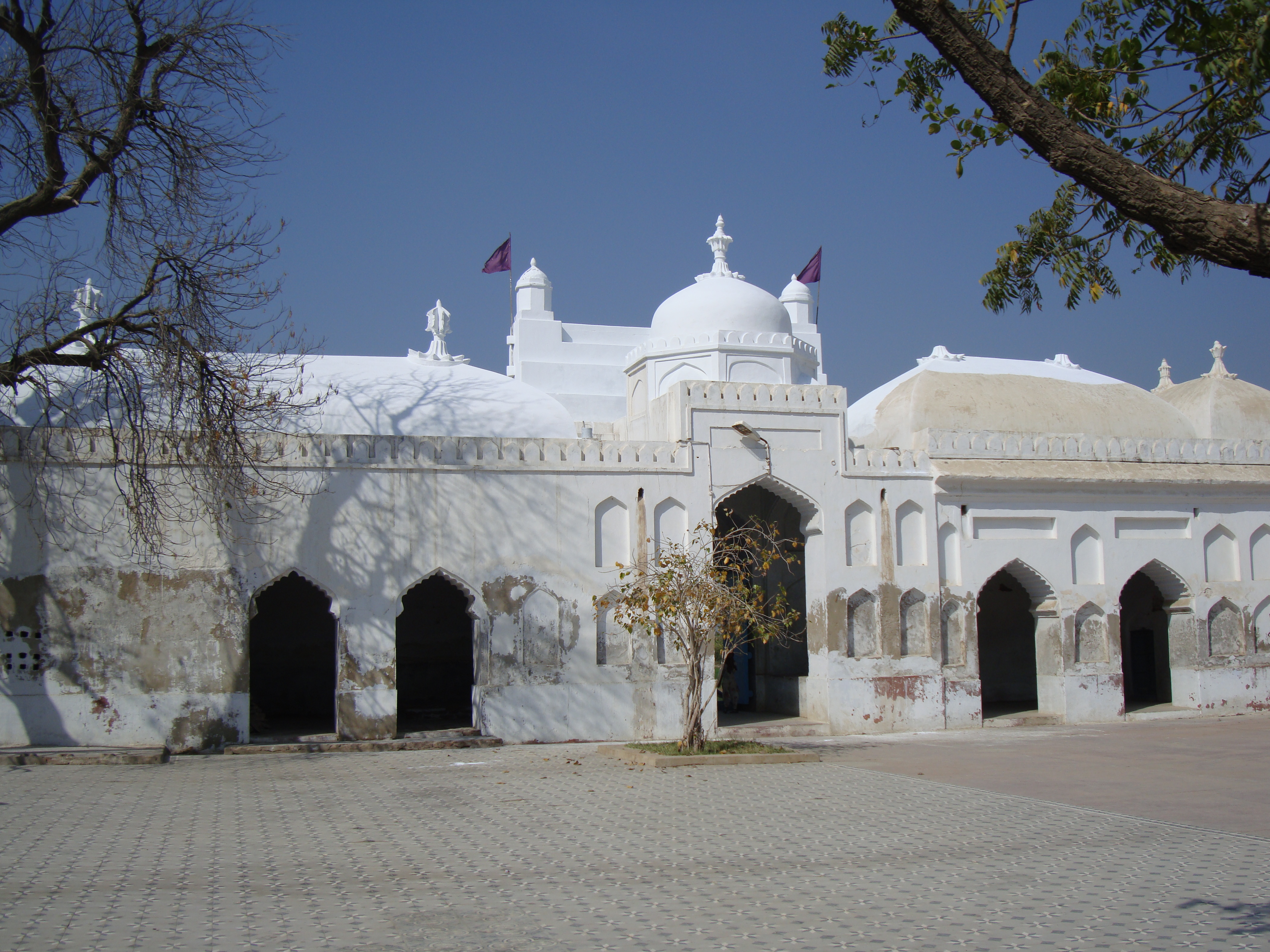
The Jhulelal [[Shrine at Odero Lal]] is situated in [[Matiari District]], almost 40 kilometers away from the [[Sanghar District]] of [[Sindh]]; The Hindus and the Muslims can pray here at the same place simultaneously. | The Jhulelal [[Shrine at Odero Lal]] is situated in [[Matiari District]], almost 40 kilometers away from the [[Sanghar District]] of [[Sindh]]; The Hindus and the Muslims can pray here at the same place simultaneously.<ref>{{cite news|last1=Zahida Rehman Jatt|title=Jhulay Lal's cradle of tolerance|url=http://www.dawn.com/news/1185942|access-date=22 December 2015|agency=Dawn|publisher=Dawn|date=June 3, 2015}}</ref><ref>{{cite book|last1=Claude Markovits|title=The Global World of Indian Merchants, 1750–1947: Traders of Sind from Bukhara to Panama|date=22 June 2000|publisher=Cambridge University Press, 2000|isbn=9781139431279|page=48|url=https://books.google.com/books?id=M2vu7Odjz6kC&q=Udero+Lal+town&pg=PA48|access-date=22 December 2015}}</ref> [[Nawabshah]], [[Hyderabad, Sindh|Hyderabad]], [[Matiari]], [[Sanghar]] and [[Mirpur Khas]] are the nearby major cities to reach at the Shrine near [[Tando Adam]].<ref>{{cite web|title=List of Cities near Udero Lāl in Sindh, Pakistan|url=http://www.gomapper.com/travel/list-of-cities-near/udero-lal.html|website=GoMapper|access-date=22 December 2015|archive-date=12 June 2018|archive-url=https://web.archive.org/web/20180612233001/http://www.gomapper.com/travel/list-of-cities-near/udero-lal.html|url-status=usurped}}</ref> | ||
It forms the seat of the Daryapanthis, originally a subsect of the followers of [[Gorakhnath]], who belong to the [[Nath]] tradition. | It forms the seat of the Daryapanthis, originally a subsect of the followers of [[Gorakhnath]], who belong to the [[Nath]] tradition.<ref name="Story of Jhulelal">{{Cite web |url=http://www.jhulelal.com/infotainment/story.html |title=Story of Jhulelal |access-date=2011-05-01 |archive-date=2011-05-31 |archive-url=https://web.archive.org/web/20110531010135/http://www.jhulelal.com/infotainment/story.html |url-status=dead }}</ref><ref>{{Cite news|url=https://www.dawn.com/news/1318886|title=How this lesser known festival is celebrated annually by Hindus in Sindh|last=Jatt|first=Zahida Rehman|date=2017-03-07|work=DAWN.COM|access-date=2018-09-16|language=en-US}}</ref> | ||
===Jhulelal Tirthdham=== | ===Jhulelal Tirthdham=== | ||
[[Sindhi Hindus]] in India built a religious shrine and cultural complex in [[Kutch]], near the border of [[Sindh Province]]. | [[File:Sindhi Pride Jhulelal Tirathdham.jpg|center|thumb|The view of Jhulelal Tirthdham]] | ||
[[Sindhi Hindus]] in India built a religious shrine and cultural complex in [[Kutch]] in the Indian state of [[Gujarat]], near the border of [[Sindh Province]].<ref name="Tirthdham1">{{cite news|title=Coming up in Gujarat, Sindhis' own sacred shrine - Times of India|website=[[The Times of India]] |date=12 May 2019 |url=https://timesofindia.indiatimes.com/india/coming-up-in-gujarat-sindhis-own-sacred-shrine/articleshow/69287901.cms|access-date=12 May 2019}}</ref><ref name="Tirthdham" /> The 100-acre complex includes a 100-foot statue of Lord Jhulelal, a museum, meditation centre, an auditorium, and a cultural and arts-and-crafts centre with 100 accommodations.<ref name="Tirthdham1" /><ref name="Tirthdham" /> Aiming to be the "a centre for global Sindhi identity",<ref name="Tirthdham1" /> the project costs an estimated ₹100 crore and was built on the donations from wealthy Indian Sindhis.<ref name="Tirthdham1" /><ref name="Tirthdham" /> [[Harish Fabiani]], one of the key promoters of the project, stated regarding the cultural complex, "The younger generation is aware they are Sindhis, but they do not know their language. We must learn our language and culture. We should have a place we can call our own."<ref name="Tirthdham">{{cite web|last1= Shradha Shahani|title=Sindhis are building a Jhulelal Tirthdham—their own holy city|date=5 June 2019|url=https://www.cntraveller.in/story/sindhis-are-building-a-jhulelal-tirthdham-their-own-holy-city/|access-date=5 June 2019}}</ref> | |||
[[File:Sindhi Pride Jhulelal Tirathdham (4) (Large).jpg|center|thumb]] | |||
[[File:Jhule Lal.jpg|thumb|Picture of Jhule Lal in Hindu temple]] | [[File:Jhule Lal.jpg|thumb|Picture of Jhule Lal in Hindu temple]] | ||
==Iconography== | ==Iconography== | ||
* In the most common form, Jhulelal is represented as a bearded man sitting cross-legged on a [[Nelumbo nucifera|lotus flower]] that rests on a [[Tenualosa ilisha|palla fish]]. | * In the most common form, Jhulelal is represented as a bearded man sitting cross-legged on a [[Nelumbo nucifera|lotus flower]] that rests on a [[Tenualosa ilisha|palla fish]].<ref>{{cite news|last1=Nadeem F. Paracha|title=Jhulay Lal's full circle|url=http://www.dawn.com/news/1227241/jhulay-lals-full-circle|access-date=22 December 2015|agency=Dawn|publisher=Dawn|date=December 20, 2015}}</ref> The fish is seen floating on the Sindhu river. He holds a sacred text and sometimes even a ''japa mala'' (rosary). He wears a golden crown with a [[peacock]] feather and wears regal clothes. Generally, temple idols represent him in this form.<ref name="falzon159" /><ref>{{cite book|last=Boivin|first=Michel|date=15 Oct 2008|page=76|title=Sindh through History and Representations: French Contributions to Sindhi Studies|publisher=Oxford University Press|isbn=9780195475036}}</ref> | ||
* In another form, he is shown standing on a palla fish or the lotus flower, holding a staff with both hands to indicate leadership. | * In another form, he is shown standing on a palla fish or the lotus flower, holding a staff with both hands to indicate leadership.<ref name="falzon159" /> | ||
* | |||
* He is often symbolized in saffron attire, symbolizing purity and devotion. The robes are often flowing, enhancing his ethereal appearance. | |||
*He has four hands only. He is happy and smiling. He is looking in front of the camera with his both eyes He is muscular with 12 pack abs. Key Physical Features: Appearance: He is shown as a fair-skinned, serene-looking man with a long, white beard and white hair, symbolizing wisdom. Pose: He is sitting cross-legged in Padmasana (lotus position) or Swastika-asana on a full Bloomed Pink lotus flower and that pink full Bloomed Lotus Flower is on the Palla Fish (a Gold fish fish that swims against the tide), That gold fish is looking in front of the camera with his both eyes and that gold Fish is happy and smiling. Front view of gold fish That is also fully visible to the camera. Attire: He wears traditional royal attire, a white and brightly colored dhoti and a kurta adorned with gold linings. He wears royal blue sherwani with gold border. Shoulder Drapes: Saffron stole Gold border embroidery Draped across shoulders and chest. 🪷 Inner Clothing Under the robe: White dhoti-like garment. Simple sacred style clothing. Red and gold border accents near waist.. 🪙 Arm Ornaments Gold arm cuffs. Gold wrist bangles. Embossed traditional patterns. Holding a Book. Features of the Book: Rectangular shape Made of pure gold. Saffron decorative edge. Ornaments: He is adorned with necklaces and a pure gold mukut crown studded with jewels, attached with a very beautiful two peacock feathers and attached with three moti malas Three Parallel Rows The moti (pearls) are arranged in three horizontal rows. These rows run along the front band of the pure gold mukut. The rows are evenly spaced and symmetrical. 2️⃣ Decorative Mala Formation The pearls together form a decorative mala (garland-like pattern). Each pearl is round, white, and uniform in size. 3️⃣ Pink Diamond Settings Between sections of the pearl rows are pink diamond / pink gemstone settings. These gemstones sit inside gold triangular or oval frames. The pink stones create contrast with the white pearls and gold crown. Symbolic Elements: Items: He holds a sacred text (pothi) in his Left Hand and Hindu Rudraksha Japa Mala (rosary) in his Upper Raised Left Hand. Lower Right Hand is holding a Sword. Blessing Posture: His right hand is raised in a blessing pose (Abhaya mudra), and emitting a white light. Halo: A gold halo and aura is shown around his head,. | |||
{{Citation needed|date=April 2025}} | |||
- a male sitting cross-legged on a large fully bloomed pink lotus flower. The lotus is placed on top of a giant smiling pure 24-carat golden fish emerging from splashing water. The gold fish is happy, cute, and facing the camera directly with both eyes visible. | |||
The male is a serene elderly man with very fair glowing skin, long white beard, and long white hair. He is smiling warmly and looking straight toward the camera. A bright radiant gold halo shines behind his head. | |||
He wears a royal blue velvet sherwani with rich golden embroidery and an saffron dupatta with golde borders. He is adorned with heavy traditional gold jewelry including layered necklaces, armlets, bracelets, and rings. On his head is an ornate golden crown decorated with jewels and peacock feathers. | |||
The male has five arms: | |||
• His right hand raised in blessing (Abhaya Mudra) emitting soft divine white light. | |||
• Raised Upper Right Hand is holding a shining sword. | |||
• Raised Upper First Top Left Hand is holding a | |||
hindu rudraksha japa mala (rosary). | |||
• Raised Upper Second Left hand is holding a | |||
fully bloomed pure gold lotus flower. | |||
• Left hand holding a | |||
gold sacred scripture box. | |||
The male sits peacefully on the pink lotus throne which rests on the large smiling gold fish swimming in water, creating dramatic splashes and ripples. | |||
== Notes == | == Notes == | ||
| Line 97: | Line 123: | ||
[[Category:Hindu folk deities]] | [[Category:Hindu folk deities]] | ||
[[Category:Hinduism in Sindh]] | [[Category:Hinduism in Sindh]] | ||
[[Category:Sindhi Hindu saints]] | [[Category:Sindhi Hindu saints]] | ||
Revision as of 04:59, 15 March 2026
| Bhagwan Jhulelal | |
|---|---|
 Jhulelal, incarnation of Varuna, sitting on a lotus flower in the middle of a river and surrounded by a couple of silver fish (palla fish) | |
| Affiliation | Varuna Deva |
| Abode | Sea & River Indus |
| Mantra | Om Vam Varunaya Namah |
| Weapon | Sword |
| Mount | Hilsa Fish & Horse |
| Personal information | |
| Siblings | Soma Rai & Bheda Rai |
Jhulelal (Script error: The function "langx" does not exist.جھولےلال ; Script error: The function "langx" does not exist.झूलेलाल) is a folkloric figure amongst the Sindhis and one of the most revered deities of Sindhi Hindus in the modern-day republics of Pakistan and India.<ref name="falzon159" /> He is considered to be an avatar of Hindu god Varuna.<ref name="Ramey2008p8" />Cite error: Invalid <ref> tag; refs with no name must have content
Legends converge upon that Jhulelal was born during the rule of one Islamic despot "Mirkshah", who had issued an ultimatum to local Hindus for converting to Islam.<ref name="falzon159" /><ref name="Westland">Bhavnani, Nandita (2014). The Making of Exile: Sindhi Sindhis and the Partition of India. Westland. ISBN 9789384030339.</ref> The reincarnation of a Sindhi deity, Jhulelal exhibited supernatural powers since childhood; he preached about how the Muslims believed in the same God, and emphasized that the Quran forbade forced conversion.<ref name="falzon159" /><ref name="Ramey2008p8" /> Ultimately, Jhulelal convinced the King to spare the Hindus and even gained devotees among the Muslims.<ref name="falzon159" /><ref name="Ramey2008p8" />
Devotion towards Jhulelal was very uniform in pre-partition Sindh and he was one of the many deities belonging to the Sindhi cultural pantheon.<ref name="falzon159" /><ref name="Ramey2008p8" /> However, in 1950 Indian Sindhis, led by Ram Panjwani in Bombay, decided to transform Jhulelal into the icon of unity for all Sindhis and unify the sindhi community.<ref name="falzon159" /><ref name="Ramey2008p8" /> Devotional songs were penned, pamphlets printed, statues installed, festivals celebrated, and cultural events organized in thousands for the cause of Jhulelal.<ref name="falzon159" /> Over the course of decades, Jhulelal has successfully become the representative Unifying God of Sindhis.<ref name="falzon159" />
Iconography of Jhulelal varies widely.<ref name="falzon159" /><ref>"Jhulay Lal's full circle". 20 December 2015.</ref> Sindhi Hindus worship Jhulelal at the Shrine at Odero Lal in Pakistan's Sindh province, which is jointly used by Sindhi Hindus, and Sindhi Muslims who revere the shrine as the tomb of Sheikh Tahir. A second shrine named Jhulelal Tirthdham exists in India at Narayan Sarovar, Kutch, Gujarat.<ref name="Tirthdham1" />
Folklore
Legendary account
After a long period of harmonious existence between the Hindus and Muslims, a new Amir, one Mirkshah of Thatta, ascended the throne.<ref name="Ramey2008p8" /> At the instigation of his advisors, he ordered that all local Hindus convert to Islam or be put to death.<ref name="Ramey2008p8" /> The Hindus prayed to Indus, who promised that Varuna would take the form of a child and avert the impending catastrophe.<ref name="Ramey2008p8" />
In 1007 Vikram Samvat (950 CE), the day of Cheti Chand in Chaitra, Jhulelal was born to a local Hindu family of Lohana caste.<ref name="Ramey2008p8" /><ref>Gopal, Dr Krishna (2003). Fairs and Festivals of India. Gyan Publishing House. ISBN 978-81-212-0810-9.</ref><ref>Registrar, India Office of the (1962). Census of India, 1961. Manager of Publications. p. 28.</ref> It was not long before Amir Mirkshah caught wind of rumors that the populace had begun to worship a local child as an incarnate deity; alarmed by this un-Islamic activity, the Amir sent his ministers to investigate. These latter returned with accounts of their witnessing strange events:<ref name="Ramey2008p8" /> the child in question metamorphosed into a young warrior, then into an old man, before back into a child; at other times, he rode up the river on the back of a fish; he acted and spoke as if a sage, rather than a typical young boy; and performed various other feats before the disbelieving eyes of the advisors.<ref name="Ramey2008p8" />Cite error: Invalid <ref> tag; refs with no name must have content Mirkshah grew afraid, upon hearing of this—but his advisors, undaunted, convinced him to hold firm.<ref name="Ramey2008p8" />
Soon, however, the Amir decided he must meet this prodigy for himself; and, upon their meeting, he found he was impressed by Jhulelal's understanding of Islam: Jhulelal preached that the Hindus and Muslims believed in the same God, and reminded Mirkshah that the Qur'an forbade compelled conversions.<ref name="Ramey2008p8" /><ref name="falzon159" /> The latter's advisors—still determined to see their brutal forced-conversion scheme carried out—instead persuaded Mirkshah to disregard these teachings of Jhulelal's and order him imprisoned.<ref name="Ramey2008p8" /> However, when the guards arrived to attempt the arrest, an inferno and a flood together engulfed the Amir's palace.<ref name="falzon159" /><ref name="Ramey2008p8" /> At this, Mirkshah relented, abolished his decree, and asked Jhulelal for forgiveness.<ref name="Ramey2008p8" />
As the palace was saved and harmony restored, Jhulelal thence gained devotees even among the Muslims (including Mirkshah).<ref name="Ramey2008p8" /> Before taking his leave, Jhulelal advised the Amir that a flame be kept burning for eternity as a reminder of his omnipresence.<ref name="falzon159" />
Variant readings
The myth of Jhulelal is not seen in regional histories written prior to the 20th century. While nearly all Jhulelal legends revolve broadly around two main themes—the valorization of Sindhi communal harmony, and the intrinsic superiority of tolerant and devout Hindus over Muslims who are depicted as unable to interpret even their own religious texts—the specifics vary widely, and have occasionally been a cause of internal contestation even among Sindhi Hindus.<ref name="Ramey2008p8" /> At the same time, Sindhi Muslims have themselves forged their own legends concerning Jhulelal.<ref name="Ramey2008p8" />
Hindus
The birth-name varies from Uderolal to Amarlal to Daryasahib; the event of his first appearance is either noted to be from a human birth or from the Indus, riding on a fish.<ref name="Ramey2008p8" /> He is variously noted as an avatara of Vishnu or a manifestation of Varuna—one account conflates the two and deems him to be the Varuna avatara of Vishnu<ref name="Ramey2008p8" />—and how he came to be known as "Jhulelal" attracts entirely another set of fascinating claims.<ref name="Ramey2008p8" /> The result of his encounter with Mirkshah also varies: some claim that the Amir submitted instantly in the face of his supernatural powers, while others claim that Jhulelal was required to lead a secretly-gathered force to victory in a conventional war.<ref name="Ramey2008p8" />
The presentation of the narrative also differs depending on source.<ref name="Ramey2008p8" /> Many renderings choose to emphasize the cruelty of Muslim rulers against Brahmins (and, by extension, against all Hindus)—a column in Indian Express projects contemporary Hindu Nationalism onto the narrative, with Jhulelal "fill[ing] the shrinking Hindus with courage" and "put[ting] holy terror into the persecuting Muslims"—while some Sindhi accounts have transplanted Jhulelal into the reign of Aurangzeb, a ruler notorious in public memory for being the worst of all persecutors of Hindus.<ref name="Ramey2008p8" /> Still others choose to emphasize the Hinduness of Jhulelal by drawing tenuous connections with Vedic corpus.<ref name="Ramey2008p8" />
Festivals
Cheti Chand
The Cheti Chand festival in the month of Chaitra, marks the arrival of spring and harvest, as well as the incarnation day of Uderolal in the Vikram Samvat calendar year 1007.<ref name=falzon159/><ref name="Ramey2008p8">Ramey, Steven W. (2008), Ramey, Steven W. (ed.), "Presenting Sacred Figures", Hindu, Sufi, or Sikh: Contested Practices and Identifications of Sindhi Hindus in India and Beyond, New York: Palgrave Macmillan US, pp. 105–124, doi:10.1057/9780230616226_5, ISBN 978-0-230-61622-6, retrieved 2021-08-24{{citation}}: CS1 maint: work parameter with ISBN (link)</ref> Uderolal morphed into a warrior and old man who preached and reprimanded Mirkhshah that Muslims and Hindus deserve the same religious freedoms. He, as Jhulelal,<ref name="Ramey2008p8"/> became the saviour of the Sindhi Hindus, who according to this legend, celebrate the new year as Uderolal's birthday.<ref name=falzon159>Mark-Anthony Falzon (2004). Cosmopolitan Connections: The Sindhi Diaspora, 1860–2000. BRILL. pp. 58–60. ISBN 90-04-14008-5.</ref><ref name="Ramey2008p8"/>
Chaliya saheb
Chalio or Chaliho, also called Chaliho Sahib, is a forty-day-long festival celebrated by Sindhi Hindus<ref name=a>Chaliho festival Archived September 16, 2011, at the Wayback Machine</ref><ref name=b>Sindhis celebrate Chalio festival</ref><ref name=d>Sindhi Festivals > Chaliho Archived April 25, 2012, at the Wayback Machine</ref> to express their gratitude to Jhulelal for saving them from their impending conversion to Islam. The festival is observed every year in the months of July to August; dates vary according to Hindu calendar.<ref name=a/><ref name=b/> It is a thanksgiving celebration in honor of Varuna Deva for listening to their prayers.<ref name=a/><ref name=b/>
Shrines
Odero Lal Sai


The Jhulelal Shrine at Odero Lal is situated in Matiari District, almost 40 kilometers away from the Sanghar District of Sindh; The Hindus and the Muslims can pray here at the same place simultaneously.<ref>Zahida Rehman Jatt (June 3, 2015). "Jhulay Lal's cradle of tolerance". Dawn. Dawn. Retrieved 22 December 2015.</ref><ref>Claude Markovits (22 June 2000). The Global World of Indian Merchants, 1750–1947: Traders of Sind from Bukhara to Panama. Cambridge University Press, 2000. p. 48. ISBN 9781139431279. Retrieved 22 December 2015.</ref> Nawabshah, Hyderabad, Matiari, Sanghar and Mirpur Khas are the nearby major cities to reach at the Shrine near Tando Adam.<ref>"List of Cities near Udero Lāl in Sindh, Pakistan". GoMapper. Archived from the original on 12 June 2018. Retrieved 22 December 2015.</ref>
It forms the seat of the Daryapanthis, originally a subsect of the followers of Gorakhnath, who belong to the Nath tradition.<ref name="Story of Jhulelal">"Story of Jhulelal". Archived from the original on 2011-05-31. Retrieved 2011-05-01.</ref><ref>Jatt, Zahida Rehman (2017-03-07). "How this lesser known festival is celebrated annually by Hindus in Sindh". DAWN.COM. Retrieved 2018-09-16.</ref>
Jhulelal Tirthdham

Sindhi Hindus in India built a religious shrine and cultural complex in Kutch in the Indian state of Gujarat, near the border of Sindh Province.<ref name="Tirthdham1">"Coming up in Gujarat, Sindhis' own sacred shrine - Times of India". The Times of India. 12 May 2019. Retrieved 12 May 2019.</ref><ref name="Tirthdham" /> The 100-acre complex includes a 100-foot statue of Lord Jhulelal, a museum, meditation centre, an auditorium, and a cultural and arts-and-crafts centre with 100 accommodations.<ref name="Tirthdham1" /><ref name="Tirthdham" /> Aiming to be the "a centre for global Sindhi identity",<ref name="Tirthdham1" /> the project costs an estimated ₹100 crore and was built on the donations from wealthy Indian Sindhis.<ref name="Tirthdham1" /><ref name="Tirthdham" /> Harish Fabiani, one of the key promoters of the project, stated regarding the cultural complex, "The younger generation is aware they are Sindhis, but they do not know their language. We must learn our language and culture. We should have a place we can call our own."<ref name="Tirthdham">Shradha Shahani (5 June 2019). "Sindhis are building a Jhulelal Tirthdham—their own holy city". Retrieved 5 June 2019.</ref>
_(Large).jpg)

Iconography
- In the most common form, Jhulelal is represented as a bearded man sitting cross-legged on a lotus flower that rests on a palla fish.<ref>Nadeem F. Paracha (December 20, 2015). "Jhulay Lal's full circle". Dawn. Dawn. Retrieved 22 December 2015.</ref> The fish is seen floating on the Sindhu river. He holds a sacred text and sometimes even a japa mala (rosary). He wears a golden crown with a peacock feather and wears regal clothes. Generally, temple idols represent him in this form.<ref name="falzon159" /><ref>Boivin, Michel (15 Oct 2008). Sindh through History and Representations: French Contributions to Sindhi Studies. Oxford University Press. p. 76. ISBN 9780195475036.</ref>
- In another form, he is shown standing on a palla fish or the lotus flower, holding a staff with both hands to indicate leadership.<ref name="falzon159" />
- He is often symbolized in saffron attire, symbolizing purity and devotion. The robes are often flowing, enhancing his ethereal appearance.
- He has four hands only. He is happy and smiling. He is looking in front of the camera with his both eyes He is muscular with 12 pack abs. Key Physical Features: Appearance: He is shown as a fair-skinned, serene-looking man with a long, white beard and white hair, symbolizing wisdom. Pose: He is sitting cross-legged in Padmasana (lotus position) or Swastika-asana on a full Bloomed Pink lotus flower and that pink full Bloomed Lotus Flower is on the Palla Fish (a Gold fish fish that swims against the tide), That gold fish is looking in front of the camera with his both eyes and that gold Fish is happy and smiling. Front view of gold fish That is also fully visible to the camera. Attire: He wears traditional royal attire, a white and brightly colored dhoti and a kurta adorned with gold linings. He wears royal blue sherwani with gold border. Shoulder Drapes: Saffron stole Gold border embroidery Draped across shoulders and chest. 🪷 Inner Clothing Under the robe: White dhoti-like garment. Simple sacred style clothing. Red and gold border accents near waist.. 🪙 Arm Ornaments Gold arm cuffs. Gold wrist bangles. Embossed traditional patterns. Holding a Book. Features of the Book: Rectangular shape Made of pure gold. Saffron decorative edge. Ornaments: He is adorned with necklaces and a pure gold mukut crown studded with jewels, attached with a very beautiful two peacock feathers and attached with three moti malas Three Parallel Rows The moti (pearls) are arranged in three horizontal rows. These rows run along the front band of the pure gold mukut. The rows are evenly spaced and symmetrical. 2️⃣ Decorative Mala Formation The pearls together form a decorative mala (garland-like pattern). Each pearl is round, white, and uniform in size. 3️⃣ Pink Diamond Settings Between sections of the pearl rows are pink diamond / pink gemstone settings. These gemstones sit inside gold triangular or oval frames. The pink stones create contrast with the white pearls and gold crown. Symbolic Elements: Items: He holds a sacred text (pothi) in his Left Hand and Hindu Rudraksha Japa Mala (rosary) in his Upper Raised Left Hand. Lower Right Hand is holding a Sword. Blessing Posture: His right hand is raised in a blessing pose (Abhaya mudra), and emitting a white light. Halo: A gold halo and aura is shown around his head,.[citation needed]
- a male sitting cross-legged on a large fully bloomed pink lotus flower. The lotus is placed on top of a giant smiling pure 24-carat golden fish emerging from splashing water. The gold fish is happy, cute, and facing the camera directly with both eyes visible.
The male is a serene elderly man with very fair glowing skin, long white beard, and long white hair. He is smiling warmly and looking straight toward the camera. A bright radiant gold halo shines behind his head.
He wears a royal blue velvet sherwani with rich golden embroidery and an saffron dupatta with golde borders. He is adorned with heavy traditional gold jewelry including layered necklaces, armlets, bracelets, and rings. On his head is an ornate golden crown decorated with jewels and peacock feathers.
The male has five arms:
• His right hand raised in blessing (Abhaya Mudra) emitting soft divine white light.
• Raised Upper Right Hand is holding a shining sword.
• Raised Upper First Top Left Hand is holding a
hindu rudraksha japa mala (rosary).
• Raised Upper Second Left hand is holding a
fully bloomed pure gold lotus flower.
• Left hand holding a
gold sacred scripture box.
The male sits peacefully on the pink lotus throne which rests on the large smiling gold fish swimming in water, creating dramatic splashes and ripples.
Notes
See also
References
External links
Hindu deities and texts | ||
|---|---|---|
| Gods |  | |
| Goddesses | ||
| Other deities | ||
| Texts | ||