



robot: Create/update articles. If there is a mistake please report on my talk page. |
mNo edit summary |
||
| Line 1: | Line 1: | ||
{{Short description|President of India from | {{Short description|President of India from 1987 to 1992<!-- Do NOT add counts or ordinals, as per [[BP:CONSENSUS]] -->}} | ||
{{redirect|R. Venkataraman|the Indian cricketer|R. Venkataraman (Indian cricketer)}} | {{redirect|R. Venkataraman|the Indian cricketer|R. Venkataraman (Indian cricketer)}} | ||
{{Indian patronymic|Venkataraman|Ramaswamy}} | {{Indian patronymic|Venkataraman|Ramaswamy}} | ||
| Line 6: | Line 6: | ||
{{Infobox officeholder | {{Infobox officeholder | ||
| name = Ramaswamy Venkataraman | | name = Ramaswamy Venkataraman | ||
| caption = Official | | caption = Official portrait, {{circa|1987}} | ||
| image = | | image = Ramaswamy Venkataraman (2012 stamp of India) (cropped).jpg | ||
| office = | | office = <!-- Do NOT add counts or ordinals, as per [[BP:CONSENSUS]] -->[[President of India]] | ||
| primeminister = [[Rajiv Gandhi]]<br />[[V. P. Singh]]<br />[[Chandra Shekhar]]<br />[[P. V. Narasimha Rao]] | | primeminister = [[Rajiv Gandhi]]<br />[[V. P. Singh]]<br />[[Chandra Shekhar]]<br />[[P. V. Narasimha Rao]] | ||
| vicepresident = [[Shankar Dayal Sharma]] | | vicepresident = [[Shankar Dayal Sharma]] | ||
| Line 14: | Line 14: | ||
| term_end = 25 July 1992 | | term_end = 25 July 1992 | ||
| predecessor = [[Zail Singh]] | | predecessor = [[Zail Singh]] | ||
| successor = | | successor = Shankar Dayal Sharma | ||
| office2 = | | office2 = <!-- Do NOT add counts or ordinals, as per [[BP:CONSENSUS]] --> [[Vice President of India]] | ||
| president2 = | | president2 = Zail Singh | ||
| primeminister2 = [[Indira Gandhi]]<br /> | | primeminister2 = [[Indira Gandhi]]<br />Rajiv Gandhi | ||
| term_start2 = 31 August 1984 | | term_start2 = 31 August 1984 | ||
| term_end2 = 24 July 1987 | | term_end2 = 24 July 1987 | ||
| predecessor2 = [[Mohammad Hidayatullah]] | | predecessor2 = [[Mohammad Hidayatullah]] | ||
| successor2 = | | successor2 = Shankar Dayal Sharma | ||
| office3 = [[Minister for Home Affairs (India)|Minister of Home Affairs]] | | office3 = <!-- Do NOT add counts or ordinals, as per [[BP:CONSENSUS]] -->[[Minister for Home Affairs (India)|Union Minister of Home Affairs]] | ||
| primeminister3 = | | primeminister3 = Indira Gandhi | ||
| term_start3 = 22 June 1982 | | term_start3 = 22 June 1982 | ||
| term_end3 = 2 September 1982 | | term_end3 = 2 September 1982 | ||
| predecessor3 = | | predecessor3 = Zail Singh | ||
| successor3 = [[Prakash Chandra Sethi]] | | successor3 = [[Prakash Chandra Sethi]] | ||
| office4 = [[Minister of Defence (India)|Minister of Defence]] | | office4 = <!-- Do NOT add counts or ordinals, as per [[BP:CONSENSUS]] -->[[Minister of Defence (India)|Union Minister of Defence]] | ||
| primeminister4 = | | primeminister4 = Indira Gandhi | ||
| term_start4 = 15 January 1982 | | term_start4 = 15 January 1982 | ||
| term_end4 = 2 August 1984 | | term_end4 = 2 August 1984 | ||
| predecessor4 = | | predecessor4 = Indira Gandhi | ||
| successor4 = [[Shankarrao Chavan]] | | successor4 = [[Shankarrao Chavan]] | ||
| office5 = [[Minister of Finance (India)|Minister of Finance]] | | office5 = <!-- Do NOT add counts or ordinals, as per [[BP:CONSENSUS]] -->[[Minister of Finance (India)|Union Minister of Finance]] | ||
| primeminister5 = | | primeminister5 = Indira Gandhi | ||
| term_start5 = 14 January 1980 | | term_start5 = 14 January 1980 | ||
| term_end5 = 15 January 1982 | | term_end5 = 15 January 1982 | ||
| predecessor5 = [[Hemvati Nandan Bahuguna]] | | predecessor5 = [[Hemvati Nandan Bahuguna]] | ||
| successor5 = [[Pranab Mukherjee]] | | successor5 = [[Pranab Mukherjee]] | ||
| birth_date = {{birth date|df=yes|1910|12| | | birth_date = {{birth date|df=yes|1910|12|04}} | ||
| birth_place = [[Rajamadam]], [[ | | birth_place = [[Rajamadam]], [[Pattukottai|Thanjavur]], [[British Raj|British India]] <br /> {{small|(present-day Tamil Nadu, India)}} | ||
| death_date = {{death date and age|df=yes|2009| | | death_date = {{death date and age|df=yes|2009|01|27|1910|12|04}} | ||
| death_place = [[New Delhi]], | | death_place = [[New Delhi]], Delhi, India | ||
| party = [[Indian National Congress]] | | party = [[Indian National Congress]] | ||
| spouse = [[Janaki Venkataraman]] | | spouse = {{marriage|[[Janaki Venkataraman]]|1938}} | ||
| children = 3 | | children = 3 | ||
| alma_mater = [[Loyola College, Chennai|Loyola College]], [[University of Madras]] | | alma_mater = [[Loyola College, Chennai|Loyola College]], [[University of Madras]] | ||
| profession = {{hlist|[[Lawyer]]|[[ | | profession = {{hlist|[[Lawyer]]|[[politician]]}} | ||
| signature = Ramaswamy Venkataraman's Autograph.jpg | | signature = Ramaswamy Venkataraman's Autograph.jpg | ||
| order = <!-- Do NOT add counts or ordinals, as per [[BP:CONSENSUS]] --> | |||
| order2 = <!-- Do NOT add counts or ordinals, as per [[BP:CONSENSUS]] --> | |||
| order1 = <!-- Do NOT add counts or ordinals, as per [[BP:CONSENSUS]] --> | |||
}} | }} | ||
'''Ramaswamy Venkataraman''' ({{audio|Rsv.ogg|pronunciation}}, 4 December 1910{{spaced | '''Ramaswamy Venkataraman''' ({{audio|Rsv.ogg|pronunciation}}, 4 December 1910{{spaced en dash}}27 January 2009),<ref>{{cite book|title=Encyclopaedia Britannica Almanac 2010|url=https://books.google.com/books?id=kd2bAAAAQBAJ&pg=PA87|date=1 January 2010|publisher=Encyclopædia Britannica, Inc.|isbn=978-1-61535-329-3|pages=87–}}</ref><ref>Vinay Kumar (28 January 2009) {{usurped|[https://web.archive.org/web/20091205191739/http://www.hinduonnet.com/2009/01/28/stories/2009012861430100.htm R. Venkataraman passes away]}}. ''The Hindu''</ref> also known as '''R. Venkataraman''', was an Indian lawyer, independence activist and politician who served as a union minister and as the <!-- Do NOT add counts or ordinals, as per [[BP:CONSENSUS]] -->[[vice president of india]] and [[president of India]].<ref>{{cite web|url=http://pastpresidentsofindia.indiapress.org/venkat.html |title=Shri Ramaswami Venkataraman – R.Venkataraman – Past President of India |publisher=Pastpresidentsofindia.indiapress.org |access-date=13 September 2012}}</ref> | ||
Venkataraman was born in [[Rajamadam]] village in [[Tanjore District (Madras Presidency)|Tanjore district, Madras Presidency]]. He studied law and practised in the [[Madras High Court]] and the [[Supreme Court of India]]. In his | Venkataraman was born in [[Rajamadam]] village in [[Tanjore District (Madras Presidency)|Tanjore district, Madras Presidency]]. He studied law and practised in the [[Madras High Court]] and the [[Supreme Court of India]]. In his youth, he was an activist for the [[Indian independence movement]], and he participated in the [[Quit India Movement]]. He was appointed as the member of the Constituent Assembly and the provisional cabinet. He was elected to the [[Lok Sabha]] four times and served as [[Minister of Finance (India)|Union Finance Minister]] and [[Minister of Defence (India)|Defence Minister]]. In 1984, he was elected as the <!-- Do NOT add counts or ordinals, as per [[BP:CONSENSUS]] --> [[vice president of India]] and in 1987, he became the <!-- Do NOT add counts or ordinals, as per [[BP:CONSENSUS]] --> president of India and served from 1987 to 1992. He also served as a state minister under [[K. Kamaraj]] and [[M. Bhaktavatsalam]].<ref name="Members Bioprofile">{{Cite web|title=Members Bioprofile|url=http://loksabhaph.nic.in/writereaddata/biodata_1_12/1095.htm|access-date=2020-09-18|website=loksabhaph.nic.in}}</ref> | ||
==Early life== | ==Early life== | ||
Venkataraman was born | Venkataraman was born in a [[Tamil Brahmin]] family<ref>{{Cite news |date=2019-04-12 |title=How Brahmins became invisible in Tamil Nadu's politics |url=https://timesofindia.indiatimes.com/elections/lok-sabha-elections/tamil-nadu/news/how-brahmins-became-invisible-in-tamil-nadus-politics/articleshow/68842141.cms |access-date=2024-07-03 |work=The Times of India |issn=0971-8257|quote= many Brahmins like R Venkataraman, Mani Shankar Aiyar, and Subramanian Swamy shot into prominence in politics in later years, they chose to operate from Delhi.}}</ref><ref>{{Cite news |last=Rajesh Ramachandran |date=2004-04-02 |title=Take 2 for Tambrams |url=https://timesofindia.indiatimes.com/india/take-2-for-tambrams/articleshow/595669.cms |access-date=2024-07-03 |work=The Times of India |issn=0971-8257}}</ref> in Rajamadam village near [[Pattukkottai|Pattukottai]], [[Tanjore district]] in [[Madras Presidency]], [[British Raj|British India]]. He had his school education in Govt Boys Higher Secondary School, Pattukottai and undergraduation in [[National College, Tiruchirappalli]].<ref name="Gandhi">{{Cite news|last=Gandhi|first=Gopalkrishna|date=2010-12-04|title=The value of decency|language=en-IN|work=The Hindu|url=https://www.thehindu.com/opinion/op-ed/The-value-of-decency/article15579183.ece|access-date=2020-09-18|issn=0971-751X}}</ref> | ||
Educated locally and in the city of [[Madras]] (now [[Chennai]]), Venkataraman obtained his master's degree in economics from [[Loyola College, Chennai|Loyola College]], [[Madras]]. He later qualified in Law from the Law College, Madras. Venkataraman was enrolled in the [[Madras High Court]] in 1935 and in the Supreme Court in 1951.<ref>[https://web.archive.org/web/20090129214547/http://hindu.com/2009/01/28/stories/2009012861861400.htm Venkataraman presided over the change to era of coalitions] ''[[The Hindu]]'', 28 January 2009.</ref> | Educated locally and in the city of [[Madras]] (now [[Chennai]]), Venkataraman obtained his master's degree in economics from [[Loyola College, Chennai|Loyola College]], [[Madras]]. He later qualified in Law from the Law College, Madras. Venkataraman was enrolled in the [[Madras High Court]] in 1935 and in the Supreme Court in 1951.<ref>[https://web.archive.org/web/20090129214547/http://hindu.com/2009/01/28/stories/2009012861861400.htm Venkataraman presided over the change to era of coalitions] ''[[The Hindu]]'', 28 January 2009.</ref> | ||
While practising law, Venkataraman was drawn into the movement for India's freedom from Britain's colonial subjugation. His active participation in the Indian National Congress's celebrated resistance to the British Government, the [[Quit India Movement]] of 1942, resulted in his detention for two years under the Defence of India Rules. Venkataraman's interest in the law continued during this period. In 1946, when the transfer of power from British to Indian hands was imminent, the Government of India included him in the panel of lawyers sent to Malaya and Singapore to defend Indian nationals charged with offences of collaboration during the Japanese occupation of those two places. In the years 1947 to 1950, Venkataraman served as Secretary of the Madras Provincial Bar Federation.<ref>{{Cite web|title=July 16, 1987: Venkataraman elected Indian President|url=https://gulfnews.com/today-history/july-16-1987-venkataraman-elected-indian-president-1.2059225|access-date=2020-09-18|website=gulfnews.com|language=en}}</ref> | While practising law, Venkataraman was drawn into the movement for India's freedom from Britain's colonial subjugation. His active participation in the Indian National Congress's celebrated resistance to the British Government, the [[Quit India Movement]] of 1942, resulted in his detention for two years under the Defence of India Rules. Venkataraman's interest in the law continued during this period. In 1946, when the transfer of power from British to Indian hands was imminent, the Government of India included him in the panel of lawyers sent to Malaya and Singapore to defend Indian nationals charged with offences of collaboration during the Japanese occupation of those two places. In the years 1947 to 1950, Venkataraman served as Secretary of the Madras Provincial Bar Federation.<ref name="webVenk">{{Cite web|title=July 16, 1987: Venkataraman elected Indian President|url=https://gulfnews.com/today-history/july-16-1987-venkataraman-elected-indian-president-1.2059225|access-date=2020-09-18|website=gulfnews.com|date=15 July 2017 |language=en}}</ref> | ||
==Political career== | ==Political career== | ||
Law and trade activity led to Venkataraman's increasing association with politics. He was a member of [[Constituent Assembly of India|constituent assembly]] that drafted [[Constitution of India|India's constitution]]. In 1950, he was elected to free India's Provisional Parliament (1950–1952) and to the First Parliament (1952–1957). During his term of legislative activity, Venkataraman attended the 1952 Session of the Metal Trades Committee of International Labour Organisation as a workers' delegate. He was a member of the Indian Parliamentary Delegation to the Commonwealth Parliamentary Conference in New Zealand. Venkataraman was also Secretary to the Congress Parliamentary Party in 1953–1954.<ref>{{Cite web|last=Grewal|first=Kairvy|date=2020-01-27|title=R Venkataraman — President who stuck by rulebook to guide India through troublesome times|url=https://theprint.in/theprint-profile/r-venkataraman-president-who-stuck-by-rulebook-to-guide-india-through-troublesome-times/354007/|access-date=2020-09-18|website=ThePrint|language=en-US}}</ref><ref name="Members Bioprofile"/> | Law and trade activity led to Venkataraman's increasing association with politics. He was a member of [[Constituent Assembly of India|constituent assembly]] that drafted [[Constitution of India|India's constitution]]. In 1950, he was elected to free India's Provisional Parliament (1950–1952) and to the First Parliament (1952–1957). During his term of legislative activity, Venkataraman attended the 1952 Session of the Metal Trades Committee of International Labour Organisation as a workers' delegate. He was a member of the Indian Parliamentary Delegation to the Commonwealth Parliamentary Conference in New Zealand. Venkataraman was also Secretary to the Congress Parliamentary Party in 1953–1954.<ref>{{Cite web|last=Grewal|first=Kairvy|date=2020-01-27|title=R Venkataraman — President who stuck by rulebook to guide India through troublesome times|url=https://theprint.in/theprint-profile/r-venkataraman-president-who-stuck-by-rulebook-to-guide-india-through-troublesome-times/354007/|access-date=2020-09-18|website=ThePrint|language=en-US}}</ref><ref name="Members Bioprofile"/> | ||
Venkatraman was reelected to Parliament from [[Thanjavur Lok Sabha constituency|Thanjavur]] in the [[1957 Indian general election|general election of 1957]] with an improved majority of 37,000 votes.<ref>{{cite book |title=Statistical Report on General Elections, 1957 to the Second Lok Sabha|volume=I |publisher=Election Commission of India |location=New Delhi |page=80 |url=https://www.ceomadhyapradesh.nic.in/Links/Books/57_Vol_I.pdf |access-date=15 June 2023}}</ref> He however resigned the seat and joined the [[Madras State|Madras government]] at the invitation of its [[List of chief ministers of Tamil Nadu|Chief Minister]], [[K. Kamaraj]].<ref>{{cite news |title=The value of decency |url=https://www.thehindu.com/opinion/op-ed/The-value-of-decency/article15579183.ece |access-date=15 June 2023 |work=The Hindu |date=3 December 2010 |language=en-IN}}</ref> Venkataraman was sworn in as Minister for Industries on 26 April 1957 and was allotted several ministries including those of Labour and Co-operation, Commercial Taxes and Nationalised Transport, Textiles, Mines and Minerals and Companies and was elected to the [[Tamil Nadu Legislative Council|Madras Legislative Council]] in the biennial elections conducted in March 1958.<ref>{{cite book |title=A Review of the Madras Legislative Assembly (1957-1962) |date=March 1962 |publisher=Legislative Assembly Department |location=Madras |pages=93, 129 |url=https://www.assembly.tn.gov.in/archive/2nd_1957/Review_2-1957-62.pdf |access-date=15 June 2023}}</ref> | |||
=== | In the [[1962 Madras Legislative Assembly election|assembly election of 1962]], the Congress Party under K Kamaraj was returned to power. Venkataraman was retained as minister in charge of the same ministries during the [[K. Kamaraj ministry|Kamaraj Ministry]] which lasted 2 October 1963 and under Chief Minister [[M. Bhaktavatsalam]] who succeeded Kamaraj. Venkataraman himself was sworn in as Minister in the Bhaktavatsalam Ministry only on 23 October 1963, as he was in New York City to attend the session of the [[United Nations Administrative Tribunal]].<ref>{{cite book |title=The Madras Legislative Assembly, 1962-67: A Review |date=August 1967 |publisher=Legislative Assembly Department, Government of Madras |location=Madras |pages=10–13 |url=https://assembly.tn.gov.in/archive/3rd_1962/Review%203_62-67.pdf |access-date=15 June 2023}}</ref> Venkataraman was reelected to the Council in the biennial elections of March 1964 and remained the leader of the house in the council until after the [[1967 Madras Legislative Assembly election|assembly elections of 1967]].<ref>{{cite book |title=The Madras Legislative Assembly, 1962-67: A Review |date=August 1967 |publisher=Legislative Assembly Department, Government of Madras |location=Madras |pages=114, 129 |url=https://assembly.tn.gov.in/archive/3rd_1962/Review%203_62-67.pdf |access-date=15 June 2023}}</ref> | ||
Venkataraman | As Minister of Industries, Venkataraman proved to be an able administrator who ushered in a period of [[Industrialisation|industrial development]] in Madras.<ref>{{cite news |title=The President who went by the book |url=https://indianexpress.com/article/news-archive/web/the-president-who-went-by-the-book/ |access-date=15 June 2023 |work=The Indian Express |date=28 January 2009 |language=en}}</ref> He championed the idea of [[industrial estates]], the first of which was established at [[Guindy]], and succeeded in getting investments in major [[Public sector undertakings in India|public sector undertakings]] such as the [[Integral Coach Factory]], [[NLC India Limited|Neyveli Lignite Corporation]] and the [[Heavy Vehicles Factory]].<ref>{{cite news |title=Presidential elections: Zail Singh's shadow to prevail over Rashtrapati Bhavan for a while |url=https://www.indiatoday.in/magazine/indiascope/story/19870715-presidential-elections-zail-singh-shadow-to-prevail-over-rashtrapati-bhavan-for-a-while-799038-1987-07-14 |access-date=15 June 2023 |work=India Today |date=15 July 1987 |language=en}}</ref><ref>{{cite news |title=Built to last, the story of Guindy Industrial Estate |url=https://www.thehindu.com/news/cities/chennai/built-to-last-the-story-of-guindy-industrial-estate/article65814635.ece |access-date=15 June 2023 |work=The Hindu |date=26 August 2022 |language=en-IN}}</ref><ref>{{cite news |title=City pays homage to man behind TN's industrial growth |url=https://timesofindia.indiatimes.com/city/chennai/city-pays-homage-to-man-behind-tns-industrial-growth/articleshow/4038858.cms |access-date=15 June 2023 |work=The Times of India |date=28 January 2009}}</ref> Venkataraman persuaded the [[TVS Group]] to set up a factory at [[Padi, Chennai|Padi]] and several other private companies including [[Ashok Leyland]], [[Hindustan Motors]] and [[Enfield Automotive|Enfield]] established their automobile factories in [[Chennai|Madras]] during this time.<ref>{{cite news |title=In R Venkatraman's demise, TN lost a great patron and Father of Industry |url=https://economictimes.indiatimes.com/news/politics-and-nation/in-r-venkatramans-demise-tn-lost-a-great-patron-and-father-of-industry/articleshow/4038516.cms?from=mdr |access-date=15 June 2023 |work=The Economic Times |date=27 January 2009}}</ref> [[Economy of Tamil Nadu|Tamil Nadu's industrialization]] has been widely credited to steps initiated during Venkataraman's decade as the state's industries minister and he has been described as the "father of industrialization" in [[Tamil Nadu]].<ref>{{cite news |title=The federal manoeuvre: on Karunanidhi and the Dravidian movement |url=https://www.thehindu.com/opinion/lead/the-federal-manoeuvre-on-the-dravidian-movement/article62112666.ece |access-date=15 June 2023 |work=The Hindu |date=15 September 2017 |language=en-IN}}</ref><ref>{{cite news |title="RV, father of industrialisation in Tamil Nadu" |url=https://www.thehindu.com/news/national/rv-father-of-industrialisation-in-tamil-nadu/article2687295.ece |access-date=15 June 2023 |work=The Hindu |date=4 December 2011 |language=en-IN}}</ref> | ||
Venkataraman | In 1967, Venkataraman contested the [[1967 Indian general election|parliamentary election]] from Thanjavur but lost to the D.S. Gopalar of the [[Dravida Munnetra Kazhagam]].<ref>{{cite journal |last1=Nathan |first1=S K S |title=The DMK and the Politics of Tamilnad |journal=Economic and Political Weekly |date=1967 |volume=2 |issue=48 |page=2139 |jstor=24478287 |url=https://www.jstor.org/stable/24478287 |access-date=15 June 2023 |issn=0012-9976}}</ref><ref>{{cite book |title=Statistical Report on General Elections, 1967 to the Fourth Lok Sabha |date=1968 |publisher=Election Commission of India |location=New Delhi |page=213 |url=https://www.ceo.kerala.gov.in/pdf/LOKSABHA-HISTORY/1967-LS.pdf |access-date=15 June 2023}}</ref> In the [[1967 Madras Legislative Assembly election|assembly election of 1967]], the Congress was routed by the Dravida Munnetra Kazhagam. [[C. N. Annadurai]], the DMK's leader in the Council became Chief Minister and Venkataraman the [[Leader of the Opposition|leader of the opposition]] in the council until his resignation from the Council in August 1967.<ref>{{cite book |title=TAMIL NADU LEGISLATIVE ASSEMBLY QUADRENNIAL REVIEW 1967-70 |date=June 1971 |publisher=Legislative Assembly Department |location=Madras |pages=139, 257 |url=https://citeseerx.ist.psu.edu/document?repid=rep1&type=pdf&doi=5dd9ee01c89bbcc9818a8897a0a134beec921a69 |access-date=15 June 2023}}</ref> | ||
Venkataraman was appointed a member of the [[Planning Commission (India)|Planning Commission]] in July, 1967 by Prime Minister Indira Gandhi and held charge of [[Economy of India|industry]], [[Labour in India|labour]], [[Electricity sector in India|power]], [[Transport in India|transport]], [[Telecommunications in India|communications]] and [[Rail transport in India|railways]].<ref>{{cite news |title=D.R. Gadgil and R. Venkataraman for Planning Commission |url=https://www.thehindu.com/archive/dr-gadgil-and-r-venkataraman-for-planning-commission/article19272631.ece |access-date=16 June 2023 |work=The Hindu |date=13 July 2017 |language=en-IN}}</ref><ref>{{cite book |last1=Jai |first1=Janak Raj |title=Presidents of India, 1950-2003 |date=2003 |publisher=Regency Publications |location=New Delhi |isbn=978-81-87498-65-0 |page=190 |url=https://books.google.com/books?id=r2C2InxI0xAC&dq=r+venkataraman+planning+commission&pg=PA190 |access-date=16 June 2023 |language=en}}</ref> In 1970, the Commission on Major Ports headed by Venkataraman submitted its report to the Government. This was the first study to be made of the integrated function and development of [[List of ports in India|major ports in India]].<ref>{{cite book |last1=Rao |first1=Y. Gouthama |title=Financial Management in Public Undertakings: A Study of Ports |date=1987 |publisher=Deep & Deep Publications |location=New Delhi |isbn=978-81-7100-010-4 |pages=44–45 |url=https://books.google.com/books?id=QYJhtNcq4OEC&dq=r+venkataraman+planning+commission&pg=PA44 |access-date=16 June 2023 |language=en}}</ref> He resigned from the Planning Commission in 1971.<ref>{{cite book |last1=Bhattacharjee |first1=Subhomoy |title=India's Coal Story: From Damodar to Zambezi |date=30 April 2017 |publisher=SAGE Publishing India |location=New Delhi |isbn=978-93-86446-01-5 |url=https://books.google.com/books?id=xRtBDwAAQBAJ&dq=r+venkataraman+planning+commission&pg=PT49 |access-date=16 June 2023 |language=en}}</ref> | |||
In 1977, Venkataraman was elected to the Lok Sabha from Madras (South) Constituency and served as an Opposition Member of Parliament and Chairman of the Public Accounts Committee.<ref>{{Cite web|title=Former President R. Venkataraman Passes Away|url=https://www.outlookindia.com/newswire/story/former-president-r-venkataraman-passes-away/652721|access-date=2020-09-18|website=www.outlookindia.com/}}</ref> | |||
== | Venkataraman was also, variously, a member of the Political Affairs Committee and the Economic Affairs Committee of the Union Cabinet; Governor, [[International Monetary Fund]], the [[International Bank for Reconstruction and Development]], and the [[Asian Development Bank]]. Venkataraman was a Delegate to the United Nations General Assembly in 1953, 1955, 1956, 1958, 1959, 1960 and 1961. He was Leader of the Indian Delegation to the 42nd Session of the International Labour Conference at Geneva (1958) and represented India in the Inter Parliamentary Conference in Vienna (1978). He was a member of the United Nations Administrative Tribunal from 1955 to 1979 and was its president from 1968 to 1979.<ref>{{Cite web|title=R. Venkataraman Biography – Ramaswamy Venkataraman Profile, Childhood, Life, Timeline|url=https://www.iloveindia.com/indian-heroes/r-venkataraman.html|access-date=2020-09-18|website=www.iloveindia.com}}</ref><ref>{{Cite news|last1=Hazarika|first1=Sanjoy|date=1987-07-17|title=MAN IN THE NEWS; INDIA'S MILD NEW PRESIDENT: Ramaswamy Venkataraman|language=en-US|newspaper=The New York Times|url=https://www.nytimes.com/1987/07/17/world/man-in-the-news-india-s-mild-new-president-ramaswamy-venkataraman.html|access-date=2020-09-18|issn=0362-4331}}</ref> | ||
[[File: | |||
Venkataraman received the Doctorate of Law (Honoris Causa) from the University of Madras. He is an Honorary Fellow, Madras Medical College; a Doctor of Social Sciences, University of Roorkee; Doctor of Law (Honoris Causa) from the University of Burdwan. He was awarded | == Union Minister == | ||
=== Minister of Finance === | |||
Venkataraman was re-elected to the Lok Sabha from the [[Chennai South Lok Sabha constituency|Madras South constituency]] in the [[1984 Indian general election|1980 general election]] with an improved majority of over 120,000 votes.<ref>{{cite book |title=Statistical Report on General Elections, 1980 to the Seventh Lok Sabha Volume II |date=1981 |publisher=Election Commission of India |location=New Delhi |page=354 |url=https://www.ceo.kerala.gov.in/pdf/LOKSABHA-HISTORY/1980-LS.pdf |access-date=14 June 2023}}</ref> He was sworn in as [[Cabinet Minister (India)|Cabinet Minister]] [[Minister of Finance (India)|in charge of Finance]] in the [[Third Indira Gandhi ministry|Indira Gandhi ministry]] on 14 January 1980.<ref>{{cite web |title=No. 55/1/1/80 - Cab Swearing-in Ceremony |url=https://cabsec.gov.in/writereaddata/initial_compositions_of_council_of_ministers/english/1_Upload_2042.pdf |publisher=Cabinet Secretariat, Government of India |access-date=14 June 2023}}</ref><ref>{{cite web |title=Notification No. 4/2/80-States dated 14 January, 1980 |url=https://cabsec.gov.in/writereaddata/initial_compositions_of_council_of_ministers/english/1_Upload_1988.pdf |publisher=Cabinet Secretariat, Government of India |access-date=14 June 2023}}</ref> During January to April, 1980 he was also [[Ministry of Commerce and Industry (India)|Minister of Industry]].<ref>{{cite web |title=No. 55/1/1/80 - Cab dated 16 January, 1980 |url=https://www.cabsec.gov.in/writereaddata/changeinportfolio/english/1_Upload_2431.pdf|publisher=Cabinet Secretariat, Government of India |access-date=14 June 2023}}</ref><ref>{{cite web |title=No. 55/1/1/80- Cab dated 5 April, 1980 |url=https://www.cabsec.gov.in/writereaddata/changeinportfolio/english/1_Upload_2433.pdf |publisher=Cabinet Secretariat, Government of India |access-date=14 June 2023}}</ref> As finance minister, Venkataraman presented the interim and final budgets for 1980 and the budget in 1981.<ref>{{cite news |title=Finance Ministers who shaped India's economy - Pillars of Indian economy |url=https://economictimes.indiatimes.com/news/economy/finance-ministers-who-shaped-indias-economy/ramaswamy-venkataraman-1980-1982/slideshow/67522425.cms |access-date=14 June 2023 |work=The Economic Times |date=14 January 2019}}</ref> Venkataraman's budget in 1981 was seen as favouring the [[middle class]] and industry, focusing on improving growth and [[saving]]s in the economy while raising [[Tariff|customs duty]] on all [[import|imported goods]] to raise revenue.<ref>{{cite news |title=Forty Years Ago, March 1, 1981: Budget Proposals |url=https://indianexpress.com/article/opinion/editorials/forty-years-ago-march-1-1981-budget-proposals-7208809/ |access-date=14 June 2023 |work=The Indian Express |date=1 March 2021 |language=en}}</ref> In the same year, he introduced a bill for the establishment of the [[National Bank for Agriculture and Rural Development]] which was passed by Parliament.<ref>{{cite journal |title=New Bank for Agriculture and Rural Development |journal=Weekly Economic Digest |date=30 November 1981 |volume=I |issue=40 |page=1 |url=https://archive.pib.gov.in/archive/ArchiveSecondPhase/FEATURE/1981-%20FEATURE%20JULY%20DEC/PDF/FEA-1981-11-30_129.pdf |access-date=14 June 2023}}</ref> | |||
When allegations of corruption were raised against the Congress Party and the [[List of chief ministers of Maharashtra|Chief Minister of Maharashtra]], [[A. R. Antulay]] regarding the collection of funds by a trust named after Prime Minister Indira Gandhi, she tasked Venkataraman with defending the government in debates on the matter in Parliament. Although [[parliamentary opposition|members of the opposition]] attempted to introduce [[Motion (parliamentary procedure)|privilege motions]] against Venkatraman on the grounds that he had misled parliament, these were rejected by the presiding officers in both houses of parliament.<ref>{{cite journal |last1=Andersen |first1=Walter K. |title=India in 1981: Stronger Political Authority and Social Tension |journal=Asian Survey |date=1982 |volume=22 |issue=2 |pages=120–121 |doi=10.2307/2643939 |jstor=2643939 |url=https://www.jstor.org/stable/2643939 |access-date=14 June 2023 |issn=0004-4687|url-access=subscription }}</ref><ref>{{cite news |title=September 8, 1981, Forty Years Ago: FM exonerated |url=https://indianexpress.com/article/opinion/editorials/fm-r-venkataraman-exonerated-forty-years-ago-7495200/ |access-date=14 June 2023 |work=The Indian Express |date=8 September 2021 |language=en}}</ref> In his interventions, Venkataraman sought to dissociate the Prime Minister from the activities of Antulay and he rejected the opposition's demand for a probe arguing that no improprieties had been committed by the trust to warrant an inquiry.<ref>{{cite news |title=September 3, 1981, Forty Years Ago: No Probe On Antulay |url=https://indianexpress.com/article/opinion/editorials/september-3-1981-forty-years-ago-no-probe-on-antulay-7485508/ |access-date=14 June 2023 |work=The Indian Express |date=3 September 2021 |language=en}}</ref><ref>{{cite news |title=September 15, 1981, Forty Years Ago: Ruckus in Lok Sabha |url=https://indianexpress.com/article/opinion/editorials/lok-sabha-protest-forty-years-ago-7509070/ |access-date=14 June 2023 |work=The Indian Express |date=15 September 2021 |language=en}}</ref> | |||
It was during Venkataraman's tenure as finance minister that India negotiated with the [[International Monetary Fund]] for a loan for 5 billion [[special drawing rights]] amounting to US$5.68 billion.<ref name="washingtonpost.com">{{cite news |last1=Rowen |first1=Hobart |title=IMF Approves $5.8 Million Loan to India |url=https://www.washingtonpost.com/archive/business/1981/11/10/imf-approves-58-million-loan-to-india/c4c73303-4bc9-4a78-ac31-680b093e658e/ |access-date=14 June 2023 |newspaper=Washington Post |date=10 November 1981}}</ref><ref name="The New York Times">{{cite news |last1=Nossiter |first1=Bernard D. |title=RECORD I. M.F. LOAN TO INDIA DUE; $5.68 BILLION WILL AID OIL SEARCH |url=https://www.nytimes.com/1981/09/09/world/record-i-mf-loan-to-india-due-5.68-billion-will-aid-oil-search.html |access-date=14 June 2023 |work=The New York Times |date=9 September 1981}}</ref> Sanctioned in November 1981, this was the largest loan ever made by the IMF.<ref>{{cite web |title=History of Lending Commitments: India |url=https://www.imf.org/external/np/fin/tad/extarr2.aspx?memberKey1=430&date1key=2000-05-31 |website=www.imf.org |publisher=International Monetary Fund |access-date=14 June 2023}}</ref><ref name="The New York Times"/> While the loan required the Indian government to limit the expansion of credit and curtail commercial borrowings and to consult the IMF on [[Fiscal policy|fiscal]] and [[Monetary policy|monetary policies]] of the government, it did not require India to [[Devaluation|devalue]] the rupee as was [[Devaluation of rupee in india|done in the past]].<ref name="washingtonpost.com"/> | |||
=== Minister of Defence === | |||
Venkataraman was shifted from the [[Ministry of Finance (India)|Ministry of Finance]] on 15 January 1982 to the [[Ministry of Defence (India)|Ministry of Defence]], a portfolio that had until then been held by Prime Minister Indira Gandhi.<ref>{{cite journal |last1=Andersen |first1=Walter K. |title=India in 1981: Stronger Political Authority and Social Tension |journal=Asian Survey |date=1982 |volume=22 |issue=2 |page=124 |doi=10.2307/2643939 |jstor=2643939 |url=https://www.jstor.org/stable/2643939 |access-date=15 June 2023 |issn=0004-4687|url-access=subscription }}</ref><ref>{{cite web |title=No. 55/1/1/82-Cab dated 15 January, 1982 |url=https://cabsec.gov.in/writereaddata/changeinportfolio/english/1_Upload_2415.pdf |publisher=Cabinet Secretariat, Government of India |access-date=15 June 2023}}</ref> | |||
During Venkataraman's tenure in the ministry, the Government of India signed deals to purchase [[Sikorsky SH-3 Sea King|Sea King helicopters]] and [[Sea Eagle (missile)|Sea Eagle missiles]] from the United Kingdom and [[Dassault Mirage|Mirage fighter aircraft]] and [[Type 209 submarine]]s from other western nations thus seeking to undo the near monopoly that the Soviet Union had on weapons systems in the [[Indian Armed Forces|Indian armed forces]].<ref>{{cite news |title=Foreign News Briefs |url=https://www.upi.com/Archives/1983/07/20/Foreign-News-Briefs/4882427521600/ |access-date=17 June 2023 |agency=UPI |date=20 July 1983 |language=en}}</ref><ref>{{cite news |title=Soviet Union concerned at growing diversification of India's arms purchases |url=https://www.indiatoday.in/magazine/defence/story/19830815-soviet-union-concerned-at-growing-diversification-of-indias-arms-purchases-770933-2013-07-17 |access-date=15 June 2023 |work=India Today |date=15 August 1983 |language=en}}</ref><ref>{{cite news |title=Months before Operation Bluestar, UK, India talked defence deals |url=https://timesofindia.indiatimes.com/city/chandigarh/months-before-operation-bluestar-uk-india-talked-defence-deals/articleshow/28946558.cms |access-date=15 June 2023 |work=The Times of India |date=17 January 2014}}</ref> In response, the Soviets, keen to not lose out in their [[List of countries by military expenditures|largest arms market]] in the [[Developing country|developing world]], agreed to India's request for acquiring the [[Mikoyan MiG-29|MiG-29]] fighter jet and to the licensed production in India of the [[Mikoyan MiG-27|MiG-27]] and MiG-29 aircraft during Venkataraman's visit to Moscow in June 1983. The offer was finalized during the visit to India of the [[Minister of Defence (Soviet Union)|Soviet Defence Minister]], [[Dmitry Ustinov]] in March 1984.<ref>{{cite journal |last1=Singh |first1=S. Nihal |title=Why India goes to Moscow for Arms |journal=Asian Survey |date=1984 |volume=24 |issue=7 |pages=707–720 |doi=10.2307/2644184 |jstor=2644184 |url=https://www.jstor.org/stable/2644184 |access-date=15 June 2023 |issn=0004-4687|url-access=subscription }}</ref><ref>{{cite book |last1=Smith |first1=Christopher Nicholas |title=The armament process in the Third World: A case study of India |date=1989 |publisher=University of Bath |location=Bath |page=327 |url=https://purehost.bath.ac.uk/ws/portalfiles/portal/188149073/Christopher_Nicholas_Smith_thesis.pdf |access-date=15 June 2023}}</ref> | |||
His most consequential contribution as Defence Minister, however, was the launch of the [[Integrated Guided Missile Development Programme]] in 1983 which led to the indigenous development of the [[Prithvi (missile)|Prithvi]], [[Akash (missile)|Akash]], [[Agni (missile)|Agni]], [[Trishul (missile)|Thrishul]] and [[Nag (missile)|Nag]] missile systems by India's [[Defence Research and Development Organisation]].<ref name="The copy-book president">{{cite news |title=The copy-book president |url=https://indianexpress.com/article/opinion/columns/the-copybook-president/ |access-date=15 June 2023 |work=The Indian Express |date=4 December 2010 |language=en}}</ref><ref>{{cite web |title=The Missile Development Programme |url=https://archive.pib.gov.in/archive/ArchiveSecondPhase/DEFENCE/1992-JAN-DEC-DEFENCE/PDF/DEF-1992-06-25_150.pdf |publisher=Press Information Bureau |access-date=15 June 2023}}</ref> Venkataraman's term also witnessed India attempt to conduct a [[Nuclear weapons testing|nuclear test]] in 1983 and the [[Operation Meghdoot|seizing of the Siachen Glacier]] by the [[Indian Army]] in 1984.<ref name="The copy-book president"/><ref>{{cite news |last1=Singh |first1=Jaswant |title=A Minister Remembers |url=https://m.tribuneindia.com/2006/20060730/spectrum/main1.htm |access-date=15 June 2023 |work=The Sunday Tribune – Spectrum |date=30 July 2006}}</ref> | |||
Venkataraman demitted office on 2 August 1984 and was succeeded by [[Shankarrao Chavan|S. B. Chavan]] as Minister of Defence.<ref>{{cite web |title=No. 55/1/1/84-Cab dated 2 August, 1984 |url=https://cabsec.gov.in/writereaddata/changeinportfolio/english/1_Upload_2350.pdf |publisher=Cabinet Secretariat, Government of India |access-date=15 June 2023}}</ref> | |||
== Tenure as President & Vice President== | |||
===Vice President of India (1984–1987)=== | |||
Prime Minister Indira Gandhi chose Venkataraman to be the [[Indian National Congress|Congress Party's]] candidate for the [[1984 Indian vice presidential election|vice presidential election]] to elect a successor to [[Mohammad Hidayatullah|M. Hidayatullah]]. [[B. C. Kamble|Bapu Chandrasen Kamble]] of the [[Republican Party of India]] was his sole opponent.<ref>{{cite news |date=2 August 1984 |title=Gandhi names candidate for vice presidential election |url=https://www.newspapers.com/article/the-odessa-american-gandhi-names-candida/183389554/ |access-date=15 June 2023 |work=The Odessa American |agency=Associated Press}}</ref> In the election held on 22 August 1984, Venkataraman won 508 of 715 valid votes cast to win outright. Venkataraman was sworn in as vice-president on 31 August 1984.<ref>{{cite book |title=VICE PRESIDENTIAL ELECTIONS FROM 1952 TO 1997 |publisher=Election Commission of India |location=New Delhi |page=18 |url=https://hindi.eci.gov.in/files/file/8463-vice-presidential-election-2002/?do=download&r=19346&confirm=1&t=1&csrfKey=3da7ee9cf3d979905d5e1a9ec470b10f |access-date=15 June 2023}}</ref> | |||
Following [[Assassination of Indira Gandhi|Indira Gandhi's assassination]], Vice President Venkataraman went along with President Zail Singh's decision to appoint [[Rajiv Gandhi]] as prime minister. It was Venkataraman who announced Indira Gandhi's death on [[Doordarshan]] and the [[Oath|swearing-in]] of a new government under Rajiv Gandhi.<ref>{{cite news |title=Pranab Mukherjee recalls how Rajiv Gandhi became PM after Indira's death |url=https://www.hindustantimes.com/india/pranab-mukherjee-recalls-how-rajiv-gandhi-became-pm-denies-he-tried-to-clinch-post/story-nLtDpvKNPXir0OUNBCFliN.html |access-date=15 July 2023 |work=Hindustan Times |date=28 January 2016 |language=en}}</ref> | |||
As relations between Rajiv Gandhi and President Zail Singh worsened, the Prime Minister stopped calling on the President. The government also began to depute Venkataraman in place of Singh on [[State visit|diplomatic visits]].<ref>{{cite news |title=President Zail Singh may end up being the least travelled head of state |url=https://www.indiatoday.in/magazine/indiascope/story/19860131-president-zail-singh-may-end-up-being-the-least-travelled-head-of-state-800530-1986-01-31 |access-date=15 July 2023 |work=India Today |date=31 January 1986 |language=en}}</ref> Gandhi however told [[Parliament of India|Parliament]] that he had been meeting the president regularly and had kept him informed on all matters of policy. A letter contradicting the Prime Minister's statement, allegedly written by President Singh, was leaked to the media which led to a political furore. Venkataraman saved Rajiv Gandhi's government much embarrassment when he declined to allow a discussion in the house on this letter and on the president's right to be kept informed under Article 78 of the [[Constitution of India|Constitution]]. Despite angry protests and [[walkout]]s by [[Parliamentary opposition|opposition parties]], Venkataraman refused to budge stating that [[confidentiality]] of communications between the president and the prime minister was required to be maintained in the interest of the nation.<ref>{{cite news |title=Rift between President Zail Singh and PM Rajiv Gandhi 'amicably settled' |url=https://www.indiatoday.in/magazine/special-report/story/19870415-rift-between-president-zail-singh-and-pm-rajiv-gandhi-amicably-settled-798768-1987-04-14 |access-date=15 July 2023 |work=India Today |date=15 April 1987 |language=en}}</ref><ref>{{cite journal |last1=Guhan |first1=S. |title=The Blotted Copybook |journal=Economic and Political Weekly |date=1994 |volume=29 |issue=35 |pages=2283–2288 |jstor=4401687 |url=https://www.jstor.org/stable/4401687 |access-date=15 July 2023 |issn=0012-9976}}</ref><ref>{{cite journal |last1=Singh |first1=Mähendra Prasad |title=The Indian Parliamentary-Federal Executive |journal=The Indian Journal of Political Science |date=1995 |volume=56 |issue=1/4 |pages=36–37 |jstor=41855723 |url=https://www.jstor.org/stable/41855723 |access-date=15 July 2023 |issn=0019-5510}}</ref> | |||
As President Singh's term neared its end it was widely speculated that he intended to dismiss Gandhi as prime minister and appoint a [[caretaker government]]. Singh asked Venkataraman whether he would be interested in becoming the prime minister in such an eventuality but Venkataraman declined the offer.<ref>{{cite news |title=A tantalising tit-bit from former President Giani Zail Singh |url=https://www.indiatoday.in/magazine/indiascope/story/19880331-a-tantalising-tit-bit-from-former-president-giani-zail-singh-797077-1988-03-30 |access-date=15 July 2023 |work=India Today |date=31 March 1988 |language=en}}</ref><ref>{{cite news |title=R. Venkataraman's 'My Presidential Years' informs, reveals and provokes |url=https://www.indiatoday.in/magazine/special-report/story/19940815-r-venkataraman-my-presidential-years-informs-reveals-and-provokes-809487-1994-08-14 |access-date=15 July 2023 |work=India Today |date=15 August 1994 |language=en}}</ref><ref name="India Today">{{cite news |title=Zail Singh's last days as President and the story of manipulations |url=https://www.indiatoday.in/magazine/cover-story/story/19880415-zail-singhs-last-days-as-president-and-the-story-of-manipulations-797167-1988-04-14 |access-date=15 July 2023 |work=India Today |date=15 April 1988 |language=en}}</ref> | |||
In the run up to the presidential election of 1987, the Congress party's initial choices for president were [[B. Shankaranand]], [[Pupul Jayakar]] and [[P. V. Narasimha Rao|P.V. Narasimha Rao]]. However, Venkataraman let it be known that he would resign if he were not nominated as the party's candidate for the presidency. On 14 June 1987 the Congress Parliamentary Board endorsed Venkataraman as the party's nominee for the presidential election.<ref>{{cite news |last1=Singh |first1=K C |title=The Giani And The Sea Of Changes |url=https://www.outlookindia.com/magazine/story/the-giani-and-the-sea-of-changes/281106 |access-date=15 July 2023 |work=Outlook |date=5 February 2022}}</ref><ref name="India Today"/> The [[Communist party|Left parties]] fielded Justice [[V. R. Krishna Iyer]] as their candidate and despite speculation that he might contest as an independent candidate, President Singh chose to retire.<ref>{{cite news |title=Presidential elections: Over 70 years, 14 Presidents, 15 big fights |url=https://indianexpress.com/article/political-pulse/presidential-elections-election-commission-of-india-7961182/ |access-date=15 July 2023 |work=The Indian Express |date=9 June 2022 |language=en}}</ref> | |||
=== President of India (1987–1992) === | |||
[[File:Swearing-in ceremony of Shri Chandra Sekhar as the Prime Minister of India at Rashtrapati Bhavan forecourt.jpg|right|thumb|Chandra Shekhar being sworn in as Prime Minister of India. Shekhar was the first prime minister to be administered the oath of office in the forecourt of the Rashtrapati Bhavan.<ref>{{cite news |title=Modi 2.0: Oath-taking ceremony – all you should know |url=https://www.deccanherald.com/national/national-politics/modi-20-oath-taking-ceremony-all-you-should-know-736927.html |access-date=19 June 2023 |work=Deccan Herald |date=29 May 2019 |language=en}}</ref>]] | |||
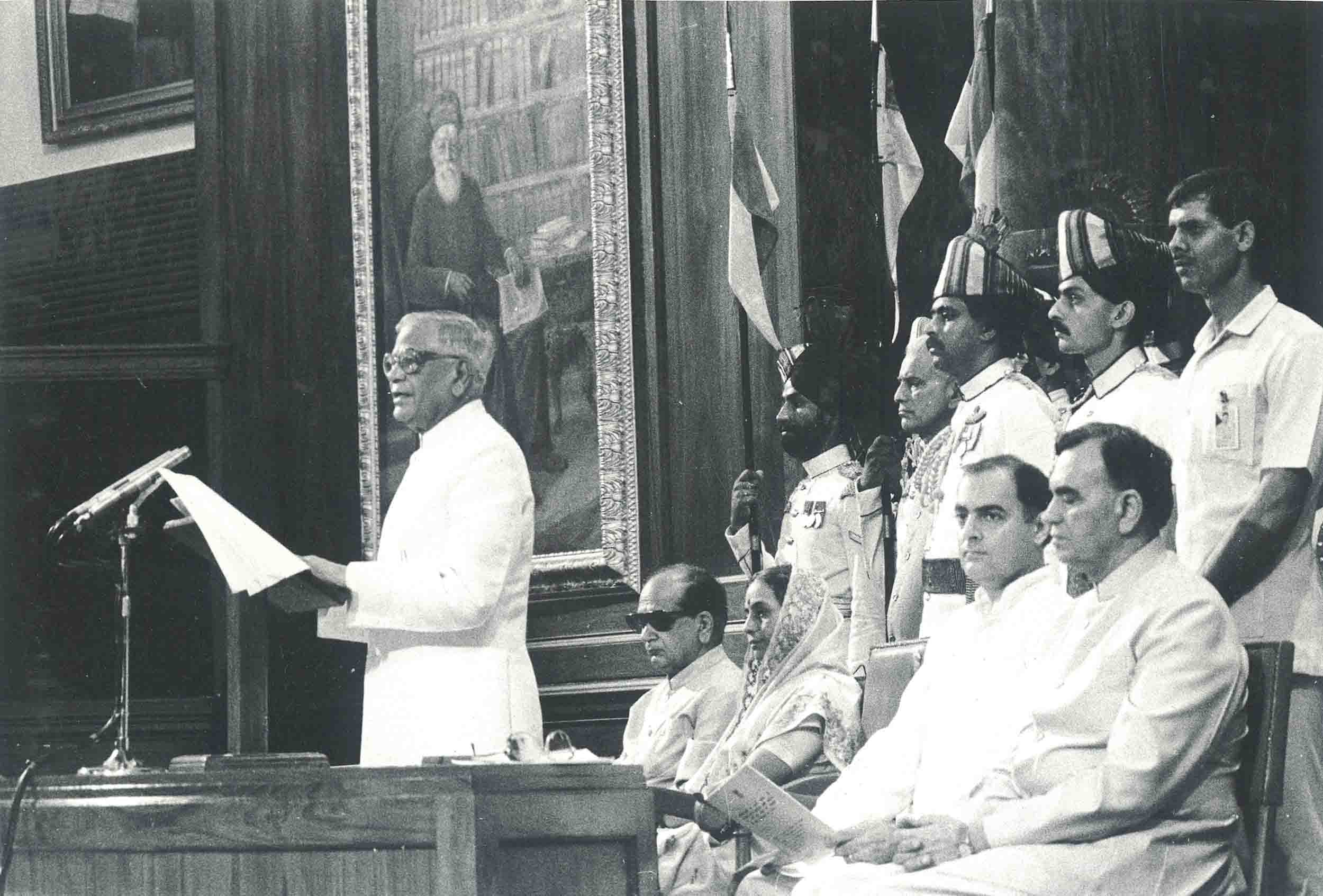
[[File:President R. Venkataraman addressing the Members of Parliament on the occasion of 40th anniversary of India's independence at the central hall, Parliament House.jpg|right|thumb|President Venkataraman addressing Parliament on the fortieth anniversary of India's independence.]] | |||
[[File:The President of India, Dr. Shankar Dayal Sharma meeting with former President of India, Shri R. Venkataraman at Rashtrapati Bhavan in New Delhi on May 18, 1995.jpg|right|thumb|President Shankar Dayal Sharma with R. Venkataraman in May,1995]] | |||
In the [[1987 Indian presidential election|election held in July 1987]] Venkataraman emerged victorious winning 740,148 votes against 281,550 votes polled by Krishna Iyer. Mithilesh Kumar came a distant third winning 2,223 votes.<ref name="bookElection">{{cite book |title=ELECTION TO THE OFFICE OF PRESIDENT OF INDIA 2022 |date=2022 |publisher=Election Commission of India |location=New Delhi |page=26 |url=https://ceo.uk.gov.in/files/Pres_VicePres_2022/03-BACKGROUNDMATERIAL-ENGLISH-2022.pdf |access-date=18 June 2023}}</ref> Venkatraman won the support of 606 of 755 [[Member of Parliament (India)|Members of Parliament]] and majorities in 14 of 25 [[State legislative assemblies of India|state legislative assemblies]] while Iyer won a majority in 8 legislative assemblies where non-Congress parties held a majority and the support of 139 members of Parliament. Kumar, leader of the Goodmans Party, ended up winning seven votes.<ref>{{cite news |title=Venkataraman elected eighth president of India|url=https://www.upi.com/Archives/1987/07/16/Venkataraman-elected-eighth-president-of-India/2598553406400/ |access-date=18 June 2023 |agency=UPI |date=16 July 1987 |language=en}}</ref><ref>{{cite news |title=Stories in the story of presidential poll losers |url=https://indianexpress.com/article/opinion/columns/stories-in-the-story-of-presidential-poll-losers-8033894/ |access-date=18 June 2023 |work=The Indian Express |date=17 July 2022 |language=en}}</ref> Venkataraman was declared elected on 16 July 1987 and was sworn in on 25 July 1987.<ref name="bookElection" /><ref>{{cite web |title=SHRI R. VENKATARAMAN TO BE SWORN IN ON SATURDAY |url=https://archive.pib.gov.in/archive/ArchiveSecondPhase/HOME%20AFFAIR/1987-JAN-DEC-HOME-AFFAIRS/PDF/HOM-1987-07-22_129.pdf |website=archive.pib.gov.in |publisher=Press Information Bureau |access-date=18 June 2023}}</ref> The election was [[Election petition|challenged]] unsuccessfully in the [[Supreme Court of India|Supreme Court]] by Mithilesh Kumar.<ref>{{cite web |title=Mithilesh Kumar vs Sri R. Venkataraman & Ors on 16 October, 1987 |url=https://indiankanoon.org/doc/1011048/ |publisher=Indian Kanoon |access-date=18 June 2023}}</ref> Coming after a series of electoral defeats, controversies over defence deals and the uneasy relationship between Prime Minister Gandhi and President Zail Singh, the election result was perceived as a boost to the Congress Party.<ref>{{cite news |title=July 16, 1987: Venkataraman elected Indian President |url=https://gulfnews.com/today-history/july-16-1987-venkataraman-elected-indian-president-1.2059225 |access-date=18 June 2023 |work=Gulf News |date=15 July 2017 |language=en}}</ref> | |||
Venkataraman served as [[President of India]] starting 1987, where he worked with four prime ministers, and appointed three of them: [[V. P. Singh]], [[Chandra Shekhar]] and [[P. V. Narasimha Rao]], during his five-year term, which saw the advent of coalition politics in India. His successor [[Shankar Dayal Sharma|S. D. Sharma]] was the only other Indian President in 20th Century to work with four prime ministers and appoint three of them.<ref>[https://web.archive.org/web/20121023030553/http://articles.timesofindia.indiatimes.com/2009-01-28/india/28054987_1_rashtrapati-bhavan-zail-singh-rv Former President Venkataraman passes away] ''[[The Times of India]]'', 28 January 2009.</ref><ref>[http://www.indianexpress.com/news/former-president-r-venkataraman-passes-away/415704/ Former President R Venkataraman passes away] ''[[The Indian Express]]'', 27 January 2009.</ref> According to his book ''My Presidential Years'', Venkataraman noted that a Congress MP approached him with the idea of seeking a second term, which he "categorically" declined. | |||
Desire for retirement: Venkataraman explained that he did not want to be involved in the political maneuvering necessary for a second term. | |||
== Post-presidency == | |||
Venkataraman returned to Chennai after retiring, but moved back to Delhi a few years later.<ref>{{Cite web |title=rediff.com: What our Presidents did after leaving Rashtrapati Bhavan |url=https://m.rediff.com/news/2007/jul/20sld9.htm |access-date=2023-06-19 |website=m.rediff.com}}</ref>[[File:President R. Venkataraman on a State Visit to United Kingdom.jpg|right|thumb|Venkataraman made a state visit to the United Kingdom in 1990. Seen here with [[Queen Elizabeth The Queen Mother]], [[Prince Philip, Duke of Edinburgh]], [[Janaki Venkataraman]] and [[Queen Elizabeth II]].]] | |||
[[File:Indiase president Vankataraman in Amsterdam begroet door Koningin Beatrix, Bestanddeelnr 934-3119.jpg|right|thumb| President Venkataraman with [[Beatrix of the Netherlands|Queen Beatrix]] during his state visit to the Netherlands in 1988.]] | |||
==Honours== | |||
Venkataraman received the Doctorate of Law (Honoris Causa) from the [[University of Madras]]. He is an Honorary Fellow, [[Madras Medical College]]; a Doctor of Social Sciences, [[University of Roorkee]]; Doctor of Law (Honoris Causa) from the [[University of Burdwan]]. He was awarded the Tamra Patra for participation in the freedom struggle, the Soviet Land Prize for his travelogue on [[K. Kamaraj]]'s visit to the Socialist countries. He was the recipient of a Souvenir from the Secretary-General of the United Nations for distinguished service as President of the U.N. Administrative Tribunal. The title of "Sat Seva Ratna" was conferred on him by the Sankaracharya of Kancheepuram. He was a great devotee of the [[Paramacharya]] of Kanchi.<ref name="webVenk" /><ref name="Gandhi"/> | |||
==Illness and death== | ==Illness and death== | ||
On 12 January 2009, Venkataraman was admitted to the Army Hospital (Research and Referral ) with complaints of Urosepsis (sepsis caused by a urinary tract infection).<ref name="ndtv">{{cite news|title=Former President R Venkataraman dies|url=http://www.ndtv.com/convergence/ndtv/story.aspx?id=NEWEN20090081563| | On 12 January 2009, Venkataraman was admitted to the Army Hospital (then Research and Referral) in New Delhi with complaints of Urosepsis (sepsis caused by a urinary tract infection).<ref name="ndtv">{{cite news|title=Former President R Venkataraman dies|url=http://www.ndtv.com/convergence/ndtv/story.aspx?id=NEWEN20090081563|publisher=[[NDTV]]|url-status=dead|archive-url=https://web.archive.org/web/20090131152540/http://www.ndtv.com/convergence/ndtv/story.aspx?id=NEWEN20090081563|archive-date=31 January 2009}}</ref> His condition grew critical on 20 January, when he was detected with [[low blood pressure]] and ''[[E. coli]]'' tract infection. | ||
Venkataraman died at the age of 98 on 27 January 2009 at 14:30 IST,<ref name="ndtv" /> due to multiple organ failure.<ref name="sindh_today">{{cite news|url=http://www.sindhtoday.net/south-asia/56521.htm|title=Former President Venkataraman dead|date=27 January 2009|work=Sindh Today|url-status=dead|archive-url=https://web.archive.org/web/20090131060735/http://www.sindhtoday.net/south-asia/56521.htm|archive-date=31 January 2009}}</ref> Since he died on the day after [[Republic Day (India)|Republic Day]], some programmes coinciding it were cancelled to mark the respect towards the late former president. He was cremated with full state honours at Ekta Sthal near [[Raj Ghat]]. President [[Pratibha Patil]], Vice President [[Mohammad Hamid Ansari]], Prime Minister [[Manmohan Singh]], and various other leaders condoled his death. | |||
Venkataraman | == Personal life == | ||
He was married to [[Janaki Venkataraman]], and had a daughter.<ref>{{Cite web |title='Nothing came easy to me,' says former President R Venkataraman's daughter |url=https://www.newindianexpress.com/cities/chennai/2018/jul/25/nothing-came-easy-to-me-says-former-president-r-venkataramans-daughter-1848055.html |access-date=2023-06-19 |website=The New Indian Express|date=25 July 2018 }}</ref> | |||
==Books by Venkataraman== | ==Books by Venkataraman== | ||
| Line 100: | Line 146: | ||
* ''The Great Humanist Ramaswami Venkataraman'', by Attar Chand. Published by Gian Pub. House, 1987. {{ISBN|81-212-0106-3}}. | * ''The Great Humanist Ramaswami Venkataraman'', by Attar Chand. Published by Gian Pub. House, 1987. {{ISBN|81-212-0106-3}}. | ||
* ''So May India be Great: Selected Speeches and Writings of President R. Venkataraman'', by Ramaswami Venkataraman. Published by Publication Division, Ministry of Information and Broadcasting, Govt. of India, 1990. | * ''So May India be Great: Selected Speeches and Writings of President R. Venkataraman'', by Ramaswami Venkataraman. Published by Publication Division, Ministry of Information and Broadcasting, Govt. of India, 1990. | ||
* ''Selected Speeches, 1984–87, 10 September 1984 – 14 May 1987, by Ramaswami Venkataraman. Published by Publications Division, Ministry of Information and Broadcasting, Govt. of India, 1991. | * ''Selected Speeches, 1984–87, 10 September 1984 – 14 May 1987'', by Ramaswami Venkataraman. Published by Publications Division, Ministry of Information and Broadcasting, Govt. of India, 1991. | ||
* ''President R. Venkataraman Selected Speeches: July 1987 – December 1989.'', by Ramaswami Venkataraman. Published by Publications Division, Ministry of Information and Broadcasting, Govt. of India, 1991. | * ''President R. Venkataraman Selected Speeches: July 1987 – December 1989.'', by Ramaswami Venkataraman. Published by Publications Division, Ministry of Information and Broadcasting, Govt. of India, 1991. | ||
{{Clear}} | {{Clear}} | ||
| Line 108: | Line 154: | ||
==Further reading== | ==Further reading== | ||
* {{cite news|title=Ramaswamy Venkataraman:Eighth President of India|work=[[The Times]]|date=30 January 2009|url=http://www.timesonline.co.uk/tol/comment/obituaries/article5613765.ece}} | * {{cite news|title=Ramaswamy Venkataraman:Eighth President of India|work=[[The Times]]|date=30 January 2009|url=http://www.timesonline.co.uk/tol/comment/obituaries/article5613765.ece}}{{dead link|date=October 2024|bot=medic}}{{cbignore|bot=medic}} | ||
==External links== | ==External links== | ||
* {{Commons category-inline}} | * {{Commons category-inline}} | ||
* {{Wikiquote-inline}} | * {{Wikiquote-inline}} | ||
| Line 143: | Line 188: | ||
|list = | |list = | ||
{{Presidents of India}} | {{Presidents of India}} | ||
{{ | {{Vice presidents of India}} | ||
{{Defence ministers of India}} | |||
{{Home Ministry (India)}} | {{Home Ministry (India)}} | ||
{{Indian | {{Indian Independence Movement}} | ||
{{Sri Lankan Civil War}} | {{Sri Lankan Civil War}} | ||
}} | }} | ||
| Line 156: | Line 202: | ||
[[Category:Loyola College, Chennai alumni]] | [[Category:Loyola College, Chennai alumni]] | ||
[[Category:Deaths from multiple organ failure]] | [[Category:Deaths from multiple organ failure]] | ||
[[Category: | [[Category:Ministers of defence of India]] | ||
[[Category: | [[Category:Ministers of finance of India]] | ||
[[Category:Indian autobiographers]] | [[Category:Indian autobiographers]] | ||
[[Category:Indian independence activists from Tamil Nadu]] | [[Category:Indian independence activists from Tamil Nadu]] | ||
| Line 168: | Line 214: | ||
[[Category:Tamil Nadu ministers]] | [[Category:Tamil Nadu ministers]] | ||
[[Category:University of Madras alumni]] | [[Category:University of Madras alumni]] | ||
[[Category:Union | [[Category:Union ministers from Tamil Nadu]] | ||
[[Category:Vice presidents of India]] | [[Category:Vice presidents of India]] | ||
[[Category:Lok Sabha members from Tamil Nadu]] | [[Category:Lok Sabha members from Tamil Nadu]] | ||
| Line 177: | Line 223: | ||
[[Category:Indian technology writers]] | [[Category:Indian technology writers]] | ||
[[Category:Indian political writers]] | [[Category:Indian political writers]] | ||
[[Category:National College, Tiruchirappalli alumni]] | [[Category:National College, Tiruchirappalli alumni]] | ||
[[Category:Politicians from Chennai]] | [[Category:Politicians from Chennai]] | ||
[[Category:People of the Sri Lankan | [[Category:People of the Sri Lankan civil war]] | ||
[[Category:Indian Peace Keeping Force]] | [[Category:Indian Peace Keeping Force]] | ||
Latest revision as of 19:29, 23 February 2026
Ramaswamy Venkataraman | |
|---|---|
_(cropped).jpg) Official portrait, c. 1987 | |
| President of India | |
| In office 25 July 1987 – 25 July 1992 | |
| Prime Minister | Rajiv Gandhi V. P. Singh Chandra Shekhar P. V. Narasimha Rao |
| Vice President | Shankar Dayal Sharma |
| Preceded by | Zail Singh |
| Succeeded by | Shankar Dayal Sharma |
| Vice President of India | |
| In office 31 August 1984 – 24 July 1987 | |
| President | Zail Singh |
| Prime Minister | Indira Gandhi Rajiv Gandhi |
| Preceded by | Mohammad Hidayatullah |
| Succeeded by | Shankar Dayal Sharma |
| Union Minister of Home Affairs | |
| In office 22 June 1982 – 2 September 1982 | |
| Prime Minister | Indira Gandhi |
| Preceded by | Zail Singh |
| Succeeded by | Prakash Chandra Sethi |
| Union Minister of Defence | |
| In office 15 January 1982 – 2 August 1984 | |
| Prime Minister | Indira Gandhi |
| Preceded by | Indira Gandhi |
| Succeeded by | Shankarrao Chavan |
| Union Minister of Finance | |
| In office 14 January 1980 – 15 January 1982 | |
| Prime Minister | Indira Gandhi |
| Preceded by | Hemvati Nandan Bahuguna |
| Succeeded by | Pranab Mukherjee |
| Personal details | |
| Born | 4 December 1910 Rajamadam, Thanjavur, British India (present-day Tamil Nadu, India) |
| Died | 27 January 2009 (aged 98) New Delhi, Delhi, India |
| Political party | Indian National Congress |
| Spouse(s) | ( m. 1938) |
| Children | 3 |
| Alma mater | Loyola College, University of Madras |
| Profession | |
| Signature |  |
Ramaswamy Venkataraman ( pronunciation (help·info), 4 December 1910 – 27 January 2009),[1][2] also known as R. Venkataraman, was an Indian lawyer, independence activist and politician who served as a union minister and as the vice president of india and president of India.[3]
Venkataraman was born in Rajamadam village in Tanjore district, Madras Presidency. He studied law and practised in the Madras High Court and the Supreme Court of India. In his youth, he was an activist for the Indian independence movement, and he participated in the Quit India Movement. He was appointed as the member of the Constituent Assembly and the provisional cabinet. He was elected to the Lok Sabha four times and served as Union Finance Minister and Defence Minister. In 1984, he was elected as the vice president of India and in 1987, he became the president of India and served from 1987 to 1992. He also served as a state minister under K. Kamaraj and M. Bhaktavatsalam.[4]
pronunciation (help·info), 4 December 1910 – 27 January 2009),[1][2] also known as R. Venkataraman, was an Indian lawyer, independence activist and politician who served as a union minister and as the vice president of india and president of India.[3]
Venkataraman was born in Rajamadam village in Tanjore district, Madras Presidency. He studied law and practised in the Madras High Court and the Supreme Court of India. In his youth, he was an activist for the Indian independence movement, and he participated in the Quit India Movement. He was appointed as the member of the Constituent Assembly and the provisional cabinet. He was elected to the Lok Sabha four times and served as Union Finance Minister and Defence Minister. In 1984, he was elected as the vice president of India and in 1987, he became the president of India and served from 1987 to 1992. He also served as a state minister under K. Kamaraj and M. Bhaktavatsalam.[4]
Early life[edit | edit source]
Venkataraman was born in a Tamil Brahmin family[5][6] in Rajamadam village near Pattukottai, Tanjore district in Madras Presidency, British India. He had his school education in Govt Boys Higher Secondary School, Pattukottai and undergraduation in National College, Tiruchirappalli.[7]
Educated locally and in the city of Madras (now Chennai), Venkataraman obtained his master's degree in economics from Loyola College, Madras. He later qualified in Law from the Law College, Madras. Venkataraman was enrolled in the Madras High Court in 1935 and in the Supreme Court in 1951.[8]
While practising law, Venkataraman was drawn into the movement for India's freedom from Britain's colonial subjugation. His active participation in the Indian National Congress's celebrated resistance to the British Government, the Quit India Movement of 1942, resulted in his detention for two years under the Defence of India Rules. Venkataraman's interest in the law continued during this period. In 1946, when the transfer of power from British to Indian hands was imminent, the Government of India included him in the panel of lawyers sent to Malaya and Singapore to defend Indian nationals charged with offences of collaboration during the Japanese occupation of those two places. In the years 1947 to 1950, Venkataraman served as Secretary of the Madras Provincial Bar Federation.[9]
Political career[edit | edit source]
Law and trade activity led to Venkataraman's increasing association with politics. He was a member of constituent assembly that drafted India's constitution. In 1950, he was elected to free India's Provisional Parliament (1950–1952) and to the First Parliament (1952–1957). During his term of legislative activity, Venkataraman attended the 1952 Session of the Metal Trades Committee of International Labour Organisation as a workers' delegate. He was a member of the Indian Parliamentary Delegation to the Commonwealth Parliamentary Conference in New Zealand. Venkataraman was also Secretary to the Congress Parliamentary Party in 1953–1954.[10][4]
Venkatraman was reelected to Parliament from Thanjavur in the general election of 1957 with an improved majority of 37,000 votes.[11] He however resigned the seat and joined the Madras government at the invitation of its Chief Minister, K. Kamaraj.[12] Venkataraman was sworn in as Minister for Industries on 26 April 1957 and was allotted several ministries including those of Labour and Co-operation, Commercial Taxes and Nationalised Transport, Textiles, Mines and Minerals and Companies and was elected to the Madras Legislative Council in the biennial elections conducted in March 1958.[13]
In the assembly election of 1962, the Congress Party under K Kamaraj was returned to power. Venkataraman was retained as minister in charge of the same ministries during the Kamaraj Ministry which lasted 2 October 1963 and under Chief Minister M. Bhaktavatsalam who succeeded Kamaraj. Venkataraman himself was sworn in as Minister in the Bhaktavatsalam Ministry only on 23 October 1963, as he was in New York City to attend the session of the United Nations Administrative Tribunal.[14] Venkataraman was reelected to the Council in the biennial elections of March 1964 and remained the leader of the house in the council until after the assembly elections of 1967.[15]
As Minister of Industries, Venkataraman proved to be an able administrator who ushered in a period of industrial development in Madras.[16] He championed the idea of industrial estates, the first of which was established at Guindy, and succeeded in getting investments in major public sector undertakings such as the Integral Coach Factory, Neyveli Lignite Corporation and the Heavy Vehicles Factory.[17][18][19] Venkataraman persuaded the TVS Group to set up a factory at Padi and several other private companies including Ashok Leyland, Hindustan Motors and Enfield established their automobile factories in Madras during this time.[20] Tamil Nadu's industrialization has been widely credited to steps initiated during Venkataraman's decade as the state's industries minister and he has been described as the "father of industrialization" in Tamil Nadu.[21][22]
In 1967, Venkataraman contested the parliamentary election from Thanjavur but lost to the D.S. Gopalar of the Dravida Munnetra Kazhagam.[23][24] In the assembly election of 1967, the Congress was routed by the Dravida Munnetra Kazhagam. C. N. Annadurai, the DMK's leader in the Council became Chief Minister and Venkataraman the leader of the opposition in the council until his resignation from the Council in August 1967.[25]
Venkataraman was appointed a member of the Planning Commission in July, 1967 by Prime Minister Indira Gandhi and held charge of industry, labour, power, transport, communications and railways.[26][27] In 1970, the Commission on Major Ports headed by Venkataraman submitted its report to the Government. This was the first study to be made of the integrated function and development of major ports in India.[28] He resigned from the Planning Commission in 1971.[29]
In 1977, Venkataraman was elected to the Lok Sabha from Madras (South) Constituency and served as an Opposition Member of Parliament and Chairman of the Public Accounts Committee.[30]
Venkataraman was also, variously, a member of the Political Affairs Committee and the Economic Affairs Committee of the Union Cabinet; Governor, International Monetary Fund, the International Bank for Reconstruction and Development, and the Asian Development Bank. Venkataraman was a Delegate to the United Nations General Assembly in 1953, 1955, 1956, 1958, 1959, 1960 and 1961. He was Leader of the Indian Delegation to the 42nd Session of the International Labour Conference at Geneva (1958) and represented India in the Inter Parliamentary Conference in Vienna (1978). He was a member of the United Nations Administrative Tribunal from 1955 to 1979 and was its president from 1968 to 1979.[31][32]
Union Minister[edit | edit source]
Minister of Finance[edit | edit source]
Venkataraman was re-elected to the Lok Sabha from the Madras South constituency in the 1980 general election with an improved majority of over 120,000 votes.[33] He was sworn in as Cabinet Minister in charge of Finance in the Indira Gandhi ministry on 14 January 1980.[34][35] During January to April, 1980 he was also Minister of Industry.[36][37] As finance minister, Venkataraman presented the interim and final budgets for 1980 and the budget in 1981.[38] Venkataraman's budget in 1981 was seen as favouring the middle class and industry, focusing on improving growth and savings in the economy while raising customs duty on all imported goods to raise revenue.[39] In the same year, he introduced a bill for the establishment of the National Bank for Agriculture and Rural Development which was passed by Parliament.[40]
When allegations of corruption were raised against the Congress Party and the Chief Minister of Maharashtra, A. R. Antulay regarding the collection of funds by a trust named after Prime Minister Indira Gandhi, she tasked Venkataraman with defending the government in debates on the matter in Parliament. Although members of the opposition attempted to introduce privilege motions against Venkatraman on the grounds that he had misled parliament, these were rejected by the presiding officers in both houses of parliament.[41][42] In his interventions, Venkataraman sought to dissociate the Prime Minister from the activities of Antulay and he rejected the opposition's demand for a probe arguing that no improprieties had been committed by the trust to warrant an inquiry.[43][44]
It was during Venkataraman's tenure as finance minister that India negotiated with the International Monetary Fund for a loan for 5 billion special drawing rights amounting to US$5.68 billion.[45][46] Sanctioned in November 1981, this was the largest loan ever made by the IMF.[47][46] While the loan required the Indian government to limit the expansion of credit and curtail commercial borrowings and to consult the IMF on fiscal and monetary policies of the government, it did not require India to devalue the rupee as was done in the past.[45]
Minister of Defence[edit | edit source]
Venkataraman was shifted from the Ministry of Finance on 15 January 1982 to the Ministry of Defence, a portfolio that had until then been held by Prime Minister Indira Gandhi.[48][49]
During Venkataraman's tenure in the ministry, the Government of India signed deals to purchase Sea King helicopters and Sea Eagle missiles from the United Kingdom and Mirage fighter aircraft and Type 209 submarines from other western nations thus seeking to undo the near monopoly that the Soviet Union had on weapons systems in the Indian armed forces.[50][51][52] In response, the Soviets, keen to not lose out in their largest arms market in the developing world, agreed to India's request for acquiring the MiG-29 fighter jet and to the licensed production in India of the MiG-27 and MiG-29 aircraft during Venkataraman's visit to Moscow in June 1983. The offer was finalized during the visit to India of the Soviet Defence Minister, Dmitry Ustinov in March 1984.[53][54]
His most consequential contribution as Defence Minister, however, was the launch of the Integrated Guided Missile Development Programme in 1983 which led to the indigenous development of the Prithvi, Akash, Agni, Thrishul and Nag missile systems by India's Defence Research and Development Organisation.[55][56] Venkataraman's term also witnessed India attempt to conduct a nuclear test in 1983 and the seizing of the Siachen Glacier by the Indian Army in 1984.[55][57]
Venkataraman demitted office on 2 August 1984 and was succeeded by S. B. Chavan as Minister of Defence.[58]
Tenure as President & Vice President[edit | edit source]
Vice President of India (1984–1987)[edit | edit source]
Prime Minister Indira Gandhi chose Venkataraman to be the Congress Party's candidate for the vice presidential election to elect a successor to M. Hidayatullah. Bapu Chandrasen Kamble of the Republican Party of India was his sole opponent.[59] In the election held on 22 August 1984, Venkataraman won 508 of 715 valid votes cast to win outright. Venkataraman was sworn in as vice-president on 31 August 1984.[60]
Following Indira Gandhi's assassination, Vice President Venkataraman went along with President Zail Singh's decision to appoint Rajiv Gandhi as prime minister. It was Venkataraman who announced Indira Gandhi's death on Doordarshan and the swearing-in of a new government under Rajiv Gandhi.[61]
As relations between Rajiv Gandhi and President Zail Singh worsened, the Prime Minister stopped calling on the President. The government also began to depute Venkataraman in place of Singh on diplomatic visits.[62] Gandhi however told Parliament that he had been meeting the president regularly and had kept him informed on all matters of policy. A letter contradicting the Prime Minister's statement, allegedly written by President Singh, was leaked to the media which led to a political furore. Venkataraman saved Rajiv Gandhi's government much embarrassment when he declined to allow a discussion in the house on this letter and on the president's right to be kept informed under Article 78 of the Constitution. Despite angry protests and walkouts by opposition parties, Venkataraman refused to budge stating that confidentiality of communications between the president and the prime minister was required to be maintained in the interest of the nation.[63][64][65]
As President Singh's term neared its end it was widely speculated that he intended to dismiss Gandhi as prime minister and appoint a caretaker government. Singh asked Venkataraman whether he would be interested in becoming the prime minister in such an eventuality but Venkataraman declined the offer.[66][67][68]
In the run up to the presidential election of 1987, the Congress party's initial choices for president were B. Shankaranand, Pupul Jayakar and P.V. Narasimha Rao. However, Venkataraman let it be known that he would resign if he were not nominated as the party's candidate for the presidency. On 14 June 1987 the Congress Parliamentary Board endorsed Venkataraman as the party's nominee for the presidential election.[69][68] The Left parties fielded Justice V. R. Krishna Iyer as their candidate and despite speculation that he might contest as an independent candidate, President Singh chose to retire.[70]
President of India (1987–1992)[edit | edit source]


In the election held in July 1987 Venkataraman emerged victorious winning 740,148 votes against 281,550 votes polled by Krishna Iyer. Mithilesh Kumar came a distant third winning 2,223 votes.[72] Venkatraman won the support of 606 of 755 Members of Parliament and majorities in 14 of 25 state legislative assemblies while Iyer won a majority in 8 legislative assemblies where non-Congress parties held a majority and the support of 139 members of Parliament. Kumar, leader of the Goodmans Party, ended up winning seven votes.[73][74] Venkataraman was declared elected on 16 July 1987 and was sworn in on 25 July 1987.[72][75] The election was challenged unsuccessfully in the Supreme Court by Mithilesh Kumar.[76] Coming after a series of electoral defeats, controversies over defence deals and the uneasy relationship between Prime Minister Gandhi and President Zail Singh, the election result was perceived as a boost to the Congress Party.[77]
Venkataraman served as President of India starting 1987, where he worked with four prime ministers, and appointed three of them: V. P. Singh, Chandra Shekhar and P. V. Narasimha Rao, during his five-year term, which saw the advent of coalition politics in India. His successor S. D. Sharma was the only other Indian President in 20th Century to work with four prime ministers and appoint three of them.[78][79] According to his book My Presidential Years, Venkataraman noted that a Congress MP approached him with the idea of seeking a second term, which he "categorically" declined. Desire for retirement: Venkataraman explained that he did not want to be involved in the political maneuvering necessary for a second term.
Post-presidency[edit | edit source]
Venkataraman returned to Chennai after retiring, but moved back to Delhi a few years later.[80]


Honours[edit | edit source]
Venkataraman received the Doctorate of Law (Honoris Causa) from the University of Madras. He is an Honorary Fellow, Madras Medical College; a Doctor of Social Sciences, University of Roorkee; Doctor of Law (Honoris Causa) from the University of Burdwan. He was awarded the Tamra Patra for participation in the freedom struggle, the Soviet Land Prize for his travelogue on K. Kamaraj's visit to the Socialist countries. He was the recipient of a Souvenir from the Secretary-General of the United Nations for distinguished service as President of the U.N. Administrative Tribunal. The title of "Sat Seva Ratna" was conferred on him by the Sankaracharya of Kancheepuram. He was a great devotee of the Paramacharya of Kanchi.[9][7]
Illness and death[edit | edit source]
On 12 January 2009, Venkataraman was admitted to the Army Hospital (then Research and Referral) in New Delhi with complaints of Urosepsis (sepsis caused by a urinary tract infection).[81] His condition grew critical on 20 January, when he was detected with low blood pressure and E. coli tract infection.
Venkataraman died at the age of 98 on 27 January 2009 at 14:30 IST,[81] due to multiple organ failure.[82] Since he died on the day after Republic Day, some programmes coinciding it were cancelled to mark the respect towards the late former president. He was cremated with full state honours at Ekta Sthal near Raj Ghat. President Pratibha Patil, Vice President Mohammad Hamid Ansari, Prime Minister Manmohan Singh, and various other leaders condoled his death.
Personal life[edit | edit source]
He was married to Janaki Venkataraman, and had a daughter.[83]
Books by Venkataraman[edit | edit source]
- Role of Planning in Industrial Development, by Ramaswami Venkataraman. Published by Govt. of India Press, 1969.
- The Role of a Private Member of Parliament, by Ramaswami Venkataraman. Published by Harold Laski Institute of Political Science, 1986.
- My Presidential Years – R Venkataraman, by R Venkataraman. 1995. HarperCollins/Indus. ISBN 81-7223-202-0.
- R. Venkataraman on Contemporary Issues, by Ramaswami Venkataraman, K. Venkatasubramanian. Published by Variant Communications, 1996.
- Relevance of Gandhi: And Other Essays, by K Swaminathan, Ramaswami Venkataraman. Published by Gandhigram Trust, 1998.
Books on Venkataraman[edit | edit source]
- President R. Venkataraman, by Nand Gopal Chaudhry. Published by Manas Publications, 1987. ISBN 81-7049-018-9.
- The Great Humanist Ramaswami Venkataraman, by Attar Chand. Published by Gian Pub. House, 1987. ISBN 81-212-0106-3.
- So May India be Great: Selected Speeches and Writings of President R. Venkataraman, by Ramaswami Venkataraman. Published by Publication Division, Ministry of Information and Broadcasting, Govt. of India, 1990.
- Selected Speeches, 1984–87, 10 September 1984 – 14 May 1987, by Ramaswami Venkataraman. Published by Publications Division, Ministry of Information and Broadcasting, Govt. of India, 1991.
- President R. Venkataraman Selected Speeches: July 1987 – December 1989., by Ramaswami Venkataraman. Published by Publications Division, Ministry of Information and Broadcasting, Govt. of India, 1991.
References[edit | edit source]
- ↑ Encyclopaedia Britannica Almanac 2010. Encyclopædia Britannica, Inc. 1 January 2010. pp. 87–. ISBN 978-1-61535-329-3.
- ↑ Vinay Kumar (28 January 2009) R. Venkataraman passes away[usurped]. The Hindu
- ↑ "Shri Ramaswami Venkataraman – R.Venkataraman – Past President of India". Pastpresidentsofindia.indiapress.org. Retrieved 13 September 2012.
- ↑ 4.0 4.1 "Members Bioprofile". loksabhaph.nic.in. Retrieved 18 September 2020.
- ↑ "How Brahmins became invisible in Tamil Nadu's politics". The Times of India. 12 April 2019. ISSN 0971-8257. Retrieved 3 July 2024.
many Brahmins like R Venkataraman, Mani Shankar Aiyar, and Subramanian Swamy shot into prominence in politics in later years, they chose to operate from Delhi.
- ↑ Rajesh Ramachandran (2 April 2004). "Take 2 for Tambrams". The Times of India. ISSN 0971-8257. Retrieved 3 July 2024.
- ↑ 7.0 7.1 Gandhi, Gopalkrishna (4 December 2010). "The value of decency". The Hindu. ISSN 0971-751X. Retrieved 18 September 2020.
- ↑ Venkataraman presided over the change to era of coalitions The Hindu, 28 January 2009.
- ↑ 9.0 9.1 "July 16, 1987: Venkataraman elected Indian President". gulfnews.com. 15 July 2017. Retrieved 18 September 2020.
- ↑ Grewal, Kairvy (27 January 2020). "R Venkataraman — President who stuck by rulebook to guide India through troublesome times". ThePrint. Retrieved 18 September 2020.
- ↑ Statistical Report on General Elections, 1957 to the Second Lok Sabha (PDF). Vol. I. New Delhi: Election Commission of India. p. 80. Retrieved 15 June 2023.
- ↑ "The value of decency". The Hindu. 3 December 2010. Retrieved 15 June 2023.
- ↑ A Review of the Madras Legislative Assembly (1957-1962) (PDF). Madras: Legislative Assembly Department. March 1962. pp. 93, 129. Retrieved 15 June 2023.
- ↑ The Madras Legislative Assembly, 1962-67: A Review (PDF). Madras: Legislative Assembly Department, Government of Madras. August 1967. pp. 10–13. Retrieved 15 June 2023.
- ↑ The Madras Legislative Assembly, 1962-67: A Review (PDF). Madras: Legislative Assembly Department, Government of Madras. August 1967. pp. 114, 129. Retrieved 15 June 2023.
- ↑ "The President who went by the book". The Indian Express. 28 January 2009. Retrieved 15 June 2023.
- ↑ "Presidential elections: Zail Singh's shadow to prevail over Rashtrapati Bhavan for a while". India Today. 15 July 1987. Retrieved 15 June 2023.
- ↑ "Built to last, the story of Guindy Industrial Estate". The Hindu. 26 August 2022. Retrieved 15 June 2023.
- ↑ "City pays homage to man behind TN's industrial growth". The Times of India. 28 January 2009. Retrieved 15 June 2023.
- ↑ "In R Venkatraman's demise, TN lost a great patron and Father of Industry". The Economic Times. 27 January 2009. Retrieved 15 June 2023.
- ↑ "The federal manoeuvre: on Karunanidhi and the Dravidian movement". The Hindu. 15 September 2017. Retrieved 15 June 2023.
- ↑ ""RV, father of industrialisation in Tamil Nadu"". The Hindu. 4 December 2011. Retrieved 15 June 2023.
- ↑ Nathan, S K S (1967). "The DMK and the Politics of Tamilnad". Economic and Political Weekly. 2 (48): 2139. ISSN 0012-9976. JSTOR 24478287. Retrieved 15 June 2023.
- ↑ Statistical Report on General Elections, 1967 to the Fourth Lok Sabha (PDF). New Delhi: Election Commission of India. 1968. p. 213. Retrieved 15 June 2023.
- ↑ TAMIL NADU LEGISLATIVE ASSEMBLY QUADRENNIAL REVIEW 1967-70. Madras: Legislative Assembly Department. June 1971. pp. 139, 257. Retrieved 15 June 2023.
- ↑ "D.R. Gadgil and R. Venkataraman for Planning Commission". The Hindu. 13 July 2017. Retrieved 16 June 2023.
- ↑ Jai, Janak Raj (2003). Presidents of India, 1950-2003. New Delhi: Regency Publications. p. 190. ISBN 978-81-87498-65-0. Retrieved 16 June 2023.
- ↑ Rao, Y. Gouthama (1987). Financial Management in Public Undertakings: A Study of Ports. New Delhi: Deep & Deep Publications. pp. 44–45. ISBN 978-81-7100-010-4. Retrieved 16 June 2023.
- ↑ Bhattacharjee, Subhomoy (30 April 2017). India's Coal Story: From Damodar to Zambezi. New Delhi: SAGE Publishing India. ISBN 978-93-86446-01-5. Retrieved 16 June 2023.
- ↑ "Former President R. Venkataraman Passes Away". www.outlookindia.com/. Retrieved 18 September 2020.
- ↑ "R. Venkataraman Biography – Ramaswamy Venkataraman Profile, Childhood, Life, Timeline". www.iloveindia.com. Retrieved 18 September 2020.
- ↑ Hazarika, Sanjoy (17 July 1987). "MAN IN THE NEWS; INDIA'S MILD NEW PRESIDENT: Ramaswamy Venkataraman". The New York Times. ISSN 0362-4331. Retrieved 18 September 2020.
- ↑ Statistical Report on General Elections, 1980 to the Seventh Lok Sabha Volume II (PDF). New Delhi: Election Commission of India. 1981. p. 354. Retrieved 14 June 2023.
- ↑ "No. 55/1/1/80 - Cab Swearing-in Ceremony" (PDF). Cabinet Secretariat, Government of India. Retrieved 14 June 2023.
- ↑ "Notification No. 4/2/80-States dated 14 January, 1980" (PDF). Cabinet Secretariat, Government of India. Retrieved 14 June 2023.
- ↑ "No. 55/1/1/80 - Cab dated 16 January, 1980" (PDF). Cabinet Secretariat, Government of India. Retrieved 14 June 2023.
- ↑ "No. 55/1/1/80- Cab dated 5 April, 1980" (PDF). Cabinet Secretariat, Government of India. Retrieved 14 June 2023.
- ↑ "Finance Ministers who shaped India's economy - Pillars of Indian economy". The Economic Times. 14 January 2019. Retrieved 14 June 2023.
- ↑ "Forty Years Ago, March 1, 1981: Budget Proposals". The Indian Express. 1 March 2021. Retrieved 14 June 2023.
- ↑ "New Bank for Agriculture and Rural Development" (PDF). Weekly Economic Digest. I (40): 1. 30 November 1981. Retrieved 14 June 2023.
- ↑ Andersen, Walter K. (1982). "India in 1981: Stronger Political Authority and Social Tension". Asian Survey. 22 (2): 120–121. doi:10.2307/2643939. ISSN 0004-4687. JSTOR 2643939. Retrieved 14 June 2023.
- ↑ "September 8, 1981, Forty Years Ago: FM exonerated". The Indian Express. 8 September 2021. Retrieved 14 June 2023.
- ↑ "September 3, 1981, Forty Years Ago: No Probe On Antulay". The Indian Express. 3 September 2021. Retrieved 14 June 2023.
- ↑ "September 15, 1981, Forty Years Ago: Ruckus in Lok Sabha". The Indian Express. 15 September 2021. Retrieved 14 June 2023.
- ↑ 45.0 45.1 Rowen, Hobart (10 November 1981). "IMF Approves $5.8 Million Loan to India". Washington Post. Retrieved 14 June 2023.
- ↑ 46.0 46.1 Nossiter, Bernard D. (9 September 1981). "RECORD I. M.F. LOAN TO INDIA DUE; $5.68 BILLION WILL AID OIL SEARCH". The New York Times. Retrieved 14 June 2023.
- ↑ "History of Lending Commitments: India". www.imf.org. International Monetary Fund. Retrieved 14 June 2023.
- ↑ Andersen, Walter K. (1982). "India in 1981: Stronger Political Authority and Social Tension". Asian Survey. 22 (2): 124. doi:10.2307/2643939. ISSN 0004-4687. JSTOR 2643939. Retrieved 15 June 2023.
- ↑ "No. 55/1/1/82-Cab dated 15 January, 1982" (PDF). Cabinet Secretariat, Government of India. Retrieved 15 June 2023.
- ↑ "Foreign News Briefs". UPI. 20 July 1983. Retrieved 17 June 2023.
- ↑ "Soviet Union concerned at growing diversification of India's arms purchases". India Today. 15 August 1983. Retrieved 15 June 2023.
- ↑ "Months before Operation Bluestar, UK, India talked defence deals". The Times of India. 17 January 2014. Retrieved 15 June 2023.
- ↑ Singh, S. Nihal (1984). "Why India goes to Moscow for Arms". Asian Survey. 24 (7): 707–720. doi:10.2307/2644184. ISSN 0004-4687. JSTOR 2644184. Retrieved 15 June 2023.
- ↑ Smith, Christopher Nicholas (1989). The armament process in the Third World: A case study of India (PDF). Bath: University of Bath. p. 327. Retrieved 15 June 2023.
- ↑ 55.0 55.1 "The copy-book president". The Indian Express. 4 December 2010. Retrieved 15 June 2023.
- ↑ "The Missile Development Programme" (PDF). Press Information Bureau. Retrieved 15 June 2023.
- ↑ Singh, Jaswant (30 July 2006). "A Minister Remembers". The Sunday Tribune – Spectrum. Retrieved 15 June 2023.
- ↑ "No. 55/1/1/84-Cab dated 2 August, 1984" (PDF). Cabinet Secretariat, Government of India. Retrieved 15 June 2023.
- ↑ "Gandhi names candidate for vice presidential election". The Odessa American. Associated Press. 2 August 1984. Retrieved 15 June 2023.
- ↑ VICE PRESIDENTIAL ELECTIONS FROM 1952 TO 1997. New Delhi: Election Commission of India. p. 18. Retrieved 15 June 2023.
- ↑ "Pranab Mukherjee recalls how Rajiv Gandhi became PM after Indira's death". Hindustan Times. 28 January 2016. Retrieved 15 July 2023.
- ↑ "President Zail Singh may end up being the least travelled head of state". India Today. 31 January 1986. Retrieved 15 July 2023.
- ↑ "Rift between President Zail Singh and PM Rajiv Gandhi 'amicably settled'". India Today. 15 April 1987. Retrieved 15 July 2023.
- ↑ Guhan, S. (1994). "The Blotted Copybook". Economic and Political Weekly. 29 (35): 2283–2288. ISSN 0012-9976. JSTOR 4401687. Retrieved 15 July 2023.
- ↑ Singh, Mähendra Prasad (1995). "The Indian Parliamentary-Federal Executive". The Indian Journal of Political Science. 56 (1/4): 36–37. ISSN 0019-5510. JSTOR 41855723. Retrieved 15 July 2023.
- ↑ "A tantalising tit-bit from former President Giani Zail Singh". India Today. 31 March 1988. Retrieved 15 July 2023.
- ↑ "R. Venkataraman's 'My Presidential Years' informs, reveals and provokes". India Today. 15 August 1994. Retrieved 15 July 2023.
- ↑ 68.0 68.1 "Zail Singh's last days as President and the story of manipulations". India Today. 15 April 1988. Retrieved 15 July 2023.
- ↑ Singh, K C (5 February 2022). "The Giani And The Sea Of Changes". Outlook. Retrieved 15 July 2023.
- ↑ "Presidential elections: Over 70 years, 14 Presidents, 15 big fights". The Indian Express. 9 June 2022. Retrieved 15 July 2023.
- ↑ "Modi 2.0: Oath-taking ceremony – all you should know". Deccan Herald. 29 May 2019. Retrieved 19 June 2023.
- ↑ 72.0 72.1 ELECTION TO THE OFFICE OF PRESIDENT OF INDIA 2022 (PDF). New Delhi: Election Commission of India. 2022. p. 26. Retrieved 18 June 2023.
- ↑ "Venkataraman elected eighth president of India". UPI. 16 July 1987. Retrieved 18 June 2023.
- ↑ "Stories in the story of presidential poll losers". The Indian Express. 17 July 2022. Retrieved 18 June 2023.
- ↑ "SHRI R. VENKATARAMAN TO BE SWORN IN ON SATURDAY" (PDF). archive.pib.gov.in. Press Information Bureau. Retrieved 18 June 2023.
- ↑ "Mithilesh Kumar vs Sri R. Venkataraman & Ors on 16 October, 1987". Indian Kanoon. Retrieved 18 June 2023.
- ↑ "July 16, 1987: Venkataraman elected Indian President". Gulf News. 15 July 2017. Retrieved 18 June 2023.
- ↑ Former President Venkataraman passes away The Times of India, 28 January 2009.
- ↑ Former President R Venkataraman passes away The Indian Express, 27 January 2009.
- ↑ "rediff.com: What our Presidents did after leaving Rashtrapati Bhavan". m.rediff.com. Retrieved 19 June 2023.
- ↑ 81.0 81.1 "Former President R Venkataraman dies". NDTV. Archived from the original on 31 January 2009.
- ↑ "Former President Venkataraman dead". Sindh Today. 27 January 2009. Archived from the original on 31 January 2009.
- ↑ "'Nothing came easy to me,' says former President R Venkataraman's daughter". The New Indian Express. 25 July 2018. Retrieved 19 June 2023.
Further reading[edit | edit source]
- "Ramaswamy Venkataraman:Eighth President of India". The Times. 30 January 2009.[dead link]


