


robot: Update article (please report if you notice any mistake or error in this edit) |
WikiDwarfBOT (talk | contribs) Cleanup: |
||
| Line 15: | Line 15: | ||
| description = | | description = | ||
}} | }} | ||
'''Dhol''' ( | '''Dhol''' ({{IPA-hi|ɖʰoːl}}) can refer to any one of a number of similar types of double-headed [[drum]] widely used, with regional variations, throughout the [[Indian subcontinent]]. Its range of distribution in [[Indian subcontinent]] primarily includes northern areas such as the [[Jammu division|Jammu]], [[Himachal Pradesh|Himachal]], [[Punjab region|Punjab]], [[Haryana]], [[Delhi]], [[Kashmir]], [[Sindh]], [[Assam Valley]], [[Uttarakhand]], [[West Bengal]], [[Odisha]], [[Gujarat]], [[Maharashtra]], [[Konkan]], [[Goa]], [[Karnataka]], [[Rajasthan]], [[Bihar]], [[Jharkhand]] and [[Uttar Pradesh]]. A related instrument is the [[dholak]] or dholki. ''Dhols'' are amongst other events used in Indian wedding ceremony processions such as [[Baraat]] or ''Varyatra''. | ||
Someone who plays the dhol is known as ''[[dholi]]''. | Someone who plays the dhol is known as ''[[dholi]]''. | ||
== Etymology == | |||
The word Dhol is derived from [[Sanskrit]] word ''ḍhola,'' a term for drum in Sanskrit language.<ref>{{Cite web |last=McGregor |first=R. S. (Ronald Stuart) |date=1993 |title=The Oxford Hindi-English dictionary |url=https://dsal.uchicago.edu/cgi-bin/app/mcgregor_query.py?qs=%E0%A4%A2%E0%A5%8B%E0%A4%B2&searchhws=yes&matchtype=exact |access-date=2023-03-17 |website=dsal.uchicago.edu}}</ref> | |||
== Construction == | == Construction == | ||
The dhol is a double-sided barrel drum played mostly as an accompanying instrument in regional music forms. In [[ | The dhol is a double-sided barrel drum played mostly as an accompanying instrument in regional music forms. In [[Qawwali music]], the term ''dhol'' is used to describe a similar, but smaller drum with a smaller [[tabla]], as a replacement for the left-hand tabla drum. The typical sizes of the drum vary slightly from region to region. In Punjab, the dhol remains large and bulky to produce the preferred loud bass. In other regions, dhols can be found in varying shapes and sizes, and made with different woods and materials (fiberglass, steel, plastic). The drum consists of a wooden barrel with animal [[Rawhide (textile)|hide]] or synthetic skin stretched over its open ends, covering them completely. These skins can be stretched or loosened with a tightening mechanism made up of either interwoven ropes, or nuts and bolts. Tightening or loosening the skins subtly alters the [[Pitch (music)|pitch]] of the drum sound. The stretched skin on one of the ends is thicker and produces a deep, low-frequency (higher bass) sound and the other thinner one produces a higher-frequency sound. Dhols with synthetic, or plastic, treble skins are common. | ||
== Playing == | == Playing == | ||
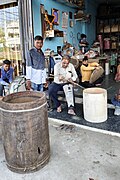
[[File:Dhol Tasha Player.jpg|thumb|380x380px| | [[File:Dhol Tasha Player.jpg|thumb|380x380px|{{center|A dhol player in [[Pune]], India}}]] | ||
[[File:Five Celestial Musicians LACMA AC1992.254.1-.5.jpg|thumb|Gandhara musicians playing dhol]] | [[File:Five Celestial Musicians LACMA AC1992.254.1-.5.jpg|thumb|Gandhara musicians playing dhol]] | ||
The dhol is played using two wooden sticks, usually made out of wood, cane, or also known as wickers cane. The stick used to play the [[bass (sound)|bass]] side of the instrument | The dhol is played using two wooden sticks, usually made out of wood, cane, or also known as wickers cane. The stick used to play the [[bass (sound)|bass]] side of the instrument is known as the ''dagga'' in Punjabi. Traditionally the Dhol player would go and look for a branch from a hardwood tree known as Tali (oak or mahogany) that was naturally curved at that angle and use this as the Dagga (Bass Stick). The reason for the bend stick is because of the goat skin. This is thin like 80-100gsm paper, so the stick has to be bent to avoid piercing the skin. The bass stick or Dagga is the thicker of the two and is bent in an eighth- or quarter-circular arc on the end that strikes the instrument.<ref>{{cite thesis |last=Schreffler |first=Gibb Stuart |date=September 2010 |title=Signs of Separation: Ḍhol in Punjabi Culture |type=PhD |chapter=The Ḍhol, Presently |publisher=University of California, Santa Barbara |pages=452–454}}</ref> The other stick, known as the ''teeli'', is much thinner and flexible and used to play the higher note end of the instrument.<ref>{{cite thesis |last=Schreffler |first=Gibb Stuart |date=September 2010 |title=Signs of Separation: Ḍhol in Punjabi Culture |type=PhD |chapter=The Ḍhol, Presently |publisher=University of California, Santa Barbara |page=460}}</ref> | ||
The dhol is slung over the shoulder or, more rarely, around the neck of the player with a strap usually made up of woven cotton.<ref>{{cite thesis |last=Schreffler |first=Gibb Stuart |date=September 2010 |title=Signs of Separation: Ḍhol in Punjabi Culture |type=PhD |chapter=The Ḍhol, Presently |publisher=University of California, Santa Barbara |pages=444, 470}}</ref> The surface of the wooden barrel is in some cases decorated with engraved patterns and sometimes paint. | The dhol is slung over the shoulder or, more rarely, around the neck of the player with a strap usually made up of woven cotton.<ref>{{cite thesis |last=Schreffler |first=Gibb Stuart |date=September 2010 |title=Signs of Separation: Ḍhol in Punjabi Culture |type=PhD |chapter=The Ḍhol, Presently |publisher=University of California, Santa Barbara |pages=444, 470}}</ref> The surface of the wooden barrel is in some cases decorated with engraved patterns and sometimes paint. | ||
In the pre-[[Partition of India|Partition]] era, dozens of rhythms were played on the Punjabi dhol, which corresponded to specific functions. However, with the decline or disappearance of some cultural practices, recent generations of dhol | In the pre-[[Partition of India|Partition]] era, dozens of rhythms were played on the Punjabi dhol, which corresponded to specific functions. However, with the decline or disappearance of some cultural practices, recent generations of dhol players have become unfamiliar with many of these. At the same time, the growth of folkloric staged bhangra dance in Punjab inspired the creation of many new rhythms particular to that dance.<ref>{{cite thesis |last=Schreffler |first=Gibb Stuart |date=September 2010 |title=Signs of Separation: Ḍhol in Punjabi Culture |type=PhD |chapter=Uses of the Ḍhol and its Repertoire |publisher=University of California, Santa Barbara |pages=619–621}}</ref> | ||
Some of the most common Punjabi dhol rhythms are ''bhangra'' (originating with the old, community bhangra dance), ''dhamaal'' (associated with many cultural functions, including worship at [[Sufi]] shrines), and ''[[kaharva]]'', a dance and song rhythm. The staged "bhangra" dance, originating in the 1950s, gave special prominence to ''kaharva'', for the performance of actions called ''luddi''. In the 1970s, many more actions were added to staged bhangra to go with the kaharva rhythm, which started to become one of the most prominent rhythms associated with the dance. At the same time, this type of rhythm would be played on the dholki drum to accompany Punjabi songs. So when, in the 1990s, Punjabi pop songs began to evoke bhangra dance, they used the kaharva rhythm. It is known now by various names. Some dhol | Some of the most common Punjabi dhol rhythms are ''bhangra'' (originating with the old, community bhangra dance), ''dhamaal'' (associated with many cultural functions, including worship at [[Sufi]] shrines), and ''[[kaharva]]'', a dance and song rhythm. The staged "bhangra" dance, originating in the 1950s, gave special prominence to ''kaharva'', for the performance of actions called ''luddi''. In the 1970s, many more actions were added to staged bhangra to go with the kaharva rhythm, which started to become one of the most prominent rhythms associated with the dance. At the same time, this type of rhythm would be played on the dholki drum to accompany Punjabi songs. So when, in the 1990s, Punjabi pop songs began to evoke bhangra dance, they used the kaharva rhythm. It is known now by various names. Some dhol players call it ''kaharva'', its technical name, while other players in Punjab call it ''luddi'' to refer to the dance of that name. With the style of dhol-playing that developed in the U.K., the name ''chaal'' was adopted, probably in reference to the "chaal" (movements) it accompanies in modern bhangra. However, that term is not used elsewhere. Johnny Kalsi is a UK Dhol player that established a syllabus to teach the art of playing this instrument. Although there is no official syllabus or phrasing for the learning process, he took the North Indian language of Tabla to visualise the beats as phonetic phrases to make learning easier.<ref>{{cite thesis |last=Schreffler |first=Gibb Stuart |date=September 2010 |title=Signs of Separation: Ḍhol in Punjabi Culture |type=PhD |chapter=Uses of the Ḍhol and its Repertoire |publisher=University of California, Santa Barbara }}</ref>{{page needed|date=March 2019}} | ||
The introduction of electronic devices such as [[tape recorders]] has led to a decline in the importance of dhol players in celebratory events. Nevertheless, dhol music still figures in the studio recordings of present-day raas, garba and bhangra music artists. | The introduction of electronic devices such as [[tape recorders]] has led to a decline in the importance of dhol players in celebratory events. Nevertheless, dhol music still figures in the studio recordings of present-day raas, garba and bhangra music artists. | ||
| Line 37: | Line 40: | ||
== History == | == History == | ||
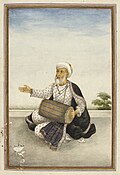
[[File:Kavval - Tashrih al-aqvam (1825), f.458v - BL Add. 27255.jpg|thumb|{{center|A man depicted playing dhol}}]] | [[File:Kavval - Tashrih al-aqvam (1825), f.458v - BL Add. 27255.jpg|thumb|{{center|A man depicted playing dhol}}]] | ||
Shail Vyas claims several percussion instruments such as the Dhol maybe came from the influence of some clay-made instruments that are similar to the Dhol, which are found in Indus Valley Civilisation.<ref>{{Cite web|url=https://www.hindustantimes.com/music/music-to-the-years-musical-instruments-from-the-indus-valley-civilisation/story-WuViIqOST8WMNCSkkayuuN.html|title=Music to the years: Musical instruments from the Indus Valley Civilisation|date=2016-08-14|work=Hindustan Times|language=en|access-date=2018-12-22}}</ref> Dhol is depicted in earliest ancient Indian sculptural arts as one of the chief percussion instruments for ancient Indian music along with [[tabla]].{{citation needed|date=February 2020}} [[Ain-i-Akbari]], describes the use of Dhol in the orchestra of the [[Mughal Empire|Mughal]] emperor [[Akbar the Great]].<ref>{{cite web |url=http://www.uweb.ucsb.edu/~hcritz/dholpages/dholhome.html |title=Dhol King of the Punjabi Instruments |last=Schreffler |first=Gibb |archive-url=https://web.archive.org/web/20080924210725/http://www.uweb.ucsb.edu/~hcritz/dholpages/dholhome.html |archive-date=2008-09-24}}</ref> The Indo-Aryan word "dhol" appears in print around 1800 in the treatise ''Sangitasara''.<ref>{{cite book|last1=Sharma |first1=Toyanath |last2=Orey |first2=Daniel Clark |chapter=Meaningful Mathematics Through the Use of Cultural Artifacts |title=Ethnomathematics and its Diverse Approaches for Mathematics Education |series=ICME-13 Monographs |publisher=Springer |location=Cham, Switzerland |isbn=978-3-319-59219-0 |date=2017 |editor1-last=Rosa |editor1-first=Milton |editor2-last=Shirley |editor2-first=Lawrence |editor3-last=Gavarrete |editor3-first=Maria Elena |editor4-last=Anangui |editor4-first=Wilfredo V. |page=165 |chapter-url=https://books.google.com/books?id=tDkuDwAAQBAJ&pg=PA165 |doi=10.1007/978-3-319-59220-6_7 |postscript=, citing:}}{{bulleted list|{{cite book |last1=Tarlekar |first1=G. H. |title=Musical Instruments in Indian Sculpture |date=1972 |publisher=Pune Vidyarthi Griha Prakashan |location=Prune, India |page=74 |ref=none}}}}</ref> | |||
== Regional forms and traditions == | == Regional forms and traditions == | ||
=== The Punjab region === | === The Punjab region === | ||
[[File:Overload Dhol Player.jpg|thumb|right|{{center|Sufi dhol player ''Pappu Saeen'', from Pakistan}}]] | [[File:Overload Dhol Player.jpg|thumb|right|{{center|Sufi dhol player ''Pappu Saeen'', from Pakistan}}]] | ||
The Punjabi dhol is used in the [[Punjab region]] of Pakistan and northern India. In Pakistan, the dhol is | The Punjabi dhol is used in the [[Punjab region]] of Pakistan and northern India. In Pakistan, the dhol is mostly played in the [[Punjab, Pakistan|Punjab region]]; however, it is also used throughout the country ranging from as far south as Karachi and as far north as Khyber Pakhtunkhwa. In India it is found in the states of [[Punjab, India|Punjab]], [[Himachal Pradesh]], [[Haryana]], and [[Delhi]]. The beats of dhol have been an element in the ceremonies of the great Sufi mystics and their followers. The patterns of dhol have been developed to catalyze the mind of the devotee who is seeking spiritual trance. {{citation needed|date=December 2012}} | ||
=== Assam === | === Assam === | ||
[[File:Bihu dance of Assam.jpg|thumbnail| | [[File:Bihu dance of Assam.jpg|thumbnail|{{center|Men playing Assamese dhol during [[Bihu]], Assam, India}}]] | ||
In [[Assam]], the dhol is widely used in ''[[Rongali Bihu]]'' (''Bohag Bihu''), the Assamese new year celebrations in the month of April. Celebrated in mid-April every year (usually on 14 or 13 April according to Assamese traditional calendar), the dhol is an important and a quintessential instrument used in [[Bihu dance]]. The origin of the Dhol in Assam dates back to at least the 14th century | In [[Assam]], the dhol is widely used in ''[[Rongali Bihu]]'' (''Bohag Bihu''), the Assamese new year celebrations in the month of April. Celebrated in mid-April every year (usually on 14 or 13 April according to the Assamese traditional calendar), the dhol is an important and a quintessential instrument used in [[Bihu dance]]. The origin of the Dhol in Assam dates back to at least the 14th century when it was referred in Assamese Buranjis as being played by the indigenous people. This shows that the origin of Dhol in Assam was much older than the rest of India, and the name was probably due to sanskritisation. The people of the [[Assam valley|Valley]] reckon that the beats of the ''dhol'' are enchanting for people even at a long distance. Played by using a bamboo stick with bare hands, the Assamese dhol is made up of a wooden barrel with the ends covered primarily with animal [[Rawhide (material)|hide]] (unlike the rest of the Indian subcontinent, where it could be a synthetic skin as well), that can either be stretched or loosened by tightening the interwoven straps. The dhol player is termed ''Dhulia'' and the expert in dhol is termed ''Ojah'' (Assamese: ওজা). | ||
The dhol also has an aspect of symbolism in [[Culture of Assam|Assamese culture]], and one considers it to be a "''devo badyo''" (Assamese: দেৱ বাদ্য) or '' an instrument of god'' believed to be brought to [[Earth]] by the [[Pandavas]].<ref>{{cite web |url=http://www.anvesha.co.in/assamese/dhol_as.htm |title=Anvesha |website=Anvesha |access-date=2015-01-02}}</ref> | The dhol also has an aspect of symbolism in [[Culture of Assam|Assamese culture]], and one considers it to be a "''devo badyo''" (Assamese: দেৱ বাদ্য) or '' an instrument of god'' believed to be brought to [[Earth]] by the [[Pandavas]].<ref>{{cite web |url=http://www.anvesha.co.in/assamese/dhol_as.htm |title=Anvesha |website=Anvesha |access-date=2015-01-02}}</ref> | ||
| Line 54: | Line 57: | ||
=== Gujarat === | === Gujarat === | ||
[[File:Dhol of Adivasi people of Gujarat.jpg|thumb| | [[File:Dhol of Adivasi people of Gujarat.jpg|thumb|{{center|Dhol of [[Adivasi people]] of Gujarat, India}}]] | ||
The dhol was used by Gujaratis during celebrations such as Navaratri to accompany garba. Garba are the folk songs which describe the grace of the divine mother. It is one of the important musical instruments in Gujarat. | The dhol was used by Gujaratis during celebrations such as Navaratri to accompany garba. Garba are the folk songs which describe the grace of the divine mother. It is one of the important musical instruments in Gujarat. | ||
=== Maharashtra === | === Maharashtra === | ||
In [[Maharashtra]], dhol is a primary instrument used in [[Ganesh festival]]s. In the city of [[Pune]], locals come together to form dhol pathaks (troupes). Pune supposedly has the largest number dhols in [[India]]. In the city of [[Nagpur]], there are many troupes | In [[Maharashtra]], dhol is a primary instrument used in [[Ganesh festival]]s. In the city of [[Pune]], locals come together to form dhol pathaks (troupes). Pune supposedly has the largest number of dhols in [[India]]. In the city of [[Nagpur]], there are many troupes that play dhol on festivals and other occasions. Here dhol is referred to as 'Sandhal'. Dhol is made up of two stretched membranes tied by a strong string. One side of the dhol is played by wooden stick called "tiparu", on that side black coloured ink paste stick in the centre. This membrane is called the "dhum". In technical language, it is called base. Another side of dhol is called "thapi" or "chati". In technical language, it is called as tremer, this side of membrane is only played by palm. Boll of the dhol is "Taa", "Dhin" and "Dha". "Taa" for the "Thapi" side, "Dhin" for the "Dhum" side and "Dha" for both sides played together. | ||
=== Karnataka === | === Karnataka === | ||
| Line 64: | Line 67: | ||
===Uttarakhand=== | ===Uttarakhand=== | ||
In the [[Garhwal division|Garhwal]] region, specific musical caste groups like the ''auji'', ''das'' or ''dholi'' have historically played the dhol and damau, the two folk instruments of the region, at special occasions or religious festivals according to the [[Dhol Sagar]], an ancient treatise that was transmitted orally and by practical teaching.<ref>{{Cite book|url=https://www.cambridge.org/core/books/mountainous-sound-spaces/drum-strokes-syllables-and-rhythmic-patterns/0F12A9EAA8A3802BDDBF91CB78032CDE| | In the [[Garhwal division|Garhwal]] region, specific musical caste groups like the ''auji'', ''das'' or ''dholi'' have historically played the dhol and damau, the two folk instruments of the region, at special occasions or religious festivals according to the [[Dhol Sagar]], an ancient treatise that was transmitted orally and by practical teaching.<ref>{{Cite book|chapter-url=https://www.cambridge.org/core/books/mountainous-sound-spaces/drum-strokes-syllables-and-rhythmic-patterns/0F12A9EAA8A3802BDDBF91CB78032CDE|chapter=Drum Strokes, Syllables and Rhythmic Patterns|editor-first=Andrew|editor-last=Alter|date=19 April 2014|publisher=Foundation Books|pages=80–96|doi=10.1017/9789384463069.008 |access-date=19 April 2021|via=[[Cambridge University Press]]|title=Mountainous Sound Spaces |isbn=9789384463069 }}</ref> | ||
=== West Bengal === | === West Bengal === | ||
The "[[dhak_(instrument)|dhak]]" (Bengali: ঢাক) is a huge membranophone instrument from India. The shapes differ from | The "[[dhak_(instrument)|dhak]]" (Bengali: ঢাক) is a huge membranophone instrument from India. The shapes differ from almost cylindrical to the barrel. The manner of stretching the hide over the mouths and lacing also varies. It is suspended from the neck, tied to the waist and kept on the lap or the ground, and usually played with wooden sticks. The left side is coated to give it a heavier sound. | ||
Drum beats are an integral part of Durga Puja.It is mostly played by the Bengali community. | Drum beats are an integral part of Durga Puja. It is mostly played by the Bengali community. | ||
=== Pashtun areas === | === Pashtun areas === | ||
| Line 87: | Line 90: | ||
*[[Nagara (drum)|Nagara]] | *[[Nagara (drum)|Nagara]] | ||
*[[Dhak (instrument)|Dhak]] | *[[Dhak (instrument)|Dhak]] | ||
*[[Chenda]] | |||
*[[Caucasian Dhol]] | *[[Caucasian Dhol]] | ||
*[[Indian musical instruments]] | *[[Indian musical instruments]] | ||
| Line 99: | Line 103: | ||
== References == | == References == | ||
{{Reflist}} | {{Reflist}} | ||
Revision as of 10:18, 22 July 2023
 | This article needs more citations. (August 2007) |
 | |
| Classification | Membranophone |
|---|---|
| Related instruments | |
| Dholki | |
| More articles or information | |
| Garba, Bhangra, Music of Punjab, Bihu Dance | |

Dhol (Hindi pronunciation: [ɖʰoːl]) can refer to any one of a number of similar types of double-headed drum widely used, with regional variations, throughout the Indian subcontinent. Its range of distribution in Indian subcontinent primarily includes northern areas such as the Jammu, Himachal, Punjab, Haryana, Delhi, Kashmir, Sindh, Assam Valley, Uttarakhand, West Bengal, Odisha, Gujarat, Maharashtra, Konkan, Goa, Karnataka, Rajasthan, Bihar, Jharkhand and Uttar Pradesh. A related instrument is the dholak or dholki. Dhols are amongst other events used in Indian wedding ceremony processions such as Baraat or Varyatra.
Someone who plays the dhol is known as dholi.
Etymology
The word Dhol is derived from Sanskrit word ḍhola, a term for drum in Sanskrit language.[1]
Construction
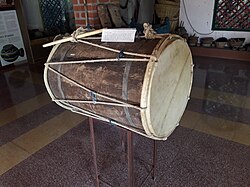
The dhol is a double-sided barrel drum played mostly as an accompanying instrument in regional music forms. In Qawwali music, the term dhol is used to describe a similar, but smaller drum with a smaller tabla, as a replacement for the left-hand tabla drum. The typical sizes of the drum vary slightly from region to region. In Punjab, the dhol remains large and bulky to produce the preferred loud bass. In other regions, dhols can be found in varying shapes and sizes, and made with different woods and materials (fiberglass, steel, plastic). The drum consists of a wooden barrel with animal hide or synthetic skin stretched over its open ends, covering them completely. These skins can be stretched or loosened with a tightening mechanism made up of either interwoven ropes, or nuts and bolts. Tightening or loosening the skins subtly alters the pitch of the drum sound. The stretched skin on one of the ends is thicker and produces a deep, low-frequency (higher bass) sound and the other thinner one produces a higher-frequency sound. Dhols with synthetic, or plastic, treble skins are common.
Playing


The dhol is played using two wooden sticks, usually made out of wood, cane, or also known as wickers cane. The stick used to play the bass side of the instrument is known as the dagga in Punjabi. Traditionally the Dhol player would go and look for a branch from a hardwood tree known as Tali (oak or mahogany) that was naturally curved at that angle and use this as the Dagga (Bass Stick). The reason for the bend stick is because of the goat skin. This is thin like 80-100gsm paper, so the stick has to be bent to avoid piercing the skin. The bass stick or Dagga is the thicker of the two and is bent in an eighth- or quarter-circular arc on the end that strikes the instrument.[2] The other stick, known as the teeli, is much thinner and flexible and used to play the higher note end of the instrument.[3]
The dhol is slung over the shoulder or, more rarely, around the neck of the player with a strap usually made up of woven cotton.[4] The surface of the wooden barrel is in some cases decorated with engraved patterns and sometimes paint.
In the pre-Partition era, dozens of rhythms were played on the Punjabi dhol, which corresponded to specific functions. However, with the decline or disappearance of some cultural practices, recent generations of dhol players have become unfamiliar with many of these. At the same time, the growth of folkloric staged bhangra dance in Punjab inspired the creation of many new rhythms particular to that dance.[5]
Some of the most common Punjabi dhol rhythms are bhangra (originating with the old, community bhangra dance), dhamaal (associated with many cultural functions, including worship at Sufi shrines), and kaharva, a dance and song rhythm. The staged "bhangra" dance, originating in the 1950s, gave special prominence to kaharva, for the performance of actions called luddi. In the 1970s, many more actions were added to staged bhangra to go with the kaharva rhythm, which started to become one of the most prominent rhythms associated with the dance. At the same time, this type of rhythm would be played on the dholki drum to accompany Punjabi songs. So when, in the 1990s, Punjabi pop songs began to evoke bhangra dance, they used the kaharva rhythm. It is known now by various names. Some dhol players call it kaharva, its technical name, while other players in Punjab call it luddi to refer to the dance of that name. With the style of dhol-playing that developed in the U.K., the name chaal was adopted, probably in reference to the "chaal" (movements) it accompanies in modern bhangra. However, that term is not used elsewhere. Johnny Kalsi is a UK Dhol player that established a syllabus to teach the art of playing this instrument. Although there is no official syllabus or phrasing for the learning process, he took the North Indian language of Tabla to visualise the beats as phonetic phrases to make learning easier.[6][page needed]
The introduction of electronic devices such as tape recorders has led to a decline in the importance of dhol players in celebratory events. Nevertheless, dhol music still figures in the studio recordings of present-day raas, garba and bhangra music artists.
History
,_f.458v_-_BL_Add._27255.jpg)
Shail Vyas claims several percussion instruments such as the Dhol maybe came from the influence of some clay-made instruments that are similar to the Dhol, which are found in Indus Valley Civilisation.[7] Dhol is depicted in earliest ancient Indian sculptural arts as one of the chief percussion instruments for ancient Indian music along with tabla.[citation needed] Ain-i-Akbari, describes the use of Dhol in the orchestra of the Mughal emperor Akbar the Great.[8] The Indo-Aryan word "dhol" appears in print around 1800 in the treatise Sangitasara.[9]
Regional forms and traditions
The Punjab region

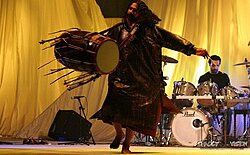
The Punjabi dhol is used in the Punjab region of Pakistan and northern India. In Pakistan, the dhol is mostly played in the Punjab region; however, it is also used throughout the country ranging from as far south as Karachi and as far north as Khyber Pakhtunkhwa. In India it is found in the states of Punjab, Himachal Pradesh, Haryana, and Delhi. The beats of dhol have been an element in the ceremonies of the great Sufi mystics and their followers. The patterns of dhol have been developed to catalyze the mind of the devotee who is seeking spiritual trance. [citation needed]
Assam

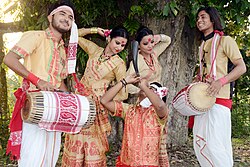
In Assam, the dhol is widely used in Rongali Bihu (Bohag Bihu), the Assamese new year celebrations in the month of April. Celebrated in mid-April every year (usually on 14 or 13 April according to the Assamese traditional calendar), the dhol is an important and a quintessential instrument used in Bihu dance. The origin of the Dhol in Assam dates back to at least the 14th century when it was referred in Assamese Buranjis as being played by the indigenous people. This shows that the origin of Dhol in Assam was much older than the rest of India, and the name was probably due to sanskritisation. The people of the Valley reckon that the beats of the dhol are enchanting for people even at a long distance. Played by using a bamboo stick with bare hands, the Assamese dhol is made up of a wooden barrel with the ends covered primarily with animal hide (unlike the rest of the Indian subcontinent, where it could be a synthetic skin as well), that can either be stretched or loosened by tightening the interwoven straps. The dhol player is termed Dhulia and the expert in dhol is termed Ojah (Assamese: ওজা).
The dhol also has an aspect of symbolism in Assamese culture, and one considers it to be a "devo badyo" (Assamese: দেৱ বাদ্য) or an instrument of god believed to be brought to Earth by the Pandavas.[10]
Goa
Dhol (which is always accompanied by tasha, cymbals, etc.) is an important part of Goan shigmo celebrations.[11] It also is an important part of Goan temple music; the temple dhol was traditionally played by a specific caste.[12]
Gujarat

The dhol was used by Gujaratis during celebrations such as Navaratri to accompany garba. Garba are the folk songs which describe the grace of the divine mother. It is one of the important musical instruments in Gujarat.
Maharashtra
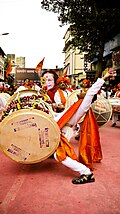
In Maharashtra, dhol is a primary instrument used in Ganesh festivals. In the city of Pune, locals come together to form dhol pathaks (troupes). Pune supposedly has the largest number of dhols in India. In the city of Nagpur, there are many troupes that play dhol on festivals and other occasions. Here dhol is referred to as 'Sandhal'. Dhol is made up of two stretched membranes tied by a strong string. One side of the dhol is played by wooden stick called "tiparu", on that side black coloured ink paste stick in the centre. This membrane is called the "dhum". In technical language, it is called base. Another side of dhol is called "thapi" or "chati". In technical language, it is called as tremer, this side of membrane is only played by palm. Boll of the dhol is "Taa", "Dhin" and "Dha". "Taa" for the "Thapi" side, "Dhin" for the "Dhum" side and "Dha" for both sides played together.
Karnataka
Called Dhollu in Kannada, the folk dance is known as Dollu Kunitha -Kunitha meaning dance. The folk art is mainly preserved and performed by the people of the Kuruba community of Karnataka.[13]
Uttarakhand
In the Garhwal region, specific musical caste groups like the auji, das or dholi have historically played the dhol and damau, the two folk instruments of the region, at special occasions or religious festivals according to the Dhol Sagar, an ancient treatise that was transmitted orally and by practical teaching.[14]
West Bengal
The "dhak" (Bengali: ঢাক) is a huge membranophone instrument from India. The shapes differ from almost cylindrical to the barrel. The manner of stretching the hide over the mouths and lacing also varies. It is suspended from the neck, tied to the waist and kept on the lap or the ground, and usually played with wooden sticks. The left side is coated to give it a heavier sound.
Drum beats are an integral part of Durga Puja. It is mostly played by the Bengali community.
Pashtun areas
The dhol is the main musical instrument in the Pashtun dance known as attan. The Afghan and Iranian Dhol is not the same drum on the Indian subcontinent.
Caucasus
Caucasian dhol is called dhol in Armenia, dholi or doli in Georgia and Abkhazia, and doul in North Caucasus.
In global culture
It has become popular in other parts of the world due to Indian diaspora and diaspora from the Indian subcontinent. Dhol has been a popular musical instrument in formal and informal dance performances for decades.
See also
- Dholak
- Dohol
- Khol
- Davul
- Nagara
- Dhak
- Chenda
- Caucasian Dhol
- Indian musical instruments
- Attan
- Bhangra (music)
- Music of Punjab
- Bihu
- Bihu dance
- Garba
- Pappu Saeen
- Rani Taj
References
- ↑ McGregor, R. S. (Ronald Stuart) (1993). "The Oxford Hindi-English dictionary". dsal.uchicago.edu. Retrieved 2023-03-17.
- ↑ Schreffler, Gibb Stuart (September 2010). "The Ḍhol, Presently". Signs of Separation: Ḍhol in Punjabi Culture (PhD). University of California, Santa Barbara. pp. 452–454.
- ↑ Schreffler, Gibb Stuart (September 2010). "The Ḍhol, Presently". Signs of Separation: Ḍhol in Punjabi Culture (PhD). University of California, Santa Barbara. p. 460.
- ↑ Schreffler, Gibb Stuart (September 2010). "The Ḍhol, Presently". Signs of Separation: Ḍhol in Punjabi Culture (PhD). University of California, Santa Barbara. pp. 444, 470.
- ↑ Schreffler, Gibb Stuart (September 2010). "Uses of the Ḍhol and its Repertoire". Signs of Separation: Ḍhol in Punjabi Culture (PhD). University of California, Santa Barbara. pp. 619–621.
- ↑ Schreffler, Gibb Stuart (September 2010). "Uses of the Ḍhol and its Repertoire". Signs of Separation: Ḍhol in Punjabi Culture (PhD). University of California, Santa Barbara.
- ↑ "Music to the years: Musical instruments from the Indus Valley Civilisation". Hindustan Times. 2016-08-14. Retrieved 2018-12-22.
- ↑ Schreffler, Gibb. "Dhol King of the Punjabi Instruments". Archived from the original on 2008-09-24.
- ↑ Sharma, Toyanath; Orey, Daniel Clark (2017). "Meaningful Mathematics Through the Use of Cultural Artifacts". In Rosa, Milton; Shirley, Lawrence; Gavarrete, Maria Elena; Anangui, Wilfredo V. (eds.). Ethnomathematics and its Diverse Approaches for Mathematics Education. ICME-13 Monographs. Cham, Switzerland: Springer. p. 165. doi:10.1007/978-3-319-59220-6_7. ISBN 978-3-319-59219-0, citing:
{{cite book}}: CS1 maint: postscript (link)- Tarlekar, G. H. (1972). Musical Instruments in Indian Sculpture. Prune, India: Pune Vidyarthi Griha Prakashan. p. 74.
- ↑ "Anvesha". Anvesha. Retrieved 2015-01-02.
- ↑ Goa, Daman and Diu (India). Gazetteer Dept (1979). Gazetteer of the Union Territory Goa, Daman and Diu: district gazetteer, Volume 1. Gazetteer Dept., Govt. of the Union Territory of Goa, Daman and Diu. p. 263.
- ↑ Śiroḍakara, Mandal, Pra. Pā, H. K (1993). People of India: Goa. Calcutta: Anthropological Survey of India. p. 45.263. ISBN 978-81-7154-760-9.
{{cite book}}: CS1 maint: multiple names: authors list (link) - ↑ "Janapadaloka -World of Folk art". Janapadaloka.in.
- ↑ Alter, Andrew, ed. (19 April 2014). "Drum Strokes, Syllables and Rhythmic Patterns". Mountainous Sound Spaces. Foundation Books. pp. 80–96. doi:10.1017/9789384463069.008. ISBN 9789384463069. Retrieved 19 April 2021 – via Cambridge University Press.
Template:Armenian musical instruments
| Wind (Sushir) |  | |
|---|---|---|
| Plucked Stringed (Tat) | ||
| Bowed Stringed (Vitat) | ||
| Membranous Percussion (Avanaddh) | ||
| Non-Membranous Percussion (Ghan) | ||
| Other | ||
| Historical/ possibly extinct | ||