





CleanupBot (talk | contribs) m clean up, removed: {{good article}} |
robot: Update article |
||
| Line 1: | Line 1: | ||
{{Short description| | {{Short description|Ancient Indian religion}} | ||
{{Redirect|Jain}} | {{Redirect|Jain}} | ||
{{good article}} | |||
{{Use dmy dates|date=February 2016}} | {{Use dmy dates|date=February 2016}} | ||
{{Use Indian English|date= | {{Use Indian English|date=December 2015}} | ||
{{Jainism}} | {{Jainism}} | ||
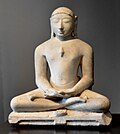
The main | '''Jainism''' ({{IPAc-en|ˈ|dʒ|eɪ|n|ɪ|z|əm}}) is an [[Indian religion]]. Jainism traces its spiritual ideas and history through a succession of twenty-four leaders or ''[[Tirthankara]]s'', with the first in the current time cycle being [[Rishabhadeva]], whom the tradition holds to have lived millions of years ago; the twenty-third ''tirthankara'' [[Parshvanatha]], whom historians date to ninth century BCE; and the twenty-fourth ''tirthankara'', [[Mahāvīra|Mahavira]] around 600 BCE. Jainism is considered to be an eternal ''[[dharma]]'' with the ''tirthankaras'' guiding every time cycle of the [[Jain cosmology|cosmology]]. The three main pillars of Jainism are ''[[Ahimsa in Jainism|ahiṃsā]]'' (non-violence), ''[[anekāntavāda]]'' (non-absolutism), and ''[[aparigraha]]'' (asceticism). | ||
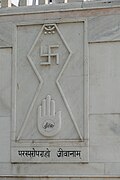
Jain monks take five main vows: ''[[ahiṃsā]]'' (non-violence), ''[[satya]]'' (truth), ''[[Achourya|asteya]]'' (not stealing), ''[[brahmacharya]]'' (sexual continence), and ''[[aparigraha]]'' (non-possessiveness). These principles have affected Jain culture in many ways, such as leading to a predominantly [[vegetarianism|vegetarian]] lifestyle. ''[[Parasparopagraho Jīvānām|Parasparopagraho jīvānām]]'' (the function of souls is to help one another) is the faith's motto, and the ''[[Ṇamōkāra mantra]]'' is its most common and basic prayer. | |||
Jainism is one of the world's oldest religions in practice to this day. It has two major ancient sub-traditions, [[Digambara]]s and [[Śvētāmbara]]s, with different views on ascetic practices, gender, and the texts that can be considered canonical; both have [[mendicant]]s supported by [[Laity|layperson]]s (''śrāvakas'' and ''śrāvikas''). The Śvētāmbara tradition in turn has three sub-traditions: Mandirvāsī, Terapanthi, and Sthānakavasī.<ref>Long, Jeffery D. (2013), ''Jainism: An Introduction'', I.B. Tauris, [[ISBN (identifier)|ISBN]] [[Special:BookSources/978-0-85771-392-6|978-0-85771-392-6]], p. 20-22.</ref> The religion has between four and five million followers, known as '''Jains''', who reside mostly in [[Jainism in India|India]]. Outside India, some of the largest communities are in [[Jainism in Canada|Canada]], [[Jainism in Europe|Europe]], and the [[Jainism in the United States|United States]], with [[Jainism in Japan|Japan]] hosting a fast-growing community of converts.<ref>{{Cite web|last=Archana|first=K. C.|date=2020-02-23|title=Jainism Gains Traction In Japan, Thousands Travel To India To Transition From Zen To Jain|url=https://www.indiatimes.com/trending/human-interest/jainism-gains-traction-in-japan-thousands-travel-to-india-to-transition-from-zen-to-jain-506991.html|access-date=2021-05-18|website=[[The Times of India]] |language=en-IN}}</ref> Major festivals include ''[[Paryushana]]'' and ''Das Lakshana'', ''[[Jain festivals#Ashtanhika Parv|Ashtanika]]'', ''[[Mahavir Janma Kalyanak]]'', ''[[Akshaya Tritiya]]'', and ''[[Diwali (Jainism)|Dipawali]]''. | |||
Estimates for the population of Jains differ from just over four million to twelve million.{{sfn|Dundas|2002|p={{page needed|date=August 2021}}}} | |||
==Beliefs and philosophy== | ==Beliefs and philosophy== | ||
{{Main|Jain philosophy}} | {{Main|Jain philosophy}} | ||
[[File:Ahimsa Jainism | [[File:Ahimsa Jainism.svg|thumb|upright=0.7|The hand symbolizes [[Ahimsa in Jainism|''Ahiṃsā'']], the wheel ''[[dharmachakra]]'', the resolve to halt ''saṃsāra'' (transmigration).|left]] | ||
Jainism is [[transtheistic]] and forecasts that the universe evolves without violating the law of [[substance dualism]],{{sfn|Yandell|1999|p=243}} | Jainism is [[transtheistic]] and forecasts that the universe evolves without violating the law of [[substance dualism]],{{sfn|Yandell|1999|p=243}} and the actual realization of this principle plays out through the phenomena of both [[Psychophysical parallelism|parallelism]] and [[Interactionism (philosophy of mind)|interactionism]].{{sfn|Sinha|1944|p=20}} | ||
===''Dravya'' ( | ===''Dravya'' (Ontological facts)=== | ||
{{Main|Dravya}} | {{Main|Dravya}} | ||
''Dravya'' means substances or entity in [[Sanskrit]].{{sfn|Grimes|1996|pp=118–119}} | ''Dravya'' means substances or entity in [[Sanskrit]].{{sfn|Grimes|1996|pp=118–119}} The universe is made up of six eternal substances: sentient beings or souls (''[[Jīva (Jainism)|jīva]]''), non-sentient substance or matter (''[[pudgala]]''), the principle of motion (''[[Dharma (Jainism)|dharma]]''), the principle of rest (''[[adharma]]''), space (''[[Ākāśa (Jainism)|ākāśa]]''), and time (''[[kāla (time)|kāla]]'').{{sfn|Grimes|1996|pp=118–119}}{{sfn|Nemicandra|Balbir|2010|p=1 of Introduction}} The last five are united as the ''ajiva'' (non-living).{{sfn|Grimes|1996|pp=118–119}} Jain philosophers distinguish a substance from a body, or thing, by declaring the former a simple indestructible element, while the latter is a compound made of one or more substances that can be destroyed.{{sfn|Champat Rai Jain|1917|p=15}} | ||
===''Tattva'' ( | ===''Tattva'' (Soteriological facts)=== | ||
{{Main|Tattva (Jainism)}} | {{Main|Tattva (Jainism)}} | ||
''Tattva'' connotes reality or truth in Jain philosophy | ''Tattva'' connotes reality or truth in Jain philosophy and is the framework for salvation. According to Digambara Jains, there are seven ''tattvas'': the sentient (''[[Jīva (Jainism)|jiva]]'' or living), the insentient (''[[ajiva]]'' or non-living), the karmic influx to the soul (''[[Asrava|Āsrava]]'', which is a mix of living and non-living), the bondage of karmic particles to the soul (''[[Bandha (Jainism)|Bandha]]''),{{sfn|von Glasenapp|1925|pp=188–190}}{{sfn|Jaini|1980|pp=219–228}} the stoppage of karmic particles (''[[Saṃvara]]''), the wiping away of past karmic particles (''[[Nirjara|Nirjarā]]''), and the liberation (''[[Moksha]]''). Śvētāmbaras add two further ''tattvas'', namely good karma (''Punya'') and bad karma (''Paapa'').{{sfn|von Glasenapp|1925|pp=177–187}}{{sfn|Jaini|1998|p=151}}{{sfn|Dundas|2002|pp=96–98}} The true insight in Jain philosophy is considered as "faith in the ''tattvas''".{{sfn|Jaini|1998|p=151}} The spiritual goal in Jainism is to reach ''moksha'' for ascetics, but for most Jain laypersons, it is to accumulate good karma that leads to better rebirth and a step closer to liberation.{{sfn|Bailey|2012|p=108}}{{sfn|Long|2013|pp=18, 98–100}} | ||
===''Pramana'' (Epistemological facts)=== | |||
{{Main|Jain epistemology}} | |||
Jain philosophy accepts three reliable means of knowledge (''[[pramana]]''). It holds that correct knowledge is based on perception (''pratyaksa''), inference (''anumana'') and testimony (''sabda'' or the word of scriptures).{{sfn|Grimes|1996|p=238}}{{sfn|Soni|2000|pp=367–377}} These ideas are elaborated in Jain texts such as ''Tattvarthasūtra'', ''Parvacanasara'', ''Nandi'' and ''Anuyogadvarini''.{{sfn|Dundas|2002|pp=75–76, 131, 229–230}}{{sfn|Soni|2000|pp=367–377}} Some Jain texts add analogy (''upamana'') as the fourth reliable means, in a manner similar to [[pramana|epistemological theories]] found in other Indian religions.{{sfn|Dundas|2002|pp=229–230}}In Jainism, ''jnāna'' (knowledge) is said to be of five kinds – ''mati jñāna'' (sensory knowledge), ''śrutu jñāna'' (scriptural knowledge), ''avadhi jñāna'' ([[clairvoyance]]), ''manah prayāya Jñāna'' ([[telepathy]]) and ''[[kevala jnana]]'' ([[omniscience]]).{{sfn|S.A. Jain|1992|p=16}} According to the Jain text ''Tattvartha sūtra'', the first two are indirect knowledge and the remaining three are direct knowledge.{{sfn|Vijay K. Jain|2011|p=6}} | |||
===Soul and karma=== | ===Soul and karma=== | ||
| Line 29: | Line 37: | ||
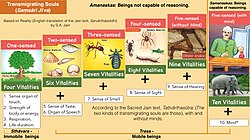
[[File:Jiva.jpg|thumb|Classification of ''Saṃsāri Jīvas'' (transmigrating souls) in Jainism]] | [[File:Jiva.jpg|thumb|Classification of ''Saṃsāri Jīvas'' (transmigrating souls) in Jainism]] | ||
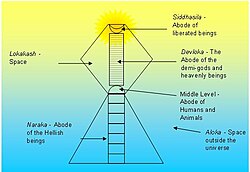
According to Jainism, the existence of "a bound and ever changing soul" is a self-evident truth, an axiom which does not need to be proven.{{sfn|Jaini|1998|p=103}} It maintains that there are numerous souls, but every one of them has three qualities (''[[Guṇa]]''): consciousness ('' | According to Jainism, the existence of "a bound and ever changing soul" is a self-evident truth, an axiom which does not need to be proven.{{sfn|Jaini|1998|p=103}} It maintains that there are numerous souls, but every one of them has three qualities (''[[Guṇa]]''): consciousness (''chaitanya'', the most important), bliss (''sukha'') and vibrational energy (''virya'').{{sfn|Jaini|1998|pp=104–106}} It further claims that the vibration draws karmic particles to the soul and creates bondages, but is also what adds merit or demerit to the soul.{{sfn|Jaini|1998|pp=104–106}} Jain texts state that souls exist as "clothed with material bodies", where it entirely fills up the body.{{sfn|von Glasenapp|1925|p=194}} Karma, as in other Indian religions, connotes in Jainism the universal cause and effect law. However, it is envisioned as a material substance (subtle matter) that can bind to the soul, travel with the soul in bound form between rebirths, and affect the suffering and happiness experienced by the ''jiva'' in the ''lokas''.{{sfn|Long|2013|pp=92–95}} Karma is believed to obscure and obstruct the innate nature and striving of the soul, as well as its spiritual potential in the next rebirth.{{sfn|Dundas|2002|pp=99–103}} | ||
===Saṃsāra=== | ===Saṃsāra=== | ||
| Line 49: | Line 57: | ||
===God=== | ===God=== | ||
[[File:MET_-_Neminatha_Akota.jpg|thumb|Lord Neminatha, [[Akota Bronzes]] (7th century)]] | |||
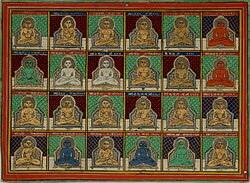
[[File:Jain 24-Tirthankaras.jpg|thumb|Jain miniature painting of 24 tirthankaras, [[Jaipur]], {{circa|1850}}]] | [[File:Jain 24-Tirthankaras.jpg|thumb|Jain miniature painting of 24 tirthankaras, [[Jaipur]], {{circa|1850}}]] | ||
{{Main|God in Jainism}} | {{Main|God in Jainism}} | ||
Jainism is a [[transtheistic]] religion,{{sfn|Zimmer|1953|p=182}} holding that the [[Jainism and non-creationism|universe was not created]], and will exist forever.{{sfn|von Glasenapp|1925|p=241}} It is believed to be independent, having no creator, governor, judge, or destroyer.{{sfn|Long|2013|pp=83–85}}{{sfn|von Glasenapp|1925|pp=241–242}} In this, it is unlike the Abrahamic religions, but similar to Buddhism.{{sfn|von Glasenapp|1925|pp=241–243}} However, Jainism believes in the world of heavenly and hell beings who are born, die and reborn like earthly beings.{{sfn|von Glasenapp|1925|pp=247–249, 262–263}}{{sfn|Dundas|2002|pp=20–21, 34–35, 74, 91, 95–96, 103}} Jain texts maintain that souls who live happily in the body of a god do so because of their positive karma.{{sfn|von Glasenapp|1925|pp=262–263}} It is further stated that they possess a more transcendent knowledge about material things and can anticipate events in the human realms.{{sfn|von Glasenapp|1925|pp=262–263}} However, once their past karmic merit is exhausted, it is explained that their souls are reborn again as humans, animals or other beings.{{sfn|von Glasenapp|1925|pp=262–263}}{{sfn|Dundas|2002|pp=91, 95–96}} In Jainism, perfect souls ''with'' a body are called ''[[Arihant (Jainism)|arihant]]'' (victors) and perfect souls ''without'' a body are called ''[[Siddha]]s'' (liberated souls).{{Sfn|Jaini|1980|pp=222–223 | Jainism is a [[transtheistic]] religion,{{sfn|Zimmer|1953|p=182}} holding that the [[Jainism and non-creationism|universe was not created]], and will exist forever.{{sfn|von Glasenapp|1925|p=241}} It is believed to be independent, having no creator, governor, judge, or destroyer.{{sfn|Long|2013|pp=83–85}}{{sfn|von Glasenapp|1925|pp=241–242}} In this, it is unlike the Abrahamic religions, but similar to Buddhism.{{sfn|von Glasenapp|1925|pp=241–243}} However, Jainism believes in the world of heavenly and hell beings who are born, die and are reborn like earthly beings.{{sfn|von Glasenapp|1925|pp=247–249, 262–263}}{{sfn|Dundas|2002|pp=20–21, 34–35, 74, 91, 95–96, 103}} Jain texts maintain that souls who live happily in the body of a god do so because of their positive karma.{{sfn|von Glasenapp|1925|pp=262–263}} It is further stated that they possess a more transcendent knowledge about material things and can anticipate events in the human realms.{{sfn|von Glasenapp|1925|pp=262–263}} However, once their past karmic merit is exhausted, it is explained that their souls are reborn again as humans, animals or other beings.{{sfn|von Glasenapp|1925|pp=262–263}}{{sfn|Dundas|2002|pp=91, 95–96}} In Jainism, perfect souls ''with'' a body are called ''[[Arihant (Jainism)|arihant]]'' (victors) and perfect souls ''without'' a body are called ''[[Siddha]]s'' (liberated souls).{{Sfn|Jaini|1980|pp=222–223}}{{sfn|Zimmer|1953|p=182}}{{sfn|Rankin|Mardia|2013|p=40}} | ||
===Salvation, liberation=== | ===Salvation, liberation=== | ||
{{Main|Moksha (Jainism)|Ratnatraya|Gunasthana}} | {{Main|Moksha (Jainism)|Ratnatraya|Gunasthana}} | ||
According to Jainism, purification of soul and liberation can be achieved through the path of four jewels:{{sfn|Vijay K. Jain|2011|p=6}}{{sfn|Cort|2001a|pp=6–7}}{{sfn|Fohr|2015|pp=9–10, 37}} ''Samyak Darśana'' (Correct View), meaning faith, acceptance of the truth of soul (''jīva'');{{sfn|Jaini|1998|pp=141–147}} ''Samyak Gyana'' (Correct Knowledge), meaning undoubting knowledge of the ''tattvas'';{{sfn|Jaini|1998|pp=148, 200}} and ''Samyak Charitra'' (Correct Conduct), meaning behavior consistent with the Five vows.{{sfn|Jaini|1998|pp=148, 200}} Jain texts often add ''samyak tap'' (Correct Asceticism) as a fourth jewel, emphasizing belief in ascetic practices as the means to liberation ([[moksha]]).{{sfn|Cort|2001a|p=7}} The four jewels are called ''Moksha Marg'' (the path of liberation).{{sfn|Cort|2001a|pp=6–7}} | |||
{{Clear}} | |||
==Main principles== | ==Main principles== | ||
===Non-violence (''ahimsa'')=== | ===Non-violence (''ahimsa'')=== | ||
{{anchor|ahiṃsā}}{{Main|Ahimsa in Jainism}} | {{anchor|ahiṃsā}}{{Main|Ahimsa in Jainism}} | ||
The principle of ''[[Ahimsa in Jainism|ahimsa]]'' (non-violence or non-injury) is a fundamental tenet of Jainism.{{sfn|Dundas|2002|p=160}} It holds that one must abandon all violent activity and that without such a commitment to non-violence all religious behavior is worthless.{{sfn|Dundas|2002|p=160}} In Jain theology, it does not matter how correct or defensible the violence may be, one must not kill or harm any being, and non-violence is the highest religious duty.{{sfn|Dundas|2002|p=160}}{{sfn|Markham|Lohr|2009|p=71}} Jain texts such as ''[[Acharanga Sutra|Acaranga Sūtra]]'' and ''[[Tattvartha Sutra|Tattvarthasūtra]]'' state that one must renounce all killing of living beings, whether tiny or large, movable or immovable.{{sfn|Price|2010|p=90}}{{sfn|Dundas|2002|pp=160–162}} Its theology teaches that one must neither kill another living being, nor cause another to kill, nor consent to any killing directly or indirectly.{{sfn| | The principle of ''[[Ahimsa in Jainism|ahimsa]]'' (non-violence or non-injury) is a fundamental tenet of Jainism.{{sfn|Dundas|2002|p=160}} It holds that one must abandon all violent activity and that without such a commitment to non-violence all religious behavior is worthless.{{sfn|Dundas|2002|p=160}} In Jain theology, it does not matter how correct or defensible the violence may be, one must not kill or harm any being, and non-violence is the highest religious duty.{{sfn|Dundas|2002|p=160}}{{sfn|Markham|Lohr|2009|p=71}} Jain texts such as ''[[Acharanga Sutra|Acaranga Sūtra]]'' and ''[[Tattvartha Sutra|Tattvarthasūtra]]'' state that one must renounce all killing of living beings, whether tiny or large, movable or immovable.{{sfn|Price|2010|p=90}}{{sfn|Dundas|2002|pp=160–162}} Its theology teaches that one must neither kill another living being, nor cause another to kill, nor consent to any killing directly or indirectly.{{sfn|Markham|Lohr|2009|p=71}}{{sfn|Price|2010|p=90}} Furthermore, Jainism emphasizes non-violence against all beings not only in action but also in speech and in thought.{{sfn|Price|2010|p=90}}{{sfn|Dundas|2002|pp=160–162}} It states that instead of hate or violence against anyone, "all living creatures must help each other".{{sfn|Dundas|2002|pp=160–162}}{{efn|This view, however, is not shared by all Jain sub-traditions. For example, the Terapanthi Jain tradition, with about 250,000 followers, considers both good karma such as compassionate charity, and bad karma such as sin, as binding one's soul to worldly morality. It states that any karma leads to a negation of the "absolute non-violence" principle, given man's limited perspective. It recommends that the monk or nun seeking salvation must avoid hurting or helping any being in any form.{{sfn|Flügel|2002|pp=1266–1267}}}} Jains believe that violence negatively affects and destroys one's soul, particularly when the violence is done with intent, hate or carelessness, or when one indirectly causes or consents to the killing of a human or non-human living being.{{sfn|Dundas|2002|pp=160–162}} | ||
The doctrine exists in Hinduism and Buddhism, but is most highly developed in Jainism.{{sfn|Dundas|2002|p=160}}{{sfn|Sundararajan|Mukherji|1997|pp=392–417}}{{sfn|Izawa|2008|pp=78–81}}{{sfn|Sethia|2004|p=2}}{{sfn|Winternitz|1993|p=409}} The theological basis of non-violence as the highest religious duty has been interpreted by some Jain scholars not to "be driven by merit from giving or compassion to other creatures, nor a duty to rescue all creatures", but resulting from "continual self-discipline", a cleansing of the soul that leads to one's own spiritual development which ultimately affects one's salvation and release from rebirths.{{sfn|Dundas|2002|pp=88–89, 257–258}} Jains believe that causing injury to any being in any form creates bad [[Karma in Jainism|karma]] which affects one's rebirth, future well being and causes suffering.{{sfn|Taylor|2008|pp=892–894}}{{sfn|Granoff|1992}} | The doctrine exists in Hinduism and Buddhism, but is most highly developed in Jainism.{{sfn|Dundas|2002|p=160}}{{sfn|Sundararajan|Mukherji|1997|pp=392–417}}{{sfn|Izawa|2008|pp=78–81}}{{sfn|Sethia|2004|p=2}}{{sfn|Winternitz|1993|p=409}} The theological basis of non-violence as the highest religious duty has been interpreted by some Jain scholars not to "be driven by merit from giving or compassion to other creatures, nor a duty to rescue all creatures", but resulting from "continual self-discipline", a cleansing of the soul that leads to one's own spiritual development which ultimately affects one's salvation and release from rebirths.{{sfn|Dundas|2002|pp=88–89, 257–258}} Jains believe that causing injury to any being in any form creates bad [[Karma in Jainism|karma]] which affects one's rebirth, future well-being and causes suffering.{{sfn|Taylor|2008|pp=892–894}}{{sfn|Granoff|1992}} | ||
Late medieval Jain scholars re-examined the ''Ahiṃsā'' doctrine when faced with external threat or violence. For example, they justified violence by monks to protect nuns.{{sfn|Dundas|2002|pp=162–163}}{{sfn|Lorenzen|1978|pp=61–75}} According to [[Paul Dundas|Dundas]], the Jain scholar [[Jinadattasuri]] wrote during a time of Muslim destruction of temples and persecution that "anybody engaged in a religious activity who was forced to fight and kill somebody would not lose any spiritual merit but instead attain deliverance".{{sfn|Dundas|2002|p=163}} However, examples in Jain texts that condone fighting and killing under certain circumstances are relatively rare.{{sfn|Dundas|2002|pp=162–163}}{{efn|Jain literature, like Buddhist and Hindu literature, has also debated the aspects of violence and non-violence in food creation.{{sfn|Olson|2014|pp=1–7}}}} | Late medieval Jain scholars re-examined the ''Ahiṃsā'' doctrine when faced with external threat or violence. For example, they justified violence by monks to protect nuns.{{sfn|Dundas|2002|pp=162–163}}{{sfn|Lorenzen|1978|pp=61–75}} According to [[Paul Dundas|Dundas]], the Jain scholar [[Jinadattasuri]] wrote during a time of Muslim destruction of temples and persecution that "anybody engaged in a religious activity who was forced to fight and kill somebody would not lose any spiritual merit but instead attain deliverance".{{sfn|Dundas|2002|p=163}} However, examples in Jain texts that condone fighting and killing under certain circumstances are relatively rare.{{sfn|Dundas|2002|pp=162–163}}{{efn|Jain literature, like Buddhist and Hindu literature, has also debated the aspects of violence and non-violence in food creation.{{sfn|Olson|2014|pp=1–7}}}} | ||
===Many-sided reality (''anekāntavāda'')=== | ===Many-sided reality (''anekāntavāda'')=== | ||
{{Main| | {{Main|Anekantavada}} | ||
[[File:Medieval Jain temple Anekantavada doctrine artwork.jpg|thumb|Jain temple painting explaining Anekantavada with [[Blind men and an elephant]]]] | [[File:Medieval Jain temple Anekantavada doctrine artwork.jpg|thumb|Jain temple painting explaining Anekantavada with [[Blind men and an elephant]]]] | ||
The second main principle of Jainism is ''anekāntavāda'',{{sfn|Charitrapragya|2004|pp=75–79}}{{sfn|Dundas|2002|pp=229–231}} from ''anekānta'' ("many-sidedness") and ''vada'' ("doctrine").{{sfn|Charitrapragya|2004|pp=75–79}}{{sfn|Dundas|2002|pp=229–231}} The doctrine states that truth and reality are complex and always have multiple aspects. It further states that reality can be experienced, but cannot be fully expressed with language. It suggests that human attempts to communicate are ''Naya'', "partial expression of the truth".{{sfn|Charitrapragya|2004|pp=75–79}} According to it, one can experience the taste of truth, but cannot fully express that taste through language. It holds that attempts to express experience are ''syāt'', or valid "in some respect", but remain "perhaps, just one perspective, incomplete".<ref>{{cite | The second main principle of Jainism is ''anekāntavāda'',{{sfn|Charitrapragya|2004|pp=75–79}}{{sfn|Dundas|2002|pp=229–231}} from ''anekānta'' ("many-sidedness") and ''vada'' ("doctrine").{{sfn|Charitrapragya|2004|pp=75–79}}{{sfn|Dundas|2002|pp=229–231}} The doctrine states that truth and reality are complex and always have multiple aspects. It further states that reality can be experienced, but cannot be fully expressed with language. It suggests that human attempts to communicate are ''Naya'', "partial expression of the truth".{{sfn|Charitrapragya|2004|pp=75–79}} According to it, one can experience the taste of truth, but cannot fully express that taste through language. It holds that attempts to express experience are ''syāt'', or valid "in some respect", but remain "perhaps, just one perspective, incomplete".<ref>{{cite encyclopedia |first=Mark Owen |last=Webb |url=http://www.iep.utm.edu/jain/ |title=Jain philosophy |archive-url=https://web.archive.org/web/20150221042158/http://www.iep.utm.edu/jain/ |archive-date=21 February 2015 |access-date=22 February 2015 |url-status=live |encyclopedia=[[Internet Encyclopedia of Philosophy]] |issn=2161-0002}}</ref> It concludes that in the same way, spiritual truths can be experienced but not fully expressed.{{sfn|Charitrapragya|2004|pp=75–79}} It suggests that the great error is belief in ''ekānta'' (one-sidedness), where some relative truth is treated as absolute.{{sfn|Schwartz|2018}} The doctrine is ancient, found in Buddhist texts such as the ''Samaññaphala Sutta''. The Jain Agamas suggest that Mahāvīra's approach to answering all metaphysical philosophical questions was a "qualified yes" (''syāt'').{{sfn|Matilal|1990|pp=301–305}}{{sfn|Balcerowicz|2015|pp=205–218}} These texts identify ''anekāntavāda'' as a key difference from the [[Buddha]]'s teachings. The Buddha taught the Middle Way, rejecting extremes of the answer "it is" or "it is not" to metaphysical questions. The Mahāvīra, in contrast, taught his followers to accept both "it is", and "it is not", qualified with "perhaps", to understand Absolute Reality.{{sfn|Matilal|1998|pp=128–135}} The permanent being is conceptualized as ''[[Jiva (Jainism)|jiva]]'' (soul) and ''[[ajiva]]'' (matter) within a dualistic ''anekāntavāda'' framework.{{sfn|Dundas|2002|pp=90–99, 104–105, 229–233}} | ||
According to Paul Dundas, in contemporary times the ''anekāntavāda'' doctrine has been interpreted by some Jains as intending to "promote a universal religious tolerance", and a teaching of "plurality" and "benign attitude to other [ethical, religious] positions". Dundas states this is a misreading of historical texts and Mahāvīra's teachings.{{sfn|Dundas|2002|pp=232–234}} According to him, the "many pointedness, multiple perspective" teachings of the Mahāvīra is about the nature of [[Absolute (philosophy)|absolute reality]] and human existence.{{sfn|Sethia|2004|pp=86–91}} He claims that it is not about condoning activities such as killing animals for food, nor violence against disbelievers or any other living being as "perhaps right".{{sfn|Dundas|2002|pp=232–234}} The five vows for Jain monks and nuns, for example, are strict requirements and there is no "perhaps" about them.{{sfn|Long|2009|pp=98–106}} Similarly, since ancient times, Jainism co-existed with Buddhism and Hinduism according to Dundas, but Jainism disagreed, in specific areas, with the knowledge systems and beliefs of these traditions, and vice versa.{{sfn|Dundas|2002|p=233}} | According to Paul Dundas, in contemporary times the ''anekāntavāda'' doctrine has been interpreted by some Jains as intending to "promote a universal religious tolerance", and a teaching of "plurality" and "benign attitude to other [ethical, religious] positions". Dundas states this is a misreading of historical texts and Mahāvīra's teachings.{{sfn|Dundas|2002|pp=232–234}} According to him, the "many pointedness, multiple perspective" teachings of the Mahāvīra is about the nature of [[Absolute (philosophy)|absolute reality]] and human existence.{{sfn|Sethia|2004|pp=86–91}} He claims that it is not about condoning activities such as killing animals for food, nor violence against disbelievers or any other living being as "perhaps right".{{sfn|Dundas|2002|pp=232–234}} The five vows for Jain monks and nuns, for example, are strict requirements and there is no "perhaps" about them.{{sfn|Long|2009|pp=98–106}} Similarly, since ancient times, Jainism co-existed with Buddhism and Hinduism according to Dundas, but Jainism disagreed, in specific areas, with the knowledge systems and beliefs of these traditions, and vice versa.{{sfn|Dundas|2002|p=233}} | ||
| Line 86: | Line 89: | ||
===Non-attachment (''aparigraha'')=== | ===Non-attachment (''aparigraha'')=== | ||
{{anchor|aparigraha}}{{Main|Aparigraha}} | {{anchor|aparigraha}}{{Main|Aparigraha}} | ||
[[File:Jain Sthanakvasi monk.jpg|thumb|A Jain monk in meditation, wearing the characteristic white robe and face covering]] | |||
The third main principle in Jainism is ''aparigraha'' which means non-attachment to worldly possessions.{{sfn|Natubhai Shah|2004|p=112}} For monks and nuns, Jainism requires a vow of complete non-possession of any property, relations and emotions.{{sfn|Dundas|2002|pp=117, 152}} The ascetic is a wandering mendicant in the Digambara tradition, or a resident mendicant in the [[Śvētāmbara]] tradition.{{sfn|Dundas|2002|pp=117, 152}} For Jain laypersons, it recommends limited possession of property that has been honestly earned, and giving excess property to charity.{{sfn|Natubhai Shah|2004|p=112}} According to Natubhai Shah, ''aparigraha'' applies to both the material and the psychic. Material possessions refer to various forms of property. Psychic possessions refer to emotions, likes and dislikes, and attachments of any form. Unchecked attachment to possessions is said to result in direct harm to one's personality.{{sfn|Natubhai Shah|2004|pp=112–113}} | The third main principle in Jainism is ''aparigraha'' which means non-attachment to worldly possessions.{{sfn|Natubhai Shah|2004|p=112}} For monks and nuns, Jainism requires a vow of complete non-possession of any property, relations and emotions.{{sfn|Dundas|2002|pp=117, 152}} The ascetic is a wandering mendicant in the Digambara tradition, or a resident mendicant in the [[Śvētāmbara]] tradition.{{sfn|Dundas|2002|pp=117, 152}} For Jain laypersons, it recommends limited possession of property that has been honestly earned, and giving excess property to charity.{{sfn|Natubhai Shah|2004|p=112}} According to Natubhai Shah, ''aparigraha'' applies to both the material and the psychic. Material possessions refer to various forms of property. Psychic possessions refer to emotions, likes and dislikes, and attachments of any form. Unchecked attachment to possessions is said to result in direct harm to one's personality.{{sfn|Natubhai Shah|2004|pp=112–113}} | ||
| Line 95: | Line 98: | ||
Jainism teaches five ethical duties, which it calls five vows. These are called ''anuvratas'' (small vows) for Jain laypersons, and ''mahavratas'' (great vows) for Jain mendicants.{{sfn|von Glasenapp|1925|pp=228–231}} For both, its moral precepts preface that the Jain has access to a ''[[guru]]'' (teacher, counsellor), ''deva'' (Jina, god), doctrine, and that the individual is free from five offences: doubts about the faith, indecisiveness about the truths of Jainism, sincere desire for Jain teachings, recognition of fellow Jains, and admiration for their spiritual pursuits.{{sfn|von Glasenapp|1925|p=228}} Such a person undertakes the following Five vows of Jainism: | Jainism teaches five ethical duties, which it calls five vows. These are called ''anuvratas'' (small vows) for Jain laypersons, and ''mahavratas'' (great vows) for Jain mendicants.{{sfn|von Glasenapp|1925|pp=228–231}} For both, its moral precepts preface that the Jain has access to a ''[[guru]]'' (teacher, counsellor), ''deva'' (Jina, god), doctrine, and that the individual is free from five offences: doubts about the faith, indecisiveness about the truths of Jainism, sincere desire for Jain teachings, recognition of fellow Jains, and admiration for their spiritual pursuits.{{sfn|von Glasenapp|1925|p=228}} Such a person undertakes the following Five vows of Jainism: | ||
# ''[[Ahiṃsā]]'', "intentional non-violence" or "noninjury":{{sfn|von Glasenapp|1925|p=228}} The first major vow taken by Jains is to cause no harm to other human beings, as well as all living beings (particularly animals).{{sfn|von Glasenapp|1925|p=228}} This is the highest ethical duty in Jainism, and it applies not only to one's actions, but demands that one be non-violent in one's speech and thoughts.<ref name=pkshah5v>{{ | # ''[[Ahiṃsā]]'', "intentional non-violence" or "noninjury":{{sfn|von Glasenapp|1925|p=228}} The first major vow taken by Jains is to cause no harm to other human beings, as well as all living beings (particularly animals).{{sfn|von Glasenapp|1925|p=228}} This is the highest ethical duty in Jainism, and it applies not only to one's actions, but demands that one be non-violent in one's speech and thoughts.<ref name=pkshah5v>{{cite web |last=Shah |first=Pravin K. |title=Five Great Vows (Maha-vratas) of Jainism |url=http://www.fas.harvard.edu/~pluralsm/affiliates/jainism/jainedu/5greatvows.htm |publisher=[[Harvard University]] Literature Center |date=2011 |access-date=7 May 2017 |archive-url=https://web.archive.org/web/20141231033127/http://www.fas.harvard.edu/~pluralsm/affiliates/jainism/jainedu/5greatvows.htm |archive-date=31 December 2014 |url-status=live}}</ref>{{sfn|Vijay K. Jain|2012|p=33}} | ||
# ''[[Satya]]'', "truth": This vow is to always speak the truth. Neither lie, nor speak what is not true, and do not encourage others or approve anyone who speaks an untruth. | # ''[[Satya]]'', "truth": This vow is to always speak the truth. Neither lie, nor speak what is not true, and do not encourage others or approve anyone who speaks an untruth.{{sfn|von Glasenapp|1925|pp=228–231}}<ref name=pkshah5v/> | ||
# ''[[Asteya]]'', "not stealing": A Jain layperson should not take anything that is not willingly given.{{sfn|von Glasenapp|1925|p=228}}{{sfn|Vijay K. Jain|2012|p=68}} Additionally, a Jain mendicant should ask for permission to take it if something is being given.{{sfn|von Glasenapp|1925|p=231}} | # ''[[Asteya]]'', "not stealing": A Jain layperson should not take anything that is not willingly given.{{sfn|von Glasenapp|1925|p=228}}{{sfn|Vijay K. Jain|2012|p=68}} Additionally, a Jain mendicant should ask for permission to take it if something is being given.{{sfn|von Glasenapp|1925|p=231}} | ||
# ''[[Brahmacharya]]'', "celibacy": Abstinence from sex and sensual pleasures is prescribed for Jain monks and nuns. For laypersons, the vow means chastity, faithfulness to one's partner. | # ''[[Brahmacharya]]'', "celibacy": Abstinence from sex and sensual pleasures is prescribed for Jain monks and nuns. For laypersons, the vow means chastity, faithfulness to one's partner.{{sfn|von Glasenapp|1925|pp=228–231}}<ref name=pkshah5v/> | ||
# ''[[Aparigraha]]'', "non-possessiveness": This includes non-attachment to material and psychological possessions, avoiding craving and greed.{{sfn|von Glasenapp|1925|pp=228–231}} Jain monks and nuns completely renounce property and social relations, own nothing and are attached to no one.{{sfn|Natubhai Shah|2004|p=112}}{{sfn|Long|2009|p=109}} | # ''[[Aparigraha]]'', "non-possessiveness": This includes non-attachment to material and psychological possessions, avoiding craving and greed.{{sfn|von Glasenapp|1925|pp=228–231}} Jain monks and nuns completely renounce property and social relations, own nothing and are attached to no one.{{sfn|Natubhai Shah|2004|p=112}}{{sfn|Long|2009|p=109}} | ||
| Line 122: | Line 125: | ||
| caption2 = A Digambara nun | | caption2 = A Digambara nun | ||
}} | }} | ||
Of the major Indian religions, Jainism has had the strongest ascetic tradition.{{sfn|Cort|2001a|pp=118–122}}{{sfn|Qvarnström|2003|p=113}}{{sfn|Qvarnström|2003|pp=169–174, 178–198 with footnotes}} Ascetic life may include nakedness, symbolizing non-possession even of clothes, fasting, body mortification, and penance, to burn away past karma and stop producing new karma, both of which are believed essential for reaching ''siddha'' and ''moksha'' ("liberation from rebirths" and "salvation").{{sfn|Cort|2001a|pp=118–122}}{{sfn|Qvarnström|2003|pp=205–212 with footnotes}}{{sfn|Balcerowicz|2015|pp=144–150}} | Of the major Indian religions, Jainism has had the strongest ascetic tradition.{{sfn|Cort|2001a|pp=118–122}}{{sfn|Qvarnström|2003|p=113}}{{sfn|Qvarnström|2003|pp=169–174, 178–198 with footnotes}} Ascetic life may include nakedness, symbolizing non-possession even of clothes, fasting, body [https://en.wiktionary.org/wiki/mortification mortification], and penance, to burn away past karma and stop producing new karma, both of which are believed essential for reaching ''siddha'' and ''moksha'' ("liberation from rebirths" and "salvation").{{sfn|Cort|2001a|pp=118–122}}{{sfn|Qvarnström|2003|pp=205–212 with footnotes}}{{sfn|Balcerowicz|2015|pp=144–150}} | ||
Jain texts like ''Tattvartha Sūtra'' and ''Uttaradhyayana Sūtra'' discuss austerities in detail. Six outer and six inner practices are oft-repeated in later Jain texts.{{sfn|Cort|2001a|pp=120–21}} Outer austerities include complete fasting, eating limited amounts, eating restricted items, abstaining from tasty foods, mortifying the flesh, and guarding the flesh (avoiding anything that is a source of temptation).{{sfn|Cort|2001a|pp=120–122}} Inner austerities include expiation, confession, respecting and assisting mendicants, studying, meditation, and ignoring bodily wants in order to abandon the body.{{sfn|Cort|2001a|pp=120–122}} Lists of internal and external austerities vary with the text and tradition.{{sfn|Qvarnström|2003|p=182 with footnote 3}}{{sfn|Johnson|1995|pp=196–197}} Asceticism is viewed as a means to control desires, and to purify the ''jiva'' (soul).{{sfn|Qvarnström|2003|pp=169–174, 178–198 with footnotes}} The ''tirthankaras'' such as the Mahāvīra (Vardhamana) set an example by performing severe austerities for twelve years.{{sfn|Cort|2001a|pp=121–122}}{{sfn|Shanti Lal Jain|1998|p=51}}{{sfn|Balcerowicz|2015|pp=15–18, 41–43}} | Jain texts like ''Tattvartha Sūtra'' and ''[[Uttaradhyayana|Uttaradhyayana Sūtra]]'' discuss austerities in detail. Six outer and six inner practices are oft-repeated in later Jain texts.{{sfn|Cort|2001a|pp=120–21}} Outer austerities include complete fasting, eating limited amounts, eating restricted items, abstaining from tasty foods, mortifying the flesh, and guarding the flesh (avoiding anything that is a source of temptation).{{sfn|Cort|2001a|pp=120–122}} Inner austerities include expiation, confession, respecting and assisting [[mendicants]], studying, meditation, and ignoring bodily wants in order to abandon the body.{{sfn|Cort|2001a|pp=120–122}} Lists of internal and external austerities vary with the text and tradition.{{sfn|Qvarnström|2003|p=182 with footnote 3}}{{sfn|Johnson|1995|pp=196–197}} Asceticism is viewed as a means to control desires, and to purify the ''jiva'' (soul).{{sfn|Qvarnström|2003|pp=169–174, 178–198 with footnotes}} The ''tirthankaras'' such as the Mahāvīra (Vardhamana) set an example by performing severe austerities for twelve years.{{sfn|Cort|2001a|pp=121–122}}{{sfn|Shanti Lal Jain|1998|p=51}}{{sfn|Balcerowicz|2015|pp=15–18, 41–43}} | ||
Monastic organization, ''sangh'', has a four-fold order consisting of ''sadhu'' (male ascetics, ''muni''), ''sadhvi'' (female ascetics, ''aryika''), ''[[Śrāvaka (Jainism)|śrāvaka]]'' (laymen), and ''śrāvikā'' (laywomen). The latter two support the ascetics and their monastic organizations called ''gacch'' or ''samuday'', in autonomous regional Jain congregations.{{sfn|Cort|2001a|pp=48–49}}{{sfn|Balcerowicz|2009|p=17}}{{sfn|Natubhai Shah|2004|pp=2–3}} Jain monastic rules have encouraged the use of mouth cover, as well as the ''Dandasan'' – a long stick with woolen threads – to gently remove ants and insects that may come in their path.{{sfn|Vijay K. Jain|2013|p=197}}{{sfn|Dundas|2002|pp=152, 163–164}}{{sfn|Jaini|1998|p=190}} | Monastic organization, ''sangh'', has a four-fold order consisting of ''sadhu'' (male ascetics, ''muni''), ''sadhvi'' (female ascetics, ''aryika''), ''[[Śrāvaka (Jainism)|śrāvaka]]'' (laymen), and ''śrāvikā'' (laywomen). The latter two support the ascetics and their monastic organizations called ''gacch'' or ''samuday'', in autonomous regional Jain congregations.{{sfn|Cort|2001a|pp=48–49}}{{sfn|Balcerowicz|2009|p=17}}{{sfn|Natubhai Shah|2004|pp=2–3}} Jain monastic rules have encouraged the use of mouth cover, as well as the ''Dandasan'' – a long stick with woolen threads – to gently remove ants and insects that may come in their path.{{sfn|Vijay K. Jain|2013|p=197}}{{sfn|Dundas|2002|pp=152, 163–164}}{{sfn|Jaini|1998|p=190}} | ||
| Line 156: | Line 159: | ||
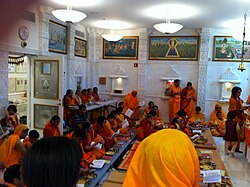
[[File:A Jain ritual offerings and puja recital at a temple, worship in Jainism.jpg|thumb|left|upright|Jain worship may include ritual offerings and recitals.{{sfn|Wiley|2009|pp=45–46, 215}}]] | [[File:A Jain ritual offerings and puja recital at a temple, worship in Jainism.jpg|thumb|left|upright|Jain worship may include ritual offerings and recitals.{{sfn|Wiley|2009|pp=45–46, 215}}]] | ||
The basic ritual is ''darsana'' (seeing) of ''deva'', which includes Jina,{{sfn|Lindsay Jones|2005|p=4771}} or other [[Yaksha|yaksas]], gods and goddesses such as Brahmadeva, 52 Viras, [[Padmavati (Jainism)|Padmavati]], [[Ambika (Jainism)|Ambika]] and 16 Vidyadevis (including [[Sarasvati]] and [[Lakshmi]]).{{sfn|Wiley|2009|pp=33, 59, 92, 138, 191}}{{sfn|Cort|1987|pp=235–255}}{{sfn|Mishra|Ray|2016|pp=141–148}} Terapanthi Digambaras limit their ritual worship to Tirthankaras.{{sfn|Dalal|2010a|p=365}} The worship ritual is called ''devapuja'', and is found in all Jain sub-traditions.{{sfn|Jaini|1998|pp=199–200}} Typically, the Jain layperson enters the temple inner sanctum in simple clothing and bare feet with a plate filled with offerings, bows down, says the [[namaskar]], completes his or her litany and prayers, sometimes is assisted by the temple priest, leaves the offerings and then departs.{{sfn|Jaini|1998|pp=199–200}} | The basic ritual is ''darsana'' (seeing) of ''deva'', which includes Jina,{{sfn|Lindsay Jones|2005|p=4771}} or other [[Yaksha|yaksas]], gods and goddesses such as Brahmadeva, 52 Viras, [[Padmavati (Jainism)|Padmavati]], [[Ambika (Jainism)|Ambika]] and 16 Vidyadevis (including [[Sarasvati]] and [[Lakshmi]]).{{sfn|Wiley|2009|pp=33, 59, 92, 138, 191}}{{sfn|Cort|1987|pp=235–255}}{{sfn|Mishra|Ray|2016|pp=141–148}} Terapanthi Digambaras limit their ritual worship to Tirthankaras.{{sfn|Dalal|2010a|p=365}} The worship ritual is called ''devapuja'', and is found in all Jain sub-traditions.{{sfn|Jaini|1998|pp=199–200}} Typically, the Jain layperson enters the Derasar (Jain temple) inner sanctum in simple clothing and bare feet with a plate filled with offerings, bows down, says the [[namaskar]], completes his or her litany and prayers, sometimes is assisted by the temple priest, leaves the offerings and then departs.{{sfn|Jaini|1998|pp=199–200}} | ||
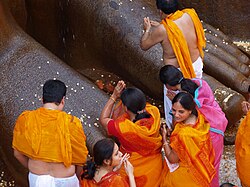
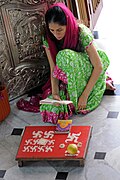
Jain practices include performing ''[[abhisheka]]'' (ceremonial bath) of the images.{{sfn|Pratapaditya Pal|1986|p=29}} Some Jain sects employ a ''pujari'' (also called ''upadhye''), who may be a Hindu, to perform priestly duties at the temple.{{sfn|Dundas|2002|pp=204–205}}{{sfn|Salvadori|1989|pp=169–170}} More elaborate worship includes offerings such as rice, fresh and dry fruits, flowers, coconut, sweets, and money. Some may light up a lamp with camphor and make auspicious marks with sandalwood paste. Devotees also recite Jain texts, particularly the life stories of the tirthankaras.{{sfn|Babb|1996|pp=32–33}}{{sfn|Wiley|2009|pp=45–46, 215}} | Jain practices include performing ''[[abhisheka]]'' (ceremonial bath) of the images.{{sfn|Pratapaditya Pal|1986|p=29}} Some Jain sects employ a ''pujari'' (also called ''upadhye''), who may be a Hindu, to perform priestly duties at the temple.{{sfn|Dundas|2002|pp=204–205}}{{sfn|Salvadori|1989|pp=169–170}} More elaborate worship includes offerings such as rice, fresh and dry fruits, flowers, coconut, sweets, and money. Some may light up a lamp with camphor and make auspicious marks with sandalwood paste. Devotees also recite Jain texts, particularly the life stories of the tirthankaras.{{sfn|Babb|1996|pp=32–33}}{{sfn|Wiley|2009|pp=45–46, 215}} | ||
| Line 166: | Line 169: | ||
[[File:Das Lakshana (Paryusana) celebrations, New York City Jain temple 2.JPG|thumb|upright|Celebrating Das Lakshana (Paryushana), [[Jain Center of America]], New York City]] | [[File:Das Lakshana (Paryusana) celebrations, New York City Jain temple 2.JPG|thumb|upright|Celebrating Das Lakshana (Paryushana), [[Jain Center of America]], New York City]] | ||
The most important annual Jain festival is called the ''Paryushana'' by Svetambaras and ''Dasa lakshana parva'' by the Digambaras. It is celebrated from the 12th day of the waning moon in the traditional lunisolar month of [[Bhadra (Hindu calendar)|Bhadrapada]] in the [[Hindu calendar|Indian calendar]]. This typically falls in August or September of the Gregorian calendar.{{sfn|Dalal|2010a|pp=164, 284}}{{sfn|Melton|2011|p=673}} It lasts eight days for Svetambaras, and ten days among the Digambaras.{{sfn|Dalal|2010a|pp=164, 284}} It is a time when lay people fast and pray. The five vows are emphasized during this time.{{sfn|Melton|2011|p=673}} Svetambaras recite the ''Kalpasūtras'', while Digambaras read their own texts. The festival is an occasion where Jains make active effort to stop cruelty towards other life forms, freeing animals in captivity and preventing the slaughter of animals.{{sfn|Dalal|2010a|pp=164, 284}} | The most important annual Jain festival is called the ''[[Paryushana]]'' by Svetambaras and ''[[Dasha-Lakshana-Parvan|Dasa lakshana parva]]'' by the Digambaras. It is celebrated from the 12th day of the waning moon in the traditional lunisolar month of [[Bhadra (Hindu calendar)|Bhadrapada]] in the [[Hindu calendar|Indian calendar]]. This typically falls in August or September of the Gregorian calendar.{{sfn|Dalal|2010a|pp=164, 284}}{{sfn|Melton|2011|p=673}} It lasts eight days for Svetambaras, and ten days among the Digambaras.{{sfn|Dalal|2010a|pp=164, 284}} It is a time when lay people fast and pray. The five vows are emphasized during this time.{{sfn|Melton|2011|p=673}} Svetambaras recite the ''Kalpasūtras'', while Digambaras read their own texts. The festival is an occasion where Jains make active effort to stop cruelty towards other life forms, freeing animals in captivity and preventing the slaughter of animals.{{sfn|Dalal|2010a|pp=164, 284}} | ||
{{Quote box | {{Quote box | ||
| Line 195: | Line 198: | ||
The Jain community is divided into two major [[Religious denomination|denominations]], [[Digambara]] and [[Śvētāmbara]]. Monks of the Digambara (sky-clad) tradition do not wear clothes. Female monastics of the Digambara sect wear unstitched plain white [[saree]]s and are referred to as ''[[Aryika]]s''. Śvētāmbara (white-clad) monastics, on the other hand, wear seamless white clothes.{{sfn|Dundas|2002|p=45}} | The Jain community is divided into two major [[Religious denomination|denominations]], [[Digambara]] and [[Śvētāmbara]]. Monks of the Digambara (sky-clad) tradition do not wear clothes. Female monastics of the Digambara sect wear unstitched plain white [[saree]]s and are referred to as ''[[Aryika]]s''. Śvētāmbara (white-clad) monastics, on the other hand, wear seamless white clothes.{{sfn|Dundas|2002|p=45}} | ||
During Chandragupta Maurya's reign, Jain tradition states that ''Acharya'' Bhadrabahu predicted a twelve-year-long famine and moved to Karnataka with his disciples. [[Sthulabhadra]], a pupil of ''Acharya'' Bhadrabahu, is believed to have stayed in Magadha.{{sfn|Clarke|Beyer|2009|p=326}} Later, as stated in tradition, when followers of ''Acharya'' Bhadrabahu returned, they found those who had remained at Magadha had started wearing white clothes, which was unacceptable to the others who remained naked.{{sfn|Dundas|2002|p=47}} This is how Jains believe the Digambara and Śvētāmbara schism began, with the former being naked while the latter wore white clothes.{{sfn|von Glasenapp|1925|p=46}} Digambara saw this as being opposed to the Jain tenet of ''aparigraha'' which, according to them, required not even possession of clothes, i.e. complete nudity. In the | During Chandragupta Maurya's reign, Jain tradition states that ''Acharya'' Bhadrabahu predicted a twelve-year-long famine and moved to Karnataka with his disciples. [[Sthulabhadra]], a pupil of ''Acharya'' Bhadrabahu, is believed to have stayed in Magadha.{{sfn|Clarke|Beyer|2009|p=326}} Later, as stated in tradition, when followers of ''Acharya'' Bhadrabahu returned, they found those who had remained at Magadha had started wearing white clothes, which was unacceptable to the others who remained naked.{{sfn|Dundas|2002|p=47}} This is how Jains believe the Digambara and Śvētāmbara schism began, with the former being naked while the latter wore white clothes.{{sfn|von Glasenapp|1925|p=46}} Digambara saw this as being opposed to the Jain tenet of ''aparigraha'' which, according to them, required not even possession of clothes, i.e. complete nudity. In the fifth-century CE, the Council of Valabhi was organized by Śvētāmbara, which Digambara did not attend. At the council, the Śvētāmbara adopted the texts they had preserved as canonical scriptures, which Digambara has ever since rejected. This council is believed to have solidified the historic schism between these two major traditions of Jainism.{{sfn|Price|2010|pp=104–105}}{{sfn|Fohr|2015|pp=21–22}} The earliest record of Digambara beliefs is contained in the Prakrit ''Suttapahuda'' of [[Kundakunda]].{{sfn|Jaini|1991|p=3}} | ||
Digambaras and Śvētāmbara differ in their practices and dress code,{{sfn|Jones|Ryan|2007|p=211}}{{sfn|Umakant P. Shah|1987|p=5}}{{sfn|Dundas|2002|pp=31–33}} interpretations of teachings,{{sfn| | Digambaras and Śvētāmbara differ in their practices and dress code,{{sfn|Jones|Ryan|2007|p=211}}{{sfn|Umakant P. Shah|1987|p=5}}{{sfn|Dundas|2002|pp=31–33}} interpretations of teachings,{{sfn|Umakant P. Shah|1987|p=5}}{{sfn|Jaini|2000|pp=27–28}} and on Jain history especially concerning the ''tirthankaras''.{{sfn|Kailash Chand Jain|1991|p=12}}{{sfn|Natubhai Shah|2004|pp=73–74}}{{sfn|Dundas|2002|p=21}}{{sfn|Umakant P. Shah|1987|p=17}}{{sfn|Umakant P. Shah|1987|pp=79–80}} Their monasticism rules differ,{{sfn|Dalal|2010a|p=167}} as does their [[iconography]].{{sfn|Dalal|2010a|p=167}} Śvētāmbara has had more female than male mendicants,{{sfn|Cort|2001a|p=47}} where Digambara has mostly had male monks{{sfn|Flügel|2006|pp=314–331, 353–361}} and considers males closest to the soul's liberation.{{sfn|Long|2013|pp=36–37}}{{sfn|Harvey|2016|pp=182–183}} The Śvētāmbaras believe that women can also achieve liberation through asceticism{{sfn|Harvey|2016|pp=182–183}}{{sfn|Dundas|2002|pp=55–59}} and state that the 19th ''Tirthankara'' [[Māllīnātha]] was female,{{sfn|Vallely|2002|p=15}} which Digambara rejects.{{sfn|Dundas|2002|p=56}} | ||
Excavations at Mathura revealed Jain statues from the time of the [[Kushan Empire]] (c.{{nbsp}}1st century CE).{{sfn|Jaini|2000|p=167}} ''Tirthankara'' represented without clothes, and monks with cloth wrapped around the left arm, are identified as the ''Ardhaphalaka'' (half-clothed) mentioned in texts.{{sfn|Jaini|2000|p=167}} The [[Yapaniya]]s, believed to have originated from the ''Ardhaphalaka'', followed Digambara nudity along with several Śvētāmbara beliefs.{{sfn|Jaini|2000|p=167}} In the modern era, according to Flügel, new Jain religious movements that are a "primarily devotional form of Jainism" have developed which resemble "Jain Mahayana" style devotionalism.{{sfn|Flügel|2005|pp=194–243}} | Excavations at Mathura revealed Jain statues from the time of the [[Kushan Empire]] (c.{{nbsp}}1st century CE).{{sfn|Jaini|2000|p=167}} ''Tirthankara'' represented without clothes, and monks with cloth wrapped around the left arm, are identified as the ''Ardhaphalaka'' (half-clothed) mentioned in texts.{{sfn|Jaini|2000|p=167}} The [[Yapaniya]]s, believed to have originated from the ''Ardhaphalaka'', followed Digambara nudity along with several Śvētāmbara beliefs.{{sfn|Jaini|2000|p=167}} In the modern era, according to Flügel, new Jain religious movements that are a "primarily devotional form of Jainism" have developed which resemble "Jain Mahayana" style devotionalism.{{sfn|Flügel|2005|pp=194–243}} | ||
| Line 207: | Line 210: | ||
| caption1 = Stela depicting ''Śhrut Jnāna'', or complete scriptural knowledge | | caption1 = Stela depicting ''Śhrut Jnāna'', or complete scriptural knowledge | ||
| image2 = Suryaprajnapati Sutra.jpg | | image2 = Suryaprajnapati Sutra.jpg | ||
| caption2 = The Suryaprajnaptisūtra, a | | caption2 = The Suryaprajnaptisūtra, a fourth or third century BCE astronomy text of Śvētāmbara Jains. Above: its manuscript from {{circa|1500}} CE.<ref>{{cite web |url=http://www.schoyencollection.com/23-religions/living-religions/23-17-jainism/astronomy/ms-5297 |title=Suryaprajnapti Sūtra |work=[[Schøyen Collection|The Schøyen Collection]] |archive-url=https://web.archive.org/web/20170615024618/http://www.schoyencollection.com/23-religions/living-religions/23-17-jainism/astronomy/ms-5297|archive-date=15 June 2017|access-date=16 June 2017|url-status=live}}</ref> | ||
| image3 = Mangulam inscription.jpg | | image3 = Mangulam inscription.jpg | ||
| caption3 = [[Mangulam]] inscription dated 3rd century BCE | | caption3 = [[Mangulam]] inscription dated 3rd century BCE | ||
| Line 220: | Line 223: | ||
The Śvētāmbaras believe that they have preserved 45 of the 50 original Jain scriptures (having lost an Anga text and four Purva texts), while the Digambaras believe that all were lost,{{sfn|Dundas|2002|p=61}}{{sfn|von Glasenapp|1925|pp=112–113, 121–122}} and that Āchārya [[Bhutabali]] was the last ascetic who had partial knowledge of the original canon. According to them, Digambara ''Āchāryas'' recreated the oldest-known Digambara Jain texts, including the four ''anuyoga''.{{sfn|Vijay K. Jain|2016|p=xii}}{{sfn|Jaini|1998|pp=78–81}}{{sfn|von Glasenapp|1925|p=124}} The Digambara texts partially agree with older Śvētāmbara texts, but there are also gross differences between the texts of the two major Jain traditions.{{sfn|von Glasenapp|1925|pp=121–122}} The Digambaras created a secondary canon between 600 and 900 CE, compiling it into four groups or ''Vedas'': history, cosmography, philosophy and ethics.{{sfn|von Glasenapp|1925|pp=123–124}}{{efn|Not to be confused with the four ''[[Veda]]s'' of Hinduism.{{sfn|Dalal|2010a|pp=164–165}}}} | The Śvētāmbaras believe that they have preserved 45 of the 50 original Jain scriptures (having lost an Anga text and four Purva texts), while the Digambaras believe that all were lost,{{sfn|Dundas|2002|p=61}}{{sfn|von Glasenapp|1925|pp=112–113, 121–122}} and that Āchārya [[Bhutabali]] was the last ascetic who had partial knowledge of the original canon. According to them, Digambara ''Āchāryas'' recreated the oldest-known Digambara Jain texts, including the four ''anuyoga''.{{sfn|Vijay K. Jain|2016|p=xii}}{{sfn|Jaini|1998|pp=78–81}}{{sfn|von Glasenapp|1925|p=124}} The Digambara texts partially agree with older Śvētāmbara texts, but there are also gross differences between the texts of the two major Jain traditions.{{sfn|von Glasenapp|1925|pp=121–122}} The Digambaras created a secondary canon between 600 and 900 CE, compiling it into four groups or ''Vedas'': history, cosmography, philosophy and ethics.{{sfn|von Glasenapp|1925|pp=123–124}}{{efn|Not to be confused with the four ''[[Veda]]s'' of Hinduism.{{sfn|Dalal|2010a|pp=164–165}}}} | ||
The most popular and influential texts of Jainism have been its non-canonical literature. Of these, the ''[[Kalpa Sūtra]]s'' are particularly popular among Śvētāmbaras, which they attribute to Bhadrabahu (c. 300 BCE). This ancient scholar is revered in the Digambara tradition, and they believe he led their migration into the ancient south Karnataka region and created their tradition.{{sfn|von Glasenapp|1925|pp=125–126}} Śvētāmbaras believe instead that Bhadrabahu moved to Nepal.{{sfn|von Glasenapp|1925|pp=125–126}} Both traditions consider his ''Niryuktis'' and ''Samhitas'' important. The earliest surviving Sanskrit text by [[Umaswati]], the ''[[Tattvarthasūtra]]'' is considered authoritative by all traditions of Jainism.{{Sfn|Jones|Ryan|2007|pp=439–440}}{{sfn|Dundas|2006|pp=395–396}}{{efn|That Which Is, known as the ''Tattvartha Sūtra'' to Jains, is recognized by all four Jain traditions as the earliest, most authoritative and comprehensive summary of their religion."{{sfn|Umāsvāti|1994|p=xi–xiii}}}} In the Digambara tradition, the texts written by Kundakunda are highly revered and have been historically influential | The most popular and influential texts of Jainism have been its non-canonical literature. Of these, the ''[[Kalpa Sūtra]]s'' are particularly popular among Śvētāmbaras, which they attribute to Bhadrabahu (c. 300 BCE). This ancient scholar is revered in the Digambara tradition, and they believe he led their migration into the ancient south Karnataka region and created their tradition.{{sfn|von Glasenapp|1925|pp=125–126}} Śvētāmbaras believe instead that Bhadrabahu moved to Nepal.{{sfn|von Glasenapp|1925|pp=125–126}} Both traditions consider his ''Niryuktis'' and ''Samhitas'' important. The earliest surviving Sanskrit text by [[Umaswati]], the ''[[Tattvarthasūtra]]'' is considered authoritative by all traditions of Jainism.{{Sfn|Jones|Ryan|2007|pp=439–440}}{{sfn|Dundas|2006|pp=395–396}}{{efn|That Which Is, known as the ''Tattvartha Sūtra'' to Jains, is recognized by all four Jain traditions as the earliest, most authoritative and comprehensive summary of their religion."{{sfn|Umāsvāti|1994|p=xi–xiii}}}} In the Digambara tradition, the texts written by Kundakunda are highly revered and have been historically influential,{{sfn|Finegan|1989|p=221}}{{sfn|Balcerowicz|2003|pp=25–34}}{{sfn|Chatterjee|2000|pp=282–283}} while the oldest being ''[[Kasayapahuda]]'' and ''[[Shatkhandagama]]'' attributed to Acharya pushpdanta and Bhutbali. Other important Digambara Jain texts include: ''[[Samayasara]]'', ''[[Ratnakaranda śrāvakācāra]]'', and ''[[Niyamasara]]''.{{sfn|Jaini|1991|pp=32–33}} | ||
==Comparison with Buddhism and Hinduism== | ==Comparison with Buddhism and Hinduism== | ||
{{main|Buddhism and Jainism|Jainism and Hinduism}} | {{main|Buddhism and Jainism|Jainism and Hinduism}} | ||
All the | All the four dharmic religions, viz., Jainism, Hinduism, Sikhism and Buddhism, share concepts and doctrines such as karma and rebirth, with similar festivals and monastic traditions.{{sfn|Solomon|Higgins|1998|pp=11–22}}{{sfn|Appleton|2016|pp=1–21, 25–27, 57–58, 82–84}}{{sfn|McFaul|2006|pp=27–28}} They do not believe in eternal heaven or hell or judgment day, and leave it up to individual discretion to choose whether or not to believe in gods, to disagree with core teachings, and to choose whether to participate in prayers, rituals and festivals. They all consider values such as non-violence to be important,{{sfn|Shaw|Demy|2017}}{{rp|p. 635|quote=Ahiṃsā (to do no harm) is a significant aspect of three major religions: Jainism, Hinduism and Buddhism}} link suffering to craving, individual's actions, intents, and karma, and believe spirituality is a means to enlightened peace, bliss and eternal liberation (''moksha'').{{sfn|Solomon|Higgins|1998|pp=18–22}}{{sfn|McFaul|2006|pp=27–40}} | ||
Jainism differs from both Buddhism and Hinduism in its ontological premises. All believe in impermanence, but Buddhism incorporates the premise of ''[[anatta]]'' ("no eternal self or soul"). Hinduism incorporates an eternal unchanging ''[[Atman (Hinduism)|atman]]'' ("soul"), while Jainism incorporates an eternal but changing ''[[Jiva (Jainism)|jiva]]'' ("soul").{{sfn|Dundas|2002|pp=87–88}}{{sfn|Wiley|2004|pp=2–5}}{{sfn|Long|2013|pp=122–125}} In Jain thought, there are infinite eternal ''jivas'', predominantly in cycles of rebirth, and a few ''siddhas'' (perfected ones).{{sfn|Hiriyanna|1993|pp=157–158, 168–169}} Unlike Jainism, Hindu philosophies encompass [[advaita|nondualism]] where all souls are identical as Brahman and posited as interconnected one{{sfn|Hiriyanna|1993|pp=54–62, 77–82, 132}}{{sfn|Perrett|2013|pp=247–248}}{{sfn|Bartley|2013|pp=1–10, 76–79, 87–98}} | Jainism differs from both Buddhism and Hinduism in its ontological premises. All believe in impermanence, but Buddhism incorporates the premise of ''[[anatta]]'' ("no eternal self or soul"). Hinduism incorporates an eternal unchanging ''[[Atman (Hinduism)|atman]]'' ("soul"), while Jainism incorporates an eternal but changing ''[[Jiva (Jainism)|jiva]]'' ("soul").{{sfn|Dundas|2002|pp=87–88}}{{sfn|Wiley|2004|pp=2–5}}{{sfn|Long|2013|pp=122–125}} In Jain thought, there are infinite eternal ''jivas'', predominantly in cycles of rebirth, and a few ''siddhas'' (perfected ones).{{sfn|Hiriyanna|1993|pp=157–158, 168–169}} Unlike Jainism, Hindu philosophies encompass [[advaita|nondualism]] where all souls are identical as Brahman and posited as interconnected one{{sfn|Hiriyanna|1993|pp=54–62, 77–82, 132}}{{sfn|Perrett|2013|pp=247–248}}{{sfn|Bartley|2013|pp=1–10, 76–79, 87–98}} | ||
| Line 231: | Line 234: | ||
While both Hinduism and Jainism believe "soul exists" to be a self-evident truth, most Hindu systems consider it to be eternally present, infinite and constant (''[[vibhu]]''), but some Hindu scholars propose soul to be atomic. Hindu thought generally discusses Atman and [[Brahman]] through a monistic or dualistic framework. In contrast, Jain thought denies the Hindu metaphysical concept of Brahman, and Jain philosophy considers the soul to be ever changing and bound to the body or matter for each lifetime, thereby having a finite size that infuses the entire body of a living being.{{sfn|Jaini|1998|pp=58, 102–105}} | While both Hinduism and Jainism believe "soul exists" to be a self-evident truth, most Hindu systems consider it to be eternally present, infinite and constant (''[[vibhu]]''), but some Hindu scholars propose soul to be atomic. Hindu thought generally discusses Atman and [[Brahman]] through a monistic or dualistic framework. In contrast, Jain thought denies the Hindu metaphysical concept of Brahman, and Jain philosophy considers the soul to be ever changing and bound to the body or matter for each lifetime, thereby having a finite size that infuses the entire body of a living being.{{sfn|Jaini|1998|pp=58, 102–105}} | ||
Jainism is similar to Buddhism in not recognizing the primacy of the Vedas and the Hindu Brahman. Jainism and Hinduism, however, both believe "soul exists" as a self-evident truth.{{sfn| | Jainism is similar to Buddhism in not recognizing the primacy of the Vedas and the Hindu Brahman. Jainism and Hinduism, however, both believe "soul exists" as a self-evident truth.{{sfn|Solomon|Higgins|1998|pp=18–22}}{{sfn|Dalal|2010b|pp=174–175}} Jains and Hindus have frequently intermarried, particularly in northern, central and western regions of India.{{sfn|Juergensmeyer|2011|p=54}}{{sfn|Kelting|2009|pp=206 note 4}} Some early colonial scholars stated that Jainism like Buddhism was, in part, a rejection of the Hindu caste system,{{sfn|Nesfield|1885|pp=116–117}}{{sfn|Pope|1880|pp=40–41}} but later scholars consider this a Western error.{{sfn|Alberts|2007|pp=258–259}} A caste system not based on birth has been a historic part of Jain society, and Jainism focused on transforming the individual, not society.{{sfn|Juergensmeyer|2011|p=54}}{{sfn|Dundas|2002|pp=147–149, 304 footnote 24}}{{sfn|Babb|1996|pp=137–145, 54, 172}}{{sfn|Sangave|1980|pp=73, 316–317}}{{efn|According to [[Richard Gombrich]] and other scholars, Buddhism too was not a rejection or rebellion against any ancient caste system and it too was focused on individual's liberation from rebirths and suffering. The caste system in Buddhist societies and monasteries outside India have been documented. Gombrich states, "Some modernists go so far as to say that the Buddha was against caste altogether: this is not the case, but is one of the mistakes picked up from western authors."{{sfn|Gombrich|2012|pp=344–353 with footnotes}}{{sfn|Alberts|2007|pp=258–259}}{{sfn|Florida|2005|pp=134–137}}}} | ||
Monasticism is similar in all three traditions,{{sfn|Johnston|2000|pp=681–683}}{{sfn|Caillat|2003a|pp=30–34 with footnote 28}} with similar rules, hierarchical structure, not traveling during the four-month [[monsoon]] season, and celibacy,{{sfn|Caillat|2003a|pp=30–34 with footnote 28}} originating before the Buddha or the Mahāvīra.{{sfn|Johnston|2000|pp=681–683}} Jain and Hindu monastic communities have traditionally been more mobile and had an itinerant lifestyle, while Buddhist monks have favored belonging to a ''sangha'' (monastery) and staying in its premises.{{sfn|Hirakawa|1993|pp=4–7}} Buddhist monastic rules forbid a monk to go outside without wearing the sangha's distinctive ruddy robe, or to use wooden bowls.{{sfn|Johnston|2000|pp=681–683}} In contrast, Jain monastic rules have either required nakedness (Digambara) or white clothes (Śvētāmbara), and they have disagreed on the legitimacy of the wooden or empty gourd as the begging bowl by Jain monks.{{sfn|Johnston|2000|pp=681–683}}{{efn|Whether the begging utensils of a monk, such as robe and begging bowl, were justified and legitimate for a Jain monk and were not considered an impediment on the path to salvation, remained a bone of contention among various splinter groups within Jainism, and was partly responsible for the ultimate Digambara-Svetambara split, although it would be a grave oversimplification to reduce the roots of the split to just monks' robes and bowls.{{sfn|Balcerowicz|2015|pp=42–43}} }} | Monasticism is similar in all three traditions,{{sfn|Johnston|2000|pp=681–683}}{{sfn|Caillat|2003a|pp=30–34 with footnote 28}} with similar rules, hierarchical structure, not traveling during the four-month [[monsoon]] season, and celibacy,{{sfn|Caillat|2003a|pp=30–34 with footnote 28}} originating before the Buddha or the Mahāvīra.{{sfn|Johnston|2000|pp=681–683}} Jain and Hindu monastic communities have traditionally been more mobile and had an itinerant lifestyle, while Buddhist monks have favored belonging to a ''sangha'' (monastery) and staying in its premises.{{sfn|Hirakawa|1993|pp=4–7}} Buddhist monastic rules forbid a monk to go outside without wearing the sangha's distinctive ruddy robe, or to use wooden bowls.{{sfn|Johnston|2000|pp=681–683}} In contrast, Jain monastic rules have either required nakedness (Digambara) or white clothes (Śvētāmbara), and they have disagreed on the legitimacy of the wooden or empty gourd as the begging bowl by Jain monks.{{sfn|Johnston|2000|pp=681–683}}{{efn|Whether the begging utensils of a monk, such as robe and begging bowl, were justified and legitimate for a Jain monk and were not considered an impediment on the path to salvation, remained a bone of contention among various splinter groups within Jainism, and was partly responsible for the ultimate Digambara-Svetambara split, although it would be a grave oversimplification to reduce the roots of the split to just monks' robes and bowls.{{sfn|Balcerowicz|2015|pp=42–43}} }} | ||
| Line 244: | Line 247: | ||
| caption1 = [[Ayagapata|Sihanamdika ayagapata]], 25-50 CE, [[Kankali Tila]], Mathura, [[Uttar Pradesh]] | | caption1 = [[Ayagapata|Sihanamdika ayagapata]], 25-50 CE, [[Kankali Tila]], Mathura, [[Uttar Pradesh]] | ||
| image2 = KHANDAGIRI AND UDAYGIRI Cave Inscriptions 1.jpg | | image2 = KHANDAGIRI AND UDAYGIRI Cave Inscriptions 1.jpg | ||
| caption2 = Inscriptions at a Udaygiri-Khandagiri 2nd-1st-century BCE Jain rock cut cave, [[Odisha]].<ref>{{cite web |url=http://asi.nic.in/asi_monu_tktd_orissa_udaigiricaves.asp |title=Udaygiri and Khandagiri Caves |url-status=dead |archive-url=https://web.archive.org/web/20151029012248/http://asi.nic.in/asi_monu_tktd_orissa_udaigiricaves.asp |archive-date=29 October 2015 |publisher=Archaeological Survey of India, Government of India}}</ref> | | caption2 = Inscriptions at a Udaygiri-Khandagiri 2nd-1st-century BCE Jain rock cut cave, [[Odisha]].<ref>{{cite web |url=http://asi.nic.in/asi_monu_tktd_orissa_udaigiricaves.asp |title=Udaygiri and Khandagiri Caves |url-status=dead |archive-url=https://web.archive.org/web/20151029012248/http://asi.nic.in/asi_monu_tktd_orissa_udaigiricaves.asp |archive-date=29 October 2015 |publisher=[[Archaeological Survey of India]], [[Government of India]] |access-date=29 October 2015}}</ref> | ||
| align = | | align = | ||
| direction = | | direction = | ||
| Line 251: | Line 254: | ||
}} | }} | ||
Jainism has contributed significantly to Indian art and architecture. Jain arts depict life legends of ''tirthankara'' or other important people, particularly with them in a seated or standing meditative posture. ''Yakshas'' and ''[[yakshini]]s'', attendant spirits who guard the ''tirthankara'', are usually shown with them.{{sfn|Natubhai Shah|1998|p=184}} The earliest known Jain image is in the [[Patna]] museum. It is dated approximately to the | Jainism has contributed significantly to Indian art and architecture. Jain arts depict life legends of ''tirthankara'' or other important people, particularly with them in a seated or standing meditative posture. ''Yakshas'' and ''[[yakshini]]s'', attendant spirits who guard the ''tirthankara'', are usually shown with them.{{sfn|Natubhai Shah|1998|p=184}} The earliest known Jain image is in the [[Patna]] museum. It is dated approximately to the third century BCE.{{sfn|Natubhai Shah|1998|p=184}} Bronze images of Pārśva can be seen in the Prince of Wales Museum, Mumbai, and in the Patna museum; these are dated to the second century BCE.{{sfn|Umakant P. Shah|1987|p=95}} | ||
''Ayagapata'' is a type of [[votive]] tablet used in Jainism for donation and worship in the early centuries. These tablets are decorated with objects and designs central to Jain worship such as the ''[[stupa]]'', ''[[dharmacakra]]'' and ''[[triratna]]''. They present simultaneous trends or image and symbol worship. Numerous such stone tablets were discovered during excavations at ancient Jain sites like [[Kankali Tila]] near [[Mathura]] in Uttar Pradesh, India. The practice of donating these tablets is documented from | ''Ayagapata'' is a type of [[votive]] tablet used in Jainism for donation and worship in the early centuries. These tablets are decorated with objects and designs central to Jain worship such as the ''[[stupa]]'', ''[[dharmacakra]]'' and ''[[triratna]]''. They present simultaneous trends or image and symbol worship. Numerous such stone tablets were discovered during excavations at ancient Jain sites like [[Kankali Tila]] near [[Mathura]] in Uttar Pradesh, India. The practice of donating these tablets is documented from first century BCE to third century CE.{{sfn|Kishore|2015|pp=17–43}}{{sfn|Jain|Fischer|1978|pp=9–10}} ''[[Samavasarana]]'', a preaching hall of ''tirthankaras'' with various beings concentrically placed, is an important theme of Jain art.{{sfn|Wiley|2009|p=184}} | ||
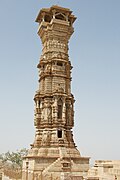
The [[Kirti Stambh|Jain tower in Chittor]], Rajasthan, is a good example of Jain architecture.{{sfn|Owen|2012a|pp=1–2}} Decorated manuscripts are preserved in Jain libraries, containing diagrams from Jain cosmology.{{sfn|Natubhai Shah|1998|p=183}} Most of the paintings and illustrations depict historical events, known as ''Panch Kalyanaka'', from the life of the ''tirthankara''. Rishabha, the first ''tirthankara'', is usually depicted in either the [[lotus position]] or ''kayotsarga'', the standing position. He is distinguished from other ''tirthankara'' by the long locks of hair falling to his shoulders. Bull images also appear in his sculptures.{{sfn|Natubhai Shah|1998|p=113}} In paintings, incidents from his life, like his marriage and [[Indra]] marking his forehead, are depicted. Other paintings show him presenting a pottery bowl to his followers; he is also seen painting a house, weaving, and being visited by his mother Marudevi.{{sfn|Jain|Fischer|1978|p=16}} Each of the twenty-four ''tirthankara'' is associated with distinctive emblems, which are listed in such texts as ''Tiloyapannati'', ''Kahavaali'' and ''Pravacanasaarodhara''.{{sfn|Natubhai Shah|1998|p=187}} | The [[Kirti Stambh|Jain tower in Chittor]], Rajasthan, is a good example of Jain architecture.{{sfn|Owen|2012a|pp=1–2}} Decorated manuscripts are preserved in Jain libraries, containing diagrams from Jain cosmology.{{sfn|Natubhai Shah|1998|p=183}} Most of the paintings and illustrations depict historical events, known as ''Panch Kalyanaka'', from the life of the ''tirthankara''. Rishabha, the first ''tirthankara'', is usually depicted in either the [[lotus position]] or ''kayotsarga'', the standing position. He is distinguished from other ''tirthankara'' by the long locks of hair falling to his shoulders. Bull images also appear in his sculptures.{{sfn|Natubhai Shah|1998|p=113}} In paintings, incidents from his life, like his marriage and [[Indra]] marking his forehead, are depicted. Other paintings show him presenting a pottery bowl to his followers; he is also seen painting a house, weaving, and being visited by his mother Marudevi.{{sfn|Jain|Fischer|1978|p=16}} Each of the twenty-four ''tirthankara'' is associated with distinctive emblems, which are listed in such texts as ''Tiloyapannati'', ''Kahavaali'' and ''Pravacanasaarodhara''.{{sfn|Natubhai Shah|1998|p=187}} | ||
| Line 262: | Line 265: | ||
A Jain temple, a ''Derasar'' or ''Basadi'', is a [[place of worship]].{{sfn|Babb|1996|p=66}} Temples contain ''tirthankara'' images, some fixed, others moveable.{{sfn|Babb|1996|p=66}} These are stationed in the inner sanctum, one of the two sacred zones, the other being the main hall.{{sfn|Babb|1996|p=66}} One of the images is marked as the ''moolnayak'' (primary deity).{{sfn|Babb|1996|p=68}} A ''[[manastambha]]'' (column of honor) is a pillar that is often constructed in front of Jain temples.{{sfn|Settar|1989|p=195}} Temple construction is considered a meritorious act.{{sfn|Sangave|2001|p=188}} | A Jain temple, a ''Derasar'' or ''Basadi'', is a [[place of worship]].{{sfn|Babb|1996|p=66}} Temples contain ''tirthankara'' images, some fixed, others moveable.{{sfn|Babb|1996|p=66}} These are stationed in the inner sanctum, one of the two sacred zones, the other being the main hall.{{sfn|Babb|1996|p=66}} One of the images is marked as the ''moolnayak'' (primary deity).{{sfn|Babb|1996|p=68}} A ''[[manastambha]]'' (column of honor) is a pillar that is often constructed in front of Jain temples.{{sfn|Settar|1989|p=195}} Temple construction is considered a meritorious act.{{sfn|Sangave|2001|p=188}} | ||
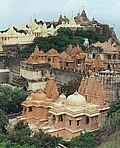
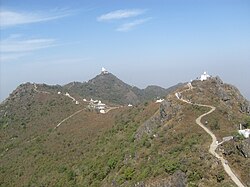
Ancient Jain monuments include the Udaigiri Hills near Bhelsa ([[Vidisha]]) in Madhya Pradesh, the [[Ellora Caves|Ellora]] in Maharashtra, the [[Palitana temples]] in Gujarat, and the Jain temples at Dilwara Temples near [[Mount Abu]], Rajasthan.<ref>{{ | Ancient Jain monuments include the Udaigiri Hills near Bhelsa ([[Vidisha]]) in Madhya Pradesh, the [[Ellora Caves|Ellora]] in Maharashtra, the [[Palitana temples]] in Gujarat, and the Jain temples at Dilwara Temples near [[Mount Abu]], Rajasthan.<ref>{{cite web |last=Barik |first=Bibhuti |title=Plan to beautify Khandagiri – Monument revamp to attract more tourists |url=http://www.telegraphindia.com/1150623/jsp/odisha/story_27206.jsp |work=[[The Telegraph (India)|The Telegraph]] |date=23 June 2015 |location=[[Bhubaneswar]] |access-date=16 February 2016 |archive-url=https://web.archive.org/web/20160223232545/http://www.telegraphindia.com/1150623/jsp/odisha/story_27206.jsp |archive-date=23 February 2016 |url-status=dead}}</ref> [[Ranakpur Jain temple|Chaumukha temple]] in [[Ranakpur]] is considered one of the most beautiful Jain temples and is famous for its detailed carvings.{{sfn|Sehdev Kumar|2001|p=106}} According to Jain texts, [[Shikharji]] is the place where twenty of the twenty-four Jain ''Tīrthaṅkaras'' along with many other monks attained ''moksha'' (died without being reborn, with their soul in ''[[Siddhashila]]''). The Shikharji site in northeastern [[Jharkhand]] is therefore a revered pilgrimage site.{{Sfn|Cort|2010|pp=130–133}}{{efn|Some texts refer to the place as Mount Sammeta.{{sfn|Jacobi|1964|p=275}}}} The Palitana temples are the holiest shrine for the Śvētāmbara Murtipujaka sect.{{sfn|Berger|2010|p=352}} Along with Shikharji the two sites are considered the holiest of all pilgrimage sites by the [[Jain community]].<ref>{{cite web |url=http://philtar.ucsm.ac.uk/encyclopedia/jainism/murti.html |title="Murtipujakas, Jainism", ''Encyclopedia of World Religions'' (PHILTAR)|work=Division of Religion and Philosophy, St Martin's College |url-status=dead |archive-url=https://web.archive.org/web/20071013131021/http://philtar.ucsm.ac.uk/encyclopedia/jainism/murti.html |archive-date=13 October 2007 |access-date=13 October 2007}}</ref> The [[Jain complex, Khajuraho]] and [[Pattadakal#Jain Temple|Jain Narayana temple]] are part of a [[UNESCO]] [[World Heritage Site]].<ref>{{cite web |url= https://whc.unesco.org/en/list/240 |title= Khajuraho Group of Monuments |publisher= [[UNESCO]] [[World Heritage Centre]] |access-date= 14 March 2017 |archive-url= https://web.archive.org/web/20170218144204/https://whc.unesco.org/en/list/240/ |archive-date= 18 February 2017 |url-status=live}}</ref><ref>{{cite web |url= https://whc.unesco.org/en/list/239 |title= Group of Monuments at Pattadakal |publisher= [[UNESCO]] [[World Heritage Centre]] |access-date= 14 March 2017 |archive-url= https://web.archive.org/web/20140326134122/https://whc.unesco.org/en/list/239 |archive-date= 26 March 2014 |url-status=live}}</ref> [[Shravanabelagola]], [[Saavira Kambada Basadi]] or ''1000 pillars'' and [[Brahma Jinalaya]] are important Jain centers in Karnataka.{{sfn|Butalia|Small|2004|p=367}}{{sfn|Fergusson|1876|p=271}}{{sfn|Pandya|2014|p=17}} In and around [[Madurai]], there are 26 caves, 200 stone beds, 60 inscriptions, and over 100 sculptures.<ref>{{cite web |first=S. S. |last=Kavitha |url=http://www.thehindu.com/life-and-style/namma-madurai-history-hidden-inside-a-cave/article4051011.ece |title=Namma Madurai: History hidden inside a cave |work=[[The Hindu]] |date=31 October 2012 |access-date=15 November 2013 |archive-url=https://web.archive.org/web/20140103053626/http://www.thehindu.com/life-and-style/namma-madurai-history-hidden-inside-a-cave/article4051011.ece |archive-date=3 January 2014 |url-status=live}}</ref> | ||
The | The second–first century BCE Udayagiri and Khandagiri Caves are rich with carvings of ''tirthanakars'' and deities with inscriptions including the [[Hathigumpha inscription|Elephant Cave inscription]].<ref>{{cite web |url=http://www.proel.org/index.php?pagina=alfabetos/dravidi |title=Dravidi Or Kalinga Syllabary |work=proel.org |access-date=13 January 2019 |archive-url=https://web.archive.org/web/20181201132912/http://www.proel.org/index.php?pagina=alfabetos%2Fdravidi |archive-date=1 December 2018 |url-status=live}}</ref>{{sfn|Upinder Singh|2016|p=460}} Jain cave temples at [[Badami cave temples|Badami]], [[Mangi-Tungi]] and the Ellora Caves are considered important.{{sfn|Owen|2012a|p=50}} The [[Sittanavasal Cave]] temple is a fine example of Jain art with an early cave shelter, and a medieval rock-cut temple with excellent fresco paintings comparable to Ajantha. Inside are seventeen stone beds with second century BCE [[Tamil-Brahmi]] inscriptions.<ref>{{cite web |first=S. S. |last=Kavitha |url=http://www.thehindu.com/features/metroplus/preserving-the-past/article100194.ece |title=Preserving the past |work=[[The Hindu]] |date=3 February 2010 |access-date=15 November 2013 |archive-url=https://web.archive.org/web/20140103060244/http://www.thehindu.com/features/metroplus/preserving-the-past/article100194.ece |archive-date=3 January 2014 |url-status=live}}</ref> The eighth century [[Kalugumalai Jain Beds|Kazhugumalai temple]] marks the revival of Jainism in South India.<ref>{{cite web |url=http://www.hindu.com/2003/09/15/stories/2003091503060500.htm |title=Arittapatti inscription throws light on Jainism |work=[[The Hindu]] |date=15 September 2003 |access-date=15 November 2013 |archive-url=https://web.archive.org/web/20131123051449/http://www.hindu.com/2003/09/15/stories/2003091503060500.htm |archive-date=23 November 2013 |url-status=dead}}</ref> | ||
<gallery mode="packed" caption="Jain temples of varied styles in India and abroad"> | <gallery mode="packed" caption="Jain temples of varied styles in India and abroad"> | ||
| Line 275: | Line 278: | ||
File:Palitana.jpg|[[Palitana temples]] | File:Palitana.jpg|[[Palitana temples]] | ||
File:1000-Pillar-Temple-Moodbidri-Left-Side-View.JPG|[[Saavira Kambada Basadi]], [[Moodbidri]], [[Karnataka]] | File:1000-Pillar-Temple-Moodbidri-Left-Side-View.JPG|[[Saavira Kambada Basadi]], [[Moodbidri]], [[Karnataka]] | ||
File:Templejaindanvers.jpg|[[ | File:Templejaindanvers.jpg|[[Jain temple, Antwerp]], [[Belgium]] | ||
File:Jain temple at Lakkundi.jpg|[[Brahma Jinalaya]], [[Lakkundi]] | |||
File:Sheth_Hutheesinh_Temple.jpg|[[Hutheesing Jain Temple]] | |||
<!--Please DO NOT add any more images here, there are QUITE enough already, thanks!--> | <!--Please DO NOT add any more images here, there are QUITE enough already, thanks!--> | ||
</gallery> | </gallery> | ||
| Line 284: | Line 289: | ||
Jain ''Tirtha'' (pilgrim) sites are divided into the following categories:{{sfn|Titze|1998}} | Jain ''Tirtha'' (pilgrim) sites are divided into the following categories:{{sfn|Titze|1998}} | ||
* ''Siddhakshetra''{{snds}}Site | * ''Siddhakshetra''{{snds}}Site of the [[Moksha (Jainism)|''moksha'']] of an ''arihant'' (''kevalin'') or ''tirthankara'', such as: [[Mount Kailash|Ashtapada]] of [[Rishabhanatha]], [[Shikharji]] of 20 [[Tirthankara]], [[Girnar]] of [[Neminatha]], [[Pawapuri]] of [[Mahaveera]], [[Champapuri]] (capital of [[Anga]]) of [[Vasupujya]], [[Mangi-Tungi]] of [[Ram]], [[Palitana]] of 3 [[Pandavas]]. | ||
* ''Atishayakshetra''{{snds}}Locations where divine events are believed to have occurred, such as: [[Mahavirji]], [[Rishabhdeo]], [[Kundalpur]], [[Tijara Jain Temple|Tijara]], and [[Aharji]]. | * ''Atishayakshetra''{{snds}}Locations where divine events are believed to have occurred, such as: [[Mahavirji]], [[Rishabhdeo]], [[Kundalpur]], [[Tijara Jain Temple|Tijara]], and [[Aharji]]. | ||
* ''Puranakshetra''{{snds}} Places associated with the lives of great men, such as: [[Ayodhya]], [[Vidisha]], [[Hastinapur]], and [[Rajgir]]. | * ''Puranakshetra''{{snds}} Places associated with the lives of great men, such as: [[Ayodhya]], [[Vidisha]], [[Hastinapur]], and [[Rajgir]]. | ||
* ''Gyanakshetra''{{snds}} Places associated with famous ''[[acharya]]s'', or centers of learning, such as [[Shravanabelagola]]. | * ''Gyanakshetra''{{snds}} Places associated with famous ''[[acharya]]s'', or centers of learning, such as [[Shravanabelagola]]. | ||
Outside contemporary India, Jain communities built [[Nagarparkar Jain Temples|temples]] in locations such as [[Nagarparkar]], [[Sindh]] ( | Outside contemporary India, Jain communities built [[Nagarparkar Jain Temples|temples]] in locations such as [[Nagarparkar]], [[Sindh]] (Pakistan). However, according to a UNESCO tentative world heritage site application, Nagarparkar was not a "major religious centre or a place of pilgrimage" for Jainism, but it was once an important cultural landscape before "the last remaining Jain community left the area in 1947 at Partition".<ref name=":0">{{cite web |url=https://whc.unesco.org/en/tentativelists/6111/ |title=Nagarparkar Cultural Landscape |archive-url=https://web.archive.org/web/20170510093259/https://whc.unesco.org/en/tentativelists/6111/ |archive-date=10 May 2017 |url-status=live |work=Tantative Lists |publisher=[[UNESCO]] [[World Heritage Centre]]}}</ref> | ||
===Statues and sculptures=== | ===Statues and sculptures=== | ||
| Line 297: | Line 302: | ||
Jain sculptures usually depict one of the twenty-four ''tīrthaṅkaras''; Parshvanatha, Rishabhanatha and Mahāvīra are among the more popular, often seated in [[lotus position]] or ''kayotsarga'', along with ''Arihant'', [[Bahubali]], and protector deities like [[Ambika (Jainism)|Ambika]].{{sfn|Arora|2007|p=405}} Quadruple images are also popular. ''Tirthankar'' idols look similar, differentiated by their individual symbol, except for Parshvanatha whose head is crowned by a snake. Digambara images are naked without any beautification, whereas Śvētāmbara depictions are clothed and ornamented.{{sfn|Cort|2010|p=184}} | Jain sculptures usually depict one of the twenty-four ''tīrthaṅkaras''; Parshvanatha, Rishabhanatha and Mahāvīra are among the more popular, often seated in [[lotus position]] or ''kayotsarga'', along with ''Arihant'', [[Bahubali]], and protector deities like [[Ambika (Jainism)|Ambika]].{{sfn|Arora|2007|p=405}} Quadruple images are also popular. ''Tirthankar'' idols look similar, differentiated by their individual symbol, except for Parshvanatha whose head is crowned by a snake. Digambara images are naked without any beautification, whereas Śvētāmbara depictions are clothed and ornamented.{{sfn|Cort|2010|p=184}} | ||
A monolithic, {{convert|18|m|ft|adj=on|abbr=off}} statue of Bahubali, ''[[Gommateshvara]]'', built in 981 CE by the [[Western Ganga dynasty|Ganga]] minister and commander [[Chavundaraya]], is situated on a hilltop in [[Shravanabelagola]] in [[Karnataka]]. This statue was voted first in the SMS poll Seven Wonders of India conducted by ''[[The Times of India]]''.<ref>{{ | A monolithic, {{convert|18|m|ft|adj=on|abbr=off}} statue of Bahubali, ''[[Gommateshvara]]'', built in 981 CE by the [[Western Ganga dynasty|Ganga]] minister and commander [[Chavundaraya]], is situated on a hilltop in [[Shravanabelagola]] in [[Karnataka]]. This statue was voted first in the SMS poll Seven Wonders of India conducted by ''[[The Times of India]]''.<ref>{{cite web |url=http://timesofindia.indiatimes.com/articleshow/2256323.cms |title=And India's 7 wonders are... |newspaper=[[The Times of India]] |date=5 August 2007 |access-date=3 January 2013 |archive-url=https://web.archive.org/web/20121018033432/http://timesofindia.indiatimes.com/articleshow/2256323.cms |archive-date=18 October 2012 |url-status=live}}</ref> The {{convert|33|m|ft|adj=on|abbr=off}} tall [[Statue of Ahiṃsā]] (depicting Rishabhanatha) was erected in the [[Nashik district]] in 2015.<ref>{{cite web |url=http://timesofindia.indiatimes.com/city/nashik/70-crore-plan-for-idol-installation-at-Mangi-Tungi/articleshow/50037188.cms |title=70-crore plan for idol installation at Mangi-Tungi |work=[[The Times of India]] |date=4 December 2015 |last=Botekar |first=Abhilash |access-date=7 February 2016 |archive-url=https://web.archive.org/web/20160119161127/http://timesofindia.indiatimes.com/city/nashik/70-crore-plan-for-idol-installation-at-Mangi-Tungi/articleshow/50037188.cms |archive-date=19 January 2016 |url-status=live}}</ref> Idols are often made in ''[[Ashtadhatu]]'' (literally "eight metals"), namely [[Akota Bronze]], [[brass]], [[gold]], [[silver]], stone [[monolith]]s, [[rock cut]], and precious stones.{{sfn|Pratapaditya Pal|1986|p=22}}<ref>{{Cite web |url=http://www.metmuseum.org/toah/hd/jais/hd_jais.htm |title=Jain Sculpture |access-date=16 April 2017 |archive-url=https://web.archive.org/web/20170506060348/http://www.metmuseum.org/toah/hd/jais/hd_jais.htm |archive-date=6 May 2017 |publisher=[[Metropolitan Museum of Art]] |url-status=live}}</ref> | ||
===Symbols=== | ===Symbols=== | ||
| Line 308: | Line 313: | ||
}} | }} | ||
Jain icons and arts incorporate symbols such as the [[swastika]], [[Om#Jainism|''Om'']], and the ''Ashtamangala''. In Jainism, ''Om'' is a condensed reference to the initials "A-A-A-U-M" of the five parameshthis: "''Arihant'', ''[[Ashiri]]'', ''[[Acharya]]'', ''[[Upajjhaya]]'', ''Muni''",<ref>{{ | Jain icons and arts incorporate symbols such as the [[swastika]], [[Om#Jainism|''Om'']], and the ''Ashtamangala''. In Jainism, ''Om'' is a condensed reference to the initials "A-A-A-U-M" of the five parameshthis: "''Arihant'', ''[[Ashiri]]'', ''[[Acharya]]'', ''[[Upajjhaya]]'', ''Muni''",<ref>{{cite web |url=https://www.cs.colostate.edu/~malaiya/om.html |archive-url=https://web.archive.org/web/19991001132837/http://www.cs.colostate.edu/~malaiya/om.html |title=Om – Significance in Jainism |publisher=Department of Computer Science of [[Colorado State University]] |archive-date=October 1, 1999 |access-date=September 23, 2021 |url-status=live}}</ref>{{sfn|von Glasenapp|1925|pp=410–411}} or the five lines of the [[Namokara Mantra|''Ṇamōkāra'' Mantra]].{{Sfn|Agarwal|2012|p=135}}{{Sfn|Agarwal|2013|p=80}} The ''[[Ashtamangala]]'' is a set of eight auspicious symbols:{{sfn|Titze|1998|p=234}} in the Digambara tradition, these are [[chatra (umbrella)|chatra]], ''[[dhvaja]]'', ''[[kalasha]]'', [[fly-whisk]], [[mirror]], chair, [[hand fan]] and vessel. In the Śvētāmbar tradition, they are Swastika, ''[[Srivatsa]]'', ''[[Nandavarta]]'', ''Vardhmanaka'' (food vessel), ''Bhadrasana'' (seat), ''[[Kalasha]]'' (pot), ''Darpan'' (mirror) and pair of fish.{{Sfn|Titze|1998|p=234}} | ||
[[File:Stambha of Parshwanath Jain Mandir, Belgachhiya 18.jpg|thumb|A symbol to represent the Jain community was chosen in 1975 as part of the commemoration of the 2,500th anniversary of Mahavira’s ''nirvana''.]] | |||
The hand with a wheel on the palm symbolizes [[Ahimsa in Jainism|''ahimsā'']]. The wheel represents the ''[[dharmachakra]]'', which stands for the resolve to halt the ''saṃsāra'' (wandering) through the relentless pursuit of ''ahimsā''. The five colours of the [[Jain flag]] represent the ''[[Pañca-Parameṣṭhi]]'' and the five vows.{{sfn|Vijay K. Jain|2012|p=iv}} The [[swastika]]'s four arms symbolise the four realms in which rebirth occurs according to Jainism: humans, heavenly beings, hellish beings and non-humans.{{sfn|Cort|2001a|p=17}}{{sfn|Jansma|Jain|2006|p=123}} The three dots on the top represent the three jewels mentioned in ancient texts: correct faith, correct understanding and correct conduct, believed to lead to spiritual perfection.{{sfn|Cort|2001a|pp=17–18}} | The hand with a wheel on the palm symbolizes [[Ahimsa in Jainism|''ahimsā'']]. The wheel represents the ''[[dharmachakra]]'', which stands for the resolve to halt the ''saṃsāra'' (wandering) through the relentless pursuit of ''ahimsā''. The five colours of the [[Jain flag]] represent the ''[[Pañca-Parameṣṭhi]]'' and the five vows.{{sfn|Vijay K. Jain|2012|p=iv}} The [[swastika]]'s four arms symbolise the four realms in which rebirth occurs according to Jainism: humans, heavenly beings, hellish beings and non-humans.{{sfn|Cort|2001a|p=17}}{{sfn|Jansma|Jain|2006|p=123}} The three dots on the top represent the three jewels mentioned in ancient texts: correct faith, correct understanding and correct conduct, believed to lead to spiritual perfection.{{sfn|Cort|2001a|pp=17–18}} | ||
| Line 315: | Line 320: | ||
==History== | ==History== | ||
{{Main|History of Jainism}} | {{Main|History of Jainism}}[[Jainism]] is a religion founded in [[ancient India]]. Jains trace their history through twenty-four ''[[tirthankara]]'' and revere [[Rishabhanatha]] as the first ''tirthankara'' (in the present time-cycle). Some artifacts found in the [[Indus Valley Civilisation|Indus River Valley civilization]] have been suggested as a link to ancient Jain culture, but very little is known about the Indus Valley iconography and script.<sup>[''[[Wikipedia:Citation needed|citation needed]]'']</sup> last two ''tirthankara'', the 23rd ''tirthankara'' [[Parshvanatha]] (c. 9th–8th century BCE) and the 24th ''tirthankara'' [[Mahavira]] (<abbr>c.</abbr> 599 – c. 527 BCE) are considered historical figures. Mahavira was a contemporary of the [[Buddha]]. According to Jain texts, the 22nd ''Tirthankara'' [[Neminatha]] lived about 85,000 years ago and was the cousin of [[Krishna]].<ref> https://bharatdiscovery.org/india/%E0%A4%8B%E0%A4%B7%E0%A4%AD%E0%A4%A8%E0%A4%BE%E0%A4%A5_%E0%A4%A4%E0%A5%80%E0%A4%B0%E0%A5%8D%E0%A4%A5%E0%A4%82%E0%A4%95%E0%A4%B0 </ref> | ||
[[File:Photo of lord adinath bhagwan at kundalpur.JPG|thumb|upright|[[Rishabhanatha|Rishabhdev]], believed to have lived over | [[File:Photo of lord adinath bhagwan at kundalpur.JPG|thumb|upright|[[Rishabhanatha|Rishabhdev]], believed to have lived over 592.704×10<sup>18</sup> years ago, is considered the traditional founder of Jainism.]] | ||
===Ancient=== | ===Ancient=== | ||
| Line 324: | Line 329: | ||
| caption1 = Jain inscription of Ashoka (c. 236 BCE) | | caption1 = Jain inscription of Ashoka (c. 236 BCE) | ||
| image2 = Shrine with Four Jinas (Rishabhanatha (Adinatha)), Parshvanatha, Neminatha, and Mahavira) LACMA M.85.55 (1 of 4).jpg | | image2 = Shrine with Four Jinas (Rishabhanatha (Adinatha)), Parshvanatha, Neminatha, and Mahavira) LACMA M.85.55 (1 of 4).jpg | ||
| caption2 = ''Chaumukha'' Sculpture with Four Jinas (Rishabhanatha (Adinatha), Parshvanatha, Neminatha, and Mahavira), [[LACMA]], | | caption2 = ''Chaumukha'' Sculpture with Four Jinas (Rishabhanatha (Adinatha), Parshvanatha, Neminatha, and Mahavira), [[LACMA]], sixth century | ||
| total_width=330 | | total_width = 330 | ||
| align = left | |||
}} | }} | ||
{{Multiple images | |||
Jainism is an ancient [[Indian religion]] of obscure origins.{{sfn|Sangave|2001|p=185}}{{sfn|Rankin|Mardia|2013|p=975}}{{sfn|von Glasenapp|1925|p=13}} Jains claim it to be eternal, and consider the first ''tirthankara'' [[Rishabhanatha]] as the reinforcer of Jain Dharma in the current time cycle.{{sfn|von Glasenapp|1925|p=16}} It is one of the ''[[Śramaṇa]]'' traditions of ancient India, those that rejected the [[Veda]]s,{{sfn|Lochtefeld|2002b|p=639}}{{sfn|Billimoria|1988|pp=1–30}} and according to the twentieth-century scholar of comparative religion [[Sarvepalli Radhakrishnan|Dr. Sarvepalli Radhakrishnan]], Jainism was in existence before the Vedas were composed.{{sfn|Jambuvijaya|2002|p=114}}{{sfn|Pande|1957|p=353}}{{efn|Long notes that [[Ṛṣabha]], the first Tīrthaṅkara of Jainism, means "bull," and that images of bulls are found at seals from the [[Indus Valley Civilization]], speculating that they may be related to Jainism.{{sfn|Long|2013|pp=53–54}}}} | |||
The historicity of first twenty two Tirthankaras is not determined yet.{{sfn|Sangave|2001|pp=104, 129}}{{sfn|Saraswati|1908|p=444}} The 23rd Tirthankara, [[Parshvanatha]], was a historical being,{{sfn|Zimmer|1953|p=183}}{{sfn|Jaini|1998|p=10}} dated by the Jain tradition to the ninth century BCE;{{sfn|Barnett|1957|p=7}} historians date him to the eighth or seventh century BC.<ref>{{cite web|url=https://www.hindustantimes.com/brunch/rude-travel-down-the-sages/story-SYVGGDouZrOTgJogiul6IN.html|title=Rude Travel: Down The Sages Vir Sanghavi|date=13 September 2013}}</ref> Mahāvīra is considered a contemporary of the Buddha, in around the sixth century BCE.{{sfn|Dundas|2003a|p=383}}{{sfn|Keown|Prebish|2013|pp=127–130}} The interaction between the two religions began with the Buddha;{{sfn|Sangave|2001|p=105}} later, they competed for followers and the merchant trade networks that sustained them.{{sfn|Neelis|2010|pp=72–76}}{{sfn|Hirakawa|1993|pp=4–7}} Buddhist and Jain texts sometimes have the same or similar titles but present different doctrines.{{sfn|Qvarnström|2003|pp=ix–xi, 151–162}} | |||
Kings [[Bimbisara]] (c. 558–491 BCE), [[Ajatashatru]] (c. 492–460 BCE), and [[Udayin]] (c. 460–440 BCE) of the [[Haryanka dynasty]] were patrons of Jainism.{{sfn|von Glasenapp|1925|p=41}} Jain tradition states that [[Chandragupta Maurya]] (322–298 BCE), the founder of the [[Mauryan Empire]] and grandfather of [[Ashoka]], became a monk and disciple of Jain ascetic [[Bhadrabahu]] in the later part of his life.{{sfn|Kulke|Rothermund|2004|pp=63–65}}{{sfn|Boesche|2003|pp=7–18}} Jain texts state that he died intentionally at Shravanabelagola by fasting.{{sfn|Kulke|Rothermund|2004|pp=63–65}}{{sfn|Mookerji|1988|pp=39–46, 234–236}} Versions of Chandragupta's story appear in Buddhist, Jain, and Hindu texts.{{sfn|Mookerji|1988|pp=4–21, 232–237}}{{sfn|von Glasenapp|1925|p=42}}{{Multiple images | |||
| image1 = Udayagiri Caves - Rani Gumpha 01.jpg | | image1 = Udayagiri Caves - Rani Gumpha 01.jpg | ||
| caption1 = [[Udayagiri and Khandagiri Caves]] built by [[King Kharavela]] of [[Mahameghavahana dynasty]] in | | caption1 = [[Udayagiri and Khandagiri Caves]] built by [[King Kharavela]] of [[Mahameghavahana dynasty]] in second century BCE | ||
| image2 = La grotte Jain Indra Sabha Ellora Caves, India.jpg | | image2 = La grotte Jain Indra Sabha Ellora Caves, India.jpg | ||
| caption2 = The Indra Sabha cave at the [[Ellora Caves]], are co-located with Hindu and Buddhist monuments. | | caption2 = The Indra Sabha cave at the [[Ellora Caves]], are co-located with Hindu and Buddhist monuments. | ||
| Line 340: | Line 351: | ||
}} | }} | ||
The third century BCE emperor Ashoka, in his pillar edicts, mentions the ''Niganthas'' (Jains).{{sfn|von Glasenapp|1925|p=43}} ''Tirthankara'' statues date back to the second century BCE.{{sfn|Upinder Singh|2016|p=444}} Archeological evidence suggests that Mathura was an important Jain center from the second century BCE onwards.{{sfn|Jain|Fischer|1978|pp=9–10}} Inscriptions from as early as the first century CE already show the schism between Digambara and Śvētāmbara.{{sfn|von Glasenapp|1925|p=49}} There is inscriptional evidence for the presence of Jain monks in south India by the second or first centuries BCE, and archaeological evidence of Jain monks in Saurashtra in Gujarat by the second century CE.{{sfn|Cort|2010|p=202}} | |||
Royal patronage has been a key factor in the growth and decline of Jainism.{{sfn|Natubhai Shah|2004|pp=69–70}} In the second half of the first century CE, Hindu kings of the [[Rashtrakuta]] dynasty sponsored major Jain cave temples.{{sfn|Pereira|1977|pp=21–24}} King [[Harshavardhana]] of the seventh century championed Jainism, Buddhism and all traditions of Hinduism.{{sfn|von Glasenapp|1925|p=52}} The Pallava King [[Mahendravarman I]] (600–630 CE) converted from Jainism to Shaivism.{{sfn|Lochtefeld|2002a|p=409}} His work ''[[Mattavilasa Prahasana]]'' ridicules certain Shaiva sects and the Buddhists and expresses contempt for Jain ascetics.{{sfn|Arunachalam|1981|p=170}} The [[Seuna (Yadava) dynasty|Yadava dynasty]] built many temples at the [[Ellora Caves]] between 700 and 1000 CE.<ref>{{cite web |url=http://asi.nic.in/asi_monu_whs_ellora.asp |title=World Heritage Sites – Ellora Caves |url-status=dead |archive-url=https://web.archive.org/web/20151007002950/http://asi.nic.in/asi_monu_whs_ellora.asp |archive-date=7 October 2015 |access-date=23 September 2021 |publisher=[[Archaeological Survey of India]], [[Government of India]]}}</ref>{{sfn|Gopal|1990|p=178}}{{sfn|Owen|2012b|pp=1–10}} King [[Āma]] of the eighth century converted to Jainism, and the Jain pilgrimage tradition was well established in his era.{{sfn|von Glasenapp|1925|pp=52–54}} [[Mularaja]] (10th century CE), the founder of the [[Chalukya dynasty]], constructed a Jain temple, even though he was not a Jain.{{sfn|von Glasenapp|1925|p=56}} During the 11th century, [[Basava]], a minister to the Jain [[Kalachuris of Kalyani|Kalachuri]] king [[Bijjala II|Bijjala]], converted many Jains to the [[Lingayatism|Lingayat]] Shaivite sect. The Lingayats destroyed Jain temples and adapted them to their use.{{sfn|von Glasenapp|1925|pp=75–77}} The [[Hoysala Dynasty|Hoysala]] King [[Vishnuvardhana]] (c. 1108–1152 CE) became a [[Vaishnava|Vaishnavite]] under the influence of [[Ramanuja]], and Vaishnavism then grew rapidly in what is now Karnataka.{{sfn|Das|2005|p=161}} | |||
Royal patronage has been a key factor in the growth and decline of Jainism.{{sfn|Natubhai Shah|2004|pp=69–70}} In the second half of the | |||
===Medieval=== | ===Medieval=== | ||
[[File:Gori Mandar.jpg|alt=Jain monuments in Nagarparkar, Pakistan|thumb|The ruins of [[Gori Temple, Nagarparkar|Gori Jain temples]] in [[Nagarparkar]], Pakistan, a pilgrimage site before 1947.<ref name=":0"/>]] | [[File:Gori Mandar.jpg|alt=Jain monuments in Nagarparkar, Pakistan|thumb|The ruins of [[Gori Temple, Nagarparkar|Gori Jain temples]] in [[Nagarparkar]], Pakistan, a pilgrimage site before 1947.<ref name=":0"/>]] | ||
Jainism faced persecution during and after the [[Muslim conquests on the Indian subcontinent]].{{sfn|Dundas|2002|pp=145–146, 124}} Muslims rulers, such as [[Mahmud Ghazni]] (1001), [[Mohammad Ghori]] (1175) and [[Alauddin Khalji|Ala-ud-din Muhammed Shah Khalji]] (1298) further oppressed the Jain community.{{sfn|von Glasenapp|1925|pp=74–75}} They vandalised idols and destroyed temples or converted them into mosques. They also burned Jain books and killed Jains. There were significant exceptions, such as Emperor [[Akbar]] (1542{{nsndns}}1605) whose legendary religious tolerance, out of respect for Jains, ordered the release of caged birds and banned the killing of animals on the Jain festival of | Jainism faced persecution during and after the [[Muslim conquests on the Indian subcontinent]].{{sfn|Dundas|2002|pp=145–146, 124}} Muslims rulers, such as [[Mahmud Ghazni]] (1001), [[Mohammad Ghori]] (1175) and [[Alauddin Khalji|Ala-ud-din Muhammed Shah Khalji]] (1298) further oppressed the Jain community.{{sfn|von Glasenapp|1925|pp=74–75}} They vandalised idols and destroyed temples or converted them into mosques. They also burned Jain books and killed Jains. There were significant exceptions, such as Emperor [[Akbar]] (1542{{nsndns}}1605) whose legendary religious tolerance, out of respect for Jains, ordered the release of caged birds and banned the killing of animals on the Jain festival of Paryushan.{{sfn|Dundas|2002|p=146}} After Akbar, Jains faced an intense period of Muslim persecution in the 17th century.{{sfn|Dundas|2002|pp=220–221}}{{sfn|Truschke|2015|pp=1311–1344}} The Jain community were the traditional bankers and financiers, and this significantly impacted the Muslim rulers. However, they rarely were a part of the political power during the Islamic rule period of the Indian subcontinent.{{sfn|Cort|1998|pp=85–86}} | ||
===Colonial era=== | ===Colonial era=== | ||
{{Multiple images | {{Multiple images | ||
| image1 = Virchand Gandhi poster.jpg | | image1 = Virchand Gandhi poster.jpg | ||
| caption1 = A poster of [[Virchand Gandhi]] who represented Jainism at the Parliament of World's Religions in [[Chicago]] in 1893. | | caption1 = A poster of [[Virchand Gandhi]] who represented Jainism at the [[Parliament of the World's Religions]] in [[Chicago]] in 1893. | ||
| image2 = Shrimad Rajchandra pratima.jpg | | image2 = Shrimad Rajchandra pratima.jpg | ||
| caption2 = A 34 feet tall idol of [[Shrimad Rajchandra]] at Dharampur, Valsad | | caption2 = A 34 feet tall idol of [[Shrimad Rajchandra]] at [[Dharampur, Gujarat|Dharampur]], [[Valsad district|Valsad]] | ||
| total_width=335 | | total_width=335 | ||
}} | }} | ||
A Gujarati Jain scholar [[Virchand Gandhi]] represented Jainism at the first [[World Parliament of Religions]] in 1893, held in America during the [[World's Columbian Exposition|Chicago | A Gujarati Jain scholar [[Virchand Gandhi]] represented Jainism at the first [[World Parliament of Religions]] in 1893, held in America during the [[World's Columbian Exposition|Chicago World's Fair]]. He worked to defend the rights of Jains, and wrote and lectured extensively on Jainism<ref name=it>{{cite web |title=Virchand Gandhi – a Gandhi before Gandhi An unsung Gandhi who set course for his namesake |url=http://www.indiatribune.com/index.php?option=com_content&view=article&id=9374:virchand-gandhi--a-gandhi-before-gandhi-an-unsung-gandhi-who-set-course-for-his-namesake-&catid=25:community&Itemid=457 |archive-url=https://web.archive.org/web/20120822022233/http://www.indiatribune.com/index.php?option=com_content&view=article&id=9374:virchand-gandhi--a-gandhi-before-gandhi-an-unsung-gandhi-who-set-course-for-his-namesake-&catid=25:community&Itemid=457 |work=[[India Tribune]] |archive-date=22 August 2012 |access-date=17 August 2012}}</ref><ref name=OpenCourt>{{cite book|last=Howard|first=Mrs. Charles|title=The Open Court, Vol. 16, Nr. 4 "The Death of Mr. Virchand R. Gandhi"|date=April 1902|publisher=[[The Open Court Publishing Company]] |location=Chicago |url=https://books.google.com/books?id=i-IeAQAAIAAJ&q=gandh&pg=PA51}}</ref> | ||
[[Shrimad Rajchandra]], a mystic, poet and philosopher | [[Shrimad Rajchandra]], a mystic, poet and philosopher revered amongst some Jains in [[Gujarat]] is believed to have attained ''jatismaran gnana'' (ability to recollect past lives) at the age of seven. Virchand Gandhi mentioned this feat at the Parliament of the World's Religions.<ref name="KarbhariGāndhī1911">{{cite book|author1=Bhagu F. Karbhari|author2=Vīrchand Rāghavajī Gāndhī|title=The Jain Philosophy: Collected and Ed. by Baghu F. Karbhari|url=https://books.google.com/books?id=L5kWQQAACAAJ|year=1911|publisher=N.M. Tripathi & Company|pages=116–120}}</ref> | ||
He | He is best known because of his association with Mahatma Gandhi.{{snf|Salter|2002|p=145}} They were introduced in Mumbai in 1891 and had various conversations through letters while Gandhi was in South Africa. Gandhi noted his impression of Shrimad Rajchandra in his autobiography, ''[[The Story of My Experiments with Truth]]'', calling him his "guide and helper" and his "refuge in moments of spiritual crisis". Shrimad Rajchandra composed [[Atma Siddhi|Shri Atmasiddhi Shatra]], considered his magnum opus, containing the essence of Jainism in a single sitting of 1.5–2 hours.<ref>{{Cite book|last=Wiley|first=Kristi L.|url=https://www.worldcat.org/oclc/647405338|title=The A to Z of Jainism|date=2006|publisher=Vision Books|isbn=81-7094-690-5|location=New Delhi|oclc=647405338}}</ref> He expounds on the 6 fundamental truths of the soul:<ref>{{Cite book|last=Doshi|first=Manu|title=Srimad Rajachandra's Atma-Siddhi (in Gujarati and English)|publisher=Koba: Srimad Rajachandra Adhyatmik Sadhana Kendra}}</ref> | ||
Colonial era reports and Christian missions variously viewed Jainism as a sect of Hinduism, a sect of Buddhism, or a distinct religion.<ref>{{cite book |title= | # Self (soul) exists | ||
# It is permanent and eternal | |||
# It the doer of its own actions | |||
# It is the enjoyer or the sufferer of its actions | |||
# Liberation exists | |||
# There is a path to achieve liberation. | |||
Colonial era reports and Christian missions variously viewed Jainism as a sect of Hinduism, a sect of Buddhism, or a distinct religion.<ref>{{cite book |first=Gajanan Krishna |last=Bhatavadekar |title=Report on the Census of the Baroda Territories 1881 |url={{Google books|4AEJAAAAQAAJ |plainurl=yes}} |year=1867 |publisher=[[Government of India]] |page=31 note 140}}</ref>{{sfn|Hopkins|1902|p=283}}{{sfn|Sunavala|1934|pp=91–93}} Christian missionaries were frustrated at Jain people without pagan creator gods refusing to convert to Christianity, while colonial era Jain scholars such as [[Champat Rai Jain]] defended Jainism against criticism and misrepresentation by Christian activists.{{sfn|Jaini|2000|p=33}} Missionaries of Christianity and Islam considered Jain traditions idolatrous and superstitious.{{sfn|Hackett|2008|pp=63–68}} These criticisms, states [[John E. Cort]], were flawed and ignored similar practices within sects of Christianity.{{sfn|Cort|2010|pp=12–16, 200–207, 218–219, 251 with note 10}} | |||
The British colonial government in India and Indian princely states promoted religious tolerance. However, laws were passed that made roaming naked by anyone an arrestable crime. This drew popular support from the majority Hindu population, but particularly impacted Digambara monks.{{sfn|Flügel|2006|pp=348–349}} The Akhil Bharatiya Jain Samaj opposed this law, claiming that it interfered with Jain religious rights. Acharya [[Shantisagar]] entered Bombay (now Mumbai) in 1927, but was forced to cover his body. He then led an India-wide tour as the naked monk with his followers, to various Digambara sacred sites, and was welcomed by kings of the Maharashtra provinces.{{sfn|Flügel|2006|pp=348–349}} Shantisagar fasted to oppose the restrictions imposed on Digambara monks by the [[British Raj]] and prompted their discontinuance.{{sfn|Natubhai Shah|2004|p=56}} The laws were abolished by India after independence.{{sfn|Flügel|2006|pp=359–360}} | The British colonial government in India and Indian princely states promoted religious tolerance. However, laws were passed that made roaming naked by anyone an arrestable crime. This drew popular support from the majority Hindu population, but particularly impacted Digambara monks.{{sfn|Flügel|2006|pp=348–349}} The Akhil Bharatiya Jain Samaj opposed this law, claiming that it interfered with Jain religious rights. Acharya [[Shantisagar]] entered Bombay (now Mumbai) in 1927, but was forced to cover his body. He then led an India-wide tour as the naked monk with his followers, to various Digambara sacred sites, and was welcomed by kings of the Maharashtra provinces.{{sfn|Flügel|2006|pp=348–349}} Shantisagar fasted to oppose the restrictions imposed on Digambara monks by the [[British Raj]] and prompted their discontinuance.{{sfn|Natubhai Shah|2004|p=56}} The laws were abolished by India after independence.{{sfn|Flügel|2006|pp=359–360}} | ||
==Modern era== | ==Modern era== | ||
{{Main|Jain | {{Main|Jain communities}} | ||
Followers of Jainism are called "Jains", a word derived from the Sanskrit ''jina'' (victor), which means an omniscient person who teaches the path of salvation.{{sfn| | Followers of Jainism are called "Jains", a word derived from the Sanskrit ''jina'' (victor), which means an omniscient person who teaches the path of salvation.{{sfn|Upinder Singh|2016|p=313}}{{sfn|Sangave|2006|p=15}} The majority of Jains currently reside in India. With four to five million followers worldwide,{{Sfn|Voorst|2014|p=96}}{{sfn|Melton|Baumann|2010|p=lix, 1395}} Jainism is small compared to [[Major religious groups|major world religions]]. Jains form 0.37% of [[Jainism in India|India]]'s population, mostly in the states of [[Jainism in Maharashtra|Maharashtra]] (1.4 million in 2011,<ref name=jaindemographics/> 31.46% of Indian Jains), [[Jainism in Rajasthan|Rajasthan]] (13.97%), [[Jainism in Gujarat|Gujarat]] (13.02%) and [[Madhya Pradesh]] (12.74%). Significant Jain populations exist in [[Jainism in Karnataka|Karnataka]] (9.89%), [[Jainism in Uttar Pradesh|Uttar Pradesh]] (4.79%), [[Jainism in Delhi|Delhi]] (3.73%) and [[Tamil Jain|Tamil Nadu]] (2.01%).<ref name=jaindemographics>{{cite web |url=http://www.censusindia.gov.in/2011census/c-01.html |title=C-1 Population By Religious Community |publisher=[[Office of the Registrar General & Census Commissioner]], [[Ministry of Home Affairs]], [[Government of India]] |date=2011 |access-date=9 September 2015 |archive-url=https://web.archive.org/web/20150913045700/http://www.censusindia.gov.in/2011census/C-01.html |archive-date=13 September 2015 |url-status=live}}</ref> Outside India, Jain communities can be found in most areas hosting [[Non-resident Indian and person of Indian origin|large Indian populations]], such as [[Jainism in Europe|Europe]], the [[Jainism in the United Kingdom|United Kingdom]], the [[Jainism in the United States|United States]], [[Jainism in Canada|Canada]],{{sfn|Wiley|2009|p=43}} Australia and [[Jainism in Africa|Kenya]].{{sfn|Mugambi|2010|p=108}} Jainism also counts several non-Indian converts; for example, it is spreading rapidly in [[Jainism in Japan|Japan]], where more than 5,000 families have converted between 2010 and 2020.<ref>{{cite web |first=Hemali |last=Chhapia |url=https://m.timesofindia.com/india/thousands-of-japanese-making-a-smooth-transition-from-zen-to-jain/amp_articleshow/74262195.cms |archive-url=https://web.archive.org/web/20200223131538/https://timesofindia.indiatimes.com/india/thousands-of-japanese-making-a-smooth-transition-from-zen-to-jain/articleshow/74262195.cms |title=Thousands of Japanese making a smooth transition from Zen to Jain |date=23 February 2020 |archive-date=23 February 2020 |access-date=23 September 2021 |website=[[The Times of India]]}}</ref> | ||
According to the National Family | According to the [[National Family Health Survey]] (NFHS-4) conducted in 2015–16, Jains form the wealthiest community in India.<ref>{{cite web |first=Roshan |last=Kishore |url=https://www.hindustantimes.com/india-news/delhi-and-punjab-richest-states-jain-wealthiest-community-national-survey/story-sakdd3MBOfKhU2p5LrNVUM.html |archive-url=https://web.archive.org/web/20180113035739/https://www.hindustantimes.com/india-news/delhi-and-punjab-richest-states-jain-wealthiest-community-national-survey/story-sakdd3MBOfKhU2p5LrNVUM.html |title=Delhi and Punjab richest states, Jain wealthiest community: National survey |date=13 January 2018 |archive-date=13 January 2018 |access-date=23 September 2021 |website=[[Hindustan Times]] |url-status=live}}</ref> According to its 2011 census, they have the country's highest literacy rate (87%) among those aged seven and older, and the most college graduates;<ref>{{cite news |first=Bharti |last=Jain |url=http://timesofindia.indiatimes.com/india/Jains-have-highest-percentage-of-literates-Census-data/articleshow/53942863.cms |title=Jains have highest percentage of literates: Census 2011 |work=[[The Times of India]] |date=31 August 2016 |access-date=19 May 2017 |archive-url=https://web.archive.org/web/20170129153443/http://timesofindia.indiatimes.com/india/Jains-have-highest-percentage-of-literates-Census-data/articleshow/53942863.cms |archive-date=29 January 2017 |url-status=live}}</ref> excluding the retired, Jain literacy in India exceeded 97%. The female to male sex ratio among Jains is .940; among Indians in the 0–6 year age range the ratio was second lowest (870 girls per 1,000 boys), higher only than [[Sikhism|Sikhs]]. Jain males have the highest work participation rates in India, while Jain females have the lowest.<ref>{{cite web| url=http://censusindia.gov.in/Ad_Campaign/drop_in_articles/04-Distribution_by_Religion.pdf| title=Distribution of Population by Religions| publisher= [[Census of India]], [[Government of India]]| year=2011| access-date=19 May 2017| archive-url=https://web.archive.org/web/20160304191803/http://censusindia.gov.in/Ad_Campaign/drop_in_articles/04-Distribution_by_Religion.pdf| archive-date=4 March 2016| url-status=live}}</ref> | ||
Jainism has been praised for some of its practices and beliefs. | Jainism has been praised for some of its practices and beliefs. Greatly influenced by [[Shrimad Rajchandra]], the leader of the campaign for Indian independence, [[Mahatma Gandhi]] stated regarding Jainsim:{{sfn|Rudolph|Rudolph|1984|p=171}} | ||
{{ | {{blockquote|No religion in the World has explained the principle of ''Ahiṃsā'' so deeply and systematically as is discussed with its applicability in every human life in Jainism. As and when the benevolent principle of ''Ahiṃsā'' or non-violence will be ascribed for practice by the people of the world to achieve their end of life in this world and beyond, Jainism is sure to have the uppermost status and Mahāvīra is sure to be respected as the greatest authority on ''Ahiṃsā''.{{sfn|Janardan Pandey|1998|p=50}}}} | ||
[[Acharya Chandana|Chandanaji]] became the first Jain woman to receive the title of [[Acharya]] in 1987.{{sfn|Miller|Long|Reading|2019|pp=[https://books.google.com/books?id=_9i_DwAAQBAJ&pg=PA10 7, 10–]}} | [[Acharya Chandana|Chandanaji]] became the first Jain woman to receive the title of [[Acharya]] in 1987.{{sfn|Miller|Long|Reading|2019|pp=[https://books.google.com/books?id=_9i_DwAAQBAJ&pg=PA10 7, 10–]}} | ||
==See also== | ==See also== | ||
{{ | {{Portal|Religion}} | ||
* [[Jain law]] | * [[Jain law]] | ||
* [[Jain cosmology]] | * [[Jain cosmology]] | ||
* [[List of Jains]] | * [[List of Jains]] | ||
* [[Nonviolence]] | * [[Nonviolence]] | ||
==Notes== | ==Notes== | ||
| Line 413: | Line 423: | ||
* {{citation |last=Balcerowicz |first=Piotr |author-link=Piotr Balcerowicz |title=Essays in Jaina Philosophy and Religion |url={{Google books|NcRpfZcIhLoC|plainurl=yes}} |year=2003 |publisher=[[Motilal Banarsidass]] |isbn=978-81-208-1977-1 }} | * {{citation |last=Balcerowicz |first=Piotr |author-link=Piotr Balcerowicz |title=Essays in Jaina Philosophy and Religion |url={{Google books|NcRpfZcIhLoC|plainurl=yes}} |year=2003 |publisher=[[Motilal Banarsidass]] |isbn=978-81-208-1977-1 }} | ||
* {{citation |last=Balcerowicz |first=Piotr |title=Jainism and the definition of religion |date=2009 |publisher=[[Hindi Granth Karyalay]] |location=Mumbai |isbn=978-81-88769-29-2 |edition=1st }} | * {{citation |last=Balcerowicz |first=Piotr |title=Jainism and the definition of religion |date=2009 |publisher=[[Hindi Granth Karyalay]] |location=Mumbai |isbn=978-81-88769-29-2 |edition=1st }} | ||
* {{citation |last=Balcerowicz |first=Piotr |title=Early Asceticism in India: Ājīvikism and Jainism |url={{Google books|nfOPCgAAQBAJ|plainurl=yes}} |year=2015 |publisher=Routledge |isbn=978-1-317-53853-0 }} | * {{citation |last=Balcerowicz |first=Piotr |title=Early Asceticism in India: Ājīvikism and Jainism |url={{Google books|nfOPCgAAQBAJ|plainurl=yes}} |year=2015 |publisher=[[Routledge]] |isbn=978-1-317-53853-0 }} | ||
* {{citation |last=Barnett |first=Lincoln |author-link=Lincoln Barnett| display-authors=etal| editor1-last=Welles |editor1-first=Sam |title=The World's Great Religions |year=1957 |publisher=[[Time Inc.|Time Incorporated]] |location=New York |edition=1st }} | * {{citation |last=Barnett |first=Lincoln |author-link=Lincoln Barnett| display-authors=etal| editor1-last=Welles |editor1-first=Sam |title=The World's Great Religions |year=1957 |publisher=[[Time Inc.|Time Incorporated]] |location=New York |edition=1st }} | ||
* {{citation |last=Bartley |first=C.J. |title=The Theology of Rāmānuja: Realism and Religion|url={{Google books|9SpTAQAAQBAJ|plainurl=yes}}| year=2013| publisher=Routledge|isbn=978-1-136-85306-7 }} | * {{citation |last=Bartley |first=C.J. |title=The Theology of Rāmānuja: Realism and Religion|url={{Google books|9SpTAQAAQBAJ|plainurl=yes}}| year=2013| publisher=[[Routledge]]|isbn=978-1-136-85306-7 }} | ||
* {{citation |last=Berger |first=Peter |author-link=Peter L. Berger |title=The Anthropology of Values: Essays in Honour of Georg Pfeffer |url={{Google books|qSt8YyRKr0wC|plainurl=yes}} |date=2010 |publisher=[[Pearson Education]] |location=India |isbn=978-81-317-2820-8 }} | * {{citation |last=Berger |first=Peter |author-link=Peter L. Berger |title=The Anthropology of Values: Essays in Honour of Georg Pfeffer |url={{Google books|qSt8YyRKr0wC|plainurl=yes}} |date=2010 |publisher=[[Pearson Education]] |location=India |isbn=978-81-317-2820-8 }} | ||
* {{citation |last=Billimoria |first=P. |title=Śabdapramāṇa: Word and Knowledge, Studies of Classical India |year=1988 |volume=10, Springer |isbn=978-94-010-7810-8 }} | * {{citation |last=Billimoria |first=P. |title=Śabdapramāṇa: Word and Knowledge, Studies of Classical India |year=1988 |volume=10, Springer |isbn=978-94-010-7810-8 }} | ||
* {{citation |last=Boesche |first=Roger |author-link=Roger Boesche |title=The First Great Political Realist: Kautilya and His Arthashastra |url={{Google books|K85NA7Rg67wC|plainurl=yes}} |year=2003 |publisher=Lexington Books |isbn=978-0-7391-0607-5 }} | * {{citation |last=Boesche |first=Roger |author-link=Roger Boesche |title=The First Great Political Realist: Kautilya and His Arthashastra |url={{Google books|K85NA7Rg67wC|plainurl=yes}} |year=2003 |publisher=Lexington Books |isbn=978-0-7391-0607-5 }} | ||
* {{citation |editor-last=Butalia |editor-first=Tarunjit Singh |editor-last2=Small |editor-first2=Dianne P. |title=Religion in Ohio: Profiles of Faith Communities |url={{Google books|LRFePtMXjT8C|plainurl=yes}} |publisher=Ohio University Press |date=2004 |isbn=978-0-8214-1551-1 }} | * {{citation |editor-last=Butalia |editor-first=Tarunjit Singh |editor-last2=Small |editor-first2=Dianne P. |title=Religion in Ohio: Profiles of Faith Communities |url={{Google books|LRFePtMXjT8C|plainurl=yes}} |publisher=[[Ohio University Press]] |date=2004 |isbn=978-0-8214-1551-1 }} | ||
* {{citation |last=Caillat |first=Colette |date=2003a |title=Gleanings from a Comparative Reading of Early Canonical Buddhist and Jaina Texts |publisher=Journal of the International Association of Buddhist Studies |volume=26 |issue=1 }} | * {{citation |last=Caillat |first=Colette |date=2003a |title=Gleanings from a Comparative Reading of Early Canonical Buddhist and Jaina Texts |publisher=Journal of the International Association of Buddhist Studies |volume=26 |issue=1 }} | ||
* {{citation |url=https://books.google.com/books?id=EscwAQAAMAAJ |title=The Practical Path |author=Champat Rai Jain |author-link=Champat Rai Jain |year=1917 |publisher=The Central Jaina Publishing House}} | * {{citation |url=https://books.google.com/books?id=EscwAQAAMAAJ |title=The Practical Path |author=Champat Rai Jain |author-link=Champat Rai Jain |year=1917 |publisher=The Central Jaina Publishing House}} | ||
* {{citation |last=Charitrapragya |first=Samani |editor-last=Sethia |editor-first=Tara |title=Ahimsā, Anekānta, and Jaininsm |url={{Google books|QYdlKv8wBiYC|plainurl=yes}} |year=2004 |publisher=Motilal Banarsidass |isbn=978-81-208-2036-4 }} | * {{citation |last=Charitrapragya |first=Samani |editor-last=Sethia |editor-first=Tara |title=Ahimsā, Anekānta, and Jaininsm |url={{Google books|QYdlKv8wBiYC|plainurl=yes}} |year=2004 |publisher=Motilal Banarsidass |isbn=978-81-208-2036-4 }} | ||
* {{citation |last=Chatterjee |first=Asim Kumar |title=A Comprehensive History of Jainism: From the Earliest Beginnings to AD 1000|url={{Google books|IH7XAAAAMAAJ|plainurl=yes}}|year=2000|publisher=Munshiram Manoharlal|isbn=978-81-215-0931-2 }} | * {{citation |last=Chatterjee |first=Asim Kumar |title=A Comprehensive History of Jainism: From the Earliest Beginnings to AD 1000|url={{Google books|IH7XAAAAMAAJ|plainurl=yes}}|year=2000|publisher=Munshiram Manoharlal|isbn=978-81-215-0931-2 }} | ||
* {{citation |last1=Clarke |first1=Peter |author-link=Peter B. Clarke |last2=Beyer |first2=Peter |author-link2=Peter Beyer |title=The World's Religions: Continuities and Transformations |url={{Google books|rBgn3xB75ZcC|plainurl=yes}} |date=2009 |publisher=Routledge |isbn=978-0-203-87212-3 }} | * {{citation |last1=Clarke |first1=Peter |author-link=Peter B. Clarke |last2=Beyer |first2=Peter |author-link2=Peter Beyer |title=The World's Religions: Continuities and Transformations |url={{Google books|rBgn3xB75ZcC|plainurl=yes}} |date=2009 |publisher=[[Routledge]] |isbn=978-0-203-87212-3 }} | ||
* {{citation |last=Cort | first=John |author-link=John E. Cort |title=Medieval Jaina Goddess Traditions | journal=Numen | volume=34 | issue=2 | pages=235–255 | year=1987 | doi=10.1163/156852787x00047 }} | * {{citation |last=Cort | first=John |author-link=John E. Cort |title=Medieval Jaina Goddess Traditions | journal=Numen | volume=34 | issue=2 | pages=235–255 | year=1987 | doi=10.1163/156852787x00047 }} | ||
* {{citation |last=Cort |first=John E. |title=The Jain Knowledge Warehouses : Traditional Libraries in India|journal=Journal of the American Oriental Society |volume=115 |issue=1 |pages=77–87 |date=1995 |doi=10.2307/605310 |jstor=605310 }} | * {{citation |last=Cort |first=John E. |title=The Jain Knowledge Warehouses : Traditional Libraries in India|journal=Journal of the American Oriental Society |volume=115 |issue=1 |pages=77–87 |date=1995 |doi=10.2307/605310 |jstor=605310 }} | ||
* {{citation |editor-last=Cort |editor-first=John E. |title=Open Boundaries: Jain Communities and Cultures in Indian History |url={{Google books|yoHfm7BgqTgC|plainurl=yes}} |publisher=SUNY Press |date=1998 |isbn=978-0-7914-3785-8 }} | * {{citation |editor-last=Cort |editor-first=John E. |title=Open Boundaries: Jain Communities and Cultures in Indian History |url={{Google books|yoHfm7BgqTgC|plainurl=yes}} |publisher=SUNY Press |date=1998 |isbn=978-0-7914-3785-8 }} | ||
* {{citation |last=Cort |first=John E. |title=Jains in the World : Religious Values and Ideology in India |url={{Google books|PZk-4HOMzsoC|plainurl=yes}} |publisher=Oxford University Press |date=2001a |isbn=978-0-19-513234-2 }} | * {{citation |last=Cort |first=John E. |title=Jains in the World : Religious Values and Ideology in India |url={{Google books|PZk-4HOMzsoC|plainurl=yes}} |publisher=[[Oxford University Press]] |date=2001a |isbn=978-0-19-513234-2 }} | ||
* {{citation |last=Cort |first=John E |editor-last=White |editor-first=David Gordon |title=Tantra in Practice|url={{Google books|hayV4o50eUEC|plainurl=yes}} |year=2001b | publisher=[[Motilal Banarsidass]] |isbn=978-81-208-1778-4 }} | * {{citation |last=Cort |first=John E |editor-last=White |editor-first=David Gordon |title=Tantra in Practice|url={{Google books|hayV4o50eUEC|plainurl=yes}} |year=2001b | publisher=[[Motilal Banarsidass]] |isbn=978-81-208-1778-4 }} | ||
* {{citation |last=Cort |first=John E. |title=Framing the Jina: Narratives of Icons and Idols in Jain History |url={{Google books|MDBpq23-0QoC|plainurl=yes}} |publisher=Oxford University Press |year=2010 |isbn=978-0-19-538502-1 }} | * {{citation |last=Cort |first=John E. |title=Framing the Jina: Narratives of Icons and Idols in Jain History |url={{Google books|MDBpq23-0QoC|plainurl=yes}} |publisher=[[Oxford University Press]] |year=2010 |isbn=978-0-19-538502-1 }} | ||
* {{citation |last=Dalal |first=Roshen |author-link=Roshen Dalal |title=The Religions of India: A Concise Guide to Nine Major Faiths |url={{Google books|pNmfdAKFpkQC|plainurl=yes}} |date=2010a |orig- | * {{citation |last=Dalal |first=Roshen |author-link=Roshen Dalal |title=The Religions of India: A Concise Guide to Nine Major Faiths |url={{Google books|pNmfdAKFpkQC|plainurl=yes}} |date=2010a |orig-date=2006 |publisher=Penguin books]|isbn=978-0-14-341517-6 }} | ||
* {{citation |last=Dalal |first=Roshen |title=Hinduism: An Alphabetical Guide |url={{Google books|DH0vmD8ghdMC|plainurl=yes}} |year=2010b |publisher=Penguin Books |isbn=978-0-14-341421-6 }} | * {{citation |last=Dalal |first=Roshen |title=Hinduism: An Alphabetical Guide |url={{Google books|DH0vmD8ghdMC|plainurl=yes}} |year=2010b |publisher=Penguin Books |isbn=978-0-14-341421-6 }} | ||
* {{citation |last=Das |first=Sisir Kumar |author-link=Sisir Kumar Das |title=A History of Indian Literature, 500–1399: From Courtly to the Popular |url={{Google books|BC3l1AbPM8sC|plainurl=yes}} |date=2005 |publisher=[[Sahitya Akademi]] |isbn=978-81-260-2171-0 }} | * {{citation |last=Das |first=Sisir Kumar |author-link=Sisir Kumar Das |title=A History of Indian Literature, 500–1399: From Courtly to the Popular |url={{Google books|BC3l1AbPM8sC|plainurl=yes}} |date=2005 |publisher=[[Sahitya Akademi]] |isbn=978-81-260-2171-0 }} | ||
* {{citation |editor-last=Doniger |editor-first=Wendy |editor-link=Wendy Doniger |title=Encyclopedia of World Religions |url={{Google books|ZP_f9icf2roC|plainurl=yes}} |date=1999 |publisher=Merriam-Webster |isbn=978-0-87779-044-0 }} | * {{citation |editor-last=Doniger |editor-first=Wendy |editor-link=Wendy Doniger |title=Encyclopedia of World Religions |url={{Google books|ZP_f9icf2roC|plainurl=yes}} |date=1999 |publisher=Merriam-Webster |isbn=978-0-87779-044-0 }} | ||
* {{citation |last=Dundas |first=Paul |author-link=Paul Dundas |title=The Jains |url={{Google books|X8iAAgAAQBAJ|plainurl=yes}} |edition=Second |date=2002 |orig- | * {{citation |last=Dundas |first=Paul |author-link=Paul Dundas |title=The Jains |url={{Google books|X8iAAgAAQBAJ|plainurl=yes}} |edition=Second |date=2002 |orig-date=1992 |publisher=[[Routledge]] |isbn=978-0-415-26605-5 |location=London and New York }} | ||
* {{citation |last=Dundas |first=Paul |title=Encyclopedia of Buddhism |editor-last=Buswell |editor-first=Robert E. |chapter=Jainism and Buddhism |location=New York |publisher=Macmillan Reference Lib. |year=2003a |isbn=978-0-02-865718-9 }} | * {{citation |last=Dundas |first=Paul |title=Encyclopedia of Buddhism |editor-last=Buswell |editor-first=Robert E. |chapter=Jainism and Buddhism |location=New York |publisher=Macmillan Reference Lib. |year=2003a |isbn=978-0-02-865718-9 }} | ||
* {{citation |last=Dundas |first=Paul |editor-last=Olivelle |editor-first=Patrick |title=Between the Empires : Society in India 300 BCE to 400 CE |url={{Google books|efaOR_-YsIcC|plainurl=yes}} |year=2006 |publisher=Oxford University Press |isbn=978-0-19-977507-1 }} | * {{citation |last=Dundas |first=Paul |editor-last=Olivelle |editor-first=Patrick |title=Between the Empires : Society in India 300 BCE to 400 CE |url={{Google books|efaOR_-YsIcC|plainurl=yes}} |year=2006 |publisher=[[Oxford University Press]] |isbn=978-0-19-977507-1 }} | ||
* {{citation |last=Fergusson |first=James |title=A History of Architecture in All Countries: From the Earliest Times to the Present Day |url={{Google books|JXZAAAAAYAAJ|plainurl=yes}} |volume=3 |publisher=John Murray |date=1876 }} | * {{citation |last=Fergusson |first=James |title=A History of Architecture in All Countries: From the Earliest Times to the Present Day |url={{Google books|JXZAAAAAYAAJ|plainurl=yes}} |volume=3 |publisher=John Murray |date=1876 }} | ||
* {{citation |last=Finegan |first=Jack |title=An Archaeological History of Religions of Indian Asia|url={{Google books|BrDXAAAAMAAJ|plainurl=yes}}|year=1989|publisher=Paragon House|isbn=978-0-913729-43-4 }} | * {{citation |last=Finegan |first=Jack |title=An Archaeological History of Religions of Indian Asia|url={{Google books|BrDXAAAAMAAJ|plainurl=yes}}|year=1989|publisher=Paragon House|isbn=978-0-913729-43-4 }} | ||
| Line 443: | Line 453: | ||
* {{citation |last=Flügel |first=Peter |author-link=Peter Flügel |year=2002 |chapter=Terapanth Śvētāmbara Jain Tradition |editor-last=Melton |editor-first=J.G. |editor-last2=Baumann |editor-first2=G. |title=Religions of the World: A Comprehensive Encyclopedia of Beliefs and Practices |publisher=ABC-CLIO |isbn=978-1-57607-223-3 }} | * {{citation |last=Flügel |first=Peter |author-link=Peter Flügel |year=2002 |chapter=Terapanth Śvētāmbara Jain Tradition |editor-last=Melton |editor-first=J.G. |editor-last2=Baumann |editor-first2=G. |title=Religions of the World: A Comprehensive Encyclopedia of Beliefs and Practices |publisher=ABC-CLIO |isbn=978-1-57607-223-3 }} | ||
* {{citation |last=Flügel |first=Peter |editor-last=King |editor-first=Anna S. |editor-last2=Brockington |editor-first2=John |editor-link2=John Brockington |title=Present Lord: Simandhara Svami and the Akram Vijnan Movement |url=http://eprints.soas.ac.uk/7438/1/Present_Lord_2003.pdf |work=The Intimate Other: Love Divine in the Indic Religions |publisher=[[Orient Longman]] |year=2005 |isbn=978-81-250-2801-7 |location=New Delhi }} | * {{citation |last=Flügel |first=Peter |editor-last=King |editor-first=Anna S. |editor-last2=Brockington |editor-first2=John |editor-link2=John Brockington |title=Present Lord: Simandhara Svami and the Akram Vijnan Movement |url=http://eprints.soas.ac.uk/7438/1/Present_Lord_2003.pdf |work=The Intimate Other: Love Divine in the Indic Religions |publisher=[[Orient Longman]] |year=2005 |isbn=978-81-250-2801-7 |location=New Delhi }} | ||
* {{citation |editor-last=Flügel |editor-first=Peter |editor-link=Peter Flügel |title=Studies in Jaina History and Culture: Disputes and Dialogues |url={{Google books|CIgqBgAAQBAJ|plainurl=yes}} |year=2006 |publisher=Routledge |isbn=978-1-134-23552-0 }} | * {{citation |editor-last=Flügel |editor-first=Peter |editor-link=Peter Flügel |title=Studies in Jaina History and Culture: Disputes and Dialogues |url={{Google books|CIgqBgAAQBAJ|plainurl=yes}} |year=2006 |publisher=[[Routledge]] |isbn=978-1-134-23552-0 }} | ||
* {{citation |last=Fohr |first=Sherry |title=Jainism: A Guide for the Perplexed |url={{Google books|HMXuBQAAQBAJ|plainurl=yes}} |year=2015 |publisher=Bloomsbury Academic |isbn=978-1-4411-5116-2 }} PB: {{ISBN|978-1-4411-6594-7}}; ePDF: {{ISBN|978-1-4742-2756-8}}; ePub: {{ISBN|978-1-4742-2755-1}}. | * {{citation |last=Fohr |first=Sherry |title=Jainism: A Guide for the Perplexed |url={{Google books|HMXuBQAAQBAJ|plainurl=yes}} |year=2015 |publisher=Bloomsbury Academic |isbn=978-1-4411-5116-2 }} PB: {{ISBN|978-1-4411-6594-7}}; ePDF: {{ISBN|978-1-4742-2756-8}}; ePub: {{ISBN|978-1-4742-2755-1}}. | ||
* {{citation |last=Gombrich |first=Richard |title=Buddhist Precept & Practice|url={{Google books|lqp4LuZQnHsC|plainurl=yes}} |year=2012|publisher=Routledge|isbn=978-1-136-15623-6 }} | * {{citation |last=Gombrich |first=Richard |title=Buddhist Precept & Practice|url={{Google books|lqp4LuZQnHsC|plainurl=yes}} |year=2012|publisher=[[Routledge]]|isbn=978-1-136-15623-6 }} | ||
* {{citation |last=Gopal |first=Madan |editor-last=Gautam |editor-first=K.S. |title=India through the ages |year=1990 |publisher=Publication Division, Ministry of Information and Broadcasting, Government of India }} | * {{citation |last=Gopal |first=Madan |editor-last=Gautam |editor-first=K.S. |title=India through the ages |year=1990 |publisher=Publication Division, Ministry of Information and Broadcasting, Government of India }} | ||
* {{citation |last=Gough |first=Ellen |title=Shades of Enlightenment: A Jain Tantric Diagram and the Colours of the Tirthankaras, International Journal of Jaina Studies |year=2012 |volume=8 |number=1 |url=http://gsas.yale.edu/news/studying-jainism-and-its-tantric-ritual-diagrams-india }} | * {{citation |last=Gough |first=Ellen |title=Shades of Enlightenment: A Jain Tantric Diagram and the Colours of the Tirthankaras, International Journal of Jaina Studies |year=2012 |volume=8 |number=1 |url=http://gsas.yale.edu/news/studying-jainism-and-its-tantric-ritual-diagrams-india }} | ||
| Line 451: | Line 461: | ||
* {{citation |last=Grimes |first=John |title=A Concise Dictionary of Indian Philosophy: Sanskrit Terms Defined in English | publisher=SUNY Press | year=1996 |location=New York |isbn=0-7914-3068-5 }} | * {{citation |last=Grimes |first=John |title=A Concise Dictionary of Indian Philosophy: Sanskrit Terms Defined in English | publisher=SUNY Press | year=1996 |location=New York |isbn=0-7914-3068-5 }} | ||
* {{citation |last=Hackett |first=Rosalind I. J. |title=Proselytization Revisited: Rights Talk, Free Markets and Culture Wars |url={{Google books|ZHHXAAAAMAAJ|plainurl=yes}} |year=2008 |publisher=Equinox Academic |isbn=978-1-84553-227-7 }} | * {{citation |last=Hackett |first=Rosalind I. J. |title=Proselytization Revisited: Rights Talk, Free Markets and Culture Wars |url={{Google books|ZHHXAAAAMAAJ|plainurl=yes}} |year=2008 |publisher=Equinox Academic |isbn=978-1-84553-227-7 }} | ||
* {{citation |last=Harvey |first=Graham |title=Religions in Focus: New Approaches to Tradition and Contemporary Practices |url={{Google books|wrTsCwAAQBAJ|plainurl=yes}} |year=2016 |publisher=Routledge |isbn=978-1-134-93690-8 }} | * {{citation |last=Harvey |first=Graham |title=Religions in Focus: New Approaches to Tradition and Contemporary Practices |url={{Google books|wrTsCwAAQBAJ|plainurl=yes}} |year=2016 |publisher=[[Routledge]] |isbn=978-1-134-93690-8 }} | ||
* {{citation |last=Jacobi |first=Hermann| title=Jaina Sūtras (Translation)|editor =Max Muller (The Sacred Books of the East Series, Volume XXII) |url=https://archive.org/stream/jainasūtrasparti029233mbp#page/n333/mode/2up |year=1964 | publisher =Motilal Banarsidass (Original: Oxford University Press)}} | * {{citation |last=Jacobi |first=Hermann| title=Jaina Sūtras (Translation)|editor =Max Muller (The Sacred Books of the East Series, Volume XXII) |url=https://archive.org/stream/jainasūtrasparti029233mbp#page/n333/mode/2up |year=1964 | publisher =Motilal Banarsidass (Original: [[Oxford University Press]])}} | ||
* {{citation |last=Hirakawa |first=Akira |title=A History of Indian Buddhism: From Śākyamuni to Early Mahāyāna|url={{Google books|XjjwjC7rcOYC|plainurl=yes}} |year=1993|publisher=Motilal Banarsidass |isbn=978-81-208-0955-0 }} | * {{citation |last=Hirakawa |first=Akira |title=A History of Indian Buddhism: From Śākyamuni to Early Mahāyāna|url={{Google books|XjjwjC7rcOYC|plainurl=yes}} |year=1993|publisher=Motilal Banarsidass |isbn=978-81-208-0955-0 }} | ||
* {{citation |last=Hiriyanna |first=M. |title=Outlines of Indian Philosophy|url={{Google books|9xGyRAjftrwC|plainurl=yes}} |year=1993|publisher=Motilal Banarsidass |isbn=978-81-208-1086-0 }} | * {{citation |last=Hiriyanna |first=M. |title=Outlines of Indian Philosophy|url={{Google books|9xGyRAjftrwC|plainurl=yes}} |year=1993|publisher=Motilal Banarsidass |isbn=978-81-208-1086-0 }} | ||
| Line 460: | Line 470: | ||
* {{citation |last1=Jain |first1=Jyotindra |author-link=Jyotindra Jain |last2=Fischer |first2=Eberhard |author-link2=Eberhard Fischer |title=Jaina Iconography |url={{Google books|gFZ7vQ2jwlEC|plainurl=yes}} |date=1978 |publisher=Brill |volume=12 |isbn=978-90-04-05259-8 }} | * {{citation |last1=Jain |first1=Jyotindra |author-link=Jyotindra Jain |last2=Fischer |first2=Eberhard |author-link2=Eberhard Fischer |title=Jaina Iconography |url={{Google books|gFZ7vQ2jwlEC|plainurl=yes}} |date=1978 |publisher=Brill |volume=12 |isbn=978-90-04-05259-8 }} | ||
* {{citation |last=Jain |first=Kailash Chand |title=Lord Mahāvīra and His Times |url={{Google books|8-TxcO9dfrcC|plainurl=yes}} |date=1991 |publisher=Motilal Banarsidass |isbn=978-81-208-0805-8 |ref={{sfnref|Kailash Chand Jain|1991}} }} | * {{citation |last=Jain |first=Kailash Chand |title=Lord Mahāvīra and His Times |url={{Google books|8-TxcO9dfrcC|plainurl=yes}} |date=1991 |publisher=Motilal Banarsidass |isbn=978-81-208-0805-8 |ref={{sfnref|Kailash Chand Jain|1991}} }} | ||
* {{citation |last=Jain |first=S. A. |title=Reality (English Translation of Srimat Pujyapadacharya's Sarvarthasiddhi) |date=1992 |orig- | * {{citation |last=Jain |first=S. A. |title=Reality (English Translation of Srimat Pujyapadacharya's Sarvarthasiddhi) |date=1992 |orig-date=First edition 1960 |publisher=Jwalamalini Trust |url=https://archive.org/details/Reality_JMT |edition=Second |quote={{PD-notice}} |ref={{sfnref|S.A. Jain|1992}} }} | ||
* {{citation |last=Jain |first=Shanti Lal |title=ABC of Jainism |url=https://archive.org/details/abcofjainismcomp0000jain/page/51 |year=1998 |publisher=Jnanodaya Vidyapeeth |isbn=978-81-7628-000-6 |ref={{sfnref|Shanti Lal Jain|1998}} }} | * {{citation |last=Jain |first=Shanti Lal |title=ABC of Jainism |url=https://archive.org/details/abcofjainismcomp0000jain/page/51 |year=1998 |publisher=Jnanodaya Vidyapeeth |isbn=978-81-7628-000-6 |ref={{sfnref|Shanti Lal Jain|1998}} }} | ||
* {{citation |last=Jain |first=Vijay K. |title=Acharya Umasvami's Tattvarthsūtra |date=2011 |publisher=Vikalp Printers |isbn=978-81-903639-2-1 |edition=1st |url={{Google books|zLmx9bvtglkC|plainurl=yes}} |quote={{PD-notice}} |ref={{sfnref|Vijay K. Jain|2011}} }} | * {{citation |last=Jain |first=Vijay K. |title=Acharya Umasvami's Tattvarthsūtra |date=2011 |publisher=Vikalp Printers |isbn=978-81-903639-2-1 |edition=1st |url={{Google books|zLmx9bvtglkC|plainurl=yes}} |quote={{PD-notice}} |ref={{sfnref|Vijay K. Jain|2011}} }} | ||
| Line 468: | Line 478: | ||
* {{citation |last=Jaini |first=Padmanabh |editor-last=Doniger |editor-first=Wendy |title=Karma and Rebirth in Classical Indian Traditions |url={{Google books|4WZTj3M71y0C|plainurl=yes}} |year=1980 |publisher=University of California Press |isbn=978-0-520-03923-0 }} | * {{citation |last=Jaini |first=Padmanabh |editor-last=Doniger |editor-first=Wendy |title=Karma and Rebirth in Classical Indian Traditions |url={{Google books|4WZTj3M71y0C|plainurl=yes}} |year=1980 |publisher=University of California Press |isbn=978-0-520-03923-0 }} | ||
* {{citation |last=Jaini |first=Padmanabh S. |author-link=Padmanabh Jaini |title=Gender and Salvation: Jaina Debates on the Spiritual Liberation of Women |url={{Google books|GRA-uoUFz3MC|plainurl=yes}} |date=1991 |isbn=978-0-520-06820-9 |publisher=University of California Press }} | * {{citation |last=Jaini |first=Padmanabh S. |author-link=Padmanabh Jaini |title=Gender and Salvation: Jaina Debates on the Spiritual Liberation of Women |url={{Google books|GRA-uoUFz3MC|plainurl=yes}} |date=1991 |isbn=978-0-520-06820-9 |publisher=University of California Press }} | ||
* {{citation |last=Jaini |first=Padmanabh S. |title=The Jaina Path of Purification |url={{Google books|wE6v6ahxHi8C|plainurl=yes}} |date=1998 |orig- | * {{citation |last=Jaini |first=Padmanabh S. |title=The Jaina Path of Purification |url={{Google books|wE6v6ahxHi8C|plainurl=yes}} |date=1998 |orig-date=1979 |publisher=[[Motilal Banarsidass]] |location=Delhi |isbn=978-81-208-1578-0 }} | ||
* {{citation |editor-last=Jaini |editor-first=Padmanabh S. |title=Collected Papers On Jaina Studies |url={{Google books|HPggiM7y1aYC|plainurl=yes}} |date=2000 |publisher=[[Motilal Banarsidass]] |location=Delhi |edition=First |isbn=978-81-208-1691-6 }} | * {{citation |editor-last=Jaini |editor-first=Padmanabh S. |title=Collected Papers On Jaina Studies |url={{Google books|HPggiM7y1aYC|plainurl=yes}} |date=2000 |publisher=[[Motilal Banarsidass]] |location=Delhi |edition=First |isbn=978-81-208-1691-6 }} | ||
* {{citation |last=Jambuvijaya |first=Muni |year=2002|title=Essays in Jaina Philosophy and Religion|editor=Piotr Balcerowicz & Marek Mejor | publisher=Motilal Banarsidass |isbn=978-81-208-1977-1 }} | * {{citation |last=Jambuvijaya |first=Muni |year=2002|title=Essays in Jaina Philosophy and Religion|editor=Piotr Balcerowicz & Marek Mejor | publisher=Motilal Banarsidass |isbn=978-81-208-1977-1 }} | ||
* {{citation |last1=Jansma |first1=Rudi |last2=Jain |first2=Sneh Rani |title=Introduction to Jainism |date=2006 |publisher=Prakrit Bharti Academy |location=Jaipur |url={{Google books|lYLXAAAAMAAJ|plainurl=yes}} |isbn=978-81-89698-09-6 }} | * {{citation |last1=Jansma |first1=Rudi |last2=Jain |first2=Sneh Rani |title=Introduction to Jainism |date=2006 |publisher=Prakrit Bharti Academy |location=Jaipur |url={{Google books|lYLXAAAAMAAJ|plainurl=yes}} |isbn=978-81-89698-09-6 }} | ||
* {{citation |last=Johnson |first=W.J. |title=Harmless Souls: Karmic Bondage and Religious Change in Early Jainism with Special Reference to Umāsvāti and Kundakunda|url={{Google books|vw8OUSfQbV4C|plainurl=yes}}|year=1995 |publisher=Motilal Banarsidass |isbn=978-81-208-1309-0 }} | * {{citation |last=Johnson |first=W.J. |title=Harmless Souls: Karmic Bondage and Religious Change in Early Jainism with Special Reference to Umāsvāti and Kundakunda|url={{Google books|vw8OUSfQbV4C|plainurl=yes}}|year=1995 |publisher=Motilal Banarsidass |isbn=978-81-208-1309-0 }} | ||
* {{citation |last=Johnston |first=William M. |title=Encyclopedia of Monasticism: A–L |url={{Google books|GfC0TDkJJNgC|plainurl=yes}} |year=2000|publisher=Routledge |isbn=978-1-57958-090-2 }} | * {{citation |last=Johnston |first=William M. |title=Encyclopedia of Monasticism: A–L |url={{Google books|GfC0TDkJJNgC|plainurl=yes}} |year=2000|publisher=[[Routledge]] |isbn=978-1-57958-090-2 }} | ||
* {{citation |last1=Jones |first1=Constance |last2=Ryan |first2=James D. |title=Encyclopedia of Hinduism |url={{Google books|OgMmceadQ3gC|plainurl=yes}} |year=2007 |publisher=Infobase Publishing |isbn=978-0-8160-5458-9 }} | * {{citation |last1=Jones |first1=Constance |last2=Ryan |first2=James D. |title=Encyclopedia of Hinduism |url={{Google books|OgMmceadQ3gC|plainurl=yes}} |year=2007 |publisher=Infobase Publishing |isbn=978-0-8160-5458-9 }} | ||
* {{citation |last=Jones |first=Lindsay |title=Encyclopedia of religion |date=2005 |publisher=Macmillan Reference |isbn=978-0-02-865733-2 |url={{Google books|0jMOAQAAMAAJ|plainurl=yes}} |ref={{sfnref|Lindsay Jones|2005}} }} | * {{citation |last=Jones |first=Lindsay |title=Encyclopedia of religion |date=2005 |publisher=Macmillan Reference |isbn=978-0-02-865733-2 |url={{Google books|0jMOAQAAMAAJ|plainurl=yes}} |ref={{sfnref|Lindsay Jones|2005}} }} | ||
* {{citation |last=Juergensmeyer |first=Mark |title=The Oxford Handbook of Global Religions|url={{Google books|EsMVDAAAQBAJ|plainurl=yes}} |year=2011|publisher=Oxford University Press|isbn=978-0-19-976764-9 }} | * {{citation |last=Juergensmeyer |first=Mark |title=The Oxford Handbook of Global Religions|url={{Google books|EsMVDAAAQBAJ|plainurl=yes}} |year=2011|publisher=[[Oxford University Press]]|isbn=978-0-19-976764-9 }} | ||
* {{citation |last=Kelting |first=M. Whitney |title=Heroic Wives Rituals, Stories and the Virtues of Jain Wifehood |url={{Google books|-txAd-dK0tEC|plainurl=yes}} |year=2009 |publisher=Oxford University Press |isbn=978-0-19-973679-9 }} | * {{citation |last=Kelting |first=M. Whitney |title=Heroic Wives Rituals, Stories and the Virtues of Jain Wifehood |url={{Google books|-txAd-dK0tEC|plainurl=yes}} |year=2009 |publisher=[[Oxford University Press]] |isbn=978-0-19-973679-9 }} | ||
* {{citation |last1=Keown |first1=Damien |last2=Prebish |first2=Charles S. |title=Encyclopedia of Buddhism |url={{Google books|NFpcAgAAQBAJ|page=PA127|keywords=|text=|plainurl=yes}} |year=2013 |publisher=Routledge |isbn=978-1-136-98588-1 }} | * {{citation |last1=Keown |first1=Damien |last2=Prebish |first2=Charles S. |title=Encyclopedia of Buddhism |url={{Google books|NFpcAgAAQBAJ|page=PA127|keywords=|text=|plainurl=yes}} |year=2013 |publisher=[[Routledge]] |isbn=978-1-136-98588-1 }} | ||
* {{citation |editor-first=Trudy |editor-last=Ring |editor-last2=Watson |editor-first2=Noelle |editor-last3=Schellinger |editor-first3=Paul |title=Asia and Oceania: International Dictionary of Historic Places |year=1996 |publisher=Routledge |isbn=978-1-884964-04-6 }} | * {{citation |editor-first=Trudy |editor-last=Ring |editor-last2=Watson |editor-first2=Noelle |editor-last3=Schellinger |editor-first3=Paul |title=Asia and Oceania: International Dictionary of Historic Places |year=1996 |publisher=[[Routledge]] |isbn=978-1-884964-04-6 }} | ||
* {{citation |last=Kishore |first=Kanika |date=2015-06-16 |title=Symbol and Image Worship in Jainism |journal=Indian Historical Review |language=en |volume=42 |issue=1 |pages=17–43 |doi=10.1177/0376983615569814 |s2cid=151841865}} | * {{citation |last=Kishore |first=Kanika |date=2015-06-16 |title=Symbol and Image Worship in Jainism |journal=Indian Historical Review |language=en |volume=42 |issue=1 |pages=17–43 |doi=10.1177/0376983615569814 |s2cid=151841865}} | ||
* {{citation |last1=Kulke |first1=Hermann |last2=Rothermund |first2=Dietmar |title=A History of India |url={{Google books|RoW9GuFJ9GIC|plainurl=yes}} |year=2004 |publisher=Routledge |isbn=978-0-415-32920-0 }} | * {{citation |last1=Kulke |first1=Hermann |last2=Rothermund |first2=Dietmar |title=A History of India |url={{Google books|RoW9GuFJ9GIC|plainurl=yes}} |year=2004 |publisher=[[Routledge]] |isbn=978-0-415-32920-0 }} | ||
* {{citation |last=Kumar |first=Sehdev |title=A Thousand Petalled Lotus: Jain Temples of Rajasthan: Architecture & Iconography |url={{Google books|nSDACkmA_ukC|plainurl=yes}} |publisher=Abhinav Publications |date=2001 |isbn=978-81-7017-348-9 |ref={{sfnref|Sehdev Kumar|2001}} }} | * {{citation |last=Kumar |first=Sehdev |title=A Thousand Petalled Lotus: Jain Temples of Rajasthan: Architecture & Iconography |url={{Google books|nSDACkmA_ukC|plainurl=yes}} |publisher=Abhinav Publications |date=2001 |isbn=978-81-7017-348-9 |ref={{sfnref|Sehdev Kumar|2001}} }} | ||
* {{citation |last=Lochtefeld |first=James G. |title=The Illustrated Encyclopedia of Hinduism: A–M |volume=1 |date=2002a|publisher=The Rosen Publishing Group |isbn=978-0-8239-3179-8 |url={{Google books|5kl0DYIjUPgC|plainurl=yes}}}} | * {{citation |last=Lochtefeld |first=James G. |title=The Illustrated Encyclopedia of Hinduism: A–M |volume=1 |date=2002a|publisher=The Rosen Publishing Group |isbn=978-0-8239-3179-8 |url={{Google books|5kl0DYIjUPgC|plainurl=yes}}}} | ||
| Line 488: | Line 498: | ||
* {{citation |last=Long |first=Jeffery D. |title=Jainism: An Introduction |year=2013 |publisher=I.B. Tauris |isbn=978-0-85771-392-6}} | * {{citation |last=Long |first=Jeffery D. |title=Jainism: An Introduction |year=2013 |publisher=I.B. Tauris |isbn=978-0-85771-392-6}} | ||
* {{citation |last=Lorenzen | first=David N. | title=Warrior Ascetics in Indian History | journal=Journal of the American Oriental Society | volume=98 | issue=1 | pages=61–75 | year=1978 | doi=10.2307/600151 | jstor=600151 }} | * {{citation |last=Lorenzen | first=David N. | title=Warrior Ascetics in Indian History | journal=Journal of the American Oriental Society | volume=98 | issue=1 | pages=61–75 | year=1978 | doi=10.2307/600151 | jstor=600151 }} | ||
* {{citation |last1=Markham |first1=Ian S. |last2=Lohr |first2=Christy |title=A World Religions Reader|url={{Google books|JdNNz1jcN9cC|plainurl=yes}} |year=2009|publisher=John Wiley & Sons|isbn=978-1-4051-7109-0 }} | * {{citation |last1=Markham |first1=Ian S. |last2=Lohr |first2=Christy |title=A World Religions Reader|url={{Google books|JdNNz1jcN9cC|plainurl=yes}} |year=2009|publisher=[[John Wiley & Sons]]|isbn=978-1-4051-7109-0 }} | ||
* {{citation |last=Matilal |first=Bimal Krishna |title=Logic, Language and Reality: Indian Philosophy and Contemporary Issues |url={{Google books|V8SLH7ogB9oC|plainurl=yes}} |year=1990|publisher=Motilal Banarsidass |isbn=978-81-208-0717-4 }} | * {{citation |last=Matilal |first=Bimal Krishna |title=Logic, Language and Reality: Indian Philosophy and Contemporary Issues |url={{Google books|V8SLH7ogB9oC|plainurl=yes}} |year=1990|publisher=Motilal Banarsidass |isbn=978-81-208-0717-4 }} | ||
* {{citation |last=Matilal |first=Bimal Krishna |editor-last=Ganeri |editor-first=Jonardon |editor-last2=Tiwari |editor-first2=Heeraman |title=The Character of Logic in India |url={{Google books|NzZRu12ngLAC|plainurl=yes}} |year=1998 |publisher=State University of New York Press|isbn=978-0-7914-3739-1 }} | * {{citation |last=Matilal |first=Bimal Krishna |editor-last=Ganeri |editor-first=Jonardon |editor-last2=Tiwari |editor-first2=Heeraman |title=The Character of Logic in India |url={{Google books|NzZRu12ngLAC|plainurl=yes}} |year=1998 |publisher=State University of New York Press|isbn=978-0-7914-3739-1 }} | ||
| Line 496: | Line 506: | ||
* {{citation |last=Michell |first=George l |title=Temple Architecture and Art of the Early Chalukyas: Badami, Mahakuta, Aihole, Pattadakal |url={{Google books|-1TroAEACAAJ|plainurl=yes}} |year=2014 |publisher=Niyogi Books |isbn=978-93-83098-33-0 }} | * {{citation |last=Michell |first=George l |title=Temple Architecture and Art of the Early Chalukyas: Badami, Mahakuta, Aihole, Pattadakal |url={{Google books|-1TroAEACAAJ|plainurl=yes}} |year=2014 |publisher=Niyogi Books |isbn=978-93-83098-33-0 }} | ||
* {{cite book|last1=Miller |first1=Christopher Patrick |last2=Long |first2=Jeffery D. |last3=Reading |first3=Michael |year=2019 |title=Beacons of Dharma: Spiritual Exemplars for the Modern Age |publisher= Rowman & Littlefield |isbn=978-1-4985-6485-4 |url=https://books.google.com/books?id=_9i_DwAAQBAJ}} | * {{cite book|last1=Miller |first1=Christopher Patrick |last2=Long |first2=Jeffery D. |last3=Reading |first3=Michael |year=2019 |title=Beacons of Dharma: Spiritual Exemplars for the Modern Age |publisher= Rowman & Littlefield |isbn=978-1-4985-6485-4 |url=https://books.google.com/books?id=_9i_DwAAQBAJ}} | ||
* {{citation |last1=Mishra |first1=Susan Verma |first2=Himanshu Prabha |last2=Ray |title=The Archaeology of Sacred Spaces: The temple in western India, 2nd century BCE–8th century CE|url={{Google books|CtDLDAAAQBAJ|plainurl=yes}}|year=2016|publisher=Routledge|isbn=978-1-317-19374-6 }} | * {{citation |last1=Mishra |first1=Susan Verma |first2=Himanshu Prabha |last2=Ray |title=The Archaeology of Sacred Spaces: The temple in western India, 2nd century BCE–8th century CE|url={{Google books|CtDLDAAAQBAJ|plainurl=yes}}|year=2016|publisher=[[Routledge]]|isbn=978-1-317-19374-6 }} | ||
* {{citation |last=Mookerji |first=Radha Kumud |author-link=Radha Kumud Mukherjee |title=Chandragupta Maurya and his times |url={{Google books|i-y6ZUheQH8C|plainurl=yes}} |edition=4th |year=1988 |orig- | * {{citation |last=Mookerji |first=Radha Kumud |author-link=Radha Kumud Mukherjee |title=Chandragupta Maurya and his times |url={{Google books|i-y6ZUheQH8C|plainurl=yes}} |edition=4th |year=1988 |orig-date=first published in 1966 |publisher=[[Motilal Banarsidass]] |isbn=978-81-208-0433-3 }} | ||
* {{citation |editor-last=Mugambi |editor-first=J.N.K. |editor-link=Jesse Mugambi |title=A Comparative Study of Religions |edition=Second |url={{Google books|cx8ACQAAQBAJ|plainurl=yes}} |publisher=University of Nairobi Press |date=2010 |orig- | * {{citation |editor-last=Mugambi |editor-first=J.N.K. |editor-link=Jesse Mugambi |title=A Comparative Study of Religions |edition=Second |url={{Google books|cx8ACQAAQBAJ|plainurl=yes}} |publisher=University of Nairobi Press |date=2010 |orig-date=1990 |isbn=978-9966-846-89-1 }} | ||
* {{citation |last=Nayanar |title=Gāthā 1.29 |year=2005 }} | * {{citation |last=Nayanar |title=Gāthā 1.29 |year=2005 }} | ||
* {{citation |last=Neelis |first=Jason |title=Early Buddhist Transmission and Trade Networks: Mobility and Exchange Within and Beyond the Northwestern Borderlands of South Asia |url={{Google books|GB-JV2eOr2UC|plainurl=yes}} |year=2010 |publisher=Brill Academic |isbn=978-90-04-18159-5 }} | * {{citation |last=Neelis |first=Jason |title=Early Buddhist Transmission and Trade Networks: Mobility and Exchange Within and Beyond the Northwestern Borderlands of South Asia |url={{Google books|GB-JV2eOr2UC|plainurl=yes}} |year=2010 |publisher=Brill Academic |isbn=978-90-04-18159-5 }} | ||
| Line 510: | Line 520: | ||
* {{citation |last=Pandey |first=Janardan |url={{Google books|lmJnWrjnfjMC|plainurl=yes}} |date=1998 |title=Gandhi and 21st Century |isbn=978-81-7022-672-7 |ref={{sfnref|Janardan Pandey|1998}} }} | * {{citation |last=Pandey |first=Janardan |url={{Google books|lmJnWrjnfjMC|plainurl=yes}} |date=1998 |title=Gandhi and 21st Century |isbn=978-81-7022-672-7 |ref={{sfnref|Janardan Pandey|1998}} }} | ||
* {{citation|url={{Google books|bBd_BAAAQBAJ|plainurl=yes}}|title=Indian Philately Digest|first=Prashant H. |last=Pandya|date=2014}} | * {{citation|url={{Google books|bBd_BAAAQBAJ|plainurl=yes}}|title=Indian Philately Digest|first=Prashant H. |last=Pandya|date=2014}} | ||
* {{citation |editor-last=Pechilis |editor-first=Karen |editor-last2=Raj |editor-first2=Selva J. |title=South Asian Religions: Tradition and Today |url={{Google books|kaubzRxh-U0C|plainurl=yes}} |publisher=Routledge |date=2013 |isbn=978-0-203-07993-5 }} | * {{citation |editor-last=Pechilis |editor-first=Karen |editor-last2=Raj |editor-first2=Selva J. |title=South Asian Religions: Tradition and Today |url={{Google books|kaubzRxh-U0C|plainurl=yes}} |publisher=[[Routledge]] |date=2013 |isbn=978-0-203-07993-5 }} | ||
* {{citation |last=Pereira |first=José |title=Monolithic Jinas |url={{Google books|LMTgiygj4-oC|page=PA24|keywords=|text=|plainurl=yes}} |year=1977 |publisher=Motilal Banarsidass |isbn=978-81-208-2397-6 }} | * {{citation |last=Pereira |first=José |title=Monolithic Jinas |url={{Google books|LMTgiygj4-oC|page=PA24|keywords=|text=|plainurl=yes}} |year=1977 |publisher=Motilal Banarsidass |isbn=978-81-208-2397-6 }} | ||
* {{citation |last=Perrett |first=Roy W. |title=Philosophy of Religion: Indian Philosophy| url={{Google books|edhYAQAAQBAJ|plainurl=yes}}| year=2013| publisher=Routledge| isbn=978-1-135-70322-6 }} | * {{citation |last=Perrett |first=Roy W. |title=Philosophy of Religion: Indian Philosophy| url={{Google books|edhYAQAAQBAJ|plainurl=yes}}| year=2013| publisher=[[Routledge]]| isbn=978-1-135-70322-6 }} | ||
* {{citation |last=Pope |first=George Uglow |title=A Text-book of Indian History|url={{Google books|xpABAAAAQAAJ|plainurl=yes}} |year=1880|publisher=W.H. Allen & Company }} | * {{citation |last=Pope |first=George Uglow |title=A Text-book of Indian History|url={{Google books|xpABAAAAQAAJ|plainurl=yes}} |year=1880|publisher=W.H. Allen & Company }} | ||
* {{citation |last=Price |first=Joan |title=Sacred Scriptures of the World Religions: An Introduction|url={{Google books|J0eycqQq9U4C|plainurl=yes}} |year=2010|publisher=Bloomsbury Academic|isbn=978-0-8264-2354-2 }} | * {{citation |last=Price |first=Joan |title=Sacred Scriptures of the World Religions: An Introduction|url={{Google books|J0eycqQq9U4C|plainurl=yes}} |year=2010|publisher=Bloomsbury Academic|isbn=978-0-8264-2354-2 }} | ||
| Line 518: | Line 528: | ||
* {{citation |last1=Rankin |first1=Aidan D. |last2=Mardia |first2=Kantilal |author-link2=Kantilal Mardia |title=Living Jainism: An Ethical Science |url={{Google books|bQxZAQAAQBAJ|plainurl=yes}} |date=2013 |publisher=John Hunt Publishing |isbn=978-1-78099-911-1 }} | * {{citation |last1=Rankin |first1=Aidan D. |last2=Mardia |first2=Kantilal |author-link2=Kantilal Mardia |title=Living Jainism: An Ethical Science |url={{Google books|bQxZAQAAQBAJ|plainurl=yes}} |date=2013 |publisher=John Hunt Publishing |isbn=978-1-78099-911-1 }} | ||
* {{citation |last=Robinson |first=Thomas Arthur |title=World Religions |url={{Google books|20DBvovDC0QC|plainurl=yes}} |publisher=[[Hymns Ancient and Modern|Hymns Ancient and Modern Ltd]]|date=2006|isbn=978-0-334-04014-9}} | * {{citation |last=Robinson |first=Thomas Arthur |title=World Religions |url={{Google books|20DBvovDC0QC|plainurl=yes}} |publisher=[[Hymns Ancient and Modern|Hymns Ancient and Modern Ltd]]|date=2006|isbn=978-0-334-04014-9}} | ||
* {{citation |last1=Rudolph |first1=Lloyd I. |last2=Rudolph |first2=Susanne Hoeber |title=The Modernity of Tradition: Political Development in India |url={{Google books|7guY1ut-0lwC|plainurl=yes}} |date=1984 |publisher=University of Chicago Press |isbn=978-0-226-73137-7 }} | * {{citation |last1=Rudolph |first1=Lloyd I. |last2=Rudolph |first2=Susanne Hoeber |title=The Modernity of Tradition: Political Development in India |url={{Google books|7guY1ut-0lwC|plainurl=yes}} |date=1984 |publisher=[[University of Chicago Press]] |isbn=978-0-226-73137-7 }} | ||
* {{cite thesis |last=Salter|first=Emma |url=http://eprints.hud.ac.uk/id/eprint/9211/|title=Raj Bhakta Marg: the path of devotion to Srimad Rajcandra. A Jain community in the twenty first century|date=September 2002 |type= Doctoral thesis |institution= University of Wales |access-date=2018-09-21|via=University of Huddersfield Repository|pages=125–150}} | * {{cite thesis |last=Salter|first=Emma |url=http://eprints.hud.ac.uk/id/eprint/9211/|title=Raj Bhakta Marg: the path of devotion to Srimad Rajcandra. A Jain community in the twenty first century|date=September 2002 |type= Doctoral thesis |institution= University of Wales |access-date=2018-09-21|via=University of Huddersfield Repository|pages=125–150}} | ||
* {{citation |last=Salvadori |first=Cynthia |title=Through open doors |url={{Google books|4xIRAQAAIAAJ|plainurl=yes}}|year=1989|publisher=Kenway |isbn=978-9966-848-05-5 }} | * {{citation |last=Salvadori |first=Cynthia |title=Through open doors |url={{Google books|4xIRAQAAIAAJ|plainurl=yes}}|year=1989|publisher=Kenway |isbn=978-9966-848-05-5 }} | ||
* {{citation |last=Sangave |first=Vilas Adinath |author-link=Vilas Adinath Sangave |title=Jaina Community: A Social Survey |url={{Google books|FWdWrRGV_t8C|plainurl=yes}} |date=1980 |publisher=[[Popular Prakashan]] |location=Bombay |edition=2nd |isbn=978-0-317-12346-3 }} | * {{citation |last=Sangave |first=Vilas Adinath |author-link=Vilas Adinath Sangave |title=Jaina Community: A Social Survey |url={{Google books|FWdWrRGV_t8C|plainurl=yes}} |date=1980 |publisher=[[Popular Prakashan]] |location=Bombay |edition=2nd |isbn=978-0-317-12346-3 }} | ||
* {{citation |last=Sangave |first=Vilas Adinath |title=Facets of Jainology: Selected Research Papers on Jain Society, Religion, and Culture |url={{Google books|QzEQJHWUwXQC|plainurl=yes}} |date=2001 |publisher=[[Popular Prakashan]] |location=Mumbai |isbn=978-81-7154-839-2 }} | * {{citation |last=Sangave |first=Vilas Adinath |title=Facets of Jainology: Selected Research Papers on Jain Society, Religion, and Culture |url={{Google books|QzEQJHWUwXQC|plainurl=yes}} |date=2001 |publisher=[[Popular Prakashan]] |location=Mumbai |isbn=978-81-7154-839-2 }} | ||
* {{citation |last=Sangave |first=Vilas Adinath |title=Aspects of Jaina religion |url={{Google books|8UhvGRoyAqMC|plainurl=yes}} |edition=5 |date=2006 |orig- | * {{citation |last=Sangave |first=Vilas Adinath |title=Aspects of Jaina religion |url={{Google books|8UhvGRoyAqMC|plainurl=yes}} |edition=5 |date=2006 |orig-date=1990 |publisher=[[Bharatiya Jnanpith]] |isbn=978-81-263-1273-3 }} | ||
* {{citation |last=Saraswati |first=Dayanand |author-link=Dayanand Saraswati|title=An English translation of Satyarth Prakash (Reprinted in 1970)|year=1908| url=https://archive.org/stream/satyarthprakashl00dayauoft#page/n467/mode/2up|publisher=Lahore : Virganand Press }} | * {{citation |last=Saraswati |first=Dayanand |author-link=Dayanand Saraswati|title=An English translation of Satyarth Prakash (Reprinted in 1970)|year=1908| url=https://archive.org/stream/satyarthprakashl00dayauoft#page/n467/mode/2up|publisher=Lahore : Virganand Press }} | ||
* {{citation |last=Sethia |first=Tara |title=Ahiṃsā, Anekānta and Jainism |url={{Google books|QYdlKv8wBiYC|plainurl=yes}} |date=2004 |publisher=[[Motilal Banarsidass]] |isbn=978-81-208-2036-4 }} | * {{citation |last=Sethia |first=Tara |title=Ahiṃsā, Anekānta and Jainism |url={{Google books|QYdlKv8wBiYC|plainurl=yes}} |date=2004 |publisher=[[Motilal Banarsidass]] |isbn=978-81-208-2036-4 }} | ||
* {{citation |last=Settar |first=S. |editor-last=Ishwaran |editor-first=K. |title=Inviting Death: Indian Attitude Towards the Ritual Death |url={{Google books|vmc3vs5Ija0C|plainurl=yes}} |date=1989 |publisher=E. J. Brill |isbn=90-04-08790-7 }} | * {{citation |last=Settar |first=S. |editor-last=Ishwaran |editor-first=K. |title=Inviting Death: Indian Attitude Towards the Ritual Death |url={{Google books|vmc3vs5Ija0C|plainurl=yes}} |date=1989 |publisher=E. J. Brill |isbn=90-04-08790-7 }} | ||
* {{citation |last=Singh |first=Ram Bhushan Prasad |title=Jainism in Early Medieval Karnataka |url={{Google books|JtWGm4E4qZIC|plainurl=yes}} | | * {{citation |last=Singh |first=Ram Bhushan Prasad |title=Jainism in Early Medieval Karnataka |url={{Google books|JtWGm4E4qZIC|plainurl=yes}} |year=2008 |orig-date=1975 |publisher=[[Motilal Banarsidass]] |isbn=978-81-208-3323-4 |ref={{sfnref|Ram Bhushan Prasad Singh|2008}} }} | ||
* {{citation |last=Singh |first=Upinder |author-link=Upinder Singh |title=A History of Ancient and Early Medieval India: From the Stone Age to the 12th Century |url={{Google books|Pq2iCwAAQBAJ|plainurl=yes}} |publisher=[[Pearson Education]] |date=2016 |isbn=978-93-325-6996-6 |ref={{sfnref|Upinder Singh|2016}} }} | * {{citation |last=Singh |first=Upinder |author-link=Upinder Singh |title=A History of Ancient and Early Medieval India: From the Stone Age to the 12th Century |url={{Google books|Pq2iCwAAQBAJ|plainurl=yes}} |publisher=[[Pearson Education]] |date=2016 |isbn=978-93-325-6996-6 |ref={{sfnref|Upinder Singh|2016}} }} | ||
* {{citation |last=Shah |first=Natubhai |title=Jainism: The World of Conquerors |url={{Google books|g120RG8GkHAC|plainurl=yes}} |volume=2 |year=1998 |publisher=Sussex Academic Press |isbn=978-1-898723-31-8 |ref={{sfnref|Natubhai Shah|1998}} }} | * {{citation |last=Shah |first=Natubhai |title=Jainism: The World of Conquerors |url={{Google books|g120RG8GkHAC|plainurl=yes}} |volume=2 |year=1998 |publisher=Sussex Academic Press |isbn=978-1-898723-31-8 |ref={{sfnref|Natubhai Shah|1998}} }} | ||
* {{citation |last=Shah |first=Natubhai |title=Jainism: The World of Conquerors |url={{Google books|qLNQKGcDIhsC|plainurl=yes}} |volume=I |date=2004 |orig- | * {{citation |last=Shah |first=Natubhai |title=Jainism: The World of Conquerors |url={{Google books|qLNQKGcDIhsC|plainurl=yes}} |volume=I |date=2004 |orig-date=First published in 1998 |publisher=[[Motilal Banarsidass]] |isbn=978-81-208-1938-2 |ref={{sfnref|Natubhai Shah|2004}} }} | ||
* {{citation |last=Shah |first=Umakant Premanand |author-link=Umakant Premanand Shah |title=Jaina-rūpa-maṇḍana: Jaina iconography |url={{Google books|m_y_P4duSXsC|plainurl=yes}} |date=1987 |publisher=Abhinav Publications |isbn=978-81-7017-208-6 |ref={{sfnref|Umakant P. Shah|1987}} }} | * {{citation |last=Shah |first=Umakant Premanand |author-link=Umakant Premanand Shah |title=Jaina-rūpa-maṇḍana: Jaina iconography |url={{Google books|m_y_P4duSXsC|plainurl=yes}} |date=1987 |publisher=Abhinav Publications |isbn=978-81-7017-208-6 |ref={{sfnref|Umakant P. Shah|1987}} }} | ||
* {{citation |last1=Sharma |first1=Ramesh Chandra |last2=Ghosal |first2=Pranati |title=Jaina Contribution to Varanasi |url={{Google books|YoLXAAAAMAAJ|plainurl=yes}} |year=2006 |publisher=Jnanapravaha |isbn=978-81-246-0341-3 }} | * {{citation |last1=Sharma |first1=Ramesh Chandra |last2=Ghosal |first2=Pranati |title=Jaina Contribution to Varanasi |url={{Google books|YoLXAAAAMAAJ|plainurl=yes}} |year=2006 |publisher=Jnanapravaha |isbn=978-81-246-0341-3 }} | ||
* {{citation |last1=Shaw |first1=Jeffrey M. |last2=Demy |first2=Timothy J. |title=War and Religion: An Encyclopedia of Faith and Conflict |url={{Google books|KDlFDgAAQBAJ|plainurl=yes}} |year=2017 |publisher=ABC-CLIO |isbn=978-1-61069-517-6 }} | * {{citation |last1=Shaw |first1=Jeffrey M. |last2=Demy |first2=Timothy J. |title=War and Religion: An Encyclopedia of Faith and Conflict |url={{Google books|KDlFDgAAQBAJ|plainurl=yes}} |year=2017 |publisher=ABC-CLIO |isbn=978-1-61069-517-6 }} | ||
* {{citation |last=Sinha |first=Jadunath |title=Indian Psychology |url=https://www.google.com/books/edition/Indian_Psychology/VCwmmWXJBqEC |year=1944 }} | * {{citation |last=Sinha |first=Jadunath |title=Indian Psychology |url=https://www.google.com/books/edition/Indian_Psychology/VCwmmWXJBqEC |year=1944 |publisher=Motilal Banarsidass |isbn=9788120801653 }} | ||
* {{citation |last1=Solomon |first1=Robert C. |last2=Higgins |first2=Kathleen M. |title=A Passion for Wisdom: A Very Brief History of Philosophy |url={{Google books|btIm8_a8Ol8C|plainurl=yes}} |year=1998 |publisher=Oxford University Press |isbn=978-0-19-511209-2 }} | * {{citation |last1=Solomon |first1=Robert C. |last2=Higgins |first2=Kathleen M. |title=A Passion for Wisdom: A Very Brief History of Philosophy |url={{Google books|btIm8_a8Ol8C|plainurl=yes}} |year=1998 |publisher=[[Oxford University Press]] |isbn=978-0-19-511209-2 }} | ||
* {{citation |last=Soni |first=Jayandra |title=Basic Jaina Epistemology |journal=Philosophy East and West |volume=50 |issue=3 |pages=367–377 |year=2000 |jstor=1400179}} | * {{citation |last=Soni |first=Jayandra |title=Basic Jaina Epistemology |journal=Philosophy East and West |volume=50 |issue=3 |pages=367–377 |year=2000 |jstor=1400179}} | ||
* {{citation |last=Sunavala |first=A.J. |title=Adarsha Sadhu: An Ideal Monk |url={{Google books|oUU4AAAAIAAJ|page=PA91|keywords=|text=|plainurl=yes}} |year=1934 |publisher=Cambridge University Press |isbn=978-1-001-40429-5 }} | * {{citation |last=Sunavala |first=A.J. |title=Adarsha Sadhu: An Ideal Monk |url={{Google books|oUU4AAAAIAAJ|page=PA91|keywords=|text=|plainurl=yes}} |year=1934 |publisher=[[Cambridge University Press]] |isbn=978-1-001-40429-5 }} | ||
* {{citation |editor-last=Sundararajan |editor-first=K. R. |editor-last2=Mukherji |editor-first2=Bithika |title=Hindu spirituality: Postclassical and modern |url=https://books.google.com/books?id=UUWIEfAY-mMC |year=1997 |publisher=[[Motilal Banarsidass]] |isbn=978-81-208-1937-5 |chapter=20 }} | * {{citation |editor-last=Sundararajan |editor-first=K. R. |editor-last2=Mukherji |editor-first2=Bithika |title=Hindu spirituality: Postclassical and modern |url=https://books.google.com/books?id=UUWIEfAY-mMC |year=1997 |publisher=[[Motilal Banarsidass]] |isbn=978-81-208-1937-5 |chapter=20 }} | ||
* {{citation |last=Schwartz |first=William Andrew |title=The Metaphysics of Paradox: Jainism, Absolute Relativity, and Religious Pluralism |date=2018 |publisher=Lexington Books |isbn=978-1-4985-6392-5 |url=https://rowman.com/ISBN/9781498563925/The-Metaphysics-of-Paradox-Jainism-Absolute-Relativity-and-Religious-Pluralism |access-date=23 August 2018 |archive-url=https://web.archive.org/web/20180824002257/https://rowman.com/ISBN/9781498563925/The-Metaphysics-of-Paradox-Jainism-Absolute-Relativity-and-Religious-Pluralism |archive-date=24 August 2018 |url-status=live}} | * {{citation |last=Schwartz |first=William Andrew |title=The Metaphysics of Paradox: Jainism, Absolute Relativity, and Religious Pluralism |date=2018 |publisher=Lexington Books |isbn=978-1-4985-6392-5 |url=https://rowman.com/ISBN/9781498563925/The-Metaphysics-of-Paradox-Jainism-Absolute-Relativity-and-Religious-Pluralism |access-date=23 August 2018 |archive-url=https://web.archive.org/web/20180824002257/https://rowman.com/ISBN/9781498563925/The-Metaphysics-of-Paradox-Jainism-Absolute-Relativity-and-Religious-Pluralism |archive-date=24 August 2018 |url-status=live}} | ||
| Line 546: | Line 556: | ||
* {{citation |last=Umāsvāti |first=Umaswami |title=That which is (Translator: Nathmal Tatia) |url={{Google books|0Rw4RwN9Q1kC|plainurl=yes}} |year=1994 |publisher=Rowman & Littlefield |isbn=978-0-06-068985-8 }} | * {{citation |last=Umāsvāti |first=Umaswami |title=That which is (Translator: Nathmal Tatia) |url={{Google books|0Rw4RwN9Q1kC|plainurl=yes}} |year=1994 |publisher=Rowman & Littlefield |isbn=978-0-06-068985-8 }} | ||
* {{citation |last=Vallely |first=Anne |title=Guardians of the Transcendent: An Ethnology of a Jain Ascetic Community |url={{Google books|eI4PAY9rDmQC|plainurl=yes}} |date=2002 |publisher=University of Toronto Press |isbn=978-0-8020-8415-6 }} | * {{citation |last=Vallely |first=Anne |title=Guardians of the Transcendent: An Ethnology of a Jain Ascetic Community |url={{Google books|eI4PAY9rDmQC|plainurl=yes}} |date=2002 |publisher=University of Toronto Press |isbn=978-0-8020-8415-6 }} | ||
* {{citation |last=Vallely |first=Anne |editor-last=Bullivant |editor-first=Stephen |editor-last2=Ruse |editor-first2=Michael |title=The Oxford Handbook of Atheism |url={{Google books|93VoAgAAQBAJ|plainurl=yes}} |year=2013 |publisher=Oxford University Press |isbn=978-0-19-166739-8 }} | * {{citation |last=Vallely |first=Anne |editor-last=Bullivant |editor-first=Stephen |editor-last2=Ruse |editor-first2=Michael |title=The Oxford Handbook of Atheism |url={{Google books|93VoAgAAQBAJ|plainurl=yes}} |year=2013 |publisher=[[Oxford University Press]] |isbn=978-0-19-166739-8 }} | ||
* {{citation |last=von Glasenapp |first=Helmuth |author-link=Helmuth von Glasenapp |others=Shridhar B. Shrotri (trans.) |title=Jainism: An Indian Religion of Salvation |trans-title=Der Jainismus: Eine Indische Erlosungsreligion |url={{Google books|WzEzXDk0v6sC|plainurl=yes}} |publisher=[[Motilal Banarsidass]] (Reprint: 1999) |year=1925| location=Delhi |isbn=978-81-208-1376-2 }} | * {{citation |last=von Glasenapp |first=Helmuth |author-link=Helmuth von Glasenapp |others=Shridhar B. Shrotri (trans.) |title=Jainism: An Indian Religion of Salvation |trans-title=Der Jainismus: Eine Indische Erlosungsreligion |url={{Google books|WzEzXDk0v6sC|plainurl=yes}} |publisher=[[Motilal Banarsidass]] (Reprint: 1999) |year=1925| location=Delhi |isbn=978-81-208-1376-2 }} | ||
* {{citation |last=Voorst |first=Robert E. Van |author-link=Robert E. Van Voorst |url={{Google books|mD8aCgAAQBAJ|plainurl=yes}}|title=RELG: World|edition=2|publisher=[[Cengage Learning]] |date=2014|isbn=978-1-285-43468-1}} | * {{citation |last=Voorst |first=Robert E. Van |author-link=Robert E. Van Voorst |url={{Google books|mD8aCgAAQBAJ|plainurl=yes}}|title=RELG: World|edition=2|publisher=[[Cengage Learning]] |date=2014|isbn=978-1-285-43468-1}} | ||
* {{citation |last=Voorst |first=Robert E. Van |author-link=Robert E. Van Voorst |title=RELG: World |url={{Google books|37TcBAAAQBAJ|plainurl=yes}} |publisher=Cengage Learning |year=2015 |edition=Second |isbn=978-1-285-43468-1 }} | * {{citation |last=Voorst |first=Robert E. Van |author-link=Robert E. Van Voorst |title=RELG: World |url={{Google books|37TcBAAAQBAJ|plainurl=yes}} |publisher=Cengage Learning |year=2015 |edition=Second |isbn=978-1-285-43468-1 }} | ||
* {{cite book|last=Weber |first=Thomas |year=2004 |title=Gandhi as Disciple and Mentor |publisher=Cambridge University Press|isbn=978-1-139-45657-9 |url=https://archive.org/details/gandhiasdisciple0000webe|url-access=registration}} | * {{cite book|last=Weber |first=Thomas |year=2004 |title=Gandhi as Disciple and Mentor |publisher=[[Cambridge University Press]]|isbn=978-1-139-45657-9 |url=https://archive.org/details/gandhiasdisciple0000webe|url-access=registration}} | ||
* {{citation |last=Wiley |first=Kristi L. |title=Historical Dictionary of Jainism|url={{Google books|QCT-CQAAQBAJ|plainurl=yes}}|year=2004| publisher=Scarecrow|isbn=978-0-8108-6558-7}} | * {{citation |last=Wiley |first=Kristi L. |title=Historical Dictionary of Jainism|url={{Google books|QCT-CQAAQBAJ|plainurl=yes}}|year=2004| publisher=Scarecrow|isbn=978-0-8108-6558-7}} | ||
* {{citation |last=Wiley |first=Kristi L. |title=The A to Z of Jainism |url={{Google books|cIhCCwAAQBAJ|plainurl=yes}} |year=2009 | volume=38 |publisher=Scarecrow |isbn=978-0-8108-6337-8 }} | * {{citation |last=Wiley |first=Kristi L. |title=The A to Z of Jainism |url={{Google books|cIhCCwAAQBAJ|plainurl=yes}} |year=2009 | volume=38 |publisher=Scarecrow |isbn=978-0-8108-6337-8 }} | ||
* {{citation |last=Williams |first=Robert |title=Jaina Yoga: A Survey of the Mediaeval Śrāvakācāras |url={{Google books|LLKcrIJ6oscC|plainurl=yes}} |year=1991 |publisher=[[Motilal Banarsidass]] |isbn=978-81-208-0775-4 }} | * {{citation |last=Williams |first=Robert |title=Jaina Yoga: A Survey of the Mediaeval Śrāvakācāras |url={{Google books|LLKcrIJ6oscC|plainurl=yes}} |year=1991 |publisher=[[Motilal Banarsidass]] |isbn=978-81-208-0775-4 }} | ||
* {{citation| last=Winternitz |first=Moriz|author-link=Moriz Winternitz|title=History of Indian Literature: Buddhist & Jain Literature| url={{Google books|Lgz1eMhu0JsC|plainurl=yes}}| year=1993 | publisher=Motilal Banarsidass| isbn=978-81-208-0265-0}} | * {{citation| last=Winternitz |first=Moriz|author-link=Moriz Winternitz|title=History of Indian Literature: Buddhist & Jain Literature| url={{Google books|Lgz1eMhu0JsC|plainurl=yes}}| year=1993 | publisher=Motilal Banarsidass| isbn=978-81-208-0265-0}} | ||
* {{citation |last=Yandell |first=Keith E. |title=Philosophy of Religion A Contemporary Introduction |url=https://www.google.com/books/edition/Philosophy_of_Religion/c6aHAgAAQBAJ |year=1999 }} | * {{citation |last=Yandell |first=Keith E. |title=Philosophy of Religion A Contemporary Introduction |url=https://www.google.com/books/edition/Philosophy_of_Religion/c6aHAgAAQBAJ |year=1999 |publisher=Routledge |isbn=9781134827237 }} | ||
* {{citation |last=Zimmer |first=Heinrich |author-link=Heinrich Zimmer |editor-last=Campbell |editor-first=Joseph |editor-link=Joseph Campbell |title=Philosophies Of India |year=1953 |orig- | * {{citation |last=Zimmer |first=Heinrich |author-link=Heinrich Zimmer |editor-last=Campbell |editor-first=Joseph |editor-link=Joseph Campbell |title=Philosophies Of India |year=1953 |orig-date=1952 |publisher=[[Routledge & Kegan Paul Ltd]] |location=London|url=https://archive.org/details/Philosophy.of.India.by.Heinrich.Zimmer |isbn=978-81-208-0739-6 }} | ||
{{refend}} | {{refend}} | ||
{{ | == External links == | ||
{{Commons category|Jainism}}{{Wikiquote}} | |||
*{{Citation|title=Jainism {{!}} Definition, Beliefs, History, Literature, & Facts|url=https://www.britannica.com/topic/Jainism|encyclopedia=[[Encyclopædia Britannica]]|publisher=[[Encyclopædia Britannica, Inc.]]}} | |||
* [https://www.srikanta-sastri.org/the-original-home-of-jainism 'The Original Home of Jainism'] by Dr. [[S. Srikanta Sastri]] | |||
{{Jainism topics}} | {{Jainism topics}} | ||
{{Religion topics}} | {{Religion topics}} | ||
{{Vegetarianism}} | {{Vegetarianism}}{{Authority control}} | ||
{{Authority control}} | |||
[[Category:Jainism| ]] | [[Category:Jainism| ]] | ||
[[Category:Dualism]] | [[Category:Dualism in cosmology]] | ||
[[Category:Indian religions]] | [[Category:Indian religions]] | ||
[[Category:Nontheism]] | [[Category:Nontheism]] | ||
[[Category:Religions that require vegetarianism]] | [[Category:Religions that require vegetarianism]] | ||
[[Category:Transtheism]] | [[Category:Transtheism]] | ||
[[Category:Polytheism]] | |||
[[Category:History of India]] | |||
[[Category:Āstika]] | |||
[[Category:Moksha-aligned dharmas]] | |||
Revision as of 19:03, 10 May 2022
| Part of a series on |
| Jainism |
|---|
 |
Jainism (/ˈdʒeɪnɪzəm/) is an Indian religion. Jainism traces its spiritual ideas and history through a succession of twenty-four leaders or Tirthankaras, with the first in the current time cycle being Rishabhadeva, whom the tradition holds to have lived millions of years ago; the twenty-third tirthankara Parshvanatha, whom historians date to ninth century BCE; and the twenty-fourth tirthankara, Mahavira around 600 BCE. Jainism is considered to be an eternal dharma with the tirthankaras guiding every time cycle of the cosmology. The three main pillars of Jainism are ahiṃsā (non-violence), anekāntavāda (non-absolutism), and aparigraha (asceticism).
Jain monks take five main vows: ahiṃsā (non-violence), satya (truth), asteya (not stealing), brahmacharya (sexual continence), and aparigraha (non-possessiveness). These principles have affected Jain culture in many ways, such as leading to a predominantly vegetarian lifestyle. Parasparopagraho jīvānām (the function of souls is to help one another) is the faith's motto, and the Ṇamōkāra mantra is its most common and basic prayer.
Jainism is one of the world's oldest religions in practice to this day. It has two major ancient sub-traditions, Digambaras and Śvētāmbaras, with different views on ascetic practices, gender, and the texts that can be considered canonical; both have mendicants supported by laypersons (śrāvakas and śrāvikas). The Śvētāmbara tradition in turn has three sub-traditions: Mandirvāsī, Terapanthi, and Sthānakavasī.[1] The religion has between four and five million followers, known as Jains, who reside mostly in India. Outside India, some of the largest communities are in Canada, Europe, and the United States, with Japan hosting a fast-growing community of converts.[2] Major festivals include Paryushana and Das Lakshana, Ashtanika, Mahavir Janma Kalyanak, Akshaya Tritiya, and Dipawali.
Estimates for the population of Jains differ from just over four million to twelve million.[3]
Beliefs and philosophy

Jainism is transtheistic and forecasts that the universe evolves without violating the law of substance dualism,[4] and the actual realization of this principle plays out through the phenomena of both parallelism and interactionism.[5]
Dravya (Ontological facts)
Dravya means substances or entity in Sanskrit.[6] The universe is made up of six eternal substances: sentient beings or souls (jīva), non-sentient substance or matter (pudgala), the principle of motion (dharma), the principle of rest (adharma), space (ākāśa), and time (kāla).[6][7] The last five are united as the ajiva (non-living).[6] Jain philosophers distinguish a substance from a body, or thing, by declaring the former a simple indestructible element, while the latter is a compound made of one or more substances that can be destroyed.[8]
Tattva (Soteriological facts)
Tattva connotes reality or truth in Jain philosophy and is the framework for salvation. According to Digambara Jains, there are seven tattvas: the sentient (jiva or living), the insentient (ajiva or non-living), the karmic influx to the soul (Āsrava, which is a mix of living and non-living), the bondage of karmic particles to the soul (Bandha),[9][10] the stoppage of karmic particles (Saṃvara), the wiping away of past karmic particles (Nirjarā), and the liberation (Moksha). Śvētāmbaras add two further tattvas, namely good karma (Punya) and bad karma (Paapa).[11][12][13] The true insight in Jain philosophy is considered as "faith in the tattvas".[12] The spiritual goal in Jainism is to reach moksha for ascetics, but for most Jain laypersons, it is to accumulate good karma that leads to better rebirth and a step closer to liberation.[14][15]
Pramana (Epistemological facts)
Jain philosophy accepts three reliable means of knowledge (pramana). It holds that correct knowledge is based on perception (pratyaksa), inference (anumana) and testimony (sabda or the word of scriptures).[16][17] These ideas are elaborated in Jain texts such as Tattvarthasūtra, Parvacanasara, Nandi and Anuyogadvarini.[18][17] Some Jain texts add analogy (upamana) as the fourth reliable means, in a manner similar to epistemological theories found in other Indian religions.[19]In Jainism, jnāna (knowledge) is said to be of five kinds – mati jñāna (sensory knowledge), śrutu jñāna (scriptural knowledge), avadhi jñāna (clairvoyance), manah prayāya Jñāna (telepathy) and kevala jnana (omniscience).[20] According to the Jain text Tattvartha sūtra, the first two are indirect knowledge and the remaining three are direct knowledge.[21]
Soul and karma

According to Jainism, the existence of "a bound and ever changing soul" is a self-evident truth, an axiom which does not need to be proven.[22] It maintains that there are numerous souls, but every one of them has three qualities (Guṇa): consciousness (chaitanya, the most important), bliss (sukha) and vibrational energy (virya).[23] It further claims that the vibration draws karmic particles to the soul and creates bondages, but is also what adds merit or demerit to the soul.[23] Jain texts state that souls exist as "clothed with material bodies", where it entirely fills up the body.[24] Karma, as in other Indian religions, connotes in Jainism the universal cause and effect law. However, it is envisioned as a material substance (subtle matter) that can bind to the soul, travel with the soul in bound form between rebirths, and affect the suffering and happiness experienced by the jiva in the lokas.[25] Karma is believed to obscure and obstruct the innate nature and striving of the soul, as well as its spiritual potential in the next rebirth.[26]
Saṃsāra
The conceptual framework of the Saṃsāra doctrine differs between Jainism and other Indian religions. Soul (jiva) is accepted as a truth, as in Hinduism but not Buddhism. The cycle of rebirths has a definite beginning and end in Jainism.[27] Jain theosophy asserts that each soul passes through 8,400,000 birth-situations as they circle through Saṃsāra,[28][29] going through five types of bodies: earth bodies, water bodies, fire bodies, air bodies and vegetable lives, constantly changing with all human and non-human activities from rainfall to breathing.[30] Harming any life form is a sin in Jainism, with negative karmic effects.[31][32] Jainism states that souls begin in a primordial state, and either evolve to a higher state or regress if driven by their karma.[33] It further clarifies that abhavya (incapable) souls can never attain moksha (liberation).[27][34] It explains that the abhavya state is entered after an intentional and shockingly evil act.[35] Souls can be good or evil in Jainism, unlike the nondualism of some forms of Hinduism and Buddhism.[34] According to Jainism, a Siddha (liberated soul) has gone beyond Saṃsāra, is at the apex, is omniscient, and remains there eternally.[36]
Cosmology


Jain texts propound that the universe consists of many eternal lokas (realms of existence). As in Buddhism and Hinduism, both time and the universe are eternal, but the universe is transient.[38][39] The universe, body, matter and time are considered separate from the soul (jiva). Their interaction explains life, living, death and rebirth in Jain philosophy.[39] The Jain cosmic universe has three parts, the upper, middle, and lower worlds (urdhva loka, madhya loka, and adho loka).[40] Jainism states that Kāla (time) is without beginning and eternal;[41] the cosmic wheel of time, kālachakra, rotates ceaselessly. In this part of the universe, it explains, there are six periods of time within two eons (ara), and in the first eon the universe generates, and in the next it degenerates.[42] Thus, it divides the worldly cycle of time into two half-cycles, utsarpiṇī (ascending, progressive prosperity and happiness) and avasarpiṇī (descending, increasing sorrow and immorality).[41][43][44] It states that the world is currently in the fifth ara of avasarpiṇī, full of sorrow and religious decline, where the height of living beings shrinks. According to Jainism, after the sixth ara, the universe will be reawakened in a new cycle.[45][46][47]
God


Jainism is a transtheistic religion,[48] holding that the universe was not created, and will exist forever.[38] It is believed to be independent, having no creator, governor, judge, or destroyer.[39][49] In this, it is unlike the Abrahamic religions, but similar to Buddhism.[50] However, Jainism believes in the world of heavenly and hell beings who are born, die and are reborn like earthly beings.[51][52] Jain texts maintain that souls who live happily in the body of a god do so because of their positive karma.[53] It is further stated that they possess a more transcendent knowledge about material things and can anticipate events in the human realms.[53] However, once their past karmic merit is exhausted, it is explained that their souls are reborn again as humans, animals or other beings.[53][54] In Jainism, perfect souls with a body are called arihant (victors) and perfect souls without a body are called Siddhas (liberated souls).[36][48][55]
Salvation, liberation
According to Jainism, purification of soul and liberation can be achieved through the path of four jewels:[21][56][57] Samyak Darśana (Correct View), meaning faith, acceptance of the truth of soul (jīva);[58] Samyak Gyana (Correct Knowledge), meaning undoubting knowledge of the tattvas;[59] and Samyak Charitra (Correct Conduct), meaning behavior consistent with the Five vows.[59] Jain texts often add samyak tap (Correct Asceticism) as a fourth jewel, emphasizing belief in ascetic practices as the means to liberation (moksha).[60] The four jewels are called Moksha Marg (the path of liberation).[56]
Main principles
Non-violence (ahimsa)
The principle of ahimsa (non-violence or non-injury) is a fundamental tenet of Jainism.[61] It holds that one must abandon all violent activity and that without such a commitment to non-violence all religious behavior is worthless.[61] In Jain theology, it does not matter how correct or defensible the violence may be, one must not kill or harm any being, and non-violence is the highest religious duty.[61][62] Jain texts such as Acaranga Sūtra and Tattvarthasūtra state that one must renounce all killing of living beings, whether tiny or large, movable or immovable.[63][64] Its theology teaches that one must neither kill another living being, nor cause another to kill, nor consent to any killing directly or indirectly.[62][63] Furthermore, Jainism emphasizes non-violence against all beings not only in action but also in speech and in thought.[63][64] It states that instead of hate or violence against anyone, "all living creatures must help each other".[64][lower-alpha 1] Jains believe that violence negatively affects and destroys one's soul, particularly when the violence is done with intent, hate or carelessness, or when one indirectly causes or consents to the killing of a human or non-human living being.[64]
The doctrine exists in Hinduism and Buddhism, but is most highly developed in Jainism.[61][66][67][68][69] The theological basis of non-violence as the highest religious duty has been interpreted by some Jain scholars not to "be driven by merit from giving or compassion to other creatures, nor a duty to rescue all creatures", but resulting from "continual self-discipline", a cleansing of the soul that leads to one's own spiritual development which ultimately affects one's salvation and release from rebirths.[70] Jains believe that causing injury to any being in any form creates bad karma which affects one's rebirth, future well-being and causes suffering.[71][72]
Late medieval Jain scholars re-examined the Ahiṃsā doctrine when faced with external threat or violence. For example, they justified violence by monks to protect nuns.[73][74] According to Dundas, the Jain scholar Jinadattasuri wrote during a time of Muslim destruction of temples and persecution that "anybody engaged in a religious activity who was forced to fight and kill somebody would not lose any spiritual merit but instead attain deliverance".[75] However, examples in Jain texts that condone fighting and killing under certain circumstances are relatively rare.[73][lower-alpha 2]
Many-sided reality (anekāntavāda)

The second main principle of Jainism is anekāntavāda,[77][78] from anekānta ("many-sidedness") and vada ("doctrine").[77][78] The doctrine states that truth and reality are complex and always have multiple aspects. It further states that reality can be experienced, but cannot be fully expressed with language. It suggests that human attempts to communicate are Naya, "partial expression of the truth".[77] According to it, one can experience the taste of truth, but cannot fully express that taste through language. It holds that attempts to express experience are syāt, or valid "in some respect", but remain "perhaps, just one perspective, incomplete".[79] It concludes that in the same way, spiritual truths can be experienced but not fully expressed.[77] It suggests that the great error is belief in ekānta (one-sidedness), where some relative truth is treated as absolute.[80] The doctrine is ancient, found in Buddhist texts such as the Samaññaphala Sutta. The Jain Agamas suggest that Mahāvīra's approach to answering all metaphysical philosophical questions was a "qualified yes" (syāt).[81][82] These texts identify anekāntavāda as a key difference from the Buddha's teachings. The Buddha taught the Middle Way, rejecting extremes of the answer "it is" or "it is not" to metaphysical questions. The Mahāvīra, in contrast, taught his followers to accept both "it is", and "it is not", qualified with "perhaps", to understand Absolute Reality.[83] The permanent being is conceptualized as jiva (soul) and ajiva (matter) within a dualistic anekāntavāda framework.[84]
According to Paul Dundas, in contemporary times the anekāntavāda doctrine has been interpreted by some Jains as intending to "promote a universal religious tolerance", and a teaching of "plurality" and "benign attitude to other [ethical, religious] positions". Dundas states this is a misreading of historical texts and Mahāvīra's teachings.[85] According to him, the "many pointedness, multiple perspective" teachings of the Mahāvīra is about the nature of absolute reality and human existence.[86] He claims that it is not about condoning activities such as killing animals for food, nor violence against disbelievers or any other living being as "perhaps right".[85] The five vows for Jain monks and nuns, for example, are strict requirements and there is no "perhaps" about them.[87] Similarly, since ancient times, Jainism co-existed with Buddhism and Hinduism according to Dundas, but Jainism disagreed, in specific areas, with the knowledge systems and beliefs of these traditions, and vice versa.[88]
Non-attachment (aparigraha)

The third main principle in Jainism is aparigraha which means non-attachment to worldly possessions.[89] For monks and nuns, Jainism requires a vow of complete non-possession of any property, relations and emotions.[90] The ascetic is a wandering mendicant in the Digambara tradition, or a resident mendicant in the Śvētāmbara tradition.[90] For Jain laypersons, it recommends limited possession of property that has been honestly earned, and giving excess property to charity.[89] According to Natubhai Shah, aparigraha applies to both the material and the psychic. Material possessions refer to various forms of property. Psychic possessions refer to emotions, likes and dislikes, and attachments of any form. Unchecked attachment to possessions is said to result in direct harm to one's personality.[91]
Jain ethics and five vows

Jainism teaches five ethical duties, which it calls five vows. These are called anuvratas (small vows) for Jain laypersons, and mahavratas (great vows) for Jain mendicants.[92] For both, its moral precepts preface that the Jain has access to a guru (teacher, counsellor), deva (Jina, god), doctrine, and that the individual is free from five offences: doubts about the faith, indecisiveness about the truths of Jainism, sincere desire for Jain teachings, recognition of fellow Jains, and admiration for their spiritual pursuits.[93] Such a person undertakes the following Five vows of Jainism:
- Ahiṃsā, "intentional non-violence" or "noninjury":[93] The first major vow taken by Jains is to cause no harm to other human beings, as well as all living beings (particularly animals).[93] This is the highest ethical duty in Jainism, and it applies not only to one's actions, but demands that one be non-violent in one's speech and thoughts.[94][95]
- Satya, "truth": This vow is to always speak the truth. Neither lie, nor speak what is not true, and do not encourage others or approve anyone who speaks an untruth.[92][94]
- Asteya, "not stealing": A Jain layperson should not take anything that is not willingly given.[93][96] Additionally, a Jain mendicant should ask for permission to take it if something is being given.[97]
- Brahmacharya, "celibacy": Abstinence from sex and sensual pleasures is prescribed for Jain monks and nuns. For laypersons, the vow means chastity, faithfulness to one's partner.[92][94]
- Aparigraha, "non-possessiveness": This includes non-attachment to material and psychological possessions, avoiding craving and greed.[92] Jain monks and nuns completely renounce property and social relations, own nothing and are attached to no one.[89][98]
Jainism prescribes seven supplementary vows, including three guņa vratas (merit vows) and four śikşā vratas.[99][100] The Sallekhana (or Santhara) vow is a "religious death" ritual observed at the end of life, historically by Jain monks and nuns, but rare in the modern age.[101] In this vow, there is voluntary and gradual reduction of food and liquid intake to end one's life by choice and with dispassion,[102][103] This is believed to reduce negative karma that affects a soul's future rebirths.[104]
Practices
Asceticism and monasticism
.jpg)


Of the major Indian religions, Jainism has had the strongest ascetic tradition.[105][106][107] Ascetic life may include nakedness, symbolizing non-possession even of clothes, fasting, body mortification, and penance, to burn away past karma and stop producing new karma, both of which are believed essential for reaching siddha and moksha ("liberation from rebirths" and "salvation").[105][108][109]
Jain texts like Tattvartha Sūtra and Uttaradhyayana Sūtra discuss austerities in detail. Six outer and six inner practices are oft-repeated in later Jain texts.[110] Outer austerities include complete fasting, eating limited amounts, eating restricted items, abstaining from tasty foods, mortifying the flesh, and guarding the flesh (avoiding anything that is a source of temptation).[111] Inner austerities include expiation, confession, respecting and assisting mendicants, studying, meditation, and ignoring bodily wants in order to abandon the body.[111] Lists of internal and external austerities vary with the text and tradition.[112][113] Asceticism is viewed as a means to control desires, and to purify the jiva (soul).[107] The tirthankaras such as the Mahāvīra (Vardhamana) set an example by performing severe austerities for twelve years.[114][115][116]
Monastic organization, sangh, has a four-fold order consisting of sadhu (male ascetics, muni), sadhvi (female ascetics, aryika), śrāvaka (laymen), and śrāvikā (laywomen). The latter two support the ascetics and their monastic organizations called gacch or samuday, in autonomous regional Jain congregations.[117][118][119] Jain monastic rules have encouraged the use of mouth cover, as well as the Dandasan – a long stick with woolen threads – to gently remove ants and insects that may come in their path.[120][121][122]
Food and fasting
The practice of non-violence towards all living beings has led to Jain culture being vegetarian. Devout Jains practice lacto-vegetarianism, meaning that they eat no eggs, but accept dairy products if there is no violence against animals during their production. Veganism is encouraged if there are concerns about animal welfare.[123] Jain monks, nuns and some followers avoid root vegetables such as potatoes, onions, and garlic because tiny organisms are injured when the plant is pulled up, and because a bulb or tuber's ability to sprout is seen as characteristic of a higher living being.[124][lower-alpha 3] Jain monks and advanced laypeople avoid eating after sunset, observing a vow of ratri-bhojana-tyaga-vrata.[125] Monks observe a stricter vow by eating only once a day.[125]
Jains fast particularly during festivals.[126] This practice is called upavasa, tapasya or vrata,[127] and may be practiced according to one's ability.[128] Digambaras fast for Dasa-laksana-parvan, eating only one or two meals per day, drinking only boiled water for ten days, or fasting completely on the first and last days of the festival,[129] mimicking the practices of a Jain mendicant for the period.[129] Śvētāmbara Jains do similarly in the eight day paryusana with samvatsari-pratikramana.[130] The practice is believed to remove karma from one's soul and provides merit (punya).[126] A "one day" fast lasts about 36 hours, starting at sunset before the day of the fast and ending 48 minutes after sunrise the day after.[126] Among laypeople, fasting is more commonly observed by women, as it shows her piety and religious purity, gains merit earning and helps ensure future well-being for her family. Some religious fasts are observed in a social and supportive female group.[131] Long fasts are celebrated by friends and families with special ceremonies.[131]
Meditation


Jainism considers meditation (dhyana) a necessary practice, but its goals are very different from those in Buddhism and Hinduism.[132] In Jainism, meditation is concerned more with stopping karmic attachments and activity, not as a means to transformational insights or self-realization in other Indian religions.[132] According to Padmanabh Jaini, Sāmāyika is a practice of "brief periods in meditation" in Jainism that is a part of siksavrata (ritual restraint).[133] The goal of Sāmāyika is to achieve equanimity, and it is the second siksavrata.[lower-alpha 4] The samayika ritual is practiced at least three times a day by mendicants, while a layperson includes it with other ritual practices such as Puja in a Jain temple and doing charity work.[134][135][136] According to Johnson, as well as Jaini, samayika connotes more than meditation, and for a Jain householder is the voluntary ritual practice of "assuming temporary ascetic status".[137][lower-alpha 5]
Rituals and worship

There are many rituals in Jainism's various sects. According to Dundas, the ritualistic lay path among Śvētāmbara Jains is "heavily imbued with ascetic values", where the rituals either revere or celebrate the ascetic life of Tirthankaras, or progressively approach the psychological and physical life of an ascetic.[139][140] The ultimate ritual is sallekhana, a religious death through ascetic abandonment of food and drinks.[139] The Digambara Jains follow the same theme, but the life cycle and religious rituals are closer to a Hindu liturgy.[139] The overlap is mainly in the life cycle (rites-of-passage) rituals, and likely developed because Jain and Hindu societies overlapped, and rituals were viewed as necessary and secular.[141][142]
Jains ritually worship numerous deities,[140] especially the Jinas. In Jainism a Jina as deva is not an avatar (incarnation), but the highest state of omniscience that an ascetic tirthankara achieved.[143] Out of the 24 Tirthankaras, Jains predominantly worship four: Mahāvīra, Parshvanatha, Neminatha and Rishabhanatha.[144] Among the non-tirthankara saints, devotional worship is common for Bahubali among the Digambaras.[145] The Panch Kalyanaka rituals remember the five life events of the tirthankaras, including the Panch Kalyanaka Pratishtha Mahotsava, Panch Kalyanaka Puja and Snatrapuja.[146][147]

The basic ritual is darsana (seeing) of deva, which includes Jina,[149] or other yaksas, gods and goddesses such as Brahmadeva, 52 Viras, Padmavati, Ambika and 16 Vidyadevis (including Sarasvati and Lakshmi).[150][151][152] Terapanthi Digambaras limit their ritual worship to Tirthankaras.[153] The worship ritual is called devapuja, and is found in all Jain sub-traditions.[154] Typically, the Jain layperson enters the Derasar (Jain temple) inner sanctum in simple clothing and bare feet with a plate filled with offerings, bows down, says the namaskar, completes his or her litany and prayers, sometimes is assisted by the temple priest, leaves the offerings and then departs.[154]
Jain practices include performing abhisheka (ceremonial bath) of the images.[155] Some Jain sects employ a pujari (also called upadhye), who may be a Hindu, to perform priestly duties at the temple.[156][157] More elaborate worship includes offerings such as rice, fresh and dry fruits, flowers, coconut, sweets, and money. Some may light up a lamp with camphor and make auspicious marks with sandalwood paste. Devotees also recite Jain texts, particularly the life stories of the tirthankaras.[158][148]
Traditional Jains, like Buddhists and Hindus, believe in the efficacy of mantras and that certain sounds and words are inherently auspicious, powerful and spiritual.[159][160] The most famous of the mantras, broadly accepted in various sects of Jainism, is the "five homage" (panca namaskara) mantra which is believed to be eternal and existent since the first tirthankara's time.[159][161] Medieval worship practices included making tantric diagrams of the Rishi-mandala including the tirthankaras.[162] The Jain tantric traditions use mantra and rituals that are believed to accrue merit for rebirth realms.[163]
Festivals
_celebrations,_New_York_City_Jain_temple_2.JPG)
The most important annual Jain festival is called the Paryushana by Svetambaras and Dasa lakshana parva by the Digambaras. It is celebrated from the 12th day of the waning moon in the traditional lunisolar month of Bhadrapada in the Indian calendar. This typically falls in August or September of the Gregorian calendar.[164][165] It lasts eight days for Svetambaras, and ten days among the Digambaras.[164] It is a time when lay people fast and pray. The five vows are emphasized during this time.[165] Svetambaras recite the Kalpasūtras, while Digambaras read their own texts. The festival is an occasion where Jains make active effort to stop cruelty towards other life forms, freeing animals in captivity and preventing the slaughter of animals.[164]
I forgive all living beings,
may all living beings forgive me.
All in this world are my friends,
I have no enemies.
— Jain festival prayer on the last day[166]
The last day involves a focused prayer and meditation session known as Samvatsari. Jains consider this a day of atonement, granting forgiveness to others, seeking forgiveness from all living beings, physically or mentally asking for forgiveness and resolving to treat everyone in the world as friends.[164] Forgiveness is asked by saying "Micchami Dukkadam" or "Khamat khamna" to others. This means, "If I have offended you in any way, knowingly or unknowingly, in thought, word or action, then I seek your forgiveness." The literal meaning of Paryushana is "abiding" or "coming together".[167]
Mahavir Janma Kalyanak celebrates the birth of Mahāvīra. It is celebrated on the 13th day of the lunisolar month of Chaitra in the traditional Indian calendar. This typically falls in March or April of the Gregorian calendar.[168][169] The festivities include visiting Jain temples, pilgrimages to shrines, reading Jain texts and processions of Mahāvīra by the community. At his legendary birthplace of Kundagrama in Bihar, north of Patna, special events are held by Jains.[168] The next day of Dipawali is observed by Jains as the anniversary of Mahāvīra's attainment of moksha.[170] The Hindu festival of Diwali is also celebrated on the same date (Kartika Amavasya). Jain temples, homes, offices, and shops are decorated with lights and diyas (small oil lamps). The lights are symbolic of knowledge or removal of ignorance. Sweets are often distributed. On Diwali morning, Nirvan Ladoo is offered after praying to Mahāvīra in all Jain temples across the world. The Jain new year starts right after Diwali.[170] Some other festivals celebrated by Jains are Akshaya Tritiya and Raksha Bandhan, similar to those in the Hindu communities.[171][172]
Traditions and sects


The Jain community is divided into two major denominations, Digambara and Śvētāmbara. Monks of the Digambara (sky-clad) tradition do not wear clothes. Female monastics of the Digambara sect wear unstitched plain white sarees and are referred to as Aryikas. Śvētāmbara (white-clad) monastics, on the other hand, wear seamless white clothes.[173]
During Chandragupta Maurya's reign, Jain tradition states that Acharya Bhadrabahu predicted a twelve-year-long famine and moved to Karnataka with his disciples. Sthulabhadra, a pupil of Acharya Bhadrabahu, is believed to have stayed in Magadha.[174] Later, as stated in tradition, when followers of Acharya Bhadrabahu returned, they found those who had remained at Magadha had started wearing white clothes, which was unacceptable to the others who remained naked.[175] This is how Jains believe the Digambara and Śvētāmbara schism began, with the former being naked while the latter wore white clothes.[176] Digambara saw this as being opposed to the Jain tenet of aparigraha which, according to them, required not even possession of clothes, i.e. complete nudity. In the fifth-century CE, the Council of Valabhi was organized by Śvētāmbara, which Digambara did not attend. At the council, the Śvētāmbara adopted the texts they had preserved as canonical scriptures, which Digambara has ever since rejected. This council is believed to have solidified the historic schism between these two major traditions of Jainism.[177][178] The earliest record of Digambara beliefs is contained in the Prakrit Suttapahuda of Kundakunda.[179]
Digambaras and Śvētāmbara differ in their practices and dress code,[180][181][182] interpretations of teachings,[181][183] and on Jain history especially concerning the tirthankaras.[184][185][186][187][188] Their monasticism rules differ,[189] as does their iconography.[189] Śvētāmbara has had more female than male mendicants,[190] where Digambara has mostly had male monks[191] and considers males closest to the soul's liberation.[192][193] The Śvētāmbaras believe that women can also achieve liberation through asceticism[193][194] and state that the 19th Tirthankara Māllīnātha was female,[195] which Digambara rejects.[196]
Excavations at Mathura revealed Jain statues from the time of the Kushan Empire (c. 1st century CE).[197] Tirthankara represented without clothes, and monks with cloth wrapped around the left arm, are identified as the Ardhaphalaka (half-clothed) mentioned in texts.[197] The Yapaniyas, believed to have originated from the Ardhaphalaka, followed Digambara nudity along with several Śvētāmbara beliefs.[197] In the modern era, according to Flügel, new Jain religious movements that are a "primarily devotional form of Jainism" have developed which resemble "Jain Mahayana" style devotionalism.[198]
Scriptures and texts


Jain canonical scriptures are called Agamas. They are believed to have been verbally transmitted, much like the ancient Buddhist and Hindu texts,[200] and to have originated from the sermons of the tirthankaras, whereupon the Ganadharas (chief disciples) transmitted them as Śhrut Jnāna (heard knowledge).[201][202] The spoken scriptural language is believed to be Ardhamagadhi by the Śvētāmbara Jains, and a form of sonic resonance by the Digambara Jains.[200]
The Śvētāmbaras believe that they have preserved 45 of the 50 original Jain scriptures (having lost an Anga text and four Purva texts), while the Digambaras believe that all were lost,[203][204] and that Āchārya Bhutabali was the last ascetic who had partial knowledge of the original canon. According to them, Digambara Āchāryas recreated the oldest-known Digambara Jain texts, including the four anuyoga.[205][206][207] The Digambara texts partially agree with older Śvētāmbara texts, but there are also gross differences between the texts of the two major Jain traditions.[208] The Digambaras created a secondary canon between 600 and 900 CE, compiling it into four groups or Vedas: history, cosmography, philosophy and ethics.[209][lower-alpha 6]
The most popular and influential texts of Jainism have been its non-canonical literature. Of these, the Kalpa Sūtras are particularly popular among Śvētāmbaras, which they attribute to Bhadrabahu (c. 300 BCE). This ancient scholar is revered in the Digambara tradition, and they believe he led their migration into the ancient south Karnataka region and created their tradition.[211] Śvētāmbaras believe instead that Bhadrabahu moved to Nepal.[211] Both traditions consider his Niryuktis and Samhitas important. The earliest surviving Sanskrit text by Umaswati, the Tattvarthasūtra is considered authoritative by all traditions of Jainism.[212][213][lower-alpha 7] In the Digambara tradition, the texts written by Kundakunda are highly revered and have been historically influential,[215][216][217] while the oldest being Kasayapahuda and Shatkhandagama attributed to Acharya pushpdanta and Bhutbali. Other important Digambara Jain texts include: Samayasara, Ratnakaranda śrāvakācāra, and Niyamasara.[218]
Comparison with Buddhism and Hinduism
All the four dharmic religions, viz., Jainism, Hinduism, Sikhism and Buddhism, share concepts and doctrines such as karma and rebirth, with similar festivals and monastic traditions.[219][220][221] They do not believe in eternal heaven or hell or judgment day, and leave it up to individual discretion to choose whether or not to believe in gods, to disagree with core teachings, and to choose whether to participate in prayers, rituals and festivals. They all consider values such as non-violence to be important,[222]:p. 635 link suffering to craving, individual's actions, intents, and karma, and believe spirituality is a means to enlightened peace, bliss and eternal liberation (moksha).[223][224]
Jainism differs from both Buddhism and Hinduism in its ontological premises. All believe in impermanence, but Buddhism incorporates the premise of anatta ("no eternal self or soul"). Hinduism incorporates an eternal unchanging atman ("soul"), while Jainism incorporates an eternal but changing jiva ("soul").[225][226][227] In Jain thought, there are infinite eternal jivas, predominantly in cycles of rebirth, and a few siddhas (perfected ones).[228] Unlike Jainism, Hindu philosophies encompass nondualism where all souls are identical as Brahman and posited as interconnected one[229][230][231]
While both Hinduism and Jainism believe "soul exists" to be a self-evident truth, most Hindu systems consider it to be eternally present, infinite and constant (vibhu), but some Hindu scholars propose soul to be atomic. Hindu thought generally discusses Atman and Brahman through a monistic or dualistic framework. In contrast, Jain thought denies the Hindu metaphysical concept of Brahman, and Jain philosophy considers the soul to be ever changing and bound to the body or matter for each lifetime, thereby having a finite size that infuses the entire body of a living being.[232]
Jainism is similar to Buddhism in not recognizing the primacy of the Vedas and the Hindu Brahman. Jainism and Hinduism, however, both believe "soul exists" as a self-evident truth.[223][233] Jains and Hindus have frequently intermarried, particularly in northern, central and western regions of India.[234][235] Some early colonial scholars stated that Jainism like Buddhism was, in part, a rejection of the Hindu caste system,[236][237] but later scholars consider this a Western error.[238] A caste system not based on birth has been a historic part of Jain society, and Jainism focused on transforming the individual, not society.[234][239][240][241][lower-alpha 8]
Monasticism is similar in all three traditions,[244][245] with similar rules, hierarchical structure, not traveling during the four-month monsoon season, and celibacy,[245] originating before the Buddha or the Mahāvīra.[244] Jain and Hindu monastic communities have traditionally been more mobile and had an itinerant lifestyle, while Buddhist monks have favored belonging to a sangha (monastery) and staying in its premises.[246] Buddhist monastic rules forbid a monk to go outside without wearing the sangha's distinctive ruddy robe, or to use wooden bowls.[244] In contrast, Jain monastic rules have either required nakedness (Digambara) or white clothes (Śvētāmbara), and they have disagreed on the legitimacy of the wooden or empty gourd as the begging bowl by Jain monks.[244][lower-alpha 9]
Jains have similar views with Hindus that violence in self-defence can be justified,[248] and that a soldier who kills enemies in combat is performing a legitimate duty.[249] Jain communities accepted the use of military power for their defence; there were Jain monarchs, military commanders, and soldiers.[250] The Jain and Hindu communities have often been very close and mutually accepting. Some Hindu temples have included a Jain Tirthankara within its premises in a place of honour,[251][252] while temple complexes such as the Badami cave temples and Khajuraho feature both Hindu and Jain monuments.[253][254]
Art and architecture


Jainism has contributed significantly to Indian art and architecture. Jain arts depict life legends of tirthankara or other important people, particularly with them in a seated or standing meditative posture. Yakshas and yakshinis, attendant spirits who guard the tirthankara, are usually shown with them.[256] The earliest known Jain image is in the Patna museum. It is dated approximately to the third century BCE.[256] Bronze images of Pārśva can be seen in the Prince of Wales Museum, Mumbai, and in the Patna museum; these are dated to the second century BCE.[257]
Ayagapata is a type of votive tablet used in Jainism for donation and worship in the early centuries. These tablets are decorated with objects and designs central to Jain worship such as the stupa, dharmacakra and triratna. They present simultaneous trends or image and symbol worship. Numerous such stone tablets were discovered during excavations at ancient Jain sites like Kankali Tila near Mathura in Uttar Pradesh, India. The practice of donating these tablets is documented from first century BCE to third century CE.[258][259] Samavasarana, a preaching hall of tirthankaras with various beings concentrically placed, is an important theme of Jain art.[260]
The Jain tower in Chittor, Rajasthan, is a good example of Jain architecture.[261] Decorated manuscripts are preserved in Jain libraries, containing diagrams from Jain cosmology.[262] Most of the paintings and illustrations depict historical events, known as Panch Kalyanaka, from the life of the tirthankara. Rishabha, the first tirthankara, is usually depicted in either the lotus position or kayotsarga, the standing position. He is distinguished from other tirthankara by the long locks of hair falling to his shoulders. Bull images also appear in his sculptures.[263] In paintings, incidents from his life, like his marriage and Indra marking his forehead, are depicted. Other paintings show him presenting a pottery bowl to his followers; he is also seen painting a house, weaving, and being visited by his mother Marudevi.[264] Each of the twenty-four tirthankara is associated with distinctive emblems, which are listed in such texts as Tiloyapannati, Kahavaali and Pravacanasaarodhara.[265]
Temples


A Jain temple, a Derasar or Basadi, is a place of worship.[266] Temples contain tirthankara images, some fixed, others moveable.[266] These are stationed in the inner sanctum, one of the two sacred zones, the other being the main hall.[266] One of the images is marked as the moolnayak (primary deity).[267] A manastambha (column of honor) is a pillar that is often constructed in front of Jain temples.[268] Temple construction is considered a meritorious act.[269]
Ancient Jain monuments include the Udaigiri Hills near Bhelsa (Vidisha) in Madhya Pradesh, the Ellora in Maharashtra, the Palitana temples in Gujarat, and the Jain temples at Dilwara Temples near Mount Abu, Rajasthan.[270] Chaumukha temple in Ranakpur is considered one of the most beautiful Jain temples and is famous for its detailed carvings.[271] According to Jain texts, Shikharji is the place where twenty of the twenty-four Jain Tīrthaṅkaras along with many other monks attained moksha (died without being reborn, with their soul in Siddhashila). The Shikharji site in northeastern Jharkhand is therefore a revered pilgrimage site.[272][lower-alpha 10] The Palitana temples are the holiest shrine for the Śvētāmbara Murtipujaka sect.[274] Along with Shikharji the two sites are considered the holiest of all pilgrimage sites by the Jain community.[275] The Jain complex, Khajuraho and Jain Narayana temple are part of a UNESCO World Heritage Site.[276][277] Shravanabelagola, Saavira Kambada Basadi or 1000 pillars and Brahma Jinalaya are important Jain centers in Karnataka.[278][279][280] In and around Madurai, there are 26 caves, 200 stone beds, 60 inscriptions, and over 100 sculptures.[281]
The second–first century BCE Udayagiri and Khandagiri Caves are rich with carvings of tirthanakars and deities with inscriptions including the Elephant Cave inscription.[282][283] Jain cave temples at Badami, Mangi-Tungi and the Ellora Caves are considered important.[284] The Sittanavasal Cave temple is a fine example of Jain art with an early cave shelter, and a medieval rock-cut temple with excellent fresco paintings comparable to Ajantha. Inside are seventeen stone beds with second century BCE Tamil-Brahmi inscriptions.[285] The eighth century Kazhugumalai temple marks the revival of Jainism in South India.[286]
- Jain temples of varied styles in India and abroad
-

-

-

-

-

-

-

-

-

-

-


_(8638423582).jpg)


Pilgrimages

Jain Tirtha (pilgrim) sites are divided into the following categories:[287]
- Siddhakshetra – Site of the moksha of an arihant (kevalin) or tirthankara, such as: Ashtapada of Rishabhanatha, Shikharji of 20 Tirthankara, Girnar of Neminatha, Pawapuri of Mahaveera, Champapuri (capital of Anga) of Vasupujya, Mangi-Tungi of Ram, Palitana of 3 Pandavas.
- Atishayakshetra – Locations where divine events are believed to have occurred, such as: Mahavirji, Rishabhdeo, Kundalpur, Tijara, and Aharji.
- Puranakshetra – Places associated with the lives of great men, such as: Ayodhya, Vidisha, Hastinapur, and Rajgir.
- Gyanakshetra – Places associated with famous acharyas, or centers of learning, such as Shravanabelagola.
Outside contemporary India, Jain communities built temples in locations such as Nagarparkar, Sindh (Pakistan). However, according to a UNESCO tentative world heritage site application, Nagarparkar was not a "major religious centre or a place of pilgrimage" for Jainism, but it was once an important cultural landscape before "the last remaining Jain community left the area in 1947 at Partition".[288]
Statues and sculptures

Jain sculptures usually depict one of the twenty-four tīrthaṅkaras; Parshvanatha, Rishabhanatha and Mahāvīra are among the more popular, often seated in lotus position or kayotsarga, along with Arihant, Bahubali, and protector deities like Ambika.[289] Quadruple images are also popular. Tirthankar idols look similar, differentiated by their individual symbol, except for Parshvanatha whose head is crowned by a snake. Digambara images are naked without any beautification, whereas Śvētāmbara depictions are clothed and ornamented.[290]
A monolithic, 18-metre (59-foot) statue of Bahubali, Gommateshvara, built in 981 CE by the Ganga minister and commander Chavundaraya, is situated on a hilltop in Shravanabelagola in Karnataka. This statue was voted first in the SMS poll Seven Wonders of India conducted by The Times of India.[291] The 33-metre (108-foot) tall Statue of Ahiṃsā (depicting Rishabhanatha) was erected in the Nashik district in 2015.[292] Idols are often made in Ashtadhatu (literally "eight metals"), namely Akota Bronze, brass, gold, silver, stone monoliths, rock cut, and precious stones.[293][294]
Symbols


Jain icons and arts incorporate symbols such as the swastika, Om, and the Ashtamangala. In Jainism, Om is a condensed reference to the initials "A-A-A-U-M" of the five parameshthis: "Arihant, Ashiri, Acharya, Upajjhaya, Muni",[295][296] or the five lines of the Ṇamōkāra Mantra.[297][298] The Ashtamangala is a set of eight auspicious symbols:[299] in the Digambara tradition, these are chatra, dhvaja, kalasha, fly-whisk, mirror, chair, hand fan and vessel. In the Śvētāmbar tradition, they are Swastika, Srivatsa, Nandavarta, Vardhmanaka (food vessel), Bhadrasana (seat), Kalasha (pot), Darpan (mirror) and pair of fish.[299]

The hand with a wheel on the palm symbolizes ahimsā. The wheel represents the dharmachakra, which stands for the resolve to halt the saṃsāra (wandering) through the relentless pursuit of ahimsā. The five colours of the Jain flag represent the Pañca-Parameṣṭhi and the five vows.[300] The swastika's four arms symbolise the four realms in which rebirth occurs according to Jainism: humans, heavenly beings, hellish beings and non-humans.[301][302] The three dots on the top represent the three jewels mentioned in ancient texts: correct faith, correct understanding and correct conduct, believed to lead to spiritual perfection.[303]
In 1974, on the 2500th anniversary of the nirvana of Mahāvīra, the Jain community chose a single combined image for Jainism.[304] It depicts the three lokas, heaven, the human world and hell. The semi-circular topmost portion symbolizes Siddhashila, a zone beyond the three realms. The Jain swastika and the symbol of Ahiṃsā are included, with the Jain mantra Parasparopagraho Jīvānām[305] from sūtra 5.21 of Umaswati's Tattvarthasūtra, meaning "souls render service to one another".[306]
History
Jainism is a religion founded in ancient India. Jains trace their history through twenty-four tirthankara and revere Rishabhanatha as the first tirthankara (in the present time-cycle). Some artifacts found in the Indus River Valley civilization have been suggested as a link to ancient Jain culture, but very little is known about the Indus Valley iconography and script.[citation needed] last two tirthankara, the 23rd tirthankara Parshvanatha (c. 9th–8th century BCE) and the 24th tirthankara Mahavira (c. 599 – c. 527 BCE) are considered historical figures. Mahavira was a contemporary of the Buddha. According to Jain texts, the 22nd Tirthankara Neminatha lived about 85,000 years ago and was the cousin of Krishna.[307]

Ancient

),_Parshvanatha,_Neminatha,_and_Mahavira)_LACMA_M.85.55_(1_of_4).jpg)
Jainism is an ancient Indian religion of obscure origins.[308][309][310] Jains claim it to be eternal, and consider the first tirthankara Rishabhanatha as the reinforcer of Jain Dharma in the current time cycle.[311] It is one of the Śramaṇa traditions of ancient India, those that rejected the Vedas,[312][313] and according to the twentieth-century scholar of comparative religion Dr. Sarvepalli Radhakrishnan, Jainism was in existence before the Vedas were composed.[314][315][lower-alpha 11]
The historicity of first twenty two Tirthankaras is not determined yet.[317][318] The 23rd Tirthankara, Parshvanatha, was a historical being,[319][320] dated by the Jain tradition to the ninth century BCE;[321] historians date him to the eighth or seventh century BC.[322] Mahāvīra is considered a contemporary of the Buddha, in around the sixth century BCE.[323][324] The interaction between the two religions began with the Buddha;[325] later, they competed for followers and the merchant trade networks that sustained them.[326][246] Buddhist and Jain texts sometimes have the same or similar titles but present different doctrines.[327]
Kings Bimbisara (c. 558–491 BCE), Ajatashatru (c. 492–460 BCE), and Udayin (c. 460–440 BCE) of the Haryanka dynasty were patrons of Jainism.[328] Jain tradition states that Chandragupta Maurya (322–298 BCE), the founder of the Mauryan Empire and grandfather of Ashoka, became a monk and disciple of Jain ascetic Bhadrabahu in the later part of his life.[329][330] Jain texts state that he died intentionally at Shravanabelagola by fasting.[329][331] Versions of Chandragupta's story appear in Buddhist, Jain, and Hindu texts.[332][333]


The third century BCE emperor Ashoka, in his pillar edicts, mentions the Niganthas (Jains).[334] Tirthankara statues date back to the second century BCE.[335] Archeological evidence suggests that Mathura was an important Jain center from the second century BCE onwards.[259] Inscriptions from as early as the first century CE already show the schism between Digambara and Śvētāmbara.[336] There is inscriptional evidence for the presence of Jain monks in south India by the second or first centuries BCE, and archaeological evidence of Jain monks in Saurashtra in Gujarat by the second century CE.[337]
Royal patronage has been a key factor in the growth and decline of Jainism.[338] In the second half of the first century CE, Hindu kings of the Rashtrakuta dynasty sponsored major Jain cave temples.[339] King Harshavardhana of the seventh century championed Jainism, Buddhism and all traditions of Hinduism.[340] The Pallava King Mahendravarman I (600–630 CE) converted from Jainism to Shaivism.[341] His work Mattavilasa Prahasana ridicules certain Shaiva sects and the Buddhists and expresses contempt for Jain ascetics.[342] The Yadava dynasty built many temples at the Ellora Caves between 700 and 1000 CE.[343][344][345] King Āma of the eighth century converted to Jainism, and the Jain pilgrimage tradition was well established in his era.[346] Mularaja (10th century CE), the founder of the Chalukya dynasty, constructed a Jain temple, even though he was not a Jain.[347] During the 11th century, Basava, a minister to the Jain Kalachuri king Bijjala, converted many Jains to the Lingayat Shaivite sect. The Lingayats destroyed Jain temples and adapted them to their use.[348] The Hoysala King Vishnuvardhana (c. 1108–1152 CE) became a Vaishnavite under the influence of Ramanuja, and Vaishnavism then grew rapidly in what is now Karnataka.[349]
Medieval

Jainism faced persecution during and after the Muslim conquests on the Indian subcontinent.[350] Muslims rulers, such as Mahmud Ghazni (1001), Mohammad Ghori (1175) and Ala-ud-din Muhammed Shah Khalji (1298) further oppressed the Jain community.[351] They vandalised idols and destroyed temples or converted them into mosques. They also burned Jain books and killed Jains. There were significant exceptions, such as Emperor Akbar (1542–1605) whose legendary religious tolerance, out of respect for Jains, ordered the release of caged birds and banned the killing of animals on the Jain festival of Paryushan.[352] After Akbar, Jains faced an intense period of Muslim persecution in the 17th century.[353][354] The Jain community were the traditional bankers and financiers, and this significantly impacted the Muslim rulers. However, they rarely were a part of the political power during the Islamic rule period of the Indian subcontinent.[355]
Colonial era

A Gujarati Jain scholar Virchand Gandhi represented Jainism at the first World Parliament of Religions in 1893, held in America during the Chicago World's Fair. He worked to defend the rights of Jains, and wrote and lectured extensively on Jainism[356][357]
Shrimad Rajchandra, a mystic, poet and philosopher revered amongst some Jains in Gujarat is believed to have attained jatismaran gnana (ability to recollect past lives) at the age of seven. Virchand Gandhi mentioned this feat at the Parliament of the World's Religions.[358] He is best known because of his association with Mahatma Gandhi.[359] They were introduced in Mumbai in 1891 and had various conversations through letters while Gandhi was in South Africa. Gandhi noted his impression of Shrimad Rajchandra in his autobiography, The Story of My Experiments with Truth, calling him his "guide and helper" and his "refuge in moments of spiritual crisis". Shrimad Rajchandra composed Shri Atmasiddhi Shatra, considered his magnum opus, containing the essence of Jainism in a single sitting of 1.5–2 hours.[360] He expounds on the 6 fundamental truths of the soul:[361]
- Self (soul) exists
- It is permanent and eternal
- It the doer of its own actions
- It is the enjoyer or the sufferer of its actions
- Liberation exists
- There is a path to achieve liberation.
Colonial era reports and Christian missions variously viewed Jainism as a sect of Hinduism, a sect of Buddhism, or a distinct religion.[362][363][364] Christian missionaries were frustrated at Jain people without pagan creator gods refusing to convert to Christianity, while colonial era Jain scholars such as Champat Rai Jain defended Jainism against criticism and misrepresentation by Christian activists.[365] Missionaries of Christianity and Islam considered Jain traditions idolatrous and superstitious.[366] These criticisms, states John E. Cort, were flawed and ignored similar practices within sects of Christianity.[367]
The British colonial government in India and Indian princely states promoted religious tolerance. However, laws were passed that made roaming naked by anyone an arrestable crime. This drew popular support from the majority Hindu population, but particularly impacted Digambara monks.[368] The Akhil Bharatiya Jain Samaj opposed this law, claiming that it interfered with Jain religious rights. Acharya Shantisagar entered Bombay (now Mumbai) in 1927, but was forced to cover his body. He then led an India-wide tour as the naked monk with his followers, to various Digambara sacred sites, and was welcomed by kings of the Maharashtra provinces.[368] Shantisagar fasted to oppose the restrictions imposed on Digambara monks by the British Raj and prompted their discontinuance.[369] The laws were abolished by India after independence.[370]
Modern era
Followers of Jainism are called "Jains", a word derived from the Sanskrit jina (victor), which means an omniscient person who teaches the path of salvation.[43][371] The majority of Jains currently reside in India. With four to five million followers worldwide,[372][373] Jainism is small compared to major world religions. Jains form 0.37% of India's population, mostly in the states of Maharashtra (1.4 million in 2011,[374] 31.46% of Indian Jains), Rajasthan (13.97%), Gujarat (13.02%) and Madhya Pradesh (12.74%). Significant Jain populations exist in Karnataka (9.89%), Uttar Pradesh (4.79%), Delhi (3.73%) and Tamil Nadu (2.01%).[374] Outside India, Jain communities can be found in most areas hosting large Indian populations, such as Europe, the United Kingdom, the United States, Canada,[375] Australia and Kenya.[376] Jainism also counts several non-Indian converts; for example, it is spreading rapidly in Japan, where more than 5,000 families have converted between 2010 and 2020.[377]
According to the National Family Health Survey (NFHS-4) conducted in 2015–16, Jains form the wealthiest community in India.[378] According to its 2011 census, they have the country's highest literacy rate (87%) among those aged seven and older, and the most college graduates;[379] excluding the retired, Jain literacy in India exceeded 97%. The female to male sex ratio among Jains is .940; among Indians in the 0–6 year age range the ratio was second lowest (870 girls per 1,000 boys), higher only than Sikhs. Jain males have the highest work participation rates in India, while Jain females have the lowest.[380]
Jainism has been praised for some of its practices and beliefs. Greatly influenced by Shrimad Rajchandra, the leader of the campaign for Indian independence, Mahatma Gandhi stated regarding Jainsim:[381]
No religion in the World has explained the principle of Ahiṃsā so deeply and systematically as is discussed with its applicability in every human life in Jainism. As and when the benevolent principle of Ahiṃsā or non-violence will be ascribed for practice by the people of the world to achieve their end of life in this world and beyond, Jainism is sure to have the uppermost status and Mahāvīra is sure to be respected as the greatest authority on Ahiṃsā.[382]
Chandanaji became the first Jain woman to receive the title of Acharya in 1987.[383]
See also
Notes
- ↑ This view, however, is not shared by all Jain sub-traditions. For example, the Terapanthi Jain tradition, with about 250,000 followers, considers both good karma such as compassionate charity, and bad karma such as sin, as binding one's soul to worldly morality. It states that any karma leads to a negation of the "absolute non-violence" principle, given man's limited perspective. It recommends that the monk or nun seeking salvation must avoid hurting or helping any being in any form.[65]
- ↑ Jain literature, like Buddhist and Hindu literature, has also debated the aspects of violence and non-violence in food creation.[76]
- ↑ In Jainism, the ahiṃsā precept for a mendicant requires avoidance of touching or disturbing any living being including plants. It also mandates never swimming in water, nor lighting or fire or extinguish one, nor thrashing arms in the air as such actions can torment or hurt other beings that live in those states of matter.[71]
- ↑ The first is desavakasika (staying in a restrained surrounding, cutting down worldly activities). The third is posadhopavasa (fasting on the 8th and 14th days on lunar waxing and waning cycles). The fourth is dana (giving alms to Jain monks, nuns or spiritual people).[133]
- ↑ According to Dundas, samayika seems to have meant "correct behavior" in early Jainism.[138]
- ↑ Not to be confused with the four Vedas of Hinduism.[210]
- ↑ That Which Is, known as the Tattvartha Sūtra to Jains, is recognized by all four Jain traditions as the earliest, most authoritative and comprehensive summary of their religion."[214]
- ↑ According to Richard Gombrich and other scholars, Buddhism too was not a rejection or rebellion against any ancient caste system and it too was focused on individual's liberation from rebirths and suffering. The caste system in Buddhist societies and monasteries outside India have been documented. Gombrich states, "Some modernists go so far as to say that the Buddha was against caste altogether: this is not the case, but is one of the mistakes picked up from western authors."[242][238][243]
- ↑ Whether the begging utensils of a monk, such as robe and begging bowl, were justified and legitimate for a Jain monk and were not considered an impediment on the path to salvation, remained a bone of contention among various splinter groups within Jainism, and was partly responsible for the ultimate Digambara-Svetambara split, although it would be a grave oversimplification to reduce the roots of the split to just monks' robes and bowls.[247]
- ↑ Some texts refer to the place as Mount Sammeta.[273]
- ↑ Long notes that Ṛṣabha, the first Tīrthaṅkara of Jainism, means "bull," and that images of bulls are found at seals from the Indus Valley Civilization, speculating that they may be related to Jainism.[316]
References
Citations
- ↑ Long, Jeffery D. (2013), Jainism: An Introduction, I.B. Tauris, ISBN 978-0-85771-392-6, p. 20-22.
- ↑ Archana, K. C. (23 February 2020). "Jainism Gains Traction In Japan, Thousands Travel To India To Transition From Zen To Jain". The Times of India. Retrieved 18 May 2021.
- ↑ Dundas 2002, p. [page needed].
- ↑ Yandell 1999, p. 243.
- ↑ Sinha 1944, p. 20.
- ↑ 6.0 6.1 6.2 Grimes 1996, pp. 118–119.
- ↑ Nemicandra & Balbir 2010, p. 1 of Introduction.
- ↑ Champat Rai Jain 1917, p. 15.
- ↑ von Glasenapp 1925, pp. 188–190.
- ↑ Jaini 1980, pp. 219–228.
- ↑ von Glasenapp 1925, pp. 177–187.
- ↑ 12.0 12.1 Jaini 1998, p. 151.
- ↑ Dundas 2002, pp. 96–98.
- ↑ Bailey 2012, p. 108.
- ↑ Long 2013, pp. 18, 98–100.
- ↑ Grimes 1996, p. 238.
- ↑ 17.0 17.1 Soni 2000, pp. 367–377.
- ↑ Dundas 2002, pp. 75–76, 131, 229–230.
- ↑ Dundas 2002, pp. 229–230.
- ↑ S.A. Jain 1992, p. 16.
- ↑ 21.0 21.1 Vijay K. Jain 2011, p. 6.
- ↑ Jaini 1998, p. 103.
- ↑ 23.0 23.1 Jaini 1998, pp. 104–106.
- ↑ von Glasenapp 1925, p. 194.
- ↑ Long 2013, pp. 92–95.
- ↑ Dundas 2002, pp. 99–103.
- ↑ 27.0 27.1 Jaini 1980, p. 226.
- ↑ Jaini 1980, p. 228.
- ↑ Jaini 2000, pp. 130–131.
- ↑ Jaini 1980, pp. 223–225.
- ↑ Jaini 1980, pp. 224–225.
- ↑ Sethia 2004, pp. 30–31.
- ↑ Jaini 1980, pp. 227–228.
- ↑ 34.0 34.1 Dundas 2002, pp. 104–105.
- ↑ Jaini 1980, p. 225.
- ↑ 36.0 36.1 Jaini 1980, pp. 222–223.
- ↑ Dundas 2002, pp. 90–92.
- ↑ 38.0 38.1 von Glasenapp 1925, p. 241.
- ↑ 39.0 39.1 39.2 Long 2013, pp. 83–85.
- ↑ Natubhai Shah 1998, p. 25.
- ↑ 41.0 41.1 Doniger 1999, p. 551.
- ↑ Vijay K. Jain 2011, p. 46.
- ↑ 43.0 43.1 Upinder Singh 2016, p. 313.
- ↑ von Glasenapp 1925, pp. 271–272.
- ↑ Dundas 2002, p. 13.
- ↑ Champat Rai Jain 1929b, p. 124.
- ↑ Dalal 2010a, p. 27.
- ↑ 48.0 48.1 Zimmer 1953, p. 182.
- ↑ von Glasenapp 1925, pp. 241–242.
- ↑ von Glasenapp 1925, pp. 241–243.
- ↑ von Glasenapp 1925, pp. 247–249, 262–263.
- ↑ Dundas 2002, pp. 20–21, 34–35, 74, 91, 95–96, 103.
- ↑ 53.0 53.1 53.2 von Glasenapp 1925, pp. 262–263.
- ↑ Dundas 2002, pp. 91, 95–96.
- ↑ Rankin & Mardia 2013, p. 40.
- ↑ 56.0 56.1 Cort 2001a, pp. 6–7.
- ↑ Fohr 2015, pp. 9–10, 37.
- ↑ Jaini 1998, pp. 141–147.
- ↑ 59.0 59.1 Jaini 1998, pp. 148, 200.
- ↑ Cort 2001a, p. 7.
- ↑ 61.0 61.1 61.2 61.3 Dundas 2002, p. 160.
- ↑ 62.0 62.1 Markham & Lohr 2009, p. 71.
- ↑ 63.0 63.1 63.2 Price 2010, p. 90.
- ↑ 64.0 64.1 64.2 64.3 Dundas 2002, pp. 160–162.
- ↑ Flügel 2002, pp. 1266–1267.
- ↑ Sundararajan & Mukherji 1997, pp. 392–417.
- ↑ Izawa 2008, pp. 78–81.
- ↑ Sethia 2004, p. 2.
- ↑ Winternitz 1993, p. 409.
- ↑ Dundas 2002, pp. 88–89, 257–258.
- ↑ 71.0 71.1 Taylor 2008, pp. 892–894.
- ↑ Granoff 1992.
- ↑ 73.0 73.1 Dundas 2002, pp. 162–163.
- ↑ Lorenzen 1978, pp. 61–75.
- ↑ Dundas 2002, p. 163.
- ↑ Olson 2014, pp. 1–7.
- ↑ 77.0 77.1 77.2 77.3 Charitrapragya 2004, pp. 75–79.
- ↑ 78.0 78.1 Dundas 2002, pp. 229–231.
- ↑ Webb, Mark Owen. "Jain philosophy". Internet Encyclopedia of Philosophy. ISSN 2161-0002. Archived from the original on 21 February 2015. Retrieved 22 February 2015.
- ↑ Schwartz 2018.
- ↑ Matilal 1990, pp. 301–305.
- ↑ Balcerowicz 2015, pp. 205–218.
- ↑ Matilal 1998, pp. 128–135.
- ↑ Dundas 2002, pp. 90–99, 104–105, 229–233.
- ↑ 85.0 85.1 Dundas 2002, pp. 232–234.
- ↑ Sethia 2004, pp. 86–91.
- ↑ Long 2009, pp. 98–106.
- ↑ Dundas 2002, p. 233.
- ↑ 89.0 89.1 89.2 Natubhai Shah 2004, p. 112.
- ↑ 90.0 90.1 Dundas 2002, pp. 117, 152.
- ↑ Natubhai Shah 2004, pp. 112–113.
- ↑ 92.0 92.1 92.2 92.3 von Glasenapp 1925, pp. 228–231.
- ↑ 93.0 93.1 93.2 93.3 von Glasenapp 1925, p. 228.
- ↑ 94.0 94.1 94.2 Shah, Pravin K. (2011). "Five Great Vows (Maha-vratas) of Jainism". Harvard University Literature Center. Archived from the original on 31 December 2014. Retrieved 7 May 2017.
- ↑ Vijay K. Jain 2012, p. 33.
- ↑ Vijay K. Jain 2012, p. 68.
- ↑ von Glasenapp 1925, p. 231.
- ↑ Long 2009, p. 109.
- ↑ Vijay K. Jain 2012, pp. 87–88.
- ↑ Tukol 1976, p. 5.
- ↑ Dundas 2002, pp. 179–180.
- ↑ Jaini 2000, p. 16.
- ↑ Tukol 1976, p. 7.
- ↑ Williams 1991, pp. 166–167.
- ↑ 105.0 105.1 Cort 2001a, pp. 118–122.
- ↑ Qvarnström 2003, p. 113.
- ↑ 107.0 107.1 Qvarnström 2003, pp. 169–174, 178–198 with footnotes.
- ↑ Qvarnström 2003, pp. 205–212 with footnotes.
- ↑ Balcerowicz 2015, pp. 144–150.
- ↑ Cort 2001a, pp. 120–21.
- ↑ 111.0 111.1 Cort 2001a, pp. 120–122.
- ↑ Qvarnström 2003, p. 182 with footnote 3.
- ↑ Johnson 1995, pp. 196–197.
- ↑ Cort 2001a, pp. 121–122.
- ↑ Shanti Lal Jain 1998, p. 51.
- ↑ Balcerowicz 2015, pp. 15–18, 41–43.
- ↑ Cort 2001a, pp. 48–49.
- ↑ Balcerowicz 2009, p. 17.
- ↑ Natubhai Shah 2004, pp. 2–3.
- ↑ Vijay K. Jain 2013, p. 197.
- ↑ Dundas 2002, pp. 152, 163–164.
- ↑ Jaini 1998, p. 190.
- ↑ Voorst 2015, p. 105.
- ↑ Sangave 1980, p. 260.
- ↑ 125.0 125.1 Jaini 2000, p. 285.
- ↑ 126.0 126.1 126.2 Wiley 2009, p. 85.
- ↑ Wiley 2009, pp. 85–86.
- ↑ Ram Bhushan Prasad Singh 2008, pp. 92–94.
- ↑ 129.0 129.1 Wiley 2009, p. 72.
- ↑ Wiley 2009, pp. 72, 85–86.
- ↑ 131.0 131.1 Wiley 2009, p. 86.
- ↑ 132.0 132.1 Dundas 2002, pp. 166–169.
- ↑ 133.0 133.1 Jaini 1998, pp. 180–181.
- ↑ Jaini 1998, pp. 180–182.
- ↑ S.A. Jain 1992, p. 261.
- ↑ Natubhai Shah 2004, pp. 128–131.
- ↑ Johnson 1995, pp. 189–190.
- ↑ Dundas 2002, p. 170.
- ↑ 139.0 139.1 139.2 Dundas 2002, pp. 187–189.
- ↑ 140.0 140.1 Jaini 1998, pp. 162–165, 295–296.
- ↑ Jaini 1998, pp. 291–299.
- ↑ Wiley 2009, pp. 186–187.
- ↑ Jaini 1998, pp. 295–299.
- ↑ Dundas 2002, p. 40.
- ↑ Cort 2010, pp. 182–184.
- ↑ Jaini 1998, pp. 196, 343, 347.
- ↑ Jaini 1998, pp. 196–199.
- ↑ 148.0 148.1 Wiley 2009, pp. 45–46, 215.
- ↑ Lindsay Jones 2005, p. 4771.
- ↑ Wiley 2009, pp. 33, 59, 92, 138, 191.
- ↑ Cort 1987, pp. 235–255.
- ↑ Mishra & Ray 2016, pp. 141–148.
- ↑ Dalal 2010a, p. 365.
- ↑ 154.0 154.1 Jaini 1998, pp. 199–200.
- ↑ Pratapaditya Pal 1986, p. 29.
- ↑ Dundas 2002, pp. 204–205.
- ↑ Salvadori 1989, pp. 169–170.
- ↑ Babb 1996, pp. 32–33.
- ↑ 159.0 159.1 Dundas 2002, pp. 81–82.
- ↑ Nayanar 2005, p. 35.
- ↑ Voorst 2015, p. 107.
- ↑ Gough 2012, pp. 1–47.
- ↑ Cort 2001b, pp. 417–419.
- ↑ 164.0 164.1 164.2 164.3 Dalal 2010a, pp. 164, 284.
- ↑ 165.0 165.1 Melton 2011, p. 673.
- ↑ Dalal 2010a, p. 284.
- ↑ Cort 1995, p. 160.
- ↑ 168.0 168.1 Dalal 2010a, p. 220.
- ↑ Natubhai Shah 2004, p. 211.
- ↑ 170.0 170.1 Pechilis & Raj 2013, p. 86.
- ↑ Pechilis & Raj 2013, p. 85.
- ↑ Dalal 2010a, p. 164.
- ↑ Dundas 2002, p. 45.
- ↑ Clarke & Beyer 2009, p. 326.
- ↑ Dundas 2002, p. 47.
- ↑ von Glasenapp 1925, p. 46.
- ↑ Price 2010, pp. 104–105.
- ↑ Fohr 2015, pp. 21–22.
- ↑ Jaini 1991, p. 3.
- ↑ Jones & Ryan 2007, p. 211.
- ↑ 181.0 181.1 Umakant P. Shah 1987, p. 5.
- ↑ Dundas 2002, pp. 31–33.
- ↑ Jaini 2000, pp. 27–28.
- ↑ Kailash Chand Jain 1991, p. 12.
- ↑ Natubhai Shah 2004, pp. 73–74.
- ↑ Dundas 2002, p. 21.
- ↑ Umakant P. Shah 1987, p. 17.
- ↑ Umakant P. Shah 1987, pp. 79–80.
- ↑ 189.0 189.1 Dalal 2010a, p. 167.
- ↑ Cort 2001a, p. 47.
- ↑ Flügel 2006, pp. 314–331, 353–361.
- ↑ Long 2013, pp. 36–37.
- ↑ 193.0 193.1 Harvey 2016, pp. 182–183.
- ↑ Dundas 2002, pp. 55–59.
- ↑ Vallely 2002, p. 15.
- ↑ Dundas 2002, p. 56.
- ↑ 197.0 197.1 197.2 Jaini 2000, p. 167.
- ↑ Flügel 2005, pp. 194–243.
- ↑ "Suryaprajnapti Sūtra". The Schøyen Collection. Archived from the original on 15 June 2017. Retrieved 16 June 2017.
- ↑ 200.0 200.1 Dundas 2002, pp. 60–61.
- ↑ Champat Rai Jain 1929b, pp. 135–136.
- ↑ von Glasenapp 1925, pp. 109–110.
- ↑ Dundas 2002, p. 61.
- ↑ von Glasenapp 1925, pp. 112–113, 121–122.
- ↑ Vijay K. Jain 2016, p. xii.
- ↑ Jaini 1998, pp. 78–81.
- ↑ von Glasenapp 1925, p. 124.
- ↑ von Glasenapp 1925, pp. 121–122.
- ↑ von Glasenapp 1925, pp. 123–124.
- ↑ Dalal 2010a, pp. 164–165.
- ↑ 211.0 211.1 von Glasenapp 1925, pp. 125–126.
- ↑ Jones & Ryan 2007, pp. 439–440.
- ↑ Dundas 2006, pp. 395–396.
- ↑ Umāsvāti 1994, p. xi–xiii.
- ↑ Finegan 1989, p. 221.
- ↑ Balcerowicz 2003, pp. 25–34.
- ↑ Chatterjee 2000, pp. 282–283.
- ↑ Jaini 1991, pp. 32–33.
- ↑ Solomon & Higgins 1998, pp. 11–22.
- ↑ Appleton 2016, pp. 1–21, 25–27, 57–58, 82–84.
- ↑ McFaul 2006, pp. 27–28.
- ↑ Shaw & Demy 2017.
- ↑ 223.0 223.1 Solomon & Higgins 1998, pp. 18–22.
- ↑ McFaul 2006, pp. 27–40.
- ↑ Dundas 2002, pp. 87–88.
- ↑ Wiley 2004, pp. 2–5.
- ↑ Long 2013, pp. 122–125.
- ↑ Hiriyanna 1993, pp. 157–158, 168–169.
- ↑ Hiriyanna 1993, pp. 54–62, 77–82, 132.
- ↑ Perrett 2013, pp. 247–248.
- ↑ Bartley 2013, pp. 1–10, 76–79, 87–98.
- ↑ Jaini 1998, pp. 58, 102–105.
- ↑ Dalal 2010b, pp. 174–175.
- ↑ 234.0 234.1 Juergensmeyer 2011, p. 54.
- ↑ Kelting 2009, pp. 206 note 4.
- ↑ Nesfield 1885, pp. 116–117.
- ↑ Pope 1880, pp. 40–41.
- ↑ 238.0 238.1 Alberts 2007, pp. 258–259.
- ↑ Dundas 2002, pp. 147–149, 304 footnote 24.
- ↑ Babb 1996, pp. 137–145, 54, 172.
- ↑ Sangave 1980, pp. 73, 316–317.
- ↑ Gombrich 2012, pp. 344–353 with footnotes.
- ↑ Florida 2005, pp. 134–137.
- ↑ 244.0 244.1 244.2 244.3 Johnston 2000, pp. 681–683.
- ↑ 245.0 245.1 Caillat 2003a, pp. 30–34 with footnote 28.
- ↑ 246.0 246.1 Hirakawa 1993, pp. 4–7.
- ↑ Balcerowicz 2015, pp. 42–43.
- ↑ Nisithabhasya (in Nisithasutra) 289; Jinadatta Suri: Upadesharasayana 26; Dundas pp. 162–163; Tähtinen p. 31.
- ↑ Jindal pp. 89–90; Laidlaw pp. 154–155; Jaini, Padmanabh S.: Ahimsa and "Just War" in Jainism, in: Ahimsa, Anekanta and Jainism, ed. Tara Sethia, New Delhi 2004, p. 52–60; Tähtinen p. 31.
- ↑ Harisena, Brhatkathakosa 124 (10th century); Jindal pp. 90–91; Sangave p. 259.
- ↑ Long 2009, pp. 5–6.
- ↑ Sharma & Ghosal 2006, pp. 100–103.
- ↑ Michell 2014, pp. 38–52, 60–61.
- ↑ Ring, Watson & Schellinger 1996, pp. 468–470.
- ↑ "Udaygiri and Khandagiri Caves". Archaeological Survey of India, Government of India. Archived from the original on 29 October 2015. Retrieved 29 October 2015.
- ↑ 256.0 256.1 Natubhai Shah 1998, p. 184.
- ↑ Umakant P. Shah 1987, p. 95.
- ↑ Kishore 2015, pp. 17–43.
- ↑ 259.0 259.1 Jain & Fischer 1978, pp. 9–10.
- ↑ Wiley 2009, p. 184.
- ↑ Owen 2012a, pp. 1–2.
- ↑ Natubhai Shah 1998, p. 183.
- ↑ Natubhai Shah 1998, p. 113.
- ↑ Jain & Fischer 1978, p. 16.
- ↑ Natubhai Shah 1998, p. 187.
- ↑ 266.0 266.1 266.2 Babb 1996, p. 66.
- ↑ Babb 1996, p. 68.
- ↑ Settar 1989, p. 195.
- ↑ Sangave 2001, p. 188.
- ↑ Barik, Bibhuti (23 June 2015). "Plan to beautify Khandagiri – Monument revamp to attract more tourists". The Telegraph. Bhubaneswar. Archived from the original on 23 February 2016. Retrieved 16 February 2016.
- ↑ Sehdev Kumar 2001, p. 106.
- ↑ Cort 2010, pp. 130–133.
- ↑ Jacobi 1964, p. 275.
- ↑ Berger 2010, p. 352.
- ↑ ""Murtipujakas, Jainism", Encyclopedia of World Religions (PHILTAR)". Division of Religion and Philosophy, St Martin's College. Archived from the original on 13 October 2007. Retrieved 13 October 2007.
- ↑ "Khajuraho Group of Monuments". UNESCO World Heritage Centre. Archived from the original on 18 February 2017. Retrieved 14 March 2017.
- ↑ "Group of Monuments at Pattadakal". UNESCO World Heritage Centre. Archived from the original on 26 March 2014. Retrieved 14 March 2017.
- ↑ Butalia & Small 2004, p. 367.
- ↑ Fergusson 1876, p. 271.
- ↑ Pandya 2014, p. 17.
- ↑ Kavitha, S. S. (31 October 2012). "Namma Madurai: History hidden inside a cave". The Hindu. Archived from the original on 3 January 2014. Retrieved 15 November 2013.
- ↑ "Dravidi Or Kalinga Syllabary". proel.org. Archived from the original on 1 December 2018. Retrieved 13 January 2019.
- ↑ Upinder Singh 2016, p. 460.
- ↑ Owen 2012a, p. 50.
- ↑ Kavitha, S. S. (3 February 2010). "Preserving the past". The Hindu. Archived from the original on 3 January 2014. Retrieved 15 November 2013.
- ↑ "Arittapatti inscription throws light on Jainism". The Hindu. 15 September 2003. Archived from the original on 23 November 2013. Retrieved 15 November 2013.
- ↑ Titze 1998.
- ↑ 288.0 288.1 "Nagarparkar Cultural Landscape". Tantative Lists. UNESCO World Heritage Centre. Archived from the original on 10 May 2017.
- ↑ Arora 2007, p. 405.
- ↑ Cort 2010, p. 184.
- ↑ "And India's 7 wonders are..." The Times of India. 5 August 2007. Archived from the original on 18 October 2012. Retrieved 3 January 2013.
- ↑ Botekar, Abhilash (4 December 2015). "70-crore plan for idol installation at Mangi-Tungi". The Times of India. Archived from the original on 19 January 2016. Retrieved 7 February 2016.
- ↑ Pratapaditya Pal 1986, p. 22.
- ↑ "Jain Sculpture". Metropolitan Museum of Art. Archived from the original on 6 May 2017. Retrieved 16 April 2017.
- ↑ "Om – Significance in Jainism". Department of Computer Science of Colorado State University. Archived from the original on 1 October 1999. Retrieved 23 September 2021.
- ↑ von Glasenapp 1925, pp. 410–411.
- ↑ Agarwal 2012, p. 135.
- ↑ Agarwal 2013, p. 80.
- ↑ 299.0 299.1 Titze 1998, p. 234.
- ↑ Vijay K. Jain 2012, p. iv.
- ↑ Cort 2001a, p. 17.
- ↑ Jansma & Jain 2006, p. 123.
- ↑ Cort 2001a, pp. 17–18.
- ↑ Robinson 2006, p. 225.
- ↑ Sangave 2001, p. 123.
- ↑ Vallely 2013, p. 358.
- ↑ https://bharatdiscovery.org/india/%E0%A4%8B%E0%A4%B7%E0%A4%AD%E0%A4%A8%E0%A4%BE%E0%A4%A5_%E0%A4%A4%E0%A5%80%E0%A4%B0%E0%A5%8D%E0%A4%A5%E0%A4%82%E0%A4%95%E0%A4%B0
- ↑ Sangave 2001, p. 185.
- ↑ Rankin & Mardia 2013, p. 975.
- ↑ von Glasenapp 1925, p. 13.
- ↑ von Glasenapp 1925, p. 16.
- ↑ Lochtefeld 2002b, p. 639.
- ↑ Billimoria 1988, pp. 1–30.
- ↑ Jambuvijaya 2002, p. 114.
- ↑ Pande 1957, p. 353.
- ↑ Long 2013, pp. 53–54.
- ↑ Sangave 2001, pp. 104, 129.
- ↑ Saraswati 1908, p. 444.
- ↑ Zimmer 1953, p. 183.
- ↑ Jaini 1998, p. 10.
- ↑ Barnett 1957, p. 7.
- ↑ "Rude Travel: Down The Sages Vir Sanghavi". 13 September 2013.
- ↑ Dundas 2003a, p. 383.
- ↑ Keown & Prebish 2013, pp. 127–130.
- ↑ Sangave 2001, p. 105.
- ↑ Neelis 2010, pp. 72–76.
- ↑ Qvarnström 2003, pp. ix–xi, 151–162.
- ↑ von Glasenapp 1925, p. 41.
- ↑ 329.0 329.1 Kulke & Rothermund 2004, pp. 63–65.
- ↑ Boesche 2003, pp. 7–18.
- ↑ Mookerji 1988, pp. 39–46, 234–236.
- ↑ Mookerji 1988, pp. 4–21, 232–237.
- ↑ von Glasenapp 1925, p. 42.
- ↑ von Glasenapp 1925, p. 43.
- ↑ Upinder Singh 2016, p. 444.
- ↑ von Glasenapp 1925, p. 49.
- ↑ Cort 2010, p. 202.
- ↑ Natubhai Shah 2004, pp. 69–70.
- ↑ Pereira 1977, pp. 21–24.
- ↑ von Glasenapp 1925, p. 52.
- ↑ Lochtefeld 2002a, p. 409.
- ↑ Arunachalam 1981, p. 170.
- ↑ "World Heritage Sites – Ellora Caves". Archaeological Survey of India, Government of India. Archived from the original on 7 October 2015. Retrieved 23 September 2021.
- ↑ Gopal 1990, p. 178.
- ↑ Owen 2012b, pp. 1–10.
- ↑ von Glasenapp 1925, pp. 52–54.
- ↑ von Glasenapp 1925, p. 56.
- ↑ von Glasenapp 1925, pp. 75–77.
- ↑ Das 2005, p. 161.
- ↑ Dundas 2002, pp. 145–146, 124.
- ↑ von Glasenapp 1925, pp. 74–75.
- ↑ Dundas 2002, p. 146.
- ↑ Dundas 2002, pp. 220–221.
- ↑ Truschke 2015, pp. 1311–1344.
- ↑ Cort 1998, pp. 85–86.
- ↑ "Virchand Gandhi – a Gandhi before Gandhi An unsung Gandhi who set course for his namesake". India Tribune. Archived from the original on 22 August 2012. Retrieved 17 August 2012.
- ↑ Howard, Mrs. Charles (April 1902). The Open Court, Vol. 16, Nr. 4 "The Death of Mr. Virchand R. Gandhi". Chicago: The Open Court Publishing Company.
- ↑ Bhagu F. Karbhari; Vīrchand Rāghavajī Gāndhī (1911). The Jain Philosophy: Collected and Ed. by Baghu F. Karbhari. N.M. Tripathi & Company. pp. 116–120.
- ↑ Salter 2002, p. 145.
- ↑ Wiley, Kristi L. (2006). The A to Z of Jainism. New Delhi: Vision Books. ISBN 81-7094-690-5. OCLC 647405338.
- ↑ Doshi, Manu. Srimad Rajachandra's Atma-Siddhi (in Gujarati and English). Koba: Srimad Rajachandra Adhyatmik Sadhana Kendra.
{{cite book}}: CS1 maint: publisher location (link) - ↑ Bhatavadekar, Gajanan Krishna (1867). Report on the Census of the Baroda Territories 1881. Government of India. p. 31 note 140.
- ↑ Hopkins 1902, p. 283.
- ↑ Jaini 2000, p. 33.
- ↑ Hackett 2008, pp. 63–68.
- ↑ Cort 2010, pp. 12–16, 200–207, 218–219, 251 with note 10.
- ↑ 368.0 368.1 Flügel 2006, pp. 348–349.
- ↑ Natubhai Shah 2004, p. 56.
- ↑ Flügel 2006, pp. 359–360.
- ↑ Sangave 2006, p. 15.
- ↑ Voorst 2014, p. 96.
- ↑ Melton & Baumann 2010, p. lix, 1395.
- ↑ 374.0 374.1 "C-1 Population By Religious Community". Office of the Registrar General & Census Commissioner, Ministry of Home Affairs, Government of India. 2011. Archived from the original on 13 September 2015. Retrieved 9 September 2015.
- ↑ Wiley 2009, p. 43.
- ↑ Mugambi 2010, p. 108.
- ↑ Chhapia, Hemali (23 February 2020). "Thousands of Japanese making a smooth transition from Zen to Jain". The Times of India. Archived from the original on 23 February 2020. Retrieved 23 September 2021.
- ↑ Kishore, Roshan (13 January 2018). "Delhi and Punjab richest states, Jain wealthiest community: National survey". Hindustan Times. Archived from the original on 13 January 2018. Retrieved 23 September 2021.
- ↑ Jain, Bharti (31 August 2016). "Jains have highest percentage of literates: Census 2011". The Times of India. Archived from the original on 29 January 2017. Retrieved 19 May 2017.
- ↑ "Distribution of Population by Religions" (PDF). Census of India, Government of India. 2011. Archived (PDF) from the original on 4 March 2016. Retrieved 19 May 2017.
- ↑ Rudolph & Rudolph 1984, p. 171.
- ↑ Janardan Pandey 1998, p. 50.
- ↑ Miller, Long & Reading 2019, pp. 7, 10–.
Sources
- Agarwal, M.K. (2012), From Bharata to India (Volume 1: Chrysee the Golden ed.), iUniverse, ISBN 978-1-4759-0766-7
- Agarwal, M.K. (2013), The Vedic Core of Human History: And Truth will be the Savior, iUniverse, ISBN 978-1-4917-1595-6
- Alberts, Wanda (2007), Integrative Religious Education in Europe: A Study-of-Religions Approach, Walter de Gruyter, ISBN 978-3-11-097134-7
- Appleton, Naomi (2016), Shared Characters in Jain, Buddhist and Hindu Narrative: Gods, Kings and Other Heroes, Taylor & Francis, ISBN 978-1-317-05574-7
- Arora, Udai Prakash (2007), Udayana, Anamika Publishers & Distributors, ISBN 978-8-179-75168-8
- Arunachalam, M., ed. (1981), Aintām Ulakat Tamil̲ Mānāṭu-Karuttaraṅku Āyvuk Kaṭṭuraikaḷ, International Association of Tamil Research
- Babb, Lawrence A. (1996), Absent Lord: Ascetics and Kings in a Jain Ritual Culture, University of California Press, ISBN 978-0-520-91708-8
- Bailey, William (2012), The Theological Universe, Bailey Publishing, PA, ISBN 978-1-312-23861-9
- Balcerowicz, Piotr (2003), Essays in Jaina Philosophy and Religion, Motilal Banarsidass, ISBN 978-81-208-1977-1
- Balcerowicz, Piotr (2009), Jainism and the definition of religion (1st ed.), Mumbai: Hindi Granth Karyalay, ISBN 978-81-88769-29-2
- Balcerowicz, Piotr (2015), Early Asceticism in India: Ājīvikism and Jainism, Routledge, ISBN 978-1-317-53853-0
- Barnett, Lincoln; et al. (1957), Welles, Sam (ed.), The World's Great Religions (1st ed.), New York: Time Incorporated
- Bartley, C.J. (2013), The Theology of Rāmānuja: Realism and Religion, Routledge, ISBN 978-1-136-85306-7
- Berger, Peter (2010), The Anthropology of Values: Essays in Honour of Georg Pfeffer, India: Pearson Education, ISBN 978-81-317-2820-8
- Billimoria, P. (1988), Śabdapramāṇa: Word and Knowledge, Studies of Classical India, vol. 10, Springer, ISBN 978-94-010-7810-8
- Boesche, Roger (2003), The First Great Political Realist: Kautilya and His Arthashastra, Lexington Books, ISBN 978-0-7391-0607-5
- Butalia, Tarunjit Singh; Small, Dianne P., eds. (2004), Religion in Ohio: Profiles of Faith Communities, Ohio University Press, ISBN 978-0-8214-1551-1
- Caillat, Colette (2003a), Gleanings from a Comparative Reading of Early Canonical Buddhist and Jaina Texts, vol. 26, Journal of the International Association of Buddhist Studies
- Champat Rai Jain (1917), The Practical Path, The Central Jaina Publishing House
- Charitrapragya, Samani (2004), Sethia, Tara (ed.), Ahimsā, Anekānta, and Jaininsm, Motilal Banarsidass, ISBN 978-81-208-2036-4
- Chatterjee, Asim Kumar (2000), A Comprehensive History of Jainism: From the Earliest Beginnings to AD 1000, Munshiram Manoharlal, ISBN 978-81-215-0931-2
- Clarke, Peter; Beyer, Peter (2009), The World's Religions: Continuities and Transformations, Routledge, ISBN 978-0-203-87212-3
- Cort, John (1987), "Medieval Jaina Goddess Traditions", Numen, 34 (2): 235–255, doi:10.1163/156852787x00047
- Cort, John E. (1995), "The Jain Knowledge Warehouses : Traditional Libraries in India", Journal of the American Oriental Society, 115 (1): 77–87, doi:10.2307/605310, JSTOR 605310
- Cort, John E., ed. (1998), Open Boundaries: Jain Communities and Cultures in Indian History, SUNY Press, ISBN 978-0-7914-3785-8
- Cort, John E. (2001a), Jains in the World : Religious Values and Ideology in India, Oxford University Press, ISBN 978-0-19-513234-2
- Cort, John E (2001b), White, David Gordon (ed.), Tantra in Practice, Motilal Banarsidass, ISBN 978-81-208-1778-4
- Cort, John E. (2010), Framing the Jina: Narratives of Icons and Idols in Jain History, Oxford University Press, ISBN 978-0-19-538502-1
- Dalal, Roshen (2010a) [2006], The Religions of India: A Concise Guide to Nine Major Faiths, Penguin books], ISBN 978-0-14-341517-6
- Dalal, Roshen (2010b), Hinduism: An Alphabetical Guide, Penguin Books, ISBN 978-0-14-341421-6
- Das, Sisir Kumar (2005), A History of Indian Literature, 500–1399: From Courtly to the Popular, Sahitya Akademi, ISBN 978-81-260-2171-0
- Doniger, Wendy, ed. (1999), Encyclopedia of World Religions, Merriam-Webster, ISBN 978-0-87779-044-0
- Dundas, Paul (2002) [1992], The Jains (Second ed.), London and New York: Routledge, ISBN 978-0-415-26605-5
- Dundas, Paul (2003a), "Jainism and Buddhism", in Buswell, Robert E. (ed.), Encyclopedia of Buddhism, New York: Macmillan Reference Lib., ISBN 978-0-02-865718-9
- Dundas, Paul (2006), Olivelle, Patrick (ed.), Between the Empires : Society in India 300 BCE to 400 CE, Oxford University Press, ISBN 978-0-19-977507-1
- Fergusson, James (1876), A History of Architecture in All Countries: From the Earliest Times to the Present Day, vol. 3, John Murray
- Finegan, Jack (1989), An Archaeological History of Religions of Indian Asia, Paragon House, ISBN 978-0-913729-43-4
- Florida, Robert E. (2005), Human Rights and the World's Major Religions: The Buddhist tradition, ABC-CLIO, ISBN 978-0-313-31318-9
- Flügel, Peter (2002), "Terapanth Śvētāmbara Jain Tradition", in Melton, J.G.; Baumann, G. (eds.), Religions of the World: A Comprehensive Encyclopedia of Beliefs and Practices, ABC-CLIO, ISBN 978-1-57607-223-3
- Flügel, Peter (2005), King, Anna S.; Brockington, John (eds.), "Present Lord: Simandhara Svami and the Akram Vijnan Movement" (PDF), The Intimate Other: Love Divine in the Indic Religions, New Delhi: Orient Longman, ISBN 978-81-250-2801-7
{{citation}}: CS1 maint: work parameter with ISBN (link) - Flügel, Peter, ed. (2006), Studies in Jaina History and Culture: Disputes and Dialogues, Routledge, ISBN 978-1-134-23552-0
- Fohr, Sherry (2015), Jainism: A Guide for the Perplexed, Bloomsbury Academic, ISBN 978-1-4411-5116-2 PB: ISBN 978-1-4411-6594-7; ePDF: ISBN 978-1-4742-2756-8; ePub: ISBN 978-1-4742-2755-1.
- Gombrich, Richard (2012), Buddhist Precept & Practice, Routledge, ISBN 978-1-136-15623-6
- Gopal, Madan (1990), Gautam, K.S. (ed.), India through the ages, Publication Division, Ministry of Information and Broadcasting, Government of India
- Gough, Ellen (2012), Shades of Enlightenment: A Jain Tantric Diagram and the Colours of the Tirthankaras, International Journal of Jaina Studies, vol. 8
- Granoff, Phyllis (1992), "The violence of non-violence: a study of some Jain responses to non-Jain religious practices", The Journal of the International Association of Buddhist Studies, 15 (1)
- Grimes, John (1996), A Concise Dictionary of Indian Philosophy: Sanskrit Terms Defined in English, New York: SUNY Press, ISBN 0-7914-3068-5
- Hackett, Rosalind I. J. (2008), Proselytization Revisited: Rights Talk, Free Markets and Culture Wars, Equinox Academic, ISBN 978-1-84553-227-7
- Harvey, Graham (2016), Religions in Focus: New Approaches to Tradition and Contemporary Practices, Routledge, ISBN 978-1-134-93690-8
- Jacobi, Hermann (1964), Max Muller (The Sacred Books of the East Series, Volume XXII) (ed.), Jaina Sūtras (Translation), Motilal Banarsidass (Original: Oxford University Press)
- Hirakawa, Akira (1993), A History of Indian Buddhism: From Śākyamuni to Early Mahāyāna, Motilal Banarsidass, ISBN 978-81-208-0955-0
- Hiriyanna, M. (1993), Outlines of Indian Philosophy, Motilal Banarsidass, ISBN 978-81-208-1086-0
- Hopkins, Edward Washburn (1902), The Religions of India, Ginn & Company
- Izawa, A. (2008), Empathy for Pain in Vedic Ritual, vol. 12, Journal of the International College for Advanced Buddhist Studies, Kokusai Bukkyōgaku Daigakuin Daigaku
- Jain, Champat Rai (1929), The Practical Dharma, The Indian Press,
 This article incorporates text from this source, which is in the public domain.
 - Jain, Jyotindra; Fischer, Eberhard (1978), Jaina Iconography, vol. 12, Brill, ISBN 978-90-04-05259-8
- Jain, Kailash Chand (1991), Lord Mahāvīra and His Times, Motilal Banarsidass, ISBN 978-81-208-0805-8
- Jain, S. A. (1992) [First edition 1960], Reality (English Translation of Srimat Pujyapadacharya's Sarvarthasiddhi) (Second ed.), Jwalamalini Trust, This article incorporates text from this source, which is in the public domain.
- Jain, Shanti Lal (1998), ABC of Jainism, Jnanodaya Vidyapeeth, ISBN 978-81-7628-000-6
- Jain, Vijay K. (2011), Acharya Umasvami's Tattvarthsūtra (1st ed.), Vikalp Printers, ISBN 978-81-903639-2-1, This article incorporates text from this source, which is in the public domain.
- Jain, Vijay K. (2012), Acharya Amritchandra's Purushartha Siddhyupaya: Realization of the Pure Self, With Hindi and English Translation, Vikalp Printers, ISBN 978-81-903639-4-5, This article incorporates text from this source, which is in the public domain.
- Jain, Vijay K. (2013), Ācārya Nemichandra's Dravyasaṃgraha, Vikalp Printers, ISBN 978-81-903639-5-2, This article incorporates text from this source, which is in the public domain.
- Jain, Vijay K. (2016), Ācārya Samantabhadra's Ratnakarandaka-śrāvakācāra: The Jewel-casket of Householder's Conduct, Vikalp Printers, ISBN 978-81-903639-9-0, This article incorporates text from this source, which is in the public domain.
- Jaini, Padmanabh (1980), Doniger, Wendy (ed.), Karma and Rebirth in Classical Indian Traditions, University of California Press, ISBN 978-0-520-03923-0
- Jaini, Padmanabh S. (1991), Gender and Salvation: Jaina Debates on the Spiritual Liberation of Women, University of California Press, ISBN 978-0-520-06820-9
- Jaini, Padmanabh S. (1998) [1979], The Jaina Path of Purification, Delhi: Motilal Banarsidass, ISBN 978-81-208-1578-0
- Jaini, Padmanabh S., ed. (2000), Collected Papers On Jaina Studies (First ed.), Delhi: Motilal Banarsidass, ISBN 978-81-208-1691-6
- Jambuvijaya, Muni (2002), Piotr Balcerowicz & Marek Mejor (ed.), Essays in Jaina Philosophy and Religion, Motilal Banarsidass, ISBN 978-81-208-1977-1
- Jansma, Rudi; Jain, Sneh Rani (2006), Introduction to Jainism, Jaipur: Prakrit Bharti Academy, ISBN 978-81-89698-09-6
- Johnson, W.J. (1995), Harmless Souls: Karmic Bondage and Religious Change in Early Jainism with Special Reference to Umāsvāti and Kundakunda, Motilal Banarsidass, ISBN 978-81-208-1309-0
- Johnston, William M. (2000), Encyclopedia of Monasticism: A–L, Routledge, ISBN 978-1-57958-090-2
- Jones, Constance; Ryan, James D. (2007), Encyclopedia of Hinduism, Infobase Publishing, ISBN 978-0-8160-5458-9
- Jones, Lindsay (2005), Encyclopedia of religion, Macmillan Reference, ISBN 978-0-02-865733-2
- Juergensmeyer, Mark (2011), The Oxford Handbook of Global Religions, Oxford University Press, ISBN 978-0-19-976764-9
- Kelting, M. Whitney (2009), Heroic Wives Rituals, Stories and the Virtues of Jain Wifehood, Oxford University Press, ISBN 978-0-19-973679-9
- Keown, Damien; Prebish, Charles S. (2013), Encyclopedia of Buddhism, Routledge, ISBN 978-1-136-98588-1
- Ring, Trudy; Watson, Noelle; Schellinger, Paul, eds. (1996), Asia and Oceania: International Dictionary of Historic Places, Routledge, ISBN 978-1-884964-04-6
- Kishore, Kanika (16 June 2015), "Symbol and Image Worship in Jainism", Indian Historical Review, 42 (1): 17–43, doi:10.1177/0376983615569814, S2CID 151841865
- Kulke, Hermann; Rothermund, Dietmar (2004), A History of India, Routledge, ISBN 978-0-415-32920-0
- Kumar, Sehdev (2001), A Thousand Petalled Lotus: Jain Temples of Rajasthan: Architecture & Iconography, Abhinav Publications, ISBN 978-81-7017-348-9
- Lochtefeld, James G. (2002a), The Illustrated Encyclopedia of Hinduism: A–M, vol. 1, The Rosen Publishing Group, ISBN 978-0-8239-3179-8
- Lochtefeld, James G. (2002b), The Illustrated Encyclopedia of Hinduism: N–Z, vol. 2, The Rosen Publishing Group, ISBN 978-0-8239-2287-1
- Long, Jeffery D. (2009), Jainism: An Introduction, I.B. Tauris, ISBN 978-0-85773-656-7
- Long, Jeffery D. (2013), Jainism: An Introduction, I.B. Tauris, ISBN 978-0-85771-392-6
- Lorenzen, David N. (1978), "Warrior Ascetics in Indian History", Journal of the American Oriental Society, 98 (1): 61–75, doi:10.2307/600151, JSTOR 600151
- Markham, Ian S.; Lohr, Christy (2009), A World Religions Reader, John Wiley & Sons, ISBN 978-1-4051-7109-0
- Matilal, Bimal Krishna (1990), Logic, Language and Reality: Indian Philosophy and Contemporary Issues, Motilal Banarsidass, ISBN 978-81-208-0717-4
- Matilal, Bimal Krishna (1998), Ganeri, Jonardon; Tiwari, Heeraman (eds.), The Character of Logic in India, State University of New York Press, ISBN 978-0-7914-3739-1
- McFaul, Thomas R. (2006), The Future of Peace and Justice in the Global Village: The Role of the World Religions in the Twenty-first Century, Greenwood Publishing, ISBN 978-0-275-99313-9
- Melton, J. Gordon, ed. (2011), Religious Celebrations: An Encyclopedia of Holidays, Festivals, Solemn Observances, and Spiritual Commemorations, vol. 1, ABC-CLIO, ISBN 978-1-59884-206-7
- Melton, J. Gordon; Baumann, Martin, eds. (2010), Religions of the World: A Comprehensive Encyclopedia of Beliefs and Practices, vol. One: A–B (Second ed.), ABC-CLIO, ISBN 978-1-59884-204-3
- Michell, George l (2014), Temple Architecture and Art of the Early Chalukyas: Badami, Mahakuta, Aihole, Pattadakal, Niyogi Books, ISBN 978-93-83098-33-0
- Miller, Christopher Patrick; Long, Jeffery D.; Reading, Michael (2019). Beacons of Dharma: Spiritual Exemplars for the Modern Age. Rowman & Littlefield. ISBN 978-1-4985-6485-4.
- Mishra, Susan Verma; Ray, Himanshu Prabha (2016), The Archaeology of Sacred Spaces: The temple in western India, 2nd century BCE–8th century CE, Routledge, ISBN 978-1-317-19374-6
- Mookerji, Radha Kumud (1988) [first published in 1966], Chandragupta Maurya and his times (4th ed.), Motilal Banarsidass, ISBN 978-81-208-0433-3
- Mugambi, J.N.K., ed. (2010) [1990], A Comparative Study of Religions (Second ed.), University of Nairobi Press, ISBN 978-9966-846-89-1
- Nayanar (2005), Gāthā 1.29
- Neelis, Jason (2010), Early Buddhist Transmission and Trade Networks: Mobility and Exchange Within and Beyond the Northwestern Borderlands of South Asia, Brill Academic, ISBN 978-90-04-18159-5
- Nemicandra, Acarya; Balbir, Nalini (2010), Dravyasamgrha: Exposition of the Six Substances, (in Prakrit and English) Pandit Nathuram Premi Research Series (vol-19), Mumbai: Hindi Granth Karyalay, ISBN 978-81-88769-30-8
- Nesfield, John Collinson (1885), Brief View of the Caste System of the North-Western Provinces and Oudh, North-Western Provinces and Oudh Government Press
- Olson, Carl (2014), "The conflicting themes of nonviolence and violence in ancient Indian asceticism as evident in the practice of fasting", International Journal of Dharma Studies, 1 (2): 1, doi:10.1186/2196-8802-2-1
- Owen, Lisa (2012a), Carving Devotion in the Jain Caves at Ellora, Brill, ISBN 978-90-04-20629-8
- Owen, Lisa (2012b), Carving Devotion in the Jain Caves at Ellora, Brill Academic, ISBN 978-90-04-20629-8
- Pal, Pratapaditya (1986), Indian Sculpture: Circa 500 B.C.–A.D. 700, vol. 1, Los Angeles Country Museum of Art, University of California Press, ISBN 978-0-87587-129-5
- Pande, Govind (1957), Studies in the Origins of Buddhism, Motilal Banarsidass (Reprint: 1995), ISBN 978-81-208-1016-7
- Pandey, Janardan (1998), Gandhi and 21st Century, ISBN 978-81-7022-672-7
- Pandya, Prashant H. (2014), Indian Philately Digest
- Pechilis, Karen; Raj, Selva J., eds. (2013), South Asian Religions: Tradition and Today, Routledge, ISBN 978-0-203-07993-5
- Pereira, José (1977), Monolithic Jinas, Motilal Banarsidass, ISBN 978-81-208-2397-6
- Perrett, Roy W. (2013), Philosophy of Religion: Indian Philosophy, Routledge, ISBN 978-1-135-70322-6
- Pope, George Uglow (1880), A Text-book of Indian History, W.H. Allen & Company
- Price, Joan (2010), Sacred Scriptures of the World Religions: An Introduction, Bloomsbury Academic, ISBN 978-0-8264-2354-2
- Qvarnström, Olle, ed. (2003), Jainism and Early Buddhism: Essays in Honor of Padmanabh S. Jaini, Jain Publishing Company, ISBN 978-0-89581-956-7
- Rankin, Aidan D.; Mardia, Kantilal (2013), Living Jainism: An Ethical Science, John Hunt Publishing, ISBN 978-1-78099-911-1
- Robinson, Thomas Arthur (2006), World Religions, Hymns Ancient and Modern Ltd, ISBN 978-0-334-04014-9
- Rudolph, Lloyd I.; Rudolph, Susanne Hoeber (1984), The Modernity of Tradition: Political Development in India, University of Chicago Press, ISBN 978-0-226-73137-7
- Salter, Emma (September 2002). Raj Bhakta Marg: the path of devotion to Srimad Rajcandra. A Jain community in the twenty first century (Doctoral thesis). University of Wales. pp. 125–150. Retrieved 21 September 2018 – via University of Huddersfield Repository.
- Salvadori, Cynthia (1989), Through open doors, Kenway, ISBN 978-9966-848-05-5
- Sangave, Vilas Adinath (1980), Jaina Community: A Social Survey (2nd ed.), Bombay: Popular Prakashan, ISBN 978-0-317-12346-3
- Sangave, Vilas Adinath (2001), Facets of Jainology: Selected Research Papers on Jain Society, Religion, and Culture, Mumbai: Popular Prakashan, ISBN 978-81-7154-839-2
- Sangave, Vilas Adinath (2006) [1990], Aspects of Jaina religion (5 ed.), Bharatiya Jnanpith, ISBN 978-81-263-1273-3
- Saraswati, Dayanand (1908), An English translation of Satyarth Prakash (Reprinted in 1970), Lahore : Virganand Press
{{citation}}: CS1 maint: publisher location (link) - Sethia, Tara (2004), Ahiṃsā, Anekānta and Jainism, Motilal Banarsidass, ISBN 978-81-208-2036-4
- Settar, S. (1989), Ishwaran, K. (ed.), Inviting Death: Indian Attitude Towards the Ritual Death, E. J. Brill, ISBN 90-04-08790-7
- Singh, Ram Bhushan Prasad (2008) [1975], Jainism in Early Medieval Karnataka, Motilal Banarsidass, ISBN 978-81-208-3323-4
- Singh, Upinder (2016), A History of Ancient and Early Medieval India: From the Stone Age to the 12th Century, Pearson Education, ISBN 978-93-325-6996-6
- Shah, Natubhai (1998), Jainism: The World of Conquerors, vol. 2, Sussex Academic Press, ISBN 978-1-898723-31-8
- Shah, Natubhai (2004) [First published in 1998], Jainism: The World of Conquerors, vol. I, Motilal Banarsidass, ISBN 978-81-208-1938-2
- Shah, Umakant Premanand (1987), Jaina-rūpa-maṇḍana: Jaina iconography, Abhinav Publications, ISBN 978-81-7017-208-6
- Sharma, Ramesh Chandra; Ghosal, Pranati (2006), Jaina Contribution to Varanasi, Jnanapravaha, ISBN 978-81-246-0341-3
- Shaw, Jeffrey M.; Demy, Timothy J. (2017), War and Religion: An Encyclopedia of Faith and Conflict, ABC-CLIO, ISBN 978-1-61069-517-6
- Sinha, Jadunath (1944), Indian Psychology, Motilal Banarsidass, ISBN 9788120801653
- Solomon, Robert C.; Higgins, Kathleen M. (1998), A Passion for Wisdom: A Very Brief History of Philosophy, Oxford University Press, ISBN 978-0-19-511209-2
- Soni, Jayandra (2000), "Basic Jaina Epistemology", Philosophy East and West, 50 (3): 367–377, JSTOR 1400179
- Sunavala, A.J. (1934), Adarsha Sadhu: An Ideal Monk, Cambridge University Press, ISBN 978-1-001-40429-5
- Sundararajan, K. R.; Mukherji, Bithika, eds. (1997), "20", Hindu spirituality: Postclassical and modern, Motilal Banarsidass, ISBN 978-81-208-1937-5
- Schwartz, William Andrew (2018), The Metaphysics of Paradox: Jainism, Absolute Relativity, and Religious Pluralism, Lexington Books, ISBN 978-1-4985-6392-5, archived from the original on 24 August 2018, retrieved 23 August 2018
- Taylor, Bron (2008), Encyclopedia of Religion and Nature, Bloomsbury Academic, ISBN 978-1-4411-2278-0
- Titze, Kurt (1998), Jainism: A Pictorial Guide to the Religion of Non-Violence (2 ed.), Motilal Banarsidass, ISBN 978-81-208-1534-6
- Truschke, Audrey (1 September 2015), "Dangerous Debates: Jain responses to theological challenges at the Mughal court", Modern Asian Studies, 49 (5): 1311–1344, doi:10.1017/S0026749X14000055, ISSN 0026-749X, S2CID 146540567
- Tukol, Justice T.K. (1976), Sallekhanā is Not Suicide (1st ed.), Ahmedabad: L.D. Institute of Indology, This article incorporates text from this source, which is in the public domain.
- Umāsvāti, Umaswami (1994), That which is (Translator: Nathmal Tatia), Rowman & Littlefield, ISBN 978-0-06-068985-8
- Vallely, Anne (2002), Guardians of the Transcendent: An Ethnology of a Jain Ascetic Community, University of Toronto Press, ISBN 978-0-8020-8415-6
- Vallely, Anne (2013), Bullivant, Stephen; Ruse, Michael (eds.), The Oxford Handbook of Atheism, Oxford University Press, ISBN 978-0-19-166739-8
- von Glasenapp, Helmuth (1925), Jainism: An Indian Religion of Salvation [Der Jainismus: Eine Indische Erlosungsreligion], Shridhar B. Shrotri (trans.), Delhi: Motilal Banarsidass (Reprint: 1999), ISBN 978-81-208-1376-2
- Voorst, Robert E. Van (2014), RELG: World (2 ed.), Cengage Learning, ISBN 978-1-285-43468-1
- Voorst, Robert E. Van (2015), RELG: World (Second ed.), Cengage Learning, ISBN 978-1-285-43468-1
- Weber, Thomas (2004). Gandhi as Disciple and Mentor. Cambridge University Press. ISBN 978-1-139-45657-9.
- Wiley, Kristi L. (2004), Historical Dictionary of Jainism, Scarecrow, ISBN 978-0-8108-6558-7
- Wiley, Kristi L. (2009), The A to Z of Jainism, vol. 38, Scarecrow, ISBN 978-0-8108-6337-8
- Williams, Robert (1991), Jaina Yoga: A Survey of the Mediaeval Śrāvakācāras, Motilal Banarsidass, ISBN 978-81-208-0775-4
- Winternitz, Moriz (1993), History of Indian Literature: Buddhist & Jain Literature, Motilal Banarsidass, ISBN 978-81-208-0265-0
- Yandell, Keith E. (1999), Philosophy of Religion A Contemporary Introduction, Routledge, ISBN 9781134827237
- Zimmer, Heinrich (1953) [1952], Campbell, Joseph (ed.), Philosophies Of India, London: Routledge & Kegan Paul Ltd, ISBN 978-81-208-0739-6
External links
- "Jainism | Definition, Beliefs, History, Literature, & Facts", Encyclopædia Britannica, Encyclopædia Britannica, Inc.
- 'The Original Home of Jainism' by Dr. S. Srikanta Sastri
| Gods | |||||
|---|---|---|---|---|---|
| Philosophy | |||||
| Branches |
| ||||
| Practices | |||||
| Literature | |||||
| Symbols |
| ||||
| Ascetics | |||||
| Scholars | |||||
| Community | |||||
| Jainism in |
| ||||
| Jainism and | |||||
| Dynasties and empires | |||||
| Related | |||||
| Lists | |||||
| Navboxes | |||||


