






Kamal Guha (talk | contribs) Pic added in Infobox |
correct information |
||
| (2 intermediate revisions by one other user not shown) | |||
| Line 1: | Line 1: | ||
{{Short description|Group of mystic, syncretic minstrels of Bengal}} | {{Short description|Group of mystic, syncretic minstrels of Bengal}} | ||
{{Hatnote|''"Baul song" redirects here.''}} | |||
{{Use dmy dates|date=June 2020}} | {{Use dmy dates|date=June 2020}} | ||
{{Infobox | {{Infobox intangible heritage | ||
| | | ICH = Baul songs | ||
| | | Country = Bangladesh | ||
| | | ID = 00107 | ||
| | | Region = APA | ||
| | | Year = 2008 | ||
| | | Session = 3rd | ||
| | | List = Representative | ||
}} | }} | ||
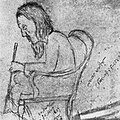
[[File:Ektara player.jpg|alt=|thumb|A Baul from [[Lalon|Lalon Shah's]] shrine in [[Kushtia District|Kushtia]], [[ | [[File:Ektara player.jpg|alt=|thumb|A Baul from [[Lalon|Lalon Shah's]] shrine in [[Kushtia District|Kushtia]], Bangladesh]] | ||
The '''Baul''' ({{ | [[File:Ektara.JPG|thumb|upright|[[Ektara]], a common musical instrument of Bauls]] | ||
{{Culture of Bengal}} | |||
{{Bengalis}} | |||
The '''Baul''' ({{langx|bn|বাউল}}) are a group of mystic minstrels of mixed elements of [[Sufism]] and [[Vaishnava Sahajiya]] from different parts of [[Bangladesh]] and the Indian states of [[West Bengal]], [[Tripura]] and [[Assam]]'s [[Barak Valley]] and [[Meghalaya]].<ref>{{Cite web |title=Baul {{!}} Folk Singers, Mysticism & Sufism |url=https://www.britannica.com/art/Baul |access-date=2024-06-15 |website=Encyclopædia Britannica |language=en}}</ref><ref name="Banglapedia" /> Bauls constitute both a [[religious syncretism|syncretic religious]] sect of troubadours and a musical tradition. Bauls are a very heterogeneous group, with many sects, but their membership mainly consists of [[Sufi]] [[Bengali Muslims]] and [[Gaudiya Vaishnavism|Gaudiya Vaishnava]] [[Bengali Hindus]].<ref>{{cite web |url=https://www.britannica.com/topic/Baul |title=Baul (Indian music) |date=18 June 2015 |website=Encyclopædia Britannica}}</ref><ref name="tt">{{cite news |url=http://articles.timesofindia.indiatimes.com/2010-02-06/news-and-interviews/28126586_1_sound-barrier-dur-dalai-lama |title=Bauled over |date=6 Feb 2010 |work=The Times of India |access-date=4 July 2013 |archive-date=4 November 2012 |archive-url=https://web.archive.org/web/20121104114314/http://articles.timesofindia.indiatimes.com/2010-02-06/news-and-interviews/28126586_1_sound-barrier-dur-dalai-lama}}</ref> They can often be identified by their distinctive clothes and musical instruments. [[Lalon|Lalon Shah]] is regarded as the most celebrated Baul saint in history.<ref>{{cite book |title=World and its People: Eastern and Southern Asia |year=2007 |publisher=Marshal Cavendish Corporation |location=New York |isbn=978-0-7614-7631-3 |page=480}}</ref><ref>{{cite book |last=Paul |first=Harendra Chandra |chapter=Origin of the Bauls and their Philosophy |year=1987 |editor-last=Khan |editor-first=Shamsuzzaman |editor-link=Shamsuzzaman Khan |title=Folklore of Bangladesh |volume=1 |location=Dhaka |publisher=Bangla Academy |page=257 |quote=Faquir Lalan-Shah (1775–1891 A.D.), its greatest exponent}}</ref><ref>{{cite book |last=Chowdhury |first=Kabir |title=Folk Poems From Bangladesh |year=1985 |publisher=Bangla Academy |location=Dhaka |pages=ii}}</ref> | |||
Although Bauls constitute only a small fraction of the Bengali population, their influence on the [[culture of Bengal]] is considerable. In 2005, the Baul tradition of Bangladesh was included in the list of [[Masterpieces of the Oral and Intangible Heritage of Humanity]] by [[UNESCO]].<ref name=unesco>[http://portal.unesco.org/en/ev.php-URL_ID=30973&URL_DO=DO_TOPIC&URL_SECTION=201.html Masterpieces of the Oral and Intangible Heritage of Humanity]. UNESCO. 25 September 2005.</ref> | Although Bauls constitute only a small fraction of the Bengali population, their influence on the [[culture of Bengal]] is considerable. In 2005, the "Baul tradition of Bangladesh" was included in the list of [[Masterpieces of the Oral and Intangible Heritage of Humanity]] by [[UNESCO]].<ref name=unesco>[http://portal.unesco.org/en/ev.php-URL_ID=30973&URL_DO=DO_TOPIC&URL_SECTION=201.html Masterpieces of the Oral and Intangible Heritage of Humanity]. UNESCO. 25 September 2005.</ref> | ||
==Etymology== | ==Etymology== | ||
The origin of the word ''Baul'' is debated. | The origin of the word ''Baul'' is debated. A common view is that it may be derived either from the [[Sanskrit]] word ''vātula'', which means "mad, crazy", or from ''vyākula'', which means "impatiently eager, upset". A recent scholarly research suggests that the Bauls may be descendants of a specific branch of Sufism referred to as ''ba'al''.<ref name="Banglapedia" /> According to philosopher [[Shashibhusan Dasgupta]], both of these derivations are consistent with the modern sense of the word, "inspired people with an ecstatic eagerness for a spiritual life where one can realise one's union with the eternal Beloved".<ref>{{cite book |last1=Dasgupta |first1=Shashibhushan |author-link=Shashibhusan Dasgupta |title=Obscure Religious Cults |year=1962 |orig-year=First published 1946 |location=Calcutta |publisher=Firma KLM |pages=160–161 |oclc=534995}}</ref> Another theory is that it comes from the Persian word ''Aul''.<ref>{{cite journal |last1=Urban |first1=Hugh B. |author-link=Hugh Urban |title=The Marketplace and the Temple: Economic Metaphors and Religious Meanings in the Folk Songs of Colonial Bengal |journal=The Journal of Asian Studies |date=November 2001 |volume=60 |issue=4 |pages=1091 |doi=10.2307/2700021 |jstor=2700021}}</ref> | ||
==History== | ==History== | ||
The origin of Bauls is not known exactly, but the word "Baul" has appeared in Bengali texts as old as the 15th century. The word is found in the ''[[Chaitanya Bhagavata]]'' of [[Vrindavana Dasa Thakura]] as well as in the ''[[Chaitanya Charitamrita]]'' of [[Krishnadasa Kaviraja]].<ref> | The origin of Bauls is not known exactly, but the word "Baul" has appeared in Bengali texts as old as the 15th century. The word is found in the ''[[Chaitanya Bhagavata]]'' of [[Vrindavana Dasa Thakura]] as well as{{citation needed|date=March 2024}} in the ''[[Chaitanya Charitamrita]]'' of [[Krishnadasa Kaviraja]].<ref>{{cite book |last1=Dasgupta |first1=Shashibhushan |author-link=Shashibhusan Dasgupta |title=Obscure Religious Cults |year=1962 |orig-year=First published 1946 |location=Calcutta |publisher=Firma KLM |page=161 |oclc=534995}}</ref> Some scholars maintain that it is not clear when the word took its sectarian significance, as opposed to being a synonym for the word ''madcap, agitated''. Bauls are a part of the culture of rural [[Bengal]]. Many attempts have been made to ascertain the origin of Bauls but there is wide disagreement among scholars.<ref>{{cite book |last=Openshaw |first=Jeanne |author-link=Jeanne Openshaw |title=Seeking Bauls of Bengal |url=https://books.google.com/books?id=YGDWuQ-wjB8C&pg=PA58 |year=2002 |publisher=Cambridge University Press |isbn=978-0-521-81125-5 |page=58}}</ref> But they agree that no founders have been acknowledged either by Bauls themselves or others.<ref name="Openshaw2002">{{cite book |last=Openshaw |first=Jeanne |author-link=Jeanne Openshaw |title=Seeking Bauls of Bengal |url=https://books.google.com/books?id=YGDWuQ-wjB8C&pg=PA56 |year=2002 |publisher=Cambridge University Press |isbn=978-0-521-81125-5 |page=56}}</ref> Bauls are divided into several named groups, each following a named Hindu or Muslim guru. Besides, there are other communities who later identified or affiliated themselves with Bauls, like ''Darbesi'', ''Nera'' and two sub-sects of [[Kartabhaja]]s — ''Aul'' and ''Sai''. The Bauls themselves attribute their lack of historical records to their reluctance to leave traces behind. Dr. Jeanne Openshaw writes that the music of the Bauls appears to have been passed down entirely in oral form until the end of the 19th century, when it was first transcribed by outside observers.<ref name="Openshaw2002"/> | ||
[[Ahmed Sharif]] says about history of Baulism in his book “Baul Tattva”, “A mixed sect has been formed by the cooperation of Brahmanism, Shaivism and Buddhist Sahajiya sects, called Nathpanth. Their goal is physical pursuits. (Nathpanth and Sahajiya) people of these two sects were once converted to Islam and Vaishnavism, but since it was not possible to abandon the old beliefs and reforms, they continued to practice religion in the old traditions even under the auspices of Islam and Vaishnavism, as a result of which the Baulism, a combination of Hindus and Muslims, emerged. Therefore, there is no obstacle in accepting the Muslim vows of a Hindu guru or the Hindu vows of a Muslim guru. They have broken the barriers of Brahmanism and Shariat Islam and have paved the way according to their own mind. That is why they say, “Kali Krishna is God, there is no barrier to any name. Say Kali Krishna is God.”<ref>{{cite book |last1=Sharif |first1=Ahmed |author1-link=Ahmed Sharif |title=বাউলতত্ত্ব (Baultattva) |date=2014 |publisher=Books Fair |location=Dhaka |isbn=9847015802066 |pages=36–42|url=https://grontho.net/%E0%A6%AC%E0%A6%BE%E0%A6%89%E0%A6%B2%E0%A6%A4%E0%A6%A4%E0%A7%8D%E0%A6%A4%E0%A7%8D%E0%A6%AC/ |quote=|trans-title=Baulism}}</ref> | |||
There are two classes of Bauls: [[asceticism|ascetic]] Bauls who reject family life and Bauls who live with their families. Ascetic Bauls renounce family life and society and survive on alms. They have no fixed dwelling place, but move from one {{ | There are two classes of Bauls: [[asceticism|ascetic]] Bauls who reject family life and Bauls who live with their families.<ref name="Banglapedia" /> Ascetic Bauls renounce family life and society and survive on alms. They have no fixed dwelling place, but move from one {{transliteration|bn|akhda}} to another. Bangladeshi men wear white [[lungi]]s and long, white tunics; women wear white [[sari]]s. They carry {{transliteration|bn|jholas}}, shoulder bags for alms. They do not beget or rear children. They are treated as {{transliteration|bn|jyante mara}}. Women dedicated to the service of ascetics, are known as {{transliteration|bn|sevadasis}} "service slaves". A male Baul can have one {{transliteration|bn|sevadasi}}, who is associated with him in the act of devotion. Until 1976 the district of Kushtia had 252 ascetic Bauls. In 1982–83 the number rose to 905; in 2000, they numbered about 5000.{{citation needed|date=May 2017}} | ||
Those who choose family life, live with their spouse, children and relations in a secluded part of a village. They do not mix freely with other members of the community. Unlike ascetic Bauls, their rituals are less strict. In order to become Bauls, they recite some mystic verses and observe certain rituals.<ref>{{cite book |last=Karim |first=Anwarul |year=2012 |chapter=Baul |chapter-url=http://en.banglapedia.org/index.php?title=Baul |editor1-last=Islam |editor1-first=Sirajul |editor1-link=Sirajul Islam |editor2-last=Jamal |editor2-first=Ahmed A. |title=Banglapedia: National Encyclopedia of Bangladesh |edition=Second |publisher=[[Asiatic Society of Bangladesh]]}}</ref> | Those who choose family life, live with their spouse, children and relations in a secluded part of a village. They do not mix freely with other members of the community. Unlike ascetic Bauls, their rituals are less strict. In order to become Bauls, they recite some mystic verses and observe certain rituals.<ref name="Banglapedia">{{cite book |last=Karim |first=Anwarul |year=2012 |chapter=Baul |chapter-url=http://en.banglapedia.org/index.php?title=Baul |editor1-last=Islam |editor1-first=Sirajul |editor1-link=Sirajul Islam |editor2-last=Jamal |editor2-first=Ahmed A. |title=Banglapedia: National Encyclopedia of Bangladesh |edition=Second |publisher=[[Asiatic Society of Bangladesh]]}}</ref> | ||
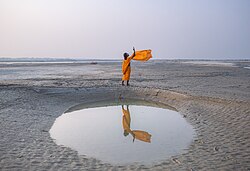
The bauls from India dress colourfully in orange and red and have a somewhat different way of getting together. In Bangladesh, Bauls mostly dress in white which symbolises purity. There is a big yearly gathering called Jaydeb Mela, taking place in Januari in Kenduli, near Bolpur, which attract bauls and followers in large numbers. | |||
==Concepts and practices== | ==Concepts and practices== | ||
[[File:Fakir Lalon Shah.jpg|left|thumb|175x175px|[[Lalon]], the most celebrated Baul saint in history, by [[Jyotirindranath Tagore]], 1889]] | [[File:Fakir Lalon Shah.jpg|left|thumb|175x175px|[[Lalon]], the most celebrated Baul saint in history, by [[Jyotirindranath Tagore]], 1889]] | ||
===Musical asceticism=== | |||
Baul music celebrates celestial love, but does this in very earthy terms, as in declarations of love by the Baul for his bosh-tomi or lifemate. | Baul music celebrates celestial love, but does this in very earthy terms, as in declarations of love by the Baul for his bosh-tomi or lifemate. | ||
With such a liberal interpretation of love, it is only natural that Baul devotional music transcends religion and some of the most famous baul composers, such as [[Lalon]], criticised the superficiality of religious divisions: | With such a liberal interpretation of love, it is only natural that Baul devotional music transcends religion and some of the most famous baul composers, such as [[Lalon]], criticised the superficiality of religious divisions: | ||
| Line 38: | Line 46: | ||
some tasbis [Muslim rosaries], and so people say<br /> | some tasbis [Muslim rosaries], and so people say<br /> | ||
they've got different religions.<br /> | they've got different religions.<br /> | ||
But do you bear the sign of your religion when you come or when you go? | But do you bear the sign of your religion when you come or when you go?"<ref name="Baul Songs">{{cite book |last=Lopez |first=Donald |title=Religions in India in Practice – "Baul Songs" |year=1995 |publisher=Princeton University Press |location=Princeton, NJ |isbn=0-691-04324-8 |pages=[https://archive.org/details/religionsofindia00dona/page/187 187–208] |url=https://archive.org/details/religionsofindia00dona/page/187 |url-access=registration}}</ref>}} | ||
===Physical esotericism=== | |||
Their religion is based on an expression of the body (''deho sādhanā''), and an expression of the mind (''mana sādhanā''). Some of their rituals are kept hidden from outsiders,<ref>{{cite journal |last=Lorea |first=Carola Erika |title="I Am Afraid of Telling You This, Lest You'd Be Scared Shitless!": The Myth of Secrecy and the Study of the Esoteric Traditions of Bengal |journal=Religions |volume=9 |issue=6 |pages=172 |date=25 May 2018 |doi=10.3390/rel9060172 |quote="Moreover, according to most of my informants, while practices are fit to be covered by secrecy and a secret jargon, theories are not." |doi-access=free}}</ref> as they might be thought to be repulsive or hedonistic. Bauls concentrate much of their mystic energies on the four body fluids, on the nine-doors (openings of the body), on [[Prakriti|prakṛiti]] as "energy of nature" or "primal motive force", and on breath [[sādhanā]]. | |||
Women were given the highest honor in Tantra as well as Baulism.<ref name=cl/><ref name=Sl/> One of the Panca-tattvas or Pañcamakāras (Madya-mamsa-matsya-mudra-maithuna) that is considered essential for Tantric sadhana is the lady, whom they used to call ma (mother), which they also adrresses their wives as.<ref name=cl/><ref name=Sl/> Some Tantras claim that even a prostitute might be a Tantric devotee's companion (Sadhana-sangini). A person's mother is their best teacher.<ref name=Sl>{{cite book |last1=Banerji |first1=Sures Chandra |title=A Layman's Guide to Sanskrit Literature |date=1997 |publisher=AMBER books |isbn=978-81-202-0421-8 |page=47 |url=https://books.google.com/books?id=XfFjAAAAMAAJ&q=T%C4%81ntric+devote%C3%A8s+(+Sadhana+-+sangini+)+One%27s+mother |access-date=6 December 2025 |language=en}}</ref> Because a Sadhaka's (male practitioner) success in Sadhana is solely dependent on his Sadhan Sangini (female consort), she is seen as superior to the man in terms of Sadhana.<ref>{{cite book |title=Man and Life |date=2003 |publisher=Institute of Social Research and Applied Anthropology |page=121 |url=https://books.google.com/books?id=DJGAAAAAMAAJ&q=sangini+baul |access-date=6 December 2025 |language=en}}</ref> Instead of calling their spouses strī (wife), many Baul males used to refer to them as sangini (companion). While some Vaishnava Bauls engage in regular social weddings with a Hindu priest and a dowry, others exchange garlands under the supervision and blessings of a guru, a practice known as mālācandan or mālābadal. Since this kind of exchange is performed in front of one's guru, whom pupils are required to obey, some Bauls believed it to be more binding than a typical social wedding. However, there is considerable disagreement and disagreement on the durability of Baul weddings performed in this manner.<ref name=cl>{{cite book |last1=Knight |first1=Lisa I. |title=Contradictory Lives: Baul Women in India and Bangladesh |date=October 2014 |publisher=Oxford University Press |isbn=978-0-19-939684-9 |page=74 |url=https://books.google.com/books?id=s_8TDAAAQBAJ&dq=baul+marriage&pg=PA74 |access-date=6 December 2025 |language=en}}</ref> As a practicing partner (sadhana sangini), fornication or other's wife (Parakia) is preferable for Vaishnavi Bauls. However, [[Fakir|Muslim Baul]]s typically make his own wife (Shwakia) as partner.<ref>{{cite book |title=Māhe-nao |date=1964 |page=58 |url=https://books.google.com/books?id=dF3NAAAAMAAJ&q=sangini+baul |access-date=6 December 2025 |language=bn}}</ref> | |||
===Impuristic occultism=== | |||
According to Bauls, using narcotics promotes achievement, happiness at work, and mental clarity. For nearly the same reason, this nation's saints, monks, Bauls, and fakirs use marijuana,<ref>{{cite book |last1=Openshaw |first1=Jeanne |title=Seeking Bauls of Bengal |date=25 July 2002 |publisher=Cambridge University Press |isbn=978-0-521-81125-5 |page=4 |url=https://books.google.com/books?id=AvsQjPPu_okC&dq=marijuana+baul&pg=PA4 |access-date=6 December 2025 |language=en}}</ref> siddhi ([[cannabis]] flower),<ref>{{cite book |title=ভারতকোষ |date=1964 |publisher=Baṅgīẏa Sāhitya Parishat̲ |url=https://books.google.com/books?id=POQRAQAAIAAJ&q=%22%E0%A6%97%E0%A6%BE%E0%A6%81%E0%A6%9C%E0%A6%BE+%E0%A6%B8%E0%A6%BF%E0%A6%A6%E0%A7%8D%E0%A6%A7%E0%A6%BF%22 |access-date=6 December 2025 |language=bn}}</ref> and [[bhang]] as the primary supplements for their sadhana and meditate while intoxicated. They also use narcotics like hashish and cocaine.<ref>{{cite book |title=Caṭṭagrāma Biśvabidyālaẏa Sṭāḍija: Samāja bijñāna |date=2 November 1990 |publisher=The University |page=212 |url=https://books.google.com/books?id=pjoS0X-FJvIC&q=%E0%A6%AC%E0%A6%BE%E0%A6%89%E0%A6%B2+%E0%A6%97%E0%A6%BE%E0%A6%9C%E0%A6%BE+%E0%A6%B8%E0%A6%BF%E0%A6%A6%E0%A7%8D%E0%A6%A7%E0%A6%BF |access-date=6 December 2025 |language=en}}</ref> | |||
To get rid of all diseases, they make a substance called Prembhaja/Premvaja /Prem Bhoja<ref name="Tem">{{cite book |title=Temenos |date=1997 |publisher=Suomen Uskontotieteellinen Seura |page=46 |url=https://books.google.com/books?id=SusnAAAAYAAJ&q=sufi+five+feces+urine+semen |access-date=4 December 2025 |language=en |quote=modern fakirs there is considerable controversy over the consumption of physical representative substances. The Pancan Rasa group con-sumes all five, including urine and feces as an aspect of prema bhoja. The Maij Bhandari consume only semen and menstrual blood (Cashin 1995: 195). Through this, we find a link also to nathistic}}</ref>(প্রেমভাজা/প্রেমভোজ)<ref>{{cite book |last1=Raśīda |first1=Phakīra Ābadura |title=Sūphī darśana |date=1980 |publisher=Isalāmī Sāṃskr̥tika Kendra, Sileṭa |page=122 |url=https://books.google.com/books?id=gpQJAQAAIAAJ&q=%22%E0%A6%AA%E0%A7%8D%E0%A6%B0%E0%A7%87%E0%A6%AE%E0%A6%AD%E0%A6%BE%E0%A6%9C%E0%A6%BE%22 |access-date=4 December 2025 |language=bn}}</ref><ref>{{cite book |last1=Śāha |first1=Lālana |title=Lālana Śāh o Lālana-gītikā |date=1968 |publisher=Bāṃlā Ekāḍemī |page=163 |url=https://books.google.com/books?id=POMRAQAAIAAJ&q=%22%E0%A6%AA%E0%A7%8D%E0%A6%B0%E0%A7%87%E0%A6%AE%E0%A6%AD%E0%A6%BE%E0%A6%9C%E0%A6%BE%22 |access-date=4 December 2025 |language=bn}}</ref> (love fry/love feast) by mixing four substances called by them four moons<ref>{{cite book |last1=Mukharji |first1=Projit Bihari |title=Nationalizing the Body: The Medical Market, Print and Daktari Medicine |date=2011 |publisher=Anthem Press |isbn=978-0-85728-995-7 |page=232 |url=https://books.google.com/books?id=CuNe6GPLheAC&dq=%22Chari+Chandra%22&pg=PA232 |access-date=4 December 2025 |language=en}}</ref> (চারি চন্দ্র,<ref>{{cite book |last1=Sengupta |first1=Mausumi Majumdar |title=Baul Songs: In Quest of Universal Humanism |date=2011 |publisher=Anthropological Survey of India, Government of India |page=33 |url=https://books.google.com/books?id=j-UypgtCNmcC&q=sufi+five+feces+urine+semen |access-date=4 December 2025 |language=en |quote=CaricOndro (Four moons) "mal . ( stool ) , mūtra ( urine ) , rajah ( menstrual flow ) and śukra ( male sexual excretion ) "}}</ref><ref>{{cite book |last1=Karim |first1=Anwarul |author1-link=:bn:আনোয়ারুল করীম |title=বাংলাদেশের বাউল: সমাজ, সাহিত্য ও সংগীত (Bangladesher baul: samaj, shahityo o sangeet)|page=408 |date=2017 |publisher=Kathaprakash |isbn=9847012004227 |edition=2nd |url=http://182.160.97.198:8080/xmlui/handle/123456789/1066 |access-date=4 December 2025 |language=bn |quote=বাউলদের মধ্যে সর্বরোগ থেকে মুক্ত হওয়ার জন্য চারিচন্দ্র অর্থাৎ মল, মূত্র, রজঃ, বীর্য মিশ্রণে একপ্রকার পদার্থ তৈরি করে তা 'প্রেম ভাজা' নামে ভক্ষণের রীতি বাউলসমাজে আছে। এই চারিচন্দ্র সমগ্র শরীরে, কপালে, বুকে, পিঠে, মাথায় মর্দন করাও হয়ে থাকে। স্বীয় প্রস্রাব মাটিতে মিশিয়ে তা কপালে বা গায়ে মাখালে মাথাব্যথা, গা ব্যথা এবং জ্বরাদির উপশম হয়। বাউলদের মধ্যে এমন ধারণা আছে শুক্রকে স্খলনের মুহূর্তে ঊর্ধ্বে ওঠাতে সক্ষম হলে অজর যৌবনলাভ সম্ভব হয়। চারিচন্দ্র অর্থাৎ মল, মূত্র, রজঃ, বীর্ষ একত্রে মিশিয়ে গায়ে মাখালে চর্মরোগ হয় না-এমন ধারণা আছে বাউলদের। (Among the Bauls, to get rid of all diseases, there is a custom in the Bauls society to make a mixture of four chandras, i.e. feces, urine, rajas, and semen, and eat it called 'prem bhaja'. This chari chandra is also rubbed all over the body, forehead, chest, back, and head. Mixing one's own urine with soil and applying it to the forehead or body relieves headaches, backaches, and fevers. Bauls believe that if one is able to raise the sperm at the moment of ejaculation, one can attain eternal youth. Bauls believe that mixing chari chandras, i.e. feces, urine, rajas, and semen together and applying it to the body prevents skin diseases.) |trans-title=The Baul of Bangladesh: Society, literatures and songs}}</ref><ref>{{cite book |last1=Sharif |first1=Ahmed |author1-link=Ahmed Sharif |title=বাউলতত্ত্ব (Baultattva) |date=2014 |publisher=Books Fair |location=Dhaka |isbn=9847015802066 |page=38|url=https://grontho.net/%E0%A6%AC%E0%A6%BE%E0%A6%89%E0%A6%B2%E0%A6%A4%E0%A6%A4%E0%A7%8D%E0%A6%A4%E0%A7%8D%E0%A6%AC/ |quote=চারিচন্দ্র হচ্ছে- মল, মূত্র, রজঃ ও শুক্র। (The four moons are feces, urine, menstruation, and semen.) |trans-title=Baulism}}</ref> Chari Chandra<ref>{{cite book |last1=Ganguli |first1=Dr Siddhartha |title=The Four Moons in the Human Body: The Mysterious Tales of the Bauls of Bengal (Introducing 'BaulOlogy') |date=12 October 2023 |publisher=Allied Publishers |isbn=978-93-90951-76-5 |page=x |url=https://books.google.com/books?id=-qbdEAAAQBAJ&dq=%22%E0%A6%9A%E0%A6%BE%E0%A6%B0%E0%A6%BF-%E0%A6%9A%E0%A6%A8%E0%A7%8D%E0%A6%A6%E0%A7%8D%E0%A6%B0%22&pg=PR10 |access-date=4 December 2025 |language=en}}</ref>) (Sarala Chandra or simplistic moons (milk and semen), Garala Chand or venom moons (urine and menstrual blood), Rohini Chandra or ascending moons (Leukorrhea) and Mohini Chandra or seductress moons or Nij Chandra or self moon (barley doe and feces)<ref>{{cite journal |last1=Kaiji |first1=Balan |title=চাঁদের ফাঁদে মুসলমান: চাঁদ ও চন্দ্র (২য় পর্ব) {{!}} সাময়িকী |journal=[[:bn:সাময়িকী (পত্রিকা)|Samoyiki (journal)]] |date=21 April 2021 |url=https://www.samoyiki.com/2021/04/21/5168/ |accessdate=5 December 2025 |language=bn-BD}}</ref> and eat it in [[Rohini (nakshatra)|Rohini]] [[Yoga]],<ref>{{cite book |title=Folklore |date=1980 |publisher=Folklore Research Institute. |page=32 |url=https://books.google.com/books?id=pm6BAAAAMAAJ&q=Prembhaja |access-date=4 December 2025 |language=en |quote=They prepare certain kind of pills known as}}</ref><ref>{{cite book |last1=Jhā |first1=Śaktinātha |title=Bastubādī Bāula: udbhaba, samāja, saṃskr̥ti o darśana |date=1999 |publisher=Lokasaṃskr̥ti o Ādibāsī Saṃskr̥ti Kendra, Tathya o Saṃskr̥ti Bibhāga, Paścimabaṅga Sarakāra |page=294 |url=https://books.google.com/books?id=szVPAQAAMAAJ&q=%22Prem-bhaja%22 |access-date=4 December 2025 |language=bn}}</ref><ref>{{cite book |last1=Karīma |first1=Ānoẏārula |title=The Myths of Bangladesh |date=1988 |publisher=Folklore Research Institute |page=142 |url=https://books.google.com/books?id=tCduAAAAMAAJ&q=%22Prem-bhaja%22 |access-date=4 December 2025 |language=en |quote=the Baul terminology is called 'jyante mora". When one is initiated into Baul cult he or she cannot get back intochamber and in presence of the Guru or spiritual leader. The Guru gives 'vij-mantra' or 'kalma". The Guru then offers prem-bhaja mixed with four fluids of the human body (urine, human milk, phlegm and feces).}}</ref> which is frequently mentioned in Baul songs and Lalon songs.<ref>{{cite book |last1=Ālī |first1=Śa Ma Śaokata |title=Kushṭiẏā Jelāẏa Isalāma |date=1992 |publisher=Isalāmika Phāuṇḍeśana Bāṃlādeśa |isbn=978-984-06-0073-1 |page=126 |url=https://books.google.com/books?id=okIFAQAAIAAJ&q=%22%E0%A6%AA%E0%A7%8D%E0%A6%B0%E0%A7%87%E0%A6%AE+%E0%A6%AD%E0%A6%BE%E0%A6%9C%E0%A6%BE%22 |access-date=4 December 2025 |language=bn}}</ref><ref>{{cite book |last1=Bandyopadhyaya |first1=Bireshwar |title=Bāńglādesér Sańg Prasańge |date=1972 |publisher=Asiatic Society |page=382 |url=https://books.google.com/books?id=MOERAQAAIAAJ&q=%22%E0%A6%AA%E0%A7%8D%E0%A6%B0%E0%A7%87%E0%A6%AE+%E0%A6%AD%E0%A6%BE%E0%A6%9C%E0%A6%BE%22 |access-date=4 December 2025 |language=bn}}</ref> It is derived from the ritual called Panch Pavitra (पंचपवित्र, five holy (things)) of [[tantric]] community,<ref>{{cite book |last1=Gadgil |first1=Sadashiv Ramchandra |author1-link=Ramchandra Bhargav Dhananjay Ramchandra Gadgil |title=Vaidika yajña, Madhyayugīna tantrasādhanā, āṇi Jñāneśvarapraṇīta bhaktiyoga |date=1979 |publisher=Dāstāne Rāmacandra |page=192 |url=https://books.google.com/books?id=Jx8dAAAAMAAJ&q=%22%E0%A4%9A%E0%A4%BE%E0%A4%B0%E0%A5%80+%E0%A4%9A%E0%A4%82%E0%A4%A6%E0%A5%8D%E0%A4%B0%22 |access-date=4 December 2025 |language=mr |quote=चारी चंद्र ' ( Four moons ) या नावाने तांत्रिकांचा ' पंचपवित्र ' विधी या पंथात सांगितला आहे . हा सर्व विधी अत्यंत घृणास्पद असाच असल्याने (The 'Panchapavitra' ritual of the Tantrics is mentioned in this sect under the name 'Chari Chandra' (Four moons). Since all these rituals are extremely abominable,)}}</ref><ref>{{cite book |last1=Singh |first1=Raj Deo |author1-link=Rajdeo Singh |title=Ṡaisla aura artha |date=1968 |page=181 |url=https://books.google.com/books?id=kv4QAAAAMAAJ&q=%E0%A4%AA%E0%A4%82%E0%A4%9A%E0%A4%AA%E0%A4%B5%E0%A4%BF%E0%A4%A4%E0%A5%8D%E0%A4%B0 |access-date=4 December 2025 |language=hi |quote=मल और मूत्र को तांत्रिकों ने पंचपवित्रों में गिना है। दे० आगे, पंचमकार के अन्तर्गत विवेचित 'पंचपवित्र ।' (Faeces and urine are considered by the tantrics to be among the five holy things. Further, Panchamakara is discussed under 'Panchavitra'.)}}</ref> also performed as [[Panchamakara|Panchan Rasa]] (Five juice) in [[Sufi]] [[Fakir]] community.<ref name="Tem"/> In another explanation, this practice is called as a form of "[[Gayatri]] Kriya" to achieve immortality.<ref>{{cite book |last1=Jahid |first1=Shaikh |title=Ādya paricaẏa |date=1964 |publisher=Barendra Risārca Miujiẏāma |page=23 |url=https://books.google.com/books?id=IvMwAAAAMAAJ&q=%22%E0%A6%97%E0%A6%BE%E0%A6%AF%E0%A6%BC%E0%A6%A4%E0%A7%8D%E0%A6%B0%E0%A7%80+%E0%A6%95%E0%A7%8D%E0%A6%B0%E0%A6%BF%E0%A6%AF%E0%A6%BC%E0%A6%BE%22 |access-date=4 December 2025 |language=bn}}</ref> | |||
==Music== | ==Music== | ||
| Line 46: | Line 62: | ||
The music of the Bauls, ''Baul Sangeet'', is a particular type of folk song. Their music represents a long heritage of preaching mysticism through songs in Bengal. | The music of the Bauls, ''Baul Sangeet'', is a particular type of folk song. Their music represents a long heritage of preaching mysticism through songs in Bengal. | ||
Bauls pour out their feelings in their songs but never bother to write them down. Theirs is essentially an oral tradition. It is said that [[Lalon|Lalon Fakir]] ( | Bauls pour out their feelings in their songs but never bother to write them down. Theirs is essentially an oral tradition. It is said that [[Lalon|Lalon Fakir]] (1774–1890), the greatest of all Bauls, continued to compose and sing songs for decades without ever stopping to correct them or put them on paper. It was only after his death that people thought of collecting and compiling his repertoire. | ||
Their lyrics intertwine a deep sense of mysticism, a longing for oneness with the divine. An important part of their philosophy is "Deha tatta", a spirituality related to the body rather than the mind. They seek the divinity in human beings. Metaphysical topics are dwelt upon humbly and in simple words. They stress remaining unattached and unconsumed by the pleasures of life even while enjoying them. To them we are all a gift of divine power and the body is a temple, music being the path to connect to that power.<ref name="about1">{{cite web|url=http://hinduism.about.com/od/artculture/a/bauls.htm|title=Bauls of Bengal|date=10 April 2012|website=Hinduism.about.com|access-date=2012-10-10}}</ref><ref name="emahomagazine1">{{cite web |author=Music |url=http://www.emahomagazine.com/2011/07/bauls-of-bengal-liberation-seekers/ |archive-url=https://archive.today/20120729054639/http://www.emahomagazine.com/2011/07/bauls-of-bengal-liberation-seekers/ | Their lyrics intertwine a deep sense of mysticism, a longing for oneness with the divine. An important part of their philosophy is "Deha tatta", a spirituality related to the body rather than the mind. They seek the divinity in human beings. Metaphysical topics are dwelt upon humbly and in simple words. They stress remaining unattached and unconsumed by the pleasures of life even while enjoying them. To them we are all a gift of divine power and the body is a temple, music being the path to connect to that power.<ref name="about1">{{cite web |url=http://hinduism.about.com/od/artculture/a/bauls.htm |title=Bauls of Bengal |date=10 April 2012 |website=Hinduism.about.com |access-date=2012-10-10 |archive-date=11 January 2017 |archive-url=https://web.archive.org/web/20170111002444/http://hinduism.about.com/od/artculture/a/bauls.htm |url-status=dead}}</ref><ref name="emahomagazine1">{{cite web |author=Music |url=http://www.emahomagazine.com/2011/07/bauls-of-bengal-liberation-seekers/ |archive-url=https://archive.today/20120729054639/http://www.emahomagazine.com/2011/07/bauls-of-bengal-liberation-seekers/ |archive-date=29 July 2012 |title=Bauls of Bengal – The Liberation Seekers |work=Emaho Magazine |date=26 July 2011 |access-date=2012-10-10}}</ref> A consistent part of Bauls' lyrics deals with body-centered practices that aim at controlling sexual desire. The esoteric knowledge of conception and contraception is revealed in the lyrics of the songs through an enigmatic language that needs to be decoded by the guru in order to be understood and experienced.<ref>{{Cite journal |last=Lorea |first=Carola |year=2014 |title=Why do you go swimming in the river full of algae? Conception and contraception in Baul songs and oral teachings |url=https://www.academia.edu/8257095 |journal=Journal of Folklore and Folkloristics |volume=7 |issue=1 |pages=9–45}}</ref> | ||
[[File:Gacher pata taka keno hoy na - Baul Song Performance - Tarun Khyapa and Ananda Khyapa with Group - Saturday Haat - Sonajhuri - Birbhum 2014-06-28 5326.ogv|thumb|''Gacher pata taka keno hoy na'', Baul song performance at the Saturday haat, Sonajhuri, Birbhum.]] | [[File:Gacher pata taka keno hoy na - Baul Song Performance - Tarun Khyapa and Ananda Khyapa with Group - Saturday Haat - Sonajhuri - Birbhum 2014-06-28 5326.ogv|thumb|''Gacher pata taka keno hoy na'', Baul song performance at the Saturday haat, Sonajhuri, Birbhum.]] | ||
Besides traditional motifs drawn from the rural everyday life, Baul songs have always been inclined to incorporate change and keep pace with social and economic innovations. For instance, modern Baul compositions discuss esoteric matters by using the terminology of modern, urban and technological lexicons, and it is not unusual to hear Baul refrains containing mobile phones, radio channels, football matches and television.<ref>{{Cite journal|last=Lorea|first=Carola Erika|date=January 2014|title=Searching for the Divine, Handling Mobile Phones|journal=[[History and Sociology of South Asia]] |language=en|volume=8|issue=1|pages=59–88|doi=10.1177/2230807513506629|s2cid=146915924|issn=2230-8075}}</ref> | Besides traditional motifs drawn from the rural everyday life, Baul songs have always been inclined to incorporate change and keep pace with social and economic innovations. For instance, modern Baul compositions discuss esoteric matters by using the terminology of modern, urban and technological lexicons, and it is not unusual to hear Baul refrains containing mobile phones, radio channels, football matches and television.<ref>{{Cite journal |last=Lorea |first=Carola Erika |date=January 2014 |title=Searching for the Divine, Handling Mobile Phones |journal=[[History and Sociology of South Asia]] |language=en |volume=8 |issue=1 |pages=59–88 |doi=10.1177/2230807513506629 |s2cid=146915924 |issn=2230-8075}}</ref> | ||
Bauls use a number of musical instruments: the most common is the ''[[ektara]]'', a one-stringed "plucked drum" drone instrument, carved from the epicarp of a gourd, and made of bamboo and goatskin. Others include the ''[[dotara]]'', a long-necked fretless lute (while the name literally means "two stringed" it usually has four metal strings) made of the wood of a jackfruit or neem tree; besides ''[[khamak]]'', one-headed drum with a string attached to it which is plucked. The only difference from ektara is that no bamboo is used to stretch the string, which is held by one hand, while being plucked by another.<ref name="Barthakur2003">{{cite book|author=Dilip Ranjan Barthakur|title=The Music And Musical Instruments of North Eastern India|url=https://books.google.com/books?id=oP4vH-4oSEcC&pg=PA130|access-date=14 July 2013|year=2003|publisher=Mittal Publications|isbn=978-81-7099-881-5|pages=130–}}</ref> Drums like the [[duggi (drum)|duggi]], a small hand-held earthen drum, and ''[[dhol]]'' and ''[[khol]]''; small cymbals called ''[[khartal]]'' and ''[[manjira]]'', and the bamboo flute are also used. ''Ghungur'' and ''nupur'' are anklets with bells that ring while the person wearing them dances. | Bauls use a number of musical instruments: the most common is the ''[[ektara]]'', a one-stringed "plucked drum" drone instrument, carved from the epicarp of a gourd, and made of bamboo and goatskin. Others include the ''[[dotara]]'', a long-necked fretless lute (while the name literally means "two stringed" it usually has four metal strings) made of the wood of a jackfruit or neem tree; besides ''[[khamak]]'', one-headed drum with a string attached to it which is plucked. The only difference from ektara is that no bamboo is used to stretch the string, which is held by one hand, while being plucked by another.<ref name="Barthakur2003">{{cite book |author=Dilip Ranjan Barthakur |title=The Music And Musical Instruments of North Eastern India |url=https://books.google.com/books?id=oP4vH-4oSEcC&pg=PA130 |access-date=14 July 2013 |year=2003 |publisher=Mittal Publications |isbn=978-81-7099-881-5 |pages=130–}}</ref> Drums like the [[duggi (drum)|duggi]], a small hand-held earthen drum, and ''[[dhol]]'' and ''[[khol]]''; small cymbals called ''[[khartal]]'' and ''[[manjira]]'', and the bamboo flute are also used. ''Ghungur'' and ''nupur'' are anklets with bells that ring while the person wearing them dances. | ||
A Baul family played on stage in London for The Rolling Stones' Hyde Park concerts in 1971, '72 and '78 in front of thousands.<ref name="emahomagazine1"/> | A Baul family played on stage in London for The Rolling Stones' Hyde Park concerts in 1971, '72 and '78 in front of thousands.<ref name="emahomagazine1"/> | ||
==Influence on Rabindranath Tagore== | ==Influence on Rabindranath Tagore== | ||
[[File:Baul Santiniketan.jpg|left|275px|thumb|Baul singers performing [[Santiniketan]], | [[File:Baul Santiniketan.jpg|left|275px|thumb|Baul singers performing [[Santiniketan]], West Bengal, India]] | ||
The songs of the Bauls and their lifestyle influenced a large part of Bengali culture, but nowhere did it leave its imprint more powerfully than on the work of [[Rabindranath Tagore]], who talked of Bauls in a number of speeches in Europe in the 1930s. An essay based on these was compiled into his English book ''[[The Religion of Man]]'': | The songs of the Bauls and their lifestyle influenced a large part of Bengali culture, but nowhere did it leave its imprint more powerfully than on the work of [[Rabindranath Tagore]], who talked of Bauls in a number of speeches in Europe in the 1930s. An essay based on these was compiled into his English book ''[[The Religion of Man]]'': | ||
| Line 115: | Line 131: | ||
Here, there and everywhere,<br /> | Here, there and everywhere,<br /> | ||
Wherever I turn, he is right there!{{citation needed|date=October 2018}}}} | Wherever I turn, he is right there!{{citation needed|date=October 2018}}}} | ||
[[File:A Soul Unchained.jpg|thumb|A Baul is singing in the middle of a field]] | |||
All bāuls shared only one belief in common—that God is hidden within the heart of man and neither priest, prophet, nor the ritual of any organized religion will help one to find Him there. They felt that both temple and mosque block the path to truth; the search for God must be carried out individually and independently.<ref name="Dimock1959">Edward C. Dimock, Jr., "Rabindranath Tagore—'The Greatest of the Bāuls of Bengal,'" The Journal of Asian Studies (Ann Arbor, Mich.: Association for Asian Studies), vol. 19, no. 1 (Nov. 1959), 36–37.</ref> | |||
==Present status== | |||
[[File:Sadhika Srijoni Tania.jpg|thumb|Baul Follower Sadhika Srijoni Tania singing with playing Dugi and Ektara.]] | |||
Bauls are found in the country of [[Bangladesh]] and the Indian state of [[West Bengal]] and the eastern parts of [[Bihar]] and [[Jharkhand]]. The Baul movement was at its peak in the 19th and early 20th centuries, but even today one comes across the occasional Baul with his ''[[ektara]]'' (one-stringed musical instrument) | |||
===Bangladesh=== | ===Bangladesh=== | ||
[[File:Tuntun Baul performing in 2018.jpg|thumb|Tuntun Baul singing in [[Bangladesh National Museum]] in 2018]] | |||
Every year, in the month of [[Falgun]] (February to March), "Lalon Smaran Utshab" (Lalon memorial festival) is held in the shrine of Lalon in [[Kushtia]], Bangladesh, where bauls and devotees of Lalon from Bangladesh and overseas come to perform and highlight the mysticism of Lalon.<ref>{{cite news |last=Aman |first=Amanur |date=13 March 2012 |title=Lalon Smaran Utshab ends |url=http://www.thedailystar.net/newDesign/news-details.php?nid=226004 |newspaper=The Daily Star |access-date=2012-10-10}}</ref> | Every year, in the month of [[Falgun]] (February to March), "Lalon Smaran Utshab" (Lalon memorial festival) is held in the shrine of Lalon in [[Kushtia]], Bangladesh, where bauls and devotees of Lalon from Bangladesh and overseas come to perform and highlight the mysticism of Lalon.<ref>{{cite news |last=Aman |first=Amanur |date=13 March 2012 |title=Lalon Smaran Utshab ends |url=http://www.thedailystar.net/newDesign/news-details.php?nid=226004 |newspaper=The Daily Star |access-date=2012-10-10}}</ref> | ||
Palli Baul Samaj Unnayan Sangstha (PBSUS), a Bangladeshi organisation, has been working to uphold and preserve the 'baul' traditions and philosophy since 2000. The organisation often arranges programmes featuring folk songs for urban audiences.<ref>{{cite web | Palli Baul Samaj Unnayan Sangstha (PBSUS), a Bangladeshi organisation, has been working to uphold and preserve the 'baul' traditions and philosophy since 2000. The organisation often arranges programmes featuring folk songs for urban audiences.<ref>{{cite web |url=http://banglamusic.com/news/baul-mela-2009-2245.html |title=Baul Mela 2009 Bangla Music – Bangla Song Bangla Video Bengali Music Mp3 News |publisher=Banglamusic.com |date=20 January 2012 |archive-url=https://web.archive.org/web/20141018181927/http://banglamusic.com/news/baul-mela-2009-2245.html |archive-date=2014-10-18 |access-date=2012-10-10}}</ref> | ||
[[Shilpakala Academy|Bangladesh Shilpakala Academy]] often organises national and international festivals and seminars, featuring the Baul music and the importance of preservation of Baul tradition. | [[Shilpakala Academy|Bangladesh Shilpakala Academy]] often organises national and international festivals and seminars, featuring the Baul music and the importance of preservation of Baul tradition. | ||
At various times, Bauls have been targeted by [[Islamism|Islamists]] due to their viewing of Bauls as [[Apostasy in Islam|apostates]] & their [[Islam and music|opposition to music]].<ref>{{Cite web |last=Aman |first=Amanur |date=2023-03-12 |title=No country for bauls |url=https://www.thedailystar.net/news/bangladesh/news/no-country-bauls-3268901 |access-date=2025-08-23 |website=The Daily Star |language=en}}</ref> | |||
[[Ahmed Sharif]] said, "In general, Muslim Bauls are semi-Muslims. They have increased the number of Muslims in Bangladesh. If the Sufi-Dervishes had not kept them semi-Muslims, so many people would not have been able to be directly initiated into the propagation of Sharia Islam. Since they were previously part of the by name Muslim community, it was possible to easily convert most of them to full Islam in the 19th and 20th centuries. Currently, there are about three lakh Bauls in Bangladesh. As a result of the [[Tariqah-i-Muhammadiya|Wahhabi]]-[[Faraizi movement|Faraizi]] and [[Ahl-i Hadith|Ahl-e-Hadith]] movements, many Muslim Bauls returned to Sharia Islam in the 19th and 20th centuries, and similarly, under the influence of English education, Hindu Bauls also adopted Brahminical rites. Otherwise, the number of Bauls was not insignificant among the lower class Bengalis (meaning [[Dalit]]s and [[Caste system among South Asian Muslims|Arzals]]) of Bengal, especially those of central, northern and West Bengal, in short, those beyond the [[Padma River|Padma]]."<ref>{{cite book |last1=Sharif |first1=Ahmed |author1-link=Ahmed Sharif |title=বাউলতত্ত্ব (Baultattva) |date=2014 |publisher=Books Fair |location=Dhaka |isbn=9847015802066 |pages=39|url=https://grontho.net/%E0%A6%AC%E0%A6%BE%E0%A6%89%E0%A6%B2%E0%A6%A4%E0%A6%A4%E0%A7%8D%E0%A6%A4%E0%A7%8D%E0%A6%AC/ |quote=|trans-title=Baulism}}</ref> | |||
===India=== | ===India=== | ||
In the village of [[Jaydev Kenduli]] in [[Birbhum | In the village of [[Jaydev Kenduli]] in [[Birbhum]] district of West Bengal, a [[Mela]] (fair) is organised in memory of the poet [[Jayadeva]] on the occasion of [[Makar Sankranti]] in the month of [[Poush]]. So many Bauls assemble for the mela that it is also referred to as "Baul Fair". | ||
In the village of [[Shantiniketan]] in | In the village of [[Shantiniketan]] in West Bengal during [[Poush Mela]], numerous Bauls also come together to enthral people with their music. | ||
Since 2006, an annual music show has been organised in [[Kolkata]] called "Baul Fakir Utsav". Bauls from several districts of Bengal as well as Bangladesh come to perform over a two day period.<ref>{{cite news |title=Baul Fakir Utsav gears up for 15th year festival {{!}} Kolkata News |url=https://timesofindia.indiatimes.com/city/kolkata/baul-fakir-utsav-gears-up-for-15th-year-festival/articleshow/73174089.cms |work=The Times of India |date=9 January 2020 |language=en}}</ref> | Since 2006, an annual music show has been organised in [[Kolkata]] called "Baul Fakir Utsav". Bauls from several districts of Bengal as well as Bangladesh come to perform over a two-day period.<ref>{{cite news |title=Baul Fakir Utsav gears up for 15th year festival {{!}} Kolkata News |url=https://timesofindia.indiatimes.com/city/kolkata/baul-fakir-utsav-gears-up-for-15th-year-festival/articleshow/73174089.cms |work=The Times of India |date=9 January 2020 |language=en}}</ref> | ||
There are also the Western Bauls in America and Europe under the spiritual direction of [[Lee Lozowick]], a student of [[Yogi Ramsuratkumar]]. Their music is quite different (rock /gospel/ blues) but the essence of the spiritual practices of the East is well maintained.<ref>Helen Crovetto, "Embodied Knowledge and Divinity: The Hohm Community as Western-style Bāuls," ''Nova Religio: The Journal of Alternative and Emergent Religions'' 10, no. 1 (August 2006): pp. | There are also the Western Bauls in America and Europe under the spiritual direction of [[Lee Lozowick]], a student of [[Yogi Ramsuratkumar]]. Their music is quite different (rock /gospel/ blues) but the essence of the spiritual practices of the East is well maintained.<ref>Helen Crovetto, "Embodied Knowledge and Divinity: The Hohm Community as Western-style Bāuls," ''Nova Religio: The Journal of Alternative and Emergent Religions'' 10, no. 1 (August 2006): pp. 69–95.</ref> | ||
In Bangalore near Electronic City Dr. Shivshankar Bhattacharjee has started Boul Sammelon (Gathering of | In Bangalore near Electronic City Dr. Shivshankar Bhattacharjee has started Boul Sammelon (Gathering of Bauls) on 7–9 April-2017 on the occasion of the inauguration of Sri Sri Kali Bari (Goodness Kali's Temple). First time it held in Bangalore to embrace the Boul culture. More than 50 Bouls participated and sang soulful songs. | ||
Currently another version of Baul called the folk fusion also called baul rock is also greatly accepted by the audience, especially in West Bengal. [[Kartik das baul]] being a traditional folk singer, who has taken baul to different heights is being associated with folk fusion. This type of baul was brought into the world of music by [[Bolepur bluez]]. | Currently another version of Baul called the folk fusion also called baul rock is also greatly accepted by the audience, especially in West Bengal. [[Kartik das baul]] being a traditional folk singer, who has taken baul to different heights is being associated with folk fusion. This type of baul was brought into the world of music by [[Bolepur bluez]]. | ||
Another popular Baul from West Bengal is Rina Das Baul from [[Bolpur]]. She, along with her troupe named Rangamatir Baul, had performed in several international functions like Urkult Festival in | Another popular Baul from West Bengal is Rina Das Baul from [[Bolpur]]. She, along with her troupe named Rangamatir Baul, had performed in several international functions like Urkult Festival in Sweden in 2017, Armor India festival in France in 2018 and Womex in at [[Porto, Portugal]] in 2021. Her music was reviewed by Simon Broughton in Songlines and, in 2019, American Grammy-nominated bluegrass Fiddler Casey Driessen collaborated with her on an album.<ref>{{Cite news |url=https://timesofindia.indiatimes.com/city/kolkata/bengal-bauls-troupe-to-perform-in-portugal/articleshow/84046822.cms |title=Bengal baul's troupe to perform in Portugal | Kolkata News |work=[[The Times of India]]}}</ref> | ||
==Notable singers== | ==Notable singers== | ||
[[File:Bhaba Pagla.jpg|thumb|A picture of the saint-composer [[Bhaba Pagla]], followed by his disciples in West Bengal and Bangladesh]] | [[File:Bhaba Pagla.jpg|thumb|A picture of the saint-composer [[Bhaba Pagla]], followed by his disciples in West Bengal and Bangladesh]] | ||
[[Lalon]] also known as Fakir Lalon Shah, Lalon Shah, Lalon Fakir (Bengali: লালন; 17 October 1774 – 17 October 1890; Bengali: 1 Kartik 1179) was a prominent Bengali philosopher, Baul saint, mystic, songwriter, social reformer and thinker. Regarded as an icon of Bengali culture, he inspired and influenced many poets, social and religious thinkers including Rabindranath Tagore, Kazi Nazrul Islam, and Allen Ginsberg although he "rejected all distinctions of caste and creed". Widely celebrated as an epitome of religious tolerance, he was also accused of heresy during his lifetime and after his death. In his songs, Lalon envisioned a society where all religions and beliefs would stay in harmony. He founded the institute known as Lalon Akhrah in Cheuriya, about 2 kilometres (1.2 mi) from Kushtia railway station. His disciples dwell mostly in Bangladesh and West Bengal. Every year on the occasion of his death anniversary, thousands of his disciples and followers assemble at Lalon Akhrah, and pay homage to him through celebration and discussion of his songs and philosophy for three days. | [[Lalon]] also known as Fakir Lalon Shah, Lalon Shah, Lalon Fakir (Bengali: লালন; 17 October 1774 – 17 October 1890; Bengali: 1 Kartik 1179) was a prominent Bengali philosopher, Baul saint, mystic, songwriter, social reformer and thinker. Regarded as an icon of Bengali culture, he inspired and influenced many poets, social and religious thinkers including Rabindranath Tagore, Kazi Nazrul Islam, and Allen Ginsberg although he "rejected all distinctions of caste and creed". Widely celebrated as an epitome of religious tolerance, he was also accused of heresy during his lifetime and after his death. In his songs, Lalon envisioned a society where all religions and beliefs would stay in harmony. He founded the institute known as Lalon Akhrah in Cheuriya, about 2 kilometres (1.2 mi) from Kushtia railway station. His disciples dwell mostly in Bangladesh and West Bengal. Every year on the occasion of his death anniversary, thousands of his disciples and followers assemble at Lalon Akhrah, and pay homage to him through celebration and discussion of his songs and philosophy for three days. | ||
[[Shah Abdul Karim]] (15 February 1916 – 12 September 2009) was a Bangladeshi Baul musician. Dubbed "Baul Samrat", he was awarded the Ekushey Padak in 2001 by the Government of Bangladesh. Some of his notable songs include Keno Piriti Baraila Re Bondhu, Murshid Dhono He Kemone Chinibo Tomare, Nao Banailo Banailo Re Kon Mestori, Ashi Bole Gelo Bondhu and Mon Mojale Ore Bawla Gaan. He referred to his compositions as Baul Gaan.<ref>{{Cite news |url=https://bdnews24.com/bangladesh/baul-king-shah-abdul-karim-buried |title='Baul king' Shah Abdul Karim buried |work=bdnews24.com |date=13 September 2009 |access-date=2019-09-13}}</ref> | |||
[[ | [[Bhaba Pagla]] (1902–1984) was a famous Indian saint-composer and an important guru from East Bengal. He has been a spiritual preceptor for many Bauls and his songs are very popular among Baul performers.<ref>{{Cite book |title=Folklore, religion and the songs of a Bengali madman: a journey between performance and the politics of cultural representation |last=Lorea |first=Carola Erika |isbn=9789004324701 |location=Leiden |publisher=Brill |oclc=950430793 |year=2016}}</ref> | ||
[[ | [[Purna Das Baul]] or ''Puran Das Baul'',<ref name=pib4>{{cite press release |title=Padma Awards Announced |url=http://www.pib.nic.in/newsite/erelease.aspx?relid=91838 |publisher=[[Ministry of Home Affairs (India)|Ministry of Home Affairs]] |date=25 January 2013 |access-date=27 January 2013}}</ref> popularly known as ''Purna Das Baul Samrat'', (born 18 March 1933) is an Indian musician and singer, in Baul tradition.<ref name="allmusic1">{{cite web |last=Hunt |first=Ken |url=http://www.allmusic.com/artist/purna-chandra-das-baul-p30765/biography |title=Purna Chandra Das Baul |work=AllMusic |access-date=15 October 2011}}</ref> Dr. [[Rajendra Prasad]], first President of the modern state of India, acknowledged Purna Das as ''Baul Samrat'' in 1967. Purna Das has also appeared in numerous films, and was personally fêted by [[Mick Jagger]] in England, and by [[Bob Dylan]] who told Purna Das that he himself would be 'the Baul of America'. He appeared in the same concert with Dylan once, and is appearing on the cover of Dylan's album John Wesley Harding. | ||
[[ | [[Lalon Band]] are Bengali folk, rock and fusion music band formed in [[Khulna]], Bangladesh. They draw heavy influence from Lalon. They are led by Nigar Sultana Sumi, one of the most renowned Baul singers in Bangladesh and West Bengal.<ref>{{Cite news |date=2016-04-13 |script-title=bn:আমার লালন {{!}} কালের কণ্ঠ |url=https://www.kalerkantho.com/print-edition/ronger-mela/2016/04/14/347307 |access-date=2022-12-13 |work=Kaler Kantho |language=bn}}</ref> | ||
==See also== | ==See also== | ||
* [[Music of Bangladesh]] | * [[Music of Bangladesh]] | ||
* [[Parvathy Baul]] | * [[Parvathy Baul]] | ||
* [[Bangla (band)]] | |||
* [[List of Intangible Cultural Heritage of Bangladesh]] | |||
==Notes== | ==Notes== | ||
| Line 163: | Line 186: | ||
==Bibliography== | ==Bibliography== | ||
*Bhattacharya, Baskar The Path of the Mystic Lover: Baul Songs of Passion and Ecstasy Inner Traditions, 1983 | * Bhattacharya, Baskar The Path of the Mystic Lover: Baul Songs of Passion and Ecstasy Inner Traditions, 1983 | ||
* Enamul Haq, Muhammad (1975), ''A history of Sufism in Bengal'', [[Asiatic Society]], Dhaka. | * Enamul Haq, Muhammad (1975), ''A history of Sufism in Bengal'', [[Asiatic Society]], Dhaka. | ||
* Qureshi, Mahmud Shah (1977), ''Poems Mystiques Bengalis''. Chants Bauls Unesco. Paris. | * Qureshi, Mahmud Shah (1977), ''Poems Mystiques Bengalis''. Chants Bauls Unesco. Paris. | ||
* Siddiqi, Ashraf (1977), ''Our Folklore Our Heritage'', Dhaka. | * Siddiqi, Ashraf (1977), ''Our Folklore Our Heritage'', Dhaka. | ||
* Karim, Anwarul (1980), ''The Bauls of Bangladesh''. | * Karim, Anwarul (1980), ''The Bauls of Bangladesh''. Lalon Academy, [[Kushtia]]. | ||
* Mukherjee, Prithwindra (1981), ''Chants Caryâ du bengali ancien'' (édition bilingue), Le Calligraphe, Paris. | * Mukherjee, Prithwindra (1981), ''Chants Caryâ du bengali ancien'' (édition bilingue), Le Calligraphe, Paris. | ||
* Mukherjee, Prithwindra (1985), ''Bâul, les Fous de l'Absolu'' (édition trilingue), Ministère de la Culture/ Findakly, Paris | * Mukherjee, Prithwindra (1985), ''Bâul, les Fous de l'Absolu'' (édition trilingue), Ministère de la Culture/ Findakly, Paris | ||
| Line 173: | Line 196: | ||
* Dimock, Edward C. (1989), ''The Place of the Hidden Moon: Erotic Mysticism in the Vaisnava-Sahajiya Cult of Bengal'', [[The University of Chicago Press]], Chicago. {{ISBN|0-226-15237-5}}, {{ISBN|978-0-226-15237-0}} | * Dimock, Edward C. (1989), ''The Place of the Hidden Moon: Erotic Mysticism in the Vaisnava-Sahajiya Cult of Bengal'', [[The University of Chicago Press]], Chicago. {{ISBN|0-226-15237-5}}, {{ISBN|978-0-226-15237-0}} | ||
* Bandyopadhyay, Pranab (1989), ''Bauls of Bengal''. Firma KLM Pvt, Ltd., Calcutta. | * Bandyopadhyay, Pranab (1989), ''Bauls of Bengal''. Firma KLM Pvt, Ltd., Calcutta. | ||
* Sarkar, R. M. (1990), ''Bauls of Bengal''. New Delhi. | * Sarkar, R. M. (1990), ''Bauls of Bengal''. New Delhi. | ||
* Brahma, Tripti (1990), ''Lalon : His Melodies''. Calcutta. | * Brahma, Tripti (1990), ''Lalon : His Melodies''. Calcutta. | ||
* Gupta, Samir Das (2000), ''Songs of Lalon''. Sahitya Prakash, Dhaka. | * Gupta, Samir Das (2000), ''Songs of Lalon''. Sahitya Prakash, Dhaka. | ||
* Karim, Anwarul (2001), ''Rabindranath O Banglar Baul'' (in Bengali), Dhaka. | * Karim, Anwarul (2001), ''Rabindranath O Banglar Baul'' (in Bengali), Dhaka. | ||
* {{cite book|last=Openshaw|first=Jeanne|title=Seeking Bauls of Bengal|url=https://books.google.com/books?id=AvsQjPPu_okC|year= 2002|publisher=Cambridge University Press|isbn=978-0-521-81125-5}} | * {{cite book |last=Openshaw |first=Jeanne |title=Seeking Bauls of Bengal |url=https://books.google.com/books?id=AvsQjPPu_okC |year=2002 |publisher=Cambridge University Press |isbn=978-0-521-81125-5}} | ||
* {{cite book|last=Baul|first=Parvathy|author-link=Parvathy Baul|title=Song of the Great Soul: An Introduction to the Baul Path|url=https://books.google.com/books?id=_0LZtgAACAAJ|year=2005|publisher=Ekatara Baul Sangeetha Kalari}} | * {{cite book |last=Baul |first=Parvathy |author-link=Parvathy Baul |title=Song of the Great Soul: An Introduction to the Baul Path |url=https://books.google.com/books?id=_0LZtgAACAAJ |year=2005 |publisher=Ekatara Baul Sangeetha Kalari}} | ||
* Capwell, Charles (2011), ''Sailing on the Sea of Love THE MUSIC OF THE BAULS OF BENGAL'', The University of Chicago Press, Chicago. {{ISBN|978-0-85742-004-6}} | * Capwell, Charles (2011), ''Sailing on the Sea of Love THE MUSIC OF THE BAULS OF BENGAL'', The University of Chicago Press, Chicago. {{ISBN|978-0-85742-004-6}} | ||
* {{Citation|last=Sen|first=Mimlu |title=Baulsphere|year=2009|publisher=[[Random House]]|isbn=978-81-8400-055-9}} | * {{Citation |last=Sen |first=Mimlu |title=Baulsphere |year=2009 |publisher=[[Random House]] |isbn=978-81-8400-055-9}} | ||
* {{Citation | | * {{Citation |year=2010 |title=The Honey Gatherers |last=Sen |first=Mimlu |publisher=Rider Books |isbn=978-1-84604-189-1 |url-access=registration |url=https://archive.org/details/honeygathererstr0000senm}} | ||
* {{cite book|last=Knight|first=Lisa I.|title=Contradictory Lives: Baul Women in India and Bangladesh|url=https://books.google.com/books?id=J4oRkwtHyngC|year=2011|publisher=Oxford University Press|isbn=978-0-19-977354-1}} | * {{cite book |last=Knight |first=Lisa I. |title=Contradictory Lives: Baul Women in India and Bangladesh |url=https://books.google.com/books?id=J4oRkwtHyngC |year=2011 |publisher=Oxford University Press |isbn=978-0-19-977354-1}} | ||
* Mukherjee, Prithwindra (2014), ''Le Spontané: chants Caryâ et Bâul'', Editions Almora, Paris. | * Mukherjee, Prithwindra (2014), ''Le Spontané: chants Caryâ et Bâul'', Editions Almora, Paris. | ||
| Line 190: | Line 212: | ||
{{col-2}} | {{col-2}} | ||
{{refbegin}} | {{refbegin}} | ||
* {{Citation | * {{Citation |doi=10.2307/767591 |author=Kuckertz, Josef |author-link=:de:Josef Kuckertz |year=1975 |title=Origin and Construction of the Melodies in Baul Songs of Bengal |jstor=767591 |journal=[[Yearbook of the International Folk Music Council]] |volume=7 |pages=85–91}}. | ||
* {{Citation |last=Openshaw |given1=J |year=2002 |title=Seeking Bauls of Bengal |publisher=[[Cambridge University Press]] |isbn=0-521-81125-2}}. | |||
* {{Citation |last=Capwell |given1=C |date=February 1974 |title=The Esoteric Belief of the Bauls of Bengal |journal=[[Journal of Asian Studies]] |volume=33 |issue=2 |pages=255–264 |doi=10.2307/2052187 |jstor=2052187 |s2cid=162678852}}. | |||
* {{Citation |author=Mukherjee, Prithwindra |year=2013 |title=Tantôt dièse, tantôt bémol (trilingual anthology with 108 poems and songs by Rabindranath Tagore) |publisher=Shahitya Prakash |location=Dhaka |isbn=9782729121853}} | |||
* {{Citation |last=Datta |given1=R |year=1978 |title=The Religious Aspect of the Baul Songs of Bengal |journal=The Journal of Asian Studies |volume=37 |issue=3 |pages=445–455 |doi=10.1017/s0021911800144031}}. | |||
}}. | |||
* {{Citation | |||
}}. | |||
* {{Citation | |||
}}. | |||
* {{Citation | |||
| author = Mukherjee, Prithwindra | |||
| year = 2013 | |||
| title = Tantôt dièse, tantôt bémol (trilingual anthology with 108 poems and songs by Rabindranath Tagore) | |||
| publisher = Shahitya Prakash | |||
| location = Dhaka | |||
| isbn = 9782729121853 | |||
}} | |||
* {{Citation | |||
}}. | |||
{{refend}} | {{refend}} | ||
{{col-2}} | {{col-2}} | ||
{{refbegin}} | {{refbegin}} | ||
* {{Citation | * {{Citation |doi=10.2307/2943448 |author1=Dimock, Edward C |date=November 1959 |title=Rabindranath Tagore--"The Greatest of the Bauls of Bengal" |jstor=2943448 |journal=The Journal of Asian Studies |volume=19 |issue=1 |pages=33–51 |s2cid=161746122}}. | ||
* {{Citation |last=Openshaw |given1=J |year=1997 |title=The Web of Deceit: Challenges to Hindu and Muslim 'Orthodoxies' by 'Bauls' of Bengal |journal=[[Religion (journal)|Religion]] |volume=27 |issue=4 |pages=297–309 |doi=10.1006/reli.1997.0093}}. | |||
* {{Citation |last=Roy |given1=BK |year=1977 |title=Rabindranath Tagore: The Man and His Poetry |publisher=Folcroft Library Editions |isbn=0-8414-7330-7}}. | |||
* {{Citation |last=Dalrymple |given1=W |title=The song of the holy fools |journal=[[The Guardian]] |url=https://www.theguardian.com/weekend/story/0,3605,1141492,00.html |access-date=5 December 2006 |location=London |date=7 February 2004}}. | |||
}}. | |||
* {{Citation | |||
}}. | |||
* {{Citation | |||
}}. | |||
* {{Citation | |||
| location=London | |||
| date=7 February 2004 | |||
}}. | |||
{{refend}} | {{refend}} | ||
{{col-end}} | {{col-end}} | ||
| Line 289: | Line 235: | ||
{{Bangladesh topics}} | {{Bangladesh topics}} | ||
[[Category:Bangladeshi folk music]] | |||
[[Category:Music of Bangladesh]] | |||
[[Category: | [[Category:Culture of Bengal]] | ||
[[Category: | |||
[[Category: | |||
[[Category:Bengali music]] | [[Category:Bengali music]] | ||
[[Category: | [[Category:Cultural heritage of India]] | ||
[[Category:Indian styles of music]] | |||
[[Category:Masterpieces of the Oral and Intangible Heritage of Humanity]] | [[Category:Masterpieces of the Oral and Intangible Heritage of Humanity]] | ||
[[Category: | [[Category:Music of Bengal]] | ||
[[Category:Religious syncretism in Asia]] | |||
[[Category: | |||
[[Category:Articles containing video clips]] | [[Category:Articles containing video clips]] | ||
[[Category: | [[Category:Culture in Kushtia]] | ||
[[Category: | [[Category:Hindu asceticism]] | ||
[[Category:Islamic asceticism]] | |||
[[Category:Occult| ]] | |||
[[Category:Esotericism]] | |||
[[Category:Occupations in music]] | |||
Latest revision as of 11:07, 29 March 2026
| Baul songs | |
|---|---|
| Country | Bangladesh |
| Reference | 00107 |
| Region | Asia and the Pacific |
| Inscription history | |
| Inscription | 2008 (3rd session) |
| List | Representative |


Template:Culture of Bengal Template:Bengalis The Baul (Bengali: বাউল) are a group of mystic minstrels of mixed elements of Sufism and Vaishnava Sahajiya from different parts of Bangladesh and the Indian states of West Bengal, Tripura and Assam's Barak Valley and Meghalaya.[1][2] Bauls constitute both a syncretic religious sect of troubadours and a musical tradition. Bauls are a very heterogeneous group, with many sects, but their membership mainly consists of Sufi Bengali Muslims and Gaudiya Vaishnava Bengali Hindus.[3][4] They can often be identified by their distinctive clothes and musical instruments. Lalon Shah is regarded as the most celebrated Baul saint in history.[5][6][7]
Although Bauls constitute only a small fraction of the Bengali population, their influence on the culture of Bengal is considerable. In 2005, the "Baul tradition of Bangladesh" was included in the list of Masterpieces of the Oral and Intangible Heritage of Humanity by UNESCO.[8]
Etymology[edit | edit source]
The origin of the word Baul is debated. A common view is that it may be derived either from the Sanskrit word vātula, which means "mad, crazy", or from vyākula, which means "impatiently eager, upset". A recent scholarly research suggests that the Bauls may be descendants of a specific branch of Sufism referred to as ba'al.[2] According to philosopher Shashibhusan Dasgupta, both of these derivations are consistent with the modern sense of the word, "inspired people with an ecstatic eagerness for a spiritual life where one can realise one's union with the eternal Beloved".[9] Another theory is that it comes from the Persian word Aul.[10]
History[edit | edit source]
The origin of Bauls is not known exactly, but the word "Baul" has appeared in Bengali texts as old as the 15th century. The word is found in the Chaitanya Bhagavata of Vrindavana Dasa Thakura as well as[citation needed] in the Chaitanya Charitamrita of Krishnadasa Kaviraja.[11] Some scholars maintain that it is not clear when the word took its sectarian significance, as opposed to being a synonym for the word madcap, agitated. Bauls are a part of the culture of rural Bengal. Many attempts have been made to ascertain the origin of Bauls but there is wide disagreement among scholars.[12] But they agree that no founders have been acknowledged either by Bauls themselves or others.[13] Bauls are divided into several named groups, each following a named Hindu or Muslim guru. Besides, there are other communities who later identified or affiliated themselves with Bauls, like Darbesi, Nera and two sub-sects of Kartabhajas — Aul and Sai. The Bauls themselves attribute their lack of historical records to their reluctance to leave traces behind. Dr. Jeanne Openshaw writes that the music of the Bauls appears to have been passed down entirely in oral form until the end of the 19th century, when it was first transcribed by outside observers.[13]
Ahmed Sharif says about history of Baulism in his book “Baul Tattva”, “A mixed sect has been formed by the cooperation of Brahmanism, Shaivism and Buddhist Sahajiya sects, called Nathpanth. Their goal is physical pursuits. (Nathpanth and Sahajiya) people of these two sects were once converted to Islam and Vaishnavism, but since it was not possible to abandon the old beliefs and reforms, they continued to practice religion in the old traditions even under the auspices of Islam and Vaishnavism, as a result of which the Baulism, a combination of Hindus and Muslims, emerged. Therefore, there is no obstacle in accepting the Muslim vows of a Hindu guru or the Hindu vows of a Muslim guru. They have broken the barriers of Brahmanism and Shariat Islam and have paved the way according to their own mind. That is why they say, “Kali Krishna is God, there is no barrier to any name. Say Kali Krishna is God.”[14]
There are two classes of Bauls: ascetic Bauls who reject family life and Bauls who live with their families.[2] Ascetic Bauls renounce family life and society and survive on alms. They have no fixed dwelling place, but move from one akhda to another. Bangladeshi men wear white lungis and long, white tunics; women wear white saris. They carry jholas, shoulder bags for alms. They do not beget or rear children. They are treated as jyante mara. Women dedicated to the service of ascetics, are known as sevadasis "service slaves". A male Baul can have one sevadasi, who is associated with him in the act of devotion. Until 1976 the district of Kushtia had 252 ascetic Bauls. In 1982–83 the number rose to 905; in 2000, they numbered about 5000.[citation needed]
Those who choose family life, live with their spouse, children and relations in a secluded part of a village. They do not mix freely with other members of the community. Unlike ascetic Bauls, their rituals are less strict. In order to become Bauls, they recite some mystic verses and observe certain rituals.[2]
The bauls from India dress colourfully in orange and red and have a somewhat different way of getting together. In Bangladesh, Bauls mostly dress in white which symbolises purity. There is a big yearly gathering called Jaydeb Mela, taking place in Januari in Kenduli, near Bolpur, which attract bauls and followers in large numbers.
Concepts and practices[edit | edit source]

Musical asceticism[edit | edit source]
Baul music celebrates celestial love, but does this in very earthy terms, as in declarations of love by the Baul for his bosh-tomi or lifemate. With such a liberal interpretation of love, it is only natural that Baul devotional music transcends religion and some of the most famous baul composers, such as Lalon, criticised the superficiality of religious divisions:
Everyone asks: "Lalan, what's your religion in this world?"
Lalan answers: "How does religion look?
I've never laid eyes on it.
Some wear malas [Hindu rosaries] around their necks,
some tasbis [Muslim rosaries], and so people say
they've got different religions.
But do you bear the sign of your religion when you come or when you go?"[15]
Physical esotericism[edit | edit source]
Their religion is based on an expression of the body (deho sādhanā), and an expression of the mind (mana sādhanā). Some of their rituals are kept hidden from outsiders,[16] as they might be thought to be repulsive or hedonistic. Bauls concentrate much of their mystic energies on the four body fluids, on the nine-doors (openings of the body), on prakṛiti as "energy of nature" or "primal motive force", and on breath sādhanā.
Women were given the highest honor in Tantra as well as Baulism.[17][18] One of the Panca-tattvas or Pañcamakāras (Madya-mamsa-matsya-mudra-maithuna) that is considered essential for Tantric sadhana is the lady, whom they used to call ma (mother), which they also adrresses their wives as.[17][18] Some Tantras claim that even a prostitute might be a Tantric devotee's companion (Sadhana-sangini). A person's mother is their best teacher.[18] Because a Sadhaka's (male practitioner) success in Sadhana is solely dependent on his Sadhan Sangini (female consort), she is seen as superior to the man in terms of Sadhana.[19] Instead of calling their spouses strī (wife), many Baul males used to refer to them as sangini (companion). While some Vaishnava Bauls engage in regular social weddings with a Hindu priest and a dowry, others exchange garlands under the supervision and blessings of a guru, a practice known as mālācandan or mālābadal. Since this kind of exchange is performed in front of one's guru, whom pupils are required to obey, some Bauls believed it to be more binding than a typical social wedding. However, there is considerable disagreement and disagreement on the durability of Baul weddings performed in this manner.[17] As a practicing partner (sadhana sangini), fornication or other's wife (Parakia) is preferable for Vaishnavi Bauls. However, Muslim Bauls typically make his own wife (Shwakia) as partner.[20]
Impuristic occultism[edit | edit source]
According to Bauls, using narcotics promotes achievement, happiness at work, and mental clarity. For nearly the same reason, this nation's saints, monks, Bauls, and fakirs use marijuana,[21] siddhi (cannabis flower),[22] and bhang as the primary supplements for their sadhana and meditate while intoxicated. They also use narcotics like hashish and cocaine.[23]
To get rid of all diseases, they make a substance called Prembhaja/Premvaja /Prem Bhoja[24](প্রেমভাজা/প্রেমভোজ)[25][26] (love fry/love feast) by mixing four substances called by them four moons[27] (চারি চন্দ্র,[28][29][30] Chari Chandra[31]) (Sarala Chandra or simplistic moons (milk and semen), Garala Chand or venom moons (urine and menstrual blood), Rohini Chandra or ascending moons (Leukorrhea) and Mohini Chandra or seductress moons or Nij Chandra or self moon (barley doe and feces)[32] and eat it in Rohini Yoga,[33][34][35] which is frequently mentioned in Baul songs and Lalon songs.[36][37] It is derived from the ritual called Panch Pavitra (पंचपवित्र, five holy (things)) of tantric community,[38][39] also performed as Panchan Rasa (Five juice) in Sufi Fakir community.[24] In another explanation, this practice is called as a form of "Gayatri Kriya" to achieve immortality.[40]
Music[edit | edit source]

The music of the Bauls, Baul Sangeet, is a particular type of folk song. Their music represents a long heritage of preaching mysticism through songs in Bengal.
Bauls pour out their feelings in their songs but never bother to write them down. Theirs is essentially an oral tradition. It is said that Lalon Fakir (1774–1890), the greatest of all Bauls, continued to compose and sing songs for decades without ever stopping to correct them or put them on paper. It was only after his death that people thought of collecting and compiling his repertoire.
Their lyrics intertwine a deep sense of mysticism, a longing for oneness with the divine. An important part of their philosophy is "Deha tatta", a spirituality related to the body rather than the mind. They seek the divinity in human beings. Metaphysical topics are dwelt upon humbly and in simple words. They stress remaining unattached and unconsumed by the pleasures of life even while enjoying them. To them we are all a gift of divine power and the body is a temple, music being the path to connect to that power.[41][42] A consistent part of Bauls' lyrics deals with body-centered practices that aim at controlling sexual desire. The esoteric knowledge of conception and contraception is revealed in the lyrics of the songs through an enigmatic language that needs to be decoded by the guru in order to be understood and experienced.[43]
Besides traditional motifs drawn from the rural everyday life, Baul songs have always been inclined to incorporate change and keep pace with social and economic innovations. For instance, modern Baul compositions discuss esoteric matters by using the terminology of modern, urban and technological lexicons, and it is not unusual to hear Baul refrains containing mobile phones, radio channels, football matches and television.[44]
Bauls use a number of musical instruments: the most common is the ektara, a one-stringed "plucked drum" drone instrument, carved from the epicarp of a gourd, and made of bamboo and goatskin. Others include the dotara, a long-necked fretless lute (while the name literally means "two stringed" it usually has four metal strings) made of the wood of a jackfruit or neem tree; besides khamak, one-headed drum with a string attached to it which is plucked. The only difference from ektara is that no bamboo is used to stretch the string, which is held by one hand, while being plucked by another.[45] Drums like the duggi, a small hand-held earthen drum, and dhol and khol; small cymbals called khartal and manjira, and the bamboo flute are also used. Ghungur and nupur are anklets with bells that ring while the person wearing them dances.
A Baul family played on stage in London for The Rolling Stones' Hyde Park concerts in 1971, '72 and '78 in front of thousands.[42]
Influence on Rabindranath Tagore[edit | edit source]

The songs of the Bauls and their lifestyle influenced a large part of Bengali culture, but nowhere did it leave its imprint more powerfully than on the work of Rabindranath Tagore, who talked of Bauls in a number of speeches in Europe in the 1930s. An essay based on these was compiled into his English book The Religion of Man:
The Bauls are an ancient group of wandering minstrels from Bengal, who believe in simplicity in life and love. They are similar to the Buddhists in their belief in a fulfillment which is reached by love's emancipating us from the dominance of self.
The below quotations are from Tagore's book "Creative Unity".[46]
The following is a translation of the famous Baul song by Gagan Harkara: Ami kothai pabo tare, amar moner manush je re.
Where shall I meet him, the Man of my Heart?
He is lost to me and I seek him wandering from land to land.
I am listless for that moonrise of beauty,
which is to light my life,
which I long to see in the fullness of vision
in gladness of heart. [p.524]
The below extract is a translation of another song:
My longing is to meet you in play of love, my Lover;
But this longing is not only mine, but also yours.
For your lips can have their smile, and your flute
its music, only in your delight in my love;
and therefore you importunate, even as I am.
The poet proudly says: 'Your flute could not have its music of beauty if your delight were not in my love. Your power is great—and there I am not equal to you—but it lies even in me to make you smile and if you and I never meet, then this play of love remains incomplete.'
The great distinguished people of the world do not know that these beggars—deprived of education, honour and wealth—can, in the pride of their souls, look down upon them as the unfortunate ones who are left on the shore for their worldly uses but whose life ever misses the touch of the Lover's arms.
This feeling that man is not a mere casual visitor at the palace-gate of the world, but the invited guest whose presence is needed to give the royal banquet its sole meaning, is not confined to any particular sect in India.[citation needed]
A large tradition in medieval devotional poetry from Rajasthan and other parts of India also bear the same message of unity in celestial and romantic love and that divine love can be fulfilled only through its human beloved.
Tagore's own compositions were powerfully influenced by Baul ideology. His music also bears the stamp of many Baul tunes. Other Bengali poets, such as Kazi Nazrul Islam, have also been influenced by Baul music and its message of non-sectarian devotion through love.
The following well-known Rabindra Sangeet is heavily influenced by Baul theme:
amar praner manush achhe prane
tai here taye shokol khane
Achhe she noyōn-taray, alōk-dharay, tai na haraye--
ogo tai dekhi taye Jethay shethay
taka-i ami je dik-paneThe man of my heart dwells inside me.
Everywhere I look, it is he.
In my every sight, in the sparkle of light
Oh, I can never lose him--
Here, there and everywhere,
Wherever I turn, he is right there![citation needed]

All bāuls shared only one belief in common—that God is hidden within the heart of man and neither priest, prophet, nor the ritual of any organized religion will help one to find Him there. They felt that both temple and mosque block the path to truth; the search for God must be carried out individually and independently.[47]
Present status[edit | edit source]

Bauls are found in the country of Bangladesh and the Indian state of West Bengal and the eastern parts of Bihar and Jharkhand. The Baul movement was at its peak in the 19th and early 20th centuries, but even today one comes across the occasional Baul with his ektara (one-stringed musical instrument)
Bangladesh[edit | edit source]

Every year, in the month of Falgun (February to March), "Lalon Smaran Utshab" (Lalon memorial festival) is held in the shrine of Lalon in Kushtia, Bangladesh, where bauls and devotees of Lalon from Bangladesh and overseas come to perform and highlight the mysticism of Lalon.[48]
Palli Baul Samaj Unnayan Sangstha (PBSUS), a Bangladeshi organisation, has been working to uphold and preserve the 'baul' traditions and philosophy since 2000. The organisation often arranges programmes featuring folk songs for urban audiences.[49]
Bangladesh Shilpakala Academy often organises national and international festivals and seminars, featuring the Baul music and the importance of preservation of Baul tradition.
At various times, Bauls have been targeted by Islamists due to their viewing of Bauls as apostates & their opposition to music.[50]
Ahmed Sharif said, "In general, Muslim Bauls are semi-Muslims. They have increased the number of Muslims in Bangladesh. If the Sufi-Dervishes had not kept them semi-Muslims, so many people would not have been able to be directly initiated into the propagation of Sharia Islam. Since they were previously part of the by name Muslim community, it was possible to easily convert most of them to full Islam in the 19th and 20th centuries. Currently, there are about three lakh Bauls in Bangladesh. As a result of the Wahhabi-Faraizi and Ahl-e-Hadith movements, many Muslim Bauls returned to Sharia Islam in the 19th and 20th centuries, and similarly, under the influence of English education, Hindu Bauls also adopted Brahminical rites. Otherwise, the number of Bauls was not insignificant among the lower class Bengalis (meaning Dalits and Arzals) of Bengal, especially those of central, northern and West Bengal, in short, those beyond the Padma."[51]
India[edit | edit source]
In the village of Jaydev Kenduli in Birbhum district of West Bengal, a Mela (fair) is organised in memory of the poet Jayadeva on the occasion of Makar Sankranti in the month of Poush. So many Bauls assemble for the mela that it is also referred to as "Baul Fair".
In the village of Shantiniketan in West Bengal during Poush Mela, numerous Bauls also come together to enthral people with their music.
Since 2006, an annual music show has been organised in Kolkata called "Baul Fakir Utsav". Bauls from several districts of Bengal as well as Bangladesh come to perform over a two-day period.[52]
There are also the Western Bauls in America and Europe under the spiritual direction of Lee Lozowick, a student of Yogi Ramsuratkumar. Their music is quite different (rock /gospel/ blues) but the essence of the spiritual practices of the East is well maintained.[53]
In Bangalore near Electronic City Dr. Shivshankar Bhattacharjee has started Boul Sammelon (Gathering of Bauls) on 7–9 April-2017 on the occasion of the inauguration of Sri Sri Kali Bari (Goodness Kali's Temple). First time it held in Bangalore to embrace the Boul culture. More than 50 Bouls participated and sang soulful songs.
Currently another version of Baul called the folk fusion also called baul rock is also greatly accepted by the audience, especially in West Bengal. Kartik das baul being a traditional folk singer, who has taken baul to different heights is being associated with folk fusion. This type of baul was brought into the world of music by Bolepur bluez.
Another popular Baul from West Bengal is Rina Das Baul from Bolpur. She, along with her troupe named Rangamatir Baul, had performed in several international functions like Urkult Festival in Sweden in 2017, Armor India festival in France in 2018 and Womex in at Porto, Portugal in 2021. Her music was reviewed by Simon Broughton in Songlines and, in 2019, American Grammy-nominated bluegrass Fiddler Casey Driessen collaborated with her on an album.[54]
Notable singers[edit | edit source]

Lalon also known as Fakir Lalon Shah, Lalon Shah, Lalon Fakir (Bengali: লালন; 17 October 1774 – 17 October 1890; Bengali: 1 Kartik 1179) was a prominent Bengali philosopher, Baul saint, mystic, songwriter, social reformer and thinker. Regarded as an icon of Bengali culture, he inspired and influenced many poets, social and religious thinkers including Rabindranath Tagore, Kazi Nazrul Islam, and Allen Ginsberg although he "rejected all distinctions of caste and creed". Widely celebrated as an epitome of religious tolerance, he was also accused of heresy during his lifetime and after his death. In his songs, Lalon envisioned a society where all religions and beliefs would stay in harmony. He founded the institute known as Lalon Akhrah in Cheuriya, about 2 kilometres (1.2 mi) from Kushtia railway station. His disciples dwell mostly in Bangladesh and West Bengal. Every year on the occasion of his death anniversary, thousands of his disciples and followers assemble at Lalon Akhrah, and pay homage to him through celebration and discussion of his songs and philosophy for three days. Shah Abdul Karim (15 February 1916 – 12 September 2009) was a Bangladeshi Baul musician. Dubbed "Baul Samrat", he was awarded the Ekushey Padak in 2001 by the Government of Bangladesh. Some of his notable songs include Keno Piriti Baraila Re Bondhu, Murshid Dhono He Kemone Chinibo Tomare, Nao Banailo Banailo Re Kon Mestori, Ashi Bole Gelo Bondhu and Mon Mojale Ore Bawla Gaan. He referred to his compositions as Baul Gaan.[55]
Bhaba Pagla (1902–1984) was a famous Indian saint-composer and an important guru from East Bengal. He has been a spiritual preceptor for many Bauls and his songs are very popular among Baul performers.[56]
Purna Das Baul or Puran Das Baul,[57] popularly known as Purna Das Baul Samrat, (born 18 March 1933) is an Indian musician and singer, in Baul tradition.[58] Dr. Rajendra Prasad, first President of the modern state of India, acknowledged Purna Das as Baul Samrat in 1967. Purna Das has also appeared in numerous films, and was personally fêted by Mick Jagger in England, and by Bob Dylan who told Purna Das that he himself would be 'the Baul of America'. He appeared in the same concert with Dylan once, and is appearing on the cover of Dylan's album John Wesley Harding.
Lalon Band are Bengali folk, rock and fusion music band formed in Khulna, Bangladesh. They draw heavy influence from Lalon. They are led by Nigar Sultana Sumi, one of the most renowned Baul singers in Bangladesh and West Bengal.[59]
See also[edit | edit source]
Notes[edit | edit source]
- ↑ "Baul | Folk Singers, Mysticism & Sufism". Encyclopædia Britannica. Retrieved 15 June 2024.
- ↑ 2.0 2.1 2.2 2.3 Karim, Anwarul (2012). "Baul". In Islam, Sirajul; Jamal, Ahmed A. (eds.). Banglapedia: National Encyclopedia of Bangladesh (Second ed.). Asiatic Society of Bangladesh.
- ↑ "Baul (Indian music)". Encyclopædia Britannica. 18 June 2015.
- ↑ "Bauled over". The Times of India. 6 February 2010. Archived from the original on 4 November 2012. Retrieved 4 July 2013.
- ↑ World and its People: Eastern and Southern Asia. New York: Marshal Cavendish Corporation. 2007. p. 480. ISBN 978-0-7614-7631-3.
- ↑ Paul, Harendra Chandra (1987). "Origin of the Bauls and their Philosophy". In Khan, Shamsuzzaman (ed.). Folklore of Bangladesh. Vol. 1. Dhaka: Bangla Academy. p. 257.
Faquir Lalan-Shah (1775–1891 A.D.), its greatest exponent
- ↑ Chowdhury, Kabir (1985). Folk Poems From Bangladesh. Dhaka: Bangla Academy. pp. ii.
- ↑ Masterpieces of the Oral and Intangible Heritage of Humanity. UNESCO. 25 September 2005.
- ↑ Dasgupta, Shashibhushan (1962) [First published 1946]. Obscure Religious Cults. Calcutta: Firma KLM. pp. 160–161. OCLC 534995.
- ↑ Urban, Hugh B. (November 2001). "The Marketplace and the Temple: Economic Metaphors and Religious Meanings in the Folk Songs of Colonial Bengal". The Journal of Asian Studies. 60 (4): 1091. doi:10.2307/2700021. JSTOR 2700021.
- ↑ Dasgupta, Shashibhushan (1962) [First published 1946]. Obscure Religious Cults. Calcutta: Firma KLM. p. 161. OCLC 534995.
- ↑ Openshaw, Jeanne (2002). Seeking Bauls of Bengal. Cambridge University Press. p. 58. ISBN 978-0-521-81125-5.
- ↑ 13.0 13.1 Openshaw, Jeanne (2002). Seeking Bauls of Bengal. Cambridge University Press. p. 56. ISBN 978-0-521-81125-5.
- ↑ Sharif, Ahmed (2014). বাউলতত্ত্ব (Baultattva) [Baulism]. Dhaka: Books Fair. pp. 36–42. ISBN 9847015802066.
{{cite book}}: Check|isbn=value: invalid prefix (help) - ↑ Lopez, Donald (1995). Religions in India in Practice – "Baul Songs". Princeton, NJ: Princeton University Press. pp. 187–208. ISBN 0-691-04324-8.
- ↑ Lorea, Carola Erika (25 May 2018). ""I Am Afraid of Telling You This, Lest You'd Be Scared Shitless!": The Myth of Secrecy and the Study of the Esoteric Traditions of Bengal". Religions. 9 (6): 172. doi:10.3390/rel9060172.
Moreover, according to most of my informants, while practices are fit to be covered by secrecy and a secret jargon, theories are not.
- ↑ 17.0 17.1 17.2 Knight, Lisa I. (October 2014). Contradictory Lives: Baul Women in India and Bangladesh. Oxford University Press. p. 74. ISBN 978-0-19-939684-9. Retrieved 6 December 2025.
- ↑ 18.0 18.1 18.2 Banerji, Sures Chandra (1997). A Layman's Guide to Sanskrit Literature. AMBER books. p. 47. ISBN 978-81-202-0421-8. Retrieved 6 December 2025.
- ↑ Man and Life. Institute of Social Research and Applied Anthropology. 2003. p. 121. Retrieved 6 December 2025.
- ↑ Māhe-nao (in Bengali). 1964. p. 58. Retrieved 6 December 2025.
- ↑ Openshaw, Jeanne (25 July 2002). Seeking Bauls of Bengal. Cambridge University Press. p. 4. ISBN 978-0-521-81125-5. Retrieved 6 December 2025.
- ↑ ভারতকোষ (in Bengali). Baṅgīẏa Sāhitya Parishat̲. 1964. Retrieved 6 December 2025.
- ↑ Caṭṭagrāma Biśvabidyālaẏa Sṭāḍija: Samāja bijñāna. The University. 2 November 1990. p. 212. Retrieved 6 December 2025.
- ↑ 24.0 24.1 Temenos. Suomen Uskontotieteellinen Seura. 1997. p. 46. Retrieved 4 December 2025.
modern fakirs there is considerable controversy over the consumption of physical representative substances. The Pancan Rasa group con-sumes all five, including urine and feces as an aspect of prema bhoja. The Maij Bhandari consume only semen and menstrual blood (Cashin 1995: 195). Through this, we find a link also to nathistic
- ↑ Raśīda, Phakīra Ābadura (1980). Sūphī darśana (in Bengali). Isalāmī Sāṃskr̥tika Kendra, Sileṭa. p. 122. Retrieved 4 December 2025.
- ↑ Śāha, Lālana (1968). Lālana Śāh o Lālana-gītikā (in Bengali). Bāṃlā Ekāḍemī. p. 163. Retrieved 4 December 2025.
- ↑ Mukharji, Projit Bihari (2011). Nationalizing the Body: The Medical Market, Print and Daktari Medicine. Anthem Press. p. 232. ISBN 978-0-85728-995-7. Retrieved 4 December 2025.
- ↑ Sengupta, Mausumi Majumdar (2011). Baul Songs: In Quest of Universal Humanism. Anthropological Survey of India, Government of India. p. 33. Retrieved 4 December 2025.
CaricOndro (Four moons) "mal . ( stool ) , mūtra ( urine ) , rajah ( menstrual flow ) and śukra ( male sexual excretion ) "
- ↑ Karim, Anwarul [in Bengali] (2017). বাংলাদেশের বাউল: সমাজ, সাহিত্য ও সংগীত (Bangladesher baul: samaj, shahityo o sangeet) [The Baul of Bangladesh: Society, literatures and songs] (in Bengali) (2nd ed.). Kathaprakash. p. 408. ISBN 9847012004227. Retrieved 4 December 2025.
বাউলদের মধ্যে সর্বরোগ থেকে মুক্ত হওয়ার জন্য চারিচন্দ্র অর্থাৎ মল, মূত্র, রজঃ, বীর্য মিশ্রণে একপ্রকার পদার্থ তৈরি করে তা 'প্রেম ভাজা' নামে ভক্ষণের রীতি বাউলসমাজে আছে। এই চারিচন্দ্র সমগ্র শরীরে, কপালে, বুকে, পিঠে, মাথায় মর্দন করাও হয়ে থাকে। স্বীয় প্রস্রাব মাটিতে মিশিয়ে তা কপালে বা গায়ে মাখালে মাথাব্যথা, গা ব্যথা এবং জ্বরাদির উপশম হয়। বাউলদের মধ্যে এমন ধারণা আছে শুক্রকে স্খলনের মুহূর্তে ঊর্ধ্বে ওঠাতে সক্ষম হলে অজর যৌবনলাভ সম্ভব হয়। চারিচন্দ্র অর্থাৎ মল, মূত্র, রজঃ, বীর্ষ একত্রে মিশিয়ে গায়ে মাখালে চর্মরোগ হয় না-এমন ধারণা আছে বাউলদের। (Among the Bauls, to get rid of all diseases, there is a custom in the Bauls society to make a mixture of four chandras, i.e. feces, urine, rajas, and semen, and eat it called 'prem bhaja'. This chari chandra is also rubbed all over the body, forehead, chest, back, and head. Mixing one's own urine with soil and applying it to the forehead or body relieves headaches, backaches, and fevers. Bauls believe that if one is able to raise the sperm at the moment of ejaculation, one can attain eternal youth. Bauls believe that mixing chari chandras, i.e. feces, urine, rajas, and semen together and applying it to the body prevents skin diseases.)
{{cite book}}: Check|isbn=value: invalid prefix (help) - ↑ Sharif, Ahmed (2014). বাউলতত্ত্ব (Baultattva) [Baulism]. Dhaka: Books Fair. p. 38. ISBN 9847015802066.
চারিচন্দ্র হচ্ছে- মল, মূত্র, রজঃ ও শুক্র। (The four moons are feces, urine, menstruation, and semen.)
{{cite book}}: Check|isbn=value: invalid prefix (help) - ↑ Ganguli, Dr Siddhartha (12 October 2023). The Four Moons in the Human Body: The Mysterious Tales of the Bauls of Bengal (Introducing 'BaulOlogy'). Allied Publishers. p. x. ISBN 978-93-90951-76-5. Retrieved 4 December 2025.
- ↑ Kaiji, Balan (21 April 2021). "চাঁদের ফাঁদে মুসলমান: চাঁদ ও চন্দ্র (২য় পর্ব) | সাময়িকী". Samoyiki (journal) (in Bengali). Retrieved 5 December 2025.
- ↑ Folklore. Folklore Research Institute. 1980. p. 32. Retrieved 4 December 2025.
They prepare certain kind of pills known as
- ↑ Jhā, Śaktinātha (1999). Bastubādī Bāula: udbhaba, samāja, saṃskr̥ti o darśana (in Bengali). Lokasaṃskr̥ti o Ādibāsī Saṃskr̥ti Kendra, Tathya o Saṃskr̥ti Bibhāga, Paścimabaṅga Sarakāra. p. 294. Retrieved 4 December 2025.
- ↑ Karīma, Ānoẏārula (1988). The Myths of Bangladesh. Folklore Research Institute. p. 142. Retrieved 4 December 2025.
the Baul terminology is called 'jyante mora". When one is initiated into Baul cult he or she cannot get back intochamber and in presence of the Guru or spiritual leader. The Guru gives 'vij-mantra' or 'kalma". The Guru then offers prem-bhaja mixed with four fluids of the human body (urine, human milk, phlegm and feces).
- ↑ Ālī, Śa Ma Śaokata (1992). Kushṭiẏā Jelāẏa Isalāma (in Bengali). Isalāmika Phāuṇḍeśana Bāṃlādeśa. p. 126. ISBN 978-984-06-0073-1. Retrieved 4 December 2025.
- ↑ Bandyopadhyaya, Bireshwar (1972). Bāńglādesér Sańg Prasańge (in Bengali). Asiatic Society. p. 382. Retrieved 4 December 2025.
- ↑ Gadgil, Sadashiv Ramchandra (1979). Vaidika yajña, Madhyayugīna tantrasādhanā, āṇi Jñāneśvarapraṇīta bhaktiyoga (in मराठी). Dāstāne Rāmacandra. p. 192. Retrieved 4 December 2025.
चारी चंद्र ' ( Four moons ) या नावाने तांत्रिकांचा ' पंचपवित्र ' विधी या पंथात सांगितला आहे . हा सर्व विधी अत्यंत घृणास्पद असाच असल्याने (The 'Panchapavitra' ritual of the Tantrics is mentioned in this sect under the name 'Chari Chandra' (Four moons). Since all these rituals are extremely abominable,)
- ↑ Singh, Raj Deo (1968). Ṡaisla aura artha (in हिन्दी). p. 181. Retrieved 4 December 2025.
मल और मूत्र को तांत्रिकों ने पंचपवित्रों में गिना है। दे० आगे, पंचमकार के अन्तर्गत विवेचित 'पंचपवित्र ।' (Faeces and urine are considered by the tantrics to be among the five holy things. Further, Panchamakara is discussed under 'Panchavitra'.)
- ↑ Jahid, Shaikh (1964). Ādya paricaẏa (in Bengali). Barendra Risārca Miujiẏāma. p. 23. Retrieved 4 December 2025.
- ↑ "Bauls of Bengal". Hinduism.about.com. 10 April 2012. Archived from the original on 11 January 2017. Retrieved 10 October 2012.
- ↑ 42.0 42.1 Music (26 July 2011). "Bauls of Bengal – The Liberation Seekers". Emaho Magazine. Retrieved 10 October 2012.
{{cite web}}: CS1 maint: deprecated archival service (link) - ↑ Lorea, Carola (2014). "Why do you go swimming in the river full of algae? Conception and contraception in Baul songs and oral teachings". Journal of Folklore and Folkloristics. 7 (1): 9–45.
- ↑ Lorea, Carola Erika (January 2014). "Searching for the Divine, Handling Mobile Phones". History and Sociology of South Asia. 8 (1): 59–88. doi:10.1177/2230807513506629. ISSN 2230-8075. S2CID 146915924.
- ↑ Dilip Ranjan Barthakur (2003). The Music And Musical Instruments of North Eastern India. Mittal Publications. pp. 130–. ISBN 978-81-7099-881-5. Retrieved 14 July 2013.
- ↑ Tagore, Rabindranath. Creative Unity (1922 lectures) at Project Gutenberg
- ↑ Edward C. Dimock, Jr., "Rabindranath Tagore—'The Greatest of the Bāuls of Bengal,'" The Journal of Asian Studies (Ann Arbor, Mich.: Association for Asian Studies), vol. 19, no. 1 (Nov. 1959), 36–37.
- ↑ Aman, Amanur (13 March 2012). "Lalon Smaran Utshab ends". The Daily Star. Retrieved 10 October 2012.
- ↑ "Baul Mela 2009 Bangla Music – Bangla Song Bangla Video Bengali Music Mp3 News". Banglamusic.com. 20 January 2012. Archived from the original on 18 October 2014. Retrieved 10 October 2012.
- ↑ Aman, Amanur (12 March 2023). "No country for bauls". The Daily Star. Retrieved 23 August 2025.
- ↑ Sharif, Ahmed (2014). বাউলতত্ত্ব (Baultattva) [Baulism]. Dhaka: Books Fair. p. 39. ISBN 9847015802066.
{{cite book}}: Check|isbn=value: invalid prefix (help) - ↑ "Baul Fakir Utsav gears up for 15th year festival | Kolkata News". The Times of India. 9 January 2020.
- ↑ Helen Crovetto, "Embodied Knowledge and Divinity: The Hohm Community as Western-style Bāuls," Nova Religio: The Journal of Alternative and Emergent Religions 10, no. 1 (August 2006): pp. 69–95.
- ↑ "Bengal baul's troupe to perform in Portugal | Kolkata News". The Times of India.
- ↑ "'Baul king' Shah Abdul Karim buried". bdnews24.com. 13 September 2009. Retrieved 13 September 2019.
- ↑ Lorea, Carola Erika (2016). Folklore, religion and the songs of a Bengali madman: a journey between performance and the politics of cultural representation. Leiden: Brill. ISBN 9789004324701. OCLC 950430793.
- ↑ "Padma Awards Announced" (Press release). Ministry of Home Affairs. 25 January 2013. Retrieved 27 January 2013.
- ↑ Hunt, Ken. "Purna Chandra Das Baul". AllMusic. Retrieved 15 October 2011.
- ↑ আমার লালন | কালের কণ্ঠ. Kaler Kantho (in Bengali). 13 April 2016. Retrieved 13 December 2022.
Bibliography[edit | edit source]
- Bhattacharya, Baskar The Path of the Mystic Lover: Baul Songs of Passion and Ecstasy Inner Traditions, 1983
- Enamul Haq, Muhammad (1975), A history of Sufism in Bengal, Asiatic Society, Dhaka.
- Qureshi, Mahmud Shah (1977), Poems Mystiques Bengalis. Chants Bauls Unesco. Paris.
- Siddiqi, Ashraf (1977), Our Folklore Our Heritage, Dhaka.
- Karim, Anwarul (1980), The Bauls of Bangladesh. Lalon Academy, Kushtia.
- Mukherjee, Prithwindra (1981), Chants Caryâ du bengali ancien (édition bilingue), Le Calligraphe, Paris.
- Mukherjee, Prithwindra (1985), Bâul, les Fous de l'Absolu (édition trilingue), Ministère de la Culture/ Findakly, Paris
- Capwell, Charles (1986), The Music of the Bauls of Bengal. Kent State University Press, USA 1986. ISBN 0-87338-317-6.
- Dimock, Edward C. (1989), The Place of the Hidden Moon: Erotic Mysticism in the Vaisnava-Sahajiya Cult of Bengal, The University of Chicago Press, Chicago. ISBN 0-226-15237-5, ISBN 978-0-226-15237-0
- Bandyopadhyay, Pranab (1989), Bauls of Bengal. Firma KLM Pvt, Ltd., Calcutta.
- Sarkar, R. M. (1990), Bauls of Bengal. New Delhi.
- Brahma, Tripti (1990), Lalon : His Melodies. Calcutta.
- Gupta, Samir Das (2000), Songs of Lalon. Sahitya Prakash, Dhaka.
- Karim, Anwarul (2001), Rabindranath O Banglar Baul (in Bengali), Dhaka.
- Openshaw, Jeanne (2002). Seeking Bauls of Bengal. Cambridge University Press. ISBN 978-0-521-81125-5.
- Baul, Parvathy (2005). Song of the Great Soul: An Introduction to the Baul Path. Ekatara Baul Sangeetha Kalari.
- Capwell, Charles (2011), Sailing on the Sea of Love THE MUSIC OF THE BAULS OF BENGAL, The University of Chicago Press, Chicago. ISBN 978-0-85742-004-6
- Sen, Mimlu (2009), Baulsphere, Random House, ISBN 978-81-8400-055-9
- Sen, Mimlu (2010), The Honey Gatherers, Rider Books, ISBN 978-1-84604-189-1
- Knight, Lisa I. (2011). Contradictory Lives: Baul Women in India and Bangladesh. Oxford University Press. ISBN 978-0-19-977354-1.
- Mukherjee, Prithwindra (2014), Le Spontané: chants Caryâ et Bâul, Editions Almora, Paris.
References[edit | edit source]
|
|
External links[edit | edit source]
- Baul Archive (archived). Dedicated to the memory of Professor Edward C. Dimock, Jr. who inspired generations of American and Bengali scholars with the poetry and philosophy of Baul songs. It is the culmination of Sally Grossman's forty-plus year long interest in the Bauls and has been conceived, inspired, and generously supported by her with the advice and cooperation of Charles Capwell.
- Lalon Song's Archive Lalon Song's Archive
| Cuisine |  | ||||
|---|---|---|---|---|---|
| Dance |
| ||||
| Music |
| ||||
| Handlooms and handicrafts |
| ||||
| Observations and festivals | |||||
| Arts | |||||
| Other | |||||


- Pages using the JsonConfig extension
- Bangladeshi folk music
- Music of Bangladesh
- Culture of Bengal
- Bengali music
- Cultural heritage of India
- Indian styles of music
- Masterpieces of the Oral and Intangible Heritage of Humanity
- Music of Bengal
- Religious syncretism in Asia
- Culture in Kushtia
- Hindu asceticism
- Islamic asceticism
- Occult
- Esotericism
- Occupations in music