m robot, dating maintenance tag modified: {{Merge}}, {{Use Indian English}} and more |
m cleanup |
||
| Line 1: | Line 1: | ||
{{ | {{Short description|Indian reusable rocket programme}} | ||
{{Use dmy dates|date=May 2025}} | |||
{{Infobox space programme | {{Infobox space programme | ||
| name = RLV Technology Demonstration Programme | | name = RLV Technology Demonstration Programme | ||
|image = RLV-TD HEX01, TDV being hoisted.jpg | | image = RLV-TD HEX01, TDV being hoisted.jpg | ||
|caption = Technology Development Vehicle (TDV) for RLV Programme | | caption = Technology Development Vehicle (TDV) for RLV Programme | ||
|image_size | | image_size = 300px | ||
| country = [[India]] | | country = [[India]] | ||
| organization = [[ISRO]] | | organization = [[ISRO]] | ||
| programme = y | | programme = y | ||
| duration = | | duration = 2012–present<ref>{{cite web | url=https://spacenews.com/34979isro-to-begin-flights-of-reusable-launcher-test-bed/ | title=ISRO to Begin Flights of Reusable Launcher Test Bed }}</ref> | ||
| firstflight = 01:30 UTC, 23 May 2016 <ref name='HEXlaunched'>{{cite news |title=India's First-Ever Indigenous Space Shuttle RLV-TD Launched Successfully|url=http://www.ndtv.com/india-news/india-all-set-to-launch-its-own-space-shuttle-today-1408943}}</ref> | | firstflight = 01:30 UTC, 23 May 2016 <ref name='HEXlaunched'>{{cite news|title=India's First-Ever Indigenous Space Shuttle RLV-TD Launched Successfully|url=http://www.ndtv.com/india-news/india-all-set-to-launch-its-own-space-shuttle-today-1408943|access-date=2016-05-23|archive-date=2016-05-23|archive-url=https://web.archive.org/web/20160523081541/http://www.ndtv.com/india-news/india-all-set-to-launch-its-own-space-shuttle-today-1408943|url-status=live}}</ref> | ||
| successes = | | lastflight = | ||
| launchsite = {{bullet list | [[Satish Dhawan Space Centre]] | [[Chitradurga Aeronautical Test Range]] ( | | successes = 1 Suborbital flight <br> | ||
| launcher = [[ | 3 Landing flights | ||
| launchsite = {{bullet list | [[Satish Dhawan Space Centre]] (HEX)| [[Chitradurga Aeronautical Test Range]] (LEX) }} | |||
| launcher = Modified-[[Geosynchronous_Satellite_Launch_Vehicle#GSLV_Mark_II|GSLV Mark II]] L40 stage | |||
| organisation = Indian Space Research Organisation | | organisation = Indian Space Research Organisation | ||
}} | }} | ||
'''Reusable Launch Vehicle–Technology Demonstration Programme''' is a series of [[technology demonstration]] missions that has been conceived by [[ISRO]] as a first step towards realising a [[Two Stage To Orbit]] (TSTO) [[reusable launch vehicle]], in which the second stage is a [[spaceplane]].<ref>{{cite web |date=2 June 2015 |title=Indian Space Research Organisation to test its reusable RLV spacecraft |url=http://www.spaceflightinsider.com/organizations/isro/indian-space-research-organisation-to-test-its-reusable-rlv-spacecraft/ |work=SpaceFlight Insider |access-date=8 June 2015 |archive-date=8 November 2020 |archive-url=https://web.archive.org/web/20201108114851/https://www.spaceflightinsider.com/organizations/isro/indian-space-research-organisation-to-test-its-reusable-rlv-spacecraft/ |url-status=live }}</ref> | |||
''' | For this purpose, a winged reusable launch vehicle technology demonstrator ('''RLV-TD''') has been configured. The RLV-TD acted as a flying test bed to evaluate various technologies like powered cruise flight, [[hypersonic flight]], and autonomous landing using air-breathing propulsion. Application of these technologies would bring down the launch cost by a factor of 10.<ref name="Presentation">{{cite web |url=http://www.livemint.com/Politics/T25O2kOeVcOL2vRfml0baK/Isros-small-steps-towards-developing-its-own-reusable-rocke.html |title=Tuesday, December 22, Isro's small steps towards developing its own reusable rocket [Reusable Launch Vehicle (RLV)] program |work=LIVE MINT, IN |date=2015 |access-date=2015-12-23 |archive-date=2016-05-26 |archive-url=https://web.archive.org/web/20160526125339/http://www.livemint.com/Politics/T25O2kOeVcOL2vRfml0baK/Isros-small-steps-towards-developing-its-own-reusable-rocke.html |url-status=live }}</ref> This project has no connection with the [[Avatar (spacecraft)|Avatar]] spaceplane concept by India's [[Defence Research and Development Organisation]].<ref name="Avatar is DRDO">{{cite web |url=http://dos.gov.in/sites/default/files/USQ251.pdf |title=Government of India Department of Space |date=14 March 2012 |access-date=2016-04-27 |quote=Feasibility study of project "AVATAR)" has been done by a group of scientists in DRDO. ISRO has no connection with the project. |url-status=dead |archive-url=https://web.archive.org/web/20160805065726/http://dos.gov.in/sites/default/files/USQ251.pdf |archive-date=5 August 2016 }}</ref> | ||
== History == | |||
In 2006 the [[Indian Space Research Organisation]] (ISRO) performed a series of ground tests to demonstrate stable supersonic combustion for nearly 7 seconds with an inlet Mach number of 6.<ref>{{Cite web| title = Welcome to Vikram Sarabhai Space Centre - ISRO_Supersonic Combustion Tech| url = http://www.vssc.gov.in/VSSC_V4/index.php/2006/79-press-release-articles/631-isro-supersonic-combustion-tech| access-date = 2015-12-23| archive-date = 2016-03-04| archive-url = https://web.archive.org/web/20160304135953/http://www.vssc.gov.in/VSSC_V4/index.php/2006/79-press-release-articles/631-isro-supersonic-combustion-tech| url-status = dead}}</ref> | |||
In March 2010, ISRO conducted the flight testing of its new sounding rocket: Advanced Technology Vehicle (ATV-D01), weighing 3 tonnes at lift-off, a diameter of {{convert|0.56|m|abbr=on}}, and a length of ~{{convert|10|m|abbr=on}}.<ref>{{Cite web| url = http://www.ias.ac.in/public/Resources/meetings/annmeet/73am_talks/bnsuresh/img12.html| title = "Space Transportation Systems: What the future beholds" by Dr. B N Suresh| date = 2 November 2007| access-date = 23 December 2015| archive-date = 1 August 2020| archive-url = https://web.archive.org/web/20200801153241/https://www.ias.ac.in/public/Resources/meetings/annmeet/73am_talks/bnsuresh/img12.html| url-status = live}}</ref> It carried a passive [[scramjet]] engine combustor module as a test-bed for demonstration of air-breathing propulsion technology.<ref>{{Cite web| title = Successful flight testing of advanced sounding rocket - ISRO| url = http://www.isro.gov.in/update/03-mar-2010/successful-flight-testing-of-advanced-sounding-rocket| website = www.isro.gov.in| access-date = 2015-12-06| archive-date = 2016-09-09| archive-url = https://web.archive.org/web/20160909115917/http://www.isro.gov.in/update/03-mar-2010/successful-flight-testing-of-advanced-sounding-rocket| url-status = dead}}</ref> | |||
In January 2012, ISRO announced that a scaled prototype, called '''Reusable Launch Vehicle-Technology Demonstrator''' ('''RLV-TD'''), was approved to be built and tested.<ref name="Design Approval">{{cite news |url=http://www.dnaindia.com/bangalore/report-isro-s-design-of-reusable-launch-vehicle-approved-1633779/ |title=ISRO's design of reusable launch vehicle approved |access-date=2015-12-25 |archive-date=2020-08-01 |archive-url=https://web.archive.org/web/20200801153214/https://www.dnaindia.com/bangalore/report-isro-s-design-of-reusable-launch-vehicle-approved-1633779 |url-status=live }}</ref> The aerodynamics characterization on the RLV-TD prototype was done by the [[National Aerospace Laboratories]] in India. The RLV-TD is in the last stages of construction by a Hyderabad-based private company called CIM Technologies. The fixed landing gear for the RLV-TD was supplied by Timetooth Technologies. The full-scale RLV is expected to use retractable landing gear.<ref>{{Cite news |date=2024-06-26 |title=RLV re-entry mission to use GSLV with PSLV last stage; landing gear to change & more |url=https://timesofindia.indiatimes.com/india/rlv-re-entry-mission-to-use-gslv-with-pslv-last-stage-landing-gear-to-change-more/articleshow/111267553.cms |access-date=2024-06-27 |work=The Times of India |issn=0971-8257}}</ref> | |||
By May 2015, engineers at the [[Vikram Sarabhai Space Centre]] (VSSC) in [[Thumba Equatorial Rocket Launching Station]] were installing thermal tiles on the outer surface of the RLV-TD to protect it against the intense heat during [[Atmospheric entry|atmospheric reentry]].<ref name="FinalTouches2015">{{cite news|title=Navigation satellite system by March|url=http://www.thehindu.com/news/cities/Thiruvananthapuram/navigation-satellite-system-by-march/article7821248.ece|access-date=2015-12-24|archive-date=2020-11-08|archive-url=https://web.archive.org/web/20201108180935/https://www.thehindu.com/news/cities/Thiruvananthapuram/navigation-satellite-system-by-march/article7821248.ece|url-status=live}}</ref> This prototype weighs around 1.5 tonnes and flew to an altitude of 65 km<ref name="FinalTouches2015"/> mounted on top of an expendable solid booster HS9.<ref name="MVD">{{Cite web|title = Modeling &Control of Launch Vehicles|url = http://www.sc.iitb.ac.in/~pdsc2014/MVD_talk.pdf|website = www.sc.iitb.ac.in|access-date = 2015-12-06|archive-date = 2015-12-24|archive-url = https://web.archive.org/web/20151224052512/http://www.sc.iitb.ac.in/~pdsc2014/MVD_talk.pdf|url-status = live}}</ref><ref name="Brahmand 2010">{{cite web |url=http://www.brahmand.com/news/Reusable-Launch-Vehicles-%EF%BF%BD-The-future-of-space-missions/5595/3/15.html |title=Reusable Launch Vehicles |work=Brahmand.com |date=25 November 2010 |access-date=2014-10-22 |url-status=dead |archive-url=https://web.archive.org/web/20141101073815/http://www.brahmand.com/news/Reusable-Launch-Vehicles-%EF%BF%BD-The-future-of-space-missions/5595/3/15.html |archive-date=1 November 2014 }}</ref> | |||
On 28 August 2016, ISRO successfully tested its scramjet engine on second developmental flight of its Advanced Technology Vehicle ATV-D02 from the [[Satish Dhawan Space Centre]] for 28 August 2016.<ref>{{Cite web|url=http://www.isro.gov.in/update/28-aug-2016/successful-flight-testing-of-isros-scramjet-engine-technology-demonstrator|title=Successful Flight Testing of ISRO's Scramjet Engine Technology Demonstrator|access-date=2016-08-28|archive-date=2016-09-14|archive-url=https://web.archive.org/web/20160914004452/http://www.isro.gov.in/update/28-aug-2016/successful-flight-testing-of-isros-scramjet-engine-technology-demonstrator|url-status=dead}}</ref><ref>{{cite news|title=Indian rockets to soon use atmospheric oxygen as fuel|url = http://www.thehindu.com/sci-tech/indian-rockets-to-soon-use-atmospheric-oxygen-as-fuel/article441392.ece}}</ref> The scramjet engine will be integrated to the RLV at a later stage of development.<ref name='Nov 2015'>{{Cite news| title = ISRO set to test scramjet engine| url = http://www.thehindu.com/todays-paper/tp-national/tp-kerala/isro-set-to-test-scramjet-engine/article7926216.ece| newspaper = The Hindu| date = 2015-11-28| access-date = 2015-12-06| issn = 0971-751X| language = en-IN| archive-date = 2020-11-08| archive-url = https://web.archive.org/web/20201108125039/https://www.thehindu.com/todays-paper/tp-national/tp-kerala/isro-set-to-test-scramjet-engine/article7926216.ece| url-status = live}}</ref> | |||
In February 2024, [[IIT Kanpur]] built and evaluated the Hypervelocity Expansion Tunnel Test Facility, referred to as S2, in the Department of Aerospace Engineering's Hypersonic Experimental Aerodynamics Laboratory (HEAL). Scramjet flights and extreme hypersonic conditions such as [[atmospheric entry]] can be replicated at the S2 facility. It is anticipated that the facility will support RLV Technology Demonstration Programme.<ref>{{Cite web |last=Tripathi |first=Sibu Kumar |date=2024-02-05 |title=Hypervelocity facility at IIT Kanpur: How it will propel India's high-speed dreams |url=https://www.indiatoday.in/science/story/hypervelocity-facility-at-iit-kanpur-how-it-will-propel-indias-high-speed-dreams-2497864-2024-02-05 |access-date=2024-11-30 |website=India Today |language=en}}</ref> | |||
==Pushpak (RLV-TD)== | |||
[[File:RLV-TD HEX01 at First Launch Pad of Satish Dhawan Space Centre, Sriharikota (SDSC SHAR) before launch 03.jpg|thumb|253x253px|RLV-TD HEX01|left]] | |||
'''Pushpak''' ([[Sanskrit]], [[ISO 15919|ISO]]: {{transliteration|sa|Puṣpaka}}, {{literal translation|Little Flower}}, [[Namesake]]: [[Pushpaka Vimana]])<ref>{{Cite web |title=India's Reusable Launch Vehicle to be called Pushpak, PM reviews progress |url=https://www.indiatoday.in/science/story/india-reusable-landing-vehicle-to-be-called-pushpak-pm-reviews-progress-2507692-2024-02-27 |access-date=2024-03-15 |website=India Today |date=27 February 2024 |language=en}}</ref> (also known as '''RLV-TD''' or '''Reusable Launch Vehicle Technology Demonstrator''') is India's first [[uncrewed spacecraft|uncrewed]] flying [[testbed]] developed for the ISRO's RLV Technology Demonstration Programme started in 2012. It is a scaled down [[prototype]] of an eventual [[two-stage-to-orbit]] (TSTO) [[reusable launch vehicle]]. | |||
In January 2012, the design of ISRO's [[reusable launch vehicle]] was approved by the National Review Committee and clearance was granted to build the vehicle. The vehicle was named 'Reusable Launch Vehicle-Technology Demonstrator' (RLV-TD).<ref name="Launch vehicle approved">{{cite news|title=Launch vehicle approved|publisher=[[Daily News and Analysis|DNA India]]|access-date=23 May 2016|url=http://www.dnaindia.com/bangalore/report-isro-s-design-of-reusable-launch-vehicle-approved-1633779|archive-date=11 September 2016|archive-url=https://web.archive.org/web/20160911044601/http://www.dnaindia.com/bangalore/report-isro-s-design-of-reusable-launch-vehicle-approved-1633779|url-status=live}}</ref> ISRO aims to bring down the cost of [[payload]] delivery to [[low Earth orbit]] by 80% from existing $20,000/kg to $4,000/kg.<ref name="Make In India Gets Wings With Successful Launch Of Swadeshi Space Shuttle">{{cite news|title=Make In India Gets Wings With Successful Launch Of Swadeshi Space Shuttle|publisher=[[The Free Press Journal]]|access-date=24 May 2016|url=http://www.freepressjournal.in/make-in-india-gets-wings-with-successful-launch-of-swadeshi-space-shuttle/856065|archive-date=25 May 2016|archive-url=https://web.archive.org/web/20160525125001/http://www.freepressjournal.in/make-in-india-gets-wings-with-successful-launch-of-swadeshi-space-shuttle/856065|url-status=live}}</ref><ref name="India Just Launched A Mini Space Shuttle">{{cite news| title=India Just Launched A Mini Space Shuttle| publisher=sciencealert.com| access-date=24 May 2016| url=http://www.sciencealert.com/india-just-launched-a-mini-space-shuttle| archive-date=17 September 2016| archive-url=https://web.archive.org/web/20160917171853/http://www.sciencealert.com/india-just-launched-a-mini-space-shuttle| url-status=live}}</ref><ref name="Breakthrough in Supersonic combustion technology">{{cite news|title=Breakthrough in Supersonic combustion technology|publisher=[[Vikram Sarabhai Space Centre]] website|access-date=23 May 2016|url=http://www.vssc.gov.in/VSSC_V4/index.php/2006/79-press-release-articles/631-isro-supersonic-combustion-tech|archive-date=4 March 2016|archive-url=https://web.archive.org/web/20160304135953/http://www.vssc.gov.in/VSSC_V4/index.php/2006/79-press-release-articles/631-isro-supersonic-combustion-tech|url-status=dead}}</ref> | |||
The RLV-TD was developed with an objective to test various aspects such as [[hypersonic flight]], [[autoland]], powered [[cruise flight]], hypersonic flight using the [[air-breathing engine]] [[propulsion]] and Hypersonic Experiment. | |||
== | A series of four RLV-TD test flights have been planned by ISRO:<ref name="Launch vehicle approved"/><ref name="Demonstration program">{{cite news|title=Demonstration program|publisher=[[ISRO]] website|access-date=23 May 2016|url=http://www.isro.gov.in/technology-development-programmes/reusable-launch-vehicle-technology-demonstration-program-rlv-td|archive-date=23 May 2016|archive-url=https://web.archive.org/web/20160523073038/http://www.isro.gov.in/technology-development-programmes/reusable-launch-vehicle-technology-demonstration-program-rlv-td|url-status=dead}}</ref><ref name="Low cost access">{{cite news|title=Low cost access|publisher=bharat-rakshak.com|access-date=23 May 2016|url=http://www.bharat-rakshak.com/media/33219-5/IMG_0024.JPG|archive-date=3 March 2016|archive-url=https://web.archive.org/web/20160303165739/http://www.bharat-rakshak.com/media/33219-5/IMG_0024.JPG|url-status=live}}</ref> | ||
* HEX (Hypersonic Flight Experiment) - '''Completed''' | |||
* LEX (Landing Experiment) - '''Completed''' | |||
* REX (Return Flight Experiment), later renamed to OREX (Orbital Return Flight Experiment) - ''Planned'' | |||
* SPEX (Scramjet Propulsion Experiment) - ''Planned'' | |||
A team of 750 engineers at the Vikram Sarabhai Space Centre, [[National Aerospace Laboratories]], and [[Indian Institute of Science]] worked on the design and development of RLV-TD and the associated rocket. RLV-TD underwent 120 hours of [[wind tunnel]], 5,000 hours of [[computational fluid dynamics]] and 1,100 runs of [[flight simulation]] tests. RLV-TD has mass of 1.75 tonnes, [[wingspan]] of 3.6 meters and overall length of 6.5 meters (excluding the rocket). The vehicle had 600 heat-resistant tiles on its undercarriage and it features [[delta wing]]s and angled [[Vertical stabilizer|tail fins]].<ref name="India Flies Winged Space Plane On Experimental Suborbital Launch">{{cite news|title=India Flies Winged Space Plane On Experimental Suborbital Launch|publisher=spaceflightnow.com|access-date=24 May 2016|url=https://spaceflightnow.com/2016/05/23/india-flies-winged-space-plane-on-experimental-suborbital-launch/|archive-date=30 August 2016|archive-url=https://web.archive.org/web/20160830125724/https://spaceflightnow.com/2016/05/23/india-flies-winged-space-plane-on-experimental-suborbital-launch/|url-status=live}}</ref><ref name="ISRO's Reusable Launch Vehicle What Happened And What Next">{{cite news|title=ISRO's Reusable Launch Vehicle What Happened And What Next|publisher=thewire.in|access-date=24 May 2016|url=http://thewire.in/2016/05/24/isros-reusable-launch-vehicle-what-happened-and-what-next-38312/|url-status=dead|archive-url=https://web.archive.org/web/20160525122822/http://thewire.in/2016/05/24/isros-reusable-launch-vehicle-what-happened-and-what-next-38312/|archive-date=25 May 2016}}</ref> Total cost of the project was {{INRConvert|95|c|1|no|to=USD|year=2016}}.<ref name="VSSC to find new skies">{{cite news|title=VSSC to find new skies|publisher=[[The Indian Express]]|access-date=24 May 2016|url=http://www.newindianexpress.com/states/kerala/VSSC-to-find-new-skies-through-RLV-TD-launch/2016/05/18/article3438189.ece|archive-date=15 September 2016|archive-url=https://web.archive.org/web/20160915054724/http://www.newindianexpress.com/states/kerala/VSSC-to-find-new-skies-through-RLV-TD-launch/2016/05/18/article3438189.ece|url-status=dead}}</ref><ref name="India's own space shuttle launched successfully">{{cite news|title=India's own space shuttle launched successfully|publisher=[[The Hindustan Times]]|access-date=24 May 2016|url=http://www.hindustantimes.com/india/india-s-very-own-space-shuttle-launched-successfully-by-isro/story-53k4Yr6sdfxzj7BS9vEUSO.html|archive-date=30 August 2016|archive-url=https://web.archive.org/web/20160830111244/http://www.hindustantimes.com/india/india-s-very-own-space-shuttle-launched-successfully-by-isro/story-53k4Yr6sdfxzj7BS9vEUSO.html|url-status=live}}</ref> Future planned developments include testing an air-breathing propulsion system, which aims to capitalise on the oxygen in the atmosphere instead of liquefied oxygen while in flight.<ref>{{Cite web|url=http://www.thebetterindia.com/56310/indian-space-research-organization-rlv-air-breathing-propulsion-system/|title=ISRO to Test Rocket That Uses Oxygen Directly from the Atmosphere to Fuel Itself|date=2016-05-26|language=en-US|access-date=2016-07-07|archive-date=2016-09-08|archive-url=https://web.archive.org/web/20160908010913/http://www.thebetterindia.com/56310/indian-space-research-organization-rlv-air-breathing-propulsion-system/|url-status=live}}</ref> The aerodynamic characterization research was conducted at the [[National Aerospace Laboratories]]' 1.2m Trisonic Wind Tunnel Facility.<ref>{{Cite web |date=2022-06-06 |title=Bengaluru: 1.2m trisonic wind tunnel at National Aerospace Laboratories completes 55 years of service |url=https://www.aninews.in/news/national/general-news/bengaluru-12m-trisonic-wind-tunnel-at-national-aerospace-laboratories-completes-55-years-of-service20220606001500/ |access-date=2024-11-22 |website=ANI |language=en}}</ref> | |||
In | === Air Breathing Propulsion Project === | ||
In January 2006, ISRO completed the design, development and tests of [[scramjet]] ([[Ramjet|supersonic ramjet]]) at its [[Vikram Sarabhai Space Centre]] in [[Thiruvananthapuram]]. During the ground tests, stable supersonic combustion with an inlet [[Mach number]] 6 was demonstrated for 7 seconds. | |||
On 3 March 2010, ISRO successfully conducted the [[flight test]] of its new sounding rocket ATV-D01 from [[Satish Dhawan Space Centre]] in [[Sriharikota]]. ATV-D01 weighed 3 tonnes at lift-off and was the heaviest sounding rocket ever developed by ISRO at the time. It was mounted with a passive [[Scramjet]] engine. The [[rocket]] flew for 7 seconds, achieved [[Mach number]] 6 + 0.5 and dynamic pressure 80 + 35 [[kPa]].<ref name="Flight testing of advanced sounding rocket">{{cite news|title=Flight testing of advanced sounding rocket|publisher=[[ISRO]] website|access-date=23 May 2016|url=http://www.isro.gov.in/update/03-mar-2010/successful-flight-testing-of-advanced-sounding-rocket|archive-date=9 September 2016|archive-url=https://web.archive.org/web/20160909115917/http://www.isro.gov.in/update/03-mar-2010/successful-flight-testing-of-advanced-sounding-rocket|url-status=dead}}</ref><ref name="Khul Ke l708">{{cite web | title=ISRO Progresses Towards a Swadeshi Space Plane | website=Khul Ke | url=https://www.khulke.com/roundtable/recorded/642eeb22714e9eae0bbcc7d7 | access-date=2023-09-07 | archive-date=2023-09-07 | archive-url=https://web.archive.org/web/20230907091949/https://www.khulke.com/roundtable/recorded/642eeb22714e9eae0bbcc7d7 | url-status=live }}</ref> | |||
On 28 August 2016, ISRO tested scramjet engine with a five-minute flight. At a height of 20 kilometers, the scramjet engine attached to the [[Advanced Technology Vehicle]] was fired. It burnt fuel for five seconds, an important milestone in the development of [[Dual Mode Ramjet]] (DMR) under Air Breathing Propulsion Project.<ref>{{Cite web |last=T.S. |first=Subramanian |date=2016-09-28 |title=Scramjet success |url=https://frontline.thehindu.com/science-and-technology/scramjet-success/article9153834.ece |access-date=2024-07-24 |website=Frontline |language=en}}</ref> The scramjet engine weighed 3,277 kg at lift-off. Critical technologies that have been successfully demonstrated include fuel injection systems, air intake mechanisms, air breathing engine igniting at supersonic speed, and holding the flame at supersonic speed. Every aspect of the flight operation followed a pre-programmed sequence. The design and development of a hypersonic engine air intake, a supersonic combustor, materials that can withstand extremely high temperatures, computational tools for simulating hypersonic flow, proper thermal management, and ground testing of the engines are just a few of the technological challenges that ISRO has successfully overcome.<ref>{{Cite news |date=2016-08-28 |title=ISRO successfully tests scramjet engine using oxygen from atmosphere |url=https://timesofindia.indiatimes.com/city/chennai/isro-successfully-tests-scramjet-engine-using-oxygen-from-atmosphere/articleshow/53892013.cms |access-date=2024-07-23 |work=The Times of India |issn=0971-8257}}</ref><ref>{{Cite web |title=ISRO's Scramjet Engine Technology Demonstrator Successfully Flight Tested |url=https://www.isro.gov.in/ScramjetEngineTechnology.html |access-date=2024-07-23 |website=ISRO |publisher=Department of Space}}</ref> | |||
On | On 23 July 2024, ISRO effectively concluded the second experimental flight demonstration of air breathing propulsion technology. Air Breathing Propulsion systems were symmetrically placed on both sides of the [[Rohini_(rocket_family)#RH-560|Rohini RH-560]] sounding rocket used in the experiment. The Air Breathing propulsion systems were ignited successfully and the test performed satisfactorily. 110 parameters were extensively watched during the flight to evaluate the propulsion system's performance.<ref>{{Cite web |date=2024-07-23 |title=Isro successfully conducts second test of Air Breathing Propulsion Technology |url=https://www.indiatoday.in/science/story/isro-successfully-conducts-second-test-of-air-breathing-propulsion-technology-2570706-2024-07-23 |access-date=2024-07-23 |website=India Today |language=en}}</ref> | ||
== RLV TD Experiments == | == RLV TD Experiments == | ||
=== Hypersonic Flight Experiment === | |||
{{For|Japan's Hypersonic Flight Experiment|HYFLEX}} | |||
[[File:RLV-TD HEX01 Logo.svg|thumb|RLV-HEX01 flight badge]] | |||
The Reusable Launch Vehicle Hypersonic Flight Experiment or '''RLV HEX''' was the first test flight in the RLV Technology Demonstration Programme. HEX was successfully conducted on 23 May 2016.<ref name= | The Reusable Launch Vehicle Hypersonic Flight Experiment or '''RLV HEX''' was the first test flight in the RLV Technology Demonstration Programme. HEX was successfully conducted on 23 May 2016.<ref name="HEXlaunched" /><ref>[https://www.isro.gov.in/update/23-may-2016/india%E2%80%99s-reusable-launch-vehicle-technology-demonstrator-rlv-td-successfully India’s Reusable Launch Vehicle-Technology Demonstrator (RLV-TD), Successfully Flight Tested] {{Webarchive|url=https://web.archive.org/web/20210209034327/https://www.isro.gov.in/update/23-may-2016/india%E2%80%99s-reusable-launch-vehicle-technology-demonstrator-rlv-td-successfully |date=2021-02-09 }}. 23 May 2016. ISRO.</ref><ref name="RLV-TD-1">[https://www.isro.gov.in/launcher/rlv-td RLV-TD] {{Webarchive|url=https://web.archive.org/web/20210417233754/https://www.isro.gov.in/launcher/rlv-td |date=2021-04-17 }}. ISRO. 23 May 2016. Includes diagrams.</ref> RLV-TD consists of a fuselage (body), a nose cap, double delta wings and twin vertical rudders. It has active control surfaces called Elevons and Rudders.<ref name="RLV-TD-1" /> Apart from the twin rudders it is similar in shape and operation to a small Space Shuttle Orbiter. TDV uses 600 or so heat resistant silica tiles and Flexible External Insulation, nose-cap is made out Carbon-Carbon composite with SiC coating. The leading edges of twin rudders are Inconel-718, wing leading edges of 15CDV6.<ref>{{cite web |last1=Kumar |first1=Kiran |title="Indigenous Development of Materials for Space Programme" |date=28 April 2016 |url=https://old.reddit.com/r/ISRO/comments/4grmoe/indigenous_development_of_materials_for_space/ |access-date=30 June 2020 |archive-date=30 June 2020 |archive-url=https://web.archive.org/web/20200630171158/https://old.reddit.com/r/ISRO/comments/4grmoe/indigenous_development_of_materials_for_space/ |url-status=live }}</ref><ref>{{cite web |title=SILICA TILES AS A THERMAL PROTECTION FOR RLV-TD |url=http://www.aerojournalindia.com/2017%20contents/Abstract%20of%20VSSC%20Special%20Issue_2017/Abstract%20of%20M_R_A_R_G_C_V_M_M_P_R.pdf |access-date=30 June 2020 |archive-date=30 June 2020 |archive-url=https://web.archive.org/web/20200630175238/http://www.aerojournalindia.com/2017%20contents/Abstract%20of%20VSSC%20Special%20Issue_2017/Abstract%20of%20M_R_A_R_G_C_V_M_M_P_R.pdf |url-status=usurped }}</ref><ref>{{cite web |title=Current Science Volume 114 - Issue 01 |url=http://www.currentscience.ac.in/php/toc.php?vol=114&issue=01 |access-date=30 June 2020 |archive-date=30 June 2020 |archive-url=https://web.archive.org/web/20200630233024/https://www.currentscience.ac.in/php/toc.php?vol=114&issue=01 |url-status=live }}</ref><ref>{{cite web |title=The technology behind India's Reusable Launch Vehicle |date=12 November 2018 |url=https://www.spacetechasia.com/technology-behind-indias-reusable-launch-vehicle/ |access-date=30 June 2020 |archive-date=30 June 2020 |archive-url=https://web.archive.org/web/20200630173633/https://www.spacetechasia.com/technology-behind-indias-reusable-launch-vehicle/ |url-status=live }}</ref><ref>{{cite web |title=A Deep Dive Into ISRO's Reusable Launch Vehicle Technology – Part I |url=http://delhidefencereview.com/2020/02/24/a-deep-dive-into-isros-reusable-launch-vehicle-technology-part-i/ |access-date=30 June 2020 |archive-date=28 June 2020 |archive-url=https://web.archive.org/web/20200628170038/http://delhidefencereview.com/2020/02/24/a-deep-dive-into-isros-reusable-launch-vehicle-technology-part-i/ |url-status=dead }}</ref><ref>{{cite web |title=A Deep Dive Into ISRO's Reusable Launch Vehicle Technology – Part II |url=http://delhidefencereview.com/2020/05/04/a-deep-dive-into-isros-reusable-launch-vehicle-technology-part-ii/ |access-date=30 June 2020 |archive-date=3 July 2020 |archive-url=https://web.archive.org/web/20200703121307/http://delhidefencereview.com/2020/05/04/a-deep-dive-into-isros-reusable-launch-vehicle-technology-part-ii/ |url-status=dead }}</ref> | ||
HEX was the first test flight of a reusable launch vehicle developed by India. The test flight objectives included:<ref name="hindu.com"> | HEX was the first test flight of a reusable launch vehicle developed by India. The test flight objectives included:<ref name="hindu.com">{{Cite news |url=https://www.thehindu.com/todays-paper/tp-national/An-Indian-space-shuttle-takes-shape/article16607270.ece |title=''An Indian space shuttle takes shape'' 2009 |newspaper=The Hindu |date=31 March 2009 |access-date=2023-04-24 |archive-date=2023-04-04 |archive-url=https://web.archive.org/web/20230404081839/https://www.thehindu.com/todays-paper/tp-national/An-Indian-space-shuttle-takes-shape/article16607270.ece |url-status=live }}</ref> | ||
* Validating the aerodynamic design characteristics during [[hypersonic flight]] | * Validating the aerodynamic design characteristics during [[hypersonic flight]] | ||
* Characterize induced loads during the hypersonic descent through the atmosphere | * Characterize induced loads during the hypersonic descent through the atmosphere | ||
| Line 44: | Line 75: | ||
* Demonstrate first stage separation sequencing | * Demonstrate first stage separation sequencing | ||
The vehicle was tracked during its flight from ground stations at Sriharikota and a shipborne terminal. The total flight duration from launch to [[splashdown]] lasted about 773.6 seconds.<ref>{{Cite journal|last1=Yadav|first1=Sandeep|last2=Jayakumar|first2=M.|last3=Nizin|first3=Aziya|last4=Kesavabrahmaji|first4=K.|last5=Shyam Mohan|first5=N.|title=Final Phase Flight Performance and Touchdown Time Assessment of TDV in RLV-TD HEX-01 Mission|url=https://doi.org/10.1007/s40032-017-0403-9|journal=Journal of the Institution of Engineers (India): Series C|language=en|volume=98|issue=6|pages=679–688|doi=10.1007/s40032-017-0403-9|bibcode=2017JIEIC..98..679Y|s2cid=115904439|issn=2250-0553}}</ref> The unit was not planned to be recovered.<ref name="India's Reusable Launch Vehicle Successfully Flight Tested">{{cite news| title=India's Reusable Launch Vehicle Successfully Flight Tested| publisher=[[ISRO]] website| access-date=23 May 2016| url=http://www.isro.gov.in/update/23-may-2016/india%E2%80%99s-reusable-launch-vehicle-technology-demonstrator-rlv-td-successfully| archive-date=14 September 2016| archive-url=https://web.archive.org/web/20160914011950/http://www.isro.gov.in/update/23-may-2016/india%E2%80%99s-reusable-launch-vehicle-technology-demonstrator-rlv-td-successfully| url-status=dead}}</ref><ref>{{cite news| title=ISRO successfully launches Indias first ever indigenous space shuttle| publisher=[[The Economic Times]]| access-date=24 May 2016| url=http://economictimes.indiatimes.com/news/science/isro-successfully-launches-indias-first-ever-indigenous-space-shuttle/articleshow/52393846.cms}}</ref> ISRO plans to construct an airstrip greater than | The vehicle was tracked during its flight from ground stations at Sriharikota and a shipborne terminal. The total flight duration from launch to [[splashdown]] lasted about 773.6 seconds.<ref>{{Cite journal|last1=Yadav|first1=Sandeep|last2=Jayakumar|first2=M.|last3=Nizin|first3=Aziya|last4=Kesavabrahmaji|first4=K.|last5=Shyam Mohan|first5=N.|date=2017-12-01|title=Final Phase Flight Performance and Touchdown Time Assessment of TDV in RLV-TD HEX-01 Mission|url=https://doi.org/10.1007/s40032-017-0403-9|journal=Journal of the Institution of Engineers (India): Series C|language=en|volume=98|issue=6|pages=679–688|doi=10.1007/s40032-017-0403-9|bibcode=2017JIEIC..98..679Y|s2cid=115904439|issn=2250-0553|url-access=subscription}}</ref> The unit was not planned to be recovered.<ref name="India's Reusable Launch Vehicle Successfully Flight Tested">{{cite news| title=India's Reusable Launch Vehicle Successfully Flight Tested| publisher=[[ISRO]] website| access-date=23 May 2016| url=http://www.isro.gov.in/update/23-may-2016/india%E2%80%99s-reusable-launch-vehicle-technology-demonstrator-rlv-td-successfully| archive-date=14 September 2016| archive-url=https://web.archive.org/web/20160914011950/http://www.isro.gov.in/update/23-may-2016/india%E2%80%99s-reusable-launch-vehicle-technology-demonstrator-rlv-td-successfully| url-status=dead}}</ref><ref>{{cite news| title=ISRO successfully launches Indias first ever indigenous space shuttle| publisher=[[The Economic Times]]| access-date=24 May 2016| url=http://economictimes.indiatimes.com/news/science/isro-successfully-launches-indias-first-ever-indigenous-space-shuttle/articleshow/52393846.cms| archive-date=28 August 2016| archive-url=https://web.archive.org/web/20160828165702/http://economictimes.indiatimes.com/news/science/isro-successfully-launches-indias-first-ever-indigenous-space-shuttle/articleshow/52393846.cms| url-status=live}}</ref> ISRO plans to construct an airstrip greater than 4km long in [[Sriharikota]] island in the "near future". Critical technologies such as autonomous navigation, guidance & control, reusable thermal protection system, and descent mission management were validated in this flight.<ref name="Indian Express">{{cite web|url=http://www.newindianexpress.com/states/kerala/ISRO-Gears-up-for-6-Major-Missions-This-Year/2015/05/30/article2839810.ece|title=ISRO Gears up for 6 Major Missions This Year|work=Express News Service|date=30 May 2015|access-date=8 June 2015|archive-date=10 September 2016|archive-url=https://web.archive.org/web/20160910194845/http://www.newindianexpress.com/states/kerala/ISRO-Gears-up-for-6-Major-Missions-This-Year/2015/05/30/article2839810.ece|url-status=dead}}</ref> | ||
===Landing Experiment=== | ===Landing Experiment=== | ||
Reusable Launch Vehicle Landing Experiment was the second test flight in the RLV Technology Demonstration Programme following the Hypersonic Flight Experiment. The demonstration trials will pave the way for the [[two-stage-to-orbit]] (TSTO) fully | The Reusable Launch Vehicle Landing Experiment or '''RLV-LEX''' was the second test flight in the RLV Technology Demonstration Programme following the Hypersonic Flight Experiment. The demonstration trials will pave the way for the [[two-stage-to-orbit]] (TSTO) fully reusable launch vehicle. Furthermore, more test similar to RLV-LEX will be conducted to test other conditions like wind, different failure conditions and other factors to finalise the testing of the vehicle.<ref name=":0">{{Cite news |title=Landing experiment likely in Challakere next week |url=https://timesofindia.indiatimes.com/city/bengaluru/indias-isro-to-conduct-reusable-launch-vehicle-rlv-landing-experiment-in-challakere/articleshow/108535242.cms |access-date=2024-03-16 |work=The Times of India |issn=0971-8257}}</ref> Three such tests were performed in between April 2023 and June 2024. A drogue chute was used to bring the speed down to 100 km/h and nose wheel brakes were used to bring the vehicle to a stop.<ref>{{cite web|title=Launch Vehicles Space Transportation of ISRO |url=https://www.isro.gov.in/NSPD2024/assets/pdf/Launch%20Vehicles-Pagewise.pdf|publisher=ISRO|access-date=23 February 2025}}</ref> | ||
[[File:Reusable Launch Vehicle Autonomous Landing Experiment RLV-LEX.webm|thumb|Reusable Launch Vehicle Autonomous Landing Mission (RLV-LEX-01)]] | |||
==== RLV-LEX-01 ==== | |||
RLV-LEX was successfully conducted on 2 April 2023 at the [[Chitradurga Aeronautical Test Range]].<ref name="LEXlaunched">{{cite news |title="ISRO Reusable Launch Vehicles Landing Experiment Successful"|url=https://timesofindia.indiatimes.com/india/isro-reusable-launch-vehicles-landing-experiment-successful-rlv-closer-to-orbital-re-entry-mission/articleshow/99181950.cms}}</ref> The flight took off at 7:10 AM and was released mid-air at a downrange of 4.6 km. The Vehicle landed at about 7:40 AM | |||
The test flight objectives included:<ref name="isro_press_release">{{cite web | url=https://www.isro.gov.in/Reusable_launch_vehicle_autonomous_landing_mission.html | title=ISRO successfully conducts the Reusable Launch Vehicle Autonomous Landing Mission (RLV LEX) | publisher=isro.gov.in | work=Indian Space Research Organisation | date=2 April 2023 | access-date=2 April 2023 | archive-date=2 April 2023 | archive-url=https://web.archive.org/web/20230402092514/https://www.isro.gov.in/Reusable_launch_vehicle_autonomous_landing_mission.html | url-status=live }}</ref> | |||
* Simulating the exact conditions of a Space Re-entry vehicle's landing - high speed, unmanned, autonomous, precise landing from the same return path | * Simulating the exact conditions of a Space Re-entry vehicle's landing - high speed, unmanned, autonomous, precise landing from the same return path | ||
* Validating the landing parameters such as the ground relative velocity, the sinking rate of landing gears and precise body rates as might experienced by | * Validating the landing parameters such as the ground relative velocity, the sinking rate of landing gears and precise body rates as might be experienced by an orbital re-entry space vehicle on its return path | ||
After the successful completion of the mission, [[S. Somanath]], chairman of [[Indian Space Research Organization|ISRO]], said to the media that they are currently planning to conduct more such landing tests to check the readiness of software and hardware under different conditions. The reported test will include the vehicle being dropped from an altitude of about 4.5 kilometres and at a lateral difference following which the vehicle must automatically guide itself for a landing.<ref>{{Cite news |date=2023-04-02 |title=Isro reusable launch vehicle's landing experiment successful; RLV closer to orbital re-entry mission |url=https://timesofindia.indiatimes.com/india/isro-reusable-launch-vehicles-landing-experiment-successful-rlv-closer-to-orbital-re-entry-mission/articleshow/99181950.cms?from=mdr |url-status=live |archive-url=https://web.archive.org/web/20230402033622/https://timesofindia.indiatimes.com/india/isro-reusable-launch-vehicles-landing-experiment-successful-rlv-closer-to-orbital-re-entry-mission/articleshow/99181950.cms?from=mdr |archive-date=2023-04-02 |access-date=2023-04-02 |work=The Times of India |issn=0971-8257}}</ref> The test would be retroactively referred to as RLV-LEX-01. | |||
==== RLV-LEX-02 ==== | |||
Another landing experiment was conducted at Chitradurga Aeronautical Test Range on 22 March 2024.<ref>{{Cite news |last=Kumar |first=Chethan |date=2024-03-22 |title=Isro completes 2nd key landing experiment of reusable launch vehicle |url=https://timesofindia.indiatimes.com/india/isro-completes-2nd-key-landing-experiment-of-reusable-launch-vehicle/articleshow/108692653.cms |access-date=2024-03-22 |work=The Times of India |issn=0971-8257}}</ref> The vehicle had to correct both cross-range and down-range deviations before landing autonomously on the runway due to the experiment's more difficult manoeuvres and dispersions.<ref>{{Cite web |last=Bagla |first=Pallava |date=22 March 2024 |title=Watch: India's 21st Century Pushpak 'Viman' Successfully Launched |url=https://www.ndtv.com/science/isro-successfully-lands-pushpak-indias-first-reusable-launch-vehicle-5287362 |access-date=2024-03-22 |website=NDTV.com}}</ref> The vehicle used its [[Nosewheel steering|nosewheel steering system]], landing gear brakes, and [[drogue parachute]] to help it come to a precise halt on the runway after making the required cross-range modifications. RLV-LEX-02 made use of the same Flight Demonstrator Vehicle as RLV-LEX-01. [[Liquid Propulsion Systems Centre|Liquid Propulsion System Centre]] (LPSC), [[ISRO Inertial Systems Unit]] (IISU), Vikram Sarabhai Space Centre, and the Indian Air Force worked together with the [[Aeronautical Development Establishment]] (ADE), [[Aerial Delivery Research and Development Establishment]] (ADRDE), and other agencies to complete the mission.<ref>{{Cite web |date=2024-03-22 |title=ISRO nails it again! Landing mission of Reusable Launch Vehicle 'Pushpak' conducted successfully in Karnataka – See Pictures |url=https://www.financialexpress.com/life/science-isro-nails-it-again-landing-mission-of-reusable-launch-vehicle-pushpak-conducted-successfully-in-karnataka-see-pictures-3433579/ |access-date=2024-03-22 |website=Financialexpress |language=en}}</ref><ref>{{Cite web |date=2024-03-22 |title=ISRO achieves another milestone, successfully lands Pushpak reusable launch vehicle |url=https://www.moneycontrol.com/news/photos/india/isro-achieves-another-milestone-successfully-lands-pushpak-reusable-launch-vehicle-12507131.html |access-date=2024-03-22 |website=Moneycontrol}}</ref> | |||
==== RLV-LEX-03 ==== | |||
ISRO completed the preparation for the third and last RLV landing experiment, RLV-LEX-03. At the Mission Readiness Review meet on 7 June 2024, [[S. Unnikrishnan Nair]], Director of the [[Vikram Sarabhai Space Centre|Vikram Sarabhai Space Center]], certified the mission for the first half of June at the [[Chitradurga Aeronautical Test Range]], subject to weather conditions. In contrast to LEX-02, where the altitude was the same but the lateral distance from the runway was 150 meters, Pushpak will be flown by an IAF Chinook helicopter to a height of 4.5 kilometers and 500 meters to one side of the runway in LEX-03 before being released. The goal of the LEX-03 mission is to investigate methods for lowering the sink rate, or rate of descent, in order to lessen the impact weight. Pushpak will carry an onboard real-time kinematics (RTK) package. The test will also determine how well Pushpak performs in scenarios with a tailwind.<ref name=":1">{{Cite news |last=Rajwi |first=Tiki |date=2024-06-08 |title=ISRO all set for third reusable launch vehicle landing experiment |url=https://www.thehindu.com/news/national/kerala/isro-all-set-for-third-reusable-launch-vehicle-landing-experiment/article68266926.ece |access-date=2024-06-09 |work=The Hindu |language=en-IN |issn=0971-751X}}</ref>[[File:Reusable Launch Vehicle Autonomous Landing Experiment (RLV LEX-03).webm|thumb|New onboard kinematics package in LEX-03 improved [[NavIC]] accuracy through multi-sensor fusion, enabling real-time error correction for autonomous landing.]]The date of the test was shifted to the end of 2nd week of June due to poor weather conditions. <ref>{{Cite web |date=2024-06-17 |title=ISRO's reusable launch vehicle, made for low-cost space missions, set for 3rd test landing this week |url=https://theprint.in/science/isros-reusable-launch-vehicle-made-for-low-cost-space-missions-set-for-3rd-test-landing-this-week/2134892/ |access-date=2024-06-17 |website=ThePrint |language=en-US}}</ref> The test was successfully conducted on 23 June from Chitradurga Aeronautical Test Range. Pushpak was released from an Indian Air Force Chinook Helicopter at an altitude of 4.5 km.<ref>{{Cite news |title=Isro's reusable launch vehicle completes 3rd landing test, paving way for orbital re-entry |url=https://timesofindia.indiatimes.com/india/isros-reusable-launch-vehicle-completes-3rd-landing-test-paving-way-for-orbital-re-entry/articleshow/111200124.cms |access-date=2024-06-23 |work=The Times of India |issn=0971-8257}}</ref> | |||
Pushpak automatically carried out cross-range correction maneuvers during the LEX-03 mission, approached the runway, and made a precise horizontal touchdown at the centerline of the runway. The vehicle's braking parachute was used to slow down to almost 100 km/h after touchdown, and the landing gear brakes were then used to bring the vehicle to a stop and decelerate on the runway. Pushpak uses its nose wheel and rudder steering system to automatically maintain a steady and accurate ground roll along the runway during this ground roll phase.<ref name=":2">{{Cite news |last= |first= |date=2024-06-23 |title=ISRO successfully conducts third and final 'Pushpak' Reusable Launch Vehicle landing experiment |url=https://www.thehindu.com/sci-tech/science/isro-successfully-conducts-third-and-final-pushpak-reusable-launch-vehicle-landing-experiment/article68323211.ece |access-date=2024-06-23 |work=The Hindu |language=en-IN |issn=0971-751X}}</ref> | |||
The mission replicated high-speed landing conditions, as well as the approach and landing interface, for a vehicle returning from space. Validation of the sophisticated guidance system that addresses both lateral and longitudinal plane error corrections which is necessary for the next Orbital Return Flight Experiment. The test vehicle was equipped with a [[Pseudolite|pseudolite system]], [[inertial sensor]], [[radar altimeter]], flush [[Air data computer|air data system]], and [[NavIC|NavIC receiver]], among other multi-sensor fusion devices. The RLV-LEX-03 demonstrated the robustness and adaptability of flight systems for multiple missions by reusing the winged body and flight systems from the LEX-02 without any modifications.<ref name=":2" /> | |||
=== Future === | === Future === | ||
Two more | Two more experiments are planned by ISRO: '''OREX''' (Orbital Return Flight Experiment) and '''SPEX''' (Scramjet Propulsion Experiment).<ref name="FinalTouches2015" /><ref>{{Cite web |url=http://www.bharat-rakshak.com/media/33219-5/IMG_0024.JPG |title=Poster on the RLV-TD |access-date=2009-07-30 |archive-date=2016-03-03 |archive-url=https://web.archive.org/web/20160303165739/http://www.bharat-rakshak.com/media/33219-5/IMG_0024.JPG |url-status=live }}</ref><ref>{{cite web| url=http://www.isro.gov.in/technology-development-programmes/reusable-launch-vehicle-technology-demonstration-program-rlv-td| title=Reusable Launch Vehicle - Technology Demonstration Program (RLV-TD) - ISRO| work=isro.gov.in| access-date=2015-06-08| archive-date=2016-05-23| archive-url=https://web.archive.org/web/20160523073038/http://www.isro.gov.in/technology-development-programmes/reusable-launch-vehicle-technology-demonstration-program-rlv-td| url-status=dead}}</ref> The OREX will launch on a [[Geosynchronous_Satellite_Launch_Vehicle|GSLV]] rocket with [[Polar Satellite Launch Vehicle#Fourth stage|PS-4]] stage instead of its [[Geosynchronous Satellite Launch Vehicle#Third stage|CUS]] [[upper stage]]s (due to decreased performance required for a suborbital flight unlike a regular GSLV launch) and [[RLV-TD|Orbital Re-entry vehicle]] (ORV) in place of its [[ogive]] [[payload fairing]] and re-enter the earth's atmosphere for a landing to demonstrate the viability of the project. The OREX vehicle will be 1.6 times larger than the Landing Experiment's Pushpak platform. It will have retractable landing gear and a thermal protection system for a safe re-entry into Earth's atmosphere.<ref name=":1" /> | ||
== Gallery == | == Gallery == | ||
{{ Gallery | {{Gallery | ||
|title = '''Photos of RLV TD''' | |title = '''Photos of RLV TD''' | ||
|align=center | |align=center | ||
| Line 75: | Line 120: | ||
|File:Launch of RLV-TD HEX01 from First Launch Pad of Satish Dhawan Space Centre, Sriharikota (SDSC SHAR) 02.jpg | |File:Launch of RLV-TD HEX01 from First Launch Pad of Satish Dhawan Space Centre, Sriharikota (SDSC SHAR) 02.jpg | ||
|Launch of RLV-TD HEX01 from First Launch Pad of Satish Dhawan Space Centre, Sriharikota (SDSC SHAR) 02 | |Launch of RLV-TD HEX01 from First Launch Pad of Satish Dhawan Space Centre, Sriharikota (SDSC SHAR) 02 | ||
}} | |File:Reusable Launch Vehicle Landing Experiment (RLV-LEX) at Aeronautical Test Range (ATR) Chitradurga 01.jpg|LEX-01 simulating vehicle landing parameters. |File:RLV-TD LEX-02 Landing Experiment 002.jpg|LEX-02 maiden autonomous landing. |File:RLV-TD LEX-03 Landing Experiment 002.jpg|To enhance safety during autonomous landing maneuvers, LEX-03 utilized a new kinematics package, enhanced satellite navigation, and multi-sensor fusion for real-time parameter modification and error correction. }} | ||
==See also== | ==See also== | ||
| Line 86: | Line 131: | ||
==External links== | ==External links== | ||
* [http://www.isro.gov.in/technology-development-programmes/reusable-launch-vehicle-technology-demonstration-program-rlv-td Home page for RLV-TD at ISRO] | * [http://www.isro.gov.in/technology-development-programmes/reusable-launch-vehicle-technology-demonstration-program-rlv-td Home page for RLV-TD at ISRO] {{Webarchive|url=https://web.archive.org/web/20160523073038/http://www.isro.gov.in/technology-development-programmes/reusable-launch-vehicle-technology-demonstration-program-rlv-td |date=2016-05-23 }} | ||
* [https://www.youtube.com/watch?v=Dzn5XaKYdJ8 RLV-TD test flight animation] at YouTube | * [https://www.youtube.com/watch?v=Dzn5XaKYdJ8 RLV-TD test flight animation] at YouTube | ||
| Line 92: | Line 137: | ||
{{spaceplanes}} | {{spaceplanes}} | ||
{{Use Indian English|date= | {{Use Indian English|date=January 2014}} | ||
[[Category:Space programme of India]] | [[Category:Space programme of India]] | ||
[[Category:Proposed reusable launch systems]] | |||
[[Category:Reusable spaceflight technology]] | |||
[[Category:Partially reusable space launch vehicles]] | |||
[[Category:Indian inventions]] | |||
Latest revision as of 19:51, 10 February 2026
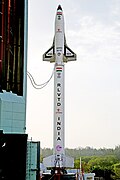
 Technology Development Vehicle (TDV) for RLV Programme | |
| Program overview | |
|---|---|
| Country | India |
| Organization | ISRO |
| Programme history | |
| Duration | 2012–present[1] |
| First flight | 01:30 UTC, 23 May 2016 [2] |
| Successes | 1 Suborbital flight 3 Landing flights |
| Launch site(s) | |
| Vehicle information | |
| Launch vehicle(s) | Modified-GSLV Mark II L40 stage |
Reusable Launch Vehicle–Technology Demonstration Programme is a series of technology demonstration missions that has been conceived by ISRO as a first step towards realising a Two Stage To Orbit (TSTO) reusable launch vehicle, in which the second stage is a spaceplane.[3]
For this purpose, a winged reusable launch vehicle technology demonstrator (RLV-TD) has been configured. The RLV-TD acted as a flying test bed to evaluate various technologies like powered cruise flight, hypersonic flight, and autonomous landing using air-breathing propulsion. Application of these technologies would bring down the launch cost by a factor of 10.[4] This project has no connection with the Avatar spaceplane concept by India's Defence Research and Development Organisation.[5]
History[edit | edit source]
In 2006 the Indian Space Research Organisation (ISRO) performed a series of ground tests to demonstrate stable supersonic combustion for nearly 7 seconds with an inlet Mach number of 6.[6]
In March 2010, ISRO conducted the flight testing of its new sounding rocket: Advanced Technology Vehicle (ATV-D01), weighing 3 tonnes at lift-off, a diameter of 0.56 m (1 ft 10 in), and a length of ~10 m (33 ft).[7] It carried a passive scramjet engine combustor module as a test-bed for demonstration of air-breathing propulsion technology.[8]
In January 2012, ISRO announced that a scaled prototype, called Reusable Launch Vehicle-Technology Demonstrator (RLV-TD), was approved to be built and tested.[9] The aerodynamics characterization on the RLV-TD prototype was done by the National Aerospace Laboratories in India. The RLV-TD is in the last stages of construction by a Hyderabad-based private company called CIM Technologies. The fixed landing gear for the RLV-TD was supplied by Timetooth Technologies. The full-scale RLV is expected to use retractable landing gear.[10]
By May 2015, engineers at the Vikram Sarabhai Space Centre (VSSC) in Thumba Equatorial Rocket Launching Station were installing thermal tiles on the outer surface of the RLV-TD to protect it against the intense heat during atmospheric reentry.[11] This prototype weighs around 1.5 tonnes and flew to an altitude of 65 km[11] mounted on top of an expendable solid booster HS9.[12][13]
On 28 August 2016, ISRO successfully tested its scramjet engine on second developmental flight of its Advanced Technology Vehicle ATV-D02 from the Satish Dhawan Space Centre for 28 August 2016.[14][15] The scramjet engine will be integrated to the RLV at a later stage of development.[16]
In February 2024, IIT Kanpur built and evaluated the Hypervelocity Expansion Tunnel Test Facility, referred to as S2, in the Department of Aerospace Engineering's Hypersonic Experimental Aerodynamics Laboratory (HEAL). Scramjet flights and extreme hypersonic conditions such as atmospheric entry can be replicated at the S2 facility. It is anticipated that the facility will support RLV Technology Demonstration Programme.[17]
Pushpak (RLV-TD)[edit | edit source]
_before_launch_03.jpg)
Pushpak (Sanskrit, ISO: Puṣpaka, lit. 'Little Flower', Namesake: Pushpaka Vimana)[18] (also known as RLV-TD or Reusable Launch Vehicle Technology Demonstrator) is India's first uncrewed flying testbed developed for the ISRO's RLV Technology Demonstration Programme started in 2012. It is a scaled down prototype of an eventual two-stage-to-orbit (TSTO) reusable launch vehicle.
In January 2012, the design of ISRO's reusable launch vehicle was approved by the National Review Committee and clearance was granted to build the vehicle. The vehicle was named 'Reusable Launch Vehicle-Technology Demonstrator' (RLV-TD).[19] ISRO aims to bring down the cost of payload delivery to low Earth orbit by 80% from existing $20,000/kg to $4,000/kg.[20][21][22]
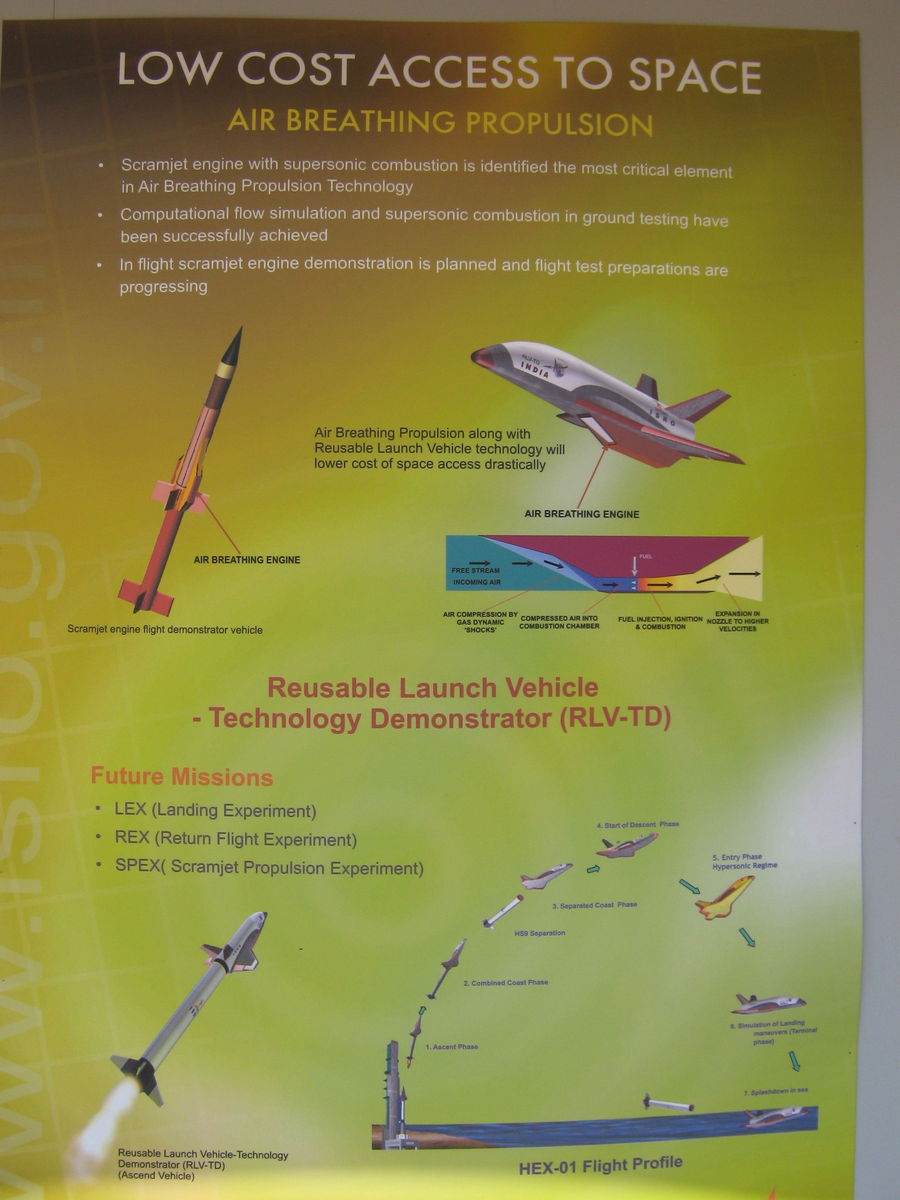
The RLV-TD was developed with an objective to test various aspects such as hypersonic flight, autoland, powered cruise flight, hypersonic flight using the air-breathing engine propulsion and Hypersonic Experiment.
A series of four RLV-TD test flights have been planned by ISRO:[19][23][24]
- HEX (Hypersonic Flight Experiment) - Completed
- LEX (Landing Experiment) - Completed
- REX (Return Flight Experiment), later renamed to OREX (Orbital Return Flight Experiment) - Planned
- SPEX (Scramjet Propulsion Experiment) - Planned
A team of 750 engineers at the Vikram Sarabhai Space Centre, National Aerospace Laboratories, and Indian Institute of Science worked on the design and development of RLV-TD and the associated rocket. RLV-TD underwent 120 hours of wind tunnel, 5,000 hours of computational fluid dynamics and 1,100 runs of flight simulation tests. RLV-TD has mass of 1.75 tonnes, wingspan of 3.6 meters and overall length of 6.5 meters (excluding the rocket). The vehicle had 600 heat-resistant tiles on its undercarriage and it features delta wings and angled tail fins.[25][26] Total cost of the project was ₹95 crore (equivalent to ₹110 crore or US$15.4 million in 2019).[27][28] Future planned developments include testing an air-breathing propulsion system, which aims to capitalise on the oxygen in the atmosphere instead of liquefied oxygen while in flight.[29] The aerodynamic characterization research was conducted at the National Aerospace Laboratories' 1.2m Trisonic Wind Tunnel Facility.[30]
Air Breathing Propulsion Project[edit | edit source]
In January 2006, ISRO completed the design, development and tests of scramjet (supersonic ramjet) at its Vikram Sarabhai Space Centre in Thiruvananthapuram. During the ground tests, stable supersonic combustion with an inlet Mach number 6 was demonstrated for 7 seconds.
On 3 March 2010, ISRO successfully conducted the flight test of its new sounding rocket ATV-D01 from Satish Dhawan Space Centre in Sriharikota. ATV-D01 weighed 3 tonnes at lift-off and was the heaviest sounding rocket ever developed by ISRO at the time. It was mounted with a passive Scramjet engine. The rocket flew for 7 seconds, achieved Mach number 6 + 0.5 and dynamic pressure 80 + 35 kPa.[31][32]
On 28 August 2016, ISRO tested scramjet engine with a five-minute flight. At a height of 20 kilometers, the scramjet engine attached to the Advanced Technology Vehicle was fired. It burnt fuel for five seconds, an important milestone in the development of Dual Mode Ramjet (DMR) under Air Breathing Propulsion Project.[33] The scramjet engine weighed 3,277 kg at lift-off. Critical technologies that have been successfully demonstrated include fuel injection systems, air intake mechanisms, air breathing engine igniting at supersonic speed, and holding the flame at supersonic speed. Every aspect of the flight operation followed a pre-programmed sequence. The design and development of a hypersonic engine air intake, a supersonic combustor, materials that can withstand extremely high temperatures, computational tools for simulating hypersonic flow, proper thermal management, and ground testing of the engines are just a few of the technological challenges that ISRO has successfully overcome.[34][35]
On 23 July 2024, ISRO effectively concluded the second experimental flight demonstration of air breathing propulsion technology. Air Breathing Propulsion systems were symmetrically placed on both sides of the Rohini RH-560 sounding rocket used in the experiment. The Air Breathing propulsion systems were ignited successfully and the test performed satisfactorily. 110 parameters were extensively watched during the flight to evaluate the propulsion system's performance.[36]
RLV TD Experiments[edit | edit source]
Hypersonic Flight Experiment[edit | edit source]

The Reusable Launch Vehicle Hypersonic Flight Experiment or RLV HEX was the first test flight in the RLV Technology Demonstration Programme. HEX was successfully conducted on 23 May 2016.[2][37][38] RLV-TD consists of a fuselage (body), a nose cap, double delta wings and twin vertical rudders. It has active control surfaces called Elevons and Rudders.[38] Apart from the twin rudders it is similar in shape and operation to a small Space Shuttle Orbiter. TDV uses 600 or so heat resistant silica tiles and Flexible External Insulation, nose-cap is made out Carbon-Carbon composite with SiC coating. The leading edges of twin rudders are Inconel-718, wing leading edges of 15CDV6.[39][40][41][42][43][44]
HEX was the first test flight of a reusable launch vehicle developed by India. The test flight objectives included:[45]
- Validating the aerodynamic design characteristics during hypersonic flight
- Characterize induced loads during the hypersonic descent through the atmosphere
- Assess the performance of the carbon fibre used in construction of the nose of the vehicle
- Demonstrate first stage separation sequencing
The vehicle was tracked during its flight from ground stations at Sriharikota and a shipborne terminal. The total flight duration from launch to splashdown lasted about 773.6 seconds.[46] The unit was not planned to be recovered.[47][48] ISRO plans to construct an airstrip greater than 4km long in Sriharikota island in the "near future". Critical technologies such as autonomous navigation, guidance & control, reusable thermal protection system, and descent mission management were validated in this flight.[49]
Landing Experiment[edit | edit source]
The Reusable Launch Vehicle Landing Experiment or RLV-LEX was the second test flight in the RLV Technology Demonstration Programme following the Hypersonic Flight Experiment. The demonstration trials will pave the way for the two-stage-to-orbit (TSTO) fully reusable launch vehicle. Furthermore, more test similar to RLV-LEX will be conducted to test other conditions like wind, different failure conditions and other factors to finalise the testing of the vehicle.[50] Three such tests were performed in between April 2023 and June 2024. A drogue chute was used to bring the speed down to 100 km/h and nose wheel brakes were used to bring the vehicle to a stop.[51]
RLV-LEX-01[edit | edit source]
RLV-LEX was successfully conducted on 2 April 2023 at the Chitradurga Aeronautical Test Range.[52] The flight took off at 7:10 AM and was released mid-air at a downrange of 4.6 km. The Vehicle landed at about 7:40 AM
The test flight objectives included:[53]
- Simulating the exact conditions of a Space Re-entry vehicle's landing - high speed, unmanned, autonomous, precise landing from the same return path
- Validating the landing parameters such as the ground relative velocity, the sinking rate of landing gears and precise body rates as might be experienced by an orbital re-entry space vehicle on its return path
After the successful completion of the mission, S. Somanath, chairman of ISRO, said to the media that they are currently planning to conduct more such landing tests to check the readiness of software and hardware under different conditions. The reported test will include the vehicle being dropped from an altitude of about 4.5 kilometres and at a lateral difference following which the vehicle must automatically guide itself for a landing.[54] The test would be retroactively referred to as RLV-LEX-01.
RLV-LEX-02[edit | edit source]
Another landing experiment was conducted at Chitradurga Aeronautical Test Range on 22 March 2024.[55] The vehicle had to correct both cross-range and down-range deviations before landing autonomously on the runway due to the experiment's more difficult manoeuvres and dispersions.[56] The vehicle used its nosewheel steering system, landing gear brakes, and drogue parachute to help it come to a precise halt on the runway after making the required cross-range modifications. RLV-LEX-02 made use of the same Flight Demonstrator Vehicle as RLV-LEX-01. Liquid Propulsion System Centre (LPSC), ISRO Inertial Systems Unit (IISU), Vikram Sarabhai Space Centre, and the Indian Air Force worked together with the Aeronautical Development Establishment (ADE), Aerial Delivery Research and Development Establishment (ADRDE), and other agencies to complete the mission.[57][58]
RLV-LEX-03[edit | edit source]
ISRO completed the preparation for the third and last RLV landing experiment, RLV-LEX-03. At the Mission Readiness Review meet on 7 June 2024, S. Unnikrishnan Nair, Director of the Vikram Sarabhai Space Center, certified the mission for the first half of June at the Chitradurga Aeronautical Test Range, subject to weather conditions. In contrast to LEX-02, where the altitude was the same but the lateral distance from the runway was 150 meters, Pushpak will be flown by an IAF Chinook helicopter to a height of 4.5 kilometers and 500 meters to one side of the runway in LEX-03 before being released. The goal of the LEX-03 mission is to investigate methods for lowering the sink rate, or rate of descent, in order to lessen the impact weight. Pushpak will carry an onboard real-time kinematics (RTK) package. The test will also determine how well Pushpak performs in scenarios with a tailwind.[59]
The date of the test was shifted to the end of 2nd week of June due to poor weather conditions. [60] The test was successfully conducted on 23 June from Chitradurga Aeronautical Test Range. Pushpak was released from an Indian Air Force Chinook Helicopter at an altitude of 4.5 km.[61]
Pushpak automatically carried out cross-range correction maneuvers during the LEX-03 mission, approached the runway, and made a precise horizontal touchdown at the centerline of the runway. The vehicle's braking parachute was used to slow down to almost 100 km/h after touchdown, and the landing gear brakes were then used to bring the vehicle to a stop and decelerate on the runway. Pushpak uses its nose wheel and rudder steering system to automatically maintain a steady and accurate ground roll along the runway during this ground roll phase.[62]
The mission replicated high-speed landing conditions, as well as the approach and landing interface, for a vehicle returning from space. Validation of the sophisticated guidance system that addresses both lateral and longitudinal plane error corrections which is necessary for the next Orbital Return Flight Experiment. The test vehicle was equipped with a pseudolite system, inertial sensor, radar altimeter, flush air data system, and NavIC receiver, among other multi-sensor fusion devices. The RLV-LEX-03 demonstrated the robustness and adaptability of flight systems for multiple missions by reusing the winged body and flight systems from the LEX-02 without any modifications.[62]
Future[edit | edit source]
Two more experiments are planned by ISRO: OREX (Orbital Return Flight Experiment) and SPEX (Scramjet Propulsion Experiment).[11][63][64] The OREX will launch on a GSLV rocket with PS-4 stage instead of its CUS upper stages (due to decreased performance required for a suborbital flight unlike a regular GSLV launch) and Orbital Re-entry vehicle (ORV) in place of its ogive payload fairing and re-enter the earth's atmosphere for a landing to demonstrate the viability of the project. The OREX vehicle will be 1.6 times larger than the Landing Experiment's Pushpak platform. It will have retractable landing gear and a thermal protection system for a safe re-entry into Earth's atmosphere.[59]
Gallery[edit | edit source]
-
 RLV-TD HEX01, TDV being transported
 -
 RLV-TD HEX01 at First Launch Pad of Satish Dhawan Space Centre, Sriharikota (SDSC SHAR) before launch 01
 -
 Launch of RLV-TD HEX01 from First Launch Pad of Satish Dhawan Space Centre, Sriharikota (SDSC SHAR) 02
 -
 LEX-01 simulating vehicle landing parameters.
 -
 LEX-02 maiden autonomous landing.
 -
 To enhance safety during autonomous landing maneuvers, LEX-03 utilized a new kinematics package, enhanced satellite navigation, and multi-sensor fusion for real-time parameter modification and error correction.

_before_launch_01.jpg)
_02.jpg)
_at_Aeronautical_Test_Range_(ATR)_Chitradurga_01.jpg)


See also[edit | edit source]
- Avatar, an unrelated spaceplane concept by India's DRDO
- Space Rider a planned robotic spaceplane by ESA
References[edit | edit source]
- ↑ "ISRO to Begin Flights of Reusable Launcher Test Bed".
- ↑ 2.0 2.1 "India's First-Ever Indigenous Space Shuttle RLV-TD Launched Successfully". Archived from the original on 23 May 2016. Retrieved 23 May 2016.
- ↑ "Indian Space Research Organisation to test its reusable RLV spacecraft". SpaceFlight Insider. 2 June 2015. Archived from the original on 8 November 2020. Retrieved 8 June 2015.
- ↑ "Tuesday, December 22, Isro's small steps towards developing its own reusable rocket [Reusable Launch Vehicle (RLV)] program". LIVE MINT, IN. 2015. Archived from the original on 26 May 2016. Retrieved 23 December 2015.
- ↑ "Government of India Department of Space" (PDF). 14 March 2012. Archived from the original (PDF) on 5 August 2016. Retrieved 27 April 2016.
Feasibility study of project "AVATAR)" has been done by a group of scientists in DRDO. ISRO has no connection with the project.
- ↑ "Welcome to Vikram Sarabhai Space Centre - ISRO_Supersonic Combustion Tech". Archived from the original on 4 March 2016. Retrieved 23 December 2015.
- ↑ ""Space Transportation Systems: What the future beholds" by Dr. B N Suresh". 2 November 2007. Archived from the original on 1 August 2020. Retrieved 23 December 2015.
- ↑ "Successful flight testing of advanced sounding rocket - ISRO". www.isro.gov.in. Archived from the original on 9 September 2016. Retrieved 6 December 2015.
- ↑ "ISRO's design of reusable launch vehicle approved". Archived from the original on 1 August 2020. Retrieved 25 December 2015.
- ↑ "RLV re-entry mission to use GSLV with PSLV last stage; landing gear to change & more". The Times of India. 26 June 2024. ISSN 0971-8257. Retrieved 27 June 2024.
- ↑ 11.0 11.1 11.2 "Navigation satellite system by March". Archived from the original on 8 November 2020. Retrieved 24 December 2015.
- ↑ "Modeling &Control of Launch Vehicles" (PDF). www.sc.iitb.ac.in. Archived (PDF) from the original on 24 December 2015. Retrieved 6 December 2015.
- ↑ "Reusable Launch Vehicles". Brahmand.com. 25 November 2010. Archived from the original on 1 November 2014. Retrieved 22 October 2014.
- ↑ "Successful Flight Testing of ISRO's Scramjet Engine Technology Demonstrator". Archived from the original on 14 September 2016. Retrieved 28 August 2016.
- ↑ "Indian rockets to soon use atmospheric oxygen as fuel".
- ↑ "ISRO set to test scramjet engine". The Hindu. 28 November 2015. ISSN 0971-751X. Archived from the original on 8 November 2020. Retrieved 6 December 2015.
- ↑ Tripathi, Sibu Kumar (5 February 2024). "Hypervelocity facility at IIT Kanpur: How it will propel India's high-speed dreams". India Today. Retrieved 30 November 2024.
- ↑ "India's Reusable Launch Vehicle to be called Pushpak, PM reviews progress". India Today. 27 February 2024. Retrieved 15 March 2024.
- ↑ 19.0 19.1 "Launch vehicle approved". DNA India. Archived from the original on 11 September 2016. Retrieved 23 May 2016.
- ↑ "Make In India Gets Wings With Successful Launch Of Swadeshi Space Shuttle". The Free Press Journal. Archived from the original on 25 May 2016. Retrieved 24 May 2016.
- ↑ "India Just Launched A Mini Space Shuttle". sciencealert.com. Archived from the original on 17 September 2016. Retrieved 24 May 2016.
- ↑ "Breakthrough in Supersonic combustion technology". Vikram Sarabhai Space Centre website. Archived from the original on 4 March 2016. Retrieved 23 May 2016.
- ↑ "Demonstration program". ISRO website. Archived from the original on 23 May 2016. Retrieved 23 May 2016.
- ↑ "Low cost access". bharat-rakshak.com. Archived from the original on 3 March 2016. Retrieved 23 May 2016.
- ↑ "India Flies Winged Space Plane On Experimental Suborbital Launch". spaceflightnow.com. Archived from the original on 30 August 2016. Retrieved 24 May 2016.
- ↑ "ISRO's Reusable Launch Vehicle What Happened And What Next". thewire.in. Archived from the original on 25 May 2016. Retrieved 24 May 2016.
- ↑ "VSSC to find new skies". The Indian Express. Archived from the original on 15 September 2016. Retrieved 24 May 2016.
- ↑ "India's own space shuttle launched successfully". The Hindustan Times. Archived from the original on 30 August 2016. Retrieved 24 May 2016.
- ↑ "ISRO to Test Rocket That Uses Oxygen Directly from the Atmosphere to Fuel Itself". 26 May 2016. Archived from the original on 8 September 2016. Retrieved 7 July 2016.
- ↑ "Bengaluru: 1.2m trisonic wind tunnel at National Aerospace Laboratories completes 55 years of service". ANI. 6 June 2022. Retrieved 22 November 2024.
- ↑ "Flight testing of advanced sounding rocket". ISRO website. Archived from the original on 9 September 2016. Retrieved 23 May 2016.
- ↑ "ISRO Progresses Towards a Swadeshi Space Plane". Khul Ke. Archived from the original on 7 September 2023. Retrieved 7 September 2023.
- ↑ T.S., Subramanian (28 September 2016). "Scramjet success". Frontline. Retrieved 24 July 2024.
- ↑ "ISRO successfully tests scramjet engine using oxygen from atmosphere". The Times of India. 28 August 2016. ISSN 0971-8257. Retrieved 23 July 2024.
- ↑ "ISRO's Scramjet Engine Technology Demonstrator Successfully Flight Tested". ISRO. Department of Space. Retrieved 23 July 2024.
- ↑ "Isro successfully conducts second test of Air Breathing Propulsion Technology". India Today. 23 July 2024. Retrieved 23 July 2024.
- ↑ India’s Reusable Launch Vehicle-Technology Demonstrator (RLV-TD), Successfully Flight Tested Archived 2021-02-09 at the Wayback Machine. 23 May 2016. ISRO.
- ↑ 38.0 38.1 RLV-TD Archived 2021-04-17 at the Wayback Machine. ISRO. 23 May 2016. Includes diagrams.
- ↑ Kumar, Kiran (28 April 2016). ""Indigenous Development of Materials for Space Programme"". Archived from the original on 30 June 2020. Retrieved 30 June 2020.
- ↑ "SILICA TILES AS A THERMAL PROTECTION FOR RLV-TD" (PDF). Archived from the original on 30 June 2020. Retrieved 30 June 2020.
- ↑ "Current Science Volume 114 - Issue 01". Archived from the original on 30 June 2020. Retrieved 30 June 2020.
- ↑ "The technology behind India's Reusable Launch Vehicle". 12 November 2018. Archived from the original on 30 June 2020. Retrieved 30 June 2020.
- ↑ "A Deep Dive Into ISRO's Reusable Launch Vehicle Technology – Part I". Archived from the original on 28 June 2020. Retrieved 30 June 2020.
- ↑ "A Deep Dive Into ISRO's Reusable Launch Vehicle Technology – Part II". Archived from the original on 3 July 2020. Retrieved 30 June 2020.
- ↑ "An Indian space shuttle takes shape 2009". The Hindu. 31 March 2009. Archived from the original on 4 April 2023. Retrieved 24 April 2023.
- ↑ Yadav, Sandeep; Jayakumar, M.; Nizin, Aziya; Kesavabrahmaji, K.; Shyam Mohan, N. (1 December 2017). "Final Phase Flight Performance and Touchdown Time Assessment of TDV in RLV-TD HEX-01 Mission". Journal of the Institution of Engineers (India): Series C. 98 (6): 679–688. Bibcode:2017JIEIC..98..679Y. doi:10.1007/s40032-017-0403-9. ISSN 2250-0553. S2CID 115904439.
- ↑ "India's Reusable Launch Vehicle Successfully Flight Tested". ISRO website. Archived from the original on 14 September 2016. Retrieved 23 May 2016.
- ↑ "ISRO successfully launches Indias first ever indigenous space shuttle". The Economic Times. Archived from the original on 28 August 2016. Retrieved 24 May 2016.
- ↑ "ISRO Gears up for 6 Major Missions This Year". Express News Service. 30 May 2015. Archived from the original on 10 September 2016. Retrieved 8 June 2015.
- ↑ "Landing experiment likely in Challakere next week". The Times of India. ISSN 0971-8257. Retrieved 16 March 2024.
- ↑ "Launch Vehicles Space Transportation of ISRO" (PDF). ISRO. Retrieved 23 February 2025.
- ↑ ""ISRO Reusable Launch Vehicles Landing Experiment Successful"".
- ↑ "ISRO successfully conducts the Reusable Launch Vehicle Autonomous Landing Mission (RLV LEX)". Indian Space Research Organisation. isro.gov.in. 2 April 2023. Archived from the original on 2 April 2023. Retrieved 2 April 2023.
- ↑ "Isro reusable launch vehicle's landing experiment successful; RLV closer to orbital re-entry mission". The Times of India. 2 April 2023. ISSN 0971-8257. Archived from the original on 2 April 2023. Retrieved 2 April 2023.
- ↑ Kumar, Chethan (22 March 2024). "Isro completes 2nd key landing experiment of reusable launch vehicle". The Times of India. ISSN 0971-8257. Retrieved 22 March 2024.
- ↑ Bagla, Pallava (22 March 2024). "Watch: India's 21st Century Pushpak 'Viman' Successfully Launched". NDTV.com. Retrieved 22 March 2024.
- ↑ "ISRO nails it again! Landing mission of Reusable Launch Vehicle 'Pushpak' conducted successfully in Karnataka – See Pictures". Financialexpress. 22 March 2024. Retrieved 22 March 2024.
- ↑ "ISRO achieves another milestone, successfully lands Pushpak reusable launch vehicle". Moneycontrol. 22 March 2024. Retrieved 22 March 2024.
- ↑ 59.0 59.1 Rajwi, Tiki (8 June 2024). "ISRO all set for third reusable launch vehicle landing experiment". The Hindu. ISSN 0971-751X. Retrieved 9 June 2024.
- ↑ "ISRO's reusable launch vehicle, made for low-cost space missions, set for 3rd test landing this week". ThePrint. 17 June 2024. Retrieved 17 June 2024.
- ↑ "Isro's reusable launch vehicle completes 3rd landing test, paving way for orbital re-entry". The Times of India. ISSN 0971-8257. Retrieved 23 June 2024.
- ↑ 62.0 62.1 "ISRO successfully conducts third and final 'Pushpak' Reusable Launch Vehicle landing experiment". The Hindu. 23 June 2024. ISSN 0971-751X. Retrieved 23 June 2024.
- ↑ "Poster on the RLV-TD". Archived from the original on 3 March 2016. Retrieved 30 July 2009.
- ↑ "Reusable Launch Vehicle - Technology Demonstration Program (RLV-TD) - ISRO". isro.gov.in. Archived from the original on 23 May 2016. Retrieved 8 June 2015.
External links[edit | edit source]
- Home page for RLV-TD at ISRO Archived 2016-05-23 at the Wayback Machine
- RLV-TD test flight animation at YouTube