


GiseleStead (talk | contribs) add content after review as per guidelines |
|||
| (One intermediate revision by one other user not shown) | |||
| Line 1: | Line 1: | ||
{{ | {{Short description|Fort in Maharashtra, India}} | ||
{{Infobox | {{More citations needed|date=August 2016}} | ||
{{Infobox military installation | |||
|name = Rohida Fort | |name = Rohida Fort | ||
|partof = | |partof = | ||
|location = [[Pune district]], [[Maharashtra]] | |location = [[Pune district]], [[Maharashtra]] | ||
|image = | |image = Rohida Fort.jpg | ||
|caption = Rohida fort | |caption = Rohida fort | ||
|map_type=India Maharashtra | |map_type=India Maharashtra | ||
| Line 10: | Line 11: | ||
|map_caption = Shown within [[Maharashtra]] | |map_caption = Shown within [[Maharashtra]] | ||
|type = Hill fort | |type = Hill fort | ||
|coordinates = {{coord|18|06| | |coordinates = {{coord|18|06|10|N|73|49|15|E|type:landmark_region:IN|display=inline,title}} | ||
|materials = Stone | |materials = Stone | ||
|height = | |height = | ||
| Line 18: | Line 19: | ||
|open_to_public = Yes | |open_to_public = Yes | ||
}} | }} | ||
'''Rohida fort''' / '''Vichitragad Fort''' is a fort located 10 km from [[Bhor]], [[Pune district]], of [[Maharashtra]]. This fort is an important fort in Pune district. The fort restoration is done by the Shree Shivdurga Samvardhan committee<ref>{{Cite web | title=श्री शिवदुर्ग संवर्धन | url=http://shivdurg.org/ | archive-url=https://web.archive.org/web/20131222194732/http://www.shivdurg.org:80/ | access-date=2025-02-26 | archive-date=2013-12-22}}</ref> with the help of forest dept. and local villagers. | |||
'''Rohida fort''' / '''Vichitragad Fort''' is a fort located 10 km from [[Bhor]], [[Pune district]], of [[Maharashtra]]. This fort is an important fort in Pune district. The fort restoration is done by the Shree Shivdurga Samvardhan committee<ref>http://shivdurg.org/</ref> with the help of forest dept. and local villagers. | |||
==History== | ==History== | ||
This fort was built during [[Yadava]] period. According to the inscription on the third gate, [[Mohammed Adil Shah, Sultan of Bijapur|Mohammed Adil Shah]] of [[Bijapur]] had repaired this fort | This fort was built during [[Yadava]] period. {{Citation needed|date=August 2024}}According to the inscription on the third gate, [[Mohammed Adil Shah, Sultan of Bijapur|Mohammed Adil Shah]] of [[Bijapur]] had repaired this fort in May 1656. {{Citation needed|date=August 2024}} | ||
Rohida was among the 23 forts Chatrapati Shivaji Maharaj handed over to Mughals (to Aurangzeb) as part the [[Treaty of Purandar (1665)|Treaty of Purandar]](1665). On 24 June 1670, this fort was again captured by Shivaji Maharaj.{{Citation needed|date=August 2024}} The Jedhe and the Khopade families held the fiefdom of lands around the fort during Nizamshahi and later during Adilshahi.<ref>{{Cite journal |author=Fukazawa, Hiroshi | title=A STUDY OF THE LOCAL ADMINISTRATION OF ĀDILSHĀHĪ SULTANATE (A.D. 1489—1686) | journal=Hitotsubashi Journal of Economics | volume=3 | number=2 | year=1963 | pages=37–67 | url=http://www.jstor.org/stable/43295419}}</ref><ref name="auto">Raeside I. A Note on the ‘Twelve Mavals’ of Poona District. Modern Asian Studies. 1978;12(3):393-417. doi:10.1017/S0026749X00006211</ref> The fort was recaptured by the Mughals during the Maratha Mughal war.In the early 1700s, the fort came under the control of the [[Pant Sachiv]]s, the ruling family of [[Bhor State]].It remained part of bhor state until Indian independence in 1947.<ref>{{cite web |url=http://trekshitiz.com/trekshitiz/Ei/Rohida-Trek-R-Alpha.html |title=Rohida, Western Ghats, Sahyadri, Adventure, Trekking |website=trekshitiz.com |url-status=dead |archive-url=https://web.archive.org/web/20160813084538/http://trekshitiz.com/trekshitiz/Ei/Rohida-Trek-R-Alpha.html |archive-date=2016-08-13}}</ref> The Pant sachivs renamed the fort, Vicitragad.<ref name="auto"/> | |||
==How to reach== | ==How to reach== | ||
The nearest town is [[Bhor]] which is 61 km from [[Pune]]. The base village of the fort is Bajarwadi which is 7 km from Bhor. There are good hotels at Bhor, now tea and snacks are also available in small hotels at Bajarwadi and Khanapur. The trekking path starts from the hillock west of the Bajarwadi Highschool. The route is very safe and wide. There are no trees on the trekking route. It takes about an hour to reach the entrance gate of the fort. The night stay on the fort can be made in the Rohidamalla temple on the fort. Bhairu bhiva Hawaldar rohida fort rakhwaldar.The villagers from the local fort restoration committee in the Bajarwadi make night stay and food arrangements at reasonable cost. | The nearest town is [[Bhor]] which is 61 km from [[Pune]]. The base village of the fort is Bajarwadi which is 7 km from Bhor. There are good hotels at Bhor, now tea and snacks are also available in small hotels at Bajarwadi and Khanapur. The trekking path starts from the hillock west of the Bajarwadi Highschool. The route is very safe and wide. There are no trees on the trekking route. It takes about an hour to reach the entrance gate of the fort. The night stay on the fort can be made in the Rohidamalla temple on the fort. Bhairu bhiva Hawaldar rohida fort rakhwaldar. The villagers from the local fort restoration committee in the Bajarwadi make night stay and food arrangements at reasonable cost. | ||
==Places to see== | ==Places to see== | ||
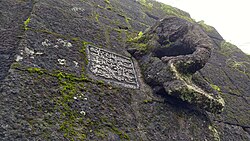
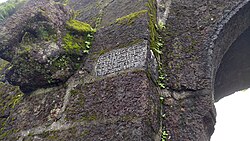
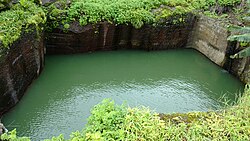
There are three gates on the main entrance path of the fort. The main entrance gate has a Ganesh patti and Miharab. There is a rock cut water cistern near the second gate. The water is available round the year for drinking purpose. There are idols of Lion and [[Sharabha]] on the second gate. After climbing 57 steps the third gate is reached. There are idols of heads of elephants on either side and rock cut inscripture in [[Persian language|Persian]] and [[Marathi language|Marathi]] on the outer side of the gate. There is a temple of Rohidamalla in good condition on the fort. There are seven Bastions on the fort, they are Shirawale Buruj, Patane buruj, Damugade buruj, Waghjai Buruj, Fatte Buruj and Sadar buruj. In some books presence of Shirja buruj is also mentioned, but its location is unknown.<ref>Book "Saad Sahydrichi-Bhatkanti killyanchi" by P.K. Ghanekar page-220</ref> There is a series of rock-cut water cisterns on the southern side of the fort. It takes about an hour to visit all places on the fort. | There are three gates on the main entrance path of the fort. The main entrance gate has a Ganesh patti and Miharab. There is a rock cut water cistern near the second gate. The water is available round the year for drinking purpose. There are idols of Lion and [[Sharabha]] on the second gate. After climbing 57 steps the third gate is reached. There are idols of heads of elephants on either side and rock cut inscripture in [[Persian language|Persian]] and [[Marathi language|Marathi]] on the outer side of the gate. There is a temple of Rohidamalla in good condition on the fort. There are seven Bastions on the fort, they are Shirawale Buruj, Patane buruj, Damugade buruj, Waghjai Buruj, Sarja Buruj, Fatte Buruj and Sadar buruj. In some books presence of Shirja buruj is also mentioned, but its location is unknown.<ref>Book "Saad Sahydrichi-Bhatkanti killyanchi" by P.K. Ghanekar page-220</ref> There is a series of rock-cut water cisterns on the southern side of the fort. It takes about an hour to visit all places on the fort. | ||
[[File:Rohida fort 1.jpg|thumb|Main gate of Rohida Fort]] | [[File:Rohida fort 1.jpg|thumb|Main gate of Rohida Fort]] | ||
[[File:Rohida4.jpg|thumb|Inscription in Farasi]] | [[File:Rohida4.jpg|thumb|Inscription in Farasi]] | ||
| Line 35: | Line 36: | ||
[[File:Rohida3.jpg|thumb|Limestone mixer]] | [[File:Rohida3.jpg|thumb|Limestone mixer]] | ||
[[File:Rohida6.jpg|thumb|Rockcut water cistern]] | [[File:Rohida6.jpg|thumb|Rockcut water cistern]] | ||
== See also == | == See also == | ||
| Line 52: | Line 52: | ||
[[Category:Forts in Pune district]] | [[Category:Forts in Pune district]] | ||
[[Category:16th-century forts in India]] | [[Category:16th-century forts in India]] | ||
Latest revision as of 08:14, 26 August 2025
 | This article needs more citations. (August 2016) |
| Rohida Fort | |
|---|---|
| Pune district, Maharashtra | |
 Rohida fort | |
  Rohida Fort | |
| Coordinates | 18°06′10″N 73°49′15″E / 18.10278°N 73.82083°E |
| Type | Hill fort |
| Site information | |
| Owner | Government of India |
| Open to the public | Yes |
| Condition | Ruins |
| Site history | |
| Materials | Stone |
Rohida fort / Vichitragad Fort is a fort located 10 km from Bhor, Pune district, of Maharashtra. This fort is an important fort in Pune district. The fort restoration is done by the Shree Shivdurga Samvardhan committee[1] with the help of forest dept. and local villagers.
History[edit | edit source]
This fort was built during Yadava period. [citation needed]According to the inscription on the third gate, Mohammed Adil Shah of Bijapur had repaired this fort in May 1656. [citation needed] Rohida was among the 23 forts Chatrapati Shivaji Maharaj handed over to Mughals (to Aurangzeb) as part the Treaty of Purandar(1665). On 24 June 1670, this fort was again captured by Shivaji Maharaj.[citation needed] The Jedhe and the Khopade families held the fiefdom of lands around the fort during Nizamshahi and later during Adilshahi.[2][3] The fort was recaptured by the Mughals during the Maratha Mughal war.In the early 1700s, the fort came under the control of the Pant Sachivs, the ruling family of Bhor State.It remained part of bhor state until Indian independence in 1947.[4] The Pant sachivs renamed the fort, Vicitragad.[3]
How to reach[edit | edit source]
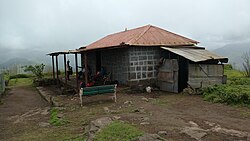
The nearest town is Bhor which is 61 km from Pune. The base village of the fort is Bajarwadi which is 7 km from Bhor. There are good hotels at Bhor, now tea and snacks are also available in small hotels at Bajarwadi and Khanapur. The trekking path starts from the hillock west of the Bajarwadi Highschool. The route is very safe and wide. There are no trees on the trekking route. It takes about an hour to reach the entrance gate of the fort. The night stay on the fort can be made in the Rohidamalla temple on the fort. Bhairu bhiva Hawaldar rohida fort rakhwaldar. The villagers from the local fort restoration committee in the Bajarwadi make night stay and food arrangements at reasonable cost.
Places to see[edit | edit source]
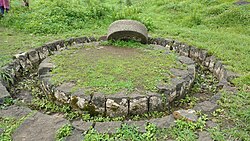
There are three gates on the main entrance path of the fort. The main entrance gate has a Ganesh patti and Miharab. There is a rock cut water cistern near the second gate. The water is available round the year for drinking purpose. There are idols of Lion and Sharabha on the second gate. After climbing 57 steps the third gate is reached. There are idols of heads of elephants on either side and rock cut inscripture in Persian and Marathi on the outer side of the gate. There is a temple of Rohidamalla in good condition on the fort. There are seven Bastions on the fort, they are Shirawale Buruj, Patane buruj, Damugade buruj, Waghjai Buruj, Sarja Buruj, Fatte Buruj and Sadar buruj. In some books presence of Shirja buruj is also mentioned, but its location is unknown.[5] There is a series of rock-cut water cisterns on the southern side of the fort. It takes about an hour to visit all places on the fort.


See also[edit | edit source]
References[edit | edit source]
- ↑ "श्री शिवदुर्ग संवर्धन". Archived from the original on 2013-12-22. Retrieved 2025-02-26.
- ↑ Fukazawa, Hiroshi (1963). "A STUDY OF THE LOCAL ADMINISTRATION OF ĀDILSHĀHĪ SULTANATE (A.D. 1489—1686)". Hitotsubashi Journal of Economics. 3 (2): 37–67.
- ↑ 3.0 3.1 Raeside I. A Note on the ‘Twelve Mavals’ of Poona District. Modern Asian Studies. 1978;12(3):393-417. doi:10.1017/S0026749X00006211
- ↑ "Rohida, Western Ghats, Sahyadri, Adventure, Trekking". trekshitiz.com. Archived from the original on 2016-08-13.
- ↑ Book "Saad Sahydrichi-Bhatkanti killyanchi" by P.K. Ghanekar page-220
