

>Drmccreedy m →Unicode: tweak wording |
add structure also and cleaned formatting |
||
| (One intermediate revision by one other user not shown) | |||
| Line 1: | Line 1: | ||
{{Short description|Abugida used to write the Ahom language}} | |||
{{Infobox writing system | {{Infobox writing system | ||
|name=Ahom script | |name=Ahom script | ||
|altname={{script|Ahom|𑜒𑜑𑜪𑜨}} | |altname={{script|Ahom|𑜒𑜑𑜪𑜨}} | ||
|type=[[Abugida]] | |type=[[Abugida]] | ||
|sample=Ahom script | |sample=Shukla Ahom.svg | ||
|caption='Ahom' in Ahom script | |||
|imagesize=150px | |||
|languages=[[Ahom language]], [[Assamese language]] (rarely)<ref>{{Cite web|url=http://sealang.net/ahom/|title=SEAlang Library Ahom Lexicography|website=sealang.net}}</ref> | |languages=[[Ahom language]], [[Assamese language]] (rarely)<ref>{{Cite web|url=http://sealang.net/ahom/|title=SEAlang Library Ahom Lexicography|website=sealang.net}}</ref> | ||
|fam1=[[Proto-Sinaitic alphabet]] | |fam1=[[Proto-Sinaitic alphabet]] | ||
|fam2=[[Phoenician alphabet]] | |fam2=[[Phoenician alphabet]] | ||
|fam3=[[Aramaic alphabet]] | |fam3=[[Aramaic alphabet]] | ||
|footnotes= | |footnotes= | ||
|fam4=[[Brāhmī script|Brāhmī]] | |fam4=[[Brāhmī script|Brāhmī]] | ||
|fam5=[[Tamil-Brahmi]] | |fam5=[[Tamil-Brahmi]] | ||
|fam6=[[Pallava script]]<ref name="diringer">{{cite book |last1=Diringer |first1=David |title=Alphabet a key to the history of mankind |date=1948 |page=411 |url=https://archive.org/details/in.gov.ignca.1287}}</ref> | |fam6=[[Pallava script]]<ref name="diringer">{{cite book |last1=Diringer |first1=David |title=Alphabet a key to the history of mankind |date=1948 |page=411 |url=https://archive.org/details/in.gov.ignca.1287}}</ref> | ||
|fam7=[[ | |fam7=[[Mon–Burmese script]] | ||
|fam8 | |fam8=''Lik-Tai scripts''{{Sfn|Daniels|2012|p=170-171}} | ||
|sisters=[[Tai Le script|Tai Le]], [[Khamti script|Khamti]] | |sisters=[[Tai Le script|Tai Le]], [[Khamti script|Khamti]] | ||
|time= 13th century–19th century | |time= 13th century–19th century | ||
| Line 23: | Line 25: | ||
{{Contains special characters|Uncommon Unicode}} | {{Contains special characters|Uncommon Unicode}} | ||
{{brahmic}} | {{brahmic}} | ||
The '''Ahom script''' or '''Tai Ahom Script''' | The '''Ahom script''' or '''Tai Ahom Script''' is an [[abugida]] that is used to write the [[Ahom language]], a dormant [[Tai language]] undergoing revival spoken by the [[Ahom people]] till the late 18th-century, who established the [[Ahom kingdom]] and ruled the eastern part of the [[Brahmaputra]] valley between the 13th and the 18th centuries.<ref name="Diller">Diller, A. (1993). Tai Languages. In ''International Encyclopedia of Linguistics'' (Vol. 4, pp. 128-131). Oxford, UK: Oxford University Press.</ref> The old Ahom language today survives in the numerous manuscripts written in this script currently in institutional and private possession. | ||
== History == | == History == | ||
It is believed that the Ahom people adopted their script from either [[Mon–Burmese script|Old Mon or Old Burmese]], in [[Upper Myanmar]] before migrating to the Brahmaputra Valley in the 13th century. This is supported based on similar shapes of characters between Ahom and Old Mon and Old Burmese scripts. It is clear, however, that the script and language would have changed during the few hundred years it was in use.<ref name="Stars"/> The Lik Tai script featured on a 1407 [[Ming dynasty]] scroll exhibits many features of the Burmese script, including fourteen of the nineteen consonants, three medial diacritics and the high tone marker. According to the scholar Daniels, this shows that the Tai borrowed from the Burmese script to create their own script; the Lik Tai script was derived from the Burmese script, as it could only have been created by someone proficient in Burmese. Daniels also argues that, unlike previously thought, the [[Lik Tho Ngok]] script is not the origin of the other Lik Tai scripts, as the 1407 Lik Tai script shows greater similarity to the Ahom script, which has been attested earlier than the Lik Tho Ngok script.{{Sfn|Daniels|2012|p=170-171}} Other "Lik" scripts are used for the [[Khamti language|Khamti]], [[Phake language|Phake]], [[Aiton language|Aiton]] and [[Tai Nuea language]]s, as well as for other Tai languages across Northern Myanmar and [[Assam]], in Northeast India. The Lik scripts have a limited inventory of 16 to 18 consonant symbols compared to the Tai Tham script, which possibly indicates that the scripts were not developed for writing Pali.<ref name="Manuscripts">{{cite journal |last1=Hundius |first1=Harald |last2=Wharton |first2=David |title=The Digital Library of Lao Manuscripts |date=2010}}</ref> | |||
Samples of writing in the Ahom Script ([[Buranji|Buranji's]]) remain stored in Assamese collections. The manuscripts were reportedly traditionally produced on paper prepared from [[agarwood]] (locally known as ''sachi'') bark.<ref name="Stars" /> Assamese replaced Ahom during the 17th century.<ref name="Columbia">Assam. (2008). In ''Columbia Encyclopedia'' Retrieved April 12, 2009, from http://www.credoreference.com/entry/8256016/.</ref> | |||
The | The various Burmese scripts that the Ahom script itself is derived from, was likely derived from the Indic, or [[Brahmi script]],<ref name="Diller" /> and possibly of South Indic origin.<ref name="French">French, M. A. (1994). Tai Languages. In ''The Encyclopedia of Language and Linguistics'' (Vol. 4, pp. 4520-4521). New York, NY: Pergamon Press Press.</ref> The Brahmic Script gradually spread to Southeast Asia (from the more western and/or northern regions of South Asia), through ports on trading routes.<ref name="Court">Court, C. (1996). Introduction. In P. T. Daniels & W. Bright (Eds.) ''The World's Writing Systems'' (pp. 443). Oxford: Oxford University Press.</ref> At these trading posts, ancient inscriptions have been found in Sanskrit, using scripts like the Brahmic Script, among others. At first, inscriptions were made in Sanskrit, Pali or various other Prakirts, but later the scripts were used to write the local Southeast Asian languages along with local varieties of the scripts being developed. By the 8th century, the scripts had diverged and separated into regional scripts.<ref name="Spread">Court, C. (1996). The spread of Brahmi Script into Southeast Asia. In P. T. Daniels & W. Bright (Eds.) ''The World's Writing Systems'' (pp. 445-449). Oxford: Oxford University Press.</ref> | ||
The Ahom script is no longer used by the Ahom people to read and write in everyday life. However, it retains cultural significance and is used for religious chants and to read literature.<ref name="Diller" /> Ahom's literary tradition provides a window into the past, of Ahom's culture.<ref name="Hongladarom">Hongladarom, K. (2005). Thai and Tai Languages. In ''Encyclopedia of linguistics'' (Vol. 2, pp. 1098-1101). New York, NY: Fitzroy Dearborn.</ref> A printed form of the font was developed in 1920, to be used in the first "Ahom-Assamese-English Dictionary".<ref name="Stars">Terwiel, B. J., & Wichasin, R. (eds.), (1992). ''Tai Ahoms and the stars: three ritual texts to ward off danger''. Ithaca, NY: Southeast Asia Program.</ref> | The Ahom script is no longer used by the Ahom people to read and write in everyday life. However, it retains cultural significance and is used for religious chants and to read literature.<ref name="Diller" /> Ahom's literary tradition provides a window into the past, of Ahom's culture.<ref name="Hongladarom">Hongladarom, K. (2005). Thai and Tai Languages. In ''Encyclopedia of linguistics'' (Vol. 2, pp. 1098-1101). New York, NY: Fitzroy Dearborn.</ref> A printed form of the font was developed in 1920, to be used in the first "Ahom-Assamese-English Dictionary".<ref name="Stars">Terwiel, B. J., & Wichasin, R. (eds.), (1992). ''Tai Ahoms and the stars: three ritual texts to ward off danger''. Ithaca, NY: Southeast Asia Program.</ref> | ||
| Line 40: | Line 42: | ||
</gallery> | </gallery> | ||
== | == Letters == | ||
Like most abugidas, each letter has an inherent vowel of /a/.<ref>{{cite web | url=https://www.unicode.org/L2/L2012/12309r-n4321r.pdf | title=N4321R: Revised Proposal to add the Ahom Script in the SMP of the UCS | first1=Martin | last1=Hosken | first2=Stephen | last2=Morey | publisher=ISO/IEC JTC1/SC2/WG2 | date=2012-10-23 }}</ref> Other vowels are indicated by using [[diacritic]]s, which can appear above, below, to the left, or to the right of the consonant. The script does not, however, indicate tones used in the language.<ref name="Stars" /> The Ahom script is further complicated as it contains inconsistencies; a consonant may be written once in a word, but pronounced twice, common words may be shortened, and consecutive words with the same initial consonant may be contracted.<ref name="Stars" /> | Like most abugidas, each letter has an inherent vowel of /a/.<ref>{{cite web | url=https://www.unicode.org/L2/L2012/12309r-n4321r.pdf | title=N4321R: Revised Proposal to add the Ahom Script in the SMP of the UCS | first1=Martin | last1=Hosken | first2=Stephen | last2=Morey | publisher=ISO/IEC JTC1/SC2/WG2 | date=2012-10-23 }}</ref> Other vowels are indicated by using [[diacritic]]s, which can appear above, below, to the left, or to the right of the consonant. The script does not, however, indicate tones used in the language.<ref name="Stars" /> The Ahom script is further complicated as it contains inconsistencies; a consonant may be written once in a word, but pronounced twice, common words may be shortened, and consecutive words with the same initial consonant may be contracted.<ref name="Stars" /> | ||
===Consonants=== | ===Consonants=== | ||
| Line 46: | Line 48: | ||
|+ Ahom consonants | |+ Ahom consonants | ||
|- | |- | ||
| {{Letter|s=Ahom|ch=𑜀|ipa=/ka/|iso=ka}} | |||
| {{Letter|s=Ahom|ch=𑜁|ipa=/kʰa/|iso=kha}} | |||
| {{Letter|s=Ahom|ch1=𑜕|ch2=𑜖|note={{noteTag|name=variantg|group=consonants|Font variants.}}|ipa=/ɡa/|iso=ga}} | |||
| {{Letter|s=Ahom|ch=𑜗|ipa=/ɡʱa/|iso=gha}} | |||
| {{Letter|s=Ahom|ch=𑜂|ipa=/ŋa/|iso=nga}} | |||
|- | |- | ||
| {{ | | {{Letter|s=Ahom|ch=𑝀|ipa=/ca/|iso=ca}} | ||
| {{Letter|s=Ahom|ch=𑜋|ipa=/cʰa/|iso=cha}} | |||
| {{Letter|s=Ahom|ch=𑜊|ipa=/ɟa/|iso=ja}} | |||
| {{Letter|s=Ahom|ch=𑜙|ipa=/ɟʱa/|iso=jha}} | |||
| {{Letter|s=Ahom|ch=𑜐|ipa=/ɲa/|iso=nya}} | |||
|- | |- | ||
| {{ | | {{Letter|s=Ahom|ch=𑝁|ipa=/ʈa/|iso=ṭa}} | ||
| {{Letter|s=Ahom|ch=𑝂|ipa=/ʈʰa/|iso=ṭha}} | |||
| {{Letter|s=Ahom|ch=𑝃|ipa=/ɖa/|iso=ḍa}} | |||
| {{Letter|s=Ahom|ch=𑝄|ipa=/ɖʱa/|iso=ḍha}} | |||
| {{Letter|s=Ahom|ch=𑝅|ipa=/ɳa/|iso=ṇa}} | |||
|- | |- | ||
| {{ | | {{Letter|s=Ahom|ch1=𑜄|ch2=𑜅|note={{noteTag|name=variantt|group=consonants|The second version of this letter is ''ta'' and ''ja'' conjoined, with ''ta'' shortened.}}|ipa=/ta/|iso=ta}} | ||
| {{Letter|s=Ahom|ch=𑜌|ipa=/tʰa/|iso=tha}} | |||
| {{Letter|s=Ahom|ch=𑜓|ipa=/da/|iso=da}} | |||
| {{Letter|s=Ahom|ch=𑜔|ipa=/dʱa/|iso=dha}} | |||
| {{Letter|s=Ahom|ch=𑜃|ipa=/na/|iso=na}} | |||
|- | |- | ||
| {{ | | {{Letter|s=Ahom|ch=𑜆|ipa=/pa/|iso=pa}} | ||
| {{Letter|s=Ahom|ch=𑜇|ipa=/pʰa/|iso=pha}} | |||
| {{Letter|s=Ahom|ch1=𑜈|ch2=𑜚|note={{noteTag|name=variantb|group=consonants|A font variant of Ba. The second version is used as ''va'' in Sajjhaya spelling.}}|ipa=/ba/|iso=ba}} | |||
| {{Letter|s=Ahom|ch=𑜘|ipa=/bʱa/|iso=bha}} | |||
| {{Letter|s=Ahom|ch=𑜉|ipa=/ma/|iso=ma}} | |||
|- | |- | ||
| {{ | | {{Letter|s=Ahom|ch=𑜍|ipa=/ra/|iso=ra}} | ||
| {{Letter|s=Ahom|ch=𑜎|ipa=/la/|iso=la}} | |||
| {{Letter|s=Ahom|ch=𑝆|ipa=/ɭa/|iso=ḷa}} | |||
| {{Letter|s=Ahom|ch=𑜏|ipa=/sa/|iso=sa}} | |||
| {{Letter|s=Ahom|ch=𑜑|ipa=/ha/|iso=ha}} | |||
|- | |- | ||
| | | | ||
| | |||
| {{Letter|s=Ahom|ch=𑜒|iso=a|note={{noteTag|name=a|group=consonants|This letter is not an independent vowel, but acts as a null consonant that can be combined with a vowel diacritic to write initial vowels.}}}} | |||
| | |||
| | |||
| | |||
| {{ | |||
| {{ | |||
| | |||
| | |||
|} | |} | ||
{{ | {{noteFoot|group=consonants}} | ||
}} | |||
The following medial consonant diacritics are used to form [[consonant cluster]]s with /l/ and /r/, such as /kl/ and /kr/. | The following medial consonant diacritics are used to form [[consonant cluster]]s with /l/ and /r/, such as /kl/ and /kr/. | ||
| Line 108: | Line 97: | ||
|+ Medial consonants | |+ Medial consonants | ||
|- | |- | ||
| {{Letter|s=Ahom|ch=◌𑜝|ipa=/l/|iso=Medial la}} | |||
| {{Letter|s=Ahom|ch=◌𑜞|ipa=/r/|iso=Medial ra}} | |||
| {{ | | {{Letter|s=Ahom|ch=◌𑜟|ipa=/r/|note=Medial ligating ra}} | ||
| {{ | |||
| {{ | |||
|} | |} | ||
| Line 123: | Line 108: | ||
|+ Vowel diacritics | |+ Vowel diacritics | ||
|- | |- | ||
| {{Letter|s=Ahom|ch=𑜠|ipa=/a/|iso=a}} | |||
| {{Letter|s=Ahom|ch=𑜡|ipa=/a:/|iso=aa}} | |||
| {{ | | {{Letter|s=Ahom|ch=◌𑜢|ipa=/i/|iso=i}} | ||
| {{Letter|s=Ahom|ch=◌𑜣|ipa=/i:/|iso=ii}} | |||
| {{ | | {{Letter|s=Ahom|ch=◌𑜤|ipa=/u/|iso=u}} | ||
| {{Letter|s=Ahom|ch=◌𑜥|ipa=/u:/|iso=uu}} | |||
| {{ | | {{Letter|s=Ahom|ch=𑜦|ipa=/e/|iso=e}} | ||
| {{Letter|s=Ahom|ch=◌𑜩|ipa=/ai/|iso=ai}} | |||
| {{ | | {{Letter|s=Ahom|ch=◌𑜨|ipa=/o/|iso=o}} | ||
| {{Letter|s=Ahom|ch=◌𑜧|ipa=/aw/|iso=aw}} | |||
| {{ | | {{Letter|s=Ahom|ch=◌𑜪|ipa=/am/|iso=am}} | ||
| {{ | |||
| {{ | |||
| {{ | |||
| {{ | |||
| {{ | |||
| {{ | |||
|} | |} | ||
To write a consonant without a vowel, the [[virama]] {{Script|Ahom|◌𑜫}} is used.<ref name="Unicode"/> | To write a consonant without a vowel, the [[virama]] {{Angbr|{{Script|Ahom|◌𑜫}}}} is used.<ref name="Unicode">{{cite journal |last1=Morey |first1=Stephen |last2=Hosken |first2=Martin |date=2012 |title=Revised Proposal to add the Ahom Script in the SMP of the UCS |url=https://www.unicode.org/L2/L2012/12309r-n4321r.pdf |journal=[[Unicode]] }}</ref> | ||
== Punctuation == | |||
The following characters are used for punctuation:<ref name="Unicode"/> | The following characters are used for punctuation:<ref name="Unicode"/> | ||
| Line 156: | Line 129: | ||
|+ Punctuation | |+ Punctuation | ||
|- | |- | ||
| {{Letter|s=Ahom|ch=𑜼|note=Separates{{br}}small sections.}} | |||
| {{Letter|s=Ahom|ch=𑜽|note=Separates{{br}}sections.}} | |||
| {{ | | {{Letter|s=Ahom|ch=𑜾|note=Marks{{br}}paragraphs.}} | ||
| {{Letter|s=Ahom|ch=𑜿|note=Exclamation{{br}}mark.}} | |||
| {{ | |||
| {{ | |||
| {{ | |||
|} | |} | ||
== Numerals == | |||
The Ahom script contains its own set of numerals:<ref name="Unicode"/> | The Ahom script contains its own set of numerals:<ref name="Unicode"/> | ||
{| class="wikitable" | {| class="wikitable" | ||
|- align="center" | |- align="center" | ||
|+Ahom numerals | |||
|{{Letter|s=Ahom|ch=𑜰|top=0}} | |||
| | | {{Letter|s=Ahom|ch=𑜱|top=1}} | ||
| {{Letter|s=Ahom|ch=𑜲|top=2}} | |||
| {{Letter|s=Ahom|ch=𑜳|top=3}} | |||
| {{Letter|s=Ahom|ch=𑜴|top=4}} | |||
|{{Letter|s=Ahom|ch=𑜵|top=5}} | |||
| {{Letter|s=Ahom|ch=𑜶|top=6}} | |||
| {{Letter|s=Ahom|ch=𑜷|top=7}} | |||
| {{Letter|s=Ahom|ch=𑜸|top=8}} | |||
| {{Letter|s=Ahom|ch=𑜹|top=9}} | |||
| {{Letter|s=Ahom|ch=𑜺|top=10}} | |||
| {{Letter|s=Ahom|ch=𑜻|top=20}} | |||
|} | |} | ||
| Line 200: | Line 176: | ||
{{refbegin}} | {{refbegin}} | ||
* {{cite book |last1=Terwiel |first1=B J |last2=Wichasin |first2=R |year=1992 |title=Tai Ahoms and the stars: three ritual texts to ward off danger |url=https://books.google.com/books?id=as1TI8XEbrUC |location=Ithaca, NY |publisher=SEAP Publications|isbn=9780877277095 }} | * {{cite book |last1=Terwiel |first1=B J |last2=Wichasin |first2=R |year=1992 |title=Tai Ahoms and the stars: three ritual texts to ward off danger |url=https://books.google.com/books?id=as1TI8XEbrUC |location=Ithaca, NY |publisher=SEAP Publications|isbn=9780877277095 }} | ||
* {{cite journal |last1=Daniels |first1=Christian |title=Script without buddhism: burmese influence on the tay (shan) script of mäng2 maaw2 as seen in a chinese scroll painting of 1407 |date=2012}} | * {{cite journal |last1=Daniels |first1=Christian |title=Script without buddhism: burmese influence on the tay (shan) script of mäng2 maaw2 as seen in a chinese scroll painting of 1407 |date=2012|journal=International Journal of Asian Studies}} | ||
{{refend}} | {{refend}} | ||
== External links == | == External links == | ||
* Entry on [http://www.omniglot.com/writing/ahom.htm Ahom] at [http://www.omniglot.com/writing/ Omniglot.com -- A guide to writing systems] | * Entry on [http://www.omniglot.com/writing/ahom.htm Ahom] at [http://www.omniglot.com/writing/ Omniglot.com -- A guide to writing systems] | ||
* Pali Tripitaka in Ahom Script by Sajjhaya foundation [https://www.sajjhaya.org/node/104] | |||
{{list of writing systems}} | {{list of writing systems}} | ||
Latest revision as of 02:39, 4 January 2026
| Ahom script | |
|---|---|
 'Ahom' in Ahom script | |
| Script type | |
Time period | 13th century–19th century |
| Languages | Ahom language, Assamese language (rarely)[1] |
| Related scripts | |
Parent systems | |
Sister systems | Tai Le, Khamti |
| ISO 15924 | |
| ISO 15924 | Ahom, , Ahom, Tai Ahom |
| Unicode | |
Unicode alias | Ahom |
| U+11700–U+1173F | |

| Brahmic scripts |
|---|
| The Brahmic script and its descendants |
The Ahom script or Tai Ahom Script is an abugida that is used to write the Ahom language, a dormant Tai language undergoing revival spoken by the Ahom people till the late 18th-century, who established the Ahom kingdom and ruled the eastern part of the Brahmaputra valley between the 13th and the 18th centuries.[4] The old Ahom language today survives in the numerous manuscripts written in this script currently in institutional and private possession.
History[edit | edit source]
It is believed that the Ahom people adopted their script from either Old Mon or Old Burmese, in Upper Myanmar before migrating to the Brahmaputra Valley in the 13th century. This is supported based on similar shapes of characters between Ahom and Old Mon and Old Burmese scripts. It is clear, however, that the script and language would have changed during the few hundred years it was in use.[5] The Lik Tai script featured on a 1407 Ming dynasty scroll exhibits many features of the Burmese script, including fourteen of the nineteen consonants, three medial diacritics and the high tone marker. According to the scholar Daniels, this shows that the Tai borrowed from the Burmese script to create their own script; the Lik Tai script was derived from the Burmese script, as it could only have been created by someone proficient in Burmese. Daniels also argues that, unlike previously thought, the Lik Tho Ngok script is not the origin of the other Lik Tai scripts, as the 1407 Lik Tai script shows greater similarity to the Ahom script, which has been attested earlier than the Lik Tho Ngok script.[3] Other "Lik" scripts are used for the Khamti, Phake, Aiton and Tai Nuea languages, as well as for other Tai languages across Northern Myanmar and Assam, in Northeast India. The Lik scripts have a limited inventory of 16 to 18 consonant symbols compared to the Tai Tham script, which possibly indicates that the scripts were not developed for writing Pali.[6]
Samples of writing in the Ahom Script (Buranji's) remain stored in Assamese collections. The manuscripts were reportedly traditionally produced on paper prepared from agarwood (locally known as sachi) bark.[5] Assamese replaced Ahom during the 17th century.[7]
The various Burmese scripts that the Ahom script itself is derived from, was likely derived from the Indic, or Brahmi script,[4] and possibly of South Indic origin.[8] The Brahmic Script gradually spread to Southeast Asia (from the more western and/or northern regions of South Asia), through ports on trading routes.[9] At these trading posts, ancient inscriptions have been found in Sanskrit, using scripts like the Brahmic Script, among others. At first, inscriptions were made in Sanskrit, Pali or various other Prakirts, but later the scripts were used to write the local Southeast Asian languages along with local varieties of the scripts being developed. By the 8th century, the scripts had diverged and separated into regional scripts.[10]
The Ahom script is no longer used by the Ahom people to read and write in everyday life. However, it retains cultural significance and is used for religious chants and to read literature.[4] Ahom's literary tradition provides a window into the past, of Ahom's culture.[11] A printed form of the font was developed in 1920, to be used in the first "Ahom-Assamese-English Dictionary".[5]
-
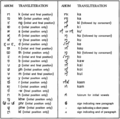 The Ahom script
 -
 An Ahom manuscript preserved in the Department of Historical and Antiquarian Studies, Pan Bazaar, Guwahati.
 -
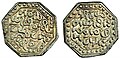 Coin of Ahom king Sunyatphaa in Ahom script


Letters[edit | edit source]
Like most abugidas, each letter has an inherent vowel of /a/.[12] Other vowels are indicated by using diacritics, which can appear above, below, to the left, or to the right of the consonant. The script does not, however, indicate tones used in the language.[5] The Ahom script is further complicated as it contains inconsistencies; a consonant may be written once in a word, but pronounced twice, common words may be shortened, and consecutive words with the same initial consonant may be contracted.[5]
Consonants[edit | edit source]
The following medial consonant diacritics are used to form consonant clusters with /l/ and /r/, such as /kl/ and /kr/.
| Template:Letter | Template:Letter | Template:Letter |
Vowels[edit | edit source]
The following vowel diacritics are added to an initial consonant:
| Template:Letter | Template:Letter | Template:Letter | Template:Letter | Template:Letter | Template:Letter | Template:Letter | Template:Letter | Template:Letter | Template:Letter | Template:Letter |
To write a consonant without a vowel, the virama ⟨Template:Script/Ahom⟩ is used.[13]
Punctuation[edit | edit source]
The following characters are used for punctuation:[13]
| Template:Letter | Template:Letter | Template:Letter | Template:Letter |
Numerals[edit | edit source]
The Ahom script contains its own set of numerals:[13]
Unicode[edit | edit source]
Ahom script was added to the Unicode Standard in June, 2015 with the release of version 8.0. The Ahom block was expended by 16 code points with Unicode 14.0.
The Unicode block for Ahom is U+11700–U+1174F:
See also[edit | edit source]
Notes[edit | edit source]
- ↑ "SEAlang Library Ahom Lexicography". sealang.net.
- ↑ Diringer, David (1948). Alphabet a key to the history of mankind. p. 411.
- ↑ 3.0 3.1 Daniels 2012, p. 170-171.
- ↑ 4.0 4.1 4.2 Diller, A. (1993). Tai Languages. In International Encyclopedia of Linguistics (Vol. 4, pp. 128-131). Oxford, UK: Oxford University Press.
- ↑ 5.0 5.1 5.2 5.3 5.4 Terwiel, B. J., & Wichasin, R. (eds.), (1992). Tai Ahoms and the stars: three ritual texts to ward off danger. Ithaca, NY: Southeast Asia Program.
- ↑ Hundius, Harald; Wharton, David (2010). "The Digital Library of Lao Manuscripts".
{{cite journal}}: Cite journal requires|journal=(help) - ↑ Assam. (2008). In Columbia Encyclopedia Retrieved April 12, 2009, from http://www.credoreference.com/entry/8256016/.
- ↑ French, M. A. (1994). Tai Languages. In The Encyclopedia of Language and Linguistics (Vol. 4, pp. 4520-4521). New York, NY: Pergamon Press Press.
- ↑ Court, C. (1996). Introduction. In P. T. Daniels & W. Bright (Eds.) The World's Writing Systems (pp. 443). Oxford: Oxford University Press.
- ↑ Court, C. (1996). The spread of Brahmi Script into Southeast Asia. In P. T. Daniels & W. Bright (Eds.) The World's Writing Systems (pp. 445-449). Oxford: Oxford University Press.
- ↑ Hongladarom, K. (2005). Thai and Tai Languages. In Encyclopedia of linguistics (Vol. 2, pp. 1098-1101). New York, NY: Fitzroy Dearborn.
- ↑ Hosken, Martin; Morey, Stephen (2012-10-23). "N4321R: Revised Proposal to add the Ahom Script in the SMP of the UCS" (PDF). ISO/IEC JTC1/SC2/WG2.
- ↑ 13.0 13.1 13.2 Morey, Stephen; Hosken, Martin (2012). "Revised Proposal to add the Ahom Script in the SMP of the UCS" (PDF). Unicode.
References[edit | edit source]
- Terwiel, B J; Wichasin, R (1992). Tai Ahoms and the stars: three ritual texts to ward off danger. Ithaca, NY: SEAP Publications. ISBN 9780877277095.
- Daniels, Christian (2012). "Script without buddhism: burmese influence on the tay (shan) script of mäng2 maaw2 as seen in a chinese scroll painting of 1407". International Journal of Asian Studies.
External links[edit | edit source]
- Entry on Ahom at Omniglot.com -- A guide to writing systems
- Pali Tripitaka in Ahom Script by Sajjhaya foundation [1]