


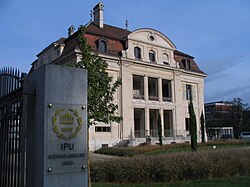

Created an enlightening manuscript. |
added references |
||
| Line 1: | Line 1: | ||
{{Short description|International organization of national parliaments}} | {{Short description|International organization of national parliaments}} | ||
{{Infobox organization | {{Infobox organization | ||
| logo = | | logo = Inter-Parliamentary Union logo.png | ||
| status = International organization | | status = International organization | ||
| headquarters = [[Geneva, Switzerland|Geneva]], [[Switzerland]] | | headquarters = [[Geneva, Switzerland|Geneva]], [[Switzerland]] | ||
| leader_title = [[President (corporation)|President]] | | membership = 183 Members<br />15 Associate Members | ||
| leader_name = [[ | | leader_title = [[President (corporation)|President]] | ||
| leader_title2 = [[Secretary General]] | | leader_name = [[Tulia Ackson]]<ref>{{cite web |title=President |url=https://www.ipu.org/about-ipu/structure-and-governance/president |website=Inter-Parliamentary Union |access-date=30 November 2021}}</ref> | ||
| leader_name2 = [[Martin Chungong]]<ref>{{cite web |title=Secretary General |url=https://www.ipu.org/about-ipu/structure-and-governance/secretary-general |website=Inter-Parliamentary Union |access-date=30 November 2021}}</ref> | | leader_title2 = [[Secretary General]] | ||
| name = Inter-Parliamentary Union | | leader_name2 = [[Martin Chungong]]<ref>{{cite web |title=Secretary General |url=https://www.ipu.org/about-ipu/structure-and-governance/secretary-general |website=Inter-Parliamentary Union |access-date=30 November 2021}}</ref> | ||
| founder = [[Frédéric Passy]],<br /> [[William Randal Cremer]] | | name = Inter-Parliamentary Union | ||
| founded = | | founder = [[Frédéric Passy]],<br /> [[William Randal Cremer]] | ||
| founded = 1889 | |||
| website = {{URL|http://www.ipu.org/}} | | website = {{URL|http://www.ipu.org/}} | ||
}} | }} | ||
The '''Inter-Parliamentary Union''' ('''IPU'''; {{ | The '''Inter-Parliamentary Union''' ('''IPU'''; {{langx|fr|Union Interparlementaire}}, '''UIP''') is an [[inter-parliamentary institution|international organization of national parliaments.]]<ref name="UIA">{{Cite web |url=https://uia.org/s/or/en/1100040146 |url-access= |title=Inter-Parliamentary Union |author1=Staff writer |year=2024 |department=UIA Global Civil Society Database |website=uia.org |publisher=[[Union of International Associations]] |agency=Yearbook of International Organizations Online |location=Brussels, Belgium |format= |arxiv= |asin= |bibcode= |doi= |doi-broken-date= |isbn= |issn= |jfm= |jstor= |lccn= |mr= |oclc= |ol= |osti= |pmc= |pmid= |rfc= |ssrn= |zbl= |id= |access-date=24 December 2024 |url-status= |archive-url= |archive-date= |via= |quote= |trans-quote= |ref= |postscript=}}</ref> Its primary purpose is to promote democratic [[governance]], [[accountability]], and cooperation among its members; other initiatives include advancing gender parity among legislatures, empowering [[youth participation]] in politics, and [[sustainable development]]. | ||
The organization was established in 1889 as the '''Inter-Parliamentary | The organization was established in 1889 as the '''Inter-Parliamentary Conference'''. Its founders were statesmen [[Frédéric Passy]] of [[France]] and [[William Randal Cremer]] of the [[United Kingdom]], who sought to create the first permanent forum for political multilateral negotiations. Initially, IPU membership was reserved for individual [[Member of Parliament|parliamentarians]], but has since transformed to include the legislatures of sovereign states. As of 2025, the national parliaments of 183 countries are members of the IPU, while 15 are associated members, most of whom are regional parliaments.<ref name="Members">{{Cite news|date=2016-05-13|title=Members|language=en|work=Inter-Parliamentary Union|url=https://www.ipu.org/about-us/members|access-date=2017-12-07}}</ref><ref>{{Cite news|title=Матвиенко избрана председателем ассамблеи Межпарламентского союза|language=ru|work=ТАСС|url=http://tass.ru/politika/4646881|access-date=2017-10-17}}</ref> Some of the organization's member states are not democratic by indexes.<ref>{{Cite web |date=2025-02-26 |title=Freedom in the World |url=https://freedomhouse.org/report/freedom-world |access-date=2025-10-08 |website=Freedom House |language=en}}</ref><ref>{{Cite web |title=Democracy Index 2020 |url=https://www.eiu.com/n/campaigns/democracy-index-2020/ |access-date=2025-10-08 |website=Economist Intelligence Unit |language=en-GB}}</ref> | ||
The IPU facilitates the development of international law and institutions, strengthening the foundations and enhancing the vision for peace and the common good, including the [[Permanent Court of Arbitration]], the [[League of Nations]], and the [[United Nations]]. It also sponsors and takes part in international conferences and forums, and has permanent [[United Nations General Assembly observers#Other entities|observer status at the United Nations General Assembly]]. Consequently, eight individuals associated with the organization are [[List of Nobel Peace Prize laureates|Nobel Peace Prize laureates]]. | The IPU facilitates the development of international law and institutions, strengthening the foundations and enhancing the vision for peace and the common good, including the [[Permanent Court of Arbitration]], the [[League of Nations]], and the [[United Nations]]. It also sponsors and takes part in international conferences and forums, and has permanent [[United Nations General Assembly observers#Other entities|observer status at the United Nations General Assembly]]. Consequently, eight individuals associated with the organization are [[List of Nobel Peace Prize laureates|Nobel Peace Prize laureates]]. | ||
| Line 46: | Line 46: | ||
===Members=== | ===Members=== | ||
[[File:Inter-Parliamentary Union Members.png|thumb|right|300px|Map of IPU member states]] | [[File:Inter-Parliamentary Union Members.png|thumb|right|300px|Map of IPU member states]] | ||
At its founding on 30 June 1889, the Inter-Parliamentary Conference had eight members: Austria-Hungary, Belgium, Denmark, France, Italy, Liberia, Spain, and the United Kingdom. The United States also attended but did not formally adopt the treaty of arbitration.<ref>{{cite web|url=https://www.ipu.org/about-ipu/history-ipu|title=History of the IPU|website=Inter-Parliamentary Union}}</ref><ref>{{cite web|url=https://www.ipu.org/130years/#1889-1914|title=Inter-Parliamentary Union {{!}} 130 years {{!}} 130 ans|website=Inter-Parliamentary Union}}</ref> | |||
The Inter-Parliamentary Union currently has 183 members. | |||
* Regional parliamentary assemblies may be admitted by the Governing Council as Associate Members | * Regional parliamentary assemblies may be admitted by the Governing Council as Associate Members | ||
| Line 52: | Line 56: | ||
It is the duty of the Members of the IPU to submit the resolutions of the IPU within their respective Parliament, in the most appropriate form; to communicate them to the Government; to stimulate their implementation and to inform the IPU Secretariat, as often and fully as possible, particularly in its annual reports, as to the steps taken and the results obtained. | It is the duty of the Members of the IPU to submit the resolutions of the IPU within their respective Parliament, in the most appropriate form; to communicate them to the Government; to stimulate their implementation and to inform the IPU Secretariat, as often and fully as possible, particularly in its annual reports, as to the steps taken and the results obtained. | ||
Almost all countries have a parliament member of IPU, with the notable exception of the United States, although the 12th (1904), the 23rd (1925) and the 42nd (1953) conferences were hosted in the US. | |||
;Associate Members | ;Associate Members | ||
| Line 64: | Line 68: | ||
|[[Andean Community of Nations|CAN]] | |[[Andean Community of Nations|CAN]] | ||
|- | |- | ||
|[[Central American Parliament]] | |[[Arab Parliament]] | ||
| | |||
|- | |||
|[[Central American Parliament]] (PARLCEN) | |||
|[[Central American Integration System|SICA]] | |[[Central American Integration System|SICA]] | ||
|- | |- | ||
| Line 73: | Line 80: | ||
|[[European Union|EU]] | |[[European Union|EU]] | ||
|- | |- | ||
| | |[[CIS Interparliamentary Assembly]] | ||
|[[Commonwealth of Independent States|CIS]] | |[[Commonwealth of Independent States|CIS]] | ||
|- | |- | ||
|Inter-Parliamentary Committee of the West African Economic and Monetary Union | |Inter-Parliamentary Committee of the West African Economic and Monetary Union | ||
|[[West African Economic and Monetary Union|UEMOA]] | |[[West African Economic and Monetary Union|UEMOA]] | ||
|- | |- | ||
|[[Latin American Parliament | |[[Latin American Parliament|Latin American and Caribbean Parliament (PARLATINO)]] | ||
| | |[[Latin American Parliament|PARLATINO]] | ||
|- | |- | ||
| | |[[Pan-African Parliament]] | ||
|[[ | |[[African Union|AU]] | ||
|- | |- | ||
|Parliament of the Economic Community of West African States | |Parliament of the Economic Community of West African States | ||
|[[Economic Community of West African States|ECOWAS]] | |[[Economic Community of West African States|ECOWAS]] | ||
|- | |- | ||
|Parliament of the Economic and Monetary Community | |Parliament of the Central African Economic and Monetary Community | ||
|[[CEMAC]] | |[[CEMAC]] | ||
|- | |- | ||
|[[Parliamentary Assembly of the Council of Europe]] | |[[Assemblée parlementaire de la Francophonie|Parliamentary Assembly of La Francophonie]] (APF) | ||
|[[Organisation internationale de la Francophonie|OIF]] | |||
|- | |||
|[[Parliamentary Assembly of the Council of Europe]] (PACE) | |||
|[[Council of Europe|CoE]] | |[[Council of Europe|CoE]] | ||
|- | |- | ||
| | |Parliamentary Assembly of the Black Sea Economic Cooperation | ||
|[[ | |[[Organization of the Black Sea Economic Cooperation|BSEC]] | ||
|} | |} | ||
| Line 108: | Line 115: | ||
* '''Assembly.''' Meeting biannually, the Assembly is composed of parliamentarians designated as delegates by the Members. The Assembly is assisted in its work by Standing Committees, whose number and terms of reference are determined by the Governing Council; Standing Committees shall normally prepare reports and draft resolutions for the Assembly. No one delegate may record more than ten votes. | * '''Assembly.''' Meeting biannually, the Assembly is composed of parliamentarians designated as delegates by the Members. The Assembly is assisted in its work by Standing Committees, whose number and terms of reference are determined by the Governing Council; Standing Committees shall normally prepare reports and draft resolutions for the Assembly. No one delegate may record more than ten votes. | ||
* '''Governing Council'''. The Governing Council normally holds two sessions a year. The Governing Council is composed of three representatives from each Member. The term of office of a member of the Governing Council lasts from one Assembly to the next and all the members of the Governing Council must be sitting members of Parliament. The Governing Council elects the President of the Inter-Parliamentary Union for a period of three years. It also elects the members of the executive committee and appoints the Secretary General of the Union. | * '''Governing Council'''. The Governing Council normally holds two sessions a year. The Governing Council is composed of three representatives from each Member. The term of office of a member of the Governing Council lasts from one Assembly to the next and all the members of the Governing Council must be sitting members of Parliament. The Governing Council elects the President of the Inter-Parliamentary Union for a period of three years. It also elects the members of the executive committee and appoints the Secretary General of the Union. | ||
* '''Executive Committee'''. The executive committee is composed of the President of the Inter-Parliamentary Union, 15 members belonging to different Parliaments (elected by the Governing Council; not less than 12 are elected from among the members of the Governing Council) and the President of the Coordinating Committee of the Meeting of Women Parliamentarians. The fifteen elected seats are assigned to the geopolitical groups. Only parliamentarians from States where women have both the right to vote and the right to stand for election are eligible to the executive committee. The executive committee is the administrative organ of the Inter-Parliamentary Union. The current President is | * '''Executive Committee'''. The executive committee is composed of the President of the Inter-Parliamentary Union, 15 members belonging to different Parliaments (elected by the Governing Council; not less than 12 are elected from among the members of the Governing Council) and the President of the Coordinating Committee of the Meeting of Women Parliamentarians. The fifteen elected seats are assigned to the geopolitical groups. Only parliamentarians from States where women have both the right to vote and the right to stand for election are eligible to the executive committee. The executive committee is the administrative organ of the Inter-Parliamentary Union. The current President is Dr. Tulia Ackson, Speaker of the National Assembly of the United Republic of Tanzania and the second woman to hold the position, who was elected in October 2023.<ref>{{Cite web|title=Election of the President of the Inter-Parliamentary Union|url=http://archive.ipu.org/cnl-e/201/15-p1.pdf}}</ref> | ||
* '''Secretariat.''' The Secretariat constitutes the totality of the staff of the organisation under the direction of the Secretary General, currently Martin Chungong of Cameroon.<ref>{{Cite web|title=Secretary General|url=https://www.ipu.org/about-ipu/structure-and-governance/secretary-general|access-date=2020-08-25|website=Inter-Parliamentary Union|language=en}}</ref> | * '''Secretariat.''' The Secretariat constitutes the totality of the staff of the organisation under the direction of the Secretary General, currently Martin Chungong of Cameroon.<ref>{{Cite web|title=Secretary General|url=https://www.ipu.org/about-ipu/structure-and-governance/secretary-general|access-date=2020-08-25|website=Inter-Parliamentary Union|language=en}}</ref> | ||
The Association of Secretaries General of Parliaments is a consultative body of the Inter-Parliamentary Union. | The Association of Secretaries General of Parliaments is a consultative body of the Inter-Parliamentary Union. | ||
== | == Assemblies == | ||
[[File:Berlin Plaque Medal 1908 Inter-Parliamentary Union.jpg|thumb|[[Art Nouveau]] [[medal|plaque-medallion]] for the 15th Inter-Parliamentary Conference 1908 in [[Berlin]]]] | [[File:Berlin Plaque Medal 1908 Inter-Parliamentary Union.jpg|thumb|[[Art Nouveau]] [[medal|plaque-medallion]] for the 15th Inter-Parliamentary Conference 1908 in [[Berlin]]]] | ||
The | The Assembly is the IPU's main political body through which the IPU's Member Parliaments adopt parliamentary resolutions on global issues. It plays a pivotal role in addressing the issues which threaten peace, democracy and sustainable development, including through its four thematic standing committees. IPU Assemblies are held twice a year either in Geneva or hosted by Member Parliaments. | ||
{| class="wikitable sortable" | {| class="wikitable sortable" | ||
|- | |- | ||
! # !! Host | ! # !! Host city!!Host country !! Year | ||
|- | |||
|150th | |||
|[[Tashkent]] | |||
|{{flag|Uzbekistan}} | |||
|2025 | |||
|- | |||
|149th | |||
|[[Geneva]] | |||
|{{flag|Switzerland}} | |||
|2024 | |||
|- | |||
|148th | |||
|[[Geneva]] | |||
|{{flag|Switzerland}} | |||
|2024 | |||
|- | |||
|147th | |||
|[[Luanda]] | |||
|{{flag|Angola}} | |||
|2023 | |||
|- | |||
|146th | |||
|[[Manama]] | |||
|{{flag|Bahrain}} | |||
|2023 | |||
|- | |||
|145th | |||
|[[Kigali]] | |||
|{{flag|Rwanda}} | |||
|2022 | |||
|- | |||
|144th | |||
|[[Nusa Dua]] | |||
|{{flag|Indonesia}} | |||
|2022 | |||
|- | |||
|143rd | |||
|[[Madrid]] | |||
|{{flag|Spain}} | |||
|2021 | |||
|- | |||
|142nd | |||
|Virtual | |||
|Virtual | |||
|2021 | |||
|- | |- | ||
| 141st||[[Belgrade]]||{{flag|Serbia}}|| 2019 | | 141st||[[Belgrade]]||{{flag|Serbia}}|| 2019 | ||
| Line 129: | Line 181: | ||
| 138th||[[Geneva]]||{{flag|Switzerland}}|| 2018 | | 138th||[[Geneva]]||{{flag|Switzerland}}|| 2018 | ||
|- | |- | ||
| 137th||[[ | | 137th||[[Saint Petersburg]]||{{flag|Russia}}|| 2017 | ||
|- | |- | ||
| 136th||[[Dhaka]]||{{flag|Bangladesh}}|| 2017 | | 136th||[[Dhaka]]||{{flag|Bangladesh}}|| 2017 | ||
| Line 160: | Line 212: | ||
| 125th||[[Bern]]||{{flag|Switzerland}}||2011 | | 125th||[[Bern]]||{{flag|Switzerland}}||2011 | ||
|- | |- | ||
| 124th||[[Panama | | 124th||[[Panama City]]||{{flag|Panama}}||2011 | ||
|- | |- | ||
| 123rd||[[Geneva]]||{{flag|Switzerland}}||2010 | | 123rd||[[Geneva]]||{{flag|Switzerland}}||2010 | ||
| Line 188: | Line 240: | ||
| 111th||[[Geneva]]||{{flag|Switzerland}}||2004 | | 111th||[[Geneva]]||{{flag|Switzerland}}||2004 | ||
|- | |- | ||
| 110th||[[Mexico]]||{{flag|Mexico}}||2004 | | 110th||[[Mexico City]]||{{flag|Mexico}}||2004 | ||
|- | |- | ||
| 109th||[[Geneva]]||{{flag|Switzerland}}||2003 | | 109th||[[Geneva]]||{{flag|Switzerland}}||2003 | ||
| Line 306: | Line 358: | ||
| 52nd||[[Belgrade]]||{{flag|Yugoslavia}}||1963 | | 52nd||[[Belgrade]]||{{flag|Yugoslavia}}||1963 | ||
|- | |- | ||
| 51st||[[ | | 51st||[[Brasília]]||{{flag|Brazil|1960}}||1962 | ||
|- | |- | ||
| 50th||[[Brussels]]||{{flag|Belgium}}||1961 | | 50th||[[Brussels]]||{{flag|Belgium}}||1961 | ||
| Line 417: | Line 469: | ||
==Presidents== | ==Presidents== | ||
{| | {|" | ||
|- | |- | ||
! President | ! President | ||
| Line 423: | Line 475: | ||
! Country | ! Country | ||
|- | |- | ||
|[[ | |[[August Beernaert]] | ||
| | |1909–1912 | ||
|{{flag| | |{{flag|Belgium}} | ||
|- | |||
|[[Philip Stanhope, 1st Baron Weardale|Philip Stanhope]] | |||
|1912–1922 | |||
|{{flag|United Kingdom}} | |||
|- | |- | ||
|[[ | |[[Theodor Adelsward]] | ||
| | |1922–1928 | ||
| {{flag| | |{{flag|Sweden}} | ||
|- | |- | ||
|[[ | |[[Fernand Bouisson]] | ||
| | |1928–1934 | ||
|{{flag| | |{{flag|France}} | ||
|- | |- | ||
|[[ | |[[Henri Carton de Wiart]] | ||
| | |1934–1947 | ||
|{{flag| | |{{flag|Belgium}} | ||
|- | |- | ||
|[[ | |[[William Wedgwood Benn, 1st Viscount Stansgate|William Wedgwood Benn]] | ||
| | |1947–1957 | ||
|{{flag| | |{{flag|United Kingdom}} | ||
|- | |- | ||
| [[ | |[[Giuseppe Codacci-Pisanelli]] | ||
| | |1957–1962 | ||
|{{flag|Italy}} | |{{flag|Italy}} | ||
|- | |- | ||
|[[ | |[[Ranieri Mazzilli]] | ||
| | |1962–1967 | ||
|{{flag| | |{{flag|Brazil}} | ||
|- | |- | ||
|[[ | |[[Abderrahman Abdennebi]] | ||
| | |1967–1968 | ||
|{{flag| | |{{flag|Tunisia}} | ||
|- | |- | ||
|[[ | |[[André Chandernagor]] | ||
| | |1968–1973 | ||
|{{flag| | |{{flag|France}} | ||
|- | |- | ||
|[[ | |[[Gurdial Singh Dhillon]] | ||
| | |1973–1976 | ||
|{{flag| | |{{flag|India}} | ||
|- | |- | ||
|[[ | |[[Thomas Williams (Warrington MP)|Thomas Williams]] | ||
| | |1976–1979 | ||
|{{flag|United Kingdom}} | |{{flag|United Kingdom}} | ||
|- | |- | ||
|[[ | |[[Rafael Caldera]] | ||
| | |1979–1982 | ||
|{{flag| | |{{flag|Venezuela}} | ||
|- | |- | ||
|[[ | |[[Johannes Virolainen]] | ||
| | |1982–1983 | ||
|{{flag| | |{{flag|Finland}} | ||
|- | |- | ||
|[[ | |[[Emile Cuvelier]] | ||
| | |1983 | ||
|{{flag| | |{{flag|Belgium}} | ||
|- | |- | ||
|[[Izz El Din El Sayed]] | |[[Izz El Din El Sayed]] | ||
| Line 483: | Line 539: | ||
|{{flag|Sudan}} | |{{flag|Sudan}} | ||
|- | |- | ||
|[[ | |[[John Page (MP for Harrow West)|John Page]] | ||
| | |1985 | ||
|{{flag| | |{{flag|United Kingdom}} | ||
|- | |- | ||
|[[ | |[[Hans Stercken]] | ||
| | |1985–1988 | ||
|{{flag| | |{{flag|West Germany}} | ||
|- | |- | ||
|[[ | |[[Dauda Sow]] | ||
| | |1988–1991 | ||
|{{flag| | |{{flag|Senegal}} | ||
|- | |- | ||
|[[ | |[[Michael Marshall (politician)|Michael Marshall]] | ||
| | |1991–1994 | ||
|{{flag|United Kingdom}} | |{{flag|United Kingdom}} | ||
|- | |- | ||
|[[ | |[[Ahmed Fathi Sorour]] | ||
| | |1994–1997 | ||
|{{flag| | |{{flag|Egypt}} | ||
|- | |- | ||
|[[ | |[[Miguel Ángel Martínez Martínez|Miguel Angel Martinez]] | ||
| | |1997–1999 | ||
|{{flag| | |{{flag|Spain}} | ||
|- | |- | ||
|[[ | |[[Najma Heptulla]] | ||
| | |1999–2002 | ||
|{{flag| | |{{flag|India}} | ||
|- | |- | ||
|[[ | |[[Sergio Paes Verdugo]] | ||
| | |2002–2005 | ||
|{{flag| | |{{flag|Chile}} | ||
|- | |- | ||
|[[ | | [[Pier Ferdinando Casini]] | ||
| | |2005–2008 | ||
|{{flag|Italy}} | |{{flag|Italy}} | ||
|- | |- | ||
|[[ | |[[Theo-Ben Gurirab]] | ||
| | |2008–2011 | ||
|{{flag| | |{{flag|Namibia}} | ||
|- | |- | ||
|[[ | |[[Abdelwahad Radi]] | ||
| | |2011–2014 | ||
|{{flag| | |{{flag|Morocco}} | ||
|- | |- | ||
|[[ | |[[Saber Hossain Chowdhury]] | ||
| | |2014–2017 | ||
|{{flag| | |{{flag|Bangladesh}} | ||
|- | |- | ||
|[[ | |[[Gabriela Cuevas Barron]] | ||
| | |2017–2020 | ||
|{{flag| | |{{flag|Mexico}} | ||
|- | |- | ||
|[[ | |[[Duarte Pacheco (21st century)|Duarte Pacheco]] | ||
| | |2020–2023 | ||
|{{flag| | |{{flag|Portugal}} | ||
|- | |- | ||
|[[ | |[[Tulia Ackson]] | ||
| | |2023– | ||
|{{flag| | |{{flag|Tanzania}} | ||
|} | |} | ||
| Line 553: | Line 609: | ||
==The IPU and the United Nations== | ==The IPU and the United Nations== | ||
The IPU marked the 50th anniversary of the United Nations, in 1995, by holding a special session in the [[United Nations General Assembly Hall|General Assembly Hall]] before the start of the session,<ref name="UN_A50561_page2">{{UN document |docid=A-50-561 |type=Document |body=General Assembly |session=50 |document_number=561 |highlight=rect_158,350_882,609 |page=2 |accessdate=2007-09-10}}</ref> where they planned for closer cooperation with the United Nations. The [[United Nations General Assembly Resolution|General Assembly Resolution]] passed during that session requested the Secretary-General to put this into action.<ref name="UN_ARES5015">{{UN document |docid=A-RES-50-15 |type=Resolution |body=General Assembly |session=50 |resolution_number=15 |accessdate=2007-09-10}}</ref> An agreement was signed between the IPU and the Secretary-General on 24 July 1996 and subsequently ratified by a General Assembly Resolution, where the United Nations recognizes IPU as the world organization of parliaments.<ref name="UN_A51402">{{UN document |docid=A-51-402 |type=Document |body=General Assembly |session=51 |document_number=402 |accessdate=2007-09-10| date=25 September 1995}}</ref><ref name="UN_ARES517">{{UN document |docid=A-RES-51-7 |type=Resolution |body=General Assembly |session=51 |resolution_number=7 |accessdate=2007-09-10}}</ref> Pursuant to this resolution, the Secretary-General submitted a report<ref name="UN_A52456">{{UN document |docid=A-52-456 |type=Document |body=General Assembly |session=52 |document_number=456 |accessdate=2007-09-10| date=13 October 1997}}</ref> which was noted with appreciation by the General Assembly, who requested further strengthening of cooperation and another report.<ref name="UN_ARES527">{{UN document |docid=A-RES-52-7 |type=Resolution |body=General Assembly |session=52 |resolution_number=7 |accessdate=2007-09-10}}</ref> This report detailed the measures that had been taken, including opening a liaison office in New York, and cooperation on issues such land-mines and the promotion of representative democracy.<ref name="UN_A53458">{{UN document |docid=A-53-458 |type=Document |body=General Assembly |session=53 |document_number=458 |accessdate=2007-09-10}}</ref> Following an entire morning of debate<ref name="UN_A53PV46_1998">{{UN document |docid=A-53-PV.46 |type=Verbatim Report |body=General Assembly |session=53 |meeting=46 |accessdate=2007-09-10}}</ref> the General Assembly passed a resolution which simply stated that it "looks forward to continued close cooperation".<ref name="UN_ARES5313">{{UN document |docid=A-RES-53-13 |type=Resolution |body=General Assembly |session=53 |resolution_number=13 |accessdate=2007-09-10}}</ref> | The IPU marked the 50th anniversary of the United Nations, in 1995, by holding a special session in the [[United Nations General Assembly Hall|General Assembly Hall]] before the start of the session,<ref name="UN_A50561_page2">{{UN document |docid=A-50-561 |type=Document |body=General Assembly |session=50 |document_number=561 |highlight=rect_158,350_882,609 |page=2 |accessdate=2007-09-10}}</ref> where they planned for closer cooperation with the United Nations. The [[United Nations General Assembly Resolution|General Assembly Resolution]] passed during that session requested the Secretary-General to put this into action.<ref name="UN_ARES5015">{{UN document |docid=A-RES-50-15 |type=Resolution |body=General Assembly |session=50 |resolution_number=15 |accessdate=2007-09-10|date=22 November 1995}}</ref> An agreement was signed between the IPU and the Secretary-General on 24 July 1996 and subsequently ratified by a General Assembly Resolution, where the United Nations recognizes IPU as the world organization of parliaments.<ref name="UN_A51402">{{UN document |docid=A-51-402 |type=Document |body=General Assembly |session=51 |document_number=402 |accessdate=2007-09-10| date=25 September 1995}}</ref><ref name="UN_ARES517">{{UN document |docid=A-RES-51-7 |type=Resolution |body=General Assembly |session=51 |resolution_number=7 |accessdate=2007-09-10|date=7 November 1996}}</ref> Pursuant to this resolution, the Secretary-General submitted a report<ref name="UN_A52456">{{UN document |docid=A-52-456 |type=Document |body=General Assembly |session=52 |document_number=456 |accessdate=2007-09-10| date=13 October 1997}}</ref> which was noted with appreciation by the General Assembly, who requested further strengthening of cooperation and another report.<ref name="UN_ARES527">{{UN document |docid=A-RES-52-7 |type=Resolution |body=General Assembly |session=52 |resolution_number=7 |accessdate=2007-09-10|date=6 November 1997}}</ref> This report detailed the measures that had been taken, including opening a liaison office in New York, and cooperation on issues such land-mines and the promotion of representative democracy.<ref name="UN_A53458">{{UN document |docid=A-53-458 |type=Document |body=General Assembly |session=53 |document_number=458 |accessdate=2007-09-10|date=5 October 1998}}</ref> Following an entire morning of debate<ref name="UN_A53PV46_1998">{{UN document |docid=A-53-PV.46 |date=28 October 1998 |type=Verbatim Report |body=General Assembly |session=53 |meeting=46 |accessdate=2007-09-10}}</ref> the General Assembly passed a resolution which simply stated that it "looks forward to continued close cooperation".<ref name="UN_ARES5313">{{UN document |docid=A-RES-53-13 |type=Resolution |body=General Assembly |session=53 |resolution_number=13 |accessdate=2007-09-10}}</ref> | ||
The following year (1999) the Secretary-General reported on an increased number of areas of cooperation,<ref name="UN_A54379">{{UN document |docid=A-54-379 |type=Document |body=General Assembly |session=54 |document_number=379 |accessdate=2007-09-10}}</ref> the issue was debated for an entire afternoon<ref name="UN_A54PV41_1999">{{UN document |docid=A-54-PV.41 |type=Verbatim Report |body=General Assembly |session=54 |meeting=41 |accessdate=2007-09-10}}</ref> (interrupted by a minute of silence held for tribute to [[Vazgen Sargsyan]], the Prime Minister of [[Armenia]] who had just at that time been [[1999 Armenian parliament shooting|killed by gunmen]]),<ref>{{ UN document |docid=A-54-PV.41 |body=General Assembly |type=Verbotim Report |session=54 |meeting=41 |page=20 |anchor=pg020-bk02 |meetingtime=15:00 |speakername=The President |accessdate=2007-09-10 }}</ref> and passed a resolution requesting the IPU be allowed to address the Millennium General Assembly directly.<ref name="UN_ARES5412">{{UN document |docid=A-RES-54-12 |type=Resolution |body=General Assembly |session=54 |resolution_number=12 |accessdate=2007-09-10| date=18 November 1999}}</ref> | The following year (1999) the Secretary-General reported on an increased number of areas of cooperation,<ref name="UN_A54379">{{UN document |docid=A-54-379 |type=Document |body=General Assembly |session=54 |document_number=379 |accessdate=2007-09-10|date=21 September 1999}}</ref> the issue was debated for an entire afternoon<ref name="UN_A54PV41_1999">{{UN document |docid=A-54-PV.41 |date=27 October 1999 |type=Verbatim Report |body=General Assembly |session=54 |meeting=41 |accessdate=2007-09-10}}</ref> (interrupted by a minute of silence held for tribute to [[Vazgen Sargsyan]], the Prime Minister of [[Armenia]] who had just at that time been [[1999 Armenian parliament shooting|killed by gunmen]]),<ref>{{ UN document |docid=A-54-PV.41 |body=General Assembly |type=Verbotim Report |session=54 |meeting=41 |page=20 |anchor=pg020-bk02 |date=27 October 1999 |meetingtime=15:00 |speakername=The President |accessdate=2007-09-10 }}</ref> and passed a resolution requesting the IPU be allowed to address the Millennium General Assembly directly.<ref name="UN_ARES5412">{{UN document |docid=A-RES-54-12 |type=Resolution |body=General Assembly |session=54 |resolution_number=12 |accessdate=2007-09-10| date=18 November 1999}}</ref> | ||
Following another report,<ref name="UN_A55409">{{UN document |docid=A-55-409 |type=Document |body=General Assembly |session=55 |document_number=409 |accessdate=2007-09-10}}</ref> and another half-day debate,<ref name="UN_A55PV55_2000">{{UN document | Following another report,<ref name="UN_A55409">{{UN document |docid=A-55-409 |type=Document |body=General Assembly |session=55 |document_number=409 |accessdate=2007-09-10|date=18 October 2000}}</ref> and another half-day debate,<ref name="UN_A55PV55_2000">{{UN document | ||
|docid=A-55-PV.55 | |docid=A-55-PV.55 | ||
|date=8 November 2000 | |date=8 November 2000 | ||
| Line 570: | Line 626: | ||
In the Resolution ''59/19, Cooperation between the United Nations and the Inter-Parliamentary Union'', the UN General Assembly takes note of the recommendations in regard to engaging parliamentarians more systematically in the work of | In the Resolution ''59/19, Cooperation between the United Nations and the Inter-Parliamentary Union'', the UN General Assembly takes note of the recommendations in regard to engaging parliamentarians more systematically in the work of | ||
the United Nations.<ref name="autogenerated1">[ | the United Nations.<ref name="autogenerated1">[https://www.ipu.org/Un-e/a-res-59-19.pdf Resolution adopted by the General Assembly], 17 December 2004</ref> | ||
The final declaration of the Second World Conference of Speakers of Parliament, hosted at United Nations headquarters, took place in September 2005, was entitled ''Bridging the democracy gap in international relations: A stronger role for parliament''.<ref>[ | The final declaration of the Second World Conference of Speakers of Parliament, hosted at United Nations headquarters, took place in September 2005, was entitled ''Bridging the democracy gap in international relations: A stronger role for parliament''.<ref>[https://www.ipu.org/splz-e/sp-conf05/declaration.pdf Bridging the democracy gap in international relations: A stronger role for parliaments] UNO Second World Conference of Speakers of Parliaments, New York, 7 to 9 September 2005</ref> | ||
In the Resolution adopted by the UN General Assembly, ''61/6, Cooperation between the United Nations and the Inter-Parliamentary Union'', on 27 November 2006, it calls for ''the further development of the annual parliamentary hearing at the United Nations and other specialized parliamentary meetings in the context of major United Nations meetings as joint United Nations-Inter-Parliamentary Union events''.<ref name="autogenerated2">[ | In the Resolution adopted by the UN General Assembly, ''61/6, Cooperation between the United Nations and the Inter-Parliamentary Union'', on 27 November 2006, it calls for ''the further development of the annual parliamentary hearing at the United Nations and other specialized parliamentary meetings in the context of major United Nations meetings as joint United Nations-Inter-Parliamentary Union events''.<ref name="autogenerated2">[https://www.ipu.org/Un-e/a-61-L6-e.pdf Resolution 61/6: Cooperation between the United Nations and the Inter-Parliamentary Union], 27 November 2006, at IPU official website</ref> | ||
Every year during the fall session of the General Assembly the IPU organises a Parliamentary Hearing.<ref>[http://www.ipu.org/un-e/un-hearings.htm Cooperation with the UN: hearings] at IPU official website</ref> A resolution on cooperation between the United Nations and the IPU allowed for circulation of official IPU documents in the General Assembly. | Every year during the fall session of the General Assembly the IPU organises a Parliamentary Hearing.<ref>[http://www.ipu.org/un-e/un-hearings.htm Cooperation with the UN: hearings] at IPU official website</ref> A resolution on cooperation between the United Nations and the IPU allowed for circulation of official IPU documents in the General Assembly. | ||
| Line 581: | Line 637: | ||
=== Fourth World Conference of Speakers of Parliament === | === Fourth World Conference of Speakers of Parliament === | ||
The fourth world conference on [[Seventieth anniversary of the United Nations|UN 70th anniversary]] marked by [[Ban Ki-moon|Ban Ki-Moon]] as "[[UN70]]" was organised in September 2015 where Speakers of all IPU('''''Inter-Parliamentary Union''''') member parliaments and of non-member parliaments were invited from across the world. The theme was on peace, democracy, and development.<ref>{{cite web|title = Press Releases|url = http://www.hellenicparliament.gr/en/Enimerosi/Grafeio-Typou/Deltia-Typou/?press=4cd2f49d-6939-4061-833d-a50a0125d9d9|website = www.hellenicparliament.gr|access-date = 2015-10-01}}</ref> | The fourth world conference on [[Seventieth anniversary of the United Nations|UN 70th anniversary]] marked by [[Ban Ki-moon|Ban Ki-Moon]] as "[[UN70]]" was organised in September 2015 where Speakers of all IPU ('''''Inter-Parliamentary Union''''') member parliaments and of non-member parliaments were invited from across the world. The theme was on peace, democracy, and development.<ref>{{cite web|title = Press Releases|url = http://www.hellenicparliament.gr/en/Enimerosi/Grafeio-Typou/Deltia-Typou/?press=4cd2f49d-6939-4061-833d-a50a0125d9d9|website = www.hellenicparliament.gr|access-date = 2015-10-01}}</ref> | ||
=== United Nations reports, resolutions, and agreements=== | === United Nations reports, resolutions, and agreements=== | ||
*Resolution of the United Nations: Cooperation between the United Nations and the Inter-Parliamentary Union, 27 November 2006.<ref name="autogenerated2" /> | *Resolution of the United Nations: Cooperation between the United Nations and the Inter-Parliamentary Union, 27 November 2006.<ref name="autogenerated2" /> | ||
*Report of the United Nations Secretary-General: Cooperation between the United Nations and regional and other organizations, 16 August 2006.<ref>[ | *Report of the United Nations Secretary-General: Cooperation between the United Nations and regional and other organizations, 16 August 2006.<ref>[https://www.ipu.org/Un-e/a-61-256-e.pdf Etpu<!-- Bot generated title -->]</ref> | ||
*Resolution of the United Nations General Assembly: Cooperation between the United Nations and the Inter-Parliamentary Union, 8 November 2004.<ref name="autogenerated1" /> | *Resolution of the United Nations General Assembly: Cooperation between the United Nations and the Inter-Parliamentary Union, 8 November 2004.<ref name="autogenerated1" /> | ||
* Report of the United Nations Secretary-General: Cooperation between the United Nations and the Inter-Parliamentary Union (see Part 5 of the Annex), 1 September 2004.<ref>[ | * Report of the United Nations Secretary-General: Cooperation between the United Nations and the Inter-Parliamentary Union (see Part 5 of the Annex), 1 September 2004.<ref>[https://www.ipu.org/Un-e/a-59-303.pdf Microsoft Word – 0447505e.doc<!-- Bot generated title -->]</ref> | ||
* Resolution adopted by the General Assembly: Cooperation between the United Nations and the Inter-Parliamentary Union, 21 November 2002.<ref>[ | * Resolution adopted by the General Assembly: Cooperation between the United Nations and the Inter-Parliamentary Union, 21 November 2002.<ref>[https://www.ipu.org/Un-e/a-res-57-47.pdf Microsoft Word – UND_GEN_N0254074_DOCU_N<!-- Bot generated title -->]</ref> | ||
* Resolution adopted by the General Assembly: Observer status for the Inter-Parliamentary Union in the General Assembly, 19 November 2002.<ref>[ | * Resolution adopted by the General Assembly: Observer status for the Inter-Parliamentary Union in the General Assembly, 19 November 2002.<ref>[https://www.ipu.org/Un-e/a-res-57-32.pdf Resolution 57/32. Observer status for the Inter-Parliamentary Union in the General Assembly] 19 November 2002</ref> | ||
* Report of the United Nations Secretary-General: Cooperation between the United Nations and the Inter-Parliamentary Union, 3 September 2002.<ref>[ | * Report of the United Nations Secretary-General: Cooperation between the United Nations and the Inter-Parliamentary Union, 3 September 2002.<ref>[https://www.ipu.org/Un-e/a-57-375.pdf Cooperation between the United Nations and the Inter-Parliamentary Union: Report of the Secretary-General—Summary] at IPU official website, 3 September 2002</ref> | ||
* Cooperation Agreement between the United Nations and the Inter-Parliamentary Union of 1996.<ref>[https://www.un.org/documents/ga/docs/51/plenary/a51-402.htm Cooperation between the United Nations and the Inter-Parliamentary Union: Report of the Secretary-General] Full item, 25 September 1996, at UNO official website. Accessed 24 February 2014</ref> | * Cooperation Agreement between the United Nations and the Inter-Parliamentary Union of 1996.<ref>[https://www.un.org/documents/ga/docs/51/plenary/a51-402.htm Cooperation between the United Nations and the Inter-Parliamentary Union: Report of the Secretary-General] Full item, 25 September 1996, at UNO official website. Accessed 24 February 2014</ref> | ||
| Line 616: | Line 672: | ||
==External links== | ==External links== | ||
* {{official | * {{official website|http://www.ipu.org/}} | ||
* [http://www.ipu.org/strct-e/un.htm Cooperation with the United Nations] at official website | * [http://www.ipu.org/strct-e/un.htm Cooperation with the United Nations] at official website | ||
* ''[https://archive.org/details/ipusterzel The Inter-Parliamentary Union]'' (1968) | * ''[https://archive.org/details/ipusterzel The Inter-Parliamentary Union]'' (1968) | ||
| Line 623: | Line 679: | ||
{{International organizations}} | {{International organizations}} | ||
{{Authority control}} | |||
[[Category:Inter-Parliamentary Union| ]] | [[Category:Inter-Parliamentary Union| ]] | ||
Latest revision as of 20:15, 28 December 2025
 | |
| Founded | 1889 |
|---|---|
| Founder | Frédéric Passy, William Randal Cremer |
| Legal status | International organization |
| Headquarters | Geneva, Switzerland |
Membership | 183 Members 15 Associate Members |
| Tulia Ackson[1] | |
| Martin Chungong[2] | |
| Website | www |
The Inter-Parliamentary Union (IPU; French: Union Interparlementaire, UIP) is an international organization of national parliaments.[3] Its primary purpose is to promote democratic governance, accountability, and cooperation among its members; other initiatives include advancing gender parity among legislatures, empowering youth participation in politics, and sustainable development.
The organization was established in 1889 as the Inter-Parliamentary Conference. Its founders were statesmen Frédéric Passy of France and William Randal Cremer of the United Kingdom, who sought to create the first permanent forum for political multilateral negotiations. Initially, IPU membership was reserved for individual parliamentarians, but has since transformed to include the legislatures of sovereign states. As of 2025, the national parliaments of 183 countries are members of the IPU, while 15 are associated members, most of whom are regional parliaments.[4][5] Some of the organization's member states are not democratic by indexes.[6][7]
The IPU facilitates the development of international law and institutions, strengthening the foundations and enhancing the vision for peace and the common good, including the Permanent Court of Arbitration, the League of Nations, and the United Nations. It also sponsors and takes part in international conferences and forums, and has permanent observer status at the United Nations General Assembly. Consequently, eight individuals associated with the organization are Nobel Peace Prize laureates.
History[edit | edit source]
The organisation's initial objective was the arbitration of conflicts. The IPU played an important part in setting up the Permanent Court of Arbitration in The Hague. Over time, its mission has evolved towards the promotion of democracy and inter-parliamentary dialogue. The IPU has worked for establishment of institutions at the inter-governmental level, including the United Nations, an organization with which it cooperates and with which it has permanent observer status.
The headquarters of the union have been moved several times since its inception. Locations:
- 1892–1911: Bern (Switzerland)
- 1911–1914: Brussels (Belgium)
- 1914–1920: Oslo (Norway)
- 1921–present: Geneva (Switzerland)
Eight leading personalities of the IPU have received Nobel Peace Prizes:
- 1901: Frédéric Passy (France)
- 1902: Charles Albert Gobat (Switzerland)
- 1903: Randal Cremer (United Kingdom)
- 1908: Fredrik Bajer (Denmark)
- 1909: Auguste Marie François Beernaert (Belgium)
- 1913: Henri La Fontaine (Belgium)
- 1921: Christian Lange (Norway)
- 1927: Ferdinand Buisson (France)
Members and organization[edit | edit source]
Members[edit | edit source]

At its founding on 30 June 1889, the Inter-Parliamentary Conference had eight members: Austria-Hungary, Belgium, Denmark, France, Italy, Liberia, Spain, and the United Kingdom. The United States also attended but did not formally adopt the treaty of arbitration.[8][9]
The Inter-Parliamentary Union currently has 183 members.
- Regional parliamentary assemblies may be admitted by the Governing Council as Associate Members
- Every Parliament constituted in conformity with the laws of a sovereign State whose population it represents and on whose territory it functions may request affiliation to the Inter-Parliamentary Union. The decision to admit or readmit a Parliament shall be taken by the Governing Council.
It is the duty of the Members of the IPU to submit the resolutions of the IPU within their respective Parliament, in the most appropriate form; to communicate them to the Government; to stimulate their implementation and to inform the IPU Secretariat, as often and fully as possible, particularly in its annual reports, as to the steps taken and the results obtained.
Almost all countries have a parliament member of IPU, with the notable exception of the United States, although the 12th (1904), the 23rd (1925) and the 42nd (1953) conferences were hosted in the US.
- Associate Members
The participating parliamentary assemblies other than national parliaments are the following:[4]
| Name | Related organization |
| Andean Parliament | CAN |
| Arab Parliament | |
| Central American Parliament (PARLCEN) | SICA |
| East African Legislative Assembly | EAC |
| European Parliament | EU |
| CIS Interparliamentary Assembly | CIS |
| Inter-Parliamentary Committee of the West African Economic and Monetary Union | UEMOA |
| Latin American and Caribbean Parliament (PARLATINO) | PARLATINO |
| Pan-African Parliament | AU |
| Parliament of the Economic Community of West African States | ECOWAS |
| Parliament of the Central African Economic and Monetary Community | CEMAC |
| Parliamentary Assembly of La Francophonie (APF) | OIF |
| Parliamentary Assembly of the Council of Europe (PACE) | CoE |
| Parliamentary Assembly of the Black Sea Economic Cooperation | BSEC |
Organs[edit | edit source]

The organs of the Inter-Parliamentary Union are:
- Assembly. Meeting biannually, the Assembly is composed of parliamentarians designated as delegates by the Members. The Assembly is assisted in its work by Standing Committees, whose number and terms of reference are determined by the Governing Council; Standing Committees shall normally prepare reports and draft resolutions for the Assembly. No one delegate may record more than ten votes.
- Governing Council. The Governing Council normally holds two sessions a year. The Governing Council is composed of three representatives from each Member. The term of office of a member of the Governing Council lasts from one Assembly to the next and all the members of the Governing Council must be sitting members of Parliament. The Governing Council elects the President of the Inter-Parliamentary Union for a period of three years. It also elects the members of the executive committee and appoints the Secretary General of the Union.
- Executive Committee. The executive committee is composed of the President of the Inter-Parliamentary Union, 15 members belonging to different Parliaments (elected by the Governing Council; not less than 12 are elected from among the members of the Governing Council) and the President of the Coordinating Committee of the Meeting of Women Parliamentarians. The fifteen elected seats are assigned to the geopolitical groups. Only parliamentarians from States where women have both the right to vote and the right to stand for election are eligible to the executive committee. The executive committee is the administrative organ of the Inter-Parliamentary Union. The current President is Dr. Tulia Ackson, Speaker of the National Assembly of the United Republic of Tanzania and the second woman to hold the position, who was elected in October 2023.[10]
- Secretariat. The Secretariat constitutes the totality of the staff of the organisation under the direction of the Secretary General, currently Martin Chungong of Cameroon.[11]
The Association of Secretaries General of Parliaments is a consultative body of the Inter-Parliamentary Union.
Assemblies[edit | edit source]

The Assembly is the IPU's main political body through which the IPU's Member Parliaments adopt parliamentary resolutions on global issues. It plays a pivotal role in addressing the issues which threaten peace, democracy and sustainable development, including through its four thematic standing committees. IPU Assemblies are held twice a year either in Geneva or hosted by Member Parliaments.


Presidents[edit | edit source]


.svg)
Amendments to the Statutes[edit | edit source]
Any proposal to amend the Statutes shall be submitted in writing to the Secretariat of the Union at least three months before the meeting of the Assembly. The Secretariat will immediately communicate all such proposals to the Members of the Union. The consideration of such proposed amendments shall be automatically placed on the agenda of the Assembly.
Any sub-amendments shall be submitted in writing to the Secretariat of the Union at least six weeks before the meeting of the Assembly. The Secretariat will immediately communicate all such sub-amendments to the Members of the Union.
After hearing the opinion of the Governing Council, expressed through a simple majority vote, the Assembly shall decide on such proposals by a two-thirds majority vote.
The IPU and the United Nations[edit | edit source]
The IPU marked the 50th anniversary of the United Nations, in 1995, by holding a special session in the General Assembly Hall before the start of the session,[13] where they planned for closer cooperation with the United Nations. The General Assembly Resolution passed during that session requested the Secretary-General to put this into action.[14] An agreement was signed between the IPU and the Secretary-General on 24 July 1996 and subsequently ratified by a General Assembly Resolution, where the United Nations recognizes IPU as the world organization of parliaments.[15][16] Pursuant to this resolution, the Secretary-General submitted a report[17] which was noted with appreciation by the General Assembly, who requested further strengthening of cooperation and another report.[18] This report detailed the measures that had been taken, including opening a liaison office in New York, and cooperation on issues such land-mines and the promotion of representative democracy.[19] Following an entire morning of debate[20] the General Assembly passed a resolution which simply stated that it "looks forward to continued close cooperation".[21]
The following year (1999) the Secretary-General reported on an increased number of areas of cooperation,[22] the issue was debated for an entire afternoon[23] (interrupted by a minute of silence held for tribute to Vazgen Sargsyan, the Prime Minister of Armenia who had just at that time been killed by gunmen),[24] and passed a resolution requesting the IPU be allowed to address the Millennium General Assembly directly.[25]
Following another report,[26] and another half-day debate,[27] the General Assembly welcomed the IPU declaration entitled "The Parliamentary vision for international cooperation at the dawn of the third millennium" and called for the Secretary-General to explore new and further ways in which the relationship could be strengthened.[28]
On 19 November 2002 the IPU was granted observer status to the General Assembly.[29]
In the Resolution 59/19, Cooperation between the United Nations and the Inter-Parliamentary Union, the UN General Assembly takes note of the recommendations in regard to engaging parliamentarians more systematically in the work of the United Nations.[30]
The final declaration of the Second World Conference of Speakers of Parliament, hosted at United Nations headquarters, took place in September 2005, was entitled Bridging the democracy gap in international relations: A stronger role for parliament.[31]
In the Resolution adopted by the UN General Assembly, 61/6, Cooperation between the United Nations and the Inter-Parliamentary Union, on 27 November 2006, it calls for the further development of the annual parliamentary hearing at the United Nations and other specialized parliamentary meetings in the context of major United Nations meetings as joint United Nations-Inter-Parliamentary Union events.[32]
Every year during the fall session of the General Assembly the IPU organises a Parliamentary Hearing.[33] A resolution on cooperation between the United Nations and the IPU allowed for circulation of official IPU documents in the General Assembly.
UN and the IPU cooperate closely in various fields, in particular peace and security, economic and social development, international law, human rights, and democracy and gender issues, but IPU has not obtained the status of UN General Assembly subsidiary organ.
Fourth World Conference of Speakers of Parliament[edit | edit source]
The fourth world conference on UN 70th anniversary marked by Ban Ki-Moon as "UN70" was organised in September 2015 where Speakers of all IPU (Inter-Parliamentary Union) member parliaments and of non-member parliaments were invited from across the world. The theme was on peace, democracy, and development.[34]
United Nations reports, resolutions, and agreements[edit | edit source]
- Resolution of the United Nations: Cooperation between the United Nations and the Inter-Parliamentary Union, 27 November 2006.[32]
- Report of the United Nations Secretary-General: Cooperation between the United Nations and regional and other organizations, 16 August 2006.[35]
- Resolution of the United Nations General Assembly: Cooperation between the United Nations and the Inter-Parliamentary Union, 8 November 2004.[30]
- Report of the United Nations Secretary-General: Cooperation between the United Nations and the Inter-Parliamentary Union (see Part 5 of the Annex), 1 September 2004.[36]
- Resolution adopted by the General Assembly: Cooperation between the United Nations and the Inter-Parliamentary Union, 21 November 2002.[37]
- Resolution adopted by the General Assembly: Observer status for the Inter-Parliamentary Union in the General Assembly, 19 November 2002.[38]
- Report of the United Nations Secretary-General: Cooperation between the United Nations and the Inter-Parliamentary Union, 3 September 2002.[39]
- Cooperation Agreement between the United Nations and the Inter-Parliamentary Union of 1996.[40]
See also[edit | edit source]
- Inter-parliamentary institution
- e-democracy
- Global democracy
- Third World Conference of Speakers of Parliament
- International Day of Democracy
- Internationalism (politics)
- List of peace activists
- Millennium Development Goals
- Supranational union
- Sustainable Development Goals
- United Nations Democracy Fund
- United Nations Parliamentary Assembly
- United Nations Department of Economic and Social Affairs (UNDESA)
Notes[edit | edit source]
References[edit | edit source]
- ↑ "President". Inter-Parliamentary Union. Retrieved 30 November 2021.
- ↑ "Secretary General". Inter-Parliamentary Union. Retrieved 30 November 2021.
- ↑ Staff writer (2024). "Inter-Parliamentary Union". UIA Global Civil Society Database. uia.org. Brussels, Belgium: Union of International Associations. Yearbook of International Organizations Online. Retrieved 24 December 2024.
- ↑ 4.0 4.1 "Members". Inter-Parliamentary Union. 2016-05-13. Retrieved 2017-12-07.
- ↑ "Матвиенко избрана председателем ассамблеи Межпарламентского союза". ТАСС (in русский). Retrieved 2017-10-17.
- ↑ "Freedom in the World". Freedom House. 2025-02-26. Retrieved 2025-10-08.
- ↑ "Democracy Index 2020". Economist Intelligence Unit. Retrieved 2025-10-08.
- ↑ "History of the IPU". Inter-Parliamentary Union.
- ↑ "Inter-Parliamentary Union | 130 years | 130 ans". Inter-Parliamentary Union.
- ↑ "Election of the President of the Inter-Parliamentary Union" (PDF).
- ↑ "Secretary General". Inter-Parliamentary Union. Retrieved 2020-08-25.
- ↑ "Cameroon: Ipu Urges Members to Stem Indefensible Terrorism and to Protect Human Rights". allAfrica.com - PR Newswire. Retrieved 2014-10-21.
- ↑ Template:UN document
- ↑ Template:UN document
- ↑ Template:UN document
- ↑ Template:UN document
- ↑ Template:UN document
- ↑ Template:UN document
- ↑ Template:UN document
- ↑ Template:UN document
- ↑ Template:UN document
- ↑ Template:UN document
- ↑ Template:UN document
- ↑ Template:UN document
- ↑ Template:UN document
- ↑ Template:UN document
- ↑ Template:UN document
- ↑ Template:UN document
- ↑ Template:UN document
- ↑ 30.0 30.1 Resolution adopted by the General Assembly, 17 December 2004
- ↑ Bridging the democracy gap in international relations: A stronger role for parliaments UNO Second World Conference of Speakers of Parliaments, New York, 7 to 9 September 2005
- ↑ 32.0 32.1 Resolution 61/6: Cooperation between the United Nations and the Inter-Parliamentary Union, 27 November 2006, at IPU official website
- ↑ Cooperation with the UN: hearings at IPU official website
- ↑ "Press Releases". www.hellenicparliament.gr. Retrieved 2015-10-01.
- ↑ Etpu
- ↑ Microsoft Word – 0447505e.doc
- ↑ Microsoft Word – UND_GEN_N0254074_DOCU_N
- ↑ Resolution 57/32. Observer status for the Inter-Parliamentary Union in the General Assembly 19 November 2002
- ↑ Cooperation between the United Nations and the Inter-Parliamentary Union: Report of the Secretary-General—Summary at IPU official website, 3 September 2002
- ↑ Cooperation between the United Nations and the Inter-Parliamentary Union: Report of the Secretary-General Full item, 25 September 1996, at UNO official website. Accessed 24 February 2014
External links[edit | edit source]
- Pages using the JsonConfig extension
- Articles containing French-language text
- Inter-Parliamentary Union
- Elections
- Parliamentary assemblies
- United Nations General Assembly observers
- Organizations established in 1889
- Organisations based in Geneva
- 1889 establishments in Switzerland
- Peace organizations
- Democracy promotion