



m robot: Update article |
slightly cleaned up article and added references |
||
| (4 intermediate revisions by 2 users not shown) | |||
| Line 1: | Line 1: | ||
{{short description| | {{short description|Region and Mahajanapada in ancient eastern India}} | ||
{{Use dmy dates|date= | {{Use dmy dates|date=November 2025}} | ||
{{Use Indian English|date=November | {{Use Indian English|date=November 2025}} | ||
{{Infobox country | {{Infobox country | ||
| native_name = | | native_name = | ||
| conventional_long_name = Kingdom of Magadha | | conventional_long_name = Kingdom of Magadha | ||
| common_name = Magadha | | common_name = Kingdom of Magadha | ||
| era = [[ | | era = [[Iron Age in India|Iron Age]] | ||
| government_type = [[Absolute monarchy]] | | life_span = Unknown (by 1200 BCE) – 625 CE | ||
| p1 = Kikata | | government_type = <!-- [[Absolute monarchy]]{{efn|as described in the ''[[Arthashastra]]''}} --> | ||
| | | p1 = Kikata kingdom | ||
| | | s1 = Satavahana Empire | ||
| s2 = Mahameghavahana dynasty{{!}}Kalinga (Mahameghavanas) | |||
| | | s3 = Vidarbha kingdom (Mauryan era){{!}}Vidarbha kingdom | ||
| image_coat = | | image_coat = | ||
| image_map = Mahajanapadas (c. 500 BCE).png | | image_map = Mahajanapadas (c. 500 BCE).png | ||
| image_map_caption = Magadha and other Mahajanapadas | | image_map_caption = Kingdom of Magadha and other Mahajanapadas during the second urbanisation | ||
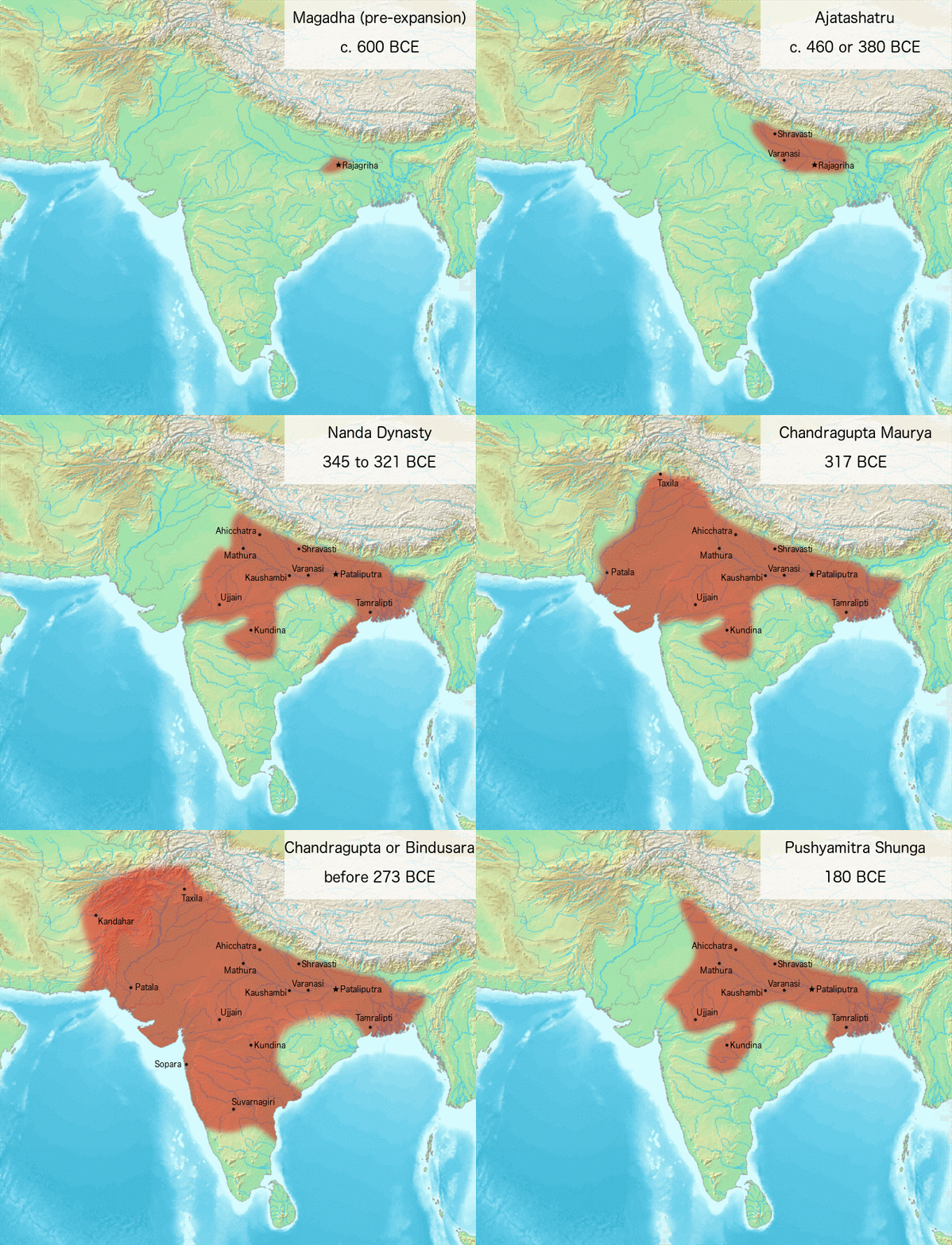
| image_map2 = Magadha Expansion 1.gif | | image_map2 = {{Switcher | ||
| image_map2_caption = Territorial expansion of | | [[File:Magadha Expansion 1.gif|upright=1.15|frameless]] | ||
| Expansion and decline of Magadha-based rule <br/>between 6th and 2nd century BCE | |||
| [[File:Magadha Expansion (6th-4th centuries BCE).png|upright=1.15|frameless]] | |||
| Magadha-based rule under Haryanka and{{space|6}}<br/>Shaisunga dynasties | |||
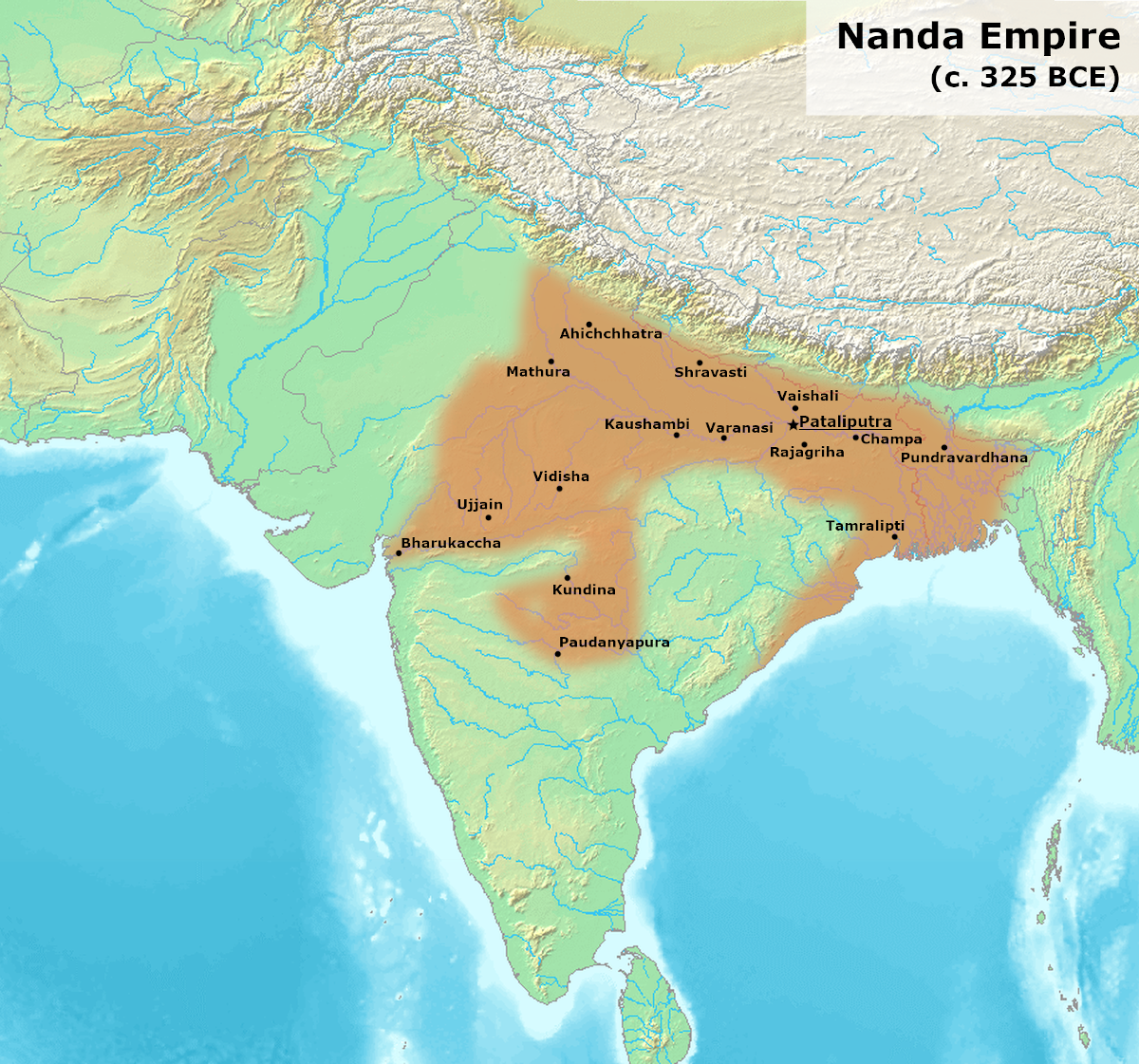
| [[File:Nanda Empire, c.325 BCE.png|upright=1.15|frameless]] | |||
| Magadha-based rule under Nanda dynasty {{space|4}} | |||
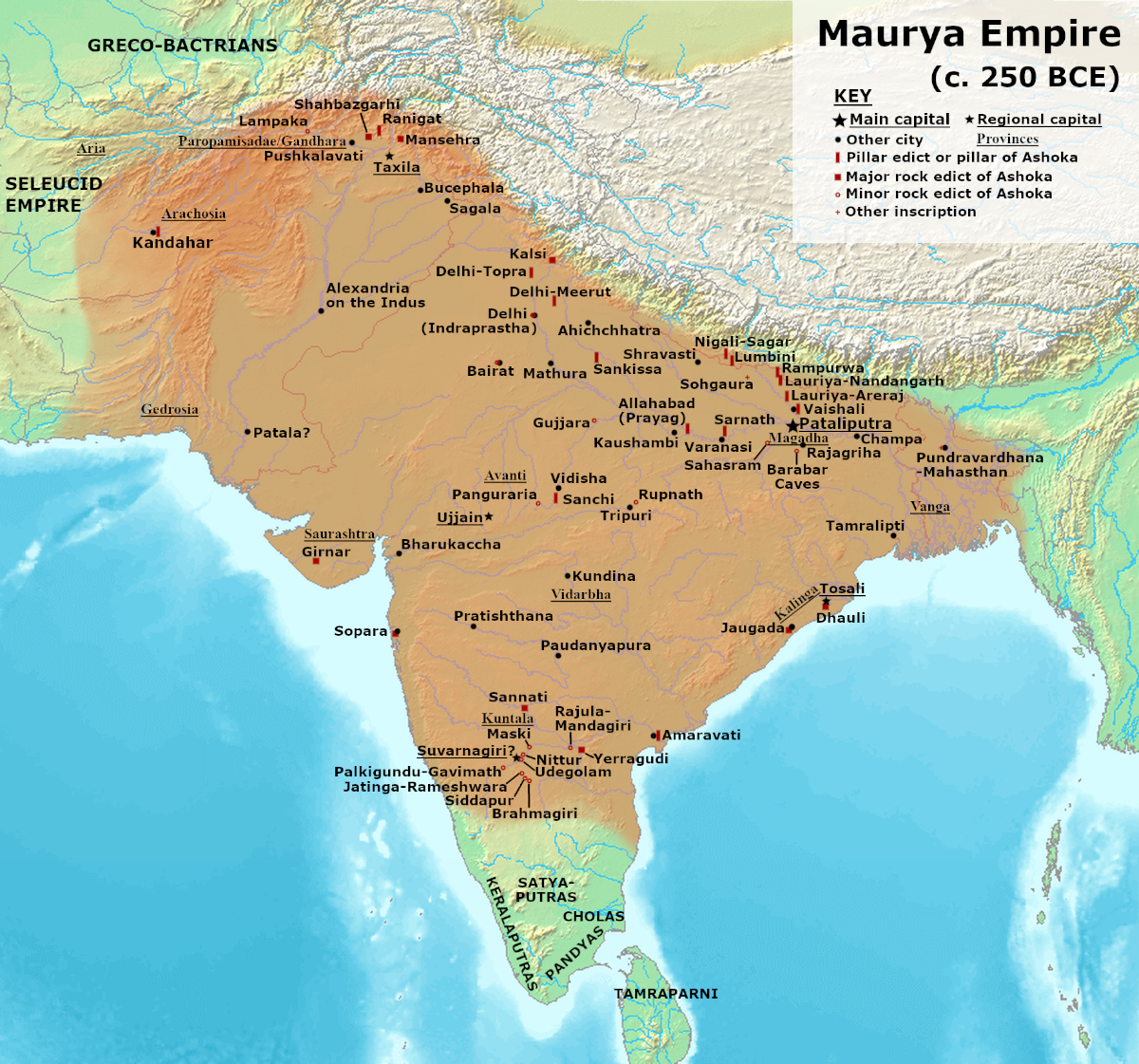
| [[File:Maurya Empire, c.250 BCE 2.png|upright=1.15|frameless]] | |||
| Magadha-based rule under Maurya dynasty{{space|3}} | |||
| [[File:Map of the Shungas.png|upright=1.15|frameless]] | |||
| Magadha-based rule under Shunga dynasty{{space|3}} | |||
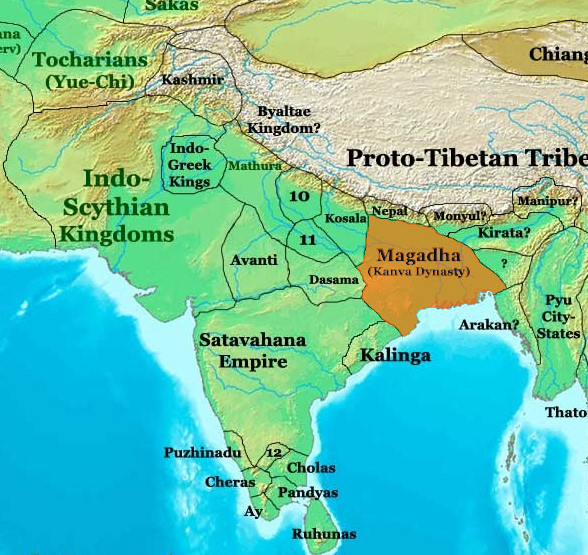
| [[File:India in 50 bc.jpg|upright=1.15|frameless]] | |||
| Magadha-based rule under Kanva dynasty{{space|5}} | |||
| [[File:South Asia historical AD450 EN.svg|upright=1.15|frameless]] | |||
| Magadha-based rule under Gupta dynasty{{space|6}} | |||
| default=1 | |||
}} | |||
| image_map2_caption = Territorial expansion of Magadha-based rulers 6th century BCE onwards | |||
| capital = [[Rajgir|Rajagriha]] (Girivraj)<br/>Later, [[Pataliputra]] (modern-day [[Patna]]) | | capital = [[Rajgir|Rajagriha]] (Girivraj)<br/>Later, [[Pataliputra]] (modern-day [[Patna]]) | ||
| common_languages = [[Magadhi Prakrit]]<br/> [[Ardhamagadhi Prakrit]] | | common_languages = [[Sanskrit]]<ref name="JainCardona2007-script1">{{cite book|last=Jain|first=Dhanesh |editor=George Cardona |editor2=Dhanesh Jain |title=The Indo-Aryan Languages|chapter-url=https://books.google.com/books?id=OtCPAgAAQBAJ&pg=PA51|year=2007|publisher=Routledge|isbn=978-1-135-79711-9|pages=47–66, 51|chapter=Sociolinguistics of the Indo-Aryan languages}}</ref><br/>[[Magadhi Prakrit]]<br/> [[Ardhamagadhi Prakrit]] | ||
| religion = | | religion = [[Brahmanism]]<br/>[[Buddhism]]<br/>[[Jainism]] | ||
| demonym = [[Māgadhī]] | |||
| currency = [[Coinage of India|Panas]] | | currency = [[Coinage of India|Panas]] | ||
| title_leader = | | title_leader = Magadha-based dynasties and empires | ||
| leader1 = [[ | | leader1 = [[Haryanka dynasty]] | ||
| year_leader1 = | | year_leader1 = {{Circa|544|413 BCE}} | ||
| leader2 = [[ | | leader2 = [[Shaishunaga dynasty]] | ||
| year_leader2 = | | year_leader2 = {{Circa|413|345 BCE}} | ||
| leader3 = [[ | | leader3 = [[Nanda dynasty]] | ||
| year_leader3 = | | year_leader3 = {{Circa|345|321 BCE}} | ||
| leader4 = [[ | | leader4 = [[Maurya Empire]] | ||
| year_leader4 = | | year_leader4 = {{Circa|321|185 BCE}} | ||
| leader5 = [[ | | leader5 = [[Shunga Empire]] | ||
| year_leader5 = | | year_leader5 = {{Circa|185|73 BCE}} | ||
| leader6 = [[ | | leader6 = [[Kanva dynasty]] | ||
| year_leader6 = | | year_leader6 = {{Circa|73|28 BCE}} | ||
| | | leader7 = Extraneous rule by [[Mitra dynasty (Kosambi)]] | ||
| | | year_leader7 = {{Circa|1st cent. BCE|2nd cent. BCE}} | ||
| | | leader8 = Extraneous rule by [[Kushan Empire]] and [[Mahameghavahana dynasty]] | ||
| | | year_leader8 = {{Circa|2nd|3rd CE?}} | ||
| | | leader9 = [[Gupta Empire]] | ||
| | | year_leader9 = {{Circa|240|579 CE}} | ||
| | | leader10 = [[Later Guptas]] | ||
| | | year_leader10 = {{Circa|6th|8th cent. CE}} | ||
| | | leader11 = | ||
}} | | year_leader11 = | ||
| leader12 = | |||
| year_leader12 = | |||
| leader13 = | |||
| year_leader13 = | |||
| leader14 = | |||
| year_leader14 = | |||
| today = {{plainlist| * [[India]] | |||
* [[Nepal]] | |||
* [[Pakistan]] | |||
* [[Bhutan]] | |||
* [[Afghanistan]] | |||
* [[Bangladesh]] | |||
}}}} | |||
{{History of Bihar}} | |||
<div class="toccolours" style="float: right; clear: right; margin: 0 0 1em 1em; width: 300px; font-size: 90%; background: #f8f9fa; border: 1px solid #a2a9b1;"> | |||
<div style="background: #eaecf0; text-align: center; padding: 8px; font-weight: bold; font-size: 110%; border-bottom: 1px solid #a2a9b1;"> | |||
Empires of Magadha | |||
</div> | |||
<div style="text-align: center; padding: 5px;"> | |||
[[File:Mahajanapadas (c. 500 BCE).png|280px|center]] | |||
</div> | |||
<div style="padding: 2px 5px 8px; text-align: center; border-bottom: 1px solid #c8ccd1; font-size: 95%;"> | |||
'''Mahajanapada Period'''<br/>Magadha among the 16 great ancient kingdoms. | |||
</div> | |||
<div style="text-align: center; padding: 5px;"> | |||
[[File:Magadha Expansion (6th-4th centuries BCE).png|280px|center]] | |||
</div> | |||
<div style="padding: 2px 5px 8px; text-align: center; border-bottom: 1px solid #c8ccd1; font-size: 95%;"> | |||
'''Haryanka Dynasty'''<br/>Early territorial expansion under Bimbisara and Ajatashatru. | |||
</div> | |||
<div style="text-align: center; padding: 5px;"> | |||
[[File:Nanda Empire, c.325 BCE.png|280px|center]] | |||
</div> | |||
<div style="padding: 2px 5px 8px; text-align: center; border-bottom: 1px solid #c8ccd1; font-size: 95%;"> | |||
'''Nanda Empire'''<br/>Magadha's dominance over Northern India. | |||
</div> | |||
<div style="text-align: center; padding: 5px;"> | |||
[[File:Magadha_Expansion_1.gif|280px|center]] | |||
</div> | |||
<div style="padding: 2px 5px 8px; text-align: center; border-bottom: 1px solid #c8ccd1; font-size: 95%;"> | |||
'''Maurya Empire'''<br/>Pan-Indian expansion originating from Pataliputra. | |||
</div> | |||
<div style="text-align: center; padding: 5px;"> | |||
[[File:Shunga Empire.jpg|280px|center]] | |||
</div> | |||
<div style="padding: 2px 5px 8px; text-align: center; border-bottom: 1px solid #c8ccd1; font-size: 95%;"> | |||
'''Shunga Empire'''<br/>Post-Mauryan dynasty controlling central and eastern India. | |||
</div> | |||
<div style="text-align: center; padding: 5px;"> | |||
[[File:Map of the Gupta Empire.png|280px|center]] | |||
</div> | |||
<div style="padding: 2px 5px 8px; text-align: center; font-size: 95%;"> | |||
'''Gupta Empire'''<br/>The Classical Age centered in Magadha. | |||
</div> | |||
</div> | |||
'''Magadha''' ({{ipa|bho|məɡəd̪ʰaː|ipa}}) was a region and kingdom in ancient India, based in the [[Indo-Gangetic Plain|eastern Ganges Plain]]. It was one of the sixteen [[Mahajanapadas]] during the [[Second Urbanization]] period. The region was ruled by several dynasties, which overshadowed, conquered, and incorporated the other Mahajanapadas. Magadha played an important role in the development of [[Jainism]] and [[Buddhism]]<ref name="Keown2004">{{cite book|author=Damien Keown|title=A Dictionary of Buddhism|url= https://www.oxfordreference.com/view/10.1093/acref/9780198605607.001.0001/acref-9780198605607-e-1054?rskey=6R59Bf&result=1 |date=26 August 2004|publisher=OUP Oxford|isbn=978-0-19-157917-2|page=163}}</ref> and formed the core of the [[Maurya Empire]] (c. 320–185 BCE). | |||
==Geography== | ==Geography== | ||
The territory of the Magadha kingdom proper before its expansion was bounded to the north, west, and east respectively by the [[Ganges|Gaṅgā]], [[Son River|Son]], and [[Chandan River|Campā]] rivers, and the eastern spurs of the [[Vindhya Range|Vindhya mountains]] formed its southern border. The territory of the initial Magadha kingdom thus corresponded to the modern-day [[Patna district|Patna]] and [[Gaya district|Gaya]] districts of the Indian state of [[Bihar]].<ref>{{cite book |last=Raychaudhuri |first=Hemchandra |author-link=Hem Chandra Raychaudhuri |date=1953 |title=Political History of Ancient India: From the Accession of Parikshit to the Extinction of Gupta Dynasty |pages=110–118 |publisher=[[University of Calcutta]] }}</ref> | |||
The region of [[Greater Magadha]] also included neighbouring regions in the eastern Gangetic plains, and had a distinct culture and belief. | |||
==History== | |||
===Vedic period (semi-legendary) (ca. 1700 BCE-6th cent. BCE)=== | |||
{{Main|Vedic period}} | |||
In the ''[[Atharvaveda]]'' (5.22) (ca. 1200-900 BCE) the Magadhas are listed along with the [[Anga]]s, [[Gandhara|Gandharis]] and Mujavats as non-Vedic tribes located outside of the [[Kuru kingdom|Kuru]]-[[Panchala]] cultural sphere.<ref>Michael Witzel (1987), "On the localisation of Vedic texts and schools (Materials on Vedic Śākhās, 7)" in G. Pollet (ed.), ''India and the Ancient world. History, Trade and Culture before A.D. 650''</ref><ref name="Majumdar_1977"/> | |||
====Kikata kingdom==== | |||
{{Main|Kikata kingdom}} | |||
Some scholars have identified the Kīkaṭa tribe—mentioned in the [[Rigveda]] (3.53.14) with their ruler Pramaganda—as the forefathers of Magadhas because Kikata is used as synonym for Magadha in the later texts.<ref>{{Cite book|url=https://books.google.com/books?id=t6TVLlPvuMAC&pg=PA159|title=Vedic Index of Names and Subjects|last1=Macdonell|first1=Arthur Anthony|last2=Keith|first2=Arthur Berriedale|date=1995|publisher=Motilal Banarsidass Publishers|isbn=9788120813328|language=en}}</ref> Like the Magadhas in the Atharvaveda, the Rigveda speaks of the Kikatas as a hostile tribe, living on the borders of Brahmanical India, who did not perform Vedic rituals, but Witzel argues that it is "misplaced" to locate the Kikatas within Magadha, as in the Rigveda "their [Kikata] territory is clearly described as being to the south of Kurukshetra, in eastern Rajasthan or western Madhya Pradesh, and Magadha is beyond the geographical horizon of the Rigveda".<ref name="Witzel1995">M. Witzel. "[https://books.google.com/books?id=OZ0gAAAAQBAJ&pg=PA333 Rigvedic history: poets, chieftains, and polities]," in ''The Indo-Aryans of Ancient South Asia: Language, Material Culture and Ethnicity.'' ed. G. Erdosy (Walter de Gruyer, 1995), p. 333</ref> | |||
====Brihadratha dynasty==== | |||
{{Main|Brihadratha dynasty}} | |||
According to the [[Puranas]], the legendary<ref>{{cite book | last=Chakrabarty | first=D.K. | title=The Geopolitical Orbits of Ancient India: The Geographical Frames of the Ancient Indian Dynasties | publisher=OUP India | year=2010 | isbn=978-0-19-908832-4 | url=https://books.google.com/books?id=EIAyDwAAQBAJ&dq=legendary&pg=PT24}}</ref> Brihadratha dynasty was the first ruling dynasty of Magadha. | |||
===Mahajanapada (6th-4th cent. BCE)=== | |||
[[File:Cyclopian wall, Rajgir. (5457385482) (cropped).jpg |thumb|right| [[Cyclopean Wall of Rajgir]] which encircled the former capital of Magadha, Rajgir. Among the oldest pieces of cyclopean masonry in the world]] | |||
====Second urbanisation==== | |||
Much of the [[Second Urbanisation]] took place in Greater Magadha from {{Circa|500 BCE}} onwards, and it was here that [[Jainism]] and Buddhism arose.{{sfn|Bronkhorst|2007|loc=p.4: Bronkhorst ''"It is also in this area that a number of religious and spiritual movements arose, most famous among them Buddhism and Jainism."''}} | |||
==== Haryanka dynasty (544 BCE–413 BCE) ==== | |||
{{main|Haryanka dynasty}} | |||
There is little certain information available on the early rulers of Magadha. The most important sources are the Buddhist ''[[Pāli Canon]]'', the ''[[Jain Agamas]]'' and the Hindu ''[[Puranas]]''. The ancient kingdom of Magadha is also mentioned in the ''[[Ramayana]]'', the ''[[Mahabharata]]''. Based on Jain and Buddhist sources, it appears that Magadha was ruled by the [[Haryanka dynasty]] for some 130 years, c. 543 to 413 BCE,<ref>{{cite journal |last1=Chandra |first1=Jnan |title=Some Unknown Facts About Bimbisāra |journal=Proceedings of the Indian History Congress |date=1958 |volume=21 |pages=215–217 |jstor=44145194}}</ref> although dates are uncertain, and could be significantly later.<ref name="Bechert"/> | |||
Two notable Haryanka dynasty rulers of Magadha were [[Bimbisara]] (also known as ''Shrenika'') and his son [[Ajatashatru]] (also known as ''Kunika''), who are mentioned in Buddhist and Jain literature as contemporaries of the Buddha and Mahavira. Later, the throne of Magadha was usurped by [[Mahapadma Nanda]], the founder of the [[Nanda Dynasty]] ({{Circa|345|322 BCE}}), which conquered much of north India. The Nanda dynasty was overthrown by [[Chandragupta Maurya]], the founder of the [[Maurya Empire]] ({{Circa|322}}–185 BCE). | |||
There is much uncertainty about the succession of kings and the precise chronology of Magadha prior to [[Mahapadma Nanda]]; the accounts of various ancient texts (all of which were written many centuries later than the era in question) contradict each other on many points. Furthermore, there is a "Long Chronology" and a contrasting "Short Chronology" preferred by some scholars, an issue that is inextricably linked to the uncertain [[Gautama Buddha#Historical Siddhārtha Gautama|chronology of the Buddha]] and [[Mahavira]].<ref name="Bechert">{{cite book|last=Bechert|first=Heinz|author-link=Heinz Bechert|title=When Did the Buddha Live?: The Controversy on the Dating of the Historical Buddha|url=https://books.google.com/books?id=ImnYAAAAMAAJ&pg=PA129|year=1995|publisher=Sri Satguru Publications|isbn=978-81-7030-469-2|page=129}}</ref> | |||
According to historian [[K. T. S. Sarao]], a proponent of the Short Chronology wherein the Buddha's lifespan was c.477–397 BCE, it can be estimated that Bimbisara was reigning c.457–405 BCE, and Ajatashatru was reigning c.405–373 BCE.<ref>{{citation |last=Sarao |first=K. T. S. |title= The Ācariyaparamparā and Date of the Buddha. |journal=Indian Historical Review |volume=30 |issue=1–2 |year=2003 |pages=1–12 |doi=10.1177/037698360303000201 |s2cid=141897826 |url=https://journals.sagepub.com/doi/abs/10.1177/037698360303000201|url-access=subscription }}</ref> | |||
According to historian [[John Keay]], a proponent of the "Long Chronology," Bimbisara must have been reigning in the late 5th century BCE,<ref>{{cite book|last=Keay|first=John|title=India: A History|url=https://books.google.com/books?id=0IquM4BrJ4YC&pg=PT141|year=2011|publisher=Open Road + Grove/Atlantic|isbn=978-0-8021-9550-0|page=141}}</ref> and Ajatashatru in the early 4th century BCE.<ref name="Keay 2010, p.149">{{cite book|last=Keay|first=John|title=India: A History|url=https://books.google.com/books?id=0IquM4BrJ4YC&pg=PT149|year=2011|publisher=Open Road + Grove/Atlantic|isbn=978-0-8021-9550-0|page=149}}</ref> Keay states that there is great uncertainty about the royal succession after Ajatashatru's death, probably because there was a period of "court intrigues and murders," during which "evidently the throne changed hands frequently, perhaps with more than one incumbent claiming to occupy it at the same time" until Mahapadma Nanda was able to secure the throne.<ref name="Keay 2010, p.149"/> | |||
The core of the kingdom was the area of Bihar south of the [[Ganges]]; its first capital was Rajagriha (modern [[Rajgir|day Rajgir]]), then [[Pataliputra]] (modern [[Patna]]).<ref name="Majumdar_1977">Ramesh Chandra Majumdar (1977). ''Ancient India''. Motilal Banarsidass Publ. {{ISBN|81-208-0436-8}}.</ref> Rajagriha was initially known as 'Girivrijja' and later came to be known as so during the reign of [[Ajatashatru]]. Magadha expanded to include most of Bihar and [[Bengal]] with the conquest of [[Vajjika League]] and [[Anga]], respectively.<ref name="Majumdar_1977"/> | |||
=== Expansion === | |||
====Shaishunaga dynasty (413 BCE–345 BCE)==== | |||
[[File:Magadha Expansion (6th-4th centuries BCE).png|thumb|right|The approximate extent of the Haryanka dynasty and the Shaisunaga dynasty between the 6th and 5th century BCE.<ref>{{cite book |last1=Schwartzberg |first1=Joseph E. |title=A Historical Atlas of South Asia |date=1978 |publisher=University of Chicago Press |location=Chicago |page=145, map XIV.1 (a)|isbn=0226742210 |url=https://dsal.uchicago.edu/reference/schwartzberg/pager.html?object=182}}</ref>]] | |||
{{Main|Shaishunaga dynasty}} | |||
====Nanda dynasty (c. 345 BCE–c. 322 BCE)==== | |||
{{Main|Nanda dynasty}} | |||
====Maurya Empire (322 BCE – 185 BCE)==== | |||
{{Main|Maurya Empire}} | |||
====Shunga Empire (185 BCE–73 BCE)==== | |||
{{Main|Shunga Empire}} | |||
== | ====Kanva dynasty (73 BCE–28 BCE)==== | ||
{{Main|Kanva dynasty}} | |||
===Extraneous rule (28 BCE-c.240 CE)=== | |||
====Mitra dynasty (Kosambi) ( 1st cent. BCE - 2nd cent. CE)==== | |||
{{Main|Mitra dynasty (Kosambi)}} | |||
====Kushan Empire and Mahameghavahana dynasty (2nd-3rd cent. CE)==== | |||
{{Main|Kushan Empire|Mahameghavahana dynasty}} | |||
===Guptas=== | |||
====Gupta Empire (c. 240–c. 579)==== | |||
{{Main|Gupta Empire}} | |||
===Post-Gupta=== | |||
====Later Guptas (c. 6th century CE–c. 8th century CE)==== | |||
{{Main|Later Guptas}} | |||
[[File:Archer type coinage of King Mahasenagupta of the Later Gupta dynasty.png|thumb|Archer type coinage of King [[Mahasenagupta]] of the Later Gupta dynasty, c. 6th century CE]] | |||
The Later Gupta dynasty, also known as the Later Guptas of Magadha, were the rulers of the [[Magadha (Mahajanapada)|Magadha]] region and partly of [[Malwa]] from the 6th and 8th centuries CE. The Later Guptas emerged after the disintegration of the [[Gupta Empire|Imperial Guptas]] as the rulers of Magadha and Malwa however, there is no evidence to connect the two dynasties and the Later Guptas may have adopted the -gupta suffix to link themselves the Imperial Guptas.<ref name=Ghosh2021>{{cite book |last1=Ghosh |first1=Suchandra |chapter=Later Guptas |title=The Encyclopedia of Ancient History: Asia and Africa |date=2022 |pages=1–2 |doi=10.1002/9781119399919.eahaa00571 |isbn=978-1-119-39991-9 |url=https://onlinelibrary.wiley.com/doi/full/10.1002/9781119399919.eahaa00571|url-access=subscription }}</ref> | |||
====Maukharis (c. 510 CE–c. 606 CE)==== | |||
{{Main|Maukharis of Kannauj|Maukharis of Gaya}} | |||
The | [[File:Map of the Maukharis.png|thumb|Map of the [[Maukharis of Kannauj]]]] | ||
The initial branch of the Maukharis ruled from [[Gaya, India|Gaya]] in Magadha before later moving to [[Kannauj]].<ref>{{cite book |last1=Ghosh |first1=Suchandra |chapter=Maukharīs |title=The Encyclopedia of Ancient History: Asia and Africa |date=2023 |pages=1–4 |doi=10.1002/9781119399919.eahaa00569 |isbn=978-1-119-39991-9 |url=https://onlinelibrary.wiley.com/doi/abs/10.1002/9781119399919.eahaa00569}}</ref> The Maukharis have been associated with the Magadha region since the [[Maurya Empire|Mauryan period]]. The earliest inscription of the Maukhari dynasty has been found in [[Gaya, India|Gaya]] dating back to the third-century BCE on a clay seal and the Maukharis continued to have a recorded presence in Gaya until the 6th century CE.<ref>{{cite book |last1=Ghosh |first1=Suchandra |chapter=Maukhari Empire |title=The Encyclopedia of Empire |date=2016 |pages=1–3 |doi=10.1002/9781118455074.wbeoe271 |isbn=978-1-118-44064-3 |url=https://onlinelibrary.wiley.com/doi/abs/10.1002/9781118455074.wbeoe271}}</ref> | |||
Due to the events leading to the collapse of the Gupta Empire, [[Harivarman]], the first Maukhari of Kannauj likely migrated westwards to carve out his own kingdom.<ref>{{cite book |last1=Tripathi |first1=Rama Shankar |title=History of Kanauj: To the Moslem Conquest |date=1989 |publisher=Motilal Banarsidass |isbn=9788120804043 |pages=28–34 |url=https://books.google.com/books?id=2Tnh2QjGhMQC&dq=maukharis+of+gaya&pg=PA32}}</ref> | |||
===Late Medieval=== | |||
{{Main|Pithipatis of Magadha}} | |||
From the 11th century until the late 13th century, a group of Buddhist kings known as the [[Pithipatis of Bodh Gaya|Pithipatis]] ruled parts of the Magadha region. These kings referred to themselves as ''Magadhādipati'' which translates to "Lords of Magadha".<ref>{{cite journal |last1=Sircar |first1=D. C. |title=Bodhgayā Inscription of Pithipati Ācārya Buddhasena |journal=Senarat Paranavitana Commemoration Volume |date=1978 |pages=255–256 |doi=10.1163/9789004646476_033 |isbn=978-90-04-64647-6 |url=https://brill.com/edcollchap/book/9789004646476/B9789004646476_s033.xml|url-access=subscription }}</ref> | |||
==Buddhism and Jainism== | ==Buddhism and Jainism== | ||
Several [[Śramaṇa|Śramaṇic movements]] | [[Gautama Buddha]], the founder of [[Buddhism]], lived much of his life in the kingdom of Magadha. He attained [[Enlightenment in Buddhism|enlightenment]] in [[Bodh Gaya]], gave his first sermon in [[Sarnath]] and the [[Buddhist councils|first Buddhist council]] was held in [[Rajgriha]].<ref>{{cite web |url=http://www.lumbinitrust.org/articles/view/214 |title=Lumbini Development Trust: Restoring the Lumbini Garden |access-date=6 January 2017 |url-status=dead |archive-url=https://web.archive.org/web/20140306041858/http://www.lumbinitrust.org/articles/view/214 |archive-date=6 March 2014 }}</ref> | ||
Several [[Śramaṇa|Śramaṇic movements]] had existed before the 6th century BCE, and these influenced both the [[āstika and nāstika]] traditions of Indian philosophy.<ref name=reginaldray247>{{cite book |first=Reginald |last=Ray |year=1999 |title=Buddhist Saints in India |publisher=Oxford University Press |isbn=978-0195134834 |pages=237–240, 247–249 }}</ref> The [[Śramaṇa|Śramaṇa movement]] gave rise to diverse range of heterodox beliefs, ranging from accepting or denying the concept of soul, atomism, antinomian ethics, materialism, atheism, agnosticism, fatalism to free will, idealisation of extreme asceticism to that of family life, strict [[ahimsa]] (non-violence) and vegetarianism to the permissibility of violence and meat-eating.<ref>{{cite book |first=Padmanabh S. |last=Jaini |year=2001 |title=Collected papers on Buddhist Studies |publisher=Motilal Banarsidass |isbn=978-8120817760 |pages=57–77 }}</ref> Magadha kingdom was the nerve centre of this revolution. | |||
[[Jainism]] was revived and re-established after [[Mahavira]], the last and the 24th ''[[Tirthankara]]'', who synthesised and revived the philosophies and promulgations of the ancient Śramaṇic traditions laid down by the first Jain tirthankara [[Rishabhanatha]] millions of years ago.<ref>{{cite book|last=Patel|first=Haresh|title=Thoughts from the Cosmic Field in the Life of a Thinking Insect [A Latter-Day Saint]|url=https://books.google.com/books?id=SXgEfiNY46sC&pg=PA271|year=2009|publisher=Strategic Book Publishing|isbn=978-1-60693-846-1|page=271}}</ref> [[Buddha]] founded [[Buddhism]] which received royal patronage in the kingdom. | [[Jainism]] was revived and re-established after [[Mahavira]], the last and the 24th ''[[Tirthankara]]'', who synthesised and revived the philosophies and promulgations of the ancient Śramaṇic traditions laid down by the first Jain tirthankara [[Rishabhanatha]] millions of years ago.<ref>{{cite book|last=Patel|first=Haresh|title=Thoughts from the Cosmic Field in the Life of a Thinking Insect [A Latter-Day Saint]|url=https://books.google.com/books?id=SXgEfiNY46sC&pg=PA271|year=2009|publisher=Strategic Book Publishing|isbn=978-1-60693-846-1|page=271}}</ref> [[Buddha]] founded [[Buddhism]] which received royal patronage in the kingdom. | ||
[[File:Magadha kingdom Circa 430-320s BC AR Karshapana.jpg|thumb|Magadha kingdom coin, | [[File:Magadha kingdom Circa 430-320s BC AR Karshapana.jpg|thumb|Magadha kingdom coin, {{Circa|430}}–320 BCE, Karshapana]] | ||
[[File:Magadha kingdom coin Circa 350 BC AR Karshapana.jpg|thumb|Magadha kingdom coin, | [[File:Magadha kingdom coin Circa 350 BC AR Karshapana.jpg|thumb|Magadha kingdom coin, {{Circa|350 BCE}}, Karshapana]] | ||
[[File:Mauryan Empire. Circa late 4th-2nd century BC.jpg|thumb|Chandragupta Maurya period [[Karshapana|Karshapana coin]], circa 315-310 B.C.<ref>{{Cite web|url=https://www.cngcoins.com/Coin.aspx?CoinID=335378|title=Auction 396. INDIA, Mauryan Empire, Karshapana (14mm, 3.32 g). circa 315-310 BC|website=www.cngcoins.com|access-date=24 April 2024}}</ref>]] | |||
According to Indologist [[Johannes Bronkhorst]], the culture of Magadha was in fundamental ways different from the Vedic kingdoms of the [[Indo-Aryans]]. According to Bronkhorst, the [[Śramaṇa|śramana]] culture arose in "[[Greater Magadha]]," which was Indo-Aryan, but not [[Historical Vedic religion|Vedic]]. In this culture, [[Kshatriya]]s were placed higher than [[Brahmin]]s, and it rejected [[Vedas|Vedic]] authority and rituals.{{sfn|Bronkhorst|2007|p={{page needed|date=April 2022}}}}<ref>{{Cite book |last=Long |first=Jeffery D. |title=Jainism : an introduction |date=2009 |publisher=I.B. Tauris |isbn=978-1-4416-3839-7 |location=London |oclc=608555139}}</ref> He argues for a cultural area termed "[[Greater Magadha]]", defined as roughly the geographical area in which the [[Buddha]] and [[Mahavira]] lived and taught.{{sfn|Bronkhorst|2007|p={{page needed|date=April 2022}}}} <ref name=Witzel>{{cite journal |last=Witzel |first=Michael |title=Macrocosm, Mesocosm, and Microcosm: The Persistent Nature of 'Hindu' Beliefs and Symbolic Forms |journal=International Journal of Hindu Studies |volume=1 |issue=3 |year=1997 |pages=501–539 |doi=10.1007/s11407-997-0021-x |jstor=20106493 |s2cid=144673508 }}</ref> | |||
With regard to the Buddha, this area stretched by and large from [[Śrāvastī]], the capital of [[Kosala]], in the north-west to [[Rajgir|Rājagṛha]], the capital of Magadha, in the south-east".{{sfn|Bronkhorst|2007 |pp=xi, 4}} According to Bronkhorst, "there was indeed a culture of Greater Magadha which remained recognizably distinct from Vedic culture until the time of the grammarian Patañjali (ca. 150 BCE) and beyond".{{sfn|Bronkhorst|2007|p=265}} The Buddhologist Alexander Wynne writes that there is an "overwhelming amount of evidence" to suggest that this rival culture to the Vedic Aryans dominated the eastern [[Gangetic plain]] during the early Buddhist period. Orthodox Vedic Brahmins were, therefore, a minority in Magadha during this early period.<ref>{{Cite web |url=https://www.h-net.org/reviews/showrev.php?id=31537|title=Review of Bronkhorst, Johannes, Greater Magadha: Studies in the Culture of Early India|last=Wynne|first=Alexander|date=2011|website=H-Buddhism|access-date=25 August 2019}}</ref> | |||
The Magadhan religions are termed the [[sramana]] traditions and include [[Jainism]], [[Buddhism]] and [[Ājīvika]]. Buddhism and Jainism were the religions promoted by the early Magadhan kings, such as Srenika, [[Bimbisara]] and [[Ajatashatru]], and the [[Nanda Dynasty]] (345–321 BCE) that followed was mostly Jain. These Sramana religions did not worship the [[Rigvedic deities|Vedic deities]], instead of practising some form of [[asceticism]] and [[meditation]] ([[jhana]]) and tending to construct round burial mounds (called [[stupas]] in Buddhism).{{sfn|Bronkhorst|2007|p=265}} These religions also sought some type of liberation from the cyclic rounds of rebirth and karmic retribution through spiritual knowledge. | |||
The Magadhan religions are termed the [[sramana]] traditions and include [[Jainism]], [[Buddhism]] and [[Ājīvika]]. Buddhism and Jainism were the religions promoted by the early Magadhan kings, such as Srenika, [[Bimbisara]] and [[Ajatashatru]], and the [[Nanda Dynasty]] (345–321 BCE) that followed was mostly Jain. These Sramana religions did not worship the [[Rigvedic deities|Vedic deities]], | |||
===Religious sites in Magadha=== | ===Religious sites in Magadha=== | ||
[[File:Bodh gaya before restoration.jpg|thumb|upright|right|The ancient [[Mahabodhi | [[File:Bodh gaya before restoration.jpg|thumb|upright|right|The ancient [[Mahabodhi Temple]] at Bodh Gaya prior to its restoration]] | ||
Among the Buddhist sites currently found in the Magadha region include two [[ | Among the Buddhist sites currently found in the Magadha region include two UNESCO [[World Heritage Site]]s such as the [[Mahabodhi Temple]] at [[Bodh Gaya]]<ref name="Sarao2020">{{cite book|author=K.T.S. Sarao|title=The History of Mahabodhi Temple at Bodh Gaya|url=https://books.google.com/books?id=H5n9DwAAQBAJ&pg=PA66|date=16 September 2020|publisher=Springer Nature|isbn=9789811580673|pages=66–}}</ref> and the [[Nalanda]] monastery.<ref name="Kumar2018">{{cite book|author=Pintu Kumar|title=Buddhist Learning in South Asia: Education, Religion, and Culture at the Ancient Sri Nalanda Mahavihara|url=https://books.google.com/books?id=wlZWDwAAQBAJ|date=7 May 2018|publisher=Lexington Books|isbn=978-1-4985-5493-0}}</ref> The Mahabodhi Temple is one of the most important places of pilgrimage in the Buddhist world and is said to mark the site where the Buddha attained enlightenment.<ref name="GearySayers2012">{{cite book|author1=David Geary|author2=Matthew R. Sayers|author3=Abhishek Singh Amar|title=Cross-disciplinary Perspectives on a Contested Buddhist Site: Bodh Gaya Jataka|url=https://books.google.com/books?id=izcenGMBfsoC|year=2012|publisher=Routledge|isbn=978-0-415-68452-1|pages=18–21}}</ref> | ||
==Language== | ==Language== | ||
{{Main|Magadhi Prakrit}} | {{Main|Magadhi Prakrit}} | ||
{{See also|Ardhamagadhi Prakrit}} | {{See also|Ardhamagadhi Prakrit}} | ||
Beginning in the Theravada commentaries, the [[Pali language]] has been identified with [[ | Beginning in the Theravada commentaries, the [[Pali language]] has been identified with [[Magadhi Prakrit|Magadhi]], the language of the kingdom of Magadha, and this was taken to also be the language that the Buddha used during his life. In the 19th century, the British [[Oriental studies|Orientalist]] [[Robert Caesar Childers]] argued that the true or geographical name of the Pali language was [[Magadhi Prakrit]], and that because ''pāḷi'' means "line, row, series", the early Buddhists extended the meaning of the term to mean "a series of books", so ''pāḷibhāsā'' means "language of the texts".<ref>''A Dictionary of the Pali Language'' By Robert Cæsar Childers</ref> Nonetheless, Pali does retain some eastern features that have been referred to as ''Māgadhisms''.<ref name="Gethin2008">{{cite book|author=Rupert Gethin|title=Sayings of the Buddha: New Translations from the Pali Nikayas|url=https://books.google.com/books?id=AvogpRk9-5wC|date=9 October 2008|publisher=OUP Oxford|isbn=978-0-19-283925-1|pages=xxiv }}</ref> | ||
Magadhi Prakrit was one of the three dramatic prakrits to emerge following the decline of Sanskrit. It was spoken in Magadha and neighbouring regions and later evolved into modern eastern [[Indo-Aryan languages]] like [[Magahi language|Magahi]], [[Maithili language|Maithili]] and [[Bhojpuri language|Bhojpuri]].<ref>{{Cite book|last=Beames|first=John|url=http://ebooks.cambridge.org/ref/id/CBO9781139208871|title=Comparative Grammar of the Modern Aryan Languages of India: To Wit, Hindi, Panjabi, Sindhi, Gujarati, Marathi, Oriya, and Bangali|date=2012|publisher=Cambridge University Press|isbn=978-1-139-20887-1|location=Cambridge|doi=10.1017/cbo9781139208871.003}}</ref> | Magadhi Prakrit was one of the three dramatic prakrits to emerge following the decline of Sanskrit. It was spoken in Magadha and neighbouring regions and later evolved into modern eastern [[Indo-Aryan languages]] like [[Magahi language|Magahi]], [[Maithili language|Maithili]] and [[Bhojpuri language|Bhojpuri]].<ref>{{Cite book|last=Beames|first=John|url=http://ebooks.cambridge.org/ref/id/CBO9781139208871|title=Comparative Grammar of the Modern Aryan Languages of India: To Wit, Hindi, Panjabi, Sindhi, Gujarati, Marathi, Oriya, and Bangali|date=2012|publisher=Cambridge University Press|isbn=978-1-139-20887-1|location=Cambridge|doi=10.1017/cbo9781139208871.003}}</ref> | ||
==Historical figures from Magadha== | ==Historical figures from Magadha== | ||
[[File:Mahavir.jpg|thumb|upright|The 24th Tirthankara of Jainism, Mahavira, who was born in | [[File:Mahavir.jpg|thumb|upright|The 24th Tirthankara of Jainism, [[Mahavira]], who was born in the [[Nāya]] republic near Magadha to a royal family ]] | ||
Important people from the region of Magadha include: | |||
* [[Maitripada]] | *'''[[Mahākāśyapa]]''' - one of [[the Buddha]]'s principle disciples born in the 5th century BCE in Mahātittha village in Magadha<ref name=Princeton>{{cite encyclopedia |last=Lopez |first=Donald |date=2014 |title=Mahākāśyapa |url= https://www.oxfordreference.com/display/10.1093/acref/9780190681159.001.0001/acref-9780190681159-e-2507|encyclopedia= Princeton Dictionary of Buddhism|location= |publisher= Princeton University Press |access-date=}}</ref> | ||
* '''[[Gautama Swami|Indrabhūti Gautama]]''' - a [[Brahmin]] born to Vasubhūti and in Gorbara village in Magadha. He is considered to be [[Mahavira]]'s chief disciple, a [[ganadhara]].<ref>{{Cite book |last=Vidyabhusana |first=Satis Chandra |url=https://books.google.com/books?id=0lG85RD9YZoC&q=%22gorbara%22&pg=PA159 |title=A History of Indian Logic: Ancient, Mediaeval and Modern Schools |date=1 January 1988 |publisher=Motilal Banarsidass Publishing House |isbn=978-81-208-0565-1 |language=en}}</ref> His brothers, Agnibhūti and Vāyubhūti, were also ganadharas of Mahavira.<ref>{{Cite book |last=Goldstücker |first=Theodor |url=https://books.google.com/books?id=bvQqdjiHUPwC&dq=agnibhuti+vayubhuti&pg=PA106 |title=Literary Remains of the Late Professor Theodore Goldstücker: In Two Volumes |date=1879 |publisher=W.H. Allen |language=en}}</ref> | |||
* '''[[Śāriputra]]''' – born to a wealthy ''[[Brahmin]]'' in a village located near [[Rājagaha]] in Magadha. He is considered the first of the Buddha's two chief male disciples, together with [[Maudgalyāyana]].<ref>{{cite journal |last1=Prasad |first1=Chandra Shekhar |title=Nalanda vis-à-vis the Birthplace of Śāriputra |journal=East and West |year=1988 |volume=38 |issue=1/4 |pages=175–188 |jstor=29756860 |url=https://www.jstor.org/stable/29756860}}</ref> | |||
* '''[[Maudgalyāyana]]''' – born in the village of Kolita in Magadha. He was one of the Buddha's two main disciples. In his youth, he was a spiritual wanderer before meeting the Buddha.<ref name="Malalasekera2007">{{cite book|author=Gunapala Piyasena Malalasekera|title=Dictionary of Pāli Proper Names|url=https://books.google.com/books?id=8Au_lIP1ZnQC&pg=PA403|year=2007|publisher=Motilal Banarsidass Publishers|isbn=978-81-208-3022-6|pages=403–404}}</ref> | |||
* '''[[Mahavira]]''' – the 24th [[Tirthankara]] of [[Jainism]]. Born into a royal [[kshatriya]] family in what is now [[Vaishali district]] of [[Bihar]]. He abandoned all worldly possessions at the age of 30 and became an ascetic. He is considered to be the successor of [[Pārśvanātha]] and a slightly older contemporary of the Buddha.<ref>{{Cite book |last=Dundas |first=Paul |url=https://books.google.com/books?id=jdjNkZoGFCgC&pg=PA30 |title=The Jains |date=2002 |publisher=Psychology Press |isbn=978-0-415-26605-5 |language=en}}</ref><ref name="Dutt2013">{{cite book|author=Romesh Chunder Dutt|title=A History of Civilisation in Ancient India: Based on Sanscrit Literature: Volume I|url=https://books.google.com/books?id=udv7AQAAQBAJ&pg=PA382|date=5 November 2013|publisher=Routledge|isbn=978-1-136-38189-8|pages=382–383}}</ref> | |||
* '''[[Maitripada]]''' – an 11th-century Indian Buddhist [[Mahasiddha]] associated with the [[Mahāmudrā]] transmission. Born in the village of Jhatakarani in Magadha. Also associated with the monasteries of [[Nalanda University|Nalanda]] and [[Vikramashila]].<ref>{{cite journal |last1=Tatz |first1=Mark |title=The Life of the Siddha-Philosopher Maitrīgupta |journal=Journal of the American Oriental Society |year=1987 |volume=107 |issue=4 |pages=695–711 |doi=10.2307/603308 |jstor=603308}}</ref> | |||
* '''[[Dhyānabhadra]]''' - 13th/14th century monk of [[Nalanda]] born to a minor chief in Magadha and later travelled across South and East Asia.<ref name=Buswell2014>{{cite book |last1=Buswell |first1=Robert |last2=Lopez |first2=Donald |title=The Princeton Dictionary of Buddhism |date=2014 |publisher=Princeton University Press |isbn=9780691157863 |pages=1056 |url=https://books.google.com/books?id=EGmYDwAAQBAJ}}</ref> | |||
*'''[[Subhūticandra]]''' - 11/12th-century Indian Buddhist monk associated with [[Nalanda]] and [[Vikramashila]] who belonged to Magadha.<ref name=Deokar2012>{{cite journal |last1=Deokar |first1=Lata |title=Subhūticandra: A Forgotten Scholar of Magadha |journal=Journal of the Centre for Buddhist Studies, Sri Lanka |date=2012 |volume=10 |pages=137–154 |url=https://www.academia.edu/7228101}}</ref> | |||
==See also== | ==See also== | ||
* [[ | * [[Greater Magadha]] | ||
* [[History of India]] | * [[History of India]] | ||
* [[ | * [[Magadha–Vajji war]] | ||
* [[ | * [[Magadha–Anga war]] | ||
* [[List of | * [[Avanti–Magadhan War]] | ||
* [[Timeline of Indian | * [[List of monarchs of Magadha]] | ||
* [[Timeline of Indian history]] | |||
* [[Magahi culture]] | |||
* [[Magahi language]] | |||
==References== | ==References== | ||
| Line 194: | Line 295: | ||
|chapter=4. The Magadhas | |chapter=4. The Magadhas | ||
|publisher=Motilal Banarsidas}} | |publisher=Motilal Banarsidas}} | ||
* {{cite book |last=Bronkhorst |first=Johannes |title=Greater Magadha: studies in the culture of early India |publisher=Brill |location=Leiden; Boston |year=2007 |isbn=978-90-04-15719-4 |oclc=608455986 |url= http://www.ahandfulofleaves.org/documents/Greater%20Magadha%20Studies%20in%20the%20Culture%20of%20Early%20India_Bronkhorst.pdf |series=Handbook of oriental studies. Section two, India |volume=19 |issn=0169-9377}} | * {{cite book |last=Bronkhorst |first=Johannes |title=Greater Magadha: studies in the culture of early India |publisher=Brill |location=Leiden; Boston |year=2007 |isbn=978-90-04-15719-4 |oclc=608455986 |url= http://www.ahandfulofleaves.org/documents/Greater%20Magadha%20Studies%20in%20the%20Culture%20of%20Early%20India_Bronkhorst.pdf |archive-url= https://web.archive.org/web/20150911082421/http://www.ahandfulofleaves.org/documents/Greater%20Magadha%20Studies%20in%20the%20Culture%20of%20Early%20India_Bronkhorst.pdf |url-status= dead |archive-date= 11 September 2015 |series=Handbook of oriental studies. Section two, India |volume=19 |issn=0169-9377}} | ||
* {{citation |last=Singh |first=Upinder |author-link=Upinder Singh |title=A History of Ancient and Early Medieval India: From the Stone Age to the 12th Century |url=https://books.google.com/books?id=Pq2iCwAAQBAJ |publisher=[[Pearson PLC|Pearson]] |year=2016 |isbn=978-81-317-1677-9 |ref={{sfnref|Upinder Singh|2016}} }} | * {{citation |last=Singh |first=Upinder |author-link=Upinder Singh |title=A History of Ancient and Early Medieval India: From the Stone Age to the 12th Century |url=https://books.google.com/books?id=Pq2iCwAAQBAJ |publisher=[[Pearson PLC|Pearson]] |year=2016 |isbn=978-81-317-1677-9 |ref={{sfnref|Upinder Singh|2016}} }} | ||
{{refend}} | {{refend}} | ||
{{Tribes and kingdoms of the Mahabharata}} | {{Tribes and kingdoms of the Mahabharata}} | ||
{{Empires}} | |||
{{Mahajanapada}} | {{Mahajanapada}} | ||
{{Middle kingdoms of India}} | {{Middle kingdoms of India}} | ||
| Line 208: | Line 310: | ||
[[Category:Magadha| ]] | [[Category:Magadha| ]] | ||
[[Category: | [[Category:6th-century disestablishments in India]] | ||
[[Category: | [[Category:Buddhist dynasties of India]] | ||
[[Category:History of | [[Category:Former kingdoms]] | ||
[[Category:Former monarchies of India]] | |||
[[Category:Hindu dynasties]] | |||
[[Category:Historical regions in India]] | |||
[[Category:Ancient Bengal]] | |||
[[Category:Kingdoms of Bihar]] | |||
[[Category:History of Jharkhand]] | |||
[[Category:History of Odisha]] | |||
[[Category:Iron Age cultures of South Asia]] | [[Category:Iron Age cultures of South Asia]] | ||
[[Category:Jain empires and kingdoms]] | |||
[[Category:Kingdoms in the Mahabharata]] | |||
[[Category:Magahi language]] | |||
[[Category:Mahajanapadas]] | [[Category:Mahajanapadas]] | ||
[[Category:Regions of Bihar]] | [[Category:Regions of Bihar]] | ||
[[Category: | [[Category:Regions of Jharkhand]] | ||
[[Category: | [[Category:Regions of Odisha]] | ||
[[Category: | [[Category:States and territories established in the 17th century BC]] | ||
[[Category:States and territories disestablished in the 6th century]] | |||
[[Category: | |||
Latest revision as of 05:14, 21 March 2026
Kingdom of Magadha | |||||||||||||
|---|---|---|---|---|---|---|---|---|---|---|---|---|---|
| Unknown (by 1200 BCE) – 625 CE | |||||||||||||
.png) Kingdom of Magadha and other Mahajanapadas during the second urbanisation | |||||||||||||

.png)


Territorial expansion of Magadha-based rulers 6th century BCE onwards | |||||||||||||
| Capital | Rajagriha (Girivraj) Later, Pataliputra (modern-day Patna) | ||||||||||||
| Common languages | Sanskrit[1] Magadhi Prakrit Ardhamagadhi Prakrit | ||||||||||||
| Religion | Brahmanism Buddhism Jainism | ||||||||||||
| Demonym | Māgadhī | ||||||||||||
| Magadha-based dynasties and empires | |||||||||||||
• c. 544 – c. 413 BCE | Haryanka dynasty | ||||||||||||
• c. 413 – c. 345 BCE | Shaishunaga dynasty | ||||||||||||
• c. 345 – c. 321 BCE | Nanda dynasty | ||||||||||||
• c. 321 – c. 185 BCE | Maurya Empire | ||||||||||||
• c. 185 – c. 73 BCE | Shunga Empire | ||||||||||||
• c. 73 – c. 28 BCE | Kanva dynasty | ||||||||||||
• c. 1st cent. BCE – c. 2nd cent. BCE | Extraneous rule by Mitra dynasty (Kosambi) | ||||||||||||
• c. 2nd – c. 3rd CE? | Extraneous rule by Kushan Empire and Mahameghavahana dynasty | ||||||||||||
• c. 240 – c. 579 CE | Gupta Empire | ||||||||||||
• c. 6th – c. 8th cent. CE | Later Guptas | ||||||||||||
| Historical era | Iron Age | ||||||||||||
| Currency | Panas | ||||||||||||
| |||||||||||||
| Today part of | |||||||||||||

Empires of Magadha
Mahajanapada Period
Magadha among the 16 great ancient kingdoms.
Haryanka Dynasty
Early territorial expansion under Bimbisara and Ajatashatru.
Nanda Empire
Magadha's dominance over Northern India.
Maurya Empire
Pan-Indian expansion originating from Pataliputra.

Shunga Empire
Post-Mauryan dynasty controlling central and eastern India.

Gupta Empire
The Classical Age centered in Magadha.
Magadha (Template:Ipa) was a region and kingdom in ancient India, based in the eastern Ganges Plain. It was one of the sixteen Mahajanapadas during the Second Urbanization period. The region was ruled by several dynasties, which overshadowed, conquered, and incorporated the other Mahajanapadas. Magadha played an important role in the development of Jainism and Buddhism[2] and formed the core of the Maurya Empire (c. 320–185 BCE).
Geography[edit | edit source]
The territory of the Magadha kingdom proper before its expansion was bounded to the north, west, and east respectively by the Gaṅgā, Son, and Campā rivers, and the eastern spurs of the Vindhya mountains formed its southern border. The territory of the initial Magadha kingdom thus corresponded to the modern-day Patna and Gaya districts of the Indian state of Bihar.[3]
The region of Greater Magadha also included neighbouring regions in the eastern Gangetic plains, and had a distinct culture and belief.
History[edit | edit source]
Vedic period (semi-legendary) (ca. 1700 BCE-6th cent. BCE)[edit | edit source]
In the Atharvaveda (5.22) (ca. 1200-900 BCE) the Magadhas are listed along with the Angas, Gandharis and Mujavats as non-Vedic tribes located outside of the Kuru-Panchala cultural sphere.[4][5]
Kikata kingdom[edit | edit source]
Some scholars have identified the Kīkaṭa tribe—mentioned in the Rigveda (3.53.14) with their ruler Pramaganda—as the forefathers of Magadhas because Kikata is used as synonym for Magadha in the later texts.[6] Like the Magadhas in the Atharvaveda, the Rigveda speaks of the Kikatas as a hostile tribe, living on the borders of Brahmanical India, who did not perform Vedic rituals, but Witzel argues that it is "misplaced" to locate the Kikatas within Magadha, as in the Rigveda "their [Kikata] territory is clearly described as being to the south of Kurukshetra, in eastern Rajasthan or western Madhya Pradesh, and Magadha is beyond the geographical horizon of the Rigveda".[7]
Brihadratha dynasty[edit | edit source]
According to the Puranas, the legendary[8] Brihadratha dynasty was the first ruling dynasty of Magadha.
Mahajanapada (6th-4th cent. BCE)[edit | edit source]
_(cropped).jpg)
Second urbanisation[edit | edit source]
Much of the Second Urbanisation took place in Greater Magadha from c. 500 BCE onwards, and it was here that Jainism and Buddhism arose.[9]
Haryanka dynasty (544 BCE–413 BCE)[edit | edit source]
There is little certain information available on the early rulers of Magadha. The most important sources are the Buddhist Pāli Canon, the Jain Agamas and the Hindu Puranas. The ancient kingdom of Magadha is also mentioned in the Ramayana, the Mahabharata. Based on Jain and Buddhist sources, it appears that Magadha was ruled by the Haryanka dynasty for some 130 years, c. 543 to 413 BCE,[10] although dates are uncertain, and could be significantly later.[11]
Two notable Haryanka dynasty rulers of Magadha were Bimbisara (also known as Shrenika) and his son Ajatashatru (also known as Kunika), who are mentioned in Buddhist and Jain literature as contemporaries of the Buddha and Mahavira. Later, the throne of Magadha was usurped by Mahapadma Nanda, the founder of the Nanda Dynasty (c. 345 – c. 322 BCE), which conquered much of north India. The Nanda dynasty was overthrown by Chandragupta Maurya, the founder of the Maurya Empire (c. 322–185 BCE).
There is much uncertainty about the succession of kings and the precise chronology of Magadha prior to Mahapadma Nanda; the accounts of various ancient texts (all of which were written many centuries later than the era in question) contradict each other on many points. Furthermore, there is a "Long Chronology" and a contrasting "Short Chronology" preferred by some scholars, an issue that is inextricably linked to the uncertain chronology of the Buddha and Mahavira.[11] According to historian K. T. S. Sarao, a proponent of the Short Chronology wherein the Buddha's lifespan was c.477–397 BCE, it can be estimated that Bimbisara was reigning c.457–405 BCE, and Ajatashatru was reigning c.405–373 BCE.[12] According to historian John Keay, a proponent of the "Long Chronology," Bimbisara must have been reigning in the late 5th century BCE,[13] and Ajatashatru in the early 4th century BCE.[14] Keay states that there is great uncertainty about the royal succession after Ajatashatru's death, probably because there was a period of "court intrigues and murders," during which "evidently the throne changed hands frequently, perhaps with more than one incumbent claiming to occupy it at the same time" until Mahapadma Nanda was able to secure the throne.[14]
The core of the kingdom was the area of Bihar south of the Ganges; its first capital was Rajagriha (modern day Rajgir), then Pataliputra (modern Patna).[5] Rajagriha was initially known as 'Girivrijja' and later came to be known as so during the reign of Ajatashatru. Magadha expanded to include most of Bihar and Bengal with the conquest of Vajjika League and Anga, respectively.[5]
Expansion[edit | edit source]
Shaishunaga dynasty (413 BCE–345 BCE)[edit | edit source]
Nanda dynasty (c. 345 BCE–c. 322 BCE)[edit | edit source]
Maurya Empire (322 BCE – 185 BCE)[edit | edit source]
Shunga Empire (185 BCE–73 BCE)[edit | edit source]
Kanva dynasty (73 BCE–28 BCE)[edit | edit source]
Extraneous rule (28 BCE-c.240 CE)[edit | edit source]
Mitra dynasty (Kosambi) ( 1st cent. BCE - 2nd cent. CE)[edit | edit source]
Kushan Empire and Mahameghavahana dynasty (2nd-3rd cent. CE)[edit | edit source]
Guptas[edit | edit source]
Gupta Empire (c. 240–c. 579)[edit | edit source]
Post-Gupta[edit | edit source]
Later Guptas (c. 6th century CE–c. 8th century CE)[edit | edit source]

The Later Gupta dynasty, also known as the Later Guptas of Magadha, were the rulers of the Magadha region and partly of Malwa from the 6th and 8th centuries CE. The Later Guptas emerged after the disintegration of the Imperial Guptas as the rulers of Magadha and Malwa however, there is no evidence to connect the two dynasties and the Later Guptas may have adopted the -gupta suffix to link themselves the Imperial Guptas.[16]
Maukharis (c. 510 CE–c. 606 CE)[edit | edit source]

The initial branch of the Maukharis ruled from Gaya in Magadha before later moving to Kannauj.[17] The Maukharis have been associated with the Magadha region since the Mauryan period. The earliest inscription of the Maukhari dynasty has been found in Gaya dating back to the third-century BCE on a clay seal and the Maukharis continued to have a recorded presence in Gaya until the 6th century CE.[18]
Due to the events leading to the collapse of the Gupta Empire, Harivarman, the first Maukhari of Kannauj likely migrated westwards to carve out his own kingdom.[19]
Late Medieval[edit | edit source]
From the 11th century until the late 13th century, a group of Buddhist kings known as the Pithipatis ruled parts of the Magadha region. These kings referred to themselves as Magadhādipati which translates to "Lords of Magadha".[20]
Buddhism and Jainism[edit | edit source]
Gautama Buddha, the founder of Buddhism, lived much of his life in the kingdom of Magadha. He attained enlightenment in Bodh Gaya, gave his first sermon in Sarnath and the first Buddhist council was held in Rajgriha.[21]
Several Śramaṇic movements had existed before the 6th century BCE, and these influenced both the āstika and nāstika traditions of Indian philosophy.[22] The Śramaṇa movement gave rise to diverse range of heterodox beliefs, ranging from accepting or denying the concept of soul, atomism, antinomian ethics, materialism, atheism, agnosticism, fatalism to free will, idealisation of extreme asceticism to that of family life, strict ahimsa (non-violence) and vegetarianism to the permissibility of violence and meat-eating.[23] Magadha kingdom was the nerve centre of this revolution.
Jainism was revived and re-established after Mahavira, the last and the 24th Tirthankara, who synthesised and revived the philosophies and promulgations of the ancient Śramaṇic traditions laid down by the first Jain tirthankara Rishabhanatha millions of years ago.[24] Buddha founded Buddhism which received royal patronage in the kingdom.


According to Indologist Johannes Bronkhorst, the culture of Magadha was in fundamental ways different from the Vedic kingdoms of the Indo-Aryans. According to Bronkhorst, the śramana culture arose in "Greater Magadha," which was Indo-Aryan, but not Vedic. In this culture, Kshatriyas were placed higher than Brahmins, and it rejected Vedic authority and rituals.[26][27] He argues for a cultural area termed "Greater Magadha", defined as roughly the geographical area in which the Buddha and Mahavira lived and taught.[26] [28]
With regard to the Buddha, this area stretched by and large from Śrāvastī, the capital of Kosala, in the north-west to Rājagṛha, the capital of Magadha, in the south-east".[29] According to Bronkhorst, "there was indeed a culture of Greater Magadha which remained recognizably distinct from Vedic culture until the time of the grammarian Patañjali (ca. 150 BCE) and beyond".[30] The Buddhologist Alexander Wynne writes that there is an "overwhelming amount of evidence" to suggest that this rival culture to the Vedic Aryans dominated the eastern Gangetic plain during the early Buddhist period. Orthodox Vedic Brahmins were, therefore, a minority in Magadha during this early period.[31]
The Magadhan religions are termed the sramana traditions and include Jainism, Buddhism and Ājīvika. Buddhism and Jainism were the religions promoted by the early Magadhan kings, such as Srenika, Bimbisara and Ajatashatru, and the Nanda Dynasty (345–321 BCE) that followed was mostly Jain. These Sramana religions did not worship the Vedic deities, instead of practising some form of asceticism and meditation (jhana) and tending to construct round burial mounds (called stupas in Buddhism).[30] These religions also sought some type of liberation from the cyclic rounds of rebirth and karmic retribution through spiritual knowledge.
Religious sites in Magadha[edit | edit source]

Among the Buddhist sites currently found in the Magadha region include two UNESCO World Heritage Sites such as the Mahabodhi Temple at Bodh Gaya[32] and the Nalanda monastery.[33] The Mahabodhi Temple is one of the most important places of pilgrimage in the Buddhist world and is said to mark the site where the Buddha attained enlightenment.[34]
Language[edit | edit source]
Beginning in the Theravada commentaries, the Pali language has been identified with Magadhi, the language of the kingdom of Magadha, and this was taken to also be the language that the Buddha used during his life. In the 19th century, the British Orientalist Robert Caesar Childers argued that the true or geographical name of the Pali language was Magadhi Prakrit, and that because pāḷi means "line, row, series", the early Buddhists extended the meaning of the term to mean "a series of books", so pāḷibhāsā means "language of the texts".[35] Nonetheless, Pali does retain some eastern features that have been referred to as Māgadhisms.[36]
Magadhi Prakrit was one of the three dramatic prakrits to emerge following the decline of Sanskrit. It was spoken in Magadha and neighbouring regions and later evolved into modern eastern Indo-Aryan languages like Magahi, Maithili and Bhojpuri.[37]
Historical figures from Magadha[edit | edit source]

Important people from the region of Magadha include:
- Mahākāśyapa - one of the Buddha's principle disciples born in the 5th century BCE in Mahātittha village in Magadha[38]
- Indrabhūti Gautama - a Brahmin born to Vasubhūti and in Gorbara village in Magadha. He is considered to be Mahavira's chief disciple, a ganadhara.[39] His brothers, Agnibhūti and Vāyubhūti, were also ganadharas of Mahavira.[40]
- Śāriputra – born to a wealthy Brahmin in a village located near Rājagaha in Magadha. He is considered the first of the Buddha's two chief male disciples, together with Maudgalyāyana.[41]
- Maudgalyāyana – born in the village of Kolita in Magadha. He was one of the Buddha's two main disciples. In his youth, he was a spiritual wanderer before meeting the Buddha.[42]
- Mahavira – the 24th Tirthankara of Jainism. Born into a royal kshatriya family in what is now Vaishali district of Bihar. He abandoned all worldly possessions at the age of 30 and became an ascetic. He is considered to be the successor of Pārśvanātha and a slightly older contemporary of the Buddha.[43][44]
- Maitripada – an 11th-century Indian Buddhist Mahasiddha associated with the Mahāmudrā transmission. Born in the village of Jhatakarani in Magadha. Also associated with the monasteries of Nalanda and Vikramashila.[45]
- Dhyānabhadra - 13th/14th century monk of Nalanda born to a minor chief in Magadha and later travelled across South and East Asia.[46]
- Subhūticandra - 11/12th-century Indian Buddhist monk associated with Nalanda and Vikramashila who belonged to Magadha.[47]
See also[edit | edit source]
- Greater Magadha
- History of India
- Magadha–Vajji war
- Magadha–Anga war
- Avanti–Magadhan War
- List of monarchs of Magadha
- Timeline of Indian history
- Magahi culture
- Magahi language
References[edit | edit source]
- ↑ Jain, Dhanesh (2007). "Sociolinguistics of the Indo-Aryan languages". In George Cardona; Dhanesh Jain (eds.). The Indo-Aryan Languages. Routledge. pp. 47–66, 51. ISBN 978-1-135-79711-9.
- ↑ Damien Keown (26 August 2004). A Dictionary of Buddhism. OUP Oxford. p. 163. ISBN 978-0-19-157917-2.
- ↑ Raychaudhuri, Hemchandra (1953). Political History of Ancient India: From the Accession of Parikshit to the Extinction of Gupta Dynasty. University of Calcutta. pp. 110–118.
- ↑ Michael Witzel (1987), "On the localisation of Vedic texts and schools (Materials on Vedic Śākhās, 7)" in G. Pollet (ed.), India and the Ancient world. History, Trade and Culture before A.D. 650
- ↑ 5.0 5.1 5.2 Ramesh Chandra Majumdar (1977). Ancient India. Motilal Banarsidass Publ. ISBN 81-208-0436-8.
- ↑ Macdonell, Arthur Anthony; Keith, Arthur Berriedale (1995). Vedic Index of Names and Subjects. Motilal Banarsidass Publishers. ISBN 9788120813328.
- ↑ M. Witzel. "Rigvedic history: poets, chieftains, and polities," in The Indo-Aryans of Ancient South Asia: Language, Material Culture and Ethnicity. ed. G. Erdosy (Walter de Gruyer, 1995), p. 333
- ↑ Chakrabarty, D.K. (2010). The Geopolitical Orbits of Ancient India: The Geographical Frames of the Ancient Indian Dynasties. OUP India. ISBN 978-0-19-908832-4.
- ↑ Bronkhorst 2007, p.4: Bronkhorst "It is also in this area that a number of religious and spiritual movements arose, most famous among them Buddhism and Jainism.".
- ↑ Chandra, Jnan (1958). "Some Unknown Facts About Bimbisāra". Proceedings of the Indian History Congress. 21: 215–217. JSTOR 44145194.
- ↑ 11.0 11.1 Bechert, Heinz (1995). When Did the Buddha Live?: The Controversy on the Dating of the Historical Buddha. Sri Satguru Publications. p. 129. ISBN 978-81-7030-469-2.
- ↑ Sarao, K. T. S. (2003), "The Ācariyaparamparā and Date of the Buddha.", Indian Historical Review, 30 (1–2): 1–12, doi:10.1177/037698360303000201, S2CID 141897826
- ↑ Keay, John (2011). India: A History. Open Road + Grove/Atlantic. p. 141. ISBN 978-0-8021-9550-0.
- ↑ 14.0 14.1 Keay, John (2011). India: A History. Open Road + Grove/Atlantic. p. 149. ISBN 978-0-8021-9550-0.
- ↑ Schwartzberg, Joseph E. (1978). A Historical Atlas of South Asia. Chicago: University of Chicago Press. p. 145, map XIV.1 (a). ISBN 0226742210.
- ↑ Ghosh, Suchandra (2022). "Later Guptas". The Encyclopedia of Ancient History: Asia and Africa. pp. 1–2. doi:10.1002/9781119399919.eahaa00571. ISBN 978-1-119-39991-9.
- ↑ Ghosh, Suchandra (2023). "Maukharīs". The Encyclopedia of Ancient History: Asia and Africa. pp. 1–4. doi:10.1002/9781119399919.eahaa00569. ISBN 978-1-119-39991-9.
- ↑ Ghosh, Suchandra (2016). "Maukhari Empire". The Encyclopedia of Empire. pp. 1–3. doi:10.1002/9781118455074.wbeoe271. ISBN 978-1-118-44064-3.
- ↑ Tripathi, Rama Shankar (1989). History of Kanauj: To the Moslem Conquest. Motilal Banarsidass. pp. 28–34. ISBN 9788120804043.
- ↑ Sircar, D. C. (1978). "Bodhgayā Inscription of Pithipati Ācārya Buddhasena". Senarat Paranavitana Commemoration Volume: 255–256. doi:10.1163/9789004646476_033. ISBN 978-90-04-64647-6.
- ↑ "Lumbini Development Trust: Restoring the Lumbini Garden". Archived from the original on 6 March 2014. Retrieved 6 January 2017.
- ↑ Ray, Reginald (1999). Buddhist Saints in India. Oxford University Press. pp. 237–240, 247–249. ISBN 978-0195134834.
- ↑ Jaini, Padmanabh S. (2001). Collected papers on Buddhist Studies. Motilal Banarsidass. pp. 57–77. ISBN 978-8120817760.
- ↑ Patel, Haresh (2009). Thoughts from the Cosmic Field in the Life of a Thinking Insect [A Latter-Day Saint]. Strategic Book Publishing. p. 271. ISBN 978-1-60693-846-1.
- ↑ "Auction 396. INDIA, Mauryan Empire, Karshapana (14mm, 3.32 g). circa 315-310 BC". www.cngcoins.com. Retrieved 24 April 2024.
- ↑ 26.0 26.1 Bronkhorst 2007, p. [page needed].
- ↑ Long, Jeffery D. (2009). Jainism : an introduction. London: I.B. Tauris. ISBN 978-1-4416-3839-7. OCLC 608555139.
- ↑ Witzel, Michael (1997). "Macrocosm, Mesocosm, and Microcosm: The Persistent Nature of 'Hindu' Beliefs and Symbolic Forms". International Journal of Hindu Studies. 1 (3): 501–539. doi:10.1007/s11407-997-0021-x. JSTOR 20106493. S2CID 144673508.
- ↑ Bronkhorst 2007, pp. xi, 4.
- ↑ 30.0 30.1 Bronkhorst 2007, p. 265.
- ↑ Wynne, Alexander (2011). "Review of Bronkhorst, Johannes, Greater Magadha: Studies in the Culture of Early India". H-Buddhism. Retrieved 25 August 2019.
- ↑ K.T.S. Sarao (16 September 2020). The History of Mahabodhi Temple at Bodh Gaya. Springer Nature. pp. 66–. ISBN 9789811580673.
- ↑ Pintu Kumar (7 May 2018). Buddhist Learning in South Asia: Education, Religion, and Culture at the Ancient Sri Nalanda Mahavihara. Lexington Books. ISBN 978-1-4985-5493-0.
- ↑ David Geary; Matthew R. Sayers; Abhishek Singh Amar (2012). Cross-disciplinary Perspectives on a Contested Buddhist Site: Bodh Gaya Jataka. Routledge. pp. 18–21. ISBN 978-0-415-68452-1.
- ↑ A Dictionary of the Pali Language By Robert Cæsar Childers
- ↑ Rupert Gethin (9 October 2008). Sayings of the Buddha: New Translations from the Pali Nikayas. OUP Oxford. pp. xxiv. ISBN 978-0-19-283925-1.
- ↑ Beames, John (2012). Comparative Grammar of the Modern Aryan Languages of India: To Wit, Hindi, Panjabi, Sindhi, Gujarati, Marathi, Oriya, and Bangali. Cambridge: Cambridge University Press. doi:10.1017/cbo9781139208871.003. ISBN 978-1-139-20887-1.
- ↑ Lopez, Donald (2014). "Mahākāśyapa". Princeton Dictionary of Buddhism. Princeton University Press.
- ↑ Vidyabhusana, Satis Chandra (1 January 1988). A History of Indian Logic: Ancient, Mediaeval and Modern Schools. Motilal Banarsidass Publishing House. ISBN 978-81-208-0565-1.
- ↑ Goldstücker, Theodor (1879). Literary Remains of the Late Professor Theodore Goldstücker: In Two Volumes. W.H. Allen.
- ↑ Prasad, Chandra Shekhar (1988). "Nalanda vis-à-vis the Birthplace of Śāriputra". East and West. 38 (1/4): 175–188. JSTOR 29756860.
- ↑ Gunapala Piyasena Malalasekera (2007). Dictionary of Pāli Proper Names. Motilal Banarsidass Publishers. pp. 403–404. ISBN 978-81-208-3022-6.
- ↑ Dundas, Paul (2002). The Jains. Psychology Press. ISBN 978-0-415-26605-5.
- ↑ Romesh Chunder Dutt (5 November 2013). A History of Civilisation in Ancient India: Based on Sanscrit Literature: Volume I. Routledge. pp. 382–383. ISBN 978-1-136-38189-8.
- ↑ Tatz, Mark (1987). "The Life of the Siddha-Philosopher Maitrīgupta". Journal of the American Oriental Society. 107 (4): 695–711. doi:10.2307/603308. JSTOR 603308.
- ↑ Buswell, Robert; Lopez, Donald (2014). The Princeton Dictionary of Buddhism. Princeton University Press. p. 1056. ISBN 9780691157863.
- ↑ Deokar, Lata (2012). "Subhūticandra: A Forgotten Scholar of Magadha". Journal of the Centre for Buddhist Studies, Sri Lanka. 10: 137–154.
Sources[edit | edit source]
- Raychaudhuri, H.C. (1972). Political History of Ancient India. Calcutta: University of Calcutta.
- Law, Bimala Churn (1926). "4. The Magadhas". Ancient Indian Tribes. Lahore: Motilal Banarsidas.
- Bronkhorst, Johannes (2007). Greater Magadha: studies in the culture of early India (PDF). Handbook of oriental studies. Section two, India. Vol. 19. Leiden; Boston: Brill. ISBN 978-90-04-15719-4. ISSN 0169-9377. OCLC 608455986. Archived from the original (PDF) on 11 September 2015.
- Singh, Upinder (2016), A History of Ancient and Early Medieval India: From the Stone Age to the 12th Century, Pearson, ISBN 978-81-317-1677-9
Template:Magadh Division topics