

ImportMaster (talk | contribs) robot: Creating new article from Special:WantedPages |
Updated article with clearer structure |
||
| Line 1: | Line 1: | ||
{| | {{short description|International sporting events}} | ||
| | {{about|the modern games in general|the recent event|2026 Winter Olympics|the ancient Greek games|Ancient Olympic Games|other uses|Olympic (disambiguation)}} | ||
| | {{pp-semi-indef}} | ||
| | {{pp-move}} | ||
| | {{protection padlock|small=yes}} | ||
| | {{Use British English|date=August 2025}} | ||
| | {{Use dmy dates|date=August 2025}} | ||
|- | {{Infobox sporting event organization | ||
| | | name = Olympic Games<br />{{small|{{nowrap|{{big|{{native name|fr|Jeux olympiques}}}}}}}} | ||
| | | image = Olympic rings without rims.svg | ||
| | | image_upright = | ||
| caption = | |||
| abbreviation = Olympiad (for summer games only) | |||
| motto = {{ubl|''Faster, Higher, Stronger – Together''|([[Latin]]: ''{{lang|la|Citius, Altius, Fortius – Communiter}}''|([[French language|French]]: ''{{lang|fr|Plus vite, Plus haut, Plus fort – Ensemble}})''}} | |||
| formation = '''Summer'''<br />[[Athens]], Greece in [[1896 Summer Olympics|1896]]<br />'''Winter'''<br />[[Chamonix]], France in [[1924 Winter Olympics|1924]] | |||
| recurrence = Four years, alternated two years during the four-year cycle | |||
| headquarters = [[Lausanne]], Switzerland | |||
| leader_title = President | |||
| leader_name = [[Kirsty Coventry]] | |||
| website = {{URL|olympics.com}} | |||
| remarks = | |||
}} | |||
{{Olympic Games sidebar}} | |||
The modern '''Olympic Games''' ('''Olympics'''; {{langx|fr|Jeux olympiques }}){{efn|English and French are the official languages of the Olympic Movement.}}<ref>{{cite web|url=http://www.olympic.org/fr/|title=Jeux Olympiques – Sports, Athlètes, Médailles, Rio 2016|publisher=International Olympic Committee|date=22 October 2018}}</ref> are the world's preeminent international [[Olympic sports|sporting]] events. They feature summer and [[winter sports]] events in which thousands of [[athlete]]s from around the world participate in a [[Multi-sport event|variety of athletic competitions]]. The Olympic Games, [[Open (sport)|open]] to both amateur and professional athletes, involve more than 200 teams, each team representing a sovereign state or territory. The Games often, but not always, substitute for any [[world championship]]s during the year in which they take place.<ref name="EB">{{cite EBO |short=yes |last1=Abrahams |first1=Harold Maurice |author1-link=Harold Maurice Abrahams |last2=Young |first2=David C. |title=Olympic Games |url=https://www.britannica.com/sports/Olympic-Games |date=4 August 2024 |access-date=5 August 2024}}</ref> The Olympics are staged every four years. Since [[1994 Winter Olympics|1994]], they have alternated between the [[Summer Olympic Games|Summer]] and [[Winter Olympics]] every two years during the four-year [[Olympiad]].<ref> | |||
{{cite magazine | |||
|author=[[The Associated Press]] | |||
|title=Olympics to Hold Events Every 2 Years : Winter Games to Be Split Off, Start Own 4-Year Cycle in '94 | |||
|url=https://www.latimes.com/archives/la-xpm-1986-10-14-mn-3527-story.html | |||
|department=L.A. Times Archives | |||
|date=14 October 1986 | |||
|magazine=[[Los Angeles Times]] | |||
}}</ref><ref> | |||
{{cite magazine | |||
|author=Alan Riding | |||
|title=OLYMPICS: One Year to Lillehammer; '94 Olympics Are on Schedule Now That Budget Games Are Over | |||
|url=https://www.nytimes.com/1993/02/12/sports/olympics-one-year-lillehammer-94-olympics-are-schedule-now-that-budget-games-are.html | |||
|magazine=[[The New York Times]] | |||
|date=12 February 1993 | |||
|archive-url=https://web.archive.org/web/20240212184811/https://www.nytimes.com/1993/02/12/sports/olympics-one-year-lillehammer-94-olympics-are-schedule-now-that-budget-games-are.html | |||
|archive-date=12 February 2024 | |||
}}</ref> | |||
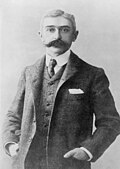
Their creation was inspired by the [[ancient Olympic Games]], held in [[Olympia, Greece]], from the 8th century BC to the 4th century AD. [[Baron Pierre de Coubertin]] founded the [[International Olympic Committee]] (IOC) in 1894, leading to the first modern Games in [[Athens]] in [[1896 Summer Olympics|1896]]. The IOC is the governing body of the [[Olympic Movement]], which encompasses all [[Entity|entities]] and individuals involved in the Olympic Games. The [[Olympic Charter]] defines their structure and authority. | |||
The evolution of the Olympic Movement during the 20th and 21st centuries has resulted in numerous changes to the Olympic Games. Some of these adjustments include the creation of the Winter Olympic Games for snow and ice sports, the [[Paralympic Games]] for athletes with disabilities, the [[Youth Olympic Games]] for athletes aged 14 to 18, the five Continental Games ([[Pan American Games|Pan American]], [[African Games|African]], [[Asian Games|Asian]], [[European Games|European]], and [[Pacific Games|Pacific]]), and the [[World Games]] for sports that are not contested in the Olympic Games. The IOC also endorses the [[Deaflympics]] and the [[Special Olympics]]. The IOC has adapted to a variety of economic, political, and technological advancements. The [[#Amateurism and professionalism|abuse of amateur rules]] prompted the IOC to shift away from pure [[Amateur sports|amateurism]], as envisioned by Coubertin, to the acceptance of [[professional athletes]] participating at the Games. The growing importance of mass media has created the issue of [[corporate sponsorship]] and general commercialisation of the Games. World Wars [[World War I|I]] and [[World War II|II]] led to the cancellation of the [[1916 Summer Olympics|1916]], [[1940 Summer Olympics|1940]], and [[1944 Summer Olympics|1944]] Olympics; large-scale boycotts during the [[Cold War]] limited participation in the [[1980 Summer Olympics|1980]] and [[1984 Summer Olympics|1984]] Olympics;<ref name="olympic.org">{{cite news|title=No Boycott Blues|url=https://www.olympic.org/los-angeles-1984|website=olympic.org|access-date=6 January 2017}}</ref> and the [[2020 Summer Olympics|2020]] Olympics were postponed until 2021 because of the [[COVID-19 restrictions]]. | |||
The Olympic Movement consists of [[List of international sports federations|international sports federations]] (IFs), [[National Olympic Committee]]s (NOCs), and organising committees for each specific Olympic Games. As the decision-making body, the IOC is responsible for choosing the host city for each Games, and organises and funds the Games according to the [[Olympic Charter]]. The IOC also determines the Olympic programme, consisting of the sports to be contested at the Games. There are several Olympic rituals and symbols, such as the [[Olympic flag]], the [[Olympic flame]] and [[List of Olympic torch relays|torch relay]], and the [[Olympic Games ceremony|opening and closing ceremonies]]. Over 14,000 athletes competed at the [[2020 Summer Olympics]] and [[2022 Winter Olympics]] combined, in 40 different sports and 448 events. The first-, second-, and third-place finishers in each event receive [[Olympic medal]]s: gold, silver, and bronze, respectively.<ref>{{Cite web |title=The prizes Olympic athletes can win if they bring home medals |url=https://news.sky.com/story/the-prizes-olympic-athletes-can-win-if-they-bring-home-medals-13187504 |access-date=2026-02-09 |website=Sky News |language=en}}</ref> | |||
The Games have grown to the point that nearly every nation is now represented; colonies and overseas territories are often allowed to field their own teams. This growth has created numerous challenges and [[List of Olympic Games scandals, controversies and incidents|controversies]], including [[List of Olympic Games boycotts|boycotts]], [[Doping at the Olympic Games|doping]], [[match fixing]], bribery, and terrorism. Every two years, the Olympics and its media exposure provide athletes with the chance to attain national and international fame. The Games also provide an opportunity for the host city and country to showcase themselves to the world. | |||
The Olympic Games have become a significant global event, fostering international cooperation and cultural exchange.<ref>{{cite EBO |short=yes |last=Hornblower |first=Simon |author-link=Simon Hornblower |title=Ancient Greek civilization |url=https://www.britannica.com/place/ancient-Greece |date=29 July 2024 |access-date=2 August 2024}}</ref> At the same time, hosting the Olympic Games can also bring significant economic benefits and challenges to the host city, affecting infrastructure, tourism and local communities.<ref>{{cite EBO |short=yes |last=Vanderpool |first=Eugene |author-link=Eugene Vanderpool |title=Olympia |url=https://www.britannica.com/place/Olympia-ancient-site-Greece |date=26 July 2024 |access-date=2 August 2024}}</ref> | |||
{{TOC limit}} | |||
==Ancient Olympics== | |||
{{main|Ancient Olympic Games}} | |||
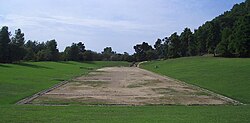
[[File:Olympia-stadion.jpg|thumb|The [[Ancient Olympic Games]] stadium in [[Olympia, Greece]]]] | |||
The "Ancient Olympic Games" ({{langx|grc|τὰ Ὀλύμπια}}, ''ta Olympia'')<ref name="perseus.tuft.edu">{{LSJ|*)olu/mpia|Ὀλύμπια|ref|mLSJ}}.</ref> were religious and athletic festivals held every four years at the sanctuary of [[Zeus]] in [[Olympia, Greece]]. The date of the festival was determined according to a complicated formula whereby the midpoint of the festival would occur during the second full moon after the [[summer solstice]]—usually late August or early September.<ref name=FinleyPleket> | |||
{{cite book | |||
|title=The Olympic Games: The First Thousand Years | |||
|author1=[[Moses I. Finley]] | |||
|author2=H.W. Pleket | |||
|date=14 June 1976 | |||
|publisher=[[Dover Publications]] | |||
}}</ref>{{rp|p=26}}<ref name=Perrottet> | |||
{{cite book | |||
|author= Tony Perrottet | |||
|title=The Naked Olympics | |||
|date=8 June 2004 | |||
|publisher=[[Random House Trade Paperbacks]]|url=http://www.tonyperrottet.com/nakedolympics | |||
}}</ref>{{rp|p=38}} This "came after the annual harvest but before the picking of the olives."<ref name=Perrottet/> Heralds were sent from Elis to announce the dates.<ref name=FinleyPleket/>{{rp|p=26}}<ref name=Perrottet/>{{rp|p=38}} Competition at first was among only "legitimate sons of free-born Greek parents."<ref name=Perrottet/>{{rp|p=49}} However, after Macedonia, and then Rome, conquered Greece, the ten Olympic judges loosened the earlier standard and permitted anyone who spoke Greek to participate.<ref name=Perrottet/>{{rp|p=50}} Tens of thousands of Greeks would make the difficult journey to attend the festival.<ref name=FinleyPleket/>{{rp|p=55}} Some sources say as many as 40,000 attended.<ref>{{cite magazine | |||
|author1=[[Stefan Lovgren]] | |||
|author2=[[Ted Chamberlain]] | |||
|title=Ancient Olympics Had 'Spectacular' Opening Ceremony, Pagan Partying | |||
|date=28 July 2012 | |||
|url=https://www.nationalgeographic.com/travel/article/120727-2012-olympics-opening-ceremony-ancient-london-world-summer-games | |||
|magazine=[[National Geographic]] | |||
}}</ref><ref> | |||
{{cite book | |||
|author=[[Mark Cartwright]] | |||
|date=13 March 2018 | |||
|chapter=Ancient Olympic Games | |||
|title=World History Encyclopedia | |||
|url=https://www.worldhistory.org/Olympic_Games | |||
}}</ref> These Games featured mainly athletic but also combat sports such as wrestling and the [[pankration]], horse and chariot racing events. It has been widely written that during the Games, all conflicts among the participating city-states were postponed until the Games were finished. This cessation of hostilities was known as the Olympic peace or truce.{{r|Swaddling 2000 p54}} This idea is a modern myth because the Greeks never suspended their wars. The truce only allowed those religious pilgrims who were travelling to [[Olympia, Greece|Olympia]] to pass through warring territories unmolested because they were protected by Zeus.<ref name=FinleyPleket/>{{rp|pp=98–99}}<ref>{{cite web|title=The Olympic Truce – Myth and Reality by Harvey Abrams|url=http://ablemedia.com/ctcweb/showcase/abrams1.html|publisher=Classics Technology Center, AbleMedia.com|access-date=12 February 2013}}</ref> | |||
The origin of the Olympics is shrouded in mystery and legend;<ref name=Young2004> | |||
{{cite book | |||
|first=David C. | |||
|last=Young | |||
|date= 1 January 2004 | |||
|chapter=Chapter 2. Beginnings and Evidence | |||
|title=A Brief History of the Olympic Games | |||
|doi=10.1002/9780470774823 | |||
|publisher=[[Blackwell Publishing]] | |||
|isbn= 978-1-4051-1129-4 | |||
}}</ref>{{rp|p=12}} one of the most popular myths identifies [[Heracles]] and his father [[Zeus]] as the progenitors of the Games.<ref name=Young2004/>{{rp|pp=12–13}}<ref>{{cite book | |||
|author=[[Pausanias (geographer)|Pausanias]] | |||
|title=Description of Greece (with an English Translation by W.H.S. Jones and H.A. Ormerod, Harvard University Press, 1918) | |||
|chapter=Book VII: Elis 1 | |||
|publisher=[[Perseus Hopper]] | |||
|url=https://www.perseus.tufts.edu/hopper/text?doc=Perseus:text:1999.01.0160:book=1:chapter=2:section=5 | |||
}}</ref><ref name=Pindar> | |||
{{cite book | |||
|author=[[Pindar]] | |||
|title=Olympian Odes | |||
|chapter=Book O Olympian 2 For Theron of Acragas Chariot Race 476 B. C. | |||
|editor=Diane Arnson Svarlien | |||
|publisher=[[Perseus Hopper]] | |||
|url=http://www.perseus.tufts.edu/hopper/text?doc=Perseus:text:1999.01.0162:book=O.:poem=2 | |||
}}</ref>{{sfn|Richardson|1992|p=227}} According to legend, it was Heracles who first called the Games "Olympic" and established the custom of holding them every four years.<ref name=Pindar/> The myth continues that after Heracles completed his [[Labours of Hercules|twelve labours]], he built the [[Olympic Stadium]] as an honour to Zeus. Following its completion, he walked in a straight line for 200 steps and called this distance a "[[Stadion (unit)|stadion]]" ({{langx|grc|στάδιον|links=no}}, [[Latin]]: {{lang|la|stadium}}, "stage"), which later became a unit of distance. The most widely accepted inception date for the Ancient Olympics is 776 BC; this is based on inscriptions, found at [[Olympia, Greece|Olympia]], listing the winners of a footrace held every four years starting in 776 BC.<ref name=EB/> For the first thirteen Olympics, the ''stadion'' footrace was the only event contested,<ref name=Perrottet/>{{rp|p=145}}<ref> | |||
{{cite book | |||
|author=[[Nicholas Richardson|Nicholas J. Richardson]] | |||
|chapter=Olympic Games | |||
|title=Oxford Classical Dictionary | |||
|date=7 March 2016 | |||
|publisher=[[Oxford University Press]] | |||
|doi=10.1093/acrefore/9780199381135.013.4544 | |||
|isbn=978-0-19-938113-5 | |||
}}</ref> and victory in that sprint was so valued that the next [[Olympiad]] was named after the winner, e.g. "the third year of the eighteenth Olympiad when Ladas of Argos won the stadion."<ref name=Perrottet/>{{rp|p=145}} The Ancient Games varied over time, but they came to feature running events, a pentathlon (consisting of a jumping event, [[Discus throw|discus]] and [[javelin throw]]s, a foot race, and wrestling), boxing, wrestling, pankration, and [[Equestrianism|equestrian]] events.{{sfn|Crowther|2007|pp=59–61}}<ref>{{cite web|title=Ancient Olympic Events|url=https://www.perseus.tufts.edu/Olympics/sports.html|publisher=Perseus Project of [[Tufts University]]|access-date=29 April 2009}}</ref> Tradition has it that [[Coroebus of Elis|Coroebus]], a cook from the city of [[Elis (city)|Elis]], was the first Olympic champion,{{sfn|Golden|2009|p=24}} which indicates that the competition was not limited to the aristocracy.<ref name=Perrottet/>{{rp|pp=50–51}} | |||
The Olympics were of fundamental religious importance, and the sporting events, which were held alongside ritual sacrifices honouring both Zeus (whose [[Statue of Zeus at Olympia|famous statue]] by [[Phidias]] stood in his temple at [[Olympia, Greece|Olympia]]) and [[Pelops]] (divine hero and mythical king of Olympia), did not start until the festival's second day.<ref name=FinleyPleket/>{{rp|p=15}} (Pelops was famous for his chariot race with King [[Oenomaus]] of [[Pisatis]].{{sfn|Burkert|1983|p=95}}) The winners of the events were admired and immortalised in poems and statues.{{sfn|Swaddling|1999|pp=90–93}} Although a wreath made from the sacred olive tree in the precinct of Zeus was the only official prize at the Olympic Games, winners' fame brought them economic wealth, too, in the form of subsidies from their hometowns and wealthy sponsors. See, e.g., Finley and Pleket,<ref name=FinleyPleket/>{{rp|pp=24, 76–82}} and Perrottet<ref name=Perrottet/>{{rp|pp=13–14}} The Games were held every four years, and this period, known as an [[Olympiad]], was used by Greeks as one of their units of time measurement. The Games were part of a cycle known as the [[Panhellenic Games]], which included the [[Pythian Games]], the [[Nemean Games]], and the [[Isthmian Games]].<ref>{{cite web|url=http://multimedia.olympic.org/pdf/en_report_658.pdf|archive-url=https://web.archive.org/web/20090325013857/http://multimedia.olympic.org/pdf/en_report_658.pdf|archive-date=25 March 2009|title=The Olympic Games in Antiquity|author=Olympic Museum|publisher=International Olympic Committee|year=2007|access-date=2 February 2009|url-status=dead| | |||
page=2}}</ref> | |||
The Olympic Games reached the height of their success in the 6th and 5th centuries BC, but then gradually declined in importance as the [[Ancient Rome|Romans]] gained power and influence in Greece. While there is no scholarly consensus as to when the Games officially ended, the most commonly held date is 393 AD, when the emperor [[Theodosius I]] decreed that all pagan cults and practices be eliminated.{{efn|However, Theodosius' decree contains no specific reference to [[Olympia, Greece|Olympia]].{{sfn|Crowther|2007|p=54}}}} Another date commonly cited is 426 AD, when his successor, [[Theodosius II]], ordered the destruction of all Greek temples.{{sfn|Crowther|2007|p=54}} | |||
==Modern Games== | |||
{{see also|List of Olympic Games host cities}} | |||
===Forerunners=== | |||
[[File:Baron Pierre de Coubertin.jpg|thumb|[[Pierre de Coubertin]], co-founder of the [[International Olympic Committee]] and its second president]] | |||
Various uses of the term "Olympic" to describe athletic events in the modern era have been documented since the 17th century. The first such event was the [[Cotswold Games]] or "Cotswold Olimpick Games", an annual meeting near [[Chipping Campden]], England, involving various sports. It was first organised by the lawyer [[Robert Dover (Cotswold Games)|Robert Dover]] between 1612 and 1642, with several later celebrations leading up to the present day. The [[British Olympic Association]], in its bid for the [[2012 Olympic Games]] in London, mentioned these games as "the first stirrings of Britain's Olympic beginnings".<ref name=BOA>{{cite web|title=400 Years of Olimpick Passion |url=http://www.olimpickgames.co.uk/contentok.php?id=853|website=olympickgames.co.uk |access-date=4 June 2010 |url-status=dead |archive-url=https://web.archive.org/web/20100606045814/http://www.olimpickgames.co.uk/contentok.php?id=853 |archive-date=6 June 2010 }}</ref> | |||
{{lang|fr|L'Olympiade de la République}}, a national Olympic festival held annually from 1796 to 1798 in [[Revolutionary France]] also attempted to emulate the ancient Olympic Games.<ref name="frencholympics" /> The competition included several disciplines from the ancient Greek Olympics. The 1796 Games also marked the introduction of the [[metric system]] into sport.<ref name="frencholympics" /> | |||
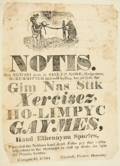
[[File:Notis - Gim Nas Stik - 1834-08-16.png|thumb|The 1834 handbill, written in phonetic vernacular, advertising "Ho-limpyc Gaymes" in [[Oswestry]], Shropshire, England]] | |||
In 1834 and 1836, the Olympic Games were held in Ramlösa, [[Sweden]], and in [[Stockholm]] in 1843, organised by Gustaf Johan Schartau and others. The Games were attended by 25,000 spectators at most.<ref name=FindlingPelle> | |||
{{cite book | |||
|editor1=John E. Findling | |||
|editor2=Kimberly Pelle | |||
|title=Encyclopedia of the Modern Olympic Movement | |||
|edition=1st | |||
|date=30 March 2004 | |||
|publisher=[[Bloomsbury Publishing|Bloomsbury]] | |||
|url=https://www.bloomsbury.com/us/encyclopedia-of-the-modern-olympic-movement-9780313322785/ | |||
}}</ref> | |||
In 1850, an Olympian Class was started by [[William Penny Brookes]] at [[Much Wenlock]], in [[Shropshire]], England. In 1859, Brookes changed the name to the [[Wenlock Olympian Games]]. This annual sports festival continues to this day.<ref name=Young2004.13> | |||
{{cite book | |||
|first=David C. | |||
|last=Young | |||
|date= 1 January 2004 | |||
|chapter=Chapter 13. The Origin and Authenticity of the Modern Olympic Games | |||
|title=A Brief History of the Olympic Games | |||
|doi=10.1002/9780470774823 | |||
|publisher=[[Blackwell Publishing]] | |||
|isbn= 978-1-4051-1129-4 | |||
}}</ref>{{rp|p=144}} The Wenlock Olympian Society was founded by Brookes on 15 November 1860.<ref name=Young1996> | |||
{{cite book | |||
|first=David C. | |||
|last=Young | |||
|title= The Modern Olympics: A Struggle for Revival | |||
|date=1996 | |||
|publisher=[[Johns Hopkins University Press]] | |||
|isbn= 0-8018-7207-3 | |||
}}</ref>{{rp|p=28}} | |||
Between 1862 and 1867, [[Liverpool]] held an annual Grand Olympic Festival. Devised by [[John Hulley]] and [[Charles Pierre Melly]], these games were the first to be wholly amateur in nature and international in outlook, although only 'gentlemen amateurs' could compete.{{sfn|Matthews|2005|pp=53–54}}{{sfn|Weiler|2004}} The programme of the first modern Olympiad in Athens in 1896 was almost identical to that of the Liverpool Olympics.{{r|Girginov Parry 2005 p38}} In 1865 Hulley, Brookes and E. G. Ravenstein founded the National Olympian Association in Liverpool, a forerunner of the [[British Olympic Association]]. Its articles of foundation provided the framework for the [[Olympic Charter|International Olympic Charter]].<ref name=Young1996/>{{rp|p=24}} In 1866, a national Olympic Games in Great Britain was organised at London's [[The Crystal Palace|Crystal Palace]].<ref>{{cite web|url= http://www.wenlock-olympian-society.org.uk/william-penny-brookes/index.shtml|title= Much Wenlock & the Olympian Connection|publisher= Wenlock Olympian Society|access-date=31 January 2009|archive-url= https://web.archive.org/web/20090123183803/http://www.wenlock-olympian-society.org.uk/william-penny-brookes/index.shtml <!--Added by H3llBot-->|archive-date= 23 January 2009}}</ref> | |||
===Revival=== | |||
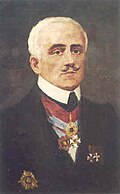
[[File:Evangelos Zappas.jpg|thumb|[[Evangelos Zappas]], co-founder of the [[International Olympic Committee]]]] | |||
Greek interest in reviving the Olympic Games began with the [[Greek War of Independence]] from the [[Ottoman Empire]] in 1821. It was first proposed by poet and newspaper editor [[Panagiotis Soutsos]] in his poem "Dialogue of the Dead", published in 1833.<ref name=Young1996/>{{rp|p=1}} [[Evangelos Zappas]], a wealthy Greek-Romanian philanthropist, first wrote to [[King Otto of Greece]], in 1856, offering to fund a permanent revival of the Olympic Games.<ref name=Young1996/>{{rp|p=14}} Zappas sponsored the first [[Zappas Olympics|Olympic Games]] in 1859, which was held in an [[Athens]] city square. Athletes participated from Greece and the Ottoman Empire. Zappas funded the restoration of the ancient [[Panathenaic Stadium]] so that it could host all future Olympic Games.<ref name=Young1996/>{{rp|p=14}} | |||
The stadium hosted the Olympics in 1870 and 1875.<ref name="Young1996" />{{rp|pp=2, 13–23, 81}} Thirty thousand spectators attended that Games in 1870, though no official attendance records are available for the 1875 Games.<ref name="Young1996" />{{rp|p=44}} In 1890, after attending the Olympian Games of the [[Wenlock Olympian Society]], [[Baron Pierre de Coubertin]], who aimed to promote international peace and friendship through sports,<ref name="EB" /> was inspired to found the [[International Olympic Committee]] (IOC).<ref name="wenlock" /> Coubertin built on the ideas and work of Brookes and Zappas with the aim of establishing internationally rotating Olympic Games that would occur every four years.<ref name="wenlock" /> He presented these ideas during the first [[Olympic Congress]] of the newly created International Olympic Committee. This meeting was held from 16 to 23 June 1894, at the [[University of Paris]]. On the last day of the Congress, it was decided that the first Olympic Games to come under the auspices of the IOC would take place in Athens in 1896.{{sfn|Coubertin|Philemon|Politis|Anninos|1897|p=8|loc=Part 2}} The IOC elected the Greek writer [[Demetrius Vikelas]] as its first president.<ref name="Young1996" />{{rp|pp=100–105}} | |||
===1896 Games=== | |||
{{main|1896 Summer Olympics}} | |||
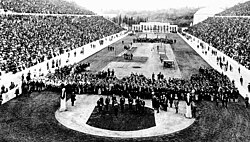
[[File:1906 Intercalated Olympic Games Opening Ceremony.jpg|thumb|The opening ceremony of the [[1896 Summer Olympics]] in [[Panathinaiko Stadium]] in [[Athens]]]] | |||
The first Games held under the auspices of the IOC were hosted in the Panathenaic Stadium in [[Athens]] in 1896. The Games brought together 14 nations and 241 athletes who competed in 43 events.<ref>{{cite web|url=http://www.olympic.org/en/content/Olympic-Games/All-Past-Olympic-Games/Summer/Athens-1896/|title=Athens 1896|publisher=The International Olympic Committee|access-date=8 February 2010}}</ref> Zappas and his cousin [[Konstantinos Zappas]] had left the Greek government a trust to fund future Olympic Games. This trust was used to help finance the 1896 Games.<ref name=Young1996/>{{rp|p=117}}<ref>{{cite book|title=Mémoire sur le conflit entre la Grèce et la Roumanie concernant l'affaire Zappa|language=fr|location=Athens|year=1893|first=Frédéric|last=de Martens|author-link=Friedrich Martens|publisher=[printer Anestis Constantinides]|url=http://anemi.lib.uoc.gr/metadata/5/1/6/metadata-513a41d33e40da3d727896b19c5b9729_1236942720.tkl|access-date=2 August 2017}}</ref><ref>{{cite book|title=L'affaire Zappa; Conflit Gréco-Roumain|language=fr|last=Streit|first=Geōrgios S.|author-link=Georgios Streit|date=1894|location=Paris|publisher=L. Larose|url=https://archive.org/details/laffairezappaco00stregoog|access-date=2 August 2017}}</ref> [[George Averoff]] contributed generously for the refurbishment of the stadium in preparation for the Games.<ref name=Young1996/>{{rp|p=128}} The Greek government also provided funding, which was expected to be recouped through the sale of tickets and from the sale of the first Olympic commemorative stamp set.<ref name=Young1996/>{{rp|p=128}} | |||
Greek officials and the public were enthusiastic about the experience of hosting an Olympic Games.<ref>{{Cite web|title=Olympic Games - a brief history {{!}} Parramatta History and Heritage|url=https://historyandheritage.cityofparramatta.nsw.gov.au/research-topics/events/olympic-games-brief-history|access-date=31 January 2024|website=historyandheritage.cityofparramatta.nsw.gov.au|language=en}}</ref> This feeling was shared by many of the athletes, who even demanded that Athens be the permanent Olympic host city. The IOC intended for subsequent Games to be rotated to various host cities around the world. The [[1900 Summer Olympics|second Olympics]] was held in Paris.<ref>{{cite web|url= https://www.sports-reference.com/olympics/summer/1896/|archive-url= https://web.archive.org/web/20200417042610/https://www.sports-reference.com/olympics/summer/1896/|url-status= dead|archive-date= 17 April 2020|title= 1896 Athina Summer Games|publisher= Sports Reference|access-date=31 January 2009}}</ref> | |||
===Changes and adaptations=== | |||
{{main|Summer Olympic Games}} | |||
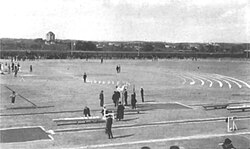
[[File:Francis Field 1904.jpg|thumb|[[Francis Olympic Field|Francis Field]] at [[Washington University in St. Louis]] during the [[1904 Summer Olympics]], the first held outside Europe|alt=]] | |||
After the success of the [[1896 Summer Olympics|1896 Games]], the Olympics entered a period of stagnation which threatened its survival. The Olympic Games held at the [[Exposition Universelle (1900)|Paris Exposition]] in [[1900 Summer Olympics|1900]] and the [[Louisiana Purchase Exposition]] at [[St. Louis]] in [[1904 Summer Olympics|1904]] failed to attract much participation or notice.<ref>{{cite web|url= http://espn.com/olympics/summer08/fanguide/history?year=1904|archive-url= https://web.archive.org/web/20210324081509/http://espn.com/olympics/summer08/fanguide/history?year=1904|url-status= dead|archive-date= 24 March 2021|title= St. Louis 1904 – Overview|publisher= ESPN|access-date=31 January 2009}}</ref> The Games rebounded with the [[1906 Intercalated Games]] (so-called because they were the second Olympics to take place within the third Olympiad), which were held in Athens. These Games attracted a broad international field of participants and generated a great deal of public interest, marking the beginning of a rise in both the popularity and the size of the Olympics. The 1906 Games were officially recognised by the IOC at the time (although not any longer), and no Intercalated Games have been held since.<ref>{{cite news|url=https://www.cbc.ca/sports/2.720/1906-olympics-mark-10th-anniversary-of-the-olympic-revival-1.719323|title=1906 Olympics mark 10th anniversary of the Olympic revival|publisher=Canadian Broadcasting Centre|date=28 May 2008|access-date=31 January 2009|url-status=live|archive-url=https://web.archive.org/web/20080731211554/http://www.cbc.ca/olympics/history/story/2008/05/05/f-olympics-feature-1906.html|archive-date=31 July 2008 }}</ref> | |||
====Winter Games==== | |||
{{main|Winter Olympic Games}} | |||
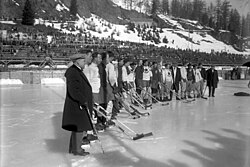
[[File:Bundesarchiv Bild 102-05472, St. Moritz, Winterolympiade.jpg|thumb|An [[ice hockey]] game during the [[1928 Winter Olympics]] at [[St. Moritz]]]] | |||
The Winter Olympics was created to feature snow and ice sports that were logistically impossible to hold during the Summer Games. Figure skating (in 1908 and 1920) and ice hockey (in 1920) were featured as Olympic events at the Summer Olympics.{{sfn|Hines|2011|page=xxii}} The IOC desired to expand this list of sports to encompass other winter activities. At the [[List of IOC meetings|1921 Olympic Congress]] in [[Lausanne]], it was decided to hold a winter version of the Olympic Games. A winter sports week (it was actually 11 days) was held in [[1924 Winter Olympics|1924]] in [[Chamonix]], France, in connection with the [[1924 Summer Olympics|Paris Games]] held three months later; this event became the first [[Winter Olympic Games]].<ref name="chamonix" /> Although, it was intended that the ''same'' country host both the Winter and Summer Games in a given year, this idea was quickly abandoned. The IOC mandated that the Winter Games be celebrated every four years in the same year as their summer counterpart.<ref>{{cite web|url=http://www.utah.com/olympics/history.htm|title=Winter Olympics History|publisher=Utah Athletic Foundation|access-date=31 January 2009|url-status=dead|archive-url=https://web.archive.org/web/20090112071018/http://www.utah.com/olympics/history.htm|archive-date=12 January 2009 }}</ref> This tradition was upheld until the [[1992 Winter Olympics|1992 Games]] in [[Albertville]], France; after that, beginning with the [[1994 Winter Olympics|1994 Games]], the Winter Olympics were held every four years, two years after each Summer Olympics.<ref name=FindlingPelle/>{{rp|p=405}} This allowed the IOC to space out the logistical and financial costs of the two events from one another, and generate advertising revenue from the Games every two years instead of four.<ref>{{cite web|last=Nucilli|first=Ryleigh|title=Here's Why the Olympics Are Held Every 4 Years|url=https://www.rd.com/article/why-olympics-are-held-every-4-years/|date=27 January 2026|website=Reader's Digest|access-date=20 February 2026}}</ref> | |||
====Paralympics==== | |||
{{main|Paralympic Games}} | |||
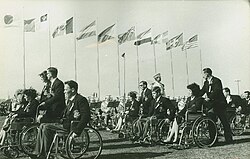
[[File:031164 - Tokyo opening ceremony -7 - 1a - adjusted.jpg|thumb|[[1964 Summer Paralympics]] in [[Tokyo]]]] | |||
In 1948, [[Sir Ludwig Guttmann]], determined to promote the rehabilitation of soldiers after [[World War II]], organised a multi-sport event between several hospitals to coincide with the [[1948 London Olympics]]. Originally known as the [[Stoke Mandeville Games]], Guttmann's event became an annual sports festival. Over the next 12 years, Guttmann and others continued their efforts to use sports as an avenue to healing. | |||
In 1960, Guttmann brought 400 athletes to Rome to compete in the "Parallel Olympics", which ran in parallel with the [[1960 Summer Olympics|Summer Olympics]] and came to be known as the first [[1960 Summer Paralympics|Paralympics]]. Since then, the Paralympics have been held in every Olympic year and, starting with the [[1988 Summer Olympics|1988 Summer Games]] in Seoul, the host city for the Olympics has also played host to the Paralympics.<ref>{{cite news|url= https://news.bbc.co.uk/sport2/hi/other_sports/disability_sport/7582206.stm|title= History of the Paralympics|work= [[BBC Sport]]|access-date=2 February 2009|date=4 September 2008}}</ref><!-- The following note is not strictly necessary given that the 1988 Winter Olympics were before the 1988 Summer Olympics, but that fact is not obvious so a clarification is useful.-->{{efn|The [[1988 Winter Olympics]] were in [[Calgary]], Canada, and the [[1988 Winter Paralympics]] were in [[Innsbruck]], Austria.<ref>{{cite web|url=https://www.paralympic.org/innsbruck-1988|title=Innsbruck 1988 Paralympics – Ceremonies, Medals, Torch Relay|publisher=International Paralympic Committee|access-date=2 August 2017}}</ref>}} The [[International Olympic Committee]] (IOC) and the [[International Paralympic Committee]] (IPC) signed an agreement in 2001 which guaranteed that host cities would be contracted to manage both the Olympic and Paralympic Games.<ref name="Parahist" /><ref>{{cite web|title=IPC-IOC Cooperation|publisher=[[International Paralympic Committee|IPC]]|website=paralympic.org|url=http://paralympic.org/IPC/IPC-IOC_Co-operation.html|access-date=3 May 2010|url-status=dead|archive-url=https://web.archive.org/web/20090908052424/http://paralympic.org/IPC/IPC-IOC_Co-operation.html|archive-date=8 September 2009}}</ref> The agreement came into effect at the [[2008 Summer Paralympics|2008 Summer Games]] in Beijing, and at the [[2010 Winter Paralympics|2010 Winter Games]] in Vancouver. | |||
Two years before the 2012 Games, the [[LOCOG]] chairman [[Lord Coe]] made the following statement about the [[2012 Summer Paralympics|Paralympics]] and [[2012 Summer Olympics|Olympics]] in London:<ref>{{cite news|url=https://www.theguardian.com/uk/2010/may/04/sainsburys-sponsors-paralympic-games|location=London|title=Sainsbury's announces sponsorship of 2012 Paralympics|date=4 May 2010|work=[[The Guardian]]|first=Owen|last=Gibson}}</ref> | |||
{{blockquote | |||
|We want to change public attitudes towards disability, celebrate the excellence of Paralympic sport and to enshrine from the very outset that the two Games are an integrated whole. | |||
}} | |||
====Youth Games==== | |||
{{main|Youth Olympic Games}} | |||
In 2010, the Olympic Games were complemented by the Youth Games, which give athletes between the ages of 14 and 18 the chance to compete. The Youth Olympic Games were conceived by IOC president [[Jacques Rogge]] in 2001 and approved during the 119th Congress of the IOC.<ref name="Rogge introduces" /><ref>{{cite news|last= Rice|first= John|url= https://www.usatoday.com/sports/olympics/2007-07-05-2774646336_x.htm|title=IOC approves Youth Olympics; first set for 2010 | |||
|agency=[[The Associated Press]] | |||
|work= USA Today|date=5 July 2007|access-date=2 February 2009}}</ref> The [[2010 Summer Youth Olympics|first Summer Youth Games]] were held in Singapore from 14 to 26 August 2010, while the [[2012 Winter Youth Olympics|inaugural Winter Games]] were hosted in [[Innsbruck]], Austria, two years later.<ref>{{cite web|title=Innsbruck is the host city for the first Winter Youth Olympic Games|publisher=The Vancouver Organizing Committee for the 2010 Olympic and Paralympic Winter Games|date=12 December 2008|url=http://www.vancouver2010.com/en/news/feature-stories/-/61888/32574/1t8ch2t/innsbruck-is-the-host-city-for.html|access-date=30 March 2009|archive-date=10 June 2009|archive-url=https://web.archive.org/web/20090610111938/http://www.vancouver2010.com/en/news/feature-stories/-/61888/32574/1t8ch2t/innsbruck-is-the-host-city-for.html|url-status=dead}}</ref> These Games will be shorter than the senior Games; the summer version will last twelve days, while the winter version will last nine days.<ref name="CRIonYOG" /> The IOC allows 3,500 athletes and 875 officials to participate at the Summer Youth Games, and 970 athletes and 580 officials at the Winter Youth Games.<ref name="YOGisGo" /><ref name="No kidding" /> The sports to be contested will coincide with those scheduled for the senior Games, however there will be variations on the sports including mixed NOC and mixed gender teams as well as a reduced number of disciplines and events.<ref>{{cite news|url= https://www.usatoday.com/sports/olympics/summer/2007-07-05-olympic-notes_N.htm|title= IOC votes to start Youth Olympics in 2010|first= Vicky|last= Michaelis|date= 5 July 2007|work= USA Today|access-date=2 February 2009}}</ref> | |||
===21st-century Games=== | |||
Over 14,000 athletes competed at the [[2020 Summer Olympics]] and [[2022 Winter Olympics]] combined, in 40 different sports and 448 events.<ref>{{Cite web|title=International Olympic Committee - Tokyo 2020|url=https://olympics.com/en/olympic-games/tokyo-2020}}</ref><ref>{{Cite web|title=International Olympic Committee - Beijing 2022|url=https://olympics.com/en/olympic-games/beijing-2022}}</ref> The Summer Olympics have grown from 241 participants representing 14 nations in 1896, to more than 11,300 competitors representing 206 nations in [[2020 Summer Olympics|2020]].<ref>{{cite web|url=https://www.olympic.org/tokyo-2020|title=Tokyo 2020|website=olympic.org|date=23 February 2023|access-date=5 November 2023}}</ref> The scope and scale of the Winter Olympics is smaller; for example, [[Beijing]] hosted 2,971 athletes from 91 nations in [[2022 Winter Olympics|2022]]. Most of the athletes and officials are housed in the [[Olympic Village]] for the duration of the Games. This accommodation centre is designed to be a self-contained home for all Olympic participants, and is furnished with cafeterias, health clinics, and locations for religious expression.<ref>{{cite web|title=Beijing to build convenient Olympic village|url=http://en.beijing2008.cn/cptvenues/venues/headlines/n214262207.shtml|publisher=The Beijing Organizing Committee for the Games of the XXIX Olympiad|access-date=4 May 2009|url-status=dead|archive-url=https://web.archive.org/web/20080914055027/http://en.beijing2008.cn/cptvenues/venues/headlines/n214262207.shtml|archive-date=14 September 2008 }}</ref> | |||
The IOC has allowed the formation of [[National Olympic Committee]]s (NOCs) to represent individual nations. These do not meet the strict requirements for political sovereignty that other international organisations demand. As a result, [[colonies]] and [[Dependent territory|dependencies]] are permitted to compete at Olympic Games, examples being territories such as [[Puerto Rico]], [[Bermuda]], and [[Hong Kong]], all of which compete as separate nations despite being legally a part of another country.<ref>{{cite web|title=Olympic Charter|url=http://multimedia.olympic.org/pdf/en_report_122.pdf|archive-url=https://web.archive.org/web/20110723070003/http://multimedia.olympic.org/pdf/en_report_122.pdf|archive-date=23 July 2011|page=61|publisher=International Olympic Committee|access-date=28 July 2011}}</ref> The current version of the Olympic Charter allows for the establishment of new NOCs to represent nations that qualify as "an independent State recognised by the international community".<ref>{{cite web|title=The Olympic Charter|url=http://www.asksam.com/ebooks/releases.asp?doc_handle=135969&file=Olympic-Charter.ask&query=recognised%20by%20the%20international%20community&search=yes|publisher=International Olympic Committee|access-date=17 July 2012|url-status=dead|archive-url=https://web.archive.org/web/20130502144028/http://www.asksam.com/ebooks/releases.asp?doc_handle=135969&file=Olympic-Charter.ask&query=recognised%20by%20the%20international%20community&search=yes|archive-date=2 May 2013 }}</ref> Consequently, the IOC did not allow the formation of NOCs for [[Sint Maarten]] and [[Curaçao]] when they gained the same constitutional status as [[Aruba]] in 2010, although the IOC had recognised the [[Aruban Olympic Committee]] in 1986.<ref>{{cite web|url=http://www.olympic.org/news/executive-board-concludes-first-meeting-of-the-new-year/112731|date=13 January 2011|access-date=13 January 2011|title=Executive Board Concludes First Meeting of the New Year|website=olympic.org}}</ref><ref>{{cite web|url=https://www.olympic.org/mr-jose-perurena?articleid=133159|title=Curtain comes down on 123rd IOC Session|website=olympic.org|date=9 July 2011|access-date=3 July 2012|archive-url=https://web.archive.org/web/20111102100904/https://www.olympic.org/mr-jose-perurena?articleid=133159|archive-date=2 November 2011|url-status=dead}}</ref> Since 2012, athletes from the former [[Netherlands Antilles]] have had the option to represent either the [[Netherlands]] or Aruba.<ref>{{cite web|url=http://www.olympic.org/news/media-resources?articleid=132830|date=1 July 2011|access-date=23 August 2012|title=Working meeting between the IOC and the NOCs of the Netherlands Antilles, Aruba and the Netherlands|website=olympic.org|archive-url=https://web.archive.org/web/20140115004545/http://www.olympic.org/news/media-resources?articleid=132830|archive-date=15 January 2014|url-status=dead}}</ref> | |||
===Cost of the Games=== | |||
{{see also|Cost of the Olympic Games}} | |||
The Oxford Olympics Study 2016 found that, since 1960, sports-related costs for the Summer Games were on average US$5.2 billion and for the Winter Games $3.1 billion. These figures do not include wider infrastructure costs like roads, urban rail, and airports, which often cost as much or more than the sports-related costs. The most expensive Summer Games were Beijing 2008 at US$40{{nbnd}}44 billion,<ref>{{cite news|title= Beijing Olympics to cost China 44 billion dollars|date= 8 June 2008|publisher= pravda.ru|first1=Dmitry|last1=Sudakov|url=http://english.pravda.ru/sports/games/06-08-2008/106003-beijing_olympics-0/|access-date=12 February 2014|url-status=live|archive-url=https://web.archive.org/web/20140222035715/http://english.pravda.ru/sports/games/06-08-2008/106003-beijing_olympics-0/|archive-date= 22 February 2014 }}</ref> and the most expensive Winter Games were Sochi 2014 at US$51 billion.<ref name="The Guardian">{{Cite news|url=https://www.theguardian.com/sport/blog/2013/oct/09/sochi-2014-olympics-money-corruption|title=Sochi 2014: the costliest Olympics yet but where has all the money gone?|newspaper=[[The Guardian]]|date= 9 October 2013|access-date=12 February 2014|last1=Gibson|first1=Owen }}</ref><ref name="study">{{Cite book|ssrn=2804554|title=The Oxford Olympics Study 2016: Cost and Cost Overrun at the Games|last1=Flyvbjerg|first1=Bent|last2=Stewart|first2=Allison|last3=Budzier|first3=Alexander|publisher=Saïd Business School, University of Oxford|year=2016|doi=10.2139/ssrn.2804554|arxiv=1607.04484|s2cid=156794182 }}</ref> As of 2016, costs per athlete were, on average, US$599,000 for the Summer Games and $1.3 million for the Winter Games; for London 2012, the cost per athlete was $1.4 million, and the figure was $7.9 million for Sochi 2014.<ref name="study"/> | |||
Where ambitious construction for the [[1976 Summer Olympics|1976 Summer Games in Montreal]] and the 1980 Summer Games in Moscow had burdened organisers with expenses greatly in excess of revenues, Los Angeles strictly controlled expenses for the 1984 Summer Games by using existing facilities and only two new that were paid for by corporate sponsors. The organising committee, led by [[Peter Ueberroth]], used some of the profits to endow the [[LA84 Foundation]] to promote youth sports in [[Southern California]], educate coaches and maintain a sports library. The 1984 Summer Olympics are often considered until that date, the most financially successful modern Olympics and a model for future Games.<ref name="financiallySuccessful">{{cite news|url=https://pqasb.pqarchiver.com/latimes/access/86729520.html?dids=86729520:86729520&FMT=ABS&FMTS=ABS:FT&date=Oct+28%2C+2001&author=ALAN+ABRAHAMSON&pub=Los+Angeles+Times&desc=L.A.+the+Best+Site%2C+Bid+Group+Insists%3B+Olympics%3A+Despite+USOC+rejection%2C+officials+say+their+plan+was+in+line+with+IOC%27s+call+for+downsizing+of+Games.&pqatl=google|title=LA the Best Site, Bid Group Insists; Olympics: Despite USOC rejection|date=25 July 2004|work=Los Angeles Times|access-date=17 August 2008|first=Alan|last=Abrahamson|archive-date=5 November 2012|archive-url=https://web.archive.org/web/20121105125946/http://pqasb.pqarchiver.com/latimes/access/86729520.html?dids=86729520:86729520&FMT=ABS&FMTS=ABS:FT&date=Oct+28%2C+2001&author=ALAN+ABRAHAMSON&pub=Los+Angeles+Times&desc=L.A.+the+Best+Site%2C+Bid+Group+Insists%3B+Olympics%3A+Despite+USOC+rejection%2C+officials+say+their+plan+was+in+line+with+IOC%27s+call+for+downsizing+of+Games.&pqatl=google|url-status=dead}}</ref> | |||
Budget overruns are common for the Games. Average overrun for Games since 1960 is 156% in real terms,<ref>{{cite news|last=Leahy|first=Joe|title=Brazil's Olympic costs running 51% over budget, report warns|work=Financial Times|date=7 July 2016|url=https://www.ft.com/content/ef122cb6-43d6-11e6-864d-01c0167ff470|archive-url=https://ghostarchive.org/archive/20221210/https://www.ft.com/content/ef122cb6-43d6-11e6-864d-01c0167ff470|archive-date=10 December 2022|url-access=subscription|url-status=live|access-date=23 July 2017}}</ref> which means that actual costs turned out to be on average 2.56 times the budget that was estimated at the time of winning the bid to host the Games. Montreal 1976 had the highest cost overrun for Summer Games, and for any Games, at 720%; Lake Placid 1980 had the highest cost overrun for Winter Games, at 324%. London 2012 had a cost overrun of 76%, Sochi 2014 of 289%.<ref name="study"/> | |||
It has been documented that cost and cost overrun for the Games follow a [[power-law distribution]], meaning that the Games are prone to large [[cost overrun]]s, and it is only a matter of time before an overrun occurs that exceeds the largest to date. In short, hosting the Games carries extreme economical and financial risks.<ref name=":0">{{Cite journal|last1=Flyvbjerg|first1=Bent|last2=Budzier|first2=Alexander|last3=Lunn|first3=Daniel|date=1 September 2020|title=Regression to the Tail: Why the Olympics Blow Up|url=https://papers.ssrn.com/sol3/papers.cfm?abstract_id=3686009|journal=Environment and Planning A: Economy and Space|ssrn=3686009|doi=10.2139/ssrn.3686009|arxiv=2009.14682|s2cid=233759692 |issn = 1556-5068 }}</ref> | |||
The final cost for the Tokyo 2020 Olympics was reported to be JPY 1,423.8 billion (US$13 billion). This was achieved by balancing revenues and expenditures through various efforts to increase revenue and continuously review expenditures. The primary sources of revenue included the International Olympic Committee (IOC) contribution of JPY 86.8 billion (US$0.8 billion), TOP sponsorship of JPY 56.9 billion (US$0.5 billion), local sponsorship of JPY 376.1 billion (US$3.4 billion), an insurance payout of JPY 50 billion (US$0.5 billion) for the postponement of the Games, and other sources including licensing. The expenditures included JPY 195.5 billion (US$1.8 billion) for venue-related costs and JPY 444.9 billion (US$4 billion) for service expenditures. The total cost also accounted for COVID-19 countermeasures amounting to JPY 35.3 billion (US$0.3 billion). Despite initial estimates, the total costs were reduced by JPY 220.2 billion (US$2 billion) from the budget announced in December 2020, and JPY 29.2 billion (US$0.3 billion) from the estimated budget in December 2021. This successful financial management resulted in a balanced budget for the Tokyo 2020 Games.<ref>{{Cite web|date=27 July 2024|title=Tokyo 2020 Organising Committee publishes final balanced budget|url=https://olympics.com/ioc/news/tokyo-2020-organising-committee-publishes-final-balanced-budget}}</ref><ref>{{Cite web|date=7 August 2021|title=Tokyo Olympics cost $15.4 billion. What else could that buy?|url=https://apnews.com/article/2020-tokyo-olympics-games-total-cost-8ec49ea2ea9d7316f37ffd20770a2742|access-date=27 July 2024|website=AP News|language=en}}</ref> | |||
===Economic and social impact on host cities and countries=== | |||
Seeking a scholarly institution to independently research the Games, [[Bob Barney]] led efforts to establish the International Centre for Olympic Studies in 1989, endeavouring to write about [[Social environment|sociocultural impacts]] of the Olympic Games.<ref name="Cengel-2008">{{cite news|title=Olympics: beyond sports|last=Cengel|first=Katya|date=10 August 2008|newspaper=[[Courier Journal]]|location=Louisville, Kentucky|page=E1|url=https://www.newspapers.com/article/the-courier-journal-olympics-2008/129824534/}}; {{cite news|title=Olympics (Continued from E1)|last=Cengel|first=Katya|date=10 August 2008|newspaper=[[Courier Journal]]|location=Louisville, Kentucky|page=E2|url=https://www.newspapers.com/article/the-courier-journal-olympics-2008/129824430/}}</ref><ref>{{cite web|url=https://baseballresearch.ca/directors/|title=Bob Barney|year=2023|website=Centre for Canadian Baseball Research|location=St. Mary's, Ontario|access-date=3 August 2023}}</ref> He felt that the Olympics "is worthy of study because it is one of the biggest meetings in a global context and has many political, economic, and other problems associated with it".<ref name="Cengel-2008" /> He began ''Olympika'' in 1992, the first peer-reviewed academic journal focused on the Olympic Games.<ref name="CSSOR">{{cite web|url=https://www.cssor.org/speakers/robert-k-barney/|title=Robert K. Barney|year=2020|website=Center for Sociocultural Sport and Olympic Research|access-date=4 August 2023}}</ref><ref name="CSSOR-2022">{{cite web|url=https://olympicstudies.org/robert-k-barney-graduate-student-essay-award/|title=Robert K. Barney Graduate Student Essay Award|date=1 November 2022|website=Center for Sociocultural Sport and Olympic Research|access-date=5 August 2023}}</ref> Founded in 1991, the [[International Society of Olympic Historians]] publishes the ''Journal of Olympic History''.<ref>{{cite web|url=https://isoh.org/about/|title=International Society of Olympic Historians|year=2023|website=[[International Society of Olympic Historians]]|access-date=1 October 2023}}</ref> | |||
Some economists are sceptical about the economic benefits of hosting the Olympic Games, emphasising that such "mega-events" often have large costs while yielding relatively few tangible benefits in the long run.<ref>{{Cite magazine|url=https://www.wired.com/2016/08/olympic-cities-everywhere/|title=Olympics Everywhere|date=August 2016|magazine=WIRED|department=Argument|page=19|type=Paper|quote=...hosting the Olympics is almost always a financial disaster for cities in the long term.... Indeed, economists are uncommonly unanimous that hosting the Olympics is a bad bet.|vauthors=Greenwell M}}</ref> Hosting (or even bidding for) the Olympics appears to increase the host country's exports, as the host or candidate country sends a signal about trade openness when bidding to host the Games.<ref>{{Cite journal|date=19 January 2011|title=The Olympic Effect|journal=[[The Economic Journal]]|volume=121|issue=553|pages=652–677|doi=10.1111/j.1468-0297.2010.02407.x|vauthors=Rose AK, Spiegel MM}}</ref> Research suggests that hosting the Summer Olympics has a positive effect on the [[Corporate giving|philanthropic contributions of corporations]] headquartered in the host city, which seems to benefit the local nonprofit sector. This effect begins in the years leading up to the Games and might persist for several years afterwards, though it is not permanent.<ref>{{Cite journal|date=1 February 2013|title=Punctuated Generosity: How Mega-events and Natural Disasters Affect Corporate Philanthropy in U.S. Communities|ssrn=2028982|journal=[[Administrative Science Quarterly]]|volume=58|issue=1|pages=111–148|doi=10.1177/0001839213475800|via=Social Science Research Network|vauthors=Tilcsik A, Marquis C|s2cid=18481039|url=https://tspace.library.utoronto.ca/bitstream/1807/42290/1/ASQ.pdf|archive-url=https://web.archive.org/web/20170922021417/https://tspace.library.utoronto.ca/bitstream/1807/42290/1/ASQ.pdf|archive-date=22 September 2017|url-status=live}}</ref> | |||
The Games have had significant negative effects on host communities; for example, the [[Centre on Housing Rights and Evictions]] reports that the Olympics displaced more than two million people over two decades,{{When|date=August 2025|reason=Cited journal source uses Atlanta 1996 as case study, so presumably this means two decades spanning before/during/after the 1996 Games?}} often disproportionately affecting disadvantaged groups.<ref>{{Cite journal|last=Glynn|first=Mary Ann|year=2008|title=Configuring the Field of Play: How Hosting the Olympic Games Impacts Civic Community|journal=Journal of Management Studies|volume=45|issue=6|pages=1117–1146|doi=10.1111/j.1467-6486.2008.00785.x|s2cid=153973502}}</ref> The [[2014 Winter Olympics]] in [[Sochi]] were the most expensive Olympic Games in history, costing in excess of US$50 billion. According to a report by the [[European Bank for Reconstruction and Development]] released at the time of the Games, the cost would not boost Russia's national economy but could attract business to Sochi and the southern [[Krasnodar region]] of Russia as a result of improved services. By December 2014, eight months after the Games, ''[[The Guardian]]'' stated that Sochi "now feels like a ghost town", citing the spread-out nature of the stadiums and arenas and the still-unfinished infrastructure.<ref>{{cite news|url=https://www.theguardian.com/sport/2014/dec/17/sochi-olympics-legacy-city-feels-like-a-ghost-town|title=The Sochi Olympics legacy: 'The city now feels like a ghost town'|date=17 December 2014|work=The Guardian|access-date=10 January 2014|last=Walker|first=Shaun}}</ref> At least four cities withdrew their bids for the [[2022 Winter Olympics]], citing the high costs or lack of local support,<ref>{{cite magazine|url=https://time.com/3462070/olympics-winter-2022/|title=Why Nobody Wants to Host the 2022 Winter Olympics|date=3 October 2014|magazine=Time|access-date=10 January 2014|first=Lisa|last=Abend|archive-date=18 September 2015|archive-url=https://web.archive.org/web/20150918021002/http://time.com/3462070/olympics-winter-2022/|url-status=dead}}</ref> resulting in only [[Bids for the 2022 Winter Olympics|a two-city race]] between [[Almaty, Kazakhstan]], and Beijing, China (which hosted the [[2008 Summer Olympics]]). ''The Guardian'' stated that the biggest threat to the future of the Olympics is that few cities or countries want to host them.<ref>{{cite news|url=https://www.theguardian.com/sport/2016/jul/27/biggest-threat-future-olympic-games-rio-2016-ioc-thomas-bach-hosts|title=Revealed: the biggest threat to the future of the Olympic Games|date=27 July 2016|work=The Guardian|access-date=30 July 2016}}</ref> Bidding for the [[2024 Summer Olympics]] became a two-city race between Paris and Los Angeles, so the IOC took the unusual step of [[Bids for the 2024 and 2028 Summer Olympics|simultaneously awarding]] both the 2024 Games to Paris and the [[2028 Summer Olympics|2028 Games]] to Los Angeles. Both of the bids were praised for their [[high-tech]] plans and innovative ways of using a record-breaking number of existing and temporary facilities.<ref>{{Cite news|date=13 September 2017|title=IOC makes historic decision by simultaneously awarding Olympic Games 2024 to Paris and 2028 to Los Angeles|work=[[International Olympic Committee]]|url=https://olympics.com/ioc/news/ioc-makes-historic-decision-by-simultaneously-awarding-olympic-games-2024-to-paris-and-2028-to-los-angeles|access-date=6 September 2021}}</ref> | |||
==International Olympic Committee== | |||
{{see also|International Olympic Committee}} | |||
The Olympic Movement encompasses a large number of national and international sporting organisations and federations, recognised media partners, as well as athletes, officials, judges, and every other person and institution that agrees to abide by the rules of the Olympic Charter.<ref name="movement" /> As the umbrella organisation of the Olympic Movement, the [[International Olympic Committee]] (IOC) is responsible for selecting the host city, overseeing the planning of the Olympic Games, updating and approving the Olympic sports programme, and negotiating sponsorship and broadcasting rights.<ref name="movement roles" /> | |||
The Olympic Movement is made of three main elements: | |||
* [[List of international sport federations|International Federations]] (IFs) are the [[Sports governing body|governing bodies]] that supervise a sport at an international level. For example, the International Federation of Association Football ([[FIFA]]) is the international governing body for association football, and the [[Fédération Internationale de Volleyball]] is the international governing body for volleyball. There are currently 35 IFs in the Olympic Movement, representing each of the Olympic sports.<ref>{{cite web|title=For the Good of the Athletes|publisher=The Beijing Organizing Committee for the Games of the XXIX Olympiad|date=31 October 2007|url=http://en.beijing2008.cn/news/official/ioc/n214186786.shtml|access-date=4 February 2009|url-status=dead|archive-url=https://web.archive.org/web/20090123170335/http://en.beijing2008.cn/news/official/ioc/n214186786.shtml|archive-date=23 January 2009 }}</ref> | |||
* [[National Olympic Committee]]s (NOCs) represent and regulate the Olympic Movement within each country. For example, the [[Hellenic Olympic Committee]] (HOC) is the NOC of [[Greece]], officially the Hellenic Republic. There are currently 206 NOCs recognised by the IOC.<ref>{{cite web|url=https://www.olympic.org/national-olympic-committees|title=National Olympic Committees|access-date=13 March 2021|website=olympic.org}} Click on "What is a National Olympic Committee?" (at top of page)</ref><ref>{{cite web|url=https://www.eurolympic.org/south-sudan-206th-noc-in-the-olympic-movement/|title=South Sudan 206th NOC in the Olympic Movement|date=4 August 2015|access-date=13 March 2021|website=eurolympic.org|archive-url=https://web.archive.org/web/20210313230227/https://www.eurolympic.org/south-sudan-206th-noc-in-the-olympic-movement/|archive-date=13 March 2021|url-status=live}}</ref> | |||
* Organising Committees for the Olympic Games (OCOGs) are temporary committees responsible for the organisation of each Olympic Games. OCOGs are dissolved after each Games once the final report is delivered to the IOC.<ref>{{cite web|url=http://www.olympic.org/ioc-governance-organising-committees|title=Organising Committees for the Olympic Games|publisher=Olympic Games|access-date=18 July 2012}}</ref> | |||
French and English are the official languages of the Olympic Movement. The other language used at each Olympic Games is the language of the host country (or languages, if a country has more than one official language apart from French or English). Every proclamation (such as the announcement of each country during the parade of nations in the opening ceremony) is spoken in these three (or more) languages, or the main two depending on whether the host country is an English or French speaking country. These languages were spoken in the traditional order: French is always spoken first, followed by English, and then the dominant language of the host nation (when this is not English or French).{{sfn|Olympic Charter|2007|p=53|loc=Rule 24}} | |||
In March 2025, [[Kirsty Coventry]] made history by becoming the first woman and the first African to be elected as President of the IOC. Coventry embodies high aspirations, envisioning a future where the Olympics serve as a symbol of global unity, weaving together diverse cultures and nations through athletic excellence. Coventry's leadership is set to ensure that every nation has an equal chance to shine on the Olympic stage, separating sports from politics. Coventry's plans align with the IOC's broader efforts to strengthen global partnerships, particularly with [[BRICS]] nations, while reinforcing its role as a global unifier, promoting peace and development through sports.<ref>{{Cite web |date=23 March 2025 |title=IOC President Kirsty Coventry Advocates Against Olympic Bans Over Conflicts - Oneindia |url=https://www.oneindia.com/videos/ioc-president-kirsty-coventry-opposes-olympic-bans-conflicts-011-4230938.html |access-date=2 April 2025 |website=www.oneindia.com |language=en}}</ref><ref>{{Cite web |title=AIMS congratulates Kirsty Coventry on her historic election as the IOC President – AIMS |url=https://aims.sport/aims-congratulates-kirsty-coventry-on-her-historic-election-as-the-ioc-president/2025/ |access-date=2 April 2025 |language=en-US}}</ref> | |||
===Allegations of bribery and corruption=== | |||
The IOC has often been accused of being an intractable organisation, with several life members on the committee. The presidential terms of [[Avery Brundage]] and [[Juan Antonio Samaranch]] were especially controversial. Brundage fought strongly for amateurism and against the commercialisation of the Olympic Games, even as these attitudes came to be seen as incongruous with the realities of modern sports. The advent of state-sponsored athletes from the [[Eastern Bloc]] countries further eroded the ideology of the pure [[Amateur sports|amateur]], as it placed self-financed amateurs of Western countries at a disadvantage.<ref name=Maraniss>{{cite book | |||
|title=Rome 1960: The Summer Olympics that Stirred the World | |||
|author=[[David Maraniss]] | |||
|publisher=[[Simon & Schuster]] | |||
|date=14 July 2009 | |||
|isbn=978-1-4165-3408-2 | |||
|url=https://parents.simonandschuster.com/9781416534082 | |||
}}</ref>{{rp|pp=52–60}} Brundage was accused of [[antisemitism]] and of racism in [[Apartheid-era South Africa and the Olympics|resisting the exclusion of South Africa]].<ref name=Maraniss/>{{rp|pp=60–69}} Under the Samaranch presidency, the office was accused of both [[nepotism]] and corruption.<ref>{{cite news|title=Samaranch Defends Nominating Son for IOC Post|website=[[CBC.ca]]|date=18 May 2001|url=https://www.cbc.ca/sports/2.722/samaranch-defends-nominating-son-for-ioc-post-1.286083|access-date=4 February 2009|url-status=live|archive-url=https://web.archive.org/web/20081205190231/http://www.cbc.ca/olympics/story/2001/05/18/ioc010516.html|archive-date=5 December 2008 }}</ref> Samaranch's ties with the [[Franco regime]] in Spain were also a source of criticism.<ref>{{cite news|title=Olympics: Barcelona Profile; Samaranch, Under the Gun Shoots Back|last=Riding|first=Alan|date=30 June 1992 | |||
|work=[[The New York Times]] | |||
|url=https://www.nytimes.com/1992/06/30/sports/olympics-barcelona-profile-samaranch-under-the-gun-shoots-back.html|access-date=30 January 2009|url-access=registration|archive-url=https://web.archive.org/web/20121112031553/https://www.nytimes.com/1992/06/30/sports/olympics-barcelona-profile-samaranch-under-the-gun-shoots-back.html|archive-date=12 November 2012|url-status=live}}</ref> | |||
In 1998, it was reported that several IOC members had [[2002 Winter Olympic bid scandal|taken gifts]] from members of the [[Salt Lake City]] bid committee for the hosting of the [[2002 Winter Olympics]]. There were soon four independent investigations underway: by the IOC, the [[United States Olympic Committee]] (USOC), the [[Salt Lake Organizing Committee]] (SLOC), and the [[United States Department of Justice]] (DOJ). Although nothing strictly illegal had occurred, it was felt that the acceptance of the gifts was morally dubious. As a result of the investigation, ten members of the IOC were expelled and a further ten sanctioned.<ref>{{cite web|url=http://www.deseretnews.com/oly/view/0,3949,35000108,00.html|title=Samaranch reflects on bid scandal with regret|work=2002 Winter Olympics coverage|publisher=Deseret News Archives|date=19 May 2001|url-status=dead|archive-url=https://web.archive.org/web/20020226194341/http://deseretnews.com/oly/view/0%2C3949%2C35000108%2C00.html|archive-date=26 February 2002}}</ref> Stricter rules were adopted for future bids, and caps were introduced to define how much IOC members could accept from bid cities. Additionally, new [[Term limit|term]] and age limits were put into place for IOC membership, and fifteen former Olympic athletes were added to the committee. Nevertheless, from sporting and business standpoints, the 2002 Olympics were one of the most successful Winter Games in history; records were set in both the broadcasting and marketing programs. Over two billion viewers watched more than 13 billion viewer-hours.<ref name="Marketing_Matters_6_2002">{{cite web|title=Marketing Matters, Issue 21|date=June 2002|url=https://stillmed.olympic.org/Documents/Reports/EN/en_report_456.pdf|access-date=20 October 2010|website=stillmed.olympic.org|publisher=IOC|archive-url=https://web.archive.org/web/20180323224646/https://stillmed.olympic.org/Documents/Reports/EN/en_report_456.pdf|archive-date=23 March 2018|url-status=live}}</ref> The 2002 Games were also a financial success, raising more money with fewer sponsors than any prior Olympic Games, leaving SLOC with a surplus of [[USD|$]]40 million. This excess revenue was used to create the Utah Athletic Foundation (also known as the Utah Olympic Legacy Foundation), which maintains and operates many of the surviving Olympic venues.<ref name="Marketing_Matters_6_2002"/> | |||
It was reported in 1999 that the [[1998 Winter Olympics|Nagano Olympic]] bid committee had spent approximately $14 million on entertaining the 62 IOC members and many of their associates. The precise figures are unknown since [[Nagano Olympic Organizing Committee|Nagano]] destroyed the financial records after the IOC requested that the entertainment expenditures should not be made public.<ref>{{cite web|last1 =Jordan |first1 =Mary |last2 =Sullivan |first2 =Kevin |title =Nagano Burned Documents Tracing '98 Olympics Bid |newspaper =Washington Post |page =A1 |date =21 January 1999 |url =https://www.washingtonpost.com/wp-srv/digest/daily/jan99/nagano21.htm |access-date =20 August 2016 |url-status=live |archive-date=6 March 2016 |archive-url=https://web.archive.org/web/20160306012906/https://www.washingtonpost.com/wp-srv/digest/daily/jan99/nagano21.htm}}</ref><ref>{{cite news|last =Macintyre|first =Donald|title =Japan's Sullied Bid|newspaper =Time Magazine|date =1 February 1999|url =http://content.time.com/time/world/article/0,8599,2053970,00.html|access-date =20 August 2016|archive-date =26 June 2022|archive-url =https://web.archive.org/web/20220626173316/http://content.time.com/time/world/article/0,8599,2053970,00.html|url-status =dead}}</ref> | |||
In July 2000, when the ''[[Los Angeles Times]]'' reported on the tangled nature of how the IOC redistributes profits from sponsorships and [[broadcasting rights]], Olympic historian [[Bob Barney]] stated that he had "yet to see matters of corruption in the IOC" but noted that there were "matters of unaccountability".<ref>{{cite news|title=IOC: A tangled web of wealth, mystery|last1=Abrahamson|first1=Alan|last2=Wharton|first2=David|date=30 July 2000|newspaper=[[St. Louis Post-Dispatch]]|location=St. Louis, Missouri|page=24|url=https://www.newspapers.com/article/st-louis-post-dispatch-ioc-2000/129932172/}}</ref> He later noted that when the spotlight is on the athletes, it has "the power to eclipse impressions of scandal or corruption", with respect to the Olympic bid process.<ref>{{cite news|title=Sun sets on Salt Lake City|date=25 February 2002|newspaper=[[Herald News (New Jersey)|Herald News]]|location=Passaic County, New Jersey|page=A1|url=https://www.newspapers.com/article/the-herald-news-olympics-2002/129939234/}}; {{cite news|title=Games (Continued From A1)|date=25 February 2002|newspaper=[[Herald News (New Jersey)|Herald News]]|location=Passaic County, New Jersey|page=A6|url=https://www.newspapers.com/article/the-herald-news-olympics-2002/129939110/}}</ref> | |||
In August 2004, a [[BBC]] documentary, ''[[Panorama (British TV programme)|Panorama]]: Buying the Games'', reported the results of an investigation into bribes allegedly used in the bidding process for the [[2012 Summer Olympics]].<ref name="Buying the Games" /> The documentary claimed that it was possible to bribe IOC members into voting for a particular candidate city. After being narrowly defeated in their bid for the 2012 Games,<ref>{{cite news|first=Lynn|last=Zinser|title=London Wins 2012 Olympics; New York Lags | |||
|work=[[The New York Times]] | |||
|date=7 July 2005|url=https://www.nytimes.com/2005/07/07/sports/othersports/london-wins-2012-olympics-new-york-lags.html|access-date=4 February 2009|url-access=registration|archive-url=https://web.archive.org/web/20150529173555/https://www.nytimes.com/2005/07/07/sports/othersports/london-wins-2012-olympics-new-york-lags.html|archive-date=29 May 2015|url-status=live}}</ref> Parisian mayor [[Bertrand Delanoë]] specifically accused the British prime minister [[Tony Blair]] and the [[London bid for the 2012 Summer Olympics|London bid committee]], headed by former Olympic champion [[Sebastian Coe]], of breaking the bid rules. He cited French president [[Jacques Chirac]] as a witness; Chirac gave guarded interviews concerning his involvement<ref>{{cite news|title=Paris Mayor Slams London Tactics|work=Sporting Life|location=UK|url=http://www.sportinglife.com/london2012/news/story_get.cgi?STORY_NAME=others/05/07/06/manual_125524.html|archive-url=https://web.archive.org/web/20110515073919/http://www.sportinglife.com/london2012/news/story_get.cgi?STORY_NAME=others%2F05%2F07%2F06%2Fmanual_125524.html|archive-date=15 May 2011|access-date=4 February 2009|url-status=dead }}</ref> but the allegation was never fully explored. [[Turin bid for the 2006 Winter Olympics|Turin's bid]] to host the [[2006 Winter Olympics]] was also clouded by controversy; a prominent IOC member, [[Marc Hodler]], closely connected to the rival [[Sion bid for the 2006 Winter Olympics|bid]] of [[Sion, Switzerland]], alleged bribery of IOC officials by members of the Turin Organising Committee. These accusations led to a wide-ranging investigation, and also served to sour many IOC members against Sion's bid which potentially helped Turin to capture the host city nomination.<ref>{{cite news|first=Howard|last=Berkes|title=How Turin got the Games|work=[[NPR]]|date=7 February 2006|url=https://www.npr.org/templates/story/story.php?storyId=5195274|access-date=4 February 2009}}</ref> | |||
==Commercialisation== | |||
===Under national organising committees=== | |||
The Olympic Games have been commercialised to various degrees since the inaugural [[1896 Summer Olympics]] in Athens, when a number of companies paid for advertising,<ref name="IOC2011Marketing">{{cite web|url=https://www.olympic.org/Documents/IOC_Marketing/OLYMPIC_MARKETING_FACT_FILE_2011.pdf|title=Olympic Marketing Fact File, 2011 Edition|page=18|access-date=22 December 2015|website=olympic.org|archive-url=https://web.archive.org/web/20110812082101/https://www.olympic.org/Documents/IOC_Marketing/OLYMPIC_MARKETING_FACT_FILE_2011.pdf|archive-date=12 August 2011|url-status=dead}}</ref> including [[Kodak]].<ref>{{Cite web|url=https://www.reuters.com/article/us-kodak-olympics-idUSWEN164520071012|title=Kodak to end Olympics sponsorship after 2008 games|date=12 October 2007|work=Reuters|last=Paul|first=Franklin}}</ref><ref>{{Cite web|url=http://disruptiveinnovation.se/?p=112|title=No more Kodak moments in the Olympics|website=disruptiveinnovation.se|date=15 April 2013|access-date=23 November 2019}}</ref> In 1908, [[Oxo (food)|Oxo]], {{ill|Odol|de}} mouthwash, and Indian Foot Powder became official sponsors of the [[1908 Summer Olympics|London Olympic Games]].<ref>{{cite web|url=http://www.itv.com/news/london/2015-12-04/wildly-interesting-facts-you-never-knew-about-london-until-now/|title=Wildly interesting facts about London you never knew, until now|website=ITV News|date=4 December 2015}}</ref><ref>{{Cite web|url=http://www.oxo.co.uk/about-us|title=The History of OXO|website=oxo.co.uk|access-date=23 November 2019|archive-url=https://web.archive.org/web/20180320010255/http://www.oxo.co.uk/about-us|archive-date=20 March 2018|url-status=dead}}</ref> [[Coca-Cola]] first sponsored the Summer Olympics in [[1928 Summer Olympics|1928]], and has remained an Olympic sponsor ever since.<ref name="IOC2011Marketing" /> Before the IOC took control of sponsorship, the NOCs had responsibility for negotiating their own contracts for sponsorship and use of the Olympic symbols.<ref name=CooperChen> | |||
{{cite book | |||
|title= Global Entertainment Media: Content, Audiences, Issues | |||
|editor=Anne Cooper-Chen | |||
|date=23 June 2005 | |||
|edition=1st | |||
|publisher=[[Routledge]] | |||
|url= https://www.routledge.com/Global-Entertainment-Media-Content-Audiences-Issues/Cooper-Chen/p/book/9780805851694 | |||
}}</ref>{{rp|p=231}} | |||
===Under IOC control=== | |||
The IOC originally resisted funding by corporate sponsors. It was not until the retirement of IOC President [[Avery Brundage]], in 1972, that the IOC began to explore the potential of the television medium and the lucrative advertising markets available to them.<ref name=CooperChen/>{{rp|p=231}} Under the leadership of [[Juan Antonio Samaranch]], the Games began to shift toward international sponsors who sought to link their products to the Olympic brand.<ref name="television"/> | |||
===Budget=== | |||
During the first half of the 20th century, the IOC ran on a small budget.<ref name="television"/>{{sfn|Buchanon|Mallon|2006|p=ci}} As president of the IOC from 1952 to 1972, Avery Brundage rejected all attempts to link the Olympics with commercial interest.<ref name=CooperChen/>{{rp|p=231}} He believed that the lobby of corporate interests would unduly impact the IOC's decision-making. His resistance to this revenue stream meant the IOC left organising committees to negotiate their own sponsorship contracts and use the Olympic symbols.<ref name=CooperChen/>{{rp|p=231}} When Brundage retired, the IOC had US$2 million in assets; eight years later the IOC coffers had swelled to US$45 million. This was primarily caused by a shift in ideology toward expansion of the Games through corporate sponsorship and the sale of television rights.<ref name=CooperChen/>{{rp|p=231}} When Juan Antonio Samaranch was elected IOC president in 1980, his desire was to make the IOC financially independent.{{sfn|Buchanon|Mallon|2006|p=ci}} | |||
The [[1984 Summer Olympics]] became a watershed moment in Olympic history. The Los Angeles-based organising committee, led by [[Peter Ueberroth]], was able to generate a surplus of US$225 million—an unprecedented amount at that time.<ref name=FindlingPelle/>{{rp|p=209}} The organising committee had been able to create such a surplus in part by selling exclusive sponsorship rights to select companies.<ref name=FindlingPelle/>{{rp|p=209}} The IOC sought to gain control of these sponsorship rights. Samaranch helped to establish The Olympic Programme (TOP) in 1985, in order to create an Olympic brand.<ref name="television"/> Membership in TOP was, and is, very exclusive and expensive. Fees cost US$50 million for a four-year membership.{{sfn|Buchanon|Mallon|2006|p=ci}} Members of TOP received exclusive global advertising rights for their product category, and use of the Olympic emblem—the [[Olympic rings|five interlocking rings]]—in their publications and advertisements.<ref name=Slack>{{cite book | |||
|editor=[[Trevor Slack]] | |||
|title=The Commercialisation of Sport | |||
|edition=1st | |||
|publisher=[[Routledge]] | |||
|date=9 March 2005 | |||
|url=https://www.routledge.com/The-Commercialisation-of-Sport/Slack/p/book/9780714680781 | |||
}}</ref>{{rp|p=194}} | |||
===Effect of television=== | |||
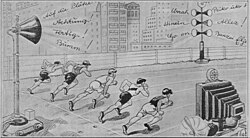
[[File:Olympic Final 2000 (1936 cartoon).jpg|thumb|upright=1.25|A ''[[Berliner Illustrirte Zeitung]]'' cartoon published during the [[1936 Summer Olympics|1936 Olympics]] in [[Berlin]] envisions the Olympics in 2000, when spectators would be replaced by television and radio, with the cheers of spectators broadcast through loudspeakers. Almost a century after the prediction, spectators still watch the Games in person and by globally-broadcast television coverage.]] | |||
The [[1936 Summer Olympics]] in [[Berlin]] were the first Games to be broadcast on television, though only to local audiences.<ref>{{cite web|title=Berlin 1936|website=olympic.org|url=http://www.olympic.org/uk/games/past/index_uk.asp?OLGT=1&OLGY=1936|archive-url=https://web.archive.org/web/20080822100804/http://www.olympic.org/uk/games/past/index_uk.asp?OLGT=1&OLGY=1936|archive-date=22 August 2008|access-date=31 March 2009}}</ref> The [[1956 Winter Olympics]] in Italy were the first internationally televised Olympic Games,<ref>{{cite web|title=Cortina d'Ampezzo|website=olympic.org|url=http://www.olympic.org/uk/games/past/index_uk.asp?OLGT=2&OLGY=1956|archive-url=https://web.archive.org/web/20080822213008/http://www.olympic.org/uk/games/past/index_uk.asp?OLGT=2&OLGY=1956|archive-date=22 August 2008|access-date=31 March 2009}}</ref> and the broadcasting rights for the [[1960 Winter Olympics|following Winter Games]] in California were sold for the first time to specialised television broadcasting networks—[[CBS]] paid US$394,000 for the American rights.<ref name=Slack/>{{rp|p=192}}<ref name="television"/> In the following decades, the Olympics became one of the ideological fronts of the Cold War, and the [[IOC]] wanted to take advantage of this heightened interest via the broadcast medium.<ref name=Slack/>{{rp|p=192}} The sale of broadcast rights enabled the IOC to increase the exposure of the Olympic Games, thereby generating more interest, which in turn enhanced the appeal of TV air time to the advertisers. This cycle allowed the IOC to charge ever-increasing fees for those rights.<ref name=Slack/>{{rp|p=192}} For example, CBS paid US$375 million for the American broadcast rights for the [[1998 Winter Olympics|1998 Nagano Games]],{{sfn|Gershon|2000|p=17}} while [[NBC]] spent US$3.5 billion for the American rights to air every Olympic Games from 2000 to 2012.<ref name="television" /> | |||
In 2011, NBC agreed to a $4.38 billion contract with the IOC to broadcast the Olympics through to the [[2020 Summer Olympics|2020 Games]], the most expensive television rights deal in Olympic history.<ref name="adweek">{{cite news|title=Update: NBC Bids $4.38 Billion for Olympic Gold|url=http://www.adweek.com/news/television/update-nbc-bids-438-billion-olympic-gold-132319|last=Crupi|first=Anthony|work=[[Adweek]]|date=7 June 2011|access-date=7 June 2011}}</ref> NBC then agreed to a $7.75 billion contract extension on 7 May 2014, to air the Olympics up to and including the 2032 Games.<ref>{{cite news|title=NBC Universal pays $7.75 billion for Olympics through 2032|url=https://www.usatoday.com/story/sports/olympics/2014/05/07/nbc-olympics-broadcast-rights-2032/8805989/|newspaper=[[USA Today]]|date=7 May 2014|last=Armour|first=Nancy}}</ref> NBC also acquired the American television rights to the [[Youth Olympic Games]], beginning in [[2014 Summer Youth Olympics|2014]],<ref>{{cite news|title=NBC Olympics, Universal Sports announce Youth Olympics coverage|url=http://olympictalk.nbcsports.com/2014/08/12/youth-olympics-nbc-coverage-nanjing/|website=[[NBC Sports]]|date=12 August 2014|last=Zaccardi|first=Nick}}</ref> and the [[Paralympic Games]].<ref>{{cite news|title=NBC Olympics, U.S. Olympic Committee acquire media rights to Paralympics in 2014, 2016|url=http://olympictalk.nbcsports.com/2013/09/24/paralympics-2014-2016-tv-coverage-nbc/|newspaper=Olympictalk | NBC Sports|date=24 September 2013|last=Zaccardi|first=Nick}}</ref> More than half of the Olympic Committee's global sponsors are American companies,<ref name="auto">{{cite web|url=https://www.nytimes.com/2017/12/07/sports/olympics/russia-olympics-us-business.html|title=Fewer Russians Could Be a Windfall for U.S. Olympic Business|last=Draper|first=Kevin | |||
|work=[[The New York Times]] | |||
|date=7 December 2017|access-date=5 February 2018|url-access=registration|archive-url=https://web.archive.org/web/20171208120943/https://www.nytimes.com/2017/12/07/sports/olympics/russia-olympics-us-business.html|archive-date=8 December 2017|url-status=live}}</ref> and NBC is one of the major sources of revenue for the IOC.<ref name="auto"/> | |||
On 13 March 2025, it was announced that [[Comcast]] would pay the IOC $3 billion to air the Olympics through 2036, and that Comcast would transition its role in the Games from Rights Holder to Strategic Partner, furthering their partnership. The announcement comes after the [[2024 Summer Olympics|2024 Paris Olympics]] received strong ratings for NBC and a boost in subscribers for [[Peacock (streaming service)|Peacock]]. This deal gave NBC the rights to air the [[2026 Winter Olympics|2026 Milano-Cortina Winter Olympics]] (which occurred from 6 February to 22 February 2026), and gives the network the rights to air the [[2028 Summer Olympics|2028 Los Angeles Olympics]], the [[2030 Winter Olympics|2030 French Alps Winter Olympics]], the [[2032 Summer Olympics|2032 Brisbane Olympics]], the [[2034 Winter Olympics|2034 Utah Winter Olympics]] and the [[Bids for the 2036 Summer Olympics|2036 Olympic Games]], with the latter marking the 100th anniversary of the first televised Games held in Berlin.<ref>{{Cite web |last=Hayes |first=Dade |date=13 March 2025 |title=Comcast Extends Olympics Through 2036, Paying $3B And Going From Rights Holder To Strategic Partner |url=https://deadline.com/2025/03/comcast-nbcuniversal-extends-olympics-rights-deal-2036-1236325411/ |access-date=13 March 2025 |website=Deadline |language=en-US}}</ref> | |||
Viewership increased exponentially from the 1960s until the end of the 20th century. This was due to the advent of satellites for broadcasting live television worldwide starting in 1964, and the introduction of [[colour television]] in 1968.<ref>{{cite book|title=Five-ring Circus: Money, Power, and Politics at the Olympic Games|editor1-last=Tomlinson|editor1-first=A.|editor2-last=Whannel|editor2-first=G.|chapter=3. The television spectacular|last=Whannel|first=Garry|year=1984|publisher=Pluto Press|location=London, UK|pages=30–43|isbn=978-0-86104-769-7}}</ref> The global audience for the [[1968 Summer Olympics|1968 Mexico City Games]] was estimated to be 600 million, whereas the audience numbers at the [[1984 Summer Olympics|Los Angeles Games of 1984]] had increased to 900 million; this number had swelled to 3.5 billion by the [[1992 Summer Olympics]] in Barcelona.{{sfn|Tomlinson|2005|p=14}}<ref>{{cite news|title=World Series TV ratings slump|url=https://www.cbsnews.com/news/world-series-tv-ratings-slump/|work=CBS News | |||
|agency=[[The Associated Press]] | |||
|access-date=4 May 2009|date=27 October 2000|archive-url=https://web.archive.org/web/20101031072605/http://www.cbsnews.com/stories/2000/10/27/sports/main244877.shtml|archive-date=31 October 2010|url-status=live}}</ref><ref>{{cite magazine|title=All Fall Down – Making sense of NBC's tumbling Olympic ratings|last=Walters|first=John|magazine=Sports Illustrated|date=2 October 2000|url=http://vault.sportsillustrated.cnn.com/vault/article/magazine/MAG1020472/index.htm|archive-url=https://web.archive.org/web/20110429222810/http://vault.sportsillustrated.cnn.com/vault/article/magazine/MAG1020472/index.htm|archive-date=29 April 2011|access-date=2 April 2009}}</ref><ref name="ratings"/><ref name=Slack/>{{rp|pp=16–18}} With such high costs charged to broadcast the Games, the added pressure of the internet, and increased competition from cable, the television lobby demanded concessions from the IOC to boost ratings. The IOC responded by making a number of changes to the Olympic programme; at the Summer Games, the gymnastics competition was expanded from seven to nine nights, and a Champions Gala was added to attract greater interest;<ref name=Slack/>{{rp|p=17}} the events programmes were also expanded for swimming and diving, both popular sports with a broad base of television viewers.<ref name=Slack/>{{rp|p=17}} Due to the substantial fees paid by NBC for rights to the Olympics, the IOC has allowed the network to influence the event scheduling to maximise U.S. television ratings when possible.<ref name=CooperChen/>{{rp|p=230}}<ref name="ratings"/>{{sfn|Woods|2007|p=146}}<ref>{{cite news|title=London Olympics 2012 Ratings: Most Watched Event In TV History|date=13 August 2012|work=The Huffington Post|url=http://www.huffingtonpost.com/2012/08/13/london-olympics-2012-ratings-most-watched-ever_n_1774032.html|access-date=12 July 2013}}</ref> Notable examples of maximising U.S. television viewership include scheduling the finals of the swimming events only during the mornings of the host cities Beijing (during the [[2008 Summer Olympics]]) and Tokyo (during the [[2020 Summer Olympics]]), which coincide with the evening [[Prime time#North America|prime time]] broadcast slots of the United States.<ref>{{Cite web|title=Olympics 2021: Why swimming finals are being held in the morning|url=https://au.sports.yahoo.com/olympics-2021-swimming-finals-being-held-morning-023644266.html|access-date=22 February 2022|website=au.sports.yahoo.com|date=24 July 2021|language=en}}</ref><ref>{{Cite web|title=Here's Why the Swimming Finals Are Held in the Morning at Tokyo Olympics {{!}} Sports Illustrated|url=https://www.si.com/.amp/olympics/2021/07/25/tokyo-olympics-swimming-schedule-us-primetime-finals|access-date=22 February 2022|website=si.com|date=25 July 2021 }}</ref><ref>{{Cite web|last=Coskrey|first=Jason|date=28 July 2021|title=Morning finals forcing swimmers to adjust in Tokyo|url=https://www.japantimes.co.jp/sports/2021/07/28/olympics/summer-olympics/olympic-swimming/tokyo-swim-finals/|access-date=22 February 2022|website=The Japan Times|language=en-US|archive-date=22 February 2022|archive-url=https://web.archive.org/web/20220222041614/https://www.japantimes.co.jp/sports/2021/07/28/olympics/summer-olympics/olympic-swimming/tokyo-swim-finals/|url-status=dead}}</ref><ref>{{Cite news|last=Carter|first=Bill|date=24 August 2008|title=On TV, Timing Is Everything at the Olympics|language=en-US | |||
|work=[[The New York Times]] | |||
|url=https://www.nytimes.com/2008/08/25/sports/olympics/25nbc.html|access-date=22 February 2022|issn=0362-4331}}</ref><ref>{{Cite web|date=26 October 2006|title=Swimming, gymnastics finals set for mornings in 2008|url=https://www.espn.com/olympics/swimming/news/story?id=2639072|access-date=22 February 2022|website=ESPN.com|language=en}}</ref> | |||
===Olympic marketing=== | |||
The funds from licensing programs support everything that goes into the Games, alongside other revenue streams from ticket sales and broadcasting rights, which represent more than 60 percent.<ref>{{Cite web|title=The Phryges – Paris 2024 Mascots Star as Olympic Merchandise|url=https://www.wipo.int/wipo_magazine_digital/en/2024/article_0014.html|access-date=20 August 2024|website=wipo.int|language=en}}</ref><ref>{{Cite web|title=Olympic Marketing Fact File 2024 Edition|url=https://stillmed.olympics.com/media/Documents/International-Olympic-Committee/IOC-Marketing-And-Broadcasting/IOC-Marketing-Fact-File.pdf|website=stillmed.olympics.com}}</ref> | |||
The sale of the Olympic brand has been controversial. The argument is that the Games have become indistinguishable from any other commercialised sporting spectacle.<ref name="Slack" />{{rp|p=194}}{{sfn|Buchanon|Mallon|2006|p=cii}} Another criticism is that the Games are funded by host cities and national governments; the IOC incurs none of the cost, yet controls all the rights and profits from the Olympic symbols. The IOC also takes a percentage of all sponsorship and broadcast income.<ref name="Slack" />{{rp|p=194}} Host cities continue to compete ardently for the right to host the Games, even though there is no certainty that they will earn back their investments.<ref name="Slack" />{{rp|pp=194–195}} Research has shown that trade is around 30 percent higher for countries that have hosted the Olympics.<ref>{{Cite web|url=http://www.frbsf.org/publications/economics/papers/2009/wp09-06bk.pdf|title=Federal Reserve Bank of San Francisco, ''The Olympic Effect'', March 2009|access-date=23 November 2019|archive-url=https://web.archive.org/web/20100412103038/http://www.frbsf.org/publications/economics/papers/2009/wp09-06bk.pdf|archive-date=12 April 2010|url-status=live}}</ref> | |||
==Symbols== | |||
{{main|Olympic symbols}} | |||
[[File:Olympic-flag-Victoria.jpg|thumb|The [[Olympic flag]]]] | |||
The Olympic Movement uses symbols to represent the ideals embodied in the Olympic Charter. The main emblem of the Games is the [[Olympic rings]]—five intertwined rings symbolising the unity of the five inhabited continents ([[Africa]], [[the Americas]] (considered as one continent), [[Asia]], [[Europe]], and [[Oceania]]). The coloured version of the rings—blue, yellow, black, green, and red—over a white field forms the Olympic flag. These colours were chosen because every nation had at least one of them on its national flag. The flag was adopted in 1914 but flown for the first time only at the [[1920 Summer Olympics]] in Antwerp, Belgium. It has since been hoisted during each celebration of the Games.<ref name="olympicsymbols" /><ref>{{cite journal|url=http://library.la84.org/SportsLibrary/JOH/JOHv10n1/JOHv10n1m.pdf|last=Lennartz|first=Karl|title=The Story of the Rings|journal=Journal of Olympic History|date=2002|volume=10|pages=29–61|access-date=30 November 2016|archive-url=https://web.archive.org/web/20160107230741/http://library.la84.org/SportsLibrary/JOH/JOHv10n1/JOHv10n1m.pdf|archive-date=7 January 2016|url-status=dead }}</ref> The IOC maintains exclusive ownership and control<ref>{{Cite web|title=The IP journey of an Olympic Games|url=https://www.wipo.int/wipo_magazine/en/2019/03/article_0007.html|access-date=20 August 2024|website=wipo.int|language=en}}</ref> of the use of Olympic symbols through the [[Nairobi Treaty]] on the Protection of the Olympic Symbol. | |||
The [[Olympic motto]], {{lang|la|Citius, Altius, Fortius}}, a [[Latin]] expression meaning "Faster, Higher, Stronger" was proposed by [[Pierre de Coubertin]] in 1894 and has been official since 1924. The motto was coined by Coubertin's friend, the [[Dominican Order|Dominican]] priest [[Henri Didon]] OP, for a Paris youth gathering of 1891.<ref>"Sport athlétique", 14 mars 1891: "... dans une éloquente allocution il a souhaité que ce drapeau les conduise 'souvent à la victoire, à la lutte toujours'. Il a dit qu'il leur donnait pour devise ces trois mots qui sont le fondement et la raison d'être des sports athlétiques: citius, altius, fortius, 'plus vite, plus haut, plus fort'.", cited in Hoffmane, Simone ''La carrière du père Didon, Dominicain. 1840–1900'', Doctoral thesis, Université de Paris IV – Sorbonne, 1985, p. 926; cf. Michaela Lochmann, ''Les fondements pédagogiques de la devise olympique "citius, altius, fortius"''</ref> | |||
Coubertin's Olympic ideals are expressed in the [[Olympic creed]]: | |||
{{blockquote | |||
|The most important thing in the Olympic Games is not to win but to take part, just as the most important thing in life is not the triumph but the struggle. The essential thing is not to have conquered but to have fought well.<ref name="olympicsymbols" /> | |||
}} | |||
Months before each Games, the [[Olympic flame]] is lit at the [[Temple of Hera, Olympia|Temple of Hera]] in [[Olympia, Greece|Olympia]] in a ceremony that reflects ancient Greek rituals. A female performer, acting as a priestess joined by ten female performers as [[Vestal Virgins]], ignites a torch by placing it inside a [[parabolic mirror]] which focuses the sun's rays; she then lights the torch of the first relay bearer (who also is a Greek athlete), thus initiating the Olympic torch relay that will carry the flame to the host city's Olympic stadium, where it plays an important role in the opening ceremony.<ref name="torch" /> Though the flame has been an Olympic symbol since [[1928 Summer Olympics|1928]], the torch relay was only introduced at the [[1936 Summer Olympics|1936 Summer Games]] to promote the [[Third Reich]].<ref name="olympicsymbols" /><ref>{{cite episode|title=IOC Investigation|series=Real Sports with Bryant Gumbel|network=HBO|date=26 July 2016|season=22|number=7|url=http://www.hbo.com/real-sports-with-bryant-gumbel/episodes/0/232-episode/index.html}} | |||
</ref> | |||
== | The [[Olympic mascot]], an animal, a human or an [[anthropomorphic]] figure representing the cultural heritage of the host country, was introduced in [[1968 Summer Olympics|1968]]. It has played an important part of the identity and promotion of the Games since the [[1980 Summer Olympics]], when the Soviet bear cub [[Misha]] reached international stardom. The mascot of the Summer Olympics in London was named Wenlock after the town of [[Much Wenlock]] in [[Shropshire]]. Much Wenlock still hosts the Wenlock Olympian Games, which were an inspiration to Pierre de Coubertin for the Olympic Games.<ref>{{cite web|title=Olympic Summer Games Mascots from Munich 1972 to London 2012|work=Olympic Studies Centre|date=April 2011|url=http://www.olympic.org/assets/osc%20section/pdf/qr_3e.pdf|access-date=13 July 2013|archive-url=https://web.archive.org/web/20121016105858/http://www.olympic.org/assets/osc%20section/pdf/qr_3e.pdf|archive-date=16 October 2012|url-status=dead}}</ref> The mascot for the [[2024 Summer Olympics|Paris 2024]] Olympic Games is an anthropomorphic [[Phrygian cap]] based on the one [[Marianne]] wore at the time of the [[French Revolution]].<ref name=":4">{{Cite news|last=Belam|first=Martin|date=14 November 2022|title=Meet the Phryges: Paris 2024 Olympic and Paralympic mascots unveiled|language=en-GB|work=The Guardian|url=https://www.theguardian.com/sport/2022/nov/14/paris-2024-olympic-mascot-paralympic-mascot-phryges-france|access-date=28 July 2023|issn=0261-3077}}</ref> | ||
{{ | |||
==Ceremonies== | |||
{{main|Olympic Games ceremony}} | |||
===Opening ceremony=== | |||
[[File:Drones durante a abertura das Olimpíadas de Tóquio.jpg|thumb|Opening ceremony of the [[2020 Summer Olympics]] in [[Tokyo]]]] | |||
As mandated by the [[Olympic Charter]], various elements frame the opening ceremony of the Olympic Games. This ceremony takes place on a Friday and is held prior to the commencement of the sporting events (apart from some group-stage football matches, softball games, and rowing heats).<ref name="OCFactSheetS" /><ref name="OCFactSheetW" /> Most of the rituals for the opening ceremony were established at the 1920 Summer Olympics in Antwerp.<ref name="OCprotocol1" /> The ceremony typically starts with the entrance of the president of the International Olympic Committee and a representative of the host country followed by the hoisting of the host country's flag and a performance of its national anthem.<ref name="OCFactSheetS" /><ref name="OCFactSheetW" /> The host nation then presents artistic displays of music, singing, dance, and theatre representative of its culture.<ref name="OCprotocol1" /> The artistic presentations have grown in scale and complexity as successive hosts attempt to provide a ceremony that outlasts its predecessor's in terms of memorability. The opening ceremony of the Beijing Games reportedly cost $100 million, with much of the cost incurred in the artistic segment.<ref>{{cite news|url=https://www.cbc.ca/sports/2.720/beijing-dazzles-chinese-history-athletes-on-parade-as-olympics-begin-1.722415|title=Beijing Dazzles: Chinese History, on Parade as Olympics Begin|publisher=Canadian Broadcasting Centre|date=8 August 2008|access-date=9 September 2008|url-status=live|archive-url=https://web.archive.org/web/20080906200510/http://www.cbc.ca/olympics/story/2008/08/07/olympics-ceremonies.html|archive-date=6 September 2008 }}</ref> | |||
After the artistic portion of the ceremony, the athletes parade into the stadium grouped by nation. Greece is traditionally the first nation to enter and leads the parade in order to honour the origins of the Olympics. Nations then enter the stadium alphabetically according to the host country's chosen language, with the host country's athletes being the last to enter. During the [[2004 Summer Olympics]], which was hosted in [[Athens]], the Greek flag entered the stadium first, while the Greek delegation entered last. Beginning with the [[2020 Summer Olympics]], the succeeding hosts of the respective Olympic Games (summer or winter) will enter immediately before the current host in descending order. Speeches are given by the [[President of the Organising Committee for the Olympic Games|President of the Organising Committee]], the IOC president, and the head of state/representative of the host country, formally opening the Games. Finally, the Olympic torch is brought into the stadium and passed on until it reaches the final torch carrier, often a successful Olympic athlete from the host nation, who lights the Olympic flame in the stadium's cauldron.<ref name="OCFactSheetS" /><ref name="OCFactSheetW" /> | |||
[[ | |||
===Closing ceremony=== | |||
[[File:Birdsclosing.jpg|thumb|Athletes gather in the stadium during the closing ceremony of the [[2008 Summer Olympics]] in [[Beijing]]]] | |||
The closing ceremony of the Olympic Games takes place on a Sunday and after all sporting events have concluded. Flag-bearers from each participating country enter the stadium, followed by the athletes who enter together, without any national distinction.<ref name="IOCclosingProtocol">{{cite web|title=Closing Ceremony Factsheet|publisher=The International Olympic Committee|date=5 June 2012|url=http://www.olympic.org/Documents/Reference_documents_Factsheets/Closing_Ceremony_of_the_Games.pdf|access-date=12 August 2012|archive-url=https://web.archive.org/web/20111016064630/http://www.olympic.org/Documents/Reference_documents_Factsheets/Closing_Ceremony_of_the_Games.pdf|archive-date=16 October 2011|url-status=dead}}</ref> Three national flags are hoisted while the corresponding national anthems are played: the flag of the current host country; the flag of Greece, to honour the birthplace of the Olympic Games; and the flag of the country hosting the next Summer or Winter Olympic Games.<ref name="IOCclosingProtocol"/> The president of the organising committee and the IOC president make their closing speeches, the Games are officially closed, and the Olympic flame is extinguished.<ref>{{cite web|title=Closing Ceremony|publisher=International Olympic Committee|date=31 January 2002|url=http://multimedia.olympic.org/pdf/en_report_268.pdf|archive-url=https://web.archive.org/web/20090325013905/http://multimedia.olympic.org/pdf/en_report_268.pdf|archive-date=25 March 2009|access-date=27 August 2008|url-status=dead }}</ref> In what is known as the Antwerp Ceremony, the current mayor of the city that organised the Games transfers a special Olympic flag to the president of the IOC, who then passes it on to the current mayor of the city hosting the next Olympic Games.<ref>{{cite web|url=http://www.vancouver2010.com/en/news/feature-stories/-/38344/32574/w6rlej/the-olympic-flags-and-emblem.html|title=The Olympic Flags and Emblem|publisher=The Vancouver Organizing Committee for the 2010 Olympic and Paralympic Winter Games|access-date=10 February 2009|archive-date=26 April 2009|archive-url=https://web.archive.org/web/20090426042147/http://www.vancouver2010.com/en/news/feature-stories/-/38344/32574/w6rlej/the-olympic-flags-and-emblem.html|url-status=dead}}</ref> The next host nation then also briefly introduces itself with artistic displays of dance and theatre representative of its culture.<ref name="IOCclosingProtocol"/> | |||
As is customary, the last medal presentation of the Games is held as part of the closing ceremony. Typically, the marathon medals are presented at the Summer Olympics,<ref name="IOCclosingProtocol"/><ref>{{cite news|title=The Latest: Rio Games close with samba-fueled Carnival party|work=The San Diego Union-Tribune | |||
|agency=[[The Associated Press]] | |||
|date=21 August 2016|url=http://www.sandiegouniontribune.com/sdut-the-latest-mens-marathon-underway-on-last-day-of-2016aug21-story.html|access-date=24 June 2018}}</ref> while the cross-country skiing mass start medals are awarded at the Winter Olympics.<ref>{{cite web|title=The Closing Ceremonies of the Olympic Game|publisher=International Olympic Committee|date=1 June 2014|url=https://www.olympic.org/closing-ceremonies|access-date=24 June 2018}}</ref> | |||
===Medal presentation=== | |||
[[File:CyclingTeamPursuitBeijing2008.jpg|thumb|A medal ceremony at the [[2008 Summer Olympics]] with (from left to right): the [[Danish flag]], the [[Union Jack|Union Flag of the UK]], and the [[New Zealand flag]]]] | |||
A medal ceremony is held after the conclusion of each Olympic event. The winner, and the second- and third-place competitors or teams, stand on top of a three-tiered [[wikt:rostrum|rostrum]] to be awarded their respective medals by a member of the IOC.<ref>{{cite EBO |short=yes |last1=Abrahams |first1=Harold Maurice |author1-link=Harold Maurice Abrahams |last2=Young |first2=David C. |title=Programs and Participation: The Medal Ceremonies |url=https://www.britannica.com/sports/Olympic-Games/Programs-and-participation |date=4 August 2024 |access-date=5 August 2024}}</ref> After the medals have been received, the national flags of the three medallists are raised while the [[national anthem]] of the gold medallist's country is played.<ref name="otraditions" /> Volunteering citizens of the host country also act as hosts during the medal ceremonies, assisting the officials who present the medals and acting as flag-bearers.<ref>{{cite news|title= Medal ceremony hostess outfits unveiled|website=[[Sina Corporation|Sina Online]]|date= 18 July 2008|url= http://english.sina.com/china/p/1/2008/0718/172118.html|access-date=29 August 2008}}</ref> In the Summer Olympics, each medal ceremony is held at the venue where the event has taken place,<ref>{{cite news|last1=Madhani|first1=Aamer|last2=Armour|first2=Nancy|title=Medalists at 2018 Winter Olympics get precious keepsake. And a medal|work=USA Today|date=13 February 2018|url=https://www.usatoday.com/story/sports/winter-olympics-2018/2018/02/13/medalists-2018-winter-olympics-get-precious-keepsake-and-medal/332267002/|access-date=22 April 2018}}</ref> but the ceremonies at the Winter Olympics are usually held in a special "plaza".<ref>{{cite news|title=Mascots come first, then medals for Olympic champions|work=USA Today | |||
|agency=[[The Associated Press]] | |||
|date=12 February 2018|url=https://www.usatoday.com/story/sports/olympics/2018/02/12/mascots-come-first-then-medals-for-pyeongchang-winners/110334494/|access-date=22 April 2018}}</ref> | |||
The [[ | The practice of awarding Olympic medals at [[podium]] ceremonies was established at the 1932 Winter Olympics, based on pedestals used at the [[1930 British Empire Games]], as proposed by [[Melville Marks Robinson]].<ref>{{cite news|title=Prof says Olympic podiums have Canadian connection|last=Ogilvie|first=Claire|date=18 October 2006|newspaper=[[The Province]]|location=Vancouver, British Columbia|page=25|url=https://www.newspapers.com/article/the-province-barney-2006/129824314/}}</ref> | ||
== | ==Sports== | ||
{{ | {{main|Olympic sports}} | ||
The | The [[Olympic sports|Olympic Games programme]] consists of 35 sports, 30 disciplines and 408 events. For example, [[Wrestling at the Summer Olympics|wrestling]] is a Summer Olympic sport, comprising two disciplines: [[Greco-Roman wrestling|Greco-Roman]] and [[Freestyle wrestling|Freestyle]]. It is further broken down into fourteen events for men and four events for women, each representing a different weight class.<ref>{{cite web|title=Wrestling|publisher=The Beijing Organizing Committee for the Games of the XXIX Olympiad|url=http://en.beijing2008.cn/sports/wrestling/|access-date=25 March 2009|url-status=dead|archive-url=https://web.archive.org/web/20090226194816/http://en.beijing2008.cn/sports/wrestling/|archive-date=26 February 2009 }}</ref> The Summer Olympics programme includes 26 sports, while the Winter Olympics programme features 15 sports.<ref name="Sports" /> [[Athletics at the Summer Olympics|Athletics]], [[Swimming at the Summer Olympics|swimming]], [[Fencing at the Summer Olympics|fencing]], and [[Gymnastics at the Summer Olympics|artistic gymnastics]] are the only summer sports that have never been absent from the Olympic programme. [[Cross-country skiing at the Winter Olympics|Cross-country skiing]], [[Figure skating at the Olympic Games|figure skating]], [[Ice hockey at the Olympic Games|ice hockey]], [[Nordic combined at the Winter Olympics|Nordic combined]], [[Ski jumping at the Winter Olympics|ski jumping]], and [[Speed skating at the Winter Olympics|speed skating]] have been featured at every Winter Olympics programme since its inception in [[1924 Winter Olympics|1924]]. Current Olympic sports, like [[Badminton at the Summer Olympics|badminton]], [[Basketball at the Summer Olympics|basketball]], and [[Volleyball at the Summer Olympics|volleyball]], first appeared on the programme as [[demonstration sport]]s and were later promoted to full Olympic sports. Some sports that were featured in earlier Games were later dropped from the programme.<ref>{{cite web|url=http://www.olympic.org/uk/sports/past/index_uk.asp|title=Olympic Sports of the Past|website=olympic.org|access-date=10 February 2009|archive-url=https://web.archive.org/web/20081218082711/http://www.olympic.org/uk/sports/past/index_uk.asp|archive-date=18 December 2008|url-status=dead}}</ref> | ||
Olympic sports are governed by [[List of international sports federations|international sports federations]] (IFs) recognised by the IOC as the global supervisors of those sports. There are 35 federations represented at the IOC.{{sfn|Olympic Charter|2007|pp=88–90}} There are sports recognised by the IOC that are not included in the Olympic programme. These sports are not considered Olympic sports, but they can be promoted to this status during a programme revision that occurs in the first IOC session following a celebration of the Olympic Games.<ref>{{cite web|url=http://www.olympic.org/uk/organisation/if/index_uk.asp|title=International Sports Federations|publisher=International Olympic Committee|access-date=8 February 2009}}</ref>{{sfn|Olympic Charter|2007|p=87}} During such revisions, sports can be excluded or included in the programme on the basis of a two-thirds majority vote of the members of the IOC.<ref>{{cite web|url=http://multimedia.olympic.org/pdf/en_report_942.pdf|archive-url=https://web.archive.org/web/20110429094118/http://multimedia.olympic.org/pdf/en_report_942.pdf|archive-date=29 April 2011|title=Factsheet: The sessions|publisher=International Olympic Committee|page=1|access-date=8 February 2009}}</ref> There are recognised sports that have never been on an Olympic programme in any capacity, for example, orienteering.<ref name="recognizedsports" /> | |||
=== | In October and November 2004, the IOC established an Olympic Programme Commission, tasked with reviewing the sports on the Olympic programme and all non-Olympic recognised sports. The goal was to apply a systematic approach to establishing the Olympic programme for each celebration of the Games.<ref name="factsheetsports" /> The commission formulated seven criteria to judge whether a sport should be included on the Olympic programme.<ref name="factsheetsports" /> These criteria are history and tradition of the sport, universality, popularity of the sport, image, athletes' health, development of the International Federation that governs the sport, and costs of holding the sport.<ref name="factsheetsports" /> From this study five recognised sports emerged as candidates for inclusion at the 2012 Summer Olympics: golf, karate, rugby sevens, roller sports and [[Squash (sport)|squash]].<ref name="factsheetsports" /> These sports were reviewed by the IOC Executive Board and then referred to the General Session in Singapore in July 2005. Of the five sports recommended for inclusion only two were selected as finalists: karate and squash.<ref name="factsheetsports" /> Neither sport attained the required two-thirds vote and consequently they were not promoted to the Olympic programme.<ref name="factsheetsports" /> In October 2009 the IOC voted to instate golf and rugby sevens as Olympic sports for the [[2016 Summer Olympics|2016]] and [[2020 Summer Olympic Games]].<ref name="newosports" /> | ||
The 114th [[IOC Session]], in 2002, limited the Summer Games programme to a maximum of 28 sports, 301 events, and 10,500 athletes.<ref name="factsheetsports" /> Three years later, at the [[117th IOC Session]], the first major programme revision was performed, resulting in the exclusion of [[Baseball at the Summer Olympics|baseball]] and [[Softball at the Summer Olympics|softball]] from the official programme of the [[2012 Summer Olympics|2012 London Games]]. Since there was no agreement in the promotion of two other sports, the 2012 programme featured just 26 sports.<ref name="factsheetsports" /> The 2016 and 2020 Games returned to the maximum of 28 sports given the addition of rugby and golf.<ref name="newosports" /> | |||
===Amateurism and professionalism=== | |||
{{further|Amateur sports}} | |||
[[File:Nagano 1998-Russia vs Czech Republic.jpg|thumb|The Gold medal game between [[Russia men's national ice hockey team|Russia]] and [[Czech Republic men's national ice hockey team|Czech Republic]] at the [[1998 Winter Olympics]]; professional [[National Hockey League]] players have been eligible to participate in [[Ice hockey at the Olympic Games|ice hockey]] since then.]] | |||
The [[ethos]] of the aristocracy as exemplified in the [[English public school]] greatly influenced [[Pierre de Coubertin]].{{sfn|Eassom|1994|pp=120–123}} The public schools subscribed to the belief that sport formed an important part of education, an attitude summed up in the saying ''[[mens sana in corpore sano]]'', a healthy mind in a healthy body. In this ethos, a gentleman was one who became an all-rounder, not the best at one specific thing. There was also a prevailing concept of fairness, in which practising or training was considered tantamount to cheating.{{sfn|Eassom|1994|pp=120–123}} Those who practised a sport professionally were considered to have an unfair advantage over those who practised it merely as a hobby.{{sfn|Eassom|1994|pp=120–123}} | |||
==== Winter | The exclusion of professionals caused several controversies throughout the history of the modern Olympics. The [[1912 Summer Olympics|1912 Olympic]] pentathlon and [[decathlon]] champion [[Jim Thorpe]] was stripped of his medals when it was discovered that he had taken expense money playing semi-professional baseball before the Olympics. His medals were posthumously restored by the IOC in 1983 after a ruling found that the decision to strip him of his medals fell [[Athletics at the 1912 Summer Olympics – Men's decathlon|outside of the required 30-day period]].<ref>{{cite web|title=Jim Thorpe Biography|publisher=Biography.com|url=http://www.biography.com/search/article.do?id=9507017|access-date=9 February 2009}}</ref> Swiss and Austrian skiers boycotted the [[1936 Winter Olympics]] in support of their skiing teachers, who were not allowed to compete because they earned money with their sport and were thus considered professionals.<ref>{{cite web|title=Garmisch-Partenkirchen 1936|publisher=International Olympic Committee|url=http://www.olympic.org/garmisch-partenkirchen-1936-winter-olympics|access-date=25 July 2011}}</ref> | ||
[[ | The advent of the state-sponsored "full-time amateur athlete" of the [[Eastern Bloc]] countries eroded the ideology of the pure [[Amateur sports#Olympics|amateur]], as it put the self-financed amateurs of the Western countries at a disadvantage. The [[Soviet Union at the Olympics|Soviet Union]] entered teams of athletes who were all nominally students, soldiers, or working in a profession, but in reality they were all paid by the state to train on a full-time basis.{{sfn|Eassom|1994|pp=120–123}}<ref>{{cite web|url=http://blogs.bu.edu/guidedhistory/russia-and-its-empires/tyler-benson/|title=The Role of Sports in The Soviet Union – Guided History|website=blogs.bu.edu}}</ref><ref name="cia.gov"/> The situation greatly disadvantaged American and Western European athletes, and this was a significant factor in the decline of American medal hauls in the 1970s and 1980s.<ref>{{Cite book|title=Degrees of Difficulty: How Women's Gymnastics Rose to Prominence and Fell from Grace|first=Georgia|last=Cervin|isbn=978-0-25204377-2|year=2021|publisher=University of Illinois Press}}</ref> As a result, the Olympics shifted away from amateurism, as envisioned by Pierre de Coubertin, to allowing participation of [[professional athletes]],<ref name="Amateurism" /> but only in the 1990s, after the [[collapse of the Soviet Union]] and its influence within the [[IOC]].<ref>{{cite web|url=https://www.cia.gov/readingroom/docs/CIA-RDP80-00810A005900310006-0.pdf|title=Soviet Control of Sports Activities and Sports Propaganda|publisher=Central Intelligence Agency|date=7 February 1955|access-date=22 August 2021|url-status=live|archive-url=https://web.archive.org/web/20210712082846/https://www.cia.gov/readingroom/docs/CIA-RDP80-00810A005900310006-0.pdf|archive-date=12 July 2021}}</ref><ref>{{cite web|url=https://www.cia.gov/readingroom/docs/CIA-RDP80-00810A005800260002-1.pdf|title=Soviet Sports as an Instrument of Political Propaganda|publisher=Central Intelligence Agency|date=20 January 1955|access-date=22 August 2021|url-status=live|archive-url=https://web.archive.org/web/20210712113025/https://www.cia.gov/readingroom/docs/CIA-RDP80-00810A005800260002-1.pdf|archive-date=12 July 2021}}</ref><ref>{{cite web|last=Schantz|first=Otto|title=The Olympic Ideal and the Winter Games Attitudes Towards the Olympic Winter Games in Olympic Discourses – from Coubertin to Samaranch|publisher=Comité International Pierre De Coubertin|url=http://coubertin.org/docs/Winter%20Games%20Schantz.pdf|archive-url=https://web.archive.org/web/20160919124001/http://coubertin.org/docs/Winter%20Games%20Schantz.pdf|archive-date=19 September 2016|url-status=dead|access-date=19 September 2016 }}</ref> | ||
==== | ====Team Canada ice hockey dispute==== | ||
{{ | Near the end of the 1960s, the [[Canadian Amateur Hockey Association]] (CAHA) felt their amateur players could no longer be competitive against the Soviet team's full-time athletes and the other constantly improving European teams. They pushed for the ability to use players from professional leagues but met opposition from the [[International Ice Hockey Federation]] (IIHF) and IOC. At the IIHF Congress in 1969, the IIHF decided to allow Canada to use nine non-NHL professional hockey players<ref name="Num17">{{cite web|url=http://www.iihf.com/iihf-home/the-iihf/100-year-anniversary/100-top-stories/story-17.html|title=Protesting Amateur Rules, Canada Leaves International Hockey|date=4 January 1970|website=iihf.com|archive-url=https://web.archive.org/web/20160220041527/http://www.iihf.com/iihf-home/the-iihf/100-year-anniversary/100-top-stories/story-17.html|archive-date=20 February 2016|url-status=dead}}</ref> at the 1970 World Championships in [[Montreal]] and [[Winnipeg]], Canada.<ref>{{cite web|url=http://www.iihf.com/iihf-home/the-iihf/100-year-anniversary/100-top-stories/story-40.html|title=Finally, Canada to Host the World Championship|date=7 May 2004|website=iihf.com|archive-url=https://web.archive.org/web/20160303190615/http://www.iihf.com/iihf-home/the-iihf/100-year-anniversary/100-top-stories/story-40.html|archive-date=3 March 2016|url-status=dead}}</ref> The decision was reversed in January 1970 after Brundage said that ice hockey's status as an Olympic sport would be in jeopardy if the change was made.<ref name="Num17" /> In response, Canada withdrew from international ice hockey competition and officials stated that they would not return until "[[Open (sport)|open competition]]" was instituted.<ref name="Num17" /><ref>{{cite news|title=Summit Series '72 Summary|publisher=[[Hockey Hall of Fame]]|url=http://www.hhof.com/html/GamesSummarySUM1972.shtml|access-date=2 March 2009|url-status=dead|archive-url=https://web.archive.org/web/20080807130920/http://www.hhof.com/html/GamesSummarySUM1972.shtml|archive-date=7 August 2008 }}</ref> [[Günther Sabetzki]] became president of the IIHF in 1975 and helped to resolve the dispute with the CAHA. In 1976, the IIHF agreed to allow "open competition" between all players in the World Championships. However, NHL players were still not allowed to play in the Olympics until 1988, because of the IOC's amateur-only policy.<ref>{{cite web|url=http://www.iihf.com/iihf-home/the-iihf/100-year-anniversary/100-top-stories/story-6.html|title=First Canada Cup Opens Up the Hockey World|date=15 September 1976|website=iihf.com|archive-url=https://web.archive.org/web/20160314105846/http://www.iihf.com/iihf-home/the-iihf/100-year-anniversary/100-top-stories/story-6.html|archive-date=14 March 2016|url-status=dead}}</ref> | ||
==Controversies== | |||
{{main|List of Olympic Games scandals and controversies}} | |||
== | ===Boycotts=== | ||
{{ | {{main|List of Olympic Games boycotts}} | ||
[[File: | [[File:1956 Summer Olympics (Melbourne) boycotting countries (blue).png|thumb|Countries that boycotted the [[1956 Summer Olympics]] (shaded blue)]] | ||
[[File:1964 Summer Olympics (Tokyo) boycotting countries (red).png|thumb|Countries that boycotted the [[1964 Summer Olympics]] (shaded red)]] | |||
[[File:1976 Summer Olympics (Montréal) boycotting countries (blue).png|thumb|Countries that boycotted the [[1976 Summer Olympics]] (shaded blue)]] | |||
[[File:1980 Summer Olympics (Moscow) boycotting countries (blue).svg|alt=|thumb|Countries that boycotted the [[1980 Summer Olympics]] (shaded blue)]] | |||
[[File:1984 Summer Olympics (Los Angeles) boycotting countries (blue).png|thumb|Countries that boycotted the [[1984 Summer Olympics]] (shaded blue)]] | |||
[[Australia]], [[France]], [[Greece]], [[Switzerland]] and the [[United Kingdom]] are the only countries to be represented at every Olympic Games since their inception in 1896. While countries sometimes miss an Olympics due to a lack of qualified athletes, some choose to boycott a celebration of the Games for various reasons. The [[Olympic Council of Ireland]] withdrew from the [[1936 Summer Olympics|1936 Berlin Games]], because the IOC insisted its team needed to be restricted to the [[Irish Free State]] rather than representing the entire island of Ireland.{{r|Krüger Murray 2003 p230}} | |||
There were three boycotts of the [[1956 Summer Olympics|1956 Melbourne Olympics]]: the [[Netherlands]], [[Spain]], and [[Switzerland]] refused to attend because of the repression of the [[Hungarian Revolution of 1956|Hungarian Revolution]] by the [[Soviet Union]] but did send an equestrian delegation to Stockholm; [[Cambodia]], [[Egypt]], [[Iraq]], and [[Lebanon]] boycotted the Games because of the [[Suez Crisis]]; and the [[People's Republic of China]] boycotted the Games due to the participation of the [[Republic of China]], composed of athletes coming from [[Taiwan]].<ref name="Boycott 1" /> | |||
[[ | In [[1972 Summer Olympics|1972]] and [[1976 Summer Olympics|1976]] a large number of African countries threatened the IOC with a boycott to force them to ban [[South Africa]] and [[Rhodesia]], because of their [[segregationist]] rule. [[New Zealand]] was also one of the African boycott targets, because [[New Zealand national rugby union team|its national rugby union team]] had toured [[apartheid]]-ruled South Africa. The IOC conceded in the first two cases but refused to ban New Zealand on the grounds that rugby was not an Olympic sport.<ref name="CBC boycott" /> Fulfilling their threat, twenty African countries were joined by [[Guyana]] and Iraq in a withdrawal from the Montreal Games, after a few of their athletes had already competed.<ref name="CBC boycott" /><ref>{{cite journal|url=http://www.la84foundation.org/OlympicInformationCenter/OlympicReview/1976/ore109/ore109h.pdf|title=Africa and the XXIst Olympiad|journal=Olympic Review|issue=109–110|pages=584–585|date=November–December 1976|access-date=6 February 2009|archive-url=https://web.archive.org/web/20080226211550/http://www.la84foundation.org/OlympicInformationCenter/OlympicReview/1976/ore109/ore109h.pdf|archive-date=26 February 2008|url-status=dead}}</ref> | ||
The Republic of China (Taiwan) was excluded from the [[1976 Summer Olympics|1976 Games]] by order of [[Pierre Trudeau]], the prime minister of Canada. Trudeau's action was widely condemned as having brought shame on Canada for having succumbed to political pressure to keep the Chinese delegation from competing under its name.<ref>{{Cite journal|doi = 10.1080/02722019109481098|title = Trudeau, Taiwan, and the 1976 Montreal Olympics|journal = American Review of Canadian Studies|volume = 21|issue = 4|pages = 423–448|year = 1991|last1 = MacIntosh|first1 = Donald|last2 = Greenhorn|first2 = Donna|last3 = Hawes|first3 = Michael}}</ref> The ROC refused a proposed compromise that would have still allowed them to use the [[Flag of Taiwan|ROC flag]] and [[National Anthem of the Republic of China|anthem]] as long as the name was changed.<ref>{{cite journal|url=http://www.la84foundation.org/OlympicInformationCenter/OlympicReview/1976/ore107/ore107i.pdf|title=Game playing in Montreal|journal=Olympic Review|pages=461–462|issue=107–108|date=October 1976|access-date=7 February 2009|archive-url=https://web.archive.org/web/20090225031658/http://www.la84foundation.org/OlympicInformationCenter/OlympicReview/1976/ore107/ore107i.pdf|archive-date=25 February 2009|url-status=dead}}</ref> Athletes from Taiwan did not participate again until the [[1984 Summer Olympics|1984 Los Angeles Olympics]], when they returned under the name of Chinese Taipei and with a special flag and anthem.<ref name="corbit" /> | |||
In 1980 and 1984, the [[Cold War]] opponents boycotted each other's Games. The [[United States]] and sixty-five other countries boycotted the [[1980 Summer Olympics|Moscow Olympics in 1980]] because of the [[Soviet–Afghan War|Soviet invasion of Afghanistan]]. This boycott reduced the number of nations participating to 80, the lowest number since 1956.<ref>{{cite web|url=http://www.olympic.org/moscow-1980-summer-olympics|title=Moscow 1980|publisher=International Olympic Committee|access-date=25 July 2011}}</ref> The Soviet Union and 15 other nations countered by boycotting the Los Angeles Olympics of 1984. Although a boycott led by the Soviet Union depleted the field in certain sports, 140 National Olympic Committees took part, which was a record at the time.<ref name="olympic.org"/> The fact that Romania, a Warsaw Pact country, opted to compete despite Soviet demands led to a warm reception of the Romanian team by the United States. When the Romanian athletes entered during the opening ceremonies, they received a standing ovation from the spectators, who comprised mostly U.S. citizens. The boycotting nations of the Eastern Bloc staged their own alternate event, the [[Friendship Games]], in July and August.<ref name="1980 Boycott" /><ref name="1980 Boycott 2" /> | |||
There had been growing calls for boycotts of Chinese goods and the 2008 Olympics in Beijing in protest of China's [[Human rights in China|human rights record]], and in response to [[2008 Tibetan unrest|Tibetan disturbances]]. Ultimately, no nation supported a boycott.<ref>{{cite news|title=Australia: Calls to Boycott Beijing Olympics|work=Inter Press Service|url=http://ipsnews.net/news.asp?idnews=41699|access-date=10 September 2008|url-status=dead|archive-url=https://web.archive.org/web/20080912023227/http://www.ipsnews.net/news.asp?idnews=41699|archive-date=12 September 2008 }}</ref><ref name="EUTibet" /> In August 2008, the government of [[Georgia (country)|Georgia]] called for a boycott of the [[2014 Winter Olympics]], set to be held in [[Sochi]], Russia, in response to Russia's participation in the [[2008 South Ossetia war]].<ref>{{Cite journal|url=https://www.csmonitor.com/World/Europe/2008/0711/p06s01-woeu.html|title=Putin Faces Green Olympic Challenge: The Sochi 2014 Winter Games are threatened by a looming international boycott, environmental concerns, and public protests against local development|journal=Christian Science Monitor|access-date=18 August 2008|url-status=live|archive-url=https://web.archive.org/web/20090822014059/http://www.csmonitor.com/2008/0711/p06s01-woeu.html|archive-date=22 August 2009|date=11 July 2008 }}, ''[[The Christian Science Monitor]]''. Retrieved 18 August 2008.</ref><ref>{{cite news|title=Olympic challenge for Sochi Games|work=The Guardian|url=https://www.theguardian.com/commentisfree/2009/dec/05/winter-olympics-sochi-russia|access-date=31 May 2011|location=London|first=Frederick|last=Bernas|date=5 December 2009}}</ref> Continuing human rights violations in China have led to "[[Concerns and controversies at the 2022 Winter Olympics#Diplomatic boycotts or non-attendance|diplomatic boycotts]]", where athletes still compete at the Games but diplomats do not attend, of the [[2022 Winter Olympics]] in Beijing by several countries, most notably the United States and United Kingdom.<ref>{{cite web|first1=Erin|last1=Doherty|access-date=20 February 2022|title=What a diplomatic boycott of the Winter Olympics means|url=https://www.axios.com/diplomatic-boycott-beijing-winter-olympics-10f6e9e4-2cd1-457b-99d9-6dfaa406c568.html|website=Axios|date=3 February 2022 }}</ref><ref>{{cite web|author=Simone McCarthy and Rhea Mogul|access-date=20 February 2022|title=India launches last-minute diplomatic boycott of Beijing Olympics over Chinese soldier|url=https://www.cnn.com/2022/02/03/china/india-diplomatic-boycott-beijing-olympics-intl-hnk/index.html|website=CNN|date=4 February 2022 }}</ref> | |||
== | ===Politics=== | ||
[[File: | [[File:Bundesarchiv Bild 183-G00630, Sommerolympiade, Siegerehrung Weitsprung.jpg|thumb|[[Jesse Owens]] on the podium after winning the long jump at the [[1936 Summer Olympics]], where he won four gold medals; in his 1980 obituary, ''[[The New York Times]]'' called him "perhaps the greatest and most famous athlete in [[track and field]] history".<ref>{{cite web|last=Litsky |first=Frank |date=1 April 1980 |title=Jesse Owens Dies of Cancer at 66; Hero of the 1936 Berlin Olympics |newspaper=[[The New York Times]] |url=https://www.nytimes.com/learning/general/onthisday/bday/0912.html |access-date=23 March 2014 |url-status=dead |archive-date=10 November 2010 |archive-url=https://web.archive.org/web/20101110052734/https://www.nytimes.com/learning/general/onthisday/bday/0912.html}}</ref>]] | ||
[[File:John Carlos, Tommie Smith, Peter Norman 1968cr.jpg|thumb|Gold medallist [[Tommie Smith]] (centre) and bronze medallist [[John Carlos]] (right) showing the [[raised fist]] on the podium after the 200 m race at the [[1968 Summer Olympics]]; both are wearing [[Olympic Project for Human Rights]] badges. [[Peter Norman]] (silver medallist, left) from Australia is also wearing an OPHR badge, in solidarity with Smith and Carlos.]] | |||
The Olympic Games have been used as a platform to promote political ideologies almost from its inception. Nazi Germany wished to portray the [[Nazi Party|National Socialist Party]] as benevolent and peace-loving when they hosted the [[1936 Summer Olympics|1936 Games]], though they used the Games to display [[Aryan]] superiority.<ref name=FindlingPelle/>{{rp|p=107}} Germany was the most successful nation at the Games, adding support to their allegations of Aryan supremacy, but the message was somewhat blunted by the notable victories of African American [[Jesse Owens]], who won four gold medals, and [[Hungary at the 1936 Summer Olympics|Hungarian]] Jew [[Ibolya Csák]].<ref name=FindlingPelle/>{{rp|pp=111–112}} The [[Soviet Union at the Olympics|Soviet Union]] did not participate until the [[1952 Summer Olympics]] in Helsinki. Instead, starting in 1928, the Soviets organised an international sports event called [[Spartakiad]]s. During the interwar period of the 1920s and 1930s, communist and socialist organisations in several countries, including the United States, attempted to counter what they called the "bourgeois" Olympics with the [[Socialist Workers' Sport International|Workers Olympics]].<ref name="GSE" />{{sfn|Roche|2000|p=106}} It was not until the [[Soviet Union at the 1956 Summer Olympics|1956 Summer Games]] that the Soviets emerged as a sporting superpower and, in doing so, took full advantage of the publicity that came with winning at the Olympics.<ref>{{cite journal|url=http://www.la84foundation.org/OlympicInformationCenter/OlympicReview/1974/ore84/ore84k.pdf|title=The USSR and Olympism|journal=[[Olympic Review]]|issue=84|pages=530–557|date=October 1974|access-date=4 May 2009|archive-url=https://web.archive.org/web/20080409030958/http://www.la84foundation.org/OlympicInformationCenter/OlympicReview/1974/ore84/ore84k.pdf|archive-date=9 April 2008|url-status=dead}}</ref> Soviet Union's success might be attributed to a heavy state's investment in sports to fulfill its political agenda on an international stage.<ref>{{cite web|url=http://blogs.bu.edu/guidedhistory/russia-and-its-empires/tyler-benson/|title=The Role of Sports in The Soviet Union|publisher= Guided History|last=Benson|first=Tyler|website=blogs.bu.edu|access-date=25 December 2018}}</ref><ref name="cia.gov">{{cite web|title=Soviet Sports and Intelligence Activities|url=https://www.cia.gov/readingroom/docs/CIA-RDP80-00810A005600130009-0.pdf|publisher=Central Intelligence Agency|date=28 December 1954|access-date=25 December 2018|archive-url=https://web.archive.org/web/20210413095421/https://www.cia.gov/readingroom/docs/CIA-RDP80-00810A005600130009-0.pdf|archive-date=13 April 2021|url-status=live}}</ref> | |||
Individual athletes have also used the Olympic stage to promote their own political agenda. At the [[1968 Summer Olympics]] in Mexico City, two American track and field athletes, [[Tommie Smith]] and [[John Carlos]], who finished first and third in the 200 metres, performed the [[1968 Olympics Black Power salute|Black Power salute]] on the victory stand. The second-place finisher, [[Peter Norman]] of Australia, wore an [[Olympic Project for Human Rights]] badge in support of Smith and Carlos. In response to the protest, IOC president [[Avery Brundage]] ordered Smith and Carlos suspended from the US team and banned from the Olympic Village. When the US Olympic Committee refused, Brundage threatened to ban the entire US track team. This threat led to the expulsion of the two athletes from the Games.<ref name="Black Salute" /> In another notable incident in the gymnastics competition, while standing on the medal podium after the balance beam event final, in which [[Natalia Kuchinskaya]] of the [[Soviet Union]] had controversially taken the gold, [[Czechoslovakia]]n gymnast [[Věra Čáslavská]] quietly turned her head down and away during the playing of the Soviet national anthem. The action was Čáslavská's silent protest against the recent [[Warsaw Pact invasion of Czechoslovakia|Soviet invasion of Czechoslovakia]]. Her protest was repeated when she accepted her medal for her floor exercise routine when the judges changed the preliminary scores of the Soviet [[Larisa Petrik]] to allow her to tie with Čáslavská for the gold. While Čáslavská's countrymen supported her actions and her outspoken opposition to communism (she had publicly signed and supported [[Ludvik Vaculik]]'s "[[The Two Thousand Words|Two Thousand Words]]" manifesto), the new regime responded by banning her from both sporting events and international travel for many years and made her an outcast from society until the fall of communism. | |||
Currently, the government of Iran has taken steps to avoid any competition between its athletes and those from Israel. [[Arash Miresmaeili]], an Iranian [[judoka]], did not compete in a match against an Israeli during the [[2004 Summer Olympics]] in Athens. Although he was officially disqualified for being overweight, Miresmaeli was awarded US$125,000 in prize money by the Iranian government, an amount paid to all Iranian gold medal winners. He was officially cleared of intentionally avoiding the bout, but his receipt of the prize money raised suspicion.<ref>{{cite news|title=Iranian Judoka rewarded after snubbing Israeli | |||
|agency=[[The Associated Press]] | |||
|publisher=NBC Sports|date=8 September 2004|url=http://nbcsports.msnbc.com/id/5942871/|access-date=7 February 2009|archive-url=https://web.archive.org/web/20090325034627/http://nbcsports.msnbc.com/id/5942871/|archive-date=25 March 2009|url-status=dead }}</ref> | |||
After the [[2022 Russian invasion of Ukraine]], the IOC Executive Board recommended "no participation of Russian and Belarusian athletes and officials, urges International Sports Federations and organisers of sports events worldwide to do everything in their power to ensure that no athlete or sports official from Russia or Belarus be allowed to take part under the name of Russia or Belarus".<ref>{{Cite web|date=3 March 2021|title=IOC EB recommends no participation of Russian and Belarusian athletes and officials|url=https://olympics.com/ioc/news/ioc-eb-recommends-no-participation-of-russian-and-belarusian-athletes-and-officials|access-date=3 March 2022|website=International Olympic Committee|language=en|archive-date=1 March 2022|archive-url=https://web.archive.org/web/20220301030908/https://olympics.com/ioc/news/ioc-eb-recommends-no-participation-of-russian-and-belarusian-athletes-and-officials|url-status=live}}</ref> In 2023, the IOC announced that Russian and Belarusian athletes could participate in the Olympics under certain conditions: they must not represent their country or any associated organisation, and those actively supporting the [[2022 Russian invasion of Ukraine]] would be barred from competing. This decision aimed to allow athletes to compete and enhance their stature. While 32 athletes accepted the invitation, 28 qualified athletes declined. Competing under a neutral flag and uniform, these athletes had a neutral song played if they won any medals, instead of their national anthems. Additionally, the audience was prohibited from waving Russian and Belarusian flags.<ref>{{Cite web|date=30 July 2024|title=Why are Russian athletes 'banned' from the 2024 Paris Olympics?|url=https://indianexpress.com/article/explained/explained-sports/russia-athletes-banned-paris-olympics-9484765/|access-date=6 August 2024|website=The Indian Express|language=en}}</ref> | |||
== | ===Use of performance-enhancing drugs=== | ||
= | {{main|Doping at the Olympic Games}} | ||
[[File:Marathon Hicks1904.jpg|thumb|[[Thomas Hicks (athlete)|Thomas Hicks]] running the [[marathon]] at the [[1904 Summer Olympics|1904 Olympics]] in [[St. Louis]]]] | |||
In the early 20th century, many Olympic athletes began using drugs to improve their athletic abilities. For example, in 1904, [[Thomas Hicks (athlete)|Thomas Hicks]], a gold medallist in the marathon, was given [[strychnine]] by his coach (at the time, taking different substances was allowed, as there was no data regarding the effect of these substances on a body of an athlete).<ref>{{cite web|title=Tom Hicks|publisher=Sports-reference.com|url=https://www.sports-reference.com/olympics/athletes/hi/tom-hicks-1.html|archive-url=https://web.archive.org/web/20200417171703/https://www.sports-reference.com/olympics/athletes/hi/tom-hicks-1.html|url-status=dead|archive-date=17 April 2020|access-date=30 January 2009}}</ref> The only Olympic death linked to performance enhancing occurred at the [[1960 Summer Olympics]] in [[Rome]]. A Danish cyclist, [[Knud Enemark Jensen]], fell from his bicycle and later died. A coroner's inquiry found that he was under the influence of [[amphetamines]].<ref name="wadahistory" /> By the mid-1960s, sports federations started to ban the use of performance-enhancing drugs; in 1967, the IOC followed suit.<ref>{{cite news|first=Sharon|last=Begley|title=The Drug Charade|work=Newsweek|date=7 January 2008|url=http://www.newsweek.com/id/86079/output/print|access-date=27 August 2008}}</ref> | |||
According to British journalist [[Andrew Jennings]], a [[KGB]] colonel stated that the agency's officers had posed as anti-doping authorities from the [[International Olympic Committed]] to undermine [[doping test]]s and that Soviet athletes were "rescued with [these] tremendous efforts".<ref name=DG2011/> On the topic of the [[1980 Summer Olympics]], a 1989 Australian study said "There is hardly a medal winner at the Moscow Games, certainly not a gold medal winner, who is not on one sort of drug or another: usually several kinds. The Moscow Games might as well have been called the Chemists' Games."<ref name=DG2011>{{cite book|url= https://books.google.com/books?isbn=0292739575|title= Drug Games: The International Olympic Committee and the Politics of Doping|first= Thomas M.|last= Hunt|year= 2011|publisher= University of Texas Press|isbn=978-0-292-73957-4 |page= 66 }}</ref> | |||
=== | In 2016, documents obtained revealed the [[Soviet Union]]'s plans for a statewide doping system in [[track and field]] in preparation for the [[1984 Summer Olympics]] in [[Los Angeles]]. Dated prior to the country's decision to boycott the Games, the document detailed the existing steroids operations of the program, along with suggestions for further enhancements.<ref name=NYT160813/> The communication, directed to the Soviet Union's head of track and field, was prepared by Sergei Portugalov of the Institute for Physical Culture. Portugalov was also one of the main figures involved in the implementation of the Russian doping programme prior to the 2016 Summer Olympics.<ref name=NYT160813>{{Cite news|url=https://www.nytimes.com/2016/08/14/sports/olympics/soviet-doping-plan-russia-rio-games.html|title=The Soviet Doping Plan: Document Reveals Illicit Approach to '84 Olympics|last=Ruiz|first=Rebecca R.|date= 13 August 2016 | ||
[[ | |newspaper=[[The New York Times]] | ||
|issn=0362-4331|access-date=3 September 2016|url-access=registration|archive-url=https://web.archive.org/web/20160815033105/https://www.nytimes.com/2016/08/14/sports/olympics/soviet-doping-plan-russia-rio-games.html|archive-date=15 August 2016|url-status=live}}</ref> | |||
The | The first Olympic athlete to test positive for the use of performance-enhancing drugs was [[Hans-Gunnar Liljenwall]], a Swedish [[Modern pentathlon|pentathlete]] at the [[1968 Summer Olympics]], who lost his bronze medal for alcohol use.{{sfn|Porterfield|2008|p=15}} One of the most publicised doping-related disqualifications occurred after the [[1988 Summer Olympics]] where Canadian sprinter [[Ben Johnson (Canadian sprinter)|Ben Johnson]] (who won the [[Athletics at the 1988 Summer Olympics – Men's 100 metres|100-metre dash]]) tested positive for [[stanozolol]].<ref>{{cite news|last=Montague|first=James|title=Hero or villain? Ben Johnson and the dirtiest race in history|url=https://edition.cnn.com/2012/07/23/sport/olympics-2012-ben-johnson-seoul-1988-dirtiest-race/index.html|publisher=CNN|date=23 July 2012|access-date=25 December 2018}}</ref> | ||
=== | In 1999, the IOC formed the [[World Anti-Doping Agency]] (WADA) in an effort to systematise the research and detection of performance-enhancing drugs. There was a sharp increase in positive drug tests at the [[2000 Summer Olympics]] and [[2002 Winter Olympics]] due to improved testing conditions. Several medallists in weightlifting and cross-country skiing from post-Soviet states were disqualified because of doping offences. The IOC-established drug testing regimen (now known as the Olympic Standard) has set the worldwide benchmark that other sporting federations attempt to emulate.<ref>{{cite news|first=Zachary|last=Coile|title=Bill Seeks to Toughen Drug Testing in Pro Sports|date=27 April 2005|work=The San Francisco Chronicle|url=http://www.sfgate.com/cgi-bin/article.cgi?file=/c/a/2005/04/27/MNGMICG0SS1.DTL|archive-url=https://web.archive.org/web/20050504212551/http://www.sfgate.com/cgi-bin/article.cgi?file=/c/a/2005/04/27/MNGMICG0SS1.DTL|url-status=dead|archive-date=4 May 2005|access-date=3 September 2008}}</ref> During the Beijing games, 3,667 athletes were tested by the IOC under the auspices of the World Anti-Doping Agency. Both urine and blood tests were used to detect banned substances.<ref name="wadahistory" /><ref>{{cite web|title=Doping: 3667 athletes tested, IOC seeks action against Halkia's coach|date=19 August 2008|publisher=Express India Newspapers|url=http://www.expressindia.com/latest-news/Doping-3667-athletes-tested-IOC-seeks-action-against-Halkias-coach/350677/|access-date=28 August 2008|url-status=dead|archive-url=https://web.archive.org/web/20081201114743/http://www.expressindia.com/latest-news/Doping-3667-athletes-tested-IOC-seeks-action-against-Halkias-coach/350677/|archive-date=1 December 2008 }}</ref> In London over 6,000 Olympic and Paralympic athletes were tested. Prior to the Games, 107 athletes tested positive for banned substances and were not allowed to compete.<ref>{{cite web|title=Play True|publisher=World Anti-Doping Agency|year=2012|url=http://www.wada-ama.org/Documents/Resources/Publications/PlayTrue_Magazine/PlayTrue-2012-02-London-Games-web-EN.pdf|access-date=13 July 2013|url-status=dead|archive-url=https://web.archive.org/web/20130125200318/http://www.wada-ama.org/Documents/Resources/Publications/PlayTrue_Magazine/PlayTrue-2012-02-London-Games-web-EN.pdf|archive-date=25 January 2013 }}</ref><ref>{{cite news|title=Anti-Doping Results Announced | ||
[[ | |work=[[The New York Times]] | ||
|date=25 July 2012|url=https://www.nytimes.com/2012/07/25/sports/olympics/antidoping-results-announced.html | |||
|agency=[[The Associated Press]] | |||
|access-date=13 July 2013|url-access=registration|archive-url=https://web.archive.org/web/20120728054943/https://www.nytimes.com/2012/07/25/sports/olympics/antidoping-results-announced.html|archive-date=28 July 2012|url-status=live}}</ref><ref>{{cite web|title=IOC Orders Belarus to Return Gold|publisher=ESPN|date=13 August 2012|url=https://www.espn.com/olympics/summer/2012/trackandfield/story/_/id/8263960/2012-london-olympics-belarus-shot-putter-nadzeya-ostapchuk-stripped-gold-doping|access-date=13 July 2013}}</ref> | |||
In 2024, rumors about China's doping spread as many of the athletes, especially in swimming, were accused of doping before Tokyo 2020. 23 Chinese swimmers were tested positive for prohibited substances, with both the World Anti-Doping Agency and World Aquatics accepting Chinese claims that positive tests were caused by tainted food.<ref>{{Cite web |date=8 August 2024 |title=China hits back at the US in response to doping allegations dogging its swimmers |url=https://apnews.com/article/olympics-2024-china-swimming-doping-51cd4e42bf73f4b9b0f8bb37453775a2 |access-date=27 September 2024 |website=AP News |language=en}}</ref> After the FBI and Justice Department started investigating, the IOC threatened to revoke the 2034 Olympics in Salt Lake City, unless they dropped the investigation.<ref>{{Cite web |last=Jett |first=Jennifer |date=2 August 2024 |title=Frequent doping tests and suspicion cast a shadow over China's Olympics swim team |url=https://www.nbcnews.com/news/rcna164541 |access-date=5 September 2024 |website=NBC News |language=en}}</ref> | |||
== | ====Russian doping scandal==== | ||
{{further|Doping in Russia|McLaren Report|Russia at the 2012 Summer Olympics#Russian doping scandal|Russia at the 2014 Winter Olympics|Russia at the 2016 Summer Olympics|Olympic Athletes from Russia at the 2018 Winter Olympics|Oswald Commission}} | |||
[[Doping in sport|Doping]] in [[Russian sports]] has a systemic nature. [[Russia at the Olympics|Russia]] has had 44 [[List of stripped Olympic medals|Olympic medals stripped]] for doping violations—the most of any country, and more than a quarter of the global total. From 2011 to 2015, more than a thousand Russian competitors in various sports, including summer, winter, and Paralympic sports, benefited from a [[cover-up]].<ref name=EDP/><ref name=McLarenII/><ref name=NYT161209/><ref name=Guardian161209/> Russia was partially banned from the [[2016 Summer Olympics]] and was banned from the [[2018 Winter Olympics]] (while still being allowed to participate as the "[[Olympic Athletes from Russia]]") due to the state-sponsored doping programme.<ref>{{cite news|work=BBC Sport|url=https://www.bbc.com/sport/olympics/36881326|title=Rio Olympics 2016: Which Russian athletes have been cleared to compete?|date=6 August 2016|access-date=2 February 2020}}</ref><ref>{{cite news|last1=Ruiz|first1=Rebecca R.|last2=Panja|first2=Tariq | |||
|work=[[The New York Times]] | |||
|url=https://www.nytimes.com/2017/12/05/sports/olympics/ioc-russia-winter-olympics.html|title=Russia Banned From Winter Olympics by I.O.C.|date=5 December 2017|access-date=2 February 2020|url-access=registration|archive-url=https://web.archive.org/web/20171217124133/https://www.nytimes.com/2017/12/05/sports/olympics/ioc-russia-winter-olympics.html|archive-date=17 December 2017|url-status=live}}</ref> | |||
In December 2019, Russia was banned for four years from all major sporting events for systematic doping and lying to WADA.<ref>{{Cite web|url=https://www.msn.com/en-in/sports/others-sports/russia-banned-from-olympics-for-four-years-over-doping-scandal-tass/ar-BBXY8gO?ocid=spartanntp#image=CC8RP1%7C2|agency=Reuters|title=Russia banned from Olympics for four years over doping scandal: TASS|website=MSN|date=9 December 2019|access-date=9 December 2019}}</ref> The ban was issued by WADA on 9 December 2019, and the Russian anti-doping agency RUSADA had 21 days to make an appeal to the [[Court of Arbitration for Sport]] (CAS). The ban meant that Russian athletes would only be allowed to compete under the Olympic flag after passing anti-doping tests.<ref>{{Cite news|work=BBC Sport|url=https://www.bbc.com/sport/olympics/50710598|title=Russia banned for four years to include 2020 Olympics and 2022 World Cup|date=9 December 2019|access-date=9 December 2019|language=en-GB}}</ref> Russia appealed the decision to the CAS.<ref> | |||
{{cite magazine | |||
|author=[[The Associated Press]] | |||
|department=Nation / Olympics / Sports / World | |||
|title=Russia confirms it will appeal 4-year Olympic ban | |||
|url=https://www.seattletimes.com/nation-world/nation/russia-confirms-it-will-appeal-4-year-olympic-ban | |||
|magazine=[[The Seattle Times]] | |||
|date=27 December 2019 | |||
}}</ref> On review of Russia's appeal of its case from WADA, CAS ruled on 17 December 2020 to reduce the penalty that WADA had placed. Instead of banning Russia from sporting events, the ruling allowed Russia to participate at the Olympics and other international events, but for a period of two years the team cannot use the Russian name, flag, or anthem and must present themselves as "Neutral Athlete" or "Neutral Team". The ruling does allow for team uniforms to display "Russia" on the uniform as well as the use of the Russian flag colours within the uniform's design, although the name should be up to equal predominance as the "Neutral Athlete/Team" designation.<ref>{{cite web|url = https://apnews.com/article/russia-banned-name-flag-olympic-games-a8bd342806883f66152859701d5ae5d4|title= Russia can't use its name and flag at the next 2 Olympics|first = Graham|last = Dunbar|date = 17 December 2020|access-date= 17 December 2020 | |||
|website=[[AP News]] | |||
}}</ref> | |||
In February 2022, during the Beijing Olympics, the international news media reported that the issue of doping was again raised over a positive test for [[trimetazidine]] by the ROC's [[Kamila Valieva]],<ref>{{Cite news|last1=Tétrault-Farber|first1=Gabrielle|last2=Axon|first2=Iain|last3=Grohmann|first3=Karolos|date=9 February 2022|title=Figure skating-Russian media say teen star tested positive for banned drug|language=en|work=[[Reuters]]|url=https://www.reuters.com/lifestyle/sports/figure-skating-medals-ceremony-delayed-over-legal-consultation-2022-02-09/|access-date=9 February 2022}}</ref><ref>{{cite web|url=https://www.usatoday.com/story/sports/olympics/beijing/2022/02/09/olympic-figure-skating-team-medals-delayed-russian-drug-test/6717526001/|title=Positive drug test by Russian Kamila Valieva has forced a delay of Olympic team medals ceremony|first=Christine|last=Brennan|author-link=Christine Brennan|website=[[USA Today]]|date=9 February 2022}}</ref> which was officially confirmed on 11 February.<ref>{{cite news|last=Thompson|first=Anna|date=11 February 2022|title=Winter Olympics: Kamila Valieva failed drug test confirmed|url=https://www.bbc.com/sport/winter-olympics/60329120.amp|work=[[BBC Sport]]|access-date=12 February 2022}}</ref> Valieva's sample in question was taken by the [[Russian Anti-Doping Agency]] (RUSADA) at the [[2022 Russian Figure Skating Championships]] on 25 December, but the sample was not analyzed at the [[World Anti-Doping Agency]] (WADA) laboratory where it was sent for testing until 8 February, one day after the team event concluded.<ref>{{cite web|url=https://www.nytimes.com/2022/02/10/sports/olympics/kamila-valieva-trimetazidine.html|title=Star Russian Figure Skater Tested Positive for Banned Drug|first1=Juliet|last1=Macur|author-link1=Juliet Macur|first2=Andrew|last2=Keh | |||
|website=[[The New York Times]] | |||
|date=12 February 2022}}</ref> CAS was expected to hear the case on 13 February with a decision scheduled for announcement the next day, ahead of her scheduled appearance in the women's singles event beginning on 15 February.<ref>{{cite web|url=https://thehill.com/policy/international/russia/593979-russian-figure-skaters-drug-case-to-be-heard-sunday-in-beijing|title=Russian figure skater's drug test case to be heard Sunday|first=Lexi|last=Lonas|website=[[The Hill (newspaper)|The Hill]]|date=12 February 2022}}</ref><ref>{{cite web|url=https://www.cnn.com/2022/02/10/sport/kamila-valieva-roc-drugs-test-olympics-spt-intl-hnk/index.html|title=Kamila Valieva: Russian anti-doping agency allowed teenage figure skater to compete in Olympics despite failed drug test|last1=Ritchie|first1=Hannah|last2=Watson|first2=Angus|last3=Regan|first3=Helen|date=11 February 2022|website=[[CNN]]|access-date=12 February 2022}}</ref> Due to Valieva being a minor at the time, as well as being classified as a "protected person" under WADA guidelines, RUSADA and the IOC announced on 12 February that they would broaden the scope of their respective investigations to include members of her entourage (e.g. coaches, team doctors, etc.).<ref>{{cite web|url=https://www.skysports.com/more-sports/winter-olympics/news/30787/12539761/kamila-valieva-ioc-welcomes-investigation-of-russian-figure-skaters-entourage-as-15-year-old-awaits-cas-decision-at-winter-olympics|title=Kamila Valieva: IOC welcomes investigation of Russian figure skater's entourage as 15-year-old awaits CAS decision at Winter Olympics|author=PA Media|author-link=PA Media|website=[[Sky Sports]]|date=12 February 2022}}</ref> By the end of the Beijing Olympics, a total five athletes were reported for doping violations.<ref>{{Cite web|website=Yahoo Sport Australia|title=Spanish skater caught in shock new scandal after Winter Olympics|first=Sam|last=Goodwin|date=22 February 2022|url=https://au.sports.yahoo.com/winter-olympics-2022-spanish-skater-fresh-doping-storm-195328933.html|url-status=live|archive-date=26 February 2022|archive-url=https://web.archive.org/web/20220226175553/https://au.sports.yahoo.com/winter-olympics-2022-spanish-skater-fresh-doping-storm-195328933.html }}</ref> A decision by RUSADA, issued in mid-October and endorsed by WADA, stated that the details of the Valieva hearing and its scheduled dates would be placed under international guidelines for the protection of minors (Valieva was 15 years old when the positive test results were disclosed) and would not be disclosed publicly.<ref name="Evan Bates">{{Cite web|url=https://olympics.nbcsports.com/2022/10/23/kamila-valieva-doping-case-russia-figure-skating/|title=Evan Bates calls Kamila Valiyeva doping case secrecy 'an injustice'|work=OlympicTalk|publisher=NBC Sports|date=23 October 2022|url-status=live|archive-url=https://web.archive.org/web/20231116034401/https://www.nbcsports.com/olympics/news/kamila-valieva-doping-case-russia-figure-skating|archive-date=16 November 2023 }}</ref> Although Russia as a country is currently banned from participating in international skating events due to the [[2022 Russian invasion of Ukraine]], Valieva has continued to compete within Russian borders without being hindered by RUSADA as recently as the Russian Grand Prix held in October 2022.<ref>{{Cite web|url=https://www.hjnews.com/sports/nation/russia-grand-prix-figure-skating-valieva/image_6fcca14d-892d-5da6-87ee-8498be2dcc28.html|title=Russia Grand Prix Figure Skating Valieva|website=The Herald Journal|date=23 October 2022|first1=Alexander|last1=Zemlianichenko|url-status=dead|archive-url=https://web.archive.org/web/20221025221740/https://www.hjnews.com/sports/nation/russia-grand-prix-figure-skating-valieva/image_6fcca14d-892d-5da6-87ee-8498be2dcc28.html|archive-date=25 October 2022 }}</ref> On 28 September 2023, CAS "ordered the production of further documentation" and announced that her hearing had been adjourned until 9{{nbnd}}10 November. It appeared that one of the parties in the case requested a file that had not previously been a part of the proceedings.<ref name="USA TODAY 2023 z927">{{cite web | title=Olympic skater Kamila Valieva's doping hearing suddenly adjourned | website=USA TODAY | date=28 September 2023 | url=https://www.usatoday.com/story/sports/olympics/2023/09/28/olympic-skater-russia-kamila-valieva-doping-hearing-adjourned-delayed/70990958007/ | access-date=28 September 2023}}</ref> On 10 November, CAS announced that a final decision was expected by the end of January 2024.<ref name="Anon. r079">{{cite web |date=10 November 2023| title= CAS Media Release concerning Kamila Valieva| url=https://www.tas-cas.org/fileadmin/user_upload/CAS_Media_Release_9451_9455_9456_Post-Hearing.pdf | access-date=22 November 2023}}</ref><ref name="USA TODAY 2023 q217">{{cite web | title=Verdict in Russian figure skater Kamila Valieva's doping case to be given by end of January | website=USA TODAY | date=10 November 2023 | url=https://www.usatoday.com/story/sports/olympics/2023/11/10/verdict-in-russian-figure-skater-kamila-valieva-s-doping-case-to-be-given-by-end-of-january/71533037007/ | access-date=22 November 2023}}</ref> On 29 January 2024, the CAS disqualified Valieva for four years retroactive to 25 December 2021 for an anti-doping rule violation.<ref>{{Cite web |last1=Ramsay |first1=George |last2=Morse |first2=Ben |date=29 January 2024 |title=Russian figure skater Kamila Valieva banned for four years by Court of Arbitration for Sport |website=[[CNN]] |url=https://www.cnn.com/2024/01/29/sport/kamila-valieva-russia-skating-cas-ruling-spt-intl/index.html |access-date=29 January 2024}}</ref><ref>{{Cite web |last=Dunbar |first=Graham |date=29 January 2024 |title=Figure skater Valieva disqualified in Olympic doping case. Russians set to lose team gold to US |url=https://apnews.com/article/olympics-valieva-doping-russia-054a24fada41ae8e4b3d28244ccd0473 |access-date=29 January 2024 |website=[[AP News]]}}</ref> | |||
=== | ===Sex discrimination=== | ||
{{main|Participation of women in the Olympics}} | |||
[[File:Charlotte Cooper.jpg|thumb|[[Charlotte Cooper (tennis)|Charlotte Cooper]] of the [[Great Britain at the Olympics|United Kingdom]], the first female Olympic champion, in the [[1900 Summer Olympics|1900 Games]]]] | |||
Women were first allowed to compete at the [[1900 Summer Olympics]] in Paris, but at the [[1992 Summer Olympics]] 35 countries were still only fielding all-male delegations.<ref name="nytimes.com" /> This number dropped rapidly over the following years. In 2000, [[Bahrain at the Olympics|Bahrain]] sent two women competitors for the first time: [[Fatema Hameed Gerashi]] and [[Mariam Mohamed Hadi Al Hilli]].<ref>{{cite web|url=http://sportsillustrated.cnn.com/olympics/news/2000/09/23/anderson_arab_women/|title=Arab women make breakthrough at Games|date=23 September 2000|website=[[CNN/SI]]|archive-url=https://web.archive.org/web/20040810022719/http://sportsillustrated.cnn.com/olympics/news/2000/09/23/anderson_arab_women/|archive-date=10 August 2004|url-status=dead}}</ref> In 2004, [[Robina Muqimyar]] and [[Fariba Rezayee]] became the first women to compete for [[Afghanistan at the Olympics|Afghanistan]].<ref>{{cite web|url=https://news.bbc.co.uk/1/hi/world/south_asia/3826673.stm|title=Afghan women's Olympic dream|date=22 June 2004|work=BBC News|archive-url=https://web.archive.org/web/20040719033311/http://news.bbc.co.uk/2/hi/south_asia/3826673.stm|archive-date=19 July 2004|url-status=live}}</ref> In 2008, the [[United Arab Emirates at the Olympics|United Arab Emirates]] sent female athletes for the first time; [[Maitha Al Maktoum]] competed in taekwondo, and [[Latifa bint Ahmed Al Maktoum|Latifa Al Maktoum]] in equestrian. Both athletes were from [[House of Maktoum|Dubai's ruling family]].<ref>{{cite news|title=Should Saudi Arabia be Banned from the Olympics?|url=http://www.huffingtonpost.com/david-wallechinsky/should-saudi-arabia-be-ba_b_115736.html|work=The Huffington Post|date=29 July 2008|first=David|last=Wallechinsky}}</ref> | |||
By 2010, only three countries had never sent female athletes to the Games: [[Brunei at the Olympics|Brunei]], [[Saudi Arabia at the Olympics|Saudi Arabia]], and [[Qatar at the Olympics|Qatar]]. Brunei had taken part in only three celebrations of the Games, sending a single athlete on each occasion, but Saudi Arabia and Qatar had been competing regularly with all-male teams. In 2010, the International Olympic Committee announced it would "press" these countries to enable and facilitate the participation of women for the [[2012 Summer Olympics]] in London. [[Anita DeFrantz]], chair of the IOC's Women and Sports Commission, suggested that countries be barred if they prevented women from competing. Shortly thereafter, the [[Qatar Olympic Committee]] announced that it "hoped to send up to four female athletes in [[Shooting at the 2012 Summer Olympics|shooting]] and [[Fencing at the 2012 Summer Olympics|fencing]]" to the 2012 Summer Games.<ref>{{cite news|last=MacKay|first=Duncan|title=Qatar decision to send female athletes to London 2012 increases pressure on Saudi Arabia|newspaper=Insidethegames.biz - Olympic, Paralympic and Commonwealth Games News |url=http://www.insidethegames.biz/summer-olympics/2012/9939-qatar-set-to-bow-to-ioc-pressure-and-send-women-to-london-2012|publisher=Inside the Games|date=1 July 2010|access-date=31 May 2017|archive-url=https://web.archive.org/web/20141228065858/http://www.insidethegames.biz/summer-olympics/2012/9939-qatar-set-to-bow-to-ioc-pressure-and-send-women-to-london-2012|archive-date=28 December 2014|url-status=live}}</ref> | |||
In 2008, [[Ali al-Ahmed]], director of the [[Institute for Gulf Affairs]], likewise called for Saudi Arabia to be barred from the Games, describing its ban on women athletes as a violation of the International Olympic Committee charter. He noted: "For the last 15 years, many international nongovernmental organisations worldwide have been trying to lobby the IOC for better enforcement of its own laws banning gender discrimination. While their efforts did result in increasing numbers of women Olympians, the IOC has been reluctant to take a strong position and threaten the discriminating countries with suspension or expulsion."<ref name="nytimes.com" /> In July 2010, ''[[The Independent]]'' reported: "Pressure is growing on the International Olympic Committee to kick out Saudi Arabia, who are likely to be the only major nation not to include women in their Olympic team for 2012. ... Should Saudi Arabia ... send a male-only team to London, we understand they will face protests from equal rights and women's groups which threaten to disrupt the Games".<ref name="independent.co.uk" /> | |||
At the 2012 Summer Olympics, every participating nation included female athletes for the first time in Olympic history.<ref>{{cite magazine|title=Saudis to send 2 women to London, make history|url=http://sportsillustrated.cnn.com/2012/olympics/2012/07/12/saudi-arabia-women-london-olympics.ap/index.html|magazine=Sports Illustrated|access-date=13 July 2012|url-status=dead|archive-url=https://web.archive.org/web/20120715100639/http://sportsillustrated.cnn.com/2012/olympics/2012/07/12/saudi-arabia-women-london-olympics.ap/index.html|archive-date=15 July 2012 }}</ref> Saudi Arabia included two female athletes in its delegation; Qatar, four; and Brunei, one ([[Maziah Mahusin]], in the 400 m hurdles). Qatar made one of its first female Olympians, [[Bahiya al-Hamad]] (shooting), its flagbearer at the 2012 Games,<ref>{{cite web|url=https://www.bbc.co.uk/news/world-middle-east-18813543|title=London 2012 Olympics: Saudi Arabian women to compete|date=12 July 2012|work=BBC News|archive-url=https://web.archive.org/web/20120717114955/https://www.bbc.co.uk/news/world-middle-east-18813543|archive-date=17 July 2012|url-status=live}}</ref> and runner [[Maryam Yusuf Jamal]] of [[Bahrain]] became the first Persian Gulf female athlete to win a medal when she won a bronze for her showing in the [[Athletics at the 2012 Summer Olympics – Women's 1500 metres|1500 m race]].<ref>{{cite news|url=http://english.alarabiya.net/articles/2012/08/13/232068.html|title=Female Gulf athletes make their mark in London Olympics|agency=Agence France-Presse|date=13 August 2012|url-status=dead|archive-url=https://web.archive.org/web/20140328201452/http://english.alarabiya.net/articles/2012/08/13/232068.html|archive-date=28 March 2014}}</ref> | |||
=== | The only sports on the Olympic programme that features men and women individually competing against one another are the equestrian disciplines, as there is no "Women's Eventing", or "Men's Dressage". As of 2008, there were still more medal events for men than women. With the addition of women's boxing to the programme in the 2012 Summer Olympics, however, women athletes were able to compete in all the sports open to men.<ref>{{cite web|url=https://news.bbc.co.uk/sport2/hi/olympic_games/8196879.stm|title=Women's boxing gains Olympic spot|date=13 August 2009|work=BBC Sport|archive-url=https://web.archive.org/web/20090815152537/http://news.bbc.co.uk/sport2/hi/olympic_games/8196879.stm|archive-date=15 August 2009|url-status=live}}</ref> In the winter Olympics, women are still unable to compete in the [[Nordic combined]].<ref>{{cite news|last=Mather|first=Victor|title=Desperately Seeking Skiers for a Budding Olympic Sport | ||
|work=[[The New York Times]] | |||
|date=21 February 2018|url=https://www.nytimes.com/2018/02/21/sports/olympics/womens-nordic-combined.html|access-date=24 June 2018|url-access=registration|archive-url=https://web.archive.org/web/20180311021834/https://www.nytimes.com/2018/02/21/sports/olympics/womens-nordic-combined.html|archive-date=11 March 2018|url-status=live}}</ref> After men were included in artistic swimming at the Paris 2024 games,<ref>{{cite web|url=https://apnews.com/article/olympics-artistic-swimming-synchronized-worlds-may-fd98564506bf362e515b1e75cb24d01c|title=Men to compete in artistic swimming at Olympics for first time | |||
|website=[[AP News]] | |||
|date=17 July 2023 }}</ref> the only remaining Olympic event in which male athletes may not compete is [[rhythmic gymnastics]].<ref>{{cite news|last=Goldsmith|first=Belinda|title=Men notch up an Olympic win at sex equality Games|url=https://www.reuters.com/article/uk-oly-equality-men-day-idUKBRE86R0KC20120728|work=Reuters|date=28 July 2012|access-date=25 December 2018}}</ref> Despite being eligible to qualify for the 2024 Paris games, no men were included on any artistic swimming team.<ref>{{cite web |url=https://www.reuters.com/sports/olympics/no-male-artistic-swimmers-olympics-after-us-leave-may-out-squad-2024-06-08/ |title=No male artistic swimmers at Olympics after U.S. leave May out of squad |work=Reuters |last=Ewing |first=Lori |date=8 June 2024 |access-date=5 October 2024}}</ref> | |||
A recent addition to the Games has been the inclusion of mixed events, whereby men and women of the same nation compete together against other teams. Beginning in 2018, the sport of [[curling]] introduced a mixed event where teams of one man and one women competed in their own tournament for a medal. As of the 2024 Paris games, there are now 13 mixed medal events across 11 disciplines at the summer games.<ref>{{cite web |url=https://olympics.com/en/news/mixed-team-events-explained-watch-live |title=Which mixed team events will take place at Paris 2024? |publisher=Olympics.com |last=Nelsen |first=Matt |date=19 July 2024 |access-date=5 October 2024}}</ref> | |||
=== | ===War and terrorism=== | ||
[[ | The [[world war]]s caused three Olympiads to pass without a celebration of the Games: the [[1916 Summer Olympics|1916 Games]] were cancelled because of [[World War I]], and the summer and winter games of 1940 and 1944 were cancelled because of World War II.{{sfn|Hines|2011|page=xxii}} The [[Russo-Georgian War]] between Georgia and Russia erupted on the opening day of the [[2008 Summer Olympics]] in Beijing. Both American President [[George W. Bush]] and Russian Prime Minister [[Vladimir Putin]] were attending the Olympics at that time and spoke together about the conflict at a luncheon hosted by the Chinese president [[Hu Jintao]].<ref name="MSNBC 2009-01-30" /><ref>{{cite news|title=Olympic Shooters Hug as their Countries do Battle|website=CNN|url=http://www.cnn.com/2008/WORLD/asiapcf/08/10/olympic.embrace/|access-date=10 August 2008|date=10 August 2008}}</ref> | ||
Terrorism most directly affected the Olympic Games in 1972. When the [[1972 Summer Olympics|Summer Games]] were held in [[Munich]], Germany, eleven members of the [[Israel at the 1972 Summer Olympics|Israeli Olympic team]] were taken hostage by the [[Palestine Liberation Organization|Palestinian]] terrorist group [[Black September Organization|Black September]] in what is now known as the [[Munich massacre]]. The terrorists killed two of the athletes soon after taking them hostage and killed the other nine during a failed liberation attempt. A German police officer and five of the terrorists also died.<ref>{{cite news|title=Munich 1972: Massacre at Munich - 50 Years of Olympic Broadcasting|website=[[CBC.ca]]|url=http://archives.cbc.ca/IDC-1-41-1289-7332/sports/olympics_cbc/clip5|access-date=29 August 2008|archive-url=https://web.archive.org/web/20080223155213/http://archives.cbc.ca/IDC-1-41-1289-7332/sports/olympics_cbc/clip5|archive-date=23 February 2008|url-status=dead}}</ref> Following the selection of [[Barcelona]], Spain, to host the [[1992 Summer Olympics]], the separatist [[ETA (separatist group)|ETA]] terrorist organisation launched attacks in the region, including the [[Vic bombing|1991 bombing]] in the Catalonian city of [[Vic, Catalonia|Vic]] that killed ten people.<ref>{{Cite journal|url=https://www.csmonitor.com/1992/0401/01061.html|title=Spain Tackles Terrorist Threat by Basques to Olympics, Expo|journal=Christian Science Monitor|date=1 April 1992|last=Senor|first=Juan I.|url-status=live|archive-url= https://web.archive.org/web/20230326034137/https://www.csmonitor.com/1992/0401/01061.html|archive-date= 26 March 2023 }}</ref><ref>{{Cite news|url=https://www.washingtonpost.com/archive/opinions/1991/08/11/the-threat-to-the-games-in-spain/37be840c-3424-4451-b037-151a53bf2491/|title=The Threat to the Games in Spain|newspaper=Washington Post|date=11 August 1991|last1=Finkelstein|first1=Beth|last2=Koch|first2=Noel|url-status=live|archive-url=https://web.archive.org/web/20201114183729/https://www.washingtonpost.com/archive/opinions/1991/08/11/the-threat-to-the-games-in-spain/37be840c-3424-4451-b037-151a53bf2491/|archive-date= 14 November 2020 }}</ref> | |||
Terrorism affected two Olympic Games held in the United States. During the [[1996 Summer Olympics]] in Atlanta, [[Centennial Olympic Park bombing|a bomb was detonated at the Centennial Olympic Park]], killing two people and injuring 111 others. The bomb was set by [[Eric Rudolph]], who is serving a life sentence for the bombing.<ref>{{cite news|title=Olympic Park Bombing|website=CNN|url=http://www.cnn.com/US/9607/27/olympic.bomb.main|access-date=29 August 2008|archive-url=https://web.archive.org/web/20080828222231/http://www.cnn.com/US/9607/27/olympic.bomb.main/|archive-date=28 August 2008|url-status=dead}}</ref> The [[2002 Winter Olympics]] in Salt Lake City took place just five months after the [[September 11 attacks]], which meant a higher level of security than ever before provided for an Olympic Games. The opening ceremonies of the Games featured symbols relating to 9/11, including the flag that flew at [[World Trade Center site|Ground Zero]] and honour guards of [[NYPD]] and [[FDNY]] members.<ref>{{cite news|url=http://www.gazettenet.com/2011/05/03/ioc-bin-laden-killing-no-bearing-olympic-security|title=IOC on bin Laden killing: no bearing on Olympic security|date=3 May 2011 | |||
[[ | |agency=[[The Associated Press]] | ||
|newspaper=Daily Hampshire Gazette|access-date=25 July 2011|archive-url=https://web.archive.org/web/20110927034002/http://www.gazettenet.com/2011/05/03/ioc-bin-laden-killing-no-bearing-olympic-security|archive-date=27 September 2011|url-status=dead}}</ref> | |||
==Citizenship== | |||
===IOC rules for citizenship=== | |||
The Olympic Charter requires that an athlete be a [[Nationality|legal national]] of the country for which they compete. Dual nationals may compete for either country, as long as three years have passed since the competitor competed for the former country. However, if the NOCs and IF involved agree, then the IOC Executive Board may reduce or cancel this period.{{r|Olympic Charter 2011}} This waiting period exists only for athletes who previously competed for one nation and want to compete for another. If an athlete gains a new or second nationality, then they do not need to wait any designated amount of time before participating for the new or second nation. The IOC is only concerned with issues of citizenship and nationality after individual nations have granted citizenship to athletes.{{sfn|Shachar|2011|pp=2114–2116}} | |||
In October 2023, the IOC suspended the [[Russian Olympic Committee]] for incorporating the [[Russian annexation of Donetsk, Kherson, Luhansk and Zaporizhzhia oblasts|four annexed Ukrainian regions]] into its charter, and the suspension was upheld in February 2024 by [[Court of Arbitration for Sport|CAS]].<ref>{{cite web|url=https://www.nbcnewyork.com/news/sports/ioc-suspends-russian-olympic-committee-for-incorporating-ukrainian-sports-regions/4762965/|title=IOC suspends Russian Olympic Committee for incorporating Ukrainian sports regions|date=12 October 2023 }}</ref> Without any NOC from Russia to approve a change of citizenship in under three years from Russia to another country, the IOC Executive Board approved changes of nationality in November 2023 | |||
and March 2024 for a total of five athletes from Russia to another country, including [[Georgii Tibilov (wrestler, born 2000)|Georgi Tiblov]] and [[Aleksandr Komarov (wrestler)|Aleksandr Komarov]] in wrestling (from Russia to Serbia), [[Mikhail Iakovlev|Mikhail Yakovlev]] in cycling (from Russia to Israel), [[Valeriia Liubimova]] in cycling, and [[Anastasiia Kirpichnikova]] in swimming (both from Russia to France).<ref>{{cite web|title=IOC Executive Board approves nine changes of nationality|url=https://olympics.com/ioc/news/ioc-executive-board-approves-nine-changes-of-nationality|date=29 November 2023|website=IOC}}</ref><ref>{{cite web|title=IOC Executive Board approves seven athletes' changes of sporting nationality for the Olympic Games Paris 2024|url=https://olympics.com/ioc/news/ioc-executive-board-approves-seven-athletes-changes-of-sporting-nationality-for-the-olympic-games-paris-2024|date=19 March 2024|website=IOC}}</ref><ref>{{cite web|url=https://news.obozrevatel.com/ukr/sport/sport/svavillya-ta-bezzakonnya-rosiya-vlashtuvala-isteriku-cherez-vtechu-sportsmeniv-z-rf-yakih-pidtrimav-mok.htm|title="Свавілля та беззаконня!" Росія влаштувала істерику через втечу спортсменів з РФ, яких підтримав МОК|date=30 November 2023 }}</ref><ref>{{cite web|url=https://tass.com/sports/1715155|title=Moscow calls on IOC to provide official explanations on transfer of three Russian athletes }}</ref> | |||
In the Winter Olympics, | ===Reasons for changing citizenship=== | ||
Occasionally, an athlete will become a citizen of a different country to enable them to compete in the Olympics. This is often because they are attracted to sponsorship deals or training facilities in the other country, or the athlete might be unable to qualify from within their country of birth. In preparation for the 2014 Winter Olympics in Sochi, the Russian Olympic Committee naturalised a South Korean-born short-track speed-skater, [[Ahn Hyun-soo]], and an American-born snowboarder, [[Vic Wild]]. The two athletes won five gold medals and one bronze medal between them at the 2014 Games.<ref name="autogenerated1" /> | |||
==Champions and medallists== | |||
{{further|Lists of Olympic medallists|List of multiple Olympic gold medallists}} | |||
[[File:Paavo Nurmi (Paris 1924).jpg|thumb|[[Paavo Nurmi]], legendary [[Finland|Finnish]] [[Middle-distance running|middle-distance]] and [[long-distance runner]], nicknamed the "[[Flying Finn]]", set 22 [[List of world records in athletics|world records]] at distances between [[1500 metres|1500 m]] and 20 km, winning nine [[Gold medal|gold]] and three [[Silver medal|silver]] medals in the 1920 through 1928 Olympic Games.]] | |||
Medals are awarded to the athletes or teams who place first, second, and third in each event. The winners receive gold medals, which were solid gold until 1912, later made of gilded silver, and now gold-plated silver. Every gold medal must contain at least six grams of pure gold.<ref name="BeijingOlymp-1" /> The runners-up are awarded silver medals and the third-place athletes receive bronze medals. In events contested by a [[single-elimination tournament]] (most notably boxing), third place might not be determined and the losers of both semi-finals each receive a bronze medal. | |||
At the [[1896 Summer Olympics|1896 Olympics]], only the winner and runner-up of each event received medals{{emdash}}silver for first and bronze for second, with no gold medals awarded. The current three-medal format was introduced at the [[1904 Summer Olympics|1904 Olympics]].<ref>{{cite web|url=http://www.olympic.org/st-louis-1904-summer-olympics|title=St Louis 1904|publisher=Olympic Games|access-date=3 July 2012}}</ref> From 1948 onward, athletes placing fourth, fifth, and sixth have received certificates, which came to be known officially as [[Olympic diploma]]s; from 1984, these have also been awarded to the seventh- and eighth-place finishers. At the [[2004 Summer Olympics]] in Athens, the gold, silver, and bronze medal winners were also presented with [[olive wreath]]s.<ref>{{cite web|title=The Modern Olympic Games|publisher=The Olympic Museum|url=http://multimedia.olympic.org/pdf/en_report_668.pdf|archive-url=https://web.archive.org/web/20080906225419/http://multimedia.olympic.org/pdf/en_report_668.pdf|archive-date=6 September 2008|url-status=dead|access-date=29 August 2008}}</ref> The [[IOC]] does not keep statistics of medals won on a national level (except for team sports), but the NOCs and the media record medal statistics and use them as a measure of each nation's success.<ref>{{cite news|last=Munro|first=James|title=Britain may aim for third in 2012|work=BBC Sport|date=25 August 2008|url=https://news.bbc.co.uk/sport1/hi/olympics/london_2012/7579901.stm|access-date=25 August 2008}}</ref> | |||
| 1896 | |||
| | |||
| | |||
|- | |||
|- | |||
| | |||
|2012 | | |||
| | |||
| | |||
|- | |||
===Summer Olympics (with | ==Nations== | ||
===Participants=== | |||
| | {{main|List of participating nations at the Summer Olympic Games|List of participating nations at the Winter Olympic Games}} | ||
|- | As of the [[2020 Summer Games]] in Tokyo, all of the current 207 NOCs (and 19 obsolete NOCs) have participated in at least one edition of the [[Summer Olympics]]. Competitors from five nations—[[Australia at the Olympics|Australia]], [[France at the Olympics|France]],{{efn|The IOC lists a French immigrant to the United States [[Albert Corey]] as a United States competitor for his marathon silver medal, but he is listed (together with four undisputed Americans) as part of a mixed team for the team race silver medal.<ref name="OR1904">{{cite book|title=The Olympic Games – 1904|author=Charles J.P. Lucas|publisher=Woodard & Tiernan|year=1905|location=St. Louis, MO|page=47|url=http://www.la84foundation.org/6oic/OfficialReports/1904/1904lucas.pdf|archive-url = https://web.archive.org/web/20090304003336/http://www.la84foundation.org/6oic/OfficialReports/1904/1904lucas.pdf|archive-date=4 March 2009|url-status=dead|access-date=28 February 2008}}</ref><ref name="IOCdatabase">{{cite web|title=Olympic Medal Winners|publisher=International Olympic Committee|url=http://www.olympic.org/athletes|access-date=2 February 2014}}</ref>}} [[Great Britain at the Olympics|Great Britain]],{{efn|All three of [[Great Britain at the 1904 Summer Olympics|Great Britain's athletes in 1904]] were from Ireland, which at the time was part of the [[United Kingdom of Great Britain and Ireland]]. Despite the team being called "Great Britain" or "Team GB", inhabitants of Northern Ireland (and formerly the whole of Ireland) are/were eligible to join.<ref>{{cite book|last=MacCarthy|first=Kevin|title=Gold, Silver and Green: The Irish Olympic Journey 1896–1924|chapter=St Louis – Ireland's Olympic Awakening|pages=117–146|date=30 March 2010|publisher=Cork University Press|isbn=978-1-85918-458-5}}</ref>}} [[Greece at the Olympics|Greece]], and [[Switzerland at the Olympics|Switzerland]]{{efn|Switzerland participated in the [[Equestrian at the 1956 Summer Olympics|equestrian events of the 1956 Games]] held in [[Stockholm]] in June,<ref name="EQ1956">{{cite book|title=The Equestrian Games of the XVI Olympiad Stockholm 1956|publisher=Esselte Aktiebolag|year=1959|location=Stockholm|page=23|url=http://www.la84foundation.org/6oic/OfficialReports/1956/or1956eq.pdf|access-date=4 February 2008|archive-url=https://web.archive.org/web/20080411091101/http://www.la84foundation.org/6oic/OfficialReports/1956/or1956eq.pdf|archive-date=11 April 2008|url-status=dead}}</ref> but did not attend the Games in [[Melbourne]] later that year.<ref name="OR1956">{{cite book|title=XVI Olympiad Melbourne 1956|publisher=W. M. Houston|year=1958|location=Melbourne|page=37|url=http://library.la84.org/6oic/OfficialReports/1956/OR1956.pdf|access-date=23 April 2015|archive-url=https://web.archive.org/web/20140108024252/http://library.la84.org/6oic/OfficialReports/1956/OR1956.pdf|archive-date=8 January 2014|url-status=dead}}</ref>}}—have competed in all 28 Summer Olympics. Athletes competing under the Olympic flag, Mixed Teams and the [[Refugee Olympic Team at the 2016 Summer Olympics|Refugee Team]] have competed at six Summer Olympics Games. | ||
| | A total of 119 NOCs (110 of the current 207 NOCs, and nine obsolete NOCs) have participated in at least one edition of the [[Winter Olympics]]. Competitors from 12 nations—[[Austria at the Olympics|Austria]], [[Canada at the Olympics|Canada]], [[Finland at the Olympics|Finland]], France, Great Britain, [[Hungary at the Olympics|Hungary]], [[Italy at the Olympics|Italy]], [[Norway at the Olympics|Norway]], [[Poland at the Olympics|Poland]], [[Sweden at the Olympics|Sweden]], Switzerland, and the [[United States at the Olympics|United States]]—have participated in all 23 Winter Games to date. | ||
|- | |||
===Host nations and cities=== | |||
{{main|List of Olympic Games host cities}} | |||
|- | {{see also|List of Olympic medals by host nation}} | ||
[[File:Summer Olympics.svg|thumb|Map of [[Summer Olympics]] locations with countries that have hosted one Summer Olympics shaded in green and countries that have hosted two or more shaded in blue]] | |||
| | [[File:Winter olympics all cities.svg|thumb|Map of [[Winter Olympics]] locations with countries that have hosted one Winter Olympics shaded in green and countries that have hosted two or more shaded in blue]] | ||
The host city for an Olympic Games had historically been chosen seven to eight years ahead of their celebration. Beginning with the 2024 and 2028 Olympics selection process in 2017, the IOC has proceeded to announce the winning bid with a longer lead-in time in order to provide time for the winning cities/regions to prepare.<ref name="bidpro" /><ref>{{cite press release|url=https://olympics.com/ioc/news/future-olympic-games-elections-to-be-more-flexible|title=Future Olympic Games elections to be more flexible|date=2 May 2019|work=International Olympic Committee}}</ref> The process of selection is carried out in two phases that span a two-year period. The prospective host city applies to its country's National Olympic Committee; if more than one city from the same country submits a proposal to its NOC, the national committee typically holds an internal selection, since only one city per NOC can be presented to the International Olympic Committee for consideration. Once the deadline for submission of proposals by the NOCs is reached, the first phase (Application) begins with the applicant cities asked to complete a questionnaire regarding several key criteria related to the organisation of the Olympic Games.<ref name="hostcity" /> In this form, the applicants must give assurances that they will comply with the Olympic Charter and with any other regulations established by the IOC Executive Committee.<ref name="bidpro" /> The evaluation of the filled questionnaires by a specialised group provides the IOC with an overview of each applicant's project and their potential to host the Games. On the basis of this technical evaluation, the IOC Executive Board selects the applicants that will proceed to the candidature stage.<ref name="hostcity" /> | |||
| | Once the candidate cities are selected, they must submit to the IOC a bigger and more detailed presentation of their project as part of a candidature file. Each city is thoroughly analysed by an evaluation commission. This commission will also visit the candidate cities, interviewing local officials and inspecting prospective venue sites, before submitting a report on its findings one month prior to the IOC's final decision. During the interview process the candidate city must also guarantee that it will be able to fund the Games.<ref name="bidpro" /> After the work of the evaluation commission, a list of candidates is presented to the General Session of the IOC, which must assemble in a country that does not have a candidate city in the running. The IOC members gathered in the Session have the final vote on the host city. Once elected, the host city bid committee (together with the NOC of the respective country) signs a Host City Contract with the IOC, officially becoming an Olympic host nation and host city.<ref name="bidpro" /> | ||
|- | |||
By 2032, the Olympic Games will have been hosted by 47 cities in 23 countries. As of 2021, since the 1988 Summer Olympics in Seoul, South Korea, the Olympics have been held in [[Asia]] or [[Oceania]] four times, a sharp increase compared to the previous 92 years of modern Olympic history. The 2016 Games in [[Rio de Janeiro]] were the first Olympics for a South American country. No bids from countries in Africa have succeeded, although Egypt (thrice) and South Africa (in 2004) have tried.<ref>{{Cite web|date=17 April 2024|title=Will Africa ever host the Olympic Games as Egypt prepares 2036 bid?|url=https://www.bbc.com/sport/africa/68817809|access-date=2 June 2024|website=BBC Sport|language=en-GB}}</ref> | |||
| | |||
| | |||
|- | |||
| | |||
|- | |||
==See also== | ==See also== | ||
* [[ | {{Columns-list|colwidth=30em| | ||
* [[ | * [[All-time Olympic Games medal table]] | ||
* [[ | * [[Art competitions at the Summer Olympics]] | ||
* [[ | * [[List of multi-sport events]] | ||
* [[Olympic Cup]] and [[Olympic Order]] | |||
* [[Olympic Day Run]] | |||
* [[Global Association of International Sports Federations]] | |||
* [[Participation of women in the Olympics]] | |||
* [[List of Olympic Games host cities]] | |||
}} | |||
== Notes == | ==Notes== | ||
{{ | {{notelist|30em}} | ||
<ref name=" | |||
{{cite web | url= http:// | ==References== | ||
<references> | |||
<!-- | |||
<ref name="elis1-7-9"> | |||
Pausanias, "Elis 1", VII, p. [https://www.perseus.tufts.edu/hopper/text?doc=Perseus%3Atext%3A1999.01.0160 7, 9, 10]; Pindar, "Olympian 10", pp. [https://www.perseus.tufts.edu/cgi-bin/ptext?doc=Perseus%3Atext%3A1999.01.0162&layout=&loc=O.+10.1 24–77] | |||
</ref> | |||
<ref name="elis1-7-7"> | |||
Pausanias, "Elis 1", VII, p. [https://www.perseus.tufts.edu/hopper/text?doc=Perseus%3Atext%3A1999.01.0160 9]; Pindar, "Olympian 10", pp. [https://www.perseus.tufts.edu/cgi-bin/ptext?doc=Perseus%3Atext%3A1999.01.0162&layout=&loc=O.+10.1 24–77] | |||
</ref> | |||
--> | |||
<ref name="frencholympics"> | |||
{{cite web|url= http://www.lepotentiel.com/afficher_supplement.php?id_article=68524&id_supplement=8&id_edition=4405|title= Histoire et évolution des Jeux olympiques|website= Potentiel|year= 2005|language=fr|access-date=31 January 2009|archive-url=https://web.archive.org/web/20110426131750/http://www.lepotentiel.com/afficher_supplement.php?id_article=68524&id_supplement=8&id_edition=4405|archive-date=26 April 2011}} | |||
</ref> | |||
<ref name="wenlock"> | |||
{{cite web|title=Rugby School motivated founder of Games|url=http://sportsillustrated.cnn.com/2004/olympics/2004/07/07/bc.sport.olympics.coubertin/|agency=Reuters|magazine=Sports Illustrated|date=7 July 2004|access-date=4 February 2009|url-status=dead|archive-url=https://web.archive.org/web/20040823070741/http://sportsillustrated.cnn.com/2004/olympics/2004/07/07/bc.sport.olympics.coubertin/|archive-date=23 August 2004 }} | |||
</ref> | |||
<ref name="chamonix"> | |||
{{cite web|url= http://www.olympic.org/uk/games/past/index_uk.asp?OLGT=2&OLGY=1924|archive-url= https://web.archive.org/web/20080802010902/http://www.olympic.org/uk/games/past/index_uk.asp?OLGT=2&OLGY=1924|archive-date= 2 August 2008|title= Chamonix 1924|publisher= International Olympic Committee|access-date=31 January 2009}} | |||
</ref> | |||
<ref name="Parahist"> | |||
{{cite web | |||
|title=History of the Paralympic Games | |||
|publisher=Government of Canada | |||
|url=http://www.canada2010.gc.ca/101/histor/010203-eng.cfm | |||
|access-date=7 April 2010 | |||
|url-status=dead | |||
|archive-url=https://web.archive.org/web/20100312224915/http://www.canada2010.gc.ca/101/histor/010203-eng.cfm | |||
|archive-date=12 March 2010 | |||
}} | }} | ||
</ref> | |||
<ref name="Rogge introduces"> | |||
{{cite news|url= https://news.bbc.co.uk/sport2/hi/other_sports/6467087.stm|title= Rogge wants Youth Olympic Games|date= 19 March 2007|work= [[BBC Sport]]|access-date=2 February 2009}} | |||
</ref> | |||
<ref name="CRIonYOG"> | |||
{{cite web|url= http://english.cri.cn/2886/2007/04/25/[email protected]|archive-url= https://wayback.archive-it.org/all/20160809193825/http://english.cri.cn/2886/2007/04/25/[email protected]|url-status= dead|archive-date= 9 August 2016|date=25 April 2007|title= IOC to Introduce Youth Olympic Games in 2010|publisher= CRIenglish.com|access-date=29 January 2009}} | |||
</ref> | |||
<ref name="YOGisGo"> | |||
{{cite web|url= http://www.olympic.org/uk/news/olympic_news/full_story_uk.asp?id=2227|archive-url= https://web.archive.org/web/20080821232940/http://www.olympic.org/uk/news/olympic_news/full_story_uk.asp?id=2227|archive-date= 21 August 2008|title= IOC session: A "go" for Youth Olympic Games|publisher= International Olympic Committee|date= 5 July 2007|access-date=2 February 2009}} | |||
</ref> | |||
<ref name="No kidding"> | |||
{{cite news|url= https://www.usatoday.com/sports/olympics/2007-04-25-2774646336_x.htm|title= No kidding: Teens to get Youth Olympic Games|work= USA Today|access-date=27 August 2008|date=25 April 2007|first=Stephen|last=Wade}} | |||
</ref> | |||
<ref name="movement"> | |||
{{cite web|url=http://www.olympic.org/uk/organisation/index_uk.asp|title=The Olympic Movement|publisher=International Olympic Committee|access-date=2 May 2009}} | |||
</ref> | |||
<ref name="movement roles"> | |||
{{cite web|url=http://multimedia.olympic.org/pdf/en_report_843.pdf|archive-url=https://web.archive.org/web/20110429054311/http://multimedia.olympic.org/pdf/en_report_843.pdf|archive-date=29 April 2011|title=Roles and responsibilities during the Olympic Games|date=February 2008|publisher=International Olympic Committee|pages=1–2|access-date=2 May 2009}} | |||
</ref> | |||
<ref name="Buying the Games"> | |||
{{cite news|title=Buying the Games|last=Rowlatt|first=Justin|work=BBC News|date=29 July 2004|url=https://news.bbc.co.uk/1/hi/programmes/panorama/3937425.stm|access-date=16 April 2009}} | |||
</ref> | |||
<ref name="television"> | |||
{{cite web | |||
|title=Issues of the Olympic Games | |||
|website=Olympic Primer | |||
|publisher=LA84 Foundation of Los Angeles | |||
|url=http://www.la84foundation.org/6oic/primer_text2.htm | |||
|access-date=30 March 2009 | |||
|url-status=dead | |||
|archive-url=https://web.archive.org/web/20090425100112/http://www.la84foundation.org/6oic/primer_text2.htm | |||
|archive-date=25 April 2009 | |||
}} | |||
</ref> | |||
<ref name="ratings"> | |||
{{cite news|title=A Surprise Winner at the Olympic Games in Beijing: NBC|last1=Carter|first1=Bill|last2=Sandomir|first2=Richard | |||
|work=[[The New York Times]] | |||
|date=17 August 2008|url=https://www.nytimes.com/2008/08/18/sports/olympics/18nbc.html|access-date=2 April 2009|url-access=registration|archive-url=https://web.archive.org/web/20080901225732/https://www.nytimes.com/2008/08/18/sports/olympics/18nbc.html|archive-date=1 September 2008|url-status=live}} | |||
</ref> | |||
<ref name="olympicsymbols"> | |||
{{cite web | |||
|url=http://multimedia.olympic.org/pdf/en_report_1303.pdf | |||
|archive-url=https://web.archive.org/web/20090324234949/http://multimedia.olympic.org/pdf/en_report_1303.pdf | |||
|archive-date=24 March 2009 | |||
|title=The Olympic Symbols | |||
|publisher=International Olympic Committee | |||
|access-date=4 February 2009 | |||
|url-status=dead | |||
}} | |||
</ref> | |||
<ref name="torch"> | |||
{{cite web | |||
|url=http://multimedia.olympic.org/pdf/en_report_655.pdf | |||
|archive-url=https://web.archive.org/web/20090325013924/http://multimedia.olympic.org/pdf/en_report_655.pdf | |||
|archive-date=25 March 2009 | |||
|title=The Olympic flame and the torch relay | |||
|website=Olympic Museum | |||
|publisher=International Olympic Committee | |||
|year=2007 | |||
|page=6 | |||
|access-date=4 February 2009 | |||
|url-status=dead | |||
}} | |||
</ref> | |||
<ref name="OCFactSheetS"> | |||
{{cite web|title= Fact sheet: Opening Ceremony of the Summer Olympic Games|publisher= International Olympic Committee|date=February 2008|url= http://multimedia.olympic.org/pdf/en_report_1134.pdf|archive-url= https://web.archive.org/web/20110429094114/http://multimedia.olympic.org/pdf/en_report_1134.pdf|archive-date= 29 April 2011|access-date=14 August 2008}} | |||
</ref> | |||
<ref name="OCFactSheetW"> | |||
{{cite web | |||
|title=Fact sheet: Opening Ceremony of the Winter Olympic Games | |||
|publisher=International Olympic Committee | |||
|date=February 2008 | |||
|url=http://multimedia.olympic.org/pdf/en_report_1036.pdf | |||
|archive-url=https://web.archive.org/web/20090325013925/http://multimedia.olympic.org/pdf/en_report_1036.pdf | |||
|archive-date=25 March 2009 | |||
|access-date=14 August 2008 | |||
|url-status=dead | |||
}} | |||
</ref> | |||
<ref name="OCprotocol1"> | |||
{{cite book | |||
|title=The Modern Olympic Games | |||
|chapter=The development of the Games – Between festival and tradition | |||
|publisher=International Olympic Committee | |||
|page=5 | |||
|url=http://multimedia.olympic.org/pdf/en_report_668.pdf | |||
|archive-url=https://web.archive.org/web/20090325013906/http://multimedia.olympic.org/pdf/en_report_668.pdf | |||
|archive-date=25 March 2009 | |||
|chapter-url=http://multimedia.olympic.org/pdf/en_report_668.pdf#pages=5 | |||
|access-date=29 August 2008 | |||
|url-status=dead | |||
}} | |||
</ref> | |||
<ref name="otraditions"> | |||
{{cite news|title= Symbols and Traditions: Medal ceremony|work= USA Today|date= 12 July 1999|url= https://www.usatoday.com/olympics/owg98/osytr03.htm|access-date=29 August 2008}} | |||
</ref> | |||
<ref name="Sports"> | |||
{{cite web|url=http://olympic.org/uk/sports/index_uk.asp|title=Sports|publisher=International Olympic Committee|access-date=8 February 2009}} | |||
</ref> | |||
<ref name="recognizedsports"> | |||
{{cite web|url=http://www.olympic.org/uk/sports/recognized/index_uk.asp|title=Recognised Sports|website=olympic.org|access-date=31 March 2009|archive-url=https://web.archive.org/web/20090324032152/http://www.olympic.org/uk/sports/recognized/index_uk.asp|archive-date=24 March 2009|url-status=dead}} | |||
</ref> | |||
<ref name="factsheetsports"> | |||
{{cite web | |||
|url=http://multimedia.olympic.org/pdf/en_report_1135.pdf | |||
|archive-url=https://web.archive.org/web/20090325013905/http://multimedia.olympic.org/pdf/en_report_1135.pdf | |||
|archive-date=25 March 2009 | |||
|title=Factsheet: The sports on the Olympic programme | |||
|publisher=International Olympic Committee | |||
|date=February 2008 | |||
|access-date=3 July 2012 | |||
|url-status=dead | |||
}} | |||
</ref> | </ref> | ||
<ref name="newosports"> | <ref name="newosports"> | ||
{{cite news | title=Golf, rugby added for 2016 and 2020 | agency=Associated Press | publisher=ESPN | date=2009 | {{cite news|title=Golf, rugby added for 2016 and 2020 | ||
|agency=[[The Associated Press]] | |||
|publisher=ESPN|date=9 October 2009|url=https://www.espn.com/olympics/news/story?id=4545111|access-date=9 October 2009}} | |||
</ref> | |||
<ref name="Amateurism"> | |||
{{cite news|title=Symbols and traditions: Amateurism|date=12 July 1999|work=USA Today|url=https://www.usatoday.com/olympics/owg98/osytr01.htm|access-date=9 February 2009}} | |||
</ref> | |||
<ref name="Boycott 1"> | |||
{{cite web|title=Melbourne/Stockholm 1956|publisher=International Olympic Committee|url=http://www.olympic.org/melbourne-stockholm-1956-summer-olympics|access-date=25 July 2011}} | |||
</ref> | |||
<ref name="CBC boycott"> | |||
{{cite news|url=https://www.cbc.ca/sports/2.720/african-nations-boycott-costly-montreal-games-1.770807|title=African nations boycott costly Montreal Games|publisher=[[CBC Sports]]|date=30 July 2008|access-date=6 February 2009|url-status=live|archive-url=https://web.archive.org/web/20120815130412/http://www.cbc.ca/olympics/history/story/2008/05/09/f-olympics-history-1976.html|archive-date=15 August 2012}} | |||
</ref> | |||
<ref name="corbit"> | |||
{{cite web | |||
|title=ChinaOlympic History | |||
|publisher=Chinaorbit.com | |||
|url=http://www.chinaorbit.com/2008-olympics-china/olympic-games-history.html | |||
|access-date=27 August 2008 | |||
|url-status=dead | |||
|archive-url=https://web.archive.org/web/20080531233555/http://www.chinaorbit.com/2008-olympics-china/olympic-games-history.html | |||
|archive-date=31 May 2008 | |||
}} | }} | ||
</ref> | </ref> | ||
<ref name=" | <ref name="1980 Boycott"> | ||
{{cite web | url= http:// | {{cite news|title=Moscow 1980:Cold War, Cold Shoulder|url=http://www.dw-world.de/dw/article/0,2144,3524906,00.html|date=31 July 2008|publisher=Deutsche Welle|access-date=27 April 2009}} | ||
</ref> | |||
<ref name="1980 Boycott 2"> | |||
{{cite web|title=Los Angeles 1984|publisher=International Olympic Committee|url=http://www.olympic.org/los-angeles-1984-summer-olympics|access-date=25 July 2011}} | |||
</ref> | |||
<ref name="EUTibet"> | |||
{{cite news|title=Diplomats Visit Tibet as EU Split on Olympic Opening Boycott|date=29 March 2008|work=The Economic Times|url=http://economictimes.indiatimes.com/News/PoliticsNation/Diplomats_visit_Tibet_as_EU_split_on_Olympic_opening_boycott_/articleshow/2908958.cms|access-date=7 February 2008}} | |||
</ref> | |||
<ref name="GSE"> | |||
{{cite encyclopedia|title=Spartakiads|volume=24.1|page=286|year=1976|encyclopedia=Sovetskaya Entsiklopediya}} | |||
</ref> | |||
<ref name="Black Salute"> | |||
{{cite news|title=1968: Black athletes make silent protest|work=BBC News|url=https://news.bbc.co.uk/onthisday/hi/dates/stories/october/17/newsid_3535000/3535348.stm|access-date=7 February 2009|date=17 October 1968}} | |||
</ref> | |||
<ref name="wadahistory">{{cite web|title=A Brief History of Anti-Doping|publisher=World Anti-Doping Agency|url=http://www.wada-ama.org/en/About-WADA/History/A-Brief-History-of-Anti-Doping/|access-date=10 September 2008|archive-date=16 August 2011|archive-url=https://web.archive.org/web/20110816090310/http://www.wada-ama.org/en/About-WADA/History/A-Brief-History-of-Anti-Doping/|url-status=dead}}</ref> | |||
<ref name="nytimes.com"> | |||
{{cite news|url=https://www.nytimes.com/2008/05/19/opinion/19iht-edahmed.3.13017836.html|title=Bar countries that ban women athletes|last=Al-Ahmed|first=Ali|date=19 May 2008 | |||
|work=[[The New York Times]] | |||
|archive-url=https://web.archive.org/web/20130502182237/https://www.nytimes.com/2008/05/19/opinion/19iht-edahmed.3.13017836.html|archive-date=2 May 2013|url-status=dead}} | |||
</ref> | |||
<ref name="independent.co.uk"> | |||
{{cite news|url=https://www.independent.co.uk/sport/general/others/inside-lines-protests-at-2012-if-saudis-say-no-girls-allowed-2017852.html|title=Inside Lines: Protests at 2012 if Saudis say 'no girls allowed'|last=Hubbard|first=Alan|date=4 July 2010|work=The Independent|archive-url=https://web.archive.org/web/20150628123306/https://www.independent.co.uk/sport/general/others/inside-lines-protests-at-2012-if-saudis-say-no-girls-allowed-2017852.html|archive-date=28 June 2015|url-status=live}} | |||
</ref> | |||
<ref name="MSNBC 2009-01-30"> | |||
{{cite news|title = Bush turns attention from politics to Olympics | |||
|agency=[[The Associated Press]] | |||
|publisher = NBC News|date = 7 August 2008|url = https://www.nbcnews.com/id/wbna26081584|access-date =30 January 2009}} | |||
</ref> | |||
<ref name="autogenerated1"> | |||
{{cite magazine|last=Larmer|first=Brook|url=http://www.time.com/time/world/article/0,8599,1833856,00.html|archive-url=https://web.archive.org/web/20080819220119/http://www.time.com/time/world/article/0,8599,1833856,00.html|url-status=dead|archive-date=19 August 2008|title=The Year of the Mercenary Athlete|magazine=[[Time (magazine)|Time]]|date=19 August 2008|access-date=27 November 2011}} | |||
</ref> | |||
<ref name="BeijingOlymp-1"> | |||
{{cite web | |||
|title=Medals of Beijing Olympic Games Unveiled | |||
|publisher=The International Olympic Committee | |||
|url=http://en.beijing2008.cn/67/83/article214028367.shtml | |||
|access-date=3 September 2008 | |||
|url-status=dead | |||
|archive-url=https://web.archive.org/web/20080903120551/http://en.beijing2008.cn/67/83/article214028367.shtml | |||
|archive-date=3 September 2008 | |||
}} | }} | ||
</ref> | </ref> | ||
<ref name="bidpro"> | <ref name="bidpro"> | ||
{{cite web | title=Olympic Charter | publisher=International Olympic Committee | pages= 72–75 | url=http://multimedia.olympic.org/pdf/en_report_122.pdf | | {{cite web|title=Olympic Charter|publisher=International Olympic Committee|pages= 72–75|url=http://multimedia.olympic.org/pdf/en_report_122.pdf|archive-url=https://web.archive.org/web/20110723070003/http://multimedia.olympic.org/pdf/en_report_122.pdf|archive-date=23 July 2011|access-date=2 April 2009}} | ||
}} | </ref> | ||
<ref name="hostcity"> | |||
{{cite web|title=Choice of the Host City|date=2009|website=olympic.org|url=https://www.olympic.org/uk/organisation/missions/cities_uk.asp|access-date=2 April 2009|archive-url=https://web.archive.org/web/20090402120408/https://www.olympic.org/uk/organisation/missions/cities_uk.asp|archive-date=2 April 2009|url-status=dead}} | |||
</ref> | |||
<ref name="Girginov Parry 2005 p38"> | |||
{{harvnb|Girginov|Parry|2005|p=[https://books.google.com/books?id=vxAmyvh0ZsQC&q=liverpool&pg=PA38 38]}} | |||
</ref> | |||
<ref name="Krüger Murray 2003 p230"> | |||
{{harvnb|Krüger|Murray|2003|p=[https://books.google.com/books?id=s5ntIQv0W5IC&dq=1936+olympics+%22irish+free+state%22&pg=PA230 230]}} | |||
</ref> | |||
<ref name="Swaddling 2000 p54"> | |||
{{harvnb|Swaddling|2000|p=[https://books.google.com/books?id=2-HQMnDiLqIC 54]}} | |||
</ref> | </ref> | ||
= | <ref name="Olympic Charter 2011"> | ||
{{cite web|title = Olympic Charter|date = July 2011|publisher = International Olympic Committee|location = Lausanne, Switzerland|url = http://www.olympic.org/Documents/olympic_charter_en.pdf|access-date =27 July 2012|archive-url = https://web.archive.org/web/20091007023126/http://www.olympic.org/Documents/olympic_charter_en.pdf|archive-date = 7 October 2009|url-status = dead}}</ref> | |||
<ref name=EDP>{{cite web|url= https://www.ipevidencedisclosurepackage.net/|title= Electronic Documentary Package of the IP Professor Richard H. McLaren, O.C.|date= December 2016|access-date= 28 December 2018|archive-url= https://web.archive.org/web/20170128101648/https://www.ipevidencedisclosurepackage.net/|archive-date= 28 January 2017|url-status=dead}}</ref> | |||
<ref name=McLarenII>{{cite web|url= https://www.wada-ama.org/en/resources/doping-control-process/mclaren-independent-investigation-report-into-sochi-allegations-0|title= McLaren Independent Investigation Report into Sochi Allegations – Part II|publisher= [[World Anti-Doping Agency]]|date= 9 December 2016|access-date= 28 December 2018|archive-date= 9 December 2016|archive-url= https://web.archive.org/web/20161209124206/https://www.wada-ama.org/en/resources/doping-control-process/mclaren-independent-investigation-report-into-sochi-allegations-0|url-status= dead}}</ref> | |||
<ref name=NYT161209>{{cite news|url=https://www.nytimes.com/2016/12/09/sports/russia-doping-mclaren-report.html|title=Report Shows Vast Reach of Russian Doping: 1,000 Athletes, 30 Sports | |||
* {{cite | |work=[[The New York Times]] | ||
* {{cite book |last= | |first= Rebecca R.|last= Ruiz|date= 9 December 2016|url-access=registration|archive-url=https://web.archive.org/web/20161217005205/https://www.nytimes.com/2016/12/09/sports/russia-doping-mclaren-report.html|archive-date=17 December 2016|url-status=live}}</ref> | ||
* {{cite | |||
* {{cite book| | <ref name=Guardian161209>{{cite news|url= https://www.theguardian.com/sport/live/2016/dec/09/mclaren-report-into-doping-in-sport-part-two-live|title= McLaren report: more than 1,000 Russian athletes involved in doping conspiracy|work= The Guardian|first= Lawrence|last= Ostlere|date= 9 December 2016 }}</ref> | ||
* {{cite book | | <!-- Unused citation. Removed at revision 506858076 | ||
* {{cite book| | <ref name="Nally2008"> | ||
{{cite book|author=T. H. Nally|title=The Aonac Tailteann and the Tailteann Games Their History and Ancient Associations, p.61|url=https://books.google.com/books?id=SObPJ02EiwMC|access-date=31 July 2012|date=30 June 2008|publisher=Jesson Press|isbn=978-1-4097-8189-9}} | |||
* {{cite book | | </ref> --> | ||
* {{cite book | </references> | ||
* {{ | |||
* {{cite book | | ===Sources=== | ||
* {{cite book |title= | {{refbegin|30em}} | ||
* {{cite book | | * {{cite web|publisher=International Olympic Committee|title=All Games since 1896|url=http://www.olympic.org/olympic-games|access-date=20 February 2013|ref=none}} | ||
* {{cite book|title = Historical Dictionary of the Olympic Movement|last1 = Buchanon|first1 = Ian|last2 = Mallon|first2 = Bill|publisher = Scarecrow Press|location = Lanham, Maryland|year = 2006|isbn = 978-0-8108-5574-8|url = https://archive.org/details/historicaldictio00buch_0}} | |||
* {{cite book|last = Burkert|first = Walter|author-link = Walter Burkert|year = 1983|title = Homo Necans | |||
* {{cite book |title= | |chapter = [[Pelops]] at [[Olympia, Greece|Olympia]] | ||
|publisher = University of California Press|isbn = 978-0-520-05875-0}} | |||
{{ | * {{cite book|title = Global entertainment media|last = Cooper-Chen|first = Anne|publisher = Lawrence Erlbaum Associates|location = Mahwah, New Jersey|year = 2005|isbn = 978-0-8058-5168-7|url = https://books.google.com/books?id=1Su8jRiVVdoC&q=tv+influence+on+olympic+games&pg=PA228|access-date =21 March 2009|ref=none}} | ||
* {{cite book|last1 = Coubertin|first1 = Pierre de|author-link = Pierre de Coubertin|last2 = Philemon|first2 = Timoleon J.|last3 = Politis|first3 = N.G.|last4 = Anninos|first4 = Charalambos|title = The Olympic Games: BC 776 – AD 1896. The Olympic Games in 1896 – Second Part|publisher = Charles Beck|location = Athens|year = 1897|url = http://www.la84foundation.org/6oic/OfficialReports/1896/1896.pdf|access-date =2 February 2009|archive-url = https://web.archive.org/web/20070801121643/http://www.la84foundation.org/6oic/OfficialReports/1896/1896.pdf|archive-date = 1 August 2007|url-status = dead}} | |||
* {{cite book|last = Crowther|first = Nigel B.|year = 2007|chapter = The Ancient Olympic Games|title = Sport in Ancient Times|publisher = Greenwood Publishing Group|isbn = 978-0-275-98739-8|url-access = registration|url = https://archive.org/details/sportinancientti0000crow }} | |||
* {{cite book|last = Eassom|first = Simon|year = 1994|title = Critical Reflections on Olympic Ideology|publisher = The Centre for Olympic Studies|location = Ontario|isbn = 978-0-7714-1697-2}} | |||
* {{cite book|title = Encyclopedia of the Modern Olympic Movement|last1 = Findling|first1 = John E.|last2 = Pelle|first2 = Kimberly D.|publisher = Greenwood Press|location = Westport, Connecticut|year = 2004|isbn = 978-0-313-32278-5|url = https://books.google.com/books?id=QmXi_-Jujj0C&q=winter+games+at+the+1912+summer+olympics&pg=PA283|access-date =30 March 2009|ref=none}} | |||
* {{cite book|last = Gershon|first = Richard A.|title = Telecommunications Management:Industry structures and planning strategies|year = 2000|publisher = Lawrence Erlbaum Associates|location = Mahwah, New Jersey|isbn = 978-0-8058-3002-6|url = https://books.google.com/books?id=H3cu_PFsFYwC&q=1998+winter+olympics&pg=PA17|access-date =21 March 2009}} | |||
* {{cite book|last1 = Girginov|first1 = Vassil|last2 = Parry|first2 = Jim|year = 2005|title = The Olympic Games Explained: A Student Guide to the Evolution of the Modern Olympic Games|publisher = Routledge|isbn = 978-0-415-34604-7|url = https://books.google.com/books?id=vxAmyvh0ZsQC|access-date =3 July 2012}} | |||
* {{cite book|last = Golden|first = Mark|year = 2009|chapter = Helpers, Horses, and Heroes|title = Greek Sport and Social Status|publisher = University of Texas Press|isbn = 978-0-292-71869-2}} | |||
* {{Cite book|last=Hines|first=James R.|url=https://archive.org/details/historicaldictio0000hine|title=Historical Dictionary of Figure Skating|publisher=Scarecrow Press|year=2011|isbn=978-0-8108-6859-5|location=Lanham, Maryland|access-date=19 July 2024}} | |||
* {{cite book|last1 = Krüger|first1 = Arnd|last2 = Murray|first2 = William J.|year = 2003|title = The Nazi Olympics: sport, politics and appeasement in the 1930s|publisher = University of Illinois Press|isbn = 978-0-252-02815-1|url = https://books.google.com/books?id=s5ntIQv0W5IC|access-date =3 July 2012}} | |||
* {{cite book|title = Rome 1960|last = Maraniss|first = David|year = 2008|publisher = Simon & Schuster|location = New York|isbn = 978-1-4165-3407-5|url = https://archive.org/details/rome1960olympics00mara |ref=none}} | |||
* {{cite book|last = Matthews|first = George R.|year = 2005|title = America's first Olympics: the St. Louis games of 1904|publisher = University of Missouri Press|isbn = 978-0-8262-1588-8|url = https://archive.org/details/americasfirstoly00matt_0|url-access = registration|page = [https://archive.org/details/americasfirstoly00matt_0/page/53 53]|quote = liverpool.}} | |||
* {{cite web|url = http://multimedia.olympic.org/pdf/en_report_122.pdf|title = Olympic Charter|publisher=International Olympic Committee|year = 2007|access-date =19 September 2012|archive-url = https://web.archive.org/web/20110723070003/http://multimedia.olympic.org/pdf/en_report_122.pdf|archive-date = 23 July 2011|ref = {{sfnRef|Olympic Charter|2007}} }} | |||
* {{cite book|title = Doping:Athletes and Drugs|last = Porterfield|first = Jason|year = 2008|publisher = Rosen Publishing Group|location = New York|isbn = 978-1-4042-1917-5|page = [https://archive.org/details/dopingathletesdr00port/page/15 15]|url = https://archive.org/details/dopingathletesdr00port/page/15 }} | |||
* {{cite book|title = The Fifth Century BC|last = Richardson|first = N.J.|year = 1992|publisher = Cambridge University Press|editor=Lewis, D.M.|editor2=Boardman, John|editor3=Davies, J.K.|isbn = 978-0-521-23347-7|chapter = Panhellenic Cults and Panhellenic Poets|chapter-url = https://books.google.com/books?id=Nqbz8Emo3PIC&pg=PA223|access-date =2 February 2013}} | |||
* {{cite book|title = Mega-Events and Modernity|last = Roche|first = Maurice|publisher = Routledge, Taylor & Francis Group|location = New York|year = 2000|url = https://books.google.com/books?id=aldh2YTO7XQC&q=spartakiads+and+the+olympics|isbn = 978-0-415-15711-7|access-date =30 January 2009}} | |||
* {{cite journal|last = Shachar|first = Ayelet|year = 2011|title = Picking Winners: Olympic Citizenship and the Global Race for Talent|journal = Yale Law Journal|volume = 120|issue = 8|pages = 2088–2139}} | |||
* {{cite book|title = The Commercialisation of sport|last = Slack|first = Trevor|publisher = Routledge|location = New York|year = 2004|isbn = 978-0-7146-8078-1|url = https://books.google.com/books?id=Kd7ieYncwxIC&q=television+and+the+olympic+games&pg=PA192|access-date =31 March 2009|ref=none}} | |||
* {{cite book|last = Swaddling|first = Judith|year = 1999|title = The Ancient Olympic Games|publisher = University of Texas Press|isbn = 978-0-292-77751-4|url = https://archive.org/details/ancientolympicga00swad }} | |||
* {{cite book|last = Swaddling|first = Judith|year = 2000|title = The Ancient Olympic Games|edition = 2|publisher = University of Texas Press|location = Austin|isbn = 978-0-292-70373-5|oclc = 10759486|url = https://books.google.com/books?id=2-HQMnDiLqIC|access-date =6 June 2009}} | |||
* {{cite book|title = Sport and leisure cultures|last = Tomlinson|first = Alan|publisher = University of Minnesota Press|location = Minneapolis, Minnesota|year = 2005|isbn = 978-0-8166-3382-1|url = https://books.google.com/books?id=JphFoBnq2R8C&q=olympic+games+television+ratings&pg=PA14|access-date =2 April 2009}} | |||
* {{cite web|publisher=Vancouver Organizing Committee for the 2010 Olympic and Paralympic Winter Games|title=Vancouver 2010 Mascots Introduced to the World|url=http://www.newswire.ca/en/story/128683/vancouver-2010-mascots-introduced-to-the-world|website=Canada Newswire|access-date=10 March 2014|date=27 November 2007|archive-url=https://web.archive.org/web/20140413144945/http://www.newswire.ca/en/story/128683/vancouver-2010-mascots-introduced-to-the-world|archive-date=13 April 2014|url-status=dead|ref=none}} | |||
* {{cite journal|last = Weiler|first = Ingomar|year = 2004|title = The predecessors of the Olympic movement, and Pierre de Coubertin|journal = European Review|volume = 12|issue = 3|pages = 427–443|doi = 10.1017/S1062798704000365|s2cid = 145511333 }} | |||
* {{cite book|title = Social Issues in Sport|last = Woods|first = Ron|publisher = Human Kinetics|location = Champaign, Illinois|year = 2007|isbn = 978-0-7360-5872-8|url = https://archive.org/details/socialissuesinsp0000wood|url-access = registration|page = [https://archive.org/details/socialissuesinsp0000wood/page/146 146]|quote = television ratings decline olympic games torino.|access-date =2 April 2009}} | |||
* {{cite book|title = A Brief History of the Olympic Games|last = Young|first = David C.|year = 2004|publisher = Wiley-Blackwell|isbn = 978-1-4051-1130-0|chapter = The Beginnings|ref=none}} | |||
* {{cite book|title = The Modern Olympics: A Struggle for Revival|last = Young|first = David C.|year = 1996|location = Baltimore|publisher = Johns Hopkins University Press|isbn = 978-0-8018-7207-5|ref=none}} | |||
{{refend}} | |||
==Further reading== | ==Further reading== | ||
* {{cite book |last= | {{refbegin}} | ||
* {{cite book |title=Power Games: A Political History of the Olympics |last=Boykoff |first=Jules |publisher=Verso |year=2016 |isbn=978-1-784-78072-2 |location=New York and London |author-link=Jules Boykoff}} | |||
* {{cite book | * {{cite book |title=Historical dictionary of the Olympic movement |last=Buchanan |first=Ian |publisher=Scarecrow Presz |year=2001 |isbn=978-0-8108-4054-6 |location=Lanham |url=https://archive.org/details/historicaldictio00buch_0}} | ||
* {{cite book | * {{cite book |title=The Golden Book of the Olympic Games |last=Kamper |first=Erich |publisher=Vallardi & Associati |year=1992 |isbn=978-88-85202-35-1 |location=Milan |author2=Mallon, Bill}} | ||
* {{cite book | * {{cite book |title=The Economics of Staging the Olympics: A Comparison of the Games 1972–2008 |last=Preuss |first=Holger |publisher=Edward Elgar Publishing |year=2005 |isbn=978-1-84376-893-7 |author2=Marcia Semitiel García}} | ||
* {{cite | * Sarantakes, Nicholas Evan. "The Olympics and the Cold War: A Historiography" ''Journal of Cold War Studies'' (Dec 2023), Vol.25, 127–158. doi: 10.1162/jcws_a_01173 | ||
* {{cite book | * {{cite book |title=Dishonored Games: Corruption, Money, and Greed at the Olympics |last=Simson |first=Vyv |publisher=S.P.I. Books |year=1992 |isbn=978-1-56171-199-4 |location=New York |author2=Jennings, Andrew}} | ||
* {{cite web |title=When the Olympics Gave Out Medals for Art (painters, sculptors, writers, musicians) |date=24 July 2012 |access-date=4 October 2021 |author=Stromberg, Joseph |website=Smithsonian Magazine |url=https://www.smithsonianmag.com/arts-culture/when-the-olympics-gave-out-medals-for-art-6878965/}} | |||
* {{cite book |title=The Complete Book of the Summer Olympics, Athens 2004 Edition |last=Wallechinsky |first=David |publisher=SportClassic Books |year=2004 |isbn=978-1-894963-32-9 |author-link=David Wallechinsky}} | |||
* {{cite book |title=The Complete Book of the Winter Olympics, Turin 2006 Edition |last=Wallechinsky |first=David |publisher=SportClassic Books |year=2005 |isbn=978-1-894963-45-9}} | |||
{{refend}} | |||
== External links == | ==External links== | ||
{{ | <!-- {{No more links}} | ||
Please be cautious adding more external links. | |||
Wikipedia is not a collection of links and should not be used for advertising. | |||
* [https://www.nytimes.com/interactive/2008/08/04/sports/olympics/20080804_MEDALCOUNT_MAP.html | Excessive or inappropriate links will be removed. | ||
* [http://www. | See [[Wikipedia:External links]] and [[Wikipedia:Spam]] for details. | ||
* [http://www. | If there are already suitable links, propose additions or replacements on | ||
* [http://www.databaseolympics.com/index.htm Database Olympics] | the article's talk page, or submit your link to the relevant category at | ||
the Open Directory Project (dmoz.org) and link there using {{Dmoz}}. | |||
--> | |||
{{Sister project links|voy=Olympic Games}} | |||
* {{Official website}} | |||
* [https://www.nytimes.com/interactive/2008/08/04/sports/olympics/20080804_MEDALCOUNT_MAP.html Interactive of all the medals in the Modern Olympics], ''[[The New York Times]]'' | |||
* [http://www.insidethegames.biz/ insidethegames – the latest and most up to date news and interviews from the world of Olympic, Commonwealth and Paralympic Games] | |||
* [http://www.gamesbids.com/eng/ GamesBids.com – An Authoritative Review of Olympic Bid Business (home of the BidIndex™)] | |||
* [https://web.archive.org/web/20070318010246/http://www.databaseolympics.com/index.htm Database Olympics] | |||
* [http://www.olympicgameswinners.com/ Reference book about all Olympic Medalists of all times] | * [http://www.olympicgameswinners.com/ Reference book about all Olympic Medalists of all times] | ||
{{Olympic Games}} | {{Olympic Games}} | ||
{{ | {{Nations at the Olympics}} | ||
{{Sports at the Olympics}} | |||
{{Olympic Games results}} | |||
{{Olympic venues}} | |||
{{Olympic Summer Games Host Cities}} | |||
{{Olympic Winter Games Host Cities}} | |||
{{Multi-sport events}} | |||
{{Team sports}} | |||
{{portal bar|Olympic Games|Modern history|Sports}} | |||
{{Authority control}} | |||
[[Category:Olympic Games| ]] | [[Category:Olympic Games| ]] | ||
[[Category:Athletic culture based on Greek antiquity]] | |||
[[Category:French inventions]] | |||
[[Category:Recurring sporting events established in 1896]] | |||
[[Category:Multi-sport events]] | [[Category:Multi-sport events]] | ||
[[Category:International Olympic Committee competitions]] | |||
Latest revision as of 02:30, 17 March 2026
 | |
| Abbreviation | Olympiad (for summer games only) |
|---|---|
| Motto | |
| First event | Summer Athens, Greece in 1896 Winter Chamonix, France in 1924 |
| Occur every | Four years, alternated two years during the four-year cycle |
| Headquarters | Lausanne, Switzerland |
| President | Kirsty Coventry |
| Website | olympics |
| Olympic Games |
|---|
|
| Main topics |
| Games |
| Continental games |
| Regional games |
| Defunct games |
The modern Olympic Games (Olympics; French: Jeux olympiques)[lower-alpha 1][1] are the world's preeminent international sporting events. They feature summer and winter sports events in which thousands of athletes from around the world participate in a variety of athletic competitions. The Olympic Games, open to both amateur and professional athletes, involve more than 200 teams, each team representing a sovereign state or territory. The Games often, but not always, substitute for any world championships during the year in which they take place.[2] The Olympics are staged every four years. Since 1994, they have alternated between the Summer and Winter Olympics every two years during the four-year Olympiad.[3][4]
Their creation was inspired by the ancient Olympic Games, held in Olympia, Greece, from the 8th century BC to the 4th century AD. Baron Pierre de Coubertin founded the International Olympic Committee (IOC) in 1894, leading to the first modern Games in Athens in 1896. The IOC is the governing body of the Olympic Movement, which encompasses all entities and individuals involved in the Olympic Games. The Olympic Charter defines their structure and authority.
The evolution of the Olympic Movement during the 20th and 21st centuries has resulted in numerous changes to the Olympic Games. Some of these adjustments include the creation of the Winter Olympic Games for snow and ice sports, the Paralympic Games for athletes with disabilities, the Youth Olympic Games for athletes aged 14 to 18, the five Continental Games (Pan American, African, Asian, European, and Pacific), and the World Games for sports that are not contested in the Olympic Games. The IOC also endorses the Deaflympics and the Special Olympics. The IOC has adapted to a variety of economic, political, and technological advancements. The abuse of amateur rules prompted the IOC to shift away from pure amateurism, as envisioned by Coubertin, to the acceptance of professional athletes participating at the Games. The growing importance of mass media has created the issue of corporate sponsorship and general commercialisation of the Games. World Wars I and II led to the cancellation of the 1916, 1940, and 1944 Olympics; large-scale boycotts during the Cold War limited participation in the 1980 and 1984 Olympics;[5] and the 2020 Olympics were postponed until 2021 because of the COVID-19 restrictions.
The Olympic Movement consists of international sports federations (IFs), National Olympic Committees (NOCs), and organising committees for each specific Olympic Games. As the decision-making body, the IOC is responsible for choosing the host city for each Games, and organises and funds the Games according to the Olympic Charter. The IOC also determines the Olympic programme, consisting of the sports to be contested at the Games. There are several Olympic rituals and symbols, such as the Olympic flag, the Olympic flame and torch relay, and the opening and closing ceremonies. Over 14,000 athletes competed at the 2020 Summer Olympics and 2022 Winter Olympics combined, in 40 different sports and 448 events. The first-, second-, and third-place finishers in each event receive Olympic medals: gold, silver, and bronze, respectively.[6]
The Games have grown to the point that nearly every nation is now represented; colonies and overseas territories are often allowed to field their own teams. This growth has created numerous challenges and controversies, including boycotts, doping, match fixing, bribery, and terrorism. Every two years, the Olympics and its media exposure provide athletes with the chance to attain national and international fame. The Games also provide an opportunity for the host city and country to showcase themselves to the world.
The Olympic Games have become a significant global event, fostering international cooperation and cultural exchange.[7] At the same time, hosting the Olympic Games can also bring significant economic benefits and challenges to the host city, affecting infrastructure, tourism and local communities.[8]
Ancient Olympics[edit | edit source]

The "Ancient Olympic Games" (Ancient Greek: τὰ Ὀλύμπια, ta Olympia)[9] were religious and athletic festivals held every four years at the sanctuary of Zeus in Olympia, Greece. The date of the festival was determined according to a complicated formula whereby the midpoint of the festival would occur during the second full moon after the summer solstice—usually late August or early September.[10]:[11]: This "came after the annual harvest but before the picking of the olives."[11] Heralds were sent from Elis to announce the dates.[10]:[11]: Competition at first was among only "legitimate sons of free-born Greek parents."[11]: However, after Macedonia, and then Rome, conquered Greece, the ten Olympic judges loosened the earlier standard and permitted anyone who spoke Greek to participate.[11]: Tens of thousands of Greeks would make the difficult journey to attend the festival.[10]: Some sources say as many as 40,000 attended.[12][13] These Games featured mainly athletic but also combat sports such as wrestling and the pankration, horse and chariot racing events. It has been widely written that during the Games, all conflicts among the participating city-states were postponed until the Games were finished. This cessation of hostilities was known as the Olympic peace or truce.[14] This idea is a modern myth because the Greeks never suspended their wars. The truce only allowed those religious pilgrims who were travelling to Olympia to pass through warring territories unmolested because they were protected by Zeus.[10]:[15]
The origin of the Olympics is shrouded in mystery and legend;[16]: one of the most popular myths identifies Heracles and his father Zeus as the progenitors of the Games.[16]:[17][18][19] According to legend, it was Heracles who first called the Games "Olympic" and established the custom of holding them every four years.[18] The myth continues that after Heracles completed his twelve labours, he built the Olympic Stadium as an honour to Zeus. Following its completion, he walked in a straight line for 200 steps and called this distance a "stadion" (Ancient Greek: στάδιον, Latin: stadium, "stage"), which later became a unit of distance. The most widely accepted inception date for the Ancient Olympics is 776 BC; this is based on inscriptions, found at Olympia, listing the winners of a footrace held every four years starting in 776 BC.[2] For the first thirteen Olympics, the stadion footrace was the only event contested,[11]:[20] and victory in that sprint was so valued that the next Olympiad was named after the winner, e.g. "the third year of the eighteenth Olympiad when Ladas of Argos won the stadion."[11]: The Ancient Games varied over time, but they came to feature running events, a pentathlon (consisting of a jumping event, discus and javelin throws, a foot race, and wrestling), boxing, wrestling, pankration, and equestrian events.[21][22] Tradition has it that Coroebus, a cook from the city of Elis, was the first Olympic champion,[23] which indicates that the competition was not limited to the aristocracy.[11]:
The Olympics were of fundamental religious importance, and the sporting events, which were held alongside ritual sacrifices honouring both Zeus (whose famous statue by Phidias stood in his temple at Olympia) and Pelops (divine hero and mythical king of Olympia), did not start until the festival's second day.[10]: (Pelops was famous for his chariot race with King Oenomaus of Pisatis.[24]) The winners of the events were admired and immortalised in poems and statues.[25] Although a wreath made from the sacred olive tree in the precinct of Zeus was the only official prize at the Olympic Games, winners' fame brought them economic wealth, too, in the form of subsidies from their hometowns and wealthy sponsors. See, e.g., Finley and Pleket,[10]: and Perrottet[11]: The Games were held every four years, and this period, known as an Olympiad, was used by Greeks as one of their units of time measurement. The Games were part of a cycle known as the Panhellenic Games, which included the Pythian Games, the Nemean Games, and the Isthmian Games.[26]
The Olympic Games reached the height of their success in the 6th and 5th centuries BC, but then gradually declined in importance as the Romans gained power and influence in Greece. While there is no scholarly consensus as to when the Games officially ended, the most commonly held date is 393 AD, when the emperor Theodosius I decreed that all pagan cults and practices be eliminated.[lower-alpha 2] Another date commonly cited is 426 AD, when his successor, Theodosius II, ordered the destruction of all Greek temples.[27]
Modern Games[edit | edit source]
Forerunners[edit | edit source]

Various uses of the term "Olympic" to describe athletic events in the modern era have been documented since the 17th century. The first such event was the Cotswold Games or "Cotswold Olimpick Games", an annual meeting near Chipping Campden, England, involving various sports. It was first organised by the lawyer Robert Dover between 1612 and 1642, with several later celebrations leading up to the present day. The British Olympic Association, in its bid for the 2012 Olympic Games in London, mentioned these games as "the first stirrings of Britain's Olympic beginnings".[28]
L'Olympiade de la République, a national Olympic festival held annually from 1796 to 1798 in Revolutionary France also attempted to emulate the ancient Olympic Games.[29] The competition included several disciplines from the ancient Greek Olympics. The 1796 Games also marked the introduction of the metric system into sport.[29]

In 1834 and 1836, the Olympic Games were held in Ramlösa, Sweden, and in Stockholm in 1843, organised by Gustaf Johan Schartau and others. The Games were attended by 25,000 spectators at most.[30]
In 1850, an Olympian Class was started by William Penny Brookes at Much Wenlock, in Shropshire, England. In 1859, Brookes changed the name to the Wenlock Olympian Games. This annual sports festival continues to this day.[31]: The Wenlock Olympian Society was founded by Brookes on 15 November 1860.[32]:
Between 1862 and 1867, Liverpool held an annual Grand Olympic Festival. Devised by John Hulley and Charles Pierre Melly, these games were the first to be wholly amateur in nature and international in outlook, although only 'gentlemen amateurs' could compete.[33][34] The programme of the first modern Olympiad in Athens in 1896 was almost identical to that of the Liverpool Olympics.[35] In 1865 Hulley, Brookes and E. G. Ravenstein founded the National Olympian Association in Liverpool, a forerunner of the British Olympic Association. Its articles of foundation provided the framework for the International Olympic Charter.[32]: In 1866, a national Olympic Games in Great Britain was organised at London's Crystal Palace.[36]
Revival[edit | edit source]

Greek interest in reviving the Olympic Games began with the Greek War of Independence from the Ottoman Empire in 1821. It was first proposed by poet and newspaper editor Panagiotis Soutsos in his poem "Dialogue of the Dead", published in 1833.[32]: Evangelos Zappas, a wealthy Greek-Romanian philanthropist, first wrote to King Otto of Greece, in 1856, offering to fund a permanent revival of the Olympic Games.[32]: Zappas sponsored the first Olympic Games in 1859, which was held in an Athens city square. Athletes participated from Greece and the Ottoman Empire. Zappas funded the restoration of the ancient Panathenaic Stadium so that it could host all future Olympic Games.[32]:
The stadium hosted the Olympics in 1870 and 1875.[32]: Thirty thousand spectators attended that Games in 1870, though no official attendance records are available for the 1875 Games.[32]: In 1890, after attending the Olympian Games of the Wenlock Olympian Society, Baron Pierre de Coubertin, who aimed to promote international peace and friendship through sports,[2] was inspired to found the International Olympic Committee (IOC).[37] Coubertin built on the ideas and work of Brookes and Zappas with the aim of establishing internationally rotating Olympic Games that would occur every four years.[37] He presented these ideas during the first Olympic Congress of the newly created International Olympic Committee. This meeting was held from 16 to 23 June 1894, at the University of Paris. On the last day of the Congress, it was decided that the first Olympic Games to come under the auspices of the IOC would take place in Athens in 1896.[38] The IOC elected the Greek writer Demetrius Vikelas as its first president.[32]:
1896 Games[edit | edit source]

The first Games held under the auspices of the IOC were hosted in the Panathenaic Stadium in Athens in 1896. The Games brought together 14 nations and 241 athletes who competed in 43 events.[39] Zappas and his cousin Konstantinos Zappas had left the Greek government a trust to fund future Olympic Games. This trust was used to help finance the 1896 Games.[32]:[40][41] George Averoff contributed generously for the refurbishment of the stadium in preparation for the Games.[32]: The Greek government also provided funding, which was expected to be recouped through the sale of tickets and from the sale of the first Olympic commemorative stamp set.[32]:
Greek officials and the public were enthusiastic about the experience of hosting an Olympic Games.[42] This feeling was shared by many of the athletes, who even demanded that Athens be the permanent Olympic host city. The IOC intended for subsequent Games to be rotated to various host cities around the world. The second Olympics was held in Paris.[43]
Changes and adaptations[edit | edit source]

After the success of the 1896 Games, the Olympics entered a period of stagnation which threatened its survival. The Olympic Games held at the Paris Exposition in 1900 and the Louisiana Purchase Exposition at St. Louis in 1904 failed to attract much participation or notice.[44] The Games rebounded with the 1906 Intercalated Games (so-called because they were the second Olympics to take place within the third Olympiad), which were held in Athens. These Games attracted a broad international field of participants and generated a great deal of public interest, marking the beginning of a rise in both the popularity and the size of the Olympics. The 1906 Games were officially recognised by the IOC at the time (although not any longer), and no Intercalated Games have been held since.[45]
Winter Games[edit | edit source]

The Winter Olympics was created to feature snow and ice sports that were logistically impossible to hold during the Summer Games. Figure skating (in 1908 and 1920) and ice hockey (in 1920) were featured as Olympic events at the Summer Olympics.[46] The IOC desired to expand this list of sports to encompass other winter activities. At the 1921 Olympic Congress in Lausanne, it was decided to hold a winter version of the Olympic Games. A winter sports week (it was actually 11 days) was held in 1924 in Chamonix, France, in connection with the Paris Games held three months later; this event became the first Winter Olympic Games.[47] Although, it was intended that the same country host both the Winter and Summer Games in a given year, this idea was quickly abandoned. The IOC mandated that the Winter Games be celebrated every four years in the same year as their summer counterpart.[48] This tradition was upheld until the 1992 Games in Albertville, France; after that, beginning with the 1994 Games, the Winter Olympics were held every four years, two years after each Summer Olympics.[30]: This allowed the IOC to space out the logistical and financial costs of the two events from one another, and generate advertising revenue from the Games every two years instead of four.[49]
Paralympics[edit | edit source]

In 1948, Sir Ludwig Guttmann, determined to promote the rehabilitation of soldiers after World War II, organised a multi-sport event between several hospitals to coincide with the 1948 London Olympics. Originally known as the Stoke Mandeville Games, Guttmann's event became an annual sports festival. Over the next 12 years, Guttmann and others continued their efforts to use sports as an avenue to healing.
In 1960, Guttmann brought 400 athletes to Rome to compete in the "Parallel Olympics", which ran in parallel with the Summer Olympics and came to be known as the first Paralympics. Since then, the Paralympics have been held in every Olympic year and, starting with the 1988 Summer Games in Seoul, the host city for the Olympics has also played host to the Paralympics.[50][lower-alpha 3] The International Olympic Committee (IOC) and the International Paralympic Committee (IPC) signed an agreement in 2001 which guaranteed that host cities would be contracted to manage both the Olympic and Paralympic Games.[52][53] The agreement came into effect at the 2008 Summer Games in Beijing, and at the 2010 Winter Games in Vancouver.
Two years before the 2012 Games, the LOCOG chairman Lord Coe made the following statement about the Paralympics and Olympics in London:[54]
We want to change public attitudes towards disability, celebrate the excellence of Paralympic sport and to enshrine from the very outset that the two Games are an integrated whole.
Youth Games[edit | edit source]
In 2010, the Olympic Games were complemented by the Youth Games, which give athletes between the ages of 14 and 18 the chance to compete. The Youth Olympic Games were conceived by IOC president Jacques Rogge in 2001 and approved during the 119th Congress of the IOC.[55][56] The first Summer Youth Games were held in Singapore from 14 to 26 August 2010, while the inaugural Winter Games were hosted in Innsbruck, Austria, two years later.[57] These Games will be shorter than the senior Games; the summer version will last twelve days, while the winter version will last nine days.[58] The IOC allows 3,500 athletes and 875 officials to participate at the Summer Youth Games, and 970 athletes and 580 officials at the Winter Youth Games.[59][60] The sports to be contested will coincide with those scheduled for the senior Games, however there will be variations on the sports including mixed NOC and mixed gender teams as well as a reduced number of disciplines and events.[61]
21st-century Games[edit | edit source]
Over 14,000 athletes competed at the 2020 Summer Olympics and 2022 Winter Olympics combined, in 40 different sports and 448 events.[62][63] The Summer Olympics have grown from 241 participants representing 14 nations in 1896, to more than 11,300 competitors representing 206 nations in 2020.[64] The scope and scale of the Winter Olympics is smaller; for example, Beijing hosted 2,971 athletes from 91 nations in 2022. Most of the athletes and officials are housed in the Olympic Village for the duration of the Games. This accommodation centre is designed to be a self-contained home for all Olympic participants, and is furnished with cafeterias, health clinics, and locations for religious expression.[65]
The IOC has allowed the formation of National Olympic Committees (NOCs) to represent individual nations. These do not meet the strict requirements for political sovereignty that other international organisations demand. As a result, colonies and dependencies are permitted to compete at Olympic Games, examples being territories such as Puerto Rico, Bermuda, and Hong Kong, all of which compete as separate nations despite being legally a part of another country.[66] The current version of the Olympic Charter allows for the establishment of new NOCs to represent nations that qualify as "an independent State recognised by the international community".[67] Consequently, the IOC did not allow the formation of NOCs for Sint Maarten and Curaçao when they gained the same constitutional status as Aruba in 2010, although the IOC had recognised the Aruban Olympic Committee in 1986.[68][69] Since 2012, athletes from the former Netherlands Antilles have had the option to represent either the Netherlands or Aruba.[70]
Cost of the Games[edit | edit source]
The Oxford Olympics Study 2016 found that, since 1960, sports-related costs for the Summer Games were on average US$5.2 billion and for the Winter Games $3.1 billion. These figures do not include wider infrastructure costs like roads, urban rail, and airports, which often cost as much or more than the sports-related costs. The most expensive Summer Games were Beijing 2008 at US$40Template:Nbnd44 billion,[71] and the most expensive Winter Games were Sochi 2014 at US$51 billion.[72][73] As of 2016, costs per athlete were, on average, US$599,000 for the Summer Games and $1.3 million for the Winter Games; for London 2012, the cost per athlete was $1.4 million, and the figure was $7.9 million for Sochi 2014.[73]
Where ambitious construction for the 1976 Summer Games in Montreal and the 1980 Summer Games in Moscow had burdened organisers with expenses greatly in excess of revenues, Los Angeles strictly controlled expenses for the 1984 Summer Games by using existing facilities and only two new that were paid for by corporate sponsors. The organising committee, led by Peter Ueberroth, used some of the profits to endow the LA84 Foundation to promote youth sports in Southern California, educate coaches and maintain a sports library. The 1984 Summer Olympics are often considered until that date, the most financially successful modern Olympics and a model for future Games.[74]
Budget overruns are common for the Games. Average overrun for Games since 1960 is 156% in real terms,[75] which means that actual costs turned out to be on average 2.56 times the budget that was estimated at the time of winning the bid to host the Games. Montreal 1976 had the highest cost overrun for Summer Games, and for any Games, at 720%; Lake Placid 1980 had the highest cost overrun for Winter Games, at 324%. London 2012 had a cost overrun of 76%, Sochi 2014 of 289%.[73]
It has been documented that cost and cost overrun for the Games follow a power-law distribution, meaning that the Games are prone to large cost overruns, and it is only a matter of time before an overrun occurs that exceeds the largest to date. In short, hosting the Games carries extreme economical and financial risks.[76]
The final cost for the Tokyo 2020 Olympics was reported to be JPY 1,423.8 billion (US$13 billion). This was achieved by balancing revenues and expenditures through various efforts to increase revenue and continuously review expenditures. The primary sources of revenue included the International Olympic Committee (IOC) contribution of JPY 86.8 billion (US$0.8 billion), TOP sponsorship of JPY 56.9 billion (US$0.5 billion), local sponsorship of JPY 376.1 billion (US$3.4 billion), an insurance payout of JPY 50 billion (US$0.5 billion) for the postponement of the Games, and other sources including licensing. The expenditures included JPY 195.5 billion (US$1.8 billion) for venue-related costs and JPY 444.9 billion (US$4 billion) for service expenditures. The total cost also accounted for COVID-19 countermeasures amounting to JPY 35.3 billion (US$0.3 billion). Despite initial estimates, the total costs were reduced by JPY 220.2 billion (US$2 billion) from the budget announced in December 2020, and JPY 29.2 billion (US$0.3 billion) from the estimated budget in December 2021. This successful financial management resulted in a balanced budget for the Tokyo 2020 Games.[77][78]
Economic and social impact on host cities and countries[edit | edit source]
Seeking a scholarly institution to independently research the Games, Bob Barney led efforts to establish the International Centre for Olympic Studies in 1989, endeavouring to write about sociocultural impacts of the Olympic Games.[79][80] He felt that the Olympics "is worthy of study because it is one of the biggest meetings in a global context and has many political, economic, and other problems associated with it".[79] He began Olympika in 1992, the first peer-reviewed academic journal focused on the Olympic Games.[81][82] Founded in 1991, the International Society of Olympic Historians publishes the Journal of Olympic History.[83]
Some economists are sceptical about the economic benefits of hosting the Olympic Games, emphasising that such "mega-events" often have large costs while yielding relatively few tangible benefits in the long run.[84] Hosting (or even bidding for) the Olympics appears to increase the host country's exports, as the host or candidate country sends a signal about trade openness when bidding to host the Games.[85] Research suggests that hosting the Summer Olympics has a positive effect on the philanthropic contributions of corporations headquartered in the host city, which seems to benefit the local nonprofit sector. This effect begins in the years leading up to the Games and might persist for several years afterwards, though it is not permanent.[86]
The Games have had significant negative effects on host communities; for example, the Centre on Housing Rights and Evictions reports that the Olympics displaced more than two million people over two decades,[when?] often disproportionately affecting disadvantaged groups.[87] The 2014 Winter Olympics in Sochi were the most expensive Olympic Games in history, costing in excess of US$50 billion. According to a report by the European Bank for Reconstruction and Development released at the time of the Games, the cost would not boost Russia's national economy but could attract business to Sochi and the southern Krasnodar region of Russia as a result of improved services. By December 2014, eight months after the Games, The Guardian stated that Sochi "now feels like a ghost town", citing the spread-out nature of the stadiums and arenas and the still-unfinished infrastructure.[88] At least four cities withdrew their bids for the 2022 Winter Olympics, citing the high costs or lack of local support,[89] resulting in only a two-city race between Almaty, Kazakhstan, and Beijing, China (which hosted the 2008 Summer Olympics). The Guardian stated that the biggest threat to the future of the Olympics is that few cities or countries want to host them.[90] Bidding for the 2024 Summer Olympics became a two-city race between Paris and Los Angeles, so the IOC took the unusual step of simultaneously awarding both the 2024 Games to Paris and the 2028 Games to Los Angeles. Both of the bids were praised for their high-tech plans and innovative ways of using a record-breaking number of existing and temporary facilities.[91]
International Olympic Committee[edit | edit source]
The Olympic Movement encompasses a large number of national and international sporting organisations and federations, recognised media partners, as well as athletes, officials, judges, and every other person and institution that agrees to abide by the rules of the Olympic Charter.[92] As the umbrella organisation of the Olympic Movement, the International Olympic Committee (IOC) is responsible for selecting the host city, overseeing the planning of the Olympic Games, updating and approving the Olympic sports programme, and negotiating sponsorship and broadcasting rights.[93]
The Olympic Movement is made of three main elements:
- International Federations (IFs) are the governing bodies that supervise a sport at an international level. For example, the International Federation of Association Football (FIFA) is the international governing body for association football, and the Fédération Internationale de Volleyball is the international governing body for volleyball. There are currently 35 IFs in the Olympic Movement, representing each of the Olympic sports.[94]
- National Olympic Committees (NOCs) represent and regulate the Olympic Movement within each country. For example, the Hellenic Olympic Committee (HOC) is the NOC of Greece, officially the Hellenic Republic. There are currently 206 NOCs recognised by the IOC.[95][96]
- Organising Committees for the Olympic Games (OCOGs) are temporary committees responsible for the organisation of each Olympic Games. OCOGs are dissolved after each Games once the final report is delivered to the IOC.[97]
French and English are the official languages of the Olympic Movement. The other language used at each Olympic Games is the language of the host country (or languages, if a country has more than one official language apart from French or English). Every proclamation (such as the announcement of each country during the parade of nations in the opening ceremony) is spoken in these three (or more) languages, or the main two depending on whether the host country is an English or French speaking country. These languages were spoken in the traditional order: French is always spoken first, followed by English, and then the dominant language of the host nation (when this is not English or French).[98]
In March 2025, Kirsty Coventry made history by becoming the first woman and the first African to be elected as President of the IOC. Coventry embodies high aspirations, envisioning a future where the Olympics serve as a symbol of global unity, weaving together diverse cultures and nations through athletic excellence. Coventry's leadership is set to ensure that every nation has an equal chance to shine on the Olympic stage, separating sports from politics. Coventry's plans align with the IOC's broader efforts to strengthen global partnerships, particularly with BRICS nations, while reinforcing its role as a global unifier, promoting peace and development through sports.[99][100]
Allegations of bribery and corruption[edit | edit source]
The IOC has often been accused of being an intractable organisation, with several life members on the committee. The presidential terms of Avery Brundage and Juan Antonio Samaranch were especially controversial. Brundage fought strongly for amateurism and against the commercialisation of the Olympic Games, even as these attitudes came to be seen as incongruous with the realities of modern sports. The advent of state-sponsored athletes from the Eastern Bloc countries further eroded the ideology of the pure amateur, as it placed self-financed amateurs of Western countries at a disadvantage.[101]: Brundage was accused of antisemitism and of racism in resisting the exclusion of South Africa.[101]: Under the Samaranch presidency, the office was accused of both nepotism and corruption.[102] Samaranch's ties with the Franco regime in Spain were also a source of criticism.[103]
In 1998, it was reported that several IOC members had taken gifts from members of the Salt Lake City bid committee for the hosting of the 2002 Winter Olympics. There were soon four independent investigations underway: by the IOC, the United States Olympic Committee (USOC), the Salt Lake Organizing Committee (SLOC), and the United States Department of Justice (DOJ). Although nothing strictly illegal had occurred, it was felt that the acceptance of the gifts was morally dubious. As a result of the investigation, ten members of the IOC were expelled and a further ten sanctioned.[104] Stricter rules were adopted for future bids, and caps were introduced to define how much IOC members could accept from bid cities. Additionally, new term and age limits were put into place for IOC membership, and fifteen former Olympic athletes were added to the committee. Nevertheless, from sporting and business standpoints, the 2002 Olympics were one of the most successful Winter Games in history; records were set in both the broadcasting and marketing programs. Over two billion viewers watched more than 13 billion viewer-hours.[105] The 2002 Games were also a financial success, raising more money with fewer sponsors than any prior Olympic Games, leaving SLOC with a surplus of $40 million. This excess revenue was used to create the Utah Athletic Foundation (also known as the Utah Olympic Legacy Foundation), which maintains and operates many of the surviving Olympic venues.[105]
It was reported in 1999 that the Nagano Olympic bid committee had spent approximately $14 million on entertaining the 62 IOC members and many of their associates. The precise figures are unknown since Nagano destroyed the financial records after the IOC requested that the entertainment expenditures should not be made public.[106][107]
In July 2000, when the Los Angeles Times reported on the tangled nature of how the IOC redistributes profits from sponsorships and broadcasting rights, Olympic historian Bob Barney stated that he had "yet to see matters of corruption in the IOC" but noted that there were "matters of unaccountability".[108] He later noted that when the spotlight is on the athletes, it has "the power to eclipse impressions of scandal or corruption", with respect to the Olympic bid process.[109]
In August 2004, a BBC documentary, Panorama: Buying the Games, reported the results of an investigation into bribes allegedly used in the bidding process for the 2012 Summer Olympics.[110] The documentary claimed that it was possible to bribe IOC members into voting for a particular candidate city. After being narrowly defeated in their bid for the 2012 Games,[111] Parisian mayor Bertrand Delanoë specifically accused the British prime minister Tony Blair and the London bid committee, headed by former Olympic champion Sebastian Coe, of breaking the bid rules. He cited French president Jacques Chirac as a witness; Chirac gave guarded interviews concerning his involvement[112] but the allegation was never fully explored. Turin's bid to host the 2006 Winter Olympics was also clouded by controversy; a prominent IOC member, Marc Hodler, closely connected to the rival bid of Sion, Switzerland, alleged bribery of IOC officials by members of the Turin Organising Committee. These accusations led to a wide-ranging investigation, and also served to sour many IOC members against Sion's bid which potentially helped Turin to capture the host city nomination.[113]
Commercialisation[edit | edit source]
Under national organising committees[edit | edit source]
The Olympic Games have been commercialised to various degrees since the inaugural 1896 Summer Olympics in Athens, when a number of companies paid for advertising,[114] including Kodak.[115][116] In 1908, Oxo, Odol mouthwash, and Indian Foot Powder became official sponsors of the London Olympic Games.[117][118] Coca-Cola first sponsored the Summer Olympics in 1928, and has remained an Olympic sponsor ever since.[114] Before the IOC took control of sponsorship, the NOCs had responsibility for negotiating their own contracts for sponsorship and use of the Olympic symbols.[119]:
Under IOC control[edit | edit source]
The IOC originally resisted funding by corporate sponsors. It was not until the retirement of IOC President Avery Brundage, in 1972, that the IOC began to explore the potential of the television medium and the lucrative advertising markets available to them.[119]: Under the leadership of Juan Antonio Samaranch, the Games began to shift toward international sponsors who sought to link their products to the Olympic brand.[120]
Budget[edit | edit source]
During the first half of the 20th century, the IOC ran on a small budget.[120][121] As president of the IOC from 1952 to 1972, Avery Brundage rejected all attempts to link the Olympics with commercial interest.[119]: He believed that the lobby of corporate interests would unduly impact the IOC's decision-making. His resistance to this revenue stream meant the IOC left organising committees to negotiate their own sponsorship contracts and use the Olympic symbols.[119]: When Brundage retired, the IOC had US$2 million in assets; eight years later the IOC coffers had swelled to US$45 million. This was primarily caused by a shift in ideology toward expansion of the Games through corporate sponsorship and the sale of television rights.[119]: When Juan Antonio Samaranch was elected IOC president in 1980, his desire was to make the IOC financially independent.[121]
The 1984 Summer Olympics became a watershed moment in Olympic history. The Los Angeles-based organising committee, led by Peter Ueberroth, was able to generate a surplus of US$225 million—an unprecedented amount at that time.[30]: The organising committee had been able to create such a surplus in part by selling exclusive sponsorship rights to select companies.[30]: The IOC sought to gain control of these sponsorship rights. Samaranch helped to establish The Olympic Programme (TOP) in 1985, in order to create an Olympic brand.[120] Membership in TOP was, and is, very exclusive and expensive. Fees cost US$50 million for a four-year membership.[121] Members of TOP received exclusive global advertising rights for their product category, and use of the Olympic emblem—the five interlocking rings—in their publications and advertisements.[122]:
Effect of television[edit | edit source]
.jpg)
The 1936 Summer Olympics in Berlin were the first Games to be broadcast on television, though only to local audiences.[123] The 1956 Winter Olympics in Italy were the first internationally televised Olympic Games,[124] and the broadcasting rights for the following Winter Games in California were sold for the first time to specialised television broadcasting networks—CBS paid US$394,000 for the American rights.[122]:[120] In the following decades, the Olympics became one of the ideological fronts of the Cold War, and the IOC wanted to take advantage of this heightened interest via the broadcast medium.[122]: The sale of broadcast rights enabled the IOC to increase the exposure of the Olympic Games, thereby generating more interest, which in turn enhanced the appeal of TV air time to the advertisers. This cycle allowed the IOC to charge ever-increasing fees for those rights.[122]: For example, CBS paid US$375 million for the American broadcast rights for the 1998 Nagano Games,[125] while NBC spent US$3.5 billion for the American rights to air every Olympic Games from 2000 to 2012.[120]
In 2011, NBC agreed to a $4.38 billion contract with the IOC to broadcast the Olympics through to the 2020 Games, the most expensive television rights deal in Olympic history.[126] NBC then agreed to a $7.75 billion contract extension on 7 May 2014, to air the Olympics up to and including the 2032 Games.[127] NBC also acquired the American television rights to the Youth Olympic Games, beginning in 2014,[128] and the Paralympic Games.[129] More than half of the Olympic Committee's global sponsors are American companies,[130] and NBC is one of the major sources of revenue for the IOC.[130]
On 13 March 2025, it was announced that Comcast would pay the IOC $3 billion to air the Olympics through 2036, and that Comcast would transition its role in the Games from Rights Holder to Strategic Partner, furthering their partnership. The announcement comes after the 2024 Paris Olympics received strong ratings for NBC and a boost in subscribers for Peacock. This deal gave NBC the rights to air the 2026 Milano-Cortina Winter Olympics (which occurred from 6 February to 22 February 2026), and gives the network the rights to air the 2028 Los Angeles Olympics, the 2030 French Alps Winter Olympics, the 2032 Brisbane Olympics, the 2034 Utah Winter Olympics and the 2036 Olympic Games, with the latter marking the 100th anniversary of the first televised Games held in Berlin.[131]
Viewership increased exponentially from the 1960s until the end of the 20th century. This was due to the advent of satellites for broadcasting live television worldwide starting in 1964, and the introduction of colour television in 1968.[132] The global audience for the 1968 Mexico City Games was estimated to be 600 million, whereas the audience numbers at the Los Angeles Games of 1984 had increased to 900 million; this number had swelled to 3.5 billion by the 1992 Summer Olympics in Barcelona.[133][134][135][136][122]: With such high costs charged to broadcast the Games, the added pressure of the internet, and increased competition from cable, the television lobby demanded concessions from the IOC to boost ratings. The IOC responded by making a number of changes to the Olympic programme; at the Summer Games, the gymnastics competition was expanded from seven to nine nights, and a Champions Gala was added to attract greater interest;[122]: the events programmes were also expanded for swimming and diving, both popular sports with a broad base of television viewers.[122]: Due to the substantial fees paid by NBC for rights to the Olympics, the IOC has allowed the network to influence the event scheduling to maximise U.S. television ratings when possible.[119]:[136][137][138] Notable examples of maximising U.S. television viewership include scheduling the finals of the swimming events only during the mornings of the host cities Beijing (during the 2008 Summer Olympics) and Tokyo (during the 2020 Summer Olympics), which coincide with the evening prime time broadcast slots of the United States.[139][140][141][142][143]
Olympic marketing[edit | edit source]
The funds from licensing programs support everything that goes into the Games, alongside other revenue streams from ticket sales and broadcasting rights, which represent more than 60 percent.[144][145]
The sale of the Olympic brand has been controversial. The argument is that the Games have become indistinguishable from any other commercialised sporting spectacle.[122]:[146] Another criticism is that the Games are funded by host cities and national governments; the IOC incurs none of the cost, yet controls all the rights and profits from the Olympic symbols. The IOC also takes a percentage of all sponsorship and broadcast income.[122]: Host cities continue to compete ardently for the right to host the Games, even though there is no certainty that they will earn back their investments.[122]: Research has shown that trade is around 30 percent higher for countries that have hosted the Olympics.[147]
Symbols[edit | edit source]

The Olympic Movement uses symbols to represent the ideals embodied in the Olympic Charter. The main emblem of the Games is the Olympic rings—five intertwined rings symbolising the unity of the five inhabited continents (Africa, the Americas (considered as one continent), Asia, Europe, and Oceania). The coloured version of the rings—blue, yellow, black, green, and red—over a white field forms the Olympic flag. These colours were chosen because every nation had at least one of them on its national flag. The flag was adopted in 1914 but flown for the first time only at the 1920 Summer Olympics in Antwerp, Belgium. It has since been hoisted during each celebration of the Games.[148][149] The IOC maintains exclusive ownership and control[150] of the use of Olympic symbols through the Nairobi Treaty on the Protection of the Olympic Symbol.
The Olympic motto, Citius, Altius, Fortius, a Latin expression meaning "Faster, Higher, Stronger" was proposed by Pierre de Coubertin in 1894 and has been official since 1924. The motto was coined by Coubertin's friend, the Dominican priest Henri Didon OP, for a Paris youth gathering of 1891.[151]
Coubertin's Olympic ideals are expressed in the Olympic creed:
The most important thing in the Olympic Games is not to win but to take part, just as the most important thing in life is not the triumph but the struggle. The essential thing is not to have conquered but to have fought well.[148]
Months before each Games, the Olympic flame is lit at the Temple of Hera in Olympia in a ceremony that reflects ancient Greek rituals. A female performer, acting as a priestess joined by ten female performers as Vestal Virgins, ignites a torch by placing it inside a parabolic mirror which focuses the sun's rays; she then lights the torch of the first relay bearer (who also is a Greek athlete), thus initiating the Olympic torch relay that will carry the flame to the host city's Olympic stadium, where it plays an important role in the opening ceremony.[152] Though the flame has been an Olympic symbol since 1928, the torch relay was only introduced at the 1936 Summer Games to promote the Third Reich.[148][153]
The Olympic mascot, an animal, a human or an anthropomorphic figure representing the cultural heritage of the host country, was introduced in 1968. It has played an important part of the identity and promotion of the Games since the 1980 Summer Olympics, when the Soviet bear cub Misha reached international stardom. The mascot of the Summer Olympics in London was named Wenlock after the town of Much Wenlock in Shropshire. Much Wenlock still hosts the Wenlock Olympian Games, which were an inspiration to Pierre de Coubertin for the Olympic Games.[154] The mascot for the Paris 2024 Olympic Games is an anthropomorphic Phrygian cap based on the one Marianne wore at the time of the French Revolution.[155]
Ceremonies[edit | edit source]
Opening ceremony[edit | edit source]

As mandated by the Olympic Charter, various elements frame the opening ceremony of the Olympic Games. This ceremony takes place on a Friday and is held prior to the commencement of the sporting events (apart from some group-stage football matches, softball games, and rowing heats).[156][157] Most of the rituals for the opening ceremony were established at the 1920 Summer Olympics in Antwerp.[158] The ceremony typically starts with the entrance of the president of the International Olympic Committee and a representative of the host country followed by the hoisting of the host country's flag and a performance of its national anthem.[156][157] The host nation then presents artistic displays of music, singing, dance, and theatre representative of its culture.[158] The artistic presentations have grown in scale and complexity as successive hosts attempt to provide a ceremony that outlasts its predecessor's in terms of memorability. The opening ceremony of the Beijing Games reportedly cost $100 million, with much of the cost incurred in the artistic segment.[159]
After the artistic portion of the ceremony, the athletes parade into the stadium grouped by nation. Greece is traditionally the first nation to enter and leads the parade in order to honour the origins of the Olympics. Nations then enter the stadium alphabetically according to the host country's chosen language, with the host country's athletes being the last to enter. During the 2004 Summer Olympics, which was hosted in Athens, the Greek flag entered the stadium first, while the Greek delegation entered last. Beginning with the 2020 Summer Olympics, the succeeding hosts of the respective Olympic Games (summer or winter) will enter immediately before the current host in descending order. Speeches are given by the President of the Organising Committee, the IOC president, and the head of state/representative of the host country, formally opening the Games. Finally, the Olympic torch is brought into the stadium and passed on until it reaches the final torch carrier, often a successful Olympic athlete from the host nation, who lights the Olympic flame in the stadium's cauldron.[156][157]
Closing ceremony[edit | edit source]

The closing ceremony of the Olympic Games takes place on a Sunday and after all sporting events have concluded. Flag-bearers from each participating country enter the stadium, followed by the athletes who enter together, without any national distinction.[160] Three national flags are hoisted while the corresponding national anthems are played: the flag of the current host country; the flag of Greece, to honour the birthplace of the Olympic Games; and the flag of the country hosting the next Summer or Winter Olympic Games.[160] The president of the organising committee and the IOC president make their closing speeches, the Games are officially closed, and the Olympic flame is extinguished.[161] In what is known as the Antwerp Ceremony, the current mayor of the city that organised the Games transfers a special Olympic flag to the president of the IOC, who then passes it on to the current mayor of the city hosting the next Olympic Games.[162] The next host nation then also briefly introduces itself with artistic displays of dance and theatre representative of its culture.[160]
As is customary, the last medal presentation of the Games is held as part of the closing ceremony. Typically, the marathon medals are presented at the Summer Olympics,[160][163] while the cross-country skiing mass start medals are awarded at the Winter Olympics.[164]
Medal presentation[edit | edit source]

A medal ceremony is held after the conclusion of each Olympic event. The winner, and the second- and third-place competitors or teams, stand on top of a three-tiered rostrum to be awarded their respective medals by a member of the IOC.[165] After the medals have been received, the national flags of the three medallists are raised while the national anthem of the gold medallist's country is played.[166] Volunteering citizens of the host country also act as hosts during the medal ceremonies, assisting the officials who present the medals and acting as flag-bearers.[167] In the Summer Olympics, each medal ceremony is held at the venue where the event has taken place,[168] but the ceremonies at the Winter Olympics are usually held in a special "plaza".[169]
The practice of awarding Olympic medals at podium ceremonies was established at the 1932 Winter Olympics, based on pedestals used at the 1930 British Empire Games, as proposed by Melville Marks Robinson.[170]
Sports[edit | edit source]
The Olympic Games programme consists of 35 sports, 30 disciplines and 408 events. For example, wrestling is a Summer Olympic sport, comprising two disciplines: Greco-Roman and Freestyle. It is further broken down into fourteen events for men and four events for women, each representing a different weight class.[171] The Summer Olympics programme includes 26 sports, while the Winter Olympics programme features 15 sports.[172] Athletics, swimming, fencing, and artistic gymnastics are the only summer sports that have never been absent from the Olympic programme. Cross-country skiing, figure skating, ice hockey, Nordic combined, ski jumping, and speed skating have been featured at every Winter Olympics programme since its inception in 1924. Current Olympic sports, like badminton, basketball, and volleyball, first appeared on the programme as demonstration sports and were later promoted to full Olympic sports. Some sports that were featured in earlier Games were later dropped from the programme.[173]
Olympic sports are governed by international sports federations (IFs) recognised by the IOC as the global supervisors of those sports. There are 35 federations represented at the IOC.[174] There are sports recognised by the IOC that are not included in the Olympic programme. These sports are not considered Olympic sports, but they can be promoted to this status during a programme revision that occurs in the first IOC session following a celebration of the Olympic Games.[175][176] During such revisions, sports can be excluded or included in the programme on the basis of a two-thirds majority vote of the members of the IOC.[177] There are recognised sports that have never been on an Olympic programme in any capacity, for example, orienteering.[178]
In October and November 2004, the IOC established an Olympic Programme Commission, tasked with reviewing the sports on the Olympic programme and all non-Olympic recognised sports. The goal was to apply a systematic approach to establishing the Olympic programme for each celebration of the Games.[179] The commission formulated seven criteria to judge whether a sport should be included on the Olympic programme.[179] These criteria are history and tradition of the sport, universality, popularity of the sport, image, athletes' health, development of the International Federation that governs the sport, and costs of holding the sport.[179] From this study five recognised sports emerged as candidates for inclusion at the 2012 Summer Olympics: golf, karate, rugby sevens, roller sports and squash.[179] These sports were reviewed by the IOC Executive Board and then referred to the General Session in Singapore in July 2005. Of the five sports recommended for inclusion only two were selected as finalists: karate and squash.[179] Neither sport attained the required two-thirds vote and consequently they were not promoted to the Olympic programme.[179] In October 2009 the IOC voted to instate golf and rugby sevens as Olympic sports for the 2016 and 2020 Summer Olympic Games.[180]
The 114th IOC Session, in 2002, limited the Summer Games programme to a maximum of 28 sports, 301 events, and 10,500 athletes.[179] Three years later, at the 117th IOC Session, the first major programme revision was performed, resulting in the exclusion of baseball and softball from the official programme of the 2012 London Games. Since there was no agreement in the promotion of two other sports, the 2012 programme featured just 26 sports.[179] The 2016 and 2020 Games returned to the maximum of 28 sports given the addition of rugby and golf.[180]
Amateurism and professionalism[edit | edit source]

The ethos of the aristocracy as exemplified in the English public school greatly influenced Pierre de Coubertin.[181] The public schools subscribed to the belief that sport formed an important part of education, an attitude summed up in the saying mens sana in corpore sano, a healthy mind in a healthy body. In this ethos, a gentleman was one who became an all-rounder, not the best at one specific thing. There was also a prevailing concept of fairness, in which practising or training was considered tantamount to cheating.[181] Those who practised a sport professionally were considered to have an unfair advantage over those who practised it merely as a hobby.[181]
The exclusion of professionals caused several controversies throughout the history of the modern Olympics. The 1912 Olympic pentathlon and decathlon champion Jim Thorpe was stripped of his medals when it was discovered that he had taken expense money playing semi-professional baseball before the Olympics. His medals were posthumously restored by the IOC in 1983 after a ruling found that the decision to strip him of his medals fell outside of the required 30-day period.[182] Swiss and Austrian skiers boycotted the 1936 Winter Olympics in support of their skiing teachers, who were not allowed to compete because they earned money with their sport and were thus considered professionals.[183]
The advent of the state-sponsored "full-time amateur athlete" of the Eastern Bloc countries eroded the ideology of the pure amateur, as it put the self-financed amateurs of the Western countries at a disadvantage. The Soviet Union entered teams of athletes who were all nominally students, soldiers, or working in a profession, but in reality they were all paid by the state to train on a full-time basis.[181][184][185] The situation greatly disadvantaged American and Western European athletes, and this was a significant factor in the decline of American medal hauls in the 1970s and 1980s.[186] As a result, the Olympics shifted away from amateurism, as envisioned by Pierre de Coubertin, to allowing participation of professional athletes,[187] but only in the 1990s, after the collapse of the Soviet Union and its influence within the IOC.[188][189][190]
Team Canada ice hockey dispute[edit | edit source]
Near the end of the 1960s, the Canadian Amateur Hockey Association (CAHA) felt their amateur players could no longer be competitive against the Soviet team's full-time athletes and the other constantly improving European teams. They pushed for the ability to use players from professional leagues but met opposition from the International Ice Hockey Federation (IIHF) and IOC. At the IIHF Congress in 1969, the IIHF decided to allow Canada to use nine non-NHL professional hockey players[191] at the 1970 World Championships in Montreal and Winnipeg, Canada.[192] The decision was reversed in January 1970 after Brundage said that ice hockey's status as an Olympic sport would be in jeopardy if the change was made.[191] In response, Canada withdrew from international ice hockey competition and officials stated that they would not return until "open competition" was instituted.[191][193] Günther Sabetzki became president of the IIHF in 1975 and helped to resolve the dispute with the CAHA. In 1976, the IIHF agreed to allow "open competition" between all players in the World Championships. However, NHL players were still not allowed to play in the Olympics until 1988, because of the IOC's amateur-only policy.[194]
Controversies[edit | edit source]
Boycotts[edit | edit source]
_boycotting_countries_(blue).png)
_boycotting_countries_(red).png)
_boycotting_countries_(blue).png)
_boycotting_countries_(blue).svg)
_boycotting_countries_(blue).png)
Australia, France, Greece, Switzerland and the United Kingdom are the only countries to be represented at every Olympic Games since their inception in 1896. While countries sometimes miss an Olympics due to a lack of qualified athletes, some choose to boycott a celebration of the Games for various reasons. The Olympic Council of Ireland withdrew from the 1936 Berlin Games, because the IOC insisted its team needed to be restricted to the Irish Free State rather than representing the entire island of Ireland.[195]
There were three boycotts of the 1956 Melbourne Olympics: the Netherlands, Spain, and Switzerland refused to attend because of the repression of the Hungarian Revolution by the Soviet Union but did send an equestrian delegation to Stockholm; Cambodia, Egypt, Iraq, and Lebanon boycotted the Games because of the Suez Crisis; and the People's Republic of China boycotted the Games due to the participation of the Republic of China, composed of athletes coming from Taiwan.[196]
In 1972 and 1976 a large number of African countries threatened the IOC with a boycott to force them to ban South Africa and Rhodesia, because of their segregationist rule. New Zealand was also one of the African boycott targets, because its national rugby union team had toured apartheid-ruled South Africa. The IOC conceded in the first two cases but refused to ban New Zealand on the grounds that rugby was not an Olympic sport.[197] Fulfilling their threat, twenty African countries were joined by Guyana and Iraq in a withdrawal from the Montreal Games, after a few of their athletes had already competed.[197][198]
The Republic of China (Taiwan) was excluded from the 1976 Games by order of Pierre Trudeau, the prime minister of Canada. Trudeau's action was widely condemned as having brought shame on Canada for having succumbed to political pressure to keep the Chinese delegation from competing under its name.[199] The ROC refused a proposed compromise that would have still allowed them to use the ROC flag and anthem as long as the name was changed.[200] Athletes from Taiwan did not participate again until the 1984 Los Angeles Olympics, when they returned under the name of Chinese Taipei and with a special flag and anthem.[201]
In 1980 and 1984, the Cold War opponents boycotted each other's Games. The United States and sixty-five other countries boycotted the Moscow Olympics in 1980 because of the Soviet invasion of Afghanistan. This boycott reduced the number of nations participating to 80, the lowest number since 1956.[202] The Soviet Union and 15 other nations countered by boycotting the Los Angeles Olympics of 1984. Although a boycott led by the Soviet Union depleted the field in certain sports, 140 National Olympic Committees took part, which was a record at the time.[5] The fact that Romania, a Warsaw Pact country, opted to compete despite Soviet demands led to a warm reception of the Romanian team by the United States. When the Romanian athletes entered during the opening ceremonies, they received a standing ovation from the spectators, who comprised mostly U.S. citizens. The boycotting nations of the Eastern Bloc staged their own alternate event, the Friendship Games, in July and August.[203][204]
There had been growing calls for boycotts of Chinese goods and the 2008 Olympics in Beijing in protest of China's human rights record, and in response to Tibetan disturbances. Ultimately, no nation supported a boycott.[205][206] In August 2008, the government of Georgia called for a boycott of the 2014 Winter Olympics, set to be held in Sochi, Russia, in response to Russia's participation in the 2008 South Ossetia war.[207][208] Continuing human rights violations in China have led to "diplomatic boycotts", where athletes still compete at the Games but diplomats do not attend, of the 2022 Winter Olympics in Beijing by several countries, most notably the United States and United Kingdom.[209][210]
Politics[edit | edit source]


The Olympic Games have been used as a platform to promote political ideologies almost from its inception. Nazi Germany wished to portray the National Socialist Party as benevolent and peace-loving when they hosted the 1936 Games, though they used the Games to display Aryan superiority.[30]: Germany was the most successful nation at the Games, adding support to their allegations of Aryan supremacy, but the message was somewhat blunted by the notable victories of African American Jesse Owens, who won four gold medals, and Hungarian Jew Ibolya Csák.[30]: The Soviet Union did not participate until the 1952 Summer Olympics in Helsinki. Instead, starting in 1928, the Soviets organised an international sports event called Spartakiads. During the interwar period of the 1920s and 1930s, communist and socialist organisations in several countries, including the United States, attempted to counter what they called the "bourgeois" Olympics with the Workers Olympics.[212][213] It was not until the 1956 Summer Games that the Soviets emerged as a sporting superpower and, in doing so, took full advantage of the publicity that came with winning at the Olympics.[214] Soviet Union's success might be attributed to a heavy state's investment in sports to fulfill its political agenda on an international stage.[215][185]
Individual athletes have also used the Olympic stage to promote their own political agenda. At the 1968 Summer Olympics in Mexico City, two American track and field athletes, Tommie Smith and John Carlos, who finished first and third in the 200 metres, performed the Black Power salute on the victory stand. The second-place finisher, Peter Norman of Australia, wore an Olympic Project for Human Rights badge in support of Smith and Carlos. In response to the protest, IOC president Avery Brundage ordered Smith and Carlos suspended from the US team and banned from the Olympic Village. When the US Olympic Committee refused, Brundage threatened to ban the entire US track team. This threat led to the expulsion of the two athletes from the Games.[216] In another notable incident in the gymnastics competition, while standing on the medal podium after the balance beam event final, in which Natalia Kuchinskaya of the Soviet Union had controversially taken the gold, Czechoslovakian gymnast Věra Čáslavská quietly turned her head down and away during the playing of the Soviet national anthem. The action was Čáslavská's silent protest against the recent Soviet invasion of Czechoslovakia. Her protest was repeated when she accepted her medal for her floor exercise routine when the judges changed the preliminary scores of the Soviet Larisa Petrik to allow her to tie with Čáslavská for the gold. While Čáslavská's countrymen supported her actions and her outspoken opposition to communism (she had publicly signed and supported Ludvik Vaculik's "Two Thousand Words" manifesto), the new regime responded by banning her from both sporting events and international travel for many years and made her an outcast from society until the fall of communism.
Currently, the government of Iran has taken steps to avoid any competition between its athletes and those from Israel. Arash Miresmaeili, an Iranian judoka, did not compete in a match against an Israeli during the 2004 Summer Olympics in Athens. Although he was officially disqualified for being overweight, Miresmaeli was awarded US$125,000 in prize money by the Iranian government, an amount paid to all Iranian gold medal winners. He was officially cleared of intentionally avoiding the bout, but his receipt of the prize money raised suspicion.[217]
After the 2022 Russian invasion of Ukraine, the IOC Executive Board recommended "no participation of Russian and Belarusian athletes and officials, urges International Sports Federations and organisers of sports events worldwide to do everything in their power to ensure that no athlete or sports official from Russia or Belarus be allowed to take part under the name of Russia or Belarus".[218] In 2023, the IOC announced that Russian and Belarusian athletes could participate in the Olympics under certain conditions: they must not represent their country or any associated organisation, and those actively supporting the 2022 Russian invasion of Ukraine would be barred from competing. This decision aimed to allow athletes to compete and enhance their stature. While 32 athletes accepted the invitation, 28 qualified athletes declined. Competing under a neutral flag and uniform, these athletes had a neutral song played if they won any medals, instead of their national anthems. Additionally, the audience was prohibited from waving Russian and Belarusian flags.[219]
Use of performance-enhancing drugs[edit | edit source]

In the early 20th century, many Olympic athletes began using drugs to improve their athletic abilities. For example, in 1904, Thomas Hicks, a gold medallist in the marathon, was given strychnine by his coach (at the time, taking different substances was allowed, as there was no data regarding the effect of these substances on a body of an athlete).[220] The only Olympic death linked to performance enhancing occurred at the 1960 Summer Olympics in Rome. A Danish cyclist, Knud Enemark Jensen, fell from his bicycle and later died. A coroner's inquiry found that he was under the influence of amphetamines.[221] By the mid-1960s, sports federations started to ban the use of performance-enhancing drugs; in 1967, the IOC followed suit.[222]
According to British journalist Andrew Jennings, a KGB colonel stated that the agency's officers had posed as anti-doping authorities from the International Olympic Committed to undermine doping tests and that Soviet athletes were "rescued with [these] tremendous efforts".[223] On the topic of the 1980 Summer Olympics, a 1989 Australian study said "There is hardly a medal winner at the Moscow Games, certainly not a gold medal winner, who is not on one sort of drug or another: usually several kinds. The Moscow Games might as well have been called the Chemists' Games."[223]
In 2016, documents obtained revealed the Soviet Union's plans for a statewide doping system in track and field in preparation for the 1984 Summer Olympics in Los Angeles. Dated prior to the country's decision to boycott the Games, the document detailed the existing steroids operations of the program, along with suggestions for further enhancements.[224] The communication, directed to the Soviet Union's head of track and field, was prepared by Sergei Portugalov of the Institute for Physical Culture. Portugalov was also one of the main figures involved in the implementation of the Russian doping programme prior to the 2016 Summer Olympics.[224]
The first Olympic athlete to test positive for the use of performance-enhancing drugs was Hans-Gunnar Liljenwall, a Swedish pentathlete at the 1968 Summer Olympics, who lost his bronze medal for alcohol use.[225] One of the most publicised doping-related disqualifications occurred after the 1988 Summer Olympics where Canadian sprinter Ben Johnson (who won the 100-metre dash) tested positive for stanozolol.[226]
In 1999, the IOC formed the World Anti-Doping Agency (WADA) in an effort to systematise the research and detection of performance-enhancing drugs. There was a sharp increase in positive drug tests at the 2000 Summer Olympics and 2002 Winter Olympics due to improved testing conditions. Several medallists in weightlifting and cross-country skiing from post-Soviet states were disqualified because of doping offences. The IOC-established drug testing regimen (now known as the Olympic Standard) has set the worldwide benchmark that other sporting federations attempt to emulate.[227] During the Beijing games, 3,667 athletes were tested by the IOC under the auspices of the World Anti-Doping Agency. Both urine and blood tests were used to detect banned substances.[221][228] In London over 6,000 Olympic and Paralympic athletes were tested. Prior to the Games, 107 athletes tested positive for banned substances and were not allowed to compete.[229][230][231]
In 2024, rumors about China's doping spread as many of the athletes, especially in swimming, were accused of doping before Tokyo 2020. 23 Chinese swimmers were tested positive for prohibited substances, with both the World Anti-Doping Agency and World Aquatics accepting Chinese claims that positive tests were caused by tainted food.[232] After the FBI and Justice Department started investigating, the IOC threatened to revoke the 2034 Olympics in Salt Lake City, unless they dropped the investigation.[233]
Russian doping scandal[edit | edit source]
Doping in Russian sports has a systemic nature. Russia has had 44 Olympic medals stripped for doping violations—the most of any country, and more than a quarter of the global total. From 2011 to 2015, more than a thousand Russian competitors in various sports, including summer, winter, and Paralympic sports, benefited from a cover-up.[234][235][236][237] Russia was partially banned from the 2016 Summer Olympics and was banned from the 2018 Winter Olympics (while still being allowed to participate as the "Olympic Athletes from Russia") due to the state-sponsored doping programme.[238][239]
In December 2019, Russia was banned for four years from all major sporting events for systematic doping and lying to WADA.[240] The ban was issued by WADA on 9 December 2019, and the Russian anti-doping agency RUSADA had 21 days to make an appeal to the Court of Arbitration for Sport (CAS). The ban meant that Russian athletes would only be allowed to compete under the Olympic flag after passing anti-doping tests.[241] Russia appealed the decision to the CAS.[242] On review of Russia's appeal of its case from WADA, CAS ruled on 17 December 2020 to reduce the penalty that WADA had placed. Instead of banning Russia from sporting events, the ruling allowed Russia to participate at the Olympics and other international events, but for a period of two years the team cannot use the Russian name, flag, or anthem and must present themselves as "Neutral Athlete" or "Neutral Team". The ruling does allow for team uniforms to display "Russia" on the uniform as well as the use of the Russian flag colours within the uniform's design, although the name should be up to equal predominance as the "Neutral Athlete/Team" designation.[243]
In February 2022, during the Beijing Olympics, the international news media reported that the issue of doping was again raised over a positive test for trimetazidine by the ROC's Kamila Valieva,[244][245] which was officially confirmed on 11 February.[246] Valieva's sample in question was taken by the Russian Anti-Doping Agency (RUSADA) at the 2022 Russian Figure Skating Championships on 25 December, but the sample was not analyzed at the World Anti-Doping Agency (WADA) laboratory where it was sent for testing until 8 February, one day after the team event concluded.[247] CAS was expected to hear the case on 13 February with a decision scheduled for announcement the next day, ahead of her scheduled appearance in the women's singles event beginning on 15 February.[248][249] Due to Valieva being a minor at the time, as well as being classified as a "protected person" under WADA guidelines, RUSADA and the IOC announced on 12 February that they would broaden the scope of their respective investigations to include members of her entourage (e.g. coaches, team doctors, etc.).[250] By the end of the Beijing Olympics, a total five athletes were reported for doping violations.[251] A decision by RUSADA, issued in mid-October and endorsed by WADA, stated that the details of the Valieva hearing and its scheduled dates would be placed under international guidelines for the protection of minors (Valieva was 15 years old when the positive test results were disclosed) and would not be disclosed publicly.[252] Although Russia as a country is currently banned from participating in international skating events due to the 2022 Russian invasion of Ukraine, Valieva has continued to compete within Russian borders without being hindered by RUSADA as recently as the Russian Grand Prix held in October 2022.[253] On 28 September 2023, CAS "ordered the production of further documentation" and announced that her hearing had been adjourned until 9Template:Nbnd10 November. It appeared that one of the parties in the case requested a file that had not previously been a part of the proceedings.[254] On 10 November, CAS announced that a final decision was expected by the end of January 2024.[255][256] On 29 January 2024, the CAS disqualified Valieva for four years retroactive to 25 December 2021 for an anti-doping rule violation.[257][258]
Sex discrimination[edit | edit source]

Women were first allowed to compete at the 1900 Summer Olympics in Paris, but at the 1992 Summer Olympics 35 countries were still only fielding all-male delegations.[259] This number dropped rapidly over the following years. In 2000, Bahrain sent two women competitors for the first time: Fatema Hameed Gerashi and Mariam Mohamed Hadi Al Hilli.[260] In 2004, Robina Muqimyar and Fariba Rezayee became the first women to compete for Afghanistan.[261] In 2008, the United Arab Emirates sent female athletes for the first time; Maitha Al Maktoum competed in taekwondo, and Latifa Al Maktoum in equestrian. Both athletes were from Dubai's ruling family.[262]
By 2010, only three countries had never sent female athletes to the Games: Brunei, Saudi Arabia, and Qatar. Brunei had taken part in only three celebrations of the Games, sending a single athlete on each occasion, but Saudi Arabia and Qatar had been competing regularly with all-male teams. In 2010, the International Olympic Committee announced it would "press" these countries to enable and facilitate the participation of women for the 2012 Summer Olympics in London. Anita DeFrantz, chair of the IOC's Women and Sports Commission, suggested that countries be barred if they prevented women from competing. Shortly thereafter, the Qatar Olympic Committee announced that it "hoped to send up to four female athletes in shooting and fencing" to the 2012 Summer Games.[263]
In 2008, Ali al-Ahmed, director of the Institute for Gulf Affairs, likewise called for Saudi Arabia to be barred from the Games, describing its ban on women athletes as a violation of the International Olympic Committee charter. He noted: "For the last 15 years, many international nongovernmental organisations worldwide have been trying to lobby the IOC for better enforcement of its own laws banning gender discrimination. While their efforts did result in increasing numbers of women Olympians, the IOC has been reluctant to take a strong position and threaten the discriminating countries with suspension or expulsion."[259] In July 2010, The Independent reported: "Pressure is growing on the International Olympic Committee to kick out Saudi Arabia, who are likely to be the only major nation not to include women in their Olympic team for 2012. ... Should Saudi Arabia ... send a male-only team to London, we understand they will face protests from equal rights and women's groups which threaten to disrupt the Games".[264]
At the 2012 Summer Olympics, every participating nation included female athletes for the first time in Olympic history.[265] Saudi Arabia included two female athletes in its delegation; Qatar, four; and Brunei, one (Maziah Mahusin, in the 400 m hurdles). Qatar made one of its first female Olympians, Bahiya al-Hamad (shooting), its flagbearer at the 2012 Games,[266] and runner Maryam Yusuf Jamal of Bahrain became the first Persian Gulf female athlete to win a medal when she won a bronze for her showing in the 1500 m race.[267]
The only sports on the Olympic programme that features men and women individually competing against one another are the equestrian disciplines, as there is no "Women's Eventing", or "Men's Dressage". As of 2008, there were still more medal events for men than women. With the addition of women's boxing to the programme in the 2012 Summer Olympics, however, women athletes were able to compete in all the sports open to men.[268] In the winter Olympics, women are still unable to compete in the Nordic combined.[269] After men were included in artistic swimming at the Paris 2024 games,[270] the only remaining Olympic event in which male athletes may not compete is rhythmic gymnastics.[271] Despite being eligible to qualify for the 2024 Paris games, no men were included on any artistic swimming team.[272]
A recent addition to the Games has been the inclusion of mixed events, whereby men and women of the same nation compete together against other teams. Beginning in 2018, the sport of curling introduced a mixed event where teams of one man and one women competed in their own tournament for a medal. As of the 2024 Paris games, there are now 13 mixed medal events across 11 disciplines at the summer games.[273]
War and terrorism[edit | edit source]
The world wars caused three Olympiads to pass without a celebration of the Games: the 1916 Games were cancelled because of World War I, and the summer and winter games of 1940 and 1944 were cancelled because of World War II.[46] The Russo-Georgian War between Georgia and Russia erupted on the opening day of the 2008 Summer Olympics in Beijing. Both American President George W. Bush and Russian Prime Minister Vladimir Putin were attending the Olympics at that time and spoke together about the conflict at a luncheon hosted by the Chinese president Hu Jintao.[274][275]
Terrorism most directly affected the Olympic Games in 1972. When the Summer Games were held in Munich, Germany, eleven members of the Israeli Olympic team were taken hostage by the Palestinian terrorist group Black September in what is now known as the Munich massacre. The terrorists killed two of the athletes soon after taking them hostage and killed the other nine during a failed liberation attempt. A German police officer and five of the terrorists also died.[276] Following the selection of Barcelona, Spain, to host the 1992 Summer Olympics, the separatist ETA terrorist organisation launched attacks in the region, including the 1991 bombing in the Catalonian city of Vic that killed ten people.[277][278]
Terrorism affected two Olympic Games held in the United States. During the 1996 Summer Olympics in Atlanta, a bomb was detonated at the Centennial Olympic Park, killing two people and injuring 111 others. The bomb was set by Eric Rudolph, who is serving a life sentence for the bombing.[279] The 2002 Winter Olympics in Salt Lake City took place just five months after the September 11 attacks, which meant a higher level of security than ever before provided for an Olympic Games. The opening ceremonies of the Games featured symbols relating to 9/11, including the flag that flew at Ground Zero and honour guards of NYPD and FDNY members.[280]
Citizenship[edit | edit source]
IOC rules for citizenship[edit | edit source]
The Olympic Charter requires that an athlete be a legal national of the country for which they compete. Dual nationals may compete for either country, as long as three years have passed since the competitor competed for the former country. However, if the NOCs and IF involved agree, then the IOC Executive Board may reduce or cancel this period.[281] This waiting period exists only for athletes who previously competed for one nation and want to compete for another. If an athlete gains a new or second nationality, then they do not need to wait any designated amount of time before participating for the new or second nation. The IOC is only concerned with issues of citizenship and nationality after individual nations have granted citizenship to athletes.[282]
In October 2023, the IOC suspended the Russian Olympic Committee for incorporating the four annexed Ukrainian regions into its charter, and the suspension was upheld in February 2024 by CAS.[283] Without any NOC from Russia to approve a change of citizenship in under three years from Russia to another country, the IOC Executive Board approved changes of nationality in November 2023 and March 2024 for a total of five athletes from Russia to another country, including Georgi Tiblov and Aleksandr Komarov in wrestling (from Russia to Serbia), Mikhail Yakovlev in cycling (from Russia to Israel), Valeriia Liubimova in cycling, and Anastasiia Kirpichnikova in swimming (both from Russia to France).[284][285][286][287]
Reasons for changing citizenship[edit | edit source]
Occasionally, an athlete will become a citizen of a different country to enable them to compete in the Olympics. This is often because they are attracted to sponsorship deals or training facilities in the other country, or the athlete might be unable to qualify from within their country of birth. In preparation for the 2014 Winter Olympics in Sochi, the Russian Olympic Committee naturalised a South Korean-born short-track speed-skater, Ahn Hyun-soo, and an American-born snowboarder, Vic Wild. The two athletes won five gold medals and one bronze medal between them at the 2014 Games.[288]
Champions and medallists[edit | edit source]
.jpg)
Medals are awarded to the athletes or teams who place first, second, and third in each event. The winners receive gold medals, which were solid gold until 1912, later made of gilded silver, and now gold-plated silver. Every gold medal must contain at least six grams of pure gold.[289] The runners-up are awarded silver medals and the third-place athletes receive bronze medals. In events contested by a single-elimination tournament (most notably boxing), third place might not be determined and the losers of both semi-finals each receive a bronze medal.
At the 1896 Olympics, only the winner and runner-up of each event received medals—silver for first and bronze for second, with no gold medals awarded. The current three-medal format was introduced at the 1904 Olympics.[290] From 1948 onward, athletes placing fourth, fifth, and sixth have received certificates, which came to be known officially as Olympic diplomas; from 1984, these have also been awarded to the seventh- and eighth-place finishers. At the 2004 Summer Olympics in Athens, the gold, silver, and bronze medal winners were also presented with olive wreaths.[291] The IOC does not keep statistics of medals won on a national level (except for team sports), but the NOCs and the media record medal statistics and use them as a measure of each nation's success.[292]
Nations[edit | edit source]
Participants[edit | edit source]
As of the 2020 Summer Games in Tokyo, all of the current 207 NOCs (and 19 obsolete NOCs) have participated in at least one edition of the Summer Olympics. Competitors from five nations—Australia, France,[lower-alpha 4] Great Britain,[lower-alpha 5] Greece, and Switzerland[lower-alpha 6]—have competed in all 28 Summer Olympics. Athletes competing under the Olympic flag, Mixed Teams and the Refugee Team have competed at six Summer Olympics Games.
A total of 119 NOCs (110 of the current 207 NOCs, and nine obsolete NOCs) have participated in at least one edition of the Winter Olympics. Competitors from 12 nations—Austria, Canada, Finland, France, Great Britain, Hungary, Italy, Norway, Poland, Sweden, Switzerland, and the United States—have participated in all 23 Winter Games to date.
Host nations and cities[edit | edit source]


The host city for an Olympic Games had historically been chosen seven to eight years ahead of their celebration. Beginning with the 2024 and 2028 Olympics selection process in 2017, the IOC has proceeded to announce the winning bid with a longer lead-in time in order to provide time for the winning cities/regions to prepare.[298][299] The process of selection is carried out in two phases that span a two-year period. The prospective host city applies to its country's National Olympic Committee; if more than one city from the same country submits a proposal to its NOC, the national committee typically holds an internal selection, since only one city per NOC can be presented to the International Olympic Committee for consideration. Once the deadline for submission of proposals by the NOCs is reached, the first phase (Application) begins with the applicant cities asked to complete a questionnaire regarding several key criteria related to the organisation of the Olympic Games.[300] In this form, the applicants must give assurances that they will comply with the Olympic Charter and with any other regulations established by the IOC Executive Committee.[298] The evaluation of the filled questionnaires by a specialised group provides the IOC with an overview of each applicant's project and their potential to host the Games. On the basis of this technical evaluation, the IOC Executive Board selects the applicants that will proceed to the candidature stage.[300]
Once the candidate cities are selected, they must submit to the IOC a bigger and more detailed presentation of their project as part of a candidature file. Each city is thoroughly analysed by an evaluation commission. This commission will also visit the candidate cities, interviewing local officials and inspecting prospective venue sites, before submitting a report on its findings one month prior to the IOC's final decision. During the interview process the candidate city must also guarantee that it will be able to fund the Games.[298] After the work of the evaluation commission, a list of candidates is presented to the General Session of the IOC, which must assemble in a country that does not have a candidate city in the running. The IOC members gathered in the Session have the final vote on the host city. Once elected, the host city bid committee (together with the NOC of the respective country) signs a Host City Contract with the IOC, officially becoming an Olympic host nation and host city.[298]
By 2032, the Olympic Games will have been hosted by 47 cities in 23 countries. As of 2021, since the 1988 Summer Olympics in Seoul, South Korea, the Olympics have been held in Asia or Oceania four times, a sharp increase compared to the previous 92 years of modern Olympic history. The 2016 Games in Rio de Janeiro were the first Olympics for a South American country. No bids from countries in Africa have succeeded, although Egypt (thrice) and South Africa (in 2004) have tried.[301]
See also[edit | edit source]
Notes[edit | edit source]
- ↑ English and French are the official languages of the Olympic Movement.
- ↑ However, Theodosius' decree contains no specific reference to Olympia.[27]
- ↑ The 1988 Winter Olympics were in Calgary, Canada, and the 1988 Winter Paralympics were in Innsbruck, Austria.[51]
- ↑ The IOC lists a French immigrant to the United States Albert Corey as a United States competitor for his marathon silver medal, but he is listed (together with four undisputed Americans) as part of a mixed team for the team race silver medal.[293][294]
- ↑ All three of Great Britain's athletes in 1904 were from Ireland, which at the time was part of the United Kingdom of Great Britain and Ireland. Despite the team being called "Great Britain" or "Team GB", inhabitants of Northern Ireland (and formerly the whole of Ireland) are/were eligible to join.[295]
- ↑ Switzerland participated in the equestrian events of the 1956 Games held in Stockholm in June,[296] but did not attend the Games in Melbourne later that year.[297]
References[edit | edit source]
- ↑ "Jeux Olympiques – Sports, Athlètes, Médailles, Rio 2016". International Olympic Committee. 22 October 2018.
- ↑ 2.0 2.1 2.2 Abrahams, Harold Maurice; Young, David C. (4 August 2024). "Olympic Games". Encyclopædia Britannica (Online ed.). Retrieved 5 August 2024.
- ↑ The Associated Press (14 October 1986). "Olympics to Hold Events Every 2 Years : Winter Games to Be Split Off, Start Own 4-Year Cycle in '94". L.A. Times Archives. Los Angeles Times.
- ↑ Alan Riding (12 February 1993). "OLYMPICS: One Year to Lillehammer; '94 Olympics Are on Schedule Now That Budget Games Are Over". The New York Times. Archived from the original on 12 February 2024.
- ↑ 5.0 5.1 "No Boycott Blues". olympic.org. Retrieved 6 January 2017.
- ↑ "The prizes Olympic athletes can win if they bring home medals". Sky News. Retrieved 9 February 2026.
- ↑ Hornblower, Simon (29 July 2024). "Ancient Greek civilization". Encyclopædia Britannica (Online ed.). Retrieved 2 August 2024.
- ↑ Vanderpool, Eugene (26 July 2024). "Olympia". Encyclopædia Britannica (Online ed.). Retrieved 2 August 2024.
- ↑ Template:LSJ.
- ↑ 10.0 10.1 10.2 10.3 10.4 10.5 Moses I. Finley; H.W. Pleket (14 June 1976). The Olympic Games: The First Thousand Years. Dover Publications.
- ↑ 11.0 11.1 11.2 11.3 11.4 11.5 11.6 11.7 11.8 Tony Perrottet (8 June 2004). The Naked Olympics. Random House Trade Paperbacks.
- ↑ Stefan Lovgren; Ted Chamberlain (28 July 2012). "Ancient Olympics Had 'Spectacular' Opening Ceremony, Pagan Partying". National Geographic.
- ↑ Mark Cartwright (13 March 2018). "Ancient Olympic Games". World History Encyclopedia.
- ↑ Swaddling 2000, p. 54
- ↑ "The Olympic Truce – Myth and Reality by Harvey Abrams". Classics Technology Center, AbleMedia.com. Retrieved 12 February 2013.
- ↑ 16.0 16.1 Young, David C. (1 January 2004). "Chapter 2. Beginnings and Evidence". A Brief History of the Olympic Games. Blackwell Publishing. doi:10.1002/9780470774823. ISBN 978-1-4051-1129-4.
- ↑ Pausanias. "Book VII: Elis 1". Description of Greece (with an English Translation by W.H.S. Jones and H.A. Ormerod, Harvard University Press, 1918). Perseus Hopper.
- ↑ 18.0 18.1 Pindar. "Book O Olympian 2 For Theron of Acragas Chariot Race 476 B. C.". In Diane Arnson Svarlien (ed.). Olympian Odes. Perseus Hopper.
- ↑ Richardson 1992, p. 227.
- ↑ Nicholas J. Richardson (7 March 2016). "Olympic Games". Oxford Classical Dictionary. Oxford University Press. doi:10.1093/acrefore/9780199381135.013.4544. ISBN 978-0-19-938113-5.
- ↑ Crowther 2007, pp. 59–61.
- ↑ "Ancient Olympic Events". Perseus Project of Tufts University. Retrieved 29 April 2009.
- ↑ Golden 2009, p. 24.
- ↑ Burkert 1983, p. 95.
- ↑ Swaddling 1999, pp. 90–93.
- ↑ Olympic Museum (2007). "The Olympic Games in Antiquity" (PDF). International Olympic Committee. p. 2. Archived from the original (PDF) on 25 March 2009. Retrieved 2 February 2009.
- ↑ 27.0 27.1 Crowther 2007, p. 54.
- ↑ "400 Years of Olimpick Passion". olympickgames.co.uk. Archived from the original on 6 June 2010. Retrieved 4 June 2010.
- ↑ 29.0 29.1 "Histoire et évolution des Jeux olympiques". Potentiel (in français). 2005. Archived from the original on 26 April 2011. Retrieved 31 January 2009.
- ↑ 30.0 30.1 30.2 30.3 30.4 30.5 John E. Findling; Kimberly Pelle, eds. (30 March 2004). Encyclopedia of the Modern Olympic Movement (1st ed.). Bloomsbury.
- ↑ Young, David C. (1 January 2004). "Chapter 13. The Origin and Authenticity of the Modern Olympic Games". A Brief History of the Olympic Games. Blackwell Publishing. doi:10.1002/9780470774823. ISBN 978-1-4051-1129-4.
- ↑ 32.00 32.01 32.02 32.03 32.04 32.05 32.06 32.07 32.08 32.09 32.10 Young, David C. (1996). The Modern Olympics: A Struggle for Revival. Johns Hopkins University Press. ISBN 0-8018-7207-3.
- ↑ Matthews 2005, pp. 53–54.
- ↑ Weiler 2004.
- ↑ Girginov & Parry 2005, p. 38
- ↑ "Much Wenlock & the Olympian Connection". Wenlock Olympian Society. Archived from the original on 23 January 2009. Retrieved 31 January 2009.
- ↑ 37.0 37.1 "Rugby School motivated founder of Games". Sports Illustrated. Reuters. 7 July 2004. Archived from the original on 23 August 2004. Retrieved 4 February 2009.
- ↑ Coubertin et al. 1897, p. 8, Part 2.
- ↑ "Athens 1896". The International Olympic Committee. Retrieved 8 February 2010.
- ↑ de Martens, Frédéric (1893). Mémoire sur le conflit entre la Grèce et la Roumanie concernant l'affaire Zappa (in français). Athens: [printer Anestis Constantinides]. Retrieved 2 August 2017.
- ↑ Streit, Geōrgios S. (1894). L'affaire Zappa; Conflit Gréco-Roumain (in français). Paris: L. Larose. Retrieved 2 August 2017.
- ↑ "Olympic Games - a brief history | Parramatta History and Heritage". historyandheritage.cityofparramatta.nsw.gov.au. Retrieved 31 January 2024.
- ↑ "1896 Athina Summer Games". Sports Reference. Archived from the original on 17 April 2020. Retrieved 31 January 2009.
- ↑ "St. Louis 1904 – Overview". ESPN. Archived from the original on 24 March 2021. Retrieved 31 January 2009.
- ↑ "1906 Olympics mark 10th anniversary of the Olympic revival". Canadian Broadcasting Centre. 28 May 2008. Archived from the original on 31 July 2008. Retrieved 31 January 2009.
- ↑ 46.0 46.1 Hines 2011, p. xxii.
- ↑ "Chamonix 1924". International Olympic Committee. Archived from the original on 2 August 2008. Retrieved 31 January 2009.
- ↑ "Winter Olympics History". Utah Athletic Foundation. Archived from the original on 12 January 2009. Retrieved 31 January 2009.
- ↑ Nucilli, Ryleigh (27 January 2026). "Here's Why the Olympics Are Held Every 4 Years". Reader's Digest. Retrieved 20 February 2026.
- ↑ "History of the Paralympics". BBC Sport. 4 September 2008. Retrieved 2 February 2009.
- ↑ "Innsbruck 1988 Paralympics – Ceremonies, Medals, Torch Relay". International Paralympic Committee. Retrieved 2 August 2017.
- ↑ "History of the Paralympic Games". Government of Canada. Archived from the original on 12 March 2010. Retrieved 7 April 2010.
- ↑ "IPC-IOC Cooperation". paralympic.org. IPC. Archived from the original on 8 September 2009. Retrieved 3 May 2010.
- ↑ Gibson, Owen (4 May 2010). "Sainsbury's announces sponsorship of 2012 Paralympics". The Guardian. London.
- ↑ "Rogge wants Youth Olympic Games". BBC Sport. 19 March 2007. Retrieved 2 February 2009.
- ↑ Rice, John (5 July 2007). "IOC approves Youth Olympics; first set for 2010". USA Today. The Associated Press. Retrieved 2 February 2009.
- ↑ "Innsbruck is the host city for the first Winter Youth Olympic Games". The Vancouver Organizing Committee for the 2010 Olympic and Paralympic Winter Games. 12 December 2008. Archived from the original on 10 June 2009. Retrieved 30 March 2009.
- ↑ "IOC to Introduce Youth Olympic Games in 2010". CRIenglish.com. 25 April 2007. Archived from the original on 9 August 2016. Retrieved 29 January 2009.
- ↑ "IOC session: A "go" for Youth Olympic Games". International Olympic Committee. 5 July 2007. Archived from the original on 21 August 2008. Retrieved 2 February 2009.
- ↑ Wade, Stephen (25 April 2007). "No kidding: Teens to get Youth Olympic Games". USA Today. Retrieved 27 August 2008.
- ↑ Michaelis, Vicky (5 July 2007). "IOC votes to start Youth Olympics in 2010". USA Today. Retrieved 2 February 2009.
- ↑ "International Olympic Committee - Tokyo 2020".
- ↑ "International Olympic Committee - Beijing 2022".
- ↑ "Tokyo 2020". olympic.org. 23 February 2023. Retrieved 5 November 2023.
- ↑ "Beijing to build convenient Olympic village". The Beijing Organizing Committee for the Games of the XXIX Olympiad. Archived from the original on 14 September 2008. Retrieved 4 May 2009.
- ↑ "Olympic Charter" (PDF). International Olympic Committee. p. 61. Archived from the original (PDF) on 23 July 2011. Retrieved 28 July 2011.
- ↑ "The Olympic Charter". International Olympic Committee. Archived from the original on 2 May 2013. Retrieved 17 July 2012.
- ↑ "Executive Board Concludes First Meeting of the New Year". olympic.org. 13 January 2011. Retrieved 13 January 2011.
- ↑ "Curtain comes down on 123rd IOC Session". olympic.org. 9 July 2011. Archived from the original on 2 November 2011. Retrieved 3 July 2012.
- ↑ "Working meeting between the IOC and the NOCs of the Netherlands Antilles, Aruba and the Netherlands". olympic.org. 1 July 2011. Archived from the original on 15 January 2014. Retrieved 23 August 2012.
- ↑ Sudakov, Dmitry (8 June 2008). "Beijing Olympics to cost China 44 billion dollars". pravda.ru. Archived from the original on 22 February 2014. Retrieved 12 February 2014.
- ↑ Gibson, Owen (9 October 2013). "Sochi 2014: the costliest Olympics yet but where has all the money gone?". The Guardian. Retrieved 12 February 2014.
- ↑ 73.0 73.1 73.2 Flyvbjerg, Bent; Stewart, Allison; Budzier, Alexander (2016). The Oxford Olympics Study 2016: Cost and Cost Overrun at the Games. Saïd Business School, University of Oxford. arXiv:1607.04484. doi:10.2139/ssrn.2804554. S2CID 156794182. SSRN 2804554.
- ↑ Abrahamson, Alan (25 July 2004). "LA the Best Site, Bid Group Insists; Olympics: Despite USOC rejection". Los Angeles Times. Archived from the original on 5 November 2012. Retrieved 17 August 2008.
- ↑ Leahy, Joe (7 July 2016). "Brazil's Olympic costs running 51% over budget, report warns". Financial Times. Archived from the original on 10 December 2022. Retrieved 23 July 2017.
- ↑ Flyvbjerg, Bent; Budzier, Alexander; Lunn, Daniel (1 September 2020). "Regression to the Tail: Why the Olympics Blow Up". Environment and Planning A: Economy and Space. arXiv:2009.14682. doi:10.2139/ssrn.3686009. ISSN 1556-5068. S2CID 233759692. SSRN 3686009.
- ↑ "Tokyo 2020 Organising Committee publishes final balanced budget". 27 July 2024.
- ↑ "Tokyo Olympics cost $15.4 billion. What else could that buy?". AP News. 7 August 2021. Retrieved 27 July 2024.
- ↑ 79.0 79.1 Cengel, Katya (10 August 2008). "Olympics: beyond sports". Courier Journal. Louisville, Kentucky. p. E1.; Cengel, Katya (10 August 2008). "Olympics (Continued from E1)". Courier Journal. Louisville, Kentucky. p. E2.
- ↑ "Bob Barney". Centre for Canadian Baseball Research. St. Mary's, Ontario. 2023. Retrieved 3 August 2023.
- ↑ "Robert K. Barney". Center for Sociocultural Sport and Olympic Research. 2020. Retrieved 4 August 2023.
- ↑ "Robert K. Barney Graduate Student Essay Award". Center for Sociocultural Sport and Olympic Research. 1 November 2022. Retrieved 5 August 2023.
- ↑ "International Society of Olympic Historians". International Society of Olympic Historians. 2023. Retrieved 1 October 2023.
- ↑ Greenwell M (August 2016). "Olympics Everywhere". Argument. WIRED (Paper). p. 19.
...hosting the Olympics is almost always a financial disaster for cities in the long term.... Indeed, economists are uncommonly unanimous that hosting the Olympics is a bad bet.
- ↑ Rose AK, Spiegel MM (19 January 2011). "The Olympic Effect". The Economic Journal. 121 (553): 652–677. doi:10.1111/j.1468-0297.2010.02407.x.
- ↑ Tilcsik A, Marquis C (1 February 2013). "Punctuated Generosity: How Mega-events and Natural Disasters Affect Corporate Philanthropy in U.S. Communities" (PDF). Administrative Science Quarterly. 58 (1): 111–148. doi:10.1177/0001839213475800. S2CID 18481039. SSRN 2028982. Archived (PDF) from the original on 22 September 2017 – via Social Science Research Network.
- ↑ Glynn, Mary Ann (2008). "Configuring the Field of Play: How Hosting the Olympic Games Impacts Civic Community". Journal of Management Studies. 45 (6): 1117–1146. doi:10.1111/j.1467-6486.2008.00785.x. S2CID 153973502.
- ↑ Walker, Shaun (17 December 2014). "The Sochi Olympics legacy: 'The city now feels like a ghost town'". The Guardian. Retrieved 10 January 2014.
- ↑ Abend, Lisa (3 October 2014). "Why Nobody Wants to Host the 2022 Winter Olympics". Time. Archived from the original on 18 September 2015. Retrieved 10 January 2014.
- ↑ "Revealed: the biggest threat to the future of the Olympic Games". The Guardian. 27 July 2016. Retrieved 30 July 2016.
- ↑ "IOC makes historic decision by simultaneously awarding Olympic Games 2024 to Paris and 2028 to Los Angeles". International Olympic Committee. 13 September 2017. Retrieved 6 September 2021.
- ↑ "The Olympic Movement". International Olympic Committee. Retrieved 2 May 2009.
- ↑ "Roles and responsibilities during the Olympic Games" (PDF). International Olympic Committee. February 2008. pp. 1–2. Archived from the original (PDF) on 29 April 2011. Retrieved 2 May 2009.
- ↑ "For the Good of the Athletes". The Beijing Organizing Committee for the Games of the XXIX Olympiad. 31 October 2007. Archived from the original on 23 January 2009. Retrieved 4 February 2009.
- ↑ "National Olympic Committees". olympic.org. Retrieved 13 March 2021. Click on "What is a National Olympic Committee?" (at top of page)
- ↑ "South Sudan 206th NOC in the Olympic Movement". eurolympic.org. 4 August 2015. Archived from the original on 13 March 2021. Retrieved 13 March 2021.
- ↑ "Organising Committees for the Olympic Games". Olympic Games. Retrieved 18 July 2012.
- ↑ Olympic Charter 2007, p. 53, Rule 24.
- ↑ "IOC President Kirsty Coventry Advocates Against Olympic Bans Over Conflicts - Oneindia". www.oneindia.com. 23 March 2025. Retrieved 2 April 2025.
- ↑ "AIMS congratulates Kirsty Coventry on her historic election as the IOC President – AIMS". Retrieved 2 April 2025.
- ↑ 101.0 101.1 David Maraniss (14 July 2009). Rome 1960: The Summer Olympics that Stirred the World. Simon & Schuster. ISBN 978-1-4165-3408-2.
- ↑ "Samaranch Defends Nominating Son for IOC Post". CBC.ca. 18 May 2001. Archived from the original on 5 December 2008. Retrieved 4 February 2009.
- ↑ Riding, Alan (30 June 1992). "Olympics: Barcelona Profile; Samaranch, Under the Gun Shoots Back". The New York Times. Archived from the original on 12 November 2012. Retrieved 30 January 2009.
- ↑ "Samaranch reflects on bid scandal with regret". 2002 Winter Olympics coverage. Deseret News Archives. 19 May 2001. Archived from the original on 26 February 2002.
- ↑ 105.0 105.1 "Marketing Matters, Issue 21" (PDF). stillmed.olympic.org. IOC. June 2002. Archived (PDF) from the original on 23 March 2018. Retrieved 20 October 2010.
- ↑ Jordan, Mary; Sullivan, Kevin (21 January 1999). "Nagano Burned Documents Tracing '98 Olympics Bid". Washington Post. p. A1. Archived from the original on 6 March 2016. Retrieved 20 August 2016.
- ↑ Macintyre, Donald (1 February 1999). "Japan's Sullied Bid". Time Magazine. Archived from the original on 26 June 2022. Retrieved 20 August 2016.
- ↑ Abrahamson, Alan; Wharton, David (30 July 2000). "IOC: A tangled web of wealth, mystery". St. Louis Post-Dispatch. St. Louis, Missouri. p. 24.
- ↑ "Sun sets on Salt Lake City". Herald News. Passaic County, New Jersey. 25 February 2002. p. A1.; "Games (Continued From A1)". Herald News. Passaic County, New Jersey. 25 February 2002. p. A6.
- ↑ Rowlatt, Justin (29 July 2004). "Buying the Games". BBC News. Retrieved 16 April 2009.
- ↑ Zinser, Lynn (7 July 2005). "London Wins 2012 Olympics; New York Lags". The New York Times. Archived from the original on 29 May 2015. Retrieved 4 February 2009.
- ↑ "Paris Mayor Slams London Tactics". Sporting Life. UK. Archived from the original on 15 May 2011. Retrieved 4 February 2009.
- ↑ Berkes, Howard (7 February 2006). "How Turin got the Games". NPR. Retrieved 4 February 2009.
- ↑ 114.0 114.1 "Olympic Marketing Fact File, 2011 Edition" (PDF). olympic.org. p. 18. Archived from the original (PDF) on 12 August 2011. Retrieved 22 December 2015.
- ↑ Paul, Franklin (12 October 2007). "Kodak to end Olympics sponsorship after 2008 games". Reuters.
- ↑ "No more Kodak moments in the Olympics". disruptiveinnovation.se. 15 April 2013. Retrieved 23 November 2019.
- ↑ "Wildly interesting facts about London you never knew, until now". ITV News. 4 December 2015.
- ↑ "The History of OXO". oxo.co.uk. Archived from the original on 20 March 2018. Retrieved 23 November 2019.
- ↑ 119.0 119.1 119.2 119.3 119.4 119.5 Anne Cooper-Chen, ed. (23 June 2005). Global Entertainment Media: Content, Audiences, Issues (1st ed.). Routledge.
- ↑ 120.0 120.1 120.2 120.3 120.4 "Issues of the Olympic Games". Olympic Primer. LA84 Foundation of Los Angeles. Archived from the original on 25 April 2009. Retrieved 30 March 2009.
- ↑ 121.0 121.1 121.2 Buchanon & Mallon 2006, p. ci.
- ↑ 122.00 122.01 122.02 122.03 122.04 122.05 122.06 122.07 122.08 122.09 Trevor Slack, ed. (9 March 2005). The Commercialisation of Sport (1st ed.). Routledge.
- ↑ "Berlin 1936". olympic.org. Archived from the original on 22 August 2008. Retrieved 31 March 2009.
- ↑ "Cortina d'Ampezzo". olympic.org. Archived from the original on 22 August 2008. Retrieved 31 March 2009.
- ↑ Gershon 2000, p. 17.
- ↑ Crupi, Anthony (7 June 2011). "Update: NBC Bids $4.38 Billion for Olympic Gold". Adweek. Retrieved 7 June 2011.
- ↑ Armour, Nancy (7 May 2014). "NBC Universal pays $7.75 billion for Olympics through 2032". USA Today.
- ↑ Zaccardi, Nick (12 August 2014). "NBC Olympics, Universal Sports announce Youth Olympics coverage". NBC Sports.
- ↑ Zaccardi, Nick (24 September 2013). "NBC Olympics, U.S. Olympic Committee acquire media rights to Paralympics in 2014, 2016". Olympictalk | NBC Sports.
- ↑ 130.0 130.1 Draper, Kevin (7 December 2017). "Fewer Russians Could Be a Windfall for U.S. Olympic Business". The New York Times. Archived from the original on 8 December 2017. Retrieved 5 February 2018.
- ↑ Hayes, Dade (13 March 2025). "Comcast Extends Olympics Through 2036, Paying $3B And Going From Rights Holder To Strategic Partner". Deadline. Retrieved 13 March 2025.
- ↑ Whannel, Garry (1984). "3. The television spectacular". In Tomlinson, A.; Whannel, G. (eds.). Five-ring Circus: Money, Power, and Politics at the Olympic Games. London, UK: Pluto Press. pp. 30–43. ISBN 978-0-86104-769-7.
- ↑ Tomlinson 2005, p. 14.
- ↑ "World Series TV ratings slump". CBS News. The Associated Press. 27 October 2000. Archived from the original on 31 October 2010. Retrieved 4 May 2009.
- ↑ Walters, John (2 October 2000). "All Fall Down – Making sense of NBC's tumbling Olympic ratings". Sports Illustrated. Archived from the original on 29 April 2011. Retrieved 2 April 2009.
- ↑ 136.0 136.1 Carter, Bill; Sandomir, Richard (17 August 2008). "A Surprise Winner at the Olympic Games in Beijing: NBC". The New York Times. Archived from the original on 1 September 2008. Retrieved 2 April 2009.
- ↑ Woods 2007, p. 146.
- ↑ "London Olympics 2012 Ratings: Most Watched Event In TV History". The Huffington Post. 13 August 2012. Retrieved 12 July 2013.
- ↑ "Olympics 2021: Why swimming finals are being held in the morning". au.sports.yahoo.com. 24 July 2021. Retrieved 22 February 2022.
- ↑ "Here's Why the Swimming Finals Are Held in the Morning at Tokyo Olympics | Sports Illustrated". si.com. 25 July 2021. Retrieved 22 February 2022.
- ↑ Coskrey, Jason (28 July 2021). "Morning finals forcing swimmers to adjust in Tokyo". The Japan Times. Archived from the original on 22 February 2022. Retrieved 22 February 2022.
- ↑ Carter, Bill (24 August 2008). "On TV, Timing Is Everything at the Olympics". The New York Times. ISSN 0362-4331. Retrieved 22 February 2022.
- ↑ "Swimming, gymnastics finals set for mornings in 2008". ESPN.com. 26 October 2006. Retrieved 22 February 2022.
- ↑ "The Phryges – Paris 2024 Mascots Star as Olympic Merchandise". wipo.int. Retrieved 20 August 2024.
- ↑ "Olympic Marketing Fact File 2024 Edition" (PDF). stillmed.olympics.com.
- ↑ Buchanon & Mallon 2006, p. cii.
- ↑ "Federal Reserve Bank of San Francisco, The Olympic Effect, March 2009" (PDF). Archived (PDF) from the original on 12 April 2010. Retrieved 23 November 2019.
- ↑ 148.0 148.1 148.2 "The Olympic Symbols" (PDF). International Olympic Committee. Archived from the original (PDF) on 24 March 2009. Retrieved 4 February 2009.
- ↑ Lennartz, Karl (2002). "The Story of the Rings" (PDF). Journal of Olympic History. 10: 29–61. Archived from the original (PDF) on 7 January 2016. Retrieved 30 November 2016.
- ↑ "The IP journey of an Olympic Games". wipo.int. Retrieved 20 August 2024.
- ↑ "Sport athlétique", 14 mars 1891: "... dans une éloquente allocution il a souhaité que ce drapeau les conduise 'souvent à la victoire, à la lutte toujours'. Il a dit qu'il leur donnait pour devise ces trois mots qui sont le fondement et la raison d'être des sports athlétiques: citius, altius, fortius, 'plus vite, plus haut, plus fort'.", cited in Hoffmane, Simone La carrière du père Didon, Dominicain. 1840–1900, Doctoral thesis, Université de Paris IV – Sorbonne, 1985, p. 926; cf. Michaela Lochmann, Les fondements pédagogiques de la devise olympique "citius, altius, fortius"
- ↑ "The Olympic flame and the torch relay" (PDF). Olympic Museum. International Olympic Committee. 2007. p. 6. Archived from the original (PDF) on 25 March 2009. Retrieved 4 February 2009.
- ↑ "IOC Investigation". Real Sports with Bryant Gumbel. HBO. No. 7, season 22.
- ↑ "Olympic Summer Games Mascots from Munich 1972 to London 2012" (PDF). Olympic Studies Centre. April 2011. Archived from the original (PDF) on 16 October 2012. Retrieved 13 July 2013.
- ↑ Belam, Martin (14 November 2022). "Meet the Phryges: Paris 2024 Olympic and Paralympic mascots unveiled". The Guardian. ISSN 0261-3077. Retrieved 28 July 2023.
- ↑ 156.0 156.1 156.2 "Fact sheet: Opening Ceremony of the Summer Olympic Games" (PDF). International Olympic Committee. February 2008. Archived from the original (PDF) on 29 April 2011. Retrieved 14 August 2008.
- ↑ 157.0 157.1 157.2 "Fact sheet: Opening Ceremony of the Winter Olympic Games" (PDF). International Olympic Committee. February 2008. Archived from the original (PDF) on 25 March 2009. Retrieved 14 August 2008.
- ↑ 158.0 158.1 "The development of the Games – Between festival and tradition" (PDF). The Modern Olympic Games (PDF). International Olympic Committee. p. 5. Archived from the original (PDF) on 25 March 2009. Retrieved 29 August 2008.
- ↑ "Beijing Dazzles: Chinese History, on Parade as Olympics Begin". Canadian Broadcasting Centre. 8 August 2008. Archived from the original on 6 September 2008. Retrieved 9 September 2008.
- ↑ 160.0 160.1 160.2 160.3 "Closing Ceremony Factsheet" (PDF). The International Olympic Committee. 5 June 2012. Archived from the original (PDF) on 16 October 2011. Retrieved 12 August 2012.
- ↑ "Closing Ceremony" (PDF). International Olympic Committee. 31 January 2002. Archived from the original (PDF) on 25 March 2009. Retrieved 27 August 2008.
- ↑ "The Olympic Flags and Emblem". The Vancouver Organizing Committee for the 2010 Olympic and Paralympic Winter Games. Archived from the original on 26 April 2009. Retrieved 10 February 2009.
- ↑ "The Latest: Rio Games close with samba-fueled Carnival party". The San Diego Union-Tribune. The Associated Press. 21 August 2016. Retrieved 24 June 2018.
- ↑ "The Closing Ceremonies of the Olympic Game". International Olympic Committee. 1 June 2014. Retrieved 24 June 2018.
- ↑ Abrahams, Harold Maurice; Young, David C. (4 August 2024). "Programs and Participation: The Medal Ceremonies". Encyclopædia Britannica (Online ed.). Retrieved 5 August 2024.
- ↑ "Symbols and Traditions: Medal ceremony". USA Today. 12 July 1999. Retrieved 29 August 2008.
- ↑ "Medal ceremony hostess outfits unveiled". Sina Online. 18 July 2008. Retrieved 29 August 2008.
- ↑ Madhani, Aamer; Armour, Nancy (13 February 2018). "Medalists at 2018 Winter Olympics get precious keepsake. And a medal". USA Today. Retrieved 22 April 2018.
- ↑ "Mascots come first, then medals for Olympic champions". USA Today. The Associated Press. 12 February 2018. Retrieved 22 April 2018.
- ↑ Ogilvie, Claire (18 October 2006). "Prof says Olympic podiums have Canadian connection". The Province. Vancouver, British Columbia. p. 25.
- ↑ "Wrestling". The Beijing Organizing Committee for the Games of the XXIX Olympiad. Archived from the original on 26 February 2009. Retrieved 25 March 2009.
- ↑ "Sports". International Olympic Committee. Retrieved 8 February 2009.
- ↑ "Olympic Sports of the Past". olympic.org. Archived from the original on 18 December 2008. Retrieved 10 February 2009.
- ↑ Olympic Charter 2007, pp. 88–90.
- ↑ "International Sports Federations". International Olympic Committee. Retrieved 8 February 2009.
- ↑ Olympic Charter 2007, p. 87.
- ↑ "Factsheet: The sessions" (PDF). International Olympic Committee. p. 1. Archived from the original (PDF) on 29 April 2011. Retrieved 8 February 2009.
- ↑ "Recognised Sports". olympic.org. Archived from the original on 24 March 2009. Retrieved 31 March 2009.
- ↑ 179.0 179.1 179.2 179.3 179.4 179.5 179.6 179.7 "Factsheet: The sports on the Olympic programme" (PDF). International Olympic Committee. February 2008. Archived from the original (PDF) on 25 March 2009. Retrieved 3 July 2012.
- ↑ 180.0 180.1 "Golf, rugby added for 2016 and 2020". ESPN. The Associated Press. 9 October 2009. Retrieved 9 October 2009.
- ↑ 181.0 181.1 181.2 181.3 Eassom 1994, pp. 120–123.
- ↑ "Jim Thorpe Biography". Biography.com. Retrieved 9 February 2009.
- ↑ "Garmisch-Partenkirchen 1936". International Olympic Committee. Retrieved 25 July 2011.
- ↑ "The Role of Sports in The Soviet Union – Guided History". blogs.bu.edu.
- ↑ 185.0 185.1 "Soviet Sports and Intelligence Activities" (PDF). Central Intelligence Agency. 28 December 1954. Archived (PDF) from the original on 13 April 2021. Retrieved 25 December 2018.
- ↑ Cervin, Georgia (2021). Degrees of Difficulty: How Women's Gymnastics Rose to Prominence and Fell from Grace. University of Illinois Press. ISBN 978-0-25204377-2.
- ↑ "Symbols and traditions: Amateurism". USA Today. 12 July 1999. Retrieved 9 February 2009.
- ↑ "Soviet Control of Sports Activities and Sports Propaganda" (PDF). Central Intelligence Agency. 7 February 1955. Archived (PDF) from the original on 12 July 2021. Retrieved 22 August 2021.
- ↑ "Soviet Sports as an Instrument of Political Propaganda" (PDF). Central Intelligence Agency. 20 January 1955. Archived (PDF) from the original on 12 July 2021. Retrieved 22 August 2021.
- ↑ Schantz, Otto. "The Olympic Ideal and the Winter Games Attitudes Towards the Olympic Winter Games in Olympic Discourses – from Coubertin to Samaranch" (PDF). Comité International Pierre De Coubertin. Archived from the original (PDF) on 19 September 2016. Retrieved 19 September 2016.
- ↑ 191.0 191.1 191.2 "Protesting Amateur Rules, Canada Leaves International Hockey". iihf.com. 4 January 1970. Archived from the original on 20 February 2016.
- ↑ "Finally, Canada to Host the World Championship". iihf.com. 7 May 2004. Archived from the original on 3 March 2016.
- ↑ "Summit Series '72 Summary". Hockey Hall of Fame. Archived from the original on 7 August 2008. Retrieved 2 March 2009.
- ↑ "First Canada Cup Opens Up the Hockey World". iihf.com. 15 September 1976. Archived from the original on 14 March 2016.
- ↑ Krüger & Murray 2003, p. 230
- ↑ "Melbourne/Stockholm 1956". International Olympic Committee. Retrieved 25 July 2011.
- ↑ 197.0 197.1 "African nations boycott costly Montreal Games". CBC Sports. 30 July 2008. Archived from the original on 15 August 2012. Retrieved 6 February 2009.
- ↑ "Africa and the XXIst Olympiad" (PDF). Olympic Review (109–110): 584–585. November–December 1976. Archived from the original (PDF) on 26 February 2008. Retrieved 6 February 2009.
- ↑ MacIntosh, Donald; Greenhorn, Donna; Hawes, Michael (1991). "Trudeau, Taiwan, and the 1976 Montreal Olympics". American Review of Canadian Studies. 21 (4): 423–448. doi:10.1080/02722019109481098.
- ↑ "Game playing in Montreal" (PDF). Olympic Review (107–108): 461–462. October 1976. Archived from the original (PDF) on 25 February 2009. Retrieved 7 February 2009.
- ↑ "ChinaOlympic History". Chinaorbit.com. Archived from the original on 31 May 2008. Retrieved 27 August 2008.
- ↑ "Moscow 1980". International Olympic Committee. Retrieved 25 July 2011.
- ↑ "Moscow 1980:Cold War, Cold Shoulder". Deutsche Welle. 31 July 2008. Retrieved 27 April 2009.
- ↑ "Los Angeles 1984". International Olympic Committee. Retrieved 25 July 2011.
- ↑ "Australia: Calls to Boycott Beijing Olympics". Inter Press Service. Archived from the original on 12 September 2008. Retrieved 10 September 2008.
- ↑ "Diplomats Visit Tibet as EU Split on Olympic Opening Boycott". The Economic Times. 29 March 2008. Retrieved 7 February 2008.
- ↑ "Putin Faces Green Olympic Challenge: The Sochi 2014 Winter Games are threatened by a looming international boycott, environmental concerns, and public protests against local development". Christian Science Monitor. 11 July 2008. Archived from the original on 22 August 2009. Retrieved 18 August 2008., The Christian Science Monitor. Retrieved 18 August 2008.
- ↑ Bernas, Frederick (5 December 2009). "Olympic challenge for Sochi Games". The Guardian. London. Retrieved 31 May 2011.
- ↑ Doherty, Erin (3 February 2022). "What a diplomatic boycott of the Winter Olympics means". Axios. Retrieved 20 February 2022.
- ↑ Simone McCarthy and Rhea Mogul (4 February 2022). "India launches last-minute diplomatic boycott of Beijing Olympics over Chinese soldier". CNN. Retrieved 20 February 2022.
- ↑ Litsky, Frank (1 April 1980). "Jesse Owens Dies of Cancer at 66; Hero of the 1936 Berlin Olympics". The New York Times. Archived from the original on 10 November 2010. Retrieved 23 March 2014.
- ↑ "Spartakiads". Sovetskaya Entsiklopediya. Vol. 24.1. 1976. p. 286.
- ↑ Roche 2000, p. 106.
- ↑ "The USSR and Olympism" (PDF). Olympic Review (84): 530–557. October 1974. Archived from the original (PDF) on 9 April 2008. Retrieved 4 May 2009.
- ↑ Benson, Tyler. "The Role of Sports in The Soviet Union". blogs.bu.edu. Guided History. Retrieved 25 December 2018.
- ↑ "1968: Black athletes make silent protest". BBC News. 17 October 1968. Retrieved 7 February 2009.
- ↑ "Iranian Judoka rewarded after snubbing Israeli". NBC Sports. The Associated Press. 8 September 2004. Archived from the original on 25 March 2009. Retrieved 7 February 2009.
- ↑ "IOC EB recommends no participation of Russian and Belarusian athletes and officials". International Olympic Committee. 3 March 2021. Archived from the original on 1 March 2022. Retrieved 3 March 2022.
- ↑ "Why are Russian athletes 'banned' from the 2024 Paris Olympics?". The Indian Express. 30 July 2024. Retrieved 6 August 2024.
- ↑ "Tom Hicks". Sports-reference.com. Archived from the original on 17 April 2020. Retrieved 30 January 2009.
- ↑ 221.0 221.1 "A Brief History of Anti-Doping". World Anti-Doping Agency. Archived from the original on 16 August 2011. Retrieved 10 September 2008.
- ↑ Begley, Sharon (7 January 2008). "The Drug Charade". Newsweek. Retrieved 27 August 2008.
- ↑ 223.0 223.1 Hunt, Thomas M. (2011). Drug Games: The International Olympic Committee and the Politics of Doping. University of Texas Press. p. 66. ISBN 978-0-292-73957-4.
- ↑ 224.0 224.1 Ruiz, Rebecca R. (13 August 2016). "The Soviet Doping Plan: Document Reveals Illicit Approach to '84 Olympics". The New York Times. ISSN 0362-4331. Archived from the original on 15 August 2016. Retrieved 3 September 2016.
- ↑ Porterfield 2008, p. 15.
- ↑ Montague, James (23 July 2012). "Hero or villain? Ben Johnson and the dirtiest race in history". CNN. Retrieved 25 December 2018.
- ↑ Coile, Zachary (27 April 2005). "Bill Seeks to Toughen Drug Testing in Pro Sports". The San Francisco Chronicle. Archived from the original on 4 May 2005. Retrieved 3 September 2008.
- ↑ "Doping: 3667 athletes tested, IOC seeks action against Halkia's coach". Express India Newspapers. 19 August 2008. Archived from the original on 1 December 2008. Retrieved 28 August 2008.
- ↑ "Play True" (PDF). World Anti-Doping Agency. 2012. Archived from the original (PDF) on 25 January 2013. Retrieved 13 July 2013.
- ↑ "Anti-Doping Results Announced". The New York Times. The Associated Press. 25 July 2012. Archived from the original on 28 July 2012. Retrieved 13 July 2013.
- ↑ "IOC Orders Belarus to Return Gold". ESPN. 13 August 2012. Retrieved 13 July 2013.
- ↑ "China hits back at the US in response to doping allegations dogging its swimmers". AP News. 8 August 2024. Retrieved 27 September 2024.
- ↑ Jett, Jennifer (2 August 2024). "Frequent doping tests and suspicion cast a shadow over China's Olympics swim team". NBC News. Retrieved 5 September 2024.
- ↑ "Electronic Documentary Package of the IP Professor Richard H. McLaren, O.C." December 2016. Archived from the original on 28 January 2017. Retrieved 28 December 2018.
- ↑ "McLaren Independent Investigation Report into Sochi Allegations – Part II". World Anti-Doping Agency. 9 December 2016. Archived from the original on 9 December 2016. Retrieved 28 December 2018.
- ↑ Ruiz, Rebecca R. (9 December 2016). "Report Shows Vast Reach of Russian Doping: 1,000 Athletes, 30 Sports". The New York Times. Archived from the original on 17 December 2016.
- ↑ Ostlere, Lawrence (9 December 2016). "McLaren report: more than 1,000 Russian athletes involved in doping conspiracy". The Guardian.
- ↑ "Rio Olympics 2016: Which Russian athletes have been cleared to compete?". BBC Sport. 6 August 2016. Retrieved 2 February 2020.
- ↑ Ruiz, Rebecca R.; Panja, Tariq (5 December 2017). "Russia Banned From Winter Olympics by I.O.C.". The New York Times. Archived from the original on 17 December 2017. Retrieved 2 February 2020.
- ↑ "Russia banned from Olympics for four years over doping scandal: TASS". MSN. Reuters. 9 December 2019. Retrieved 9 December 2019.
- ↑ "Russia banned for four years to include 2020 Olympics and 2022 World Cup". BBC Sport. 9 December 2019. Retrieved 9 December 2019.
- ↑ The Associated Press (27 December 2019). "Russia confirms it will appeal 4-year Olympic ban". Nation / Olympics / Sports / World. The Seattle Times.
- ↑ Dunbar, Graham (17 December 2020). "Russia can't use its name and flag at the next 2 Olympics". AP News. Retrieved 17 December 2020.
- ↑ Tétrault-Farber, Gabrielle; Axon, Iain; Grohmann, Karolos (9 February 2022). "Figure skating-Russian media say teen star tested positive for banned drug". Reuters. Retrieved 9 February 2022.
- ↑ Brennan, Christine (9 February 2022). "Positive drug test by Russian Kamila Valieva has forced a delay of Olympic team medals ceremony". USA Today.
- ↑ Thompson, Anna (11 February 2022). "Winter Olympics: Kamila Valieva failed drug test confirmed". BBC Sport. Retrieved 12 February 2022.
- ↑ Macur, Juliet; Keh, Andrew (12 February 2022). "Star Russian Figure Skater Tested Positive for Banned Drug". The New York Times.
- ↑ Lonas, Lexi (12 February 2022). "Russian figure skater's drug test case to be heard Sunday". The Hill.
- ↑ Ritchie, Hannah; Watson, Angus; Regan, Helen (11 February 2022). "Kamila Valieva: Russian anti-doping agency allowed teenage figure skater to compete in Olympics despite failed drug test". CNN. Retrieved 12 February 2022.
- ↑ PA Media (12 February 2022). "Kamila Valieva: IOC welcomes investigation of Russian figure skater's entourage as 15-year-old awaits CAS decision at Winter Olympics". Sky Sports.
- ↑ Goodwin, Sam (22 February 2022). "Spanish skater caught in shock new scandal after Winter Olympics". Yahoo Sport Australia. Archived from the original on 26 February 2022.
- ↑ "Evan Bates calls Kamila Valiyeva doping case secrecy 'an injustice'". OlympicTalk. NBC Sports. 23 October 2022. Archived from the original on 16 November 2023.
- ↑ Zemlianichenko, Alexander (23 October 2022). "Russia Grand Prix Figure Skating Valieva". The Herald Journal. Archived from the original on 25 October 2022.
- ↑ "Olympic skater Kamila Valieva's doping hearing suddenly adjourned". USA TODAY. 28 September 2023. Retrieved 28 September 2023.
- ↑ "CAS Media Release concerning Kamila Valieva" (PDF). 10 November 2023. Retrieved 22 November 2023.
- ↑ "Verdict in Russian figure skater Kamila Valieva's doping case to be given by end of January". USA TODAY. 10 November 2023. Retrieved 22 November 2023.
- ↑ Ramsay, George; Morse, Ben (29 January 2024). "Russian figure skater Kamila Valieva banned for four years by Court of Arbitration for Sport". CNN. Retrieved 29 January 2024.
- ↑ Dunbar, Graham (29 January 2024). "Figure skater Valieva disqualified in Olympic doping case. Russians set to lose team gold to US". AP News. Retrieved 29 January 2024.
- ↑ 259.0 259.1 Al-Ahmed, Ali (19 May 2008). "Bar countries that ban women athletes". The New York Times. Archived from the original on 2 May 2013.
- ↑ "Arab women make breakthrough at Games". CNN/SI. 23 September 2000. Archived from the original on 10 August 2004.
- ↑ "Afghan women's Olympic dream". BBC News. 22 June 2004. Archived from the original on 19 July 2004.
- ↑ Wallechinsky, David (29 July 2008). "Should Saudi Arabia be Banned from the Olympics?". The Huffington Post.
- ↑ MacKay, Duncan (1 July 2010). "Qatar decision to send female athletes to London 2012 increases pressure on Saudi Arabia". Insidethegames.biz - Olympic, Paralympic and Commonwealth Games News. Inside the Games. Archived from the original on 28 December 2014. Retrieved 31 May 2017.
- ↑ Hubbard, Alan (4 July 2010). "Inside Lines: Protests at 2012 if Saudis say 'no girls allowed'". The Independent. Archived from the original on 28 June 2015.
- ↑ "Saudis to send 2 women to London, make history". Sports Illustrated. Archived from the original on 15 July 2012. Retrieved 13 July 2012.
- ↑ "London 2012 Olympics: Saudi Arabian women to compete". BBC News. 12 July 2012. Archived from the original on 17 July 2012.
- ↑ "Female Gulf athletes make their mark in London Olympics". Agence France-Presse. 13 August 2012. Archived from the original on 28 March 2014.
- ↑ "Women's boxing gains Olympic spot". BBC Sport. 13 August 2009. Archived from the original on 15 August 2009.
- ↑ Mather, Victor (21 February 2018). "Desperately Seeking Skiers for a Budding Olympic Sport". The New York Times. Archived from the original on 11 March 2018. Retrieved 24 June 2018.
- ↑ "Men to compete in artistic swimming at Olympics for first time". AP News. 17 July 2023.
- ↑ Goldsmith, Belinda (28 July 2012). "Men notch up an Olympic win at sex equality Games". Reuters. Retrieved 25 December 2018.
- ↑ Ewing, Lori (8 June 2024). "No male artistic swimmers at Olympics after U.S. leave May out of squad". Reuters. Retrieved 5 October 2024.
- ↑ Nelsen, Matt (19 July 2024). "Which mixed team events will take place at Paris 2024?". Olympics.com. Retrieved 5 October 2024.
- ↑ "Bush turns attention from politics to Olympics". NBC News. The Associated Press. 7 August 2008. Retrieved 30 January 2009.
- ↑ "Olympic Shooters Hug as their Countries do Battle". CNN. 10 August 2008. Retrieved 10 August 2008.
- ↑ "Munich 1972: Massacre at Munich - 50 Years of Olympic Broadcasting". CBC.ca. Archived from the original on 23 February 2008. Retrieved 29 August 2008.
- ↑ Senor, Juan I. (1 April 1992). "Spain Tackles Terrorist Threat by Basques to Olympics, Expo". Christian Science Monitor. Archived from the original on 26 March 2023.
- ↑ Finkelstein, Beth; Koch, Noel (11 August 1991). "The Threat to the Games in Spain". Washington Post. Archived from the original on 14 November 2020.
- ↑ "Olympic Park Bombing". CNN. Archived from the original on 28 August 2008. Retrieved 29 August 2008.
- ↑ "IOC on bin Laden killing: no bearing on Olympic security". Daily Hampshire Gazette. The Associated Press. 3 May 2011. Archived from the original on 27 September 2011. Retrieved 25 July 2011.
- ↑ "Olympic Charter" (PDF). Lausanne, Switzerland: International Olympic Committee. July 2011. Archived from the original (PDF) on 7 October 2009. Retrieved 27 July 2012.
- ↑ Shachar 2011, pp. 2114–2116.
- ↑ "IOC suspends Russian Olympic Committee for incorporating Ukrainian sports regions". 12 October 2023.
- ↑ "IOC Executive Board approves nine changes of nationality". IOC. 29 November 2023.
- ↑ "IOC Executive Board approves seven athletes' changes of sporting nationality for the Olympic Games Paris 2024". IOC. 19 March 2024.
- ↑ ""Свавілля та беззаконня!" Росія влаштувала істерику через втечу спортсменів з РФ, яких підтримав МОК". 30 November 2023.
- ↑ "Moscow calls on IOC to provide official explanations on transfer of three Russian athletes".
- ↑ Larmer, Brook (19 August 2008). "The Year of the Mercenary Athlete". Time. Archived from the original on 19 August 2008. Retrieved 27 November 2011.
- ↑ "Medals of Beijing Olympic Games Unveiled". The International Olympic Committee. Archived from the original on 3 September 2008. Retrieved 3 September 2008.
- ↑ "St Louis 1904". Olympic Games. Retrieved 3 July 2012.
- ↑ "The Modern Olympic Games" (PDF). The Olympic Museum. Archived from the original (PDF) on 6 September 2008. Retrieved 29 August 2008.
- ↑ Munro, James (25 August 2008). "Britain may aim for third in 2012". BBC Sport. Retrieved 25 August 2008.
- ↑ Charles J.P. Lucas (1905). The Olympic Games – 1904 (PDF). St. Louis, MO: Woodard & Tiernan. p. 47. Archived from the original (PDF) on 4 March 2009. Retrieved 28 February 2008.
- ↑ "Olympic Medal Winners". International Olympic Committee. Retrieved 2 February 2014.
- ↑ MacCarthy, Kevin (30 March 2010). "St Louis – Ireland's Olympic Awakening". Gold, Silver and Green: The Irish Olympic Journey 1896–1924. Cork University Press. pp. 117–146. ISBN 978-1-85918-458-5.
- ↑ The Equestrian Games of the XVI Olympiad Stockholm 1956 (PDF). Stockholm: Esselte Aktiebolag. 1959. p. 23. Archived from the original (PDF) on 11 April 2008. Retrieved 4 February 2008.
- ↑ XVI Olympiad Melbourne 1956 (PDF). Melbourne: W. M. Houston. 1958. p. 37. Archived from the original (PDF) on 8 January 2014. Retrieved 23 April 2015.
- ↑ 298.0 298.1 298.2 298.3 "Olympic Charter" (PDF). International Olympic Committee. pp. 72–75. Archived from the original (PDF) on 23 July 2011. Retrieved 2 April 2009.
- ↑ "Future Olympic Games elections to be more flexible". International Olympic Committee (Press release). 2 May 2019.
- ↑ 300.0 300.1 "Choice of the Host City". olympic.org. 2009. Archived from the original on 2 April 2009. Retrieved 2 April 2009.
- ↑ "Will Africa ever host the Olympic Games as Egypt prepares 2036 bid?". BBC Sport. 17 April 2024. Retrieved 2 June 2024.
Sources[edit | edit source]
- "All Games since 1896". International Olympic Committee. Retrieved 20 February 2013.
- Buchanon, Ian; Mallon, Bill (2006). Historical Dictionary of the Olympic Movement. Lanham, Maryland: Scarecrow Press. ISBN 978-0-8108-5574-8.
- Burkert, Walter (1983). "Pelops at Olympia". Homo Necans. University of California Press. ISBN 978-0-520-05875-0.
- Cooper-Chen, Anne (2005). Global entertainment media. Mahwah, New Jersey: Lawrence Erlbaum Associates. ISBN 978-0-8058-5168-7. Retrieved 21 March 2009.
- Coubertin, Pierre de; Philemon, Timoleon J.; Politis, N.G.; Anninos, Charalambos (1897). The Olympic Games: BC 776 – AD 1896. The Olympic Games in 1896 – Second Part (PDF). Athens: Charles Beck. Archived from the original (PDF) on 1 August 2007. Retrieved 2 February 2009.
- Crowther, Nigel B. (2007). "The Ancient Olympic Games". Sport in Ancient Times. Greenwood Publishing Group. ISBN 978-0-275-98739-8.
- Eassom, Simon (1994). Critical Reflections on Olympic Ideology. Ontario: The Centre for Olympic Studies. ISBN 978-0-7714-1697-2.
- Findling, John E.; Pelle, Kimberly D. (2004). Encyclopedia of the Modern Olympic Movement. Westport, Connecticut: Greenwood Press. ISBN 978-0-313-32278-5. Retrieved 30 March 2009.
- Gershon, Richard A. (2000). Telecommunications Management:Industry structures and planning strategies. Mahwah, New Jersey: Lawrence Erlbaum Associates. ISBN 978-0-8058-3002-6. Retrieved 21 March 2009.
- Girginov, Vassil; Parry, Jim (2005). The Olympic Games Explained: A Student Guide to the Evolution of the Modern Olympic Games. Routledge. ISBN 978-0-415-34604-7. Retrieved 3 July 2012.
- Golden, Mark (2009). "Helpers, Horses, and Heroes". Greek Sport and Social Status. University of Texas Press. ISBN 978-0-292-71869-2.
- Hines, James R. (2011). Historical Dictionary of Figure Skating. Lanham, Maryland: Scarecrow Press. ISBN 978-0-8108-6859-5. Retrieved 19 July 2024.
- Krüger, Arnd; Murray, William J. (2003). The Nazi Olympics: sport, politics and appeasement in the 1930s. University of Illinois Press. ISBN 978-0-252-02815-1. Retrieved 3 July 2012.
- Maraniss, David (2008). Rome 1960. New York: Simon & Schuster. ISBN 978-1-4165-3407-5.
- Matthews, George R. (2005). America's first Olympics: the St. Louis games of 1904. University of Missouri Press. p. 53. ISBN 978-0-8262-1588-8.
liverpool.
- "Olympic Charter" (PDF). International Olympic Committee. 2007. Archived from the original (PDF) on 23 July 2011. Retrieved 19 September 2012.
- Porterfield, Jason (2008). Doping:Athletes and Drugs. New York: Rosen Publishing Group. p. 15. ISBN 978-1-4042-1917-5.
- Richardson, N.J. (1992). "Panhellenic Cults and Panhellenic Poets". In Lewis, D.M.; Boardman, John; Davies, J.K. (eds.). The Fifth Century BC. Cambridge University Press. ISBN 978-0-521-23347-7. Retrieved 2 February 2013.
- Roche, Maurice (2000). Mega-Events and Modernity. New York: Routledge, Taylor & Francis Group. ISBN 978-0-415-15711-7. Retrieved 30 January 2009.
- Shachar, Ayelet (2011). "Picking Winners: Olympic Citizenship and the Global Race for Talent". Yale Law Journal. 120 (8): 2088–2139.
- Slack, Trevor (2004). The Commercialisation of sport. New York: Routledge. ISBN 978-0-7146-8078-1. Retrieved 31 March 2009.
- Swaddling, Judith (1999). The Ancient Olympic Games. University of Texas Press. ISBN 978-0-292-77751-4.
- Swaddling, Judith (2000). The Ancient Olympic Games (2 ed.). Austin: University of Texas Press. ISBN 978-0-292-70373-5. OCLC 10759486. Retrieved 6 June 2009.
- Tomlinson, Alan (2005). Sport and leisure cultures. Minneapolis, Minnesota: University of Minnesota Press. ISBN 978-0-8166-3382-1. Retrieved 2 April 2009.
- "Vancouver 2010 Mascots Introduced to the World". Canada Newswire. Vancouver Organizing Committee for the 2010 Olympic and Paralympic Winter Games. 27 November 2007. Archived from the original on 13 April 2014. Retrieved 10 March 2014.
- Weiler, Ingomar (2004). "The predecessors of the Olympic movement, and Pierre de Coubertin". European Review. 12 (3): 427–443. doi:10.1017/S1062798704000365. S2CID 145511333.
- Woods, Ron (2007). Social Issues in Sport. Champaign, Illinois: Human Kinetics. p. 146. ISBN 978-0-7360-5872-8. Retrieved 2 April 2009.
television ratings decline olympic games torino.
- Young, David C. (2004). "The Beginnings". A Brief History of the Olympic Games. Wiley-Blackwell. ISBN 978-1-4051-1130-0.
- Young, David C. (1996). The Modern Olympics: A Struggle for Revival. Baltimore: Johns Hopkins University Press. ISBN 978-0-8018-7207-5.
Further reading[edit | edit source]
- Boykoff, Jules (2016). Power Games: A Political History of the Olympics. New York and London: Verso. ISBN 978-1-784-78072-2.
- Buchanan, Ian (2001). Historical dictionary of the Olympic movement. Lanham: Scarecrow Presz. ISBN 978-0-8108-4054-6.
- Kamper, Erich; Mallon, Bill (1992). The Golden Book of the Olympic Games. Milan: Vallardi & Associati. ISBN 978-88-85202-35-1.
- Preuss, Holger; Marcia Semitiel García (2005). The Economics of Staging the Olympics: A Comparison of the Games 1972–2008. Edward Elgar Publishing. ISBN 978-1-84376-893-7.
- Sarantakes, Nicholas Evan. "The Olympics and the Cold War: A Historiography" Journal of Cold War Studies (Dec 2023), Vol.25, 127–158. doi: 10.1162/jcws_a_01173
- Simson, Vyv; Jennings, Andrew (1992). Dishonored Games: Corruption, Money, and Greed at the Olympics. New York: S.P.I. Books. ISBN 978-1-56171-199-4.
- Stromberg, Joseph (24 July 2012). "When the Olympics Gave Out Medals for Art (painters, sculptors, writers, musicians)". Smithsonian Magazine. Retrieved 4 October 2021.
- Wallechinsky, David (2004). The Complete Book of the Summer Olympics, Athens 2004 Edition. SportClassic Books. ISBN 978-1-894963-32-9.
- Wallechinsky, David (2005). The Complete Book of the Winter Olympics, Turin 2006 Edition. SportClassic Books. ISBN 978-1-894963-45-9.
External links[edit | edit source]
{{URL|example.com|optional display text}}- Interactive of all the medals in the Modern Olympics, The New York Times
- insidethegames – the latest and most up to date news and interviews from the world of Olympic, Commonwealth and Paralympic Games
- GamesBids.com – An Authoritative Review of Olympic Bid Business (home of the BidIndex™)
- Database Olympics
- Reference book about all Olympic Medalists of all times

Template:Sports at the Olympics
| |
[c1] Cancelled due to World War I; [c2] Cancelled due to World War II; [c3] Postponed to 2021 due to the COVID-19 pandemic |


| |
[c1] Cancelled due to World War II |


| |||||||||||||||
| |||||||||||||||
| |||||||||||||||
| |||||||||||||||
| |||||||||||||||
| |||||||||||||||


.svg)
- Pages using the JsonConfig extension
- Articles containing French-language text
- Articles containing Ancient Greek (to 1453)-language text
- Flag icons missing country data templates
- Olympic Games
- Athletic culture based on Greek antiquity
- French inventions
- Recurring sporting events established in 1896
- Multi-sport events
- International Olympic Committee competitions