
















ImportMaster (talk | contribs) robot: Import article using Special:Import |
updated |
||
| (4 intermediate revisions by 2 users not shown) | |||
| Line 1: | Line 1: | ||
{{Short description|Country in | {{Short description|Country in West Asia}} | ||
{{ | {{about|the country}} | ||
{{ | {{redirect|Persia}}{{pp-dispute|small=yes}} | ||
{{Use dmy dates|date=January 2026}} | |||
{{pp- | {{Use American English|date=June 2025}} | ||
{{Use | |||
{{Use | |||
{{Infobox country | {{Infobox country | ||
| conventional_long_name = Islamic Republic of Iran | | conventional_long_name = Islamic Republic of Iran | ||
| common_name = Iran | | common_name = Iran | ||
| native_name = | | native_name = <templatestyles src="Nobold/styles.css"/><span class="nobold">{{native name|fa|جمهوری اسلامی ایران|italics=off}}<br />{{transliteration|fa|Jomhuri-ye Eslâmi-ye Irân}}</span> | ||
| image_flag = Flag of Iran.svg | | image_flag = Flag of Iran (official).svg | ||
| image_coat = Emblem of Iran.svg | | image_coat = Emblem of Iran.svg{{!}}class=skin-invert | ||
| symbol_type = Emblem | | symbol_type = Emblem | ||
| national_motto = {{ubl | |||
| national_anthem = {{lang|fa| | | {{lang|ar|اَللَّٰهُ أَكْبَرُ}} | ||
| {{transliteration|ar|Allāhu ʾAkbar}} (''[[Takbir]]'') | |||
| image_map = Iran (orthographic projection).svg | | "[[God in Islam|God]] is the Greatest" | ||
| (''[[de jure]]'') | |||
| {{lang|fa|استقلال، آزادی، جمهوری اسلامی}} | |||
| {{transliteration|fa|Esteqlâl, Âzâdi, Jomhuri-ye Eslâmi}} | |||
| "Independence, freedom, the Islamic Republic" | |||
| (''[[de facto]]''){{sfn|Temperman|2010|p=87}} | |||
}} | |||
| national_anthem = {{lang|fa|مهر خاوران}}<br />''[[Mehr-e Khavaran|Mehr-e Khâvarân]]''<br />"Eastern Sun"{{parabr}}{{center|[[File:Sorud-e Mellí-e Yomhurí-e Eslamí-e Irán (instrumental).oga]]}} | |||
| image_map = {{switcher|[[File:Iran (orthographic projection).svg|frameless]]|Show globe|[[File:Iran - Location Map (2013) - IRN - UNOCHA.svg|frameless]]|Show map of Iran}} | |||
| map_width = 250px | |||
| capital = [[Tehran]] | | capital = [[Tehran]] | ||
| coordinates = {{ | | coordinates = {{#invoke:Coordinates|coord|35|41|N|51|25|E|type:city}} | ||
| largest_city = [[Tehran]] | | largest_city = [[Tehran]] | ||
| official_languages = [[Persian language|Persian]] | | official_languages = [[Persian language|Persian]] | ||
| | | languages2_type = Special status | ||
| | | demonym = [[Demographics of Iran|Iranian]] | ||
| government_type = Unitary [[presidential system|presidential]]{{efn|Ultimate authority is vested in the [[Supreme Leader of Iran|Supreme Leader]], a position above the President.}} theocratic [[Islamic republic]] under an [[authoritarianism|authoritarian]] dictatorship | |||
| | |||
| leader_title1 = [[Supreme Leader of Iran|Supreme Leader]] | | leader_title1 = [[Supreme Leader of Iran|Supreme Leader]] | ||
| leader_name1 = | | leader_name1 = [[Mojtaba Khamenei]] | ||
| leader_title2 = [[President of Iran|President]] | | leader_title2 = [[President of Iran|President]] | ||
| leader_name2 = [[ | | leader_name2 = [[Masoud Pezeshkian]] | ||
| leader_title3 = [[Vice President of Iran|Vice President]] | | leader_title3 = [[Vice President of Iran|Vice President]] | ||
| leader_name3 = [[Mohammad | | leader_name3 = [[Mohammad Reza Aref]] | ||
| leader_title4 = [[List of | | leader_title4 = [[List of speakers of the Parliament of Iran|Speaker of the Assembly]] | ||
| leader_name4 = [[Mohammad Bagher Ghalibaf]] | | leader_name4 = [[Mohammad Bagher Ghalibaf]] | ||
| leader_title5 = [[Chief Justice of Iran|Chief Justice]] | | leader_title5 = [[Chief Justice of Iran|Chief Justice]] | ||
| leader_name5 = [[Gholam-Hossein Mohseni-Eje'i]] | | leader_name5 = [[Gholam-Hossein Mohseni-Eje'i]] | ||
| legislature = [[Islamic Consultative Assembly]] | | legislature = [[Islamic Consultative Assembly]] | ||
| sovereignty_type = [[History of Iran| | | sovereignty_type = [[History of Iran|Formation]] | ||
| established_event1 = [[ | | established_event1 = [[Median kingdom]] | ||
| established_date1 = {{circa}} | | established_date1 = {{circa|678 BC}} | ||
| established_event2 = [[Achaemenid Empire]] | | established_event2 = [[Achaemenid Empire]] | ||
| established_date2 = 550 BC | | established_date2 = 550 BC | ||
| Line 53: | Line 50: | ||
| established_date3 = 247 BC | | established_date3 = 247 BC | ||
| established_event4 = [[Sasanian Empire]] | | established_event4 = [[Sasanian Empire]] | ||
| established_date4 = 224 AD | | established_date4 = 224 AD | ||
| established_event5 = [[ | | established_event5 = [[Iranian Intermezzo]] | ||
| established_date5 = | | established_date5 = 821 | ||
| established_event6 = [[Safavid Iran]] | | established_event6 = [[Safavid Iran]] | ||
| established_date6 = 1501 | | established_date6 = 22 December 1501 | ||
| established_event7 = [[Afsharid | | established_event7 = [[Afsharid Iran]] | ||
| established_date7 = 1736 | | established_date7 = 22 January 1736 | ||
| established_event8 = [[Zand | | established_event8 = [[Zand Iran]] | ||
| established_date8 = 1751 | | established_date8 = 1751 | ||
| established_event9 = [[Qajar Iran]] | | established_event9 = [[Qajar Iran]] | ||
| established_date9 = | | established_date9 = 20 March 1794 | ||
| established_event10 = [[Pahlavi Iran]] | | established_event10 = [[Persian Constitutional Revolution|Constitutional Revolution]] | ||
| | | established_date10 = 12 December 1905 | ||
| | | established_event11 = [[Pahlavi Iran]] | ||
| | | established_date11 = 15 December 1925 | ||
| | | established_event12 = [[Iranian Revolution]] | ||
| | | established_date12 = 11 February 1979 | ||
| | | established_event13 = [[1979 Iranian Islamic Republic referendum|Islamic Republic established]] | ||
| | | established_date13 = 1 April 1979 | ||
| established_event14 = [[Constitution of Iran|Current constitution]] | |||
| established_date14 = 3 December 1979 | |||
| established_event15 = [[1989 Iranian constitutional referendum|Constitutional amendment]] | |||
| established_date15 = 28 July 1989 | |||
| area_km2 = 1,648,195 | | area_km2 = 1,648,195 | ||
| area_rank = 17th | | area_rank = 17th | ||
| area_sq_mi = 636,372<!--Do not remove per [[ | | area_sq_mi = 636,372<!--Do not remove per [[Bharatpedia:Manual of Style/Dates and Numbers]]--> | ||
| percent_water = 1.63 (as of 2015)<ref>{{ | | percent_water = 1.63 (as of 2015)<ref>{{Cite web |title=Surface water and surface water change |url=https://stats.oecd.org/Index.aspx?DataSetCode=SURFACE_WATER |access-date=11 October 2020 |publisher=[[Organisation for Economic Co-operation and Development]] (OECD) |archive-date=24 March 2021 |archive-url=https://web.archive.org/web/20210324133453/https://stats.oecd.org/Index.aspx?DataSetCode=SURFACE_WATER |url-status=live}}</ref> | ||
| population_estimate = {{IncreaseNeutral}} | | population_estimate = {{IncreaseNeutral}} 92,417,681<ref>{{Cite web |url=http://www.worldometers.info/world-population/iran-population/ |title=Iran Population (2025) |website=Worldometer}}</ref> | ||
| population_estimate_year = | | population_estimate_year = 2025 | ||
| population_estimate_rank = 17th | | population_estimate_rank = 17th | ||
| population_density_km2 = | | population_density_km2 = {{#expr: 85961000/1648195 round 0}} | ||
| population_density_sq_mi = | | population_density_sq_mi = {{#expr: 85961000/636372 round 0}}<!--Do not remove per [[Bharatpedia:Manual of Style/Dates and Numbers]]--> | ||
| population_density_rank = | | population_density_rank = 163rd | ||
| GDP_PPP = {{increase}} $1. | | GDP_PPP = {{increase}} $1.879 trillion<ref name="IMFWEO.IR">{{cite web |url=https://data.imf.org/en/Data-Explorer?datasetUrn=IMF.RES:WEO(9.0.0)|title=World Economic Outlook Database, October 2025 Edition. (Iran) |website= |publisher=[[International Monetary Fund]] |date=14 October 2025 |access-date=13 November 2025}}</ref> | ||
| GDP_PPP_rank = 22nd | |||
| GDP_PPP_rank = | | GDP_PPP_per_capita = {{increase}} $21,473<ref name="IMFWEO.IR" /> | ||
| GDP_PPP_per_capita = {{increase}} $ | | GDP_PPP_year = 2025 | ||
| GDP_PPP_per_capita_rank = | | GDP_PPP_per_capita_rank = 88th | ||
| GDP_nominal = {{ | | GDP_nominal = {{decrease}} $356.513 billion<ref name="IMFWEO.IR" /> | ||
| GDP_nominal_rank = 42nd | |||
| GDP_nominal_rank = | | GDP_nominal_per_capita = {{decrease}} $4,074<ref name="IMFWEO.IR" /> | ||
| GDP_nominal_per_capita = {{ | | GDP_nominal_year = 2025 | ||
| GDP_nominal_per_capita_rank = | | GDP_nominal_per_capita_rank = 132nd | ||
| Gini = | | Gini = 35.9<!--number only--> | ||
| Gini_year = | | Gini_year = 2023 | ||
| Gini_change = increase<!--increase/decrease/steady--> | | Gini_change = increase <!--increase/decrease/steady--> | ||
| Gini_ref = <ref | | Gini_ref = <ref>{{cite web |url=https://www.cia.gov/the-world-factbook/field/gini-index-coefficient-distribution-of-family-income/country-comparison/ |title=Gini Index coefficient |work=[[The World Factbook]] |access-date=24 September 2024 |archive-date=17 July 2021 |archive-url=https://web.archive.org/web/20210717071854/https://www.cia.gov/the-world-factbook/field/gini-index-coefficient-distribution-of-family-income/country-comparison |url-status=dead}}</ref> | ||
| Gini_rank = | | Gini_rank = | ||
| HDI = 0. | | HDI = 0.799 | ||
| HDI_year = | | HDI_year = 2023<!-- Please use the year to which the data refers, not the publication year. --> | ||
| HDI_change = | | HDI_change = increase | ||
| HDI_ref = <ref name="UNHDR">{{ | | HDI_ref = <ref name="UNHDR">{{Cite web |date=6 May 2025 |title=Human Development Report 2025 |url=https://hdr.undp.org/system/files/documents/global-report-document/hdr2025reporten.pdf |url-status=live |archive-url=https://web.archive.org/web/20250506051232/https://hdr.undp.org/system/files/documents/global-report-document/hdr2025reporten.pdf |archive-date=6 May 2025 |access-date=6 May 2025 |publisher=[[United Nations Development Programme]]}}</ref> | ||
| HDI_rank = | | HDI_rank = 75th | ||
| currency = [[Iranian rial]] ({{wikt-lang|fa|ریال}}) | | currency = [[Iranian rial]] ({{nq|{{wikt-lang|fa|ریال}}}}) | ||
| currency_code = IRR | | currency_code = IRR | ||
| time_zone = [[Iran Standard Time|IRST]] | | time_zone = [[Iran Standard Time|IRST]] | ||
| utc_offset = +3:30 | | utc_offset = +3:30 | ||
| | | calling_code = [[+98]] | ||
| | | cctld = {{unbulleted list |[[.ir]] |[[.ir|ایران.]]}} | ||
| | |||
| drives_on = right | | drives_on = right | ||
}} | }} | ||
{{Contains special characters|Perso-Arabic|compact=yes|width=290px}} | {{Contains special characters|Perso-Arabic|compact=yes|width=290px}} | ||
'''Iran''',{{efn|English: {{IPAc-en|audio=En-us-Iran.ogg|ɪ|.|ˈ|r|ɑː|n}} {{respell|ih|RAHN}} {{langx|fa|ایران|Irân}}, {{IPA|fa|ʔiːˈɾɒːn|pron|Iran-Pronunciation.ogg}}}} officially the '''Islamic Republic of Iran''',{{efn|{{langx|fa|جمهوری اسلامی ایران|Jomhuri-ye Eslâmi-ye Irân}}, {{IPA|fa|dʒomhuːˈɾiːje eslɒːˈmiːje ʔiːˈɾɒːn|pron|audio=Fa-ir-JEI (1).ogg}}.}} and also known as '''Persia''',{{efn|English: {{IPAc-en|audio=LL-Q1860 (eng)-Vealhurl-Persia.wav|ˈ|p|ɜːr|ʒ|ə}} {{respell|PUR|zhə}}.;<ref name="MW">{{Cite web |title=Definition of IRAN |url=https://www.merriam-webster.com/dictionary/Iran |access-date=24 September 2022 |website=[[Merriam Webster]] |language=en |archive-date=24 September 2022 |archive-url=https://web.archive.org/web/20220924135158/https://www.merriam-webster.com/dictionary/Iran |url-status=live}}</ref> {{langx|fa|پارس|Pârs}}, {{IPA|fa|pʰɒːɹs|pron}}}} is a country in [[West Asia]]. It borders [[Iraq]] to the west, [[Turkey]], [[Azerbaijan]], and [[Armenia]] to the northwest, the [[Caspian Sea]] to the north, [[Turkmenistan]] to the northeast, [[Afghanistan]] to the east, [[Pakistan]] to the southeast, and the [[Gulf of Oman]] and the [[Persian Gulf]] to the south. With a population of over 92 million, Iran ranks 17th globally in both [[List of countries and dependencies by area|geographic size]] and [[List of countries and dependencies by population|population]] and is the [[List of Asian countries by area|sixth-largest country]] in Asia. It is divided into [[Regions of Iran|five regions]] with [[Provinces of Iran|31 provinces]]. [[Tehran]] is the nation's capital, [[List of cities in Iran by province|largest city]], and [[Financial centre|financial center]]. | |||
' | Home to one of the world's oldest continuous major civilizations, Iran was first united as a [[Median kingdom|nation]] by the [[Medes]] under [[Cyaxares]] in the 7th century BC<ref>{{Cite encyclopedia |date=February 26, 2024 |title=Cyaxares |url=https://www.britannica.com/biography/Cyaxares |archive-url=https://web.archive.org/web/20260130070623/https://www.britannica.com/biography/Cyaxares |archive-date=January 30, 2026 |access-date=March 14, 2026 |encyclopedia=Britannica}}</ref> and reached its territorial height in the 6th century BC, when [[Cyrus the Great]] founded the [[Achaemenid Empire]]. [[Alexander the Great]] conquered the empire in the 4th century BC.<ref>{{Cite web |last=Bivar |first=Adrian David Hugh |last2=Young |first2=T. Cuyler |last3=Dresden |first3=Mark J. |last4=Ghirshman |first4=Roman |date=November 8, 2024 |title=Ancient Iran |url=https://www.britannica.com/place/ancient-Iran |archive-url=https://web.archive.org/web/20260311163904/https://www.britannica.com/place/ancient-Iran |archive-date=March 11, 2026 |access-date=March 14, 2026 |website=Encyclopaedia Britannica}}</ref> An Iranian rebellion in the 3rd century BC established the [[Parthian Empire]], which later liberated the country. In the 3rd century AD, the Parthians were succeeded by the [[Sasanian Empire]], which oversaw a golden age in the [[History of Iran|history of Iranian civilization]]. During this period, ancient Iran saw some of the earliest developments of writing, agriculture, urbanization, religion, and administration. Once a center for [[Zoroastrianism]], Iran underwent [[Islamization of Iran|Islamization]] following the [[Muslim conquest of Persia|7th century Muslim conquest]]. Innovations in [[Persian literature|literature]], [[Iranian philosophy|philosophy]], mathematics, [[Ancient Iranian medicine|medicine]], astronomy and [[Persian art|art]] were renewed during the [[Islamic Golden Age]] and [[Iranian Intermezzo]], a period during which [[List of monarchs of Iran#Iranian Intermezzo (821–1090)|Iranian Muslim dynasties]] ended Arab rule and revived the [[Persian language]]. This era was followed by [[Seljuk Empire|Seljuk]] and [[Khwarazmian Empire|Khwarazmian]] rule, [[Mongol conquest of Persia and Mesopotamia|Mongol conquests]] and the [[Timurid Renaissance]] from the 11th to 14th centuries. | ||
In the 16th century, the native [[Safavid Iran|Safavid dynasty]] re-established a unified Iranian state with [[Twelver Shi'ism|Twelver Shia Islam]] as the [[State religion|official religion]], laying the framework for the modern state of Iran. During the [[Afsharid Iran|Afsharid Empire]] in the 18th century, Iran was a leading world power, but it lost this status after the [[Qajar Iran|Qajars]] took power in the 1790s. The early 20th century saw the [[Persian Constitutional Revolution]] and the establishment of the [[Pahlavi dynasty]] by [[Reza Shah]], who ousted the last Qajar Shah in 1925. Following the [[Anglo-Soviet invasion of Iran|Anglo-Soviet invasion of Iran in 1941]], his son [[Mohammad Reza Pahlavi]] rose to power. Attempts by [[Mohammad Mosaddegh]] to [[Nationalization of the Iranian oil industry|nationalize the oil industry]] led to the [[1953 Iranian coup d'état|Anglo-American coup in 1953]]. The [[Iranian Revolution]] in 1979 overthrew the monarchy, and the Islamic Republic of Iran was established by [[Ruhollah Khomeini]], the country's first [[Supreme Leader of Iran|supreme leader]]. In 1980, [[Iraqi invasion of Iran|Iraq invaded Iran]], sparking the eight-year-long [[Iran–Iraq War]], which ended in a stalemate. Iran has since been involved in [[proxy war]]s with [[Iran–Israel proxy conflict|Israel]] and [[Iran–Saudi Arabia proxy war|Saudi Arabia]]; in June 2025, Israeli strikes on Iran escalated tensions into the [[Twelve-Day War]]. Following the war and amid a [[Iranian economic crisis|growing economic crisis]], the [[2025–2026 Iranian protests|largest protests since 1979]] erupted in late December 2025.<ref>{{cite news |title=As protests surge, the Iranian regime's options are narrowing |url=https://www.economist.com/middle-east-and-africa/2026/01/09/as-protests-surge-the-iranian-regimes-options-are-narrowing |url-access=limited |access-date=9 January 2026 |newspaper=[[The Economist]] |date=9 January 2026}}</ref><ref>{{cite web |last1=Doucet |first1=Lyse |title=Iran's rulers face biggest challenge since 1979 revolution |url=https://www.bbc.com/news/articles/c3ve572edzqo |website=BBC |access-date=12 January 2026 |quote=Iran's rulers are confronting their most serious challenge since their own 1979 revolution.}}</ref> The [[United States]] and [[Israel]] launched a [[2026 Iran war|major attack on Iran]] in late February 2026.<ref>{{Cite news|last=Sanger|first=David E.|author-link=David E. Sanger|date=February 28, 2026|title=For Trump, the Iran Attack Is the Ultimate War of Choice|work=The New York Times|url=https://www.nytimes.com/2026/02/28/us/politics/trump-iran-attack.html|url-access=subscription|access-date=March 1, 2026}}</ref> [[Mojtaba Khamenei]] became the country's new supreme leader in March 2026 following [[Assassination of Ali Khamenei|the assassination]] of his father, [[Ali Khamenei]], in those strikes.<ref name="EasternHerald2026">{{#invoke:Cite|web |date=9 March 2026 |title=Iranian Council of Experts Elects Mojtaba Khamenei as New Supreme Leader|url=https://easternherald.com/2026/03/09/mojtaba-khamenei-elected-iran-supreme-leader/|access-date=9 March 2026 |website=The Eastern Herald}}</ref><ref name="Guardian2026">{{Cite news |last=Tondo |first=Lorenzo |date=8 March 2026 |title=Ali Khamenei's son Mojtaba chosen as Iran's new supreme leader |url=https://www.theguardian.com/world/2026/mar/08/ali-khameneis-son-mojtaba-chosen-as-irans-new-supreme-leader |access-date=8 March 2026 |work=The Guardian |language=en-GB |issn=0261-3077}}</ref><ref name="AlJazeera2026">{{Cite web |date=8 March 2026 |title=Who is Mojtaba Khamenei, Iran's new supreme leader amid war? |url=https://www.aljazeera.com/features/2026/3/8/who-is-mojtaba-khamenei-a-contender-for-irans-leadership-amid-war |access-date=8 March 2026 |website=Al Jazeera |language=en}}</ref> | |||
Iran's government is a [[Theocracy#Islamic theocracies|theocratic]] [[Islamic republic]] governed by elected and unelected institutions, with ultimate authority vested in the supreme leader. While [[Elections in Iran|it holds elections]], key offices, including the head of state and military, are not subject to public vote. The Iranian government is an [[authoritarianism|authoritarian regime]] which has been widely criticized internationally due to [[Human rights in the Islamic Republic of Iran|its poor human rights record]], including restrictions on [[freedom of assembly]], [[Freedom of expression in Iran|expression]], and the [[Media of Iran|press]], as well as its [[Women's rights in Iran|treatment of women]], [[Ethnic minorities in Iran|ethnic minorities]], and [[Political prisoners in Iran|political dissidents]]. International observers have raised concerns over the fairness of its electoral processes, especially the vetting of candidates by unelected bodies such as the [[Guardian Council]]. Iran maintains a [[Central planning|centrally planned economy]] with significant [[State-owned enterprises|state ownership]] in key sectors, though [[Private sector|private enterprise]] exists alongside this. It is a [[middle power]], due to its large reserves of [[fossil fuel]]s (including the world's second largest [[Natural gas in Iran|natural gas supply]] and [[List of countries by proven oil reserves|third largest proven oil reserves]]), its geopolitically significant location, and its role as the world's focal point of [[Shia Islam]]. Iran is a [[Nuclear latency|threshold state]] with [[Nuclear program of Iran|one of the most scrutinized nuclear program]]s, which it claims is solely for civilian purposes; however, the [[IAEA]], a [[United Nations]] (UN) agency tasked with monitoring the production of [[nuclear weapons]], has on two occasions found Iran to be non-compliant with its safeguards obligations.<ref>{{cite web |last1=Kerr |first1=Paul |title=Iran's Nuclear Program: Tehran's Compliance with International Obligations |url=https://www.congress.gov/crs-product/R40094 |publisher=Library of Congress|access-date=12 January 2026}}</ref><ref>{{cite web |last1=Mills |first1=Claire |last2=Curtis |first2=John |title=Israel-Iran 2025: Developments in Iran's nuclear programme and military action |url=https://commonslibrary.parliament.uk/research-briefings/cbp-10284/ |website=House of Commons Library |publisher=UK Parliament |access-date=12 January 2026 |quote =In June 2025, the IAEA Board of Governors adopted a resolution which, for the first time since 2005, formally found Iran to be non-compliant with its nuclear safeguards obligations }}</ref> It is a founding member of the UN and [[Foreign relations of Iran|a member state of numerous international organisations]]. Iran has 29 [[List of World Heritage Sites in Iran|UNESCO World Heritage Sites]] (the [[World Heritage Sites by country|10th-highest in the world]]) and ranks 4th in [[intangible cultural heritage]] or human treasures. | |||
== Name == | |||
{{Excerpt|Name of Iran}} | |||
== | == History == | ||
{{Main| | {{Main|History of Iran}} | ||
{{For timeline|Timeline of Iranian history}} | |||
=== Prehistory === | |||
{{Main|Prehistory of Iran}} | |||
=== | The earliest known presence of hominins in Iran dates to around 800,000 years ago, in the [[Middle Paleolithic]].<ref name="bishi">Biglari, F. and Shidrang, S., (2006) The Lower Paleolithic Occupation of Iran, Near Eastern Archeology 69 (3–4): 160-168</ref> Many [[Middle Paleolithic]] sites have been discovered, mainly in the [[Zagros Mountains]] in western Iran and some sites associated with [[Neanderthal]]s.<ref>{{Cite journal |last1=Biglari |first1=Fereidoun |last2=Shidrang |first2=Sonia |year=2019 |title=Rescuing the Paleolithic Heritage of Hawraman, Kurdistan, Iranian Zagros |url=https://www.journals.uchicago.edu/doi/10.1086/706536 |journal=Near Eastern Archaeology |volume=82 |issue=4 |pages=226–235 |doi=10.1086/706536 |s2cid=212851965 |issn=1094-2076 |url-access=subscription}}</ref><ref>J.D. Vigne, J. Peters and D. Helmer, ''First Steps of Animal Domestication'', Proceedings of the 9th Conference of the International Council of Archaeozoology, Durham, August 2002, {{ISBN|1-84217-121-6}}</ref> The [[Zarzian culture]] is documented in Iran during the [[Epipaleolithic]] (25,000–11,500 years ago).<ref>Deborah I. Olszewski: "The Zarzian in the Context of the Epipaleolithic Middle East", in: ''Humanities'' 19 (2012) 1-20, page 2.</ref> Agriculture first appeared in Iran some 12,000 years ago alongside better-documented settlements in the [[Fertile Crescent]]. The [[Chogha Golan]] site featured early domestication of [[emmer]] wheat.<ref>{{cite news |title=Early humans in Iran were growing wheat 12,000 years ago |url=https://www.nbcnews.com/science/science-news/early-humans-iran-were-growing-wheat-12-000-years-ago-f6C10536898 |publisher=NBC News |date=4 July 2013 |language=en}}</ref> The contemporary site of [[Ganj Dareh]] also features the earliest known domestication of [[goat]]s around 10,000 years ago.<ref>{{Cite journal |title=The Initial Domestication of Goats (''Capra hircus'') in the Zagros Mountains 10,000 Years Ago |journal=Science |bibcode=2000Sci...287.2254Z |last1=Zeder |first1=Melinda A. |last2=Hesse |first2=Brian |year=2000 |volume=287 |issue=5461 |pages=2254–2257 |doi=10.1126/science.287.5461.2254 |pmid=10731145}}</ref> | ||
The | The ancient city of [[Susa]], which would become the capital of [[Elam]] and later a capital city of the [[Achaemenid empire]], was first settled in 4400–4200 BC, adjacent to the modern site of [[Shush, Iran]].<ref name="Elam">{{cite book |title=The Archaeology of Elam: Formation and Transformation of an Ancient Iranian State |first=D. T. |last=Potts |publisher=Cambridge University Press |year=1999 |isbn=0-521-56358-5}}</ref>{{rp|46–47}}<ref>{{cite web |title=SUSA |url=https://www.iranicaonline.org/articles/susa-parent/?highlight=Susa |website=Encyclopaedia Iranica}}</ref> The [[Kura–Araxes culture]] ({{circa|3400|2000 BC}}) existed in northwestern Iran and the [[Caucasus]].<ref name="books.google.nl2">{{cite book |last=Kushnareva |first=K. Kh. |title=The Southern Caucasus in Prehistory: Stages of Cultural and Socioeconomic Development from the Eighth to the Second Millennium B.C. |url=https://books.google.com/books?id=e1PNO7urjHQC&pg=PA44 |year=1997 |publisher=UPenn Museum of Archaeology |isbn=978-0-924171-50-5 |access-date=8 May 2016 |archive-date=13 September 2020 |archive-url=https://web.archive.org/web/20200913110041/https://books.google.com/books?id=e1PNO7urjHQC&pg=PA44 |url-status=live}}, page 44</ref> | ||
=== Antiquity === | |||
{{Further|Medes|Indo-Iranians}} | |||
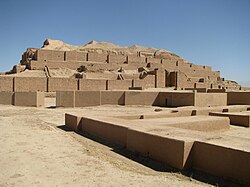
== | [[File:Choqa Zanbil Darafsh 1 (36).JPG|thumb|[[Chogha Zanbil]] is one of the few extant [[ziggurat]]s outside of [[Mesopotamia]] and considered the best-preserved example in the world.]] | ||
Iran is home to one of the world's oldest continuous major civilizations, with historical and urban settlements dating back to 4000 BC, including the [[Jiroft culture]] in southeastern Iran.<ref>{{cite web |url= http://en.people.cn/90001/90782/90874/6236885.html |title= New evidence: modern civilization began in Iran |author= <!--Staff writer(s); no by-line.--> |date= August 10, 2007|publisher= People's Daily Online |access-date=February 14, 2026 |url-status=dead | |||
|archive-url= https://web.archive.org/web/20210224223600/http://en.people.cn/90001/90782/90874/6236885.html |archive-date= February 24, 2021 }}</ref> Inscriptions in the [[Proto-Elamite script]], which predates [[cuneiform]], have been found from the early third millennium BC.<ref>{{cite web |url=http://www.chnpress.com/news/?section=2&id=6864 |title=5000-Y-Old Inscribed Tablets Discovered in Jiroft |url-status=dead |archive-url=https://web.archive.org/web/20110511111851/http://www.chnpress.com/news/?section=2&id=6864 |archive-date=11 May 2011}}</ref><ref>Yeganeh, Sepideh Jamshidi, et al., "Complexity of proto-elamite administration system: Insights from compositional data from sealings and tablets", Journal of Archaeological Science: Reports 61 : 104973, 2025</ref> The western part of the Iranian plateau participated in the traditional [[ancient Near East]] with [[Elam]] (3200–539 BC), and later with other peoples such as the [[Kassites]], [[Mannaea]]ns, and [[Gutians]]. The earliest Iranian peoples began to arrive from Central Asia in the 2nd millennium BC.<ref>{{Cite web |date=16 July 2025 |title=Iran - Ethnic Groups, Languages, Religions {{!}} Britannica |url=https://www.britannica.com/place/Iran/People |access-date=17 July 2025 |website=Encyclopædia Britannica |language=en}}</ref> | |||
{{ | The [[Median dynasty#Genealogy|Median dynasty]] ruled the earliest Iranian state.{{Sfn|Dandamayev|2021|p=1630}}{{Sfn|Katouzian|2013|p=xii}}{{Sfn|Gaube|2008|p=161}} In 612 BC, [[Cyaxares]] and the [[Babylonia|Babylon]]ian king [[Nabopolassar]] invaded [[Assyria]] and destroyed [[Nineveh]], the Assyrian capital, which led to the fall of the [[Neo-Assyrian Empire]].{{sfn|Sicker|2000|p=68–69}} The Medes later conquered and dissolved [[Urartu]] as well.<ref>{{Cite web |url=http://www.starspring.com/ascender/urartu/urartu.html |archive-url=https://web.archive.org/web/20150702205257/http://www.starspring.com/ascender/urartu/urartu.html |title=Urartu – Lost Kingdom of Van |archive-date=2 July 2015}}</ref><ref>{{cite web |url=http://www.allaboutturkey.com/urartu.htm |title=Urartu Civilization – All About Turkey |access-date=18 June 2015 |archive-date=1 July 2015 |archive-url=https://web.archive.org/web/20150701005402/http://www.allaboutturkey.com/urartu.htm |url-status=live}}</ref>{{Sfn|Shenkar|2014|p=5}} | ||
=== | ==== Achaemenid Empire ==== | ||
{{Main|Achaemenid Empire}} | |||
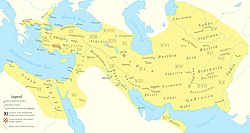
[[File:Achaemenid Empire at its greatest extent according to Oxford Atlas of World History 2002.jpg|thumb|upright=1.3|The [[Achaemenid Empire]], or the First Persian Empire, at its greatest extent]] | |||
[[File: | |||
The | The [[Achaemenid dynasty|Achaemenids]] united all [[Persians|Persian]] tribes under [[Cambyses I]]. Under his son, [[Cyrus the Great]], the Achaemenids defeated the Medes and established the [[Achaemenid Empire]],{{Sfn|Middleton|2015|p=148}} the largest-ever Iranian state.{{Sfn|Shenkar|2014|p=5}} Cyrus conquered the [[Lydia]]n and [[Neo-Babylonian Empire|Neo-Babylonian]] empires, creating an empire far larger than Assyria. His son, [[Cambyses II]] ({{Reign}}530–522 BC), conquered the last major power of the region, [[ancient Egypt]], causing the collapse of its [[Twenty-sixth Dynasty of Egypt|twenty-sixth dynasty]]. | ||
After the death of Cambyses II, [[Darius the Great]] ({{Reign}}522–486 BC) ascended the throne by overthrowing the Achaemenid monarch [[Bardiya]]. Darius' first capital was at Susa, and he started the building program at [[Persepolis]]. He improved the extensive road system, and during his reign the first recorded mentions are made of the [[Royal Road]], a highway from Susa to [[Sardis]].<ref>{{Cite web |url=http://www.thebritishmuseum.ac.uk/forgottenempire/persia/darius.html |title=Forgotten Empire— the world of Ancient Persia |publisher=The British Museum |year=2005 |archive-url=https://web.archive.org/web/20070423012310/http://www.thebritishmuseum.ac.uk/forgottenempire/persia/darius.html |archive-date=23 April 2007 |access-date=16 March 2023}}</ref> | |||
In 499 BC, [[Classical Athens|Athens]] supported a revolt in [[Miletus]], resulting in the sacking of Sardis. This led to the [[Greco-Persian Wars]], which lasted the first half of the 5th century BC. In the [[First Persian invasion of Greece]], Persian general [[Mardonius (general)|Mardonius]] re-subjugated Thrace and made Macedon a full part of Persia.{{sfn|Roisman|Worthington|2011|p=345}} Darius' successor [[Xerxes I]] ({{Reign}}486–465) launched the [[Second Persian invasion of Greece]]. At a crucial moment in the war, about half of mainland Greece was overrun by the Persians, including territories to the north of the Isthmus of [[Corinth]].<ref>{{Cite book |last1=Carey |first1=Brian Todd |url=https://books.google.com/books?id=3OSfBwAAQBAJ&pg=PT32 |title=Warfare in the Ancient World |last2=Allfree |first2=Joshua B. |last3=Cairns |first3=John |date=19 January 2006 |publisher=Pen and Sword |isbn=978-1-84884-630-2 |language=en}}</ref>{{Sfn|Aeschylus|2009|p=18}} This was reversed by a Greek victory following the battles of [[Battle of Plataea|Plataea]] and [[Battle of Salamis|Salamis]], during which Persia lost its footholds in Europe, and withdrew from it.{{sfn|Roisman|Worthington|2011|pp=135–138, 342–345}} | |||
The empire entered a period of decline. From 334 BC to 331 BC, [[Alexander the Great]] defeated [[Darius III]] ({{Reign}}336–330 BC) in the battles of [[Battle of the Granicus|Granicus]], [[Battle of Issus|Issus]] and [[Battle of Gaugamela|Gaugamela]], swiftly conquering the Achaemanid Empire by 331 BC. Alexander's empire collapsed after his death; his general, [[Seleucus I Nicator]], tried to take control of Iran, [[Mesopotamia]], [[Syria]], and [[Anatolia]]. His empire was the [[Seleucid Empire]]. | |||
{{Main | ==== Parthian and Sasanian empires ==== | ||
{{Main|Parthian Empire|Sasanian Empire}} | |||
The Arsacids of [[Parthia]],{{Sfn|Venning|2023|p=118}} initially Seleucid vassals,{{Sfn|Strootman|2020|p=151}} originated as leaders of the Iranian{{efn|The Parni was an eastern Iranian tribe established on the Amu Darya in the confederation of [[Dahae]].{{sfn|Lecoq|2011}} To Yarshater, they were a [[Sakas|Saka]] tribe, who penetrated Parthia, adopted its language, and eventually challenged the Seleucids' power in Parthia.{{sfn|Yarshater|2004}}}} [[Parni]] tribe in the northeastern [[steppe]]s.{{Sfn|Venning|2023|p=162}} The Parthians gradually [[Seleucid–Parthian Wars|challenged Seleucid rule]] over Iran, eventually securing control through the 142 BC conquest of [[Babylonia]].{{Sfn|Venning|2023|p=118}}{{Sfn|Strootman|2020|p=150}} Although fighting continued, the death of [[Antiochus VII Sidetes]] in 129 BC marked the collapse of the Seleucid Empire,{{Sfn|Strootman|2020|p=150}} which then lingered on as a [[rump state]] in Syria until conquered by the [[Roman Empire]] in the 60s BC.{{Sfn|Venning|2023|p=118}} | |||
[[File:The Sasanian Empire at its apex under Khosrow II.svg|thumb|upright=1.3|The [[Sasanian Empire]] at its greatest extent {{Circa|620}}, under the reign of [[Khosrow II]]]] | |||
The [[Parthian Empire]] endured for five centuries, but civil wars destabilized it. Parthian power evaporated when [[Ardashir I]] revolted against the Arsacids and killed their last ruler, [[Artabanus IV of Parthia|Artabanus IV]], in 224 AD. Ardashir established the [[Sasanian Empire]], which ruled Iran and much of [[Near East]].{{Sfn|Shahbazi|2005}} At their zenith, the Sasanians controlled all of modern-day Iran and Iraq and parts of the [[Pre-Islamic Arabia|Arabian Peninsula]], as well as the [[Caucasus]], the [[Levant]], and parts of [[Central Asia|Central]] and [[South Asia]].<ref>{{Cite news |title=Khosrow II (590–628 CE) |url=https://encyclopedia.pub/entry/23003#:~:text=It%20was%20under%20Khosrow%20II,the%20early%20seventh%20century%20CE. |archive-url=https://web.archive.org/web/20240619204859/https://encyclopedia.pub/entry/23003#:~:text=It%20was%20under%20Khosrow%20II,the%20early%20seventh%20century%20CE. |archive-date=19 June 2024 |access-date=27 February 2025 |language=en |url-status=live}}</ref> | |||
The strong economic conditions left by Parthians allowed the Sasanians to build a powerful and distinctive economic state whose reputation spread well beyond its political frontiers and time.{{Sfn|Gyselen|1997}} The Sasanian Empire was characterized by a complex and centralized government bureaucracy and the revitalization of [[Zoroastrianism]] as a legitimizing and unifying ideal.{{Sfn|Eiland|2004|p=81}} | |||
=== Medieval period === | |||
After the fall of the Sasanian Empire in 651 during the [[Early Muslim conquests]], the [[Arabs]] of the [[Umayyad Caliphate]] adopted many Persian customs, especially the administrative and the court mannerisms. Arab provincial governors were either Persianized [[Arameans]] or ethnic Persians; Persian remained the official language of the caliphate until the adoption of Arabic toward the end of the 7th century.{{Sfn|Hawting|1986|p=63–64}} However, Iran was still not entirely under Arab control; the [[Daylam]] region was under the control of the [[Daylamites]], [[Tabaristan]] was under [[Dabuyid dynasty|Dabuyid]] and [[Paduspanids|Paduspanid]] control, and [[Mount Damavand]] under [[Masmughans of Damavand|Masmughan]] control. Arabs had invaded these regions several times but the regions' inaccessible terrain prevented a decisive result. The most prominent ruler of the Dabuyids, [[Farrukhan the Great]] ({{Reign}}712–728), managed to hold his domains during his long struggle against the Arab general [[Yazid ibn al-Muhallab]], who was defeated by a combined Daylamite–Dabuyid army and forced to retreat from Tabaristan.{{sfn|Pourshariati|2008|pp=312–313}} | |||
==== Iranian Intermezzo ==== | |||
{{Main|Iranian Intermezzo}} | |||
[[File:Saffarids 900ad.jpg|thumb|upright=1.3|The [[Saffarid dynasty]] in 900 AD]] | |||
Anti-Umayyad insurrections were supported by non-Arab Islamic converts, who were resentful over being relegated to lower social standing. In 747–750, one of these insurrections grew into the [[Abbasid revolution]], in which descendants of Muhammad's uncle, [[Abbas ibn Ali|Abbas]], overthrew the Umayyads.{{Sfn|Osman|2014|pp=62–63}} The political authority of the [[Abbasid Caliphate|Abbasid caliphs]] diminished over the course of the 9th and 10th centuries.{{Sfn|Lorentz|2007|p=xxviii}} This led to the establishment of several independent Iranian dynasties,{{Sfn|Lorentz|2007|p=xxviii}} the ousting of Arab rulers from their scattered bastions across the country, and an Iranian cultural renaissance.{{Sfn|Mahendrarajah|2019}} The period between the collapse of Abbasid authority and the conquest of Iran by the [[Seljuk Empire|Seljuk Turks]] in the 11th century is referred to as the "[[Iranian Intermezzo]]".{{Sfn|Mahendrarajah|2019}} | |||
The Iranian Intermezzo saw the rise and fall of several major and minor dynasties.{{Sfn|Mahendrarajah|2019}} Among the most important of these overlapping dynasties were the [[Tahirid dynasty|Tahirids]] in [[Greater Khorasan|Khorasan]] (821–873); the [[Saffarid dynasty|Saffarids]] in [[Sistan]] (861–1003); and the [[Samanid Empire|Samanids]] (819–1005), originally at [[Bukhara]]. The Samanids eventually ruled an area from central Iran to Pakistan. By the early 10th century, the Abbasids almost lost control to the growing Iranian faction known as the [[Buyid dynasty]] (934–1062).{{Sfn|Blair|1992|p=6}} | |||
The | Since much of the Abbasid administration had been Persian, the Buyids were quietly able to assume real power in Baghdad. The Buyids were defeated in the mid-11th century by the [[Seljuk Empire|Seljuq Turks]], who continued to exert influence over the Abbasids. From the empire's inception, the Seljuk rulers minted coins with the title ''šāhānšāh'' ({{Literal translation|King of Kings}}) in its Persian form,{{sfn|Barthold|1962|p=108}} perhaps adopting it from the Buyids.{{Sfn|Blair|1992|p=6}} The Seljuk Empire fractured after the death of [[Ahmad Sanjar]] in 1157. | ||
The [[Islamization of Iran]] was a long process. As Persian Muslims consolidated their rule, the Muslim population rose from approximately 40% in the mid-9th century to close to 90% by the end of the 11th century. Historian [[Seyyed Hossein Nasr]] suggests that the rapid increase in conversion was aided by the Persian nationality of the rulers.<ref>Nasr, Hoseyn; Islam and the pliqht of modern man</ref> Although Persians adopted the religion of their conquerors, over the centuries they worked to protect and revive their distinctive language and culture, a process known as [[Persianization]]. Arabs and Turks participated in this process.<ref name="britannica2">''[[Encyclopædia Britannica]]'', "Seljuq", Online Edition, ([https://www.britannica.com/eb/article-9066688 Link] {{Webarchive|url=https://web.archive.org/web/20071219231803/https://www.britannica.com/eb/article-9066688 |date=19 December 2007 }})</ref><ref>Richard Frye, The Heritage of Persia, p. 243.</ref><ref>Rayhanat al- adab, (3rd ed.), vol. 1, p. 181.</ref> | |||
==== Mongol invasions ==== | |||
{{See also|Mongol invasion of the Khwarazmian Empire|Mongol conquest of Persia and Mesopotamia}} | |||
=== | [[File:Map of the Khwarazmian Empire.png|thumb|upright=1.3|Territory of the [[Khwarazmian Empire]] on the eve of the [[Mongol campaigns in Central Asia|Mongol conquests]], {{circa}} 1215]] | ||
In the early 13th century, the Mongols reached Iran.{{sfn|Ward|2009|p=39}} [[Siege of Bukhara|Bukhara was conquered]] in 1220{{Sfn|Aigle|2024|p=26}} and the [[Khwarazmian Empire]] was destroyed.{{Sfn|Bosworth|2009}} During 1220–21 Bukhara, [[Siege of Samarkand (1220)|Samarkand]], [[Herat]], [[Tus, Iran|Tus]] and [[Nishapur]] were razed, and the whole populations were slaughtered. Over the following decades, further conquests followed, culminating in the [[Siege of Baghdad|fall of Baghdad]] and end of the [[Abbasid Caliphate]]'s rule in 1258.{{Sfn|Lane|2012|p=250}} | |||
{{ | After the death of [[Möngke Khan]], the [[Mongol Empire]] was fractured by civil war, both over the succession of the next Great Khan and between nomadic traditionalists and the new settled princes of China and the Middle East. [[Kublai Khan]] was eventually universally recognized, but the empire was irreversibly fragmented.{{Sfn|Lane|2012|p=250}} In much of the southwest of the empire, including Iran, power fell to [[Hulegu Khan]],{{Sfn|Rossabi|2002|p=32}} who had been made a deputy there under Möngke Khan.{{Sfn|Lane|2012|p=250}} Hulegu was accepted as a legitimate ruler in Iran and was legitimized through a ''[[fatwa]]'' issued by the Shia scholar [[Ali ibn Tawus al-Hilli]].{{Sfn|Lane|2012|pp=253–254, 256}} Iran experienced a cultural renaissance under [[Ilkhanate|Ilkhanid]] rule.{{Sfn|Lane|2012|pp=253–254, 256}} [[Ghazan Khan]] converted to Islam in the late 13th century, turning the state further away from the other Mongol realms.{{Sfn|Rossabi|2002|p=32}} | ||
After Ghazan's nephew [[Abu Sa'id Bahadur Khan|Abu Said]] died in 1335, the Ilkhanate lapsed into civil war and was divided between several petty dynasties – most prominently the [[Jalayirids]], [[Muzaffarids (Iran)|Muzaffarids]], [[Sarbadars]] and [[Kartids]]. The mid-14th-century [[Black Death]] killed about 30% of the country's population.<ref>[http://www.nationalreview.com/interrogatory/kelly200509140843.asp Q&A with John Kelly on The Great Mortality on National Review Online] {{Webarchive|url=https://web.archive.org/web/20090109165503/http://www.nationalreview.com/interrogatory/kelly200509140843.asp |date=9 January 2009 }}.</ref> | |||
==== Timur and the rise of new powers ==== | |||
{{See also|Timurid conquests and invasions}} | |||
[[File:Empire of Timur and his Campaigns.png|thumb|[[Timur]]'s empire and his military campaigns]] | |||
Iran remained divided until the establishment of the Persianate [[Timurid dynasty]] in 1370. Its founder, Timur (r. 1370–1405), hailed from a [[Turkification|Turkified]] tribe of Mongols.<ref>{{harvnb|Golden|2011|p=94}}: "He was born some 100 km (62 miles) south of Samarkand into a clan of the Barlas, a Turkicized tribe of Mongol descent."</ref> After establishing a power base in [[Transoxiana]], Timur invaded Iran in 1381 and eventually conquered most of it. Timur's campaigns were known for their brutality; many people were slaughtered and several cities were destroyed.<ref name="lcweb2.loc.gov">This section incorporates text from the public domain [[Library of Congress Country Studies]].<br />{{Citation |archive-url=https://web.archive.org/web/20080917085548/http://lcweb2.loc.gov/cgi-bin/query/r?frd/cstdy:@field(DOCID+ir0018) |title=Iran: a country study |chapter=Invasions of the Mongols and Tamerlane |series=Library of Congress Country Studies |archive-date=17 September 2008 |year=1989 |first=Helen |last=Chapin Metz |url=https://tile.loc.gov/storage-services/master/frd/frdcstdy/ir/irancountrystudy00curt_0/irancountrystudy00curt_0_djvu.txt |url-status=unfit}}</ref> | |||
In 1387, Timur ordered the complete [[Siege of Isfahan (1387)|massacre of Isfahan]], killing 70,000 people.<ref>{{cite web |url=http://www.smithsonianmag.com/people-places/Irans-Hidden-Jewel.html?c=y&page=2 |archive-url=https://web.archive.org/web/20100717113459/http://www.smithsonianmag.com/people-places/Irans-Hidden-Jewel.html?c=y&page=2 |url-status=dead |archive-date=17 July 2010 |title=Isfahan: Iran's Hidden Jewel |publisher=Smithsonianmag.com |access-date=21 June 2013}}</ref> The Timurids maintained control of most of Iran until 1452, when they lost the bulk of it to the [[Qara Qoyunlu]], who were conquered by the [[Aq Qoyunlu]] in 1468. [[Uzun Hasan]] and his successors were the masters of Iran until the rise of the Safavids.<ref name="lcweb2.loc.gov" /> | |||
=== Early modern period === | |||
{{Main|Safavid Iran|Afsharid Iran|Zand dynasty|Qajar Iran|Portuguese–Safavid wars|Ottoman–Persian Wars}} | |||
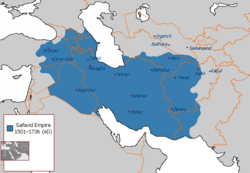
[[File:Safavid Empire 1501 1722 AD.png|thumb|[[Safavid Iran]] (1501–1722) at its greatest extent]] | |||
The [[Safavid Iran|Safavid Empire]], founded by [[Ismail I]] (r. 1505–1524), is often considered the beginning of modern Iranian history.{{Sfn|Matthee|2008}} While Safavid Iran predated the concept of the nation-state as such, it established the basis for the modern state of Iran.{{Sfn|Matthee|2008}}{{Sfn|Brown|2011|p=432}} The [[Safavid dynasty|Safavid]] dynastic period was one of the most important Iranian history, as it reunified Iran as a cohesive entity under native rule and established Shia Islam as the [[State religion|official religion]].{{Sfn|Savory|Karamustafa|1998|p=}} The Safavids ruled from 1501 to 1722, and experienced a brief restoration from 1729 to 1736. | |||
The Safavid state had a complex bureaucratic system of checks and balances, which ensured transparency and prevented fraud. This system was not intended to equalize power between branches of government, but to ensure total power of the shah. Legitimized by his bloodline as a [[sayyid]], or descendant of Muhammad, the shah monitored the actions of government officials through reports provided by the superintendent of each department. [[Jean Chardin]], French merchant and eventual ambassador to Iran, wrote that the Safavid shahs ruled their land with an iron fist and often in a [[Despotism|despotic]] manner.<ref>Ferrier, R. W.; A Journey to Persia: Jean Chardin's Portrait of a Seventeenth-century Empire; pp. 71–71.</ref> | |||
= | Complex rivalries in the region of [[Greater Khorasan|Khorasan]] led to the Afghan [[Hotak dynasty]] invading Iran. In 1722, this conflict led to the collapse of the Safavid Empire after the [[siege of Isfahan]].{{Sfn|Matthee|2008}}{{Sfn|Aghaie|2012|p=306}} The brief interlude between 1722 and the rise of the [[Qajar dynasty]] in 1789–1796 was marked by widespread political turmoil in Iran and several rival attempts to establish power over the country. The Safavids failed to regain power and the Hotaks failed to establish control. The rival [[Afsharid Iran|Afsharid]] and [[Zand dynasty|Zand]] dynasties were established by [[Nader Shah]] ({{Reign}}1736–1747) and [[Karim Khan Zand|Karim Khan]] ({{Reign}}1751–1779), respectively.{{Sfn|Aghaie|2012|p=306}} | ||
{{ | ==== Nader Shah and the shifting balance of power ==== | ||
[[File: | {{See also|Campaigns of Nader Shah}} | ||
[[File:Revised Map of the Afsharid Empire.png|thumb|A map of the [[Afsharid Empire]] at its greatest extent, in 1741–1745]] | |||
Nader Shah has been described as "the last great Asiatic military conqueror", and compared by some historians to Napoleon and Alexander the Great.<ref>''Cambridge History of Iran'' Vol. 7, p. 59.</ref>{{sfn|Axworthy|2008|p=xvii}} His numerous campaigns created a great empire that, at its maximum extent, briefly encompassed all or part of modern-day Afghanistan, Armenia, Azerbaijan, Bahrain, Georgia, India, Iran, Iraq, Turkey, Turkmenistan, Oman, Pakistan, Uzbekistan, the [[North Caucasus]], and the [[Persian Gulf]]. However, his military spending had a ruinous effect on the Iranian economy.{{sfn|Tucker|2006a}} | |||
Nader Shah's death was followed by a [[Division of the Afsharid Empire|period of anarchy]] in Iran as rival army commanders fought for power. Nader's own family, the [[Afsharid dynasty|Afsharids]], lost all but a small domain in Khorasan. The Zand family seized control of much of Iran in the 1750s.{{Sfn|Baker|2005|p=13}} The Zand rulers never proclaimed themselves to be ''shah''s, but as [[regent]]s of Iran.{{Sfn|Baker|2005|p=13}}''{{Sfn|Perry|2000}}'' They first staked their claim to power on behalf of the Safavid puppet [[Ismail III]] ({{Reign}}1750–1773) and then on behalf of the Iranian people.{{Sfn|Baker|2005|p=13}}''{{Sfn|Perry|2000}}'' | |||
==== Rise of the Qajar dynasty and foreign interference ==== | |||
[[File:Map Iran 1900-en.png|thumb|Iran under the [[Qajar dynasty]] in the 19th century.]] | |||
The Qajar dynasty gradually increased in power as they clashed with the Afsharids and the Zands for control of the land, culminating in [[Agha Mohammad Shah]] proclaiming himself ruler in 1789.{{sfn|Perry|1984}} Agha Mohammad defeated the Zand dynasty in 1794 and was officially crowned in 1796.{{Sfn|Baker|2005|p=13}}{{sfn|Perry|1984}} Shortly thereafter, he captured and deposed the Afsharid Shahrokh Shah, reunifying Iran under a single ruler.{{sfn|Perry|1984}} | |||
==== | In the 19th century, Iran lost significant territories in the [[Caucasus]] to the [[Russian Empire]] following the [[Russo-Persian Wars]].{{Sfn|Dowling|2014|p=728–729}} Meanwhile, [[United Kingdom|Britain]] became involved in [[southern Iran]] to counter Russia's presence in the north, which posed a threat to [[British India]].{{sfn|Amanat|2002}} Amid this struggle for power, drought, shifting agricultural priorities, and poor governance culminated in the [[Persian famine of 1870–1872|Great Persian Famine of 1870–1871]]. While the death toll is unknown, the famine killed a significant portion of Iran's population; between several hundred thousand and four million Iranians are believed to have died as a result.<ref>{{cite journal |jstor=617680 |title=The Great Persian Famine of 1870–71 |first=Shoko |last=Okazaki |date=1 January 1986 |journal=Bulletin of the School of Oriental and African Studies, University of London |volume=49 |issue=1 |pages=183–192 |doi=10.1017/s0041977x00042609 |s2cid=155516933}}</ref> | ||
{{ | === 20th century up to the Iranian Revolution === | ||
{{Main|Pahlavi Iran}} | |||
==== Constitutional Revolution and the rise of the Pahlavi dynasty ==== | |||
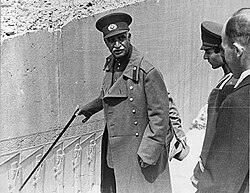
[[File:RezaShahBozorgTakhteJamshid32.jpg|thumb|[[Reza Shah Pahlavi]] with [[Mohammad Reza Pahlavi]] at [[Persepolis]]]] | |||
The [[Persian Constitutional Revolution]] between 1905 and 1911 led to the establishment of an Iranian parliament.<ref>{{Cite web |title=CONSTITUTIONAL REVOLUTION |url=https://www.iranicaonline.org/articles/constitutional-revolution-index/ |access-date=7 May 2025 |website=[[Encyclopaedia Iranica]] |language=en-US |archive-date=15 April 2025 |archive-url=https://web.archive.org/web/20250415161440/https://www.iranicaonline.org/articles/constitutional-revolution-index/ |url-status=live}}</ref> After the [[1921 Persian coup d'état|1921 coup d'état]], the Qajar dynasty was replaced with the [[Pahlavi dynasty]].<ref>{{Cite web |title=Pahlavi Dynasty |url=https://www.encyclopedia.com/history/encyclopedias-almanacs-transcripts-and-maps/pahlavi-dynasty |access-date=7 May 2025 |website=}}</ref> The dynasty was founded by [[Reza Shah]], who established an [[authoritarianism|authoritarian government]] that valued [[Iranian nationalism|nationalism]], [[militarism]], [[secularism in Iran|secularism]] and [[anti-communism]] combined with strict [[censorship]] and [[state propaganda]].<ref>Michael P. Zirinsky; "Imperial Power and Dictatorship: Britain and the Rise of Reza Shah, 1921–1926", International Journal of Middle East Studies 24 (1992), 639–663, Cambridge University Press</ref> Reza Shah introduced many socio-economic reforms, reorganizing the army, government administration, and finances.<ref name="Columbia_Encyclopedia">{{cite encyclopedia |archive-url=https://web.archive.org/web/20090201151652/http://www.bartleby.com/65/re/RezaShah.html |url=http://www.bartleby.com/65/re/RezaShah.html |url-status=usurped |archive-date=1 February 2009 |encyclopedia=The Columbia Encyclopedia |edition=Sixth |orig-date=2001 |year=2007 |title=Reza Shah Pahlevi}}</ref> Reza Shah ruled for almost 16 years until 1941, when he was forced to [[Abdication|abdicate]] by the [[Anglo-Soviet invasion of Iran]]. | |||
== | To his supporters, his reign brought "[[Law and order (politics)|law and order]], discipline, central authority, and modern amenities – schools, trains, buses, radios, cinemas, and telephones."<ref name="Ervand, 2008 p.91">Ervand, ''History of Modern Iran'', (2008), p.91</ref> However, his reign has been characterized as a corrupt [[police state]] which provided only surface level modernization.<ref name="Ervand, 2008 p.91" /><ref>Richard W. Cottam, Nationalism in Iran, University of Pittsburgh Press, ISBN o-8229-3396-7</ref><ref>The Origins of the Iranian Revolution by Roger Homan. International Affairs, Vol. 56, No. 4 (Autumn, 1980), pp. 673–677.{{JSTOR|2618173}}</ref> | ||
==== World War II and post-occupation instability ==== | |||
Due in part to Nazi Germany's [[Operation Barbarossa|invasion]] of the [[Soviet Union]], the Iranian government expected Germany to win the war and establish a powerful force on the Russian-Iranian border. Iran rejected British and Soviet demands to expel German residents from its borders. In response, the two [[Allies of World War II|Allies]] invaded in August 1941 and easily overwhelmed the weak Iranian army in [[Operation Countenance]]. Iran became the major conduit of Allied [[Lend-Lease]] aid to the Soviet Union. The purpose was to secure Iranian oil fields and ensure Allied supply lines through the [[Persian Corridor]]. Iran remained officially neutral. Reza Shah was deposed during the subsequent occupation and replaced with his young son [[Mohammad Reza Pahlavi]].<ref>Richard Stewart, ''Sunrise at Abadan: the British and Soviet invasion of Iran, 1941'' (1988).</ref> At the 1943 [[Tehran Conference]], the Allied "Big Three"—[[Joseph Stalin]], [[Franklin D. Roosevelt]], and [[Winston Churchill]]—issued the Tehran Declaration to guarantee the post-war independence and boundaries of Iran.<ref>Louise Fawcett, "Revisiting the Iranian Crisis of 1946: How Much More Do We Know?." ''Iranian Studies'' 47#3 (2014): 379–399.</ref> | |||
==== | ==== Mosaddegh and the Shah's rule ==== | ||
{{See also|1953 Iranian coup d'état}} | |||
[[File:Jimmy Carter with King Hussein of Jordan the Shah of Iran and Shahbanou of Iran - NARA - 177332 04.jpg|thumb|[[Mohammad Reza Pahlavi|Shah]] and [[Farah Pahlavi|Shahbanou]] of [[Pahlavi Iran|Iran]] with US President [[Jimmy Carter]] and [[King Hussein]] of Jordan in 1977]] | |||
In 1951, under Prime Minister [[Mohammad Mosaddegh]], the Iranian parliament voted to nationalize the British-owned oil industry, leading to the [[Abadan Crisis]]. Despite British pressure, including an economic blockade, nationalization continued. Mosaddegh was removed from power in 1952 but was quickly re-appointed by the Shah, due to a popular uprising in support of the premier. He forced the Shah into a brief exile in August 1953 after a failed military coup by [[Imperial Guard (Iran)|Imperial Guard]] Colonel [[Nematollah Nassiri]]. | |||
[[ | On 19 August, a successful [[1953 Iranian coup d'état|coup]] was headed by retired army general [[Fazlollah Zahedi]], aided by the US ([[CIA]])<ref name=BBC>{{cite news |title=CIA documents acknowledge its role in Iran's 1953 coup |url=https://www.bbc.co.uk/news/world-middle-east-23762970 |work=[[BBC News]] |access-date=20 August 2013 |archive-date=9 March 2021 |archive-url=https://web.archive.org/web/20210309131918/https://www.bbc.co.uk/news/world-middle-east-23762970 |url-status=live}}</ref> and the British ([[MI6]]), known as Operation Ajax and Operation Boot to the respective agencies.<ref>{{cite book |last=Kinzer |first=Stephen |title=The Brothers: John Foster Dulles, Allen Dulles, and Their Secret World War |publisher=Times Books |location=New York |year=2013}}</ref> The coup—with a [[black propaganda]] campaign against Mosaddegh<ref>{{Cite journal |last=Gölz |first=Olmo |date=1 January 2019 |title=Gölz "The Dangerous Classes and the 1953 Coup in Iran: On the Decline of 'lutigari' Masculinities." In Crime, Poverty and Survival in the Middle East and North Africa: The 'Dangerous Classes' since 1800. Edited by Stephanie Cronin, 177–90. London: I.B. Tauris, 2019. |url=https://www.academia.edu/40997855 |journal=Crime, Poverty and Survival in the Middle East and North Africa}}</ref>—forced Mosaddegh from office. Mosaddegh was arrested and tried for treason. Found guilty, Mosaddegh had his sentence reduced to house arrest on his family estate while his foreign minister, [[Hossein Fatemi]], was executed. [[Fazlollah Zahedi|Zahedi]] succeeded him as prime minister and suppressed opposition to the Shah, specifically from the [[National Front (Iran)|National Front]] and the communist [[Tudeh Party]]. | ||
From that time until the revolution, Iran was ruled as an autocracy under the Shah, with strong American support. Iran initiated economic, social, agrarian, and administrative reforms to modernize the country, which became known as the [[White Revolution]]. Many Islamic leaders criticized these initiatives, and the land reform had mixed results.<ref>{{Cite web |url=https://www.britannica.com/topic/White-Revolution |title=White Revolution (Iran) | History, Significance, & Effects | Britannica |website=Encyclopædia Britannica |access-date=3 December 2022}}</ref> By 1978, the Shah had become wildly unpopular among the Iranian people. Daily demonstrations destabilized the region, and the Shah established [[martial law]] to curb opposition. When hundreds of thousands of protestors persisted, security forces opened fire on the crowds in an incident that became known as [[Black Friday (1978)|Black Friday]].<ref>{{Cite web |title=The Hostage Crisis, 30 Years On |url=http://www.pbs.org/wgbh/pages/frontline/tehranbureau/2009/11/30-years-after-the-hostage-crisis.html |access-date=4 July 2025 |website=FRONTLINE - Tehran Bureau |language=en}}</ref> | |||
=== Islamic Revolution === | |||
{{Main|Iranian Revolution}} | |||
[[File:Imam Khomeini in Mehrabad.jpg|thumb|upright=.7|Ayatollah [[Khomeini]] returns to Iran after 14 years exile in France on 1 February 1979.]] | |||
The protests against the Shah grew to include more than 10% of the country; it is rare for revolutions to involve even 1% of a country's population.<ref>{{Cite journal |last=Kurzman |first=Charles |year=2003 |title=The Qum Protests and the Coming of the Iranian Revolution, 1975 and 1978 |url=https://www.cambridge.org/core/product/identifier/S0145553200012554/type/journal_article |journal=Social Science History |language=en |volume=27 |issue=3 |pages=287–325 |doi=10.1017/S0145553200012554 |issn=0145-5532}}</ref> Frustration with the Shah was so great that even secular and leftist groups supported [[Ruhollah Khomeini|Ayatollah Ruhollah Khomeini]], the leader of the [[Iranian Revolution|revolution]], despite sharing none of his political positions.<ref>{{Cite book |last=Milani |first=Abbas |title=The Shah |date=2024 |publisher=St. Martin's Press |isbn=978-0-230-34038-1 |edition=1st |location=New York}}</ref> Under increasing pressure, the Shah eventually fled Iran, charging the interim [[Regency Council (Iran)|Regency Council]] with his duties until a new government was formed.<ref name = "Chamber">{{Cite web |title=History of Iran: Islamic Revolution of 1979 |url=https://www.iranchamber.com/history/islamic_revolution/islamic_revolution.php |access-date=16 March 2023 |website=Iran Chamber |archive-date=21 October 2018 |archive-url=https://web.archive.org/web/20181021153717/http://www.iranchamber.com/history/islamic_revolution/islamic_revolution.php |url-status=live}}</ref><ref>{{Cite web |year=2018 |orig-date=1998 |title=The Iranian Revolution |url=http://www.fsmitha.com/h2/ch29ir.html |access-date=16 March 2023 |last=Smitha |first=Frank E. |archive-url=https://web.archive.org/web/20161010233759/http://www.fsmitha.com/h2/ch29ir.html |archive-date=10 October 2016}}</ref> [[Shapour Bakhtiar]], the head of the Council, invited Khomeini to return from exile. However, upon return, Khomeini pledged to defeat the interim government led by Bakhtiar and claimed to support free democratic elections. Violence broke out between the two factions, ultimately leading Bakhtiar to flee Iran in disguise. | |||
On 31 March 1979, a [[1979 Iranian Islamic Republic referendum|referendum]] was held on whether to transition from a government of monarchy to an [[Islamic republic]]. The referendum was approved by a massive margin of 99.31%. It mandated the creation of an [[Assembly for the Final Review of the Constitution|assembly]] to draft the new [[theocratic]] constitution, whereby Khomeini became [[Supreme Leader of Iran|Supreme Leader]] in December 1979. Iran's modernizing, capitalist economy was replaced by populist Islamic economic and cultural policies. Industries were nationalized, laws and schools [[Islamization of knowledge|Islamized]], and [[Western world|Western influence]] restricted.<ref name="Britannica Khomeini">{{Cite encyclopaedia |url=https://www.britannica.com/biography/Ruhollah-Khomeini |title=Ruhollah Khomeini |encyclopedia=[[Britannica]] |last=Afari |first=Janet |date=19 May 2023 |access-date=21 May 2025 |archive-date=22 April 2025 |archive-url=https://web.archive.org/web/20250422012154/https://www.britannica.com/biography/Ruhollah-Khomeini |url-status=live}}</ref> | |||
==== Khomeini, Iran–Iraq War, and leadership transition ==== | |||
{{See also|Aftermath of the Iranian Revolution|Iran–Iraq War}} | |||
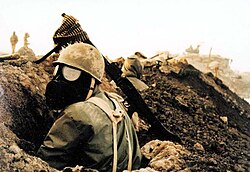
[[File:Chemical weapon1.jpg|thumb|An Iranian soldier with gas mask during the [[Iran–Iraq War]]]] | |||
The shah, now out of power, went to the US to seek cancer treatment after other countries denied him entry. Supporters of the revolution feared that this was a step toward a coup to reinstate the Shah's reign. On 4 November 1979, Iranian students [[Iran hostage crisis|seized US embassy personnel]], labeling the embassy a "den of spies".<ref name="carterpbs">[https://www.pbs.org/wgbh/amex/carter/sfeature/sf_hostage.html PBS, American Experience, Jimmy Carter, "444 Days: America Reacts"] {{Webarchive|url=https://web.archive.org/web/20110119224031/https://www.pbs.org/wgbh/amex/carter/sfeature/sf_hostage.html |date=19 January 2011}}. Retrieved 1 October 2007</ref> 52 hostages were held for 444 days until January 1981.<ref>''Guests of the Ayatollah: The Iran Hostage Crisis: The First Battle in America's War with Militant Islam'', Mark Bowden, p. 127, 200</ref> During the [[Cultural Revolution in Iran]] from 1980 to 1983 opposition to Islamic values was purged<ref name="z079">{{cite journal | last=Razavi | first=Reza | title=The Cultural Revolution in Iran, with Close Regard to the Universities, and its Impact on the Student Movement | journal=Middle Eastern Studies | volume=45 | issue=1 | date=2009 | issn=0026-3206 | doi=10.1080/00263200802547586 | pages=1–17 | url=http://www.tandfonline.com/doi/full/10.1080/00263200802547586 | access-date=2026-02-27}}</ref> including through the [[1981–1982 Iran massacres]].<ref name="b372">{{cite journal | last=Nasiri | first=Shahin | title=Clerical Sovereignty and its Absolute Others: Religious Genocide in Iran | journal=Journal of Genocide Research | date=2025 | issn=1462-3528 | doi=10.1080/14623528.2025.2566533 | pages=1–25 | url=https://www.tandfonline.com/doi/full/10.1080/14623528.2025.2566533 | access-date=2026-02-27}}</ref> | |||
Iraqi leader [[Saddam Hussein]] attempted to take advantage of the disorder of the revolution, the weakness of the Iranian military and the revolution's antagonism against Western governments. On 22 September 1980, the Iraqi army [[Iraqi invasion of Iran|invaded Iran]] at [[Khuzestan province|Khuzestan]], precipitating the [[Iran–Iraq War]]. The attack took revolutionary Iran by surprise. Although Hussein's forces made early advances, Iranian forces pushed the Iraqi army back into Iraq by 1982. Khomeini sought to [[Exporting the revolution|export the revolution]] westward into Iraq, especially to the country's Shi'a Arab majority. The war continued until 1988, when Khomeini "drank the cup of poison" and accepted a truce mediated by the UN.<ref>{{Cite news |last=Blair |first=David |date=18 June 2025 |title=Deep in a bunker, Iran's supreme leader faces a dilemma: Must he drink his cup of poison? |url=https://www.telegraph.co.uk/world-news/2025/06/18/will-iran-supreme-leader-drink-his-cup-of-poison/ |access-date=4 July 2025 |work=The Telegraph |language=en-GB |issn=0307-1235}}</ref> The war, which ended in a stalemate in 1988, killed approximately 500,000 people.<ref>{{cite encyclopedia |title=Iran–Iraq War |encyclopedia=[[Encyclopædia Britannica]] |url=https://www.britannica.com/event/Iran-Iraq-War |access-date=2 September 2021 |archive-date=30 August 2021 |archive-url=https://web.archive.org/web/20210830211148/https://www.britannica.com/event/Iran-Iraq-War |url-status=live}}</ref> During the war, Saddam extensively used [[Iraqi chemical weapons program|chemical weapons]] against Iranians.<ref>{{cite web |last1=Harris |first1=Shane |last2=Aid |first2=Matthew M. |url=https://foreignpolicy.com/2013/08/26/exclusive-cia-files-prove-america-helped-saddam-as-he-gassed-iran/ |title=Exclusive: CIA Files Prove America Helped Saddam as He Gassed Iran |work=[[Foreign Policy]] |date=26 August 2013 |access-date=7 May 2017 |archive-url=https://web.archive.org/web/20140915042349/http://www.foreignpolicy.com/articles/2013/08/25/secret_cia_files_prove_america_helped_saddam_as_he_gassed_iran?page=0%2C2 |archive-date=15 September 2014 |url-status=live}}</ref> | |||
==== | ==== Khamenei era ==== | ||
{{ | {{further|2009 Iranian presidential election protests|Joint Comprehensive Plan of Action|Assassination of Qasem Soleimani|Mahsa Amini protests|2024 Iran–Israel conflict|Iran–Israel war|2025–2026 Iranian protests}} | ||
On his deathbed in 1989, Khomeini appointed a 25-man Constitutional Reform Council which named [[Ali Khamenei]] as the next Supreme Leader, and made changes to Iran's constitution.<ref>Abrahamian, ''History of Modern Iran'', (2008), p.182</ref> While Khamenei lacked Khomeini's "charisma and clerical standing", he developed a network of supporters within the armed forces and its economically powerful [[Bonyad|religious foundations]].<ref>"Who's in Charge?" by Ervand Abrahamian ''London Review of Books'', 6 November 2008</ref> | |||
[[File:Ayatollah Ali Khamenei at the Great Conference of Basij members at Azadi stadium October 2018 033.jpg|thumb|Ali Khamenei at the Great Conference of [[Basij]] members at [[Azadi Stadium]], October 2018]] | |||
President [[Akbar Rafsanjani]] concentrated on a pro-business policy of rebuilding the economy, without breaking with the ideology of the revolution. He supported a free market, favoring privatization of state industries and a moderate position internationally. In 1997, Rafsanjani was succeeded by moderate [[Iranian reform movement|reformist]] [[Mohammad Khatami]], whose government advocated freedom of expression, constructive diplomatic relations with Asia and the EU, and policy that supported a free market and foreign investment. | |||
[[ | The [[2005 Iranian presidential election|2005 presidential election]] brought conservative populist and nationalist candidate [[Mahmoud Ahmadinejad]] to power. He was known for his hardline views, nuclearization, and [[Mahmoud Ahmadinejad and Israel|hostility towards Israel]], [[Saudi Arabia]], the UK, US and other states. He was the first president to be summoned by the [[Islamic Consultative Assembly|parliament]] to answer questions regarding his presidency.<ref>{{Cite news |date=5 June 2012 |title=Ahmadinejad critic Larijani re-elected Iran speaker |url=https://www.bbc.com/news/world-middle-east-18328882 |access-date=10 May 2024 |work=[[BBC News]] |language=en-GB |archive-date=10 May 2024 |archive-url=https://web.archive.org/web/20240510171821/https://www.bbc.com/news/world-middle-east-18328882 |url-status=live}}</ref> In 2013, centrist and reformist [[Hassan Rouhani]] was elected president. He encouraged personal freedom, access to information, and improved women's rights. He improved diplomatic relations through exchanging conciliatory letters.<ref>{{Cite news |last1=Borger |first1=Julian |last2=Dehghan |first2=Saeed Kamali |date=19 September 2013 |title=Hassan Rouhani sets out his vision for a new and free Iran |url=https://www.theguardian.com/world/2013/sep/19/hassan-rouhani-vision-iran-free |access-date=10 May 2024 |work=[[The Guardian]] |language=en-GB |issn=0261-3077 |archive-date=12 November 2023 |archive-url=https://web.archive.org/web/20231112101132/https://www.theguardian.com/world/2013/sep/19/hassan-rouhani-vision-iran-free |url-status=live}}</ref> The [[Joint Comprehensive Plan of Action]] was reached in [[Vienna]] in 2015, between Iran, the [[P5+1]] ([[permanent members of the United Nations Security Council|UN Security Council]] + Germany) and the EU. The negotiations centered around ending the [[United Nations Security Council Resolution 1929|economic sanctions]] in exchange for Iran's restriction in producing [[enriched uranium]].<ref>{{cite web |author=Kutsch, Tom |date=14 July 2015 |title=Iran, world powers strike historic nuclear deal |url=http://america.aljazeera.com/articles/2015/7/14/iran-world-powers-strike-historic-nuclear-deal.html |archive-url=https://web.archive.org/web/20150715175516/http://america.aljazeera.com/articles/2015/7/14/iran-world-powers-strike-historic-nuclear-deal.html |archive-date=15 July 2015 |access-date=15 July 2015 |publisher=[[Al Jazeera]]}}</ref> In 2018, the US under President [[First presidency of Donald Trump|Donald Trump]] withdrew from the deal and new sanctions were imposed. This nulled the economic provisions and brought Iran to [[nuclear latency|nuclear threshold status]].<ref>{{Cite news |last=Brewer |first=Eric |date=25 June 2024 |title=Iran's New Nuclear Threat |url=https://www.foreignaffairs.com/iran/irans-new-nuclear-threat |access-date=2 July 2024 |work=Foreign Affairs |language=en-US |issn=0015-7120}}</ref> In 2020, [[Islamic Revolutionary Guard Corps|IRGC]] general [[Qasem Soleimani]], the 2nd-most powerful person in Iran,<ref>{{Cite web |date=4 January 2020 |title=U.S. killing of Iran's second most powerful man risks regional conflagration |url=https://www.reuters.com/article/us-iraq-security-blast-soleimani-analysi/u-s-killing-of-irans-second-most-powerful-man-risks-regional-conflagration-idUSKBN1Z21TJ/ |website=[[Reuters]] |access-date=7 May 2024 |archive-date=18 April 2024 |archive-url=https://web.archive.org/web/20240418120615/https://www.reuters.com/article/us-iraq-security-blast-soleimani-analysi/u-s-killing-of-irans-second-most-powerful-man-risks-regional-conflagration-idUSKBN1Z21TJ/ |url-status=live}}</ref> was [[Assassination of Qasem Soleimani|assassinated by the US]], heightening [[Iran–United States relations|tensions between them]].<ref name="Roelants">Carolien Roelants, Iran expert of ''[[NRC Handelsblad]]'', in a debate on ''[[Buitenhof (TV series)|Buitenhof]]'' on Dutch television, 5 January 2020.</ref> [[Operation Martyr Soleimani|Iran retaliated against US airbases in Iraq]], the largest ballistic missile attack ever on Americans;<ref>{{Citation |title=Never-before-seen video of the attack on Al Asad Airbase |date=28 February 2021 |url=https://www.youtube.com/watch?v=lGP7hZQuTL0 |access-date=8 January 2024 |language=en |archive-date=23 February 2022 |archive-url=https://web.archive.org/web/20220223104408/https://www.youtube.com/watch?v=lGP7hZQuTL0 |url-status=live}}</ref> 110 sustained [[Traumatic brain injury|brain injuries]].<ref>{{Cite web |title=109 US troops diagnosed with brain injuries from Iran attack |url=https://www.aljazeera.com/news/2020/2/10/109-us-troops-diagnosed-with-brain-injuries-from-iran-attack |access-date=7 April 2024 |publisher=[[Al Jazeera]] |language=en |archive-date=7 April 2024 |archive-url=https://web.archive.org/web/20240407113740/https://www.aljazeera.com/news/2020/2/10/109-us-troops-diagnosed-with-brain-injuries-from-iran-attack |url-status=live}}</ref><ref>{{Cite web |title=Pentagon admits 109 brain injuries in Iran attack |url=https://www.dw.com/en/109-us-service-members-were-injured-in-the-iran-missile-attack/a-52331039 |access-date=7 April 2024 |publisher=[[Deutsche Welle]] |language=en |archive-date=7 April 2024 |archive-url=https://web.archive.org/web/20240407113741/https://www.dw.com/en/109-us-service-members-were-injured-in-the-iran-missile-attack/a-52331039 |url-status=live}}</ref><ref>{{Cite web |last=Starr |first=Barbara |date=10 February 2020 |title=Over 100 US troops have been diagnosed with traumatic brain injuries following Iran strike |url=https://www.cnn.com/2020/02/10/politics/traumatic-brain-injuries-iran-strike/index.html |access-date=7 April 2024 |publisher=[[CNN]] |language=en |archive-date=7 April 2024 |archive-url=https://web.archive.org/web/20240407113740/https://www.cnn.com/2020/02/10/politics/traumatic-brain-injuries-iran-strike/index.html |url-status=live}}</ref> On 8 January, Iran's [[Islamic Revolutionary Guard Corps]] shot down [[Ukraine International Airlines Flight 752]], killing 176 civilians and leading to [[Ukraine International Airlines Flight 752 protests|nation-wide protests]]. An international investigation led to the government admitting to the shootdown by a surface-to-air missile.<ref>{{cite news |url=https://www.reuters.com/article/us-iran-crash/ukrainian-airplane-with-180-aboard-crashes-in-iran-fars-idUSKBN1Z70EL |title=Ukrainian airplane with 180 aboard crashes in Iran: Fars |date=8 January 2020 |work=Reuters |url-status=live |archive-url=https://web.archive.org/web/20200108035747/https://www.reuters.com/article/us-iran-crash/ukrainian-airplane-with-180-aboard-crashes-in-iran-fars-idUSKBN1Z70EL |archive-date=8 January 2020 |access-date=8 January 2020}}</ref><ref>{{cite news |url=https://www.bbc.com/news/world-middle-east-51077788 |work=BBC |title=Demands for justice after Iran's plane admission |date=11 January 2020 |access-date=11 January 2020}}</ref> | ||
=== | Hardliner [[Ebrahim Raisi]] lost a presidential bid in 2017, but ran again [[2021 Iranian presidential election|in 2021]], succeeding Rouhani.<ref>{{cite news |last1=Motamedi |first1=Maziar |title=Hardliner Raisi elected Iran's new president |url=https://www.aljazeera.com/news/2021/6/19/raisi-wins-irans-presidential-election-amid-low-turnout |publisher=[[Al Jazeera]] |language=en |archive-date=1 September 2021 |access-date=2 January 2025 |archive-url=https://web.archive.org/web/20210901094359/https://www.aljazeera.com/news/2021/6/19/raisi-wins-irans-presidential-election-amid-low-turnout |url-status=live}}</ref> During Raisi's term, Iran [[Nuclear program of Iran|intensified uranium enrichment]], hindered international inspections, joined SCO and BRICS, [[Iran and the Russian invasion of Ukraine|supported the]] [[2022 Russian invasion of Ukraine]] and restored relations with Saudi Arabia. In April 2024, the [[Israeli airstrike on the Iranian consulate in Damascus]] killed an IRGC commander.<ref>{{Cite web |title=Several killed in Israeli strike on Iranian consulate in Damascus |url=https://www.aljazeera.com/news/2024/4/1/several-killed-in-israeli-strike-on-iranian-consulate-in-damascus-reports |access-date=1 May 2024 |publisher=[[Al Jazeera]] |language=en |archive-date=30 April 2024 |archive-url=https://web.archive.org/web/20240430180537/https://www.aljazeera.com/news/2024/4/1/several-killed-in-israeli-strike-on-iranian-consulate-in-damascus-reports |url-status=live}}</ref><ref>{{Cite web |date=1 April 2024 |title=Israeli strike on Iran's consulate in Syria killed 2 generals and 5 other officers, Iran says |url=https://apnews.com/article/israel-syria-airstrike-iranian-embassy-edca34c52d38c8bc57281e4ebf33b240 |access-date=1 May 2024 |website=[[AP News]] |language=en |archive-date=19 April 2024 |archive-url=https://web.archive.org/web/20240419075609/https://apnews.com/article/israel-syria-airstrike-iranian-embassy-edca34c52d38c8bc57281e4ebf33b240 |url-status=live}}</ref> Iran [[April 2024 Iranian strikes on Israel|retaliated]] with [[Unmanned aerial vehicle|UAVs]], [[Cruise missile|cruise]] and [[ballistic missile]]s; 9 hit Israel.<ref>{{Cite news |author=Jack Dutton |date=15 April 2024 |title=How Iran's attack on Israel is disrupting air traffic |url=https://www.al-monitor.com/originals/2024/04/how-irans-attack-israel-disrupting-air-traffic |access-date=1 May 2024 |language=en |archive-date=1 May 2024 |archive-url=https://web.archive.org/web/20240501174027/https://www.al-monitor.com/originals/2024/04/how-irans-attack-israel-disrupting-air-traffic |url-status=live}}</ref><ref>{{Cite web |last=Toossi |first=Sina |date=2 May 2024 |title=Iran Has Defined Its Red Line With Israel |url=https://foreignpolicy.com/2024/04/18/iran-has-defined-its-red-line-with-israel/ |access-date=1 May 2024 |website=Foreign Policy |language=en-US |archive-date=1 May 2024 |archive-url=https://web.archive.org/web/20240501174027/https://foreignpolicy.com/2024/04/18/iran-has-defined-its-red-line-with-israel/ |url-status=live}}</ref><ref>{{Cite news |date=14 April 2024 |title=What was in wave of Iranian attacks and how were they thwarted? |url=https://www.bbc.com/news/world-middle-east-68811273 |access-date=1 May 2024 |language=en-GB |archive-date=14 April 2024 |archive-url=https://web.archive.org/web/20240414091527/https://www.bbc.com/news/world-middle-east-68811273 |url-status=live}}</ref> It was the largest drone strike in history,<ref>{{Cite web |title=The largest drone attack in history |url=http://iranpress.com/aliaspage/277652 |access-date=1 May 2024 |website= |language=en}}</ref> biggest missile attack in Iranian history,<ref>{{Cite web |last=Motamedi |first=Maziar |title='True Promise': Why and how did Iran launch a historic attack on Israel? |url=https://www.aljazeera.com/news/2024/4/14/true-promise-why-and-how-did-iran-launch-a-historic-attack-on-israel |access-date=1 May 2024 |publisher=[[Al Jazeera]] |language=en |archive-date=14 April 2024 |archive-url=https://web.archive.org/web/20240414145020/https://www.aljazeera.com/news/2024/4/14/true-promise-why-and-how-did-iran-launch-a-historic-attack-on-israel |url-status=live}}</ref> its first ever direct attack on Israel<ref>{{Cite web |date=13 April 2024 |title=Iran launches first-ever direct attack on Israel |url=https://abc7ny.com/israel-gaza-live-updates-iran-launches-dozens-of-drones-in-retaliatory-strike/14656640/ |access-date=1 May 2024 |website=ABC7 New York |language=en |archive-date=1 May 2024 |archive-url=https://web.archive.org/web/20240501174027/https://abc7ny.com/israel-gaza-live-updates-iran-launches-dozens-of-drones-in-retaliatory-strike/14656640/ |url-status=live}}</ref><ref>{{Cite web |date=18 April 2024 |title=How Israel could respond to Iran's drone and missile assault |url=https://www.france24.com/en/middle-east/20240418-how-israel-could-respond-to-iran-s-drone-and-missile-assault |access-date=1 May 2024 |publisher=[[France 24]] |language=en |archive-date=1 May 2024 |archive-url=https://web.archive.org/web/20240501174029/https://www.france24.com/en/middle-east/20240418-how-israel-could-respond-to-iran-s-drone-and-missile-assault |url-status=live}}</ref> and the first time [[1991 Iraqi missile attacks against Israel|since 1991]] that Israel was directly attacked by a state.<ref>{{Cite news |last=Johny |first=Stanly |date=14 April 2024 |title=By attacking Israel, Iran turns shadow war into direct conflict |url=https://www.thehindu.com/news/international/analysis-three-takeaways-from-irans-attack-on-israel/article68064678.ece |access-date=1 May 2024 |work=[[The Hindu]] |language=en-IN |issn=0971-751X |archive-date=14 April 2024 |archive-url=https://web.archive.org/web/20240414203401/https://www.thehindu.com/news/international/analysis-three-takeaways-from-irans-attack-on-israel/article68064678.ece |url-status=live}}</ref> In May 2024, Raisi was killed in a [[2024 Varzaqan helicopter crash|helicopter crash]],<ref>{{cite news |title=Who died alongside Iran's President Raisi in the helicopter crash? |url=https://www.aljazeera.com/news/2024/5/20/who-died-alongside-irans-president-raisi-in-the-helicopter-crash |publisher=[[Al Jazeera]] |language=en |archive-date=19 May 2024 |access-date=2 January 2025 |archive-url=https://web.archive.org/web/20240519213002/https://apnews.com/article/helicopter-iran-raisi-crash-azerbaijan-3ef9fe5772fb06f6d9dcc371b115923f |url-status=live}}</ref> and Iran held a [[2024 Iranian presidential election|presidential election]], when reformist and former [[Ministry of Health and Medical Education|Minister of Health]], [[Masoud Pezeshkian]], was elected.<ref>{{Cite web |date=6 July 2024 |title=Masoud Pezeshkian, a heart surgeon who rose to power in parliament, now Iran's president-elect |url=https://apnews.com/article/iran-presidential-runoff-election-masoud-pezeshkian-profile-a07e9921fa8c25b1a05333e128c03916 |access-date=6 July 2024 |website=[[AP News]] |language=en}}</ref><ref>{{Cite news |last1=Fassihi |first1=Farnaz |last2=Vinograd |first2=Cassandra |date=6 July 2024 |title=Reformist Candidate Wins Iran's Presidential Election |url=https://www.nytimes.com/2024/07/05/world/middleeast/iran-election-reformist-wins.html |access-date=6 July 2024 |work=[[The New York Times]] |language=en-US |issn=0362-4331 |archive-date=6 July 2024 |archive-url=https://web.archive.org/web/20240706034614/https://www.nytimes.com/2024/07/05/world/middleeast/iran-election-reformist-wins.html |url-status=live}}</ref> In October, Iran [[October 2024 Iranian strikes on Israel|launched]] 180 ballistic missiles at Israel in retaliation for assassinations [[Assassination of Ismail Haniyeh|of Ismail Haniyeh]], [[2024 Hezbollah headquarters strike|Hassan Nasrallah]] and [[Abbas Nilforoushan]]. Israel [[October 2024 Israeli strikes on Iran|struck]] Iranian military sites.<ref>{{cite news |title=What we know about Israel's attack on Iran |url=https://www.bbc.com/news/articles/cgr0yvrx4qpo |work=[[BBC News]] |archive-date=27 October 2024 |access-date=31 December 2024 |archive-url=https://web.archive.org/web/20241027231243/https://www.bbc.com/news/articles/cgr0yvrx4qpo |url-status=live}}</ref> In May 2025, Iran's government ordered [[2025 Afghan deportation from Iran|mass deportation]] of an estimated four million [[Afghan diaspora|Afghan migrants]] and refugees living in Iran.<ref>{{cite news |title=Iran tells millions of Afghans to leave or face arrest on day of deadline |url=https://www.aljazeera.com/news/2025/7/6/iran-tells-millions-of-afghans-to-leave-or-face-arrest-on-day-of-deadline |publisher=Al Jazeera |date=6 July 2025}}</ref> | ||
[[File:تقدیم پیام پادشاه عربستان به رهبر انقلاب 07.jpg|thumb|Ayatollah [[Ali Khamenei]] with [[Saudi Arabia]]'s Defense Minister [[Khalid bin Salman Al Saud|Khalid bin Salman]] and Major General [[Mohammad Bagheri (general)|Mohammad Bagheri]] on 17 April 2025]] | |||
The weakening of Iran's [[Axis of Resistance|key allies and proxies]] since 2023 left Iran's government weakened and isolated.<ref>{{Cite news |title=Iran's leader hopes America can save his faltering regime |url=https://www.economist.com/middle-east-and-africa/2025/05/01/irans-leader-hopes-america-can-save-his-faltering-regime |access-date=25 May 2025 |newspaper=[[The Economist]] |issn=0013-0613}}</ref><ref>{{Cite web |date=9 December 2024 |title=Iran in a 'position of unprecedented weakness' after the fall of Assad in Syria |url=https://www.france24.com/en/middle-east/20241209-iran-position-unprecedented-weakness-after-fall-of-assad-syria-proxies-hezbollah-middle-east |access-date=25 May 2025 |publisher=[[France 24]] |language=en}}</ref><ref>{{Cite web |date=6 March 2025 |title=The fall of Assad has exposed the extent of the damage to Iran's axis of resistance |url=https://www.chathamhouse.org/2024/12/fall-assad-has-exposed-extent-damage-irans-axis-resistance |access-date=25 May 2025 |website=Chatham House |language=en}}</ref> In early 2025, Iran was rapidly advancing its nuclear program.<ref>{{Cite news |last=Barnes |first=Joe |date=31 January 2025 |title=Iran 'secretly building nuclear missiles that can hit Europe' |url=https://www.telegraph.co.uk/world-news/2025/01/31/iran-nuclear-warhead-europe-revolutionary-guard-north-korea/ |access-date=28 April 2025 |work=The Telegraph |language=en-GB |issn=0307-1235}}</ref> Analysts warned such activity exceeded any plausible civilian justification.<ref name="Economist20250128">{{Cite news |title=Iran's alarming nuclear dash will soon test Donald Trump |url=https://www.economist.com/middle-east-and-africa/2025/01/28/irans-alarming-nuclear-dash-will-soon-test-donald-trump |access-date=23 February 2025 |newspaper=[[The Economist]] |issn=0013-0613}}</ref> Iran and the United States [[2025–2026 Iran–United States negotiations|entered negotiations]] for a new nuclear agreement, but progress stalled. In June, [[International Atomic Energy Agency|IAEA]] found Iran non-compliant with its nuclear obligations;<ref name="Euronews20250612">{{Cite web |title=UN nuclear watchdog finds Iran in non-compliance with its obligations |url=https://www.euronews.com/2025/06/12/un-nuclear-watchdog-finds-iran-in-non-compliance-with-nuclear-obligations |access-date=12 June 2025 |website=Euro News |date=12 June 2025}}</ref> in response, Iran announced activation of a new enrichment facility.<ref name="CNN20250612">{{Cite web |last1=Salem |first1=Mostafa |last2=Pleitgen |first2=Frederik |date=12 June 2025 |title=Iran threatens nuclear escalation after UN watchdog board finds it in breach of obligations |url=https://www.cnn.com/2025/06/12/middleeast/iran-threatens-nuclear-escalation-iaea-intl |access-date=12 June 2025 |publisher=[[CNN]] |language=en}}</ref> On 13 June 2025, Israel launched strikes across Iran, targeting nuclear facilities and killing top members of Iran's military leadership.<ref>{{Cite news |last1=Shotter |first1=James |last2=Sevastopulo |first2=Demetri |last3=England |first3=Andrew |last4=Bozorgmehr |first4=Najmeh |date=13 June 2025 |title=Israel launches air strikes against Iran commanders and nuclear sites |url=https://www.ft.com/content/46b1a363-c805-4800-abbf-6b47b9602ef2 |access-date=13 June 2025 |work=Financial Times}}</ref><ref>{{Cite news |last1=Fassihi |first1=Farnaz |last2=Nauman |first2=Qasim |last3=Boxerman |first3=Aaron |last4=Kingsley |first4=Patrick |last5=Bergman |first5=Ronen |date=13 June 2025 |title=Israel Strikes Iran's Nuclear Program, Killing Top Military Officials: Live Updates |url=https://www.nytimes.com/live/2025/06/12/world/israel-iran-us-nuclear |access-date=13 June 2025 |work=[[The New York Times]] |language=en-US |issn=0362-4331}}</ref> Iran retaliated with missile strikes, and hostilities resulted in [[Twelve-Day War|direct conflict]] between them. On 22 June, the [[United States strikes on Iranian nuclear sites|US struck the Iranian nuclear facilities]];<ref>{{Cite news |date=22 June 2025 |title=Trump says US has attacked three nuclear sites in Iran |url=https://www.theguardian.com/world/2025/jun/21/trump-us-nuclear-strikes-iran |access-date=22 June 2025 |work=The Guardian |language=en-GB |issn=0261-3077}}</ref> Iran [[Iranian strikes on Al Udeid Air Base|attacked US bases in Qatar]] as a result. On 24 June, Israel and Iran agreed to a ceasefire after insistence from the US.<ref>{{Cite news |date=23 June 2025 |title=Trump says Iran and Israel agree to a ceasefire |url=https://www.reuters.com/world/middle-east/trump-says-iran-israel-agree-ceasefire-2025-06-23/ |access-date=23 June 2025 |work=[[Reuters]] |language=en}}</ref><ref>{{Cite web |url=https://apnews.com/article/trump-iran-israel-ceasefire-agreement-terms-b5fc5cc8a8c32b4899646130b496798a |title=A whirlwind 48 hours: How Trump's Israel-Iran ceasefire agreement came together |date=24 June 2025 |website=AP News}}</ref> | |||
{{ | Since December 2025, Iran has experienced [[2025–2026 Iranian protests|mass demonstrations]] across cities calling for the overthrow of the Islamic Republic, sparked by frustration over the [[Iranian economic crisis|economic crisis]].<ref>{{Cite news |last1=Parent |first1=Deepa |last2=Christou |first2=William |date=31 December 2025 |title='We want the mullahs gone': economic crisis sparks biggest protests in Iran since 2022 |url=https://www.theguardian.com/world/2025/dec/31/we-want-the-mullahs-gone-economic-crisis-sparks-biggest-protests-in-iran-since-2022 |access-date=1 January 2026 |work=The Guardian |language=en-GB |issn=0261-3077}}</ref> {{As of|2026|01|13}}, ''[[Iran International]]'' estimated that at least 12,000 protesters had been killed amidst the [[2026 Internet blackout in Iran|internet blackout]], as government security forces escalated their use of lethal force against demonstrators.<ref name="2000killed">{{cite news |date=10 January 2026 |title=Mass killings reported as security forces use live fire on Iran protesters |url=https://www.iranintl.com/en/202601103903 |access-date=10 January 2026 |publisher=Iran International}}</ref><ref>{{cite web |last=Sparks |first=John |date=9 January 2026 |title=Iran's leaders facing most serious threat since 1979 revolution |url=https://news.sky.com/story/irans-leaders-facing-most-serious-threat-since-1979-revolution-13492604 |access-date=9 January 2026 |website=Sky News |language=en}}</ref><ref>https://www.iranintl.com/en/202601130145</ref> {{As of|2026|01|17}}, estimates suggested that at least 16,500 people had been killed and approximately 330,000 injured in the [[2026 Iran massacres]].<ref>{{Cite web |last=Lamb |first=Christina |date=17 January 2026 |title=Iran report says 16,500 dead in 'genocide under digital darkness' |url=https://www.thetimes.com/world/middle-east/article/iran-young-protesters-news-nsdztp5t2 |access-date=18 January 2026 |website=The Sunday Times |language=en}}</ref> | ||
[[ | |||
On 28 February 2026, the [[United States]] and [[Israel]] conducted [[2026 Israeli–United States strikes on Iran|coordinated military strikes]] against multiple targets in the Islamic Republic of Iran, marking a significant escalation in long-standing tensions between [[Tehran]] and the [[Israel–United States relations|U.S.–Israel alliance.]]<ref>{{Cite news |last=Liptak |first=Kevin |last2=Ebrahim |first2=Nadeen |last3=Liebermann |first3=Oren |date=2026-02-28 |title=US carrying out strikes against Iran, three US officials say |url=https://edition.cnn.com/world/live-news/israel-iran-attack-02-28-26-hnk-intl |access-date=2026-02-28 |work=[[CNN]]}}</ref> That same day, Ali Khamenei was [[Assassination of Ali Khamenei|assassinated]] as part of a series of Israeli airstrikes [[List of Iranian officials killed during the 2026 Iran war|aimed at high-ranking Iranian officials]]. Khamenei's death was confirmed by the Iranian government on 1 March.<ref>{{Cite web |date=2026-03-01 |title=Ayatollah Khamenei Death: A Seismic Shift in Middle Eastern Geopolitics |url=https://islamicinfocenter.com/ayatollah-khamenei-death/ |access-date=2026-03-01 |website=Islamic Info Center |archive-date=2 March 2026 |archive-url=https://web.archive.org/web/20260302155943/https://islamicinfocenter.com/ayatollah-khamenei-death/ |url-status=live }}</ref> On 8 March, the 88-person Assembly of Experts announced that [[Mojtaba Khamenei]], son of Ali Khamenei, was elected Supreme Leader in a "unanimous vote".<ref name="EasternHerald2026" /><ref name="Guardian2026" /><ref name="AlJazeera2026" /> | |||
== Geography == | |||
{{Main|Geography of Iran}} | |||
{{See also|Borders of Iran|Agriculture in Iran|List of mountains in Iran|List of islands of Iran}} | |||
[[File:Iran-geographic map.svg|thumb|upright=1.2|The [[Geography of Iran#Topography|Topography of Iran]]]] | |||
= | Iran has an area of {{convert|1648195|km2|mi2|abbr=on}}. It is the [[List of Asian countries by area|sixth-largest country entirely in Asia]] and the second-largest in West Asia.<ref>{{cite magazine |title=Iran's Strategy in the Strait of Hormuz |url=https://thediplomat.com/2012/07/irans-strategy-in-the-strait-of-hormuz/ |magazine=[[The Diplomat (magazine)|The Diplomat]] |archive-url=https://web.archive.org/web/20151208071232/https://thediplomat.com/2012/07/irans-strategy-in-the-strait-of-hormuz/ |archive-date=8 December 2015 |access-date=29 November 2015}}</ref> It lies between latitudes 24° and 40° N and longitudes 44° and 64° E. It is bordered to the northwest by [[Armenia]], the Azeri exclave of [[Nakhchivan Autonomous Republic|Nakhchivan]],<ref>{{cite web |url=https://www.cia.gov/the-world-factbook/countries/azerbaijan/ |title=CIA – The World Factbook |access-date=7 April 2012 |archive-date=27 January 2021 |archive-url=https://web.archive.org/web/20210127171042/https://www.cia.gov/the-world-factbook/countries/azerbaijan/ |url-status=dead}}</ref> and the [[Azerbaijan|Republic of Azerbaijan]]; to the north by the [[Caspian Sea]]; to the northeast by [[Turkmenistan]]; to the east by [[Afghanistan]] and Pakistan; to the south by the [[Persian Gulf]] and the [[Gulf of Oman]]; and to the west by [[Iraq]] and Turkey. | ||
{{ | |||
[[ | |||
Iran is in a seismically active area.<ref>{{cite web |url=https://www.usgs.gov/faqs/which-country-has-most-earthquakes |title=Which country has the most earthquakes? |date=2 May 2010 |publisher=[[United States Geological Survey]] |access-date=22 May 2021 |archive-date=22 May 2021 |archive-url=https://web.archive.org/web/20210522195818/https://www.usgs.gov/faqs/which-country-has-most-earthquakes |url-status=live}}</ref> On average, an earthquake of [[moment magnitude scale|magnitude]] 7.0 or higher occurs once every ten years.<ref>{{cite news |url=https://www.ilna.news/fa/tiny/news-11875 |script-title=fa:هر ده سال، یک زلزله ۷ ریشتری در کشور رخ میدهد | خبرگزاری ایلنا |date=13 October 2012 |access-date=5 August 2022 |archive-date=28 March 2024 |archive-url=https://web.archive.org/web/20240328151114/https://www.ilna.ir/بخش-اخبار-47/11875-هر-ده-سال-یک |url-status=live |language=fa}}</ref> Most earthquakes are shallow-focus and can be very devastating, such as the [[2003 Bam earthquake]]. Iran consists mostly of the [[Iranian Plateau]], with its southwestern region on the [[Arabian plate]]. | |||
Iran is one of the world's most mountainous countries; its landscape is dominated by rugged mountain ranges that separate [[drainage basin|basins]] or [[plateau]]s. The populous western Iran is the most mountainous, with ranges such as the [[Caucasus Mountains|Caucasus]], [[Zagros Mountains|Zagros]], and [[Alborz]]. [[Mount Damavand]] is the highest point, at {{convert|5610|m|ft|0|abbr=on}}, which is the highest volcano in Asia. Iran's mountains have impacted its politics and economics for centuries. | |||
Northern Iran is covered by the lush lowland [[Hyrcanian forests|Caspian Hyrcanian forests]], near the southern shores of the Caspian Sea. The east consists mostly of [[desert]] basins, such as the [[Dasht-e Kavir|Kavir Desert]], which is the country's largest desert, and the [[Dasht-e Loot|Lut Desert]], as well as salt lakes. The Lut Desert is the hottest recorded spot on the Earth's surface, with 70.7 °C recorded in 2005.<ref>{{Cite web |date=9 November 2009 |title=The 5 Hottest Deserts in the World |url=https://www.mapquest.com/travel/survival/wilderness/5-hottest-deserts-on-earth.htm |access-date=31 December 2023 |website=MapQuest Travel |language=en-us |archive-date=31 December 2023 |archive-url=https://web.archive.org/web/20231231121804/https://www.mapquest.com/travel/survival/wilderness/5-hottest-deserts-on-earth.htm |url-status=live}}</ref><ref>{{Cite web |date=5 April 2012 |title=Where Is the Hottest Place on Earth? |url=https://earthobservatory.nasa.gov/features/HottestSpot |access-date=31 December 2023 |website=earthobservatory.nasa.gov |language=en |archive-date=3 November 2020 |archive-url=https://web.archive.org/web/20201103173321/https://earthobservatory.nasa.gov/features/HottestSpot |url-status=live}}</ref><ref>{{Cite web |date=22 February 2017 |title=The hottest place on earth – Secret Compass |url=https://secretcompass.com/ten-things-you-didnt-know-about-iran-lut-desert-gallery-video/ |access-date=31 December 2023 |language=en-GB |archive-date=31 December 2023 |archive-url=https://web.archive.org/web/20231231121805/https://secretcompass.com/ten-things-you-didnt-know-about-iran-lut-desert-gallery-video/ |url-status=live}}</ref><ref>{{Cite web |last=Sand-boarding.com |date=10 August 2023 |title=The Hottest Deserts on Earth Are Too Hot to Handle |url=https://sand-boarding.com/hottest-deserts-in-the-world/ |access-date=31 December 2023 |website=Surf the Sand |language=en-US |archive-date=31 December 2023 |archive-url=https://web.archive.org/web/20231231121804/https://sand-boarding.com/hottest-deserts-in-the-world/ |url-status=live}}</ref> Large plains are found along the coast of the Caspian and at the north end of the Persian Gulf, where Iran borders the mouth of the [[Shatt al-Arab|Arvand river]]. Smaller, discontinuous plains are found along the remaining coast of the Persian Gulf, the [[Strait of Hormuz]], and Gulf of Oman.<ref>{{Cite web |title=Geography {{!}} Iranian Student Organization (IrSO) |url=https://www.unl.edu/irso/geography |access-date=28 January 2024 |website= |archive-date=28 January 2024 |archive-url=https://web.archive.org/web/20240128122610/https://www.unl.edu/irso/geography |url-status=live}}</ref><ref>{{Cite web |title=IRAN TODAY – Geography... |url=https://www.allventure.com/en/impressions/iran-today/geography.html |access-date=28 January 2024 |website= |language=en-gb |archive-date=28 January 2024 |archive-url=https://web.archive.org/web/20240128122610/https://www.allventure.com/en/impressions/iran-today/geography.html |url-status=live}}</ref><ref>{{Cite web |title=Iran ecotourism {{!}} Iran Ecotour guide training course |url=https://arasbaran.org/en/news.cfm?id=680 |access-date=28 January 2024 |website= |archive-date=28 January 2024 |archive-url=https://web.archive.org/web/20240128122612/https://arasbaran.org/en/news.cfm?id=680 |url-status=live}}</ref> | |||
=== Climate === | |||
{{main|Climate of Iran}} | |||
[[File:Koppen-Geiger Map IRN present.svg|thumb|A [[Köppen climate classification]] map of Iran]] | |||
Iran's climate is diverse, ranging from [[Desert climate|arid]] and [[semi-arid climate|semi-arid]], to [[subtropics|subtropical]] along the Caspian coast and northern forests.<ref name="HaftlangLang2003">{{cite book |author1=Kiyanoosh Kiyani Haftlang |author2=Kiyānūsh Kiyānī Haft Lang |title=The Book of Iran: A Survey of the Geography of Iran |url=https://books.google.com/books?id=Gecy7sqblqoC&pg=PA17 |year=2003 |publisher=Alhoda UK |isbn=978-964-94491-3-5 |page=17}}</ref> On the north edge of Iran, temperatures rarely fall below freezing and the area remains humid. Summer temperatures rarely exceed {{convert|29|°C|°F|1}}.<ref>{{cite web |url=https://weather-and-climate.com/average-monthly-Rainfall-Temperature-Sunshine-in-Iran |title=Weather and Climate: Iran, average monthly Rainfall, Sunshine, Temperature, Humidity, Wind Speed |newspaper=World Weather and Climate Information |access-date=29 November 2015 |archive-url=https://web.archive.org/web/20150922105410/https://weather-and-climate.com/average-monthly-Rainfall-Temperature-Sunshine-in-Iran |archive-date=22 September 2015}}</ref> Annual precipitation is {{convert|680|mm|in|1|abbr=on}} in the eastern plains and more than {{convert|1700|mm|in|1|abbr=on}} in the west. The UN Resident Coordinator for Iran has said that "[[Water scarcity]] poses the most severe human security challenge in Iran today".<ref>{{cite news |url=https://news.yahoo.com/farming-reforms-offer-hope-irans-water-crisis-131227395.html |title=Farming reforms offer hope for Iran's water crisis |last1=Moghtader |first1=Michelle |date=3 August 2014 |agency=[[Reuters]] |access-date=4 August 2014 |archive-url=https://web.archive.org/web/20140807031853/http://news.yahoo.com/farming-reforms-offer-hope-irans-water-crisis-131227395.html |archive-date=7 August 2014}}</ref> | |||
To the west, settlements in the Zagros basin have lower temperatures and severe winters, with freezing average daily temperatures and heavy snowfall. The east and central basins are arid, with less than {{convert|200|mm|in|1|abbr=on}} of rain and have occasional deserts.<ref name="Nicholson2011">{{cite book |author=Sharon E. Nicholson |title=Dryland Climatology |url=https://books.google.com/books?id=fqussIGJ0NcC&pg=PA367 |year=2011 |publisher=[[Cambridge University Press]] |isbn=978-1-139-50024-1 |page=367}}</ref> Average summer temperatures may reach {{convert|38|°C|1}}. The southern coastal plains of the Persian Gulf and Gulf of Oman have mild winters, and very humid and hot summers. The annual precipitation ranges from {{convert|135|to|355|mm|in|1|abbr=on}}.<ref name="Nagarajan2010">{{cite book |author=R. Nagarajan |url=https://books.google.com/books?id=x1505bxl0EkC&pg=PA383 |title=Drought Assessment |publisher=Springer Science & Business Media |year=2010 |isbn=978-90-481-2500-5 |page=383}}</ref> | |||
=== Biodiversity === | |||
{{See also|Wildlife of Iran|List of national parks and protected areas of Iran|Forests of Iran}} | |||
[[ | [[File:Persian Leopard sitting.jpg|thumb|A [[Persian leopard]], native to the [[Iranian Plateau]]]] | ||
[[ | Nearly 60% of Iran is mountainous, and less than 10% is forested.<ref>Rouchiche, Salah and M.A. Haji Mirsadeghi. "Role of Planted Forests and Trees Outside Forests in Sustainable Forest Management: Islamic Republic of Iran Country Study Report", August 2002.</ref> About 120 million hectares of forests and fields are government-owned for national exploitation.<ref>{{Cite journal |last=Kernan |first=Henry S. |year=1957 |title=Forest Management in Iran |journal=Middle East Journal |volume=11 |issue=2 |pages=198–202 |jstor=4322899}}</ref><ref>{{Cite journal |last1=Sotoudeh Foumani |first1=B. |last2=Rostami Shahraji |first2=T. |last3=Mohammadi Limaei |first3=S. |date=1 June 2017 |title=Role of political power in forest administration policy of Iran |url=https://cjes.guilan.ac.ir/article_2374.html |journal=Caspian Journal of Environmental Sciences |language=en |volume=15 |issue=2 |pages=181–199 |doi=10.22124/cjes.2017.2374 |issn=1735-3033 |access-date=8 May 2024 |archive-date=8 May 2024 |archive-url=https://web.archive.org/web/20240508112630/https://cjes.guilan.ac.ir/article_2374.html |url-status=live}}</ref> Iran's forests can be divided into five vegetation regions: the Hyrcanian region which forms the green belt of the north side of Iran; the [[Turan]] region, which are mainly scattered in the center of Iran; the [[Zagros Mountains|Zagros region]], which mainly contains oak forests in the west; the Persian Gulf region, which is scattered in the southern coastal belt; the [[Arasbaran|Arasbarani region]], which contains rare and unique species. More than 8,200 [[plant]] species are grown. The land covered by natural flora is four times that of Europe's.<ref>{{Cite web |title=Iran Wildlife and Nature – including flora and fauna and their natural habitats. |url=http://www.aitotours.com/aboutiran/20/wildlife---nature/default.aspx |access-date=5 May 2024 |website= |archive-date=5 May 2024 |archive-url=https://web.archive.org/web/20240505152636/http://www.aitotours.com/aboutiran/20/wildlife---nature/default.aspx |url-status=live}}</ref> There are over 200 protected areas to preserve biodiversity and wildlife, with over 30 being the [[national park]]s. | ||
Iran's living fauna includes 34 bat species, [[Indian grey mongoose]], [[small Indian mongoose]], [[golden jackal]], [[Indian wolf]], [[fox]]es, [[striped hyena]], [[leopard]], [[Eurasian lynx]], [[brown bear]] and [[Asian black bear]]. [[Ungulate]] species include [[wild boar]], [[urial]], [[Armenian mouflon]], [[red deer]], and [[goitered gazelle]].<ref name="Fast2005">{{cite book |author=April Fast |title=Iran: The Land |url=https://archive.org/details/iranland0000fast |url-access=registration |year=2005 |publisher=Crabtree Publishing Company |isbn=978-0-7787-9315-1 |page=[https://archive.org/details/iranland0000fast/page/31 31]}}</ref><ref name="Firouz2005">{{cite book |author=Eskandar Firouz |title=The Complete Fauna of Iran |url=https://books.google.com/books?id=t2EZCScFXloC&pg=PP1 |year=2005 |publisher=I.B. Tauris |isbn=978-1-85043-946-2}}</ref> The critically endangered [[Asiatic cheetah]] survives only in Iran. Iran lost all its [[Asiatic lion]]s and the extinct [[Caspian tiger]]s by the early 20th century.<ref>{{cite book |author=Guggisberg, C.A.W. |year=1961 |title=Simba: The Life of the Lion |publisher=Howard Timmins, Cape Town}}</ref> Domestic ungulates are represented by [[sheep]], [[goat]], [[cattle]], [[horse]], [[water buffalo]], [[donkey]] and [[camel]]. Iran is home to more than 570 bird species like [[pheasant]], [[partridge]], [[stork]], [[eagle]]s and [[falcon]]s.<ref>{{Cite book |last=Firouz |first=Eskander |url=https://books.google.com/books?id=t2EZCScFXloC&pg=PP1 |title=The Complete Fauna of Iran |date=14 October 2005 |publisher=Bloomsbury Academic |isbn=978-1-85043-946-2 |language=en}}</ref><ref>{{Cite book |last1=Humphreys |first1=Patrick |url=https://books.google.com/books?id=esV0hccod0kC&pg=PP1 |title=The Lion and the Gazelle: The Mammals and Birds of Iran |last2=Kahrom |first2=Esmail |date=31 December 1997 |publisher=Bloomsbury Academic |isbn=978-1-86064-229-6 |language=en}}</ref><ref>{{cite web |title=Bird Checklists of the World: Iran |url=https://avibase.bsc-eoc.org/checklist.jsp?region=IR |website=Avibase |access-date=17 April 2025 |archive-date=27 April 2025 |archive-url=https://web.archive.org/web/20250427150401/https://avibase.bsc-eoc.org/checklist.jsp?region=IR |url-status=live}}</ref> | |||
== Government and politics == | |||
{{Main|Government of Iran|Politics of Iran}} | |||
{{See also|Elections in Iran}} | |||
{{See also| | |||
Iran | |||
=== Supreme Leader === | |||
{{Main|Supreme Leader of Iran}} | |||
=== | {{Multiple image | ||
| direction = horizontal | |||
| align = right | |||
| caption_align = center | |||
| total_width = 320 | |||
| image1 = Ayatollah Mojtaba Khamenei, March 8, 2026 (cropped).jpg | |||
| image2 = Masoud Pezeshkian 2025 (cropped).jpg | |||
| image3 = Mohammad Reza Aref, July 2025 (cropped).jpg | |||
| caption1 = [[Mojtaba Khamenei]]<br /><small>[[Supreme Leader of Iran|Supreme Leader]] </small> | |||
| caption2 = [[Masoud Pezeshkian]]<br /><small>[[President of Iran|President]] </small> | |||
| caption3 = [[Mohammad Reza Aref]]<br /><small>[[Vice President of Iran|Vice President]] </small> | |||
| alt1 = | |||
| alt2 = | |||
}} | |||
[[File: | [[File:Ayatollah Ali Khamenei met with Pakistani Prime Minister Shehbaz Sharif 1404-3-10.jpg|thumb|Former Supreme Leader Ayatollah [[Ali Khamenei]] with Pakistan's Prime Minister [[Shehbaz Sharif]] on 26 May 2025]] | ||
The Supreme Leader,{{efn|{{langx|fa|رهبر معظم|Rahbar-e Moazam}}}} the ''Rahbar'', the Leader of the Revolution or Supreme Leadership Authority, is the [[head of state]] and is responsible for supervision of policy. The president has limited power compared to the ''Rahbar''. Key ministers are selected with the ''Rahbar''{{'}}s agreement, who has the ultimate say on foreign policy.<ref name="reuters.com">{{cite news |date=8 January 2018 |title=In jab at rivals, Rouhani says Iran protests about more than economy |url=https://www.reuters.com/article/us-iran-rallies-rouhani/in-jab-at-hardliners-rouhani-says-iran-protests-were-not-only-economic-idUSKBN1EX0S9 |url-status=live |archive-url=https://web.archive.org/web/20180113092651/https://www.reuters.com/article/us-iran-rallies-rouhani/in-jab-at-hardliners-rouhani-says-iran-protests-were-not-only-economic-idUSKBN1EX0S9 |archive-date=13 January 2018 |access-date=1 February 2018 |newspaper=[[Reuters]]}}</ref> The ''Rahbar'' is directly involved in ministerial appointments for defense, intelligence and foreign affairs, and other top ministries after submission of candidates from the president. | |||
The ''Rahbar'' directly controls regional policy, with the Ministry of Foreign Affairs tasks limited to protocol and ceremonial occasions. Ambassadors to Arab countries, for example, are chosen by the [[Quds Force]], which reports to the Rahbar.<ref name="english.aawsat.com">{{cite web |last=Al-awsat |first=Asharq |date=25 September 2017 |title=Khamenei Orders New Supervisory Body to Curtail Government – ASHARQ AL-AWSAT English Archive |url=https://english.aawsat.com/amir-taheri/features/khamenei-orders-new-supervisory-body-curtail-government |archive-url=https://web.archive.org/web/20171010083335/https://english.aawsat.com/amir-taheri/features/khamenei-orders-new-supervisory-body-curtail-government |archive-date=10 October 2017 |access-date=23 October 2017}}</ref> The ''Rahbar'' can order laws to be amended.<ref>{{cite news |url=https://www.al-monitor.com/pulse/originals/2018/12/iran-retirement-law-reemployment-retirees-khamenei-order.html |title=Khamenei orders controversial retirement law amended |work=Al-Monitor |date=5 December 2018 |access-date=12 December 2018 |archive-date=7 December 2018 |archive-url=https://web.archive.org/web/20181207154816/https://www.al-monitor.com/pulse/originals/2018/12/iran-retirement-law-reemployment-retirees-khamenei-order.html |url-status=live}}</ref> The [[Execution of Imam Khomeini's Order|Setad]], a [[state-owned enterprise]] under the ''Rahbar'', was valued at $95bn in 2013, accounts of which are secret even to the [[Iranian parliament|parliament]].<ref>{{cite web |url=https://www.reuters.com/investigates/iran/ |title=Reuters Investigates – Assets of the Ayatollah |website=[[Reuters]] |date=11 November 2013 |access-date=8 January 2018 |archive-date=12 November 2013 |archive-url=https://web.archive.org/web/20131112231535/http://www.reuters.com/investigates/iran/ |url-status=live}}</ref><ref name="SetadWins">{{cite news |url=https://www.reuters.com/article/us-setad-sanctions-exclusive/exclusive-khameneis-business-empire-gains-from-iran-sanctions-relief-idUSBREA0L1CO20140122 |title=Exclusive: Khamenei's business empire gains from Iran sanctions relief |work=Reuters |author=Steve Stecklow, Babak Dehghanpisheh |date=22 January 2014 |access-date=14 January 2018 |archive-date=15 January 2018 |archive-url=https://web.archive.org/web/20180115124809/https://www.reuters.com/article/us-setad-sanctions-exclusive/exclusive-khameneis-business-empire-gains-from-iran-sanctions-relief-idUSBREA0L1CO20140122 |url-status=live}}</ref> | |||
The ''Rahbar'' is the [[commander-in-chief]] of the [[Armed Forces of the Islamic Republic of Iran|Armed Forces]],{{efn|"Appointing and dismissing the chief of the general staff, the commander-in-chief of the Islamic Revolution Guards Corps, and the commanders of the armed forces."<ref name="article 107" >{{cite web |url=https://www.iranchamber.com/government/constitutions/constitution_ch08.php |title=The Constitution of Islamic Republic of Iran |website=Iran Chamber |date=13 June 2025 |access-date=13 June 2025}}</ref>}} controls military intelligence and security operations,<ref>{{cite web |url=https://www.iranchamber.com/government/articles/structure_of_power.php |title=The Structure of Power in Iran |website=Iran Chamber |date=13 June 2025 |access-date=13 June 2025}}</ref> and has the sole power to declare war or peace.{{efn|"Declaring war and peace, and the mobilization of the armed forces."<ref name="article 107" />}} The ''Rahbar'' also appoints the heads of the judiciary, state radio and television networks, commanders of the police and military, and members of the [[Guardian Council]]. | |||
}}</ref> | |||
=== | The [[Assembly of Experts]] is responsible for electing the ''Rahbar'' and has the power to dismiss him on the basis of qualifications and popular esteem.<ref name="loc">{{cite web |url=http://countrystudies.us/iran/81.htm |title=Iran – The Constitution |first=Library of Congress |last=Federal Research Division |access-date=14 April 2006 |archive-url=https://web.archive.org/web/20060923063550/http://countrystudies.us/iran/81.htm |archive-date=23 September 2006}}</ref> To date, the Assembly of Experts has not challenged any of the ''Rahbar''{{'}}s decisions nor attempted to dismiss him. The previous head of the judicial system, [[Sadiq Larijani]], appointed by the ''Rahbar'', said that it is illegal for the Assembly of Experts to supervise the ''Rahbar''.<ref name="Al-awsat">{{cite news |url=http://english.aawsat.com/2015/12/article55345842/55345842 |title=Controversy in Iran Surrounding the Supervision of the Supreme Leader's Performance |newspaper=Asharq Al-Awsat |author=Adil Alsalmi |date=15 December 2015 |access-date=1 July 2016 |archive-url=https://web.archive.org/web/20160625141325/http://english.aawsat.com/2015/12/article55345842/55345842 |archive-date=25 June 2016}}</ref> Many believe the Assembly of Experts has become a ceremonial body without any real power.<ref>{{cite magazine |url=https://www.theatlantic.com/international/archive/2016/02/iran-parliamentary-elections-assembly-of-experts/470580/ |title=Myths and Realities of Iran's Parliamentary Elections |magazine=The Atlantic |date=23 February 2016 |access-date=26 February 2017 |archive-date=16 February 2017 |archive-url=https://web.archive.org/web/20170216170320/https://www.theatlantic.com/international/archive/2016/02/iran-parliamentary-elections-assembly-of-experts/470580/ |url-status=live}}</ref><ref>{{cite web |url=http://www.washingtoninstitute.org/policy-analysis/view/anomalies-and-results-from-irans-assembly-of-experts-election |title=Anomalies in Iran's Assembly of Experts Election – The Washington Institute for Near East Policy |website= |date=22 March 2016 |access-date=26 February 2017 |archive-date=17 August 2016 |archive-url=https://web.archive.org/web/20160817025352/http://www.washingtoninstitute.org/policy-analysis/view/anomalies-and-results-from-irans-assembly-of-experts-election |url-status=live}}</ref><ref>{{cite web |author=Majid Rafizadeh |title=Why Khamenei wants the next Supreme Leader to be 'revolutionary' |website=AlArabiya News |date=24 June 2016 |url=http://english.alarabiya.net/en/views/news/middle-east/2016/06/24/Why-Khamenei-wants-the-next-Supreme-Leader-to-be-revolutionary-.html |access-date=4 October 2022 |archive-date=4 February 2017 |archive-url=https://web.archive.org/web/20170204170310/http://english.alarabiya.net/en/views/news/middle-east/2016/06/24/Why-Khamenei-wants-the-next-Supreme-Leader-to-be-revolutionary-.html |url-status=live}}</ref> In February 2025, ''[[The New York Times]]'' reported that according to [[Karim Sadjadpour]], an expert on Iran at the [[Carnegie Endowment for International Peace]], there exist in the Islamic Republic of Iran two parallel systems.<ref name="Sanger-2025">{{Cite news |last1=Sanger |first1=David E. |last2=Barnes |first2=Julian E. |date=3 February 2025 |title=Iran Is Developing Plans for Faster, Cruder Weapon, U.S. Concludes |url=https://www.nytimes.com/2025/02/03/us/politics/iran-nuclear-weapon.html |access-date=5 February 2025 |work=[[The New York Times]] |language=en-US |issn=0362-4331}}</ref> One system is ruled by the military and intelligence forces, who report to the ''Rahbar'', and "who oversee the nuclear programme and regional proxies and are tasked with [[Political repression in the Islamic Republic of Iran|repression]], hostage taking and assassinations".<ref name="Sanger-2025" /> The other system is ruled by diplomats and politicians, "who are authorized to speak to Western media and officials" and have minimal knowledge of Iran's nuclear programme.<ref name="Sanger-2025" /> | ||
The political system is based on the [[Constitution of Iran|country's constitution]].<ref name="servcons">{{cite web |url=http://www.servat.unibe.ch/icl/ir00000_.html |title=Constitution of Iran |publisher=[[University of Berne|University of Bern]] |location=Switzerland |access-date=2 April 2016 |archive-date=21 August 2018 |archive-url=https://web.archive.org/web/20180821093931/http://www.servat.unibe.ch/icl/ir00000_.html |url-status=live}}</ref> According to [[International Institute for Democracy and Electoral Assistance|International IDEA]]'s Global State of Democracy (GSoD) Indices and Democracy Tracker, Iran performs in the low range on overall democratic measures, with particular weaknesses in gender equality, freedom of association and assembly, and freedom of expression.<ref>{{Cite web |title=Iran {{!}} The Global State of Democracy |url=https://www.idea.int/democracytracker/country/iran |access-date=29 September 2025 |website=www.idea.int |language=en}}</ref><ref>{{Cite web |title=Global State of Democracy Indices {{!}} The Global State of Democracy |url=https://www.idea.int/democracytracker/gsod-indices |access-date=29 September 2025 |website=www.idea.int}}</ref><ref>{{Cite web |title=Home {{!}} The Global State of Democracy |url=https://www.idea.int/democracytracker/ |access-date=29 September 2025 |website=www.idea.int}}</ref> Furthermore, Iran was ranked 158th in [[Representative democracy|electoral democracy]] for year 2024 according to [[V-Dem Democracy Indices]] and was an [[electoral autocracy]] in the [[V-Dem Democracy Indices#Regimes of the World|Regimes of the World]] classification.<ref name="j496">{{cite web |title=Democracy Report 2025, 25 Years of Autocratization – Democracy Trumped? |url=https://v-dem.net/documents/54/v-dem_dr_2025_lowres_v1.pdf |access-date=14 March 2025}}</ref><ref name="d672">{{cite journal |last1=Lührmann |first1=Anna |last2=Tannenberg |first2=Marcus |last3=Lindberg |first3=Staffan I. |title=Regimes of the World (RoW): Opening New Avenues for the Comparative Study of Political Regimes |journal=Politics and Governance |publisher=Cogitatio |volume=6 |issue=1 |date=19 March 2018 |issn=2183-2463 |doi=10.17645/pag.v6i1.1214 |doi-access=free |pages=60–77}}</ref> [[Juan José Linz]] wrote in 2000 that "the Iranian regime combines the ideological bent of [[totalitarianism]] with the limited pluralism of [[authoritarianism]]".<ref>Juan José Linz, ''[https://books.google.com/books?id=8cYk_ABfMJIC&pg=PA36 Totalitarian and Authoritarian Regimes] {{Webarchive|url=https://web.archive.org/web/20200726124833/https://books.google.com/books?id=8cYk_ABfMJIC&pg=PA36|date=26 July 2020}}'' (Lynne Rienner, 2000), p. 36.</ref> | |||
=== President === | |||
{{Main|President of Iran}} | |||
The | [[File:Presidential Administration of Iran building.jpg|thumb|The entrance to [[Presidential Administration of Iran|Presidential Administration]] palace ([[Pasteur Street|Pasteur]]), the cabinet's meeting place, and [[President of Iran|President]]'s office]] | ||
The president is [[head of government]] and the second-highest-ranking authority after the Supreme Leader. The president is elected by [[universal suffrage]] for 4 years. Before [[Elections in Iran|elections]], nominees to become a presidential candidate must be approved by the [[Guardian Council]].<ref>{{Cite web |date=9 June 2024 |title=Council of Guardians {{!}} Definition, Role, Selection, & History |url=https://www.britannica.com/topic/Council-of-Guardians |access-date=6 July 2024 |website=[[Encyclopædia Britannica]] |language=en |archive-date=26 February 2023 |archive-url=https://web.archive.org/web/20230226143015/https://www.britannica.com/topic/Council-of-Guardians |url-status=live}}</ref> The council's members are chosen by the Leader, with the Leader having the power to dismiss the president.<ref>{{cite news |last1=Gladstone |first1=Rick |title=Is Iran's Supreme Leader Truly Supreme? Yes, but President Is No Mere Figurehead |url=https://www.nytimes.com/2021/08/05/world/middleeast/iran-president-ebrahim-raisi.html |archive-url=https://ghostarchive.org/archive/20211228/https://www.nytimes.com/2021/08/05/world/middleeast/iran-president-ebrahim-raisi.html |archive-date=28 December 2021 |url-access=limited |access-date=27 September 2021 |work=[[The New York Times]] |date=5 August 2021}}{{cbignore}}</ref> The president can only be re-elected for one term.<ref name="photius">{{cite web |title=Iran The Presidency |url=http://www.photius.com/countries/iran/government/iran_government_the_presidency.html |url-status=live |archive-url=https://web.archive.org/web/20080622094238/http://www.photius.com/countries/iran/government/iran_government_the_presidency.html |archive-date=22 June 2008 |access-date=18 June 2011}}</ref> The president is the chairman of the [[Supreme National Security Council]], and has the power to declare a [[state of emergency]] after passage by the parliament. | |||
=== | The president is responsible for the implementation of the constitution and for the exercise of executive powers in implementing the decrees and general policies as outlined by the ''Rahbar'', except for matters directly related to the ''Rahbar'', who has the final say.<ref name="leader">{{cite web |title=Leadership in the Constitution of the Islamic Republic of Iran |url=http://www.leader.ir/langs/en/index.php?p=leader_law |archive-url=https://web.archive.org/web/20130612094341/http://www.leader.ir/langs/en/index.php?p=leader_law |archive-date=12 June 2013 |access-date=21 June 2013}}</ref> The president functions as the executive of affairs such as signing treaties and other international agreements, and administering national planning, budget, and state employment affairs, all as approved by the ''Rahbar''.<ref name="Middle East Eye">{{cite web |title=Iran's Khamenei hits out at Rafsanjani in rare public rebuke |url=http://www.middleeasteye.net/news/khamenei-lashes-out-rafsanjani-and-rouhani-rare-iran-public-spat-1261460510 |work=[[Middle East Eye]] |access-date=3 June 2017 |archive-date=4 April 2016 |archive-url=https://web.archive.org/web/20160404031405/http://www.middleeasteye.net/news/khamenei-lashes-out-rafsanjani-and-rouhani-rare-iran-public-spat-1261460510 |url-status=live}}</ref><ref name="en.iranwire.com">{{cite web |title=Asking for a Miracle: Khamenei's Economic Plan |url=https://iranwire.com/en/features/273 |website=Iran Wire |access-date=22 October 2019 |archive-date=22 October 2019 |archive-url=https://web.archive.org/web/20191022043451/https://iranwire.com/en/features/273 |url-status=live}}</ref> | ||
The president appoints ministers, subject to the approval of the Parliament and the ''Rahbar'', who can dismiss or reinstate any minister.<ref name="stalbertgazette.com">{{Cite news |url=http://www.stalbertgazette.com/article/GB/20110420/CP01/304209937/-1/sag0806/iranian-lawmakers-warn-ahmadinejad-to-back-intelligence-chief-as |title=Iranian lawmakers warn Ahmadinejad to accept intelligence chief as political feud deepens |work=CP |access-date=21 May 2017 |archive-url=https://web.archive.org/web/20170808034040/http://www.stalbertgazette.com/article/GB/20110420/CP01/304209937/-1/sag0806/iranian-lawmakers-warn-ahmadinejad-to-back-intelligence-chief-as |archive-date=8 August 2017}}</ref><ref name="news.bbc.co.uk">{{cite news |url=http://news.bbc.co.uk/2/hi/middle_east/8168202.stm |title=BBC NEWS – Middle East – Iranian vice-president 'sacked' |date=25 July 2009 |work=[[BBC News]] |access-date=26 July 2016 |archive-date=3 October 2018 |archive-url=https://web.archive.org/web/20181003041952/http://news.bbc.co.uk/2/hi/middle_east/8168202.stm |url-status=live}}</ref><ref>{{cite book |author=Amir Saeed Vakil, Pouryya Askary |title=constitution in now law like order |date=2004 |page=362}}</ref> The president supervises the [[Council of Ministers of Iran|Council of Ministers]], coordinates government decisions, and selects government policies to be placed before the legislature.<ref>{{cite web |url=http://countrystudies.us/iran/84.htm |title=Iran – The Prime Minister and the Council of Ministers |publisher=Country Studies |access-date=18 June 2011 |archive-url=https://web.archive.org/web/20110520124905/http://countrystudies.us/iran/84.htm |archive-date=20 May 2011}}</ref> Eight vice presidents serve under the president, as well as a cabinet of 22 ministers, all appointed by the president.<ref name="Judiciary">{{cite web |url=http://www.iranchamber.com/government/articles/structure_of_power.php |title=The Structure of Power in Iran |publisher=Iran Chamber |date=24 June 2005 |access-date=18 June 2011 |archive-url=https://web.archive.org/web/20110605074610/http://www.iranchamber.com/government/articles/structure_of_power.php |archive-date=5 June 2011}}</ref> | |||
=== Guardian Council === | |||
{{Main|Guardian Council}} | |||
Presidential and parliamentary candidates must be approved by the 12-member Guardian Council (all members of which are appointed by the Leader) or the Leader before running to ensure their allegiance.<ref>{{cite book |author=Chibli Mallat |url=https://books.google.com/books?id=5oB4_tohQegC |title=The Renewal of Islamic Law: Muhammad Baqer As-Sadr, Najaf and the Shi'i International |date=2004 |publisher=[[Cambridge University Press]] |isbn=978-0-521-53122-1 |access-date=21 June 2013}}</ref> The Leader rarely does the vetting, but has the power to do so, in which case additional approval of the Guardian Council is not needed. The Leader can revert the decisions of the Guardian Council.<ref>{{cite web |author=<!--Not stated.--> and agencies |date=24 May 2005 |title=Iran reverses ban on reformist candidates |url=https://www.theguardian.com/world/2005/may/24/iran |url-status=live |archive-url=https://web.archive.org/web/20161221144045/https://www.theguardian.com/world/2005/may/24/iran |archive-date=21 December 2016 |access-date=10 August 2017 |website=[[The Guardian]]}}</ref> | |||
The constitution gives the council three mandates: veto power over legislation passed by the [[Majlis of Iran|parliament]],<ref>Article 98 of the constitution</ref><ref>Articles 96 and 94 of the constitution.</ref> supervision of elections<ref name="IDP">{{cite web |title=THE GUARDIAN COUNCIL |url=https://irandataportal.syr.edu/the-guardian-council |access-date=7 September 2022 |website=Iran Data Portal |archive-date=19 May 2022 |archive-url=https://web.archive.org/web/20220519124159/https://irandataportal.syr.edu/the-guardian-council |url-status=live}}</ref> and approving or disqualifying candidates seeking to run in local, parliamentary, presidential, or Assembly of Experts elections.<ref name="Article 99 of the constitution">Article 99 of the constitution</ref> The council can nullify a law based on two accounts: being against [[sharia]] (Islamic law), or being against the constitution.<ref name="Article 4 Archived 9 December 2006 at the Wayback Machine">[http://mellat.majlis.ir/archive/constitution/english.htm Article 4] {{webarchive|url=https://web.archive.org/web/20061209085520/http://mellat.majlis.ir/archive/constitution/english.htm|date=9 December 2006}}</ref> | |||
{{ | === Supreme National Security Council === | ||
{{Main|Supreme National Security Council}} | |||
=== | The Supreme National Security Council (SNSC) is at the top of the foreign policy decisions process.<ref>{{Cite web |title=Iran's Multifaceted Foreign Policy |url=https://www.cfr.org/backgrounder/irans-multifaceted-foreign-policy |access-date=8 May 2024 |website=Council on Foreign Relations |language=en |archive-date=8 May 2024 |archive-url=https://web.archive.org/web/20240508112631/https://www.cfr.org/backgrounder/irans-multifaceted-foreign-policy |url-status=live}}</ref><ref>{{Cite web |date=1 April 2019 |title=Supreme National Security Council of Iran |url=https://iranprimer.usip.org/blog/2019/apr/01/supreme-national-security-council-iran |access-date=8 May 2024 |website=[[United States Institute of Peace]] |language=en |archive-date=8 May 2024 |archive-url=https://web.archive.org/web/20240508112628/https://iranprimer.usip.org/blog/2019/apr/01/supreme-national-security-council-iran}}</ref><ref>{{Cite web |title=Inside Iran – The Structure Of Power In Iran |url=https://www.pbs.org/wgbh/pages/frontline/shows/tehran/inside/govt.html |access-date=8 May 2024 |publisher=[[PBS]] |archive-date=7 May 2019 |archive-url=https://web.archive.org/web/20190507165336/https://www.pbs.org/wgbh/pages/frontline/shows/tehran/inside/govt.html |url-status=live}}</ref> The council was formed during the [[1989 Iranian constitutional referendum]] for the protection and support of national interests, the revolution, territorial integrity and national sovereignty.<ref>{{cite book |last1=Thaler |first1=David E. |last2=Nader |first2=Alireza |last3=Chubin |first3=Shahram |last4=Green |first4=Jerrold D. |last5=Lynch |first5=Charlotte |last6=Wehrey |first6=Frederic |title=Mullahs, Guards, and Bonyads |date=2010 |publisher=[[RAND Corporation]] |isbn=978-0-8330-4773-1 |pages=21–36 |jstor=10.7249/mg878osd.10 |jstor-access=free |chapter=Formal Structures of the Islamic Republic |url=https://www.rand.org/pubs/monographs/MG878.html}}</ref> It is mandated by Article 176 of the [[Constitution of the Islamic Republic of Iran|Constitution]] to be presided over by the president.<ref>{{Cite web |date=22 May 2023 |title=Iran's president appoints new official in powerful security post, replacing longtime incumbent |url=https://apnews.com/article/iran-supreme-national-security-council-shamkhani-892b335e8492782b19b28a92e066db7f |access-date=8 May 2024 |website=[[AP News]] |language=en |archive-date=8 May 2024 |archive-url=https://web.archive.org/web/20240508112628/https://apnews.com/article/iran-supreme-national-security-council-shamkhani-892b335e8492782b19b28a92e066db7f |url-status=live}}</ref><ref>{{Cite web |title=Deep Dive: Reshuffle at Iran's Supreme National Security Council |url=https://amwaj.media/article/deep-dive-reshuffle-at-iran-s-supreme-national-security-council |access-date=8 May 2024 |website= |language=en |archive-date=8 May 2024 |archive-url=https://web.archive.org/web/20240508112631/https://amwaj.media/article/deep-dive-reshuffle-at-iran-s-supreme-national-security-council |url-status=live}}</ref> | ||
{{ | The leader selects the secretary of the Supreme Council, and the council's decisions are effective after the leader confirms them. The SNSC formulates nuclear policy and would become effective if the Leader confirms them.<ref>{{Cite web |title=Iran's switch of top security official hints at end of nuclear talks |url=https://asia.nikkei.com/Politics/Iran-s-switch-of-top-security-official-hints-at-end-of-nuclear-talks |access-date=8 May 2024 |website=Nikkei Asia |language=en-GB |archive-date=8 May 2024 |archive-url=https://web.archive.org/web/20240508112628/https://asia.nikkei.com/Politics/Iran-s-switch-of-top-security-official-hints-at-end-of-nuclear-talks |url-status=live}}</ref><ref>{{Cite web |title=Iranian Supreme National Security Council: Latest News, Photos, Videos on Iranian Supreme National Security Council |url=https://www.ndtv.com/topic/iranian-supreme-national-security-council |access-date=8 May 2024 |website=[[NDTV.com]] |archive-date=8 May 2024 |archive-url=https://web.archive.org/web/20240508112628/https://www.ndtv.com/topic/iranian-supreme-national-security-council |url-status=live}}</ref> | ||
=== Legislature === | |||
{{Main|Legislature of Iran}} | |||
{{See also|Specialized Commissions of the Parliament of Iran|Supreme Audit Court of Iran|Majlis Research Centre}} | |||
[[File:Iranian Parliament 2.jpg|thumb| The building of Iranian Parliament ([[Islamic Consultative Assembly]]—ICA)]] | |||
The | The legislature, known as the [[Islamic Consultative Assembly]], Iranian Parliament or "Majles", is a [[unicameralism|unicameral]] body comprising 290 members elected for four years.<ref name="Majlis">{{cite web |url=http://www.electionguide.org/country.php?ID=103 |title=IFES Election Guide |access-date=18 June 2011 |archive-url=https://web.archive.org/web/20110616042705/http://www.electionguide.org/country.php?ID=103 |archive-date=16 June 2011}}</ref> It drafts legislation, ratifies international treaties, and approves the national budget. All parliamentary candidates and legislation from the assembly must be approved by the Guardian Council.<ref>{{cite web |url=http://countrystudies.us/iran/86.htm |title=Iran – The Council of Guardians |access-date=18 June 2011 |archive-url=https://web.archive.org/web/20110520124440/http://countrystudies.us/iran/86.htm |archive-date=20 May 2011}}</ref><ref>[http://www.rferl.org/newsline/2006/10/031006.asp IRANIAN LEGISLATURE APPROVES FUNDS FOR GASOLINE IMPORTS] {{webarchive|url=https://web.archive.org/web/20061101092818/http://www.rferl.org/newsline/2006/10/031006.asp|date=1 November 2006}} provides an example the need for approval of the Guardian Council.</ref> The Guardian Council can dismiss elected members of the parliament.<ref>{{cite web |last=Dehghan |first=Saeed Kamali |date=15 April 2016 |title=Iran bars female MP for 'shaking hands with unrelated man' |url=https://www.theguardian.com/world/2016/apr/15/iran-bars-female-mp-for-shaking-hands-with-unrelated-man |url-status=live |archive-url=https://web.archive.org/web/20170811010404/https://www.theguardian.com/world/2016/apr/15/iran-bars-female-mp-for-shaking-hands-with-unrelated-man |archive-date=11 August 2017 |access-date=10 August 2017 |website=[[The Guardian]]}}</ref><ref>{{cite web |date=15 May 2016 |title=Minoo Khaleghi summoned to court |url=http://www.tehrantimes.com/news/402544/Minoo-Khaleghi-summoned-to-court |url-status=live |archive-url=https://web.archive.org/web/20170811010436/http://www.tehrantimes.com/news/402544/Minoo-Khaleghi-summoned-to-court |archive-date=11 August 2017 |access-date=10 August 2017}}</ref> The parliament has no legal status without the Guardian Council, and the Council holds absolute veto power over legislation.<ref name="Archived copy">{{cite web |title=خانه ملت |url=http://mellat.majlis.ir/constitution/english.htm |archive-url=https://web.archive.org/web/20090705083907/http://mellat.majlis.ir/constitution/english.htm |archive-date=5 July 2009 |access-date=11 January 2022 |website=}}</ref> | ||
[[ | The [[Expediency Discernment Council]] has the authority to mediate disputes between Parliament and the Guardian Council. It serves as an advisory body to the Supreme Leader, making it one of Iran's most powerful governing bodies.<ref>{{cite news |title=Expediency council |url=http://news.bbc.co.uk/1/shared/spl/hi/middle_east/03/iran_power/html/expediency_council.stm |url-status=live |archive-url=https://web.archive.org/web/20080305232619/http://news.bbc.co.uk/1/shared/spl/hi/middle_east/03/iran_power/html/expediency_council.stm |archive-date=5 March 2008 |access-date=3 February 2008 |work=[[BBC News]]}}</ref><ref name="Article 4 Archived 9 December 2006 at the Wayback Machine" /> The Parliament has 207 constituencies, including the 5 [[reserved seats]] for religious minorities. The remaining 202 are territorial, covering one or more of Iran's counties. | ||
=== Law === | |||
{{Main|Judicial system of the Islamic Republic of Iran}} | |||
Iran uses the sharia law (based on [[Ja'fari school]]) as its legal system, with elements of [[civil law (legal system)|civil law]]. The Supreme Leader appoints the head of the Supreme Court and chief public prosecutor. There are several types of courts, including public courts that deal with civil and criminal cases, and [[Islamic Revolutionary Court|revolutionary courts]], which deal with certain offenses, such as crimes against [[national security]]. The decisions of the revolutionary courts are final and cannot be appealed. | |||
The Chief Justice heads the judicial system and is responsible for its administration and supervision. He is the highest judge of the [[Supreme Court of Iran]]. The Chief Justice nominates candidates to serve as minister of justice, and the president selects one. The Chief Justice can serve for two five-year terms.<ref>{{cite web |author=Axel Tschentscher, LL.M. |url=https://www.servat.unibe.ch/icl/ir00000_.html |title=ICL > Iran > Constitution |access-date=10 January 2022 |archive-date=14 October 2020 |archive-url=https://web.archive.org/web/20201014010533/https://www.servat.unibe.ch/icl/ir00000_.html |url-status=live}}</ref> | |||
{{ | |||
The [[Special Clerical Court]] handles crimes allegedly committed by [[cleric]]s, although it has taken on cases involving [[laity|laypeople]]. The Special Clerical Court functions independently of the regular judicial framework and is accountable only to the Rahbar. The Court's rulings are final and cannot be appealed.<ref name="Judiciary"/> The Assembly of Experts, which meets for one week annually, comprises 86 "virtuous and learned" clerics elected by adult suffrage for 8-year terms. | |||
=== Administrative divisions === | |||
{{Main|Administrative divisions of Iran|Regions of Iran|Provinces of Iran|Counties of Iran|List of cities in Iran by province}} | |||
=== | Iran operates as a [[unitary state]]<ref name="Unitary 1">{{cite web |title=Comparison of Unitary Vs. Federal Political Systems (with an Emphasis on the Appropriateness of Federal Political System and Its Potential Advantages for Afghanistan) | ||
|url=https://cognizancejournal.com/vol4issue9/V4I918.pdf |date=September 2024 |format=PDF |author=Mohammad Yaseen Jaras |publisher=Cognizance Journal | |||
|quote=Political centrality and having a centralistic system is one of the inherent characteristics of all unitary governments, and this structure was created to carry out the country's administrative affairs as coherently as possible. therefore, most countries have a unitary system, such as France, Iran, Afghanistan, and other countries. }}</ref><ref name="Unitary 2">{{cite web |title=Islamic Republic of Iran: Report on the Observance of Standards and Codes{{em-dash}}Fiscal Transparency Module |url=https://www.imf.org/external/pubs/ft/scr/2002/cr02267.pdf |date=2002-12-02 |publisher=[[International Monetary Fund]] |quote=Type of government: An Islamic Republic with a unitary government. |format=PDF }}</ref> and is subdivided into thirty-one [[province]]s ({{langx|fa|استان}}, ''ostân''), each governed from a local centre, usually the largest local city, which is called the capital (Persian: {{lang|fa|مرکز}}, ''[[Markaz (country subdivision)|markaz]]'') of that province. The provincial authority is headed by a [[governor-general]] ({{lang|fa|استاندار}}, ''ostândâr''), who is appointed by the [[Ministry of Interior (Iran)|Minister of the Interior]] subject to the approval of [[Cabinet of Iran|the cabinet]].<ref name="govgen">{{cite web |last=IRNA |first=Online Edition |title=Paris for further cultural cooperation with Iran |url=http://www2.irna.com/en/news/view/line-203/0710215516003338.htm |archive-url=https://web.archive.org/web/20071023184320/http://www2.irna.com/en/news/view/line-203/0710215516003338.htm |archive-date=23 October 2007 |access-date=21 October 2007}}</ref> | |||
{{center|{{Provinces of Iran Labelled Map}}}} | |||
{{center|<small>A map of Iran's provinces</small>}} | |||
=== Foreign relations === | |||
{{Main|Foreign relations of Iran}} | |||
[[File:Diplomatic relations of Iran.svg|thumb|Nations with which Iran has diplomatic relations]] | |||
Iran maintains diplomatic relations with 165 countries, but not the United States and Israel—a state which Iran derecognised in 1979.<ref name="MousavianShahidsaless2014">{{cite book |author1=Seyed Hossein Mousavian |author2=Shahir Shahidsaless |title=Iran and the United States: An Insider's View on the Failed Past and the Road to Peace |url=https://books.google.com/books?id=ppe9AwAAQBAJ&pg=PA33 |year=2014 |publisher=Bloomsbury Publishing |isbn=978-1-62892-870-9 |page=33}}</ref> Iran has an [[Iran–Saudi Arabia proxy conflict|adversarial relationship with Saudi Arabia]] due to different political ideologies. [[Iran–Turkey relations|Iran and Turkey]] have been involved in modern proxy conflicts such as in [[Syria]], [[Libya]], and the [[South Caucasus]].<ref>{{Cite web |last=Qaed |first=Anas Al |date=25 September 2023 |title=Unseen Tensions: The Undercurrents of Iran-Turkey Relations in the South Caucasus |url=https://gulfif.org/unseen-tensions-the-undercurrents-of-iran-turkey-relations-in-the-south-caucasus/ |access-date=1 May 2024 |website=Gulf International Forum |language=en |archive-date=1 May 2024 |archive-url=https://web.archive.org/web/20240501174027/https://gulfif.org/unseen-tensions-the-undercurrents-of-iran-turkey-relations-in-the-south-caucasus/ |url-status=live}}</ref><ref>{{Cite web |title=The Cold War Between Turkey and Iran – Foreign Policy Research Institute |work=Foreign Policy Research Institute |url=https://www.fpri.org/article/2012/06/the-cold-war-between-turkey-and-iran/ |access-date=1 May 2024 |language=en-US |archive-date=1 May 2024 |archive-url=https://web.archive.org/web/20240501174028/https://www.fpri.org/article/2012/06/the-cold-war-between-turkey-and-iran/ |url-status=live}}</ref><ref>{{Cite journal |title=Turkish and Iranian Involvement in Iraq and Syria |url=https://www.swp-berlin.org/publikation/turkish-and-iranian-involvement-in-iraq-and-syria |access-date=1 May 2024 |journal=SWP Comment |year=2022 |language=de |doi=10.18449/2022c58 |last1=Azizi |first1=Hamidreza |last2=اevik |first2=Salim |archive-date=1 May 2024 |archive-url=https://web.archive.org/web/20240501174028/https://www.swp-berlin.org/publikation/turkish-and-iranian-involvement-in-iraq-and-syria |url-status=live}}</ref> However, they have shared common interests, such as the issue of [[Kurdish nationalism|Kurdish separatism]] and the [[Qatar diplomatic crisis]].<ref>{{Cite web |date=25 August 2017 |title=Iran and Turkey Agree on Opposing Kurdish Independence, but Not Much More |url=https://www.fdd.org/analysis/2017/08/25/iran-and-turkey-agree-on-opposing-kurdish-independence-but-not-much-more/ |access-date=1 May 2024 |website=FDD |language=en |archive-date=1 May 2024 |archive-url=https://web.archive.org/web/20240501174028/https://www.fdd.org/analysis/2017/08/25/iran-and-turkey-agree-on-opposing-kurdish-independence-but-not-much-more/ |url-status=live}}</ref><ref>{{Cite web |title=Five things to know about the blockade against Qatar |url=https://www.aljazeera.com/news/2020/6/5/qatar-blockade-five-things-to-know-about-the-gulf-crisis |access-date=1 May 2024 |publisher=[[Al Jazeera]] |language=en |archive-date=30 April 2024 |archive-url=https://web.archive.org/web/20240430114242/https://www.aljazeera.com/news/2020/6/5/qatar-blockade-five-things-to-know-about-the-gulf-crisis |url-status=live}}</ref> Iran has a close and strong relationship with [[Tajikistan]].<ref>{{Cite web |title=A New Phase in Cooperation between Tajikistan and Iran |url=https://www.eurasian-research.org/publication/a-new-phase-in-cooperation-between-tajikistan-and-iran/ |access-date=8 May 2024 |language=en-US |archive-date=28 March 2023 |archive-url=https://web.archive.org/web/20230328203848/https://www.eurasian-research.org/publication/a-new-phase-in-cooperation-between-tajikistan-and-iran/ |url-status=live}}</ref><ref>{{cite book |last1=Lal |first1=Rollie |title=Central Asia and Its Asian Neighbors |date=2006 |publisher=[[RAND Corporation]] |isbn=978-0-8330-3878-4 |pages=11–18 |jstor=10.7249/mg440af.10 |jstor-access=free |chapter=Iran |url=https://www.rand.org/pubs/monographs/MG440.html}}</ref><ref>{{Cite web |last=uz |first=Daryo |date=11 June 2023 |title=Iranian President to visit to Tajikistan to bolster bilateral relations |url=https://daryo.uz/en/2023/11/06/iranian-president-to-visit-to-tajikistan-to-bolster-bilateral-relations |access-date=8 May 2024 |website= |language=en |archive-date=8 May 2024 |archive-url=https://web.archive.org/web/20240508112629/https://daryo.uz/en/2023/11/06/iranian-president-to-visit-to-tajikistan-to-bolster-bilateral-relations |url-status=live}}</ref><ref>{{Cite web |date=1 November 2011 |title=Iran Extends Influence in Central Asia's Tajikistan |url=https://www.voanews.com/a/article--iran-extends-influence-in-central-asias-tajikistan-133111348/168606.html |access-date=8 May 2024 |publisher=[[Voice of America]] |language=en |archive-date=21 May 2023 |archive-url=https://web.archive.org/web/20230521202950/https://www.voanews.com/a/article--iran-extends-influence-in-central-asias-tajikistan-133111348/168606.html |url-status=live}}</ref> Iran also has a strong relationship with [[Iran–Pakistan relations|Pakistan]] sharing common interests, such as the issue of [[Baloch separatism]].<ref>Multiple Sources: | |||
* {{cite news |last1=Siddique |first1=Abubakar |date=9 February 2022 |title=Escalating Violence In A Restive Pakistani Province Resurrects A Forgotten Conflict |url=https://gandhara.rferl.org/a/pakistan-balochistan-violence-conflict-military-separatists/31695168.html |newspaper=Radio Free Europe/Radio Liberty |quote=Since the beginning of this year, violent attacks by secular ethnic Baluch separatists in Pakistan's restive southwestern province of Balochistan have dramatically risen.}} | |||
* {{cite web |date=8 February 2022 |title=Baloch insurgency and continued tale of apathy and violence |url=https://moderndiplomacy.eu/2022/02/08/baloch-insurgency-and-continued-tale-of-apathy-and-violence/ |quote=The province of Balochistan is once again in the vortex of turmoil and violence.}} | |||
* {{cite web |title="insurgency" (noun) |url=http://unabridged.merriam-webster.com/unabridged/insurgency |access-date=27 November 2019 |publisher=Merriam-Webster Unabridged |quote=The quality or state of being insurgent; specifically: a condition of revolt against a recognized government that does not reach the proportions of an organized revolutionary government and is not recognized as belligerency (subscription required)}} | |||
* {{cite web |title=insurgency, n |url=https://www.oed.com/view/Entry/97279?redirectedFrom=insurgency#eid |access-date=27 November 2019 |publisher=Oxford English Dictionary |quote=The quality or state of being insurgent; the tendency to rise in revolt; insurgence n. The action of rising against authority; a rising, revolt." (subscription required)}} | |||
* {{cite web |title=Insurgency |url=https://www.britannica.com/topic/insurgency |access-date=27 November 2019 |publisher=Encyclopedia Britannica |quote=Insurgency, term historically restricted to rebellious acts that did not reach the proportions of an organized revolution. It has subsequently been applied to any such armed uprising, typically guerrilla in character, against the recognized government of a state or country. (subscription required)}}</ref> | |||
=== | Iran formed the [[Axis of Resistance]], a coalition of actors committed to countering the influence of the United States and Israel in the region.<ref name="Hubbard-2024">{{Cite news |last1=Hubbard |first1=Ben |last2=Rubin |first2=Alissa J. |date=30 September 2024 |title=Facing a Big Test, Iran's 'Axis of Resistance' Flails |url=https://www.nytimes.com/2024/09/30/world/middleeast/iran-axis-of-resistance.html |work=[[The New York Times]] |archive-date=9 October 2024 |access-date=9 May 2025 |archive-url=https://web.archive.org/web/20241009133520/https://www.nytimes.com/2024/09/30/world/middleeast/iran-axis-of-resistance.html |url-status=live}}</ref><ref name="AlKassab-2023">{{Cite news |last=Al-Kassab |first=Fatima |date=26 October 2023 |title=What is the 'axis of resistance' of Iran-backed groups in the Middle East? |url=https://www.npr.org/2023/10/26/1208456496/iran-hamas-axis-of-resistance-hezbollah-israel |url-status=live |archive-url=https://web.archive.org/web/20231029183838/https://www.npr.org/2023/10/26/1208456496/iran-hamas-axis-of-resistance-hezbollah-israel |archive-date=29 October 2023 |access-date=30 October 2023 |publisher=[[NPR]]}}</ref> It most notably includes the [[Hezbollah]] in Lebanon, [[Islamic Resistance in Iraq|Islamic Resistance]] and [[Popular Mobilization Forces]] in Iraq, and the [[Houthis|Houthi movement]] in Yemen.{{efn|Officially the Ansar Allah, ''de facto'' government in Northwestern Yemen since 28 July 2016 under the [[Supreme Political Council]].}} It sometimes<ref>{{Cite web |title=Flexible Resistance: How Hezbollah and Hamas Are Mending Ties |url=https://carnegieendowment.org/research/2018/07/flexible-resistance-how-hezbollah-and-hamas-are-mending-ties?lang=en¢er=middle-east |access-date=28 September 2024 |website=[[Carnegie Endowment for International Peace]] |language=en |archive-date=4 May 2025 |archive-url=https://web.archive.org/web/20250504032206/https://carnegieendowment.org/research/2018/07/flexible-resistance-how-hezbollah-and-hamas-are-mending-ties?center=middle-east&lang=en |url-status=live}}</ref><ref>{{Cite news |title=What links Hamas to the 'Axis of Resistance' and Iran as its patron? |url=https://www.irishtimes.com/world/middle-east/2023/10/10/what-links-hamas-to-the-axis-of-resistance-and-iran-as-its-patron/ |access-date=28 September 2024 |newspaper=[[The Irish Times]] |language=en |archive-date=26 December 2024 |archive-url=https://web.archive.org/web/20241226173727/https://www.irishtimes.com/world/middle-east/2023/10/10/what-links-hamas-to-the-axis-of-resistance-and-iran-as-its-patron/ |url-status=live}}</ref> includes [[Hamas]]{{efn|Officially the Islamic Resistance Movement, ''de facto'' government of the [[Gaza Strip]] since [[Battle of Gaza (2007)|15 June 2007]].}} and a variety of [[Palestinian political violence|other Palestinian militant groups]].<ref>{{cite news |date=7 August 2012 |title=Iran backs Assad as Syrian forces choke off Aleppo |url=http://in.reuters.com/article/syria-crisis-idINL6E8J6E9Q20120807/ |archive-url=https://web.archive.org/web/20230127053526/http://in.reuters.com/article/syria-crisis-idINL6E8J6E9Q20120807/ |archive-date=27 January 2023 |access-date=7 August 2012 |work=[[Reuters]]}}</ref><ref>{{cite news |date=7 August 2012 |title=Iran: Syria part of 'axis of resistance' |url=http://www.cnn.com/2012/08/07/world/meast/syria-unrest/ |url-status=live |archive-url=https://web.archive.org/web/20200921050037/https://www.cnn.com/2012/08/07/world/meast/syria-unrest/ |archive-date=21 September 2020 |access-date=7 August 2012 |publisher=[[CNN]]}}</ref> Iran has deep economic relations and alliance with Iraq, Lebanon, and did with Syria, which was described as Iran's "closest ally".<ref>{{Cite news |last=Bakri |first=Nada |date=27 August 2011 |title=Iran Calls on Syria to Recognize Citizens' Demands |url=https://www.nytimes.com/2011/08/28/world/middleeast/28syria.html |url-status=live |archive-url=https://web.archive.org/web/20160302112046/https://www.nytimes.com/2011/08/28/world/middleeast/28syria.html |archive-date=2 March 2016 |access-date=1 May 2024 |work=[[The New York Times]] |language=en-US |issn=0362-4331}}</ref><ref>{{Cite web |title=Syria and Iran: What's Behind the Enduring Alliance? |url=https://www.brookings.edu/articles/syria-and-iran-whats-behind-the-enduring-alliance/ |url-status=live |archive-url=https://web.archive.org/web/20240508112628/https://www.brookings.edu/articles/syria-and-iran-whats-behind-the-enduring-alliance/ |archive-date=8 May 2024 |access-date=8 May 2024 |website=Brookings |language=en-US}}</ref><ref>{{Cite web |last=Yan |first=Holly |date=29 August 2013 |title=Syria allies: Why Russia, Iran and China are standing by the regime |url=https://www.cnn.com/2013/08/29/world/meast/syria-iran-china-russia-supporters/index.html |url-status=live |archive-url=https://web.archive.org/web/20240508112628/https://www.cnn.com/2013/08/29/world/meast/syria-iran-china-russia-supporters/index.html |archive-date=8 May 2024 |access-date=8 May 2024 |publisher=[[CNN]] |language=en}}</ref> In December 2024, the [[fall of the Assad regime]] in Syria, a close ally of Iran, was a severe setback for the political influence of Iran in the region.<ref>{{cite news |date=9 December 2024 |title=Assad regime's collapse is a devastating defeat for Iran |url=https://www.nbcnews.com/news/world/assad-regimes-collapse-devastating-defeat-iran-rcna183369 |publisher=[[NBC News]] |language=en}}</ref> | ||
[[File:Iranian Foreign Affaire Ministry.jpg|thumb|The building of [[Ministry of Foreign Affairs (Iran)|Ministry of Foreign Affairs]], which extensively uses [[Achaemenid architecture]] in its facade, [[National Garden, Tehran|National Garden]]]] | |||
=== | Russia is a key trading partner, especially in regard to its excess oil reserves.<ref>{{Cite web |title=Why Iran and Russia can dodge Western sanctions |url=https://www.dw.com/en/why-iran-and-russia-can-dodge-western-sanctions/a-68928255 |access-date=1 May 2024 |publisher=[[Deutsche Welle]] |language=en |archive-date=30 April 2024 |archive-url=https://web.archive.org/web/20240430234742/https://www.dw.com/en/why-iran-and-russia-can-dodge-western-sanctions/a-68928255 |url-status=live}}</ref><ref>{{Cite web |date=3 March 2024 |title=Iran, Russia discuss developing oil, gas fields |url=https://en.mehrnews.com/news/212563/Iran-Russia-discuss-developing-oil-gas-fields |access-date=1 May 2024 |agency=[[Mehr News Agency]] |language=en |archive-date=1 May 2024 |archive-url=https://web.archive.org/web/20240501174028/https://en.mehrnews.com/news/212563/Iran-Russia-discuss-developing-oil-gas-fields |url-status=live}}</ref> Both share a close economic and military alliance and are subject to heavy sanctions by Western nations.<ref>{{Cite news |title=US asks Iran to stop selling drones to Russia |url=https://www.ft.com/content/c237c531-a51e-4205-a934-0a13e0a50482 |access-date=1 May 2024 |newspaper=Financial Times |date=16 August 2023 |archive-date=17 May 2024 |archive-url=https://web.archive.org/web/20240517223516/https://www.ft.com/content/c237c531-a51e-4205-a934-0a13e0a50482 |url-status=live |last1=England |first1=Andrew |last2=Schwartz |first2=Felicia}}</ref><ref>{{Cite web |last=Bertrand |first=Natasha |date=25 July 2023 |title=Iran helping Russia build drone stockpile that is expected to be 'orders of magnitude larger' than previous arsenal, US says |url=https://www.cnn.com/2023/07/25/politics/us-russia-iran-drones/index.html |access-date=1 May 2024 |publisher=[[CNN]] |language=en |archive-date=30 April 2024 |archive-url=https://web.archive.org/web/20240430192702/https://www.cnn.com/2023/07/25/politics/us-russia-iran-drones/index.html |url-status=live}}</ref><ref>{{Cite web |date=1 March 2023 |title=Timeline: Iran-Russia Collaboration on Drones |url=https://iranprimer.usip.org/blog/2023/mar/01/timeline-iran-russia-collaboration-drones |access-date=1 May 2024 |website=[[United States Institute of Peace]] |language=en |archive-date=1 May 2024 |archive-url=https://web.archive.org/web/20240501095358/https://iranprimer.usip.org/blog/2023/mar/01/timeline-iran-russia-collaboration-drones}}</ref><ref>{{Cite web |last=Iddon |first=Paul |title=Iran Might Receive Its First Su-35 Flanker Fighters From Russia Next Week |url=https://www.forbes.com/sites/pauliddon/2024/04/20/iran-might-receive-its-first-su-35-flanker-fighters-from-russia-next-week/ |access-date=1 May 2024 |website=[[Forbes]] |language=en |archive-date=1 May 2024 |archive-url=https://web.archive.org/web/20240501174027/https://www.forbes.com/sites/pauliddon/2024/04/20/iran-might-receive-its-first-su-35-flanker-fighters-from-russia-next-week/ |url-status=live}}</ref> Iran is the only country in Western Asia that has been invited to join the [[Collective Security Treaty Organization|CSTO]], the Russia-based international treaty organization that parallels [[NATO]].<ref>{{Cite web |last=Valvo |first=Giovanni |date=14 December 2012 |title=Syria, Iran And The Future Of The CSTO – Analysis |url=https://www.eurasiareview.com/14122012-syria-iran-and-the-future-of-the-csto-analysis/ |access-date=1 May 2024 |website=Eurasia Review |language=en-US |archive-date=9 May 2023 |archive-url=https://web.archive.org/web/20230509095412/https://www.eurasiareview.com/14122012-syria-iran-and-the-future-of-the-csto-analysis/ |url-status=live}}</ref> | ||
Relations between Iran and China are strong economically; they have developed a friendly, economic and strategic relationship. In 2021, Iran and China signed a [[Iran–China 25-year Cooperation Program|25-year cooperation agreement]] that will strengthen the relations between the two countries and would include "political, strategic and economic" components.<ref>{{Cite web |date=27 March 2021 |title=Iran-China to sign 25-year cooperation pact: Tehran |url=https://arab.news/9v6ju |access-date=1 May 2024 |website=[[Arab News]] |language=en}}</ref> [[China–Iran relations|Iran-China relations]] dates back to at least 200 BC and possibly earlier.<ref>{{Cite web |last=Garver |first=John W. |date=11 December 2006 |title=Twenty Centuries of Friendly Cooperation: The Sino-Iranian Relationship |url=https://www.theglobalist.com/twenty-centuries-of-friendly-cooperation-the-sino-iranian-relationship/ |access-date=1 May 2024 |website=The Globalist |language=en-US |archive-date=29 May 2016 |archive-url=https://web.archive.org/web/20160529201451/http://www.theglobalist.com/twenty-centuries-of-friendly-cooperation-the-sino-iranian-relationship/ |url-status=live}}</ref><ref>{{Cite book |last=Fishberg |first=Maurice |url=https://books.google.com/books?id=pfIQnqoQz0oC&pg=PA233 |title=Materials for the Physical Anthropology of the Eastern European Jews |date=1907 |publisher=New Era Print. Company |language=en}}</ref> Iran is one of the few countries in the world that has a good relationship with both [[North Korea|North]] and [[South Korea]].<ref>{{Cite journal |last=Azad |first=Shirzad |year=2012 |title=Iran and the Two Koreas: A Peculiar Pattern of Foreign Policy |journal=The Journal of East Asian Affairs |volume=26 |issue=2 |pages=163–192 |jstor=23595522}}</ref> Iran is a member of dozens of international organizations, including the [[Group of 15|G-15]], [[Group of 24|G-24]], [[Group of 77|G-77]], [[International Atomic Energy Agency|IAEA]], [[International Bank for Reconstruction and Development|IBRD]], [[International Development Association|IDA]], [[Non-Aligned Movement|NAM]], [[Islamic Development Bank|IDB]], [[International Finance Corporation|IFC]], [[International Labour Organization|ILO]], [[International Monetary Fund|IMF]], [[International Maritime Organization|IMO]], [[Interpol]], [[Organisation of Islamic Cooperation|OIC]], [[OPEC]], [[World Health Organization|WHO]], and the [[United Nations|UN]], and currently has observer status at the [[World Trade Organization|WTO]]. | |||
=== Military === | |||
{{Main|Military history of Iran}} | |||
[[File:Sejjil missile launch - November 2008 (21).jpg|thumb|upright=.7|[[Medium-range ballistic missile|MRBM]] [[Sejjil]]. Iran is the world's 6th [[Ballistic missile|missile power]], and the 5th country in the world with [[Hypersonic missile|hypersonic missile technology]]]] | |||
The military is organised under a unified structure, the [[Islamic Republic of Iran Armed Forces]], comprising the [[Islamic Republic of Iran Army]], which includes the [[Islamic Republic of Iran Army Ground Forces|Ground Forces]], [[Islamic Republic of Iran Air Defense Force|Air Defence Force]], [[Islamic Republic of Iran Air Force|Air Force]], and [[Islamic Republic of Iran Navy|Navy]]; the [[Islamic Revolutionary Guard Corps]], which consists of the [[Islamic Revolutionary Guard Corps Ground Forces|Ground Forces]], [[Islamic Revolutionary Guard Corps Aerospace Force|Aerospace Force]], [[Islamic Revolutionary Guard Corps Navy|Navy]], [[Quds Force]], and [[Basij]]; and the [[Police Command of the Islamic Republic of Iran|Police Command]] (Faraja), which serves an analogous function to a [[Gendarmerie|gendarme]]. While the IRIAF protects the country's sovereignty in a traditional capacity, the IRGC is mandated to ensure the integrity of the Republic against foreign interference, coups, and internal riots.<ref>[http://news.bbc.co.uk/2/hi/middle_east/7064353.stm "Profile: Iran's Revolutionary Guards"] {{webarchive|url=https://web.archive.org/web/20081227172931/http://news.bbc.co.uk/2/hi/middle_east/7064353.stm|date=27 December 2008}}. [[BBC News]]. 18 October 2009.</ref> In 2019, the United States under [[Donald Trump|President Donald Trump]] officially labeled the Revolutionary Guard as a foreign terrorist organization. It is the first time that an element of a foreign state was designated as a terrorist organization.<ref>{{Cite news|url=https://www.wsj.com/articles/u-s-to-designate-iranian-guard-corps-a-foreign-terrorist-organization-11554499401|title=U.S. to Designate Iranian Guard Corps a Foreign Terror Group|last1=Gordon|first1=Michael R.|date=5 April 2019|work=The Wall Street Journal|access-date=7 April 2019|last2=Strobel|first2=Warren P.|language=en-US|issn=0099-9660|last3=Youssef|first3=Nancy A.}}</ref><ref>{{Cite web|url=https://www.aljazeera.com/news/2019/04/label-iran-revolutionary-guard-corps-terrorist-group-190406061535338.html|title=US 'to label Iran's Revolutionary Guard Corps a terrorist group'|website=www.aljazeera.com|access-date=7 April 2019}}</ref> [[Conscription in Iran|Since 1925]], all male citizens aged 18 must serve around 14 months in the IRIAF or IRGC.<ref>{{Cite web |date=16 March 2024 |script-title=fa:اخبار سیاسی ۲۶ اسفند؛ کمک رهبرانقلاب به زندانیان نیازمند/تایید کاهش مدت سربازی |url=https://www.isna.ir/news/1402122618464/اخبار-سیاسی-۲۶-اسفند-کمک-رهبرانقلاب-به-زندانیان-نیازمند-تایید |access-date=16 March 2024 |website= |language=fa |archive-date=16 March 2024 |archive-url=https://web.archive.org/web/20240316122351/https://www.isna.ir/news/1402122618464/اخبار-سیاسی-۲۶-اسفند-کمک-رهبرانقلاب-به-زندانیان-نیازمند-تایید |url-status=live}}</ref><ref>{{Cite web |date=16 March 2024 |script-title=fa:تایید مصوبه کاهش مدت سربازی در شورای نگهبان |url=https://www.ekhtebar.ir/تایید-مصوبه-کاهش-مدت-سربازی-در-شورای-نگ/ |access-date=16 March 2024 |website= |language=fa-IR |archive-date=16 March 2024 |archive-url=https://web.archive.org/web/20240316171553/https://www.ekhtebar.ir/تایید-مصوبه-کاهش-مدت-سربازی-در-شورای-نگ/ |url-status=live}}</ref> | |||
[[ | |||
Iran has over 610,000 active troops and around 350,000 reservists, which is at least over one million military personnel, one of the world's highest [[List of countries by number of military and paramilitary personnel|percentage of citizens with military training]].<ref>{{Cite web |last=Hussain |first=Murtaza |title=Why war with Iran would spell disaster |url=https://www.aljazeera.com/opinions/2012/9/12/why-war-with-iran-would-spell-disaster |access-date=15 March 2024 |publisher=[[Al Jazeera]] |language=en |archive-date=29 February 2024 |archive-url=https://web.archive.org/web/20240229012940/https://www.aljazeera.com/opinions/2012/9/12/why-war-with-iran-would-spell-disaster |url-status=live}}</ref><ref>{{cite book |last1=Jones |first1=Seth G. |chapter=Regular Military Power |pages=19–27 |jstor=resrep29480.7 |jstor-access=free |title=Containing Tehran: Understanding Iran's Power and Exploiting Its Vulnerabilities |date=2020 |publisher=Center for Strategic and International Studies |isbn=978-1-4422-8149-3}}</ref><ref>{{Cite web |date=12 February 2024 |title=The Largest Armies in the World |url=https://www.worldatlas.com/society/the-largest-armies-in-the-world.html |access-date=18 March 2024 |website=WorldAtlas |language=en-US |archive-date=18 March 2024 |archive-url=https://web.archive.org/web/20240318122543/https://www.worldatlas.com/society/the-largest-armies-in-the-world.html |url-status=live}}</ref><ref>{{Cite web |last=Kaskanis |first=Angelos |date=2 December 2023 |title=Iran's Military Capabilities: Exploring the Power of the |url=https://brusselsmorning.com/irans-military-capabilities/36049/ |access-date=18 March 2024 |language=en-GB |archive-date=18 March 2024 |archive-url=https://web.archive.org/web/20240318122543/https://brusselsmorning.com/irans-military-capabilities/36049/ |url-status=live}}</ref> The Basij, a [[paramilitary]] volunteer militia within the IRGC, has over 20 million members, 600,000 available for immediate call-up, 300,000 reservists, and one million that could be mobilised when necessary.<ref>{{Cite web |script-title=fa:ارتش بیست میلیونی |url=http://www.imam-khomeini.ir/fa/n151194/ارتش_بیست_میلیونی |access-date=15 March 2024 |website= |archive-date=15 March 2024 |archive-url=https://web.archive.org/web/20240315102527/http://www.imam-khomeini.ir/fa/n151194/ارتش_بیست_میلیونی |url-status=live}}</ref><ref>{{Cite web |date=3 April 2024 |title=Iran's Revolutionary Guards: Powerful group with wide regional reach |url=https://www.deccanherald.com/world/irans-revolutionary-guards-powerful-group-with-wide-regional-reach-2878423 |website=[[Deccan Herald]] |access-date=15 March 2024 |archive-date=15 March 2024 |archive-url=https://web.archive.org/web/20240315102530/https://www.deccanherald.com/world/irans-revolutionary-guards-powerful-group-with-wide-regional-reach-2878423 |url-status=live}}</ref><ref>{{Cite web |date=7 December 2008 |title=Iran's Basij Force – The Mainstay Of Domestic Security |url=https://www.rferl.org/a/Irans_Basij_Force_Mainstay_Of_Domestic_Security/1357081.html |publisher=Radio Free Europe/Radio Liberty |access-date=15 March 2024 |archive-date=23 September 2016 |archive-url=https://web.archive.org/web/20160923021108/http://www.rferl.org/content/Irans_Basij_Force_Mainstay_Of_Domestic_Security/1357081.html |url-status=live}}</ref> Faraja, the Iranian uniformed [[police force]], has over 260,000 active personnel. Most statistical organizations do not include the Basij and Faraja in their rating reports. | |||
The | Iran ranks 7th in the number of active military personnel<ref>{{Cite web |author=Sinéad Baker |author2=Thibault Spirlet |title=The world's most powerful militaries in 2023, ranked |url=https://www.businessinsider.com/ranked-world-most-powerful-militaries-2023-firepower-us-china-russia-2023-5 |access-date=28 December 2023 |website=[[Business Insider]] |language=en-US |archive-date=24 December 2023 |archive-url=https://web.archive.org/web/20231224124226/https://www.businessinsider.com/ranked-world-most-powerful-militaries-2023-firepower-us-china-russia-2023-5 |url-status=live}}</ref> and 9th in size of both its ground force and armoured force. Iran's armed forces are the largest in West Asia and comprise the greatest [[Army Aviation]] fleet in the Middle East.<ref>{{Cite web |title=General Ghorbani: Iran helicopter fleet, strongest in Middle East |url=http://iranpress.com/aliaspage/7560 |access-date=24 December 2023 |website=Iran Press |language=en |archive-date=24 December 2023 |archive-url=https://web.archive.org/web/20231224125731/https://iranpress.com/aliaspage/7560 |url-status=live}}</ref><ref>{{Cite web |date=13 August 2021 |script-title=fa:سازمان صنایع دریایی – پایگاه اطلاعات دریایی ایران |url=http://www.imarine.ir/marine-industries-organization/ |access-date=24 December 2023 |archive-url=https://web.archive.org/web/20210813214257/http://www.imarine.ir/marine-industries-organization/ |archive-date=13 August 2021 |language=fa}}</ref><ref>{{Cite web |title=Iran – Army Navy Air Force {{!}} budget, equipment, personnel |url=https://armedforces.eu/Iran |access-date=24 December 2023 |website=ArmedForces |language=en |archive-date=3 December 2023 |archive-url=https://web.archive.org/web/20231203224400/https://armedforces.eu/Iran |url-status=live}}</ref> Iran is among the top 15 countries in terms of military budget.<ref>{{Cite web |date=26 April 2022 |title=Iran Boosts Military Budget To Stand Among Top 15 |url=https://www.iranintl.com/en/202204261827 |access-date=10 December 2023 |website=Iran International |archive-date=10 December 2023 |archive-url=https://web.archive.org/web/20231210121648/https://www.iranintl.com/en/202204261827 |url-status=live}}</ref> In 2021, its military spending increased for the first time in four years, to $24.6 billion, 2.3% of the national GDP.<ref>{{Cite web |date=10 December 2023 |title=Iran Military Spending=Defense Budget 1960–2023 |url=https://www.macrotrends.net/countries/IRN/iran/military-spending-defense-budget |access-date=10 December 2023 |website=Macrotrends |archive-date=10 December 2023 |archive-url=https://web.archive.org/web/20231210121648/https://www.macrotrends.net/countries/IRN/iran/military-spending-defense-budget |url-status=live}}</ref> Funding for the IRGC accounted for 34% of Iran's total military spending in 2021.<ref>{{Cite web |date=25 April 2022 |title=World military expenditure passes $2 trillion for first time |url=https://www.sipri.org/media/press-release/2022/world-military-expenditure-passes-2-trillion-first-time |access-date=10 December 2023 |website=Sipri |archive-date=9 December 2023 |archive-url=https://web.archive.org/web/20231209052355/https://www.sipri.org/media/press-release/2022/world-military-expenditure-passes-2-trillion-first-time |url-status=live}}</ref> | ||
=== | Since the Islamic revolution, to overcome foreign embargoes, Iran has developed a domestic military industry capable of producing indigenous [[tank]]s, [[armoured personnel carrier]]s, [[missile]]s, [[submarine]]s, [[Iranian frigate Jamaran|missile destroyer]], [[radar]] systems, [[helicopter]]s, [[Navy|naval vessels]], and [[fighter aircraft|fighter planes]].<ref name="AskariMohseni2010">{{cite book |author1=Hossein Askari |url=https://books.google.com/books?id=GxdtLyJZxDUC&pg=PA93 |title=The Militarization of the Persian Gulf: An Economic Analysis |author2=Amin Mohseni |author3=Shahrzad Daneshvar |publisher=Edward Elgar Publishing |year=2010 |isbn=978-1-84980-186-7 |page=93}}</ref> Official announcements have highlighted the development of advanced weaponry, particularly in rocketry.<ref>{{Cite news |title=Iran tests new long-range missile |work=[[BBC News]] |date=12 November 2008 |url=http://news.bbc.co.uk/2/hi/middle_east/7725951.stm |access-date=12 November 2008 |archive-date=14 June 2018 |archive-url=https://web.archive.org/web/20180614195959/http://news.bbc.co.uk/2/hi/middle_east/7725951.stm |url-status=live}}</ref>{{efn|Examples include the [[Hoot (torpedo)|Hoot]], [[Kowsar]], [[Zelzal]], [[Fateh-110]], [[Shahab-3]], [[Sejjil]], [[Fattah-1 (missile)|Fattah]], [[Khorramshahr (missile)|Khorramahahr]], [[Kheibar Shekan]], [[Emad (missile)|Emad]], [[Ghadr-110]], [[Hormuz-1 (missile)|Hormuz-1]], [[Dezful (missile)|Dezful]], [[Qiam 1]], [[Ashoura (missile)|Ashoura]], [[Fajr-3 (missile)|Fajr-3]], [[Haj Qasem (missile)|Haj Qasem]], [[Persian Gulf (missile)|Persian Gulf]], [[Raad-500 (missile)|Raad-500]], [[Zolfaghar (missile)|Zolfaghar]], [[Hoveyzeh (cruise missile)|Hoveyzeh]], [[Soumar (missile)|Soumar]], [[Fakour-90]], [[Paveh cruise missile|Paveh]], [[Rezvan missile|Rezvan]], [[Samen (missile)|Samen]], [[Tondar-69]].{{citation needed|date=March 2024}}}} Consequently, Iran has the largest and most diverse [[ballistic missile]] arsenal in the Middle East and is only the 5th country in the world with [[Hypersonic missile|hypersonic missile technology]].<ref>{{Cite web |last=Motamedi |first=Maziar |date=6 June 2023 |title=Fattah: Iran unveils its first hypersonic missile |url=https://www.aljazeera.com/news/2023/6/6/fattah-iran-unveils-its-first-hypersonic-missile |publisher=[[Al Jazeera]] |access-date=6 December 2023 |archive-date=6 June 2023 |archive-url=https://web.archive.org/web/20230606223808/https://www.aljazeera.com/news/2023/6/6/fattah-iran-unveils-its-first-hypersonic-missile |url-status=live}}</ref><ref>[https://www.bbc.com/news/world-middle-east-31984423 "Are the Iran nuclear talks heading for a deal?"] {{Webarchive|url=https://web.archive.org/web/20180617121201/https://www.bbc.com/news/world-middle-east-31984423 |date=17 June 2018 }}. [[BBC News Online]]. Retrieved 4 August 2016.</ref> Iran designs and produces a variety of [[unmanned aerial vehicle]]s.<ref>{{Cite web |date=8 December 2023 |title=Iran becoming global drone producer on back of Ukraine war, says US |url=https://www.theguardian.com/world/2023/feb/14/us-says-iran-becoming-a-drone-leader-as-russia-uses-its-craft-in-ukraine |access-date=8 December 2023 |website=[[The Guardian]]}}</ref><ref>{{Cite web |date=17 March 2024 |title=Iran is becoming a drone superpower |url=https://thehill.com/opinion/international/453437-iran-is-becoming-a-drone-superpower/ |website=The Hill |access-date=17 March 2024 |archive-date=23 January 2024 |archive-url=https://web.archive.org/web/20240123134835/https://thehill.com/opinion/international/453437-iran-is-becoming-a-drone-superpower/ |url-status=live}}</ref><ref>{{Cite news |date=8 April 2024 |title=Iran's Better, Stealthier Drones Are Remaking Global Warfare |url=https://www.bloomberg.com/news/features/2024-04-08/iran-s-drone-tech-innovations-are-redefining-global-warfare |access-date=5 May 2024 |publisher=Bloomberg L.P. |language=en |archive-date=10 April 2024 |archive-url=https://web.archive.org/web/20240410042411/https://www.bloomberg.com/news/features/2024-04-08/iran-s-drone-tech-innovations-are-redefining-global-warfare |url-status=live}}</ref> It is one of the world's five countries with [[cyberwarfare]] capabilities and is identified as "one of the most active players in the international cyber arena".<ref>{{Cite web |date=21 December 2023 |script-title=fa:رادیو زمانه هک شد |url=https://www.bbc.com/persian/iran/2010/01/100130_u02-radiozamaneh-hackers |publisher=[[BBC]] |access-date=20 December 2023 |archive-date=20 December 2023 |archive-url=https://web.archive.org/web/20231220235325/https://www.bbc.com/persian/iran/2010/01/100130_u02-radiozamaneh-hackers |url-status=live}}</ref><ref>{{Cite web |date=21 December 2023 |title=How Iran's political battle is fought in cyberspace |url=http://news.bbc.co.uk/2/hi/middle_east/8505645.stm |publisher=[[BBC]] |access-date=20 December 2023 |archive-date=14 February 2010 |archive-url=https://web.archive.org/web/20100214115913/http://news.bbc.co.uk/2/hi/middle_east/8505645.stm |url-status=live}}</ref><ref>{{Cite web |date=21 December 2023 |title=What rules apply in cyber-wars |url=http://news.bbc.co.uk/1/hi/technology/8114444.stm |publisher=[[BBC]]}}</ref> | ||
{{ | |||
Following Russia's purchase of Iranian drones during the [[Russo-Ukrainian war (2022–present)|Russo-Ukrainian war]],<ref>{{Cite news |date=17 August 2023 |title=Inside the Russian effort to build 6,000 attack drones with Iran's help |url=https://www.washingtonpost.com/investigations/2023/08/17/russia-iran-drone-shahed-alabuga/ |access-date=11 January 2024 |newspaper=[[The Washington Post]] |language=en |archive-date=3 April 2024 |archive-url=https://web.archive.org/web/20240403184443/https://www.washingtonpost.com/investigations/2023/08/17/russia-iran-drone-shahed-alabuga/ |url-status=live}}</ref><ref>{{Cite news |last1=Nissenbaum |first1=Dion |last2=Strobel |first2=Warren P. |date=5 February 2023 |title=WSJ News Exclusive {{!}} Moscow, Tehran Advance Plans for Iranian-Designed Drone Facility in Russia |url=https://www.wsj.com/articles/moscow-tehran-advance-plans-for-iranian-designed-drone-facility-in-russia-11675609087 |access-date=11 January 2024 |work=[[The Wall Street Journal]] |language=en-US |issn=0099-9660 |archive-date=29 May 2023 |archive-url=https://web.archive.org/web/20230529170949/https://www.wsj.com/articles/moscow-tehran-advance-plans-for-iranian-designed-drone-facility-in-russia-11675609087 |url-status=live}}</ref><ref>{{Cite web |date=15 May 2023 |title=Russia aims to obtain more attack drones from Iran after depleting stockpile, White House says |url=https://apnews.com/article/russia-iran-military-cooperation-d982dd3faf78fbb17dfc8b9c1cb9dae7 |access-date=11 January 2024 |website=[[AP News]] |language=en |archive-date=17 December 2023 |archive-url=https://web.archive.org/web/20231217074921/https://apnews.com/article/russia-iran-military-cooperation-d982dd3faf78fbb17dfc8b9c1cb9dae7 |url-status=live}}</ref> in November 2023, the IRIAF finalized arrangements to acquire Russian [[Sukhoi Su-35]] fighter jets, [[Mil Mi-28]] attack helicopters, air defense and missile systems.<ref>{{Cite web |date=11 January 2024 |title=Iran finalises deal buy russian fighter jets |url=https://www.reuters.com/world/iran-finalises-deal-buy-russian-fighter-jets-tasnim-2023-11-28/ |website=[[Reuters]] |access-date=11 January 2024 |archive-date=12 December 2023 |archive-url=https://web.archive.org/web/20231212140807/https://www.reuters.com/world/iran-finalises-deal-buy-russian-fighter-jets-tasnim-2023-11-28/ |url-status=live}}</ref><ref>{{Cite web |date=28 November 2023 |title=Iran Finalizes Deal to Buy Russian Fighter Jets – Tasnim |url=https://www.voanews.com/a/iran-finalizes-deal-to-buy-russian-fighter-jets---tasnim-/7373046.html |access-date=11 January 2024 |publisher=[[Voice of America]] |language=en |archive-date=11 January 2024 |archive-url=https://web.archive.org/web/20240111105438/https://www.voanews.com/a/iran-finalizes-deal-to-buy-russian-fighter-jets---tasnim-/7373046.html |url-status=live}}</ref> The Iranian Navy has had joint exercises with Russia and China.<ref>{{Cite web |date=15 March 2023 |title=China, Russia, Iran hold joint naval drills in Gulf of Oman |url=https://apnews.com/article/china-russia-iran-naval-drills-oman-gulf-9f515b3246e4cbe0d98a35e8399dc177 |access-date=14 January 2024 |website=[[AP News]] |language=en |archive-date=2 January 2024 |archive-url=https://web.archive.org/web/20240102234018/https://apnews.com/article/china-russia-iran-naval-drills-oman-gulf-9f515b3246e4cbe0d98a35e8399dc177 |url-status=live}}</ref> | |||
=== Nuclear program === | |||
{{Main|Nuclear program of Iran}} | |||
=== | Iran's nuclear program dates back to the 1950s.<ref>{{Cite web |date=28 January 2007 |title=An atomic threat made in America |url=https://www.chicagotribune.com/nation-world/chi-061209atoms-day1-story-htmlstory.html |url-status=live |archive-url=https://web.archive.org/web/20140405050620/http://www.chicagotribune.com/news/nationworld/chi-061209atoms-day1-story,0,2034260.htmlstory |archive-date=5 April 2014 |access-date=28 December 2023 |website=[[Chicago Tribune]]}}</ref> Iran revived it after the Islamic revolution, and its extensive nuclear fuel cycle, including enrichment capabilities, became the [[Views on the nuclear program of Iran|subject of intense international negotiations]] and sanctions.<ref>{{Cite web |date=20 February 2012 |title=Iran's Nuclear Program – Council on Foreign Relations |work=Council on Foreign Relations |url=http://www.cfr.org/iran/irans-nuclear-program/p16811 |access-date=1 May 2024 |archive-date=20 February 2012 |archive-url=https://web.archive.org/web/20120220182315/http://www.cfr.org/iran/irans-nuclear-program/p16811}}</ref> Many countries have expressed concern Iran could divert civilian nuclear technology into a [[Iran and weapons of mass destruction|weapons program]].<ref>{{Cite web |date=23 March 2023 |title=Iran Could Make Fuel for Nuclear Bomb in Less Than 2 Weeks, Milley Says |url=https://www.voanews.com/a/iran-could-make-fuel-for-nuclear-bomb-in-less-than-2-weeks-milley-says-/7019023.html |access-date=1 May 2024 |publisher=[[Voice of America]] |language=en |archive-date=1 May 2024 |archive-url=https://web.archive.org/web/20240501174027/https://www.voanews.com/a/iran-could-make-fuel-for-nuclear-bomb-in-less-than-2-weeks-milley-says-/7019023.html |url-status=live}}</ref> In 2015, Iran and the [[P5+1]] agreed to the [[Joint Comprehensive Plan of Action|Joint Comprehensive Plan on Action]], aiming to end [[United Nations Security Council Resolution 1929|economic sanctions]] in exchange for restriction in producing [[enriched uranium]].<ref>{{Cite web |title=Iran Deal |url=https://obamawhitehouse.archives.gov/node/328996 |access-date=1 May 2024 |website=The White House |language=en |archive-date=27 April 2024 |archive-url=https://web.archive.org/web/20240427112948/https://obamawhitehouse.archives.gov/node/328996 |url-status=live}}</ref> | ||
{{ | |||
[[ | |||
In 2018, however, the [[United States withdrawal from the Joint Comprehensive Plan of Action|US withdrew]] from the deal under the [[First presidency of Donald Trump|Trump administration]] and reimposed sanctions. This was met with resistance by Iran and other members of the P5+1.<ref>{{Cite web |last=Fox |first=Kara |date=8 May 2018 |title=European leaders 'disappointed' in Trump's withdrawal from Iran deal |url=https://www.cnn.com/2018/05/08/europe/iran-deal-world-leaders-react/index.html |access-date=1 May 2024 |publisher=[[CNN]] |language=en |archive-date=1 May 2024 |archive-url=https://web.archive.org/web/20240501174028/https://www.cnn.com/2018/05/08/europe/iran-deal-world-leaders-react/index.html |url-status=live}}</ref><ref>{{Cite web |last=Sparks |first=Grace |date=8 May 2018 |title=Majority say US should not withdraw from Iran nuclear agreement |url=https://www.cnn.com/2018/05/08/politics/poll-iran-agreement/index.html |access-date=1 May 2024 |publisher=[[CNN]] |language=en |archive-date=8 May 2018 |archive-url=https://web.archive.org/web/20180508185901/https://www.cnn.com/2018/05/08/politics/poll-iran-agreement/index.html |url-status=live}}</ref><ref>{{Cite web |last=Schumann |first=Anna |date=11 May 2020 |title=A worthless withdrawal: Two years since President Trump abandoned the JCPOA |url=https://armscontrolcenter.org/a-worthless-withdrawal-two-years-since-president-trump-abandoned-the-jcpoa/ |access-date=8 May 2024 |website=Center for Arms Control and Non-Proliferation |language=en-US |archive-date=8 May 2024 |archive-url=https://web.archive.org/web/20240508113155/https://armscontrolcenter.org/a-worthless-withdrawal-two-years-since-president-trump-abandoned-the-jcpoa/ |url-status=live}}</ref> A year later, Iran began decreasing its compliance.<ref name=jcpoafp/> By 2020, Iran announced it would no longer observe any limit set by the agreement.<ref>{{Cite web |date=5 January 2020 |title=Iran abandons enrichment limits in further step back from nuclear deal |url=https://www.france24.com/en/20200105-iran-abandons-enrichment-limits-in-further-step-back-from-nuclear-deal |access-date=1 May 2024 |publisher=[[France 24]] |language=en |archive-date=1 May 2024 |archive-url=https://web.archive.org/web/20240501174027/https://www.france24.com/en/20200105-iran-abandons-enrichment-limits-in-further-step-back-from-nuclear-deal |url-status=live}}</ref><ref>{{Cite news |date=7 July 2019 |title=Iran nuclear deal: Government announces enrichment breach |url=https://www.bbc.com/news/world-middle-east-48899243 |access-date=1 May 2024 |language=en-GB |archive-date=29 April 2024 |archive-url=https://web.archive.org/web/20240429162539/https://www.bbc.com/news/world-middle-east-48899243 |url-status=live}}</ref> Progress since then has brought Iran to the [[Nuclear latency|nuclear threshold status]].<ref>{{Cite web |title=Iran approaches the nuclear threshold |url=https://www.iiss.org/online-analysis/online-analysis/2022/11/iran-approaches-the-nuclear-threshold/ |access-date=1 May 2024 |website=IISS |language=en |archive-date=1 May 2024 |archive-url=https://web.archive.org/web/20240501174028/https://www.iiss.org/online-analysis/online-analysis/2022/11/iran-approaches-the-nuclear-threshold/ |url-status=live}}</ref><ref>{{Cite news |last=Motamedi |first=Maziar |title=Five years after Trump's exit, no return to the Iran nuclear deal |url=https://www.aljazeera.com/news/2023/5/8/five-years-after-trumps-exit-no-return-to-the-iran-nuclear-deal |access-date=8 May 2024 |publisher=[[Al Jazeera]] |language=en |archive-date=7 May 2024 |archive-url=https://web.archive.org/web/20240507150814/https://www.aljazeera.com/news/2023/5/8/five-years-after-trumps-exit-no-return-to-the-iran-nuclear-deal |url-status=live}}</ref><ref name=jcpoafp>{{Cite web |last=Lynch |first=Colum |date=16 May 2024 |title=Despite U.S. Sanctions, Iran Expands Its Nuclear Stockpile |url=https://foreignpolicy.com/2020/05/08/iran-advances-nuclear-program-withdrawal-jcpoa/ |access-date=8 May 2024 |website=Foreign Policy |language=en-US |archive-date=10 May 2024 |archive-url=https://web.archive.org/web/20240510220143/https://foreignpolicy.com/2020/05/08/iran-advances-nuclear-program-withdrawal-jcpoa/ |url-status=live}}</ref> {{As of|November 2023}}, Iran had uranium enriched to up to 60% fissile content, close to weapon grade.<ref>{{Cite web |last=Murphy |first=Francois |date=15 November 2023 |title=Iran's nuclear enrichment advances as it stonewalls UN, IAEA reports show. |url=https://www.reuters.com/world/middle-east/irans-nuclear-enrichment-advances-it-stonewalls-un-iaea-reports-show-2023-11-15/ |url-status=live |archive-url=https://web.archive.org/web/20231206001632/http://www.reuters.com/world/middle-east/irans-nuclear-enrichment-advances-it-stonewalls-un-iaea-reports-show-2023-11-15/ |archive-date=6 December 2023 |access-date=20 December 2023 |website=[[Reuters]]}}</ref><ref>{{Cite web |date=15 November 2023 |title=Iran advances nuclear enrichment while still barring inspectors; IAEA |url=https://www.aljazeera.com/news/2023/11/15/iran-advances-nuclear-enrichment-while-still-barring-inspectors-iaea |url-status=live |archive-url=https://web.archive.org/web/20231220233722/https://www.aljazeera.com/news/2023/11/15/iran-advances-nuclear-enrichment-while-still-barring-inspectors-iaea |archive-date=20 December 2023 |access-date=20 December 2023 |publisher=[[Al Jazeera]]}}</ref><ref>{{Cite web |date=26 December 2023 |title=Iran Resumes Pace of 60% Uranium Enrichment, IAEA Says |url=https://www.voanews.com/a/iran-resumes-pace-of-60-uranium-enrichment-iaea-says-/7413491.html |url-status=live |archive-url=https://web.archive.org/web/20240111105437/https://www.voanews.com/a/iran-resumes-pace-of-60-uranium-enrichment-iaea-says-/7413491.html |archive-date=11 January 2024 |access-date=11 January 2024 |publisher=[[Voice of America]] |language=en}}</ref><ref>{{Cite web |date=26 February 2024 |title=Watchdog Report: Iran Has Further Increased Its Total Stockpile of Uranium |url=https://www.voanews.com/a/iaea-iran-uranium-stock-enriched-to-60-shrinks/7503307.html |access-date=8 May 2024 |publisher=[[Voice of America]] |language=en |archive-date=8 May 2024 |archive-url=https://web.archive.org/web/20240508113154/https://www.voanews.com/a/iaea-iran-uranium-stock-enriched-to-60-shrinks/7503307.html |url-status=live}}</ref> Some analysts already regard Iran as a ''[[de facto]]'' nuclear power.<ref>{{Cite web |date=19 April 2024 |title=Does Iran already have nuclear weapons? |url=https://www.washingtontimes.com/news/2024/feb/19/does-iran-already-have-nuclear-weapons/ |website=[[The Washington Times]] |access-date=15 March 2024 |archive-date=15 March 2024 |archive-url=https://web.archive.org/web/20240315102525/https://www.washingtontimes.com/news/2024/feb/19/does-iran-already-have-nuclear-weapons/ |url-status=live}}</ref><ref>{{Cite web |last=Pletka |first=Danielle |date=18 April 2024 |title=Whatever Happened to Biden's Iran Policy? |url=https://foreignpolicy.com/2024/03/26/bidens-iran-policy-nuclear-deal-jcpoa/ |access-date=28 March 2024 |website=Foreign Policy |language=en-US |archive-date=27 March 2024 |archive-url=https://web.archive.org/web/20240327184237/https://foreignpolicy.com/2024/03/26/bidens-iran-policy-nuclear-deal-jcpoa/ |url-status=live}}</ref><ref>{{Cite news |last=Cohen |first=Avner |date=21 March 2024 |title=Has Iran become a de facto nuclear state? |url=https://www.haaretz.com/opinion/2024-03-21/ty-article-opinion/.premium/has-iran-become-a-de-facto-nuclear-state/0000018e-61d8-d507-a1cf-63de494b0000 |access-date=1 May 2024 |work=Haaretz |language=en |archive-date=4 June 2024 |archive-url=https://web.archive.org/web/20240604190301/https://www.haaretz.com/opinion/2024-03-21/ty-article-opinion/.premium/has-iran-become-a-de-facto-nuclear-state/0000018e-61d8-d507-a1cf-63de494b0000 |url-status=live}}</ref> | |||
=== Regional influence === | |||
{{Main|Iranian influence in Lebanon|Iranian intervention in the Syrian civil war|Iranian intervention in Iraq (2014–present)}} | |||
[[File:Iranian Influence (2).png|thumb|Iran and its [[sphere of influence]]]] | |||
Iran's significant influence and foothold was sometimes characterized as the "Dawn of A New Persian Empire".<ref>{{Cite news |author=Fereydoun Khavand |date=14 September 2017 |title=Are We Witnessing The Dawn Of A New Persian Empire? |work=Radio Farda |url=https://en.radiofarda.com/a/iran-influence-in-middle-east-new-empire/28735042.html |access-date=31 January 2024}}</ref><ref>{{Cite web |author=Masood Al-Zahid |date=28 May 2015 |title=Far-fetched Goal: Can Iran turn itself into a "neo-Persian Empire"? |url=https://futureuae.com/en-US/Mainpage/Item/1997/far-fetched-goal-can-iran-turn-itself-into-a-neo-persian-empire |access-date=31 January 2024 |website=Future Center |language=en}}</ref><ref>{{Cite web |last=Handberg |first=Hjalte |date=1 January 2019 |title=Understanding Iranian Proxy Warfare: A Historical Analysis of the Relational Development of the Islamic Republic of Iran and Iraqi Insurgencies |url=https://www.diva-portal.org/smash/get/diva2:1482158/FULLTEXT01.pdf |website=Diva Portal}}</ref><ref>{{Cite news |date=14 April 2024 |title=China, Russia and Iran Are Reviving the Age of Empires |url=https://www.bloomberg.com/opinion/features/2024-04-14/china-russia-and-iran-are-rebuilding-empires-to-defeat-us-europe |access-date=1 May 2024 |publisher=Bloomberg L.P. |language=en |archive-date=16 April 2024 |archive-url=https://web.archive.org/web/20240416070253/https://www.bloomberg.com/opinion/features/2024-04-14/china-russia-and-iran-are-rebuilding-empires-to-defeat-us-europe |url-status=live}}</ref> Some analysts associated the Iranian influence to the nation's proud [[Iranian nationalism|national legacy]], [[Achaemenid Empire|empire]] and [[History of Iran|history]].<ref>{{Cite web |last=Aaberg |first=John |date=15 September 2019 |title=Understanding Iranian Proxy Warfare: A Historical Analysis of the Relational Development of the Islamic Republic of Iran and Iraqi Insurgencies |url=http://www.diva-portal.org/smash/get/diva2:1482158/FULLTEXT01.pdf |access-date=3 April 2024 |website=Diva Portal |archive-date=30 March 2024 |archive-url=https://web.archive.org/web/20240330154657/https://www.diva-portal.org/smash/get/diva2:1482158/FULLTEXT01.pdf |url-status=live}}</ref><ref>{{Cite web |title=The Rise of the Iranian Empire |url=http://www.thetower.org/article/the-rise-of-the-iranian-empire/ |access-date=31 January 2024 |website=The Tower |language=en-US |archive-date=31 January 2024 |archive-url=https://web.archive.org/web/20240131115021/http://www.thetower.org/article/the-rise-of-the-iranian-empire/ |url-status=live}}</ref><ref>{{Cite web |last=Dagres |first=Holly |date=28 January 2019 |title=Persia is back, but in a different form |url=https://www.atlanticcouncil.org/blogs/iransource/persia-is-back-but-in-a-different-form/ |access-date=31 January 2024 |website=Atlantic Council |language=en-US}}</ref> | |||
After the revolution, Iran grew its influence across and beyond the region.<ref>{{Cite web |date=1 August 2015 |title=The Challenge of Iran |url=https://iranprimer.usip.org/resource/challenge-iran |access-date=30 January 2024 |website=[[United States Institute of Peace]] |language=en |archive-date=30 January 2024 |archive-url=https://web.archive.org/web/20240130174231/https://iranprimer.usip.org/resource/challenge-iran}}</ref><ref>{{Cite web |title=Iran, a Geopolitical Player in the Middle East |url=https://www.iemed.org/publication/iran-a-geopolitical-player-in-the-middle-east/ |access-date=30 January 2024 |website= |language=en-US |archive-date=30 January 2024 |archive-url=https://web.archive.org/web/20240130174232/https://www.iemed.org/publication/iran-a-geopolitical-player-in-the-middle-east/ |url-status=live}}</ref><ref>{{Cite web |last=Team |first=G. P. F. |date=16 February 2018 |title=Iranian Expansion Spreads Beyond the Middle East |url=https://geopoliticalfutures.com/iranian-expansion-spreads-beyond-middle-east/ |access-date=31 January 2024 |website=Geopolitical Futures |language=en-US |archive-date=31 January 2024 |archive-url=https://web.archive.org/web/20240131115020/https://geopoliticalfutures.com/iranian-expansion-spreads-beyond-middle-east/ |url-status=live}}</ref><ref>{{Cite web |title=New report reveals extent of Iran's growing Middle East influence |url=https://www.aljazeera.com/news/2019/11/7/new-report-reveals-extent-of-irans-growing-middle-east-influence |access-date=31 January 2024 |publisher=[[Al Jazeera]] |language=en |archive-date=31 January 2024 |archive-url=https://web.archive.org/web/20240131115020/https://www.aljazeera.com/news/2019/11/7/new-report-reveals-extent-of-irans-growing-middle-east-influence |url-status=live}}</ref> It built military forces with a wide network of state and none-state actors, starting with Hezbollah in Lebanon in 1982.<ref>{{Cite journal |last=Kane |first=J. Robert |year=2018 |title=A Life Cycle Analysis of Hezbollah: Where the Group Came from and Where It Is Going |journal=American Intelligence Journal |volume=35 |issue=2 |pages=67–73 |jstor=26566567}}</ref><ref>{{Cite web |title=Hezbollah's Record on War & Politics |url=https://www.wilsoncenter.org/article/hezbollahs-record-war-politics |access-date=30 January 2024 |website= |date=25 October 2023 |language=en |archive-date=31 January 2024 |archive-url=https://web.archive.org/web/20240131093311/https://www.wilsoncenter.org/article/hezbollahs-record-war-politics |url-status=live}}</ref> The IRGC was key to Iranian influence, through its Quds Force.<ref>{{Cite news |date=8 April 2019 |title=Profile: Iran's Revolutionary Guards |url=https://www.bbc.com/news/world-middle-east-47852262 |access-date=30 January 2024 |language=en-GB |archive-date=16 March 2022 |archive-url=https://web.archive.org/web/20220316054026/https://www.bbc.com/news/world-middle-east-47852262 |url-status=live}}</ref><ref>{{Cite web |title=Hezbollah's Regional Activities in Support of Iran's Proxy Networks |url=https://www.mei.edu/publications/hezbollahs-regional-activities-support-irans-proxy-networks |access-date=30 January 2024 |website=[[Middle East Institute]] |language=en |archive-date=13 May 2023 |archive-url=https://web.archive.org/web/20230513224544/https://www.mei.edu/publications/hezbollahs-regional-activities-support-irans-proxy-networks |url-status=live}}</ref><ref>{{Cite journal |last=DeVore |first=Marc R. |year=2012 |title=Exploring the Iran-Hezbollah Relationship: A Case Study of how State Sponsorship affects Terrorist Group Decision-Making |journal=Perspectives on Terrorism |volume=6 |issue=4/5 |pages=85–107 |jstor=26296878}}</ref> The instability in Lebanon (from the 1980s),<ref>{{Cite journal |last=Kliot |first=N. |year=1987 |title=The Collapse of the Lebanese State |journal=Middle Eastern Studies |volume=23 |issue=1 |pages=54–74 |doi=10.1080/00263208708700688 |jstor=4283154}}</ref> Iraq (from 2003)<ref>{{Cite news |date=19 March 2023 |title=War, insurgency, IS and instability: Iraq since the 2003 US invasion |url=https://www.theguardian.com/world/2023/mar/19/war-insurgency-is-and-instability-iraq-since-the-2003-us-invasion |access-date=30 January 2024 |work=The Guardian |language=en-GB |issn=0261-3077}}</ref> and Yemen (from 2014)<ref>{{Cite web |date=17 October 2023 |title=The Saudi-led War in Yemen: Frequently Asked Questions {{!}} Friends Committee On National Legislation |url=https://www.fcnl.org/issues/middle-east-iran/saudi-led-war-yemen-frequently-asked-questions |access-date=30 January 2024 |website= |language=en |archive-date=28 January 2024 |archive-url=https://web.archive.org/web/20240128135958/https://www.fcnl.org/issues/middle-east-iran/saudi-led-war-yemen-frequently-asked-questions |url-status=live}}</ref> allowed Iran to build strong alliances and footholds beyond its borders. Iran had a prominent influence in the social services, education, economy and politics of Lebanon,<ref>{{Cite journal |jstor=resrep20960.6 |title=Hezbollah's Intervention in the Syrian Conflict |last1=Ali |first1=Mohanad Hage |journal=Power Points Defining the Syria-Hezbollah Relationship |date=30 January 2024 |pages=8–13 |publisher=Carnegie Endowment for International Peace}}</ref><ref>{{Cite journal |last=Akbar |first=Ali |date=8 August 2023 |title=Iran's soft power in the Middle East via the promotion of the Persian language |journal=Contemporary Politics |language=en |volume=29 |issue=4 |pages=424–445 |doi=10.1080/13569775.2023.2169305 |issn=1356-9775 |doi-access=free}}</ref> and Lebanon provides Iran access to the [[Mediterranean Sea]].<ref>{{Cite web |title=Tehran's Corridor to the Mediterranean Sea – EUROPolitika |url=https://www.europolitika.com/tehrans-corridor-to-the-mediterranean-sea/ |access-date=30 January 2024 |language=tr |archive-date=30 January 2024 |archive-url=https://web.archive.org/web/20240130174232/https://www.europolitika.com/tehrans-corridor-to-the-mediterranean-sea/ |url-status=live}}</ref><ref>{{Cite web |date=23 December 2023 |title=Iran Threatens Mediterranean Closure Over Gaza Without Saying How |url=https://www.voanews.com/a/iran-threatens-mediterranean-closure-over-gaza-without-saying-how/7409793.html |access-date=30 January 2024 |publisher=Voice of America |language=en |archive-date=30 January 2024 |archive-url=https://web.archive.org/web/20240130174231/https://www.voanews.com/a/iran-threatens-mediterranean-closure-over-gaza-without-saying-how/7409793.html |url-status=live}}</ref> Hezbollah's strategic successes against Israel, such as its symbolic victory during the [[2006 Lebanon War|2006 Israel–Hezbollah War]], elevated Iran's influence in the [[Levant]] and strengthened its appeal across the [[Muslim world]].<ref>{{Cite web |title=Iran Thrives In The Levant On Weakened States Threatened By Sunni Radicalism |url=https://www.hoover.org/research/iranian-corridor-middle-east-geopolitics-sectarianism-and-economic-integration |access-date=30 January 2024 |website=Hoover Institution |language=en |archive-date=30 January 2024 |archive-url=https://web.archive.org/web/20240130174230/https://www.hoover.org/research/iranian-corridor-middle-east-geopolitics-sectarianism-and-economic-integration |url-status=live}}</ref><ref>{{Cite report |url=https://apps.dtic.mil/sti/citations/ADA560123 |title=How to Contain Iranian Influence in the Levant |language=en |access-date=30 January 2024 |archive-date=30 January 2024 |archive-url=https://web.archive.org/web/20240130174232/https://apps.dtic.mil/sti/citations/ADA560123 |url-status=live}}</ref> | |||
After the [[2003 invasion of Iraq|US invasion of Iraq in 2003]] and the arrival of [[Islamic State|ISIS]] in the mid-2010s, Iran financed and trained militia groups in Iraq.<ref name="Institute for the Study of War">{{Cite web |title=Institute for the Study of War |url=http://dev-isw.bivings.com/ |archive-url=https://web.archive.org/web/20220325065358/https://www.understandingwar.org/backgrounder/russian-offensive-campaign-assessment-march-24 |archive-date=25 March 2022 |access-date=23 March 2024 |website=Institute for the Study of War |language=en}}</ref><ref>{{Cite web |author=Luca Nevola |author2=Miran Feyli |date=23 May 2023 |title=The Muqawama and Its Enemies: Shifting Patterns in Iran-Backed Shiite Militia Activity in Iraq |url=https://acleddata.com/2023/05/23/the-muqawama-and-its-enemies-shifting-patterns-in-iran-backed-shiite-militia-activity-in-iraq/ |access-date=30 January 2024 |website=ACLED |language=en-US |archive-date=30 January 2024 |archive-url=https://web.archive.org/web/20240130174231/https://acleddata.com/2023/05/23/the-muqawama-and-its-enemies-shifting-patterns-in-iran-backed-shiite-militia-activity-in-iraq/ |url-status=live}}</ref><ref>{{Cite web |author=Crispin Smith |author2=Michael Knights |date=20 March 2023 |title=Remaking Iraq: How Iranian-Backed Militias Captured the Country |url=https://www.justsecurity.org/85566/remaking-iraq-how-iranian-backed-militias-captured-the-country/ |access-date=30 January 2024 |website=Just Security |language=en-US |archive-date=30 January 2024 |archive-url=https://web.archive.org/web/20240130174230/https://www.justsecurity.org/85566/remaking-iraq-how-iranian-backed-militias-captured-the-country/ |url-status=live}}</ref> After the Iran-Iraq war and the fall of [[Saddam Hussein]], Iran shaped Iraq's politics.<ref>{{Cite web |title=How Much Influence Does Iran Have in Iraq? |url=https://www.cfr.org/in-brief/how-much-influence-does-iran-have-iraq |access-date=30 January 2024 |website=Council on Foreign Relations |language=en |archive-date=30 March 2023 |archive-url=https://web.archive.org/web/20230330011242/https://www.cfr.org/in-brief/how-much-influence-does-iran-have-iraq |url-status=live}}</ref><ref>{{Cite web |title=Iran is still the main foreign power in Iraq |url=https://www.ispionline.it/en/publication/iran-is-still-the-main-foreign-power-in-iraq-121476 |access-date=30 January 2024 |website=ISPI |language=en-US |archive-date=30 January 2024 |archive-url=https://web.archive.org/web/20240130175734/https://www.ispionline.it/en/publication/iran-is-still-the-main-foreign-power-in-iraq-121476 |url-status=live}}</ref><ref>{{Cite web |last=Motamedi |first=Maziar |title=Where does Iran stand on neighbouring Iraq's political turmoil? |url=https://www.aljazeera.com/news/2022/8/31/where-does-iran-stand-on-neighbouring-iraqs-political-turmoil |access-date=30 January 2024 |publisher=[[Al Jazeera]] |language=en |archive-date=30 January 2024 |archive-url=https://web.archive.org/web/20240130174230/https://www.aljazeera.com/news/2022/8/31/where-does-iran-stand-on-neighbouring-iraqs-political-turmoil |url-status=live}}</ref> Following Iraq's struggle against ISIS in 2014, companies linked to the IRGC such as [[Khatam-al Anbiya Construction Headquarters|Khatam al-Anbiya]], started to build roads, power plants, hotels and businesses in Iraq, creating an economic corridor worth around $9 billion before [[COVID-19]].<ref>{{Cite web |script-title=fa:افزایش صادرات ایران به عراق تا 9 میلیارد دلار/ در تجارت با منطقه جایگاه مناسبی نداریم |url=https://khabarfarsi.com/u/111389054 |access-date=30 January 2024 |website=KhabarFarsi.com |language=fa |archive-date=30 January 2024 |archive-url=https://web.archive.org/web/20240130174231/https://khabarfarsi.com/u/111389054 |url-status=live}}</ref> | |||
[[File:Achaemenid Empire 500 BCE.jpg|thumb|Achaemenid Empire in 500 BC]] | |||
During [[Yemeni civil war (2014–present)|Yemen's civil war]] Iran provided military support to the Houthis,<ref>{{Cite web |title=The Houthis, Iran, and tensions in the Red Sea |url=https://www.mei.edu/publications/houthis-iran-and-tensions-red-sea |access-date=30 January 2024 |website=Middle East Institute |language=en |archive-date=30 January 2024 |archive-url=https://web.archive.org/web/20240130174230/https://www.mei.edu/publications/houthis-iran-and-tensions-red-sea |url-status=live}}</ref><ref>{{Cite web |date=23 August 2021 |title=How Iran Helped Houthis Expand Their Reach |url=https://warontherocks.com/2021/08/how-iran-helped-houthis-expand-their-reach/ |access-date=30 January 2024 |website=War on the Rocks |language=en-US |archive-date=30 January 2024 |archive-url=https://web.archive.org/web/20240130174230/https://warontherocks.com/2021/08/how-iran-helped-houthis-expand-their-reach/ |url-status=live}}</ref><ref>{{Cite web |last=Lester |first=Stephanie |date=19 December 2019 |title=Media Guide: Iran and the Yemeni Civil War |url=http://www.us-iran.org/resources/2019/12/19/media-guide-iran-and-the-yemeni-civil-war |access-date=30 January 2024 |website=American Iranian Council |language=en-US |archive-date=30 January 2024 |archive-url=https://web.archive.org/web/20240130174230/http://www.us-iran.org/resources/2019/12/19/media-guide-iran-and-the-yemeni-civil-war |url-status=live}}</ref> a [[Zaydism|Zaydi]] Shia movement fighting Yemen's [[Sunni Islam|Sunni]] government since 2004,<ref>{{Cite web |date=29 December 2023 |title=5 Things to Know About the Houthis, Their Attacks on Israel and the U.S., and Their Treatment of Yemen's Jews {{!}} AJC |url=https://www.ajc.org/news/5-things-to-know-about-the-houthis-their-attacks-on-israel-and-the-us-and-their-treatment-of |access-date=30 January 2024 |website= |language=en |archive-date=30 January 2024 |archive-url=https://web.archive.org/web/20240130174230/https://www.ajc.org/news/5-things-to-know-about-the-houthis-their-attacks-on-israel-and-the-us-and-their-treatment-of |url-status=live}}</ref><ref>{{Cite news |last=Ignatius |first=David |date=16 January 2024 |title=Opinion {{!}} The Houthis sink an arrow into the West's Achilles' heel |url=https://www.washingtonpost.com/opinions/2024/01/16/red-sea-houthis-supply-chain-disruption/ |access-date=30 January 2024 |newspaper=[[The Washington Post]] |language=en-US |issn=0190-8286 |archive-date=17 January 2024 |archive-url=https://web.archive.org/web/20240117171545/https://www.washingtonpost.com/opinions/2024/01/16/red-sea-houthis-supply-chain-disruption/ |url-status=live}}</ref> which gained [[Red Sea crisis|significant power]].<ref>{{Cite web |title=Yemen's Houthi rebels seize cargo ship in Red Sea |url=https://www.aljazeera.com/news/2023/11/19/yemens-houthi-rebels-seize-cargo-ship-in-red-sea-israel-blames-iran |access-date=23 March 2024 |publisher=[[Al Jazeera]] |language=en |archive-date=24 March 2024 |archive-url=https://web.archive.org/web/20240324024030/https://www.aljazeera.com/news/2023/11/19/yemens-houthi-rebels-seize-cargo-ship-in-red-sea-israel-blames-iran |url-status=live}}</ref><ref>{{Cite web |date=2 March 2024 |title=A ship earlier hit by Yemen's Houthi rebels sinks in the Red Sea, the first vessel lost in conflict |url=https://apnews.com/article/yemen-houthi-rebels-rubymar-sinks-red-sea-fb64a490ce935756337ee3606e15d093 |access-date=23 March 2024 |website=[[AP News]] |language=en |archive-date=23 March 2024 |archive-url=https://web.archive.org/web/20240323071241/https://apnews.com/article/yemen-houthi-rebels-rubymar-sinks-red-sea-fb64a490ce935756337ee3606e15d093 |url-status=live}}</ref><ref>{{Cite web |last=Clinch |first=Matt |date=25 March 2022 |title=Yemen's Houthis claim attack on Aramco facility after reports of a huge fire in Saudi city of Jeddah |url=https://www.cnbc.com/2022/03/25/reports-of-huge-fire-at-aramco-oil-facility-in-saudi-arabia.html |access-date=23 March 2024 |publisher=[[CNBC]] |language=en |archive-date=26 March 2022 |archive-url=https://web.archive.org/web/20220326083516/https://www.cnbc.com/2022/03/25/reports-of-huge-fire-at-aramco-oil-facility-in-saudi-arabia.html |url-status=live}}</ref> Iran has considerable influence in Afghanistan through militant groups such as [[Liwa Fatemiyoun|Fatemiyoun Division]]<ref>{{Cite web |date=13 February 2018 |title=Mission Accomplished? What's Next for Iran's Afghan Fighters in Syria |url=https://warontherocks.com/2018/02/mission-accomplished-whats-next-irans-afghan-fighters-syria/ |access-date=25 March 2024 |website=War on the Rocks |language=en-US |archive-date=14 May 2019 |archive-url=https://web.archive.org/web/20190514235532/https://warontherocks.com/2018/02/mission-accomplished-whats-next-irans-afghan-fighters-syria/ |url-status=live}}</ref><ref>{{Cite web |date=28 July 2021 |title=Iran's Tricky Balancing Act in Afghanistan |url=https://warontherocks.com/2021/07/irans-tricky-balancing-act-in-afghanistan/ |access-date=25 March 2024 |website=War on the Rocks |language=en-US |archive-date=22 March 2022 |archive-url=https://web.archive.org/web/20220322050754/https://warontherocks.com/2021/07/irans-tricky-balancing-act-in-afghanistan/ |url-status=live}}</ref> and [[Hezbollah Afghanistan]]<ref>{{cite web |author1=Ari Heistein |author2=James West |date=20 November 2015 |title=Syria's Other Foreign Fighters: Iran's Afghan and Pakistani Mercenaries |url=https://nationalinterest.org/feature/syrias-other-foreign-fighters-irans-afghan-pakistani-14400 |access-date=18 May 2022 |publisher=National Interest}}</ref><ref name="aijac">{{cite web |author=Oved Lobel |date=16 November 2018 |title=Afghanistan: The Forgotten Front Against Iran |url=https://aijac.org.au/fresh-air/afghanistan-the-forgotten-front-against-iran/ |access-date=18 May 2022 |publisher=aijac.org}}</ref> and also in Pakistan through militant groups such as [[Liwa Zainabiyoun|Zainabiyoun Brigade]]<ref>{{Cite web |date=2 May 2016 |title=Meet the Zainebiyoun Brigade: An Iranian Backed Pakistani Shia Militia Fighting in Syria – The OSINT Blog |work=The OSINT Blog |url=https://theosintblog.com/2016/04/28/meet-the-zainebiyoun-brigade-an-iranian-backed-pakistani-shia-militia-fighting-in-syria/ |access-date=25 March 2024 |archive-date=2 May 2016 |archive-url=https://web.archive.org/web/20160502213753/https://theosintblog.com/2016/04/28/meet-the-zainebiyoun-brigade-an-iranian-backed-pakistani-shia-militia-fighting-in-syria/ |url-status=dead}}</ref> and [[Sipah-e-Muhammad Pakistan]].<ref name="pakistantoday.com.pk">{{Cite web |title='200 Iranian-trained Sipah-e-Muhammad activists hunting down ASWJ workers' |url=https://www.pakistantoday.com.pk/2011/05/26/%E2%80%98200-iranian-trained-sipah-e-muhammad-activists-hunting-down-aswj-workers%E2%80%99/ |access-date=2018-07-26 |website=www.pakistantoday.com.pk |language=en-GB|archive-url=https://web.archive.org/web/20180726135021/https://www.pakistantoday.com.pk/2011/05/26/%E2%80%98200-iranian-trained-sipah-e-muhammad-activists-hunting-down-aswj-workers%E2%80%99/|archive-date=2018-07-26}}</ref> | |||
In Syria, Iran supported President [[Bashar al-Assad]];<ref>{{Cite journal |last=Terrill |first=W. Andrew |year=2015 |title=Iran's Strategy for Saving Asad |journal=Middle East Journal |volume=69 |issue=2 |pages=222–236 |doi=10.3751/69.2.1 |jstor=43698235}}</ref><ref>{{Cite web |date=30 July 2012 |title=Iran's Evolving Policy on Syria |url=https://iranprimer.usip.org/blog/2012/jul/30/iran%E2%80%99s-evolving-policy-syria |access-date=30 January 2024 |website=[[United States Institute of Peace]] |language=en |archive-date=30 January 2024 |archive-url=https://web.archive.org/web/20240130174231/https://iranprimer.usip.org/blog/2012/jul/30/iran%E2%80%99s-evolving-policy-syria}}</ref> the two countries were long-standing allies.<ref>{{Cite journal |last=Samii |first=Abbas William |year=2008 |title=A Stable Structure on Shifting Sands: Assessing the Hizbullah-Iran-Syria Relationship |journal=Middle East Journal |volume=62 |issue=1 |pages=32–53 |doi=10.3751/62.1.12 |jstor=25482471}}</ref><ref name="Institute for the Study of War"/> Iran provided significant military and economic support to Assad's government,<ref>{{Cite web |date=30 December 2023 |title=Why is Iran Involved in Syria: A Look at Multifaceted Reasons |work=Best Diplomats | New York |url=https://bestdiplomats.org/why-is-iran-involved-in-syria/ |access-date=30 January 2024 |language=en-US |archive-date=30 January 2024 |archive-url=https://web.archive.org/web/20240130174231/https://bestdiplomats.org/why-is-iran-involved-in-syria/ |url-status=live}}</ref><ref>{{Cite web |title=Iran Update, September 20, 2023 |url=https://www.criticalthreats.org/analysis/iran-update-september-20-2023 |access-date=30 January 2024 |website=Critical Threats |archive-date=30 January 2024 |archive-url=https://web.archive.org/web/20240130174232/https://www.criticalthreats.org/analysis/iran-update-september-20-2023 |url-status=live}}</ref> so had a considerable foothold in Syria.<ref>{{Cite web |title=After 7 years of war, Assad has won in Syria. What's next for Washington? |url=https://www.brookings.edu/articles/after-7-years-of-war-assad-has-won-in-syria-whats-next-for-washington/ |access-date=30 January 2024 |website=Brookings |language=en-US |archive-date=30 January 2024 |archive-url=https://web.archive.org/web/20240130174231/https://www.brookings.edu/articles/after-7-years-of-war-assad-has-won-in-syria-whats-next-for-washington/ |url-status=live}}</ref><ref>{{Cite web |title=Syria's Stalemate Has Only Benefitted Assad and His Backers |url=https://www.usip.org/publications/2023/03/syrias-stalemate-has-only-benefitted-assad-and-his-backers |access-date=30 January 2024 |website=United States Institute of Peace |language=en |archive-date=18 March 2023 |archive-url=https://web.archive.org/web/20230318081024/https://www.usip.org/publications/2023/03/syrias-stalemate-has-only-benefitted-assad-and-his-backers}}</ref> Iran has long supported organizations in [[North Africa]] in countries like [[Algeria]] and [[Tunisia]]. Iran embraced [[Hamas]] in part to help undermine the popularity of the [[Palestine Liberation Organization|Palestinian Liberation Organization]] (PLO).<ref>{{Cite web |title=Iran and Hamas beyond the borders of the Middle East |url=https://www.mei.edu/publications/iran-and-hamas-beyond-borders-middle-east |access-date=30 January 2024 |website=[[Middle East Institute]] |language=en |archive-date=30 January 2024 |archive-url=https://web.archive.org/web/20240130174231/https://www.mei.edu/publications/iran-and-hamas-beyond-borders-middle-east |url-status=live}}</ref> Iran's support of Hamas emerged more clearly in later years.<ref>{{Cite web |last=Skare |first=Erik |date=18 December 2023 |title=Iran, Hamas, and Islamic Jihad: A marriage of convenience |url=https://ecfr.eu/article/iran-hamas-and-islamic-jihad-a-marriage-of-convenience/ |access-date=30 January 2024 |website=ECFR |language=en-GB |archive-date=16 January 2024 |archive-url=https://web.archive.org/web/20240116122514/https://ecfr.eu/article/iran-hamas-and-islamic-jihad-a-marriage-of-convenience/ |url-status=live}}</ref><ref>{{Cite web |title=The Hamas-Iran Relationship {{!}} The Washington Institute |url=https://www.washingtoninstitute.org/policy-analysis/hamas-iran-relationship |access-date=30 January 2024 |website= |language=en |archive-date=30 January 2024 |archive-url=https://web.archive.org/web/20240130174230/https://www.washingtoninstitute.org/policy-analysis/hamas-iran-relationship |url-status=live}}</ref><ref>{{Cite web |title=Hamas And Israel: Iran's Role |url=https://www.wilsoncenter.org/article/hamas-and-israel-irans-role |access-date=30 January 2024 |website= |date=10 October 2023 |language=en |archive-date=30 January 2024 |archive-url=https://web.archive.org/web/20240130174231/https://www.wilsoncenter.org/article/hamas-and-israel-irans-role |url-status=live}}</ref><ref>{{Cite news |author=Jake Tapper |author2=Katie Bo Lillis |date=14 November 2023 |title=Found document suggests Iran sought to help Hamas make its own weapons ahead of attack, sources say |publisher=CNN |url=https://www.cnn.com/2023/11/14/politics/document-iran-hamas-weapons/index.html |access-date=30 January 2024 |language=en |archive-date=30 January 2024 |archive-url=https://web.archive.org/web/20240130174230/https://www.cnn.com/2023/11/14/politics/document-iran-hamas-weapons/index.html |url-status=live}}</ref> According to US intelligence, Iran does not have full control over these state and non-state groups.<ref>{{Cite web |date=2 January 2024 |title=US intelligence officials estimate Tehran does not have full control of its proxy groups |url=https://www.politico.com/news/2024/02/01/iran-proxies-intel-houthis-00139099 |website=Politico |access-date=15 March 2024 |archive-date=29 March 2024 |archive-url=https://web.archive.org/web/20240329202849/https://www.politico.com/news/2024/02/01/iran-proxies-intel-houthis-00139099 |url-status=live}}</ref> | |||
=== | === Human rights and censorship === | ||
{{Main|Human rights in Iran|Censorship in Iran}} | |||
{{ | {{See also|Capital punishment in Iran|Political repression in the Islamic Republic of Iran}} | ||
[[File:EvinHouseofDetention.jpg|thumb|The entrance to [[Evin Prison]], established in 1972. [[Vice Media|VICE]] describes the prison as the "legendary terrifying place that nobody wants to end up."<ref>{{Cite AV media |url=https://www.youtube.com/watch?v=voA0cS1JiGQ |title=VICE Guide to Iran with Suroosh Alvi |date=15 April 2020 |last=VICE |access-date=17 May 2024 |via=YouTube}}</ref>|225x225px]] | |||
[[File: | The Iranian government has been denounced by various international organizations and governments for violating human rights.<ref>{{cite web |date=30 January 2019 |title=Iran |url=https://freedomhouse.org/report/freedom-world/2019/iran |archive-url=https://web.archive.org/web/20190430053909/https://freedomhouse.org/report/freedom-world/2019/iran |archive-date=30 April 2019 |access-date=30 April 2019 |website=}}</ref> The government has frequently persecuted and arrested critics of the government. Iranian law does not recognise [[LGBT rights in Iran|sexual orientations]]. [[LGBT rights in Iran|Sexual activity between members of the same sex]] is illegal and is [[Death penalty for homosexuality|punishable by death]].<ref>{{cite news |first=Daniel |last=Avery |title=71 Countries Where Homosexuality is Illegal |url=https://www.newsweek.com/73-countries-where-its-illegal-be-gay-1385974 |work=Newsweek |date=4 April 2019 |access-date=17 August 2019 |archive-date=11 December 2019 |archive-url=https://web.archive.org/web/20191211204842/https://www.newsweek.com/73-countries-where-its-illegal-be-gay-1385974 |url-status=live}}</ref><ref>{{cite news |title=Iran defends execution of gay people |url=https://www.dw.com/en/iran-defends-execution-of-gay-people/a-49144899 |publisher=[[Deutsche Welle]] |date=12 June 2019 |access-date=17 August 2019 |archive-date=9 January 2020 |archive-url=https://web.archive.org/web/20200109074057/https://www.dw.com/en/iran-defends-execution-of-gay-people/a-49144899 |url-status=live}}</ref> [[Capital punishment]] is a legal punishment, and Iran is reported to have the highest execution rate per capita in the world.<ref>{{Cite web |last=Lynch |first=Colum |date=2015-10-27 |title=Iran Wins World Record for Most Executions Per Capita |url=https://foreignpolicy.com/2015/10/27/rouhani-zarif-state-department-human-rightsiran-wins-world-record-for-most-executions-per-capita/ |access-date=2026-03-08 |website=[[Foreign Policy]] |language=en-US}}</ref><ref>{{Cite web |last=David Gritten |date=2025-12-23 |title=UN experts urge Iran to stop execution of woman activist |url=https://www.bbc.com/news/articles/cwyxz5jken3o |access-date=2026-03-08 |website=[[BBC]] |language=en-GB |quote="Iran is today the world's number one executioner of women per capita. Zahra's case lays bare this terror: in Iran, daring to hold a sign declaring women's resistance to oppression is now punishable by death," it said.}}</ref><ref>{{cite news |title=Iran halts execution of three protesters after online campaign |url=https://www.bbc.com/news/world-middle-east-53463685 |publisher=[[BBC]] |access-date=17 May 2024 |archive-date=7 September 2020 |archive-url=https://web.archive.org/web/20200907110937/https://www.bbc.com/news/world-middle-east-53463685 |url-status=live}}</ref> UN Special Rapporteur [[Javaid Rehman]] has reported discrimination against several ethnic minorities in Iran.<ref>{{Cite news |date=22 October 2019 |title=Iran: UN expert says ethnic, religious minorities face discrimination |work=[[Office of the United Nations High Commissioner for Human Rights]] |location=New York |url=https://www.ohchr.org/en/press-releases/2019/10/iran-un-expert-says-ethnic-religious-minorities-face-discrimination |access-date=12 December 2023 |archive-date=12 December 2023 |archive-url=https://web.archive.org/web/20231212074243/https://www.ohchr.org/en/press-releases/2019/10/iran-un-expert-says-ethnic-religious-minorities-face-discrimination |url-status=live}}</ref> A group of UN experts in 2022 urged Iran to stop "systematic persecution" of religious minorities, adding that members of the [[Baháʼí Faith]] were arrested, barred from universities, or had their homes demolished.<ref>{{Cite web |date=22 August 2022 |title=Rights experts urge Iran to end 'systematic persecution' of religious minorities |url=https://news.un.org/en/story/2022/08/1125162 |access-date=12 December 2023 |website=[[UN News]] |language=en |archive-date=12 December 2023 |archive-url=https://web.archive.org/web/20231212074243/https://news.un.org/en/story/2022/08/1125162 |url-status=live}}</ref><ref>{{Cite news |title=UN Rights Experts Call On Iran To Stop Persecution Of Baha'is, Other Religious Minorities |language=en |work=[[RadioFreeEurope/RadioLiberty]] |url=https://www.rferl.org/a/iran-bahai-faith-persecution-un-rights-religious-minorities/31999696.html |access-date=12 December 2023 |archive-date=12 December 2023 |archive-url=https://web.archive.org/web/20231212074243/https://www.rferl.org/a/iran-bahai-faith-persecution-un-rights-religious-minorities/31999696.html |url-status=live}}</ref> In 2024, a UN Special Rapporteur investigation concluded that Iran committed [[genocide]] against its political and religious minorities during [[1981–1982 Iran Massacres|1981–1982 massacres]] and [[1988 executions of Iranian political prisoners|1988 mass executions]].<ref name="ShahinClerical">{{cite journal |last1=Nasiri |first1=Shahin |title=Clerical Sovereignty and its Absolute Others: Religious Genocide in Iran |journal=[[Journal of Genocide Research]] |date=25 September 2025 |volume=28 |pages=1–25 |url=https://www.tandfonline.com/doi/full/10.1080/14623528.2025.2566533#abstract |access-date=24 October 2025 |publisher=[[Routledge]] |issn=1462-3528}}</ref> | ||
The | |||
Censorship is ranked among the most extreme worldwide.<ref>{{Cite web |title=Iran |url=https://rsf.org/en/iran |url-status=live |archive-url=https://web.archive.org/web/20180119053026/https://rsf.org/en/iran |archive-date=19 January 2018 |access-date=9 September 2017 |website=Reporters Without Borders}}</ref><ref>{{Cite web |date=19 April 2016 |title=The World Press Freedom Index |url=https://rsf.org/en/world-press-freedom-index |url-status=live |archive-url=https://web.archive.org/web/20190419141729/https://rsf.org/en/world-press-freedom-index |archive-date=19 April 2019 |access-date=17 May 2019 |website=[[Reporters Without Borders]]}}</ref><ref>{{Cite web |date=30 January 2019 |title=Freedom in the World 2019, Iran |url=https://freedomhouse.org/report/freedom-world/2019/iran |url-status=live |archive-url=https://web.archive.org/web/20190430053909/https://freedomhouse.org/report/freedom-world/2019/iran |archive-date=30 April 2019 |access-date=17 May 2019 |website=Freedom House}}</ref> Iran has strict [[Internet censorship in Iran|internet censorship]], with the government persistently blocking social media and other sites.<ref>{{Cite web |last=Taylor |first=Chloe |date=21 November 2019 |title=Iran's internet blackout enters fifth day as government claims victory over protesters |url=https://www.cnbc.com/2019/11/21/irans-internet-blackout-enters-fifth-day-amid-fuel-price-protests.html |url-status=live |archive-url=https://web.archive.org/web/20191122155819/https://www.cnbc.com/2019/11/21/irans-internet-blackout-enters-fifth-day-amid-fuel-price-protests.html |archive-date=22 November 2019 |access-date=24 November 2019 |publisher=[[CNBC]] |language=en}}</ref><ref>{{Cite web |last=Mihalcik |first=Carrie |title=Iran's internet has been shut down for days amid protests |url=https://www.cnet.com/news/irans-internet-has-been-shut-down-for-days-amid-protests/ |url-status=live |archive-url=https://web.archive.org/web/20191126051521/https://www.cnet.com/news/irans-internet-has-been-shut-down-for-days-amid-protests/ |archive-date=26 November 2019 |access-date=24 November 2019 |publisher=[[CNET]] |language=en}}</ref><ref name="TechCrunch">{{Cite web |date=17 November 2019 |title=Iran shuts down country's internet in the wake of fuel protests |url=https://techcrunch.com/2019/11/17/iran-shuts-down-countrys-internet-in-the-wake-of-fuel-protests/ |url-status=live |archive-url=https://web.archive.org/web/20201125171635/https://techcrunch.com/2019/11/17/iran-shuts-down-countrys-internet-in-the-wake-of-fuel-protests/ |archive-date=25 November 2020 |access-date=24 November 2019 |website=TechCrunch |language=en-US}}</ref> Since January 2021, authorities have blocked several social media platforms.<ref>{{Cite news |last1=MacLellan |first1=Stephanie |date=9 January 2018 |title=What You Need to Know about Internet Censorship in Iran |url=https://www.cigionline.org/articles/what-you-need-know-about-internet-censorship-iran |url-status=live |archive-url=https://web.archive.org/web/20201124164741/https://www.cigionline.org/articles/what-you-need-know-about-internet-censorship-iran |archive-date=24 November 2020 |access-date=11 November 2020 |website=Centre for International Governance Innovation |language=en}}</ref> | |||
The | The 2006 election results were widely disputed, resulting in [[2009 Iranian presidential election protests|protests]].<ref>{{cite web |last=Landry |first=Carole |date=25 June 2009 |title=G8 calls on Iran to halt election violence |url=https://www.google.com/hostednews/afp/article/ALeqM5jSWPwBGmOByDmvG6OPfqesxJ2O7Q |archive-url=https://web.archive.org/web/20110312135716/https://www.google.com/hostednews/afp/article/ALeqM5jSWPwBGmOByDmvG6OPfqesxJ2O7Q |archive-date=12 March 2011 |access-date=18 June 2011}}</ref><ref>{{cite news |last1=Tait |first1=Robert |last2=Black |first2=Ian |last3=Tran |first3=Mark |date=17 June 2009 |title=Iran protests: Fifth day of unrest as regime cracks down on critics |url=https://www.theguardian.com/world/2009/jun/17/iran-protests-day-five |url-status=live |archive-url=https://web.archive.org/web/20161221142529/https://www.theguardian.com/world/2009/jun/17/iran-protests-day-five |archive-date=21 December 2016 |access-date=14 December 2016 |work=[[The Guardian]] |location=London}}</ref><ref>{{cite news |date=5 July 2009 |title=Iran clerics defy election ruling |url=http://news.bbc.co.uk/2/hi/middle_east/8134904.stm |url-status=live |archive-url=https://web.archive.org/web/20171010065919/http://news.bbc.co.uk/2/hi/middle_east/8134904.stm |archive-date=10 October 2017 |access-date=18 June 2011 |work=[[BBC News]]}}</ref><ref>{{cite web |date=7 September 2009 |title=Is this government legitimate? |url=http://www.bbc.co.uk/persian/iran/2009/07/090704_op_brief_majma_qom.shtml |url-status=live |archive-url=https://web.archive.org/web/20150409060631/http://www.bbc.co.uk/persian/iran/2009/07/090704_op_brief_majma_qom.shtml |archive-date=9 April 2015 |access-date=18 June 2011 |publisher=[[BBC]]}}</ref> The [[2017–18 Iranian protests]] swept across the country in response to the economic and political situation.<ref>{{cite news |last=Erdbrink |first=Thomas |date=4 August 2018 |title=Protests Pop Up Across Iran, Fueled by Daily Dissatisfaction |url=https://www.nytimes.com/2018/08/04/world/middleeast/iran-protests.html |url-status=live |archive-url=https://web.archive.org/web/20231023212544/https://www.nytimes.com/2018/08/04/world/middleeast/iran-protests.html |archive-date=23 October 2023 |access-date=5 August 2022 |newspaper=[[The New York Times]]}}</ref> It was formally confirmed that thousands of protesters were arrested.<ref>{{Cite news |date=24 January 2019 |title=Iran arrested 7,000 in crackdown on dissent during 2018 |url=https://www.bbc.com/news/world-middle-east-46984649 |url-status=live |archive-url=https://web.archive.org/web/20230528144810/https://www.bbc.com/news/world-middle-east-46984649 |archive-date=28 May 2023 |access-date=5 August 2022 |work=[[BBC News]]}}</ref> The [[2019–20 Iranian protests]] started on 15 November in [[Ahvaz]], and spread across the country after the government announced increases in fuel prices of up to 300%.<ref>{{cite news |date=17 November 2019 |title=In Pictures: Iranians protest against the increase in fuel prices |url=https://www.aljazeera.com/indepth/inpictures/pictures-iranians-protest-increase-fuel-prices-191117091345643.html |url-status=live |archive-url=https://web.archive.org/web/20191119060103/https://www.aljazeera.com/indepth/inpictures/pictures-iranians-protest-increase-fuel-prices-191117091345643.html |archive-date=19 November 2019 |access-date=19 November 2019 |publisher=[[Al Jazeera]]}}</ref> A [[2019 Internet blackout in Iran|week-long total Internet shutdown]] marked one of the most severe Internet blackouts in any country, and the bloodiest governmental crackdown of the protestors.<ref>{{cite web |last=Shutdown |first=Iran Internet |title=A web of impunity: The killings Iran's internet shutdown hid |url=https://iran-shutdown.amnesty.org/ |archive-url=https://web.archive.org/web/20210110235750/https://iran-shutdown.amnesty.org/ |archive-date=10 January 2021 |access-date=15 January 2021}}</ref> Tens of thousands were arrested and hundreds were killed within a few days according to multiple international observers, including [[Amnesty International]].<ref>{{cite news |title=Special Report: Iran's leader ordered crackdown on unrest – 'Do whatever it takes to end it' |url=https://www.reuters.com/article/us-iran-protests-specialreport/special-report-irans-leader-ordered-crackdown-on-unrest-do-whatever-it-takes-to-end-it-idUSKBN1YR0QR |url-status=live |archive-url=https://web.archive.org/web/20191223095916/https://www.reuters.com/article/us-iran-protests-specialreport/special-report-irans-leader-ordered-crackdown-on-unrest-do-whatever-it-takes-to-end-it-idUSKBN1YR0QR |archive-date=23 December 2019 |access-date=23 December 2019 |work=[[Reuters]]}}</ref> | ||
[[Ukraine International Airlines Flight 752]] was a scheduled international civilian passenger flight from Tehran to [[Kyiv]], operated by [[Ukraine International Airlines]]. On 8 January 2020, the Boeing 737–800 flying the route was shot down by the IRGC shortly after takeoff, killing all 176 occupants on board and leading to [[Ukraine International Airlines Flight 752 protests|protests]]. An international investigation led to the government admitting to the shootdown, calling it a "human error".<ref>{{cite news |date=8 January 2020 |title=Ukrainian airplane with 180 aboard crashes in Iran: Fars |url=https://www.reuters.com/article/us-iran-crash/ukrainian-airplane-with-180-aboard-crashes-in-iran-fars-idUSKBN1Z70EL |url-status=live |archive-url=https://web.archive.org/web/20200108035747/https://www.reuters.com/article/us-iran-crash/ukrainian-airplane-with-180-aboard-crashes-in-iran-fars-idUSKBN1Z70EL |archive-date=8 January 2020 |access-date=8 January 2020 |work=[[Reuters]]}}</ref><ref>{{cite news |date=11 January 2020 |title=Demands for justice after Iran's plane admission |url=https://www.bbc.com/news/world-middle-east-51077788 |url-status=live |archive-url=https://web.archive.org/web/20200112185600/https://www.bbc.com/news/world-middle-east-51077788 |archive-date=12 January 2020 |access-date=11 January 2020 |publisher=[[BBC]]}}</ref> Further [[Mahsa Amini protests|protests against the government]] began on 16 September 2022 after a woman named [[Death of Mahsa Amini|Mahsa Amini died in police custody]] following her arrest by the [[Guidance Patrol]], known commonly as the "morality police".<ref>{{Cite web |title=Who are Iran's 'morality police'? – DW – 12/04/2022 |url=https://www.dw.com/en/who-are-irans-morality-police/a-63200711 |url-status=live |archive-url=https://web.archive.org/web/20231023065624/https://www.dw.com/en/who-are-irans-morality-police/a-63200711 |archive-date=23 October 2023 |access-date=23 October 2023 |publisher=[[Deutsche Welle]] |language=en}}</ref><ref>{{Cite news |date=20 September 2022 |title=Protests flare across Iran in violent unrest over woman's death |url=https://www.reuters.com/world/middle-east/tehran-governor-accuses-protesters-attacks-least-22-arrested-2022-09-20/ |url-status=live |archive-url=https://web.archive.org/web/20220927195508/https://www.reuters.com/world/middle-east/tehran-governor-accuses-protesters-attacks-least-22-arrested-2022-09-20/ |archive-date=27 September 2022 |access-date=23 September 2022 |work=[[Reuters]] |language=en}}</ref><ref>{{cite web |last1=Leonhardt |first1=David |date=26 September 2022 |title=Iran's Ferocious Dissent |url=https://www.nytimes.com/2022/09/26/briefing/iran-protests-mahsa-amini.html |url-status=live |archive-url=https://web.archive.org/web/20220927061245/https://www.nytimes.com/2022/09/26/briefing/iran-protests-mahsa-amini.html |archive-date=27 September 2022 |access-date=27 September 2022 |website=[[The New York Times]]}}</ref><ref>{{cite news |date=16 September 2022 |title=Iranian woman dies 'after being beaten by morality police' over hijab law |url=https://www.theguardian.com/global-development/2022/sep/16/iranian-woman-dies-after-being-beaten-by-morality-police-over-hijab-law |url-status=live |archive-url=https://web.archive.org/web/20220920020636/https://www.theguardian.com/global-development/2022/sep/16/iranian-woman-dies-after-being-beaten-by-morality-police-over-hijab-law |archive-date=20 September 2022 |access-date=22 September 2022 |work=[[The Guardian]] |language=en}}</ref> Government crackdown on the protests have been described by the UN to be [[crimes against humanity]].<ref>{{Cite web |date=8 March 2024 |title=Iran committed crimes against humanity during protest crackdown, UN says |url=https://www.aljazeera.com/news/2024/3/8/iran-committed-crimes-against-humanity-during-protest-crackdown-un-says |access-date=6 September 2025 |publisher=Al Jazeera |language=en}}</ref> | |||
== Economy == | |||
{{Main|Economy of Iran}} | {{Main|Economy of Iran}} | ||
{{See also|Subsidies in Iran|Banking and insurance in Iran}} | |||
{{As of|2024}}, Iran has the world's [[List of countries by GDP (PPP)|19th largest economy by PPP-adjusted GDP]]. It is a [[Mixed economy|mixture]] of [[Planned economy|central planning]], [[state ownership]] of oil and other large enterprises, village agriculture, and small-scale private trading and service ventures.<ref>{{cite web |url=http://www.traveldocs.com/ir/economy.htm |archive-url=https://web.archive.org/web/20110608192955/http://www.traveldocs.com/ir/economy.htm |archive-date=8 June 2011 |title=Iran economy |access-date=18 June 2011}}</ref> Services contribute the largest percentage of GDP, followed by industry ([[Mining in Iran|mining]] and manufacturing) and [[Agriculture in Iran|agriculture]].<ref>[http://www.turquoisepartners.com/iraninvestment/IIM-AprMay12.pdf ''Iran Investment Monthly''] {{Webarchive|url=https://web.archive.org/web/20131031023806/http://www.turquoisepartners.com/iraninvestment/IIM-AprMay12.pdf |date=31 October 2013 }}. Turquoise Partners (April 2012). Retrieved 24 July 2012.</ref> The economy is characterised by its hydrocarbon sector, manufacturing and financial services.<ref>{{Cite web |title=Overview |url=https://www.worldbank.org/en/country/iran/overview |access-date=24 December 2023 |publisher=World Bank |language=en |archive-date=4 July 2020 |archive-url=https://web.archive.org/web/20200704155746/https://www.worldbank.org/en/country/iran/overview |url-status=live}}</ref> With 10% of the world's [[Iran's oil reserves|oil reserves]] and 15% of [[Iran's Natural Gas Reserves|gas reserves]], Iran is an [[energy superpower]]. Over [[Industry of Iran|40 industries]] are directly involved in the [[Tehran Stock Exchange]]. | |||
[[File:Tehran Stock Exchange 3513534.jpg|thumb|upright=.8|[[Tehran Stock Exchange]]]] | |||
Tehran is the economic powerhouse of Iran.<ref>{{cite encyclopedia |title=Tehran (Iran): People – Britannica Online Encyclopedia |encyclopedia=[[Encyclopædia Britannica]] |url=http://www.britannica.com/EBchecked/topic/585619/Tehran/276311/Economy |access-date=21 May 2012 |archive-url=https://web.archive.org/web/20121123001337/http://www.britannica.com/EBchecked/topic/585619/Tehran/276311/Economy |archive-date=23 November 2012 |url-status=live}}</ref> About 30% of Iran's public-sector workforce and 45% of its large industrial firms are located there, and half those firms' employees work for government.<ref>{{cite web |author=Cordesman, Anthony H. |date=23 September 2008 |title=The US, Israel, the Arab States and a Nuclear Iran. Part One: Iranian Nuclear Programs |url=http://csis.org/files/media/csis/pubs/081006_iran_nuclear.pdf |url-status=live |archive-url=https://web.archive.org/web/20100806042511/http://csis.org/files/media/csis/pubs/081006_iran_nuclear.pdf |archive-date=6 August 2010 |access-date=25 September 2010 |work=Center for Strategic and International Studies}}</ref> The [[Central Bank of Iran]] is responsible for developing and maintaining the currency: the [[Iranian rial]]. The government does not recognise [[List of trade unions in Iran|trade unions]] other than the [[Iranian labor law|Islamic labour councils]], which are subject to the approval of employers and the security services.<ref name="ayatoil">{{cite news |title=Iran's banned trade unions: Aya-toiling |url=https://www.economist.com/news/middle-east-and-africa/21576408-though-watched-and-muzzled-independent-labour-unions-are-stirring-aya-toiling |access-date=23 June 2013 |newspaper=[[The Economist]] |date=20 April 2013 |archive-date=23 June 2013 |archive-url=https://web.archive.org/web/20130623080810/http://www.economist.com/news/middle-east-and-africa/21576408-though-watched-and-muzzled-independent-labour-unions-are-stirring-aya-toiling |url-status=live}}</ref> Iran was the first country to introduce a [[Universal basic income|national basic income]] in Autumn 2010.<ref>{{cite news |date=23 June 2011 |title=Iran's bold economic reform: Economic jihad |url=https://www.economist.com/middle-east-and-africa/2011/06/23/economic-jihad |newspaper=The Economist}}</ref> Unemployment was 9% in 2022.<ref>{{Cite web |url=https://www.ceicdata.com/en/indicator/iran/unemployment-rate |title=Iran Unemployment Rate |access-date=7 June 2024 |archive-date=8 November 2023 |archive-url=https://web.archive.org/web/20231108141105/https://www.ceicdata.com/en/indicator/iran/unemployment-rate |url-status=live}}</ref> | |||
[[Politics of Iran#Budget|Budget deficits]] have been a chronic problem, mostly due to [[Subsidies in Iran|large state subsidies]], that include foodstuffs and especially petrol, totaling $100 billion in 2022 for energy alone.<ref>{{Cite web |url=https://www.iranintl.com/en/202205093109 |title=Senior Official Says Iran Paying $100 Billion In Energy Subsidies |website=Iran International |date=9 May 2022 |access-date=7 June 2024 |archive-date=4 June 2024 |archive-url=https://web.archive.org/web/20240604142038/https://www.iranintl.com/en/202205093109 |url-status=live}}</ref><ref>{{cite web |url=http://www.payvand.com/news/07/jan/1295.html |title=Ahmadinejad's Achilles Heel: The Iranian Economy |website= |access-date=18 June 2011 |archive-date=10 October 2017 |archive-url=https://web.archive.org/web/20171010061417/http://www.payvand.com/news/07/jan/1295.html}}</ref> In 2010, the economic reform plan was to cut subsidies gradually and replace them with targeted social assistance. The objective is to move towards free market prices and increase productivity and social justice.<ref>{{cite web |url=http://go.worldbank.org/KQD2RP3RX0 |archive-url=http://webarchive.loc.gov/all/20110210062245/http://go.worldbank.org/KQD2RP3RX0 |archive-date=10 February 2011 |title=Iran – Country Brief |access-date=30 January 2010}}</ref> The administration continues reform, and indicates it will diversify the oil-reliant economy. Iran has developed a [[Biotechnology in Iran|biotechnology]], [[Chemistry in Iran|nanotechnology]], and [[Pharmaceuticals in Iran|pharmaceutical]] industry.<ref>{{cite web |url=http://www.nanovip.com/nanotechnology-companies/iran |archive-url=https://web.archive.org/web/20061114070827/http://www.nanovip.com/nanotechnology-companies/iran |archive-date=14 November 2006 |title=List of Iranian Nanotechnology companies |access-date=21 June 2013}}</ref> The government is [[Privatization in Iran|privatising industries]]. | |||
Iran has leading manufacturing industries in automobile manufacture, transportation, construction materials, home appliances, food and agricultural goods, armaments, pharmaceuticals, information technology, and petrochemicals in the Middle East.<ref name="Economy">{{cite web |url=https://www.uktradeinvest.gov.uk/ukti/appmanager/ukti/countries?_nfls=false&_nfpb=true&_pageLabel=CountryType1&navigationPageId=/iran |archive-url=https://web.archive.org/web/20060213220829/https://www.uktradeinvest.gov.uk/ukti/appmanager/ukti/countries?_nfls=false&_nfpb=true&_pageLabel=CountryType1&navigationPageId=%2Firan |archive-date=13 February 2006 |title=UK Trade & Investment |date=13 February 2006 |access-date=21 June 2013}}</ref> It is among the world's top five producers of [[apricot]]s, [[cherry|cherries]], [[cucumber]]s and [[gherkin]]s, [[Date palm#Description|dates]], [[common fig|figs]], [[pistachio]]s, [[quince]]s, [[walnut]]s, [[Kiwifruit]] and [[watermelon]]s.<ref>{{Cite web |url=https://www.fao.org/faostat/en/#data/QCL |title=FAOSTAT |website=FAO |access-date=7 June 2024 |archive-date=12 November 2016 |archive-url=https://web.archive.org/web/20161112130804/https://www.fao.org/faostat/en/#data/QCL |url-status=live}}</ref> [[International sanctions against Iran]] have damaged the economy.<ref name="everend">{{cite news |title=Iran and sanctions: When will it ever end? |url=https://www.economist.com/middle-east-and-africa/2012/08/18/when-will-it-ever-end |newspaper=[[The Economist]] |access-date=23 June 2013 |date=18 August 2012 |archive-date=30 May 2013 |archive-url=https://web.archive.org/web/20130530021803/http://www.economist.com/node/21560596 |url-status=live}}</ref> Iran is one of three countries that has not ratified the [[Paris Agreement]] to limit [[Climate change in the Middle East and North Africa|climate change]], although academics say it would be good for the country.<ref>{{cite journal |last1=Larch |first1=Mario |last2=Wanner |first2=Joschka |title=The consequences of non-participation in the Paris Agreement |journal=European Economic Review |date=April 2024 |volume=163 |article-number=104699 |doi=10.1016/j.euroecorev.2024.104699 |hdl=10419/302105 |hdl-access=free}}</ref> | |||
Iran suffers from high inflation<ref>{{Cite web |title=World Bank Open Data |url=https://data.worldbank.org/indicator/NY.GDP.DEFL.KD.ZG?locations=IR |access-date=10 March 2025 |website=World Bank Open Data}}</ref><ref>{{Cite web |title=Iran Datasets |url=https://www.imf.org/external/datamapper/profile/IRN |access-date=10 March 2025 |website=IMF}}</ref> and especially [[Food inflation in Iran|surging food prices]]. A major contributing factor is the involvement of the IRGC in the economy,<ref>{{cite book |last1=Wehrey |first1=Frederic |chapter=Economic Expansion: The IRGCʹs Business Conglomerate and Public Works |date=2009 |title=The Rise of the Pasdaran |pages=55–76 |series=Assessing the Domestic Roles of IranA's Islamic Revolutionary Guards Corps |publisher=RAND Corporation |isbn=978-0-8330-4620-8 |last2=Green |first2=Jerrold D. |last3=Nichiporuk |first3=Brian |last4=Nader |first4=Alireza |last5=Hansell |first5=Lydia |last6=Nafisi |first6=Rasool |last7=Bohandy |first7=S. R. |jstor=10.7249/mg821osd.12}}</ref> particularly in the agriculture and food sectors but also due to significant spending on the Axis of Resistance which increase the public deficit.<ref>{{Cite web |last=Amiri |first=Hoshang |date=27 May 2025 |title=Iran's Government Budget Deficit Worsened During Ebrahim Raisi's Presidency |url=https://iranfocus.com/economy/51255-irans-government-budget-deficit-worsened-during-ebrahim-raisis-presidency/ |access-date=10 March 2025 |website=Iran Focus |language=en-US}}</ref> | |||
=== Tourism === | |||
{{Main|Tourism in Iran}} | {{Main|Tourism in Iran}} | ||
[[File:Kish Island, Persian Gulf, Iran.jpg|thumb|Around 12 million tourists visit [[Kish Island]] annually.<ref>{{Cite web |title=Kish Island, Hormozgan province – ITTO |url=https://itto.org/iran/city/Kish-Island/ |access-date=9 January 2024 |website=itto.org}}</ref>]] | |||
Tourism had been rapidly growing before the [[COVID-19 pandemic]], reaching nearly nine million foreign visitors in 2019, the world's third fastest-growing tourism destination.<ref>{{Cite web |date=18 August 2019 |title=Iran's tourist arrivals grow to over 8 Million: Minister |url=https://en.irna.ir/news/83911482/Iran-s-tourist-arrivals-grow-to-over-8-million-Minister |access-date=7 December 2023 |website=Irna |archive-date=7 December 2023 |archive-url=https://web.archive.org/web/20231207181819/https://en.irna.ir/news/83911482/Iran-s-tourist-arrivals-grow-to-over-8-million-Minister |url-status=live}}</ref><ref>{{Cite web |date=7 December 2023 |title=Iran Third Fastest Growing Tourism Destination In 2019: UNWTO |url=https://www.mcth.ir/english/news/ID/50639 |access-date=7 December 2023 |website=MCTH |archive-date=7 December 2023 |archive-url=https://web.archive.org/web/20231207180653/https://www.mcth.ir/english/news/ID/50639}}</ref> In 2022 it expanded its share to 5% of the economy.<ref>{{Cite web |date=29 April 2024 |title=Iran's tourism industry up by 21% in 2023 |url=https://en.mehrnews.com/news/214503/Iran-s-tourism-industry-up-by-21-in-2023 |access-date=1 May 2024 |agency=[[Mehr News Agency]] |language=en |archive-date=29 April 2024 |archive-url=https://web.archive.org/web/20240429085210/https://en.mehrnews.com/news/214503/Iran-s-tourism-industry-up-by-21-in-2023 |url-status=live}}</ref> Iran's tourism experienced a growth of 43% in 2023, attracting six million foreign tourists.<ref>{{Cite news |date=28 May 2024 |script-title=fa:بازدید ۶ میلیون گردشگر خارجی از ایران در یک سال/ صعود ۶ پلهای ایران در ردهبندی گردشگری |url=https://www.irna.ir/news/85492058/بازدید-۶میلیون-گردشگر-خارجی-از-ایران-در-یک-سال-صعود-۶-پله-ای |agency=[[Islamic Republic News Agency]] |access-date=28 May 2024 |archive-date=28 May 2024 |archive-url=https://web.archive.org/web/20240528112554/https://www.irna.ir/news/85492058/بازدید-۶میلیون-گردشگر-خارجی-از-ایران-در-یک-سال-صعود-۶-پله-ای |url-status=live}}</ref> The government ended visa requirements for 60 countries in 2023.<ref>{{Cite web |last=Kryeziu |first=Alza |date=17 April 2024 |title=Half of the World Now Granted Visa-Free Access to Iran |url=https://visaguide.world/news/half-of-the-world-now-granted-visa-free-access-to-iran/ |access-date=15 May 2024 |website= |language=en-US |archive-date=18 April 2024 |archive-url=https://web.archive.org/web/20240418095000/https://visaguide.world/news/half-of-the-world-now-granted-visa-free-access-to-iran/ |url-status=live}}</ref> | |||
Alongside the capital, the most popular tourist destinations are [[Isfahan]], [[ | 98% of visits are for leisure, while 2% are for business, indicating the country's appeal as a tourist destination.<ref>{{Cite web |date=29 April 2024 |title=Revival rhythm: Iran's tourism blooms by 21% |url=https://www.tehrantimes.com/news/497821/Revival-rhythm-Iran-s-tourism-blooms-by-21 |access-date=1 May 2024 |website=[[Tehran Times]] |language=en |archive-date=6 May 2024 |archive-url=https://web.archive.org/web/20240506165621/https://www.tehrantimes.com/news/497821/Revival-rhythm-Iran-s-tourism-blooms-by-21 |url-status=live}}</ref> Alongside the capital, the most popular tourist destinations are [[Isfahan]], [[Shiraz]] and [[Mashhad]].<ref>[http://www.tehrantimes.com/PDF/10978/10978-7.pdf Sightseeing and excursions in Iran] {{webarchive |url=https://web.archive.org/web/20150418212600/http://www.tehrantimes.com/PDF/10978/10978-7.pdf |date=18 April 2015 }}. ''[[Tehran Times]]'', 28 September 2010. Retrieved 22 March 2011.</ref> Travellers from other West Asian countries grew 31% in the first seven months of 2023.<ref>{{Cite web |date=12 December 2023 |title=Foreign arrivals in Iran reach 4.4 million in 8 months, up by 48.5% y/y |url=https://www.tehrantimes.com/news/492481/Foreign-arrivals-in-Iran-reach-4-4-million-in-8-months-up-by |access-date=18 January 2024 |website=[[Tehran Times]] |language=en |archive-date=16 December 2023 |archive-url=https://web.archive.org/web/20231216120727/https://www.tehrantimes.com/news/492481/Foreign-arrivals-in-Iran-reach-4-4-million-in-8-months-up-by |url-status=live}}</ref> Domestic tourism is one of the world's largest; Iranian tourists spent $33bn in 2021.<ref>{{Cite web |date=15 December 2023 |title=Iran's tourism among the top 20 countries |url=https://newspaper.irandaily.ir/7386/5/4874 |website=Iran Daily |access-date=15 December 2023 |archive-date=15 December 2023 |archive-url=https://web.archive.org/web/20231215175941/https://newspaper.irandaily.ir/7386/5/4874 |url-status=live}}</ref><ref name="BYI">{{Cite book |last1=Ayse |first1=Valentine |url=http://www.investiniran.ir/en/filepool/26?redirectpage=%2fen%2febook |last2=Nash |first2=Jason John |last3=Leland |first3=Rice |date=2013 |title=The Business Year 2013: Iran |place=London |publisher=The Business Year |page=166 |isbn=978-1-908180-11-7 |access-date=23 June 2014 |archive-url=https://web.archive.org/web/20161227193349/http://www.investiniran.ir/en/filepool/26?redirectpage=%2Fen%2Febook |archive-date=27 December 2016}}</ref><ref name="MACooper2012">{{cite book |author1=Brian Boniface, MA |author2=Chris Cooper |author3=Robyn Cooper |title=Worldwide Destinations: The geography of travel and tourism |url=https://books.google.com/books?id=U9CzLp7n6mgC&pg=PA362 |year=2012 |publisher=Routledge |isbn=978-1-136-00113-0 |page=362}}</ref> Iran projects investment of $32 billion in the tourism sector by 2026.<ref>{{Cite web |date=10 January 2023 |title=Iran sets up funds for tourism development |url=https://www.tehrantimes.com/news/480690/Iran-sets-up-fund-for-tourism-development |website=[[Tehran Times]] |access-date=15 December 2023 |archive-date=15 December 2023 |archive-url=https://web.archive.org/web/20231215180959/https://www.tehrantimes.com/news/480690/Iran-sets-up-fund-for-tourism-development |url-status=live}}</ref> | ||
=== | === Agriculture and fishery === | ||
{{Main|Agriculture in Iran}} | |||
{{ | [[File:Ali Azad.jpg|thumb|A [[paddy field]] in [[Bandpey]], northern Iran]] | ||
Roughly one-third of Iran's surface area is suitable for farmland. Only 12% of the total land area is under cultivation, and less than one-third of the cultivated area is irrigated. The rest is devoted to [[dryland farming]]. Some 92% of agricultural products depend on water.<ref>{{cite web |title=Agriculture in Iran |url=http://www.iranicaonline.org/articles/agriculture-in-iran |access-date=19 February 2016 |archive-date=4 August 2019 |archive-url=https://web.archive.org/web/20190804020304/http://www.iranicaonline.org/articles/agriculture-in-iran |url-status=live}}</ref> The western and northwestern portions of the country have the most fertile soils. Iran's [[food security]] index stands at around 96 percent.<ref>{{cite web |date=7 August 2014 |title=Iran Food security |url=http://www.futuredirections.org.au/publication/iran-s-food-security/ |url-status=usurped |archive-url=https://web.archive.org/web/20160507130724/http://www.futuredirections.org.au/publication/iran-s-food-security/ |archive-date=7 May 2016 |access-date=19 February 2016}}</ref><ref>{{Cite journal |last=Seyf |first=Ahmad |year=1984 |title=Technical Changes in Iranian Agriculture, 1800–1906 |journal=Middle Eastern Studies |volume=20 |issue=4 |pages=142–154 |doi=10.1080/00263208408700603 |jstor=4283034}}</ref> | |||
Iran | 3% of Iran's land area is used for grazing and fodder production. Most of the grazing is done on mostly semi-dry rangeland in mountain areas and on areas surrounding the large deserts of central Iran. Progressive government efforts and incentives during the 1990s improved agricultural productivity, helping Iran toward its goal of reestablishing national self-sufficiency in food production. | ||
Access to the Caspian Sea, the Persian Gulf, the Gulf of Oman, and many river basins provides the potential to develop excellent fisheries. The government assumed control of commercial fishing in 1952. Expansion of the fishery infrastructure enabled Iran to harvest an estimated 700,000 tons of fish annually from the southern waters. Since the revolution, increased attention has been focused on producing fish from inland waters. Between 1976 and 2004, the combined take from inland waters by the state and private sectors increased from 1,100 tons to 110,175 tons.<ref name="loc3"><!--http://lcweb2.loc.gov/frd/cs/pdf/CS_Iran.pdf {{PD-notice}}-->{{Cite web |title=About this Collection | Country Studies | Digital Collections | Library of Congress |url=https://www.loc.gov/collections/country-studies/about-this-collection/ |website=[[Library of Congress]] |access-date=7 June 2024 |archive-date=25 June 2015 |archive-url=https://web.archive.org/web/20150625213643/http://lcweb2.loc.gov/frd/cs/cltoc.html |url-status=live}}</ref> Iran is the world's largest producer and exporter of [[caviar]], exporting more than 300 tonnes annually.<ref name="news.bbc.co.uk2">{{cite news |date=19 June 2001 |title=Crunch time for Caspian caviar |url=http://news.bbc.co.uk/2/hi/business/1394717.stm |url-status=live |archive-url=https://web.archive.org/web/20100327033334/http://news.bbc.co.uk/2/hi/business/1394717.stm |archive-date=27 March 2010 |access-date=23 April 2010 |work=BBC News}}</ref><ref>{{cite web |title=Iransaga – Iran The Country, The Land |url=http://www.art-arena.com/land.htm |access-date=21 January 2012 |archive-date=26 October 2010 |archive-url=https://web.archive.org/web/20101026160712/http://art-arena.com/land.htm |url-status=live}}</ref> | |||
=== Industry and services === | |||
{{Main|Industry of Iran}} | |||
[[File:IKCO Reera 01 2023-09-01.jpg|thumb|Iran is the world's 16th largest car manufacturer, with [[Iran Khodro|IKCO]] being the largest in the [[Middle East]], [[Central Asia]] and [[North Africa]].<ref>{{Cite web |date=13 May 2011 |title=Iran Khodro Rail Industries Factory Inaugurated |url=http://en.iccim.ir/index.php?option=com_content&task=view&id=275&Itemid=53 |access-date=17 May 2024 |archive-url=https://web.archive.org/web/20110513171714/http://en.iccim.ir/index.php?option=com_content&task=view&id=275&Itemid=53 |archive-date=13 May 2011}}</ref>]] | |||
=== | In 2024, Iran was ranked 16th in global car manufacturing, ahead of the [[United Kingdom|UK]], [[Italy]], and Russia.<ref>{{Cite web |date=30 March 2024 |title=Iran takes world's 16th place in car manufacturing: OICA |url=https://en.mehrnews.com/news/213366/Iran-takes-world-s-16th-place-in-car-manufacturing-OICA |access-date=31 March 2024 |agency=[[Mehr News Agency]] |language=en |archive-date=31 March 2024 |archive-url=https://web.archive.org/web/20240331012940/https://en.mehrnews.com/news/213366/Iran-takes-world-s-16th-place-in-car-manufacturing-OICA |url-status=live}}</ref><ref>{{Cite web |title=Iran takes world's 16th place in car manufacturing: OICA |url=https://nournews.ir/en/news/168914/news/168914/Iran-takes-world%27s-16th-place-in-car-manufacturing-OICA |access-date=31 March 2024 |website= |language=en}}{{Dead link|date=October 2024 |bot=InternetArchiveBot |fix-attempted=yes }}</ref> It built 1.188 million cars in 2023, a 12% growth compared to the previous years. Iran exports cars to countries such as Venezuela, Russia and Belarus. From 2008 to 2009, Iran leaped to 28th place from 69th in annual industrial production growth rate.<ref>{{Cite web |date=27 February 2010 |title=Iran advances 41 places in industrial production |url=https://www.tehrantimes.com/news/215089/Iran-advances-41-places-in-industrial-production |access-date=10 January 2024 |website=[[Tehran Times]] |language=en |archive-date=10 January 2024 |archive-url=https://web.archive.org/web/20240110114053/https://www.tehrantimes.com/news/215089/Iran-advances-41-places-in-industrial-production |url-status=live}}</ref> Iranian [[General contractor|contractors]] have been awarded several foreign tender contracts in different fields of construction of [[List of reservoirs and dams in Iran|dams]], [[Transport in Iran|bridges, roads]], [[Construction in Iran|buildings]], [[Islamic Republic of Iran Railways|railroads]], [[List of power stations in Iran|power generation]], and [[National Iranian Oil Company|gas, oil]] and [[National Iranian Petrochemical Company|petrochemical]] industries. In 2011, some 66 Iranian industrial companies were carrying out projects in 27 countries.<ref>{{Cite web |date=1 April 2011 |title=Iran doing industrial projects in 27 countries |url=https://en.mehrnews.com/news/45255/Iran-doing-industrial-projects-in-27-countries |access-date=10 January 2024 |agency=[[Mehr News Agency]] |language=en}}</ref> Iran exported over $20 billion worth of technical and engineering services over 2001–2011. The availability of local raw materials, [[Mining in Iran|rich mineral reserves]], experienced manpower have all played crucial role in winning the bids.<ref>{{Cite web |date=28 January 2011 |script-title=fa:سازمان توسعه تجارت ایران |url=http://en.tpo.ir/documents/document/11970/12498/Technical-Engineering-Services.aspx |access-date=10 January 2024 |archive-date=28 January 2011 |archive-url=https://web.archive.org/web/20110128131844/http://en.tpo.ir/documents/document/11970/12498/Technical-Engineering-Services.aspx}}</ref> | ||
{{ | 45% of large industrial firms are located in Tehran, and almost half of their workers work for government.<ref>{{Cite web |url=http://csis.org/files/media/csis/pubs/081006_iran_nuclear.pdf |title=The US, Israel, the Arab States and a Nuclear Iran |access-date=10 January 2024 |archive-date=6 August 2010 |archive-url=https://web.archive.org/web/20100806042511/http://csis.org/files/media/csis/pubs/081006_iran_nuclear.pdf}}</ref> The Iranian retail industry is largely in the hands of cooperatives, many of them government-sponsored, and of independent retailers in the [[bazaar]]s. The bulk of food sales occur at street markets, where the Chief Statistics Bureau sets the prices.<ref>{{Cite web |date=3 April 2012 |title=SCT – Shopping Centers Today Online |url=http://www.icsc.org/srch/sct/sct0907/feature_iran.php |access-date=10 January 2024 |archive-date=3 April 2012 |archive-url=https://web.archive.org/web/20120403073459/http://www.icsc.org/srch/sct/sct0907/feature_iran.php}}</ref> | ||
[[File: | [[File:Sam Cafe, Tehran (39662980492).jpg|thumb|Modern [[Coffeehouse|café]] in Tehran]] | ||
Iran's automotive industry is the second most active industry of Iran, after its oil and gas industry. [[Iran Tractor Manufacturing Company|ITMCO]] is the biggest tractor manufacturer in the Middle East. Iran is the [[List of countries by motor vehicle production|12th largest automaker in the world]]. Construction is one of the most important sectors in Iran. The annual [[Revenue|turnover]] in the construction industry amounts to US$38.4 billion.<ref name="austrade.gov.au">{{Cite web |url=http://www.austrade.gov.au/Construction-to-Iran/default.aspx |title=Construction to Iran – for Australian exporters – Austrade |access-date=9 February 2007 |archive-url=https://web.archive.org/web/20070306065159/http://www.austrade.gov.au/Construction-to-Iran/default.aspx |archive-date=6 March 2007 |url-status=live}}</ref> The [[Central Bank of Iran]] indicates that 70 percent of the Iranians own homes, with huge amounts of idle money entering the housing market.<ref name="iran-daily1">[http://iran-daily.com/1385/2740/html/economy.htm Iran Daily – Domestic Economy – 12/23/06<!-- Bot generated title -->] {{webarchive|url=https://web.archive.org/web/20070907012151/http://iran-daily.com/1385/2740/html/economy.htm |date=7 September 2007 }}</ref><ref name="iran-daily2">[http://iran-daily.com/1386/2812/html/economy.htm Iran Daily – Domestic Economy – 04/09/07<!-- Bot generated title -->] {{webarchive|url=https://web.archive.org/web/20070906160656/http://iran-daily.com/1386/2812/html/economy.htm |date=6 September 2007 }}</ref> | |||
Iran | Iran is ranked among 15 major mineral-rich countries.<ref>{{Cite web |title=MINING.COM |url=https://www.mining.com/ |access-date=10 January 2024 |website= |language=en-US |archive-date=10 January 2024 |archive-url=https://web.archive.org/web/20240110104248/https://www.mining.com/ |url-status=live}}</ref><ref>{{Cite web |date=7 July 2011 |title=Atieh Bahar – Resources – Iran's Automotive Industry Overview |url=http://www.atiehbahar.com/Resource.aspx?n=1000042 |archive-url=https://web.archive.org/web/20110707182609/http://www.atiehbahar.com/Resource.aspx?n=1000042 |archive-date=7 July 2011 |access-date=10 January 2024}}</ref> Iran has become self-sufficient in designing, building and operating dams and power plants. Iran is one of the six countries in the world that manufacture gas- and steam-powered turbines.<ref>{{Cite web |date=12 October 2012 |title=Official: Iran now among world's 6 turbine manufacturers – Tehran Times |url=http://www.tehrantimes.com/economy-and-business/99706-official-iran-now-among-worlds-6-turbine-manufacturers |access-date=10 January 2024 |archive-date=12 October 2012 |archive-url=https://web.archive.org/web/20121012033817/http://www.tehrantimes.com/economy-and-business/99706-official-iran-now-among-worlds-6-turbine-manufacturers}}</ref> | ||
=== Energy === | |||
{{main|Energy in Iran}} | |||
[[ | {{see also|Petroleum industry in Iran}} | ||
[[File:South Pars Onshore Facilities (8).jpg|thumb|[[South Pars/North Dome Gas-Condensate field|South Pars Gas-Condensate field]], the world's largest [[gas field]], holds 8% of Earth's gas reserves.<ref>{{Cite web |date=18 May 2023 |title=Gas compression at South Pars |url=https://en.shana.ir/news/472739/Gas-compression-at-South-Pars |access-date=17 March 2024 |website=Shana |language=en}}</ref>]] | |||
Iran is an [[energy superpower]], and petroleum plays a key part.<ref>{{Cite web |last=Coşkun |first=Bezen Balamir |year=2009 |title=Global Energy Geopolitics and Iran |url=http://www.uidergisi.com/wp-content/uploads/2011/06/Global-Energy-Geopolitics-and-Iran.pdf |url-status=usurped |archive-url=https://web.archive.org/web/20140401102351/http://www.uidergisi.com/wp-content/uploads/2011/06/Global-Energy-Geopolitics-and-Iran.pdf |archive-date=1 April 2014}}</ref><ref>{{Cite web |date=3 March 2016 |title=The Rising might of the Middle East super power – Council on Foreign Relations |url=http://www.cfr.org/iran/rising-might-middle-east-super-power/p11412 |access-date=15 May 2024 |archive-date=3 March 2016 |archive-url=https://web.archive.org/web/20160303175813/http://www.cfr.org/iran/rising-might-middle-east-super-power/p11412}}</ref> {{As of|2023}}, Iran produced 4% of the world's [[crude oil]] ({{convert|3.6|Moilbbl|m3}} per day),<ref>{{Cite web |url=https://www.eia.gov/international/data/world/petroleum-and-other-liquids/annual-petroleum-and-other-liquids-production?pd=5&p=0000000000000000000000000000000000vg&u=0&f=A&v=mapbubble&a=-&i=none&vo=value&t=C&g=00000000000000000000000000000000000000000000000001&l=249-ruvvvvvfvtvnvv1vrvvvvfvvvvvvfvvvou20evvvvvvvvvvnvvvs0008&s=94694400000&e=1672531200000& |title=International - U.S. Energy Information Administration (EIA) |website= |access-date=7 June 2024 |archive-date=10 May 2024 |archive-url=https://web.archive.org/web/20240510202759/https://www.eia.gov/international/data/world/petroleum-and-other-liquids/annual-petroleum-and-other-liquids-production?pd=5&p=0000000000000000000000000000000000vg&u=0&f=A&v=mapbubble&a=-&i=none&vo=value&&t=C&g=00000000000000000000000000000000000000000000000001&l=249-ruvvvvvfvtvnvv1vrvvvvfvvvvvvfvvvou20evvvvvvvvvvnvvvs0008&s=94694400000&e=1672531200000 |url-status=live}}</ref> which generates US$36bn<ref name="u048">{{cite web |date=2 April 2024 |title=Iran's oil exports reached $35 billion in last 12 months -ILNA |url=https://www.reuters.com/markets/commodities/irans-oil-exports-reached-35-billion-last-12-months-ilna-2024-04-02/ |website=[[Reuters]]}}</ref> of export revenue and is the main source of [[Foreign reserves|foreign currency]].<ref>{{Cite web |title=Iran's Foreign Trade Regime Report |url=http://www.irantradelaw.com/wp-content/uploads/2010/03/Irans-Foreign-Trade-Regime-Report.pdf |archive-url=https://web.archive.org/web/20130310232210/http://www.irantradelaw.com/wp-content/uploads/2010/03/Irans-Foreign-Trade-Regime-Report.pdf |archive-date=10 March 2013 |access-date=11 August 2010}}</ref> Oil and gas reserves are estimated at 1.2 trn barrels;<ref>{{Cite web |title=Iran's oil and gas reserves estimated at 1.2 trillion barrels: NIOC chief {{!}} Hellenic Shipping News Worldwide |url=https://www.hellenicshippingnews.com/irans-oil-and-gas-reserves-estimated-at-1-2-trillion-barrels-nioc-chief/ |access-date=2 May 2024 |website= |archive-date=2 May 2024 |archive-url=https://web.archive.org/web/20240502152327/https://www.hellenicshippingnews.com/irans-oil-and-gas-reserves-estimated-at-1-2-trillion-barrels-nioc-chief/ |url-status=live}}</ref> Iran holds 10% of world oil reserves and 15% for gas. Iran ranks 3rd in [[List of countries by proven oil reserves|oil reserves]]<ref>{{Cite web |date=2 June 2024 |title=Iran ranks 2nd, 3rd in gas, oil reserves in world |url=https://en.irna.ir/news/85008991/Iran-ranks-2nd-3rd-in-gas-oil-reserves-in-world |website=IRNA |access-date=2 May 2024 |archive-date=2 May 2024 |archive-url=https://web.archive.org/web/20240502152328/https://en.irna.ir/news/85008991/Iran-ranks-2nd-3rd-in-gas-oil-reserves-in-world |url-status=live}}</ref> and is [[OPEC]]'s 2nd largest exporter. Iran has the 2nd largest [[Natural gas in Iran|gas reserves]],<ref name="The Wall Street Journalgas">{{cite news |title=BP Cuts Russia, Turkmenistan Natural Gas Reserves Estimates |url=http://www.rigzone.com/news/oil_gas/a/127044/BP_Cuts_Russia_Turkmenistan_Natural_Gas_Reserves_Estimates |access-date=24 June 2013 |newspaper=[[The Wall Street Journal]] |date=12 June 2013 |archive-url=https://web.archive.org/web/20130619152119/http://www.rigzone.com/news/oil_gas/a/127044/BP_Cuts_Russia_Turkmenistan_Natural_Gas_Reserves_Estimates |archive-date=19 June 2013}}</ref> and [[List of countries by natural gas production|3rd largest natural gas production]]. In 2019, Iran discovered a southern oil field of 50 bn barrels.<ref>{{Cite web |first1=Nada |last1=Altaher |first2=Matthew |last2=Robinson |date=10 November 2019 |title=Iran has discovered an oil field with an estimated 53 billion barrels of crude, Rouhani says |url=https://www.cnn.com/2019/11/10/business/iran-new-oil-field-intl/index.html |access-date=2 May 2024 |publisher=[[CNN]] |language=en |archive-date=2 May 2024 |archive-url=https://web.archive.org/web/20240502152327/https://www.cnn.com/2019/11/10/business/iran-new-oil-field-intl/index.html |url-status=live}}</ref><ref>{{Cite web |date=10 November 2019 |title=Iran discovers new oil field with over 50 billion barrels |url=https://apnews.com/general-news-a6adb7b30adb444998541b1b5aca4332 |access-date=2 May 2024 |website=[[AP News]] |language=en |archive-date=2 May 2024 |archive-url=https://web.archive.org/web/20240502153829/https://apnews.com/general-news-a6adb7b30adb444998541b1b5aca4332 |url-status=live}}</ref><ref>{{Cite web |title=Iran says new oilfield found with 53 billion barrels |url=https://www.aljazeera.com/economy/2019/11/10/rouhani-iran-finds-new-oilfield-with-53-billion-barrels |access-date=2 May 2024 |publisher=[[Al Jazeera]] |language=en |archive-date=2 May 2024 |archive-url=https://web.archive.org/web/20240502152327/https://www.aljazeera.com/economy/2019/11/10/rouhani-iran-finds-new-oilfield-with-53-billion-barrels |url-status=live}}</ref><ref>{{Cite news |date=10 November 2019 |title=Iran oil: New field with 53bn barrels found — Rouhani |url=https://www.bbc.com/news/world-middle-east-50365235 |access-date=2 May 2024 |language=en-GB |archive-date=2 May 2024 |archive-url=https://web.archive.org/web/20240502152327/https://www.bbc.com/news/world-middle-east-50365235 |url-status=live}}</ref> In April 2024, the [[National Iranian Oil Company|NIOC]] discovered 10 giant shale oil deposits, totaling 2.6 bn barrels.<ref>{{Cite web |date=2 April 2024 |title=Iran discovers giant shale oil reserves in several regions |url=https://en.mehrnews.com/news/213440/Iran-discovers-giant-shale-oil-reserves-in-several-regions |access-date=2 May 2024 |agency=[[Mehr News Agency]] |language=en |archive-date=10 April 2024 |archive-url=https://web.archive.org/web/20240410200633/https://en.mehrnews.com/news/213440/Iran-discovers-giant-shale-oil-reserves-in-several-regions |url-status=live}}</ref><ref>{{Cite web |last=Dooley |first=Kenny |date=2 April 2024 |title=Iran discovers giant shale oil reserves in several regions |url=https://www.ogv.energy/news-item/iran-discovers-giant-shale-oil-reserves-in-several-regions |access-date=2 May 2024 |website= |language=en |archive-date=2 May 2024 |archive-url=https://web.archive.org/web/20240502152332/https://www.ogv.energy/news-item/iran-discovers-giant-shale-oil-reserves-in-several-regions |url-status=live}}</ref><ref>{{Cite web |last=Ugal |first=Nishant |date=9 October 2023 |title=Four new oil and gas discoveries unveiled by Iran with potential 2.6 billion barrels of reserves |url=https://www.upstreamonline.com/exploration/four-new-oil-and-gas-discoveries-unveiled-by-iran-with-potential-2-6-billion-barrels-of-reserves/2-1-1531271 |access-date=2 May 2024 |website= |language=en |archive-date=2 May 2024 |archive-url=https://web.archive.org/web/20240502152328/https://www.upstreamonline.com/exploration/four-new-oil-and-gas-discoveries-unveiled-by-iran-with-potential-2-6-billion-barrels-of-reserves/2-1-1531271 |url-status=live}}</ref> Iran plans to invest $500 billion in oil by 2025.<ref name="nitc.co.ir">[http://www.nitc.co.ir/iran-daily/1387/3109/html/economy.htm Iran Daily – Domestic Economy – 04/24/08]{{Dead link|date=June 2024 |bot=InternetArchiveBot |fix-attempted=yes }}</ref> | |||
== | Iran manufactures 60–70% of its industrial equipment domestically, including turbines, pumps, catalysts, [[Oil refinery|refineries]], [[oil tanker]]s, [[drilling rig]]s, [[Oil platform|offshore platforms]], towers, pipes, and exploration instruments.<ref>[http://www.shana.ir/155561-en.html SHANA: Share of domestically made equipments on the rise] {{webarchive|url=https://web.archive.org/web/20120309074817/http://www.shana.ir/155561-en.html|date=9 March 2012}}. Retrieved 26 July 2010.</ref> The addition of new [[hydroelectricity|hydroelectric]] stations and streamlining of conventional coal and oil-fired stations increased installed capacity to 33 GW; about 75% was based on natural gas, 18% on oil, and 7% on hydroelectric power. In 2004, Iran opened its first wind-powered and geothermal plants, and the first [[Solar power|solar]] thermal plant began in 2009. Iran is the world's third country to develop [[Gas to liquids|GTL]] technology.<ref>{{cite web |url=http://oilprice.com/Energy/Energy-General/Iran-Besieged-by-Gasoline-Sanctions-Develops-GTL-to-Extract-Gasoline-from-Natural-Gas.html |title=Iran, Besieged by Gasoline Sanctions, Develops GTL to Extract Gasoline from Natural Gas |publisher=Oilprice.com |access-date=7 February 2012 |archive-date=7 February 2012 |archive-url=https://web.archive.org/web/20120207171626/http://oilprice.com/Energy/Energy-General/Iran-Besieged-by-Gasoline-Sanctions-Develops-GTL-to-Extract-Gasoline-from-Natural-Gas.html |url-status=live}}</ref> | ||
[[Demographics of Iran|Demographic]] trends and intensified industrialization have caused electric power demand to grow by 8% per year. The government's goal of 53 GW of installed capacity by 2010 is to be reached by bringing on line [[List of power stations in Iran|new gas-fired plants]], and adding hydropower and nuclear generation capacity. [[Bushehr Nuclear Power Plant|Iran's first nuclear power plant]] went online in 2011.<ref name="nuclear">{{cite web |url=http://lcweb2.loc.gov/frd/cs/profiles/Iran.pdf |title=Iran |access-date=18 June 2011 |archive-date=30 January 2012 |archive-url=https://web.archive.org/web/20120130153236/http://lcweb2.loc.gov/frd/cs/profiles/Iran.pdf |url-status=live}}</ref><ref name="MüllerMüller2015">{{cite book |author1=Daniel Müller |author2=Professor Harald Müller |title=WMD Arms Control in the Middle East: Prospects, Obstacles and Options |url=https://books.google.com/books?id=PoFTBgAAQBAJ&pg=PA140 |date=2015 |publisher=Ashgate Publishing, Ltd. |isbn=978-1-4724-3593-4 |page=140}}</ref> Despite being an energy superpower as of 2024–2025 [[Iranian energy crisis|Iran suffers from an energy crisis]], manifested by many power outages.<ref>{{Cite news |date=12 December 2024 |script-title=fa:بازگشت دوباره خاموشیها به خاطر مشکل سوخت در ایران |url=https://www.radiofarda.com/a/iran-blackouts-returns/33237782.html |access-date=10 March 2025 |work=Radio Farda |language=fa |last1=فردا |first1=رادیو}}</ref><ref>{{Cite web |date=24 February 2025 |title=Energy shortages force Iran to cut workweek to two, three days |url=https://www.iranintl.com/en/202502248976 |access-date=10 March 2025 |website= |language=en}}</ref> | |||
[[ | |||
=== Science and technology === | |||
{{Main|Science and technology in Iran}} | |||
[[File:Incoming Students Celebration 98 Faculty of Marine Engineering AmirKabir University of Technology.jpg|thumb|Students of [[Amirkabir University of Technology]] in Tehran]] | |||
Iran has made considerable advances in science and technology, despite international sanctions. In the biomedical sciences, the [[Institute of Biochemistry and Biophysics]] has a [[UNESCO]] chair in biology.<ref>{{cite web |url=http://www.ibb.ut.ac.ir/ |title=Institute of Biochemistry and Biophysics |date=2 February 2011 |access-date=18 June 2011 |archive-date=22 October 2006 |archive-url=https://web.archive.org/web/20061022062049/http://www.ibb.ut.ac.ir/}}</ref> In 2006, [[List of contemporary Iranian scientists, scholars, and engineers|Iranian scientists]] successfully [[Cloning|cloned]] a sheep at the Royan Research Centre in Tehran.<ref>{{cite web |url=http://www.middle-east-online.com/english/?id=17674 |title=The first successfully cloned animal in Iran |date=30 September 2006 |access-date=21 June 2013 |archive-date=28 October 2011 |archive-url=https://web.archive.org/web/20111028014352/http://www.middle-east-online.com/english/?id=17674}}</ref> [[Stem cell]] research is among the top 10 in the world.<ref>{{cite web |url=http://isg-mit.org/projects-storage/StemCell/stem_cell_iran.pdf |title=Iranian Studies Group at MIT |access-date=25 August 2010 |archive-date=2 October 2008 |archive-url=https://web.archive.org/web/20081002222401/http://isg-mit.org/projects-storage/StemCell/stem_cell_iran.pdf}}</ref> Iran ranks 15th in the world in [[nanotechnology|nanotechnologies]].<ref>{{cite web |url=http://nano.ir/?lang=2index.php/news/show/1477 |title=INIC – News – 73% of Tehran's Students Acquainted with Nanotechnology |date=18 January 2010 |access-date=1 August 2010 |archive-url=https://web.archive.org/web/20151015234940/http://nano.ir/?lang=2index.php%2Fnews%2Fshow%2F1477 |archive-date=15 October 2015}}</ref><ref>{{cite web |url=http://www.bernama.com/bernama/v5/bm/newsworld.php?id=453647 |title=Iran Ranks 15th in Nanotech Articles |agency=Bernama |date=9 November 2009 |access-date=1 August 2010 |archive-date=10 December 2011 |archive-url=https://web.archive.org/web/20111210064005/http://www.bernama.com/bernama/v5/bm/newsworld.php?id=453647 |url-status=live}}</ref><ref>{{cite web |url=http://www.iran-daily.com/1388/3372/html/science.htm |archive-url=https://web.archive.org/web/20090415053429/http://www.iran-daily.com/1388/3372/html/science.htm |archive-date=15 April 2009 |title=Iran daily: Iranian Technology From Foreign Perspective |access-date=21 June 2013}}</ref> Iranian scientists outside Iran have made major scientific contributions. In 1960, [[Ali Javan]] co-invented the first [[gas laser]], and [[fuzzy set]] theory was introduced by [[Lotfi A. Zadeh]].<ref>{{cite web |url=http://www-bisc.cs.berkeley.edu/Zadeh-1965.pdf |title=Project Retired – EECS at UC Berkeley |archive-url=https://web.archive.org/web/20071127005930/http://www-bisc.cs.berkeley.edu/Zadeh-1965.pdf |archive-date=27 November 2007}}</ref> | |||
Cardiologist [[Tofy Mussivand]] invented and developed the first artificial cardiac pump, the precursor of the [[artificial heart]]. Furthering research in diabetes, the [[Glycated hemoglobin|HbA1c]] was discovered by [[Samuel Rahbar]]. Many papers in [[string theory]] are published in Iran.<ref name="Nasr2007">{{cite book |author=Vali Nasr |title=The Shia Revival: How Conflicts within Islam Will Shape the Future |url=https://books.google.com/books?id=a-QH_CxIFTEC&pg=PA213 |year=2007 |publisher=W.W. Norton |isbn=978-0-393-06640-1 |page=213}}</ref> In 2014, Iranian mathematician [[Maryam Mirzakhani]] became the first woman, and Iranian, to receive the [[Fields Medal]], the highest prize in mathematics.<ref>{{cite web |author1=Ben Mathis-Lilley |title=A Woman Has Won the Fields Medal, Math's Highest Prize, for the First Time |url=http://www.slate.com/blogs/the_slatest/2014/08/12/first_female_fields_medal_winner_maryam_mirzakhani_of_stanford.html |website=Slate |publisher=Graham Holdings Company |access-date=14 August 2014 |date=12 August 2014 |archive-date=14 August 2014 |archive-url=https://web.archive.org/web/20140814032405/http://www.slate.com/blogs/the_slatest/2014/08/12/first_female_fields_medal_winner_maryam_mirzakhani_of_stanford.html |url-status=live}}</ref> | |||
Iran | Iran increased its publication output nearly tenfold from 1996 through 2004, and ranked first in output growth rate, followed by China.<ref>{{cite web |author=Expert:VSR.Subramaniam |url=http://experts.about.com/q/Economics-2301/economic.htm |archive-url=https://web.archive.org/web/20120426170542/http://en.allexperts.com/q/Economics-2301/economic.htm |archive-date=26 April 2012 |title=Economics: economic, medical uses of alcohol, uses of alcohol |date=18 October 2006 |access-date=18 June 2011}}</ref> According to a study by [[SCImago Journal Rank|SCImago]] in 2012, Iran would rank fourth in research output by 2018, if the trend persisted.<ref name="SCImago_December_2012c">{{cite web |url=http://www.scimagolab.com/blog/wp-content/uploads/2012/04/forecasting-excercise.pdf |title=Forecasting Exercise |newspaper=SCImago |year=2012 |access-date=30 June 2017 |archive-date=10 October 2017 |archive-url=https://web.archive.org/web/20171010055804/http://www.scimagolab.com/blog/wp-content/uploads/2012/04/forecasting-excercise.pdf}}</ref> The Iranian humanoid robot [[Surena (robot)|Sorena 2]], which was designed by engineers at the [[University of Tehran]], was unveiled in 2010. The [[Institute of Electrical and Electronics Engineers]] (IEEE) has placed the name of Surena among the five most prominent robots, after analysing its performance.<ref>{{cite web |url=http://www.iran-daily.com/1389/8/18/MainPaper/3817/Page/1/Index.htm |title=No. 3817 | Front page | Page 1 |work=Iran Daily |access-date=21 October 2011 |archive-date=12 November 2010 |archive-url=https://web.archive.org/web/20101112185315/http://www.iran-daily.com/1389/8/18/MainPaper/3817/Page/1/Index.htm |url-status=live}}</ref> | ||
According to the | According to a 2019 study by Isabel Campos-Varela et al., Iran recorded the highest proportion of retracted publications globally, with 15.52 retractions per 10,000 publications. Media reports from 2023 indicate that Iran continues to rank among the countries with the highest retraction rates. Common types of misconduct include fraudulent peer review processes, plagiarism, and data fabrication. Data from the Retraction Watch Leaderboard further highlights that two of the 32 individuals with the highest number of retracted articles worldwide are based in Iran.<ref>{{Cite web |title=Academic misconduct: Are we progressing or going backwards? |url=https://www.universityworldnews.com/post.php?story=20250305070534841 |access-date=10 March 2025 |website=[[University World News]] |language=en}}</ref> Iran was ranked 70th in the [[Global Innovation Index]] in 2025.<ref>{{Cite web |title=GII Innovation Ecosystems & Data Explorer 2025 |url=https://www.wipo.int/gii-ranking/en/iran |access-date=16 October 2025 |website=WIPO}}</ref><ref>{{Cite book |last1=Dutta |first1=Soumitra |url=https://www.wipo.int/web-publications/global-innovation-index-2025/en/index.html |title=Global Innovation Index 2025: Innovation at a Crossroads |last2=Lanvin |first2=Bruno |publisher=[[World Intellectual Property Organization]] |year=2025 |isbn=978-92-805-3797-0 |page=19 |language=en |doi=10.34667/tind.58864 |access-date=17 October 2025}}</ref> | ||
==== Iranian Space Agency ==== | |||
{{Main|Iranian Space Agency}} | |||
[[File:Safir navid 1.jpg|thumb|upright=0.7|Historic launch of [[Safir (rocket)|Safir]]]] | |||
The [[Iranian Space Agency]] was established in 2004. Iran became an orbital-launch-capable nation in 2009<ref>{{Cite news |last1=Fathi |first1=Nazila |last2=Broad |first2=William J. |date=3 February 2009 |title=Iran Launches Satellite in a Challenge for Obama |url=https://www.nytimes.com/2009/02/04/world/middleeast/04iran.html |access-date=4 January 2024 |work=[[The New York Times]] |language=en-US |issn=0362-4331 |archive-date=25 November 2020 |archive-url=https://web.archive.org/web/20201125005806/https://www.nytimes.com/2009/02/04/world/middleeast/04iran.html |url-status=live}}</ref> and is a founding member of the [[United Nations Committee on the Peaceful Uses of Outer Space]]. Iran placed its domestically built satellite [[Omid]] into orbit on the 30th anniversary of the revolution, in 2009,<ref name="HarveySmid2011">{{cite book |author1=Brian Harvey |author2=Henk H. F. Smid |author3=Theo Pirard |title=Emerging Space Powers: The New Space Programs of Asia, the Middle East and South-America |url=https://books.google.com/books?id=XD1ZaYbiWwMC&pg=PA293 |year=2011 |publisher=Springer Science & Business Media |isbn=978-1-4419-0874-2 |page=293}}</ref> through its first expendable launch vehicle [[Safir (rocket)|Safir]]. It became the [[Timeline of first orbital launches by country|9th country]] capable of both producing a satellite and sending it into space from a domestically made launcher.<ref name="Hvac-conference.ir_November_29_2015c">{{cite web |url=http://www.hvac-conference.ir/files/content/ICHVAC5_Brochure.pdf |title=The 6th International Conference on Heating, Ventilating and Air Conditioning |website= |year=2015 |access-date=29 November 2015 |archive-url=https://web.archive.org/web/20151208142627/http://www.hvac-conference.ir/files/content/ICHVAC5_Brochure.pdf |archive-date=8 December 2015}}</ref> [[Simorgh (rocket)|Simorgh]]'s launch in 2016, is the successor of Safir.<ref>{{Cite web |author1=Stephen Clark |date=2 February 2009 |title=Iran Launches Omid Satellite Into Orbit |url=https://www.space.com/5432-iran-launches-omid-satellite-orbit.html |access-date=27 January 2024 |website=[[Space.com]] |language=en |archive-date=29 February 2024 |archive-url=https://web.archive.org/web/20240229050901/https://www.space.com/5432-iran-launches-omid-satellite-orbit.html |url-status=live}}</ref> | |||
In the | In January 2024, Iran launched the [[Soraya (satellite)|Soraya satellite]] into its highest orbit yet (750 km),<ref>{{Cite web |date=20 January 2024 |title=Iran Launches Soraya Satellite Into Orbit 750 Km Above Earth – Iran Front Page |url=https://ifpnews.com/iran-soraya-satellite-orbit-750-km-earth/ |access-date=21 January 2024 |website= |language=en-US |archive-date=21 January 2024 |archive-url=https://web.archive.org/web/20240121013649/https://ifpnews.com/iran-soraya-satellite-orbit-750-km-earth/ |url-status=live}}</ref><ref>{{Cite web |title=Iran says it launched a satellite despite Western concerns |url=https://www.dw.com/en/iran-says-it-launched-a-satellite-despite-western-concerns/a-68041834 |access-date=21 January 2024 |publisher=[[Deutsche Welle]] |language=en |archive-date=21 January 2024 |archive-url=https://web.archive.org/web/20240121015553/https://www.dw.com/en/iran-says-it-launched-a-satellite-despite-western-concerns/a-68041834 |url-status=live}}</ref> a space launch milestone for the country.<ref>{{Cite web |title=Iran says launches satellite in new aerospace milestone |url=https://phys.org/news/2024-01-iran-satellite-aerospace-milestone.html |access-date=21 January 2024 |website= |language=en |archive-date=21 January 2024 |archive-url=https://web.archive.org/web/20240121092740/https://phys.org/news/2024-01-iran-satellite-aerospace-milestone.html |url-status=live}}</ref><ref>{{Cite web |last=Presse |first=AFP-Agence France |title=Iran Says Launches Satellite In New Aerospace Milestone |url=https://www.barrons.com/news/iran-says-launches-satellite-in-new-aerospace-milestone-5935a502 |access-date=21 January 2024 |website=Barrons |language=en-US |archive-date=21 January 2024 |archive-url=https://web.archive.org/web/20240121081523/https://www.barrons.com/news/iran-says-launches-satellite-in-new-aerospace-milestone-5935a502 |url-status=live}}</ref> It was launched by [[Qaem 100|Qaem 100 rocket]].<ref>{{Cite web |date=21 January 2024 |title=Iran's Soraya satellite signals received on earth |url=https://en.mehrnews.com/news/211087/Iran-s-Soraya-satellite-signals-received-on-earth |access-date=21 January 2024 |agency=[[Mehr News Agency]] |language=en |archive-date=22 January 2024 |archive-url=https://web.archive.org/web/20240122011923/https://en.mehrnews.com/news/211087/Iran-s-Soraya-satellite-signals-received-on-earth |url-status=live}}</ref><ref>{{Cite web |title=Iran successfully launches Soraya satellite using Qa'im 100 carrier |url=http://iranpress.com/aliaspage/271060 |access-date=21 January 2024 |website=Iran Press |language=en}}</ref> Iran also successfully launched 3 indigenous satellites, The Mahda, Kayan and Hatef,<ref>{{Cite web |title=Iran says it launches 3 satellites into space-Xinhua |url=https://english.news.cn/20240128/f0acca839b4b434f979ad239c00f79e5/c.html |access-date=28 January 2024 |website= |archive-date=28 January 2024 |archive-url=https://web.archive.org/web/20240128110500/http://english.news.cn/20240128/f0acca839b4b434f979ad239c00f79e5/c.html |url-status=live}}</ref> into orbit using the Simorgh carrier rocket.<ref>{{Cite web |title=Iran launches three satellites simultaneously for first time – DW – 01/28/2024 |url=https://www.dw.com/en/iran-launches-three-satellites-simultaneously-for-first-time/a-68105298 |access-date=28 January 2024 |publisher=[[Deutsche Welle]] |language=en |archive-date=28 January 2024 |archive-url=https://web.archive.org/web/20240128100907/https://www.dw.com/en/iran-launches-three-satellites-simultaneously-for-first-time/a-68105298 |url-status=live}}</ref><ref>{{Cite web |date=28 January 2024 |title=Iran launches 3 satellites into space that are part of a Western-criticized program as tensions rise |url=https://apnews.com/article/iran-satellite-launch-us-ballistic-missiles-israel-hamas-74bcd3eb7e48a31be4f52b8d86d24721 |access-date=28 January 2024 |website=[[AP News]] |language=en |archive-date=28 January 2024 |archive-url=https://web.archive.org/web/20240128070143/https://apnews.com/article/iran-satellite-launch-us-ballistic-missiles-israel-hamas-74bcd3eb7e48a31be4f52b8d86d24721 |url-status=live}}</ref> It was the first time in the country's history that it simultaneously sent three satellites into space.<ref>{{Cite news |date=28 January 2024 |title=Iran simultaneously launches three satellites – state media |url=https://economictimes.indiatimes.com/news/international/world-news/iran-simultaneously-launches-three-satellites-state-media/articleshow/107200287.cms?from=mdr |access-date=28 January 2024 |work=[[The Economic Times]] |issn=0013-0389 |archive-date=28 January 2024 |archive-url=https://web.archive.org/web/20240128215058/https://economictimes.indiatimes.com/news/international/world-news/iran-simultaneously-launches-three-satellites-state-media/articleshow/107200287.cms?from=mdr |url-status=live}}</ref><ref>{{Cite web |date=28 January 2024 |title=Iran Conducts Second Controversial Satellite Launch In One Week |url=https://www.iranintl.com/en/202401288496 |access-date=28 January 2024 |website=Iran International |language=en |archive-date=28 January 2024 |archive-url=https://web.archive.org/web/20240128080807/https://www.iranintl.com/en/202401288496 |url-status=live}}</ref> The three satellites are designed for testing advanced satellite subsystems, space-based positioning technology, and narrowband communication.<ref>{{Cite web |title=Iran launches three satellites amid rising tensions with Western powers |url=https://www.aljazeera.com/news/2024/1/28/iran-launches-three-satellites-amid-rising-tensions-with-western-powers |access-date=28 January 2024 |publisher=[[Al Jazeera]] |language=en |archive-date=28 January 2024 |archive-url=https://web.archive.org/web/20240128105249/https://www.aljazeera.com/news/2024/1/28/iran-launches-three-satellites-amid-rising-tensions-with-western-powers |url-status=live}}</ref> | ||
In February 2024, Iran launched its domestically developed imaging satellite, Pars 1, from Russia into orbit.<ref>{{Cite web |title=Iran launches 'domestically developed' imaging satellite from Russia |url=https://www.aljazeera.com/news/2024/2/29/iran-launches-domestically-developed-imaging-satellite-from-russia |access-date=15 March 2024 |publisher=[[Al Jazeera]] |language=en |archive-date=14 March 2024 |archive-url=https://web.archive.org/web/20240314180754/https://www.aljazeera.com/news/2024/2/29/iran-launches-domestically-developed-imaging-satellite-from-russia |url-status=live}}</ref><ref>{{Cite web |last=Online {{!}} |first=E. T. |date=29 February 2024 |title=Iran launches Pars 1 satellite from Russia amidst Western concern over Moscow-Tehrain ties |url=https://economictimes.indiatimes.com/news/international/world-news/iran-launches-pars-1-satellite-from-russia-amidst-western-concern-over-moscow-tehrain-ties/videoshow/108112811.cms |access-date=15 March 2024 |website=[[The Economic Times]] |language=en |archive-date=15 March 2024 |archive-url=https://web.archive.org/web/20240315142858/https://economictimes.indiatimes.com/news/international/world-news/iran-launches-pars-1-satellite-from-russia-amidst-western-concern-over-moscow-tehrain-ties/videoshow/108112811.cms |url-status=live}}</ref> This was the second time since August 2022, when Russia launched another Iranian remote-sensing, [[Khayyam satellite]], into orbit from [[Kazakhstan]], reflecting deep scientific cooperation between the countries.<ref>{{Cite web |last=Motamedi |first=Maziar |title=Russia launches Iranian satellite into space from Kazakhstan base |url=https://www.aljazeera.com/news/2022/8/9/russia-launches-iranian-satellite-into-space-from-kazakhstan-base |access-date=15 March 2024 |publisher=[[Al Jazeera]] |language=en |archive-date=13 October 2022 |archive-url=https://web.archive.org/web/20221013155720/https://www.aljazeera.com/news/2022/8/9/russia-launches-iranian-satellite-into-space-from-kazakhstan-base |url-status=live}}</ref><ref>{{Cite web |title=Russia launches Soyuz rocket into space carrying Iranian satellite Pars-I |url=https://www.wionews.com/world/russia-launches-soyuz-rocket-into-space-carrying-iranian-satellite-695097 |access-date=15 March 2024 |publisher=[[WION]] |date=29 February 2024 |language=en-us |archive-date=15 March 2024 |archive-url=https://web.archive.org/web/20240315141352/https://www.wionews.com/world/russia-launches-soyuz-rocket-into-space-carrying-iranian-satellite-695097 |url-status=live}}</ref> | |||
=== Telecommunication === | |||
{{Main|Communications in Iran}} | |||
The [[ | {{See also|Telecommunication Company of Iran|Iran Electronics Industries}} | ||
The telecommunications industry is almost entirely state-owned, dominated by the [[Telecommunication Company of Iran]]. As of 2020, 70 million Iranians use high-speed mobile internet. Iran is among the first five countries which have had a growth rate of over 20 percent and the highest level of development in telecommunication.<ref>{{Cite web |date=3 July 2007 |title=National Security and the Internet in the Persian Gulf: Iran |url=http://www.georgetown.edu/research/arabtech/pgi98-4.html |access-date=1 January 2024 |archive-url=https://web.archive.org/web/20070703041209/http://www.georgetown.edu/research/arabtech/pgi98-4.html |archive-date=3 July 2007}}</ref> Iran has been awarded the UNESCO special certificate for providing telecommunication services to rural areas. | |||
Globally, Iran ranks 75th in mobile [[internet]] speed and 153rd in fixed internet speed.<ref>{{Cite web |title=Internet Speed in Iran is at Regional Bottom |url=https://iranopendata.org/en/pages/internet-speed-in-iran-is-at-regional-bottom |access-date=5 July 2024 |website=Iran Open Data |date=8 March 2024 |language=en}}</ref> | |||
==Demographics== | == Demographics == | ||
{{Main|Demographics of Iran}} | |||
{{ | {{#invoke:multiple image| | ||
| perrow = 1 | |||
| total_width = 200 | |||
| image1 = Provinces of Iran by population.svg | | image1 = Provinces of Iran by population.svg | ||
| image2 = Iran Counties by Population (2021).svg | | image2 = Iran Counties by Population (2021).svg | ||
| footer = Population of Iranian provinces and counties in 2021 | | footer = Population of Iranian provinces and counties in 2021 | ||
}} | }} | ||
Iran | Iran's population grew rapidly from about 19 million in 1956 to about 85 million by February 2023.<ref>{{Cite web |script-title=fa:درگاه ملی آمار |url=https://amar.org.ir/statistical-information |access-date=14 February 2023 |website=درگاه ملی آمار ایران |archive-date=25 March 2023 |archive-url=https://web.archive.org/web/20230325224203/https://amar.org.ir/statistical-information |url-status=live}}</ref> Iran's [[Total fertility rate|fertility rate]] has dropped dramatically, from 6.5 children born per woman to about 1.7 two decades later,<ref>Latest Statistical Center of Iran fertility rate statistics (published February 2023). [https://www.amar.org.ir/Portals/0/PropertyAgent/461/Files/26322/Mizan_Barvari_Kol_1400.xlsx xlsx] {{Webarchive|url=https://web.archive.org/web/20230522140324/https://www.amar.org.ir/Portals/0/PropertyAgent/461/Files/26322/Mizan_Barvari_Kol_1400.xlsx |date=22 May 2023 }} at [https://www.amar.org.ir/پایگاه-ها-و-سامانه-ها/سریهای-زمانی/agentType/ViewType/PropertyTypeID/1936 page] {{Webarchive|url=https://web.archive.org/web/20230326043023/https://www.amar.org.ir/پایگاه-ها-و-سامانه-ها/سریهای-زمانی/agentType/ViewType/PropertyTypeID/1936 |date=26 March 2023 }}.</ref><ref>{{Cite journal |last=Roser |first=Max |date=19 February 2014 |title=Fertility Rate |url=https://ourworldindata.org/fertility-rate |journal=Our World in Data |access-date=11 July 2020 |archive-date=21 November 2020 |archive-url=https://web.archive.org/web/20201121073056/https://ourworldindata.org/fertility-rate |url-status=live}}</ref><ref>{{cite web |title=Children per woman |url=https://ourworldindata.org/grapher/children-per-woman-UN |access-date=11 July 2020 |website=Our World in Data |archive-date=3 July 2020 |archive-url=https://web.archive.org/web/20200703175339/https://ourworldindata.org/grapher/children-per-woman-un |url-status=live}}</ref> leading to a population growth rate of about 1.39% in 2018.<ref>{{cite web |title=Population growth (annual %) – Iran, Islamic Rep. {{!}} Data |url=https://data.worldbank.org/indicator/SP.POP.GROW?locations=IR&view=chart |access-date=11 July 2020 |website= |archive-date=11 July 2020 |archive-url=https://web.archive.org/web/20200711223056/https://data.worldbank.org/indicator/SP.POP.GROW?locations=IR&view=chart |url-status=live}}</ref> Due to its young population, studies project that the growth will continue to slow until it stabilises at around 105 million by 2050.<ref name="bureau">U.S. Bureau of the Census, 2005. Unpublished work tables for estimating Iran's mortality. Washington, D.C.: | ||
Population Division, International Programs Center</ref><ref name="payvand">{{cite web |url=http://www.payvand.com/news/04/aug/1017.html |title=Iran's population growth rate falls to 1.5 percent: UNFP |access-date=18 October 2006 |archive-date=27 December 2016 |archive-url=https://web.archive.org/web/20161227193340/http://www.payvand.com/news/04/aug/1017.html}}</ref><ref>{{cite web |url=https://esa.un.org/unpd/wpp/DataQuery/ |title=World Population Prospects – Population Division – United Nations |website= |access-date=25 August 2018 |archive-url=https://web.archive.org/web/20160919061238/https://esa.un.org/unpd/wpp/DataQuery/ |archive-date=19 September 2016}}</ref><ref>{{Cite web |title=Asian Countries by Population (2025) |url=https://www.worldometers.info/population/countries-in-asia-by-population/ |access-date=19 August 2025 |website=Worldometer |language=en}}</ref> | |||
Iran | Iran hosts one of the largest refugee populations, with almost one million,<ref>{{cite web |title=Refugee population by country or territory of asylum – Iran, Islamic Rep. |url=https://data.worldbank.org/indicator/SM.POP.REFG?end=2019&locations=IR&start=1990&view=chart |access-date=11 July 2020 |publisher=[[World Bank]] |archive-date=11 July 2020 |archive-url=https://web.archive.org/web/20200711231102/https://data.worldbank.org/indicator/SM.POP.REFG?end=2019&locations=IR&start=1990&view=chart |url-status=live}}</ref> mostly from Afghanistan and Iraq.<ref>{{cite web |url=http://www.irinnews.org/Report.aspx?ReportId=77107 |title=Afghanistan-Iran: Iran says it will deport over one million Afghans |date=4 March 2008 |access-date=21 June 2013 |archive-date=2 September 2011 |archive-url=https://web.archive.org/web/20110902170454/http://www.irinnews.org/Report.aspx?ReportId=77107 |url-status=live}}</ref> As of 2025, Iran was home to an estimated four million [[Afghans in Iran|Afghan migrants]] and refugees.<ref>{{cite news |title='They threw us out like garbage': Iran rushes deportation of four million Afghans before deadline |url=https://www.theguardian.com/global-development/2025/jul/07/iran-rushes-deportation-4-million-afghans-deadline-women-repression |work=The Guardian |date=7 July 2025}}</ref> According to the Iranian Constitution, the government is required to provide every citizen with access to social security, covering retirement, unemployment, old age, disability, accidents, calamities, health and medical treatment and care services.<ref>{{cite web |url=http://info.worldbank.org/etools/docs/library/77421/june2003/ppt/w1/iran.pdf |title=Iran Social Security System |publisher=[[World Bank]] |year=2003 |access-date=30 November 2015 |archive-date=8 December 2015 |archive-url=https://web.archive.org/web/20151208125524/http://info.worldbank.org/etools/docs/library/77421/june2003/ppt/w1/iran.pdf |url-status=live}}</ref> This is covered by [[Taxation in Iran|tax revenues]] and income derived from public contributions.<ref>{{cite journal |last1=Mejía |first1=Aurelio |url=http://aprendeenlinea.udea.edu.co/revistas/index.php/lecturasdeeconomia/article/view/15770/17868 |title=Is tax funding of health care more likely to be regressive than systems based on social insurance in low and middle-income countries? |newspaper=Universidad de Antioquia |year=2013 |issue=78 |pages=229–239 |access-date=30 November 2015 |archive-date=16 December 2015 |archive-url=https://web.archive.org/web/20151216074956/http://aprendeenlinea.udea.edu.co/revistas/index.php/lecturasdeeconomia/article/view/15770/17868}}</ref> | ||
Iran | Iran has one of the highest urban growth rates in the world. From 1950 to 2002, the urban proportion of the population increased from 27% to 60%.<ref name="payvand2">{{cite web |url=http://www.payvand.com/news/03/nov/1135.html |title=Iran: Focus on reverse migration |work=Payvand |access-date=17 April 2006 |archive-url=https://web.archive.org/web/20060326185508/http://www.payvand.com/news/03/nov/1135.html |archive-date=26 March 2006}}</ref> Iran's population is concentrated in its western half, especially in the north, north-west and west.<ref>{{Cite web |title=Population distribution – The World Factbook |url=https://www.cia.gov/the-world-factbook/about/archives/2021/field/population-distribution/ |access-date=6 October 2022 |publisher=Central Intelligence Agency |archive-date=6 October 2022 |archive-url=https://web.archive.org/web/20221006203129/https://www.cia.gov/the-world-factbook/about/archives/2021/field/population-distribution/ |url-status=dead}}</ref> Tehran, with a population of around 9.4 million, is Iran's capital and largest city. Iran's second most populous city, [[Mashhad]], has a population of around 3.4 million, and is capital of the province of [[Razavi Khorasan province|Razavi Khorasan]]. Isfahan has a population of around 2.2 million and is Iran's third most populous city. It is the capital of [[Isfahan province]] and was the third capital of the Safavid Empire. | ||
{{Largest cities of Iran|class=info}} | |||
=== | === Ethnic groups === | ||
{{Main|Ethnicities in Iran}} | |||
[[File:Iran ethnoreligious distribution 2004.jpg|thumb|Colour-coded map of Iran's ethnic groups]] | |||
Ethnic group composition remains a point of debate, mainly regarding the largest and second largest ethnic groups, the Persians and Azerbaijanis, due to the lack of Iranian state censuses based on ethnicity. | |||
According to a 2003 estimate, [[Persians]] make up 51% of the population, while [[Iranian Azerbaijanis|Azerbaijanis]] make up 24%, [[Gilaks]] and [[Mazanderani people|Mazanderanis]] 8%, [[Kurds in Iran|Kurds]] 7%, [[Iranian Arabs|Arabs]] 3%, [[Lurs]] 2%, [[Baloch people|Balochis]] 2%, [[Iranian Turkmens|Turkmens]] 2%, and other groups (including [[Iranian Armenians|Armenians]], [[Iranian Jews|Jews]], [[Assyrians in Iran|Assyrians]], [[Qashqai people|Qashqai]], [[Shahsevan]]) make up the remaining 1%.{{Sfn|Tohidi|2009|p=300}} [[The World Factbook]] at 2011 gives the same figures.{{Sfn|United States|2011|p=316}} The [[Library of Congress]] in 2008 issued slightly different estimates: 65% Persians (also including Gilaks and Mazenderanis{{Efn|"The ''Factbook'' puts 'Persian and Persian dialects' at 58 percent, but 51 percent of the population as ethnic Persians, while the Library of Congress states that Persian 'is spoken as a mother tongue by at least 65 percent of the population and as a second language by a large proportion of the remaining 35 percent. The 'Persian' mentioned in the latter report must thus also include Gilaki and Mazi. However, Gilaki and Mazi are actually from a different branch of the Iranian language subfamily than Persian, and could be as such be seen not as dialects, but as distinct languages. Suffice it here to say that while some scholars see categories such as Gilakis and Mazandaranis as referring to separate ethnic groups due to their linguistic traits, others count them as 'Persians' on exactly the same basis."{{sfn|Elling|2013|p=19}}}}), 16% Azerbaijanis, 7% Kurds, 6% Lurs, 2% Arabs, 2% Balochis, 1% Turkic tribal groups (such as Qashqai), and non-Persian, non-Turkic groups (including Armenians, Assyrians, and [[Iranian Georgians|Georgians]]) less than 1%.<ref>{{cite web |last1=Curtis |first1=Glenn E. |last2=Hooglund |first2=Eric |date=May 2008 |title=Country Profile: Iran |url=http://www.loc.gov/rr/frd/cs/profiles/Iran.pdf |url-status=dead |archive-url=https://web.archive.org/web/20150927105102/http://www.loc.gov/rr/frd/cs/profiles/Iran.pdf |archive-date=27 September 2015 |website= |publisher=[[Library of Congress]] |page=5 |via=[[Federal Research Division]]}}</ref> | |||
Minorities in Iran have been disproportionately affected by the ongoing [[Political repression in the Islamic Republic of Iran|crackdown aimed at repressing]] the "Woman, Life, Freedom" movement, according to the UN Fact-Finding Mission.<ref>{{Cite web |title=Minorities in Iran have been disproportionally impacted in ongoing crackdown to repress the "Woman, Life, Freedom" movement, UN Fact-Finding Mission says |url=https://www.ohchr.org/en/press-releases/2024/08/minorities-iran-have-been-disproportionally-impacted-ongoing-crackdown |access-date=10 March 2025 |website=OHCHR |language=en}}</ref> | |||
=== Languages === | |||
{{Main|Languages of Iran}} | |||
[[File:I am Cyrus, Achaemenid King - Pasargady01.jpg|thumb|"I am [[Cyrus the Great|Cyrus]] the king, an [[Achaemenid Empire|Achaemenid]]", in [[Old Persian cuneiform|Old Persian]], [[Elamite language|Elamite]] and [[Akkadian language|Akkadian]] languages; [[Pasargadae]], [[World Heritage Site]]]] | |||
Most of the population speaks [[Persian language|Persian]], Iran's [[official language|official]] and [[national language]].<ref name="AO">{{Cite web |title=Constitution of Islamic Republic of Iran, Chapter II: The Official Language, Script, Calendar, and Flag of the Country, Article 15 |url=https://www.iranchamber.com/government/laws/constitution_ch02.php |archive-url=https://web.archive.org/web/20220730024031/https://www.iranchamber.com/government/laws/constitution_ch02.php |archive-date=30 July 2022 |access-date=9 June 2023 |website=Iran Chamber Society}}</ref> Others include speakers of other [[Iranian languages]], within the greater [[Indo-European languages|Indo-European]] family, and languages belonging to other ethnicities. The [[Gilaki language|Gilaki]] and [[Mazanderani language|Mazenderani]] languages are widely spoken in [[Gilan Province|Gilan]] and [[Mazandaran Province|Mazenderan]], northern Iran. The [[Talysh language]] is spoken in parts of Gilan. Varieties of [[Kurdish languages|Kurdish]] are concentrated in the province of [[Kurdistan Province|Kurdistan]] and nearby areas. In [[Khuzestan Province|Khuzestan]], [[Persian dialects in Khuzestan|several dialects of Persian]] are spoken. South Iran also houses the [[Luri language|Luri]] and [[Achomi language|Lari]] languages. | |||
[[Azerbaijani language|Azerbaijani]], the most-spoken minority language in Iran,<ref>Annika Rabo, Bo Utas. [https://books.google.com/books?id=rWEbrv5oD8AC ''The Role of the State in West Asia''] Swedish Research Institute in Istanbul, 2005 {{ISBN|91-86884-13-1}}</ref> and other [[Turkic languages]] and dialects are found in various regions, especially [[Azerbaijan (Iran)|Azerbaijan]]. Notable minority languages include [[Armenian language|Armenian]], [[Georgian language|Georgian]], [[Neo-Aramaic languages|Neo-Aramaic]], and [[Arabic]]. [[Khuzestani Arabic|Khuzi Arabic]] is spoken by the [[Ahwazi Arabs|Arabs in Khuzestan]], and the wider group of [[Iranian Arabs]]. [[Circassian languages|Circassian]] was once widely spoken by the large Circassian minority, but, due to assimilation, no sizable number of Circassians speak the language anymore.<ref>[https://books.google.com/books?id=stl97FdyRswC&pg=PA141 ''Encyclopedia of the Peoples of Africa and the Middle East''] {{Webarchive|url=https://web.archive.org/web/20240402135910/https://books.google.com/books?id=stl97FdyRswC&pg=PA141#v=onepage&q&f=false |date=2 April 2024 }} Facts On File, Incorporated {{ISBN|1-4381-2676-X}} p. 141</ref><ref>{{cite web |url=http://www.iranicaonline.org/articles/georgia-iv--2 |title=Georgia viii: Georgian communities in Persia |last1=Oberling |first1=Pierre |date=7 February 2012 |website=[[Encyclopaedia Iranica]] |access-date=9 June 2014 |archive-date=17 May 2013 |archive-url=https://web.archive.org/web/20130517031826/http://www.iranicaonline.org/articles/georgia-iv--2 |url-status=live}}</ref><ref>{{cite web |url=http://mcha.kbsu.ru/english/m_hist_01E.htm.html |title=Circassian |publisher=Official Circassian Association |access-date=9 June 2014 |archive-url=https://web.archive.org/web/20160304035542/http://mcha.kbsu.ru/english/m_hist_01E.htm.html |archive-date=4 March 2016}}</ref><ref>{{cite journal |url=http://iranian.com/Travelers/June97/Chardin/index.shtml |title=Persians: Kind, hospitable, tolerant flattering cheats? |first1=Sir John |last1=Chardin |author-link=Jean Chardin |date=June 1997 |journal=[[Iranian.com|The Iranian]] |access-date=9 June 2014 |archive-url=https://web.archive.org/web/19970620173929/http://www.iranian.com/Travelers/June97/Chardin/index.shtml |archive-date=20 June 1997 |url-status=live}} Excerpted from: | |||
* {{cite book |chapter-url=https://books.google.com/books?id=5jPL0A31H5MC&pg=PA183 |chapter=Book 2, Chapter XI: Of the Temper, Manners, and Customs of the Persians: A XVII th. Century Viewpoint |first1=Sir John |last1=Chardin |author-link=Jean Chardin |title=Travels in Persia, 1673–1677 |url=https://books.google.com/books?id=5jPL0A31H5MC |location=New York |publisher=Dover Publications |year=1988 |pages=183–197 |isbn=978-0-486-25636-8 |oclc=798310290 |access-date=9 June 2014 |archive-date=11 February 2023 |archive-url=https://web.archive.org/web/20230211033457/https://books.google.com/books?id=5jPL0A31H5MC |url-status=live}}</ref> | |||
=== | === Religion === | ||
{{Main|Religion in Iran}} | |||
{{ | {{Pie chart | ||
| caption = Religion in Iran (2016 census)<ref name="religion2016">{{Cite web |title=Religious composition of Iran 2016 |url=http://pop-stat.mashke.org/iran-religion2016reg.htm |access-date=17 June 2025 |website=pop-stat.mashke.org}}</ref> | |||
[[File: | | label1 = [[Islam in Iran|Islam]] | ||
| value1 = 99.59 | |||
| color1 = Green | |||
| label2 = [[Christianity in Iran|Christianity]] | |||
| value2 = 0.16 | |||
| color2 = DarkOrchid | |||
| label3 = [[Zoroastrianism in Iran|Zoroastrianism]] | |||
| value3 = 0.03 | |||
| color3 = Goldenrod | |||
| label4 = [[Judaism in Iran|Judaism]] | |||
| value4 = 0.01 | |||
| color4 = Blue | |||
| label5 = Other religions | |||
| value5 = 0.05 | |||
| color5 = LightGray | |||
| label6 = Unknown | |||
| value6 = 0.16 | |||
| color6 = Grey | |||
}} | |||
[[File:RezaShrine.jpg|thumb|''[[Imam Reza]]'' shrine.]] | |||
[[Twelver Shi'ism|Twelver Shi'a]] [[Islam]] is the [[state religion]], which 90–95% of Iranians adhere to according to both official and unofficial sources, such as the CIA.<ref>{{Citation |title=Iran |date=25 June 2025 |work=The World Factbook |url=https://www.cia.gov/the-world-factbook/countries/iran/#people-and-society/#Religions |archive-url=https://web.archive.org/web/20250626192242/https://www.cia.gov/the-world-factbook/countries/iran/#people-and-society/#Religions |url-status=dead |archive-date=26 June 2025 |access-date=29 June 2025 |publisher=Central Intelligence Agency |language=en}}</ref><ref>{{cite book |author=Walter Martin |title=Kingdom of the Cults, The |url=https://books.google.com/books?id=Yra4KhlMBYQC&pg=PA421 |access-date=24 June 2013 |quote=Ninety-five percent of Iran's Muslims are Shi'ites. |year=2003 |publisher=Baker Books |isbn=978-0-7642-2821-6 |page=421 |archive-date=11 February 2023 |archive-url=https://web.archive.org/web/20230211033458/https://books.google.com/books?id=Yra4KhlMBYQC&pg=PA421 |url-status=live}}</ref><ref>{{cite book |author=Bhabani Sen Gupta |title=The Persian Gulf and South Asia: prospects and problems of inter-regional cooperation |quote=Shias constitute seventy-five percent of the population of the Gulf. Of this, ninety-five percent of Iranians and sixty of Iraqis are Shias. |year=1987 |publisher=South Asian Publishers |isbn=978-81-7003-077-5 |page=[https://archive.org/details/persiangulfsouth0000unse/page/158 158] |url=https://archive.org/details/persiangulfsouth0000unse/page/158}}</ref><ref>{{Cite web |url=https://www.state.gov/reports/2021-report-on-international-religious-freedom/iran/ |title=2021 Report on International Religious Freedom: Iran |access-date=8 March 2024 |archive-date=25 December 2023 |archive-url=https://web.archive.org/web/20231225100641/https://www.state.gov/reports/2021-report-on-international-religious-freedom/iran/ |url-status=live|website=US Department of State}}</ref><ref>{{Cite news |last=Smyth |first=Gareth |date=29 September 2016 |title=Removal of the heart: how Islam became a matter of state in Iran |url=https://www.theguardian.com/world/2016/sep/29/iran-shia-islam-matter-of-state |access-date=23 May 2024 |work=[[The Guardian]] |language=en-GB |issn=0261-3077 |archive-date=13 July 2019 |archive-url=https://web.archive.org/web/20190713043734/https://www.theguardian.com/world/2016/sep/29/iran-shia-islam-matter-of-state |url-status=live}}</ref> About 5–10% of the population follow the [[Sunni Islam|Sunni]] branch of Islam, mainly the [[Hanafi school]].<ref>{{cite news |title=2022 Report on International Religious Freedom: Iran |url=https://www.state.gov/reports/2022-report-on-international-religious-freedom/iran/ |work=[[United States Department of State]]}}</ref><ref>{{Cite book |last=Gorder |first=Christian van |url=https://books.google.com/books?id=8GyTAgAAQBAJ&dq=central+asia+hanafi&pg=PA74 |title=Muslim-Christian Relations in Central Asia |date=5 June 2008 |publisher=Routledge |isbn=978-1-135-97168-7 |language=en}}</ref> | |||
The [[ | The Sunni branch of Islam, [[Christianity]], [[Judaism]], and [[Zoroastrianism]] are officially recognised by the government and have reserved seats in the Parliament.<ref name="Colin Brock p 99">Colin Brock, Lila Zia Levers. [https://books.google.com/books?id=rOJsCQAAQBAJ ''Aspects of Education in the Middle East and Africa''] Symposium Books Ltd., 7 mei 2007 {{ISBN|1-873927-21-5}} p. 99</ref> There is a large population of adherents to [[Yarsanism]], a [[Kurds in Iran|Kurdish]] indigenous religion, estimated to comprise 500,000 to 1,000,000 followers.<ref>''Encyclopedia of the Modern Middle East and North Africa'' (Detroit: Thomson Gale, 2004) p. 82</ref>{{sfnp|Hamzeh'ee|1990|p=39}}<ref>{{Cite news |date=13 November 2019 |title=In pictures: Inside Iran's secretive Yarsan faith |url=https://www.bbc.com/news/world-middle-east-50378946 |access-date=24 March 2024 |language=en-GB |archive-date=26 May 2024 |archive-url=https://web.archive.org/web/20240526153448/https://www.bbc.com/news/world-middle-east-50378946 |url-status=live}}</ref><ref>{{Cite journal |last=Monazzami |first=Ardeshir |date=20 February 2022 |title=Rereading the Religiosity of Yarsan |url=https://adyan.urd.ac.ir/article_136086_en.html |journal=Religious Research |language=en |volume=9 |issue=18 |pages=143–167 |doi=10.22034/jrr.2021.261350.1805 |issn=2345-3230 |access-date=24 March 2024 |archive-date=24 March 2024 |archive-url=https://web.archive.org/web/20240324104814/https://adyan.urd.ac.ir/article_136086_en.html |url-status=live}}</ref><ref>{{Cite web |title='Men and women have equal rights in the Yarsan community' |url=https://test.jinhaagency.com/en/community-life/men-and-women-have-equal-rights-in-the-yarsan-community-33444 |access-date=24 March 2024 |website=JINHAGENCY News |language=en |archive-date=24 March 2024 |archive-url=https://web.archive.org/web/20240324104813/https://test.jinhaagency.com/en/community-life/men-and-women-have-equal-rights-in-the-yarsan-community-33444 |url-status=live|date=21 June 2023}}</ref> The [[Baháʼí Faith]] is not officially recognised and has been subject to official persecution; the [[persecution of Baháʼís]] has increased since the revolution.<ref name="fdih2">{{cite web |author=International Federation for Human Rights |date=1 August 2003 |title=Discrimination against religious minorities in Iran |url=http://www.fidh.org/IMG/pdf/ir0108a.pdf |access-date=3 September 2020 |page=6 |archive-date=31 October 2006 |archive-url=https://web.archive.org/web/20061031221624/http://www.fidh.org/IMG/pdf/ir0108a.pdf |url-status=live}}</ref><ref name="ihrdc">{{cite web |author=Iran Human Rights Documentation Center |year=2007 |title=A Faith Denied: The Persecution of the Bahل'يs of Iran |url=http://www.iranhrdc.org/english/pdfs/Reports/bahai_report.pdf |archive-url=https://web.archive.org/web/20070611140854/http://www.iranhrdc.org/english/pdfs/Reports/bahai_report.pdf |archive-date=11 June 2007 |access-date=19 March 2007 |publisher=Iran Human Rights Documentation Center}}</ref><ref>{{cite news |last=Kamali |first=Saeed |date=27 February 2013 |title=Bahai student expelled from Iranian university 'on grounds of religion' |url=https://www.theguardian.com/world/2013/feb/27/bahai-student-expelled-iranian-university |access-date=21 June 2013 |newspaper=[[The Guardian]] |archive-date=7 May 2019 |archive-url=https://web.archive.org/web/20190507194258/https://www.theguardian.com/world/2013/feb/27/bahai-student-expelled-iranian-university |url-status=live}}</ref> [[Irreligion]] is not recognised by the government. Iran is home to the largest Jewish community in the Muslim World and the Middle East, outside of Israel.<ref>{{Cite web |title=Vital Statistics: Jewish Population of the World (1882 - Present) |url=https://www.jewishvirtuallibrary.org/jewish-population-of-the-world |access-date=22 October 2019 |website=[[Jewish Virtual Library]] |archive-date=13 October 2023 |archive-url=https://web.archive.org/web/20231013082335/https://www.jewishvirtuallibrary.org/jewish-population-of-the-world |url-status=live}}</ref><ref>{{cite web |title=In Iran, Mideast's largest Jewish population outside Israel finds new acceptance by officials |url=https://www.foxnews.com/world/in-iran-mideasts-largest-jewish-population-outside-israel-finds-new-acceptance-by-officials/ |access-date=1 September 2015 |publisher=[[Fox News]] |date=24 March 2015 |archive-date=14 October 2015 |archive-url=https://web.archive.org/web/20151014124935/http://www.foxnews.com/world/2014/11/26/in-iran-mideast-largest-jewish-population-outside-israel-finds-new-acceptance/ |url-status=live}}</ref> Around 250,000 to 370,000 [[Christianity in Iran|Christians reside in Iran]], and it is the largest recognised minority religion. Most are of Armenian background, as well as a sizable minority of Assyrians.<ref name="IRFR2009-Iran">{{cite web |author=U.S. State Department |date=26 October 2009 |title=Iran – International Religious Freedom Report 2009 |url=https://www.state.gov/g/drl/rls/irf/2009/127347.htm |archive-url=https://web.archive.org/web/20091029231558/http://www.state.gov/g/drl/rls/irf/2009/127347.htm |archive-date=29 October 2009 |publisher=The Office of Electronic Information, Bureau of Public Affair}}</ref><ref>{{citation |title=2011 General Census Selected Results |page=26 |year=2012 |url=http://www.amar.org.ir/Portals/0/Files/abstract/1390/n_sarshomari90_2.pdf |publisher=Statistical Center of Iran |isbn=978-964-365-827-4 |access-date=27 January 2017 |archive-date=24 June 2019 |archive-url=https://web.archive.org/web/20190624231316/https://www.amar.org.ir/Portals/0/Files/abstract/1390/n_sarshomari90_2.pdf |url-status=live}}</ref><ref>Country Information and Guidance "Christians and Christian converts, Iran" December 2014. p.9</ref> The Iranian government has supported the rebuilding and renovation of Armenian churches and has supported the [[Armenian Monastic Ensembles of Iran]]. In 2019, the government registered the [[Vank Cathedral]], in [[Isfahan]], as a [[World Heritage Site]]. Three Armenian churches in Iran are included in the [[World Heritage Site|World Heritage List]].<ref>[https://ancawr.org/iran-to-register-armenian-cathedral-in-isfahan-as-unesco-world-heritage-site/ "Iran to Register Armenian Cathedral in Isfahan as UNESCO World Heritage Site"] {{Webarchive|url=https://web.archive.org/web/20210425221459/https://ancawr.org/iran-to-register-armenian-cathedral-in-isfahan-as-unesco-world-heritage-site/ |date=25 April 2021 }}. ''Armenian National Committee of America''. Retrieved 25 April 2021.</ref><ref>{{Cite web |url=https://whc.unesco.org/en/list/1262/ |title=Armenian Monastic Ensembles of Iran |access-date=25 April 2021 |archive-date=17 January 2023 |archive-url=https://web.archive.org/web/20230117154240/https://whc.unesco.org/en/list/1262/ |url-status=live|website=[[UNESCO]] World Heritage Convention}}</ref> | ||
=== | === Education === | ||
{{Main| | {{Main|Education in Iran}} | ||
[[File:TehranUniversityEntrancePanorama.jpg|thumb|[[University of Tehran]]''',''' the oldest Iranian university (1851), and among the [[College and university rankings|World's Top Universities]]]] | |||
| | Education is highly centralised. [[K–12]] is supervised by the [[Ministry of Education (Iran)|Ministry of Education]]. Higher education is supervised by the [[Ministry of Science, Research and Technology (Iran)|Ministry of Science and Technology]]. Literacy among people aged 15 and older was 86% {{as of|2016|lc=yes}}, with men (90%) significantly more literate than women (81%). Government expenditure on education is around 4% of GDP.<ref>{{cite web |date=27 November 2016 |title=Iran (Islamic Republic of) |url=http://uis.unesco.org/en/country/ir |access-date=29 July 2020 |website= |archive-date=30 January 2024 |archive-url=https://web.archive.org/web/20240130131646/https://uis.unesco.org/en/country/ir |url-status=live}}</ref> | ||
| [[ | |||
|- | |||
[[ | The requirement to enter into higher education is to have a [[high school diploma]] and pass the [[Iranian University Entrance Exam]]. Many students do a one–two-year course of [[University-preparatory school|pre-university]].<ref>{{cite web |url=http://www.arabiancampus.com/studyiniran/edusys.htm |title=Study in Iran :: Iran Educational System |author=Peter Krol |work=Arabian Campus |access-date=26 October 2015 |archive-date=12 November 2023 |archive-url=https://web.archive.org/web/20231112205139/http://www.arabiancampus.com/studyiniran/edusys.htm |url-status=live}}</ref> Iran's higher education has different levels of diplomas, including an associate degree in two years, a bachelor's degree in four years, and a master's degree in two years, after which another exam allows the candidate to pursue a doctoral programme.<ref name="wes.org">{{cite web |url=http://www.wes.org/ca/wedb/iran/firedov.htm |title=WEP-Iran |access-date=7 February 2012 |archive-url=https://web.archive.org/web/20120224011506/http://www.wes.org/ca/wedb/iran/firedov.htm |archive-date=24 February 2012}}</ref> | ||
=== Health === | |||
{{Main|Health in Iran}} | |||
{{See also|Healthcare in Iran}} | |||
[[File:Razavihospital faz2.jpg|thumb|[[Razavi Hospital]], accredited by ACI<ref>https://accreditation.ca/</ref> for its quality health services<ref>{{Cite web |last=سایت |first=مدیر |date=28 December 2023 |script-title=fa:گفتگو با استادی که مبتکروآغاز کننده روش های جدید جراحی مغز در دانشگاه علوم پزشکی مشهد است |url=https://razavihospital.ir//گفتگو-با-استادی-که-مبتکروآغاز-کننده-رو/ |access-date=27 January 2024 |website= |language=fa-IR}}</ref>]] | |||
Healthcare is provided by the public-governmental system, the private sector, and [[Non-governmental organization|NGOs]].<ref>{{Cite web |date=10 October 2016 |title=Filepool – Detail {{!}} Organization for Investment Economic and Technical Assistance of Iran |url=http://www.investiniran.ir/en/filepool/26?redirectpage=%2fen%2febook |access-date=1 January 2024 |archive-url=https://web.archive.org/web/20161010112638/http://www.investiniran.ir/en/filepool/26?redirectpage=%2fen%2febook |archive-date=10 October 2016}}</ref> Iran is the only country in the world with a [[Organ trade#Iran|legal organ trade]].<ref>{{Cite journal |last=Movassagh |first=Hooman |date=24 April 2016 |title=Human Organ Donations under the "Iranian Model": A Rewarding Scheme for U.S. Regulatory Reform? |url=https://journals.iupui.edu/index.php/ihlr/article/view/21140 |journal=Indiana Health Law Review |language=en |volume=13 |issue=1 |pages=82–118 |doi=10.18060/3911.0013 |issn=2374-2593 |access-date=1 January 2024 |archive-date=1 January 2024 |archive-url=https://web.archive.org/web/20240101151727/https://journals.iupui.edu/index.php/ihlr/article/view/21140 |url-status=live}}</ref> Iran has been able to extend public health [[Preventive medicine|preventive services]] through the establishment of an extensive [[Primary Health Centre|Primary Health Care Network]]. As a result, child and maternal mortality rates have fallen significantly, and life expectancy at birth has risen. Iran's medical knowledge rank is 17th globally and 1st in the Middle East and North Africa. In terms of medical science production index, Iran ranks 16th in the world.<ref>{{Cite web |last=kental_tour |date=24 January 2023 |title=Iran health care ranking |url=https://kentaltravel.com/blog/iran-health-care-ranking/ |access-date=1 January 2024 |website=Kental Travel |language=en-US |archive-date=1 January 2024 |archive-url=https://web.archive.org/web/20240101151727/https://kentaltravel.com/blog/iran-health-care-ranking/ |url-status=live}}</ref> Iran is fast emerging as a preferred destination for [[medical tourism]].<ref>{{Cite web |date=15 December 2023 |title=Medical Tourism in Iran |url=https://www.medicaltourism.com/destinations/iran#:~:text=Iran%2C%20a%20country%20of%20rich,and%20treatments%20at%20competitive%20prices |url-status=live |archive-url=https://web.archive.org/web/20231215172208/https://www.medicaltourism.com/destinations/iran#:~:text=Iran%2C%20a%20country%20of%20rich,and%20treatments%20at%20competitive%20prices |archive-date=15 December 2023 |access-date=15 December 2023 |website=Medical Tourism}}</ref> | |||
Iran faces the common problem of other young demographic nations in the region, which is keeping pace with growth of an already huge demand for public services. An anticipated increase in the population growth rate will increase the need for public health infrastructures and services.<ref>{{Cite web |date=1 January 2024 |title=Payvand |url=http://www.payvand.com/news/09/apr/1027.html |archive-url=https://web.archive.org/web/20111129222751/http://www.payvand.com/news/09/apr/1027.html |archive-date=29 November 2011 |access-date=1 January 2024 |website=Payvand}}</ref> In 2016, about 90% of Iranians had health insurance.<ref>{{Cite web |date=17 August 2016 |title=Iran Health Insurance in Brief |url=http://www.arkanteb.com/site/en/tips/69-iran-health-insurance-in-brief.html |archive-url=https://web.archive.org/web/20160817173914/http://www.arkanteb.com/site/en/tips/69-iran-health-insurance-in-brief.html |archive-date=17 August 2016 |access-date=1 January 2024}}</ref> | |||
== Culture == | |||
{{Main|Culture of Iran}} | {{Main|Culture of Iran}} | ||
===Art=== | === Art === | ||
{{Main|Persian art{{!}}Iranian art|Arts of Iran|Iranian modern and contemporary art}} | |||
[[File:Mirror Hall by Kamal-ol-molk.JPG|thumb|[[Kamal-ol-molk]]'s ''[[Mirror Hall]] of [[Golestan Palace]],'' often considered a starting point in [[Iranian modern and contemporary art|Iranian modern art]]<ref>{{cite encyclopedia |encyclopedia=Encyclopوdia Iranica |url=http://www.iranicaonline.org/articles/kamal-al-molk-mohammad-gaffari |title=Kamāl-al-Molk, Moḥammad Ḡaffāri |volume=XV |pages=417–433 |access-date=13 July 2017}}</ref>]] | |||
Iran has one of the richest art heritages in history and been strong in many media including [[architecture]], [[painting]], [[literature]], [[music]], [[metalworking]], [[stonemasonry]], [[weaving]], [[calligraphy]] and [[sculpture]]. At different times, influences from neighboring civilizations have been important, and latterly Persian art gave and received major influences as part of the wider styles of [[Islamic art]]. | |||
[[File: | |||
From the Achaemenid Empire (550–330 BC), the courts of successive dynasties led the style of Persian art, and court-sponsored art left many of the most impressive pieces that remain. The Islamic style of dense decoration, geometrically laid out, developed in Iran into an elegant and harmonious style, combining motifs derived from plants with Chinese motifs such as the cloud-band, and often animals represented at a smaller scale. During the Safavid Empire in the 16th century, this style was used across a variety of media, and diffused from the court artists of the king, most being painters.<ref>{{Cite web |author=Suzan Yalman |author2=Linda Komaroff |title=The Art of the Safavids before 1600 |website=The Metropolitan Museum of Art |url=https://www.metmuseum.org/toah/hd/safa/hd_safa.htm |access-date=6 July 2024 |date=October 2002 |language=en}}</ref> | |||
By the time of the Sasanians, Iranian art had a renaissance.<ref>{{cite encyclopedia |url=https://www.britannica.com/topic/Sasanian-dynasty |title=Sāsānian dynasty |encyclopedia=[[Encyclopaedia Britannica]] |date=18 July 2017 |quote=Under the Sāsānians Iranian art experienced a general renaissance. |access-date=20 July 2017 |archive-date=21 January 2021 |archive-url=https://web.archive.org/web/20210121184437/https://www.britannica.com/topic/Sasanian-dynasty |url-status=live}}</ref> During the Middle Ages, Sasanian art played a prominent role in the formation of European and Asian mediaeval art.<ref>{{cite web |url=http://www.parstimes.com/history/title.html |title=Iran – A country study |access-date=18 June 2011 |archive-date=28 July 2011 |archive-url=https://web.archive.org/web/20110728142527/http://www.parstimes.com/history/title.html |url-status=live}}</ref><ref>{{cite web |url=http://www.levity.com/alchemy/islam16.html |title=History of Islamic Science 5 |access-date=18 June 2011 |archive-date=5 June 2011 |archive-url=https://web.archive.org/web/20110605031853/http://www.levity.com/alchemy/islam16.html |url-status=live}}</ref><ref name="Iran in Britannica">{{cite encyclopedia |last=Afary |first=Janet |title=Iran |year=2006 |encyclopedia=[[Encyclopaedia Britannica]] |access-date=29 October 2007 |url=https://www.britannica.com/eb/article-9106324/Iran |archive-date=2 November 2007 |archive-url=https://web.archive.org/web/20071102225221/http://www.britannica.com/eb/article-9106324/Iran |url-status=live}}</ref><ref>{{cite encyclopedia |encyclopedia=[[Encyclopaedia Iranica]] |url=http://www.iranicaonline.org/articles/art-in-iran-xii-iranian-pre-islamic-elements-in-islamic-art |title=Art in Iran |trans-title=xii. Iranian Pre-Islamic Elements in Islamic Art |volume=II |pages=549–646 |access-date=15 July 2017 |archive-date=23 July 2017 |archive-url=https://web.archive.org/web/20170723171932/http://www.iranicaonline.org/articles/art-in-iran-xii-iranian-pre-islamic-elements-in-islamic-art |url-status=live}}</ref> The Safavid era is known as the Golden Age of Iranian art.<ref>{{cite book |url=https://books.google.com/books?id=Q6i8NQAACAAJ |author=Canby, Sheila R. |publisher=British Museum Press |year=2002 |title=The Golden Age of Persian Art: 1501–1722 |isbn=978-0-7141-2404-9}}</ref> [[Safavid art]] exerted noticeable influences upon the [[Ottoman Empire|Ottomans]], the [[Mughal Empire|Mughals]], and the [[Deccan sultanates|Deccans]], and was influential through its fashion and garden architecture on 11th–17th-century Europe. | |||
Iran's [[Iranian modern and contemporary art|contemporary art]] traces its origins | Iran's [[Iranian modern and contemporary art|contemporary art]] traces its origins to [[Kamal-ol-molk]], a prominent [[realism (arts)|realist]] painter at the [[Qajar dynasty|Qajar]] court who affected the norms of painting and adopted a naturalistic style that would compete with photographic works. A new Iranian school of fine art was established by him in 1928, and was followed by the so-called "coffeehouse" style of painting. Iran's [[avant-garde]] modernists emerged by the arrival of new western influences during World War II. The contemporary art scene originates in the late 1940s, and Tehran's first modern art gallery, Apadana, was opened in 1949 by Mahmud Javadipur, Hosein Kazemi, and Hushang Ajudani.<ref>{{cite book |url=https://books.google.com/books?id=cSKMk4dmPVwC |title=Picturing Iran |trans-title=Art, Society and Revolution |first1=Lynn |last1=Gumpert |first2=Shiva |last2=Balaghi |page=48 |year=2002 |publisher=I.B. Tauris |isbn=978-1-86064-883-0}}</ref> The new movements received official encouragement by the 1950s,<ref name="IrMo">{{cite encyclopedia |title=Art in Iran |encyclopedia=Encyclopوdia Iranica |url=http://www.iranicaonline.org/articles/art-in-iran-xi-post-qajar- |access-date=15 July 2017 |volume=II |pages=640–646 |trans-title=xi. Post-Qajar (Painting) |archive-date=28 July 2017 |archive-url=https://web.archive.org/web/20170728133830/http://www.iranicaonline.org/articles/art-in-iran-xi-post-qajar- |url-status=live}}</ref> which led to the emergence of artists such as [[Marcos Grigorian]].<ref>{{cite web |title=Art in America: Modernity and revolution: a recent show of Iranian art focused on the turbulent time from 1960 to 1980, juxtaposing formally inventive works of art with politically charged photographs and posters – Art & Politics – Between Word and Image: Modern Iranian Visual Culture |date=25 November 2004 |website=looksmart |url=http://www.findarticles.com/p/articles/mi_m1248/is_2_91/ai_97551434 |archive-url=https://web.archive.org/web/20041125121857/http://www.findarticles.com/p/articles/mi_m1248/is_2_91/ai_97551434 |archive-date=25 November 2004}}</ref> | ||
Iran's [[avant-garde]] modernists emerged by the arrival of new western influences during World War II. | |||
=== Architecture === | |||
{{Main|Iranian architecture|Persian gardens}} | {{Main|Iranian architecture|Persian gardens}} | ||
[[File:Chehel Sotoon.jpg|thumb|[[Chehel Sotoun|Chehel Sotoun Palace]] in [[Isfahan]], built during the [[Safavid Iran|Safavid Empire]] with example of a [[talar]]'','' [[World Heritage Site]]|222x222px]] | |||
The history of architecture in Iran dates back to at least 5,000 BC, with characteristic examples distributed over an area from what is now Turkey and Iraq to Uzbekistan and Tajikistan, and from the Caucasus to Zanzibar. The Iranians made early use of mathematics, geometry and astronomy in their architecture, yielding a tradition with structural and aesthetic variety.<ref>{{cite book |author=Pope, Arthur Upham |title=Persian Architecture |url=https://archive.org/details/persianarchitect0000unse |url-access=registration |publisher=[[George Braziller]] |location=New York |date=1965 |page=[https://archive.org/details/persianarchitect0000unse/page/266 266] |author-link=Arthur Upham Pope}}</ref> The guiding [[motif (visual arts)|motif]] is its cosmic symbolism.<ref>{{cite book |author1=Ardalan, Nader |author2=[[Laleh Bakhtiar|Bakhtiar, Laleh]]. |title=The Sense of Unity: The Sufi Tradition in Persian Architecture |date=2000 |publisher=[[University of Chicago Press]] |isbn=978-1-871031-78-2}}</ref> | |||
Iran ranks | In addition to historic gates, palaces, and mosques, the rapid growth of cities such as Tehran has brought a wave of construction. Iran ranks 7th among UNESCO's list of countries with the most archaeological ruins and attractions from antiquity.<ref>{{cite web |title=Virtual Conference |url=http://www1.american.edu/ted/iran-tour.htm |archive-url=https://web.archive.org/web/20101124090123/http://www1.american.edu/ted/iran-tour.htm |archive-date=24 November 2010 |access-date=18 June 2011}}</ref> | ||
=== World Heritage Sites === | |||
{{Main|List of World Heritage Sites in Iran|Iran National Heritage List|}} | |||
Iran's rich culture and history is reflected by its 29 [[World Heritage Site]]s, ranking 1st in the Middle East, and 10th in the world. These include [[Persepolis]], [[Naqsh-e Jahan Square|Naghsh-e Jahan Square]], [[Chogha Zanbil]], [[Pasargadae]], [[Golestan Palace]], [[Arg-e Bam]], [[Behistun Inscription]], [[Shahr-e Sukhteh]], [[Susa]], [[Takht-e Soleymān|Takht-e Soleyman]], [[Hyrcanian forests]], the city of [[Yazd]] and more. Iran has 26 [[Intangible cultural heritage]], or Human treasures, which ranks 4th worldwide.<ref>{{Cite web |date=8 December 2023 |title=Iran secures 5th place worldwide for UNESCO-listed intangible treasures |url=https://www.tehrantimes.com/news/492297/Iran-secures-5th-place-worldwide-for-UNESCO-listed-intangible |access-date=12 January 2024 |website=[[Tehran Times]] |language=en |archive-date=14 December 2023 |archive-url=https://web.archive.org/web/20231214020926/https://www.tehrantimes.com/news/492297/Iran-secures-5th-place-worldwide-for-UNESCO-listed-intangible |url-status=live}}</ref><ref>{{Cite web |last=asadian |date=6 December 2023 |title=Iran Reached 5th in UNESCO Intangible Cultural Heritage list |url=https://en.shafaqna.com/340309/iran-reached-5th-rank-in-unesco-intangible-cultural-heritage-list/ |access-date=12 January 2024 |publisher=International Shia News Agency |language=en-US |archive-date=12 January 2024 |archive-url=https://web.archive.org/web/20240112082739/https://en.shafaqna.com/340309/iran-reached-5th-rank-in-unesco-intangible-cultural-heritage-list/ |url-status=live}}</ref> | |||
===Weaving=== | === Weaving === | ||
{{Main|Persian carpet|Tabriz rug|Ardabil Carpet}} | |||
[[File:Pazyryk carpet.jpg|thumb|The Pazyryk Carpet, 400 BC]] | |||
Iran's carpet-weaving has its origins in the Bronze Age | Iran's carpet-weaving has its origins in the [[Bronze Age]] and is one of the most distinguished manifestations of Iranian art. Carpet weaving is an essential part of [[Persian culture]] and [[Iranian art]]. Persian rugs and carpets were woven in parallel by nomadic tribes in village and town workshops, and by royal court manufactories. As such, they represent simultaneous lines of tradition, and reflect the history of Iran, Persian culture, and its various peoples. Although the term "Persian carpet" most often refers to pile-woven textiles, flat-woven carpets and rugs like [[Kilim]], [[Soumak rug|Soumak]], and embroidered tissues like [[Suzani (textile)|Suzani]] are part of the manifold tradition of Persian carpet weaving. | ||
=== | Iran produces three-quarters of the world's handmade carpets, and has 30% of export markets.<ref name="Goswami2009">{{cite book |author=K K Goswami |title=Advances in Carpet Manufacture |url=https://books.google.com/books?id=-cekAgAAQBAJ&pg=PA148 |year=2009 |publisher=Elsevier |isbn=978-1-84569-585-9 |page=148}}</ref><ref>{{cite web |last=Khalaj |first=Mehrnosh |url=https://www.ft.com/content/5a5c0444-1669-11df-bf44-00144feab49a |title=Iran's oldest craft left behind |work=Financial Times |date=10 February 2010 |access-date=4 October 2013 |url-access=subscription |archive-date=26 December 2018 |archive-url=https://web.archive.org/web/20181226073509/https://www.ft.com/content/5a5c0444-1669-11df-bf44-00144feab49a?ftcamp=rss%20 |url-status=live}}</ref> In 2010, the "traditional skills of carpet weaving" in [[Fars province]] and [[Kashan]] were inscribed to the [[UNESCO Intangible Cultural Heritage Lists|UNESCO Intangible Cultural Heritage]] List.<ref>{{Cite web |title=UNESCO – Traditional skills of carpet weaving in Fars |url=https://ich.unesco.org/en/RL/traditional-skills-of-carpet-weaving-in-fars-00382 |access-date=1 January 2024 |website= |language=en |archive-date=8 December 2020 |archive-url=https://web.archive.org/web/20201208020730/https://ich.unesco.org/en/RL/traditional-skills-of-carpet-weaving-in-fars-00382 |url-status=live}}</ref><ref>{{Cite web |title=UNESCO – Traditional skills of carpet weaving in Kashan |url=https://ich.unesco.org/en/RL/traditional-skills-of-carpet-weaving-in-kashan-00383 |access-date=1 January 2024 |website= |language=en |archive-date=8 December 2020 |archive-url=https://web.archive.org/web/20201208020852/https://ich.unesco.org/en/RL/traditional-skills-of-carpet-weaving-in-kashan-00383 |url-status=live}}</ref><ref>{{Cite web |date=8 December 2012 |title=Iran's carpet washing ritual registered on UNESCO representative list |url=https://en.mehrnews.com/news/53059/Iran-s-carpet-washing-ritual-registered-on-UNESCO-representative |access-date=1 January 2024 |agency=[[Mehr News Agency]] |language=en |archive-date=1 January 2024 |archive-url=https://web.archive.org/web/20240101111553/https://en.mehrnews.com/news/53059/Iran-s-carpet-washing-ritual-registered-on-UNESCO-representative |url-status=live}}</ref> Within the [[Oriental rug]]s produced by the countries of the "rug belt", the Persian carpet stands out by the variety and elaborateness of its manifold designs.<ref>{{Cite web |last=Team |first=SURFIRAN Editorial |date=6 February 2016 |title=Persian Carpets Return to the US Market |url=https://surfiran.com/mag/iranian-carpet/ |access-date=6 July 2024 |website=SURFIRAN Mag |language=en-US}}</ref> | ||
Carpets woven in towns and regional centres like [[Tabriz rug|Tabriz]], [[Kerman carpet|Kerman]], [[Ravar]], [[Neyshabour]], [[Mashhad]], [[Kashan]], [[Isfahan rug|Isfahan]], [[Nain rug|Nain]] and [[Qom rug|Qom]] are characterized by their specific weaving techniques and use of high-quality materials, colours and patterns. Hand-woven Persian rugs and carpets have been regarded as objects of high artistic value and prestige, since they were mentioned by [[ancient Greek]] writers. | |||
[[ | |||
=== Literature === | |||
{{Main|Literature in Iran}} | |||
{{See also|Iranian literature}} | |||
[[File:Hafez 880714 095.jpg|thumb|Tombs of [[Hafez]]]] | |||
Iran has | Iran's oldest literary tradition is that of [[Avestan]], the [[Iranian languages#Old Iranian|Old Iranian]] [[sacred language]] of the [[Avesta]], which consists of the legendary and religious texts of Zoroastrianism and the [[ancient Iranian religion]].<ref>{{cite journal |journal=Indo-Iranian Journal |title=A Glossary of Terms for Weapons and Armor in Old Iranian |first=W.W. |last=Malandra |volume=15 |issue=4 |pages=264–289 |year=1973 |location=Philadelphia |publisher=Brill |jstor=24651454 |doi=10.1163/000000073790079071 |s2cid=162194727}}</ref><ref>{{cite book |author1=David Levinson |author2=Karen Christensen |title=Encyclopedia of Modern Asia: Iaido to Malay |url=https://archive.org/details/encyclopediamode02levi_463 |url-access=limited |year=2002 |publisher=Charles Scribner's Sons |isbn=978-0-684-80617-4 |page=[https://archive.org/details/encyclopediamode02levi_463/page/n97 48]}}</ref> The Persian language was used and developed through [[Persianate society|Persianate societies]] in Asia Minor, Central Asia, and South Asia, leaving extensive influences on [[Ottoman poetry|Ottoman]] and [[Persian language in the Indian subcontinent|Mughal literatures]], among others. Iran has several famous medieval poets, notably [[Rumi]], [[Ferdowsi]], [[Hafez]], [[Saadi Shirazi]], [[Omar Khayyam]], and [[Nizami Ganjavi]].<ref>{{cite book |author=François de Blois |title=Persian Literature: A Bio-bibliographical Survey |url=https://books.google.com/books?id=F-lH8aQ9-HsC&pg=363 |access-date=21 June 2013 |volume=5 |date=April 2004 |publisher=[[Routledge]] |quote=Nizami Ganja'i, whose personal name was Ilyas, is the most celebrated native poet of the Persians after Firdausi. |isbn=978-0-947593-47-6 |page=363}}</ref> | ||
Described as one of the great literatures of humanity,<ref>Arthur John Arberry, ''The Legacy of Persia'', Oxford: Clarendon Press, 1953, {{ISBN|0-19-821905-9}}, p. 200.</ref> including [[Goethe]]'s assessment of it as one of the four main bodies of world literature,<ref>Von David Levinson; Karen Christensen, ''Encyclopedia of Modern Asia'', Charles Scribner's Sons. 2002, vol. 4, p. 480</ref> Persian literature has its roots in surviving works of [[Middle Persian]] and [[Old Persian]], the latter of which dates back as far as 522 BC, the date of the earliest surviving Achaemenid inscription, the [[Behistun Inscription]]. The bulk of surviving Persian literature, however, comes from the times following the Muslim conquest in {{Circa}} 650 AD. After the Abbasids came to power (750 AD), the Iranians became the scribes and bureaucrats of the Islamic Caliphate and, increasingly, also its writers and poets. The New Persian language literature arose and flourished in Khorasan and Transoxiana because of political reasons, early Iranian dynasties of post-Islamic Iran, such as the Tahirids and Samanids, being based in Khorasan.<ref>Frye, R.N., "Darī", ''The Encyclopaedia of Islam'', Brill Publications, CD version.</ref> | |||
{{Main| | === Museums === | ||
{{Main|List of museums in Iran}} | |||
[[File:Národní muzeum Íránu.jpg|thumb|The [[National Museum of Iran]] in Tehran]] | |||
The [[National Museum of Iran]] in Tehran is the country's most important cultural institution. As the first and biggest museum in Iran, the institution includes the [[Museum of Ancient Iran]] and the [[Museum of the Islamic Era]]. The National Museum is the world's most important museum in terms of preservation, display and research of archaeological collections of Iran,<ref name="National Museum of Iran">{{Cite web |title=National Museum of Iran – Official Site For National Museum Of Iran |url=https://irannationalmuseum.ir/en/ |access-date=6 January 2024 |language=fa-IR |archive-date=2 February 2024 |archive-url=https://web.archive.org/web/20240202002842/https://irannationalmuseum.ir/en/ |url-status=live}}</ref> and ranks as one of the few most prestigious museums globally in terms of volume, diversity and quality of its monuments.<ref name="National Museum of Iran" /> | |||
There are many other popular museums across the country such as the [[Golestan Palace]] ([[World Heritage Site]]), [[Treasury of National Jewels|The Treasury of National Jewels]], [[Reza Abbasi Museum]], [[Tehran Museum of Contemporary Art]], [[Sa'dabad Complex]], [[Carpet Museum of Iran|The Carpet Museum]], [[Abgineh Museum of Tehran|Abgineh Museum]], [[Pars Museum]], [[Azerbaijan Museum]], Hegmataneh Museum, Susa Museum and more. Around 25 million people visited the museums in 2019.<ref>{{Cite web |date=7 January 2024 |title=25 million people visited museums last year |url=https://en.irna.ir/news/83321603/25-million-people-visit-museums-last-year |website=IRNA |access-date=6 January 2024 |archive-date=6 January 2024 |archive-url=https://web.archive.org/web/20240106225535/https://en.irna.ir/news/83321603/25-million-people-visit-museums-last-year |url-status=live}}</ref><ref>{{Cite web |date=21 May 2019 |title=25 million visited Iran's heritage museums in calendar year |url=https://www.tehrantimes.com/news/436197/25-million-visited-Iran-s-heritage-museums-in-calendar-year |access-date=6 January 2024 |website=[[Tehran Times]] |language=en |archive-date=29 February 2024 |archive-url=https://web.archive.org/web/20240229012947/https://www.tehrantimes.com/news/436197/25-million-visited-Iran-s-heritage-museums-in-calendar-year |url-status=live}}</ref> | |||
=== Music and dance === | |||
{{Main|Music of Iran|Iranian dance}} | |||
{{multiple image| | |||
| direction = vertical | |||
| width = 210 | |||
| image1 = Museum of Persepolis Darafsh (16) (cropped).JPG | |||
| caption1 = A [[Karnay]], an ancient Iranian musical instrument from the 6th century BC, kept at the Persepolis Museum | |||
| image2 = Dancers on a piece of ceramic from CheshmeAli, Iran, 5000 BC, Louvre.jpg | |||
| caption2 = Dancers on a piece of ceramic from [[Cheshmeh-Ali (Shahr-e-Rey)|Cheshmeh-Ali]], 5000 BC | |||
}} | |||
=== | Iran is the apparent birthplace of the earliest complex instruments, dating to the 3rd millennium BC.<ref>{{cite encyclopedia |url=http://www.iranicaonline.org/articles/music-history-i-pre-islamic-iran |title=Music History: i. Pre-Islamic Iran |encyclopedia=Encyclopedia Iranica |access-date=27 August 2015 |archive-date=28 April 2020 |archive-url=https://web.archive.org/web/20200428204706/http://www.iranicaonline.org/articles/music-history-i-pre-islamic-iran |url-status=live}}</ref> The use of [[angular harp]]s have been documented at Madaktu and [[Kul-e Farah]], with the largest collection of Elamite instruments documented at Kul-e Farah. [[Xenophon]]'s ''[[Cyropaedia]]'' mentions singing women at the court of the Achaemenid Empire. Under the Parthian Empire, the ''[[Gusans|gōsān]]'' ([[Parthian language|Parthian]] for 'minstrel') had a prominent role.<ref>{{cite encyclopedia |encyclopedia=Encyclopedia Iranica |url=http://www.iranicaonline.org/articles/gosan |title=GŌSĀN |volume=Xi |pages=167–170 |access-date=15 July 2017 |archive-date=24 September 2020 |archive-url=https://web.archive.org/web/20200924074942/http://www.iranicaonline.org/articles/gosan |url-status=live}}</ref><ref>{{Cite web |last=Farrokh |first=Kaveh |title=Parthian and Central Asian Martial Music |url=https://www.kavehfarrokh.com/ancient-prehistory-651-a-d/parthian/parthian-and-central-asian-martial-music/ |access-date=26 May 2024 |website=Kaveh Farrokh |date=13 January 2023 |archive-date=26 May 2024 |archive-url=https://web.archive.org/web/20240526112928/https://www.kavehfarrokh.com/ancient-prehistory-651-a-d/parthian/parthian-and-central-asian-martial-music/ |url-status=live}}</ref> | ||
{{ | The history of [[Sasanian music]] is better documented than earlier periods and is especially more evident in Avestan texts.<ref name=EI-mhphi>{{harv|Lawergren|2009}} iv. First millennium C.E. (1) Sasanian music, 224–651.</ref> By the time of [[Khosrow II]], the Sasanian royal court hosted prominent musicians, namely Azad, [[Bamshad]], [[Barbad]], [[Nagisa (harpist)|Nagisa]], Ramtin, and [[Sarkash]]. Iranian traditional musical instruments include string instruments such as [[chang (instrument)|chang]] ([[harp]]), [[qanun (instrument)|qanun]], [[santur]], [[rud]] ([[oud]], [[barbat (lute)|barbat]]), [[tar (string instrument)|tar]], [[dutar|dotar]], [[setar]], [[tanbur]], and [[kamancheh|kamanche]], wind instruments such as [[sorna]] ([[zurna]], [[karnay|karna]]) and [[ney]], and percussion instruments such as [[tonbak|tompak]], [[kus]], [[daf]] ([[dayereh|dayere]]), and [[naqareh|naqare]]. | ||
[[ | |||
The [[Tehran Symphony Orchestra]] was founded in 1933. By the late 1940s, [[Ruhollah Khaleqi]] founded the country's first national music society and established the School of National Music in 1949.<ref>{{cite web |url=http://www.bbc.co.uk/persian/arts/story/2006/11/061113_pm-mk-khaleghi.shtml |title=BBCPersian.com |publisher=BBC |access-date=26 October 2015}}</ref> [[Iranian pop music]] has its origins in the [[Qajar Iran|Qajar era]].<ref>{{cite web |url=http://www.iranchamber.com/music/articles/pop_music_iran.php |title=Iran Chamber Society: Music of Iran: Pop Music in Iran |work=Iran Chamber |access-date=26 October 2015 |archive-date=24 September 2015 |archive-url=https://web.archive.org/web/20150924043026/http://www.iranchamber.com/music/articles/pop_music_iran.php |url-status=live}}</ref> It was significantly developed since the 1950s, using indigenous instruments and forms accompanied by electric guitar and other imported characteristics. [[Iranian rock]] emerged in the 1960s and [[Iranian hip hop|hip hop]] in the 2000s.<ref>{{cite web |script-title=fa:'اسکورپیو' در آپارات" |url=http://www.bbc.co.uk/persian/arts/2013/02/130227_aprat_week_09.shtml |work=[[BBC Persian]] |access-date=27 August 2015 |archive-date=13 March 2013 |archive-url=https://web.archive.org/web/20130313105726/http://www.bbc.co.uk/persian/arts/2013/02/130227_aprat_week_09.shtml |url-status=live |language=fa}}</ref><ref>{{cite news |url=http://www.sfgate.com/news/article/Rebels-of-rap-reign-in-Iran-3287827.php |title=Rebels of rap reign in Iran |work=San Francisco Chronicle |date=16 April 2008 |access-date=26 October 2015 |archive-date=22 October 2015 |archive-url=https://web.archive.org/web/20151022193843/http://www.sfgate.com/news/article/Rebels-of-rap-reign-in-Iran-3287827.php |url-status=live}}</ref> | |||
Iran has known dance in the forms of music, play, drama or religious rituals since at least the 6th millennium BC. Artifacts with pictures of dancers were found in archaeological prehistoric sites.<ref>{{Cite web |title=Welcome to Encyclopaedia Iranica |url=https://iranicaonline.org/ |access-date=3 April 2024 |website=[[Encyclopedia Iranica]] |language=en-US |archive-date=10 April 2010 |archive-url=https://web.archive.org/web/20100410171658/https://iranicaonline.org/ |url-status=live}}</ref> Genres of dance vary depending on the area, culture, and language of the local people, and can range from sophisticated reconstructions of refined court dances to energetic folk dances.<ref>{{Cite web |date=12 January 2024 |title=A Brief Introduction to Iranian Dance |url=http://www.laurelvictoriagray.com/persian-dance.html |website=Laurel Victoria Gray |access-date=12 January 2024 |archive-date=18 November 2012 |archive-url=https://web.archive.org/web/20121118050436/http://www.laurelvictoriagray.com/persian-dance.html |url-status=live}}</ref> Each group, region, and historical epoch has specific dance styles associated with it. The earliest researched dance from historic Iran is a dance worshipping Mithra. Ancient Persian dance was significantly researched by Greek historian [[Herodotus]]. Iran was occupied by foreign powers, causing a slow disappearance of heritage dance traditions. | |||
The Qajar era had an important influence on Persian dance. In this period, a style of dance began to be called "[[classical Persian dance]]". Dancers performed artistic dances in court for entertainment purposes such as coronations, marriage celebrations, and [[Nowruz|Norouz]] celebrations. In the 20th century, the music came to be orchestrated and dance movement and costuming gained a modernistic orientation to the West. | |||
=== Media === | |||
{{Main|Media of Iran}} | |||
[[File:IRIB Building.jpg|thumb|[[Islamic Republic of Iran Broadcasting|IRIB]], the Iranian [[State media|state-controlled]] media corporation]] | |||
Iran's | Iran's largest media corporation is the state-owned [[Islamic Republic of Iran Broadcasting|IRIB]]. The [[Ministry of Culture and Islamic Guidance]] is responsible for the cultural policy, including activities regarding communications and information.<ref>{{cite web |url=http://www.unesco.org/new/en/tehran/about-this-office/single-view/news/irans_minister_of_culture_and_islamic_guidance_calls_for |title=Iran's Minister of Culture and Islamic Guidance calls for expansion of ties with UNESCO |publisher=[[UNESCO]] |access-date=2 December 2018 |date=15 December 2014 |archive-date=8 February 2017 |archive-url=https://web.archive.org/web/20170208183653/http://www.unesco.org/new/en/tehran/about-this-office/single-view/news/irans_minister_of_culture_and_islamic_guidance_calls_for |url-status=live}}</ref> | ||
Most of the [[list of newspapers in Iran|newspapers published in Iran]] are in Persian, the country's official and national language. The country's most widely circulated periodicals are based in Tehran, among which are ''[[Etemad]]'', ''[[Ettela'at]]'', ''[[Kayhan]]'', ''[[Hamshahri]]'', ''[[Resalat (newspaper)|Resalat]]'', and ''[[Shargh]]''.<ref name=BYI /> ''[[Tehran Times]]'', ''[[Iran (newspaper)|Iran Daily]]'', and ''[[Financial Tribune]]'' are among the famous English-language newspapers based in Iran. | |||
[[ | Iran ranks 17th among [[List of countries by number of Internet users|countries by number of Internet users]]. [[Google Search]] is Iran's most widely used search engine and [[Instagram]] is the most popular online [[social networking service]].<ref name="Alexa Internet">{{cite web |work=Alexa Internet |url=http://www.alexa.com/topsites/countries/IR |title=Top Sites in Iran |access-date=2 December 2018 |archive-date=10 December 2010 |archive-url=https://web.archive.org/web/20101210145701/http://www.alexa.com/topsites/countries/ir}}</ref> Direct access to many worldwide mainstream websites has been blocked in Iran, including [[Facebook]], which has been blocked since 2009. About 90% of Iran's [[e-commerce]] takes place on the Iranian online store [[Digikala]], which has around 750,000 visitors per day and is the most visited online store in the Middle East.<ref>{{cite news |work=The Guardian |url=https://www.theguardian.com/technology/2015/may/31/amazon-iranian-style-digikala-other-startups-aparat-hamijoo-takhfifan |title=From Digikala to Hamijoo: the Iranian startup revolution, phase two |last=Kamali Dehghan |first=Saeed |date=13 May 2015 |access-date=14 December 2016 |archive-date=12 April 2019 |archive-url=https://web.archive.org/web/20190412095014/https://www.theguardian.com/technology/2015/may/31/amazon-iranian-style-digikala-other-startups-aparat-hamijoo-takhfifan |url-status=live}}</ref> | ||
[[ | |||
=== Cuisine === | |||
{{Main|Iranian cuisine}} | {{Main|Iranian cuisine}} | ||
[[File:Kebab Bakhtyari.jpg|thumb|[[Chelow kabab]] (rice and [[kebab]]), one of [[Iran's national dishes]]]] | |||
Iranian | Iranian main dishes include varieties of [[kebab]], [[pilaf]], [[stew]] ([[khoresh]]), [[soup]] and [[āsh]], and [[omelette]]. Lunch and dinner meals are commonly accompanied by side dishes such as plain [[yogurt]] or [[Tzatziki|mast-o-khiar]], [[Sabzi khordan|sabzi]], [[Shirazi salad|salad Shirazi]], and [[Tursu|torshi]], and might follow dishes such as [[borani]], [[Mirza Ghassemi|Mirza Qasemi]], or [[kashk e bademjan]]. In Iranian culture, tea is widely consumed.<ref>{{cite book |author=Williams, Stuart. |title=Iran – Culture Smart!: The Essential Guide to Customs & Culture |date=October 2008 |publisher=Kuperard |isbn=978-1-85733-598-9 |chapter=DRINKING |quote=Iranians are obsessive tea drinkers |chapter-url=https://books.google.com/books?id=YXYFAQAAQBAJ}}</ref><ref>{{cite book |author=Maslin, Jamie. |url=https://archive.org/details/iranianrapperspe0000masl |title=Iranian Rappers and Persian Porn: A Hitchhiker's Adventures in the New Iran |publisher=Skyhorse Publishing Inc. |year=2009 |isbn=978-1-60239-791-0 |page=[https://archive.org/details/iranianrapperspe0000masl/page/58 58] |quote=Iran is a nation of obsessive tea drinkers |url-access=registration}}</ref> Iran is the world's seventh major tea producer.<ref name="FAOSTAT2">Food and Agriculture Organization of the United Nations—Production [http://faostat.fao.org/DesktopDefault.aspx?PageID=567&lang=en FAOSTAT] {{Webarchive|url=https://web.archive.org/web/20111115042315/http://faostat.fao.org/DesktopDefault.aspx?PageID=567&lang=en |date=15 November 2011 }}. Retrieved 30 April 2010.</ref> One of Iran's most popular desserts is the [[Faloodeh|falude]].<ref>{{cite book |author=Foodspotting |title=The Foodspotting Field Guide |date=18 March 2014 |publisher=Chronicle Books |isbn=978-1-4521-3008-8 |chapter=24 / Dessert: Faloodeh |chapter-url=https://books.google.com/books?id=PswWAgAAQBAJ}}</ref> There is also the popular saffron ice cream, known as ''[[Bastani Sonnati]]'' ("traditional ice cream"),<ref>{{cite web |author=Henninger, Danya |date=7 February 2017 |title=Franklin Fountain has an ImPeach sundae with 'nuts from the cabinet' |url=https://billypenn.com/2017/02/07/franklin-fountain-has-an-impeach-sundae-with-nuts-from-the-cabinet |website=BillyPenn.com |access-date=20 July 2017 |archive-date=19 August 2017 |archive-url=https://web.archive.org/web/20170819144151/https://billypenn.com/2017/02/07/franklin-fountain-has-an-impeach-sundae-with-nuts-from-the-cabinet/ |url-status=live}}</ref> which is sometimes accompanied with [[carrot juice]].<ref>{{Cite book |author=Duguid, Naomi |url=https://books.google.com/books?id=v-GACwAAQBAJ |title=Taste of Persia: A Cook's Travels Through Armenia, Azerbaijan, Georgia, Iran, and Kurdistan |date=6 September 2016 |publisher=Artisan |isbn=978-1-57965-727-7 |page=353 |quote=...{{nbsp}}havij bastani, a kind of ice cream float, made with Persian ice cream and carrot juice}}</ref> Iran is also famous for its [[caviar]].<ref>{{cite web |title=Sturgeon Stocks Slump |url=http://www.iran-daily.com/1383/2228/html/focus.htm |archive-url=https://web.archive.org/web/20050716074736/http://www.iran-daily.com/1383/2228/html/focus.htm |archive-date=16 July 2005 |access-date=21 June 2013 |publisher=Iran-daily.com}}</ref> | ||
Typical Iranian main dishes are combinations of [[rice]] with [[meat]], [[vegetable]]s and [[Nut (fruit)|nuts]]. [[List of culinary herbs and spices|Herbs]] are frequently used, along with fruits such as [[plum]]s, [[pomegranate]]s, [[quince]], [[prune]]s, [[apricot]]s and [[raisin]]s. Characteristic Iranian spices and flavourings such as [[saffron]], [[cardamom]], and [[dried lime]] and other sources of sour flavoring, [[cinnamon]], [[turmeric]] and [[parsley]] are mixed and used in various dishes. | |||
=== Sports === | |||
{{Main|Sport in Iran}} | {{Main|Sport in Iran}} | ||
{{multiple image| | |||
| align = right | |||
| direction = vertical | |||
| width = | |||
| image1 = Dizin ski resort.jpg | |||
| alt1 = | |||
| caption1 = [[Dizin]], biggest [[ski resort]] in the [[Middle East]] | |||
| image2 = Azadi Stadium in the final week of the 39th League.jpg | |||
| alt2 = | |||
| caption2 = [[Azadi Stadium]] in [[Tehran]], [[West Asia]]'s largest football stadium | |||
}} | |||
Iran is the birthplace of [[polo]],<ref>{{cite web |url=http://www.polomuseum.com/history_of_polo.htm |title=The History of Polo |publisher=Polomuseum.com |access-date=27 March 2015 |archive-date=17 July 2013 |archive-url=https://web.archive.org/web/20130717015002/http://www.polomuseum.com/history_of_polo.htm |url-status=live}}</ref><ref>{{cite web |url=http://www.historic-uk.com/CultureUK/The-Origins-of-Polo/ |title=The origins and history of Polo |author=Ben Johnson |access-date=27 March 2015 |archive-date=28 February 2015 |archive-url=https://web.archive.org/web/20150228012509/http://www.historic-uk.com/CultureUK/The-Origins-of-Polo/ |url-status=live}}</ref><ref>{{Cite web |title=Iran Chamber Society: Sport in Iran: History of Chogân (Polo) |url=https://www.iranchamber.com/sport/chogan/chogan_history.php |access-date=26 May 2024 |website=Iran Chamber |archive-date=26 May 2024 |archive-url=https://web.archive.org/web/20240526112927/https://www.iranchamber.com/sport/chogan/chogan_history.php |url-status=live}}</ref> locally known as chogan, with its earliest records attributed to the ancient Medes.<ref>{{Cite book |author=Singh, Jaisal |year=2007 |title=Polo in India |location=London |publisher=New Holland |page=[https://books.google.com/books?id=2ZF5EIfX9VwC&pg=PA10 10] |isbn=978-1-84537-913-1}}</ref> Freestyle wrestling is traditionally considered the national sport, and [[Iran national freestyle wrestling athletes|Iran's wrestlers]] have been world champions many times. Iran's traditional wrestling, called ''[[Pahlevani and zoorkhaneh rituals|koڑti e pahlevāni]]'' ("heroic wrestling"), is registered on UNESCO's Intangible Cultural Heritage list.<ref>{{Cite web |title=Zurkhaneh Traditional Sports |url=https://traditionalsportsgames.org/index.php/sport/35-traditional-sports-recognized/214-zurkhaneh |access-date=2 May 2024 |website= |archive-date=2 May 2024 |archive-url=https://web.archive.org/web/20240502163840/https://traditionalsportsgames.org/index.php/sport/35-traditional-sports-recognized/214-zurkhaneh |url-status=live}}</ref> Iran's [[National Olympic Committee of the Islamic Republic of Iran|National Olympic Committee]] was founded in 1947. Wrestlers and weightlifters have achieved the country's highest [[Iran at the Olympics|records at the Olympics]]. In 1974, Iran became the first country in West Asia to host the [[Asian Games]].<ref>{{Cite web |title=History of Asian Games |url=https://www.insidethegames.biz/articles/1059784/history-of-asian-games |access-date=28 January 2024 |website= |archive-date=18 January 2024 |archive-url=https://web.archive.org/web/20240118004949/https://www.insidethegames.biz/articles/1059784/history-of-asian-games |url-status=live}}</ref><ref>{{Cite web |title=Iranian Great Power Ambitions and China's Return to the Olympic Movement, 1973–74 |url=https://www.wilsoncenter.org/article/iranian-great-power-ambitions-and-chinas-return-to-the-olympic-movement-1973-74 |access-date=28 January 2024 |website= |date=31 October 2016 |language=en |archive-date=28 January 2024 |archive-url=https://web.archive.org/web/20240128122610/https://www.wilsoncenter.org/article/iranian-great-power-ambitions-and-chinas-return-to-the-olympic-movement-1973-74 |url-status=live}}</ref><ref>{{Cite web |title=Teenagers won titles in the Tehran 1974 Asian Games where South Korea and Iran were the bests |url=http://www.asbcnews.org/teenagers-won-titles-in-the-tehran-1974-asian-games-where-south-korea-and-iran-were-the-bests/ |access-date=28 January 2024 |website= |language=en-US |archive-date=28 January 2024 |archive-url=https://web.archive.org/web/20240128122610/http://www.asbcnews.org/teenagers-won-titles-in-the-tehran-1974-asian-games-where-south-korea-and-iran-were-the-bests/ |url-status=live}}</ref> | |||
Iran | As a mountainous country, Iran is a venue for skiing, snowboarding, hiking, rock climbing,<ref>{{cite web |url=http://www.rockclimbing.com/ |title=Rock Climbing Routes, Gear, Photos, Videos & Articles |publisher=Rockclimbing.com |date=27 October 2009 |access-date=18 June 2011 |archive-url=https://web.archive.org/web/20110615152628/http://www.rockclimbing.com/ |archive-date=15 June 2011}}</ref> and mountain climbing.<ref>{{cite web |url=http://www.mountainzone.ir/ |title=Iran Mountain Zone (IMZ) |date=11 June 1966 |access-date=18 June 2011 |archive-date=9 December 2002 |archive-url=https://web.archive.org/web/20021209175412/http://www.mountainzone.ir/ |url-status=live}}</ref><ref>{{cite web |url=http://www.abc-of-mountaineering.com/middle-east/iran/ |title=Mountaineering in Iran |publisher=Abc-of-mountaineering.com |access-date=18 June 2011 |archive-url=https://web.archive.org/web/20110707072811/https://www.abc-of-mountaineering.com/middle-east/iran/ |archive-date=7 July 2011}}</ref> It is home to ski resorts, the most famous being [[Tochal Complex|Tochal]], [[Dizin]], and [[Shemshak (ski resort)|Shemshak]].<ref name="Snowseasoncentral.com_November_29_2015c">{{cite web |url=http://www.snowseasoncentral.com/work-a-winter-snow-season-iran |title=Iran – Guide to Skiing and Snowboarding |year=2015 |access-date=29 November 2015 |archive-date=8 January 2014 |archive-url=https://web.archive.org/web/20140108113156/http://www.snowseasoncentral.com/work-a-winter-snow-season-iran |url-status=live}}</ref> Dizin is the largest, and authorised by [[International Ski and Snowboard Federation|FIS]] to administer international competitions.<ref>{{Cite web |date=15 December 2023 |title=Dizi (IRI) |url=https://www.fis-ski.com/DB/general/event-details.html?eventid=47908§orcode=AL&seasoncode=2021 |website=FIS |access-date=15 December 2023 |archive-date=15 December 2023 |archive-url=https://web.archive.org/web/20231215183320/https://www.fis-ski.com/DB/general/event-details.html?eventid=47908§orcode=AL&seasoncode=2021 |url-status=live}}</ref> | ||
[[ | |||
[[Football in Iran|Football]] | [[Football in Iran|Football]] is the most popular sport, with the [[Iran national football team|men's national team]] having won the [[AFC Asian Cup|Asian Cup]] three times. The men's team ranks 2nd in Asia and 18th in the [[FIFA World Rankings]] {{as of|April 2025|lc=y}}.<ref>{{cite web |url=https://www.fifa.com/fifa-world-ranking/associations/association/IRN/men/ |title=Iran: FIFA/Coca-Cola World Ranking |publisher=[[FIFA]] |access-date=4 May 2020 |archive-date=14 April 2020 |archive-url=https://web.archive.org/web/20200414135244/https://www.fifa.com/fifa-world-ranking/associations/association/IRN/men/ |url-status=live}}</ref> The [[Azadi Stadium]] in Tehran is the largest association football stadium in West Asia and on a list of top-20 stadiums in the world.<ref>{{Cite web |last=Hayward |first=Joshua |title=Ranking the Top 20 Stadiums in World Football |url=https://bleacherreport.com/articles/1804430-ranking-the-top-20-stadiums-in-world-football |access-date=26 December 2023 |website=Bleacher Report |language=en |archive-date=29 February 2024 |archive-url=https://web.archive.org/web/20240229064950/https://bleacherreport.com/articles/1804430-ranking-the-top-20-stadiums-in-world-football |url-status=live}}</ref> Volleyball is the second most popular sport.<ref>{{cite web |url=http://www.aipsmedia.com/index.php?page=news&cod=16859&tp=n |title=AIPS Web Site – USA Volleyball president tips Iran to qualify for Rio |date=2 December 2011 |access-date=26 October 2015 |archive-url=https://web.archive.org/web/20151015234936/http://www.aipsmedia.com/index.php?page=news&cod=16859&tp=n |archive-date=15 October 2015}}</ref><ref>{{cite web |url=http://www.worldofvolley.com/News/Latest_news/170/volleyball-pioneer-ahmad-masajedi-says-irans-rise-to-the-top-wont-stop-.html |title=WorldofVolley :: Volleyball pioneer Ahmad Masajedi says Iran's rise to the top won't stop |date=2 December 2011 |access-date=26 October 2015 |archive-date=15 October 2015 |archive-url=https://web.archive.org/web/20151015234934/http://www.worldofvolley.com/News/Latest_news/170/volleyball-pioneer-ahmad-masajedi-says-irans-rise-to-the-top-wont-stop-.html |url-status=live}}</ref> Having won the 2011 and 2013 [[Asian Men's Volleyball Championship]]s, the [[Iran men's national volleyball team|men's national team]] is the 2nd strongest in Asia, and 15th in the [[FIVB World Rankings]] {{as of|2025|January|lc=y}}. [[Basketball]] is also popular, with the [[Iran national basketball team|men's national team]] having won three [[FIBA Asia Championship|Asian Championships]] since 2007.<ref>{{cite news |url=https://www.espn.com/espnmag/story?id=3671265 |access-date=21 April 2012 |publisher=ESPN |first=Sam |last=Alipour |title=Mission Improbable |date=21 April 2012 |archive-date=24 November 2012 |archive-url=https://web.archive.org/web/20121124115828/http://sports.espn.go.com/espnmag/story?id=3671265 |url-status=live}}</ref> | ||
== See also == | |||
{{Portal|Iran|Country}} | |||
* [[Outline of Iran]]{{Clear}} | |||
== Notes == | |||
<templatestyles src="Reflist/styles.css" /><div class="reflist reflist-lower-alpha"><references group="lower-alpha" /></div> | |||
== References == | |||
{{reflist}} | |||
== Bibliography == | |||
=== | === ''Encyclopaedia Iranica'' === | ||
{{Refbegin|30em}} | |||
* {{Encyclopaedia Iranica|volume=online|title=Great Britain iii. British influence in Persia in the 19th century|year=2002|first=Abbas|last=Amanat|url=https://www.iranicaonline.org/articles/great-britain-iii/}} | |||
* {{Encyclopaedia Iranica|volume=online|title=Anūštigin Ḡarčaʾī|year=1986|first=C. Edmund|last=Bosworth|url=https://www.iranicaonline.org/articles/anustigin-garcai-slave-commander}} | |||
* {{Encyclopaedia Iranica|volume=online|title=Khwarazmshahs i. Descendants of the line of Anuštigin|year=2009|first=C. Edmund|last=Bosworth|url=https://www.iranicaonline.org/articles/khwarazmshahs-i}} | |||
* {{Encyclopaedia Iranica |last=Lawergren |first=Bo |author-link=Bo Lawergren |year=2009 |encyclopedia=[[Encyclopædia Iranica]] |title=Music History i. Pre-Islamic Iran |url=https://www.iranicaonline.org/articles/music-history-i-pre-islamic-iran |volume=online}} | |||
* {{Encyclopaedia Iranica|volume=online|title=Aparna|year=2011|first=P.|last=Lecoq|url=https://www.iranicaonline.org/articles/aparna-c3k}} | |||
* {{Encyclopædia Iranica|volume=online|article=Economy iv. In the Sasanian Period|year=1997|first=Ryka|last=Gyselen|url=https://www.iranicaonline.org/articles/economy-iv/}} | |||
* {{Encyclopaedia Iranica |year=1998 |title=Ērān, Ērānšahr |url=http://www.iranicaonline.org/articles/eran-eransah |last=MacKenzie |first=David Niel |volume=online}} | |||
* {{Encyclopaedia Iranica|volume=online|title=Safavid Dynasty|author-link=Rudi Matthee | year=2008|first=Rudolph P.|last=Matthee|url=https://www.iranicaonline.org/articles/safavids}} | |||
* {{Encyclopaedia Iranica|volume=online|title=Āgā Mohammad Khan Qājār|year=1984|first=J. R.|last=Perry|url=https://www.iranicaonline.org/articles/aga-mohammad-khan/}} | |||
* {{Encyclopaedia Iranica|volume=online|title=Zand Dynasty|year=2000|first=J. R.|last=Perry|url=https://www.iranicaonline.org/articles/zand-dynasty}} | |||
* {{Encyclopædia Iranica Online|volume=online|fascicle=|article=Esmāʿīl I Ṣafawī|year=1998|first1=Roger|last1=Savory|first2=Ahmet T.|last2=Karamustafa|url=https://www.iranicaonline.org/articles/esmail-i-safawi#i}} | |||
* {{Encyclopaedia Iranica |year=1987 |title=Aryans |encyclopedia=Encyclopedia Iranica |location=New York |url=http://www.iranicaonline.org/articles/aryans |last=Schmitt |first=Rüdiger |volume=online}} | |||
*{{Encyclopaedia Iranica|title=Iraj |encyclopedia=Encyclopaedia Iranica |url=https://www.iranicaonline.org/articles/iraj |last=Shahbazi |first=Alireza Shapour |date=2004 |volume=online}} | |||
* {{Encyclopedia Iranica|volume=online|article=Sasanian Dynasty|year=2005|first=Alireza Shapur|last=Shahbazi|url=https://www.iranicaonline.org/articles/sasanian-dynasty/}} | |||
* {{cite encyclopedia | title = Nāder Shāh | last = Tucker | first = Ernest | url = https://www.iranicaonline.org/articles/nader-shah | encyclopedia = Encyclopaedia Iranica | year = 2006a }} | |||
* {{Encyclopedia Iranica |year=2004 |title=Iran ii. Iranian History (1) Pre-Islamic Times |url=https://www.iranicaonline.org/articles/iran-ii1-pre-islamic-times/ |last=Yarshater |first=Ehsan |volume=online }} | |||
{{Refend}} | |||
{{sfn whitelist|CITEREFYarshater2004|CITEREFShahbazi2005}} | |||
{{ | === Books === | ||
Iran | {{Refbegin|30em}} | ||
* {{cite book |author1=Aeschylus |author-link=Aeschylus |title=The Complete Aeschylus: Volume II: Persians and Other Plays |publisher=Oxford University Press |year=2009 |isbn=978-0-19-045183-7 |translator-last=Lembke |translator-first=Janet |chapter=Persians |access-date= |orig-year=1981 |translator-last2=Herington |translator-first2=C. John}} | |||
* {{Cite book |last=Aghaie |first=Kamran Scot |title=The Oxford Handbook of Iranian History |publisher=Oxford University Press |year=2012 |isbn=978-0-19-973215-9 |chapter=The Afghan Interlude and the Zand and Afshar Dynasties (1722–95)}} | |||
* {{Cite book |last=Aigle |first=Denise |title=Iran Under the Mongols: Ilkhanid Administrators and Persian Notables in Fars |publisher=I.B. Tauris |year=2024 |isbn=978-0-7556-4573-2}} | |||
* {{cite book |last=Axworthy |first=Michael |title=A History of Iran: Empire of the Mind |publisher=Basic Books |year=2008 |isbn=978-0-465-09876-7}} | |||
* {{Cite book |last=Baker |first=Patricia L. |title=Iran: The Bradt Travel Guide |date=2005 |publisher=Bradt Travel Guides |isbn=978-1-84162-123-4 |orig-date=2001}} | |||
* {{Cite book |last=Barthold |first=V. V. |title=Four Studies on the History of Central Asia: Volume III: Mir Ali-Shir: A History of the Turkman People |publisher=Brill |year=1962 |chapter=}} | |||
* {{Cite book |last=Blair |first=Sheila |title=The Monumental Inscriptions from Early Islamic Iran and Transoxiana |publisher=Brill |year=1992 |isbn=90-04-09367-2}} | |||
* {{Cite book |last=Brown |first=Brad |title=[[Conflict and Conquest in the Islamic World|Conflict and Conquest in the Islamic World: A Historical Encyclopedia]] |date=2011 |publisher=ABC-CLIO |isbn=978-1-59884-336-1 |editor-last=Mikaberidze |editor-first=Alexander |volume=1 |chapter=Ismail, Shah (Safavid) (1487–1524)}} | |||
* {{Cite book |last=Dowling |first=Timothy C. |url= |title=Russia at War: From the Mongol Conquest to Afghanistan, Chechnya, and Beyond |publisher=ABC-CLIO |year=2014 |isbn=978-1-59884-948-6 |series=2 volumes}} | |||
* {{cite book |last1=El-Azhari |first1=Taef |title=Queens, Eunuchs and Concubines in Islamic History, 661–1257 |date=2019 |publisher=Edinburg University Press |isbn=978-1-4744-2318-2 |pages=285–348 |chapter=The Seljuqs from Syria to Iran: The Age of Khatuns and Atabegs |doi=10.3366/edinburgh/9781474423182.003.0007 |s2cid=219872073}} | |||
* {{cite book |last1=Elling |first1=Rasmus Christian |title=Minorities in Iran: Nationalism and Ethnicity after Khomeini |date=2013 |publisher=Springer |isbn=978-1-137-04780-9}} | |||
* {{Cite book |last=Eiland |first=Murray |title=Atlas of World Art |publisher=Oxford University Press |year=2004 |isbn=978-0-19-521583-0 |editor-last=Onians |editor-first=John |pages= |chapter=West Asia, 300 BC–AD 600}} | |||
* {{cite book |last1=Ehteshami |first1=Anoushiravan |url= |title=Iran: Stuck in Transition |date=2017 |publisher=Routledge |isbn=978-1-351-98545-1 |chapter=Modern state formation}} | |||
* {{Cite book |last=Gaube |first=Heinz |title=The City in the Islamic World: Volume 2 |publisher=Brill |year=2008 |isbn=978-90-47-44265-3 |chapter=Iranian Cities}} | |||
* {{Cite book |last=Golden |first=Peter B. |title=Central Asia in World History |date=2011 |publisher=Oxford University Press}} | |||
* {{Cite book |last=Dandamayev |first=Muhammad |title=A Companion to the Achaemenid Persian Empire: Volume II |publisher=Wiley-Blackwell |year=2021 |isbn=978-1-119-07165-5 |chapter=Eastern Europe}} | |||
* {{Cite book |last=Hawting |first=G. R. |title=The First Dynasty of Islam: The Umayyad Caliphate, AD 661–750 |publisher=Croom Helm Ltd |year=1986}} | |||
* {{cite book |last=Hamzeh'ee |first=M. Reza |title=The Yaresan: a Sociological, Historical, and Religio-Historical Study of a Kurdish Community |publisher=K. Schwarz |publication-place=Berlin |year=1990 |isbn=3-922968-83-X |oclc=23438701}} | |||
* {{Cite book |last=Lane |first=George E. |title=The Oxford Handbook of Iranian History |publisher=Oxford University Press |year=2012 |isbn=978-0-19-973215-9 |chapter=The Mongols in Iran}} | |||
* {{Cite book |last=Katouzian |first=Homa |title=Iran: Politics, History and Literature |publisher=Routledge |year=2013 |isbn=978-0-415-63689-6}} | |||
* {{Cite book |last=Lorentz |first=John H. |title=The A to Z of Iran |publisher=Scarecrow Press |year=2007 |isbn=978-0-8108-7638-5}} | |||
* {{Cite book |last=Mahendrarajah |first=Shivan |title=Iran after the Mongols |publisher=Bloomsbury |year=2019 |isbn=9781786725974 |chapter=The Iranian Interlude: From Mongol Decline to Timur's Invasion}} | |||
* {{cite book |last1=Malekzadeh |first1=Elham |url= |title=Iran and the West: Cultural Perceptions from the Sasanian Empire to the Islamic Republic |date=2018 |publisher=I.B. Tauris |isbn=978-1-83860-876-7 |editor-last=Whiskin |editor-first=Margaux |chapter=A Narrative of Historical and Cultural Ties Between Iran and Romania}} | |||
* {{Cite book |last1=Matthews |first1=Roger |last2=Nashli |first2=Hassan Fazeli |title=The Archaeology of Iran from the Palaeolithic to the Achaemenid Empire |url=https://doi.org/10.4324/9781003224129 |isbn=978-1-003-22412-9 |year=2022 |publisher=[[Routledge]] |doi=10.4324/9781003224129}} | |||
* {{Cite book |last=Middleton |first=John |title=World Monarchies and Dynasties |publisher=Routledge |year=2015 |isbn=978-0-7656-8050-1}} | |||
* {{Cite book |last=Osman |first=Khalil |title=Sectarianism in Iraq: The Making of State and Nation Since 1920 |publisher=Taylor & Francis |year=2014 |isbn=978-1-138-77946-4}} | |||
* {{cite book |last1=Roisman |first1=Joseph |last2=Worthington |first2=Ian |title=A Companion to Ancient Macedonia |publisher=John Wiley and Sons |year=2011 |isbn=978-1-4443-5163-7 |url=https://books.google.com/books?id=QsJ183uUDkMC}} | |||
* {{Cite book |last=Ross |first=Martha |title=Rulers and Governments of the World: Volume 1: Earliest Times to 1491 |publisher=Bowker |year=1977 |isbn=0-85935-021-5 |chapter=}} | |||
* {{Cite book |last=Rossabi |first=Morris |title=The Legacy of Genghis Khan: Courtly Art and Culture in Western Asia, 1256–1353 |publisher=The Metropolitan Museum of Art |year=2002 |isbn=1-58839-071-3 |chapter=The Mongols and Their Legacy}} | |||
* {{cite book |last=Pourshariati |first=Parvaneh |title=Decline and Fall of the Sasanian Empire: The Sasanian–Parthian Confederacy and the Arab Conquest of Iran |location= |publisher=I.B. Tauris |year=2008 |isbn=978-1-84511-645-3 |url=}} | |||
* {{Cite book |last=Shenkar |first=Michael |title=Intangible Spirits and Graven Images: The Iconography of Deities in the Pre-Islamic Iranian World |publisher=Brill |year=2014 |isbn=978-90-04-28148-6}} | |||
* {{Cite book |last=Strootman |first=Rolf |title=New Perspectives in Seleucid History, Archaeology and Numismatics: Studies in Honor of Getzel M. Cohen |publisher=Walter de Gruyter GmbH |year=2020 |isbn=978-3-11-028378-5 |chapter=The Great Kings of Asia: Imperial Titulature in the Seleukid and Post-Seleukid Middle East}} | |||
* {{cite book |first=Jeroen |last=Temperman |title=State-Religion Relationships and Human Rights Law: Towards a Right to Religiously Neutral Governance |year=2010 |publisher=Brill |isbn=978-90-04-18148-9 |chapter=State Support & State Acknowledgement of Religion}} | |||
* {{cite book |title=The Pre-Islamic Middle East |last=Sicker |first=Martin |year=2000 |publisher=Greenwood Publishing Group |isbn=978-0-275-96890-8}} | |||
* {{Cite book |last=Osanloo |first=Arzoo |title=The Politics of Women's Rights in Iran |date=2009 |publisher=Princeton University Press |isbn=978-0-691-13546-5 |chapter=Human Rights: The Politics and Prose of Discursive Sites}} | |||
* {{Cite book |title=Contemporary Iran: Economy, Society, Politics |last=Tohidi |first=Nayareh |publisher=Oxford University Press |year=2009 |isbn=978-0-19-537849-8 |editor-last=Gheissari |editor-first=Ali |chapter=Ethnicity and Religious Minority Politics in Iran}} | |||
* {{Cite book |last=Venning |first=Timothy |title=A Compendium of World Sovereigns: Volume I Ancient |publisher=Routledge |year=2023 |isbn=978-1-032-36194-9}} | |||
* {{cite book |last=Ward |first=Steven R. |title=Immortal: A Military History of Iran and its Armed Forces |year=2009 |publisher=Georgetown University Press |isbn=978-1-58901-587-6}} | |||
{{Refend}} | |||
=== Other sources === | |||
{{Refbegin|30em}} | |||
* {{Cite book |last=United States |title=The World Factbook 2011 |year=2011 |publisher=Central Intelligence Agency |chapter=Iran |isbn=978-0-16-089365-0 |chapter-url=https://books.google.com/books?id=ndOYoxPXw4oC&dq=iran+theocratic+republic&pg=PA315}} | |||
{{Refend}} | |||
== External links == | |||
{{Library resources box}} | |||
{{Sister project links|auto=yes}} | |||
* [https://www.ifs.du.edu/ifs/frm_CountryProfile.aspx?Country=IR Key Development Forecasts for Iran] from [[International Futures]] | |||
=== Government === | |||
* [https://irangov.ir/en Government] – Official website of the Government of Iran | |||
* [https://www.leader.ir/en Supreme Leader] – official website of the supreme leader of Iran | |||
* [https://president.ir/en Presidency] – official website of the president of Iran | |||
* [http://www.majlis.ir Consultative Assembly] – official website of the National Consultative Assembly of Iran | |||
* [http://divanealee.eadl.ir Supreme Court] {{Webarchive|url=https://web.archive.org/web/20250614105707/https://divanealee.eadl.ir/ |date=14 June 2025 }} – official website of the Supreme Court of Egypt | |||
* [http://www.amar.org.ir Statistics] – official website of Statistical Centre of Iran | |||
=== | === History === | ||
* [https://lisbon.mfa.ir/pt/generalcategoryservices/9025/history-of-iran "History"] {{Webarchive|url=https://web.archive.org/web/20250629145424/https://lisbon.mfa.ir/pt/generalcategoryservices/9025/history-of-iran |date=29 June 2025 }} – Iranian history at Embassy of Iran in Lisbon | |||
[ | |||
=== Tourism === | |||
* [https://visitiran.ir/ Visit Iran] – Iran's official tourism portal | |||
== | === Maps === | ||
{{ | * {{Wikiatlas}} | ||
* | * {{OSM relation|304938}} | ||
{{Navboxes top| title = Articles related to Iran}} | |||
{{ | <templatestyles src="Plain navboxes/styles.css" /><div class="PlainNavboxes">{{Iran topics|state=expanded}}</div> | ||
{{ | |||
{{Countries bordering the Persian Gulf}} | {{Countries bordering the Persian Gulf}} | ||
{{Countries bordering the Arabian Sea}} | {{Countries bordering the Arabian Sea}} | ||
{{Countries and territories of the Middle East}} | {{Countries and territories of the Middle East}} | ||
{{Countries of Asia}} | {{Countries of Asia}} | ||
{{ | {{Navboxes bottom}} | ||
{{ | {{#invoke:Authority control|authorityControl}} | ||
{{ | {{#invoke:Coordinates|coord|32|N|53|E|dim:1000km_type:country_region:IR|format=dms|display=title}} | ||
[[Category:Iran| ]] | [[Category:Iran| ]] | ||
[[Category:Countries in Asia]] | [[Category:Countries in Asia]] | ||
[[Category:G15 nations]] | [[Category:G15 nations]] | ||
[[Category:Iranian | [[Category:Iranian plateau]] | ||
[[Category:Islamic republics]] | [[Category:Islamic republics]] | ||
[[Category:BRICS nations]] | |||
[[Category:Member states of OPEC]] | [[Category:Member states of OPEC]] | ||
[[Category:Member states of the Organisation of Islamic Cooperation]] | [[Category:Member states of the Organisation of Islamic Cooperation]] | ||
[[Category:Member states of the United Nations]] | [[Category:Member states of the United Nations]] | ||
[[Category: | [[Category:Countries and territories where Persian is an official language]] | ||
[[Category:States and territories established in the 6th century BC]] | [[Category:States and territories established in the 6th century BC]] | ||
[[Category:States and territories established in 1501]] | |||
[[Category:States and territories established in 1979]] | [[Category:States and territories established in 1979]] | ||
[[Category: | [[Category:Countries in West Asia]] | ||
[[Category:1979 establishments in Iran]] | [[Category:1979 establishments in Iran]] | ||
[[Category:Former monarchies of | [[Category:Former monarchies of West Asia]] | ||
[[Category:Developing 8 Countries member states]] | [[Category:Developing 8 Countries member states]] | ||
[[Category:Theocracies]] | |||
[[Category:Religion and politics]] | |||
Latest revision as of 07:54, 18 March 2026
Islamic Republic of Iran جمهوری اسلامی ایران (Persian) Jomhuri-ye Eslâmi-ye Irân | |
|---|---|
.svg) Flag
 Emblem
| |
| Motto: | |
| Anthem: مهر خاوران Mehr-e Khâvarân "Eastern Sun" | |
.svg) _-_IRN_-_UNOCHA.svg) | |
| Capital and largest city | Tehran 35°41′N 51°25′E / 35.683°N 51.417°E |
| Official languages | Persian |
| Demonym | Iranian |
| Government | Unitary presidential[lower-alpha 1] theocratic Islamic republic under an authoritarian dictatorship |
| Mojtaba Khamenei | |
| Masoud Pezeshkian | |
| Mohammad Reza Aref | |
| Mohammad Bagher Ghalibaf | |
| Gholam-Hossein Mohseni-Eje'i | |
| Legislature | Islamic Consultative Assembly |
| Formation | |
| c. 678 BC | |
| 550 BC | |
| 247 BC | |
| 224 AD | |
| 821 | |
| 22 December 1501 | |
| 22 January 1736 | |
| 1751 | |
| 20 March 1794 | |
| 12 December 1905 | |
| 15 December 1925 | |
| 11 February 1979 | |
| 1 April 1979 | |
| 3 December 1979 | |
| 28 July 1989 | |
| Area | |
• Total | 1,648,195 km2 (636,372 sq mi) (17th) |
• Water (%) | 1.63 (as of 2015)[2] |
| Population | |
• 2025 estimate |  92,417,681[3] (17th) 92,417,681[3] (17th) |
• Density | 52/km2 (134.7/sq mi) (163rd) |
| GDP (PPP) | 2025 estimate |
• Total |  $1.879 trillion[4] (22nd) $1.879 trillion[4] (22nd) |
• Per capita | $21,473[4] (88th) |
| GDP (nominal) | 2025 estimate |
• Total |  $356.513 billion[4] (42nd) $356.513 billion[4] (42nd) |
• Per capita | $4,074[4] (132nd) |
| Gini (2023) |  35.9[5] 35.9[5]medium inequality |
| HDI (2023) | 0.799[6] high (75th) |
| Currency | Iranian rial (ریال) (IRR) |
| Time zone | UTC+3:30 (IRST) |
| Calling code | +98 |
| ISO 3166 code | IR |
| Internet TLD | |

Iran,[lower-alpha 2] officially the Islamic Republic of Iran,[lower-alpha 3] and also known as Persia,[lower-alpha 4] is a country in West Asia. It borders Iraq to the west, Turkey, Azerbaijan, and Armenia to the northwest, the Caspian Sea to the north, Turkmenistan to the northeast, Afghanistan to the east, Pakistan to the southeast, and the Gulf of Oman and the Persian Gulf to the south. With a population of over 92 million, Iran ranks 17th globally in both geographic size and population and is the sixth-largest country in Asia. It is divided into five regions with 31 provinces. Tehran is the nation's capital, largest city, and financial center.
Home to one of the world's oldest continuous major civilizations, Iran was first united as a nation by the Medes under Cyaxares in the 7th century BC[8] and reached its territorial height in the 6th century BC, when Cyrus the Great founded the Achaemenid Empire. Alexander the Great conquered the empire in the 4th century BC.[9] An Iranian rebellion in the 3rd century BC established the Parthian Empire, which later liberated the country. In the 3rd century AD, the Parthians were succeeded by the Sasanian Empire, which oversaw a golden age in the history of Iranian civilization. During this period, ancient Iran saw some of the earliest developments of writing, agriculture, urbanization, religion, and administration. Once a center for Zoroastrianism, Iran underwent Islamization following the 7th century Muslim conquest. Innovations in literature, philosophy, mathematics, medicine, astronomy and art were renewed during the Islamic Golden Age and Iranian Intermezzo, a period during which Iranian Muslim dynasties ended Arab rule and revived the Persian language. This era was followed by Seljuk and Khwarazmian rule, Mongol conquests and the Timurid Renaissance from the 11th to 14th centuries.
In the 16th century, the native Safavid dynasty re-established a unified Iranian state with Twelver Shia Islam as the official religion, laying the framework for the modern state of Iran. During the Afsharid Empire in the 18th century, Iran was a leading world power, but it lost this status after the Qajars took power in the 1790s. The early 20th century saw the Persian Constitutional Revolution and the establishment of the Pahlavi dynasty by Reza Shah, who ousted the last Qajar Shah in 1925. Following the Anglo-Soviet invasion of Iran in 1941, his son Mohammad Reza Pahlavi rose to power. Attempts by Mohammad Mosaddegh to nationalize the oil industry led to the Anglo-American coup in 1953. The Iranian Revolution in 1979 overthrew the monarchy, and the Islamic Republic of Iran was established by Ruhollah Khomeini, the country's first supreme leader. In 1980, Iraq invaded Iran, sparking the eight-year-long Iran–Iraq War, which ended in a stalemate. Iran has since been involved in proxy wars with Israel and Saudi Arabia; in June 2025, Israeli strikes on Iran escalated tensions into the Twelve-Day War. Following the war and amid a growing economic crisis, the largest protests since 1979 erupted in late December 2025.[10][11] The United States and Israel launched a major attack on Iran in late February 2026.[12] Mojtaba Khamenei became the country's new supreme leader in March 2026 following the assassination of his father, Ali Khamenei, in those strikes.[13][14][15]
Iran's government is a theocratic Islamic republic governed by elected and unelected institutions, with ultimate authority vested in the supreme leader. While it holds elections, key offices, including the head of state and military, are not subject to public vote. The Iranian government is an authoritarian regime which has been widely criticized internationally due to its poor human rights record, including restrictions on freedom of assembly, expression, and the press, as well as its treatment of women, ethnic minorities, and political dissidents. International observers have raised concerns over the fairness of its electoral processes, especially the vetting of candidates by unelected bodies such as the Guardian Council. Iran maintains a centrally planned economy with significant state ownership in key sectors, though private enterprise exists alongside this. It is a middle power, due to its large reserves of fossil fuels (including the world's second largest natural gas supply and third largest proven oil reserves), its geopolitically significant location, and its role as the world's focal point of Shia Islam. Iran is a threshold state with one of the most scrutinized nuclear programs, which it claims is solely for civilian purposes; however, the IAEA, a United Nations (UN) agency tasked with monitoring the production of nuclear weapons, has on two occasions found Iran to be non-compliant with its safeguards obligations.[16][17] It is a founding member of the UN and a member state of numerous international organisations. Iran has 29 UNESCO World Heritage Sites (the 10th-highest in the world) and ranks 4th in intangible cultural heritage or human treasures.
Name[edit | edit source]
History[edit | edit source]
Prehistory[edit | edit source]
The earliest known presence of hominins in Iran dates to around 800,000 years ago, in the Middle Paleolithic.[18] Many Middle Paleolithic sites have been discovered, mainly in the Zagros Mountains in western Iran and some sites associated with Neanderthals.[19][20] The Zarzian culture is documented in Iran during the Epipaleolithic (25,000–11,500 years ago).[21] Agriculture first appeared in Iran some 12,000 years ago alongside better-documented settlements in the Fertile Crescent. The Chogha Golan site featured early domestication of emmer wheat.[22] The contemporary site of Ganj Dareh also features the earliest known domestication of goats around 10,000 years ago.[23]
The ancient city of Susa, which would become the capital of Elam and later a capital city of the Achaemenid empire, was first settled in 4400–4200 BC, adjacent to the modern site of Shush, Iran.[24]:46–47[25] The Kura–Araxes culture (c. 3400 – c. 2000 BC) existed in northwestern Iran and the Caucasus.[26]
Antiquity[edit | edit source]
.JPG)
Iran is home to one of the world's oldest continuous major civilizations, with historical and urban settlements dating back to 4000 BC, including the Jiroft culture in southeastern Iran.[27] Inscriptions in the Proto-Elamite script, which predates cuneiform, have been found from the early third millennium BC.[28][29] The western part of the Iranian plateau participated in the traditional ancient Near East with Elam (3200–539 BC), and later with other peoples such as the Kassites, Mannaeans, and Gutians. The earliest Iranian peoples began to arrive from Central Asia in the 2nd millennium BC.[30]
The Median dynasty ruled the earliest Iranian state.[31][32][33] In 612 BC, Cyaxares and the Babylonian king Nabopolassar invaded Assyria and destroyed Nineveh, the Assyrian capital, which led to the fall of the Neo-Assyrian Empire.[34] The Medes later conquered and dissolved Urartu as well.[35][36][37]
Achaemenid Empire[edit | edit source]

The Achaemenids united all Persian tribes under Cambyses I. Under his son, Cyrus the Great, the Achaemenids defeated the Medes and established the Achaemenid Empire,[38] the largest-ever Iranian state.[37] Cyrus conquered the Lydian and Neo-Babylonian empires, creating an empire far larger than Assyria. His son, Cambyses II (r. 530–522 BC), conquered the last major power of the region, ancient Egypt, causing the collapse of its twenty-sixth dynasty.
After the death of Cambyses II, Darius the Great (r. 522–486 BC) ascended the throne by overthrowing the Achaemenid monarch Bardiya. Darius' first capital was at Susa, and he started the building program at Persepolis. He improved the extensive road system, and during his reign the first recorded mentions are made of the Royal Road, a highway from Susa to Sardis.[39]
In 499 BC, Athens supported a revolt in Miletus, resulting in the sacking of Sardis. This led to the Greco-Persian Wars, which lasted the first half of the 5th century BC. In the First Persian invasion of Greece, Persian general Mardonius re-subjugated Thrace and made Macedon a full part of Persia.[40] Darius' successor Xerxes I (r. 486–465) launched the Second Persian invasion of Greece. At a crucial moment in the war, about half of mainland Greece was overrun by the Persians, including territories to the north of the Isthmus of Corinth.[41][42] This was reversed by a Greek victory following the battles of Plataea and Salamis, during which Persia lost its footholds in Europe, and withdrew from it.[43]
The empire entered a period of decline. From 334 BC to 331 BC, Alexander the Great defeated Darius III (r. 336–330 BC) in the battles of Granicus, Issus and Gaugamela, swiftly conquering the Achaemanid Empire by 331 BC. Alexander's empire collapsed after his death; his general, Seleucus I Nicator, tried to take control of Iran, Mesopotamia, Syria, and Anatolia. His empire was the Seleucid Empire.
Parthian and Sasanian empires[edit | edit source]
The Arsacids of Parthia,[44] initially Seleucid vassals,[45] originated as leaders of the Iranian[lower-alpha 5] Parni tribe in the northeastern steppes.[48] The Parthians gradually challenged Seleucid rule over Iran, eventually securing control through the 142 BC conquest of Babylonia.[44][49] Although fighting continued, the death of Antiochus VII Sidetes in 129 BC marked the collapse of the Seleucid Empire,[49] which then lingered on as a rump state in Syria until conquered by the Roman Empire in the 60s BC.[44]

The Parthian Empire endured for five centuries, but civil wars destabilized it. Parthian power evaporated when Ardashir I revolted against the Arsacids and killed their last ruler, Artabanus IV, in 224 AD. Ardashir established the Sasanian Empire, which ruled Iran and much of Near East.[50] At their zenith, the Sasanians controlled all of modern-day Iran and Iraq and parts of the Arabian Peninsula, as well as the Caucasus, the Levant, and parts of Central and South Asia.[51]
The strong economic conditions left by Parthians allowed the Sasanians to build a powerful and distinctive economic state whose reputation spread well beyond its political frontiers and time.[52] The Sasanian Empire was characterized by a complex and centralized government bureaucracy and the revitalization of Zoroastrianism as a legitimizing and unifying ideal.[53]
Medieval period[edit | edit source]
After the fall of the Sasanian Empire in 651 during the Early Muslim conquests, the Arabs of the Umayyad Caliphate adopted many Persian customs, especially the administrative and the court mannerisms. Arab provincial governors were either Persianized Arameans or ethnic Persians; Persian remained the official language of the caliphate until the adoption of Arabic toward the end of the 7th century.[54] However, Iran was still not entirely under Arab control; the Daylam region was under the control of the Daylamites, Tabaristan was under Dabuyid and Paduspanid control, and Mount Damavand under Masmughan control. Arabs had invaded these regions several times but the regions' inaccessible terrain prevented a decisive result. The most prominent ruler of the Dabuyids, Farrukhan the Great (r. 712–728), managed to hold his domains during his long struggle against the Arab general Yazid ibn al-Muhallab, who was defeated by a combined Daylamite–Dabuyid army and forced to retreat from Tabaristan.[55]
Iranian Intermezzo[edit | edit source]

Anti-Umayyad insurrections were supported by non-Arab Islamic converts, who were resentful over being relegated to lower social standing. In 747–750, one of these insurrections grew into the Abbasid revolution, in which descendants of Muhammad's uncle, Abbas, overthrew the Umayyads.[56] The political authority of the Abbasid caliphs diminished over the course of the 9th and 10th centuries.[57] This led to the establishment of several independent Iranian dynasties,[57] the ousting of Arab rulers from their scattered bastions across the country, and an Iranian cultural renaissance.[58] The period between the collapse of Abbasid authority and the conquest of Iran by the Seljuk Turks in the 11th century is referred to as the "Iranian Intermezzo".[58]
The Iranian Intermezzo saw the rise and fall of several major and minor dynasties.[58] Among the most important of these overlapping dynasties were the Tahirids in Khorasan (821–873); the Saffarids in Sistan (861–1003); and the Samanids (819–1005), originally at Bukhara. The Samanids eventually ruled an area from central Iran to Pakistan. By the early 10th century, the Abbasids almost lost control to the growing Iranian faction known as the Buyid dynasty (934–1062).[59]
Since much of the Abbasid administration had been Persian, the Buyids were quietly able to assume real power in Baghdad. The Buyids were defeated in the mid-11th century by the Seljuq Turks, who continued to exert influence over the Abbasids. From the empire's inception, the Seljuk rulers minted coins with the title šāhānšāh (lit. 'King of Kings') in its Persian form,[60] perhaps adopting it from the Buyids.[59] The Seljuk Empire fractured after the death of Ahmad Sanjar in 1157.
The Islamization of Iran was a long process. As Persian Muslims consolidated their rule, the Muslim population rose from approximately 40% in the mid-9th century to close to 90% by the end of the 11th century. Historian Seyyed Hossein Nasr suggests that the rapid increase in conversion was aided by the Persian nationality of the rulers.[61] Although Persians adopted the religion of their conquerors, over the centuries they worked to protect and revive their distinctive language and culture, a process known as Persianization. Arabs and Turks participated in this process.[62][63][64]
Mongol invasions[edit | edit source]

In the early 13th century, the Mongols reached Iran.[65] Bukhara was conquered in 1220[66] and the Khwarazmian Empire was destroyed.[67] During 1220–21 Bukhara, Samarkand, Herat, Tus and Nishapur were razed, and the whole populations were slaughtered. Over the following decades, further conquests followed, culminating in the fall of Baghdad and end of the Abbasid Caliphate's rule in 1258.[68]
After the death of Möngke Khan, the Mongol Empire was fractured by civil war, both over the succession of the next Great Khan and between nomadic traditionalists and the new settled princes of China and the Middle East. Kublai Khan was eventually universally recognized, but the empire was irreversibly fragmented.[68] In much of the southwest of the empire, including Iran, power fell to Hulegu Khan,[69] who had been made a deputy there under Möngke Khan.[68] Hulegu was accepted as a legitimate ruler in Iran and was legitimized through a fatwa issued by the Shia scholar Ali ibn Tawus al-Hilli.[70] Iran experienced a cultural renaissance under Ilkhanid rule.[70] Ghazan Khan converted to Islam in the late 13th century, turning the state further away from the other Mongol realms.[69]
After Ghazan's nephew Abu Said died in 1335, the Ilkhanate lapsed into civil war and was divided between several petty dynasties – most prominently the Jalayirids, Muzaffarids, Sarbadars and Kartids. The mid-14th-century Black Death killed about 30% of the country's population.[71]
Timur and the rise of new powers[edit | edit source]

Iran remained divided until the establishment of the Persianate Timurid dynasty in 1370. Its founder, Timur (r. 1370–1405), hailed from a Turkified tribe of Mongols.[72] After establishing a power base in Transoxiana, Timur invaded Iran in 1381 and eventually conquered most of it. Timur's campaigns were known for their brutality; many people were slaughtered and several cities were destroyed.[73]
In 1387, Timur ordered the complete massacre of Isfahan, killing 70,000 people.[74] The Timurids maintained control of most of Iran until 1452, when they lost the bulk of it to the Qara Qoyunlu, who were conquered by the Aq Qoyunlu in 1468. Uzun Hasan and his successors were the masters of Iran until the rise of the Safavids.[73]
Early modern period[edit | edit source]

The Safavid Empire, founded by Ismail I (r. 1505–1524), is often considered the beginning of modern Iranian history.[75] While Safavid Iran predated the concept of the nation-state as such, it established the basis for the modern state of Iran.[75][76] The Safavid dynastic period was one of the most important Iranian history, as it reunified Iran as a cohesive entity under native rule and established Shia Islam as the official religion.[77] The Safavids ruled from 1501 to 1722, and experienced a brief restoration from 1729 to 1736.
The Safavid state had a complex bureaucratic system of checks and balances, which ensured transparency and prevented fraud. This system was not intended to equalize power between branches of government, but to ensure total power of the shah. Legitimized by his bloodline as a sayyid, or descendant of Muhammad, the shah monitored the actions of government officials through reports provided by the superintendent of each department. Jean Chardin, French merchant and eventual ambassador to Iran, wrote that the Safavid shahs ruled their land with an iron fist and often in a despotic manner.[78]
Complex rivalries in the region of Khorasan led to the Afghan Hotak dynasty invading Iran. In 1722, this conflict led to the collapse of the Safavid Empire after the siege of Isfahan.[75][79] The brief interlude between 1722 and the rise of the Qajar dynasty in 1789–1796 was marked by widespread political turmoil in Iran and several rival attempts to establish power over the country. The Safavids failed to regain power and the Hotaks failed to establish control. The rival Afsharid and Zand dynasties were established by Nader Shah (r. 1736–1747) and Karim Khan (r. 1751–1779), respectively.[79]
Nader Shah and the shifting balance of power[edit | edit source]

Nader Shah has been described as "the last great Asiatic military conqueror", and compared by some historians to Napoleon and Alexander the Great.[80][81] His numerous campaigns created a great empire that, at its maximum extent, briefly encompassed all or part of modern-day Afghanistan, Armenia, Azerbaijan, Bahrain, Georgia, India, Iran, Iraq, Turkey, Turkmenistan, Oman, Pakistan, Uzbekistan, the North Caucasus, and the Persian Gulf. However, his military spending had a ruinous effect on the Iranian economy.[82]
Nader Shah's death was followed by a period of anarchy in Iran as rival army commanders fought for power. Nader's own family, the Afsharids, lost all but a small domain in Khorasan. The Zand family seized control of much of Iran in the 1750s.[83] The Zand rulers never proclaimed themselves to be shahs, but as regents of Iran.[83][84] They first staked their claim to power on behalf of the Safavid puppet Ismail III (r. 1750–1773) and then on behalf of the Iranian people.[83][84]
Rise of the Qajar dynasty and foreign interference[edit | edit source]

The Qajar dynasty gradually increased in power as they clashed with the Afsharids and the Zands for control of the land, culminating in Agha Mohammad Shah proclaiming himself ruler in 1789.[85] Agha Mohammad defeated the Zand dynasty in 1794 and was officially crowned in 1796.[83][85] Shortly thereafter, he captured and deposed the Afsharid Shahrokh Shah, reunifying Iran under a single ruler.[85]
In the 19th century, Iran lost significant territories in the Caucasus to the Russian Empire following the Russo-Persian Wars.[86] Meanwhile, Britain became involved in southern Iran to counter Russia's presence in the north, which posed a threat to British India.[87] Amid this struggle for power, drought, shifting agricultural priorities, and poor governance culminated in the Great Persian Famine of 1870–1871. While the death toll is unknown, the famine killed a significant portion of Iran's population; between several hundred thousand and four million Iranians are believed to have died as a result.[88]
20th century up to the Iranian Revolution[edit | edit source]
Constitutional Revolution and the rise of the Pahlavi dynasty[edit | edit source]

The Persian Constitutional Revolution between 1905 and 1911 led to the establishment of an Iranian parliament.[89] After the 1921 coup d'état, the Qajar dynasty was replaced with the Pahlavi dynasty.[90] The dynasty was founded by Reza Shah, who established an authoritarian government that valued nationalism, militarism, secularism and anti-communism combined with strict censorship and state propaganda.[91] Reza Shah introduced many socio-economic reforms, reorganizing the army, government administration, and finances.[92] Reza Shah ruled for almost 16 years until 1941, when he was forced to abdicate by the Anglo-Soviet invasion of Iran.
To his supporters, his reign brought "law and order, discipline, central authority, and modern amenities – schools, trains, buses, radios, cinemas, and telephones."[93] However, his reign has been characterized as a corrupt police state which provided only surface level modernization.[93][94][95]
World War II and post-occupation instability[edit | edit source]
Due in part to Nazi Germany's invasion of the Soviet Union, the Iranian government expected Germany to win the war and establish a powerful force on the Russian-Iranian border. Iran rejected British and Soviet demands to expel German residents from its borders. In response, the two Allies invaded in August 1941 and easily overwhelmed the weak Iranian army in Operation Countenance. Iran became the major conduit of Allied Lend-Lease aid to the Soviet Union. The purpose was to secure Iranian oil fields and ensure Allied supply lines through the Persian Corridor. Iran remained officially neutral. Reza Shah was deposed during the subsequent occupation and replaced with his young son Mohammad Reza Pahlavi.[96] At the 1943 Tehran Conference, the Allied "Big Three"—Joseph Stalin, Franklin D. Roosevelt, and Winston Churchill—issued the Tehran Declaration to guarantee the post-war independence and boundaries of Iran.[97]
Mosaddegh and the Shah's rule[edit | edit source]

In 1951, under Prime Minister Mohammad Mosaddegh, the Iranian parliament voted to nationalize the British-owned oil industry, leading to the Abadan Crisis. Despite British pressure, including an economic blockade, nationalization continued. Mosaddegh was removed from power in 1952 but was quickly re-appointed by the Shah, due to a popular uprising in support of the premier. He forced the Shah into a brief exile in August 1953 after a failed military coup by Imperial Guard Colonel Nematollah Nassiri.
On 19 August, a successful coup was headed by retired army general Fazlollah Zahedi, aided by the US (CIA)[98] and the British (MI6), known as Operation Ajax and Operation Boot to the respective agencies.[99] The coup—with a black propaganda campaign against Mosaddegh[100]—forced Mosaddegh from office. Mosaddegh was arrested and tried for treason. Found guilty, Mosaddegh had his sentence reduced to house arrest on his family estate while his foreign minister, Hossein Fatemi, was executed. Zahedi succeeded him as prime minister and suppressed opposition to the Shah, specifically from the National Front and the communist Tudeh Party.
From that time until the revolution, Iran was ruled as an autocracy under the Shah, with strong American support. Iran initiated economic, social, agrarian, and administrative reforms to modernize the country, which became known as the White Revolution. Many Islamic leaders criticized these initiatives, and the land reform had mixed results.[101] By 1978, the Shah had become wildly unpopular among the Iranian people. Daily demonstrations destabilized the region, and the Shah established martial law to curb opposition. When hundreds of thousands of protestors persisted, security forces opened fire on the crowds in an incident that became known as Black Friday.[102]
Islamic Revolution[edit | edit source]

The protests against the Shah grew to include more than 10% of the country; it is rare for revolutions to involve even 1% of a country's population.[103] Frustration with the Shah was so great that even secular and leftist groups supported Ayatollah Ruhollah Khomeini, the leader of the revolution, despite sharing none of his political positions.[104] Under increasing pressure, the Shah eventually fled Iran, charging the interim Regency Council with his duties until a new government was formed.[105][106] Shapour Bakhtiar, the head of the Council, invited Khomeini to return from exile. However, upon return, Khomeini pledged to defeat the interim government led by Bakhtiar and claimed to support free democratic elections. Violence broke out between the two factions, ultimately leading Bakhtiar to flee Iran in disguise.
On 31 March 1979, a referendum was held on whether to transition from a government of monarchy to an Islamic republic. The referendum was approved by a massive margin of 99.31%. It mandated the creation of an assembly to draft the new theocratic constitution, whereby Khomeini became Supreme Leader in December 1979. Iran's modernizing, capitalist economy was replaced by populist Islamic economic and cultural policies. Industries were nationalized, laws and schools Islamized, and Western influence restricted.[107]
Khomeini, Iran–Iraq War, and leadership transition[edit | edit source]

The shah, now out of power, went to the US to seek cancer treatment after other countries denied him entry. Supporters of the revolution feared that this was a step toward a coup to reinstate the Shah's reign. On 4 November 1979, Iranian students seized US embassy personnel, labeling the embassy a "den of spies".[108] 52 hostages were held for 444 days until January 1981.[109] During the Cultural Revolution in Iran from 1980 to 1983 opposition to Islamic values was purged[110] including through the 1981–1982 Iran massacres.[111]
Iraqi leader Saddam Hussein attempted to take advantage of the disorder of the revolution, the weakness of the Iranian military and the revolution's antagonism against Western governments. On 22 September 1980, the Iraqi army invaded Iran at Khuzestan, precipitating the Iran–Iraq War. The attack took revolutionary Iran by surprise. Although Hussein's forces made early advances, Iranian forces pushed the Iraqi army back into Iraq by 1982. Khomeini sought to export the revolution westward into Iraq, especially to the country's Shi'a Arab majority. The war continued until 1988, when Khomeini "drank the cup of poison" and accepted a truce mediated by the UN.[112] The war, which ended in a stalemate in 1988, killed approximately 500,000 people.[113] During the war, Saddam extensively used chemical weapons against Iranians.[114]
Khamenei era[edit | edit source]
On his deathbed in 1989, Khomeini appointed a 25-man Constitutional Reform Council which named Ali Khamenei as the next Supreme Leader, and made changes to Iran's constitution.[115] While Khamenei lacked Khomeini's "charisma and clerical standing", he developed a network of supporters within the armed forces and its economically powerful religious foundations.[116]

President Akbar Rafsanjani concentrated on a pro-business policy of rebuilding the economy, without breaking with the ideology of the revolution. He supported a free market, favoring privatization of state industries and a moderate position internationally. In 1997, Rafsanjani was succeeded by moderate reformist Mohammad Khatami, whose government advocated freedom of expression, constructive diplomatic relations with Asia and the EU, and policy that supported a free market and foreign investment.
The 2005 presidential election brought conservative populist and nationalist candidate Mahmoud Ahmadinejad to power. He was known for his hardline views, nuclearization, and hostility towards Israel, Saudi Arabia, the UK, US and other states. He was the first president to be summoned by the parliament to answer questions regarding his presidency.[117] In 2013, centrist and reformist Hassan Rouhani was elected president. He encouraged personal freedom, access to information, and improved women's rights. He improved diplomatic relations through exchanging conciliatory letters.[118] The Joint Comprehensive Plan of Action was reached in Vienna in 2015, between Iran, the P5+1 (UN Security Council + Germany) and the EU. The negotiations centered around ending the economic sanctions in exchange for Iran's restriction in producing enriched uranium.[119] In 2018, the US under President Donald Trump withdrew from the deal and new sanctions were imposed. This nulled the economic provisions and brought Iran to nuclear threshold status.[120] In 2020, IRGC general Qasem Soleimani, the 2nd-most powerful person in Iran,[121] was assassinated by the US, heightening tensions between them.[122] Iran retaliated against US airbases in Iraq, the largest ballistic missile attack ever on Americans;[123] 110 sustained brain injuries.[124][125][126] On 8 January, Iran's Islamic Revolutionary Guard Corps shot down Ukraine International Airlines Flight 752, killing 176 civilians and leading to nation-wide protests. An international investigation led to the government admitting to the shootdown by a surface-to-air missile.[127][128]
Hardliner Ebrahim Raisi lost a presidential bid in 2017, but ran again in 2021, succeeding Rouhani.[129] During Raisi's term, Iran intensified uranium enrichment, hindered international inspections, joined SCO and BRICS, supported the 2022 Russian invasion of Ukraine and restored relations with Saudi Arabia. In April 2024, the Israeli airstrike on the Iranian consulate in Damascus killed an IRGC commander.[130][131] Iran retaliated with UAVs, cruise and ballistic missiles; 9 hit Israel.[132][133][134] It was the largest drone strike in history,[135] biggest missile attack in Iranian history,[136] its first ever direct attack on Israel[137][138] and the first time since 1991 that Israel was directly attacked by a state.[139] In May 2024, Raisi was killed in a helicopter crash,[140] and Iran held a presidential election, when reformist and former Minister of Health, Masoud Pezeshkian, was elected.[141][142] In October, Iran launched 180 ballistic missiles at Israel in retaliation for assassinations of Ismail Haniyeh, Hassan Nasrallah and Abbas Nilforoushan. Israel struck Iranian military sites.[143] In May 2025, Iran's government ordered mass deportation of an estimated four million Afghan migrants and refugees living in Iran.[144]

The weakening of Iran's key allies and proxies since 2023 left Iran's government weakened and isolated.[145][146][147] In early 2025, Iran was rapidly advancing its nuclear program.[148] Analysts warned such activity exceeded any plausible civilian justification.[149] Iran and the United States entered negotiations for a new nuclear agreement, but progress stalled. In June, IAEA found Iran non-compliant with its nuclear obligations;[150] in response, Iran announced activation of a new enrichment facility.[151] On 13 June 2025, Israel launched strikes across Iran, targeting nuclear facilities and killing top members of Iran's military leadership.[152][153] Iran retaliated with missile strikes, and hostilities resulted in direct conflict between them. On 22 June, the US struck the Iranian nuclear facilities;[154] Iran attacked US bases in Qatar as a result. On 24 June, Israel and Iran agreed to a ceasefire after insistence from the US.[155][156]
Since December 2025, Iran has experienced mass demonstrations across cities calling for the overthrow of the Islamic Republic, sparked by frustration over the economic crisis.[157] As of 13 January 2026[update], Iran International estimated that at least 12,000 protesters had been killed amidst the internet blackout, as government security forces escalated their use of lethal force against demonstrators.[158][159][160] As of 17 January 2026[update], estimates suggested that at least 16,500 people had been killed and approximately 330,000 injured in the 2026 Iran massacres.[161]
On 28 February 2026, the United States and Israel conducted coordinated military strikes against multiple targets in the Islamic Republic of Iran, marking a significant escalation in long-standing tensions between Tehran and the U.S.–Israel alliance.[162] That same day, Ali Khamenei was assassinated as part of a series of Israeli airstrikes aimed at high-ranking Iranian officials. Khamenei's death was confirmed by the Iranian government on 1 March.[163] On 8 March, the 88-person Assembly of Experts announced that Mojtaba Khamenei, son of Ali Khamenei, was elected Supreme Leader in a "unanimous vote".[13][14][15]
Geography[edit | edit source]

Iran has an area of 1,648,195 km2 (636,372 sq mi). It is the sixth-largest country entirely in Asia and the second-largest in West Asia.[164] It lies between latitudes 24° and 40° N and longitudes 44° and 64° E. It is bordered to the northwest by Armenia, the Azeri exclave of Nakhchivan,[165] and the Republic of Azerbaijan; to the north by the Caspian Sea; to the northeast by Turkmenistan; to the east by Afghanistan and Pakistan; to the south by the Persian Gulf and the Gulf of Oman; and to the west by Iraq and Turkey.
Iran is in a seismically active area.[166] On average, an earthquake of magnitude 7.0 or higher occurs once every ten years.[167] Most earthquakes are shallow-focus and can be very devastating, such as the 2003 Bam earthquake. Iran consists mostly of the Iranian Plateau, with its southwestern region on the Arabian plate.
Iran is one of the world's most mountainous countries; its landscape is dominated by rugged mountain ranges that separate basins or plateaus. The populous western Iran is the most mountainous, with ranges such as the Caucasus, Zagros, and Alborz. Mount Damavand is the highest point, at 5,610 m (18,406 ft), which is the highest volcano in Asia. Iran's mountains have impacted its politics and economics for centuries.
Northern Iran is covered by the lush lowland Caspian Hyrcanian forests, near the southern shores of the Caspian Sea. The east consists mostly of desert basins, such as the Kavir Desert, which is the country's largest desert, and the Lut Desert, as well as salt lakes. The Lut Desert is the hottest recorded spot on the Earth's surface, with 70.7 °C recorded in 2005.[168][169][170][171] Large plains are found along the coast of the Caspian and at the north end of the Persian Gulf, where Iran borders the mouth of the Arvand river. Smaller, discontinuous plains are found along the remaining coast of the Persian Gulf, the Strait of Hormuz, and Gulf of Oman.[172][173][174]
Climate[edit | edit source]

Iran's climate is diverse, ranging from arid and semi-arid, to subtropical along the Caspian coast and northern forests.[175] On the north edge of Iran, temperatures rarely fall below freezing and the area remains humid. Summer temperatures rarely exceed 29 °C (84.2 °F).[176] Annual precipitation is 680 mm (26.8 in) in the eastern plains and more than 1,700 mm (66.9 in) in the west. The UN Resident Coordinator for Iran has said that "Water scarcity poses the most severe human security challenge in Iran today".[177]
To the west, settlements in the Zagros basin have lower temperatures and severe winters, with freezing average daily temperatures and heavy snowfall. The east and central basins are arid, with less than 200 mm (7.9 in) of rain and have occasional deserts.[178] Average summer temperatures may reach 38 °C (100.4 °F). The southern coastal plains of the Persian Gulf and Gulf of Oman have mild winters, and very humid and hot summers. The annual precipitation ranges from 135 to 355 mm (5.3 to 14.0 in).[179]
Biodiversity[edit | edit source]

Nearly 60% of Iran is mountainous, and less than 10% is forested.[180] About 120 million hectares of forests and fields are government-owned for national exploitation.[181][182] Iran's forests can be divided into five vegetation regions: the Hyrcanian region which forms the green belt of the north side of Iran; the Turan region, which are mainly scattered in the center of Iran; the Zagros region, which mainly contains oak forests in the west; the Persian Gulf region, which is scattered in the southern coastal belt; the Arasbarani region, which contains rare and unique species. More than 8,200 plant species are grown. The land covered by natural flora is four times that of Europe's.[183] There are over 200 protected areas to preserve biodiversity and wildlife, with over 30 being the national parks.
Iran's living fauna includes 34 bat species, Indian grey mongoose, small Indian mongoose, golden jackal, Indian wolf, foxes, striped hyena, leopard, Eurasian lynx, brown bear and Asian black bear. Ungulate species include wild boar, urial, Armenian mouflon, red deer, and goitered gazelle.[184][185] The critically endangered Asiatic cheetah survives only in Iran. Iran lost all its Asiatic lions and the extinct Caspian tigers by the early 20th century.[186] Domestic ungulates are represented by sheep, goat, cattle, horse, water buffalo, donkey and camel. Iran is home to more than 570 bird species like pheasant, partridge, stork, eagles and falcons.[187][188][189]
Government and politics[edit | edit source]
Supreme Leader[edit | edit source]
.jpg)
.jpg)
.jpg)

The Supreme Leader,[lower-alpha 6] the Rahbar, the Leader of the Revolution or Supreme Leadership Authority, is the head of state and is responsible for supervision of policy. The president has limited power compared to the Rahbar. Key ministers are selected with the Rahbar's agreement, who has the ultimate say on foreign policy.[190] The Rahbar is directly involved in ministerial appointments for defense, intelligence and foreign affairs, and other top ministries after submission of candidates from the president.
The Rahbar directly controls regional policy, with the Ministry of Foreign Affairs tasks limited to protocol and ceremonial occasions. Ambassadors to Arab countries, for example, are chosen by the Quds Force, which reports to the Rahbar.[191] The Rahbar can order laws to be amended.[192] The Setad, a state-owned enterprise under the Rahbar, was valued at $95bn in 2013, accounts of which are secret even to the parliament.[193][194]
The Rahbar is the commander-in-chief of the Armed Forces,[lower-alpha 7] controls military intelligence and security operations,[196] and has the sole power to declare war or peace.[lower-alpha 8] The Rahbar also appoints the heads of the judiciary, state radio and television networks, commanders of the police and military, and members of the Guardian Council.
The Assembly of Experts is responsible for electing the Rahbar and has the power to dismiss him on the basis of qualifications and popular esteem.[197] To date, the Assembly of Experts has not challenged any of the Rahbar's decisions nor attempted to dismiss him. The previous head of the judicial system, Sadiq Larijani, appointed by the Rahbar, said that it is illegal for the Assembly of Experts to supervise the Rahbar.[198] Many believe the Assembly of Experts has become a ceremonial body without any real power.[199][200][201] In February 2025, The New York Times reported that according to Karim Sadjadpour, an expert on Iran at the Carnegie Endowment for International Peace, there exist in the Islamic Republic of Iran two parallel systems.[202] One system is ruled by the military and intelligence forces, who report to the Rahbar, and "who oversee the nuclear programme and regional proxies and are tasked with repression, hostage taking and assassinations".[202] The other system is ruled by diplomats and politicians, "who are authorized to speak to Western media and officials" and have minimal knowledge of Iran's nuclear programme.[202]
The political system is based on the country's constitution.[203] According to International IDEA's Global State of Democracy (GSoD) Indices and Democracy Tracker, Iran performs in the low range on overall democratic measures, with particular weaknesses in gender equality, freedom of association and assembly, and freedom of expression.[204][205][206] Furthermore, Iran was ranked 158th in electoral democracy for year 2024 according to V-Dem Democracy Indices and was an electoral autocracy in the Regimes of the World classification.[207][208] Juan José Linz wrote in 2000 that "the Iranian regime combines the ideological bent of totalitarianism with the limited pluralism of authoritarianism".[209]
President[edit | edit source]

The president is head of government and the second-highest-ranking authority after the Supreme Leader. The president is elected by universal suffrage for 4 years. Before elections, nominees to become a presidential candidate must be approved by the Guardian Council.[210] The council's members are chosen by the Leader, with the Leader having the power to dismiss the president.[211] The president can only be re-elected for one term.[212] The president is the chairman of the Supreme National Security Council, and has the power to declare a state of emergency after passage by the parliament.
The president is responsible for the implementation of the constitution and for the exercise of executive powers in implementing the decrees and general policies as outlined by the Rahbar, except for matters directly related to the Rahbar, who has the final say.[213] The president functions as the executive of affairs such as signing treaties and other international agreements, and administering national planning, budget, and state employment affairs, all as approved by the Rahbar.[214][215] The president appoints ministers, subject to the approval of the Parliament and the Rahbar, who can dismiss or reinstate any minister.[216][217][218] The president supervises the Council of Ministers, coordinates government decisions, and selects government policies to be placed before the legislature.[219] Eight vice presidents serve under the president, as well as a cabinet of 22 ministers, all appointed by the president.[220]
Guardian Council[edit | edit source]
Presidential and parliamentary candidates must be approved by the 12-member Guardian Council (all members of which are appointed by the Leader) or the Leader before running to ensure their allegiance.[221] The Leader rarely does the vetting, but has the power to do so, in which case additional approval of the Guardian Council is not needed. The Leader can revert the decisions of the Guardian Council.[222]
The constitution gives the council three mandates: veto power over legislation passed by the parliament,[223][224] supervision of elections[225] and approving or disqualifying candidates seeking to run in local, parliamentary, presidential, or Assembly of Experts elections.[226] The council can nullify a law based on two accounts: being against sharia (Islamic law), or being against the constitution.[227]
Supreme National Security Council[edit | edit source]
The Supreme National Security Council (SNSC) is at the top of the foreign policy decisions process.[228][229][230] The council was formed during the 1989 Iranian constitutional referendum for the protection and support of national interests, the revolution, territorial integrity and national sovereignty.[231] It is mandated by Article 176 of the Constitution to be presided over by the president.[232][233]
The leader selects the secretary of the Supreme Council, and the council's decisions are effective after the leader confirms them. The SNSC formulates nuclear policy and would become effective if the Leader confirms them.[234][235]
Legislature[edit | edit source]

The legislature, known as the Islamic Consultative Assembly, Iranian Parliament or "Majles", is a unicameral body comprising 290 members elected for four years.[236] It drafts legislation, ratifies international treaties, and approves the national budget. All parliamentary candidates and legislation from the assembly must be approved by the Guardian Council.[237][238] The Guardian Council can dismiss elected members of the parliament.[239][240] The parliament has no legal status without the Guardian Council, and the Council holds absolute veto power over legislation.[241]
The Expediency Discernment Council has the authority to mediate disputes between Parliament and the Guardian Council. It serves as an advisory body to the Supreme Leader, making it one of Iran's most powerful governing bodies.[242][227] The Parliament has 207 constituencies, including the 5 reserved seats for religious minorities. The remaining 202 are territorial, covering one or more of Iran's counties.
Law[edit | edit source]
Iran uses the sharia law (based on Ja'fari school) as its legal system, with elements of civil law. The Supreme Leader appoints the head of the Supreme Court and chief public prosecutor. There are several types of courts, including public courts that deal with civil and criminal cases, and revolutionary courts, which deal with certain offenses, such as crimes against national security. The decisions of the revolutionary courts are final and cannot be appealed.
The Chief Justice heads the judicial system and is responsible for its administration and supervision. He is the highest judge of the Supreme Court of Iran. The Chief Justice nominates candidates to serve as minister of justice, and the president selects one. The Chief Justice can serve for two five-year terms.[243]
The Special Clerical Court handles crimes allegedly committed by clerics, although it has taken on cases involving laypeople. The Special Clerical Court functions independently of the regular judicial framework and is accountable only to the Rahbar. The Court's rulings are final and cannot be appealed.[220] The Assembly of Experts, which meets for one week annually, comprises 86 "virtuous and learned" clerics elected by adult suffrage for 8-year terms.
Administrative divisions[edit | edit source]
Iran operates as a unitary state[244][245] and is subdivided into thirty-one provinces (Persian: استان, ostân), each governed from a local centre, usually the largest local city, which is called the capital (Persian: مرکز, markaz) of that province. The provincial authority is headed by a governor-general (استاندار, ostândâr), who is appointed by the Minister of the Interior subject to the approval of the cabinet.[246]
Foreign relations[edit | edit source]

Iran maintains diplomatic relations with 165 countries, but not the United States and Israel—a state which Iran derecognised in 1979.[247] Iran has an adversarial relationship with Saudi Arabia due to different political ideologies. Iran and Turkey have been involved in modern proxy conflicts such as in Syria, Libya, and the South Caucasus.[248][249][250] However, they have shared common interests, such as the issue of Kurdish separatism and the Qatar diplomatic crisis.[251][252] Iran has a close and strong relationship with Tajikistan.[253][254][255][256] Iran also has a strong relationship with Pakistan sharing common interests, such as the issue of Baloch separatism.[257]
Iran formed the Axis of Resistance, a coalition of actors committed to countering the influence of the United States and Israel in the region.[258][259] It most notably includes the Hezbollah in Lebanon, Islamic Resistance and Popular Mobilization Forces in Iraq, and the Houthi movement in Yemen.[lower-alpha 9] It sometimes[260][261] includes Hamas[lower-alpha 10] and a variety of other Palestinian militant groups.[262][263] Iran has deep economic relations and alliance with Iraq, Lebanon, and did with Syria, which was described as Iran's "closest ally".[264][265][266] In December 2024, the fall of the Assad regime in Syria, a close ally of Iran, was a severe setback for the political influence of Iran in the region.[267]

Russia is a key trading partner, especially in regard to its excess oil reserves.[268][269] Both share a close economic and military alliance and are subject to heavy sanctions by Western nations.[270][271][272][273] Iran is the only country in Western Asia that has been invited to join the CSTO, the Russia-based international treaty organization that parallels NATO.[274]
Relations between Iran and China are strong economically; they have developed a friendly, economic and strategic relationship. In 2021, Iran and China signed a 25-year cooperation agreement that will strengthen the relations between the two countries and would include "political, strategic and economic" components.[275] Iran-China relations dates back to at least 200 BC and possibly earlier.[276][277] Iran is one of the few countries in the world that has a good relationship with both North and South Korea.[278] Iran is a member of dozens of international organizations, including the G-15, G-24, G-77, IAEA, IBRD, IDA, NAM, IDB, IFC, ILO, IMF, IMO, Interpol, OIC, OPEC, WHO, and the UN, and currently has observer status at the WTO.
Military[edit | edit source]
.jpg)
The military is organised under a unified structure, the Islamic Republic of Iran Armed Forces, comprising the Islamic Republic of Iran Army, which includes the Ground Forces, Air Defence Force, Air Force, and Navy; the Islamic Revolutionary Guard Corps, which consists of the Ground Forces, Aerospace Force, Navy, Quds Force, and Basij; and the Police Command (Faraja), which serves an analogous function to a gendarme. While the IRIAF protects the country's sovereignty in a traditional capacity, the IRGC is mandated to ensure the integrity of the Republic against foreign interference, coups, and internal riots.[279] In 2019, the United States under President Donald Trump officially labeled the Revolutionary Guard as a foreign terrorist organization. It is the first time that an element of a foreign state was designated as a terrorist organization.[280][281] Since 1925, all male citizens aged 18 must serve around 14 months in the IRIAF or IRGC.[282][283]
Iran has over 610,000 active troops and around 350,000 reservists, which is at least over one million military personnel, one of the world's highest percentage of citizens with military training.[284][285][286][287] The Basij, a paramilitary volunteer militia within the IRGC, has over 20 million members, 600,000 available for immediate call-up, 300,000 reservists, and one million that could be mobilised when necessary.[288][289][290] Faraja, the Iranian uniformed police force, has over 260,000 active personnel. Most statistical organizations do not include the Basij and Faraja in their rating reports.
Iran ranks 7th in the number of active military personnel[291] and 9th in size of both its ground force and armoured force. Iran's armed forces are the largest in West Asia and comprise the greatest Army Aviation fleet in the Middle East.[292][293][294] Iran is among the top 15 countries in terms of military budget.[295] In 2021, its military spending increased for the first time in four years, to $24.6 billion, 2.3% of the national GDP.[296] Funding for the IRGC accounted for 34% of Iran's total military spending in 2021.[297]
Since the Islamic revolution, to overcome foreign embargoes, Iran has developed a domestic military industry capable of producing indigenous tanks, armoured personnel carriers, missiles, submarines, missile destroyer, radar systems, helicopters, naval vessels, and fighter planes.[298] Official announcements have highlighted the development of advanced weaponry, particularly in rocketry.[299][lower-alpha 11] Consequently, Iran has the largest and most diverse ballistic missile arsenal in the Middle East and is only the 5th country in the world with hypersonic missile technology.[300][301] Iran designs and produces a variety of unmanned aerial vehicles.[302][303][304] It is one of the world's five countries with cyberwarfare capabilities and is identified as "one of the most active players in the international cyber arena".[305][306][307]
Following Russia's purchase of Iranian drones during the Russo-Ukrainian war,[308][309][310] in November 2023, the IRIAF finalized arrangements to acquire Russian Sukhoi Su-35 fighter jets, Mil Mi-28 attack helicopters, air defense and missile systems.[311][312] The Iranian Navy has had joint exercises with Russia and China.[313]
Nuclear program[edit | edit source]
Iran's nuclear program dates back to the 1950s.[314] Iran revived it after the Islamic revolution, and its extensive nuclear fuel cycle, including enrichment capabilities, became the subject of intense international negotiations and sanctions.[315] Many countries have expressed concern Iran could divert civilian nuclear technology into a weapons program.[316] In 2015, Iran and the P5+1 agreed to the Joint Comprehensive Plan on Action, aiming to end economic sanctions in exchange for restriction in producing enriched uranium.[317]
In 2018, however, the US withdrew from the deal under the Trump administration and reimposed sanctions. This was met with resistance by Iran and other members of the P5+1.[318][319][320] A year later, Iran began decreasing its compliance.[321] By 2020, Iran announced it would no longer observe any limit set by the agreement.[322][323] Progress since then has brought Iran to the nuclear threshold status.[324][325][321] As of November 2023[update], Iran had uranium enriched to up to 60% fissile content, close to weapon grade.[326][327][328][329] Some analysts already regard Iran as a de facto nuclear power.[330][331][332]
Regional influence[edit | edit source]
Iran's significant influence and foothold was sometimes characterized as the "Dawn of A New Persian Empire".[333][334][335][336] Some analysts associated the Iranian influence to the nation's proud national legacy, empire and history.[337][338][339]
After the revolution, Iran grew its influence across and beyond the region.[340][341][342][343] It built military forces with a wide network of state and none-state actors, starting with Hezbollah in Lebanon in 1982.[344][345] The IRGC was key to Iranian influence, through its Quds Force.[346][347][348] The instability in Lebanon (from the 1980s),[349] Iraq (from 2003)[350] and Yemen (from 2014)[351] allowed Iran to build strong alliances and footholds beyond its borders. Iran had a prominent influence in the social services, education, economy and politics of Lebanon,[352][353] and Lebanon provides Iran access to the Mediterranean Sea.[354][355] Hezbollah's strategic successes against Israel, such as its symbolic victory during the 2006 Israel–Hezbollah War, elevated Iran's influence in the Levant and strengthened its appeal across the Muslim world.[356][357]
After the US invasion of Iraq in 2003 and the arrival of ISIS in the mid-2010s, Iran financed and trained militia groups in Iraq.[358][359][360] After the Iran-Iraq war and the fall of Saddam Hussein, Iran shaped Iraq's politics.[361][362][363] Following Iraq's struggle against ISIS in 2014, companies linked to the IRGC such as Khatam al-Anbiya, started to build roads, power plants, hotels and businesses in Iraq, creating an economic corridor worth around $9 billion before COVID-19.[364]

During Yemen's civil war Iran provided military support to the Houthis,[365][366][367] a Zaydi Shia movement fighting Yemen's Sunni government since 2004,[368][369] which gained significant power.[370][371][372] Iran has considerable influence in Afghanistan through militant groups such as Fatemiyoun Division[373][374] and Hezbollah Afghanistan[375][376] and also in Pakistan through militant groups such as Zainabiyoun Brigade[377] and Sipah-e-Muhammad Pakistan.[378]
In Syria, Iran supported President Bashar al-Assad;[379][380] the two countries were long-standing allies.[381][358] Iran provided significant military and economic support to Assad's government,[382][383] so had a considerable foothold in Syria.[384][385] Iran has long supported organizations in North Africa in countries like Algeria and Tunisia. Iran embraced Hamas in part to help undermine the popularity of the Palestinian Liberation Organization (PLO).[386] Iran's support of Hamas emerged more clearly in later years.[387][388][389][390] According to US intelligence, Iran does not have full control over these state and non-state groups.[391]
Human rights and censorship[edit | edit source]

The Iranian government has been denounced by various international organizations and governments for violating human rights.[393] The government has frequently persecuted and arrested critics of the government. Iranian law does not recognise sexual orientations. Sexual activity between members of the same sex is illegal and is punishable by death.[394][395] Capital punishment is a legal punishment, and Iran is reported to have the highest execution rate per capita in the world.[396][397][398] UN Special Rapporteur Javaid Rehman has reported discrimination against several ethnic minorities in Iran.[399] A group of UN experts in 2022 urged Iran to stop "systematic persecution" of religious minorities, adding that members of the Baháʼí Faith were arrested, barred from universities, or had their homes demolished.[400][401] In 2024, a UN Special Rapporteur investigation concluded that Iran committed genocide against its political and religious minorities during 1981–1982 massacres and 1988 mass executions.[402]
Censorship is ranked among the most extreme worldwide.[403][404][405] Iran has strict internet censorship, with the government persistently blocking social media and other sites.[406][407][408] Since January 2021, authorities have blocked several social media platforms.[409]
The 2006 election results were widely disputed, resulting in protests.[410][411][412][413] The 2017–18 Iranian protests swept across the country in response to the economic and political situation.[414] It was formally confirmed that thousands of protesters were arrested.[415] The 2019–20 Iranian protests started on 15 November in Ahvaz, and spread across the country after the government announced increases in fuel prices of up to 300%.[416] A week-long total Internet shutdown marked one of the most severe Internet blackouts in any country, and the bloodiest governmental crackdown of the protestors.[417] Tens of thousands were arrested and hundreds were killed within a few days according to multiple international observers, including Amnesty International.[418]
Ukraine International Airlines Flight 752 was a scheduled international civilian passenger flight from Tehran to Kyiv, operated by Ukraine International Airlines. On 8 January 2020, the Boeing 737–800 flying the route was shot down by the IRGC shortly after takeoff, killing all 176 occupants on board and leading to protests. An international investigation led to the government admitting to the shootdown, calling it a "human error".[419][420] Further protests against the government began on 16 September 2022 after a woman named Mahsa Amini died in police custody following her arrest by the Guidance Patrol, known commonly as the "morality police".[421][422][423][424] Government crackdown on the protests have been described by the UN to be crimes against humanity.[425]
Economy[edit | edit source]
As of 2024[update], Iran has the world's 19th largest economy by PPP-adjusted GDP. It is a mixture of central planning, state ownership of oil and other large enterprises, village agriculture, and small-scale private trading and service ventures.[426] Services contribute the largest percentage of GDP, followed by industry (mining and manufacturing) and agriculture.[427] The economy is characterised by its hydrocarbon sector, manufacturing and financial services.[428] With 10% of the world's oil reserves and 15% of gas reserves, Iran is an energy superpower. Over 40 industries are directly involved in the Tehran Stock Exchange.

Tehran is the economic powerhouse of Iran.[429] About 30% of Iran's public-sector workforce and 45% of its large industrial firms are located there, and half those firms' employees work for government.[430] The Central Bank of Iran is responsible for developing and maintaining the currency: the Iranian rial. The government does not recognise trade unions other than the Islamic labour councils, which are subject to the approval of employers and the security services.[431] Iran was the first country to introduce a national basic income in Autumn 2010.[432] Unemployment was 9% in 2022.[433]
Budget deficits have been a chronic problem, mostly due to large state subsidies, that include foodstuffs and especially petrol, totaling $100 billion in 2022 for energy alone.[434][435] In 2010, the economic reform plan was to cut subsidies gradually and replace them with targeted social assistance. The objective is to move towards free market prices and increase productivity and social justice.[436] The administration continues reform, and indicates it will diversify the oil-reliant economy. Iran has developed a biotechnology, nanotechnology, and pharmaceutical industry.[437] The government is privatising industries.
Iran has leading manufacturing industries in automobile manufacture, transportation, construction materials, home appliances, food and agricultural goods, armaments, pharmaceuticals, information technology, and petrochemicals in the Middle East.[438] It is among the world's top five producers of apricots, cherries, cucumbers and gherkins, dates, figs, pistachios, quinces, walnuts, Kiwifruit and watermelons.[439] International sanctions against Iran have damaged the economy.[440] Iran is one of three countries that has not ratified the Paris Agreement to limit climate change, although academics say it would be good for the country.[441]
Iran suffers from high inflation[442][443] and especially surging food prices. A major contributing factor is the involvement of the IRGC in the economy,[444] particularly in the agriculture and food sectors but also due to significant spending on the Axis of Resistance which increase the public deficit.[445]
Tourism[edit | edit source]

Tourism had been rapidly growing before the COVID-19 pandemic, reaching nearly nine million foreign visitors in 2019, the world's third fastest-growing tourism destination.[447][448] In 2022 it expanded its share to 5% of the economy.[449] Iran's tourism experienced a growth of 43% in 2023, attracting six million foreign tourists.[450] The government ended visa requirements for 60 countries in 2023.[451]
98% of visits are for leisure, while 2% are for business, indicating the country's appeal as a tourist destination.[452] Alongside the capital, the most popular tourist destinations are Isfahan, Shiraz and Mashhad.[453] Travellers from other West Asian countries grew 31% in the first seven months of 2023.[454] Domestic tourism is one of the world's largest; Iranian tourists spent $33bn in 2021.[455][456][457] Iran projects investment of $32 billion in the tourism sector by 2026.[458]
Agriculture and fishery[edit | edit source]

Roughly one-third of Iran's surface area is suitable for farmland. Only 12% of the total land area is under cultivation, and less than one-third of the cultivated area is irrigated. The rest is devoted to dryland farming. Some 92% of agricultural products depend on water.[459] The western and northwestern portions of the country have the most fertile soils. Iran's food security index stands at around 96 percent.[460][461]
3% of Iran's land area is used for grazing and fodder production. Most of the grazing is done on mostly semi-dry rangeland in mountain areas and on areas surrounding the large deserts of central Iran. Progressive government efforts and incentives during the 1990s improved agricultural productivity, helping Iran toward its goal of reestablishing national self-sufficiency in food production.
Access to the Caspian Sea, the Persian Gulf, the Gulf of Oman, and many river basins provides the potential to develop excellent fisheries. The government assumed control of commercial fishing in 1952. Expansion of the fishery infrastructure enabled Iran to harvest an estimated 700,000 tons of fish annually from the southern waters. Since the revolution, increased attention has been focused on producing fish from inland waters. Between 1976 and 2004, the combined take from inland waters by the state and private sectors increased from 1,100 tons to 110,175 tons.[462] Iran is the world's largest producer and exporter of caviar, exporting more than 300 tonnes annually.[463][464]
Industry and services[edit | edit source]

In 2024, Iran was ranked 16th in global car manufacturing, ahead of the UK, Italy, and Russia.[466][467] It built 1.188 million cars in 2023, a 12% growth compared to the previous years. Iran exports cars to countries such as Venezuela, Russia and Belarus. From 2008 to 2009, Iran leaped to 28th place from 69th in annual industrial production growth rate.[468] Iranian contractors have been awarded several foreign tender contracts in different fields of construction of dams, bridges, roads, buildings, railroads, power generation, and gas, oil and petrochemical industries. In 2011, some 66 Iranian industrial companies were carrying out projects in 27 countries.[469] Iran exported over $20 billion worth of technical and engineering services over 2001–2011. The availability of local raw materials, rich mineral reserves, experienced manpower have all played crucial role in winning the bids.[470]
45% of large industrial firms are located in Tehran, and almost half of their workers work for government.[471] The Iranian retail industry is largely in the hands of cooperatives, many of them government-sponsored, and of independent retailers in the bazaars. The bulk of food sales occur at street markets, where the Chief Statistics Bureau sets the prices.[472]
.jpg)
Iran's automotive industry is the second most active industry of Iran, after its oil and gas industry. ITMCO is the biggest tractor manufacturer in the Middle East. Iran is the 12th largest automaker in the world. Construction is one of the most important sectors in Iran. The annual turnover in the construction industry amounts to US$38.4 billion.[473] The Central Bank of Iran indicates that 70 percent of the Iranians own homes, with huge amounts of idle money entering the housing market.[474][475]
Iran is ranked among 15 major mineral-rich countries.[476][477] Iran has become self-sufficient in designing, building and operating dams and power plants. Iran is one of the six countries in the world that manufacture gas- and steam-powered turbines.[478]
Energy[edit | edit source]
.jpg)
Iran is an energy superpower, and petroleum plays a key part.[480][481] As of 2023[update], Iran produced 4% of the world's crude oil (3.6 million barrels (570,000 m3) per day),[482] which generates US$36bn[483] of export revenue and is the main source of foreign currency.[484] Oil and gas reserves are estimated at 1.2 trn barrels;[485] Iran holds 10% of world oil reserves and 15% for gas. Iran ranks 3rd in oil reserves[486] and is OPEC's 2nd largest exporter. Iran has the 2nd largest gas reserves,[487] and 3rd largest natural gas production. In 2019, Iran discovered a southern oil field of 50 bn barrels.[488][489][490][491] In April 2024, the NIOC discovered 10 giant shale oil deposits, totaling 2.6 bn barrels.[492][493][494] Iran plans to invest $500 billion in oil by 2025.[495]
Iran manufactures 60–70% of its industrial equipment domestically, including turbines, pumps, catalysts, refineries, oil tankers, drilling rigs, offshore platforms, towers, pipes, and exploration instruments.[496] The addition of new hydroelectric stations and streamlining of conventional coal and oil-fired stations increased installed capacity to 33 GW; about 75% was based on natural gas, 18% on oil, and 7% on hydroelectric power. In 2004, Iran opened its first wind-powered and geothermal plants, and the first solar thermal plant began in 2009. Iran is the world's third country to develop GTL technology.[497]
Demographic trends and intensified industrialization have caused electric power demand to grow by 8% per year. The government's goal of 53 GW of installed capacity by 2010 is to be reached by bringing on line new gas-fired plants, and adding hydropower and nuclear generation capacity. Iran's first nuclear power plant went online in 2011.[498][499] Despite being an energy superpower as of 2024–2025 Iran suffers from an energy crisis, manifested by many power outages.[500][501]
Science and technology[edit | edit source]

Iran has made considerable advances in science and technology, despite international sanctions. In the biomedical sciences, the Institute of Biochemistry and Biophysics has a UNESCO chair in biology.[502] In 2006, Iranian scientists successfully cloned a sheep at the Royan Research Centre in Tehran.[503] Stem cell research is among the top 10 in the world.[504] Iran ranks 15th in the world in nanotechnologies.[505][506][507] Iranian scientists outside Iran have made major scientific contributions. In 1960, Ali Javan co-invented the first gas laser, and fuzzy set theory was introduced by Lotfi A. Zadeh.[508]
Cardiologist Tofy Mussivand invented and developed the first artificial cardiac pump, the precursor of the artificial heart. Furthering research in diabetes, the HbA1c was discovered by Samuel Rahbar. Many papers in string theory are published in Iran.[509] In 2014, Iranian mathematician Maryam Mirzakhani became the first woman, and Iranian, to receive the Fields Medal, the highest prize in mathematics.[510]
Iran increased its publication output nearly tenfold from 1996 through 2004, and ranked first in output growth rate, followed by China.[511] According to a study by SCImago in 2012, Iran would rank fourth in research output by 2018, if the trend persisted.[512] The Iranian humanoid robot Sorena 2, which was designed by engineers at the University of Tehran, was unveiled in 2010. The Institute of Electrical and Electronics Engineers (IEEE) has placed the name of Surena among the five most prominent robots, after analysing its performance.[513]
According to a 2019 study by Isabel Campos-Varela et al., Iran recorded the highest proportion of retracted publications globally, with 15.52 retractions per 10,000 publications. Media reports from 2023 indicate that Iran continues to rank among the countries with the highest retraction rates. Common types of misconduct include fraudulent peer review processes, plagiarism, and data fabrication. Data from the Retraction Watch Leaderboard further highlights that two of the 32 individuals with the highest number of retracted articles worldwide are based in Iran.[514] Iran was ranked 70th in the Global Innovation Index in 2025.[515][516]
Iranian Space Agency[edit | edit source]

The Iranian Space Agency was established in 2004. Iran became an orbital-launch-capable nation in 2009[517] and is a founding member of the United Nations Committee on the Peaceful Uses of Outer Space. Iran placed its domestically built satellite Omid into orbit on the 30th anniversary of the revolution, in 2009,[518] through its first expendable launch vehicle Safir. It became the 9th country capable of both producing a satellite and sending it into space from a domestically made launcher.[519] Simorgh's launch in 2016, is the successor of Safir.[520]
In January 2024, Iran launched the Soraya satellite into its highest orbit yet (750 km),[521][522] a space launch milestone for the country.[523][524] It was launched by Qaem 100 rocket.[525][526] Iran also successfully launched 3 indigenous satellites, The Mahda, Kayan and Hatef,[527] into orbit using the Simorgh carrier rocket.[528][529] It was the first time in the country's history that it simultaneously sent three satellites into space.[530][531] The three satellites are designed for testing advanced satellite subsystems, space-based positioning technology, and narrowband communication.[532]
In February 2024, Iran launched its domestically developed imaging satellite, Pars 1, from Russia into orbit.[533][534] This was the second time since August 2022, when Russia launched another Iranian remote-sensing, Khayyam satellite, into orbit from Kazakhstan, reflecting deep scientific cooperation between the countries.[535][536]
Telecommunication[edit | edit source]
The telecommunications industry is almost entirely state-owned, dominated by the Telecommunication Company of Iran. As of 2020, 70 million Iranians use high-speed mobile internet. Iran is among the first five countries which have had a growth rate of over 20 percent and the highest level of development in telecommunication.[537] Iran has been awarded the UNESCO special certificate for providing telecommunication services to rural areas.
Globally, Iran ranks 75th in mobile internet speed and 153rd in fixed internet speed.[538]
Demographics[edit | edit source]

.svg)
Iran's population grew rapidly from about 19 million in 1956 to about 85 million by February 2023.[539] Iran's fertility rate has dropped dramatically, from 6.5 children born per woman to about 1.7 two decades later,[540][541][542] leading to a population growth rate of about 1.39% in 2018.[543] Due to its young population, studies project that the growth will continue to slow until it stabilises at around 105 million by 2050.[544][545][546][547]
Iran hosts one of the largest refugee populations, with almost one million,[548] mostly from Afghanistan and Iraq.[549] As of 2025, Iran was home to an estimated four million Afghan migrants and refugees.[550] According to the Iranian Constitution, the government is required to provide every citizen with access to social security, covering retirement, unemployment, old age, disability, accidents, calamities, health and medical treatment and care services.[551] This is covered by tax revenues and income derived from public contributions.[552]
Iran has one of the highest urban growth rates in the world. From 1950 to 2002, the urban proportion of the population increased from 27% to 60%.[553] Iran's population is concentrated in its western half, especially in the north, north-west and west.[554] Tehran, with a population of around 9.4 million, is Iran's capital and largest city. Iran's second most populous city, Mashhad, has a population of around 3.4 million, and is capital of the province of Razavi Khorasan. Isfahan has a population of around 2.2 million and is Iran's third most populous city. It is the capital of Isfahan province and was the third capital of the Safavid Empire.
Template:Largest cities of Iran
Ethnic groups[edit | edit source]

Ethnic group composition remains a point of debate, mainly regarding the largest and second largest ethnic groups, the Persians and Azerbaijanis, due to the lack of Iranian state censuses based on ethnicity.
According to a 2003 estimate, Persians make up 51% of the population, while Azerbaijanis make up 24%, Gilaks and Mazanderanis 8%, Kurds 7%, Arabs 3%, Lurs 2%, Balochis 2%, Turkmens 2%, and other groups (including Armenians, Jews, Assyrians, Qashqai, Shahsevan) make up the remaining 1%.[555] The World Factbook at 2011 gives the same figures.[556] The Library of Congress in 2008 issued slightly different estimates: 65% Persians (also including Gilaks and Mazenderanis[lower-alpha 12]), 16% Azerbaijanis, 7% Kurds, 6% Lurs, 2% Arabs, 2% Balochis, 1% Turkic tribal groups (such as Qashqai), and non-Persian, non-Turkic groups (including Armenians, Assyrians, and Georgians) less than 1%.[558]
Minorities in Iran have been disproportionately affected by the ongoing crackdown aimed at repressing the "Woman, Life, Freedom" movement, according to the UN Fact-Finding Mission.[559]
Languages[edit | edit source]

Most of the population speaks Persian, Iran's official and national language.[560] Others include speakers of other Iranian languages, within the greater Indo-European family, and languages belonging to other ethnicities. The Gilaki and Mazenderani languages are widely spoken in Gilan and Mazenderan, northern Iran. The Talysh language is spoken in parts of Gilan. Varieties of Kurdish are concentrated in the province of Kurdistan and nearby areas. In Khuzestan, several dialects of Persian are spoken. South Iran also houses the Luri and Lari languages.
Azerbaijani, the most-spoken minority language in Iran,[561] and other Turkic languages and dialects are found in various regions, especially Azerbaijan. Notable minority languages include Armenian, Georgian, Neo-Aramaic, and Arabic. Khuzi Arabic is spoken by the Arabs in Khuzestan, and the wider group of Iranian Arabs. Circassian was once widely spoken by the large Circassian minority, but, due to assimilation, no sizable number of Circassians speak the language anymore.[562][563][564][565]
Religion[edit | edit source]
- Islam (99.6%)
- Christianity (0.16%)
- Zoroastrianism (0.03%)
- Judaism (0.01%)
- Other religions (0.05%)
- Unknown (0.16%)

Twelver Shi'a Islam is the state religion, which 90–95% of Iranians adhere to according to both official and unofficial sources, such as the CIA.[567][568][569][570][571] About 5–10% of the population follow the Sunni branch of Islam, mainly the Hanafi school.[572][573]
The Sunni branch of Islam, Christianity, Judaism, and Zoroastrianism are officially recognised by the government and have reserved seats in the Parliament.[574] There is a large population of adherents to Yarsanism, a Kurdish indigenous religion, estimated to comprise 500,000 to 1,000,000 followers.[575][576][577][578][579] The Baháʼí Faith is not officially recognised and has been subject to official persecution; the persecution of Baháʼís has increased since the revolution.[580][581][582] Irreligion is not recognised by the government. Iran is home to the largest Jewish community in the Muslim World and the Middle East, outside of Israel.[583][584] Around 250,000 to 370,000 Christians reside in Iran, and it is the largest recognised minority religion. Most are of Armenian background, as well as a sizable minority of Assyrians.[585][586][587] The Iranian government has supported the rebuilding and renovation of Armenian churches and has supported the Armenian Monastic Ensembles of Iran. In 2019, the government registered the Vank Cathedral, in Isfahan, as a World Heritage Site. Three Armenian churches in Iran are included in the World Heritage List.[588][589]
Education[edit | edit source]

Education is highly centralised. K–12 is supervised by the Ministry of Education. Higher education is supervised by the Ministry of Science and Technology. Literacy among people aged 15 and older was 86% as of 2016[update], with men (90%) significantly more literate than women (81%). Government expenditure on education is around 4% of GDP.[590]
The requirement to enter into higher education is to have a high school diploma and pass the Iranian University Entrance Exam. Many students do a one–two-year course of pre-university.[591] Iran's higher education has different levels of diplomas, including an associate degree in two years, a bachelor's degree in four years, and a master's degree in two years, after which another exam allows the candidate to pursue a doctoral programme.[592]
Health[edit | edit source]

Healthcare is provided by the public-governmental system, the private sector, and NGOs.[595] Iran is the only country in the world with a legal organ trade.[596] Iran has been able to extend public health preventive services through the establishment of an extensive Primary Health Care Network. As a result, child and maternal mortality rates have fallen significantly, and life expectancy at birth has risen. Iran's medical knowledge rank is 17th globally and 1st in the Middle East and North Africa. In terms of medical science production index, Iran ranks 16th in the world.[597] Iran is fast emerging as a preferred destination for medical tourism.[598]
Iran faces the common problem of other young demographic nations in the region, which is keeping pace with growth of an already huge demand for public services. An anticipated increase in the population growth rate will increase the need for public health infrastructures and services.[599] In 2016, about 90% of Iranians had health insurance.[600]
Culture[edit | edit source]
Art[edit | edit source]

Iran has one of the richest art heritages in history and been strong in many media including architecture, painting, literature, music, metalworking, stonemasonry, weaving, calligraphy and sculpture. At different times, influences from neighboring civilizations have been important, and latterly Persian art gave and received major influences as part of the wider styles of Islamic art.
From the Achaemenid Empire (550–330 BC), the courts of successive dynasties led the style of Persian art, and court-sponsored art left many of the most impressive pieces that remain. The Islamic style of dense decoration, geometrically laid out, developed in Iran into an elegant and harmonious style, combining motifs derived from plants with Chinese motifs such as the cloud-band, and often animals represented at a smaller scale. During the Safavid Empire in the 16th century, this style was used across a variety of media, and diffused from the court artists of the king, most being painters.[602]
By the time of the Sasanians, Iranian art had a renaissance.[603] During the Middle Ages, Sasanian art played a prominent role in the formation of European and Asian mediaeval art.[604][605][606][607] The Safavid era is known as the Golden Age of Iranian art.[608] Safavid art exerted noticeable influences upon the Ottomans, the Mughals, and the Deccans, and was influential through its fashion and garden architecture on 11th–17th-century Europe.
Iran's contemporary art traces its origins to Kamal-ol-molk, a prominent realist painter at the Qajar court who affected the norms of painting and adopted a naturalistic style that would compete with photographic works. A new Iranian school of fine art was established by him in 1928, and was followed by the so-called "coffeehouse" style of painting. Iran's avant-garde modernists emerged by the arrival of new western influences during World War II. The contemporary art scene originates in the late 1940s, and Tehran's first modern art gallery, Apadana, was opened in 1949 by Mahmud Javadipur, Hosein Kazemi, and Hushang Ajudani.[609] The new movements received official encouragement by the 1950s,[610] which led to the emergence of artists such as Marcos Grigorian.[611]
Architecture[edit | edit source]

The history of architecture in Iran dates back to at least 5,000 BC, with characteristic examples distributed over an area from what is now Turkey and Iraq to Uzbekistan and Tajikistan, and from the Caucasus to Zanzibar. The Iranians made early use of mathematics, geometry and astronomy in their architecture, yielding a tradition with structural and aesthetic variety.[612] The guiding motif is its cosmic symbolism.[613]
In addition to historic gates, palaces, and mosques, the rapid growth of cities such as Tehran has brought a wave of construction. Iran ranks 7th among UNESCO's list of countries with the most archaeological ruins and attractions from antiquity.[614]
World Heritage Sites[edit | edit source]
Iran's rich culture and history is reflected by its 29 World Heritage Sites, ranking 1st in the Middle East, and 10th in the world. These include Persepolis, Naghsh-e Jahan Square, Chogha Zanbil, Pasargadae, Golestan Palace, Arg-e Bam, Behistun Inscription, Shahr-e Sukhteh, Susa, Takht-e Soleyman, Hyrcanian forests, the city of Yazd and more. Iran has 26 Intangible cultural heritage, or Human treasures, which ranks 4th worldwide.[615][616]
Weaving[edit | edit source]

Iran's carpet-weaving has its origins in the Bronze Age and is one of the most distinguished manifestations of Iranian art. Carpet weaving is an essential part of Persian culture and Iranian art. Persian rugs and carpets were woven in parallel by nomadic tribes in village and town workshops, and by royal court manufactories. As such, they represent simultaneous lines of tradition, and reflect the history of Iran, Persian culture, and its various peoples. Although the term "Persian carpet" most often refers to pile-woven textiles, flat-woven carpets and rugs like Kilim, Soumak, and embroidered tissues like Suzani are part of the manifold tradition of Persian carpet weaving.
Iran produces three-quarters of the world's handmade carpets, and has 30% of export markets.[617][618] In 2010, the "traditional skills of carpet weaving" in Fars province and Kashan were inscribed to the UNESCO Intangible Cultural Heritage List.[619][620][621] Within the Oriental rugs produced by the countries of the "rug belt", the Persian carpet stands out by the variety and elaborateness of its manifold designs.[622]
Carpets woven in towns and regional centres like Tabriz, Kerman, Ravar, Neyshabour, Mashhad, Kashan, Isfahan, Nain and Qom are characterized by their specific weaving techniques and use of high-quality materials, colours and patterns. Hand-woven Persian rugs and carpets have been regarded as objects of high artistic value and prestige, since they were mentioned by ancient Greek writers.
Literature[edit | edit source]

Iran's oldest literary tradition is that of Avestan, the Old Iranian sacred language of the Avesta, which consists of the legendary and religious texts of Zoroastrianism and the ancient Iranian religion.[623][624] The Persian language was used and developed through Persianate societies in Asia Minor, Central Asia, and South Asia, leaving extensive influences on Ottoman and Mughal literatures, among others. Iran has several famous medieval poets, notably Rumi, Ferdowsi, Hafez, Saadi Shirazi, Omar Khayyam, and Nizami Ganjavi.[625]
Described as one of the great literatures of humanity,[626] including Goethe's assessment of it as one of the four main bodies of world literature,[627] Persian literature has its roots in surviving works of Middle Persian and Old Persian, the latter of which dates back as far as 522 BC, the date of the earliest surviving Achaemenid inscription, the Behistun Inscription. The bulk of surviving Persian literature, however, comes from the times following the Muslim conquest in c. 650 AD. After the Abbasids came to power (750 AD), the Iranians became the scribes and bureaucrats of the Islamic Caliphate and, increasingly, also its writers and poets. The New Persian language literature arose and flourished in Khorasan and Transoxiana because of political reasons, early Iranian dynasties of post-Islamic Iran, such as the Tahirids and Samanids, being based in Khorasan.[628]
Museums[edit | edit source]

The National Museum of Iran in Tehran is the country's most important cultural institution. As the first and biggest museum in Iran, the institution includes the Museum of Ancient Iran and the Museum of the Islamic Era. The National Museum is the world's most important museum in terms of preservation, display and research of archaeological collections of Iran,[629] and ranks as one of the few most prestigious museums globally in terms of volume, diversity and quality of its monuments.[629]
There are many other popular museums across the country such as the Golestan Palace (World Heritage Site), The Treasury of National Jewels, Reza Abbasi Museum, Tehran Museum of Contemporary Art, Sa'dabad Complex, The Carpet Museum, Abgineh Museum, Pars Museum, Azerbaijan Museum, Hegmataneh Museum, Susa Museum and more. Around 25 million people visited the museums in 2019.[630][631]
Music and dance[edit | edit source]
_(cropped).JPG)

Iran is the apparent birthplace of the earliest complex instruments, dating to the 3rd millennium BC.[632] The use of angular harps have been documented at Madaktu and Kul-e Farah, with the largest collection of Elamite instruments documented at Kul-e Farah. Xenophon's Cyropaedia mentions singing women at the court of the Achaemenid Empire. Under the Parthian Empire, the gōsān (Parthian for 'minstrel') had a prominent role.[633][634]
The history of Sasanian music is better documented than earlier periods and is especially more evident in Avestan texts.[635] By the time of Khosrow II, the Sasanian royal court hosted prominent musicians, namely Azad, Bamshad, Barbad, Nagisa, Ramtin, and Sarkash. Iranian traditional musical instruments include string instruments such as chang (harp), qanun, santur, rud (oud, barbat), tar, dotar, setar, tanbur, and kamanche, wind instruments such as sorna (zurna, karna) and ney, and percussion instruments such as tompak, kus, daf (dayere), and naqare.
The Tehran Symphony Orchestra was founded in 1933. By the late 1940s, Ruhollah Khaleqi founded the country's first national music society and established the School of National Music in 1949.[636] Iranian pop music has its origins in the Qajar era.[637] It was significantly developed since the 1950s, using indigenous instruments and forms accompanied by electric guitar and other imported characteristics. Iranian rock emerged in the 1960s and hip hop in the 2000s.[638][639]
Iran has known dance in the forms of music, play, drama or religious rituals since at least the 6th millennium BC. Artifacts with pictures of dancers were found in archaeological prehistoric sites.[640] Genres of dance vary depending on the area, culture, and language of the local people, and can range from sophisticated reconstructions of refined court dances to energetic folk dances.[641] Each group, region, and historical epoch has specific dance styles associated with it. The earliest researched dance from historic Iran is a dance worshipping Mithra. Ancient Persian dance was significantly researched by Greek historian Herodotus. Iran was occupied by foreign powers, causing a slow disappearance of heritage dance traditions.
The Qajar era had an important influence on Persian dance. In this period, a style of dance began to be called "classical Persian dance". Dancers performed artistic dances in court for entertainment purposes such as coronations, marriage celebrations, and Norouz celebrations. In the 20th century, the music came to be orchestrated and dance movement and costuming gained a modernistic orientation to the West.
Media[edit | edit source]

Iran's largest media corporation is the state-owned IRIB. The Ministry of Culture and Islamic Guidance is responsible for the cultural policy, including activities regarding communications and information.[642] Most of the newspapers published in Iran are in Persian, the country's official and national language. The country's most widely circulated periodicals are based in Tehran, among which are Etemad, Ettela'at, Kayhan, Hamshahri, Resalat, and Shargh.[456] Tehran Times, Iran Daily, and Financial Tribune are among the famous English-language newspapers based in Iran.
Iran ranks 17th among countries by number of Internet users. Google Search is Iran's most widely used search engine and Instagram is the most popular online social networking service.[643] Direct access to many worldwide mainstream websites has been blocked in Iran, including Facebook, which has been blocked since 2009. About 90% of Iran's e-commerce takes place on the Iranian online store Digikala, which has around 750,000 visitors per day and is the most visited online store in the Middle East.[644]
Cuisine[edit | edit source]

Iranian main dishes include varieties of kebab, pilaf, stew (khoresh), soup and āsh, and omelette. Lunch and dinner meals are commonly accompanied by side dishes such as plain yogurt or mast-o-khiar, sabzi, salad Shirazi, and torshi, and might follow dishes such as borani, Mirza Qasemi, or kashk e bademjan. In Iranian culture, tea is widely consumed.[645][646] Iran is the world's seventh major tea producer.[647] One of Iran's most popular desserts is the falude.[648] There is also the popular saffron ice cream, known as Bastani Sonnati ("traditional ice cream"),[649] which is sometimes accompanied with carrot juice.[650] Iran is also famous for its caviar.[651]
Typical Iranian main dishes are combinations of rice with meat, vegetables and nuts. Herbs are frequently used, along with fruits such as plums, pomegranates, quince, prunes, apricots and raisins. Characteristic Iranian spices and flavourings such as saffron, cardamom, and dried lime and other sources of sour flavoring, cinnamon, turmeric and parsley are mixed and used in various dishes.
Sports[edit | edit source]


Iran is the birthplace of polo,[652][653][654] locally known as chogan, with its earliest records attributed to the ancient Medes.[655] Freestyle wrestling is traditionally considered the national sport, and Iran's wrestlers have been world champions many times. Iran's traditional wrestling, called koڑti e pahlevāni ("heroic wrestling"), is registered on UNESCO's Intangible Cultural Heritage list.[656] Iran's National Olympic Committee was founded in 1947. Wrestlers and weightlifters have achieved the country's highest records at the Olympics. In 1974, Iran became the first country in West Asia to host the Asian Games.[657][658][659]
As a mountainous country, Iran is a venue for skiing, snowboarding, hiking, rock climbing,[660] and mountain climbing.[661][662] It is home to ski resorts, the most famous being Tochal, Dizin, and Shemshak.[663] Dizin is the largest, and authorised by FIS to administer international competitions.[664]
Football is the most popular sport, with the men's national team having won the Asian Cup three times. The men's team ranks 2nd in Asia and 18th in the FIFA World Rankings as of April 2025[update].[665] The Azadi Stadium in Tehran is the largest association football stadium in West Asia and on a list of top-20 stadiums in the world.[666] Volleyball is the second most popular sport.[667][668] Having won the 2011 and 2013 Asian Men's Volleyball Championships, the men's national team is the 2nd strongest in Asia, and 15th in the FIVB World Rankings as of January 2025[update]. Basketball is also popular, with the men's national team having won three Asian Championships since 2007.[669]
See also[edit | edit source]
Notes[edit | edit source]
- ↑ Ultimate authority is vested in the Supreme Leader, a position above the President.
- ↑ English: /ɪ.ˈrɑːn/ (
 listen) ih-RAHN Persian: ایران, romanized: Irân, pronounced [ʔiːˈɾɒːn] [[:Media:Iran-Pronunciation.ogg|]] (help·info)
- ↑ Persian: جمهوری اسلامی ایران, romanized: Jomhuri-ye Eslâmi-ye Irân, pronounced [dʒomhuːˈɾiːje eslɒːˈmiːje ʔiːˈɾɒːn] [[:Media:Fa-ir-JEI (1).ogg|]] (help·info).
- ↑ English: /ˈpɜːrʒə/ (listen) PUR-zhə.;[7] Persian: پارس, romanized: Pârs, pronounced [pʰɒːɹs]
- ↑ The Parni was an eastern Iranian tribe established on the Amu Darya in the confederation of Dahae.[46] To Yarshater, they were a Saka tribe, who penetrated Parthia, adopted its language, and eventually challenged the Seleucids' power in Parthia.[47]
- ↑ Persian: رهبر معظم, romanized: Rahbar-e Moazam
- ↑ "Appointing and dismissing the chief of the general staff, the commander-in-chief of the Islamic Revolution Guards Corps, and the commanders of the armed forces."[195]
- ↑ "Declaring war and peace, and the mobilization of the armed forces."[195]
- ↑ Officially the Ansar Allah, de facto government in Northwestern Yemen since 28 July 2016 under the Supreme Political Council.
- ↑ Officially the Islamic Resistance Movement, de facto government of the Gaza Strip since 15 June 2007.
- ↑ Examples include the Hoot, Kowsar, Zelzal, Fateh-110, Shahab-3, Sejjil, Fattah, Khorramahahr, Kheibar Shekan, Emad, Ghadr-110, Hormuz-1, Dezful, Qiam 1, Ashoura, Fajr-3, Haj Qasem, Persian Gulf, Raad-500, Zolfaghar, Hoveyzeh, Soumar, Fakour-90, Paveh, Rezvan, Samen, Tondar-69.[citation needed]
- ↑ "The Factbook puts 'Persian and Persian dialects' at 58 percent, but 51 percent of the population as ethnic Persians, while the Library of Congress states that Persian 'is spoken as a mother tongue by at least 65 percent of the population and as a second language by a large proportion of the remaining 35 percent. The 'Persian' mentioned in the latter report must thus also include Gilaki and Mazi. However, Gilaki and Mazi are actually from a different branch of the Iranian language subfamily than Persian, and could be as such be seen not as dialects, but as distinct languages. Suffice it here to say that while some scholars see categories such as Gilakis and Mazandaranis as referring to separate ethnic groups due to their linguistic traits, others count them as 'Persians' on exactly the same basis."[557]
References[edit | edit source]
- ↑ Temperman 2010, p. 87.
- ↑ "Surface water and surface water change". Organisation for Economic Co-operation and Development (OECD). Archived from the original on 24 March 2021. Retrieved 11 October 2020.
- ↑ "Iran Population (2025)". Worldometer.
- ↑ 4.0 4.1 4.2 4.3 "World Economic Outlook Database, October 2025 Edition. (Iran)". International Monetary Fund. 14 October 2025. Retrieved 13 November 2025.
- ↑ "Gini Index coefficient". The World Factbook. Archived from the original on 17 July 2021. Retrieved 24 September 2024.
- ↑ "Human Development Report 2025" (PDF). United Nations Development Programme. 6 May 2025. Archived (PDF) from the original on 6 May 2025. Retrieved 6 May 2025.
- ↑ "Definition of IRAN". Merriam Webster. Archived from the original on 24 September 2022. Retrieved 24 September 2022.
- ↑ "Cyaxares". Britannica. 26 February 2024. Archived from the original on 30 January 2026. Retrieved 14 March 2026.
- ↑ Bivar, Adrian David Hugh; Young, T. Cuyler; Dresden, Mark J.; Ghirshman, Roman (8 November 2024). "Ancient Iran". Encyclopaedia Britannica. Archived from the original on 11 March 2026. Retrieved 14 March 2026.
- ↑ "As protests surge, the Iranian regime's options are narrowing". The Economist. 9 January 2026. Retrieved 9 January 2026.
- ↑ Doucet, Lyse. "Iran's rulers face biggest challenge since 1979 revolution". BBC. Retrieved 12 January 2026.
Iran's rulers are confronting their most serious challenge since their own 1979 revolution.
- ↑ Sanger, David E. (28 February 2026). "For Trump, the Iran Attack Is the Ultimate War of Choice". The New York Times. Retrieved 1 March 2026.
- ↑ 13.0 13.1 "Iranian Council of Experts Elects Mojtaba Khamenei as New Supreme Leader". The Eastern Herald. 9 March 2026. Retrieved 9 March 2026.
- ↑ 14.0 14.1 Tondo, Lorenzo (8 March 2026). "Ali Khamenei's son Mojtaba chosen as Iran's new supreme leader". The Guardian. ISSN 0261-3077. Retrieved 8 March 2026.
- ↑ 15.0 15.1 "Who is Mojtaba Khamenei, Iran's new supreme leader amid war?". Al Jazeera. 8 March 2026. Retrieved 8 March 2026.
- ↑ Kerr, Paul. "Iran's Nuclear Program: Tehran's Compliance with International Obligations". Library of Congress. Retrieved 12 January 2026.
- ↑ Mills, Claire; Curtis, John. "Israel-Iran 2025: Developments in Iran's nuclear programme and military action". House of Commons Library. UK Parliament. Retrieved 12 January 2026.
In June 2025, the IAEA Board of Governors adopted a resolution which, for the first time since 2005, formally found Iran to be non-compliant with its nuclear safeguards obligations
- ↑ Biglari, F. and Shidrang, S., (2006) The Lower Paleolithic Occupation of Iran, Near Eastern Archeology 69 (3–4): 160-168
- ↑ Biglari, Fereidoun; Shidrang, Sonia (2019). "Rescuing the Paleolithic Heritage of Hawraman, Kurdistan, Iranian Zagros". Near Eastern Archaeology. 82 (4): 226–235. doi:10.1086/706536. ISSN 1094-2076. S2CID 212851965.
- ↑ J.D. Vigne, J. Peters and D. Helmer, First Steps of Animal Domestication, Proceedings of the 9th Conference of the International Council of Archaeozoology, Durham, August 2002, ISBN 1-84217-121-6
- ↑ Deborah I. Olszewski: "The Zarzian in the Context of the Epipaleolithic Middle East", in: Humanities 19 (2012) 1-20, page 2.
- ↑ "Early humans in Iran were growing wheat 12,000 years ago". NBC News. 4 July 2013.
- ↑ Zeder, Melinda A.; Hesse, Brian (2000). "The Initial Domestication of Goats (Capra hircus) in the Zagros Mountains 10,000 Years Ago". Science. 287 (5461): 2254–2257. Bibcode:2000Sci...287.2254Z. doi:10.1126/science.287.5461.2254. PMID 10731145.
- ↑ Potts, D. T. (1999). The Archaeology of Elam: Formation and Transformation of an Ancient Iranian State. Cambridge University Press. ISBN 0-521-56358-5.
- ↑ "SUSA". Encyclopaedia Iranica.
- ↑ Kushnareva, K. Kh. (1997). The Southern Caucasus in Prehistory: Stages of Cultural and Socioeconomic Development from the Eighth to the Second Millennium B.C. UPenn Museum of Archaeology. ISBN 978-0-924171-50-5. Archived from the original on 13 September 2020. Retrieved 8 May 2016., page 44
- ↑ "New evidence: modern civilization began in Iran". People's Daily Online. 10 August 2007. Archived from the original on 24 February 2021. Retrieved 14 February 2026.
- ↑ "5000-Y-Old Inscribed Tablets Discovered in Jiroft". Archived from the original on 11 May 2011.
- ↑ Yeganeh, Sepideh Jamshidi, et al., "Complexity of proto-elamite administration system: Insights from compositional data from sealings and tablets", Journal of Archaeological Science: Reports 61 : 104973, 2025
- ↑ "Iran - Ethnic Groups, Languages, Religions | Britannica". Encyclopædia Britannica. 16 July 2025. Retrieved 17 July 2025.
- ↑ Dandamayev 2021, p. 1630.
- ↑ Katouzian 2013, p. xii.
- ↑ Gaube 2008, p. 161.
- ↑ Sicker 2000, p. 68–69.
- ↑ "Urartu – Lost Kingdom of Van". Archived from the original on 2 July 2015.
- ↑ "Urartu Civilization – All About Turkey". Archived from the original on 1 July 2015. Retrieved 18 June 2015.
- ↑ 37.0 37.1 Shenkar 2014, p. 5.
- ↑ Middleton 2015, p. 148.
- ↑ "Forgotten Empire— the world of Ancient Persia". The British Museum. 2005. Archived from the original on 23 April 2007. Retrieved 16 March 2023.
- ↑ Roisman & Worthington 2011, p. 345.
- ↑ Carey, Brian Todd; Allfree, Joshua B.; Cairns, John (19 January 2006). Warfare in the Ancient World. Pen and Sword. ISBN 978-1-84884-630-2.
- ↑ Aeschylus 2009, p. 18.
- ↑ Roisman & Worthington 2011, pp. 135–138, 342–345.
- ↑ 44.0 44.1 44.2 Venning 2023, p. 118.
- ↑ Strootman 2020, p. 151.
- ↑ Lecoq 2011.
- ↑ Yarshater 2004.
- ↑ Venning 2023, p. 162.
- ↑ 49.0 49.1 Strootman 2020, p. 150.
- ↑ Shahbazi 2005.
- ↑ "Khosrow II (590–628 CE)". Archived from the original on 19 June 2024. Retrieved 27 February 2025.
- ↑ Gyselen 1997.
- ↑ Eiland 2004, p. 81.
- ↑ Hawting 1986, p. 63–64.
- ↑ Pourshariati 2008, pp. 312–313.
- ↑ Osman 2014, pp. 62–63.
- ↑ 57.0 57.1 Lorentz 2007, p. xxviii.
- ↑ 58.0 58.1 58.2 Mahendrarajah 2019.
- ↑ 59.0 59.1 Blair 1992, p. 6.
- ↑ Barthold 1962, p. 108.
- ↑ Nasr, Hoseyn; Islam and the pliqht of modern man
- ↑ Encyclopædia Britannica, "Seljuq", Online Edition, (Link Archived 19 December 2007 at the Wayback Machine)
- ↑ Richard Frye, The Heritage of Persia, p. 243.
- ↑ Rayhanat al- adab, (3rd ed.), vol. 1, p. 181.
- ↑ Ward 2009, p. 39.
- ↑ Aigle 2024, p. 26.
- ↑ Bosworth 2009.
- ↑ 68.0 68.1 68.2 Lane 2012, p. 250.
- ↑ 69.0 69.1 Rossabi 2002, p. 32.
- ↑ 70.0 70.1 Lane 2012, pp. 253–254, 256.
- ↑ Q&A with John Kelly on The Great Mortality on National Review Online Archived 9 January 2009 at the Wayback Machine.
- ↑ Golden 2011, p. 94: "He was born some 100 km (62 miles) south of Samarkand into a clan of the Barlas, a Turkicized tribe of Mongol descent."
- ↑ 73.0 73.1 This section incorporates text from the public domain Library of Congress Country Studies.
Chapin Metz, Helen (1989), "Invasions of the Mongols and Tamerlane", Iran: a country study, Library of Congress Country Studies, archived from the original on 17 September 2008 - ↑ "Isfahan: Iran's Hidden Jewel". Smithsonianmag.com. Archived from the original on 17 July 2010. Retrieved 21 June 2013.
- ↑ 75.0 75.1 75.2 Matthee 2008.
- ↑ Brown 2011, p. 432.
- ↑ Savory & Karamustafa 1998.
- ↑ Ferrier, R. W.; A Journey to Persia: Jean Chardin's Portrait of a Seventeenth-century Empire; pp. 71–71.
- ↑ 79.0 79.1 Aghaie 2012, p. 306.
- ↑ Cambridge History of Iran Vol. 7, p. 59.
- ↑ Axworthy 2008, p. xvii.
- ↑ Tucker 2006a.
- ↑ 83.0 83.1 83.2 83.3 Baker 2005, p. 13.
- ↑ 84.0 84.1 Perry 2000.
- ↑ 85.0 85.1 85.2 Perry 1984.
- ↑ Dowling 2014, p. 728–729.
- ↑ Amanat 2002.
- ↑ Okazaki, Shoko (1 January 1986). "The Great Persian Famine of 1870–71". Bulletin of the School of Oriental and African Studies, University of London. 49 (1): 183–192. doi:10.1017/s0041977x00042609. JSTOR 617680. S2CID 155516933.
- ↑ "CONSTITUTIONAL REVOLUTION". Encyclopaedia Iranica. Archived from the original on 15 April 2025. Retrieved 7 May 2025.
- ↑ "Pahlavi Dynasty". Retrieved 7 May 2025.
- ↑ Michael P. Zirinsky; "Imperial Power and Dictatorship: Britain and the Rise of Reza Shah, 1921–1926", International Journal of Middle East Studies 24 (1992), 639–663, Cambridge University Press
- ↑ "Reza Shah Pahlevi". The Columbia Encyclopedia (Sixth ed.). 2007 [2001]. Archived from the original on 1 February 2009.
- ↑ 93.0 93.1 Ervand, History of Modern Iran, (2008), p.91
- ↑ Richard W. Cottam, Nationalism in Iran, University of Pittsburgh Press, ISBN o-8229-3396-7
- ↑ The Origins of the Iranian Revolution by Roger Homan. International Affairs, Vol. 56, No. 4 (Autumn, 1980), pp. 673–677.JSTOR 2618173
- ↑ Richard Stewart, Sunrise at Abadan: the British and Soviet invasion of Iran, 1941 (1988).
- ↑ Louise Fawcett, "Revisiting the Iranian Crisis of 1946: How Much More Do We Know?." Iranian Studies 47#3 (2014): 379–399.
- ↑ "CIA documents acknowledge its role in Iran's 1953 coup". BBC News. Archived from the original on 9 March 2021. Retrieved 20 August 2013.
- ↑ Kinzer, Stephen (2013). The Brothers: John Foster Dulles, Allen Dulles, and Their Secret World War. New York: Times Books.
- ↑ Gölz, Olmo (1 January 2019). "Gölz "The Dangerous Classes and the 1953 Coup in Iran: On the Decline of 'lutigari' Masculinities." In Crime, Poverty and Survival in the Middle East and North Africa: The 'Dangerous Classes' since 1800. Edited by Stephanie Cronin, 177–90. London: I.B. Tauris, 2019". Crime, Poverty and Survival in the Middle East and North Africa.
- ↑ "White Revolution (Iran) | History, Significance, & Effects | Britannica". Encyclopædia Britannica. Retrieved 3 December 2022.
- ↑ "The Hostage Crisis, 30 Years On". FRONTLINE - Tehran Bureau. Retrieved 4 July 2025.
- ↑ Kurzman, Charles (2003). "The Qum Protests and the Coming of the Iranian Revolution, 1975 and 1978". Social Science History. 27 (3): 287–325. doi:10.1017/S0145553200012554. ISSN 0145-5532.
- ↑ Milani, Abbas (2024). The Shah (1st ed.). New York: St. Martin's Press. ISBN 978-0-230-34038-1.
- ↑ "History of Iran: Islamic Revolution of 1979". Iran Chamber. Archived from the original on 21 October 2018. Retrieved 16 March 2023.
- ↑ Smitha, Frank E. (2018) [1998]. "The Iranian Revolution". Archived from the original on 10 October 2016. Retrieved 16 March 2023.
- ↑ Afari, Janet (19 May 2023). "Ruhollah Khomeini". Britannica. Archived from the original on 22 April 2025. Retrieved 21 May 2025.
- ↑ PBS, American Experience, Jimmy Carter, "444 Days: America Reacts" Archived 19 January 2011 at the Wayback Machine. Retrieved 1 October 2007
- ↑ Guests of the Ayatollah: The Iran Hostage Crisis: The First Battle in America's War with Militant Islam, Mark Bowden, p. 127, 200
- ↑ Razavi, Reza (2009). "The Cultural Revolution in Iran, with Close Regard to the Universities, and its Impact on the Student Movement". Middle Eastern Studies. 45 (1): 1–17. doi:10.1080/00263200802547586. ISSN 0026-3206. Retrieved 27 February 2026.
- ↑ Nasiri, Shahin (2025). "Clerical Sovereignty and its Absolute Others: Religious Genocide in Iran". Journal of Genocide Research: 1–25. doi:10.1080/14623528.2025.2566533. ISSN 1462-3528. Retrieved 27 February 2026.
- ↑ Blair, David (18 June 2025). "Deep in a bunker, Iran's supreme leader faces a dilemma: Must he drink his cup of poison?". The Telegraph. ISSN 0307-1235. Retrieved 4 July 2025.
- ↑ "Iran–Iraq War". Encyclopædia Britannica. Archived from the original on 30 August 2021. Retrieved 2 September 2021.
- ↑ Harris, Shane; Aid, Matthew M. (26 August 2013). "Exclusive: CIA Files Prove America Helped Saddam as He Gassed Iran". Foreign Policy. Archived from the original on 15 September 2014. Retrieved 7 May 2017.
- ↑ Abrahamian, History of Modern Iran, (2008), p.182
- ↑ "Who's in Charge?" by Ervand Abrahamian London Review of Books, 6 November 2008
- ↑ "Ahmadinejad critic Larijani re-elected Iran speaker". BBC News. 5 June 2012. Archived from the original on 10 May 2024. Retrieved 10 May 2024.
- ↑ Borger, Julian; Dehghan, Saeed Kamali (19 September 2013). "Hassan Rouhani sets out his vision for a new and free Iran". The Guardian. ISSN 0261-3077. Archived from the original on 12 November 2023. Retrieved 10 May 2024.
- ↑ Kutsch, Tom (14 July 2015). "Iran, world powers strike historic nuclear deal". Al Jazeera. Archived from the original on 15 July 2015. Retrieved 15 July 2015.
- ↑ Brewer, Eric (25 June 2024). "Iran's New Nuclear Threat". Foreign Affairs. ISSN 0015-7120. Retrieved 2 July 2024.
- ↑ "U.S. killing of Iran's second most powerful man risks regional conflagration". Reuters. 4 January 2020. Archived from the original on 18 April 2024. Retrieved 7 May 2024.
- ↑ Carolien Roelants, Iran expert of NRC Handelsblad, in a debate on Buitenhof on Dutch television, 5 January 2020.
- ↑ Never-before-seen video of the attack on Al Asad Airbase, 28 February 2021, archived from the original on 23 February 2022, retrieved 8 January 2024
- ↑ "109 US troops diagnosed with brain injuries from Iran attack". Al Jazeera. Archived from the original on 7 April 2024. Retrieved 7 April 2024.
- ↑ "Pentagon admits 109 brain injuries in Iran attack". Deutsche Welle. Archived from the original on 7 April 2024. Retrieved 7 April 2024.
- ↑ Starr, Barbara (10 February 2020). "Over 100 US troops have been diagnosed with traumatic brain injuries following Iran strike". CNN. Archived from the original on 7 April 2024. Retrieved 7 April 2024.
- ↑ "Ukrainian airplane with 180 aboard crashes in Iran: Fars". Reuters. 8 January 2020. Archived from the original on 8 January 2020. Retrieved 8 January 2020.
- ↑ "Demands for justice after Iran's plane admission". BBC. 11 January 2020. Retrieved 11 January 2020.
- ↑ Motamedi, Maziar. "Hardliner Raisi elected Iran's new president". Al Jazeera. Archived from the original on 1 September 2021. Retrieved 2 January 2025.
- ↑ "Several killed in Israeli strike on Iranian consulate in Damascus". Al Jazeera. Archived from the original on 30 April 2024. Retrieved 1 May 2024.
- ↑ "Israeli strike on Iran's consulate in Syria killed 2 generals and 5 other officers, Iran says". AP News. 1 April 2024. Archived from the original on 19 April 2024. Retrieved 1 May 2024.
- ↑ Jack Dutton (15 April 2024). "How Iran's attack on Israel is disrupting air traffic". Archived from the original on 1 May 2024. Retrieved 1 May 2024.
- ↑ Toossi, Sina (2 May 2024). "Iran Has Defined Its Red Line With Israel". Foreign Policy. Archived from the original on 1 May 2024. Retrieved 1 May 2024.
- ↑ "What was in wave of Iranian attacks and how were they thwarted?". 14 April 2024. Archived from the original on 14 April 2024. Retrieved 1 May 2024.
- ↑ "The largest drone attack in history". Retrieved 1 May 2024.
- ↑ Motamedi, Maziar. "'True Promise': Why and how did Iran launch a historic attack on Israel?". Al Jazeera. Archived from the original on 14 April 2024. Retrieved 1 May 2024.
- ↑ "Iran launches first-ever direct attack on Israel". ABC7 New York. 13 April 2024. Archived from the original on 1 May 2024. Retrieved 1 May 2024.
- ↑ "How Israel could respond to Iran's drone and missile assault". France 24. 18 April 2024. Archived from the original on 1 May 2024. Retrieved 1 May 2024.
- ↑ Johny, Stanly (14 April 2024). "By attacking Israel, Iran turns shadow war into direct conflict". The Hindu. ISSN 0971-751X. Archived from the original on 14 April 2024. Retrieved 1 May 2024.
- ↑ "Who died alongside Iran's President Raisi in the helicopter crash?". Al Jazeera. Archived from the original on 19 May 2024. Retrieved 2 January 2025.
- ↑ "Masoud Pezeshkian, a heart surgeon who rose to power in parliament, now Iran's president-elect". AP News. 6 July 2024. Retrieved 6 July 2024.
- ↑ Fassihi, Farnaz; Vinograd, Cassandra (6 July 2024). "Reformist Candidate Wins Iran's Presidential Election". The New York Times. ISSN 0362-4331. Archived from the original on 6 July 2024. Retrieved 6 July 2024.
- ↑ "What we know about Israel's attack on Iran". BBC News. Archived from the original on 27 October 2024. Retrieved 31 December 2024.
- ↑ "Iran tells millions of Afghans to leave or face arrest on day of deadline". Al Jazeera. 6 July 2025.
- ↑ "Iran's leader hopes America can save his faltering regime". The Economist. ISSN 0013-0613. Retrieved 25 May 2025.
- ↑ "Iran in a 'position of unprecedented weakness' after the fall of Assad in Syria". France 24. 9 December 2024. Retrieved 25 May 2025.
- ↑ "The fall of Assad has exposed the extent of the damage to Iran's axis of resistance". Chatham House. 6 March 2025. Retrieved 25 May 2025.
- ↑ Barnes, Joe (31 January 2025). "Iran 'secretly building nuclear missiles that can hit Europe'". The Telegraph. ISSN 0307-1235. Retrieved 28 April 2025.
- ↑ "Iran's alarming nuclear dash will soon test Donald Trump". The Economist. ISSN 0013-0613. Retrieved 23 February 2025.
- ↑ "UN nuclear watchdog finds Iran in non-compliance with its obligations". Euro News. 12 June 2025. Retrieved 12 June 2025.
- ↑ Salem, Mostafa; Pleitgen, Frederik (12 June 2025). "Iran threatens nuclear escalation after UN watchdog board finds it in breach of obligations". CNN. Retrieved 12 June 2025.
- ↑ Shotter, James; Sevastopulo, Demetri; England, Andrew; Bozorgmehr, Najmeh (13 June 2025). "Israel launches air strikes against Iran commanders and nuclear sites". Financial Times. Retrieved 13 June 2025.
- ↑ Fassihi, Farnaz; Nauman, Qasim; Boxerman, Aaron; Kingsley, Patrick; Bergman, Ronen (13 June 2025). "Israel Strikes Iran's Nuclear Program, Killing Top Military Officials: Live Updates". The New York Times. ISSN 0362-4331. Retrieved 13 June 2025.
- ↑ "Trump says US has attacked three nuclear sites in Iran". The Guardian. 22 June 2025. ISSN 0261-3077. Retrieved 22 June 2025.
- ↑ "Trump says Iran and Israel agree to a ceasefire". Reuters. 23 June 2025. Retrieved 23 June 2025.
- ↑ "A whirlwind 48 hours: How Trump's Israel-Iran ceasefire agreement came together". AP News. 24 June 2025.
- ↑ Parent, Deepa; Christou, William (31 December 2025). "'We want the mullahs gone': economic crisis sparks biggest protests in Iran since 2022". The Guardian. ISSN 0261-3077. Retrieved 1 January 2026.
- ↑ "Mass killings reported as security forces use live fire on Iran protesters". Iran International. 10 January 2026. Retrieved 10 January 2026.
- ↑ Sparks, John (9 January 2026). "Iran's leaders facing most serious threat since 1979 revolution". Sky News. Retrieved 9 January 2026.
- ↑ https://www.iranintl.com/en/202601130145
- ↑ Lamb, Christina (17 January 2026). "Iran report says 16,500 dead in 'genocide under digital darkness'". The Sunday Times. Retrieved 18 January 2026.
- ↑ Liptak, Kevin; Ebrahim, Nadeen; Liebermann, Oren (28 February 2026). "US carrying out strikes against Iran, three US officials say". CNN. Retrieved 28 February 2026.
- ↑ "Ayatollah Khamenei Death: A Seismic Shift in Middle Eastern Geopolitics". Islamic Info Center. 1 March 2026. Archived from the original on 2 March 2026. Retrieved 1 March 2026.
- ↑ "Iran's Strategy in the Strait of Hormuz". The Diplomat. Archived from the original on 8 December 2015. Retrieved 29 November 2015.
- ↑ "CIA – The World Factbook". Archived from the original on 27 January 2021. Retrieved 7 April 2012.
- ↑ "Which country has the most earthquakes?". United States Geological Survey. 2 May 2010. Archived from the original on 22 May 2021. Retrieved 22 May 2021.
- ↑ هر ده سال، یک زلزله ۷ ریشتری در کشور رخ میدهد | خبرگزاری ایلنا (in فارسی). 13 October 2012. Archived from the original on 28 March 2024. Retrieved 5 August 2022.
- ↑ "The 5 Hottest Deserts in the World". MapQuest Travel. 9 November 2009. Archived from the original on 31 December 2023. Retrieved 31 December 2023.
- ↑ "Where Is the Hottest Place on Earth?". earthobservatory.nasa.gov. 5 April 2012. Archived from the original on 3 November 2020. Retrieved 31 December 2023.
- ↑ "The hottest place on earth – Secret Compass". 22 February 2017. Archived from the original on 31 December 2023. Retrieved 31 December 2023.
- ↑ Sand-boarding.com (10 August 2023). "The Hottest Deserts on Earth Are Too Hot to Handle". Surf the Sand. Archived from the original on 31 December 2023. Retrieved 31 December 2023.
- ↑ "Geography | Iranian Student Organization (IrSO)". Archived from the original on 28 January 2024. Retrieved 28 January 2024.
- ↑ "IRAN TODAY – Geography..." Archived from the original on 28 January 2024. Retrieved 28 January 2024.
- ↑ "Iran ecotourism | Iran Ecotour guide training course". Archived from the original on 28 January 2024. Retrieved 28 January 2024.
- ↑ Kiyanoosh Kiyani Haftlang; Kiyānūsh Kiyānī Haft Lang (2003). The Book of Iran: A Survey of the Geography of Iran. Alhoda UK. p. 17. ISBN 978-964-94491-3-5.
- ↑ "Weather and Climate: Iran, average monthly Rainfall, Sunshine, Temperature, Humidity, Wind Speed". World Weather and Climate Information. Archived from the original on 22 September 2015. Retrieved 29 November 2015.
- ↑ Moghtader, Michelle (3 August 2014). "Farming reforms offer hope for Iran's water crisis". Reuters. Archived from the original on 7 August 2014. Retrieved 4 August 2014.
- ↑ Sharon E. Nicholson (2011). Dryland Climatology. Cambridge University Press. p. 367. ISBN 978-1-139-50024-1.
- ↑ R. Nagarajan (2010). Drought Assessment. Springer Science & Business Media. p. 383. ISBN 978-90-481-2500-5.
- ↑ Rouchiche, Salah and M.A. Haji Mirsadeghi. "Role of Planted Forests and Trees Outside Forests in Sustainable Forest Management: Islamic Republic of Iran Country Study Report", August 2002.
- ↑ Kernan, Henry S. (1957). "Forest Management in Iran". Middle East Journal. 11 (2): 198–202. JSTOR 4322899.
- ↑ Sotoudeh Foumani, B.; Rostami Shahraji, T.; Mohammadi Limaei, S. (1 June 2017). "Role of political power in forest administration policy of Iran". Caspian Journal of Environmental Sciences. 15 (2): 181–199. doi:10.22124/cjes.2017.2374. ISSN 1735-3033. Archived from the original on 8 May 2024. Retrieved 8 May 2024.
- ↑ "Iran Wildlife and Nature – including flora and fauna and their natural habitats". Archived from the original on 5 May 2024. Retrieved 5 May 2024.
- ↑ April Fast (2005). Iran: The Land. Crabtree Publishing Company. p. 31. ISBN 978-0-7787-9315-1.
- ↑ Eskandar Firouz (2005). The Complete Fauna of Iran. I.B. Tauris. ISBN 978-1-85043-946-2.
- ↑ Guggisberg, C.A.W. (1961). Simba: The Life of the Lion. Howard Timmins, Cape Town.
- ↑ Firouz, Eskander (14 October 2005). The Complete Fauna of Iran. Bloomsbury Academic. ISBN 978-1-85043-946-2.
- ↑ Humphreys, Patrick; Kahrom, Esmail (31 December 1997). The Lion and the Gazelle: The Mammals and Birds of Iran. Bloomsbury Academic. ISBN 978-1-86064-229-6.
- ↑ "Bird Checklists of the World: Iran". Avibase. Archived from the original on 27 April 2025. Retrieved 17 April 2025.
- ↑ "In jab at rivals, Rouhani says Iran protests about more than economy". Reuters. 8 January 2018. Archived from the original on 13 January 2018. Retrieved 1 February 2018.
- ↑ Al-awsat, Asharq (25 September 2017). "Khamenei Orders New Supervisory Body to Curtail Government – ASHARQ AL-AWSAT English Archive". Archived from the original on 10 October 2017. Retrieved 23 October 2017.
- ↑ "Khamenei orders controversial retirement law amended". Al-Monitor. 5 December 2018. Archived from the original on 7 December 2018. Retrieved 12 December 2018.
- ↑ "Reuters Investigates – Assets of the Ayatollah". Reuters. 11 November 2013. Archived from the original on 12 November 2013. Retrieved 8 January 2018.
- ↑ Steve Stecklow, Babak Dehghanpisheh (22 January 2014). "Exclusive: Khamenei's business empire gains from Iran sanctions relief". Reuters. Archived from the original on 15 January 2018. Retrieved 14 January 2018.
- ↑ 195.0 195.1 "The Constitution of Islamic Republic of Iran". Iran Chamber. 13 June 2025. Retrieved 13 June 2025.
- ↑ "The Structure of Power in Iran". Iran Chamber. 13 June 2025. Retrieved 13 June 2025.
- ↑ Federal Research Division, Library of Congress. "Iran – The Constitution". Archived from the original on 23 September 2006. Retrieved 14 April 2006.
- ↑ Adil Alsalmi (15 December 2015). "Controversy in Iran Surrounding the Supervision of the Supreme Leader's Performance". Asharq Al-Awsat. Archived from the original on 25 June 2016. Retrieved 1 July 2016.
- ↑ "Myths and Realities of Iran's Parliamentary Elections". The Atlantic. 23 February 2016. Archived from the original on 16 February 2017. Retrieved 26 February 2017.
- ↑ "Anomalies in Iran's Assembly of Experts Election – The Washington Institute for Near East Policy". 22 March 2016. Archived from the original on 17 August 2016. Retrieved 26 February 2017.
- ↑ Majid Rafizadeh (24 June 2016). "Why Khamenei wants the next Supreme Leader to be 'revolutionary'". AlArabiya News. Archived from the original on 4 February 2017. Retrieved 4 October 2022.
- ↑ 202.0 202.1 202.2 Sanger, David E.; Barnes, Julian E. (3 February 2025). "Iran Is Developing Plans for Faster, Cruder Weapon, U.S. Concludes". The New York Times. ISSN 0362-4331. Retrieved 5 February 2025.
- ↑ "Constitution of Iran". Switzerland: University of Bern. Archived from the original on 21 August 2018. Retrieved 2 April 2016.
- ↑ "Iran | The Global State of Democracy". www.idea.int. Retrieved 29 September 2025.
- ↑ "Global State of Democracy Indices | The Global State of Democracy". www.idea.int. Retrieved 29 September 2025.
- ↑ "Home | The Global State of Democracy". www.idea.int. Retrieved 29 September 2025.
- ↑ "Democracy Report 2025, 25 Years of Autocratization – Democracy Trumped?" (PDF). Retrieved 14 March 2025.
- ↑ Lührmann, Anna; Tannenberg, Marcus; Lindberg, Staffan I. (19 March 2018). "Regimes of the World (RoW): Opening New Avenues for the Comparative Study of Political Regimes". Politics and Governance. 6 (1). Cogitatio: 60–77. doi:10.17645/pag.v6i1.1214. ISSN 2183-2463.
- ↑ Juan José Linz, Totalitarian and Authoritarian Regimes Archived 26 July 2020 at the Wayback Machine (Lynne Rienner, 2000), p. 36.
- ↑ "Council of Guardians | Definition, Role, Selection, & History". Encyclopædia Britannica. 9 June 2024. Archived from the original on 26 February 2023. Retrieved 6 July 2024.
- ↑ Gladstone, Rick (5 August 2021). "Is Iran's Supreme Leader Truly Supreme? Yes, but President Is No Mere Figurehead". The New York Times. Archived from the original on 28 December 2021. Retrieved 27 September 2021.
- ↑ "Iran The Presidency". Archived from the original on 22 June 2008. Retrieved 18 June 2011.
- ↑ "Leadership in the Constitution of the Islamic Republic of Iran". Archived from the original on 12 June 2013. Retrieved 21 June 2013.
- ↑ "Iran's Khamenei hits out at Rafsanjani in rare public rebuke". Middle East Eye. Archived from the original on 4 April 2016. Retrieved 3 June 2017.
- ↑ "Asking for a Miracle: Khamenei's Economic Plan". Iran Wire. Archived from the original on 22 October 2019. Retrieved 22 October 2019.
- ↑ "Iranian lawmakers warn Ahmadinejad to accept intelligence chief as political feud deepens". CP. Archived from the original on 8 August 2017. Retrieved 21 May 2017.
- ↑ "BBC NEWS – Middle East – Iranian vice-president 'sacked'". BBC News. 25 July 2009. Archived from the original on 3 October 2018. Retrieved 26 July 2016.
- ↑ Amir Saeed Vakil, Pouryya Askary (2004). constitution in now law like order. p. 362.
- ↑ "Iran – The Prime Minister and the Council of Ministers". Country Studies. Archived from the original on 20 May 2011. Retrieved 18 June 2011.
- ↑ 220.0 220.1 "The Structure of Power in Iran". Iran Chamber. 24 June 2005. Archived from the original on 5 June 2011. Retrieved 18 June 2011.
- ↑ Chibli Mallat (2004). The Renewal of Islamic Law: Muhammad Baqer As-Sadr, Najaf and the Shi'i International. Cambridge University Press. ISBN 978-0-521-53122-1. Retrieved 21 June 2013.
- ↑ and agencies (24 May 2005). "Iran reverses ban on reformist candidates". The Guardian. Archived from the original on 21 December 2016. Retrieved 10 August 2017.
- ↑ Article 98 of the constitution
- ↑ Articles 96 and 94 of the constitution.
- ↑ "THE GUARDIAN COUNCIL". Iran Data Portal. Archived from the original on 19 May 2022. Retrieved 7 September 2022.
- ↑ Article 99 of the constitution
- ↑ 227.0 227.1 Article 4 Archived 9 December 2006 at the Wayback Machine
- ↑ "Iran's Multifaceted Foreign Policy". Council on Foreign Relations. Archived from the original on 8 May 2024. Retrieved 8 May 2024.
- ↑ "Supreme National Security Council of Iran". United States Institute of Peace. 1 April 2019. Archived from the original on 8 May 2024. Retrieved 8 May 2024.
- ↑ "Inside Iran – The Structure Of Power In Iran". PBS. Archived from the original on 7 May 2019. Retrieved 8 May 2024.
- ↑ Thaler, David E.; Nader, Alireza; Chubin, Shahram; Green, Jerrold D.; Lynch, Charlotte; Wehrey, Frederic (2010). "Formal Structures of the Islamic Republic". Mullahs, Guards, and Bonyads. RAND Corporation. pp. 21–36. ISBN 978-0-8330-4773-1. JSTOR 10.7249/mg878osd.10.
- ↑ "Iran's president appoints new official in powerful security post, replacing longtime incumbent". AP News. 22 May 2023. Archived from the original on 8 May 2024. Retrieved 8 May 2024.
- ↑ "Deep Dive: Reshuffle at Iran's Supreme National Security Council". Archived from the original on 8 May 2024. Retrieved 8 May 2024.
- ↑ "Iran's switch of top security official hints at end of nuclear talks". Nikkei Asia. Archived from the original on 8 May 2024. Retrieved 8 May 2024.
- ↑ "Iranian Supreme National Security Council: Latest News, Photos, Videos on Iranian Supreme National Security Council". NDTV.com. Archived from the original on 8 May 2024. Retrieved 8 May 2024.
- ↑ "IFES Election Guide". Archived from the original on 16 June 2011. Retrieved 18 June 2011.
- ↑ "Iran – The Council of Guardians". Archived from the original on 20 May 2011. Retrieved 18 June 2011.
- ↑ IRANIAN LEGISLATURE APPROVES FUNDS FOR GASOLINE IMPORTS Archived 1 November 2006 at the Wayback Machine provides an example the need for approval of the Guardian Council.
- ↑ Dehghan, Saeed Kamali (15 April 2016). "Iran bars female MP for 'shaking hands with unrelated man'". The Guardian. Archived from the original on 11 August 2017. Retrieved 10 August 2017.
- ↑ "Minoo Khaleghi summoned to court". 15 May 2016. Archived from the original on 11 August 2017. Retrieved 10 August 2017.
- ↑ "خانه ملت". Archived from the original on 5 July 2009. Retrieved 11 January 2022.
- ↑ "Expediency council". BBC News. Archived from the original on 5 March 2008. Retrieved 3 February 2008.
- ↑ Axel Tschentscher, LL.M. "ICL > Iran > Constitution". Archived from the original on 14 October 2020. Retrieved 10 January 2022.
- ↑ Mohammad Yaseen Jaras (September 2024). "Comparison of Unitary Vs. Federal Political Systems (with an Emphasis on the Appropriateness of Federal Political System and Its Potential Advantages for Afghanistan)" (PDF). Cognizance Journal.
Political centrality and having a centralistic system is one of the inherent characteristics of all unitary governments, and this structure was created to carry out the country's administrative affairs as coherently as possible. therefore, most countries have a unitary system, such as France, Iran, Afghanistan, and other countries.
- ↑ "Islamic Republic of Iran: Report on the Observance of Standards and Codes[[:Template:Em-dash]]Fiscal Transparency Module" (PDF). International Monetary Fund. 2 December 2002.
Type of government: An Islamic Republic with a unitary government.
{{cite web}}: URL–wikilink conflict (help) - ↑ IRNA, Online Edition. "Paris for further cultural cooperation with Iran". Archived from the original on 23 October 2007. Retrieved 21 October 2007.
- ↑ Seyed Hossein Mousavian; Shahir Shahidsaless (2014). Iran and the United States: An Insider's View on the Failed Past and the Road to Peace. Bloomsbury Publishing. p. 33. ISBN 978-1-62892-870-9.
- ↑ Qaed, Anas Al (25 September 2023). "Unseen Tensions: The Undercurrents of Iran-Turkey Relations in the South Caucasus". Gulf International Forum. Archived from the original on 1 May 2024. Retrieved 1 May 2024.
- ↑ "The Cold War Between Turkey and Iran – Foreign Policy Research Institute". Foreign Policy Research Institute. Archived from the original on 1 May 2024. Retrieved 1 May 2024.
- ↑ Azizi, Hamidreza; اevik, Salim (2022). "Turkish and Iranian Involvement in Iraq and Syria". SWP Comment (in Deutsch). doi:10.18449/2022c58. Archived from the original on 1 May 2024. Retrieved 1 May 2024.
- ↑ "Iran and Turkey Agree on Opposing Kurdish Independence, but Not Much More". FDD. 25 August 2017. Archived from the original on 1 May 2024. Retrieved 1 May 2024.
- ↑ "Five things to know about the blockade against Qatar". Al Jazeera. Archived from the original on 30 April 2024. Retrieved 1 May 2024.
- ↑ "A New Phase in Cooperation between Tajikistan and Iran". Archived from the original on 28 March 2023. Retrieved 8 May 2024.
- ↑ Lal, Rollie (2006). "Iran". Central Asia and Its Asian Neighbors. RAND Corporation. pp. 11–18. ISBN 978-0-8330-3878-4. JSTOR 10.7249/mg440af.10.
- ↑ uz, Daryo (11 June 2023). "Iranian President to visit to Tajikistan to bolster bilateral relations". Archived from the original on 8 May 2024. Retrieved 8 May 2024.
- ↑ "Iran Extends Influence in Central Asia's Tajikistan". Voice of America. 1 November 2011. Archived from the original on 21 May 2023. Retrieved 8 May 2024.
- ↑ Multiple Sources:
- Siddique, Abubakar (9 February 2022). "Escalating Violence In A Restive Pakistani Province Resurrects A Forgotten Conflict". Radio Free Europe/Radio Liberty.
Since the beginning of this year, violent attacks by secular ethnic Baluch separatists in Pakistan's restive southwestern province of Balochistan have dramatically risen.
- "Baloch insurgency and continued tale of apathy and violence". 8 February 2022.
The province of Balochistan is once again in the vortex of turmoil and violence.
- ""insurgency" (noun)". Merriam-Webster Unabridged. Retrieved 27 November 2019.
The quality or state of being insurgent; specifically: a condition of revolt against a recognized government that does not reach the proportions of an organized revolutionary government and is not recognized as belligerency (subscription required)
- "insurgency, n". Oxford English Dictionary. Retrieved 27 November 2019.
The quality or state of being insurgent; the tendency to rise in revolt; insurgence n. The action of rising against authority; a rising, revolt." (subscription required)
- "Insurgency". Encyclopedia Britannica. Retrieved 27 November 2019.
Insurgency, term historically restricted to rebellious acts that did not reach the proportions of an organized revolution. It has subsequently been applied to any such armed uprising, typically guerrilla in character, against the recognized government of a state or country. (subscription required)
- Siddique, Abubakar (9 February 2022). "Escalating Violence In A Restive Pakistani Province Resurrects A Forgotten Conflict". Radio Free Europe/Radio Liberty.
- ↑ Hubbard, Ben; Rubin, Alissa J. (30 September 2024). "Facing a Big Test, Iran's 'Axis of Resistance' Flails". The New York Times. Archived from the original on 9 October 2024. Retrieved 9 May 2025.
- ↑ Al-Kassab, Fatima (26 October 2023). "What is the 'axis of resistance' of Iran-backed groups in the Middle East?". NPR. Archived from the original on 29 October 2023. Retrieved 30 October 2023.
- ↑ "Flexible Resistance: How Hezbollah and Hamas Are Mending Ties". Carnegie Endowment for International Peace. Archived from the original on 4 May 2025. Retrieved 28 September 2024.
- ↑ "What links Hamas to the 'Axis of Resistance' and Iran as its patron?". The Irish Times. Archived from the original on 26 December 2024. Retrieved 28 September 2024.
- ↑ "Iran backs Assad as Syrian forces choke off Aleppo". Reuters. 7 August 2012. Archived from the original on 27 January 2023. Retrieved 7 August 2012.
- ↑ "Iran: Syria part of 'axis of resistance'". CNN. 7 August 2012. Archived from the original on 21 September 2020. Retrieved 7 August 2012.
- ↑ Bakri, Nada (27 August 2011). "Iran Calls on Syria to Recognize Citizens' Demands". The New York Times. ISSN 0362-4331. Archived from the original on 2 March 2016. Retrieved 1 May 2024.
- ↑ "Syria and Iran: What's Behind the Enduring Alliance?". Brookings. Archived from the original on 8 May 2024. Retrieved 8 May 2024.
- ↑ Yan, Holly (29 August 2013). "Syria allies: Why Russia, Iran and China are standing by the regime". CNN. Archived from the original on 8 May 2024. Retrieved 8 May 2024.
- ↑ "Assad regime's collapse is a devastating defeat for Iran". NBC News. 9 December 2024.
- ↑ "Why Iran and Russia can dodge Western sanctions". Deutsche Welle. Archived from the original on 30 April 2024. Retrieved 1 May 2024.
- ↑ "Iran, Russia discuss developing oil, gas fields". Mehr News Agency. 3 March 2024. Archived from the original on 1 May 2024. Retrieved 1 May 2024.
- ↑ England, Andrew; Schwartz, Felicia (16 August 2023). "US asks Iran to stop selling drones to Russia". Financial Times. Archived from the original on 17 May 2024. Retrieved 1 May 2024.
- ↑ Bertrand, Natasha (25 July 2023). "Iran helping Russia build drone stockpile that is expected to be 'orders of magnitude larger' than previous arsenal, US says". CNN. Archived from the original on 30 April 2024. Retrieved 1 May 2024.
- ↑ "Timeline: Iran-Russia Collaboration on Drones". United States Institute of Peace. 1 March 2023. Archived from the original on 1 May 2024. Retrieved 1 May 2024.
- ↑ Iddon, Paul. "Iran Might Receive Its First Su-35 Flanker Fighters From Russia Next Week". Forbes. Archived from the original on 1 May 2024. Retrieved 1 May 2024.
- ↑ Valvo, Giovanni (14 December 2012). "Syria, Iran And The Future Of The CSTO – Analysis". Eurasia Review. Archived from the original on 9 May 2023. Retrieved 1 May 2024.
- ↑ "Iran-China to sign 25-year cooperation pact: Tehran". Arab News. 27 March 2021. Retrieved 1 May 2024.
- ↑ Garver, John W. (11 December 2006). "Twenty Centuries of Friendly Cooperation: The Sino-Iranian Relationship". The Globalist. Archived from the original on 29 May 2016. Retrieved 1 May 2024.
- ↑ Fishberg, Maurice (1907). Materials for the Physical Anthropology of the Eastern European Jews. New Era Print. Company.
- ↑ Azad, Shirzad (2012). "Iran and the Two Koreas: A Peculiar Pattern of Foreign Policy". The Journal of East Asian Affairs. 26 (2): 163–192. JSTOR 23595522.
- ↑ "Profile: Iran's Revolutionary Guards" Archived 27 December 2008 at the Wayback Machine. BBC News. 18 October 2009.
- ↑ Gordon, Michael R.; Strobel, Warren P.; Youssef, Nancy A. (5 April 2019). "U.S. to Designate Iranian Guard Corps a Foreign Terror Group". The Wall Street Journal. ISSN 0099-9660. Retrieved 7 April 2019.
- ↑ "US 'to label Iran's Revolutionary Guard Corps a terrorist group'". www.aljazeera.com. Retrieved 7 April 2019.
- ↑ اخبار سیاسی ۲۶ اسفند؛ کمک رهبرانقلاب به زندانیان نیازمند/تایید کاهش مدت سربازی (in فارسی). 16 March 2024. Archived from the original on 16 March 2024. Retrieved 16 March 2024.
- ↑ تایید مصوبه کاهش مدت سربازی در شورای نگهبان (in فارسی). 16 March 2024. Archived from the original on 16 March 2024. Retrieved 16 March 2024.
- ↑ Hussain, Murtaza. "Why war with Iran would spell disaster". Al Jazeera. Archived from the original on 29 February 2024. Retrieved 15 March 2024.
- ↑ Jones, Seth G. (2020). "Regular Military Power". Containing Tehran: Understanding Iran's Power and Exploiting Its Vulnerabilities. Center for Strategic and International Studies. pp. 19–27. ISBN 978-1-4422-8149-3. JSTOR resrep29480.7.
- ↑ "The Largest Armies in the World". WorldAtlas. 12 February 2024. Archived from the original on 18 March 2024. Retrieved 18 March 2024.
- ↑ Kaskanis, Angelos (2 December 2023). "Iran's Military Capabilities: Exploring the Power of the". Archived from the original on 18 March 2024. Retrieved 18 March 2024.
- ↑ ارتش بیست میلیونی. Archived from the original on 15 March 2024. Retrieved 15 March 2024.
- ↑ "Iran's Revolutionary Guards: Powerful group with wide regional reach". Deccan Herald. 3 April 2024. Archived from the original on 15 March 2024. Retrieved 15 March 2024.
- ↑ "Iran's Basij Force – The Mainstay Of Domestic Security". Radio Free Europe/Radio Liberty. 7 December 2008. Archived from the original on 23 September 2016. Retrieved 15 March 2024.
- ↑ Sinéad Baker; Thibault Spirlet. "The world's most powerful militaries in 2023, ranked". Business Insider. Archived from the original on 24 December 2023. Retrieved 28 December 2023.
- ↑ "General Ghorbani: Iran helicopter fleet, strongest in Middle East". Iran Press. Archived from the original on 24 December 2023. Retrieved 24 December 2023.
- ↑ سازمان صنایع دریایی – پایگاه اطلاعات دریایی ایران (in فارسی). 13 August 2021. Archived from the original on 13 August 2021. Retrieved 24 December 2023.
- ↑ "Iran – Army Navy Air Force | budget, equipment, personnel". ArmedForces. Archived from the original on 3 December 2023. Retrieved 24 December 2023.
- ↑ "Iran Boosts Military Budget To Stand Among Top 15". Iran International. 26 April 2022. Archived from the original on 10 December 2023. Retrieved 10 December 2023.
- ↑ "Iran Military Spending=Defense Budget 1960–2023". Macrotrends. 10 December 2023. Archived from the original on 10 December 2023. Retrieved 10 December 2023.
- ↑ "World military expenditure passes $2 trillion for first time". Sipri. 25 April 2022. Archived from the original on 9 December 2023. Retrieved 10 December 2023.
- ↑ Hossein Askari; Amin Mohseni; Shahrzad Daneshvar (2010). The Militarization of the Persian Gulf: An Economic Analysis. Edward Elgar Publishing. p. 93. ISBN 978-1-84980-186-7.
- ↑ "Iran tests new long-range missile". BBC News. 12 November 2008. Archived from the original on 14 June 2018. Retrieved 12 November 2008.
- ↑ Motamedi, Maziar (6 June 2023). "Fattah: Iran unveils its first hypersonic missile". Al Jazeera. Archived from the original on 6 June 2023. Retrieved 6 December 2023.
- ↑ "Are the Iran nuclear talks heading for a deal?" Archived 17 June 2018 at the Wayback Machine. BBC News Online. Retrieved 4 August 2016.
- ↑ "Iran becoming global drone producer on back of Ukraine war, says US". The Guardian. 8 December 2023. Retrieved 8 December 2023.
- ↑ "Iran is becoming a drone superpower". The Hill. 17 March 2024. Archived from the original on 23 January 2024. Retrieved 17 March 2024.
- ↑ "Iran's Better, Stealthier Drones Are Remaking Global Warfare". Bloomberg L.P. 8 April 2024. Archived from the original on 10 April 2024. Retrieved 5 May 2024.
- ↑ رادیو زمانه هک شد. BBC. 21 December 2023. Archived from the original on 20 December 2023. Retrieved 20 December 2023.
- ↑ "How Iran's political battle is fought in cyberspace". BBC. 21 December 2023. Archived from the original on 14 February 2010. Retrieved 20 December 2023.
- ↑ "What rules apply in cyber-wars". BBC. 21 December 2023.
- ↑ "Inside the Russian effort to build 6,000 attack drones with Iran's help". The Washington Post. 17 August 2023. Archived from the original on 3 April 2024. Retrieved 11 January 2024.
- ↑ Nissenbaum, Dion; Strobel, Warren P. (5 February 2023). "WSJ News Exclusive | Moscow, Tehran Advance Plans for Iranian-Designed Drone Facility in Russia". The Wall Street Journal. ISSN 0099-9660. Archived from the original on 29 May 2023. Retrieved 11 January 2024.
- ↑ "Russia aims to obtain more attack drones from Iran after depleting stockpile, White House says". AP News. 15 May 2023. Archived from the original on 17 December 2023. Retrieved 11 January 2024.
- ↑ "Iran finalises deal buy russian fighter jets". Reuters. 11 January 2024. Archived from the original on 12 December 2023. Retrieved 11 January 2024.
- ↑ "Iran Finalizes Deal to Buy Russian Fighter Jets – Tasnim". Voice of America. 28 November 2023. Archived from the original on 11 January 2024. Retrieved 11 January 2024.
- ↑ "China, Russia, Iran hold joint naval drills in Gulf of Oman". AP News. 15 March 2023. Archived from the original on 2 January 2024. Retrieved 14 January 2024.
- ↑ "An atomic threat made in America". Chicago Tribune. 28 January 2007. Archived from the original on 5 April 2014. Retrieved 28 December 2023.
- ↑ "Iran's Nuclear Program – Council on Foreign Relations". Council on Foreign Relations. 20 February 2012. Archived from the original on 20 February 2012. Retrieved 1 May 2024.
- ↑ "Iran Could Make Fuel for Nuclear Bomb in Less Than 2 Weeks, Milley Says". Voice of America. 23 March 2023. Archived from the original on 1 May 2024. Retrieved 1 May 2024.
- ↑ "Iran Deal". The White House. Archived from the original on 27 April 2024. Retrieved 1 May 2024.
- ↑ Fox, Kara (8 May 2018). "European leaders 'disappointed' in Trump's withdrawal from Iran deal". CNN. Archived from the original on 1 May 2024. Retrieved 1 May 2024.
- ↑ Sparks, Grace (8 May 2018). "Majority say US should not withdraw from Iran nuclear agreement". CNN. Archived from the original on 8 May 2018. Retrieved 1 May 2024.
- ↑ Schumann, Anna (11 May 2020). "A worthless withdrawal: Two years since President Trump abandoned the JCPOA". Center for Arms Control and Non-Proliferation. Archived from the original on 8 May 2024. Retrieved 8 May 2024.
- ↑ 321.0 321.1 Lynch, Colum (16 May 2024). "Despite U.S. Sanctions, Iran Expands Its Nuclear Stockpile". Foreign Policy. Archived from the original on 10 May 2024. Retrieved 8 May 2024.
- ↑ "Iran abandons enrichment limits in further step back from nuclear deal". France 24. 5 January 2020. Archived from the original on 1 May 2024. Retrieved 1 May 2024.
- ↑ "Iran nuclear deal: Government announces enrichment breach". 7 July 2019. Archived from the original on 29 April 2024. Retrieved 1 May 2024.
- ↑ "Iran approaches the nuclear threshold". IISS. Archived from the original on 1 May 2024. Retrieved 1 May 2024.
- ↑ Motamedi, Maziar. "Five years after Trump's exit, no return to the Iran nuclear deal". Al Jazeera. Archived from the original on 7 May 2024. Retrieved 8 May 2024.
- ↑ Murphy, Francois (15 November 2023). "Iran's nuclear enrichment advances as it stonewalls UN, IAEA reports show". Reuters. Archived from the original on 6 December 2023. Retrieved 20 December 2023.
- ↑ "Iran advances nuclear enrichment while still barring inspectors; IAEA". Al Jazeera. 15 November 2023. Archived from the original on 20 December 2023. Retrieved 20 December 2023.
- ↑ "Iran Resumes Pace of 60% Uranium Enrichment, IAEA Says". Voice of America. 26 December 2023. Archived from the original on 11 January 2024. Retrieved 11 January 2024.
- ↑ "Watchdog Report: Iran Has Further Increased Its Total Stockpile of Uranium". Voice of America. 26 February 2024. Archived from the original on 8 May 2024. Retrieved 8 May 2024.
- ↑ "Does Iran already have nuclear weapons?". The Washington Times. 19 April 2024. Archived from the original on 15 March 2024. Retrieved 15 March 2024.
- ↑ Pletka, Danielle (18 April 2024). "Whatever Happened to Biden's Iran Policy?". Foreign Policy. Archived from the original on 27 March 2024. Retrieved 28 March 2024.
- ↑ Cohen, Avner (21 March 2024). "Has Iran become a de facto nuclear state?". Haaretz. Archived from the original on 4 June 2024. Retrieved 1 May 2024.
- ↑ Fereydoun Khavand (14 September 2017). "Are We Witnessing The Dawn Of A New Persian Empire?". Radio Farda. Retrieved 31 January 2024.
- ↑ Masood Al-Zahid (28 May 2015). "Far-fetched Goal: Can Iran turn itself into a "neo-Persian Empire"?". Future Center. Retrieved 31 January 2024.
- ↑ Handberg, Hjalte (1 January 2019). "Understanding Iranian Proxy Warfare: A Historical Analysis of the Relational Development of the Islamic Republic of Iran and Iraqi Insurgencies" (PDF). Diva Portal.
- ↑ "China, Russia and Iran Are Reviving the Age of Empires". Bloomberg L.P. 14 April 2024. Archived from the original on 16 April 2024. Retrieved 1 May 2024.
- ↑ Aaberg, John (15 September 2019). "Understanding Iranian Proxy Warfare: A Historical Analysis of the Relational Development of the Islamic Republic of Iran and Iraqi Insurgencies" (PDF). Diva Portal. Archived (PDF) from the original on 30 March 2024. Retrieved 3 April 2024.
- ↑ "The Rise of the Iranian Empire". The Tower. Archived from the original on 31 January 2024. Retrieved 31 January 2024.
- ↑ Dagres, Holly (28 January 2019). "Persia is back, but in a different form". Atlantic Council. Retrieved 31 January 2024.
- ↑ "The Challenge of Iran". United States Institute of Peace. 1 August 2015. Archived from the original on 30 January 2024. Retrieved 30 January 2024.
- ↑ "Iran, a Geopolitical Player in the Middle East". Archived from the original on 30 January 2024. Retrieved 30 January 2024.
- ↑ Team, G. P. F. (16 February 2018). "Iranian Expansion Spreads Beyond the Middle East". Geopolitical Futures. Archived from the original on 31 January 2024. Retrieved 31 January 2024.
- ↑ "New report reveals extent of Iran's growing Middle East influence". Al Jazeera. Archived from the original on 31 January 2024. Retrieved 31 January 2024.
- ↑ Kane, J. Robert (2018). "A Life Cycle Analysis of Hezbollah: Where the Group Came from and Where It Is Going". American Intelligence Journal. 35 (2): 67–73. JSTOR 26566567.
- ↑ "Hezbollah's Record on War & Politics". 25 October 2023. Archived from the original on 31 January 2024. Retrieved 30 January 2024.
- ↑ "Profile: Iran's Revolutionary Guards". 8 April 2019. Archived from the original on 16 March 2022. Retrieved 30 January 2024.
- ↑ "Hezbollah's Regional Activities in Support of Iran's Proxy Networks". Middle East Institute. Archived from the original on 13 May 2023. Retrieved 30 January 2024.
- ↑ DeVore, Marc R. (2012). "Exploring the Iran-Hezbollah Relationship: A Case Study of how State Sponsorship affects Terrorist Group Decision-Making". Perspectives on Terrorism. 6 (4/5): 85–107. JSTOR 26296878.
- ↑ Kliot, N. (1987). "The Collapse of the Lebanese State". Middle Eastern Studies. 23 (1): 54–74. doi:10.1080/00263208708700688. JSTOR 4283154.
- ↑ "War, insurgency, IS and instability: Iraq since the 2003 US invasion". The Guardian. 19 March 2023. ISSN 0261-3077. Retrieved 30 January 2024.
- ↑ "The Saudi-led War in Yemen: Frequently Asked Questions | Friends Committee On National Legislation". 17 October 2023. Archived from the original on 28 January 2024. Retrieved 30 January 2024.
- ↑ Ali, Mohanad Hage (30 January 2024). "Hezbollah's Intervention in the Syrian Conflict". Power Points Defining the Syria-Hezbollah Relationship. Carnegie Endowment for International Peace: 8–13. JSTOR resrep20960.6.
- ↑ Akbar, Ali (8 August 2023). "Iran's soft power in the Middle East via the promotion of the Persian language". Contemporary Politics. 29 (4): 424–445. doi:10.1080/13569775.2023.2169305. ISSN 1356-9775.
- ↑ "Tehran's Corridor to the Mediterranean Sea – EUROPolitika" (in Türkçe). Archived from the original on 30 January 2024. Retrieved 30 January 2024.
- ↑ "Iran Threatens Mediterranean Closure Over Gaza Without Saying How". Voice of America. 23 December 2023. Archived from the original on 30 January 2024. Retrieved 30 January 2024.
- ↑ "Iran Thrives In The Levant On Weakened States Threatened By Sunni Radicalism". Hoover Institution. Archived from the original on 30 January 2024. Retrieved 30 January 2024.
- ↑ How to Contain Iranian Influence in the Levant (Report). Archived from the original on 30 January 2024. Retrieved 30 January 2024.
- ↑ 358.0 358.1 "Institute for the Study of War". Institute for the Study of War. Archived from the original on 25 March 2022. Retrieved 23 March 2024.
- ↑ Luca Nevola; Miran Feyli (23 May 2023). "The Muqawama and Its Enemies: Shifting Patterns in Iran-Backed Shiite Militia Activity in Iraq". ACLED. Archived from the original on 30 January 2024. Retrieved 30 January 2024.
- ↑ Crispin Smith; Michael Knights (20 March 2023). "Remaking Iraq: How Iranian-Backed Militias Captured the Country". Just Security. Archived from the original on 30 January 2024. Retrieved 30 January 2024.
- ↑ "How Much Influence Does Iran Have in Iraq?". Council on Foreign Relations. Archived from the original on 30 March 2023. Retrieved 30 January 2024.
- ↑ "Iran is still the main foreign power in Iraq". ISPI. Archived from the original on 30 January 2024. Retrieved 30 January 2024.
- ↑ Motamedi, Maziar. "Where does Iran stand on neighbouring Iraq's political turmoil?". Al Jazeera. Archived from the original on 30 January 2024. Retrieved 30 January 2024.
- ↑ افزایش صادرات ایران به عراق تا 9 میلیارد دلار/ در تجارت با منطقه جایگاه مناسبی نداریم. KhabarFarsi.com (in فارسی). Archived from the original on 30 January 2024. Retrieved 30 January 2024.
- ↑ "The Houthis, Iran, and tensions in the Red Sea". Middle East Institute. Archived from the original on 30 January 2024. Retrieved 30 January 2024.
- ↑ "How Iran Helped Houthis Expand Their Reach". War on the Rocks. 23 August 2021. Archived from the original on 30 January 2024. Retrieved 30 January 2024.
- ↑ Lester, Stephanie (19 December 2019). "Media Guide: Iran and the Yemeni Civil War". American Iranian Council. Archived from the original on 30 January 2024. Retrieved 30 January 2024.
- ↑ "5 Things to Know About the Houthis, Their Attacks on Israel and the U.S., and Their Treatment of Yemen's Jews | AJC". 29 December 2023. Archived from the original on 30 January 2024. Retrieved 30 January 2024.
- ↑ Ignatius, David (16 January 2024). "Opinion | The Houthis sink an arrow into the West's Achilles' heel". The Washington Post. ISSN 0190-8286. Archived from the original on 17 January 2024. Retrieved 30 January 2024.
- ↑ "Yemen's Houthi rebels seize cargo ship in Red Sea". Al Jazeera. Archived from the original on 24 March 2024. Retrieved 23 March 2024.
- ↑ "A ship earlier hit by Yemen's Houthi rebels sinks in the Red Sea, the first vessel lost in conflict". AP News. 2 March 2024. Archived from the original on 23 March 2024. Retrieved 23 March 2024.
- ↑ Clinch, Matt (25 March 2022). "Yemen's Houthis claim attack on Aramco facility after reports of a huge fire in Saudi city of Jeddah". CNBC. Archived from the original on 26 March 2022. Retrieved 23 March 2024.
- ↑ "Mission Accomplished? What's Next for Iran's Afghan Fighters in Syria". War on the Rocks. 13 February 2018. Archived from the original on 14 May 2019. Retrieved 25 March 2024.
- ↑ "Iran's Tricky Balancing Act in Afghanistan". War on the Rocks. 28 July 2021. Archived from the original on 22 March 2022. Retrieved 25 March 2024.
- ↑ Ari Heistein; James West (20 November 2015). "Syria's Other Foreign Fighters: Iran's Afghan and Pakistani Mercenaries". National Interest. Retrieved 18 May 2022.
- ↑ Oved Lobel (16 November 2018). "Afghanistan: The Forgotten Front Against Iran". aijac.org. Retrieved 18 May 2022.
- ↑ "Meet the Zainebiyoun Brigade: An Iranian Backed Pakistani Shia Militia Fighting in Syria – The OSINT Blog". The OSINT Blog. 2 May 2016. Archived from the original on 2 May 2016. Retrieved 25 March 2024.
- ↑ "'200 Iranian-trained Sipah-e-Muhammad activists hunting down ASWJ workers'". www.pakistantoday.com.pk. Archived from the original on 26 July 2018. Retrieved 26 July 2018.
- ↑ Terrill, W. Andrew (2015). "Iran's Strategy for Saving Asad". Middle East Journal. 69 (2): 222–236. doi:10.3751/69.2.1. JSTOR 43698235.
- ↑ "Iran's Evolving Policy on Syria". United States Institute of Peace. 30 July 2012. Archived from the original on 30 January 2024. Retrieved 30 January 2024.
- ↑ Samii, Abbas William (2008). "A Stable Structure on Shifting Sands: Assessing the Hizbullah-Iran-Syria Relationship". Middle East Journal. 62 (1): 32–53. doi:10.3751/62.1.12. JSTOR 25482471.
- ↑ "Why is Iran Involved in Syria: A Look at Multifaceted Reasons". Best Diplomats | New York. 30 December 2023. Archived from the original on 30 January 2024. Retrieved 30 January 2024.
- ↑ "Iran Update, September 20, 2023". Critical Threats. Archived from the original on 30 January 2024. Retrieved 30 January 2024.
- ↑ "After 7 years of war, Assad has won in Syria. What's next for Washington?". Brookings. Archived from the original on 30 January 2024. Retrieved 30 January 2024.
- ↑ "Syria's Stalemate Has Only Benefitted Assad and His Backers". United States Institute of Peace. Archived from the original on 18 March 2023. Retrieved 30 January 2024.
- ↑ "Iran and Hamas beyond the borders of the Middle East". Middle East Institute. Archived from the original on 30 January 2024. Retrieved 30 January 2024.
- ↑ Skare, Erik (18 December 2023). "Iran, Hamas, and Islamic Jihad: A marriage of convenience". ECFR. Archived from the original on 16 January 2024. Retrieved 30 January 2024.
- ↑ "The Hamas-Iran Relationship | The Washington Institute". Archived from the original on 30 January 2024. Retrieved 30 January 2024.
- ↑ "Hamas And Israel: Iran's Role". 10 October 2023. Archived from the original on 30 January 2024. Retrieved 30 January 2024.
- ↑ Jake Tapper; Katie Bo Lillis (14 November 2023). "Found document suggests Iran sought to help Hamas make its own weapons ahead of attack, sources say". CNN. Archived from the original on 30 January 2024. Retrieved 30 January 2024.
- ↑ "US intelligence officials estimate Tehran does not have full control of its proxy groups". Politico. 2 January 2024. Archived from the original on 29 March 2024. Retrieved 15 March 2024.
- ↑ VICE (15 April 2020). VICE Guide to Iran with Suroosh Alvi. Retrieved 17 May 2024 – via YouTube.
- ↑ "Iran". 30 January 2019. Archived from the original on 30 April 2019. Retrieved 30 April 2019.
- ↑ Avery, Daniel (4 April 2019). "71 Countries Where Homosexuality is Illegal". Newsweek. Archived from the original on 11 December 2019. Retrieved 17 August 2019.
- ↑ "Iran defends execution of gay people". Deutsche Welle. 12 June 2019. Archived from the original on 9 January 2020. Retrieved 17 August 2019.
- ↑ Lynch, Colum (27 October 2015). "Iran Wins World Record for Most Executions Per Capita". Foreign Policy. Retrieved 8 March 2026.
- ↑ David Gritten (23 December 2025). "UN experts urge Iran to stop execution of woman activist". BBC. Retrieved 8 March 2026.
"Iran is today the world's number one executioner of women per capita. Zahra's case lays bare this terror: in Iran, daring to hold a sign declaring women's resistance to oppression is now punishable by death," it said.
- ↑ "Iran halts execution of three protesters after online campaign". BBC. Archived from the original on 7 September 2020. Retrieved 17 May 2024.
- ↑ "Iran: UN expert says ethnic, religious minorities face discrimination". Office of the United Nations High Commissioner for Human Rights. New York. 22 October 2019. Archived from the original on 12 December 2023. Retrieved 12 December 2023.
- ↑ "Rights experts urge Iran to end 'systematic persecution' of religious minorities". UN News. 22 August 2022. Archived from the original on 12 December 2023. Retrieved 12 December 2023.
- ↑ "UN Rights Experts Call On Iran To Stop Persecution Of Baha'is, Other Religious Minorities". RadioFreeEurope/RadioLiberty. Archived from the original on 12 December 2023. Retrieved 12 December 2023.
- ↑ Nasiri, Shahin (25 September 2025). "Clerical Sovereignty and its Absolute Others: Religious Genocide in Iran". Journal of Genocide Research. 28. Routledge: 1–25. ISSN 1462-3528. Retrieved 24 October 2025.
- ↑ "Iran". Reporters Without Borders. Archived from the original on 19 January 2018. Retrieved 9 September 2017.
- ↑ "The World Press Freedom Index". Reporters Without Borders. 19 April 2016. Archived from the original on 19 April 2019. Retrieved 17 May 2019.
- ↑ "Freedom in the World 2019, Iran". Freedom House. 30 January 2019. Archived from the original on 30 April 2019. Retrieved 17 May 2019.
- ↑ Taylor, Chloe (21 November 2019). "Iran's internet blackout enters fifth day as government claims victory over protesters". CNBC. Archived from the original on 22 November 2019. Retrieved 24 November 2019.
- ↑ Mihalcik, Carrie. "Iran's internet has been shut down for days amid protests". CNET. Archived from the original on 26 November 2019. Retrieved 24 November 2019.
- ↑ "Iran shuts down country's internet in the wake of fuel protests". TechCrunch. 17 November 2019. Archived from the original on 25 November 2020. Retrieved 24 November 2019.
- ↑ MacLellan, Stephanie (9 January 2018). "What You Need to Know about Internet Censorship in Iran". Centre for International Governance Innovation. Archived from the original on 24 November 2020. Retrieved 11 November 2020.
- ↑ Landry, Carole (25 June 2009). "G8 calls on Iran to halt election violence". Archived from the original on 12 March 2011. Retrieved 18 June 2011.
- ↑ Tait, Robert; Black, Ian; Tran, Mark (17 June 2009). "Iran protests: Fifth day of unrest as regime cracks down on critics". The Guardian. London. Archived from the original on 21 December 2016. Retrieved 14 December 2016.
- ↑ "Iran clerics defy election ruling". BBC News. 5 July 2009. Archived from the original on 10 October 2017. Retrieved 18 June 2011.
- ↑ "Is this government legitimate?". BBC. 7 September 2009. Archived from the original on 9 April 2015. Retrieved 18 June 2011.
- ↑ Erdbrink, Thomas (4 August 2018). "Protests Pop Up Across Iran, Fueled by Daily Dissatisfaction". The New York Times. Archived from the original on 23 October 2023. Retrieved 5 August 2022.
- ↑ "Iran arrested 7,000 in crackdown on dissent during 2018". BBC News. 24 January 2019. Archived from the original on 28 May 2023. Retrieved 5 August 2022.
- ↑ "In Pictures: Iranians protest against the increase in fuel prices". Al Jazeera. 17 November 2019. Archived from the original on 19 November 2019. Retrieved 19 November 2019.
- ↑ Shutdown, Iran Internet. "A web of impunity: The killings Iran's internet shutdown hid". Archived from the original on 10 January 2021. Retrieved 15 January 2021.
- ↑ "Special Report: Iran's leader ordered crackdown on unrest – 'Do whatever it takes to end it'". Reuters. Archived from the original on 23 December 2019. Retrieved 23 December 2019.
- ↑ "Ukrainian airplane with 180 aboard crashes in Iran: Fars". Reuters. 8 January 2020. Archived from the original on 8 January 2020. Retrieved 8 January 2020.
- ↑ "Demands for justice after Iran's plane admission". BBC. 11 January 2020. Archived from the original on 12 January 2020. Retrieved 11 January 2020.
- ↑ "Who are Iran's 'morality police'? – DW – 12/04/2022". Deutsche Welle. Archived from the original on 23 October 2023. Retrieved 23 October 2023.
- ↑ "Protests flare across Iran in violent unrest over woman's death". Reuters. 20 September 2022. Archived from the original on 27 September 2022. Retrieved 23 September 2022.
- ↑ Leonhardt, David (26 September 2022). "Iran's Ferocious Dissent". The New York Times. Archived from the original on 27 September 2022. Retrieved 27 September 2022.
- ↑ "Iranian woman dies 'after being beaten by morality police' over hijab law". The Guardian. 16 September 2022. Archived from the original on 20 September 2022. Retrieved 22 September 2022.
- ↑ "Iran committed crimes against humanity during protest crackdown, UN says". Al Jazeera. 8 March 2024. Retrieved 6 September 2025.
- ↑ "Iran economy". Archived from the original on 8 June 2011. Retrieved 18 June 2011.
- ↑ Iran Investment Monthly Archived 31 October 2013 at the Wayback Machine. Turquoise Partners (April 2012). Retrieved 24 July 2012.
- ↑ "Overview". World Bank. Archived from the original on 4 July 2020. Retrieved 24 December 2023.
- ↑ "Tehran (Iran): People – Britannica Online Encyclopedia". Encyclopædia Britannica. Archived from the original on 23 November 2012. Retrieved 21 May 2012.
- ↑ Cordesman, Anthony H. (23 September 2008). "The US, Israel, the Arab States and a Nuclear Iran. Part One: Iranian Nuclear Programs" (PDF). Center for Strategic and International Studies. Archived (PDF) from the original on 6 August 2010. Retrieved 25 September 2010.
- ↑ "Iran's banned trade unions: Aya-toiling". The Economist. 20 April 2013. Archived from the original on 23 June 2013. Retrieved 23 June 2013.
- ↑ "Iran's bold economic reform: Economic jihad". The Economist. 23 June 2011.
- ↑ "Iran Unemployment Rate". Archived from the original on 8 November 2023. Retrieved 7 June 2024.
- ↑ "Senior Official Says Iran Paying $100 Billion In Energy Subsidies". Iran International. 9 May 2022. Archived from the original on 4 June 2024. Retrieved 7 June 2024.
- ↑ "Ahmadinejad's Achilles Heel: The Iranian Economy". Archived from the original on 10 October 2017. Retrieved 18 June 2011.
- ↑ "Iran – Country Brief". Archived from the original on 10 February 2011. Retrieved 30 January 2010.
- ↑ "List of Iranian Nanotechnology companies". Archived from the original on 14 November 2006. Retrieved 21 June 2013.
- ↑ "UK Trade & Investment". 13 February 2006. Archived from the original on 13 February 2006. Retrieved 21 June 2013.
- ↑ "FAOSTAT". FAO. Archived from the original on 12 November 2016. Retrieved 7 June 2024.
- ↑ "Iran and sanctions: When will it ever end?". The Economist. 18 August 2012. Archived from the original on 30 May 2013. Retrieved 23 June 2013.
- ↑ Larch, Mario; Wanner, Joschka (April 2024). "The consequences of non-participation in the Paris Agreement". European Economic Review. 163 104699. doi:10.1016/j.euroecorev.2024.104699. hdl:10419/302105.
- ↑ "World Bank Open Data". World Bank Open Data. Retrieved 10 March 2025.
- ↑ "Iran Datasets". IMF. Retrieved 10 March 2025.
- ↑ Wehrey, Frederic; Green, Jerrold D.; Nichiporuk, Brian; Nader, Alireza; Hansell, Lydia; Nafisi, Rasool; Bohandy, S. R. (2009). "Economic Expansion: The IRGCʹs Business Conglomerate and Public Works". The Rise of the Pasdaran. Assessing the Domestic Roles of IranA's Islamic Revolutionary Guards Corps. RAND Corporation. pp. 55–76. ISBN 978-0-8330-4620-8. JSTOR 10.7249/mg821osd.12.
- ↑ Amiri, Hoshang (27 May 2025). "Iran's Government Budget Deficit Worsened During Ebrahim Raisi's Presidency". Iran Focus. Retrieved 10 March 2025.
- ↑ "Kish Island, Hormozgan province – ITTO". itto.org. Retrieved 9 January 2024.
- ↑ "Iran's tourist arrivals grow to over 8 Million: Minister". Irna. 18 August 2019. Archived from the original on 7 December 2023. Retrieved 7 December 2023.
- ↑ "Iran Third Fastest Growing Tourism Destination In 2019: UNWTO". MCTH. 7 December 2023. Archived from the original on 7 December 2023. Retrieved 7 December 2023.
- ↑ "Iran's tourism industry up by 21% in 2023". Mehr News Agency. 29 April 2024. Archived from the original on 29 April 2024. Retrieved 1 May 2024.
- ↑ بازدید ۶ میلیون گردشگر خارجی از ایران در یک سال/ صعود ۶ پلهای ایران در ردهبندی گردشگری. Islamic Republic News Agency. 28 May 2024. Archived from the original on 28 May 2024. Retrieved 28 May 2024.
- ↑ Kryeziu, Alza (17 April 2024). "Half of the World Now Granted Visa-Free Access to Iran". Archived from the original on 18 April 2024. Retrieved 15 May 2024.
- ↑ "Revival rhythm: Iran's tourism blooms by 21%". Tehran Times. 29 April 2024. Archived from the original on 6 May 2024. Retrieved 1 May 2024.
- ↑ Sightseeing and excursions in Iran Archived 18 April 2015 at the Wayback Machine. Tehran Times, 28 September 2010. Retrieved 22 March 2011.
- ↑ "Foreign arrivals in Iran reach 4.4 million in 8 months, up by 48.5% y/y". Tehran Times. 12 December 2023. Archived from the original on 16 December 2023. Retrieved 18 January 2024.
- ↑ "Iran's tourism among the top 20 countries". Iran Daily. 15 December 2023. Archived from the original on 15 December 2023. Retrieved 15 December 2023.
- ↑ 456.0 456.1 Ayse, Valentine; Nash, Jason John; Leland, Rice (2013). The Business Year 2013: Iran. London: The Business Year. p. 166. ISBN 978-1-908180-11-7. Archived from the original on 27 December 2016. Retrieved 23 June 2014.
- ↑ Brian Boniface, MA; Chris Cooper; Robyn Cooper (2012). Worldwide Destinations: The geography of travel and tourism. Routledge. p. 362. ISBN 978-1-136-00113-0.
- ↑ "Iran sets up funds for tourism development". Tehran Times. 10 January 2023. Archived from the original on 15 December 2023. Retrieved 15 December 2023.
- ↑ "Agriculture in Iran". Archived from the original on 4 August 2019. Retrieved 19 February 2016.
- ↑ "Iran Food security". 7 August 2014. Archived from the original on 7 May 2016. Retrieved 19 February 2016.
- ↑ Seyf, Ahmad (1984). "Technical Changes in Iranian Agriculture, 1800–1906". Middle Eastern Studies. 20 (4): 142–154. doi:10.1080/00263208408700603. JSTOR 4283034.
- ↑ "About this Collection | Country Studies | Digital Collections | Library of Congress". Library of Congress. Archived from the original on 25 June 2015. Retrieved 7 June 2024.
- ↑ "Crunch time for Caspian caviar". BBC News. 19 June 2001. Archived from the original on 27 March 2010. Retrieved 23 April 2010.
- ↑ "Iransaga – Iran The Country, The Land". Archived from the original on 26 October 2010. Retrieved 21 January 2012.
- ↑ "Iran Khodro Rail Industries Factory Inaugurated". 13 May 2011. Archived from the original on 13 May 2011. Retrieved 17 May 2024.
- ↑ "Iran takes world's 16th place in car manufacturing: OICA". Mehr News Agency. 30 March 2024. Archived from the original on 31 March 2024. Retrieved 31 March 2024.
- ↑ "Iran takes world's 16th place in car manufacturing: OICA". Retrieved 31 March 2024.[permanent dead link]
- ↑ "Iran advances 41 places in industrial production". Tehran Times. 27 February 2010. Archived from the original on 10 January 2024. Retrieved 10 January 2024.
- ↑ "Iran doing industrial projects in 27 countries". Mehr News Agency. 1 April 2011. Retrieved 10 January 2024.
- ↑ سازمان توسعه تجارت ایران. 28 January 2011. Archived from the original on 28 January 2011. Retrieved 10 January 2024.
- ↑ "The US, Israel, the Arab States and a Nuclear Iran" (PDF). Archived from the original (PDF) on 6 August 2010. Retrieved 10 January 2024.
- ↑ "SCT – Shopping Centers Today Online". 3 April 2012. Archived from the original on 3 April 2012. Retrieved 10 January 2024.
- ↑ "Construction to Iran – for Australian exporters – Austrade". Archived from the original on 6 March 2007. Retrieved 9 February 2007.
- ↑ Iran Daily – Domestic Economy – 12/23/06 Archived 7 September 2007 at the Wayback Machine
- ↑ Iran Daily – Domestic Economy – 04/09/07 Archived 6 September 2007 at the Wayback Machine
- ↑ "MINING.COM". Archived from the original on 10 January 2024. Retrieved 10 January 2024.
- ↑ "Atieh Bahar – Resources – Iran's Automotive Industry Overview". 7 July 2011. Archived from the original on 7 July 2011. Retrieved 10 January 2024.
- ↑ "Official: Iran now among world's 6 turbine manufacturers – Tehran Times". 12 October 2012. Archived from the original on 12 October 2012. Retrieved 10 January 2024.
- ↑ "Gas compression at South Pars". Shana. 18 May 2023. Retrieved 17 March 2024.
- ↑ Coşkun, Bezen Balamir (2009). "Global Energy Geopolitics and Iran" (PDF). Archived from the original on 1 April 2014.
- ↑ "The Rising might of the Middle East super power – Council on Foreign Relations". 3 March 2016. Archived from the original on 3 March 2016. Retrieved 15 May 2024.
- ↑ "International - U.S. Energy Information Administration (EIA)". Archived from the original on 10 May 2024. Retrieved 7 June 2024.
- ↑ "Iran's oil exports reached $35 billion in last 12 months -ILNA". Reuters. 2 April 2024.
- ↑ "Iran's Foreign Trade Regime Report" (PDF). Archived from the original (PDF) on 10 March 2013. Retrieved 11 August 2010.
- ↑ "Iran's oil and gas reserves estimated at 1.2 trillion barrels: NIOC chief | Hellenic Shipping News Worldwide". Archived from the original on 2 May 2024. Retrieved 2 May 2024.
- ↑ "Iran ranks 2nd, 3rd in gas, oil reserves in world". IRNA. 2 June 2024. Archived from the original on 2 May 2024. Retrieved 2 May 2024.
- ↑ "BP Cuts Russia, Turkmenistan Natural Gas Reserves Estimates". The Wall Street Journal. 12 June 2013. Archived from the original on 19 June 2013. Retrieved 24 June 2013.
- ↑ Altaher, Nada; Robinson, Matthew (10 November 2019). "Iran has discovered an oil field with an estimated 53 billion barrels of crude, Rouhani says". CNN. Archived from the original on 2 May 2024. Retrieved 2 May 2024.
- ↑ "Iran discovers new oil field with over 50 billion barrels". AP News. 10 November 2019. Archived from the original on 2 May 2024. Retrieved 2 May 2024.
- ↑ "Iran says new oilfield found with 53 billion barrels". Al Jazeera. Archived from the original on 2 May 2024. Retrieved 2 May 2024.
- ↑ "Iran oil: New field with 53bn barrels found — Rouhani". 10 November 2019. Archived from the original on 2 May 2024. Retrieved 2 May 2024.
- ↑ "Iran discovers giant shale oil reserves in several regions". Mehr News Agency. 2 April 2024. Archived from the original on 10 April 2024. Retrieved 2 May 2024.
- ↑ Dooley, Kenny (2 April 2024). "Iran discovers giant shale oil reserves in several regions". Archived from the original on 2 May 2024. Retrieved 2 May 2024.
- ↑ Ugal, Nishant (9 October 2023). "Four new oil and gas discoveries unveiled by Iran with potential 2.6 billion barrels of reserves". Archived from the original on 2 May 2024. Retrieved 2 May 2024.
- ↑ Iran Daily – Domestic Economy – 04/24/08[permanent dead link]
- ↑ SHANA: Share of domestically made equipments on the rise Archived 9 March 2012 at the Wayback Machine. Retrieved 26 July 2010.
- ↑ "Iran, Besieged by Gasoline Sanctions, Develops GTL to Extract Gasoline from Natural Gas". Oilprice.com. Archived from the original on 7 February 2012. Retrieved 7 February 2012.
- ↑ "Iran" (PDF). Archived (PDF) from the original on 30 January 2012. Retrieved 18 June 2011.
- ↑ Daniel Müller; Professor Harald Müller (2015). WMD Arms Control in the Middle East: Prospects, Obstacles and Options. Ashgate Publishing, Ltd. p. 140. ISBN 978-1-4724-3593-4.
- ↑ فردا, رادیو (12 December 2024). بازگشت دوباره خاموشیها به خاطر مشکل سوخت در ایران. Radio Farda (in فارسی). Retrieved 10 March 2025.
- ↑ "Energy shortages force Iran to cut workweek to two, three days". 24 February 2025. Retrieved 10 March 2025.
- ↑ "Institute of Biochemistry and Biophysics". 2 February 2011. Archived from the original on 22 October 2006. Retrieved 18 June 2011.
- ↑ "The first successfully cloned animal in Iran". 30 September 2006. Archived from the original on 28 October 2011. Retrieved 21 June 2013.
- ↑ "Iranian Studies Group at MIT" (PDF). Archived from the original (PDF) on 2 October 2008. Retrieved 25 August 2010.
- ↑ "INIC – News – 73% of Tehran's Students Acquainted with Nanotechnology". 18 January 2010. Archived from the original on 15 October 2015. Retrieved 1 August 2010.
- ↑ "Iran Ranks 15th in Nanotech Articles". Bernama. 9 November 2009. Archived from the original on 10 December 2011. Retrieved 1 August 2010.
- ↑ "Iran daily: Iranian Technology From Foreign Perspective". Archived from the original on 15 April 2009. Retrieved 21 June 2013.
- ↑ "Project Retired – EECS at UC Berkeley" (PDF). Archived from the original (PDF) on 27 November 2007.
- ↑ Vali Nasr (2007). The Shia Revival: How Conflicts within Islam Will Shape the Future. W.W. Norton. p. 213. ISBN 978-0-393-06640-1.
- ↑ Ben Mathis-Lilley (12 August 2014). "A Woman Has Won the Fields Medal, Math's Highest Prize, for the First Time". Slate. Graham Holdings Company. Archived from the original on 14 August 2014. Retrieved 14 August 2014.
- ↑ Expert:VSR.Subramaniam (18 October 2006). "Economics: economic, medical uses of alcohol, uses of alcohol". Archived from the original on 26 April 2012. Retrieved 18 June 2011.
- ↑ "Forecasting Exercise" (PDF). SCImago. 2012. Archived from the original (PDF) on 10 October 2017. Retrieved 30 June 2017.
- ↑ "No. 3817 | Front page | Page 1". Iran Daily. Archived from the original on 12 November 2010. Retrieved 21 October 2011.
- ↑ "Academic misconduct: Are we progressing or going backwards?". University World News. Retrieved 10 March 2025.
- ↑ "GII Innovation Ecosystems & Data Explorer 2025". WIPO. Retrieved 16 October 2025.
- ↑ Dutta, Soumitra; Lanvin, Bruno (2025). Global Innovation Index 2025: Innovation at a Crossroads. World Intellectual Property Organization. p. 19. doi:10.34667/tind.58864. ISBN 978-92-805-3797-0. Retrieved 17 October 2025.
- ↑ Fathi, Nazila; Broad, William J. (3 February 2009). "Iran Launches Satellite in a Challenge for Obama". The New York Times. ISSN 0362-4331. Archived from the original on 25 November 2020. Retrieved 4 January 2024.
- ↑ Brian Harvey; Henk H. F. Smid; Theo Pirard (2011). Emerging Space Powers: The New Space Programs of Asia, the Middle East and South-America. Springer Science & Business Media. p. 293. ISBN 978-1-4419-0874-2.
- ↑ "The 6th International Conference on Heating, Ventilating and Air Conditioning" (PDF). 2015. Archived from the original (PDF) on 8 December 2015. Retrieved 29 November 2015.
- ↑ Stephen Clark (2 February 2009). "Iran Launches Omid Satellite Into Orbit". Space.com. Archived from the original on 29 February 2024. Retrieved 27 January 2024.
- ↑ "Iran Launches Soraya Satellite Into Orbit 750 Km Above Earth – Iran Front Page". 20 January 2024. Archived from the original on 21 January 2024. Retrieved 21 January 2024.
- ↑ "Iran says it launched a satellite despite Western concerns". Deutsche Welle. Archived from the original on 21 January 2024. Retrieved 21 January 2024.
- ↑ "Iran says launches satellite in new aerospace milestone". Archived from the original on 21 January 2024. Retrieved 21 January 2024.
- ↑ Presse, AFP-Agence France. "Iran Says Launches Satellite In New Aerospace Milestone". Barrons. Archived from the original on 21 January 2024. Retrieved 21 January 2024.
- ↑ "Iran's Soraya satellite signals received on earth". Mehr News Agency. 21 January 2024. Archived from the original on 22 January 2024. Retrieved 21 January 2024.
- ↑ "Iran successfully launches Soraya satellite using Qa'im 100 carrier". Iran Press. Retrieved 21 January 2024.
- ↑ "Iran says it launches 3 satellites into space-Xinhua". Archived from the original on 28 January 2024. Retrieved 28 January 2024.
- ↑ "Iran launches three satellites simultaneously for first time – DW – 01/28/2024". Deutsche Welle. Archived from the original on 28 January 2024. Retrieved 28 January 2024.
- ↑ "Iran launches 3 satellites into space that are part of a Western-criticized program as tensions rise". AP News. 28 January 2024. Archived from the original on 28 January 2024. Retrieved 28 January 2024.
- ↑ "Iran simultaneously launches three satellites – state media". The Economic Times. 28 January 2024. ISSN 0013-0389. Archived from the original on 28 January 2024. Retrieved 28 January 2024.
- ↑ "Iran Conducts Second Controversial Satellite Launch In One Week". Iran International. 28 January 2024. Archived from the original on 28 January 2024. Retrieved 28 January 2024.
- ↑ "Iran launches three satellites amid rising tensions with Western powers". Al Jazeera. Archived from the original on 28 January 2024. Retrieved 28 January 2024.
- ↑ "Iran launches 'domestically developed' imaging satellite from Russia". Al Jazeera. Archived from the original on 14 March 2024. Retrieved 15 March 2024.
- ↑ Online |, E. T. (29 February 2024). "Iran launches Pars 1 satellite from Russia amidst Western concern over Moscow-Tehrain ties". The Economic Times. Archived from the original on 15 March 2024. Retrieved 15 March 2024.
- ↑ Motamedi, Maziar. "Russia launches Iranian satellite into space from Kazakhstan base". Al Jazeera. Archived from the original on 13 October 2022. Retrieved 15 March 2024.
- ↑ "Russia launches Soyuz rocket into space carrying Iranian satellite Pars-I". WION. 29 February 2024. Archived from the original on 15 March 2024. Retrieved 15 March 2024.
- ↑ "National Security and the Internet in the Persian Gulf: Iran". 3 July 2007. Archived from the original on 3 July 2007. Retrieved 1 January 2024.
- ↑ "Internet Speed in Iran is at Regional Bottom". Iran Open Data. 8 March 2024. Retrieved 5 July 2024.
- ↑ درگاه ملی آمار. درگاه ملی آمار ایران. Archived from the original on 25 March 2023. Retrieved 14 February 2023.
- ↑ Latest Statistical Center of Iran fertility rate statistics (published February 2023). xlsx Archived 22 May 2023 at the Wayback Machine at page Archived 26 March 2023 at the Wayback Machine.
- ↑ Roser, Max (19 February 2014). "Fertility Rate". Our World in Data. Archived from the original on 21 November 2020. Retrieved 11 July 2020.
- ↑ "Children per woman". Our World in Data. Archived from the original on 3 July 2020. Retrieved 11 July 2020.
- ↑ "Population growth (annual %) – Iran, Islamic Rep. | Data". Archived from the original on 11 July 2020. Retrieved 11 July 2020.
- ↑ U.S. Bureau of the Census, 2005. Unpublished work tables for estimating Iran's mortality. Washington, D.C.: Population Division, International Programs Center
- ↑ "Iran's population growth rate falls to 1.5 percent: UNFP". Archived from the original on 27 December 2016. Retrieved 18 October 2006.
- ↑ "World Population Prospects – Population Division – United Nations". Archived from the original on 19 September 2016. Retrieved 25 August 2018.
- ↑ "Asian Countries by Population (2025)". Worldometer. Retrieved 19 August 2025.
- ↑ "Refugee population by country or territory of asylum – Iran, Islamic Rep". World Bank. Archived from the original on 11 July 2020. Retrieved 11 July 2020.
- ↑ "Afghanistan-Iran: Iran says it will deport over one million Afghans". 4 March 2008. Archived from the original on 2 September 2011. Retrieved 21 June 2013.
- ↑ "'They threw us out like garbage': Iran rushes deportation of four million Afghans before deadline". The Guardian. 7 July 2025.
- ↑ "Iran Social Security System" (PDF). World Bank. 2003. Archived (PDF) from the original on 8 December 2015. Retrieved 30 November 2015.
- ↑ Mejía, Aurelio (2013). "Is tax funding of health care more likely to be regressive than systems based on social insurance in low and middle-income countries?". Universidad de Antioquia (78): 229–239. Archived from the original on 16 December 2015. Retrieved 30 November 2015.
- ↑ "Iran: Focus on reverse migration". Payvand. Archived from the original on 26 March 2006. Retrieved 17 April 2006.
- ↑ "Population distribution – The World Factbook". Central Intelligence Agency. Archived from the original on 6 October 2022. Retrieved 6 October 2022.
- ↑ Tohidi 2009, p. 300.
- ↑ United States 2011, p. 316.
- ↑ Elling 2013, p. 19.
- ↑ Curtis, Glenn E.; Hooglund, Eric (May 2008). "Country Profile: Iran" (PDF). Library of Congress. p. 5. Archived from the original (PDF) on 27 September 2015 – via Federal Research Division.
- ↑ "Minorities in Iran have been disproportionally impacted in ongoing crackdown to repress the "Woman, Life, Freedom" movement, UN Fact-Finding Mission says". OHCHR. Retrieved 10 March 2025.
- ↑ "Constitution of Islamic Republic of Iran, Chapter II: The Official Language, Script, Calendar, and Flag of the Country, Article 15". Iran Chamber Society. Archived from the original on 30 July 2022. Retrieved 9 June 2023.
- ↑ Annika Rabo, Bo Utas. The Role of the State in West Asia Swedish Research Institute in Istanbul, 2005 ISBN 91-86884-13-1
- ↑ Encyclopedia of the Peoples of Africa and the Middle East Archived 2 April 2024 at the Wayback Machine Facts On File, Incorporated ISBN 1-4381-2676-X p. 141
- ↑ Oberling, Pierre (7 February 2012). "Georgia viii: Georgian communities in Persia". Encyclopaedia Iranica. Archived from the original on 17 May 2013. Retrieved 9 June 2014.
- ↑ "Circassian". Official Circassian Association. Archived from the original on 4 March 2016. Retrieved 9 June 2014.
- ↑ Chardin, Sir John (June 1997). "Persians: Kind, hospitable, tolerant flattering cheats?". The Iranian. Archived from the original on 20 June 1997. Retrieved 9 June 2014. Excerpted from:
- Chardin, Sir John (1988). "Book 2, Chapter XI: Of the Temper, Manners, and Customs of the Persians: A XVII th. Century Viewpoint". Travels in Persia, 1673–1677. New York: Dover Publications. pp. 183–197. ISBN 978-0-486-25636-8. OCLC 798310290. Archived from the original on 11 February 2023. Retrieved 9 June 2014.
- ↑ "Religious composition of Iran 2016". pop-stat.mashke.org. Retrieved 17 June 2025.
- ↑ "Iran", The World Factbook, Central Intelligence Agency, 25 June 2025, archived from the original on 26 June 2025, retrieved 29 June 2025
- ↑ Walter Martin (2003). Kingdom of the Cults, The. Baker Books. p. 421. ISBN 978-0-7642-2821-6. Archived from the original on 11 February 2023. Retrieved 24 June 2013.
Ninety-five percent of Iran's Muslims are Shi'ites.
- ↑ Bhabani Sen Gupta (1987). The Persian Gulf and South Asia: prospects and problems of inter-regional cooperation. South Asian Publishers. p. 158. ISBN 978-81-7003-077-5.
Shias constitute seventy-five percent of the population of the Gulf. Of this, ninety-five percent of Iranians and sixty of Iraqis are Shias.
- ↑ "2021 Report on International Religious Freedom: Iran". US Department of State. Archived from the original on 25 December 2023. Retrieved 8 March 2024.
- ↑ Smyth, Gareth (29 September 2016). "Removal of the heart: how Islam became a matter of state in Iran". The Guardian. ISSN 0261-3077. Archived from the original on 13 July 2019. Retrieved 23 May 2024.
- ↑ "2022 Report on International Religious Freedom: Iran". United States Department of State.
- ↑ Gorder, Christian van (5 June 2008). Muslim-Christian Relations in Central Asia. Routledge. ISBN 978-1-135-97168-7.
- ↑ Colin Brock, Lila Zia Levers. Aspects of Education in the Middle East and Africa Symposium Books Ltd., 7 mei 2007 ISBN 1-873927-21-5 p. 99
- ↑ Encyclopedia of the Modern Middle East and North Africa (Detroit: Thomson Gale, 2004) p. 82
- ↑ Hamzeh'ee (1990), p. 39.
- ↑ "In pictures: Inside Iran's secretive Yarsan faith". 13 November 2019. Archived from the original on 26 May 2024. Retrieved 24 March 2024.
- ↑ Monazzami, Ardeshir (20 February 2022). "Rereading the Religiosity of Yarsan". Religious Research. 9 (18): 143–167. doi:10.22034/jrr.2021.261350.1805. ISSN 2345-3230. Archived from the original on 24 March 2024. Retrieved 24 March 2024.
- ↑ "'Men and women have equal rights in the Yarsan community'". JINHAGENCY News. 21 June 2023. Archived from the original on 24 March 2024. Retrieved 24 March 2024.
- ↑ International Federation for Human Rights (1 August 2003). "Discrimination against religious minorities in Iran" (PDF). p. 6. Archived (PDF) from the original on 31 October 2006. Retrieved 3 September 2020.
- ↑ Iran Human Rights Documentation Center (2007). "A Faith Denied: The Persecution of the Bahل'يs of Iran" (PDF). Iran Human Rights Documentation Center. Archived from the original (PDF) on 11 June 2007. Retrieved 19 March 2007.
- ↑ Kamali, Saeed (27 February 2013). "Bahai student expelled from Iranian university 'on grounds of religion'". The Guardian. Archived from the original on 7 May 2019. Retrieved 21 June 2013.
- ↑ "Vital Statistics: Jewish Population of the World (1882 - Present)". Jewish Virtual Library. Archived from the original on 13 October 2023. Retrieved 22 October 2019.
- ↑ "In Iran, Mideast's largest Jewish population outside Israel finds new acceptance by officials". Fox News. 24 March 2015. Archived from the original on 14 October 2015. Retrieved 1 September 2015.
- ↑ U.S. State Department (26 October 2009). "Iran – International Religious Freedom Report 2009". The Office of Electronic Information, Bureau of Public Affair. Archived from the original on 29 October 2009.
- ↑ 2011 General Census Selected Results (PDF), Statistical Center of Iran, 2012, p. 26, ISBN 978-964-365-827-4, archived (PDF) from the original on 24 June 2019, retrieved 27 January 2017
- ↑ Country Information and Guidance "Christians and Christian converts, Iran" December 2014. p.9
- ↑ "Iran to Register Armenian Cathedral in Isfahan as UNESCO World Heritage Site" Archived 25 April 2021 at the Wayback Machine. Armenian National Committee of America. Retrieved 25 April 2021.
- ↑ "Armenian Monastic Ensembles of Iran". UNESCO World Heritage Convention. Archived from the original on 17 January 2023. Retrieved 25 April 2021.
- ↑ "Iran (Islamic Republic of)". 27 November 2016. Archived from the original on 30 January 2024. Retrieved 29 July 2020.
- ↑ Peter Krol. "Study in Iran :: Iran Educational System". Arabian Campus. Archived from the original on 12 November 2023. Retrieved 26 October 2015.
- ↑ "WEP-Iran". Archived from the original on 24 February 2012. Retrieved 7 February 2012.
- ↑ https://accreditation.ca/
- ↑ سایت, مدیر (28 December 2023). گفتگو با استادی که مبتکروآغاز کننده روش های جدید جراحی مغز در دانشگاه علوم پزشکی مشهد است (in فارسی). Retrieved 27 January 2024.
- ↑ "Filepool – Detail | Organization for Investment Economic and Technical Assistance of Iran". 10 October 2016. Archived from the original on 10 October 2016. Retrieved 1 January 2024.
- ↑ Movassagh, Hooman (24 April 2016). "Human Organ Donations under the "Iranian Model": A Rewarding Scheme for U.S. Regulatory Reform?". Indiana Health Law Review. 13 (1): 82–118. doi:10.18060/3911.0013. ISSN 2374-2593. Archived from the original on 1 January 2024. Retrieved 1 January 2024.
- ↑ kental_tour (24 January 2023). "Iran health care ranking". Kental Travel. Archived from the original on 1 January 2024. Retrieved 1 January 2024.
- ↑ "Medical Tourism in Iran". Medical Tourism. 15 December 2023. Archived from the original on 15 December 2023. Retrieved 15 December 2023.
- ↑ "Payvand". Payvand. 1 January 2024. Archived from the original on 29 November 2011. Retrieved 1 January 2024.
- ↑ "Iran Health Insurance in Brief". 17 August 2016. Archived from the original on 17 August 2016. Retrieved 1 January 2024.
- ↑ "Kamāl-al-Molk, Moḥammad Ḡaffāri". Encyclopوdia Iranica. Vol. XV. pp. 417–433. Retrieved 13 July 2017.
- ↑ Suzan Yalman; Linda Komaroff (October 2002). "The Art of the Safavids before 1600". The Metropolitan Museum of Art. Retrieved 6 July 2024.
- ↑ "Sāsānian dynasty". Encyclopaedia Britannica. 18 July 2017. Archived from the original on 21 January 2021. Retrieved 20 July 2017.
Under the Sāsānians Iranian art experienced a general renaissance.
- ↑ "Iran – A country study". Archived from the original on 28 July 2011. Retrieved 18 June 2011.
- ↑ "History of Islamic Science 5". Archived from the original on 5 June 2011. Retrieved 18 June 2011.
- ↑ Afary, Janet (2006). "Iran". Encyclopaedia Britannica. Archived from the original on 2 November 2007. Retrieved 29 October 2007.
- ↑ "Art in Iran" [xii. Iranian Pre-Islamic Elements in Islamic Art]. Encyclopaedia Iranica. Vol. II. pp. 549–646. Archived from the original on 23 July 2017. Retrieved 15 July 2017.
- ↑ Canby, Sheila R. (2002). The Golden Age of Persian Art: 1501–1722. British Museum Press. ISBN 978-0-7141-2404-9.
- ↑ Gumpert, Lynn; Balaghi, Shiva (2002). Picturing Iran [Art, Society and Revolution]. I.B. Tauris. p. 48. ISBN 978-1-86064-883-0.
- ↑ "Art in Iran" [xi. Post-Qajar (Painting)]. Encyclopوdia Iranica. Vol. II. pp. 640–646. Archived from the original on 28 July 2017. Retrieved 15 July 2017.
- ↑ "Art in America: Modernity and revolution: a recent show of Iranian art focused on the turbulent time from 1960 to 1980, juxtaposing formally inventive works of art with politically charged photographs and posters – Art & Politics – Between Word and Image: Modern Iranian Visual Culture". looksmart. 25 November 2004. Archived from the original on 25 November 2004.
- ↑ Pope, Arthur Upham (1965). Persian Architecture. New York: George Braziller. p. 266.
- ↑ Ardalan, Nader; Bakhtiar, Laleh. (2000). The Sense of Unity: The Sufi Tradition in Persian Architecture. University of Chicago Press. ISBN 978-1-871031-78-2.
- ↑ "Virtual Conference". Archived from the original on 24 November 2010. Retrieved 18 June 2011.
- ↑ "Iran secures 5th place worldwide for UNESCO-listed intangible treasures". Tehran Times. 8 December 2023. Archived from the original on 14 December 2023. Retrieved 12 January 2024.
- ↑ asadian (6 December 2023). "Iran Reached 5th in UNESCO Intangible Cultural Heritage list". International Shia News Agency. Archived from the original on 12 January 2024. Retrieved 12 January 2024.
- ↑ K K Goswami (2009). Advances in Carpet Manufacture. Elsevier. p. 148. ISBN 978-1-84569-585-9.
- ↑ Khalaj, Mehrnosh (10 February 2010). "Iran's oldest craft left behind". Financial Times. Archived from the original on 26 December 2018. Retrieved 4 October 2013.
- ↑ "UNESCO – Traditional skills of carpet weaving in Fars". Archived from the original on 8 December 2020. Retrieved 1 January 2024.
- ↑ "UNESCO – Traditional skills of carpet weaving in Kashan". Archived from the original on 8 December 2020. Retrieved 1 January 2024.
- ↑ "Iran's carpet washing ritual registered on UNESCO representative list". Mehr News Agency. 8 December 2012. Archived from the original on 1 January 2024. Retrieved 1 January 2024.
- ↑ Team, SURFIRAN Editorial (6 February 2016). "Persian Carpets Return to the US Market". SURFIRAN Mag. Retrieved 6 July 2024.
- ↑ Malandra, W.W. (1973). "A Glossary of Terms for Weapons and Armor in Old Iranian". Indo-Iranian Journal. 15 (4). Philadelphia: Brill: 264–289. doi:10.1163/000000073790079071. JSTOR 24651454. S2CID 162194727.
- ↑ David Levinson; Karen Christensen (2002). Encyclopedia of Modern Asia: Iaido to Malay. Charles Scribner's Sons. p. 48. ISBN 978-0-684-80617-4.
- ↑ François de Blois (April 2004). Persian Literature: A Bio-bibliographical Survey. Vol. 5. Routledge. p. 363. ISBN 978-0-947593-47-6. Retrieved 21 June 2013.
Nizami Ganja'i, whose personal name was Ilyas, is the most celebrated native poet of the Persians after Firdausi.
- ↑ Arthur John Arberry, The Legacy of Persia, Oxford: Clarendon Press, 1953, ISBN 0-19-821905-9, p. 200.
- ↑ Von David Levinson; Karen Christensen, Encyclopedia of Modern Asia, Charles Scribner's Sons. 2002, vol. 4, p. 480
- ↑ Frye, R.N., "Darī", The Encyclopaedia of Islam, Brill Publications, CD version.
- ↑ 629.0 629.1 "National Museum of Iran – Official Site For National Museum Of Iran" (in فارسی). Archived from the original on 2 February 2024. Retrieved 6 January 2024.
- ↑ "25 million people visited museums last year". IRNA. 7 January 2024. Archived from the original on 6 January 2024. Retrieved 6 January 2024.
- ↑ "25 million visited Iran's heritage museums in calendar year". Tehran Times. 21 May 2019. Archived from the original on 29 February 2024. Retrieved 6 January 2024.
- ↑ "Music History: i. Pre-Islamic Iran". Encyclopedia Iranica. Archived from the original on 28 April 2020. Retrieved 27 August 2015.
- ↑ "GŌSĀN". Encyclopedia Iranica. Vol. Xi. pp. 167–170. Archived from the original on 24 September 2020. Retrieved 15 July 2017.
- ↑ Farrokh, Kaveh (13 January 2023). "Parthian and Central Asian Martial Music". Kaveh Farrokh. Archived from the original on 26 May 2024. Retrieved 26 May 2024.
- ↑ (Lawergren 2009) iv. First millennium C.E. (1) Sasanian music, 224–651.
- ↑ "BBCPersian.com". BBC. Retrieved 26 October 2015.
- ↑ "Iran Chamber Society: Music of Iran: Pop Music in Iran". Iran Chamber. Archived from the original on 24 September 2015. Retrieved 26 October 2015.
- ↑ 'اسکورپیو' در آپارات". BBC Persian (in فارسی). Archived from the original on 13 March 2013. Retrieved 27 August 2015.
- ↑ "Rebels of rap reign in Iran". San Francisco Chronicle. 16 April 2008. Archived from the original on 22 October 2015. Retrieved 26 October 2015.
- ↑ "Welcome to Encyclopaedia Iranica". Encyclopedia Iranica. Archived from the original on 10 April 2010. Retrieved 3 April 2024.
- ↑ "A Brief Introduction to Iranian Dance". Laurel Victoria Gray. 12 January 2024. Archived from the original on 18 November 2012. Retrieved 12 January 2024.
- ↑ "Iran's Minister of Culture and Islamic Guidance calls for expansion of ties with UNESCO". UNESCO. 15 December 2014. Archived from the original on 8 February 2017. Retrieved 2 December 2018.
- ↑ "Top Sites in Iran". Alexa Internet. Archived from the original on 10 December 2010. Retrieved 2 December 2018.
- ↑ Kamali Dehghan, Saeed (13 May 2015). "From Digikala to Hamijoo: the Iranian startup revolution, phase two". The Guardian. Archived from the original on 12 April 2019. Retrieved 14 December 2016.
- ↑ Williams, Stuart. (October 2008). "DRINKING". Iran – Culture Smart!: The Essential Guide to Customs & Culture. Kuperard. ISBN 978-1-85733-598-9.
Iranians are obsessive tea drinkers
- ↑ Maslin, Jamie. (2009). Iranian Rappers and Persian Porn: A Hitchhiker's Adventures in the New Iran. Skyhorse Publishing Inc. p. 58. ISBN 978-1-60239-791-0.
Iran is a nation of obsessive tea drinkers
- ↑ Food and Agriculture Organization of the United Nations—Production FAOSTAT Archived 15 November 2011 at the Wayback Machine. Retrieved 30 April 2010.
- ↑ Foodspotting (18 March 2014). "24 / Dessert: Faloodeh". The Foodspotting Field Guide. Chronicle Books. ISBN 978-1-4521-3008-8.
- ↑ Henninger, Danya (7 February 2017). "Franklin Fountain has an ImPeach sundae with 'nuts from the cabinet'". BillyPenn.com. Archived from the original on 19 August 2017. Retrieved 20 July 2017.
- ↑ Duguid, Naomi (6 September 2016). Taste of Persia: A Cook's Travels Through Armenia, Azerbaijan, Georgia, Iran, and Kurdistan. Artisan. p. 353. ISBN 978-1-57965-727-7.
... havij bastani, a kind of ice cream float, made with Persian ice cream and carrot juice
- ↑ "Sturgeon Stocks Slump". Iran-daily.com. Archived from the original on 16 July 2005. Retrieved 21 June 2013.
- ↑ "The History of Polo". Polomuseum.com. Archived from the original on 17 July 2013. Retrieved 27 March 2015.
- ↑ Ben Johnson. "The origins and history of Polo". Archived from the original on 28 February 2015. Retrieved 27 March 2015.
- ↑ "Iran Chamber Society: Sport in Iran: History of Chogân (Polo)". Iran Chamber. Archived from the original on 26 May 2024. Retrieved 26 May 2024.
- ↑ Singh, Jaisal (2007). Polo in India. London: New Holland. p. 10. ISBN 978-1-84537-913-1.
- ↑ "Zurkhaneh Traditional Sports". Archived from the original on 2 May 2024. Retrieved 2 May 2024.
- ↑ "History of Asian Games". Archived from the original on 18 January 2024. Retrieved 28 January 2024.
- ↑ "Iranian Great Power Ambitions and China's Return to the Olympic Movement, 1973–74". 31 October 2016. Archived from the original on 28 January 2024. Retrieved 28 January 2024.
- ↑ "Teenagers won titles in the Tehran 1974 Asian Games where South Korea and Iran were the bests". Archived from the original on 28 January 2024. Retrieved 28 January 2024.
- ↑ "Rock Climbing Routes, Gear, Photos, Videos & Articles". Rockclimbing.com. 27 October 2009. Archived from the original on 15 June 2011. Retrieved 18 June 2011.
- ↑ "Iran Mountain Zone (IMZ)". 11 June 1966. Archived from the original on 9 December 2002. Retrieved 18 June 2011.
- ↑ "Mountaineering in Iran". Abc-of-mountaineering.com. Archived from the original on 7 July 2011. Retrieved 18 June 2011.
- ↑ "Iran – Guide to Skiing and Snowboarding". 2015. Archived from the original on 8 January 2014. Retrieved 29 November 2015.
- ↑ "Dizi (IRI)". FIS. 15 December 2023. Archived from the original on 15 December 2023. Retrieved 15 December 2023.
- ↑ "Iran: FIFA/Coca-Cola World Ranking". FIFA. Archived from the original on 14 April 2020. Retrieved 4 May 2020.
- ↑ Hayward, Joshua. "Ranking the Top 20 Stadiums in World Football". Bleacher Report. Archived from the original on 29 February 2024. Retrieved 26 December 2023.
- ↑ "AIPS Web Site – USA Volleyball president tips Iran to qualify for Rio". 2 December 2011. Archived from the original on 15 October 2015. Retrieved 26 October 2015.
- ↑ "WorldofVolley :: Volleyball pioneer Ahmad Masajedi says Iran's rise to the top won't stop". 2 December 2011. Archived from the original on 15 October 2015. Retrieved 26 October 2015.
- ↑ Alipour, Sam (21 April 2012). "Mission Improbable". ESPN. Archived from the original on 24 November 2012. Retrieved 21 April 2012.
Bibliography[edit | edit source]
Encyclopaedia Iranica[edit | edit source]
- Template:Encyclopaedia Iranica
- Template:Encyclopaedia Iranica
- Template:Encyclopaedia Iranica
- Template:Encyclopaedia Iranica
- Template:Encyclopaedia Iranica
- Template:Encyclopædia Iranica
- Template:Encyclopaedia Iranica
- Template:Encyclopaedia Iranica
- Template:Encyclopaedia Iranica
- Template:Encyclopaedia Iranica
- Template:Encyclopædia Iranica Online
- Template:Encyclopaedia Iranica
- Template:Encyclopaedia Iranica
- Template:Encyclopedia Iranica
- Tucker, Ernest (2006a). "Nāder Shāh". Encyclopaedia Iranica.
- Template:Encyclopedia Iranica
Books[edit | edit source]
- Aeschylus (2009) [1981]. "Persians". The Complete Aeschylus: Volume II: Persians and Other Plays. Translated by Lembke, Janet; Herington, C. John. Oxford University Press. ISBN 978-0-19-045183-7.
- Aghaie, Kamran Scot (2012). "The Afghan Interlude and the Zand and Afshar Dynasties (1722–95)". The Oxford Handbook of Iranian History. Oxford University Press. ISBN 978-0-19-973215-9.
- Aigle, Denise (2024). Iran Under the Mongols: Ilkhanid Administrators and Persian Notables in Fars. I.B. Tauris. ISBN 978-0-7556-4573-2.
- Axworthy, Michael (2008). A History of Iran: Empire of the Mind. Basic Books. ISBN 978-0-465-09876-7.
- Baker, Patricia L. (2005) [2001]. Iran: The Bradt Travel Guide. Bradt Travel Guides. ISBN 978-1-84162-123-4.
- Barthold, V. V. (1962). Four Studies on the History of Central Asia: Volume III: Mir Ali-Shir: A History of the Turkman People. Brill.
- Blair, Sheila (1992). The Monumental Inscriptions from Early Islamic Iran and Transoxiana. Brill. ISBN 90-04-09367-2.
- Brown, Brad (2011). "Ismail, Shah (Safavid) (1487–1524)". In Mikaberidze, Alexander (ed.). Conflict and Conquest in the Islamic World: A Historical Encyclopedia. Vol. 1. ABC-CLIO. ISBN 978-1-59884-336-1.
- Dowling, Timothy C. (2014). Russia at War: From the Mongol Conquest to Afghanistan, Chechnya, and Beyond. 2 volumes. ABC-CLIO. ISBN 978-1-59884-948-6.
- El-Azhari, Taef (2019). "The Seljuqs from Syria to Iran: The Age of Khatuns and Atabegs". Queens, Eunuchs and Concubines in Islamic History, 661–1257. Edinburg University Press. pp. 285–348. doi:10.3366/edinburgh/9781474423182.003.0007. ISBN 978-1-4744-2318-2. S2CID 219872073.
- Elling, Rasmus Christian (2013). Minorities in Iran: Nationalism and Ethnicity after Khomeini. Springer. ISBN 978-1-137-04780-9.
- Eiland, Murray (2004). "West Asia, 300 BC–AD 600". In Onians, John (ed.). Atlas of World Art. Oxford University Press. ISBN 978-0-19-521583-0.
- Ehteshami, Anoushiravan (2017). "Modern state formation". Iran: Stuck in Transition. Routledge. ISBN 978-1-351-98545-1.
- Gaube, Heinz (2008). "Iranian Cities". The City in the Islamic World: Volume 2. Brill. ISBN 978-90-47-44265-3.
- Golden, Peter B. (2011). Central Asia in World History. Oxford University Press.
- Dandamayev, Muhammad (2021). "Eastern Europe". A Companion to the Achaemenid Persian Empire: Volume II. Wiley-Blackwell. ISBN 978-1-119-07165-5.
- Hawting, G. R. (1986). The First Dynasty of Islam: The Umayyad Caliphate, AD 661–750. Croom Helm Ltd.
- Hamzeh'ee, M. Reza (1990). The Yaresan: a Sociological, Historical, and Religio-Historical Study of a Kurdish Community. Berlin: K. Schwarz. ISBN 3-922968-83-X. OCLC 23438701.
- Lane, George E. (2012). "The Mongols in Iran". The Oxford Handbook of Iranian History. Oxford University Press. ISBN 978-0-19-973215-9.
- Katouzian, Homa (2013). Iran: Politics, History and Literature. Routledge. ISBN 978-0-415-63689-6.
- Lorentz, John H. (2007). The A to Z of Iran. Scarecrow Press. ISBN 978-0-8108-7638-5.
- Mahendrarajah, Shivan (2019). "The Iranian Interlude: From Mongol Decline to Timur's Invasion". Iran after the Mongols. Bloomsbury. ISBN 9781786725974.
- Malekzadeh, Elham (2018). "A Narrative of Historical and Cultural Ties Between Iran and Romania". In Whiskin, Margaux (ed.). Iran and the West: Cultural Perceptions from the Sasanian Empire to the Islamic Republic. I.B. Tauris. ISBN 978-1-83860-876-7.
- Matthews, Roger; Nashli, Hassan Fazeli (2022). The Archaeology of Iran from the Palaeolithic to the Achaemenid Empire. Routledge. doi:10.4324/9781003224129. ISBN 978-1-003-22412-9.
- Middleton, John (2015). World Monarchies and Dynasties. Routledge. ISBN 978-0-7656-8050-1.
- Osman, Khalil (2014). Sectarianism in Iraq: The Making of State and Nation Since 1920. Taylor & Francis. ISBN 978-1-138-77946-4.
- Roisman, Joseph; Worthington, Ian (2011). A Companion to Ancient Macedonia. John Wiley and Sons. ISBN 978-1-4443-5163-7.
- Ross, Martha (1977). Rulers and Governments of the World: Volume 1: Earliest Times to 1491. Bowker. ISBN 0-85935-021-5.
- Rossabi, Morris (2002). "The Mongols and Their Legacy". The Legacy of Genghis Khan: Courtly Art and Culture in Western Asia, 1256–1353. The Metropolitan Museum of Art. ISBN 1-58839-071-3.
- Pourshariati, Parvaneh (2008). Decline and Fall of the Sasanian Empire: The Sasanian–Parthian Confederacy and the Arab Conquest of Iran. I.B. Tauris. ISBN 978-1-84511-645-3.
- Shenkar, Michael (2014). Intangible Spirits and Graven Images: The Iconography of Deities in the Pre-Islamic Iranian World. Brill. ISBN 978-90-04-28148-6.
- Strootman, Rolf (2020). "The Great Kings of Asia: Imperial Titulature in the Seleukid and Post-Seleukid Middle East". New Perspectives in Seleucid History, Archaeology and Numismatics: Studies in Honor of Getzel M. Cohen. Walter de Gruyter GmbH. ISBN 978-3-11-028378-5.
- Temperman, Jeroen (2010). "State Support & State Acknowledgement of Religion". State-Religion Relationships and Human Rights Law: Towards a Right to Religiously Neutral Governance. Brill. ISBN 978-90-04-18148-9.
- Sicker, Martin (2000). The Pre-Islamic Middle East. Greenwood Publishing Group. ISBN 978-0-275-96890-8.
- Osanloo, Arzoo (2009). "Human Rights: The Politics and Prose of Discursive Sites". The Politics of Women's Rights in Iran. Princeton University Press. ISBN 978-0-691-13546-5.
- Tohidi, Nayareh (2009). "Ethnicity and Religious Minority Politics in Iran". In Gheissari, Ali (ed.). Contemporary Iran: Economy, Society, Politics. Oxford University Press. ISBN 978-0-19-537849-8.
- Venning, Timothy (2023). A Compendium of World Sovereigns: Volume I Ancient. Routledge. ISBN 978-1-032-36194-9.
- Ward, Steven R. (2009). Immortal: A Military History of Iran and its Armed Forces. Georgetown University Press. ISBN 978-1-58901-587-6.
Other sources[edit | edit source]
- United States (2011). "Iran". The World Factbook 2011. Central Intelligence Agency. ISBN 978-0-16-089365-0.
External links[edit | edit source]
| Library resources about Iran |
Government[edit | edit source]
- Government – Official website of the Government of Iran
- Supreme Leader – official website of the supreme leader of Iran
- Presidency – official website of the president of Iran
- Consultative Assembly – official website of the National Consultative Assembly of Iran
- Supreme Court Archived 14 June 2025 at the Wayback Machine – official website of the Supreme Court of Egypt
- Statistics – official website of Statistical Centre of Iran
History[edit | edit source]
- "History" Archived 29 June 2025 at the Wayback Machine – Iranian history at Embassy of Iran in Lisbon
Tourism[edit | edit source]
- Visit Iran – Iran's official tourism portal
Maps[edit | edit source]
 Wikimedia Atlas of Iran
 Geographic data related to Iran at OpenStreetMap
.svg)


.png)
- Pages using the JsonConfig extension
- Pages with Persian IPA
- Pages using contains special characters for widely supported languages
- Iran
- Countries in Asia
- G15 nations
- Iranian plateau
- Islamic republics
- BRICS nations
- Member states of OPEC
- Member states of the Organisation of Islamic Cooperation
- Member states of the United Nations
- Countries and territories where Persian is an official language
- States and territories established in the 6th century BC
- States and territories established in 1501
- States and territories established in 1979
- Countries in West Asia
- 1979 establishments in Iran
- Former monarchies of West Asia
- Developing 8 Countries member states
- Theocracies
- Religion and politics