



WikiDwarfBOT (talk | contribs) Cleanup: Source modification. |
|||
| (One intermediate revision by one other user not shown) | |||
| Line 1: | Line 1: | ||
{{Short description|Tourist destination in Karnataka}} | |||
{{redirect|Gokarna, India|other places|Gokarna (disambiguation)}} | {{redirect|Gokarna, India|other places|Gokarna (disambiguation)}} | ||
{{Use dmy dates|date=November 2020}} | {{Use dmy dates|date=November 2020}} | ||
| Line 9: | Line 10: | ||
| nickname = | | nickname = | ||
| settlement_type = town | | settlement_type = town | ||
| image_skyline = | | image_skyline = Om beach Gokarna.JPG | ||
| image_alt = | | image_alt = | ||
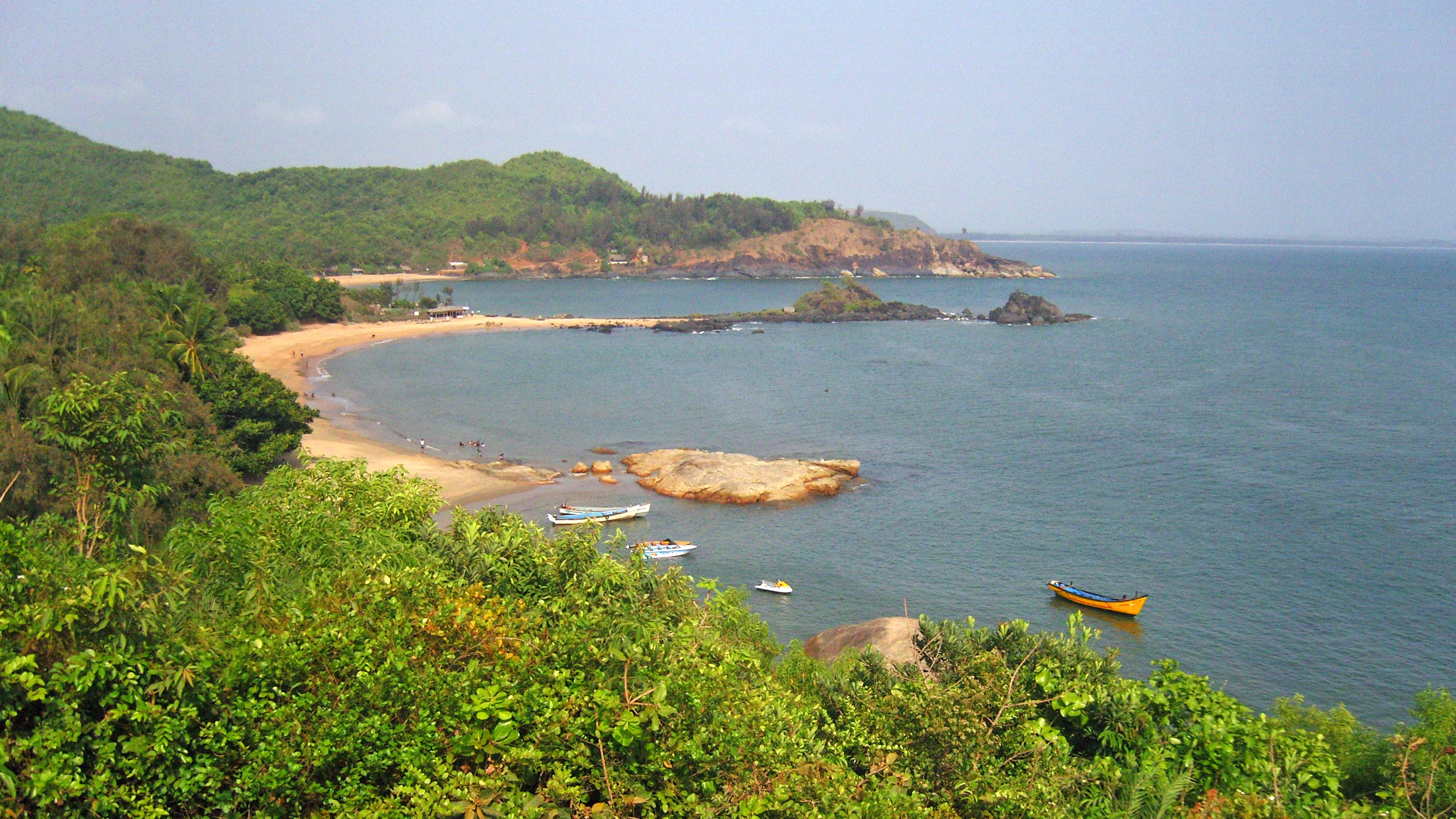
| image_caption = | | image_caption = Gokarna Om Beach | ||
| pushpin_map = India Karnataka#India | | pushpin_map = India Karnataka#India | ||
| pushpin_label_position = right | | pushpin_label_position = right | ||
| Line 21: | Line 22: | ||
| subdivision_type1 = [[States and territories of India|State]] | | subdivision_type1 = [[States and territories of India|State]] | ||
| subdivision_name1 = [[Karnataka]] | | subdivision_name1 = [[Karnataka]] | ||
| subdivision_type2 = [[List of districts of India|District]] | | subdivision_type2 = Region | ||
| | | subdivision_name2 = [[Karavali]] | ||
| subdivision_type3 = [[List of districts of India|District]] | |||
| subdivision_name3 = [[Uttara Kannada]] | |||
| subdivision_type4 = [[Tehsil]] | |||
| subdivision_name4 = [[Kumta]] | |||
| established_title = <!-- Established --> | | established_title = <!-- Established --> | ||
| established_date = | | established_date = | ||
| Line 49: | Line 54: | ||
| postal_code = | | postal_code = | ||
| registration_plate = [[List of RTO districts in India#KA.E2.80.94Karnataka|KA]]-47 | | registration_plate = [[List of RTO districts in India#KA.E2.80.94Karnataka|KA]]-47 | ||
| website = | | website = {{Url|http://uttarakannada.nic.in/tourism.html}} | ||
| footnotes = | | footnotes = | ||
}} | }} | ||
'''Gokarna''' is a small temple town | '''Gokarna''' is a small temple town located in the [[Uttara Kannada]] district of [[Karnataka]] state in southern [[India]],<ref>{{Cite web|url=http://www.fallingrain.com/world/IN/28/Gokarna.html|title=Maps, Weather, and Airports for Gokarna, India|website=www.fallingrain.com|access-date=30 December 2019}}</ref> It has a population of around 20,000. [[Shiva]] the most worshipped deity in the town, and to whom its main temple, also known as [[Mahabaleshwar Temple, Gokarna|Mahabaleshwara]], is dedicated. At this temple is housed what is believed by some to be the earliest [[Shiva Linga]] (Atmalinga). | ||
Gokarna is known as one of | Gokarna is known as one of seven important centers of pilgrimage in [[Hinduism]]. It lies on what was once unspoiled coastline at the estuary of the [[River Aghanashini]]. Due to an increase in tourism, the character of the town has changed, and is no longer just a center of pilgrimage, though large numbers of Shiva devotees continue to visit for prayer and worship. | ||
Because of its calm, rustic nature, many younger, [[Western World|Western]] tourists began visiting the area in the 1990s, with enterpirising locals opening stores and restaurants to capitalize on this. In more recent years, a small number of resorts have opened which cater to wealthier tourists. | |||
== Etymology == | == Etymology == | ||
[[File: Kudle beach gokarna.jpg|thumb|View for Kudle beach seen from the north]] | [[File:Kudle beach gokarna.jpg|thumb|View for Kudle beach seen from the north]] | ||
Gokarna means ''cow's ear''. It is believed that [[Shiva]] emerged from the ear of a cow ([[Prithvi]], the Mother Earth) here. It is at the ear-shaped confluence of two rivers [[Gangavali River|Gangavali]] and [[River Aghanashini|Aghanashini]]. | |||
The Bhagavata Purana relates that 200 years into this current kali yuga a pious brahmana named Atmaveda was unable because of karma incurred in past lives to have any children in his current incarnation. Atmaveda was devastated by not being able to have children, and wandered into a forest to pray for help. There he met a Sannyasi, whom he implored to grant him and his wife the ability to have a child. The Sannyasi warned Atmaveda against opposing his karma, but finally relented and gave Atmaveda a fruit that his wife was to consume to have a child. Atmaveda's wife Dhundhuli did not want to go through the pain of pregnancy and childbirth, so she gave the fruit from the Sannyasi to her cow. A human child was born of the cow, human in all its parts except for its ears, which were cow ears. Because of this the child was named Gokarna. | |||
Gokarna is mentioned in the Shrimad [[Bhagavata Purana]] as being the home of the brothers Gokarna and Dhundhakari. | Gokarna is mentioned in the Shrimad [[Bhagavata Purana]] as being the home of the brothers Gokarna and Dhundhakari. | ||
| Line 74: | Line 81: | ||
Maha [[Vishnu]] learned that [[Ravana]] will become all powerful by worshipping the 'Atma Linga' and menace to the world and Ravana's conviction that nobody could defeat him, once he acquired the very power of Shiva. [[Maha Vishnu]] devised a plan to install the linga somewhere and as he thought that Ganapati was alone capable of doing it, he along with all the gods pleads [[Ganapati]] to execute the plan. Ganapati accepts and reaches Gokarna as a Brahmin boy. | Maha [[Vishnu]] learned that [[Ravana]] will become all powerful by worshipping the 'Atma Linga' and menace to the world and Ravana's conviction that nobody could defeat him, once he acquired the very power of Shiva. [[Maha Vishnu]] devised a plan to install the linga somewhere and as he thought that Ganapati was alone capable of doing it, he along with all the gods pleads [[Ganapati]] to execute the plan. Ganapati accepts and reaches Gokarna as a Brahmin boy. | ||
As Ravana was nearing Gokarna, Maha Vishnu who had known well that Ravana was punctual in performing his periodical rites ([[Sandyavandhana]]), hides sun with his Sudarshana Chakra (Wheel). Thinking that it was time to perform the evening rites, Ravana finds a Brahmin boy and asked him to hold the Atmalinga in his hand | As Ravana was nearing Gokarna, Maha Vishnu who had known well that Ravana was punctual in performing his periodical rites ([[Sandyavandhana]]), hides sun with his Sudarshana Chakra (Wheel). Thinking that it was time to perform the evening rites, Ravana finds a Brahmin boy and asked him to hold the Atmalinga in his hand until he came back after finishing the rites. [[Ganapati]] agreed to hold the linga on one condition that he would do so until he would be able to bear the weight of linga and that thereafter he would call Ravana three times and if failed to come to him by then he would place the linga on the earth. | ||
Ganapati calls Ravana three times when he was performing his rites and places the linga on the earth and he | Ganapati calls Ravana three times when he was performing his rites and places the linga on the earth and he vanishes. The Atmalinga at once got firmly entrenched in the earth. Ravana learned that he had been tricked by the Gods. The depressed demon king Ravana was deeply agitated and tried to pull up the linga, but the linga did not budge a little. It resulted in his throwing the coverings of the Linga to Dhareshwara, Gunavanteshwara, [[Murudeshwara]] and Shejjeshwar temples. Ravana was unable to lift the linga from the ground again and called the Shiva linga as ''Mahabala'', one with great strength, and ever since, the linga illustrious as Mahabaleshwara. Shiva learned all these from Vayu Deva, the god of wind, and came on to Earth with Goddess [[Parvathi]] devi and his train of Gods, he visited these five places and worshipped the linga which had now taken five forms. He acknowledged that these five places would be his "Pancha Kshetras" (Five Holy Places). | ||
Gokarna was part of the [[Sodhe]] and [[Vijayanagara Empire|Vijayanagar]] kingdoms. When the Konkan region — including [[Goa]] — was occupied by the Portuguese, it became part of their rule. | Gokarna was part of the [[Sodhe]] and [[Vijayanagara Empire|Vijayanagar]] kingdoms. When the Konkan region — including [[Goa]] — was occupied by the Portuguese, it became part of their rule. | ||
| Line 83: | Line 90: | ||
[[File:Om beach Gokarna.JPG|thumb|Boating services seen in Om beach, 5km from Gokarna]] | [[File:Om beach Gokarna.JPG|thumb|Boating services seen in Om beach, 5km from Gokarna]] | ||
[[File:om beach gokarna sun bathing.JPG|thumb|A tourist [[sun bathing]] in Om beach]] | [[File:om beach gokarna sun bathing.JPG|thumb|A tourist [[sun bathing]] in Om beach]] | ||
Gokarna is about 238 km north of [[Mangalore]], 483 km from [[Bengaluru]] and about 59 km from [[Karwar]]. It is between the Gangavali and | Gokarna is about 238 km north of [[Mangalore]], 483 km from [[Bengaluru]] and about 59 km from [[Karwar]]. It is between the Gangavali and Aghanashini rivers along the Karwar coast by the Arabian Sea. It is 200 km north from the college towns of [[Suratkal]] and [[Manipal]]. | ||
<!-- [[File:India_Karnataka_Gokarna_Landscape.jpg|thumb|200px|Landscape of Gokarna]] --> | <!-- [[File:India_Karnataka_Gokarna_Landscape.jpg|thumb|200px|Landscape of Gokarna]] --> | ||
<!-- [[File:OmBeach Rocks.jpg|thumb|200px|Om beach rocks at Gokarna]] --> | <!-- [[File:OmBeach Rocks.jpg|thumb|200px|Om beach rocks at Gokarna]] --> | ||
Gokarna can be reached by buses and maxicabs from Kumta (30 km), Ankola (26 km), Karwar (59 km) and Bhatkal(88 km) on National Highway | Gokarna can be reached by buses and maxicabs from Kumta (30 km), Ankola (26 km), Karwar (59 km) and Bhatkal (88 km) on National Highway 66 ([[NH-66]]). Karnataka State Road Transport Corporation (KSRTC) runs long-journey buses from cities like [[Panaji]], [[Bengaluru]] and [[Mangalore]]. Private buses (Vijayanand Roadlines - VRL, Sugama, Sea Bird, etc.) operate night journeys from the capital city of Bengaluru to Gokarna daily. | ||
It can be reached by [[Konkan Railway]] on the [[Mumbai]] to [[Mangalore]] route or [[Goa]] to [[Mangalore]] route. The railway station (called Gokarna Road) is | It can be reached by [[Konkan Railway]] on the [[Mumbai]] to [[Mangalore]] route or [[Goa]] to [[Mangalore]] route. The railway station (called Gokarna Road) is 10 km from the town. The station has a retiring room at a nominal price. Many important trains like [[Matsyagandha Express]], KSR Bengaluru Karwar Express, [[Poorna Express]], [[Marusagar Express]] and Mangalore Local and DEMU local are the Daily Local Trains halt here.<ref>{{Cite web|url=https://www.lonelyplanet.com/india/karnataka/gokarna|title=Gokarna - Lonely Planet|last=Planet|first=Lonely|website=Lonely Planet|access-date=26 October 2016}}</ref> | ||
The nearest airports are [[Hubli]] Airport, Karnataka which has domestic flights only, [[Goa International Airport]] at Goa and [[Mangalore International Airport]] at [[Bajpe]], [[Karnataka]] are the nearest airports to reach at Gokarna. | The nearest airports are [[Hubli]] Airport, Karnataka which has domestic flights only, [[Goa International Airport]] at Goa and [[Mangalore International Airport]] at [[Bajpe]], [[Karnataka]] are the nearest airports to reach at Gokarna. | ||
| Line 150: | Line 157: | ||
* [[Bhookailasa (1940 film)|''Bhookailasa'' (1940 film)]] | * [[Bhookailasa (1940 film)|''Bhookailasa'' (1940 film)]] | ||
* [[Murudeshwara]] | * [[Murudeshwara]] | ||
* [[Apsarakonda]] | |||
* [[Karwar]] | * [[Karwar]] | ||
* [[Mangalore]] | * [[Mangalore]] | ||
* [[Om Parvat]] | |||
== References == | == References == | ||
| Line 158: | Line 167: | ||
==External links== | ==External links== | ||
* [https://web.archive.org/web/20110721084607/http://www.chitrapurmath.net/our_maths/gokarn.asp Gokarn Math] | * [https://web.archive.org/web/20110721084607/http://www.chitrapurmath.net/our_maths/gokarn.asp Gokarn Math] | ||
* [http://www.srigokarna.org/ Official Website of Gokarna Temple] {{in lang|kn}} | * [http://www.srigokarna.org/ Official Website of Gokarna Temple] {{in lang|kn}} | ||
*[https://templeknowledge.com/mahabaleshwar-temple-gokarna/ tour guide Gokarna Temple] | |||
{{Uttara Kannada}} | {{Uttara Kannada}} | ||
Latest revision as of 06:09, 22 July 2023
Gokarna | |
|---|---|
town | |
 Gokarna Om Beach | |
  Gokarna Location in Karnataka, India  Gokarna Gokarna (India) | |
| Coordinates: 14°33′00″N 74°19′00″E / 14.55°N 74.31667°E | |
| Country |  India India |
| State | Karnataka |
| Region | Karavali |
| District | Uttara Kannada |
| Tehsil | Kumta |
| Area | |
| • Total | 10.9 km2 (4.2 sq mi) |
| Elevation | 22 m (72 ft) |
| Population (2001) | |
| • Total | 25,851 |
| • Density | 2,400/km2 (6,100/sq mi) |
| Languages | |
| • Official | Kannada |
| Time zone | UTC+5:30 (IST) |
| Vehicle registration | KA-47 |
| Website | uttarakannada |
Gokarna is a small temple town located in the Uttara Kannada district of Karnataka state in southern India,[1] It has a population of around 20,000. Shiva the most worshipped deity in the town, and to whom its main temple, also known as Mahabaleshwara, is dedicated. At this temple is housed what is believed by some to be the earliest Shiva Linga (Atmalinga).
Gokarna is known as one of seven important centers of pilgrimage in Hinduism. It lies on what was once unspoiled coastline at the estuary of the River Aghanashini. Due to an increase in tourism, the character of the town has changed, and is no longer just a center of pilgrimage, though large numbers of Shiva devotees continue to visit for prayer and worship.
Because of its calm, rustic nature, many younger, Western tourists began visiting the area in the 1990s, with enterpirising locals opening stores and restaurants to capitalize on this. In more recent years, a small number of resorts have opened which cater to wealthier tourists.
Etymology[edit | edit source]

Gokarna means cow's ear. It is believed that Shiva emerged from the ear of a cow (Prithvi, the Mother Earth) here. It is at the ear-shaped confluence of two rivers Gangavali and Aghanashini.
The Bhagavata Purana relates that 200 years into this current kali yuga a pious brahmana named Atmaveda was unable because of karma incurred in past lives to have any children in his current incarnation. Atmaveda was devastated by not being able to have children, and wandered into a forest to pray for help. There he met a Sannyasi, whom he implored to grant him and his wife the ability to have a child. The Sannyasi warned Atmaveda against opposing his karma, but finally relented and gave Atmaveda a fruit that his wife was to consume to have a child. Atmaveda's wife Dhundhuli did not want to go through the pain of pregnancy and childbirth, so she gave the fruit from the Sannyasi to her cow. A human child was born of the cow, human in all its parts except for its ears, which were cow ears. Because of this the child was named Gokarna.
Gokarna is mentioned in the Shrimad Bhagavata Purana as being the home of the brothers Gokarna and Dhundhakari.
In order that Brahma who out of arrogance arising out of his power to create the universe, sat penancing to redeem himself from curse of Shiva, the latter appeared in front of him from the ears of a cow. So the place came to be known as Gokarna or ear of the cow. Hindu Puranas says that when Parashurama, the sixth avatar of Vishnu created Kerala, it was from Gokarna to Kanyakumari.
As per legend, Ravana was given Atmalinga by Shiva and instructed that it would stay permanently where it is first placed on the land. But Ganesha came in the form of a boy and planted it in Gokarna while Ravana was performing rituals. Once placed Ravana could not remove it from the ground, but he removed some pieces of the Linga and threw them in different directions.[2][3]
Geography[edit | edit source]
Legend[edit | edit source]
The earliest history of the city is in Treta Yuga, Ravana (Demon/Asura King of Lanka) reaches Kailasa and performed rigorous penance to get the "Atma Linga" from Shiva, as Ravana's mother expressed a keen desire to worship the atmalinga of Lord Shiva.[4][5] After a long penance, Shiva gave the Atma linga to Ravana as a boon and instructs Ravana to carry it home by walk, that he should never place it on the earth even for a short while failing which the linga would get eternally embedded at the place where he broke his commands.
Maha Vishnu learned that Ravana will become all powerful by worshipping the 'Atma Linga' and menace to the world and Ravana's conviction that nobody could defeat him, once he acquired the very power of Shiva. Maha Vishnu devised a plan to install the linga somewhere and as he thought that Ganapati was alone capable of doing it, he along with all the gods pleads Ganapati to execute the plan. Ganapati accepts and reaches Gokarna as a Brahmin boy.
As Ravana was nearing Gokarna, Maha Vishnu who had known well that Ravana was punctual in performing his periodical rites (Sandyavandhana), hides sun with his Sudarshana Chakra (Wheel). Thinking that it was time to perform the evening rites, Ravana finds a Brahmin boy and asked him to hold the Atmalinga in his hand until he came back after finishing the rites. Ganapati agreed to hold the linga on one condition that he would do so until he would be able to bear the weight of linga and that thereafter he would call Ravana three times and if failed to come to him by then he would place the linga on the earth.
Ganapati calls Ravana three times when he was performing his rites and places the linga on the earth and he vanishes. The Atmalinga at once got firmly entrenched in the earth. Ravana learned that he had been tricked by the Gods. The depressed demon king Ravana was deeply agitated and tried to pull up the linga, but the linga did not budge a little. It resulted in his throwing the coverings of the Linga to Dhareshwara, Gunavanteshwara, Murudeshwara and Shejjeshwar temples. Ravana was unable to lift the linga from the ground again and called the Shiva linga as Mahabala, one with great strength, and ever since, the linga illustrious as Mahabaleshwara. Shiva learned all these from Vayu Deva, the god of wind, and came on to Earth with Goddess Parvathi devi and his train of Gods, he visited these five places and worshipped the linga which had now taken five forms. He acknowledged that these five places would be his "Pancha Kshetras" (Five Holy Places).
Gokarna was part of the Sodhe and Vijayanagar kingdoms. When the Konkan region — including Goa — was occupied by the Portuguese, it became part of their rule.
Location[edit | edit source]

Gokarna is about 238 km north of Mangalore, 483 km from Bengaluru and about 59 km from Karwar. It is between the Gangavali and Aghanashini rivers along the Karwar coast by the Arabian Sea. It is 200 km north from the college towns of Suratkal and Manipal.
Gokarna can be reached by buses and maxicabs from Kumta (30 km), Ankola (26 km), Karwar (59 km) and Bhatkal (88 km) on National Highway 66 (NH-66). Karnataka State Road Transport Corporation (KSRTC) runs long-journey buses from cities like Panaji, Bengaluru and Mangalore. Private buses (Vijayanand Roadlines - VRL, Sugama, Sea Bird, etc.) operate night journeys from the capital city of Bengaluru to Gokarna daily.
It can be reached by Konkan Railway on the Mumbai to Mangalore route or Goa to Mangalore route. The railway station (called Gokarna Road) is 10 km from the town. The station has a retiring room at a nominal price. Many important trains like Matsyagandha Express, KSR Bengaluru Karwar Express, Poorna Express, Marusagar Express and Mangalore Local and DEMU local are the Daily Local Trains halt here.[6]
The nearest airports are Hubli Airport, Karnataka which has domestic flights only, Goa International Airport at Goa and Mangalore International Airport at Bajpe, Karnataka are the nearest airports to reach at Gokarna.
Neighbouring villages are Bankikodla-Hanehalli, Sanikatta, Tadadi, Torke, Madangere, Maskeri, Adigone, Nelaguni and Bijjur.
Climate[edit | edit source]
| Climate data for Gokarna | |||||||||||||
|---|---|---|---|---|---|---|---|---|---|---|---|---|---|
| Month | Jan | Feb | Mar | Apr | May | Jun | Jul | Aug | Sep | Oct | Nov | Dec | Year |
| Average high °C (°F) | 31.8 (89.2) |
31.4 (88.5) |
32.3 (90.1) |
33.0 (91.4) |
29.5 (85.1) |
29.8 (85.6) |
28.7 (83.7) |
28.6 (83.5) |
29.1 (84.4) |
30.9 (87.6) |
32.3 (90.1) |
32.3 (90.1) |
30.8 (87.4) |
| Average low °C (°F) | 20.1 (68.2) |
20.7 (69.3) |
23.0 (73.4) |
25.4 (77.7) |
26.1 (79.0) |
24.3 (75.7) |
23.8 (74.8) |
23.8 (74.8) |
23.4 (74.1) |
23.4 (74.1) |
22.1 (71.8) |
20.9 (69.6) |
23.1 (73.5) |
| Average precipitation mm (inches) | 0 (0) |
0 (0) |
1 (0.0) |
11 (0.4) |
184 (7.2) |
980 (38.6) |
1,227 (48.3) |
665 (26.2) |
366 (14.4) |
157 (6.2) |
49 (1.9) |
9 (0.4) |
3,649 (143.6) |
| Source: http://en.climate-data.org/location/172162/ | |||||||||||||
Beaches[edit | edit source]
The drive up the winding path that leads to Gokarna is scenic, with the rocky mountains and Western Ghats on one side and the Arabian Sea on the other. Gokarna is known for the beaches. The Gokarna main beach is in town and Kudle beach are west facing. Om beach, Half moon Beach, Paradise Beach (also known as Full moon) and Belekan beach are south facing.[7]
The Gokarna beach forms the coast of the town and is followed by Main beach in northern direction while the other four beaches lie to the south. Gokarna Main Beach is mainly used by Indian pilgrims. Main Beach is a long open beach, known for surfing. Kudle and Om are around 6 km from Gokarna town along a muddy hill; they are accessible by rickshaw or foot. Half moon and Paradise are beyond Om beach and are accessible only by trekking or boat. Om beach is named so because it is shaped like the auspicious ॐ Om symbol. Om beach is a naturally Om-shaped beach,[8] it attracts local tourists on weekends. It has a few shacks and eateries, and also boat service to other beaches.
See also[edit | edit source]
References[edit | edit source]
- ↑ "Maps, Weather, and Airports for Gokarna, India". www.fallingrain.com. Retrieved 30 December 2019.
- ↑ "Yahoo". Yahoo. Retrieved 26 October 2016.
- ↑ WPBlogger, Truper &. "The Curse of Gokarna: The history of an Indian village » Old World Wandering: A Travelogue". Retrieved 26 October 2016.
- ↑ "Gokarna - Story of Ravana - Ghumakkar - Inspiring travel experiences". Ghumakkar - Inspiring travel experiences. 25 April 2012. Retrieved 26 October 2016.
- ↑ "Gokarna Mahabaleshwara Temple, Gokarna Beach, Gokarna Siddi Kshetra, Gokarna Lord Shiva's Atmalinga, Gokarna Travel Destination". www.karnatakavision.com. Retrieved 26 October 2016.
- ↑ Planet, Lonely. "Gokarna - Lonely Planet". Lonely Planet. Retrieved 26 October 2016.
- ↑ Lonely Planet (21 January 2016). "Beaches". Lonely Planet. Retrieved 21 January 2016.
- ↑ "Beaches".
- Source: Karnataka State Gazetteer 1983