|
|
| (One intermediate revision by one other user not shown) |
| Line 1: |
Line 1: |
| {{Redirect|Nippon|other uses|Japan (disambiguation)|and|Nippon (disambiguation)}} | | {{Redirect|NIPPON|other uses|Japan (disambiguation)|and|Nippon (disambiguation)}}{{Infobox country |
| {{Use American English|date=December 2020}}
| | | conventional_long_name = Japan |
| {{Short description|Country in East Asia}}
| | | common_name = Japan |
| {{Use mdy dates|date=January 2021}}
| | | linking_name = Japan |
| {{bots|deny=Citation bot}}
| | | native_name = {{unbulleted list|{{native name|ja|日本国|italics=off|paren=omit}} or {{native name|ja|日本|italics=off}}{{efn|name=fn1|In English, the official name of the country is simply "Japan".<ref>{{cite web |title=Official Names of Member States (UNTERM) |url=https://protocol.un.org/dgacm/pls/site.nsf/files/Country%20Names%20UNTERM3/$FILE/UNTERM%20-%20EFSRCA.pdf |publisher=UN Protocol and Liaison Service |accessdate=May 21, 2020 |archive-date=June 5, 2020 |archive-url=https://web.archive.org/web/20200605193554/https://protocol.un.org/dgacm/pls/site.nsf/files/Country%20Names%20UNTERM3/$FILE/UNTERM%20-%20EFSRCA.pdf |url-status=dead }}</ref> In Japanese, the name of the country as it appears on official documents, including the [[Constitution of Japan|country's constitution]], is {{lang-ja|日本|label=none}} ( {{audio|help=no|Ja-nippon nihonkoku.ogg|''Nippon-koku''}} or ''Nihon-koku''), meaning "State of Japan". Despite this, the short-form name 日本 (''Nippon'' or ''Nihon'') is often used officially.}}|{{small|''Nippon-koku'' or ''Nihon-koku''<br>''Nippon'' or ''Nihon''}}}} |
| {{Featured article}}
| | | image_flag = Flag of Japan.svg |
| {{pp-semi-indef}}
| | | alt_flag = Centered deep red circle on a white rectangle<ref>{{cite web|title=National Flag and National Anthem|url=http://www.japan.go.jp/culture/flagandanthem.html|quote=The Rising Sun Flag and "Kimi Ga Yo" are respectively the national flag and anthem of Japan. This was formalized in 1999 with the Law Regarding the National Flag and National Anthem.|accessdate=January 29, 2017}}</ref> |
| {{Infobox country | | | image_coat = Imperial Seal of Japan.svg |
| | conventional_long_name = Japan | | | alt_coat = Golden circle subdivided by golden wedges with rounded outer edges and thin black outlines |
| | common_name = Japan | | | symbol_type = Imperial Seal |
| | native_name = {{unbulleted list|{{native name|ja|日本国|italics=off|paren=omit}} or {{native name|ja|日本|italics=off}}{{efn|name=fn1|In English, the official name of the country is simply "Japan".<ref>{{cite web |title=Official Names of Member States (UNTERM) |url=https://protocol.un.org/dgacm/pls/site.nsf/files/Country%20Names%20UNTERM3/$FILE/UNTERM%20-%20EFSRCA.pdf |publisher=UN Protocol and Liaison Service |accessdate=May 21, 2020}}</ref> In Japanese, the name of the country as it appears on official documents, including the [[Constitution of Japan|country's constitution]], is {{lang-ja|日本国|label=none}} ( {{audio|help=no|Ja-nippon nihonkoku.ogg|''Nippon-koku''}} or ''Nihon-koku''), meaning "State of Japan". Despite this, the short-form name 日本 (''Nippon'' or ''Nihon'') is often used officially.}}|{{small|''Nippon-koku'' or ''Nihon-koku''<br>''Nippon'' or ''Nihon''}}}} | | | other_symbol = {{unbulleted list |[[File:Goshichi no kiri.svg|75x75px|Seal of the Office of the Prime Minister and the Government of Japan]]|{{larger|{{nihongo||五七桐|Go-Shichi no Kiri}}}}}} |
| | image_flag = Flag of Japan.svg | | | other_symbol_type = [[Government Seal of Japan]] |
| | alt_flag = Centered deep red circle on a white rectangle | | | national_anthem = {{unbulleted list|"''[[Kimigayo]]''"|{{lower|0.25em|{{big|{{Nihongo2|君が代}}}}}}}}<br>{{small|"His Imperial Majesty's Reign"}}<ref>{{cite web|title=Explore Japan National Flag and National Anthem|url=http://web-japan.org/kidsweb/explore/national/index.html|accessdate=January 29, 2017}}</ref><ref>{{cite web|title=National Symbols|url=http://www.japan-guide.com/e/e2270.html|accessdate=January 29, 2017|url-status=dead|archiveurl=https://web.archive.org/web/20170202040038/http://www.japan-guide.com/e/e2270.html|archivedate=February 2, 2017|df=mdy-all}}</ref><br>[[File:Kimi ga Yo instrumental.ogg|center]] |
| | image_coat = Imperial Seal of Japan.svg | | | image_map = Japan (orthographic projection).svg |
| | alt_coat = Golden circle subdivided by golden wedges with rounded outer edges and thin black outlines | | | map_width = 220px |
| | symbol_type = Imperial Seal | | | alt_map = Projection of Asia with Japan's Area coloured green |
| | other_symbol = <div style="padding:0.2em;">[[File:Goshichi no kiri.svg|80px|Seal of the Office of the Prime Minister and the Government of Japan]]</div> | | | map_caption = Area controlled by Japan shown in green—claimed, but uncontrolled shown in light green |
| | other_symbol_type = [[Government Seal of Japan|Government Seal]] | | | capital = [[Tokyo]]<ref>{{cite web|title=History of Tokyo|url=http://www.metro.tokyo.jp/ENGLISH/ABOUT/HISTORY/history01.htm|quote=The Edo Period lasted for nearly 260 years until the Meiji Restoration in 1868, when the Tokugawa Shogunate ended and imperial rule was restored. The Emperor moved to Edo, which was renamed Tokyo. Thus, Tokyo became the capital of Japan|accessdate=January 29, 2017}}</ref> |
| | national_anthem = {{Nihongo|"[[Kimigayo]]"|君が代|italics=off}}<div style="display:inline-block;margin-top:0.4em;">{{small|"His Imperial Majesty's Reign"}}<ref>{{cite web|title=Explore Japan National Flag and National Anthem|url=http://web-japan.org/kidsweb/explore/national/index.html|accessdate=January 29, 2017}}</ref><ref>{{cite web|title=National Symbols|url=http://www.japan-guide.com/e/e2270.html|accessdate=January 29, 2017|url-status=dead|archiveurl=https://web.archive.org/web/20170202040038/http://www.japan-guide.com/e/e2270.html|archivedate=February 2, 2017|df=mdy-all}}</ref>{{center|[[File:Kimi ga Yo instrumental.ogg]]}}</div> | | | coordinates = {{Coord|35|41|N|139|46|E|type:city}} |
| | image_map = Japan (orthographic projection).svg | | | largest_city = capital |
| | alt_map = Projection of Asia with Japan's Area colored green | | | languages_type = [[National language]] |
| | map_caption = Japanese territory in dark green; [[Territorial disputes of Japan|claimed but uncontrolled territory]] in light green | | | languages = [[Japanese language|Japanese]] |
| | capital = [[Tokyo]] | | | ethnic_groups = {{unbulleted list |
| | coordinates = {{Coord|35|41|N|139|46|E|type:city}}
| | |98.5% [[Japanese people|Japanese]] |
| | largest_city = capital
| | |0.5% [[Koreans in Japan|Korean]] |
| | languages_type = [[National language]]
| | |0.4% [[Chinese people|Chinese]] |
| | languages = [[Japanese language|Japanese]]
| | |0.6% other |
| | government_type = [[Unitary state|Unitary]] [[Parliamentary system|parliamentary]] [[constitutional monarchy]]
| |
| | leader_title1 = [[Emperor of Japan|Emperor]]
| |
| | leader_name1 = [[Naruhito]]
| |
| | leader_title2 = [[Prime Minister of Japan|Prime Minister]]
| |
| | leader_name2 = [[Yoshihide Suga]]
| |
| | legislature = [[National Diet]]
| |
| | upper_house = [[House of Councillors (Japan)|House of Councillors]]
| |
| | lower_house = [[House of Representatives (Japan)|House of Representatives]]
| |
| | sovereignty_type = [[History of Japan|Formation]]
| |
| | established_event1 = [[Yamato Dynasty|Imperial Dynasty established]]
| |
| | established_date1 = February 11, 660 BC
| |
| | established_event2 = [[Meiji Constitution|Meiji constitution]]
| |
| | established_date2 = November 29, 1890
| |
| | established_event3 = {{nowrap|[[Constitution of Japan|Current constitution]]}}
| |
| | established_date3 = May 3, 1947
| |
| | area_km2 = 377,975
| |
| | area_footnote = <ref name="area-2019">{{cite web |script-title=ja:令和元年全国都道府県市区町村別面積調(10月1日時点) |url=https://www.gsi.go.jp/KOKUJYOHO/MENCHO201910-index.html |publisher=[[Geospatial Information Authority of Japan]] |language=ja |date=December 26, 2019 |archive-url=https://web.archive.org/web/20200415123703/https://www.gsi.go.jp/KOKUJYOHO/MENCHO201910-index.html |archive-date=April 15, 2020 |url-status=dead }}</ref>
| |
| | percent_water = 1.4 (as of 2015)<ref>{{cite web |title=Surface water and surface water change |access-date=October 11, 2020 |publisher=OECD |url=https://stats.oecd.org/Index.aspx?DataSetCode=SURFACE_WATER#}}</ref>
| |
| | area_rank = 62nd <!-- Area rank should match [[List of countries and dependencies by area]] -->
| |
| | population_estimate = {{decrease neutral}} 125,360,000<ref>{{cite web |title=Population Estimates Monthly Report July 2021) |url=https://www.stat.go.jp/english/data/jinsui/tsuki/index.html |publisher=[[Statistics Bureau (Japan)|Statistics Bureau of Japan]] |date=July 20, 2021}}</ref>
| |
| | population_estimate_rank = 11th | |
| | population_estimate_year = 2021
| |
| | population_census = 126,226,568<ref>{{cite web |url=https://www.e-stat.go.jp/en/stat-search/files?page=1&layout=datalist&toukei=00200521&tstat=000001136464&cycle=0&year=20200&month=24101210&tclass1=000001136465&tclass2=000001154388&tclass3val=0 |title=2020 Population Census Preliminary Tabulation |accessdate=June 26, 2021 |publisher=[[Statistics Bureau (Japan)|Statistics Bureau of Japan]]}}</ref>
| |
| | population_census_year = 2020 | |
| | population_census_rank = | |
| | population_density_km2 = 334
| |
| | population_density_rank = 24th
| |
| | GDP_PPP = {{increase}} $5.586 trillion<ref name="IMFWEOJP">{{cite web |url=https://www.imf.org/en/Publications/WEO/weo-database/2021/April/weo-report?c=158,&s=NGDP_RPCH,NGDPD,PPPGDP,NGDPDPC,PPPPC,&sy=2019&ey=2026&ssm=0&scsm=1&scc=0&ssd=1&ssc=0&sic=0&sort=country&ds=.&br=1 |title=World Economic Outlook database: April 2021 |publisher=[[International Monetary Fund]] |date=April 2021}}</ref>
| |
| | GDP_PPP_year = 2021 | |
| | GDP_PPP_rank = 4th | |
| | GDP_PPP_per_capita = {{increase}} $44,585
| |
| | GDP_PPP_per_capita_rank = 27th
| |
| | GDP_nominal = {{increase}} $5.378 trillion<ref name="IMFWEOJP" />
| |
| | GDP_nominal_year = 2021
| |
| | GDP_nominal_rank = 3rd
| |
| | GDP_nominal_per_capita = {{increase}} $42,928
| |
| | GDP_nominal_per_capita_rank = 23rd
| |
| | Gini = 33.4 <!-- Number only. -->
| |
| | Gini_year = 2018
| |
| | Gini_change = decrease<!-- Increase/decrease/steady. -->
| |
| | Gini_ref = <ref>{{cite encyclopedia|url=https://data.oecd.org/inequality/income-inequality.htm|title=Inequality - Income inequality - OECD Data|publisher=[[Organisation for Economic Co-operation and Development|OECD]]|access-date=25 July 2021}}</ref>
| |
| | Gini_rank = 78th
| |
| | HDI = 0.919 <!-- Number only, between 0 and 1. -->
| |
| | HDI_year = 2019<!-- Please use the year to which the data refers, not the publication year. -->
| |
| | HDI_change = increase <!-- Increase/decrease/steady. -->
| |
| | HDI_ref = <ref name="UNHDR">{{cite web|url=http://hdr.undp.org/sites/default/files/hdr2020.pdf|title=Human Development Report 2020|language=en|publisher=[[United Nations Development Programme]]|date=December 15, 2020|accessdate=December 15, 2020}}</ref>
| |
| | HDI_rank = 19th | |
| | currency = [[Japanese yen]] (¥)
| |
| | time_zone = [[Japan Standard Time|JST]] | |
| | utc_offset = +09:00 | |
| | drives_on = [[Left- and right-hand traffic|left]] | |
| | calling_code = [[Telephone numbers in Japan|+81]] | |
| | cctld = [[.jp]] | |
| | official_website = <!----- do not add www.japan.go.jp – The article is about the country, not the government -----> | |
| | demonym = Japanese
| |
| | today =
| |
| }} | | }} |
| '''Japan''' ({{lang-ja|日本}}, ''Nippon'' {{IPA-ja|ɲippoꜜɴ||ja-nippon(日本).ogg}} or ''Nihon'' {{IPA-ja|ɲihoꜜɴ||ja-nihon(日本).ogg}}) is an [[island country]] in [[East Asia]], located in the northwest [[Pacific Ocean]]. It is bordered on the west by the [[Sea of Japan]], and extends from the [[Sea of Okhotsk]] in the north toward the [[East China Sea]] and [[Taiwan]] in the south. Part of the [[Ring of Fire]], Japan spans [[Japanese archipelago|an archipelago]] of [[List of islands of Japan|6852 islands]] covering {{convert|377,975|km2|mi2|sp=us|abbr=}}; the five main islands are [[Hokkaido]], [[Honshu]], [[Shikoku]], [[Kyushu]], and [[Okinawa Island|Okinawa]]. [[Tokyo]] is Japan's capital and largest city; other major cities include [[Yokohama]], [[Osaka]], [[Nagoya]], [[Sapporo]], [[Fukuoka]], [[Kobe]], and [[Kyoto]]. | | | ethnic_groups_year = 2011{{lower|0.4em|<ref name="cia">{{cite web |url=https://www.cia.gov/library/publications/the-world-factbook/geos/ja.html |title=CIA Factbook: Japan |publisher=Cia.gov |accessdate=November 9, 2011 |archive-date=December 20, 2015 |archive-url=https://web.archive.org/web/20151220044055/https://www.cia.gov/library/publications/the-world-factbook/geos/ja.html |url-status=dead }}</ref>}} |
| | | demonym = [[Japanese people|Japanese]] |
| | | government_type = [[Unitary state|Unitary]] [[Parliamentary system|parliamentary]] [[constitutional monarchy]] |
| | | leader_title1 = [[Emperor of Japan|Emperor]] |
| | | leader_name1 = [[Naruhito, Crown Prince of Japan|Naruhito]] |
| | | leader_title2 = [[Prime Minister of Japan|Prime Minister]] |
| | | leader_name2 = [[Fumio Kishida]] |
| | | leader_title3 = [[Deputy Prime Minister of Japan|Deputy Prime Minister]] |
| | | leader_name3 = Vacant |
| | | legislature = [[National Diet]] |
| | | upper_house = [[House of Councillors (Japan)|House of Councillors]] |
| | | lower_house = [[House of Representatives (Japan)|House of Representatives]] |
| | | sovereignty_type = [[History of Japan|Formation]] |
| | | established_event1 = [[National Foundation Day]] |
| | | established_date1 = February 11, 660 BCE<ref>According to legend, Japan was founded on this date by [[Emperor Jimmu]], the country's first Emperor.</ref> |
| | | established_event2 = [[Meiji Constitution]] |
| | | established_date2 = November 29, 1890 |
| | | established_event3 = {{nowrap|[[Constitution of Japan|Current constitution]]}} |
| | | established_date3 = May 3, 1947 |
| | | established_event4 = |
| | | established_date4 = |
| | | established_event5 = |
| | | established_date5 = |
| | | area_km2 = 377,972 |
| | | area_footnote = <ref>{{cite web|title=Facts about Japan, General Information|url=http://www.japan.go.jp/japan/facts/|accessdate=January 29, 2017}}</ref> |
| | | area_rank = 61st <!-- Area rank should match [[List of countries and dependencies by area]] --> |
| | | area_sq_mi = {{convert|377972|km2|sqmi|disp=output number only}}<!-- Do not remove per [[WP:MOSNUM]]. --> |
| | | percent_water = 1.40 (as of 2015)<ref>{{cite web|title=Surface water and surface water change|access-date=October 11, 2020|publisher=OECD|url=https://stats.oecd.org/Index.aspx?DataSetCode=SURFACE_WATER#}}</ref> |
| | | population_census = 126,572,604<ref>{{cite web|url=http://www.e-stat.go.jp/SG1/estat/GL08020101.do?_toGL08020101_&tstatCode=000001080615&requestSender=search|title=最新結果一覧 政府統計の総合窓口 GL08020101|publisher=Statistics Bureau of Japan|accessdate=April 27, 2016}}</ref> |
| | | population_census_year = 2017 |
| | | population_census_rank = 10th |
| | | population_density_km2 = 336 |
| | | population_density_rank = 36th |
| | | GDP_PPP = $5.420 trillion<ref name="imf2">{{cite web|title=World Economic Outlook Database, April 2017 – Report for Selected Countries and Subjects|url=http://www.imf.org/external/pubs/ft/weo/2017/01/weodata/weorept.aspx?sy=2014&ey=2022&scsm=1&ssd=1&sort=country&ds=.&br=1&c=158&s=NGDPD%2CNGDPDPC%2CPPPGDP%2CPPPPC%2CPPPEX&grp=0&a=&pr.x=87&pr.y=5|publisher=[[International Monetary Fund]] (IMF)|accessdate=April 21, 2016}}</ref> |
| | | GDP_PPP_year = 2017 |
| | | GDP_PPP_rank = 4th |
| | | GDP_PPP_per_capita = $42,960<ref name=imf2/> |
| | | GDP_PPP_per_capita_rank = 27th |
| | | GDP_nominal = $4.841 trillion<ref name=imf2/> |
| | | GDP_nominal_year = 2017 |
| | | GDP_nominal_rank = 3rd |
| | | GDP_nominal_per_capita = $38,281<ref name=imf2/> |
| | | GDP_nominal_per_capita_rank = 20th |
| | | Gini = 37.6 <!-- Number only. --> |
| | | Gini_year = 2008 |
| | | Gini_change = <!-- Increase/decrease/steady. --> |
| | | Gini_ref = <ref>{{cite web|title=World Factbook: Gini Index|url=https://www.cia.gov/library/publications/the-world-factbook/fields/2172.html|publisher=[[Central Intelligence Agency|CIA]]|accessdate=May 11, 2011|archive-date=June 13, 2007|archive-url=https://web.archive.org/web/20070613005439/https://www.cia.gov/library/publications/the-world-factbook/fields/2172.html|url-status=dead}}</ref> |
| | | Gini_rank = 76th |
| | | HDI = 0.903 <!-- Number only, between 0 and 1. --> |
| | | HDI_year = 2015<!-- Please use the year to which the data refers, not the publication year. --> |
| | | HDI_change = increase <!-- Increase/decrease/steady. --> |
| | | HDI_ref = <ref name="HDI">{{cite web |url=http://hdr.undp.org/sites/default/files/2016_human_development_report.pdf |title=2016 Human Development Report |year=2016 |accessdate=March 23, 2017 |publisher=United Nations Development Programme}}</ref> |
| | | HDI_rank = 17th |
| | | currency = [[Japanese yen|Yen]] (¥){{\}}{{transl|ja|''En''}} {{nihongo2|円}} |
| | | currency_code = JPY |
| | | time_zone = [[Japan Standard Time|JST]] |
| | | utc_offset = +9 |
| | | utc_offset_DST = +9 |
| | | time_zone_DST = not observed |
| | | date_format = {{unbulleted list|yyyy-mm-dd|yyyy年m月d日|{{nowrap|[[Japanese era name|Era]] yy年m月d日 {{small|([[Common Era|CE]]−1988)}}}}}} |
| | | drives_on = left |
| | | calling_code = [[Telephone numbers in Japan|+81]] |
| | | cctld = [[.jp]] |
| | | official_website = [http://www.japan.go.jp/index.html www.japan.go.jp] |
| | | religion = {{Unbulleted list|item_style=white-space:nowrap;|51.82% [[Shinto]]|34.9% [[Buddhism]]|4% [[Shinto sects and schools|Shinto sects]]|2.3% [[Christianity]]|7.0% No answer<ref name="Dentsu2006">Dentsu Communication Institute, Japan Research Center: ''[http://www2.ttcn.ne.jp/honkawa/9460.html Sixty Countries' Values Databook]'' (世界60カ国価値観データブック) (2000).</ref>}} |
| | | population_density_sq_mi = 882.7 <!-- Do not remove per [[WP:MOSNUM]]. --> |
| | | iso3166code = JP |
| | | today = |
| | }} |
| | {{Infobox Chinese |
| | | title = Japan |
| | | kanji = 日本国 |
| | | kyujitai = 日本國 |
| | | katakana = ニッポンコク<br>ニホンコク |
| | | hiragana = にっぽんこく<br>にほんこく |
| | | l = State of Japan |
| | | romaji = Nippon-koku<br>Nihon-koku |
| | | revhep = Nippon-koku<br>Nihon-koku |
| | }} |
| | |
| | '''Japan''' ({{lang-ja|日本}}; Romanised as ''nihon'' or ''nippon'') is a [[country]] in [[East Asia]]. It is a group of many [[island]]s close to the east coast of [[Korea]], [[China]] and [[Russia]]. The [[Pacific Ocean]] is to the east of Japan and the [[Sea of Japan]] is to the west.<ref name="CIA Factbook" /> Most people in Japan live on one of the four islands. The biggest of these islands, [[Honshu]], has the most people. Honshu is the 7th largest island in the [[world]]. [[Tokyo]] is the [[capital city|capital]] of Japan and its biggest city. |
| | |
| | The [[Japanese people]] call their country "Nihon" or "Nippon",<ref name="CIA Factbook">{{cite web|url=https://www.cia.gov/library/publications/the-world-factbook/geos/ja.html|title=Japan|publisher=CIA|accessdate=2016-06-19|work=CIA World Factbook|archive-date=2015-12-20|archive-url=https://web.archive.org/web/20151220044055/https://www.cia.gov/library/publications/the-world-factbook/geos/ja.html|url-status=dead}}</ref> which means "the origin of the [[Sun]]" in Japanese. Japan is a [[monarchy]] whose [[head of state]] is called the [[Emperor of Japan|Emperor]].<ref name="CIA Factbook" /> Japan is the oldest monarchy in the world, lasting more than 2,000 years.<ref name="BBC">{{cite news|url=https://www.bbc.com/news/world-asia-48133701|title=Emperor Naruhito and Japan's lonely republicans|last=Wong-Anan |first=Nopporn|publisher=BBC|accessdate=2022-01-18|work=BBC|date=3 May 2019 |archive-date=2019-05-03}}</ref> |
| | |
| | ==History of Japan== |
| | {{Main|History of Japan}}{{History of Japan}} |
| | The first people in Japan were the [[Ainu people]] and other [[Jōmon period|Jōmon people]]. They were closer related to [[Europe]]ans or [[Mongols]].<ref>{{Cite journal|title=Old World sources of the first New World human inhabitants: A comparative craniofacial view|last=Brace|first=C. Loring|journal=Proceedings of the National Academy of Sciences of the United States of America|year=2001|volume=98|issue=17|pages=10017–10022|doi=10.1073/pnas.171305898|pmid=11481450|pmc=55570|bibcode=2001PNAS...9810017L|doi-access=free}}</ref> They were later conquered and replaced by the [[Yayoi period|Yayoi people]] (early Japanese and Ryukyuans). The Yayoi were an ancient ethnic group that migrated to the Japanese archipelago mainly from [[China|southeastern China]] during the Yayoi period (300 BCE–300 CE). Modern [[Japanese people]] have primarily Yayoi ancestry at an average of 97%.<ref>https://www.biorxiv.org/content/biorxiv/early/2019/03/15/579177.full.pdf</ref><ref>{{Cite web|url=https://www.yomiuri.co.jp/fukayomi/20171214-OYT8T50003/|title=「縄文人」は独自進化したアジアの特異集団だった! : 深読み|date=2017-12-15|website=読売新聞オンライン|language=ja|access-date=2019-12-19}}</ref> The indigenous [[Ryukyuan people|Ryukyuan]] and [[Ainu people|Ainu]] peoples have more Jōmon ancestry on the other hand. |
|
| |
|
| Japan is the [[List of countries and dependencies by population|eleventh-most populous country]] in the world, as well as one of the [[List of countries and dependencies by population density|most densely populated]] and [[Urbanization by country|urbanized]]. About three-fourths of [[Geography of Japan|the country's terrain]] is mountainous, concentrating its population of 125.36 million on narrow [[coastal plains]]. Japan is divided into [[Prefectures of Japan|47 administrative prefectures]] and [[List of regions of Japan|eight traditional regions]]. The [[Greater Tokyo Area]] is the [[List of largest cities|most populous metropolitan area]] in the world, with more than 37.4 million residents. | | The earliest records on Japan are from [[China|Chinese]] documents. One of those records said there were many small countries (in Japan) which had wars between them and later a country, ruled by a queen, became the strongest, unified others, and brought peace. |
|
| |
|
| Japan [[Japanese Paleolithic|has been inhabited]] since the [[Upper Paleolithic]] period (30,000 BC), though the first written mention of the archipelago appears in [[Book of Han|a Chinese chronicle]] finished in the 2nd century AD. Between the 4th and 9th centuries, the kingdoms of Japan became unified under [[Emperor of Japan|an emperor]] and [[Imperial House of Japan|the imperial court]] based in [[Heian-kyō]]. Beginning in the 12th century, political power was held by a series of military dictators (''[[Shogun|shōgun]]'') and feudal lords (''[[Daimyo|daimyō]]''), and enforced by a class of warrior nobility (''[[samurai]]''). After [[Sengoku period|a century-long period of civil war]], the country was reunified in 1603 under the [[Tokugawa shogunate]], which enacted [[Sakoku|an isolationist foreign policy]]. In 1854, [[Perry Expedition|a United States fleet]] forced Japan to [[Bakumatsu|open trade to the West]], which led to [[Boshin War|the end of the shogunate]] and [[Meiji Restoration|the restoration of imperial power]] in 1868. In the [[Meiji (era)|Meiji period]], the [[Empire of Japan]] adopted [[Meiji Constitution|a Western-modeled constitution]] and pursued a program of [[Industrialisation|industrialization]] and [[Modernization theory|modernization]]. In 1937, Japan [[Second Sino-Japanese War|invaded China]]; in 1941, it entered [[World War II]] as an [[Axis powers|Axis power]]. After suffering defeat in the [[Pacific War]] and [[Atomic bombings of Hiroshima and Nagasaki|two atomic bombings]], Japan [[Surrender of Japan|surrendered]] in 1945 and came under a seven-year [[Occupation of Japan|Allied occupation]], during which it adopted a [[Constitution of Japan|new constitution]]. Under the 1947 constitution, Japan has maintained a [[Unitary state|unitary]] [[Parliamentary system|parliamentary]] [[constitutional monarchy]] with a [[Bicameralism|bicameral]] legislature, the [[National Diet]].
| | The Japanese began to write their own history after the [[5th century|5th]] and [[6th century|6th centuries]], when people from [[Korea]] and China taught Japan about the [[Chinese writing system]]. Japan's neighbours also taught them [[Buddhism]].<ref name="'Japan history'">{{cite web|url=http://www.japan-guide.com/e/e2131.html |title=Early Japan (until 710) |accessdate=2009-06-16 |work=japan-guide.com }}</ref> The Japanese changed Buddhism in many ways. For example, Japanese Buddhists used ideas such as [[Zen]] more than other Buddhists.<ref name="'Japan history'" /> |
|
| |
|
| Japan is a [[great power]] and a member of numerous international organizations, including the [[United Nations]] (since 1956), the [[OECD]], and the [[Group of Seven]]. Although it has [[Article 9 of the Japanese Constitution|renounced its right to declare war]], the country maintains [[Japan Self-Defense Forces|Self-Defense Forces]] that rank as one of the world's strongest militaries. After World War II, Japan experienced record growth in [[Japanese economic miracle|an economic miracle]], becoming the [[List of countries by largest historical GDP|second-largest economy]] in the world by 1990. As of 2021, [[Economy of Japan|the country's economy]] is the [[List of countries by GDP (nominal)|third-largest by nominal GDP]] and the [[List of countries by GDP (PPP)|fourth-largest by PPP]]. A global leader in the [[Automotive industry in Japan|automotive]] and [[Electronics industry in Japan|electronics industries]], Japan has made significant contributions to [[Science and technology in Japan|science and technology]]. Ranked "very high" on the [[Human Development Index]], Japan has the world's [[List of countries by life expectancy|highest life expectancy]], though it is experiencing [[Aging of Japan|a decline in population]]. The [[culture of Japan]] is well known around the world, including its [[Japanese art|art]], [[Japanese cuisine|cuisine]], [[Music of Japan|music]], and [[Japanese popular culture|popular culture]], which encompasses prominent [[Manga|comic]], [[Anime|animation]] and [[Video games in Japan|video game]] industries. | | Japan had some contact with the Europeans in the [[16th century]]. The [[Portugal|Portuguese]] were the first Europeans to visit Japan. Later, the [[Spain|Spanish]] and [[Holland|Dutch]] came to Japan to trade. Also, they brought [[Christianity]]. Japan's leaders welcomed them at first, but because Europeans had conquered many places in the world, the Japanese were scared they would conquer Japan too. So the Japanese did not let the Europeans come into Japan anymore, except in a small area in [[Nagasaki]] city. Many Christians were killed. Only the Chinese, Korean, and Dutch people were allowed to visit Japan, in the end, and they were under careful control of the Japanese government. Japan was opened for visitors again in [[1854]] by Commodore [[Matthew C. Perry|Matthew Perry]], when the [[United States|Americans]] wanted to use Japanese ports for American [[whale]] boats. Perry brought steamships with guns, which scared the Japanese into making an agreement with him.<ref>{{cite web |url= http://www.history.navy.mil/branches/teach/ends/opening.htm |title= Perry & Opening of Japan |work= history.navy.mil |year= 2009 |accessdate= December 1, 2011 |archive-date= December 4, 2002 |archive-url= https://web.archive.org/web/20021204182024/http://www.history.navy.mil/branches/teach/ends/opening.htm |url-status= dead }}</ref> |
| {{TOClimit|3}}
| | [[File:Ceremony_for_the_Promulgation_of_the_Constitution_by_Wada_Eisaku.jpg|thumb|Meiji Constitution]] |
| | This new contact with Europeans and Americans changed the Japanese culture. The [[Meiji Restoration]] of [[1868]] stopped some old ways and added many new ones. The [[Empire of Japan]] was created, and it became a very powerful nation and tried to invade the countries next to it. It invaded and [[annexation|annexed]] [[Ryukyu Islands|Ryukyu]] Kingdom, [[Taiwan]], and Korea. It had wars with China and Russia: the [[First Sino-Japanese War]], the [[Boxer Rebellion]], the [[Russo-Japanese War]], [[World War I]]. |
| | |
| | In 1918, World War I allowed Japan, which joined the side of the victorious [[Allies of World War I|Allies]], to capture [[German colonial empire|German possessions]] in the Pacific and in China. which grew to become a part of [[World War II]] when Japan became allies with [[Nazi Germany]] and [[Kingdom of Italy (1861–1946)|Fascist Italy]]. |
| | [[File:Japanese_Empire_(orthographic_projection).svg|thumb|240x240px|[[Empire of Japan]](1942)]] |
| | In 1941, Japan attacked [[Pearl Harbor]] in [[Hawaii]], a water base of the United States, and destroyed or damaged many ships and airplanes. This started the United States' involvement in [[World War II]]. American and Japanese forces fought each other in the Pacific. Once airbases were established within range of the Japanese mainland, America began to win, and started dropping bombs on Japanese cities. America was able to bomb most of the important cities and quickly brought Japan close to defeat. To make Japan surrender, the United States dropped two [[atomic bomb]]s on the cities of [[Hiroshima]] and [[Nagasaki]], killing 150,000 Japanese citizens. Soon after this the [[Soviet Union]] began to fight against Japan, and the Japanese army in [[Manchuria]] lost. Japan surrendered and gave up all the places it took from other countries, accepting the [[Potsdam Conference|Potsdam]] Proclamation. The United States occupied Japan from September 1945 to April 1952 and forced it to write a new [[constitution]], in which it promised to never go to war again. |
| | |
| | Japan was granted membership in the [[United Nations]] in 1956. A [[Japanese economic miracle|period of record growth]] propelled Japan to become the second-largest economy in the world.On March 11, 2011, Japan suffered one of the [[2011 Tōhoku earthquake and tsunami|largest earthquakes in its recorded history]], triggering the Fukushima Daiichi nuclear disaster. On May 1, 2019, after the historic [[abdication of Emperor Akihito]], his son [[Naruhito]] became Emperor, beginning the [[Reiwa period|Reiwa]] era. On 8 July 2022, former Prime Minister [[Shinzo Abe]] was [[Assassination of Shinzo Abe|assassinated]] while giving a campaign speech in [[Nara, Nara|Nara]]. |
| | |
| | ==Geography== |
|
| |
|
| ==Etymology==
| | Japan is a group of islands in the Western [[Pacific]], off the coast of China. The four biggest islands are [[Honshu]], [[Hokkaido]], [[Shikoku]], and [[Kyushu]], and there are about 6,000 smaller islands there. Japan is separated from the Asian continent by the [[Sea of Japan]] and the East China Sea. Honshu, which means 'Mainland' in the [[Japanese language]], is the biggest island. Hokkaido is the island north of Honshu. Kyushu is the island west of Honshu. Shikoku is the island to the south-west of Honshu.<ref name='CIA Factbook' /> |
| {{Main|Names of Japan}}
| |
| {{Infobox Chinese
| |
| | kanji = {{linktext|日本国}}
| |
| | hiragana = {{linktext|にっぽんこく}}<br/>{{linktext|にほんこく}}
| |
| | katakana = {{linktext|ニッポンコク}}<br/>{{linktext|ニホンコク}}
| |
| | kyujitai = {{linktext|日本國}}
| |
| | romaji = Nippon-koku<br/>Nihon-koku
| |
| }}
| |
| The name for Japan in [[Japanese language|Japanese]] is written using the [[kanji]] {{nihongo2|日本}} and pronounced ''Nippon'' or ''Nihon''.<ref name="schreiber">{{cite web |last1=Schreiber |first1=Mark |title=You say 'Nihon,' I say 'Nippon,' or let's call the whole thing 'Japan'? |url=https://www.japantimes.co.jp/life/2019/11/26/language/nihon-nippon-japan/ |website=[[The Japan Times]]|date=November 26, 2019}}</ref> Before {{nihongo2|日本}} was adopted in the early 8th century, the country was known in China as ''[[Wa (Japan)|Wa]]'' ({{nihongo2|倭}}) and in Japan by the [[endonym]] ''Yamato''.<ref name="carr">{{cite journal |last1=Carr |first1=Michael |title=Wa Wa Lexicography |journal=International Journal of Lexicography |date=March 1992 |volume=5 |issue=1 |pages=1–31 |doi=10.1093/ijl/5.1.1 |url=https://academic.oup.com/ijl/article/5/1/1/950449 |url-access=subscription|via=[[Oxford Academic]]}}</ref> ''Nippon'', the original [[Sino-Japanese reading]] of the characters, is favored for official uses, including on [[Japanese yen|banknotes]] and postage stamps.<ref name="schreiber" /> ''Nihon'' is typically used in everyday speech and reflects shifts in [[Japanese phonology]] during the [[Edo period]].<ref name="carr" /> The characters {{nihongo2|日本}} mean "sun origin",<ref name="schreiber" /> which is the source of the popular Western [[epithet]] "Land of the Rising Sun".<ref>{{cite book|title=The Emergence of Japanese Kingship|first=Joan R. |last=Piggott|year=1997|publisher=Stanford University Press|isbn=978-0-8047-2832-4|pages=143–144|url={{Google books|BruaJSZmjHcC|page=|keywords=|text=|plainurl=yes}} }}</ref>
| |
|
| |
|
| The name ''Japan'' is based on the Chinese pronunciation of {{nihongo2|日本}} and was introduced to European languages through early trade. In the 13th century, [[Marco Polo]] recorded the early [[Mandarin Chinese|Mandarin]] or [[Wu Chinese]] pronunciation of the characters {{lang-zh|日本國|labels=no}} as ''Cipangu''.<ref>{{Cite news |url=https://www.japantimes.co.jp/life/2008/07/27/general/cipangus-landlocked-isles/ |archiveurl=https://web.archive.org/web/20180825151317/https://www.japantimes.co.jp/life/2008/07/27/general/cipangus-landlocked-isles |archivedate=August 25, 2018 |title=Cipangu's landlocked isles |newspaper=The Japan Times |date=July 27, 2008 |last1=Hoffman |first1=Michael }}</ref> The old [[Malay language|Malay]] name for Japan, ''Japang'' or ''Japun'', was borrowed from a southern coastal Chinese dialect and encountered by [[Portuguese Empire|Portuguese]] traders in Southeast Asia, who brought the word to Europe in the early 16th century.<ref>{{cite book|title=Asia in the Making of Europe|volume=I|page=157|year=2010|publisher=University of Chicago Press|last=Lach|first=Donald}}</ref> The first version of the name in English appears in a book published in 1577, which spelled the name as ''Giapan'' in a translation of a 1565 Portuguese letter.<ref>{{cite book|last=Mancall|first=Peter C.|title=Travel Narratives from the Age of Discovery: an anthology|year=2006|publisher=Oxford University Press|pages=156–157|chapter=Of the Ilande of Giapan, 1565}}</ref><ref>{{cite book |url={{Google books|giZnAgAAQBAJ|page=PA79|keywords=|text=|plainurl=yes}} |title=London: The Selden Map and the Making of a Global City, 1549–1689|first= Robert K. |last=Batchelor |pages= 76, 79 |publisher=University of Chicago Press |isbn=978-0-226-08079-6 |year= 2014}}</ref>
| | In the middle of Japan there are mountains.<ref name='CIA Factbook' /> They cover the middle of the islands and leave a very narrow strip of flat land on most coasts. Many of the mountains are extinct [[volcano]]es, but some are still active. The highest of these mountains is the beautiful, volcano-shaped Mt Fuji (3,776 metres or 12,389 feet high). Japan has many earthquakes, in fact there are about 1500 of these every year.<ref name='CIA Factbook' /> The biggest earthquake recorded in Japan was in 2011 - called '2011 Tohoku Earthquake'. It caused great damage to several power plants forcing Japan to shut down all its nuclear plants. There was nuclear core meltdown which caused a serious health risk to nearby villages and cities. |
|
| |
|
| ==History==
| | 90% of the people living in Japan live in just 10% of the [[land]], near the coast. The other 10% of the people in Japan live away from the coast. |
| {{Main|History of Japan}}
| |
|
| |
|
| ===Prehistoric to classical history===
| | Over 10 cities have more than a million people in them. The biggest city in Japan is [[Tokyo]], which is the capital. |
| [[File:Emperor Jimmu.jpg|thumb|left|upright|[[Legend]]ary {{Nihongo|[[Emperor Jimmu]]|神武天皇|Jinmu-tennō}}]]
| | [[File:Skyscrapers of Shinjuku 2009 January.jpg|thumb|300px|[[Tokyo]]]] |
| A [[Japanese Paleolithic|Paleolithic culture]] from around 30,000 BC constitutes the first known habitation of the [[Japanese archipelago|islands of Japan]].<ref>{{cite journal |last1=Ono |first1=Akira |last2=Sato |first2=Hiroyuki |last3=Tsutsumi |first3=Takashi |last4=Kudo |first4=Yuichiro |title=Radiocarbon Dates and Archaeology of the Late Pleistocene in the Japanese Islands |journal=[[Radiocarbon (journal)|Radiocarbon]] |date=2002 |volume=44 |issue=2 |pages=477–494 |doi=10.1017/S0033822200031854 |url=https://www.cambridge.org/core/journals/radiocarbon/article/radiocaron-dates-and-archaeology-of-the-late-pleistocene-in-the-japanese-islands/580E3E8E6F7C0E9E65D9FA8EC7FB6553 |doi-access=free }}</ref> This was followed from around 14,500 BC (the start of the [[Jōmon period]]) by a [[Mesolithic]] to [[Neolithic]] semi-sedentary [[hunter-gatherer]] culture characterized by [[Pit-house|pit dwelling]] and rudimentary agriculture.<ref>{{cite book |last1=Habu |first1=Junko |title=Ancient Jomon of Japan |year=2004 |publisher=[[Cambridge University Press]] |isbn=978-0-521-77670-7 |page=43 |url=https://www.google.com/books/edition/Ancient_Jomon_of_Japan/vGnAbTyTynsC }}</ref> [[Jōmon pottery|Clay vessels]] from the period are among the oldest surviving examples of pottery.<ref>{{cite web|url=https://www.metmuseum.org/toah/hd/jomo/hd_jomo.htm|publisher=Metropolitan Museum of Art|title=Jōmon Culture (ca. 10,500–ca. 300 B.C.)|accessdate=August 28, 2020}}</ref> From around 1000 BC, [[Yayoi period#Origin of the Yayoi people|Yayoi people]] began to enter the archipelago from Kyushu, intermingling with the [[Jomon people|Jōmon]];<ref>{{cite book |last1=Oh |first1=ChungHae Amana |title=Cosmogonical Worldview of Jomon Pottery |year=2011 |publisher=Sankeisha |isbn=978-4-88361-924-5 |page=37 |url=https://www.google.com/books/edition/Cosmogonical_Worldview_of_Jomon_Pottery/hxulspIN_2UC }}</ref> the [[Yayoi period]] saw the introduction of practices including [[Paddy field|wet-rice farming]],<ref>{{cite web|title=Road of rice plant|url=http://www.kahaku.go.jp/special/past/japanese/ipix/5/5-25.html|archiveurl=https://web.archive.org/web/20110430010530/http://www.kahaku.go.jp/special/past/japanese/ipix/5/5-25.html|archivedate=April 30, 2011|publisher=[[National Science Museum of Japan]]|accessdate=January 15, 2011}}</ref> a new [[Yayoi pottery|style of pottery]],<ref>{{cite web|title=Kofun Period (ca. 300–710)|url=http://www.metmuseum.org/toah/hd/kofu/hd_kofu.htm|publisher=Metropolitan Museum of Art|accessdate=August 28, 2020}}</ref> and metallurgy from China and Korea.<ref>{{cite web|title=Yayoi Culture (ca. 300 B.C.–300 A.D.)|url=http://www.metmuseum.org/toah/hd/yayo/hd_yayo.htm|publisher=Metropolitan Museum of Art|accessdate=August 28, 2020}}</ref> According to legend, [[Emperor Jimmu]] (grandson of [[Amaterasu]]) founded [[Yamatai|a kingdom]] in central Japan in 660 BC, beginning a [[Imperial House of Japan|continuous imperial line]].<ref>{{cite book|publisher=Routledge|page=9|last=Hendry|first=Joy|title=Understanding Japanese Society|year=2012|isbn=978-1-136-27918-8}}</ref>
| |
|
| |
|
| Japan first appears in written history in the Chinese ''[[Book of Han]]'', completed in 111 AD. Buddhism was introduced to Japan from [[Baekje]] (a Korean kingdom) in 552, but the development of [[Buddhism in Japan|Japanese Buddhism]] was primarily influenced by China.<ref>{{cite book |last1=Brown |first1=Delmer M. |last2=Hall |first2=John Whitney |last3=Jansen |first3=Marius B. |last4=Shively |first4=Donald H. |last5=Twitchett |first5=Denis |title=The Cambridge History of Japan|volume=1|year=1988 |publisher=[[Cambridge University Press]] |isbn=978-0-521-22352-2 |pages=140–149, 275 |url=https://www.google.com/books/edition/_/A3_6lp8IOK8C }}</ref> Despite early resistance, Buddhism was promoted by the ruling class, including figures like [[Prince Shōtoku]], and gained widespread acceptance beginning in the [[Asuka period]] (592–710).<ref>{{cite book |title=The Japanese Experience: A Short History of Japan |first=William Gerald|last=Beasley |publisher=University of California Press |year=1999 |page=42 |isbn=978-0-520-22560-2|url={{Google books|9AivK7yMICgC|page=|keywords=|text=|plainurl=yes}}}}</ref> | | ==Politics and government== |
| | {{further|Government of Japan}} |
| | [[File:Diet_of_Japan_Kokkai_2009.jpg|thumb|The [[National Diet Building]]]] |
| | Historically influenced by [[Chinese law]], the [[Law of Japan|Japanese legal system]] developed independently during the Edo period through texts such as [[Kujikata Osadamegaki]]. Since the late 19th century, the [[Judicial system of Japan|judicial system]] has been largely based on the [[Civil law (legal system)|civil law]] of Europe, notably Germany. In 1896, Japan established a [[civil code]] based on the German [[Bürgerliches Gesetzbuch]], which remains in effect with post–World War II modifications. The [[Constitution of Japan]], adopted in 1947, is the oldest unamended constitution in the world. Statutory law originates in the legislature, and the constitution requires that the emperor promulgate legislation passed by the Diet without giving him the power to oppose legislation. |
|
| |
|
| The far-reaching [[Taika Reform]]s in 645 nationalized all land in Japan, to be [[Equal-field system|distributed equally]] among cultivators, and ordered the compilation of a household registry as the basis for a new system of taxation.<ref name="Sansom " /> The [[Jinshin War]] of 672, a bloody conflict between [[Prince Ōama]] and his nephew [[Prince Ōtomo]], became a major catalyst for further administrative reforms.<ref name="ritsuryo" /> These reforms culminated with the promulgation of the [[Taihō Code]], which consolidated existing statutes and established the structure of the central and subordinate local governments.<ref name="Sansom ">{{cite book |first=George|last=Sansom |year=1961 |title=A History of Japan: 1334–1615 |publisher=Stanford University Press|pages=57, 68|isbn=978-0-8047-0525-7|url={{Google books|0syC6L77dpAC|page=|keywords=|text=|plainurl=yes}} }}</ref> These legal reforms created the ''[[ritsuryō]]'' state, a system of Chinese-style centralized government that remained in place for half a millennium.<ref name="ritsuryo">{{cite book |first=Conrad|last=Totman |year=2002 |title=A History of Japan |publisher=Blackwell |pages=107–108 |isbn=978-1-4051-2359-4|url={{Google books|Z_a_QgAACAAJ|page=|keywords=|text=|plainurl=yes}} }}</ref> | | The main body of Japanese statutory law is called the [[Six Codes]].Japan's court system is divided into four basic tiers: the [[Supreme Court of Japan|Supreme Court]] and three levels of lower courts.The ruling party is the [[Liberal Democratic Party (Japan)]] and the prime minister is Fumio Kishida. The legislature of Japan is called the [[Diet of Japan|National Diet]]. |
|
| |
|
| The [[Nara period]] (710–784) marked the emergence of a Japanese state centered on the Imperial Court in [[Heijō Palace|Heijō-kyō]] (modern [[Nara, Nara|Nara]]). The period is characterized by the appearance of a nascent [[Japanese literature|literary culture]] with the completion of the ''[[Kojiki]]'' (712) and ''[[Nihon Shoki]]'' (720), as well as the development of Buddhist-inspired artwork and [[Historic Monuments of Ancient Nara|architecture]].<ref>{{cite book |first=Conrad|last=Totman |year=2002 |title=A History of Japan |publisher=Blackwell |pages=64–79 |isbn=978-1-4051-2359-4|url={{Google books|Z_a_QgAACAAJ|page=|keywords=|text=|plainurl=yes}} }}</ref><ref name=courtiers>{{cite book|chapter=Of Courtiers and Warriors: Early and Medieval History (710–1600)|pages=24–52|author=Henshall, Kenneth|title=A History of Japan: From Stone Age to Superpower|isbn=978-0-230-36918-4|publisher=Palgrave Macmillan|year=2012}}</ref> A [[735–737 Japanese smallpox epidemic|smallpox epidemic in 735–737]] is believed to have killed as much as one-third of Japan's population.<ref name=courtiers/><ref>{{cite book|last=Hays|first=J.N.|title=Epidemics and pandemics: their impacts on human history|year=2005|publisher=ABC-CLIO|isbn=978-1-85109-658-9|page=31|url={{Google books|GyE8Qt-kS1kC|page=|keywords=|text=|plainurl=yes}}}}</ref> In 784, [[Emperor Kanmu]] moved the capital, settling on [[Heian-kyō]] (modern Kyoto) in 794.<ref name=courtiers/> This marked the beginning of the [[Heian period]] (794–1185), during which a distinctly indigenous Japanese culture emerged. [[Murasaki Shikibu]]'s ''[[The Tale of Genji]]'' and the lyrics of Japan's national anthem "[[Kimigayo]]" were written during this time.<ref>{{cite book |first=Conrad|last=Totman |year=2002 |title=A History of Japan |publisher=Blackwell |pages=79–87, 122–123 |isbn=978-1-4051-2359-4|url={{Google books|Z_a_QgAACAAJ|page=|keywords=|text=|plainurl=yes}} }}</ref>
| | ==Science and technology== |
| | In the past, the Japanese learned science by way of China or from [[Europe]] in the [[Meiji Era]]. However, in recent decades Japan has been a leading innovator in several fields, including [[chemical engineering]], [[nanotechnology]], and robotics. There are many technological companies in Japan, and these companies make products for export. |
|
| |
|
| ===Feudal era===
| | The robot Asimo was made and introduced in the year [[2000]]. It was manufactured by [[Honda]]. |
| [[File:Mōko Shūrai Ekotoba 2.jpg|thumb|[[Samurai]] warriors battling Mongols during the [[Mongol invasions of Japan]], depicted in the ''[[Mōko Shūrai Ekotoba]]'']]
| |
| Japan's feudal era was characterized by the emergence and dominance of a ruling class of warriors, the [[samurai]].<ref name="Leibo2015">{{cite book|first=Steven A. |last=Leibo|title=East and Southeast Asia 2015–2016|url=https://books.google.com/books?id=1yX-CQAAQBAJ&pg=PA99|year=2015|publisher=Rowman & Littlefield Publishers|isbn=978-1-4758-1875-8|pages=99–104}}</ref> In 1185, following the defeat of the [[Taira clan]] in the [[Genpei War]], samurai [[Minamoto no Yoritomo]] established a [[military government]] at [[Kamakura, Kanagawa|Kamakura]].<ref>{{cite book|title=World Monarchies and Dynasties|last=Middleton|first=John|year=2015|page=616|publisher=Routledge}}</ref> After Yoritomo's death, the [[Hōjō clan]] came to power as regents for the ''shōguns''.<ref name=courtiers/> The [[Zen]] school of Buddhism was introduced from China in the [[Kamakura period]] (1185–1333) and became popular among the samurai class.<ref>{{cite book|last=Totman|first=Conrad|title=A History of Japan |edition=2nd |year=2005|publisher=Blackwell|isbn=978-1-4051-2359-4|pages=106–112|url={{Google books|Z_a_QgAACAAJ|page=|keywords=|text=|plainurl=yes}}}}</ref> The [[Kamakura shogunate]] repelled [[Mongol invasions of Japan|Mongol invasions]] in 1274 and 1281 but was eventually [[Kenmu Restoration|overthrown]] by [[Emperor Go-Daigo]].<ref name=courtiers/> Go-Daigo was defeated by [[Ashikaga Takauji]] in 1336, beginning the [[Muromachi period]] (1336–1573).<ref name="Shirane2012a">{{cite book|first=Haruo |last=Shirane|title=Traditional Japanese Literature: An Anthology, Beginnings to 1600|url=https://books.google.com/books?id=E8qq6zhhM5kC&pg=PA409|year=2012|publisher=Columbia University Press|isbn=978-0-231-15730-8|page=409}}</ref> The succeeding [[Ashikaga shogunate]] failed to control the feudal warlords (''daimyōs'') and a [[Ōnin War|civil war began in 1467]], opening the century-long [[Sengoku period]] ("Warring States").<ref>{{cite book |first=George|last=Sansom |year=1961 |title=A History of Japan: 1334–1615 |publisher=Stanford University Press|pages=42, 217 |isbn=978-0-8047-0525-7|url={{Google books|0syC6L77dpAC|page=|keywords=|text=|plainurl=yes}} }}</ref>
| |
|
| |
|
| During the 16th century, Portuguese traders and [[Society of Jesus|Jesuit]] [[Missionary|missionaries]] reached Japan for the first time, initiating direct [[Nanban trade|commercial]] and [[Nanban art|cultural]] exchange between Japan and the West.<ref name=courtiers/><ref>{{cite book|title=Tanegashima|year=2005|publisher=Taylor & Francis|isbn=0-203-47957-2|last=Lidin|first=Olof}}</ref> [[Oda Nobunaga]] used European technology and firearms to conquer many other ''daimyōs'';<ref>{{cite journal|title=The impact of firearms on Japanese warfare, 1543–98|last=Brown|first=Delmer|journal=The Far Eastern Quarterly|volume=7|issue=3|date=May 1948|doi=10.2307/2048846 |pages=236–253|jstor=2048846}}</ref> his consolidation of power began what was known as the [[Azuchi–Momoyama period]].<ref>{{cite web|url=https://collections.dma.org/essay/dAg2pDvx|publisher=Dallas Museum of Art|title=Azuchi-Momoyama period (1573–1603)|accessdate=October 3, 2020}}</ref> After [[Honnō-ji Incident|the death of Nobunaga]] in 1582, his successor [[Toyotomi Hideyoshi]] unified the nation in the early 1590s and launched [[Japanese invasions of Korea (1592–98)|two unsuccessful invasions of Korea in 1592 and 1597]].<ref name=courtiers/>
| | ==Society and culture== |
|
| |
|
| [[Tokugawa Ieyasu]] served as [[Council of Five Elders|regent]] for Hideyoshi's son [[Toyotomi Hideyori]] and used his position to gain political and military support.<ref name="Turnbull2011">{{cite book|last=Turnbull|first=Stephen|title=Toyotomi Hideyoshi|year=2011|publisher=Osprey Publishing|isbn=978-1-84603-960-7|page=61|url={{Google books|x8govgAACAAJ|page=|keywords=|text=|plainurl=yes}}}}</ref> When open war broke out, Ieyasu defeated rival clans in the [[Battle of Sekigahara]] in 1600. He was appointed ''shōgun'' by [[Emperor Go-Yōzei]] in 1603 and established the [[Tokugawa shogunate]] at [[Edo]] (modern Tokyo).<ref name=closed>{{cite book|chapter=The Closed Country: the Tokugawa Period (1600–1868)|pages=53–74|author=Henshall, Kenneth|title=A History of Japan: From Stone Age to Superpower|isbn=978-0-230-36918-4|publisher=Palgrave Macmillan|year=2012}}</ref> The shogunate enacted measures including ''[[buke shohatto]]'', as a code of conduct to control the autonomous ''daimyōs'',<ref>{{cite book|last=Totman|first=Conrad|title=A History of Japan |edition=2nd |year=2005|publisher=Blackwell|isbn=978-1-4051-2359-4|pages=142–143|url={{Google books|Z_a_QgAACAAJ|page=|keywords=|text=|plainurl=yes}}}}</ref> and in 1639 the isolationist ''[[sakoku]]'' ("closed country") policy that spanned the two and a half centuries of tenuous political unity known as the [[Edo period]] (1603–1868).<ref name=closed/><ref>{{cite journal|last=Toby|first=Ronald P.|title=Reopening the Question of Sakoku: Diplomacy in the Legitimation of the Tokugawa Bakufu|journal=Journal of Japanese Studies|year=1977|volume=3|issue=2|pages=323–363|doi=10.2307/132115|jstor=132115}}</ref> Modern Japan's economic growth began in this period, resulting in [[Kaidō|roads]] and water transportation routes, as well as financial instruments such as [[futures contract]]s, banking and insurance of the [[Osaka rice brokers]].<ref>{{cite book |title=The Origins of Japanese Trade Supremacy |author=Howe, Christopher |publisher=Hurst & Company |year=1996 |isbn=978-1-85065-538-1|pages=58ff|url={{Google books|XkCRcv0iXn0C|page=|keywords=|text=|plainurl=yes}} }}</ref> The study of Western sciences (''[[rangaku]]'') continued through contact with the Dutch enclave in [[Nagasaki]].<ref name=closed/> The Edo period gave rise to ''[[kokugaku]]'' ("national studies"), the study of Japan by the Japanese.<ref>{{cite journal|last1=Ohtsu|first1=M.|last2=Imanari|first2=Tomio|title=Japanese National Values and Confucianism|journal=Japanese Economy|year=1999|volume=27|issue=2|pages=45–59|doi=10.2753/JES1097-203X270245}}</ref>
| | {{see also|Japanese tea ceremony|Noh|Kabuki}} |
|
| |
|
| ===Modern era===
| | Many things in Japanese culture originated in [[China]], like [[Go]] and [[bonsai]]. |
| [[File:Meiji tenno1.jpg|thumb|upright|left|[[Emperor Meiji]] ({{nihongo2|明治天皇}}, ''Meiji-tennō''; 1852–1912)]]
| |
| In 1854, [[Matthew C. Perry|Commodore Matthew Perry]] and the "[[Black Ships]]" of the [[United States Navy]] forced the opening of Japan to the outside world with the [[Convention of Kanagawa]].<ref name=closed/> Subsequent similar treaties with other Western countries brought economic and political crises.<ref name=closed/> The resignation of the ''shōgun'' led to the [[Boshin War]] and the establishment of a [[Abolition of the han system|centralized state]] nominally unified under the emperor (the [[Meiji Restoration]]).<ref>{{cite book|last=Totman|first=Conrad|title=A History of Japan |edition=2nd |year=2005|publisher=Blackwell|isbn=978-1-4051-2359-4|pages=289–296|url={{Google books|Z_a_QgAACAAJ|page=|keywords=|text=|plainurl=yes}}}}</ref> Adopting Western political, judicial, and military institutions, the [[Cabinet of Japan|Cabinet]] organized the [[Privy Council (Japan)|Privy Council]], introduced the [[Meiji Constitution]], and assembled the [[National Diet|Imperial Diet]].<ref name=modernnation>{{cite book|chapter=Building a Modern Nation: the Meiji Period (1868–1912)|pages=75–107|author=Henshall, Kenneth|title=A History of Japan: From Stone Age to Superpower|isbn=978-0-230-36918-4|publisher=Palgrave Macmillan|year=2012}}</ref> During the [[Meiji era]] (1868–1912), the [[Empire of Japan]] emerged as the most developed nation in Asia and as an industrialized world power that pursued military conflict to expand its sphere of influence.<ref>{{cite book|last=McCargo|first=Duncan|title=Contemporary Japan|year=2000|publisher=Macmillan|isbn=978-0-333-71000-5 |pages=18–19|url={{Google books|8au8QgAACAAJ|page=|keywords=|text=|plainurl=yes}}}}</ref><ref>{{Cite book|title=The Political Economy of Growth|last=Baran|first=Paul|publisher=Monthly Review Press|year=1962|isbn=|page=160}}</ref><ref>{{cite book|last=Totman|first=Conrad|title=A History of Japan |edition=2nd |year=2005|publisher=Blackwell|isbn=978-1-4051-2359-4|pages=312–314|url={{Google books|Z_a_QgAACAAJ|page=|keywords=|text=|plainurl=yes}}}}</ref> After victories in the [[First Sino-Japanese War]] (1894–1895) and the [[Russo-Japanese War]] (1904–1905), Japan gained control of Taiwan, Korea and the southern half of [[Sakhalin]].<ref>{{cite book|last=Matsusaka|first=Y. Tak|title=Companion to Japanese History|year=2009|publisher=Blackwell|isbn=978-1-4051-1690-9|pages=224–241|editor=Tsutsui, William M.|chapter=The Japanese Empire}}</ref><ref name=modernnation/> The Japanese population doubled from 35 million in 1873 to 70 million by 1935, with a significant shift to urbanization.<ref>{{cite book|last=Hiroshi|first=Shimizu|title=Japan and Singapore in the world economy: Japan's economic advance into Singapore, 1870–1965|year=1999|publisher=Routledge|isbn=978-0-415-19236-1|author2=Hitoshi, Hirakawa|page=17|url={{Google books|7k0F8YoZ6P0C|page=|keywords=|text=|plainurl=yes}}}}</ref><ref name=excesses>{{cite book|chapter=The Excesses of Ambition: the Pacific War and its Lead-Up|pages=108–141|author=Henshall, Kenneth|title=A History of Japan: From Stone Age to Superpower|isbn=978-0-230-36918-4|publisher=Palgrave Macmillan|year=2012}}</ref>
| |
|
| |
|
| The early 20th century saw a period of [[Taishō period|Taishō democracy]] (1912–1926) overshadowed by increasing [[expansionism]] and [[Japanese militarism|militarization]].<ref>{{cite book|title=The Pursuit of Power in Modern Japan 1825–1995|chapter=Taisho Democracy and the First World War|doi=10.1093/acprof:oso/9780198205890.001.0001|last=Tsuzuki|first=Chushichi|year=2011|publisher=Oxford University Press|isbn=978-0-19-820589-0}}</ref><ref name=ramesh>{{cite book|chapter=The Taisho Period (1912–1926): Transition from Democracy to a Military Economy|title=China's Economic Rise|last=Ramesh|first=S|pages=173–209|isbn=978-3-030-49811-5|publisher=Palgrave Macmillan|year=2020}}</ref> [[Japan during World War I|World War I]] allowed Japan, which joined the side of the victorious [[Allies of World War I|Allies]], to capture [[German colonial empire|German possessions]] in the Pacific and in China.<ref name=ramesh/> The 1920s saw a political shift towards [[Statism in Shōwa Japan|statism]], a period of lawlessness following the 1923 [[Great Tokyo Earthquake]], the passing of [[Peace Preservation Law#Public Security Preservation Law of 1925|laws against political dissent]], and a series of [[May 15 Incident|attempted coups]].<ref name=excesses/><ref>{{cite book|title=Nationalism Today: Extreme Political Movements around the World|page=20|editor=Burnett, M. Troy|publisher=ABC-CLIO|year=2020}}</ref><ref>{{cite book|page=268|title=Embracing 'Asia' in China and Japan|year=2018|publisher=Palgrave Macmillan|last=Weber|first=Torsten}}</ref> This process accelerated during the 1930s, spawning a number of radical nationalist groups that shared a hostility to liberal democracy and a dedication to expansion in Asia. In 1931, Japan [[Japanese invasion of Manchuria|invaded and occupied Manchuria]]; following [[Lytton Report|international condemnation of the occupation]], it resigned from the [[League of Nations]] two years later.<ref name="Inc1945">{{cite magazine|title= The Japanese Nation: It has a history of feudalism, nationalism, war and now defeat|magazine=LIFE|url=https://books.google.com/books?id=t0kEAAAAMBAJ&pg=PA109|date=September 17, 1945|pages=109–111}}</ref> In 1936, Japan signed the [[Anti-Comintern Pact]] with [[Nazi Germany]]; the 1940 [[Tripartite Pact]] made it one of the [[Axis Powers]].<ref name=excesses/>
| | Cherry blossom also known as Japanese cherry and Sakura is thought to be the national flower of Japan. |
| [[File:Japanese Empire (orthographic projection).svg|thumb|The 19th to 20th century [[Empire of Japan|Japanese Empire]] at its maximum extent in 1942]]
| |
| The Empire of Japan invaded other parts of China in 1937, precipitating the [[Second Sino-Japanese War]] (1937–1945).<ref name="Paine2012">{{cite book|first=S. C. M. |last=Paine|title=The Wars for Asia, 1911–1949|url=https://books.google.com/books?id=bAYgAwAAQBAJ&pg=PA123|year=2012|publisher=Cambridge University Press|isbn=978-1-139-56087-0|pages=123–125}}</ref> In 1940, the Empire [[Japanese invasion of French Indochina|invaded French Indochina]], after which the United States placed an oil embargo on Japan.<ref name=excesses/><ref>{{cite book |first=Roland H., Jr. |last=Worth |title=No Choice But War: the United States Embargo Against Japan and the Eruption of War in the Pacific |publisher=McFarland |year=1995 |pages=56, 86|isbn=978-0-7864-0141-3|url={{Google books|ezBnAAAAMAAJ|page=|keywords=|text=|plainurl=yes}} }}</ref> On December 7–8, 1941, Japanese forces carried out surprise [[Attack on Pearl Harbor|attacks on Pearl Harbor]], as well as on [[United Kingdom|British]] forces in [[Battle of Malaya|Malaya]], [[Bombing of Singapore (1941)|Singapore]], and [[Battle of Hong Kong|Hong Kong]], among others, beginning [[Pacific War|World War II in the Pacific]].<ref>{{cite book|chapter=Introduction: December 7/8, 1941|last1=Bailey|first1=Beth|last2=Farber|first2=David|pages=1–8|title=Beyond Pearl Harbor: A Pacific History|year=2019|publisher=University Press of Kansas}}</ref> Throughout areas occupied by Japan during the war, numerous abuses were committed against local inhabitants, with many forced into [[Comfort women|sexual slavery]].<ref>{{cite journal|last=Yōko|first=Hayashi|title=Issues Surrounding the Wartime "Comfort Women"|journal=Review of Japanese Culture and Society|year=1999–2000|volume=11/12|issue=Special Issue|pages=54–65|jstor=42800182}}</ref> After [[Allies of World War II|Allied]] victories during the next four years, which culminated in the [[Soviet invasion of Manchuria]] and the [[atomic bombings of Hiroshima and Nagasaki]] in 1945, Japan agreed to an [[Surrender of Japan|unconditional surrender]].<ref>{{cite journal|last=Pape|first=Robert A.|title=Why Japan Surrendered|journal=International Security|year=1993|volume=18|issue=2|pages=154–201|doi=10.2307/2539100|jstor=2539100}}</ref> The war cost Japan [[Japanese colonial empire|its colonies]] and millions of lives.<ref name=excesses/> The Allies (led by the United States) repatriated millions of [[Japanese diaspora|Japanese settlers]] from their former colonies and military camps throughout Asia, largely eliminating the Japanese empire and its influence over the territories it conquered.<ref>{{cite book|last=Watt|first=Lori|title=When Empire Comes Home: Repatriation and Reintegration in Postwar Japan|publisher=Harvard University Press|year=2010|isbn=978-0-674-05598-8|pages=1–4|url={{Google books|_F3AN6x6AQ8C|page=|keywords=|text=|plainurl=yes}}}}</ref><ref name=phoenix/> The Allies convened the [[International Military Tribunal for the Far East]] to prosecute Japanese leaders for [[Japanese war crimes|war crimes]].<ref name=phoenix>{{cite book|chapter=A Phoenix from the Ashes: Postwar Successes and Beyond|pages=142–180|author=Henshall, Kenneth|title=A History of Japan: From Stone Age to Superpower|isbn=978-0-230-36918-4|publisher=Palgrave Macmillan|year=2012}}</ref>
| |
|
| |
|
| In 1947, Japan adopted a new [[Constitution of Japan|constitution]] emphasizing liberal democratic practices.<ref name=phoenix/> The [[Occupation of Japan|Allied occupation]] ended with the [[Treaty of San Francisco]] in 1952,<ref>{{Cite news |url=http://www.japantimes.co.jp/news/2007/03/06/national/52-coup-plot-bid-to-rearm-japan-cia/ |title='52 coup plot bid to rearm Japan: CIA |first=Joseph |last=Coleman|date=March 6, 2007|newspaper=The Japan Times }}</ref> and Japan was granted membership in the [[United Nations]] in 1956.<ref name=phoenix/> A [[Japanese economic miracle|period of record growth]] propelled Japan to become the second-largest economy in the world;<ref name=phoenix/> this ended in the mid-1990s after the popping of an [[Japanese asset price bubble|asset price bubble]], beginning the [[Lost Decade (Japan)|"Lost Decade"]].<ref>{{cite journal|doi=10.1111/1467-9701.00522|title=The bubble and the lost decade|last1=Saxonhouse|first1=Gary|last2=Stern|first2=Robert|journal=The World Economy|year=2003|pages=267–281|volume=26|issue=3}}</ref> On March 11, 2011, Japan suffered one of the [[2011 Tōhoku earthquake and tsunami|largest earthquakes in its recorded history]], triggering the [[Fukushima Daiichi nuclear disaster]].<ref name="nytimes-tsunami">{{cite news|last1=Fackler|first1=Martin|last2=Drew|first2= Kevin|title=Devastation as Tsunami Crashes Into Japan|url=https://www.nytimes.com/2011/03/12/world/asia/12japan.html|newspaper=The New York Times|date=March 11, 2011}}</ref> On May 1, 2019, after the historic [[abdication of Emperor Akihito]], his son [[Naruhito]] became Emperor, beginning the [[Reiwa]] era.<ref>{{cite web |title=Japan's emperor thanks country, prays for peace before abdication |url=https://asia.nikkei.com/Spotlight/Japan-s-Reiwa-era/Japan-s-emperor-thanks-country-prays-for-peace-before-abdication |website=Nikkei Asian Review |date=April 30, 2019}}</ref>
| | Japan's traditional food is [[seafood]], rice, [[miso soup]], and vegetables. [[Noodles]] and [[tofu]] are also common. [[Sushi]], a Japanese food made of cooked rice with [[vinegar]] with other ingredients such as raw fish, is popular around the world. |
|
| |
|
| ==Geography==
| | The religion in Japan is mostly [[Shinto]] and [[Buddhist]]. Due to the tolerant nature of the two main Japanese religions, and the resulting intermixing of the two, many Japanese identify as both Shinto and Buddhist at the same time. There are small numbers of [[Christian]]s and [[Hindu]]s, and a few [[Jew]]s.<ref>{{cite web | url=https://indianexpress.com/article/research/saraswati-is-the-most-revered-deity-in-japan-after-the-buddha-filmmaker-benoy-behl/ | title='Saraswati is the most revered deity in Japan, after the Buddha': Filmmaker Benoy Behl | date=11 May 2019 }}</ref> |
| {{Main|Geography of Japan|Geology of Japan}}
| |
| [[File:Satellite View of Japan 1999.jpg|thumb|upright|The [[Japanese archipelago]]]]
| |
| Japan comprises 6852 islands extending along the [[Pacific]] coast of [[Asia]]. It stretches over {{convert|comma=5|3000|km|mi|abbr=on}} northeast–southwest from the [[Sea of Okhotsk]] to the [[East China Sea]].<ref name=water>{{cite web |title = Water Supply in Japan |url = https://www.mhlw.go.jp/english/policy/health/water_supply/1.html |archiveurl=https://web.archive.org/web/20180126130519/https://www.mhlw.go.jp/english/policy/health/water_supply/1.html |archivedate = January 26, 2018 | publisher = Ministry of Health, Labour and Welfare | accessdate = September 26, 2018 }}</ref><ref>{{cite journal|title=An Invitation to Japan's Borderlands: At the Geopolitical Edge of the Eurasian Continent|last=Iwashita|first=Akihiro|pages=279–282|doi=10.1080/08865655.2011.686969|year=2011|journal=Journal of Borderlands Studies|volume=26|issue=3}}</ref> The country's five main islands, from north to south, are [[Hokkaido]], [[Honshu]], [[Shikoku]], [[Kyushu]] and [[Okinawa Island|Okinawa]].<ref>{{cite journal|doi=10.1016/j.imic.2012.04.004|title=The development of small islands in Japan: An historical perspective|last=Kuwahara|first=Sueo|year=2012|volume=1|issue=1|journal=Journal of Marine and Island Cultures|pages=38–45|doi-access=free}}</ref> The [[Ryukyu Islands]], which include Okinawa, are a chain to the south of Kyushu. The [[Nanpō Islands]] are south and east of the main islands of Japan. Together they are often known as the [[Japanese archipelago]].<ref>{{cite book|last=McCargo|first=Duncan|title=Contemporary Japan|year=2000|publisher=Macmillan|isbn=978-0-333-71000-5 |pages=8–11|url={{Google books|8au8QgAACAAJ|page=|keywords=|text=|plainurl=yes}}}}</ref> {{As of|2019}}, Japan's territory is {{convert|comma=5|377,975.24|km²|sqmi|abbr=on}}.<ref name="area-2019" /> Japan has the sixth longest [[List of countries by length of coastline|coastline]] in the world at {{convert|comma=5|29751 |km|mi|abbr=on}}. Because of its far-flung outlying islands, Japan has the sixth largest [[Exclusive economic zone of Japan|Exclusive Economic Zone]] in the world, covering {{convert|comma=5|4470000|km²|sqmi|abbr=on}}.<ref name=cia/><ref>{{cite journal|doi=10.1080/08865655.2011.686972|last=Yamada|first=Yoshihiko|title=Japan's New National Border Strategy and Maritime Security|pages=357–367|year=2011|volume=26|issue=3|journal=Journal of Borderlands Studies}}</ref> | |
|
| |
|
| Because of its mountainous terrain, approximately 67% of Japan's land is uninhabitable.<ref>{{cite journal|first1=Shouji |last1=Fujimoto|first2=Takayuki |last2=Mizuno|first3=Takaaki|last3= Ohnishi|first4=Chihiro |last4=Shimizu |first5=Tsutomu |last5=Watanabe|title=Relationship between population density and population movement in inhabitable lands|journal=Evolutionary and Institutional Economics Review |year=2017|volume=14|pages=117–130|doi=10.1007/s40844-016-0064-z|doi-access=free}}</ref> The habitable zones, mainly in coastal areas, have extremely high population densities: Japan is one of the [[List of countries by population density|most densely populated countries]].<ref>{{cite web|url=http://statisticstimes.com/demographics/countries-by-population-density.php|website=Statistics Times|title=List of countries by population density|accessdate=October 12, 2020}}</ref><ref>{{cite journal|title=Geographic Dependency of Population Distribution|journal=Proceedings of the International Conference on Social Modeling and Simulation, Plus Econophysics Colloquium |pages=151–162|first1=Shouji |last1=Fujimoto|first2=Takayuki|last2= Mizuno|first3=Takaaki |last3=Ohnishi|first4=Chihiro |last4=Shimizu|first5=Tsutomu |last5=Watanabe|series=Springer Proceedings in Complexity |year=2014|doi=10.1007/978-3-319-20591-5_14|isbn=978-3-319-20590-8 |doi-access=free}}</ref> {{As of|2014}}, approximately 0.5% of Japan's total area is [[land reclamation|reclaimed land]] ({{transl|ja|umetatechi}}).<ref>{{cite journal|first=Yang|last=Hua|title=Legal Regulation of Land Reclamation in China's Coastal Areas|journal=Coastal Management|volume=42|issue=1|year=2014|pages=59–79|doi=10.1080/08920753.2013.865008}}</ref>
| | When it comes to [[popular culture]], Japan is famous for making [[video game]]s. Many of the biggest companies that make games, like [[Nintendo]], [[Namco]], and [[Sega]], are Japanese. Other well-known parts of Japanese [[arts]] are [[comics]], called [[manga]], and digital [[animation]], or [[anime]]. Many people get to know Japanese or how life in Japan is like by reading manga or watching anime on [[television]]. |
|
| |
|
| Japan is substantially prone to earthquakes, [[tsunami]] and volcanoes because of its location along the Pacific Ring of Fire.<ref>{{cite web|last=Israel|first=Brett|date=March 14, 2011|title=Japan's Explosive Geology Explained|url=http://www.livescience.com/30226-japan-tectonics-explosive-geology-ring-of-fire-110314.html|publisher=Live Science}}</ref> It has the [[List of countries by natural disaster risk|17th highest natural disaster risk]] as measured in the 2016 World Risk Index.<ref name=wri>{{Cite web|title=World Risk Report 2016|url=http://collections.unu.edu/view/UNU:5763#viewMetadata|publisher=UNU-EHS |access-date=November 8, 2020}}</ref> Japan has 111 active volcanoes.<ref>{{cite journal|title=A New Japan Volcanological Database|last1=Fujita|first1=Eisuke|last2=Ueda|first2=Hideki|last3=Nakada|first3=Setsuya|journal=Frontiers in Earth Science|date=July 2020|volume=8|page=205|doi=10.3389/feart.2020.00205|doi-access=free}}</ref> Destructive earthquakes, often resulting in tsunami, occur several times each century;<ref>{{cite web |url=http://volcano.und.edu/vwdocs/volc_images/north_asia/japan_tec.html |archiveurl=https://web.archive.org/web/20070204064754/http://volcano.und.edu/vwdocs/volc_images/north_asia/japan_tec.html |archivedate=February 4, 2007 |title=Tectonics and Volcanoes of Japan |publisher=Oregon State University |accessdate=March 27, 2007}}</ref> the [[1923 Great Kantō earthquake|1923 Tokyo earthquake]] killed over 140,000 people.<ref>{{cite web|url=https://www.smithsonianmag.com/history/the-great-japan-earthquake-of-1923-1764539/|website=Smithsonian Magazine|last=Hammer|first=Joshua|date=May 2011|title=The Great Japan Earthquake of 1923}}</ref> More recent major quakes are the 1995 [[Great Hanshin earthquake]] and the [[2011 Tōhoku earthquake and tsunami|2011 Tōhoku earthquake]], which triggered a large tsunami.<ref name="nytimes-tsunami" />
| | The [[Ryukyuan people|Ryukyuans]] and the [[Ainu people|Ainu]] both have their own separate cultures, languages and religion. |
|
| |
|
| ===Climate=== | | ==Armed forces== |
| {{Main|Geography of Japan#Climate}}
| | {{further|Imperial Japanese Army|Japan Self-Defense Force}} |
| [[File:Sakurajima at Sunset.jpg|thumb|[[Sakurajima]]]]
| |
| The climate of Japan is predominantly temperate but varies greatly from north to south. The northernmost region, Hokkaido, has a [[humid continental climate]] with long, cold winters and very warm to cool summers. [[Precipitation (meteorology)|Precipitation]] is not heavy, but the islands usually develop deep snowbanks in the winter.<ref name=autogenerated2>{{cite book|last=Karan|first=Pradyumna Prasad|title=Japan in the 21st century|year=2005|publisher=University Press of Kentucky|isbn=978-0-8131-2342-4|pages=18–21, 41|author2=Gilbreath, Dick|url={{Google books|oze_mWihnU0C|page=|keywords=|text=|plainurl=yes}}}}</ref>
| |
|
| |
|
| In the [[Sea of Japan]] region on Honshu's west coast, northwest winter winds bring heavy snowfall during winter. In the summer, the region sometimes experiences extremely hot temperatures because of the [[foehn wind|foehn]].<ref>{{cite web|url=https://www.data.jma.go.jp/gmd/cpd/longfcst/en/tourist/file/Hokuriku.html|publisher=Japan Meteorological Agency|title=Climate of Hokuriku district|accessdate=October 24, 2020}}</ref> The [[Central Highland (Japan)|Central Highland]] has a typical inland humid continental climate, with large temperature differences between summer and winter. The mountains of the [[Chūgoku region|Chūgoku]] and Shikoku regions shelter the [[Seto Inland Sea]] from seasonal winds, bringing mild weather year-round.<ref name=autogenerated2 />
| | ==Education== |
| | {{further|List of national universities in Japan}} |
|
| |
|
| The Pacific coast features a [[humid subtropical]] climate that experiences milder winters with occasional snowfall and hot, humid summers because of the southeast seasonal wind. The Ryukyu and Nanpō Islands have a [[subtropics|subtropical climate]], with warm winters and hot summers. Precipitation is very heavy, especially during the rainy season.<ref name=autogenerated2 /> The main [[East Asian rainy season|rainy season]] begins in early May in Okinawa, and the rain front gradually moves north. In late summer and early autumn, [[typhoon]]s often bring heavy rain.<ref>{{cite web|url=https://www.data.jma.go.jp/gmd/cpd/longfcst/en/tourist_japan.html|publisher=Japan Meteorological Association|title=Overview of Japan's climate|accessdate=December 11, 2020}}</ref> According to the Environment Ministry, heavy rainfall and increasing temperatures have caused problems in the agricultural industry and elsewhere.<ref name=climatechange>{{Cite web|title=Japan 2030: Tackling climate issues is key to the next decade|url=https://features.japantimes.co.jp/climate-crisis-2030/|website=The Japan Times|last=Ito|first=Masami|accessdate=September 24, 2020}}</ref> The highest temperature ever measured in Japan, {{convert|comma=5|41.1|°C}}, was recorded on July 23, 2018,<ref>{{Cite web |agency=Associated Press|date=July 23, 2018|url=https://www.nytimes.com/aponline/2018/07/23/world/asia/ap-as-asia-heat-wave.html |title=Record High in Japan as Heat Wave Grips the Region |website=The New York Times |archive-url=https://web.archive.org/web/20180723124113/https://www.nytimes.com/aponline/2018/07/23/world/asia/ap-as-asia-heat-wave.html |archive-date=July 23, 2018 |url-status=dead }}</ref> and repeated on August 17, 2020.<ref>{{cite web|url=https://www.cnn.com/2020/08/18/weather/japan-hottest-temperature-record-climate-intl-hnk/index.html|publisher=CNN|date=August 18, 2020|title=Japan's heat wave continues, as temperatures equal highest record|last1=Ogura|first1=Junko|last2=Regan|first2=Helen}}</ref> | | ==Cities== |
| | The biggest cities in Japan are: |
| | * [[Tokyo]] (Capital City) |
| | * [[Yokohama]] |
| | * [[Nagoya]] |
| | * [[Osaka]] |
| | * [[Kyoto]] |
| | * [[Kobe]] |
| | * [[Hiroshima]] |
| | * [[Fukuoka]] |
| | * [[Kitakyushu]] |
| | * [[Sendai, Miyagi|Sendai]] |
| | * [[Sapporo]] |
| | * [[Nagasaki]] |
|
| |
|
| ===Biodiversity===
| | In Japan there are seven traditional regions:<ref>{{cite book| author = Louis-Frédéric| title = Japan Encyclopedia| url = https://books.google.com/books?id=p2QnPijAEmEC&pg=PA242| year = 2005| publisher = Harvard University Press| isbn = 978-0-674-01753-5| page = 242 }}</ref> |
| {{Main|Wildlife of Japan}}
| | * [[Hokkaido]] |
| Japan has nine forest [[Ecoregions in Japan|ecoregions]] which reflect the climate and geography of the islands. They range from [[Tropical and subtropical moist broadleaf forests|subtropical moist broadleaf forests]] in the Ryūkyū and [[Bonin Islands]], to [[temperate broadleaf and mixed forests]] in the mild climate regions of the main islands, to [[temperate coniferous forest]]s in the cold, winter portions of the northern islands.<ref>{{cite web |url=http://www.us.emb-japan.go.jp/jicc/spotflora.htm |archiveurl=https://web.archive.org/web/20070213035135/http://www.us.emb-japan.go.jp/jicc/spotflora.htm |archivedate=February 13, 2007 |title=Flora and Fauna: Diversity and regional uniqueness |publisher=Embassy of Japan in the USA |accessdate=April 1, 2007}}</ref> Japan has over 90,000 species of [[Wildlife of Japan|wildlife]] {{as of|2019|lc=y}},<ref name="Sakurai2019">{{cite book|first=Ryo |last=Sakurai|title=Human Dimensions of Wildlife Management in Japan: From Asia to the World|url=https://books.google.com/books?id=68OWDwAAQBAJ&pg=PA12|year=2019|publisher=Springer|isbn=978-981-13-6332-0|pages=12–13}}</ref> including the [[brown bear]], the [[Japanese macaque]], the [[Japanese raccoon dog]], the [[small Japanese field mouse]], and the [[Japanese giant salamander]].<ref>{{cite web|title=The Wildlife in Japan |url=https://www.env.go.jp/nature/yasei/pamph/pamph01/WildlifePamphlet-EN_151126.pdf |publisher=[[Ministry of the Environment (Japan)|Ministry of the Environment]] |date=March 2015}}</ref> | | * [[Tohoku]] |
| | * [[Kanto]] |
| | * [[Chubu]] |
| | * [[Kansai]] |
| | * [[Chugoku]] |
| | * [[Shikoku]] |
| | * [[Kyushu]] |
|
| |
|
| A large network of [[List of national parks of Japan|national parks]] has been established to protect important areas of flora and fauna as well as 52 [[Ramsar sites in Japan|Ramsar wetland sites]].<ref>{{cite web |url=http://www.env.go.jp/en/nature/nps/park/ |title=National Parks of Japan |publisher=Ministry of the Environment |accessdate=May 11, 2011}}</ref><ref>{{cite web|url=https://www.ramsar.org/wetland/japan|publisher=Ramsar|title=Japan|accessdate=December 11, 2020}}</ref> [[World Heritage Sites in Japan|Four sites]] have been inscribed on the UNESCO World Heritage List for their outstanding natural value.<ref name="unesco1">{{cite web |url=https://whc.unesco.org/en/statesparties/jp |title=Japan – Properties Inscribed on the World Heritage List |publisher=UNESCO|accessdate=December 11, 2020}}</ref>
| |
|
| |
|
| ===Environment=== | | ===Territorial problem=== |
| {{Main|Environmental issues in Japan|Climate change in Japan}}
| | Since Japan is an island nation, Japan has several problems over territory because maritime boundaries can be hard to protect. These days, Japan is competing for at least 4 different territories. It cannot agree with some neighbouring countries on whether the land belongs to Japan or the other country. |
| [[File:Kongobuji Koyasan07n3200.jpg|thumb|Autumn [[Maple tree|maple leaves]] (''[[momiji]]'') at [[Kongōbu-ji]] on [[Mount Kōya]], a [[UNESCO]] [[World Heritage Site]]]] | | * [[Senkaku Islands]] problem (with [[China]] and [[Taiwan]]) |
| In the period of rapid economic growth after World War II, environmental policies were downplayed by the government and industrial corporations; as a result, [[Four Big Pollution Diseases of Japan|environmental pollution]] was widespread in the 1950s and 1960s. Responding to rising concern, the government introduced environmental protection laws in 1970.<ref>{{cite web|script-title=ja:日本の大気汚染の歴史 |url=http://www.erca.go.jp/taiki/history/ko_syousyu.html |publisher=Environmental Restoration and Conservation Agency |accessdate=March 2, 2014 |language=Japanese |url-status=dead |archiveurl=https://web.archive.org/web/20110501085231/http://www.erca.go.jp/taiki/history/ko_syousyu.html |archivedate=May 1, 2011}}</ref> The [[1973 oil crisis|oil crisis in 1973]] also encouraged the efficient use of energy because of Japan's lack of natural resources.<ref>{{cite web|last=Sekiyama|first=Takeshi|title=Japan's international cooperation for energy efficiency and conservation in Asian region|url=http://nice.erina.or.jp/en/pdf/C-SEKIYAMA.pdf|archiveurl=https://web.archive.org/web/20080216005103/http://nice.erina.or.jp/en/pdf/C-SEKIYAMA.pdf|archivedate=February 16, 2008|publisher=Energy Conservation Center|accessdate=January 16, 2011}}</ref>
| | * [[Liancourt Rocks]] island problem (with [[South Korea]]) |
| | * Southern [[Chishima Islands]] problem (with [[Russia]]) |
| | * [[Sea of Japan]] problem (with [[South Korea]] and [[North Korea]]) |
|
| |
|
| {{As of|2020}}, more than 22 coal-fired power plants are planned for construction in Japan, following the switching-off of [[Nuclear power in Japan|Japan's nuclear fleet]] after the 2011 Fukushima nuclear disaster.<ref>{{cite web|url=https://www.independent.co.uk/news/world/asia/japan-new-coal-power-plant-climate-change-tokyo-a9316271.html|website=The Independent|title=Japan to build up to 22 new coal power plants despite climate emergency|last=Tabuchi|first=Hiroko|date=February 4, 2020}}</ref> Japan ranks 20th in the 2018 [[Environmental Performance Index]], which measures a nation's commitment to environmental sustainability.<ref>{{cite web|title=Environmental Performance Index: Japan|url=https://epi.envirocenter.yale.edu/epi-country-report/JPN|publisher=Yale University|accessdate=February 26, 2018}}</ref> Japan is the world's fifth largest emitter of [[carbon dioxide]].<ref name=climatechange/> As the host and signatory of the 1997 [[Kyoto Protocol]], Japan is under treaty obligation to reduce its carbon dioxide emissions and to take other steps to curb climate change.<ref>{{cite news |url=https://www.reuters.com/article/idUST191967 |title=Japan sees extra emission cuts to 2020 goal – minister |date=June 24, 2009 |publisher=Reuters}}</ref> In 2020 the government of Japan announced a target of [[carbon neutrality|carbon-neutral]]ity by 2050.<ref>{{cite news |last1=Davidson |first1=Jordan |title=Japan Targets Carbon Neutrality by 2050 |url=https://www.ecowatch.com/japan-carbon-neutral-2648499409.html |website=Ecowatch |date=October 26, 2020}}</ref> Environmental issues include urban air pollution ([[NOx]], suspended particulate matter, and toxics), [[waste management]], water [[eutrophication]], [[nature conservation]], [[Climate change in Japan|climate change]], chemical management and international co-operation for conservation.<ref>{{cite web|title=Environmental Performance Review of Japan|url=http://www.oecd.org/dataoecd/0/17/2110905.pdf|publisher=[[Organisation for Economic Co-operation and Development|OECD]]|accessdate=January 16, 2011}}</ref>
| | ==Public transportation== |
| | [[File:JR Central Shinkansen 700.jpg|thumb|left|High speed [[Shinkansen]] or ''Bullet trains'' are a common form of transportation in Japan.]] |
|
| |
|
| ==Politics==
| | There are several important international airports in Japan. [[Narita]] is the major international airport in the Tokyo area. Kansai International Airport serves as the main airport for [[Osaka]], [[Kobe]], and [[Kyoto]]. [[Chūbu Centrair International Airport]] near [[Nagoya]] is the newest of the three. [[Haneda Airport]] is close to central Tokyo and is the largest domestic airport in the country. |
| {{Main|Politics of Japan|Government of Japan}}
| |
| Japan is a [[unitary state]] and [[constitutional monarchy]] in which the power of the [[Emperor of Japan|Emperor]] is limited to a ceremonial role.<ref name=euparl>{{cite web|url=https://www.europarl.europa.eu/thinktank/en/document.html?reference=EPRS_BRI%282020%29651951|publisher=European Parliament|title=Japan's Parliament and other political institutions|date=June 9, 2020}}</ref> Executive power is instead wielded by the [[Prime Minister of Japan]] and his [[Cabinet of Japan|Cabinet]], whose sovereignty is vested in the Japanese people.<ref name="Constitution">{{cite web|url=http://www.kantei.go.jp/foreign/constitution_and_government_of_japan/constitution_e.html |title=The Constitution of Japan |publisher=Prime Minister of Japan and His Cabinet |date=November 3, 1946 |url-status=dead |archiveurl=https://web.archive.org/web/20131214104438/http://www.kantei.go.jp/foreign/constitution_and_government_of_japan/constitution_e.html |archivedate=December 14, 2013}}</ref> [[Naruhito]] is the Emperor of Japan, having succeeded his father [[Akihito]] upon his accession to the [[Chrysanthemum Throne]] in 2019.<ref name=euparl/>
| |
|
| |
|
| [[File:Diet of Japan Kokkai 2009.jpg|thumb|The [[National Diet Building]]]]
| | The [[Shinkansen]] is one of the fastest trains in the world and connects cities in Honshu and Kyushu. Networks of public and private railways are almost all over the country. People mostly travel between cities in buses. |
| Japan's legislative organ is the [[National Diet]], a [[Bicameralism|bicameral]] [[parliament]].<ref name=euparl/> It consists of a lower [[House of Representatives (Japan)|House of Representatives]] with 465 seats, elected by popular vote every four years or when dissolved, and an upper [[House of Councillors (Japan)|House of Councillors]] with 245 seats, whose popularly-elected members serve six-year terms.<ref name=sec>{{cite web|url=https://www.sec.gov/Archives/edgar/data/837056/000119312520211213/d477441dex1.htm|publisher=US Securities and Exchange Commission|date=August 6, 2020|title=Japan}}</ref> There is [[universal suffrage]] for adults over 18 years of age,<ref>{{cite web|url=https://www.un.org/youthenvoy/2016/07/japan-youth-can-make-difference-new-voting-rights-u-n-envoy/|publisher=UN Envoy on Youth|title=Japan Youth Can Make Difference with New Voting Rights: UN Envoy|date=July 2016}}</ref> with a [[secret ballot]] for all elected offices.<ref name="Constitution" /> The prime minister as the [[head of government]] has the power to appoint and dismiss [[Ministers of State]], and is [[Imperial Investiture|appointed]] by the emperor after being designated from among the members of the Diet.<ref name=sec/> Elected in the [[2020 Liberal Democratic Party (Japan) leadership election|2020 Japanese prime minister election]], [[Yoshihide Suga]] is Japan's prime minister.<ref>{{cite news |url=https://www.japantimes.co.jp/news/2020/09/14/national/politics-diplomacy/yoshihide-suga-japan-prime-minister/ |title=Yoshihide Suga set to become Japan's prime minister after winning LDP election |work=The Japan Times |date=September 14, 2020 }}</ref>
| |
|
| |
|
| Historically influenced by [[Chinese law]], the [[Law of Japan|Japanese legal system]] developed independently during the Edo period through texts such as ''[[Kujikata Osadamegaki]]''.<ref name=dean>{{cite book|last=Dean|first=Meryll|title=Japanese legal system: text, cases & materials|year=2002|publisher=Cavendish|isbn=978-1-85941-673-0|pages=55–58, 131|edition=2nd|url={{Google books|lt9jB5CjfRIC|page=|keywords=|text=|plainurl=yes}}}}</ref> Since the late 19th century, the [[judicial system of Japan|judicial system]] has been largely based on the [[civil law (legal system)|civil law]] of Europe, notably Germany. In 1896, Japan established a [[civil code]] based on the German [[Bürgerliches Gesetzbuch]], which remains in effect with post–World War II modifications.<ref>{{cite journal|last=Kanamori|first=Shigenari|title=German influences on Japanese Pre-War Constitution and Civil Code|journal=European Journal of Law and Economics|date=January 1, 1999|volume=7|issue=1|pages=93–95|doi=10.1023/A:1008688209052}}</ref> The [[Constitution of Japan]], adopted in 1947, is the oldest unamended constitution in the world.<ref name="anomalous-constitution">{{cite news|title=The Anomalous Life of the Japanese Constitution |url=https://www.nippon.com/en/in-depth/a05602/the-anomalous-life-of-the-japanese-constitution.html |date=August 15, 2017 |website=Nippon.com |archive-url=https://web.archive.org/web/20190811213143/https://www.nippon.com/en/in-depth/a05602/the-anomalous-life-of-the-japanese-constitution.html |url-status=live |archive-date=August 11, 2019}}</ref> Statutory law originates in the legislature, and the constitution requires that the emperor promulgate legislation passed by the Diet without giving him the power to oppose legislation. The main body of Japanese statutory law is called the [[Six Codes]].<ref name=dean/> Japan's court system is divided into four basic tiers: the [[Supreme Court of Japan|Supreme Court]] and three levels of lower courts.<ref>{{cite web |url=http://www.kantei.go.jp/foreign/judiciary/0620system.html |publisher=Office of the Prime Minister of Japan |title=The Japanese Judicial System |date=July 1999}}</ref>
| | ==Subdivisions== |
| | [[File:Regions and Prefectures of Japan (ja).png|230px|thumb|Prefectures in Japan]] |
| | : {{Main|Prefectures of Japan}} |
| | : {{Main|List of Provinces of Japan}} |
| | Modern Japan is divided into 47 [[prefectures]].<ref>{{cite book| author = Louis-Frédéric| title = Japan Encyclopedia| url = https://books.google.com/books?id=p2QnPijAEmEC&pg=PA780| year = 2005| publisher = Harvard University Press| isbn = 978-0-674-01753-5| page = 780 }}</ref> Before the [[Meiji period]] (1868-1912), the nation was divided into [[provinces]] which were consolidated in the prefectural system. |
|
| |
|
| ===Administrative divisions===
| |
| {{Main|Administrative divisions of Japan|Prefectures of Japan}}
| |
| Japan is divided into [[Prefectures of Japan|47 prefectures]], each overseen by an elected [[Governor (Japan)|governor]] and legislature.<ref name=euparl/> In the following table, the prefectures are grouped by [[List of regions of Japan|region]]:<ref>{{cite web |url=https://web-japan.org/factsheet/en/pdf/e02_regions.pdf |title=Regions of Japan |publisher=Ministry of Foreign Affairs of Japan |accessdate=January 13, 2021}}</ref>
| |
| {| style="margin:auto;" | | {| style="margin:auto;" |
| | rowspan="2" |[[File:Regions and Prefectures of Japan 2.svg|thumb|center|upright=1.5|Prefectures of Japan with colored regions]]
| | | style="padding-right:1em; vertical-align:top;" | |
| | style="padding-right:1em; padding-left:2em; vertical-align:top;" | | | {{center|'''[[Hokkaidō]]'''}} |
| <div class="center">{{color box|#EF7979}} '''[[Hokkaido]]'''</div>
| |
| ---- | | ---- |
| 1. [[Hokkaido]] | | 1. [[Hokkaidō]]<br /> |
| | style="padding-right:1em; vertical-align:top;" | | | | style="padding-right:1em; vertical-align:top;" | |
| <div class="center">'''{{color box|#EFE979}} [[Tōhoku region|Tōhoku]]'''</div>
| | {{center|'''[[Tōhoku region|Tōhoku]]'''}} |
| ---- | | ---- |
| 2. [[Aomori Prefecture|Aomori]]<br/> | | 2. [[Aomori Prefecture|Aomori]]<br /> |
| 3. [[Iwate Prefecture|Iwate]]<br/> | | 3. [[Iwate Prefecture|Iwate]]<br /> |
| 4. [[Miyagi Prefecture|Miyagi]]<br/> | | 4. [[Miyagi Prefecture|Miyagi]]<br /> |
| 5. [[Akita Prefecture|Akita]]<br/> | | 5. [[Akita Prefecture|Akita]]<br /> |
| 6. [[Yamagata Prefecture|Yamagata]]<br/> | | 6. [[Yamagata Prefecture|Yamagata]]<br /> |
| 7. [[Fukushima Prefecture|Fukushima]] | | 7. [[Fukushima Prefecture|Fukushima]]<br /> |
| | style="padding-right:1em; vertical-align:top;" | | | | style="padding-right:1em; vertical-align:top;" | |
| <div class="center">'''{{color box|#87EF79}} [[Kantō region|Kantō]]'''</div>
| | {{center|'''[[Kantō region|Kantō]]'''}} |
| ---- | | ---- |
| 8. [[Ibaraki Prefecture|Ibaraki]]<br/> | | 8. [[Ibaraki Prefecture|Ibaraki]]<br /> |
| 9. [[Tochigi Prefecture|Tochigi]]<br/> | | 9. [[Tochigi Prefecture|Tochigi]]<br /> |
| 10. [[Gunma Prefecture|Gunma]]<br/> | | 10. [[Gunma Prefecture|Gunma]]<br /> |
| 11. [[Saitama Prefecture|Saitama]]<br/> | | 11. [[Saitama Prefecture|Saitama]]<br /> |
| 12. [[Chiba Prefecture|Chiba]]<br/> | | 12. [[Chiba Prefecture|Chiba]]<br /> |
| 13. [[Tokyo]]<br/> | | 13. [[Tokyo Metropolis|Tokyo]]<br /> |
| 14. [[Kanagawa Prefecture|Kanagawa]] | | 14. [[Kanagawa Prefecture|Kanagawa]]<br /> |
| | style="padding-right:1em; vertical-align:top;" | | | | style="padding-right:1em; vertical-align:top;" | |
| <div class="center">'''{{color box|#79EFDB}} [[Chūbu region|Chūbu]]'''</div>
| | {{center|'''[[Chūbu region|Chūbu]]'''}} |
| ---- | | ---- |
| 15. [[Niigata Prefecture|Niigata]]<br/> | | 15. [[Niigata Prefecture|Niigata]]<br /> |
| 16. [[Toyama Prefecture|Toyama]]<br/> | | 16. [[Toyama Prefecture|Toyama]]<br /> |
| 17. [[Ishikawa Prefecture|Ishikawa]]<br/> | | 17. [[Ishikawa Prefecture|Ishikawa]]<br /> |
| 18. [[Fukui Prefecture|Fukui]]<br/> | | 18. [[Fukui Prefecture|Fukui]]<br /> |
| 19. [[Yamanashi Prefecture|Yamanashi]]<br/> | | 19. [[Yamanashi Prefecture|Yamanashi]]<br /> |
| 20. [[Nagano Prefecture|Nagano]]<br/> | | 20. [[Nagano Prefecture|Nagano]]<br /> |
| 21. [[Gifu Prefecture|Gifu]]<br/> | | 21. [[Gifu Prefecture|Gifu]]<br /> |
| 22. [[Shizuoka Prefecture|Shizuoka]]<br/> | | 22. [[Shizuoka Prefecture|Shizuoka]]<br /> |
| 23. [[Aichi Prefecture|Aichi]] | | 23. [[Aichi Prefecture|Aichi]]<br /> |
| |- | | |- |
| | style="padding-right:1em; padding-left:2em; vertical-align:top;" | | | | style="padding-right:1em; vertical-align:top;" | |
| <div class="center">'''{{color box|#9579EF}} [[Kansai]]'''</div>
| | {{center|'''[[Kansai]]'''}} |
| ---- | | ---- |
| 24. [[Mie Prefecture|Mie]]<br/> | | 24. [[Mie Prefecture|Mie]]<br /> |
| 25. [[Shiga Prefecture|Shiga]]<br/> | | 25. [[Shiga Prefecture|Shiga]]<br /> |
| 26. [[Kyoto Prefecture|Kyoto]]<br/> | | 26. [[Kyoto Prefecture|Kyoto]]<br /> |
| 27. [[Osaka Prefecture|Osaka]]<br/> | | 27. [[Osaka Prefecture|Osaka]]<br /> |
| 28. [[Hyōgo Prefecture|Hyōgo]]<br/> | | 28. [[Hyōgo Prefecture|Hyōgo]]<br /> |
| 29. [[Nara Prefecture|Nara]]<br/> | | 29. [[Nara Prefecture|Nara]]<br /> |
| 30. [[Wakayama Prefecture|Wakayama]] | | 30. [[Wakayama Prefecture|Wakayama]]<br /> |
| | style="padding-right:1em; vertical-align:top;" | | | | style="padding-right:1em; vertical-align:top;" | |
| <div class="center">'''{{color box|#EFB179}} [[Chūgoku region|Chūgoku]]'''</div>
| | {{center|'''[[Chūgoku region|Chūgoku]]'''}} |
| ---- | | ---- |
| 31. [[Tottori Prefecture|Tottori]]<br/> | | 31. [[Tottori Prefecture|Tottori]]<br /> |
| 32. [[Shimane Prefecture|Shimane]]<br/> | | 32. [[Shimane Prefecture|Shimane]]<br /> |
| 33. [[Okayama Prefecture|Okayama]]<br/> | | 33. [[Okayama Prefecture|Okayama]]<br /> |
| 34. [[Hiroshima Prefecture|Hiroshima]]<br/> | | 34. [[Hiroshima Prefecture|Hiroshima]]<br /> |
| 35. [[Yamaguchi Prefecture|Yamaguchi]] | | 35. [[Yamaguchi Prefecture|Yamaguchi]]<br /> |
| | style="padding-right:1em; vertical-align:top;" | | | | style="padding-right:1em; vertical-align:top;" | |
| <div class="center">'''{{color box|#CC79EF}} [[Shikoku]]'''</div>
| | {{center|'''[[Shikoku]]'''}} |
| ---- | | ---- |
| 36. [[Tokushima Prefecture|Tokushima]]<br/> | | 36. [[Tokushima Prefecture|Tokushima]]<br /> |
| 37. [[Kagawa Prefecture|Kagawa]]<br/> | | 37. [[Kagawa Prefecture|Kagawa]]<br /> |
| 38. [[Ehime Prefecture|Ehime]]<br/> | | 38. [[Ehime Prefecture|Ehime]]<br /> |
| 39. [[Kōchi Prefecture|Kōchi]] | | 39. [[Kōchi Prefecture|Kōchi]]<br /> |
| | style="padding-right:1em; vertical-align:top;" | | | | style="padding-right:1em; vertical-align:top;" | |
| <div class="center">'''{{color box|#B4B4B4}} [[Kyūshū]]'''</div>
| | {{center|'''[[Kyūshū]] and [[Okinawa]]'''}} |
| ---- | | ---- |
| 40. [[Fukuoka Prefecture|Fukuoka]]<br/> | | 40. [[Fukuoka Prefecture|Fukuoka]]<br /> |
| 41. [[Saga Prefecture|Saga]]<br/> | | 41. [[Saga Prefecture|Saga]]<br /> |
| 42. [[Nagasaki Prefecture|Nagasaki]]<br/> | | 42. [[Nagasaki Prefecture|Nagasaki]]<br /> |
| 43. [[Kumamoto Prefecture|Kumamoto]]<br/> | | 43. [[Kumamoto Prefecture|Kumamoto]]<br /> |
| 44. [[Ōita Prefecture|Ōita]]<br/> | | 44. [[Ōita Prefecture|Ōita]]<br /> |
| 45. [[Miyazaki Prefecture|Miyazaki]]<br/> | | 45. [[Miyazaki Prefecture|Miyazaki]]<br /> |
| 46. [[Kagoshima Prefecture|Kagoshima]]<br/> | | 46. [[Kagoshima Prefecture|Kagoshima]]<br /> |
| 47. [[Okinawa Prefecture|Okinawa]] | | 47. [[Okinawa Prefecture|Okinawa]] <br /> |
| |} | | |} |
| <!--{{Japan Regions and Prefectures Labelled Map}}-->
| |
| {{clear}}
| |
|
| |
|
| ===Foreign relations=== | | ==Sports== |
| {{Main|Foreign relations of Japan}}
| | [[File:Sumo ceremony.jpg|thumb|[[Sumo]] fighters give a circle around the referee in the opening ceremony.]] |
| [[File:G7 in het Catshuis.jpg|thumb|upright=1.2|Japan is a member of both the [[G7]] and the [[G-20 major economies|G20]].]] | | {{main|Sport in Japan}} |
| A member state of the United Nations since 1956, Japan is one of the [[G4 nations]] seeking reform of the [[United Nations Security Council|Security Council]].<ref>{{cite web|url=https://www.mofa.go.jp/policy/other/bluebook/2017/html/chapter3/c030105.html|publisher=Ministry of Foreign Affairs of Japan|title=Japan's Efforts at the United Nations (UN)|work=Diplomatic Bluebook 2017|accessdate=December 11, 2020}}</ref> Japan is a member of the [[Group of Seven|G7]], [[Asia-Pacific Economic Cooperation|APEC]], and "[[ASEAN Free Trade Area#ASEAN Plus Three|ASEAN Plus Three]]", and is a participant in the [[East Asia Summit]].<ref name=terada>{{cite book|url=https://www.jcie.org/researchpdfs/PacificNation/Terada.pdf|last=Terada|first=Takashi|chapter=The United States and East Asian Regionalism|title=A Pacific Nation|editor1=Borthwick, Mark|editor2=Yamamoto, Tadashi|editor2-link=Tadashi Yamamoto |year=2011|isbn=978-4-88907-133-7}}</ref> It is the world's fifth largest donor of [[official development assistance]], donating US$9.2 billion in 2014.<ref>{{cite web|title=Statistics from the Development Co-operation Report 2015|url=http://www.oecd.org/dac/japan.htm|publisher=OECD|accessdate=November 15, 2015}}</ref> In 2017, Japan had the fifth largest diplomatic network in the world.<ref name="global-diplomacy-index">{{Cite web|url=https://globaldiplomacyindex.lowyinstitute.org/country_rank.html|title=Global Diplomacy Index – Country Rank|publisher=Lowy Institute|access-date=April 1, 2018}}</ref>
| | Japan has many traditional sports such as [[sumo]], [[judo]], [[karate]], [[kyūdō|kyudo]], [[aikido]], [[iaido]] and [[kendo]]. Also, there are sports which were imported from the West such as [[baseball]], [[soccer]], [[rugby]], [[golf]] and [[skiing]].<ref>{{cite book| author = Louis-Frédéric| title = Japan Encyclopedia| url = https://books.google.com/books?id=p2QnPijAEmEC&pg=PA905| year = 2005| publisher = Harvard University Press| isbn = 978-0-674-01753-5| pages = 905–907 }}</ref> Baseball is the most popular sport.<ref>{{Cite web|title=Baseball in Japan and the US: History, Culture, and Future Prospects|url=https://www.asianstudies.org/publications/eaa/archives/baseball-in-japan-and-the-us-history-culture-and-future-prospects/|access-date=2022-02-26|website=Association for Asian Studies|language=en-US}}</ref> |
|
| |
|
| Japan has close economic and military relations with the United States, with which it maintains a [[Treaty of Mutual Cooperation and Security between the United States and Japan|security alliance]].<ref name=us-relations>{{cite web|url=https://www.state.gov/u-s-relations-with-japan/|publisher=US Department of State|title=US Relations with Japan|date=January 21, 2020}}</ref> The United States is a major market for Japanese exports and a major source of Japanese imports, and is committed to defending the country, with military bases in Japan.<ref name=us-relations/> Japan signed a security pact with Australia in March 2007<ref>{{cite web|url=http://www.mofa.go.jp/region/asia-paci/australia/joint0703.html |title=Japan-Australia Joint Declaration on Security Cooperation |publisher=Ministry of Foreign Affairs|accessdate=August 25, 2010}}</ref> and with India in October 2008.<ref>{{cite web|url=http://www.mofa.go.jp/region/asia-paci/india/pmv0810/joint_d.html |title=Joint Declaration on Security Cooperation between Japan and India |publisher=Ministry of Foreign Affairs |date=October 22, 2008}}</ref> | | Japan has taken part in the [[Olympic Games]] since 1912. It hosted the Olympic Games in 1964, 1972, 1998 and 2020. From 1912 until now, Japanese sportspeople have won 398 medals in total. |
|
| |
|
| Japan's relationship with South Korea had historically been strained because of Japan's treatment of Koreans during [[Korea under Japanese rule|Japanese colonial rule]], particularly over the issue of [[Comfort women|comfort women]]. In 2015, Japan agreed to settle the comfort women dispute with South Korea by issuing a formal apology and paying money to the surviving comfort women.<ref>{{Cite news|url=https://www.bbc.com/news/world-asia-35188135|title=Japan and South Korea agree WW2 'comfort women' deal|date=December 28, 2015|work=BBC News}}</ref> {{As of|2019}} Japan is a major importer of Korean music ([[K-pop]]), television ([[Korean drama|K-dramas]]), and other cultural products.<ref>{{cite web|last=Ju|first=H.|date=July 2018|title=The Korean Wave and Korean Dramas|website=Oxford Research Encyclopedia of Communication|doi=10.1093/acrefore/9780190228613.013.715|isbn=9780190228613|url=https://oxfordre.com/communication/view/10.1093/acrefore/9780190228613.001.0001/acrefore-9780190228613-e-715}}</ref><ref>{{cite news |url=http://www.koreaherald.com/view.php?ud=20190814000566|website=The Korean Herald|title=21 years after 'Japanese invasion,' Korean pop culture stronger than ever|last=Min-sik|first=Yoon|date=August 14, 2019}}</ref>
| | Professional sports are also popular and many sports such as baseball (see [[Pacific League]] and [[Central League]]), soccer (see [[List of Japanese football teams]]), sumo, [[American football]], [[basketball]] and [[volleyball]], are played professionally. |
|
| |
|
| Japan is engaged in several territorial disputes with its neighbors. Japan contests Russia's control of the [[Kuril Islands dispute|Southern Kuril Islands]], which were occupied by the Soviet Union in 1945.<ref>{{cite web|url=https://www.mofa.go.jp/region/europe/russia/territory/index.html |title=Japanese Territory, Northern Territories |date=April 4, 2014 |publisher=[[Ministry of Foreign Affairs (Japan)|MOFA]]}}</ref> South Korea's control of the [[Liancourt Rocks]] is acknowledged but not accepted as they are claimed by Japan.<ref name="takeshima">{{cite web|url=https://www.mofa.go.jp/region/asia-paci/takeshima/index.html |title=Japanese Territory, Takeshima |date=July 30, 2014 |publisher=MOFA}}</ref> Japan has strained relations with China and Taiwan over the [[Senkaku Islands]] and the status of [[Okinotorishima]].<ref>{{cite journal|doi=10.1177/0920203X16665778|date=September 2016|title=The Senkaku Shoto/Diaoyu Islands and Okinotorishima disputes: Ideational and material influences|last=Fox|first=Senan|journal=China Information|volume=30|issue=3|pages=312–333}}</ref>
| | ==Related pages== |
| | | * [[Japanese food]] |
| ===Military===
| | * [[Japanese language]] |
| {{Main|Japan Self-Defense Forces}}
| | * [[Japanese calendar]] |
| [[File:US Navy 051115-N-8492C-125 The Japan Maritime Self-Defense Force (JMSDF) destroyer JDS Kongou (DDG 173) sails in formation with other JMSDF ships and ships assigned to the USS Kitty Hawk Carrier Strike Group.jpg|thumb|left|[[Japan Maritime Self-Defense Force|JMSDF]] [[Kongō class destroyer|''Kongō'' class destroyer]]]]
| |
| Japan is the second-highest-ranked Asian country in the [[Global Peace Index]] 2020.<ref>{{cite web|url=https://www.visionofhumanity.org/wp-content/uploads/2020/10/GPI_2020_web.pdf|title=Global Peace Index 2020|publisher=Institute for Economics & Peace|date=June 2020}}</ref> Japan maintains one of the largest military budgets of any country in the world.<ref>{{cite web|url=https://www.globalfirepower.com/defense-spending-budget.asp|website=Global Firepower|title=Defense Spending by Country (2020)|accessdate=November 9, 2020}}</ref> The country's military (the [[Japan Self-Defense Forces]]) is restricted by [[Article 9 of the Japanese Constitution]], which renounces Japan's right to declare war or use military force in international disputes.<ref>{{cite web|url=https://www.loc.gov/law/help/japan-constitution/article9.php|publisher=Library of Congress|title=Japan: Article 9 of the Constitution|date=February 2006|accessdate=November 9, 2020}}</ref> The military is governed by the [[Ministry of Defense (Japan)|Ministry of Defense]], and primarily consists of the [[Japan Ground Self-Defense Force]], the [[Japan Maritime Self-Defense Force]], and the [[Japan Air Self-Defense Force]]. The [[Japanese Iraq Reconstruction and Support Group|deployment of troops to Iraq]] and Afghanistan marked the first overseas use of Japan's military since World War II.<ref>{{cite web|url=https://www.cfr.org/backgrounder/japan-and-its-military|last=Teslik|first=Lee Hudson|date=April 13, 2006|publisher=Council on Foreign Relations|title=Japan and its military}}</ref>
| |
| | |
| The [[Government of Japan]] has been making changes to its security policy which include the establishment of the [[National Security Council (Japan)|National Security Council]], the adoption of the National Security Strategy, and the development of the National Defense Program Guidelines.<ref name="Japan's Security Policy">{{cite news |title= Japan's Security Policy |publisher= Ministry of Foreign Affairs of Japan |url=http://www.mofa.go.jp/policy/security/|date=April 6, 2016}}</ref> In May 2014, Prime Minister Shinzō Abe said Japan wanted to shed the passiveness it has maintained since the end of World War II and take more responsibility for regional security.<ref name="JapanAsia">{{cite news|title=Abe offers Japan's help in maintaining regional security|url=http://www.japanherald.com/index.php/sid/222467193/scat/c4f2dd8ca8c78044/ht/Abe-offers-Japans-help-in-maintaining-regional-security|date=May 30, 2014|newspaper=Japan Herald|archive-url=https://web.archive.org/web/20140531184828/http://www.japanherald.com/index.php/sid/222467193/scat/c4f2dd8ca8c78044/ht/Abe-offers-Japans-help-in-maintaining-regional-security|archive-date=May 31, 2014|url-status=dead}}</ref> Recent tensions, particularly with North Korea and China, have reignited the debate over the status of the JSDF and its relation to Japanese society.<ref>{{cite news|url=https://thediplomat.com/2020/09/japan-dealing-with-north-koreas-growing-missile-threat/|work=The Diplomat|last=Yoji|first=Koda|date=September 18, 2020|title=Japan: Dealing with North Korea's Growing Missile Threat}}</ref><ref>{{cite web|url=https://www.wsj.com/articles/japan-china-military-provocations-revival-disputed-islands-pacifism-11594735596|work=The Wall Street Journal|title=China Provocations Hasten Japan's Military Revival|last1=Gale|first1=Alastair|last2=Tsuneoka|first2=Chieko|date=July 14, 2020}}</ref><ref>{{cite news|url=https://www.economist.com/asia/2019/04/17/japans-self-defence-forces-are-beginning-to-focus-on-china|work=The Economist|title=Japan's Self-Defence Forces are beginning to focus on China|date=April 17, 2019}}</ref>
| |
| | |
| ===Domestic law enforcement===
| |
| {{Main|Law enforcement in Japan|Crime in Japan}}
| |
| Domestic security in Japan is provided mainly by the [[prefectural police department]]s, under the oversight of the [[National Police Agency (Japan)|National Police Agency]].<ref>{{Cite web|publisher=Supreme Court of Japan|year=2005|title=Who will conduct the investigation?|url=http://www.courts.go.jp/saiban/qa_keizi/qa_keizi_09/index.html|accessdate=November 1, 2018}}</ref> As the central coordinating body for the Prefectural Police Departments, the National Police Agency is administered by the [[National Public Safety Commission (Japan)|National Public Safety Commission]].<ref name="NPA1977-2">{{Cite book|editor=National Police Agency Police History Compilation Committee|year=1977|title=Japan post-war police history|publisher=[[:ja:警察協会|Japan Police Support Association]]|language=Japanese}}</ref> The [[Special Assault Team]] comprises national-level [[counter-terrorism]] tactical units that cooperate with territorial-level [[Riot Police Unit#Specialist squads|Anti-Firearms Squads and Counter-NBC Terrorism Squads]].<ref name="WP">{{cite web|url=http://www.npa.go.jp/english/kokusai9/White_Paper_2009_7.pdf|title=Chapter IV. Maintenance of Public Safety and Disaster Countermeasures|archiveurl=https://www.webcitation.org/5xSaWNCYB?url=http://www.npa.go.jp/english/kokusai9/White_Paper_2009_7.pdf|accessdate=March 25, 2011|archivedate=March 26, 2011|publisher=[[National Police Agency (Japan)|Japanese National Police Agency]]|url-status=dead}}</ref> The [[Japan Coast Guard]] guards territorial waters surrounding Japan and uses surveillance and control countermeasures against smuggling, marine [[environmental crime]], poaching, piracy, spy ships, unauthorized foreign fishing vessels, and illegal immigration.<ref>{{cite web|url=https://www.kaiho.mlit.go.jp/e/image/15_b%20of%20jcg.pdf |title=Japan Coast Guard|archiveurl=https://web.archive.org/web/20190708235951/https://www.kaiho.mlit.go.jp/e/image/15_b%20of%20jcg.pdf |accessdate=July 8, 2019 |archivedate=July 8, 2019 |publisher=[[Japan Coast Guard]] |url-status=live}}</ref>
| |
| | |
| The [[Firearm and Sword Possession Control Law]] strictly regulates the civilian ownership of guns, swords and other weaponry.<ref>{{cite news|url=https://www.japantimes.co.jp/news/2008/11/29/national/diet-tightens-laws-on-knives-guns/#.XS9faShKi01 |title=Diet tightens laws on knives, guns |date=November 29, 2008 |work=The Japan Times }}</ref><ref>{{cite web|url=https://www.theatlantic.com/international/archive/2012/07/a-land-without-guns-how-japan-has-virtually-eliminated-shooting-deaths/260189/ |title=A Land Without Guns: How Japan Has Virtually Eliminated Shooting Deaths |date=July 23, 2012 |first=Max |last=Fisher |work=[[The Atlantic]] }}</ref> According to the [[United Nations Office on Drugs and Crime]], among the member states of the UN that report statistics {{as of|2018|lc=y}}, the incidence rates of violent crimes such as murder, abduction, sexual violence and robbery are very low in Japan.<ref>{{Cite web|publisher=UNODC|title=Victims of intentional homicide, 1990–2018|url=https://dataunodc.un.org/content/data/homicide/homicide-rate|accessdate=November 11, 2020}}</ref><ref>{{cite web|publisher=UNODC|url=https://dataunodc.un.org/data/crime/kidnapping|title=Kidnapping: 2018|accessdate=November 11, 2020}}</ref><ref>{{cite web|publisher=UNODC|title=Sexual violence|url=https://dataunodc.un.org/data/crime/sexual-violence|accessdate=November 11, 2020}}</ref><ref>{{cite web|publisher=UNODC|title=Robbery: 2018|url=https://dataunodc.un.org/data/crime/Robbery|accessdate=November 11, 2020}}</ref>
| |
| | |
| ==Economy==
| |
| {{Main|Economy of Japan}}
| |
| [[File:The Tokyo Stock Exchange - main room 3.jpg|thumb|upright|The [[Tokyo Stock Exchange]]]]
| |
| Japan is the third largest national economy in the world, after the United States and China, in terms of [[nominal GDP]],<ref>{{Cite web|url=https://data.worldbank.org/indicator/NY.GDP.MKTP.CD?most_recent_value_desc=true&year_high_desc=true|publisher=World Bank|title=GDP (current US$)|accessdate=November 11, 2020}}</ref> and the fourth largest national economy in the world, after the United States, China and India, in terms of [[purchasing power parity]] {{as of|2019|lc=y}}.<ref>{{cite web|url=https://databank.worldbank.org/data/download/GDP_PPP.pdf|accessdate=November 11, 2020|title=Gross domestic product 2019, PPP|publisher=World Bank}}</ref> {{As of|2019|}}, Japan's labor force consisted of 67 million workers.<ref name=sec/> Japan has a [[List of countries by unemployment rate|low unemployment rate]] of around 2.4 percent.<ref name=sec/> Around 16 percent of the population were below the poverty line in 2017.<ref>{{cite news|url=https://www.theguardian.com/world/2017/jan/17/japans-rising-child-poverty-exposes-truth-behind-two-decades-of-economic-decline|work=The Guardian|title=Japan's rising child poverty exposes true cost of two decades of economic decline|last=McCurry|first=Justin|date=January 17, 2017}}</ref> Japan today has the highest ratio of [[National debt of Japan|public debt]] to GDP of any developed nation,<ref name=monstim>{{cite web|url=http://fortune.com/2014/10/31/japan-monetary-stimulus-debt/|title=Japan's latest economic stimulus exposes its dirty debt secret|first=Cyrus|last=Sanati|website=Fortune|date=October 31, 2014}}</ref><ref name=timebomb>{{cite news |first=Chris |last=Matthews |date=February 26, 2016 |url=http://fortune.com/2015/02/26/japan-economic-time-bomb/ |title=Forget Greece, Japan is the world's real economic time bomb |website=Fortune}}</ref> with national debt at 236% relative to GDP as of 2017.<ref name=japandebt>{{cite web|url=https://www.marketwatch.com/story/heres-a-lesson-from-japan-about-the-threat-of-a-us-debt-crisis-2018-05-14/|title=Here's a lesson from Japan about the threat of a U.S. debt crisis |date=May 14, 2018|first=Sunny|last=Oh|website=MarketWatch}}</ref><ref>{{cite web|url=https://www.fitchratings.com/research/sovereigns/japan-coronavirus-response-increases-public-debt-challenge-15-04-2020|publisher=Fitch Ratings|title=Japan's Coronavirus Response Increases Public Debt Challenge|date=April 15, 2020}}</ref>
| |
| | |
| Japan's exports amounted to 18.5% of GDP in 2018.<ref>{{cite web|url=https://data.worldbank.org/indicator/NE.EXP.GNFS.ZS?locations=JP|publisher=World Bank|title=Exports of goods and services (% of GDP): Japan|accessdate=November 11, 2020}}</ref> {{As of|2019|}}, Japan's main export markets were the United States (19.8 percent) and China (19.1 percent).<ref name=sec/> Its main exports are motor vehicles, iron and steel products, semiconductors and auto parts.<ref name="cia">{{cite web|url=https://www.cia.gov/the-world-factbook/countries/japan/ |title=World Factbook: Japan |publisher=CIA |accessdate=January 16, 2021}}</ref> Japan's main import markets {{as of|2019||lc=y}} were China (23.5 percent), the United States (11 percent), and Australia (6.3 percent).<ref name=sec/> Japan's main imports are machinery and equipment, fossil fuels, foodstuffs, chemicals, and raw materials for its industries.<ref name=sec/>
| |
| | |
| Japan ranks 29th of 190 countries in the 2019 [[ease of doing business index]].<ref>{{cite web|url=https://www.doingbusiness.org/en/rankings|publisher=World Bank|title=Ease of Doing Business rankings|accessdate=November 11, 2020}}</ref> The Japanese variant of capitalism has many distinct features: [[keiretsu]] enterprises are influential, and [[Permanent employment|lifetime employment]] and seniority-based career advancement are common in the [[Japanese work environment]].<ref name="oecd2008">{{cite web|url=http://www.oecd.org/document/17/0,3343,en_2649_34111_40353553_1_1_1_1,00.html |title=Economic survey of Japan 2008 |publisher=[[Organisation for Economic Co-operation and Development|OECD]] |accessdate=August 25, 2010 |url-status=dead |archiveurl=https://web.archive.org/web/20101109122744/http://www.oecd.org/document/17/0%2C3343%2Cen_2649_34111_40353553_1_1_1_1%2C00.html |archivedate=November 9, 2010 }}</ref><ref>{{cite news |url=http://www.economist.com/node/7193984?story_id=7193984 |title=Japan's Economy: Free at last |newspaper=The Economist |date=July 20, 2006}}</ref> Japan has a large [[cooperative]] sector, with three of the ten largest cooperatives in the world, including the largest [[consumer cooperative]] and the largest [[agricultural cooperative]] in the world {{as of|2018|lc=y}}.<ref>{{cite web|url=https://www.ica.coop/sites/default/files/publication-files/wcm2018-printx50-227290600.pdf |title=The 2018 World Cooperative Monitor: Exploring the Cooperative Economy |date=October 2018 |publisher=[[International Co-operative Alliance]] }}</ref> Japan ranks highly for [[Competition (companies)|competitiveness]] and [[economic freedom]]. It is ranked sixth in the [[Global Competitiveness Report]] for 2015–2016.<ref>{{cite web |url=http://reports.weforum.org/global-competitiveness-report-2015-2016/economies/#indexId=GCI&economy=JPN |title=Country/Economy Profiles: Japan|publisher=World Economic Forum |accessdate=February 24, 2016 }}</ref><ref>{{cite web |url=http://reports.weforum.org/global-competitiveness-report-2015-2016/competitiveness-rankings/ |title=Competitiveness Rankings |publisher=World Economic Forum |accessdate=February 24, 2016 }}</ref>
| |
| | |
| ===Agriculture and fishery===
| |
| {{Main|Agriculture, forestry, and fishing in Japan}}
| |
| [[File:Rice Paddies In Aizu, Japan.JPG|thumb|A [[rice paddy]] in [[Aizu]], [[Fukushima Prefecture]]]]
| |
| The Japanese agricultural sector accounts for about 1.2% of the total country's GDP {{as of|2018|lc=yes}}.<ref name=sec/> Only 11.5% of Japan's land is suitable for cultivation.<ref>{{cite web|url=https://data.worldbank.org/indicator/AG.LND.ARBL.ZS|title=Arable land (% of land area)|publisher=World Bank|accessdate=November 11, 2020}}</ref> Because of this lack of arable land, a system of [[Terrace (earthworks)|terraces]] is used to farm in small areas.<ref name="Urbanites Help Sustain Japan's Historic Rice Paddy Terraces">{{cite web |url=http://ourworld.unu.edu/en/the-people-who-sustain-japans-historic-terraced-rice-fields |title=Urbanites Help Sustain Japan's Historic Rice Paddy Terraces |website=Our World |date=May 22, 2012|author1=Nagata, Akira |author2=Chen, Bixia}}</ref> This results in one of the world's highest levels of crop yields per unit area, with an agricultural self-sufficiency rate of about 50% {{as of|2018|lc=y}}.<ref>{{cite journal|title=The spatial patterns in long-term temporal trends of three major crops' yields in Japan|doi=10.1080/1343943X.2018.1459752|year=2018|volume=21|last=Chen|first=Hungyen|journal=Plant Production Science|issue=3|pages=177–185|doi-access=free}}</ref> Japan's small agricultural sector is highly subsidized and [[Agricultural Protectionism in Japan|protected]].<ref>{{cite web|work=Agricultural Policy Monitoring and Evaluation |title=Japan: Support to agriculture|year=2020|publisher=OECD|accessdate=November 11, 2020|url=https://www.oecd-ilibrary.org/sites/751935f0-en/index.html?itemId=/content/component/751935f0-en}}</ref> There has been a growing concern about farming as farmers are aging with a difficult time finding successors.<ref>{{cite web |url=https://www.thejakartapost.com/life/2019/12/31/grown-from-necessity-vertical-farming-takes-off-in-ageing-japan.html|title=Grown from necessity: Vertical farming takes off in aging Japan|last=Nishimura|first=Karyn|agency=Agence France-Presse|date=January 1, 2020|website=The Jakarta Post}}</ref>
| |
| | |
| Japan ranked seventh in the world in [[fishing industry by country|tonnage of fish caught]] and captured 3,167,610 metric tons of fish in 2016, down from an annual average of 4,000,000 tons over the previous decade.<ref>{{cite web |url=http://www.fao.org/3/i9540en/i9540en.pdf |title=The state of world fisheries and aquaculture |publisher=Food and Agriculture Organization |date=2018 |accessdate=May 25, 2020}}</ref> Japan maintains one of the world's largest fishing fleets and accounts for nearly 15% of the global catch,<ref name=cia /> prompting critiques that Japan's fishing is leading to depletion in fish stocks such as [[tuna]].<ref>{{cite web|url=https://www.theguardian.com/world/2017/apr/24/japan-criticised-exceed-bluefin-tuna-fishing-quota|newspaper=The Guardian|last=McCurry|first=Justin|title=Japan to exceed bluefin tuna quota amid warnings of commercial extinction|date=April 24, 2017}}</ref> Japan has sparked controversy by supporting commercial [[whaling in Japan|whaling]].<ref>{{cite web|url=https://www.bbc.com/news/world-asia-48821797|website=BBC News|title=Japan resumes commercial whaling after 30 years|date=July 1, 2019}}</ref>
| |
| | |
| ===Industry===
| |
| {{Main|Manufacturing in Japan|Electronics industry in Japan|Automotive industry in Japan}}
| |
| [[File:2017 Toyota Camry TRD.jpg|thumb|A plug-in [[hybrid vehicle|hybrid car]] manufactured by [[Toyota]]. Japan is the third-largest maker of automobiles in the world.<ref name=":0" />]]
| |
| | |
| Japan has a large industrial capacity and is home to some of the "largest and most technologically advanced producers of motor vehicles, [[machine tool]]s, steel and nonferrous metals, ships, [[chemical substance]]s, textiles, and [[food processing|processed foods]]".<ref name="cia"/> Japan's industrial sector makes up approximately 27.5% of its GDP.<ref name=cia/> The country's manufacturing output is the third highest in the world {{as of|2019|lc=yes}}.<ref>{{Cite web|title=Manufacturing, value added (current US$) |url=https://data.worldbank.org/indicator/NV.IND.MANF.CD?most_recent_value_desc=true|access-date=March 17, 2020|publisher=World Bank}}</ref>
| |
| | |
| Japan is the third largest automobile producer in the world {{as of|2017|lc=y}} and is home to [[Toyota]], the world's largest automobile company.<ref name=":0">{{Cite web|url=http://www.oica.net/category/production-statistics/|title=Production Statistics|publisher=OICA|date=2016|accessdate=November 13, 2016}}</ref><ref>{{Cite web|url=https://www.autocar.co.uk/car-news/features/time-running-out-japans-car-industry|website=Autocar|title=Is time running out for Japan's car industry?|last=Holder|first=Jim|date=December 15, 2019}}</ref> The Japanese shipbuilding industry faces competition from South Korea and China; a 2020 government initiative identified this sector as a target for increasing exports.<ref>{{cite web|url=https://japan-forward.com/japan-targets-to-export-more-ships-revive-global-market-share/|website=Japan Forward|title=Japan Targets to Export More Ships, Revive Global Market Share|last=Okada|first=Mizuki|date=September 5, 2020}}</ref>
| |
| | |
| ===Services and tourism===
| |
| {{Main|Trade and services in Japan|Tourism in Japan}}
| |
| Japan's service sector accounts for about 70% of its total economic output {{as of|2019|lc=y}}.<ref>{{cite web|url=https://data.worldbank.org/indicator/NV.SRV.TOTL.ZS|publisher=World Bank|title=Services, value added (% of GDP)|accessdate=November 11, 2020}}</ref> Banking, retail, [[transportation in Japan|transportation]], and telecommunications are all major industries, with companies such as Toyota, [[Mitsubishi UFJ Financial Group|Mitsubishi UFJ]], -[[Nippon Telegraph and Telephone|NTT]], [[ÆON (company)|ÆON]], [[Softbank]], [[Hitachi]], and [[Itochu]] listed as among the largest in the world.<ref name="Fortune Global 500 ">{{cite news |url=https://fortune.com/global500/2020/search/?fg500_country=Japan&non-us-cos-y-n=true |title=Fortune Global 500 |accessdate=November 11, 2020|website=Fortune}}</ref><ref>{{cite news |url=https://www.forbes.com/global2000/#2cb352db335d |title=The World's Largest Public Companies |work=Forbes |accessdate=November 11, 2020}}</ref>
| |
| | |
| Japan attracted 31.9 million international tourists in 2019.<ref>{{Cite web|url=https://statistics.jnto.go.jp/en/graph/#graph--inbound--travelers--transition|title=Trends in the Visitor Arrivals to Japan by Year|publisher=JNTO|accessdate=December 11, 2020}}</ref> For inbound tourism, Japan was [[World Tourism rankings|ranked]] 11th in the world in 2019.<ref>{{cite journal|url=https://www.e-unwto.org/doi/epdf/10.18111/wtobarometereng.2020.18.1.5|date=August–September 2020|publisher=UNWTO|title=Statistical Annex|journal=UNWTO World Tourism Barometer|volume=18|issue=5|page=18|doi=10.18111/wtobarometereng.2020.18.1.5|doi-access=free}}</ref> The 2017 ''[[Travel and Tourism Competitiveness Report]]'' ranked Japan 4th out of 141 countries, which was the highest in Asia.<ref>{{cite web |title=The Travel & Tourism Competitiveness Report 2017 |publisher=World Economic Forum |url=http://www3.weforum.org/docs/WEF_TTCR_2017_web_0401.pdf |date=April 2017}}</ref>
| |
| | |
| ===Science and technology===
| |
| {{Main|Science and technology in Japan|Video gaming in Japan}}
| |
| [[File:Kibo PM and ELM-PS.jpg|thumb|The [[Japanese Experiment Module]] (Kibō) at the [[International Space Station]]]]
| |
| Japan is a leading nation in [[scientific research]], particularly in the natural sciences and engineering. The country ranks twelfth among the most innovative countries in the 2020 [[Bloomberg Innovation Index]].<ref>{{cite web|url=https://www.bloomberg.com/news/articles/2020-01-18/germany-breaks-korea-s-six-year-streak-as-most-innovative-nation|title=Germany Breaks Korea's Six-Year Streak as Most Innovative Nation|publisher=Bloomberg|last1=Jamrisko|first1=Michelle|last2=Lu|first2=Wei|date=January 18, 2020}}</ref> Relative to gross domestic product, Japan's [[research and development]] budget is the [[List of countries by research and development spending|second highest in the world]],<ref>{{cite web |url=http://uis.unesco.org/apps/visualisations/research-and-development-spending/|publisher=UNESCO|title=How much does your country invest in R&D?|accessdate=November 11, 2020}}</ref> with 867,000 researchers sharing a 19-trillion-yen research and development budget {{as of|2017|lc=y}}.<ref>{{cite web|url=https://www.nippon.com/en/japan-data/h00388/japan%E2%80%99s-science-and-technology-research-spending-at-new-high.html|website=Nippon.com|date=February 19, 2019|title=Japan's Science and Technology Research Spending at New High}}</ref> The country has produced twenty-two [[Nobel Prize|Nobel laureates]] in either physics, chemistry or medicine,<ref>{{cite web |url=https://www.nobelprize.org/prizes/lists/all-nobel-prizes/|publisher=Nobel Media|title=All Nobel Prizes|accessdate=November 11, 2020}}</ref> and three [[Fields Medal|Fields medalists]].<ref>{{cite web|url=https://www.mathunion.org/imu-awards/fields-medal|publisher=International Mathematical Union|title=Fields Medal|accessdate=November 11, 2020}}</ref>
| |
| | |
| Japan leads the world in [[robotics]] production and use, supplying 55% of the world's 2017 total.<ref>{{cite web|url=https://ifr.org/post/why-japan-leads-industrial-robot-production|title=Why Japan leads industrial robot production|publisher=International Federation of Robotics|date=December 17, 2018|last=Fujiwara|first=Hiroshi}}</ref> Japan has the second highest number of researchers in science and technology per capita in the world with 14 per 1000 employees.<ref>{{cite web |url=http://data.uis.unesco.org/index.aspx?queryid=64|publisher=UNESCO|title=Science,technology and innovation: Researchers by sex, per million inhabitants, per thousand labour force, per thousand total employment (FTE and HC)|accessdate=November 11, 2020}}</ref>
| |
| | |
| The Japanese consumer electronics industry, once considered the strongest in the world, is in a state of decline as competition arises in countries like South Korea and China.<ref>{{cite web|url=https://money.cnn.com/2017/05/04/technology/japanese-companies-fall-toshiba-olympus-sanyo-sharp/index.html|website=CNN Money|last=Pham|first=Sherisse|date=May 4, 2017|title=How things got ugly for some of Japan's biggest brands}}</ref> However, [[video gaming in Japan]] remains a major industry. In 2014, Japan's consumer video game market grossed $9.6 billion, with $5.8 billion coming from mobile gaming.<ref>{{cite web|url=http://gamasutra.com/view/news/246644/Japans_game_market_hits_record_high_as_consoles_decline_and_mobile_grows.php|title=Japan's game market hits record high as consoles decline and mobile grows|first=Christian|last=Nutt|publisher=Gamasutra|date=June 19, 2015}}</ref>
| |
| | |
| The [[Japan Aerospace Exploration Agency]] is Japan's national [[space agency]]; it conducts space, planetary, and aviation research, and leads development of rockets and satellites.<ref>{{cite web|url=https://www.space.com/22672-japan-aerospace-exploration-agency.html|website=Space|first=Elizabeth|last=Howell|date=May 19, 2016|title=JAXA: Japan's Aerospace Exploration Agency}}</ref> It is a participant in the [[International Space Station]]: the [[Japanese Experiment Module]] (Kibō) was added to the station during [[Space Shuttle]] assembly flights in 2008.<ref>{{cite web|title=Japan Aerospace Exploration Agency Homepage |publisher=Japan Aerospace Exploration Agency |date=August 3, 2006 |url=http://www.jaxa.jp/index_e.html |url-status=dead |archiveurl=https://web.archive.org/web/20070321160909/http://www.jaxa.jp/index_e.html |archivedate=March 21, 2007}}</ref> The [[space probe]] ''[[Akatsuki (spacecraft)|Akatsuki]]'' was launched in 2010 and achieved orbit around Venus in 2015.<ref>{{cite web|url=https://solarsystem.nasa.gov/missions/akatsuki/in-depth/|publisher=NASA|title=Akatsuki|accessdate=November 11, 2020}}</ref> Japan's plans in [[space exploration]] include building a [[colonization of the Moon|moon base]] and landing astronauts by 2030.<ref>{{cite web |url=https://www.space.com/japan-robots-build-moon-base.html|first=Elizabeth|last=Howell|date=April 7, 2019|website=Space|title=Can Robots Build a Moon Base for Astronauts? Japan Hopes to Find Out}}</ref> In 2007, it launched lunar explorer [[SELENE]] (Selenological and Engineering Explorer) from [[Tanegashima Space Center]]. The largest lunar mission since the [[Apollo program]], its purpose was to gather data on the [[Moon#Formation|moon's origin and evolution]]. The explorer entered a lunar orbit on October 4, 2007,<ref>{{cite web|url=http://www.japancorp.net/Article.Asp?Art_ID=15429 |title=Japan Successfully Launches Lunar Explorer 'Kaguya' |publisher=Japan Corporate News Network |date=September 14, 2007 |url-status=dead |archiveurl=https://web.archive.org/web/20110430010519/http://www.japancorp.net/Article.Asp?Art_ID=15429 |archivedate=April 30, 2011}}</ref><ref>{{cite news|url=http://news.bbc.co.uk/2/hi/asia-pacific/6994272.stm |title=Japan launches first lunar probe |work=BBC News |date=September 14, 2007 }}</ref> and was deliberately crashed into the Moon on June 11, 2009.<ref>{{cite news|url=http://news.bbc.co.uk/2/hi/science/nature/8094863.stm |title=Japanese probe crashes into Moon |work=BBC News |date=June 11, 2009 }}</ref>
| |
| | |
| ==Infrastructure==
| |
| ===Transportation===
| |
| {{Main|Transport in Japan}}
| |
| [[File:Japan Airlines, Boeing 787-9 JA861J NRT (19455285040).jpg|thumb|[[Japan Airlines]], the [[flag carrier]] of Japan]]
| |
| Japan has invested heavily in transportation infrastructure.<ref>{{cite news|url=https://www.bbc.com/news/world-asia-19893379|website=BBC News|last=Wingfield-Hayes|first=Rupert|title=Japan's high-spending legacy|date=October 10, 2012}}</ref> The country has approximately {{convert|comma=5|1200000|km|abbr=off|sp=us}} of roads made up of {{convert|comma=5|1000000|km|abbr=off|sp=us}} of city, town and village roads, {{convert|comma=5|130000|km|abbr=off|sp=us}} of prefectural roads, {{convert|comma=5|54736|km|abbr=off|sp=us}} of general national highways and {{convert|comma=5|7641|km|abbr=off|sp=us}} of national [[Expressways of Japan|expressways]] {{as of|2017|lc=y}}.<ref>{{cite journal|doi=10.1007/s12544-017-0255-7|title=Japan's transport planning at national level, natural disasters, and their interplays|year=2017|journal=European Transport Research Review|last=Shibayama|first=Takeru|volume=9|issue=3|doi-access=free}}</ref>
| |
| | |
| Since privatization in 1987,<ref>{{cite web|url=https://www.japantimes.co.jp/opinion/2017/04/04/editorials/privatization-jnr-30-years/|website=The Japan Times|date=April 4, 2017|title=Privatization of JNR, 30 years on}}</ref> [[List of railway companies in Japan|dozens of Japanese railway companies]] compete in regional and local passenger transportation markets; major companies include seven [[Japan Railways Group|JR]] enterprises, [[Kintetsu Railway|Kintetsu]], [[Seibu Railway]] and [[Keio Corporation]]. The high-speed [[Shinkansen]] (bullet trains) that connect major cities are known for their safety and punctuality.<ref>{{cite web|url=https://www.bloomberg.com/news/features/2020-10-07/can-japan-s-bullet-trains-get-back-up-to-speed|publisher=Bloomberg|date=October 7, 2020|last=Sieloff|first=Sarah|title=Japan's Bullet Trains Are Hitting a Speed Bump}}</ref>
| |
| | |
| There are 175 airports in Japan {{as of|2013|lc=y}}.<ref name="cia" /> The largest domestic airport, [[Haneda Airport]] in Tokyo, was [[World's busiest airports by passenger traffic|Asia's second-busiest airport]] in 2019.<ref>{{cite web|url=https://www.cnn.com/travel/article/asia-busiest-airports-2019/index.html|publisher=CNN|date=April 22, 2019|last=Falcus|first=Matt|title=Asia's 9 busiest airports in 2019}}</ref> The Keihin and Hanshin superport hubs are among the largest in the world, at 7.98 and 5.22 million [[twenty-foot equivalent unit|TEU]] respectively {{as of|2017|lc=y}}.<ref>{{cite web|url=https://www.worldshipping.org/about-the-industry/global-trade/top-50-world-container-ports|publisher=World Shipping Council|title=Top 50 World Container Ports|accessdate=November 16, 2020}}</ref>
| |
| | |
| ===Energy===
| |
| {{Main|Energy in Japan}}
| |
| [[File:Kashiwazaki-Kariwa 04780017 (8388173865).jpg|thumb|The [[Kashiwazaki-Kariwa Nuclear Power Plant]]]]
| |
| {{As of|2017}}, 39% of energy in Japan was produced from petroleum, 25% from coal, 23% from natural gas, 3.5% from [[hydropower]] and 1.5% from [[Nuclear power in Japan|nuclear power]]. Nuclear power was down from 11.2 percent in 2010.<ref>{{cite web|title=Energy|url=http://www.stat.go.jp/english/data/handbook/pdf/2019all.pdf#page=92|website=Statistical Handbook of Japan 2019|publisher=Statistics Bureau|accessdate=July 1, 2020}}</ref> By May 2012 all of the country's nuclear power plants had been taken offline because of ongoing public opposition following the Fukushima Daiichi nuclear disaster in March 2011, though government officials continued to try to sway public opinion in favor of returning at least some to service.<ref>{{cite news|last=Tsukimori|first=Osamu|title=Japan nuclear power-free as last reactor shuts|url=https://www.reuters.com/article/us-nuclear-japan-idUSBRE84405820120505|publisher=Reuters|date=May 5, 2012|archivedate=September 24, 2015|archiveurl=https://web.archive.org/web/20150924163821/http://www.reuters.com/article/2012/05/05/us-nuclear-japan-idUSBRE84405820120505|url-status=live}}</ref> The [[Sendai Nuclear Power Plant]] restarted in 2015,<ref>{{cite news|url=https://www.bbc.co.uk/news/av/world-asia-33858628/nuclear-power-back-in-japan-for-first-time-since-fukushima|title=Nuclear power back in Japan for first time since Fukushima|work=BBC News|date=August 11, 2015}}</ref> and since then several other nuclear power plants have been restarted.<ref>{{cite web|url=https://www.neimagazine.com/news/newsmixed-progress-for-japans-nuclear-plant-restarts-7887062|work=Nuclear Engineering International|date=April 23, 2020|title=Mixed progress for Japan's nuclear plant restarts}}</ref> Japan lacks significant domestic reserves and has a heavy dependence on [[List of countries by oil imports|imported energy]].<ref>{{cite web|url=https://www.oxfordenergy.org/wpcms/wp-content/uploads/2018/02/A-Review-of-the-Evolution-of-the-Japanese-Oil-Industry-Oil-Policy-and-its-Relationship-with-the-Middle-East-WPM-76.pdf|pages=5–12|title=A Review of the Evolution of the Japanese Oil Industry, Oil Policy and its Relationship with the Middle East|date=April 2018|publisher=Oxford Institute for Energy Studies|last=Thorarinsson|first=Loftur}}</ref> The country has therefore aimed to diversify its sources and maintain high levels of energy efficiency.<ref>{{cite journal|url=https://www.hindawi.com/journals/jen/2017/4107614/|title=Japan's 2014 Strategic Energy Plan: A Planned Energy System Transition|doi=10.1155/2017/4107614|last1=Kucharski|first1=Jeffrey|last2=Unesaki|first2=Hironobu|year=2017|journal=Journal of Energy|volume=2017|pages=1–13|doi-access=free}}</ref>
| |
| | |
| ===Water supply and sanitation===
| |
| {{Main|Water supply and sanitation in Japan}}
| |
| Responsibility for the water and sanitation sector is shared between the [[Ministry of Health, Labour and Welfare (Japan)|Ministry of Health, Labour and Welfare]], in charge of water supply for domestic use; the [[Ministry of Land, Infrastructure, Transport and Tourism (Japan)|Ministry of Land, Infrastructure, Transport and Tourism]], in charge of water resources development as well as sanitation; the [[Ministry of the Environment (Japan)|Ministry of the Environment]], in charge of ambient water quality and environmental preservation; and the [[Ministry of Internal Affairs and Communications]], in charge of performance benchmarking of utilities.<ref>{{cite web|url=http://www.mhlw.go.jp/english/policy/health/water_supply/dl/3-1a.pdf |title=Waterworks Vision Summary|date=June 2004|publisher=Ministry of Health, Labour and Welfare}}</ref> Access to an [[improved water source]] is universal in Japan. About 98% of the population receives piped water supply from public utilities.<ref>{{cite web|url=http://www.jwwa.or.jp/jigyou/kaigai_file/2017WaterSupplyInJapan.pdf|title=Water Supply in Japan 2017|publisher=Japan Water Works Association|accessdate=November 17, 2020}}</ref>
| |
| | |
| ==Demographics==
| |
| {{Main|Demographics of Japan|Japanese people|Ethnic groups of Japan|List of metropolitan areas in Japan}}
| |
| [[File:Tokyo from the top of the SkyTree.JPG|thumb|The [[Greater Tokyo Area]] is ranked as the [[List of metropolitan areas by population|most populous metropolitan area]] in the world.]]
| |
| Japan has a [[Demography of Japan|population]] of 125.7 million, of which 123.2 million are Japanese nationals (2020 estimates).<ref name="November 2020 population estimate">{{cite web|url=https://www.stat.go.jp/english/data/jinsui/tsuki/index.html|title=Population Estimates Monthly Report November 2020|date=June 20, 2019|publisher=Statistics Bureau Japan|access-date=April 29, 2021 }}</ref> A small population of foreign residents makes up the remainder.<ref>{{cite web|url=https://mainichi.jp/english/articles/20190710/p2g/00m/0dm/075000c|title=Japan population drops by record number to 124.8 mil.: gov't|last=|first=|date=July 10, 2019|website=The Mainichi | archiveurl=https://web.archive.org/web/20190711174837/https://mainichi.jp/english/articles/20190710/p2g/00m/0dm/075000c |archivedate= July 11, 2019}}</ref> In 2019, 92% of the total Japanese population lived in cities.<ref>{{cite web |url=https://data.worldbank.org/indicator/SP.URB.TOTL.IN.ZS?locations=JP|publisher=World Bank|title=Urban population (% of total population)|accessdate=November 19, 2020}}</ref> The capital city Tokyo has a population of 13.8 million (2018).<ref name="toukei-metro">{{cite web|url=http://www.toukei.metro.tokyo.jp/jsuikei/js-index.htm |script-title=ja:東京都の人口(推計)|trans-title=Population of Tokyo (estimate)|publisher=Tokyo Metropolitan Government Bureau of Statistics Department |accessdate=October 22, 2018|url-status=live|archiveurl=https://web.archive.org/web/20181002162446/http://www.toukei.metro.tokyo.jp/jsuikei/js-index.htm|archivedate=October 2, 2018}}</ref> It is part of the [[Greater Tokyo Area]], the biggest [[List of metropolitan areas by population|metropolitan area]] in the world with 38,140,000 people (2016).<ref name="auto3">{{cite web|url=https://www.un.org/en/development/desa/population/publications/pdf/urbanization/the_worlds_cities_in_2016_data_booklet.pdf|title=The World's Cities in 2016|date=March 12, 2017|publisher=United Nations|access-date=}}</ref>
| |
| | |
| Ethnic minority groups in Japan include the indigenous [[Ainu people|Ainu]] and [[Ryukyuan people]].<ref>{{cite journal|author=Japanese Archipelago Human Population Genetics Consortium|title=The history of human populations in the Japanese Archipelago inferred from genome-wide SNP data with a special reference to the Ainu and the Ryukyuan populations|journal=Journal of Human Genetics |volume=57|pages=787–795|year=2012|issue=12|doi=10.1038/jhg.2012.114|pmid=23135232|url=https://www.nature.com/articles/jhg2012114|doi-access=free}}</ref> [[Koreans in Japan|Zainichi Koreans]],<ref>{{cite news|url=https://www.aljazeera.com/features/2018/06/13/zainichi-being-korean-in-japan/|website=Al Jazeera|title=Zainichi: Being Korean in Japan|last1=Ambrose|first1=Drew|last2=Armont|first2=Rhiona-Jade|date=June 13, 2018}}</ref> [[Chinese people in Japan|Chinese]],<ref>{{cite encyclopedia|doi=10.1007/978-0-387-29904-4_70|title=Chinese in Japan|encyclopedia=Encyclopedia of Diasporas|last=Chen|first=Lara Tien-shi|year=2005|pages=680–688|isbn=978-0-306-48321-9}}</ref> [[Filipinos in Japan|Filipinos]],<ref>{{cite journal|title='Mixed' Japanese-Filipino identities under Japanese multiculturalism|journal=Social Identities|last=Seiger|first=Fiona-Katharina|pages=392–407|doi=10.1080/13504630.2018.1499225|volume=25|issue=3|year=2019|doi-access=free}}</ref> Brazilians mostly [[Japanese Brazilian|of Japanese descent]],<ref>{{cite news|url=https://www.bbc.com/news/business-33114120|website=BBC News|title=The Brazilians winning in Japan|date=July 17, 2015|last=Tobace|first=Ewerthon}}</ref> and Peruvians mostly [[Japanese Peruvian|of Japanese descent]] are also among Japan's small minority groups.<ref>{{cite web|url=https://www.nippon.com/en/people/e00054/|website=Nippon.com|title=Peruvians Struggling to Find a Place in Japanese Society|date=February 13, 2014}}</ref> ''[[Burakumin]]'' make up a social minority group.<ref>{{cite news|title=Japan's hidden caste of untouchables|url=https://www.bbc.com/news/world-asia-34615972|website=BBC News|date=October 23, 2015}}</ref>
| |
| | |
| Japan has the second longest overall [[life expectancy]] at birth of any country in the world, at 84 years {{as of|2019|lc=y}}.<ref>{{cite web|url=https://data.worldbank.org/indicator/SP.DYN.LE00.IN?locations=JP&most_recent_value_desc=true|publisher=World Bank|title=Life expectancy at birth, total (years)|accessdate=November 19, 2020}}</ref> The [[Aging of Japan|Japanese population is rapidly aging]] as a result of a [[post–World War II baby boom]] followed by a decrease in birth rates.<ref>{{cite news|url=https://www.japantimes.co.jp/news/2015/01/05/national/numbers-tell-tale-japans-postwar-rise-fall/|website=The Japan Times|title=Numbers tell tale of Japan's postwar rise and fall|last=Yoshida|first=Reiji|date=January 5, 2015}}</ref> {{as of|2019}} over 20 percent of the population is over 65, and this is projected to rise to one in three by 2030.<ref name=walia>{{cite news|url=https://www.japantimes.co.jp/opinion/2019/11/19/commentary/japan-commentary/economic-challenge-japans-aging-crisis/|website=The Japan Times|title=The economic challenge of Japan's aging crisis|last=Walia|first=Simran|date=November 19, 2019}}</ref> The changes in demographic structure have created a number of social issues, particularly a decline in workforce population and increase in the cost of social security benefits.<ref name=walia/> A growing number of younger Japanese are not marrying or remain childless.<ref name=walia/><ref>{{cite news|url=https://www.theatlantic.com/business/archive/2017/07/japan-mystery-low-birth-rate/534291/|website=The Atlantic|title=The Mystery of Why Japanese People Are Having So Few Babies|last=Semuels|first=Alana|date=July 20, 2017}}</ref> Japan's population is expected to drop to around 100 million by 2050.<ref>{{cite web|url=https://qz.com/1295721/the-japanese-population-is-shrinking-faster-than-every-other-big-country/|website=QZ|title=The world is running out of Japanese people|last=Kopf|first=Dan|date=June 4, 2018}}</ref> [[Immigration to Japan|Immigration]] and birth incentives are sometimes suggested as a solution to provide younger workers to support the nation's aging population.<ref>{{cite news|url=https://www.cnn.com/2018/05/07/health/japan-child-population-record-low-intl/index.html|publisher=CNN|last1=Wakatsuki|first1=Yoko|last2=Griffiths|first2=James|date=May 7, 2018|title=Number of children in Japan shrinks to new record low}}</ref><ref>{{cite web|url=https://www.bbc.com/worklife/article/20181210-more-seniors-more-foreigners-how-japan-is-rapidly-changing|publisher=BBC|title=More seniors, more foreigners: How Japan is changing|last=Lufkin|first=Bryan|date=December 10, 2018}}</ref> On April 1, 2019, Japan's revised immigration law was enacted, protecting the rights of foreign workers to help reduce labor shortages in certain sectors.<ref>{{cite web|title=New immigration rules to stir up Japan's regional rentals scene — if they work|url=https://www.rethinktokyo.com/2019/03/27/new-immigration-visa-rules-japan-foreign-workers|website= REthink Tokyo |date=March 27, 2019|archiveurl=https://web.archive.org/web/20190702124120/https://www.rethinktokyo.com/2019/03/27/new-immigration-visa-rules-japan-foreign-workers|archivedate=July 2, 2019}}</ref>
| |
| {{Largest cities of Japan}}
| |
| | |
| ===Religion===
| |
| {{Main|Religion in Japan}}
| |
| [[File:Itsukushima Gate.jpg|thumb|The [[torii]] of [[Itsukushima Shrine|Itsukushima Shinto Shrine]] near [[Hiroshima]]]]
| |
| Japan's constitution guarantees full religious freedom.<ref name="Inoue2007">{{cite book|first=Kyoko|last= Inoue|title=MacArthur's Japanese Constitution|url=https://books.google.com/books?id=ffeE989AWrAC&pg=PA132|year=2007|publisher=University of Chicago Press|isbn=978-0-226-38391-0|pages=132–133|edition=2}}</ref> Upper estimates suggest that 84–96 percent of the Japanese population subscribe to [[Shinto]] as its indigenous religion.<ref>{{cite web|title=A View of Religion in Japan |url=https://www.japansociety.org/a_view_of_religion_in_japan |accessdate=January 29, 2017 |url-status=dead |archiveurl=https://web.archive.org/web/20160123023617/http://www.japansociety.org/a_view_of_religion_in_japan |archivedate=January 23, 2016 |last=McQuaid|first=John|publisher=Japan Society}}</ref> However, these estimates are based on people [[Danka system|affiliated]] with a temple, rather than the number of true believers. Many Japanese people practice both Shinto and [[Buddhism]]; they can either identify with both religions or describe themselves as non-religious or spiritual.<ref>{{cite web|title=How religious are Japanese people? |url=https://japantoday.com/category/features/opinions/how-religious-are-japanese-people |date=October 27, 2013|website=Japan Today}}</ref> The level of participation in religious ceremonies as a cultural tradition remains high, especially during [[Japanese festivals|festivals]] and occasions such as the [[Hatsumōde|first shrine visit]] of the [[Japanese New Year|New Year]].<ref>{{cite journal|title=Women between Religion and Spirituality: Observing Religious Experience in Everyday Japanese Life|last=Cavaliere|first=Paola|journal=Religions|year=2019|volume=10|issue=6|page=377|doi=10.3390/rel10060377|doi-access=free}}</ref> [[Taoism]] and [[Confucianism]] from China have also influenced Japanese beliefs and customs.<ref>{{cite book|last=Totman|first=Conrad|title=A History of Japan |edition=2nd |year=2005|publisher=Blackwell|isbn=978-1-4051-2359-4|page=72|url={{Google books|Z_a_QgAACAAJ|page=|keywords=|text=|plainurl=yes}}}}</ref>
| |
| | |
| [[Christianity]] was first introduced into Japan by Jesuit missions starting in 1549. Today, 1%<ref>{{cite web|url=https://www.christianitytoday.com/news/2018/may/japan-unesco-hidden-christian-persecution-world-heritage.html|website=Christianity Today|title=Why Japan Wants Its Past Persecution of Christians to Be World Renowned|last=Shellnutt|first=Kate|date=May 29, 2018}}</ref> to 1.5% of the population are [[Christianity in Japan|Christians]].<ref>{{cite book|url=https://www.bunka.go.jp/tokei_hakusho_shuppan/hakusho_nenjihokokusho/shukyo_nenkan/pdf/r01nenkan.pdf#page=49|title=Shūkyō nenkan reiwa gan'nen-ban|publisher=[[Agency for Cultural Affairs]]|year=2019|page=35|language=ja|script-title=ja:宗教年鑑 令和元年版|trans-title=Religious Yearbook 2019}}</ref> Throughout the latest century, Western customs originally related to Christianity (including [[marriage in Japan|Western style weddings]], [[Valentine's Day]] and [[Christmas]]) have become popular as secular customs among many Japanese.<ref>{{cite news|last=Kato|first=Mariko|title=Christianity's long history in the margins|newspaper=The Japan Times|date=February 24, 2009}}</ref>
| |
| | |
| About 90% of those practicing [[Islam in Japan]] are foreign-born migrants {{as of|2016|lc=y}}.<ref>{{Cite web|url=https://www.japantimes.co.jp/community/2016/07/13/issues/shadow-surveillance-looms-japans-muslims/|website=The Japan Times|title=Shadow of surveillance looms over Japan's Muslims|last=Blakkarly|first=Jarni|date=July 13, 2016}}</ref> {{As of|2018}} there were an estimated 105 [[mosque]]s and 200,000 Muslims in Japan, 43,000 of which were ethnically Japanese.<ref>{{cite news|url=https://mainichi.jp/english/articles/20191128/p2a/00m/0fe/014000c|website=The Mainichi|date=November 29, 2019|title=No. of Muslims, mosques on the rise in Japan amid some misconceptions, prejudice}}</ref> Other minority religions include [[Hinduism in Japan|Hinduism]], [[Judaism]], and [[Baháʼí Faith in Japan|Baháʼí Faith]], as well as the [[animist]] beliefs of the Ainu.<ref>{{cite web|url=https://www.state.gov/wp-content/uploads/2019/05/JAPAN-2018-INTERNATIONAL-RELIGIOUS-FREEDOM-REPORT.pdf|publisher=US Department of State|title=Japan 2018 International Religious Freedom Report|accessdate=November 20, 2020}}</ref>
| |
| | |
| ===Languages===
| |
| {{Main|Languages of Japan|Japanese language}}
| |
| [[File:豚骨らーめん 博多天神 いらっしゃい 2010 (5023366778).jpg|thumb|''[[Kanji]]'' and ''[[hiragana]]'' signs]]
| |
| [[Japanese writing system|Japanese writing]] uses [[kanji]] ([[Chinese character]]s) and two sets of [[kana]] ([[syllabary|syllabaries]] based on [[Cursive script (East Asia)|cursive script]] and [[Radical (Chinese characters)|radical]] of kanji), as well as the [[Latin alphabet]] and [[Arabic numerals]].<ref>{{cite web|last=Miyagawa|first=Shigeru|title=The Japanese Language|url=http://web.mit.edu/jpnet/articles/JapaneseLanguage.html|publisher=Massachusetts Institute of Technology|accessdate=January 16, 2011}}</ref> English instruction was made mandatory in Japanese elementary schools in 2020.<ref>{{cite news|url=https://www.japantimes.co.jp/opinion/2020/01/21/commentary/japan-commentary/japan-going-wrong-way-english-education-reform/|website=The Japan Times|title=Japan going the wrong way in English-education reform|last=Sawa|first=Takamitsu|date=January 21, 2020}}</ref>
| |
| | |
| Besides Japanese, the [[Ryukyuan languages]] ([[Amami language|Amami]], [[Kunigami language|Kunigami]], [[Okinawan language|Okinawan]], [[Miyakoan language|Miyako]], [[Yaeyama language|Yaeyama]], [[Yonaguni language|Yonaguni]]), part of the [[Japonic languages|Japonic language family]], are spoken in the Ryukyu Islands chain.<ref>{{cite book|last=Anderson|first=Mark|chapter=Language shift in the Ryukyu Islands|pages=370–388|title=Routledge Handbook of Japanese Sociolinguistics |editor=Heinrich, Patrick |editor2=Ohara, Yumiko |year=2019|isbn=978-1-315-21337-8 |publisher=Routledge}}</ref> Few children learn these languages,<ref>{{cite book|last1=Fujita-Round|first1=Sachiyo|last2=Maher|first2=John|chapter=Language Policy and Education in Japan|doi=10.1007/978-3-319-02320-5_36-2|editor-last1=McCarty|editor-first1=T|editor-last2=May|editor-first2=S|title=Language Policy and Political Issues in Education|year=2017|publisher=Springer|pages=1–15|isbn=978-3-319-02320-5}}</ref> but local governments have sought to increase awareness of the traditional languages.<ref>{{cite book|chapter=Language Revitalization Efforts in the Ryukyus|last=Ishihara|first=Masahide|pages=67–82|year=2016|title=Self-determinable Development of Small Islands|publisher=Springer |editor=Ishihara, Masahide |editor2=Hoshino, Eiichi |editor3=Fujita, Yoko |isbn=978-981-10-0132-1}}</ref> The [[Ainu language]], which is a [[language isolate]], is [[moribund language|moribund]], with only a few native speakers remaining {{as of|2014|lc=y}}.<ref>{{cite book|page=1058|chapter=The ethnohistory and anthropology of 'modern' hunter-gatherers: north Japan (Ainu)|last=Hudson|first=Mark|publisher=Oxford University Press|year=2014|isbn=978-0-19-955122-4|title=The Oxford Handbook of the Archaeology and Anthropology of Hunter-Gatherers |editor=Cummings, Vicki |editor2=Jordan, Peter |editor3=Zvelebil, Marek}}</ref>
| |
| | |
| ===Education===
| |
| {{Main|Education in Japan}}
| |
| [[File:Tokyo University Entrance Exam Results 6.JPG|thumb|Students celebrating after the announcement of the results of the [[Higher education in Japan#University entrance|entrance examinations]] to the [[University of Tokyo]]]]
| |
| Primary schools, secondary schools and universities were [[Education in the Empire of Japan|introduced]] in 1872 as a result of the Meiji Restoration.<ref>{{cite book|chapter=The Gakusei: the first national plan for education, 1872|title=The History of Modern Japanese Education: Constructing the National School System, 1872–1890|first=Benjamin|last=Duke|publisher= Rutgers University Press|year=2009|pages=61–76}}</ref> Since the 1947 [[Fundamental Law of Education]], compulsory education in Japan comprises [[Elementary schools in Japan|elementary]] and [[Secondary education in Japan#Junior high school|junior high school]], which together last for nine years.<ref>{{cite book|url=https://www.jica.go.jp/jica-ri/IFIC_and_JBICI-Studies/english/publications/reports/study/topical/educational/pdf/educational_02.pdf|page=23|chapter=The Modernization and Development of Education in Japan|publisher=Japan International Cooperation Agency Research Institute|date=March 2004|title=The History of Japan's Educational Development}}</ref> Almost all children continue their education at a three-year [[Secondary education in Japan|senior high school]].<ref>{{cite web|url=https://ncee.org/what-we-do/center-on-international-education-benchmarking/top-performing-countries/japan-overview/japan-instructional-systems/|publisher=Center on International Education Benchmarking|title=Japan: Learning Systems|accessdate=November 22, 2020}}</ref> The two top-ranking universities in Japan are the [[University of Tokyo]] and [[Kyoto University]].<ref>{{cite web|url=https://www.topuniversities.com/university-rankings/world-university-rankings/2020|title=QS World University Rankings 2020 |publisher=QS TopUniversities |year=2019 |accessdate=September 7, 2019}}</ref> Starting in April 2016, various schools began the academic year with elementary school and junior high school integrated into one nine-year compulsory schooling program; [[Ministry of Education, Culture, Sports, Science and Technology|MEXT]] plans for this approach to be adopted nationwide.<ref>{{cite news|url=http://www.japantimes.co.jp/news/2016/06/10/national/compulsory-nine-year-school-system-kicks-off-japan/ |title=Compulsory nine-year school system kicks off in Japan|date=June 10, 2016 |newspaper=The Japan Times }}</ref>
| |
| | |
| The [[Programme for International Student Assessment]] coordinated by the OECD ranks the knowledge and skills of Japanese 15-year-olds as the third best in the world.<ref name="auto4">{{cite web |title=Japan – Student performance (PISA 2015) |publisher=OECD |url=http://gpseducation.oecd.org/CountryProfile?plotter=h5&primaryCountry=JPN&treshold=10&topic=PI|accessdate=December 6, 2020}}</ref> Japan is one of the top-performing [[OECD]] countries in reading literacy, math and sciences with the average student scoring 529 and has one of the world's highest-educated labor forces among OECD countries.<ref>{{cite web |url=http://www.oecd.org/education/Japan-EAG2014-Country-Note.pdf |title=Education at a Glance 2014 |publisher=OECD |accessdate=August 16, 2019 }}</ref><ref name="auto4" /><ref>{{cite web |title=PISA – Results in Focus |publisher=OECD |url=https://www.oecd.org/pisa/pisa-2015-results-in-focus.pdf|page=5|accessdate=December 6, 2020|year=2018}}</ref> {{as of|2017}}, Japan's public spending on education amounted to just 3.3 percent of its GDP, below the OECD average of 4.9 percent.<ref>{{cite web |title=Japan Might Be What Equality in Education Looks Like|website=The Atlantic|last=Semuels|first=Alana|url=https://www.theatlantic.com/business/archive/2017/08/japan-equal-education-school-cost/535611/|date=August 2, 2017}}</ref> In 2017, the country ranked third for the percentage of 25- to 64-year-olds that have attained tertiary education with 51 percent.<ref name="auto">{{cite web |url=http://gpseducation.oecd.org/CountryProfile?primaryCountry=JPN&treshold=10&topic=EO |title=Japan |publisher=OECD |accessdate=August 16, 2019 }}</ref> Approximately 60 percent of Japanese aged 25 to 34 have some form of tertiary education qualification, and bachelor's degrees are held by 30.4 percent of Japanese aged 25 to 64, the second most in the OECD after South Korea.<ref name="auto" />
| |
| | |
| ===Health===
| |
| {{Main|Health in Japan|Health care system in Japan}}
| |
| Health care is provided by national and local governments. Payment for personal medical services is offered through a universal health insurance system that provides relative equality of access, with fees set by a government committee. People without insurance through employers can participate in a national health insurance program administered by local governments.<ref name="Ikegami2014">{{cite book|first=Naoki |last=Ikegami|title=Universal Health Coverage for Inclusive and Sustainable Development: Lessons from Japan|url=https://books.google.com/books?id=q6m1BAAAQBAJ&pg=PA16|date=October 14, 2014|publisher=World Bank Publications|isbn=978-1-4648-0408-3|pages=16–17}}</ref> Since 1973, all elderly persons have been covered by government-sponsored insurance.<ref>{{cite web |url=http://www.nyu.edu/projects/rodwin/lessons.html |first=Victor|last=Rodwin|title=Health Care in Japan |publisher=New York University |accessdate=March 10, 2007}}</ref>
| |
| | |
| Japan [[Suicide in Japan|has one of the world's highest suicide rates]].<ref>{{cite journal|title=Cultural influences on suicide in Japan|last1=Russell|first1=Roxanne|last2=Metraux|first2=Daniel|last3=Tohen|first3=Mauricio|journal=Psychiatry and Clinical Neurosciences|doi=10.1111/pcn.12428|volume=71|year=2017|issue=1|pages=2–5|pmid=27487762|doi-access=free}}</ref> Another significant public health issue is [[smoking in Japan|smoking among Japanese men]].<ref>{{cite journal|doi= 10.1016/j.je.2016.12.017 |last1=Akter|first1=Shamima|last2=Goto|first2=Atsushi|last3=Mizoue|first3=Tetsuya|title=Smoking and the risk of type 2 diabetes in Japan: A systematic review and meta-analysis |journal=Journal of Epidemiology|year=2017|volume=27|issue=12|pages=553–561|pmid=28716381|pmc=5623034}}</ref> Japan has the lowest rate of heart disease in the OECD, and the lowest level of dementia in the developed world.<ref>{{cite book|last1=Britnell|first1=Mark|title=In Search of the Perfect Health System|date=2015|publisher=Palgrave|isbn=978-1-137-49661-4|page=18}}</ref>
| |
| | |
| ==Culture==
| |
| {{Main|Culture of Japan}}
| |
| {{See also|Japanese popular culture}}
| |
| Contemporary Japanese culture combines influences from Asia, Europe and North America.<ref name="Haffner">{{Cite book |title=Japan's Open Future: An Agenda for Global Citizenship |last1=Haffner |first1=John |last2=Klett |first2=Tomas |last3=Lehmann |first3=Jean-Pierre |publisher=Anthem Press |year=2009 |isbn=978-1-84331-311-3 |page=17}}</ref> Traditional Japanese arts include [[Japanese handicrafts|crafts]] such as [[Japanese pottery and porcelain|ceramics]], [[Kimono|textiles]], [[Japanese lacquerware|lacquerware]], [[Japanese sword|swords]] and [[Japanese traditional dolls|dolls]]; performances of [[bunraku]], [[kabuki]], [[noh]], [[Japanese traditional dance|dance]], and [[rakugo]]; and other practices, the [[Japanese tea ceremony|tea ceremony]], [[ikebana]], [[Japanese martial arts|martial arts]], [[Japanese calligraphy|calligraphy]], [[origami]], [[onsen]], [[Geisha]] and [[List of Japanese games|games]]. Japan has a developed system for the protection and promotion of both tangible and intangible [[Cultural Properties of Japan|Cultural Properties]] and [[National Treasures of Japan|National Treasures]].<ref>{{cite web |url=http://www.bunka.go.jp/english/index.html |title=Administration of Cultural Affairs in Japan |publisher=Agency for Cultural Affairs |accessdate=May 11, 2011}}</ref> Twenty-two sites have been inscribed on the UNESCO World Heritage List, eighteen of which are of cultural significance.<ref name="unesco1" />
| |
| | |
| ===Art and architecture===
| |
| {{Main|Japanese art}}
| |
| {{Further|Japanese garden|Japanese esthetics|Manga|Japanese sculpture}}
| |
| {{multiple image
| |
| | total_width = 320
| |
| | caption1 = [[Hokusai]]'s 19th-century [[ukiyo-e]] [[Woodblock printing in Japan|woodblock print]] ''[[The Great Wave off Kanagawa]]''
| |
| | caption2 = [[Ritsurin Garden]], one of the most famous strolling gardens in Japan
| |
| | direction = horizontal
| |
| | image1 = The Great Wave off Kanagawa.jpg
| |
| | image2 = 150504 Ritsurin Park Takamatsu Kagawa pref Japan01s3.jpg
| |
| }}
| |
| The history of [[Japanese painting]] exhibits synthesis and competition between native [[Japanese esthetics]] and imported ideas.<ref name=autogenerated3>{{cite book|last=Arrowsmith|first=Rupert Richard|title=Modernism and the Museum: Asian, African, and Pacific Art and the London Avant-Garde|year=2010|publisher=Oxford University Press|isbn=978-0-19-959369-9|url={{Google books|MIBNXScRj3QC|page=|keywords=|text=|plainurl=yes}}}}</ref> The interaction between Japanese and European art has been significant: for example [[ukiyo-e]] prints, which began to be exported in the 19th century in the movement known as [[Japonism]], had a significant influence on the development of modern art in the West, most notably on [[post-Impressionism]].<ref name=autogenerated3 /> Japanese [[manga]] developed in the 20th century and have become popular worldwide.<ref name="Kinko Ito 456–475">{{cite journal|first=Kinko |last=Ito|title=A History of Manga in the Context of Japanese Culture and Society|journal=Journal of Popular Culture|volume=38|issue=3|pages=456–475|date=February 2005|doi=10.1111/j.0022-3840.2005.00123.x}}</ref>
| |
| | |
| [[Japanese architecture]] is a combination between local and other influences. It has traditionally been typified by wooden or mud plaster structures, elevated slightly off the ground, with tiled or thatched roofs.<ref>{{cite book|url=https://books.google.com/books?id=njnRAgAAQBAJ&pg=PT26|pages=26–27|title=Traditional Japanese Architecture: An Exploration of Elements and Forms|last=Locher|first=Mira|publisher=Tuttle Publishing|year=2012|isbn=978-1-4629-0606-2}}</ref> The [[Ise Grand Shrine|Shrines of Ise]] have been celebrated as the prototype of Japanese architecture.<ref>{{cite book |title=Ise: Prototype of Japanese Architecture |author1=Tange, Kenzo |author2=Kawazoe, Noboru |year=1965 |publisher=Massachusetts Institute of Technology Press}}</ref> [[Minka|Traditional housing]] and many [[Japanese Buddhist architecture|temple buildings]] see the use of [[tatami]] mats and [[Shōji|sliding doors]] that break down the distinction between rooms and indoor and outdoor space.<ref>{{cite book |title=What is Japanese Architecture?: A Survey of Traditional Japanese Architecture with a List of Sites and a Map |author1=Kazuo, Nishi |author2=Kazuo, Hozumi |year=1995 |publisher=Kodansha |isbn=978-4-7700-1992-9|url={{Google books|oZl_yEJGtUYC|page=|keywords=|text=|plainurl=yes}} }}</ref> Since the 19th century, Japan has incorporated much of Western [[modern architecture]] into construction and design.<ref>{{cite journal|title=Early Western Architecture in Japan|last=Abe|first=K|volume=13|issue=2|journal=Journal of the Society of Architectural Historians |pages=13–18|date=May 1954|doi=10.2307/987685|jstor=987685}}</ref> It was not until after World War II that Japanese architects made an impression on the international scene, firstly with the work of architects like [[Kenzō Tange]] and then with movements like [[Metabolist Movement|Metabolism]].<ref>{{cite web|last=Inagaki|first=Aizo|title=Japan|at=Modern: Meiji and after|doi=10.1093/gao/9781884446054.article.T043440|year=2003|website=Oxford Art Online|isbn=978-1-884446-05-4|url=https://www.oxfordartonline.com/groveart/view/10.1093/gao/9781884446054.001.0001/oao-9781884446054-e-7000043440}}</ref>
| |
| | |
| ===Literature and philosophy===
| |
| {{Main|Japanese literature|Japanese poetry|Japanese philosophy}}
| |
| [[File:Genji emaki 01003 001.jpg|thumb|12th-century [[Genji Monogatari Emaki|illustrated handscroll]] of ''[[The Tale of Genji]]'', a [[National Treasures of Japan|National Treasure]]]]
| |
| The earliest works of Japanese literature include the ''[[Kojiki]]'' and ''[[Nihon Shoki]]'' chronicles and the ''[[Man'yōshū]]'' [[List of Japanese poetry anthologies|poetry anthology]], all from the 8th century and written in Chinese characters.<ref>{{cite book |title=Seeds in the Heart: Japanese Literature from Earliest Times to the Late Sixteenth Century |author=Keene, Donald |publisher=Columbia University Press |year=2000 |isbn=978-0-231-11441-7|url={{Google books|_DEwTJq3TbcC|page=|keywords=|text=|plainurl=yes}} }}</ref><ref>{{cite web |url=http://www.meijigakuin.ac.jp/~ascj/2000/200015.htm |title= Asian Studies Conference, Japan (2000) |publisher=Meiji Gakuin University |accessdate=April 1, 2007}}</ref> In the early Heian period, the system of [[Phonogram (linguistics)|phonograms]] known as ''kana'' ([[hiragana]] and [[katakana]]) was developed.<ref>{{cite web|url=https://www.metmuseum.org/toah/hd/heia/hd_heia.htm|publisher=The Met|title=Heian Period (794–1185)|date=October 2002}}</ref> ''[[The Tale of the Bamboo Cutter]]'' is considered the oldest extant Japanese narrative.<ref>{{cite web|url=https://calisphere.org/item/35b0ea2b3cd767b5ae9e0df7b07f43db/|website=Calisphere|title=Tale of the bamboo cutter|accessdate=November 23, 2020}}</ref> An account of court life is given in ''[[The Pillow Book]]'' by [[Sei Shōnagon]], while ''[[The Tale of Genji]]'' by [[Murasaki Shikibu]] is often described as the world's first novel.<ref>{{cite book|last=Totman|first=Conrad|title=A History of Japan |edition=2nd |year=2005|publisher=Blackwell|isbn=978-1-4051-2359-4|pages=126–127|url={{Google books|Z_a_QgAACAAJ|page=|keywords=|text=|plainurl=yes}}}}</ref><ref>{{Cite book|title=The Tale of Genji|editor=Royall, Tyler|publisher=Penguin Classics|year=2003|isbn=978-0-14-243714-8|pages=i–ii, xii|url={{Google books|AIUvc9FnZ5AC|page=|keywords=|text=|plainurl=yes}}}}</ref>
| |
| | |
| During the Edo period, the [[chōnin]] ("townspeople") overtook the samurai aristocracy as producers and consumers of literature. The popularity of the works of [[Saikaku]], for example, reveals this change in readership and authorship, while [[Matsuo Bashō|Bashō]] revivified the poetic tradition of the [[Kokinshū]] with his [[haikai]] ([[haiku]]) and wrote the poetic travelogue ''[[Oku no Hosomichi]]''.<ref>{{cite book |title=World Within Walls: Japanese Literature of the Pre-Modern Era, 1600–1867 |author=Keene, Donald |publisher=Columbia University Press |year=1999 |isbn=978-0-231-11467-7|url={{Google books|gwQTF-9axqoC|page=|keywords=|text=|plainurl=yes}} }}</ref> The Meiji era saw the decline of traditional literary forms as Japanese literature integrated Western influences. [[Natsume Sōseki]] and [[Mori Ōgai]] were significant novelists in the early 20th century, followed by [[Ryūnosuke Akutagawa]], [[Jun'ichirō Tanizaki]], [[Kafū Nagai]] and, more recently, [[Haruki Murakami]] and [[Kenji Nakagami]]. Japan has two [[Nobel Prize in Literature|Nobel Prize-winning]] authors – [[Yasunari Kawabata]] (1968) and [[Kenzaburō Ōe]] (1994).<ref>{{cite encyclopedia|title=Japanese literature|encyclopedia=Encyclopedia Britannica|last=Keene|first=Donald}}</ref>
| |
| | |
| Japanese philosophy has historically been a [[Information fusion|fusion]] of both foreign, particularly [[Chinese philosophy|Chinese]] and [[Western philosophy|Western]], and uniquely Japanese elements. In its literary forms, Japanese philosophy began about fourteen centuries ago. Confucian ideals remain evident in the [[Japanese society|Japanese concept of society]] and the self, and in the organization of the government and the structure of society.<ref name="ReferenceA">{{cite encyclopedia|url=https://plato.stanford.edu/entries/japanese-confucian/ |title=Japanese Confucian Philosophy |date=May 20, 2008 |encyclopedia=[[Stanford Encyclopedia of Philosophy]]}}</ref> Buddhism has profoundly impacted Japanese psychology, metaphysics, and esthetics.<ref>{{cite encyclopedia|url=http://plato.stanford.edu/archives/win2011/entries/japanese-aesthetics/|title=Japanese aesthetics|first=Graham|last=Parkes|editor-first=Edward N.|editor-last=Zalta|date=January 1, 2011|encyclopedia=Stanford Encyclopedia of Philosophy}}</ref>
| |
| | |
| ===Performing arts===
| |
| {{Main|Music of Japan|Theatre of Japan}}
| |
| [[File:春日神社ー篠山ー翁奉納P1011774.jpg|thumb|right|''[[Noh]]'' performance at a Shinto shrine]]
| |
| Japanese music is eclectic and diverse. Many [[Traditional Japanese musical instruments|instruments]], such as the [[Koto (instrument)|koto]], were introduced in the 9th and 10th centuries. The popular [[Music of Japan#Folk music|folk music]], with the guitar-like [[shamisen]], dates from the 16th century.<ref>{{cite book|last=Malm|first=William P.|title=Traditional Japanese music and musical instruments|year=2000|publisher=Kodansha International|isbn=978-4-7700-2395-7|pages=[https://archive.org/details/traditionaljapan0000malm/page/31 31–45]|edition=New|url=https://archive.org/details/traditionaljapan0000malm/page/31}}</ref> Western classical music, introduced in the late 19th century, forms an integral part of Japanese culture.<ref>{{cite book|chapter=Katsu Watanabe, Akane Oki, and Yasushi Ishii, Librarians of the NHK Symphony Orchestra, Tokyo|pages=156–167|title=Conversations with the World's Leading Orchestra and Opera Librarians|last=Lo|first=Patrick|publisher=Rowman & Littlefield|year=2016}}</ref> [[Taiko#Kumi-daiko|Kumi-daiko]] (ensemble drumming) was developed in postwar Japan and became very popular in North America.<ref>{{cite web|url=https://web.stanford.edu/group/stanfordtaiko/cgi-bin/history.html|publisher=Stanford Taiko|title=History of Taiko|accessdate=November 24, 2020}}</ref> Popular music in post-war Japan has been heavily influenced by American and European trends, which has led to the evolution of [[J-pop]].<ref>{{cite news |url=https://www.theguardian.com/music/2005/aug/21/popandrock3 |title= J-Pop History |work=The Observer |first=Chris |last=Campion |date=August 22, 2005}}</ref> [[Karaoke]] is a significant cultural activity.<ref>{{cite web|url=https://www.thrillist.com/travel/nation/karaoke-in-japan|work=Thrillist|title=What Karaoke Means to the Country That Invented It|last=Caracciolo|first=Frankie|date=September 18, 2020}}</ref>
| |
| | |
| The four traditional theaters from Japan are ''[[noh]]'', ''[[kyōgen]]'', ''[[kabuki]]'', and ''[[bunraku]]''.<ref>{{cite web|url=https://www.timeout.com/tokyo/art/traditional-japanese-theatre-overview|website=Time Out Tokyo|date=September 27, 2009|title=Traditional Japanese theatre: overview}}</ref> Noh is one of the oldest continuous theater traditions in the world.<ref>{{cite web|first=Edwin|last=Lee|date=December 6, 2018|url=https://www.theatlantic.com/video/index/577531/noh-japanese/|title=The Oldest Surviving Form of Theater|website=The Atlantic}}</ref>
| |
| | |
| ===Customs and holidays===
| |
| {{Main|Etiquette in Japan||Public holidays in Japan|Japanese festivals}}
| |
| [[File:Young ladies at Harajuku.jpg|thumb|Young ladies celebrate {{Nihongo|[[Coming of Age Day]]|成人の日 |Seijin no Hi}} in [[Harajuku]], [[Tokyo]]]]
| |
| {{Nihongo|[[Ishin-denshin]]|以心伝心}} is a Japanese idiom which denotes a form of interpersonal communication through unspoken mutual understanding.<ref name=Maynard-1993>{{cite book| last1=Maynard| first1=Michael L| last2=Maynard| first2=Senko K| author3=Taki| title=101 Japanese Idioms: Understanding Japanese Language and Culture Through Popular Phrases|url= |year=1993| publisher=McGraw Hill Professional| isbn=978-0-8442-8496-5| page=113}}</ref> {{Nihongo|[[Isagiyosa]]|潔さ}} is a virtue of the capability of accepting death with composure. [[Cherry blossom]]s are a symbol of isagiyosa in the sense of embracing the transience of the world.<ref>{{cite book|first1=Richard J. |last1=Berenson |first2=Neil |last2=deMause|title=The complete illustrated guidebook to Prospect Park and the Brooklyn Botanic Garden|year=2001|page=121|publisher=Silver Lining Books}}</ref> {{Nihongo|[[Hansei]]|反省}} is a central idea in Japanese culture, meaning to acknowledge one's own mistake and to pledge improvement. {{Nihongo|[[Kotodama]]|言霊}} refers to the Japanese belief that mystical powers dwell in words and names.<ref name="face-saving">{{cite book|last=Cohen|first=Raymond|title=Negotiating Across Cultures: Communication Obstacles in International Diplomacy|publisher=United States Institute of Peace|year=1991|isbn=978-1-878379-08-5|url=https://archive.org/details/negotiatingacros00cohe}}</ref>
| |
| | |
| Officially, Japan has 16 national, government-recognized holidays. Public holidays in Japan are regulated by the {{Nihongo|Public Holiday Law|国民の祝日に関する法律|Kokumin no Shukujitsu ni Kansuru Hōritsu}} of 1948.<ref>{{cite news|author=Nakamura, Akemi|url=http://www.japantimes.co.jp/cgi-bin/nn20080408i1.html |title=National holidays trace roots to China, ancients, harvests|archive-url=https://web.archive.org/web/20090713203247/http://search.japantimes.co.jp/cgi-bin/nn20080408i1.html |archive-date=July 13, 2009 |newspaper=The Japan Times|date=April 8, 2008}}</ref> Beginning in 2000, Japan implemented the [[Happy Monday System]], which moved a number of national holidays to Monday in order to obtain a long weekend.<ref>{{cite web|url=http://news.bbc.co.uk/2/hi/asia-pacific/596910.stm|website=BBC News|title=Happy Monday in Japan|last=Hindell|first=Juliet|date=January 10, 2000}}</ref> The national holidays in Japan are [[Japanese New Year|New Year's Day]] on January 1, [[Coming of Age Day]] on the second Monday of January, [[National Foundation Day]] on February 11, [[The Emperor's Birthday]] on February 23, [[Vernal Equinox Day]] on March 20 or 21, [[Shōwa Day]] on April 29, [[Constitution Memorial Day]] on May 3, [[Greenery Day]] on May 4, [[Children's Day (Japan)|Children's Day]] on May 5, [[Marine Day]] on the third Monday of July, [[Mountain Day]] on August 11, [[Respect for the Aged Day]] on the third Monday of September, [[September equinox|Autumnal Equinox]] on September 23 or 24, [[Health and Sports Day]] on the second Monday of October, [[Culture Day]] on November 3, and [[Labor Thanksgiving Day]] on November 23.<ref>{{cite web|url=https://www.nippon.com/en/japan-data/h00738/|website=Nippon.com|title=Japan's National Holidays in 2021|date=June 10, 2020}}</ref>
| |
| | |
| ===Cuisine===
| |
| {{Main|Japanese cuisine}}
| |
| [[File:East West sushi 01.jpg|thumb|A plate of ''[[sushi|nigiri-zushi]]'']]
| |
| Japanese cuisine offers a vast array of [[Japanese regional cuisine|regional specialties]] that use traditional recipes and local ingredients.<ref>{{cite web|url=https://www.frommers.com/destinations/japan/in-depth/food--drink|publisher=Frommer's|title=Food & Drink in Japan|accessdate=December 1, 2020}}</ref> Seafood and [[Japanese rice]] or [[Japanese noodles|noodles]] are traditional staples.<ref>{{cite book|title=Street Foods|last=von Bargen|first=Hinnerk|page=14|publisher=Wiley|year=2015}}</ref> [[Japanese curry]], since its introduction to Japan from [[British Raj|British India]], is so widely consumed that it can be termed a [[national dish]], alongside [[ramen]] and [[sushi]].<ref>{{cite web|url=https://www.vice.com/en/article/nepjbw/a-brief-history-of-how-curry-ended-up-in-japan|website=Vice|title=A brief history of how curry ended up in Japan|last=Makalintal|first=Bettina|date=February 11, 2018}}</ref><ref>{{cite web|url=https://japantoday.com/category/features/opinions/the-rules-of-sushi|website=Japan Today|title=The rules of sushi|date=September 13, 2012}}</ref><ref>{{cite web|url=https://www.theguardian.com/world/2010/jun/18/ramen-japan-national-dish|website=The Guardian|last=McCurry|first=Justin|date=June 18, 2010|title=Ramen: Japan's super slurpy noodles}}</ref> Traditional Japanese sweets are known as ''wagashi''.<ref name="Goldstein2015">{{cite book|first=Darra |last=Goldstein|title=The Oxford Companion to Sugar and Sweets|url={{Google books|jbi6BwAAQBAJ|page=PA777|keywords=|text=|plainurl=yes}}|year=2015|publisher=Oxford University Press|isbn=978-0-19-931339-6|pages=777–}}</ref> Ingredients such as [[red bean paste]] and [[mochi]] are used. More modern-day tastes includes [[green tea ice cream]].<ref name="FujitaStallings2008">{{cite book|first1=Hiroko |last1=Fujita|first2=Fran |last2=Stallings|title=Folktales from the Japanese Countryside|url={{Google books|p7nNJAt75XQC|page=PA148|keywords=|text=|plainurl=yes}}|year=2008|publisher=Libraries Unlimited|isbn=978-1-59158-488-9|pages=148–}}</ref>
| |
| | |
| Popular Japanese beverages include [[sake]], which is a brewed rice beverage that typically contains 14–17% alcohol and is made by multiple fermentation of rice.<ref name="Batt2014">{{cite book|first=Carl A. |last=Batt|title=Encyclopedia of Food Microbiology|url={{Google books|1b1CAgAAQBAJ|page=PA846|keywords=|text=|plainurl=yes}}|year=2014|publisher=Academic Press|isbn=978-0-12-384733-1|pages=846–}}</ref> Beer has been brewed in Japan since the late 17th century.<ref name="BoultonQuain2013">{{cite book|first1=Christopher |last1=Boulton|first2=David |last2=Quain|title=Brewing Yeast and Fermentation|url={{Google books|QpDVsu-vaBcC|page=PT20|keywords=|text=|plainurl=yes}}|year=2013|publisher=John Wiley & Sons|isbn=978-1-118-68534-1|page=20}}</ref> [[Green tea]] is produced in Japan and prepared in forms such as [[matcha]], used in the [[Japanese tea ceremony]].<ref>{{hosking-jfood|30}}</ref>
| |
| | |
| ===Media===
| |
| {{Main|Cinema of Japan|Anime|Media of Japan}}
| |
| According to the 2015 NHK survey on television viewing in Japan, 79 percent of Japanese watch television daily.<ref>{{cite web|url=https://www.nhk.or.jp/bunken/english/reports/pdf/report_16042101.pdf |title=Television Viewing and Media Use Today: From "The Japanese and Television 2015" Survey|publisher=NHK Broadcasting Culture Research Institute|date= April 2016}}</ref> [[Japanese television drama]]s are viewed both within Japan and internationally;<ref>{{cite book|editor-last=Iwabuchi|editor-first=Koichi|title=Feeling Asian Modernities: Transnational Consumption of Japanese TV Dramas|publisher= Hong Kong University Press|year=2004|jstor=j.ctt2jc5b9|isbn=9789622096318}}</ref> other popular shows are in the genres of [[Japanese variety show|variety shows]], comedy, and news programs.<ref>{{cite web|url=https://japantoday.com/category/entertainment/what-are-the-most-popular-japanese-tv-shows|website=Japan Today|title=What are the most popular Japanese TV shows?|accessdate=December 4, 2020}}</ref> [[Japanese newspapers]] are among the most circulated in the world {{as of|2016|lc=y}}.<ref>{{cite web|page=19|title=World Press Trends 2016|publisher=WAN-IFRA|url=http://anp.cl/wp-content/uploads/2017/02/WAN-IFRA_WPT_2016_3.pdf|archive-url=https://web.archive.org/web/20200724194049/http://anp.cl/wp-content/uploads/2017/02/WAN-IFRA_WPT_2016_3.pdf|accessdate=November 11, 2020|archive-date=July 24, 2020}}</ref>
| |
| | |
| Japan has one of the oldest and largest film industries globally.<ref>{{cite book|page=xi|title=Historical Dictionary of Japanese Cinema|last=Sharp|first=Jasper|publisher=Scarecrow Press|year=2011}}</ref> [[Ishirō Honda]]'s ''[[Godzilla (1954 film)|Godzilla]]'' became an international icon of Japan and spawned an entire subgenre of ''[[kaiju]]'' films, as well as the longest-running film franchise in history.<ref>{{cite web|url=https://www.nypl.org/blog/2014/05/21/godzilla|publisher=New York Public Library|last=Ingoglia|first=Jesse|date=May 21, 2014|title=Godzilla: monster, metaphor, pop icon}}</ref><ref>{{cite book|chapter=Introduction|year=2017|publisher=McFarland|last=Kalat|first=David|edition=2nd|title=A Critical History and Filmography of Toho's Godzilla Series}}</ref> Japanese animated films and television series, known as [[anime]], were largely influenced by Japanese manga and have been extensively popular in the West. Japan is a world-renowned powerhouse of animation.<ref>{{cite book|chapter=Miyazaki and Takahata anime cinema|pages=105–136|last=Hu|first=Tze-Yue|title=Frames of Anime: culture and image-building|year=2010|publisher=Hong Kong University Press}}</ref><ref>{{cite web|url=https://www.japantimes.co.jp/news/2010/09/07/reference/anime-makes-japan-superpower/|website=The Japan Times|title='Anime' makes Japan superpower|last=Nagata|first=Kazuaki|date=September 7, 2010}}</ref>
| |
| | |
| ===Sports===
| |
| {{Main|Sport in Japan}}
| |
| [[File:Aki basho dohyō-iri on Sept. 28 2014.jpg|thumb|left|[[Sumo]] wrestlers form around the referee during the ring-entering ceremony]]
| |
| Traditionally, [[sumo]] is considered Japan's national sport.<ref>{{cite web |url=https://www.pbs.org/independentlens/sumoeastandwest/sumo.html |title=Sumo: East and West |publisher=PBS|accessdate=March 10, 2007}}</ref> Japanese martial arts such as [[judo]] and [[kendo]] are taught as part of the compulsory junior high school curriculum.<ref>{{cite web|url=https://www.japantimes.co.jp/news/2017/04/24/reference/prewar-bayonetting-martial-art-makes-return-schools/|website=The Japan Times|title=Prewar bayonetting martial art makes return to schools|last=Aoki|first=Mizuho|date=April 24, 2017}}</ref> [[Baseball in Japan|Baseball]] is the most popular spectator sport in the country.<ref>{{cite web|url=https://www.statista.com/statistics/793450/japan-most-watched-sports/|publisher=Statista|title=Favorite sports to watch in Japan as of September 2019|accessdate=December 5, 2020}}</ref> Japan's top professional league, [[Nippon Professional Baseball]], was established in 1936.<ref>{{cite book |author1=Nagata, Yoichi |author2=Holway, John B. |editor=Palmer, Pete |title=Total Baseball |edition=4th |year=1995 |publisher=Viking Press |page=547 |chapter=Japanese Baseball}}</ref> Since the establishment of the [[J. League|Japan Professional Football League]] in 1992, association football has gained a wide following.<ref>{{cite web |url=http://www.tjf.or.jp/takarabako/PDF/TB09_JCN.pdf |title= Soccer as a Popular Sport: Putting Down Roots in Japan |publisher= The Japan Forum |accessdate=April 1, 2007}}</ref> The country co-hosted the [[2002 FIFA World Cup]] with South Korea.<ref>{{cite web|url=https://www.usatoday.com/story/sports/soccer/worldcup/2018/05/24/every-fifa-world-cup-winner-germany-brazil-italy/540978002/|website=USA Today|title=Every FIFA World Cup champion: Brazil, Germany, Italy historically dominate tournament|last=Reineking|first=Jim|date=May 25, 2018}}</ref> Japan has one of the most successful football teams in Asia, winning the [[AFC Asian Cup|Asian Cup]] four times,<ref>{{cite web|title=Team Japan|url=http://www.afcasiancup.com/team/en/Japan|publisher=Asian Football Confederation|accessdate=March 2, 2014}}</ref> and the [[2011 FIFA Women's World Cup|FIFA Women's World Cup]] in 2011.<ref>{{cite web|url=https://www.fifa.com/womensworldcup/matches/round=255989/match=300144437/summary.html|title=Japan edge USA for maiden title|date=July 17, 2011|publisher=FIFA}}</ref> Golf is also popular in Japan.<ref>{{cite web |url=http://metropolis.co.jp/tokyo/604/sports.asp |title= Japanese Golf Gets Friendly |website=[[Metropolis (English magazine in Japan)|Metropolis]] |first=Fred |last=Varcoe|accessdate=April 1, 2007|archiveurl = https://web.archive.org/web/20070926215517/http://metropolis.co.jp/tokyo/604/sports.asp |archivedate = September 26, 2007}}</ref>
| |
| | |
| In [[motorsport]], Japanese automotive manufacturers have been successful in multiple different categories, with titles and victories in series such as [[Formula One]], [[Grand Prix motorcycle racing|MotoGP]], [[IndyCar Series|IndyCar]], [[World Rally Championship]], [[FIA World Endurance Championship|World Endurance Championship]], [[World Touring Car Championship]], [[British Touring Car Championship]] and the [[WeatherTech SportsCar Championship|IMSA SportsCar Championship]].<ref>{{Cite web|url=https://www.statsf1.com/en/moteur-honda.aspx|title=Honda |publisher=STATS F1|last=|first=|date=|access-date=February 21, 2020}}</ref><ref>{{Cite web|url=https://www.wrc.com/en/more/wrc-history/group-a/|title=Group A|publisher=World Rally Championship|access-date=February 21, 2020}}</ref><ref>{{Cite web|url=https://www.motogp.com/en/news/2017/10/11/japanese-industry-in-motogp/241690|title=Japanese industry in MotoGP™|last=Sports|first=Dorna|website=MotoGP|access-date=February 21, 2020}}</ref> Three Japanese drivers have achieved podium finishes in Formula One, and drivers from Japan have victories at the [[Indianapolis 500]] and the [[24 Hours of Le Mans]], in addition to success in domestic championships.<ref>{{Cite news|last=Nagatsuka|first=Kaz|url=https://www.japantimes.co.jp/sports/2017/06/14/more-sports/auto-racing/sato-revels-glow-historic-indy-500-triumph/|title=Sato revels in glow of historic Indy 500 triumph|date=June 14, 2017|work=The Japan Times }}</ref><ref>{{Cite web|url=https://www.autosport.com/general/news/the-man-behind-japans-only-le-mans-winner-5110896/5110896/|work=Autosport|title=The man behind Japan's only Le Mans winner|last=Newbold|first=James|date=June 7, 2018}}</ref> [[Super GT]] is the most popular national series in Japan, while [[Super Formula Championship|Super Formula]] is the top level domestic open-wheel series.<ref>{{cite web|url=http://metropolis.co.jp/tokyo/623/sports.asp|title=Japanese Omnibus: Sports|last=Clarke|first=Len|website=Metropolis|archiveurl=https://web.archive.org/web/20070926215524/http://metropolis.co.jp/tokyo/623/sports.asp|archivedate=September 26, 2007|accessdate=April 1, 2007}}</ref> The country hosts major races such as the [[Japanese Grand Prix]].<ref>{{cite web|url=https://www.tokyoweekender.com/2018/04/for-the-love-of-cars-auto-racing-in-japan/|website=Tokyo Weekender|date=April 18, 2018|title=For the Love of Cars: Auto Racing in Japan}}</ref>
| |
| | |
| Japan hosted the Summer Olympics in [[1964 Summer Olympics|Tokyo in 1964]] and the Winter Olympics in [[1972 Winter Olympics|Sapporo in 1972]] and [[1998 Winter Olympics|Nagano in 1998]].<ref>{{cite web|title=Olympic History in Japan|url=http://www.joc.or.jp/english/historyjapan/history_japan_bid.html|publisher=Japanese Olympic Committee|accessdate=January 7, 2011}}</ref> The country hosted the official [[2006 Basketball World Championship]]<ref>{{cite web|title=2006 FIBA World Championship|url=http://www.fiba.com/pages/eng/fe/06_wcm/|publisher=FIBA|accessdate=May 10, 2017}}</ref> and will co-host the [[2023 Basketball World Championship]].<ref>{{cite web|title=FIBA Basketball World Cup 2023|url=http://www.fiba.basketball/basketballworldcup/2023|accessdate=September 24, 2020|publisher=FIBA}}</ref> Tokyo hosted the [[2020 Summer Olympics]] in 2021, making Tokyo the first Asian city to host the Olympics twice.<ref>{{cite web|url=http://www.olympic.org/news/ioc-selects-tokyo-as-host-of-2020-summer-olympic-games/208784|title=IOC selects Tokyo as host of 2020 Summer Olympic Games|date=July 21, 2016|publisher=International Olympic Committee}}</ref> The country gained the hosting rights for the official [[Women's Volleyball World Championship]] on five occasions, more than any other nation.<ref>{{cite web|title=The Game – World Championships – FIVB Women's World Championships Finals|url=http://www.fivb.org/TheGame/TheGame_WorldChampionships.htm|publisher=FIVB|accessdate=June 13, 2017}}</ref> Japan is the most successful Asian [[Rugby Union]] country<ref>{{cite web|url=https://www.asiarugby.com/about-asia-rugby/history/|title=History|publisher=Asia Rugby|accessdate=December 5, 2020}}</ref> and hosted the 2019 IRB [[Rugby World Cup]].<ref>{{cite web|url=http://www.rugbyworldcup.com/rugbyworldcup2019/news/newsid=2069327.html#japan+reaches+rest+asia |title=Japan reaches out to the rest of Asia|date=November 1, 2013 |publisher=Rugby World Cup|url-status=dead |archiveurl=https://web.archive.org/web/20131217224929/http://www.rugbyworldcup.com/rugbyworldcup2019/news/newsid%3D2069327.html |archivedate=December 17, 2013 }}</ref>
| |
| | |
| ==See also==
| |
| {{Portal|Asia|Japan|Islands}}
| |
| *[[Index of Japan-related articles]]
| |
| *[[Outline of Japan]]
| |
| {{clear}}
| |
|
| |
|
| | ==References== |
| | {{reflist}} |
| ==Notes== | | ==Notes== |
| {{Notelist}} | | {{notelist}} |
| | |
| ==References==
| |
| {{Reflist}}
| |
|
| |
|
| ==External links== | | ==External links== |
| {{Z148}}<!-- {{No more links}} | | {{Sister project links}} |
| | |
| Please be cautious adding more external links.
| |
| | |
| Wikipedia is not a collection of links and should not be used for advertising.
| |
| | |
| Excessive or inappropriate links will be removed.
| |
| | |
| See [[Wikipedia:External links]] and [[Wikipedia:Spam]] for details.
| |
|
| |
|
| If there are already suitable links, propose additions or replacements on
| | ; Government |
| the article's talk page, or submit your link to the relevant category at
| | * [http://www.kantei.go.jp/foreign/index-e.html Kantei.go.jp], official [[Prime Minister of Japan|prime ministerial]] and cabinet site |
| the Open Directory Project (dmoz.org) and link there using {{Dmoz}}.
| | * [http://www.mofa.go.jp/ Ministry of Foreign Affairs], papers on Japan's foreign policy, education programs, culture and life. |
| | | * [http://www.ndl.go.jp/en/index.html National Diet Library] |
| -->
| | * [https://sntv24samachar.com Sntv24samachar] |
| {{Sister project links|Japan|s=no|q=no|voy=Japan}}
| | * [http://www.shugiin.go.jp/index.nsf/html/index_e.htm Shugi-in.go.jp], official site of the House of Representatives |
| '''Government'''
| | * [https://www.cia.gov/library/publications/world-leaders-1/JA.html Chief of State and Cabinet Members] {{Webarchive|url=https://web.archive.org/web/20160304211337/https://www.cia.gov/library/publications/world-leaders-1/JA.html |date=2016-03-04 }} |
| *[http://www.japan.go.jp/ JapanGov – The Government of Japan] {{in lang|en}} | |
| *[http://japan.kantei.go.jp/index.html Prime Minister of Japan and His Cabinet Official website] {{in lang|en}}
| |
| *[https://web.archive.org/web/20161120104322/http://www.kunaicho.go.jp/eindex.html The Imperial Household Agency], official site of the Imperial House of Japan | |
| *[http://www.ndl.go.jp/en/index.html National Diet Library] | |
| | |
| '''General information'''
| |
| *[https://web.archive.org/web/20090421051351/http://ucblibraries.colorado.edu/govpubs/for/japan.htm Japan] from ''[[University of Colorado Boulder|UCB]] Libraries GovPubs'' | |
| *[https://www.bbc.com/news/world-asia-pacific-14918801 Japan] profile from BBC News | |
| *[http://www.oecd.org/japan/ Japan] from the [[Organisation for Economic Co-operation and Development|OECD]]
| |
| *{{OSM relation|382313}}
| |
| | |
| {{Anchor|Related information}}
| |
| {{Japan topics}}
| |
| {{Navboxes
| |
| | title = [[File:Nuvola apps kpdf2.png|25px]] Topics related to Japan
| |
| | list = | |
| {{East Asian topics}}
| |
| {{Regions and administrative divisions of Japan}}
| |
| {{Major non-NATO ally}}
| |
| {{East Asia Summit (EAS)}}
| |
| {{G20}}
| |
| {{Member states of the OECD}}
| |
| {{Monarchies|state=collapsed}}
| |
| }} | |
|
| |
|
| {{Authority control}} | | {{Asia}} |
| {{Coord|36|N|138|E|type:country_region:JP|display=title}} | | {{G8}} |
| [[Category:Japan| ]]<!--please leave the empty space as standard-->
| | {{Group of 7}} |
| [[Category:East Asian countries]]
| | {{authority control}} |
| [[Category:G7 nations]] | | [[Category:G7 nations]] |
| [[Category:Group of Eight nations]] | | [[Category:Japan| ]] |
| [[Category:G20 nations]]
| | [[Category:Current monarchies]] |
| [[Category:Island countries]] | | [[Category:Monarchies of Asia]] |
| [[Category:Member states of the United Nations]] | | [[Category:G8 nations]] |
| [[Category:Northeast Asian countries]] | |
| [[Category:Transcontinental countries]]
| |


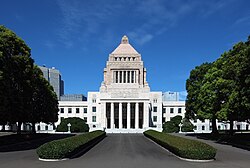


![Centered deep red circle on a white rectangle[2]](/wiki/File:Flag_of_Japan.svg)

.svg)
 0.903[14]

.svg)


.png)

 Nippon-koku or Nihon-koku), meaning "State of Japan". Despite this, the short-form name 日本 (Nippon or Nihon) is often used officially.
.svg)


