

No edit summary |
|||
| Line 1: | Line 1: | ||
{{short description|Dalit caste of India}} | |||
{{Infobox caste | {{Infobox caste | ||
| caste_name=Ramdasia | | caste_name=Ramdasia | ||
| Line 5: | Line 7: | ||
| religions=[[Sikhism]] • [[Hinduism]]}} | | religions=[[Sikhism]] • [[Hinduism]]}} | ||
The '''Ramdasia''' were historically a [[Sikh]] [[Hindu]] sub-group that originated from the | The '''Ramdasia''' were historically a [[Sikh]] [[Hindu]] sub-group that originated from the [[Caste system in India|caste]] of leather tanners and shoemakers known as [[Chamar]].<ref name="Rajesh K. Chander">{{cite book |title=Combating Social Exclusion: Intersectionalities of Caste, Class, Gender and Regions |first=Rajesh K I. |last=Chander |publisher=Studera Press |year=2019 |isbn=978-93-85883-58-3|page=64 |url=https://books.google.com/books?id=8TvnDwAAQBAJ&dq=ramdasia+caste+in+jammu&pg=PA64}}</ref> Nowadays people of this community do [[farming]], large number of them are governnent officials, [[Granthi]] in gurudwara and prominent [[politicians]]. In the book ''British Untouchables: A Study of Dalit Identity and Education'' by Paul Avtar Singh Ghuman, it is clearly mentioned on page number IX under the heading "Glossary of Terms" that Ramdasias are chamars who converted to Sikhism.<ref>{{cite book|last=Ghuman|first=Paul|title=British Untouchables A Study of Dalit Identity and Education|date=May 2011|publisher=Ashgate Publishing, Limited|isbn=978-0754648772|page=iX|url=https://books.google.com/books?id=eQZcI3FCxlEC&pg=PR9}}</ref> | ||
==Terminology== | ==Terminology== | ||
"Ramdasia is a term used in general for Sikhs whose ancestors belonged ex untouchables [[Chamar]] caste. Originally they are followers of [[Guru Ravidass]] ji who belongs to [[Chamar]] community ".<ref name="Rajesh K. Chander">{{cite | "Ramdasia is a term used in general for Sikhs whose ancestors belonged ex untouchables [[Chamar]] caste. Originally they are followers of [[Guru Ravidass]] ji who belongs to [[Chamar]] community ".<ref name="Rajesh K. Chander"/> Both the words Ramdasia and [[Ravidasia]] are also used inter changeably while these also have regional context. In [[Puadh]] and [[Malwa]], largely Ramdasia in used while [[Ravidasia]] is predominantly used in [[Doaba]].<ref name="toi">{{cite web|date=30 September 2021|title=Punjab's dalit conundrum: A look into Sikhs' caste identity|url=https://timesofindia.indiatimes.com/city/chandigarh/punjabs-dalit-conundrum-a-look-into-sikhs-caste-identity/articleshow/86607310.cms|work=[[The Times of India]]|accessdate=11 October 2021}}</ref> | ||
Ramdasia | Ramdasia Sikhs are enlisted as scheduled caste by Department of Social justice, Empowerment and Minorities- Government of Punjab. On Department's list of Scheduled Caste, this caste is listed on serial number 9 alongside with other [[Chamar]] caste synonymous such as [[Ravidasia]], [[Jatav]] and so on.<ref>http://socialjustice.nic.in/writereaddata/UploadFile/Scan-0015.jpg</ref> | ||
==Military service== | ==Military service== | ||
| Line 23: | Line 25: | ||
When India became independent in 1947, the British Indian Army became the Indian Army. This, like its predecessor, relies on the martial race theory for much of its recruitment and thus there is a grossly disproportionate number of Sikhs within its ranks.<ref>{{cite book |first=Kaushik |last=Roy |chapter=Indian Society and the Soldier |pages=66–67 |title=Handbook of Indian Defence Policy: Themes, Structures and Doctrines |editor-first=Harsh V. |editor-last=Pant |publisher=Routledge |year=2015 |isbn=978-1-31738-009-2 |url=https://books.google.com/books?id=9xG4CwAAQBAJ}}</ref> The Ramdasias Sikhs amd Mazhabi Sikhs continued their service with the SLI in the new army.<ref name="wilkinson" /> The SLI has served in almost all of the post-1947 conflicts involving India, including the wars with Pakistan in [[Indo-Pakistan War of 1947|1947]], [[Indo-Pakistan War of 1965|1965]] and [[Indo-Pakistan War of 1971|1971]], the [[Hyderabad Police Action]] of 1948 and the [[Sino-Indian War|Chinese aggression in 1962]]. It has also served in [[Sri Lanka]], where the 1st, 7th, 13th and 14th Battalions have contributed towards peace-keeping.<ref>{{cite web |title=Story of The Sikh Light Infantry |publisher=The Sikh Review |url=http://www.sikhreview.org/november1995/chivalry.htm |archive-url=https://web.archive.org/web/20020531202833/http://www.sikhreview.org/november1995/chivalry.htm |archive-date=2002-05-31}}</ref> | When India became independent in 1947, the British Indian Army became the Indian Army. This, like its predecessor, relies on the martial race theory for much of its recruitment and thus there is a grossly disproportionate number of Sikhs within its ranks.<ref>{{cite book |first=Kaushik |last=Roy |chapter=Indian Society and the Soldier |pages=66–67 |title=Handbook of Indian Defence Policy: Themes, Structures and Doctrines |editor-first=Harsh V. |editor-last=Pant |publisher=Routledge |year=2015 |isbn=978-1-31738-009-2 |url=https://books.google.com/books?id=9xG4CwAAQBAJ}}</ref> The Ramdasias Sikhs amd Mazhabi Sikhs continued their service with the SLI in the new army.<ref name="wilkinson" /> The SLI has served in almost all of the post-1947 conflicts involving India, including the wars with Pakistan in [[Indo-Pakistan War of 1947|1947]], [[Indo-Pakistan War of 1965|1965]] and [[Indo-Pakistan War of 1971|1971]], the [[Hyderabad Police Action]] of 1948 and the [[Sino-Indian War|Chinese aggression in 1962]]. It has also served in [[Sri Lanka]], where the 1st, 7th, 13th and 14th Battalions have contributed towards peace-keeping.<ref>{{cite web |title=Story of The Sikh Light Infantry |publisher=The Sikh Review |url=http://www.sikhreview.org/november1995/chivalry.htm |archive-url=https://web.archive.org/web/20020531202833/http://www.sikhreview.org/november1995/chivalry.htm |archive-date=2002-05-31}}</ref> | ||
== | ==Hindu Ramdasia== | ||
This sect of Ramdasia having faith in [[Hinduism]] and they mostly residing in [[Pathankot]], [[Jammu]], [[Himachal Pradesh]] and [[Jalandhar]]. Hindu Ramdasia migrated from Pakistan and back in [[Sialkot]], these Ramdasia were involved in Leather/Sports Goods Business. After migrating in [[Jalandhar]] they established their own Tanneries and Sports Goods manufacturing Units. For This purpose [[Government of Punjab, India]] helped them by providing liberal loans and allotting sites for their Factories<ref name="Krishan L. Sharma">{{cite book |title=Entrepreneurial Growth and Development Programmes in Northern India |first=Krishan L. |last=Sharma |publisher=Abhinav Publications |year=1980 |isbn=9780836406498|page=67 |url=https://www.google.com.au/books/edition/Entrepreneurial_Growth_and_Development_P/fwI7fLC9qQMC?hl=en&gbpv=1&dq=ramdasia+meerut&pg=PA67&printsec=frontcover}}</ref> Hindu Ramdasia's are staunch follower of [[Guru Ravidass]] and they follow Dera Swami Gurdeep Giri ji, Pathankot. According to Department of Social Justice and Empowerment, Government of India Ramdasias are listed as [[Chamar]] Caste on serial number 4 and 14 for [[Jammu and Kashmir (union territory)|Jammu and Kashmir]] and [[Himachal Pradesh]] respectively.<ref>http://socialjustice.nic.in/writereaddata/UploadFile/Scan-0006.jpg</ref><ref>http://socialjustice.nic.in/writereaddata/UploadFile/Scan-0030.jpg</ref> | |||
==Ramdasia Religious faith== | |||
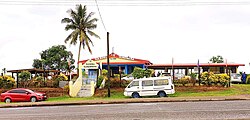
Ramdasia community having faith in [[Guru Ravidas]] and they have established several shrines dedicate to him. In India first recognized shrine was constructed in Kolkata and outside India first shrine was established on Fiji island in 1939 in Nasinu. In Nasinu first Sikh Gurdwara dedicated to [[Guru Ravidas]] was constructed by migrants from Doaba region of Punjab. | |||
[[File:Gurdwara Guru Ravidass, Nasinu, Fiji.jpg|thumb|Gurdwara [[Guru Ravidass]], Nasinu, Fiji Established in 1939]] | |||
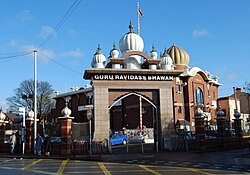
[[File:Gurdwara Guru Ravidass Bhavan, Birmingham.jpg|thumb|Gurdwara Guru Ravidass Bhavan, Birmingham]] | |||
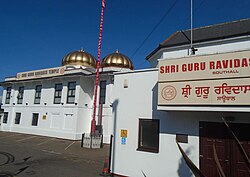
[[File:Gurdwara Guru Ravidass Sabha,Southall .jpg|thumb|[[Gurdwara Guru Ravidass Sabha]], Southall]] | |||
== | ==[[Ravidasia]]/Ramdasia [[Chamar]] Diaspora== | ||
The Ravidasia/Ramdasia [[Chamar]] diaspora emigrated from India and Pakistan is significant. Emigration from the [[Punjab]] began before and after the 19th century, with many Ravidasia/Ramdasia [[Chamar]] settling in Europe,<ref>{{cite FOREFEUROPE. (2019) ‘The ‘Untouchables’ In Europe – 10 Years After the Murder of Their Saint, 19 September 2021 [Blog]. Available at https://foref-europe.org/blog/2019/09/12/the-untouchables-in-europe-10-years-ago-their-guru-was-murdered-in-vienna/ (Accessed 21 October 2021}}</ref> and also a large Ravidasia/Ramdasia [[Chamar]] population in [[North America]] such as the [[United States]] and the [[Canada]].<ref name="HT">{{cite web|date=26 May 2009|title=Dalits in Canada call Vienna killing 'act of terrorism |url=https://www.hindustantimes.com/world/dalits-in-canada-call-vienna-killing-act-of-terrorism/story-4DXJafLl6WAjuPKG0APa8N.html|publisher=[[Hindustan Times]]|accessdate=11 October 2021}}</ref> There is sizeable population of Ravidasia/Ramdasia [[Chamar]] in [[Oceania]] too. | |||
In 2006 Canadian Ravidasia/Ramdasia [[Chamar]] diaspora celebrated the 100 years of dalit heritage in Canada with the support of [[Guru Ravidass]] [[Gurdwara]] [[Vancouver]], honorary chairs Mayor Derek Corrigan (Burnaby) and Commissioner Lahori Ram (Economic Development, State of California). Canadian politicians such as councilor Sav Dhaliwal (Burnaby), MLA Raj Chauhan (Burnaby-Edmonds), MLA Dave Hayer (Surrey), MP Peter Julian (Burnaby), MP Sukh Dhaliwal (Surrey-N. Delta), Ex-Premier BC & MP Ujjal Dosanjh (Vancouver), MLA Sue Hammel (Surrey), MLA Bruce Ralston (Surrey), councilor George Chow (Vancouver), and Deputy Commissioner Paul McDonnell (Burnaby) also participated in this centennial function.<ref>{{cite PVCHR. (2006) ‘Dalit centennial report, 20 September 2006 [Blog]. Available at https://pvchr.blogspot.com/2006/09/dalit-centennial-report.html/ (Accessed 21 October 2021}}</ref> | |||
Today they have presence in every major city of world where they have also established [[Guru Ravidass]] [[Gurdwaras]] and Temples. | |||
==Demographics== | ==Demographics== | ||
{{As of|2011}} Census, there were 3,095,324 [[Chamars]] in the Indian state of Punjab, of whom 1,017,192 declared themselves as [[Ad-Dharmi]] [[Chamar]] and 2,078,132 declared themselves as | {{As of|2011}} Census, there were 3,095,324 [[Chamars]] in the Indian state of Punjab, of whom 1,017,192 declared themselves as [[Ad-Dharmi]] [[Chamar]] and 2,078,132 declared themselves as Ramdasia/Ravidasia [[Chamar]]. According to this Census, during the same year the population of Sikh Ramdasia/Ravidasia and Hindu Ramdasia/Ravidasia in Punjab was 1,443,079 and 629,157 respectively.<ref name="2011 census1">{{cite web |url=https://www.censusindia.gov.in/2011census/SCST-Series/SC14/SC-03-00-14-DDW-2011.XLS|format=XLS |publisher=The Registrar General & Census Commissioner, India |title=SC-14 Scheduled Caste Population By Religious Community (States/UTs) – Punjab |access-date=2021-06-27}}</ref> | ||
Most of the Hindu | Most of the Hindu Ramdasias (Counted alongside with other Chamar Caste Synonyms such as Ravidasia and Jatav) living in the [[Jammu and Kashmir (union territory)|Jammu and Kashmir]], [[Himachal Pradesh]] and [[Haryana]]. {{As of|2011}}, there were 212,032 Ramdasia in Jammu and Kashmir, comprising 209,512 Hindus, 2,486 Sikhs and 34 Buddhists,<ref name="2011 census2">{{cite web |url=https://www.censusindia.gov.in/2011census/SCST-Series/SC14/SC-01-00-14-DDW-2011.XLS|format=XLS |publisher=The Registrar General & Census Commissioner, India |title=SC-14 Scheduled Caste Population By Religious Community (States/UTs) – Jammu and Kashmir |access-date=2021-06-27}}</ref> 2,429,137 lived in Haryana (2,390,403 Hindu, 37,191 Sikh and 1,543 Buddhists)<ref name="2011 census3">{{cite web |url=https://www.censusindia.gov.in/2011census/SCST-Series/SC14/SC-06-00-14-DDW-2011.XLS|format=XLS |publisher=The Registrar General & Census Commissioner, India |title=SC-14 Scheduled Caste Population By Religious Community (States/UTs) – Haryana |access-date=2021-06-27}}</ref> and 458,838 resided in Himachal Pradesh (453,871 Hindu, 4,887 Sikh and 80 Buddhists)<ref name="2011 census4">{{cite web |url=https://www.censusindia.gov.in/2011census/SCST-Series/SC14/SC-02-00-14-DDW-2011.XLS|format=XLS |publisher=The Registrar General & Census Commissioner, India |title=SC-14 Scheduled Caste Population By Religious Community (States/UTs) – Himachal Pradesh |access-date=2021-06-27}}</ref> | ||
== Prominent Ramdasia [[Chamar]] == | == Prominent Ramdasia [[Chamar]] == | ||
| Line 52: | Line 62: | ||
*[[Gopal Singh Khalsa]] | *[[Gopal Singh Khalsa]] | ||
*[[Darbara Singh Guru]] | *[[Darbara Singh Guru]] | ||
*[[ | *[[Beant Singh (assassin)]] | ||
==See also== | ==See also== | ||
Latest revision as of 16:29, 29 December 2021
| Ramdasia | |
|---|---|
| Religions | Sikhism • Hinduism |
| Languages | Punjabi • Hindi • Dogri |
| Populated states | Punjab • Haryana • Jammu • Himachal Pradesh |
The Ramdasia were historically a Sikh Hindu sub-group that originated from the caste of leather tanners and shoemakers known as Chamar.[1] Nowadays people of this community do farming, large number of them are governnent officials, Granthi in gurudwara and prominent politicians. In the book British Untouchables: A Study of Dalit Identity and Education by Paul Avtar Singh Ghuman, it is clearly mentioned on page number IX under the heading "Glossary of Terms" that Ramdasias are chamars who converted to Sikhism.[2]
Terminology[edit | edit source]
"Ramdasia is a term used in general for Sikhs whose ancestors belonged ex untouchables Chamar caste. Originally they are followers of Guru Ravidass ji who belongs to Chamar community ".[1] Both the words Ramdasia and Ravidasia are also used inter changeably while these also have regional context. In Puadh and Malwa, largely Ramdasia in used while Ravidasia is predominantly used in Doaba.[3]
Ramdasia Sikhs are enlisted as scheduled caste by Department of Social justice, Empowerment and Minorities- Government of Punjab. On Department's list of Scheduled Caste, this caste is listed on serial number 9 alongside with other Chamar caste synonymous such as Ravidasia, Jatav and so on.[4]
Military service[edit | edit source]
British Raj[edit | edit source]

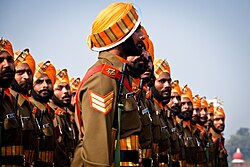
The Ramdasia Sikhs, together with the Majhabi Sikhs, were recruited to the Sikh Light Infantry regiment (SLI) after its formation in 1941.[5] The Sikh Light Infantry has always been a "single class" regiment in the parlance adopted from the British Raj era. This means that it recruits only from one demographic, which in this instance means the Ramdasia Sikhs and Mazhabi Sikhs.[6] Indeed, the SLI was initially called the Mazhabi & Ramdasia Sikh Regiment.[7] Despite unwillingness among some policy makers, the British had to abandon their traditional distinction between martial and non-martial races during the Second World War. This was necessitated by the need for more recruits than could be supplied by those communities upon which they usually relied, such as the Jat Sikhs, Dogras and Punjabi Musalmans. In addition, indiscipline among Jat Sikhs caused by their concerns regarding a post-war division of India was another reason to prefer recruitment of new classes. While recruitment from the pre-war martial classes was still pre-eminent, that from newly recognised classes such as the Ramdasias snd Mazhabis became significant.[8]
After independence of India[edit | edit source]
When India became independent in 1947, the British Indian Army became the Indian Army. This, like its predecessor, relies on the martial race theory for much of its recruitment and thus there is a grossly disproportionate number of Sikhs within its ranks.[9] The Ramdasias Sikhs amd Mazhabi Sikhs continued their service with the SLI in the new army.[5] The SLI has served in almost all of the post-1947 conflicts involving India, including the wars with Pakistan in 1947, 1965 and 1971, the Hyderabad Police Action of 1948 and the Chinese aggression in 1962. It has also served in Sri Lanka, where the 1st, 7th, 13th and 14th Battalions have contributed towards peace-keeping.[10]
Hindu Ramdasia[edit | edit source]
This sect of Ramdasia having faith in Hinduism and they mostly residing in Pathankot, Jammu, Himachal Pradesh and Jalandhar. Hindu Ramdasia migrated from Pakistan and back in Sialkot, these Ramdasia were involved in Leather/Sports Goods Business. After migrating in Jalandhar they established their own Tanneries and Sports Goods manufacturing Units. For This purpose Government of Punjab, India helped them by providing liberal loans and allotting sites for their Factories[11] Hindu Ramdasia's are staunch follower of Guru Ravidass and they follow Dera Swami Gurdeep Giri ji, Pathankot. According to Department of Social Justice and Empowerment, Government of India Ramdasias are listed as Chamar Caste on serial number 4 and 14 for Jammu and Kashmir and Himachal Pradesh respectively.[12][13]
Ramdasia Religious faith[edit | edit source]
Ramdasia community having faith in Guru Ravidas and they have established several shrines dedicate to him. In India first recognized shrine was constructed in Kolkata and outside India first shrine was established on Fiji island in 1939 in Nasinu. In Nasinu first Sikh Gurdwara dedicated to Guru Ravidas was constructed by migrants from Doaba region of Punjab.


Ravidasia/Ramdasia Chamar Diaspora[edit | edit source]
The Ravidasia/Ramdasia Chamar diaspora emigrated from India and Pakistan is significant. Emigration from the Punjab began before and after the 19th century, with many Ravidasia/Ramdasia Chamar settling in Europe,[14] and also a large Ravidasia/Ramdasia Chamar population in North America such as the United States and the Canada.[15] There is sizeable population of Ravidasia/Ramdasia Chamar in Oceania too.
In 2006 Canadian Ravidasia/Ramdasia Chamar diaspora celebrated the 100 years of dalit heritage in Canada with the support of Guru Ravidass Gurdwara Vancouver, honorary chairs Mayor Derek Corrigan (Burnaby) and Commissioner Lahori Ram (Economic Development, State of California). Canadian politicians such as councilor Sav Dhaliwal (Burnaby), MLA Raj Chauhan (Burnaby-Edmonds), MLA Dave Hayer (Surrey), MP Peter Julian (Burnaby), MP Sukh Dhaliwal (Surrey-N. Delta), Ex-Premier BC & MP Ujjal Dosanjh (Vancouver), MLA Sue Hammel (Surrey), MLA Bruce Ralston (Surrey), councilor George Chow (Vancouver), and Deputy Commissioner Paul McDonnell (Burnaby) also participated in this centennial function.[16]
Today they have presence in every major city of world where they have also established Guru Ravidass Gurdwaras and Temples.
Demographics[edit | edit source]
As of 2011[update] Census, there were 3,095,324 Chamars in the Indian state of Punjab, of whom 1,017,192 declared themselves as Ad-Dharmi Chamar and 2,078,132 declared themselves as Ramdasia/Ravidasia Chamar. According to this Census, during the same year the population of Sikh Ramdasia/Ravidasia and Hindu Ramdasia/Ravidasia in Punjab was 1,443,079 and 629,157 respectively.[17]
Most of the Hindu Ramdasias (Counted alongside with other Chamar Caste Synonyms such as Ravidasia and Jatav) living in the Jammu and Kashmir, Himachal Pradesh and Haryana. As of 2011[update], there were 212,032 Ramdasia in Jammu and Kashmir, comprising 209,512 Hindus, 2,486 Sikhs and 34 Buddhists,[18] 2,429,137 lived in Haryana (2,390,403 Hindu, 37,191 Sikh and 1,543 Buddhists)[19] and 458,838 resided in Himachal Pradesh (453,871 Hindu, 4,887 Sikh and 80 Buddhists)[20]
Prominent Ramdasia Chamar[edit | edit source]
- Kanshi Ram
- Lal Singh Dil
- Amar Singh (Punjab politician)
- Shamsher Singh Dullo
- Harinder Singh Khalsa
- Bhan Singh Bhaura
- Sukhdev Singh Libra
- Sadhu Singh
- Charanjit Singh Channi
- Babu Parmanand
- Gopal Singh Khalsa
- Darbara Singh Guru
- Beant Singh (assassin)
See also[edit | edit source]
References[edit | edit source]
- ↑ 1.0 1.1 Chander, Rajesh K I. (2019). Combating Social Exclusion: Intersectionalities of Caste, Class, Gender and Regions. Studera Press. p. 64. ISBN 978-93-85883-58-3.
- ↑ Ghuman, Paul (May 2011). British Untouchables A Study of Dalit Identity and Education. Ashgate Publishing, Limited. p. iX. ISBN 978-0754648772.
- ↑ "Punjab's dalit conundrum: A look into Sikhs' caste identity". The Times of India. 30 September 2021. Retrieved 11 October 2021.
- ↑ http://socialjustice.nic.in/writereaddata/UploadFile/Scan-0015.jpg
- ↑ 5.0 5.1 Wilkinson, Steven I. (2015). Army and Nation: The Military and Indian Democracy Since Independence. Harvard University Press. p. 11. ISBN 978-0-67472-880-6.
- ↑ Wilkinson, Steven I. (2015). Army and Nation: The Military and Indian Democracy Since Independence. Harvard University Press. pp. 39–41. ISBN 978-0-67472-880-6.
- ↑ Cohen, Stephen (2013). "The Untouchable Soldier". In Karsten, Peter (ed.). Recruiting, Drafting, and Enlisting: Two Sides of the Raising of Military Forces. Routledge. p. 170. ISBN 978-1-13566-150-2.
- ↑ Marston, Daniel (2003). Phoenix from the Ashes: The Indian Army in the Burma Campaign. Greenwood Publishing Group. pp. 218–220, 236. ISBN 978-0-27598-003-0.
- ↑ Roy, Kaushik (2015). "Indian Society and the Soldier". In Pant, Harsh V. (ed.). Handbook of Indian Defence Policy: Themes, Structures and Doctrines. Routledge. pp. 66–67. ISBN 978-1-31738-009-2.
- ↑ "Story of The Sikh Light Infantry". The Sikh Review. Archived from the original on 2002-05-31.
- ↑ Sharma, Krishan L. (1980). Entrepreneurial Growth and Development Programmes in Northern India. Abhinav Publications. p. 67. ISBN 9780836406498.
- ↑ http://socialjustice.nic.in/writereaddata/UploadFile/Scan-0006.jpg
- ↑ http://socialjustice.nic.in/writereaddata/UploadFile/Scan-0030.jpg
- ↑ {{cite FOREFEUROPE. (2019) ‘The ‘Untouchables’ In Europe – 10 Years After the Murder of Their Saint, 19 September 2021 [Blog]. Available at https://foref-europe.org/blog/2019/09/12/the-untouchables-in-europe-10-years-ago-their-guru-was-murdered-in-vienna/ (Accessed 21 October 2021}}
- ↑ "Dalits in Canada call Vienna killing 'act of terrorism". Hindustan Times. 26 May 2009. Retrieved 11 October 2021.
- ↑ {{cite PVCHR. (2006) ‘Dalit centennial report, 20 September 2006 [Blog]. Available at https://pvchr.blogspot.com/2006/09/dalit-centennial-report.html/ (Accessed 21 October 2021}}
- ↑ "SC-14 Scheduled Caste Population By Religious Community (States/UTs) – Punjab" (XLS). The Registrar General & Census Commissioner, India. Retrieved 2021-06-27.
- ↑ "SC-14 Scheduled Caste Population By Religious Community (States/UTs) – Jammu and Kashmir" (XLS). The Registrar General & Census Commissioner, India. Retrieved 2021-06-27.
- ↑ "SC-14 Scheduled Caste Population By Religious Community (States/UTs) – Haryana" (XLS). The Registrar General & Census Commissioner, India. Retrieved 2021-06-27.
- ↑ "SC-14 Scheduled Caste Population By Religious Community (States/UTs) – Himachal Pradesh" (XLS). The Registrar General & Census Commissioner, India. Retrieved 2021-06-27.


