





Khun seng7 (talk | contribs) No edit summary |
No edit summary |
||
| Line 1: | Line 1: | ||
{{Short description|Assamese offering tray}} | |||
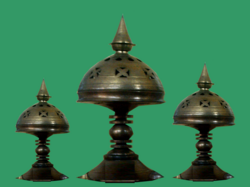
[[File:শৰাই.JPG|thumb|A ''xorai'' on display]] | |||
[[File:Xorai welcome to Kaziranga.jpg|thumb|Two extra-large ''xorai'' sculptures used beside a road to welcome visitors to [[Kaziranga National Park]]]] | |||
[[ | A '''xorai''' is a traditional Assamese offering tray or dish mounted on a pedestal. Usually made of [[bell metal]] or brass, it is one of the best-known symbols of [[Assam]] and is associated with hospitality, honour, religious offerings and cultural ceremony.<ref>{{Cite web|url=https://assam.gov.in/en/main/CULTURE%20OF%20ASSAM|title=Culture of Assam {{!}} ASSAM GOVERNMENT|website=assam.gov.in|access-date=2019-07-02}}</ref><ref>{{Cite news|url=https://www.thehindu.com/life-and-style/insiders-guide-assam-to-mizoram/article19854549.ece|title=Insider's guide: Assam to Mizoram|last=Mathew|first=Elizabeth|date=2017-10-13|work=The Hindu|access-date=2019-07-02|language=en-IN|issn=0971-751X}}</ref><ref>{{Cite news|url=https://www.thehindu.com/entertainment/movies/giving-voice-to-the-voiceless/article25133281.ece|title=Giving voice to the voiceless|last=Baruah|first=Parthajit|date=2018-10-05|work=The Hindu|access-date=2019-07-02|language=en-IN|issn=0971-751X}}</ref> Similar ''dish-on-stand'' type articles have been in use in the region since the [[Kamarupa]] period.<ref>{{cite journal | ||
|last1=Hazarika | |||
|first1=Manjil | |||
|last2=Devi | |||
|first2=Jonali | |||
|last3=Wunglengton | |||
|first3=Y. S. | |||
|last4=Sanathana | |||
|first4=Y. S. | |||
|display-authors=etal | |||
|title=A Study of Pottery and Terracotta Objects from Excavations at Cotton College (1990–1992) in Guwahati, Assam | |||
|journal=Heritage: Journal of Multidisciplinary Studies in Archaeology | |||
|volume=8.1 | |||
|year=2020 | |||
|pages=92–125 |url=https://www.heritageuniversityofkerala.com/JournalPDF/Volume8.1/4.pdf | |||
}} pp. 108–109, 112–113. The authors identify the ''dish-on-stand'' among the principal forms of kaolin or "Ambari ware". Their catalogue records 90 stand/stem fragments, some interpreted as components of dishes-on-stand used in ritual and ceremonial contexts, and describes the complete form as "a more or less flat dish with decorations on the surface having splayed rim attached on top of a stand"; the vessel is interpreted as having ceremonial, decorative and domestic uses.</ref>{{efn| In his study of the excavations at [[Ambari]], Guwahati, archaeologist M. K. Dhavalikar mentions that the ''dish-on-stand'' vessel may have been used for serving {{transliteration|as|tambul}} ([[areca nut|betel nut]] and [[betel|leaf]]), as is still used today, the only difference being that the modern version is made out of metal.<ref>{{cite journal | |||
|last=Dhavalikar | |||
|first=M. K. | |||
|title=Archaeology of Gauhati | |||
|journal=Bulletin of the Deccan College Post-Graduate and Research Institute | |||
|volume=31/32 | |||
|issue=1/2 | |||
|year=1971 | |||
|page=142 | |||
|jstor=42930897 | |||
|quote=Two interesting shapes are a dish-on-stand and a horn-shaped vessel. The former is found in large numbers and various sizes. It might have been used for serving ''tāmbul'' as is done today, the only difference being that the metal dish-on-stand is now used.}}</ref>}} | |||
A xorai generally consists of a shallow circular tray or plate supported by a stem and base. It may be open or fitted with an ornamental cover. It is commonly used to offer {{transliteration|as|tamul-pan}} ([[areca nut]] and [[betel leaf]]), sweets, food, flowers, religious offerings or other ceremonial objects. In Assamese society, presenting a xorai conveys welcome, gratitude and respect.<ref>{{Cite web|url=https://www.news18.com/photogallery/politics/rahul-gandhis-49th-birthday-glimpses-from-his-life-in-pictures-2193333.html|title=Rahul Gandhi's 49th Birthday: Glimpses from His Life in Pictures|date=2019-06-19|website=News18|access-date=2019-07-02}}</ref><ref>{{Cite web|url=https://www.telegraphindia.com/north-east/hima-feted-for-her-golden-track-feat/cid/1666893|title=Hima feted for her golden track feat|website=telegraphindia.com|language=en|access-date=2019-07-02}}</ref> | |||
A related Assamese vessel is the '''{{transliteration|as|bota}}''', a bowl-like or covered container which may be used together with a xorai. Although the two objects share a related form and ceremonial function, the xorai is usually a flat or shallow tray on a pedestal, whereas a bota is more bowl-shaped.<ref>{{cite book | |||
|last=Saikia | |||
|first=Yasmin | |||
|title=Fragmented Memories: Struggling to Be Tai-Ahom in India | |||
|url=https://archive.org/details/fragmentedmemori0000saik | |||
|publisher=Duke University Press | |||
|location=Durham | |||
|year=2004 | |||
|isbn=9780822334255 | |||
|access-date=5 June 2025 | |||
}}</ref> | |||
== | [[Hajo]] and [[Sarthebari]] are among the principal centres of traditional bell-metal and brass craftsmanship in Assam.<ref>{{Cite web|url=https://www.telegraphindia.com/north-east/time-to-give-the-makers-a-xorai/cid/1620693|title=Time to give the makers a xorai|website=telegraphindia.com|language=en|access-date=2019-07-02}}</ref> | ||
=== | == History and origin == | ||
The xorai has been described as a long-established ceremonial object in Assam, used in royal courts, religious rituals and community ceremonies. | |||
===Kamrupa Period=== | |||
Pedestal or raised dish forms were present in the Brahmaputra Valley since the [[Kamarupa]] period. Archaeological studies of the early-medieval pottery tradition of [[Ambari]], Guwahati, identify the ''dish-on-stand''<ref>{{cite journal | |||
|last1=Hazarika | |||
|first1=Manjil | |||
|last2=Devi | |||
|first2=Jonali | |||
|last3=Wunglengton | |||
|first3=Y. S. | |||
|last4=Sanathana | |||
|first4=Y. S. | |||
|display-authors=etal | |||
|title=A Study of Pottery and Terracotta Objects from Excavations at Cotton College (1990–1992) in Guwahati, Assam | |||
|journal=Heritage: Journal of Multidisciplinary Studies in Archaeology | |||
|volume=8.1 | |||
|year=2020 | |||
|pages=92–125 |url=https://www.heritageuniversityofkerala.com/JournalPDF/Volume8.1/4.pdf | |||
}} pp. 108–109, 112–113. The authors identify the ''dish-on-stand'' among the principal forms of kaolin or "Ambari ware". Their catalogue records 90 stand/stem fragments, some interpreted as components of dishes-on-stand used in ritual and ceremonial contexts, and describes the complete form as "a more or less flat dish with decorations on the surface having splayed rim attached on top of a stand"; the vessel is interpreted as having ceremonial, decorative and domestic uses.</ref> among the principal forms of the distinctive kaolin pottery known as "Ambari ware".<ref>"It was Dhavalikar (1973: 138) who first termed the Kaolin pottery recovered from the Ambari archaeological site as the ‘Ambari ware’ [...] Principal forms of kaolin pottery include [...] dish-on-stand and horn-shaped vessels."{{harvcol|Hazarika|2020|pp=92-125}}</ref> Surviving stands and stems have also been interpreted as components of dishes-on-stand used for ceremonial, ritual and domestic purposes.<ref>{{cite journal | |||
|last1=Hazarika | |||
|first1=Manjil | |||
|last2=Devi | |||
|first2=Jonali | |||
|last3=Wunglengton | |||
|first3=Y. S. | |||
|last4=Sanathana | |||
|first4=Y. S. | |||
|display-authors=etal | |||
|title=A Study of Pottery and Terracotta Objects from Excavations at Cotton College (1990–1992) in Guwahati, Assam | |||
|journal=Heritage: Journal of Multidisciplinary Studies in Archaeology | |||
|volume=8.1 | |||
|year=2020 | |||
|pages=92–125 | |||
}}</ref> In his study of the excavations at [[Ambari]], Guwahati, archaeologist M. K. Dhavalikar identified the ''dish-on-stand'' as one of the distinctive forms of the fine ceramic assemblage which he termed "Ambari Ware". Dhavalikar suggested that the vessel may have been used serving {{transliteration|as|tambul}} ([[areca nut|betel nut]] and [[betel|leaf]]), as in contemporary Assam, noting that the corresponding dish-on-stand like the ''{{transliteration|as|bota}}'' or ''Xorai''<ref>{{cite web | |||
|title=Culture of Assam | |||
|website=Assam State Portal | |||
|publisher=Government of Assam | |||
|url=https://usp2.amtron.in/about-us/391 | |||
|access-date=27 July 2026 | |||
|quote=Guests are offered "Tamul Paan" in a traditional bell metal serving "Bota" as a mark of honour. | |||
}}</ref> used in modern times was made of metal.<ref>{{cite journal | |||
|last=Dhavalikar | |||
|first=M. K. | |||
|title=Archaeology of Gauhati | |||
|journal=Bulletin of the Deccan College Post-Graduate and Research Institute | |||
|volume=31/32 | |||
|issue=1/2 | |||
|year=1971 | |||
|page=142 | |||
|jstor=42930897 | |||
|quote=Two interesting shapes are a dish-on-stand and a horn-shaped vessel. The former is found in large numbers and various sizes. It might have been used for serving ''tāmbul'' as is done today, the only difference being that the metal dish-on-stand is now used.}}</ref> The Ambari Ware horizon represented in the earlier excavation sequence has been dated broadly to the seventh–twelfth centuries CE. Sukanya Sharma notes that the kaolin pottery occurred abundantly in Period I at Ambari, which is approximately dated to the seventh–twelfth centuries CE, with a radiocarbon date of 1030 ± 130 CE.<ref>{{cite journal | |||
|last=Sharma | |||
|first=Sukanya | |||
|title=Southeast Asian Elements in the Archaeological Evidence of Northeast India | |||
|journal=SPAFA Journal | |||
|volume=20 | |||
|issue=3 | |||
|year=2010 | |||
|page=24 | |||
|url=https://www.seameo-spafa.org/wp-content/uploads/2015/11/225_1316503644_sub.pdf | |||
|quote=The pottery was found abundantly in period I of Ambari excavation in Guwahati. Period I is approximately dated from 7th to 12th century. The radio carbon date is 1030+130 CE.}}</ref> The discovery of kaolin pottery at these sites has been interpreted as evidence of early cultural contact with [[China]] and the transmission of ceramic ideas into [[Northeast India]].<ref>{{cite journal | |||
|last=Sharma | |||
|first=Sukanya | |||
|title=Southeast Asian Elements in the Archaeological Evidence of Northeast India | |||
|journal=SPAFA Journal | |||
|volume=20 | |||
|issue=3 | |||
|year=2010 | |||
|page=24 | |||
|url=https://www.seameo-spafa.org/wp-content/uploads/2015/11/225_1316503644_sub.pdf | |||
}}</ref>{{efn|In discussing the use of white clay in ancient South Asian ceramics, Baishali Ghosh distinguishes kaolin from the ball clay used for [[Satavahana]] terracottas and states: "Furthermore, the use of kaolin was unknown to South Asian potters until the Muslim invasion that introduced the application of kaolin through porcelain-making and pot-glazing."<ref>{{cite journal | |||
|last=Ghosh | |||
|first=Baishali | |||
|title=Recovering Local Agency and Technology in the Trans-Roman-Deccani Trade | |||
|journal=World History Connected | |||
|volume=18 | |||
|issue=3 | |||
|year=2021 | |||
|page=7 | |||
|url=https://worldhistoryconnected.press.uillinois.edu/18.3/pdfs/06_WHC_18_3_Ghosh.pdf | |||
|quote=Furthermore, the use of kaolin was unknown to South Asian potters until the Muslim invasion that introduced the application of kaolin through porcelain-making and pot-glazing. | |||
}}</ref>}} | |||
Bell metalworking was also known in the Kamrupa period. [[Birinchi Kumar Barua|B. K. Barua]], in his discussion of ornaments in early Assam, cites the ''[[Kalika Purana]]'' for the use of {{transliteration|sa|IAST|kāṃsya}}, which he identifies as bell metal.<ref>''Kalika Purana'', ch. 69, vv. 33–34: {{lang|sa|अयोमयमृते कांस्यमृते यद्भूषणं भवेत्। स्वर्णरौप्यस्य चाभावे त्वधः काये नियोजयेत्॥}} B. K. Barua renders the passage as stating that ornaments made of other metals, except iron and "bell-metal (kamsya)", were to be worn on the lower part of the body. {{cite thesis | |||
|last=Barua | |||
|first=Birinchi Kumar | |||
|title=A Cultural History of Assam of the Early Period | |||
|type=PhD thesis | |||
|publisher=School of Oriental and African Studies, University of London | |||
|year=1947 | |||
|page=201 | |||
}}</ref> A comparable change in material from earthenware to metal, while retaining the pedestal-tray form, is also attested elsewhere in Southeast Asia. The [[National Museum of the Philippines]] compares prehistoric earthenware pedestalled bowls with the brass ''tabak'' of the [[Maranao people|Maranao]] and [[Maguindanao people|Maguindanao]], noting their similarity in form and ceremonial serving function<ref>{{cite web | |||
|title=Earthenware Pedestalled Bowls | |||
|url=https://www.nationalmuseum.gov.ph/2021/12/07/earthenware-pedestalled-bowls/ | |||
|website=National Museum of the Philippines | |||
|date=7 December 2021 | |||
|access-date=28 July 2026 | |||
}}</ref>; Cambodian museum collections likewise preserve pedestal trays in clay alongside footed and pedestal trays made of brass.<ref>{{cite web | |||
|title=Museum Management System in Cambodia | |||
|url=https://search.cambodiamuseum.info/index.php/searchcatalog/page_list/f.ref_en_nb/desc/ | |||
|website=National Museum of Cambodia | |||
|access-date=28 July 2026 | |||
}}</ref> | |||
[[File:Tamulpanor Xorai Assam.JPG|thumb|A xorai with [[gamosa]], {{transliteration|as|tamul}} ([[areca nut]]) and {{transliteration|as|paan}} ([[betel]])]] | |||
=== | ===Late Medieval Period=== | ||
The archaeological distribution of the ''dish-on-stand'' form extended into eastern Assam. It is attested at [[Bhismaknagar]], a site generally associated with the [[Chutia kingdom]].<ref>{{cite web | |||
|title=Remains at Bhismaknagar | |||
|website=Archaeological Survey of India, Guwahati Circle | |||
|url=http://asiguwahaticircle.gov.in/bhismaknagar.html | |||
|quote=The remains are generally ascribed to the rule of the 'Chutias', a Tibeto-Burmese tribe who ruled over the region of Sadiya from 11th to 16th Century CE. | |||
}}</ref> Tage Tada describes the ceramic assemblage from the site as predominantly red and wheel-turned and lists bowls, dishes, ''dish-on-stand'', spouted vessels, jars and decorative finials among its important forms. He further notes that the fine wheel-turned pottery bears close affinity with pottery excavated at [[Ambari]], Guwahati, which he dates to approximately the tenth–twelfth centuries.<ref>{{cite book | |||
|last=Tada | |||
|first=Tage | |||
|title=Archaeological Remains of Arunachal Pradesh: Upto 16th Century A.D. | |||
|publisher=Department of Cultural Affairs, Directorate of Research, Government of Arunachal Pradesh | |||
|location=Itanagar | |||
|year=2014 | |||
|page=115 | |||
}}</ref> Kaolin pottery recovered from Bhismaknagar has separately been interpreted as evidence of early cultural contact with [[China]] and the transmission of ceramic ideas into Northeast India.<ref>{{cite journal | |||
|last=Sharma | |||
|first=Sukanya | |||
|title=Southeast Asian Elements in the Archaeological Evidence of Northeast India | |||
|journal=SPAFA Journal | |||
|volume=20 | |||
|issue=3 | |||
|year=2010 | |||
|page=24 | |||
|url=https://www.seameo-spafa.org/wp-content/uploads/2015/11/225_1316503644_sub.pdf | |||
}}</ref> | |||
The | The use of Xorai is recorded in Chutia, Ahom and Dimasa contexts. Its association with honour and hospitality continued through the [[Chutia kingdom|Chutia]] and [[Ahom kingdom|Ahom]] periods and remains prominent in contemporary Assamese culture.<ref>{{Cite news|title=Assam's Xorai is more than just a metal artifact|url=https://www.outlookindia.com/outlooktraveller/explore/story/70480/the-assamese-xorai-and-its-cultural-importance|work=Outlook Traveller|date=2020-06-15|access-date=2025-07-23}}{{dead link|date=August 2026|bot=medic}}{{cbignore|bot=medic}}</ref> A passage in the ''Satsari Buranji'' refers to the Chutia king presenting two golden xorais and two pieces of cloth to Phrachengmung Gohain, indicating the use of such ceremonial objects in the political and courtly culture of the period.<ref>Bhuyan, S. K., ''Satsari Buranji'', p. 58: "{{lang|as|ফ্ৰাচেংমুঙলৈ দিলে সুবৰ্ণৰ শৰাই ২ খন, পাটি ২ টা..}}"</ref> An explicit Buranji reference to specialist bell-metal workers occurs in connection with the conquest of the [[Chutia Kingdom]]. According to the ''Banhgaria Burhagohain Buranji'', preserved in the ''Satsari Asam Buranji'', following the fall of the Chutia kingdom, the Ahoms obtained, along with people belonging to various other occupational groups, {{transliteration|as|kahar}} (bell-metal workers) from the conquered territory.<ref>{{cite book | ||
|editor-last=Bhuyan | |||
|editor-first=Surya Kumar | |||
|title=Satsari Asam Buranji | |||
|publisher=Gauhati University | |||
|location=Gauhati | |||
|year=1960 | |||
|page=126 | |||
}}</ref> Among the [[Dimasa people|Dimasa]], the word {{lang|dis|horai}} is used for a xorai-like vessel.<ref>{{cite web|title=horai|url=https://www.xobdo.org/dic/horai|website=Xobdo|access-date=14 June 2026}}</ref> Dimasa textile traditions also include a motif known as {{lang|dis|horaimin}}, associated with the form of the horai.<ref>{{cite web|last=ROOHI|title=Weaving in indigenous Dimasa community of Assam | |||
|url=https://in.boell.org/en/weaving-indigenous-dimasa-community-assam|website=Heinrich Böll Stiftung|date=19 December 2019|access-date=14 June 2026}}</ref> | |||
[[File:সঁফুৰা.JPG|thumb|A xorai]] | |||
[[File: | |||
=== Comparative context === | |||
Objects comparable in broad form or ceremonial function to the xorai occur in other Asian cultures, including the [[thali]] in North India and the ''phan'' of Cambodia and Thailand. Pedestal bowls, trays and covered offering vessels are also found in Tibetan, Burmese, Indonesian and Philippine traditions. However, the Assamese xorai is distinctive in its bell-metal craftsmanship, local terminology and central role in Assamese hospitality and religious culture.<ref>{{Cite web | |||
|title=Cultural Objects of the East: A Comparative Overview | |||
|url=https://www.sahapedia.org/cultural-objects-east-comparative-overview | |||
|website=Sahapedia | |||
|access-date=2025-07-23 | |||
}}{{Dead link|date=August 2025 |bot=InternetArchiveBot |fix-attempted=yes }}</ref> | |||
High-stemmed trays, bowls and offering vessels comparable in general form to the xorai occur in several parts of Asia. Such similarities do not by themselves establish a direct line of descent for the Assamese xorai, but they indicate that pedestal vessels have long been used in religious, domestic and ceremonial settings across East, Himalayan and Southeast Asia. | |||
[[File:Warring States Bronze Dou 02.jpg|thumb|A bronze Chinese ''dou'' vessel from the [[Warring States period]]]] | |||
In ancient China, high-stemmed food and ritual vessels known as {{transliteration|zh|dou}} ({{lang|zh|豆}}) were used in ceremonial settings. Archaeological examples occur in Neolithic and later Chinese contexts, and the form became associated with ritual food offerings during the [[Zhou dynasty]].{{citation needed|date=June 2026}} Linguistic studies place the earliest diversification of the [[Sino-Tibetan languages]] in northern China during the Late Neolithic period.<ref>{{cite journal|last1=Zhang|first1=Menghan|last2=Yan|first2=Shi|last3=Pan|first3=Wuyun|last4=Jin|first4=Li|year=2019 | |||
|title=Phylogenetic evidence for Sino-Tibetan origin in northern China in the Late Neolithic|journal=Nature|volume=569|pages=112–115|doi=10.1038/s41586-019-1153-z}}</ref><ref>{{cite journal|last1=Zhang|first1=Hanzhi|last2=Ji|first2=Ting|last3=Pagel|first3=Mark|last4=Mace|first4=Ruth|year=2020 | |||
|title=Dated phylogeny suggests early Neolithic origin of Sino-Tibetan languages | |||
|journal=Scientific Reports|volume=10|article-number=20792|doi=10.1038/s41598-020-77404-4|doi-access=free|pmc=7695722}}</ref> The [[Bodo-Garo languages]] of Assam belong to the wider Tibeto-Burman branch of this language family.<ref>{{cite book | |||
|last=DeLancey|first=Scott|year=2012|chapter=On the Origins of Bodo-Garo|editor-last=Morey | |||
|editor-first=Stephen|editor2-last=Post|editor2-first=Mark W.|title=North East Indian Linguistics|volume=4|publisher=Cambridge University Press India|pages=3–20}}</ref> | |||
[[File:Spring & Autumn Bronze Dou, Xinzheng.jpg|thumb|A bronze ''dou'' vessel from the [[Spring and Autumn period]]]] | |||
=== Tibetan and Himalayan vessels === | |||
Pedestal bowls, trays and offering stands are also found in Tibetan Buddhist material culture. The Rubin Museum of Himalayan Art describes stemmed offering bowls as objects used in religious rites as well as in daily consumption.<ref>{{cite web|title=Stemmed Offering Bowl|website=Rubin Museum of Himalayan Art|publisher=Rubin Museum of Himalayan Art|url=https://rubinmuseum.org/collection/sc2012-7-6-1-7/|access-date=15 June 2026}}</ref> [[Tibetan Buddhism|Tibetan Buddhist]] [[mandala]] offering sets often employ a stand or base to hold grain or other offerings arranged as a mandala.<ref>{{cite web|title=Base for an offering mandala used in Tibetan Buddhist rituals|website=National Museum of Asian Art|publisher=Smithsonian Institution|url=https://asia-archive.si.edu/object/F1998.295|access-date=15 June 2026|quote=It serves as a stand, or base, to hold offerings (usually grain), which are arranged to form a mandala.}}</ref> Other Tibetan ceremonial vessels include pedestal bowls, covered tea bowls and {{transliteration|bo|serkyem}} offering sets, which are used in offerings to protective deities and may contain tea, alcohol, grains, sweets or ritual food.<ref>{{cite web | |||
|title=Pedestal Bowl|website=Himalayan Art Resources|url=https://www.himalayanart.org/items/3314996|access-date=15 June 2026}}</ref><ref>{{cite web|title=Tibetan Buddhist Silver Pedestal Offering Bowl|website=Invaluable | |||
|url=https://www.invaluable.com/auction-lot/tibetan-buddhist-silver-pedestal-offering-bowl-13-1206-c-b9d41abb7e | |||
|archive-url=https://web.archive.org/web/20260615094050/https://www.invaluable.com/auction-lot/tibetan-buddhist-silver-pedestal-offering-bowl-13-1206-c-b9d41abb7e|archive-date=15 June 2026|access-date=15 June 2026}}</ref><ref>{{cite web|title=Serkyem Offering in Buddhism: A Comprehensive Guide|website=Evamratna|date=21 November 2023|url=https://evamratna.com/blogs/evamratna-blogs/serkyem-offering|access-date=15 June 2026}}</ref><ref>{{cite web|title=Tea Bowl with Stand and Lid|website=Rubin Museum of Himalayan Art|publisher=Rubin Museum of Himalayan Art|url=https://rubinmuseum.org/collection/sc2013-2a-c/|access-date=15 June 2026 | |||
}}</ref> | |||
=== | === Myanmar === | ||
Pedestal dishes and covered offering vessels are prominent in the material culture of Myanmar. The Burmese word {{transliteration|my|ban}} ({{lang|my|ဗန်း}}) means “tray”, while '{{transliteration|my|langpan}} ({{lang|my|လင်ပန်း}}) has a related meaning.<ref>{{cite web|script-title=my:ဗန်း|website=Wiktionary|url=https://en.wiktionary.org/wiki/%E1%80%97%E1%80%94%E1%80%BA%E1%80%B8|access-date=15 June 2026}}</ref><ref>{{cite web|script-title=my:လင်ပန်း|website=Wiktionary | |||
|url=https://en.wiktionary.org/wiki/%E1%80%9C%E1%80%84%E1%80%BA%E1%80%95%E1%80%94%E1%80%BA%E1%80%B8 | |||
|access-date=15 June 2026 | |||
}}</ref> An open Burmese pedestal dish is often called a ''kalat''. Covered offering vessels known as {{transliteration|my|hsun-ok}} are used to carry or present food and offerings in Buddhist contexts. Such vessels commonly consist of a pedestal, a bowl-like container, internal trays and a domed or spired cover; they are often made from lacquered bamboo or wood.<ref>{{cite web|title=hsun-ok; vessel-stand; bowl|website=British Museum Collection Online|publisher=The British Museum | |||
|url=https://www.britishmuseum.org/collection/object/A_1993-1117-1|access-date=15 June 2026}}</ref><ref>{{cite web|title=Buddhist offering vessel (hsun ok)|website=Art Gallery of South Australia Collection|publisher=Art Gallery of South Australia|url=https://www.agsa.sa.gov.au/collection-publications/collection/works/buddhist-offering-vessel-hsun-ok/24828/|access-date=15 June 2026}}</ref> Covered offering vessels similar to the Burmese ''hsun-ok'' are also found in the Shan regions of northeastern Myanmar. Their form is especially associated with Buddhist offering traditions, although open pedestal trays occur more widely across mainland Southeast Asia.<ref>{{cite web|title=hsun-ok|website=British Museum Collection Online|publisher=The British Museum|url=https://www.britishmuseum.org/collection/object/A_1998-0723-241 | |||
|access-date=15 June 2026}}</ref><ref>{{cite web|title=Burmese Lacquer Hson-ok Offering Box|website=Michael Backman Ltd|url=https://www.michaelbackmanltd.com/archived_objects/burmese-lacquer-hson-ok-offering-box/|access-date=15 June 2026}}</ref> | |||
=== Cambodia, Thailand and the ''phan'' === | |||
In Cambodia and Thailand, pedestal trays used for offerings are generally known as {{transliteration|th|phan}} or related forms such as ''pan'' and ''ban''.<ref>{{cite web|script-title=km:ពាន|website=Wiktionary|url=https://en.wiktionary.org/wiki/%E1%9E%96%E1%9E%B6%E1%9E%93|access-date=15 June 2026}}</ref><ref>{{cite web|title=Phan (tray)|website=Wikipedia|url=https://en.wikipedia.org/wiki/Phan_(tray) | |||
|access-date=15 June 2026}}</ref>{{Circular reference|date=August 2026}} Linguist Roger Blench has discussed an Austroasiatic word family for “pedestal tray” or “pedestal dish”, including Proto-Mon-Khmer *baːn, Kui ''phian'', Surin Khmer ''piːan'', T’in ''phɨan'' and Nyah Kur ''kǝbíǝn''. He compares this vocabulary with Old Chinese *bˤan, meaning “tray”, and suggests that the Khmer, Thai and Shan forms may plausibly all be regional Chinese borrowings.<ref>{{cite book | |||
|last=Blench | |||
|first=Roger | |||
|chapter=Basketry in Austroasiatic | |||
|editor-last=Alves | |||
|editor-first=Mark | |||
|title=Austroasiatic Linguistics in Honour of Michel Ferlus | |||
|publisher=JSEALS Special Publication | |||
|year=2025 | |||
|pages=87–88 | |||
|url=https://icaal.net/wp-content/uploads/2026/01/AA-Linguistics-in-Honour-of-Michel-Ferlus-2025.pdf | |||
|access-date=15 June 2026 | |||
}}</ref> Pedestalled dishes and bowls are documented in pre-Angkorian (300–500 CE) archaeological contexts in Cambodia and northeastern Thailand.<ref>{{cite journal | |||
|last=Heng | |||
|first=Piphal | |||
|title=Transition to the Pre-Angkorian period (300–500 CE): Thala Borivat and a regional perspective | |||
|journal=Journal of Southeast Asian Studies | |||
|volume=47 | |||
|issue=3 | |||
|year=2016 | |||
|pages=484–505 | |||
|doi=10.1017/S0022463416000369 | |||
|url=https://www.cambridge.org/core/journals/journal-of-southeast-asian-studies/article/transition-to-the-preangkorian-period-300500-ce-thala-borivat-and-a-regional-perspective/AEC80A473E33ED556489658939C261D2 | |||
|access-date=15 June 2026 | |||
|url-access=subscription | |||
}}</ref> Similar forms have also been noted among ceramics from [[Angkor Borei]].<ref>{{cite journal | |||
|last=Stark | |||
|first=Miriam T. | |||
|year=2019 | |||
|title=Earthenware Ceramic Technologies of Angkor Borei, Cambodia | |||
|journal=Udaya, Journal of Khmer Studies | |||
|volume=14 | |||
|pages=109–132 | |||
}}</ref> Khmer inscriptions and studies of Khmer silverware also record trays and pedestal vessels among ceremonial objects.<ref>{{cite book | |||
|last=Kong | |||
|first=Vireak | |||
|year=2009 | |||
|title=Khmer Silverwares | |||
|publisher=UNESCO | |||
|location=Phnom Penh | |||
|url=https://unesdoc.unesco.org/ark:/48223/pf0000187953 | |||
|access-date=9 June 2026 | |||
}}</ref> The Thai ''phan'' remains an important ceremonial object, including in the {{transliteration|th|Bai Sri Su Khwan}} ritual of northeastern Thailand, where food and ritual offerings are placed on such trays.<ref>{{Cite journal | |||
|last1=Titrassamee | |||
|first1=Songsak | |||
|last2=Lamduan | |||
|first2=Somchai | |||
|last3=Phaengsoi | |||
|first3=Kosit | |||
|date=2014-06-12 | |||
|title=Bai Sri Su Khwan: Spirit Blessing in North-eastern Thailand | |||
|journal=Asian Culture and History | |||
|volume=6 | |||
|issue=2 | |||
|pages=134–138 | |||
|publisher=Canadian Center of Science and Education | |||
|doi=10.5539/ach.v6n2p134 | |||
|issn=1916-9655 | |||
|url=https://patricklepetit.jalbum.net/ANIMISM%20AND%20RELIGION/LIBRARY/Bai_Sri_Su_Khwan_Spirit_Blessing_in_North-eastern.pdf | |||
|access-date=2026-06-14 | |||
}} {{Dead link|date=June 2026 |bot=InternetArchiveBot |fix-attempted=yes }}</ref> In the [[Ahom language]], a related tray or pedestal vessel was called {{transliteration|aho|phun}} ({{lang|aho|𑜇𑜥𑜃𑜫}}). The same word could also refer to a [[maihang]], another Assamese pedestal vessel or tray.<ref>{{Cite book | |||
|last=Barua | |||
|first=Golap Chandra | |||
|title=Ahom-Assamese-English Dictionary | |||
|publisher=Baptist Mission Press | |||
|location=Calcutta | |||
|year=1920 | |||
|page=138 | |||
|url=https://ia801408.us.archive.org/2/items/in.ernet.dli.2015.463794/2015.463794.Ahom-assamese-english-Dictionary.pdf | |||
|access-date=2026-06-14 | |||
}}</ref> | |||
=== Other comparable vessels === | |||
Comparable pedestal trays and offering vessels are also used elsewhere in Southeast Asia. In Bali, the {{lang|ban|dulang}} is a raised tray used to carry offerings in religious and ceremonial contexts. In the southern Philippines, the [[Maranao people|Maranao]] and [[Maguindanao people|Maguindanao]] use brass pedestal vessels known respectively as {{lang|mrw|tabak}} and {{lang|mdh|tabak}} during special occasions and communal food service; these vessels evolved from earlier earthenware forms.<ref>{{cite web | |||
|title=Earthenware Pedestalled Bowls | |||
|website=National Museum of the Philippines | |||
|publisher=National Museum of the Philippines | |||
|date=7 December 2021 | |||
|url=https://www.nationalmuseum.gov.ph/2021/12/07/earthenware-pedestalled-bowls/ | |||
|access-date=15 June 2026 | |||
}}</ref> Examples of offering trays and pedestal vessels are also known from medieval Java and other parts of island Southeast Asia.<ref>{{cite web | |||
|title=Offering tray (talam) | |||
|website=The Metropolitan Museum of Art | |||
|publisher=The Metropolitan Museum of Art | |||
|url=https://www.metmuseum.org/art/collection/search/715081 | |||
|access-date=15 June 2026 | |||
}}</ref><ref>{{cite web | |||
|title=Offering Vessel in the Form of a Female Head | |||
|website=Los Angeles County Museum of Art | |||
|publisher=LACMA | |||
|url=https://collections.lacma.org/node/175545 | |||
|access-date=15 June 2026 | |||
}}</ref> | |||
[[File:Xorai worship.webp|thumb|A xorai used in a [[namghar]]]] | |||
== | == Usage == | ||
Xorais are used in Assamese religious, social and ceremonial life. Their principal uses include: | |||
* offering {{transliteration|as|tamul-pan}} ([[betel nut]] and [[betel|betel leaves]]) to guests as a sign of welcome, respect and thanks;<ref>{{Cite web|url=https://www.hindustantimes.com/cricket/sourav-ganguly-speaks-about-ms-dhoni-s-position-leading-into-the-world-cup/story-9NaHPRRTs3oPUZ3lMf9LDM.html|title=Sourav Ganguly speaks about MS Dhoni's position leading into the World Cup|date=2018-10-22|website=Hindustan Times|language=en|access-date=2019-07-02}}</ref> | |||
* placing food, offerings or ritual objects before an altar in a [[namghar]], temple or household shrine; | |||
* holding offerings during religious ceremonies and [[Ekasarana Dharma|Neo-Vaishnavite]] observances; | |||
* serving as a decorative symbol during traditional functions, including [[Bihu dance]] performances; | |||
* being presented to guests, artists, public figures and dignitaries during felicitations and official ceremonies. | |||
The Government of Assam describes the offering of {{transliteration|as|tamul-pan}} on a xorai as a customary expression of devotion, respect and friendship, and also notes its use for placing ''prasad'' and other offerings in namghars or places of worship.<ref>{{cite web | |||
|title=Culture of Assam | |||
|url=https://assam.gov.in/about-us/391 | |||
|website=Assam State Portal | |||
|publisher=Government of Assam | |||
|access-date=9 June 2026 | |||
}}</ref> | |||
=== Tamul-pan and hospitality === | |||
The presentation of areca nut and betel leaf is an important form of hospitality in Assam. The practice forms part of a wider cultural tradition in South and Southeast Asia in which betel and areca are associated with greeting guests, ritual exchange, marriage ceremonies, social recognition and religious offerings.<ref>{{cite journal | |||
|last1=Ahuja | |||
|first1=S. C. | |||
|last2=Ahuja | |||
|first2=Uma | |||
|year=2011 | |||
|title=Betel Leaf and Betel Nut in India: History and Uses | |||
|journal=Asian Agri-History | |||
|volume=15 | |||
|issue=1 | |||
|pages=13–35 | |||
|url=https://www.researchgate.net/publication/292469329_Betel_leaf_and_betel_nut_in_India_History_and_uses | |||
|access-date=9 June 2026 | |||
}}</ref> | |||
Comparable customs are found among neighbouring communities. In Khasi society, for example, the offering of {{lang|kha|kwai}}—areca nut and betel leaf—is described as an important form of hospitality and courtesy towards visitors.<ref>{{cite web | |||
|title=Shikyntien Kwai: A Folklore about Betel Hospitality in Khasi Society | |||
|url=https://www.necarf.org/home/articles/54/shikyntien-kwai-a-folklore-about-betel-hospitality-in-khasi-society | |||
|website=NECARF | |||
|date=14 October 2020 | |||
|access-date=9 June 2026 | |||
}}</ref> In Assam, the use of a bell-metal xorai or bota gives this wider custom a distinctive local material form. | |||
=== | === Religious significance === | ||
Over time, the xorai became closely associated with Assamese religious life, particularly with [[Ekasarana Dharma|Neo-Vaishnavism]] and the institution of the namghar. It is used to place the [[Bhagavata Purana|Bhagavata]], religious texts, offerings and ''prasad'' in communal worship. Accounts of the Neo-Vaishnavite tradition associate the wider adoption of the xorai in namghars with the religious movement of [[Srimanta Sankardeva]] in the fifteenth and sixteenth centuries. In this context, the xorai is described as a symbol of common worship and the equal distribution of ''prasad'' among devotees.<ref>{{cite web | |||
|url=https://www.gktoday.in/xorai/ | |||
|title=Xorai | |||
|website=GKToday | |||
|date=20 March 2021 | |||
}}</ref> | |||
[[File:Sankaradeva.jpg|thumb|[[Srimanta Sankardev]]]] | |||
== Manufacturing process == | |||
Xorais are typically crafted using [[bell metal]], an alloy of copper and tin, although brass variants are also produced. Traditional artisans, especially in [[Sarthebari]] and [[Hajo]], use manual processes involving melting, casting, hammering, shaping, polishing and engraving. The craft requires specialised skill and is often transmitted within artisan families across generations.<ref>{{Cite web | |||
|title=Sarthebari: The Bell Metal Town of Assam | |||
|url=https://www.india.com/travel/articles/sarthebari-the-bell-metal-town-of-assam-3521869/ | |||
|website=India.com | |||
|access-date=2025-07-23 | |||
}}</ref> | |||
== Symbolism and cultural significance == | |||
The | In Assamese society, the xorai is regarded as a sacred and symbolic object. It is used to present offerings to guests, elders and deities, and is associated with respect, purity, goodwill and hospitality.<ref>{{Cite web | ||
|url=https://www.downtoearth.org.in/blog/culture/an-iconic-symbol-of-assamese-culture-the-xorai-78931 | |||
|title=An iconic symbol of Assamese culture: The Xorai | |||
|website=Down To Earth | |||
|access-date=2025-07-23 | |||
}}{{Dead link|date=August 2025 |bot=InternetArchiveBot |fix-attempted=yes }}</ref> The cultural importance of the xorai lies partly in its movement from courtly and elite settings into broader community use. Through the offering of {{transliteration|as|tamul-pan}}, it became a widely recognised medium of honour and social exchange across the Brahmaputra Valley. In modern Assamese public culture, it is frequently treated as an emblem of collective identity and regional heritage.<ref>{{cite web | |||
|url=https://www.gktoday.in/xorai/ | |||
|title=Xorai | |||
|website=GKToday | |||
|date=20 March 2021 | |||
}}</ref> | |||
== Modern adaptations == | |||
While traditional uses of the xorai continue, it has increasingly been adapted as a decorative and symbolic gift in modern settings. It is presented during state ceremonies, academic convocations, cultural festivals and public felicitations. Designer versions are also produced as showpieces, awards and souvenirs.<ref>{{Cite news | |||
|title=From Tradition to Trend: How Xorai Found Its Place in Modern Ceremonies | |||
|url=https://www.eastmojo.com/assam/2021/10/20/xorai-symbol-of-assamese-tradition-now-a-modern-icon/ | |||
|work=EastMojo | |||
|date=2021-10-20 | |||
|access-date=2025-07-23 | |||
}}{{Dead link|date=August 2025 |bot=InternetArchiveBot |fix-attempted=yes }}</ref> | |||
== Representation in media and events == | |||
The xorai is frequently displayed in Assamese literature, films, documentaries, advertisements and public events. During occasions such as [[Assam Day]], [[Rongali Bihu]], state receptions and cultural programmes, it is commonly displayed or presented to dignitaries as a cultural emblem of Assam.<ref>{{Cite web | |||
|title=Xorai: An Emblem of Assamese Identity in Global Platforms | |||
|url=https://www.thehillstimes.in/featured/xorai-an-emblem-of-assamese-identity | |||
|website=The Hills Times | |||
|access-date=2025-07-23 | |||
}}{{Dead link|date=August 2025 |bot=InternetArchiveBot |fix-attempted=yes }}</ref> | |||
== | == See also == | ||
* [[Culture of Assam]] | |||
* [[Bell and brass metal crafts of Assam]] | |||
* [[Traditional crafts of Assam]] | |||
* [[Areca nut]] | |||
* [[Betel]] | |||
* [[Namghar]] | |||
* [[Maihang]] | |||
== References == | |||
<references /> | |||
==Notes== | |||
{{notelist}} | |||
[[Category:Culture of Assam]] | |||
[[Category:Objects used in Hindu worship]] | |||
[[ | |||
[[ | |||
Revision as of 17:31, 23 September 2026


A xorai is a traditional Assamese offering tray or dish mounted on a pedestal. Usually made of bell metal or brass, it is one of the best-known symbols of Assam and is associated with hospitality, honour, religious offerings and cultural ceremony.[1][2][3] Similar dish-on-stand type articles have been in use in the region since the Kamarupa period.[4][lower-alpha 1]
A xorai generally consists of a shallow circular tray or plate supported by a stem and base. It may be open or fitted with an ornamental cover. It is commonly used to offer tamul-pan (areca nut and betel leaf), sweets, food, flowers, religious offerings or other ceremonial objects. In Assamese society, presenting a xorai conveys welcome, gratitude and respect.[6][7]
A related Assamese vessel is the bota, a bowl-like or covered container which may be used together with a xorai. Although the two objects share a related form and ceremonial function, the xorai is usually a flat or shallow tray on a pedestal, whereas a bota is more bowl-shaped.[8]
Hajo and Sarthebari are among the principal centres of traditional bell-metal and brass craftsmanship in Assam.[9]
History and origin
The xorai has been described as a long-established ceremonial object in Assam, used in royal courts, religious rituals and community ceremonies.
Kamrupa Period
Pedestal or raised dish forms were present in the Brahmaputra Valley since the Kamarupa period. Archaeological studies of the early-medieval pottery tradition of Ambari, Guwahati, identify the dish-on-stand[10] among the principal forms of the distinctive kaolin pottery known as "Ambari ware".[11] Surviving stands and stems have also been interpreted as components of dishes-on-stand used for ceremonial, ritual and domestic purposes.[12] In his study of the excavations at Ambari, Guwahati, archaeologist M. K. Dhavalikar identified the dish-on-stand as one of the distinctive forms of the fine ceramic assemblage which he termed "Ambari Ware". Dhavalikar suggested that the vessel may have been used serving tambul (betel nut and leaf), as in contemporary Assam, noting that the corresponding dish-on-stand like the bota or Xorai[13] used in modern times was made of metal.[14] The Ambari Ware horizon represented in the earlier excavation sequence has been dated broadly to the seventh–twelfth centuries CE. Sukanya Sharma notes that the kaolin pottery occurred abundantly in Period I at Ambari, which is approximately dated to the seventh–twelfth centuries CE, with a radiocarbon date of 1030 ± 130 CE.[15] The discovery of kaolin pottery at these sites has been interpreted as evidence of early cultural contact with China and the transmission of ceramic ideas into Northeast India.[16][lower-alpha 2]
Bell metalworking was also known in the Kamrupa period. B. K. Barua, in his discussion of ornaments in early Assam, cites the Kalika Purana for the use of kāṃsya, which he identifies as bell metal.[18] A comparable change in material from earthenware to metal, while retaining the pedestal-tray form, is also attested elsewhere in Southeast Asia. The National Museum of the Philippines compares prehistoric earthenware pedestalled bowls with the brass tabak of the Maranao and Maguindanao, noting their similarity in form and ceremonial serving function[19]; Cambodian museum collections likewise preserve pedestal trays in clay alongside footed and pedestal trays made of brass.[20]

Late Medieval Period
The archaeological distribution of the dish-on-stand form extended into eastern Assam. It is attested at Bhismaknagar, a site generally associated with the Chutia kingdom.[21] Tage Tada describes the ceramic assemblage from the site as predominantly red and wheel-turned and lists bowls, dishes, dish-on-stand, spouted vessels, jars and decorative finials among its important forms. He further notes that the fine wheel-turned pottery bears close affinity with pottery excavated at Ambari, Guwahati, which he dates to approximately the tenth–twelfth centuries.[22] Kaolin pottery recovered from Bhismaknagar has separately been interpreted as evidence of early cultural contact with China and the transmission of ceramic ideas into Northeast India.[23]
The use of Xorai is recorded in Chutia, Ahom and Dimasa contexts. Its association with honour and hospitality continued through the Chutia and Ahom periods and remains prominent in contemporary Assamese culture.[24] A passage in the Satsari Buranji refers to the Chutia king presenting two golden xorais and two pieces of cloth to Phrachengmung Gohain, indicating the use of such ceremonial objects in the political and courtly culture of the period.[25] An explicit Buranji reference to specialist bell-metal workers occurs in connection with the conquest of the Chutia Kingdom. According to the Banhgaria Burhagohain Buranji, preserved in the Satsari Asam Buranji, following the fall of the Chutia kingdom, the Ahoms obtained, along with people belonging to various other occupational groups, kahar (bell-metal workers) from the conquered territory.[26] Among the Dimasa, the word horai is used for a xorai-like vessel.[27] Dimasa textile traditions also include a motif known as horaimin, associated with the form of the horai.[28]

Comparative context
Objects comparable in broad form or ceremonial function to the xorai occur in other Asian cultures, including the thali in North India and the phan of Cambodia and Thailand. Pedestal bowls, trays and covered offering vessels are also found in Tibetan, Burmese, Indonesian and Philippine traditions. However, the Assamese xorai is distinctive in its bell-metal craftsmanship, local terminology and central role in Assamese hospitality and religious culture.[29]
High-stemmed trays, bowls and offering vessels comparable in general form to the xorai occur in several parts of Asia. Such similarities do not by themselves establish a direct line of descent for the Assamese xorai, but they indicate that pedestal vessels have long been used in religious, domestic and ceremonial settings across East, Himalayan and Southeast Asia.

In ancient China, high-stemmed food and ritual vessels known as dou (豆) were used in ceremonial settings. Archaeological examples occur in Neolithic and later Chinese contexts, and the form became associated with ritual food offerings during the Zhou dynasty.[citation needed] Linguistic studies place the earliest diversification of the Sino-Tibetan languages in northern China during the Late Neolithic period.[30][31] The Bodo-Garo languages of Assam belong to the wider Tibeto-Burman branch of this language family.[32]

Tibetan and Himalayan vessels
Pedestal bowls, trays and offering stands are also found in Tibetan Buddhist material culture. The Rubin Museum of Himalayan Art describes stemmed offering bowls as objects used in religious rites as well as in daily consumption.[33] Tibetan Buddhist mandala offering sets often employ a stand or base to hold grain or other offerings arranged as a mandala.[34] Other Tibetan ceremonial vessels include pedestal bowls, covered tea bowls and serkyem offering sets, which are used in offerings to protective deities and may contain tea, alcohol, grains, sweets or ritual food.[35][36][37][38]
Myanmar
Pedestal dishes and covered offering vessels are prominent in the material culture of Myanmar. The Burmese word ban (ဗန်း) means “tray”, while 'langpan (လင်ပန်း) has a related meaning.[39][40] An open Burmese pedestal dish is often called a kalat. Covered offering vessels known as hsun-ok are used to carry or present food and offerings in Buddhist contexts. Such vessels commonly consist of a pedestal, a bowl-like container, internal trays and a domed or spired cover; they are often made from lacquered bamboo or wood.[41][42] Covered offering vessels similar to the Burmese hsun-ok are also found in the Shan regions of northeastern Myanmar. Their form is especially associated with Buddhist offering traditions, although open pedestal trays occur more widely across mainland Southeast Asia.[43][44]
Cambodia, Thailand and the phan
In Cambodia and Thailand, pedestal trays used for offerings are generally known as phan or related forms such as pan and ban.[45][46][circular reference] Linguist Roger Blench has discussed an Austroasiatic word family for “pedestal tray” or “pedestal dish”, including Proto-Mon-Khmer *baːn, Kui phian, Surin Khmer piːan, T’in phɨan and Nyah Kur kǝbíǝn. He compares this vocabulary with Old Chinese *bˤan, meaning “tray”, and suggests that the Khmer, Thai and Shan forms may plausibly all be regional Chinese borrowings.[47] Pedestalled dishes and bowls are documented in pre-Angkorian (300–500 CE) archaeological contexts in Cambodia and northeastern Thailand.[48] Similar forms have also been noted among ceramics from Angkor Borei.[49] Khmer inscriptions and studies of Khmer silverware also record trays and pedestal vessels among ceremonial objects.[50] The Thai phan remains an important ceremonial object, including in the Bai Sri Su Khwan ritual of northeastern Thailand, where food and ritual offerings are placed on such trays.[51] In the Ahom language, a related tray or pedestal vessel was called phun (𑜇𑜥𑜃𑜫). The same word could also refer to a maihang, another Assamese pedestal vessel or tray.[52]
Other comparable vessels
Comparable pedestal trays and offering vessels are also used elsewhere in Southeast Asia. In Bali, the dulang is a raised tray used to carry offerings in religious and ceremonial contexts. In the southern Philippines, the Maranao and Maguindanao use brass pedestal vessels known respectively as tabak and tabak during special occasions and communal food service; these vessels evolved from earlier earthenware forms.[53] Examples of offering trays and pedestal vessels are also known from medieval Java and other parts of island Southeast Asia.[54][55]

Usage
Xorais are used in Assamese religious, social and ceremonial life. Their principal uses include:
- offering tamul-pan (betel nut and betel leaves) to guests as a sign of welcome, respect and thanks;[56]
- placing food, offerings or ritual objects before an altar in a namghar, temple or household shrine;
- holding offerings during religious ceremonies and Neo-Vaishnavite observances;
- serving as a decorative symbol during traditional functions, including Bihu dance performances;
- being presented to guests, artists, public figures and dignitaries during felicitations and official ceremonies.
The Government of Assam describes the offering of tamul-pan on a xorai as a customary expression of devotion, respect and friendship, and also notes its use for placing prasad and other offerings in namghars or places of worship.[57]
Tamul-pan and hospitality
The presentation of areca nut and betel leaf is an important form of hospitality in Assam. The practice forms part of a wider cultural tradition in South and Southeast Asia in which betel and areca are associated with greeting guests, ritual exchange, marriage ceremonies, social recognition and religious offerings.[58]
Comparable customs are found among neighbouring communities. In Khasi society, for example, the offering of kwai—areca nut and betel leaf—is described as an important form of hospitality and courtesy towards visitors.[59] In Assam, the use of a bell-metal xorai or bota gives this wider custom a distinctive local material form.
Religious significance
Over time, the xorai became closely associated with Assamese religious life, particularly with Neo-Vaishnavism and the institution of the namghar. It is used to place the Bhagavata, religious texts, offerings and prasad in communal worship. Accounts of the Neo-Vaishnavite tradition associate the wider adoption of the xorai in namghars with the religious movement of Srimanta Sankardeva in the fifteenth and sixteenth centuries. In this context, the xorai is described as a symbol of common worship and the equal distribution of prasad among devotees.[60]

Manufacturing process
Xorais are typically crafted using bell metal, an alloy of copper and tin, although brass variants are also produced. Traditional artisans, especially in Sarthebari and Hajo, use manual processes involving melting, casting, hammering, shaping, polishing and engraving. The craft requires specialised skill and is often transmitted within artisan families across generations.[61]
Symbolism and cultural significance
In Assamese society, the xorai is regarded as a sacred and symbolic object. It is used to present offerings to guests, elders and deities, and is associated with respect, purity, goodwill and hospitality.[62] The cultural importance of the xorai lies partly in its movement from courtly and elite settings into broader community use. Through the offering of tamul-pan, it became a widely recognised medium of honour and social exchange across the Brahmaputra Valley. In modern Assamese public culture, it is frequently treated as an emblem of collective identity and regional heritage.[63]
Modern adaptations
While traditional uses of the xorai continue, it has increasingly been adapted as a decorative and symbolic gift in modern settings. It is presented during state ceremonies, academic convocations, cultural festivals and public felicitations. Designer versions are also produced as showpieces, awards and souvenirs.[64]
Representation in media and events
The xorai is frequently displayed in Assamese literature, films, documentaries, advertisements and public events. During occasions such as Assam Day, Rongali Bihu, state receptions and cultural programmes, it is commonly displayed or presented to dignitaries as a cultural emblem of Assam.[65]
See also
- Culture of Assam
- Bell and brass metal crafts of Assam
- Traditional crafts of Assam
- Areca nut
- Betel
- Namghar
- Maihang
References
- ↑ "Culture of Assam | ASSAM GOVERNMENT". assam.gov.in. Retrieved 2019-07-02.
- ↑ Mathew, Elizabeth (2017-10-13). "Insider's guide: Assam to Mizoram". The Hindu. ISSN 0971-751X. Retrieved 2019-07-02.
- ↑ Baruah, Parthajit (2018-10-05). "Giving voice to the voiceless". The Hindu. ISSN 0971-751X. Retrieved 2019-07-02.
- ↑ Hazarika, Manjil; Devi, Jonali; Wunglengton, Y. S.; Sanathana, Y. S.; et al. (2020). "A Study of Pottery and Terracotta Objects from Excavations at Cotton College (1990–1992) in Guwahati, Assam" (PDF). Heritage: Journal of Multidisciplinary Studies in Archaeology. 8.1: 92–125. pp. 108–109, 112–113. The authors identify the dish-on-stand among the principal forms of kaolin or "Ambari ware". Their catalogue records 90 stand/stem fragments, some interpreted as components of dishes-on-stand used in ritual and ceremonial contexts, and describes the complete form as "a more or less flat dish with decorations on the surface having splayed rim attached on top of a stand"; the vessel is interpreted as having ceremonial, decorative and domestic uses.
- ↑ Dhavalikar, M. K. (1971). "Archaeology of Gauhati". Bulletin of the Deccan College Post-Graduate and Research Institute. 31/32 (1/2): 142. JSTOR 42930897.
Two interesting shapes are a dish-on-stand and a horn-shaped vessel. The former is found in large numbers and various sizes. It might have been used for serving tāmbul as is done today, the only difference being that the metal dish-on-stand is now used.
- ↑ "Rahul Gandhi's 49th Birthday: Glimpses from His Life in Pictures". News18. 2019-06-19. Retrieved 2019-07-02.
- ↑ "Hima feted for her golden track feat". telegraphindia.com. Retrieved 2019-07-02.
- ↑ Saikia, Yasmin (2004). Fragmented Memories: Struggling to Be Tai-Ahom in India. Durham: Duke University Press. ISBN 9780822334255. Retrieved 5 June 2025.
- ↑ "Time to give the makers a xorai". telegraphindia.com. Retrieved 2019-07-02.
- ↑ Hazarika, Manjil; Devi, Jonali; Wunglengton, Y. S.; Sanathana, Y. S.; et al. (2020). "A Study of Pottery and Terracotta Objects from Excavations at Cotton College (1990–1992) in Guwahati, Assam" (PDF). Heritage: Journal of Multidisciplinary Studies in Archaeology. 8.1: 92–125. pp. 108–109, 112–113. The authors identify the dish-on-stand among the principal forms of kaolin or "Ambari ware". Their catalogue records 90 stand/stem fragments, some interpreted as components of dishes-on-stand used in ritual and ceremonial contexts, and describes the complete form as "a more or less flat dish with decorations on the surface having splayed rim attached on top of a stand"; the vessel is interpreted as having ceremonial, decorative and domestic uses.
- ↑ "It was Dhavalikar (1973: 138) who first termed the Kaolin pottery recovered from the Ambari archaeological site as the ‘Ambari ware’ [...] Principal forms of kaolin pottery include [...] dish-on-stand and horn-shaped vessels."(Hazarika 2020:92-125)
- ↑ Hazarika, Manjil; Devi, Jonali; Wunglengton, Y. S.; Sanathana, Y. S.; et al. (2020). "A Study of Pottery and Terracotta Objects from Excavations at Cotton College (1990–1992) in Guwahati, Assam". Heritage: Journal of Multidisciplinary Studies in Archaeology. 8.1: 92–125.
- ↑ "Culture of Assam". Assam State Portal. Government of Assam. Retrieved 27 July 2026.
Guests are offered "Tamul Paan" in a traditional bell metal serving "Bota" as a mark of honour.
- ↑ Dhavalikar, M. K. (1971). "Archaeology of Gauhati". Bulletin of the Deccan College Post-Graduate and Research Institute. 31/32 (1/2): 142. JSTOR 42930897.
Two interesting shapes are a dish-on-stand and a horn-shaped vessel. The former is found in large numbers and various sizes. It might have been used for serving tāmbul as is done today, the only difference being that the metal dish-on-stand is now used.
- ↑ Sharma, Sukanya (2010). "Southeast Asian Elements in the Archaeological Evidence of Northeast India" (PDF). SPAFA Journal. 20 (3): 24.
The pottery was found abundantly in period I of Ambari excavation in Guwahati. Period I is approximately dated from 7th to 12th century. The radio carbon date is 1030+130 CE.
- ↑ Sharma, Sukanya (2010). "Southeast Asian Elements in the Archaeological Evidence of Northeast India" (PDF). SPAFA Journal. 20 (3): 24.
- ↑ Ghosh, Baishali (2021). "Recovering Local Agency and Technology in the Trans-Roman-Deccani Trade" (PDF). World History Connected. 18 (3): 7.
Furthermore, the use of kaolin was unknown to South Asian potters until the Muslim invasion that introduced the application of kaolin through porcelain-making and pot-glazing.
- ↑ Kalika Purana, ch. 69, vv. 33–34: अयोमयमृते कांस्यमृते यद्भूषणं भवेत्। स्वर्णरौप्यस्य चाभावे त्वधः काये नियोजयेत्॥ B. K. Barua renders the passage as stating that ornaments made of other metals, except iron and "bell-metal (kamsya)", were to be worn on the lower part of the body. Barua, Birinchi Kumar (1947). A Cultural History of Assam of the Early Period (PhD thesis). School of Oriental and African Studies, University of London. p. 201.
- ↑ "Earthenware Pedestalled Bowls". National Museum of the Philippines. 7 December 2021. Retrieved 28 July 2026.
- ↑ "Museum Management System in Cambodia". National Museum of Cambodia. Retrieved 28 July 2026.
- ↑ "Remains at Bhismaknagar". Archaeological Survey of India, Guwahati Circle.
The remains are generally ascribed to the rule of the 'Chutias', a Tibeto-Burmese tribe who ruled over the region of Sadiya from 11th to 16th Century CE.
- ↑ Tada, Tage (2014). Archaeological Remains of Arunachal Pradesh: Upto 16th Century A.D. Itanagar: Department of Cultural Affairs, Directorate of Research, Government of Arunachal Pradesh. p. 115.
- ↑ Sharma, Sukanya (2010). "Southeast Asian Elements in the Archaeological Evidence of Northeast India" (PDF). SPAFA Journal. 20 (3): 24.
- ↑ "Assam's Xorai is more than just a metal artifact". Outlook Traveller. 2020-06-15. Retrieved 2025-07-23.[dead link]
- ↑ Bhuyan, S. K., Satsari Buranji, p. 58: "ফ্ৰাচেংমুঙলৈ দিলে সুবৰ্ণৰ শৰাই ২ খন, পাটি ২ টা.."
- ↑ Bhuyan, Surya Kumar, ed. (1960). Satsari Asam Buranji. Gauhati: Gauhati University. p. 126.
- ↑ "horai". Xobdo. Retrieved 14 June 2026.
- ↑ ROOHI (19 December 2019). "Weaving in indigenous Dimasa community of Assam". Heinrich Böll Stiftung. Retrieved 14 June 2026.
- ↑ "Cultural Objects of the East: A Comparative Overview". Sahapedia. Retrieved 2025-07-23.[permanent dead link]
- ↑ Zhang, Menghan; Yan, Shi; Pan, Wuyun; Jin, Li (2019). "Phylogenetic evidence for Sino-Tibetan origin in northern China in the Late Neolithic". Nature. 569: 112–115. doi:10.1038/s41586-019-1153-z.
- ↑ Zhang, Hanzhi; Ji, Ting; Pagel, Mark; Mace, Ruth (2020). "Dated phylogeny suggests early Neolithic origin of Sino-Tibetan languages". Scientific Reports. 10 20792. doi:10.1038/s41598-020-77404-4. PMC 7695722.
- ↑ DeLancey, Scott (2012). "On the Origins of Bodo-Garo". In Morey, Stephen; Post, Mark W. (eds.). North East Indian Linguistics. Vol. 4. Cambridge University Press India. pp. 3–20.
- ↑ "Stemmed Offering Bowl". Rubin Museum of Himalayan Art. Rubin Museum of Himalayan Art. Retrieved 15 June 2026.
- ↑ "Base for an offering mandala used in Tibetan Buddhist rituals". National Museum of Asian Art. Smithsonian Institution. Retrieved 15 June 2026.
It serves as a stand, or base, to hold offerings (usually grain), which are arranged to form a mandala.
- ↑ "Pedestal Bowl". Himalayan Art Resources. Retrieved 15 June 2026.
- ↑ "Tibetan Buddhist Silver Pedestal Offering Bowl". Invaluable. Archived from the original on 15 June 2026. Retrieved 15 June 2026.
- ↑ "Serkyem Offering in Buddhism: A Comprehensive Guide". Evamratna. 21 November 2023. Retrieved 15 June 2026.
- ↑ "Tea Bowl with Stand and Lid". Rubin Museum of Himalayan Art. Rubin Museum of Himalayan Art. Retrieved 15 June 2026.
- ↑ ဗန်း. Wiktionary. Retrieved 15 June 2026.
- ↑ လင်ပန်း. Wiktionary. Retrieved 15 June 2026.
- ↑ "hsun-ok; vessel-stand; bowl". British Museum Collection Online. The British Museum. Retrieved 15 June 2026.
- ↑ "Buddhist offering vessel (hsun ok)". Art Gallery of South Australia Collection. Art Gallery of South Australia. Retrieved 15 June 2026.
- ↑ "hsun-ok". British Museum Collection Online. The British Museum. Retrieved 15 June 2026.
- ↑ "Burmese Lacquer Hson-ok Offering Box". Michael Backman Ltd. Retrieved 15 June 2026.
- ↑ ពាន. Wiktionary. Retrieved 15 June 2026.
- ↑ "Phan (tray)". Wikipedia. Retrieved 15 June 2026.
- ↑ Blench, Roger (2025). "Basketry in Austroasiatic". In Alves, Mark (ed.). Austroasiatic Linguistics in Honour of Michel Ferlus (PDF). JSEALS Special Publication. pp. 87–88. Retrieved 15 June 2026.
- ↑ Heng, Piphal (2016). "Transition to the Pre-Angkorian period (300–500 CE): Thala Borivat and a regional perspective". Journal of Southeast Asian Studies. 47 (3): 484–505. doi:10.1017/S0022463416000369. Retrieved 15 June 2026.
- ↑ Stark, Miriam T. (2019). "Earthenware Ceramic Technologies of Angkor Borei, Cambodia". Udaya, Journal of Khmer Studies. 14: 109–132.
- ↑ Kong, Vireak (2009). Khmer Silverwares. Phnom Penh: UNESCO. Retrieved 9 June 2026.
- ↑ Titrassamee, Songsak; Lamduan, Somchai; Phaengsoi, Kosit (2014-06-12). "Bai Sri Su Khwan: Spirit Blessing in North-eastern Thailand" (PDF). Asian Culture and History. 6 (2). Canadian Center of Science and Education: 134–138. doi:10.5539/ach.v6n2p134. ISSN 1916-9655. Retrieved 2026-06-14. [permanent dead link]
- ↑ Barua, Golap Chandra (1920). Ahom-Assamese-English Dictionary (PDF). Calcutta: Baptist Mission Press. p. 138. Retrieved 2026-06-14.
- ↑ "Earthenware Pedestalled Bowls". National Museum of the Philippines. National Museum of the Philippines. 7 December 2021. Retrieved 15 June 2026.
- ↑ "Offering tray (talam)". The Metropolitan Museum of Art. The Metropolitan Museum of Art. Retrieved 15 June 2026.
- ↑ "Offering Vessel in the Form of a Female Head". Los Angeles County Museum of Art. LACMA. Retrieved 15 June 2026.
- ↑ "Sourav Ganguly speaks about MS Dhoni's position leading into the World Cup". Hindustan Times. 2018-10-22. Retrieved 2019-07-02.
- ↑ "Culture of Assam". Assam State Portal. Government of Assam. Retrieved 9 June 2026.
- ↑ Ahuja, S. C.; Ahuja, Uma (2011). "Betel Leaf and Betel Nut in India: History and Uses". Asian Agri-History. 15 (1): 13–35. Retrieved 9 June 2026.
- ↑ "Shikyntien Kwai: A Folklore about Betel Hospitality in Khasi Society". NECARF. 14 October 2020. Retrieved 9 June 2026.
- ↑ "Xorai". GKToday. 20 March 2021.
- ↑ "Sarthebari: The Bell Metal Town of Assam". India.com. Retrieved 2025-07-23.
- ↑ "An iconic symbol of Assamese culture: The Xorai". Down To Earth. Retrieved 2025-07-23.[permanent dead link]
- ↑ "Xorai". GKToday. 20 March 2021.
- ↑ "From Tradition to Trend: How Xorai Found Its Place in Modern Ceremonies". EastMojo. 2021-10-20. Retrieved 2025-07-23.[permanent dead link]
- ↑ "Xorai: An Emblem of Assamese Identity in Global Platforms". The Hills Times. Retrieved 2025-07-23.[permanent dead link]
Notes
- ↑ In his study of the excavations at Ambari, Guwahati, archaeologist M. K. Dhavalikar mentions that the dish-on-stand vessel may have been used for serving tambul (betel nut and leaf), as is still used today, the only difference being that the modern version is made out of metal.[5]
- ↑ In discussing the use of white clay in ancient South Asian ceramics, Baishali Ghosh distinguishes kaolin from the ball clay used for Satavahana terracottas and states: "Furthermore, the use of kaolin was unknown to South Asian potters until the Muslim invasion that introduced the application of kaolin through porcelain-making and pot-glazing."[17]