










This is a list of bridges in India.
Historical and architectural interest bridges[edit | edit source]
Major road and railway bridges[edit | edit source]
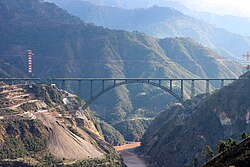
The largest of all indian's railway bridges is the Chenab Bridge, located on the Jammu–Baramulla line that connects the Jammu region and the Kashmir Valley, which turned out to be the most expensive line of Indian's railway network. The Chenab Bridge was the highest arch bridge in the world when opening in 2022 with a deck 322 m (1,056 ft) above the Chenab River, it's still the highest railway bridge on earth nowadays.[1][2]
Extradosed bridges have experienced remarkable growth in India since the 2010s with a large number of multi-span bridges built on rivers such as the Ganges, which has significant widths in certain places. Their advantages are as follows:
- They allow longer spans than conventional beam bridges and therefore a reduced number of foundations.
- The thickness of the deck is considerably reduced (the Arrah–Chhapra bridge deck is 3.4 m (11 ft) thick), thereby minimizing the amount of concrete.
- They can be made up of precast segments even for medium spans and then be erected much more quickly and easily than the typical in-situ concrete construction.
- A more elegant aesthetic appearance than conventional beam bridges.[3]
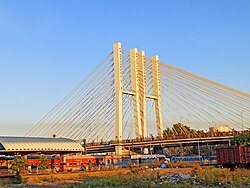
The first major extradosed bridge built in India is the Second Vivekananda Bridge between Howrah and Kolkata. It has 8 pylons and a suspended length of 880 m (2,890 ft), which was among the longest in its category at the time. Additionally it had one of the largest numbers of spans at the time. Another main feature of the bridge is its 29 m (95 ft) width with 6 road lanes for a single plane axial suspension.[4]
The Arrah–Chhapra Bridge held the record for the longest total extradosed span length in the world when it was inaugurated in 2017, with 16 pylons and 1,920 m (6,300 ft), surpassing the well-known Twinkle Ibigawa Bridge in Japan.[3] This record will be largely beaten by the new Kacchi Dargah–Bidupur Bridge under construction with 66 pylons and an extradose length of 9,750 m (31,990 ft).[5]
The Rajendra Setu was the first rail-cum-road bridge in independent India on the river Ganga, one of the major rivers in the country.
This table presents the structures with spans greater than 120 metres (390 ft) (non-exhaustive list). Template:Row indexer
Planned bridges[edit | edit source]
Alphabetical list[edit | edit source]
See also[edit | edit source]
- Transport in India
- Highways in India
- List of national highways in India
- Rail transport in India
- Geography of India
- List of rivers of India
- List of longest bridges above water in India
- List of longest bridges in West Bengal
- Bridges in Bihar
- List of bridges in Srinagar
- List of bridges on Brahmaputra River
Notes and references[edit | edit source]
- Notes
- Nicolas Janberg. "International Database for Civil and Structural Engineering". Structurae.com.
- Others references
- ↑ "Chenab Railway Bridge". Highestbridges.com. Retrieved December 20, 2022.
- ↑ "World's highest rail bridge to come up across Chenab river". Hindustan Times. Archived from the original on February 17, 2013. Retrieved December 20, 2022.
- ↑ 3.0 3.1 Cite error: Invalid
<ref>tag; no text was provided for refs namedRobazza Trowland - ↑ "Design and Construction Features of Nivedita Bridge". Nbmcw.com - NBM&CW Infra Construction & Equipments Magazine. Archived from the original on October 27, 2020. Retrieved December 20, 2022.
- ↑ Cite error: Invalid
<ref>tag; no text was provided for refs namedVeera Choi Viswanath
Further reading[edit | edit source]
- Bhandari, R.R. (2006). "Bridges: The Spectacular Feat of Indian Engineering" (PDF). Indian Railways, Glorious 150 years. Publications Division, Ministry of Information & Broadcasting, Government of India. ISBN 8123012543. Archived from the original (PDF) on March 5, 2016.
- Bhide, M.C.; Matange, H.D. (2001). "Arch Bridge Architectural and Constructional Developments in India". Arch'01 : Troisième conférence internationale sur les ponts en arc - Abdunur, Charles. Paris: Presses de l'Ecole nationale des ponts et chaussées. pp. 105–111. ISBN 2-85978-347-4.
- Data Collection Survey on Bridge Sector - Final Report (PDF). Japan International Cooperation Agency - Ministry of Road Transport and Highways. April 2014.
{{cite book}}:|website=ignored (help) - Deloche, Jean (1984). The Ancient Bridges of India. New Delhi: Sitaram Bhartia Institute of Scientific Research.
- Harper, Douglas (2015). River, Railway and Ravine: Foot Suspension Bridges for Empire. History Press. ISBN 978-0-7509-6213-1.
- IABSE Colloquium (New Delhi): Foundations for major bridges: design and construction. Vol. 80. International Association for Bridge and Structural Engineering. 1999.
{{cite book}}:|website=ignored (help) - IABSE fourteenth congress (New Delhi). International Association for Bridge and Structural Engineering. March 1992. ISBN 3-85748-075-0.
{{cite book}}:|website=ignored (help) - "Indian Engineering Heritage (Railways), Fourth Report" (PDF). Inae.in. Indian National Academy of Engineering. April 2015. pp. 45–92. Archived from the original (PDF) on 1 February 2020.
- Prade, Marcel (1990). "L'Inde". Les Grands Ponts du Monde : Ponts Remarquables Hors d'Europe [The Great Bridges of the World: Remarkable Bridges Outside Europe]. Art et patrimoine (in français). Poitiers: Brissaud. p. 233. ISBN 2-902170-68-8.
- Singh, Yatindra Pal (2022). Iconic Bridges of Indian Railways. Blue Rose Publishers. ISBN 978-93-5611-461-6.
External links[edit | edit source]
- "Brücken in der Indien" [Bridges in India]. Brueckenweb.de (in Deutsch).
- Denenberg, David. "Suspension Bridges of India". Bridgemeister.com.
- Sakowski, Eric. "Category: Bridges in India". Highestbridges.com.
Template:List of bridges in the world Template:Bridge footer