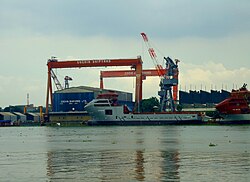
A shipyard, also called a dockyard or boatyard, is a place where ships are built and repaired. These can be yachts, military vessels, cruise liners or other cargo or passenger ships. Compared to shipyards, which are sometimes more involved with original construction, dockyards are sometimes more linked with maintenance and basing activities. The terms are routinely used interchangeably, in part because the evolution of dockyards and shipyards has often caused them to change or merge roles.
Shipyards are constructed near the sea or tidal rivers to allow easy access for their ships. The United Kingdom, for example, has shipyards on many of its rivers.
The site of a large shipyard will contain many specialised cranes, dry docks, slipways, dust-free warehouses, painting facilities and extremely large areas for fabrication of the ships. After a ship's useful life is over, it makes its final voyage to a ship-breaking yard, often on a beach in South Asia. Historically ship-breaking was carried out in drydock in developed countries, but high wages and environmental regulations have resulted in movement of the industry to third-world regions.
The oldest structure sometimes identified as a dockyard[lower-alpha 1] was built c. 2400 BC by the Indus Valley civilisation in the Harappan port city of Lothal (in present-day Gujarat, India).<ref name=":0">"Archaeological remains of a Harappa Port-Town, Lothal". UNESCO World Heritage Centre. Retrieved 10 February 2022. In close proximity to the enclosure identified as a warehouse, along the eastern side where a wharf-like platform, is a basin measuring 217 m long and 26 meters in width, identified as a tidal dock-yard.</ref><ref>"This is Modi govt's plan for India's first National Maritime Museum in Gujarat's Lothal". ThePrint. 9 March 2020. Archaeological excavations discovered the oldest man-made dockyard – over 5,000 years old – in Lothal, located near the village of Saragwala in the Dholka Taluka of Ahmedabad district. [...] It was one of the southernmost cities, and the only port town, in the Indus Valley civilisation. [...] While the city has been nominated as a UNESCO World Heritage Site by the Indian government, its application is pending on the United Nation's tentative list. [...] According to UNESCO, stone anchors, marine shells and seals possibly belonging to the Persian Gulf corroborate the use of the basin as a dockyard where boats would have sailed upstream from the Gulf of Cambay during high tide.</ref> Lothal engineers accorded high priority to the creation of a dockyard and a warehouse to serve the purposes of maritime trade. The name Naupactus, an ancient Greek city on the Gulf of Corinth, means "shipyard" (combination of the Greek words ναύς naus: "ship, boat"; and πήγνυμι pêgnumi, pegnymi: "builder, fixer").<ref name="t347">Strabo (11 June 2024). Strabo's Geography: A Translation for the Modern World. Princeton University Press. p. 499. ISBN978-0-691-24312-2. Retrieved 4 September 2025.</ref> Naupactus' reputation in this field extended back into legendary times – the site is traditionally identified by Greek authors such as Ephorus and Strabo as the place where a fleet was said to have been built by the legendary Heraclidae<ref>Müller, Karl Otfried, ed. (2010) [1841]. "Ephori fragmenta". Fragmenta Historicorum Graecorum. Cambridge: Cambridge University Press. p. 236. ISBN9781108016605. Retrieved 23 May 2024. Naupactus, ... sic dicta quod Heraclidae ibi classem compegerint, auctoribus Ephoro et Strabone.</ref> Other early historical shipyards include Tel Abu Saifi, in the Northern Sinai, a 4th-century BCE, Ptolemaic Era, Egyptian dockyard, with two dry docks.<ref>"Ancient Shipyard Discovered in Egypt – Archaeology Magazine". archaeology.org. 13 February 2019. Retrieved 13 July 2022.</ref> Narni was a shipyard of Ancient Rome.
In the Spanish city of Barcelona, the Drassanes shipyards were active from at least the mid-13th century until the 18th century, although at times they served as a barracks for troops as well as an arsenal. During their time of operation the Drassanes were continuously changed, rebuilt and modified, but two original towers and part of the original eight construction-naves remain today. From the 14th century, several hundred years before the Industrial Revolution, ships were the first items to be manufactured in a factory – in the Venice Arsenal of the Venetian Republic in present-day Italy. The Arsenal apparently mass-produced nearly one ship every day using pre-manufactured parts and assembly lines. At its height in the 16th century the enterprise employed 16,000 people. Spain built component ships of the Great Armada of 1588 at ports such as Algeciras or Málaga.<ref>"Quarterly Review". Quarterly Review (100–118). Anglo-Spanish Society: 43. 1977. Retrieved 23 June 2023. It is probable that at least a quarter of the ships of the Great Armada sent against England were built at Algeciras or Malaga.</ref> In the 17th and 18th centuries, shipyards developed in complexity, with yards such as Blackwall Yard (1614 to 1987), the Scotts Shipbuilding and Engineering Company in Greenock, Scotland (1711–1984) and the Kraljevica Shipyard (1729 and still operating) being established. Havana was long the only dockyard in the Caribbean during the colonial period, the Santísima Trinidad, the largest warship of its time, was built there in 1769. Royal Naval Dockyards in the UK also expanded at this time, (including Woolwich, Deptford, Chatham, Portsmouth and Devonport), Gibraltar, Bombay, Bermuda, Hong Kong and elsewhere worldwide. Similarly, other countries in this period include the Nantes-Indret yard in France (established in 1771 it built ships for the American Revolution including the Deane), Charlestown Navy Yard, later Boston Navy Yard, Boston, Massachusetts (1800 to 1974), the Navy Island, Ontario, Canada (French in the 18th century, then British 1763 to War of 1812), the Philadelphia Naval Shipyard (1799 to 1995), at two locations, and the Portsmouth Naval Shipyard, located on Maine-New Hampshire border (1800 to present, making it the oldest continuously operating shipyard of the US Navy).
New shipyards were established after the war, a prominent example being the Gdańsk Shipyard in 1945, the birthplace of Solidarity Movement – (still a working yard). In the late 20th century, shipbuilding in countries such as the US and UK declined, with yards closing and new shipyards instead expanding in countries such as Japan, South Korea and China.<ref name="e757"/><ref name="v785">Milmo, Dan (6 November 2013). "The decline of the UK shipbuilding industry was not inevitable". the Guardian. Retrieved 4 September 2025.</ref> By the early 21st century, China became the worlds leading shipbuilder, with approximately 50% of global tonnage build at Chinese shipyards in 2023.<ref name="h362">"A closer look at the massive Chinese orderbook amid US probe". Riviera (in português). Retrieved 4 September 2025.</ref> Since the early 2020s, shipyard capacity, design and infrastructure is changing in light of technological change and as the result of regulatory changes from the International Maritime Organization requiring ships to be built to operate more efficiently and with less pollution.<ref name="c717">"Review of Maritime Transport 2024"(PDF). UN Trade and Development (UNCTAD). 22 October 2024. p. 4. Retrieved 4 September 2025.</ref>
Shipyard work
Donjon shipyard with fully enclosed assembly building in Erie, Pennsylvania
Work in shipyards typically involves the construction, modification, retrofitting and repair of ships.<ref name="c766">Eyres, D.J.; Bruce, G.J. (2012). "Shipyard layout". Ship Construction. Elsevier. pp. 119–124. doi:10.1016/b978-0-08-097239-8.00011-8. ISBN978-0-08-097239-8.</ref> This varies according to the type of shipyard and if there are drydocks in the shipyard.<ref name="c776">"Guidance on safety in shipyards". International Marine Contractors Association (IMCA). Retrieved 4 September 2025.</ref> It may also involve ship breaking, although in the 21st century, most ship recycling takes place at the Alang Ship Breaking Yard in India, the Chittagong Ship Breaking Yard in Bangladesh and the Gadani Ship Breaking Yard in Pakistan.<ref name="h741">"Ship Breaking around the world". Ship Breaking. 4 September 2025. Retrieved 4 September 2025.</ref> Shipyards normally have industrial facilities for the production, assembly, and installation of materials. Shipyards normally have quays, jetties and slipways that include specific areas for launching, for repair and for outfitting work.<ref name="c766"/> The work in the shipyard will typically involve activities such as the welding and cutting of steel, the use of cutting tools and other machine tools plumbing, electrical work, and the application, removal or renewal of paints and coatings.<ref name="i517">"Shipyards". Maritime Safety and Health. 1 May 2024. Retrieved 4 September 2025.</ref>
Work in the shipyard typically falls under the relevant national domestic health and safety legislation. Examples around the world include the US Shipyard Industry Standards, part of Occupational Safety and Health Administration, the UK workplace regulations of the UK Health and Safety Executive and the Industrial Safety and Health Act of Ministry of Employment and Labor in South Korea.<ref name="t292">"Shipyard Industry Standards"(PDF). OSHA. Retrieved 4 September 2025.</ref><ref name="j836">"Shipbuilding and ship-repair". HSE. 16 July 2025. Retrieved 4 September 2025.</ref><ref name="n521">The Maritime Executive (3 September 2025). "Supervisor Killed at Hanwha Ocean Shipyard During Testing on FPSO". The Maritime Executive. Retrieved 4 September 2025.</ref> Work in shipyards can at times be considered dangerous.<ref name="r319">DiVincenzo, Kimber (17 July 2025). "Workplace Safety For Shipyard Workers". Work-Fit. Retrieved 4 September 2025.</ref> Accidents in shipyards may involve falls from height,<ref name="n521"/> as well as injuries from the use of tools and equipment, and from other hazards such as fire, explosion and pollution.<ref name="r319"/> In the late 20th century, many shipyard workers have been affected by the legacy of asbestos use within shipyards, although the use of the material is often prohibited following greater understanding of the effects of asbestosis.<ref name="u653">Beckett, William S (19 September 2007). "Shipyard workers and asbestos: a persistent and international problem". Occupational and Environmental Medicine. 64 (10). BMJ: 639.1–641. Bibcode:2007OccEM..64639.1B. doi:10.1136/oem.2006.032284. ISSN1351-0711. PMC2078396. PMID17881468.</ref> Hazards may also come from factors such as slips, trips, excessive-noise, high-pressure tools and impact tools such as needleguns and grinders.<ref name="k771">"Occupational Safety and Health Administration". Shipyard Common Hazards. 26 June 2014. Retrieved 4 September 2025.</ref> To mitigate the dangers and hazards of shipyard work, many employ safe systems of work based on regulation, best practice and guidance, typically involve the control of processes and the use of risk assessments and similar methods of work.<ref name="c776"/>
Norfolk Naval Shipyard in Portsmouth, Virginia, is one of the largest shipyards in the world; specializing in repairing, overhauling and modernizing naval ships and submarines. It's the oldest and largest industrial facility that belongs to the United States Navy
Vigor Marine Group, a shipbuilding and ship repair company headquartered in Portland, Oregon, with shipyards in Oregon, Washington, California, and Virginia as of 2025[update].
Fincantieri – Cantieri Navali Italiani S.p.A.<ref>E-mail * Saisissez votre adresse électronique. (24 December 2012). "STX Europe démantelé, Fincantieri va devenir le géant européen de la navale" (in français). Mer et Marine. Archived from the original on 2 May 2013. Retrieved 30 April 2013.</ref> is an Italian shipbuilding company based in Trieste, Italy. It was formed in 1959 and is the largest shipbuilder in Europe, and one of the largest in the world. The company has built both commercial and military vessels during its history.
The Meyer Werft GmbH is one of the major German shipyards, headquartered in Papenburg at the river Ems. Founded in 1795 and starting with small wooden vessels, today Meyer Werft is one of world's leading builders of luxury passenger ships. Altogether about 700 ships of different types have been built at the yard.
Navantia: major public Spanish shipbuilding firm, which offers its services to both military and civil sector in three industrial areas: Cartagena / Cádiz / Ferrol (headquarters: Madrid) and with recent important projects as -class frigate program and -class submarine program
Construcciones Navales del Norte LaNaval, Sestao (Bilbao)
Navantia-Cartagena shipyard (Spain)Devonport Dockyard, located in the city of Plymouth, England in the county of Devon is the largest naval base in Western Europe. It has 15 dry docks, 4 miles (6.4 km)* of waterfront, 25 tidal berths, five basins and covers 650 acres (2.6 km<sup>2</sup>). It is the main refitting base for Royal Navy nuclear submarines and also handles work on frigates. It is the base for seven of the Trafalgar-class nuclear-powered hunter-killer submarines and many frigates, exploiting its convenient access to the Atlantic Ocean. It supports the Vanguard-classTrident missile nuclear ballistic missile submarines in a custom-built refitting dock. It houses HMS Courageous, a nuclear-powered submarine used in the Falklands War and open to the general public.<ref>"Submarine Museum marks Falklands 30th anniversary". BBC. 2 May 2012. Archived from the original on 14 June 2012.</ref> Facilities in the local area also include a major naval training establishment and a base for the Royal Marines.
Chatham Dockyard, located on the River Medway in Kent, was established as a royal dockyard by Queen Elizabeth I in 1567. For 414 years, the Dockyard provided over 500 ships for the Royal Navy, and was forefront of shipbuilding, industrial and architectural technology. At its height, it employed over 10,000 skilled artisans and covered 400 acres (1.6 km<sup>2</sup>). The dockyard closed in 1984, and most of the Georgian dockyard is now managed as a visitor attraction by the Chatham Historic Dockyard Trust.
Galați shipyard Galați is the largest naval shipyard on the Danube, given its strategic positioning inland but with access to the sea through either Sulina or Danube-Black Sea canal its output ranges from large tankers to research vessels, yachts and small coast guard patrol boats. The yard is known for taking on specialty projects and under Damen has completed over such 250 vessels since 1999.
The Black Sea Shipyard in Mykolaiv, Ukraine, is one of the largest shipyards in Europe, and is where all Soviet and Russian aircraft carriers were built.
Mitsui Engineering & Shipbuilding's Tamano Works builds bulk carriers, ore carriers, crude oil tankers, oil product carriers, LNG carriers, LPG carriers, reefers, container ships, pure car carriers, cargo ships, patrol vessels, ocean surveillance ships, training vessels, fishery patrol boats and fishing boats
Mitsubishi Heavy Industries's Nagasaki Shipyard & Machinery Works primarily produces specialized commercial vessels, including LNG carriers, oil tankers and passenger cruise ships
Hyundai Heavy IndustriesUlsan Shipyard & Gunsan shipyard, in South Korea, is currently the largest in the world and has the capability to build a variety of vessels including Commercial Cargo, FPSO offshore, container ship, LNG Carrier, Car carriers, Tankers like VLCC & ULCC, Iron ore carrier and Naval vessels like Aegis destroyers & submarines.
CSBC Corporation, Taiwan, in Taiwan, is a private company that produces ships for civilian and military use. It was a state-owned enterprise of Taiwan (Republic of China) but transitioned to private ownership via an IPO in 2008. It is headquartered in Kaohsiung and shipyards in Kaohsiung and Keelung.
Jiangnan Shipyard, in Shanghai, China, is a subsidiary of China State Shipbuilding Corporation that produces both military and civilian ships. Its headquarters and main shipyard are based in Shanghai, with subsidiary shipyards in Shanghai and Chongqing.
Bason Shipyard, in Ho Chi Minh City, Vietnam, is a long-standing builder that was established by the French government in April 1863 to repair warships and merchant vessels. Aside from its main function of building and repairing naval vessels, Bason also offers service to local and foreign customers from Southeast Asia and Europe.<ref>"Bason Shipyard's Brief History" (in Tiếng Việt). Bason Shipyard Website. Archived from the original on 3 March 2016. Retrieved 29 March 2013.</ref>
South Asia and the Middle East
Cranes in Cochin Shipyard (India).Dhaka ShipyardDhaka Shipyard – welding propellers
FMC Dockyard is one of the largest shipyards in Bangladesh, located in Eastern Bank of the Karnaphuli river in Chittagong. The dockyard has its own forward and backward linkage. 106-by-26-metre (348 ft × 85 ft) Syncrolift and side transfer system.
Western Marine Shipyard, a leading shipyard in Bangladesh based in Chittagong. The shipyard has been exporting ships and vessels to a number of European, Asian and African countries.
Khulna Shipyard is the oldest shipyard in Bangladesh, situated in Khulna. It mainly produces warships for Bangladesh Navy. Recently it also started to build commercial vessels like cargo ship, container, oil tanker for local buyers.
Pipavav Shipyard in Gujarat, India, is the leading, modern and largest engineering facility in the business of ships and offshore platforms construction, repair and conversion, heavy engineering and offshore engineering in South Asia.
Colombo Dockyard in Colombo, Sri Lanka, is the largest engineering facility in the business of ship repair, shipbuilding, heavy engineering and offshore engineering in Sri Lanka.
Mazagaon Dockyard, operated by state-owned Mazagaon Dock Limited, is one of India's largest shipyards. It constructs a variety of ships both for the defence and civilian sector. The dockyard is known for constructing Britain's HMS Trincomalee. Currently the shipyard is building three -class frigates and three -class destroyers for the Indian Navy.
The Jebel Ali and Dubai ports in the UAE are capable of handling, constructing and repairing large ships. They also provide dry dock facilities.<ref>"Drydocks World: Profile". drydocks.gov.ae. Archived from the original on 4 May 2018. Retrieved 13 May 2020.</ref>
The gate 7 of Shuwaikh port in the Kuwait has facility for repairing ships. They also provide dry dock facilities.<ref>"HOME". heisco.com. Archived from the original on 24 February 2018. Retrieved 6 May 2018.</ref>
↑An alternative classification describes the structure as an irrigation tank.<ref>Leshnik, Lawrence S.; Junghans, K. H. (October 1968). "The Harappan 'Port' at Lothal: Another View". American Anthropologist. 70 (5): 911–922. doi:10.1525/aa.1968.70.5.02a00070. Retrieved 22 May 2024. The settlement in general and the basin in particular do not, in the author's view, appear to meet the requirements of a port. As an alternative, he suggests that the basin could have served as an irrigation tank for a moderately-sized but still rural village.</ref>
References
External links
Shipbuilding History – extensive collection of information about North American shipyards, including over 500 pages of US shipyard construction records