

 | This article needs more citations. (September 2018) |
| Kachchaleswarar Temple | |
|---|---|
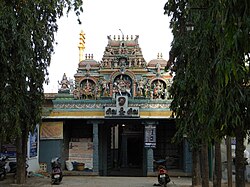
 Front view of Kachchaaleeshwarar Koil | |
| Religion | |
| District | Chennai |
| Deity | Kachchaleswarar (Lord Shiva) |
| Location | |
| State | Tamil Nadu |
| Country | India |
 Interactive map of Kachchaleswarar Temple | |
| Coordinates | 13°02′01″N 80°16′13″E / 13.033634°N 80.270199°E |
| Architecture | |
| Creator | Kalavai Chetty |
| Temple | 1 |
Kachchaleswarar Temple, also known as the Great Kachali Pagoda, is a Hindu temple located in Armenian Street, in the neighbourhood of Parry's corner (Old: George Town) in Chennai city, Tamil Nadu, India. Constructed on land belonging to dubash Kalavai Chetty in 1725, the temple belonged to the left-hand castes and was the site of the first major conflict between left and right-handed castes in the then Madras city.
The temple is modelled on the Kachaaleshwarar temple at Kancheepuram. Kachaaleshwarar (Shiva) is the main deity and Soundaraambikai, the consort deity.
History


The temple was built in 1725 by Kalavai Chetty, a 'dubash' working for the British East India Company, on a land belonging to him.[1] The street on which the temple stands was originally came to be known as "Katchala Pagoda Street", after the "Great Kachali Pagoda" as the temple was known then.[1] A huge retinue of dancing girls were attached to the temple in the earlier days.[1] These dancing girls resided in a quarter adjoining the temple since about 1700.[1]
The temple happened to be the cause of one of "Black Town's" first caste disputes as it belonged to the Left-Hand Caste. With the government's intervention, a new approach to the temple was built without encroaching on Right-Hand Caste property.[1]
A plaque in the temple records the year of the first kumbhaabishekam (consecration) as 1728. Post-Independence, a mahaa-kumbhaabishekam (great consecration) was held on 8 July 1962. A major renovation of the temple began on 20 February 1984 and another great consecration was held on 9 July 1989.

See also


References
- ↑ 1.0 1.1 1.2 1.3 1.4 Muthiah, S. (2014). Madras Rediscovered. Chennai: EastWest. p. 383. ISBN 978-93-84030-28-5.
Further reading
- Muthiah, S. (2004). Madras Rediscovered. East West Books (Madras) Pvt Ltd. p. 329. ISBN 81-88661-24-4.


| Temples |
|
|---|---|
| Churches |
|
| Mosques | |
| Jain temples | |
| Buddhist temples | |
| Gurudwaras | |
| Parsi temples | |

