
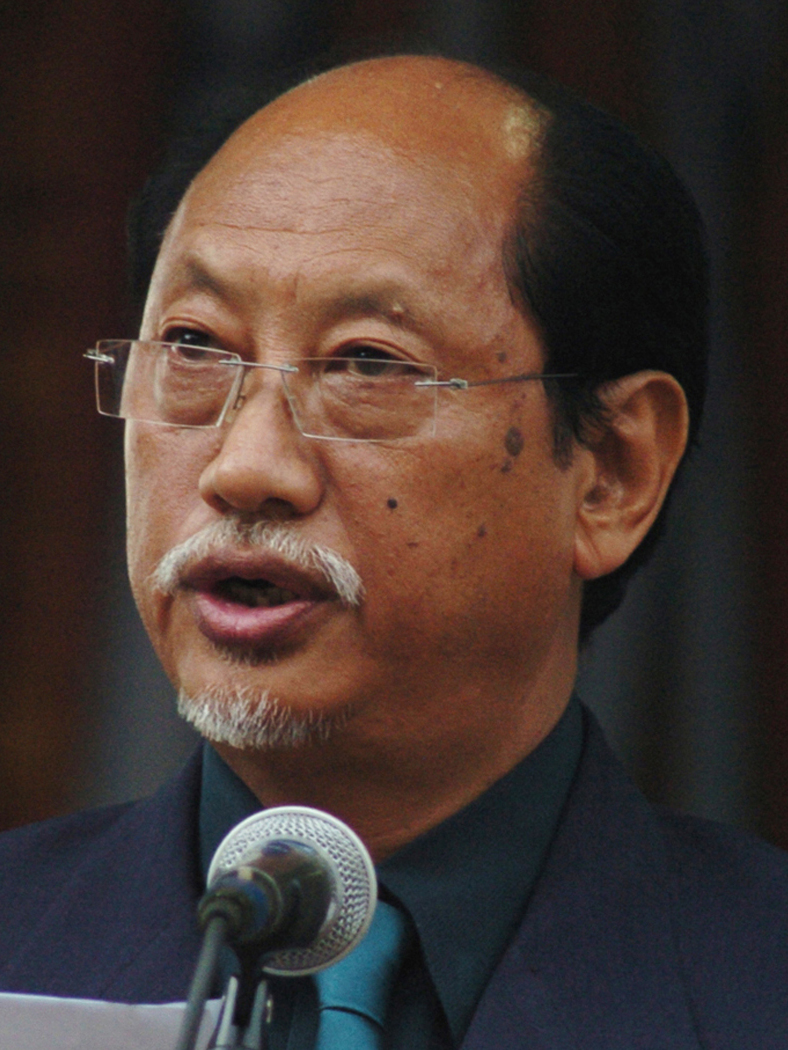
| Chief Minister of Nagaland | |
|---|---|
| File:..Nagaland Flag(INDIA).png | |
| Style | The Honourable (Formal) Mr. Chief Minister (Informal) |
| Status | Head of Government |
| Abbreviation | CM |
| Member of | Nagaland Legislative Assembly |
| Reports to | Governor of Nagaland |
| Appointer | Governor of Nagaland |
| Term length | At the confidence of the assembly Chief minister's term is for five years and is subject to no term limits.[1] |
| Inaugural holder | P. Shilu Ao |
| Formation | 1 December 1963 |
| Deputy | Yanthungo Patton |
The Chief Minister of Nagaland is the chief executive of the Indian state of Nagaland. As per the Constitution of India, the governor is a state's de jure head, but de facto executive authority rests with the chief minister. Following elections to the Nagaland Legislative Assembly, the state's governor usually invites the party (or coalition) with a majority of seats to form the government. The governor appoints the chief minister, whose council of ministers are collectively responsible to the assembly. Given that he has the confidence of the assembly, the chief minister's term is for five years and is subject to no term limits.[1]
Since 1963, ten people belonging to seven parties have served as Chief Minister of Nagaland. The first three belonged to the Naga Nationalist Organisation, including the inaugural officeholder P. Shilu Ao. The current incumbent is Neiphiu Rio of the Nationalist Democratic Progressive Party, in office since 8 March 2018.
List

.png)


.jpg)

Notes
- Footnotes
- ↑ A number inside brackets indicates that the incumbent has previously held office.
- ↑ This column only names the chief minister's party. The state government he headed may have been a complex coalition of several parties and independents; these are not listed here.
- ↑ 3.0 3.1 3.2 3.3 President's rule may be imposed when the "government in a state is not able to function as per the Constitution", which often happens because no party or coalition has a majority in the assembly. When President's rule is in force in a state, its council of ministers stands dissolved. The office of chief minister thus lies vacant, and the administration is taken over by the governor, who functions on behalf of the central government. At times, the legislative assembly also stands dissolved.[3]
- References
- ↑ 1.0 1.1 Durga Das Basu. Introduction to the Constitution of India. 1960. 20th Edition, 2011 Reprint. pp. 241, 245. LexisNexis Butterworths Wadhwa Nagpur. ISBN 978-81-8038-559-9. Note: although the text talks about Indian state governments in general, it applies for the specific case of Nagaland as well.
- ↑ "General Information, Nagaland". Information & Public Relations department, Nagaland government. Archived from the original on 8 May 2015. Retrieved 11 March 2009.
- ↑ Amberish K. Diwanji. "A dummy's guide to President's rule". Rediff.com. 15 March 2005.