




 | This article needs more citations. (November 2015) |
| Hari Singh | |
|---|---|
 | |
| Maharaja of Jammu and Kashmir | |
| Reign | 23 September 1925 — 17 November 1952 |
| Predecessor | Pratap Singh |
| Successor | Monarchy abolished |
| Regent | Karan Singh (1949-1952) |
| Born | 23 September 1895 Jammu, Jammu and Kashmir, British India (present-day Jammu and Kashmir, India) |
| Died | 26 April 1961 (aged 65) Mumbai, Maharashtra, India (present-day Mumbai) |
| Spouse | Maharani Tara Devi (4th wife) |
| Issue | Karan Singh (titular Maharajah) |
| House | Dogra |
| Father | Sir Amar Singh |
| Religion | Hinduism[1] |

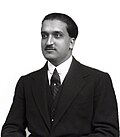
Maharaja Sir Hari Singh GCSI GCIE GCVO (23 September 1895 – 26 April 1961) was the last ruling Maharaja of the princely state of Jammu and Kashmir during British Raj, a landlocked kingdom bordered by five nations: Afghanistan, Russia, India, Pakistan and China. In 1947 Hari Singh through its Legistlative Assembly (Praja Parishad) decided to remain independent but factions from Poonch & Gilgit (western Kashmir) led an armed struggle resulting to Indo-Pakistani War of 1947-1948 than Indo-Pakistani War of 1965, Indo-Pakistani War of 1971 & Kargil 1999, yet the conflicts didn't resolve the confusion as who really owns Kashmir as Pakistan could grab only 1/4 of Jammu & Kashmir while the prized 'Vale of Kashmir' remained with India. Pakistan often questions on the legalities of 'ownership of Kashmir' which has led to detailed disclosure of all events revolving around 'Hari Singh' again and again. His personality is under scrutiny and politicians continuously use his placard to arouse public sympathies even though he legally handed over Kashmir to India, an area with diverse ethnicities and retired to Mumbai where he died in 1961.
Early life

Hari Singh was born on 23 September 1895 at the palace of Amar Mahal, Jammu, the only surviving son of Raja Amar Singh,[2] the brother of Maharaja Pratap Singh Jamwal, then the Maharaja of Jammu and Kashmir in a Rajput family. Since the Maharaja had no issue, Hari Singh was heir to the throne of Jammu and Kashmir.
In 1903, Hari Singh served as a page of honour to Lord Curzon at the grand Delhi Durbar. At the age of thirteen, he was sent to Mayo College in Ajmer. A year later, in 1909, his father died, and the British took a keen interest in his education and appointed Major H. K. Brar as his guardian. After Mayo College, Hari Singh went to the British-run Imperial Cadet Corps at Dehradun for military training.[citation needed]
Maharaja Pratap Singh appointed him as the commander-in-chief of the State Forces in 1915.[3]
British Connection
During first world war (1914-1918), Hari Singh seeked permission for his visit to Flanders and France so he can encourage morale of his troops, which was not obliged as his presence could have been misunderstood by native Indians who were fighting in harsher winters in trench warfare.[4]On his maiden visit to Britain in 1919, Hari Singh's heart was lonely. Hari Singh was raised by Francis Younghusband, British Resident of Kashmir (1906-1909) family and their daughter Eileen Younghusband had played with him in childhood. Hari Singh aged 24 met Mrs Maud (Maudie) aged 18 who resembled Eileen on the celebration of Armistice day Ball at Albert Hall on 4 November 1919 and instantaneously fell in love, it was like returning of old playfull days. He left for Paris where Mrs Maud (Maudie) joined to celebrate French Christmas. Little he realized that affair is going to end within a month and he will fall prey to the plans of 'Mayfair Mob': Monty Newton and Rodolphe Lemoine the two of the most notorious conmen in history.[5] The "youthful escapades" of Hari Singh, whilst crown prince included paying two cheques of £150,000, the second cheque was later stopped after suspicion for blackmailing by the fake ex-husband of Maudie Robinson of Knightsbridge, the affair 'Black Prince Conspiracy' came into the limelight of media in 1921.[6] That issue had resulted in a court case in London in 1924 during which the India Office tried to keep his name out of proceedings by arranging for him to be referred to as "Mr A."[3] However "the secret of the Kashmiri Prince and the beautiful blonde quickly became the subject of salacious gossip throughout London society."[6] Realizing many sensitive information involved around conman which included espionage, India Office in Britain decided to close the files for a hundred years rather than the usual thirty.[7]

He was one of the two members from India on Churchill's British War Cabinet in World War II. Hari Singh supplied 75,000 troops from the Jammu & Kashmir Rifles ( J&K State Forces ) for the Allied Forces


Reign

The Seal of Maharaja Hari Singh had a Crown at the top. A katar or ceremonial dagger sat below the crown. Two soldiers held the flags. An image of the sun was between them, that symbolised his Suryavansha Kshatriya lineage]] from Lord Rama, the Hindu Sun God. Following the death of his uncle Pratap Singh in 1925, Hari Singh ascended the throne of Jammu and Kashmir. Singh was known as a lavish spender of money. The funeral of his uncle and former ruler Pratap Singh is believed to have expended much gold and jewellery in the funeral pyre.[8] Immediately, Hari Singh conducted free elections and formed Praja Sabha ( Legistlative Assembly of King's People) to rule with laws implemented under Ranbir Penal Code (R.P.C) which Praja Parishad decreed. Hari Singh served as second Prime Minister (1925-1927) Jammu and Kashmir (princely state).[9]As per recommendations of Glancy Commission 75 members – 12 government officials, 16 state councillors, and 14 nominated and 33 elected (21 Muslims, 10 Hindus and 2 Sikhs) formed Praja Parishad members. The laws under Praja Parishad made Jammu & Kashmir a forerunner state for other Princely India. Primary education was made compulsory in the state, introduced laws prohibiting child marriage, widow remarriage and opened places of worship to the low castes.[10] Maharaja Hari Singh and his law and revenue minister, Justice Sir Lal Gopal Mukherjee, a former judge of the Allahabad high court (1926-1934), who had served the state of J&K from 1935 to 1940 brought a written Constitution of J&K on 7 September 1939 which was the "pioneer" in the annals of Asia's constitutional history; despite the fact that it was anything but a people-friendly "Magna Carta" for the state.[11]
Partition and accession
In 1947, after India gained independence from British rule, Jammu and Kashmir could have joined India, joined Pakistan, or remained independent. Jammu & Kashmir princely state originally maintained its independence by signing standstill agreement ( provision in accession agreement ) with Pakistan to which India declined and insisted on full accession.[12]Urged by Patel, Gowalkar (Guruji) the RSS chief reached Srinagar on 17 October and met Maharaja on 18 October and pleaded him to join India.[13][14]. On the night of 21/22 October 1947 nearly 20,000 Pashtun tribesmen funded by Pakistan infiltrated into border of Jammu & Kashmir at Muzaffrabad. 4 J&K State forces deployed at Muzaffrabad joined hands with invaders and Maharaja Hari Singh's C-I-C Rajinder Singh (brigadier), left with only 200 men withheld invaders at Uri ( gateway to Kashmir) from 23-26/27 October 1947. While, Maharaja Hari Singh kept appealling to India for help.[15] As invaders neared Srinagar, V.P Menon & Sam Manikshaw arrived at Srinagar to assess the situation of Kashmir and adviced Maharaja Hari Singh to proceed to Jammu on 25 October 1947. On next day V.P Menon along with Mehr Chand Mahajan (Prime Minister J&K) left for New Delhi by air on the morning of 26 October 1947. Although the Indian Prime Minister Nehru was ready to send troops, the Governor-General of India, Lord Mountbatten of Burma, advised the Maharaja to accede to India before India could send its troops. Lord Mountbatten assured militarily intervention in J&K only after instrument of accession were signed. V.P Menon then left from New Delhi to Jammu by air in afternoon on 26 October 1947 and got the legal documents signed and came back on the same day by evening by air to New Delhi. Hence, considering the emergency situation, the Maharaja signed the Instrument of Accession on 26 October 1947, joining the whole of his princely state (including Jammu, Kashmir, Northern Areas, Ladakh, Trans-Karakoram Tract and Aksai Chin) to the Dominion of India.[16][17][18][19] On 27 Octobr 1947 Lord Mountbatten accepted the accession of Princely State of Jammu & Kashmir to India and Indian Army landed on Srinagar airport on the same day. These events triggered the first Indo-Pakistan War.[20] Pressure from Nehru and Sardar Patel eventually compelled Hari Singh to appoint his son and heir, Yuvraj (Crown Prince) Karan Singh, as Prince Regent of Jammu and Kashmir in 1949, although he remained the titular Maharaja of the state until 1952, when the monarchy was abolished by Nehru's government. He was also forced to appoint the popular Kashmiri leader Sheikh Abdullah as the prime minister of Kashmir. He had a contentious relationship with both Nehru and Abdullah.[21] Karan Singh was appointed 'Sadr-e-Riyasat' ('Head of State') in 1952 and Governor of the State in 1964.[21] Abdullah would later be dismissed from his position as prime minister of Kashmir and jailed by Karan Singh.[22]
Nehru and Abdullah conspired to banish Singh from Jammu and Kashmir and forced him to live in exile in Bombay. Singh spent his final days in Bombay. He died on 26 April 1961, after fourteen years of his banishment. As per his will, his ashes were brought to Jammu and spread all over Jammu and Kashmir and immersed in the Tawi River at Jammu.[23]
Mahatma Gandhi Connection
Sheikh Abdullah has acknowledged that Hari Singh believed in the philosophy of Mahatma's peacefull satyagrah and treated his opposition with respect. Sheikh Abdullah a satyagrahi during his period was on a trial proceedings during 1947 and was released after Mahatma adviced him to do so. Sheikh Abdullah was again on trial in 1961 in India on Kashmir Conspiracy Case when news of passing away of Hari Singh arrived. Sheikh Abdullah showed his anger on the continuation of court proceedings for that day and requested a day off as a tribute to Hari Singh.[24]
Round Table Conferences (India) held at Britain, Hari Singh shocked English by taking his stand to freedom of India instead of continuation of Raj in 1930 following which Mahatma was brought out of jail and Irwin-Gandhi pact signed so that Mahatma can attend second round table conference in 1931.
Hari Singh replyed to George V: "I must express our deep gratitude to His Most Gracious Majesty for the cordial welcome tendered to us and I pray that providence may grant us the vision and the will to realize the hopes expressed in the inspiring words uttered this morning by our beloved Emperor."
"This is the first occasion on which the Princes of India meet in person at a Conference Table along with the representatives of British India and His Majesty's Government to discuss the political future of India." "As Indians and loyal to the land where we derive our birth and infant nurture, we stand as solidly as the rest of our countrymen for our land's enjoyment of a position of honour and equality in the British Common Wealth of Nations". " Neither England nor India can afford to see this Conference in failure. The task confronting this Conference is a gigantic one. Two years ago, speaking at a meeting of the Chamber of Princes, I said, with regard to certain activities in British India, that is my view, Federation was a higher ideal than isolation. I feel deeply gratified at the progress which has been made with the scheme of an All-India Federation as worked out in the Report of the Federal Structure Sub-Committee. But ever since the idea of a Federation was taken up in this Conference, some surprise has been expressed in various quarters in India and in England at the willingness of the Princes to join an All-India Federation. It is said that Princes have forced the pace and that in any case they should have opposed a Federation with British India."
"I have never disguised from my friends, my warm support of the idea of an All-India Federation".[25]
Nai Talim, an education programme developed for children in 1937 by Gandhi was first adopted by Hari Singh among other Princely States of British India. Hari Singh was very much interested in education. He opened jabran schools whose numbers rose from 706 to 20,728; jabran means forceful education to children. Sheikh Abdullah received his education from one such school.[26]
Family
He was married four times. Three of them died during child births and custom enforced him to immediately take a new bride. With his fourth wife, Maharani Tara Devi (1910–1967), he had one son, Yuvraj (crown prince) Karan Singh.[27] Hari Singh had reserved the entire third floor of the hotel for the occasion where his son was born in Suite 318-319-320 at the Martinez Hotel in Cannes, France.[28]
- Spouses:
- Dharampur Rani Sri Lal Kunverba Sahiba; married at Rajkot 7 May 1913, died during pregnancy in 1915. No children.
- Rani Dhan Deiji Sahiba; married at Chamba 8 November 1915, died 31 January 1920. No children.

- Maharani Dhanvant Kunveri Baiji Sahiba (1910–19?); married at Dharampur 30 April 1923. No children.
- Maharani Tara Devi Sahiba of Kangra,(1910–1967); married 1928, separated 1950, one child:

- Yuvraj (crown prince, i.e. heir apparent) Karan Singh (born 9 March 1931)
Dhandevi Memorial Kanya Fund named after the Maharaja’s Chamba wife granted orphan girls a sum of up to Rs 200 and an acre of state land.
Honours

(ribbon bar, as it would look today; incomplete)


- Delhi Durbar Medal-1903
- Delhi Durbar Medal-1911
- Prince of Wales Visit Medal-1922
- Knight Grand Commander of the Order of the Indian Empire (GCIE)-1929 (KCIE-1918)
- Grand Cross of the Order of the Crown of Italy-1930
- Knight Grand Commander of the Order of the Star of India (GCSI)-1933
- King George V Silver Jubilee Medal-1935
- King George VI Coronation Medal-1937
- Hon. LL.D from Punjab University-1938
- Grand Officer of the Legion d'Honneur-1938
- 1939-1945 Star-1945
- Africa Star-1945
- War Medal 1939-1945-1945
- India Service Medal-1945
- Knight Grand Cross of the Royal Victorian Order (GCVO)-1946 (KCVO-1922)
- Indian Independence Medal-1947
Hari Singh Born: 23 September 1895 Died: 26 April 1961
| ||
| Regnal titles | ||
|---|---|---|
| Preceded by Pratap Singh (as Maharaja of Jammu and Kashmir) |
Maharaja of Jammu and Kashmir 1925–1952 |
Succeeded by Republic of India Karan Singh as titular Maharajah of Jammu and Kashmir |
Pioneer in India
Story goes that 12 Kg of willow seeds and some fine artisans were imported from European lands by Maharaja Hari Singh during his reign to start wicker craft industry in Kashmir.[29] The only successful Willow plantation outside England was done by Forester Mr Steanes (Kamraj Forest Division) at Haran Shallabug Plantation in ( Sindh Forest Division) & Ningli Plantation in ( Bandipora Forest Division) at Kashmir. The varieties that have survived are Slaix alba, Salix nigra for bat manufacturing, Salox babylonica for mighty appearance as ornamental tree, Salix traindra for basket manufacturing have survived till today.[30]
Hari Singh was a tireless women’s rights champion encouraging widow remarriage and ownership of property by women. To ensure that women were included in the revolutionary changes being made in the field of education, he established the department of women education and appointed a Deputy Director for it. His many reforms in the health sector included women-centric measures like additional maternity wards in zenana hospitals.
Legacy
Hari Parbat & Qilla are visible features in the centre of Srinagar. Inspired by it Hari Singh was named after this Hindu deity. Hari Singh Nalwa, captured the only fort of Kashmir from Afghans and remained its first Governor, so its name was changed from Koh-i-Maran to Hari Hill & Fort by Sikhs.[31]
On the death of Hari Singh, Pandit Prem Nath Dogra of Praja Parishad, the person who led an agitation to arrest Sheikh Abdullah took out a mourning procession to the banks of Tawi, where the rituals were performed on 26 April 1961. As Govt. didn't announce state mourning the youth reacted and marched to the civil secretariat to bring down the flag to half-mast but in vain.[32]
The Amar Kshatriya Rajput Sabha (AKRS) J&K installed a life size statue of late Maharaja at district Kashtriya Rajput Sabha Samba near Veer Bhoomi Park Samba Jammu Pathankot national highway on his 119 birthday on 23 September 2019[33]
Dr Karan Singh (his son) dedicated Hari Singh's properties in Jammu to Hari-Tara Charitable Trust on 15 January 1970. The Palace where Hari Singh once played hosts permanent painting galleries known as Amar Mahal Museum and displays 25,000 books Library inside 1890 French designed cheâteau also, houses 'Dogra Gold Throne' on which Hari Singh reigned.[34]
Union Minister Ghulam Nabi Azad & MP Karan Singh unveiled the statue of Maharaja Hari Singh near the Tawi bridge in Jammu on Ramnavmi 1 April 2012.[35]
Hari Niwas Palace, the home of Hari Singh in Jammu is now been run as a heritage hotel which provides the visitors with great services. Located on the shores of River Tawi, this hotel provides views of the Trikuta Hills and Vaishno Devi.[36]
Jammu Municipal Corporation erected a statue of Maharaja Hari Singh in standing posture near Bagh-e-Bahu Police Station adjoining junction crossings linking Gujjar Nagar Tawi Bridge, University, Bagh-e-Bahu, Narwal[37]
Hari Singh High Street Srinagar is named after him. It has 105 gold ornament shops and many luxurious items showrooms.[38]
A trust has converted Hari Singh's polo and horse racing ground into a school: Maharaja Hari Singh Agricultural Collegiate School MHAC, a residential as well as day boarding school at Nagbani, P O Domana Jammu.[39]
Maharaja Hari Singh DAV Public School Poonch started in 1982 with the Nursery class, the institution grew to secondary school and became the first choice of the locality. School affiliated with DAV is located 3 Km away from Poonch in village Kanyuin.[40]
Govt. of India decided to start separate schools for specially-abled children across the State in 2018, Jammu region got its first such school in Government Hari Singh Higher Secondary School, Prem Nagar Jammu; provisioned in new building with residential facilities.[41]
Established in 1933, Hari Singh School, Kanji House Jammu is located next to Mubarak Mandi Palace is being run today by Govt. Education Department for 9 to 12 class. The school is co-educational and it doesn't have an attached pre-primary section.[42]
India Today in 1983 disclosed that Srinagar's Treasury office holds Hari Singh's jewellery which includes crowns, ceremonial swords, necklaces, bracelets, rings, bangles, robes, daggers, watches and even toys kept in trunks and nothing has been decided about their future destiny.[43]
Hari Singh's 1924 Vauxhall 30-98 OE Velox Tourer, fetched 390,000 pounds in auctions at Bonhams Bond Street, Britain on December 2 2018.[44]
Maharaja Hari Singh Park, built at a cost of Rs 4.72 crore in 43 kanals along the Tawi river, was inaugurated by the then Chief Minister of the state Mehbooba Mufti on 16 May 2018. The statue installed in the middle of park is a Metallic replica of Maharaja Hari Singh sitting on his gold throne.[45]
An exclusive park for woman 'Hari Singh Janana Park' was landscaped by Gardens and Floriculture Department at New Secretariat during Chief Minister Ghulam Nabi Azad's tennure
Amar Singh Club Srinagar, established by Hari Singh in 1933 became the first modern club in Srinagar. Designed in British style it covers an overall area of ten acres of spacious lush green lawns, one tennis court, badminton court, two Squash courts and one billiard hall.[46]
Formation of Jammu & Kashmir Bank by Maharaja on 1st October 1938 was a visionary approach for uplifting the society.[47]
References
- ↑ Rai 2004.
- ↑ General Sir Raja Amar Singh Jamwal : 14 January 1865 – 26 March 1909
- ↑ 3.0 3.1 Snedden, Christopher (2015). Understanding Kashmir and Kashmiris. Oxford University Press. p. 128. ISBN 978-1-84904-342-7.
- ↑ "Letter from Lt. Col. Bannermann to J.B Wood 17 November 1917". The British Library:BL IOR R 1/1/917.
- ↑ Kwarteng, Kwasai (28 May 2012). Ghosts of Empire. Bloomsbury. ISBN 9781408829004.
{{cite book}}: CS1 maint: year (link) - ↑ 6.0 6.1 "Hari Singh's blackmailing and love in London". The Kashmir Walla. 13 December 2013. Retrieved 22 May 2021.
- ↑ Jeffrey, Barbara (2019). Chancers. Amberley. ISBN 9781445689784.
- ↑ Kashmir's Last Maharaja, Kashmir Life, 2 May 2011.
- ↑ Hussain, Masood. "Kashmir's Last Maharaja". Retrieved 2 May 2011.
- ↑ Anand, Ragubhir Lal (1 February 2014). IS God DEAD?????. Partridge Publishing. p. 26. ISBN 978-1-48281-823-9.
- ↑ "Hari Singh's 1939 constitution in J&K marked a first in South Asia". Deccan Chronicle. Retrieved 5 September 2019.
- ↑ https://newsroom24x7.com/2020/09/23/tributes-to-the-last-maharaja-of-jammu-kashmir/%7Cdate= September 2020
- ↑ Bhatnagar, Arun (2018). India: Shedding the Past, Embracing the Future, 1906-2017. Konark Publishers. ISBN 9322008903.
- ↑ Mule, Madhavrao. Sri Guruji Samagra Darshan.
- ↑ "Maharaja Hari Singh's Letter to Mountbatten". www.jammu-kashmir.com. Retrieved 10 January 2020.
- ↑ Jha, Prem Shankar (1996). Kashmir 1947, Rival Versions of History. Oxford University Press. ISBN 0195637666.
- ↑ Ramachandra., Guha (1 January 2008). India after Gandhi : the history of the world's largest democracy. Harper Perennial. ISBN 978-0060958589. OCLC 474262656.
- ↑ Justice A. S. Anand, The Constitution of Jammu & Kashmir (5th edition, 2006), page 67
- ↑ Kashmir, Research Paper 04/28 by Paul Bowers, House of Commons Library, United Kingdom. Archived 28 July 2004 at the Wayback Machine
- ↑ "Pakistan Invasion". Early Times. Retrieved 26 October 2018.
- ↑ 21.0 21.1 Ramachandra., Guha (1 January 2008). India after Gandhi : the history of the world's largest democracy. Harper Perennial. p. 92. ISBN 978-0060958589. OCLC 474262656.
- ↑ Ramachandra., Guha (1 January 2008). India after Gandhi : the history of the world's largest democracy. Harper Perennial. p. 262. ISBN 978-0060958589. OCLC 474262656.
- ↑ Dynasty clash in Kashmir: Hari Singh's grandson Ajatshatru challenges Abdullahs, The Economic Times, 14 March 2013.
- ↑ "Gandhi on Kashmir, Gandhians on Kashmir". The Telegraph. Retrieved 16 August 2019.
- ↑ "Remember Maharaja Hari Singh". Daily Excellsior. Retrieved 23 September 2017.
- ↑ Verma, Shiv. "A bipolar universe: Maharaja Hari Singh's 'great betrayal'". The Guardian. Retrieved 17 October 2020.
- ↑ Mufti 2013, p. 157.
- ↑ "Karan Singh recalls his French Connection". NetIndian. Retrieved 22 May 2021.
{{cite web}}: CS1 maint: url-status (link) - ↑ "The woven willows of Kashmir".
- ↑ "SWOT Analysis of Willow/Salix". Rajeshwar Singh Jamwal.
- ↑ "Reviews".
- ↑ "How Maharaja Hari Singh was Exiled and Betrayed by Nehru & Sheikh Abdullah". Hindu Post. Retrieved 24 August 2019.
- ↑ "Maharaja Hari Singh's statue unveiled on his 119th Birthday anniversary". Early Times. Retrieved 23 September 2019.
- ↑ "JK royal family moves court claiming ownership of Raj Bhawan". Hindustan Times. Retrieved 23 April 2015.
- ↑ "Maharaja's Statue unveiled". The Tribune. Retrieved 2 April 2012.
- ↑ "Hari Niwas".
- ↑ "City's statues in a sorry state". Daily Excelsior. Retrieved 27 April 2014.
- ↑ "Jewellery Showrooms Hari Singh High Street".
- ↑ "MAHARAJA HARISINGH AGRICULTURAL COLLEGIATE SCHOOL, A UNIT OF DAV COLLEGE TRUST".
- ↑ "MHS DAV Poonch".
- ↑ "Hari Singh HSS to be converted into school for special children". Retrieved 27 May 2018.
- ↑ "HSS".
- ↑ "Major controversy ensues on ownership of Kashmir treasure". India Today. Retrieved 27 June 2014.
- ↑ "Rare, vintage sports car of Hari Singh, Maharaja of Kashmir, to fetch over $425K in auction". Retrieved 1 November 2018.
- ↑ "JDA sold Maharaja Hari Singh Park!". Dainik Jagran. Retrieved 2 December 2018.
- ↑ "Amar Singh Club".
- ↑ "Maharaja Hari Singh a true visionary, pioneer of landmark initiatives". State Times. Retrieved 26 May 2020.
Bibliography
- Rai, Mridu (2004), Hindu Rulers, Muslim Subjects: Islam, Rights, and the History of Kashmir, C. Hurst & Co, ISBN 1850656614
- Mufti, Gulzar (2013), Kashmir in Sickness and in Health, Partridge Publishing India, ISBN 978-1-4828-0998-5
External links

- Proclamation of 1 May 1951 on Jammu & Kashmir Constituent Assembly by Yuvraj (Crown Prince) Karan Singh (Son of Maharajah Hari Singh) from the Official website of Government of Jammu and Kashmir, India
- Conflict in Kashmir: Selected Internet Resources by the Library, University of California, Berkeley, USA; University of California at Berkeley Library Bibliographies and Web-Bibliographies list
- V Sundaram. "Salutations to Guruji Golwalkar – IV". Archived from the original on 4 December 2008. The role of Shri Guruji Golwalkar (Sarsanghchalak of the Rashtriya Swayamsevak Sangh – RSS)
- Nehru, Abdullah betrayed Maharaja Hari Singh
- Banished from his own land
- Pages using the JsonConfig extension
- Articles needing additional references from November 2015
- Dethroned monarchs
- Rajput rulers
- Knights Grand Commander of the Order of the Star of India
- Knights Grand Commander of the Order of the Indian Empire
- Knights Grand Cross of the Royal Victorian Order
- 1895 births
- 1961 deaths
- Maharajas of Jammu and Kashmir
- Indian Hindus
- Indian knights
- Hindu monarchs
- 20th-century Indian royalty