






Ajay Kumar (talk | contribs) Created a new article Tag: New redirect |
improve details per standard format for consistency |
||
| Line 1: | Line 1: | ||
# | {{Short description|British statesman and admiral (1900–1979)}} | ||
{{Redirect|Louis Mountbatten|his father|Prince Louis of Battenberg|his hereditary peerage|Earl Mountbatten of Burma}} | |||
{{Use dmy dates|date=September 2024}} | |||
{{Infobox officeholder | |||
| honorific_prefix = [[Admiral of the Fleet (Royal Navy)|Admiral of the Fleet]]<br> [[His Excellency]] [[The Right Honourable]] | |||
| name = The Earl Mountbatten of Burma | |||
| honorific_suffix = {{post-nominals|country=GBR|size=100%|KG|GCB|OM|GCSI|GCIE|GCVO|KStJ|DSO|ADC(P)|PC|FRS}} | |||
| image = Lord Mountbatten Naval in colour Allan Warren.jpg | |||
| caption = Portrait by [[Allan Warren]], 1976 | |||
| office1 = [[Chief of the Defence Staff (United Kingdom)|Chief of the Defence Staff]] | |||
| prime_minister1 = {{Unbulleted list|[[Harold Macmillan]]|[[Alec Douglas-Home]]|[[Harold Wilson]]}} | |||
| term_start1 = 13 July 1959 | |||
| term_end1 = 15 July 1965 | |||
| predecessor1 = [[William Dickson (RAF officer)|William Dickson]] | |||
| successor1 = [[Richard Hull]] | |||
| office2 = [[First Sea Lord]] | |||
| prime_minister2 = {{Unbulleted list|[[Anthony Eden]]|Harold Macmillan}} | |||
| term_start2 = 18 April 1955 | |||
| term_end2 = 19 October 1959 | |||
| predecessor2 = [[Rhoderick McGrigor]] | |||
| successor2 = [[Charles Lambe]] | |||
| office3 = [[Governor-General of India]] | |||
| monarch3 = [[George VI]] | |||
| prime_minister3 = [[Jawaharlal Nehru]] | |||
| term_start3 = 15 August 1947 | |||
| term_end3 = 21 June 1948 | |||
| predecessor3 = ''Himself'' (As Viceroy and Governor-General of India) | |||
| successor3 = [[C. Rajagopalachari]] | |||
| office4 = [[Viceroy and Governor-General of India]] | |||
| prime_minister4 = [[Clement Attlee]] | |||
| monarch4 = George VI | |||
| term_start4 = 21 February 1947 | |||
| term_end4 = 15 August 1947 | |||
| predecessor4 = [[Archibald Wavell, 1st Earl Wavell|The Viscount Wavell]] | |||
| successor4 = {{Unbulleted list|''Himself'' (as Governor-General of India)|[[Muhammad Ali Jinnah]] (as [[Governor-General of Pakistan]])}} | |||
| office5 = [[List of governors of the Straits Settlements|Governor of the Straits Settlements]] | |||
| status5 = Military administration | |||
| monarch5 = George VI | |||
| term_start5 = 12 September 1945 | |||
| term_end5 = 31 March 1946 | |||
| predecessor5 = Sir [[Shenton Thomas]] <br/> ''as civilian governor'' | |||
| successor5 = Sir Shenton Thomas <br/> ''governorship continued'' | |||
| office6 = Member of the [[House of Lords]] | |||
| status6 = [[Lord Temporal]] | |||
| term_label6 = [[Hereditary peer]]age | |||
| term_start6 = 13 June 1946 | |||
| term_end6 = 27 August 1979 | |||
| predecessor6 = [[Earl Mountbatten of Burma|''Peerage established'']] | |||
| successor6 = [[Patricia Knatchbull, 2nd Countess Mountbatten of Burma|The 2nd Countess Mountbatten of Burma]] | |||
| birth_name = Prince Louis of Battenberg | |||
| birth_date = {{birth date|1900|6|25|df=y}} | |||
| birth_place = [[Frogmore House]], Windsor, Berkshire, England | |||
| death_date = {{death date and age|1979|8|27|1900|6|25|df=y}} | |||
| death_place = [[Mullaghmore, County Sligo]], Republic of Ireland | |||
| death_cause = [[Assassination of Lord Mountbatten|Assassination]] | |||
| resting_place = [[Romsey Abbey]] | |||
| spouse = {{marriage|[[Edwina Ashley]]|18 July 1922|21 February 1960|end=died}} | |||
| children = {{ublist | |||
|[[Patricia Knatchbull, 2nd Countess Mountbatten of Burma]] | |||
|[[Lady Pamela Hicks]] | |||
}} | |||
| parents = {{ublist | |||
|[[Louis Mountbatten, 1st Marquess of Milford Haven]] | |||
|[[Princess Victoria of Hesse and by Rhine]] | |||
}} | |||
| alma_mater = [[Christ's College, Cambridge]] | |||
| nickname = Dickie | |||
| allegiance = United Kingdom | |||
| branch = [[Royal Navy]] | |||
| service_years = 1913–1965 | |||
| commands = {{collapsible list |title=''See list'' | |||
|{{Longitem|[[Chief of the Defence Staff (United Kingdom)|Chief of the Defence Staff]]}}|(1959–1965) | |||
|{{Longitem|[[First Sea Lord]]}}|(1955–1959) | |||
|{{Longitem|[[Mediterranean Fleet]]}}|(1952–1954) | |||
|{{Longitem|[[Fourth Sea Lord]]}}|(1950–1952) | |||
|{{Longitem|[[Supreme Allied Commander]], [[South East Asia Command]]}}|(1943–1946) | |||
|{{Longitem|Chief of [[Combined Operations Headquarters|Combined Operations]]}}|(1941–1943) | |||
|{{Longitem|{{HMS|Illustrious|87|6}}}}|(1941) | |||
|{{Longitem|{{HMS|Kelly|F01|6}}}}|(1939–1941) | |||
|{{Longitem|{{HMS|Wishart|D67|6}}}}|(1934–1936) | |||
|{{Longitem|{{HMS|Daring|H16|6}}}}|(1934) | |||
}} | |||
| unit = | |||
| battles = {{ublist | |||
|[[World War I|First World War]] | |||
|[[World War II|Second World War]] | |||
}} | |||
| mawards = [[List of titles and honours of Lord Mountbatten|Full list]] | |||
| laterwork = | |||
| signature = Signature of Lord Louis Mountbatten.svg | |||
}} | |||
'''Louis Francis Albert Victor Nicholas Mountbatten, 1st Earl Mountbatten of Burma''' (born '''Prince Louis of Battenberg''';{{refn|Mountbatten's family dropped their princely titles in 1917, after which he was styled '''Lord Louis Mountbatten''' until 1946. He was styled '''The Viscount Mountbatten of Burma''' from 1946 to 1947.|group=n}} 25 June 1900 – 27 August 1979), commonly known as '''Lord Mountbatten''', was a British [[statesman]], [[naval officer]], and member of the [[British royal family]]. A maternal uncle of [[Prince Philip]] and second cousin once removed of [[Queen Elizabeth II]], he served in the [[Royal Navy]] during both [[world war]]s and rose to become [[Supreme Allied Commander]], [[South East Asia Command]], in the later stages of the [[Second World War]]. He subsequently oversaw the transition of [[British India]] to independence as the last [[Viceroy of India|Viceroy]] and the first [[Governor-General of India|Governor‑General]] of [[independent India]]. As the last viceroy of India, Mountbatten also oversaw its partition into the Dominions of India and Pakistan and the integration of the princely states into India. | |||
Mountbatten later held senior posts in the post‑war armed forces, serving as [[First Sea Lord]] and then as [[Chief of the Defence Staff (United Kingdom)|Chief of the Defence Staff]] until 1965, making him the longest-serving professional head of the British Armed Forces to date. During this period Mountbatten also served as [[chairman of the NATO Military Committee]] for a year. He remained closely associated with the royal family throughout his life and acted as a mentor to his great‑nephew, the future [[King Charles III]]. Beyond his official duties, he was active in international education, naval and sporting organisations, and a range of charitable and cultural initiatives. | |||
His career and reputation have been the subject of considerable debate. Admirers highlighted his energy, charm, and administrative ability, while critics accused him of vanity, self‑promotion, and flawed judgement, particularly in relation to the [[partition of India]] and his wartime assessments in [[Southeast Asia|South East Asia]]. His private life attracted scrutiny, and after his death allegations of sexual abuse were made, some of which were dismissed by official inquiries. | |||
In August 1979, [[Assassination of Lord Mountbatten|Mountbatten was assassinated]] by the [[Provisional Irish Republican Army]] when a bomb exploded aboard his fishing boat in [[Mullaghmore, County Sligo]]. His death prompted widespread condemnation and international mourning, and he received a [[Funeral of Lord Mountbatten|ceremonial funeral]] at [[Westminster Abbey]]. | |||
== Early life == | |||
Mountbatten, then styled Prince Louis of [[Battenberg family|Battenberg]], was born on 25 June 1900 at [[Frogmore House]] in the [[Home Park, Windsor]], Berkshire.<ref>{{cite web|url=https://www.britishmuseum.org/collection/term/BIOG4103|title=Louis Mountbatten, 1st Earl Mountbatten of Burma|publisher=British Museum|access-date=7 September 2021|archive-date=25 September 2021|archive-url=https://web.archive.org/web/20210925044010/https://www.britishmuseum.org/collection/term/BIOG4103|url-status=live}}</ref> He was the youngest child and second son of [[Prince Louis of Battenberg]] and his wife [[Princess Victoria of Hesse and by Rhine]].<ref>{{harvp|Zuckerman|1981|pp=355–364}}</ref> Mountbatten's maternal grandparents were [[Louis IV, Grand Duke of Hesse]], and [[Princess Alice of the United Kingdom]], a daughter of [[Queen Victoria]] and [[Prince Albert of Saxe-Coburg and Gotha]]. His paternal grandparents were [[Prince Alexander of Hesse and by Rhine]] and [[Julia, Princess of Battenberg]].<ref name=burke>{{harvp|Montgomery-Massingberd|1973|pp=303–304}}</ref> Their marriage was [[morganatic]], as Julia was not of royal lineage; consequently, Mountbatten and his father bore the style Serene Highness rather than Royal Highness, were ineligible for the title Princes of Hesse, and held the lesser Battenberg designation. His elder siblings were [[Princess Alice of Battenberg]] (mother of [[Prince Philip, Duke of Edinburgh]]), Princess Louise of Battenberg (later [[Louise Mountbatten|Queen Louise of Sweden]]), and Prince George of Battenberg (later [[George Mountbatten, 2nd Marquess of Milford Haven]]).<ref name="burke" /> | |||
Mountbatten was baptised in the large drawing room of Frogmore House on 17 July by the [[Dean of Windsor]], [[Philip Eliot (priest)|Philip Eliot]]. His godparents were Queen Victoria (his maternal great-grandmother), [[Nicholas II of Russia]] (his maternal uncle through marriage and paternal second cousin, represented by the child's father) and [[Prince Francis Joseph of Battenberg]] (his paternal uncle, represented by [[Lord Edward Clinton]]).<ref name="journal">{{cite web |url=http://www.queenvictoriasjournals.org/search/displayItemFromId.do?FormatType=fulltextimgsrc&QueryType=articles&ItemID=19000717 |title=Journal Entry : Tuesday 17th July 1900 |author=Queen Victoria |date=17 July 1900 |website=queenvictoriasjournals.org |access-date=5 August 2019 |author-link=Queen Victoria }}</ref> He wore the original 1841 [[royal christening gown]] at the ceremony.<ref name="journal" /> | |||
Mountbatten's nickname among family and friends was "Dickie"; although "Richard" was not among his given names. His great-grandmother, Queen Victoria, had originally suggested "Nicky", but as the name was already widely used within the Russian imperial family (particularly for Nicholas II), it was altered to "Dickie" to avoid confusion.{{r|life1942081763}} | |||
Mountbatten was educated at home for the first ten years of his life; he was then sent to [[Lockers Park School]] in Hertfordshire<ref name="odnb">{{harvp|Ziegler |2011}}.</ref> and later to the [[Royal Naval College, Osborne]], in May 1913.<ref name="heath183">{{harvp|Heathcote|2002|p=183}}.</ref> | |||
Mountbatten's mother's younger sister was the [[Russian Empire|Russian]] Empress [[Alexandra Feodorovna (Alix of Hesse)|Alexandra Feodorovna]]. As a child he visited the imperial court at [[St Petersburg]] and became close to the [[Russian imperial family]], harbouring romantic feelings for his maternal first cousin [[Grand Duchess Maria Nikolaevna]], whose photograph he kept at his bedside for the rest of his life.<ref name="king49">{{harvp|King|Wilson|2003|p=49}}.</ref> | |||
Mountbatten adopted his surname as a result of [[World War I]]. From 1914 to 1918, [[Allies of World War I|Britain and its allies]] were at war with the [[Central Powers]], led by the [[German Empire]]. To appease British nationalist sentiment, in 1917 King [[George V]] issued a royal proclamation changing the name of the British [[royal house]] from the German [[House of Saxe-Coburg and Gotha]] to the [[House of Windsor]]. The King's British relatives with German names and titles followed suit, with Mountbatten's father adopting the surname Mountbatten, an [[Anglicisation of names|anglicisation]] of Battenberg. His father was subsequently created [[Marquess of Milford Haven]].<ref>{{harvp|Hough|1984|p=317}}</ref> | |||
== First World War == | |||
At the age of 16, Mountbatten was posted as [[midshipman]] to the [[battlecruiser]] {{HMS|Lion|1910|6}} in July 1916 and, after seeing action in August, transferred to the battleship {{HMS|Queen Elizabeth|1913|6}} during the closing phases of the [[First World War]].<ref name=heath183/> In 1917, when the royal family abandoned their German names and titles and adopted the more British-sounding "Windsor", Mountbatten acquired the [[Courtesy titles in the United Kingdom|courtesy title]] appropriate to a younger son of a marquess, becoming known as ''Lord Louis Mountbatten'' (''Lord Louis'' for short) until he was created a peer in his own right in 1946.<ref name=heath184>{{harvp|Heathcote|2002|p=184}}.</ref> He paid a ten-day visit to the [[Western Front (World War I)|Western Front]] in July 1918.<ref>{{Harvp|Ziegler|1985|p=46}}</ref> | |||
[[File:Lord Louis Mountbatten1925.jpg|thumb|left|upright|Portrait by [[Philip de László]], 1925]] | |||
While still an acting-[[sub-lieutenant]], Mountbatten was appointed [[First lieutenant#Royal Navy|first lieutenant]] (second-in-command) of the [[P-class sloop]] HMS ''P. 31'' on 13 October 1918 and was confirmed as a [[Substantive rank|substantive]] sub-lieutenant on 15 January 1919. HMS ''P. 31'' took part in the Peace River Pageant on 4 April 1919. Mountbatten attended [[Christ's College, Cambridge]], for two terms from October 1919, studying English literature (including [[John Milton]] and [[Lord Byron]]) in a programme designed to augment the education of junior officers whose studies had been curtailed by the war.<ref>{{Harvp|Ziegler|1985|pp=47–49}}</ref><ref>{{Harvp|Smith|2010|p=66}}</ref> He was elected for a term to the Standing Committee of the [[Cambridge Union Society]] and was suspected of sympathy for the [[Labour Party (United Kingdom)|Labour Party]], then emerging as a potential party of government for the first time.<ref>{{Harvp|Ziegler|1985|p=49}}</ref> | |||
== Interwar period == | |||
[[File:Edward VIII with his staff in Japan 1922.jpg|thumb|Prince Edward with his staff all wearing kimono during the Pacific visit to Japan in 1922. (Mountbatten standing, first from left). The [[Rising Sun Flag]] in the background.]] | |||
Mountbatten was posted to the battlecruiser {{HMS|Renown|1916|6}} in March 1920 and accompanied [[Edward VIII|Edward, Prince of Wales]], on a royal tour of Australia.<ref name=heath184/> He was promoted lieutenant on 15 April 1920.<ref>{{London Gazette |issue=32461 |date=20 September 1921 |page=7384}}</ref> HMS ''Renown'' returned to Portsmouth on 11 October 1920.<ref name="Ziegler 1985, p59">{{Harvp|Ziegler|1985|p=59}}</ref> Early in 1921, Royal Navy personnel were deployed for civil defence duties as [[Triple Alliance (1914)#The Post-War Triple Alliance|serious industrial unrest]] appeared imminent, and Mountbatten was required to command a platoon of stokers in [[Northern England]], many of whom had never handled a rifle before.<ref name="Ziegler 1985, p59"/> He transferred to the battlecruiser {{HMS|Repulse|1916|6}} in March 1921 and again accompanied the Prince of Wales, this time on a royal tour of India and Japan.<ref name=heath184/><ref>{{Harvp|Ziegler|1985|p=60}} states that he actually joined HMS ''Repulse'' on 25 June 1921</ref> Edward and Mountbatten formed a close friendship during the trip.<ref name=heath184/> Mountbatten survived the deep defence cuts known as the [[Geddes Axe]]; fifty-two percent of the officers of his year had left the Royal Navy by the end of 1923. Although he was highly regarded by his superiors, it was rumoured that wealthy and well-connected officers were more likely to be retained.<ref>{{Harvp|Ziegler|1985|p=73}}</ref> He was posted to the battleship {{HMS|Revenge|06|6}} in the [[Mediterranean Fleet]] in January 1923.<ref name=heath184/> | |||
Pursuing his interests in technological development and gadgetry, Mountbatten joined the [[HMS Mercury (shore establishment)|Portsmouth Signals School]] in August 1924 and then briefly studied electronics at the [[Royal Naval College, Greenwich]].<ref name=heath184/> He became a Member of the [[Institution of Electrical Engineers]] (IEE), now the [[Institution of Engineering and Technology]] (IET).<ref name="medal">{{cite web |url=http://conferences.theiet.org/achievement/senior/mountbatten.cfm |title=Mountbatten Medal |publisher=IET |access-date=20 September 2012 |url-status=dead |archive-url=https://web.archive.org/web/20121027032009/http://conferences.theiet.org/achievement/senior/mountbatten.cfm |archive-date=27 October 2012 }}</ref> He was posted to the battleship {{HMS|Centurion|1911|6}} in the [[Reserve Fleet (United Kingdom)|Reserve Fleet]] in 1926 and became Assistant Fleet Wireless and Signals Officer of the [[Mediterranean Fleet]] under Admiral Sir [[Roger Keyes]] in January 1927.<ref name=heath184/> Promoted [[Lieutenant commander (Royal Navy)|lieutenant commander]] on 15 April 1928,<ref>{{London Gazette|issue=33378|date=24 April 1928|page=2900}}</ref> Mountbatten returned to the Signals School in July 1929 as Senior Wireless Instructor.<ref name=heath184/> He was appointed Fleet Wireless Officer to the Mediterranean Fleet in August 1931 and, having been promoted [[Commander (Royal Navy)|commander]] on 31 December 1932,<ref>{{London Gazette |issue=33899 |date=3 January 1933 |page=48}}</ref> was posted to the battleship {{HMS|Resolution|09|6}}.<ref name=heath184/> | |||
In 1934, Mountbatten received his first command, the destroyer {{HMS|Daring|H16|6}}.<ref name=heath184/> He was tasked with sailing the new ship to Singapore and exchanging her for the older destroyer {{HMS|Wishart|D67|6}}.<ref name=heath184/> He successfully brought ''Wishart'' back to Malta and then attended the [[funeral of George V]] in January 1936.<ref>{{London Gazette |issue=34279 |date=29 April 1936 |page=2785 |supp=y}}</ref> Mountbatten was appointed a personal naval [[aide-de-camp]] to King Edward VIII on 23 June 1936,<ref>{{London Gazette |issue=34296 |date=19 June 1936 |page=4012 |supp=y}}</ref> and, having joined the Naval Air Division of the [[British Admiralty|Admiralty]] in July 1936,<ref name="Zuckerman">{{harvp|Zuckerman|1981|pp=354–366}}</ref> he attended the [[coronation of George VI and Elizabeth]] in May 1937.<ref>{{London Gazette|issue=34453|date=10 November 1937|page=7049 |supp=y}}</ref> He was promoted [[Captain (Royal Navy)|captain]] on 30 June 1937<ref>{{London Gazette |issue=34414 |date=2 July 1937 |page=4247}}</ref> and was given command of the destroyer {{HMS|Kelly|F01|6}} in June 1939.<ref name=heath185>{{harvp|Heathcote|2002|p=185}}.</ref> | |||
Within the Admiralty, Mountbatten was known as "The Master of Disaster" for his penchant for getting into difficult situations.<ref>{{Cite magazine|url=https://www.newyorker.com/magazine/2007/08/13/exit-wounds|title=Exit Wounds|first=Pankaj|last=Mishra|magazine=The New Yorker|access-date=10 April 2021|archive-date=6 July 2014|archive-url=https://web.archive.org/web/20140706122849/http://www.newyorker.com/arts/critics/books/2007/08/13/070813crbo_books_mishra?currentPage=3|url-status=live}}</ref><ref>{{Cite web|url=https://www.chron.com/entertainment/books/article/Indian-Summer-by-Alex-von-Tunzelmann-1572367.php|title=Indian Summer by Alex von Tunzelmann|first=Fritz|last=Lanham|date=5 August 2007|website=Chron|access-date=10 April 2021|archive-date=10 April 2021|archive-url=https://web.archive.org/web/20210410100442/https://www.chron.com/entertainment/books/article/Indian-Summer-by-Alex-von-Tunzelmann-1572367.php|url-status=live}}</ref> | |||
== Second World War == | |||
[[File:Rear Admiral Lord Louis Mountbatten H17387.jpg|thumb|Mountbatten inspecting sailors before the [[Operation Biting|Bruneval Raid]], February 1942]] | |||
When war broke out in September 1939, Mountbatten became Captain (D) (commander) of the [[5th Destroyer Flotilla]] aboard HMS ''Kelly'', which soon became noted for its exploits.<ref name="Zuckerman"/> In late 1939 he brought the [[Edward VIII|Duke of Windsor]] back from exile in France, and in early May 1940 Mountbatten led a British convoy through fog to evacuate Allied forces participating in the [[Namsos campaign]] during the [[Norwegian campaign]].<ref name=heath185/> | |||
On the night of 9–10 May 1940, ''Kelly'' was torpedoed amidships by a German [[E-boat]] ''S 31'' off the Dutch coast, and Mountbatten thereafter commanded the 5th Destroyer Flotilla from the destroyer {{HMS|Javelin|F61|6}}.<ref name=heath185/> On 29 November 1940, the Flotilla engaged three German destroyers off [[Lizard Point, Cornwall]]. Mountbatten turned to port to match a German course change, a move described as "a rather disastrous" one,<ref>{{Harvp|March|1966|p=353}}</ref> as the directors swung off and lost target, resulting in ''Javelin'' being struck by two torpedoes. He rejoined ''Kelly'' in December 1940, by which time her torpedo damage had been repaired.<ref name=heath185/> | |||
''Kelly'' was sunk by German [[dive bomber]]s on 23 May 1941 during the [[Battle of Crete]],<ref name=heath186>{{harvp|Heathcote|2002|p=186}}</ref> an incident that later served as the basis for [[Noël Coward]]'s film ''[[In Which We Serve]]''.<ref>{{harvp|Niemi|2006|p= 70}}.</ref> Coward, a personal friend of Mountbatten, incorporated some of his speeches into the film.<ref name=heath186/> Mountbatten was [[mentioned in despatches]] on 9 August 1940<ref>{{London Gazette |issue=34918 |date=9 August 1940 |page=4919 |supp=y}}</ref> and 21 March 1941,<ref>{{London Gazette |issue=35113 |date=18 March 1941 |page=1654 |supp=y}}</ref> and was awarded the [[Distinguished Service Order]] in January 1941.<ref name="dso">{{London Gazette | |||
| issue = 35029 | |||
| date = 31 December 1940 | |||
| page = 25 | |||
| supp = y | |||
}} ''DSO''</ref> | |||
[[File:Mountbatten Short and Kimmel in Hawaii 1941.jpg|left|thumb|(Front row, L–R) [[Walter Short]], Mountbatten and [[Husband E. Kimmel]] (Back row) [[Frederick Martin (general)|Frederick Martin]] and [[Patrick Bellinger]] in Hawaii 1941]] | |||
In August 1941, Mountbatten was appointed captain of the [[aircraft carrier]] {{HMS|Illustrious|87|6}}, which was in [[Norfolk, Virginia]], for repairs following [[Operation Pedestal|action at Malta]] in January.<ref name=heath186/> During this period of relative inactivity, he paid a flying visit to [[Pearl Harbor]], three months before the [[Attack on Pearl Harbor|Japanese attack]]. Mountbatten was appalled at the US naval base's lack of preparedness and, drawing on Japan's history of launching wars with surprise attacks, the recent British success at the [[Battle of Taranto]], and the demonstrated effectiveness of aircraft against warships, accurately predicted that the United States would enter the war after a Japanese surprise attack on Pearl Harbor.<ref name=heath186/><ref>{{cite news |last=O'Toole |first=Thomas |url=https://www.washingtonpost.com/archive/lifestyle/1982/12/07/mountbatten-predicted-pearl-harbor/26546444-b456-47aa-af05-c6aa97e884fd/ |title=Mountbatten Predicted Pearl Harbor |newspaper=The Washington Post |date=7 December 1982 |access-date=9 July 2017 |archive-date=28 August 2017 |archive-url=https://web.archive.org/web/20170828090508/https://www.washingtonpost.com/archive/lifestyle/1982/12/07/mountbatten-predicted-pearl-harbor/26546444-b456-47aa-af05-c6aa97e884fd/ |url-status=live }}</ref> | |||
[[File:Bundesarchiv Bild 183-S68745, Konferenz von Casablanca.jpg|right|thumb|Clockwise from lower right, [[Franklin D. Roosevelt]], [[Winston Churchill]], Sir [[Hastings Ismay, 1st Baron Ismay|Hastings 'Pug' Ismay]], Mountbatten: January 1943 at the [[Casablanca Conference]]]] | |||
Mountbatten was a favourite of [[Winston Churchill]].<ref>{{harvp|Gilbert|1988|p=762}}</ref> On 27 October 1941, Mountbatten replaced [[Admiral of the Fleet (Royal Navy)|Admiral of the Fleet]] Sir [[Roger Keyes]] as Chief of [[Combined Operations Headquarters]] and was promoted to [[Commodore (rank)|commodore]].<ref name=heath186/> | |||
His duties in this role included devising new technical aids to support opposed landings.<ref name="Zuckerman"/> Noteworthy technical achievements by Mountbatten and his staff included the construction of [[Operation Pluto|"PLUTO", an underwater oil pipeline to Normandy]]; an artificial [[Mulberry harbour]] built from concrete caissons and sunken ships; and the development of [[Landing Ship, Tank|tank-landing ships]].<ref name="Zuckerman"/> Mountbatten also proposed [[Project Habakkuk]] to Churchill, an ambitious plan for an unsinkable 600-metre aircraft carrier made from reinforced ice ("[[Pykrete]]"). The project was never carried out due to its enormous cost.<ref name="Zuckerman"/> | |||
[[File:Admiral Lord Louis Mountbatten, 1943. TR1230 (cropped).jpg|thumb|left|upright|Mountbatten in 1943]] | |||
As commander of Combined Operations, Mountbatten and his staff planned the highly successful [[Bruneval raid]], which gained important intelligence and captured part of a German [[Würzburg radar]] installation, along with one of its technicians, on 27 February 1942. Mountbatten recognised that surprise and speed were essential to securing the radar and concluded that an airborne assault was the only viable method.<ref>{{harvp|Otway|1990|pp=65–66}}</ref> | |||
On 18 March 1942, he was promoted to the [[acting rank]] of [[Vice admiral (Royal Navy)|vice admiral]] and given the [[honorary rank]]s of [[Lieutenant-general (United Kingdom)|lieutenant general]]<ref>{{cite web |url=http://www.nationalarchives.gov.uk/pathways/firstworldwar/transcripts/service_records/navalofficer_sr.htm |title=First World War |publisher=Nationalarchives.gov.uk |access-date=14 January 2020 |archive-date=1 June 2020 |archive-url=https://web.archive.org/web/20200601151529/http://www.nationalarchives.gov.uk/pathways/firstworldwar/transcripts/service_records/navalofficer_sr.htm |url-status=live }}</ref> and [[air marshal]] to provide the authority required for his duties in Combined Operations. Despite the misgivings of General Sir [[Alan Brooke, 1st Viscount Alanbrooke|Alan Brooke]], the [[Chief of the Imperial General Staff]],<ref>{{Harvp|Lownie|2019|p=131}}</ref> Mountbatten was placed on the [[Chiefs of Staff Committee]].<ref>{{harvp|Khanna|2015|p=53}}</ref> He was in large part responsible for the planning and organisation of the [[St Nazaire Raid]] on 28 March, which put out of action one of the most heavily defended docks in Nazi-occupied France until well after the war's end, a result that contributed to Allied supremacy in the [[Battle of the Atlantic]].<ref>{{cite web|url=https://www.nationalww2museum.org/war/articles/bold-strategy-british-raid-st-nazaire|title=A Bold Strategy: The British Raid on St. Nazaire|date=2 April 2021 |publisher=The National World War II Museum, New Orleans|access-date=29 June 2025}}</ref> | |||
After the successes at Bruneval and St Nazaire came the disastrous [[Dieppe Raid]] of 19 August 1942. Mountbatten was central to the planning and promotion of the assault, which proved a marked failure, with casualties of almost 60%, the great majority of them Canadians. In the aftermath, he became a controversial figure in Canada, and the [[Royal Canadian Legion]] distanced itself from him during later visits.<ref name=villa>{{harvp|Villa|1989|pp=240–241}}.</ref> His relations with Canadian veterans, who blamed him for the losses, "remained frosty" after the war.<ref>{{cite web |url=http://archives.cbc.ca/IDC-1-71-2359-13811/conflict_war/dieppe/clip6 |title=Who Was Responsible For Dieppe? |publisher=CBC Archives |date=9 September 1962 |access-date=1 August 2007 |archive-date=8 February 2008 |archive-url=https://web.archive.org/web/20080208122432/http://archives.cbc.ca/IDC-1-71-2359-13811/conflict_war/dieppe/clip6 |url-status=live }}</ref> | |||
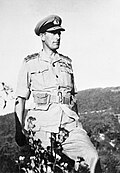
[[File:SE 000014 Mountbatten as SACSEA during Arakan tour.jpg|left|upright|thumb|Mountbatten during his tour of the [[Arakan campaign (1942–1943)|Arakan campaign]] in Burma in February 1944]] | |||
Mountbatten claimed that the lessons learned from the Dieppe Raid were necessary for planning the Normandy invasion on [[D-Day]] nearly two years later. However, military historians such as Major General [[Julian Thompson (Royal Marines officer)|Julian Thompson]], a former [[Royal Marines|Royal Marine]], have argued that these lessons should not have required a debacle such as Dieppe to be recognised.<ref name=Thompson>{{harvp|Thompson|2001|pp=263–269}}.</ref> Nevertheless, as a direct result of the failings, the British introduced several innovations, most notably [[Hobart's Funnies]], specialised armoured vehicles which, during the [[Normandy Landings]], undoubtedly saved many lives on the three Commonwealth beachheads of [[Gold Beach|Gold]], [[Juno Beach|Juno]], and [[Sword Beach|Sword]].<ref>{{cite news |url=https://news.bbc.co.uk/2/shared/spl/hi/picture_gallery/04/uk_d_day_inventions/html/1.stm |title=In pictures: D-Day inventions: The Flail |work=BBC News |access-date=20 September 2012 |archive-date=14 September 2007 |archive-url=https://web.archive.org/web/20070914053643/http://news.bbc.co.uk/1/shared/spl/hi/picture_gallery/04/uk_d_day_inventions/html/1.stm |url-status=live }}</ref> | |||
=== SEAC and Burma campaign === | |||
In August 1943, Churchill appointed Mountbatten Supreme Allied Commander, [[South East Asia Command]] (SEAC), with promotion to acting full [[Admiral (Royal Navy)|admiral]].<ref name=heath186/> His less practical ideas were sidelined by an experienced planning staff led by Lieutenant-Colonel [[James Allason]], although some proposals, such as an amphibious assault near [[Rangoon]], reached Churchill before being quashed.<ref>{{cite news |url= https://www.telegraph.co.uk/news/obituaries/politics-obituaries/8597474/Lt-Col-James-Allason.html |archive-url=https://ghostarchive.org/archive/20220110/https://www.telegraph.co.uk/news/obituaries/politics-obituaries/8597474/Lt-Col-James-Allason.html |archive-date=10 January 2022 |url-access=subscription |url-status=live |department=Obituary |title=Lt-Col James Allason |newspaper=The Telegraph |location= London |date= 24 June 2011 |access-date=20 September 2012}}{{cbignore}}</ref> | |||
[[File:Mountbatten address, Singapore 1945.jpg|right|upright|thumb|Mountbatten's address on the steps of Singapore's [[City Hall, Singapore|Municipal Building]] after the surrender]] | |||
British interpreter [[Hugh Lunghi]] recounted an embarrassing episode during the [[Potsdam Conference]] when Mountbatten, hoping for an invitation to visit the [[Soviet Union]], repeatedly attempted to impress [[Joseph Stalin]] with his former connections to the [[Russian imperial family]]. The attempt fell flat, with Stalin dryly inquiring whether "it was some time ago that he had been there". Lunghi later recalled, "The meeting was embarrassing because Stalin was so unimpressed. He offered no invitation. Mountbatten left with his tail between his legs."<ref>{{harvp|Montefiore|2004|p=501}}.</ref> | |||
During his time as Supreme Allied Commander of the Southeast Asia Theatre, Mountbatten's command oversaw the [[Burma campaign (1944–1945)|recapture of Burma]] from the Japanese by General Sir [[William Slim]].<ref name=heath187>{{harvp|Heathcote|2002|p=187}}</ref> A personal high point was the receipt of the Japanese surrender in Singapore, when British troops returned to the island to accept the formal capitulation of Japanese forces in the region, led by General [[Itagaki Seishiro]] on 12 September 1945, in an operation codenamed [[Operation Tiderace|Tiderace]].<ref>{{harvp|Park|1946|p=2156, para 360}}.</ref> South East Asia Command was disbanded in May 1946, and Mountbatten returned home with the substantive rank of [[Rear admiral (Royal Navy)|rear-admiral]].<ref name=heath188>{{harvp|Heathcote|2002|p=188}}.</ref> That year, he was made a [[Knight of the Garter|Knight Companion of the Garter]] and created '''Viscount Mountbatten of Burma''', of [[Romsey]] in the [[County of Southampton]], as a [[Victory title#British Empire|victory title]] for war service. In 1947, he was further created '''Earl Mountbatten of Burma''' and '''Baron Romsey''', of Romsey in the County of Southampton.<ref>{{cite web|url=https://www.bbc.co.uk/history/historic_figures/mountbatten_lord_louis.shtml|title=Lord Louis Mountbatten (1900–1979)|publisher=BBC|access-date=19 July 2018|archive-date=27 July 2018|archive-url=https://web.archive.org/web/20180727173721/http://www.bbc.co.uk/history/historic_figures/mountbatten_lord_louis.shtml|url-status=live}}</ref><ref name="auto">{{London Gazette |issue=44059 |date=21 July 1966 |page=8227}}</ref> | |||
Following the war, Mountbatten largely shunned the Japanese out of respect for his men killed during the conflict, and, in accordance with his will, Japan was not invited to send diplomatic representatives to his funeral in 1979. He did, however, meet Emperor [[Hirohito]] during the latter's state visit to Britain in 1971, reportedly at the urging of the Queen.<ref>{{cite news | url=https://www.nytimes.com/1979/09/05/archives/japan-is-not-invited-to-lord-mountbattens-funeral-lord-mountbatten.html | title=Japan is not invited to Lord Mountbatten's Funeral | work=The New York Times | date=5 September 1979 | access-date=9 July 2017 | archive-date=23 January 2018 | archive-url=https://web.archive.org/web/20180123131634/http://www.nytimes.com/1979/09/05/archives/japan-is-not-invited-to-lord-mountbattens-funeral-lord-mountbatten.html | url-status=live }}</ref> | |||
== Viceroy of India == | |||
{{main|Partition of India}} | |||
Mountbatten's experience in the region, and in particular his perceived [[Labour Party (UK)|Labour]] sympathies at the time, together with his wife's longstanding friendship and collaboration with [[V. K. Krishna Menon]], led Menon to put forward Mountbatten's name alone as a viceregal candidate acceptable to the [[Indian National Congress]], in clandestine meetings with Sir [[Stafford Cripps]] and [[Clement Attlee]].<ref>{{Cite journal |last=Ganguly |first=Sumit |date=February 2021 |title=A Chequered Brilliance: The Many Lives of V. K. Krishna Menon. By Jairam Ramesh. New Delhi: Penguin Random House India, 2019. 744 pp. ISBN: 9780670092321 (cloth). |url=http://dx.doi.org/10.1017/s0021911820003964 |journal=The Journal of Asian Studies |volume=80 |issue=1 |pages=220–221 |doi=10.1017/s0021911820003964 |s2cid=234076753 |issn=0021-9118|url-access=subscription }}</ref> Attlee advised King [[George VI]] to appoint Mountbatten [[Viceroy of India]] on 20 February 1947,<ref>{{harvp|Talbot|Singh|2009|p=40}}.</ref><ref>{{London Gazette|issue=37916|date=25 March 1947|page=1399}}</ref> charging him with overseeing the transition of British India to independence no later than 30 June 1948. Mountbatten's instructions were to avoid partition and preserve a united India as the outcome of the [[Indian Independence Act 1947|transfer of power]], but he was authorised to adapt to a changing situation in order to secure Britain's prompt withdrawal with minimal reputational damage.<ref name=Ziegler359>{{harvp|Ziegler|1985|p=359}}.</ref><ref>{{harvp|Jalal|1994|p=250}}: "These instructions were to avoid partition and obtain an unitary government for British India and the Indian States and at the same time observe the pledges to the princes and the Muslims; to secure agreement to the [[Cabinet Mission]] plan without coercing any of the parties; somehow to keep the [[British Indian Army|Indian army]] undivided, and to retain India within the [[Commonwealth of Nations|Commonwealth]]. (Attlee to Mountbatten, 18 March 1947, ibid, 972–974)"</ref> | |||
[[File:Lord Mountbatten visits Punjabi riot scenes.jpg|thumb|Lord and Lady Mountbatten visit an affected village in the aftermath of the [[Rawalpindi Massacres]]]] | |||
Mountbatten arrived in India on 22 March by air from [[London]]. That evening, he was taken to [[Rashtrapati Bhavan, New Delhi|his residence]], and two days later he took the viceregal oath. His arrival coincided with large-scale communal riots in [[Delhi]] and [[Bombay]], and large-scale [[Rawalpindi Massacres|massacres in Rawalpindi]]. Mountbatten concluded that the situation was too volatile to wait even a year before granting independence. Although his advisers favoured a gradual transfer of power, he decided that the only viable course was a quick and orderly handover of power the end of 1947; in his view, any longer risked civil war.<ref name="White2012">{{harvp|White|2012|p=428}}.</ref> Mountbatten also hurried the process so that he could return to the Royal Navy.<ref>{{harvp|Wolpert|2006|p=130}}</ref><ref name="SarJinna">{{harvp|Sardesai|2007|pp=309–313}}.</ref> | |||
{{multiple image|total_width=400px|align=right|image1=Mountbatten visiting Sardar.jpg|caption1=Lord and Lady Mountbatten at [[Mussoorie]] with Congress leader [[Sardar Patel]], his daughter [[Manibehn Patel]] and Nehru in the background|image2=Mountbattens with Gandhi (IND 5298).jpg|caption2=Lord and Lady Mountbatten with [[Mahatma Gandhi]], 1947}} | |||
Mountbatten was fond of [[Indian National Congress|Congress]] leader [[Jawaharlal Nehru]] and his liberal outlook for the country, and, through the efforts of their close mutual friend, [[Krishna Menon]], developed a depth of feeling and intimacy with Nehru that was shared by his wife, Edwina. He felt differently about the [[All India Muslim League|Muslim League]] leader [[Muhammad Ali Jinnah]], but recognised his influence, stating "If it could be said that any single man held the future of India in the palm of his hand in 1947, that man was Mohammad Ali Jinnah."<ref name="SarJinna"/> During his meeting with Jinnah on 5 April 1947,<ref>{{harvp|Wolpert|2006|p=141}}.</ref> Mountbatten tried to persuade him of the merits of a united India, citing the difficultly of dividing the mixed provinces of [[Punjab Province (British India)|Punjab]] and [[Bengal Presidency|Bengal]], but Jinnah remained unyielding in his goal of establishing a [[Muslim nationalism in South Asia|separate Muslim state]] [[Pakistan Movement|called Pakistan]].<ref>{{harvp|Greenberg|2005|p=89}}</ref> | |||
[[File:Lord Mountbatten meets Nehru, Jinnah and other Leaders to plan Partition of India.jpg|thumb|left|Mountbatten meeting with [[Jawaharlal Nehru]] (left) and [[Muhammad Ali Jinnah]] (right) in discussing the partition of British India, 1947.]] | |||
Given the British government's recommendation to grant independence quickly, Mountbatten concluded that a united India was no longer an achievable goal and resigned himself to a plan for partition, creating the independent nations of India and Pakistan.<ref name="Zuckerman"/> He set a date for the transfer of power from the British to the Indians, arguing that a fixed timeline would demonstrate both his and the British government's sincerity in working towards a swift and efficient independence, and would remove any possibility of stalling the process.<ref name=Ziegler355>{{harvp|Ziegler|1985|p=355}}.</ref> | |||
{{multiple image | |||
| align = right | |||
| direction = vertical | |||
| width = 200 | |||
| image1 = Mountbatten Proposed Flag of India.svg | |||
| alt1 = | |||
| caption1 = Mountbatten's proposed flag for India, consisting of the flag of the Indian National Congress [[Defacement (flag)|defaced]] with a Union Jack in the canton. It was rejected by Nehru, as he felt that the more extremist members of Congress would see the inclusion of the Union Jack on an Indian flag as pandering to the British.<ref name="crwflags1996">{{cite web |url=https://www.crwflags.com/fotw/flags/in!.html |title=Indian Flag Proposals |author=Dipesh Navsaria |date=27 July 1996 |work=Flags of the World |access-date=14 March 2020 |archive-date=31 May 2023 |archive-url=https://web.archive.org/web/20230531044153/https://crwflags.com/fotw/flags/in!.html |url-status=live }}</ref> | |||
| image2 = Mountbatten Proposed Flag of Pakistan.svg | |||
| alt2 = | |||
| caption2 = Mountbatten's proposed flag for Pakistan, consisting of the flag of the Muslim League [[Defacement (flag)|defaced]] with a Union Jack in the canton. It was rejected by Jinnah, as he felt that a flag featuring a Christian Cross alongside the Islamic Crescent would be unacceptable to the Muslims of Pakistan.<ref name="crwflags1996"/> | |||
}} | |||
Among the Indian leaders, [[Mahatma Gandhi]] emphatically insisted on maintaining a [[Opposition to the Partition of India|united India]] and for a time successfully rallied support for this goal. During his meeting with Mountbatten, Gandhi asked him to invite Jinnah to form a new central government, but Mountbatten never conveyed Gandhi's proposal to Jinnah.<ref>{{harvp|Wolpert|2006|p=139}}.</ref> When Mountbatten's accelerated timeline offered the prospect of attaining independence soon, political sentiment shifted. Given Mountbatten's determination, the inability of Nehru and [[Sardar Patel]] to reach an accommodation with the Muslim League, and Jinnah's obstinacy, all [[List of political parties in India|Indian party leaders]] (except Gandhi) acquiesced to Jinnah's plan to divide India,<ref name=Ziegler373>{{harvp|Ziegler|1985|p=373}}.</ref> which in turn eased Mountbatten's task. Mountbatten also developed a strong relationship with the [[Princely state|Indian princes]], who ruled those parts of India not directly under British administration, and his intervention was decisive in persuading the vast majority of them to see the advantages of joining the [[Dominion of India|Indian Union]].<ref>{{cite web|url=https://indianexpress.com/article/research/how-vallabhbhai-patel-v-p-menon-and-mountbatten-unified-india-4915468/|title=How Vallabhbhai Patel, V P Menon and Mountbatten unified India|date=31 October 2017|access-date=19 August 2019|archive-date=15 December 2022|archive-url=https://web.archive.org/web/20221215161435/https://indianexpress.com/article/research/how-vallabhbhai-patel-v-p-menon-and-mountbatten-unified-india-4915468/|url-status=live}}</ref> On one hand, the integration of the princely states can be viewed as a positive aspect of his legacy,<ref>{{harvp|Guha|2008|p=57}}.</ref> but on the other, the refusal of [[Hyderabad State|Hyderabad]], [[Jammu and Kashmir (princely state)|Jammu, and Kashmir]], and [[Junagadh State|Junagadh]] to join one of the dominions contributed to future [[Indo-Pakistani wars and conflicts|wars]] between Pakistan and India.<ref>{{harvp|Stoessinger|2010|p=185}}.</ref> | |||
Mountbatten brought forward the date of partition from June 1948 to 15 August 1947.<ref>{{harvp|Talbot|Singh|2009|p= xvii}}.</ref> The uncertainty surrounding the future borders prompted [[Islam in South Asia|Muslims]] and [[Hindus]] to move towards areas where they believed they would be in the majority. Both communities were deeply fearful, and the movement of Muslims from the East was matched by a similar movement of Hindus from the West.<ref>{{harvp|Khan|2007|pp=100–101}}.</ref> A boundary committee chaired by Sir [[Cyril Radcliffe]] was charged with drawing the borders of the new nations. With a mandate to leave as many Hindus and [[Sikhs]] in India, and as many Muslims in Pakistan, as possible, Radcliffe [[Radcliffe Line|produced a map]] that divided the two countries along the Punjab and Bengal borders. This left 14 million people on the "wrong" side of the line, and many fled to "safety" on the other side when the boundaries were announced.<ref name=White2012/><ref>{{Harvp|Hodson|1980|pp=102–106}}</ref> | |||
=== Independence of India and Pakistan === | |||
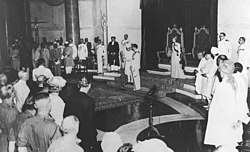
[[File:Lord Mountbatten swears in Jawaharlal Nehru as the first Prime Minister of free India on Aug 15, 1947.jpg|thumb|left|Mountbatten with [[Jawaharlal Nehru]], the first Prime Minister of sovereign India, in Government House. Lady Mountbatten is standing to their left.]] | |||
When India and Pakistan attained independence at midnight on 14–15 August 1947, Mountbatten was alone in his study at the Viceroy's House, reflecting that for a few minutes more he remained the most powerful man on Earth. At 12 am, as a final act of showmanship, he created [[Joan Falkiner]], the Australian wife of the Nawab of [[Palanpur State|Palanpur]], a highness — a gesture that was reportedly one of his favourite duties, and one that was annulled at the stroke of midnight.<ref>{{harvp|Tunzelmann|2007|p=4}}</ref> | |||
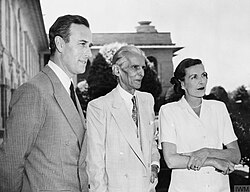
[[File:Mountbatten Jinnah.jpg|thumb|left|Lord and Lady Mountbatten with [[Muhammad Ali Jinnah]].]] | |||
Notwithstanding the self-promotion of his own role in Indian independence – notably in the television series ''The Life and Times of Admiral of the Fleet Lord Mountbatten of Burma'', produced by his son-in-law [[John Knatchbull, 7th Baron Brabourne|Lord Brabourne]], and in ''[[Freedom at Midnight]]'' by [[Dominique Lapierre]] and [[Larry Collins (writer)|Larry Collins]], for which he was the principal quoted source – his record is regarded as very mixed. One common view is that he hastened the process of independence unduly and recklessly, foreseeing vast disruption and loss of life and not wanting this to occur on his watch, but thereby helping to bring it about indirectly, especially in Punjab and Bengal.<ref>See, e.g., {{harvp|Wolpert|2006}}.</ref> [[John Kenneth Galbraith]], the Canadian-American [[Harvard University]] economist who advised Indian governments during the 1950s and, as an intimate of Nehru, served as the American ambassador from 1961 to 1963, was a particularly harsh critic of Mountbatten in this regard.<ref>{{cite web |url=http://www.windsorscottish.com/pl-lp-jkgalbraith.php |title=People: Scots of Windsor's Past |publisher=Windsor's Scottish Heritage |access-date=20 September 2012 |url-status=dead |archive-url=https://web.archive.org/web/20120809005357/http://www.windsorscottish.com/pl-lp-jkgalbraith.php |archive-date=9 August 2012 }}</ref> Another view, however, is that the British were forced to expedite partition to avoid involvement in a potential civil war, with law and order already breaking down and Britain possessing limited resources after the Second World War.<ref name="Lawrence p 72">Lawrence J. Butler, 2002, ''Britain and Empire: Adjusting to a Post-Imperial World'', p. 72</ref><ref>Ronald Hyam, ''Britain's Declining Empire: The Road to Decolonisation, 1918–1968'', p. 113; Cambridge University Press, {{ISBN|0-521-86649-9}}, 2007</ref> According to historian Lawrence James, Mountbatten had no option but to cut and run, the alternative being British involvement in a civil war with no viable exit.<ref name="Lawrence p 72"/> | |||
The creation of Pakistan was never emotionally accepted by many British leaders, Mountbatten among them.<ref>{{harvp|McGrath|1996|p=38}}</ref> He made clear his lack of support for, and faith in, the [[All-India Muslim League|Muslim League]]'s idea of Pakistan.<ref>{{harvp|Ahmed|1997|p=136}}</ref> [[Muhammad Ali Jinnah|Jinnah]] refused Mountbatten's offer to serve as [[Governor-General of Pakistan]].<ref>{{harvp|Wolpert|2006|page=163}}</ref> When Mountbatten was asked by Collins and Lapierre whether he would have sabotaged the creation of Pakistan had he known that Jinnah was dying of [[tuberculosis]], he replied, "Most probably".<ref>{{harvp|Ahmed|1997|p=209}}</ref> | |||
===Governor-General of India=== | |||
Mountbatten became the first [[Governor-General of India|Governor-General of independent India]] on 15 August 1947 at the request of Indian Prime Minister [[Jawaharlal Nehru]]. ''[[Life (magazine)|Life]]'' magazine noted of his reception in India that, "The people gathered in the streets to cheer Mountbatten as no European had ever been cheered before."<ref name="Time Inc">{{cite book | title=LIFE | date=8 September 1947 | publisher=Time Inc | issn=0024-3019 | url=https://books.google.com/books?id=MEIEAAAAMBAJ | page=39 | access-date=15 March 2024 | archive-date=8 March 2023 | archive-url=https://web.archive.org/web/20230308032354/https://books.google.com/books?id=MEIEAAAAMBAJ | url-status=live }}</ref> | |||
During his tenure as governor-general, which lasted until 21 June 1948, Mountbatten played a significant role in the [[political integration of India]] and persuaded many [[princely states]] to join the new dominion.<ref name="Sanajaoba223">{{cite book |last=Sanajaoba |first=Naorem |url=https://books.google.com/books?id=9eYC4tjzyi4C&pg=PA223 |title=Law and Society: Strategy for Public Choice, 2001 |publisher=Mittal Publications |year=1991 |isbn=978-81-7099-271-4 |page=223 |quote=The princely states had been wooed by Mountbatten, Patel and Nehru to join the Indian Dominion |access-date=15 March 2024 |archive-url=https://web.archive.org/web/20240315055902/https://books.google.com/books?id=9eYC4tjzyi4C&pg=PA223 |archive-date=15 March 2024 |url-status=live}}</ref><ref name="heath189">{{harvp|Heathcote|2002|p=189}}</ref> On his advice, India took the issue of Kashmir to the newly formed [[United Nations]] in January 1948.<ref>{{harvp|Guha|2008|p=87}}.</ref> Accounts differ on the future Mountbatten desired for Kashmir. Pakistani sources suggest that he favoured the [[Instrument of Accession (Jammu and Kashmir)|accession of Kashmir to India]], citing his close relationship with Nehru, while Mountbatten's own account states that he simply wanted [[Maharaja Hari Singh]] to make a decision. He made several attempts to mediate between the Congress leaders, Muhammad Ali Jinnah, and Hari Singh on issues relating to accession of Kashmir, though he was largely unsuccessful in resolving the conflict.<ref>{{harvp|Schofield|2010|pp=29–31}}.</ref> After the [[Indo-Pakistani war of 1947–1948|tribal invasion of Kashmir]], it was on his suggestion that India secured the state's accession from Hari Singh before sending in military forces for its defence.<ref>{{harvp|Guha|2008|p=83}}.</ref> | |||
After his tenure concluded, Mountbatten continued to enjoy close relations with Nehru and the post-Independence Indian leadership, and he was welcomed as a former governor-general on subsequent visits, including during an official trip in March 1956. The Pakistani government, by contrast, held a negative view of Mountbatten for what it perceived as his hostile attitude towards Pakistan and deemed him ''[[persona non grata]]'', barring him from transiting its airspace during the same visit.<ref>{{Harvp|Ziegler|1989|pp=14–16, 117}}</ref> | |||
== Later career == | |||
[[File:Lord Louis Mountbatten Visits Malayan Contingent, Kensington Gardens, London, England, UK, 1946 D28023.jpg|thumbnail|right|Mountbatten inspects Malayan troops in [[Kensington Gardens]] in 1946]] | |||
After leaving India, Mountbatten served as commander of the [[1st Cruiser Squadron]] in the [[Mediterranean Fleet]] and, having been granted the [[substantive rank]] of [[Vice admiral (Royal Navy)|vice-admiral]] on 22 June 1949,<ref>{{London Gazette |issue=38681 |date=2 August 1949 |page=3760}}</ref> became Second-in-Command of the [[Mediterranean Fleet]] in April 1950.<ref name=heath189/> He was appointed [[Fourth Sea Lord]] at the Admiralty in June 1950, before returning to the Mediterranean to serve as Commander-in-Chief, Mediterranean Fleet, and [[NATO]] Commander, [[Allied Forces Mediterranean]], from June 1952.<ref name=heath189/> He was promoted to the substantive rank of full admiral on 27 February 1953,<ref>{{London Gazette |issue=39802 |date=17 March 1953 |page=1530}}</ref> and in March 1953 was appointed [[Personal aide-de-camp]] to the Queen.<ref name='Oxford'>{{Cite book |title=Mountbatten, Louis |publisher=[[Oxford Biography Index]] |doi = 10.1093/ww/9780199540884.013.U157802|chapter = Mountbatten of Burma, 1st Earl, (Louis (Francis Albert Victor Nicholas) Mountbatten) (25 June 1900 – 27 Aug. 1979) |year = 2007}}</ref> | |||
[[File:HMS Glasgow Mounbatten.jpg|thumb|left|upright|Mountbatten arrives on board {{HMS|Glasgow|C21|6}} at Malta to assume command of the Mediterranean Fleet, 16 May 1952]] | |||
Mountbatten served his final posting at the Admiralty as [[First Sea Lord]] and Chief of the Naval Staff from April 1955 to July 1959, a position his father had held some forty years earlier. This was the first time in Royal Naval history that a father and son had both attained such high office.<ref name="harvp|Patton|2005|pp=14–17">{{harvp|Patton|2005|pp=14–17}}</ref> He was promoted to [[Admiral of the Fleet (Royal Navy)|Admiral of the Fleet]] on 22 October 1956.<ref>{{London Gazette |issue=40927 |date=16 November 1956 |page=6492}}</ref> | |||
During the [[Suez Crisis]] of 1956, Mountbatten strongly advised his old friend, Prime Minister [[Anthony Eden]] against the [[Eden ministry|Conservative government]]'s plan to seize the [[Suez Canal]] in conjunction with [[French Fourth Republic|France]] and Israel. He argued that such a move would destabilise the Middle East, undermine the authority of the United Nations, divide the Commonwealth, and diminish Britain's global standing. His advice was not taken. Eden insisted that Mountbatten should not resign, and Mountbatten instead worked hard to prepare the Royal Navy for war with characteristic professionalism and thoroughness.<ref>{{Harvp|Ziegler|1985|pp=537–547}}</ref><ref>{{Harvp|Smith|2012|pp=489–508}}</ref><ref>{{Harvp|Smith|2013|pp=105–134}}</ref> | |||
Despite his military rank, Mountbatten was initially ignorant of the physics involved in a nuclear explosion and had to be reassured that the fission reactions from the [[Bikini Atoll tests]] would not spread through the oceans and destroy the planet.<ref>{{harvp|Zuckerman|1981|p=363}}</ref> As he became more familiar with this new form of weaponry, he grew increasingly opposed to its use in combat, while at the same time recognising the potential value of nuclear energy, particularly for submarine propulsion. He later expressed his views on the use of nuclear weapons in his article "A Military Commander Surveys The Nuclear Arms Race", published shortly after his death in ''International Security'' in the Winter of 1979–1980.<ref>{{harvp|Mountbatten|1979–1980}}</ref> | |||
After leaving the Admiralty, Mountbatten became [[Chief of the Defence Staff (United Kingdom)|Chief of the Defence Staff]].<ref name=heath189/> He served in this post for six years, during which he oversaw the consolidation of the three service departments into a single [[Ministry of Defence (United Kingdom)|Ministry of Defence]].<ref name=heath190>{{harvp|Heathcote|2002|p=190}}.</ref> [[Ian Jacob]], co-author of the 1963 ''Report on the Central Organisation of Defence'' that underpinned these reforms, described Mountbatten as "universally mistrusted in spite of his great qualities".<ref name=healey258>{{harvp|Healey|1989|p=258}}.</ref> Following the [[1964 United Kingdom general election|election]] of the [[Labour government, 1964-1970|Wilson ministry]] in October 1964, the government had to decide whether to renew his appointment the following July. The [[Secretary of State for Defence|Defence Secretary]], [[Denis Healey]], interviewed the forty most senior officials in the Ministry of Defence; only one, Sir [[Kenneth Strong]], a personal friend of Mountbatten, recommended his reappointment.<ref name=healey258/> Healey later recalled, "When I told Dickie of my decision not to reappoint him, he slapped his thigh and roared with delight; but his eyes told a different story."<ref name=healey258/> | |||
Mountbatten was appointed [[Colonel of the Regiment|Colonel]] of [[Life Guards (United Kingdom)|The Life Guards]] and [[Gold Stick in Waiting]] on 29 January 1965,<ref>{{London Gazette|nolink=y|issue=43563|supp=y|page=1147|date=2 February 1965}}</ref> and Life [[Colonel commandant#United Kingdom|Colonel Commandant]] of the [[Royal Marines]] later that year.<ref>{{London Gazette|nolink=y|issue=43731|page=7446|date=6 August 1965}}</ref> He served as [[Governor of the Isle of Wight]] from 20 July 1965,<ref>{{London Gazette |issue=43720 |date=23 July 1965 |page=7029}}</ref> and became the [[Lord Lieutenant of the Isle of Wight|island's first Lord Lieutenant]] on 1 April 1974.<ref>{{London Gazette |issue=46255 |date=4 April 1974 |page=4399}}</ref> | |||
[[File:KN-C17494. President John F. Kennedy Meets with Lord Louis Mountbatten.jpg|thumb|Mountbatten with [[John F. Kennedy]] in the Oval Office, Washington, D.C., 11 April 1961]] | |||
[[File:Louis Mountbatten visit to Israel (997009932856605171).jpg|thumb|Louis Mountbatten during a 1967 visit to Israel]] | |||
Mountbatten was elected a [[Fellow of the Royal Society]]<ref name="Zuckerman"/> and received an honorary doctorate from [[Heriot-Watt University]] in 1968.<ref>{{cite web |url=http://www1.hw.ac.uk/graduation/honorary-graduates.htm |title=Heriot-Watt University Edinburgh: Honorary Graduates |last= |website=www1.hw.ac.uk |access-date=11 April 2016 |archive-date=18 April 2016 |archive-url=https://web.archive.org/web/20160418163907/http://www1.hw.ac.uk/graduation/honorary-graduates.htm |url-status=dead }}</ref> | |||
In 1969, he tried unsuccessfully to persuade his second cousin, the Spanish pretender [[Infante Juan, Count of Barcelona]], to ease the eventual accession of his son, [[Juan Carlos]], to the Spanish throne by signing a declaration of abdication while in exile.<ref name="powell">{{harvp|Powell|1996 |pp=50–51, 221–222}}.</ref> The following year, Mountbatten attended an official [[White House]] dinner, during which he held a 20-minute conversation with [[Richard Nixon]] and [[United States Secretary of State|Secretary of State]] [[William P. Rogers]]. He later wrote, "I was able to talk to the President a bit about both Tino [Constantine II of Greece] and Juanito [Juan Carlos of Spain] to try and put over their respective points of view about [[Kingdom of Greece|Greece]] and [[Francoist Spain|Spain]], and how I felt the US could help them."<ref name="powell"/> In January 1971, Nixon hosted Juan Carlos and his wife, [[Queen Sofia of Spain|Sofia]] (sister of the exiled King Constantine), during a visit to Washington, and later that year ''[[The Washington Post]]'' published an article alleging that the [[Presidency of Richard Nixon|Nixon administration]] was seeking to persuade Franco to retire in favour of the young Bourbon prince.<ref name="powell"/> | |||
From 1967 until 1978, Mountbatten served as president of the [[United World Colleges]] Organisation, then represented by a single institution: [[Atlantic College]] in South Wales. He supported the movement enthusiastically and encouraged heads of state, politicians, and public figures around the world to share his interest. Under his presidency and personal involvement, the United World College of South East Asia was established in Singapore in 1971, followed by the [[United World College of the Pacific]] in [[Victoria, British Columbia]], in 1974. In 1978, he passed the presidency to his great-nephew, [[Charles, Prince of Wales]].<ref>{{cite web |url= http://www.uwc.nl/en/who-we-are/history |title= History |publisher= UWC |access-date= 20 September 2012 |url-status=dead |archive-url= https://web.archive.org/web/20140108081504/http://www.uwc.nl/en/who-we-are/history |archive-date= 8 January 2014 }}</ref> | |||
Mountbatten also helped to launch the [[International Baccalaureate]]; in 1971 he presented the first IB diplomas in the Greek Theatre of the [[International School of Geneva]], Switzerland.<ref>{{cite web |url=https://www.ibo.org/ib-world-archive/september-2013-issue-68/where-are-they-now2/ |title=Where are they now? – International Baccalaureate® |date=May 2015 |publisher=Ibo.org |access-date=26 April 2020 |archive-date=18 January 2021 |archive-url=https://web.archive.org/web/20210118012623/https://www.ibo.org/ib-world-archive/september-2013-issue-68/where-are-they-now2/ |url-status=live }}</ref><ref>{{cite web |url=https://www.ecolint.ch/overview/our-history |title=Ecolint – Swiss International school in Geneva |publisher=Ecolint.ch |date=17 September 1924 |access-date=26 April 2020 |archive-date=17 July 2020 |archive-url=https://web.archive.org/web/20200717083419/https://www.ecolint.ch/overview/our-history |url-status=dead }}</ref><ref>{{cite web|url=https://files.eric.ed.gov/fulltext/EJ1133258.pdf|title=The International Baccalaureate (IB) Programme: An International Gateway to Higher Education and Beyond|access-date=26 April 2020|archive-date=16 January 2021|archive-url=https://web.archive.org/web/20210116153757/https://files.eric.ed.gov/fulltext/EJ1133258.pdf|url-status=live}}</ref> | |||
In 1975, Mountbatten finally visited the [[Soviet Union]], leading the United Kingdom's delegation as the personal representative of Queen [[Elizabeth II]] at the celebrations marking the 30th anniversary of [[Victory Day (9 May)|Victory Day]] in the Second World War in Moscow.<ref>{{harvp|Barratt|Ritchie|1991|p=162}}</ref> | |||
== Alleged plots against Harold Wilson == | |||
{{Main|Harold Wilson conspiracy theories#The 1968 plot}} | |||
[[Peter Wright (MI5 officer)|Peter Wright]], in his 1987 book ''[[Spycatcher]]'', claimed that in May 1968 Mountbatten attended a private meeting with press baron [[Cecil Harmsworth King|Cecil King]] and the government's Chief Scientific Adviser, [[Solly Zuckerman]]. Wright alleged that "up to thirty" [[MI5]] officers had joined a secret campaign to undermine the crisis-stricken [[Labour Party (United Kingdom)|Labour]] government of [[Harold Wilson]] and that King was an MI5 agent. At the meeting, King allegedly urged Mountbatten to lead a government of national salvation. Zuckerman pointed out that such an idea amounted to "rank treachery" and it came to nothing owing to Mountbatten's reluctance to act.<ref>{{cite web |url=https://publications.parliament.uk/pa/cm199596/cmhansrd/vo950110/debtext/60110-43.htm |title=House of Commons Proceedings |at=Column 287 |website=Hansard |date=10 January 1996 |access-date=20 September 2012 |archive-date=4 October 2012 |archive-url=https://web.archive.org/web/20121004140120/http://www.publications.parliament.uk/pa/cm199596/cmhansrd/vo950110/debtext/60110-43.htm |url-status=live }}</ref> In contrast, [[Andrew Lownie]] has suggested that it took the intervention of the Queen to dissuade Mountbatten from plotting against Wilson.<ref name="Sawer">{{cite news |last1=Sawer |first1=Patrick |title=Revealed: Full extent of Lord Mountbatten's role in '68 plot against Harold Wilson |url=https://www.telegraph.co.uk/news/2019/08/17/revealed-full-extent-lord-mountbattens-role-68-plot-against/ |archive-url=https://ghostarchive.org/archive/20220110/https://www.telegraph.co.uk/news/2019/08/17/revealed-full-extent-lord-mountbattens-role-68-plot-against/ |archive-date=10 January 2022 |url-access=subscription |url-status=live |work=The Telegraph |date=17 August 2019}}{{cbignore}}</ref> | |||
In 2006, the [[BBC]] documentary ''The Plot Against Harold Wilson'' alleged that there had been another plot involving Mountbatten to oust Wilson during his second term in office (1974–1976). The period was characterised by high inflation, rising unemployment, and widespread industrial unrest. The alleged plot centred on right-wing former military figures who were supposedly building private armies to counter what they perceived as threats from trade unions and the Soviet Union. They believed that the Labour government was unable or unwilling to address these developments and that Wilson was either a Soviet agent or, at the very least, a [[communism|communist]] sympathiser – claims Wilson strongly denied. The documentary makers alleged that a coup was planned to overthrow Wilson and replace him with Mountbatten, using these private armies and sympathisers within the military and MI5.<ref>{{cite news |url=https://news.bbc.co.uk/2/hi/uk_news/politics/4789060.stm |work=BBC News |title=Wilson 'Plot': The Secret Tapes |date=9 March 2006 |access-date=20 September 2012 |first=Brian |last=Wheeler |archive-date=15 February 2009 |archive-url=https://web.archive.org/web/20090215151907/http://news.bbc.co.uk/1/hi/uk_politics/4789060.stm |url-status=live }}</ref> | |||
The first official history of MI5, ''[[The Defence of the Realm]]'' (2009), implied that there had indeed been a plot against Wilson and that MI5 maintained a file on Mountbatten. However, it also made clear that any such activity was entirely unofficial and centred on a small group of discontented officers. This had already been confirmed by former [[cabinet secretary]] [[John Hunt, Baron Hunt of Tanworth|Lord Hunt]], who concluded in a secret inquiry in 1996 that "there is absolutely no doubt at all that a few, a very few, malcontents in MI5 ... a lot of them like Peter Wright who were right-wing, malicious and had serious personal grudges – gave vent to these and spread damaging malicious stories about that Labour government."<ref>{{cite news |url=https://www.theguardian.com/books/2009/oct/10/defence-of-the-realm-mi5 |newspaper=The Guardian |location=London |title=The Defence of the Realm: The Authorized History of MI5 by Christopher Andrew |first=David |last=Leigh |date=10 October 2009 |access-date=20 September 2012 |archive-date=17 May 2014 |archive-url=https://web.archive.org/web/20140517171811/http://www.theguardian.com/books/2009/oct/10/defence-of-the-realm-mi5 |url-status=live }}</ref> | |||
== Personal life == | |||
=== Marriage and sexual relationships === | |||
[[File:Louis and Edwina Mountbatten 01.jpg|thumb|upright|Louis and Edwina Mountbatten]] | |||
Mountbatten was married on 18 July 1922 to [[Edwina Cynthia Annette Ashley]], daughter of [[Wilfrid Ashley, 1st Baron Mount Temple|Wilfred William Ashley]], later 1st [[Baron Mount Temple]], himself a grandson of [[Anthony Ashley-Cooper, 7th Earl of Shaftesbury]]. She was the favourite granddaughter of the Edwardian magnate Sir [[Ernest Cassel]] and the principal heir to his fortune. The couple spent heavily on households, luxuries, and entertainment.<ref name=heath184/> Their honeymoon included a tour of European royal courts and North America, with a visit to [[Niagara Falls]] (because "all honeymooners went there").<ref name="life1942081763">{{cite magazine |url=https://books.google.com/books?id=v04EAAAAMBAJ&pg=PA63 |title=Lord Louis Mountbatten |magazine=Life |date=17 August 1942 |access-date=20 September 2012 |page=63 |via=[[Google Books]]}}</ref> During their stay in California, the newlyweds appeared in a silent home movie by [[Charlie Chaplin]], called ''Nice And Friendly'', which was not shown in cinemas.<ref>{{cite web|url=https://www.charliechaplin.com/en/films/9-Limelight/articles/300-Nice-and-Friendly|title=Nice and Friendly|work=Charlie Chaplin Official Website|accessdate=5 August 2022|archive-date=11 August 2022|archive-url=https://web.archive.org/web/20220811123421/https://www.charliechaplin.com/en/films/9-Limelight/articles/300-Nice-and-Friendly|url-status=live}}</ref><ref>{{cite web |last1=Chaplin |first1=Charlie |author1-link=Charlie Chaplin |title=WATCH: Charlie Chaplin - Nice and Friendly (1922) |url=https://www.youtube.com/watch?v=-3K1R5_0qes |website=youtube.com |publisher=[[PBS News Hour]] |language=en |format=video |date=6 July 2018 |access-date=10 March 2023 |archive-date=26 April 2019 |archive-url=https://web.archive.org/web/20190426120006/https://www.youtube.com/watch?v=-3K1R5_0qes |url-status=live }}</ref> | |||
Mountbatten later admitted: "Edwina and I spent all our married lives getting into other people's beds."<ref>{{harvp|Ziegler|1985|p=53}}.</ref> He maintained an affair for several years with [[Yola Letellier]],<ref name=hicks>{{harvp|Hicks|2012|p=24}}</ref> the wife of Henri Letellier, publisher of ''[[Le Journal]]'' and mayor of [[Deauville]] (1925–1928).<ref>{{harvp|Aubenas|Chardin|Demange|2007|pp=91, 111}}</ref> Yola Letellier's life story was the inspiration for [[Colette]]'s novel ''[[Gigi (novella)|Gigi]]''.<ref name=hicks/> | |||
After Edwina's death in 1960, Mountbatten was involved in relationships with young women, according to his daughter Patricia, his secretary John Barratt, his [[valet]] Bill Evans, and [[William Stadiem]], an employee of [[Madame Claude]].<ref name="thetimes1">{{cite news |last=Lownie |first=Andrew |url=https://www.thetimes.com/uk/society/article/the-love-lives-of-lord-and-lady-mountbatten-bedhopping-gay-affairs-and-dangerous-liaisons-p7wqpk7xz |title=The love lives of Lord and Lady Mountbatten – bedhopping, gay affairs and dangerous liaisons |work=The Times |date=7 November 2017 |access-date=23 August 2019 |archive-date=9 May 2021 |archive-url=https://web.archive.org/web/20210509184316/https://www.thetimes.co.uk/article/the-love-lives-of-lord-and-lady-mountbatten-bedhopping-gay-affairs-and-dangerous-liaisons-p7wqpk7xz |url-status=live }}{{subscription required}}</ref> He also had a long-running affair with American actress [[Shirley MacLaine]], whom he met in the 1960s.<ref>{{Cite web|url=https://theprint.in/world/the-private-lives-of-the-mountbattens-open-marriage-flings-and-paedophilia/281688/|title=The private lives of the Mountbattens — Open marriage, flings and paedophilia|first=Srijan|last=Shukla|website=[[ThePrint]] |date=25 August 2019|access-date=3 January 2022|archive-date=3 January 2022|archive-url=https://web.archive.org/web/20220103071036/https://theprint.in/world/the-private-lives-of-the-mountbattens-open-marriage-flings-and-paedophilia/281688/|url-status=live}}</ref> | |||
In 2019, Ron Perks, Mountbatten's driver in [[Colony of Malta|Malta]] in 1948, alleged that Mountbatten had visited the Red House, an upmarket gay brothel in [[Rabat, Malta|Rabat]] used by naval officers.<ref>{{cite news |date=18 August 2019 |title=Prince Charles' mentor 'perverted' |url=https://www.news.com.au/entertainment/celebrity-life/royals/prince-charles-mentor-lord-mountbatten-was-a-homosexual-with-a-perversion-for-young-boys-fbi-files-claim/news-story/5ab4fdb8c928610bd9a123a018b27b53 |url-status=live |archive-url=https://web.archive.org/web/20190819005901/https://www.news.com.au/entertainment/celebrity-life/royals/prince-charles-mentor-lord-mountbatten-was-a-homosexual-with-a-perversion-for-young-boys-fbi-files-claim/news-story/5ab4fdb8c928610bd9a123a018b27b53 |archive-date=19 August 2019 |access-date=19 August 2019 |newspaper=News.com.au}}</ref> [[Andrew Lownie]], a fellow of the [[Royal Historical Society]], wrote that the United States [[Federal Bureau of Investigation]] (FBI) maintained files concerning Mountbatten's alleged homosexuality.<ref name="sdaytimes">{{cite news |last=Tucker |first=Grant |date=18 August 2019 |title=Lord Mountbatten's 'lust for young men' revealed |url=https://www.thetimes.com/article/lord-mountbattens-lust-for-young-men-revealed-90swzmgms |url-status=live |archive-url=https://web.archive.org/web/20210410004628/https://www.thetimes.co.uk/article/lord-mountbattens-lust-for-young-men-revealed-90swzmgms |archive-date=10 April 2021 |access-date=31 March 2021 |work=The Sunday Times}}{{subscription required}}</ref> Lownie also interviewed several young men who claimed to have been in a relationship with Mountbatten. John Barratt, Mountbatten's personal and private secretary for twenty years,<ref>{{Cite web |date=23 April 2000 |title=Book tells of 'bored, bullied' Queen |url=http://www.theguardian.com/uk/2000/apr/23/monarchy.vanessathorpe |url-status=live |archive-url=https://web.archive.org/web/20210327233712/https://www.theguardian.com/uk/2000/apr/23/monarchy.vanessathorpe |archive-date=27 March 2021 |access-date=23 November 2020 |work=The Guardian}}</ref> stated that Mountbatten was not homosexual and that it would have been impossible for such a fact to have been concealed from him.<ref name="thetimes1" /> | |||
=== Wealth === | |||
Due to Edwina's considerable inheritance, the couple were extremely wealthy during their married life. Following the death of her maternal grandfather, [[Ernest Cassel|Sir Ernest Cassel]], in 1921, Edwina received a life-interest trust fund comprising {{frac|25|64}} of Cassel's residuary estate.<ref name="DT1960-03-17-p13">{{cite news |title=Trustees to Pay Duty: Lady Mountbatten's Life Interest |work=The Daily Telegraph |location=London |date=17 March 1960 |page=13 |url=https://www.newspapers.com/article/the-daily-telegraph-trustees-to-pay-duty/181031771/ |via=Newspapers.com |access-date=14 September 2025}}</ref> Cassel's gross estate had been valued at approximately £7,330,000, from which £2,900,000 in death duties were paid. After taxes and other expenses, the net value of the trust fund Edwina received from her grandfather's will was approximately £1,600,000.<ref name="DT1960-03-17-p13" /> | |||
In contrast to his new wife's extreme wealth, Mountbatten's salary as a [[Royal Navy]] [[lieutenant]]<ref>Mountbatten was promoted Royal Navy lieutenant on 15 April 1920.{{London Gazette |issue=32461 |date=20 September 1921 |page=7384}}</ref> was £310 a year (equivalent to £{{Format price|{{Inflation|UK-GDP|310|1921|r=-2}}}} in {{Inflation-year|UK-GDP}}),{{Inflation-fn|UK-GDP|df=y}} which was doubled by his private income.<ref>Lownie, Andrew (2019), p. 1563</ref> Edwina later inherited the country seat of [[Broadlands]], Hampshire, from her father, Lord Mount Temple.<ref>{{cite book |last=Hoey |first=Brian |title=Mountbatten: The Private Story |location=London |publisher=Pan Books in association with Sidgwick & Jackson |date=1995 |orig-year=1994 |page=106 |isbn=9780330340342 |oclc=1412657154 |url=https://archive.org/details/mountbattenpriva0000hoey/page/106/mode/2up |via=Internet Archive |access-date=14 September 2025}}</ref> | |||
Mountbatten would later confide to his elder daughter that he and Edwina sometimes struggled to spend their £60,000 post-tax annual income during the early years of their marriage.<ref>{{cite book |last=Hoey |first=Brian |title=Mountbatten: The Private Story |location=London |publisher=Sidgwick & Jackson |date=1994 |page=106 |url=https://archive.org/details/mountbatten0000bria/page/106/mode/2up |via=Internet Archive |isbn=9780283061738 |oclc=31301664 |access-date=14 September 2025}}</ref> The couple's combined before tax income during the 1930s was an estimated £113,000;<ref name="DailyTelegraphCountessMountbatten1960">{{cite news |title=Obituary: Countess Mountbatten |newspaper=The Daily Telegraph |date=22 February 1960 |page=16 |url=https://www.newspapers.com/article/the-daily-telegraph-obituary-countess-m/191877914/ |access-date=22 February 2026 }}</ref> however, increases in income tax rates during the 1920s and 1930s reduced their post-tax income closer to £40,000 in the years before the Second World War.<ref name="Mountbatten Bill in Lords">{{cite news |title=Mountbatten Bill in Lords |work=The Daily Telegraph |location=London |date=8 April 1949 |page=5 |url=https://www.newspapers.com/article/the-daily-telegraph-mountbatten-bill-in/181030921/ |via=Newspapers.com |access-date=14 September 2025}}</ref> | |||
Upon Mountbatten's appointment as Supreme Allied Commander in South East Asia during the later stages of the war, his salary was £6,000, upon which he paid £2,400 in Indian income tax. He was also granted a £1,500 entertainment allowance, bringing his net employment income to £5,100.<ref>{{cite book |last=Hoey |first=Brian |title=Mountbatten: The Private Story |location=London |publisher=Sidgwick & Jackson |date=1994 |page=120 |url=https://archive.org/details/mountbatten0000bria/page/120/mode/2up |via=Internet Archive |isbn=9780283061738 |oclc=31301664 |access-date=14 September 2025}}</ref> | |||
By the end of the Second World War, the highest rate of income tax in Great Britain had risen to 19s 6d in the pound (97.5%), reducing the post-tax income they enjoyed from Edwina's fund to £4,500. The Mountbattens sought a [[Private members' bills in the Parliament of the United Kingdom]], and, in 1949, the ''"Mountbatten Estate Bill"'' was introduced to amend the terms of Edwina's trust fund by removing the restrictions her grandfather's will placed on her borrowing against the capital assets or anticipating future income. The justification for the bill was that Lord and Lady Mountbatten undertook an exceptionally large number of public duties, which they argued placed a significant drain on their private wealth. In an address to the House of Lords committee, Edwina's representative, Sir Walter Monckton KC, noted that she had enjoyed a post-tax income of about £40,000 prior to the war.<ref name="Mountbatten Bill in Lords"/> | |||
Following Edwina's death in 1960, her gross personal estate was valued at £589,655, with a net value of £478,618.<ref>{{cite news |title=£478,618 Will of Lady Mountbatten |work=The Daily Telegraph |location=London |date=25 March 1960 |page=1 |url=https://www.newspapers.com/article/the-daily-telegraph-478618-will-of-lad/181031414/ |via=Newspapers.com |access-date=14 September 2025}}</ref> Death duties of £333,153 were levied on her personal estate; Mountbatten reportedly complained to friends that his net inheritance from his wife's estate amounted to about one shilling on the pound (5%).<ref>{{cite book |last=Hoey |first=Brian |title=Mountbatten: The Private Story |location=London |publisher=Sidgwick & Jackson |date=1994 |page=118 |url=https://archive.org/details/mountbatten0000bria/page/118/mode/2up |via=Internet Archive |isbn=9780283061738 |oclc=31301664 |access-date=14 September 2025}}</ref> | |||
Following his own death in 1979, Mountbatten's estate was valued for probate purposes at £2,196,494 ({{Inflation|UK|2196494|1979|fmt=eq|cursign=£|r=-6}}).<ref>{{cite web |last1=Evans |first1=Rob |last2=Pegg |first2=David |title=£187m of Windsor family wealth hidden in secret royal wills |url=https://www.theguardian.com/uk-news/2022/jul/18/187m-pounds-of-windsor-family-wealth-hidden-in-secret-royal-wills |website=The Guardian |access-date=19 July 2022 |language=en |date=18 July 2022 |archive-date=5 May 2023 |archive-url=https://web.archive.org/web/20230505032103/https://www.theguardian.com/uk-news/2022/jul/18/187m-pounds-of-windsor-family-wealth-hidden-in-secret-royal-wills |url-status=live }}</ref> | |||
=== Daughter as heir === | |||
Lord and Lady Mountbatten had two daughters: [[Patricia Knatchbull]] (14 February 1924 – 13 June 2017),<ref>{{cite news |last1=Corby |first1=Tom |title=Countess Mountbatten of Burma |department=obituary |url=https://www.theguardian.com/society/2017/jun/15/countess-mountbatten-of-burma-obituary |work=The Guardian |date=15 June 2017 |access-date=28 October 2017 |archive-date=29 October 2017 |archive-url=https://web.archive.org/web/20171029065002/https://www.theguardian.com/society/2017/jun/15/countess-mountbatten-of-burma-obituary |url-status=live }}</ref> who served at times as lady-in-waiting to Queen Elizabeth II, and [[Lady Pamela Hicks]] (born 19 April 1929), who accompanied her parents to India in 1947–1948 and also served as a lady-in-waiting to the Queen.<ref name=burke/> | |||
As Mountbatten had no sons when he was created Viscount Mountbatten of Burma, of Romsey in the County of Southampton, on 27 August 1946,<ref>{{London Gazette |issue=37702 |date=27 August 1946|page=4305}}</ref> and subsequently Earl Mountbatten of Burma and Baron Romsey, in the County of Southampton, on 18 October 1947,<ref>{{London Gazette |issue=38109 |date=28 October 1947 |page=5074}}</ref> the [[Letters Patent]] were drafted so that, in the event he left no sons or male-line issue, the titles could pass to his daughters in order of seniority.<ref name="auto"/> | |||
=== Leisure interests === | |||
Mountbatten was passionate about [[genealogy]], an interest he shared with other European royalty and nobility; according to Ziegler, he spent a great deal of his leisure time studying his links with European royal houses.<ref>{{Harvp|Ziegler|1985|p=21, 117}}</ref> From 1957 until his death, he served as Patron of the [[Cambridge University Heraldic and Genealogical Society]].<ref>{{Cite web|title=Further Information|url=http://cuhags.soc.srcf.net/misc/|access-date=10 August 2022|website=Cambridge University Heraldic and Genealogical Society|archive-date=10 August 2022|archive-url=https://web.archive.org/web/20220810091749/http://cuhags.soc.srcf.net/misc/|url-status=live}}</ref> He was equally enthusiastic about orders, decorations, and military ranks and uniforms, though he regarded this interest as a sign of vanity and tried, with limited success, to distance himself from it.<ref name="Harvp|Ziegler|1985|p=116–117">{{Harvp|Ziegler|1985|p=116–117}}</ref> Throughout his career, Mountbatten consistently sought to secure as many orders and decorations as possible.<ref>{{Harvp|Vickers|1994|p=184–187}}</ref> Particular about details of dress, he took an interest in fashion design, introducing trouser zips, a tail-coat with broad, high lapels, and a "buttonless waistcoat" that could be pulled on over the head.<ref>{{Harvp|Ziegler|1985|p=109}}</ref> In 1949, having relinquished the office of [[Governor-General of India]] but retaining a keen interest in Indian affairs, he designed new flags, insignia, and details of uniforms for the [[Indian Armed Forces]] ahead of the transition from British dominion to republic; many of his designs were implemented and remain in use.<ref>{{cite news |last=Chhina |first=Man Aman Singh |date=2 September 2022 |title=Explained: How India adopted its military flags and badges based on Lord Mountbatten's suggestions |url=https://indianexpress.com/article/explained/india-adopted-military-flags-badges-lord-mountbattens-suggestions-8125477/ |work=[[The Indian Express]] |access-date=2 September 2022 |archive-date=2 September 2022 |archive-url=https://web.archive.org/web/20220902050114/https://indianexpress.com/article/explained/india-adopted-military-flags-badges-lord-mountbattens-suggestions-8125477/ |url-status=live }}</ref> | |||
Like many members of the royal family, Mountbatten was an aficionado of [[polo]]. He introduced the sport to the Royal Navy in the 1920s and wrote a book on the subject.{{r|life1942081763}} He received US patent 1,993,334 in 1931 for a polo stick.<ref>{{cite web|url=https://patents.google.com/patent/US1993334A/en|title=Polo Stick: United States Patent 1993334|access-date=19 July 2021|archive-date=19 July 2021|archive-url=https://web.archive.org/web/20210719173342/https://patents.google.com/patent/US1993334A/en|url-status=live}}</ref> He also served as Commodore of Emsworth Sailing Club in [[Hampshire]] from 1931,<ref>{{cite web |url=http://www.conservancy.co.uk/assets/assets/walks_ems_lang.pdf |title=Emsworth to Langstone |access-date=19 May 2013 |archive-url=https://web.archive.org/web/20140922184900/http://www.conservancy.co.uk/assets/assets/walks_ems_lang.pdf |archive-date=22 September 2014 |url-status=dead }}</ref> and was a long-serving Patron of the [[Society for Nautical Research]] (1951–1979).<ref>{{Harvp|Murphy|Oddy|2010|p=191}}</ref> Apart from official documents, he was not much of a reader, though he enjoyed the works of [[P. G. Wodehouse]]. He also liked the cinema; his favourite stars included [[Fred Astaire]], [[Rita Hayworth]], [[Grace Kelly]], and [[Shirley MacLaine]]. In general, however, he had a limited interest in the arts.<ref name="Harvp|Ziegler|1985|p=116–117"/> | |||
=== Mentorship of King Charles III === | |||
Mountbatten was a strong influence in the upbringing of his great-nephew, the future King [[Charles III]], and later acted as a mentor. "Honorary Grandfather" and "Honorary Grandson", they fondly called each other according to [[Jonathan Dimbleby]]'s biography of the then-Prince, though both the Ziegler biography of Mountbatten and Dimbleby's account suggest that the results of this mentorship were mixed. From time to time, he strongly upbraided the Prince for showing tendencies towards the idle, pleasure-seeking dilettantism of his predecessor as Prince of Wales, King [[Edward VIII]], whom Mountbatten had known well in their youth. Yet he also encouraged Charles to enjoy the bachelor life while he could, and then to marry a young and inexperienced girl so as to ensure a stable married life.<ref>{{harvp|Junor|2005|p=72}}.</ref> | |||
His qualification for offering advice to this particular heir to the throne was unique. It was Mountbatten who had arranged the visit of King [[George VI]] and Queen [[Queen Elizabeth the Queen Mother|Elizabeth]] to [[Dartmouth Royal Naval College]] on 22 July 1939, taking care to include the young Princesses Elizabeth and Margaret in the invitation, and assigning his nephew, [[Cadet]] [[Prince Philip of Greece]], to keep them amused while their parents toured the facility. This was the first recorded meeting of Charles's future parents.<ref>{{cite web |url=http://www.channel4.com/history/microsites/R/real_lives/prince_philip.html |title=The Real Prince Philip |access-date=12 May 2007 |last=Edwards |first=Phil |date=31 October 2000 |format=TV documentary |website=Real Lives: Channel 4's portrait gallery |publisher=Channel 4 |archive-date=7 April 2007 |archive-url=https://web.archive.org/web/20070407224048/http://www.channel4.com/history/microsites/R/real_lives/prince_philip.html |url-status=live }}</ref> A few months later, however, his efforts nearly came to naught when he received a letter from his sister [[Princess Alice of Battenberg|Alice]] in [[Athens]] informing him that Philip was visiting her and had agreed to [[repatriate]] permanently to [[Kingdom of Greece|Greece]]. Within days, Philip received a command from his cousin and sovereign, King [[George II of Greece]], to resume his naval career in Britain which, though given without explanation, the young prince obeyed.<ref>{{harvp|Vickers|2000|p=281}}.</ref> | |||
In 1974, Mountbatten began corresponding with Charles about a potential marriage to his granddaughter, [[Amanda Knatchbull]], who was also Charles's second cousin.<ref name="Dimbleby204–206">{{harvp|Dimbleby|1994|pp=204–206}}.</ref> Around this time, he also recommended that the 25-year-old prince get on with "sowing some wild oats".<ref name="Dimbleby204–206"/> Charles dutifully wrote to Amanda's mother (who was also his godmother and his father's first cousin), [[Patricia Knatchbull, 2nd Countess Mountbatten of Burma|Lady Brabourne]], expressing his interest. Her reply was supportive but advised that she thought her daughter still rather young to be [[courted]].<ref name=JD>{{harvp|Dimbleby|1994|pp=263–265}}.</ref> | |||
In February 1975, Charles visited New Delhi to play [[polo]] and was shown around [[Rashtrapati Bhavan, New Delhi|Rashtrapati Bhavan]], the former Viceroy's House, by Mountbatten.<ref>{{cite news | title = People in Sports | url = https://www.nytimes.com/1975/02/22/archives/people-in-sports-bench-and-model-married-in-ohio.html | work = [[The New York Times]] | date = 22 February 1975 | access-date = 17 November 2020 | archive-date = 29 April 2022 | archive-url = https://web.archive.org/web/20220429161921/https://www.nytimes.com/1975/02/22/archives/people-in-sports-bench-and-model-married-in-ohio.html | url-status = live }}</ref> | |||
Four years later, Mountbatten secured an invitation for himself and Amanda to accompany Charles on his planned 1980 tour of India.<ref name=JD/> Their fathers promptly objected. Prince Philip believed that the Indian public's reception would more likely reflect their response to the uncle than to the nephew. [[John Knatchbull, 7th Baron Brabourne|Lord Brabourne]] counselled that the intense scrutiny of the press would be more likely to drive Mountbatten's godson and granddaughter apart than together.<ref name=JD/> | |||
Charles was rescheduled to tour India alone, but Mountbatten did not live to the planned date of departure. When Charles finally proposed marriage to Amanda later in 1979, the circumstances had changed and she refused him.<ref name=JD/> | |||
== Allegations of paedophilia == | |||
In 2019, files were opened showing that the FBI had been aware in the 1940s of allegations that Mountbatten was homosexual and a [[paedophile]].<ref>{{cite web |title=Admiral Mountbatten: Allegations of homosexuality (1957) |url=https://warwick.ac.uk/fac/cross_fac/capital/teaching_and_learning/projects/robeson/fbi/robes14.pdf |url-status=bot: unknown |archive-url=https://web.archive.org/web/20241225162311/https://warwick.ac.uk/fac/cross_fac/capital/teaching_and_learning/projects/robeson/fbi/robes14.pdf |archive-date=25 December 2024 |access-date=27 August 2025 |work=FBI}}</ref><ref>{{cite web |title=FBI files claim Lord Louis Mountbatten was known to be a homosexual and had a 'perversion for young boys |url=https://www.news.com.au/entertainment/celebrity-life/royals/fbi-files-claim-lord-louis-mountbatten-had-a-perversion-for-young-boys/news-story/3647da9b3e938ae4aa5d0f3608639479 |url-status=live |archive-url=https://web.archive.org/web/20210806152355/https://www.news.com.au/entertainment/celebrity-life/royals/fbi-files-claim-lord-louis-mountbatten-had-a-perversion-for-young-boys/news-story/3647da9b3e938ae4aa5d0f3608639479 |archive-date=6 August 2021 |access-date=6 August 2021}}</ref> The FBI file on Mountbatten, begun after he became Supreme Allied Commander in Southeast Asia in 1944, described Mountbatten and his wife Edwina as "persons of extremely low morals", and included a claim by American author [[Elizabeth Wharton Drexel|Elizabeth, Baroness Decies]], that Mountbatten was known to be a homosexual and had "a perversion for young boys".<ref name="sdaytimes" /><ref>{{cite web |date=20 August 2019 |title=FBI files allege Lord Mountbatten, murdered by the IRA, was a pedophile |url=https://www.irishcentral.com/roots/history/lord-mountbatten-pedophile-allegations |url-status=live |archive-url=https://web.archive.org/web/20200511232208/https://www.irishcentral.com/roots/history/lord-mountbatten-pedophile-allegations |archive-date=11 May 2020 |access-date=17 May 2020 |publisher=Irish Central}}</ref> Norman Nield, Mountbatten's driver from 1942 to 1943, told the tabloid ''[[New Zealand Truth]]'' that he had transported young boys aged eight to twelve who had been procured for Mountbatten to his official residence, and that he had been paid to keep quiet. [[Robin Bryans]] also claimed, in the Irish magazine ''Now'', that Mountbatten and [[Anthony Blunt]], among others, were part of a ring that engaged in homosexual orgies and procured boys in their first year at public schools such as [[Portora Royal School]] in [[Enniskillen]].<ref name="thetimes1" /> Former residents of the [[Kincora Boys' Home]] in [[Belfast]] have asserted that they were trafficked to Mountbatten at [[Classiebawn Castle]], his residence in [[Mullaghmore, County Sligo]].<ref>{{cite news |last=Graham |first=Ysenda Maxtone |date=30 August 2019 |title=The Mountbattens by Andrew Lownie review — the dark side of a famous marriage |url=https://www.thetimes.com/article/the-mountbattens-by-andrew-lownie-review-dickie-and-edwina-unwrapped-0jbnqllgd |url-status=live |archive-url=https://web.archive.org/web/20210424093238/https://www.thetimes.co.uk/article/the-mountbattens-by-andrew-lownie-review-dickie-and-edwina-unwrapped-0jbnqllgd |archive-date=24 April 2021 |access-date=31 March 2021 |work=The Times}}{{subscription required}}</ref><ref>{{cite news |last=Johnson |first=Kathryn |date=28 November 2019 |title=Mountbatten book author seeks more transparency over child sex allegations |url=https://www.belfasttelegraph.co.uk/news/northern-ireland/mountbatten-book-author-seeks-more-transparency-over-child-sex-allegations-38732730.html |url-status=live |archive-url=https://web.archive.org/web/20200927044250/https://www.belfasttelegraph.co.uk/news/northern-ireland/mountbatten-book-author-seeks-more-transparency-over-child-sex-allegations-38732730.html |archive-date=27 September 2020 |access-date=17 May 2020 |work=Belfast Telegraph}}</ref><ref>{{cite news |last=Burca |first=Joseph de |title=The Anglo-Irish Vice Ring |url=https://villagemagazine.ie/anglo-irish-vice-ring-online-book/ |archive-url=https://web.archive.org/web/20200601101311/https://villagemagazine.ie/anglo-irish-vice-ring-online-book/ |archive-date=1 June 2020 |access-date=17 May 2020 |work=Village magazine |location=Republic of Ireland}}</ref> These claims were dismissed by the [[Northern Ireland Historical Institutional Abuse Inquiry]] (HIA).<ref name="hia">{{cite web |title=Kincora Boys Home |url=https://www.hiainquiry.org/sites/hiainquiry/files/media-files/Chapter%2026%20-%20Module%2015%20-%20Kincora%20Boys%E2%80%99%20Home%20%28Part%201%29.pdf |url-status=live |archive-url=https://web.archive.org/web/20210731144408/https://www.hiainquiry.org/sites/hiainquiry/files/media-files/Chapter%2026%20-%20Module%2015%20-%20Kincora%20Boys%E2%80%99%20Home%20(Part%201).pdf |archive-date=31 July 2021 |access-date=18 November 2020 |publisher=Historical Institution Abuse |page=59 |volume=8}}</ref> The HIA stated that the article making the original allegations "did not give any basis for the assertions that any of these people [Mountbatten and others] were connected with Kincora".<ref name="hia" /> | |||
In October 2022, Arthur Smyth, a former resident of Kincora, waived his anonymity to make allegations of child abuse against Mountbatten.<ref name="rte-court-to-hear-allegations-of-abuse-by-mountbatten">{{Cite news |last=Macauley |first=Conor |date=16 October 2022 |title=Court to hear allegations of abuse by Mountbatten at Belfast home |url=https://www.rte.ie/news/2022/1016/1329499-abuse/ |url-status=live |archive-url=https://web.archive.org/web/20221017162353/https://www.rte.ie/news/2022/1016/1329499-abuse/ |archive-date=17 October 2022 |access-date=17 October 2022 |publisher=[[RTÉ News]]}}</ref> The allegations form part of a civil case against state authorities responsible for the care of children in Kincora.<ref name="rte-court-to-hear-allegations-of-abuse-by-mountbatten" /> Smyth claims that he was raped twice by Mountbatten in encounters facilitated by the house father of Kincora.<ref>{{Cite web |date=28 March 2023 |title=Dad opens up on how he believes top royal raped him when he was a boy |url=https://www.sundayworld.com/news/irish-news/dad-opens-up-on-how-he-believes-top-royal-raped-him-when-he-was-a-boy/a1595043263.html |access-date=23 June 2024 |website=SundayWorld.com |language=en}}</ref> In 2025, journalist Chris Moore published a book, ''Kincora: Britain's Shame'', in which he detailed allegations by five men that Mountbatten had raped them when they were children in Kincora.<ref>{{Cite book|first=Chris |last=Moore |title=Kincora: Britain's Shame - Mountbatten, MI5, the Belfast Boys' Home Sex Abuse Scandal and the British Cover Up |date=2025 |publisher=Irish Acedemic Press |isbn=9781785375545 |pages=186–226}}</ref> | |||
== Television appearances == | |||
Instead of writing a memoir, Mountbatten presented a television series. Produced by [[Thames Television]] for [[ITV (network)|ITV]]<ref name="joseph1980">{{Cite book |last=Joseph |first=Michael |url=https://archive.org/details/25yearsonitv0000unse/page/154/mode/1up?view=theater |title=25 Years on ITV |publisher=Independent Television Books Ltd |year=1980 |isbn=0-900727-81-0 |location=London |page=154 |access-date=2025-07-19}}</ref> in 1969, the 12-episode documentary ''The Life and Times of Lord Mountbatten'' retraced his life and the major historical events of the century.<ref>{{cite web|last=Coll|first=R. |year=2017|title=Autobiography and history on screen: The Life and Times of Lord Mountbatten|doi=10.17863/CAM.10 |url=https://doi.org/10.17863/CAM.10|access-date=2 January 2025}}</ref> | |||
On 27 April 1977, shortly before his 77th birthday, he became the first member of the royal family to appear on the TV guest show ''[[This Is Your Life (UK TV series)|This Is Your Life]]''.<ref>{{cite web |url=http://www.eofftv.com/t/thi/this_is_your_life_1969_main.htm |title=This Is Your Life (1969–1993) |publisher=EOFF TV |access-date=20 September 2012 |url-status=dead |archive-url=https://web.archive.org/web/20120422082302/http://www.eofftv.com/t/thi/this_is_your_life_1969_main.htm |archive-date=22 April 2012 }}</ref> In the UK, 22.22 million viewers tuned in to watch the programme.<ref name="BFI-1970s">{{cite web |url=http://www.bfi.org.uk/features/mostwatched/1970s.html |title=Features | Britain's Most Watched TV | 1970s |publisher=British Film Institute (BFI) |archive-url=https://web.archive.org/web/20051122221511/http://www.bfi.org.uk/features/mostwatched/1970s.html |archive-date=22 November 2005 |accessdate=7 July 2016}}</ref> | |||
== Assassination == | |||
{{main|Assassination of Lord Mountbatten}} | |||
[[File:Wikimania 2018 by Rainer Halama-0503 cropped.jpg|thumb|right|upright|''Christ in Triumph over Darkness and Evil'' by [[Gabriel Loire]] (1982) at [[St. George's Cathedral, Cape Town]], South Africa, in memory of Mountbatten]] | |||
Mountbatten usually holidayed at his summer home, [[Classiebawn Castle]], on the [[Mullaghmore Peninsula]] in County Sligo, in the north-west of Ireland. The village lay only {{convert|12|mi}} from [[Republic of Ireland-Northern Ireland border|the border]] with [[County Fermanagh]] in Northern Ireland and near an area known to be used as a cross-border refuge by [[Provisional Irish Republican Army|IRA]] members.<ref name="Time Magazine">{{Cite magazine |title=Britain: A Nation Mourns Its Loss |url=http://www.time.com/time/magazine/article/0,9171,920606,00.html |archive-url=https://web.archive.org/web/20081003053535/http://www.time.com/time/magazine/article/0,9171,920606,00.html |url-status=dead |archive-date=3 October 2008 |magazine=[[Time (magazine)|Time]] |date=10 September 1979 |access-date=20 September 2012}}</ref><ref name=onthisday /> In 1978, the IRA had allegedly attempted to shoot Mountbatten as he was aboard his boat, but poor weather had prevented the sniper from taking his shot.<ref>{{harvp|Barratt|Ritchie|1991|p=23}}</ref> | |||
On 27 August 1979, Mountbatten went [[lobster-potting]] and tuna fishing in his {{convert|30|ft|m|0|abbr=off|adj=on}} wooden boat, ''Shadow V'', which had been moored in the harbour at Mullaghmore.<ref name=onthisday/> IRA member [[Thomas McMahon (Irish republican)|Thomas McMahon]] had slipped onto the unguarded vessel the previous night and attached a radio-controlled bomb weighing {{convert|50|lb|kg}}. When the party had taken the boat only a few hundred yards from the shore, the device was detonated. The boat was destroyed by the force of the blast and Mountbatten's legs were all but severed. Then aged 79, he was pulled alive from the water by nearby fishermen, but died from his injuries before reaching the shore.<ref name=onthisday>{{cite news |url=https://news.bbc.co.uk/onthisday/hi/dates/stories/august/27/newsid_2511000/2511545.stm |title=On This Day: 27 August 1979: IRA Bomb Kills Lord Mountbatten |work=BBC News |access-date=20 September 2012 |archive-date=21 January 2008 |archive-url=https://web.archive.org/web/20080121045317/http://news.bbc.co.uk/onthisday/hi/dates/stories/august/27/newsid_2511000/2511545.stm |url-status=live }}</ref><ref name=guardian>{{cite web |url=https://www.theguardian.com/theguardian/2008/aug/28/3 |title=IRA Bombs Kill Mountbatten and 17 Soldiers |newspaper=The Guardian |location=London |date=28 August 1979 |access-date=20 September 2012 |archive-date=17 May 2014 |archive-url=https://web.archive.org/web/20140517205342/http://www.theguardian.com/theguardian/2008/aug/28/3 |url-status=live }}</ref><ref>{{harvp|O'Brien|1995|p=55}}.</ref> | |||
Also aboard were his elder daughter [[Patricia Knatchbull, 2nd Countess Mountbatten of Burma|Patricia, Lady Brabourne]]; her husband [[John Knatchbull, 7th Baron Brabourne|Lord Brabourne]]; their twin sons Nicholas and Timothy Knatchbull; Lord Brabourne's mother [[Doreen Knatchbull, Baroness Brabourne|Doreen, Dowager Lady Brabourne]]; and Paul Maxwell, a young crew member from [[Enniskillen]] in County Fermanagh.<ref>{{cite news |url=https://www.telegraph.co.uk/news/uknews/theroyalfamily/9950397/Queen-Mother-may-get-blue-plaque-tribute.html |archive-url=https://ghostarchive.org/archive/20220110/https://www.telegraph.co.uk/news/uknews/theroyalfamily/9950397/Queen-Mother-may-get-blue-plaque-tribute.html |archive-date=10 January 2022 |url-access=subscription |url-status=live |newspaper=The Telegraph |location=London |title=Queen Mother may get blue plaque tribute}}{{cbignore}}</ref> Nicholas (aged 14) and Paul (aged 15) were killed in the explosion, and the others were seriously injured.<ref>{{cite news |url=https://www.telegraph.co.uk/news/uknews/northernireland/9366701/Tim-Knatchbull-the-IRA-killed-my-grandfather-but-Im-glad-the-Queen-met-their-man.html |archive-url=https://ghostarchive.org/archive/20220110/https://www.telegraph.co.uk/news/uknews/northernireland/9366701/Tim-Knatchbull-the-IRA-killed-my-grandfather-but-Im-glad-the-Queen-met-their-man.html |archive-date=10 January 2022 |url-access=subscription |url-status=live |title=Tim Knatchbull: The IRA killed my grandfather, but I'm glad the Queen met their man |work=The Telegraph |location=London |date=1 July 2012 |access-date=20 September 2012}}{{cbignore}}</ref> Doreen, Dowager Lady Brabourne (aged 83), died from her injuries the following day.<ref name="harvp|Patton|2005|pp=14–17"/> | |||
The attack prompted outrage and condemnation around the world.<ref>{{cite web|url=https://alphahistory.com/northernireland/lord-louis-mountbatten/|title=Lord Louis Mountbatten|date=19 April 2016|publisher=Alpha History|access-date=19 November 2019}}</ref> Queen Elizabeth II received messages of condolence from leaders including US President [[Jimmy Carter]] and [[Pope John Paul II]].<ref>{{harvp|Seward|2015|p=79}}</ref> Carter expressed his "profound sadness" at the death.<ref>{{cite news|url=https://news.bbc.co.uk/2/hi/uk_news/8418150.stm|title=Files show US-UK tensions over Northern Ireland in 1979|publisher=BBC|date=30 December 2009|access-date=19 November 2019|archive-date=20 July 2022|archive-url=https://web.archive.org/web/20220720205128/http://news.bbc.co.uk/1/hi/uk/8418150.stm|url-status=live}}</ref> Many in the [[Irish American|Irish-American]] community were appalled by the attack, particularly as many American soldiers had served under Mountbatten during the Second World War.<ref name="FWAF">{{Cite book|title=A Different Way to Win: Dan Rooney's Story: From the Super Bowl to the Rooney Rule|url=https://books.google.com/books?id=JCgDEAAAQBAJ&pg=PT136|author=Jim Rooney|date=2019|pages=136–137|publisher=AMTZ Chiloé Publishing, LLC|isbn=9-7817-3340-4921|access-date=30 April 2023|archive-date=20 August 2023|archive-url=https://web.archive.org/web/20230820143101/https://books.google.com/books?id=JCgDEAAAQBAJ&pg=PT136|url-status=live}}</ref><ref>{{cite book|title=The Financing of Terror|author=[[James Adams (entrepreneur)|James Adams]]|date=10 April 2017|page=155|publisher=Independently Published |isbn=978-1-5210-0362-6}}</ref><ref>{{cite book|title=Irish America and the Ulster Conflict: 1968-1995|author=Andrew J. Wilson|date=1 January 1995|page=152|publisher=Catholic University of America Press|isbn=0-8132-08351}}</ref> Jim Rooney, son of [[Pittsburgh Steelers]] president [[Dan M. Rooney]] (who co-founded [[The Ireland Funds]] in 1976), recalled that:<blockquote>Mountbatten's murder shocked many Irish-Americans, my parents included, because they remembered him for the role he played in defeating the [[Axis powers|Axis]]. "It was quite sad because being in America, you were familiar with Lord Mountbatten because of World War II," my mother recalled. "It was a very sad time." But my father didn't give in to despair. "That didn't slow down [my father] one bit. It more or less gave him more energy," my mother said.<ref name="FWAF"/></blockquote> | |||
Prime Minister [[Margaret Thatcher]] said:<blockquote>His death leaves a gap that can never be filled. The British people give thanks for his life and grieve at his passing.<ref name=nyt>{{cite news|url=https://www.nytimes.com/1979/08/28/archives/lord-mountbatten-is-killed-as-his-fishing-boat-explodes-ira-faction.html|title=Lord Mountbatten is killed as his fishing boat explodes: IRA faction says it set bomb|work=[[The New York Times]]|date=28 August 1979|access-date=19 November 2019|archive-date=23 July 2020|archive-url=https://web.archive.org/web/20200723075853/https://www.nytimes.com/1979/08/28/archives/lord-mountbatten-is-killed-as-his-fishing-boat-explodes-ira-faction.html|url-status=live}}</ref></blockquote> | |||
[[George Colley]], the ''[[Tánaiste]]'' (Deputy head of the Government of Ireland), said:<blockquote>No effort will be spared to bring those responsible to justice. It is understood that subversives have claimed responsibility for the explosion. Assuming that police investigations substantiate the claim, I know that the Irish people will join me in condemning this heartless and terrible outrage.<ref name=nyt/></blockquote> | |||
The IRA issued a statement afterward, saying:<blockquote>The IRA claim responsibility for the execution of Lord Louis Mountbatten. This operation is one of the discriminate ways we can bring to the attention of the English people the continuing occupation of our country. ... The death of Mountbatten and the tributes paid to him will be seen in sharp contrast to the apathy of the British Government and the English people to the deaths of over three hundred British soldiers, and the deaths of Irish men, women, and children at the hands of their forces.<ref name="Time Magazine"/><ref>{{harvp|English|2004|p=220}}</ref></blockquote> | |||
Six weeks later,<ref name="time" /> [[Sinn Féin]] vice-president [[Gerry Adams]] said of Mountbatten's death:<blockquote>The IRA gave clear reasons for the execution. I think it is unfortunate that anyone has to be killed, but the furor created by Mountbatten's death showed up the hypocritical attitude of the media establishment. As a member of the [[House of Lords]], Mountbatten was an emotional figure in both British and Irish politics. What the IRA did to him is what Mountbatten had been doing all his life to other people; and with his war record I don't think he could have objected to dying in what was clearly a war situation. He knew the danger involved in coming to this country. In my opinion, the IRA achieved its objective: people started paying attention to what was happening in Ireland.<ref name="time">{{cite magazine |last1=Amfitheatrof |first1=Erik |title=Northern Ireland: It is Clearly a War Situation |url=http://content.time.com/time/magazine/article/0,9171,948791,00.html |access-date=19 May 2015 |magazine=[[Time (magazine)|Time]] |date=19 November 1979 |archive-date=10 February 2015 |archive-url=https://web.archive.org/web/20150210193552/http://content.time.com/time/magazine/article/0,9171,948791,00.html |url-status=live }}</ref></blockquote> | |||
Indian prime minister [[Charan Singh]] remarked: | |||
<blockquote>Here in India, he will be remembered as a Viceroy and a Governor General who at the time of India's Independence gave us abundantly of his wisdom and goodwill. It was in recognition of our affection for him, respect for his impartiality and regard for his concern for India's freedom that the entire nation readily accepted Lord Mountbatten as the first Governor General of Independent India. His drive and vigour helped in the difficult period after our Independence.<ref name="Singh 1992 p. ">{{cite book | last=Singh | first=C. | title=Charan Singh: Selected Speeches, July 1979-December 1979 | publisher=Publications Division, Ministry of Information and Broadcasting | year=1992 | url=https://books.google.com/books?id=qshHAAAAMAAJ | page=55 | access-date=15 March 2024 | archive-date=15 March 2024 | archive-url=https://web.archive.org/web/20240315063556/https://books.google.com/books?id=qshHAAAAMAAJ | url-status=live }}</ref></blockquote> | |||
In India, a week of national mourning was declared following Mountbatten's death.<ref name="Moore 1983 p. ">{{cite book | last=Moore | first=R.J. | title=Escape from Empire: The Attlee Government and the Indian Problem | publisher=Clarendon Press | year=1983 | isbn=978-0-19-822688-8 | url=https://books.google.com/books?id=VwNuAAAAMAAJ | page=215 | access-date=15 March 2024 | archive-date=15 March 2024 | archive-url=https://web.archive.org/web/20240315063556/https://books.google.com/books?id=VwNuAAAAMAAJ | url-status=live }}</ref> [[Burma]] announced a three-day period of mourning.<ref name="The Service 1979 p. ">{{cite book | title=Daily Report: Asia & Pacific | publisher=The Service | issue=nos. 164-177 | year=1979 | url=https://books.google.com/books?id=QorGy_zuQCoC | page=25 | access-date=15 March 2024 | archive-date=15 March 2024 | archive-url=https://web.archive.org/web/20240315063557/https://books.google.com/books?id=QorGy_zuQCoC | url-status=live }}</ref> | |||
In 2015, Adams said in an interview, "I stand over what I said then. I'm not one of those people that engages in revisionism. Thankfully the war is over."<ref>{{cite web |url=https://www.belfasttelegraph.co.uk/news/republic-of-ireland/gerry-adams-has-no-apology-for-lord-mountbatten-murder-earl-knew-the-dangers-of-coming-to-ireland-31237440.html |title=Gerry Adams has no apology for Lord Mountbatten murder – earl 'knew the dangers' of coming to Ireland |date=20 May 2015 |work=Belfast Telegraph |access-date=28 December 2017 |archive-date=28 December 2017 |archive-url=https://web.archive.org/web/20171228112252/https://www.belfasttelegraph.co.uk/news/republic-of-ireland/gerry-adams-has-no-apology-for-lord-mountbatten-murder-earl-knew-the-dangers-of-coming-to-ireland-31237440.html |url-status=live }}</ref> | |||
On the day of the bombing, the IRA also ambushed and killed eighteen [[British soldiers]] at the gates of [[Narrow Water Castle]], just outside [[Warrenpoint]] in [[County Down]], Northern Ireland. Sixteen of the dead were from the [[Parachute Regiment (United Kingdom)|Parachute Regiment]]. The attack, which became known as the [[Warrenpoint ambush]],<ref>{{cite news|url=https://www.belfasttelegraph.co.uk/opinion/news-analysis/was-narrow-water-probe-doomed-from-the-start-28719623.html|title=Was Narrow Water probe doomed from the start?|work=Belfast Telegraph|date=29 February 2012|access-date=17 July 2018|archive-date=18 July 2018|archive-url=https://web.archive.org/web/20180718001503/https://www.belfasttelegraph.co.uk/opinion/news-analysis/was-narrow-water-probe-doomed-from-the-start-28719623.html|url-status=live}}</ref> was the deadliest assault on the British Army during [[the Troubles]].<ref name=onthisday /> | |||
=== Funeral === | |||
{{Main|Funeral of Lord Mountbatten}} | |||
[[File:MountbattenTomb.JPG|thumb|upright=1.3|Mountbatten's tomb at [[Romsey Abbey]] in Hampshire, near to his home, [[Broadlands]].]] | |||
On 5 September 1979, Mountbatten received a [[ceremonial funeral]] at [[Westminster Abbey]], attended by Queen Elizabeth II, the royal family, and members of the European royal houses. Watched by thousands of people, the funeral procession, which began at [[Wellington Barracks]], included representatives of all three [[British Armed Services]] and military contingents from Burma, India, the United States (represented by 70 sailors of the [[US Navy]] and 50 [[US Marines]]<ref>{{Cite news|last=Apple|first=R. W. Jr.|date=6 September 1979|title=Hushed London Bids Mountbatten Farewell|language=en-US|work=The New York Times|url=https://www.nytimes.com/1979/09/06/archives/hushed-london-bids-mountbatten-farewell-europes-royalty-turns-out.html|access-date=15 May 2021|issn=0362-4331|archive-date=15 May 2021|archive-url=https://web.archive.org/web/20210515161934/https://www.nytimes.com/1979/09/06/archives/hushed-london-bids-mountbatten-farewell-europes-royalty-turns-out.html|url-status=live}}</ref>), France (represented by the [[French Navy]]), and Canada. His coffin was drawn on a gun carriage by 118 Royal Navy ratings.<ref name=iwmfuneral>{{cite web |url=http://www.iwm.org.uk/collections/item/object/1060022140 |publisher=Imperial War Museum |title=The Funeral of Lord Mountbatten |access-date=28 January 2013 |archive-date=14 May 2013 |archive-url=https://web.archive.org/web/20130514075054/http://www.iwm.org.uk/collections/item/object/1060022140 |url-status=live }}</ref><ref>{{Cite web|title=Ceremonial Funeral of Lord Louis Mountbatten of Burma|url=https://www.commsmuseum.co.uk/dykes/mobfuneral/mobfuneral.htm|access-date=15 May 2021|website=www.commsmuseum.co.uk|archive-date=15 May 2021|archive-url=https://web.archive.org/web/20210515161945/https://www.commsmuseum.co.uk/dykes/mobfuneral/mobfuneral.htm|url-status=live}}</ref> Mountbatten's funeral was the first major royal funeral to be held in the Abbey since the 18th century.<ref name="Range 2016">{{cite book | last=Range | first=M. | title=British Royal and State Funerals: Music and Ceremonial Since Elizabeth I | publisher=Boydell Press | year=2016 | isbn=978-1-78327-092-7 | url=https://books.google.com/books?id=Kn1FDAAAQBAJ&pg=PA304 | access-date=17 March 2024 | page=304 | archive-date=17 March 2024 | archive-url=https://web.archive.org/web/20240317064708/https://books.google.com/books?id=Kn1FDAAAQBAJ&pg=PA304 | url-status=live }}</ref> During the televised service, his great-nephew Charles read the lesson from [[Psalm]] 107.<ref name=iwmfuneral/> In his address, the [[Archbishop of Canterbury]], [[Donald Coggan]], highlighted Mountbatten's various achievements and his "lifelong devotion to the Royal Navy".<ref>{{cite news |url=https://news.bbc.co.uk/onthisday/hi/dates/stories/september/5/newsid_2499000/2499279.stm |publisher=BBC |date=5 September 1979 |title=On This Day: Mountbatten Buried after Final Parade |access-date=28 January 2013 |archive-date=1 January 2008 |archive-url=https://web.archive.org/web/20080101174021/http://news.bbc.co.uk/onthisday/hi/dates/stories/september/5/newsid_2499000/2499279.stm |url-status=live }}</ref> After the public ceremonies, which he had planned himself, he was buried in [[Romsey Abbey]].<ref>{{harvp|Vickers|1989|p=42}}</ref><ref>{{Harvp|Wilson|2016|loc=Kindle locations 33727-33728}}</ref> As part of the funeral arrangements, his body had been embalmed by [[Desmond Henley]].<ref name=christopherhenley>{{cite web |url=http://christopherhenleylimited.com/inmemoriam.htm |title=In Memoriam: Desmond C. Henley |publisher=Christopher Henley Limited |access-date=16 March 2014 |archive-date=14 September 2013 |archive-url=https://web.archive.org/web/20130914054346/http://christopherhenleylimited.com/inmemoriam.htm |url-status=dead }}</ref> | |||
=== Aftermath === | |||
Two hours before the bomb detonated, Thomas McMahon had been arrested at a [[Garda Síochána|Garda]] checkpoint between [[Longford]] and [[Granard]] on suspicion of driving a stolen vehicle. He was tried for the assassinations in Ireland and convicted on 23 November 1979, based on forensic evidence supplied by [[James O'Donovan]] that showed flecks of paint from the boat and traces of nitroglycerine on his clothes.<ref>{{cite news |url=https://www.telegraph.co.uk/news/uknews/law-and-order/5995439/Killer-of-Lord-Mountbatten-enjoys-freedom-30-years-on-from-IRA-murder.html |archive-url=https://ghostarchive.org/archive/20220110/https://www.telegraph.co.uk/news/uknews/law-and-order/5995439/Killer-of-Lord-Mountbatten-enjoys-freedom-30-years-on-from-IRA-murder.html |archive-date=10 January 2022 |url-access=subscription |url-status=live |title=Killer of Lord Mountbatten Enjoys Freedom, 30 Years on from IRA Murder |work=The Telegraph |location= London |date=9 August 2009 |access-date=20 September 2012}}{{cbignore}}</ref> He was released in 1998 under the terms of the [[Good Friday Agreement]].<ref name=onthisday /><ref>{{harvp|Moloney|2002|p=176}}.</ref> | |||
On hearing of Mountbatten's death, the then [[Master of the Queen's Music]], [[Malcolm Williamson]], composed the ''Lament in Memory of Lord Mountbatten of Burma'' for violin and string orchestra. The 11-minute work received its first performance on 5 May 1980 by the [[Scottish Ensemble|Scottish Baroque Ensemble]], conducted by Leonard Friedman.<ref>{{cite news |url=https://www.theguardian.com/news/2003/mar/04/guardianobituaries.artsobituaries |department=Obituary |title=Malcolm Williamson |newspaper=The Guardian |location=London |date=4 March 2003 |access-date=20 September 2012 |archive-date=27 April 2019 |archive-url=https://web.archive.org/web/20190427084729/https://www.theguardian.com/news/2003/mar/04/guardianobituaries.artsobituaries |url-status=live }}</ref> | |||
The [[Mountbatten Brailler]] was developed after a bequest in his will was left for the creation of a modern, low cost, portable brailler.<ref>{{cite web|url= http://www.afb.org/jvib/jvibabstractNew.asp?articleid=jvib971008|title= Teachers' Perceptions of Using the Mountbatten Brailler with Young Children|publisher= American Foundation for the Blind|first= M.C.|last= Holbrook|date= 2003|access-date= 26 April 2010|archive-url= https://web.archive.org/web/20120222071257/http://www.afb.org/jvib/jvibabstractNew.asp?articleid=jvib971008|archive-date= 22 February 2012|url-status= dead}}</ref> | |||
== Legacy == | |||
Mountbatten's faults, according to his biographer [[Philip Ziegler]], like everything else about him, "were on the grandest scale. His vanity though child-like, was monstrous, his ambition unbridled ... He sought to rewrite history with cavalier indifference to the facts to magnify his own achievements."<ref name="Ziegler, p. 701">{{Harvp|Ziegler|1985|p=701}}</ref> However, Ziegler concludes that Mountbatten's virtues outweighed his defects:<ref name="Ziegler, p. 701" /> | |||
<blockquote>He was generous and loyal ... He was warm-hearted, predisposed to like everyone he met, quick-tempered but never bearing grudges ... His tolerance was extraordinary; his readiness to respect and listen to the views of others was remarkable throughout his life.</blockquote> | |||
Ziegler argues that he was truly a great man, and despite being an executor of policy rather than an initiator, he came to be regarded as its creator.<ref name="Ziegler, p. 701"/> | |||
<blockquote>What he could do with superlative aplomb was to identify the object at which he was aiming, and force it through to its conclusion. A powerful, analytic mind of crystalline clarity, a superabundance of energy, great persuasive powers, endless resilience in the face of setback or disaster rendered him the most formidable of operators. He was infinitely resourceful, quick in his reactions, always ready to cut his losses and start again ... He was an executor of policy rather than an initiator; but whatever the policy, he espoused it with such energy and enthusiasm, made it so completely his own, that it became identified with him and, in the eyes of the outside world as well as his own, his creation.</blockquote> | |||
Others were less conflicted. Field Marshal Sir [[Gerald Templer]], the former [[Chief of the Imperial General Staff]], once told him, "You are so crooked, Dickie, that if you swallowed a nail, you would shit a corkscrew".<ref>{{harvp|Rankin|2011|p=134}}</ref> | |||
Mountbatten supported the burgeoning nationalist movements that grew up in the shadow of Japanese occupation. His priority was to maintain practical, stable government, but he was driven by an idealism that held that every people should be allowed to control their own destiny. Critics argued that he was too ready to overlook the faults of nationalist groups, particularly their subordination to communist influence. Ziegler writes that in Malaya, where the main resistance to the Japanese came from Chinese groups under considerable communist influence, "Mountbatten proved to have been naïve in his assessment. ... He erred, however, not because he was 'soft on Communism' ... but from an over-readiness to assume the best of those with whom he had dealings." Furthermore, Ziegler argues, he was following a practical policy based on the assumption that it would take a long and bloody struggle to drive the Japanese out, and he needed the support of all the anti-Japanese elements, most of which were either nationalists or communists.<ref>{{Harvp|Ziegler|1985|p=314}}</ref> | |||
Mountbatten took pride in enhancing intercultural understanding, and in 1984, with his elder daughter as patron, the [[Mountbatten Institute]] was established to give young adults opportunities to develop intercultural appreciation and experience by spending time abroad.<ref>{{cite web |url=http://www.mountbatten.org/ |title=Mountbatten Institute |access-date=20 September 2012 |archive-date=18 September 2012 |archive-url=https://web.archive.org/web/20120918234738/http://www.mountbatten.org/ |url-status=live }}</ref> The IET annually awards the [[Mountbatten Medal]] for an outstanding contribution, or contributions over a period, to the promotion of electronics or information technology and their application.<ref name="medal"/> | |||
Canada's capital city of [[Ottawa]] named Mountbatten Avenue in his memory.<ref>{{cite web |title=Mountbatten Avenue |website=National Inventory of Military Memorials |publisher=National Defence Canada |date=16 April 2008 |url=http://www.cmp-cpm.forces.gc.ca/dhh-dhp/nic-inm/sm-rm/mdsr-rdr-eng.asp?PID=8383 |url-status=dead |archive-url=https://web.archive.org/web/20150210133416/http://www.cmp-cpm.forces.gc.ca/dhh-dhp/nic-inm/sm-rm/mdsr-rdr-eng.asp?PID=8383 |archive-date=10 February 2015}}</ref> Java Street in [[Kuala Lumpur]], Malaysia was renamed ''Jalan Mountbatten'' after the Second World War;<ref>{{cite web |title=1936 Printers Limited Map of Kuala Lumpur, Malaysia |url=https://www.geographicus.com/P/AntiqueMap/kualalumpur-printersltd-1936 |access-date=25 July 2024}}</ref><ref>{{cite web |title=1964 Survey Dept. of Malaya Map of Kuala Lumpur, Malaysia |url=https://www.geographicus.com/P/AntiqueMap/kualalumpur-surveydept-1964 |access-date=25 July 2024}}</ref> it was renamed again to [[List of roads in Kuala Lumpur|Jalan Tun Perak]] in 1981. The [[Mountbatten, Singapore|Mountbatten]] estate and [[Mountbatten MRT station]] in Singapore were also named after him.<ref>{{cite web|url=https://remembersingapore.org/2016/09/06/mountbatten-road-old-bungalows/|title=The Old World Charm of Mountbatten|date=6 September 2016|publisher=Remember Singapore|access-date=29 December 2019|archive-date=9 May 2020|archive-url=https://web.archive.org/web/20200509103806/https://remembersingapore.org/2016/09/06/mountbatten-road-old-bungalows/|url-status=live}}</ref> | |||
The Lord Louis Mountbatten Memorial Loyal Orange Lodge 781 was created in his memory in 1980.<ref>{{Cite journal |last=HARVIE |first=CHRISTOPHER |date=1997 |title='''The Billy Boys': A Concise History of Orangeism in Scotland''. By William S. Marshall. Pp. xvii, 214. Edinburgh: Mercat Press. 1996. £12.99. |journal=The Scottish Historical Review |volume=76 |issue=2 |pages=295 |doi=10.3366/shr.1997.76.2.295 |issn=0036-9241}}</ref> It is a lodge within the [[Orange Order]], located in [[Scarborough, North Yorkshire]],<ref>{{Citation |last=Silvestri |first=Michael |title=An 'Irish Paladin': John Nicholson as an Ulster and Irish Imperial Hero |date=2009 |work=Ireland and India |pages=113–138 |doi=10.1057/9780230246812_5 |place=London |publisher=Palgrave Macmillan UK |isbn=978-1-349-30368-7}}</ref><ref>{{Cite web |date=2003-02-28 |title=Towns to host Orange parade |url=https://www.yorkpress.co.uk/news/7912403.towns-to-host-orange-parade/ |access-date=2025-10-02 |website=York Press}}</ref> a [[Protestantism|Protestant]] [[fraternity]] that holds regular meetings and takes part in [[Orange parades]].<ref>{{Cite web |title=Grand Lodges WorldWide {{!}} Grand Orange Lodge of Canada |url=https://grandorangelodge.ca/about/grand-lodges-worldwide/ |access-date=2025-10-02 }}</ref> | |||
Mountbatten's personal papers, comprising approximately 250,000 documents and 50,000 photographs, are preserved in the [[University of Southampton#Libraries|University of Southampton Library]].<ref>{{cite web|url=https://www.southampton.ac.uk/archives/cataloguedatabases/mb/index.page|title=Index|publisher=University of Suthampton|access-date=14 September 2021|archive-date=28 October 2021|archive-url=https://web.archive.org/web/20211028015211/https://www.southampton.ac.uk/archives/cataloguedatabases/mb/index.page|url-status=live}}</ref> | |||
==Awards and decorations== | |||
{{main|List of titles and honours of Lord Mountbatten}} | |||
{| class="wikitable" | |||
|+ | |||
!Country | |||
!Date | |||
!Appointment | |||
!Ribbon | |||
!Post-nominal | |||
letters | |||
!Other | |||
|- | |||
| rowspan="5" |{{flagdeco|UK}} [[United Kingdom]] | |||
|1911 | |||
|[[King George V Coronation Medal]] | |||
|[[File:King George V Coronation Medal ribbon.svg|80px]] | |||
| colspan="2" rowspan="3" | | |||
|- | |||
| rowspan="2" |1918 | |||
|[[British War Medal]] | |||
|[[File:British War Medal BAR.svg|80px]] | |||
|- | |||
|[[Victory Medal (United Kingdom)|Victory Medal]] | |||
|[[File:Victory Medal ribbon bar.svg|80px]] | |||
|- | |||
|1920 | |||
|[[Member of the Royal Victorian Order]] | |||
| rowspan="2" |[[File:UK Royal Victorian Order ribbon.svg|80px]] | |||
|MVO | |||
|Promoted to KCVO in 1922<ref>{{London Gazette | |||
| issue = 32086 | |||
| date = 15 October 1920 | |||
| page = 9987 | |||
}} ''MVO''</ref> | |||
|- | |||
| rowspan="3" |1922 | |||
|[[Knight Commander of the Royal Victorian Order]] | |||
|KCVO | |||
|Promoted to GCVO in 1937<ref>{{London Gazette | |||
| issue = 32730 | |||
| date = 18 July 1922 | |||
| page = 5353 | |||
}} KCVO</ref> | |||
|- | |||
|{{flagdeco|Kingdom of Spain|1785}} [[Kingdom of Spain (1874-1931)|Kingdom of Spain]] | |||
|[[Order of Isabella the Catholic|Knight Grand Cross of the Order of Isabella the Catholic]] | |||
|[[File:ESP Isabella Catholic Order GC.svg|80px]] | |||
|gcYC | |||
| rowspan="3" |<ref name="debretts1976">{{cite book |url=https://books.google.com/books?id=6Gc-AQAAIAAJ |title=Debrett's Peerage and Baronetage |publisher=Kelly's Directories |year=1976 |location=Kingston upon Thames, Surrey |page=882 |via=Google Books}}</ref> | |||
|- | |||
|{{flagdeco|Kingdom of Egypt}} [[Kingdom of Egypt]] | |||
|[[Order of the Nile|Order of the Nile, Fourth Class]] | |||
|[[File:EGY Order of the Nile - Officer BAR.svg|80px]] | |||
| rowspan="2" | | |||
|- | |||
|{{flagdeco|Romania}} [[Kingdom of Romania|Romania]] | |||
|1924 | |||
|[[Order of the Crown (Romania)|Knight Grand Cross of the Order of the Crown]] | |||
|[[File:Ro1ocr.gif|80px]] | |||
|- | |||
| rowspan="4" |{{flagdeco|UK}}[[United Kingdom]] | |||
|1929 | |||
|[[Commander of the Order of St John]] | |||
|[[File:Order of St John (UK) ribbon -vector.svg|80px]] | |||
| | |||
|Promoted to KStJ in 1940<ref>{{London Gazette | |||
| issue = 33453 | |||
| date = 1 January 1929 | |||
| page = 49 | |||
}}</ref> | |||
|- | |||
|1935 | |||
|[[King George V Silver Jubilee Medal]] | |||
|[[File:King George V Silver Jubilee Medal ribbon.svg|80px]] | |||
| colspan="2" rowspan="2" | | |||
|- | |||
| rowspan="3" |1937 | |||
|[[King George VI Coronation Medal]] | |||
|[[File:GeorgeVICoronationRibbon.png|80px]] | |||
|- | |||
|[[Knight Grand Cross of the Royal Victorian Order]] | |||
|[[File:UK Royal Victorian Order ribbon.svg|80px]] | |||
|GCVO | |||
|<ref>{{London Gazette | |||
| issue = 34365 | |||
| date = 29 January 1937 | |||
| page = 693 | |||
| supp = y | |||
}} ''GCVO''</ref> | |||
|- | |||
|{{flagdeco|Romania}} [[Kingdom of Romania|Romania]] | |||
|[[Order of the Star of Romania|Knight Grand Cross of the Order of the Star of Romania]] | |||
|[[File:Order of the Star of Romania - Ribbon bar.svg|80px]] | |||
| | |||
|<ref name="debretts1976" /> | |||
|- | |||
| rowspan="2" |{{flagdeco|UK}}[[United Kingdom]] | |||
|1940 | |||
|[[Knight of Justice of the Order of Saint John of Jerusalem|Knight of Justice of the Order of St John]] | |||
|[[File:Order of St John (UK) ribbon -vector.svg|80px]] | |||
|KStJ | |||
|<ref>{{London Gazette | |||
| issue = 34878 | |||
| date = 21 June 1940 | |||
| page = 3777 | |||
}}</ref> | |||
|- | |||
| rowspan="2" |1941 | |||
|[[Companion of the Distinguished Service Order]] | |||
|[[File:Dso-ribbon.png|80px]] | |||
|DSO | |||
|<ref name="dso" /> | |||
|- | |||
|{{flagdeco|Kingdom of Greece}} [[Kingdom of Greece]] | |||
|[[War Cross (Greece)|War Cross]] | |||
|[[File:Greek War Cross 1940 3rd class ribbon.png|80px]] | |||
| | |||
|<ref>{{London Gazette | |||
| issue = 35538 | |||
| date = 24 April 1942 | |||
| page = 1850 | |||
| supp = y | |||
}} ''Military Cross (Second Class) (Greece)''</ref> | |||
|- | |||
|{{flagdeco|UK}}[[United Kingdom]] | |||
| rowspan="2" |1943 | |||
|[[Companion of the Order of the Bath]] | |||
|[[File:Order of the Bath UK ribbon.svg|80px]] | |||
|CB | |||
|Promoted to KCB in 1945 | |||
|- | |||
|{{flagdeco|United States|1912}} [[United States]] | |||
|[[Chief Commander of the Legion of Merit]] | |||
|[[File:US Legion of Merit Chief Commander ribbon.png|80px]] | |||
| | |||
|<ref name="diaries">{{harvp|Ziegler|1989|pp=18, 254}}.</ref> | |||
|- | |||
| rowspan="8" |{{flagdeco|UK}}[[United Kingdom]] | |||
| rowspan="11" |1945 | |||
|[[Knight Commander of the Order of the Bath]] | |||
|[[File:Order of the Bath UK ribbon.svg|80px]] | |||
|KCB | |||
|Promoted to GCB in 1955<ref>{{London Gazette | |||
| issue = 37023 | |||
| date = 6 April 1945 | |||
| page = 1893 | |||
| supp = y | |||
}} ''KCB''</ref> | |||
|- | |||
|[[1939–45 Star]] | |||
|[[File:39-45 Star BAR.svg|80px]] | |||
| rowspan="10" | | |||
| rowspan="7" | | |||
|- | |||
|[[Atlantic Star]] | |||
|[[File:Atlantic Star BAR.svg|80px]] | |||
|- | |||
|[[Africa Star]] | |||
|[[File:Africa Star BAR.svg|80px]] | |||
|- | |||
|[[Burma Star]] | |||
|[[File:Burma Star BAR.svg|80px]] | |||
|- | |||
|[[Italy Star]] | |||
|[[File:Italy Star BAR.svg|80px]] | |||
|- | |||
|[[Defence Medal (United Kingdom)|Defence Medal]] | |||
|[[File:Defence Medal BAR.svg|80px]] | |||
|- | |||
|[[War Medal 1939–1945]] | |||
|[[File:War Medal 39-45 w MID BAR.svg|80px]] | |||
|- | |||
|{{flagdeco|Republic of China}} [[Republic of China (1912-1949)|Republic of China]] | |||
|[[Order of the Cloud and Banner|Special Grand Cordon of the Order of the Cloud and Banner]] | |||
|[[File:Order of the Cloud and Banner 1st.gif|80px]] | |||
|<ref>{{London Gazette | |||
| issue = 37023 | |||
| date = 6 April 1945 | |||
| page = 1895 | |||
| supp = y | |||
}} ''Order of the Cloud and Banner (China)''</ref> | |||
|- | |||
| rowspan="2" |{{flagdeco|United States|1912}} [[United States]] | |||
|[[Distinguished Service Medal (U.S. Army)|Distinguished Service Medal]] | |||
|[[File:U.S. Army Distinguished Service Medal ribbon.svg|80px]] | |||
|<ref>{{London Gazette | |||
| issue = 37299 | |||
| date = 5 October 1945 | |||
| page = 4954 | |||
| supp = y | |||
}} ''DSM (US)''</ref> | |||
|- | |||
|[[Asiatic-Pacific Campaign Medal]] | |||
|{{ribbon devices|number=2|type=service-star|ribbon= Asiatic-Pacific Campaign Medal ribbon.svg |width=80}} | |||
| | |||
|- | |||
|{{flagdeco|UK}}[[United Kingdom]] | |||
| rowspan="2" |1946 | |||
|[[Knight Companion of the Order of the Garter]] | |||
|[[File:Order of the Garter UK ribbon.svg|80px]] | |||
|KG | |||
|<ref>{{London Gazette | |||
| issue = 37807 | |||
| date = 3 December 1946 | |||
| page = 5945 | |||
| supp = y | |||
}} ''KG''</ref> | |||
|- | |||
|{{flagdeco|Kingdom of Greece}} [[Kingdom of Greece]] | |||
|[[Order of George I|Knight Grand Cross of the Order of George I]] | |||
|[[File:GRE_Order_of_George_I_-_Grand_Cross_BAR.png|80px]] | |||
| | |||
|<ref>{{London Gazette | |||
| issue = 37777 | |||
| date = 1 November 1946 | |||
| page = 5418 | |||
| supp = y | |||
}} ''Order of George I (Greece)''</ref> | |||
|- | |||
|{{flagdeco|Thailand}} [[History of Thailand (1932–1973)|Kingdom of Thailand]] | |||
|21 January 1946 | |||
|[[Order of the White Elephant|Knight Grand Cordon of the Order of the White Elephant]] | |||
|[[File:Order of the White Elephant - Special Class (Thailand) ribbon.svg|80x80px]] | |||
|PCh (KCE) | |||
|<ref name="AP7-17-65">{{cite news |date=17 July 1965 |title=Draped with Honors Mountbatten Steps Down as Defense Chief |url=https://news.google.com/newspapers?nid=1129&dat=19650717&id=HCsNAAAAIBAJ&pg=4917,2454145 |url-status=live |archive-url=https://web.archive.org/web/20220511183708/https://news.google.com/newspapers?nid=1129&dat=19650717&id=HCsNAAAAIBAJ&pg=4917,2454145 |archive-date=11 May 2022 |access-date=13 September 2013 |newspaper=Pittsburgh Post-Gazette |via=[[Google News]] |agency=Associated Press}}</ref><ref>{{harvp|Ziegler|1988|p=288}}</ref> | |||
|- | |||
|{{flagdeco|Nepal}} [[Kingdom of Nepal]] | |||
|10 May 1946 | |||
|[[Order of the Star of Nepal|Grand Commander of the Order of the Star of Nepal]] | |||
|[[File:Most Refulgent Order of the Star of Nepal.PNG|80px]] | |||
| rowspan="3" | | |||
|<ref name="AP7-17-65" /><ref>{{harvp|Ziegler|1988|p=332}}</ref> | |||
|- | |||
| rowspan="2" |{{flagdeco|France}} [[Provisional Government of the French Republic|France]] | |||
| rowspan="2" |3 June 1946 | |||
|[[Grand Cross of the Legion of Honour]] | |||
|[[File:Legion Honneur GC ribbon.svg|80px]] | |||
|<ref name="AP7-17-65" /><ref name="Ziegler_1988_341">{{harvp|Ziegler|1988|p=341}}</ref> | |||
|- | |||
|[[1939–1945 War Cross (France)|1939–1945 War Cross]] | |||
|[[File:Croix de Guerre 1939-1945 ribbon.svg|80px]] | |||
|<ref name="Ziegler_1988_341" /> | |||
|- | |||
| rowspan="3" |{{flagdeco|British India|1785}}[[British Raj|India]] | |||
| rowspan="2" |1947 | |||
|[[Knight Grand Commander of the Order of the Star of India]] | |||
|[[File:ImperialOrderCrownIndiaRibbon.svg|80x80px]] | |||
|GCSI | |||
|<ref>{{London Gazette | |||
| issue = 37916 | |||
| date = 25 March 1947 | |||
| page = 1399 | |||
| supp = | |||
}} ''GCSI''</ref>{{refn|As Viceroy and Governor-General of India, who was the ''ex officio'' Grand Master of the order.|name=VGG |group= n}} | |||
|- | |||
|[[Knight Grand Commander of the Order of the Indian Empire]] | |||
|[[File:Order of the Indian Empire Ribbon.svg|80px]] | |||
|GCIE | |||
|<ref>{{London Gazette | |||
| issue = 37916 | |||
| date = 25 March 1947 | |||
| page = 1399 | |||
| supp = | |||
}} ''GCIE''</ref>{{refn||name=VGG |group= n}} | |||
|- | |||
| rowspan="2" |1948 | |||
|[[Indian Independence Medal]] | |||
|[[File:Indian Independence medal 1947.svg|80px]] | |||
| rowspan="2" | | |||
| | |||
|- | |||
|{{flagdeco|Netherlands}} [[Kingdom of the Netherlands]] | |||
|[[Order of the Netherlands Lion|Knight Grand Cross of the Order of the Netherlands Lion]] | |||
|[[File:Order of the Netherlands Lion ribbon - Knight Grand Cross.svg|80px]] | |||
|<ref>{{London Gazette | |||
| issue = 38176 | |||
| date = 13 January 1948 | |||
| page = 274 | |||
}} ''Order of the Netherlands Lion''</ref> | |||
|- | |||
|{{flagdeco|Portugal}} [[Portugal|Portuguese Republic]] | |||
|1951 | |||
|[[Order of Aviz|Knight Grand Cross of the Order of Aviz]] | |||
|[[File:PRT Military Order of Aviz - Grand Cross BAR.svg|80px]] | |||
|GCA | |||
|<ref name="debretts1976" /> | |||
|- | |||
|{{flagdeco|UK}}[[United Kingdom]] | |||
| rowspan="2" |1952 | |||
|[[Queen Elizabeth II Coronation Medal]] | |||
|[[File:UK Queen EII Coronation Medal ribbon.svg|80px]] | |||
| | |||
| rowspan="2" | | |||
|- | |||
|{{flagdeco|Sweden}} [[Sweden|Kingdom of Sweden]] | |||
|[[Royal Order of the Seraphim|Knight of the Royal Order of the Seraphim]] | |||
|[[File:Seraphimerorden ribbon.svg|80px]] | |||
|RSerafO | |||
|- | |||
|{{flagdeco|UK}}[[United Kingdom]] | |||
|1955 | |||
|[[Knight Grand Cross of the Order of the Bath]] | |||
|[[File:Order of the Bath UK ribbon.svg|80px]] | |||
|GCB | |||
|<ref>{{London Gazette | |||
| issue = 40497 | |||
| date = 3 June 1955 | |||
| page = 3258 | |||
| supp = y | |||
}} ''GCB''</ref> | |||
|- | |||
|{{flagdeco|Burma|1948}} [[Union of Burma (1948–1962)|Union of Burma]] | |||
|1956 | |||
|[[Thiri Thudhamma Thingaha|Grand Commander of the Order of Thiri Thudhamma]] | |||
|[[File:Ordine della Verità - divisione militare (Birmania).png|80px]] | |||
| rowspan="2" | | |||
|<ref name="diaries" /> | |||
|- | |||
|{{flagdeco|Denmark}} [[Danish Realm|Kingdom of Denmark]] | |||
|1962 | |||
|[[Order of the Dannebrog|Grand Cross of the Order of the Dannebrog]] | |||
|[[File:Order of the Dannebrog S.K.svg|80x80px]] | |||
|<ref name="debretts1976" /> | |||
|- | |||
|{{flagdeco|UK}}[[United Kingdom]] | |||
| rowspan="2" |1965 | |||
|[[Member of the Order of Merit]] | |||
|[[File:Galó de l'Orde del Mèrit (UK).svg|80px]] | |||
|OM | |||
|Military Division<ref>{{London Gazette | |||
| issue = 43713 | |||
| date = 16 July 1965 | |||
| page = 6729 | |||
}} ''OM''</ref> | |||
|- | |||
|{{flagdeco|Ethiopian Empire}} [[Ethiopian Empire]] | |||
|[[Order of the Seal of Solomon|Knight Grand Cross of the Order of the Seal of Solomon]] | |||
|[[File:ETH Order of Solomon BAR.png|80px]] | |||
|S.K. | |||
|<ref name="debretts1976" /> | |||
|- | |||
|{{flagdeco|Maldives}} [[Maldives]] | |||
|1972 | |||
|[[Order of the Distinguished Rule of Izzuddin]] | |||
|[[File:Order of Izzuddin (ribbon).svg|80px]] | |||
| rowspan="4" | | |||
|<ref>{{cite web |author=<!--Not stated--> |date=5 June 2013 |title=President Waheed Confers the order of 'Nishan Izzuddeen" on Palestinian President |url=https://presidencymaldives.gov.mv/Press/Article/12895 |url-status=live |archive-url=https://web.archive.org/web/20220811123420/https://presidencymaldives.gov.mv/Press/Article/12895 |archive-date=11 August 2022 |access-date=10 July 2022 |website=The President's Office |publisher=Government of the Republic of Maldives}}</ref> | |||
|- | |||
|{{flagdeco|Nepal}} [[Kingdom of Nepal]] | |||
|24 February 1975 | |||
|King Birendra Coronation Medal | |||
|[[File:King Birendra Investiture Medal 1975.svg|80px]] | |||
|<ref>{{cite web |date=28 October 2013 |title=Prince, Charles, Prince of Wales and Lord Mountbatten, wearing full naval uniform, visit Nepal to attend the coronation of King Birendra on January 01, 1975. |url=https://www.gettyimages.com.au/detail/news-photo/prince-charles-prince-of-wales-and-lord-mountbatten-wearing-news-photo/186083536?adppopup=true |access-date=22 September 2024 |publisher=GettyImages}}</ref> | |||
|- | |||
| rowspan="2" |{{flagdeco|UK}}[[United Kingdom]] | |||
|1977 | |||
|[[Queen Elizabeth II Silver Jubilee Medal]] | |||
|[[File:UK Queen Elizabeth II Silver Jubilee Medal ribbon.svg|80px]] | |||
| rowspan="2" | | |||
|- | |||
| | |||
|[[Naval General Service Medal (1915)|Naval General Service Medal]] | |||
|[[File:Naval General Service Medal 1915 BAR.svg|80px]] | |||
|} | |||
He was appointed [[personal aide-de-camp]] by Edward VIII, George VI<ref>{{London Gazette|issue=34365|date=29 January 1937|page=687|supp=y}} ''Personal Naval Aide-de-Camp to HM The King''</ref> and Elizabeth II and wore each of their [[royal cypher]]s on his epaulettes.<ref>{{cite web|url=https://www.alamy.com/stock-photo-royalty-lord-mountbatten-107817907.html|title=Royalty – Lord Mountbatten|publisher=Alamy|access-date=4 March 2020|archive-date=10 December 2020|archive-url=https://web.archive.org/web/20201210144731/https://www.alamy.com/stock-photo-royalty-lord-mountbatten-107817907.html|url-status=live}}</ref><ref>{{cite web|url=https://www.icp.org/browse/archive/objects/the-earl-mountbatten-of-burma|title=Earl Mountbatten of Bruma|date=3 March 2016|publisher=International Center of Photography|access-date=5 March 2021|archive-date=13 June 2021|archive-url=https://web.archive.org/web/20210613171349/https://www.icp.org/browse/archive/objects/the-earl-mountbatten-of-burma|url-status=live}}</ref> | |||
==Arms== | |||
{{Infobox COA wide | |||
| image = Coat of Arms of Louis Mountbatten, Earl of Burma.svg | |||
| bannerimage = | |||
| badgeimage = | |||
| notes =The arms of the Earl Mountbatten of Burma consist of: | |||
| adopted = | |||
| crest =Crests of Hesse modified and Battenberg. | |||
| torse = | |||
| helm =Helms of Hesse modified and Battenberg. | |||
| escutcheon = Within the Garter, Quarterly, 1st and 4th, Hesse with a bordure compony argent and gules; 2nd and 3rd, Battenberg; charged at the honour point with an inescutcheon of the British Royal arms with a label of three points argent, the centre point charged with a rose gules and each of the others with an ermine spot sable (Princess Alice, his grandmother).<ref>{{harvp|Lee|1999|pp= 15, 135 & 136}}.</ref> | |||
| supporters = Two Lions queue fourchée and crowned all or. | |||
| compartment = | |||
| motto = ''In honour bound'' | |||
| orders = The [[Order of the Garter]] ribbon.<br />'''Honi soit qui mal y pense'''<br />''(Shame be to him who thinks evil of it)'' | |||
| other_elements = | |||
| banner = | |||
| badge = | |||
| symbolism = | |||
| previous_versions = | |||
}} | |||
==Notes== | |||
{{reflist|group=n}} | |||
==References== | |||
===Footnotes=== | |||
{{reflist}} | |||
===Works cited=== | |||
{{refbegin|35em|indent=yes}} | |||
* {{cite book |last=Ahmed |first=Akbar S. |url=https://books.google.com/books?id=YGdiqF6V8wYC |title=Jinnah, Pakistan and Islamic Identity: The Search for Saladin |publisher=[[Routledge]] |location=London |year=1997 |isbn=978-0-415-14966-2 }} | |||
* {{cite book | last1=Aubenas | first1=Sylvie | last2=Chardin | first2=Virginie | last3=Demange | first3=Xavier | title=Elegance: The Seeberger Brothers and the Birth of Fashion Photography | publisher=Chronicle Books | year=2007 | url=https://books.google.com/books?id=W4rpmVb2ZrkC | isbn=978-0-8118-5942-4 }} | |||
* {{cite book |last1=Barratt | first1=John | last2=Ritchie | first2=Jean | title=With the greatest respect: the private lives of Earl Mountbatten and Prince & Princess Michael of Kent | publisher=Sidgwick & Jackson | location=London | date=1991 | isbn=978-0-283-06098-4}} | |||
* {{cite book |last= Dimbleby |first= Jonathan |author-link= Jonathan Dimbleby |title= The Prince of Wales: A Biography |location= New York |publisher= Morrow |year= 1994 |isbn= 978-0-688-12996-5 |url= https://archive.org/details/princeofwalesbio00dimb }} | |||
* {{cite book |last=English | first=Richard |title=Armed Struggle: The History of the IRA |publisher=Pan Macmillan |year=2004 |location=London | isbn=978-0-330-49388-8}} | |||
* {{cite book |last= Gilbert |first= Martin | author-link = Martin Gilbert | title= Never Despair: Winston Churchill 1945–65|location= London |publisher= Minerva |year= 1988 |isbn= 978-0-7493-9104-1 }} | |||
* {{cite journal |last=Greenberg |first=Jonathan D. |title=Generations of Memory: Remembering Partition in India/Pakistan and Israel/Palestine |journal=[[Comparative Studies of South Asia, Africa and the Middle East]] |volume=25 |issue=1 |year=2005 |pages=89–110 |doi=10.1215/1089201x-25-1-89|s2cid=145076643 }} | |||
* {{cite book |last= Guha |first= Ramachandra |title= India After Gandhi: The History of the World's Largest Democracy |location= London |publisher= Pan |year= 2008 |isbn= 978-0-330-39611-0 }} | |||
* {{cite book|last=Healey |first=Denis|author-link=Denis Healey |title=The Time of My Life |location= London |publisher= Michael Joseph |year=1989 |isbn= 978-0-413-77796-6 }} | |||
* {{cite book|last=Heathcote |first=Tony |title=The British Admirals of the Fleet 1734–1995 |location= Havertown |publisher= Pen & Sword |year=2002 |isbn= 978-0-85052-835-0 }} | |||
* {{cite book |last= Hicks |first= Pamela |title= Daughter of Empire: Life as a Mountbatten |location= London |publisher= Weidenfeld & Nicolson |year= 2012 |isbn= 978-0-297-86482-0 |url-access= registration |url= https://archive.org/details/daughterofempire0000hick }} | |||
* {{Cite journal|last=Hodson|first=H. V.|date=1980|title=Earl Mountbatten's role in the partition of India|url=http://dx.doi.org/10.1080/00358538008453429|journal=The Round Table|volume=70|issue=277|pages=102–106|doi=10.1080/00358538008453429|issn=0035-8533|access-date=17 December 2021|archive-date=31 March 2024|archive-url=https://web.archive.org/web/20240331064527/https://www.tandfonline.com/doi/abs/10.1080/00358538008453429|url-status=live|url-access=subscription}} | |||
* {{cite book|first=Richard|last=Hough|author-link=Richard Hough|title=Louis and Victoria: The Family History of the Mountbattens | edition=2nd|publisher=Weidenfeld and Nicolson|location=London|year=1984|isbn=978-0-297-78470-8}} | |||
* {{cite book |first=Ayesha |last=Jalal |title=The Sole Spokesman: Jinnah, the Muslim League and the Demand for Pakistan |url=https://books.google.com/books?id=D63KMRN1SJ8C |date=1994 |publisher=Cambridge University Press |isbn=978-0-521-45850-4 }} | |||
* {{cite book |last= Junor |first= Penny | author-link = Penny Junor |title= The Firm: The Troubled Life of the House of Windsor |year= 2005 |publisher= Thomas Dunne Books |location= New York |isbn= 978-0-312-35274-5 |url= https://archive.org/details/isbn_9780312352745 }} | |||
* {{cite book |last= Khan |first= Yasmin |year= 2007 |title= The Great Partition: The Making of India and Pakistan |location= New Haven |publisher= Yale University Press |isbn= 978-0-300-12078-3 |url= https://archive.org/details/greatpartitionma00khan }} | |||
* {{cite book|url=https://books.google.com/books?id=uAmqCQAAQBAJ&pg=PA53|title=Art of Generalship|first=K. K.|last=Khanna|date=2015|publisher=[[United Service Institution]]|via=Google Books|isbn=978-93-82652-93-9|access-date=20 August 2019|archive-date=31 March 2024|archive-url=https://web.archive.org/web/20240331064527/https://books.google.com/books?id=uAmqCQAAQBAJ&pg=PA53#v=onepage&q&f=false|url-status=live}} | |||
* {{cite book |last1= King |first1= Greg |last2= Wilson |first2= Penny |title= The Fate of the Romanovs |location= Hoboken, New Jersey |publisher= Wiley |year= 2003 |isbn= 978-0-471-20768-9 }} | |||
* {{cite book |last= Lee |first= Brian |title= British Royal Bookplates |year= 1999 |publisher= Scolar Press |location= Aldershot |isbn= 978-0-85967-883-4 }} | |||
* {{cite book |last=Lownie |first=Andrew |authorlink=Andrew Lownie | title=The Mountbattens: Their Lives And Loves | isbn=978-1-64313-791-9 | location=London | publisher=Blink Publishing | date=2019}} | |||
* {{cite book | title=British Destroyers: A History of Development, 1892–1953 | first1=Edgar J. | last1=March | publisher =Billing & Sons | location=Guildford, England |year=1966 |oclc=1894771}} | |||
* {{cite book |last=McGrath |first=Allen |url=https://books.google.com/books?id=a0FuAAAAMAAJ |title=The Destruction of Pakistan's Democracy |publisher=Oxford University Press |location=Karachi |year=1996 |isbn=978-0-19-577583-9 |access-date=22 August 2020 |archive-date=28 March 2024 |archive-url=https://web.archive.org/web/20240328155035/https://books.google.com/books?id=a0FuAAAAMAAJ |url-status=live }} | |||
* {{cite book |last= Moloney |first= Ed |author-link= Ed Moloney |title= A Secret History of the IRA |location= London |publisher= Allen Lane |year= 2002 |isbn= 978-0-393-32502-7 |url= https://archive.org/details/secrethistoryofi00edmo }} | |||
* {{cite book |last= Montefiore |first= Simon Sebag |author-link=Simon Sebag Montefiore|title= Stalin: The Court of the Red Tsar |year= 2004 |location= New York |publisher= Knopf |isbn= 978-1-4000-4230-2 |url= https://archive.org/details/stalincourtofred00mont }} | |||
* {{cite book |last= Montgomery-Massingberd |first= Hugh |title= Burke's Guide to the Royal Family |location= London |publisher= Burke's Peerage |year= 1973 |isbn= 978-0-220-66222-6 |url= https://archive.org/details/burkesguidetoroy00lond }} | |||
* {{cite book |last=Moore |first=Chris |title=The Kincora scandal: political cover-up and intrigue in Northern Ireland | publisher=Marino Press | location=Dublin | date=1996 | isbn=978-1-86023-029-5}} | |||
* {{cite journal |last=Mountbatten |first=Louis |title=A Military Commander Surveys The Nuclear Arms Race |journal=International Security |volume=4 |issue=3 |date=Winter 1979–1980 |pages=3–5 |doi=10.2307/2626691|jstor=2626691 |s2cid=154271535 }} | |||
* {{cite book |last1=Murphy | first1=Hugh | last2=Oddy | first2=Derek J. | date=2010 | title=The Mirror of the Seas: A Centenary History of the Society for Nautical Research | location=London | publisher=Society for Nautical Research | isbn=978-0-902387-01-0}} | |||
* {{cite book |last= Niemi |first= Robert |url= https://books.google.com/books?id=WVFhcBcv_X8C&pg=PA70 |title= History in the Media: Film and Television |location= Santa Barbara, California |publisher= ABC-CLIO |isbn= 978-1-57607-952-2 |date= 2006 |via= Google Books }} | |||
* {{cite book |last= O'Brien |first= Brendan |title= The Long War: The IRA and Sinn Féin |location= Dublin |publisher= The O'Brien Press |year= 1995 |isbn= 978-0-86278-606-9 }} | |||
* {{cite book| last=Otway| first=Lieutenant-Colonel T.B.H.| title=The Second World War 1939–1945 Army – Airborne Forces| publisher=[[Imperial War Museum]]| year= 1990| isbn=978-0-901627-57-5}} | |||
* {{cite book |last= Park |first= Keith |url= http://www.ibiblio.org/hyperwar/UN/UK/LondonGazette/39202.pdf |title= Air Operations in South East Asia 3rd May 1945 to 12th September 1945 |location= London |publisher= War Office |date= August 1946 |via= Hyperwar Foundation |access-date= 29 September 2012 |archive-date= 2 January 2019 |archive-url= https://web.archive.org/web/20190102012209/http://www.ibiblio.org/hyperwar/UN/UK/LondonGazette/39202.pdf |url-status= live }} published in {{London Gazette| issue=39202| date=13 April 1951|pages=2127–2172| supp=y}} | |||
* {{cite journal |last=Patton |first=Allyson |title=Broadlands: Lord Mountbatten's Country Home |journal=British Heritage |volume=26 |issue=1 |date= March 2005 |pages= 14–17 | issn=0195-2633}} | |||
* {{cite book |last= Powell |first= Charles |title= Juan Carlos of Spain |location= Houndmills |publisher= MacMillan Press, St. Antony's Series |year= 1996 |isbn= 978-0-333-54726-7 }} | |||
* {{cite book|first=Nicholas |last=Rankin|author-link=Nicholas Rankin|title=Ian Fleming's Commandos: The Story of 30 Assault Unit in World War II|year=2011|publisher=Faber & Faber|isbn=978-0-571-25062-2}} | |||
* {{cite book |last= Sardesai |first= Damodar |title= India: The Definitive History |location= Boulder, Colorado |publisher= Westview |year= 2007 |isbn= 978-0-8133-4352-5 }} | |||
* {{cite book|last=Schofield|first=Victoria|title=Kashmir in Conflict: India, Pakistan and the Unending War|publisher=I.B.Tauris|year=2010|isbn=978-1-84885-105-4|location=New York}} | |||
* {{cite book|last=Seward|first=Ingrid|url=https://books.google.com/books?id=Y5qZBgAAQBAJ|title=The Queen's Speech: An Intimate Portrait of the Queen in her Own Words|publisher=Simon & Schuster|year=2015|isbn=978-1-4711-5097-5|access-date=22 August 2020|archive-date=31 March 2024|archive-url=https://web.archive.org/web/20240331064528/https://books.google.com/books?id=Y5qZBgAAQBAJ|url-status=live}} | |||
* {{cite book |last= Smith |first= Adrian |title= Mountbatten: Apprentice War Lord 1900–1943 |year= 2010 |publisher= I B Tauris & Co Ltd|location= London|isbn= 978-1-848-85374-4}} | |||
* {{Cite journal |last=Smith |first=Adrian |author-mask={{long dash}} |date=2012 |title=Rewriting History? Admiral Lord Mountbatten's Efforts to Distance Himself From the 1956 Suez Crisis |journal=Contemporary British History |volume=26 |pages=489–508 |doi=10.1080/13619462.2012.676912 |number=4 |s2cid=145579429 |url=https://eprints.soton.ac.uk/336072/1/Mountbatten_and_Suez_1956_article_for_CBH.docx |access-date=27 December 2019 |archive-date=27 December 2019 |archive-url=https://web.archive.org/web/20191227070321/https://eprints.soton.ac.uk/336072/1/Mountbatten_and_Suez_1956_article_for_CBH.docx |url-status=live }} | |||
* {{Cite journal |last=Smith |first=Adrian |author-mask={{long dash}} |date=2013 |title=Resignation of a First Sea Lord: Mountbatten and the 1956 Suez Crisis |journal=History |volume=98 |pages=105–134 |doi=10.1111/j.1468-229X.2012.00576.x |jstor=24429571 |number=329|doi-access=free }} | |||
* {{cite book |last= Stoessinger |first= John |authorlink=John G. Stoessinger|title= Why Nations Go to War |year= 2010 |location= Boston |publisher= Wadsworth–Cengage Learning |isbn= 978-0-495-79718-0 }} | |||
* {{cite book |last1= Talbot |first1= Ian |last2= Singh |first2= Gurharpal |title= The Partition of India |location= Cambridge |publisher= Cambridge University Press |year= 2009 |isbn= 978-0-521-67256-6 }} | |||
* {{cite book |last= Thompson |first= Julian |author-link= Julian Thompson (Royal Marines officer) |title= The Royal Marines: From Sea Soldiers to a Special Force |location= London |publisher= Pan |year= 2001 |isbn= 978-0-330-37702-7 }} | |||
* {{cite book |last=Tunzelmann |first=Alex von |title=Indian Summer: The Secret History of the End of an Empire |location= London |publisher=Simon & Schuster |year=2007 |isbn=978-0-7432-8588-9}} | |||
* {{cite journal |first=Hugo |last=Vickers|author-link=Hugo Vickers |title=The Man Who Was Never Wrong |journal=Royalty Monthly |page=42 |date=November 1989}} | |||
* {{cite book |last= Vickers |first= Hugo |author-mask={{long dash}} | title= Alice, Princess Andrew of Greece |publisher= Hamish Hamilton |location= London |year= 2000 |isbn= 978-0-241-13686-7 }} | |||
* {{cite book |last= Vickers |first= Hugo |author-mask= {{long dash}} |title= Royal Orders: the honours and the honoured |publisher= Boxtree |location= London |year= 1994 |isbn= 1-85283-510-9 |url= https://archive.org/details/royalorders0000vick/mode/2up }} | |||
* {{cite book |last= Villa |first= Brian Loring |title= Unauthorised Action: Mountbatten and the Dieppe Raid |location= Oxford |publisher= Oxford University Press |year= 1989 |isbn= 978-0-19-540804-1 |url= https://archive.org/details/unauthorizedacti0000vill }} | |||
* {{cite book |last= White |first= Matthew |title= [[The Great Big Book of Horrible Things]] |location= New York |publisher= [[W. W. Norton]] |year= 2012 |isbn= 978-0-393-08192-3 }} | |||
* {{cite book | last=Wilson | first=Scott | title=Resting Places: The Burial Sites of More Than 14,000 Famous Persons | edition=3rd; Kindle | publisher= McFarland & Company, Inc. | isbn=978-1-4766-2599-7 | date=2016}} | |||
* {{cite book |last= Wolpert |first= Stanley A. |author-link= Stanley Wolpert |title= Shameful Flight: The Last Years of the British Empire in India |url= https://archive.org/details/shamefulflightla00wolp |url-access= registration |location= Oxford |publisher= Oxford University Press |year= 2006 |isbn= 978-0-19-539394-1 }} | |||
* {{cite book |last= Ziegler |first= Philip|author-link=Philip Ziegler |title= Mountbatten: The Official Biography |location= London |publisher= HarperCollins |year= 1985 |isbn= 978-0-00-216543-3 |url-access= registration |url= https://archive.org/details/mountbattenoffic00phil }} | |||
* {{cite ODNB |first= Philip |last= Ziegler |author-mask= {{long dash}} |date=January 2011 |orig-year= first published 2004 |title= Mountbatten, Louis Francis Albert Victor Nicholas, first Earl Mountbatten of Burma (1900–1979) |edition= Online |doi= 10.1093/ref:odnb/31480 }} | |||
* {{cite book |editor-last=Ziegler |editor-first=Philip |title=Personal Diary of Admiral the Lord Louis Mountbatten: Supreme Allied Commander South-East Asia, 1943-1946 |year=1988 |publisher=William Collins Sons & Co. |location=London |isbn=0-00-217607-6 |edition=1st}} | |||
* {{cite book |editor-last= Ziegler |editor-first= Philip |editor-mask= {{long dash}} |title= From Shore to Shore: The Tour Diaries of Earl Mountbatten of Burma 1953–1979 |location= London |publisher= HarperCollins |year= 1989 |isbn= 978-0-00-217606-4 |url= https://books.google.com/books?id=8ewgAAAAMAAJ |via= Google Books |access-date= 22 August 2020 |archive-date= 31 March 2024 |archive-url= https://web.archive.org/web/20240331064800/https://books.google.com/books?id=8ewgAAAAMAAJ |url-status= live }} | |||
* {{cite journal |last1= Zuckerman |first1= Lord |author-link= Solly Zuckerman, Baron Zuckerman |doi= 10.1098/rsbm.1981.0014 |doi-access= free|title= Earl Mountbatten of Burma, KG, OM 25 June 1900 – 27 August 1979 |journal= [[Biographical Memoirs of Fellows of the Royal Society]] |volume= 27 |pages= 354–366 |date= November 1981 |issue= 27 |jstor= 769876 |s2cid= 72216772 }} | |||
{{refend}} | |||
== Further reading == | |||
{{refbegin|35em|indent=yes}} | |||
* {{Cite journal |last=Ankit |first=Rakesh |date=2021 |title=Mountbatten and India, 1964-79: after Nehru |journal=[[Contemporary British History]] |volume=35 |issue=4 |pages=569–596 |doi=10.1080/13619462.2021.1944113 |s2cid=237793636 |issn=1361-9462 |doi-access=free}} | |||
* {{cite journal |last=Coll |first=Rebecca |title=Autobiography and history on screen: The Life and Times of Lord Mountbatten |journal=Historical Journal of Film, Radio and Television |volume=37 |issue=4 |date=2017 |pages=665–682 |doi=10.1080/01439685.2016.1187847 |s2cid=159708448 |issn=0143-9685 |url=https://www.repository.cam.ac.uk/handle/1810/256074 |access-date=18 September 2022 |archive-date=29 November 2022 |archive-url=https://web.archive.org/web/20221129045424/https://www.repository.cam.ac.uk/handle/1810/256074 |url-status=live}} | |||
* {{cite journal |author=Copland, Ian |year=1993 |title=Lord Mountbatten and the integration of the Indian states: A reappraisal |journal=Journal of Imperial and Commonwealth History |volume=21 |issue=2 |pages=385–408 |doi=10.1080/03086539308582896 |issn=0308-6534}} | |||
* {{cite journal |last1=Grove |first1=Eric |last2=Rohan |first2=Sally Rohan |title=The Limits of Opposition: Admiral Earl Mountbatten of Burma, First Sea Lord and Chief of Naval Staff. |journal=Contemporary British History |volume=13 |issue=2 |date=1999 |pages=98–116 |doi=10.1080/13619469908581531 |issn=1361-9462}} | |||
* {{cite book |last=Hough |first=Richard |title=Mountbatten: Hero of Our Time |location=London |publisher=Weidenfeld & Nicolson |year=1980 |isbn=978-0-297-77805-9}} | |||
* {{cite book |last=Knatchbull |first=Timothy |title=From a Clear Blue Sky |location=London |publisher=Arrow |year=2010 |isbn=978-0-09-954358-9}} | |||
* {{cite book |last=Leigh |first=David |title=The Wilson Plot: The Intelligence Services and the Discrediting of a Prime Minister 1945–1976 |location=London |publisher=Heinemann |year=1988 |isbn=978-0-434-41340-9 |url=https://archive.org/details/wilsonplotintell0000leig}} | |||
* {{cite book |last=McLynn |first=Frank |title=The Burma Campaign: Disaster into Triumph, 1942–1945 |publisher=Yale University Press |date=2011 |location=New Haven, Connecticut |isbn=978-0-300-17836-4}} | |||
* {{cite journal |author=Moore, R. J. |year=1981 |title=Mountbatten, India, and the Commonwealth |journal=Journal of Commonwealth & Comparative Politics |volume=19 |issue=1 |pages=5–43 |doi=10.1080/14662048108447372 |doi-access= |issn=0306-3631}} | |||
* {{cite book |last=Murfett |first=Malcolm |title=The First Sea Lords from Fisher to Mountbatten |location=Westport, Connecticut |publisher=Praeger |year=1995 |isbn=978-0-275-94231-1}} | |||
* {{cite book |last=Neillands |first=Robin |title=The Dieppe Raid: the story of the disastrous 1942 expedition |year=2005 |publisher=Indiana University Press |location=Bloomington, Indiana |isbn=978-0-253-34781-7}} | |||
* {{cite book |last=Nordenvall |first=Per |title=Kungl. Serafimerorden 1748–1998 |year=1998 |publisher=Kungl. Maj:ts orden |location=Stockholm |language=sv |trans-title=The Royal Order of the Seraphim 1748–1998 |isbn=978-91-630-6744-0}} | |||
* {{cite book |last=Ritter |first=Jonathan Templin |title=Stilwell and Mountbatten in Burma: Allies at War, 1943–1944 |date=2017 |publisher=University of North Texas Press |location=Denton, Texas |isbn=978-1-57441-674-9}} | |||
* {{cite book |last=Roberts |first=Andrew |title=Eminent Churchillians |location=London |publisher=Phoenix |year=2004 |isbn=978-1-85799-213-7 |url=https://archive.org/details/eminentchurchill00robe_0/page/55}} | |||
* {{cite journal |last=Smith |first=Adrian |title=Command and Control in Postwar Britain Defence Decision-making in the United Kingdom, 1945-1984 |journal=Twentieth Century British History |volume=2 |issue=3 |date=1991 |pages=291–327 |doi=10.1093/tcbh/2.3.291}} | |||
* {{cite journal |last=Smith |first=Adrian |author-mask={{long dash}} |title=Mountbatten goes to the movies: Promoting the heroic myth through cinema |journal=Historical Journal of Film, Radio and Television |volume=26 |issue=3 |date=August 2006 |pages=395–416 |doi=10.1080/01439680600799421 |s2cid=191491309}} | |||
* {{cite book |last=Terraine |first=John |title=The Life and Times of Lord Mountbatten |url=https://archive.org/details/lifetimesoflordm0000terr |url-access=registration |location=London |publisher=Hutchinson |year=1968 |isbn=978-0-09-088810-8}} | |||
* {{cite journal |last1=Villa |first1=Brian Loring |last2=Henshaw |first2=Peter J. |title=The Dieppe Raid Debate |journal=Canadian Historical Review |volume=79 |issue=2 |date=June 1998 |pages=304–315 |url=https://muse.jhu.edu/article/590264 |issn=0008-3755}} | |||
* {{cite book |last=Wheen |first=Francis |author-link=Francis Wheen |title=Tom Driberg: The Soul of Indiscretion |year=2001 |publisher=[[Fourth Estate (imprint)|Fourth Estate]] |location=London |isbn=978-1-84115-575-3}} | |||
* {{cite book |editor-last=Ziegler |editor-first=Philip |title=The Diaries of Lord Louis Mountbatten, 1920-1922: Tours with the Prince of Wales |location=London |publisher=Collins |year=1987 |isbn=0-00-217608-4 |url=https://archive.org/details/diariesoflordlou0000moun}} | |||
{{refend}} | |||
== External links == | |||
{{Commons category|Louis Mountbatten, 1st Earl Mountbatten of Burma}} | |||
{{Wikiquote}} | |||
* [https://www.lordmountbattenofburma.com Tribute & Memorial Website to Louis, 1st Earl Mountbatten of Burma] {{Webarchive|url=https://web.archive.org/web/20200918190711/https://www.lordmountbattenofburma.com/ |date=18 September 2020 }} | |||
* [https://www.parliament.uk/about/living-heritage/evolutionofparliament/legislativescrutiny/parliament-and-empire/collections1/collections2/mountbatten-the-last-viceroy/ 70th Anniversary of Indian Independence – Mountbatten: The Last Viceroy – UK Parliament Living Heritage] | |||
* {{Hansard-contribs | mr-louis-mountbatten-1 | the Earl Mountbatten of Burma}} | |||
* [http://www.southampton.ac.uk/archives/cataloguedatabases/mb/index.page Papers of Louis, Earl Mountbatten of Burma] {{Webarchive|url=https://web.archive.org/web/20200824052107/https://www.southampton.ac.uk/archives/cataloguedatabases/mb/index.page |date=24 August 2020 }} | |||
* {{NPG name}} | |||
* {{IMDb name|0609884|Louis Mountbatten}} | |||
* {{PM20|FID=pe/012556}} | |||
* [https://web.archive.org/web/20241225162311/https://warwick.ac.uk/fac/cross_fac/capital/teaching_and_learning/projects/robeson/fbi/robes14.pdf FBI report produced in 1957 regarding allegations that Mountbatten was homosexual and a paedophile] | |||
{{s-start}} | |||
{{s-gov}} | |||
{{s-bef|before=[[Archibald Percival Wavell, 1st Earl Wavell|The Viscount Wavell]]}} | |||
{{s-ttl|title=[[Viceroy of India]]|years=1947}} | |||
{{s-non|reason=[[Partition of India]]}} | |||
{{s-break}} | |||
{{s-new}} | |||
{{s-ttl|title=[[Governor General of India]]|years=1947–1948}} | |||
{{s-aft|after=[[Chakravarti Rajagopalachari]]}} | |||
{{s-break}} | |||
{{s-hon}} | |||
{{s-bef|before=[[Gerald Wellesley, 7th Duke of Wellington|The Duke of Wellington]]}} | |||
{{s-ttl|title=[[Governor of the Isle of Wight]]|years=1965–1974}} | |||
{{s-vac|next=[[David Seely, 4th Baron Mottistone|Lord Mottistone]]}} | |||
{{s-break}} | |||
{{s-new}} | |||
{{s-ttl|title=[[Lord Lieutenant of the Isle of Wight]]|years=1974–1979}} | |||
{{s-aft|after=[[Nicholson Baronets|John Nicholson]]}} | |||
{{s-break}} | |||
{{s-mil}} | |||
{{s-bef|before=[[Richard Symonds-Tayler]]}} | |||
{{s-ttl|title=[[Vice-Admiral Commanding 1st Cruiser Squadron]]|years=1948–1950}} | |||
{{s-aft|after=[[Mark Pizey]]}} | |||
{{s-break}} | |||
{{s-bef|before=[[Herbert Annesley Packer|Herbert Packer]]}} | |||
{{s-ttl|title=[[Fourth Sea Lord]]|years=1950–1952}} | |||
{{s-aft|after=[[Sydney Raw]]}} | |||
{{s-break}} | |||
{{s-bef|before=[[John Edelsten]]}} | |||
{{s-ttl|title=[[Commander-in-Chief Mediterranean Fleet]]|years=1952–1954}} | |||
{{s-aft|after=[[Guy Grantham]]}} | |||
{{s-break}} | |||
{{s-bef|before=[[Rhoderick McGrigor]]}} | |||
{{s-ttl|title=[[First Sea Lord]]|years=1955–1959}} | |||
{{s-aft|after=[[Charles Lambe]]}} | |||
{{s-break}} | |||
{{s-bef|before=[[William Dickson (RAF officer)|William Dickson]]}} | |||
{{s-ttl|title=[[Chief of the Defence Staff (United Kingdom)|Chief of the Defence Staff]]|years=1959–1965}} | |||
{{s-aft|after=[[Richard Hull]]}} | |||
{{s-break}} | |||
{{s-bef|before=[[Rustu Erdelhun]]}} | |||
{{s-ttl|title=[[Chairman of the NATO Military Committee]]|years=1960–1961}} | |||
{{s-aft|after=[[Lyman Lemnitzer]]}} | |||
{{s-break}} | |||
{{s-reg|uk}} | |||
{{s-new|rows=2|creation}} | |||
{{s-ttl|title=[[Earl Mountbatten of Burma]]|years=1947–1979}} | |||
{{s-aft|rows=2|after=[[Patricia Knatchbull]]|as=Countess}} | |||
{{s-break}} | |||
{{s-ttl|title=[[Viscount Mountbatten of Burma]]|years=1946–1979}} | |||
{{s-end}} | |||
{{Navboxes|list= | |||
{{Chiefs of Defence Staff}} | |||
{{First Sea Lord}} | |||
{{Viceroys of India}} | |||
{{Indian independence movement}} | |||
{{Battenberg family}} | |||
{{FRS 1966}} | |||
{{Chairmen of the NATO Military Committee}} | |||
{{PIRA}} | |||
}} | |||
{{Authority control}} | |||
<!-- Orders and honours --> | |||
{{DEFAULTSORT:Mountbatten, Lord}} | |||
[[Category:Lord Mountbatten| ]] | |||
[[Category:1900 births]] | |||
[[Category:1979 deaths]] | |||
[[Category:Alumni of Christ's College, Cambridge]] | |||
[[Category:Assassinated British politicians]] | |||
[[Category:Assassinated British military personnel]] | |||
[[Category:Assassinated royalty]] | |||
[[Category:Battenberg family|Louis Francis]] | |||
[[Category:British Empire in World War II]] | |||
[[Category:British people murdered abroad]] | |||
[[Category:British terrorism victims]] | |||
[[Category:Burma in World War II]] | |||
[[Category:Chief Commanders of the Legion of Merit]] | |||
[[Category:Chiefs of the Defence Staff (United Kingdom)]] | |||
[[Category:Companions of the Distinguished Service Order]] | |||
[[Category:Deaths by improvised explosive device in the Republic of Ireland]] | |||
[[Category:Earls Mountbatten of Burma]] | |||
[[Category:English people of German descent]] | |||
[[Category:Fellows of the Royal Society (Statute 12)]] | |||
[[Category:First Sea Lords and Chiefs of the Naval Staff]] | |||
[[Category:Foreign recipients of the Distinguished Service Medal (United States)]] | |||
[[Category:Princes in the German Empire]] | |||
[[Category:Governors-general of India]] | |||
[[Category:Graduates of the Royal Naval College, Greenwich]] | |||
[[Category:Grand Cross of the Legion of Honour]] | |||
[[Category:Grand Crosses of the Order of Aviz]] | |||
[[Category:Grand Crosses of the Order of George I]] | |||
[[Category:Grand Crosses of the Order of the Crown (Romania)]] | |||
[[Category:Grand Crosses of the Order of the Dannebrog]] | |||
[[Category:Grand Crosses of the Order of the Star of Romania]] | |||
[[Category:Knights Grand Commander of the Order of the Indian Empire]] | |||
[[Category:Knights Grand Commander of the Order of the Star of India]] | |||
[[Category:Knights Grand Cross of the Order of the Bath]] | |||
[[Category:Knights Grand Cross of the Order of Isabella the Catholic]] | |||
[[Category:Knights Grand Cross of the Royal Victorian Order]] | |||
[[Category:Knights of Justice of the Order of St John]] | |||
[[Category:Knights of the Garter]] | |||
[[Category:Legion of Frontiersmen members]] | |||
[[Category:Lord lieutenants of the Isle of Wight]] | |||
[[Category:Members of the Order of Merit]] | |||
[[Category:Members of the Privy Council of the United Kingdom]] | |||
[[Category:Military of Singapore under British rule]] | |||
[[Category:Mountbatten family|Lord]] | |||
[[Category:NATO military personnel]] | |||
[[Category:Partition of India]] | |||
[[Category:People associated with the Royal National College for the Blind]] | |||
[[Category:People educated at Lockers Park School]] | |||
[[Category:People educated at the Royal Naval College, Osborne]] | |||
[[Category:Military personnel from Windsor, Berkshire]] | |||
[[Category:People killed by the Provisional Irish Republican Army]] | |||
[[Category:People murdered in the Republic of Ireland]] | |||
[[Category:Presidents of the British Computer Society]] | |||
[[Category:British recipients of the Croix de Guerre (France)]] | |||
[[Category:Recipients of the Order of Polonia Restituta]] | |||
[[Category:Recipients of the Order of the Star of Nepal]] | |||
[[Category:Recipients of the War Cross (Greece)]] | |||
[[Category:Royal Navy admirals of the fleet]] | |||
[[Category:Royal Navy admirals of World War II]] | |||
[[Category:Royal Navy officers of World War I]] | |||
[[Category:Terrorism deaths in the Republic of Ireland]] | |||
[[Category:Viceroys of India]] | |||
[[Category:Younger sons of marquesses]] | |||
[[Category:Viscounts created by George VI]] | |||
[[Category:Earls created by George VI]] | |||
[[Category:Recipients of the Distinguished Service Medal (US Army)]] | |||
[[Category:Burials at Romsey Abbey]] | |||
[[Category:Lords of the Admiralty]] | |||
[[Category:Recipients of orders, decorations, and medals of Ethiopia]] | |||
[[Category:Flag designers]] | |||
[[Category:European politicians assassinated in the 1970s]] | |||
[[Category:People of the India–Pakistan war of 1947–1948]] | |||
[[Category:Politicians assassinated in 1979]] | |||
[[Category:Recipients of the Order of Izzuddin]] | |||
[[Category:Historical figures with ambiguous or disputed sexuality]] | |||
Latest revision as of 20:25, 31 May 2026
The Earl Mountbatten of Burma | |
|---|---|
 Portrait by Allan Warren, 1976 | |
| Chief of the Defence Staff | |
| In office 13 July 1959 – 15 July 1965 | |
| Preceded by | William Dickson |
| Succeeded by | Richard Hull |
| First Sea Lord | |
| In office 18 April 1955 – 19 October 1959 | |
| Preceded by | Rhoderick McGrigor |
| Succeeded by | Charles Lambe |
| Governor-General of India | |
| In office 15 August 1947 – 21 June 1948 | |
| Monarch | George VI |
| Preceded by | Himself (As Viceroy and Governor-General of India) |
| Succeeded by | C. Rajagopalachari |
| Viceroy and Governor-General of India | |
| In office 21 February 1947 – 15 August 1947 | |
| Monarch | George VI |
| Preceded by | The Viscount Wavell |
| Succeeded by |
|
| Governor of the Straits Settlements | |
Military administration | |
| In office 12 September 1945 – 31 March 1946 | |
| Monarch | George VI |
| Preceded by | Sir Shenton Thomas as civilian governor |
| Succeeded by | Sir Shenton Thomas governorship continued |
| Member of the House of Lords | |
| Hereditary peerage 13 June 1946 – 27 August 1979 | |
| Preceded by | Peerage established |
| Succeeded by | The 2nd Countess Mountbatten of Burma |
| Personal details | |
| Born | Prince Louis of Battenberg 25 June 1900 Frogmore House, Windsor, Berkshire, England |
| Died | 27 August 1979 (aged 79) Mullaghmore, County Sligo, Republic of Ireland |
| Cause of death | Assassination |
| Resting place | Romsey Abbey |
| Spouse(s) | |
| Children | |
| Parent(s) | |
| Alma mater | Christ's College, Cambridge |
| Signature |  |
| Nickname(s) | Dickie |
| Military service | |
| Allegiance | United Kingdom |
| Branch/service | Royal Navy |
| Commands | See list
|
| Battles/wars | |
| Awards | Full list |
Louis Francis Albert Victor Nicholas Mountbatten, 1st Earl Mountbatten of Burma (born Prince Louis of Battenberg;[n 1] 25 June 1900 – 27 August 1979), commonly known as Lord Mountbatten, was a British statesman, naval officer, and member of the British royal family. A maternal uncle of Prince Philip and second cousin once removed of Queen Elizabeth II, he served in the Royal Navy during both world wars and rose to become Supreme Allied Commander, South East Asia Command, in the later stages of the Second World War. He subsequently oversaw the transition of British India to independence as the last Viceroy and the first Governor‑General of independent India. As the last viceroy of India, Mountbatten also oversaw its partition into the Dominions of India and Pakistan and the integration of the princely states into India.
Mountbatten later held senior posts in the post‑war armed forces, serving as First Sea Lord and then as Chief of the Defence Staff until 1965, making him the longest-serving professional head of the British Armed Forces to date. During this period Mountbatten also served as chairman of the NATO Military Committee for a year. He remained closely associated with the royal family throughout his life and acted as a mentor to his great‑nephew, the future King Charles III. Beyond his official duties, he was active in international education, naval and sporting organisations, and a range of charitable and cultural initiatives.
His career and reputation have been the subject of considerable debate. Admirers highlighted his energy, charm, and administrative ability, while critics accused him of vanity, self‑promotion, and flawed judgement, particularly in relation to the partition of India and his wartime assessments in South East Asia. His private life attracted scrutiny, and after his death allegations of sexual abuse were made, some of which were dismissed by official inquiries.
In August 1979, Mountbatten was assassinated by the Provisional Irish Republican Army when a bomb exploded aboard his fishing boat in Mullaghmore, County Sligo. His death prompted widespread condemnation and international mourning, and he received a ceremonial funeral at Westminster Abbey.
Early life[edit | edit source]
Mountbatten, then styled Prince Louis of Battenberg, was born on 25 June 1900 at Frogmore House in the Home Park, Windsor, Berkshire.[1] He was the youngest child and second son of Prince Louis of Battenberg and his wife Princess Victoria of Hesse and by Rhine.[2] Mountbatten's maternal grandparents were Louis IV, Grand Duke of Hesse, and Princess Alice of the United Kingdom, a daughter of Queen Victoria and Prince Albert of Saxe-Coburg and Gotha. His paternal grandparents were Prince Alexander of Hesse and by Rhine and Julia, Princess of Battenberg.[3] Their marriage was morganatic, as Julia was not of royal lineage; consequently, Mountbatten and his father bore the style Serene Highness rather than Royal Highness, were ineligible for the title Princes of Hesse, and held the lesser Battenberg designation. His elder siblings were Princess Alice of Battenberg (mother of Prince Philip, Duke of Edinburgh), Princess Louise of Battenberg (later Queen Louise of Sweden), and Prince George of Battenberg (later George Mountbatten, 2nd Marquess of Milford Haven).[3]
Mountbatten was baptised in the large drawing room of Frogmore House on 17 July by the Dean of Windsor, Philip Eliot. His godparents were Queen Victoria (his maternal great-grandmother), Nicholas II of Russia (his maternal uncle through marriage and paternal second cousin, represented by the child's father) and Prince Francis Joseph of Battenberg (his paternal uncle, represented by Lord Edward Clinton).[4] He wore the original 1841 royal christening gown at the ceremony.[4]
Mountbatten's nickname among family and friends was "Dickie"; although "Richard" was not among his given names. His great-grandmother, Queen Victoria, had originally suggested "Nicky", but as the name was already widely used within the Russian imperial family (particularly for Nicholas II), it was altered to "Dickie" to avoid confusion.[5]
Mountbatten was educated at home for the first ten years of his life; he was then sent to Lockers Park School in Hertfordshire[6] and later to the Royal Naval College, Osborne, in May 1913.[7]
Mountbatten's mother's younger sister was the Russian Empress Alexandra Feodorovna. As a child he visited the imperial court at St Petersburg and became close to the Russian imperial family, harbouring romantic feelings for his maternal first cousin Grand Duchess Maria Nikolaevna, whose photograph he kept at his bedside for the rest of his life.[8]
Mountbatten adopted his surname as a result of World War I. From 1914 to 1918, Britain and its allies were at war with the Central Powers, led by the German Empire. To appease British nationalist sentiment, in 1917 King George V issued a royal proclamation changing the name of the British royal house from the German House of Saxe-Coburg and Gotha to the House of Windsor. The King's British relatives with German names and titles followed suit, with Mountbatten's father adopting the surname Mountbatten, an anglicisation of Battenberg. His father was subsequently created Marquess of Milford Haven.[9]
First World War[edit | edit source]
At the age of 16, Mountbatten was posted as midshipman to the battlecruiser HMS Lion in July 1916 and, after seeing action in August, transferred to the battleship HMS Queen Elizabeth during the closing phases of the First World War.[7] In 1917, when the royal family abandoned their German names and titles and adopted the more British-sounding "Windsor", Mountbatten acquired the courtesy title appropriate to a younger son of a marquess, becoming known as Lord Louis Mountbatten (Lord Louis for short) until he was created a peer in his own right in 1946.[10] He paid a ten-day visit to the Western Front in July 1918.[11]

While still an acting-sub-lieutenant, Mountbatten was appointed first lieutenant (second-in-command) of the P-class sloop HMS P. 31 on 13 October 1918 and was confirmed as a substantive sub-lieutenant on 15 January 1919. HMS P. 31 took part in the Peace River Pageant on 4 April 1919. Mountbatten attended Christ's College, Cambridge, for two terms from October 1919, studying English literature (including John Milton and Lord Byron) in a programme designed to augment the education of junior officers whose studies had been curtailed by the war.[12][13] He was elected for a term to the Standing Committee of the Cambridge Union Society and was suspected of sympathy for the Labour Party, then emerging as a potential party of government for the first time.[14]
Interwar period[edit | edit source]

Mountbatten was posted to the battlecruiser HMS Renown in March 1920 and accompanied Edward, Prince of Wales, on a royal tour of Australia.[10] He was promoted lieutenant on 15 April 1920.[15] HMS Renown returned to Portsmouth on 11 October 1920.[16] Early in 1921, Royal Navy personnel were deployed for civil defence duties as serious industrial unrest appeared imminent, and Mountbatten was required to command a platoon of stokers in Northern England, many of whom had never handled a rifle before.[16] He transferred to the battlecruiser HMS Repulse in March 1921 and again accompanied the Prince of Wales, this time on a royal tour of India and Japan.[10][17] Edward and Mountbatten formed a close friendship during the trip.[10] Mountbatten survived the deep defence cuts known as the Geddes Axe; fifty-two percent of the officers of his year had left the Royal Navy by the end of 1923. Although he was highly regarded by his superiors, it was rumoured that wealthy and well-connected officers were more likely to be retained.[18] He was posted to the battleship HMS Revenge in the Mediterranean Fleet in January 1923.[10]
Pursuing his interests in technological development and gadgetry, Mountbatten joined the Portsmouth Signals School in August 1924 and then briefly studied electronics at the Royal Naval College, Greenwich.[10] He became a Member of the Institution of Electrical Engineers (IEE), now the Institution of Engineering and Technology (IET).[19] He was posted to the battleship HMS Centurion in the Reserve Fleet in 1926 and became Assistant Fleet Wireless and Signals Officer of the Mediterranean Fleet under Admiral Sir Roger Keyes in January 1927.[10] Promoted lieutenant commander on 15 April 1928,[20] Mountbatten returned to the Signals School in July 1929 as Senior Wireless Instructor.[10] He was appointed Fleet Wireless Officer to the Mediterranean Fleet in August 1931 and, having been promoted commander on 31 December 1932,[21] was posted to the battleship HMS Resolution.[10]
In 1934, Mountbatten received his first command, the destroyer HMS Daring.[10] He was tasked with sailing the new ship to Singapore and exchanging her for the older destroyer HMS Wishart.[10] He successfully brought Wishart back to Malta and then attended the funeral of George V in January 1936.[22] Mountbatten was appointed a personal naval aide-de-camp to King Edward VIII on 23 June 1936,[23] and, having joined the Naval Air Division of the Admiralty in July 1936,[24] he attended the coronation of George VI and Elizabeth in May 1937.[25] He was promoted captain on 30 June 1937[26] and was given command of the destroyer HMS Kelly in June 1939.[27]
Within the Admiralty, Mountbatten was known as "The Master of Disaster" for his penchant for getting into difficult situations.[28][29]
Second World War[edit | edit source]

When war broke out in September 1939, Mountbatten became Captain (D) (commander) of the 5th Destroyer Flotilla aboard HMS Kelly, which soon became noted for its exploits.[24] In late 1939 he brought the Duke of Windsor back from exile in France, and in early May 1940 Mountbatten led a British convoy through fog to evacuate Allied forces participating in the Namsos campaign during the Norwegian campaign.[27]
On the night of 9–10 May 1940, Kelly was torpedoed amidships by a German E-boat S 31 off the Dutch coast, and Mountbatten thereafter commanded the 5th Destroyer Flotilla from the destroyer HMS Javelin.[27] On 29 November 1940, the Flotilla engaged three German destroyers off Lizard Point, Cornwall. Mountbatten turned to port to match a German course change, a move described as "a rather disastrous" one,[30] as the directors swung off and lost target, resulting in Javelin being struck by two torpedoes. He rejoined Kelly in December 1940, by which time her torpedo damage had been repaired.[27]
Kelly was sunk by German dive bombers on 23 May 1941 during the Battle of Crete,[31] an incident that later served as the basis for Noël Coward's film In Which We Serve.[32] Coward, a personal friend of Mountbatten, incorporated some of his speeches into the film.[31] Mountbatten was mentioned in despatches on 9 August 1940[33] and 21 March 1941,[34] and was awarded the Distinguished Service Order in January 1941.[35]

In August 1941, Mountbatten was appointed captain of the aircraft carrier HMS Illustrious, which was in Norfolk, Virginia, for repairs following action at Malta in January.[31] During this period of relative inactivity, he paid a flying visit to Pearl Harbor, three months before the Japanese attack. Mountbatten was appalled at the US naval base's lack of preparedness and, drawing on Japan's history of launching wars with surprise attacks, the recent British success at the Battle of Taranto, and the demonstrated effectiveness of aircraft against warships, accurately predicted that the United States would enter the war after a Japanese surprise attack on Pearl Harbor.[31][36]

Mountbatten was a favourite of Winston Churchill.[37] On 27 October 1941, Mountbatten replaced Admiral of the Fleet Sir Roger Keyes as Chief of Combined Operations Headquarters and was promoted to commodore.[31] His duties in this role included devising new technical aids to support opposed landings.[24] Noteworthy technical achievements by Mountbatten and his staff included the construction of "PLUTO", an underwater oil pipeline to Normandy; an artificial Mulberry harbour built from concrete caissons and sunken ships; and the development of tank-landing ships.[24] Mountbatten also proposed Project Habakkuk to Churchill, an ambitious plan for an unsinkable 600-metre aircraft carrier made from reinforced ice ("Pykrete"). The project was never carried out due to its enormous cost.[24]
.jpg)
As commander of Combined Operations, Mountbatten and his staff planned the highly successful Bruneval raid, which gained important intelligence and captured part of a German Würzburg radar installation, along with one of its technicians, on 27 February 1942. Mountbatten recognised that surprise and speed were essential to securing the radar and concluded that an airborne assault was the only viable method.[38]
On 18 March 1942, he was promoted to the acting rank of vice admiral and given the honorary ranks of lieutenant general[39] and air marshal to provide the authority required for his duties in Combined Operations. Despite the misgivings of General Sir Alan Brooke, the Chief of the Imperial General Staff,[40] Mountbatten was placed on the Chiefs of Staff Committee.[41] He was in large part responsible for the planning and organisation of the St Nazaire Raid on 28 March, which put out of action one of the most heavily defended docks in Nazi-occupied France until well after the war's end, a result that contributed to Allied supremacy in the Battle of the Atlantic.[42]
After the successes at Bruneval and St Nazaire came the disastrous Dieppe Raid of 19 August 1942. Mountbatten was central to the planning and promotion of the assault, which proved a marked failure, with casualties of almost 60%, the great majority of them Canadians. In the aftermath, he became a controversial figure in Canada, and the Royal Canadian Legion distanced itself from him during later visits.[43] His relations with Canadian veterans, who blamed him for the losses, "remained frosty" after the war.[44]

Mountbatten claimed that the lessons learned from the Dieppe Raid were necessary for planning the Normandy invasion on D-Day nearly two years later. However, military historians such as Major General Julian Thompson, a former Royal Marine, have argued that these lessons should not have required a debacle such as Dieppe to be recognised.[45] Nevertheless, as a direct result of the failings, the British introduced several innovations, most notably Hobart's Funnies, specialised armoured vehicles which, during the Normandy Landings, undoubtedly saved many lives on the three Commonwealth beachheads of Gold, Juno, and Sword.[46]
SEAC and Burma campaign[edit | edit source]
In August 1943, Churchill appointed Mountbatten Supreme Allied Commander, South East Asia Command (SEAC), with promotion to acting full admiral.[31] His less practical ideas were sidelined by an experienced planning staff led by Lieutenant-Colonel James Allason, although some proposals, such as an amphibious assault near Rangoon, reached Churchill before being quashed.[47]

British interpreter Hugh Lunghi recounted an embarrassing episode during the Potsdam Conference when Mountbatten, hoping for an invitation to visit the Soviet Union, repeatedly attempted to impress Joseph Stalin with his former connections to the Russian imperial family. The attempt fell flat, with Stalin dryly inquiring whether "it was some time ago that he had been there". Lunghi later recalled, "The meeting was embarrassing because Stalin was so unimpressed. He offered no invitation. Mountbatten left with his tail between his legs."[48]
During his time as Supreme Allied Commander of the Southeast Asia Theatre, Mountbatten's command oversaw the recapture of Burma from the Japanese by General Sir William Slim.[49] A personal high point was the receipt of the Japanese surrender in Singapore, when British troops returned to the island to accept the formal capitulation of Japanese forces in the region, led by General Itagaki Seishiro on 12 September 1945, in an operation codenamed Tiderace.[50] South East Asia Command was disbanded in May 1946, and Mountbatten returned home with the substantive rank of rear-admiral.[51] That year, he was made a Knight Companion of the Garter and created Viscount Mountbatten of Burma, of Romsey in the County of Southampton, as a victory title for war service. In 1947, he was further created Earl Mountbatten of Burma and Baron Romsey, of Romsey in the County of Southampton.[52][53]
Following the war, Mountbatten largely shunned the Japanese out of respect for his men killed during the conflict, and, in accordance with his will, Japan was not invited to send diplomatic representatives to his funeral in 1979. He did, however, meet Emperor Hirohito during the latter's state visit to Britain in 1971, reportedly at the urging of the Queen.[54]
Viceroy of India[edit | edit source]
Mountbatten's experience in the region, and in particular his perceived Labour sympathies at the time, together with his wife's longstanding friendship and collaboration with V. K. Krishna Menon, led Menon to put forward Mountbatten's name alone as a viceregal candidate acceptable to the Indian National Congress, in clandestine meetings with Sir Stafford Cripps and Clement Attlee.[55] Attlee advised King George VI to appoint Mountbatten Viceroy of India on 20 February 1947,[56][57] charging him with overseeing the transition of British India to independence no later than 30 June 1948. Mountbatten's instructions were to avoid partition and preserve a united India as the outcome of the transfer of power, but he was authorised to adapt to a changing situation in order to secure Britain's prompt withdrawal with minimal reputational damage.[58][59]

Mountbatten arrived in India on 22 March by air from London. That evening, he was taken to his residence, and two days later he took the viceregal oath. His arrival coincided with large-scale communal riots in Delhi and Bombay, and large-scale massacres in Rawalpindi. Mountbatten concluded that the situation was too volatile to wait even a year before granting independence. Although his advisers favoured a gradual transfer of power, he decided that the only viable course was a quick and orderly handover of power the end of 1947; in his view, any longer risked civil war.[60] Mountbatten also hurried the process so that he could return to the Royal Navy.[61][62]

.jpg)
Mountbatten was fond of Congress leader Jawaharlal Nehru and his liberal outlook for the country, and, through the efforts of their close mutual friend, Krishna Menon, developed a depth of feeling and intimacy with Nehru that was shared by his wife, Edwina. He felt differently about the Muslim League leader Muhammad Ali Jinnah, but recognised his influence, stating "If it could be said that any single man held the future of India in the palm of his hand in 1947, that man was Mohammad Ali Jinnah."[62] During his meeting with Jinnah on 5 April 1947,[63] Mountbatten tried to persuade him of the merits of a united India, citing the difficultly of dividing the mixed provinces of Punjab and Bengal, but Jinnah remained unyielding in his goal of establishing a separate Muslim state called Pakistan.[64]

Given the British government's recommendation to grant independence quickly, Mountbatten concluded that a united India was no longer an achievable goal and resigned himself to a plan for partition, creating the independent nations of India and Pakistan.[24] He set a date for the transfer of power from the British to the Indians, arguing that a fixed timeline would demonstrate both his and the British government's sincerity in working towards a swift and efficient independence, and would remove any possibility of stalling the process.[65]


Among the Indian leaders, Mahatma Gandhi emphatically insisted on maintaining a united India and for a time successfully rallied support for this goal. During his meeting with Mountbatten, Gandhi asked him to invite Jinnah to form a new central government, but Mountbatten never conveyed Gandhi's proposal to Jinnah.[67] When Mountbatten's accelerated timeline offered the prospect of attaining independence soon, political sentiment shifted. Given Mountbatten's determination, the inability of Nehru and Sardar Patel to reach an accommodation with the Muslim League, and Jinnah's obstinacy, all Indian party leaders (except Gandhi) acquiesced to Jinnah's plan to divide India,[68] which in turn eased Mountbatten's task. Mountbatten also developed a strong relationship with the Indian princes, who ruled those parts of India not directly under British administration, and his intervention was decisive in persuading the vast majority of them to see the advantages of joining the Indian Union.[69] On one hand, the integration of the princely states can be viewed as a positive aspect of his legacy,[70] but on the other, the refusal of Hyderabad, Jammu, and Kashmir, and Junagadh to join one of the dominions contributed to future wars between Pakistan and India.[71]
Mountbatten brought forward the date of partition from June 1948 to 15 August 1947.[72] The uncertainty surrounding the future borders prompted Muslims and Hindus to move towards areas where they believed they would be in the majority. Both communities were deeply fearful, and the movement of Muslims from the East was matched by a similar movement of Hindus from the West.[73] A boundary committee chaired by Sir Cyril Radcliffe was charged with drawing the borders of the new nations. With a mandate to leave as many Hindus and Sikhs in India, and as many Muslims in Pakistan, as possible, Radcliffe produced a map that divided the two countries along the Punjab and Bengal borders. This left 14 million people on the "wrong" side of the line, and many fled to "safety" on the other side when the boundaries were announced.[60][74]
Independence of India and Pakistan[edit | edit source]

When India and Pakistan attained independence at midnight on 14–15 August 1947, Mountbatten was alone in his study at the Viceroy's House, reflecting that for a few minutes more he remained the most powerful man on Earth. At 12 am, as a final act of showmanship, he created Joan Falkiner, the Australian wife of the Nawab of Palanpur, a highness — a gesture that was reportedly one of his favourite duties, and one that was annulled at the stroke of midnight.[75]

Notwithstanding the self-promotion of his own role in Indian independence – notably in the television series The Life and Times of Admiral of the Fleet Lord Mountbatten of Burma, produced by his son-in-law Lord Brabourne, and in Freedom at Midnight by Dominique Lapierre and Larry Collins, for which he was the principal quoted source – his record is regarded as very mixed. One common view is that he hastened the process of independence unduly and recklessly, foreseeing vast disruption and loss of life and not wanting this to occur on his watch, but thereby helping to bring it about indirectly, especially in Punjab and Bengal.[76] John Kenneth Galbraith, the Canadian-American Harvard University economist who advised Indian governments during the 1950s and, as an intimate of Nehru, served as the American ambassador from 1961 to 1963, was a particularly harsh critic of Mountbatten in this regard.[77] Another view, however, is that the British were forced to expedite partition to avoid involvement in a potential civil war, with law and order already breaking down and Britain possessing limited resources after the Second World War.[78][79] According to historian Lawrence James, Mountbatten had no option but to cut and run, the alternative being British involvement in a civil war with no viable exit.[78]
The creation of Pakistan was never emotionally accepted by many British leaders, Mountbatten among them.[80] He made clear his lack of support for, and faith in, the Muslim League's idea of Pakistan.[81] Jinnah refused Mountbatten's offer to serve as Governor-General of Pakistan.[82] When Mountbatten was asked by Collins and Lapierre whether he would have sabotaged the creation of Pakistan had he known that Jinnah was dying of tuberculosis, he replied, "Most probably".[83]
Governor-General of India[edit | edit source]
Mountbatten became the first Governor-General of independent India on 15 August 1947 at the request of Indian Prime Minister Jawaharlal Nehru. Life magazine noted of his reception in India that, "The people gathered in the streets to cheer Mountbatten as no European had ever been cheered before."[84]
During his tenure as governor-general, which lasted until 21 June 1948, Mountbatten played a significant role in the political integration of India and persuaded many princely states to join the new dominion.[85][86] On his advice, India took the issue of Kashmir to the newly formed United Nations in January 1948.[87] Accounts differ on the future Mountbatten desired for Kashmir. Pakistani sources suggest that he favoured the accession of Kashmir to India, citing his close relationship with Nehru, while Mountbatten's own account states that he simply wanted Maharaja Hari Singh to make a decision. He made several attempts to mediate between the Congress leaders, Muhammad Ali Jinnah, and Hari Singh on issues relating to accession of Kashmir, though he was largely unsuccessful in resolving the conflict.[88] After the tribal invasion of Kashmir, it was on his suggestion that India secured the state's accession from Hari Singh before sending in military forces for its defence.[89]
After his tenure concluded, Mountbatten continued to enjoy close relations with Nehru and the post-Independence Indian leadership, and he was welcomed as a former governor-general on subsequent visits, including during an official trip in March 1956. The Pakistani government, by contrast, held a negative view of Mountbatten for what it perceived as his hostile attitude towards Pakistan and deemed him persona non grata, barring him from transiting its airspace during the same visit.[90]
Later career[edit | edit source]

After leaving India, Mountbatten served as commander of the 1st Cruiser Squadron in the Mediterranean Fleet and, having been granted the substantive rank of vice-admiral on 22 June 1949,[91] became Second-in-Command of the Mediterranean Fleet in April 1950.[86] He was appointed Fourth Sea Lord at the Admiralty in June 1950, before returning to the Mediterranean to serve as Commander-in-Chief, Mediterranean Fleet, and NATO Commander, Allied Forces Mediterranean, from June 1952.[86] He was promoted to the substantive rank of full admiral on 27 February 1953,[92] and in March 1953 was appointed Personal aide-de-camp to the Queen.[93]

Mountbatten served his final posting at the Admiralty as First Sea Lord and Chief of the Naval Staff from April 1955 to July 1959, a position his father had held some forty years earlier. This was the first time in Royal Naval history that a father and son had both attained such high office.[94] He was promoted to Admiral of the Fleet on 22 October 1956.[95]
During the Suez Crisis of 1956, Mountbatten strongly advised his old friend, Prime Minister Anthony Eden against the Conservative government's plan to seize the Suez Canal in conjunction with France and Israel. He argued that such a move would destabilise the Middle East, undermine the authority of the United Nations, divide the Commonwealth, and diminish Britain's global standing. His advice was not taken. Eden insisted that Mountbatten should not resign, and Mountbatten instead worked hard to prepare the Royal Navy for war with characteristic professionalism and thoroughness.[96][97][98]
Despite his military rank, Mountbatten was initially ignorant of the physics involved in a nuclear explosion and had to be reassured that the fission reactions from the Bikini Atoll tests would not spread through the oceans and destroy the planet.[99] As he became more familiar with this new form of weaponry, he grew increasingly opposed to its use in combat, while at the same time recognising the potential value of nuclear energy, particularly for submarine propulsion. He later expressed his views on the use of nuclear weapons in his article "A Military Commander Surveys The Nuclear Arms Race", published shortly after his death in International Security in the Winter of 1979–1980.[100]
After leaving the Admiralty, Mountbatten became Chief of the Defence Staff.[86] He served in this post for six years, during which he oversaw the consolidation of the three service departments into a single Ministry of Defence.[101] Ian Jacob, co-author of the 1963 Report on the Central Organisation of Defence that underpinned these reforms, described Mountbatten as "universally mistrusted in spite of his great qualities".[102] Following the election of the Wilson ministry in October 1964, the government had to decide whether to renew his appointment the following July. The Defence Secretary, Denis Healey, interviewed the forty most senior officials in the Ministry of Defence; only one, Sir Kenneth Strong, a personal friend of Mountbatten, recommended his reappointment.[102] Healey later recalled, "When I told Dickie of my decision not to reappoint him, he slapped his thigh and roared with delight; but his eyes told a different story."[102]
Mountbatten was appointed Colonel of The Life Guards and Gold Stick in Waiting on 29 January 1965,[103] and Life Colonel Commandant of the Royal Marines later that year.[104] He served as Governor of the Isle of Wight from 20 July 1965,[105] and became the island's first Lord Lieutenant on 1 April 1974.[106]

.jpg)
Mountbatten was elected a Fellow of the Royal Society[24] and received an honorary doctorate from Heriot-Watt University in 1968.[107]
In 1969, he tried unsuccessfully to persuade his second cousin, the Spanish pretender Infante Juan, Count of Barcelona, to ease the eventual accession of his son, Juan Carlos, to the Spanish throne by signing a declaration of abdication while in exile.[108] The following year, Mountbatten attended an official White House dinner, during which he held a 20-minute conversation with Richard Nixon and Secretary of State William P. Rogers. He later wrote, "I was able to talk to the President a bit about both Tino [Constantine II of Greece] and Juanito [Juan Carlos of Spain] to try and put over their respective points of view about Greece and Spain, and how I felt the US could help them."[108] In January 1971, Nixon hosted Juan Carlos and his wife, Sofia (sister of the exiled King Constantine), during a visit to Washington, and later that year The Washington Post published an article alleging that the Nixon administration was seeking to persuade Franco to retire in favour of the young Bourbon prince.[108]
From 1967 until 1978, Mountbatten served as president of the United World Colleges Organisation, then represented by a single institution: Atlantic College in South Wales. He supported the movement enthusiastically and encouraged heads of state, politicians, and public figures around the world to share his interest. Under his presidency and personal involvement, the United World College of South East Asia was established in Singapore in 1971, followed by the United World College of the Pacific in Victoria, British Columbia, in 1974. In 1978, he passed the presidency to his great-nephew, Charles, Prince of Wales.[109]
Mountbatten also helped to launch the International Baccalaureate; in 1971 he presented the first IB diplomas in the Greek Theatre of the International School of Geneva, Switzerland.[110][111][112]
In 1975, Mountbatten finally visited the Soviet Union, leading the United Kingdom's delegation as the personal representative of Queen Elizabeth II at the celebrations marking the 30th anniversary of Victory Day in the Second World War in Moscow.[113]
Alleged plots against Harold Wilson[edit | edit source]
Peter Wright, in his 1987 book Spycatcher, claimed that in May 1968 Mountbatten attended a private meeting with press baron Cecil King and the government's Chief Scientific Adviser, Solly Zuckerman. Wright alleged that "up to thirty" MI5 officers had joined a secret campaign to undermine the crisis-stricken Labour government of Harold Wilson and that King was an MI5 agent. At the meeting, King allegedly urged Mountbatten to lead a government of national salvation. Zuckerman pointed out that such an idea amounted to "rank treachery" and it came to nothing owing to Mountbatten's reluctance to act.[114] In contrast, Andrew Lownie has suggested that it took the intervention of the Queen to dissuade Mountbatten from plotting against Wilson.[115]
In 2006, the BBC documentary The Plot Against Harold Wilson alleged that there had been another plot involving Mountbatten to oust Wilson during his second term in office (1974–1976). The period was characterised by high inflation, rising unemployment, and widespread industrial unrest. The alleged plot centred on right-wing former military figures who were supposedly building private armies to counter what they perceived as threats from trade unions and the Soviet Union. They believed that the Labour government was unable or unwilling to address these developments and that Wilson was either a Soviet agent or, at the very least, a communist sympathiser – claims Wilson strongly denied. The documentary makers alleged that a coup was planned to overthrow Wilson and replace him with Mountbatten, using these private armies and sympathisers within the military and MI5.[116]
The first official history of MI5, The Defence of the Realm (2009), implied that there had indeed been a plot against Wilson and that MI5 maintained a file on Mountbatten. However, it also made clear that any such activity was entirely unofficial and centred on a small group of discontented officers. This had already been confirmed by former cabinet secretary Lord Hunt, who concluded in a secret inquiry in 1996 that "there is absolutely no doubt at all that a few, a very few, malcontents in MI5 ... a lot of them like Peter Wright who were right-wing, malicious and had serious personal grudges – gave vent to these and spread damaging malicious stories about that Labour government."[117]
Personal life[edit | edit source]
Marriage and sexual relationships[edit | edit source]

Mountbatten was married on 18 July 1922 to Edwina Cynthia Annette Ashley, daughter of Wilfred William Ashley, later 1st Baron Mount Temple, himself a grandson of Anthony Ashley-Cooper, 7th Earl of Shaftesbury. She was the favourite granddaughter of the Edwardian magnate Sir Ernest Cassel and the principal heir to his fortune. The couple spent heavily on households, luxuries, and entertainment.[10] Their honeymoon included a tour of European royal courts and North America, with a visit to Niagara Falls (because "all honeymooners went there").[5] During their stay in California, the newlyweds appeared in a silent home movie by Charlie Chaplin, called Nice And Friendly, which was not shown in cinemas.[118][119]
Mountbatten later admitted: "Edwina and I spent all our married lives getting into other people's beds."[120] He maintained an affair for several years with Yola Letellier,[121] the wife of Henri Letellier, publisher of Le Journal and mayor of Deauville (1925–1928).[122] Yola Letellier's life story was the inspiration for Colette's novel Gigi.[121]
After Edwina's death in 1960, Mountbatten was involved in relationships with young women, according to his daughter Patricia, his secretary John Barratt, his valet Bill Evans, and William Stadiem, an employee of Madame Claude.[123] He also had a long-running affair with American actress Shirley MacLaine, whom he met in the 1960s.[124]
In 2019, Ron Perks, Mountbatten's driver in Malta in 1948, alleged that Mountbatten had visited the Red House, an upmarket gay brothel in Rabat used by naval officers.[125] Andrew Lownie, a fellow of the Royal Historical Society, wrote that the United States Federal Bureau of Investigation (FBI) maintained files concerning Mountbatten's alleged homosexuality.[126] Lownie also interviewed several young men who claimed to have been in a relationship with Mountbatten. John Barratt, Mountbatten's personal and private secretary for twenty years,[127] stated that Mountbatten was not homosexual and that it would have been impossible for such a fact to have been concealed from him.[123]
Wealth[edit | edit source]
Due to Edwina's considerable inheritance, the couple were extremely wealthy during their married life. Following the death of her maternal grandfather, Sir Ernest Cassel, in 1921, Edwina received a life-interest trust fund comprising 25⁄64 of Cassel's residuary estate.[128] Cassel's gross estate had been valued at approximately £7,330,000, from which £2,900,000 in death duties were paid. After taxes and other expenses, the net value of the trust fund Edwina received from her grandfather's will was approximately £1,600,000.[128]
In contrast to his new wife's extreme wealth, Mountbatten's salary as a Royal Navy lieutenant[129] was £310 a year (equivalent to £Format price error: cannot parse value "Error when using {{Inflation}}: |index=UK-GDP (parameter 1) not a recognized index." in 2016),[130] which was doubled by his private income.[131] Edwina later inherited the country seat of Broadlands, Hampshire, from her father, Lord Mount Temple.[132]
Mountbatten would later confide to his elder daughter that he and Edwina sometimes struggled to spend their £60,000 post-tax annual income during the early years of their marriage.[133] The couple's combined before tax income during the 1930s was an estimated £113,000;[134] however, increases in income tax rates during the 1920s and 1930s reduced their post-tax income closer to £40,000 in the years before the Second World War.[135]
Upon Mountbatten's appointment as Supreme Allied Commander in South East Asia during the later stages of the war, his salary was £6,000, upon which he paid £2,400 in Indian income tax. He was also granted a £1,500 entertainment allowance, bringing his net employment income to £5,100.[136]
By the end of the Second World War, the highest rate of income tax in Great Britain had risen to 19s 6d in the pound (97.5%), reducing the post-tax income they enjoyed from Edwina's fund to £4,500. The Mountbattens sought a Private members' bills in the Parliament of the United Kingdom, and, in 1949, the "Mountbatten Estate Bill" was introduced to amend the terms of Edwina's trust fund by removing the restrictions her grandfather's will placed on her borrowing against the capital assets or anticipating future income. The justification for the bill was that Lord and Lady Mountbatten undertook an exceptionally large number of public duties, which they argued placed a significant drain on their private wealth. In an address to the House of Lords committee, Edwina's representative, Sir Walter Monckton KC, noted that she had enjoyed a post-tax income of about £40,000 prior to the war.[135]
Following Edwina's death in 1960, her gross personal estate was valued at £589,655, with a net value of £478,618.[137] Death duties of £333,153 were levied on her personal estate; Mountbatten reportedly complained to friends that his net inheritance from his wife's estate amounted to about one shilling on the pound (5%).[138]
Following his own death in 1979, Mountbatten's estate was valued for probate purposes at £2,196,494 (Error when using {{Inflation}}: |index=UK (parameter 1) not a recognized index.).[139]
Daughter as heir[edit | edit source]
Lord and Lady Mountbatten had two daughters: Patricia Knatchbull (14 February 1924 – 13 June 2017),[140] who served at times as lady-in-waiting to Queen Elizabeth II, and Lady Pamela Hicks (born 19 April 1929), who accompanied her parents to India in 1947–1948 and also served as a lady-in-waiting to the Queen.[3]
As Mountbatten had no sons when he was created Viscount Mountbatten of Burma, of Romsey in the County of Southampton, on 27 August 1946,[141] and subsequently Earl Mountbatten of Burma and Baron Romsey, in the County of Southampton, on 18 October 1947,[142] the Letters Patent were drafted so that, in the event he left no sons or male-line issue, the titles could pass to his daughters in order of seniority.[53]
Leisure interests[edit | edit source]
Mountbatten was passionate about genealogy, an interest he shared with other European royalty and nobility; according to Ziegler, he spent a great deal of his leisure time studying his links with European royal houses.[143] From 1957 until his death, he served as Patron of the Cambridge University Heraldic and Genealogical Society.[144] He was equally enthusiastic about orders, decorations, and military ranks and uniforms, though he regarded this interest as a sign of vanity and tried, with limited success, to distance himself from it.[145] Throughout his career, Mountbatten consistently sought to secure as many orders and decorations as possible.[146] Particular about details of dress, he took an interest in fashion design, introducing trouser zips, a tail-coat with broad, high lapels, and a "buttonless waistcoat" that could be pulled on over the head.[147] In 1949, having relinquished the office of Governor-General of India but retaining a keen interest in Indian affairs, he designed new flags, insignia, and details of uniforms for the Indian Armed Forces ahead of the transition from British dominion to republic; many of his designs were implemented and remain in use.[148]
Like many members of the royal family, Mountbatten was an aficionado of polo. He introduced the sport to the Royal Navy in the 1920s and wrote a book on the subject.[5] He received US patent 1,993,334 in 1931 for a polo stick.[149] He also served as Commodore of Emsworth Sailing Club in Hampshire from 1931,[150] and was a long-serving Patron of the Society for Nautical Research (1951–1979).[151] Apart from official documents, he was not much of a reader, though he enjoyed the works of P. G. Wodehouse. He also liked the cinema; his favourite stars included Fred Astaire, Rita Hayworth, Grace Kelly, and Shirley MacLaine. In general, however, he had a limited interest in the arts.[145]
Mentorship of King Charles III[edit | edit source]
Mountbatten was a strong influence in the upbringing of his great-nephew, the future King Charles III, and later acted as a mentor. "Honorary Grandfather" and "Honorary Grandson", they fondly called each other according to Jonathan Dimbleby's biography of the then-Prince, though both the Ziegler biography of Mountbatten and Dimbleby's account suggest that the results of this mentorship were mixed. From time to time, he strongly upbraided the Prince for showing tendencies towards the idle, pleasure-seeking dilettantism of his predecessor as Prince of Wales, King Edward VIII, whom Mountbatten had known well in their youth. Yet he also encouraged Charles to enjoy the bachelor life while he could, and then to marry a young and inexperienced girl so as to ensure a stable married life.[152]
His qualification for offering advice to this particular heir to the throne was unique. It was Mountbatten who had arranged the visit of King George VI and Queen Elizabeth to Dartmouth Royal Naval College on 22 July 1939, taking care to include the young Princesses Elizabeth and Margaret in the invitation, and assigning his nephew, Cadet Prince Philip of Greece, to keep them amused while their parents toured the facility. This was the first recorded meeting of Charles's future parents.[153] A few months later, however, his efforts nearly came to naught when he received a letter from his sister Alice in Athens informing him that Philip was visiting her and had agreed to repatriate permanently to Greece. Within days, Philip received a command from his cousin and sovereign, King George II of Greece, to resume his naval career in Britain which, though given without explanation, the young prince obeyed.[154]
In 1974, Mountbatten began corresponding with Charles about a potential marriage to his granddaughter, Amanda Knatchbull, who was also Charles's second cousin.[155] Around this time, he also recommended that the 25-year-old prince get on with "sowing some wild oats".[155] Charles dutifully wrote to Amanda's mother (who was also his godmother and his father's first cousin), Lady Brabourne, expressing his interest. Her reply was supportive but advised that she thought her daughter still rather young to be courted.[156]
In February 1975, Charles visited New Delhi to play polo and was shown around Rashtrapati Bhavan, the former Viceroy's House, by Mountbatten.[157]
Four years later, Mountbatten secured an invitation for himself and Amanda to accompany Charles on his planned 1980 tour of India.[156] Their fathers promptly objected. Prince Philip believed that the Indian public's reception would more likely reflect their response to the uncle than to the nephew. Lord Brabourne counselled that the intense scrutiny of the press would be more likely to drive Mountbatten's godson and granddaughter apart than together.[156]
Charles was rescheduled to tour India alone, but Mountbatten did not live to the planned date of departure. When Charles finally proposed marriage to Amanda later in 1979, the circumstances had changed and she refused him.[156]
Allegations of paedophilia[edit | edit source]
In 2019, files were opened showing that the FBI had been aware in the 1940s of allegations that Mountbatten was homosexual and a paedophile.[158][159] The FBI file on Mountbatten, begun after he became Supreme Allied Commander in Southeast Asia in 1944, described Mountbatten and his wife Edwina as "persons of extremely low morals", and included a claim by American author Elizabeth, Baroness Decies, that Mountbatten was known to be a homosexual and had "a perversion for young boys".[126][160] Norman Nield, Mountbatten's driver from 1942 to 1943, told the tabloid New Zealand Truth that he had transported young boys aged eight to twelve who had been procured for Mountbatten to his official residence, and that he had been paid to keep quiet. Robin Bryans also claimed, in the Irish magazine Now, that Mountbatten and Anthony Blunt, among others, were part of a ring that engaged in homosexual orgies and procured boys in their first year at public schools such as Portora Royal School in Enniskillen.[123] Former residents of the Kincora Boys' Home in Belfast have asserted that they were trafficked to Mountbatten at Classiebawn Castle, his residence in Mullaghmore, County Sligo.[161][162][163] These claims were dismissed by the Northern Ireland Historical Institutional Abuse Inquiry (HIA).[164] The HIA stated that the article making the original allegations "did not give any basis for the assertions that any of these people [Mountbatten and others] were connected with Kincora".[164]
In October 2022, Arthur Smyth, a former resident of Kincora, waived his anonymity to make allegations of child abuse against Mountbatten.[165] The allegations form part of a civil case against state authorities responsible for the care of children in Kincora.[165] Smyth claims that he was raped twice by Mountbatten in encounters facilitated by the house father of Kincora.[166] In 2025, journalist Chris Moore published a book, Kincora: Britain's Shame, in which he detailed allegations by five men that Mountbatten had raped them when they were children in Kincora.[167]
Television appearances[edit | edit source]
Instead of writing a memoir, Mountbatten presented a television series. Produced by Thames Television for ITV[168] in 1969, the 12-episode documentary The Life and Times of Lord Mountbatten retraced his life and the major historical events of the century.[169]
On 27 April 1977, shortly before his 77th birthday, he became the first member of the royal family to appear on the TV guest show This Is Your Life.[170] In the UK, 22.22 million viewers tuned in to watch the programme.[171]
Assassination[edit | edit source]

Mountbatten usually holidayed at his summer home, Classiebawn Castle, on the Mullaghmore Peninsula in County Sligo, in the north-west of Ireland. The village lay only 12 miles (19 km) from the border with County Fermanagh in Northern Ireland and near an area known to be used as a cross-border refuge by IRA members.[172][173] In 1978, the IRA had allegedly attempted to shoot Mountbatten as he was aboard his boat, but poor weather had prevented the sniper from taking his shot.[174]
On 27 August 1979, Mountbatten went lobster-potting and tuna fishing in his 30-foot (9-metre) wooden boat, Shadow V, which had been moored in the harbour at Mullaghmore.[173] IRA member Thomas McMahon had slipped onto the unguarded vessel the previous night and attached a radio-controlled bomb weighing 50 pounds (23 kg). When the party had taken the boat only a few hundred yards from the shore, the device was detonated. The boat was destroyed by the force of the blast and Mountbatten's legs were all but severed. Then aged 79, he was pulled alive from the water by nearby fishermen, but died from his injuries before reaching the shore.[173][175][176]
Also aboard were his elder daughter Patricia, Lady Brabourne; her husband Lord Brabourne; their twin sons Nicholas and Timothy Knatchbull; Lord Brabourne's mother Doreen, Dowager Lady Brabourne; and Paul Maxwell, a young crew member from Enniskillen in County Fermanagh.[177] Nicholas (aged 14) and Paul (aged 15) were killed in the explosion, and the others were seriously injured.[178] Doreen, Dowager Lady Brabourne (aged 83), died from her injuries the following day.[94]
The attack prompted outrage and condemnation around the world.[179] Queen Elizabeth II received messages of condolence from leaders including US President Jimmy Carter and Pope John Paul II.[180] Carter expressed his "profound sadness" at the death.[181] Many in the Irish-American community were appalled by the attack, particularly as many American soldiers had served under Mountbatten during the Second World War.[182][183][184] Jim Rooney, son of Pittsburgh Steelers president Dan M. Rooney (who co-founded The Ireland Funds in 1976), recalled that:
Mountbatten's murder shocked many Irish-Americans, my parents included, because they remembered him for the role he played in defeating the Axis. "It was quite sad because being in America, you were familiar with Lord Mountbatten because of World War II," my mother recalled. "It was a very sad time." But my father didn't give in to despair. "That didn't slow down [my father] one bit. It more or less gave him more energy," my mother said.[182]
Prime Minister Margaret Thatcher said:
His death leaves a gap that can never be filled. The British people give thanks for his life and grieve at his passing.[185]
George Colley, the Tánaiste (Deputy head of the Government of Ireland), said:
No effort will be spared to bring those responsible to justice. It is understood that subversives have claimed responsibility for the explosion. Assuming that police investigations substantiate the claim, I know that the Irish people will join me in condemning this heartless and terrible outrage.[185]
The IRA issued a statement afterward, saying:
The IRA claim responsibility for the execution of Lord Louis Mountbatten. This operation is one of the discriminate ways we can bring to the attention of the English people the continuing occupation of our country. ... The death of Mountbatten and the tributes paid to him will be seen in sharp contrast to the apathy of the British Government and the English people to the deaths of over three hundred British soldiers, and the deaths of Irish men, women, and children at the hands of their forces.[172][186]
Six weeks later,[187] Sinn Féin vice-president Gerry Adams said of Mountbatten's death:
The IRA gave clear reasons for the execution. I think it is unfortunate that anyone has to be killed, but the furor created by Mountbatten's death showed up the hypocritical attitude of the media establishment. As a member of the House of Lords, Mountbatten was an emotional figure in both British and Irish politics. What the IRA did to him is what Mountbatten had been doing all his life to other people; and with his war record I don't think he could have objected to dying in what was clearly a war situation. He knew the danger involved in coming to this country. In my opinion, the IRA achieved its objective: people started paying attention to what was happening in Ireland.[187]
Indian prime minister Charan Singh remarked:
Here in India, he will be remembered as a Viceroy and a Governor General who at the time of India's Independence gave us abundantly of his wisdom and goodwill. It was in recognition of our affection for him, respect for his impartiality and regard for his concern for India's freedom that the entire nation readily accepted Lord Mountbatten as the first Governor General of Independent India. His drive and vigour helped in the difficult period after our Independence.[188]
In India, a week of national mourning was declared following Mountbatten's death.[189] Burma announced a three-day period of mourning.[190]
In 2015, Adams said in an interview, "I stand over what I said then. I'm not one of those people that engages in revisionism. Thankfully the war is over."[191]
On the day of the bombing, the IRA also ambushed and killed eighteen British soldiers at the gates of Narrow Water Castle, just outside Warrenpoint in County Down, Northern Ireland. Sixteen of the dead were from the Parachute Regiment. The attack, which became known as the Warrenpoint ambush,[192] was the deadliest assault on the British Army during the Troubles.[173]
Funeral[edit | edit source]

On 5 September 1979, Mountbatten received a ceremonial funeral at Westminster Abbey, attended by Queen Elizabeth II, the royal family, and members of the European royal houses. Watched by thousands of people, the funeral procession, which began at Wellington Barracks, included representatives of all three British Armed Services and military contingents from Burma, India, the United States (represented by 70 sailors of the US Navy and 50 US Marines[193]), France (represented by the French Navy), and Canada. His coffin was drawn on a gun carriage by 118 Royal Navy ratings.[194][195] Mountbatten's funeral was the first major royal funeral to be held in the Abbey since the 18th century.[196] During the televised service, his great-nephew Charles read the lesson from Psalm 107.[194] In his address, the Archbishop of Canterbury, Donald Coggan, highlighted Mountbatten's various achievements and his "lifelong devotion to the Royal Navy".[197] After the public ceremonies, which he had planned himself, he was buried in Romsey Abbey.[198][199] As part of the funeral arrangements, his body had been embalmed by Desmond Henley.[200]
Aftermath[edit | edit source]
Two hours before the bomb detonated, Thomas McMahon had been arrested at a Garda checkpoint between Longford and Granard on suspicion of driving a stolen vehicle. He was tried for the assassinations in Ireland and convicted on 23 November 1979, based on forensic evidence supplied by James O'Donovan that showed flecks of paint from the boat and traces of nitroglycerine on his clothes.[201] He was released in 1998 under the terms of the Good Friday Agreement.[173][202]
On hearing of Mountbatten's death, the then Master of the Queen's Music, Malcolm Williamson, composed the Lament in Memory of Lord Mountbatten of Burma for violin and string orchestra. The 11-minute work received its first performance on 5 May 1980 by the Scottish Baroque Ensemble, conducted by Leonard Friedman.[203]
The Mountbatten Brailler was developed after a bequest in his will was left for the creation of a modern, low cost, portable brailler.[204]
Legacy[edit | edit source]
Mountbatten's faults, according to his biographer Philip Ziegler, like everything else about him, "were on the grandest scale. His vanity though child-like, was monstrous, his ambition unbridled ... He sought to rewrite history with cavalier indifference to the facts to magnify his own achievements."[205] However, Ziegler concludes that Mountbatten's virtues outweighed his defects:[205]
He was generous and loyal ... He was warm-hearted, predisposed to like everyone he met, quick-tempered but never bearing grudges ... His tolerance was extraordinary; his readiness to respect and listen to the views of others was remarkable throughout his life.
Ziegler argues that he was truly a great man, and despite being an executor of policy rather than an initiator, he came to be regarded as its creator.[205]
What he could do with superlative aplomb was to identify the object at which he was aiming, and force it through to its conclusion. A powerful, analytic mind of crystalline clarity, a superabundance of energy, great persuasive powers, endless resilience in the face of setback or disaster rendered him the most formidable of operators. He was infinitely resourceful, quick in his reactions, always ready to cut his losses and start again ... He was an executor of policy rather than an initiator; but whatever the policy, he espoused it with such energy and enthusiasm, made it so completely his own, that it became identified with him and, in the eyes of the outside world as well as his own, his creation.
Others were less conflicted. Field Marshal Sir Gerald Templer, the former Chief of the Imperial General Staff, once told him, "You are so crooked, Dickie, that if you swallowed a nail, you would shit a corkscrew".[206]
Mountbatten supported the burgeoning nationalist movements that grew up in the shadow of Japanese occupation. His priority was to maintain practical, stable government, but he was driven by an idealism that held that every people should be allowed to control their own destiny. Critics argued that he was too ready to overlook the faults of nationalist groups, particularly their subordination to communist influence. Ziegler writes that in Malaya, where the main resistance to the Japanese came from Chinese groups under considerable communist influence, "Mountbatten proved to have been naïve in his assessment. ... He erred, however, not because he was 'soft on Communism' ... but from an over-readiness to assume the best of those with whom he had dealings." Furthermore, Ziegler argues, he was following a practical policy based on the assumption that it would take a long and bloody struggle to drive the Japanese out, and he needed the support of all the anti-Japanese elements, most of which were either nationalists or communists.[207]
Mountbatten took pride in enhancing intercultural understanding, and in 1984, with his elder daughter as patron, the Mountbatten Institute was established to give young adults opportunities to develop intercultural appreciation and experience by spending time abroad.[208] The IET annually awards the Mountbatten Medal for an outstanding contribution, or contributions over a period, to the promotion of electronics or information technology and their application.[19]
Canada's capital city of Ottawa named Mountbatten Avenue in his memory.[209] Java Street in Kuala Lumpur, Malaysia was renamed Jalan Mountbatten after the Second World War;[210][211] it was renamed again to Jalan Tun Perak in 1981. The Mountbatten estate and Mountbatten MRT station in Singapore were also named after him.[212]
The Lord Louis Mountbatten Memorial Loyal Orange Lodge 781 was created in his memory in 1980.[213] It is a lodge within the Orange Order, located in Scarborough, North Yorkshire,[214][215] a Protestant fraternity that holds regular meetings and takes part in Orange parades.[216]
Mountbatten's personal papers, comprising approximately 250,000 documents and 50,000 photographs, are preserved in the University of Southampton Library.[217]
Awards and decorations[edit | edit source]


_ribbon_-vector.svg)


_ribbon.svg)


.png)


.svg)


.svg)


He was appointed personal aide-de-camp by Edward VIII, George VI[242] and Elizabeth II and wore each of their royal cyphers on his epaulettes.[243][244]
Arms[edit | edit source]

|
|
Notes[edit | edit source]
References[edit | edit source]
Footnotes[edit | edit source]
- ↑ "Louis Mountbatten, 1st Earl Mountbatten of Burma". British Museum. Archived from the original on 25 September 2021. Retrieved 7 September 2021.
- ↑ Zuckerman (1981), pp. 355–364
- ↑ 3.0 3.1 3.2 Montgomery-Massingberd (1973), pp. 303–304
- ↑ 4.0 4.1 Queen Victoria (17 July 1900). "Journal Entry : Tuesday 17th July 1900". queenvictoriasjournals.org. Retrieved 5 August 2019.
- ↑ 5.0 5.1 5.2 "Lord Louis Mountbatten". Life. 17 August 1942. p. 63. Retrieved 20 September 2012 – via Google Books.
- ↑ Ziegler (2011).
- ↑ 7.0 7.1 Heathcote (2002), p. 183.
- ↑ King & Wilson (2003), p. 49.
- ↑ Hough (1984), p. 317
- ↑ 10.00 10.01 10.02 10.03 10.04 10.05 10.06 10.07 10.08 10.09 10.10 10.11 Heathcote (2002), p. 184.
- ↑ Ziegler (1985), p. 46
- ↑ Ziegler (1985), pp. 47–49
- ↑ Smith (2010), p. 66
- ↑ Ziegler (1985), p. 49
- ↑ "No. 32461". The London Gazette. 20 September 1921. p. 7384.
- ↑ 16.0 16.1 Ziegler (1985), p. 59
- ↑ Ziegler (1985), p. 60 states that he actually joined HMS Repulse on 25 June 1921
- ↑ Ziegler (1985), p. 73
- ↑ 19.0 19.1 "Mountbatten Medal". IET. Archived from the original on 27 October 2012. Retrieved 20 September 2012.
- ↑ "No. 33378". The London Gazette. 24 April 1928. p. 2900.
- ↑ "No. 33899". The London Gazette. 3 January 1933. p. 48.
- ↑ "No. 34279". The London Gazette (Supplement). 29 April 1936. p. 2785.
- ↑ "No. 34296". The London Gazette (Supplement). 19 June 1936. p. 4012.
- ↑ 24.0 24.1 24.2 24.3 24.4 24.5 24.6 Zuckerman (1981), pp. 354–366
- ↑ "No. 34453". The London Gazette (Supplement). 10 November 1937. p. 7049.
- ↑ "No. 34414". The London Gazette. 2 July 1937. p. 4247.
- ↑ 27.0 27.1 27.2 27.3 Heathcote (2002), p. 185.
- ↑ Mishra, Pankaj. "Exit Wounds". The New Yorker. Archived from the original on 6 July 2014. Retrieved 10 April 2021.
- ↑ Lanham, Fritz (5 August 2007). "Indian Summer by Alex von Tunzelmann". Chron. Archived from the original on 10 April 2021. Retrieved 10 April 2021.
- ↑ March (1966), p. 353
- ↑ 31.0 31.1 31.2 31.3 31.4 31.5 Heathcote (2002), p. 186
- ↑ Niemi (2006), p. 70.
- ↑ "No. 34918". The London Gazette (Supplement). 9 August 1940. p. 4919.
- ↑ "No. 35113". The London Gazette (Supplement). 18 March 1941. p. 1654.
- ↑ 35.0 35.1 "No. 35029". The London Gazette (Supplement). 31 December 1940. p. 25. DSO
- ↑ O'Toole, Thomas (7 December 1982). "Mountbatten Predicted Pearl Harbor". The Washington Post. Archived from the original on 28 August 2017. Retrieved 9 July 2017.
- ↑ Gilbert (1988), p. 762
- ↑ Otway (1990), pp. 65–66
- ↑ "First World War". Nationalarchives.gov.uk. Archived from the original on 1 June 2020. Retrieved 14 January 2020.
- ↑ Lownie (2019), p. 131
- ↑ Khanna (2015), p. 53
- ↑ "A Bold Strategy: The British Raid on St. Nazaire". The National World War II Museum, New Orleans. 2 April 2021. Retrieved 29 June 2025.
- ↑ Villa (1989), pp. 240–241.
- ↑ "Who Was Responsible For Dieppe?". CBC Archives. 9 September 1962. Archived from the original on 8 February 2008. Retrieved 1 August 2007.
- ↑ Thompson (2001), pp. 263–269.
- ↑ "In pictures: D-Day inventions: The Flail". BBC News. Archived from the original on 14 September 2007. Retrieved 20 September 2012.
- ↑ "Lt-Col James Allason". Obituary. The Telegraph. London. 24 June 2011. Archived from the original on 10 January 2022. Retrieved 20 September 2012.
- ↑ Montefiore (2004), p. 501.
- ↑ Heathcote (2002), p. 187
- ↑ Park (1946), p. 2156, para 360.
- ↑ Heathcote (2002), p. 188.
- ↑ "Lord Louis Mountbatten (1900–1979)". BBC. Archived from the original on 27 July 2018. Retrieved 19 July 2018.
- ↑ 53.0 53.1 "No. 44059". The London Gazette. 21 July 1966. p. 8227.
- ↑ "Japan is not invited to Lord Mountbatten's Funeral". The New York Times. 5 September 1979. Archived from the original on 23 January 2018. Retrieved 9 July 2017.
- ↑ Ganguly, Sumit (February 2021). "A Chequered Brilliance: The Many Lives of V. K. Krishna Menon. By Jairam Ramesh. New Delhi: Penguin Random House India, 2019. 744 pp. ISBN: 9780670092321 (cloth)". The Journal of Asian Studies. 80 (1): 220–221. doi:10.1017/s0021911820003964. ISSN 0021-9118. S2CID 234076753.
- ↑ Talbot & Singh (2009), p. 40.
- ↑ "No. 37916". The London Gazette. 25 March 1947. p. 1399.
- ↑ Ziegler (1985), p. 359.
- ↑ Jalal (1994), p. 250: "These instructions were to avoid partition and obtain an unitary government for British India and the Indian States and at the same time observe the pledges to the princes and the Muslims; to secure agreement to the Cabinet Mission plan without coercing any of the parties; somehow to keep the Indian army undivided, and to retain India within the Commonwealth. (Attlee to Mountbatten, 18 March 1947, ibid, 972–974)"
- ↑ 60.0 60.1 White (2012), p. 428.
- ↑ Wolpert (2006), p. 130
- ↑ 62.0 62.1 Sardesai (2007), pp. 309–313.
- ↑ Wolpert (2006), p. 141.
- ↑ Greenberg (2005), p. 89
- ↑ Ziegler (1985), p. 355.
- ↑ 66.0 66.1 Dipesh Navsaria (27 July 1996). "Indian Flag Proposals". Flags of the World. Archived from the original on 31 May 2023. Retrieved 14 March 2020.
- ↑ Wolpert (2006), p. 139.
- ↑ Ziegler (1985), p. 373.
- ↑ "How Vallabhbhai Patel, V P Menon and Mountbatten unified India". 31 October 2017. Archived from the original on 15 December 2022. Retrieved 19 August 2019.
- ↑ Guha (2008), p. 57.
- ↑ Stoessinger (2010), p. 185.
- ↑ Talbot & Singh (2009), p. xvii.
- ↑ Khan (2007), pp. 100–101.
- ↑ Hodson (1980), pp. 102–106
- ↑ Tunzelmann (2007), p. 4
- ↑ See, e.g., Wolpert (2006).
- ↑ "People: Scots of Windsor's Past". Windsor's Scottish Heritage. Archived from the original on 9 August 2012. Retrieved 20 September 2012.
- ↑ 78.0 78.1 Lawrence J. Butler, 2002, Britain and Empire: Adjusting to a Post-Imperial World, p. 72
- ↑ Ronald Hyam, Britain's Declining Empire: The Road to Decolonisation, 1918–1968, p. 113; Cambridge University Press, ISBN 0-521-86649-9, 2007
- ↑ McGrath (1996), p. 38
- ↑ Ahmed (1997), p. 136
- ↑ Wolpert (2006), p. 163
- ↑ Ahmed (1997), p. 209
- ↑ LIFE. Time Inc. 8 September 1947. p. 39. ISSN 0024-3019. Archived from the original on 8 March 2023. Retrieved 15 March 2024.
- ↑ Sanajaoba, Naorem (1991). Law and Society: Strategy for Public Choice, 2001. Mittal Publications. p. 223. ISBN 978-81-7099-271-4. Archived from the original on 15 March 2024. Retrieved 15 March 2024.
The princely states had been wooed by Mountbatten, Patel and Nehru to join the Indian Dominion
- ↑ 86.0 86.1 86.2 86.3 Heathcote (2002), p. 189
- ↑ Guha (2008), p. 87.
- ↑ Schofield (2010), pp. 29–31.
- ↑ Guha (2008), p. 83.
- ↑ Ziegler (1989), pp. 14–16, 117
- ↑ "No. 38681". The London Gazette. 2 August 1949. p. 3760.
- ↑ "No. 39802". The London Gazette. 17 March 1953. p. 1530.
- ↑ "Mountbatten of Burma, 1st Earl, (Louis (Francis Albert Victor Nicholas) Mountbatten) (25 June 1900 – 27 Aug. 1979)". Mountbatten, Louis. Oxford Biography Index. 2007. doi:10.1093/ww/9780199540884.013.U157802.
- ↑ 94.0 94.1 Patton (2005), pp. 14–17
- ↑ "No. 40927". The London Gazette. 16 November 1956. p. 6492.
- ↑ Ziegler (1985), pp. 537–547
- ↑ Smith (2012), pp. 489–508
- ↑ Smith (2013), pp. 105–134
- ↑ Zuckerman (1981), p. 363
- ↑ Mountbatten (1979–1980)
- ↑ Heathcote (2002), p. 190.
- ↑ 102.0 102.1 102.2 Healey (1989), p. 258.
- ↑ "No. 43563". The London Gazette (Supplement). 2 February 1965. p. 1147.
- ↑ "No. 43731". The London Gazette. 6 August 1965. p. 7446.
- ↑ "No. 43720". The London Gazette. 23 July 1965. p. 7029.
- ↑ "No. 46255". The London Gazette. 4 April 1974. p. 4399.
- ↑ "Heriot-Watt University Edinburgh: Honorary Graduates". www1.hw.ac.uk. Archived from the original on 18 April 2016. Retrieved 11 April 2016.
- ↑ 108.0 108.1 108.2 Powell (1996), pp. 50–51, 221–222.
- ↑ "History". UWC. Archived from the original on 8 January 2014. Retrieved 20 September 2012.
- ↑ "Where are they now? – International Baccalaureate®". Ibo.org. May 2015. Archived from the original on 18 January 2021. Retrieved 26 April 2020.
- ↑ "Ecolint – Swiss International school in Geneva". Ecolint.ch. 17 September 1924. Archived from the original on 17 July 2020. Retrieved 26 April 2020.
- ↑ "The International Baccalaureate (IB) Programme: An International Gateway to Higher Education and Beyond" (PDF). Archived (PDF) from the original on 16 January 2021. Retrieved 26 April 2020.
- ↑ Barratt & Ritchie (1991), p. 162
- ↑ "House of Commons Proceedings". Hansard. 10 January 1996. Column 287. Archived from the original on 4 October 2012. Retrieved 20 September 2012.
- ↑ Sawer, Patrick (17 August 2019). "Revealed: Full extent of Lord Mountbatten's role in '68 plot against Harold Wilson". The Telegraph. Archived from the original on 10 January 2022.
- ↑ Wheeler, Brian (9 March 2006). "Wilson 'Plot': The Secret Tapes". BBC News. Archived from the original on 15 February 2009. Retrieved 20 September 2012.
- ↑ Leigh, David (10 October 2009). "The Defence of the Realm: The Authorized History of MI5 by Christopher Andrew". The Guardian. London. Archived from the original on 17 May 2014. Retrieved 20 September 2012.
- ↑ "Nice and Friendly". Charlie Chaplin Official Website. Archived from the original on 11 August 2022. Retrieved 5 August 2022.
- ↑ Chaplin, Charlie (6 July 2018). "WATCH: Charlie Chaplin - Nice and Friendly (1922)" (video). youtube.com. PBS News Hour. Archived from the original on 26 April 2019. Retrieved 10 March 2023.
- ↑ Ziegler (1985), p. 53.
- ↑ 121.0 121.1 Hicks (2012), p. 24
- ↑ Aubenas, Chardin & Demange (2007), pp. 91, 111
- ↑ 123.0 123.1 123.2 Lownie, Andrew (7 November 2017). "The love lives of Lord and Lady Mountbatten – bedhopping, gay affairs and dangerous liaisons". The Times. Archived from the original on 9 May 2021. Retrieved 23 August 2019.(subscription required)
- ↑ Shukla, Srijan (25 August 2019). "The private lives of the Mountbattens — Open marriage, flings and paedophilia". ThePrint. Archived from the original on 3 January 2022. Retrieved 3 January 2022.
- ↑ "Prince Charles' mentor 'perverted'". News.com.au. 18 August 2019. Archived from the original on 19 August 2019. Retrieved 19 August 2019.
- ↑ 126.0 126.1 Tucker, Grant (18 August 2019). "Lord Mountbatten's 'lust for young men' revealed". The Sunday Times. Archived from the original on 10 April 2021. Retrieved 31 March 2021.(subscription required)
- ↑ "Book tells of 'bored, bullied' Queen". The Guardian. 23 April 2000. Archived from the original on 27 March 2021. Retrieved 23 November 2020.
- ↑ 128.0 128.1 "Trustees to Pay Duty: Lady Mountbatten's Life Interest". The Daily Telegraph. London. 17 March 1960. p. 13. Retrieved 14 September 2025 – via Newspapers.com.
- ↑ Mountbatten was promoted Royal Navy lieutenant on 15 April 1920."No. 32461". The London Gazette. 20 September 1921. p. 7384.
- ↑ United Kingdom Gross Domestic Product deflator figures follow the MeasuringWorth "consistent series" supplied in Thomas, Ryland; Williamson, Samuel H. (2026). "What Was the U.K. GDP Then?". MeasuringWorth. Retrieved 1 April 2026.
- ↑ Lownie, Andrew (2019), p. 1563
- ↑ Hoey, Brian (1995) [1994]. Mountbatten: The Private Story. London: Pan Books in association with Sidgwick & Jackson. p. 106. ISBN 9780330340342. OCLC 1412657154. Retrieved 14 September 2025 – via Internet Archive.
- ↑ Hoey, Brian (1994). Mountbatten: The Private Story. London: Sidgwick & Jackson. p. 106. ISBN 9780283061738. OCLC 31301664. Retrieved 14 September 2025 – via Internet Archive.
- ↑ "Obituary: Countess Mountbatten". The Daily Telegraph. 22 February 1960. p. 16. Retrieved 22 February 2026.
- ↑ 135.0 135.1 "Mountbatten Bill in Lords". The Daily Telegraph. London. 8 April 1949. p. 5. Retrieved 14 September 2025 – via Newspapers.com.
- ↑ Hoey, Brian (1994). Mountbatten: The Private Story. London: Sidgwick & Jackson. p. 120. ISBN 9780283061738. OCLC 31301664. Retrieved 14 September 2025 – via Internet Archive.
- ↑ "£478,618 Will of Lady Mountbatten". The Daily Telegraph. London. 25 March 1960. p. 1. Retrieved 14 September 2025 – via Newspapers.com.
- ↑ Hoey, Brian (1994). Mountbatten: The Private Story. London: Sidgwick & Jackson. p. 118. ISBN 9780283061738. OCLC 31301664. Retrieved 14 September 2025 – via Internet Archive.
- ↑ Evans, Rob; Pegg, David (18 July 2022). "£187m of Windsor family wealth hidden in secret royal wills". The Guardian. Archived from the original on 5 May 2023. Retrieved 19 July 2022.
- ↑ Corby, Tom (15 June 2017). "Countess Mountbatten of Burma". obituary. The Guardian. Archived from the original on 29 October 2017. Retrieved 28 October 2017.
- ↑ "No. 37702". The London Gazette. 27 August 1946. p. 4305.
- ↑ "No. 38109". The London Gazette. 28 October 1947. p. 5074.
- ↑ Ziegler (1985), p. 21, 117
- ↑ "Further Information". Cambridge University Heraldic and Genealogical Society. Archived from the original on 10 August 2022. Retrieved 10 August 2022.
- ↑ 145.0 145.1 Ziegler (1985), p. 116–117
- ↑ Vickers (1994), p. 184–187
- ↑ Ziegler (1985), p. 109
- ↑ Chhina, Man Aman Singh (2 September 2022). "Explained: How India adopted its military flags and badges based on Lord Mountbatten's suggestions". The Indian Express. Archived from the original on 2 September 2022. Retrieved 2 September 2022.
- ↑ "Polo Stick: United States Patent 1993334". Archived from the original on 19 July 2021. Retrieved 19 July 2021.
- ↑ "Emsworth to Langstone" (PDF). Archived from the original (PDF) on 22 September 2014. Retrieved 19 May 2013.
- ↑ Murphy & Oddy (2010), p. 191
- ↑ Junor (2005), p. 72.
- ↑ Edwards, Phil (31 October 2000). "The Real Prince Philip" (TV documentary). Real Lives: Channel 4's portrait gallery. Channel 4. Archived from the original on 7 April 2007. Retrieved 12 May 2007.
- ↑ Vickers (2000), p. 281.
- ↑ 155.0 155.1 Dimbleby (1994), pp. 204–206.
- ↑ 156.0 156.1 156.2 156.3 Dimbleby (1994), pp. 263–265.
- ↑ "People in Sports". The New York Times. 22 February 1975. Archived from the original on 29 April 2022. Retrieved 17 November 2020.
- ↑ "Admiral Mountbatten: Allegations of homosexuality (1957)" (PDF). FBI. Archived from the original on 25 December 2024. Retrieved 27 August 2025.
{{cite web}}: CS1 maint: bot: original URL status unknown (link) - ↑ "FBI files claim Lord Louis Mountbatten was known to be a homosexual and had a 'perversion for young boys". Archived from the original on 6 August 2021. Retrieved 6 August 2021.
- ↑ "FBI files allege Lord Mountbatten, murdered by the IRA, was a pedophile". Irish Central. 20 August 2019. Archived from the original on 11 May 2020. Retrieved 17 May 2020.
- ↑ Graham, Ysenda Maxtone (30 August 2019). "The Mountbattens by Andrew Lownie review — the dark side of a famous marriage". The Times. Archived from the original on 24 April 2021. Retrieved 31 March 2021.(subscription required)
- ↑ Johnson, Kathryn (28 November 2019). "Mountbatten book author seeks more transparency over child sex allegations". Belfast Telegraph. Archived from the original on 27 September 2020. Retrieved 17 May 2020.
- ↑ Burca, Joseph de. "The Anglo-Irish Vice Ring". Village magazine. Republic of Ireland. Archived from the original on 1 June 2020. Retrieved 17 May 2020.
- ↑ 164.0 164.1 "Kincora Boys Home" (PDF). Historical Institution Abuse. p. 59. Archived (PDF) from the original on 31 July 2021. Retrieved 18 November 2020.
- ↑ 165.0 165.1 Macauley, Conor (16 October 2022). "Court to hear allegations of abuse by Mountbatten at Belfast home". RTÉ News. Archived from the original on 17 October 2022. Retrieved 17 October 2022.
- ↑ "Dad opens up on how he believes top royal raped him when he was a boy". SundayWorld.com. 28 March 2023. Retrieved 23 June 2024.
- ↑ Moore, Chris (2025). Kincora: Britain's Shame - Mountbatten, MI5, the Belfast Boys' Home Sex Abuse Scandal and the British Cover Up. Irish Acedemic Press. pp. 186–226. ISBN 9781785375545.
- ↑ Joseph, Michael (1980). 25 Years on ITV. London: Independent Television Books Ltd. p. 154. ISBN 0-900727-81-0. Retrieved 19 July 2025.
- ↑ Coll, R. (2017). "Autobiography and history on screen: The Life and Times of Lord Mountbatten". doi:10.17863/CAM.10. Retrieved 2 January 2025.
- ↑ "This Is Your Life (1969–1993)". EOFF TV. Archived from the original on 22 April 2012. Retrieved 20 September 2012.
- ↑ "Features | Britain's Most Watched TV | 1970s". British Film Institute (BFI). Archived from the original on 22 November 2005. Retrieved 7 July 2016.
- ↑ 172.0 172.1 "Britain: A Nation Mourns Its Loss". Time. 10 September 1979. Archived from the original on 3 October 2008. Retrieved 20 September 2012.
- ↑ 173.0 173.1 173.2 173.3 173.4 "On This Day: 27 August 1979: IRA Bomb Kills Lord Mountbatten". BBC News. Archived from the original on 21 January 2008. Retrieved 20 September 2012.
- ↑ Barratt & Ritchie (1991), p. 23
- ↑ "IRA Bombs Kill Mountbatten and 17 Soldiers". The Guardian. London. 28 August 1979. Archived from the original on 17 May 2014. Retrieved 20 September 2012.
- ↑ O'Brien (1995), p. 55.
- ↑ "Queen Mother may get blue plaque tribute". The Telegraph. London. Archived from the original on 10 January 2022.
- ↑ "Tim Knatchbull: The IRA killed my grandfather, but I'm glad the Queen met their man". The Telegraph. London. 1 July 2012. Archived from the original on 10 January 2022. Retrieved 20 September 2012.
- ↑ "Lord Louis Mountbatten". Alpha History. 19 April 2016. Retrieved 19 November 2019.
- ↑ Seward (2015), p. 79
- ↑ "Files show US-UK tensions over Northern Ireland in 1979". BBC. 30 December 2009. Archived from the original on 20 July 2022. Retrieved 19 November 2019.
- ↑ 182.0 182.1 Jim Rooney (2019). A Different Way to Win: Dan Rooney's Story: From the Super Bowl to the Rooney Rule. AMTZ Chiloé Publishing, LLC. pp. 136–137. ISBN 9-7817-3340-4921. Archived from the original on 20 August 2023. Retrieved 30 April 2023.
- ↑ James Adams (10 April 2017). The Financing of Terror. Independently Published. p. 155. ISBN 978-1-5210-0362-6.
- ↑ Andrew J. Wilson (1 January 1995). Irish America and the Ulster Conflict: 1968-1995. Catholic University of America Press. p. 152. ISBN 0-8132-08351.
- ↑ 185.0 185.1 "Lord Mountbatten is killed as his fishing boat explodes: IRA faction says it set bomb". The New York Times. 28 August 1979. Archived from the original on 23 July 2020. Retrieved 19 November 2019.
- ↑ English (2004), p. 220
- ↑ 187.0 187.1 Amfitheatrof, Erik (19 November 1979). "Northern Ireland: It is Clearly a War Situation". Time. Archived from the original on 10 February 2015. Retrieved 19 May 2015.
- ↑ Singh, C. (1992). Charan Singh: Selected Speeches, July 1979-December 1979. Publications Division, Ministry of Information and Broadcasting. p. 55. Archived from the original on 15 March 2024. Retrieved 15 March 2024.
- ↑ Moore, R.J. (1983). Escape from Empire: The Attlee Government and the Indian Problem. Clarendon Press. p. 215. ISBN 978-0-19-822688-8. Archived from the original on 15 March 2024. Retrieved 15 March 2024.
- ↑ Daily Report: Asia & Pacific. The Service. 1979. p. 25. Archived from the original on 15 March 2024. Retrieved 15 March 2024.
- ↑ "Gerry Adams has no apology for Lord Mountbatten murder – earl 'knew the dangers' of coming to Ireland". Belfast Telegraph. 20 May 2015. Archived from the original on 28 December 2017. Retrieved 28 December 2017.
- ↑ "Was Narrow Water probe doomed from the start?". Belfast Telegraph. 29 February 2012. Archived from the original on 18 July 2018. Retrieved 17 July 2018.
- ↑ Apple, R. W. Jr. (6 September 1979). "Hushed London Bids Mountbatten Farewell". The New York Times. ISSN 0362-4331. Archived from the original on 15 May 2021. Retrieved 15 May 2021.
- ↑ 194.0 194.1 "The Funeral of Lord Mountbatten". Imperial War Museum. Archived from the original on 14 May 2013. Retrieved 28 January 2013.
- ↑ "Ceremonial Funeral of Lord Louis Mountbatten of Burma". www.commsmuseum.co.uk. Archived from the original on 15 May 2021. Retrieved 15 May 2021.
- ↑ Range, M. (2016). British Royal and State Funerals: Music and Ceremonial Since Elizabeth I. Boydell Press. p. 304. ISBN 978-1-78327-092-7. Archived from the original on 17 March 2024. Retrieved 17 March 2024.
- ↑ "On This Day: Mountbatten Buried after Final Parade". BBC. 5 September 1979. Archived from the original on 1 January 2008. Retrieved 28 January 2013.
- ↑ Vickers (1989), p. 42
- ↑ Wilson (2016), Kindle locations 33727-33728
- ↑ "In Memoriam: Desmond C. Henley". Christopher Henley Limited. Archived from the original on 14 September 2013. Retrieved 16 March 2014.
- ↑ "Killer of Lord Mountbatten Enjoys Freedom, 30 Years on from IRA Murder". The Telegraph. London. 9 August 2009. Archived from the original on 10 January 2022. Retrieved 20 September 2012.
- ↑ Moloney (2002), p. 176.
- ↑ "Malcolm Williamson". Obituary. The Guardian. London. 4 March 2003. Archived from the original on 27 April 2019. Retrieved 20 September 2012.
- ↑ Holbrook, M.C. (2003). "Teachers' Perceptions of Using the Mountbatten Brailler with Young Children". American Foundation for the Blind. Archived from the original on 22 February 2012. Retrieved 26 April 2010.
- ↑ 205.0 205.1 205.2 Ziegler (1985), p. 701
- ↑ Rankin (2011), p. 134
- ↑ Ziegler (1985), p. 314
- ↑ "Mountbatten Institute". Archived from the original on 18 September 2012. Retrieved 20 September 2012.
- ↑ "Mountbatten Avenue". National Inventory of Military Memorials. National Defence Canada. 16 April 2008. Archived from the original on 10 February 2015.
- ↑ "1936 Printers Limited Map of Kuala Lumpur, Malaysia". Retrieved 25 July 2024.
- ↑ "1964 Survey Dept. of Malaya Map of Kuala Lumpur, Malaysia". Retrieved 25 July 2024.
- ↑ "The Old World Charm of Mountbatten". Remember Singapore. 6 September 2016. Archived from the original on 9 May 2020. Retrieved 29 December 2019.
- ↑ HARVIE, CHRISTOPHER (1997). "'The Billy Boys': A Concise History of Orangeism in Scotland. By William S. Marshall. Pp. xvii, 214. Edinburgh: Mercat Press. 1996. £12.99". The Scottish Historical Review. 76 (2): 295. doi:10.3366/shr.1997.76.2.295. ISSN 0036-9241.
- ↑ Silvestri, Michael (2009), "An 'Irish Paladin': John Nicholson as an Ulster and Irish Imperial Hero", Ireland and India, London: Palgrave Macmillan UK, pp. 113–138, doi:10.1057/9780230246812_5, ISBN 978-1-349-30368-7
{{citation}}: CS1 maint: work parameter with ISBN (link) - ↑ "Towns to host Orange parade". York Press. 28 February 2003. Retrieved 2 October 2025.
- ↑ "Grand Lodges WorldWide | Grand Orange Lodge of Canada". Retrieved 2 October 2025.
- ↑ "Index". University of Suthampton. Archived from the original on 28 October 2021. Retrieved 14 September 2021.
- ↑ "No. 32086". The London Gazette. 15 October 1920. p. 9987. MVO
- ↑ "No. 32730". The London Gazette. 18 July 1922. p. 5353. KCVO
- ↑ 220.0 220.1 220.2 220.3 220.4 Debrett's Peerage and Baronetage. Kingston upon Thames, Surrey: Kelly's Directories. 1976. p. 882 – via Google Books.
- ↑ "No. 33453". The London Gazette. 1 January 1929. p. 49.
- ↑ "No. 34365". The London Gazette (Supplement). 29 January 1937. p. 693. GCVO
- ↑ "No. 34878". The London Gazette. 21 June 1940. p. 3777.
- ↑ "No. 35538". The London Gazette (Supplement). 24 April 1942. p. 1850. Military Cross (Second Class) (Greece)
- ↑ 225.0 225.1 Ziegler (1989), pp. 18, 254.
- ↑ "No. 37023". The London Gazette (Supplement). 6 April 1945. p. 1893. KCB
- ↑ "No. 37023". The London Gazette (Supplement). 6 April 1945. p. 1895. Order of the Cloud and Banner (China)
- ↑ "No. 37299". The London Gazette (Supplement). 5 October 1945. p. 4954. DSM (US)
- ↑ "No. 37807". The London Gazette (Supplement). 3 December 1946. p. 5945. KG
- ↑ "No. 37777". The London Gazette (Supplement). 1 November 1946. p. 5418. Order of George I (Greece)
- ↑ 231.0 231.1 231.2 "Draped with Honors Mountbatten Steps Down as Defense Chief". Pittsburgh Post-Gazette. Associated Press. 17 July 1965. Archived from the original on 11 May 2022. Retrieved 13 September 2013 – via Google News.
- ↑ Ziegler (1988), p. 288
- ↑ Ziegler (1988), p. 332
- ↑ 234.0 234.1 Ziegler (1988), p. 341
- ↑ "No. 37916". The London Gazette. 25 March 1947. p. 1399. GCSI
- ↑ "No. 37916". The London Gazette. 25 March 1947. p. 1399. GCIE
- ↑ "No. 38176". The London Gazette. 13 January 1948. p. 274. Order of the Netherlands Lion
- ↑ "No. 40497". The London Gazette (Supplement). 3 June 1955. p. 3258. GCB
- ↑ "No. 43713". The London Gazette. 16 July 1965. p. 6729. OM
- ↑ "President Waheed Confers the order of 'Nishan Izzuddeen" on Palestinian President". The President's Office. Government of the Republic of Maldives. 5 June 2013. Archived from the original on 11 August 2022. Retrieved 10 July 2022.
- ↑ "Prince, Charles, Prince of Wales and Lord Mountbatten, wearing full naval uniform, visit Nepal to attend the coronation of King Birendra on January 01, 1975". GettyImages. 28 October 2013. Retrieved 22 September 2024.
- ↑ "No. 34365". The London Gazette (Supplement). 29 January 1937. p. 687. Personal Naval Aide-de-Camp to HM The King
- ↑ "Royalty – Lord Mountbatten". Alamy. Archived from the original on 10 December 2020. Retrieved 4 March 2020.
- ↑ "Earl Mountbatten of Bruma". International Center of Photography. 3 March 2016. Archived from the original on 13 June 2021. Retrieved 5 March 2021.
- ↑ Lee (1999), pp. 15, 135 & 136.
Works cited[edit | edit source]
- Ahmed, Akbar S. (1997). Jinnah, Pakistan and Islamic Identity: The Search for Saladin. London: Routledge. ISBN 978-0-415-14966-2.
- Aubenas, Sylvie; Chardin, Virginie; Demange, Xavier (2007). Elegance: The Seeberger Brothers and the Birth of Fashion Photography. Chronicle Books. ISBN 978-0-8118-5942-4.
- Barratt, John; Ritchie, Jean (1991). With the greatest respect: the private lives of Earl Mountbatten and Prince & Princess Michael of Kent. London: Sidgwick & Jackson. ISBN 978-0-283-06098-4.
- Dimbleby, Jonathan (1994). The Prince of Wales: A Biography. New York: Morrow. ISBN 978-0-688-12996-5.
- English, Richard (2004). Armed Struggle: The History of the IRA. London: Pan Macmillan. ISBN 978-0-330-49388-8.
- Gilbert, Martin (1988). Never Despair: Winston Churchill 1945–65. London: Minerva. ISBN 978-0-7493-9104-1.
- Greenberg, Jonathan D. (2005). "Generations of Memory: Remembering Partition in India/Pakistan and Israel/Palestine". Comparative Studies of South Asia, Africa and the Middle East. 25 (1): 89–110. doi:10.1215/1089201x-25-1-89. S2CID 145076643.
- Guha, Ramachandra (2008). India After Gandhi: The History of the World's Largest Democracy. London: Pan. ISBN 978-0-330-39611-0.
- Healey, Denis (1989). The Time of My Life. London: Michael Joseph. ISBN 978-0-413-77796-6.
- Heathcote, Tony (2002). The British Admirals of the Fleet 1734–1995. Havertown: Pen & Sword. ISBN 978-0-85052-835-0.
- Hicks, Pamela (2012). Daughter of Empire: Life as a Mountbatten. London: Weidenfeld & Nicolson. ISBN 978-0-297-86482-0.
- Hodson, H. V. (1980). "Earl Mountbatten's role in the partition of India". The Round Table. 70 (277): 102–106. doi:10.1080/00358538008453429. ISSN 0035-8533. Archived from the original on 31 March 2024. Retrieved 17 December 2021.
- Hough, Richard (1984). Louis and Victoria: The Family History of the Mountbattens (2nd ed.). London: Weidenfeld and Nicolson. ISBN 978-0-297-78470-8.
- Jalal, Ayesha (1994). The Sole Spokesman: Jinnah, the Muslim League and the Demand for Pakistan. Cambridge University Press. ISBN 978-0-521-45850-4.
- Junor, Penny (2005). The Firm: The Troubled Life of the House of Windsor. New York: Thomas Dunne Books. ISBN 978-0-312-35274-5.
- Khan, Yasmin (2007). The Great Partition: The Making of India and Pakistan. New Haven: Yale University Press. ISBN 978-0-300-12078-3.
- Khanna, K. K. (2015). Art of Generalship. United Service Institution. ISBN 978-93-82652-93-9. Archived from the original on 31 March 2024. Retrieved 20 August 2019 – via Google Books.
- King, Greg; Wilson, Penny (2003). The Fate of the Romanovs. Hoboken, New Jersey: Wiley. ISBN 978-0-471-20768-9.
- Lee, Brian (1999). British Royal Bookplates. Aldershot: Scolar Press. ISBN 978-0-85967-883-4.
- Lownie, Andrew (2019). The Mountbattens: Their Lives And Loves. London: Blink Publishing. ISBN 978-1-64313-791-9.
- March, Edgar J. (1966). British Destroyers: A History of Development, 1892–1953. Guildford, England: Billing & Sons. OCLC 1894771.
- McGrath, Allen (1996). The Destruction of Pakistan's Democracy. Karachi: Oxford University Press. ISBN 978-0-19-577583-9. Archived from the original on 28 March 2024. Retrieved 22 August 2020.
- Moloney, Ed (2002). A Secret History of the IRA. London: Allen Lane. ISBN 978-0-393-32502-7.
- Montefiore, Simon Sebag (2004). Stalin: The Court of the Red Tsar. New York: Knopf. ISBN 978-1-4000-4230-2.
- Montgomery-Massingberd, Hugh (1973). Burke's Guide to the Royal Family. London: Burke's Peerage. ISBN 978-0-220-66222-6.
- Moore, Chris (1996). The Kincora scandal: political cover-up and intrigue in Northern Ireland. Dublin: Marino Press. ISBN 978-1-86023-029-5.
- Mountbatten, Louis (Winter 1979–1980). "A Military Commander Surveys The Nuclear Arms Race". International Security. 4 (3): 3–5. doi:10.2307/2626691. JSTOR 2626691. S2CID 154271535.
- Murphy, Hugh; Oddy, Derek J. (2010). The Mirror of the Seas: A Centenary History of the Society for Nautical Research. London: Society for Nautical Research. ISBN 978-0-902387-01-0.
- Niemi, Robert (2006). History in the Media: Film and Television. Santa Barbara, California: ABC-CLIO. ISBN 978-1-57607-952-2 – via Google Books.
- O'Brien, Brendan (1995). The Long War: The IRA and Sinn Féin. Dublin: The O'Brien Press. ISBN 978-0-86278-606-9.
- Otway, Lieutenant-Colonel T.B.H. (1990). The Second World War 1939–1945 Army – Airborne Forces. Imperial War Museum. ISBN 978-0-901627-57-5.
- Park, Keith (August 1946). Air Operations in South East Asia 3rd May 1945 to 12th September 1945 (PDF). London: War Office. Archived (PDF) from the original on 2 January 2019. Retrieved 29 September 2012 – via Hyperwar Foundation. published in "No. 39202". The London Gazette (Supplement). 13 April 1951. pp. 2127–2172.
- Patton, Allyson (March 2005). "Broadlands: Lord Mountbatten's Country Home". British Heritage. 26 (1): 14–17. ISSN 0195-2633.
- Powell, Charles (1996). Juan Carlos of Spain. Houndmills: MacMillan Press, St. Antony's Series. ISBN 978-0-333-54726-7.
- Rankin, Nicholas (2011). Ian Fleming's Commandos: The Story of 30 Assault Unit in World War II. Faber & Faber. ISBN 978-0-571-25062-2.
- Sardesai, Damodar (2007). India: The Definitive History. Boulder, Colorado: Westview. ISBN 978-0-8133-4352-5.
- Schofield, Victoria (2010). Kashmir in Conflict: India, Pakistan and the Unending War. New York: I.B.Tauris. ISBN 978-1-84885-105-4.
- Seward, Ingrid (2015). The Queen's Speech: An Intimate Portrait of the Queen in her Own Words. Simon & Schuster. ISBN 978-1-4711-5097-5. Archived from the original on 31 March 2024. Retrieved 22 August 2020.
- Smith, Adrian (2010). Mountbatten: Apprentice War Lord 1900–1943. London: I B Tauris & Co Ltd. ISBN 978-1-848-85374-4.
- Template:Long dash (2012). "Rewriting History? Admiral Lord Mountbatten's Efforts to Distance Himself From the 1956 Suez Crisis". Contemporary British History. 26 (4): 489–508. doi:10.1080/13619462.2012.676912. S2CID 145579429. Archived from the original on 27 December 2019. Retrieved 27 December 2019.
- Template:Long dash (2013). "Resignation of a First Sea Lord: Mountbatten and the 1956 Suez Crisis". History. 98 (329): 105–134. doi:10.1111/j.1468-229X.2012.00576.x. JSTOR 24429571.
- Stoessinger, John (2010). Why Nations Go to War. Boston: Wadsworth–Cengage Learning. ISBN 978-0-495-79718-0.
- Talbot, Ian; Singh, Gurharpal (2009). The Partition of India. Cambridge: Cambridge University Press. ISBN 978-0-521-67256-6.
- Thompson, Julian (2001). The Royal Marines: From Sea Soldiers to a Special Force. London: Pan. ISBN 978-0-330-37702-7.
- Tunzelmann, Alex von (2007). Indian Summer: The Secret History of the End of an Empire. London: Simon & Schuster. ISBN 978-0-7432-8588-9.
- Vickers, Hugo (November 1989). "The Man Who Was Never Wrong". Royalty Monthly: 42.
- Template:Long dash (2000). Alice, Princess Andrew of Greece. London: Hamish Hamilton. ISBN 978-0-241-13686-7.
- Template:Long dash (1994). Royal Orders: the honours and the honoured. London: Boxtree. ISBN 1-85283-510-9.
- Villa, Brian Loring (1989). Unauthorised Action: Mountbatten and the Dieppe Raid. Oxford: Oxford University Press. ISBN 978-0-19-540804-1.
- White, Matthew (2012). The Great Big Book of Horrible Things. New York: W. W. Norton. ISBN 978-0-393-08192-3.
- Wilson, Scott (2016). Resting Places: The Burial Sites of More Than 14,000 Famous Persons (3rd; Kindle ed.). McFarland & Company, Inc. ISBN 978-1-4766-2599-7.
- Wolpert, Stanley A. (2006). Shameful Flight: The Last Years of the British Empire in India. Oxford: Oxford University Press. ISBN 978-0-19-539394-1.
- Ziegler, Philip (1985). Mountbatten: The Official Biography. London: HarperCollins. ISBN 978-0-00-216543-3.
- Template:Long dash (January 2011) [first published 2004]. "Mountbatten, Louis Francis Albert Victor Nicholas, first Earl Mountbatten of Burma (1900–1979)". Oxford Dictionary of National Biography (Online ed.). Oxford University Press. doi:10.1093/ref:odnb/31480. Template:ODNBsub
- Ziegler, Philip, ed. (1988). Personal Diary of Admiral the Lord Louis Mountbatten: Supreme Allied Commander South-East Asia, 1943-1946 (1st ed.). London: William Collins Sons & Co. ISBN 0-00-217607-6.
- Template:Long dash, ed. (1989). From Shore to Shore: The Tour Diaries of Earl Mountbatten of Burma 1953–1979. London: HarperCollins. ISBN 978-0-00-217606-4. Archived from the original on 31 March 2024. Retrieved 22 August 2020 – via Google Books.
- Zuckerman, Lord (November 1981). "Earl Mountbatten of Burma, KG, OM 25 June 1900 – 27 August 1979". Biographical Memoirs of Fellows of the Royal Society. 27 (27): 354–366. doi:10.1098/rsbm.1981.0014. JSTOR 769876. S2CID 72216772.
Further reading[edit | edit source]
- Ankit, Rakesh (2021). "Mountbatten and India, 1964-79: after Nehru". Contemporary British History. 35 (4): 569–596. doi:10.1080/13619462.2021.1944113. ISSN 1361-9462. S2CID 237793636.
- Coll, Rebecca (2017). "Autobiography and history on screen: The Life and Times of Lord Mountbatten". Historical Journal of Film, Radio and Television. 37 (4): 665–682. doi:10.1080/01439685.2016.1187847. ISSN 0143-9685. S2CID 159708448. Archived from the original on 29 November 2022. Retrieved 18 September 2022.
- Copland, Ian (1993). "Lord Mountbatten and the integration of the Indian states: A reappraisal". Journal of Imperial and Commonwealth History. 21 (2): 385–408. doi:10.1080/03086539308582896. ISSN 0308-6534.
- Grove, Eric; Rohan, Sally Rohan (1999). "The Limits of Opposition: Admiral Earl Mountbatten of Burma, First Sea Lord and Chief of Naval Staff". Contemporary British History. 13 (2): 98–116. doi:10.1080/13619469908581531. ISSN 1361-9462.
- Hough, Richard (1980). Mountbatten: Hero of Our Time. London: Weidenfeld & Nicolson. ISBN 978-0-297-77805-9.
- Knatchbull, Timothy (2010). From a Clear Blue Sky. London: Arrow. ISBN 978-0-09-954358-9.
- Leigh, David (1988). The Wilson Plot: The Intelligence Services and the Discrediting of a Prime Minister 1945–1976. London: Heinemann. ISBN 978-0-434-41340-9.
- McLynn, Frank (2011). The Burma Campaign: Disaster into Triumph, 1942–1945. New Haven, Connecticut: Yale University Press. ISBN 978-0-300-17836-4.
- Moore, R. J. (1981). "Mountbatten, India, and the Commonwealth". Journal of Commonwealth & Comparative Politics. 19 (1): 5–43. doi:10.1080/14662048108447372. ISSN 0306-3631.
- Murfett, Malcolm (1995). The First Sea Lords from Fisher to Mountbatten. Westport, Connecticut: Praeger. ISBN 978-0-275-94231-1.
- Neillands, Robin (2005). The Dieppe Raid: the story of the disastrous 1942 expedition. Bloomington, Indiana: Indiana University Press. ISBN 978-0-253-34781-7.
- Nordenvall, Per (1998). Kungl. Serafimerorden 1748–1998 [The Royal Order of the Seraphim 1748–1998] (in svenska). Stockholm: Kungl. Maj:ts orden. ISBN 978-91-630-6744-0.
- Ritter, Jonathan Templin (2017). Stilwell and Mountbatten in Burma: Allies at War, 1943–1944. Denton, Texas: University of North Texas Press. ISBN 978-1-57441-674-9.
- Roberts, Andrew (2004). Eminent Churchillians. London: Phoenix. ISBN 978-1-85799-213-7.
- Smith, Adrian (1991). "Command and Control in Postwar Britain Defence Decision-making in the United Kingdom, 1945-1984". Twentieth Century British History. 2 (3): 291–327. doi:10.1093/tcbh/2.3.291.
- Template:Long dash (August 2006). "Mountbatten goes to the movies: Promoting the heroic myth through cinema". Historical Journal of Film, Radio and Television. 26 (3): 395–416. doi:10.1080/01439680600799421. S2CID 191491309.
- Terraine, John (1968). The Life and Times of Lord Mountbatten. London: Hutchinson. ISBN 978-0-09-088810-8.
- Villa, Brian Loring; Henshaw, Peter J. (June 1998). "The Dieppe Raid Debate". Canadian Historical Review. 79 (2): 304–315. ISSN 0008-3755.
- Wheen, Francis (2001). Tom Driberg: The Soul of Indiscretion. London: Fourth Estate. ISBN 978-1-84115-575-3.
- Ziegler, Philip, ed. (1987). The Diaries of Lord Louis Mountbatten, 1920-1922: Tours with the Prince of Wales. London: Collins. ISBN 0-00-217608-4.
External links[edit | edit source]
- Tribute & Memorial Website to Louis, 1st Earl Mountbatten of Burma Archived 18 September 2020 at the Wayback Machine
- 70th Anniversary of Indian Independence – Mountbatten: The Last Viceroy – UK Parliament Living Heritage
- Hansard 1803–2005: contributions in Parliament by the Earl Mountbatten of Burma
- Papers of Louis, Earl Mountbatten of Burma Archived 24 August 2020 at the Wayback Machine
- Portraits of Lord Mountbatten at the National Portrait Gallery, London
- Louis Mountbatten on IMDb
- Template:PM20
- FBI report produced in 1957 regarding allegations that Mountbatten was homosexual and a paedophile
.svg)
.svg)
.svg)
- Pages using the JsonConfig extension
- NPG name template with no id set
- Lord Mountbatten
- 1900 births
- 1979 deaths
- Alumni of Christ's College, Cambridge
- Assassinated British politicians
- Assassinated British military personnel
- Assassinated royalty
- Battenberg family
- British Empire in World War II
- British people murdered abroad
- British terrorism victims
- Burma in World War II
- Chief Commanders of the Legion of Merit
- Chiefs of the Defence Staff (United Kingdom)
- Companions of the Distinguished Service Order
- Deaths by improvised explosive device in the Republic of Ireland
- Earls Mountbatten of Burma
- English people of German descent
- Fellows of the Royal Society (Statute 12)
- First Sea Lords and Chiefs of the Naval Staff
- Foreign recipients of the Distinguished Service Medal (United States)
- Princes in the German Empire
- Governors-general of India
- Graduates of the Royal Naval College, Greenwich
- Grand Cross of the Legion of Honour
- Grand Crosses of the Order of Aviz
- Grand Crosses of the Order of George I
- Grand Crosses of the Order of the Crown (Romania)
- Grand Crosses of the Order of the Dannebrog
- Grand Crosses of the Order of the Star of Romania
- Knights Grand Commander of the Order of the Indian Empire
- Knights Grand Commander of the Order of the Star of India
- Knights Grand Cross of the Order of the Bath
- Knights Grand Cross of the Order of Isabella the Catholic
- Knights Grand Cross of the Royal Victorian Order
- Knights of Justice of the Order of St John
- Knights of the Garter
- Legion of Frontiersmen members
- Lord lieutenants of the Isle of Wight
- Members of the Order of Merit
- Members of the Privy Council of the United Kingdom
- Military of Singapore under British rule
- Mountbatten family
- NATO military personnel
- Partition of India
- People associated with the Royal National College for the Blind
- People educated at Lockers Park School
- People educated at the Royal Naval College, Osborne
- Military personnel from Windsor, Berkshire
- People killed by the Provisional Irish Republican Army
- People murdered in the Republic of Ireland
- Presidents of the British Computer Society
- British recipients of the Croix de Guerre (France)
- Recipients of the Order of Polonia Restituta
- Recipients of the Order of the Star of Nepal
- Recipients of the War Cross (Greece)
- Royal Navy admirals of the fleet
- Royal Navy admirals of World War II
- Royal Navy officers of World War I
- Terrorism deaths in the Republic of Ireland
- Viceroys of India
- Younger sons of marquesses
- Viscounts created by George VI
- Earls created by George VI
- Recipients of the Distinguished Service Medal (US Army)
- Burials at Romsey Abbey
- Lords of the Admiralty
- Recipients of orders, decorations, and medals of Ethiopia
- Flag designers
- European politicians assassinated in the 1970s
- People of the India–Pakistan war of 1947–1948
- Politicians assassinated in 1979
- Recipients of the Order of Izzuddin
- Historical figures with ambiguous or disputed sexuality