












KarmaConyers (talk | contribs) updated page |
re-framing and cleaning, revised version |
||
| Line 1: | Line 1: | ||
{{Infobox royalty | {{Infobox royalty | ||
| title = [[Chakravartin|Chakravartin Samraat]]<br>Maharajadhiraja<br>Mahāsammata | |||
| title | | image = Chandragupta Maurya stamp.jpg | ||
| image_size = | |||
| alt = Stamp on Chandragupta Maurya | |||
| caption = Chandragupta Maurya stamp issued by Indian Government in 2001 | |||
| succession = 1st [[List of Mauryan rulers|Mauryan Emperor]] | |||
| reign = {{circa|324 or 321|297 BCE}}<ref name="britchandrag">{{cite encyclopedia |title=Chandragupta |encyclopedia=Encyclopædia Britannica |url=https://www.britannica.com/biography/Chandragupta |access-date=2026-05-11}}</ref>{{sfn|Upinder Singh|2016|p=330}} | |||
| father = [[Chandravardhana Maurya]] | |||
| | | mother = [[Dharmadevi Maurya]] | ||
| | | coronation = c. 324 or 321 BCE | ||
| succession | | predecessor = Emperor [[Dhana Nanda]] (Nanda Dynasty) | ||
| reign | | reg-type = Amatya | ||
| coronation | | successor = Emperor [[Bindusara Maurya]] (son){{sfn|Upinder Singh|2016|p=331}} | ||
| predecessor | | spouses = Empress [[Durdhara]] | ||
| reg-type | | issue = Emperor [[Bindusara Maurya]] , Justin (Kshenak) | ||
| successor | | dynasty = [[Maurya Empire|Maurya]] | ||
| | | religion = [[Hinduism]]{{sfn|Sastri|1988|pp=163–164}}<ref name="India1960">{{citation|last1=Majumdar|first1=R. C.|author-link1=R. C. Majumdar|last2=Raychauduhuri|first2=H. C.|author-link2=H. C. Raychaudhuri|last3=Datta|first3=Kalikinkar|title=An Advanced History of India |url=https://books.google.com/books?id=MyIWMwEACAAJ|year=1960|publisher=Macmillan & Company Ltd; New York: St Martin's Press|location=London|quote=If the Jaina tradition is to be believed, Chandragupta was converted to the religion of Mahavira. He is said to have abdicated his throne and passed his last days at Sravana Belgola in Mysore. Greek evidence, however, suggests that the first Maurya did not give up the performance of sacrificial rites and was far from following the Jaina creed of ''Ahimsa'' or non-injury to animals. He took delight in hunting, a practice that was continued by his son and alluded to by his grandson in his eighth Rock Edict. It is, however, possible that in his last days he showed some predilection for Jainism ...}}</ref> | ||
| issue | <br /> [[Jainism]]<ref name="India1960" /> | ||
| dynasty | |||
| religion | |||
}} | }} | ||
{{Maurya}} | {{Maurya}} | ||
[[ | '''Chandragupta Maurya'''{{efn|{{Ubl | [[Pali|Pāli]]:चन्दगुत्त मोरीय | [[Sanskrit]]: चन्द्रगुप्त मौर्य | {{lang-grc|Σανδράκοπτος}} {{transl|grc|Sandrákoptos}} {{lang|grc|Σανδράκοττος}} {{transl|grc|Sandrákottos}} {{lang|grc|Ανδροκόττος}} {{transl|grc|Androkóttos}}}}}} (350-295 BCE) was the first emperor of the [[Mauryan Empire]] in [[Ancient India]]. He extensively expanded the [[Kingdom of Magadha]] and founded the Maurya dynasty.<ref name=chakrabarti-maurya-dynasty>{{citation|last=Chakrabarty|first=Dilip K.|author-link=Dilip K. Chakrabarti|title=The Geopolitical Orbits of Ancient India: The Geographical Frames of the Ancient Indian Dynasties |location=New Delhi, Oxford and New York|publisher=Oxford University Press|page=29|year=2010|isbn= 978-0-19-908832-4|quote=We are assuming that the basic historical-geographical configuration of the Magadhan power was achieved before the beginning of the Maurya dynasty, whose founder Chandragupta Maurya simply added to it the stretch from the Indus valley to the southern foot of the Hindukush, giving the Mauryan India a strong foothold in the Oxus to the Indus interaction zone of Indian history. The evidence is in some cases, as in the cases of [[Gujarat]], [[Bengal]], and [[Assam]], shadowy, but if Chandragupta had undertaken expeditions in these directions, there would have been echoes of these expeditions in the literary traditions.}}</ref> He reigned from 320 BCE to 298 BCE.<ref name=fisher-env-history>{{citation|last=Fisher|first=Michael|title=An Environmental History of India, From the Earliest Times to the Twenty-First-Century|location=Cambridge and New York|series=New Approaches in Asian History Series|publisher=Cambridge University Press|year=2018|page=71|isbn=9781107111622|quote=Chandragupta (r. 320 – c. 298 BCE) led a rebellion that seized power in Magadha and founded the Maurya Dynasty. He located his capital Pataliputra (today’s Patna) at an especially strategic trading and defensive location, on the south bank of the Ganges where the Son River joined it. The actual origins of the Maurya family remain uncertain, but consensus holds that Chandragupta was low-born. One popular account asserts he was the previous king’s son by a low-ranked queen or concubine and overthrew his royal half-brothers. }}</ref> The [[Magadhan kingdom]] under the Mauryas expanded to become an [[Mauryan empire|empire]] that reached its peak under the reign of his grandson, [[Ashoka|Asoka]], from 268 BCE to 231 BCE.<ref name=bose-jalal>{{citation|last1=Bose|first1=Sugata|author1-link=Sugata Bose|last2=Jalal|first2=Ayesha|author2-link=Ayesha Jalal|title=Modern South Asia: History, Culture, Political Economy|location=London and New York|publisher=Routledge|year=|isbn=|page=39|quote=The political history of the centuries following the rise of Buddhism and Jainism saw the emergence and consolidation of powerful regional states in northern India. Among the strongest of these was the kingdom of Magadha, with its capital at Pataliputra (near the modern city of Patna). The [[Magadha|Magadhan kingdom]] expanded under the Maurya dynasty in the fourth and fifth centuries BCE to become an empire embracing almost the whole of the subcontinent. Chandragupta Maurya founded the dynasty in 322 BCE, just a few years after Alexander the Great's brief foray into northwestern India. The Maurya empire reached its apogee under the reign of Ashoka (268–231 BCE)}}</ref> The nature of the political formation that existed in Chandragupta's time is not certain.<ref name=burton-stein-maurya>{{citation|last1=Stein|first1=Burton|author1-link=Burton Stein|last2=Arnold|first2=David|author2-link=David Arnold (historian)|title=A History of India|page=16|edition=2|publisher=Wiley-Blackwell|year=2010|isbn=978-1-4051-9509-6|quote=Around 270 bce, the first Indian documentary records, issued by the Buddhist king Ashoka, were added to the Greek source. Though Ashoka’s inscriptions were deciphered in the nineteenth century, we still cannot be sure about the political formation that existed under this Mauryan king, much less under the kingdom’s founder, Ashoka’s grandfather Chandragupta, who was possibly a contemporary of Alexander. Evidence in the form of a Sanskrit treatise called the Arthashastra – depicting a centralized, tyrannical, spy-ridden and compulsively controlling regime – probably does not pertain to Mauryan times. If its political world was not pure theory, it could only have been achieved within a small city-state, not a realm as vast as that defined by the distribution of Ashoka’s inscriptions, over some 1500 miles from Afghanistan to southern India.}}</ref> | ||
[[ | Chandragupta Maurya was an important figure in the [[history of India]], who laid the foundations of the first state that united most of India. Chandragupta, under the tutelage of [[Chanakya]], created a new empire based on the principles of statecraft, built a large army, and continued expanding the boundaries of his empire until ultimately renouncing it for an ascetic life in his final years. | ||
[[File:Chandragupta Maurya | [[File:Chandragupta Maurya stamp.jpg|thumb|Chandragupta Maurya stamp issued by Indian Government in 2001]] | ||
Prior to his consolidation of power, [[Alexander the Great]] had invaded the North-West Indian subcontinent before abandoning his campaign in 324 BCE due to a mutiny caused by the prospect of facing another large empire, presumably the [[Nanda Empire]]. Chandragupta defeated and conquered both the Nanda Empire and the Greek satraps that were appointed or formed from Alexander's Empire in [[South Asia]]. He set out to [[Conquest of the Nanda Empire|conquer the Nanda Empire]] centered in [[Pataliputra]], [[Magadha]]. Afterwards, Chandragupta expanded and secured his western border, where he was confronted by [[Seleucus I Nicator]] in the [[Seleucid–Mauryan war]]. After two years of war, Chandragupta was considered to have gained the upper hand in the conflict and annexed satrapies up to the [[Hindu Kush]]. Instead of prolonging the war, both parties settled on a marriage treaty between Chandragupta and [[Seleucus I Nicator]]'s daughter Helena. | |||
[[File:Chandragupta wedding.png|thumb|The wedding Maṇḍapa depicting the marriage of Chandragupta and Helena.The Maṇḍapa painted in the [[Laxminarayan Temple]], New Delhi.]] | |||
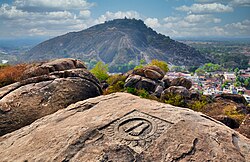
Chandragupta's empire extended throughout most of the Indian subcontinent, spanning from modern day [[Bengal]] to [[Afghanistan]] across North India as well as making inroads into Central and South India. Contemporary Greek evidence states that Chandragupta did not give up performing the rites of sacrificing animals associated with [[Vedic Brahminism]], an ancient form of Hinduism; he delighted in hunting and otherwise leading a life remote from the Jain practice of ''[[Ahimsa]]'' or nonviolence towards living beings.<ref name="India1960" /><ref>The authors and their affiliations listed in the title page of the reference (which has the Wikipedia page ''[[An Advanced History of India]]'') are: R. C. Majumdar, M.A., Ph.D. Vice-Chancellor, Dacca University; H. C. Raychaudhuri, M.A., Ph.D., Carmichael Professor of Ancient Indian History and Culture, Calcutta University; and Kalikinkar Datta, M.A., Ph.D. Premchand Raychand Scholar, Mount Medallist, Griffith Prizeman, Professor and Head of the Department of History, Patna College, Patna</ref> Chandragupta's reign, and the Maurya Empire, set an era of economic prosperity, reforms, infrastructure expansions, and tolerance. Many religions thrived within his realms and his descendants' empire. [[Buddhism]], [[Jainism]] and [[Ājīvika]] gained prominence alongside [[Vedic]] and [[Brahmanism|Brahmanistic]] traditions, and minority religions such as [[Zoroastrianism]] and the [[Greek pantheon]] were respected. A memorial for Chandragupta Maurya exists on the [[Chandragiri hill]] along with a seventh-century hagiographic inscription. | |||
==Historical sources== | |||
Chandragupta's life and accomplishments are described in ancient and historical Greek, Hindu, Buddhist, and Jain texts, but they significantly vary in detail.{{sfn|Mookerji|1988|pp=2-14, 229-235}} Chandragupta was born about 340 BC and died at about 295 BC. His main biographical sources in chronological order are:{{sfn|Mookerji|1988|pp=3-14}} | |||
Chandragupta's | * Greek and Roman sources, which are the oldest surviving records that mention Chandragupta or circumstances related to him; these include works written by [[Nearchus]], [[Onesicritus]], [[Aristobulus of Cassandreia]], [[Strabo]], [[Megasthenes]], [[Diodorus]], [[Arrian]], [[Pliny the Elder]], [[Plutarch]] and [[Justin (historian)|Justin]]. | ||
* Greek sources by | * Hindu texts such as the [[Puranas]] and [[Arthashastra]]; later composed Hindu sources include legends in [[Vishakhadatta]]'s [[Mudrarakshasa]], [[Somadeva]]'s [[Kathasaritsagara]] and [[Kshemendra]]'s [[Brihatkathamanjari]]. | ||
* Buddhist sources are those dated in fourth-century or after, including the Sri Lankan Pali texts [[Dipavamsa]] (''Rajavamsa'' section), [[Mahavamsa]], [[Mahavamsa tika]] and [[Mahabodhivamsa]]. | |||
* | |||
* | |||
* 7th to 10th century Jain inscriptions at [[Shravanabelagola|Shravanabelgola]]; these are disputed by scholars as well as the Svetambara Jain tradition.{{sfn|Wiley|2009|pp=50–52}}{{sfn|Fleet|1892|pp=156–162}} The second Digambara text interpreted to be mentioning the Maurya emperor is dated to about the 10th-century such as in the ''Brhatkathakosa'' of [[Harisena (Jain monk)]], while the complete Jain legend about Chandragupta is found in the 12th-century [[Parisishtaparvan]] by [[Hemachandra]]. | * 7th to 10th century Jain inscriptions at [[Shravanabelagola|Shravanabelgola]]; these are disputed by scholars as well as the Svetambara Jain tradition.{{sfn|Wiley|2009|pp=50–52}}{{sfn|Fleet|1892|pp=156–162}} The second Digambara text interpreted to be mentioning the Maurya emperor is dated to about the 10th-century such as in the ''Brhatkathakosa'' of [[Harisena (Jain monk)]], while the complete Jain legend about Chandragupta is found in the 12th-century [[Parisishtaparvan]] by [[Hemachandra]]. | ||
The Greek and Roman texts do not mention Chandragupta directly, except for a second-century text written by the Roman historian [[Justin (historian)|Justin]]. They predominantly | The Greek and Roman texts do not mention Chandragupta directly, except for a second-century text written by the Roman historian [[Justin (historian)|Justin]]. They predominantly mention the last [[Nanda Empire|Nanda emperor]], who usurped the throne of the king before him. Justin states that Chandragupta was of humble origin, and includes stories of miraculous legends associated with him, such as a wild elephant appearing and submitting itself to him as a ride to him before a battle. Justin's text notes that Chandragupta and Chanakya defeated and removed Nanda from his throne. {{sfn|Mookerji|1988|pp=5-7}} [[Megasthenes]]' account, as it has survived in Greek texts that quote him, states that [[Alexander the Great]] and Chandragupta met, which, if true, would mean his rule started before 321 BCE. He is described as a great king, but not as great in power and influence as [[Porus the Elder|Porus]] in northwestern India or Agrammes ([[Dhana Nanda]]) in eastern India. As Alexander did not cross the [[Beas river]], Chandragupta's territory probably included the [[Punjab region]].{{sfn|Upinder Singh|2017|pp=264–265}} | ||
The pre-4th century Hindu Puranic texts mostly mirror the Greek sources. These texts do not discuss the details of Chandragupta's ancestry, but rather cover the ancestry of the last Nanda king. The Nanda king is described to be cruel, against [[dharma]] and [[shastra]]s, and born out of an illicit relationship followed by a coup.{{sfn|Mookerji|1988|pp=7–9}} The Chanakya's ''Arthasastra'' refers to the Nanda rule as against the spiritual, cultural, and military interests of the country, a period where intrigue and vice multiplied.{{sfn|Mookerji|1988|pp=7–9}} Chanakya states that Chandragupta returned dharma, nurtured diversity of views, and ruled virtuously that kindled love among the subjects for his rule. {{sfn|Mookerji|1988|pp=7–9}} | |||
Buddhist texts such as ''[[Mahavamsa]]'' describe Chandragupta to be of [[Kshatriya]] origin.{{sfn|Mookerji|1988|p=14}} These sources, written about seven centuries after his dynasty ended, state that both Chandragupta and his grandson Ashoka – a patron of Buddhism {{En dash}} were from a branch of the [[Shakya]] noble family, from which [[Gautama Buddha]] descended.{{sfn|Mookerji|1988|pp=13-15}} These Buddhist sources attempt to link the dynasty of their patron Ashoka directly to the Buddha.{{sfn|Thapar|1961|p=12}} The sources claim that the family branched off to escape persecution from a king of the [[Kosala Kingdom]] and Chandragupta's ancestors moved into a secluded Himalayan kingdom known for its peacocks. The Buddhist sources explain the epithet ''maurya'' comes from these peacocks, or ''Mora'' in Pali (Sanskrit: Mayura). {{sfn|Mookerji|1988|pp=13-15}} The Buddhist texts are inconsistent; some offer other legends to explain his epithet. For example, they mention a city named "Moriya-nagara" where all buildings were made of bricks colored like the peacock's neck.{{sfn|Mookerji|1988|pp=13-14}} The ''Maha-bodhi-vasa'' states he hailed from Moriya-nagara, while the ''Digha-Nikaya'' states he came from the maurya clan of Pipphalivana.{{sfn|Mookerji|1988|p=14}} | |||
{{Gallery | |||
|title= | |||
|width=160 | height=170 | |||
|align=center | |||
|footer= | |||
|File:Balustrade peacock Sanchi Stupa No1.jpg | |||
|Design of a [[peacock]], on the stairway balustrade of the Great Stupa at [[Sanchi]]. | |||
|alt1=Chandragupta Maurya relation with Pipphalivana | |||
|File:Indian Museum Sculpture - Peacock (9217548983).jpg | |||
|Design of a peacock, on the railing of the [[Bharhuta Stupa]]. | |||
|alt2=Chandragupta Maurya relation with Pipphalivana | |||
}} | |||
The Buddhist sources also mention that "Brahmin Chanakya" was his counselor and with whose support Chandragupta became the king at Patliputra. .{{sfn|Mookerji|1988|pp=13-14}} He has also been variously identified with [[Shashigupta]] (which has same etymology as of Chandragupta) of [[Paropamisadae]] on the account of same life events.<ref>{{cite journal |last1=Seth |first1=H. C. |title=Did Candragupta Maurya belong to North-Western India? |journal=Annals of the Bhandarkar Oriental Research Institute |date=1937 |volume=18 |issue=2 |pages=158–165 |jstor=41688339 |issn=0378-1143}}</ref> | |||
[[File:7th-century Bhadrabahu Sanskrit inscription, Purvahale Kannada script, Shravanabelgola Karnataka.jpg|thumb|upright=1.65|7th-century [[Bhadrabahu]] inscription at [[Shravanabelagola]] ([[Sanskrit]], Purvahale Kannada script). This is the oldest inscription at the site, and it mentions Bhadrabahu and [[Prabhācandra|Prabhacandra]]. [[B. Lewis Rice|Lewis Rice]] and [[Digambara Jainism|Digambara Jains]] interpret Prabhacandra to be Chandragupta Maurya, while others such as [[John Faithfull Fleet|J F Fleet]], [[V. R. Ramachandra Dikshitar]], and [[Śvētāmbara|Svetambara]] Jains state this interpretation is wrong. {{sfn|Dikshitar|1993|pp=264–266}}{{sfn|Wiley|2009|pp=50–52}}{{sfn|Fleet|1892|pp=156–162}}]] | |||
The 12th-century Digambara text ''[[Parishishtaparvan]]'' by [[Hemachandra]] is the main and earliest Jain source of the complete legend of Chandragupta. It was written nearly 1,400 years after Chandragupta's death. Canto 8, verses 170 to 469, describes the legend of Chandragupta and Chanakya's influence on him. {{sfn|Mookerji|1988|p=14}}{{sfn|Hemacandra|1998|pp=155–157, 168–188}} Other Digambara Jain sources state he moved to [[Karnataka]] after renouncing his kingdom and performed [[Sallekhana]] – the Jain religious ritual of peacefully welcoming death by fasting.{{sfn|Jones|Ryan|2006|p=xxviii}} The earliest mention of Chandragupta's ritual death is found in [[Harisena]]'s ''Brhatkathakosa'', a Sanskrit text of stories about Digambara Jains. The ''Brhatkathakosa'' describes the legend of Bhadrabahu and mentions Chandragupta in its 131st story.{{sfn|Jaini|1991|pp=43–44}} However, the story makes no mention of the Maurya empire, and mentions that his disciple Chandragupta lived in and migrated from [[Ujjain]] – a kingdom (northwest Madhya Pradesh) about a thousand kilometers west of the [[Magadha]] and [[Pataliputra|Patliputra]] (central Bihar). This has led to the proposal that [[Harisena (Jain monk)|Harisena's]] Chandragupta may be a later era, different person.{{sfn|Jaini|1991|pp=43–44}}{{sfn|Dikshitar|1993|pp=264–266}}{{sfn|Upādhye|1977|pp=272–273}} | |||
== Date == | |||
None of the ancient texts mention when Chandragupta was born. [[Plutarch]] claims that he was a young man when he met [[Alexander the Great|Alexander]] during the [[Indian campaign of Alexander the Great|latter's invasion of India]] ({{Circa|326}}-325 BCE). Assuming the Plutarch account is true, Raychaudhuri proposed in 1923 that Chandragupta may have been born after 350 BCE.{{sfn|Raychaudhuri|1923|p=142}} According to other Greco-Roman texts, Chandragupta attacked the Greek-Indian governors after Alexander's death ({{Circa|323 BCE}}) with [[Seleucus I Nicator]] entering into a treaty with Chandragupta years later.{{sfn|Raychaudhuri|1923|p=137}} Seleucus Nicator, under this treaty, gave up Arachosia (Kandahar), Gedrosia (Makran), and Paropanisadai (Paropamisadae, Kabul) to Chandragupta, in exchange for 500 war elephants. {{sfn|Upinder Singh|2017|pp=264–265}} | |||
The texts do not include the start or end year of Chandragupta's reign.{{sfn|Raychaudhuri|1923|p=138}} According to some Hindu and Buddhist texts, Chandragupta ruled for 24 years.{{sfn|Thapar|1961|p=13}} The Buddhist sources state Chandragupta Maurya ruled 162 years after the death of the Buddha.{{sfn|Raychaudhuri|1967|pp=134–142}} However, the Buddha's birth and death vary by source and all these lead to a chronology that is significantly different from the Greek-Roman records. Similarly, Jain sources composed give different gaps between [[Mahavira|Mahavira's]] death and his accession.{{sfn|Raychaudhuri|1967|pp=134–142}} As with the Buddha's death, the date of Mahavira's death itself is also a matter of debate, and the inconsistencies and lack of unanimity among the Jain authors cast doubt on Jain sources. This Digambara Jain chronology, also, is not reconcilable with the chronology implied in other Indian and non-Indian sources.{{sfn|Raychaudhuri|1967|pp=134–142}} | |||
== | Historians such as [[Irfan Habib]] and Vivekanand Jha assign Chandragupta's reign to c. 322-298 BCE.{{sfn|Habib|Jha|2004|p=15}} Upinder Singh dates his rule from 324 or 321 BCE to 297 BCE.{{sfn|Upinder Singh|2016|p=331}} Kristi Wiley states he reigned between 320 and 293 BCE.{{sfn|Wiley|2009|pp=50–52}} | ||
== | == Early life == | ||
The Buddhist sources, written centuries later, claim that both Chandragupta and his grandson, the great patron of Buddhism called [[Ashoka]], were of noble lineage. Some texts link him to the same family of Sakyas from which the [[Buddha]] came, adding that his epithet ''Moriya'' (Sanskrit: Maurya, Mayura) comes from ''Mora'', which in Pali means peacock. Most Buddhist texts state that Chandragupta was a Kshatriya, the Hindu warrior class in Magadha and a student of Chanakya.{{sfn|Mookerji|1988|pp=13-18}} The Buddhist texts are inconsistent, with some including legends about a city named "Moriya-nagara" where all buildings were made of bricks colored like the peacock's resplendent neck.{{sfn|Mookerji|1988|pp=13-14}} The Jain sources, also written centuries later, claim Chandragupta to be the son of a village chief, a village known for raising peacocks.{{sfn|Mookerji|1988|pp=13-14}} | |||
One medieval commentator states Chandragupta to be the son of one of the Nanda's wives with the name Mura.{{sfn|Mookerji|1988|pp=7–9}} Other sources describe Mura as a concubine of the king.<ref name=":1">{{cite book |title=The Cambridge History of India |year=1968 |editor=Edward James Rapson |volume=4 |page=470 |quote="His surname Maurya is explained by Indian authorities as mean 'son of Mura,' who is described as a concubine of the king. |editor2=Wolseley Haig |editor3=Richard Burn |editor4=Henry Dodwell |editor5=Mortimer Wheeler}}</ref> Another Sanskrit dramatic text [[Mudrarakshasa]] uses the terms ''Vrishala'' and ''Kula-Hina'' (meaning - "not descending from a recognized clan or family.") to describe Chandragupta.{{sfn|Mookerji|1988|pp=9–11}} The word ''Vrishala'' has two meanings: one is the ''son of a [[Shudra]]''; the other means the ''best of kings''. A later commentator used the former interpretation to posit that Chandragupta had a Shudra background. However, historian [[Radha Kumud Mukherjee]] opposed this theory, and stated that the word should be interpreted as "the best of kings".{{sfn|Mookerji|1988|pp=9–11}} The same drama also refers to Chandragupta as someone of humble origin, like Justin.{{sfn|Mookerji|1988|pp=9–11}} According to the 11th-century texts of the Kashmiri Hindu tradition – [[Kathasaritsagara]] and ''Brihat-Katha-Manjari'' – the Nanda lineage was very short. Chandragupta was a son of Purva-Nanda, the older Nanda based in Ayodhya. {{sfn|Mookerji|1988|p=13}}{{sfn|Mookerji|1988|pp=15-18}}{{refn|note|According to Kaushik Roy, Chandragupta Maurya was a [[Shudra]] lineage, king.{{sfn|Roy|2012|pp=61-62}}}} The common theme in the Hindu sources is that Chandragupta came from a humble background and with Chanakya, he emerged as a dharmic king loved by his subjects.{{sfn|Mookerji|1988|pp=7–13}} | |||
According to the Digambara legend by Hemachandra, [[Chanakya]] was a Jain layperson and a Brahmin. When Chanakya was born, Jain monks prophesied that Chanakya will one day grow up to help make someone an emperor and will be the power behind the throne.{{sfn|Mookerji|1988|p=6}}{{sfn|Hemacandra|1998|pp=155–157, 168–188}} Chanakya believed in the prophecy and fulfilled it by agreeing to help the daughter of a peacock-breeding community chief deliver a baby boy. In exchange, he asked the mother to give up the boy and let him adopt him at a later date.{{sfn|Mookerji|1988|p=14}}{{sfn|Hemacandra|1998|pp=155–157, 168–188}} The Jain Brahmin then went about making money through magic, and returned later to claim young Chandragupta,{{sfn|Hemacandra|1998|pp=155–157, 168–188}} whom he taught and trained. Together, they recruited soldiers and attacked the [[Nanda Empire|Nanda kingdom]]. Eventually, they won and proclaimed Patliputra as their capital.{{sfn|Hemacandra|1998|pp=155–157, 168–188}} | |||
=== Education === | |||
Chandragupta and | Chandragupta Maurya's influential prime minister [[Chanakya]] is said to have taught at Taxila.<ref>{{cite book|last1=Schlichtmann|first1=Klaus|url=https://books.google.com/books?id=1UYKDQAAQBAJ&pg=PT29|title=A Peace History of India: From Ashoka Maurya to Mahatma Gandhi|date=2016|publisher=Vij Books India Pvt Ltd|isbn=9789385563522|page=29|language=en}}</ref> The Buddhist text ''Mahavamsa-tika'' states that Chanakya took Chandragupta to the [[University of ancient Taxila|Taxila University]] for training and education, where he was educated in "all the sciences and arts" of the time, including military science. He studied there for eight years.{{sfn|Mookerji|1988|pp=18-23, 53-54, 140-141}}<ref>{{cite journal|last=Modelski|first=George|year=1964|title=Kautilya: Foreign Policy and International System in the Ancient Hindu World.|url=https://archive.org/details/sim_american-political-science-review_1964-09_58_3/page/549|journal=American Political Science Review|publisher=Cambridge University Press (CUP)|volume=58|issue=3|pages=549–560|doi=10.2307/1953131|jstor=1953131|issn=0003-0554}}</ref> This account aligns with Plutarch's claim that Alexander met a young Chandragupta during his military campaign in Punjab:<ref name="RM16">{{cite book|last1=Mookerji|first1=Radhakumud|url=https://books.google.com/books?id=i-y6ZUheQH8C&pg=PA16|title=Chandragupta Maurya and His Times|date=1966|publisher=Motilal Banarsidass|isbn=9788120804050|pages=16–17|language=en|author-link1=Radha Kumud Mukherjee}}</ref> | ||
{{quote|Androcottus, when he was a stripling, saw Alexander himself, and we are told that he often said in later times that Alexander narrowly missed making himself master of the country, since its king was hated and despised on account of his baseness and low birth.|Plutarch, Life of Alexander 62:9<ref>{{Cite web|title=Plutarch 62.9|url=https://topostext.org/work/172#Alex.62.9|access-date=2024-03-25|website=topostext.org}}</ref>}} | |||
== | == Influence of Chanakya == | ||
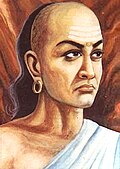
[[File:Chanakya artistic depiction.jpg|thumb|upright=0.8|left|alt=Chanakya|Chandragupta's [[guru]] was [[Chanakya]], with whom he studied as a child and with whose counsel he built the Empire. This image is a 1915 attempt at depicting Chanakya.]] | |||
The Buddhist and Hindu sources present different versions of how Chandragupta met [[Chanakya]]. Broadly, they mention young Chandragupta creating a mock game of a royal court that he and his shepherd friends played near [[Vindhya Range|Vinjha forest]]. Chanakya saw him give orders to the others, bought him from the hunter, and adopted Chandragupta.{{sfn|Mookerji|1988|pp=15–17}} Chanakya taught and admitted him in [[Taxila]] to study the Vedas, military arts, law, and other sastras.{{sfn|Mookerji|1988|pp=15–17}}<ref>{{cite journal | last=Modelski | first=George | title=Kautilya: Foreign Policy and International System in the Ancient Hindu World | journal=American Political Science Review | publisher=Cambridge University Press | volume=58 | issue=3 | year=1964 | doi=10.2307/1953131 | pages=549–560| jstor=1953131 | s2cid=144135587 }}; Quote: "Kautilya is believed to have been Chanakya, a Brahmin who served as prime Minister to Chandragupta (321–296 B.C.), the founder of the Mauryan Empire."</ref> | |||
After [[Taxila]], Chandragupta and [[Chanakya]] moved to [[Pataliputra]], the capital and a historic learning center in the eastern [[Magadha]] kingdom of India. They met Nanda there according to Hindu sources, and [[Dhana Nanda]] according to [[Pali]]-language Buddhist sources.{{sfn|Mookerji|1988|pp=19–20}} Chandragupta became a commander of the Nanda army, but according to Justin, Chandragupta offended the Nanda king ("Nandrum" or "Nandrus") who ordered his execution.{{sfn|Mookerji|1988|p=6}} An alternative version states that it was the Nanda king who was publicly insulted by Chanakya.{{sfn|Mookerji|1988|p=18}} Chandragupta and Chanakya escaped and became rebels who planned to remove the Nanda king from power.{{sfn|Habib|Jha|2004|p=14}}{{refn|group=note|Some early printed editions of Justin's work wrongly mentioned "Alexandrum" instead of "Nandrum"; this error was corrected in philologist [[J. W. McCrindle]]'s 1893 translation. In the 20th century, historians [[Hem Chandra Raychaudhuri]] and [[R. C. Majumdar]] believed "Alexandrum" to be correct reading, and theorized that Justin refers to a meeting between Chandragupta and [[Alexander the Great]] ("Alexandrum"). However, this is incorrect: research by historian [[Alfred von Gutschmid]] in the preceding century had clearly established that "Nandrum" is the correct reading supported by multiple manuscripts: only a single defective manuscript mentions "Alexandrum" in the margin.{{sfn|Trautmann|1970|pp=240-241}}}} The ''Mudrarakshasa'' also states that Chanakya swore to destroy the Nanda dynasty after he felt insulted by the king.<ref name=":0">{{Cite web |title=History: Biography of Chandragupta Maurya and His Maurya Empire |url=https://www.mizanurrmizan.info/2022/08/history-biography-of-chandragupta-maurya-and-his-maurya-empire.html |access-date=2022-08-05 |website=Md. Mizanur Rahaman Mizan|date=4 August 2022 }}</ref>{{sfn|Mookerji|1988|p=18}} | |||
The Roman text by [[Justin (historian)|Justin]] mentions a couple of miraculous incidents that involved Sandracottus (Chandragupta) and presents these legends as omens and portents of his fate. In the first incident, when Chandragupta was asleep after having escaped from Nandrum, a big lion came up to him, licked him, and then left. In the second incident, when Chandragupta was readying for war with Alexander's generals, a huge wild elephant approached him and offered itself to be his steed.{{sfn|Mookerji|1988|p=32}} | |||
== | == Names and titles == | ||
[[File:Chandragupt maurya Birla mandir 6 dec 2009 (31) (cropped).JPG|thumb|A modern statue depicting Chandragupta Maurya, [[Laxminarayan Temple]], Delhi]] | |||
Greek writer [[Phylarchus]] (c. third century BCE), who is quoted by [[Athenaeus]], calls Chandragupta "Sandrokoptos". The later Greco-Roman writers [[Strabo]], [[Arrian]], and [[Justin (historian)|Justin]] (c. second century) call him "Sandrocottus".{{sfn|Raychaudhuri|1967|p=139}} In [[Greek language|Greek]] and [[Latin]] accounts, Chandragupta is known as '''Sandrakottos''' ({{lang-el|Σανδράκοττος}}) and '''Androcottus''' ({{lang-el|Ανδροκόττος}}).{{sfn|Thapar|2004|p=177}}<ref>{{Cite journal |jstor = 41694901|title = The Indika of Megasthenes — an Appraisal|journal = Annals of the Bhandarkar Oriental Research Institute|volume = 72/73|issue = 1/4|pages = 307–329|last1 = Arora|first1 = U. P.|year = 1991}}</ref> | |||
The king's epithets mentioned in the Sanskrit play ''[[Mudrarakshasa]]'' include "Chanda-siri" (Chandra-shri), "Piadamsana" (Priya-darshana), and Vrishala.{{sfn|Raychaudhuri|1967|p=139}} Piadamsana is similar to Piyadasi, an epithet of his grandson [[Ashoka]].{{sfn|Raychaudhuri|1967|pp=139-140}} The word "Vrishala" is used in Indian epics and law books to refer to non-orthodox people. According to one theory, it may be derived from the Greek royal title [[Basileus]], but there is no concrete evidence of this: the Indian sources apply it to several non-royals, especially wandering teachers and ascetics.{{sfn|Raychaudhuri|1967|p=140}} | |||
[[ | |||
== Military strength == | |||
During the Maurya Empire, India had become considerably strong from the perspective of social, economic, and political prosperity. | |||
[[File:035 The War over the Buddha's Relics (33813012975).jpg|thumb|The Mauryan army of Magadha, including infantry, elephant corps, archers, cavalry, chariots, and Emperor Ashoka on a chariot on the right. An artwork engraved at the Sanchi Stupa built by Ashoka, corroborating the accounts of Greek historians.]] | |||
According to Vishakhadatta and Buddhist literature, Chandragupta's army, in addition to the warriors of the [[republics]], included a large number of [[Shakas]], [[Yavanas]] (Greeks), [[Kiratas]], [[Kambojas]], [[Persians|Parasikas]], and [[Bahlikas]].{{sfn|Mookerji|1988|p=27}} Information from Kautilya's ''Arthashastra'' indicates that a military contingent named "Shudrakarshaka" was also included. Although Kautilya sanctioned the inclusion of Shudras in the army, he was opposed to them becoming kings.{{sfn|Dr .R .S. Sharma, Sudras in ancient India|p= 150}} | |||
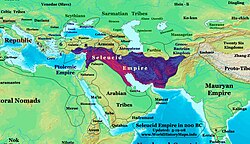
[[File:Hellenistic World 300 BCE Standard map.jpg|thumb|The Western world after the [[Seleucid–Mauryan war]]]] | |||
[[File: | |||
The Greek historian [[Pliny the Elder|Pliny]] states: | |||
{{quote|The largest and wealthiest city is Palibothra (Pataliputra), from which some people have named this nation itself, yes, and commonly Palibothra (Pataliputra) beyond the Ganges. Their kings (Chandragupta Maurya) used to pay a daily wage to a military force of 600,000 infantry, 30,000 cavalry, and 9,000 elephants.|[https://archive.org/details/plinysnaturalhis00plinrich/page/n334/mode/1up Pliny, Natural History, Book VI, Chapter XIX]}} | |||
According to [[Plutarch]], after his victorious war against Seleucus, Chandragupta Maurya proceeded towards southern India with a vast army to further expand his empire: | |||
{{quote|Not long after, Sandrocottus (Chandragupta), who then sat on the throne, gave Seleucus 500 elephants and overran and conquered the whole of India with an army of 600,000 infantry.|Life of Alexander, Chapter LXII<ref>{{cite book |author=Plutarch |title=Life of Alexander |chapter=Chapter LXII |url=https://books.google.co.in/books?id=TXtEAQAAMAAJ&printsec=frontcover&source=gbs_ge_summary_r&cad=0#v=onepage&q&f=false |quote=Not long after, Sandrocottus (Chandragupta), who then sat on the throne, gave Seleucus 500 elephants and overran and conquered the whole of India with an army of 600,000 infantry.}}</ref>}} | |||
The Greek historian [[Arrian]] notes: | |||
== | {{quote|In each chariot of the Indian king, besides the driver, there were two soldiers, and on an elephant, besides the mahout, three archers.|Arrian, Anabasis of Alexander {{sfn|Radhakumud Mukharjee|1940|p=165}}{{sfn|Vincent Smith|1924|p=132}}}} | ||
In Chandragupta's army, each of the 9,000 elephants carried four soldiers, totalling 36,000 men, and each of the 8,000 chariots carried three soldiers, totalling 24,000 men.<ref>{{Cite book|url=http://archive.org/details/aclcpl000001273|title=Man In India-volume 42|year=October 1962|pages=272}}</ref> | |||
Based on the writings of the Greek historians [[Pliny the Elder|Pliny]], [[Arrian]], and [[Plutarch]], historians [[Vincent Arthur Smith|Vincent Smith]], [[Radhakumud Mukherjee|Radha Kumud Mookerji]], [[Ashirbadi Lal Srivastava]] and Indologists such as Gyanchandra Mahajan concluded that Chandragupta's army consisted of a total of 600,000 infantry, 30,000 cavalry, 36,000 men with 9,000 elephants, and 24,000 men with 8,000 chariots. Excluding allied troops and attendants, the total fighting force was 690,000, approximately 700,000 men.<ref>Chandragupta military strength: | |||
{{ | *{{Cite book|quote=Arrian has pointed out, each chariot carried two soldiers, besides the driver, and an elephant carried three archers, besides the Mahout, then the total number of men in Chandragupta’s army would be 6,00,000 infantry, 30,000 horse-men, 36,000 men with the elephants, and 24,000 men with the chariots, totalling 6,90,000 in all, excluding followers and attendants.|page=165|url=https://archive.org/details/in.ernet.dli.2015.532631/page/n183/mode/1up|title=Chandragupta Maurya And His Times|last=Mookerji|first=Radha Kumud|date=1940}} | ||
*{{citation|last=Smith|first=Vincent Arthur|title=The Oxford History of India: From the Earliest Times to the End of 1911|quote=The Maurya raised the number of the infantry to 600,000, and of the elephants to 9,000. But his cavalry is said to have mustered only 30,000..... Each chariot required at least three, and that each elephant carried at least four men, his total force must have amounted to not less than 690,000, or in round numbers 700,000 men.|url=https://archive.org/details/oxfordhistoryofi00smituoft/page/82/mode/1up|publisher=Clarendon Press|page=82}} | |||
*{{Cite book|quote=In ancient India there was a highly organised system of military administration. The state maintained a powerful standing army, and it was well looked after. Chandra Gupta Maurya had a huge force consisting of six lakhs infantary, 30,000 cavalry, 9,000 elephants, and 8,000 chariots. The total strength of his army was 6,90,000 men, excluding camp followers and attendants. |page=11|url=https://archive.org/details/medievalindiancu0000ashi_1sted/page/11/mode/1up?q=Maurya+6%2C90%2C000|title=Medieval Indian culture|last=Ashirbadi Lal Srivastava|date=1964-01-01|publisher=Shiva Lal Agarwala}} | |||
*{{Cite book|url=https://archive.org/details/in.ernet.dli.2015.220182/page/n151/mode/1up|title=New Text Book Of Indian History To 1526|quote=The Mauryan war-machine was therefore perfected in every respect. The military might consisted of troops of different kinds, namely hereditary or feudatory troops, hired troops, gild levies, and forest tribes. They were fully and efficiently equipped. The regular military establishment consisted of 600,000 infantry, 30,000 horsemen, 36,000 men with 9,000 elephants, and 24,000 men with nearly 8,000 chariots. Thus there were 6,90,000 fighting men in addition to followers and attendants.|last=Gian Chand Mahajan|date=|pages=148}}</ref> | |||
==Empire == | |||
During Chandragupta Maurya’s reign, forests were considered state property. A special department managed them under a revenue officer known as the samāharta. A forest officer supervised activities such as collecting forest resources, setting prices, and selling forest products. Water supply and rules governing forest use were also regulated. An official called the Akshatapala was responsible for auditing accounts. This administrative system helped maintain effective control over forest resources.<ref>{{Cite book|url=https://archive.org/details/isbn_9789353883140/page/180/mode/1up?q=%22mauryan%22 |title=Critical Themes in Environmental History of India |date=2020|page=180|first=Ranjan|last=Chakrabarti|publisher=Indian Council of Historical Research |isbn=978-93-5388-316-4}}</ref> Historian Ram Sharan Sharma noted that Chandragupta’s empire maintained a large army and a strong judicial system, particularly to maintain order in tribal regions prone to unrest.<ref>{{cite book |last=Sharma |first=Ram Sharan|title=Prachin Bharat Me Rajneetik Vichar Avam Sansthae |year=1990 |publisher=Rajkamal Prakashan |isbn=9788126707584 |page=355 |quote=The tribal people living inside the empire and on its borders were equally a cause of trouble. So for this, there was a huge permanent army and tight judicial system.|url=https://archive.org/details/in.ernet.dli.2015.401527/page/n355}}</ref> Archaeologist Dilip Chakrabarti argued that the foundations of a centralized administrative system including control over large forested regions of central India were laid by Chandragupta, as later evidenced by the distribution of Ashoka’s edicts. The strategic locations along the Kaimur hills and routes through Sasaram, Ahraura, Rupnath, and Panguraria suggest these areas were already under Mauryan authority.<ref>{{Cite book |last=Chakrabarty |first=Dilip K. |url=https://books.google.co.in/books?id=EIAyDwAAQBAJ&pg=PA46 |title=The Geopolitical Orbits of Ancient India: The Geographical Frames of the Ancient Indian Dynasties |date=2010-10-18 |publisher=Oxford University Press |isbn=978-0-19-908832-4 |pages=42-43 |language=en |quote=...There is no reason to claim that the vast spaces of hilly and forested central India lay outside the Mauryan rule.}}</ref> D. R. Bhandarkar stated that the empire was well-administered from the start, with viceroys governing different regions to ensure tight control a system Chandragupta established.<ref>{{cite book |last=Bhandarkar |first=D. R. |title=Asoka |year=1925 |publisher=University of Calcutta |page=46|url=https://archive.org/details/in.ernet.dli.2015.279637/page/n57/mode/2up}}</ref> | |||
[[File:Seleucid Mauryan War.jpg|thumb|250x250px|Seleucid Mauryan War c.305 to 303 BC<ref>{{cite book |last=Schwartzberg |first=Joseph E. |title=Schwartzberg Atlas |publisher= |year= |isbn= |page=170 |url=https://dsal.uchicago.edu/reference/schwartzberg/pager.html?object=208 |quote=By 311 B.C. or somewhat later the Indus had become the frontier of the Magadhan Empire. Further westward expansion was largely the outcome of the successful military encounter with Seleucus Nicator (Seleukos Nikator), founder of the Seleucid dynasty and inheritor of Alexander's eastern empire from northern Syria to India. Between 305 and 302 B.C. Seleucus ceded the satrapies of Gedrosia, Arachosia, Paropamisadai, and probably Aria, gave his adversary a Greek princess in marriage, and obtained in return 500 war elephants and permanent peace and friendship on his eastern frontier. About this time, perhaps earlier, western Gandhara and areas north to the Hindu Kush, Abhisara, and probably Kasmira were also annexed to the Mauryan dominions.}}</ref><ref>{{cite book |last1=Dani |first1=Ahmad Hasan |last2=Bernard |first2=P. |title=History of Civilizations of Central Asia |volume=2: The Development of Sedentary and Nomadic Civilizations, 700 B.C. to A.D. 250 |publisher=UNESCO |year= |isbn= |pages=67–97 |url=https://unesdoc.unesco.org/ark:/48223/pf0000097857 |quote=The Indus region fell to the rise of the Mauryans and later when Seleucus Nicator tried to recover this lost territory, he had further to cede to Candragupta Maurya the provinces of Aria, Arachosia, Gedrosia and the Paropamisadae.}}</ref>]] | |||
Empire expansion is based on inferences from Greek and Roman historians and the religious Indian texts written centuries after his death. Based on these, the North-West reach of his empire included parts of present-day [[Afghanistan]] that [[Seleucus I Nicator]] ceded to him including [[Kabul]], [[Kandahar]], [[Taxila]] and [[Gandhara]].{{sfn|Mookerji|1988|pp=36–37, 105}} These are the areas where his grandson Ashoka left the [[Kandahar Greek Edicts of Ashoka|major Kandahar rock edict]] and other edicts in the Greek and Aramaic languages.{{sfn|Dupree|2014|pp=285–289}}<ref>{{cite journal|last1=Dupont-Sommer|first1=André|title=Une nouvelle inscription araméenne d'Asoka trouvée dans la vallée du Laghman (Afghanistan)|journal=Comptes rendus des séances de l'Académie des Inscriptions et Belles-Lettres| volume=114|issue=1| year=1970|pages=158–173| doi=10.3406/crai.1970.12491}}</ref> | |||
According to | ===Building the empire=== | ||
}} | {{Main|Conquest of the Nanda Empire}} | ||
According to the Buddhist text ''Mahavamsa Tika'', Chandragupta and Chanakya raised an army by recruiting soldiers from many places after the former completed his education at Taxila. Chanakya made Chandragupta the leader of the army.{{sfn|Mookerji|1988|p=22}} The Digambara Jain text ''Parishishtaparvan'' states that this army was raised by Chanakya with coins he minted and an alliance formed with Parvataka.{{sfn|Hemacandra|1998|pp=175–188}}{{sfn|Raychaudhuri|1967|pp=144-145}} According to Justin, Chandragupta organized an army. Early translators interpreted Justin's original expression as "body of robbers", but states Raychaudhuri, the original expression used by Justin may mean mercenary soldier, hunter, or robber.{{sfn|Raychaudhuri|1967|p=144}} | |||
The | The Buddhist ''Mahavamsa Tika'' and Jain ''Parishishtaparvan'' records Chandragupta's army unsuccessfully attacking the Nanda capital. {{sfn|Hemacandra|1998|pp=175–188}} Chandragupta and Chanakya then began a campaign at the frontier of the Nanda empire, gradually conquering various territories on their way to the Nanda capital.{{sfn|Mookerji|1988|p=33}} He then refined his strategy by establishing garrisons in the conquered territories, and finally besieged the Nanda capital Pataliputra. There [[Dhana Nanda]] accepted defeat, and was killed by Buddhist accounts,{{sfn|Malalasekera|2002|p=383}} or deposed and exiled by Hindu accounts.{{sfn|Mookerji|1988|pp=33-34}} | ||
=== | ===Conquest of the Nanda empire=== | ||
Greco-Roman writer [[Plutarch]] stated, in his ''Life of Alexander'', that the Nanda king was so unpopular that had Alexander tried, he could have easily conquered India.{{sfn|Habib|Jha|2004|p=14}}{{sfn|Stoneman|2019|p=155}} After Alexander ended his campaign and left, Chandragupta's army conquered the Nanda capital Pataliputra around 322 BCE with Chanakya's counsel.{{sfn|Mookerji|1988|p=6}} | |||
Buddhist texts such as ''[[Milindapanha]]'' claim Magadha was ruled by the Nanda dynasty, which, with Chanakya's counsel, Chandragupta conquered to restore ''[[dhamma]]''.{{sfn|Thapar|2013|pp=362–364}}{{sfn|Sen|1895|pp=26–32}} The army of Chandragupta and Chanakya first conquered the Nanda outer territories before invading Pataliputra. In contrast to the easy victory of Buddhist sources, the Hindu and Jain texts state that the campaign was bitterly fought because the Nanda dynasty had a powerful and well-trained army.{{sfn|Mookerji|1988|pp=28–33}}{{sfn|Sen|1895|pp=26–32}} | |||
The ''Mudrarakshasa'' | The conquest was fictionalised in ''Mudrarakshasa'', in which Chandragupta is said to have first acquired [[Punjab]] and allied with a local king named Parvatka under the Chanakya's advice before advancing on the [[Nanda Empire]].{{sfn|Roy|2012|pp=27, 61-62}} Chandragupta laid siege to [[Kusumapura]] (now [[Patna]]), the capital of [[Magadha]], by deploying [[guerrilla warfare]] methods with the help of mercenaries from conquered areas.{{sfn|Roy|2012|pp=61–62}}{{sfn|Grant|2010|p=49}} Historian P. K. Bhattacharyya states that the empire was built by a gradual conquest of provinces after the initial consolidation of Magadha.{{sfn|Bhattacharyya|1977|p=8}} | ||
According to the Digambara Jain version by Hemachandra, the success of Chandragupta and his strategist Chanakya was stopped by a Nanda town that refused to surrender.{{sfn|Hemacandra|1998|pp=176–177}} Chanakya disguised himself as a [[mendicant]] and found seven mother goddesses (''saptamatrika'') inside. He concluded these goddesses were protecting the town people.{{sfn|Hemacandra|1998|pp=176–177}} The townspeople sought the disguised mendicant's advice on how to end the blockade of the army surrounding their town. Hemacandra wrote Chanakya swindled them into removing the mother goddesses. The townspeople removed the protective goddesses and an easy victory over the town followed. Thereafter, the alliance of Chandragupta and Parvataka overran the Nanda kingdom and attacked Patliputra with an "immeasurable army".{{sfn|Hemacandra|1998|pp=176–177}} With a depleted treasury, exhausted merit, and insufficient intelligence, the Nanda king lost.{{sfn|Hemacandra|1998|pp=176–177}} | |||
[[ | |||
{{ | |||
These legends state that the Nanda king was defeated, but allowed to leave Pataliputra alive with a chariot full of items his family needed.{{sfn|Mookerji|1988|p=34}} The Jain sources attest that his daughter fell in [[love at first sight]] with Chandragupta and married him.{{sfn|Hemacandra|1998|pp=176–177}}{{sfn|Mookerji|1988|p=14}} With the defeat of Nanda, Chandragupta Maurya founded the [[Maurya Empire]] in ancient India.{{sfn|Roy|2012|p=62}} | |||
====Conquest of the Eastern Seleucid Empire==== | |||
[[File:Seleucid-Empire 200bc.jpg|thumb|Seleucid Empire 281 BCE]] | |||
[[File:Chandragupta Maurya Empire c.290 BCE.png|thumb|Chandragupta Maurya Empire c.290 BCE]] | |||
Greek historians mentioned the result of [[Seleucid–Mauryan war]] where Seleucid Empire's eastern satrapies( [[Gedrosia]],[[Arachosia]], [[Aria]], and [[Paropamisadae]]) ceded to Mauryan Empire : | |||
{{quote|text= " Seleucus crossed the Indus and waged war with Sandrocottus [Maurya], king of he Indians, who dwelt on the banks of that stream, until they came to an understanding with each other and contracted a marriage relationship. Some of these exploits were performed before the death of Antigonus and some afterward." |sign=<small>[[Appian]]</small>|source=''History of Rome'', The Syrian Wars [https://www.livius.org/sources/content/appian/appian-the-syrian-wars/appian-the-syrian-wars-11/ 55]}} | |||
{{quote|text= " The geographical position of the tribes is as follows: along the Indus are the Paropamisadae, above whom lies the Paropamisus mountain: then, towards the south, the Arachoti: then next, towards the south, the Gedroseni, with the other tribes that occupy the seaboard; and the Indus lies, latitudinally, alongside all these places; and of these places, in part, some that lie along the Indus are held by Indians, although they formerly belonged to the Persians. Alexander [III 'the Great' of Macedon] took these away from the Arians and established settlements of his own, but [[Seleucus Nicator]] gave them to [[Sandrocottus]] [Chandragupta], upon terms of intermarriage and of receiving in exchange five hundred elephants. " |sign=<small>[[Strabo]] </small>|source= 15.2.9<ref>[https://penelope.uchicago.edu/Thayer/E/Roman/Texts/Strabo/15B*.html#2.9]</ref> }} | |||
Greecian historian Pliny also quoted a passage from Megasthanes work about Chandragupta Empire boundaries: | |||
<blockquote> | |||
Most geographers, in fact, do not look upon India as bounded by the river Indus, but add to it the four satrapies of the [[Gedrosia|Gedrose]], the [[Arachosia|Arachotë]], the [[Herat|Aria]], and the [[Paropamisadë]], the [[Kabul River|River Cophes]] thus forming the extreme boundary of India. According to other writers, however, all these territories, are reckoned as belonging to the country of the Aria.<br> | |||
— Pliny, Natural History VI, 23<ref>Pliny, Natural History VI, 23[https://archive.today/20121210070738/http://perseus.mpiwg-berlin.mpg.de/cgi-bin/ptext?lookup=Plin.+Nat.+6.23]</ref><ref>Pliny, Natural History VI, 23[https://archive.org/details/naturalhistoryof21855plin/page/50/mode/1up]</ref> | |||
</blockquote> | |||
The conquest of the south by Chandragupta Maurya may also perhaps be inferred from the following statement of Plutarch. "The throne" in the context is the Magadhan throne, the occupation of which by Chandragupta is thus followed by two other events, viz., the defeat of Selucus, and the conquest of the remaining part of India not included in the Magadhan empire of the Nandas: | |||
<blockquote>"Not long afterwards Androkottos, who had by that time mounted the throne, presented Selukos with 500 elephants, and overran and subdued the whole of India with an army of 600,000."<br> | |||
— Chapter LXII ,Life of Alexander, Plutarch<ref>Chapter LXII ,Life of Alexander, Plutarch [https://books.google.co.in/books?id=TXtEAQAAMAAJ&printsec=frontcover&source=gbs_ge_summary_r&cad=0#v=onepage&q&f=false]</ref> | |||
</blockquote> | |||
Megasthenes defined the region that Chandragupta won from Seleucus as likely western side Gedrosia which shares boundaries with the Euphrates River, and eastern side Arachosia shares boundaries with the Indus. The northern frontier boundary formed by Hindukush mountain range: | |||
[[File:SakastanMap.jpg|thumb|Satrapian provinces in northwestern India which ceaded to Chandragupta by Selucus due to [[Treaty of Indus]].]] | |||
<blockquote> | |||
Sandrokottos the king of the Indians, India forms the largest of the four parts into which Southern Asia is divided, while the smallest part is that region which is included between the Euphrates and our own sea. The two remaining parts, which are separated from the others by the Euphrates and the Indus, and lie between these rivers. [...] India is bounded on its eastern side, right onwards to the south, by the great ocean; that its northern frontier is formed by the Kaukasos range(Hindukush Range) as far as the junction of that range with Tauros; and that the boundary.<br> | |||
— Book I Fragment II , Indica, Megasthanes<ref>Book I Fragment II , Indica, Megasthanes[https://archive.org/details/AncientIndiaAsDescribedByMegasthenesAndArrianByMccrindleJ.W/page/n54/mode/1up]</ref> | |||
</blockquote> | |||
====Treaty of the Indus==== | |||
The ancient historians Justin, Appian, and Strabo preserve the three main terms of the Treaty of the Indus:<ref>{{Cite book|url=https://books.google.co.in/books?id=9UWdAwAAQBAJ&printsec=frontcover&source=gbs_ge_summary_r&cad=0#v=onepage&q&f=false|title=The Land of the Elephant Kings: Space, Territory, and Ideology in the Seleucid Empire|last=Kosmin|first=Paul J.|date=2014-06-23|publisher=Harvard University Press|isbn=978-0-674-72882-0|language=en}}</ref> | |||
#Seleucus transferred to Chandragupta's kingdom the easternmost satrapies of his empire, certainly Gandhara, Parapamisadae, and the eastern parts of Gedrosia, Arachosia and Aria as far as Herat. | |||
#Chandragupta gave Seleucus 500 Indian war elephants. | |||
#The two kings were joined by some kind of marriage alliance (ἐπιγαμία οι κῆδος); most likely Chandragupta wed a female relative of Seleucus. | |||
===War and marriage alliance with Seleucus=== | |||
According to Appian, [[Seleucus I Nicator]], one of Alexander's Macedonian generals who in 312 BCE established the [[Seleucid Kingdom]] with its capital at Babylon, brought Persia and [[Bactria]] under his own authority, putting his eastern front facing the empire of Chandragupta.{{sfn|Mookerji|1988|pp=2-3, 35-38}}{{sfn|Appian|p=55}} Seleucus and Chandragupta waged war until they came to an understanding with each other. Seleucus married off his daughter, Berenice, to Chandragupta to forge an alliance.{{sfn|Appian|p=55}} | |||
{{ | |||
According to Strabo, Chandragupta engaged in a marital alliance with [[Seleucus I Nicator|Seleucus]] to formalise the peace treaty:{{sfn|Mookerji|1988|p=37}} | |||
[[File:Chandragupta.et.Helena.jpg|thumb|alt=Marriage|"Chandra Gupta Maurya entertains his bride from Babylon": a conjectural interpretation of the "marriage agreement" between the Seleucids and Chandragupta Maurya, related by [[Appian]]<ref>''History of Rome'', The Syrian Wars [http://www.livius.org/ap-ark/appian/appian_syriaca_11.html 55] {{webarchive|url=https://web.archive.org/web/20071103154609/http://www.livius.org/ap-ark/appian/appian_syriaca_11.html |date=3 November 2007 }}</ref>]] | |||
{{quote|The Indians occupy in part some of the countries situated along the Indus, which formerly belonged to the Persians: Alexander deprived the Ariani of them, and established there settlements of his own. But [[Seleucus Nicator]] gave them to [[Sandrocottus]] in consequence of a marriage contract ([[Epigamia]], Greek: Ἐπιγαμία), and received in return five hundred elephants.|[[Strabo]] 15.2.1(9)<ref>{{cite web|url=http://www.perseus.tufts.edu/cgi-bin/ptext?doc=Perseus%3Atext%3A1999.01.0239&query=head%3D%23120|title=Strabo 15.2.1(9)}}</ref>}} | |||
R. C. Majumdar and D. D. Kosambi note that Seleucus appeared to have fared poorly after ceding large territories west of the Indus to Chandragupta. The Maurya Empire added [[Arachosia]] ([[Kandahar]]), [[Gedrosia]] ([[Balochistan (Pakistan)|Balochistan]]), and [[Paropamisadae]] ([[Gandhara]]).{{sfn|Mookerji|1988|pp=36–37, 105}}<ref>{{cite journal | last1 = Walter Eugene | first1 = Clark | year = 1919 | title = The Importance of Hellenism from the Point of View of Indic-Philology | journal = Classical Philology | volume = 14 | issue = 4| pages = 297–313 | doi = 10.1086/360246 | s2cid = 161613588 }}</ref>{{efn|According to Grainger, Seleucus "must ... have held Aria" (Herat), and furthermore, his "son [[Antiochus I Soter|Antiochos]] was active there fifteen years later". (Grainger, John D. 1990, 2014. ''Seleukos Nikator: Constructing a Hellenistic Kingdom''. Routledge. p. 109).}} According to Strabo, [[Seleucus Nicator]] gave these regions to Chandragupta along with a marriage treaty, and in return received five hundred elephants.<ref>{{cite web|url=https://www.perseus.tufts.edu/cgi-bin/ptext?doc=Perseus%3Atext%3A1999.01.0239&query=head%3D%23120|title=Strabo 15.2.1(9)|access-date=14 July 2017|archive-url=https://web.archive.org/web/20090203225004/http://www.perseus.tufts.edu/cgi-bin/ptext?doc=Perseus%3Atext%3A1999.01.0239&query=head%3D%23120|archive-date=3 February 2009|url-status=live}}</ref> The details of the engagement treaty are not known.{{sfn|Barua|2005|pp=13-15}} However, since the extensive sources available on Seleucus never mention an Indian princess, it is thought that the marital alliance went the other way, with Chandragupta himself or his son Bindusara marrying a Seleucid princess, in accordance with contemporary Greek practices to form dynastic alliances. An Indian [[Puranic]] source, the [[Pratisargaparvan|Pratisarga Parva]] of the [[Bhavishya Purana]], described the marriage of Chandragupta with a Greek ("[[Yavana]]") princess, daughter of Seleucus.<ref>{{Cite book |last=Sagar |first=Chandra |title=Foreign Influence on Ancient India |publisher=Northern Book Centre |year=1992 |page=83}}</ref> [[Mahavamsa|The Mahavamsa]] also states that, seven months after the war ended, Seleucus gave one of his daughters, Berenice (known in Pali as ''Suvarnnaksi'') in marriage to Chandragupta.<ref>{{Cite book |last=Paranavithana |first=Senarat |title=The Greeks and the Mauryans |publisher=Lake House Investments |date=January 1971 |isbn=9780842607933 |language=English}}</ref> | |||
Chandragupta sent 500 [[war elephant]]s to Seleucus, which played a key role in Seleucus' victory at the [[Battle of Ipsus]].<ref>''India, the Ancient Past'', Burjor Avari, p. 106-107</ref>{{sfn|Majumdar|2003|p=105}}<ref>{{cite journal | last1 = Tarn | first1 = W. W. | year = 1940 | title = Two Notes on Seleucid History: 1. Seleucus' 500 Elephants, 2. Tarmita | journal = The Journal of Hellenic Studies | volume = 60 | pages = 84–94 | doi = 10.2307/626263 | jstor = 626263 | s2cid = 163980490 }}</ref> In addition to this treaty, Seleucus dispatched [[Megasthenes]] as an ambassador to Chandragupta's court, and later [[Antiochus I Soter|Antiochos]] sent [[Deimakos]] to his son Bindusara at the Maurya court at Patna.{{sfn|Mookerji|1988|p=38}} | Chandragupta sent 500 [[war elephant]]s to Seleucus, which played a key role in Seleucus' victory at the [[Battle of Ipsus]].<ref>''India, the Ancient Past'', Burjor Avari, p. 106-107</ref>{{sfn|Majumdar|2003|p=105}}<ref>{{cite journal | last1 = Tarn | first1 = W. W. | year = 1940 | title = Two Notes on Seleucid History: 1. Seleucus' 500 Elephants, 2. Tarmita | journal = The Journal of Hellenic Studies | volume = 60 | pages = 84–94 | doi = 10.2307/626263 | jstor = 626263 | s2cid = 163980490 }}</ref> In addition to this treaty, Seleucus dispatched [[Megasthenes]] as an ambassador to Chandragupta's court, and later [[Antiochus I Soter|Antiochos]] sent [[Deimakos]] to his son Bindusara at the Maurya court at Patna.{{sfn|Mookerji|1988|p=38}} | ||
[ | {{quote|text= " Seleucus crossed the Indus and waged war with Sandrocottus [Maurya], king of he Indians, who dwelt on the banks of that stream, until they came to an understanding with each other and contracted a marriage relationship. Some of these exploits were performed before the death of Antigonus and some afterward." |sign=<small>[[Appian]]</small>|source=''History of Rome'', The Syrian Wars [https://www.livius.org/sources/content/appian/appian-the-syrian-wars/appian-the-syrian-wars-11/ 55]}} | ||
An Indian [[Puranic]] source, the ''[[Pratisargaparvan|Pratisarga Parva]]'' of the ''[[Bhavishya Purana]]'', described the marriage of Chandragupta with a Greek ("[[Yavana]]") princess, daughter of Seleucus,<ref name="Sagar">Foreign Influence on Ancient India, Krishna Chandra Sagar, Northern Book Centre, 1992, p.83 [https://books.google.com/books?id=0UA4rkm9MgkC&pg=PA83]</ref> before accurately detailing early Mauryan genealogy: | |||
{{quote|"Chandragupta married with a daughter of [[Seleucus I Nicator|Suluva]] (Seleucus), the [[Yavana]] king of [[Persian Empire|Pausasa]] (Persia).<ref>The country is transliterated as "Pausasa" in the online translation: [http://mandhataglobal.com/wp-content/custom/articles/Puranas.pdf Pratisarga Parva p.18] {{webarchive|url=https://web.archive.org/web/20160423144009/http://mandhataglobal.com/wp-content/custom/articles/Puranas.pdf |date=23 April 2016 }} and in Encyclopaedia of Indian Traditions and Cultural Heritage, Anmol Publications, 2009, p.18; and "Paursa" in the original Sanskrit of the first two verses given in Foreign Influence on Ancient India, Krishna Chandra Sagar, Northern Book Centre, 1992, [https://books.google.com/books?id=0UA4rkm9MgkC&pg=PA83 p.83]:</ref> Thus, he mixed the Buddhists and the Yavanas. He ruled for 60 years. From him, [[Bindusara]] was born and ruled for the same number of years as his father. His son was [[Ashoka]]."|''[[Pratisarga Parva]]''<ref>Translation given in: Encyclopaedia of Indian Traditions and Cultural Heritage, Anmol Publications, 2009, p.18. Also online translation: [http://mandhataglobal.com/wp-content/custom/articles/Puranas.pdf Pratisarga Parva p.18] {{webarchive|url=https://web.archive.org/web/20160423144009/http://mandhataglobal.com/wp-content/custom/articles/Puranas.pdf |date=23 April 2016 }}.</ref><ref>Original Sanskrit of the first two verses given in Foreign Influence on Ancient India, Krishna Chandra Sagar, Northern Book Centre, 1992, [https://books.google.com/books?id=0UA4rkm9MgkC&pg=PA83 p.83]: "Chandragupta Sutah Paursadhipateh Sutam. Suluvasya Tathodwahya Yavani Baudhtatapar".</ref><ref name="Sagar"/>}} | |||
=== | ===Southern conquest=== | ||
After annexing Seleucus' provinces west of the Indus river, Chandragupta had a vast empire extending across the northern Indian sub-continent from the [[Bay of Bengal]] to the [[Arabian Sea]]. Chandragupta began expanding his empire southwards beyond the [[Vindhya Range]] and into the [[Deccan Plateau]].{{sfn|Mookerji|1988|p=6}} By the time his conquests were complete, Chandragupta's empire extended over most of the subcontinent.{{sfn|Raychaudhuri|1967|p=18}} | |||
Two poetic anthologies from the Tamil [[Sangam literature]] corpus – ''[[Akananuru]]'' and ''[[Purananuru]]'' – allude to the Nanda rule and Maurya empire. For example, poems 69, 281 and 375 mention the army and chariots of the Mauryas, while poems 251 and 265 may be alluding to the Nandas.{{sfn|Zvelebil|1973|pp=53-54}} However, the poems dated between first-century BCE to fifth-century CE do not mention Chandragupta Maurya by name, and some of them could be referring to a different Moriya dynasty in the Deccan region in the fifth century CE.{{sfn|Mookerji|1988|pp=41–42}} According to Upinder Singh, these poems may be mentioning Mokur and Koshar kingdoms of Vadugars (northerners) in Karnataka and Andhra Pradesh, with one interpretation being that the Maurya empire had an alliance with these at some point of time.{{sfn|Upinder Singh|2016|pp=330–331}} | |||
===Conquest of the Saurashtra=== | |||
Chandragupta conquered Southern-Western part of India. Especially his conquest over Saurashtra and Sudarshana lake construction is preseved in later Satrapian king Rudradaman inscription: | |||
<blockquote>(L.8)[] for the sake of ordered to be made by the Vaishya Pushyagupta, the provincial governor of the Maurya king Chandragupta; adorned with conduits for [[Ashoka]] the Maurya by the [[Yavana]] king [[Tushaspha]] while governing; and by the conduit ordered to be made by him, constructed in a manner worthy of a king (and) seen in that breach. | |||
—Junagadh rock inscription of Rudradaman<ref name="WB">[http://projectsouthasia.sdstate.edu/Docs/HISTORY/PRIMARYDOCS/EPIGRAPHY/JunagadhRockInscription.htm "Junagadh Rock Inscription of Rudradaman", ''Project South Asia''.]{{webarchive|url=https://web.archive.org/web/20090223182107/http://projectsouthasia.sdstate.edu/Docs/HISTORY/PRIMARYDOCS/EPIGRAPHY/JunagadhRockInscription.htm |date=23 February 2009 }}</ref> | |||
</blockquote> | |||
In the west, Chandragupta's rule over present-day [[Gujarat]] is attested to by Ashoka's inscription in [[Junagadh]]. On the same rock, about 400 years later, [[Junagadh rock inscription of Rudradaman|Rudradaman inscribed]] a longer text sometime about the mid second–century.{{sfn|Salomon|1998|pp=194, 199–200 with footnote 2}} Rudradaman's inscription states that the Sudarshana lake in the area was commissioned during the rule of Chandragupta through his governor Vaishya Pushyagupta and conduits were added during Ashoka's rule through Tushaspha. The Mauryan control of the region is further corroborated by the inscription on the rock, which suggests that Chandragupta controlled the [[Malwa]] region in Central India, located between Gujarat and Pataliputra.{{sfn|Habib|Jha|2004|p=19}} | |||
[[ | |||
There is uncertainty about the other conquests that Chandragupta may have achieved, especially in the [[Deccan]] region of southern India.{{sfn|Habib|Jha|2004|p=19}} At the time of his grandson Ashoka's ascension in c. 268 BCE, the empire extended up to present-day [[Karnataka]] in the south, so the southern conquests may be attributed to either Chandragupta or his son Bindusara. If the Jain tradition about Chandragupta ending his life as a renunciate in Karnakata is considered correct, it appears that Chandragupta initiated the southern conquest.{{sfn|Habib|Jha|2004|p=19}} | |||
===Conquest of the Kuntala=== | |||
Shikarpur Taluq, inscription 225 mentioned about Mauryan ruling in the region of [[Kuntala country|Kuntala]] .Shikarpur Taluq inscription mentioned about Mauryan ruling in the region of [[Kuntala country|Kuntala]] .The Kuntala country is an ancient Indian political region including the western Deccan and some parts of central,south Karnataka and north Mysore. | |||
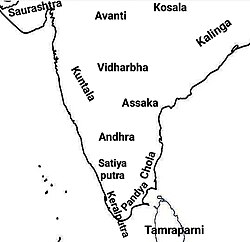
[[File:South India 500 to 200 BCE.jpg|thumb|South India , Kuntala present in Western coastal region]] | |||
<blockquote> | |||
''Kuntala-kshôpiyam pesarvett â-nava-Nanda-Gupta-kula-Mauryya-kshmâpar aldar llasaj-jasad''<br> | |||
— Shikarpur Taluq, inscription 225<ref>Shikarpur Taluq inscription 225, Epigraphia Carnatica, Volume 17[https://archive.org/details/epigraphia_carnatica_vol7_myso/page/n327/mode/1up]</ref><ref>Shikarpur Taluq inscription 225, Epigraphia Carnatica Volume 17[https://archive.org/details/epigraphia_carnatica_vol7_myso/page/n587/mode/1up]</ref><br> | |||
'''Translation''' : The Kuntala country, which is like curls (kuntaja) to the lady Earth, was-ruled by the renowned nine Nandas, the Gupta and Mauryan kings.</blockquote> | |||
== Economic condition == | |||
During the Mauryan period, the economic situation expanded. From the reign of Chandragupta Maurya to the reign of Ashoka, the economic condition improved significantly. Agriculture was the primary means of livelihood at this time. | |||
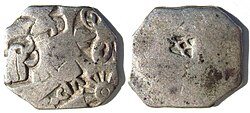
[[File:Mauryan Empire. Circa late 4th-2nd century BC.jpg|thumb|centre|Coin from the period of Chandragupta Maurya<ref>{{Cite web|url=https://www.cngcoins.com/Coin.aspx?CoinID=335378|title=Auction 396. INDIA, Mauryan Empire, Karshapana (14mm, 3.32 g). circa 315-310 BC|website=www.cngcoins.com|access-date=2024-04-24}}</ref>]] | |||
[[File:Gorakhpur, Copper Plate Edict Of Chandragupta (3rd century BCE).jpg|thumb|An example of the district administration of Chandragupta Maurya. This copper plate, found from [[Sohgaura copper plate inscription|Sohgaura]] (district Gorakhpur). The text of the plate has been translated as follows. Its mentions the establishment of two grain depots (''Kosthagara'') to fight against famine.<ref name = "MCQ">2000+ MCQs with Explanatory Notes For HISTORY by Disha Experts [https://books.google.en/books?id=O65TDwAAQBAJ&pg=PA63 p.63]</ref> | |||
{{blockquote | | |||
''Sāvatiyānam Mahāma(ttā)nam sāsane Mānavāsītika-''<br /> | |||
''ḍasilimate Ussagāme va ete duve koṭṭhāgālāni''<br /> | |||
''tina-yavāni maṃthulloca-chammā-dāma-bhālakān(i)va''<br /> | |||
''laṃ kayiyati atiyāyikāya no gahi(ta)vvāya''<ref>{{cite journal |last1=Barua |first1=B. M. |title=THE SOHGAURA COPPER-PLATE INSCRIPTION |journal=Annals of the Bhandarkar Oriental Research Institute |volume=11 |issue=1 |date=1930 |page=48 |jstor=41688160 }}</ref>|The order of the [[Mahamatra]]s of [[Shravasti]] issued from the Manavasiti camp. Only to the tenants, only on the advent of drought, these (the) dravya store houses of Triveni, [[Mathura]], Chanchu, Modama and Bhadra are to the distributed, in case of distress they are not to be withheld.<br > —Translated by Jayaswal<ref>{{Cite book|url=http://archive.org/details/hnch_mourya-samrajya-ka-itihas-by-satyaketu-vidyalankar-1980-new-delhi-shri-saraswati-sadan|title=Mourya Samrajya Ka Itihas By Satyaketu Vidyalankar 1980 New Delhi Shri Saraswati Sadan|last=|pages=455}}</ref> | |||
<br /> }}]] | |||
==== | Similar to Sohgaura, an inscription has also been found from Pundravardhana Nagar (Mahasthan) in Bangladesh, providing information about a famine that occurred.<ref>{{Cite book|url=https://books.google.co.in/books?id=H3lUIIYxWkEC&pg=PA329&lpg=PA329&dq=FRAGMENTARY+MAURYA+INSCRIPTION+FROM+MATHURA&source=bl&ots=xh5A1Q9_mI&sig=ACfU3U0jG-ROa7wKNHFDCD53C2jhoyOFaA&hl=en&sa=X&ved=2ahUKEwjKueH-pP2FAxV3wjgGHQ3NAzw4FBDoAXoECAQQAg#v=onepage&q=FRAGMENTARY%20MAURYA%20INSCRIPTION%20FROM%20MATHURA&f=false|page=329|quote=The Sohgaura inscription has been commented on by numerous scholars, who have variously assigned it a pre-Ashokan or post-Maurya date, the majority opinion currently favouring the latter. K. P. Jayaswal interpreted the crescent on the top as an emblem of the Maurya king Chandragupta and connected the contents of the inscription with the Jain legend of a great famine during the reign of this king. Many years later, in 1931, Baru Faqir, a resident of Mahasthangarh village in Bagura district of Bangladesh .... The Mahasthan inscription appears to record an order issued by a ruler to the mahamatra stationed at Pundranagara (the site of which is represented by Mahasthangarh village), in order to relieve the distress caused on account of famine to some people known as the Samvamgiyas, who apparently lived in and around this town.|title=A History of Ancient and Early Medieval India: From the Stone Age to the 12th Century|last=Singh|first=Upinder|date=2008|publisher=Pearson Education India|isbn=978-81-317-1120-0|language=en}}</ref> | ||
[[Chanakya]], in the fourth section of the ''[[Arthashastra]]'' under "Upānipāt pratikāra" (measures to protect the populace from calamities), provided the following, which matches the arrangements made by Chandragupta in the Sohgaura and Mahasthan inscriptions: | |||
{{quote|In times of famine, the king shall show favour by distributing seeds and food, or by constructing forts and bridges with the provision of food, or by sharing food, or by relocating them to another region.<br>—Kautilya, [[Arthashastra]] 4.3.17<ref>{{Cite book|url=http://archive.org/details/JhPw_kautilya-artha-shastra-of-vishnu-gupta-vol.-2-part-2-with-5-commentaries-ed.-by-|title=Kautilya Artha Shastra Of Vishnu Gupta Vol. 2 Part 2 With 5 Commentaries|last=Shastri Datara|first=Vishvanatha|publisher=Sampurnanand Sanskrit University Varanasi|pages=19}}</ref>}} | |||
The famous scholar Megasthenes, who visited the Mauryan court, believed that grain never became expensive in India. The administration had formulated a policy for agricultural progress. Herdsmen were appointed to protect agriculture. For irrigation facilities, Chandragupta Maurya constructed the [[Sudarshana Lake]] near Junagadh.<ref>{{Cite book|page=198|url=http://archive.org/details/in.ernet.dli.2015.269161|title=Prachin Bharat Mein Daan Ki Avdarana|last=S.k.tiwari}}</ref> | |||
== Campaigns and conflicts == | |||
==Empire== | {| class="wikitable" | ||
|+ | |||
! style="background:orange;"| | |||
<span style="color: white"> Dates </span> | |||
! style="background:orange;width: 320px;"|<span style="color: white"> Conflict </span> | |||
! style="background:orange;"|<span style="color: white"> Side </span> | |||
! style="background:orange;width: 300px;"| <span style="color:white"> Opponent </span> | |||
! style="background:orange;width: 300px;"| <span style="color:white"> Result </span> | |||
|- | |||
| 305–315 BCE | |||
| '''[[Chandragupta Maurya's Macedonian campaign]]''' | |||
| [[Mauryan Empire]] | |||
| [[Macedonian Empire]] | |||
| style="background:#8cff90"|'''Mauryan victory'''{{sfn|Mookerji|1988|pp=6–8, 31–33}} | |||
*[[Chandragupta Maurya]] conquered the Macedonian satrapies in the [[Indus Valley]] and [[Northwest India]].<ref name="greenwood">{{cite book|url=https://books.google.com/books?id=JEvN6XwWTk8C&pg=PA252|title=From Polis to Empire, the Ancient World, C. 800 B.C.-A.D. 500|date=2002|publisher=Greenwood Publishing|isbn=0313309426|access-date=16 August 2019}}</ref> | |||
*Chandragupta Maurya conquered the Macedonian satrapies in the Punjab region.<ref name="greenwood"/> | |||
*Among the four satraps of Alexander he fought were [[Eudemus (general)|Eudemus]], ruler of western Punjab until his departure in 317 BCE, and [[Peithon, son of Agenor|Peithon]], ruler of the Greek colonies along the Indus until their departure for [[Babylon]] in 316 BCE. Both Peithon and Eudemus were defeated by Chandragupta and surrendered to him.{{sfn|Kosmin|2014|p=33–34}} | |||
|- | |||
| 315–317 BCE | |||
| '''Campaign against Greek governors''' | |||
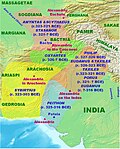
'''[[File:EasternSatrapsAfterAlexander.jpg|thumb|alt=Eastern Satraps|By 317 BCE, Chandragupta had defeated the remaining [[Macedonia (ancient kingdom)|Macedonian]] [[satraps]] in the north-west of the [[Indian subcontinent]].]] | |||
| [[Mauryan Empire]] | |||
| [[Macedonian Empire]] | |||
| style="background:#8cff90"|'''Mauryan victory'''{{sfn|Mookerji|1988|pp=6–8, 31–33}} | |||
*Justin relates that after Alexander's death, Chandragupta freed Indian territories from the Greeks and executed some Greek governors.<ref>[http://www.forumromanum.org/literature/justin/trad15.html Justin XV.4.12-13]</ref> | |||
*Chandragupta turned his attention to Northwestern India (modern-day [[Pakistan]]), where he fought against the four satraps (described as "prefects" in Western sources) left by Alexander and killed two satraps, [[Nicanor (satrap)|Nicanor]] and [[Philip (satrap)|Philip]]. The other two, Eudemus and Peithon, had already surrendered and returned to Babylon.<ref>Radha Kumud Mookerji, ''Chandragupta Maurya and His Times'', 4th ed. (Delhi: Motilal Banarsidass, 1988 [1966]), 31, 28–33.</ref> | |||
|- | |||
|322–320 BCE | |||
| '''Conquest of the [[Nanda Empire]]''' | |||
| [[Chandragupta Maurya]] | |||
| [[Dhana Nanda]] of the [[Nanda dynasty|Nanda Empire]] | |||
| style="background:#8cff90"|'''Mauryan victory'''{{sfn|Thapar|2013|pp=362–364}}{{sfn|Sen|1895|pp=26–32}} | |||
* Chandragupta defeated the Nandas and established the Magadha-based Maurya Empire.{{sfn|Upinder Singh|2008|p=272}} | |||
* He married the Nanda princess [[Durdhara]].{{sfn|Hemacandra|1998|pp=175–188}}{{sfn|Malalasekera|2002|p=383}}{{sfn|Mookerji|1988|pp=33-34}} | |||
|- | |||
| 305–303 BCE | |||
| '''[[Seleucid–Mauryan war]]''' | |||
| [[Mauryan Empire]] | |||
| [[Seleucid Empire]] | |||
| style="background:#8cff90"|'''Mauryan victory'''<ref name="JACKSON">"Pg.106 - Seleucid Kingdom Another Hellenistic monarchy was founded by the general Seleucus (suh-LOO-kuss), who established the Seleucid dynasty of Syria. This was the largest of the Hellenistic kingdoms and controlled much of the old Persian Empire from Turkey in the west to India in the east, although the Seleucids found it increasingly difficult to maintain control of the eastern territories. In fact, an Indian ruler named Chandragupta Maurya (chundruh-GOOP-tuh MOWR-yuh) (324-301 B.C.E.) created a new Indian state, the Mauryan Empire, and '''drove out the Seleucid forces.''' ... The Seleucid rulers maintained relations with the Mauryan Empire. Trade was fostered, especially in such luxuries as spices and jewels. Seleucus also sent Greek and Macedonian ambassadors to the Mauryan court. Best known of these was Megasthenes (muh-GAS-thuh-neez), whose report on the people of India remained one of the Western best sources of information on India until the Middle Ages." {{Cite book|url=http://archive.org/details/westerncivilizat08edspie|title=Western civilization|last=Spielvogel|first=Jackson J.|date=2012|page=106|publisher=Boston, MA : Wadsworth Cengage Learning|others=Internet Archive|isbn=978-0-495-91329-0}}</ref> | |||
* [[Treaty of the Indus]]{{sfn|Kosmin|2014|p=33–34}} | |||
* The eastern satrapies of the Seleucid Empire were ceded to the Maurya Empire | |||
* Seleucus gave his daughter to Chandragupta, initiating a dynastic partnership | |||
* Chandragupta gave 500 [[war elephant]]s to Seleucus | |||
* Establishment of [[Megasthenes|diplomatic relations]] | |||
|} | |||
=== | ==Rule == | ||
After unifying much of India, Chandragupta and [[Chanakya]] passed a series of major economic and political reforms. Chandragupta established a [[Mantriparishad|strong central administration]] from Pataliputra (now [[Patna]]).{{sfn|Mookerji|1988|pp=13–18}} Chandragupta applied the statecraft and economic policies described in Chanakya's text ''[[Arthashastra]]''.{{sfn|Boesche|2003|pp=7–18}}<ref>MV Krishna Rao (1958, Reprinted 1979), Studies in Kautilya, 2nd Edition, {{oclc|551238868}}, {{ISBN|978-8121502429}}, pages 13–14, 231–233</ref>{{sfn|Olivelle|2013|pp=31–38}} There are varying accounts in the historic, legendary, and hagiographic literature of various Indian religions about Chandragupta's rule, but Allchin and Erdosy' are suspect; they state, "one cannot but be struck by the many close correspondences between the (Hindu) Arthashastra and the two other major sources the (Buddhist) Asokan inscriptions and (Greek) Megasthenes text".{{sfn|Allchin|Erdosy|1995|pp=187–194}} | |||
After | |||
The Maurya rule was a structured administration; Chandragupta had a council of ministers ('' | The Maurya rule was a structured administration; Chandragupta had a council of ministers (''amatya''), with Chanakya was his chief minister.<ref>{{cite journal | last=Modelski | first=George | title=Kautilya: Foreign Policy and International System in the Ancient Hindu World | journal=American Political Science Review | volume=58 | issue=3 | year=1964 | doi=10.2307/1953131 | pages=549–560| jstor=1953131 | s2cid=144135587 }}; Quote: "Kautilya is believed to have been Chanakya, a Brahmin who served as Chief Minister to Chandragupta (321–296 B.C.), the founder of the Mauryan Empire."</ref>{{sfn|Upinder Singh|2017|p=220}} The empire was organised into territories (''janapada''), centres of regional power were protected with forts (''durga''), and state operations were funded with treasury (''kosa'').{{sfn|Allchin|Erdosy|1995|pp=189–192}} Strabo, in his ''Geographica'' composed about 300 years after Chandragupta's death, describes aspects of his rule in his chapter XV.46–69. He had councillors for matters of justice and assessors to collect taxes on commercial activity and trade goods. He routinely performed Vedic sacrifices,{{sfn|Eraly|2002|pp=414–415}} Brahmanical rituals,{{sfn|Sastri|1988|pp=163–164}} and hosted major festivals marked by procession of elephants and horses. His officers inspected situations requiring law and order in the cities; the crime rate was low.{{sfn|Mookerji|1988|pp=62–63, 79–80, 90, 159–160}} | ||
According to Megasthenes, Chandragupta's rule was marked by three parallel administrative structures. One managed the affairs of villages, ensuring irrigation, recording land ownership, monitoring tools supply, enforcing hunting, wood products and forest-related laws, and settling disputes.{{sfn|Sastri|1988|pp=120–122}} Another administrative structure managed city affairs, including all matters related to trade, merchant activity, visit of foreigners, harbors, roads, temples, markets, and industries. They also collected taxes and ensured standardized weights and measures.{{sfn|Sastri|1988|pp=120–122}} The third administrative body overlooked the military, its training, its weapons supply, and the needs of the soldiers.{{sfn|Sastri|1988|pp=120–122}} | According to Megasthenes, Chandragupta's rule was marked by three parallel administrative structures. One managed the affairs of villages, ensuring irrigation, recording land ownership, monitoring tools supply, enforcing hunting, wood products and forest-related laws, and settling disputes.{{sfn|Sastri|1988|pp=120–122}} Another administrative structure managed city affairs, including all matters related to trade, merchant activity, visit of foreigners, harbors, roads, temples, markets, and industries. They also collected taxes and ensured standardized weights and measures.{{sfn|Sastri|1988|pp=120–122}} The third administrative body overlooked the military, its training, its weapons supply, and the needs of the soldiers.{{sfn|Sastri|1988|pp=120–122}} | ||
Chanakya was concerned about Chandragupta's safety and developed elaborate techniques to prevent assassination attempts. Various sources report Chandragupta frequently changed bedrooms to confuse conspirators. He left his palace only for certain tasks: to go on military expeditions, to visit his court for dispensing justice, to offer sacrifices, for celebrations, and for hunting. During celebrations, he was well-guarded, and on hunts, he was surrounded by female guards who were presumed to be less likely to participate in a coup conspiracy. These strategies may have resulted from the historical context of the Nanda | Chanakya was concerned about Chandragupta's safety and developed elaborate techniques to prevent assassination attempts. Various sources report Chandragupta frequently changed bedrooms to confuse conspirators. He left his palace only for certain tasks: to go on military expeditions, to visit his court for dispensing justice, to offer sacrifices, for celebrations, and for hunting. During celebrations, he was well-guarded, and on hunts, he was surrounded by female guards who were presumed to be less likely to participate in a coup conspiracy. These strategies may have resulted from the historical context of the Nanda king who had come to power by assassinating the previous king.{{sfn|Allan|1958|pp=25–28}} | ||
During Chandragupta's reign and that of his dynasty, many religions thrived in India, with [[Buddhism]], Jainism and [[Ajivika]] gaining prominence along with other folk traditions.{{sfn|Obeyesekere|1980|pp=137–139 with footnote 3}}{{sfn|Albinski|1958|pp=62–75}} | During Chandragupta's reign and that of his dynasty, many religions thrived in India, with [[Buddhism]], Jainism and [[Ajivika]] gaining prominence along with other folk traditions.{{sfn|Obeyesekere|1980|pp=137–139 with footnote 3}}{{sfn|Albinski|1958|pp=62–75}} | ||
==Infrastructure projects== | |||
[[File:MauryanCoin.JPG|thumb|left|alt=Coins|Silver punch mark coin | [[File:MauryanCoin.JPG|thumb|left|alt=Coins|Silver punch mark coin of the [[Maurya empire]], with symbols of wheel and elephant (3rd century BCE)]] | ||
The empire built a [[Maurya Empire#Economy|strong economy]] from a solid infrastructure such as irrigation, temples, mines, and roads.{{sfn|Allchin|Erdosy|1995|pp=187–195}}{{sfn|Roy|2012|pp=62–63}} Ancient epigraphical evidence suggests Chandragupta, under counsel from Chanakya, started and completed many irrigation reservoirs and networks across the Indian subcontinent to ensure food supplies for the civilian population and the army, a practice continued by his dynastic successors.{{sfn|Allchin|Erdosy|1995|pp=187–194}} Regional prosperity in agriculture was one of the required duties of his state officials.{{sfn|Allchin|Erdosy|1995|pp=192–194}} | The empire built a [[Maurya Empire#Economy|strong economy]] from a solid infrastructure such as irrigation, temples, mines, and roads.{{sfn|Allchin|Erdosy|1995|pp=187–195}}{{sfn|Roy|2012|pp=62–63}} Ancient epigraphical evidence suggests Chandragupta, under counsel from Chanakya, started and completed many irrigation reservoirs and networks across the Indian subcontinent to ensure food supplies for the civilian population and the army, a practice continued by his dynastic successors.{{sfn|Allchin|Erdosy|1995|pp=187–194}} Regional prosperity in agriculture was one of the required duties of his state officials.{{sfn|Allchin|Erdosy|1995|pp=192–194}} | ||
Chandragupta's state also started mines, centers to produce goods, and networks for trading these goods. His rule developed land routes for goods transportation within the Indian subcontinent, disfavoring water transport. Chandragupta expanded "roads suitable for carts", preferring these over those narrow tracts that allowed only pack animals.{{sfn|F. R. Allchin|George Erdosy|1995|pp=194-195}} | |||
The strongest evidence of infrastructure development is found in the [[Junagadh rock inscription of Rudradaman]] in Gujarat, dated to about 150 | The strongest evidence of infrastructure development is found in the [[Junagadh rock inscription of Rudradaman]] in Gujarat, dated to about 150 CE. It states, among other things, that Rudradaman repaired and enlarged the reservoir and irrigation conduit infrastructure built by Chandragupta and enhanced by Asoka.{{sfn|Allchin|Erdosy|1995|p=189}} Chandragupta's empire also built mines, manufacturing centres, and networks for trading goods. His rule developed land routes to transport goods across the Indian subcontinent. Chandragupta expanded "roads suitable for carts" as he preferred those over narrow tracks suitable for only pack animals.{{sfn|Allchin|Erdosy|1995|pp=194–195}} | ||
According to Kaushik Roy, the Maurya dynasty rulers were "great road builders".{{sfn|Roy|2012|pp=62–63}} The Greek ambassador Megasthenes credited this tradition to Chandragupta after the completion of a thousand-mile-long highway connecting Chandragupta's capital [[Pataliputra]] in Bihar to [[Taxila]] in the north-west where he studied. The other major strategic road infrastructure credited to this tradition spread from Pataliputra in various directions, connecting it with | According to Kaushik Roy, the Maurya dynasty rulers were "great road builders".{{sfn|Roy|2012|pp=62–63}} The Greek ambassador Megasthenes credited this tradition to Chandragupta after the completion of a thousand-mile-long highway connecting Chandragupta's capital [[Pataliputra]] in Bihar to [[Taxila]] in the north-west where he studied. The other major strategic road infrastructure credited to this tradition spread from Pataliputra in various directions, connecting it with Nepal, [[Kapilavastu (ancient city)|Kapilavastu]], [[Dehradun]], [[Mirzapur]], [[Odisha]], [[Andhra Pradesh|Andhra]], and [[Karnataka]].{{sfn|Roy|2012|pp=62–63}} Roy stated this network boosted trade and commerce, and helped move armies rapidly and efficiently.{{sfn|Roy|2012|pp=62–63}} | ||
Chandragupta and Chanakya seeded weapon manufacturing centres, and kept them as a state monopoly of the state. The state, however, encouraged competing private parties to operate mines and supply these centres.{{sfn|Roy|2012|pp=63–64}} They considered economic prosperity essential to the pursuit of [[dharma]] (virtuous life) and adopted a policy of avoiding war with diplomacy yet continuously preparing the army for war to defend its interests and other ideas in the ''[[Arthashastra]]''.{{sfn|Roy|2012|pp=64–68}}{{sfn|Olivelle|2013|pp=49–51, 99–108, 277–294, 349–356, 373–382}} | Chandragupta and Chanakya seeded weapon manufacturing centres, and kept them as a state monopoly of the state. The state, however, encouraged competing private parties to operate mines and supply these centres.{{sfn|Roy|2012|pp=63–64}} They considered economic prosperity essential to the pursuit of [[dharma]] (virtuous life) and adopted a policy of avoiding war with diplomacy yet continuously preparing the army for war to defend its interests and other ideas in the ''[[Arthashastra]]''.{{sfn|Roy|2012|pp=64–68}}{{sfn|Olivelle|2013|pp=49–51, 99–108, 277–294, 349–356, 373–382}} | ||
==Arts and architecture == | |||
[[File:Didarganj_Yakshi_statue_in_the_Bihar_Museum.jpg|thumb|left|thumb|alt=Statue|3rd century BCE [[Didarganj Yakshi]], discovered in 1917 buried in the banks of the Ganges.<ref name=tapati51>{{cite book|author=Tapati Guha-Thakurta|editor=Partha Chatterjee and Anjan Ghosh|title=History and the Present|url=https://books.google.com/books?id=-1eCdLyrpV8C |year=2006|publisher=Anthem|isbn=978-1-84331-224-6|pages=51–53, 58–59}}</ref><ref name=varadpande32>{{cite book|author=Manohar Laxman Varadpande|title=Woman in Indian Sculpture|url=https://books.google.com/books?id=IsE5KAja3jAC |year=2006|publisher=Abhinav Publications|isbn=978-81-7017-474-5|pages=32–34 with Figure 11}}</ref>]] | |||
The evidence of arts and architecture during Chandragupta's time is mostly limited to texts such as those by Megasthenes and Kautilya. The edict inscriptions and carvings on monumental pillars are attributed to his grandson Ashoka. The texts imply the existence of cities, public works, and prosperous architecture but the historicity of these is in question.{{sfn|Harrison|2009|pp=234–235}} | |||
== | Archeological discoveries in the modern age, such as those [[Didarganj Yakshi]] discovered in 1917 buried beneath the banks of the Ganges suggest exceptional artisanal accomplishment.{{sfn|Guha-Thakurta|2006|pp=51–53, 58–59}}{{sfn|Varadpande|2006|pp=32–34 with Figure 11}} The site was dated to third century BCE by almost all scholars{{sfn|Guha-Thakurta|2006|pp=51–53, 58–59}}{{sfn|Varadpande|2006|pp=32–34 with Figure 11}} but Frederick Asher questioned it.{{sfn|Asher|2015|pp=421–423}} | ||
==Succession and death (Sallekhana)== | |||
[[File:Jain Inscription.jpg|thumb|alt=Inscription|1,300 years Old Shravanabelagola relief shows death of Chandragupta after taking the vow of [[Sallekhana]]. Some consider it about the legend of his arrival with Bhadrabahu.{{sfn|Dikshitar|1993|pp=264–266}}{{sfn|Wiley|2009|pp=50–52}}{{sfn|Fleet|1892|pp=156–162}}]] | |||
[[File:Chandragupta Maurya and Bhadrabahu.jpg|thumb|A statue depicting Chandragupta Maurya (right) with his spiritual mentor [[Acharya Bhadrabahu]] at [[Shravanabelagola]].]] | |||
== | The circumstances and year of Chandragupta's death are unclear and disputed.{{sfn|Dikshitar|1993|pp=264–266}}{{sfn|Wiley|2009|pp=50–52}}{{sfn|Fleet|1892|pp=156–162}} According to Digambara Jain accounts, Bhadrabahu forecast a 12-year famine because of all the killing and violence during the conquests by Chandragupta Maurya. He led a group of Jain monks to south India, where Chandragupta Maurya joined him as a monk after abdicating his kingdom to his son Bindusara. Together, states a Digambara legend, Chandragupta and Bhadrabahu moved to Shravanabelagola, in present-day south Karnataka.{{sfn|Habib|Jha|2004|p=20}} These Jain accounts appeared in texts such as ''Brihakathā kośa'' (931 CE) of Harishena, ''Bhadrabāhu charita'' (1450 CE) of Ratnanandi, ''Munivaṃsa bhyudaya'' (1680 CE) and ''Rajavali kathe''.{{sfn|Mookerji|1988|pp=39–40}}{{sfn|Samuel|2010|pp=60}}{{sfn|Thapar|2004|p=178}} Chandragupta lived as an ascetic at [[Shravanabelagola]] for several years before fasting to death as per the Jain practice of ''[[sallekhana]]'', according to the Digambara legend.{{sfn|Mookerji|1988|pp=39–41, 60–64}}{{sfn|Jones|Ryan|2006|p=xxviii}}{{sfn|Bentley|1993|pp=44–46}} | ||
[[File:Tijara Jain temple painting 32.jpg|thumb|Chandragupta Maurya having 16 [[auspicious dreams in Jainism]] ]] | |||
[[ | In accordance with the Digambara tradition, the hill on which Chandragupta is stated to have performed asceticism is now known as [[Chandragiri hill]], and Digambaras believe that Chandragupta Maurya erected an ancient temple that now survives as the [[Chandragupta basadi]].{{sfn|Mookerji|1988|p=40}} According to Roy, Chandragupta's abdication of throne may be dated to c. 298 BCE, and his death between 297 BCE and 293 BCE.{{sfn|Roy|2012|pp=61–62}} His grandson was emperor [[Ashoka]] who is famed for his historic pillars and his role in helping spread [[Buddhism]] outside of ancient India.{{sfn|Mookerji|1962|pp=60–64}}{{sfn|Bentley|1993|pp=44-46}} | ||
Regarding the inscriptions describing the relation of Bhadrabahu and Chandragupta Maurya, [[Radha Kumud Mukherjee|Radha Kumud Mookerji]] writes,<blockquote>The oldest inscription of about 600 AD associated "the pair (''yugma''), Bhadrabahu along with Chandragupta ''Muni''." Two inscriptions of about 900 AD on the [[Kaveri]] near [[Srirangapatna|Seringapatam]] describe the summit of a hill called [[Chandragiri hill|Chandragiri]] as marked by the footprints of Bhadrabahu and Chandragupta ''munipati''. A [[Shravanabelagola]] inscription of 1129 mentions Bhadrabahu "''Shrutakevali''", and Chandragupta who acquired such merit that he was worshipped by the forest deities. Another inscription of 1163 similarly couples and describes them. A third inscription of the year 1432 speaks of ''Yatindra'' Bhadrabahu, and his disciple Chandragupta, the fame of whose penance spread into other words.<ref>{{Cite book|last=Mookerji|first=Radhakumud|url=https://books.google.com/books?id=i-y6ZUheQH8C|title=Chandragupta Maurya and His Times|date=1966|publisher=Motilal Banarsidass Publ.|isbn=978-81-208-0405-0|language=en}}</ref></blockquote>Along with texts, several Digambara Jain inscriptions dating from the 7th–15th century refer to Bhadrabahu and a Prabhacandra. Later Digambara tradition identified the Prabhacandra as Chandragupta, and some modern era scholars have accepted this Digambara tradition while others have not, {{sfn|Dikshitar|1993|pp=264–266}}{{sfn|Wiley|2009|pp=50–52}}{{sfn|Fleet|1892|pp=156–162}} Several of the late Digambara inscriptions and texts in Karnataka state the journey started from Ujjain and not Patliputra (as stated in some Digambara texts).{{sfn|Wiley|2009|pp=50–52}}{{sfn|Fleet|1892|pp=156–162}} | |||
[[Jeffery D. Long]] – a scholar of Jain and Hindu studies {{En dash}} says in one Digambara version, it was Samprati Chandragupta who renounced, migrated and performed ''sallekhana'' in Shravanabelagola. Long states scholars attribute the disintegration of the Maurya empire to the times and actions of Samprati Chandragupta – the grandson of Ashoka and great-great-grandson of Chandragupta Maurya. The two Chandraguptas have been confused to be the same in some Digambara legends.{{sfn|Long|2013|pp=60–61}} | |||
Scholar of Jain studies and Sanskrit [[Paul Dundas]] says the Svetambara tradition of Jainism disputes the ancient Digambara legends. According to a fifth-century text of the Svetambara Jains, the Digambara sect of Jainism was founded 609 years after Mahavira's death, or in first-century CE.{{sfn|Dundas|2003|pp=46–49}} Digambaras wrote their own versions and legends after the fifth-century, with their first expanded Digambara version of sectarian split within Jainism appearing in the tenth-century.{{sfn|Dundas|2003|pp=46–49}} The Svetambaras texts describe Bhadrabahu was based near Nepalese foothills of the Himalayas in third-century BCE, who neither moved nor travelled with Chandragupta Maurya to the south; rather, he died near Patliputra, according to the Svetambara Jains.{{sfn|Wiley|2009|pp=50–52}}{{sfn|Dundas|2003|pp=46–49, 67–69}}{{sfn|Jyoti Prasad Jain|2005|pp=65–67}} | |||
The 12th-century Svetambara Jain legend by Hemachandra presents a different picture. The Hemachandra version includes stories about Jain monks who could become invisible to steal food from royal storage and the Jain Brahmin Chanakya using violence and cunning tactics to expand Chandragupta's kingdom and increase royal revenues.{{sfn|Hemacandra|1998|pp=155–157, 168–188}} It states in verses 8.415 to 8.435, that for 15 years as king, Chandragupta was a follower of non-Jain "ascetics with the wrong view of religion" (non-Jain) and "lusted for women". Chanakya, who was a Jain follower, persuaded Chandragupta to convert to Jainism by showing that Jain ascetics avoided women and focused on their religion.{{sfn|Hemacandra|1998|pp=155–157, 168–188}} The legend mentions Chanakya aiding the premature birth of Bindusara,{{sfn|Hemacandra|1998|pp=155–157, 168–188}} It states in verse 8.444 that "Chandragupta died in meditation (can possibly be ''sallekhana''.) and went to heaven".{{sfn|Hemacandra|1998|pp=185–188}} According to Hemachandra's legend, Chanakya also performed ''sallekhana''. {{sfn|Hemacandra|1998|pp=185–188}} | |||
[[File:Footprint of Chandragupta Maurya.jpg|thumb|The Footprints of Chandragupta Maurya on [[Chandragiri hill|Chandragiri]] Hill, where Chandragupta (the unifier of India and founder of the [[Maurya Empire|Maurya]] Dynasty) performed [[Sallekhana]].]] | |||
According to [[V. R. Ramachandra Dikshitar]] – an Indologist and historian, several of the Digambara legends mention Prabhacandra, who had been misidentified as Chandragupta Maurya particularly after the original publication on Shravanabelagola epigraphy by [[B. Lewis Rice]]. The earliest and most important inscriptions mention Prabhacandra, which Rice presumed may have been the "clerical name assumed by Chadragupta Maurya" after he renounced and moved with Bhadrabahu from Patliputra. Dikshitar stated there is no evidence to support this and Prabhacandra was an important Jain monk scholar who migrated centuries after Chandragupta Maurya's death.{{sfn|Dikshitar|1993|pp=264–266}} Other scholars have taken Rice's deduction of Chandragupta Maurya retiring and dying in Shravanabelagola as the working hypothesis, since no alternative historical information or evidence is available about Chandragupta's final years and death.{{sfn|Dikshitar|1993|pp=264–266}} | |||
==Legacy== | |||
[[File:Grand Trunk Road Route.png|thumb|Route of the Grand Trunk Road using Open Street Maps.]] | |||
*Chandragupta Maurya commissioned the construction of the Sudarshana Lake, an artificial reservoir in present-day Gujarat. According to the Junagadh rock inscription of Rudradaman I (c. 150 CE), the lake was built by his provincial governor Pushyagupta.<ref>Junagadh Rock Inscription of Rudradaman I. ''Epigraphia Indica'', Vol. VIII, pp. 36–49.</ref> The lake, a major feat of Mauryan engineering, remained in use for nearly a thousand years, later repaired by Rudradaman and Skandagupta.<ref>Raychaudhuri, Hemchandra (1967). ''Political History of Ancient India''. University of Calcutta. p. 145.</ref> | |||
[[File:Lake on Girnar Taleti.jpg|thumb|Sudarshana Lake]] | |||
*Chandragupta Maurya established the original corridor of the [[Grand Trunk Road]], known then as the ''Uttarapatha''. It connected Takshashila in the northwest to Pataliputra and further east to Tamralipta. The road, lined with rest houses and mile markers, facilitated trade, military movement, and administration, and remains one of the oldest continuously used roads in the world.<ref>Smith, Vincent A. (1911). ''The Early History of India''. Clarendon Press. pp. 156–157.</ref> | |||
*A memorial to Chandragupta Maurya exists on [[Chandragiri hill]] in [[Shravanabelagola]], [[Karnataka]].{{sfn|Vallely|2018|pp=182–183}} | |||
{{Gallery | |||
|title= | |||
|width=160 | height=170 | |||
|align=center | |||
|footer= | |||
|File:Chandragupta Maurya Stamp.jpg | |||
|The [[Indian Postal Service]] issued a [[Commemorative stamp|commemorative postage stamp]] honouring Chandragupta Maurya in 2001.<ref name="PIBRelease">[http://pib.nic.in/archieve/lreleng/lyr2001/rjul2001/19072001/r190720012.html Commemorative postage stamp on Chandragupta Maurya] {{webarchive|url=https://web.archive.org/web/20130427002333/http://pib.nic.in/archieve/lreleng/lyr2001/rjul2001/19072001/r190720012.html |date=27 April 2013 }}, Press Information Bureau, Govt. of India</ref> | |||
|alt1=Commemorative stamp featuring Chandragupta Maurya | |||
|File:Painting of Chandragupta and Cāṇakya.png | |||
|Painting of Chandragupta and [[Chanakya]] in the central hall of the Srimadbhagavadgita Temple, [[Mathura ]]. | |||
|alt2=Artistic depiction of Chandragupta and Cāṇakya | |||
|File:Capjhture (2).png | |||
|Painting of Chandragupta and [[Chanakya]] in the hall of the New Vishwanath Temple, [[Varanasi]]. | |||
|alt3=Artwork portraying Chandragupta and Cāṇakya in Varanasi | |||
|File:Chandragupta Maurya and Bhadrabahu.jpg | |||
|Statue of Chandrgupta and [[Bhadrabahu]] at [[Shravanabelagola]]. | |||
|alt4=Artwork portraying Chandragupta and Bhadrabahu in Shravanabelagola | |||
|File:Chandragupt maurya Birla mandir 6 dec 2009 (31).JPG | |||
|Statue of the Chandragupta Maurya at Birla Temple, [[Delhi]]. | |||
|alt4=Artwork portraying Chandragupta and Bhadrabahu in Shravanabelagola | |||
}} | |||
==In popular culture== | ==In popular culture== | ||
* '' | *''Mudrarakshasa'' is a political drama in Sanskrit by [[Vishakhadatta]] composed 600 years after the conquest of Chandragupta – probably between 300 CE and 700 CE.{{sfn|Roy|2012|pp=61–62}} | ||
* [[Dwijendralal Ray|D. L. Roy]] wrote a Bengali drama named ''[[Chandragupta (play)|Chandragupta]]'' based on the life of Chandragupta. The story of the play is loosely borrowed from the [[Puranas]] and the Greek history.{{sfn|Ghosh|2001|pp=44–46}} | * [[Dwijendralal Ray|D. L. Roy]] wrote a Bengali drama named ''[[Chandragupta (play)|Chandragupta]]'' based on the life of Chandragupta. The story of the play is loosely borrowed from the [[Puranas]] and the Greek history.{{sfn|Ghosh|2001|pp=44–46}} | ||
* Chanakya's role in the formation of the Maurya Empire is the essence of a historical/spiritual novel ''The Courtesan and the Sadhu'' by Dr. Mysore N. Prakash.<ref>''The Courtesan and the Sadhu, A Novel about Maya, Dharma, and God'', October 2008, Dharma Vision LLC., {{ISBN|978-0-9818237-0-6}}, Library of Congress Control Number: 2008934274</ref> | *Chanakya's role in the formation of the Maurya Empire is the essence of a historical/spiritual novel ''The Courtesan and the Sadhu'' by Dr. Mysore N. Prakash.<ref>''The Courtesan and the Sadhu, A Novel about Maya, Dharma, and God'', October 2008, Dharma Vision LLC., {{ISBN|978-0-9818237-0-6}}, Library of Congress Control Number: 2008934274</ref> | ||
*''Chandragupta'' is a 1920 Indian silent film about the Mauryan king.<ref>{{cite book|author=[[Bhagwan Das Garga]]|title=So Many Cinemas: The Motion Picture in India|url=https://books.google.com/books?id=wXRZAAAAMAAJ|year=1996|publisher=Eminence Designs|isbn=978-81-900602-1-9|page=43}}</ref> | *''Chandragupta'' is a 1920 Indian silent film about the Mauryan king.<ref>{{cite book|author=[[Bhagwan Das Garga]]|title=So Many Cinemas: The Motion Picture in India|url=https://books.google.com/books?id=wXRZAAAAMAAJ|year=1996|publisher=Eminence Designs|isbn=978-81-900602-1-9|page=43}}</ref> | ||
*[[Chandragupta (film)|''Chandragupta'']] is a 1934 Indian film directed by [[Abdur Rashid Kardar]]. | *[[Chandragupta (film)|''Chandragupta'']] is a 1934 Indian film directed by [[Abdur Rashid Kardar]]. | ||
*''[[Chandraguptha Chanakya]]'' is an Indian [[Tamil language|Tamil]]-language historical drama film directed by C. K. Sachi, starring Bhavani K. Sambamurthy as Chandragupta. | * ''[[Chandraguptha Chanakya]]'' is an Indian [[Tamil language|Tamil]]-language historical drama film directed by C. K. Sachi, starring Bhavani K. Sambamurthy as Chandragupta. | ||
*''Samrat Chandragupta'' is a 1945 Indian historical film by [[Jayant Desai]].<ref>{{cite book|title=Screen World Publication's 75 Glorious Years of Indian Cinema: Complete Filmography of All Films (silent & Hindi) Produced Between 1913-1988|url=https://books.google.com/books?id=q7UEAQAAIAAJ|year=1988|publisher=Screen World Publication|page=109}}</ref> | *''Samrat Chandragupta'' is a 1945 Indian historical film by [[Jayant Desai]].<ref>{{cite book|title=Screen World Publication's 75 Glorious Years of Indian Cinema: Complete Filmography of All Films (silent & Hindi) Produced Between 1913-1988|url=https://books.google.com/books?id=q7UEAQAAIAAJ|year=1988|publisher=Screen World Publication|page=109}}</ref> | ||
*''Samrat Chandragupt'' is a 1958 Indian historical fiction film by [[Babubhai Mistry]], a remake of the 1945 film. It stars [[Bharat Bhushan]] in the titular role of the emperor.<ref>{{cite book|author=Hervé Dumont|title=L'Antiquité au cinéma: vérités, légendes et manipulations|url=https://books.google.com/books?id=Ke0nAQAAIAAJ|year=2009|publisher=Nouveau Monde|isbn=978-2-84736-476-7}}</ref> | *''Samrat Chandragupt'' is a 1958 Indian historical fiction film by [[Babubhai Mistry]], a remake of the 1945 film. It stars [[Bharat Bhushan]] in the titular role of the emperor.<ref>{{cite book|author=Hervé Dumont|title=L'Antiquité au cinéma: vérités, légendes et manipulations|url=https://books.google.com/books?id=Ke0nAQAAIAAJ|year=2009|publisher=Nouveau Monde|isbn=978-2-84736-476-7}}</ref> | ||
* The story of [[Chanakya]] and Chandragupta was made into a film in [[Telugu language|Telugu]] in 1977 titled ''[[Chanakya Chandragupta]]''.<ref>{{cite web|url=https://www.imdb.com/title/tt0259242/|title=Chanakya Chandragupta (1977)|work=IMDb|date=25 August 1977|access-date=2016-02-20|url-status=live|archive-url=https://web.archive.org/web/20160311074910/http://www.imdb.com/title/tt0259242/|archive-date=11 March 2016|df=dmy-all}}</ref> | *The story of [[Chanakya]] and Chandragupta was made into a film in [[Telugu language|Telugu]] in 1977 titled ''[[Chanakya Chandragupta]]''.<ref>{{cite web|url=https://www.imdb.com/title/tt0259242/|title=Chanakya Chandragupta (1977)|work=IMDb|date=25 August 1977|access-date=2016-02-20|url-status=live|archive-url=https://web.archive.org/web/20160311074910/http://www.imdb.com/title/tt0259242/|archive-date=11 March 2016|df=dmy-all}}</ref> | ||
* The television series ''[[Chanakya (TV series)|Chanakya]]'' is an account of the life and times of Chanakya, based on the play | *The television series ''[[Chanakya (TV series)|Chanakya]]'' is an account of the life and times of Chanakya, based on the play "Mudra Rakshasa" (The Signet Ring of "Rakshasa").<ref name="ie-8sept91">{{cite news |title= Television |newspaper= The Indian Express |date= 8 September 1991 |url= https://news.google.com/newspapers?id=0X1lAAAAIBAJ&pg=0,1743861 |access-date= 22 August 2017 |archive-url= https://web.archive.org/web/20180511072641/https://news.google.com/newspapers?id=0X1lAAAAIBAJ&sjid=wZ0NAAAAIBAJ&pg=0,1743861 |archive-date= 11 May 2018 |url-status= live }}</ref> | ||
* In 2011, a television series called ''[[Chandragupta Maurya (2011 TV series)|Chandragupta Maurya]]'' was telecast on [[Imagine TV]].<ref>{{cite web|url=http://zeenews.india.com/entertainment/idiotbox/chandragupta-maurya-comes-to-small-screen_79683.html|title=Chandragupta Maurya comes to small screen|work=Zee News|url-status=live|archive-url=https://web.archive.org/web/20160303235717/http://zeenews.india.com/entertainment/idiotbox/chandragupta-maurya-comes-to-small-screen_79683.html|archive-date=3 March 2016|df=dmy-all|date=2011-01-13}}</ref><ref>{{cite news|url=http://timesofindia.indiatimes.com/tv/news/hindi/Chandragupta-Maurya-on-Sony-TV/articleshow/13009059.cms|title=Chandragupta Maurya on Sony TV?|work=The Times of India|date=5 May 2012 |url-status=live|archive-url=https://web.archive.org/web/20160104234227/http://timesofindia.indiatimes.com/tv/news/hindi/Chandragupta-Maurya-on-Sony-TV/articleshow/13009059.cms|archive-date=4 January 2016|df=dmy-all}}</ref><ref>{{cite web|last=TV|first=Imagine|title=Channel|url=http://www.imagine.tv/in/shows/subhome/123/1779/|work=TV Channel|url-status=live|archive-url=https://web.archive.org/web/20110725194239/http://www.imagine.tv/in/shows/subhome/123/1779/|archive-date=25 July 2011|df=dmy-all}}</ref> | *In 2011, a television series called ''[[Chandragupta Maurya (2011 TV series)|Chandragupta Maurya]]'' was telecast on [[Imagine TV]].<ref>{{cite web|url=http://zeenews.india.com/entertainment/idiotbox/chandragupta-maurya-comes-to-small-screen_79683.html|title=Chandragupta Maurya comes to small screen|work=Zee News|url-status=live|archive-url=https://web.archive.org/web/20160303235717/http://zeenews.india.com/entertainment/idiotbox/chandragupta-maurya-comes-to-small-screen_79683.html|archive-date=3 March 2016|df=dmy-all|date=2011-01-13}}</ref><ref>{{cite news|url=http://timesofindia.indiatimes.com/tv/news/hindi/Chandragupta-Maurya-on-Sony-TV/articleshow/13009059.cms|title=Chandragupta Maurya on Sony TV?|work=The Times of India|date=5 May 2012 |url-status=live|archive-url=https://web.archive.org/web/20160104234227/http://timesofindia.indiatimes.com/tv/news/hindi/Chandragupta-Maurya-on-Sony-TV/articleshow/13009059.cms|archive-date=4 January 2016|df=dmy-all}}</ref><ref>{{cite web|last=TV|first=Imagine|title=Channel|url=http://www.imagine.tv/in/shows/subhome/123/1779/|work=TV Channel|url-status=live|archive-url=https://web.archive.org/web/20110725194239/http://www.imagine.tv/in/shows/subhome/123/1779/|archive-date=25 July 2011|df=dmy-all}}</ref> | ||
* In 2016, the television series ''[[Chandra Nandini]]'' was a fictionalized romance saga.<ref>{{cite news |title= Real truth behind Chandragupta's birth, his first love Durdhara and journey to becoming the Mauryan King |date= 17 October 2016 |url= https://www.speakingtree.in/allslides/real-truth-about-chandragupta-maurya-his-birth-his-real-wives-and-death |url-status= live |archive-url= https://web.archive.org/web/20171028043805/https://www.speakingtree.in/allslides/real-truth-about-chandragupta-maurya-his-birth-his-real-wives-and-death |archive-date= 28 October 2017 |df= dmy-all | *In 2016, the television series ''[[Chandra Nandini]]'' was a fictionalized romance saga.<ref>{{cite news |title= Real truth behind Chandragupta's birth, his first love Durdhara and journey to becoming the Mauryan King |date= 17 October 2016 |url= https://www.speakingtree.in/allslides/real-truth-about-chandragupta-maurya-his-birth-his-real-wives-and-death |url-status= live |archive-url= https://web.archive.org/web/20171028043805/https://www.speakingtree.in/allslides/real-truth-about-chandragupta-maurya-his-birth-his-real-wives-and-death |archive-date= 28 October 2017 |df= dmy-all }}</ref> | ||
*In 2018, a television series called ''[[Chandragupt Maurya (2018 TV Series)|Chandragupta Maurya]]'' portrays the life of Chandragupta Maurya.<ref>{{cite news |title='Chandraguta Maurya' to launch in November on Sony TV |url=https://www.bizasialive.com/chandragupta-maurya-to-launch-in-november-on-sony-tv/ |access-date=18 November 2018 |archive-url=https://web.archive.org/web/20181113170050/https://www.bizasialive.com/chandragupta-maurya-to-launch-in-november-on-sony-tv/ |archive-date=13 November 2018 |url-status=live }}</ref> | |||
* In 2018, a television series called ''[[Chandragupt Maurya (2018 TV Series)|Chandragupta Maurya]]'' portrays the life of Chandragupta Maurya.<ref>{{cite news |title='Chandraguta Maurya' to launch in November on Sony TV |url=https://www.bizasialive.com/chandragupta-maurya-to-launch-in-november-on-sony-tv/ |access-date=18 November 2018 |archive-url=https://web.archive.org/web/20181113170050/https://www.bizasialive.com/chandragupta-maurya-to-launch-in-november-on-sony-tv/ |archive-date=13 November 2018 |url-status=live }}</ref> | *He is a leader of the Indian civilization in the ''[[Civilization VI: Rise and Fall|Rise and Fall]]'' expansion of the [[4X]] video game [[Civilization VI]].<ref>{{Cite web|url=https://civilization.com/news/entries/civilization-vi-rise-and-fall-chandragupta-leads-india/|title=Civilization VI – The Official Site {{!}} News {{!}} CIVILIZATION VI: RISE AND FALL - CHANDRAGUPTA LEADS INDIA|website=civilization.com|language=en|access-date=2018-07-26|archive-url=https://web.archive.org/web/20180727024252/https://civilization.com/news/entries/civilization-vi-rise-and-fall-chandragupta-leads-india/|archive-date=27 July 2018|url-status=live}}</ref> | ||
*''[[Nobunaga the Fool]]'', a Japanese stage play and anime, features a character named Chandragupta based on the emperor. | *''[[Nobunaga the Fool]]'', a Japanese stage play and anime, features a character named Chandragupta based on the emperor. | ||
*In the 2001 film ''[[ | *In the 2001 film ''[[Aśoka (film)|Aśoka]]'', directed by [[Santosh Sivan]], Bollywood producer [[Umesh Mehra]] played the role of Chandragupta Maurya. | ||
==See also== | ==See also== | ||
*[[List of Indian monarchs]] | *[[List of Indian monarchs]] | ||
*[[List of Jain states and dynasties]] | |||
*[[Mauryan art]] | *[[Mauryan art]] | ||
*[[ | *[[Shashigupta]] | ||
== Notes == | ==Notes== | ||
{{notelist| | {{notelist|30em}} | ||
{{reflist|group=note|30em}} | |||
}} | |||
==References== | ==References== | ||
{{Reflist|30}} | {{Reflist|30}} | ||
== Sources == | ==Sources== | ||
{{refbegin}} | {{refbegin|30em}} | ||
* {{citation|last=Albinski|first=Henry S.|title=The Place of the Emperor Asoka in Ancient Indian Political Thought|journal=Midwest Journal of Political Science|volume=2|issue=1|year=1958|pages=62–75|jstor=2109166|doi=10.2307/2109166}} | |||
* {{citation |last=Albinski |first=Henry S. |title=The Place of the Emperor Asoka in Ancient Indian Political Thought |journal=Midwest Journal of Political Science |volume=2 |issue=1 |year = 1958 |pages=62–75 |jstor=2109166 |doi=10.2307/2109166 }} | * {{citation|last=Allan|first=J|title=The Cambridge Shorter History Of India|url=https://archive.org/details/in.ernet.dli.2015.99610|year=1958|publisher=Cambridge University Press}} | ||
* {{citation |last=Allan |first=J |title=The Cambridge Shorter History Of India |url= https://archive.org/details/in.ernet.dli.2015.99610 |year=1958 |publisher=Cambridge University Press }} | * {{citation|last1=Allchin|first1=F. R.|last2=Erdosy|first2=George|title=The Archaeology of Early Historic South Asia: The Emergence of Cities and States|url=https://books.google.com/books?id=Q5kI02_zW70C|year=1995|publisher=Cambridge University Press|isbn=978-0-521-37695-2}} | ||
* {{citation | | * {{citation|last=Appian|title=History of Rome, The Syrian Wars}} | ||
* {{citation | | * {{citation|last=Asher|first=Frederick|editor-last=Brown|editor-first=Rebecca M.|editor-last2=Hutton|editor-first2=Deborah S.|title=A Companion to Asian Art and Architecture|url=https://books.google.com/books?id=7DX-CAAAQBAJ|year=2015|publisher=John Wiley & Sons|isbn=978-1-119-01953-4}} | ||
* {{citation |last= | * {{citation|last=Barua|first=Pradeep|title=The State at War in South Asia|url=https://muse.jhu.edu/book/11919|publisher=Nebraska Press|year=2005|volume=2|isbn=9780803240612|quote=via [[Project MUSE]] {{subscription required}}}} | ||
* {{citation|last=Bentley|first=Jerry|title=Old World Encounters: Cross-Cultural Contacts and Exchanges in Pre-Modern Times|publisher=Oxford University Press|year=1993}} | |||
* {{citation|last=Bhattacharyya|first=P. K.|title=Historical Geography of Madhyapradesh from Early Records|publisher=[[Motilal Banarsidass]]|year=1977}} | |||
* {{citation |last= | * {{citation|last=Boesche|first=Roger|author-link=Roger Boesche|year=2003|title=Kautilya's ''Arthaśāstra'' on War and Diplomacy in Ancient India|journal=The Journal of Military History|volume=67|issue=1|page=9|doi=10.1353/jmh.2003.0006|s2cid=154243517|url=http://muse.jhu.edu/demo/journal_of_military_history/v067/67.1boesche.pdf|issn=0899-3718|doi-access=free}} | ||
* {{citation|last1=Brown|first1=Rebecca M.|last2=Hutton|first2=Deborah S.|url=https://books.google.com/books?id=7DX-CAAAQBAJ|title=A Companion to Asian Art and Architecture|isbn=9781119019534|date=2015-06-22|publisher=John Wiley & Sons}} | |||
* {{citation|last=Dikshitar|first=V. R. Ramachandra|title=The Mauryan Polity|url=https://books.google.com/books?id=LA91rqvCB2EC|year=1993|publisher=Motilal Banarsidass Publ.|isbn=978-81-208-1023-5}} | |||
* {{citation | | * {{citation|last=Dundas|first=Paul|title=The Jains|url=https://books.google.com/books?id=X8iAAgAAQBAJ|year=2003|publisher=Routledge|isbn=978-0-415-26605-5}} | ||
* {{ | * {{citation|last=Dupree|first=Louis|title=Afghanistan|url=https://books.google.com/books?id=yvr_AwAAQBAJ|year=2014|publisher=Princeton University Press|isbn=978-1-4008-5891-0}} | ||
* {{ | * {{citation|last=Eraly|first=Abraham|title=Gem In The Lotus|url=https://books.google.com/books?id=YokatCwNG90C|year=2002|publisher=Penguin|isbn=978-93-5118-014-2}} | ||
* {{citation|last=Fleet|first=J.F.|title=Bhadrabahu, Chandragupta and Shravanabelagola (Indian Antiquary)|url=https://books.google.com/books?id=bjdCAQAAMAAJ|year=1892|publisher=Archaeological Society of India|volume=21}} | |||
* {{citation|last= | * {{citation|last=Ghosh|first=Ajit Kumar|title=Dwijendralal Ray|edition=1st|year=2001|series=Makers of Indian Literature|publisher=Sahitye Akademi|location=New Delhi|isbn=978-81-260-1227-5}} | ||
* {{ | * {{citation|last=Grant|first=R.G.|title=Commanders|publisher=Penguin|year=2010}} | ||
* {{ | * {{citation|last=Guha-Thakurta|first=Tapati|editor1-last=Chatterjee|editor1-first=Partha|editor2-last=Ghosh|editor2-first=Anjan|title=History and the Present|url=https://books.google.com/books?id=-1eCdLyrpV8C|year=2006|publisher=Anthem Press|isbn=978-1-84331-224-6}} | ||
* {{citation|last1=Habib|first1=Irfan|last2=Jha|first2=Vivekanand|title=Mauryan India|series=A People's History of India|url=https://books.google.com/books?id=nUvGQgAACAAJ|year=2004|publisher=Aligarh Historians Society / [[Tulika Books]]|isbn=978-81-85229-92-8}} | |||
* {{ | * {{citation|last=Harrison|first=Thomas|title=The Great Empires of the Ancient World|url=https://books.google.com/books?id=MDzbX7h3h-gC|year=2009|publisher=Getty Publications|isbn=978-0-89236-987-4}} | ||
* {{citation |last= | * {{citation|last=Hemacandra|translator=R.C.C. Fynes|title=The Lives of the Jain Elders|url=https://books.google.com/books?id=quNpKVqABGMC|year=1998|publisher=Oxford University Press|isbn=978-0-19-283227-6}} | ||
* {{citation | | * {{citation|last=Jain|first=Jyoti Prasad|title=Jaina Sources of the History of Ancient India: 100 BC - AD 900|url=https://books.google.com/books?id=UTUwAQAAIAAJ|year=2005|publisher=Munshiram Manoharlal|isbn=9788121511407|ref={{sfnref|Jyoti Prasad Jain|2005}}}} | ||
* {{citation |last= | * {{citation|last=Jaini|first=Padmanabh S.|title=Gender and Salvation|url=https://archive.org/details/bub_gb_GRA-uoUFz3MC|year=1991|publisher=University of California Press|isbn=978-0-520-06820-9}} | ||
* {{citation|last1=Jones|first1=Constance|last2=Ryan|first2=James D.|title=Encyclopedia of Hinduism|url=https://books.google.com/books?id=OgMmceadQ3gC|year=2006|publisher=Infobase Publishing|isbn=978-0-8160-7564-5}} | |||
* {{citation |last= | * {{citation|first=Jeffery D|last=Long|title=Jainism: An Introduction|url=https://books.google.com/books?id=I3gAAwAAQBAJ|year=2013|publisher=I.B.Tauris|isbn=978-0-85771-392-6}} | ||
* {{citation|last=Majumdar|first=R. C.|author-link=R. C. Majumdar|title=Ancient India|url=https://books.google.com/books?id=XNxiN5tzKOgC|publisher=[[Motilal Banarsidass]]|year=2003|orig-year=1952|isbn=978-81-208-0436-4}} | |||
* {{citation | last = | * {{citation|last=Malalasekera|first=Gunapala Piyasena|title=Encyclopaedia of Buddhism: Acala|url=https://books.google.com/books?id=5UfYAAAAMAAJ|year=2002|publisher=Government of Ceylon}} | ||
* {{citation |last= | * {{citation|last=Mandal|first=Dhaneshwar|title=Ayodhya, Archaeology After Demolition: A Critique of the "new" and "fresh" Discoveries|url=https://books.google.com/books?id=FvTBfbfxAukC|isbn=9788125023449|year=2003|publisher=Orient Blackswan}} | ||
* {{citation|last=Mookerji|first=Radha Kumud|author-link=Radha Kumud Mukherjee|title=Aśoka|year=1962|publisher=Motilal Banarsidass (reprint 1995)|location=Delhi|isbn=978-81208-058-28|edition=3rd Revised., repr}} | |||
* {{citation | | * {{citation|last=Mookerji|first=Radha Kumud|author-link=Radha Kumud Mukherjee|title=Chandragupta Maurya and his times|url=https://books.google.com/books?id=i-y6ZUheQH8C|edition=4th|year=1988|orig-year=first published in 1966|publisher=[[Motilal Banarsidass]]|isbn=81-208-0433-3}} | ||
* {{citation | * {{citation|last=Obeyesekere|first=Gananath|editor-first=Wendy|editor-last=Doniger|title=Karma and Rebirth in Classical Indian Traditions|url=https://books.google.com/books?id=4WZTj3M71y0C|year=1980|publisher=University of California Press|isbn=978-0-520-03923-0}} | ||
* {{citation |last= | * {{citation|last=Olivelle|first=Patrick|title=King, Governance, and Law in Ancient India: Kauṭilya's Arthaśāstra|year=2013|publisher=Oxford University Press|location=Oxford UK|isbn=978-0199891825|url=https://books.google.com/books?id=6MlgU0oQb4sC}} | ||
* {{citation|last=Raychaudhuri|first=H. C.|author-link=H C Raychaudhuri|year=1923|title=Political History of Ancient India: From the Accession of Parikshit to the Extinction of the Gupta Dynasty|publisher=Oxford University Press (1996 reprint, with B. N. Mukerjee Introduction)}} | |||
* {{citation|last=Raychaudhuri|first=H. C.|author-link=Hem Chandra Raychaudhuri|chapter=India in the Age of the Nandas / Chandragupta and Bindusara|editor=K. A. Nilakanta Sastri|editor-link=K. A. Nilakanta Sastri|title=Age of the Nandas and Mauryas|edition=Second|chapter-url=https://indianculture.gov.in/ebooks/age-nandas-and-mauryas-0|year=1967|publisher=Motilal Banarsidass (1988 reprint)|isbn=978-81-208-0466-1}} | |||
* {{citation | | * {{citation|last=Roy|first=Kaushik|title=Hinduism and the Ethics of Warfare in South Asia: From Antiquity to the Present|publisher=Cambridge University Press|year=2012|isbn=978-1-107-01736-8|url=https://books.google.com/books?id=vRE3n1VwDTIC}} | ||
* {{citation|last=Salomon|first=Richard|title=Indian Epigraphy: A Guide to the Study of Inscriptions in Sanskrit, Prakrit, and the other Indo-Aryan Languages|url=https://books.google.com/books?id=XYrG07qQDxkC|year=1998|publisher=Oxford University Press|isbn=978-0-19-535666-3}} | |||
* {{citation|last=Samuel|first=Geoffrey|author-link=Geoffrey Samuel|year=2010|title=The Origins of Yoga and Tantra. Indic Religions to the Thirteenth Century|publisher=Cambridge University Press}} | |||
* {{citation |last= | * {{citation|last=Sastri|first=Kallidaikurichi Aiyah Nilakanta|title=Age of the Nandas and Mauryas|url=https://indianculture.gov.in/ebooks/age-nandas-and-mauryas-0|year=1988|publisher=Motilal Banarsidass|isbn=978-81-208-0466-1}} | ||
* {{citation |last= | * {{citation|last=Sen|first=R.K.|title=Journal of the Buddhist Text Society of India|chapter-url=https://books.google.com/books?id=r0ZBAQAAMAAJ|year=1895|publisher=The Society|chapter=Origin of the Maurya of Magadha and of Chanakya}} | ||
* {{citation|last=Singh|first=Upinder|author-link=Upinder Singh|title=A History of Ancient and Early Medieval India: From the Stone Age to the 12th Century|url=https://books.google.com/books?id=Pq2iCwAAQBAJ|publisher=[[Pearson Education]]|year=2016|isbn=978-93-325-6996-6|ref={{sfnref|Upinder Singh|2016}}}} | |||
* {{citation |last= | * {{citation|last=Singh|first=Upinder|author-link=Upinder Singh|title=Political Violence in Ancient India|url=https://books.google.com/books?id=t6A4DwAAQBAJ|publisher=[[Harvard University Press]]|year=2017|isbn=978-0-674-97527-9|ref={{sfnref|Upinder Singh|2017}}}} | ||
* {{citation|last=Stoneman|first=Richard|title=The Greek Experience of India: From Alexander to the Indo-Greeks|url=https://books.google.com/books?id=8MFnDwAAQBAJ&pg=PA155|year=2019|publisher=Princeton University Press|isbn=978-0-691-18538-5}} | |||
* {{citation |last= | * {{citation|last=Thapar|first=Romila|author-link=Romila Thapar|title=Aśoka and the Decline of the Mauryas|url=https://books.google.com/books?id=pwJuAAAAMAAJ|year=1961|publisher=Oxford University Press}} | ||
* {{citation|last=Thapar|first=Romila|author-link=Romila Thapar|title=Early India: From the Origins to A.D. 1300|url=https://books.google.com/books?id=-5irrXX0apQC|year=2004|orig-year=first published by Penguin in 2002|publisher=University of California Press|isbn=978-0-520-24225-8}} | |||
* {{citation | | * {{citation|last=Thapar|first=Romila|author-link=Romila Thapar|title=The Past Before Us|url=https://books.google.com/books?id=aei9AAAAQBAJ|year=2013|publisher=[[Harvard University Press]]|isbn=978-0-674-72651-2}} | ||
* {{citation|last=Trautmann|first=Thomas R.|title=Alexander and Nandrus in Justin 15.4.16.|journal=Annals of the Bhandarkar Oriental Research Institute|volume=51|issue=1/4|year=1970}} | |||
* {{citation |last= | * {{citation|last=Upādhye|first=Ādinātha Neminātha|title=Mahāvīra and His Teachings|url=https://books.google.com/books?id=gO8JAQAAIAAJ|year=1977|publisher=Bhagavān Mahāvīra 2500th Nirvāṇa Mahotsava Samiti}} | ||
* {{citation | | * {{citation|last=Vallely|first=Anne|editor-last=Kitts|editor-first=Margo|title=Martyrdom, Self-Sacrifice, and Self-Immolation: Religious Perspectives on Suicide|url=https://books.google.com/books?id=XHhUDwAAQBAJ|year=2018|publisher=Oxford University Press|isbn=978-0-19-065648-5}} | ||
* {{citation|last=Varadpande|first=Manohar Laxman|title=Woman in Indian Sculpture|url=https://books.google.com/books?id=IsE5KAja3jAC|year=2006|publisher=Abhinav|isbn=978-81-7017-474-5}} | |||
* {{citation|last=Wiley|first=Kristi L.|title=The A to Z of Jainism|url=https://books.google.com/books?id=kUz9o-EKTpwC|date=16 July 2009|publisher=Scarecrow|isbn=978-0-8108-6821-2}} | |||
* {{citation |last= | * {{citation|last=Zvelebil|first=Kamil|title=The Smile of Murugan: On Tamil Literature of South India|url=https://books.google.com/books?id=degUAAAAIAAJ|year=1973|publisher=BRILL|isbn=90-04-03591-5}} | ||
* {{citation |last= | |||
* {{citation |last= | |||
* {{citation |last= | |||
* {{citation |last= | |||
* {{citation |last= | |||
* {{citation |last= | |||
* {{citation |last= | |||
* {{ | |||
* {{citation |last= | |||
{{refend}} | {{refend}} | ||
| Line 440: | Line 460: | ||
{{Library resources box}} | {{Library resources box}} | ||
*{{cite book |last=Bongard-Levin |first=Grigory Maksimovich |date=1985 |title=Mauryan India |location=New Delhi |publisher=Sterling Publishers |oclc=14395730 |author-link=Grigory Bongard-Levin }} | *{{cite book |last=Bongard-Levin |first=Grigory Maksimovich |date=1985 |title=Mauryan India |location=New Delhi |publisher=Sterling Publishers |oclc=14395730 |author-link=Grigory Bongard-Levin }} | ||
*{{citation |last=Kosmin |first=Paul J. |author-link=Paul J. Kosmin |title=The Land of the Elephant Kings: Space, Territory, and Ideology in Seleucid Empire |url=https://books.google.com/books?id=9UWdAwAAQBAJ |publisher=[[Harvard University Press]] |year=2014 |isbn=978-0-674-72882-0 }} | |||
* {{citation |last=Kosmin |first=Paul J. |author-link=Paul J. Kosmin |title=The Land of the Elephant Kings: Space, Territory, and Ideology in Seleucid Empire |url=https://books.google.com/books?id=9UWdAwAAQBAJ |publisher=[[Harvard University Press]] |year=2014 |isbn=978-0-674-72882-0 | *{{citation |last=Mani |first=Braj Ranjan |title=Debrahmanising history: dominance and resistance in Indian society |url=https://books.google.com/books?id=-kEwAQAAIAAJ |year=2005 |publisher=Manohar |isbn=978-81-7304-640-7 }} | ||
*{{citation |last=Roy |first=Kaushik |title=Warfare in Pre-British India–1500BCE to 1740CE |publisher=Routledge | year=2015 }} | |||
* {{citation |last=Mani |first=Braj Ranjan |title=Debrahmanising history: dominance and resistance in Indian society |url=https://books.google.com/books?id=-kEwAQAAIAAJ |year=2005 |publisher=Manohar |isbn=978-81-7304-640-7 }} | *{{citation |last=Sagar |first=Krishna Chandra |title=Foreign Influence on Ancient India |publisher=Northern Book Centre |year=1992 |url=https://books.google.com/books?id=0UA4rkm9MgkC |isbn=9788172110284 }} | ||
* {{citation |last=Roy |first=Kaushik |title=Warfare in Pre-British India–1500BCE to 1740CE |publisher=Routledge | year=2015 }} | |||
* {{citation |last=Sagar |first=Krishna Chandra |title=Foreign Influence on Ancient India |publisher=Northern Book Centre |year=1992 |url=https://books.google.com/books?id=0UA4rkm9MgkC |isbn=9788172110284 }} | |||
==External links== | ==External links== | ||
* [https://archive.org/details/in.gov.ignca.34822/page/n3 Maurya and Sunga Art], N R Ray | *[https://archive.org/details/in.gov.ignca.34822/page/n3 Maurya and Sunga Art], N R Ray | ||
{{S-start}} | {{S-start}} | ||
{{S-hou|Maurya dynasty||||}} | {{S-hou|Maurya dynasty||||}} | ||
{{S-bef|before=[[Dhana Nanda]]<br/>(as king of the [[Magadha | {{S-bef|before=[[Dhana Nanda]]<br/>(as king of the [[Magadha|Magadha Empire]])}} | ||
{{S-ttl|title=[[Maurya Empire#List of rulers|Emperor of the Maurya Empire]]|years=322–297 BCE}} | {{S-ttl|title=[[Maurya Empire#List of rulers|Emperor of the Maurya Empire]]|years=322–297 BCE}} | ||
{{S-aft|after=[[Bindusara]]}} | {{S-aft|after=[[Bindusara]]}} | ||
| Line 462: | Line 480: | ||
{{Authority control}} | {{Authority control}} | ||
[[Category:3rd-century BC Indian monarchs]] | [[Category:3rd-century BC Indian monarchs]] | ||
[[Category:4th-century BC Indian monarchs]] | [[Category:4th-century BC Indian monarchs]] | ||
[[Category:290s BC deaths]] | [[Category:290s BC deaths]] | ||
[[Category:Mauryan | [[Category:Mauryan emperors]] | ||
[[Category:Founding monarchs | [[Category:Founding monarchs]] | ||
[[Category:3rd-century BC Hindus]] | [[Category:3rd-century BC Hindus]] | ||
[[Category:4th-century BC Hindus]] | [[Category:4th-century BC Hindus]] | ||
Revision as of 14:38, 11 May 2026
| Chandragupta Maurya | |
|---|---|
| Chakravartin Samraat Maharajadhiraja Mahāsammata | |
 Chandragupta Maurya stamp issued by Indian Government in 2001 | |
| 1st Mauryan Emperor | |
| Reign | c. 324 or 321 – c. 297 BCE[1][2] |
| Coronation | c. 324 or 321 BCE |
| Predecessor | Emperor Dhana Nanda (Nanda Dynasty) |
| Successor | Emperor Bindusara Maurya (son)[3] |
| Spouses | Empress Durdhara |
| Issue | Emperor Bindusara Maurya , Justin (Kshenak) |
| Dynasty | Maurya |
| Father | Chandravardhana Maurya |
| Mother | Dharmadevi Maurya |
| Religion | Hinduism[4][5]
Jainism[5] |
| Maurya Empire (322–180 BCE) | ||||||||||||||||||||
|---|---|---|---|---|---|---|---|---|---|---|---|---|---|---|---|---|---|---|---|---|
|
||||||||||||||||||||


Chandragupta Maurya[lower-alpha 1] (350-295 BCE) was the first emperor of the Mauryan Empire in Ancient India. He extensively expanded the Kingdom of Magadha and founded the Maurya dynasty.[6] He reigned from 320 BCE to 298 BCE.[7] The Magadhan kingdom under the Mauryas expanded to become an empire that reached its peak under the reign of his grandson, Asoka, from 268 BCE to 231 BCE.[8] The nature of the political formation that existed in Chandragupta's time is not certain.[9] Chandragupta Maurya was an important figure in the history of India, who laid the foundations of the first state that united most of India. Chandragupta, under the tutelage of Chanakya, created a new empire based on the principles of statecraft, built a large army, and continued expanding the boundaries of his empire until ultimately renouncing it for an ascetic life in his final years.
Prior to his consolidation of power, Alexander the Great had invaded the North-West Indian subcontinent before abandoning his campaign in 324 BCE due to a mutiny caused by the prospect of facing another large empire, presumably the Nanda Empire. Chandragupta defeated and conquered both the Nanda Empire and the Greek satraps that were appointed or formed from Alexander's Empire in South Asia. He set out to conquer the Nanda Empire centered in Pataliputra, Magadha. Afterwards, Chandragupta expanded and secured his western border, where he was confronted by Seleucus I Nicator in the Seleucid–Mauryan war. After two years of war, Chandragupta was considered to have gained the upper hand in the conflict and annexed satrapies up to the Hindu Kush. Instead of prolonging the war, both parties settled on a marriage treaty between Chandragupta and Seleucus I Nicator's daughter Helena.

Chandragupta's empire extended throughout most of the Indian subcontinent, spanning from modern day Bengal to Afghanistan across North India as well as making inroads into Central and South India. Contemporary Greek evidence states that Chandragupta did not give up performing the rites of sacrificing animals associated with Vedic Brahminism, an ancient form of Hinduism; he delighted in hunting and otherwise leading a life remote from the Jain practice of Ahimsa or nonviolence towards living beings.[5][10] Chandragupta's reign, and the Maurya Empire, set an era of economic prosperity, reforms, infrastructure expansions, and tolerance. Many religions thrived within his realms and his descendants' empire. Buddhism, Jainism and Ājīvika gained prominence alongside Vedic and Brahmanistic traditions, and minority religions such as Zoroastrianism and the Greek pantheon were respected. A memorial for Chandragupta Maurya exists on the Chandragiri hill along with a seventh-century hagiographic inscription.
Historical sources
Chandragupta's life and accomplishments are described in ancient and historical Greek, Hindu, Buddhist, and Jain texts, but they significantly vary in detail.[11] Chandragupta was born about 340 BC and died at about 295 BC. His main biographical sources in chronological order are:[12]
- Greek and Roman sources, which are the oldest surviving records that mention Chandragupta or circumstances related to him; these include works written by Nearchus, Onesicritus, Aristobulus of Cassandreia, Strabo, Megasthenes, Diodorus, Arrian, Pliny the Elder, Plutarch and Justin.
- Hindu texts such as the Puranas and Arthashastra; later composed Hindu sources include legends in Vishakhadatta's Mudrarakshasa, Somadeva's Kathasaritsagara and Kshemendra's Brihatkathamanjari.
- Buddhist sources are those dated in fourth-century or after, including the Sri Lankan Pali texts Dipavamsa (Rajavamsa section), Mahavamsa, Mahavamsa tika and Mahabodhivamsa.
- 7th to 10th century Jain inscriptions at Shravanabelgola; these are disputed by scholars as well as the Svetambara Jain tradition.[13][14] The second Digambara text interpreted to be mentioning the Maurya emperor is dated to about the 10th-century such as in the Brhatkathakosa of Harisena (Jain monk), while the complete Jain legend about Chandragupta is found in the 12th-century Parisishtaparvan by Hemachandra.
The Greek and Roman texts do not mention Chandragupta directly, except for a second-century text written by the Roman historian Justin. They predominantly mention the last Nanda emperor, who usurped the throne of the king before him. Justin states that Chandragupta was of humble origin, and includes stories of miraculous legends associated with him, such as a wild elephant appearing and submitting itself to him as a ride to him before a battle. Justin's text notes that Chandragupta and Chanakya defeated and removed Nanda from his throne. [15] Megasthenes' account, as it has survived in Greek texts that quote him, states that Alexander the Great and Chandragupta met, which, if true, would mean his rule started before 321 BCE. He is described as a great king, but not as great in power and influence as Porus in northwestern India or Agrammes (Dhana Nanda) in eastern India. As Alexander did not cross the Beas river, Chandragupta's territory probably included the Punjab region.[16]
The pre-4th century Hindu Puranic texts mostly mirror the Greek sources. These texts do not discuss the details of Chandragupta's ancestry, but rather cover the ancestry of the last Nanda king. The Nanda king is described to be cruel, against dharma and shastras, and born out of an illicit relationship followed by a coup.[17] The Chanakya's Arthasastra refers to the Nanda rule as against the spiritual, cultural, and military interests of the country, a period where intrigue and vice multiplied.[17] Chanakya states that Chandragupta returned dharma, nurtured diversity of views, and ruled virtuously that kindled love among the subjects for his rule. [17]
Buddhist texts such as Mahavamsa describe Chandragupta to be of Kshatriya origin.[18] These sources, written about seven centuries after his dynasty ended, state that both Chandragupta and his grandson Ashoka – a patron of Buddhism – were from a branch of the Shakya noble family, from which Gautama Buddha descended.[19] These Buddhist sources attempt to link the dynasty of their patron Ashoka directly to the Buddha.[20] The sources claim that the family branched off to escape persecution from a king of the Kosala Kingdom and Chandragupta's ancestors moved into a secluded Himalayan kingdom known for its peacocks. The Buddhist sources explain the epithet maurya comes from these peacocks, or Mora in Pali (Sanskrit: Mayura). [19] The Buddhist texts are inconsistent; some offer other legends to explain his epithet. For example, they mention a city named "Moriya-nagara" where all buildings were made of bricks colored like the peacock's neck.[21] The Maha-bodhi-vasa states he hailed from Moriya-nagara, while the Digha-Nikaya states he came from the maurya clan of Pipphalivana.[18]
-

-
 Design of a peacock, on the railing of the Bharhuta Stupa.

.jpg)
The Buddhist sources also mention that "Brahmin Chanakya" was his counselor and with whose support Chandragupta became the king at Patliputra. .[21] He has also been variously identified with Shashigupta (which has same etymology as of Chandragupta) of Paropamisadae on the account of same life events.[22]

The 12th-century Digambara text Parishishtaparvan by Hemachandra is the main and earliest Jain source of the complete legend of Chandragupta. It was written nearly 1,400 years after Chandragupta's death. Canto 8, verses 170 to 469, describes the legend of Chandragupta and Chanakya's influence on him. [18][24] Other Digambara Jain sources state he moved to Karnataka after renouncing his kingdom and performed Sallekhana – the Jain religious ritual of peacefully welcoming death by fasting.[25] The earliest mention of Chandragupta's ritual death is found in Harisena's Brhatkathakosa, a Sanskrit text of stories about Digambara Jains. The Brhatkathakosa describes the legend of Bhadrabahu and mentions Chandragupta in its 131st story.[26] However, the story makes no mention of the Maurya empire, and mentions that his disciple Chandragupta lived in and migrated from Ujjain – a kingdom (northwest Madhya Pradesh) about a thousand kilometers west of the Magadha and Patliputra (central Bihar). This has led to the proposal that Harisena's Chandragupta may be a later era, different person.[26][23][27]
Date
None of the ancient texts mention when Chandragupta was born. Plutarch claims that he was a young man when he met Alexander during the latter's invasion of India (c. 326-325 BCE). Assuming the Plutarch account is true, Raychaudhuri proposed in 1923 that Chandragupta may have been born after 350 BCE.[28] According to other Greco-Roman texts, Chandragupta attacked the Greek-Indian governors after Alexander's death (c. 323 BCE) with Seleucus I Nicator entering into a treaty with Chandragupta years later.[29] Seleucus Nicator, under this treaty, gave up Arachosia (Kandahar), Gedrosia (Makran), and Paropanisadai (Paropamisadae, Kabul) to Chandragupta, in exchange for 500 war elephants. [16]
The texts do not include the start or end year of Chandragupta's reign.[30] According to some Hindu and Buddhist texts, Chandragupta ruled for 24 years.[31] The Buddhist sources state Chandragupta Maurya ruled 162 years after the death of the Buddha.[32] However, the Buddha's birth and death vary by source and all these lead to a chronology that is significantly different from the Greek-Roman records. Similarly, Jain sources composed give different gaps between Mahavira's death and his accession.[32] As with the Buddha's death, the date of Mahavira's death itself is also a matter of debate, and the inconsistencies and lack of unanimity among the Jain authors cast doubt on Jain sources. This Digambara Jain chronology, also, is not reconcilable with the chronology implied in other Indian and non-Indian sources.[32]
Historians such as Irfan Habib and Vivekanand Jha assign Chandragupta's reign to c. 322-298 BCE.[33] Upinder Singh dates his rule from 324 or 321 BCE to 297 BCE.[3] Kristi Wiley states he reigned between 320 and 293 BCE.[13]
Early life
The Buddhist sources, written centuries later, claim that both Chandragupta and his grandson, the great patron of Buddhism called Ashoka, were of noble lineage. Some texts link him to the same family of Sakyas from which the Buddha came, adding that his epithet Moriya (Sanskrit: Maurya, Mayura) comes from Mora, which in Pali means peacock. Most Buddhist texts state that Chandragupta was a Kshatriya, the Hindu warrior class in Magadha and a student of Chanakya.[34] The Buddhist texts are inconsistent, with some including legends about a city named "Moriya-nagara" where all buildings were made of bricks colored like the peacock's resplendent neck.[21] The Jain sources, also written centuries later, claim Chandragupta to be the son of a village chief, a village known for raising peacocks.[21]
One medieval commentator states Chandragupta to be the son of one of the Nanda's wives with the name Mura.[17] Other sources describe Mura as a concubine of the king.[35] Another Sanskrit dramatic text Mudrarakshasa uses the terms Vrishala and Kula-Hina (meaning - "not descending from a recognized clan or family.") to describe Chandragupta.[36] The word Vrishala has two meanings: one is the son of a Shudra; the other means the best of kings. A later commentator used the former interpretation to posit that Chandragupta had a Shudra background. However, historian Radha Kumud Mukherjee opposed this theory, and stated that the word should be interpreted as "the best of kings".[36] The same drama also refers to Chandragupta as someone of humble origin, like Justin.[36] According to the 11th-century texts of the Kashmiri Hindu tradition – Kathasaritsagara and Brihat-Katha-Manjari – the Nanda lineage was very short. Chandragupta was a son of Purva-Nanda, the older Nanda based in Ayodhya. [37][38][39] The common theme in the Hindu sources is that Chandragupta came from a humble background and with Chanakya, he emerged as a dharmic king loved by his subjects.[40]
According to the Digambara legend by Hemachandra, Chanakya was a Jain layperson and a Brahmin. When Chanakya was born, Jain monks prophesied that Chanakya will one day grow up to help make someone an emperor and will be the power behind the throne.[41][24] Chanakya believed in the prophecy and fulfilled it by agreeing to help the daughter of a peacock-breeding community chief deliver a baby boy. In exchange, he asked the mother to give up the boy and let him adopt him at a later date.[18][24] The Jain Brahmin then went about making money through magic, and returned later to claim young Chandragupta,[24] whom he taught and trained. Together, they recruited soldiers and attacked the Nanda kingdom. Eventually, they won and proclaimed Patliputra as their capital.[24]
Education
Chandragupta Maurya's influential prime minister Chanakya is said to have taught at Taxila.[42] The Buddhist text Mahavamsa-tika states that Chanakya took Chandragupta to the Taxila University for training and education, where he was educated in "all the sciences and arts" of the time, including military science. He studied there for eight years.[43][44] This account aligns with Plutarch's claim that Alexander met a young Chandragupta during his military campaign in Punjab:[45]
Androcottus, when he was a stripling, saw Alexander himself, and we are told that he often said in later times that Alexander narrowly missed making himself master of the country, since its king was hated and despised on account of his baseness and low birth.
— Plutarch, Life of Alexander 62:9[46]
Influence of Chanakya

The Buddhist and Hindu sources present different versions of how Chandragupta met Chanakya. Broadly, they mention young Chandragupta creating a mock game of a royal court that he and his shepherd friends played near Vinjha forest. Chanakya saw him give orders to the others, bought him from the hunter, and adopted Chandragupta.[47] Chanakya taught and admitted him in Taxila to study the Vedas, military arts, law, and other sastras.[47][48]
After Taxila, Chandragupta and Chanakya moved to Pataliputra, the capital and a historic learning center in the eastern Magadha kingdom of India. They met Nanda there according to Hindu sources, and Dhana Nanda according to Pali-language Buddhist sources.[49] Chandragupta became a commander of the Nanda army, but according to Justin, Chandragupta offended the Nanda king ("Nandrum" or "Nandrus") who ordered his execution.[41] An alternative version states that it was the Nanda king who was publicly insulted by Chanakya.[50] Chandragupta and Chanakya escaped and became rebels who planned to remove the Nanda king from power.[51][note 1] The Mudrarakshasa also states that Chanakya swore to destroy the Nanda dynasty after he felt insulted by the king.[53][50]
The Roman text by Justin mentions a couple of miraculous incidents that involved Sandracottus (Chandragupta) and presents these legends as omens and portents of his fate. In the first incident, when Chandragupta was asleep after having escaped from Nandrum, a big lion came up to him, licked him, and then left. In the second incident, when Chandragupta was readying for war with Alexander's generals, a huge wild elephant approached him and offered itself to be his steed.[54]
Names and titles
_(cropped).JPG)
Greek writer Phylarchus (c. third century BCE), who is quoted by Athenaeus, calls Chandragupta "Sandrokoptos". The later Greco-Roman writers Strabo, Arrian, and Justin (c. second century) call him "Sandrocottus".[55] In Greek and Latin accounts, Chandragupta is known as Sandrakottos (Greek: Σανδράκοττος) and Androcottus (Greek: Ανδροκόττος).[56][57]
The king's epithets mentioned in the Sanskrit play Mudrarakshasa include "Chanda-siri" (Chandra-shri), "Piadamsana" (Priya-darshana), and Vrishala.[55] Piadamsana is similar to Piyadasi, an epithet of his grandson Ashoka.[58] The word "Vrishala" is used in Indian epics and law books to refer to non-orthodox people. According to one theory, it may be derived from the Greek royal title Basileus, but there is no concrete evidence of this: the Indian sources apply it to several non-royals, especially wandering teachers and ascetics.[59]
Military strength
During the Maurya Empire, India had become considerably strong from the perspective of social, economic, and political prosperity.
.jpg)
According to Vishakhadatta and Buddhist literature, Chandragupta's army, in addition to the warriors of the republics, included a large number of Shakas, Yavanas (Greeks), Kiratas, Kambojas, Parasikas, and Bahlikas.[60] Information from Kautilya's Arthashastra indicates that a military contingent named "Shudrakarshaka" was also included. Although Kautilya sanctioned the inclusion of Shudras in the army, he was opposed to them becoming kings.[61]

The Greek historian Pliny states:
The largest and wealthiest city is Palibothra (Pataliputra), from which some people have named this nation itself, yes, and commonly Palibothra (Pataliputra) beyond the Ganges. Their kings (Chandragupta Maurya) used to pay a daily wage to a military force of 600,000 infantry, 30,000 cavalry, and 9,000 elephants.
According to Plutarch, after his victorious war against Seleucus, Chandragupta Maurya proceeded towards southern India with a vast army to further expand his empire:
Not long after, Sandrocottus (Chandragupta), who then sat on the throne, gave Seleucus 500 elephants and overran and conquered the whole of India with an army of 600,000 infantry.
— Life of Alexander, Chapter LXII[62]
The Greek historian Arrian notes:
In each chariot of the Indian king, besides the driver, there were two soldiers, and on an elephant, besides the mahout, three archers.
In Chandragupta's army, each of the 9,000 elephants carried four soldiers, totalling 36,000 men, and each of the 8,000 chariots carried three soldiers, totalling 24,000 men.[65]
Based on the writings of the Greek historians Pliny, Arrian, and Plutarch, historians Vincent Smith, Radha Kumud Mookerji, Ashirbadi Lal Srivastava and Indologists such as Gyanchandra Mahajan concluded that Chandragupta's army consisted of a total of 600,000 infantry, 30,000 cavalry, 36,000 men with 9,000 elephants, and 24,000 men with 8,000 chariots. Excluding allied troops and attendants, the total fighting force was 690,000, approximately 700,000 men.[66]
Empire
During Chandragupta Maurya’s reign, forests were considered state property. A special department managed them under a revenue officer known as the samāharta. A forest officer supervised activities such as collecting forest resources, setting prices, and selling forest products. Water supply and rules governing forest use were also regulated. An official called the Akshatapala was responsible for auditing accounts. This administrative system helped maintain effective control over forest resources.[67] Historian Ram Sharan Sharma noted that Chandragupta’s empire maintained a large army and a strong judicial system, particularly to maintain order in tribal regions prone to unrest.[68] Archaeologist Dilip Chakrabarti argued that the foundations of a centralized administrative system including control over large forested regions of central India were laid by Chandragupta, as later evidenced by the distribution of Ashoka’s edicts. The strategic locations along the Kaimur hills and routes through Sasaram, Ahraura, Rupnath, and Panguraria suggest these areas were already under Mauryan authority.[69] D. R. Bhandarkar stated that the empire was well-administered from the start, with viceroys governing different regions to ensure tight control a system Chandragupta established.[70]

Empire expansion is based on inferences from Greek and Roman historians and the religious Indian texts written centuries after his death. Based on these, the North-West reach of his empire included parts of present-day Afghanistan that Seleucus I Nicator ceded to him including Kabul, Kandahar, Taxila and Gandhara.[73] These are the areas where his grandson Ashoka left the major Kandahar rock edict and other edicts in the Greek and Aramaic languages.[74][75]
Building the empire
According to the Buddhist text Mahavamsa Tika, Chandragupta and Chanakya raised an army by recruiting soldiers from many places after the former completed his education at Taxila. Chanakya made Chandragupta the leader of the army.[76] The Digambara Jain text Parishishtaparvan states that this army was raised by Chanakya with coins he minted and an alliance formed with Parvataka.[77][78] According to Justin, Chandragupta organized an army. Early translators interpreted Justin's original expression as "body of robbers", but states Raychaudhuri, the original expression used by Justin may mean mercenary soldier, hunter, or robber.[79]
The Buddhist Mahavamsa Tika and Jain Parishishtaparvan records Chandragupta's army unsuccessfully attacking the Nanda capital. [77] Chandragupta and Chanakya then began a campaign at the frontier of the Nanda empire, gradually conquering various territories on their way to the Nanda capital.[80] He then refined his strategy by establishing garrisons in the conquered territories, and finally besieged the Nanda capital Pataliputra. There Dhana Nanda accepted defeat, and was killed by Buddhist accounts,[81] or deposed and exiled by Hindu accounts.[82]
Conquest of the Nanda empire
Greco-Roman writer Plutarch stated, in his Life of Alexander, that the Nanda king was so unpopular that had Alexander tried, he could have easily conquered India.[51][83] After Alexander ended his campaign and left, Chandragupta's army conquered the Nanda capital Pataliputra around 322 BCE with Chanakya's counsel.[41]
Buddhist texts such as Milindapanha claim Magadha was ruled by the Nanda dynasty, which, with Chanakya's counsel, Chandragupta conquered to restore dhamma.[84][85] The army of Chandragupta and Chanakya first conquered the Nanda outer territories before invading Pataliputra. In contrast to the easy victory of Buddhist sources, the Hindu and Jain texts state that the campaign was bitterly fought because the Nanda dynasty had a powerful and well-trained army.[86][85]
The conquest was fictionalised in Mudrarakshasa, in which Chandragupta is said to have first acquired Punjab and allied with a local king named Parvatka under the Chanakya's advice before advancing on the Nanda Empire.[87] Chandragupta laid siege to Kusumapura (now Patna), the capital of Magadha, by deploying guerrilla warfare methods with the help of mercenaries from conquered areas.[88][89] Historian P. K. Bhattacharyya states that the empire was built by a gradual conquest of provinces after the initial consolidation of Magadha.[90]
According to the Digambara Jain version by Hemachandra, the success of Chandragupta and his strategist Chanakya was stopped by a Nanda town that refused to surrender.[91] Chanakya disguised himself as a mendicant and found seven mother goddesses (saptamatrika) inside. He concluded these goddesses were protecting the town people.[91] The townspeople sought the disguised mendicant's advice on how to end the blockade of the army surrounding their town. Hemacandra wrote Chanakya swindled them into removing the mother goddesses. The townspeople removed the protective goddesses and an easy victory over the town followed. Thereafter, the alliance of Chandragupta and Parvataka overran the Nanda kingdom and attacked Patliputra with an "immeasurable army".[91] With a depleted treasury, exhausted merit, and insufficient intelligence, the Nanda king lost.[91]
These legends state that the Nanda king was defeated, but allowed to leave Pataliputra alive with a chariot full of items his family needed.[92] The Jain sources attest that his daughter fell in love at first sight with Chandragupta and married him.[91][18] With the defeat of Nanda, Chandragupta Maurya founded the Maurya Empire in ancient India.[93]
Conquest of the Eastern Seleucid Empire


Greek historians mentioned the result of Seleucid–Mauryan war where Seleucid Empire's eastern satrapies( Gedrosia,Arachosia, Aria, and Paropamisadae) ceded to Mauryan Empire :
" Seleucus crossed the Indus and waged war with Sandrocottus [Maurya], king of he Indians, who dwelt on the banks of that stream, until they came to an understanding with each other and contracted a marriage relationship. Some of these exploits were performed before the death of Antigonus and some afterward."
" The geographical position of the tribes is as follows: along the Indus are the Paropamisadae, above whom lies the Paropamisus mountain: then, towards the south, the Arachoti: then next, towards the south, the Gedroseni, with the other tribes that occupy the seaboard; and the Indus lies, latitudinally, alongside all these places; and of these places, in part, some that lie along the Indus are held by Indians, although they formerly belonged to the Persians. Alexander [III 'the Great' of Macedon] took these away from the Arians and established settlements of his own, but Seleucus Nicator gave them to Sandrocottus [Chandragupta], upon terms of intermarriage and of receiving in exchange five hundred elephants. "
Greecian historian Pliny also quoted a passage from Megasthanes work about Chandragupta Empire boundaries:
Most geographers, in fact, do not look upon India as bounded by the river Indus, but add to it the four satrapies of the Gedrose, the Arachotë, the Aria, and the Paropamisadë, the River Cophes thus forming the extreme boundary of India. According to other writers, however, all these territories, are reckoned as belonging to the country of the Aria.
— Pliny, Natural History VI, 23[95][96]
The conquest of the south by Chandragupta Maurya may also perhaps be inferred from the following statement of Plutarch. "The throne" in the context is the Magadhan throne, the occupation of which by Chandragupta is thus followed by two other events, viz., the defeat of Selucus, and the conquest of the remaining part of India not included in the Magadhan empire of the Nandas:
"Not long afterwards Androkottos, who had by that time mounted the throne, presented Selukos with 500 elephants, and overran and subdued the whole of India with an army of 600,000."
— Chapter LXII ,Life of Alexander, Plutarch[97]
Megasthenes defined the region that Chandragupta won from Seleucus as likely western side Gedrosia which shares boundaries with the Euphrates River, and eastern side Arachosia shares boundaries with the Indus. The northern frontier boundary formed by Hindukush mountain range:

Sandrokottos the king of the Indians, India forms the largest of the four parts into which Southern Asia is divided, while the smallest part is that region which is included between the Euphrates and our own sea. The two remaining parts, which are separated from the others by the Euphrates and the Indus, and lie between these rivers. [...] India is bounded on its eastern side, right onwards to the south, by the great ocean; that its northern frontier is formed by the Kaukasos range(Hindukush Range) as far as the junction of that range with Tauros; and that the boundary.
— Book I Fragment II , Indica, Megasthanes[98]
Treaty of the Indus
The ancient historians Justin, Appian, and Strabo preserve the three main terms of the Treaty of the Indus:[99]
- Seleucus transferred to Chandragupta's kingdom the easternmost satrapies of his empire, certainly Gandhara, Parapamisadae, and the eastern parts of Gedrosia, Arachosia and Aria as far as Herat.
- Chandragupta gave Seleucus 500 Indian war elephants.
- The two kings were joined by some kind of marriage alliance (ἐπιγαμία οι κῆδος); most likely Chandragupta wed a female relative of Seleucus.
War and marriage alliance with Seleucus
According to Appian, Seleucus I Nicator, one of Alexander's Macedonian generals who in 312 BCE established the Seleucid Kingdom with its capital at Babylon, brought Persia and Bactria under his own authority, putting his eastern front facing the empire of Chandragupta.[100][101] Seleucus and Chandragupta waged war until they came to an understanding with each other. Seleucus married off his daughter, Berenice, to Chandragupta to forge an alliance.[101]
According to Strabo, Chandragupta engaged in a marital alliance with Seleucus to formalise the peace treaty:[102]

The Indians occupy in part some of the countries situated along the Indus, which formerly belonged to the Persians: Alexander deprived the Ariani of them, and established there settlements of his own. But Seleucus Nicator gave them to Sandrocottus in consequence of a marriage contract (Epigamia, Greek: Ἐπιγαμία), and received in return five hundred elephants.
R. C. Majumdar and D. D. Kosambi note that Seleucus appeared to have fared poorly after ceding large territories west of the Indus to Chandragupta. The Maurya Empire added Arachosia (Kandahar), Gedrosia (Balochistan), and Paropamisadae (Gandhara).[73][105][lower-alpha 2] According to Strabo, Seleucus Nicator gave these regions to Chandragupta along with a marriage treaty, and in return received five hundred elephants.[106] The details of the engagement treaty are not known.[107] However, since the extensive sources available on Seleucus never mention an Indian princess, it is thought that the marital alliance went the other way, with Chandragupta himself or his son Bindusara marrying a Seleucid princess, in accordance with contemporary Greek practices to form dynastic alliances. An Indian Puranic source, the Pratisarga Parva of the Bhavishya Purana, described the marriage of Chandragupta with a Greek ("Yavana") princess, daughter of Seleucus.[108] The Mahavamsa also states that, seven months after the war ended, Seleucus gave one of his daughters, Berenice (known in Pali as Suvarnnaksi) in marriage to Chandragupta.[109]
Chandragupta sent 500 war elephants to Seleucus, which played a key role in Seleucus' victory at the Battle of Ipsus.[110][111][112] In addition to this treaty, Seleucus dispatched Megasthenes as an ambassador to Chandragupta's court, and later Antiochos sent Deimakos to his son Bindusara at the Maurya court at Patna.[113]
" Seleucus crossed the Indus and waged war with Sandrocottus [Maurya], king of he Indians, who dwelt on the banks of that stream, until they came to an understanding with each other and contracted a marriage relationship. Some of these exploits were performed before the death of Antigonus and some afterward."
An Indian Puranic source, the Pratisarga Parva of the Bhavishya Purana, described the marriage of Chandragupta with a Greek ("Yavana") princess, daughter of Seleucus,[114] before accurately detailing early Mauryan genealogy:
"Chandragupta married with a daughter of Suluva (Seleucus), the Yavana king of Pausasa (Persia).[115] Thus, he mixed the Buddhists and the Yavanas. He ruled for 60 years. From him, Bindusara was born and ruled for the same number of years as his father. His son was Ashoka."
Southern conquest
After annexing Seleucus' provinces west of the Indus river, Chandragupta had a vast empire extending across the northern Indian sub-continent from the Bay of Bengal to the Arabian Sea. Chandragupta began expanding his empire southwards beyond the Vindhya Range and into the Deccan Plateau.[41] By the time his conquests were complete, Chandragupta's empire extended over most of the subcontinent.[118]
Two poetic anthologies from the Tamil Sangam literature corpus – Akananuru and Purananuru – allude to the Nanda rule and Maurya empire. For example, poems 69, 281 and 375 mention the army and chariots of the Mauryas, while poems 251 and 265 may be alluding to the Nandas.[119] However, the poems dated between first-century BCE to fifth-century CE do not mention Chandragupta Maurya by name, and some of them could be referring to a different Moriya dynasty in the Deccan region in the fifth century CE.[120] According to Upinder Singh, these poems may be mentioning Mokur and Koshar kingdoms of Vadugars (northerners) in Karnataka and Andhra Pradesh, with one interpretation being that the Maurya empire had an alliance with these at some point of time.[121]
Conquest of the Saurashtra
Chandragupta conquered Southern-Western part of India. Especially his conquest over Saurashtra and Sudarshana lake construction is preseved in later Satrapian king Rudradaman inscription:
(L.8)[] for the sake of ordered to be made by the Vaishya Pushyagupta, the provincial governor of the Maurya king Chandragupta; adorned with conduits for Ashoka the Maurya by the Yavana king Tushaspha while governing; and by the conduit ordered to be made by him, constructed in a manner worthy of a king (and) seen in that breach.
—Junagadh rock inscription of Rudradaman[122]
In the west, Chandragupta's rule over present-day Gujarat is attested to by Ashoka's inscription in Junagadh. On the same rock, about 400 years later, Rudradaman inscribed a longer text sometime about the mid second–century.[123] Rudradaman's inscription states that the Sudarshana lake in the area was commissioned during the rule of Chandragupta through his governor Vaishya Pushyagupta and conduits were added during Ashoka's rule through Tushaspha. The Mauryan control of the region is further corroborated by the inscription on the rock, which suggests that Chandragupta controlled the Malwa region in Central India, located between Gujarat and Pataliputra.[124]
There is uncertainty about the other conquests that Chandragupta may have achieved, especially in the Deccan region of southern India.[124] At the time of his grandson Ashoka's ascension in c. 268 BCE, the empire extended up to present-day Karnataka in the south, so the southern conquests may be attributed to either Chandragupta or his son Bindusara. If the Jain tradition about Chandragupta ending his life as a renunciate in Karnakata is considered correct, it appears that Chandragupta initiated the southern conquest.[124]
Conquest of the Kuntala
Shikarpur Taluq, inscription 225 mentioned about Mauryan ruling in the region of Kuntala .Shikarpur Taluq inscription mentioned about Mauryan ruling in the region of Kuntala .The Kuntala country is an ancient Indian political region including the western Deccan and some parts of central,south Karnataka and north Mysore.

Kuntala-kshôpiyam pesarvett â-nava-Nanda-Gupta-kula-Mauryya-kshmâpar aldar llasaj-jasad
— Shikarpur Taluq, inscription 225[125][126]
Translation : The Kuntala country, which is like curls (kuntaja) to the lady Earth, was-ruled by the renowned nine Nandas, the Gupta and Mauryan kings.
Economic condition
During the Mauryan period, the economic situation expanded. From the reign of Chandragupta Maurya to the reign of Ashoka, the economic condition improved significantly. Agriculture was the primary means of livelihood at this time.

.jpg)
Sāvatiyānam Mahāma(ttā)nam sāsane Mānavāsītika-
ḍasilimate Ussagāme va ete duve koṭṭhāgālāni
tina-yavāni maṃthulloca-chammā-dāma-bhālakān(i)va
laṃ kayiyati atiyāyikāya no gahi(ta)vvāya[129]— The order of the Mahamatras of Shravasti issued from the Manavasiti camp. Only to the tenants, only on the advent of drought, these (the) dravya store houses of Triveni, Mathura, Chanchu, Modama and Bhadra are to the distributed, in case of distress they are not to be withheld.
—Translated by Jayaswal[130]
Similar to Sohgaura, an inscription has also been found from Pundravardhana Nagar (Mahasthan) in Bangladesh, providing information about a famine that occurred.[131]
Chanakya, in the fourth section of the Arthashastra under "Upānipāt pratikāra" (measures to protect the populace from calamities), provided the following, which matches the arrangements made by Chandragupta in the Sohgaura and Mahasthan inscriptions:
In times of famine, the king shall show favour by distributing seeds and food, or by constructing forts and bridges with the provision of food, or by sharing food, or by relocating them to another region.
—Kautilya, Arthashastra 4.3.17[132]
The famous scholar Megasthenes, who visited the Mauryan court, believed that grain never became expensive in India. The administration had formulated a policy for agricultural progress. Herdsmen were appointed to protect agriculture. For irrigation facilities, Chandragupta Maurya constructed the Sudarshana Lake near Junagadh.[133]
Campaigns and conflicts
|
Dates |
Conflict | Side | Opponent | Result |
|---|---|---|---|---|
| 305–315 BCE | Chandragupta Maurya's Macedonian campaign | Mauryan Empire | Macedonian Empire | Mauryan victory[134]
|
| 315–317 BCE | Campaign against Greek governors
 |
Mauryan Empire | Macedonian Empire | Mauryan victory[134]
|
| 322–320 BCE | Conquest of the Nanda Empire | Chandragupta Maurya | Dhana Nanda of the Nanda Empire | Mauryan victory[84][85] |
| 305–303 BCE | Seleucid–Mauryan war | Mauryan Empire | Seleucid Empire | Mauryan victory[140]
|
Rule
After unifying much of India, Chandragupta and Chanakya passed a series of major economic and political reforms. Chandragupta established a strong central administration from Pataliputra (now Patna).[141] Chandragupta applied the statecraft and economic policies described in Chanakya's text Arthashastra.[142][143][144] There are varying accounts in the historic, legendary, and hagiographic literature of various Indian religions about Chandragupta's rule, but Allchin and Erdosy' are suspect; they state, "one cannot but be struck by the many close correspondences between the (Hindu) Arthashastra and the two other major sources the (Buddhist) Asokan inscriptions and (Greek) Megasthenes text".[145]
The Maurya rule was a structured administration; Chandragupta had a council of ministers (amatya), with Chanakya was his chief minister.[146][147] The empire was organised into territories (janapada), centres of regional power were protected with forts (durga), and state operations were funded with treasury (kosa).[148] Strabo, in his Geographica composed about 300 years after Chandragupta's death, describes aspects of his rule in his chapter XV.46–69. He had councillors for matters of justice and assessors to collect taxes on commercial activity and trade goods. He routinely performed Vedic sacrifices,[149] Brahmanical rituals,[4] and hosted major festivals marked by procession of elephants and horses. His officers inspected situations requiring law and order in the cities; the crime rate was low.[150]
According to Megasthenes, Chandragupta's rule was marked by three parallel administrative structures. One managed the affairs of villages, ensuring irrigation, recording land ownership, monitoring tools supply, enforcing hunting, wood products and forest-related laws, and settling disputes.[151] Another administrative structure managed city affairs, including all matters related to trade, merchant activity, visit of foreigners, harbors, roads, temples, markets, and industries. They also collected taxes and ensured standardized weights and measures.[151] The third administrative body overlooked the military, its training, its weapons supply, and the needs of the soldiers.[151]
Chanakya was concerned about Chandragupta's safety and developed elaborate techniques to prevent assassination attempts. Various sources report Chandragupta frequently changed bedrooms to confuse conspirators. He left his palace only for certain tasks: to go on military expeditions, to visit his court for dispensing justice, to offer sacrifices, for celebrations, and for hunting. During celebrations, he was well-guarded, and on hunts, he was surrounded by female guards who were presumed to be less likely to participate in a coup conspiracy. These strategies may have resulted from the historical context of the Nanda king who had come to power by assassinating the previous king.[152]
During Chandragupta's reign and that of his dynasty, many religions thrived in India, with Buddhism, Jainism and Ajivika gaining prominence along with other folk traditions.[153][154]
Infrastructure projects

The empire built a strong economy from a solid infrastructure such as irrigation, temples, mines, and roads.[155][156] Ancient epigraphical evidence suggests Chandragupta, under counsel from Chanakya, started and completed many irrigation reservoirs and networks across the Indian subcontinent to ensure food supplies for the civilian population and the army, a practice continued by his dynastic successors.[145] Regional prosperity in agriculture was one of the required duties of his state officials.[157] Chandragupta's state also started mines, centers to produce goods, and networks for trading these goods. His rule developed land routes for goods transportation within the Indian subcontinent, disfavoring water transport. Chandragupta expanded "roads suitable for carts", preferring these over those narrow tracts that allowed only pack animals.[158]
The strongest evidence of infrastructure development is found in the Junagadh rock inscription of Rudradaman in Gujarat, dated to about 150 CE. It states, among other things, that Rudradaman repaired and enlarged the reservoir and irrigation conduit infrastructure built by Chandragupta and enhanced by Asoka.[159] Chandragupta's empire also built mines, manufacturing centres, and networks for trading goods. His rule developed land routes to transport goods across the Indian subcontinent. Chandragupta expanded "roads suitable for carts" as he preferred those over narrow tracks suitable for only pack animals.[160]
According to Kaushik Roy, the Maurya dynasty rulers were "great road builders".[156] The Greek ambassador Megasthenes credited this tradition to Chandragupta after the completion of a thousand-mile-long highway connecting Chandragupta's capital Pataliputra in Bihar to Taxila in the north-west where he studied. The other major strategic road infrastructure credited to this tradition spread from Pataliputra in various directions, connecting it with Nepal, Kapilavastu, Dehradun, Mirzapur, Odisha, Andhra, and Karnataka.[156] Roy stated this network boosted trade and commerce, and helped move armies rapidly and efficiently.[156]
Chandragupta and Chanakya seeded weapon manufacturing centres, and kept them as a state monopoly of the state. The state, however, encouraged competing private parties to operate mines and supply these centres.[161] They considered economic prosperity essential to the pursuit of dharma (virtuous life) and adopted a policy of avoiding war with diplomacy yet continuously preparing the army for war to defend its interests and other ideas in the Arthashastra.[162][163]
Arts and architecture

The evidence of arts and architecture during Chandragupta's time is mostly limited to texts such as those by Megasthenes and Kautilya. The edict inscriptions and carvings on monumental pillars are attributed to his grandson Ashoka. The texts imply the existence of cities, public works, and prosperous architecture but the historicity of these is in question.[166]
Archeological discoveries in the modern age, such as those Didarganj Yakshi discovered in 1917 buried beneath the banks of the Ganges suggest exceptional artisanal accomplishment.[167][168] The site was dated to third century BCE by almost all scholars[167][168] but Frederick Asher questioned it.[169]
Succession and death (Sallekhana)


The circumstances and year of Chandragupta's death are unclear and disputed.[23][13][14] According to Digambara Jain accounts, Bhadrabahu forecast a 12-year famine because of all the killing and violence during the conquests by Chandragupta Maurya. He led a group of Jain monks to south India, where Chandragupta Maurya joined him as a monk after abdicating his kingdom to his son Bindusara. Together, states a Digambara legend, Chandragupta and Bhadrabahu moved to Shravanabelagola, in present-day south Karnataka.[170] These Jain accounts appeared in texts such as Brihakathā kośa (931 CE) of Harishena, Bhadrabāhu charita (1450 CE) of Ratnanandi, Munivaṃsa bhyudaya (1680 CE) and Rajavali kathe.[171][172][173] Chandragupta lived as an ascetic at Shravanabelagola for several years before fasting to death as per the Jain practice of sallekhana, according to the Digambara legend.[174][25][175]

In accordance with the Digambara tradition, the hill on which Chandragupta is stated to have performed asceticism is now known as Chandragiri hill, and Digambaras believe that Chandragupta Maurya erected an ancient temple that now survives as the Chandragupta basadi.[176] According to Roy, Chandragupta's abdication of throne may be dated to c. 298 BCE, and his death between 297 BCE and 293 BCE.[88] His grandson was emperor Ashoka who is famed for his historic pillars and his role in helping spread Buddhism outside of ancient India.[177][178]
Regarding the inscriptions describing the relation of Bhadrabahu and Chandragupta Maurya, Radha Kumud Mookerji writes,
The oldest inscription of about 600 AD associated "the pair (yugma), Bhadrabahu along with Chandragupta Muni." Two inscriptions of about 900 AD on the Kaveri near Seringapatam describe the summit of a hill called Chandragiri as marked by the footprints of Bhadrabahu and Chandragupta munipati. A Shravanabelagola inscription of 1129 mentions Bhadrabahu "Shrutakevali", and Chandragupta who acquired such merit that he was worshipped by the forest deities. Another inscription of 1163 similarly couples and describes them. A third inscription of the year 1432 speaks of Yatindra Bhadrabahu, and his disciple Chandragupta, the fame of whose penance spread into other words.[179]
Along with texts, several Digambara Jain inscriptions dating from the 7th–15th century refer to Bhadrabahu and a Prabhacandra. Later Digambara tradition identified the Prabhacandra as Chandragupta, and some modern era scholars have accepted this Digambara tradition while others have not, [23][13][14] Several of the late Digambara inscriptions and texts in Karnataka state the journey started from Ujjain and not Patliputra (as stated in some Digambara texts).[13][14]
Jeffery D. Long – a scholar of Jain and Hindu studies – says in one Digambara version, it was Samprati Chandragupta who renounced, migrated and performed sallekhana in Shravanabelagola. Long states scholars attribute the disintegration of the Maurya empire to the times and actions of Samprati Chandragupta – the grandson of Ashoka and great-great-grandson of Chandragupta Maurya. The two Chandraguptas have been confused to be the same in some Digambara legends.[180]
Scholar of Jain studies and Sanskrit Paul Dundas says the Svetambara tradition of Jainism disputes the ancient Digambara legends. According to a fifth-century text of the Svetambara Jains, the Digambara sect of Jainism was founded 609 years after Mahavira's death, or in first-century CE.[181] Digambaras wrote their own versions and legends after the fifth-century, with their first expanded Digambara version of sectarian split within Jainism appearing in the tenth-century.[181] The Svetambaras texts describe Bhadrabahu was based near Nepalese foothills of the Himalayas in third-century BCE, who neither moved nor travelled with Chandragupta Maurya to the south; rather, he died near Patliputra, according to the Svetambara Jains.[13][182][183]
The 12th-century Svetambara Jain legend by Hemachandra presents a different picture. The Hemachandra version includes stories about Jain monks who could become invisible to steal food from royal storage and the Jain Brahmin Chanakya using violence and cunning tactics to expand Chandragupta's kingdom and increase royal revenues.[24] It states in verses 8.415 to 8.435, that for 15 years as king, Chandragupta was a follower of non-Jain "ascetics with the wrong view of religion" (non-Jain) and "lusted for women". Chanakya, who was a Jain follower, persuaded Chandragupta to convert to Jainism by showing that Jain ascetics avoided women and focused on their religion.[24] The legend mentions Chanakya aiding the premature birth of Bindusara,[24] It states in verse 8.444 that "Chandragupta died in meditation (can possibly be sallekhana.) and went to heaven".[184] According to Hemachandra's legend, Chanakya also performed sallekhana. [184]

According to V. R. Ramachandra Dikshitar – an Indologist and historian, several of the Digambara legends mention Prabhacandra, who had been misidentified as Chandragupta Maurya particularly after the original publication on Shravanabelagola epigraphy by B. Lewis Rice. The earliest and most important inscriptions mention Prabhacandra, which Rice presumed may have been the "clerical name assumed by Chadragupta Maurya" after he renounced and moved with Bhadrabahu from Patliputra. Dikshitar stated there is no evidence to support this and Prabhacandra was an important Jain monk scholar who migrated centuries after Chandragupta Maurya's death.[23] Other scholars have taken Rice's deduction of Chandragupta Maurya retiring and dying in Shravanabelagola as the working hypothesis, since no alternative historical information or evidence is available about Chandragupta's final years and death.[23]
Legacy

- Chandragupta Maurya commissioned the construction of the Sudarshana Lake, an artificial reservoir in present-day Gujarat. According to the Junagadh rock inscription of Rudradaman I (c. 150 CE), the lake was built by his provincial governor Pushyagupta.[185] The lake, a major feat of Mauryan engineering, remained in use for nearly a thousand years, later repaired by Rudradaman and Skandagupta.[186]

- Chandragupta Maurya established the original corridor of the Grand Trunk Road, known then as the Uttarapatha. It connected Takshashila in the northwest to Pataliputra and further east to Tamralipta. The road, lined with rest houses and mile markers, facilitated trade, military movement, and administration, and remains one of the oldest continuously used roads in the world.[187]
- A memorial to Chandragupta Maurya exists on Chandragiri hill in Shravanabelagola, Karnataka.[188]
-
 The Indian Postal Service issued a commemorative postage stamp honouring Chandragupta Maurya in 2001.[189]
 -

-

-
 Statue of Chandrgupta and Bhadrabahu at Shravanabelagola.
 -
 Statue of the Chandragupta Maurya at Birla Temple, Delhi.


.png)
.JPG)
In popular culture
- Mudrarakshasa is a political drama in Sanskrit by Vishakhadatta composed 600 years after the conquest of Chandragupta – probably between 300 CE and 700 CE.[88]
- D. L. Roy wrote a Bengali drama named Chandragupta based on the life of Chandragupta. The story of the play is loosely borrowed from the Puranas and the Greek history.[190]
- Chanakya's role in the formation of the Maurya Empire is the essence of a historical/spiritual novel The Courtesan and the Sadhu by Dr. Mysore N. Prakash.[191]
- Chandragupta is a 1920 Indian silent film about the Mauryan king.[192]
- Chandragupta is a 1934 Indian film directed by Abdur Rashid Kardar.
- Chandraguptha Chanakya is an Indian Tamil-language historical drama film directed by C. K. Sachi, starring Bhavani K. Sambamurthy as Chandragupta.
- Samrat Chandragupta is a 1945 Indian historical film by Jayant Desai.[193]
- Samrat Chandragupt is a 1958 Indian historical fiction film by Babubhai Mistry, a remake of the 1945 film. It stars Bharat Bhushan in the titular role of the emperor.[194]
- The story of Chanakya and Chandragupta was made into a film in Telugu in 1977 titled Chanakya Chandragupta.[195]
- The television series Chanakya is an account of the life and times of Chanakya, based on the play "Mudra Rakshasa" (The Signet Ring of "Rakshasa").[196]
- In 2011, a television series called Chandragupta Maurya was telecast on Imagine TV.[197][198][199]
- In 2016, the television series Chandra Nandini was a fictionalized romance saga.[200]
- In 2018, a television series called Chandragupta Maurya portrays the life of Chandragupta Maurya.[201]
- He is a leader of the Indian civilization in the Rise and Fall expansion of the 4X video game Civilization VI.[202]
- Nobunaga the Fool, a Japanese stage play and anime, features a character named Chandragupta based on the emperor.
- In the 2001 film Aśoka, directed by Santosh Sivan, Bollywood producer Umesh Mehra played the role of Chandragupta Maurya.
See also
Notes
- ↑
- Pāli:चन्दगुत्त मोरीय
- Sanskrit: चन्द्रगुप्त मौर्य
- Ancient Greek: Σανδράκοπτος Sandrákoptos Σανδράκοττος Sandrákottos Ανδροκόττος Androkóttos
- ↑ According to Grainger, Seleucus "must ... have held Aria" (Herat), and furthermore, his "son Antiochos was active there fifteen years later". (Grainger, John D. 1990, 2014. Seleukos Nikator: Constructing a Hellenistic Kingdom. Routledge. p. 109).
- ↑ Some early printed editions of Justin's work wrongly mentioned "Alexandrum" instead of "Nandrum"; this error was corrected in philologist J. W. McCrindle's 1893 translation. In the 20th century, historians Hem Chandra Raychaudhuri and R. C. Majumdar believed "Alexandrum" to be correct reading, and theorized that Justin refers to a meeting between Chandragupta and Alexander the Great ("Alexandrum"). However, this is incorrect: research by historian Alfred von Gutschmid in the preceding century had clearly established that "Nandrum" is the correct reading supported by multiple manuscripts: only a single defective manuscript mentions "Alexandrum" in the margin.[52]
References
- ↑ "Chandragupta". Encyclopædia Britannica. Retrieved 2026-05-11.
- ↑ Upinder Singh 2016, p. 330.
- ↑ 3.0 3.1 Upinder Singh 2016, p. 331.
- ↑ 4.0 4.1 Sastri 1988, pp. 163–164.
- ↑ 5.0 5.1 5.2 Majumdar, R. C.; Raychauduhuri, H. C.; Datta, Kalikinkar (1960), An Advanced History of India, London: Macmillan & Company Ltd; New York: St Martin's Press,
If the Jaina tradition is to be believed, Chandragupta was converted to the religion of Mahavira. He is said to have abdicated his throne and passed his last days at Sravana Belgola in Mysore. Greek evidence, however, suggests that the first Maurya did not give up the performance of sacrificial rites and was far from following the Jaina creed of Ahimsa or non-injury to animals. He took delight in hunting, a practice that was continued by his son and alluded to by his grandson in his eighth Rock Edict. It is, however, possible that in his last days he showed some predilection for Jainism ...
- ↑ Chakrabarty, Dilip K. (2010), The Geopolitical Orbits of Ancient India: The Geographical Frames of the Ancient Indian Dynasties, New Delhi, Oxford and New York: Oxford University Press, p. 29, ISBN 978-0-19-908832-4,
We are assuming that the basic historical-geographical configuration of the Magadhan power was achieved before the beginning of the Maurya dynasty, whose founder Chandragupta Maurya simply added to it the stretch from the Indus valley to the southern foot of the Hindukush, giving the Mauryan India a strong foothold in the Oxus to the Indus interaction zone of Indian history. The evidence is in some cases, as in the cases of Gujarat, Bengal, and Assam, shadowy, but if Chandragupta had undertaken expeditions in these directions, there would have been echoes of these expeditions in the literary traditions.
- ↑ Fisher, Michael (2018), An Environmental History of India, From the Earliest Times to the Twenty-First-Century, New Approaches in Asian History Series, Cambridge and New York: Cambridge University Press, p. 71, ISBN 9781107111622,
Chandragupta (r. 320 – c. 298 BCE) led a rebellion that seized power in Magadha and founded the Maurya Dynasty. He located his capital Pataliputra (today's Patna) at an especially strategic trading and defensive location, on the south bank of the Ganges where the Son River joined it. The actual origins of the Maurya family remain uncertain, but consensus holds that Chandragupta was low-born. One popular account asserts he was the previous king's son by a low-ranked queen or concubine and overthrew his royal half-brothers.
- ↑ Bose, Sugata; Jalal, Ayesha, Modern South Asia: History, Culture, Political Economy, London and New York: Routledge, p. 39,
The political history of the centuries following the rise of Buddhism and Jainism saw the emergence and consolidation of powerful regional states in northern India. Among the strongest of these was the kingdom of Magadha, with its capital at Pataliputra (near the modern city of Patna). The Magadhan kingdom expanded under the Maurya dynasty in the fourth and fifth centuries BCE to become an empire embracing almost the whole of the subcontinent. Chandragupta Maurya founded the dynasty in 322 BCE, just a few years after Alexander the Great's brief foray into northwestern India. The Maurya empire reached its apogee under the reign of Ashoka (268–231 BCE)
- ↑ Stein, Burton; Arnold, David (2010), A History of India (2 ed.), Wiley-Blackwell, p. 16, ISBN 978-1-4051-9509-6,
Around 270 bce, the first Indian documentary records, issued by the Buddhist king Ashoka, were added to the Greek source. Though Ashoka's inscriptions were deciphered in the nineteenth century, we still cannot be sure about the political formation that existed under this Mauryan king, much less under the kingdom's founder, Ashoka's grandfather Chandragupta, who was possibly a contemporary of Alexander. Evidence in the form of a Sanskrit treatise called the Arthashastra – depicting a centralized, tyrannical, spy-ridden and compulsively controlling regime – probably does not pertain to Mauryan times. If its political world was not pure theory, it could only have been achieved within a small city-state, not a realm as vast as that defined by the distribution of Ashoka's inscriptions, over some 1500 miles from Afghanistan to southern India.
- ↑ The authors and their affiliations listed in the title page of the reference (which has the Wikipedia page An Advanced History of India) are: R. C. Majumdar, M.A., Ph.D. Vice-Chancellor, Dacca University; H. C. Raychaudhuri, M.A., Ph.D., Carmichael Professor of Ancient Indian History and Culture, Calcutta University; and Kalikinkar Datta, M.A., Ph.D. Premchand Raychand Scholar, Mount Medallist, Griffith Prizeman, Professor and Head of the Department of History, Patna College, Patna
- ↑ Mookerji 1988, pp. 2-14, 229-235.
- ↑ Mookerji 1988, pp. 3-14.
- ↑ 13.0 13.1 13.2 13.3 13.4 13.5 13.6 13.7 Wiley 2009, pp. 50–52.
- ↑ 14.0 14.1 14.2 14.3 14.4 14.5 Fleet 1892, pp. 156–162.
- ↑ Mookerji 1988, pp. 5-7.
- ↑ 16.0 16.1 Upinder Singh 2017, pp. 264–265.
- ↑ 17.0 17.1 17.2 17.3 Mookerji 1988, pp. 7–9.
- ↑ 18.0 18.1 18.2 18.3 18.4 Mookerji 1988, p. 14.
- ↑ 19.0 19.1 Mookerji 1988, pp. 13-15.
- ↑ Thapar 1961, p. 12.
- ↑ 21.0 21.1 21.2 21.3 Mookerji 1988, pp. 13-14.
- ↑ Seth, H. C. (1937). "Did Candragupta Maurya belong to North-Western India?". Annals of the Bhandarkar Oriental Research Institute. 18 (2): 158–165. ISSN 0378-1143. JSTOR 41688339.
- ↑ 23.0 23.1 23.2 23.3 23.4 23.5 23.6 Dikshitar 1993, pp. 264–266.
- ↑ 24.0 24.1 24.2 24.3 24.4 24.5 24.6 24.7 Hemacandra 1998, pp. 155–157, 168–188.
- ↑ 25.0 25.1 Jones & Ryan 2006, p. xxviii.
- ↑ 26.0 26.1 Jaini 1991, pp. 43–44.
- ↑ Upādhye 1977, pp. 272–273.
- ↑ Raychaudhuri 1923, p. 142.
- ↑ Raychaudhuri 1923, p. 137.
- ↑ Raychaudhuri 1923, p. 138.
- ↑ Thapar 1961, p. 13.
- ↑ 32.0 32.1 32.2 Raychaudhuri 1967, pp. 134–142.
- ↑ Habib & Jha 2004, p. 15.
- ↑ Mookerji 1988, pp. 13-18.
- ↑ Edward James Rapson; Wolseley Haig; Richard Burn; Henry Dodwell; Mortimer Wheeler, eds. (1968). The Cambridge History of India. Vol. 4. p. 470.
"His surname Maurya is explained by Indian authorities as mean 'son of Mura,' who is described as a concubine of the king.
- ↑ 36.0 36.1 36.2 Mookerji 1988, pp. 9–11.
- ↑ Mookerji 1988, p. 13.
- ↑ Mookerji 1988, pp. 15-18.
- ↑ note
- ↑ Mookerji 1988, pp. 7–13.
- ↑ 41.0 41.1 41.2 41.3 Mookerji 1988, p. 6.
- ↑ Schlichtmann, Klaus (2016). A Peace History of India: From Ashoka Maurya to Mahatma Gandhi. Vij Books India Pvt Ltd. p. 29. ISBN 9789385563522.
- ↑ Mookerji 1988, pp. 18-23, 53-54, 140-141.
- ↑ Modelski, George (1964). "Kautilya: Foreign Policy and International System in the Ancient Hindu World". American Political Science Review. 58 (3). Cambridge University Press (CUP): 549–560. doi:10.2307/1953131. ISSN 0003-0554. JSTOR 1953131.
- ↑ Mookerji, Radhakumud (1966). Chandragupta Maurya and His Times. Motilal Banarsidass. pp. 16–17. ISBN 9788120804050.
- ↑ "Plutarch 62.9". topostext.org. Retrieved 2024-03-25.
- ↑ 47.0 47.1 Mookerji 1988, pp. 15–17.
- ↑ Modelski, George (1964). "Kautilya: Foreign Policy and International System in the Ancient Hindu World". American Political Science Review. 58 (3). Cambridge University Press: 549–560. doi:10.2307/1953131. JSTOR 1953131. S2CID 144135587.; Quote: "Kautilya is believed to have been Chanakya, a Brahmin who served as prime Minister to Chandragupta (321–296 B.C.), the founder of the Mauryan Empire."
- ↑ Mookerji 1988, pp. 19–20.
- ↑ 50.0 50.1 Mookerji 1988, p. 18.
- ↑ 51.0 51.1 Habib & Jha 2004, p. 14.
- ↑ Trautmann 1970, pp. 240-241.
- ↑ "History: Biography of Chandragupta Maurya and His Maurya Empire". Md. Mizanur Rahaman Mizan. 4 August 2022. Retrieved 2022-08-05.
- ↑ Mookerji 1988, p. 32.
- ↑ 55.0 55.1 Raychaudhuri 1967, p. 139.
- ↑ Thapar 2004, p. 177.
- ↑ Arora, U. P. (1991). "The Indika of Megasthenes — an Appraisal". Annals of the Bhandarkar Oriental Research Institute. 72/73 (1/4): 307–329. JSTOR 41694901.
- ↑ Raychaudhuri 1967, pp. 139-140.
- ↑ Raychaudhuri 1967, p. 140.
- ↑ Mookerji 1988, p. 27.
- ↑ Dr .R .S. Sharma, Sudras in ancient India, p. 150.
- ↑ Plutarch. "Chapter LXII". Life of Alexander.
Not long after, Sandrocottus (Chandragupta), who then sat on the throne, gave Seleucus 500 elephants and overran and conquered the whole of India with an army of 600,000 infantry.
- ↑ Radhakumud Mukharjee 1940, p. 165.
- ↑ Vincent Smith 1924, p. 132.
- ↑ Man In India-volume 42. October 1962. p. 272.
{{cite book}}: CS1 maint: year (link) - ↑ Chandragupta military strength:
- Mookerji, Radha Kumud (1940). Chandragupta Maurya And His Times. p. 165.
Arrian has pointed out, each chariot carried two soldiers, besides the driver, and an elephant carried three archers, besides the Mahout, then the total number of men in Chandragupta's army would be 6,00,000 infantry, 30,000 horse-men, 36,000 men with the elephants, and 24,000 men with the chariots, totalling 6,90,000 in all, excluding followers and attendants.
- Smith, Vincent Arthur, The Oxford History of India: From the Earliest Times to the End of 1911, Clarendon Press, p. 82,
The Maurya raised the number of the infantry to 600,000, and of the elephants to 9,000. But his cavalry is said to have mustered only 30,000..... Each chariot required at least three, and that each elephant carried at least four men, his total force must have amounted to not less than 690,000, or in round numbers 700,000 men.
- Ashirbadi Lal Srivastava (1964-01-01). Medieval Indian culture. Shiva Lal Agarwala. p. 11.
In ancient India there was a highly organised system of military administration. The state maintained a powerful standing army, and it was well looked after. Chandra Gupta Maurya had a huge force consisting of six lakhs infantary, 30,000 cavalry, 9,000 elephants, and 8,000 chariots. The total strength of his army was 6,90,000 men, excluding camp followers and attendants.
- Gian Chand Mahajan. New Text Book Of Indian History To 1526. p. 148.
The Mauryan war-machine was therefore perfected in every respect. The military might consisted of troops of different kinds, namely hereditary or feudatory troops, hired troops, gild levies, and forest tribes. They were fully and efficiently equipped. The regular military establishment consisted of 600,000 infantry, 30,000 horsemen, 36,000 men with 9,000 elephants, and 24,000 men with nearly 8,000 chariots. Thus there were 6,90,000 fighting men in addition to followers and attendants.
- Mookerji, Radha Kumud (1940). Chandragupta Maurya And His Times. p. 165.
- ↑ Chakrabarti, Ranjan (2020). Critical Themes in Environmental History of India. Indian Council of Historical Research. p. 180. ISBN 978-93-5388-316-4.
- ↑ Sharma, Ram Sharan (1990). Prachin Bharat Me Rajneetik Vichar Avam Sansthae. Rajkamal Prakashan. p. 355. ISBN 9788126707584.
The tribal people living inside the empire and on its borders were equally a cause of trouble. So for this, there was a huge permanent army and tight judicial system.
- ↑ Chakrabarty, Dilip K. (2010-10-18). The Geopolitical Orbits of Ancient India: The Geographical Frames of the Ancient Indian Dynasties. Oxford University Press. pp. 42–43. ISBN 978-0-19-908832-4.
...There is no reason to claim that the vast spaces of hilly and forested central India lay outside the Mauryan rule.
- ↑ Bhandarkar, D. R. (1925). Asoka. University of Calcutta. p. 46.
- ↑ Schwartzberg, Joseph E. Schwartzberg Atlas. p. 170.
By 311 B.C. or somewhat later the Indus had become the frontier of the Magadhan Empire. Further westward expansion was largely the outcome of the successful military encounter with Seleucus Nicator (Seleukos Nikator), founder of the Seleucid dynasty and inheritor of Alexander's eastern empire from northern Syria to India. Between 305 and 302 B.C. Seleucus ceded the satrapies of Gedrosia, Arachosia, Paropamisadai, and probably Aria, gave his adversary a Greek princess in marriage, and obtained in return 500 war elephants and permanent peace and friendship on his eastern frontier. About this time, perhaps earlier, western Gandhara and areas north to the Hindu Kush, Abhisara, and probably Kasmira were also annexed to the Mauryan dominions.
- ↑ Dani, Ahmad Hasan; Bernard, P. History of Civilizations of Central Asia. Vol. 2: The Development of Sedentary and Nomadic Civilizations, 700 B.C. to A.D. 250. UNESCO. pp. 67–97.
The Indus region fell to the rise of the Mauryans and later when Seleucus Nicator tried to recover this lost territory, he had further to cede to Candragupta Maurya the provinces of Aria, Arachosia, Gedrosia and the Paropamisadae.
- ↑ 73.0 73.1 Mookerji 1988, pp. 36–37, 105.
- ↑ Dupree 2014, pp. 285–289.
- ↑ Dupont-Sommer, André (1970). "Une nouvelle inscription araméenne d'Asoka trouvée dans la vallée du Laghman (Afghanistan)". Comptes rendus des séances de l'Académie des Inscriptions et Belles-Lettres. 114 (1): 158–173. doi:10.3406/crai.1970.12491.
- ↑ Mookerji 1988, p. 22.
- ↑ 77.0 77.1 77.2 Hemacandra 1998, pp. 175–188.
- ↑ Raychaudhuri 1967, pp. 144-145.
- ↑ Raychaudhuri 1967, p. 144.
- ↑ Mookerji 1988, p. 33.
- ↑ 81.0 81.1 Malalasekera 2002, p. 383.
- ↑ 82.0 82.1 Mookerji 1988, pp. 33-34.
- ↑ Stoneman 2019, p. 155.
- ↑ 84.0 84.1 Thapar 2013, pp. 362–364.
- ↑ 85.0 85.1 85.2 Sen 1895, pp. 26–32.
- ↑ Mookerji 1988, pp. 28–33.
- ↑ Roy 2012, pp. 27, 61-62.
- ↑ 88.0 88.1 88.2 Roy 2012, pp. 61–62.
- ↑ Grant 2010, p. 49.
- ↑ Bhattacharyya 1977, p. 8.
- ↑ 91.0 91.1 91.2 91.3 91.4 Hemacandra 1998, pp. 176–177.
- ↑ Mookerji 1988, p. 34.
- ↑ Roy 2012, p. 62.
- ↑ [1]
- ↑ Pliny, Natural History VI, 23[2]
- ↑ Pliny, Natural History VI, 23[3]
- ↑ Chapter LXII ,Life of Alexander, Plutarch [4]
- ↑ Book I Fragment II , Indica, Megasthanes[5]
- ↑ Kosmin, Paul J. (2014-06-23). The Land of the Elephant Kings: Space, Territory, and Ideology in the Seleucid Empire. Harvard University Press. ISBN 978-0-674-72882-0.
- ↑ Mookerji 1988, pp. 2-3, 35-38.
- ↑ 101.0 101.1 Appian, p. 55.
- ↑ Mookerji 1988, p. 37.
- ↑ History of Rome, The Syrian Wars 55 Archived 3 November 2007 at the Wayback Machine
- ↑ "Strabo 15.2.1(9)".
- ↑ Walter Eugene, Clark (1919). "The Importance of Hellenism from the Point of View of Indic-Philology". Classical Philology. 14 (4): 297–313. doi:10.1086/360246. S2CID 161613588.
- ↑ "Strabo 15.2.1(9)". Archived from the original on 3 February 2009. Retrieved 14 July 2017.
- ↑ Barua 2005, pp. 13-15.
- ↑ Sagar, Chandra (1992). Foreign Influence on Ancient India. Northern Book Centre. p. 83.
- ↑ Paranavithana, Senarat (January 1971). The Greeks and the Mauryans. Lake House Investments. ISBN 9780842607933.
- ↑ India, the Ancient Past, Burjor Avari, p. 106-107
- ↑ Majumdar 2003, p. 105.
- ↑ Tarn, W. W. (1940). "Two Notes on Seleucid History: 1. Seleucus' 500 Elephants, 2. Tarmita". The Journal of Hellenic Studies. 60: 84–94. doi:10.2307/626263. JSTOR 626263. S2CID 163980490.
- ↑ Mookerji 1988, p. 38.
- ↑ 114.0 114.1 Foreign Influence on Ancient India, Krishna Chandra Sagar, Northern Book Centre, 1992, p.83 [6]
- ↑ The country is transliterated as "Pausasa" in the online translation: Pratisarga Parva p.18 Archived 23 April 2016 at the Wayback Machine and in Encyclopaedia of Indian Traditions and Cultural Heritage, Anmol Publications, 2009, p.18; and "Paursa" in the original Sanskrit of the first two verses given in Foreign Influence on Ancient India, Krishna Chandra Sagar, Northern Book Centre, 1992, p.83:
- ↑ Translation given in: Encyclopaedia of Indian Traditions and Cultural Heritage, Anmol Publications, 2009, p.18. Also online translation: Pratisarga Parva p.18 Archived 23 April 2016 at the Wayback Machine.
- ↑ Original Sanskrit of the first two verses given in Foreign Influence on Ancient India, Krishna Chandra Sagar, Northern Book Centre, 1992, p.83: "Chandragupta Sutah Paursadhipateh Sutam. Suluvasya Tathodwahya Yavani Baudhtatapar".
- ↑ Raychaudhuri 1967, p. 18.
- ↑ Zvelebil 1973, pp. 53-54.
- ↑ Mookerji 1988, pp. 41–42.
- ↑ Upinder Singh 2016, pp. 330–331.
- ↑ "Junagadh Rock Inscription of Rudradaman", Project South Asia.Archived 23 February 2009 at the Wayback Machine
- ↑ Salomon 1998, pp. 194, 199–200 with footnote 2.
- ↑ 124.0 124.1 124.2 Habib & Jha 2004, p. 19.
- ↑ Shikarpur Taluq inscription 225, Epigraphia Carnatica, Volume 17[7]
- ↑ Shikarpur Taluq inscription 225, Epigraphia Carnatica Volume 17[8]
- ↑ "Auction 396. INDIA, Mauryan Empire, Karshapana (14mm, 3.32 g). circa 315-310 BC". www.cngcoins.com. Retrieved 2024-04-24.
- ↑ 2000+ MCQs with Explanatory Notes For HISTORY by Disha Experts p.63
- ↑ Barua, B. M. (1930). "THE SOHGAURA COPPER-PLATE INSCRIPTION". Annals of the Bhandarkar Oriental Research Institute. 11 (1): 48. JSTOR 41688160.
- ↑ Mourya Samrajya Ka Itihas By Satyaketu Vidyalankar 1980 New Delhi Shri Saraswati Sadan. p. 455.
- ↑ Singh, Upinder (2008). A History of Ancient and Early Medieval India: From the Stone Age to the 12th Century. Pearson Education India. p. 329. ISBN 978-81-317-1120-0.
The Sohgaura inscription has been commented on by numerous scholars, who have variously assigned it a pre-Ashokan or post-Maurya date, the majority opinion currently favouring the latter. K. P. Jayaswal interpreted the crescent on the top as an emblem of the Maurya king Chandragupta and connected the contents of the inscription with the Jain legend of a great famine during the reign of this king. Many years later, in 1931, Baru Faqir, a resident of Mahasthangarh village in Bagura district of Bangladesh .... The Mahasthan inscription appears to record an order issued by a ruler to the mahamatra stationed at Pundranagara (the site of which is represented by Mahasthangarh village), in order to relieve the distress caused on account of famine to some people known as the Samvamgiyas, who apparently lived in and around this town.
- ↑ Shastri Datara, Vishvanatha. Kautilya Artha Shastra Of Vishnu Gupta Vol. 2 Part 2 With 5 Commentaries. Sampurnanand Sanskrit University Varanasi. p. 19.
- ↑ S.k.tiwari. Prachin Bharat Mein Daan Ki Avdarana. p. 198.
- ↑ 134.0 134.1 Mookerji 1988, pp. 6–8, 31–33.
- ↑ 135.0 135.1 From Polis to Empire, the Ancient World, C. 800 B.C.-A.D. 500. Greenwood Publishing. 2002. ISBN 0313309426. Retrieved 16 August 2019.
- ↑ 136.0 136.1 Kosmin 2014, p. 33–34.
- ↑ Justin XV.4.12-13
- ↑ Radha Kumud Mookerji, Chandragupta Maurya and His Times, 4th ed. (Delhi: Motilal Banarsidass, 1988 [1966]), 31, 28–33.
- ↑ Upinder Singh 2008, p. 272.
- ↑ "Pg.106 - Seleucid Kingdom Another Hellenistic monarchy was founded by the general Seleucus (suh-LOO-kuss), who established the Seleucid dynasty of Syria. This was the largest of the Hellenistic kingdoms and controlled much of the old Persian Empire from Turkey in the west to India in the east, although the Seleucids found it increasingly difficult to maintain control of the eastern territories. In fact, an Indian ruler named Chandragupta Maurya (chundruh-GOOP-tuh MOWR-yuh) (324-301 B.C.E.) created a new Indian state, the Mauryan Empire, and drove out the Seleucid forces. ... The Seleucid rulers maintained relations with the Mauryan Empire. Trade was fostered, especially in such luxuries as spices and jewels. Seleucus also sent Greek and Macedonian ambassadors to the Mauryan court. Best known of these was Megasthenes (muh-GAS-thuh-neez), whose report on the people of India remained one of the Western best sources of information on India until the Middle Ages." Spielvogel, Jackson J. (2012). Western civilization. Internet Archive. Boston, MA : Wadsworth Cengage Learning. p. 106. ISBN 978-0-495-91329-0.
- ↑ Mookerji 1988, pp. 13–18.
- ↑ Boesche 2003, pp. 7–18.
- ↑ MV Krishna Rao (1958, Reprinted 1979), Studies in Kautilya, 2nd Edition, OCLC 551238868, ISBN 978-8121502429, pages 13–14, 231–233
- ↑ Olivelle 2013, pp. 31–38.
- ↑ 145.0 145.1 Allchin & Erdosy 1995, pp. 187–194.
- ↑ Modelski, George (1964). "Kautilya: Foreign Policy and International System in the Ancient Hindu World". American Political Science Review. 58 (3): 549–560. doi:10.2307/1953131. JSTOR 1953131. S2CID 144135587.; Quote: "Kautilya is believed to have been Chanakya, a Brahmin who served as Chief Minister to Chandragupta (321–296 B.C.), the founder of the Mauryan Empire."
- ↑ Upinder Singh 2017, p. 220.
- ↑ Allchin & Erdosy 1995, pp. 189–192.
- ↑ Eraly 2002, pp. 414–415.
- ↑ Mookerji 1988, pp. 62–63, 79–80, 90, 159–160.
- ↑ 151.0 151.1 151.2 Sastri 1988, pp. 120–122.
- ↑ Allan 1958, pp. 25–28.
- ↑ Obeyesekere 1980, pp. 137–139 with footnote 3.
- ↑ Albinski 1958, pp. 62–75.
- ↑ Allchin & Erdosy 1995, pp. 187–195.
- ↑ 156.0 156.1 156.2 156.3 Roy 2012, pp. 62–63.
- ↑ Allchin & Erdosy 1995, pp. 192–194.
- ↑ F. R. Allchin & George Erdosy 1995, pp. 194-195.
- ↑ Allchin & Erdosy 1995, p. 189.
- ↑ Allchin & Erdosy 1995, pp. 194–195.
- ↑ Roy 2012, pp. 63–64.
- ↑ Roy 2012, pp. 64–68.
- ↑ Olivelle 2013, pp. 49–51, 99–108, 277–294, 349–356, 373–382.
- ↑ Tapati Guha-Thakurta (2006). Partha Chatterjee and Anjan Ghosh (ed.). History and the Present. Anthem. pp. 51–53, 58–59. ISBN 978-1-84331-224-6.
- ↑ Manohar Laxman Varadpande (2006). Woman in Indian Sculpture. Abhinav Publications. pp. 32–34 with Figure 11. ISBN 978-81-7017-474-5.
- ↑ Harrison 2009, pp. 234–235.
- ↑ 167.0 167.1 Guha-Thakurta 2006, pp. 51–53, 58–59.
- ↑ 168.0 168.1 Varadpande 2006, pp. 32–34 with Figure 11.
- ↑ Asher 2015, pp. 421–423.
- ↑ Habib & Jha 2004, p. 20.
- ↑ Mookerji 1988, pp. 39–40.
- ↑ Samuel 2010, pp. 60.
- ↑ Thapar 2004, p. 178.
- ↑ Mookerji 1988, pp. 39–41, 60–64.
- ↑ Bentley 1993, pp. 44–46.
- ↑ Mookerji 1988, p. 40.
- ↑ Mookerji 1962, pp. 60–64.
- ↑ Bentley 1993, pp. 44-46.
- ↑ Mookerji, Radhakumud (1966). Chandragupta Maurya and His Times. Motilal Banarsidass Publ. ISBN 978-81-208-0405-0.
- ↑ Long 2013, pp. 60–61.
- ↑ 181.0 181.1 Dundas 2003, pp. 46–49.
- ↑ Dundas 2003, pp. 46–49, 67–69.
- ↑ Jyoti Prasad Jain 2005, pp. 65–67.
- ↑ 184.0 184.1 Hemacandra 1998, pp. 185–188.
- ↑ Junagadh Rock Inscription of Rudradaman I. Epigraphia Indica, Vol. VIII, pp. 36–49.
- ↑ Raychaudhuri, Hemchandra (1967). Political History of Ancient India. University of Calcutta. p. 145.
- ↑ Smith, Vincent A. (1911). The Early History of India. Clarendon Press. pp. 156–157.
- ↑ Vallely 2018, pp. 182–183.
- ↑ Commemorative postage stamp on Chandragupta Maurya Archived 27 April 2013 at the Wayback Machine, Press Information Bureau, Govt. of India
- ↑ Ghosh 2001, pp. 44–46.
- ↑ The Courtesan and the Sadhu, A Novel about Maya, Dharma, and God, October 2008, Dharma Vision LLC., ISBN 978-0-9818237-0-6, Library of Congress Control Number: 2008934274
- ↑ Bhagwan Das Garga (1996). So Many Cinemas: The Motion Picture in India. Eminence Designs. p. 43. ISBN 978-81-900602-1-9.
- ↑ Screen World Publication's 75 Glorious Years of Indian Cinema: Complete Filmography of All Films (silent & Hindi) Produced Between 1913-1988. Screen World Publication. 1988. p. 109.
- ↑ Hervé Dumont (2009). L'Antiquité au cinéma: vérités, légendes et manipulations. Nouveau Monde. ISBN 978-2-84736-476-7.
- ↑ "Chanakya Chandragupta (1977)". IMDb. 25 August 1977. Archived from the original on 11 March 2016. Retrieved 20 February 2016.
- ↑ "Television". The Indian Express. 8 September 1991. Archived from the original on 11 May 2018. Retrieved 22 August 2017.
- ↑ "Chandragupta Maurya comes to small screen". Zee News. 13 January 2011. Archived from the original on 3 March 2016.
- ↑ "Chandragupta Maurya on Sony TV?". The Times of India. 5 May 2012. Archived from the original on 4 January 2016.
- ↑ TV, Imagine. "Channel". TV Channel. Archived from the original on 25 July 2011.
- ↑ "Real truth behind Chandragupta's birth, his first love Durdhara and journey to becoming the Mauryan King". 17 October 2016. Archived from the original on 28 October 2017.
- ↑ "'Chandraguta Maurya' to launch in November on Sony TV". Archived from the original on 13 November 2018. Retrieved 18 November 2018.
- ↑ "Civilization VI – The Official Site | News | CIVILIZATION VI: RISE AND FALL - CHANDRAGUPTA LEADS INDIA". civilization.com. Archived from the original on 27 July 2018. Retrieved 2018-07-26.
Sources
- Albinski, Henry S. (1958), "The Place of the Emperor Asoka in Ancient Indian Political Thought", Midwest Journal of Political Science, 2 (1): 62–75, doi:10.2307/2109166, JSTOR 2109166
- Allan, J (1958), The Cambridge Shorter History Of India, Cambridge University Press
- Allchin, F. R.; Erdosy, George (1995), The Archaeology of Early Historic South Asia: The Emergence of Cities and States, Cambridge University Press, ISBN 978-0-521-37695-2
- Appian, History of Rome, The Syrian Wars
- Asher, Frederick (2015), Brown, Rebecca M.; Hutton, Deborah S. (eds.), A Companion to Asian Art and Architecture, John Wiley & Sons, ISBN 978-1-119-01953-4
- Barua, Pradeep (2005), The State at War in South Asia, vol. 2, Nebraska Press, ISBN 9780803240612,
via Project MUSE (subscription required)
- Bentley, Jerry (1993), Old World Encounters: Cross-Cultural Contacts and Exchanges in Pre-Modern Times, Oxford University Press
- Bhattacharyya, P. K. (1977), Historical Geography of Madhyapradesh from Early Records, Motilal Banarsidass
- Boesche, Roger (2003), "Kautilya's Arthaśāstra on War and Diplomacy in Ancient India" (PDF), The Journal of Military History, 67 (1): 9, doi:10.1353/jmh.2003.0006, ISSN 0899-3718, S2CID 154243517
- Brown, Rebecca M.; Hutton, Deborah S. (2015-06-22), A Companion to Asian Art and Architecture, John Wiley & Sons, ISBN 9781119019534
- Dikshitar, V. R. Ramachandra (1993), The Mauryan Polity, Motilal Banarsidass Publ., ISBN 978-81-208-1023-5
- Dundas, Paul (2003), The Jains, Routledge, ISBN 978-0-415-26605-5
- Dupree, Louis (2014), Afghanistan, Princeton University Press, ISBN 978-1-4008-5891-0
- Eraly, Abraham (2002), Gem In The Lotus, Penguin, ISBN 978-93-5118-014-2
- Fleet, J.F. (1892), Bhadrabahu, Chandragupta and Shravanabelagola (Indian Antiquary), vol. 21, Archaeological Society of India
- Ghosh, Ajit Kumar (2001), Dwijendralal Ray, Makers of Indian Literature (1st ed.), New Delhi: Sahitye Akademi, ISBN 978-81-260-1227-5
- Grant, R.G. (2010), Commanders, Penguin
- Guha-Thakurta, Tapati (2006), Chatterjee, Partha; Ghosh, Anjan (eds.), History and the Present, Anthem Press, ISBN 978-1-84331-224-6
- Habib, Irfan; Jha, Vivekanand (2004), Mauryan India, A People's History of India, Aligarh Historians Society / Tulika Books, ISBN 978-81-85229-92-8
- Harrison, Thomas (2009), The Great Empires of the Ancient World, Getty Publications, ISBN 978-0-89236-987-4
- Hemacandra (1998), The Lives of the Jain Elders, translated by R.C.C. Fynes, Oxford University Press, ISBN 978-0-19-283227-6
- Jain, Jyoti Prasad (2005), Jaina Sources of the History of Ancient India: 100 BC - AD 900, Munshiram Manoharlal, ISBN 9788121511407
- Jaini, Padmanabh S. (1991), Gender and Salvation, University of California Press, ISBN 978-0-520-06820-9
- Jones, Constance; Ryan, James D. (2006), Encyclopedia of Hinduism, Infobase Publishing, ISBN 978-0-8160-7564-5
- Long, Jeffery D (2013), Jainism: An Introduction, I.B.Tauris, ISBN 978-0-85771-392-6
- Majumdar, R. C. (2003) [1952], Ancient India, Motilal Banarsidass, ISBN 978-81-208-0436-4
- Malalasekera, Gunapala Piyasena (2002), Encyclopaedia of Buddhism: Acala, Government of Ceylon
- Mandal, Dhaneshwar (2003), Ayodhya, Archaeology After Demolition: A Critique of the "new" and "fresh" Discoveries, Orient Blackswan, ISBN 9788125023449
- Mookerji, Radha Kumud (1962), Aśoka (3rd Revised., repr ed.), Delhi: Motilal Banarsidass (reprint 1995), ISBN 978-81208-058-28
- Mookerji, Radha Kumud (1988) [first published in 1966], Chandragupta Maurya and his times (4th ed.), Motilal Banarsidass, ISBN 81-208-0433-3
- Obeyesekere, Gananath (1980), Doniger, Wendy (ed.), Karma and Rebirth in Classical Indian Traditions, University of California Press, ISBN 978-0-520-03923-0
- Olivelle, Patrick (2013), King, Governance, and Law in Ancient India: Kauṭilya's Arthaśāstra, Oxford UK: Oxford University Press, ISBN 978-0199891825
- Raychaudhuri, H. C. (1923), Political History of Ancient India: From the Accession of Parikshit to the Extinction of the Gupta Dynasty, Oxford University Press (1996 reprint, with B. N. Mukerjee Introduction)
- Raychaudhuri, H. C. (1967), "India in the Age of the Nandas / Chandragupta and Bindusara", in K. A. Nilakanta Sastri (ed.), Age of the Nandas and Mauryas (Second ed.), Motilal Banarsidass (1988 reprint), ISBN 978-81-208-0466-1
- Roy, Kaushik (2012), Hinduism and the Ethics of Warfare in South Asia: From Antiquity to the Present, Cambridge University Press, ISBN 978-1-107-01736-8
- Salomon, Richard (1998), Indian Epigraphy: A Guide to the Study of Inscriptions in Sanskrit, Prakrit, and the other Indo-Aryan Languages, Oxford University Press, ISBN 978-0-19-535666-3
- Samuel, Geoffrey (2010), The Origins of Yoga and Tantra. Indic Religions to the Thirteenth Century, Cambridge University Press
- Sastri, Kallidaikurichi Aiyah Nilakanta (1988), Age of the Nandas and Mauryas, Motilal Banarsidass, ISBN 978-81-208-0466-1
- Sen, R.K. (1895), "Origin of the Maurya of Magadha and of Chanakya", Journal of the Buddhist Text Society of India, The Society
- Singh, Upinder (2016), A History of Ancient and Early Medieval India: From the Stone Age to the 12th Century, Pearson Education, ISBN 978-93-325-6996-6
- Singh, Upinder (2017), Political Violence in Ancient India, Harvard University Press, ISBN 978-0-674-97527-9
- Stoneman, Richard (2019), The Greek Experience of India: From Alexander to the Indo-Greeks, Princeton University Press, ISBN 978-0-691-18538-5
- Thapar, Romila (1961), Aśoka and the Decline of the Mauryas, Oxford University Press
- Thapar, Romila (2004) [first published by Penguin in 2002], Early India: From the Origins to A.D. 1300, University of California Press, ISBN 978-0-520-24225-8
- Thapar, Romila (2013), The Past Before Us, Harvard University Press, ISBN 978-0-674-72651-2
- Trautmann, Thomas R. (1970), "Alexander and Nandrus in Justin 15.4.16.", Annals of the Bhandarkar Oriental Research Institute, 51 (1/4)
- Upādhye, Ādinātha Neminātha (1977), Mahāvīra and His Teachings, Bhagavān Mahāvīra 2500th Nirvāṇa Mahotsava Samiti
- Vallely, Anne (2018), Kitts, Margo (ed.), Martyrdom, Self-Sacrifice, and Self-Immolation: Religious Perspectives on Suicide, Oxford University Press, ISBN 978-0-19-065648-5
- Varadpande, Manohar Laxman (2006), Woman in Indian Sculpture, Abhinav, ISBN 978-81-7017-474-5
- Wiley, Kristi L. (16 July 2009), The A to Z of Jainism, Scarecrow, ISBN 978-0-8108-6821-2
- Zvelebil, Kamil (1973), The Smile of Murugan: On Tamil Literature of South India, BRILL, ISBN 90-04-03591-5
Further reading
| Library resources about Chandragupta Maurya |
- Bongard-Levin, Grigory Maksimovich (1985). Mauryan India. New Delhi: Sterling Publishers. OCLC 14395730.
- Kosmin, Paul J. (2014), The Land of the Elephant Kings: Space, Territory, and Ideology in Seleucid Empire, Harvard University Press, ISBN 978-0-674-72882-0
- Mani, Braj Ranjan (2005), Debrahmanising history: dominance and resistance in Indian society, Manohar, ISBN 978-81-7304-640-7
- Roy, Kaushik (2015), Warfare in Pre-British India–1500BCE to 1740CE, Routledge
- Sagar, Krishna Chandra (1992), Foreign Influence on Ancient India, Northern Book Centre, ISBN 9788172110284
External links
- Maurya and Sunga Art, N R Ray
Chandragupta Maurya Maurya dynasty
| ||
| Preceded by Dhana Nanda (as king of the Magadha Empire) |
Emperor of the Maurya Empire 322–297 BCE |
Succeeded by Bindusara |


