



No edit summary |
improved article |
||
| Line 1: | Line 1: | ||
{{Use dmy dates|date=June 2025}} | |||
{{Use dmy dates|date= | {{Use Indian English|date=June 2025}} | ||
{{Use Indian English|date= | |||
{{Infobox settlement<!-- See [[Wikipedia:WikiProject Indian cities]] for details --> | {{Infobox settlement<!-- See [[Wikipedia:WikiProject Indian cities]] for details --> | ||
| name | | name = Thanesar | ||
| other_name | | other_name = Sthāṇvīśvara | ||
| | | settlement_type = City | ||
| | | image_skyline = {{multiple image | ||
| | | border = infobox | ||
| image_alt | | total_width = 340 | ||
| image_caption | | perrow = 1/2 | ||
| pushpin_map | | image1 = The holy bhram sarovar.jpg | ||
| pushpin_label_position | | caption1 = | ||
| pushpin_map_alt | | image2 = Entrance kkr.jpg | ||
| pushpin_map_caption | | caption2 = | ||
| coordinates | | image3 = | ||
| subdivision_type | | caption3 = | ||
| subdivision_name | }} | ||
| subdivision_type1 | | image_alt = | ||
| subdivision_name1 | | image_caption = [[Brahma Sarovar]] and | ||
| subdivision_type2 | [[Kurukshetra]] City Entrance Gate At [[National Highway 44 (India)]] | ||
| subdivision_name2 | | pushpin_map = India Haryana#India3 | ||
| established_title | | pushpin_label_position = right | ||
| established_date | | pushpin_map_alt = | ||
| founder | | pushpin_map_caption = Location in Haryana, India | ||
| named_for | | coordinates = {{coord|29|58|N|76|49|E|display=inline,title}} | ||
| government_type | | subdivision_type = [[Country]] | ||
| governing_body | | subdivision_name = {{flag|India}} | ||
| unit_pref | | subdivision_type1 = [[States and territories of India|State]] | ||
| area_footnotes | | subdivision_name1 = [[Haryana]] | ||
| area_rank | | subdivision_type2 = [[List of districts of India|District]] | ||
| area_total_km2 | | subdivision_name2 = [[Kurukshetra district]] | ||
| elevation_footnotes | | established_title = <!-- Established --> | ||
| elevation_m | | established_date = | ||
| population_total | | founder = | ||
| population_as_of | | named_for = | ||
| population_rank | | government_type = | ||
| population_density_km2 | | governing_body = | ||
| population_demonym | | unit_pref = Metric | ||
| population_footnotes | | area_footnotes = | ||
| demographics_type1 | | area_rank = | ||
| demographics1_title1 | | area_total_km2 = | ||
| demographics1_info1 | | elevation_footnotes = | ||
| timezone1 | | elevation_m = 232 | ||
| utc_offset1 | | population_total = 154962 | ||
| postal_code_type | | population_as_of = 2011 | ||
| postal_code | | population_rank = | ||
| registration_plate | | population_density_km2 = auto | ||
| website | | population_demonym = | ||
| footnotes | | population_footnotes = <ref name=2011census/> | ||
| official_name | | demographics_type1 = Languages | ||
| demographics1_title1 = Official | |||
| demographics1_info1 = [[Hindi]], [[Haryanvi language|Haryanvi]] | |||
| timezone1 = [[Indian Standard Time|IST]] | |||
| utc_offset1 = +5:30 | |||
| postal_code_type = <!-- [[Postal Index Number|PIN]] --> | |||
| postal_code = | |||
| registration_plate = HR | |||
| website = {{URL|haryana.gov.in}} | |||
| footnotes = | |||
| official_name = Thanesar city or Sthāṇvīśvara city | |||
}} | }} | ||
'''Thanesar | '''Thanesar''' ([[IAST]]: Sthāṇvīśvara) is a historic city and [[Hindu pilgrimage sites|Hindu pilgrimage centre]] in the [[Kurukshetra district]] of [[Haryana]], [[India]]. It is located approximately 160 km northwest of [[Delhi]]. The city [[Kurukshetra]]'s area merges with Thanesar.<ref name="Lochtefeld2002">{{cite book|author=James G. Lochtefeld|title=The Illustrated Encyclopedia of Hinduism: N-Z|url=https://archive.org/details/illustratedencyc0000loch|url-access=registration|year=2002|publisher=The Rosen Publishing Group|isbn=978-0-8239-3180-4|pages=[https://archive.org/details/illustratedencyc0000loch/page/694 694]}}</ref><ref name=encystan/> | ||
Thanesar was the capital of the [[Pushyabhuti dynasty]], whose rulers conquered most of [[Aryavarta]] following the fall of the [[Gupta Empire]]. The Pushyabhuti emperor [[Prabhakarvardhana]] was a ruler of Thanesar in the early seventh century CE. He was succeeded by his sons, [[Rajyavardhana]] and [[Harsha]].<ref name="Sadasivan2011">{{cite book|author=Balaji Sadasivan|title=The Dancing Girl: A History of Early India|url=https://books.google.com/books?id=980SAvbmpUkC&pg=PT110|year=2011|publisher=Institute of Southeast Asian Studies|isbn=978-981-4311-67-0|pages=110–}}</ref> Harsha, also known as Harshavardhana, consolidated a vast empire over much of North India by defeating independent kings that fragmented from the Later Guptas. | |||
==Demographics== | |||
The [[2011 census of India]] noted that Thanesar had a population of 154,962.<ref>{{cite web|url=http://www.censusindia.net/results/town.php?stad=A&state5=999|archive-url=https://web.archive.org/web/20040616075334/http://www.censusindia.net/results/town.php?stad=A&state5=999|archive-date=16 June 2004|title= Census of India 2001: Data from the 2001 Census, including cities, villages and towns (Provisional)|access-date=1 November 2008|publisher= Census Commission of India}}</ref><ref name=2011census>{{cite web |title=Cities having population 1 lakh and above, Census 2011| url = http://censusindia.gov.in/2011-prov-results/paper2/data_files/India2/Table_2_PR_Cities_1Lakh_and_Above.pdf |publisher=Census of India, 2011| page=1|access-date = 9 August 2014 }}</ref> Males constituted 55% of the population and females 45% (83,655{{snd}}71,307). Thanesar had an average literacy rate of 85.73%, higher than the national average of 74.04: male literacy is 89.89%, and female literacy is 80.85%.<ref name=2011census/> In Thanesar, 12% of the population is under 6 years of age. | |||
==Geography== | |||
{{mapframe|frame=yes|type=point|zoom=SWITCH:12, 9, 6|switch=zoomed in, zoomed mid, zoomed out}} | |||
Thanesar is located at {{coord|29|58|N|76|49|E|}}.<ref>{{Cite web |title=Maps, Weather, and Airports for Thanesar, India |url=http://www.fallingrain.com/world/IN/10/Thanesar.html |access-date=5 November 2023 |website=www.fallingrain.com}}</ref> | |||
==History== | ==History== | ||
[[File:Harsha Ka Tila.jpg|thumb|''Harsha Ka Tila'' mound west of [[Sheikh Chilli's Tomb]] complex, with ruins from the reign of 7th century ruler [[Harsha]].]] | [[File:Harsha Ka Tila.jpg|thumb|''Harsha Ka Tila'' mound west of [[Sheikh Chilli's Tomb]] complex, with ruins from the reign of 7th century ruler [[Harsha]].]] | ||
Thanesar is | Present-day Thanesar is located on an ancient mound. The mound (1km long and 750m wide) is known as ''Harsh ka Tila'' (Mound of Harsha). It has ruins of structures built during the reign of [[Harsha]], seventh-century CE. Among the archaeological finds from the mound include [[Painted Grey Ware]] shards in the pre-[[Kushana]] levels and [[Pottery in the Indian subcontinent|Red Polished Ware]] from the post-[[Gupta period]].<ref name="asi">{{cite web| title = Sheikh Chilli's Tomb, Thanesar|publisher= Archaeological Survey of India| url = http://asi.nic.in/asi_monu_tktd_haryana_thanesar.asp| access-date = 9 August 2014 }}</ref><ref>{{cite web | title = Harsh Ka Tila |publisher= Kurukshetra district website| url = http://www.kurukshetra.nic.in/tour/Archeologysite/harsh_ka_tila.htm | access-date = 8 August 2014}}</ref> | ||
In the post-Gupta period, Sthanishvara was the capital of the [[Vardhana dynasty]], which ruled over a major part of [[North India]] during the late-sixth and early-seventh centuries. [[Prabhakaravardhana|Prabhakarvardhana]], fourth king of the Vardhana dynasty, had his capital at Thanesar. After his death in 606 CE, his eldest son [[Rajyavardhana]] ascended the throne, who was later murdered by a rival, which led to Harsha ascending to the throne at age 16. In the following years, he conquered much of North India, extended to [[Kamarupa]], and eventually made [[Kannauj]] his capital, and ruled until 647 CE. His biography ''[[Harshacharita]]'' ("Deeds of Harsha") describes his association with Thanesar.<ref name="encystan">{{cite web | title = Sthanvishvara (historical region, India) |publisher= Encyclopædia Britannica | url = http://www.britannica.com/EBchecked/topic/566090/Sthanvishvara | access-date = 9 August 2014 }}</ref><ref name="asi" /><ref>{{cite web| title = Harsha (Indian emperor)|publisher= Encyclopædia Britannica|url = http://www.britannica.com/EBchecked/topic/256065/Harsha | access-date = 9 August 2014 }}</ref> | |||
Thanesar is listed in the [[Ain-i-Akbari]] as a [[pargana]] under the [[sarkar (administrative division)|sarkar]] of [[Sirhind]], producing a revenue of 7,850,803 [[dam (Indian coin)|dam]]s for the imperial treasury and supplying a force of 1500 infantries and 50 cavalries. It had a brick fort at the time.<ref name="Ain-i-Akbari">{{cite book |last1=Abu'l-Fazl ibn Mubarak |url=https://archive.org/details/ainiakbarivolum00mubgoog |title=The Ain-i-Akbari |last2=Jarrett |first2=Henry Sullivan |date=1891 |publisher=Asiatic Society of Bengal |location=Calcutta |page=296 |access-date=21 January 2021}}</ref> | |||
Majority of architectural remains including [[Caravanserai|Karavan serai]], cells, and various arched and vaulted structures date from the [[Mughal Empire|Mughal period]]. Building remains of a large palatial structure from the pre-Islamic era were also found with two distinct phases of construction which exposed brick covered drains and rooms situated around a central courtyard.<ref>{{Cite book|title=textsThanesar|last=Pande|first=B.M.|publisher=Archaeological Survey of India|year=2016|pages=19–21}}</ref> | Majority of architectural remains including [[Caravanserai|Karavan serai]], cells, and various arched and vaulted structures date from the [[Mughal Empire|Mughal period]]. Building remains of a large palatial structure from the pre-Islamic era were also found with two distinct phases of construction which exposed brick covered drains and rooms situated around a central courtyard.<ref>{{Cite book|title=textsThanesar|last=Pande|first=B.M.|publisher=Archaeological Survey of India|year=2016|pages=19–21}}</ref> | ||
=== Sack of | === Sack of Sthaneshwar by Mahmud of Gazni === | ||
Thanesar was sacked and many of its temples were destroyed by | Thanesar was sacked and many of its temples were destroyed by Mahmud of Ghazni in 1011.<ref>{{cite web | title = Kurukshetra (India)|publisher=Encyclopædia Britannica | url = http://www.britannica.com/EBchecked/topic/325415/Kurukshetra | access-date = 9 August 2014 }}</ref> | ||
{{cquote|'The city of Taneshar is highly venerated by Hindus. The idol of that place is called Cakrasvamin, i.e. the owner of the cakra, a weapon | {{cquote|'The city of Taneshar is highly venerated by Hindus. The idol of that place is called Cakrasvamin (Chakra Swami), i.e. the owner of the cakra, a weapon that we have already described. It is of bronze and is nearly the size of a man. It is now lying in the hippodrome in Ghazna, together with the Lord of Somnath, which is a representation of the Mahadeva, called Linga."<ref>Abu Rihan Muhammad bin Ahmad al-Biruni al-Khwarizmi, Tarikhu'l-Hind</ref>}} | ||
[[Firishta]] records<ref>''Farishta Vo1.'' Page 29 Translation by John Briggs.</ref> that {{cquote|In the year A.H. 402 (A.D. 1011) Mehmood Gazini resolved on the conquest of Thanesur, the most sacred Hindu place, in the kingdom of Hindoostan. It had reached the ears of the King that Thanesar was held in the same veneration by idolaters, as Mecca by the faithful; that they had there set up a number of idols, the principal of which they called Jugsoma, pretending that it had existed ever since the creation.}} | [[Firishta]] records<ref>''Farishta Vo1.'' Page 29 Translation by John Briggs.</ref> that {{cquote|In the year A.H. 402 (A.D. 1011) Mehmood Gazini resolved on the conquest of Thanesur, the most sacred Hindu place, in the kingdom of Hindoostan. It had reached the ears of the King that Thanesar was held in the same veneration by idolaters, as Mecca by the faithful; that they had there set up a number of idols, the principal of which they called Jugsoma, pretending that it had existed ever since the creation. | ||
}} | |||
Mahmud, having reached Thanesar before the Hindus, had time to take measures for its defence; the city was plundered, the idols broken, and the idol Jugsoma was sent to [[Ghazni]] to be trodden underfoot. According to Haji Mahommed Kandahary, a ruby was found in one of the temples weighing 450 [[Mithqal|mithqals]]. It was allowed by everyone who saw it to be a wonder that had never been heard of. About the attack on Thanesar, [[Tarikh Yamini|Utbi]] wrote "The blood of the infidels flowed so copiously that the stream was discoloured, notwithstanding its purity, and people were unable to drink it."<ref>{{cite web | title=The History of India |year = 1869| url=https://books.google.com/books?id=RZBkGsFMrxcC&q=Utbi%2C+The+blood+of+the+infidels+flowed+so+copiously+that+the+stream+was+discoloured%2C+notwithstanding+its+purity%2C+and+people+were+unable+to+drink+it.&pg=PA40| last1=Elliot | first1=Henry M. }}</ref>[[File:Sheikh Chilli's Tomb HR.JPG|thumb|Sheikh Chilli's Tomb]] | |||
[[File:Basawan. Battle of rival ascetics. Akbarnama, ca. 1590, V&A Museum.jpg|thumb|right|upright=0.89|[[Battle of Thanesar (1567)|Battle of Thanesar]] (1567)]] | |||
[[File:Sheikh Chilli's Tomb HR.JPG|thumb|Sheikh Chilli's Tomb]] | |||
[[File:Basawan. | |||
[[File:Palace ruins 2.JPG|thumb|220px|Karawan serai ruins at "Harsh ka tila" mound area spread over 1 km, [[Mughal Empire|Mughal period]]]] | [[File:Palace ruins 2.JPG|thumb|220px|Karawan serai ruins at "Harsh ka tila" mound area spread over 1 km, [[Mughal Empire|Mughal period]]]] | ||
===British era=== | ===British era=== | ||
{{see also | History_of_Haryana#Colonial_period | Ballabhgarh#History | Farrukhnagar#Under_British_Raj | Nahar Singh | Rao Tula Ram | label 1 = Haryana in 1857| label 2 = Ballabhgarh history | label 3 = Farrukhnagar history | label 4 = Nahar Singh | label 5 = Rao Tula Ram }} | {{see also | History_of_Haryana#Colonial_period | Ballabhgarh#History | Farrukhnagar#Under_British_Raj | Nahar Singh | Rao Tula Ram | label 1 = Haryana in 1857| label 2 = Ballabhgarh history | label 3 = Farrukhnagar history | label 4 = Nahar Singh | label 5 = Rao Tula Ram }} | ||
For their participation in [[Indian Rebellion of 1857|first war of independence]], the [[Chaudhary]]s and [[Lambardar]]s of villages who participated in [[History of Haryana#Colonial period|rebellion in Haryana]] were | For their participation in the [[Indian Rebellion of 1857|first war of independence]], the [[Chaudhary]]s and [[Lambardar]]s of villages who participated in the [[History of Haryana#Colonial period|rebellion in Haryana]] were deprived of their land and property. 368 people from [[Hisar district|Hisar]] and [[Gurugram district|Gurugram]] were hanged or transported{{Clarify|date=November 2023}} for life, and fines were imposed on the people of Thanesar ([[Indian rupee|Rs]] 235,000), [[Ambala]] (Rs. 253,541) and [[Rohtak]] (Rs. 63,000 mostly on [[Ranghar]]s, [[Punjabi Shaikh|Shaikh]]s and [[Qassab|Muslim Kasai]]).<ref name="balidan1">{{Cite book |last=Mittal |first=Satish Chandra |url=https://books.google.com/books?id=2RKTigrrP1cC |title=Haryana, a Historical Perspective |date=1986 |publisher=Atlantic Publishers & Distri |language=en}}</ref> | ||
== Tourism == | == Tourism == | ||
[[File:Bheeshma Kund, Narakatari.jpg|thumb|Bhishma Kund at Narkatari.]] | [[File:Bheeshma Kund, Narakatari.jpg|thumb|Bhishma Kund at Narkatari.]] | ||
=== Religious === | === Religious === | ||
[[File:Sannihit Sarovar.gif|thumb| [[Sannihit Sarovar]], | <!-- Deleted image removed: [[File:Sannihit Sarovar.gif|thumb| [[Sannihit Sarovar]], Thanesar]] --> | ||
Thanesar derives its name from the | Thanesar derives its name from the word ''Sthaneshwar'' which means "place of god." The [[Sthaneshwar Mahadev Temple]] is believed to be the place where the [[Pandavas]] and Krishna prayed to [[Shiva]] and received his blessings for victory in the battle of Mahabharata.<ref name="Prasad2010">{{cite book|author=Dev Prasad|title=Krishna: A Journey through the Lands & Legends of Krishna|url=https://books.google.com/books?id=o0_5caqiUH0C&pg=PT216|year=2010|publisher=Jaico Publishing House|isbn=978-81-8495-170-7|pages=216–}}</ref> It is the central and the most important place in the [[48 kos parikrama of Kurukshetra]]. 1.5 km from Thanesar on [[Kurukshetra]]-[[Pehowa]] road is the water tank named Bhishma Kund is believed to be the spot when [[Bhishma]] lay of the bed of arrows during the [[Mahabharata war]].<ref name="Biju2006">{{cite book|author=M.R. Biju|title=Sustainable Dimensions Of Tourism Management|url=https://books.google.com/books?id=AkAdvTbg0dEC&pg=PA28|date=1 January 2006|publisher=Mittal Publications|isbn=978-81-8324-129-8|pages=28–}}</ref><ref>[http://www.kurukshetra.nic.in/tour/Religious/tirath/Kurukshetra/007-bhishamkund/index.htm Narkatari] Kurukshetra district website.</ref> | ||
==See also== | ==See also== | ||
*[[Tatka Village]] | *[[Tatka Village]] | ||
==References== | ==References== | ||
{{Reflist|30em}} | {{Reflist|30em}} | ||
{{reflist|group=lower-alpha}} | |||
{{notelist}} | |||
==Bibliography== | ==Bibliography== | ||
* {{cite book| title = The Harsa-carita of Bana |author=Banabhatta|author-link=Banabhatta |translator=[[Edward Byles Cowell|E. B. Cowell]] |translator2=[[F. W. Thomas]] |url=https://archive.org/stream/harsacaritaofban00banaiala#page/n7/mode/2up|publisher=London : Royal Asiatic Society|year=1897}} | * {{cite book| title = The Harsa-carita of Bana |author=Banabhatta|author-link=Banabhatta |translator=[[Edward Byles Cowell|E. B. Cowell]] |translator2=[[F. W. Thomas]] |url=https://archive.org/stream/harsacaritaofban00banaiala#page/n7/mode/2up|publisher=London : Royal Asiatic Society|year=1897}} | ||
{{ | ==External links== | ||
{{Wikiquote|Thanesar}} | |||
{{ | *{{Commonscatinline|Thanesar}} | ||
{{Kurukshetra district topics}}{{Municipalities of Haryana}} | |||
[[Category:Ancient Indian cities]] | [[Category:Ancient Indian cities]] | ||
[[Category:Cities and towns in Kurukshetra district]] | [[Category:Cities and towns in Kurukshetra district]] | ||
[[Category:Former | [[Category:Former capitals in India]] | ||
[[Category:Hindu pilgrimage sites in India]] | [[Category:Hindu pilgrimage sites in India]] | ||
Latest revision as of 19:15, 17 March 2026
Thanesar
Sthāṇvīśvara | |
|---|---|
City | |
| Thanesar city or Sthāṇvīśvara city | |
  Thanesar Location in Haryana, India  Thanesar Thanesar (India) | |
| Coordinates: 29°58′N 76°49′E / 29.967°N 76.817°E | |
| Country |  India India |
| State | Haryana |
| District | Kurukshetra district |
| Elevation | 232 m (761 ft) |
| Population (2011)[1] | |
| • Total | 154,962 |
| Languages | |
| • Official | Hindi, Haryanvi |
| Time zone | UTC+5:30 (IST) |
| Vehicle registration | HR |
| Website | haryana |


Thanesar (IAST: Sthāṇvīśvara) is a historic city and Hindu pilgrimage centre in the Kurukshetra district of Haryana, India. It is located approximately 160 km northwest of Delhi. The city Kurukshetra's area merges with Thanesar.[2][3]
Thanesar was the capital of the Pushyabhuti dynasty, whose rulers conquered most of Aryavarta following the fall of the Gupta Empire. The Pushyabhuti emperor Prabhakarvardhana was a ruler of Thanesar in the early seventh century CE. He was succeeded by his sons, Rajyavardhana and Harsha.[4] Harsha, also known as Harshavardhana, consolidated a vast empire over much of North India by defeating independent kings that fragmented from the Later Guptas.
Demographics[edit | edit source]
The 2011 census of India noted that Thanesar had a population of 154,962.[5][1] Males constituted 55% of the population and females 45% (83,655 – 71,307). Thanesar had an average literacy rate of 85.73%, higher than the national average of 74.04: male literacy is 89.89%, and female literacy is 80.85%.[1] In Thanesar, 12% of the population is under 6 years of age.
Geography[edit | edit source]
Thanesar is located at 29°58′N 76°49′E / 29.967°N 76.817°E.[6]
History[edit | edit source]

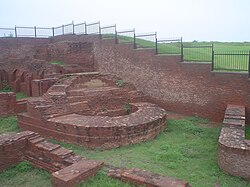
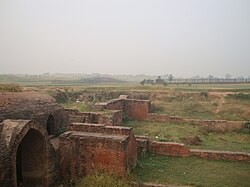
Present-day Thanesar is located on an ancient mound. The mound (1km long and 750m wide) is known as Harsh ka Tila (Mound of Harsha). It has ruins of structures built during the reign of Harsha, seventh-century CE. Among the archaeological finds from the mound include Painted Grey Ware shards in the pre-Kushana levels and Red Polished Ware from the post-Gupta period.[7][8]
In the post-Gupta period, Sthanishvara was the capital of the Vardhana dynasty, which ruled over a major part of North India during the late-sixth and early-seventh centuries. Prabhakarvardhana, fourth king of the Vardhana dynasty, had his capital at Thanesar. After his death in 606 CE, his eldest son Rajyavardhana ascended the throne, who was later murdered by a rival, which led to Harsha ascending to the throne at age 16. In the following years, he conquered much of North India, extended to Kamarupa, and eventually made Kannauj his capital, and ruled until 647 CE. His biography Harshacharita ("Deeds of Harsha") describes his association with Thanesar.[3][7][9]
Thanesar is listed in the Ain-i-Akbari as a pargana under the sarkar of Sirhind, producing a revenue of 7,850,803 dams for the imperial treasury and supplying a force of 1500 infantries and 50 cavalries. It had a brick fort at the time.[10]
Majority of architectural remains including Karavan serai, cells, and various arched and vaulted structures date from the Mughal period. Building remains of a large palatial structure from the pre-Islamic era were also found with two distinct phases of construction which exposed brick covered drains and rooms situated around a central courtyard.[11]
Sack of Sthaneshwar by Mahmud of Gazni[edit | edit source]
Thanesar was sacked and many of its temples were destroyed by Mahmud of Ghazni in 1011.[12]
'The city of Taneshar is highly venerated by Hindus. The idol of that place is called Cakrasvamin (Chakra Swami), i.e. the owner of the cakra, a weapon that we have already described. It is of bronze and is nearly the size of a man. It is now lying in the hippodrome in Ghazna, together with the Lord of Somnath, which is a representation of the Mahadeva, called Linga."[13]
In the year A.H. 402 (A.D. 1011) Mehmood Gazini resolved on the conquest of Thanesur, the most sacred Hindu place, in the kingdom of Hindoostan. It had reached the ears of the King that Thanesar was held in the same veneration by idolaters, as Mecca by the faithful; that they had there set up a number of idols, the principal of which they called Jugsoma, pretending that it had existed ever since the creation.
Mahmud, having reached Thanesar before the Hindus, had time to take measures for its defence; the city was plundered, the idols broken, and the idol Jugsoma was sent to Ghazni to be trodden underfoot. According to Haji Mahommed Kandahary, a ruby was found in one of the temples weighing 450 mithqals. It was allowed by everyone who saw it to be a wonder that had never been heard of. About the attack on Thanesar, Utbi wrote "The blood of the infidels flowed so copiously that the stream was discoloured, notwithstanding its purity, and people were unable to drink it."[15]


British era[edit | edit source]
For their participation in the first war of independence, the Chaudharys and Lambardars of villages who participated in the rebellion in Haryana were deprived of their land and property. 368 people from Hisar and Gurugram were hanged or transported[clarification needed] for life, and fines were imposed on the people of Thanesar (Rs 235,000), Ambala (Rs. 253,541) and Rohtak (Rs. 63,000 mostly on Ranghars, Shaikhs and Muslim Kasai).[16]
Tourism[edit | edit source]

Religious[edit | edit source]
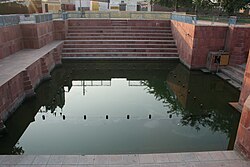
Thanesar derives its name from the word Sthaneshwar which means "place of god." The Sthaneshwar Mahadev Temple is believed to be the place where the Pandavas and Krishna prayed to Shiva and received his blessings for victory in the battle of Mahabharata.[17] It is the central and the most important place in the 48 kos parikrama of Kurukshetra. 1.5 km from Thanesar on Kurukshetra-Pehowa road is the water tank named Bhishma Kund is believed to be the spot when Bhishma lay of the bed of arrows during the Mahabharata war.[18][19]
See also[edit | edit source]
References[edit | edit source]
- ↑ 1.0 1.1 1.2 "Cities having population 1 lakh and above, Census 2011" (PDF). Census of India, 2011. p. 1. Retrieved 9 August 2014.
- ↑ James G. Lochtefeld (2002). The Illustrated Encyclopedia of Hinduism: N-Z. The Rosen Publishing Group. pp. 694. ISBN 978-0-8239-3180-4.
- ↑ 3.0 3.1 "Sthanvishvara (historical region, India)". Encyclopædia Britannica. Retrieved 9 August 2014.
- ↑ Balaji Sadasivan (2011). The Dancing Girl: A History of Early India. Institute of Southeast Asian Studies. pp. 110–. ISBN 978-981-4311-67-0.
- ↑ "Census of India 2001: Data from the 2001 Census, including cities, villages and towns (Provisional)". Census Commission of India. Archived from the original on 16 June 2004. Retrieved 1 November 2008.
- ↑ "Maps, Weather, and Airports for Thanesar, India". www.fallingrain.com. Retrieved 5 November 2023.
- ↑ 7.0 7.1 "Sheikh Chilli's Tomb, Thanesar". Archaeological Survey of India. Retrieved 9 August 2014.
- ↑ "Harsh Ka Tila". Kurukshetra district website. Retrieved 8 August 2014.
- ↑ "Harsha (Indian emperor)". Encyclopædia Britannica. Retrieved 9 August 2014.
- ↑ Abu'l-Fazl ibn Mubarak; Jarrett, Henry Sullivan (1891). The Ain-i-Akbari. Calcutta: Asiatic Society of Bengal. p. 296. Retrieved 21 January 2021.
- ↑ Pande, B.M. (2016). textsThanesar. Archaeological Survey of India. pp. 19–21.
- ↑ "Kurukshetra (India)". Encyclopædia Britannica. Retrieved 9 August 2014.
- ↑ Abu Rihan Muhammad bin Ahmad al-Biruni al-Khwarizmi, Tarikhu'l-Hind
- ↑ Farishta Vo1. Page 29 Translation by John Briggs.
- ↑ Elliot, Henry M. (1869). "The History of India".
- ↑ Mittal, Satish Chandra (1986). Haryana, a Historical Perspective. Atlantic Publishers & Distri.
- ↑ Dev Prasad (2010). Krishna: A Journey through the Lands & Legends of Krishna. Jaico Publishing House. pp. 216–. ISBN 978-81-8495-170-7.
- ↑ M.R. Biju (1 January 2006). Sustainable Dimensions Of Tourism Management. Mittal Publications. pp. 28–. ISBN 978-81-8324-129-8.
- ↑ Narkatari Kurukshetra district website.
Bibliography[edit | edit source]
- Banabhatta (1897). The Harsa-carita of Bana. Translated by E. B. Cowell; F. W. Thomas. London : Royal Asiatic Society.
{{cite book}}: CS1 maint: publisher location (link)
External links[edit | edit source]
Kurukshetra district topics | ||
|---|---|---|
| History | .svg) | |
| Cities and towns | ||
| Education | ||
| Tourist attractions | ||
| Transport | ||
| Lok Sabha constituencies | ||