

No edit summary |
m general fix details for consistency additionally and corrected details based on references |
||
| Line 1: | Line 1: | ||
{{Short description|Species of | {{Short description|Species of gazelle}} | ||
{{About|the animal|India based automobile manufacturer|Chinkara Motors}} | {{About|the animal|the India based automobile manufacturer|Chinkara Motors}} | ||
{{Use dmy dates|date=May 2022}} | |||
{{EngvarB|date=May 2022}} | |||
{{Speciesbox | {{Speciesbox | ||
| name = Chinkara | | name = Chinkara | ||
| Line 6: | Line 8: | ||
| status = LC | | status = LC | ||
| status_system = IUCN3.1 | | status_system = IUCN3.1 | ||
| status_ref = <ref name=iucn>{{cite iucn |title=''Gazella bennettii'' | | | status_ref = <ref name=iucn>{{cite iucn |author=IUCN SSC Antelope Specialist Group |date=2017 |title=''Gazella bennettii'' |volume=2017 |article-number=e.T8978A50187762 |doi=10.2305/IUCN.UK.2017-2.RLTS.T8978A50187762.en |access-date=19 November 2021}}</ref> | ||
| image_caption = Chinkara | | status2 = CITES_A3 | ||
| status2_system = CITES | |||
| status2_ref = <ref>{{cite Species+ |id=65567 |title=''Gazella bennettii'' |access-date=22 November 2025}}</ref> | |||
| image_caption = Chinkara in [[Thar Desert]], [[Rajasthan]] | |||
| genus = Gazella | | genus = Gazella | ||
| species = bennettii<ref name=msw3>{{MSW3 Wozencraft |id=14200555 |pages=536 |heading=Species ''Gazella bennettii''}}</ref> | | species = bennettii<ref name=msw3>{{MSW3 Wozencraft |id=14200555 |pages=536 |heading=Species ''Gazella bennettii''}}</ref> | ||
| Line 15: | Line 20: | ||
}} | }} | ||
The ''' | The '''chinkara''' ('''''Gazella bennettii'''''), also known as the '''Indian gazelle''', is a [[gazelle]] [[species]] native to [[India]], [[Iran]], [[Afghanistan]] and [[Pakistan]].<ref name=iucn/> | ||
==Taxonomy== | ==Taxonomy== | ||
| Line 22: | Line 27: | ||
* [[Gujarat chinkara]] ''(G. b. christii)'' <small>([[Edward Blyth|Blyth]], 1842)</small> – ranges from the desert lowlands of Pakistan, western India, [[Rann of Kutch]], [[Kathiawar]], [[Saurashtra (region)|Saurastra region]] and as far east of [[Ahmedabad district]] in [[Gujarat]]; | * [[Gujarat chinkara]] ''(G. b. christii)'' <small>([[Edward Blyth|Blyth]], 1842)</small> – ranges from the desert lowlands of Pakistan, western India, [[Rann of Kutch]], [[Kathiawar]], [[Saurashtra (region)|Saurastra region]] and as far east of [[Ahmedabad district]] in [[Gujarat]]; | ||
* [[Kennion gazelle]], eastern jebeer gazelle or Baluchistan gazelle (''G. b. fuscifrons'') <small>([[William Thomas Blanford|Blanford]], 1873)</small> – occurs in eastern Iran, (southeast and along the [[Makran|Makran coast]], [[Sistan and Baluchestan Province|Sistan and Baluchistan]]) southern [[Afghanistan]], Pakistan, [[Balochistan, Pakistan|Balochistan Province]] to [[Sindh]] and northwestern India, [[Rajasthan]], also the darkest subspecies; | * [[Kennion gazelle]], eastern jebeer gazelle or Baluchistan gazelle (''G. b. fuscifrons'') <small>([[William Thomas Blanford|Blanford]], 1873)</small> – occurs in eastern Iran, (southeast and along the [[Makran|Makran coast]], [[Sistan and Baluchestan Province|Sistan and Baluchistan]]) southern [[Afghanistan]], Pakistan, [[Balochistan, Pakistan|Balochistan Province]] to [[Sindh]] and northwestern India, [[Rajasthan]], also the darkest subspecies; | ||
* [[Bushehr gazelle]] (''G. b. karamii'') <small>([[Colin Groves|Groves]], 1993)</small> – ranges in | * [[Bushehr gazelle]] (''G. b. karamii'') <small>([[Colin Groves|Groves]], 1993)</small> – ranges in southwestern Iran, restricted near [[Bushehr]], also the smallest subspecies;<ref name=Mallon>{{cite book |title=Antelopes: North Africa, the Middle East, and Asia|url=https://books.google.com/books?id=uFo03Nd2oj8C&pg=PA117|author=Mallon, D. P. |author2=Kingswood, S. C. |publisher=IUCN The World Conservation Union |page=117 |year=2001 |isbn = 978-2-8317-0594-1|access-date=17 December 2016}}</ref> | ||
* [[Jebeer gazelle]], western jebeer gazelle or Shikari gazelle (''G. b. shikarii'') <small>(Groves, 1993)</small> – Lives in northeastern Iran, north and west-central districts ([[Khar Turan National Park|Touran]], west to [[Tehran Province|Tehran]] and southwest to [[Shiraz County]] and beyond), also the palest subspecies;<ref name=Mallon/> | * [[Jebeer gazelle]], western jebeer gazelle or Shikari gazelle (''G. b. shikarii'') <small>(Groves, 1993)</small> – Lives in northeastern Iran, north and west-central districts ([[Khar Turan National Park|Touran]], west to [[Tehran Province|Tehran]] and southwest to [[Shiraz County]] and beyond), also the palest subspecies;<ref name=Mallon/> | ||
* [[Salt Range gazelle]] (''G. b. salinarum'') <small>(Groves, 2003)</small> – ranges in Pakistan, [[Punjab, Pakistan|Punjab]] region and east as far as [[Delhi]], [[Punjab, India|Indian Punjab]], [[Haryana]] in northwest India, salt range;<ref name=Groves>{{cite book |title=Ungulate Taxonomy |url=https://books.google.com/books?id=v3uZtA1ZpTAC&pg=PA174 |author=Groves, C. |author2=Grubb, P. |publisher=The Johns Hopkins University Press|page=174|year=2011|isbn = | * [[Salt Range gazelle]] (''G. b. salinarum'') <small>(Groves, 2003)</small> – ranges in Pakistan, [[Punjab, Pakistan|Punjab]] region and east as far as [[Delhi]], [[Punjab, India|Indian Punjab]], [[Haryana]] in northwest India, salt range;<ref name=Groves>{{cite book |title=Ungulate Taxonomy |url=https://books.google.com/books?id=v3uZtA1ZpTAC&pg=PA174 |author=Groves, C. |author2=Grubb, P. |publisher=The Johns Hopkins University Press|page=174|year=2011|isbn = 978-1-4214-0093-8|access-date=17 December 2016}}</ref> | ||
==Characteristics== | ==Characteristics== | ||
It stands at {{convert|65|cm|in|abbr=on}} tall and weighs about {{convert|23|kg|lb|abbr=on}}. It has a reddish-buff summer coat with smooth, glossy fur. In winter, the white belly and throat fur is in greater contrast. The sides of the face have dark chestnut stripes from the corner of the eye to the muzzle, bordered by white stripes. Chinkara have straight horns with prominent rings which reach over {{convert|39|cm|in|abbr=on}}. Both males and females have horn although females have shorter horns.<ref>Prater, S. H. (1971). The Book of Indian Animals. Oxford University Press, 2005 reprint.</ref><ref name="ADW">{{Cite web|url=https://animaldiversity.org/accounts/Gazella_bennettii/|title=Gazella bennettii-Indian Gazelle |last=McCart |first=D. |website=Animal Diversity Web|access-date=June 25, 2019}}</ref> | |||
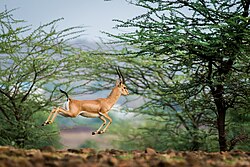
It stands at {{convert|65|cm|in|abbr=on}} tall and weighs about {{convert|23|kg|lb|abbr=on}}. It has a reddish-buff summer coat with smooth, glossy fur. In winter, the white belly and throat fur is in greater contrast. The sides of the face have dark chestnut stripes from the corner of the eye to the muzzle, bordered by white stripes. | [[File:Jumping Chinkara.jpg|thumb|A chinkara at [[Mayureshwar Wildlife Sanctuary]], Maharashtra, India]] | ||
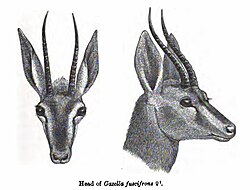
[[File:GazellaFuscifrons.jpg|thumb|''G. b. fuscifrons'' of [[Balochistan]]]] | |||
==Distribution and habitat == | ==Distribution and habitat == | ||
Chinkara live | Chinkara live on arid [[Plain|plains]] and hilly country, [[desert]]s, [[Tropical and subtropical dry broadleaf forests|dry scrub]] and light or open forests, inhabiting more than 80 [[Protected areas of India|protected areas]] in India; they are most common in the [[States and union territories of India|states]] of [[Gujarat]], [[Madhya Pradesh]], [[Maharashtra]] and [[Rajasthan]], though more sparse populations are also known from [[Andhra Pradesh]], [[Karnataka]] and [[Telangana]], in [[South India]].<ref>{{Cite web |date=13 March 2026 |title=Observations - iNaturalist |url=https://www.inaturalist.org/observations?place_id=6681&subview=map&taxon_id=42253 |access-date=21 March 2026 |website=[[iNaturalist]]}}</ref><ref>{{Cite web |date=13 March 2026 |title=Observations - iNaturalist |url=https://www.inaturalist.org/observations?lat=12.28443378315388&lng=79.47117864071646&radius=889.634758444995&subview=map&taxon_id=42253 |access-date=21 March 2026 |website=[[iNaturalist]]}}</ref> In Pakistan, they range at elevations of up to {{convert|1500|m|ft|abbr=on}}, and may be found as far north as [[Punjab, Pakistan|Punjab Province]] and as far south as [[Kirthar National Park]], near [[Karachi]], [[Sindh]].<ref>{{Cite web |date=23 November 2025 |title=Observations - iNaturalist |url=https://www.inaturalist.org/observations?place_id=7076&subview=map&taxon_id=42253 |access-date=21 March 2026 |website=[[iNaturalist]]}}</ref> In Iran, their largest population is at [[Kavir National Park]], south of [[Tehran]], though they are also found further south and east in Dar-e Anjir Wildlife Refuge ([[Yazd province|Yazd]]) and Bakhtegan National Park (east of [[Shiraz]]).<ref name=Mallon2001>Mallon, D. P. and S. C. Kingswood (eds.) (2001). Antelopes. Part 4: North Africa, the Middle East, and Asia. Global Survey and Regional Action Plans, IUCN, Gland, Switzerland.</ref><ref>{{Cite web |date=24 April 2025 |title=Observations - iNaturalist |url=https://www.inaturalist.org/observations?place_id=6818&subview=map&taxon_id=42253 |access-date=21 March 2026 |website=[[iNaturalist]]}}</ref> | ||
In 2001, the Indian chinkara population was estimated at 100,000 with 80,000 living in the [[Thar Desert]]. The population in Pakistan is scattered, and has been severely reduced by hunting | In 2001, the Indian chinkara population was estimated at 100,000 animals, with 80,000 living in the west of the country and in the [[Thar Desert]]. The population in Pakistan is highly scattered, and has been severely reduced by hunting, as is the case in Iran; in Afghanistan, chinkara are very rare and likely only seldomly seen in the southern parts of the country.<ref name=Mallon2001/> | ||
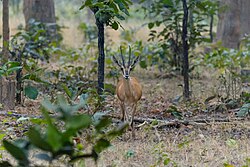
[[File:Chinkara by Tisha Mukherjee 01.jpg|thumb|A chinkara in [[Sanjay Dubri Tiger Reserve]], Madhya Pradesh]] | |||
== | ==Behaviour and ecology== | ||
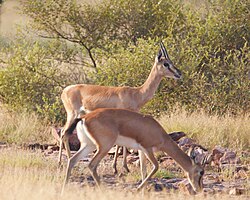
[[File:Chinkara | [[File:Chinkara doe x 2 (48940748053).jpg|thumb| Two chinkara does in [[Ranthambore National Park]], Rajasthan, India]] | ||
Chinkara are swift and agile and maintain nocturnal and [[Crepuscular animal|crepuscular]] habits, with most feeding occurring during the evening. They are browsers and consume leaves and grasses, typically being observed alone or in small groups or pairings, such as mother and offspring. Occasionally, small herds of several individuals are observed. The Indian gazelle is considered polygamous; males are territorial and protect their areas from intrusion. Two breeding seasons occur during the year, one at the end of the rainy season and another at the end of spring; females endure a gestation period of 5-5.5 months and give birth to one offspring, sometimes twins. The calves stay with their mother for up to 12 months.<ref name="ADW"/> | |||
The chinkara is preyed upon by the [[Indian leopard]], [[Bengal tiger]], [[Asiatic lion]] (in Gujarat), [[Indian wolf]], [[golden jackal]] and packs of [[dhole]]. In rarer cases, unattended calves, and even mature gazelles, may be consumed by [[Indian python|Indian pythons]]; [[Mugger crocodile|mugger crocodiles]] are another threat, especially when during dry seasons or when drinking at crocodile-inhabited water sources. Outside of protected areas, they may be pursued by [[Free-ranging dog|feral]] and [[Pye-dog|pariah dogs]]. In Madhya Pradesh's [[Kuno National Park]], they are likely hunted by [[Cheetah|cheetahs]], as a population of South African cheetahs has been imported to the region in an effort to repopulate India with the wild cats; the last [[Asiatic cheetah]] in India was killed in the early 20th century, with only 100 or less surviving in Iran.<ref name="ADW"/> | |||
==Threats== | |||
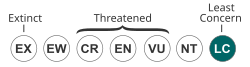
The chinkara is threatened by extensive hunting for meat and [[Trophy hunting|trophies]] in Afghanistan, Iran and Pakistan. Other threats include habitat loss due to agricultural and industrial expansion. The status in these countries is unclear. Around 1,300 individuals occur in Iran. In 2001, the chinkara population in India was estimated at over 100,000 individuals, of which nearly 80,000 occurred in the [[Thar desert]]. However, the population has declined since then. The chinkara is listed as [[Least-concern species|least concern]] on the [[IUCN Red List]].<ref name=iucn/> | |||
In 1993, a controversy erupted when the [[Government of Gujarat]] issued a decree to [[Denotification of land|denotify]] the [[Narayan Sarovar Sanctuary]], that contains a small population of chinkara, to allow mining of [[lignite]], [[limestone]], [[bentonite]] and [[bauxite]] inside the sanctuary. This was, however, rejected by the Gujarat High Court, and the sanctuary was restored to its earlier limits.<ref name="mallon"/><ref>{{cite news |last1=Kumar|first1=S. |title=Mining digs deep into India's wildlife refuges |url=https://www.newscientist.com/article/mg14719921.500-mining-digs-deep-into-indias-wildlife-refuges/ |access-date=12 March 2016 |work=[[New Scientist]] |year=1995}}</ref> | |||
== Conservation == | == Conservation == | ||
The chinkara occurs in over 80 protected areas in India.<ref name="mallon">{{cite book |last1=Mallon |first1=D.P.|last2=Kingswood|first2=S.C.|last3=East|first3=R.D.|title=Antelopes: Global Survey and Regional Action Plans |year=2001 |publisher=[[IUCN]]|location=Gland, Switzerland|isbn= | The chinkara is protected in Iran and Pakistan.<ref name=iucn/> It occurs in over 80 protected areas in India.<ref name="mallon">{{cite book |last1=Mallon |first1=D.P. |last2=Kingswood |first2=S.C. |last3=East|first3=R.D.|title=Antelopes: Global Survey and Regional Action Plans |year=2001 |publisher=[[IUCN]] |location=Gland, Switzerland |isbn=978-2-8317-0594-1|page=185}}</ref> In January 2016, the [[Government of Karnataka]] issued a notification to establish a sanctuary especially for chinkara in the [[Yadahalli, Bilagi|Yadahalli]] village in the [[Bagalkot district]] of the state. This region shelters a major population of chinkara.<ref>{{cite news |last1=Prabhu |first1=N. |title=State gets first chinkara sanctuary |url=http://www.thehindu.com/news/cities/bangalore/state-gets-first-chinkara-sanctuary/article8052269.ece|access-date=12 March 2016 |work=[[The Hindu]] |year=2016}}</ref> The Karnataka Government also notified the [[Bukkapatna Chinkara Wildlife Sanctuary]] in Tumakuru district in May 2019.<ref>{{Cite news |url=https://timesofindia.indiatimes.com/city/bengaluru/karnataka-chinkara-sanctuary-at-tumakuru-notified/articleshow/69379884.cms |title=Chinkara sanctuary: Karnataka: Chinkara sanctuary at Tumakuru notified | Bengaluru News| website=[[The Times of India]] |date=17 May 2019}}</ref> | ||
= | |||
==See also== | |||
* [[Yadahalli Chinkara Wildlife Sanctuary]] | |||
==References== | ==References== | ||
| Line 56: | Line 63: | ||
==External links== | ==External links== | ||
{{Commons | {{Commons category|Gazella bennettii|Gazella bennettii}} | ||
{{Wikispecies|Gazella bennettii}} | {{Wikispecies|Gazella bennettii}} | ||
| Line 73: | Line 80: | ||
[[Category:Fauna of the Thar Desert]] | [[Category:Fauna of the Thar Desert]] | ||
[[Category:Fauna of Sindh]] | [[Category:Fauna of Sindh]] | ||
[[Category:Symbols of Rajasthan]] | [[Category:Symbols of Rajasthan]] | ||
Latest revision as of 02:07, 29 March 2026
| Chinkara | |
|---|---|

| |
| Chinkara in Thar Desert, Rajasthan | |
Scientific classification 
| |
| : | [[Template:Taxonomy/Gazella]] |
| Species: | Template:Taxonomy/GazellaG. bennettii[3]
|
| Binomial name | |
| Template:Taxonomy/GazellaGazella bennettii[3] (Sykes, 1831)
| |

| |
| Distribution map of chinkara | |
The chinkara (Gazella bennettii), also known as the Indian gazelle, is a gazelle species native to India, Iran, Afghanistan and Pakistan.[1]
Taxonomy[edit | edit source]
The following six subspecies are considered valid:[3]
- Deccan chinkara (G. b. bennettii) (Sykes 1831) – ranges from South India, from the Ganges Valley (east to the borders of West Bengal) south at least to Hyderabad, Andhra Pradesh, Deccan Plateau;
- Gujarat chinkara (G. b. christii) (Blyth, 1842) – ranges from the desert lowlands of Pakistan, western India, Rann of Kutch, Kathiawar, Saurastra region and as far east of Ahmedabad district in Gujarat;
- Kennion gazelle, eastern jebeer gazelle or Baluchistan gazelle (G. b. fuscifrons) (Blanford, 1873) – occurs in eastern Iran, (southeast and along the Makran coast, Sistan and Baluchistan) southern Afghanistan, Pakistan, Balochistan Province to Sindh and northwestern India, Rajasthan, also the darkest subspecies;
- Bushehr gazelle (G. b. karamii) (Groves, 1993) – ranges in southwestern Iran, restricted near Bushehr, also the smallest subspecies;[4]
- Jebeer gazelle, western jebeer gazelle or Shikari gazelle (G. b. shikarii) (Groves, 1993) – Lives in northeastern Iran, north and west-central districts (Touran, west to Tehran and southwest to Shiraz County and beyond), also the palest subspecies;[4]
- Salt Range gazelle (G. b. salinarum) (Groves, 2003) – ranges in Pakistan, Punjab region and east as far as Delhi, Indian Punjab, Haryana in northwest India, salt range;[5]
Characteristics[edit | edit source]
It stands at 65 cm (26 in) tall and weighs about 23 kg (51 lb). It has a reddish-buff summer coat with smooth, glossy fur. In winter, the white belly and throat fur is in greater contrast. The sides of the face have dark chestnut stripes from the corner of the eye to the muzzle, bordered by white stripes. Chinkara have straight horns with prominent rings which reach over 39 cm (15 in). Both males and females have horn although females have shorter horns.[6][7]


Distribution and habitat[edit | edit source]
Chinkara live on arid plains and hilly country, deserts, dry scrub and light or open forests, inhabiting more than 80 protected areas in India; they are most common in the states of Gujarat, Madhya Pradesh, Maharashtra and Rajasthan, though more sparse populations are also known from Andhra Pradesh, Karnataka and Telangana, in South India.[8][9] In Pakistan, they range at elevations of up to 1,500 m (4,900 ft), and may be found as far north as Punjab Province and as far south as Kirthar National Park, near Karachi, Sindh.[10] In Iran, their largest population is at Kavir National Park, south of Tehran, though they are also found further south and east in Dar-e Anjir Wildlife Refuge (Yazd) and Bakhtegan National Park (east of Shiraz).[11][12]
In 2001, the Indian chinkara population was estimated at 100,000 animals, with 80,000 living in the west of the country and in the Thar Desert. The population in Pakistan is highly scattered, and has been severely reduced by hunting, as is the case in Iran; in Afghanistan, chinkara are very rare and likely only seldomly seen in the southern parts of the country.[11]

Behaviour and ecology[edit | edit source]
.jpg)
Chinkara are swift and agile and maintain nocturnal and crepuscular habits, with most feeding occurring during the evening. They are browsers and consume leaves and grasses, typically being observed alone or in small groups or pairings, such as mother and offspring. Occasionally, small herds of several individuals are observed. The Indian gazelle is considered polygamous; males are territorial and protect their areas from intrusion. Two breeding seasons occur during the year, one at the end of the rainy season and another at the end of spring; females endure a gestation period of 5-5.5 months and give birth to one offspring, sometimes twins. The calves stay with their mother for up to 12 months.[7]
The chinkara is preyed upon by the Indian leopard, Bengal tiger, Asiatic lion (in Gujarat), Indian wolf, golden jackal and packs of dhole. In rarer cases, unattended calves, and even mature gazelles, may be consumed by Indian pythons; mugger crocodiles are another threat, especially when during dry seasons or when drinking at crocodile-inhabited water sources. Outside of protected areas, they may be pursued by feral and pariah dogs. In Madhya Pradesh's Kuno National Park, they are likely hunted by cheetahs, as a population of South African cheetahs has been imported to the region in an effort to repopulate India with the wild cats; the last Asiatic cheetah in India was killed in the early 20th century, with only 100 or less surviving in Iran.[7]
Threats[edit | edit source]
The chinkara is threatened by extensive hunting for meat and trophies in Afghanistan, Iran and Pakistan. Other threats include habitat loss due to agricultural and industrial expansion. The status in these countries is unclear. Around 1,300 individuals occur in Iran. In 2001, the chinkara population in India was estimated at over 100,000 individuals, of which nearly 80,000 occurred in the Thar desert. However, the population has declined since then. The chinkara is listed as least concern on the IUCN Red List.[1]
In 1993, a controversy erupted when the Government of Gujarat issued a decree to denotify the Narayan Sarovar Sanctuary, that contains a small population of chinkara, to allow mining of lignite, limestone, bentonite and bauxite inside the sanctuary. This was, however, rejected by the Gujarat High Court, and the sanctuary was restored to its earlier limits.[13][14]
Conservation[edit | edit source]
The chinkara is protected in Iran and Pakistan.[1] It occurs in over 80 protected areas in India.[13] In January 2016, the Government of Karnataka issued a notification to establish a sanctuary especially for chinkara in the Yadahalli village in the Bagalkot district of the state. This region shelters a major population of chinkara.[15] The Karnataka Government also notified the Bukkapatna Chinkara Wildlife Sanctuary in Tumakuru district in May 2019.[16]
See also[edit | edit source]
References[edit | edit source]
- ↑ 1.0 1.1 1.2 1.3 IUCN SSC Antelope Specialist Group (2017). "Gazella bennettii". IUCN Red List of Threatened Species. 2017 e.T8978A50187762. doi:10.2305/IUCN.UK.2017-2.RLTS.T8978A50187762.en. Retrieved 19 November 2021.
- ↑ "Gazella bennettii". Species+. UN Environment Programme World Conservation Monitoring Centre. Retrieved 22 November 2025.
- ↑ 3.0 3.1 Wozencraft, W.C. (2005). "Species Gazella bennettii". In Wilson, D.E.; Reeder, D.M (eds.). Mammal Species of the World: A Taxonomic and Geographic Reference (3rd ed.). Johns Hopkins University Press. p. 536. ISBN 978-0-8018-8221-0. OCLC 62265494.
- ↑ 4.0 4.1 Mallon, D. P.; Kingswood, S. C. (2001). Antelopes: North Africa, the Middle East, and Asia. IUCN The World Conservation Union. p. 117. ISBN 978-2-8317-0594-1. Retrieved 17 December 2016.
- ↑ Groves, C.; Grubb, P. (2011). Ungulate Taxonomy. The Johns Hopkins University Press. p. 174. ISBN 978-1-4214-0093-8. Retrieved 17 December 2016.
- ↑ Prater, S. H. (1971). The Book of Indian Animals. Oxford University Press, 2005 reprint.
- ↑ 7.0 7.1 7.2 McCart, D. "Gazella bennettii-Indian Gazelle". Animal Diversity Web. Retrieved 25 June 2019.
- ↑ "Observations - iNaturalist". iNaturalist. 13 March 2026. Retrieved 21 March 2026.
- ↑ "Observations - iNaturalist". iNaturalist. 13 March 2026. Retrieved 21 March 2026.
- ↑ "Observations - iNaturalist". iNaturalist. 23 November 2025. Retrieved 21 March 2026.
- ↑ 11.0 11.1 Mallon, D. P. and S. C. Kingswood (eds.) (2001). Antelopes. Part 4: North Africa, the Middle East, and Asia. Global Survey and Regional Action Plans, IUCN, Gland, Switzerland.
- ↑ "Observations - iNaturalist". iNaturalist. 24 April 2025. Retrieved 21 March 2026.
- ↑ 13.0 13.1 Mallon, D.P.; Kingswood, S.C.; East, R.D. (2001). Antelopes: Global Survey and Regional Action Plans. Gland, Switzerland: IUCN. p. 185. ISBN 978-2-8317-0594-1.
- ↑ Kumar, S. (1995). "Mining digs deep into India's wildlife refuges". New Scientist. Retrieved 12 March 2016.
- ↑ Prabhu, N. (2016). "State gets first chinkara sanctuary". The Hindu. Retrieved 12 March 2016.
- ↑ "Chinkara sanctuary: Karnataka: Chinkara sanctuary at Tumakuru notified | Bengaluru News". The Times of India. 17 May 2019.