




m Reverted edits by 2405:201:A802:38D8:7046:1D73:94C7:DB66 (talk) to last revision by [[User:>Uanfala|>Uanfala]] Tag: Rollback |
BennyHubbs95 (talk | contribs) m formatting fix |
||
| Line 1: | Line 1: | ||
{{ | {{Short description|Collection of Buddhist mystical poems}} | ||
{{Use British English|date=March 2013}} | {{Use British English|date=March 2013}} | ||
{{Use dmy dates|date= | {{Use dmy dates|date=June 2025}} | ||
{{ | {{italic title}} | ||
The '''Charyapada''' is a collection of mystical poems, [[songs of realization]] in the [[Vajrayana]] tradition of Buddhism from the [[tantra| | {{Vajrayana}} | ||
The '''Charyapada''' is a collection of [[mystical]] poems, [[songs of realization]] in the [[Vajrayana|Vajrayāna]] tradition of [[Buddhism]] from the [[tantra|tāntric]] tradition in [[Assam]], [[Bengal]], [[Bihar]] and [[Odisha]].<ref>{{Cite web |date=6 May 2025 |title=Bengali literature {{!}} History, Rabindranath Tagore, Poetry, Novels, & Facts {{!}} Britannica |url=https://www.britannica.com/art/Bengali-literature |access-date=12 June 2025 |website=www.britannica.com |language=en}}</ref> | |||
It was | It was compiled between the 8th and 12th centuries in late [[Apabhraṃśa]] or various [[Abahatta|Abahaṭṭha]] dialects, representing the formative stage of the Eastern [[Indo-Aryan languages]].<ref>{{Cite book |last1=Jain |first1=Danesh |url=https://books.google.com/books?id=iUHfBQAAQBAJ |title=The Indo-Aryan Languages |last2=Cardona |first2=George |date=26 July 2007 |publisher=Routledge |isbn=978-1-135-79710-2 |pages=433 |language=en|quotation= The language of the Caryas is late Apabhramsa, and represents the formative period of the NIA languages including Asamiya.}}</ref><ref>{{Cite book |last=Murshid |first=Ghulam |url=https://books.google.com/books?id=9o4SEAAAQBAJ&dq=Abahatta&pg=PT15 |title=Bengali Culture Over a Thousand Years |date=25 January 2018 |publisher=Niyogi Books |isbn=978-93-86906-12-0 |pages=34 |language=en|quotation= Muhammad Shahidullah described the branch of Prakrit prevalent in the Bengal region as ‘Gauri Prakrit’. This Prakrit gradually evolved into apabhramsa, and then into abahatta, which is, more or less, the language of the Charyapada.}}</ref><ref>{{cite journal |last1=Kitada |first1=Makoto |title=On the 'New' Caryāpada |journal=Orientalistische Literaturzeitung |date=2023 |volume=117 |issue=4–5 |pages=315–322 |doi=10.1515/olzg-2022-0096 |url=https://www.degruyter.com/document/doi/10.1515/olzg-2022-0096/html|url-access=subscription }}</ref> It was written during a period when the northeastern Prākrit languages had not yet differentiated into later forms, or they were just getting differentiated.<ref>"The language of [''charyāpadas''] was also claimed to be early Assamese and early Bihari (Eastern Hindi) by various scholars. Although no systematic scientific study has been undertaken on the basis of comparative reconstruction, a cursory look is enough to suggest that the language of these texts represents a stage when the North-Eastern Prākrit was either not differentiated or at an early stage of differentiation into the regional languages of Eastern and North-Eastern India." {{harvcol|Pattanayak|2016|p=127}}</ref> Scholars of many eastern Indo-Aryan languages, such as [[Assamese language|Assamese]], [[Bengali language|Bengali]], [[Maithili language|Maithili]], and [[Odia language|Odia]] find features of these languages in the language of this work.<ref>{{Cite book |last1=Jain |first1=Danesh |url=https://books.google.com/books?id=iUHfBQAAQBAJ&q=indo+aryan+language |title=The Indo-Aryan Languages |last2=Cardona |first2=George |date=26 July 2007 |publisher=Routledge |isbn=978-1-135-79710-2 |pages=525 |language=en}}</ref><ref>{{Cite book |last=Comrie |first=Bernard |url=https://books.google.com/books?id=5IXJ1RbE8-8C |title=The Major Languages of South Asia, the Middle East and Africa |date=30 November 2022 |publisher=Routledge |isbn=978-1-134-93257-3 |language=en|quotation=This is clearly evident, for instance, in the case of the celebrated Buddhist hymns called the Caryapada, composed in eastern India roughly between AD 1000 and 1200. Though the language of these hymns is Old Bengali, there are reference works on Assamese, Oriya and even Maithili that treat the same hymns as the earliest specimens of each of these languages and their literatures.}}</ref><ref>{{Cite book |last=Dalby |first=Andrew |url=https://books.google.com/books?id=7dHNCgAAQBAJ&q=Cary%C4%81pada |title=Dictionary of Languages: The definitive reference to more than 400 languages |date=28 October 2015 |publisher=Bloomsbury Publishing |isbn=978-1-4081-0214-5 |pages=87 |language=en|quotation= Around 1000 AD, when Bengali, Oriya and Assamese not yet distinguishable as separate languages, the remarkable, mystical Buddhist Charyapada songs were composed. They were discovered in a manuscript at Kathmandu and first published in 1916. They are claimed as the foundation of the literary tradition of all three languages.}}</ref> A palm-leaf manuscript of the ''Charyāpada'' was rediscovered in the early 20th century by [[Haraprasad Shastri|Haraprasād Shāstrī]] at the Nepal Royal Court Library.<ref name="GuhathakurtaSchendel2013">{{cite book |last1=Guhathakurta |first1=Meghna |last2=van Schendel |first2=Willem |title=The Bangladesh Reader: History, Culture, Politics |url=https://books.google.com/books?id=haGORCJRlOUC&pg=PA40 |year=2013 |publisher=Duke University Press |isbn=978-0-8223-5318-8 |page=40 |access-date=13 February 2016 }}</ref> The ''Charyāpada'' was also preserved in the [[Tibetan Buddhist canon]].<ref name="Kværne2010">{{cite book |last=Kværne |first=Per |author-link=Per Kværne |title=An Anthology of Buddhist Tantric Songs: A Study of the Caryāgīti |url=https://books.google.com/books?id=Nf3YQgAACAAJ |year=2010 |publisher=Orchid Press |isbn=978-974-8299-34-1 |access-date=13 February 2016 |archive-date=13 January 2021 |archive-url=https://web.archive.org/web/20210113193926/https://books.google.com/books?id=Nf3YQgAACAAJ |url-status=live}}</ref> | ||
==Manuscripts== | ==Manuscripts== | ||
The original palm-leaf manuscript of the Charyapada, or ''Caryācaryāviniścaya'', spanning 47 padas (verses) along with a Sanskrit commentary, was edited by Shastri and published from Bangiya Sahitya Parishad as a part of his ''Hajar Bacharer Purano Bangala Bhasay Bauddhagan O Doha'' (Buddhist Songs and Couplets) in 1916 under the name of ''Charyacharyavinishchayah''. This manuscript is presently preserved at the National Archives of Nepal. [[Prabodh Chandra Bagchi|Prabodhchandra Bagchi]] later published a manuscript of a Tibetan translation containing 50 verses.<ref>Bagchi Prabodhchandra, ''Materials for a critical edition of the old Bengali Caryapadas (A comparative study of the text and Tibetan translation) Part I'' in ''Journal of the Department of Letters'', Vol.XXX, pp. 1–156, Calcutta University, Calcutta,1938 CE</ref> | [[File:Charyapada.jpg|400px|thumb|right|Pages from the Charyapada]] | ||
The original palm-leaf manuscript of the Charyapada, or ''Caryācaryāviniścaya'', spanning 47 padas (verses) along with a Sanskrit commentary, was edited by Haraprashad Shastri and published from Bangiya Sahitya Parishad as a part of his ''Hajar Bacharer Purano Bangala Bhasay Bauddhagan O Doha'' (Buddhist Songs and Couplets) in 1916 under the name of ''Charyacharyavinishchayah''. This manuscript is presently preserved at the National Archives of Nepal. [[Prabodh Chandra Bagchi|Prabodhchandra Bagchi]] later published a manuscript of a Tibetan translation containing 50 verses.<ref>Bagchi Prabodhchandra, ''Materials for a critical edition of the old Bengali Caryapadas (A comparative study of the text and Tibetan translation) Part I'' in ''Journal of the Department of Letters'', Vol.XXX, pp. 1–156, Calcutta University, Calcutta, 1938 CE</ref> Traditional Tibetan sources assign the translation of the ''dohās'' to the 12th century Indian Buddhist monk of [[Nalanda]], [[Vairocanavajra]].<ref name=Schaeffer2000>{{cite journal |last1=SCHAEFFER |first1=KURTIS |title=THE RELIGIOUS CAREER OF VAIROCANAVAJRA — A TWELFTH-CENTURY INDIAN BUDDHIST MASTER FROM DAKṢIṆA KOŚALA |journal=Journal of Indian Philosophy |date=2000 |volume=28 |issue=4 |pages=361–384 |doi=10.1023/A:1004844115222 |jstor=23496816 |url=https://www.jstor.org/stable/23496816|url-access=subscription }}</ref> | |||
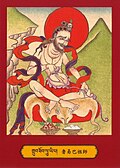
[[File:Vairocanavajra.jpg|thumb|Tibetan depiction of the 12th century monk of Nalanda, [[Vairocanavajra]], who translated the Charyapadas into [[Tibetic languages|Tibetan]]]] | |||
[[File: | |||
The | The Tibetan translation provided additional information, including that the Sanskrit commentary in the manuscript, known as ''Charyagiti-koshavrtti,'' was written by Munidatta<!-- Who is Munidatta? That name sure comes up a lot later... -->. It also mentions that the original text was translated by Shilachari and its commentary by Munidatta was translated by Chandrakirti or Kirtichandra.<ref name="sen1">Sen Sukumar (1995). ''Charyageeti Padavali'' (in Bengali), Kolkata: Ananda Publishers, {{ISBN|81-7215-458-5}}, pp. 29–30</ref> | ||
==Poets== | |||
{{Main|Category:Poets of Charyapada}} | |||
The poets and their works as mentioned in the text are as follows: | The poets and their works as mentioned in the text are as follows: | ||
[[File:Luipa.jpg|thumb|right|250px|[[Luipa]], the author of the first poem of Charyapada]] | |||
{| class="wikitable" style="text-align:centre" | {| class="wikitable" style="text-align:centre" | ||
|- | |- | ||
| Line 37: | Line 34: | ||
| Chatillapāda || 5 | | Chatillapāda || 5 | ||
|- | |- | ||
| [[ | | [[Shantideva|Bhusukupāda]] || 6, 21, 23, 27, 30, 41, 43, 49 | ||
|- | |- | ||
| [[Kanha (poet)|Kānhapāda]] || 7, 9, 10, 11, 12, 13, 18, 19, 24, 36, 40, 42, 45 | | [[Kanha (poet)|Kānhapāda]] || 7, 9, 10, 11, 12, 13, 18, 19, 24, 36, 40, 42, 45 | ||
| Line 43: | Line 40: | ||
| [[Lawapa|Kambalāmbarapāda]] || 8 | | [[Lawapa|Kambalāmbarapāda]] || 8 | ||
|- | |- | ||
| Dombipāda || 14 | | [[Dombipa|Dombipāda]]|| 14 | ||
|- | |- | ||
| Shantipāda || 15, 26 | | Shantipāda || 15, 26 | ||
| Line 55: | Line 52: | ||
| Shabarapāda || 28, 50 | | Shabarapāda || 28, 50 | ||
|- | |- | ||
| Āryadevapāda || 31 | |||
|- | |- | ||
| Dhendhanapāda || 33 | | Dhendhanapāda || 33 | ||
| Line 74: | Line 71: | ||
|} | |} | ||
The manuscript of the Charyapada discovered by Haraprasad Shastri from Nepal consists of 47 padas (verses). The title-page, the [[Colophon (publishing)|colophon]], and pages 36, 37, 38, 39, and 66 (containing padas 24, 25, and 48 and their commentary) were missing in this manuscript. The 47 verses of this manuscript were composed by 22 of the [[Mahasiddha]]s (750 and 1150 CE), or Siddhacharyas, whose names are mentioned at the beginning of each pada (except the first pada). Some parts of the manuscripts are lost; however, in the Tibetan Buddhist Canon, a translation of 50 padas is found, which includes padas 24, 25, and 48, and the complete pada 23. Pada 25 was written by the Siddhacharya poet Tantripāda, whose work was previously missing. In his commentary on pada 10, Munidatta mentions the name of another Siddhacharya poet, Ladidombipāda, but no pada written by him has been discovered so far.{{citation needed|date=July 2024}} | |||
The | |||
[[File:Shantideva.jpg|thumb|[[Shantideva]] aka Bhusuku pa, the author of the 2nd highest number of poems of Charyapada]] | |||
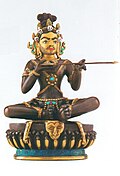
[[File:Saraha.jpg|right|thumb|200px|A contemporary bronze image of [[Saraha]]pa holding an arrow, probably made in Nepal]] | |||
The names of the Siddhacharyas in Sanskrit (or its Tibetan language equivalent), and the raga in which the verse was to be sung, are given prior to each pada. The Sanskrit names of the Siddhacharya poets were likely assigned to each pada by the commentator Munidatta.{{citation needed|date=July 2024}} | |||
[[File:Sketch Kanhapad.jpg|thumb|A sketch of Siddhacharya poet [[Kanhapa]]da]] | |||
==Period== | ==Period== | ||
Haraprasad Shastri, who rediscovered the Charyapada, conjectured that it was written during the 10th century. However, according to [[Suniti Kumar Chatterji]], it was composed between 10th and 12th century. Prabodh Chandra Bagchi upholds this view. [[Sukumar Sen (linguist)|Sukumar Sen]], while supporting this view, also states that the Charyapada could have been written between the 11th and 14th centuries.<ref name="sen2">Sen Sukumar (1991) [1940]. ''Bangala Sahityer Itihas'', Vol.I, (in Bengali), Kolkata: Ananda Publishers, {{ISBN|81-7066-966-9}}, p.55</ref> However, [[Muhammad Shahidullah]] was of the opinion that the Charyapada dates back to an even earlier time. He maintained that it was likely to have been composed between 7th and 11th century.<ref>Muhammad Shahidullah : ''Bangala Bhashar Itibritto'', 2006, Mawla Brothers, Dhaka</ref> [[Rahul Sankrityayan]] thought that the Charyapada was probably written between 8th and 11th century. | Haraprasad Shastri, who rediscovered the Charyapada, conjectured that it was written during the 10th century. However, according to [[Suniti Kumar Chatterji]], it was composed between 10th and 12th century. Prabodh Chandra Bagchi upholds this view. [[Sukumar Sen (linguist)|Sukumar Sen]], while supporting this view, also states that the Charyapada could have been written between the 11th and 14th centuries.<ref name="sen2">Sen Sukumar (1991) [1940]. ''Bangala Sahityer Itihas'', Vol.I, (in Bengali), Kolkata: Ananda Publishers, {{ISBN|81-7066-966-9}}, p. 55</ref> However, [[Muhammad Shahidullah]] was of the opinion that the Charyapada dates back to an even earlier time. He maintained that it was likely to have been composed between 7th and 11th century.<ref>Muhammad Shahidullah: ''Bangala Bhashar Itibritto'', 2006, Mawla Brothers, Dhaka</ref> [[Rahul Sankrityayan]] thought that the Charyapada was probably written between 8th and 11th century. | ||
==Language== | ==Language== | ||
Haraprasad Shastri, in his introduction to the ''Charyacharya-vinishchaya,'' referred to the enigmatic language of its verses as "[[twilight language]]" (Sanskrit: ''Sandhya-bhasha''), or ''Alo-andhari'' (half-expressed and half-concealed) based on the Sanskrit commentary of Munidatta. Vidhushekhara Shastri, on the basis of evidence from a number of Buddhist texts, later referred to this language as 'Intentional Language' (Sanskrit: ''Sandha-bhasha'').<ref>''Indian Historical Quarterly'', Vol.IV, No.1, 1928 CE, pp.287–296</ref> | [[Haraprasad Shastri]], in his introduction to the ''Charyacharya-vinishchaya,'' referred to the enigmatic language of its verses as "[[twilight language]]" (Sanskrit: ''Sandhya-bhasha''), or ''Alo-andhari'' (half-expressed and half-concealed) based on the Sanskrit commentary of Munidatta. Vidhushekhara Shastri, on the basis of evidence from a number of Buddhist texts, later referred to this language as 'Intentional Language' (Sanskrit: ''Sandha-bhasha'').<ref>''Indian Historical Quarterly'', Vol.IV, No.1, 1928 CE, pp. 287–296</ref> | ||
The padas were written by poets from different regions, and it is natural that they would display linguistic affinities from these regions. Different scholars have noted the affinities of the language of the ''Charyapada'' with [[Assamese language|Assamese]], [[ | The padas were written by poets from different regions, and it is natural that they would display linguistic affinities from these regions. Different scholars have noted the affinities of the language of the ''Charyapada'' with [[Assamese language|Assamese]], [[Bengali language|Bengali]], [[Maithili language|Maithili]], and [[Odia language|Odia]].<ref name="Majumdar1980">{{cite book |editor1-last=Majumdar |editor1-first=R. C. |editor1-link=R. C. Majumdar |editor2-last=Pusalker |editor2-first=A. D. |editor3-last=Majumdar |editor3-first=A. K. |title=The Delhi Sultanate |url=https://archive.org/details/delhisultanate0006rcma/page/516/mode/1up |year=1980 |orig-year=First published 1960 |series=The History and Culture of the Indian People |volume=VI |edition=3rd |publisher=Bharatiya Vidya Bhavan |location=Bombay |oclc=664485 |pages=516, 519 |quote="The ''Charyāpadas'' of Old Bengali have also been claimed for Old Assamese ... Some Oriyā scholars, like those of Assam, regard the speech of the ''Charyāpadas'' to be the oldest form of their language. The Maithils have also made the same claim."}}</ref> | ||
===Affinities with Assamese=== | ===Affinities with Assamese=== | ||
[[Luipa]] was from [[Kamarupa]] and wrote two ''charyas''. Sarahapa, another poet, is said to have been from Rani, a place close to present-day [[Guwahati]]. Some of the affinities with Assamese are:<ref>''Language and Literature'' from The Comprehensive History of Assam Vol 1, ed H K Barpujari, Guwahati 1990</ref> | [[Luipa]] was from [[Kamarupa]] and wrote two ''charyas''. Sarahapa, another poet, is said to have been from Rani, a place close to present-day [[Guwahati]].{{fact|date=March 2026}} Some of the affinities with Assamese are:<ref>''Language and Literature'' from The Comprehensive History of Assam Vol 1, ed H K Barpujari, Guwahati 1990</ref> | ||
'''Negatives''' – the negative particle in Assamese comes ahead of the verb: ''na jãi'' (No. 2, 15, 20, 29); ''na jivami'' (No. 4); ''na chadaa'', ''na jani'', ''na disaa'' (No. 6). ''Charya'' 15 has 9 such forms.<br>'''Present participles''' – the suffix ''-ante'' is used as in Assamese of the Vaishnava period: ''jvante'' (while living, No. 22); ''sunante'' (while listening, No. 30) etc.<br>'''Incomplete verb forms''' – suffixes ''-i'' and ''-iya'' used in modern and [[Early Assamese]] respectively: ''kari'' (3, 38); ''cumbi'' (4); ''maria'' (11); ''laia'' (28) etc.<br>'''Present indefinite verb forms''' – ''-ai'': ''bhanai'' (1); ''tarai'' (5); ''pivai'' (6).<br>'''Future''' – the ''-iva'' suffix: ''haiba'' (5); ''kariba'' (7).<br>'''Nominative case ending''' – case ending in ''e'': ''kumbhire khaa'', ''core nila'' (2).<br>'''Instrumental case ending''' – case ending ''-e'' and ''-era'': ''uju bate gela'' (15); ''kuthare chijaa'' (45). | '''Negatives''' – the negative particle in Assamese comes ahead of the verb: ''na jãi'' (No. 2, 15, 20, 29); ''na jivami'' (No. 4); ''na chadaa'', ''na jani'', ''na disaa'' (No. 6). ''Charya'' 15 has 9 such forms.<br />'''Present participles''' – the suffix ''-ante'' is used as in Assamese of the Vaishnava period: ''jvante'' (while living, No. 22); ''sunante'' (while listening, No. 30) etc.<br />'''Incomplete verb forms''' – suffixes ''-i'' and ''-iya'' used in modern and [[Early Assamese]] respectively: ''kari'' (3, 38); ''cumbi'' (4); ''maria'' (11); ''laia'' (28) etc.<br />'''Present indefinite verb forms''' – ''-ai'': ''bhanai'' (1); ''tarai'' (5); ''pivai'' (6).<br />'''Future''' – the ''-iva'' suffix: ''haiba'' (5); ''kariba'' (7).<br />'''Nominative case ending''' – case ending in ''-e'': ''kumbhire khaa'', ''core nila'' (2).<br />'''Dative-Accusative case ending''' – case ending in ''-aka'': ''ṭhākuraka pariṇibittā'' (12), ''nāsaka thāti'' (21).<br />'''Instrumental case ending''' – case ending ''-e'' and ''-era'': ''uju bate gela'' (15); ''kuthare chijaa'' (45).<br />'''Genitive case ending''' – case ending in ''-ara'': ''sasara siṁge'' (41).<br />'''Locative case ending''' – case ending in ''-ata'', ''e'': ''māṅgata caṛhile'' (8), ''bāṭata milila'' (8), ''bājai bīranāde'' (11). | ||
The vocabulary of the Charyapadas includes non-''tatsama'' words which are typically Assamese, such as ''dala'' (1), ''thira kari'' (3, 38), ''tai'' (4), ''uju'' (15), ''caka'' (14) etc. | The vocabulary of the Charyapadas includes non-''tatsama'' words which are typically Assamese, such as ''dala'' (1), ''thira kari'' (3, 38), ''tai'' (4), ''uju'' (15), ''caka'' (14) etc. | ||
===Affinities with Bengali=== | ===Affinities with Bengali=== | ||
A number of Siddhacharyas who wrote the verses of Charyapada were from | A large number of the Siddhacharyas who wrote the verses of Charyapada were from [[Bengal]].<ref>{{cite book |last1=Dasgupta |first1=Shashibhushan |author-link=Shashibhusan Dasgupta |title=Obscure Religious Cults |year=1962 |orig-year=First published 1946 |location=Calcutta |publisher=Firma KLM |page=7 |oclc=534995}}</ref> The affinities with [[Bengali language]] are:<ref>Chatterjee, S.K. ''The Origin and Development of Bengali Language'', Vol.1, Calcutta, 1926, p. 112</ref> | ||
'''Genitive''' ''-era'', ''-ara'';<br />'''Locative''' ''-te'', ''-e/A'';<br />'''Nominative''' ''-Ta'';<br /> '''Present participles''' – the suffix ''-ante and -anta'' is used in Middle Bengali; <br />'''Present indefinite verb''' ''-ai'' that transformed into ''-e'' in modern Bangla: bolai; basai; nāchai.<br /> | |||
'''Negatives''' – the negative particle, used ahead of the verb in both Early and Modern Bengali poetry, also prevalent in many dialects of Modern Bangla;<br />'''Second Person Suffix''' ''-asi/si'' that transformed into ''-is'' in modern Bangla; <br />'''Incomplete verb forms of participles''' – suffixes ''-i'' and ''-iya'' used in modern poetry and Early and Middle Bangla both '''<br />Post-positional words''' like ''majha'', ''antara'', ''sanga'';<br />'''Past and future bases''' -''ila-'', ''-iba-'';<br />'''Nominative case ending''' – case ending in ''e'' is prevalent in many dialects in modern Bangla (even certain situations in standard Bangla) as well as middle Bangla: chore nila; kumbhire khāa.<br />'''Instrumental case ending''' – case ending ''-e'';<br />'''Conjunctive indeclinable''' -''ia'';<br />'''Conjunctive conditional''' -''ite'';<br />'''Passive''' -''ia-''<br />'''Substantive roots''' ''ach'' and ''thak''.<br />'''Future''' the -iba suffix: jāiba; haiba; kariba. | |||
Ekaso (100), Padama (Padma:Lotus), Chausatthi (64), Pakhudi (petals) Tahin (there, in that), Charhi (climb/rise), nachai (dances), Dombi (a Bengali woman belonging to the scheduled caste, Domi/Domni), Bapuri (a Bengali word for 'poor fellow'; 'বাপুর, বাপুড়া'<ref>{{Cite web |last=Dasa |first=Jnanendramohana |date=1937 |title=Bangala Bhashara abhidana |url=https://dsal.uchicago.edu/cgi-bin/app/dasa_query.py?qs=%E0%A6%AC%E0%A6%BE%E0%A6%AA%E0%A7%81&searchhws=yes&matchtype=exact |access-date=19 April 2022 |website=dsal.uchicago.edu}}</ref>) | |||
===Affinities with Bihari languages=== | |||
Several scholars have noted the affinities of the Charyapadas with [[Bihari languages]] like [[Maithili language|Maithili]] and [[Magahi language|Magahi]]. [[Rahul Sankrityayan]] in his ''Puratatv Nibandhawali'' noted that most of the [[Mahasiddhas|Siddhas]] who composed the poems were from [[Bihar]] and the language used was an early form of Magahi. The historian, [[K. P. Jayaswal]] deemed the Charyapada poems to be an early form of Maithili.<ref>{{cite book |last1=Prasad Sinha |first1=Bindeshwari |title=Comprehensive History Of Bihar, Volume 1, Part 2 |date=1974 |publisher=KP Jayaswal Research Institute |page=396 |url=https://archive.org/details/in.ernet.dli.2015.534083/page/n419/mode/2up?q=maithili}}</ref> | |||
<ref> | |||
===Affinities with Odia=== | |||
The beginnings of [[Odia language|Odia]] poetry coincide with the development of Charya Sahitya, the literature thus started by Mahayana Buddhist poets.<ref>{{cite web | url=https://www.academia.edu/3537646 | title=Odia as a Classical Language | last1=Prusty | first1=Dr Subrat | access-date=4 September 2022 | archive-date=27 September 2022 | archive-url=https://web.archive.org/web/20220927081548/https://www.academia.edu/3537646 | url-status=live }}</ref> | |||
== | ==Rāga== | ||
Before each song in the manuscript, a [[Rāga]] is given to which it is to be sung. The complete set of rāga used in the Charyapada is list below. | |||
{| class="wikitable" style="text-align:left" | {| class="wikitable" style="text-align:left" | ||
|- | |- | ||
| Line 167: | Line 147: | ||
|} | |} | ||
While some of these Rāgas are extinct, the names of some of these Rāgas may actually be variant names of popular Rāgas we know today.<ref>Roy, Niharranjan, ''Bangalir Itihas: Adiparba'' (in Bengali), Dey's Publishing, Calcutta, 1993 CE, {{ISBN|81-7079-270-3}}, pp 637</ref> | While some of these Rāgas are extinct, the names of some of these Rāgas may actually be variant names of popular Rāgas we know today.<ref>Roy, Niharranjan, ''Bangalir Itihas: Adiparba'' (in Bengali), Dey's Publishing, Calcutta, 1993 CE, {{ISBN|81-7079-270-3}}, pp 637</ref> | ||
==Notes== | ==Notes== | ||
| Line 203: | Line 152: | ||
==References== | ==References== | ||
{{ | {{refbegin}} | ||
* {{cite book |last=Kværne |first=Per |year=2010 |title=An Anthology of Buddhist Tantric Songs: A Study of the Charyagiti |publisher=Orchid Press |place=Bangkok |isbn=978-974-8299-34-1}} | |||
* {{cite book |last=Pattanayak |first=D. P. |year=2016 |chapter=Oriya and Assamese |editor1-last=Emeneau |editor1-first=Murray B. |editor2-last=Fergusson |editor2-first=Charles A. |title=Linguistics in South Asia |publisher=De Gruyter |pages=122–152 |isbn=978-3-11-081950-2}} | |||
{{refend}} | |||
{{ | |||
== Further reading == | == Further reading == | ||
* ''Charjapad Samiksha'' by Dr. Belal Hossain, Dhaka: Borno Bichitrra. | |||
* ''Charjapad Samiksha'' by Dr. Belal Hossain, Dhaka : Borno Bichitrra. | * ''Bangala Bhasar Itibrtta'', by Dr. [[Muhammad Shahidullah]], 1959, Dhaka. | ||
* ''Bangala Bhasar Itibrtta'', by Dr. Muhammad Shahidullah, 1959, Dhaka. | * [[Sukumar Sen (linguist)|Sen Sukumar]], ''Charyageeti Padavali'' (in Bengali), Ananda Publishers, 1st edition, Kolkata, 1995, {{ISBN|81-7215-458-5}}. | ||
* [[Haraprasad Shastri|Shastri Haraprasad]](ed.), ''Hajar Bacharer Purano Bangala Bhasay Bauddhagan O Doha'' (in Bengali), Bangiya Sahitya Parishad, 3rd edition, Kolkata, 1413 Bangabda (2006). | |||
== External links == | == External links == | ||
* [https://archive.org/details/caryagitikosa/page/n3 Caryāgītikoṣa ( | {{Commons category}} | ||
* [https://archive.org/details/caryagitikosa/page/n3 Caryāgītikoṣa (Facsimile Edition)] | |||
* [https://archive.org/details/in.ernet.dli.2015.313666/page/n3 Caryāgīti-koṣa of Buddhist Siddhas] | * [https://archive.org/details/in.ernet.dli.2015.313666/page/n3 Caryāgīti-koṣa of Buddhist Siddhas] | ||
* [https://archive.org/details/sen1948oldbengalitexts Old Bengali Texts (Caryāgīti)] | * [https://archive.org/details/sen1948oldbengalitexts Old Bengali Texts (Caryāgīti)] | ||
* [https://archive.org/details/shahidullahleschantsmystiques/page/n1 Les chants mystiques de Kāṇha et de Saraha] | * [https://archive.org/details/shahidullahleschantsmystiques/page/n1 Les chants mystiques de Kāṇha et de Saraha] | ||
* [https://web.archive.org/web/20091026210552/http://www.geocities.com/kavitayan/charyagiti.html Mystic Poems of Eighth Century India] | * [https://web.archive.org/web/20091026210552/http://www.geocities.com/kavitayan/charyagiti.html Mystic Poems of Eighth Century India] | ||
* [http://www.milansagar.com/kobi/charjageeti/kobi-charjageeti.html Milansagar] | * [http://www.milansagar.com/kobi/charjageeti/kobi-charjageeti.html Milansagar] | ||
[[Category: | [[Category:Charyapada| ]] | ||
[[Category: | [[Category:Bangladeshi poetry]] | ||
[[Category:Buddhist poetry]] | [[Category:Buddhist poetry]] | ||
[[Category:Pala Empire]] | [[Category:Pala Empire]] | ||
[[Category:Vajrayana]] | [[Category:Vajrayana]] | ||
[[Category:Kamrupi culture]] | [[Category:Kamrupi culture]] | ||
Latest revision as of 18:51, 28 March 2026
| Part of a series on |
| Vajrayana Buddhism |
|---|
 |
The Charyapada is a collection of mystical poems, songs of realization in the Vajrayāna tradition of Buddhism from the tāntric tradition in Assam, Bengal, Bihar and Odisha.[1]
It was compiled between the 8th and 12th centuries in late Apabhraṃśa or various Abahaṭṭha dialects, representing the formative stage of the Eastern Indo-Aryan languages.[2][3][4] It was written during a period when the northeastern Prākrit languages had not yet differentiated into later forms, or they were just getting differentiated.[5] Scholars of many eastern Indo-Aryan languages, such as Assamese, Bengali, Maithili, and Odia find features of these languages in the language of this work.[6][7][8] A palm-leaf manuscript of the Charyāpada was rediscovered in the early 20th century by Haraprasād Shāstrī at the Nepal Royal Court Library.[9] The Charyāpada was also preserved in the Tibetan Buddhist canon.[10]
Manuscripts[edit | edit source]

The original palm-leaf manuscript of the Charyapada, or Caryācaryāviniścaya, spanning 47 padas (verses) along with a Sanskrit commentary, was edited by Haraprashad Shastri and published from Bangiya Sahitya Parishad as a part of his Hajar Bacharer Purano Bangala Bhasay Bauddhagan O Doha (Buddhist Songs and Couplets) in 1916 under the name of Charyacharyavinishchayah. This manuscript is presently preserved at the National Archives of Nepal. Prabodhchandra Bagchi later published a manuscript of a Tibetan translation containing 50 verses.[11] Traditional Tibetan sources assign the translation of the dohās to the 12th century Indian Buddhist monk of Nalanda, Vairocanavajra.[12]

The Tibetan translation provided additional information, including that the Sanskrit commentary in the manuscript, known as Charyagiti-koshavrtti, was written by Munidatta. It also mentions that the original text was translated by Shilachari and its commentary by Munidatta was translated by Chandrakirti or Kirtichandra.[13]
Poets[edit | edit source]
The poets and their works as mentioned in the text are as follows:

| Poet | Pada |
|---|---|
| Luipāda | 1,29 |
| Kukkuripāda | 2, 20, 48 |
| Virubāpāda | 3 |
| Gundaripāda | 4 |
| Chatillapāda | 5 |
| Bhusukupāda | 6, 21, 23, 27, 30, 41, 43, 49 |
| Kānhapāda | 7, 9, 10, 11, 12, 13, 18, 19, 24, 36, 40, 42, 45 |
| Kambalāmbarapāda | 8 |
| Dombipāda | 14 |
| Shantipāda | 15, 26 |
| Mahidharapāda | 16 |
| Vināpāda | 17 |
| Sarahapāda | 22, 32, 38, 39 |
| Shabarapāda | 28, 50 |
| Āryadevapāda | 31 |
| Dhendhanapāda | 33 |
| Darikapāda | 34 |
| Bhādepāda | 35 |
| Tādakapāda | 37 |
| Kankanapāda | 44 |
| Jayanandipāda | 46 |
| Dhāmapāda | 47 |
| Tantripāda | 25 |
The manuscript of the Charyapada discovered by Haraprasad Shastri from Nepal consists of 47 padas (verses). The title-page, the colophon, and pages 36, 37, 38, 39, and 66 (containing padas 24, 25, and 48 and their commentary) were missing in this manuscript. The 47 verses of this manuscript were composed by 22 of the Mahasiddhas (750 and 1150 CE), or Siddhacharyas, whose names are mentioned at the beginning of each pada (except the first pada). Some parts of the manuscripts are lost; however, in the Tibetan Buddhist Canon, a translation of 50 padas is found, which includes padas 24, 25, and 48, and the complete pada 23. Pada 25 was written by the Siddhacharya poet Tantripāda, whose work was previously missing. In his commentary on pada 10, Munidatta mentions the name of another Siddhacharya poet, Ladidombipāda, but no pada written by him has been discovered so far.[citation needed]


The names of the Siddhacharyas in Sanskrit (or its Tibetan language equivalent), and the raga in which the verse was to be sung, are given prior to each pada. The Sanskrit names of the Siddhacharya poets were likely assigned to each pada by the commentator Munidatta.[citation needed]

Period[edit | edit source]
Haraprasad Shastri, who rediscovered the Charyapada, conjectured that it was written during the 10th century. However, according to Suniti Kumar Chatterji, it was composed between 10th and 12th century. Prabodh Chandra Bagchi upholds this view. Sukumar Sen, while supporting this view, also states that the Charyapada could have been written between the 11th and 14th centuries.[14] However, Muhammad Shahidullah was of the opinion that the Charyapada dates back to an even earlier time. He maintained that it was likely to have been composed between 7th and 11th century.[15] Rahul Sankrityayan thought that the Charyapada was probably written between 8th and 11th century.
Language[edit | edit source]
Haraprasad Shastri, in his introduction to the Charyacharya-vinishchaya, referred to the enigmatic language of its verses as "twilight language" (Sanskrit: Sandhya-bhasha), or Alo-andhari (half-expressed and half-concealed) based on the Sanskrit commentary of Munidatta. Vidhushekhara Shastri, on the basis of evidence from a number of Buddhist texts, later referred to this language as 'Intentional Language' (Sanskrit: Sandha-bhasha).[16]
The padas were written by poets from different regions, and it is natural that they would display linguistic affinities from these regions. Different scholars have noted the affinities of the language of the Charyapada with Assamese, Bengali, Maithili, and Odia.[17]
Affinities with Assamese[edit | edit source]
Luipa was from Kamarupa and wrote two charyas. Sarahapa, another poet, is said to have been from Rani, a place close to present-day Guwahati.[citation needed] Some of the affinities with Assamese are:[18]
Negatives – the negative particle in Assamese comes ahead of the verb: na jãi (No. 2, 15, 20, 29); na jivami (No. 4); na chadaa, na jani, na disaa (No. 6). Charya 15 has 9 such forms.
Present participles – the suffix -ante is used as in Assamese of the Vaishnava period: jvante (while living, No. 22); sunante (while listening, No. 30) etc.
Incomplete verb forms – suffixes -i and -iya used in modern and Early Assamese respectively: kari (3, 38); cumbi (4); maria (11); laia (28) etc.
Present indefinite verb forms – -ai: bhanai (1); tarai (5); pivai (6).
Future – the -iva suffix: haiba (5); kariba (7).
Nominative case ending – case ending in -e: kumbhire khaa, core nila (2).
Dative-Accusative case ending – case ending in -aka: ṭhākuraka pariṇibittā (12), nāsaka thāti (21).
Instrumental case ending – case ending -e and -era: uju bate gela (15); kuthare chijaa (45).
Genitive case ending – case ending in -ara: sasara siṁge (41).
Locative case ending – case ending in -ata, e: māṅgata caṛhile (8), bāṭata milila (8), bājai bīranāde (11).
The vocabulary of the Charyapadas includes non-tatsama words which are typically Assamese, such as dala (1), thira kari (3, 38), tai (4), uju (15), caka (14) etc.
Affinities with Bengali[edit | edit source]
A large number of the Siddhacharyas who wrote the verses of Charyapada were from Bengal.[19] The affinities with Bengali language are:[20]
Genitive -era, -ara;
Locative -te, -e/A;
Nominative -Ta;
Present participles – the suffix -ante and -anta is used in Middle Bengali;
Present indefinite verb -ai that transformed into -e in modern Bangla: bolai; basai; nāchai.
Negatives – the negative particle, used ahead of the verb in both Early and Modern Bengali poetry, also prevalent in many dialects of Modern Bangla;
Second Person Suffix -asi/si that transformed into -is in modern Bangla;
Incomplete verb forms of participles – suffixes -i and -iya used in modern poetry and Early and Middle Bangla both
Post-positional words like majha, antara, sanga;
Past and future bases -ila-, -iba-;
Nominative case ending – case ending in e is prevalent in many dialects in modern Bangla (even certain situations in standard Bangla) as well as middle Bangla: chore nila; kumbhire khāa.
Instrumental case ending – case ending -e;
Conjunctive indeclinable -ia;
Conjunctive conditional -ite;
Passive -ia-
Substantive roots ach and thak.
Future the -iba suffix: jāiba; haiba; kariba.
Ekaso (100), Padama (Padma:Lotus), Chausatthi (64), Pakhudi (petals) Tahin (there, in that), Charhi (climb/rise), nachai (dances), Dombi (a Bengali woman belonging to the scheduled caste, Domi/Domni), Bapuri (a Bengali word for 'poor fellow'; 'বাপুর, বাপুড়া'[21])
Affinities with Bihari languages[edit | edit source]
Several scholars have noted the affinities of the Charyapadas with Bihari languages like Maithili and Magahi. Rahul Sankrityayan in his Puratatv Nibandhawali noted that most of the Siddhas who composed the poems were from Bihar and the language used was an early form of Magahi. The historian, K. P. Jayaswal deemed the Charyapada poems to be an early form of Maithili.[22]
Affinities with Odia[edit | edit source]
The beginnings of Odia poetry coincide with the development of Charya Sahitya, the literature thus started by Mahayana Buddhist poets.[23]
Rāga[edit | edit source]
Before each song in the manuscript, a Rāga is given to which it is to be sung. The complete set of rāga used in the Charyapada is list below.
| Raga | Pada |
|---|---|
| Patamanjari | 1, 6, 7, 9, 11, 17, 20, 29, 31, 33, 36 |
| Gabadā or Gaudā | 2, 3, 18 |
| Aru | 4 |
| Gurjari, Gunjari or Kanha-Gunjari | 5, 22, 41, 47 |
| Devakri | 8 |
| Deshākha | 10, 32 |
| Kāmod | 13, 27, 37, 42 |
| Dhanasi or Dhanashri | 14 |
| Rāmakri | 15, 50 |
| Balāddi or Barādi | 21, 23, 28, 34 |
| Shabari | 26, 46 |
| Mallāri | 30, 35, 44, 45, 49 |
| Mālasi | 39 |
| Mālasi-Gaburā | 40 |
| Bangāl | 43 |
| Bhairavi | 12, 16, 19, 38 |
While some of these Rāgas are extinct, the names of some of these Rāgas may actually be variant names of popular Rāgas we know today.[24]
Notes[edit | edit source]
- ↑ "Bengali literature | History, Rabindranath Tagore, Poetry, Novels, & Facts | Britannica". www.britannica.com. 6 May 2025. Retrieved 12 June 2025.
- ↑ Jain, Danesh; Cardona, George (26 July 2007). The Indo-Aryan Languages. Routledge. p. 433. ISBN 978-1-135-79710-2.
The language of the Caryas is late Apabhramsa, and represents the formative period of the NIA languages including Asamiya.
- ↑ Murshid, Ghulam (25 January 2018). Bengali Culture Over a Thousand Years. Niyogi Books. p. 34. ISBN 978-93-86906-12-0.
Muhammad Shahidullah described the branch of Prakrit prevalent in the Bengal region as 'Gauri Prakrit'. This Prakrit gradually evolved into apabhramsa, and then into abahatta, which is, more or less, the language of the Charyapada.
- ↑ Kitada, Makoto (2023). "On the 'New' Caryāpada". Orientalistische Literaturzeitung. 117 (4–5): 315–322. doi:10.1515/olzg-2022-0096.
- ↑ "The language of [charyāpadas] was also claimed to be early Assamese and early Bihari (Eastern Hindi) by various scholars. Although no systematic scientific study has been undertaken on the basis of comparative reconstruction, a cursory look is enough to suggest that the language of these texts represents a stage when the North-Eastern Prākrit was either not differentiated or at an early stage of differentiation into the regional languages of Eastern and North-Eastern India." (Pattanayak 2016:127)
- ↑ Jain, Danesh; Cardona, George (26 July 2007). The Indo-Aryan Languages. Routledge. p. 525. ISBN 978-1-135-79710-2.
- ↑ Comrie, Bernard (30 November 2022). The Major Languages of South Asia, the Middle East and Africa. Routledge. ISBN 978-1-134-93257-3.
This is clearly evident, for instance, in the case of the celebrated Buddhist hymns called the Caryapada, composed in eastern India roughly between AD 1000 and 1200. Though the language of these hymns is Old Bengali, there are reference works on Assamese, Oriya and even Maithili that treat the same hymns as the earliest specimens of each of these languages and their literatures.
- ↑ Dalby, Andrew (28 October 2015). Dictionary of Languages: The definitive reference to more than 400 languages. Bloomsbury Publishing. p. 87. ISBN 978-1-4081-0214-5.
Around 1000 AD, when Bengali, Oriya and Assamese not yet distinguishable as separate languages, the remarkable, mystical Buddhist Charyapada songs were composed. They were discovered in a manuscript at Kathmandu and first published in 1916. They are claimed as the foundation of the literary tradition of all three languages.
- ↑ Guhathakurta, Meghna; van Schendel, Willem (2013). The Bangladesh Reader: History, Culture, Politics. Duke University Press. p. 40. ISBN 978-0-8223-5318-8. Retrieved 13 February 2016.
- ↑ Kværne, Per (2010). An Anthology of Buddhist Tantric Songs: A Study of the Caryāgīti. Orchid Press. ISBN 978-974-8299-34-1. Archived from the original on 13 January 2021. Retrieved 13 February 2016.
- ↑ Bagchi Prabodhchandra, Materials for a critical edition of the old Bengali Caryapadas (A comparative study of the text and Tibetan translation) Part I in Journal of the Department of Letters, Vol.XXX, pp. 1–156, Calcutta University, Calcutta, 1938 CE
- ↑ SCHAEFFER, KURTIS (2000). "THE RELIGIOUS CAREER OF VAIROCANAVAJRA — A TWELFTH-CENTURY INDIAN BUDDHIST MASTER FROM DAKṢIṆA KOŚALA". Journal of Indian Philosophy. 28 (4): 361–384. doi:10.1023/A:1004844115222. JSTOR 23496816.
- ↑ Sen Sukumar (1995). Charyageeti Padavali (in Bengali), Kolkata: Ananda Publishers, ISBN 81-7215-458-5, pp. 29–30
- ↑ Sen Sukumar (1991) [1940]. Bangala Sahityer Itihas, Vol.I, (in Bengali), Kolkata: Ananda Publishers, ISBN 81-7066-966-9, p. 55
- ↑ Muhammad Shahidullah: Bangala Bhashar Itibritto, 2006, Mawla Brothers, Dhaka
- ↑ Indian Historical Quarterly, Vol.IV, No.1, 1928 CE, pp. 287–296
- ↑ Majumdar, R. C.; Pusalker, A. D.; Majumdar, A. K., eds. (1980) [First published 1960]. The Delhi Sultanate. The History and Culture of the Indian People. Vol. VI (3rd ed.). Bombay: Bharatiya Vidya Bhavan. pp. 516, 519. OCLC 664485.
The Charyāpadas of Old Bengali have also been claimed for Old Assamese ... Some Oriyā scholars, like those of Assam, regard the speech of the Charyāpadas to be the oldest form of their language. The Maithils have also made the same claim.
- ↑ Language and Literature from The Comprehensive History of Assam Vol 1, ed H K Barpujari, Guwahati 1990
- ↑ Dasgupta, Shashibhushan (1962) [First published 1946]. Obscure Religious Cults. Calcutta: Firma KLM. p. 7. OCLC 534995.
- ↑ Chatterjee, S.K. The Origin and Development of Bengali Language, Vol.1, Calcutta, 1926, p. 112
- ↑ Dasa, Jnanendramohana (1937). "Bangala Bhashara abhidana". dsal.uchicago.edu. Retrieved 19 April 2022.
- ↑ Prasad Sinha, Bindeshwari (1974). Comprehensive History Of Bihar, Volume 1, Part 2. KP Jayaswal Research Institute. p. 396.
- ↑ Prusty, Dr Subrat. "Odia as a Classical Language". Archived from the original on 27 September 2022. Retrieved 4 September 2022.
- ↑ Roy, Niharranjan, Bangalir Itihas: Adiparba (in Bengali), Dey's Publishing, Calcutta, 1993 CE, ISBN 81-7079-270-3, pp 637
References[edit | edit source]
- Kværne, Per (2010). An Anthology of Buddhist Tantric Songs: A Study of the Charyagiti. Bangkok: Orchid Press. ISBN 978-974-8299-34-1.
- Pattanayak, D. P. (2016). "Oriya and Assamese". In Emeneau, Murray B.; Fergusson, Charles A. (eds.). Linguistics in South Asia. De Gruyter. pp. 122–152. ISBN 978-3-11-081950-2.
Further reading[edit | edit source]
- Charjapad Samiksha by Dr. Belal Hossain, Dhaka: Borno Bichitrra.
- Bangala Bhasar Itibrtta, by Dr. Muhammad Shahidullah, 1959, Dhaka.
- Sen Sukumar, Charyageeti Padavali (in Bengali), Ananda Publishers, 1st edition, Kolkata, 1995, ISBN 81-7215-458-5.
- Shastri Haraprasad(ed.), Hajar Bacharer Purano Bangala Bhasay Bauddhagan O Doha (in Bengali), Bangiya Sahitya Parishad, 3rd edition, Kolkata, 1413 Bangabda (2006).