






>GreenC bot Rescued 1 archive link; reformat 2 links. Wayback Medic 2.5 |
quick add structure after review additionally and corrected details |
||
| Line 1: | Line 1: | ||
{{Short description|None}} | |||
{{pp-move}} | |||
{{Use British English|date=August 2014}} | {{Use British English|date=August 2014}} | ||
{{Use dmy dates|date=August 2014}} | {{Use dmy dates|date=August 2014}} | ||
This article lists monuments and sites of historic importance in [[Odisha]], India. | This article lists monuments and sites of historic importance in [[Odisha]], India. | ||
==Prehistoric== | ==Prehistoric== | ||
{| class="wikitable sortable" width=100% | {| class="wikitable sortable" width=100% | ||
| Line 16: | Line 18: | ||
| | | | ||
| [[Kalahandi district]] | | [[Kalahandi district]] | ||
| Rock paintings from [[ | | Rock paintings from [[Upper Paleolithic]]. | ||
| | |||
|- | |- | ||
| [[Vikramkhol]] | | [[Vikramkhol]] | ||
| c.3000 BCE | | c. 3000 BCE | ||
| | | | ||
| [[Jharsuguda]] | | [[Jharsuguda]] | ||
| Prehistoric human [[rock shelter]] with inscriptions. | | Prehistoric human [[rock shelter]] with inscriptions. | ||
| <ref name=vikramkhol>{{cite news|title=Ancient rock art starts to fade out: | | <ref name=vikramkhol>{{cite news|title=Ancient rock art starts to fade out: Engravings in Vikramkhol cave under threat|url=http://www.telegraphindia.com/1111228/jsp/odisha/story_14932470.jsp|archive-url=https://web.archive.org/web/20141104163603/http://www.telegraphindia.com/1111228/jsp/odisha/story_14932470.jsp|url-status=dead|archive-date=4 November 2014|access-date=10 June 2014|work=[[The Telegraph (India)]]|date=27 December 2011}}</ref> | ||
|} | |} | ||
==Ancient== | ==Ancient== | ||
Singhapura (In Jajpur Dist): Some historians said that it was the capital of Singha Bahu, a Kalinga King who was contemporary of Lord Buddh and Bimbisar of Rajgrih. His exiled son Prince Vijaya established Sinhalese dynasty in Sri Lanka | Singhapura (In Jajpur Dist): Some historians said that it was the capital of Singha Bahu, a Kalinga King who was contemporary of Lord Buddh and Bimbisar of Rajgrih. His exiled son Prince Vijaya established Sinhalese dynasty in Sri Lanka. | ||
{| class="wikitable sortable" width=100% | {| class="wikitable sortable" width=100% | ||
| Line 46: | Line 49: | ||
|- | |- | ||
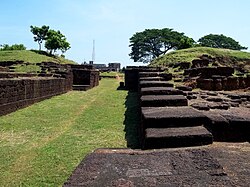
| [[Sisupalgarh]] | | [[Sisupalgarh]] | ||
| c.300 CE | | c. 300 CE | ||
| [[File:Sisupalagada Bhubaneswar.jpg|200px|Sisupalagada, Bhubaneswar]] | | [[File:Sisupalagada Bhubaneswar.jpg|200px|Sisupalagada, Bhubaneswar]] | ||
| [[Bhubaneswar]] <br> {{coord|20|13|35.9|N|85|51|11.0|E}} | | [[Bhubaneswar]] <br> {{coord|20|13|35.9|N|85|51|11.0|E}} | ||
| Line 53: | Line 56: | ||
|- | |- | ||
| [[Asurgarh]] | | [[Asurgarh]] | ||
| c. | | c. 9th century BCE | ||
| | | | ||
| [[Kalahandi]] | | [[Kalahandi]] | ||
| | | [[Asurgarh]] is an archaeological site in the Kalahandi district of Odisha, India. Asurgarh is one of the sites which has its beginning in around 8th-9th century BC and emerged as one of the early urban fortified settlements in the region and it is older than Sisupalgarh. Archaeologists have unearthed artefacts believed to be 2,300-year-old while carrying out excavation at the Asurgarh Fort in Odisha’s Kalahandi district. [[DB Gadanayak]], [[Archaeological Survey of India]], says Asurgarh is one of the sites which has its beginning in around 8th-9th century BC and emerged as one of the early urban fortified settlements in the region by the efforts of tribal and non-tribal inhabitants of the region.<ref name=":0">{{Cite web |last= |first= |date=2022-04-11 |title=‘Asurgarh fort settlement belongs to Iron Age, older than Sisupalgarh’ |url=https://www.newindianexpress.com/states/odisha/2022/apr/11/asurgarh-fort-settlement-belongs-to-iron-age-older-than-sisupalgarh-2440634.html |access-date=2024-09-11 |website=The New Indian Express |language=en}}</ref> [[Lokesh Durga]], Department of History of [[Delhi University]], says Asurgarh settlement is older than Sisupalgarh and the first Urbanization process in Odisha started from Asurgarh.<ref name=":0" /><ref> {{Cite news |last=Barik |first=Satyasundar |date=2022-04-24 |title=Carbon dating finds Asurgarh is Odisha’s oldest fortified settlement |url=https://www.thehindu.com/news/national/other-states/carbon-dating-finds-asurgarh-is-odishas-oldest-fortified-settlement/article65351205.ece |access-date=2024-09-11 |work=The Hindu |language=en-IN |issn=0971-751X}}</ref><ref> {{Cite web |title=Odisha Current Affairs 2024 : Download Free PDF & Practice Quiz |url=https://testbook.com/current-affairs/odisha-current-affairs |access-date=2024-09-11 |website=Testbook |language=en}}</ref> | ||
|<ref> L K Durga, 2018. Process of Peripheralization of Settlements in Early Historic Odisha: An Archaeological Perspective, Vol. 6, ''Heritage: Journal of Multidisciplinary Studies in Archaeology'' http://www.heritageuniversityofkerala.com/JournalPDF/Volume6/26.pdf</ref><ref>D B Garnayak, 2020. Excavation at Asurgarh: An Early Historic Fortified | |||
Settlement in Odisha | |||
, Vol. 8.2, ''Heritage: Journal of Multidisciplinary Studies in Archaeology'', http://www.heritageuniversityofkerala.com/JournalPDF/Volume8.2/18.pdf </ref> | |||
|- | |- | ||
|[[Bindusagar Tank]] | |[[Bindusagar Tank]] | ||
| Line 63: | Line 68: | ||
|[[File:View of Ananta Vasudeva Temple from Bindusagar - July 2007.jpg|200px|Bindusagar]] | |[[File:View of Ananta Vasudeva Temple from Bindusagar - July 2007.jpg|200px|Bindusagar]] | ||
| Old Town, Bhubaneswar | | Old Town, Bhubaneswar | ||
| A ritual tank with a shrine in the centre | | A ritual tank with a shrine in the centre | ||
|<ref name=bindusagar>{{cite web|title=Bindusagar Tank|url=http://ignca.nic.in/asi_reports/orkhurda026.pdf|website | |<ref name=bindusagar>{{cite web|title=Bindusagar Tank|url=http://ignca.nic.in/asi_reports/orkhurda026.pdf|website=Indira Gandhi National Centre for the Arts (IGNCA)|access-date=8 August 2014}}</ref> | ||
|- | |- | ||
| Chausath Yogini Temples | | [[Chausath Yogini Temple, Ranipur Jharial|Chausath Yogini Temples]] | ||
| c. 9th century CE | | c. 9th century CE | ||
|[[File: | |[[File:Chausath Yogini Temple, Ranipur Jharial, Odisha (2018) 1.jpg|200px|Chausath Yogini Temples]] | ||
| Jharial, [[Bolangir]] | | Jharial, [[Bolangir]] | ||
| A [[hypaethral]] temple for 64 [[yogini]]s | | A [[hypaethral]] temple for 64 [[yogini]]s | ||
| Line 82: | Line 87: | ||
| [[Anantashayana Vishnu]] | | [[Anantashayana Vishnu]] | ||
| 9th century CE | | 9th century CE | ||
| | | | ||
| Sarang, [[Dhenkanal district|Dhenkanal]] | | Sarang, [[Dhenkanal district|Dhenkanal]] | ||
| 15 metre long rock cut image of [[Vishnu]] lying in rest. | | 15 metre long rock cut image of [[Vishnu]] lying in rest. | ||
| <ref name="Anantasayana Visnu">{{cite web|title=Anantasayana Visnu|url=http://ignca.nic.in/asi_reports/ordhenknl001.pdf|access-date=8 August 2014 | | <ref name="Anantasayana Visnu">{{cite web|title=Anantasayana Visnu|url=http://ignca.nic.in/asi_reports/ordhenknl001.pdf|access-date=8 August 2014|website=Indira Gandhi National Centre for the Arts (IGNCA)}}</ref> | ||
|} | |} | ||
| Line 99: | Line 104: | ||
|- | |- | ||
| [[Ratnagiri, Odisha|Ratnagiri]] | | [[Ratnagiri, Odisha|Ratnagiri]] | ||
| c.10th century | | c. 10th century | ||
| [[File:Ratnagiri (30).JPG|200px|Ratnagiri, Jajpur]] | | [[File:Ratnagiri (30).JPG|200px|Ratnagiri, Jajpur]] | ||
| [[Jajpur]] | | [[Jajpur]] | ||
| Line 106: | Line 111: | ||
|- | |- | ||
| [[Lalitgiri]] | | [[Lalitgiri]] | ||
| c.10th century | | c. 10th century | ||
| [[File:MulGandhakuti Lalitgiri.JPG|200px|Lalitgiri, Jajpur]] | | [[File:MulGandhakuti Lalitgiri.JPG|200px|Lalitgiri, Jajpur]] | ||
| [[Cuttack]] | | [[Cuttack]] | ||
| A group [[Buddhist]] monasteries | | A group [[Buddhist]] monasteries | ||
| <ref name=lalit>{{cite web|title=Excavated Buddhist site, Lalitgiri|url=http://asi.nic.in/asi_monu_tktd_orissa_es_lalitagiri.asp|website=[[Archaeological Survey of India]]|publisher=[[Archaeological Survey of India]]|access-date=10 June 2014|ref=lalit|archive-url=https://web.archive.org/web/20140926160922/http://asi.nic.in/asi_monu_tktd_orissa_es_lalitagiri.asp|archive-date=26 September 2014|url-status=dead}}</ref> | | <ref name=lalit>{{cite web|title=Excavated Buddhist site, Lalitgiri|url=http://asi.nic.in/asi_monu_tktd_orissa_es_lalitagiri.asp|website=[[Archaeological Survey of India]]|publisher=[[Archaeological Survey of India]]|access-date=10 June 2014|ref=lalit|archive-url=https://web.archive.org/web/20140926160922/http://asi.nic.in/asi_monu_tktd_orissa_es_lalitagiri.asp|archive-date=26 September 2014|url-status=dead}}</ref> | ||
|- | |- | ||
| Line 117: | Line 122: | ||
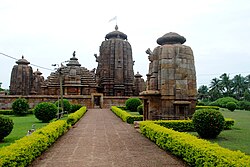
| [[Bhubaneswar]] | | [[Bhubaneswar]] | ||
| [[Shiva]] temple built during reign of the [[Somavaṃśī dynasty|Somavamsis]] | | [[Shiva]] temple built during reign of the [[Somavaṃśī dynasty|Somavamsis]] | ||
| <ref name=Brahmeswara>{{cite web|title=Brahmeswara Temple|url=http://ignca.nic.in/asi_reports/orkhurda028.pdf|website | | <ref name=Brahmeswara>{{cite web|title=Brahmeswara Temple|url=http://ignca.nic.in/asi_reports/orkhurda028.pdf|website=Indira Gandhi National Centre for the Arts (IGNCA)|access-date=8 August 2014}}</ref> | ||
|- | |- | ||
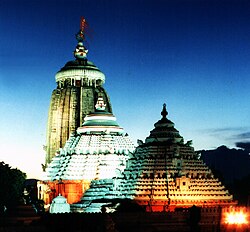
| [[Jagannath Temple, Puri|Jagannath Temple]] | | [[Jagannath Temple, Puri|Jagannath Temple]] | ||
| c.1090 | | c. 1090 | ||
| [[File:Sri Jagannath Temple Puri, Orissa.jpeg|200px|Sri Jagannath Temple Puri, Orissa]] | | [[File:Sri Jagannath Temple Puri, Orissa.jpeg|200px|Sri Jagannath Temple Puri, Orissa]] | ||
| [[Puri]] | | [[Puri]] | ||
| [[Vaishnava]] temple built by [[Eastern Ganga dynasty]] kings | | [[Vaishnava]] temple built by [[Eastern Ganga dynasty]] kings | ||
| <ref name="Mukherjee1981">{{cite book|author=Prabhat Mukherjee|title=The History of Medieval Vaishnavism in Orissa|url=https://books.google.com/books?id=7LFzfbhmJcMC|year=1981|publisher=Asian Educational Services|isbn=978-81-206-0229-8|pages=29–,32}}</ref> | | <ref name="Mukherjee1981">{{cite book|author=Prabhat Mukherjee|title=The History of Medieval Vaishnavism in Orissa|url=https://books.google.com/books?id=7LFzfbhmJcMC|year=1981|publisher=Asian Educational Services|isbn=978-81-206-0229-8|pages=29–,32}}</ref> | ||
|- | |- | ||
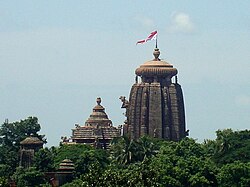
| [[Lingaraja Temple]] | | [[Lingaraja Temple]] | ||
| c.1100 | | c. 1100 | ||
| [[File:Lingaraj.JPG|200px|Lingaraj Temple, Bhubaneswar]] | | [[File:Lingaraj.JPG|200px|Lingaraj Temple, Bhubaneswar]] | ||
| [[Bhubaneswar]] | | [[Bhubaneswar]] | ||
| Shiva temple built by Somavamsi kings | | Shiva temple built by Somavamsi kings | ||
| <ref name="Nāẏaka2011">{{cite book|author=Pabitra Mohana Nāẏaka|title=Inscriptions of Orissa: With Special Reference to Subarnapur|url=https://books.google.com/books?id=Gv9mSu0qxSYC&pg=PR7|access-date=10 June 2014|year=2011|publisher=Readworthy|isbn=978-93-5018-042-6|page=vii}}</ref> | | <ref name="Nāẏaka2011">{{cite book|author=Pabitra Mohana Nāẏaka|title=Inscriptions of Orissa: With Special Reference to Subarnapur|url=https://books.google.com/books?id=Gv9mSu0qxSYC&pg=PR7|access-date=10 June 2014|year=2011|publisher=Readworthy|isbn=978-93-5018-042-6|page=vii}}</ref> | ||
|- | |- | ||
| Line 137: | Line 142: | ||
| [[File:Puri-gundica-mandir.jpg|200px|Gundicha Temple]] | | [[File:Puri-gundica-mandir.jpg|200px|Gundicha Temple]] | ||
| [[Puri]] | | [[Puri]] | ||
| Built by the [[Eastern Ganga dynasty]]. Houses the main idols during the [[Ratha-Yatra (Puri)|Ratha Yatra]] festival | | Built by the [[Eastern Ganga dynasty]]. Houses the main idols during the [[Ratha-Yatra (Puri)|Ratha Yatra]] festival | ||
| <ref name=gundicha>{{cite web|title=Gundicha Temple|url=http://ignca.nic.in/asi_reports/orpuri071.pdf|access-date=8 August 2014 | | <ref name=gundicha>{{cite web|title=Gundicha Temple|url=http://ignca.nic.in/asi_reports/orpuri071.pdf|access-date=8 August 2014|website=Indira Gandhi National Centre for the Arts (IGNCA)}}</ref><ref name=ratha-gundicha>{{cite news|title=Five Lakh Throng Gundicha Temple in Puri|url=http://www.newindianexpress.com/states/odisha/Five-Lakh-Throng-Gundicha-Temple-in-Puri/2014/07/07/article2318331.ece|archive-url=https://web.archive.org/web/20140707060436/http://www.newindianexpress.com/states/odisha/Five-Lakh-Throng-Gundicha-Temple-in-Puri/2014/07/07/article2318331.ece|url-status=dead|archive-date=7 July 2014|access-date=8 August 2014|work=[[The New Indian Express]]|date=7 July 2014}}</ref> | ||
|- | |- | ||
| [[Barabati fort]] | | [[Barabati fort]] | ||
| Line 151: | Line 156: | ||
| [[File:Kapilasa temple Dhenkanal Odisha4.jpg|200px|Kapilasa temple, Dhenkanal]] | | [[File:Kapilasa temple Dhenkanal Odisha4.jpg|200px|Kapilasa temple, Dhenkanal]] | ||
| [[Dhenkanal district|Dhenkanal]] | | [[Dhenkanal district|Dhenkanal]] | ||
| [[Shiva]] temple constructed by [[Narasingha Deva I]] | | [[Shiva]] temple constructed by [[Narasingha Deva I]] | ||
| <ref name=kapilash>{{cite web|title=Kapilash Temple|url=http://dhenkanal.nic.in/kapilas/kapilas.htm|website=District Portal: Dhenkanal|publisher=[[Government of Odisha]]|access-date=10 June 2014|ref=kapilash}}</ref> | | <ref name=kapilash>{{cite web|title=Kapilash Temple|url=http://dhenkanal.nic.in/kapilas/kapilas.htm|website=District Portal: Dhenkanal|publisher=[[Government of Odisha]]|access-date=10 June 2014|ref=kapilash}}</ref> | ||
|- | |- | ||
| Line 158: | Line 163: | ||
| [[File:Konark Temple.jpg|200px|Konark Sun Temple]] | | [[File:Konark Temple.jpg|200px|Konark Sun Temple]] | ||
| [[Konark]] | | [[Konark]] | ||
| Supposedly built by king [[Narasingha Deva I]] of [[Eastern Ganga Dynasty]] around 1250 | | Supposedly built by king [[Narasingha Deva I]] of [[Eastern Ganga Dynasty]] around 1250 | ||
| <ref name="konark">{{cite book|title=Indian History|url=https://books.google.com/books?id=X4j7Nf_MU24C&pg=SL2-PA3|access-date=8 August 2014|publisher=Tata McGraw-Hill Education|isbn=978-0-07-132923-1|page=B3}}</ref> | | <ref name="konark">{{cite book|title=Indian History| year=1960 |url=https://books.google.com/books?id=X4j7Nf_MU24C&pg=SL2-PA3|access-date=8 August 2014|publisher=Tata McGraw-Hill Education|isbn=978-0-07-132923-1|page=B3}}</ref> | ||
|- | |- | ||
| [[Ananta Vasudeva Temple]] | | [[Ananta Vasudeva Temple]] | ||
| Line 172: | Line 177: | ||
| [[File:Athara nala.JPG|200px|Atharanala, Puri]] | | [[File:Athara nala.JPG|200px|Atharanala, Puri]] | ||
| [[Puri]] <br> {{coord|19|49|11|N|85|49|54.1|E}} | | [[Puri]] <br> {{coord|19|49|11|N|85|49|54.1|E}} | ||
| Bridge with 18 [[arch]]es, purportedly built by Narasingha Deva II of [[Eastern Ganga Dynasty]] | | Bridge with 18 [[arch]]es, purportedly built by Narasingha Deva II of [[Eastern Ganga Dynasty]] | ||
| <ref name="Starza1993">{{cite book|author=O. M. Starza|title=The Jagannatha Temple at Puri: Its Architecture, Art, and Cult|url=https://books.google.com/books?id=v4bV3beb0n8C&pg=PA8|access-date=10 June 2014|year=1993|publisher=BRILL|isbn=90-04-09673-6|page=8}}</ref> | | <ref name="Starza1993">{{cite book|author=O. M. Starza|title=The Jagannatha Temple at Puri: Its Architecture, Art, and Cult|url=https://books.google.com/books?id=v4bV3beb0n8C&pg=PA8|access-date=10 June 2014|year=1993|publisher=BRILL|isbn=90-04-09673-6|page=8}}</ref> | ||
|- | |- | ||
| Line 185: | Line 190: | ||
| Latadeipur, Gondia, [[Dhenkanal district|Dhenkanal]] | | Latadeipur, Gondia, [[Dhenkanal district|Dhenkanal]] | ||
| [[Shiva]] temple built during the reign of the [[Gajapati Kingdom|Gajapati dynasty]] | | [[Shiva]] temple built during the reign of the [[Gajapati Kingdom|Gajapati dynasty]] | ||
| <ref name=ASI-orissa>{{cite web|title=Alphabetical List of Monuments - Orissa|url=http://asi.nic.in/asi_monu_alphalist_orissa.asp|website | | <ref name=ASI-orissa>{{cite web|title=Alphabetical List of Monuments - Orissa|url=http://asi.nic.in/asi_monu_alphalist_orissa.asp|website=[[Archaeological Survey of India]] (ASI)|access-date=8 August 2014}}</ref><ref name=IGNCA-Annakotesvara>{{cite web|title=Annakotesvara Temple|url=http://ignca.nic.in/asi_reports/ordhenknl009.pdf|website=Indira Gandhi National Centre For The Arts (IGNCA)|access-date=8 August 2014}}</ref> | ||
|- | |- | ||
|Alarnath Temple | |Alarnath Temple | ||
| Line 191: | Line 196: | ||
| | | | ||
|Brahmagiri, Puri, 752011 | |Brahmagiri, Puri, 752011 | ||
|<ref>{{Cite web|title=alarnath temple - Google Search|url=https://www.google.com/search?q=alarnath+temple | |<ref>{{Cite web|title=alarnath temple - Google Search|url=https://www.google.com/search?q=alarnath+temple&tbm=isch&cshid=1595351210100#imgrc=gCNBQUM4weFCuM|access-date=2020-07-21|website=www.google.com}}</ref> | ||
|[http://www.shreekhetra.com/alarnath.html] | |[http://www.shreekhetra.com/alarnath.html] | ||
|- | |- | ||
| [[Baladevjew Temple]] | | [[Baladevjew Temple]] | ||
| 1707 | | 1707 | ||
| | | | ||
| [[Kendrapara]] | | [[Kendrapara]] | ||
| Temple built during [[Maratha]] occupation of | | Temple built during [[Maratha]] occupation of Odish | ||
| <ref name=30lakhs>{{cite news|title=30 lakhs were granted for the renovation of Baldevjew and Mausi Maa temples under heritage conservation project.|url=http://indianexpress.com/article/india/india-others/archaeology-department-undertakes-renovation-of-mausi-maa-temple/|access-date=15 June 2014|work=The Indian Express|date=9 June 2014}}</ref> | | <ref name=30lakhs>{{cite news|title=30 lakhs were granted for the renovation of Baldevjew and Mausi Maa temples under heritage conservation project.|url=http://indianexpress.com/article/india/india-others/archaeology-department-undertakes-renovation-of-mausi-maa-temple/|access-date=15 June 2014|work=The Indian Express|date=9 June 2014}}</ref> | ||
|- | |- | ||
| Line 205: | Line 210: | ||
| | | | ||
| [[Cuttack]] | | [[Cuttack]] | ||
| Mosque built by [[Shuja-ud-Din Muhammad Khan]]. Purportedly contains a [[Qadam Rasul]] (footprint of | | Mosque built by [[Shuja-ud-Din Muhammad Khan]]. Purportedly contains a [[Qadam Rasul]] (footprint of [[Muhammad]]). | ||
| <ref name=islamic_cuttack>{{cite journal|author1=Mohammed Yamin|url=http://orissa.gov.in/e-magazine/Orissareview/2011/may/engpdf/48-57.pdf|title=Islamic Monuments in Cuttack|journal=Orissa Review|date=May 2011|publisher=[[Government of Odisha]]|access-date=10 June 2014}}</ref> | | <ref name=islamic_cuttack>{{cite journal|author1=Mohammed Yamin|url=http://orissa.gov.in/e-magazine/Orissareview/2011/may/engpdf/48-57.pdf|title=Islamic Monuments in Cuttack|journal=Orissa Review|date=May 2011|publisher=[[Government of Odisha]]|access-date=10 June 2014}}</ref> | ||
| Line 222: | Line 227: | ||
| [[Joranda Gadi]] | | [[Joranda Gadi]] | ||
| Early 20th century | | Early 20th century | ||
| | | | ||
| Joranda, [[Dhenkanal district|Dhenkanal]] | | Joranda, [[Dhenkanal district|Dhenkanal]] | ||
| Contains the [[Samadhi (shrine)|samadhi]] of the founder of the [[Mahima Dharma]] sect. | | Contains the [[Samadhi (shrine)|samadhi]] of the founder of the [[Mahima Dharma]] sect. | ||
| <ref name=joranda>{{cite web|title=Joranda Gadi|url=http://ignca.nic.in/asi_reports/ordhenknl013.pdf|website | | <ref name=joranda>{{cite web|title=Joranda Gadi|url=http://ignca.nic.in/asi_reports/ordhenknl013.pdf|website=Indira Gandhi National Centre for the Arts (IGNCA)|access-date=8 August 2014}}</ref> | ||
|- | |- | ||
|Inchudi | |Inchudi | ||
| Line 231: | Line 236: | ||
| | | | ||
| [[Balasore]] | | [[Balasore]] | ||
| Site of [[Salt Satyagraha]] in the state | | Site of [[Salt Satyagraha]] in the state | ||
|<ref name=inchudi>{{cite news|title=Satyagraha memory fades with time|url=http://www.telegraphindia.com/1120912/jsp/odisha/story_15963791.jsp|access-date=10 June 2014|work=[[The Telegraph (India)]]|date=12 September 2012}}</ref> | |<ref name=inchudi>{{cite news|title=Satyagraha memory fades with time|url=http://www.telegraphindia.com/1120912/jsp/odisha/story_15963791.jsp|archive-url=https://web.archive.org/web/20140316063646/http://www.telegraphindia.com/1120912/jsp/odisha/story_15963791.jsp|url-status=dead|archive-date=16 March 2014|access-date=10 June 2014|work=[[The Telegraph (India)]]|date=12 September 2012}}</ref> | ||
|} | |} | ||
| Line 243: | Line 248: | ||
{{Odisha}} | {{Odisha}} | ||
[[Category:Archaeological sites in Odisha| ]] | |||
[[Category: | |||
[[Category:Lists of tourist attractions in Odisha]] | [[Category:Lists of tourist attractions in Odisha]] | ||
Latest revision as of 22:13, 6 March 2026
This article lists monuments and sites of historic importance in Odisha, India.
Prehistoric[edit | edit source]
| Site | Date(s) | Picture | Location | Description | References |
|---|---|---|---|---|---|
| Gudahandi | c. 20000 BCE | Kalahandi district | Rock paintings from Upper Paleolithic. | ||
| Vikramkhol | c. 3000 BCE | Jharsuguda | Prehistoric human rock shelter with inscriptions. | [1] |
Ancient[edit | edit source]
Singhapura (In Jajpur Dist): Some historians said that it was the capital of Singha Bahu, a Kalinga King who was contemporary of Lord Buddh and Bimbisar of Rajgrih. His exiled son Prince Vijaya established Sinhalese dynasty in Sri Lanka.
| Site | Date(s) | Picture | Location | Description | References |
|---|---|---|---|---|---|
| Dhauli | 262 BCE | 
|
Dhauli, Bhubaneswar | Site of the Kalinga War | [2] |
| Sisupalgarh | c. 300 CE | 
|
Bhubaneswar 20°13′35.9″N 85°51′11.0″E / 20.226639°N 85.853056°E |
Ancient fort | [3] |
| Asurgarh | c. 9th century BCE | Kalahandi | Asurgarh is an archaeological site in the Kalahandi district of Odisha, India. Asurgarh is one of the sites which has its beginning in around 8th-9th century BC and emerged as one of the early urban fortified settlements in the region and it is older than Sisupalgarh. Archaeologists have unearthed artefacts believed to be 2,300-year-old while carrying out excavation at the Asurgarh Fort in Odisha’s Kalahandi district. DB Gadanayak, Archaeological Survey of India, says Asurgarh is one of the sites which has its beginning in around 8th-9th century BC and emerged as one of the early urban fortified settlements in the region by the efforts of tribal and non-tribal inhabitants of the region.[4] Lokesh Durga, Department of History of Delhi University, says Asurgarh settlement is older than Sisupalgarh and the first Urbanization process in Odisha started from Asurgarh.[4][5][6] | [7][8] | |
| Bindusagar Tank | c. 7-8th century CE | 
|
Old Town, Bhubaneswar | A ritual tank with a shrine in the centre | [9] |
| Chausath Yogini Temples | c. 9th century CE | _1.jpg)
|
Jharial, Bolangir | A hypaethral temple for 64 yoginis | [10] |
| Chausathi Jogini Temple | 9th century CE | 
|
Hirapur, Khurda | Hypaethral temple for 64 Yoginis in the outskirts of Bhubaneswar | [11] |
| Anantashayana Vishnu | 9th century CE | Sarang, Dhenkanal | 15 metre long rock cut image of Vishnu lying in rest. | [12] |
Medieval[edit | edit source]
| Site | Date(s) | Picture | Location | Description | References |
|---|---|---|---|---|---|
| Ratnagiri | c. 10th century | .JPG)
|
Jajpur | Buddhist monastery built by the Bhauma-Kara dynasty | [13] |
| Lalitgiri | c. 10th century | 
|
Cuttack | A group Buddhist monasteries | [14] |
| Brahmeswara Temple | 1058 CE | 
|
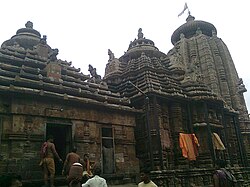
Bhubaneswar | Shiva temple built during reign of the Somavamsis | [15] |
| Jagannath Temple | c. 1090 | 
|
Puri | Vaishnava temple built by Eastern Ganga dynasty kings | [16] |
| Lingaraja Temple | c. 1100 | 
|
Bhubaneswar | Shiva temple built by Somavamsi kings | [17] |
| Gundicha Temple | 12th century | 
|
Puri | Built by the Eastern Ganga dynasty. Houses the main idols during the Ratha Yatra festival | [18][19] |
| Barabati fort | c. 1230 | 
|
Cuttack | Presumed to have been built by Anangabhimadev III of the Eastern Ganga dynasty | [20] |
| Kapilash Temple | 1246 | 
|
Dhenkanal | Shiva temple constructed by Narasingha Deva I | [21] |
| Konark Sun Temple | c. 1250 | 
|
Konark | Supposedly built by king Narasingha Deva I of Eastern Ganga Dynasty around 1250 | [22] |
| Ananta Vasudeva Temple | c.1278 | 
|
Bhubaneswar | Vaishnava temple built by Queen Chandrika, daughter of Anangabhimadeva III, of the Eastern Ganga dynasty | [16][23] |
| Atharanala Bridge | c.1300 | 
|
Puri 19°49′11″N 85°49′54.1″E / 19.81972°N 85.831694°E |
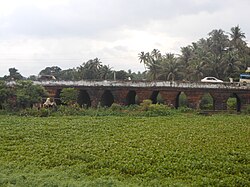
Bridge with 18 arches, purportedly built by Narasingha Deva II of Eastern Ganga Dynasty | [24] |
| Biraja Temple, Jajpur | 13th Century | Built originally by Jajati Keshari of Soma Dynasty | |||
| Annakoteshvara Temple | 16th Century | Latadeipur, Gondia, Dhenkanal | Shiva temple built during the reign of the Gajapati dynasty | [25][26] | |
| Alarnath Temple | 1610 AD | Brahmagiri, Puri, 752011 | [27] | [1] | |
| Baladevjew Temple | 1707 | Kendrapara | Temple built during Maratha occupation of Odish | [28] | |
| Qadam-e-Rasool | 1718 | Cuttack | Mosque built by Shuja-ud-Din Muhammad Khan. Purportedly contains a Qadam Rasul (footprint of Muhammad). | [29] |
Colonial[edit | edit source]
| Site | Date(s) | Picture | Location | Description | References |
|---|---|---|---|---|---|
| Joranda Gadi | Early 20th century | Joranda, Dhenkanal | Contains the samadhi of the founder of the Mahima Dharma sect. | [30] | |
| Inchudi | 1930 | Balasore | Site of Salt Satyagraha in the state | [31] |
See also[edit | edit source]
References[edit | edit source]
- ↑ "Ancient rock art starts to fade out: Engravings in Vikramkhol cave under threat". The Telegraph (India). 27 December 2011. Archived from the original on 4 November 2014. Retrieved 10 June 2014.
- ↑ Subodh Kapoor (2002). Indian Encyclopaedia. Cosmo Publications. p. 1137. ISBN 978-81-7755-257-7. Retrieved 8 August 2014.
- ↑ Paul Yule. Early Historic Sites in Orissa (Delhi 2006) 19-22.
- ↑ 4.0 4.1 "'Asurgarh fort settlement belongs to Iron Age, older than Sisupalgarh'". The New Indian Express. 11 April 2022. Retrieved 11 September 2024.
- ↑ Barik, Satyasundar (24 April 2022). "Carbon dating finds Asurgarh is Odisha's oldest fortified settlement". The Hindu. ISSN 0971-751X. Retrieved 11 September 2024.
- ↑ "Odisha Current Affairs 2024 : Download Free PDF & Practice Quiz". Testbook. Retrieved 11 September 2024.
- ↑ L K Durga, 2018. Process of Peripheralization of Settlements in Early Historic Odisha: An Archaeological Perspective, Vol. 6, Heritage: Journal of Multidisciplinary Studies in Archaeology http://www.heritageuniversityofkerala.com/JournalPDF/Volume6/26.pdf
- ↑ D B Garnayak, 2020. Excavation at Asurgarh: An Early Historic Fortified Settlement in Odisha , Vol. 8.2, Heritage: Journal of Multidisciplinary Studies in Archaeology, http://www.heritageuniversityofkerala.com/JournalPDF/Volume8.2/18.pdf
- ↑ "Bindusagar Tank" (PDF). Indira Gandhi National Centre for the Arts (IGNCA). Retrieved 8 August 2014.
- ↑ "Ranipur-Jharial Yogini Temple: A Ninth Century Monument Remains in Ruins". The New Indian Express. 7 March 2014. Retrieved 10 June 2014.
{{cite news}}: CS1 maint: deprecated archival service (link) - ↑ "Yogini temple of Hirapur". The Hindu. 17 October 2003.[dead link]
- ↑ "Anantasayana Visnu" (PDF). Indira Gandhi National Centre for the Arts (IGNCA). Retrieved 8 August 2014.
- ↑ "Excavated Buddhist site, Ratnagiri". Archaeological Survey of India. Archaeological Survey of India. Retrieved 10 June 2014.
- ↑ "Excavated Buddhist site, Lalitgiri". Archaeological Survey of India. Archaeological Survey of India. Archived from the original on 26 September 2014. Retrieved 10 June 2014.
- ↑ "Brahmeswara Temple" (PDF). Indira Gandhi National Centre for the Arts (IGNCA). Retrieved 8 August 2014.
- ↑ 16.0 16.1 Prabhat Mukherjee (1981). The History of Medieval Vaishnavism in Orissa. Asian Educational Services. pp. 29–, 32. ISBN 978-81-206-0229-8.
- ↑ Pabitra Mohana Nāẏaka (2011). Inscriptions of Orissa: With Special Reference to Subarnapur. Readworthy. p. vii. ISBN 978-93-5018-042-6. Retrieved 10 June 2014.
- ↑ "Gundicha Temple" (PDF). Indira Gandhi National Centre for the Arts (IGNCA). Retrieved 8 August 2014.
- ↑ "Five Lakh Throng Gundicha Temple in Puri". The New Indian Express. 7 July 2014. Archived from the original on 7 July 2014. Retrieved 8 August 2014.
- ↑ Hemanta K. Mohapatra (January 2004). "Remembering the Great Barabati Fort" (PDF). Orissa Review. Government of Odisha. Retrieved 10 June 2014.
- ↑ "Kapilash Temple". District Portal: Dhenkanal. Government of Odisha. Retrieved 10 June 2014.
- ↑ Indian History. Tata McGraw-Hill Education. 1960. p. B3. ISBN 978-0-07-132923-1. Retrieved 8 August 2014.
- ↑ Trilochan Dash. Story of Lord Sri Jagannatha in Srimandira at Sri Purusottam Kshetra. Trilochan Dash. p. 31. GGKEY:Y2TR84PZ0DD. Retrieved 10 June 2014.
- ↑ O. M. Starza (1993). The Jagannatha Temple at Puri: Its Architecture, Art, and Cult. BRILL. p. 8. ISBN 90-04-09673-6. Retrieved 10 June 2014.
- ↑ "Alphabetical List of Monuments - Orissa". Archaeological Survey of India (ASI). Retrieved 8 August 2014.
- ↑ "Annakotesvara Temple" (PDF). Indira Gandhi National Centre For The Arts (IGNCA). Retrieved 8 August 2014.
- ↑ "alarnath temple - Google Search". www.google.com. Retrieved 21 July 2020.
- ↑ "30 lakhs were granted for the renovation of Baldevjew and Mausi Maa temples under heritage conservation project". The Indian Express. 9 June 2014. Retrieved 15 June 2014.
- ↑ Mohammed Yamin (May 2011). "Islamic Monuments in Cuttack" (PDF). Orissa Review. Government of Odisha. Retrieved 10 June 2014.
- ↑ "Joranda Gadi" (PDF). Indira Gandhi National Centre for the Arts (IGNCA). Retrieved 8 August 2014.
- ↑ "Satyagraha memory fades with time". The Telegraph (India). 12 September 2012. Archived from the original on 16 March 2014. Retrieved 10 June 2014.


