
robot: Update article (please report if you notice any mistake or error in this edit) |
refined citations after review |
||
| Line 1: | Line 1: | ||
{{short description|Road in Kolkata, India}} | {{short description|Road in Kolkata, India}} | ||
{{Use dmy dates|date=January 2026}} | |||
{{Use Indian English|date=January 2026}} | |||
{{Infobox street | {{Infobox street | ||
| name | | name = Mahatma Gandhi Road | ||
| native_name | | native_name = | ||
| marker_image | | marker_image = | ||
| image | | image = A view of Burrabazar and Mahatma Gandhi Road.jpg | ||
| image_size | | image_size = 270px | ||
| caption | | caption = Mahatma Gandhi Road in [[Burrabazar]] | ||
| other_name | | other_name = MG Road | ||
| former_names | | former_names = Harrison Road | ||
| postal_code | | postal_code = 700007, 700009 | ||
| addresses | | addresses = | ||
| length_km | | length_km = | ||
| length_ref | | length_ref = | ||
| width | | width = | ||
| location | | location = [[Kolkata]], India | ||
| metro_system | | metro_system = [[Kolkata Metro]] | ||
| metro | | metro = [[MG Road metro station, Kolkata|MG Road]] and [[Sealdah metro station|Sealdah]] | ||
| client | | client = | ||
| maint | | maint = [[Kolkata Municipal Corporation]] | ||
| coordinates | | coordinates = {{Coord|22.5794|88.3611|display=title, inline}} | ||
| direction_a | | direction_a = west | ||
| terminus_a | | terminus_a = [[Howrah Bridge]] | ||
| direction_b | | direction_b = east | ||
| terminus_b | | terminus_b = [[Sealdah Station]] | ||
| junction | | junction = | ||
| commissioning_date | | commissioning_date = | ||
| construction_start_date = | | construction_start_date = | ||
| completion_date | | completion_date = | ||
| inauguration_date | | inauguration_date = <!-- {{Start date|df=yes|YYYY|MM|DD}} --> | ||
| demolition_date | | demolition_date = | ||
| designer | | designer = | ||
| known_for | | known_for = | ||
| status | | status = | ||
}} | }} | ||
| Line 41: | Line 41: | ||
== History == | == History == | ||
[[File:Calcutta. Harrison Road. II. LCCN2017658177.jpg|thumb|Calcutta. Harrison Road. 1890]] | [[File:Calcutta. Harrison Road. II. LCCN2017658177.jpg|thumb|Calcutta. Harrison Road. 1890]] | ||
Mahatma Gandhi road was initially known as Harrison Road. After the independence of India in 1947 the Harrison Road in Kolkata was renamed Mahatma Gandhi Road (M.G. Road) and the name of [[Chowringhee Road]] was changed to [[Jawaharlal Nehru]] road.<ref name="Moorhouse2012">{{cite book|author=Geoffrey Moorhouse|title=Calcutta|url=https://books.google.com/books?id=eR0WhGXILVYC&pg=PT280|accessdate=9 June 2013|date=5 April 2012|publisher=Faber & Faber|isbn=978-0-571-28113-8|pages=280–}}</ref> In 1889 when [[Calcutta Electric Supply Corporation]] (CESC) started promoting electricity in the city, this Harrison road was the first street in the city to be lit by the authority.<ref name="Let there be light">{{cite news|title=Let there be light|url=http://www.telegraphindia.com/1090426/jsp/calcutta/story_10866828.jsp|accessdate=9 June 2013|newspaper=The Telegraph (Calcutta)}}</ref> Calcutta Improvement Trust (CIT) decided to build the [[Chittaranjan Avenue|Central Avenue]] in 1911. By 1926, Harrison Road was stretched to Beadon Street in the north and to [[Bowbazar]] in the south.<ref name="Rajasthan meets Attica">{{cite news|title=Rajasthan meets Attica|url=http://www.telegraphindia.com/1030314/asp/calcutta/story_1764259.asp|accessdate=9 June 2013|newspaper=The Telegraph (Calcutta)}}</ref> | Mahatma Gandhi road was initially known as Harrison Road. After the independence of India in 1947 the Harrison Road in Kolkata was renamed Mahatma Gandhi Road (M.G. Road) and the name of [[Chowringhee Road]] was changed to [[Jawaharlal Nehru]] road.<ref name="Moorhouse2012">{{cite book|author=Geoffrey Moorhouse|title=Calcutta|url=https://books.google.com/books?id=eR0WhGXILVYC&pg=PT280|accessdate=9 June 2013|date=5 April 2012|publisher=Faber & Faber|isbn=978-0-571-28113-8|pages=280–}}</ref> In 1889 when [[Calcutta Electric Supply Corporation]] (CESC) started promoting electricity in the city, this Harrison road was the first street in the city to be lit by the authority.<ref name="Let there be light">{{cite news|title=Let there be light|url=http://www.telegraphindia.com/1090426/jsp/calcutta/story_10866828.jsp|archive-url=https://web.archive.org/web/20090429033342/http://www.telegraphindia.com/1090426/jsp/calcutta/story_10866828.jsp|url-status=dead|archive-date=29 April 2009|accessdate=9 June 2013|newspaper=The Telegraph (Calcutta)}}</ref> Calcutta Improvement Trust (CIT) decided to build the [[Chittaranjan Avenue|Central Avenue]] in 1911. By 1926, Harrison Road was stretched to Beadon Street in the north and to [[Bowbazar]] in the south.<ref name="Rajasthan meets Attica">{{cite news|title=Rajasthan meets Attica|url=http://www.telegraphindia.com/1030314/asp/calcutta/story_1764259.asp|archive-url=https://web.archive.org/web/20030430212055/http://www.telegraphindia.com/1030314/asp/calcutta/story_1764259.asp|url-status=dead|archive-date=30 April 2003|accessdate=9 June 2013|newspaper=The Telegraph (Calcutta)}}</ref> | ||
Charu Guha, a pioneer of the city's studio photography, started her first studio in the Harrison Road in 1920.<ref name="An early airbrush artist">{{cite news|title=An early airbrush artist|url=http://www.telegraphindia.com/1090329/jsp/calcutta/story_10737054.jsp|accessdate=9 June 2013|newspaper=The Telegraph (Calcutta)}}</ref> During India's independence movement, this street was previously considered as "communally sensitive" neighbourhood of the city.<ref name="A new India mob at Raj Bhavan curfew no bar Gandhi fast Anglo-indians au revoir free Boroline">{{cite news|title=A new India mob at Raj Bhavan curfew no bar Gandhi fast Anglo-indians au revoir free Boroline|url=http://www.telegraphindia.com/1100815/jsp/calcutta/story_12813433.jsp|accessdate=9 June 2013|newspaper=The Telegraph (Calcutta)|date=26 April 2009}}</ref> On 1 April 1930, ''[[The Vancouver Sun]]'' newspaper reported— "four more were killed in rioting this afternoon in Harrison Road, which is the usual storm quarter in this region."<ref name="Drive Against Mahatma">{{cite news|title=Drive Against Mahatma|url=https://news.google.com/newspapers?id=OnBmAAAAIBAJ&sjid=6YgNAAAAIBAJ&dq=harrison-road%20gandhi&pg=2173%2C3756880|accessdate=9 June 2013|newspaper=The Vancouver Sun|date=1 April 1930}}</ref> | Charu Guha, a pioneer of the city's studio photography, started her first studio in the Harrison Road in 1920.<ref name="An early airbrush artist">{{cite news|title=An early airbrush artist|url=http://www.telegraphindia.com/1090329/jsp/calcutta/story_10737054.jsp|archive-url=https://web.archive.org/web/20090402003358/http://telegraphindia.com/1090329/jsp/calcutta/story_10737054.jsp|url-status=dead|archive-date=2 April 2009|accessdate=9 June 2013|newspaper=The Telegraph (Calcutta)}}</ref> During India's independence movement, this street was previously considered as "communally sensitive" neighbourhood of the city.<ref name="A new India mob at Raj Bhavan curfew no bar Gandhi fast Anglo-indians au revoir free Boroline">{{cite news|title=A new India mob at Raj Bhavan curfew no bar Gandhi fast Anglo-indians au revoir free Boroline|url=http://www.telegraphindia.com/1100815/jsp/calcutta/story_12813433.jsp|archive-url=https://web.archive.org/web/20100820024432/http://www.telegraphindia.com/1100815/jsp/calcutta/story_12813433.jsp|url-status=dead|archive-date=20 August 2010|accessdate=9 June 2013|newspaper=The Telegraph (Calcutta)|date=26 April 2009}}</ref> On 1 April 1930, ''[[The Vancouver Sun]]'' newspaper reported— "four more were killed in rioting this afternoon in Harrison Road, which is the usual storm quarter in this region."<ref name="Drive Against Mahatma">{{cite news|title=Drive Against Mahatma|url=https://news.google.com/newspapers?id=OnBmAAAAIBAJ&sjid=6YgNAAAAIBAJ&dq=harrison-road%20gandhi&pg=2173%2C3756880|accessdate=9 June 2013|newspaper=The Vancouver Sun|date=1 April 1930}}</ref> | ||
== Location and operation == | == Location and operation == | ||
| Line 56: | Line 56: | ||
[[File:Hindu School - Kolkata 7409.JPG|thumb|[[Hindu School, Kolkata|Hindu School]]— it is located on [[College Street (Kolkata)|College Street]], adjacent to Mahatma Gandhi Road]] | [[File:Hindu School - Kolkata 7409.JPG|thumb|[[Hindu School, Kolkata|Hindu School]]— it is located on [[College Street (Kolkata)|College Street]], adjacent to Mahatma Gandhi Road]] | ||
Several educational institutions are located on or near Mahatma Gandhi Road, <ref name="Culture Mahatma Gandhi Road">{{cite web|title=Culture Mahtma Gandhi Road |url=http://www.asklaila.com/Mahatma-Gandhi-Road-Guide-Kolkata/lg3973/ |publisher=Ask Laila |accessdate=9 June 2013 |archiveurl=https://web.archive.org/web/20130324183428/http://www.asklaila.com/Mahatma-Gandhi-Road-Guide-Kolkata/lg3973 |archivedate=24 March 2013 |url-status=dead }}</ref> such as Anglo Arabic Secondary School, Gyan Bharati Vidyapith, St. Paul's School, [[Hindu School]], Lawrence Day School, Shri Jain Vidyalaya and St. Pauls' Mission School.{{ | Several educational institutions are located on or near Mahatma Gandhi Road,<ref name="Culture Mahatma Gandhi Road">{{cite web|title=Culture Mahtma Gandhi Road |url=http://www.asklaila.com/Mahatma-Gandhi-Road-Guide-Kolkata/lg3973/ |publisher=Ask Laila |accessdate=9 June 2013 |archiveurl=https://web.archive.org/web/20130324183428/http://www.asklaila.com/Mahatma-Gandhi-Road-Guide-Kolkata/lg3973 |archivedate=24 March 2013 |url-status=dead }}</ref> such as Anglo Arabic Secondary School, Gyan Bharati Vidyapith, St. Paul's School, [[Hindu School]], Lawrence Day School, Shri Jain Vidyalaya and St. Pauls' Mission School.{{citation needed|date=October 2018}} | ||
=== Restaurants === | === Restaurants === | ||
| Line 67: | Line 67: | ||
[[Rabindranath Tagore]] in this poem ''Ekdin Rate'' mentioned this street. The lines of the poem were— ''Howrah-r bridge chole mosto she bichhe, Harrison road chole tar pichhe, pichhe'' (the approximate English translation: The [[Howrah Bridge]] is moving as if a large centipede and the Harrison Road moves behind it).<!--#### DO NOT ADD BENGALI SCRIPT ####--><ref name="Ekdin Rate">{{cite web|title=Ekdin Rate|url=http://www.rabindra-rachanabali.nltr.org/node/15364|work=Rabindra Rachanabali|publisher=nltr.org|author=Rabindranath Tagore}}</ref> | [[Rabindranath Tagore]] in this poem ''Ekdin Rate'' mentioned this street. The lines of the poem were— ''Howrah-r bridge chole mosto she bichhe, Harrison road chole tar pichhe, pichhe'' (the approximate English translation: The [[Howrah Bridge]] is moving as if a large centipede and the Harrison Road moves behind it).<!--#### DO NOT ADD BENGALI SCRIPT ####--><ref name="Ekdin Rate">{{cite web|title=Ekdin Rate|url=http://www.rabindra-rachanabali.nltr.org/node/15364|work=Rabindra Rachanabali|publisher=nltr.org|author=Rabindranath Tagore}}</ref> | ||
[[Sharadindu Bandyopadhyay|Saradindu Bandopadhyay]]'s famous fictional character, [[Byomkesh Bakshi]] - India's putative foremost detective, lived on Harrison Road in the second floor of a three-storied building along with his friend and associate Ajit Banerjee and domestic help, Putiram. | [[Sharadindu Bandyopadhyay|Saradindu Bandopadhyay]]'s famous fictional character, [[Byomkesh Bakshi]] - India's putative foremost detective, lived on Harrison Road in the second floor of a three-storied building along with his friend and associate Ajit Banerjee and domestic help, Putiram.{{Citation needed|date=January 2026}} | ||
== Gallery == | == Gallery == | ||
<gallery> | <gallery> | ||
File:Mahatma Gandhi Road - Strand Road View - Kolkata 2016-10-11 0591.JPG|MG Road and [[Strand Road, Kolkata| | File:Mahatma Gandhi Road - Strand Road View - Kolkata 2016-10-11 0591.JPG|MG Road and [[Strand Road, Kolkata|Rajiv Gandhi Sarani]] Crossing | ||
File:Kolkata Tram on Mahatma Gandhi road IMG 20181215 101007.jpg|[[Trams in Kolkata|Kolkata tram]] route no. 18 on MG Road near [[Howrah Bridge]] | File:Kolkata Tram on Mahatma Gandhi road IMG 20181215 101007.jpg|[[Trams in Kolkata|Kolkata tram]] route no. 18 on MG Road near [[Howrah Bridge]], closed in 2021 | ||
File:Mahatma Gandhi Road - College Street Crossing - Kolkata 2015-02-09 2278.JPG|MG Road and [[College Street (Kolkata)|College Street]] Crossing | File:Mahatma Gandhi Road - College Street Crossing - Kolkata 2015-02-09 2278.JPG|MG Road and [[College Street (Kolkata)|College Street]] Crossing | ||
File:Mahatma Gandhi Road - Amharst Street Crossing - Kolkata 2015-02-09 2282.JPG|MG Road and [[Amherst Street (Kolkata)| | File:Mahatma Gandhi Road - Amharst Street Crossing - Kolkata 2015-02-09 2282.JPG|MG Road and [[Amherst Street (Kolkata)|Raja Ram Mohan Sarani]] Crossing | ||
File:Mahatma Gandhi Road and Surya Sen Street Crossing - Kolkata 2014-01-01 1787.JPG|MG Road and Surya Sen Street Crossing | File:Mahatma Gandhi Road and Surya Sen Street Crossing - Kolkata 2014-01-01 1787.JPG|MG Road and Surya Sen Street Crossing | ||
File:Vidyapati Setu - Mahatma Gandhi Road - Sealdah - Kolkata 2015-08-11 1974.JPG|Vidyapati Setu, MG Road, [[Sealdah]] | File:Vidyapati Setu - Mahatma Gandhi Road - Sealdah - Kolkata 2015-08-11 1974.JPG|Vidyapati Setu, MG Road, [[Sealdah]] (also known as Sealdah flyover) | ||
</gallery> | </gallery> | ||
Latest revision as of 12:08, 12 January 2026
| MG Road | |
 Mahatma Gandhi Road in Burrabazar | |
| Former name(s) | Harrison Road |
|---|---|
| Maintained by | Kolkata Municipal Corporation |
| Location | Kolkata, India |
| Postal code | 700007, 700009 |
| Nearest Kolkata Metro station | MG Road and Sealdah |
| Coordinates | 22°34′46″N 88°21′40″E / 22.5794°N 88.3611°E |
| west end | Howrah Bridge |
| east end | Sealdah Station |
Mahatma Gandhi Road or M.G. Road, formerly known as Harrison Road,[1] is a principal East-West thoroughfare in Kolkata (Previously known as Calcutta), the capital of the Indian state of West Bengal. M.G. Road makes the boundary of North and Central Kolkata.[2] In 1889 this was the first street of the city to be lit by electricity.
History[edit | edit source]

Mahatma Gandhi road was initially known as Harrison Road. After the independence of India in 1947 the Harrison Road in Kolkata was renamed Mahatma Gandhi Road (M.G. Road) and the name of Chowringhee Road was changed to Jawaharlal Nehru road.[3] In 1889 when Calcutta Electric Supply Corporation (CESC) started promoting electricity in the city, this Harrison road was the first street in the city to be lit by the authority.[4] Calcutta Improvement Trust (CIT) decided to build the Central Avenue in 1911. By 1926, Harrison Road was stretched to Beadon Street in the north and to Bowbazar in the south.[5]
Charu Guha, a pioneer of the city's studio photography, started her first studio in the Harrison Road in 1920.[6] During India's independence movement, this street was previously considered as "communally sensitive" neighbourhood of the city.[7] On 1 April 1930, The Vancouver Sun newspaper reported— "four more were killed in rioting this afternoon in Harrison Road, which is the usual storm quarter in this region."[8]
Location and operation[edit | edit source]
The road is arterial in maintaining east–west connection in Kolkata. It is of the shortest distance between two major rail stations in Kolkata Metropolitan Area — Sealdah Station and Howrah Station. Several important places are on this road, such as Sealdah Station, Surya Sen Street crossing, Amherst Street crossing, College Street/Bidhan Sarani crossing, Chittaranjan Avenue crossing, Rabindra Sarani (Chitpur Road) crossing, Netaji Subhas Road crossing, Burrabazar and Strand Road crossing/Howrah Bridge.[9]
M.G. Road runs from Sealdah Flyover (Vidyapati Setu) in the eastern limit to the threshold of Howrah Bridge in the west.[9]
The road is bi-directional throughout the day. Certain crossings are, however, unidirectional, that is, in certain crossings, vehicles can turn only in a specific direction.
Culture[edit | edit source]
Education institutions[edit | edit source]

Several educational institutions are located on or near Mahatma Gandhi Road,[10] such as Anglo Arabic Secondary School, Gyan Bharati Vidyapith, St. Paul's School, Hindu School, Lawrence Day School, Shri Jain Vidyalaya and St. Pauls' Mission School.[citation needed]
Restaurants[edit | edit source]
Some popular restaurants in or near Mahatma Gandhi Roadare [10] Shreeram Dhaba, Aahar Restaurant, Madhuri Restaurant, Basanta Cabin.
Cinema halls[edit | edit source]
Several cinema halls are located on or near the road, such as Aruna, Chhabighar, Naaz, Purabi, Prabhat.[10]
In popular culture[edit | edit source]
Rabindranath Tagore in this poem Ekdin Rate mentioned this street. The lines of the poem were— Howrah-r bridge chole mosto she bichhe, Harrison road chole tar pichhe, pichhe (the approximate English translation: The Howrah Bridge is moving as if a large centipede and the Harrison Road moves behind it).[11]
Saradindu Bandopadhyay's famous fictional character, Byomkesh Bakshi - India's putative foremost detective, lived on Harrison Road in the second floor of a three-storied building along with his friend and associate Ajit Banerjee and domestic help, Putiram.[citation needed]
Gallery[edit | edit source]
-
 MG Road and Rajiv Gandhi Sarani Crossing
 -
 Kolkata tram route no. 18 on MG Road near Howrah Bridge, closed in 2021
 -
 MG Road and College Street Crossing
 -
 MG Road and Raja Ram Mohan Sarani Crossing
 -
 MG Road and Surya Sen Street Crossing
 -
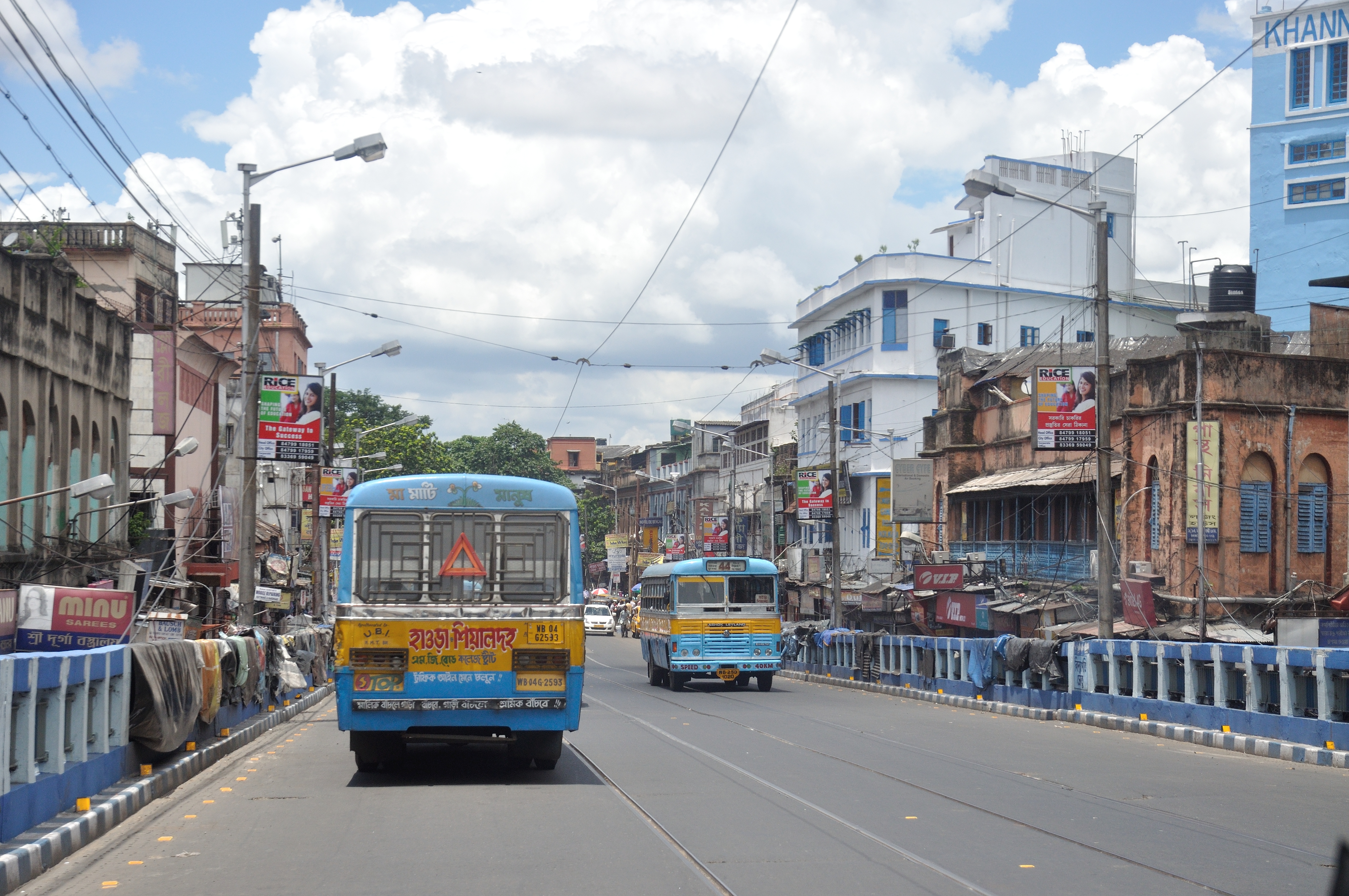 Vidyapati Setu, MG Road, Sealdah (also known as Sealdah flyover)


West Bengal[edit | edit source]
References[edit | edit source]
- ↑ Nripati Ghoshal (May 2006). Odyssey of an Indian Bureaucrat. iUniverse. pp. 17–. ISBN 978-0-595-34753-7. Retrieved 9 June 2013.
- ↑ Sarina Singh (15 September 2010). Lonely Planet India. Lonely Planet. pp. 506–. ISBN 978-1-74220-347-8. Retrieved 9 June 2013.
- ↑ Geoffrey Moorhouse (5 April 2012). Calcutta. Faber & Faber. pp. 280–. ISBN 978-0-571-28113-8. Retrieved 9 June 2013.
- ↑ "Let there be light". The Telegraph (Calcutta). Archived from the original on 29 April 2009. Retrieved 9 June 2013.
- ↑ "Rajasthan meets Attica". The Telegraph (Calcutta). Archived from the original on 30 April 2003. Retrieved 9 June 2013.
- ↑ "An early airbrush artist". The Telegraph (Calcutta). Archived from the original on 2 April 2009. Retrieved 9 June 2013.
- ↑ "A new India mob at Raj Bhavan curfew no bar Gandhi fast Anglo-indians au revoir free Boroline". The Telegraph (Calcutta). 26 April 2009. Archived from the original on 20 August 2010. Retrieved 9 June 2013.
- ↑ "Drive Against Mahatma". The Vancouver Sun. 1 April 1930. Retrieved 9 June 2013.
- ↑ 9.0 9.1 "Kolkata City Guide".
{{cite web}}: Missing or empty|url=(help) (in Bengali) - ↑ 10.0 10.1 10.2 "Culture Mahtma Gandhi Road". Ask Laila. Archived from the original on 24 March 2013. Retrieved 9 June 2013.
- ↑ Rabindranath Tagore. "Ekdin Rate". Rabindra Rachanabali. nltr.org.
