


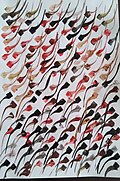


Created page with "{{Short description|The predominant style in Persian calligraphy}} {{Hatnote|The Nastaliq text on this page will show in a different style if you do not have a Nastaliq font i..." |
m enhanced layout additionally and added references for clarity |
||
| Line 1: | Line 1: | ||
{{Short description| | {{Short description|Predominant calligraphic hand of the Perso-Arabic script}} | ||
{{Hatnote|The Nastaliq text on this page will show in a different style if you do not have a Nastaliq font installed.{{ | {{Hatnote|The Nastaliq text on this page will show in a different style if you do not have a Nastaliq font installed.}} | ||
{{Infobox writing system | {{Italic title}} | ||
| name | |||
| type | {{Cleanup lang|date=August 2025}}{{Infobox writing system | ||
| languages = | | name = Nastaliq | ||
| sample | | type = [[Abjad]] | ||
| caption | | languages = [[Persian language#Classical Persian|Classical Persian]]<br />[[Urdu]]<br />[[Kashmiri language|Kashmiri]]<br />[[Punjabi language|Punjabi]]<br />[[Turkic languages]] | ||
| imagesize = 200px | | time = 14th century AD – present | ||
| iso15924 | | native_name = {{nq|نَسْتَعْلِیق}} | ||
| note | | sample = Welcome to Wikipedia - fa.svg | ||
| direction = [[ | | caption = "Welcome to Wikipedia" from the [[Persian Wikipedia]] | ||
| imagesize = 200px | |||
| iso15924 = Aran | |||
| note = none | |||
| direction = [[Right-to-left]]<ref>{{Cite conference|last1=Akram|first1=Qurat ul Ain|last2=Hussain|first2=Sarmad|last3=Niazi|first3=Aneeta|last4=Anjum|first4=Umair|last5=Irfan|first5=Faheem|title=2014 11th IAPR International Workshop on Document Analysis Systems|date=April 2014|chapter=Adapting Tesseract for Complex Scripts: An Example for Urdu Nastalique|conference=11th IAPR International Workshop on Document Analysis Systems|location=Tours, France|publisher=IEEE|volume=|pages=191–195|doi=10.1109/DAS.2014.45|isbn=978-1-4799-3243-6}}</ref> | |||
| region = Commonly used in [[Iran]], [[Pakistan]], [[Afghanistan]], [[India]] and [[Xinjiang]]<br>Historically used in [[Iraq]], [[Turkey]], [[Uzbekistan]], [[Bangladesh]], [[Turkmenistan]] and [[Tajikistan]] | |||
}} | }} | ||
{{Calligraphy}} | {{Calligraphy|Signed_Sami_-_Levha_(calligraphic_inscription)_-_Google_Art_Project.jpg}} | ||
[[File:Khatt-e Nastaliq.jpg|thumb|right| | |||
[[File: | Example reading {{lang|fa|{{nq|"خط نڛتعليق"}}}} ("Nastaliq script") in Nastaliq. | ||
<br/>The dotted form <big>{{Script/Arabic|ڛ}}</big> is used in place of <big>{{Script/Arabic|س}}</big>.]] | |||
{{ | |||
'''''Nastaliq'''''{{efn|({{IPAc-en|ˌ|n|æ|s|t|ə|ˈ|l|iː|k|,_|ˈ|n|æ|s|t|ə|l|iː|k}};<ref>{{Cite web|title=Nastaliq|url=https://www.lexico.com/definition/nastaliq|archive-url=https://web.archive.org/web/20220328182321/https://www.lexico.com/definition/nastaliq|url-status=dead|archive-date=March 28, 2022|access-date=2020-07-05|website=Lexico Dictionaries|publisher=[[Oxford University Press]]|language=en}}</ref> {{IPA|fa|'nastaʔ'liːq|lang}}; {{IPA|ur|nəst̪əʔ'liːq, nəst̪ɑː'liːq|lang}}); also [[Romanization of Persian|romanized]] as '''''Nastaʿlīq''''' or '''''Nastaleeq''''' or '''''Nastaaleeq''''' ({{nq|نَسْتَعْلِیق}})}} is one of the main [[book hand|calligraphic hands]] used to write the [[Persian language|Persian]] and [[Arabic scripts]], and it is used for several significant [[Indo-Iranian languages]] (namely all [[Iranian languages|Iranic]] and some [[Indo-Aryan languages|Indo-Aryan]] languages), predominantly [[Persian language|Persian]], [[Kurdish language|Kurdish]], [[Pashto]], [[Balochi language|Balochi]], [[Urdu]], [[Sindhi language|Sindhi]], [[Saraiki language|Saraiki]], [[Kashmiri language|Kashmiri]] and [[Shahmukhi|Punjabi]]. It is also often used for [[Ottoman Turkish]], but rarely for [[Arabic]] (particularly in [[Iraq]]). ''Nastaliq'' developed in [[Iran]] from a combination of ''[[Naskh (script)|Naskh]]'' and ''[[Taliq script|Ta'liq]]'', beginning in the 13th century{{sfn|Blair|p=xxii, 286}}<ref name="Iranica">{{Cite web |author=Gholam-Hosayn Yusofi |date=December 15, 1990 |title=Calligraphy |url=https://www.iranicaonline.org/articles/calligraphy |website=[[Encyclopædia Iranica]] |language=en}}</ref> and it remains widely used in [[Iran]], [[India]], [[Pakistan]], [[Afghanistan]], and other countries for writing poetry and as a form of art.<ref>{{Cite journal|author1=Atif Gulzar|author2=Shafiq ur Rahman|date=2007|title=Nastaleeq: A challenge accepted by Omega|url=https://www.tug.org/TUGboat/tb29-1/tb91gulzar.pdf|journal=TUGboat|volume=29|pages=1–6}}</ref> | |||
== History == | == History == | ||
[[File: | [[File:Coin of Nader Shah, minted in Daghestan (Dagestan). Reverse.jpg|300px|thumb|Nastaliq writing style in Silver coin of [[Nader Shah]], minted in [[Daghestan]]. Dated 1741/2. Reverse. ]] | ||
The name ''Nastaliq'' "is a contraction of the Persian {{transliteration|fa|naskh-e ta'liq}} ({{langx|fa|{{nq|نَسْخِ تَعلیق}}}}), meaning a hanging or suspended ''[[Naskh (script)|naskh.]]''"{{sfn|Blair|p=274}} Virtually all [[Safavid Iran|Safavid]] authors (like [[Dust Muhammad]] or [[Ahmad Monshi Ghomi|Qadi Ahmad]]) attributed the invention of {{transliteration|fa|nastaliq}} to [[Mir Ali Tabrizi]], who lived at the end of the 14th and the beginning of the 15th century. That tradition was questioned by Elaine Wright, who traced the evolution of ''Nastaliq'' in 14th-century Iran and showed how it developed gradually among scribes in [[Shiraz]]. According to her studies, ''nastaliq'' has its origin from ''naskh'' alone, and not by combining ''naskh'' and ''[[Taliq script|taliq]]'', as was commonly thought. In addition to study of the practice of calligraphy, Elaine Wright also found a document written by [[Jafar Tabrizi]] {{Circa|1430}}, according to whom: | |||
{{ | [[File:In Nasta'liq calligraphy, dimensions and sizes are determined using the dot of Nasta'liq and small approximate circles. In the hypothetical word TAAD, observe the dotting and dimensioning.png|300px|thumb|In Nasta'liq calligraphy, dimensions and sizes are determined using the dot of Nasta'liq and small approximate circles. In the hypothetical word TAAD (Persian: طعد), observe the dotting and dimensioning]] | ||
{{blockquote|It must be known that ''nastaʿliq'' is derived from ''naskh''. Some Shirazi [scribes] modified it [naskh] by taking out the flattened [letter] ''kaf'' and straight bottom part of [the letters] ''sin'', ''lam'' and ''nun''. From other scripts they then brought in a curved ''sin'' and stretched forms and introduced variations in the thickness of the line. So a new script was created, to be named ''nastaʿliq''. After a while [[Tabriz]]i [scribes] modified what Shirazi [scribes] had created by gradually rendering it thinner and defining its canons, until the time when Khwaja Mir ʿAli Tabrizi brought this script to perfection.{{sfn|Blair|p=275}}}} | |||
[[File:Nastaliq Painting-Caligraphy the letter Mim.jpg|thumb|alt=210|Nastaliq [[Persian Calligram]] the [[Persian alphabet|Persian letter]] [[Mem]]]] | |||
Thus, "our earliest written source also credits Shirazi scribes with the development of ''nastaʿliq'' and Mir ʿAli Tabrizi with its canonization."{{sfn|Blair|p=275}} Wright's proposed origin of ''nastaliq'' was complicated by studies of Francis Richard, who argued on the basis of some manuscripts from Tabriz that its early evolution was not confined to Shiraz.{{sfn|Blair|p=275}} Finally, many authors point out that development of ''nastaʿliq'' was a process which occurred over several centuries. For example, Gholam-Hosayn Yusofi, Ali Alparslan and [[Sheila Blair]] recognize a gradual shift towards ''nastaʿliq'' in some 13th-century manuscripts.<ref name="Iranica"/><ref>{{Cite journal|url = http://dx.doi.org/10.1163/1573-3912_islam_COM_0502|title = K̲h̲aṭṭ ii. In Persia|author = [[Ali Alparslan]]|website = [[Encyclopaedia of Islam]]|doi = 10.1163/1573-3912_islam_COM_0502|language = en|url-access = subscription}}</ref>{{sfn|Blair|p=xxii}} Hamid Reza Afsari traces the first elements of the style to 5th/11th-century copies of Persian translations of the Qur'an, and Rawāqī argues that the referenced translations may be even older.<ref name="Hamid Reza Afsari">{{Cite web|url = https://referenceworks.brillonline.com/entries/encyclopaedia-islamica/calligraphy-COM_05000067?s.num=3|title = Calligraphy|author = Hamid Reza Afsari|website = [[Encyclopaedia Islamica]]|date = 17 June 2021|language = en}}</ref> | |||
Persian differs from Arabic in its proportion of straight and curved letters. It also lacks the definite article ''al-'', whose upright ''alif'' and ''lam'' are responsible for Arabic writing's distinct verticality and rhythm. Hanging scripts like ''taliq'' and ''nastaliq'' were suitable for writing Persian {{Ndash}}when ''taliq'' was used for court documents, ''nastaliq'' was developed for Persian poetry, "whose [[hemistich]]es encourage the pile-up of letters against the intercolumnar ruling. Only later was it adopted for prose."{{sfn|Blair|p=276}} | |||
The first master of ''nastaliq'' was the aforementioned [[Mir Ali Tabrizi]], who passed his style to his son ʿUbaydallah. A student of ʿUbaydallah, [[Jafar Tabrizi]] (d. 1431) (see quote above), moved to [[Herat]], when he became the head of the [[scriptorium]] (''kitabkhana'') of prince [[Baysunghur]] (therefore his epithet Baysunghuri). Jafar trained several students in ''nastaliq'', of whom the most famous was [[Maulana Azhar|Azhar Tabrizi]] (d. 1475). Its classical form ''nastaliq'' achieved{{Incomprehensible inline|date=August 2025}} under [[Sultan Ali Mashhadi]] (d. 1520), a student of Azhar (or perhaps one of Azhar's students) who worked for [[Sultan Husayn Bayqara]] (1469–1506) and his vizier [[Ali-Shir Nava'i]].{{sfn|Blair|p=277-280}} | |||
Simultaneously, a different style of ''nastaliq'' developed in western and southern Iran. This style was associated with ʿAbd al-Rahman Khwarazmi, the calligrapher of the [[Pir Budaq]] [[Qara Qoyunlu]] (1456–1466), and then with his children, ʿAbd al-Karim Khwarazmi and [[ʿAbd al-Rahim Khwarazmi Anisi|ʿAbd al-Rahim Anisi]] (both active at the court of [[Yaqub Aq Qoyunlu|Ya'qub Beg]] [[Aq Qoyunlu]]; 1478–1490). This more angular western Iranian style was largely dominant at the beginning of the [[Safavid Iran|Safavid era]], but then lost to the style canonized by Sultan Ali Mashhadi; however, it continued to be used in the Indian subcontinent.<ref name="Hamid Reza Afsari" />{{sfn|Blair|p=284, 430}} | |||
The most famous calligrapher of the next generation in eastern lands was [[Mir Ali Heravi]] (d. 1544), who was especially renowned for his calligraphic specimens (''qitʿa''). The eastern style of ''nastaliq'' became the predominant style in western Iran, as artists gravitated to work in the Safavid royal scriptorium. The most famous of these calligraphers working for the court in Tabriz was Shah Mahmud Nishapuri (d. 1564/1565), known especially for the unusual choice of ''nastaliq'' as a script used for the copy of the Qur'an.{{sfn|Blair|p=430-436}} Its apogeum ''nastaliq'' achieved{{Incomprehensible inline|date=August 2025}} in writings of [[Mir Emad Hassani]] (d. 1615), "whose style was the model in the following centuries."<ref name="Hamid Reza Afsari" /> Mir Emad's successors in the 17th and 18th centuries developed a more elongated style of ''nastaliq'', with wider spaces between words. [[Mirza Mohammad Reza Kalhor]] (d. 1892), the most important calligrapher of the 19th century, reintroduced the more compact style, writing words on a smaller scale in a single motion. In the 19th century ''nastaliq'' was also adopted in Iran for lithographed books.{{sfn|Blair|p=446-447}} In the 20th century, "the use of ''nastaliq'' declined. After World War II, however, interest in calligraphy and above all in ''nastaliq'' revived, and some outstandingly able masters of the art have since then emerged."<ref name="Iranica" /> | |||
{{ | The use of ''nastaliq'' early expanded beyond Iran at a very early date. [[Timurid Empire|Timurids]] brought it to the [[Indian subcontinent]], and ''nastaliq'' became the favorite script of the Persian court of the [[Mughal Empire|Mughals]]. Notable masters of ''nastaliq'' such as [[Muhammad Husayn Kashmiri]] (d. 1611/1612) and [[Abd al-Rahim Anbarin-Qalam]] worked for [[Akbar]] (1556–1605) and [[Jahangir]] (1605–1627). Another important practitioner of the script was [[Abd al-Rashid Daylami]] (d. 1671), nephew and student of Mir Emad, who became court calligrapher of [[Shah Jahan]] (1628–1658) after arriving in India. During this era, ''nastaliq'' became the common script for writing the [[Hindustani language]], especially [[Standard Urdu]].<ref name="Iranica2">{{Cite web|url = https://www.iranicaonline.org/articles/calligraphy-2|title = CALLIGRAPHY (continued)|author = [[Gholam-Hosayn Yusofi]]|website = [[Encyclopædia Iranica]]|language = en}}</ref>{{sfn|Blair|p=536-539, 552-554}} | ||
''Nastaliq'' was also adopted in the [[Ottoman Empire]], which has always had strong cultural ties to Iran. Here it was known as ''taliq'' (Turkish ''talik''), not to be confused with the Persian ''[[taliq script]]''. The first Iranian calligraphers who brought ''nastaliq'' to Ottoman lands, including [[Asadullah Kirmani]] (d. 1488), belonged to the western tradition. However, at a relatively early stage, Ottoman calligraphers adopted the eastern style of ''nastaliq''. In the 17th century, a student of Mir Emad, [[Darvish Abdi Bokharai]] (d. 1647), transplanted his style to Istanbul. The greatest master of ''nastaliq'' in 18th century was [[Mehmed Esad Yesari|Mehmed Yasari]] (d. 1798), who closely followed Mir Emad. This tradition was further developed by Yasari's son [[Yesarizade Mustafa Izzet Efendi|Mustafa Izzet]] (d. 1849), who founded a distinct Ottoman school of ''nastaliq''. He introduced new and precise proportions of the script that differed from the Iranian tradition. The most important member of this school in the second half of the 19th century was [[Sami Efendi]] (d. 1912), who taught many famous practitioners of ''nastaliq'', including [[Mehmed Nazif Bey]] (d. 1913), [[Mehmed Hulusi Yazgan]] (d. 1940) and [[Necmeddin Okyay]] (d. 1976). The specialty of the Ottoman school was ''celî nastaliq'', used in inscriptions and mosque plates.{{sfn|Blair|p=513-518}}<ref name="Iranica2" /><ref name="NESTA‘LİK">{{Cite web|url = https://islamansiklopedisi.org.tr/nestalik|title = NESTA'LİK|author = [[Ali Alparslan]]|website = [[İslâm Ansiklopedisi]]|language = en}}</ref> | |||
[[ | |||
{{ | |||
{{gallery | |||
|Folio from a Khusraw u Shirin by Nizami (d.1209); verso - text and illuminated heading (sarlawh) (F1931.37).jpg|Opening page to a copy of [[Nizami Ganjavi|Nizami's]] ''[[Khosrow and Shirin]]'' with calligraphy by [[Mir Ali Tabrizi]]. [[Tabriz]], {{Circa|1410}}. [[Freer Gallery of Art]] | |||
|First Page of the Baysunghur's Gulistan (CBL Per119.10f.1.v).jpg|Opening page from a manuscript of [[Saadi Shirazi|Saʿdi's]] ''[[Gulistan (book)|Gulistan]]'' copied by [[Jafar Tabrizi]]. [[Herat]], 1426/27. [[Chester Beatty Library]] | |||
|"Allusion to Sura 27-16", Folio from a Mantiq al-tair (Language of the Birds) MET DP159398.jpg|Page from a manuscript of [[Attar of Nishapur|Attar's]] ''[[The Conference of the Birds|Mantiq al-Tayr]]'' copied by [[Sultan Ali Mashhadi]]. [[Herat]], dated 25 April 1487. [[Metropolitan Museum of Art]] | |||
|Colophon to Nizami's "Khamsa" written by 'Abd al-Rahim al- Khwarazmi Anisi (TKS H762, f. 316a).jpg|Colophon to Nizami's ''Khamsa'' copied by [[ʿAbd al-Rahim Khwarazmi Anisi]]. Tabriz, 1481. [[Topkapı Palace]] Museum | |||
|"Portrait of Ibrahim 'Adil Shah II of Bijapur", Folio from the Shah Jahan Album MET DT2792.jpg|[[Rubaʿi]] copied by [[Mir Ali Heravi]] and later mounted in the so-called "Kevorkian Album". [[Bukhara]], {{Circa|1534}}. Metropolitan Museum of Art | |||
|Opening double page from the Qur'an in nasta'liq script (TKS H.S. 25, ff. 1b-2a).jpg|Opening double page from the Qur'an manuscript copied by [[Shah Mahmud Nishapuri]], dated 12 June 1538. Topkapı Palace Museum | |||
|Nasta'liq calligraphy style - Mir Emad Hassani 09.png|Sura [[Al-Fatiha]] copied by [[Mir Emad Hassani]]. [[Museum of the Islamic Era]] | |||
|Colophon from the Khamsa of Nizami - BL Or. MS 12208 f. 325v.jpg|Colophon from a [[Khamsa of Nizami (British Library, Or. 12208)|manuscript]] of Nizami's ''Khamsa'' copied by [[Abd al-Rahim Anbarin-Qalam]], dated 14 December 1595. [[British Library]] | |||
|Amir Khusraw Dihlavi - Incipit Page with Illuminated Headpiece - Walters W6241B - Full Page.jpg|Page from a manuscript of [[Amir Khusrau]]'s ''Khamsa'' copied by [[Muhammad Husayn Kashmiri]] and finished in the forty-second year of [[Akbar]]'s reign (March 1597 – March 1598). [[Walters Art Museum]] | |||
|Calligrapher’s license with a quatrain copied by Muhammad Asʿad Yasari (TKS GY 324.27-3).jpg|Calligrapher's license with a rubaʿi copied by [[Mehmed Esad Yesari|Mehmed Yasari]] from an exemplar by Mir Emad. [[Istanbul]], 1754. Topkapı Palace Museum | |||
|Signed Sami - Levha (calligraphic inscription) - Google Art Project.jpg|''Levha'' (calligraphic inscription) by [[Sami Efendi]]. Istanbul, 1906. [[Sakıp Sabancı Museum]] | |||
|Containing calligraphies ascribed to Nazif Bey - Murakka (calligraphic album) - Google Art Project.jpg|Page from the ''[[muraqqa]]'' with [[Khaqani]]'s ode on the Prophet copied by [[Mehmed Nazif Bey]] from an original by [[Yesarizade Mustafa Izzet Efendi|Mustafa Izzet]]. 20th century (before 1913). Sakıp Sabancı Museum | |||
}} | |||
== {{transliteration|fa|Shekasteh}} ''Nastaliq'' == | |||
[[File:Chayyam guyand kasan behescht ba hur chosch ast small.png|thumb|A [[rubaʿi]] of Omar Khayyam in Shekasteh Nastaliq.<br/>In print:{{rtl-para|fa|{{Nastaliq|1={{raise|0.4em|گویند کسان بهشت با حور خوش است<br/>من میگویم که آب انگور خوش است<br/>این نقد بگیر و دست از آن نسیه بدار<br/>کاواز دهل شنیدن از دور خوش است|size=1.25em}}}}}} In modern [[Naskh (script)|Naskh]]: {{rtl-para|fa|{{naskh|1={{lower|0.2em|گویند کسان بهشت با حور خوش است<br/>من میگویم که آب انگور خوش است<br/>این نقد بگیر و دست از آن نسیه بدار<br/>کاواز دهل شنیدن از دور خوش است}}}}}}]] | |||
[[File:Ghafeleye Omr.svg|thumb|A line of poetry by the Iranian poet [[Omar Khayyam]] in Shekasteh Nastaliq.<br/>In print: {{rtl-para|fa|{{nastaliq|1={{raise|0.4em|این قافلهٔ عُمر عجب میگذرد|size=1.25em}}}}}} In modern [[Naskh (script)|Naskh]]: {{rtl-para|fa|{{naskh|1={{lower|0.2em|2=<span style="line-height: 1.5;">این قافلهٔ عُمر عجب میگذرد</span>}}}}}}]] | |||
''{{transliteration|fa|Shekasteh}}'' or ''{{transliteration|fa|Shekasteh Nastaliq}}'' ({{langx|fa|{{Nastaliq|شکسته نستعلیق}}}}, {{lang|fa|{{uninaskh|شکسته نستعلیق}}}}, "cursive {{transliteration|fa|Nastaliq}}" or literally "broken {{transliteration|fa|Nastaliq}}") style is a "streamlined" form of {{transliteration|fa|Nastaliq}}.<ref name="readnast3">{{Cite book |last1=Spooner |first1=Brian |title=Reading Nasta'liq: Persian and Urdu Hands from 1500 to the Present |last2=Hanaway |first2=William L. |year=1995 |isbn=978-1568592138 |pages=3 |publisher=Mazda Publishers }}</ref> Its development is connected with the fact that "the increasing use of nastaʿlīq and consequent need to write it quickly exposed it to a process of gradual attrition."<ref name="Iranica"/> The ''shekasteh nastaliq'' emerged in the early 17th century and differed from proper ''nastaliq'' only in so far as some of the letters were shrunk (shekasteh, lit. "broken") and detached letters and words were sometimes joined.<ref name="Iranica"/> These unauthorized connections "mean that calligraphers can write ''shekasteh'' faster than any other script."{{sfn|Blair|p=441}} Manuscripts from this early period show signs of the influence of ''shekasteh taliq''; while having the appearance of a shrunken form of nastaliq, they also contain features of ''[[Taliq script|taliq]]'' "due to their being written by scribes who had been trained in taʿlīq."<ref name="Iranica"/> ''Shekasteh nastaliq'' (usually shortened to simply ''skehasteh''), being more easily legible than ''taliq'' gradually replaced the latter as the script of decrees and documents. Later, it also came into use for writing prose and poetry.<ref name="Iranica"/>{{sfn|Blair|p=441}} | |||
The first important calligraphers of ''shekasteh'' were [[Mohammad Shafiʿ Heravi]] (d. 1670–71) (he was known as Shafiʿa and hence ''shekasteh'' was sometimes called ''shafiʿa'' or ''shifiʿa'') and [[Mortazaqoli Khan Shamlu]] (d. 1688–89). Both of them produced works of real artistic quality, which does not change the fact that in this early phase ''shekasteh'' still lacked consistency (it is especially visible in writing of Mortazaqoli Khan Shamlu). Most modern scholars consider that ''shekasteh'' reached its peak of artistic perfection under [[Abdol Majid Taleqani]] (d. 1771), "who gave the script its distinctive and definite form."<ref name="Iranica"/> The tradition of Taleqani was later followed by [[Mirza Kuchek Esfahani]] (d. 1813),{{sfn|Blair|p=444-445}}<ref>{{Cite web|url = https://www.iranicaonline.org/articles/abd-al-majid-talaqani-revered-calligrapher-d-1771-72|title = ʿABD-AL-MAJĪD ṬĀLAQĀNĪ|author = [[Priscilla Soucek]]|website = [[Encyclopædia Iranica]]|language = en}}</ref> [[Mirza Gholam Reza Esfahani|Gholam Reza Esfahani]] (d. 1886–87)<ref>{{Cite web|url = https://www.iranicaonline.org/articles/golam-reza-kosnevis|title = ḠOLĀM-REŻĀ ḴOŠNEVIS|author = Maryam Ekhtiar|website = [[Encyclopædia Iranica]]|language = en}}</ref> and [[Ali Akbar Golestaneh]] (d. 1901).<ref>{{Cite web|url = https://www.iranicaonline.org/articles/golestana-ali-akba|title = GOLESTĀNA, ʿALI-AKBAR|author = Maryam Ekhtiar|website = [[Encyclopædia Iranica]]|language = en}}</ref> | |||
< | The added frills made ''shekasteh'' increasingly difficult to read and it remained the script of documents and decrees, "while ''nastaʿliq'' retained its pre-eminence as the main calligraphic style." The need for simplification of ''shekasteh'' resulted in development of secretarial style (''shekasteh-ye tahriri'') by writers like [[Adib-al-Mamalek Farahani]] (d. 1917) and [[Hasan Ali Khan Garroosy|Nezam Garrusi]] (d. 1900). The secretarial style is a simplified form of ''shekasteh'' which is faster to write and read, but less artistic. Long used in governmental and other institutions in Iran, ''shekasteh'' degenerated in the first half of the 20th century, but later again engaged the attention of calligraphers.<ref name="Iranica"/>{{sfn|Blair|p=445, 471}} ''Shekasteh'' was used only in Iran and to a small extent in Afghanistan and Ottoman Empire. Its use in Afghanistan was different from the Persian norm and sometimes only as experimental devices (''tafannon'')<ref name="Iranica"/><ref name="NESTA‘LİK"/> | ||
File: | {{gallery | ||
|Shakastah Nasta‘liq calligraphy, National Library of Iran, No. 2313.jpg|Calligraphy by [[Mohammad Shafiʿ Heravi]]. [[National Library of Iran]] | |||
|File:Double page from "Majmu‘a-i munsh‘at" by Abu‘l-Qasim Ivughli Haydar (S2014.7).jpg|Double page from the "Majmu‘a-i munsh‘at" – collection of correspondence sent by Persian rulers compiled by Abu‘l-Qasim Ivughli Haydar. [[Isfahan]], 1682. [[Arthur M. Sackler Gallery]] | |||
|Calligraphy in Shakastah Nasta‘liq (Library of the Golestan Palace, No. 1515).jpg|Calligraphy by [[Abdol Majid Taleqani]]. [[Golestan Palace]] Library | |||
|Plea for Tax Relief, folio from an album (HUAM 1958.212).jpg|Plea for tax relief copied by [[Mirza Kuchak Esfahani]]. Iran, 1795–1796. [[Harvard Art Museums]] | |||
|Fath Ali Shah Qajar Firman in Shikasta Nastaliq script January 1831.jpg|[[Firman]] issued in the Name of [[Fath-Ali Shah Qajar]]. Iran, January 1831. [[Metropolitan Museum of Art]] | |||
|Shakastah Nasta‘liq calligraphy, 1896 CE, Library of the Islamic Parliament of Iran, No. 13.jpg|Calligraphy by [[Ali Akbar Golestaneh]]. Iran, 1896. Library of the [[Islamic Consultative Assembly|Islamic Parliament of Iran]] | |||
}} | |||
{{Clear}} | {{Clear}} | ||
== | == ''Nastaliq'' typesetting == | ||
[[ | Modern {{transliteration|fa|Nastaliq}} typography began with the invention of [[Noori Nastaliq]] which was first created as a digital font in 1981 through the collaboration of [[Ahmed Mirza Jamil]] (as calligrapher) and [[Monotype Imaging]] (formerly Monotype Corp & Monotype Typography).<ref name="Interview with Mirza Ahmad Jamil">{{cite web|last=Khurshiq|first=Iqbal|title=زندگی آگے بڑھنے کا نام اور جمود موت ہے: نوری نستعلیق کی ایجاد سے خط نستعلیق کی دائمی حفاظت ہوگئی|date=17 November 2013|url=http://www.express.pk/story/197175/|publisher=Express|access-date=24 November 2013}}</ref> Although this employed over 20,000 ligatures (individually designed character combinations),<ref>[https://restofworld.org/2021/bringing-urdu-into-the-digital-age/ How to bring a language to the future], 9 Feb 2021</ref> it provided accurate results and allowed newspapers such as Pakistan's ''[[Daily Jang]]'' to use digital typesetting instead of a group of calligraphers. It suffered from two problems in the 1990s: its non-availability on standard platforms such as [[Microsoft Windows]] or [[Mac OS]], and the non-[[WYSIWYG]] nature of text entry, whereby the document had to be created by commands in Monotype's proprietary [[page description language]]. | ||
< | |||
{{Gallery | |||
| title = Examples of Nastaliq typesetting | |||
| align = center | |||
| footer = | |||
| style = | |||
| state = | |||
| height = 170 | |||
| width = 250 | |||
| captionstyle = | |||
| File:Miremad-1.jpg | |||
| Persian [[Chalipa]] panel, [[Mir Emad]]<br/> | |||
In print:<sup>[[#Nastaliq typesetting|[note]]]</sup> | |||
{{rtl-para|fa|{{Nastaliq|1={{raise|1em|بودم به تو عمری و ترا سیر ندیدم<br/>از وصل تو هرگز به مرادی نرسیدم<br/>از بهر تو بیگانه شدم از همه خویشان<br/>وحشی صفت از خلق به یکبار بریدم|size=1.25em}}}}}} | |||
In [[Naskh (script)|Naskh]] styled typeface: | |||
{{rtl-para|fa|{{naskh|1={{lower|0.2em|2=<span style="line-height: 1.3;">بودم به تو عمری و ترا سیر ندیدم<br/>از وصل تو هرگز به مرادی نرسیدم<br/>از بهر تو بیگانه شدم از همه خویشان<br/>وحشی صفت از خلق به یکبار بریدم</span>}}}}}} | |||
| alt1= | |||
| File:Urdu couplet.svg | |||
| An example of the {{Transliteration|fa|Nastaliq}} script used for writing [[Urdu]].<br/>Nastaliq:<br/>{{rtl-para|{{lang|ur|{{nastaliq|size=1.25em|؎ کیا تنگ ہم ستم زدگان کا جہاں ہے<br/>جس میں ایک بیضۂ مور آسماں ہے}}}}}}<br/>Naskh:<br/>{{rtl-para|{{lang|fa|{{naskh|size=1.25em|1={{lower|0.2em|2=<span style="line-height: 1.3;">؎ کیا تنگ ہم ستم زدگان کا جہاں ہے<br/>جس میں ایک بیضۂ مور آسماں ہے</span>}}}}}}}} | |||
| alt2= | |||
| File:Hafez Ghazal.jpg | |||
| A [[couplet]] versified by the Persian poet [[Hafez]] in Nastaliq font (by Software), in print:<sup>[[#Nastaliq typesetting|[note]]]</sup> | |||
{{rtl-para|1=fa|2={{nq|1={{raise|0.5em| | |||
حافظ شیرازی<br/> | |||
مرا عهدیست با جانان که تا جان در بدن دارم<br/> | |||
هواداران کویش را چو جان خویشتن دارم | |||
|size=1.25em}}}}}} | |||
in a [[Naskh (script)|Naskh]] styled typeface: | |||
{{rtl-para|1=fa|2={{naskh|1={{lower|0.1em|2=<span style="line-height: 1.2;"> | |||
حافظ شیرازی<br/> | |||
مرا عهدیست با جانان که تا جان در بدن دارم<br/> | |||
هواداران کویش را چو جان خویشتن دارم | |||
</span>}}}}}} | |||
| alt3= | |||
| File: | |||
| Write a caption here | |||
| alt4= | |||
| File: | |||
| Write a caption here | |||
| alt5= | |||
}} | |||
{{Clear}} | {{Clear}} | ||
=== InPage === | === InPage === | ||
In 1994, [[InPage]] Urdu, which is a functional page layout software for Windows akin to [[QuarkXPress]], was developed for Pakistan's newspaper industry by an Indian software company Concept Software Pvt Ltd. It offered the ''Noori Nastaliq'' font licensed from Monotype Imaging. This font is still used in current versions of the software for Windows. As of 2009, [[InPage]] has become Unicode based, supporting more languages and the ''Faiz Lahori Nastaliq'' font with Kasheeda has been added to it along with compatibility with OpenType Unicode fonts. | |||
In 1994, [[InPage]] Urdu, which is a | |||
=== Cross platform Nastaliq fonts === | === Cross platform Nastaliq fonts === | ||
[[File:Urdu Typesetting 2020-05-30 003910.png|140px|thumb|right|Text: {{nq|1=<span style="line-height:2.5;">{{raise|0.1em|نستعلیق}}</span>}} in the font "Urdu Typesetting".]] | |||
[[File:Urdu Typesetting 2020-05-30 003910.png|140px|thumb|right| Text: {{nq|نستعلیق}} in the font "Urdu Typesetting".]] | * Windows 8 was the first version of Microsoft Windows to have native Nastaliq support, through Microsoft's "Urdu Typesetting" font.<ref>{{cite web|url=http://www.siao2.com/2011/11/16/10237715.aspx|title=The evolving Story of Locale Support, part 9: Nastaleeq vs. Nastaliq? Either way, Windows 8 has got it!|publisher=MSDN Blogs|access-date=2013-03-24}}</ref> | ||
* Windows 8 was the first version of Microsoft Windows to have native Nastaliq support, through Microsoft's "Urdu Typesetting" font.<ref>{{cite web|url=http://www.siao2.com/2011/11/16/10237715.aspx |title=The evolving Story of Locale Support, part 9: Nastaleeq vs. Nastaliq? Either way, Windows 8 has got it! |publisher=MSDN Blogs |access-date=2013-03-24}}</ref> | |||
[[File:Noto Nastaliq 2020-05-30 004037.png|140px|thumb | [[File:Noto Nastaliq 2020-05-30 004037.png|140px|thumb|Text: {{nq|1=<span style="line-height:2.5;">{{raise|0.1em|نستعلیق}}</span>}} in the font "Noto Nastaliq".]] | ||
* Google has an open-source Nastaliq font called [[Noto fonts|Noto Nastaliq Urdu]].<ref>{{Cite web|url=https://www.google.com/get/noto/#nastaliq-aran|title = Google Noto Fonts}}</ref> Apple provides this font on all Mac installations since macOS High Sierra. Likewise, Apple has carried this font on iOS devices since iOS 11.<ref>{{Cite web|url=https://tribune.com.pk/story/1514433/apple-finally-enables-nastaleeq-typeface-urdu-keyboard-ios-11/|title=Apple finally enables Nastaleeq typeface for Urdu keyboard in iOS 11|date=23 September 2017}}</ref> | * Google has an open-source Nastaliq font called [[Noto fonts|Noto Nastaliq Urdu]].<ref>{{Cite web|url=https://www.google.com/get/noto/#nastaliq-aran|title = Google Noto Fonts}}</ref> Apple provides this font on all Mac installations since macOS High Sierra. Likewise, Apple has carried this font on iOS devices since iOS 11.<ref>{{Cite web|url=https://tribune.com.pk/story/1514433/apple-finally-enables-nastaleeq-typeface-urdu-keyboard-ios-11/ |website=The Express Tribune |title=Apple finally enables Nastaleeq typeface for Urdu keyboard in iOS 11|date=23 September 2017}}</ref> | ||
* [[Awami Nastaliq]] features a more extensive character set than most Nastaliq typefaces, supporting: <!--Ref does not explicitly list all of these but Nastaliq is a style for Urdu | * [[Awami Nastaliq]] features a more extensive character set than most Nastaliq typefaces, supporting:<!--Ref does not explicitly list all of these but Nastaliq is a style for Urdu and if it can do Urdu, it also covers full Persian alphabet, specified Iranian because obviously it can't do Tajiki--> [[Urdu]], [[Balochi language|Balochi]], [[Persian language|Persian]], Khowar, Palula, Saraiki, Shina.<ref>{{cite web|title=What is Special About Awami Nastaliq? |url=http://software.sil.org/awami/what-is-special/|website=Awami Nastaliq, SIL Language Technology }}</ref> | ||
* [[Amar Nastaleeq]] was created for [[Embedded OpenType|web embedding]] on [[Urdu]] | * [[Amar Nastaleeq]] was created for [[Embedded OpenType|web embedding]] on [[Urdu]] websites in 2013. The font was announced by Urdu poet [[Fahmida Riaz]].<ref>{{Cite web|url=https://twitter.com/fahmidariaz/status/403607540698578944|title=Amar Nastaleeq Font for Urdu Web Publishing|first=fahmida|last=Riaz|website=Twitter |date=21 November 2013}}</ref> | ||
{{Clear}} | {{Clear}} | ||
== Letter forms == | == Letter forms == | ||
The ''Nastaliq'' style uses more than three general forms for many letters,<ref>{{cite web|last1=FWP|title=Urdu: some thoughts about the script and grammar, and other general notes for students assembled from years of classroom notes by FWP, 2006 onward. |url=http://www.columbia.edu/itc/mealac/pritchett/00urdu/urduscript/index.html|website=Columbia University in the City of New York |access-date=28 February 2020|archive-url=https://web.archive.org/web/20230406004235/http://www.columbia.edu/itc/mealac/pritchett/00urdu/urduscript/index.html|archive-date=2023-04-06}}</ref><ref name="Scanned table">{{cite web|title=The chart below gives the different positional variants of some of the significantly different letters. - Environment |url=http://www.columbia.edu/itc/mealac/pritchett/00urdu/urduscript/graphics/naimchart.gif|via=Columbia University in the City of New York |access-date=28 February 2020|archive-url=https://web.archive.org/web/20230407145904if_/http://www.columbia.edu/itc/mealac/pritchett/00urdu/urduscript/graphics/naimchart.gif|archive-date=2023-04-07|url-status=dead}}</ref> even in non-decorative documents. For example, most documents written in [[Urdu]] use the ''Nastaliq'' style. | |||
==In Unicode== | |||
{{see also|Arabic (Unicode block)}} | |||
Nastaliq is not separately encoded in [[Unicode]] as it is a particular style of Arabic script and not a writing system in its own right. Nastaliq letterforms are produced by choosing a Nastaliq [[font]] to display the text. | |||
== See also == | == See also == | ||
* [[Islamic calligraphy]] | * [[Islamic calligraphy]] | ||
* [[Persian calligraphy]] | * [[Persian calligraphy]] | ||
* [[Shahmukhi | * [[Shahmukhi|Shahmukhi script]] | ||
* [[Urdu alphabet]] | * [[Urdu alphabet]] | ||
* [[Ruqʿah script]] | * [[Ruqʿah script]] | ||
* [[Chalipa]] panel | |||
== Notes == | |||
{{Notelist}} | |||
== References == | == References == | ||
{{Reflist}} | {{Reflist}} | ||
== | == Bibliography == | ||
* Sheila Blair | * {{Cite book|last=Blair|year=2008|first=Sheila|author-link=Sheila Blair|title=Islamic Calligraphy|publisher=Edinburgh University Press|isbn=978-0748612123|ref={{SfnRef|Blair}}}} | ||
== External links == | == External links == | ||
{{Commons category|Nastaliq}} | {{Commons category|Nastaliq}} | ||
* [https://web.archive.org/web/20160304133208/http://rumicode.com/greetings-info-fa.html Rumicode]: Online Service For {{ | * [https://khattaatt.com/blogs/arabic-calligraphy-blog/nastaliq-script-the-poetic-flow-of-arabic-calligraphy KHATTAATT]: Nastaliq Script: The Poetic Flow of Arabic Calligraphy | ||
* [http://www.nastaliqonline.ir/ Nastaliq Online]: Online Service For {{ | * [https://web.archive.org/web/20160304133208/http://rumicode.com/greetings-info-fa.html Rumicode]: Online Service For {{transliteration|fa|Nastaliq}} Calligraphy | ||
* [http://www.nastaliqonline.ir/ Nastaliq Online]: Online Service For {{transliteration|fa|Nastaliq}} Calligraphy | |||
* [https://web.archive.org/web/20060207192912/http://anjomankhoshnevisan.ir/en/ Iranian Calligraphers Association] | * [https://web.archive.org/web/20060207192912/http://anjomankhoshnevisan.ir/en/ Iranian Calligraphers Association] | ||
* [http://www.sil.org/computing/catalog/show_software.asp?id=32 Nastaliq Writer] for Macintosh by [[SIL International|SIL]] | * [http://www.sil.org/computing/catalog/show_software.asp?id=32 Nastaliq Writer] for Macintosh by [[SIL International|SIL]] | ||
* [http://www.inpage.com/ InPage Urdu]: Official InPage Urdu DTP software site | * [http://www.inpage.com/ InPage Urdu]: Official InPage Urdu DTP software site | ||
* [http://www.faiznastaliq.com/ Faiz Nastaliq]: Official Faiz {{ | * [http://www.faiznastaliq.com/ Faiz Nastaliq]: Official Faiz {{transliteration|fa|Nastaliq}} site | ||
* [https://web.archive.org/web/20120608004825/http://www.calligraphyislamic.com/ Profiles and works of World Islamic calligraphy] {{in lang|fr}} | * [https://web.archive.org/web/20120608004825/http://www.calligraphyislamic.com/ Profiles and works of World Islamic calligraphy] {{in lang|fr}} | ||
* [https://web.archive.org/web/20100928182912/http://www.wegoiran.com/iran-information/iran-culture/nastaliq-script-persian-calligraphy.htm Nastaliq Script | * [https://web.archive.org/web/20100928182912/http://www.wegoiran.com/iran-information/iran-culture/nastaliq-script-persian-calligraphy.htm Nastaliq Script {{!}} Persian Calligraphy] | ||
* [http://software.sil.org/awami/ Awami Nastaliq]: A Nastaliq font by SIL International | * [http://software.sil.org/awami/ Awami Nastaliq]: A Nastaliq font by SIL International | ||
{{Islamic calligraphy}} | {{Islamic calligraphy}} | ||
| Line 171: | Line 184: | ||
[[Category:Urdu calligraphy]] | [[Category:Urdu calligraphy]] | ||
[[Category:Iranian inventions]] | [[Category:Iranian inventions]] | ||
[[Category:Handwriting script]] | |||
Latest revision as of 16:49, 18 March 2026
 | This article or section should specify the language of its non-English content, using {{lang}}, {{transliteration}} for transliterated languages, and {{IPA}} for phonetic transcriptions, with an appropriate ISO 639 code. Bharatpedia's multilingual support templates may also be used. (August 2025) |
| Nastaliq نَسْتَعْلِیق | |
|---|---|
 "Welcome to Wikipedia" from the Persian Wikipedia | |
| Script type | |
Time period | 14th century AD – present |
| Direction | Right-to-left[1] |
| Region | Commonly used in Iran, Pakistan, Afghanistan, India and Xinjiang Historically used in Iraq, Turkey, Uzbekistan, Bangladesh, Turkmenistan and Tajikistan |
| Languages | Classical Persian Urdu Kashmiri Punjabi Turkic languages |
| ISO 15924 | |
| ISO 15924 | Aran, , Arabic (Nastaliq variant) |

Nastaliq[lower-alpha 1] is one of the main calligraphic hands used to write the Persian and Arabic scripts, and it is used for several significant Indo-Iranian languages (namely all Iranic and some Indo-Aryan languages), predominantly Persian, Kurdish, Pashto, Balochi, Urdu, Sindhi, Saraiki, Kashmiri and Punjabi. It is also often used for Ottoman Turkish, but rarely for Arabic (particularly in Iraq). Nastaliq developed in Iran from a combination of Naskh and Ta'liq, beginning in the 13th century[3][4] and it remains widely used in Iran, India, Pakistan, Afghanistan, and other countries for writing poetry and as a form of art.[5]
History[edit | edit source]
._Reverse.jpg)
The name Nastaliq "is a contraction of the Persian naskh-e ta'liq (Persian: نَسْخِ تَعلیق), meaning a hanging or suspended naskh."[6] Virtually all Safavid authors (like Dust Muhammad or Qadi Ahmad) attributed the invention of nastaliq to Mir Ali Tabrizi, who lived at the end of the 14th and the beginning of the 15th century. That tradition was questioned by Elaine Wright, who traced the evolution of Nastaliq in 14th-century Iran and showed how it developed gradually among scribes in Shiraz. According to her studies, nastaliq has its origin from naskh alone, and not by combining naskh and taliq, as was commonly thought. In addition to study of the practice of calligraphy, Elaine Wright also found a document written by Jafar Tabrizi c. 1430, according to whom:

It must be known that nastaʿliq is derived from naskh. Some Shirazi [scribes] modified it [naskh] by taking out the flattened [letter] kaf and straight bottom part of [the letters] sin, lam and nun. From other scripts they then brought in a curved sin and stretched forms and introduced variations in the thickness of the line. So a new script was created, to be named nastaʿliq. After a while Tabrizi [scribes] modified what Shirazi [scribes] had created by gradually rendering it thinner and defining its canons, until the time when Khwaja Mir ʿAli Tabrizi brought this script to perfection.[7]

Thus, "our earliest written source also credits Shirazi scribes with the development of nastaʿliq and Mir ʿAli Tabrizi with its canonization."[7] Wright's proposed origin of nastaliq was complicated by studies of Francis Richard, who argued on the basis of some manuscripts from Tabriz that its early evolution was not confined to Shiraz.[7] Finally, many authors point out that development of nastaʿliq was a process which occurred over several centuries. For example, Gholam-Hosayn Yusofi, Ali Alparslan and Sheila Blair recognize a gradual shift towards nastaʿliq in some 13th-century manuscripts.[4][8][9] Hamid Reza Afsari traces the first elements of the style to 5th/11th-century copies of Persian translations of the Qur'an, and Rawāqī argues that the referenced translations may be even older.[10]
Persian differs from Arabic in its proportion of straight and curved letters. It also lacks the definite article al-, whose upright alif and lam are responsible for Arabic writing's distinct verticality and rhythm. Hanging scripts like taliq and nastaliq were suitable for writing Persian –when taliq was used for court documents, nastaliq was developed for Persian poetry, "whose hemistiches encourage the pile-up of letters against the intercolumnar ruling. Only later was it adopted for prose."[11]
The first master of nastaliq was the aforementioned Mir Ali Tabrizi, who passed his style to his son ʿUbaydallah. A student of ʿUbaydallah, Jafar Tabrizi (d. 1431) (see quote above), moved to Herat, when he became the head of the scriptorium (kitabkhana) of prince Baysunghur (therefore his epithet Baysunghuri). Jafar trained several students in nastaliq, of whom the most famous was Azhar Tabrizi (d. 1475). Its classical form nastaliq achieved[incomprehensible] under Sultan Ali Mashhadi (d. 1520), a student of Azhar (or perhaps one of Azhar's students) who worked for Sultan Husayn Bayqara (1469–1506) and his vizier Ali-Shir Nava'i.[12]
Simultaneously, a different style of nastaliq developed in western and southern Iran. This style was associated with ʿAbd al-Rahman Khwarazmi, the calligrapher of the Pir Budaq Qara Qoyunlu (1456–1466), and then with his children, ʿAbd al-Karim Khwarazmi and ʿAbd al-Rahim Anisi (both active at the court of Ya'qub Beg Aq Qoyunlu; 1478–1490). This more angular western Iranian style was largely dominant at the beginning of the Safavid era, but then lost to the style canonized by Sultan Ali Mashhadi; however, it continued to be used in the Indian subcontinent.[10][13]
The most famous calligrapher of the next generation in eastern lands was Mir Ali Heravi (d. 1544), who was especially renowned for his calligraphic specimens (qitʿa). The eastern style of nastaliq became the predominant style in western Iran, as artists gravitated to work in the Safavid royal scriptorium. The most famous of these calligraphers working for the court in Tabriz was Shah Mahmud Nishapuri (d. 1564/1565), known especially for the unusual choice of nastaliq as a script used for the copy of the Qur'an.[14] Its apogeum nastaliq achieved[incomprehensible] in writings of Mir Emad Hassani (d. 1615), "whose style was the model in the following centuries."[10] Mir Emad's successors in the 17th and 18th centuries developed a more elongated style of nastaliq, with wider spaces between words. Mirza Mohammad Reza Kalhor (d. 1892), the most important calligrapher of the 19th century, reintroduced the more compact style, writing words on a smaller scale in a single motion. In the 19th century nastaliq was also adopted in Iran for lithographed books.[15] In the 20th century, "the use of nastaliq declined. After World War II, however, interest in calligraphy and above all in nastaliq revived, and some outstandingly able masters of the art have since then emerged."[4]
The use of nastaliq early expanded beyond Iran at a very early date. Timurids brought it to the Indian subcontinent, and nastaliq became the favorite script of the Persian court of the Mughals. Notable masters of nastaliq such as Muhammad Husayn Kashmiri (d. 1611/1612) and Abd al-Rahim Anbarin-Qalam worked for Akbar (1556–1605) and Jahangir (1605–1627). Another important practitioner of the script was Abd al-Rashid Daylami (d. 1671), nephew and student of Mir Emad, who became court calligrapher of Shah Jahan (1628–1658) after arriving in India. During this era, nastaliq became the common script for writing the Hindustani language, especially Standard Urdu.[16][17]
Nastaliq was also adopted in the Ottoman Empire, which has always had strong cultural ties to Iran. Here it was known as taliq (Turkish talik), not to be confused with the Persian taliq script. The first Iranian calligraphers who brought nastaliq to Ottoman lands, including Asadullah Kirmani (d. 1488), belonged to the western tradition. However, at a relatively early stage, Ottoman calligraphers adopted the eastern style of nastaliq. In the 17th century, a student of Mir Emad, Darvish Abdi Bokharai (d. 1647), transplanted his style to Istanbul. The greatest master of nastaliq in 18th century was Mehmed Yasari (d. 1798), who closely followed Mir Emad. This tradition was further developed by Yasari's son Mustafa Izzet (d. 1849), who founded a distinct Ottoman school of nastaliq. He introduced new and precise proportions of the script that differed from the Iranian tradition. The most important member of this school in the second half of the 19th century was Sami Efendi (d. 1912), who taught many famous practitioners of nastaliq, including Mehmed Nazif Bey (d. 1913), Mehmed Hulusi Yazgan (d. 1940) and Necmeddin Okyay (d. 1976). The specialty of the Ottoman school was celî nastaliq, used in inscriptions and mosque plates.[18][16][19]
-
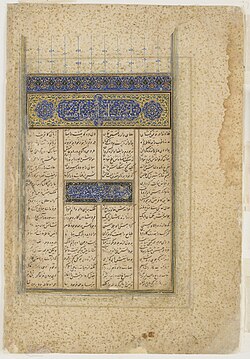 Opening page to a copy of Nizami's Khosrow and Shirin with calligraphy by Mir Ali Tabrizi. Tabriz, c. 1410. Freer Gallery of Art
 -
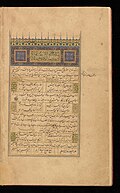 Opening page from a manuscript of Saʿdi's Gulistan copied by Jafar Tabrizi. Herat, 1426/27. Chester Beatty Library
 -
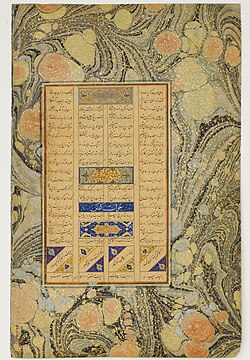 Page from a manuscript of Attar's Mantiq al-Tayr copied by Sultan Ali Mashhadi. Herat, dated 25 April 1487. Metropolitan Museum of Art
 -
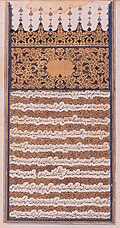 Colophon to Nizami's Khamsa copied by ʿAbd al-Rahim Khwarazmi Anisi. Tabriz, 1481. Topkapı Palace Museum
 -
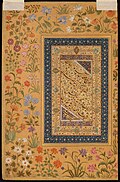 Rubaʿi copied by Mir Ali Heravi and later mounted in the so-called "Kevorkian Album". Bukhara, c. 1534. Metropolitan Museum of Art
 -
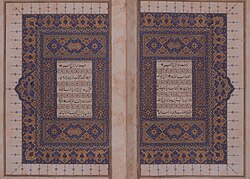 Opening double page from the Qur'an manuscript copied by Shah Mahmud Nishapuri, dated 12 June 1538. Topkapı Palace Museum
 -
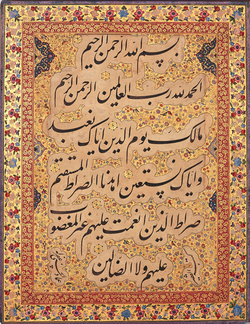
-
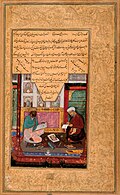 Colophon from a manuscript of Nizami's Khamsa copied by Abd al-Rahim Anbarin-Qalam, dated 14 December 1595. British Library
 -
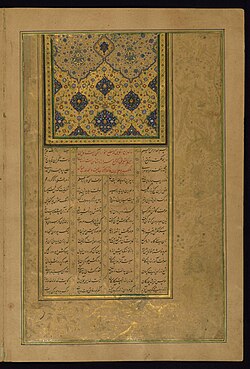 Page from a manuscript of Amir Khusrau's Khamsa copied by Muhammad Husayn Kashmiri and finished in the forty-second year of Akbar's reign (March 1597 – March 1598). Walters Art Museum
 -
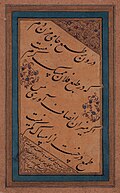 Calligrapher's license with a rubaʿi copied by Mehmed Yasari from an exemplar by Mir Emad. Istanbul, 1754. Topkapı Palace Museum
 -
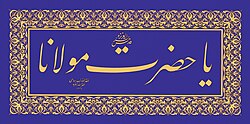 Levha (calligraphic inscription) by Sami Efendi. Istanbul, 1906. Sakıp Sabancı Museum
 -
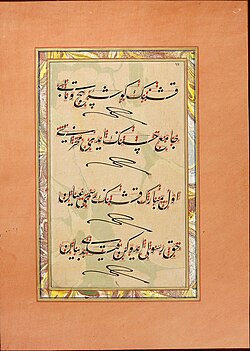 Page from the muraqqa with Khaqani's ode on the Prophet copied by Mehmed Nazif Bey from an original by Mustafa Izzet. 20th century (before 1913). Sakıp Sabancı Museum
;_verso_-_text_and_illuminated_heading_(sarlawh)_(F1931.37).jpg)
.jpg)
_MET_DP159398.jpg)
.jpg)

.jpg)


.jpg)
_-_Google_Art_Project.jpg)
_-_Google_Art_Project.jpg)
Shekasteh Nastaliq[edit | edit source]

In print:Template:Rtl-para In modern Naskh: Template:Rtl-para

In print: Template:Rtl-para In modern Naskh: Template:Rtl-para
Shekasteh or Shekasteh Nastaliq (Persian: شکسته نستعلیق, Template:Uninaskh, "cursive Nastaliq" or literally "broken Nastaliq") style is a "streamlined" form of Nastaliq.[20] Its development is connected with the fact that "the increasing use of nastaʿlīq and consequent need to write it quickly exposed it to a process of gradual attrition."[4] The shekasteh nastaliq emerged in the early 17th century and differed from proper nastaliq only in so far as some of the letters were shrunk (shekasteh, lit. "broken") and detached letters and words were sometimes joined.[4] These unauthorized connections "mean that calligraphers can write shekasteh faster than any other script."[21] Manuscripts from this early period show signs of the influence of shekasteh taliq; while having the appearance of a shrunken form of nastaliq, they also contain features of taliq "due to their being written by scribes who had been trained in taʿlīq."[4] Shekasteh nastaliq (usually shortened to simply skehasteh), being more easily legible than taliq gradually replaced the latter as the script of decrees and documents. Later, it also came into use for writing prose and poetry.[4][21]
The first important calligraphers of shekasteh were Mohammad Shafiʿ Heravi (d. 1670–71) (he was known as Shafiʿa and hence shekasteh was sometimes called shafiʿa or shifiʿa) and Mortazaqoli Khan Shamlu (d. 1688–89). Both of them produced works of real artistic quality, which does not change the fact that in this early phase shekasteh still lacked consistency (it is especially visible in writing of Mortazaqoli Khan Shamlu). Most modern scholars consider that shekasteh reached its peak of artistic perfection under Abdol Majid Taleqani (d. 1771), "who gave the script its distinctive and definite form."[4] The tradition of Taleqani was later followed by Mirza Kuchek Esfahani (d. 1813),[22][23] Gholam Reza Esfahani (d. 1886–87)[24] and Ali Akbar Golestaneh (d. 1901).[25]
The added frills made shekasteh increasingly difficult to read and it remained the script of documents and decrees, "while nastaʿliq retained its pre-eminence as the main calligraphic style." The need for simplification of shekasteh resulted in development of secretarial style (shekasteh-ye tahriri) by writers like Adib-al-Mamalek Farahani (d. 1917) and Nezam Garrusi (d. 1900). The secretarial style is a simplified form of shekasteh which is faster to write and read, but less artistic. Long used in governmental and other institutions in Iran, shekasteh degenerated in the first half of the 20th century, but later again engaged the attention of calligraphers.[4][26] Shekasteh was used only in Iran and to a small extent in Afghanistan and Ottoman Empire. Its use in Afghanistan was different from the Persian norm and sometimes only as experimental devices (tafannon)[4][19]
-
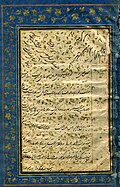 Calligraphy by Mohammad Shafiʿ Heravi. National Library of Iran
 -
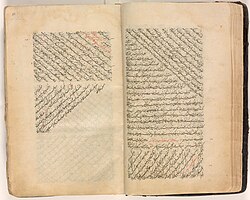 Double page from the "Majmu‘a-i munsh‘at" – collection of correspondence sent by Persian rulers compiled by Abu‘l-Qasim Ivughli Haydar. Isfahan, 1682. Arthur M. Sackler Gallery
 -
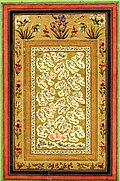 Calligraphy by Abdol Majid Taleqani. Golestan Palace Library
 -
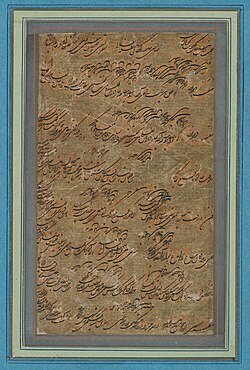 Plea for tax relief copied by Mirza Kuchak Esfahani. Iran, 1795–1796. Harvard Art Museums
 -
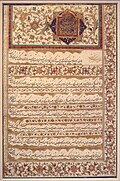
-
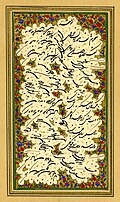 Calligraphy by Ali Akbar Golestaneh. Iran, 1896. Library of the Islamic Parliament of Iran

.jpg)
.jpg)
.jpg)


Nastaliq typesetting[edit | edit source]
Modern Nastaliq typography began with the invention of Noori Nastaliq which was first created as a digital font in 1981 through the collaboration of Ahmed Mirza Jamil (as calligrapher) and Monotype Imaging (formerly Monotype Corp & Monotype Typography).[27] Although this employed over 20,000 ligatures (individually designed character combinations),[28] it provided accurate results and allowed newspapers such as Pakistan's Daily Jang to use digital typesetting instead of a group of calligraphers. It suffered from two problems in the 1990s: its non-availability on standard platforms such as Microsoft Windows or Mac OS, and the non-WYSIWYG nature of text entry, whereby the document had to be created by commands in Monotype's proprietary page description language.
-
![Persian Chalipa panel, Mir Emad In print:[note] Template:Rtl-para In Naskh styled typeface: Template:Rtl-para](/w/images/smartcommons/thumbs/commons/d/df/Miremad-1.jpg/103px-Miremad-1.jpg) Persian Chalipa panel, Mir Emad
Persian Chalipa panel, Mir Emad
In print:[note] Template:Rtl-para In Naskh styled typeface: Template:Rtl-para -
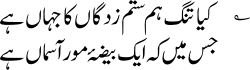 An example of the Nastaliq script used for writing Urdu.
Nastaliq:
Template:Rtl-para
Naskh:
Template:Rtl-para -
![A couplet versified by the Persian poet Hafez in Nastaliq font (by Software), in print:[note] Template:Rtl-para in a Naskh styled typeface: Template:Rtl-para](/w/images/smartcommons/thumbs/commons/5/5c/Hafez_Ghazal.jpg/250px-Hafez_Ghazal.jpg) A couplet versified by the Persian poet Hafez in Nastaliq font (by Software), in print:[note] Template:Rtl-para in a Naskh styled typeface: Template:Rtl-para
A couplet versified by the Persian poet Hafez in Nastaliq font (by Software), in print:[note] Template:Rtl-para in a Naskh styled typeface: Template:Rtl-para
![Persian Chalipa panel, Mir Emad In print:[note] Template:Rtl-para In Naskh styled typeface: Template:Rtl-para](/wiki/File:Miremad-1.jpg)

![A couplet versified by the Persian poet Hafez in Nastaliq font (by Software), in print:[note] Template:Rtl-para in a Naskh styled typeface: Template:Rtl-para](/wiki/File:Hafez_Ghazal.jpg)
InPage[edit | edit source]
In 1994, InPage Urdu, which is a functional page layout software for Windows akin to QuarkXPress, was developed for Pakistan's newspaper industry by an Indian software company Concept Software Pvt Ltd. It offered the Noori Nastaliq font licensed from Monotype Imaging. This font is still used in current versions of the software for Windows. As of 2009, InPage has become Unicode based, supporting more languages and the Faiz Lahori Nastaliq font with Kasheeda has been added to it along with compatibility with OpenType Unicode fonts.
Cross platform Nastaliq fonts[edit | edit source]

- Windows 8 was the first version of Microsoft Windows to have native Nastaliq support, through Microsoft's "Urdu Typesetting" font.[29]

- Google has an open-source Nastaliq font called Noto Nastaliq Urdu.[30] Apple provides this font on all Mac installations since macOS High Sierra. Likewise, Apple has carried this font on iOS devices since iOS 11.[31]
- Awami Nastaliq features a more extensive character set than most Nastaliq typefaces, supporting: Urdu, Balochi, Persian, Khowar, Palula, Saraiki, Shina.[32]
- Amar Nastaleeq was created for web embedding on Urdu websites in 2013. The font was announced by Urdu poet Fahmida Riaz.[33]
Letter forms[edit | edit source]
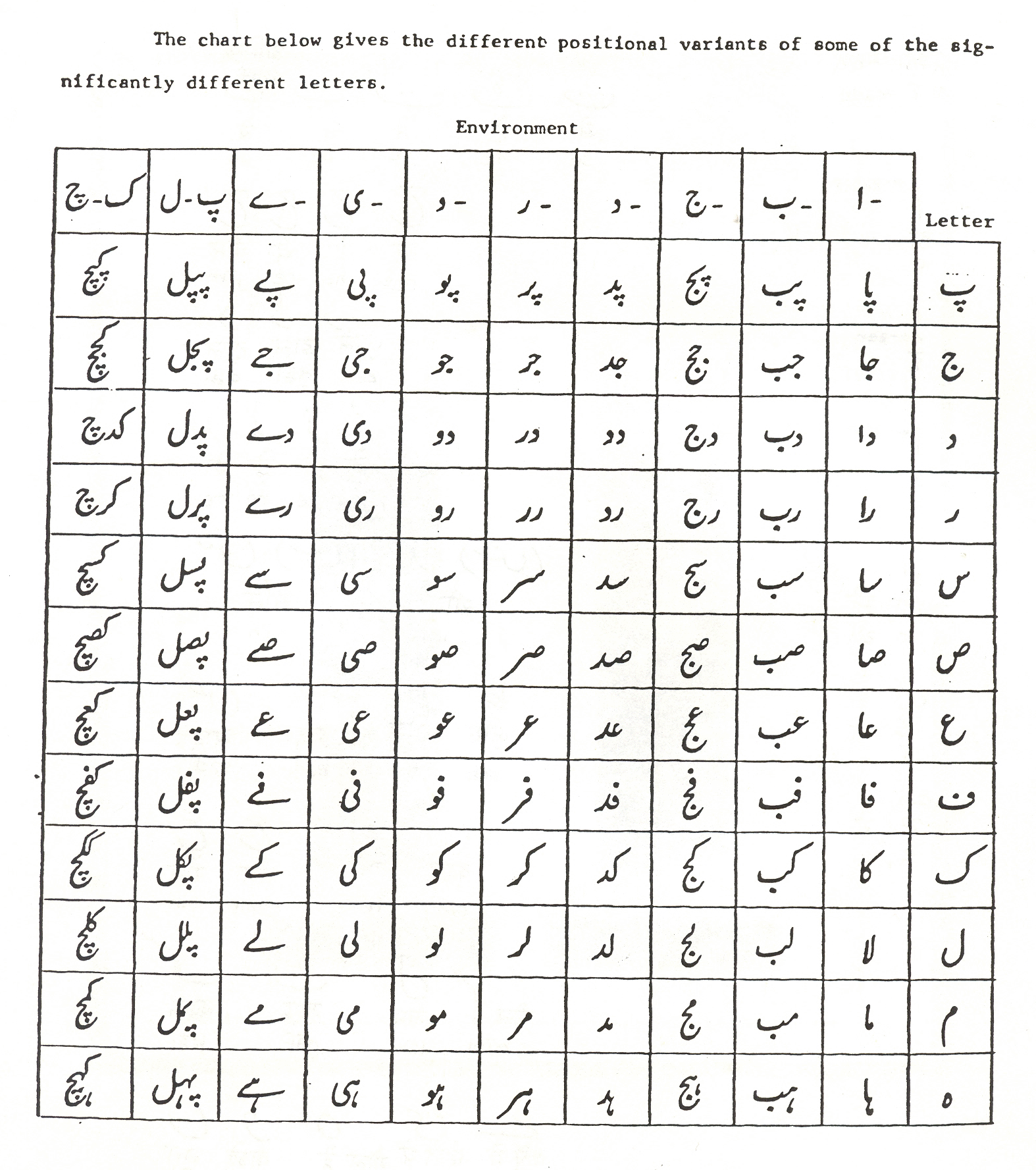
The Nastaliq style uses more than three general forms for many letters,[34][35] even in non-decorative documents. For example, most documents written in Urdu use the Nastaliq style.
In Unicode[edit | edit source]
Nastaliq is not separately encoded in Unicode as it is a particular style of Arabic script and not a writing system in its own right. Nastaliq letterforms are produced by choosing a Nastaliq font to display the text.
See also[edit | edit source]
Notes[edit | edit source]
- ↑ (/ˌnæstəˈliːk, ˈnæstəliːk/;[2] Persian: ['nastaʔ'liːq]; Urdu: [nəst̪əʔ'liːq, nəst̪ɑː'liːq]); also romanized as Nastaʿlīq or Nastaleeq or Nastaaleeq (نَسْتَعْلِیق)
References[edit | edit source]
- ↑ Akram, Qurat ul Ain; Hussain, Sarmad; Niazi, Aneeta; Anjum, Umair; Irfan, Faheem (April 2014). "Adapting Tesseract for Complex Scripts: An Example for Urdu Nastalique". 2014 11th IAPR International Workshop on Document Analysis Systems. 11th IAPR International Workshop on Document Analysis Systems. Tours, France: IEEE. pp. 191–195. doi:10.1109/DAS.2014.45. ISBN 978-1-4799-3243-6.
- ↑ "Nastaliq". Lexico Dictionaries. Oxford University Press. Archived from the original on March 28, 2022. Retrieved 2020-07-05.
- ↑ Blair, p. xxii, 286.
- ↑ 4.00 4.01 4.02 4.03 4.04 4.05 4.06 4.07 4.08 4.09 Gholam-Hosayn Yusofi (December 15, 1990). "Calligraphy". Encyclopædia Iranica.
- ↑ Atif Gulzar; Shafiq ur Rahman (2007). "Nastaleeq: A challenge accepted by Omega" (PDF). TUGboat. 29: 1–6.
- ↑ Blair, p. 274.
- ↑ 7.0 7.1 7.2 Blair, p. 275.
- ↑ Ali Alparslan. "K̲h̲aṭṭ ii. In Persia". Encyclopaedia of Islam. doi:10.1163/1573-3912_islam_COM_0502.
- ↑ Blair, p. xxii.
- ↑ 10.0 10.1 10.2 Hamid Reza Afsari (17 June 2021). "Calligraphy". Encyclopaedia Islamica.
- ↑ Blair, p. 276.
- ↑ Blair, p. 277-280.
- ↑ Blair, p. 284, 430.
- ↑ Blair, p. 430-436.
- ↑ Blair, p. 446-447.
- ↑ 16.0 16.1 Gholam-Hosayn Yusofi. "CALLIGRAPHY (continued)". Encyclopædia Iranica.
- ↑ Blair, p. 536-539, 552-554.
- ↑ Blair, p. 513-518.
- ↑ 19.0 19.1 Ali Alparslan. "NESTA'LİK". İslâm Ansiklopedisi.
- ↑ Spooner, Brian; Hanaway, William L. (1995). Reading Nasta'liq: Persian and Urdu Hands from 1500 to the Present. Mazda Publishers. p. 3. ISBN 978-1568592138.
- ↑ 21.0 21.1 Blair, p. 441.
- ↑ Blair, p. 444-445.
- ↑ Priscilla Soucek. "ʿABD-AL-MAJĪD ṬĀLAQĀNĪ". Encyclopædia Iranica.
- ↑ Maryam Ekhtiar. "ḠOLĀM-REŻĀ ḴOŠNEVIS". Encyclopædia Iranica.
- ↑ Maryam Ekhtiar. "GOLESTĀNA, ʿALI-AKBAR". Encyclopædia Iranica.
- ↑ Blair, p. 445, 471.
- ↑ Khurshiq, Iqbal (17 November 2013). "زندگی آگے بڑھنے کا نام اور جمود موت ہے: نوری نستعلیق کی ایجاد سے خط نستعلیق کی دائمی حفاظت ہوگئی". Express. Retrieved 24 November 2013.
- ↑ How to bring a language to the future, 9 Feb 2021
- ↑ "The evolving Story of Locale Support, part 9: Nastaleeq vs. Nastaliq? Either way, Windows 8 has got it!". MSDN Blogs. Retrieved 2013-03-24.
- ↑ "Google Noto Fonts".
- ↑ "Apple finally enables Nastaleeq typeface for Urdu keyboard in iOS 11". The Express Tribune. 23 September 2017.
- ↑ "What is Special About Awami Nastaliq?". Awami Nastaliq, SIL Language Technology.
- ↑ Riaz, fahmida (21 November 2013). "Amar Nastaleeq Font for Urdu Web Publishing". Twitter.
- ↑ FWP. "Urdu: some thoughts about the script and grammar, and other general notes for students assembled from years of classroom notes by FWP, 2006 onward". Columbia University in the City of New York. Archived from the original on 2023-04-06. Retrieved 28 February 2020.
- ↑ "The chart below gives the different positional variants of some of the significantly different letters. - Environment". Archived from the original on 2023-04-07. Retrieved 28 February 2020 – via Columbia University in the City of New York.

Bibliography[edit | edit source]
- Blair, Sheila (2008). Islamic Calligraphy. Edinburgh University Press. ISBN 978-0748612123.
External links[edit | edit source]
- KHATTAATT: Nastaliq Script: The Poetic Flow of Arabic Calligraphy
- Rumicode: Online Service For Nastaliq Calligraphy
- Nastaliq Online: Online Service For Nastaliq Calligraphy
- Iranian Calligraphers Association
- Nastaliq Writer for Macintosh by SIL
- InPage Urdu: Official InPage Urdu DTP software site
- Faiz Nastaliq: Official Faiz Nastaliq site
- Profiles and works of World Islamic calligraphy (in French)
- Nastaliq Script | Persian Calligraphy
- Awami Nastaliq: A Nastaliq font by SIL International