

Ajay Kumar (talk | contribs) Created a new article |
m expanded content |
||
| Line 1: | Line 1: | ||
{{Short description|Traditional | {{italictitle}} | ||
{{Short description|Traditional meal of Kerala, India}} | |||
{{Use dmy dates|date=December 2019}} | {{Use dmy dates|date=December 2019}} | ||
{{Use Indian English|date=December 2019}} | {{Use Indian English|date=December 2019}} | ||
{{Infobox food | {{Infobox food | ||
| name | | name = Sadya | ||
| image | | image = Sadhya DSW.jpg | ||
| image_size | | image_size = 300px | ||
| caption | | caption = | ||
| country = [[India]] | |||
| country | | region = [[Kerala]] | ||
| region | | creator = | ||
| creator | | course = | ||
| course | | type = | ||
| type | | served = | ||
| served | | main_ingredient = | ||
| main_ingredient | | variations = | ||
| variations | | calories = | ||
| calories | | other = [[Kamayan]] | ||
| other | |||
}} | }} | ||
[[File:Sadya 2019.jpg|thumb|Traditional Kerala | [[File:Sadya 2019.jpg|thumb|Traditional Kerala sadya]] | ||
'''Sadya''' | '''''Sadya''''' or '''oonu''' ({{langx|ml|സദ്യ}}), also spelt '''''sadhya''''', is a meal of [[Kerala]] origin and of importance to all Malayalis, consisting of a variety of traditional vegetarian dishes usually served on a [[banana]] leaf as lunch.<ref>Kerala's Slow Food; The Indian banana leaf banquet that tastes like home by Shahnaz Habib AFAR March/ April 2014 page 49</ref> Sadya is typically served as a traditional feast for [[Onam]] and [[Vishu]],<ref name="Iyer 2018">{{cite web | last=Iyer | first=Meenakshi | title=Onam 2018, here's why Sadya is the most balanced meal, full of nutritional value – more lifestyle | website=[[Hindustan Times]] | date=25 August 2018 | url=https://www.hindustantimes.com/more-lifestyle/onam-2018-here-s-why-sadya-is-the-most-balanced-meal-full-of-nutritional-value/story-2gwLfWrIj9L3VSnBVFxUfK.html | access-date=20 September 2018 | archive-date=20 September 2018 | archive-url=https://web.archive.org/web/20180920234525/https://www.hindustantimes.com/more-lifestyle/onam-2018-here-s-why-sadya-is-the-most-balanced-meal-full-of-nutritional-value/story-2gwLfWrIj9L3VSnBVFxUfK.html | url-status=dead }}</ref> along with other special occasions such as birthdays, weddings and temple festivals. | ||
==Etymology== | |||
The Malayalam word ''sadya'' ({{wikt-lang|ml|സദ്യ}}) derives from [[Sanskrit]] ''ságdhi-'' ({{wikt-lang|sa|सग्धि}}), referring to a communal feast.<ref>{{Cite news |date=2016-09-09 |title=How Onasadya traditions differ across Kerala |url=https://www.thehindu.com/features/metroplus/Food/Onam-on-a-leaf/article14630774.ece |access-date=2024-12-07 |work=The Hindu |language=en-IN |issn=0971-751X}}</ref> | |||
==Overview== | ==Overview== | ||
[[File:Valla Sadya.JPG|thumb|left|Valla sadya]] | [[File:Valla Sadya.JPG|thumb|left|Valla sadya]] | ||
A typical | A typical sadya can have about 24–28 dishes served as a single course.<ref>{{cite web |title=Happy Onam 2020: 26 dishes in the Onam Sadhya feast, what they’re called |url=https://www.hindustantimes.com/more-lifestyle/happy-onam-2020-26-dishes-in-the-onam-sadhya-feast-what-they-re-called/story-Ox35zUre2YkHzMjzOcSHTN.html |publisher=Hindustan Times |access-date=26 June 2024}}</ref>In some cases, where it is much larger, it can include over 64 items, such as the sadya for Aranmula Vallamkali ([[Valla Sadhya|Valla-sadya]]).<ref name="NDTV Food 2017"/> During a traditional sadya meal, people are seated [[cross-legged]] on mats.<ref name="Vasu Kumar 2017">{{cite book | last1=Vasu | first1=S.S.L. | last2=Kumar | first2=R. | title=Morning Glory Blossoms | publisher=Partridge Publishing Singapore | year=2017 | isbn=978-1-5437-4244-2 | url=https://books.google.com/books?id=8aJEDwAAQBAJ&pg=PT21 | access-date=20 September 2018 | page=21}}</ref> Food is eaten with the right hand, without cutlery.<ref name="Vasu Kumar 2017"/> The fingers are cupped to form a [[Ladle (spoon)|ladle]].<ref name="Vasu Kumar 2017"/> | ||
The main dish is plain boiled [[rice]], served along with other curries | The main dish is plain boiled [[rice]], served along with other curries/''koottaan'' ({{wikt-lang|ml|കൂട്ടാന്}}) which include [[parippu]], [[sambar (dish)|sambar]], [[Rasam (dish)|rasam]], {{transliteration|ml|italic=no|pulisseri}} and others like {{transliteration|ml|italic=no|[[kaalan]]}}, {{transliteration|ml|italic=no|[[avial]]}}, {{transliteration|ml|italic=no|[[thoran]]}}, {{transliteration|ml|italic=no|[[olan (dish)|olan]]}}, {{transliteration|ml|italic=no|[[pachadi]]}}, {{transliteration|ml|italic=no|[[kichadi]]}}, {{transliteration|ml|italic=no|[[koottukari]]}}, {{transliteration|ml|italic=no|erissery}}, [[mango pickle]], [[injipuli]], [[mezhukkupuratti]], {{transliteration|ml|italic=no|[[lime pickle|naranga achaar (lime pickle)]]}}, as well as [[papadam]], [[plantain chips]], {{transliteration|ml|italic=no|sharkara upperi}}, [[banana]], plain [[curd]] and [[buttermilk]].<ref name="NDTV Food 2017">{{cite web | title=Happy Vishu 2017: Vishu Sadhya, Kerala's Grand New Year Feast | publisher=[[NDTV]] Food | date=13 April 2017 | url=https://food.ndtv.com/food-drinks/happy-vishu-2017-vishu-sadhya-keralas-grand-new-year-feast-1680747 | access-date=20 September 2018}}</ref><ref name="Rai">{{cite book | last=Rai | first=J. | title=Curry Cookbook – Keralan Cuisine – Jay Rai's Indian Kitchen: करी व्यंजनों | publisher=Springwood media | isbn=978-1-4761-2308-0 | url=https://books.google.com/books?id=5zDWhOU-I04C&pg=PT4 | access-date=20 September 2018 | page=pt4-5}}</ref><ref>{{cite book | last=Brien | first=C.O. | title=The Penguin Food Guide to India | publisher=Penguin Books Limited | year=2013 | isbn=978-93-5118-575-8 | url=https://books.google.com/books?id=BGhBAgAAQBAJ&pg=PT422 | access-date=20 September 2018 | page=pt422}}</ref><ref name="Punit 2015">{{cite web |last=Punit |first=27 lip-smacking, vegetarian dishes to try during Kerala’s grandest feast |date=28 August 2015 |title=Quartz India |url=https://qz.com/india/489554/27-lip-smacking-vegetarian-dishes-to-try-during-keralas-grandest-feast/ |access-date=20 September 2018 |website=Quartz India}}</ref> The buttermilk is typically served near the end of the meal.<ref name="NDTV Food 2017"/> The traditional dessert called [[payasam]] served at the end of the meal is of many kinds<ref name="NDTV Food 2017"/> and usually three or more are served. Some of the varieties are Paalada pradhaman, [[Ada pradhaman]], Parippu pradhaman, Chakka pradhaman, Gothampu payasam, Paal payasam, etc. The multiple curries are all made with different vegetables and have their own flavor. The variety of curries is to symbolize prosperity and well-being. | ||
[[File:Onam Sadya (15164960372).jpg|thumb|A sadya served for [[Onam]]]] | [[File:Onam Sadya (15164960372).jpg|thumb|A sadya served for [[Onam]]]] | ||
The dishes are served in different spots on the banana leaf.<ref name="Kannampilly 2003"/> For example, the pickles are served on the top left corner and the banana | The dishes are served in different spots on the banana leaf.<ref name="Kannampilly 2003"/> For example, the pickles are served on the top left corner and the banana in the bottom left corner, which helps the waiters to easily identify and decide on offering additional servings. The most common ingredients in all the dishes are coconut as it is abundant in Kerala. Coconut milk is used in some dishes, and coconut oil is used for frying. | ||
There are regional variations in the sadya menu, influenced by local customs and ingredient availability. Although the custom is to use traditional and seasonal vegetables indigenous to Kerala or the Southwest Coast of India, it has become common practice to include vegetables such as carrots, pineapples, and beans in the dishes. Traditionally, dishes in a sadya do not contain onion or garlic. The meal may be followed by chewing of ''vettila murukkaan'', [[betel leaf]]<ref name="India.com 2017">{{cite web | title=Onam Sadya Items That Make the Traditional Recipe of Kerala Festival a Hit | website=India.com | date=3 September 2017 | url=http://www.india.com/festivals-events/onam-sadhya-items-that-make-the-traditional-recipe-of-kerala-festival-a-hit-2445898/ | access-date=20 September 2018}}</ref> with lime and arecanut. This helps with the digestion of the meal and cleanses the palate.<ref name="India.com 2017"/> | |||
== Variations == | |||
*[[Trivandrum Sadhya]] | |||
*[[Valla Sadhya]] | |||
==Preparations== | ==Preparations== | ||
[[File:Kichadi Sadhya.jpg|thumb|left|[[Pachadi]] | [[File:Kichadi Sadhya.jpg|thumb|left|[[Pachadi]] is sometimes used in sadya.]] | ||
The sadya is usually served for lunch,<ref>{{cite book | last=Basu | first=M. | title=Masala: Indian Cooking for Modern Living | publisher=Bloomsbury Publishing | year=2018 | isbn=978-1-4088-8687-8 | url=https://books.google.com/books?id=WDNWDwAAQBAJ&pg=PT268 | access-date=20 September 2018 | page=pt268}}</ref> although a lighter version is served for dinner | The sadya is usually served for lunch,<ref>{{cite book | last=Basu | first=M. | title=Masala: Indian Cooking for Modern Living | publisher=Bloomsbury Publishing | year=2018 | isbn=978-1-4088-8687-8 | url=https://books.google.com/books?id=WDNWDwAAQBAJ&pg=PT268 | access-date=20 September 2018 | page=pt268}}</ref> although a lighter version is served for dinner as well. Preparations begin the night before, and the dishes are prepared before ten o'clock in the morning on the day of the celebration. Nowadays, sadya is often served on tables, as people no longer find it convenient to sit on the floor. Sourcing of items/ingredients for a sadya is an elaborate and careful process to ensure quality. The lighting of the fire to prepare the sadya is done after a prayer to Agni, and the first serving is offered on a banana leaf in front of a lighted [[nilavilakku]] as an offering to [[Ganesha|Ganapati]]. | ||
In a sadya, the meals are served on a [[banana leaf]].<ref name="NDTV Food 2017"/> The leaf is folded and closed once the meal is finished.<ref name="The Hans India 2016">{{cite web | title=The festive feast | website=The Hans India | date=11 September 2016 | url=http://www.thehansindia.com/posts/index/Sunday-Hans/2016-09-11/The-festive-feast/253227 | access-date=20 September 2018}}</ref> In some instances, closing the leaf toward you communicates satisfaction with the meal, while folding it away from oneself signifies that the meal can be improved.<ref name="The Hans India 2016"/> However, the direction the leaf is folded in can have different meanings in various parts of Kerala.<ref>{{cite web | last=Pillai | first=Pooja | title=God's Own Platter | website=The Indian Express | date=14 September 2016 | url=http://indianexpress.com/article/lifestyle/food-wine/gods-kerala-onam-meal-food-feast-own-platter-3029921/ | access-date=20 September 2018}}</ref> | |||
The Central Travancore-style sadya is known to be the most disciplined and tradition-bound.<ref name="Hindu2016b">{{cite web|author=N. Satyendran |url=http://www.thehindu.com/todays-paper/tp-features/tp-metroplus/onam-on-a-leaf/article9092190.ece |title=Onam on a leaf |work=The Hindu |date=2010-08-10 |access-date=2016-09-14}}</ref> There is usually an order followed in serving the dishes, starting from the chips and pickles first.<ref name="Kannampilly 2003" /><ref name="Punit 2015" /> However, different styles and approaches to making and serving the dishes are adopted in various parts of Kerala depending on local preferences. [[Valla Sadhya|Aranmula Valla-sadya]] is the most celebrated sadya with over 64 items served traditionally.<ref>{{cite web |date=22 August 2015 |title=Sing out loud for a 64-dish sadya |url=https://timesofindia.indiatimes.com/city/kochi/Sing-out-loud-for-a-64-dish-sadya/articleshow/48620396.cms |access-date=20 September 2018 |website=The Times of India}}</ref> | |||
The Central Travancore-style sadya is | |||
==Typical ingredients== | ==Typical ingredients== | ||
The items include:<ref name="Hindu2016b"/><ref name="Indianexpress">{{cite web|url=http://indianexpress.com/article/lifestyle/food-wine/onam-special-heres-what-a-traditional-onam-sadhya-consists-of-3028642/ |title=Onam special: Here's what a traditional Onam sadhya consists of |website=The Indian Express|date=2016-09-13 |access-date=2016-09-13}}</ref> | The items include:<ref name="Hindu2016b"/><ref name="Indianexpress">{{cite web|url=http://indianexpress.com/article/lifestyle/food-wine/onam-special-heres-what-a-traditional-onam-sadhya-consists-of-3028642/ |title=Onam special: Here's what a traditional Onam sadhya consists of |website=The Indian Express|date=2016-09-13 |access-date=2016-09-13}}</ref> | ||
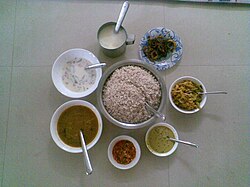
[[File:Sadhya Items.jpg|thumb|250px|Sadya items | [[File:Sadhya Items.jpg|thumb|250px|Sadya items. Clockwise from top: [[paayasam]] (in mug), [[bittergourd]] [[thoran]], [[aviyal]], [[kaalan]], [[lime pickle]], [[Sambar (dish)|saambaar]], [[buttermilk]], boiled rice in centre]] | ||
* Rice: It is the main item in a sadya. It is | * Rice: It is the main item in a sadya. It is usually Kerala red rice (semi-polished parboiled brown<ref name="Hindu2016b"/><ref name=ctsadhya>{{cite web|author1=Ramya Menon|title=God's Own Feast-ival!|url=http://www.cucumbertown.com/gods-own-feast-ival-onam|archive-url=https://web.archive.org/web/20140904212725/http://www.cucumbertown.com/gods-own-feast-ival-onam|url-status=dead|archive-date=2014-09-04|website=Cucumbertown}}</ref>) which is used for the sadya, but [[Matta rice|Kerala matta]] rice is sometimes used.<ref>{{cite web | last=Tiwari | first=Nimisha | title=Flavours of India: Here's a look at a plethora of dishes that make festivals fun | website=The Economic Times | date=19 July 2018 | url=https://economictimes.indiatimes.com/magazines/travel/flavours-of-india-heres-a-look-at-a-plethora-of-dishes-that-make-festivals-fun/articleshow/65039593.cms | access-date=20 September 2018}}</ref> | ||
* [[Parippu]]: A thick curry [[lentil]] dish | * [[Parippu]]: A thick curry [[lentil]] dish. | ||
* [[Sambar (dish)|Sambar]]: A thick gravy made of [[lentils]], [[tamarind]], vegetables like [[Moringa oleifera|drumsticks]], [[tomato]], yam etc., and | * [[Sambar (dish)|Sambar]]: A thick gravy made of [[lentils]], [[tamarind]], vegetables like [[Moringa oleifera|drumsticks]], [[tomato]], yam etc., and flavoured with [[asafoetida]]. | ||
* [[Rasam (dish)|Rasam]]: A watery dish made of tamarind,<ref name="Firstpost 2017"/> tomatoes, and spices like [[black pepper]], [[asafoetida]], [[coriander]], [[chili pepper]], etc. It is very spicy in taste and aids in digestion. However, in some regions Rasam is not counted as part of | * [[Rasam (dish)|Rasam]]: A watery dish made of tamarind,<ref name="Firstpost 2017"/> tomatoes, and spices like [[black pepper]], [[asafoetida]], [[coriander]], [[chili pepper]], etc. It is very spicy in taste and aids in digestion. However, in some regions Rasam is not counted as part of a sadya. | ||
* [[Avial]]: A dense mixture of various vegetables and coconut, it is seasoned with [[Curry Tree|curry leaves]] and coconut oil.<ref name="Punit 2015"/> | * [[Avial]]: A dense mixture of various vegetables and coconut, it is seasoned with [[Curry Tree|curry leaves]] and coconut oil.<ref name="Punit 2015"/> | ||
* [[Kaalan]]: Made of curd, coconut, and any one vegetable like "nendran" plantain or a tuber-like [[yam (vegetable)|yam]]. It is very thick and more sour, and typically can last for a longer period owing to the lower water content.<ref name="Indianexpress"/> | * [[Kaalan]]: Made of [[curd]], coconut, and any one vegetable like "nendran" plantain or a tuber-like [[yam (vegetable)|yam]]. It is very thick and more sour, and typically can last for a longer period owing to the lower water content.<ref name="Indianexpress"/> | ||
* [[Olan (dish)|Olan]]: A light dish, prepared of [[white gourd]] or black peas, coconut milk, and [[ginger]] seasoned with [[coconut]] oil.<ref name="Punit 2015"/><ref name="Hindu2016b"/> | * [[Olan (dish)|Olan]]: A light dish, prepared of [[white gourd]] or black peas, coconut milk, and [[ginger]] seasoned with [[coconut]] oil.<ref name="Punit 2015"/><ref name="Hindu2016b"/> | ||
* [[Koottukari]]: Vegetables like banana or yam cooked with [[chickpea]]s, coconut and black pepper.<ref>{{Cite web|date=2020-08-09|title=Onam Sadya: Know Everything About It|url=https://www.caringlyyours.com/everything-about-onam-sadya/|access-date=2020-08-13|website=Caringly Yours|language=en-US}}</ref> | * [[Koottukari]]: Vegetables like banana or yam cooked with [[chickpea]]s, coconut and black pepper.<ref>{{Cite web|date=2020-08-09|title=Onam Sadya: Know Everything About It|url=https://www.caringlyyours.com/everything-about-onam-sadya/|access-date=2020-08-13|website=Caringly Yours|language=en-US|archive-date=24 June 2021|archive-url=https://web.archive.org/web/20210624123722/https://www.caringlyyours.com/everything-about-onam-sadya/|url-status=dead}}</ref> | ||
* Erissery: A thick curry made from pumpkin, [[black-eyed pea]]s and coconut.<ref>{{cite web | title=When kanji used to be the special item on wedding menu | website=OnManorama | date=29 August 2018 | url=https://food.manoramaonline.com/food/foodie/2018/08/29/when-kanji-used-to-be-the-special-item-wedding-menu.html | access-date=20 September 2018}}</ref><ref>{{cite book | last=Kannan | first=A. | title=From the South Delectable Home Cooking | publisher=DC Books | year=2011 | isbn=978-81-921926-2-8 | url=https://books.google.com/books?id=ne6vDQAAQBAJ&pg=PA1 | access-date=20 September 2018 | page=1}}</ref> | * Erissery: A thick curry made from pumpkin, [[black-eyed pea]]s and coconut.<ref>{{cite web | title=When kanji used to be the special item on wedding menu | website=OnManorama | date=29 August 2018 | url=https://food.manoramaonline.com/food/foodie/2018/08/29/when-kanji-used-to-be-the-special-item-wedding-menu.html | access-date=20 September 2018}}</ref><ref>{{cite book | last=Kannan | first=A. | title=From the South Delectable Home Cooking | publisher=DC Books | year=2011 | isbn=978-81-921926-2-8 | url=https://books.google.com/books?id=ne6vDQAAQBAJ&pg=PA1 | access-date=20 September 2018 | page=1}}</ref> | ||
* [[Pachadi]]: Sour curry made of curd and usually [[cucumber]] or sliced ash gourd cooked in coconut ground with mustard seeds and seasoned with sautéed mustard seeds and curry leaves.<ref name="Indianexpress"/><ref name="Tastycircle">{{cite web|author=N. Satyendran |url=http://www.tastycircle.com/recipe/pachadi/ |title=Pachadi|date=6 July 2012 |access-date=2016-09-14}}</ref> | * [[Pachadi]]: Sour curry made of curd and usually [[cucumber]] or sliced ash gourd cooked in coconut ground with mustard seeds and seasoned with sautéed mustard seeds and curry leaves.<ref name="Indianexpress"/><ref name="Tastycircle">{{cite web|author=N. Satyendran |url=http://www.tastycircle.com/recipe/pachadi/ |title=Pachadi|date=6 July 2012 |access-date=2016-09-14}}</ref> | ||
* Sweet [[Pachadi#In Kerala and Tamil Nadu|Pachadi]]: A sweet form of Pachadi, made with pineapple, pumpkin or grapes in curd.<ref name="Punit 2015"/> The gravy masala comprises coconut ground with cumin seeds and green chillies.<ref name="Indianexpress"/> | * Sweet [[Pachadi#In Kerala and Tamil Nadu|Pachadi]]: A sweet form of Pachadi, made with pineapple, pumpkin or grapes in curd.<ref name="Punit 2015"/> The gravy masala comprises coconut ground with cumin seeds and green chillies.<ref name="Indianexpress"/><ref name="Tastycircle"/> | ||
* Pulisseri: A sour, yellow-coloured thin curry made with slightly soured | * Pulisseri: A sour, yellow-coloured thin curry made with slightly soured [[yogurt]] and cucumber.<ref name="Kannampilly 2003">{{cite book | last=Kannampilly | first=V. | title=The Essential Kerala Cookbook | publisher=Penguin Books | year=2003 | isbn=978-0-14-302950-2 | url=https://books.google.com/books?id=pYfOCaAPb3sC&pg=PA9 | access-date=20 September 2018 | page=9}}</ref> A sweet variant called Mampazha-pulissheri replaces cucumber with a combination of ripe mangoes and [[jaggery]]. | ||
* [[Injipuli]]: A sweet pickle made of ginger, tamarind, green chilies, and jaggery, also called Puli-inji.<ref>{{cite web | title=Onam 2018: All the delicacies that make up the very vast Onam sadhya feast | website=The Indian Express | date=24 August 2018 | url=https://indianexpress.com/article/lifestyle/food-wine/onam-2018-dishes-onam-sadhya-5322737/ | access-date=20 September 2018}}</ref> | * [[Injipuli]]: A sweet pickle made of ginger, tamarind, green chilies, and jaggery, also called Puli-inji.<ref>{{cite web | title=Onam 2018: All the delicacies that make up the very vast Onam sadhya feast | website=The Indian Express | date=24 August 2018 | url=https://indianexpress.com/article/lifestyle/food-wine/onam-2018-dishes-onam-sadhya-5322737/ | access-date=20 September 2018}}</ref> | ||
* [[Thoran]]: A dish of [[sautéed]] vegetables such as [[pea]]s, [[green bean]]s, raw [[jackfruit]], carrots, or [[cabbage]] (usually) with grated coconut. | * [[Thoran]]: A dish of [[sautéed]] vegetables such as [[pea]]s, [[green bean]]s, raw [[jackfruit]], carrots, or [[cabbage]] (usually) with grated coconut. | ||
* [[Mezhukkupuratti]]: A style of preparation for vegetarian dish where the vegetable is stir-fried with spices. Chopped onions or shallots may also be used. | * [[Mezhukkupuratti]]: A style of preparation for a vegetarian dish where the vegetable is stir-fried with spices. Chopped onions or shallots may also be used. | ||
* [[Achaar]]: Spicy [[pickling|pickles]] of raw [[mango]] ([[Mango pickle]]),<ref name="NDTV Food 2017"/> [[lemon]],<ref name="Firstpost 2017">{{cite web | title=Watch: Essential parts of an Onam Sadhya | website=Firstpost | date=4 September 2017 | url=https://www.firstpost.com/india/watch-breaking-down-the-onam-sadhya-4007925.html | access-date=20 September 2018}}</ref> [[lime (fruit)|lime]], ([[Lime pickle|Narangakari]]) etc. | * [[Achaar]]: Spicy [[pickling|pickles]] of raw [[mango]] ([[Mango pickle]]),<ref name="NDTV Food 2017"/> [[lemon]],<ref name="Firstpost 2017">{{cite web | title=Watch: Essential parts of an Onam Sadhya | website=Firstpost | date=4 September 2017 | url=https://www.firstpost.com/india/watch-breaking-down-the-onam-sadhya-4007925.html | access-date=20 September 2018}}</ref> [[lime (fruit)|lime]], ([[Lime pickle|Narangakari]]) etc. | ||
* [[Pappadam]]: Made with lentil flour, it is | * [[Pappadam]]: Made with lentil flour, it is paired with rice and can be eaten as an appetizer. | ||
* [[Banana chip#India|Sharkara upperi]]: [[ | * [[Banana chip#India|Sharkara upperi]]: [[Banana chip]]s with jaggery. <ref name="Punit 2015"/> | ||
* [[Banana chip#India|Kaaya Varuthathu]]: | * [[Banana chip#India|Kaaya Varuthathu]]: Banana chips. <ref name="NDTV Food 2017"/> | ||
* [[Banana]]: A ripe banana is often served with the | * [[Banana]]: A ripe banana is often served with the sadya to be eaten with the dessert, Payasam. | ||
* [[Chammanthi podi]]: coconut powder served as a dry condiment or chutney. | * [[Chammanthi podi]]: coconut powder served as a dry condiment or chutney. | ||
* [[Buttermilk|Sambharam]], also referred to as moru: A drink made from salted buttermilk with green chilli, ginger and curry leaves, it is drunk to improve digestion and is typically served near the end of the meal.<ref name="NDTV Food 2017"/><ref name="Firstpost 2017"/> | * [[Buttermilk|Sambharam]], also referred to as moru: A drink made from salted buttermilk with green chilli, ginger, and curry leaves, it is drunk to improve digestion and is typically served near the end of the meal.<ref name="NDTV Food 2017"/><ref name="Firstpost 2017"/> | ||
*[[Kadumanga]]: Sliced mango pickle. Usually served as the third condiment of the sadya. | |||
These side dishes are followed by desserts like Pradhaman and Payasams.<ref name="NDTV Food 2017"/ | These side dishes are followed by desserts like Pradhaman and Payasams.<ref name="NDTV Food 2017"/> | ||
==Pradhaman== | ==Pradhaman== | ||
''Pradhaman'' is a sweet dish in the form of a thick liquid; similar to [[payasam]], but with more variety in terms of ingredients and more elaborately made. It is made with white [[sugar]] or jaggery to which coconut milk is added. The main difference between a pradhaman and a payasam is that the former uses coconut milk, while the liquid versions of payasam use cow's milk. | ''Pradhaman'' is a sweet dish in the form of a thick liquid; similar to [[payasam]], but with more variety in terms of ingredients and more elaborately made. It is made with white [[sugar]] or jaggery to which coconut milk is added. The main difference between a pradhaman and a payasam is that the former uses coconut milk, while the liquid versions of payasam use cow's milk. | ||
* Palada pradhaman is made of flakes of cooked rice, milk, and sugar.<ref>{{cite book | last=Kannampilly | first=V. | title=The Essential Kerala Cookbook | publisher=Penguin Books | year=2003 | isbn=978-0-14-302950-2 | url=https://books.google.com/books?id=pYfOCaAPb3sC&pg=PA232 | access-date=20 September 2018 | page=232}}</ref> | * [[Ada pradhaman#Palada pradhaman|Palada pradhaman]] is made of flakes of cooked rice, milk, and sugar.<ref>{{cite book | last=Kannampilly | first=V. | title=The Essential Kerala Cookbook | publisher=Penguin Books | year=2003 | isbn=978-0-14-302950-2 | url=https://books.google.com/books?id=pYfOCaAPb3sC&pg=PA232 | access-date=20 September 2018 | page=232}}</ref> | ||
* Pazha pradhaman is made of cooked "nendra" plantain or banana in jaggery and coconut milk.<ref>{{cite web | last=James | first=Merin | title=It's sadhya time, let's feast! | website=The Asian Age | date=31 August 2017 | url=http://www.asianage.com/life/food/310817/its-sadhya-time-lets-feast.html | access-date=20 September 2018}}</ref><ref>{{cite book | last=Varghese | first=T. | title=Stark World Kerala | publisher=Stark World Pub. | year=2006 | isbn=978-81-902505-1-1 | url=https://books.google.com/books?id=lDhuAAAAMAAJ | access-date=20 September 2018 | page=107}}</ref> | * Pazha pradhaman is made of cooked "nendra" plantain or banana in jaggery and coconut milk.<ref>{{cite web | last=James | first=Merin | title=It's sadhya time, let's feast! | website=The Asian Age | date=31 August 2017 | url=http://www.asianage.com/life/food/310817/its-sadhya-time-lets-feast.html | access-date=20 September 2018}}</ref><ref>{{cite book | last=Varghese | first=T. | title=Stark World Kerala | publisher=Stark World Pub. | year=2006 | isbn=978-81-902505-1-1 | url=https://books.google.com/books?id=lDhuAAAAMAAJ | access-date=20 September 2018 | page=107}}</ref> | ||
* Gothambu pradhaman is made of broken [[wheat]].<ref name="Rai"/> | * Gothambu pradhaman is made of broken [[wheat]].<ref name="Rai"/> | ||
* Parippu pradhaman is made of [[Mung bean|green gram]].<ref>{{cite book | last=Abram | first=D. | title=The Rough Guide to Kerala | publisher=Rough Guides | year=2010 | isbn=978-1-4053-8806-1 | url=https://books.google.com/books?id=NqjHz7n3Un0C&pg=PT86 | access-date=20 September 2018 | page=pt86}}</ref> | * Parippu pradhaman is made of [[Mung bean|green gram]].<ref>{{cite book | last=Abram | first=D. | title=The Rough Guide to Kerala | publisher=Rough Guides | year=2010 | isbn=978-1-4053-8806-1 | url=https://books.google.com/books?id=NqjHz7n3Un0C&pg=PT86 | access-date=20 September 2018 | page=pt86}}</ref> | ||
* [[Chakka prathaman]] is made of jackfruit.<ref>{{cite web | title=Chakka Maholsavam to feature jackfruit delicacies | website=The Hindu | date=10 May 2018 | url=https://www.thehindu.com/news/cities/kozhikode/chakka-maholsavam-to-feature-jackfruit-delicacies/article23829437.ece | access-date=20 September 2018}}</ref> | * [[Chakka prathaman]] is made of jackfruit.<ref>{{cite web | title=Chakka Maholsavam to feature jackfruit delicacies | website=The Hindu | date=10 May 2018 | url=https://www.thehindu.com/news/cities/kozhikode/chakka-maholsavam-to-feature-jackfruit-delicacies/article23829437.ece | access-date=20 September 2018}}</ref> | ||
* [[Ada pradhaman]] is made of | * [[Ada pradhaman]] is made of rice-ada (Rice flakes).<ref>{{cite news | url=https://www.thehindu.com/life-and-style/food/kerala-celebrates-onam-with-payasam-fetes/article36014401.ece | title=Payasam fetes usher in the sweet notes of Onam in Kerala | newspaper=The Hindu | date=20 August 2021 | last1=Nagarajan | first1=Saraswathy }}</ref> | ||
* Kadala pradhaman is made from black gram.<ref>{{cite book | author=India Ministry of Tourism | title=Explore India: The Official Newsletter of the Ministry of Tourism | publisher=Durga Das Publications Pvt. Limited | issue=v. 3 | year=2001 | url=https://books.google.com/books?id=Qk0sAQAAMAAJ | access-date=20 September 2018 }}</ref> | * Kadala pradhaman is made from black gram.<ref>{{cite book | author=India Ministry of Tourism | title=Explore India: The Official Newsletter of the Ministry of Tourism | publisher=Durga Das Publications Pvt. Limited | issue=v. 3 | year=2001 | url=https://books.google.com/books?id=Qk0sAQAAMAAJ | access-date=20 September 2018 }}</ref> | ||
==See also== | ==See also== | ||
{{portal|Food|India}} | {{portal|Food|India}} | ||
* [[Cuisine of Kerala]] | * [[Cuisine of Kerala]] | ||
* [[Kamayan]] | * [[Kamayan]] (a similar meal from the Philippines) | ||
* [[Onam#Onam Sadya|Onam sadya]] | * [[Onam#Onam Sadya|Onam sadya]] | ||
* [[ | *[[Trivandrum Sadhya]] | ||
*[[Trivandrum Boli]] | |||
* [[South Indian cuisine]] | * [[South Indian cuisine]] | ||
* [[Thali]] | |||
==References== | ==References== | ||
| Line 161: | Line 101: | ||
* {{commons category-inline|Sadya}} | * {{commons category-inline|Sadya}} | ||
[[Category:Hors d'oeuvres]] | |||
[[Category:Eating_parties]] | |||
[[Category:Indian cuisine]] | |||
[[Category:Kerala cuisine]] | [[Category:Kerala cuisine]] | ||
[[Category: | [[Category:Lunch]] | ||
[[Category:Meals]] | |||
[[Category:Serving and dining]] | |||
[[Category:Singaporean cuisine]] | |||
[[Category:Sri Lankan cuisine]] | |||
[[Category:Onam]] | |||
Latest revision as of 13:40, 24 January 2026
 | |
| Place of origin | India |
|---|---|
| Region or state | Kerala |
| Other information | Kamayan |

Sadya or oonu (Malayalam: സദ്യ), also spelt sadhya, is a meal of Kerala origin and of importance to all Malayalis, consisting of a variety of traditional vegetarian dishes usually served on a banana leaf as lunch.[1] Sadya is typically served as a traditional feast for Onam and Vishu,[2] along with other special occasions such as birthdays, weddings and temple festivals.
Etymology[edit | edit source]
The Malayalam word sadya (സദ്യ) derives from Sanskrit ságdhi- (सग्धि), referring to a communal feast.[3]
Overview[edit | edit source]

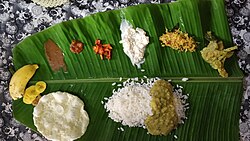
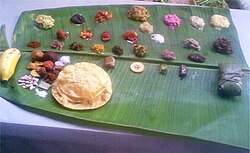
A typical sadya can have about 24–28 dishes served as a single course.[4]In some cases, where it is much larger, it can include over 64 items, such as the sadya for Aranmula Vallamkali (Valla-sadya).[5] During a traditional sadya meal, people are seated cross-legged on mats.[6] Food is eaten with the right hand, without cutlery.[6] The fingers are cupped to form a ladle.[6]
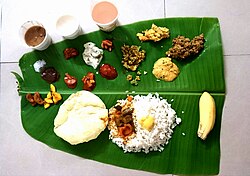
The main dish is plain boiled rice, served along with other curries/koottaan (കൂട്ടാന്) which include parippu, sambar, rasam, pulisseri and others like kaalan, avial, thoran, olan, pachadi, kichadi, koottukari, erissery, mango pickle, injipuli, mezhukkupuratti, naranga achaar (lime pickle), as well as papadam, plantain chips, sharkara upperi, banana, plain curd and buttermilk.[5][7][8][9] The buttermilk is typically served near the end of the meal.[5] The traditional dessert called payasam served at the end of the meal is of many kinds[5] and usually three or more are served. Some of the varieties are Paalada pradhaman, Ada pradhaman, Parippu pradhaman, Chakka pradhaman, Gothampu payasam, Paal payasam, etc. The multiple curries are all made with different vegetables and have their own flavor. The variety of curries is to symbolize prosperity and well-being.
.jpg)
The dishes are served in different spots on the banana leaf.[10] For example, the pickles are served on the top left corner and the banana in the bottom left corner, which helps the waiters to easily identify and decide on offering additional servings. The most common ingredients in all the dishes are coconut as it is abundant in Kerala. Coconut milk is used in some dishes, and coconut oil is used for frying.
There are regional variations in the sadya menu, influenced by local customs and ingredient availability. Although the custom is to use traditional and seasonal vegetables indigenous to Kerala or the Southwest Coast of India, it has become common practice to include vegetables such as carrots, pineapples, and beans in the dishes. Traditionally, dishes in a sadya do not contain onion or garlic. The meal may be followed by chewing of vettila murukkaan, betel leaf[11] with lime and arecanut. This helps with the digestion of the meal and cleanses the palate.[11]
Variations[edit | edit source]
Preparations[edit | edit source]

The sadya is usually served for lunch,[12] although a lighter version is served for dinner as well. Preparations begin the night before, and the dishes are prepared before ten o'clock in the morning on the day of the celebration. Nowadays, sadya is often served on tables, as people no longer find it convenient to sit on the floor. Sourcing of items/ingredients for a sadya is an elaborate and careful process to ensure quality. The lighting of the fire to prepare the sadya is done after a prayer to Agni, and the first serving is offered on a banana leaf in front of a lighted nilavilakku as an offering to Ganapati.
In a sadya, the meals are served on a banana leaf.[5] The leaf is folded and closed once the meal is finished.[13] In some instances, closing the leaf toward you communicates satisfaction with the meal, while folding it away from oneself signifies that the meal can be improved.[13] However, the direction the leaf is folded in can have different meanings in various parts of Kerala.[14]
The Central Travancore-style sadya is known to be the most disciplined and tradition-bound.[15] There is usually an order followed in serving the dishes, starting from the chips and pickles first.[10][9] However, different styles and approaches to making and serving the dishes are adopted in various parts of Kerala depending on local preferences. Aranmula Valla-sadya is the most celebrated sadya with over 64 items served traditionally.[16]
Typical ingredients[edit | edit source]

- Rice: It is the main item in a sadya. It is usually Kerala red rice (semi-polished parboiled brown[15][18]) which is used for the sadya, but Kerala matta rice is sometimes used.[19]
- Parippu: A thick curry lentil dish.
- Sambar: A thick gravy made of lentils, tamarind, vegetables like drumsticks, tomato, yam etc., and flavoured with asafoetida.
- Rasam: A watery dish made of tamarind,[20] tomatoes, and spices like black pepper, asafoetida, coriander, chili pepper, etc. It is very spicy in taste and aids in digestion. However, in some regions Rasam is not counted as part of a sadya.
- Avial: A dense mixture of various vegetables and coconut, it is seasoned with curry leaves and coconut oil.[9]
- Kaalan: Made of curd, coconut, and any one vegetable like "nendran" plantain or a tuber-like yam. It is very thick and more sour, and typically can last for a longer period owing to the lower water content.[17]
- Olan: A light dish, prepared of white gourd or black peas, coconut milk, and ginger seasoned with coconut oil.[9][15]
- Koottukari: Vegetables like banana or yam cooked with chickpeas, coconut and black pepper.[21]
- Erissery: A thick curry made from pumpkin, black-eyed peas and coconut.[22][23]
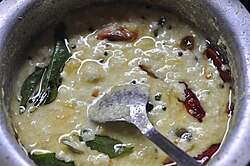
- Pachadi: Sour curry made of curd and usually cucumber or sliced ash gourd cooked in coconut ground with mustard seeds and seasoned with sautéed mustard seeds and curry leaves.[17][24]
- Sweet Pachadi: A sweet form of Pachadi, made with pineapple, pumpkin or grapes in curd.[9] The gravy masala comprises coconut ground with cumin seeds and green chillies.[17][24]
- Pulisseri: A sour, yellow-coloured thin curry made with slightly soured yogurt and cucumber.[10] A sweet variant called Mampazha-pulissheri replaces cucumber with a combination of ripe mangoes and jaggery.
- Injipuli: A sweet pickle made of ginger, tamarind, green chilies, and jaggery, also called Puli-inji.[25]
- Thoran: A dish of sautéed vegetables such as peas, green beans, raw jackfruit, carrots, or cabbage (usually) with grated coconut.
- Mezhukkupuratti: A style of preparation for a vegetarian dish where the vegetable is stir-fried with spices. Chopped onions or shallots may also be used.
- Achaar: Spicy pickles of raw mango (Mango pickle),[5] lemon,[20] lime, (Narangakari) etc.
- Pappadam: Made with lentil flour, it is paired with rice and can be eaten as an appetizer.
- Sharkara upperi: Banana chips with jaggery. [9]
- Kaaya Varuthathu: Banana chips. [5]
- Banana: A ripe banana is often served with the sadya to be eaten with the dessert, Payasam.
- Chammanthi podi: coconut powder served as a dry condiment or chutney.
- Sambharam, also referred to as moru: A drink made from salted buttermilk with green chilli, ginger, and curry leaves, it is drunk to improve digestion and is typically served near the end of the meal.[5][20]
- Kadumanga: Sliced mango pickle. Usually served as the third condiment of the sadya.
These side dishes are followed by desserts like Pradhaman and Payasams.[5]
Pradhaman[edit | edit source]
Pradhaman is a sweet dish in the form of a thick liquid; similar to payasam, but with more variety in terms of ingredients and more elaborately made. It is made with white sugar or jaggery to which coconut milk is added. The main difference between a pradhaman and a payasam is that the former uses coconut milk, while the liquid versions of payasam use cow's milk.
- Palada pradhaman is made of flakes of cooked rice, milk, and sugar.[26]
- Pazha pradhaman is made of cooked "nendra" plantain or banana in jaggery and coconut milk.[27][28]
- Gothambu pradhaman is made of broken wheat.[7]
- Parippu pradhaman is made of green gram.[29]
- Chakka prathaman is made of jackfruit.[30]
- Ada pradhaman is made of rice-ada (Rice flakes).[31]
- Kadala pradhaman is made from black gram.[32]
See also[edit | edit source]

- Cuisine of Kerala
- Kamayan (a similar meal from the Philippines)
- Onam sadya
- Trivandrum Sadhya
- Trivandrum Boli
- South Indian cuisine
- Thali
References[edit | edit source]
- ↑ Kerala's Slow Food; The Indian banana leaf banquet that tastes like home by Shahnaz Habib AFAR March/ April 2014 page 49
- ↑ Iyer, Meenakshi (25 August 2018). "Onam 2018, here's why Sadya is the most balanced meal, full of nutritional value – more lifestyle". Hindustan Times. Archived from the original on 20 September 2018. Retrieved 20 September 2018.
- ↑ "How Onasadya traditions differ across Kerala". The Hindu. 9 September 2016. ISSN 0971-751X. Retrieved 7 December 2024.
- ↑ "Happy Onam 2020: 26 dishes in the Onam Sadhya feast, what they're called". Hindustan Times. Retrieved 26 June 2024.
- ↑ 5.0 5.1 5.2 5.3 5.4 5.5 5.6 5.7 5.8 "Happy Vishu 2017: Vishu Sadhya, Kerala's Grand New Year Feast". NDTV Food. 13 April 2017. Retrieved 20 September 2018.
- ↑ 6.0 6.1 6.2 Vasu, S.S.L.; Kumar, R. (2017). Morning Glory Blossoms. Partridge Publishing Singapore. p. 21. ISBN 978-1-5437-4244-2. Retrieved 20 September 2018.
- ↑ 7.0 7.1 Rai, J. Curry Cookbook – Keralan Cuisine – Jay Rai's Indian Kitchen: करी व्यंजनों. Springwood media. p. pt4-5. ISBN 978-1-4761-2308-0. Retrieved 20 September 2018.
- ↑ Brien, C.O. (2013). The Penguin Food Guide to India. Penguin Books Limited. p. pt422. ISBN 978-93-5118-575-8. Retrieved 20 September 2018.
- ↑ 9.0 9.1 9.2 9.3 9.4 9.5 Punit, 27 lip-smacking, vegetarian dishes to try during Kerala’s grandest feast (28 August 2015). "Quartz India". Quartz India. Retrieved 20 September 2018.
{{cite web}}: CS1 maint: multiple names: authors list (link) CS1 maint: numeric names: authors list (link) - ↑ 10.0 10.1 10.2 Kannampilly, V. (2003). The Essential Kerala Cookbook. Penguin Books. p. 9. ISBN 978-0-14-302950-2. Retrieved 20 September 2018.
- ↑ 11.0 11.1 "Onam Sadya Items That Make the Traditional Recipe of Kerala Festival a Hit". India.com. 3 September 2017. Retrieved 20 September 2018.
- ↑ Basu, M. (2018). Masala: Indian Cooking for Modern Living. Bloomsbury Publishing. p. pt268. ISBN 978-1-4088-8687-8. Retrieved 20 September 2018.
- ↑ 13.0 13.1 "The festive feast". The Hans India. 11 September 2016. Retrieved 20 September 2018.
- ↑ Pillai, Pooja (14 September 2016). "God's Own Platter". The Indian Express. Retrieved 20 September 2018.
- ↑ 15.0 15.1 15.2 15.3 N. Satyendran (10 August 2010). "Onam on a leaf". The Hindu. Retrieved 14 September 2016.
- ↑ "Sing out loud for a 64-dish sadya". The Times of India. 22 August 2015. Retrieved 20 September 2018.
- ↑ 17.0 17.1 17.2 17.3 "Onam special: Here's what a traditional Onam sadhya consists of". The Indian Express. 13 September 2016. Retrieved 13 September 2016.
- ↑ Ramya Menon. "God's Own Feast-ival!". Cucumbertown. Archived from the original on 4 September 2014.
- ↑ Tiwari, Nimisha (19 July 2018). "Flavours of India: Here's a look at a plethora of dishes that make festivals fun". The Economic Times. Retrieved 20 September 2018.
- ↑ 20.0 20.1 20.2 "Watch: Essential parts of an Onam Sadhya". Firstpost. 4 September 2017. Retrieved 20 September 2018.
- ↑ "Onam Sadya: Know Everything About It". Caringly Yours. 9 August 2020. Archived from the original on 24 June 2021. Retrieved 13 August 2020.
- ↑ "When kanji used to be the special item on wedding menu". OnManorama. 29 August 2018. Retrieved 20 September 2018.
- ↑ Kannan, A. (2011). From the South Delectable Home Cooking. DC Books. p. 1. ISBN 978-81-921926-2-8. Retrieved 20 September 2018.
- ↑ 24.0 24.1 N. Satyendran (6 July 2012). "Pachadi". Retrieved 14 September 2016.
- ↑ "Onam 2018: All the delicacies that make up the very vast Onam sadhya feast". The Indian Express. 24 August 2018. Retrieved 20 September 2018.
- ↑ Kannampilly, V. (2003). The Essential Kerala Cookbook. Penguin Books. p. 232. ISBN 978-0-14-302950-2. Retrieved 20 September 2018.
- ↑ James, Merin (31 August 2017). "It's sadhya time, let's feast!". The Asian Age. Retrieved 20 September 2018.
- ↑ Varghese, T. (2006). Stark World Kerala. Stark World Pub. p. 107. ISBN 978-81-902505-1-1. Retrieved 20 September 2018.
- ↑ Abram, D. (2010). The Rough Guide to Kerala. Rough Guides. p. pt86. ISBN 978-1-4053-8806-1. Retrieved 20 September 2018.
- ↑ "Chakka Maholsavam to feature jackfruit delicacies". The Hindu. 10 May 2018. Retrieved 20 September 2018.
- ↑ Nagarajan, Saraswathy (20 August 2021). "Payasam fetes usher in the sweet notes of Onam in Kerala". The Hindu.
- ↑ India Ministry of Tourism (2001). Explore India: The Official Newsletter of the Ministry of Tourism. Durga Das Publications Pvt. Limited. Retrieved 20 September 2018.