





Ajay Kumar (talk | contribs) Created a new article |
Vanmathiscp (talk | contribs) m expanded structure per standard format |
||
| Line 3: | Line 3: | ||
{{Infobox settlement | {{Infobox settlement | ||
| name = Samarkand | | name = Samarkand | ||
| native_name = {{lang|uz|Самарқанд}} / {{native name|uz|Samarqand | | native_name = {{lang|uz|Самарқанд}} / {{native name|uz|Samarqand}} | ||
| native_name_lang = | | native_name_lang = | ||
| settlement_type = [[City]] | |||
| settlement_type = City | |||
| image_skyline = {{Photomontage | | image_skyline = {{Photomontage | ||
|photo1a = | |photo1a = RegistanSquare Samarkand.jpg | ||
|photo2a = Mausoleum of Amir Temur (1).JPG | |photo2a = Mausoleum of Amir Temur (1).JPG | ||
|photo2b = Shah-i-Zinda (8145369659).jpg | |photo2b = Shah-i-Zinda (8145369659).jpg | ||
|photo3a = Sherdor madrasah 3.jpg | |photo3a = Sherdor madrasah 3.jpg | ||
|photo3b = Mosque Bibi Khanum (5).JPG | |photo3b = Mosque Bibi Khanum (5).JPG | ||
|photo4a = | |photo4a = Mausolées du groupe central (Shah-i-Zinda, Samarcande) (6009956484).jpg | ||
|photo4b = | |photo4b = | ||
|photo5a = | |photo5a = | ||
| Line 24: | Line 23: | ||
|foot_montage = | |foot_montage = | ||
}} | }} | ||
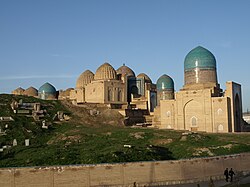
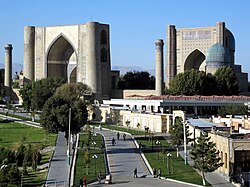
| image_caption = <div> | | image_caption = <div>Clockwise from the top:<br/>[[Registan]] square, [[Shah-i-Zinda]] necropolis, [[Bibi-Khanym Mosque]], view inside [[Shah-i-Zinda]], [[Sherdar Madrasa]] in the Registan, [[Gur-e-Amir]] ([[Timur]]'s Mausoleum)</div> | ||
| image_alt = | | image_alt = | ||
| image_flag = | | image_flag = | ||
| Line 38: | Line 37: | ||
| map_alt = | | map_alt = | ||
| map_caption = | | map_caption = | ||
| pushpin_map = Uzbekistan | | pushpin_map = Uzbekistan | ||
| pushpin_map_alt = | | pushpin_map_alt = | ||
| pushpin_mapsize = 300 | | pushpin_mapsize = 300 | ||
| pushpin_map_caption = Location in Uzbekistan | | pushpin_map_caption = Location in Uzbekistan | ||
| pushpin_label_position = | | pushpin_label_position = left | ||
| pushpin_relief = 1 | | pushpin_relief = 1 | ||
| coordinates = {{coord|39|39| | | coordinates = {{coord|39|39|02|N|66|57|55|E|region:UZ-SA_type:city|display=it}} | ||
| coor_pinpoint = | | coor_pinpoint = | ||
| coordinates_footnotes = | | coordinates_footnotes = | ||
| Line 50: | Line 49: | ||
| subdivision_name = {{flag|Uzbekistan}} | | subdivision_name = {{flag|Uzbekistan}} | ||
| subdivision_type1 = [[Regions of Uzbekistan|Vilayat]] | | subdivision_type1 = [[Regions of Uzbekistan|Vilayat]] | ||
| subdivision_name1 = [[Samarqand Region| | | subdivision_name1 = [[Samarqand Region|Samarqand Vilayat]] | ||
| subdivision_type2 = | | subdivision_type2 = | ||
| subdivision_name2 = | | subdivision_name2 = | ||
| Line 56: | Line 55: | ||
| subdivision_name3 = | | subdivision_name3 = | ||
| established_title = Settled | | established_title = Settled | ||
| established_date = 8th century | | established_date = 8th century BC | ||
| founder = | | founder = | ||
| seat_type = | | seat_type = | ||
| Line 93: | Line 92: | ||
| area_blank2_ha = | | area_blank2_ha = | ||
| elevation_m = 705 | | elevation_m = 705 | ||
| population_as_of = 1 January | | population_as_of = 1 January 2025 | ||
| population_footnotes = | | population_footnotes = | ||
| population_total = | | population_total = 595,200<ref>{{cite web |url=https://www.stat.uz/en/181-ofytsyalnaia-statystyka-en/6383-demography |title=The State Committee of the Republic of Uzbekistan on Statistics |access-date=2020-04-26 |archive-url=https://web.archive.org/web/20200429095401/https://stat.uz/en/181-ofytsyalnaia-statystyka-en/6383-demography |archive-date=2020-04-29 |url-status=dead}}</ref> | ||
| population_density_km2 = auto | | population_density_km2 = auto | ||
| population_metro = | | population_metro = 1,300,000 | ||
| population_note = | | population_note = | ||
| population_demonym = Samarkandian / Samarkandi | | population_demonym = Samarkandian / Samarkandi | ||
| timezone1 = | | timezone1 = [[Uzbekistan Time|UZT]] | ||
| utc_offset1 = + | | utc_offset1 = +05:00 | ||
| timezone1_DST = | | timezone1_DST = | ||
| utc_offset1_DST = | | utc_offset1_DST = | ||
| elevation_ft = 2,363 | |||
| postal_code_type = Postal code | | postal_code_type = Postal code | ||
| postal_code = 140100 | | postal_code = 140100 | ||
| Line 118: | Line 118: | ||
|Area = 1,123 ha | |Area = 1,123 ha | ||
|Buffer_zone = 1,369 ha}} | |Buffer_zone = 1,369 ha}} | ||
| official_name = | |||
}} | }} | ||
{{Contains special characters|Sogdian}} | {{Contains special characters|Sogdian}} | ||
'''Samarkand'''{{efn|{{IPAc-en|ˈ|s|æ|m|ər|k|æ|n|d}} {{respell|SAM|ər|kand}}; [[Uzbek language|Uzbek]] and {{langx|tg|Самарқанд|Samarqand}}, {{IPA|uz|sæmærˈqænd, -ænt|IPA}}.}} is a city in southeastern [[Uzbekistan]] and among the [[List of oldest continuously inhabited cities|oldest continuously inhabited cities]] in [[Central Asia]]. Samarkand is the capital of the [[Samarkand Region]] and a district-level city, that includes the [[urban-type settlement]]s [[Kimyogarlar]], [[Farxod|Farhod]] and [[Xishrav|Khishrav]].<ref name=class>{{cite web |url=https://stat.uz/uploads/docs/soato(mhobt)_2020.xlsx |title=Classification system of territorial units of the Republic of Uzbekistan |language=uz, ru |date=July 2020 |publisher=The State Committee of the Republic of Uzbekistan on statistics}}</ref> With 551,700 inhabitants (2021),<ref name=samstat>{{cite web |url=https://samstat.uz/files/284/Demografiya/1705/Hududlar-boyicha-shahar-va-qishloq-aholisi-soni.pdf |title=Urban and rural population by district |publisher=Samarkand regional department of statistics |language=uz |archive-url=https://web.archive.org/web/20220213143332/https://samstat.uz/uz/?option=com_dropfiles&format=&task=frontfile.download&catid=284&id=1705&Itemid=1000000000000 |archive-date=2022-02-13 |url-status=dead}}</ref> it is the [[List of cities in Uzbekistan|third-largest city in Uzbekistan]]. | |||
The | Historically, Samarkand has long been one of the principal urban centers of Iranian (Persian-Tajik) civilization in Central Asia and played a major role in the cultural and commercial networks of the Silk Road.<ref>{{cite web |title=Samarkand |url=https://www.iranicaonline.org/articles/samarqand-i|website=Encyclopaedia Iranica |access-date=10 March 2026}}</ref><ref>{{cite encyclopedia |title=Samarkand |encyclopedia=Encyclopaedia Britannica |url=https://www.britannica.com/place/Samarkand-Uzbekistan|access-date=10 March 2026}}</ref><ref>{{cite book |last=Frye |first=Richard N. |title=The Heritage of Central Asia |publisher=Cambridge University Press |year=1996}}</ref> There is evidence of human activity in the area of the city dating from the late [[Paleolithic]]. Though there is no direct evidence of when Samarkand was founded, several theories propose that it was founded between the 8th and 7th centuries BC. Prospering from its location on the [[Silk Road]] between [[East Asia|China]], [[Persia]] and [[Europe]], at times Samarkand was one of the largest cities in [[Central Asia]],<ref name="ReferenceC">Guidebook of history of Samarkand", {{ISBN|978-9943-01-139-7}}</ref><ref>{{cite news |last1=Varadarajan |first1=Tunku |date=24 October 2009 |title=Metropolitan Glory |url=https://www.wsj.com/articles/SB10001424052748704500604574483701746375742 |newspaper=The Wall Street Journal}}</ref> By the time of the Persian [[Achaemenid Empire]], it was the capital of the [[Sogdia]]n [[satrap]]y. The city was conquered by [[Alexander the Great]] in 329 BC, when it was known as Markanda, which was rendered in [[Greek language|Greek]] as {{lang|grc|Μαράκανδα}}.<ref name="History of Samarkand">{{cite web |title=History of Samarkand |url=http://www.sezamtravel.com/en/Samarkand |publisher=Sezamtravel |access-date=1 November 2013 |archive-url=https://web.archive.org/web/20131103035234/http://www.sezamtravel.com/en/Samarkand |archive-date=3 November 2013 |url-status=live}}</ref> The city was ruled by a succession of [[Iranian peoples|Iranian]] and [[Turkic peoples|Turkic]] rulers until it was conquered by the [[Mongols]] under [[Genghis Khan]] in 1220. | ||
Since the 11th century, the city has been under Turkic/Uzbek political control, but the city's culture and dominant language has always been [[Persian language|Persian]].<ref>{{Cite web |last=Centre |first=UNESCO World Heritage |title=Samarkand – Crossroad of Cultures |url=https://whc.unesco.org/en/list/603/ |access-date=2025-11-05 |website=UNESCO World Heritage Centre |language=en}}</ref> | |||
== | The city is noted as a centre of [[Islam]]ic [[Ulama|scholarly]] study and the birthplace of the [[Timurid Renaissance]]. In the 14th century, [[Timur]] made it the capital of his empire and the site of his mausoleum, the [[Gur-e Amir]]. The [[Bibi-Khanym Mosque]], rebuilt during the [[Soviet]] era, remains one of the city's most notable landmarks. Samarkand's [[Registan]] square was the city's ancient centre and is bounded by three monumental religious buildings. The city has carefully preserved the traditions of ancient crafts: embroidery, goldwork, silk weaving, copper engraving, ceramics, wood carving, and wood painting.<ref>Энциклопедия туризма Кирилла и Мефодия. 2008.</ref> In 2001, [[UNESCO]] added the city to its [[World Heritage List]] as ''Samarkand – Crossroads of Cultures''. | ||
The name comes from [[Sogdian language|Sogdian]] {{lang|sog|samar}} "stone, rock" and {{lang|sog|kand}} "fort, town."<ref>{{cite book |last=Room |first=Adrian |title=Placenames of the World: Origins and Meanings of the Names for 6,600 Countries, Cities, Territories, Natural Features and Historic Sites |edition=2nd |year=2006 |publisher=McFarland |location=London |isbn=978-0-7864-2248-7 |page=330 |quote=Samarkand City, southeastern Uzbekistan. The city here was already named ''Marakanda'', when captured by Alexander the Great in 329 BCE. Its own name derives from the Sogdian words ''samar'', "stone, rock", and ''kand'', "fort, town".}}</ref> In this respect, ''Samarkand'' shares the same meaning as the name of the Uzbek capital [[Tashkent]], with ''tash-'' being the Turkic term for "stone" and ''-kent'' the Turkic analogue of ''kand''.<ref>Sachau, Edward C. Alberuni’s India: an Account of the Religion. Philosophy, Literature, Geography, Chronology, Astronomy, Customs, Laws and Astrology of India about AD 1030, vol. 1 London: KEGAN PAUL, TRENCH, TRtJBNBR & CO. 1910. p.298.</ref> | |||
Modern Samarkand is divided into two parts: the old city, which includes historical monuments, shops, and old private houses; and the new city, which was developed during the days of the [[Russian Empire]] and [[Soviet Union]] and includes administrative buildings along with cultural centres and educational institutions.<ref>{{cite web |url= https://www.advantour.com/uzbekistan/samarkand/history.htm |title= History of Samarkand |website= Advantour |access-date= 2018-05-15 |archive-url=https://web.archive.org/web/20180516174124/https://www.advantour.com/uzbekistan/samarkand/history.htm |archive-date=2018-05-16 |url-status=live}}</ref> On 15 and 16 September 2022, the city hosted the [[2022 SCO summit]]. | |||
Samarkand has a multicultural and [[plurilingualism|plurilingual]] history that was significantly modified by the process of [[National delimitation in the Soviet Union|national delimitation in Central Asia]]. Small group of inhabitants of the city are bilingual speakers of the [[Tajik language]],<ref>"The Persian-speaking cities of Bukhara and Samarkand, rightly considered by today’s Tajiks as the constituting the historical centres of Tajik civilization" Foltz, Richard. A History of the Tajiks: Iranians of the East. I.B. Tauris, 2019. p.9</ref><ref>D.I. Kertzer/D. Arel, [https://books.google.com/books?id=qMxbzF4NdFUC&pg=PA187 Census and identity] {{Webarchive|url=https://web.archive.org/web/20221117053532/https://books.google.com/books?id=qMxbzF4NdFUC&pg=PA187&dq=&hl=en |date=2022-11-17 }}, Cambridge University Press, 2001, pp. 186–188.</ref> whereas [[Uzbek language|Uzbek]] is the official language and Russian is also widely used in the public sphere, as per [[Languages of Uzbekistan|Uzbekistan's language policy]]. | |||
==Name== | |||
The city was named ''Marakanda'' when captured by [[Alexander the Great]] in 329 BC.<ref name=Room/> | |||
According to some sources, the present name comes from the eastern Iranian language [[Sogdian language|Sogdian]] {{lang|sog|samar}} "stone, rock" and {{lang|sog|kand}} "fort, town."<ref name=Room>{{cite book |last=Room |first=Adrian |title=Placenames of the World: Origins and Meanings of the Names for 6,600 Countries, Cities, Territories, Natural Features and Historic Sites |edition=2nd |year=2006 |publisher=McFarland |location=London |isbn=978-0-7864-2248-7 |page=330 |quote=Samarkand City, southeastern Uzbekistan. The city here was already named ''Marakanda'', when captured by Alexander the Great in 329 BCE. Its own name derives from the Sogdian words ''samar'', "stone, rock", and ''kand'', "fort, town".}}</ref> In this respect, ''Samarkand'' shares the same meaning as the name of the Uzbek capital [[Tashkent]], with ''tash-'' being the Turkic term for "stone" and ''-kent'' the Turkic analogue of ''kand'' borrowed from Iranian languages.<ref>Sachau, Edward C. Alberuni’s India: an Account of the Religion. Philosophy, Literature, Geography, Chronology, Astronomy, Customs, Laws and Astrology of India about AD 1030, vol. 1 London: KEGAN PAUL, TRENCH, TRtJBNBR & CO. 1910. p.298.</ref> But this can't be proven because the city was given its name long after the Turkification of the Sogdians.<ref>{{Cite journal |last=Krippes |first=Karl |date=1991 |title=Sociolinguistic Notes on the Turcification of the Sogdians |url=https://www.jstor.org/stable/41927772 |journal=Central Asiatic Journal |volume=35 |issue=1/2 |pages=67–80 |issn=0008-9192}}</ref> | |||
From more realistic and historical sources, according to 11th-century scholar [[Mahmud al-Kashgari|Mahmud al-Kashghari]], the city was known in [[Karakhanid language|Karakhanid Turkic]] as ''{{Transliteration|Arab|Sämizkänd}}'' or ''Sämerkänd'' ({{Script/Arabic|سَمِزْکَنْدْ}}), meaning "fat city."<ref>{{Cite book |last=al-Kashghari |first=Mahmud |url=https://archive.org/details/CompendiumOfTheTurkicDialectsPart1-MahmudAl-Kashghari/page/n283/mode/2up |title=Compendium of The Turkic Dialects |date=1074 |publisher=Harvard University Printing Office |series=Part 1 |publication-date=1982 |page=270 |translator-last=Dankoff |translator-first=Robert |quote=sämiz känd meaning “Fat city (balda samina)” is called thus because of its great size; it is, in Persian, Samarqand. |author-link=Mahmud al-Kashgari |translator-last2=Kelly |translator-first2=James Michael |translator-link=Robert Dankoff |via=[[Archive.org]]}}</ref> 16th-century Mughal emperor [[Babur]] also mentioned the city under this name, and 15th-century Castillian traveler [[Ruy González de Clavijo]] stated that Samarkand was simply a distorted form of it.<ref>{{Cite journal |last=Ragagnin |first=Elisabetta |date=2020 |title=About Marco Polo Samarkand |url=https://uzlc.navoiy-uni.uz/index.php/uzlangcult/article/view/41 |journal=Uzbekistan: Language and Culture |language=en |publisher={{Interlanguage link|Alisher Navo’i Tashkent State University of Uzbek Language and Literature|uz|Toshkent davlat oʻzbek tili va adabiyoti universiteti}} |volume=3 |issue=3 |pages=79–87 |issn=2181-922X |archive-date=2024-01-23 |access-date=2024-01-23 |archive-url=https://web.archive.org/web/20240123015507/https://uzlc.navoiy-uni.uz/index.php/uzlangcult/article/view/41 |url-status=dead }}</ref> | |||
Some languages have their own spellings or variations of the name, such as the [[French language|French]] "Samarcande", the [[Italian language|Italian]] and [[Spanish language|Spanish]] "Samarcanda", and the [[Turkish language|Turkish]] "Semerkant".<ref>[https://web.archive.org/web/20120117020102/http://www.antalya.bel.tr/UploadedDocuments/semerkant_t.pdf "SEMERKANT"], antalya.bel.tr (archived), accessed 4 February 2026</ref> | |||
==History== | ==History== | ||
{{More citations needed | {{More citations needed section|date=November 2022}} | ||
===Early history=== | ===Early history=== | ||
{{see also|Timeline of Samarkand}} | {{see also|Timeline of Samarkand}} | ||
Along with [[Bukhara]],<ref>Vladimir Babak, Demian Vaisman, Aryeh Wasserman, ''Political organization in Central Asia and Azerbaijan: sources and documents'', p. 374</ref> Samarkand is one of the oldest inhabited cities in [[Central Asia]], prospering from its location on the trade route between China and Europe. There is no direct evidence of when it was founded. Researchers at the Institute of Archaeology of Samarkand date the city's founding | Along with [[Bukhara]],<ref>Vladimir Babak, Demian Vaisman, Aryeh Wasserman, ''Political organization in Central Asia and Azerbaijan: sources and documents'', p. 374</ref> Samarkand is one of the oldest inhabited cities in [[Central Asia]], prospering from its location on the trade route between China and Europe. There is no direct evidence of when it was founded. Researchers at the Institute of Archaeology of Samarkand date the city's founding around 700 BC.<ref>{{cite book | last1=Hanks | first1=Reuel R. | title=Historical Dictionary of Uzbekistan | date=19 February 2024 | publisher=Bloomsbury Publishing PLC | isbn=978-1-5381-0229-9 | url=https://books.google.com/books?id=eW31EAAAQBAJ&dq=samarkand+700+bce&pg=PA175 }}</ref> | ||
[[Archaeology|Archaeological]] excavations conducted within the city limits (Syob and midtown) as well as suburban areas (Hojamazgil, Sazag'on) unearthed 40,000-year-old evidence of human activity, dating back to the [[Upper Paleolithic]]. A group of [[Mesolithic]] (12th–7th millennia | [[Archaeology|Archaeological]] excavations conducted within the city limits (Syob and midtown) as well as suburban areas (Hojamazgil, Sazag'on) unearthed 40,000-year-old evidence of human activity, dating back to the [[Upper Paleolithic]]. A group of [[Mesolithic]] (12th–7th millennia BC) archaeological sites were discovered in the suburbs of Sazag'on-1, Zamichatosh, and Okhalik. The Syob and Darg'om [[canal]]s, supplying the city and its suburbs with water, appeared around the 7th–5th centuries BC (early [[Iron Age]]). | ||
From its earliest days, Samarkand was one of the main centres of [[Sogdia]]n civilization. By the time of the [[Achaemenid Empire|Achaemenid]] dynasty of Persia, the city had become the capital of the Sogdian [[satrapy]]. | From its earliest days, Samarkand was one of the main centres of [[Sogdia]]n civilization. By the time of the [[Achaemenid Empire|Achaemenid]] dynasty of Persia, the city had become the capital of the Sogdian [[satrapy]]. | ||
===Hellenistic period=== | ===Hellenistic period=== | ||
[[File:Afrasiyab ruins in Samarkand.jpg|thumb|upright=1.35|right|Ancient city walls of Samarkand, 4th century | [[File:Afrasiyab ruins in Samarkand.jpg|thumb|upright=1.35|right|Ancient city walls of Samarkand, 4th century BC]] | ||
[[File:Daniël de Blieck - Alexander Slaying Cleitus.jpg|thumb|upright=1.35|''[[Alexander the Great]] Slaying [[Cleitus the Black|Cleitus]] in Samarkand'', by [[Daniël de Blieck]].<br>[[Ferens Art Gallery]], Hull.]] | [[File:Daniël de Blieck - Alexander Slaying Cleitus.jpg|thumb|upright=1.35|''[[Alexander the Great]] Slaying [[Cleitus the Black|Cleitus]] in Samarkand'', by [[Daniël de Blieck]].<br>[[Ferens Art Gallery]], Hull.]] | ||
Alexander the Great conquered Samarkand in 329 | [[Alexander the Great]] conquered Samarkand in 329 BC. The city was known as '''Maracanda''' (Μαράκανδα) by the Greeks.<ref>''Columbia-Lippincott Gazetteer'' (New York: Columbia University Press, 1972 reprint) p. 1657</ref> Written sources offer small clues as to the subsequent system of government.<ref name=Wood2002>{{cite book |last= Wood |first= Frances |year= 2002 |title= The Silk Road: Two Thousand Years in the Heart of Asia |location= Berkeley and Los Angeles |publisher= University of California Press}}</ref> They mention one Orepius who became ruler "not from ancestors, but as a gift of Alexander."<ref>{{cite journal |last= Shichkina |first= G.V. |title= Ancient Samarkand: Capital of Soghd |journal= Bulletin of the Asia Institute |year= 1994 |volume= 8 |page= 83}}</ref> | ||
While Samarkand suffered significant damage during Alexander's initial conquest, the city recovered rapidly and flourished under the new Hellenic influence. There were also major new construction techniques | While Samarkand suffered significant damage during Alexander's initial conquest, the city recovered rapidly and flourished under the new Hellenic influence. There were also major new construction techniques. Oblong bricks were replaced with square ones and superior methods of [[masonry]] and [[plastering]] were introduced.<ref>{{cite journal |last=Shichkina |first=G.V. |title=Ancient Samarkand: capital of Soghd |journal=Bulletin of the Asia Institute |year=1994 |volume=8 |page=86}}</ref> | ||
Alexander's conquests introduced classical Greek culture into Central Asia | Alexander's conquests introduced classical Greek culture into Central Asia and for a time, Greek aesthetics heavily influenced local artisans. This Hellenistic legacy continued as the city became part of various successor states in the centuries following Alexander's death, the Greek [[Seleucid Empire]], [[Greco-Bactrian Kingdom]], and [[Kushan Empire]] (even though the [[Yuezhi|Kushana]] themselves originated in Central Asia). After the Kushan state lost control of Sogdia during the 3rd century AD, Samarkand went into decline as a centre of economic, cultural, and political power. It did not significantly revive until the 5th century. | ||
=== | ===Sasanian era=== | ||
Samarkand was conquered by the Persian [[ | Samarkand was conquered by the Persian [[Sasanians]] c. 260 AD. Under Sasanian rule, the region became an essential site for [[Manichaeism]] and facilitated the dissemination of the religion throughout Central Asia.<ref name="Dumper, Stanley 2007 319">{{cite book |last=Dumper, Stanley |title=Cities of the Middle East and North Africa: A Historical Encyclopedia |year=2007 |publisher=ABC-CLIO |location=California |pages=319–320}}</ref> | ||
=== | ===Hephthalites and Turkic Khaganate era=== | ||
Between AD 350 and 375, Samarkand was conquered by the nomadic tribes of [[Xionites]], the origin of which remains controversial.<ref>Grenet Frantz, Regional interaction in Central Asia and northwest India in the Kidarite and Hephthalites periods in Indo-Iranian languages and peoples. Edited by Nicholas Sims-Williams. Oxford university press, 2003. Р.219–220</ref> The resettlement of nomadic groups to Samarkand confirms archaeological material from the 4th century. The culture of nomads from the Middle [[Syrdarya]] basin is spreading in the region.<ref>Buryakov Y.F. Iz istorii arkheologicheskikh rabot v zonakh oroshayemogo zemledeliya Uzbekistana // Arkheologicheskiye raboty na novostroykakh Uzbekistana. Tashkent, 1990. pp. 9–10.</ref> Between 457 and 509, Samarkand was part of the [[Kidarite]] state.<ref>Etienne de la Vaissiere, Sogdian traders. A history. Translated by James Ward. Brill. Leiden. Boston, 2005, pp. 108–111.</ref> | |||
[[File:Turkish officers during a audience with king Varkhuman of Samarkand. 648-651 CE, Afrasiyab, Samarkand.jpg|thumb|upright|left|[[Western Turks|Turkic officers]] during an audience with king [[Varkhuman]] of Samarkand. 648–651 | [[File:Turkish officers during a audience with king Varkhuman of Samarkand. 648-651 CE, Afrasiyab, Samarkand.jpg|thumb|upright|left|[[Western Turks|Turkic officers]] during an audience with king [[Varkhuman]] of Samarkand. 648–651 AD, [[Afrasiyab (Samarkand)|Afrasiyab murals]], Samarkand.<ref>{{cite book |last1=Baumer |first1=Christoph |title=History of Central Asia, The: 4-volume set |date=18 April 2018 |publisher=Bloomsbury Publishing |isbn=978-1-83860-868-2 |page=243 |url=https://books.google.com/books?id=DhiWDwAAQBAJ&pg=RA1-PA243}}</ref><ref>{{cite journal |last1=Grenet |first1=Frantz |date=2004 |title=Maracanda/Samarkand, une métropole pré-mongole |journal=Annales. Histoire, Sciences Sociales |volume=5/6 |page=Fig. B |url=https://www.cairn.info/journal-annales-2004-5-page-1043.htm}}</ref>]] | ||
After the [[ | After the [[Hephthalites]] ("White Huns") conquered Samarkand, they controlled it until the [[Göktürks]], in an alliance with the Sassanid Persians, won it at the [[Battle of Bukhara]], c. 560 AD.<ref>{{Cite book |last=Bivar |first=A.D.H. |url=https://www.iranicaonline.org/articles/hephthalites |title=Encyclopedia Iranica, Vol. XII, Fasc. 2 |publisher=London et al. |pages=198–201}}</ref> | ||
In the middle of the 6th century, a Turkic state was formed in Altai, founded by the Ashina dynasty. The new state formation was named the [[First Turkic Khaganate|Turkic Khaganate]] after the people of the Turks, which were headed by the ruler – the Khagan. | In the middle of the 6th century, a Turkic state was formed in Altai, founded by the Ashina dynasty. The new state formation was named the [[First Turkic Khaganate|Turkic Khaganate]] after the people of the Turks, which were headed by the ruler – the Khagan. From 557 to 561, the [[Hephthalites]] empire was defeated by the joint actions of the Turks and Sassanids, which led to the establishment of a common border between the two empires.<ref>History of Civilizations of Central Asia: The crossroads of civilizations, AD 250 to 750. Vol. 3. Unesco, 1996. p. 332</ref> | ||
In the early Middle Ages, Samarkand was surrounded by four rows of defensive walls and had four gates.<ref>Belenitskiy A.M., Bentovich I.B., Bolshakov O.G. Srednevekovyy gorod Sredney Azii. L., 1973.</ref> | In the early Middle Ages, Samarkand was surrounded by four rows of defensive walls and had four gates.<ref>Belenitskiy A.M., Bentovich I.B., Bolshakov O.G. Srednevekovyy gorod Sredney Azii. L., 1973.</ref> | ||
| Line 168: | Line 180: | ||
Sprishevskiy V.I. Pogrebeniye s konem serediny I tysyacheletiya n.e., obnaruzhennoye okolo observatorii Ulugbeka. // Tr. Muzeya istorii narodov Uzbekistana. T.1.- Tashkent, 1951.</ref> | Sprishevskiy V.I. Pogrebeniye s konem serediny I tysyacheletiya n.e., obnaruzhennoye okolo observatorii Ulugbeka. // Tr. Muzeya istorii narodov Uzbekistana. T.1.- Tashkent, 1951.</ref> | ||
During the period of the ruler of the Western Turkic | During the period of the ruler of the Western Turkic Khaganate, [[Tong Yabghu Qaghan]] (618–630), family relations were established with the ruler of Samarkand – Tong Yabghu Qaghan gave him his daughter.<ref>Klyashtornyy S. G., Savinov D. G., Stepnyye imperii drevney Yevrazii. Sankt-Peterburg: Filologicheskiy fakul'tet SPbGU, 2005 god, s. 97</ref> | ||
Some parts of Samarkand have been | Some parts of Samarkand have been Christian since the 4th century. In the 5th century, a [[Nestorian]] chair was established in Samarkand. At the beginning of the 8th century, it was transformed into a Nestorian metropolitanate.<ref>Masson M.Ye., Proiskhozhdeniye dvukh nestorianskikh namogilnykh galek Sredney Azii // Obshchestvennyye nauki v Uzbekistane, 1978, №10, p. 53.</ref> Discussions and polemics arose between the Sogdian followers of [[Christianity]] and [[Manichaeism]], reflected in the documents.<ref>Sims-Williams Nicholas, [https://researchers.mq.edu.au/en/publications/a-christian-sogdian-polemic-against-the-manichaeans A Christian sogdian polemic against the manichaens // Religious themes and texts of pre-Islamic Iran and Central Asia.] Edited by Carlo G. Cereti, Mauro Maggi and Elio Provasi. Wiesbaden: Dr. Ludwig Reichert Verlag, 2003, pp. 399–407</ref> | ||
===Early Islamic era=== | ===Early Islamic era=== | ||
[[File:Coin of Sogdian ruler Turgar, Ikhshid of Samarkand, Penjikent, 8th century CE (obverse and reverse), Tajikistan National Museum of Antiquities (319).jpg|thumb|Coin of [[Sogdia]]n ruler [[Turgar]], last [[Ikhshid]] of Samarkand, [[Panjakent|Penjikent]], 8th century | [[File:Coin of Sogdian ruler Turgar, Ikhshid of Samarkand, Penjikent, 8th century CE (obverse and reverse), Tajikistan National Museum of Antiquities (319).jpg|thumb|Coin of [[Sogdia]]n ruler [[Turgar]], last [[Ikhshid]] of Samarkand, [[Panjakent|Penjikent]], 8th century AD, [[National Museum of Antiquities of Tajikistan]].<ref>{{cite book |title=Tadjikistan : au pays des fleuves d'or |date=2021 |publisher=Musée Guimet |location=Paris |isbn=978-9461616272 |page=152}}</ref>]] | ||
The armies of the [[Umayyad Caliphate]] under [[Qutayba ibn Muslim]] captured the city from the Tang dynasty c. 710 | The armies of the [[Umayyad Caliphate]] under [[Qutayba ibn Muslim]] captured the city from the [[Tang dynasty]] c. 710 AD.<ref name="Dumper, Stanley 2007 319"/> During this period, Samarkand was a diverse religious community and was home to a number of religions, including [[Zoroastrianism]], [[Buddhism]], [[Hinduism]], [[Manichaeism]], [[Judaism]], and [[Nestorian Christianity]], with most of the population following Zoroastrianism.<ref>{{cite book |last=Dumper, Stanley |title=Cities of the Middle East and North Africa: A Historical Encyclopedia |year=2007 |location=California}}</ref> | ||
During this period, Samarkand was a diverse religious community and was home to a number of religions, including [[Zoroastrianism]], [[Buddhism]], [[Hinduism]], [[Manichaeism]], [[Judaism]], and [[Nestorian Christianity]], with most of the population following Zoroastrianism.<ref>{{cite book |last=Dumper, Stanley |title=Cities of the Middle East and North Africa: A Historical Encyclopedia |year=2007 |location=California}}</ref> | |||
Qutayba generally did not settle Arabs in Central Asia; he forced the local rulers to pay him tribute but largely left them to their own devices. Samarkand was the major exception to this policy: Qutayba established an Arab [[garrison]] and Arab governmental administration in the city, its Zoroastrian [[fire temple]]s were razed, and a [[mosque]] was built.<ref name="Wellhausen437438">{{cite book |last1=Wellhausen |first1=J. |author-link=Julius Wellhausen |editor1-last=Weir |editor1-first=Margaret Graham |title=The Arab Kingdom and its Fall |date=1927 |publisher=University of Calcutta |url=https://books.google.com/books?id=qxPKpCcVOdcC |pages=437–438 |isbn=9780415209045 |access-date=2019-05-04 |archive-url=https://web.archive.org/web/20190421054204/https://books.google.com/books?id=qxPKpCcVOdcC |archive-date=2019-04-21 |url-status=live}}</ref> Much of the city's population converted to Islam.<ref>{{cite book |last=Whitfield |first=Susan |author-link=Susan Whitfield |title=Life Along the Silk Road |year=1999 |publisher=University of California Press |location=California |page=33}}</ref> | Qutayba generally did not settle Arabs in Central Asia; he forced the local rulers to pay him tribute but largely left them to their own devices. Samarkand was the major exception to this policy: Qutayba established an Arab [[garrison]] and Arab governmental administration in the city, its Zoroastrian [[fire temple]]s were razed, and a [[mosque]] was built.<ref name="Wellhausen437438">{{cite book |last1=Wellhausen |first1=J. |author-link=Julius Wellhausen |editor1-last=Weir |editor1-first=Margaret Graham |title=The Arab Kingdom and its Fall |date=1927 |publisher=University of Calcutta |url=https://books.google.com/books?id=qxPKpCcVOdcC |pages=437–438 |isbn=9780415209045 |access-date=2019-05-04 |archive-url=https://web.archive.org/web/20190421054204/https://books.google.com/books?id=qxPKpCcVOdcC |archive-date=2019-04-21 |url-status=live}}</ref> Much of the city's population converted to Islam.<ref>{{cite book |last=Whitfield |first=Susan |author-link=Susan Whitfield |title=Life Along the Silk Road |year=1999 |publisher=University of California Press |location=California |page=33}}</ref> | ||
| Line 184: | Line 194: | ||
Legend has it that during [[Abbasid]] rule,<ref>Quraishi, Silim "A survey of the development of papermaking in Islamic Countries", ''Bookbinder'', 1989 (3): 29–36.</ref> the secret of [[papermaking]] was obtained from two [[Han Chinese|Chinese]] prisoners from the [[Battle of Talas]] in 751, which led to the foundation of the first [[paper mill]] in the Islamic world at Samarkand. The invention then spread to the rest of the Islamic world and thence to Europe.{{citation needed|date=November 2022}} | Legend has it that during [[Abbasid]] rule,<ref>Quraishi, Silim "A survey of the development of papermaking in Islamic Countries", ''Bookbinder'', 1989 (3): 29–36.</ref> the secret of [[papermaking]] was obtained from two [[Han Chinese|Chinese]] prisoners from the [[Battle of Talas]] in 751, which led to the foundation of the first [[paper mill]] in the Islamic world at Samarkand. The invention then spread to the rest of the Islamic world and thence to Europe.{{citation needed|date=November 2022}} | ||
[[File:Dinar of al-Mu'tazz, AH 253.jpg|250px|thumb|[[Gold dinar]] of caliph [[al-Mu'tazz]], minted at Samarkand in [[Hijri year|AH]] 253 (867 | [[File:Dinar of al-Mu'tazz, AH 253.jpg|250px|thumb|[[Gold dinar]] of caliph [[al-Mu'tazz]], minted at Samarkand in [[Hijri year|AH]] 253 (867 AD). His reign marks the apogee of the [[Anarchy at Samarra|decline of the Caliphate]]'s central authority]] | ||
Abbasid [[Anarchy at Samarra|control of Samarkand soon dissipated]] and was replaced with that of the [[Samanids]] (875–999), though the Samanids were still nominal vassals of the [[Abbasid caliph|Caliph]] during their control of Samarkand. Under Samanid rule the city became a capital of the Samanid dynasty and an even more important node of numerous trade routes. The Samanids were overthrown by the [[Karakhanids]] around 999. Over the next 200 years, Samarkand would be ruled by a succession of [[Turkic peoples|Turkic]] tribes, including the [[Seljuqs]] and the [[Khwarazmshahs]].<ref>{{cite book |last=Dumper, Stanley |title=Cities of the Middle East and North Africa: A Historical Encyclopedia |year=2007 |location=California |page=320}}</ref> | Abbasid [[Anarchy at Samarra|control of Samarkand soon dissipated]] and was replaced with that of the [[Samanids]] (875–999), though the Samanids were still nominal vassals of the [[Abbasid caliph|Caliph]] during their control of Samarkand. Under Samanid rule the city became a capital of the Samanid dynasty and an even more important node of numerous trade routes. The Samanids were overthrown by the [[Karakhanids]] around 999. Over the next 200 years, Samarkand would be ruled by a succession of [[Turkic peoples|Turkic]] tribes, including the [[Seljuqs]] and the [[Khwarazmshahs]].<ref>{{cite book |last=Dumper, Stanley |title=Cities of the Middle East and North Africa: A Historical Encyclopedia |year=2007 |location=California |page=320}}</ref> | ||
| Line 193: | Line 203: | ||
[[File:Shah-i-Zinda.jpg|thumb|Shah-i Zinda memorial complex, 11th–15th centuries]] | [[File:Shah-i-Zinda.jpg|thumb|Shah-i Zinda memorial complex, 11th–15th centuries]] | ||
After the fall of the [[Samanids]] state in | After the fall of the [[Samanids]] state in 999, it was replaced by the Qarakhanid State, where the Turkic Qarakhanid dynasty ruled.<ref name="ReferenceE">Kochnev B. D., Numizmaticheskaya istoriya Karakhanidskogo kaganata (991—1209 gg.). Moskva «Sofiya», 2006</ref> After the state of the Qarakhanids split into two parts, Samarkand became a part of the West [[Kara-Khanid Khanate|Karakhanid Khaganate]] and from 1040 to 1212 was its capital.<ref name="ReferenceE"/> The founder of the Western Qarakhanid Khaganate was Ibrahim Tamgach Khan (1040–1068).<ref name="ReferenceE"/> For the first time, he built a [[madrasa]] in Samarkand with state funds and supported the development of culture in the region. During his reign, a public hospital (bemoristan) and a madrasa were established in Samarkand, where medicine was also taught. | ||
The memorial complex [[Shah-i-Zinda]] was founded by the rulers of the Karakhanid dynasty in the 11th century.<ref>Nemtseva, N.B., Shvab, IU. Ansambl Shah-i Zinda: istoriko-arkhitektymyi ocherk. Tashent: 1979.</ref> | The memorial complex [[Shah-i-Zinda]] was founded by the rulers of the Karakhanid dynasty in the 11th century.<ref>Nemtseva, N.B., Shvab, IU. Ansambl Shah-i Zinda: istoriko-arkhitektymyi ocherk. Tashent: 1979.</ref> | ||
| Line 202: | Line 212: | ||
[[File:Afrosiab (8145369219).jpg|thumb|left|Ruins of Afrasiab – ancient Samarkand destroyed by Genghis Khan.]] | [[File:Afrosiab (8145369219).jpg|thumb|left|Ruins of Afrasiab – ancient Samarkand destroyed by Genghis Khan.]] | ||
The Mongols [[Siege of Samarkand (1220)|conquered Samarkand]] in 1220. [[Ata-Malik Juvayni| | The Mongols [[Siege of Samarkand (1220)|conquered Samarkand]] in 1220. [[Ata-Malik Juvayni|Juvayni]] writes that Genghis killed all who took refuge in the [[citadel]] and the mosque, pillaged the city completely, and [[conscription|conscripted]] 30,000 young men along with 30,000 craftsmen. Samarkand suffered at least one other Mongol sack by [[Baraq (Chagatai Khan)|Khan Baraq]] to get treasure he needed to pay an army. It remained part of the [[Chagatai Khanate]] (one of four Mongol successor realms) until 1370. | ||
''[[The Travels of Marco Polo|The Travels]]'' of [[Marco Polo]], where Polo records his journey along the Silk Road in the late 13th century, describes Samarkand as "a very large and splendid city..."<ref>{{cite web |title=Samarkand Travel Guide |url=https://caravanistan.com/uzbekistan/center/samarkand/ |access-date=2021-03-20 |website=Caravanistan}}</ref> | ''[[The Travels of Marco Polo|The Travels]]'' of [[Marco Polo]], where Polo records his journey along the Silk Road in the late 13th century, describes Samarkand as "a very large and splendid city..."<ref>{{cite web |title=Samarkand Travel Guide |url=https://caravanistan.com/uzbekistan/center/samarkand/ |access-date=2021-03-20 |website=Caravanistan}}</ref> | ||
| Line 214: | Line 224: | ||
In 1365, a revolt against Chagatai Mongol control occurred in Samarkand.<ref>''Encyclopædia Britannica'', 15th Ed, p. 204</ref> In 1370, the conqueror [[Timur]] (Tamerlane), the founder and ruler of the [[Timurid Empire]], made Samarkand his capital. Timur used various tools for legitimisation, including urban planning in his capital, Samarkand.<ref>Malikov Azim, The cultural traditions of urban planning in Samarkand during the epoch of Timur. In: Baumer, C., Novák, M. and Rutishauser, S., Cultures in Contact. Central Asia as Focus of Trade, Cultural Exchange and Knowledge Transmission. Harrassowitz. 2022, p.343</ref> Over the next 35 years, he rebuilt most of the city and populated it with great artisans and craftsmen from across the empire. Timur gained a reputation as a patron of the arts, and Samarkand grew to become the centre of the region of [[Transoxiana]]. Timur's commitment to the arts is evident in how, in contrast with the ruthlessness he showed his enemies, he demonstrated mercy toward those with special artistic abilities. The lives of artists, craftsmen, and [[architect]]s were spared so that they could improve and beautify Timur's capital.{{citation needed|date=November 2022}} | In 1365, a revolt against Chagatai Mongol control occurred in Samarkand.<ref>''Encyclopædia Britannica'', 15th Ed, p. 204</ref> In 1370, the conqueror [[Timur]] (Tamerlane), the founder and ruler of the [[Timurid Empire]], made Samarkand his capital. Timur used various tools for legitimisation, including urban planning in his capital, Samarkand.<ref>Malikov Azim, The cultural traditions of urban planning in Samarkand during the epoch of Timur. In: Baumer, C., Novák, M. and Rutishauser, S., Cultures in Contact. Central Asia as Focus of Trade, Cultural Exchange and Knowledge Transmission. Harrassowitz. 2022, p.343</ref> Over the next 35 years, he rebuilt most of the city and populated it with great artisans and craftsmen from across the empire. Timur gained a reputation as a patron of the arts, and Samarkand grew to become the centre of the region of [[Transoxiana]]. Timur's commitment to the arts is evident in how, in contrast with the ruthlessness he showed his enemies, he demonstrated mercy toward those with special artistic abilities. The lives of artists, craftsmen, and [[architect]]s were spared so that they could improve and beautify Timur's capital.{{citation needed|date=November 2022}} | ||
Timur was also directly involved in construction projects, and his visions often exceeded the technical abilities of his workers. The city was in a state of constant construction, and Timur would often order buildings to be done and redone quickly if he was unsatisfied with the results.<ref name="Marefat 1992 33–38">{{cite journal |last=Marefat |first=Roya |title=The Heavenly City of Samarkand |journal=The Wilson Quarterly |date=Summer 1992 |volume=16 |issue=3 |pages=33–38 |jstor=40258334}}</ref> By his orders, Samarkand could be reached only by roads; deep ditches were dug, and walls {{cvt|5|mi|km|abbr=off|order=flip|0}} in circumference separated the city from its surrounding neighbors.<ref | Timur was also directly involved in construction projects, and his visions often exceeded the technical abilities of his workers. The city was in a state of constant construction, and Timur would often order buildings to be done and redone quickly if he was unsatisfied with the results.<ref name="Marefat 1992 33–38">{{cite journal |last= Marefat |first= Roya |title= The Heavenly City of Samarkand |journal= The Wilson Quarterly |date= Summer 1992 |volume= 16 |issue= 3 |pages= 33–38 |jstor= 40258334}}</ref> By his orders, Samarkand could be reached only by roads; deep ditches were dug, and walls {{cvt|5|mi|km|abbr=off|order=flip|0}} in circumference separated the city from its surrounding neighbors.<ref name=Wood2002 /> At this time, the city had a population of about 150,000.<ref name="ReferenceB">''Columbia-Lippincott Gazetteer'', p. 1657</ref> | ||
[[Henry III of Castile | [[Henry III of Castile]]'s ambassador [[Ruy Gonzalez de Clavijo]], who visited Samarkand between 8 September and 20 November 1404, attested to the never-ending construction that went on in the city. "The Mosque which Timur had built seemed to us the noblest of all those we visited in the city of Samarkand."<ref>{{cite book |last=Le Strange |first=Guy (trans) |title=Clavijo: Embassy to Tamburlaine 1403–1406 |year=1928 |location=London |page=280}}</ref> | ||
=== | ===Ulugh Beg's period (1409–1449)=== | ||
[[File:Ulugh Beg's Astronomic Observatory.jpg|thumb|left|Many prominent astronomers worked at [[Ulugh Beg Observatory|Ulugh Beg's observatory]], which contained this mural sextant, constructed in Samarkand during the 15th century.]] | |||
Between 1417 and 1420, Timur's grandson [[Ulugh Beg]] built a [[madrasa]]h in Samarkand, which became the first building in the architectural ensemble of Registan. Ulugh Beg invited a large number of astronomers and mathematicians of the Islamic world to this madrasa. Under Ulugh Beg, Samarkand became one of the world centers of medieval science. In the first half of the 15th century, a whole scientific school arose around Ulugh Beg, uniting prominent astronomers and mathematicians including [[Jamshid al-Kashi]], [[Qāḍī Zāda al-Rūmī]], and [[Ali Qushji]]. Ulugh Beg's main interest in science was astronomy, and he constructed an observatory in 1428. Its main instrument was the [[Mural instrument|wall quadrant]], which was unique in the world.<ref>{{Cite web |url=https://mathshistory.st-andrews.ac.uk/Biographies/Ulugh_Beg/ |title=Ulugh Beg – Biography |website=Maths History}}</ref> It was known as the "Fakhri Sextant" and had a radius of 40 meters.<ref>{{Cite book |last=Ulugh Beg |title=Dictionary of Scientific Biography}}</ref> Seen in the image on the left, the arc was finely constructed with a staircase on either side to provide access for the assistants who performed the measurements. | |||
=== | ===Uzbek period=== | ||
In 1500, [[nomad]]ic [[Uzbeks|Uzbek]] warriors took control of Samarkand.<ref name="ReferenceB"/> The [[Shaybanids]] emerged as the city's leaders at or about this time. In 1501, Samarkand was finally taken by [[Muhammad Shaybani]] from the Uzbek dynasty of [[Shaybanid]]s, and the city became part of the newly formed “Bukhara Khanate”. Samarkand was chosen as the capital of this state, in which Muhammad Shaybani Khan was crowned. In Samarkand, Muhammad Shaybani Khan ordered to build a large | In 1500, [[nomad]]ic [[Uzbeks|Uzbek]] warriors took control of Samarkand.<ref name="ReferenceB"/> The [[Shaybanids]] emerged as the city's leaders at or about this time. In 1501, Samarkand was finally taken by [[Muhammad Shaybani]] from the Uzbek dynasty of [[Shaybanid]]s, and the city became part of the newly formed “Bukhara Khanate”. Samarkand was chosen as the capital of this state, in which Muhammad Shaybani Khan was crowned. In Samarkand, Muhammad Shaybani Khan ordered to build a large madrasa, where he later took part in scientific and religious disputes. The first dated news about the Shaybani Khan madrasa dates back to 1504 (it was completely destroyed during the years of Soviet power). Muhammad Salikh wrote that Sheibani Khan built a madrasa in Samarkand to perpetuate the memory of his brother Mahmud Sultan.<ref name="ReferenceF">Mukminova R. G., K istorii agrarnykh otnosheniy v Uzbekistane XVI veke. Po materialam «Vakf-name». Tashkent. Nauka. 1966</ref> | ||
Fazlallah ibn Ruzbihan {{Who|date=November 2022}} in "Mikhmon-namei Bukhara" expresses his admiration for the majestic building of the | Fazlallah ibn Ruzbihan {{Who|date=November 2022}} in "Mikhmon-namei Bukhara" expresses his admiration for the majestic building of the madrasa, its gilded roof, high hujras, spacious courtyard and quotes a verse praising the madrasa.<ref>Fazlallakh ibn Ruzbikhan Isfakhani. Mikhman-name-yi Bukhara (Zapiski bukharskogo gostya). M. Vostochnaya literatura. 1976, p. 3</ref> Zayn ad-din Vasifi, who visited the Sheibani-khan madrasa several years later, wrote in his memoirs that the veranda, hall and courtyard of the madrassah are spacious and magnificent.<ref name="ReferenceF"/> | ||
Abdulatif Khan, the son of | Abdulatif Khan, the son of Ulugh Beg's grandson Kuchkunji Khan, who ruled in Samarkand from 1540 to 1551, was considered an expert in the history of Maverannahr and the Shibanid dynasty. He patronized poets and scientists. Abdulatif Khan himself wrote poetry under the literary pseudonym Khush.<ref>B.V. Norik. Rol' shibanidskikh praviteley v literaturnoy zhizni Maverannakhra XVI veka. Sankt-Peterburg: Rakhmat-name, 2008. p. 233.</ref> | ||
During the reign of the Ashtarkhanid [[Imam Quli Khan of Bukhara|Imam Quli Khan]] (1611–1642) famous architectural masterpieces were built in Samarkand. In 1612–1656, the governor of Samarkand, Yalangtush Bahadur, built a cathedral mosque, | During the reign of the Ashtarkhanid [[Imam Quli Khan of Bukhara|Imam Quli Khan]] (1611–1642) famous architectural masterpieces were built in Samarkand. In 1612–1656, the governor of Samarkand, Yalangtush Bahadur, built a cathedral mosque, the [[Tilakari Madrasa]] and the [[Sherdar Madrasa]].{{citation needed|date=November 2022}} | ||
[[Zarafshan Water Bridge]] is a brick bridge built on the left bank of the [[Zarafshan River]], 7–8 km northeast of the center of Samarkand, built by [[Muhammad Shaybani|Shaibani Khan]] at the beginning of the 16th century.<ref>{{Cite web|url= https://uzsmart.uz/encyclopedia/encyclopedia/66708.html|title= ZARAFSHON SUVAYIRGʻICH KOʻPRIGI |website= uzsmart.uz |accessdate= 2023-11-14}}</ref><ref>{{Cite web|url= https://www.centralasia-travel.com/ru/countries/uzbekistan/places/most-sheybanixana |title= МОСТ ШЕЙБАНИ-ХАНА |website= www.centralasia-travel.com |accessdate= 2023-11-14}}</ref> | |||
After an assault by the [[Afsharid dynasty|Afshar]] [[Shah]]anshah [[Nader Shah]], the city was abandoned in the early 1720s.<ref>''Britannica''. 15th Ed, p. 204</ref> From 1599 to 1756, Samarkand was ruled by the [[Astrakhan Khanate|Ashtrakhanid]] branch of the [[Khanate of Bukhara]]. | After an assault by the [[Afsharid dynasty|Afshar]] [[Shah]]anshah [[Nader Shah]], the city was abandoned in the early 1720s.<ref>''Britannica''. 15th Ed, p. 204</ref> From 1599 to 1756, Samarkand was ruled by the [[Astrakhan Khanate|Ashtrakhanid]] branch of the [[Khanate of Bukhara]]. | ||
<gallery mode="packed" heights="120"> | <gallery mode="packed" heights="120"> | ||
File:Rajasthan3.jpg|Ulugh Beg | File:Rajasthan3.jpg|The [[Ulugh Beg Madrasa]] | ||
File:Rajasthan.jpg| | File:Rajasthan.jpg|The [[Sherdar Madrasa]] | ||
File:Registan Tillya-Kari madrasah2014.JPG| | File:Registan Tillya-Kari madrasah2014.JPG|The [[Tilakari Madrasa]] | ||
Ulugh-beg Madrassa courtyard.JPG|Ulugh Beg | Ulugh-beg Madrassa courtyard.JPG|The [[Ulugh Beg Madrasa]]'s courtyard | ||
File:Lion(or tiger) on the Sher-dor madrassa.JPG|Tiger on the | File:Lion(or tiger) on the Sher-dor madrassa.JPG|Tiger on the [[Sherdar Madrasa]]'s [[iwan]] | ||
</gallery> | </gallery> | ||
===Second half of the | ===Second half of the 18th–19’s century Uzbek period=== | ||
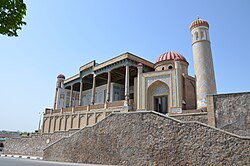
[[File:Mosque Hazrat-Hyzr (1).JPG|thumb|right|Khazrat Hizr mosque, 1854]] | [[File:Mosque Hazrat-Hyzr (1).JPG|thumb|right|Khazrat Hizr mosque, 1854]] | ||
| Line 247: | Line 260: | ||
{{See also|Russian Turkestan|Uzbeks#Russo-Soviet era}} | {{See also|Russian Turkestan|Uzbeks#Russo-Soviet era}} | ||
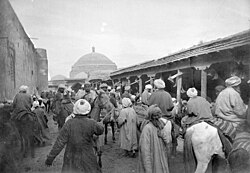
[[File:Самарканд - 6.jpg|thumb|Samarkand in 1890]] | [[File:Самарканд - 6.jpg|thumb|Samarkand in 1890]] | ||
The city came under [[imperial Russia]]n rule after the citadel had been taken by a force under Colonel [[Konstantin Petrovich von Kaufman]] in 1868. Shortly thereafter the small Russian garrison of 500 men were themselves [[Siege of Samarkand (1868)|besieged]]. The assault, which was led by Abdul Malik Tura, the rebellious elder son of the [[Emirate of Bukhara|Bukharan Emir]], as well as Baba [[Bey|Beg]] of [[Shahrisabz]] and Jura Beg of [[Kitab, Uzbekistan|Kitab]], was repelled with heavy losses. General [[Alexander Konstantinovich Abramov]] became the first Governor of the Military [[Okrug]], which the Russians established along the course of the [[Zeravshan River]] with Samarkand as the administrative centre. The Russian section of the city was built after this point, largely west of the old city. | The city came under [[imperial Russia]]n rule after the citadel had been taken by a force under Colonel [[Konstantin Petrovich von Kaufman]] in 1868. Shortly thereafter the small Russian garrison of 500 men were themselves [[Siege of Samarkand (1868)|besieged]]. The assault, which was led by Abdul Malik Tura, the rebellious elder son of the [[Emirate of Bukhara|Bukharan Emir]], as well as Baba [[Bey|Beg]] of [[Shahrisabz]] and Jura Beg of [[Kitab, Uzbekistan|Kitab]], was repelled with heavy losses. General [[Alexander Konstantinovich Abramov]] became the first Governor of the Military [[Okrug]], which the Russians established along the course of the [[Zeravshan River]] with Samarkand as the administrative centre. The Russian section of the city was built after this point, largely west of the old city.{{citation needed|date=November 2025}} | ||
In 1886, the city became the capital of the newly formed [[Samarkand Oblast]] of [[Russian Turkestan]] and regained even more importance when the [[Trans-Caspian railway]] reached it in 1888. | In 1886, the city became the capital of the newly formed [[Samarkand Oblast]] of [[Russian Turkestan]] and regained even more importance when the [[Trans-Caspian railway]] reached it in 1888.{{citation needed|date=November 2025}} | ||
===Soviet period=== | ===Soviet period=== | ||
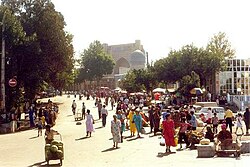
[[File:Samarqand.jpg|thumb|[[Downtown]] with Bibi-Khanym Mosque in 1990s]] | [[File:Samarqand.jpg|thumb|[[Downtown]] with Bibi-Khanym Mosque in 1990s]] | ||
Samarkand was the capital of the [[Uzbek SSR]] from 1925 to 1930, before being replaced by [[Tashkent]]. During [[World War II]], after [[Nazi Germany]] [[Operation Barbarossa|invaded]] the [[Soviet Union]], a number of Samarkand's citizens were sent to [[Smolensk]] to [[Battle of Smolensk (1941)|fight the enemy]]. Many were [[German mistreatment of Soviet prisoners of war|taken captive or killed by the Nazis]].<ref name=Soldat>{{Cite web |title=Советское Поле Славы |url=https://www.soldat.ru/search/f_glory/soldiers.html |archiveurl=https://web.archive.org/web/20200413043841/http://www.soldat.ru/search/f_glory/soldiers.html |url-status=dead |archivedate=April 13, 2020 |website=www.soldat.ru}}</ref><ref name="BBC2017CentralAsians">{{cite news |author=Rustam Qobil |publisher=BBC |title=Why were 101 Uzbeks killed in the Netherlands in 1942? |url=https://www.bbc.co.uk/news/magazine-39849088 |date=2017-05-09 |access-date=2017-05-09 |archive-url=https://web.archive.org/web/20200330201803/https://www.bbc.co.uk/news/magazine-39849088 |archive-date=2020-03-30 |url-status=live}}</ref> Additionally, thousands of refugees from the occupied western regions of the USSR fled to the city, and it served as one of the main hubs for the fleeing civilians in the [[Uzbek Soviet Socialist Republic]] and the [[Soviet Union]] as a whole.{{citation needed|date=November 2022}} | Samarkand was the capital of [[Turkestan Provisional Government]] in 1922 and was the capital of the [[Uzbek SSR]] from 1925 to 1930, before being replaced by [[Tashkent]]. During [[World War II]], after [[Nazi Germany]] [[Operation Barbarossa|invaded]] the [[Soviet Union]], a number of Samarkand's citizens were sent to [[Smolensk]] to [[Battle of Smolensk (1941)|fight the enemy]]. Many were [[German mistreatment of Soviet prisoners of war|taken captive or killed by the Nazis]].<ref name=Soldat>{{Cite web |title=Советское Поле Славы |url=https://www.soldat.ru/search/f_glory/soldiers.html |archiveurl=https://web.archive.org/web/20200413043841/http://www.soldat.ru/search/f_glory/soldiers.html |url-status=dead |archivedate=April 13, 2020 |website=www.soldat.ru}}</ref><ref name="BBC2017CentralAsians">{{cite news |author=Rustam Qobil |publisher=BBC |title=Why were 101 Uzbeks killed in the Netherlands in 1942? |url=https://www.bbc.co.uk/news/magazine-39849088 |date=2017-05-09 |access-date=2017-05-09 |archive-url=https://web.archive.org/web/20200330201803/https://www.bbc.co.uk/news/magazine-39849088 |archive-date=2020-03-30 |url-status=live}}</ref> Additionally, thousands of refugees from the occupied western regions of the USSR fled to the city, and it served as one of the main hubs for the fleeing civilians in the [[Uzbek Soviet Socialist Republic]] and the [[Soviet Union]] as a whole.{{citation needed|date=November 2022}} | ||
[[File:1872 Vereshchagin Triumphierend anagoria.JPG|thumb|upright=1.25|''Triumph'' by [[Vasily Vereshchagin]], depicting the | [[File:1872 Vereshchagin Triumphierend anagoria.JPG|thumb|upright=1.25|''Triumph'' by [[Vasily Vereshchagin]], depicting the [[Sherdar Madrasa]] on the [[Registan]].]] | ||
European study of the history of Samarkand began after the conquest of Samarkand by the Russian Empire in 1868. The first studies of the history of Samarkand belong to N. Veselovsky, V. Bartold and V. Vyatkin. In the Soviet period, the generalization of materials on the history of Samarkand was reflected in the two-volume ''History of Samarkand'' edited by the academician of Uzbekistan [[Ibrohim Moʻminov]].<ref>Montgomery David. Samarkand taarikhi (History of Samarkand) by I.M.Muminov, The American historical review, volume 81, no.8 (October 1976), pp. 914–915</ref> | |||
On the initiative of Academician of the Academy of Sciences of the Uzbek SSR I. Muminov and with the support of Sharaf Rashidov, the 2500th anniversary of Samarkand was widely celebrated in 1970. In this regard, a monument to | On the initiative of Academician of the Academy of Sciences of the Uzbek SSR I. Muminov and with the support of [[Sharof Rashidov|Sharaf Rashidov]], the 2500th anniversary of Samarkand was widely celebrated in 1970. In this regard, a monument to [[Ulugh Beg]] was opened, the Museum of the History of Samarkand was founded, and a two-volume history of Samarkand was prepared and published.<ref>Istoriya Samarkanda v dvukh tomakh. Pod redaktsiyey I. Muminova. Tashkent, 1970</ref><ref>Montgomery David, Review of Samarkand taarikhi by I. M. Muminov et al. // The American historical review, volume 81, no. 4 (October 1976)</ref> | ||
After Uzbekistan gained independence, several monographs were published on the ancient and medieval history of Samarkand.<ref>Shirinov T.SH., Isamiddinov M.KH. Arkheologiya drevnego Samarkanda. Tashkent, 2007</ref><ref>Malikov A.M. Istoriya Samarkanda (s drevnikh vremen do serediny XIV veka). Tom. 1. Tashkent: Paradigma, 2017.</ref> | After Uzbekistan gained independence, several monographs were published on the ancient and medieval history of Samarkand.<ref>Shirinov T.SH., Isamiddinov M.KH. Arkheologiya drevnego Samarkanda. Tashkent, 2007</ref><ref>Malikov A.M. Istoriya Samarkanda (s drevnikh vremen do serediny XIV veka). Tom. 1. Tashkent: Paradigma, 2017.</ref> | ||
| Line 266: | Line 279: | ||
===Climate=== | ===Climate=== | ||
Samarkand has a [[ | Samarkand has a [[cold semi-arid climate]] ([[Köppen climate classification]]: ''BSk'') with hot, dry summers and relatively wet, variable winters that alternate periods of warm weather with periods of cold weather. July and August are the hottest months of the year, with temperatures reaching and exceeding {{cvt|40|C}}. Precipitation is sparse from June through October, but increases to a maximum from February to April. January 2008 was particularly cold; the temperature dropped to {{cvt|-22|°C|0}}.<ref>{{cite web |url=http://www.samarkand.info/html/weather.html |title=Weather in Samarkand |access-date=2009-06-11 |author=Samarkand.info |archive-url=https://web.archive.org/web/20090604132408/http://www.samarkand.info/html/weather.html |archive-date=2009-06-04 |url-status=live}}</ref> | ||
{{Weather box | {{Weather box | ||
|width=auto | |width=auto | ||
| Line 337: | Line 350: | ||
| Dec record low C=−22.8 | | Dec record low C=−22.8 | ||
|year record low C=−25.4 | |year record low C=−25.4 | ||
| precipitation colour=green | |precipitation colour =green | ||
| Jan precipitation mm= | | Jan precipitation mm=41.1 | ||
| Feb precipitation mm=52. | | Feb precipitation mm=52.2 | ||
| Mar precipitation mm=73.2 | | Mar precipitation mm=73.2 | ||
| Apr precipitation mm= | | Apr precipitation mm=62.9 | ||
| May precipitation mm=40. | | May precipitation mm=40.0 | ||
| Jun precipitation mm=6.8 | | Jun precipitation mm=6.8 | ||
| Jul precipitation mm=1.6 | | Jul precipitation mm=1.6 | ||
| Aug precipitation mm=1.6 | | Aug precipitation mm=1.6 | ||
| Sep precipitation mm=2. | | Sep precipitation mm=2.7 | ||
| Oct precipitation mm=16.0 | | Oct precipitation mm=16.0 | ||
| Nov precipitation mm=40. | | Nov precipitation mm=40.3 | ||
| Dec precipitation mm=39.2 | | Dec precipitation mm=39.2 | ||
|year precipitation mm= | |year precipitation mm=377.6 | ||
|unit precipitation days = 1.0 mm | |||
| Jan precipitation days = 14 | |||
| Feb precipitation days = 13 | |||
| Mar precipitation days = 15 | |||
| Apr precipitation days = 13 | |||
| May precipitation days = 11 | |||
| Jun precipitation days = 5 | |||
| Jul precipitation days = 2 | |||
| Aug precipitation days = 2 | |||
| Sep precipitation days = 2 | |||
| Oct precipitation days = 6 | |||
| Nov precipitation days = 10 | |||
| Dec precipitation days = 12 | |||
| year precipitation days = 105 | |||
| Jan humidity=76 | | Jan humidity=76 | ||
| Feb humidity=74 | | Feb humidity=74 | ||
| Line 364: | Line 391: | ||
| Dec humidity=74 | | Dec humidity=74 | ||
|year humidity=59 | |year humidity=59 | ||
| Jan | | Jan rain days=8 | ||
| Feb | | Feb rain days=10 | ||
| Mar | | Mar rain days=13 | ||
| Apr | | Apr rain days=11 | ||
| May | | May rain days=9 | ||
| Jun | | Jun rain days=3 | ||
| Jul | | Jul rain days=2 | ||
| Aug | | Aug rain days=1 | ||
| Sep | | Sep rain days=2 | ||
| Oct | | Oct rain days=6 | ||
| Nov | | Nov rain days=8 | ||
| Dec | | Dec rain days=9 | ||
| year | | year rain days= 82 | ||
| Jan snow days=9 | | Jan snow days=9 | ||
| Feb snow days=7 | | Feb snow days=7 | ||
| Line 390: | Line 417: | ||
| Dec snow days=6 | | Dec snow days=6 | ||
|year snow days=28 | |year snow days=28 | ||
| Jan sun= | | Jan sun=119.2 | ||
| Feb sun=130.9 | | Feb sun=130.9 | ||
| Mar sun= | | Mar sun=172.2 | ||
| Apr sun= | | Apr sun=228.8 | ||
| May sun= | | May sun=297.7 | ||
| Jun sun= | | Jun sun=345.5 | ||
| Jul sun= | | Jul sun=373.1 | ||
| Aug sun= | | Aug sun=358.9 | ||
| Sep sun= | | Sep sun=305.9 | ||
| Oct sun= | | Oct sun=242.6 | ||
| Nov sun= | | Nov sun=150.7 | ||
| Dec sun= | | Dec sun=120.2 | ||
|year sun= | |year sun= | ||
| Jan dew point C=-2 | | Jan dew point C=-2 | ||
| Feb dew point C=-1 | | Feb dew point C=-1 | ||
| Line 427: | Line 454: | ||
| Nov uv=2 | | Nov uv=2 | ||
| Dec uv=2 | | Dec uv=2 | ||
|source 1 = Pogoda.ru.net <ref name = Pogoda > | |source 1 = Pogoda.ru.net<ref name = Pogoda > | ||
{{cite web | {{cite web | ||
| url = http://www.pogodaiklimat.ru/climate.php?id=38696 | | url = http://www.pogodaiklimat.ru/climate.php?id=38696 | ||
| Line 434: | Line 461: | ||
| language = ru | | language = ru | ||
| access-date = 18 January 2021}}</ref> | | access-date = 18 January 2021}}</ref> | ||
|source 2=Weather Atlas (UV),<ref>{{cite web |url=https://www.weather-atlas.com/en/uzbekistan/samarkand-climate |title=Samarkand, Uzbekistan – Detailed climate information and monthly weather forecast |publisher=Weather Atlas |access-date=1 August 2022}}</ref> Time and Date (dewpoints, 1985–2015),<ref>{{cite web |url=https://www.timeanddate.com/weather/uzbekistan/samarkand/climate |title=Climate & Weather Averages in Samarkand |publisher=Time and Date |access-date=24 July 2022}}</ref> | |source 2=Weather Atlas (UV),<ref>{{cite web |url=https://www.weather-atlas.com/en/uzbekistan/samarkand-climate |title=Samarkand, Uzbekistan – Detailed climate information and monthly weather forecast |publisher=Weather Atlas |access-date=1 August 2022}}</ref> Time and Date (dewpoints, 1985–2015),<ref>{{cite web |url=https://www.timeanddate.com/weather/uzbekistan/samarkand/climate |title=Climate & Weather Averages in Samarkand |publisher=Time and Date |access-date=24 July 2022}}</ref> [[NOAA]]<ref name= NOAA>{{cite web |url=https://www.nodc.noaa.gov/archive/arc0216/0253808/2.2/data/0-data/Region-2-WMO-Normals-9120/Uzbekistan/CSV/Samarkand_38696.csv|title=Samarkand Climate Normals 1991–2020 |publisher=National Oceanic and Atmospheric Administration |access-date=November 1, 2023}}</ref> | ||
|date=August | |date=August 2023 | ||
}} | }} | ||
==People== | ==People== | ||
According to official reports, a majority of Samarkand's inhabitants are [[Uzbeks]], while many sources refer to the city as majority [[Tajiks|Tajik]],<ref>Akiner, Shirin; Djalili, Mohammad-Reza; Grare, Frederic (2013). Tajikistan: The Trials of Independence. Routledge. {{ISBN|978-1-136-10490-9}} p. 78, "Bukhara and Samarkand, inhabited by a marked Tajik majority (...)"</ref><ref name="Lena Jonson 2006. pg 108">Lena Jonson (1976) "Tajikistan in the New Central Asia", I.B.Tauris, p. 108: "According to official Uzbek statistics there are slightly over 1 million Tajiks in Uzbekistan or about 3% of the population. The unofficial figure is over 6 million Tajiks. They are concentrated in the Sukhandarya, Samarqand and Bukhara regions."</ref><ref name="catoday.org">{{cite web |url=http://catoday.org/tjru/11180-uzbekistan-tadzhikskiy-yazyk-podavlyaetsya |title=Узбекистан: Таджикский язык подавляется |website=catoday.org — ИА "Озодагон" |access-date=22 March 2019 |archive-url=https://web.archive.org/web/20190322114708/http://catoday.org/tjru/11180-uzbekistan-tadzhikskiy-yazyk-podavlyaetsya |archive-date=22 March 2019 |url-status=dead}}</ref><ref name="news.tj">{{cite web |url=https://news.tj/ru/news/opinion/20190318/tadzhiki-irantsi-vostoka-retsenziya-knigi-ot-kamoliddina-abdullaeva |title=Таджики – иранцы Востока? Рецензия книги от Камолиддина Абдуллаева |website=«ASIA-Plus» Media Group / Tajikistan — news.tj |access-date=22 March 2019 |archive-url=https://web.archive.org/web/20190327090939/https://news.tj/ru/news/opinion/20190318/tadzhiki-irantsi-vostoka-retsenziya-knigi-ot-kamoliddina-abdullaeva |archive-date=27 March 2019 |url-status=dead}}</ref> up to 70 percent of the city's population.<ref name=Foltz>{{cite journal |author-link=Richard Foltz |author=Richard Foltz |title=The Tajiks of Uzbekistan |journal=Central Asian Survey |volume=15 |issue=2 |pages=213–216 |year=1996 |doi=10.1080/02634939608400946}}</ref> Tajiks are especially concentrated in the eastern part of the city, where the main architectural landmarks are. | According to official reports, a majority of Samarkand's inhabitants are [[Uzbeks]], while many sources refer to the city as majority [[Tajiks|Tajik]],<ref>Akiner, Shirin; Djalili, Mohammad-Reza; Grare, Frederic (2013). Tajikistan: The Trials of Independence. Routledge. {{ISBN|978-1-136-10490-9}} p. 78, "Bukhara and Samarkand, inhabited by a marked Tajik majority (...)"</ref><ref name="Lena Jonson 2006. pg 108">Lena Jonson (1976) "Tajikistan in the New Central Asia", I.B.Tauris, p. 108: "According to official Uzbek statistics there are slightly over 1 million Tajiks in Uzbekistan or about 3% of the population. The unofficial figure is over 6 million Tajiks. They are concentrated in the Sukhandarya, Samarqand and Bukhara regions."</ref><ref name="catoday.org">{{cite web |url=http://catoday.org/tjru/11180-uzbekistan-tadzhikskiy-yazyk-podavlyaetsya |title=Узбекистан: Таджикский язык подавляется |website=catoday.org — ИА "Озодагон" |access-date=22 March 2019 |archive-url=https://web.archive.org/web/20190322114708/http://catoday.org/tjru/11180-uzbekistan-tadzhikskiy-yazyk-podavlyaetsya |archive-date=22 March 2019 |url-status=dead}}</ref><ref name="news.tj">{{cite web |url=https://news.tj/ru/news/opinion/20190318/tadzhiki-irantsi-vostoka-retsenziya-knigi-ot-kamoliddina-abdullaeva |title=Таджики – иранцы Востока? Рецензия книги от Камолиддина Абдуллаева |website=«ASIA-Plus» Media Group / Tajikistan — news.tj |access-date=22 March 2019 |archive-url=https://web.archive.org/web/20190327090939/https://news.tj/ru/news/opinion/20190318/tadzhiki-irantsi-vostoka-retsenziya-knigi-ot-kamoliddina-abdullaeva |archive-date=27 March 2019 |url-status=dead}}</ref> up to 70 percent of the city's population.<ref name="Foltz">{{cite journal |author-link=Richard Foltz |author=Richard Foltz |title=The Tajiks of Uzbekistan |journal=Central Asian Survey |volume=15 |issue=2 |pages=213–216 |year=1996 |doi=10.1080/02634939608400946}}</ref> Tajiks are especially concentrated in the eastern part of the city, where the main architectural landmarks are.<ref name="Foltz" /> | ||
According to various independent sources, Tajiks are Samarkand's majority ethnic group. Ethnic [[Uzbek people|Uzbeks]] are the second-largest group<ref name="PB">[[Paul Bergne]]: ''The Birth of Tajikistan. National Identity and the Origins of the Republic''. International Library of Central Asia Studies. [[I.B. Tauris]]. 2007. Pg. 106</ref> and are most concentrated in the west of Samarkand. Exact demographic figures are difficult to obtain since some people in Uzbekistan identify as "Uzbek" even though they speak [[Tajik language|Tajiki]] as their first language, often because they are registered as Uzbeks by the central government despite their Tajiki language and identity. As explained by [[Paul Bergne]]: | According to various independent sources, Tajiks are Samarkand's majority ethnic group. Ethnic [[Uzbek people|Uzbeks]] are the second-largest group<ref name="PB">[[Paul Bergne]]: ''The Birth of Tajikistan. National Identity and the Origins of the Republic''. International Library of Central Asia Studies. [[I.B. Tauris]]. 2007. Pg. 106</ref><ref>{{cite book |last=Frye |first=Richard N. |url=https://archive.org/details/heritageofcentra00frye |title=The Heritage of Central Asia: From Antiquity to the Turkish Expansion |publisher=Princeton University Press |year=1996 |access-date=10 March 2026}}</ref> and are most concentrated in the west of Samarkand. Exact demographic figures are difficult to obtain since some people in Uzbekistan identify as "Uzbek" even though they speak [[Tajik language|Tajiki]] as their first language, often because they are registered as Uzbeks by the central government despite their Tajiki language and identity. As explained by [[Paul Bergne]]: | ||
<blockquote>During the census of 1926 a significant part of the Tajik population was registered as Uzbek. Thus, for example, in the 1920 census in Samarkand city the Tajiks were recorded as numbering 44,758 and the Uzbeks only 3301. According to the 1926 census, the number of Uzbeks was recorded as 43,364 and the Tajiks as only 10,716. In a series of kishlaks [villages] in the Khojand Okrug, whose population was registered as Tajik in 1920 e.g. in Asht, Kalacha, Akjar i Tajik and others, in the 1926 census they were registered as Uzbeks. Similar facts can be adduced also with regard to Ferghana, Samarkand, and especially the Bukhara oblasts.<ref name="PB" /></blockquote> | <blockquote>During the census of 1926 a significant part of the Tajik population was registered as Uzbek. Thus, for example, in the 1920 census in Samarkand city the Tajiks were recorded as numbering 44,758 and the Uzbeks only 3301. According to the 1926 census, the number of Uzbeks was recorded as 43,364 and the Tajiks as only 10,716. In a series of kishlaks [villages] in the Khojand Okrug, whose population was registered as Tajik in 1920 e.g. in Asht, Kalacha, Akjar i Tajik and others, in the 1926 census they were registered as Uzbeks. Similar facts can be adduced also with regard to Ferghana, Samarkand, and especially the Bukhara oblasts.<ref name="PB" /></blockquote> | ||
| Line 447: | Line 474: | ||
Samarkand is also home to large ethnic communities of "[[Iranian peoples|Iranis]]" (the old, [[Persian language|Persian]]-speaking, [[Shia]] population of [[Merv]] city and oasis, deported en masse to this area in the late 18th century), [[Russians]], [[Ukrainians]], [[Belarusians]], [[Armenians]], [[Azeris]], [[Tatars]], [[Koryo-saram|Koreans]], [[Polish people|Poles]], and [[Germans]], all of whom live primarily in the centre and western neighborhoods of the city. These peoples have emigrated to Samarkand since the end of the 19th century, especially during the Soviet Era; by and large, they speak the [[Russian language]]. | Samarkand is also home to large ethnic communities of "[[Iranian peoples|Iranis]]" (the old, [[Persian language|Persian]]-speaking, [[Shia]] population of [[Merv]] city and oasis, deported en masse to this area in the late 18th century), [[Russians]], [[Ukrainians]], [[Belarusians]], [[Armenians]], [[Azeris]], [[Tatars]], [[Koryo-saram|Koreans]], [[Polish people|Poles]], and [[Germans]], all of whom live primarily in the centre and western neighborhoods of the city. These peoples have emigrated to Samarkand since the end of the 19th century, especially during the Soviet Era; by and large, they speak the [[Russian language]]. | ||
In the extreme west and southwest of Samarkand is a population of [[ | In the extreme west and southwest of Samarkand is a population of [[Central Asian Arabs]], who mostly speak Uzbek; only a small portion of the older generation speaks [[Central Asian Arabic]]. In eastern Samarkand there was once a large mahallah of [[Bukharian Jews|Bukharian (Central Asian) Jews]], but starting in the 1970s, hundreds of thousands of Jews left Uzbekistan for [[Israel]], [[United States]], [[Canada]], [[Australia]], and [[Europe]]. Only a few Jewish families are left in Samarkand today. | ||
Also in the eastern part of Samarkand there are several quarters where [[:ru:Среднеазиатские цыгане|Central Asian "Gypsies"]]<ref>{{cite conference |url=https://www.researchgate.net/publication/266387780 |title=Migrations and Identities of Central Asian 'Gypsies' |doi=10.1057/ces.2008.3 |author1=Marushiakova |last2=Popov |first2=Vesselin |date=January 2014 |s2cid=154689140 |accessdate=2022-02-28 |conference=Asia Pacific Sociological Association (APSA) Conference "Transforming Societies: Conestations and Convergences in Asia and the Pacific"}}</ref> ([[Lyuli]], Djugi, [[Parya language|Parya]], and other groups) live. These peoples began to arrive in Samarkand several centuries ago from what are now [[India]] and [[Pakistan]]. They mainly speak a dialect of the Tajik language, as well as their own languages, most notably [[Parya language|Parya]]. | Also in the eastern part of Samarkand there are several quarters where [[:ru:Среднеазиатские цыгане|Central Asian "Gypsies"]]<ref>{{cite conference |url=https://www.researchgate.net/publication/266387780 |title=Migrations and Identities of Central Asian 'Gypsies' |doi=10.1057/ces.2008.3 |author1=Marushiakova |last2=Popov |first2=Vesselin |date=January 2014 |s2cid=154689140 |accessdate=2022-02-28 |conference=Asia Pacific Sociological Association (APSA) Conference "Transforming Societies: Conestations and Convergences in Asia and the Pacific"}}</ref> ([[Lyuli]], Djugi, [[Parya language|Parya]], and other groups) live. These peoples began to arrive in Samarkand several centuries ago from what are now [[India]] and [[Pakistan]]. They mainly speak a dialect of the Tajik language, as well as their own languages, most notably [[Parya language|Parya]]. | ||
| Line 453: | Line 480: | ||
===Language=== | ===Language=== | ||
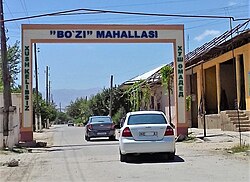
[[File:Bilingual Samarkand.jpg|thumb|right|Greeting in two languages: Uzbek (Latin) and Tajik (Cyrillic) at the entrance to one of the [[mahallah]]s (Bo'zi) of Samarkand]] | [[File:Bilingual Samarkand.jpg|thumb|right|Greeting in two languages: Uzbek (Latin) and Tajik (Cyrillic) at the entrance to one of the [[mahallah]]s (Bo'zi) of Samarkand]] | ||
The state and official language in Samarkand, as in all Uzbekistan, is the [[Uzbek language]]. Uzbek is one of the [[Turkic languages]] and the mother tongue of [[Uzbeks]], [[Turkmens]], | The state and official language in Samarkand, as in all Uzbekistan, is the [[Uzbek language]]. Uzbek is one of the [[Turkic languages]] and the mother tongue of [[Uzbeks]], [[Turkmens]], {{ill|Samarkandian Iranians|ru|Среднеазиатские иранцы|uz|Oʻrta Osiyo eroniylari}}, and most [[Central Asian Arabs|Samarkandian Arabs]] living in Samarkand. | ||
As in the rest of Uzbekistan, the [[Russian language]] is the [[de facto]] second official language in Samarkand, and about 5% of signs and inscriptions in Samarkand are in this language. [[Russians]], [[Belarusians]], [[Polish people|Poles]], [[Germans]], [[Koryo-saram|Koreans]], the majority of [[Ukrainians]], the majority of [[Armenians]], [[Greeks]], some [[Tatars]], and some [[Azerbaijanis]] in Samarkand speak Russian. Several Russian-language newspapers are published in Samarkand, the most popular of which is | As in the rest of Uzbekistan, the [[Russian language]] is the [[de facto]] second official language in Samarkand, and about 5% of signs and inscriptions in Samarkand are in this language. [[Russians]], [[Belarusians]], [[Polish people|Poles]], [[Germans]], [[Koryo-saram|Koreans]], the majority of [[Ukrainians]], the majority of [[Armenians]], [[Greeks]], some [[Tatars]], and some [[Azerbaijanis]] in Samarkand speak Russian. Several Russian-language newspapers are published in Samarkand, the most popular of which is ''{{ill|Samarkandskiy vestnik|ru|Самаркандский вестник|uz|Samarkandskiy vestnik}}'' (Russian: Самаркандский вестник, lit. the Samarkand Herald). The Samarkandian TV channel STV conducts some broadcasts in Russian. | ||
De facto, the most common native language in Samarkand is [[Tajik language|Tajik]], which is a dialect or variant of the [[Persian language]]. Samarkand was one of the cities in which the Persian language developed. Many classical Persian [[poetry|poets]] and writers lived in or visited Samarkand over the millennia, the most famous being [[Ferdowsi|Abulqasem Ferdowsi]], [[Omar Khayyam]], [[Jami|Abdurahman Jami]], [[Rudaki|Abu Abdullah Rudaki]], [[Suzani Samarqandi]], and [[Kamal Khujandi]]. | De facto, the most common native language in Samarkand is [[Tajik language|Tajik]], which is a dialect or variant of the [[Persian language]]. Samarkand was one of the cities in which the Persian language developed. Many classical Persian [[poetry|poets]] and writers lived in or visited Samarkand over the millennia, the most famous being [[Ferdowsi|Abulqasem Ferdowsi]], [[Omar Khayyam]], [[Jami|Abdurahman Jami]], [[Rudaki|Abu Abdullah Rudaki]], [[Suzani Samarqandi]], and [[Kamal Khujandi]]. | ||
While the official stance is that Uzbek is the most common language in Samarkand, some data indicate that only about 30% of residents speak it as a native tongue. For the other 70%, Tajik is the native tongue, with Uzbek the second language and Russian the third. However, as no population census has been taken in Uzbekistan since 1989, there are no accurate data on this matter. Despite Tajik being the second most common language in Samarkand, it does not enjoy the status of an official or regional language.<ref name="Karl Cordell 1999. pg 201">Karl Cordell, "Ethnicity and Democratisation in the New Europe", Routledge, 1998. p. 201: "Consequently, the number of citizens who regard themselves as Tajiks is difficult to determine. Tajikis within and outside of the republic, Samarkand State University (SamGU) academic and international commentators suggest that there may be between six and seven million Tajiks in Uzbekistan, constituting 30% of the republic's 22 million population, rather than the official figure of 4.7% (Foltz 1996: 213; Carlisle 1995: 88).</ref><ref name="Lena Jonson 2006. pg 108"/><ref name="catoday.org"/><ref name="lingvomania.info">{{cite web |url=http://lingvomania.info/2016/status-tadzhikskogo-yazyka-v-uzbekistane.html |title=Статус таджикского языка в Узбекистане |website=Лингвомания.info — lingvomania.info |access-date=22 March 2019 |archive-url=https://web.archive.org/web/20161029222029/http://lingvomania.info/2016/status-tadzhikskogo-yazyka-v-uzbekistane.html |archive-date=29 October 2016 |url-status=dead}}</ref><ref name="news.tj"/><ref>{{cite web |url=http://www.profi-forex.org/novosti-mira/novosti-sng/uzbekistan/entry1008185843.html |title=Есть ли шансы на выживание таджикского языка в Узбекистане — эксперты |website="Биржевой лидер" — pfori-forex.org |access-date=22 March 2019 |archive-url=https://web.archive.org/web/20190322113157/http://www.profi-forex.org/novosti-mira/novosti-sng/uzbekistan/entry1008185843.html |archive-date=22 March 2019 |url-status=dead}}</ref> Nevertheless, at Samarkand State University ten faculties offer courses in Tajiki, and the Tajik Language and Literature Department has an enrolment of over 170 students.<ref>{{cite book|last1=Foltz|first1=Richard|author-link=Richard Foltz|title=A History of the Tajiks: Iranians of the East, 2nd edition |date=2023|publisher=Bloomsbury Publishing|isbn=978-0-7556-4964-8|page=186}}</ref> Only one newspaper in Samarkand is published in Tajiki, in the [[Tajik alphabet|Cyrillic Tajik alphabet]]: ''[[:ru:Овози Самарканд|Ovozi Samarqand]]'' (Tajik: ''Овози Самарқанд'' — ''Voice of Samarkand''). Local Samarkandian STV and " | While the official stance is that Uzbek is the most common language in Samarkand, some data indicate that only about 30% of residents speak it as a native tongue. For the other 70%, Tajik is the native tongue, with Uzbek the second language and Russian the third. However, as no population census has been taken in Uzbekistan since 1989, there are no accurate data on this matter. Despite Tajik being the second most common language in Samarkand, it does not enjoy the status of an official or regional language.<ref name="Karl Cordell 1999. pg 201">Karl Cordell, "Ethnicity and Democratisation in the New Europe", Routledge, 1998. p. 201: "Consequently, the number of citizens who regard themselves as Tajiks is difficult to determine. Tajikis within and outside of the republic, Samarkand State University (SamGU) academic and international commentators suggest that there may be between six and seven million Tajiks in Uzbekistan, constituting 30% of the republic's 22 million population, rather than the official figure of 4.7% (Foltz 1996: 213; Carlisle 1995: 88).</ref><ref name="Lena Jonson 2006. pg 108"/><ref name="catoday.org"/><ref name="lingvomania.info">{{cite web |url=http://lingvomania.info/2016/status-tadzhikskogo-yazyka-v-uzbekistane.html |title=Статус таджикского языка в Узбекистане |website=Лингвомания.info — lingvomania.info |access-date=22 March 2019 |archive-url=https://web.archive.org/web/20161029222029/http://lingvomania.info/2016/status-tadzhikskogo-yazyka-v-uzbekistane.html |archive-date=29 October 2016 |url-status=dead}}</ref><ref name="news.tj"/><ref>{{cite web |url=http://www.profi-forex.org/novosti-mira/novosti-sng/uzbekistan/entry1008185843.html |title=Есть ли шансы на выживание таджикского языка в Узбекистане — эксперты |website="Биржевой лидер" — pfori-forex.org |access-date=22 March 2019 |archive-url=https://web.archive.org/web/20190322113157/http://www.profi-forex.org/novosti-mira/novosti-sng/uzbekistan/entry1008185843.html |archive-date=22 March 2019 |url-status=dead}}</ref> Nevertheless, at Samarkand State University ten faculties offer courses in Tajiki, and the Tajik Language and Literature Department has an enrolment of over 170 students.<ref name="Bloomsbury Publishing">{{cite book|last1=Foltz|first1=Richard|author-link=Richard Foltz|title=A History of the Tajiks: Iranians of the East, 2nd edition |date=2023|publisher=Bloomsbury Publishing|isbn=978-0-7556-4964-8|page=186}}</ref> Only one newspaper in Samarkand is published in Tajiki, in the [[Tajik alphabet|Cyrillic Tajik alphabet]]: ''[[:ru:Овози Самарканд|Ovozi Samarqand]]'' (Tajik: ''Овози Самарқанд'' —''Voice of Samarkand''). Local Samarkandian STV and "Samarkand" TV channels offer some broadcasts in Tajik, as does one regional radio station. In 2022 a quarterly literary magazine in Tajiki, ''Durdonai Sharq'', was launched in Samarkand.<ref name="Bloomsbury Publishing"/> | ||
In addition to Uzbek, Tajik, and Russian, native languages spoken in Samarkand include [[Ukrainian language|Ukrainian]], [[Armenian language|Armenian]], [[Azerbaijani language|Azerbaijani]], [[Tatar language|Tatar]], [[Crimean Tatar language|Crimean Tatar]], [[Arabic]] (for a very small percentage of Samarkandian Arabs), and others. | In addition to Uzbek, Tajik, and Russian, native languages spoken in Samarkand include [[Ukrainian language|Ukrainian]], [[Armenian language|Armenian]], [[Azerbaijani language|Azerbaijani]], [[Tatar language|Tatar]], [[Crimean Tatar language|Crimean Tatar]], [[Arabic]] (for a very small percentage of Samarkandian Arabs), and others. | ||
Modern Samarkand is a vibrant city, and in 2019 the city hosted the first Samarkand Half Marathon.<ref>[https://worldsmarathons.com/marathon/samarkand-marathon Samarkand | Modern Samarkand is a vibrant city, and in 2019 the city hosted the first Samarkand Half Marathon.<ref>[https://worldsmarathons.com/marathon/samarkand-marathon Samarkand Marathon].</ref> In 2022 this also included a full marathon for the first time. | ||
==Religion== | ==Religion== | ||
===Islam=== | ===Islam=== | ||
[[Islam]] entered Samarkand in the 8th century, during the [[Muslim conquest of Transoxiana|invasion of the Arabs in Central Asia]] ([[Umayyad Caliphate]]). Before that, almost all inhabitants of | [[Islam]] entered Samarkand in the 8th century, during the [[Muslim conquest of Transoxiana|invasion of the Arabs in Central Asia]] ([[Umayyad Caliphate]]). Before that, almost all inhabitants of Samarkand were [[Zoroastrians]], and many [[Nestorians]] and [[Buddhists]] also lived in the city. From that point forward, throughout the reigns of many Muslim governing powers, numerous [[mosque]]s, [[madrasa]]hs, [[minaret]]s, [[shrine]]s, and [[mausoleums]] were built in the city. Many have been preserved. For example, there is [[:ru:Мемориальный комплекс имама Аль-Бухари|the Shrine]] of [[Muhammad al-Bukhari|Imam Bukhari]], an [[Ulama|Islamic scholar]] who authored the [[History of hadith|hadith collection]] known as ''[[Sahih al-Bukhari]]'', which [[Sunni Islam|Sunni Muslims]] regard as one of the most authentic (''[[Saheeh|sahih]]'') [[hadith]] collections. His other books included ''[[Al-Adab al-Mufrad]]''. Samarkand is also home to [[:ru:Мавзолей Абу Мансура Матуриди|the Shrine]] of [[Abu Mansur al-Maturidi|Imam Maturidi]], the founder of [[Maturidi]]sm and the [[:ru:Мавзолей Ходжа Дониёр|Mausoleum of the Prophet Daniel]], who is revered in [[Islam]], [[Judaism]], and [[Christianity]]. | ||
Most inhabitants of Samarkand are Muslim, primarily [[Sunni Islam|Sunni]] (mostly [[Hanafi]]) and [[Sufism|Sufi]]. Approximately 80–85% of Muslims in the city are Sunni, comprising almost all [[Tajiks]], [[Uzbeks]], and | Most inhabitants of Samarkand are Muslim, primarily [[Sunni Islam|Sunni]] (mostly [[Hanafi]]) and [[Sufism|Sufi]]. Approximately 80–85% of Muslims in the city are Sunni, comprising almost all [[Tajiks]], [[Uzbeks]], and Samarkandian Arabs living therein. Samarkand's best-known Islamic sacred lineages are the descendants of Sufi leaders such as Khodja Akhror Wali (1404–1490) and Makhdumi A’zam (1461–1542), the descendants of Sayyid Ata (first half of 14th c.) and Mirakoni Khojas (Sayyids from Mirakon, a village in Iran).<ref>Malikov Azim, Sacred lineages of Samarqand: history and identity in Anthropology of the Middle East, Volume 15, Issue 1, Summer 2020, р.36</ref> The liberal policy of President [[Shavkat Mirziyoyev]] opened up new opportunities for the expression of the religious identity. In Samarkand, since 2018, there has been an increase in the number of women wearing the hijab.<ref>https://www.ajol.info/index.php/ijma/article/view/218533 Malikov A. and Djuraeva D. 2021. Women, Islam, and politics in Samarkand (1991–2021), International Journal of Modern Anthropology. 2 (16): 561</ref> | ||
such as Khodja Akhror Wali (1404–1490) and Makhdumi A’zam (1461–1542), the descendants of Sayyid Ata (first half of 14th c.) and Mirakoni | |||
The liberal policy of President [[Shavkat Mirziyoyev]] opened up new opportunities for the expression of the religious identity. In Samarkand, since 2018, there has been an increase in the number of women wearing the hijab.<ref>Malikov A. and Djuraeva D. 2021. Women, Islam, and politics in Samarkand (1991–2021), International Journal of Modern Anthropology. 2 (16): 561</ref> | |||
<gallery mode="packed"> | <gallery mode="packed"> | ||
File:AlBukhari mausoleum.jpg|[[:ru:Мемориальный комплекс имама Аль-Бухари|Imam Bukhari Shrine]] | File:AlBukhari mausoleum.jpg|[[:ru:Мемориальный комплекс имама Аль-Бухари|Imam Bukhari Shrine]] | ||
| Line 481: | Line 506: | ||
====Shia Muslims==== | ====Shia Muslims==== | ||
The [[Samarqand Region|Samarqand Vilayat]] is one of the two regions of Uzbekistan (along with [[Buxoro Region|Bukhara Vilayat]]) that | The [[Samarqand Region|Samarqand Vilayat]] is one of the two regions of Uzbekistan (along with [[Buxoro Region|Bukhara Vilayat]]) that are home to a large number of Shiites. The total population of the Samarkand Vilayat is more than 3,720,000 people (2019). | ||
There are no exact data on the number of Shiites in the city of Samarkand, but the city has several Shiite mosques and madrasas. The largest of these are the Punjabi Mosque, the Punjabi Madrassah, and the Mausoleum of Mourad Avliya. Every year, the Shiites of Samarkand | There are no exact data on the number of Shiites in the city of Samarkand, but the city has several Shiite mosques and madrasas. The largest of these are the Punjabi Mosque, the Punjabi Madrassah, and the Mausoleum of Mourad Avliya. Every year, the Shiites of Samarkand commemorate [[Ashura]], as well as other memorable Shiite dates and holidays. | ||
Shiites in Samarkand are mostly [[:ru:Среднеазиатские иранцы| | Shiites in Samarkand are mostly [[:ru:Среднеазиатские иранцы|Samarkandian Iranians]], who call themselves ''Irani''. Their ancestors began to arrive in Samarkand in the 18th century. Some migrated there | ||
in search of a better life, others were sold as [[slavery|slaves]] there by [[Turkmens|Turkmen]] captors, and others were soldiers who were posted to Samarkand. Mostly they came from [[Khorasan Province|Khorasan]], [[Mashhad]], [[Sabzevar]], [[Nishapur]], and [[Merv]]; and secondarily from [[Iranian Azerbaijan]], [[Zanjan, Iran|Zanjan]], [[Tabriz]], and [[Ardabil]]. Samarkandian Shiites also include [[Azerbaijanis]], as well as small numbers of Tajiks and Uzbeks. | in search of a better life, others were sold as [[slavery|slaves]] there by [[Turkmens|Turkmen]] captors, and others were soldiers who were posted to Samarkand. Mostly they came from [[Khorasan Province|Khorasan]], [[Mashhad]], [[Sabzevar]], [[Nishapur]], and [[Merv]]; and secondarily from [[Iranian Azerbaijan]], [[Zanjan, Iran|Zanjan]], [[Tabriz]], and [[Ardabil]]. Samarkandian Shiites also include [[Azerbaijanis]], as well as small numbers of Tajiks and Uzbeks. | ||
While there are no official data on the total number of Shiites in Uzbekistan, they are estimated to be "several hundred thousand." According to [[ | While there are no official data on the total number of Shiites in Uzbekistan, they are estimated to be "several hundred thousand." According to [[United States diplomatic cables leak|leaked diplomatic cables]], in 2007–2008, the [[United States Ambassador-at-Large for International Religious Freedom|US Ambassador for International Religious Freedom]] held a series of meetings with Sunni [[mullah]]s and Shiite [[imam]]s in Uzbekistan. During one of the talks, the imam of the Shiite mosque in [[Bukhara]] said that about 300,000 Shiites live in the Bukhara Vilayat and 1 million in the Samarkand Vilayat. The Ambassador slightly doubted the authenticity of these figures, emphasizing in his report that data on the numbers of religious and ethnic minorities provided by the government of Uzbekistan were considered a very "delicate topic" due to their potential to provoke interethnic and interreligious conflicts. All the ambassadors of the ambassador tried to emphasize that traditional Islam, especially [[Sufism]] and [[Sunnism]], in the regions of Bukhara and Samarkand is characterized by great religious tolerance toward other religions and sects, including Shiism.<ref>{{cite web |url=http://www.islamsng.com/uzb/pastfuture/5570 |title=Шииты в Узбекистане |work=www.islamsng.com |access-date=April 3, 2019 |archive-url=https://web.archive.org/web/20171003214455/http://www.islamsng.com/uzb/pastfuture/5570 |archive-date=October 3, 2017 |url-status=dead}}</ref><ref>{{cite web |url=http://www.dn.kz/index.php?option=com_content&view=article&id=1545:2013-11-29-08-08-10&catid=2:2011-10-23-11-43-45&Itemid=17 |title=Ташкент озабочен делами шиитов |work=www.dn.kz |access-date=April 3, 2019 |archive-url=https://web.archive.org/web/20190403133434/http://www.dn.kz/index.php?option=com_content&view=article&id=1545:2013-11-29-08-08-10&catid=2:2011-10-23-11-43-45&Itemid=17 |archive-date=2019-04-03 |url-status=dead}}</ref><ref>{{cite web |url=http://catoday.org/centrasia/uzbekistan-irancy-shiity-stalkivayutsya-c-problemami-s-pravoohranitelnymi-organami-iran |title=Узбекистан: Иранцы-шииты сталкиваются c проблемами с правоохранительными органами |work=catoday.org |access-date=April 3, 2019 |archive-url=https://web.archive.org/web/20170905092804/http://catoday.org/centrasia/uzbekistan-irancy-shiity-stalkivayutsya-c-problemami-s-pravoohranitelnymi-organami-iran |archive-date=September 5, 2017 |url-status=dead}}</ref> | ||
<gallery mode=" | <gallery mode="separated"> | ||
File:Panjab Shia Mosque in Samarkand.jpg|[[:ru:Панджоб (мечеть)|Panjab Shia Mosque]] | File:Panjab Shia Mosque in Samarkand.jpg|[[:ru:Панджоб (мечеть)|Panjab Shia Mosque]] | ||
File:Panjab Madrasa in Samarkand.jpg|[[:ru:Медресе Панджоб|Panjab Shia Madrasa]] | File:Panjab Madrasa in Samarkand.jpg|[[:ru:Медресе Панджоб|Panjab Shia Madrasa]] | ||
| Line 496: | Line 521: | ||
===Christianity=== | ===Christianity=== | ||
[[File:Church of the East provinces 10 c.svg|thumb|right|upright=1.5|Provinces of the [[Church of the East]] in 10th century]] | {{More citations needed section|date=March 2024}}[[File:Church of the East provinces 10 c.svg|thumb|right|upright=1.5|Provinces of the [[Church of the East]] in 10th century]] | ||
[[Christianity]] was introduced to Samarkand when it was part of | [[Christianity]] was introduced to Samarkand when it was part of Sogdiana, long before the penetration of [[Islam]] into Central Asia. The city then became one of the centers of [[Nestorianism]] in [[Central Asia]].<ref>Dickens, Mark "Nestorian Christianity in Central Asia. p. 17</ref> The majority of the population were then [[Zoroastrians]], but since Samarkand was the crossroads of trade routes among [[East Asia|China]], [[Greater Iran|Persia]], and [[Europe]], it was religiously tolerant. Under the [[Umayyad Caliphate]], Zoroastrians and Nestorians were persecuted by the [[Arabs|Arab]] conquerors;{{Citation needed|date=March 2024}} the survivors fled to other places or converted to Islam. Several Nestorian temples were built in Samarkand, but they have not survived. Their remains were found by archeologists at the ancient site of [[Afrasiyab (Samarkand)|Afrasiyab]] and on the outskirts of Samarkand. | ||
In the three decades of 1329–1359, the [[:ru:Самаркандская епархия (титулярная)|Samarkand eparchy]] of the [[Catholic Church|Roman Catholic Church]] served several thousand Catholics who lived in the city. According to [[Marco Polo]] and Johann Elemosina, a descendant of [[Chagatai Khan|Chaghatai Khan]], the founder of the [[Chagatai Khanate|Chaghatai dynasty]], [[Eljigidey]], converted to Christianity and was baptized. With the assistance of Eljigidey, the Catholic Church of [[St. John the Baptist]] was built in Samarkand. After a while, however, Islam completely supplanted Catholicism. | In the three decades of 1329–1359, the [[:ru:Самаркандская епархия (титулярная)|Samarkand eparchy]] of the [[Catholic Church|Roman Catholic Church]] served several thousand Catholics who lived in the city. According to [[Marco Polo]] and Johann Elemosina, a descendant of [[Chagatai Khan|Chaghatai Khan]], the founder of the [[Chagatai Khanate|Chaghatai dynasty]], [[Eljigidey]], converted to Christianity and was baptized. With the assistance of Eljigidey, the Catholic Church of [[St. John the Baptist]] was built in Samarkand. After a while, however, Islam completely supplanted Catholicism. | ||
| Line 503: | Line 528: | ||
Christianity reappeared in Samarkand several centuries later, from the mid-19th century onward, after the city was seized by the [[Russian Empire]]. [[Russian Orthodox Church|Russian Orthodoxy]] was introduced to Samarkand in 1868, and several churches and temples were built. In the early 20th century several more Orthodox cathedrals, churches, and temples were built, most of which were demolished while Samarkand was part of the [[USSR]]. | Christianity reappeared in Samarkand several centuries later, from the mid-19th century onward, after the city was seized by the [[Russian Empire]]. [[Russian Orthodox Church|Russian Orthodoxy]] was introduced to Samarkand in 1868, and several churches and temples were built. In the early 20th century several more Orthodox cathedrals, churches, and temples were built, most of which were demolished while Samarkand was part of the [[USSR]]. | ||
In present time, Christianity is the second-largest religious group in Samarkand with the predominant form is the [[Russian Orthodox Church|Russian Orthodox Church (Moscow Patriarchate)]]. More than 5% of Samarkand residents are Orthodox, mostly [[Russians]], [[Ukrainians]], and [[Belarusians]], and also some [[Koryo-saram|Koreans]] and [[Greeks]]. Samarkand is the center of the Samarkand branch (which includes the [[ | In present time, Christianity is the second-largest religious group in Samarkand with the predominant form is the [[Russian Orthodox Church|Russian Orthodox Church (Moscow Patriarchate)]]. More than 5% of Samarkand residents are Orthodox, mostly [[Russians]], [[Ukrainians]], and [[Belarusians]], and also some [[Koryo-saram|Koreans]] and [[Greeks]]. Samarkand is the center of the Samarkand branch (which includes the [[Samarqand Region|Samarkand]], [[Qashqadaryo Region|Qashqadarya]], and [[Surxondaryo Region|Surkhandarya]] provinces of Uzbekistan) of the [[:ru:Ташкентская и Узбекистанская епархия|Uzbekistan and Tashkent eparchy]] of the [[:ru:Среднеазиатский митрополичий округ|Central Asian Metropolitan District]] of the [[Russian Orthodox Church|Russian Orthodox Church of the Moscow Patriarchate]]. The city has several active Orthodox churches: [[:ru:Собор Святителя Алексия Московского (Самарканд)|Cathedral of St. Alexiy Moscowskiy]], [[:ru:Храм Покрова Пресвятой Богородицы (Самарканд)|Church of the Intercession of the Holy Virgin]], and [[:ru:Храм Святого Георгия Победоносца (Самарканд, действующий)|Church of St. George the Victorious]]. There are also a number of inactive Orthodox churches and temples, for example that of [[:ru:Храм Святого Георгия Победоносца (Самарканд, недействующий)|Church of St. George Pobedonosets]].<ref>В. А. Нильсен. У истоков современного градостроительства Узбекистана (ΧΙΧ — начало ΧΧ веков). —Ташкент: Издательство литературы и искусства имени Гафура Гуляма, 1988. 208 с.</ref><ref>''Голенберг В. А.'' «Старинные храмы туркестанского края». Ташкент 2011 год</ref> | ||
There are also a few tens of thousands of [[Catholic Church|Catholics]] in Samarkand, mostly [[Polish people|Poles]], [[Germans]], and some [[Ukrainians]]. In the center of Samarkand is [[St. John the Baptist Church, Samarkand|St. John the Baptist Catholic Church]], which was built at the beginning of the 20th century. Samarkand is part of the [[Apostolic Administration of Uzbekistan]].<ref>Католичество в Узбекистане. Ташкент, 1990.</ref> | There are also a few tens of thousands of [[Catholic Church|Catholics]] in Samarkand, mostly [[Polish people|Poles]], [[Germans]], and some [[Ukrainians]]. In the center of Samarkand is [[St. John the Baptist Church, Samarkand|St. John the Baptist Catholic Church]], which was built at the beginning of the 20th century. Samarkand is part of the [[Apostolic Administration of Uzbekistan]].<ref>Католичество в Узбекистане. Ташкент, 1990.</ref> | ||
The third largest Christian sect in Samarkand is the [[Armenian Apostolic Church]], followed by a few tens of thousands of Armenian Samarkandians. Armenian Christians began emigrating to Samarkand at the end of the 19th century, this flow increasing especially in the Soviet era.<ref>Armenians. Ethnic atlas of Uzbekistan, 2000.</ref> In the west of Samarkand is the [[:ru:Церковь Святой Богородицы (Самарканд)|Armenian Church Surb Astvatsatsin]].<ref>Назарьян Р.Г. Армяне Самарканда. Москва. 2007</ref> | The third largest Christian sect in Samarkand is the [[Armenian Apostolic Church]], followed by a few tens of thousands of Armenian Samarkandians. Armenian Christians began emigrating to Samarkand at the end of the 19th century, this flow increasing especially in the Soviet era.<ref>Armenians. Ethnic atlas of Uzbekistan, 2000.</ref> In the west of Samarkand is the [[:ru:Церковь Святой Богородицы (Самарканд)|Armenian Church Surb Astvatsatsin]].<ref>Назарьян Р.Г. Армяне Самарканда. Москва. 2007</ref> | ||
<gallery mode=" | <gallery mode="separated"> | ||
File:Orthodox church in Samarkand 11-09.JPG|[[:ru:Собор Святителя Алексия Московского (Самарканд)|Orthodox Cathedral of St. Alexiy Moscowskiy]] | File:Orthodox church in Samarkand 11-09.JPG|[[:ru:Собор Святителя Алексия Московского (Самарканд)|Orthodox Cathedral of St. Alexiy Moscowskiy]] | ||
File:Church Cover Blessed Virgin in Samarkand 12-55.JPG|[[:ru:Храм Покрова Пресвятой Богородицы (Самарканд)|Orthodox Church of the Intercession of the Holy Virgin]] | File:Church Cover Blessed Virgin in Samarkand 12-55.JPG|[[:ru:Храм Покрова Пресвятой Богородицы (Самарканд)|Orthodox Church of the Intercession of the Holy Virgin]] | ||
| Line 519: | Line 544: | ||
Samarkand also has several thousand [[Protestantism|Protestants]], including [[Lutheranism|Lutherans]], [[Baptists]], [[Mormons]], [[Jehovah's Witnesses]], [[Adventism|Adventists]], and members of the [[Korean Presbyterian church]]. These Christian movements appeared in Samarkand mainly after the independence of [[Uzbekistan]] in 1991.<ref>Бабина Ю. Ё. Новые христианские течения и страны мира. Фолкв, 1995.</ref> | Samarkand also has several thousand [[Protestantism|Protestants]], including [[Lutheranism|Lutherans]], [[Baptists]], [[Mormons]], [[Jehovah's Witnesses]], [[Adventism|Adventists]], and members of the [[Korean Presbyterian church]]. These Christian movements appeared in Samarkand mainly after the independence of [[Uzbekistan]] in 1991.<ref>Бабина Ю. Ё. Новые христианские течения и страны мира. Фолкв, 1995.</ref> | ||
== | ==Landmarks== | ||
=== Silk Road Samarkand (Eternal city) === | === Silk Road Samarkand (Eternal city) === | ||
Silk Road Samarkand is a modern multiplex which opened in early 2022 in eastern Samarkand. The complex covers 260 hectares and includes world-class business and medical hotels, eateries, recreational facilities, park grounds, an ethnographic corner and a large congress hall for hosting international events.<ref>{{Cite web |title=Silk Road Samarkand Tourist Complex |url=https://www.advantour.com/uzbekistan/samarkand/silk-road-samarkand.htm |access-date=2023-01-20 |website= Advantour}}</ref> | |||
Silk Road Samarkand is a modern multiplex which | |||
Eternal city situated in Silk Road Samarkand complex. This site which occupies 17 hectares accurately recreates the spirit of the ancient city backed up by the history and traditions of Uzbek lands and Uzbek people for the guests of the Silk Road Samarkand. The narrow streets here house multiple shops of artists, artisans, and craftsmen. The pavilions of the Eternal City were inspired by real houses and picturesque squares described in ancient books. This is where you can plunge into a beautiful oriental fairy tale: with turquoise domes, mosaics on palaces, and high minarets that pierce the sky. | Eternal city situated in Silk Road Samarkand complex. This site which occupies 17 hectares accurately recreates the spirit of the ancient city backed up by the history and traditions of Uzbek lands and Uzbek people for the guests of the Silk Road Samarkand. The narrow streets here house multiple shops of artists, artisans, and craftsmen. The pavilions of the Eternal City were inspired by real houses and picturesque squares described in ancient books. This is where you can plunge into a beautiful oriental fairy tale: with turquoise domes, mosaics on palaces, and high minarets that pierce the sky. | ||
| Line 529: | Line 552: | ||
Visitors to the Eternal City can taste national dishes from different eras and regions of the country and also see authentic street performances. The Eternal City showcases a unique mix of Parthian, Hellenistic, and Islamic cultures so that the guests could imagine the versatile heritage of bygone centuries in full splendor. The project was inspired and designed by Bobur Ismoilov, a famous modern artist.<ref>{{Cite web |title=Eternal City |url=https://www.silkroad-samarkand.com/resort/eternal-city/ |access-date=2023-01-20 |website=www.silkroad-samarkand.com}}</ref> | Visitors to the Eternal City can taste national dishes from different eras and regions of the country and also see authentic street performances. The Eternal City showcases a unique mix of Parthian, Hellenistic, and Islamic cultures so that the guests could imagine the versatile heritage of bygone centuries in full splendor. The project was inspired and designed by Bobur Ismoilov, a famous modern artist.<ref>{{Cite web |title=Eternal City |url=https://www.silkroad-samarkand.com/resort/eternal-city/ |access-date=2023-01-20 |website=www.silkroad-samarkand.com}}</ref> | ||
==Architecture== | |||
[[File:Building Samarkand Mosque.jpg|thumb|upright=1.2|Building the Great Mosque of Samarkand. Illustration by [[Bihzad]] for the [[Zafarnama (Yazdi biography)|Zafar-Nameh]]. Text copied in [[Herat]] in 1467–68 and illuminated the late 1480s. John Work Garret Collection, Milton S. Eisenhower Library, Johns Hopkins University, Baltimore.]] | [[File:Building Samarkand Mosque.jpg|thumb|upright=1.2|Building the Great Mosque of Samarkand. Illustration by [[Bihzad]] for the [[Zafarnama (Yazdi biography)|Zafar-Nameh]]. Text copied in [[Herat]] in 1467–68 and illuminated the late 1480s. John Work Garret Collection, Milton S. Eisenhower Library, Johns Hopkins University, Baltimore.]] | ||
Timur initiated the building of Bibi | Timur initiated the building of Bibi-Khanym after his 1398–1399 campaign in India. The Bibi-Khanym originally had about 450 marble columns, which were hauled there and set up with the help of 95 elephants that Timur had brought back from Hindustan. Artisans and stonemasons from India designed the mosque's dome, giving it its distinctive appearance amongst the other buildings. An 1897 earthquake destroyed the columns, which were not entirely restored in the subsequent reconstruction.<ref name="Marefat 1992 33–38"/> | ||
The best-known landmark of Samarkand is the mausoleum known as Gur-i Amir. It exhibits the influences of many cultures, past civilizations, neighboring peoples, and religions, especially those of Islam. Despite the devastation wrought by Mongols to Samarkand's pre-Timurid Islamic architecture, under Timur these architectural styles were revived, recreated, and restored. The blueprint and layout of the mosque itself, with their precise measurements, demonstrate the Islamic passion for [[geometry]]. The entrance to the Gur-i Amir is decorated with Arabic [[calligraphy]] and inscriptions, the latter a common feature in Islamic architecture. Timur's meticulous attention to detail is especially obvious inside the mausoleum: the tiled walls are a marvelous example of [[mosaic]] [[faience]], an Iranian technique in which each tile is cut, colored, and fit into place individually.<ref name="Marefat 1992 33–38"/> The tiles of the Gur-i Amir were also arranged so that they spell out religious words such as "[[Muhammad]]" and "Allah."<ref name="Marefat 1992 33–38"/> | The best-known landmark of Samarkand is the mausoleum known as Gur-i Amir. It exhibits the influences of many cultures, past civilizations, neighboring peoples, and religions, especially those of Islam. Despite the devastation wrought by Mongols to Samarkand's pre-Timurid Islamic architecture, under Timur these architectural styles were revived, recreated, and restored. The blueprint and layout of the mosque itself, with their precise measurements, demonstrate the Islamic passion for [[geometry]]. The entrance to the Gur-i Amir is decorated with Arabic [[calligraphy]] and inscriptions, the latter a common feature in Islamic architecture. Timur's meticulous attention to detail is especially obvious inside the mausoleum: the tiled walls are a marvelous example of [[mosaic]] [[faience]], an Iranian technique in which each tile is cut, colored, and fit into place individually.<ref name="Marefat 1992 33–38"/> The tiles of the Gur-i Amir were also arranged so that they spell out religious words such as "[[Muhammad]]" and "Allah."<ref name="Marefat 1992 33–38"/> | ||
| Line 547: | Line 570: | ||
===Suburbs=== | ===Suburbs=== | ||
Suburbs of the city include: Gulyakandoz, Superfosfatnyy, Bukharishlak, Ulugbek, Ravanak, Kattakishlak, Registan, Zebiniso, Kaftarkhona, Uzbankinty.<ref>{{Cite web |url=https://www.google.com/maps/place/Superfosfatnyy,+Uzbekistan/@39.6761233,66.9140197,28690m/data=!3m1!1e3!4m5!3m4!1s0x3f4d1af650279a57:0x4ff7249d3d5dafb8!8m2!3d39.67305!4d66.853607 |title=Superfosfatnyy · Uzbekistan |website=Superfosfatnyy · Uzbekistan}}</ref> | |||
==Transport== | ==Transport== | ||
===Local=== | ===Local=== | ||
Samarkand has a strong public-transport system. From Soviet times up through today, municipal [[bus]]es and [[taxi]]s ([[GAZ-21]], [[GAZ-24]], [[GAZ-3102]], [[VAZ-2101]], [[VAZ-2106]] and [[VAZ-2107]]) have operated in Samarkand. Buses, mostly [[SamAuto]] and [[ | Samarkand has a strong public-transport system. From Soviet times up through today, municipal [[bus]]es and [[taxi]]s ([[GAZ-21]], [[GAZ-24]], [[GAZ-3102]], [[VAZ-2101]], [[VAZ-2106]] and [[VAZ-2107]]) have operated in Samarkand. Buses, mostly [[SamAuto]] and [[Isuzu]] buses, are the most common and popular mode of transport in the city. Taxis, which are mostly [[Chevrolet]]s and [[Daewoo Motors|Daewoo]] sedans, are usually yellow in color. Since 2017, there have also been [[Trams in Samarkand|several Samarkandian tram lines]], mostly Vario LF.S Czech trams. From the [[Soviet]] Era up until 2005, Samarkandians also got around via [[trolleybus]]. Finally, Samarkand has the so-called "[[Marshrutka]]," which are [[Daewoo Damas]] and [[GAZelle]] [[minibuses]]. | ||
<gallery mode="packed"> | <gallery mode="packed"> | ||
File:Beruni street in Samarkand.jpg|Many yellow taxis on the streets of Samarkand | File:Beruni street in Samarkand.jpg|Many yellow taxis on the streets of Samarkand | ||
| Line 558: | Line 581: | ||
File:Tram in Samarkand.jpg|Tram in Samarkand | File:Tram in Samarkand.jpg|Tram in Samarkand | ||
</gallery> | </gallery> | ||
Until 1950, the main forms of transport in Samarkand were [[carriage]]s and "[[Araba (carriage)|arabas]]" with [[horse]]s and [[donkey]]s. However, the city had a [[steam]] tram | Until 1950, the main forms of transport in Samarkand were [[carriage]]s and "[[Araba (carriage)|arabas]]" with [[horse]]s and [[donkey]]s. However, the city had a [[steam]] tram from 1924 to 1930, and there were more modern trams from 1947 to 1973. | ||
===Air transport=== | ===Air transport=== | ||
| Line 564: | Line 587: | ||
===Railway=== | ===Railway=== | ||
Modern Samarkand is an important | Modern Samarkand is an important rail junction of Uzbekistan, and all national east–west railway routes pass through the city. The most important and longest of these is [[Tashkent]]–[[Kungrad]]. High-speed [[Tashkent–Samarkand high-speed rail line]] trains run between Tashkent, Samarkand, and Bukhara. Samarkand also has international railway connections: [[Saratov]]–Samarkand, [[Moscow]]–Samarkand, and [[Astana]]–Samarkand. | ||
<gallery mode="packed"> | <gallery mode="packed"> | ||
File:Samarkand Railway Station.jpg|Samarkand railway station | File:Samarkand Railway Station.jpg|Samarkand railway station | ||
File:Afrosiyob Express Train in Station - Samarkand - Uzbekistan (7502824436) (3).jpg|Afrasiyab (Talgo 250) high-speed train in Samarkand railway station | File:Afrosiyob Express Train in Station - Samarkand - Uzbekistan (7502824436) (3).jpg|Afrasiyab (Talgo 250) high-speed train in Samarkand railway station | ||
</gallery> | </gallery> | ||
Between 1879 and 1891, the [[Russian Empire]] built the [[Trans-Caspian Railway]] to facilitate its expansion into Central Asia. The railway originated in Krasnovodsk (now [[Türkmenbaşy, Turkmenistan|Turkmenbashi]]) on the [[Caspian Sea]] coast. Its terminus was originally Samarkand, whose station first opened in May 1888. However, a decade later, the railway was extended eastward to Tashkent and [[Andijan]], and its name was changed to Central Asian Railways. Nonetheless, Samarkand remained one of the largest and most important stations of the [[Uzbek SSR]] and [[Soviet Central Asia]]. | |||
==International relations== | ==International relations== | ||
| Line 594: | Line 617: | ||
*{{flagicon|RUS}} [[Samara]], Russia | *{{flagicon|RUS}} [[Samara]], Russia | ||
*{{flagicon|CHN}} [[Xi'an]], China | *{{flagicon|CHN}} [[Xi'an]], China | ||
*{{flagicon|JPN}} [[Nara (city)|Nara]], Japan<ref>{{cite web | url=https://samarkand.uz/en/press/news/nara-va-samarqand-shaharlari-ortasida-birodarlik-bitimi-imzolandi | title=A brotherhood agreement has been signed between the cities of Nara and Samarkand }}</ref> | |||
<!--rest of cities - other form of cooperation, they don't list Samarkand as their twin town--> | <!--rest of cities - other form of cooperation, they don't list Samarkand as their twin town--> | ||
{{div col end}} | {{div col end}} | ||
Samarkand has friendly relations with:<ref name=samarkand/><ref>{{cite web |title=Внешнеэкономическое сотрудничество |url=http://bobruisk.by/economics/part/?curPos=2 |website=bobruisk.by |publisher=Babruysk |language=ru |access-date=2020-11-15}}</ref> | Samarkand has friendly relations with:<ref name=samarkand/><ref>{{cite web |title=Внешнеэкономическое сотрудничество |url=http://bobruisk.by/economics/part/?curPos=2 |website=bobruisk.by |publisher=Babruysk |language=ru |access-date=2020-11-15 |archive-date=2020-10-28 |archive-url=https://web.archive.org/web/20201028022318/http://bobruisk.by/economics/part/?curPos=2 |url-status=dead }}</ref> | ||
{{div col|colwidth=15em}} | {{div col|colwidth=15em}} | ||
*{{flagicon|TUR}} [[Antalya]], Turkey | *{{flagicon|TUR}} [[Antalya]], Turkey | ||
*{{flagicon|BLR}} [[Babruysk]], Belarus | *{{flagicon|BLR}} [[Babruysk]], Belarus | ||
*{{flagicon|GER}} [[Bremen]], Germany | *{{flagicon|GER}} [[Bremen]], Germany | ||
*{{flagicon|AUS}} [[Canberra]], Australia | |||
*{{flagicon|TUR}} [[Eskişehir]], Turkey | *{{flagicon|TUR}} [[Eskişehir]], Turkey | ||
*{{flagicon|ITA}} [[Florence]], Italy | *{{flagicon|ITA}} [[Florence]], Italy | ||
| Line 611: | Line 637: | ||
*{{flagicon|ESP}} [[Valencia]], Spain | *{{flagicon|ESP}} [[Valencia]], Spain | ||
{{div col end}} | {{div col end}} | ||
==In literature== | |||
The [[frame story]] of ''[[One Thousand and One Nights]]'' involves a [[Sasanian Empire|Sasanian]] king who assigns his brother, [[Shah Zaman (One Thousand and One Nights)|Shah Zaman]], to rule over Samarkand.<ref>{{Cite book |last=Burton |first=Richard |title=The Arabian Nights |date=2011 |publisher=Canterbury Classics |isbn=978-1-60710-309-7 |editor-last=Mondschein |editor-first=Ken |pages=1}}</ref> | |||
The poet [[James Elroy Flecker]] published the poem ''The Golden Journey to Samarkand'' in 1913. It was included in his play, ''Hassan''. ''Hassan'' (''The Story of Hassan of Bagdad and How He Came to Make the Golden Journey to Samarkand'') is a five-act drama in prose with verse passages. It tells the story of Hassan, a young man from Baghdad who embarks on a journey to Samarkand. Along the way, he encounters various challenges and obstacles, including bandits, treacherous terrain, and political turmoil. | |||
Samarkand (French: Samarcande), written by French-Lebanese writer [[Amin Maalouf]], is a 1988 historical fiction novel that revolves around the 11th-century Persian poet Omar Khayyám and his poetry collection Rubaiyat. | |||
In 2002, Nobel Laureate [[Wole Soyinka]] titled his collection of poetry ''Samarkand and Other Markets I Have Known.''<ref>{{Cite web |title=Samarkand and Other Markets I Have Known {{!}} poetry by Soyinka {{!}} Britannica |url=https://www.britannica.com/topic/Samarkand-and-Other-Markets-I-Have-Known |access-date=2023-09-17 |website=Encyclopædia Britannica |language=en}}</ref> | |||
English author [[Jonathan Stroud]] published his book ''[[The Amulet of Samarkand]]'' in 2003. The book contains no allusions to Samarkand other than namesake.{{citation needed|date=August 2024}} | |||
The city of Samarkand is famous for being the subject of an Uzbek tale called "The Rendezvous at Samarkand." | |||
It was recounted by a 12th-century Persian storyteller and mystic, Farid Al-Din Attar. | |||
In a legendary Baghdad, ruled by a powerful caliph, lived a young, healthy vizier. He seemed to have his whole life ahead of him. One day, he went to the city market, incognito, as he often did. Amidst the stalls of the spice merchants, he encountered a skeletal woman, who turned around as he passed and reached out to him. The vizier, a wise man, immediately recognized death. Terrified by what he saw, he begged his caliph to let him flee Baghdad, explaining that death was here and wanted to take him. His only hope was to immediately saddle his fastest horse and gallop off far from the city. The caliph therefore granted him permission to leave and asked him where he would be going. The vizier replies that to escape death, he is going to Samarkand, the desert city, on the edge of the kingdom, on the borders of Asia and the Middle East, thinking he will be safe there, far from the death that lurks in Baghdad! However, the caliph also decides to go to the market to check for the presence of death. He recognizes her very quickly and addresses her without fear, asking her the meaning of the gesture she made towards the vizier. "It was only a gesture of surprise..." replies death "Because I saw him in Baghdad while I must take him tonight in Samarkand..." | |||
This tale illustrates the inevitability of human destiny in the face of death. {{Citation needed|date=June 2025}} | |||
This tale also inspired Agatha Christie to title her novel "Appointment with Death."{{Citation needed|date=July 2025}} | |||
In [[Theodore Judson]]'s 2004 novel [[Fitzpatrick's War]], the title character attempts to make Samarkand (which he renames "Neapolis") the capital of a world empire and resides there until his assassination. | |||
Mentioned in books of [[World of Watches]]<ref>{{Cite news |last=Newman |first=Kim |date=2008-12-06 |title=The coldest warriors |url=https://www.theguardian.com/books/2008/dec/06/sergei-lukyanenko-russia-novel-fiction |access-date=2025-12-30 |work=The Guardian |language=en-GB |issn=0261-3077 |quote=Here we also get a trip to Scotland to find a real vampire lurking in the Edinburgh Dungeon tourist attraction, offering a foreign view of the familiar, but the middle segment, set in Samarkand, is more striking}}</ref><ref>{{Cite book |last=Lukyanenko |first=Sergei |url=https://books.google.com/books?id=2PwoAQAAIAAJ |title=The Last Watch |date=2008 |publisher=William Heinemann |isbn=978-0-434-01737-9 |language=en}}</ref><ref>{{Cite web |date=2011-08-24 |title=Review 137: The Last Watch |url=https://thelablib.org/2011/08/25/review-137-the-last-watch/ |access-date=2025-12-30 |website=The Labyrinth Library |language=en |quote=Anton not only has to deal with the Watches of Samarkand – which are far less efficient and well-staffed as others in Europe – but there’s still someone out to kill him}}</ref><ref>{{Cite web |last=Recommendation |first=New Book |date=2024-10-07 |title=Summary of 'The Last Watch' by Sergei Lukyanenko: A Detailed Synopsis |url=https://newbookrecommendation.com/summary-of-the-last-watch-by-sergei-lukyanenko-a-detailed-synopsis-2/ |access-date=2025-12-30 |website=New Book Recommendation |language=en-US |quote=The societal structures in Samarkand differ dramatically from Moscow’s. Anton’s relationship with the local Watches showcases the common struggles they all face}}</ref> and [[Day Watch (film)|Day Watch]] movie (2006).<ref>{{Cite news |last=Floyd |first=Nigel |title=Day Watch |url=https://www.timeout.com/movies/day-watch-1 |archive-url=http://web.archive.org/web/20240617075853/https://www.timeout.com/movies/day-watch-1 |archive-date=2024-06-17 |access-date=2025-12-30 |work=Time Out Worldwide |language=en-GB |quote=The opening scenes whisk us back to fourteenth-century Samarkand, where Mongol warlord Tamerlane acquires the ‘Chalk of Destiny’}}</ref><ref>{{Cite web |title=Day Watch (2006) |url=https://www.moriareviews.com/horror/day-watch-2006.htm |quote=Anton travels to Samarkand on a crusade to find the legendary Chalk of Fate from the tomb of the great warrior Tamerlane, with which one is reputed to be able to rewrite their own past}}</ref><ref>{{Cite web |date=2007-06-06 |title=Day Watch |url=https://www.straight.com/article-94192/day-watch |access-date=2025-12-30 |website=The Georgia Straight |language=en}}</ref><ref>{{Cite AV media |url=https://wherefilmed.org/en/day-watch-2006/ |title=Where was the movie Day Watch filmed: {{!}} Filming locations, countries, coordinates, and map |language=en |access-date=2025-12-30 |via=wherefilmed.org}}</ref><ref>{{Cite web |title=Day Watch |url=https://reverseshot.org/reviews/entry/501/day_watch |access-date=2025-12-30 |website=Reverse Shot |language=en |quote=the 14th-century nomadic warrior Tamerlane invades a fortress in Samarkand in search of the “chalk of fate,” which he successfully swipes from a gold-dusted, Buddha-shaped man named Zoar, who is alive and well and running a noodle shop in Moscow six centuries later}}</ref> | |||
==Notable people== | |||
*[[Bakhtiyor Fazilov]], Businessman | |||
*[[Takhmina Ikromova]], Uzbek rhythmic gymnast | |||
*[[Igor Sarukhanov]], Russian pop musician, composer and artist of Armenian descent | |||
==See also== | ==See also== | ||
*[[Samarkand non]] | *[[Samarkand non]] | ||
*[[The Mongol Invasion (trilogy)]] | |||
== Notes == | |||
{{notelist}} | |||
==Citations== | ==Citations== | ||
| Line 627: | Line 684: | ||
{{Commons category}} | {{Commons category}} | ||
{{Wikivoyage}} | {{Wikivoyage}} | ||
*Forbes, Andrew, & Henley, David: ''[http://www.cpamedia.com/article.php?pg=archive&acid=120613150427&aiid=120613151433 Timur's Legacy: The Architecture of Bukhara and Samarkand]'' (CPA Media). | * Forbes, Andrew, & Henley, David: ''[http://www.cpamedia.com/article.php?pg=archive&acid=120613150427&aiid=120613151433 Timur's Legacy: The Architecture of Bukhara and Samarkand]'' (CPA Media). | ||
*[http://depts.washington.edu/silkroad/cities/uz/samarkand/samarkand.html Samarkand – Silk Road Seattle Project], University of Washington | * [http://depts.washington.edu/silkroad/cities/uz/samarkand/samarkand.html Samarkand – Silk Road Seattle Project], University of Washington | ||
*[https://web.archive.org/web/20070311131202/http://www.iranica.com/newsite/articles/sup/Samarqand.html The history of Samarkand], according to Columbia University's Encyclopædia Iranica (archived 11 March 2007) | * {{usurped|1=[https://web.archive.org/web/20070311131202/http://www.iranica.com/newsite/articles/sup/Samarqand.html The history of Samarkand]}}, according to Columbia University's Encyclopædia Iranica (archived 11 March 2007) | ||
*[https://whc.unesco.org/en/list/603 Samarkand – Crossroad of Cultures] | * [https://whc.unesco.org/en/list/603 Samarkand – Crossroad of Cultures]. UNESCO World Heritage Committee documentation on Samarkand. | ||
*{{Cite EB1911|wstitle=Samarkand (city) |volume=24 |last1=Kropotkin |first1=Peter Alexeivitch |author1-link=Peter Kropotkin |last2=Bealby |first2=John Thomas |pages=112–113 |short=1}} | * {{Cite EB1911|wstitle= Samarkand (city) |volume= 24 |last1= Kropotkin |first1= Peter Alexeivitch |author1-link= Peter Kropotkin |last2= Bealby |first2= John Thomas |pages= 112–113 |short= 1}} | ||
*[http://www.gcatholic.org/dioceses/former/sama1.htm GCatholic – former Latin Catholic bishopric] | * [http://www.gcatholic.org/dioceses/former/sama1.htm GCatholic – former Latin Catholic bishopric] | ||
*[http://www.people-travels.com/uzbekistan-cities/samarkand/ Samarkand: Photos, History, Sights], Useful information for travelers | *[http://www.people-travels.com/uzbekistan-cities/samarkand/ Samarkand: Photos, History, Sights], Useful information for travelers | ||
*[https://web.archive.org/web/20180818044736/http://samarkand.com/samarkand/about-samarkand-uzbekistan/ About Samarkand in Uzbekistan Latest] (archived 18 August 2018) | *[https://web.archive.org/web/20180818044736/http://samarkand.com/samarkand/about-samarkand-uzbekistan/ About Samarkand in Uzbekistan Latest] (archived 18 August 2018) | ||
*[https://damda.uz/en/blog/medrese-tillya-kori Tilla-Kori Madrasa was included in the UNESCO World Heritage List] | * [https://damda.uz/en/blog/medrese-tillya-kori Tilla-Kori Madrasa was included in the UNESCO World Heritage List] {{Webarchive|url=https://web.archive.org/web/20190702062426/https://damda.uz/en/blog/medrese-tillya-kori |date=2019-07-02 }} | ||
{{S-start}} | {{S-start}} | ||
{{s-bef|before=-}} | {{s-bef|before=-}} | ||
| Line 649: | Line 705: | ||
{{s-aft|after=[[Herat]]}} | {{s-aft|after=[[Herat]]}} | ||
{{s-bef|before=[[Bukhara]]}} | {{s-bef|before=[[Bukhara]]}} | ||
{{s-ttl|title=Capital of the [[Uzbek SSR]]|years= | {{s-ttl|title=Capital of the [[Uzbek SSR]]|years=1925–1930}} | ||
{{s-aft|after=[[Tashkent]]}} | {{s-aft|after=[[Tashkent]]}} | ||
{{S-end}} | {{S-end}} | ||
| Line 664: | Line 720: | ||
[[Category:Former national capitals]] | [[Category:Former national capitals]] | ||
[[Category:Populated places along the Silk Road]] | [[Category:Populated places along the Silk Road]] | ||
[[Category:Populated places in | [[Category:Populated places established in the 1st millennium BC]] | ||
[[Category:Populated places in Samarkand Region]] | |||
[[Category:Samarkand Oblast]] | [[Category:Samarkand Oblast]] | ||
[[Category:Sasanian cities]] | [[Category:Sasanian cities]] | ||
[[Category:Sogdian cities]] | [[Category:Sogdian cities]] | ||
[[Category:World Heritage Sites in Uzbekistan]] | [[Category:World Heritage Sites in Uzbekistan]] | ||
Latest revision as of 15:25, 25 March 2026
Samarkand
| |
|---|---|
 .JPG) .jpg)  .JPG) _(6009956484).jpg) Clockwise from the top: Registan square, Shah-i-Zinda necropolis, Bibi-Khanym Mosque, view inside Shah-i-Zinda, Sherdar Madrasa in the Registan, Gur-e-Amir (Timur's Mausoleum) | |
 Seal | |
| Lua error in Module:Location_map at line 851: Unable to find the specified location map definition: "Module:Location map/data/Uzbekistan" does not exist. | |
| Coordinates: 39°39′02″N 66°57′55″E / 39.65056°N 66.96528°E | |
| Country |  Uzbekistan Uzbekistan |
| Vilayat | Samarqand Vilayat |
| Settled | 8th century BC |
| Government | |
| • Type | City Administration |
| • Body | Hakim (Mayor) |
| Area | |
| • City | 120 km2 (50 sq mi) |
| Elevation | 705 m (2,363 ft) |
| Population (1 January 2025) | |
| • City | 595,200[1] |
| • Metro | 1,300,000 |
| Demonym | Samarkandian / Samarkandi |
| Time zone | UTC+05:00 (UZT) |
| Postal code | 140100 |
| Website | samarkand.uz |
| Official name | Samarkand – Crossroads of Cultures |
| Criteria | Cultural: i, ii, iv |
| Reference | 603 |
| Inscription | 2001 (25th session) |
| Area | 1,123 ha |
| Buffer zone | 1,369 ha |
Samarkand[lower-alpha 1] is a city in southeastern Uzbekistan and among the oldest continuously inhabited cities in Central Asia. Samarkand is the capital of the Samarkand Region and a district-level city, that includes the urban-type settlements Kimyogarlar, Farhod and Khishrav.[2] With 551,700 inhabitants (2021),[3] it is the third-largest city in Uzbekistan.
Historically, Samarkand has long been one of the principal urban centers of Iranian (Persian-Tajik) civilization in Central Asia and played a major role in the cultural and commercial networks of the Silk Road.[4][5][6] There is evidence of human activity in the area of the city dating from the late Paleolithic. Though there is no direct evidence of when Samarkand was founded, several theories propose that it was founded between the 8th and 7th centuries BC. Prospering from its location on the Silk Road between China, Persia and Europe, at times Samarkand was one of the largest cities in Central Asia,[7][8] By the time of the Persian Achaemenid Empire, it was the capital of the Sogdian satrapy. The city was conquered by Alexander the Great in 329 BC, when it was known as Markanda, which was rendered in Greek as Μαράκανδα.[9] The city was ruled by a succession of Iranian and Turkic rulers until it was conquered by the Mongols under Genghis Khan in 1220.
Since the 11th century, the city has been under Turkic/Uzbek political control, but the city's culture and dominant language has always been Persian.[10]
The city is noted as a centre of Islamic scholarly study and the birthplace of the Timurid Renaissance. In the 14th century, Timur made it the capital of his empire and the site of his mausoleum, the Gur-e Amir. The Bibi-Khanym Mosque, rebuilt during the Soviet era, remains one of the city's most notable landmarks. Samarkand's Registan square was the city's ancient centre and is bounded by three monumental religious buildings. The city has carefully preserved the traditions of ancient crafts: embroidery, goldwork, silk weaving, copper engraving, ceramics, wood carving, and wood painting.[11] In 2001, UNESCO added the city to its World Heritage List as Samarkand – Crossroads of Cultures.
Modern Samarkand is divided into two parts: the old city, which includes historical monuments, shops, and old private houses; and the new city, which was developed during the days of the Russian Empire and Soviet Union and includes administrative buildings along with cultural centres and educational institutions.[12] On 15 and 16 September 2022, the city hosted the 2022 SCO summit.
Samarkand has a multicultural and plurilingual history that was significantly modified by the process of national delimitation in Central Asia. Small group of inhabitants of the city are bilingual speakers of the Tajik language,[13][14] whereas Uzbek is the official language and Russian is also widely used in the public sphere, as per Uzbekistan's language policy.
Name[edit | edit source]
The city was named Marakanda when captured by Alexander the Great in 329 BC.[15]
According to some sources, the present name comes from the eastern Iranian language Sogdian samar "stone, rock" and kand "fort, town."[15] In this respect, Samarkand shares the same meaning as the name of the Uzbek capital Tashkent, with tash- being the Turkic term for "stone" and -kent the Turkic analogue of kand borrowed from Iranian languages.[16] But this can't be proven because the city was given its name long after the Turkification of the Sogdians.[17]
From more realistic and historical sources, according to 11th-century scholar Mahmud al-Kashghari, the city was known in Karakhanid Turkic as Sämizkänd or Sämerkänd ({{safesubst:ifsubst|1=|2= }سَمِزْکَنْدْ</ span> ), meaning "fat city."[18] 16th-century Mughal emperor Babur also mentioned the city under this name, and 15th-century Castillian traveler Ruy González de Clavijo stated that Samarkand was simply a distorted form of it.[19]
Some languages have their own spellings or variations of the name, such as the French "Samarcande", the Italian and Spanish "Samarcanda", and the Turkish "Semerkant".[20]
History[edit | edit source]
 | This section needs more citations. (November 2022) |
Early history[edit | edit source]
Along with Bukhara,[21] Samarkand is one of the oldest inhabited cities in Central Asia, prospering from its location on the trade route between China and Europe. There is no direct evidence of when it was founded. Researchers at the Institute of Archaeology of Samarkand date the city's founding around 700 BC.[22]
Archaeological excavations conducted within the city limits (Syob and midtown) as well as suburban areas (Hojamazgil, Sazag'on) unearthed 40,000-year-old evidence of human activity, dating back to the Upper Paleolithic. A group of Mesolithic (12th–7th millennia BC) archaeological sites were discovered in the suburbs of Sazag'on-1, Zamichatosh, and Okhalik. The Syob and Darg'om canals, supplying the city and its suburbs with water, appeared around the 7th–5th centuries BC (early Iron Age).
From its earliest days, Samarkand was one of the main centres of Sogdian civilization. By the time of the Achaemenid dynasty of Persia, the city had become the capital of the Sogdian satrapy.
Hellenistic period[edit | edit source]


Ferens Art Gallery, Hull.
Alexander the Great conquered Samarkand in 329 BC. The city was known as Maracanda (Μαράκανδα) by the Greeks.[23] Written sources offer small clues as to the subsequent system of government.[24] They mention one Orepius who became ruler "not from ancestors, but as a gift of Alexander."[25]
While Samarkand suffered significant damage during Alexander's initial conquest, the city recovered rapidly and flourished under the new Hellenic influence. There were also major new construction techniques. Oblong bricks were replaced with square ones and superior methods of masonry and plastering were introduced.[26]
Alexander's conquests introduced classical Greek culture into Central Asia and for a time, Greek aesthetics heavily influenced local artisans. This Hellenistic legacy continued as the city became part of various successor states in the centuries following Alexander's death, the Greek Seleucid Empire, Greco-Bactrian Kingdom, and Kushan Empire (even though the Kushana themselves originated in Central Asia). After the Kushan state lost control of Sogdia during the 3rd century AD, Samarkand went into decline as a centre of economic, cultural, and political power. It did not significantly revive until the 5th century.
Sasanian era[edit | edit source]
Samarkand was conquered by the Persian Sasanians c. 260 AD. Under Sasanian rule, the region became an essential site for Manichaeism and facilitated the dissemination of the religion throughout Central Asia.[27]
Hephthalites and Turkic Khaganate era[edit | edit source]
Between AD 350 and 375, Samarkand was conquered by the nomadic tribes of Xionites, the origin of which remains controversial.[28] The resettlement of nomadic groups to Samarkand confirms archaeological material from the 4th century. The culture of nomads from the Middle Syrdarya basin is spreading in the region.[29] Between 457 and 509, Samarkand was part of the Kidarite state.[30]

After the Hephthalites ("White Huns") conquered Samarkand, they controlled it until the Göktürks, in an alliance with the Sassanid Persians, won it at the Battle of Bukhara, c. 560 AD.[33]
In the middle of the 6th century, a Turkic state was formed in Altai, founded by the Ashina dynasty. The new state formation was named the Turkic Khaganate after the people of the Turks, which were headed by the ruler – the Khagan. From 557 to 561, the Hephthalites empire was defeated by the joint actions of the Turks and Sassanids, which led to the establishment of a common border between the two empires.[34]
In the early Middle Ages, Samarkand was surrounded by four rows of defensive walls and had four gates.[35]
An ancient Turkic burial with a horse was investigated on the territory of Samarkand. It dates back to the 6th century.[36]
During the period of the ruler of the Western Turkic Khaganate, Tong Yabghu Qaghan (618–630), family relations were established with the ruler of Samarkand – Tong Yabghu Qaghan gave him his daughter.[37]
Some parts of Samarkand have been Christian since the 4th century. In the 5th century, a Nestorian chair was established in Samarkand. At the beginning of the 8th century, it was transformed into a Nestorian metropolitanate.[38] Discussions and polemics arose between the Sogdian followers of Christianity and Manichaeism, reflected in the documents.[39]
Early Islamic era[edit | edit source]
,_Tajikistan_National_Museum_of_Antiquities_(319).jpg)
The armies of the Umayyad Caliphate under Qutayba ibn Muslim captured the city from the Tang dynasty c. 710 AD.[27] During this period, Samarkand was a diverse religious community and was home to a number of religions, including Zoroastrianism, Buddhism, Hinduism, Manichaeism, Judaism, and Nestorian Christianity, with most of the population following Zoroastrianism.[41]
Qutayba generally did not settle Arabs in Central Asia; he forced the local rulers to pay him tribute but largely left them to their own devices. Samarkand was the major exception to this policy: Qutayba established an Arab garrison and Arab governmental administration in the city, its Zoroastrian fire temples were razed, and a mosque was built.[42] Much of the city's population converted to Islam.[43]
As a long-term result, Samarkand developed into a center of Islamic and Arabic learning.[42] At the end of the 740s, a movement of those dissatisfied with the power of the Umayyads emerged in the Arab Caliphate, led by the Abbasid commander Abu Muslim, who, after the victory of the uprising, became the governor of Khorasan and Maverannahr (750–755). He chose Samarkand as his residence. His name is associated with the construction of a multi-kilometer defensive wall around the city and the palace.[44]
Legend has it that during Abbasid rule,[45] the secret of papermaking was obtained from two Chinese prisoners from the Battle of Talas in 751, which led to the foundation of the first paper mill in the Islamic world at Samarkand. The invention then spread to the rest of the Islamic world and thence to Europe.[citation needed]

Abbasid control of Samarkand soon dissipated and was replaced with that of the Samanids (875–999), though the Samanids were still nominal vassals of the Caliph during their control of Samarkand. Under Samanid rule the city became a capital of the Samanid dynasty and an even more important node of numerous trade routes. The Samanids were overthrown by the Karakhanids around 999. Over the next 200 years, Samarkand would be ruled by a succession of Turkic tribes, including the Seljuqs and the Khwarazmshahs.[46]
The 10th-century Persian author Istakhri, who travelled in Transoxiana, provides a vivid description of the natural riches of the region he calls "Smarkandian Sogd":
I know no place in it or in Samarkand itself where if one ascends some elevated ground one does not see greenery and a pleasant place, and nowhere near it are mountains lacking in trees or a dusty steppe... Samakandian Sogd... [extends] eight days travel through unbroken greenery and gardens... . The greenery of the trees and sown land extends along both sides of the river [Sogd]... and beyond these fields is pasture for flocks. Every town and settlement has a fortress... It is the most fruitful of all the countries of Allah; in it are the best trees and fruits, in every home are gardens, cisterns and flowing water.
Karakhanid (Ilek-Khanid) period (11th–12th centuries)[edit | edit source]

After the fall of the Samanids state in 999, it was replaced by the Qarakhanid State, where the Turkic Qarakhanid dynasty ruled.[47] After the state of the Qarakhanids split into two parts, Samarkand became a part of the West Karakhanid Khaganate and from 1040 to 1212 was its capital.[47] The founder of the Western Qarakhanid Khaganate was Ibrahim Tamgach Khan (1040–1068).[47] For the first time, he built a madrasa in Samarkand with state funds and supported the development of culture in the region. During his reign, a public hospital (bemoristan) and a madrasa were established in Samarkand, where medicine was also taught.
The memorial complex Shah-i-Zinda was founded by the rulers of the Karakhanid dynasty in the 11th century.[48]
The most striking monument of the Qarakhanid era in Samarkand was the palace of Ibrahim ibn Hussein (1178–1202), which was built in the citadel in the 12th century. During the excavations, fragments of monumental painting were discovered. On the eastern wall, a Turkic warrior was depicted, dressed in a yellow caftan and holding a bow. Horses, hunting dogs, birds and periodlike women were also depicted here.[49]
Mongol period[edit | edit source]
.jpg)
The Mongols conquered Samarkand in 1220. Juvayni writes that Genghis killed all who took refuge in the citadel and the mosque, pillaged the city completely, and conscripted 30,000 young men along with 30,000 craftsmen. Samarkand suffered at least one other Mongol sack by Khan Baraq to get treasure he needed to pay an army. It remained part of the Chagatai Khanate (one of four Mongol successor realms) until 1370.
The Travels of Marco Polo, where Polo records his journey along the Silk Road in the late 13th century, describes Samarkand as "a very large and splendid city..."[50]
The Yenisei area had a community of weavers of Chinese origin, and Samarkand and Outer Mongolia both had artisans of Chinese origin, as reported by Changchun.[51] After Genghis Khan conquered Central Asia, foreigners were chosen as governmental administrators; Chinese and Qara-Khitays (Khitans) were appointed as co-managers of gardens and fields in Samarkand, which Muslims were not permitted to manage on their own.[52][53] The khanate allowed the establishment of Christian bishoprics (see below).
Timur's rule (1370–1405)[edit | edit source]
.jpg)
Ibn Battuta, who visited in 1333, called Samarkand "one of the greatest and finest of cities, and most perfect of them in beauty." He also noted that the orchards were supplied water via norias.[54]
In 1365, a revolt against Chagatai Mongol control occurred in Samarkand.[55] In 1370, the conqueror Timur (Tamerlane), the founder and ruler of the Timurid Empire, made Samarkand his capital. Timur used various tools for legitimisation, including urban planning in his capital, Samarkand.[56] Over the next 35 years, he rebuilt most of the city and populated it with great artisans and craftsmen from across the empire. Timur gained a reputation as a patron of the arts, and Samarkand grew to become the centre of the region of Transoxiana. Timur's commitment to the arts is evident in how, in contrast with the ruthlessness he showed his enemies, he demonstrated mercy toward those with special artistic abilities. The lives of artists, craftsmen, and architects were spared so that they could improve and beautify Timur's capital.[citation needed]
Timur was also directly involved in construction projects, and his visions often exceeded the technical abilities of his workers. The city was in a state of constant construction, and Timur would often order buildings to be done and redone quickly if he was unsatisfied with the results.[57] By his orders, Samarkand could be reached only by roads; deep ditches were dug, and walls 8 km (5 mi) in circumference separated the city from its surrounding neighbors.[24] At this time, the city had a population of about 150,000.[58]
Henry III of Castile's ambassador Ruy Gonzalez de Clavijo, who visited Samarkand between 8 September and 20 November 1404, attested to the never-ending construction that went on in the city. "The Mosque which Timur had built seemed to us the noblest of all those we visited in the city of Samarkand."[59]
Ulugh Beg's period (1409–1449)[edit | edit source]

Between 1417 and 1420, Timur's grandson Ulugh Beg built a madrasah in Samarkand, which became the first building in the architectural ensemble of Registan. Ulugh Beg invited a large number of astronomers and mathematicians of the Islamic world to this madrasa. Under Ulugh Beg, Samarkand became one of the world centers of medieval science. In the first half of the 15th century, a whole scientific school arose around Ulugh Beg, uniting prominent astronomers and mathematicians including Jamshid al-Kashi, Qāḍī Zāda al-Rūmī, and Ali Qushji. Ulugh Beg's main interest in science was astronomy, and he constructed an observatory in 1428. Its main instrument was the wall quadrant, which was unique in the world.[60] It was known as the "Fakhri Sextant" and had a radius of 40 meters.[61] Seen in the image on the left, the arc was finely constructed with a staircase on either side to provide access for the assistants who performed the measurements.
Uzbek period[edit | edit source]
In 1500, nomadic Uzbek warriors took control of Samarkand.[58] The Shaybanids emerged as the city's leaders at or about this time. In 1501, Samarkand was finally taken by Muhammad Shaybani from the Uzbek dynasty of Shaybanids, and the city became part of the newly formed “Bukhara Khanate”. Samarkand was chosen as the capital of this state, in which Muhammad Shaybani Khan was crowned. In Samarkand, Muhammad Shaybani Khan ordered to build a large madrasa, where he later took part in scientific and religious disputes. The first dated news about the Shaybani Khan madrasa dates back to 1504 (it was completely destroyed during the years of Soviet power). Muhammad Salikh wrote that Sheibani Khan built a madrasa in Samarkand to perpetuate the memory of his brother Mahmud Sultan.[62]
Fazlallah ibn Ruzbihan [who?] in "Mikhmon-namei Bukhara" expresses his admiration for the majestic building of the madrasa, its gilded roof, high hujras, spacious courtyard and quotes a verse praising the madrasa.[63] Zayn ad-din Vasifi, who visited the Sheibani-khan madrasa several years later, wrote in his memoirs that the veranda, hall and courtyard of the madrassah are spacious and magnificent.[62]
Abdulatif Khan, the son of Ulugh Beg's grandson Kuchkunji Khan, who ruled in Samarkand from 1540 to 1551, was considered an expert in the history of Maverannahr and the Shibanid dynasty. He patronized poets and scientists. Abdulatif Khan himself wrote poetry under the literary pseudonym Khush.[64]
During the reign of the Ashtarkhanid Imam Quli Khan (1611–1642) famous architectural masterpieces were built in Samarkand. In 1612–1656, the governor of Samarkand, Yalangtush Bahadur, built a cathedral mosque, the Tilakari Madrasa and the Sherdar Madrasa.[citation needed]
Zarafshan Water Bridge is a brick bridge built on the left bank of the Zarafshan River, 7–8 km northeast of the center of Samarkand, built by Shaibani Khan at the beginning of the 16th century.[65][66]
After an assault by the Afshar Shahanshah Nader Shah, the city was abandoned in the early 1720s.[67] From 1599 to 1756, Samarkand was ruled by the Ashtrakhanid branch of the Khanate of Bukhara.
-
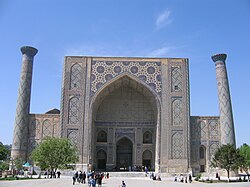
-
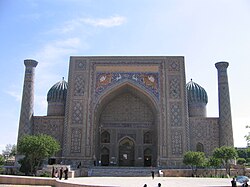 The Sherdar Madrasa
 -
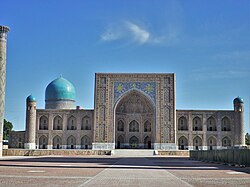 The Tilakari Madrasa
 -
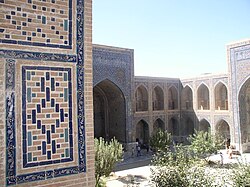 The Ulugh Beg Madrasa's courtyard
 -
 Tiger on the Sherdar Madrasa's iwan


_on_the_Sher-dor_madrassa.JPG)
Second half of the 18th–19’s century Uzbek period[edit | edit source]
.JPG)
From 1756 to 1868, it was ruled by the Manghud Emirs of Bukhara.[68] The revival of the city began during the reign of the founder of the Uzbek dynasty, the Mangyts, Muhammad Rakhim (1756–1758), who became famous for his strong-willed qualities and military art. Muhammad Rakhimbiy made some attempts to revive Samarkand.[69]
Russian Empire period[edit | edit source]

The city came under imperial Russian rule after the citadel had been taken by a force under Colonel Konstantin Petrovich von Kaufman in 1868. Shortly thereafter the small Russian garrison of 500 men were themselves besieged. The assault, which was led by Abdul Malik Tura, the rebellious elder son of the Bukharan Emir, as well as Baba Beg of Shahrisabz and Jura Beg of Kitab, was repelled with heavy losses. General Alexander Konstantinovich Abramov became the first Governor of the Military Okrug, which the Russians established along the course of the Zeravshan River with Samarkand as the administrative centre. The Russian section of the city was built after this point, largely west of the old city.[citation needed]
In 1886, the city became the capital of the newly formed Samarkand Oblast of Russian Turkestan and regained even more importance when the Trans-Caspian railway reached it in 1888.[citation needed]
Soviet period[edit | edit source]

Samarkand was the capital of Turkestan Provisional Government in 1922 and was the capital of the Uzbek SSR from 1925 to 1930, before being replaced by Tashkent. During World War II, after Nazi Germany invaded the Soviet Union, a number of Samarkand's citizens were sent to Smolensk to fight the enemy. Many were taken captive or killed by the Nazis.[70][71] Additionally, thousands of refugees from the occupied western regions of the USSR fled to the city, and it served as one of the main hubs for the fleeing civilians in the Uzbek Soviet Socialist Republic and the Soviet Union as a whole.[citation needed]

European study of the history of Samarkand began after the conquest of Samarkand by the Russian Empire in 1868. The first studies of the history of Samarkand belong to N. Veselovsky, V. Bartold and V. Vyatkin. In the Soviet period, the generalization of materials on the history of Samarkand was reflected in the two-volume History of Samarkand edited by the academician of Uzbekistan Ibrohim Moʻminov.[72]
On the initiative of Academician of the Academy of Sciences of the Uzbek SSR I. Muminov and with the support of Sharaf Rashidov, the 2500th anniversary of Samarkand was widely celebrated in 1970. In this regard, a monument to Ulugh Beg was opened, the Museum of the History of Samarkand was founded, and a two-volume history of Samarkand was prepared and published.[73][74]
After Uzbekistan gained independence, several monographs were published on the ancient and medieval history of Samarkand.[75][76]
Geography[edit | edit source]

Samarkand is located in southeastern Uzbekistan, in the Zarefshan River valley, 135 km from Qarshi. Road M37 connects Samarkand to Bukhara, 240 km away. Road M39 connects it to Tashkent, 270 km away. The Tajikistan border is about 35 km from Samarkand; the Tajik capital Dushanbe is 210 km away from Samarkand. Road M39 connects Samarkand to Mazar-i-Sharif in Afghanistan, which is 340 km away.
Climate[edit | edit source]
Samarkand has a cold semi-arid climate (Köppen climate classification: BSk) with hot, dry summers and relatively wet, variable winters that alternate periods of warm weather with periods of cold weather. July and August are the hottest months of the year, with temperatures reaching and exceeding 40 °C (104 °F). Precipitation is sparse from June through October, but increases to a maximum from February to April. January 2008 was particularly cold; the temperature dropped to −22 °C (−8 °F).[78]
| Climate data for Samarkand (1991–2020, extremes 1891–present) | |||||||||||||
|---|---|---|---|---|---|---|---|---|---|---|---|---|---|
| Month | Jan | Feb | Mar | Apr | May | Jun | Jul | Aug | Sep | Oct | Nov | Dec | Year |
| Record high °C (°F) | 23.2 (73.8) |
26.7 (80.1) |
32.2 (90.0) |
36.2 (97.2) |
39.5 (103.1) |
41.6 (106.9) |
42.4 (108.3) |
41.0 (105.8) |
38.6 (101.5) |
35.2 (95.4) |
31.5 (88.7) |
27.5 (81.5) |
42.4 (108.3) |
| Average high °C (°F) | 7.3 (45.1) |
9.5 (49.1) |
15.2 (59.4) |
21.4 (70.5) |
27.0 (80.6) |
32.4 (90.3) |
34.5 (94.1) |
33.3 (91.9) |
28.6 (83.5) |
22.0 (71.6) |
14.4 (57.9) |
9.1 (48.4) |
21.2 (70.2) |
| Daily mean °C (°F) | 2.3 (36.1) |
4.0 (39.2) |
9.3 (48.7) |
15.2 (59.4) |
20.4 (68.7) |
25.4 (77.7) |
27.2 (81.0) |
25.6 (78.1) |
20.6 (69.1) |
14.1 (57.4) |
8.0 (46.4) |
3.7 (38.7) |
14.7 (58.4) |
| Average low °C (°F) | −1.3 (29.7) |
−0.2 (31.6) |
4.6 (40.3) |
9.7 (49.5) |
14.1 (57.4) |
18.0 (64.4) |
19.5 (67.1) |
17.9 (64.2) |
13.5 (56.3) |
7.8 (46.0) |
3.2 (37.8) |
−0.2 (31.6) |
8.9 (48.0) |
| Record low °C (°F) | −25.4 (−13.7) |
−22 (−8) |
−14.9 (5.2) |
−6.8 (19.8) |
−1.3 (29.7) |
4.8 (40.6) |
8.6 (47.5) |
7.8 (46.0) |
0.0 (32.0) |
−6.4 (20.5) |
−18.1 (−0.6) |
−22.8 (−9.0) |
−25.4 (−13.7) |
| Average precipitation mm (inches) | 41.1 (1.62) |
52.2 (2.06) |
73.2 (2.88) |
62.9 (2.48) |
40.0 (1.57) |
6.8 (0.27) |
1.6 (0.06) |
1.6 (0.06) |
2.7 (0.11) |
16.0 (0.63) |
40.3 (1.59) |
39.2 (1.54) |
377.6 (14.87) |
| Average precipitation days (≥ 1.0 mm) | 14 | 13 | 15 | 13 | 11 | 5 | 2 | 2 | 2 | 6 | 10 | 12 | 105 |
| Average rainy days | 8 | 10 | 13 | 11 | 9 | 3 | 2 | 1 | 2 | 6 | 8 | 9 | 82 |
| Average snowy days | 9 | 7 | 3 | 0.3 | 0.1 | 0 | 0 | 0 | 0 | 0.3 | 2 | 6 | 28 |
| Average relative humidity (%) | 76 | 74 | 70 | 63 | 54 | 42 | 42 | 43 | 47 | 59 | 68 | 74 | 59 |
| Average dew point °C (°F) | −2 (28) |
−1 (30) |
2 (36) |
6 (43) |
9 (48) |
9 (48) |
10 (50) |
9 (48) |
6 (43) |
4 (39) |
2 (36) |
−1 (30) |
4 (40) |
| Mean monthly sunshine hours | 119.2 | 130.9 | 172.2 | 228.8 | 297.7 | 345.5 | 373.1 | 358.9 | 305.9 | 242.6 | 150.7 | 120.2 | 2,845.7 |
| Average ultraviolet index | 2 | 3 | 3 | 4 | 5 | 6 | 6 | 6 | 4 | 3 | 2 | 2 | 4 |
| Source 1: Pogoda.ru.net[79] | |||||||||||||
| Source 2: Weather Atlas (UV),[80] Time and Date (dewpoints, 1985–2015),[81] NOAA[82] | |||||||||||||
People[edit | edit source]
According to official reports, a majority of Samarkand's inhabitants are Uzbeks, while many sources refer to the city as majority Tajik,[83][84][85][86] up to 70 percent of the city's population.[87] Tajiks are especially concentrated in the eastern part of the city, where the main architectural landmarks are.[87]
According to various independent sources, Tajiks are Samarkand's majority ethnic group. Ethnic Uzbeks are the second-largest group[88][89] and are most concentrated in the west of Samarkand. Exact demographic figures are difficult to obtain since some people in Uzbekistan identify as "Uzbek" even though they speak Tajiki as their first language, often because they are registered as Uzbeks by the central government despite their Tajiki language and identity. As explained by Paul Bergne:
During the census of 1926 a significant part of the Tajik population was registered as Uzbek. Thus, for example, in the 1920 census in Samarkand city the Tajiks were recorded as numbering 44,758 and the Uzbeks only 3301. According to the 1926 census, the number of Uzbeks was recorded as 43,364 and the Tajiks as only 10,716. In a series of kishlaks [villages] in the Khojand Okrug, whose population was registered as Tajik in 1920 e.g. in Asht, Kalacha, Akjar i Tajik and others, in the 1926 census they were registered as Uzbeks. Similar facts can be adduced also with regard to Ferghana, Samarkand, and especially the Bukhara oblasts.[88]
Samarkand is also home to large ethnic communities of "Iranis" (the old, Persian-speaking, Shia population of Merv city and oasis, deported en masse to this area in the late 18th century), Russians, Ukrainians, Belarusians, Armenians, Azeris, Tatars, Koreans, Poles, and Germans, all of whom live primarily in the centre and western neighborhoods of the city. These peoples have emigrated to Samarkand since the end of the 19th century, especially during the Soviet Era; by and large, they speak the Russian language.
In the extreme west and southwest of Samarkand is a population of Central Asian Arabs, who mostly speak Uzbek; only a small portion of the older generation speaks Central Asian Arabic. In eastern Samarkand there was once a large mahallah of Bukharian (Central Asian) Jews, but starting in the 1970s, hundreds of thousands of Jews left Uzbekistan for Israel, United States, Canada, Australia, and Europe. Only a few Jewish families are left in Samarkand today.
Also in the eastern part of Samarkand there are several quarters where Central Asian "Gypsies"[90] (Lyuli, Djugi, Parya, and other groups) live. These peoples began to arrive in Samarkand several centuries ago from what are now India and Pakistan. They mainly speak a dialect of the Tajik language, as well as their own languages, most notably Parya.
Language[edit | edit source]

The state and official language in Samarkand, as in all Uzbekistan, is the Uzbek language. Uzbek is one of the Turkic languages and the mother tongue of Uzbeks, Turkmens, Samarkandian Iranians, and most Samarkandian Arabs living in Samarkand.
As in the rest of Uzbekistan, the Russian language is the de facto second official language in Samarkand, and about 5% of signs and inscriptions in Samarkand are in this language. Russians, Belarusians, Poles, Germans, Koreans, the majority of Ukrainians, the majority of Armenians, Greeks, some Tatars, and some Azerbaijanis in Samarkand speak Russian. Several Russian-language newspapers are published in Samarkand, the most popular of which is Samarkandskiy vestnik (Russian: Самаркандский вестник, lit. the Samarkand Herald). The Samarkandian TV channel STV conducts some broadcasts in Russian.
De facto, the most common native language in Samarkand is Tajik, which is a dialect or variant of the Persian language. Samarkand was one of the cities in which the Persian language developed. Many classical Persian poets and writers lived in or visited Samarkand over the millennia, the most famous being Abulqasem Ferdowsi, Omar Khayyam, Abdurahman Jami, Abu Abdullah Rudaki, Suzani Samarqandi, and Kamal Khujandi.
While the official stance is that Uzbek is the most common language in Samarkand, some data indicate that only about 30% of residents speak it as a native tongue. For the other 70%, Tajik is the native tongue, with Uzbek the second language and Russian the third. However, as no population census has been taken in Uzbekistan since 1989, there are no accurate data on this matter. Despite Tajik being the second most common language in Samarkand, it does not enjoy the status of an official or regional language.[91][84][85][92][86][93] Nevertheless, at Samarkand State University ten faculties offer courses in Tajiki, and the Tajik Language and Literature Department has an enrolment of over 170 students.[94] Only one newspaper in Samarkand is published in Tajiki, in the Cyrillic Tajik alphabet: Ovozi Samarqand (Tajik: Овози Самарқанд —Voice of Samarkand). Local Samarkandian STV and "Samarkand" TV channels offer some broadcasts in Tajik, as does one regional radio station. In 2022 a quarterly literary magazine in Tajiki, Durdonai Sharq, was launched in Samarkand.[94]
In addition to Uzbek, Tajik, and Russian, native languages spoken in Samarkand include Ukrainian, Armenian, Azerbaijani, Tatar, Crimean Tatar, Arabic (for a very small percentage of Samarkandian Arabs), and others.
Modern Samarkand is a vibrant city, and in 2019 the city hosted the first Samarkand Half Marathon.[95] In 2022 this also included a full marathon for the first time.
Religion[edit | edit source]
Islam[edit | edit source]
Islam entered Samarkand in the 8th century, during the invasion of the Arabs in Central Asia (Umayyad Caliphate). Before that, almost all inhabitants of Samarkand were Zoroastrians, and many Nestorians and Buddhists also lived in the city. From that point forward, throughout the reigns of many Muslim governing powers, numerous mosques, madrasahs, minarets, shrines, and mausoleums were built in the city. Many have been preserved. For example, there is the Shrine of Imam Bukhari, an Islamic scholar who authored the hadith collection known as Sahih al-Bukhari, which Sunni Muslims regard as one of the most authentic (sahih) hadith collections. His other books included Al-Adab al-Mufrad. Samarkand is also home to the Shrine of Imam Maturidi, the founder of Maturidism and the Mausoleum of the Prophet Daniel, who is revered in Islam, Judaism, and Christianity.
Most inhabitants of Samarkand are Muslim, primarily Sunni (mostly Hanafi) and Sufi. Approximately 80–85% of Muslims in the city are Sunni, comprising almost all Tajiks, Uzbeks, and Samarkandian Arabs living therein. Samarkand's best-known Islamic sacred lineages are the descendants of Sufi leaders such as Khodja Akhror Wali (1404–1490) and Makhdumi A’zam (1461–1542), the descendants of Sayyid Ata (first half of 14th c.) and Mirakoni Khojas (Sayyids from Mirakon, a village in Iran).[96] The liberal policy of President Shavkat Mirziyoyev opened up new opportunities for the expression of the religious identity. In Samarkand, since 2018, there has been an increase in the number of women wearing the hijab.[97]


Shia Muslims[edit | edit source]
The Samarqand Vilayat is one of the two regions of Uzbekistan (along with Bukhara Vilayat) that are home to a large number of Shiites. The total population of the Samarkand Vilayat is more than 3,720,000 people (2019).
There are no exact data on the number of Shiites in the city of Samarkand, but the city has several Shiite mosques and madrasas. The largest of these are the Punjabi Mosque, the Punjabi Madrassah, and the Mausoleum of Mourad Avliya. Every year, the Shiites of Samarkand commemorate Ashura, as well as other memorable Shiite dates and holidays.
Shiites in Samarkand are mostly Samarkandian Iranians, who call themselves Irani. Their ancestors began to arrive in Samarkand in the 18th century. Some migrated there in search of a better life, others were sold as slaves there by Turkmen captors, and others were soldiers who were posted to Samarkand. Mostly they came from Khorasan, Mashhad, Sabzevar, Nishapur, and Merv; and secondarily from Iranian Azerbaijan, Zanjan, Tabriz, and Ardabil. Samarkandian Shiites also include Azerbaijanis, as well as small numbers of Tajiks and Uzbeks.
While there are no official data on the total number of Shiites in Uzbekistan, they are estimated to be "several hundred thousand." According to leaked diplomatic cables, in 2007–2008, the US Ambassador for International Religious Freedom held a series of meetings with Sunni mullahs and Shiite imams in Uzbekistan. During one of the talks, the imam of the Shiite mosque in Bukhara said that about 300,000 Shiites live in the Bukhara Vilayat and 1 million in the Samarkand Vilayat. The Ambassador slightly doubted the authenticity of these figures, emphasizing in his report that data on the numbers of religious and ethnic minorities provided by the government of Uzbekistan were considered a very "delicate topic" due to their potential to provoke interethnic and interreligious conflicts. All the ambassadors of the ambassador tried to emphasize that traditional Islam, especially Sufism and Sunnism, in the regions of Bukhara and Samarkand is characterized by great religious tolerance toward other religions and sects, including Shiism.[98][99][100]


Christianity[edit | edit source]
| This section needs more citations. (March 2024) |

Christianity was introduced to Samarkand when it was part of Sogdiana, long before the penetration of Islam into Central Asia. The city then became one of the centers of Nestorianism in Central Asia.[101] The majority of the population were then Zoroastrians, but since Samarkand was the crossroads of trade routes among China, Persia, and Europe, it was religiously tolerant. Under the Umayyad Caliphate, Zoroastrians and Nestorians were persecuted by the Arab conquerors;[citation needed] the survivors fled to other places or converted to Islam. Several Nestorian temples were built in Samarkand, but they have not survived. Their remains were found by archeologists at the ancient site of Afrasiyab and on the outskirts of Samarkand.
In the three decades of 1329–1359, the Samarkand eparchy of the Roman Catholic Church served several thousand Catholics who lived in the city. According to Marco Polo and Johann Elemosina, a descendant of Chaghatai Khan, the founder of the Chaghatai dynasty, Eljigidey, converted to Christianity and was baptized. With the assistance of Eljigidey, the Catholic Church of St. John the Baptist was built in Samarkand. After a while, however, Islam completely supplanted Catholicism.
Christianity reappeared in Samarkand several centuries later, from the mid-19th century onward, after the city was seized by the Russian Empire. Russian Orthodoxy was introduced to Samarkand in 1868, and several churches and temples were built. In the early 20th century several more Orthodox cathedrals, churches, and temples were built, most of which were demolished while Samarkand was part of the USSR.
In present time, Christianity is the second-largest religious group in Samarkand with the predominant form is the Russian Orthodox Church (Moscow Patriarchate). More than 5% of Samarkand residents are Orthodox, mostly Russians, Ukrainians, and Belarusians, and also some Koreans and Greeks. Samarkand is the center of the Samarkand branch (which includes the Samarkand, Qashqadarya, and Surkhandarya provinces of Uzbekistan) of the Uzbekistan and Tashkent eparchy of the Central Asian Metropolitan District of the Russian Orthodox Church of the Moscow Patriarchate. The city has several active Orthodox churches: Cathedral of St. Alexiy Moscowskiy, Church of the Intercession of the Holy Virgin, and Church of St. George the Victorious. There are also a number of inactive Orthodox churches and temples, for example that of Church of St. George Pobedonosets.[102][103]
There are also a few tens of thousands of Catholics in Samarkand, mostly Poles, Germans, and some Ukrainians. In the center of Samarkand is St. John the Baptist Catholic Church, which was built at the beginning of the 20th century. Samarkand is part of the Apostolic Administration of Uzbekistan.[104]
The third largest Christian sect in Samarkand is the Armenian Apostolic Church, followed by a few tens of thousands of Armenian Samarkandians. Armenian Christians began emigrating to Samarkand at the end of the 19th century, this flow increasing especially in the Soviet era.[105] In the west of Samarkand is the Armenian Church Surb Astvatsatsin.[106]


Samarkand also has several thousand Protestants, including Lutherans, Baptists, Mormons, Jehovah's Witnesses, Adventists, and members of the Korean Presbyterian church. These Christian movements appeared in Samarkand mainly after the independence of Uzbekistan in 1991.[107]
Landmarks[edit | edit source]
Silk Road Samarkand (Eternal city)[edit | edit source]
Silk Road Samarkand is a modern multiplex which opened in early 2022 in eastern Samarkand. The complex covers 260 hectares and includes world-class business and medical hotels, eateries, recreational facilities, park grounds, an ethnographic corner and a large congress hall for hosting international events.[108]
Eternal city situated in Silk Road Samarkand complex. This site which occupies 17 hectares accurately recreates the spirit of the ancient city backed up by the history and traditions of Uzbek lands and Uzbek people for the guests of the Silk Road Samarkand. The narrow streets here house multiple shops of artists, artisans, and craftsmen. The pavilions of the Eternal City were inspired by real houses and picturesque squares described in ancient books. This is where you can plunge into a beautiful oriental fairy tale: with turquoise domes, mosaics on palaces, and high minarets that pierce the sky.
Visitors to the Eternal City can taste national dishes from different eras and regions of the country and also see authentic street performances. The Eternal City showcases a unique mix of Parthian, Hellenistic, and Islamic cultures so that the guests could imagine the versatile heritage of bygone centuries in full splendor. The project was inspired and designed by Bobur Ismoilov, a famous modern artist.[109]
Architecture[edit | edit source]

Timur initiated the building of Bibi-Khanym after his 1398–1399 campaign in India. The Bibi-Khanym originally had about 450 marble columns, which were hauled there and set up with the help of 95 elephants that Timur had brought back from Hindustan. Artisans and stonemasons from India designed the mosque's dome, giving it its distinctive appearance amongst the other buildings. An 1897 earthquake destroyed the columns, which were not entirely restored in the subsequent reconstruction.[57]
The best-known landmark of Samarkand is the mausoleum known as Gur-i Amir. It exhibits the influences of many cultures, past civilizations, neighboring peoples, and religions, especially those of Islam. Despite the devastation wrought by Mongols to Samarkand's pre-Timurid Islamic architecture, under Timur these architectural styles were revived, recreated, and restored. The blueprint and layout of the mosque itself, with their precise measurements, demonstrate the Islamic passion for geometry. The entrance to the Gur-i Amir is decorated with Arabic calligraphy and inscriptions, the latter a common feature in Islamic architecture. Timur's meticulous attention to detail is especially obvious inside the mausoleum: the tiled walls are a marvelous example of mosaic faience, an Iranian technique in which each tile is cut, colored, and fit into place individually.[57] The tiles of the Gur-i Amir were also arranged so that they spell out religious words such as "Muhammad" and "Allah."[57]
The ornamentation of the Gur-i Amir's walls includes floral and vegetal motifs, which signify gardens; the floor tiles feature uninterrupted floral patterns. In Islam, gardens are symbols of paradise, and as such, they were depicted on the walls of tombs and grown in Samarkand itself.[57] Samarkand boasted two major gardens, the New Garden and the Garden of Heart's Delight, which became the central areas of entertainment for ambassadors and important guests. In 1218, a friend of Genghis Khan named Yelü Chucai reported that Samarkand was the most beautiful city of all, as "it was surrounded by numerous gardens. Every household had a garden, and all the gardens were well designed, with canals and water fountains that supplied water to round or square-shaped ponds. The landscape included rows of willows and cypress trees, and peach and plum orchards were shoulder to shoulder."[110] Persian carpets with floral patterns have also been found in some Timurid buildings.[111]
The elements of traditional Islamic architecture can be seen in traditional mud-brick Uzbek houses that are built around central courtyards with gardens.[112] Most of these houses have painted wooden ceilings and walls. By contrast, houses in the west of the city are chiefly European-style homes built in the 19th and 20th centuries.[112]
Turko-Mongol influence is also apparent in Samarkand's architecture. It is believed that the melon-shaped domes of the mausoleums were designed to echo yurts or gers, traditional Mongol tents in which the bodies of the dead were displayed before burial or other disposition. Timur built his tents from more-durable materials, such as bricks and wood, but their purposes remained largely unchanged.[57] The chamber in which Timur's own body was laid included "tugs", poles whose tops were hung with a circular arrangement of horse or yak tail hairs. These banners symbolized an ancient Turkic tradition of sacrificing horses, which were valuable commodities, to honor the dead.[57] Tugs were also a type of cavalry standard used by many nomads, up to the time of the Ottoman Turks.
Colors of buildings in Samarkand also have significant meanings. The dominant architectural color is blue, which Timur used to convey a broad range of concepts. For example, the shades of blue in the Gur-i Amir are colors of mourning; in that era, blue was the color of mourning in Central Asia, as it still is in various cultures today. Blue was also considered the color that could ward off "the evil eye" in Central Asia; this notion is evidenced by in the number of blue-painted doors in and around the city. Furthermore, blue represented water, a particularly rare resource in the Middle East and Central Asia; walls painted blue symbolized the wealth of the city.
Gold also has a strong presence in the city. Timur's fascination with vaulting explains the excessive use of gold in the Gur-i Amir, as well as the use of embroidered gold fabric in both the city and his buildings. The Mongols had great interests in Chinese- and Persian-style golden silk textiles, as well as nasij[113] woven in Iran and Transoxiana. Mongol leaders like Ögedei Khan built textile workshops in their cities to be able to produce gold fabrics themselves.
Suburbs[edit | edit source]
Suburbs of the city include: Gulyakandoz, Superfosfatnyy, Bukharishlak, Ulugbek, Ravanak, Kattakishlak, Registan, Zebiniso, Kaftarkhona, Uzbankinty.[114]
Transport[edit | edit source]
Local[edit | edit source]
Samarkand has a strong public-transport system. From Soviet times up through today, municipal buses and taxis (GAZ-21, GAZ-24, GAZ-3102, VAZ-2101, VAZ-2106 and VAZ-2107) have operated in Samarkand. Buses, mostly SamAuto and Isuzu buses, are the most common and popular mode of transport in the city. Taxis, which are mostly Chevrolets and Daewoo sedans, are usually yellow in color. Since 2017, there have also been several Samarkandian tram lines, mostly Vario LF.S Czech trams. From the Soviet Era up until 2005, Samarkandians also got around via trolleybus. Finally, Samarkand has the so-called "Marshrutka," which are Daewoo Damas and GAZelle minibuses.
-
 Many yellow taxis on the streets of Samarkand
 -
 Taxi and tram on Rudaki Street in Samarkand
 -
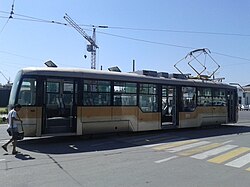 Tram in Samarkand


Until 1950, the main forms of transport in Samarkand were carriages and "arabas" with horses and donkeys. However, the city had a steam tram from 1924 to 1930, and there were more modern trams from 1947 to 1973.
Air transport[edit | edit source]
In the north of the city is Samarkand International Airport, which was opened in the 1930s, under the Soviets. As of spring 2019, Samarkand International Airport has flights to Tashkent, Nukus, Moscow, Saint Petersburg, Yekaterinburg, Kazan, Istanbul, and Dushanbe; charter flights to other cities are also available.
Railway[edit | edit source]
Modern Samarkand is an important rail junction of Uzbekistan, and all national east–west railway routes pass through the city. The most important and longest of these is Tashkent–Kungrad. High-speed Tashkent–Samarkand high-speed rail line trains run between Tashkent, Samarkand, and Bukhara. Samarkand also has international railway connections: Saratov–Samarkand, Moscow–Samarkand, and Astana–Samarkand.
-
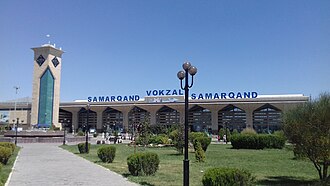 Samarkand railway station
 -
 Afrasiyab (Talgo 250) high-speed train in Samarkand railway station

_(3).jpg)
Between 1879 and 1891, the Russian Empire built the Trans-Caspian Railway to facilitate its expansion into Central Asia. The railway originated in Krasnovodsk (now Turkmenbashi) on the Caspian Sea coast. Its terminus was originally Samarkand, whose station first opened in May 1888. However, a decade later, the railway was extended eastward to Tashkent and Andijan, and its name was changed to Central Asian Railways. Nonetheless, Samarkand remained one of the largest and most important stations of the Uzbek SSR and Soviet Central Asia.
International relations[edit | edit source]
Samarkand is twinned with:[115]
 Agra, India
- Afghanistan Balkh, Afghanistan
 Banda Aceh, Indonesia
 Cusco, Peru
 Jūrmala, Latvia
 Kairouan, Tunisia
 Khujand, Tajikistan
 Krasnoyarsk, Russia
 Lahore, Pakistan
 Liège, Belgium
 Mary, Turkmenistan
- Merv, Turkmenistan
 Mexico City, Mexico
- New Delhi, India
 Nishapur, Iran
 Plovdiv, Bulgaria
 Rio de Janeiro, Brazil
- Samara, Russia
 Xi'an, China
 Nara, Japan[116]
Samarkand has friendly relations with:[115][117]


In literature[edit | edit source]
The frame story of One Thousand and One Nights involves a Sasanian king who assigns his brother, Shah Zaman, to rule over Samarkand.[118]
The poet James Elroy Flecker published the poem The Golden Journey to Samarkand in 1913. It was included in his play, Hassan. Hassan (The Story of Hassan of Bagdad and How He Came to Make the Golden Journey to Samarkand) is a five-act drama in prose with verse passages. It tells the story of Hassan, a young man from Baghdad who embarks on a journey to Samarkand. Along the way, he encounters various challenges and obstacles, including bandits, treacherous terrain, and political turmoil.
Samarkand (French: Samarcande), written by French-Lebanese writer Amin Maalouf, is a 1988 historical fiction novel that revolves around the 11th-century Persian poet Omar Khayyám and his poetry collection Rubaiyat.
In 2002, Nobel Laureate Wole Soyinka titled his collection of poetry Samarkand and Other Markets I Have Known.[119]
English author Jonathan Stroud published his book The Amulet of Samarkand in 2003. The book contains no allusions to Samarkand other than namesake.[citation needed]
The city of Samarkand is famous for being the subject of an Uzbek tale called "The Rendezvous at Samarkand." It was recounted by a 12th-century Persian storyteller and mystic, Farid Al-Din Attar. In a legendary Baghdad, ruled by a powerful caliph, lived a young, healthy vizier. He seemed to have his whole life ahead of him. One day, he went to the city market, incognito, as he often did. Amidst the stalls of the spice merchants, he encountered a skeletal woman, who turned around as he passed and reached out to him. The vizier, a wise man, immediately recognized death. Terrified by what he saw, he begged his caliph to let him flee Baghdad, explaining that death was here and wanted to take him. His only hope was to immediately saddle his fastest horse and gallop off far from the city. The caliph therefore granted him permission to leave and asked him where he would be going. The vizier replies that to escape death, he is going to Samarkand, the desert city, on the edge of the kingdom, on the borders of Asia and the Middle East, thinking he will be safe there, far from the death that lurks in Baghdad! However, the caliph also decides to go to the market to check for the presence of death. He recognizes her very quickly and addresses her without fear, asking her the meaning of the gesture she made towards the vizier. "It was only a gesture of surprise..." replies death "Because I saw him in Baghdad while I must take him tonight in Samarkand..." This tale illustrates the inevitability of human destiny in the face of death. [citation needed]
This tale also inspired Agatha Christie to title her novel "Appointment with Death."[citation needed]
In Theodore Judson's 2004 novel Fitzpatrick's War, the title character attempts to make Samarkand (which he renames "Neapolis") the capital of a world empire and resides there until his assassination.
Mentioned in books of World of Watches[120][121][122][123] and Day Watch movie (2006).[124][125][126][127][128]
Notable people[edit | edit source]
- Bakhtiyor Fazilov, Businessman
- Takhmina Ikromova, Uzbek rhythmic gymnast
- Igor Sarukhanov, Russian pop musician, composer and artist of Armenian descent
See also[edit | edit source]
Notes[edit | edit source]
- ↑ /ˈsæmərkænd/ SAM-ər-kand; Uzbek and Tajik: Самарқанд, romanized: Samarqand, IPA: [sæmærˈqænd, -ænt].
Citations[edit | edit source]
- ↑ "The State Committee of the Republic of Uzbekistan on Statistics". Archived from the original on 2020-04-29. Retrieved 2020-04-26.
- ↑ "Classification system of territorial units of the Republic of Uzbekistan" (in oʻzbekcha / ўзбекча and русский). The State Committee of the Republic of Uzbekistan on statistics. July 2020.
- ↑ "Urban and rural population by district" (in oʻzbekcha / ўзбекча). Samarkand regional department of statistics. Archived from the original (PDF) on 2022-02-13.
- ↑ "Samarkand". Encyclopaedia Iranica. Retrieved 10 March 2026.
- ↑ "Samarkand". Encyclopaedia Britannica. Retrieved 10 March 2026.
- ↑ Frye, Richard N. (1996). The Heritage of Central Asia. Cambridge University Press.
- ↑ Guidebook of history of Samarkand", ISBN 978-9943-01-139-7
- ↑ Varadarajan, Tunku (24 October 2009). "Metropolitan Glory". The Wall Street Journal.
- ↑ "History of Samarkand". Sezamtravel. Archived from the original on 3 November 2013. Retrieved 1 November 2013.
- ↑ Centre, UNESCO World Heritage. "Samarkand – Crossroad of Cultures". UNESCO World Heritage Centre. Retrieved 2025-11-05.
- ↑ Энциклопедия туризма Кирилла и Мефодия. 2008.
- ↑ "History of Samarkand". Advantour. Archived from the original on 2018-05-16. Retrieved 2018-05-15.
- ↑ "The Persian-speaking cities of Bukhara and Samarkand, rightly considered by today’s Tajiks as the constituting the historical centres of Tajik civilization" Foltz, Richard. A History of the Tajiks: Iranians of the East. I.B. Tauris, 2019. p.9
- ↑ D.I. Kertzer/D. Arel, Census and identity Archived 2022-11-17 at the Wayback Machine, Cambridge University Press, 2001, pp. 186–188.
- ↑ 15.0 15.1 Room, Adrian (2006). Placenames of the World: Origins and Meanings of the Names for 6,600 Countries, Cities, Territories, Natural Features and Historic Sites (2nd ed.). London: McFarland. p. 330. ISBN 978-0-7864-2248-7.
Samarkand City, southeastern Uzbekistan. The city here was already named Marakanda, when captured by Alexander the Great in 329 BCE. Its own name derives from the Sogdian words samar, "stone, rock", and kand, "fort, town".
- ↑ Sachau, Edward C. Alberuni’s India: an Account of the Religion. Philosophy, Literature, Geography, Chronology, Astronomy, Customs, Laws and Astrology of India about AD 1030, vol. 1 London: KEGAN PAUL, TRENCH, TRtJBNBR & CO. 1910. p.298.
- ↑ Krippes, Karl (1991). "Sociolinguistic Notes on the Turcification of the Sogdians". Central Asiatic Journal. 35 (1/2): 67–80. ISSN 0008-9192.
- ↑ al-Kashghari, Mahmud (1074). Compendium of The Turkic Dialects. Part 1. Translated by Dankoff, Robert; Kelly, James Michael. Harvard University Printing Office (published 1982). p. 270 – via Archive.org.
sämiz känd meaning "Fat city (balda samina)" is called thus because of its great size; it is, in Persian, Samarqand.
- ↑ Ragagnin, Elisabetta (2020). "About Marco Polo Samarkand". Uzbekistan: Language and Culture. 3 (3). Alisher Navo’i Tashkent State University of Uzbek Language and Literature: 79–87. ISSN 2181-922X. Archived from the original on 2024-01-23. Retrieved 2024-01-23.
- ↑ "SEMERKANT", antalya.bel.tr (archived), accessed 4 February 2026
- ↑ Vladimir Babak, Demian Vaisman, Aryeh Wasserman, Political organization in Central Asia and Azerbaijan: sources and documents, p. 374
- ↑ Hanks, Reuel R. (19 February 2024). Historical Dictionary of Uzbekistan. Bloomsbury Publishing PLC. ISBN 978-1-5381-0229-9.
- ↑ Columbia-Lippincott Gazetteer (New York: Columbia University Press, 1972 reprint) p. 1657
- ↑ 24.0 24.1 Wood, Frances (2002). The Silk Road: Two Thousand Years in the Heart of Asia. Berkeley and Los Angeles: University of California Press.
- ↑ Shichkina, G.V. (1994). "Ancient Samarkand: Capital of Soghd". Bulletin of the Asia Institute. 8: 83.
- ↑ Shichkina, G.V. (1994). "Ancient Samarkand: capital of Soghd". Bulletin of the Asia Institute. 8: 86.
- ↑ 27.0 27.1 Dumper, Stanley (2007). Cities of the Middle East and North Africa: A Historical Encyclopedia. California: ABC-CLIO. pp. 319–320.
- ↑ Grenet Frantz, Regional interaction in Central Asia and northwest India in the Kidarite and Hephthalites periods in Indo-Iranian languages and peoples. Edited by Nicholas Sims-Williams. Oxford university press, 2003. Р.219–220
- ↑ Buryakov Y.F. Iz istorii arkheologicheskikh rabot v zonakh oroshayemogo zemledeliya Uzbekistana // Arkheologicheskiye raboty na novostroykakh Uzbekistana. Tashkent, 1990. pp. 9–10.
- ↑ Etienne de la Vaissiere, Sogdian traders. A history. Translated by James Ward. Brill. Leiden. Boston, 2005, pp. 108–111.
- ↑ Baumer, Christoph (18 April 2018). History of Central Asia, The: 4-volume set. Bloomsbury Publishing. p. 243. ISBN 978-1-83860-868-2.
- ↑ Grenet, Frantz (2004). "Maracanda/Samarkand, une métropole pré-mongole". Annales. Histoire, Sciences Sociales. 5/6: Fig. B.
- ↑ Bivar, A.D.H. Encyclopedia Iranica, Vol. XII, Fasc. 2. London et al. pp. 198–201.
- ↑ History of Civilizations of Central Asia: The crossroads of civilizations, AD 250 to 750. Vol. 3. Unesco, 1996. p. 332
- ↑ Belenitskiy A.M., Bentovich I.B., Bolshakov O.G. Srednevekovyy gorod Sredney Azii. L., 1973.
- ↑ Sprishevskiy V.I. Pogrebeniye s konem serediny I tysyacheletiya n.e., obnaruzhennoye okolo observatorii Ulugbeka. // Tr. Muzeya istorii narodov Uzbekistana. T.1.- Tashkent, 1951.
- ↑ Klyashtornyy S. G., Savinov D. G., Stepnyye imperii drevney Yevrazii. Sankt-Peterburg: Filologicheskiy fakul'tet SPbGU, 2005 god, s. 97
- ↑ Masson M.Ye., Proiskhozhdeniye dvukh nestorianskikh namogilnykh galek Sredney Azii // Obshchestvennyye nauki v Uzbekistane, 1978, №10, p. 53.
- ↑ Sims-Williams Nicholas, A Christian sogdian polemic against the manichaens // Religious themes and texts of pre-Islamic Iran and Central Asia. Edited by Carlo G. Cereti, Mauro Maggi and Elio Provasi. Wiesbaden: Dr. Ludwig Reichert Verlag, 2003, pp. 399–407
- ↑ Tadjikistan : au pays des fleuves d'or. Paris: Musée Guimet. 2021. p. 152. ISBN 978-9461616272.
- ↑ Dumper, Stanley (2007). Cities of the Middle East and North Africa: A Historical Encyclopedia. California.
{{cite book}}: CS1 maint: location missing publisher (link) - ↑ 42.0 42.1 Wellhausen, J. (1927). Weir, Margaret Graham (ed.). The Arab Kingdom and its Fall. University of Calcutta. pp. 437–438. ISBN 9780415209045. Archived from the original on 2019-04-21. Retrieved 2019-05-04.
- ↑ Whitfield, Susan (1999). Life Along the Silk Road. California: University of California Press. p. 33.
- ↑ Bartold V. V., Abu Muslim//Akademik V. V. Bartol'd. Sochineniya. Tom VII. Moskva: Nauka, 1971
- ↑ Quraishi, Silim "A survey of the development of papermaking in Islamic Countries", Bookbinder, 1989 (3): 29–36.
- ↑ Dumper, Stanley (2007). Cities of the Middle East and North Africa: A Historical Encyclopedia. California. p. 320.
{{cite book}}: CS1 maint: location missing publisher (link) - ↑ 47.0 47.1 47.2 Kochnev B. D., Numizmaticheskaya istoriya Karakhanidskogo kaganata (991—1209 gg.). Moskva «Sofiya», 2006
- ↑ Nemtseva, N.B., Shvab, IU. Ansambl Shah-i Zinda: istoriko-arkhitektymyi ocherk. Tashent: 1979.
- ↑ Karev, Yury. Qarakhanid wall paintings in the citadel of Samarqand: First report and preliminary observations in Muqarnas 22 (2005): 45–84.
- ↑ "Samarkand Travel Guide". Caravanistan. Retrieved 2021-03-20.
- ↑ Jacques Gernet (31 May 1996). A History of Chinese Civilization. Cambridge University Press. pp. 377–. ISBN 978-0-521-49781-7. Archived from the original on 15 June 2016. Retrieved 25 January 2020.
- ↑ E.J.W. Gibb memorial series. 1928. p. 451.
- ↑ E. Bretschneider (1888). "The Travels of Ch'ang Ch'un to the West, 1220–1223 recorded by his disciple Li Chi Ch'ang". Mediæval Researches from Eastern Asiatic Sources. Barnes & Noble. pp. 37–108. Archived from the original on 2018-04-30. Retrieved 2018-04-26.
- ↑ Battutah, Ibn (2002). The Travels of Ibn Battutah. London: Picador. p. 143. ISBN 9780330418799.
- ↑ Encyclopædia Britannica, 15th Ed, p. 204
- ↑ Malikov Azim, The cultural traditions of urban planning in Samarkand during the epoch of Timur. In: Baumer, C., Novák, M. and Rutishauser, S., Cultures in Contact. Central Asia as Focus of Trade, Cultural Exchange and Knowledge Transmission. Harrassowitz. 2022, p.343
- ↑ 57.0 57.1 57.2 57.3 57.4 57.5 57.6 Marefat, Roya (Summer 1992). "The Heavenly City of Samarkand". The Wilson Quarterly. 16 (3): 33–38. JSTOR 40258334.
- ↑ 58.0 58.1 Columbia-Lippincott Gazetteer, p. 1657
- ↑ Le Strange, Guy (trans) (1928). Clavijo: Embassy to Tamburlaine 1403–1406. London. p. 280.
{{cite book}}: CS1 maint: location missing publisher (link) - ↑ "Ulugh Beg – Biography". Maths History.
- ↑ Ulugh Beg. Dictionary of Scientific Biography.
- ↑ 62.0 62.1 Mukminova R. G., K istorii agrarnykh otnosheniy v Uzbekistane XVI veke. Po materialam «Vakf-name». Tashkent. Nauka. 1966
- ↑ Fazlallakh ibn Ruzbikhan Isfakhani. Mikhman-name-yi Bukhara (Zapiski bukharskogo gostya). M. Vostochnaya literatura. 1976, p. 3
- ↑ B.V. Norik. Rol' shibanidskikh praviteley v literaturnoy zhizni Maverannakhra XVI veka. Sankt-Peterburg: Rakhmat-name, 2008. p. 233.
- ↑ "ZARAFSHON SUVAYIRGʻICH KOʻPRIGI". uzsmart.uz. Retrieved 2023-11-14.
- ↑ "МОСТ ШЕЙБАНИ-ХАНА". www.centralasia-travel.com. Retrieved 2023-11-14.
- ↑ Britannica. 15th Ed, p. 204
- ↑ Columbia-Lippincott Gazetteer. p. 1657
- ↑ Materialy po istorii Sredney i Tsentral'noy Azii X—XIX veka. Tashkent: Fan, 1988, рр. 270—271
- ↑ "Советское Поле Славы". www.soldat.ru. Archived from the original on April 13, 2020.
- ↑ Rustam Qobil (2017-05-09). "Why were 101 Uzbeks killed in the Netherlands in 1942?". BBC. Archived from the original on 2020-03-30. Retrieved 2017-05-09.
- ↑ Montgomery David. Samarkand taarikhi (History of Samarkand) by I.M.Muminov, The American historical review, volume 81, no.8 (October 1976), pp. 914–915
- ↑ Istoriya Samarkanda v dvukh tomakh. Pod redaktsiyey I. Muminova. Tashkent, 1970
- ↑ Montgomery David, Review of Samarkand taarikhi by I. M. Muminov et al. // The American historical review, volume 81, no. 4 (October 1976)
- ↑ Shirinov T.SH., Isamiddinov M.KH. Arkheologiya drevnego Samarkanda. Tashkent, 2007
- ↑ Malikov A.M. Istoriya Samarkanda (s drevnikh vremen do serediny XIV veka). Tom. 1. Tashkent: Paradigma, 2017.
- ↑ "Samarkand, Uzbekistan". Earthobservatory.nasa.gov. 23 September 2013. Archived from the original on 2015-09-17. Retrieved 2014-08-23.
- ↑ Samarkand.info. "Weather in Samarkand". Archived from the original on 2009-06-04. Retrieved 2009-06-11.
- ↑ "Weather and Climate-The Climate of Samarkand" (in русский). Weather and Climate. Retrieved 18 January 2021.
- ↑ "Samarkand, Uzbekistan – Detailed climate information and monthly weather forecast". Weather Atlas. Retrieved 1 August 2022.
- ↑ "Climate & Weather Averages in Samarkand". Time and Date. Retrieved 24 July 2022.
- ↑ "Samarkand Climate Normals 1991–2020". National Oceanic and Atmospheric Administration. Retrieved November 1, 2023.
- ↑ Akiner, Shirin; Djalili, Mohammad-Reza; Grare, Frederic (2013). Tajikistan: The Trials of Independence. Routledge. ISBN 978-1-136-10490-9 p. 78, "Bukhara and Samarkand, inhabited by a marked Tajik majority (...)"
- ↑ 84.0 84.1 Lena Jonson (1976) "Tajikistan in the New Central Asia", I.B.Tauris, p. 108: "According to official Uzbek statistics there are slightly over 1 million Tajiks in Uzbekistan or about 3% of the population. The unofficial figure is over 6 million Tajiks. They are concentrated in the Sukhandarya, Samarqand and Bukhara regions."
- ↑ 85.0 85.1 "Узбекистан: Таджикский язык подавляется". catoday.org — ИА "Озодагон". Archived from the original on 22 March 2019. Retrieved 22 March 2019.
- ↑ 86.0 86.1 "Таджики – иранцы Востока? Рецензия книги от Камолиддина Абдуллаева". «ASIA-Plus» Media Group / Tajikistan — news.tj. Archived from the original on 27 March 2019. Retrieved 22 March 2019.
- ↑ 87.0 87.1 Richard Foltz (1996). "The Tajiks of Uzbekistan". Central Asian Survey. 15 (2): 213–216. doi:10.1080/02634939608400946.
- ↑ 88.0 88.1 Paul Bergne: The Birth of Tajikistan. National Identity and the Origins of the Republic. International Library of Central Asia Studies. I.B. Tauris. 2007. Pg. 106
- ↑ Frye, Richard N. (1996). The Heritage of Central Asia: From Antiquity to the Turkish Expansion. Princeton University Press. Retrieved 10 March 2026.
- ↑ Marushiakova; Popov, Vesselin (January 2014). Migrations and Identities of Central Asian 'Gypsies'. Asia Pacific Sociological Association (APSA) Conference "Transforming Societies: Conestations and Convergences in Asia and the Pacific". doi:10.1057/ces.2008.3. S2CID 154689140. Retrieved 2022-02-28.
- ↑ Karl Cordell, "Ethnicity and Democratisation in the New Europe", Routledge, 1998. p. 201: "Consequently, the number of citizens who regard themselves as Tajiks is difficult to determine. Tajikis within and outside of the republic, Samarkand State University (SamGU) academic and international commentators suggest that there may be between six and seven million Tajiks in Uzbekistan, constituting 30% of the republic's 22 million population, rather than the official figure of 4.7% (Foltz 1996: 213; Carlisle 1995: 88).
- ↑ "Статус таджикского языка в Узбекистане". Лингвомания.info — lingvomania.info. Archived from the original on 29 October 2016. Retrieved 22 March 2019.
- ↑ "Есть ли шансы на выживание таджикского языка в Узбекистане — эксперты". "Биржевой лидер" — pfori-forex.org. Archived from the original on 22 March 2019. Retrieved 22 March 2019.
- ↑ 94.0 94.1 Foltz, Richard (2023). A History of the Tajiks: Iranians of the East, 2nd edition. Bloomsbury Publishing. p. 186. ISBN 978-0-7556-4964-8.
- ↑ Samarkand Marathon.
- ↑ Malikov Azim, Sacred lineages of Samarqand: history and identity in Anthropology of the Middle East, Volume 15, Issue 1, Summer 2020, р.36
- ↑ https://www.ajol.info/index.php/ijma/article/view/218533 Malikov A. and Djuraeva D. 2021. Women, Islam, and politics in Samarkand (1991–2021), International Journal of Modern Anthropology. 2 (16): 561
- ↑ "Шииты в Узбекистане". www.islamsng.com. Archived from the original on October 3, 2017. Retrieved April 3, 2019.
- ↑ "Ташкент озабочен делами шиитов". www.dn.kz. Archived from the original on 2019-04-03. Retrieved April 3, 2019.
- ↑ "Узбекистан: Иранцы-шииты сталкиваются c проблемами с правоохранительными органами". catoday.org. Archived from the original on September 5, 2017. Retrieved April 3, 2019.
- ↑ Dickens, Mark "Nestorian Christianity in Central Asia. p. 17
- ↑ В. А. Нильсен. У истоков современного градостроительства Узбекистана (ΧΙΧ — начало ΧΧ веков). —Ташкент: Издательство литературы и искусства имени Гафура Гуляма, 1988. 208 с.
- ↑ Голенберг В. А. «Старинные храмы туркестанского края». Ташкент 2011 год
- ↑ Католичество в Узбекистане. Ташкент, 1990.
- ↑ Armenians. Ethnic atlas of Uzbekistan, 2000.
- ↑ Назарьян Р.Г. Армяне Самарканда. Москва. 2007
- ↑ Бабина Ю. Ё. Новые христианские течения и страны мира. Фолкв, 1995.
- ↑ "Silk Road Samarkand Tourist Complex". Advantour. Retrieved 2023-01-20.
- ↑ "Eternal City". www.silkroad-samarkand.com. Retrieved 2023-01-20.
- ↑ Liu, Xinru (2010). The Silk Road in world history. New York: Oxford University Press. ISBN 978-0-19-516174-8.
- ↑ Cohn-Wiener, Ernst (June 1935). "An Unknown Timurid Building". The Burlington Magazine for Connoisseurs. 66 (387): 272–273+277. JSTOR 866154.
- ↑ 112.0 112.1 "Samarkand – Crossroad of Cultures". UNESCO World Heritage Centre. Archived from the original on 2018-05-16. Retrieved 2018-05-15.
- ↑ "Textiles in "The world of Kubilai Khan" @ Metropolitan Museum, New York". Alain.R.Truong. 25 December 2010. Archived from the original on 2019-11-18. Retrieved 2020-05-23.
- ↑ "Superfosfatnyy · Uzbekistan". Superfosfatnyy · Uzbekistan.
- ↑ 115.0 115.1 "Самарканд и Валенсия станут городами-побратимами". podrobno.uz (in русский). 2018-01-27. Retrieved 2020-11-15.
- ↑ "A brotherhood agreement has been signed between the cities of Nara and Samarkand".
- ↑ "Внешнеэкономическое сотрудничество". bobruisk.by (in русский). Babruysk. Archived from the original on 2020-10-28. Retrieved 2020-11-15.
- ↑ Burton, Richard (2011). Mondschein, Ken (ed.). The Arabian Nights. Canterbury Classics. p. 1. ISBN 978-1-60710-309-7.
- ↑ "Samarkand and Other Markets I Have Known | poetry by Soyinka | Britannica". Encyclopædia Britannica. Retrieved 2023-09-17.
- ↑ Newman, Kim (2008-12-06). "The coldest warriors". The Guardian. ISSN 0261-3077. Retrieved 2025-12-30.
Here we also get a trip to Scotland to find a real vampire lurking in the Edinburgh Dungeon tourist attraction, offering a foreign view of the familiar, but the middle segment, set in Samarkand, is more striking
- ↑ Lukyanenko, Sergei (2008). The Last Watch. William Heinemann. ISBN 978-0-434-01737-9.
- ↑ "Review 137: The Last Watch". The Labyrinth Library. 2011-08-24. Retrieved 2025-12-30.
Anton not only has to deal with the Watches of Samarkand – which are far less efficient and well-staffed as others in Europe – but there's still someone out to kill him
- ↑ Recommendation, New Book (2024-10-07). "Summary of 'The Last Watch' by Sergei Lukyanenko: A Detailed Synopsis". New Book Recommendation. Retrieved 2025-12-30.
The societal structures in Samarkand differ dramatically from Moscow's. Anton's relationship with the local Watches showcases the common struggles they all face
- ↑ Floyd, Nigel. "Day Watch". Time Out Worldwide. Archived from the original on 2024-06-17. Retrieved 2025-12-30.
The opening scenes whisk us back to fourteenth-century Samarkand, where Mongol warlord Tamerlane acquires the 'Chalk of Destiny'
- ↑ "Day Watch (2006)".
Anton travels to Samarkand on a crusade to find the legendary Chalk of Fate from the tomb of the great warrior Tamerlane, with which one is reputed to be able to rewrite their own past
- ↑ "Day Watch". The Georgia Straight. 2007-06-06. Retrieved 2025-12-30.
- ↑ Where was the movie Day Watch filmed: | Filming locations, countries, coordinates, and map. Retrieved 2025-12-30 – via wherefilmed.org.
- ↑ "Day Watch". Reverse Shot. Retrieved 2025-12-30.
the 14th-century nomadic warrior Tamerlane invades a fortress in Samarkand in search of the "chalk of fate," which he successfully swipes from a gold-dusted, Buddha-shaped man named Zoar, who is alive and well and running a noodle shop in Moscow six centuries later
General and cited references[edit | edit source]
- Azim Malikov, "Cult of saints and shrines in the Samarqand province of Uzbekistan". International Journal of Modern Anthropology. No. 4. 2010, pp. 116–123.
- Azim Malikov, "The politics of memory in Samarkand in post-Soviet period". International Journal of Modern Anthropology. (2018) Vol. 2. Issue No. 11. pp. 127–145.
- Azim Malikov, "Sacred lineages of Samarqand: history and identity". Anthropology of the Middle East, Volume 15, Issue 1, Summer 2020, рp. 34–49.
- Alexander Morrison, Russian Rule in Samarkand 1868–1910: A Comparison with British India (Oxford, OUP, 2008) (Oxford Historical Monographs).
External links[edit | edit source]
- Forbes, Andrew, & Henley, David: Timur's Legacy: The Architecture of Bukhara and Samarkand (CPA Media).
- Samarkand – Silk Road Seattle Project, University of Washington
- The history of Samarkand[usurped], according to Columbia University's Encyclopædia Iranica (archived 11 March 2007)
- Samarkand – Crossroad of Cultures. UNESCO World Heritage Committee documentation on Samarkand.
- Kropotkin, Peter Alexeivitch; Bealby, John Thomas (1911). . Encyclopædia Britannica. Vol. 24 (11th ed.). pp. 112–113.
- GCatholic – former Latin Catholic bishopric
- Samarkand: Photos, History, Sights, Useful information for travelers
- About Samarkand in Uzbekistan Latest (archived 18 August 2018)
- Tilla-Kori Madrasa was included in the UNESCO World Heritage List Archived 2019-07-02 at the Wayback Machine
| Preceded by - |
Capital of the Samanid Empire 819–892 |
Succeeded by Bukhara |
| Preceded by Gurganj |
Capital of Khwarazmian Empire 1212–1220 |
Succeeded by Ghazna |
| Preceded by - |
Capital of the Timurid Empire 1370–1405 |
Succeeded by Herat |
| Preceded by Bukhara |
Capital of the Uzbek SSR 1925–1930 |
Succeeded by Tashkent |
Template:Samarqand Region Template:Cities in Uzbekistan Template:Tourist attractions in Uzbekistan Template:Iranian Architecture
- Pages with Uzbek IPA
- Pages using the JsonConfig extension
- Articles containing Ancient Greek (to 1453)-language text
- Articles needing additional references from November 2022
- Articles needing additional references from March 2024
- Samarkand
- Archaeological sites in Uzbekistan
- Cities in Uzbekistan
- Former capitals of Iran
- Former national capitals
- Populated places along the Silk Road
- Populated places established in the 1st millennium BC
- Populated places in Samarkand Region
- Samarkand Oblast
- Sasanian cities
- Sogdian cities
- World Heritage Sites in Uzbekistan