







ImportMaster (talk | contribs) mNo edit summary |
Joann47Q9259 (talk | contribs) fixed details to improve readability |
||
| Line 1: | Line 1: | ||
{{Short description|Minor character from the Hindu epic Mahabharata}} | {{Short description|Minor character from the Hindu epic Mahabharata}} | ||
{{distinguish|Yerevan|Ravana}} | {{distinguish|Yerevan|Ravana}} | ||
{{Use dmy dates|date= | {{Use dmy dates|date=October 2024}} | ||
{{use Indian English|date= | {{use Indian English|date=October 2024}} | ||
{{Infobox deity | {{Infobox deity | ||
| type = Hindu | | type = Hindu | ||
| Line 15: | Line 15: | ||
| affiliation = [[Nāga]] | | affiliation = [[Nāga]] | ||
| weapon = [[Sword]], Bow and Arrows | | weapon = [[Sword]], Bow and Arrows | ||
| consort = [[Krishna]] in his [[Mohini]] form | | consort = [[Krishna]] in his [[Mohini]] form (in folk traditions) | ||
| parents = [[Ulupi]] (mother) <br> [[Arjuna]] (father) | | parents = [[Ulupi]] (mother) <br/> [[Arjuna]] (father) | ||
}} | }} | ||
'''Iravan''' also known as '''Iravat'''<ref>Sörensen (1902) p. 345 indexes the name as Irāvat.</ref> and '''Iravant''', is a minor character from the [[Hinduism|Hindu]] [[Hindu epic|epic]] [[Mahabharata]]. The son of [[Pandava]] prince [[Arjuna]] (one of the main heroes of the Mahabharata) and the [[Nāga|Naga]] princess [[Ulupi]], Iravan is the central deity of the [[Cult (religious practice)| | '''Iravan''' also known as '''Iravat'''<ref>Sörensen (1902) p. 345 indexes the name as Irāvat.</ref> and '''Iravant''', is a minor character from the [[Hinduism|Hindu]] [[Hindu epic|epic]] ''[[Mahabharata]]''. The son of [[Pandava]] prince [[Arjuna]] (one of the main heroes of the ''Mahabharata'') and the [[Nāga|Naga]] princess [[Ulupi]], Iravan is the central deity of the [[Cult (religious practice)|cult]] of '''Kuttantavar''' ('''Kuttandavar''') which is also the name commonly given to him in that tradition—and plays a major role in the sect of [[Draupadi]]. Both these sects are of Tamil origin, from a region of the country where he is worshipped as a [[Village deities of Tamil Nadu|village deity]] and is known as '''Aravan'''. He is also a patron god of well-known [[transgender]] communities called ''Ali''s (also ''Aravani'' in Tamil, and ''[[Hijra (South Asia)|Hijra]]'' throughout South Asia).<ref>{{cite journal|last1=Somasundaram O|first1=S|date=Jan–Mar 2009|title=Transgenderism: Facts and fictions|journal=Indian Journal of Psychiatry|pmid=19742192|volume=51|issue=1|pmc=2738402|pages=73–75|doi=10.4103/0019-5545.44917|doi-access=free}}</ref> | ||
cult]] of '''Kuttantavar''' ('''Kuttandavar''') which is also the name commonly given to him in that tradition—and plays a major role in the sect of [[Draupadi]]. Both these | |||
The Mahabharata portrays Iravan as dying a heroic death | The ''Mahabharata'' portrays Iravan as dying a heroic death on the 8th day of the 18-day [[Kurukshetra War]] (''Mahabharata'' war), the epic's main subject. However, the South Indian traditions have a supplementary practice of honouring Aravan's self-sacrifice to the goddess [[Kali]] to ensure her favour and the victory of the Pandavas in the war. The Kuttantavar tradition focuses on one of the three boons granted to Aravan by the god [[Krishna]] in honour of this self-sacrifice. Aravan requested that he be married before his death. Krishna satisfied this boon in his female form, [[Mohini]]. In [[Koovagam]], [[Tamil Nadu]], this incident is re-enacted in an 18-day festival, first by a ceremonial marriage of Aravan to Alis ([[Hijra (South Asia)|hijra]]) and male villagers (who have taken vows to Aravan) and then by their widowhood after ritual re-enactment of Aravan's sacrifice. | ||
The [[Draupati Amman|Draupadi tradition]] | The [[Draupati Amman|Draupadi tradition]] emphasises another boon: Krishna allows Aravan to witness the entire duration of the ''Mahabharata'' war through the eyes of his severed head. In another 18-day festival, the ceremonial head of Aravan is hoisted on a post to witness the ritual re-enactment of the ''Mahabharata'' war. The head of Aravan is a common motif in Draupadi temples. Often it is a portable wooden head; sometimes it even has its own shrine in the temple complex or is placed on the corners of temple roofs as a guardian against spirits. Aravan is worshipped in the form of his severed head and is believed to cure disease and induce pregnancy in childless women. | ||
Iravan is also known in Indonesia (where his name is spelled '''Irawan'''). An independent set of traditions have developed around Irawan on the main island of [[Java]] where, for example, he loses his association with the Naga. Separate Javanese traditions present a dramatic marriage of Irawan to Titisari, daughter of Krishna, and a death resulting from a case of mistaken identity. These stories are told through the medium of traditional Javanese theatre (''[[Wayang]]''), especially in shadow-puppet plays known as ''Wayang Kulit''. | Iravan is also known in Indonesia (where his name is spelled '''Irawan'''). An independent set of traditions have developed around Irawan on the main island of [[Java]] where, for example, he loses his association with the Naga. Separate Javanese traditions present a dramatic marriage of Irawan to Titisari, daughter of Krishna, and a death resulting from a case of mistaken identity. These stories are told through the medium of traditional Javanese theatre (''[[Wayang]]''), especially in shadow-puppet plays known as ''[[Wayang kulit|Wayang Kulit]]''. | ||
== Etymology and other names == | == Etymology and other names == | ||
According to the [[Monier Monier-Williams|Monier Williams]] Sanskrit–English Dictionary (1899), the name Iravan ({{ | According to the [[Monier Monier-Williams|Monier Williams]] Sanskrit–English Dictionary (1899), the name Iravan ({{langx|sa|इरावान्}}, {{IAST|Irāvān}}), also spelt ''Irawan'', is formed from the root Iravat (इरावत्, {{IAST|Irāvat}}), also spelt ''Irawat''.<ref>by [[sandhi]] with the onomastic suffix आन्. Iravan is the masculine nominative singular of the root form Iravat.</ref> In turn, the root Iravat is derived from ''Irā'' (इरा)—closely linked with ''Iḍā'' (इडा)—meaning "possessing food", "endowed with provisions" or, by extension, "comfortable" (as used in the ''Mahabharata'' and the [[Rigveda|''Rig'']] and [[Atharva Veda|''Atharva'' vedic]] scriptures).<ref>{{cite web|url=http://www.sanskrit-lexicon.uni-koeln.de/cgi-bin/monier/serveimg.pl?file=/scans/MWScan/MWScanjpg/mw0168-imaka.jpg|title=Monier Williams Sanskrit-English Dictionary|last=Monier-Williams|year=2008|page=168|access-date=7 May 2010|orig-year =1899|publisher=[[University of Cologne|Universität zu Köln]]}}</ref> Alf Hiltebeitel, [[George Washington University]] professor of religion,<ref>See {{cite web|url=http://www.gwu.edu/~religion/faculty/index.cfm#beitel|title=Religion Department |work=Official site of GWU|publisher=[[The George Washington University]] (GWU)|access-date=22 March 2010}} for Alf Hiltebeitel's profile.</ref> suggests that the Sanskrit name Iravan or Iravant is derived from Iḍā-vant, "one who possessed ''Iḍā''". The French Indologist [[Madeleine Biardeau]] describes religious use of the word Iḍā as reference to an "oblatory substance consumed by the participants from which comes all fecundity of the sacrifice".<ref name="Hilt320" /> Based on this definition, Biardeau concludes that Iravant means sacrificial victim in the ''Mahabharata''. ''Iḍā'' is also used elsewhere to denote a substance that [[Deva (Hinduism)|Devas]] (gods) and [[Asura]]s (demons) vie for.<ref name="Hilt320">Hiltebeitel (1988) p. 320, Madeleine Biardeau is quoted on the page.</ref> | ||
Iravan is generally known as Aravan ({{lang|ta|அரவான்}}, Aravāṇ), also spelt as ''Aravaan'' in South India. He is revered as a deity in two southern Indian Hindu cults: the Kuttantavar cult (dedicated solely to Aravan), and the cult of Draupadi (Aravan's stepmother and Arjuna's wife). In his own cult, Aravan is also known as Kuttantavar (கூத்தாண்டவர்), originating from the legend of Kuttantavar killing the demon Kuttacuran. This name is sometimes spelled as ''Kuttandar'', ''Khoothandavar'' or ''Koothandavar''.<ref name="H455ff" /> | Iravan is generally known as Aravan ({{lang|ta|அரவான்}}, Aravāṇ), also spelt as ''Aravaan'' in South India. He is revered as a deity in two southern Indian Hindu cults: the Kuttantavar cult (dedicated solely to Aravan), and the cult of Draupadi (Aravan's stepmother and Arjuna's wife). In his own cult, Aravan is also known as Kuttantavar (கூத்தாண்டவர்), originating from the legend of Kuttantavar killing the demon Kuttacuran. This name is sometimes spelled as ''Kuttandar'', ''Khoothandavar'' or ''Koothandavar''.<ref name="H455ff" /> | ||
| Line 39: | Line 38: | ||
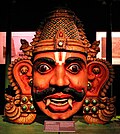
[[File:Aravan head.jpg|thumb|Iravan's head, [[Asian Civilizations Museum]], Singapore|alt=A crowned male wooden head with big eyes and ears, a Vaishnava tilak and bushy brows and large moustache. He has reddish skin, and two large canine teeth that hang down lower than his bottom lip. His eyes are wide open and he has large S-shaped ears that reach down to his chin. In the dark background, images are displayed on the back wall under lighting.]] | [[File:Aravan head.jpg|thumb|Iravan's head, [[Asian Civilizations Museum]], Singapore|alt=A crowned male wooden head with big eyes and ears, a Vaishnava tilak and bushy brows and large moustache. He has reddish skin, and two large canine teeth that hang down lower than his bottom lip. His eyes are wide open and he has large S-shaped ears that reach down to his chin. In the dark background, images are displayed on the back wall under lighting.]] | ||
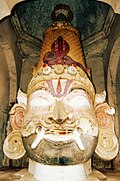
Aravan is always worshipped in temples in the form of his severed head. He is usually depicted with a moustache, pronounced eyes and large ears. Typically, he also wears a conical crown, a [[Vaishnava]] ''[[Urdhva Pundra|tilak]]'' mark on his forehead and earrings. Aravan is often depicted with a cobra hood over his crown, cobra heads sprouting through the crown, or a snake emerging from behind the crown.<ref>Hiltebeitel (1991) p. 309</ref> Even the chief Koovagam icon features a serpent on Aravan's crown.<ref name="Koovagam photos" /> | Aravan is always worshipped in temples in the form of his severed head. He is usually depicted with a moustache, pronounced eyes and large ears. Typically, he also wears a conical crown, a [[Vaishnava]] ''[[Urdhva Pundra|tilak]]'' mark on his forehead and earrings. Aravan is often depicted with a cobra hood over his crown, cobra heads sprouting through the crown, or a snake emerging from behind the crown.<ref>Hiltebeitel (1991) p. 309</ref> Even the chief Koovagam icon features a serpent on Aravan's crown asserting his mother Ulupi's naga lineage.<ref name="Koovagam photos" /> | ||
Another distinctive feature of Aravan's iconography is the presence of demonic canine teeth. Although the central Koovagam icon does not feature such demonic teeth, they are a regular feature of most Draupadi cult images, where Aravan's demonic features are | Another distinctive feature of Aravan's iconography is the presence of demonic canine teeth. Although the central Koovagam icon does not feature such demonic teeth, they are a regular feature of most Draupadi cult images, where Aravan's demonic features are emphasised.<ref>Hiltebeitel (1998) p. 147</ref> | ||
Aravan-head icons are either painted or unpainted portable ones for processions; they are housed together in the temples of his shrines. Koovagam, Kothadai, Kothattai and Pillaiyarkuppam have icons painted with a red face and multi-coloured ornamentation. Unpainted black stone images of the Aravan-head are seen in Kothattai, Madhukarai and Pillaiyarkuppam.<ref name="Koovagam photos">Hiltebeitel (1998) pp. 152, 160, 162, 165 for Koovagam images</ref><ref name="Madukarai">See Madurai's temple photos at {{cite web|url=http://picasaweb.google.com/n.g3nd3r/Madukarai# |title=Madukarai |last=n.g3nd3r |date=2 July 2008 |publisher=Picasa Web Albums |access-date=27 March 2010 |url-status=dead |archive-url=https://web.archive.org/web/20121107060811/http://picasaweb.google.com/n.g3nd3r/Madukarai |archive-date= 7 November 2012 }}</ref><ref name="Kothadai">See Kothadai's temple's photos at {{cite web|url=http://picasaweb.google.com/n.g3nd3r/Kothadai# |title=Kothadai |last=n.g3nd3r |date=2 July 2008 |publisher=Picasa Web Albums |access-date=27 March 2010 |url-status=dead |archive-url=https://web.archive.org/web/20121107061152/http://picasaweb.google.com/n.g3nd3r/Kothadai |archive-date= 7 November 2012 }}</ref><ref name="Pillaiyar Kuppam">See Pillaiyar-Kuppam's photos at {{cite web|url=http://picasaweb.google.com/n.g3nd3r/PillaiyarKuppam# |title=Pillaiyar Kuppam |last=n.g3nd3r |date=2 July 2008 |publisher=Picassa Web Albums |access-date=27 March 2010 |url-status=dead |archive-url=https://web.archive.org/web/20121107061241/http://picasaweb.google.com/n.g3nd3r/PillaiyarKuppam |archive-date= 7 November 2012 }}</ref><ref name="Devanampattinam">See Devanampattinam's photos at {{cite web|url=http://picasaweb.google.com/n.g3nd3r/Devanampattinam# |title=Devanampattinam |last=n.g3nd3r |date=2 July 2008 |publisher=Picasa Web Albums |access-date=27 March 2010 |url-status=dead |archive-url=https://web.archive.org/web/20121107061125/http://picasaweb.google.com/n.g3nd3r/Devanampattinam |archive-date= 7 November 2012 }}</ref><ref name="Kotthattai">{{cite web|url=https://www.flickr.com/photos/dilipm/sets/72157605195647564/|title=Kothattai Aravaan Festival |year=2008|work=Flickr|publisher=Dilip Muralidaran|access-date=27 March 2010}}</ref> | Aravan-head icons are either painted or unpainted portable ones for processions; they are housed together in the temples of his shrines. Koovagam, Kothadai, Kothattai and Pillaiyarkuppam have icons painted with a red face and multi-coloured ornamentation. Unpainted black stone images of the Aravan-head are seen in Kothattai, Madhukarai and Pillaiyarkuppam.<ref name="Koovagam photos">Hiltebeitel (1998) pp. 152, 160, 162, 165 for Koovagam images</ref><ref name="Madukarai">See Madurai's temple photos at {{cite web|url=http://picasaweb.google.com/n.g3nd3r/Madukarai# |title=Madukarai |last=n.g3nd3r |date=2 July 2008 |publisher=Picasa Web Albums |access-date=27 March 2010 |url-status=dead |archive-url=https://web.archive.org/web/20121107060811/http://picasaweb.google.com/n.g3nd3r/Madukarai |archive-date= 7 November 2012 }}</ref><ref name="Kothadai">See Kothadai's temple's photos at {{cite web|url=http://picasaweb.google.com/n.g3nd3r/Kothadai# |title=Kothadai |last=n.g3nd3r |date=2 July 2008 |publisher=Picasa Web Albums |access-date=27 March 2010 |url-status=dead |archive-url=https://web.archive.org/web/20121107061152/http://picasaweb.google.com/n.g3nd3r/Kothadai |archive-date= 7 November 2012 }}</ref><ref name="Pillaiyar Kuppam">See Pillaiyar-Kuppam's photos at {{cite web|url=http://picasaweb.google.com/n.g3nd3r/PillaiyarKuppam# |title=Pillaiyar Kuppam |last=n.g3nd3r |date=2 July 2008 |publisher=Picassa Web Albums |access-date=27 March 2010 |url-status=dead |archive-url=https://web.archive.org/web/20121107061241/http://picasaweb.google.com/n.g3nd3r/PillaiyarKuppam |archive-date= 7 November 2012 }}</ref><ref name="Devanampattinam">See Devanampattinam's photos at {{cite web|url=http://picasaweb.google.com/n.g3nd3r/Devanampattinam# |title=Devanampattinam |last=n.g3nd3r |date=2 July 2008 |publisher=Picasa Web Albums |access-date=27 March 2010 |url-status=dead |archive-url=https://web.archive.org/web/20121107061125/http://picasaweb.google.com/n.g3nd3r/Devanampattinam |archive-date= 7 November 2012 }}</ref><ref name="Kotthattai">{{cite web|url=https://www.flickr.com/photos/dilipm/sets/72157605195647564/|title=Kothattai Aravaan Festival |year=2008|work=Flickr|publisher=Dilip Muralidaran|access-date=27 March 2010}}</ref> | ||
| Line 50: | Line 49: | ||
== Historical development == | == Historical development == | ||
Iravan first appears as a minor character in the Mahabharata as the son of Arjuna, the chief hero of the epic. The background to the Mahabharata infers a date that is "after the very early [[Vedic period]]" and before "the first Indian 'empire' was to rise in the third century B.C.", so "somewhere in the eighth or ninth century".<ref name=vanB73>Buitenen (1973) pp. xxiv–xxv</ref> It is generally agreed, however, that "Unlike the Vedas, which have to be preserved letter-perfect, the epic was a popular work whose reciters would inevitably conform to changes in language and style."<ref name=vanB73/> The earliest surviving components of this dynamic text are believed to be no older than the earliest external references to the epic, which may include an allusion in [[Pāṇini|Panini]]'s 4th-century grammar manual ''Ashtadhyayi'' (4:2:56).<ref name=vanB73/><ref name=Brockington>Brockington (1998) p. 26</ref> It is estimated that the Sanskrit text probably reached something of a "final form" by the early [[Gupta Empire|Gupta period]] (about the 4th century CE).<ref name=vanB73 /> The editor of the first great critical edition of the Mahabharata commented: "It is useless to think of reconstructing a fluid text in a literally original shape, on the basis of an archetype and a ''stemma codicum''. What then is possible? Our objective can only be to reconstruct ''the oldest form of the text which it is possible to reach'' on the basis of the manuscript material available."<ref>Sukthankar (1933) "Prolegomena" p. lxxxvi. Emphasis is original.</ref> | Iravan first appears as a minor character in the ''Mahabharata'' as the son of Arjuna, the chief hero of the epic. The background to the ''Mahabharata'' infers a date that is "after the very early [[Vedic period]]" and before "the first Indian 'empire' was to rise in the third century B.C.", so "somewhere in the eighth or ninth century".<ref name=vanB73>Buitenen (1973) pp. xxiv–xxv</ref> It is generally agreed, however, that "Unlike the Vedas, which have to be preserved letter-perfect, the epic was a popular work whose reciters would inevitably conform to changes in language and style."<ref name=vanB73/> The earliest surviving components of this dynamic text are believed to be no older than the earliest external references to the epic, which may include an allusion in [[Pāṇini|Panini]]'s 4th-century grammar manual ''Ashtadhyayi'' (4:2:56).<ref name=vanB73/><ref name=Brockington>Brockington (1998) p. 26</ref> It is estimated that the Sanskrit text probably reached something of a "final form" by the early [[Gupta Empire|Gupta period]] (about the 4th century CE).<ref name=vanB73 /> The editor of the first great critical edition of the ''Mahabharata'' commented: "It is useless to think of reconstructing a fluid text in a literally original shape, on the basis of an archetype and a ''stemma codicum''. What then is possible? Our objective can only be to reconstruct ''the oldest form of the text which it is possible to reach'' on the basis of the manuscript material available."<ref>Sukthankar (1933) "Prolegomena" p. lxxxvi. Emphasis is original.</ref> | ||
[[File:Aravan | [[File:Sri Aravan ஸ்ரீ அரவான் at Maha Mariamman Koyil Singapore (2023) - img 02.jpg|thumb|left|upright|A portable wooden Aravan head in [[Sri Mariamman Temple, Singapore]]|alt=A crowned male wooden head with big eyes and ears, a Vaishnava tilak and bushy brows and moustache. A garland is seen around the neck and on the crown. He has pink skin, and two large canine teeth that hang down lower than his bottom lip. His eyes are wide open and he has large S-shaped ears.]] | ||
Iravan is also mentioned, as the son of Arjuna and Ulupi, in passing references in two ''[[Purana]]s'' ("sacred texts") known as the ''[[Vishnu Purana]]'' (4:20:12)—also with a text history from the late Vedic through the Gupta periods—and the ''[[Bhagavata Purana]]'' (9:22:32)—traditionally dated to the Vedic period but dated by modern scholars to the 9th or 10th century CE.<ref>For ''Viṣṇu Purana'' 4:20:49 and article on Irāvat, see Dikshitar (1951) p. 199.</ref><ref>[[Vishnu Purana]] 4:20:12 translation at {{cite web|url=http://salmun.cwahi.net/wrel/rhindu/scrip/vp/vp.htm|title=The Vishnu Purana|last=Wilson|first=Horace Hayman|year=1840|work=Yahshuan Archives|access-date=20 March 2010|author-link=Horace Hayman Wilson|url-status=dead|archive-url=https://web.archive.org/web/20100304170056/http://salmun.cwahi.net/wrel/rhindu/scrip/vp/vp.htm|archive-date=4 March 2010}}</ref><ref>{{cite web|url=http://www.srimadbhagavatam.org/canto9/chapter22.html|title=Bhāgavata Purana 9:22:32|last=Aadhar|first=Anand|access-date=20 March 2010}}</ref> | Iravan is also mentioned, as the son of Arjuna and Ulupi, in passing references in two ''[[Purana]]s'' ("sacred texts") known as the ''[[Vishnu Purana]]'' (4:20:12)—also with a text history from the late Vedic through the Gupta periods—and the ''[[Bhagavata Purana]]'' (9:22:32)—traditionally dated to the Vedic period but dated by modern scholars to the 9th or 10th century CE.<ref>For ''Viṣṇu Purana'' 4:20:49 and article on Irāvat, see Dikshitar (1951) p. 199.</ref><ref>[[Vishnu Purana]] 4:20:12 translation at {{cite web|url=http://salmun.cwahi.net/wrel/rhindu/scrip/vp/vp.htm|title=The Vishnu Purana|last=Wilson|first=Horace Hayman|year=1840|work=Yahshuan Archives|access-date=20 March 2010|author-link=Horace Hayman Wilson|url-status=dead|archive-url=https://web.archive.org/web/20100304170056/http://salmun.cwahi.net/wrel/rhindu/scrip/vp/vp.htm|archive-date=4 March 2010}}</ref><ref>{{cite web|url=http://www.srimadbhagavatam.org/canto9/chapter22.html|title=Bhāgavata Purana 9:22:32|last=Aadhar|first=Anand|access-date=20 March 2010}}</ref> | ||
Although the original Sanskrit version of the Mahabharata records Iravan's (Sanskrit name) death during the 18-day Mahabharata war, the Tamil versions discuss Aravan's (Tamil name) ritual self-sacrifice to Kali before the war. Hiltebeitel relates this to the South Indian glorification of "heroic" [[self-mutilation]] and self-decapitation before a goddess.<ref name="H318ff">Hiltebeitel (1988) pp. 318–20</ref><ref name="H284">Hiltebeitel (1991) p. 284</ref> He takes particular note of a scene towards the end of a puranic text, ''[[Devi Mahatmyam]]'', in interpreting old Tamil sculptures depicting a warrior king spilling his own blood, as in the ''Purana'', in adoration of a goddess of victory.<ref name="H318ff" /> In the Tamil sculptures, the goddess is [[Korravai]], who became associated with [[Durga]] and hence Kali.<ref name="H318ff" /> He also finds parallels in the [[Andhra Pradesh|Telugu]] legend of the sacrifice of [[Barbarika]]<ref>Barbarika is described as the son of Iravan's cousin, [[Ghatotkacha]] in the Mahabharata.</ref>—another Mahabharata character—and its variants in [[Rajasthan]] (see also: [[Khatushyamji]]), [[Himachal Pradesh]], [[Garhwal division|Garhwal]], [[Kurukshetra]], [[Bundelkhand]] and [[Orissa, India|Orissa]]. Most notable among the similarities between Aravan and Barbarika is the boon to witness the entire duration of the Mahabharata war—through the eyes of the severed head, despite the sacrifice.<ref>See Hiltebeitel (1999) for parallels with Barbarika's story</ref><ref>Hiltebeitel (1988) pp. 317–18</ref> | Although the original Sanskrit version of the ''Mahabharata'' records Iravan's (Sanskrit name) death during the 18-day ''Mahabharata'' war, the Tamil versions discuss Aravan's (Tamil name) ritual self-sacrifice to Kali before the war. Hiltebeitel relates this to the South Indian glorification of "heroic" [[self-mutilation]] and self-decapitation before a goddess.<ref name="H318ff">Hiltebeitel (1988) pp. 318–20</ref><ref name="H284">Hiltebeitel (1991) p. 284</ref> He takes particular note of a scene towards the end of a puranic text, ''[[Devi Mahatmyam]]'', in interpreting old Tamil sculptures depicting a warrior king spilling his own blood, as in the ''Purana'', in adoration of a goddess of victory.<ref name="H318ff" /> In the Tamil sculptures, the goddess is [[Korravai]], who became associated with [[Durga]] and hence Kali.<ref name="H318ff" /> He also finds parallels in the [[Andhra Pradesh|Telugu]] legend of the sacrifice of [[Barbarika]]<ref>Barbarika is described as the son of Iravan's cousin, [[Ghatotkacha]] in the Mahabharata.</ref>—another ''Mahabharata'' character—and its variants in [[Rajasthan]] (see also: [[Khatushyamji]]), [[Himachal Pradesh]], [[Garhwal division|Garhwal]], [[Kurukshetra]], [[Bundelkhand]] and [[Orissa, India|Orissa]]. Most notable among the similarities between Aravan and Barbarika is the boon to witness the entire duration of the ''Mahabharata'' war—through the eyes of the severed head, despite the sacrifice.<ref>See Hiltebeitel (1999) for parallels with Barbarika's story</ref><ref>Hiltebeitel (1988) pp. 317–18</ref> | ||
The first account of Aravan's sacrifice is found in ''Parata Venpa''—the earliest surviving Tamil version of the | The first account of Aravan's sacrifice is found in ''Parata Venpa''—the earliest surviving Tamil version of the ''Mahabharata''—by Peruntevanar (9th century). The tale is later retold by Villiputuralvar in his 14th-century ''Makaparatam'' and by Nallapillai in the 18th century.<ref>Hiltebeitel (1988) p. 318</ref> The legend is also mentioned in the text ''[[Purana#Sthala Puranas|Khoothanvar Sthala Purana]]'', associated with the shrine of Kuttantavar.<ref>Pattanaik (2000) p. 37</ref> | ||
Another source of Aravan traditions is the folk-theatre of Tamil Nadu, called ''[[koothu]]''. ''Aravan Kalappali'' (or ''Aravan Kalabali''), "Aravan's Battlefield Sacrifice", is a popular theme of the traditional ''[[Terukkuttu|Terukuttu]]'' ("street theatre"). ''Aravan Kalappali'' tells the story of Aravan's pre-battle self-sacrifice to the goddess [[Kali]] to win her support, guaranteeing victory for the Pandavas (Arjuna and his brothers) in the Mahabharata war. ''Aravan Kalappali'' is staged annually in the villages of [[Melattur, Tamil Nadu|Melattur]], Kodukizhi and Yervadi, according to various forms of the ''koothu'' folk-theatre. In Karambai, ''Aravan Kalappali'' is performed as part of the cult of Draupadi, on the 18th day of an annual festival (April–May), to please the goddess.<ref name="hindu">{{cite news|url=http://www.hindu.com/2001/08/17/stories/0917035f.htm|archive-url=https://web.archive.org/web/20121104064550/http://www.hindu.com/2001/08/17/stories/0917035f.htm|url-status=dead|archive-date=4 November 2012|title=Symbol of sacrifice |last=Santhanam|first=Kausalya |date=17 August 2001|work=[[The Hindu]]|access-date=7 May 2010}}</ref> | Another source of Aravan traditions is the folk-theatre of Tamil Nadu, called ''[[koothu]]''. ''Aravan Kalappali'' (or ''Aravan Kalabali''), "Aravan's Battlefield Sacrifice", is a popular theme of the traditional ''[[Terukkuttu|Terukuttu]]'' ("street theatre"). ''Aravan Kalappali'' tells the story of Aravan's pre-battle self-sacrifice to the goddess [[Kali]] to win her support, guaranteeing victory for the Pandavas (Arjuna and his brothers) in the ''Mahabharata'' war. ''Aravan Kalappali'' is staged annually in the villages of [[Melattur, Tamil Nadu|Melattur]], Kodukizhi and Yervadi, according to various forms of the ''koothu'' folk-theatre. In Karambai, ''Aravan Kalappali'' is performed as part of the cult of Draupadi, on the 18th day of an annual festival (April–May), to please the goddess.<ref name="hindu">{{cite news|url=http://www.hindu.com/2001/08/17/stories/0917035f.htm|archive-url=https://web.archive.org/web/20121104064550/http://www.hindu.com/2001/08/17/stories/0917035f.htm|url-status=dead|archive-date=4 November 2012|title=Symbol of sacrifice |last=Santhanam|first=Kausalya |date=17 August 2001|work=[[The Hindu]]|access-date=7 May 2010}}</ref> | ||
In modern interpretations, Aravan's head | In modern interpretations, Aravan's head symbolises not only self-sacrifice but also regeneration and continuity, because of his ability to see the war after his sacrifice.<ref>Hiltebeitel (1988) p. 332</ref> For example, Iramacamippulavar's ''Merkolvilakka Kkatai Akaravaricai'' (1963)—which narrates the tale of Aravan—ends with the conclusion that Aravan continues to live on as a folk hero in Tamil Nadu, because he embodies "the ideal of self-sacrifice".<ref>Shulman (1978) p. 132. Iramacamippulavar, Merkolvilakka kkatai akaravaricai (Madras, 1963), 1:40–44.</ref> Aravan is considered to be a representation of the cost of war; he evokes the "countless innocent" reluctantly sent by their mothers "to be consumed by the insatiable Goddess of War".<ref name="hindu" /> Indologist [[David Dean Shulman|David Shulman]], on the other hand, considers Aravan's sacrifice to be a reworking of the serpent sacrifice in the Tamil epic tradition.<ref>Shulman (1978) p. 131</ref> | ||
{{clear}} | {{clear}} | ||
== Mahabharata == | == ''Mahabharata'' == | ||
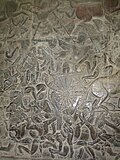
[[File:The center of battle of Kurukshetra.jpg|thumb|A scene from the Mahabharata war, [[Angkor Wat]] relief|alt=A black stone relief depicting a number of men wearing a crown and a dhoti, fighting with spears, swords and bows. A chariot with half the horse out of the frame – is seen in the middle.]] | [[File:The center of battle of Kurukshetra.jpg|thumb|A scene from the Mahabharata war, [[Angkor Wat]] relief|alt=A black stone relief depicting a number of men wearing a crown and a dhoti, fighting with spears, swords and bows. A chariot with half the horse out of the frame – is seen in the middle.]] | ||
While the marriage of Iravan's parents is mentioned in the first book of the Mahabharata, [[Adi Parva]] (the Book of Beginnings), both the birth and death of Iravan are mentioned later, in the sixth book, [[Bhishma Parva]] (the Book of Bhishma).<ref name="Hiltebeitel 1995 p. 448">Hiltebeitel (1995) p. 448</ref><ref>{{harvnb|Sörensen|1902|loc=p. 345.}} Index notes references to Irāvat in Mahabharata book 6, chapters 45, 56, 75, 81, 83, 90, 91, and 96 of the Bombay edition.</ref> In this sixth book of the epic, Arjuna, the third Pandava brother, is exiled from [[Indraprastha]] (the capital city of the Pandava kingdom) to go on a 12-year pilgrimage as a penance for violating the terms of his marriage to Draupadi, the Pandava brothers' common wife. Arjuna reaches the north-east region of present-day India and falls in love with Ulupi, a widowed Naga princess. The two get married and have a son named Iravan; later, Arjuna proceeds with his pilgrimage, leaving Iravan and Ulupi behind in [[Nagaloka]], the abode of the Nagas.<ref>For Iravan article, see Mani (1975) pp. 331–32.</ref> Iravan is described as being born ''parakshetre'', literally "in a region belonging to another person", interpreted by Hiltebeitel as "upon the wife of another". Iravan grew up in Nagaloka, protected by his mother, but was rejected by his maternal uncle because of the latter's hatred of Arjuna. After reaching maturity, Iravan, hoping to be reunited with his father, departs for [[Svarga|Indraloka]], the abode of the god [[Indra]], who is also Arjuna's father. Upon meeting his adult son, Arjuna requests his assistance in the Kurukshetra War.<ref name="Hiltebeitel 1995 p. 448" /><ref name="vogel">Vogel (1995) pp. 75–76</ref> | While the marriage of Iravan's parents is mentioned in the first book of the ''Mahabharata'', [[Adi Parva]] (the Book of Beginnings), both the birth and death of Iravan are mentioned later, in the sixth book, [[Bhishma Parva]] (the Book of Bhishma).<ref name="Hiltebeitel 1995 p. 448">Hiltebeitel (1995) p. 448</ref><ref>{{harvnb|Sörensen|1902|loc=p. 345.}} Index notes references to Irāvat in Mahabharata book 6, chapters 45, 56, 75, 81, 83, 90, 91, and 96 of the Bombay edition.</ref> In this sixth book of the epic, Arjuna, the third Pandava brother, is exiled from [[Indraprastha]] (the capital city of the Pandava kingdom) to go on a 12-year pilgrimage as a penance for violating the terms of his marriage to Draupadi, the Pandava brothers' common wife. Arjuna reaches the north-east region of present-day India and falls in love with Ulupi, a widowed Naga princess. The two get married and have a son named Iravan; later, Arjuna proceeds with his pilgrimage, leaving Iravan and Ulupi behind in [[Nagaloka]], the abode of the Nagas.<ref>For Iravan article, see Mani (1975) pp. 331–32.</ref> Iravan is described as being born ''parakshetre'', literally "in a region belonging to another person", interpreted by Hiltebeitel as "upon the wife of another". Iravan grew up in Nagaloka, protected by his mother, but was rejected by his maternal uncle because of the latter's hatred of Arjuna. After reaching maturity, Iravan, hoping to be reunited with his father, departs for [[Svarga|Indraloka]], the abode of the god [[Indra]], who is also Arjuna's father. Upon meeting his adult son, Arjuna requests his assistance in the Kurukshetra War.<ref name="Hiltebeitel 1995 p. 448" /><ref name="vogel">Vogel (1995) pp. 75–76</ref> | ||
Thus Iravan finally reaches the battlefield of Kurukshetra to assist his father and Pandavas against their cousins and opponents, the [[Kauravas]] and slays many enemy warriors. On the first day of war, Iravan fights a duel with Srutayush, a [[Kshatriya]] king who had been a ''[[daitya]]'' (demon) called Krodhavasa in a [[Reincarnation|prior incarnation]]. Srutayush is later killed by Arjuna.<ref>Mani (1975) p. 743 (Mahabharata—[[Bhishma Parva]] 45:69)</ref><ref>{{cite book|last =Ganguli | title=The Mahabharata Book 6: Bhishma Parva | chapter=XLV | url=http://www.sacred-texts.com/hin/m06/m06045.htm|year =1883–1896|access-date=7 May 2010}}</ref> On the seventh day of war, Iravan also defeats Vinda and Anuvinda, the princes of [[Avanti Kingdom (Mahabharata)|Avanti]], who are later killed by Arjuna.<ref>For Vinda and Anuvinda, Mani (1975) (Mahabharata—Bhishma Parva 83:18–22) pp. 45, 857</ref><ref>{{cite book|last =Ganguli| title=The Mahabharata Book 6: Bhishma Parva | chapter=LXXXIV | url=http://www.sacred-texts.com/hin/m06/m06084.htm|year =1883–1896|access-date=7 May 2010}}</ref> | Thus Iravan finally reaches the battlefield of Kurukshetra to assist his father and Pandavas against their cousins and opponents, the [[Kauravas]] and slays many enemy warriors. On the first day of war, Iravan fights a duel with Srutayush, a [[Kshatriya]] king who had been a ''[[daitya]]'' (demon) called Krodhavasa in a [[Reincarnation|prior incarnation]]. Srutayush is later killed by Arjuna.<ref>Mani (1975) p. 743 (Mahabharata—[[Bhishma Parva]] 45:69)</ref><ref>{{cite book|last =Ganguli | title=The Mahabharata Book 6: Bhishma Parva | chapter=XLV | url=http://www.sacred-texts.com/hin/m06/m06045.htm|year =1883–1896|access-date=7 May 2010}}</ref> On the seventh day of war, Iravan also defeats Vinda and Anuvinda, the princes of [[Avanti Kingdom (Mahabharata)|Avanti]], who are later killed by Arjuna.<ref>For Vinda and Anuvinda, Mani (1975) (Mahabharata—Bhishma Parva 83:18–22) pp. 45, 857</ref><ref>{{cite book|last =Ganguli| title=The Mahabharata Book 6: Bhishma Parva | chapter=LXXXIV | url=http://www.sacred-texts.com/hin/m06/m06084.htm|year =1883–1896|access-date=7 May 2010}}</ref> | ||
| Line 75: | Line 74: | ||
On the eighth day of the war, Iravan combats the princes of [[Gandhara]], sons of king Suvala, and the younger brothers of [[Shakuni]], the treacherous maternal uncle of the Kauravas. The brothers Gaya, Gavaksha, Vrishava, Charmavat, Arjava, and Suka attack Iravan, supported by the whole Kaurava army, but Iravan's army of Nagas slay all the soldiers, leaving the Gandhara princes for Iravan. Iravan, then gets down from his chariot and slays five of the Gandhara princes in a sword fight; Vrishava alone escapes death.<ref name="xci">{{cite book|last =Ganguli| title=The Mahabharata Book 6: Bhishma Parva | chapter=Section XCI |url=http://www.sacred-texts.com/hin/m06/m06091.htm#fr_438|year =1883–1896|access-date=7 May 2010}}</ref><ref>For sons of Subala, Mani (1975) pp. 90, 178, 217, 287, 758, 881. For Iravan, Mani (1975) pp. 331–32 (Mahabharata—Bhishma Parva 90:27–46)</ref> | On the eighth day of the war, Iravan combats the princes of [[Gandhara]], sons of king Suvala, and the younger brothers of [[Shakuni]], the treacherous maternal uncle of the Kauravas. The brothers Gaya, Gavaksha, Vrishava, Charmavat, Arjava, and Suka attack Iravan, supported by the whole Kaurava army, but Iravan's army of Nagas slay all the soldiers, leaving the Gandhara princes for Iravan. Iravan, then gets down from his chariot and slays five of the Gandhara princes in a sword fight; Vrishava alone escapes death.<ref name="xci">{{cite book|last =Ganguli| title=The Mahabharata Book 6: Bhishma Parva | chapter=Section XCI |url=http://www.sacred-texts.com/hin/m06/m06091.htm#fr_438|year =1883–1896|access-date=7 May 2010}}</ref><ref>For sons of Subala, Mani (1975) pp. 90, 178, 217, 287, 758, 881. For Iravan, Mani (1975) pp. 331–32 (Mahabharata—Bhishma Parva 90:27–46)</ref> | ||
Agitated by this reversal, the eldest Kaurava, [[Duryodhana]], orders the ''[[rakshasa]]'' (giant) [[ | Agitated by this reversal, the eldest Kaurava, [[Duryodhana]], orders the ''[[rakshasa]]'' (giant) [[List of characters in the Mahabharata#Alambusha|Alamvusha]] (or Alambusha), son of [[Rishyasringa]], to kill Iravan. This time Alambusha, as well as Iravan, uses illusion in combat. Alambusha attacks Iravan with a bow, but Iravan counters, breaking Alambusha's bow and slicing the giant into several pieces. Alambusha's body, however, reconstitutes itself. Then Iravan assumes the form of the serpent [[Shesha]] (Ananta), and his serpent army surrounds him to protect him. Alambusha counters this by assuming the form of [[Garuda]] (the eagle-man), the eternal foe of the serpents, and devours the serpent army. Ultimately, Alambusha catches Iravan by surprise and kills him by cutting off his head, though Iravan is later avenged when [[Ghatotkacha]], his cousin, finally kills Alambusha during the night war on the fourteenth day and restrucess him.<ref name="vogel" /><ref name="xci" /><ref>For Almabusha, Mani (1975) p. 24. For Iravan, Mani (1975) pp. 331–32 (Bhishma Parva 90:56–76)</ref> | ||
== Tamil traditions == | == Tamil traditions == | ||
=== Selection as sacrificial victim === | === Selection as sacrificial victim === | ||
The earliest source of Tamil traditions regarding Aravan is found in Peruntevanar's ''Parata Venpa'', a 9th-century Tamil version of the Mahabharata.<ref name="Hiltebeitel452">Hiltebeitel (1995) p. 452</ref> One of the features of this work is its reference to a rite it calls ''kalappali'' ("sacrifice to the battlefield"), a term found only in Tamil versions of the Mahabharata. This is a ritual performed before battle to ensure victory. In Peruntevanar's narrative, just before the Mahabharata war, Duryodhana—the leader of the Kauravas and opponent of the Pandavas—learns from the Pandava's expert astrologer, [[Sahadeva]], that the [[amavasya|day of the new moon]], indeed the very next day, would be the most auspicious time for a ''kalappali''. Consequently, Duryodhana approaches and convinces Aravan to be the sacrificial victim for the ''kalappali''.<ref name="H284" /> | The earliest source of Tamil traditions regarding Aravan is found in Peruntevanar's ''Parata Venpa'', a 9th-century Tamil version of the ''Mahabharata''.<ref name="Hiltebeitel452">Hiltebeitel (1995) p. 452</ref> One of the features of this work is its reference to a rite it calls ''kalappali'' ("sacrifice to the battlefield"), a term found only in Tamil versions of the ''Mahabharata''. This is a ritual performed before battle to ensure victory. In Peruntevanar's narrative, just before the ''Mahabharata'' war, Duryodhana—the leader of the Kauravas and opponent of the Pandavas—learns from the Pandava's expert astrologer, [[Sahadeva]], that the [[amavasya|day of the new moon]], indeed the very next day, would be the most auspicious time for a ''kalappali''. Consequently, Duryodhana approaches and convinces Aravan to be the sacrificial victim for the ''kalappali''.<ref name="H284" /> | ||
[[File:The_Hindu_Goddess_Kali_LACMA_M.83.48_(7_of_9).jpg|thumb|left|upright|Aravan's ritual self-sacrifice was offered to the goddess [[Kali]] (pictured), to ensure her favour and victory in war for his father, [[Arjuna]], and uncles—the [[Pandava]]s.|alt=A reddish bronze statue of a four-armed topless woman wearing a short pant sari, standing on a pedestal. She wears a flaming crown and various ornaments. She carries in her hands a goad, a noose, a bowl and a small broken trident.]] | [[File:The_Hindu_Goddess_Kali_LACMA_M.83.48_(7_of_9).jpg|thumb|left|upright|Aravan's ritual self-sacrifice was offered to the goddess [[Kali]] (pictured), to ensure her favour and victory in war for his father, [[Arjuna]], and uncles—the [[Pandava]]s.|alt=A reddish bronze statue of a four-armed topless woman wearing a short pant sari, standing on a pedestal. She wears a flaming crown and various ornaments. She carries in her hands a goad, a noose, a bowl and a small broken trident.]] | ||
| Line 87: | Line 86: | ||
Later Tamil sources provide variants to Peruntevanar's version. In Villiputuralvar's 14th-century version, Krishna first offers himself as the sacrificial victim, but Aravan volunteers to replace him. There is no mention of Duryodhana in this version of the legend.<ref name="Villiputuralvar">Makaparatam of Villiputtiralvar (Villiputuralvar) 2659–2667 (kalappali. 1–8). Shulman (1978) p. 131</ref> In other accounts, Aravan is sacrificed in order to counteract the Kauravas' sacrifice of a white elephant.<ref name="Villiputuralvar" /> In the traditions of the village of Neppattur, in the [[Thanjavur district]], Aravan is described as being so strong that he could slay all the Duryodhanas at once, thus preventing any war from happening. So Krishna prescribes the human sacrifice of Aravan in order that "the greater sacrifice of the war can take place".<ref>Shulman (1978) p. 133</ref> | Later Tamil sources provide variants to Peruntevanar's version. In Villiputuralvar's 14th-century version, Krishna first offers himself as the sacrificial victim, but Aravan volunteers to replace him. There is no mention of Duryodhana in this version of the legend.<ref name="Villiputuralvar">Makaparatam of Villiputtiralvar (Villiputuralvar) 2659–2667 (kalappali. 1–8). Shulman (1978) p. 131</ref> In other accounts, Aravan is sacrificed in order to counteract the Kauravas' sacrifice of a white elephant.<ref name="Villiputuralvar" /> In the traditions of the village of Neppattur, in the [[Thanjavur district]], Aravan is described as being so strong that he could slay all the Duryodhanas at once, thus preventing any war from happening. So Krishna prescribes the human sacrifice of Aravan in order that "the greater sacrifice of the war can take place".<ref>Shulman (1978) p. 133</ref> | ||
In ''terukkuttu'' performances, at the time of Aravan's sacrifice, he is often compared to [[King Puru|Puru]] and [[Bhishma]], characters in the Mahabharata who gave up their youth and sexual fulfilment for the sake of their respective fathers, [[Yayati]] and [[Santanu]]. In the drama, after acquiring Aravan's approval, Krishna approaches Aravan's mother, Ulupi—Nagakanni or Nakakanni ("Serpent maiden") in Tamil, for her consent. At first she strongly opposes her son's proposed sacrifice but finally relents when Aravan appeals to her, explaining that he belongs to Kali alone.<ref name="Hiltebeitel322+" /> | In ''terukkuttu'' performances, at the time of Aravan's sacrifice, he is often compared to [[King Puru|Puru]] and [[Bhishma]], characters in the ''Mahabharata'' who gave up their youth and sexual fulfilment for the sake of their respective fathers, [[Yayati]] and [[Santanu]]. In the drama, after acquiring Aravan's approval, Krishna approaches Aravan's mother, Ulupi—Nagakanni or Nakakanni ("Serpent maiden") in Tamil, for her consent. At first she strongly opposes her son's proposed sacrifice but finally relents when Aravan appeals to her, explaining that he belongs to Kali alone.<ref name="Hiltebeitel322+" /> | ||
Finally, in all versions of the tale, Krishna tricks the gods [[Surya]] (the Sun) and [[Chandra]] (the Moon) to co-ordinate their movements so that the day of the new moon will fall one day earlier—the current day. This allows Aravan to make the initial sacrifice of flesh on behalf of the Pandavas, only making the rest-offering on behalf of Duryodhana the following day, yet fulfilling his promise to Duryodhana by doing so.<ref name="Hiltebeitel452" /><ref name="Hiltebeitel322+" /><ref name="Hiltebeitel284+" /> | Finally, in all versions of the tale, Krishna tricks the gods [[Surya]] (the Sun) and [[Chandra]] (the Moon) to co-ordinate their movements so that the day of the new moon will fall one day earlier—the current day. This allows Aravan to make the initial sacrifice of flesh on behalf of the Pandavas, only making the rest-offering on behalf of Duryodhana the following day, yet fulfilling his promise to Duryodhana by doing so.<ref name="Hiltebeitel452" /><ref name="Hiltebeitel322+" /><ref name="Hiltebeitel284+" /> | ||
| Line 93: | Line 92: | ||
=== Three boons === | === Three boons === | ||
In ''Parata Venpa'', Aravan asks Krishna to grant him the boon of a heroic death on the battlefield at the hands of a great hero. Although ''Parata Venpa'' mentions only one boon, the overall Tamil tradition preserves a total of three distinct boons associated with Aravan. The single boon of ''Parata Venpa'', according to Hiltebeitel, indicates an early (9th-century) effort to | In ''Parata Venpa'', Aravan asks Krishna to grant him the boon of a heroic death on the battlefield at the hands of a great hero. Although ''Parata Venpa'' mentions only one boon, the overall Tamil tradition preserves a total of three distinct boons associated with Aravan. The single boon of ''Parata Venpa'', according to Hiltebeitel, indicates an early (9th-century) effort to harmonise the Tamil tradition of Aravan's pre-battle sacrifice with the original Sanskrit account of his death during the battle at the hands of Alambusha (Alampucan in Tamil).<ref name="Hiltebeitel452" /> | ||
In both the Kuttantavar and Draupadi cults, Aravan is believed to have been granted a second boon—to see the entire 18-day war. A second boon is indeed found in Villiputuralvar's 14th-century version of the Mahabharata. In this version, Aravan is granted boons of watching the battle for a "few days" and of dying gloriously after killing many enemies, though Villiputuralvar does not actually specify whether Aravan's head survives to see the complete battle after his bodily death on the eighth day.<ref name="Hiltebeitel453">Hiltebeitel (1995) p. 453</ref> | In both the Kuttantavar and Draupadi cults, Aravan is believed to have been granted a second boon—to see the entire 18-day war. A second boon is indeed found in Villiputuralvar's 14th-century version of the ''Mahabharata''. In this version, Aravan is granted boons of watching the battle for a "few days" and of dying gloriously after killing many enemies, though Villiputuralvar does not actually specify whether Aravan's head survives to see the complete battle after his bodily death on the eighth day.<ref name="Hiltebeitel453">Hiltebeitel (1995) p. 453</ref> | ||
[[File:Mohini in Belur temple.jpg|thumb|upright|In folk tradition, Krishna is believed to have assumed the form of Mohini (pictured) and married Aravan.|alt=A black stone sculpture of a young topless, standing woman, wearing a conical crown with a halo and various ornaments around her waist, necklaces, bangles, bracelets, earrings, anklets as well as the sacred thread. Her arms are broken. Two small attendants stand with folded hands near her feet.]] | [[File:Mohini in Belur temple.jpg|thumb|upright|In folk tradition, Krishna is believed to have assumed the form of Mohini (pictured) and married Aravan.|alt=A black stone sculpture of a young topless, standing woman, wearing a conical crown with a halo and various ornaments around her waist, necklaces, bangles, bracelets, earrings, anklets as well as the sacred thread. Her arms are broken. Two small attendants stand with folded hands near her feet.]] | ||
The third boon is found only in the folk rituals. This third boon provides for Aravan to be married before the sacrifice, entitling him to the right of cremation and funerary offerings (bachelors were buried). However, no woman wanted to marry Aravan, fearing the inevitable doom of widowhood (see also ''[[sati (practice)|sati]]''). In the Kuttantavar cult version, Krishna solves this dilemma by taking on his female form, [[Mohini]] the enchantress, marrying Aravan, and spending that night with him. The Koovagam version additionally relates Krishna's mourning as a widow after Aravan's sacrifice the next day, after which he returns to his original masculine form for the duration of the war.<ref name="Hiltebeitel452" /><ref name="Hiltebeitel322+" /><ref name="Hiltebeitel284+" /><ref name="P87">Pattanaik (2002) p. 87 | The third boon is found only in the folk rituals. This third boon provides for Aravan to be married before the sacrifice, entitling him to the right of cremation and funerary offerings (bachelors were buried). However, no woman wanted to marry Aravan, fearing the inevitable doom of widowhood (see also ''[[sati (practice)|sati]]''). In the Kuttantavar cult version, Krishna solves this dilemma by taking on his female form, [[Mohini]] the enchantress, marrying Aravan, and spending that night with him. The Koovagam version additionally relates Krishna's mourning as a widow after Aravan's sacrifice the next day, after which he returns to his original masculine form for the duration of the war.<ref name="Hiltebeitel452" /><ref name="Hiltebeitel322+" /><ref name="Hiltebeitel284+" /><ref name="P87">Pattanaik (2002) p. 87</ref> | ||
The ''terukuttu'' performance presents a stylised wedding ceremony followed by Mohini's abrupt departure, which is taken to signify that the marriage is unconsummated.<ref>Hiltebeitel (1988) p. 324</ref> Another version, popular with trans people, cites the reason behind Aravan's wish to be "coital bliss" and tells explicitly about consummation of the marriage.<ref>{{cite news|url=http://www.hinduonnet.com/mag/2003/05/25/stories/2003052500600500.htm|archive-url=https://web.archive.org/web/20110606124222/http://www.hinduonnet.com/mag/2003/05/25/stories/2003052500600500.htm|archive-date=6 June 2011|title=Lessons in transformation|last=Doshi|first=Tishani|date=25 May 2003|work=[[The Hindu]]|url-status=usurped|access-date=19 March 2010}}</ref><ref name="G388">Goldman (1993) p. 388</ref> This third marriage boon is not, however, uniform across all the folk traditions. In other legends, Krishna arranges some other pre-war marriages. In Thanjavur, the marriage of Aravan and Mohini is unknown; instead it depicts Aravan as married to Paravanacciyal, the daughter of Krishna's younger cousin-brother [[Satyaki]].<ref name="Hiltebeitel286">Hiltebeitel (1991) p. 286</ref> | |||
The pre-battle sacrifice is incompatible with the first and second boons, but the cults have their own explanations. The self-sacrifice prior to the war is incompatible with dying a heroic death during the war and both are incompatible with living to see the full duration of the war. The Kuttantavar cult resolves the first dilemma, holding that Aravan's body reconfigured itself after the sacrifice and that Aravan went on to die a heroic death on the eighth day of the war. The Kuttantavar cult are not overly concerned about the second boon of Aravan's continued observation of the war. On the other hand, the Draupadi cult are not overly concerned about the first boon of the heroic death; they resolve the second dilemma, regarding Aravan's continued observation of the war, holding that Aravan was able to watch the entire war through the eyes of his severed head. A third view | Hiltebeitel theorises that both the first (heroic-death) and third (marriage) boons originated with the Kuttantavar cult, while the second boon originated with the Draupadi cult. The Kuttantavar cult ritualises both the heroic death and the marriage ceremony—enacted by ''Alis'' (officially, "eunuchs" in Tamil Nadu). Whereas, in the Draupadi cult it is the clay head of Aravan, fixed on a posta and witnessing the re-enactment of the 18-day war, that is prominently ritualised. Additionally, Draupadi-cult texts from Thajavur concentrate only on this second boon, omitting the other two.<ref name="Hiltebeitel325">Hiltebeitel (1988) p. 325</ref><ref>Hiltebeitel (1991) p. 285</ref> | ||
The pre-battle sacrifice is incompatible with the first and second boons, but the cults have their own explanations. The self-sacrifice prior to the war is incompatible with dying a heroic death during the war and both are incompatible with living to see the full duration of the war. The Kuttantavar cult resolves the first dilemma, holding that Aravan's body reconfigured itself after the sacrifice and that Aravan went on to die a heroic death on the eighth day of the war. The Kuttantavar cult are not overly concerned about the second boon of Aravan's continued observation of the war. On the other hand, the Draupadi cult are not overly concerned about the first boon of the heroic death; they resolve the second dilemma, regarding Aravan's continued observation of the war, holding that Aravan was able to watch the entire war through the eyes of his severed head. A third view harmonises all the boons, holding that Aravan's body reconstituted after the sacrifice; he then fought heroically until being decapitated on the eighth day, observing the remainder of the war through the eyes of his severed head.<ref name="Hiltebeitel325" /> | |||
In any case, the pre-battle sacrifice is the common element in the Tamil traditions. After Aravan requested and was granted his boons, he was ready for the sacrifice. He proceeds to the Kurukshetra battlefield. While Yudhishthira is worshipping Kali in his "hall of weapons", Aravan removes his epaulettes and chest plate. He then cuts his body into 32 pieces—one cut for each of his 32 bodily perfections—which are offered by Yudhishthira to Kali. In a ''terukuttu'' performance, this is depicted by covering the actor playing Aravan with a white cloth from the neck down. It is also believed that Aravan's spirit may possess the actor at this point. Sometimes a chicken is sacrificed on stage in a ''terukuttu'' performance to signify the sacrifice.<ref name="Hiltebeitel286" /><ref>Hiltebeitel (1988) p. 326</ref> In Villiputuralvar's retelling, an elephant is sacrificed to the goddess, complementing Aravan's own self-sacrifice.<ref name="Villiputuralvar" /> | In any case, the pre-battle sacrifice is the common element in the Tamil traditions. After Aravan requested and was granted his boons, he was ready for the sacrifice. He proceeds to the Kurukshetra battlefield. While Yudhishthira is worshipping Kali in his "hall of weapons", Aravan removes his epaulettes and chest plate. He then cuts his body into 32 pieces—one cut for each of his 32 bodily perfections—which are offered by Yudhishthira to Kali. In a ''terukuttu'' performance, this is depicted by covering the actor playing Aravan with a white cloth from the neck down. It is also believed that Aravan's spirit may possess the actor at this point. Sometimes a chicken is sacrificed on stage in a ''terukuttu'' performance to signify the sacrifice.<ref name="Hiltebeitel286" /><ref>Hiltebeitel (1988) p. 326</ref> In Villiputuralvar's retelling, an elephant is sacrificed to the goddess, complementing Aravan's own self-sacrifice.<ref name="Villiputuralvar" /> | ||
| Line 112: | Line 113: | ||
A traditional story local to Koovagam describes how Aravan came to be known as Kuttantavar. After the war, while the Pandavas are boasting about vanquishing the Kauravas, Krishna asks Aravan—the sole witness of the entire war, "who was truly responsible for winning this war?" Aravan replies that he saw two things: Krishna's discus decapitating the enemy, and his conch shell collecting their blood. This reply is understood to give all the credit for the victory to Krishna.<ref name="H455ff">Hiltebeitel (1995) pp. 455–56</ref> | A traditional story local to Koovagam describes how Aravan came to be known as Kuttantavar. After the war, while the Pandavas are boasting about vanquishing the Kauravas, Krishna asks Aravan—the sole witness of the entire war, "who was truly responsible for winning this war?" Aravan replies that he saw two things: Krishna's discus decapitating the enemy, and his conch shell collecting their blood. This reply is understood to give all the credit for the victory to Krishna.<ref name="H455ff">Hiltebeitel (1995) pp. 455–56</ref> | ||
Aravan's opinion enrages the proud and quick-tempered Bhima, whose influence in deciding the outcome of the battle is covered at great length in the Mahabharata. However, before Bhima can wound Aravan, Krishna orders Aravan's head to be dropped in the river Caraparika, where he assumes the form of a child, and is eventually found by the king of Chandragiri, a city on the river bank. The child cries "Kuva Kuva", when picked up by the king, who therefore names the location Kuvakkam (Koovagam). The king also names the child Carapalan ("reed-child").<ref name="H455ff" /> | Aravan's opinion enrages the proud and quick-tempered Bhima, whose influence in deciding the outcome of the battle is covered at great length in the ''Mahabharata''. However, before Bhima can wound Aravan, Krishna orders Aravan's head to be dropped in the river Caraparika, where he assumes the form of a child, and is eventually found by the king of Chandragiri, a city on the river bank. The child cries "Kuva Kuva", when picked up by the king, who therefore names the location Kuvakkam (Koovagam). The king also names the child Carapalan ("reed-child").<ref name="H455ff" /> | ||
The tradition goes on to relate that Carapalan grew up, going on to kill the demon Kuttacuran, who had wounded his adopted father in battle. Draupadi—identified in this tradition with the [[Mahadevi|Supreme Goddess]]—blesses Carapalan with the new name Kuttantavar—the slayer of Kuttacuran—and grants him a temple in Koovagam.<ref name="H455ff" /> | The tradition goes on to relate that Carapalan grew up, going on to kill the demon Kuttacuran, who had wounded his adopted father in battle. Draupadi—identified in this tradition with the [[Mahadevi|Supreme Goddess]]—blesses Carapalan with the new name Kuttantavar—the slayer of Kuttacuran—and grants him a temple in Koovagam.<ref name="H455ff" /> | ||
| Line 180: | Line 181: | ||
{{Col-end}} | {{Col-end}} | ||
The severed head of Aravan is a common motif in Draupadi's temples. Often it is a portable wooden head; sometimes this even has its own shrine in the temple complex.<ref>Hiltebeitel (1988) p. 327</ref> Icons of Aravan's head are also often placed on the corners and edges of Draupadi temple roofs. As a ''pey'' or ''[[bhoot (ghost)|bhuta]]'' (spirit), Aravan acts as a guardian against other spirits, for the temple itself, and also for the Patukalam ceremony.<ref>Hiltebeitel (1991) p. 298</ref> Patukalam, in the Draupadi cult, is the symbolic ground on which the Mahabharata war is ritually re-enacted. In the ''[[Tehsil|taluk]]s'' of Thajavur, Kumbhakonam and Pattukkotai, Aravan's head is enshrined permanently in a ''[[mandapa]]'' or within a temple [[Niche (architecture)|niche]]. The largest known Aravan head is found at the Hajiyar Teru temple in [[Kumbakonam|Kumbhakonam]].<ref>Hiltebeitel (1991) p. 314</ref> | The severed head of Aravan is a common motif in Draupadi's temples. Often it is a portable wooden head; sometimes this even has its own shrine in the temple complex.<ref>Hiltebeitel (1988) p. 327</ref> Icons of Aravan's head are also often placed on the corners and edges of Draupadi temple roofs. As a ''pey'' or ''[[bhoot (ghost)|bhuta]]'' (spirit), Aravan acts as a guardian against other spirits, for the temple itself, and also for the Patukalam ceremony.<ref>Hiltebeitel (1991) p. 298</ref> Patukalam, in the Draupadi cult, is the symbolic ground on which the ''Mahabharata'' war is ritually re-enacted. In the ''[[Tehsil|taluk]]s'' of Thajavur, Kumbhakonam and Pattukkotai, Aravan's head is enshrined permanently in a ''[[mandapa]]'' or within a temple [[Niche (architecture)|niche]]. The largest known Aravan head is found at the Hajiyar Teru temple in [[Kumbakonam|Kumbhakonam]].<ref>Hiltebeitel (1991) p. 314</ref> | ||
=== Kuttantavar tradition === | === Kuttantavar tradition === | ||
| Line 188: | Line 189: | ||
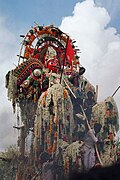
[[File:Kuvagam Kuttantavar.jpg|thumb|left|Aravan as Kuttantavar: here being paraded around Koovagam, prior to ritual re-enactment of his sacrifice|alt=A huge sculpture of an armoured warrior man, with a moustache and red face. He is adorned with many floral garlands, which also cover his arms. Male priests surround him.]] | [[File:Kuvagam Kuttantavar.jpg|thumb|left|Aravan as Kuttantavar: here being paraded around Koovagam, prior to ritual re-enactment of his sacrifice|alt=A huge sculpture of an armoured warrior man, with a moustache and red face. He is adorned with many floral garlands, which also cover his arms. Male priests surround him.]] | ||
''Aravani''s, who call themselves ''Ali''s in this geographic area, take part in the Koovagam festival by re-enacting the marriage of Aravan and Mohini. The ''Aravanis'' participate in similar Kuttantavar festivals, of smaller scale, in other villages like Tevanampattanam, Tiruvetkalam, Adivarahanattum—{{convert|5|mi|km|0}} north-west of [[Chidambaram]]—and Kotthatai (all in Tamil Nadu) and also in Pillaiyarkuppam, in [[Puducherry (union territory)|Puducherry]].<ref name="Niklas">See Niklas (2003) p. 14 for the account of the 10-day Pillaiyarkuppam festival, which is similar to the Koovagam description.</ref> Although local ''Aravani''s have been part of this festival for many years, since the 1960s, a large number of ''Aravani''s have come to the festival from further afield: from throughout Tamil Nadu, from the whole of India, and even from as far away as Singapore.<ref name="Hiltebeitel453" /><ref>Elmore (2003) p. 18</ref> About 25,000 Transgender followers, including the ''Aravani''s, visit the festival.<ref>{{cite news |first=Varuna|last=Verma|title=Celebrating the third sex|url=http://www.telegraphindia.com/1070429/asp/7days/story_7705455.asp|archive-url =https://web.archive.org/web/20090201033150/http://www.telegraphindia.com/1070429/asp/7days/story_7705455.asp|archive-date=1 February 2009|work=[[The Telegraph (Kolkata)|The Telegraph]]|location =[[Kolkata]]|date=29 April 2007|url-status= | ''Aravani''s, who call themselves ''Ali''s in this geographic area, take part in the Koovagam festival by re-enacting the marriage of Aravan and Mohini. The ''Aravanis'' participate in similar Kuttantavar festivals, of smaller scale, in other villages like Tevanampattanam, Tiruvetkalam, Adivarahanattum—{{convert|5|mi|km|0}} north-west of [[Chidambaram]]—and Kotthatai (all in Tamil Nadu) and also in Pillaiyarkuppam, in [[Puducherry (union territory)|Puducherry]].<ref name="Niklas">See Niklas (2003) p. 14 for the account of the 10-day Pillaiyarkuppam festival, which is similar to the Koovagam description.</ref> Although local ''Aravani''s have been part of this festival for many years, since the 1960s, a large number of ''Aravani''s have come to the festival from further afield: from throughout Tamil Nadu, from the whole of India, and even from as far away as Singapore.<ref name="Hiltebeitel453" /><ref>Elmore (2003) p. 18</ref> About 25,000 Transgender followers, including the ''Aravani''s, visit the festival.<ref>{{cite news |first=Varuna|last=Verma|title=Celebrating the third sex|url=http://www.telegraphindia.com/1070429/asp/7days/story_7705455.asp|archive-url =https://web.archive.org/web/20090201033150/http://www.telegraphindia.com/1070429/asp/7days/story_7705455.asp|archive-date=1 February 2009|work=[[The Telegraph (Kolkata)|The Telegraph]]|location =[[Kolkata]]|date=29 April 2007|url-status=dead|access-date=14 May 2009}}</ref> Francis's account of 1906 records men dressed as women, from [[Vanniyar]] and other castes, becoming part of the festival—a "popular feast, but there is no explicit mention of ''Aravani''s. It also records that the ritual marriage of the men to Kuttantavar and their widowhood occurred on the last day of the festival, unlike the present form of the festival, which has the marriage ceremony on the 14th day, and the widowhood ceremony on the 16th day.<ref>Hiltebeitel (1995) p. 454</ref> | ||
During the first six days of the Kuttantavar festival, Aravan's head (''cami'') is "danced" around the streets of Kuvagam, with music and fireworks accompanying it. Each household offers a ''[[Puja (Hinduism)|puja]]'' (a kind of devotional ceremony) to Aravan, with lamp-waving, coconut-offerings and other rituals. Traditionally, goats and chickens are sacrificed. On the 13th day, Aravan's "soul" is ritually transferred from his head to a pot, and the head is repainted. On the evening of the 14th day, a {{convert|20|ft|m|adj=on}} high post is erected on a processional chariot. The post will support Aravan's head and body later in the festival. After the post-setting ceremony (''kampam niruttatal''), young and middle-aged men (farmers and traders from Koovagam and surrounding villages) who have vowed to marry Aravan purchase ''[[Mangalsutra|thali]]''s—the traditional mark of a married woman, in this case a pendant with a piece of [[turmeric]] at its centre. The priest, representing Aravan, ties the ''thali''s around their necks in the [[Garbhagriha|inner sanctum]] of the temple.<ref name="kuvgam">See: | During the first six days of the Kuttantavar festival, Aravan's head (''cami'') is "danced" around the streets of Kuvagam, with music and fireworks accompanying it. Each household offers a ''[[Puja (Hinduism)|puja]]'' (a kind of devotional ceremony) to Aravan, with lamp-waving, coconut-offerings and other rituals. Traditionally, goats and chickens are sacrificed. On the 13th day, Aravan's "soul" is ritually transferred from his head to a pot, and the head is repainted. On the evening of the 14th day, a {{convert|20|ft|m|adj=on}} high post is erected on a processional chariot. The post will support Aravan's head and body later in the festival. After the post-setting ceremony (''kampam niruttatal''), young and middle-aged men (farmers and traders from Koovagam and surrounding villages) who have vowed to marry Aravan purchase ''[[Mangalsutra|thali]]''s—the traditional mark of a married woman, in this case a pendant with a piece of [[turmeric]] at its centre. The priest, representing Aravan, ties the ''thali''s around their necks in the [[Garbhagriha|inner sanctum]] of the temple.<ref name="kuvgam">See: | ||
| Line 198: | Line 199: | ||
The ''Aravani''s arrive in increasing numbers from the 14th through the 16th day. Late on the 15th night, they dance with the flower-crown (''karakam'') of Aravan, which is believed to possess his power.<ref name="kuvgam" /> After this dance, the priest marries the ''Aravani''s to Aravan through the traditional ''thali''-tying ceremony. The ''Aravani''s then conduct sex work, symbolic of consummating their ritual marriage. A "night of wild revelry and sexual promiscuity" follows for the ''Aravani''s.<ref name="G388" /><ref name="GURUNG" /> However, the villagers who married Aravan are not described as having sex in any of the accounts. While ''Aravani''s wear women's clothes and jewellery, villagers marrying Aravan on account of wish-fulfilment vows made to him retain their ordinary men's clothes.<ref>See photos of the marriage ceremony at {{cite web|url=http://picasaweb.google.com/n.g3nd3r/KoovagamMarriageToAravan# |title=Koovagam:Marriage to Aravan |access-date=26 March 2010 |last=n.g3nd3r |date=2 July 2008 |publisher=Picassa Web Albums |url-status=dead |archive-url=https://web.archive.org/web/20121107060825/http://picasaweb.google.com/n.g3nd3r/KoovagamMarriageToAravan |archive-date= 7 November 2012 }}</ref> | The ''Aravani''s arrive in increasing numbers from the 14th through the 16th day. Late on the 15th night, they dance with the flower-crown (''karakam'') of Aravan, which is believed to possess his power.<ref name="kuvgam" /> After this dance, the priest marries the ''Aravani''s to Aravan through the traditional ''thali''-tying ceremony. The ''Aravani''s then conduct sex work, symbolic of consummating their ritual marriage. A "night of wild revelry and sexual promiscuity" follows for the ''Aravani''s.<ref name="G388" /><ref name="GURUNG" /> However, the villagers who married Aravan are not described as having sex in any of the accounts. While ''Aravani''s wear women's clothes and jewellery, villagers marrying Aravan on account of wish-fulfilment vows made to him retain their ordinary men's clothes.<ref>See photos of the marriage ceremony at {{cite web|url=http://picasaweb.google.com/n.g3nd3r/KoovagamMarriageToAravan# |title=Koovagam:Marriage to Aravan |access-date=26 March 2010 |last=n.g3nd3r |date=2 July 2008 |publisher=Picassa Web Albums |url-status=dead |archive-url=https://web.archive.org/web/20121107060825/http://picasaweb.google.com/n.g3nd3r/KoovagamMarriageToAravan |archive-date= 7 November 2012 }}</ref> | ||
[[File:Kuvagam hijras.jpg|thumb|''Aravani''s—the "brides" | [[File:Kuvagam hijras.jpg|thumb|''Aravani''s—the "brides of Aravan"—mourn his death|alt=A group of seated transvestite men and/or eunuchs dressed in saris mourn.]] | ||
Early on the 16th day, the "soul" of Aravan is transferred back to his repainted head and the ''cuvami tirukkan tirattal'' ("opening of the god's holy eyes") ceremony is performed with painting of the pupils. The head is then paraded around the village on a portable platform called a ''ketayam''. The ''ketayam'' is accompanied by two other platform-chariots, one holding the chest plate and epaulettes of Aravan—without which the festival is considered incomplete; the other carries his flower-crown. The ceremony ends with a sacrificial offering of [[rooster]]s. Aravan's head is fixed on the post, with his large epaulettes and chest plate fixed to his body, which is made of straw and surrounded by a garland. The image is then paraded across the village in preparation for his ''kalappali'' and ritual re-enactment of his death on the eighth day of the war. At noon his chariot turns north, a symbolic gesture representing his ''kalappali'' and then he is turned to face the ceremonial Kurukshetra battlefield, | Early on the 16th day, the "soul" of Aravan is transferred back to his repainted head and the ''cuvami tirukkan tirattal'' ("opening of the god's holy eyes") ceremony is performed with painting of the pupils. The head is then paraded around the village on a portable platform called a ''ketayam''. The ''ketayam'' is accompanied by two other platform-chariots, one holding the chest plate and epaulettes of Aravan—without which the festival is considered incomplete; the other carries his flower-crown. The ceremony ends with a sacrificial offering of [[rooster]]s. Aravan's head is fixed on the post, with his large epaulettes and chest plate fixed to his body, which is made of straw and surrounded by a garland. The image is then paraded across the village in preparation for his ''kalappali'' and ritual re-enactment of his death on the eighth day of the war. At noon his chariot turns north, a symbolic gesture representing his ''kalappali'' and then he is turned to face the ceremonial Kurukshetra battlefield, symbolising his entry onto the battlefield to die at the hands of Alambusha. On arrival in Kurukshetra, the garlands are removed, indicating the removal of his flesh and his defeat on the eighth day of war.<ref name="kuvgam" /> | ||
Returning from the battlefield, the chariot turns towards the location prepared for the ceremonial mourning rituals, the "weeping ground" (''alukalam''). The "widowed" ''Aravani''s, with their hair dishevelled, lament the death of their "husband" as he performs the ''kalappali''. The garlands from Aravan's image are thrown at devotees one by one, | Returning from the battlefield, the chariot turns towards the location prepared for the ceremonial mourning rituals, the "weeping ground" (''alukalam''). The "widowed" ''Aravani''s, with their hair dishevelled, lament the death of their "husband" as he performs the ''kalappali''. The garlands from Aravan's image are thrown at devotees one by one, symbolising his gradual loss of vitality. At this "weeping ground", the ''Aravani''s mourn Aravan's death by breaking their bangles, beating their breasts and discarding their bridal finery, like the legendary Mohini-Krishna. They cut their ''thali''s, which are flung at a post erected for the ceremony (''vellikkal''). After bathing, they put on white [[sari]]s as a mark of their widowhood. The ''Aravani''s bear these signs of widowhood for a month before re-adorning themselves with bangles and coloured saris again.<ref name="kuvgam" /> | ||
At mid-afternoon, as the chariot reaches ''alukalam'', Aravan is stripped to his skeletal straw body. Most ''Aravani''s have left and men wedded to Aravan also break their ''thali''s and bangles and perform all the rites of widowhood (the ''vellikkal'' rites) before the image of Aravan. Meanwhile, a ''paratiyar'' (Mahabharata-reciter) tells the story of the culmination of the war, symbolic of Aravan fulfilling his wish of seeing the war. Hiltebeitel suggests that while the ''Aravani''s weep for Aravan's ''kalappali'', the villagers weep for the death of an ancestor, as life leaves Aravan's head at the end of the war.<ref name="kuvgam" /> | At mid-afternoon, as the chariot reaches ''alukalam'', Aravan is stripped to his skeletal straw body. Most ''Aravani''s have left and men wedded to Aravan also break their ''thali''s and bangles and perform all the rites of widowhood (the ''vellikkal'' rites) before the image of Aravan. Meanwhile, a ''paratiyar'' (''Mahabharata''-reciter) tells the story of the culmination of the war, symbolic of Aravan fulfilling his wish of seeing the war. Hiltebeitel suggests that while the ''Aravani''s weep for Aravan's ''kalappali'', the villagers weep for the death of an ancestor, as life leaves Aravan's head at the end of the war.<ref name="kuvgam" /> | ||
Also at the ''alukalam'', a symbolic sacrifice of cooked "blood rice" is distributed in honour of the deceased Aravan. This rice is believed to make childless women conceive. After the death rites at dusk, the chariot is now considered a "house of death", and the lifeless head is removed from the frame of its skeletal body, then covered by a cloth, and finally paraded around the village as though at a funeral. The head is taken to the temple of Kali, where is it "revived". In a ceremony called ''vitaiyatti'' ("the return dance"), the head is once more danced around the village, right up until early morning on the 17th day. On the 18th and final day, the head is decorated and paraded around the village a final time. In the evening, the ''pujari'' ("priest") as Yudhishthira (Dharmaraja) crowns Aravan's head in a coronation ceremony held in the inner sanctum of his temple.<ref name="kuvgam" /><ref>See photos of the ceremony of dancing of Aravan's head and the procession at {{cite web|url=http://picasaweb.google.com/n.g3nd3r/KoovagamProcessionOfAravan# |title=Koovagam: Procession of Aravan |last=n.g3nd3r |date=2 July 2008 |publisher=Picassa Web Albums |access-date=26 March 2010 |url-status=dead |archive-url=https://web.archive.org/web/20121107060849/http://picasaweb.google.com/n.g3nd3r/KoovagamProcessionOfAravan |archive-date= 7 November 2012 }} and {{cite web|url=http://picasaweb.google.com/n.g3nd3r/KoovagamWidowhood# |title=Koovagam: Widowhood |last=n.g3nd3r |date=2 July 2008 |publisher=Picassa Web Albums |access-date=26 March 2010 |url-status=dead |archive-url=https://web.archive.org/web/20121107061226/http://picasaweb.google.com/n.g3nd3r/KoovagamWidowhood |archive-date= 7 November 2012 }}</ref> | Also at the ''alukalam'', a symbolic sacrifice of cooked "blood rice" is distributed in honour of the deceased Aravan. This rice is believed to make childless women conceive. After the death rites at dusk, the chariot is now considered a "house of death", and the lifeless head is removed from the frame of its skeletal body, then covered by a cloth, and finally paraded around the village as though at a funeral. The head is taken to the temple of Kali, where is it "revived". In a ceremony called ''vitaiyatti'' ("the return dance"), the head is once more danced around the village, right up until early morning on the 17th day. On the 18th and final day, the head is decorated and paraded around the village a final time. In the evening, the ''pujari'' ("priest") as Yudhishthira (Dharmaraja) crowns Aravan's head in a coronation ceremony held in the inner sanctum of his temple.<ref name="kuvgam" /><ref>See photos of the ceremony of dancing of Aravan's head and the procession at {{cite web|url=http://picasaweb.google.com/n.g3nd3r/KoovagamProcessionOfAravan# |title=Koovagam: Procession of Aravan |last=n.g3nd3r |date=2 July 2008 |publisher=Picassa Web Albums |access-date=26 March 2010 |url-status=dead |archive-url=https://web.archive.org/web/20121107060849/http://picasaweb.google.com/n.g3nd3r/KoovagamProcessionOfAravan |archive-date= 7 November 2012 }} and {{cite web|url=http://picasaweb.google.com/n.g3nd3r/KoovagamWidowhood# |title=Koovagam: Widowhood |last=n.g3nd3r |date=2 July 2008 |publisher=Picassa Web Albums |access-date=26 March 2010 |url-status=dead |archive-url=https://web.archive.org/web/20121107061226/http://picasaweb.google.com/n.g3nd3r/KoovagamWidowhood |archive-date= 7 November 2012 }}</ref> | ||
In Coimbatore district, [[Aravan Festival in Coimbatore|''Aravan Thiruvizha'']] (The festival of Aravan)<ref>{{cite news|date=17 November 2013|title=A Koothandavar fest without TGs in Coimbatore|newspaper=The New Indian Express|url=https://www.newindianexpress.com/states/tamil-nadu/2013/nov/17/ | In Coimbatore district, [[Aravan Festival in Coimbatore|''Aravan Thiruvizha'']] (The festival of Aravan)<ref>{{cite news|date=17 November 2013|title=A Koothandavar fest without TGs in Coimbatore|newspaper=The New Indian Express|url=https://www.newindianexpress.com/states/tamil-nadu/2013/nov/17/a-koothandavar-fest-without-tgs-in-coimbatore-538361.html |access-date=23 January 2022}}</ref> is celebrated in seven places in [[Coimbatore]] city such as [[Vellalore]], [[Thudiyalur]], [[Kurichi]], [[Singanallur, Coimbatore|Singanallur]], [[Annur]], [[Vadavalli]] and Kattampatti.<ref>{{cite news|date=9 November 2016|title=Aravan festival in the city of Coimbatore|newspaper=The Hindu Tamil|url=https://www.hindutamil.in/news/spirituals/86563-.html |access-date=23 January 2022}}</ref> The festival at Singanallur, celebrated in the Tamil month of [[Kārtika (month)|Karthigai]], is the largest of the seven festivals. It is termed as "Saathi Nallinakka Thiruvizha" involving the share of over eight communities.<ref>{{cite news|date=28 December 2016|title=Aravan Festival in Singanallur|newspaper=Dinamaalar|url=https://temple.dinamalar.com/news_detail.php?id=86312 |access-date=23 January 2022}}</ref><ref>{{cite news|date=25 April 2018|title=Aravan Festival in Singanallur|newspaper=Daily Thanthi|url=https://www.dailythanthi.com/Others/Devotional/2018/04/25114957/transgender--may-Kuttantavar-festival.vpf |access-date=23 January 2022}}</ref><ref>{{cite news|date=10 May 2017|title=Aravan Festival in Tamilnadu|newspaper=Maalaimalar|url=https://www.maalaimalar.com/devotional/devotionaltopnews/2017/05/10112848/1084526/koovagam-koothandavar-temple-villupuram.vpf|access-date=23 January 2022|archive-date=23 April 2022|archive-url=https://web.archive.org/web/20220423082857/https://www.maalaimalar.com/devotional/devotionaltopnews/2017/05/10112848/1084526/koovagam-koothandavar-temple-villupuram.vpf|url-status=dead}}</ref> The festival is celebrated in the month of [[Pausha|Thai]] in Annur,<ref>{{cite news|date=17 November 2019|title=Aravan Festival in Annur|newspaper=Dinamalar|url=https://temple.dinamalar.com/margazhi/detail.php?id=102065|access-date=23 January 2022}}</ref> [[Thudiyalur]] in the month of [[Bhadra (Hindu calendar)|Purattasi]],<ref>{{cite web|url= https://temple.dinamalar.com/new.php?id=2313|title= Aravan Festival in Thudiyalur}}</ref> [[Kurichi]] in the month of [[Ashvin (month)|Aiipasi]],<ref>{{cite news|date=28 December 2016|title=Aravan festival in Kurichi|newspaper=Dinamaalar|url=https://temple.dinamalar.com/news_detail.php?id=118980 |access-date=23 January 2022}}</ref> Kattampatti in the month of Thai and [[Vadavalli]]<ref>{{cite news|date=26 February 2013|title=Aravan Festival in Kattampatti|newspaper=Dinamalar|url=https://www.dinamalar.com/news/tamil-nadu-district-news-coimbatore/news/655237 |access-date=23 January 2022}}</ref> in the month of [[Phalguna|Panguni]].<ref>{{cite news|date=17 November 2019|title=Aravan Festival in Vadavalli|newspaper=Dinamalar|url=https://www.dinamalar.com/news/tamil-nadu-district-news-coimbatore/news/2413428 |access-date=23 January 2022}}</ref> | ||
=== Draupadi cult rituals === | === Draupadi cult rituals === | ||
| Line 214: | Line 215: | ||
[[File:Nallaravan.jpg|thumb|An Aravan head, {{convert|13|ft|m}} high, in the [[Draupati Amman|Draupadi Amman]] temple in [[Ayyampettai (Thanjavur district)|Ayyampettai]]. A cobra hood is seen on his crown, while another five-headed cobra is emerging from behind the crown.|alt=A big wooden male head with a moustache, bushy brows, Vaishnava tilak, fangs protruding from the end of the mouth, big eyes and ears and wearing a conical crown with a cobra on its front and another five-headed cobra is emerging from behind]] | [[File:Nallaravan.jpg|thumb|An Aravan head, {{convert|13|ft|m}} high, in the [[Draupati Amman|Draupadi Amman]] temple in [[Ayyampettai (Thanjavur district)|Ayyampettai]]. A cobra hood is seen on his crown, while another five-headed cobra is emerging from behind the crown.|alt=A big wooden male head with a moustache, bushy brows, Vaishnava tilak, fangs protruding from the end of the mouth, big eyes and ears and wearing a conical crown with a cobra on its front and another five-headed cobra is emerging from behind]] | ||
Devotees of Draupadi commemorate the Mahabharata war by conducting an annual festival known as ''patukalam''. This festival usually begins with a ''kuttu'' ("drama") re-enacting Draupadi's wedding.<ref>Hiltebeitel (1988) p. 145</ref> During the festival, the actor playing the part of Draupadi (and other women participating in the public ceremonies) lament the death of Aravan and the other heroes of the war.<ref>Hiltebeitel (1995) p. 462</ref> There is some variation in the length of the ''patukalam'' festival and in the day allocated to performing the ''kuttu'' of "Aravan's sacrifice" (''kalappali''), but wherever the ritual ''kalappali'' is performed, that place is declared to be, symbolically, the battlefield of Kurukshetra.<ref name="H288">Hiltebeitel (1991) p. 288</ref> | Devotees of Draupadi commemorate the ''Mahabharata'' war by conducting an annual festival known as ''patukalam''. This festival usually begins with a ''kuttu'' ("drama") re-enacting Draupadi's wedding.<ref>Hiltebeitel (1988) p. 145</ref> During the festival, the actor playing the part of Draupadi (and other women participating in the public ceremonies) lament the death of Aravan and the other heroes of the war.<ref>Hiltebeitel (1995) p. 462</ref> There is some variation in the length of the ''patukalam'' festival and in the day allocated to performing the ''kuttu'' of "Aravan's sacrifice" (''kalappali''), but wherever the ritual ''kalappali'' is performed, that place is declared to be, symbolically, the battlefield of Kurukshetra.<ref name="H288">Hiltebeitel (1991) p. 288</ref> | ||
In Irunkal, Tamil Nadu, this ''kuttu'' is usually performed 16 days before "''patukalam'' day", the last day of an 18-day festival. In Singapore, however, the ''kuttu'' is performed on the day of the new moon in the Tamil month of Purattaci (September–October).<ref>Hiltebeitel (1991) p. 287</ref> In shorter 10- to 12-day festivals, the ''kuttu'' and ritualisation of Aravan's ''kalappali'' are performed on the concluding night of the festival, as can be observed in Bangalore and in and around Chennai—at Sowcarpet, Alantur and Punamalli.<ref name="H288" /> | In Irunkal, Tamil Nadu, this ''kuttu'' is usually performed 16 days before "''patukalam'' day", the last day of an 18-day festival. In Singapore, however, the ''kuttu'' is performed on the day of the new moon in the Tamil month of Purattaci (September–October).<ref>Hiltebeitel (1991) p. 287</ref> In shorter 10- to 12-day festivals, the ''kuttu'' and ritualisation of Aravan's ''kalappali'' are performed on the concluding night of the festival, as can be observed in Bangalore and in and around Chennai—at Sowcarpet, Alantur and Punamalli.<ref name="H288" /> | ||
There is also variation in how Aravan is represented in the festivities. While permanent wooden Aravan heads are used in temples in Chennai and Puducherry, in rural areas the head and body of Aravan are made of clay; both are destroyed at the end of the festival.<ref name="H288" /> At Tindivanam, a headless clay and bamboo body of Aravan is modelled, showing him in a heroic position, kneeling on his left knee and holding a bow. A clay head is then ceremoniously fixed, making the effigy about {{convert|7|ft|m}} tall. The officiating priest first takes a sword, striking pieces from the head. Then, a pumpkin is sliced into 32 pieces, | There is also variation in how Aravan is represented in the festivities. While permanent wooden Aravan heads are used in temples in Chennai and Puducherry, in rural areas the head and body of Aravan are made of clay; both are destroyed at the end of the festival.<ref name="H288" /> At Tindivanam, a headless clay and bamboo body of Aravan is modelled, showing him in a heroic position, kneeling on his left knee and holding a bow. A clay head is then ceremoniously fixed, making the effigy about {{convert|7|ft|m}} tall. The officiating priest first takes a sword, striking pieces from the head. Then, a pumpkin is sliced into 32 pieces, symbolising 32 pieces of Aravan's sacrificed body. Next, Aravan is fed his own "blood", represented by the blood of goat, sacrificed to Aravan beforehand. Aravan's body from the neck downwards is then covered with a bloodstained white cloth. Finally, blood-soaked rice is sprinkled on Aravan's face. Devotees, as in the Kuttantavar cult, believe eating this rice from Aravan's face, recovered after the ceremony, can induce pregnancy.<ref>Hiltebeitel (1991) pp. 289–93</ref> | ||
In Cattiram Karuppur, near Kumbhakonam, a {{convert|25|ft|m|adj=on}} statue of Aravan is constructed horizontally and placed on the ground. Aravan's story is then re-enacted; one of the actors, believed to be possessed by Kali, kills a rooster over the statue's neck, | In Cattiram Karuppur, near Kumbhakonam, a {{convert|25|ft|m|adj=on}} statue of Aravan is constructed horizontally and placed on the ground. Aravan's story is then re-enacted; one of the actors, believed to be possessed by Kali, kills a rooster over the statue's neck, symbolising the sacrifice. Again, blood-soaked rice is distributed to devotees, especially childless women.<ref>Hiltebeitel (1991) pp. 294–96</ref> Similar rituals associated with a symbolic sacrifice and blood-soaked rice are performed in Melaccari,<ref>Hiltebeitel (1991) pp. 292–93</ref> Alantur, Punamalli and Villupuram. At Alantur and Punamalli, a goat is sacrificed, in Cuddalore, Patirikkuppam and Villupuram, a cock is sacrificed.<ref>Hiltebeitel (1991) pp. 296–97</ref> In the districts of Cuddalore, Thanjavur and Villupuram, Aravan's head is hoisted to an elevated position to watch over the ''patukalam'' and the symbolic re-enactment of the ''Mahabharata'' war.<ref name="arcot" /><ref>Hiltebeitel (1991) p. 294</ref> | ||
== Javanese traditions == | == Javanese traditions == | ||
The Indonesian island of Java, run by the [[Srivijaya]] dynasty of [[Sumatra]] from the 7th century, partly practised [[Hinduism in Java|Hinduism]]. This included transmission and adoption of the Mahabharata traditions. "The earliest evidence of the penetration of the Sanskrit epics into rural areas is found in the [[Sangsang]] copper plate inscription issued in the name of King [[Balitung]] in AD 907."<ref name=Supomo>Supomo (1995)</ref> A "rendering of the Mahābhārata (IAST original) into Javanese was undertaken under the patronage of King [[Dharmawangśa]] Tĕguh (AD 990–1016)",<ref name=Supomo /> culminating in "a recital of the [[Virata Parva|Wirāṭaparwa]] for 'one month minus one evening'—commencing on 14 October and ending on 12 November 996."<ref name=Supomo /> This first translation into Javanese was "abbreviated" and in "prose".<ref name=Supomo /> However, [[East Java]]nese poets later started producing native metered ''[[kakawin]]'', expanding on themes from the ''parva''s ("books" or "chapters") of the Mahabharata, and freely importing these into Javanese settings.<ref name=Supomo /> [[Petrus Josephus Zoetmulder]] commented: "These men and women with their Indian names are essentially Javanese, acting like Javanese, thinking like Javanese and living in a Javanese environment."<ref>Zoetmulder (1974) pp. 187–188</ref> | The Indonesian island of Java, run by the [[Srivijaya]] dynasty of [[Sumatra]] from the 7th century, partly practised [[Hinduism in Java|Hinduism]]. This included transmission and adoption of the ''Mahabharata'' traditions. "The earliest evidence of the penetration of the Sanskrit epics into rural areas is found in the [[Sangsang]] copper plate inscription issued in the name of King [[Balitung]] in AD 907."<ref name=Supomo>Supomo (1995)</ref> A "rendering of the Mahābhārata (IAST original) into Javanese was undertaken under the patronage of King [[Dharmawangśa]] Tĕguh (AD 990–1016)",<ref name=Supomo /> culminating in "a recital of the [[Virata Parva|Wirāṭaparwa]] for 'one month minus one evening'—commencing on 14 October and ending on 12 November 996."<ref name=Supomo /> This first translation into Javanese was "abbreviated" and in "prose".<ref name=Supomo /> However, [[East Java]]nese poets later started producing native metered ''[[kakawin]]'', expanding on themes from the ''parva''s ("books" or "chapters") of the ''Mahabharata'', and freely importing these into Javanese settings.<ref name=Supomo /> [[Petrus Josephus Zoetmulder]] commented: "These men and women with their Indian names are essentially Javanese, acting like Javanese, thinking like Javanese and living in a Javanese environment."<ref>Zoetmulder (1974) pp. 187–188</ref> | ||
[[File:COLLECTIE TROPENMUSEUM Houten wajangpop voorstellende Irawan TMnr 4283-38.jpg|thumb|''Bambang'' Irawan ''wayang golek'' wooden puppet]] | [[File:COLLECTIE TROPENMUSEUM Houten wajangpop voorstellende Irawan TMnr 4283-38.jpg|thumb|''Bambang'' Irawan ''wayang golek'' wooden puppet]] | ||
The stories of Iravan, usually spelled Irawan in Java, along with others from the Javanese version of the Mahabharata, are told in traditional Javanese theatre (''[[wayang]]''), as well as shadow-puppet plays known as ''wayang kulit''. As in India, Irawan is described as a son of Ardjuna (Arjuna) and Ulupi. While in India, Irawan's mother Ulupi is a Naga (serpent), in Javanese legends she is the daughter of the sage Kanwa (Jayawilapa in puppetry) of the Yasarata hermitage. Irawan is born and brought up in the hermitage under the care of his mother and grandfather, away from his father.<ref name="S551ff">For Ulupi: Sudibyoprono (1991) pp. 551–52</ref><ref name="S237" /> Irawan and his stepbrother Abhimanju ([[Abhimanyu]]) or Angkawijaya are the protagonists of more than 40 ''lakon''s ("scenes", "dramas" or "plays") set in the Amarta Period, the era of the Pandawas (Pandavas).<ref>Brandon (1993) p. 13</ref> In these ''lakon''s, Irawan is depicted as a ''lijepan'' character—"a small, extremely refined, controlled character, whose manner is modest".<ref>Brandon (1993) p. 49</ref> In the ''wayang kulit'', he is referred to as a ''bambang'' ("refined knight"), depicted with a white face and dubbed with a light, floating voice.<ref>Mrázek (2005) pp. 274–75</ref> Irawan is also described as determined and calm.<ref name="S237" /> | The stories of Iravan, usually spelled Irawan in Java, along with others from the Javanese version of the ''Mahabharata'', are told in traditional Javanese theatre (''[[wayang]]''), as well as shadow-puppet plays known as ''wayang kulit''. As in India, Irawan is described as a son of Ardjuna (Arjuna) and Ulupi. While in India, Irawan's mother Ulupi is a Naga (serpent), in Javanese legends she is the daughter of the sage Kanwa (Jayawilapa in puppetry) of the Yasarata hermitage. Irawan is born and brought up in the hermitage under the care of his mother and grandfather, away from his father.<ref name="S551ff">For Ulupi: Sudibyoprono (1991) pp. 551–52</ref><ref name="S237" /> Irawan and his stepbrother Abhimanju ([[Abhimanyu]]) or Angkawijaya are the protagonists of more than 40 ''lakon''s ("scenes", "dramas" or "plays") set in the Amarta Period, the era of the Pandawas (Pandavas).<ref>Brandon (1993) p. 13</ref> In these ''lakon''s, Irawan is depicted as a ''lijepan'' character—"a small, extremely refined, controlled character, whose manner is modest".<ref>Brandon (1993) p. 49</ref> In the ''wayang kulit'', he is referred to as a ''bambang'' ("refined knight"), depicted with a white face and dubbed with a light, floating voice.<ref>Mrázek (2005) pp. 274–75</ref> Irawan is also described as determined and calm.<ref name="S237" /> | ||
;Irawan Rabi | ;Irawan Rabi | ||
| Line 237: | Line 238: | ||
;Irawan(an)taka | ;Irawan(an)taka | ||
The ''kakawin'' text ''Irawan(an)taka'' ("Death of Irawan"), also known as ''Parthawijaya'' ("Arjuna's Victory"), describes Irawan's death in the Bharatayuddha (Mahabharata war).<ref>Creese (1999) p. 78</ref> At the beginning of the Bharatayuddha, Irawan advances to the battlefield along with his brothers. Together, they kill many Kurawas. Later, the demon (''ditya'') Kalasrenggi encounters Irawan. Kalasrenggi, whose father was killed by Ardjuna, mistakes Irawan for Ardjuna because of the similarity of their appearance and kills him.<ref name="S237" /> Arjuna then kills Kalasrenggi to avenge Irawan's death. The death of Irawan is placed at the very beginning of the war in the Javanese version of the Mahabharata.<ref>For Bharatayuddha: Sudibyoprono (1991) p. 88</ref> The puppetry version of the story places this encounter between Irawan and Kalasrenggi even before Irawan's meeting with his father, ahead of the Bharatayuddha.<ref name="S237">For Irawan article: Sudibyoprono (1991) p. 237</ref> | The ''kakawin'' text ''Irawan(an)taka'' ("Death of Irawan"), also known as ''Parthawijaya'' ("Arjuna's Victory"), describes Irawan's death in the Bharatayuddha (''Mahabharata'' war).<ref>Creese (1999) p. 78</ref> At the beginning of the Bharatayuddha, Irawan advances to the battlefield along with his brothers. Together, they kill many Kurawas. Later, the demon (''ditya'') Kalasrenggi encounters Irawan. Kalasrenggi, whose father was killed by Ardjuna, mistakes Irawan for Ardjuna because of the similarity of their appearance and kills him.<ref name="S237" /> Arjuna then kills Kalasrenggi to avenge Irawan's death. The death of Irawan is placed at the very beginning of the war in the Javanese version of the ''Mahabharata''.<ref>For Bharatayuddha: Sudibyoprono (1991) p. 88</ref> The puppetry version of the story places this encounter between Irawan and Kalasrenggi even before Irawan's meeting with his father, ahead of the Bharatayuddha.<ref name="S237">For Irawan article: Sudibyoprono (1991) p. 237</ref> | ||
== Notes == | == Notes == | ||
| Line 249: | Line 250: | ||
* {{cite book|last=Brockington|first=John|title=The Sanskrit Epics|publisher=[[Brill Publishers]]|year=1998|series=Handbook of Oriental Studies (Handbuch Der Orientalistik part 2)|volume=11|isbn=0-19-565025-5|ref=none}} [https://www.jstor.org/stable/24663438 Reviewed] by Alf Hiltebeitel in ''Indo-Iranian Journal'' '''43''' (2000): 161–169. | * {{cite book|last=Brockington|first=John|title=The Sanskrit Epics|publisher=[[Brill Publishers]]|year=1998|series=Handbook of Oriental Studies (Handbuch Der Orientalistik part 2)|volume=11|isbn=0-19-565025-5|ref=none}} [https://www.jstor.org/stable/24663438 Reviewed] by Alf Hiltebeitel in ''Indo-Iranian Journal'' '''43''' (2000): 161–169. | ||
* {{cite book|last=Buitenen|first=Johannes Adrianus Bernadus van|title=The Mahābhārata|publisher=[[University of Chicago Press]]|year=1973|volume=1|isbn=0-226-84663-6|url=https://books.google.com/books?id=V7QBbkhaxp0C|ref=none}} | * {{cite book|last=Buitenen|first=Johannes Adrianus Bernadus van|title=The Mahābhārata|publisher=[[University of Chicago Press]]|year=1973|volume=1|isbn=0-226-84663-6|url=https://books.google.com/books?id=V7QBbkhaxp0C|ref=none}} | ||
* {{cite journal|last=Creese|first=Helen|year=1999|title=The Balinese kakawin tradition; A preliminary description and inventory|journal=Bijdragen tot de Taal-, Land- en Volkenkunde|publisher=KITLV journals|volume=155|issue=1|pages=45–96|doi=10.1163/22134379-90003880|url=http://www.kitlv-journals.nl/|ref=none}} | * {{cite journal|last=Creese|first=Helen|year=1999|title=The Balinese kakawin tradition; A preliminary description and inventory|journal=Bijdragen tot de Taal-, Land- en Volkenkunde|publisher=KITLV journals|volume=155|issue=1|pages=45–96|doi=10.1163/22134379-90003880|url=http://www.kitlv-journals.nl/|ref=none|doi-access=free}} | ||
* {{cite book|last=Dikshitar|first=V. A. Ramachandra|title=The Purāṇa Index|publisher=Motilal Banarsidass Publ|location=Delhi|year=1951|volume=1|isbn=81-208-1273-5|author-link = V. R. Ramachandra Dikshitar|ref=none}} | * {{cite book|last=Dikshitar|first=V. A. Ramachandra|title=The Purāṇa Index|publisher=Motilal Banarsidass Publ|location=Delhi|year=1951|volume=1|isbn=81-208-1273-5|author-link = V. R. Ramachandra Dikshitar|ref=none}} | ||
* {{cite book | author=Elmore, Wilber Theodore | title=Dravidian Gods in Modern Hinduism; A Study of the Local and Village Deities of Southern India | url=https://books.google.com/books?id=s21S-Cmq03UC&q=Aravan&pg=PA18 | page=18 | publisher=Kessinger Publishing | year=2003 | orig-year=January 1915 | isbn=978-0-7661-3871-1 | ref=none }} | * {{cite book | author=Elmore, Wilber Theodore | title=Dravidian Gods in Modern Hinduism; A Study of the Local and Village Deities of Southern India | url=https://books.google.com/books?id=s21S-Cmq03UC&q=Aravan&pg=PA18 | page=18 | publisher=Kessinger Publishing | year=2003 | orig-year=January 1915 | isbn=978-0-7661-3871-1 | ref=none }} | ||
* {{cite book|last=Florida|first=Nancy K.|title=Writing the past, inscribing the future: history as prophesy in colonial Java|publisher=[[Duke University Press]]|year=1995|url=https://books.google.com/books?id=JtXWqGzfzGgC|isbn=0-8223-1622-6|ref=none}} | * {{cite book|last=Florida|first=Nancy K.|title=Writing the past, inscribing the future: history as prophesy in colonial Java|publisher=[[Duke University Press]]|year=1995|url=https://books.google.com/books?id=JtXWqGzfzGgC|isbn=0-8223-1622-6|ref=none}} | ||
* {{cite book|last=Florida|first=Nancy K.|title=Javanese Literature in Surakarta Manuscripts|publisher=[[ | * {{cite book|last=Florida|first=Nancy K.|title=Javanese Literature in Surakarta Manuscripts|publisher=[[Cornell University Southeast Asia Program]]|year=2000|volume=2|url=https://books.google.com/books?id=Id4dj7txArMC|isbn=0-87727-604-8|ref=none}} | ||
* {{cite book| author = Ganguli, Kisari Mohan| author-link = Kisari Mohan Ganguli| title = Mahabharata| publisher = The Internet Sacred Texts Archive<!-- The translation is in Public domain -->| year = 1883–1896| url = http://www.sacred-texts.com/hin/maha/index.htm| access-date = 7 May 2010| ref = none}} | * {{cite book| author = Ganguli, Kisari Mohan| author-link = Kisari Mohan Ganguli| title = Mahabharata| publisher = The Internet Sacred Texts Archive<!-- The translation is in Public domain -->| year = 1883–1896| url = http://www.sacred-texts.com/hin/maha/index.htm| access-date = 7 May 2010| ref = none}} | ||
* {{cite journal|doi=10.2307/605387|last=Goldman|first=Robert P.|date=Jul–Sep 1993|title=Transsexualism, Gender, and Anxiety in Traditional India|journal=Journal of the American Oriental Society|publisher=American Oriental Society|volume=113|issue=3|pages=374–401|jstor=605387|ref=none}} | * {{cite journal|doi=10.2307/605387|last=Goldman|first=Robert P.|date=Jul–Sep 1993|title=Transsexualism, Gender, and Anxiety in Traditional India|journal=Journal of the American Oriental Society|publisher=American Oriental Society|volume=113|issue=3|pages=374–401|jstor=605387|ref=none}} | ||
* {{cite book | last= Hiltebeitel | first= Alf | title= The cult of Draupadi: Mythologies: from Gingee to Kuruksetra | chapter= Chapter 15: Aravan's Sacrifice | chapter-url= https://books.google.com/books?id=ui5gju8MwDUC&pg=PA317 | * {{cite book | last= Hiltebeitel | first= Alf | title= The cult of Draupadi: Mythologies: from Gingee to Kuruksetra | chapter= Chapter 15: Aravan's Sacrifice | chapter-url= https://books.google.com/books?id=ui5gju8MwDUC&pg=PA317 | volume= 1 | year= 1988 | publisher= University of Chicago Press | isbn= 978-0-226-34046-3 | author-link= Alf Hiltebeitel | ref= none }} | ||
* {{cite book | last=Hiltebeitel | first=Alf | title=The cult of Draupadi: On Hindu ritual and the goddess | chapter=Chapter 9: Aravan's battlefield sacrifice to Kali | chapter-url=https://books.google.com/books?id=T5waGURCi1QC&pg=PA283 | * {{cite book | last=Hiltebeitel | first=Alf | title=The cult of Draupadi: On Hindu ritual and the goddess | chapter=Chapter 9: Aravan's battlefield sacrifice to Kali | chapter-url=https://books.google.com/books?id=T5waGURCi1QC&pg=PA283 | year=1991 | publisher=University of Chicago Press | isbn=978-0-226-34048-7 | volume=2 | ref=none }} | ||
* {{cite journal|last=Hiltebeitel | first=Alf |date=May 1995| title=Dying Before the Mahabharata War: Martial and Transsexual Body-Building for Aravan|journal=The Journal of Asian Studies|publisher=Association for Asian Studies|volume=54|issue=2|pages=447–473 |jstor=2058746|doi=10.2307/2058746| s2cid=161561834 |ref=none}} | * {{cite journal|last=Hiltebeitel | first=Alf |date=May 1995| title=Dying Before the Mahabharata War: Martial and Transsexual Body-Building for Aravan|journal=The Journal of Asian Studies|publisher=Association for Asian Studies|volume=54|issue=2|pages=447–473 |jstor=2058746|doi=10.2307/2058746| s2cid=161561834 |ref=none}} | ||
* {{cite book | last=Hiltebeitel | first=Alf | title= Hair: its power and meaning in Asian cultures | chapter = Chapter 7: Hair Like Snakes and Mustached Brides: Crossed Gender in an Indian Folk Cult |year = 1998 | publisher= SUNY Press | isbn = 0-7914-3741-8 |editor = Hiltebeitel, Alf |editor2=Miller, Barbara D|ref=none}} | * {{cite book | last=Hiltebeitel | first=Alf | title= Hair: its power and meaning in Asian cultures | chapter = Chapter 7: Hair Like Snakes and Mustached Brides: Crossed Gender in an Indian Folk Cult |year = 1998 | publisher= SUNY Press | isbn = 0-7914-3741-8 |editor = Hiltebeitel, Alf |editor2=Miller, Barbara D|ref=none}} | ||
| Line 263: | Line 264: | ||
* {{cite book | author = Mani, Vettam | title = Puranic Encyclopaedia: A Comprehensive Dictionary With Special Reference to the Epic and Puranic Literature | publisher = Motilal Banarsidass | year = 1975 | location = Delhi | isbn = 0-8426-0822-2 |ref=none}} | * {{cite book | author = Mani, Vettam | title = Puranic Encyclopaedia: A Comprehensive Dictionary With Special Reference to the Epic and Puranic Literature | publisher = Motilal Banarsidass | year = 1975 | location = Delhi | isbn = 0-8426-0822-2 |ref=none}} | ||
* {{cite book|last=Mrázek|first=Jan|title=Phenomenology of a puppet theatre: contemplations on the art of Javanese wayang kulit|publisher=KITLV Press|location=Leidan, The Netherlands|year=2005|isbn=90-6718-252-4|ref=none}} | * {{cite book|last=Mrázek|first=Jan|title=Phenomenology of a puppet theatre: contemplations on the art of Javanese wayang kulit|publisher=KITLV Press|location=Leidan, The Netherlands|year=2005|isbn=90-6718-252-4|ref=none}} | ||
* {{cite encyclopedia|author= Niklas, Ulrike|editor1= Mills, Margaret Ann|editor2= Claus, Peter J.|editor3= Diamond, Sarah|encyclopedia= South Asian folklore: an | * {{cite encyclopedia|author= Niklas, Ulrike|editor1= Mills, Margaret Ann|editor2= Claus, Peter J.|editor3= Diamond, Sarah|encyclopedia= South Asian folklore: an encyclopaedia: Afghanistan, Bangladesh, India, Nepal, Pakistan, Sri Lanka|title= Aravani festival|url= https://books.google.com/books?id=ienxrTPHzzwC&q=Shulman+%22Aravan%22&pg=PA14|access-date= 13 May 2009|year= 2003|publisher= Taylor & Francis|isbn= 0-415-93919-4|ref= none}} | ||
* {{cite book | author=Pattanaik, Devdutt | title=The goddess in India | url=https://books.google.com/books?id=rjL3ogbdJNkC&q=Aravan&pg=PA37 | publisher=Inner Traditions / Bear & Co | year=2000 | isbn=0-89281-807-7 | location=Vermont | ref=none }} | * {{cite book | author=Pattanaik, Devdutt | title=The goddess in India | url=https://books.google.com/books?id=rjL3ogbdJNkC&q=Aravan&pg=PA37 | publisher=Inner Traditions / Bear & Co | year=2000 | isbn=0-89281-807-7 | location=Vermont | ref=none }} | ||
* {{cite book | author=Pattanaik, Devdutt | title=The Man who was a Woman and Other Queer Tales of Hindu Lore | url=https://books.google.com/books?id=Odsk9xfOp6oC&q=Aravan&pg=PA87 | page=87 | publisher=The Haworth Press, Inc | year=2002 | isbn=1-56023-180-7 | ref=none }} | * {{cite book | author=Pattanaik, Devdutt | title=The Man who was a Woman and Other Queer Tales of Hindu Lore | url=https://books.google.com/books?id=Odsk9xfOp6oC&q=Aravan&pg=PA87 | page=87 | publisher=The Haworth Press, Inc | year=2002 | isbn=1-56023-180-7 | ref=none }} | ||
| Line 270: | Line 271: | ||
* {{cite book|last=Sudibyoprono|first=R. Rio|title=Ensiklopedi wayang purwa|publisher=[[Balai Pustaka]]|location=Jakarta|year=1991|edition=1|isbn=979-407-341-5 |language=id|ref=none}} | * {{cite book|last=Sudibyoprono|first=R. Rio|title=Ensiklopedi wayang purwa|publisher=[[Balai Pustaka]]|location=Jakarta|year=1991|edition=1|isbn=979-407-341-5 |language=id|ref=none}} | ||
* {{cite book|last=Sukthankar|first=Vishnu S.|title=Mahabharata|publisher=[[Bhandarkar Oriental Research Institute]]|location=[[Pune]]|date=1927–1959|isbn = <!-- no isbn printed on hard copy -->|ref=none}} | * {{cite book|last=Sukthankar|first=Vishnu S.|title=Mahabharata|publisher=[[Bhandarkar Oriental Research Institute]]|location=[[Pune]]|date=1927–1959|isbn = <!-- no isbn printed on hard copy -->|ref=none}} | ||
* {{cite book|last=Supomo|first=S|title=The Austronesians: historical and comparative perspectives|editor=Peter S. Bellwood|editor2=JJ Fox|editor3=DT Tryon|publisher=Conference proceedings, Comparative Austronesian Project|location=Canberra|year=1995|chapter=Chapter 15: Indic Transformation: The Sanskritization of Jawa and the Javanization of the Bharata|url=http://epress.anu.edu.au/austronesians/austronesians/mobile_devices/ch15s07.html|access-date=7 May 2010|display-editors=etal|ref=none}} | * {{cite book|last=Supomo|first=S|title=The Austronesians: historical and comparative perspectives|editor=Peter S. Bellwood|editor2=JJ Fox|editor3=DT Tryon|publisher=Conference proceedings, Comparative Austronesian Project|location=Canberra|year=1995|chapter=Chapter 15: Indic Transformation: The Sanskritization of Jawa and the Javanization of the Bharata|doi=10.22459/A.09.2006|doi-access=free|isbn=978-0-7315-2132-6|url=http://epress.anu.edu.au/austronesians/austronesians/mobile_devices/ch15s07.html|access-date=7 May 2010|display-editors=etal|ref=none}} | ||
* {{cite book | author=[[Edgar Thurston|Thurston, Edgar]]|author2=[[K. Rangachari]]| title = [[Castes and Tribes of Southern India]]<!-- | url=https://books.google.com/?id=Erin3nkU3ZUC | * {{cite book | author=[[Edgar Thurston|Thurston, Edgar]]|author2=[[K. Rangachari]]| title = [[Castes and Tribes of Southern India]]<!-- | url=https://books.google.com/books?id=Erin3nkU3ZUC&dq=Aravan+Iravan&pg=PA10 -->|year = 2001| orig-year = 1909|edition = 4|publisher = Asian Educational Services|volume = 6 | isbn=978-81-206-0288-5|ref=none}} | ||
* {{cite book| author=Vogel, Jean Philippe| title=Indian serpent-lore, or the Nāgas in Hindu Legend and Art| url=https://books.google.com/books?id=nU8JRyvXWnYC&q=Iravant| publisher=Kessinger Publishing| year=2005| chapter=The Nāgas in the great epic| orig-year=1926| isbn=0-7661-9240-7| ref=none}} available at {{cite web|url=https://archive.org/details/IndianSerpentLoreOrTheNagasInHinduLegendAndArt|title=Indian Serpent-Lore Or The Nagas In Hindu Legend And Art (1926)|year=1926 |publisher=Internet archive|ref=none}}<!-- Book is in Public domain --> | * {{cite book| author=Vogel, Jean Philippe| title=Indian serpent-lore, or the Nāgas in Hindu Legend and Art| url=https://books.google.com/books?id=nU8JRyvXWnYC&q=Iravant| publisher=Kessinger Publishing| year=2005| chapter=The Nāgas in the great epic| orig-year=1926| isbn=0-7661-9240-7| ref=none}} available at {{cite web|url=https://archive.org/details/IndianSerpentLoreOrTheNagasInHinduLegendAndArt|title=Indian Serpent-Lore Or The Nagas In Hindu Legend And Art (1926)|year=1926 |publisher=Internet archive|ref=none}}<!-- Book is in Public domain --> | ||
* {{cite book|last=Zoetmulder|first=Petrus Josephus|title=Kalangwan: a survey of Old Javanese literature|publisher=[[Martinus Nijhoff]]|location=[[The Hague]]|year=1974|series=Translation series (Koninklijk Instituut voor Taal-, Land- en Volkenkunde (Netherlands)) |isbn=90-247-1674-8|ref=none}} | * {{cite book|last=Zoetmulder|first=Petrus Josephus|title=Kalangwan: a survey of Old Javanese literature|publisher=[[Martinus Nijhoff]]|location=[[The Hague]]|year=1974|series=Translation series (Koninklijk Instituut voor Taal-, Land- en Volkenkunde (Netherlands)) |isbn=90-247-1674-8|ref=none}} | ||
| Line 281: | Line 282: | ||
== External links == | == External links == | ||
{{Commons category| | {{Commons category|Irāvān}} | ||
* [http://kshetrapuranas.wordpress.com/2009/02/14/the-koothandavar-spectacle-koovagam/ Koovagam festival] | * [http://kshetrapuranas.wordpress.com/2009/02/14/the-koothandavar-spectacle-koovagam/ Koovagam festival] | ||
* [ | * [https://news.bbc.co.uk/2/hi/programmes/from_our_own_correspondent/2975727.stm BBC coverage of the Koovagam festival] | ||
{{Mahābhārata}} | {{Mahābhārata}} | ||
{{HinduMythology}} | {{HinduMythology}} | ||
| Line 294: | Line 295: | ||
[[Category:Regional Hindu gods]] | [[Category:Regional Hindu gods]] | ||
[[Category:Hindu folk deities]] | [[Category:Hindu folk deities]] | ||
[[Category:LGBTQ and Hinduism]] | |||
[[Category:People of the Kurukshetra War]] | |||
Latest revision as of 07:08, 17 March 2026
| Iravan | |
|---|---|
 Aravan worshipped at Sri Mariamman Temple, Singapore. A cobra hood is sheltering Aravan's head. | |
| Devanagari | इरावान् |
| Sanskrit transliteration | Irāvāṇ |
| Tamil | அரவான் |
| Affiliation | Nāga |
| Weapon | Sword, Bow and Arrows |
| Parents | Ulupi (mother) Arjuna (father) |
| Consort | Krishna in his Mohini form (in folk traditions) |
Iravan also known as Iravat[1] and Iravant, is a minor character from the Hindu epic Mahabharata. The son of Pandava prince Arjuna (one of the main heroes of the Mahabharata) and the Naga princess Ulupi, Iravan is the central deity of the cult of Kuttantavar (Kuttandavar) which is also the name commonly given to him in that tradition—and plays a major role in the sect of Draupadi. Both these sects are of Tamil origin, from a region of the country where he is worshipped as a village deity and is known as Aravan. He is also a patron god of well-known transgender communities called Alis (also Aravani in Tamil, and Hijra throughout South Asia).[2]
The Mahabharata portrays Iravan as dying a heroic death on the 8th day of the 18-day Kurukshetra War (Mahabharata war), the epic's main subject. However, the South Indian traditions have a supplementary practice of honouring Aravan's self-sacrifice to the goddess Kali to ensure her favour and the victory of the Pandavas in the war. The Kuttantavar tradition focuses on one of the three boons granted to Aravan by the god Krishna in honour of this self-sacrifice. Aravan requested that he be married before his death. Krishna satisfied this boon in his female form, Mohini. In Koovagam, Tamil Nadu, this incident is re-enacted in an 18-day festival, first by a ceremonial marriage of Aravan to Alis (hijra) and male villagers (who have taken vows to Aravan) and then by their widowhood after ritual re-enactment of Aravan's sacrifice.
The Draupadi tradition emphasises another boon: Krishna allows Aravan to witness the entire duration of the Mahabharata war through the eyes of his severed head. In another 18-day festival, the ceremonial head of Aravan is hoisted on a post to witness the ritual re-enactment of the Mahabharata war. The head of Aravan is a common motif in Draupadi temples. Often it is a portable wooden head; sometimes it even has its own shrine in the temple complex or is placed on the corners of temple roofs as a guardian against spirits. Aravan is worshipped in the form of his severed head and is believed to cure disease and induce pregnancy in childless women.
Iravan is also known in Indonesia (where his name is spelled Irawan). An independent set of traditions have developed around Irawan on the main island of Java where, for example, he loses his association with the Naga. Separate Javanese traditions present a dramatic marriage of Irawan to Titisari, daughter of Krishna, and a death resulting from a case of mistaken identity. These stories are told through the medium of traditional Javanese theatre (Wayang), especially in shadow-puppet plays known as Wayang Kulit.
Etymology and other names[edit | edit source]
According to the Monier Williams Sanskrit–English Dictionary (1899), the name Iravan (Sanskrit: इरावान्, Irāvān), also spelt Irawan, is formed from the root Iravat (इरावत्, Irāvat), also spelt Irawat.[3] In turn, the root Iravat is derived from Irā (इरा)—closely linked with Iḍā (इडा)—meaning "possessing food", "endowed with provisions" or, by extension, "comfortable" (as used in the Mahabharata and the Rig and Atharva vedic scriptures).[4] Alf Hiltebeitel, George Washington University professor of religion,[5] suggests that the Sanskrit name Iravan or Iravant is derived from Iḍā-vant, "one who possessed Iḍā". The French Indologist Madeleine Biardeau describes religious use of the word Iḍā as reference to an "oblatory substance consumed by the participants from which comes all fecundity of the sacrifice".[6] Based on this definition, Biardeau concludes that Iravant means sacrificial victim in the Mahabharata. Iḍā is also used elsewhere to denote a substance that Devas (gods) and Asuras (demons) vie for.[6]
Iravan is generally known as Aravan (அரவான், Aravāṇ), also spelt as Aravaan in South India. He is revered as a deity in two southern Indian Hindu cults: the Kuttantavar cult (dedicated solely to Aravan), and the cult of Draupadi (Aravan's stepmother and Arjuna's wife). In his own cult, Aravan is also known as Kuttantavar (கூத்தாண்டவர்), originating from the legend of Kuttantavar killing the demon Kuttacuran. This name is sometimes spelled as Kuttandar, Khoothandavar or Koothandavar.[7]
The South Indian, Tamil name, Aravan, is popularly believed to be derived from the word aravam (அரவம்) (snake). Aravan's association with snakes is also apparent in his iconography.[6]
Iconography[edit | edit source]

Aravan is always worshipped in temples in the form of his severed head. He is usually depicted with a moustache, pronounced eyes and large ears. Typically, he also wears a conical crown, a Vaishnava tilak mark on his forehead and earrings. Aravan is often depicted with a cobra hood over his crown, cobra heads sprouting through the crown, or a snake emerging from behind the crown.[8] Even the chief Koovagam icon features a serpent on Aravan's crown asserting his mother Ulupi's naga lineage.[9]
Another distinctive feature of Aravan's iconography is the presence of demonic canine teeth. Although the central Koovagam icon does not feature such demonic teeth, they are a regular feature of most Draupadi cult images, where Aravan's demonic features are emphasised.[10]
Aravan-head icons are either painted or unpainted portable ones for processions; they are housed together in the temples of his shrines. Koovagam, Kothadai, Kothattai and Pillaiyarkuppam have icons painted with a red face and multi-coloured ornamentation. Unpainted black stone images of the Aravan-head are seen in Kothattai, Madhukarai and Pillaiyarkuppam.[9][11][12][13][14][15]
Some paintings also depict the sacrifice of Aravan. In these scenes, he is often depicted bowing to Kali, while his head is about to be severed; or, as in one Sowcarpet painting, a self-decapitated Aravan holds both a sword and his own severed head, offering the latter to the goddess.[16][17]
Historical development[edit | edit source]
Iravan first appears as a minor character in the Mahabharata as the son of Arjuna, the chief hero of the epic. The background to the Mahabharata infers a date that is "after the very early Vedic period" and before "the first Indian 'empire' was to rise in the third century B.C.", so "somewhere in the eighth or ninth century".[18] It is generally agreed, however, that "Unlike the Vedas, which have to be preserved letter-perfect, the epic was a popular work whose reciters would inevitably conform to changes in language and style."[18] The earliest surviving components of this dynamic text are believed to be no older than the earliest external references to the epic, which may include an allusion in Panini's 4th-century grammar manual Ashtadhyayi (4:2:56).[18][19] It is estimated that the Sanskrit text probably reached something of a "final form" by the early Gupta period (about the 4th century CE).[18] The editor of the first great critical edition of the Mahabharata commented: "It is useless to think of reconstructing a fluid text in a literally original shape, on the basis of an archetype and a stemma codicum. What then is possible? Our objective can only be to reconstruct the oldest form of the text which it is possible to reach on the basis of the manuscript material available."[20]
_-_img_02.jpg)
Iravan is also mentioned, as the son of Arjuna and Ulupi, in passing references in two Puranas ("sacred texts") known as the Vishnu Purana (4:20:12)—also with a text history from the late Vedic through the Gupta periods—and the Bhagavata Purana (9:22:32)—traditionally dated to the Vedic period but dated by modern scholars to the 9th or 10th century CE.[21][22][23]
Although the original Sanskrit version of the Mahabharata records Iravan's (Sanskrit name) death during the 18-day Mahabharata war, the Tamil versions discuss Aravan's (Tamil name) ritual self-sacrifice to Kali before the war. Hiltebeitel relates this to the South Indian glorification of "heroic" self-mutilation and self-decapitation before a goddess.[24][25] He takes particular note of a scene towards the end of a puranic text, Devi Mahatmyam, in interpreting old Tamil sculptures depicting a warrior king spilling his own blood, as in the Purana, in adoration of a goddess of victory.[24] In the Tamil sculptures, the goddess is Korravai, who became associated with Durga and hence Kali.[24] He also finds parallels in the Telugu legend of the sacrifice of Barbarika[26]—another Mahabharata character—and its variants in Rajasthan (see also: Khatushyamji), Himachal Pradesh, Garhwal, Kurukshetra, Bundelkhand and Orissa. Most notable among the similarities between Aravan and Barbarika is the boon to witness the entire duration of the Mahabharata war—through the eyes of the severed head, despite the sacrifice.[27][28]
The first account of Aravan's sacrifice is found in Parata Venpa—the earliest surviving Tamil version of the Mahabharata—by Peruntevanar (9th century). The tale is later retold by Villiputuralvar in his 14th-century Makaparatam and by Nallapillai in the 18th century.[29] The legend is also mentioned in the text Khoothanvar Sthala Purana, associated with the shrine of Kuttantavar.[30]
Another source of Aravan traditions is the folk-theatre of Tamil Nadu, called koothu. Aravan Kalappali (or Aravan Kalabali), "Aravan's Battlefield Sacrifice", is a popular theme of the traditional Terukuttu ("street theatre"). Aravan Kalappali tells the story of Aravan's pre-battle self-sacrifice to the goddess Kali to win her support, guaranteeing victory for the Pandavas (Arjuna and his brothers) in the Mahabharata war. Aravan Kalappali is staged annually in the villages of Melattur, Kodukizhi and Yervadi, according to various forms of the koothu folk-theatre. In Karambai, Aravan Kalappali is performed as part of the cult of Draupadi, on the 18th day of an annual festival (April–May), to please the goddess.[31]
In modern interpretations, Aravan's head symbolises not only self-sacrifice but also regeneration and continuity, because of his ability to see the war after his sacrifice.[32] For example, Iramacamippulavar's Merkolvilakka Kkatai Akaravaricai (1963)—which narrates the tale of Aravan—ends with the conclusion that Aravan continues to live on as a folk hero in Tamil Nadu, because he embodies "the ideal of self-sacrifice".[33] Aravan is considered to be a representation of the cost of war; he evokes the "countless innocent" reluctantly sent by their mothers "to be consumed by the insatiable Goddess of War".[31] Indologist David Shulman, on the other hand, considers Aravan's sacrifice to be a reworking of the serpent sacrifice in the Tamil epic tradition.[34]
Mahabharata[edit | edit source]

While the marriage of Iravan's parents is mentioned in the first book of the Mahabharata, Adi Parva (the Book of Beginnings), both the birth and death of Iravan are mentioned later, in the sixth book, Bhishma Parva (the Book of Bhishma).[35][36] In this sixth book of the epic, Arjuna, the third Pandava brother, is exiled from Indraprastha (the capital city of the Pandava kingdom) to go on a 12-year pilgrimage as a penance for violating the terms of his marriage to Draupadi, the Pandava brothers' common wife. Arjuna reaches the north-east region of present-day India and falls in love with Ulupi, a widowed Naga princess. The two get married and have a son named Iravan; later, Arjuna proceeds with his pilgrimage, leaving Iravan and Ulupi behind in Nagaloka, the abode of the Nagas.[37] Iravan is described as being born parakshetre, literally "in a region belonging to another person", interpreted by Hiltebeitel as "upon the wife of another". Iravan grew up in Nagaloka, protected by his mother, but was rejected by his maternal uncle because of the latter's hatred of Arjuna. After reaching maturity, Iravan, hoping to be reunited with his father, departs for Indraloka, the abode of the god Indra, who is also Arjuna's father. Upon meeting his adult son, Arjuna requests his assistance in the Kurukshetra War.[35][38]
Thus Iravan finally reaches the battlefield of Kurukshetra to assist his father and Pandavas against their cousins and opponents, the Kauravas and slays many enemy warriors. On the first day of war, Iravan fights a duel with Srutayush, a Kshatriya king who had been a daitya (demon) called Krodhavasa in a prior incarnation. Srutayush is later killed by Arjuna.[39][40] On the seventh day of war, Iravan also defeats Vinda and Anuvinda, the princes of Avanti, who are later killed by Arjuna.[41][42]
On the eighth day of the war, Iravan combats the princes of Gandhara, sons of king Suvala, and the younger brothers of Shakuni, the treacherous maternal uncle of the Kauravas. The brothers Gaya, Gavaksha, Vrishava, Charmavat, Arjava, and Suka attack Iravan, supported by the whole Kaurava army, but Iravan's army of Nagas slay all the soldiers, leaving the Gandhara princes for Iravan. Iravan, then gets down from his chariot and slays five of the Gandhara princes in a sword fight; Vrishava alone escapes death.[43][44]
Agitated by this reversal, the eldest Kaurava, Duryodhana, orders the rakshasa (giant) Alamvusha (or Alambusha), son of Rishyasringa, to kill Iravan. This time Alambusha, as well as Iravan, uses illusion in combat. Alambusha attacks Iravan with a bow, but Iravan counters, breaking Alambusha's bow and slicing the giant into several pieces. Alambusha's body, however, reconstitutes itself. Then Iravan assumes the form of the serpent Shesha (Ananta), and his serpent army surrounds him to protect him. Alambusha counters this by assuming the form of Garuda (the eagle-man), the eternal foe of the serpents, and devours the serpent army. Ultimately, Alambusha catches Iravan by surprise and kills him by cutting off his head, though Iravan is later avenged when Ghatotkacha, his cousin, finally kills Alambusha during the night war on the fourteenth day and restrucess him.[38][43][45]
Tamil traditions[edit | edit source]
Selection as sacrificial victim[edit | edit source]
The earliest source of Tamil traditions regarding Aravan is found in Peruntevanar's Parata Venpa, a 9th-century Tamil version of the Mahabharata.[46] One of the features of this work is its reference to a rite it calls kalappali ("sacrifice to the battlefield"), a term found only in Tamil versions of the Mahabharata. This is a ritual performed before battle to ensure victory. In Peruntevanar's narrative, just before the Mahabharata war, Duryodhana—the leader of the Kauravas and opponent of the Pandavas—learns from the Pandava's expert astrologer, Sahadeva, that the day of the new moon, indeed the very next day, would be the most auspicious time for a kalappali. Consequently, Duryodhana approaches and convinces Aravan to be the sacrificial victim for the kalappali.[25]
.jpg)
The god Krishna, who is a close friend of and advisor to the Pandavas, hears of Duryodhana's plan, and devises one of his own, to ensure that Aravan will give himself as a sacrifice on behalf of the Pandavas rather than the Kauravas. Krishna first discusses the issue with Yudhishthira (Dharma or Dharmaraja), the eldest of the Pandavas, recommending the sacrifice to Kali as a part of an ayudha-puja ("worship of the weapons"). Krishna establishes that there are four candidates most suited to being offered as the victim: Shalya, who is on the side of Kauravas; Arjuna, the commander of the Pandavas; Aravan; and Krishna himself. From this shortlist, Krishna finally narrows the best choice down to Aravan. Aravan agrees to undergo the kalappali on behalf of the Pandavas but mentions his prior commitment to Duryodhana.[47][48]
Later Tamil sources provide variants to Peruntevanar's version. In Villiputuralvar's 14th-century version, Krishna first offers himself as the sacrificial victim, but Aravan volunteers to replace him. There is no mention of Duryodhana in this version of the legend.[49] In other accounts, Aravan is sacrificed in order to counteract the Kauravas' sacrifice of a white elephant.[49] In the traditions of the village of Neppattur, in the Thanjavur district, Aravan is described as being so strong that he could slay all the Duryodhanas at once, thus preventing any war from happening. So Krishna prescribes the human sacrifice of Aravan in order that "the greater sacrifice of the war can take place".[50]
In terukkuttu performances, at the time of Aravan's sacrifice, he is often compared to Puru and Bhishma, characters in the Mahabharata who gave up their youth and sexual fulfilment for the sake of their respective fathers, Yayati and Santanu. In the drama, after acquiring Aravan's approval, Krishna approaches Aravan's mother, Ulupi—Nagakanni or Nakakanni ("Serpent maiden") in Tamil, for her consent. At first she strongly opposes her son's proposed sacrifice but finally relents when Aravan appeals to her, explaining that he belongs to Kali alone.[47]
Finally, in all versions of the tale, Krishna tricks the gods Surya (the Sun) and Chandra (the Moon) to co-ordinate their movements so that the day of the new moon will fall one day earlier—the current day. This allows Aravan to make the initial sacrifice of flesh on behalf of the Pandavas, only making the rest-offering on behalf of Duryodhana the following day, yet fulfilling his promise to Duryodhana by doing so.[46][47][48]
Three boons[edit | edit source]
In Parata Venpa, Aravan asks Krishna to grant him the boon of a heroic death on the battlefield at the hands of a great hero. Although Parata Venpa mentions only one boon, the overall Tamil tradition preserves a total of three distinct boons associated with Aravan. The single boon of Parata Venpa, according to Hiltebeitel, indicates an early (9th-century) effort to harmonise the Tamil tradition of Aravan's pre-battle sacrifice with the original Sanskrit account of his death during the battle at the hands of Alambusha (Alampucan in Tamil).[46]
In both the Kuttantavar and Draupadi cults, Aravan is believed to have been granted a second boon—to see the entire 18-day war. A second boon is indeed found in Villiputuralvar's 14th-century version of the Mahabharata. In this version, Aravan is granted boons of watching the battle for a "few days" and of dying gloriously after killing many enemies, though Villiputuralvar does not actually specify whether Aravan's head survives to see the complete battle after his bodily death on the eighth day.[51]

The third boon is found only in the folk rituals. This third boon provides for Aravan to be married before the sacrifice, entitling him to the right of cremation and funerary offerings (bachelors were buried). However, no woman wanted to marry Aravan, fearing the inevitable doom of widowhood (see also sati). In the Kuttantavar cult version, Krishna solves this dilemma by taking on his female form, Mohini the enchantress, marrying Aravan, and spending that night with him. The Koovagam version additionally relates Krishna's mourning as a widow after Aravan's sacrifice the next day, after which he returns to his original masculine form for the duration of the war.[46][47][48][52]
The terukuttu performance presents a stylised wedding ceremony followed by Mohini's abrupt departure, which is taken to signify that the marriage is unconsummated.[53] Another version, popular with trans people, cites the reason behind Aravan's wish to be "coital bliss" and tells explicitly about consummation of the marriage.[54][55] This third marriage boon is not, however, uniform across all the folk traditions. In other legends, Krishna arranges some other pre-war marriages. In Thanjavur, the marriage of Aravan and Mohini is unknown; instead it depicts Aravan as married to Paravanacciyal, the daughter of Krishna's younger cousin-brother Satyaki.[56]
Hiltebeitel theorises that both the first (heroic-death) and third (marriage) boons originated with the Kuttantavar cult, while the second boon originated with the Draupadi cult. The Kuttantavar cult ritualises both the heroic death and the marriage ceremony—enacted by Alis (officially, "eunuchs" in Tamil Nadu). Whereas, in the Draupadi cult it is the clay head of Aravan, fixed on a posta and witnessing the re-enactment of the 18-day war, that is prominently ritualised. Additionally, Draupadi-cult texts from Thajavur concentrate only on this second boon, omitting the other two.[57][58]
The pre-battle sacrifice is incompatible with the first and second boons, but the cults have their own explanations. The self-sacrifice prior to the war is incompatible with dying a heroic death during the war and both are incompatible with living to see the full duration of the war. The Kuttantavar cult resolves the first dilemma, holding that Aravan's body reconfigured itself after the sacrifice and that Aravan went on to die a heroic death on the eighth day of the war. The Kuttantavar cult are not overly concerned about the second boon of Aravan's continued observation of the war. On the other hand, the Draupadi cult are not overly concerned about the first boon of the heroic death; they resolve the second dilemma, regarding Aravan's continued observation of the war, holding that Aravan was able to watch the entire war through the eyes of his severed head. A third view harmonises all the boons, holding that Aravan's body reconstituted after the sacrifice; he then fought heroically until being decapitated on the eighth day, observing the remainder of the war through the eyes of his severed head.[57]
In any case, the pre-battle sacrifice is the common element in the Tamil traditions. After Aravan requested and was granted his boons, he was ready for the sacrifice. He proceeds to the Kurukshetra battlefield. While Yudhishthira is worshipping Kali in his "hall of weapons", Aravan removes his epaulettes and chest plate. He then cuts his body into 32 pieces—one cut for each of his 32 bodily perfections—which are offered by Yudhishthira to Kali. In a terukuttu performance, this is depicted by covering the actor playing Aravan with a white cloth from the neck down. It is also believed that Aravan's spirit may possess the actor at this point. Sometimes a chicken is sacrificed on stage in a terukuttu performance to signify the sacrifice.[56][59] In Villiputuralvar's retelling, an elephant is sacrificed to the goddess, complementing Aravan's own self-sacrifice.[49]
Aravan, after being stripped of his flesh, has only his head and skeleton remaining. Krishna advises him to pray to the Naga, Adi-Shesha, his grandfather, and father of Ulupi. Adi-Shesha coils himself around Aravan, becomes his flesh and restores his body.[60] To fulfil the second boon, Krishna orchestrates the heroic death by making one of the enemy strong enough to defeat the mighty Aravan. Krishna selects Alambusha. Then, depending on the version of the story, Krishna either advises Alambusha to assume the form of Garuda via a heavenly voice, or he sends the true Garuda to assist Alambusha. At the sight of Garuda—his perennial "eagle" adversary—Shesha uncoils in fear, leaving Aravan unprotected and leading ultimately to Alambusha beheading the weakened Aravan.[61]
Aravan to Kuttantavar[edit | edit source]
A traditional story local to Koovagam describes how Aravan came to be known as Kuttantavar. After the war, while the Pandavas are boasting about vanquishing the Kauravas, Krishna asks Aravan—the sole witness of the entire war, "who was truly responsible for winning this war?" Aravan replies that he saw two things: Krishna's discus decapitating the enemy, and his conch shell collecting their blood. This reply is understood to give all the credit for the victory to Krishna.[7]
Aravan's opinion enrages the proud and quick-tempered Bhima, whose influence in deciding the outcome of the battle is covered at great length in the Mahabharata. However, before Bhima can wound Aravan, Krishna orders Aravan's head to be dropped in the river Caraparika, where he assumes the form of a child, and is eventually found by the king of Chandragiri, a city on the river bank. The child cries "Kuva Kuva", when picked up by the king, who therefore names the location Kuvakkam (Koovagam). The king also names the child Carapalan ("reed-child").[7]
The tradition goes on to relate that Carapalan grew up, going on to kill the demon Kuttacuran, who had wounded his adopted father in battle. Draupadi—identified in this tradition with the Supreme Goddess—blesses Carapalan with the new name Kuttantavar—the slayer of Kuttacuran—and grants him a temple in Koovagam.[7]
There are variants within this tradition. Some versions give the credit for finding the child to Queen Kirupanci of Chandragiri.[7] Others omit mention of the king of Chandragiri altogether, and omit reference to the Koovagam temple. Instead they focus on the demon Kuttacuran and an apparently impossible boon granted to him that he will be killed by a person having only a head and who was born from water. Vishnu, incarnated as Krishna, informs the gods that Aravan will kill this demon. With this in mind, the head of Aravan is consigned to the river and is transformed into a child called Kuttan ("born from water"), who kills the demon.[62]
Worship[edit | edit source]
Following and temples[edit | edit source]
Hiltebeitel argues that the Kuttantavar cult might represent the original Tamil tradition regarding Aravan,[63] however it is no longer the only tradition that venerates Aravan. The Draupadi cult has developed traditions and rituals of its own.
Most Kuttantavar devotees reside in the Tamil Nadu districts of Cuddalore, Thiruvannamalai, Vellore and Villupuram.[64][65] Draupadi's devotees have also spread across these districts, as well as into the Kanchipuram (former Chingleput) district. Her temples can also be seen in the Thanjavur district and beyond, to the southern districts of the states of Andhra Pradesh and Karnataka. The temples of Kuttantavar are fewer than the Draupadi temples and are restricted to a belt running from the Cuddalore and Villupuram districts through to Coimbatore. Thirty-two of these temples are particularly prominent; Koovagam is the foremost. The 32 temples are:[66]
- Singanallur (Cinkanallur, Singanallur-Neelikonampalyam)
- Kancappalli
- Kumaramankalam
- Kurichi
- Annur
- Tutiyalur (Thudiyalur)
- Kotthattai[15]
- Puvanakiri
- Tevanampattanam
- Tiruvetkalam
- Kalarikiyam
- Palaiyacuramankalam
- Panaimatal
- Pelur
- Tetavur
- Cerppapattu
- Kilvanampati
- Tevanur
- Vedanthavadi - www.vedanthavadi.com
- Viranantal
- Colavaram
- Otukkattur
- Pulimetu
- Putur
- Vellayampati
- Konalur
- Koovagam (Kuvakkam)
- Pennaivalam
- Tailapuram
The severed head of Aravan is a common motif in Draupadi's temples. Often it is a portable wooden head; sometimes this even has its own shrine in the temple complex.[68] Icons of Aravan's head are also often placed on the corners and edges of Draupadi temple roofs. As a pey or bhuta (spirit), Aravan acts as a guardian against other spirits, for the temple itself, and also for the Patukalam ceremony.[69] Patukalam, in the Draupadi cult, is the symbolic ground on which the Mahabharata war is ritually re-enacted. In the taluks of Thajavur, Kumbhakonam and Pattukkotai, Aravan's head is enshrined permanently in a mandapa or within a temple niche. The largest known Aravan head is found at the Hajiyar Teru temple in Kumbhakonam.[70]
Kuttantavar tradition[edit | edit source]
Aravan is known as Kuttantavar in the cult which bears his name, and in which he is the chief deity. His main temple is in Koovagam,[71] Tamil Nadu. Here, the marriage of Aravan and Mohini, Krishna's female form, and her widowhood and mourning, after Aravan's sacrifice, forms the central theme of an 18-day annual festival either side of the night of the full moon in the Tamil month of Cittirai (April–May). The day of the full moon is the central day of the festival, when Aravan's sacrifice is ritually re-enacted.[55][72]

Aravanis, who call themselves Alis in this geographic area, take part in the Koovagam festival by re-enacting the marriage of Aravan and Mohini. The Aravanis participate in similar Kuttantavar festivals, of smaller scale, in other villages like Tevanampattanam, Tiruvetkalam, Adivarahanattum—5 miles (8 km) north-west of Chidambaram—and Kotthatai (all in Tamil Nadu) and also in Pillaiyarkuppam, in Puducherry.[73] Although local Aravanis have been part of this festival for many years, since the 1960s, a large number of Aravanis have come to the festival from further afield: from throughout Tamil Nadu, from the whole of India, and even from as far away as Singapore.[51][74] About 25,000 Transgender followers, including the Aravanis, visit the festival.[75] Francis's account of 1906 records men dressed as women, from Vanniyar and other castes, becoming part of the festival—a "popular feast, but there is no explicit mention of Aravanis. It also records that the ritual marriage of the men to Kuttantavar and their widowhood occurred on the last day of the festival, unlike the present form of the festival, which has the marriage ceremony on the 14th day, and the widowhood ceremony on the 16th day.[76]
During the first six days of the Kuttantavar festival, Aravan's head (cami) is "danced" around the streets of Kuvagam, with music and fireworks accompanying it. Each household offers a puja (a kind of devotional ceremony) to Aravan, with lamp-waving, coconut-offerings and other rituals. Traditionally, goats and chickens are sacrificed. On the 13th day, Aravan's "soul" is ritually transferred from his head to a pot, and the head is repainted. On the evening of the 14th day, a 20-foot (6.1 m) high post is erected on a processional chariot. The post will support Aravan's head and body later in the festival. After the post-setting ceremony (kampam niruttatal), young and middle-aged men (farmers and traders from Koovagam and surrounding villages) who have vowed to marry Aravan purchase thalis—the traditional mark of a married woman, in this case a pendant with a piece of turmeric at its centre. The priest, representing Aravan, ties the thalis around their necks in the inner sanctum of the temple.[77][78] Even married men and men afflicted with diseases, all dressed as women, are described as ritually "marrying" Aravan in the festival, to please the deity.[79]
The Aravanis arrive in increasing numbers from the 14th through the 16th day. Late on the 15th night, they dance with the flower-crown (karakam) of Aravan, which is believed to possess his power.[77] After this dance, the priest marries the Aravanis to Aravan through the traditional thali-tying ceremony. The Aravanis then conduct sex work, symbolic of consummating their ritual marriage. A "night of wild revelry and sexual promiscuity" follows for the Aravanis.[55][72] However, the villagers who married Aravan are not described as having sex in any of the accounts. While Aravanis wear women's clothes and jewellery, villagers marrying Aravan on account of wish-fulfilment vows made to him retain their ordinary men's clothes.[80]

Early on the 16th day, the "soul" of Aravan is transferred back to his repainted head and the cuvami tirukkan tirattal ("opening of the god's holy eyes") ceremony is performed with painting of the pupils. The head is then paraded around the village on a portable platform called a ketayam. The ketayam is accompanied by two other platform-chariots, one holding the chest plate and epaulettes of Aravan—without which the festival is considered incomplete; the other carries his flower-crown. The ceremony ends with a sacrificial offering of roosters. Aravan's head is fixed on the post, with his large epaulettes and chest plate fixed to his body, which is made of straw and surrounded by a garland. The image is then paraded across the village in preparation for his kalappali and ritual re-enactment of his death on the eighth day of the war. At noon his chariot turns north, a symbolic gesture representing his kalappali and then he is turned to face the ceremonial Kurukshetra battlefield, symbolising his entry onto the battlefield to die at the hands of Alambusha. On arrival in Kurukshetra, the garlands are removed, indicating the removal of his flesh and his defeat on the eighth day of war.[77]
Returning from the battlefield, the chariot turns towards the location prepared for the ceremonial mourning rituals, the "weeping ground" (alukalam). The "widowed" Aravanis, with their hair dishevelled, lament the death of their "husband" as he performs the kalappali. The garlands from Aravan's image are thrown at devotees one by one, symbolising his gradual loss of vitality. At this "weeping ground", the Aravanis mourn Aravan's death by breaking their bangles, beating their breasts and discarding their bridal finery, like the legendary Mohini-Krishna. They cut their thalis, which are flung at a post erected for the ceremony (vellikkal). After bathing, they put on white saris as a mark of their widowhood. The Aravanis bear these signs of widowhood for a month before re-adorning themselves with bangles and coloured saris again.[77]
At mid-afternoon, as the chariot reaches alukalam, Aravan is stripped to his skeletal straw body. Most Aravanis have left and men wedded to Aravan also break their thalis and bangles and perform all the rites of widowhood (the vellikkal rites) before the image of Aravan. Meanwhile, a paratiyar (Mahabharata-reciter) tells the story of the culmination of the war, symbolic of Aravan fulfilling his wish of seeing the war. Hiltebeitel suggests that while the Aravanis weep for Aravan's kalappali, the villagers weep for the death of an ancestor, as life leaves Aravan's head at the end of the war.[77]
Also at the alukalam, a symbolic sacrifice of cooked "blood rice" is distributed in honour of the deceased Aravan. This rice is believed to make childless women conceive. After the death rites at dusk, the chariot is now considered a "house of death", and the lifeless head is removed from the frame of its skeletal body, then covered by a cloth, and finally paraded around the village as though at a funeral. The head is taken to the temple of Kali, where is it "revived". In a ceremony called vitaiyatti ("the return dance"), the head is once more danced around the village, right up until early morning on the 17th day. On the 18th and final day, the head is decorated and paraded around the village a final time. In the evening, the pujari ("priest") as Yudhishthira (Dharmaraja) crowns Aravan's head in a coronation ceremony held in the inner sanctum of his temple.[77][81]
In Coimbatore district, Aravan Thiruvizha (The festival of Aravan)[82] is celebrated in seven places in Coimbatore city such as Vellalore, Thudiyalur, Kurichi, Singanallur, Annur, Vadavalli and Kattampatti.[83] The festival at Singanallur, celebrated in the Tamil month of Karthigai, is the largest of the seven festivals. It is termed as "Saathi Nallinakka Thiruvizha" involving the share of over eight communities.[84][85][86] The festival is celebrated in the month of Thai in Annur,[87] Thudiyalur in the month of Purattasi,[88] Kurichi in the month of Aiipasi,[89] Kattampatti in the month of Thai and Vadavalli[90] in the month of Panguni.[91]
Draupadi cult rituals[edit | edit source]

Devotees of Draupadi commemorate the Mahabharata war by conducting an annual festival known as patukalam. This festival usually begins with a kuttu ("drama") re-enacting Draupadi's wedding.[92] During the festival, the actor playing the part of Draupadi (and other women participating in the public ceremonies) lament the death of Aravan and the other heroes of the war.[93] There is some variation in the length of the patukalam festival and in the day allocated to performing the kuttu of "Aravan's sacrifice" (kalappali), but wherever the ritual kalappali is performed, that place is declared to be, symbolically, the battlefield of Kurukshetra.[94]
In Irunkal, Tamil Nadu, this kuttu is usually performed 16 days before "patukalam day", the last day of an 18-day festival. In Singapore, however, the kuttu is performed on the day of the new moon in the Tamil month of Purattaci (September–October).[95] In shorter 10- to 12-day festivals, the kuttu and ritualisation of Aravan's kalappali are performed on the concluding night of the festival, as can be observed in Bangalore and in and around Chennai—at Sowcarpet, Alantur and Punamalli.[94]
There is also variation in how Aravan is represented in the festivities. While permanent wooden Aravan heads are used in temples in Chennai and Puducherry, in rural areas the head and body of Aravan are made of clay; both are destroyed at the end of the festival.[94] At Tindivanam, a headless clay and bamboo body of Aravan is modelled, showing him in a heroic position, kneeling on his left knee and holding a bow. A clay head is then ceremoniously fixed, making the effigy about 7 feet (2.1 m) tall. The officiating priest first takes a sword, striking pieces from the head. Then, a pumpkin is sliced into 32 pieces, symbolising 32 pieces of Aravan's sacrificed body. Next, Aravan is fed his own "blood", represented by the blood of goat, sacrificed to Aravan beforehand. Aravan's body from the neck downwards is then covered with a bloodstained white cloth. Finally, blood-soaked rice is sprinkled on Aravan's face. Devotees, as in the Kuttantavar cult, believe eating this rice from Aravan's face, recovered after the ceremony, can induce pregnancy.[96]
In Cattiram Karuppur, near Kumbhakonam, a 25-foot (7.6 m) statue of Aravan is constructed horizontally and placed on the ground. Aravan's story is then re-enacted; one of the actors, believed to be possessed by Kali, kills a rooster over the statue's neck, symbolising the sacrifice. Again, blood-soaked rice is distributed to devotees, especially childless women.[97] Similar rituals associated with a symbolic sacrifice and blood-soaked rice are performed in Melaccari,[98] Alantur, Punamalli and Villupuram. At Alantur and Punamalli, a goat is sacrificed, in Cuddalore, Patirikkuppam and Villupuram, a cock is sacrificed.[99] In the districts of Cuddalore, Thanjavur and Villupuram, Aravan's head is hoisted to an elevated position to watch over the patukalam and the symbolic re-enactment of the Mahabharata war.[64][100]
Javanese traditions[edit | edit source]
The Indonesian island of Java, run by the Srivijaya dynasty of Sumatra from the 7th century, partly practised Hinduism. This included transmission and adoption of the Mahabharata traditions. "The earliest evidence of the penetration of the Sanskrit epics into rural areas is found in the Sangsang copper plate inscription issued in the name of King Balitung in AD 907."[101] A "rendering of the Mahābhārata (IAST original) into Javanese was undertaken under the patronage of King Dharmawangśa Tĕguh (AD 990–1016)",[101] culminating in "a recital of the Wirāṭaparwa for 'one month minus one evening'—commencing on 14 October and ending on 12 November 996."[101] This first translation into Javanese was "abbreviated" and in "prose".[101] However, East Javanese poets later started producing native metered kakawin, expanding on themes from the parvas ("books" or "chapters") of the Mahabharata, and freely importing these into Javanese settings.[101] Petrus Josephus Zoetmulder commented: "These men and women with their Indian names are essentially Javanese, acting like Javanese, thinking like Javanese and living in a Javanese environment."[102]

The stories of Iravan, usually spelled Irawan in Java, along with others from the Javanese version of the Mahabharata, are told in traditional Javanese theatre (wayang), as well as shadow-puppet plays known as wayang kulit. As in India, Irawan is described as a son of Ardjuna (Arjuna) and Ulupi. While in India, Irawan's mother Ulupi is a Naga (serpent), in Javanese legends she is the daughter of the sage Kanwa (Jayawilapa in puppetry) of the Yasarata hermitage. Irawan is born and brought up in the hermitage under the care of his mother and grandfather, away from his father.[103][104] Irawan and his stepbrother Abhimanju (Abhimanyu) or Angkawijaya are the protagonists of more than 40 lakons ("scenes", "dramas" or "plays") set in the Amarta Period, the era of the Pandawas (Pandavas).[105] In these lakons, Irawan is depicted as a lijepan character—"a small, extremely refined, controlled character, whose manner is modest".[106] In the wayang kulit, he is referred to as a bambang ("refined knight"), depicted with a white face and dubbed with a light, floating voice.[107] Irawan is also described as determined and calm.[104]
- Irawan Rabi
A popular lakon named Irawan Rabi ("Irawan's wedding") tells about the love of Irawan and Titisari, a daughter of Kresna (Krishna).[108] While Titisari is engaged to Irawan, Baladewa (Baladeva), Kresna's brother and an ally of the Kurawas (Kauravas), wants her to marry Lesmana Mandrakumara, the son of Durjudana (Duryodhana), initiating a dramatic conflict. The conflict that ensues ends up being three-sided, among the Pandawas, Kurawas and the ogre-kingdom, whose evil ogre-king Barandjana plans to kidnap Titisari. The confusion that follows results in the outwitting and humiliation of the Kurawas. Siti Sendari, the eldest daughter of Kresna and the estranged wife of Abhimanju, takes advantage of the situation and schemes to bring Irawan and Titisari together, while also mending her relationships with her husband.[109][110] Though officially Irawan and Titisari are the hero and heroine of the lakon, in reality they are mere spectators, not the movers, in the play.[109] Brandon describes Irawan as a minor character.[111] Irawan is also depicted as unassertive and manipulated by others, which is common in South Asian theatre.[109] Another lakon called Serat Lampahan Pregiwa Pregiwati also relates a tale about the love of Irawan and Titisari.[112]
- Serat Gambiranom

In a lakon called Serat Gambiranom, written in macapat verse by Mangkunegara IV's court poet R. M. Ng. Wiryakusuma in 1883,[113] and embellished by anonymous later poets, Irawan becomes the king of Ngrancang Kencana and earns the title Prabu Gambiranom.[114] Yet another lakon, Irawan Maling, discusses a duel between Irawan and Angkawijaya.[115]
- Irawan(an)taka
The kakawin text Irawan(an)taka ("Death of Irawan"), also known as Parthawijaya ("Arjuna's Victory"), describes Irawan's death in the Bharatayuddha (Mahabharata war).[116] At the beginning of the Bharatayuddha, Irawan advances to the battlefield along with his brothers. Together, they kill many Kurawas. Later, the demon (ditya) Kalasrenggi encounters Irawan. Kalasrenggi, whose father was killed by Ardjuna, mistakes Irawan for Ardjuna because of the similarity of their appearance and kills him.[104] Arjuna then kills Kalasrenggi to avenge Irawan's death. The death of Irawan is placed at the very beginning of the war in the Javanese version of the Mahabharata.[117] The puppetry version of the story places this encounter between Irawan and Kalasrenggi even before Irawan's meeting with his father, ahead of the Bharatayuddha.[104]
Notes[edit | edit source]
- ↑ Sörensen (1902) p. 345 indexes the name as Irāvat.
- ↑ Somasundaram O, S (January–March 2009). "Transgenderism: Facts and fictions". Indian Journal of Psychiatry. 51 (1): 73–75. doi:10.4103/0019-5545.44917. PMC 2738402. PMID 19742192.
- ↑ by sandhi with the onomastic suffix आन्. Iravan is the masculine nominative singular of the root form Iravat.
- ↑ Monier-Williams (2008) [1899]. "Monier Williams Sanskrit-English Dictionary". Universität zu Köln. p. 168. Retrieved 7 May 2010.
- ↑ See "Religion Department". Official site of GWU. The George Washington University (GWU). Retrieved 22 March 2010. for Alf Hiltebeitel's profile.
- ↑ 6.0 6.1 6.2 Hiltebeitel (1988) p. 320, Madeleine Biardeau is quoted on the page.
- ↑ 7.0 7.1 7.2 7.3 7.4 Hiltebeitel (1995) pp. 455–56
- ↑ Hiltebeitel (1991) p. 309
- ↑ 9.0 9.1 Hiltebeitel (1998) pp. 152, 160, 162, 165 for Koovagam images
- ↑ Hiltebeitel (1998) p. 147
- ↑ 11.0 11.1 See Madurai's temple photos at n.g3nd3r (2 July 2008). "Madukarai". Picasa Web Albums. Archived from the original on 7 November 2012. Retrieved 27 March 2010.
{{cite web}}: CS1 maint: numeric names: authors list (link) - ↑ See Kothadai's temple's photos at n.g3nd3r (2 July 2008). "Kothadai". Picasa Web Albums. Archived from the original on 7 November 2012. Retrieved 27 March 2010.
{{cite web}}: CS1 maint: numeric names: authors list (link) - ↑ 13.0 13.1 See Pillaiyar-Kuppam's photos at n.g3nd3r (2 July 2008). "Pillaiyar Kuppam". Picassa Web Albums. Archived from the original on 7 November 2012. Retrieved 27 March 2010.
{{cite web}}: CS1 maint: numeric names: authors list (link) - ↑ See Devanampattinam's photos at n.g3nd3r (2 July 2008). "Devanampattinam". Picasa Web Albums. Archived from the original on 7 November 2012. Retrieved 27 March 2010.
{{cite web}}: CS1 maint: numeric names: authors list (link) - ↑ 15.0 15.1 "Kothattai Aravaan Festival". Flickr. Dilip Muralidaran. 2008. Retrieved 27 March 2010.
- ↑ See Hiltebeitel (1991) pp. 254–56, 268; Hiltebeitel (1988) p. 249 for Draupadi cult images.
- ↑ "ARAVAN KADABALI" (in français). Retrieved 27 March 2010.
- ↑ 18.0 18.1 18.2 18.3 Buitenen (1973) pp. xxiv–xxv
- ↑ Brockington (1998) p. 26
- ↑ Sukthankar (1933) "Prolegomena" p. lxxxvi. Emphasis is original.
- ↑ For Viṣṇu Purana 4:20:49 and article on Irāvat, see Dikshitar (1951) p. 199.
- ↑ Vishnu Purana 4:20:12 translation at Wilson, Horace Hayman (1840). "The Vishnu Purana". Yahshuan Archives. Archived from the original on 4 March 2010. Retrieved 20 March 2010.
- ↑ Aadhar, Anand. "Bhāgavata Purana 9:22:32". Retrieved 20 March 2010.
- ↑ 24.0 24.1 24.2 Hiltebeitel (1988) pp. 318–20
- ↑ 25.0 25.1 Hiltebeitel (1991) p. 284
- ↑ Barbarika is described as the son of Iravan's cousin, Ghatotkacha in the Mahabharata.
- ↑ See Hiltebeitel (1999) for parallels with Barbarika's story
- ↑ Hiltebeitel (1988) pp. 317–18
- ↑ Hiltebeitel (1988) p. 318
- ↑ Pattanaik (2000) p. 37
- ↑ 31.0 31.1 Santhanam, Kausalya (17 August 2001). "Symbol of sacrifice". The Hindu. Archived from the original on 4 November 2012. Retrieved 7 May 2010.
- ↑ Hiltebeitel (1988) p. 332
- ↑ Shulman (1978) p. 132. Iramacamippulavar, Merkolvilakka kkatai akaravaricai (Madras, 1963), 1:40–44.
- ↑ Shulman (1978) p. 131
- ↑ 35.0 35.1 Hiltebeitel (1995) p. 448
- ↑ Sörensen 1902, p. 345. Index notes references to Irāvat in Mahabharata book 6, chapters 45, 56, 75, 81, 83, 90, 91, and 96 of the Bombay edition.
- ↑ For Iravan article, see Mani (1975) pp. 331–32.
- ↑ 38.0 38.1 Vogel (1995) pp. 75–76
- ↑ Mani (1975) p. 743 (Mahabharata—Bhishma Parva 45:69)
- ↑ Ganguli (1883–1896). "XLV". The Mahabharata Book 6: Bhishma Parva. Retrieved 7 May 2010.
- ↑ For Vinda and Anuvinda, Mani (1975) (Mahabharata—Bhishma Parva 83:18–22) pp. 45, 857
- ↑ Ganguli (1883–1896). "LXXXIV". The Mahabharata Book 6: Bhishma Parva. Retrieved 7 May 2010.
- ↑ 43.0 43.1 Ganguli (1883–1896). "Section XCI". The Mahabharata Book 6: Bhishma Parva. Retrieved 7 May 2010.
- ↑ For sons of Subala, Mani (1975) pp. 90, 178, 217, 287, 758, 881. For Iravan, Mani (1975) pp. 331–32 (Mahabharata—Bhishma Parva 90:27–46)
- ↑ For Almabusha, Mani (1975) p. 24. For Iravan, Mani (1975) pp. 331–32 (Bhishma Parva 90:56–76)
- ↑ 46.0 46.1 46.2 46.3 Hiltebeitel (1995) p. 452
- ↑ 47.0 47.1 47.2 47.3 Hiltebeitel (1988) pp. 322–24
- ↑ 48.0 48.1 48.2 Hiltebeitel (1991) pp. 284–85
- ↑ 49.0 49.1 49.2 Makaparatam of Villiputtiralvar (Villiputuralvar) 2659–2667 (kalappali. 1–8). Shulman (1978) p. 131
- ↑ Shulman (1978) p. 133
- ↑ 51.0 51.1 Hiltebeitel (1995) p. 453
- ↑ Pattanaik (2002) p. 87
- ↑ Hiltebeitel (1988) p. 324
- ↑ Doshi, Tishani (25 May 2003). "Lessons in transformation". The Hindu. Archived from the original on 6 June 2011. Retrieved 19 March 2010.
- ↑ 55.0 55.1 55.2 Goldman (1993) p. 388
- ↑ 56.0 56.1 Hiltebeitel (1991) p. 286
- ↑ 57.0 57.1 Hiltebeitel (1988) p. 325
- ↑ Hiltebeitel (1991) p. 285
- ↑ Hiltebeitel (1988) p. 326
- ↑ Hiltebeitel (1988) p. 329
- ↑ Hiltebeitel (1988) p. 331
- ↑ Hiltebeitel (1995) pp. 464–65
- ↑ "This Aravan-Kuttantavar cult may well be older than the Draupadi cult and was almost certainly originally independent of it, as it still largely is today." Hiltebeitel (1988) p. 320
- ↑ 64.0 64.1 64.2 64.3 64.4 64.5 Hiltebeitel refers to the North and South Arcot districts. In 1989, North Arcot was split into two districts—Tiruvannamalai and Vellore; and in 1993, South Arcot was also split into two districts—Cuddalore and Villupuram. The towns in the following table are grouped according to their current district names (taluks are noted as provided by Hiltebeitel.)
- ↑ See for overview of districts (Please follow links for specific details): "Districts of Tamil Nadu". Official Govt. site. Government of Tamil Nadu. Retrieved 1 April 2010.
- ↑ Hiltebeitel (1995) p. 448. For a map dedicating location of the 32 temples see p. 449.
- ↑ Until 1996, Erode district was called Periyar district.
- ↑ Hiltebeitel (1988) p. 327
- ↑ Hiltebeitel (1991) p. 298
- ↑ Hiltebeitel (1991) p. 314
- ↑ Koovagam is variously spelt as Kuvagam, Kuvvakkam, Koovakkam, Kuvakkam, Kuvnakkam etc.
- ↑ 72.0 72.1 Gurung, Madhu (18 March 2007). "Journey of possibilities". The Hindu. Archived from the original on 26 March 2008. Retrieved 19 March 2010.
- ↑ See Niklas (2003) p. 14 for the account of the 10-day Pillaiyarkuppam festival, which is similar to the Koovagam description.
- ↑ Elmore (2003) p. 18
- ↑ Verma, Varuna (29 April 2007). "Celebrating the third sex". The Telegraph. Kolkata. Archived from the original on 1 February 2009. Retrieved 14 May 2009.
- ↑ Hiltebeitel (1995) p. 454
- ↑ 77.0 77.1 77.2 77.3 77.4 77.5 See:
- Hiltebeitel (1991) p. 301
- Hiltebeitel (1995) pp. 457–64
- Pattanaik (2002) p. 87
- ↑ This tying of the thali is the central rite of a Tamil marriage, marking the entry of the wife into her husband's life and home.
- ↑ Thurston (2001) pp. 10–12
- ↑ See photos of the marriage ceremony at n.g3nd3r (2 July 2008). "Koovagam:Marriage to Aravan". Picassa Web Albums. Archived from the original on 7 November 2012. Retrieved 26 March 2010.
{{cite web}}: CS1 maint: numeric names: authors list (link) - ↑ See photos of the ceremony of dancing of Aravan's head and the procession at n.g3nd3r (2 July 2008). "Koovagam: Procession of Aravan". Picassa Web Albums. Archived from the original on 7 November 2012. Retrieved 26 March 2010.
{{cite web}}: CS1 maint: numeric names: authors list (link) and n.g3nd3r (2 July 2008). "Koovagam: Widowhood". Picassa Web Albums. Archived from the original on 7 November 2012. Retrieved 26 March 2010.{{cite web}}: CS1 maint: numeric names: authors list (link) - ↑ "A Koothandavar fest without TGs in Coimbatore". The New Indian Express. 17 November 2013. Retrieved 23 January 2022.
- ↑ "Aravan festival in the city of Coimbatore". The Hindu Tamil. 9 November 2016. Retrieved 23 January 2022.
- ↑ "Aravan Festival in Singanallur". Dinamaalar. 28 December 2016. Retrieved 23 January 2022.
- ↑ "Aravan Festival in Singanallur". Daily Thanthi. 25 April 2018. Retrieved 23 January 2022.
- ↑ "Aravan Festival in Tamilnadu". Maalaimalar. 10 May 2017. Archived from the original on 23 April 2022. Retrieved 23 January 2022.
- ↑ "Aravan Festival in Annur". Dinamalar. 17 November 2019. Retrieved 23 January 2022.
- ↑ "Aravan Festival in Thudiyalur".
- ↑ "Aravan festival in Kurichi". Dinamaalar. 28 December 2016. Retrieved 23 January 2022.
- ↑ "Aravan Festival in Kattampatti". Dinamalar. 26 February 2013. Retrieved 23 January 2022.
- ↑ "Aravan Festival in Vadavalli". Dinamalar. 17 November 2019. Retrieved 23 January 2022.
- ↑ Hiltebeitel (1988) p. 145
- ↑ Hiltebeitel (1995) p. 462
- ↑ 94.0 94.1 94.2 Hiltebeitel (1991) p. 288
- ↑ Hiltebeitel (1991) p. 287
- ↑ Hiltebeitel (1991) pp. 289–93
- ↑ Hiltebeitel (1991) pp. 294–96
- ↑ Hiltebeitel (1991) pp. 292–93
- ↑ Hiltebeitel (1991) pp. 296–97
- ↑ Hiltebeitel (1991) p. 294
- ↑ 101.0 101.1 101.2 101.3 101.4 Supomo (1995)
- ↑ Zoetmulder (1974) pp. 187–188
- ↑ For Ulupi: Sudibyoprono (1991) pp. 551–52
- ↑ 104.0 104.1 104.2 104.3 For Irawan article: Sudibyoprono (1991) p. 237
- ↑ Brandon (1993) p. 13
- ↑ Brandon (1993) p. 49
- ↑ Mrázek (2005) pp. 274–75
- ↑ Day, A., "Reading Irawan Rabi (Irawan's Wedding)", Asian Studies Review, Vol.5, No.1, pp.17–18
- ↑ 109.0 109.1 109.2 Brandon (1993) pp. 70–71
- ↑ Alkire, Stephen R.; Guritno, Pandam (1993) [1970]. "Irawan's Wedding (Irawan Rabi)". On Thrones of Gold: Three Javanese Shadow Plays. English version by James R. Brandon. Harvard University Press. pp. 171–268. ISBN 0-8248-1425-8.
- ↑ Brandon (1993) p. 75
- ↑ Florida (2000) p. 309
- ↑ Florida (1995) p. 34
- ↑ Florida (2000) p. 312
- ↑ Florida (2000) p. 435
- ↑ Creese (1999) p. 78
- ↑ For Bharatayuddha: Sudibyoprono (1991) p. 88

References[edit | edit source]
- Brandon, James R., ed. (1993). On thrones of gold: three Javanese shadow plays. University of Hawaii Press. ISBN 0-8248-1425-8.
- Brockington, John (1998). The Sanskrit Epics. Handbook of Oriental Studies (Handbuch Der Orientalistik part 2). Vol. 11. Brill Publishers. ISBN 0-19-565025-5. Reviewed by Alf Hiltebeitel in Indo-Iranian Journal 43 (2000): 161–169.
- Buitenen, Johannes Adrianus Bernadus van (1973). The Mahābhārata. Vol. 1. University of Chicago Press. ISBN 0-226-84663-6.
- Creese, Helen (1999). "The Balinese kakawin tradition; A preliminary description and inventory". Bijdragen tot de Taal-, Land- en Volkenkunde. 155 (1). KITLV journals: 45–96. doi:10.1163/22134379-90003880.
- Dikshitar, V. A. Ramachandra (1951). The Purāṇa Index. Vol. 1. Delhi: Motilal Banarsidass Publ. ISBN 81-208-1273-5.
- Elmore, Wilber Theodore (2003) [January 1915]. Dravidian Gods in Modern Hinduism; A Study of the Local and Village Deities of Southern India. Kessinger Publishing. p. 18. ISBN 978-0-7661-3871-1.
- Florida, Nancy K. (1995). Writing the past, inscribing the future: history as prophesy in colonial Java. Duke University Press. ISBN 0-8223-1622-6.
- Florida, Nancy K. (2000). Javanese Literature in Surakarta Manuscripts. Vol. 2. Cornell University Southeast Asia Program. ISBN 0-87727-604-8.
- Ganguli, Kisari Mohan (1883–1896). Mahabharata. The Internet Sacred Texts Archive. Retrieved 7 May 2010.
- Goldman, Robert P. (July–September 1993). "Transsexualism, Gender, and Anxiety in Traditional India". Journal of the American Oriental Society. 113 (3). American Oriental Society: 374–401. doi:10.2307/605387. JSTOR 605387.
- Hiltebeitel, Alf (1988). "Chapter 15: Aravan's Sacrifice". The cult of Draupadi: Mythologies: from Gingee to Kuruksetra. Vol. 1. University of Chicago Press. ISBN 978-0-226-34046-3.
- Hiltebeitel, Alf (1991). "Chapter 9: Aravan's battlefield sacrifice to Kali". The cult of Draupadi: On Hindu ritual and the goddess. Vol. 2. University of Chicago Press. ISBN 978-0-226-34048-7.
- Hiltebeitel, Alf (May 1995). "Dying Before the Mahabharata War: Martial and Transsexual Body-Building for Aravan". The Journal of Asian Studies. 54 (2). Association for Asian Studies: 447–473. doi:10.2307/2058746. JSTOR 2058746. S2CID 161561834.
- Hiltebeitel, Alf (1998). "Chapter 7: Hair Like Snakes and Mustached Brides: Crossed Gender in an Indian Folk Cult". In Hiltebeitel, Alf; Miller, Barbara D (eds.). Hair: its power and meaning in Asian cultures. SUNY Press. ISBN 0-7914-3741-8.
- Hiltebeitel, Alf (1999). "Chapter 12: Barbarīka, Arāvaṇ, Kūttāṇṭavar: Furthering the Case of the Severed Head". Rethinking India's oral and classical epics: Draupadī among Rajputs, Muslims, and Dalits. University of Chicago Press. ISBN 978-0-226-34051-7.
- Mani, Vettam (1975). Puranic Encyclopaedia: A Comprehensive Dictionary With Special Reference to the Epic and Puranic Literature. Delhi: Motilal Banarsidass. ISBN 0-8426-0822-2.
- Mrázek, Jan (2005). Phenomenology of a puppet theatre: contemplations on the art of Javanese wayang kulit. Leidan, The Netherlands: KITLV Press. ISBN 90-6718-252-4.
- Niklas, Ulrike (2003). "Aravani festival". In Mills, Margaret Ann; Claus, Peter J.; Diamond, Sarah (eds.). South Asian folklore: an encyclopaedia: Afghanistan, Bangladesh, India, Nepal, Pakistan, Sri Lanka. Taylor & Francis. ISBN 0-415-93919-4. Retrieved 13 May 2009.
- Pattanaik, Devdutt (2000). The goddess in India. Vermont: Inner Traditions / Bear & Co. ISBN 0-89281-807-7.
- Pattanaik, Devdutt (2002). The Man who was a Woman and Other Queer Tales of Hindu Lore. The Haworth Press, Inc. p. 87. ISBN 1-56023-180-7.
- Shulman, David (November 1978). "The Serpent and the Sacrifice: An Anthill Myth from Tiruvārūr". History of Religions. 18 (2). The University of Chicago Press: 107–137. doi:10.1086/462810. JSTOR 1062582. S2CID 161216108.
- Sörensen, S. (1902). An Index to the Names in the Mahābhārata (1963 Reprint ed.). Delhi: Motilal Banarsidass Publishers Private Ltd. ISBN 81-208-2011-8.
- Sudibyoprono, R. Rio (1991). Ensiklopedi wayang purwa (in Bahasa Indonesia) (1 ed.). Jakarta: Balai Pustaka. ISBN 979-407-341-5.
- Sukthankar, Vishnu S. (1927–1959). Mahabharata. Pune: Bhandarkar Oriental Research Institute.
- Supomo, S (1995). "Chapter 15: Indic Transformation: The Sanskritization of Jawa and the Javanization of the Bharata". In Peter S. Bellwood; JJ Fox; DT Tryon; et al. (eds.). The Austronesians: historical and comparative perspectives. Canberra: Conference proceedings, Comparative Austronesian Project. doi:10.22459/A.09.2006. ISBN 978-0-7315-2132-6. Retrieved 7 May 2010.
- Thurston, Edgar; K. Rangachari (2001) [1909]. Castes and Tribes of Southern India. Vol. 6 (4 ed.). Asian Educational Services. ISBN 978-81-206-0288-5.
- Vogel, Jean Philippe (2005) [1926]. "The Nāgas in the great epic". Indian serpent-lore, or the Nāgas in Hindu Legend and Art. Kessinger Publishing. ISBN 0-7661-9240-7. available at "Indian Serpent-Lore Or The Nagas In Hindu Legend And Art (1926)". Internet archive. 1926.
- Zoetmulder, Petrus Josephus (1974). Kalangwan: a survey of Old Javanese literature. Translation series (Koninklijk Instituut voor Taal-, Land- en Volkenkunde (Netherlands)). The Hague: Martinus Nijhoff. ISBN 90-247-1674-8.
Further reading[edit | edit source]
- Bolle, Kees W. (August 1983). "A World of Sacrifice". History of Religions. 23 (1). The University of Chicago Press: 37–63. doi:10.1086/462935. JSTOR 1062317. S2CID 162224286.
- Mutaliyār, Cūḷai Municāmi (1907). Aravān kaḷapali nāṭakam (in தமிழ்). Cennai: Caṇmukam Piras.
External links[edit | edit source]
Hindu deities and texts | ||
|---|---|---|
| Gods |  | |
| Goddesses | ||
| Other deities | ||
| Texts | ||