
>Pratyk321 link |
fixed issues |
||
| Line 1: | Line 1: | ||
{{short description|Overview of Jainism in the Indian state of Uttar Pradesh}} | |||
{{Use dmy dates|date=December 2015}} | {{Use dmy dates|date=December 2015}} | ||
{{Use Indian English|date=December 2015}} | {{Use Indian English|date=December 2015}} | ||
[[File:Digamber Jain Temple, Sarnath.jpg|thumb|[[ | [[File:Digamber Jain Temple, Sarnath.jpg|thumb|[[Sarnath Jain Tirth]], the birthplace of [[Shreyanasanatha]]. ]] | ||
{{Jainism}} | {{Jainism}} | ||
[[Uttar Pradesh]], a state in north India has a long association with Jainism. Today the state is home to a number of Jain monuments, such as [[Jain Temples]] and [[Jain Tirths]]. There are around 213,267 Jains in Uttar Pradesh according to [[2011 Census of India]].<ref>{{citation|url=http://www.censusindia.gov.in/2011census/c-01.html|title=C-1 Population By Religious Community|publisher=Ministry of Home Affairs, Government of India|last=Office of registrar general and census commissioner|date=2011}}</ref> | '''[[Uttar Pradesh]]''', a state in north India has a long association with Jainism. Today the state is home to a number of Jain monuments, such as [[Jain Temples]] and [[Jain Tirths]]. There are around 213,267 Jains in Uttar Pradesh according to the [[2011 Census of India]].<ref>{{citation|url=http://www.censusindia.gov.in/2011census/c-01.html|title=C-1 Population By Religious Community|publisher=Ministry of Home Affairs, Government of India|last=Office of registrar general and census commissioner|date=2011}}</ref> | ||
==History== | ==History== | ||
[[Parshvanatha]], the twenty-third [[tirthankara]], was born in ''Benaras'' (now [[Varanasi]]){{sfn|Zimmer|1953|p=195}} in 872 BCE.{{sfn|Zimmer|1953|p=183}} According to Jain tradition, Kashi (now ''Varanasi'') is the birthplace of three more tithankaras, namely [[Suparshvanatha]], [[Chandraprabha]] and [[Shreyansanatha]].<ref>{{citation|title=4 Jain Tirthankaras born in Varanasi|url=http://timesofindia.indiatimes.com/city/varanasi/4-Jain-Tirthankaras-born-in-Varanasi/articleshow/48664869.cms|work=[[The Times of India]]|date=25 August 2015}}</ref> | [[Parshvanatha]], the twenty-third [[tirthankara]], was born in ''Benaras'' (now [[Varanasi]]){{sfn|Zimmer|1953|p=195}} in 872 BCE.{{sfn|Zimmer|1953|p=183}} According to Jain tradition, Kashi (now ''Varanasi'') is the birthplace of three more tithankaras, namely [[Suparshvanatha]], [[Chandraprabha]] and [[Shreyansanatha]].<ref>{{citation|title=4 Jain Tirthankaras born in Varanasi|url=http://timesofindia.indiatimes.com/city/varanasi/4-Jain-Tirthankaras-born-in-Varanasi/articleshow/48664869.cms|work=[[The Times of India]]|date=25 August 2015}}</ref> | ||
According to Jain tradition, five ''[[tirthankara]]s'' were born at [[Ayodhya]], including [[Rishabhanatha]],<ref>{{citation |url=http://beta.jainpedia.org/themes/people/jina/rsabha.html|title=Birth of Adinath in Ayodhya}}</ref> | According to Jain tradition, five ''[[tirthankara]]s'' were born at [[Ayodhya]], including [[Rishabhanatha]],<ref>{{citation|url=http://beta.jainpedia.org/themes/people/jina/rsabha.html|title=Birth of Adinath in Ayodhya|access-date=5 March 2012|archive-date=27 June 2012|archive-url=https://web.archive.org/web/20120627115723/http://beta.jainpedia.org/themes/people/jina/rsabha.html|url-status=dead}}</ref> [[Ajitanatha]],<ref>{{citation|url=http://beta.jainpedia.org/themes/people/jina/ajita.html|title=Birth of Ajitnath in Ayodhya|access-date=5 March 2012|archive-date=14 April 2012|archive-url=https://web.archive.org/web/20120414113033/http://beta.jainpedia.org/themes/people/jina/ajita.html|url-status=dead}}</ref> [[Abhinandananatha]],<ref>{{citation|url=http://beta.jainpedia.org/themes/people/jina/abhinandana.html|title=Birth of Abhinandanath in Ayodhya|access-date=5 March 2012|archive-date=10 April 2012|archive-url=https://web.archive.org/web/20120410194143/http://beta.jainpedia.org/themes/people/jina/abhinandana.html|url-status=dead}}</ref> [[Sumatinatha]]<ref>{{citation|url=http://beta.jainpedia.org/themes/people/jina/sumati.html|title=Birth of Sumatinath in Ayodhya|access-date=5 March 2012|archive-date=10 March 2012|archive-url=https://web.archive.org/web/20120310201340/http://beta.jainpedia.org/themes/people/jina/sumati.html|url-status=dead}}</ref> and [[Anantanatha]].<ref>{{citation|url=http://beta.jainpedia.org/themes/people/jina/ananta.html|title=Birth of Anantnath in Ayodhya|access-date=5 March 2012|archive-date=14 April 2012|archive-url=https://web.archive.org/web/20120414113141/http://beta.jainpedia.org/themes/people/jina/ananta.html|url-status=dead}}</ref> | ||
[[Ajitanatha]],<ref>{{citation |url=http://beta.jainpedia.org/themes/people/jina/ajita.html|title=Birth of Ajitnath in Ayodhya}}</ref> [[Abhinandananatha]],<ref>{{citation |url=http://beta.jainpedia.org/themes/people/jina/abhinandana.html|title=Birth of Abhinandanath in Ayodhya}}</ref> [[Sumatinatha]]<ref>{{citation |url=http://beta.jainpedia.org/themes/people/jina/sumati.html|title=Birth of Sumatinath in Ayodhya}}</ref> and [[Anantanatha]].<ref>{{citation |url=http://beta.jainpedia.org/themes/people/jina/ananta.html|title=Birth of Anantnath in Ayodhya}}</ref> | |||
The famous naked male torso found at Lohanipur, whether [[Maurya Empire|Mauryan]] or, more likely [[Kushan Empire|Kushana]], is generally taken as indicative evidence of ascetic tradition in north India. Inscriptions from the many ''ayagapatas'' of the Mathura region make clear that ''puja'' to the ''tirthankaras'' with lay and ascetic involvement was an important dimension to this.{{sfn|Patrick Olivelle|2006|p=399}} | The famous naked male torso found at Lohanipur, whether [[Maurya Empire|Mauryan]] or, more likely [[Kushan Empire|Kushana]], is generally taken as indicative evidence of ascetic tradition in north India. Inscriptions from the many ''ayagapatas'' of the Mathura region make clear that ''puja'' to the ''tirthankaras'' with lay and ascetic involvement was an important dimension to this.{{sfn|Patrick Olivelle|2006|p=399}} | ||
The earliest archeological evidence is in the form of a naked headless torso discovered in 1937 near Patna (Bihar), which is called the | The earliest archeological evidence is in the form of a naked headless torso discovered in 1937 near Patna (Bihar), which is called the ''Lohanipur Torso''. This has been dated by modern scholarship to about the 2nd-century BCE. It is a highly polished stone artwork of precise human form, but it is unclear if it belongs to Jainism, Ajivikas or some other Indian religious ascetic tradition.{{sfn|John Cort|2010|pp=32-37}} While it is not Buddhist, and is naked like the Jinas, it may also not be a Jain statue because it lacks the Jain iconography, and because similar high quality Jain artworks are missing for many centuries and Jain artworks that have been found from the same period in north India show quite different forms and symbols. It may belong to Ajivikas or another ancient Indian naked ascetic tradition.{{sfn|John Cort|2010|pp=32-37}}{{sfn| Balcerowicz|2015|pp=286-287}} Ancient naked terracotta statues discovered in 1970s near [[Ayodhya]] are similar to the Lohanipur Torso, but terracotta arts are also missing in Jaina tradition and the Ayodhya terracotta statues too lack Jain iconography.{{sfn|John Cort|2010|pp=32-37}}{{sfn| Balcerowicz|2015|pp=286-287}} | ||
==[[Shravasti]]== | |||
Shravasti is often mentioned in Jaina sources. It is also called Chandrapuri or Chandrikapuri or Ārya Kṣetra, because Jaina texts state that two of their Tirthankaras were born here millions of years ago, in prehistoric times – [[Sambhavanatha]] (3rd of 24) and [[Chandraprabha]] (8th of 24). Sravasti is also known as the capital city of [[Kunala]]'s kingdom.<ref>{{Cite web |last=Temple |first=Richard |url=https://jainqq.org/explore/032545/384 |title=Indian Antiquary Vol 53}}</ref> | |||
Sambhavanatha is said to have had taken initiation, donated all his belongings, and broken his first fast in Sravasti after begging for alms from King Surendradatta.<ref>{{Cite web |last=www.wisdomlib.org |date=2018-11-30 |title=Part 10: Sambhava’s initiation |url=https://www.wisdomlib.org/jainism/book/trishashti-shalaka-purusha-caritra/d/doc212689.html |access-date=2025-02-08 |website=www.wisdomlib.org |language=en}}</ref><ref>{{Cite web |last=www.wisdomlib.org |date=2018-11-30 |title=Part 11: Sambhava’s fast-breaking |url=https://www.wisdomlib.org/jainism/book/trishashti-shalaka-purusha-caritra/d/doc212690.html |access-date=2025-02-08 |website=www.wisdomlib.org |language=en}}</ref> [[Munisuvrata]]swami, the 20th [[Tirthankara]], visited Sravasti and initiated several members of the royal family. As per the Jaina text [[Jnatadharmakathah]], [[Parshvanatha]], the 23rd Tirthankara, also visited Sravasti and inspired several lay-followers to accept initiation.{{sfn|Law|1935|pp=25–26}} | |||
Further, Shravasti is the place of the bitter arguments and meeting between [[Mahavira]] – the 24th Tirthankara, and [[Makkhali Gosala|Gosala Mankhaliputta]] – the founder of [[Ajivikas]] and a rival. According to the Jain texts, the Mahavira visited Shravasti many times and spent his tenth ''varsha'' monsoon season here before attaining omniscience. He was hosted by a wealthy merchant named Nandinipriya. Ancient Jain scholars such as [[Kapila]], Maghavan and [[Kesi (Ganadhara)|Keshi]] studied in Shravasti.{{sfn|Law|1935|pp=25–26}} At Sravasti, Jamāli, Mahavira's son-in-law, created the first of the eight heretical sects by opposing tenets of [[Jainism]] as taught by Mahavira himself. The eighth heretical sect, [[Digambara]] sect, was created by [[Sivabhuti]] at Rathavirapur.<ref>{{Cite web |last=Chatterjee |first=Aseem Kumar |title=Comprehensive History Of Jainism |url=https://jainqq.org/explore/022803/54}}</ref> As described in the Jaina text [[Uttaradhyayana|Uttaradhyayana Sutra]], the discussion between Keśiśramanācharya and Mahavira's first disciple, [[Gautama Swami]], is said to have had taken place at Sravasti. This was the place where [[Upkeśa Gaccha]] was established by Keśiśramanācharya after he accepted Mahavira's conduct and became a white-clad monk along with all his disciples who were initially following [[Parshvanatha]]'s conduct.<ref>{{Cite web |last=Jacobi |first=Hermann |url=https://sacred-texts.com/jai/sbe45/sbe4525.htm |title=TWENTY-THIRD LECTURE: KÊSI AND GAUTAMA}}</ref> Moreover, the [[Pattavali]] described in the [[Kalpa Sūtra]], states the existence of "Śrāvastikā Śākhā", one of the four branches of the "Veṣavāṭikgaṇa" of the Jaina sangha. It had originated from Ācārya Kāmardhi, a disciple of Ācārya Suhastisuri, belonging to the beginning of the 3rd century BCE.<ref>{{Cite web |last=Jacobi |first=Hermann |url=https://sacred-texts.com/jai/sbe22/sbe2290.htm |title=LIST OF THE STHAVIRAS}}</ref> Ācārya Jinaprabhasuri, in his [[Vividha Tirtha Kalpa]] confirms that a Jaina temple with an image of [[Sambhavanatha]] was renovated multiple times until it was finally completely desecrated during the reign of [[Alauddin Khilji]].<ref>{{Cite web |last=Jinaprabhasuri |first=Ācārya |url=https://jainqq.org/explore/009519/102 |title=Vividha Tirtha Kalpa}}</ref> | |||
==Bundelkhand== | ==Bundelkhand== | ||
| Line 34: | Line 41: | ||
| footer = | | footer = | ||
}} | }} | ||
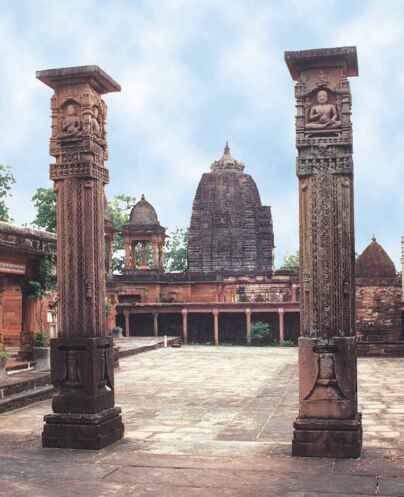
The fort temples are dominated by the Jain temples in the eastern part of the hill fort; the images here are mostly of the "iconographic and the stylistic variety".<ref name="Titze p.103">Titze p.103</ref> The Jain complex was built during 8th to the 17th century and consist of 31 Jain temples housing around 2,000 sculptures which is the largest such collection in the world.<ref>{{Citation|url=http://www.uptourism.gov.in/pages/top/explore/top-explore-jhansi---deogarh/jain-temple|publisher=uptourism.gov.in|title=Jain Temple Complex|access-date=2017-09-22}}</ref> The Jain temples have a large number of panels depicting scenes from Jain | The fort temples are dominated by the Jain temples in the eastern part of the hill fort; the images here are mostly of the "iconographic and the stylistic variety".<ref name="Titze p.103">Titze p.103</ref> The Jain complex was built during 8th to the 17th century and consist of 31 Jain temples housing around 2,000 sculptures which is the largest such collection in the world.<ref>{{Citation|url=http://www.uptourism.gov.in/pages/top/explore/top-explore-jhansi---deogarh/jain-temple|publisher=uptourism.gov.in|title=Jain Temple Complex|access-date=2017-09-22|archive-date=13 March 2017|archive-url=https://web.archive.org/web/20170313022134/http://uptourism.gov.in/pages/top/explore/top-explore-jhansi---deogarh/jain-temple|url-status=dead}}</ref> The Jain temples have a large number of panels depicting scenes from Jain philosophy, [[tirthankara]] images and [[Jain art#Ayagapata|votive tablets]]. The pillars are carved with a thousand figures.<ref name=city>{{Cite web|url=http://www.whereincity.com/india/uttar-pradesh/deogarh.php|title= Deogarh|access-date=2010-01-08}}</ref> Worship at some of the Jain temples are still held regularly. The most famous of the Jain temples in the fort is the Shantinath temple, which was built before 862 AD. It is testament that a prosperous Jain community lived in this region.<ref>{{Cite book|last1=Titze|first1=Kurt| first2=Klaus|last2=Bruhn| title= Jainism: a Pictorial guide to the religion of non-violence|url=https://books.google.com/books?id=loQkEIf8z5wC|publisher= Motilal Banarsidass Publ.|year=1998|isbn=81-208-1534-3|page=105|language=en}}</ref> Jain temple complex in Deogarh is protected by the Department of Archaeology of the [[Archaeological Survey of India]] (ASI).<ref name='asi'>{{Citation|url=http://asi.nic.in/asi_monu_alphalist_uttarpradesh_lucknow.asp|title=Alphabetical List of Monuments - Lucknow Circle, Uttar Pradesh|publisher=Archaeological Survey of India|access-date=2017-09-22}}</ref> ASI maintain an archaeological museum at the Deogarh site, which is noted for its treasured archaeological sculptures.<ref name="asian">{{Cite book|title=Studies in south Asian culture, Part 3|pages=1–29|url=https://books.google.com/books?id=2K83AAAAIAAJ|author=Universiteit van Amsterdam and Institute of South Asian Archaeology|publisher=Brill Archive|year=1958|language=en}}</ref> | ||
== Kankali Tila == | == Kankali Tila == | ||
| Line 44: | Line 51: | ||
==Prominent Tirthas== | ==Prominent Tirthas== | ||
[[File:Shobhnath temple (5703632908).jpg|thumb|Shobhnath temple, [[Shravasti]] ]] | [[File:Shobhnath temple (5703632908).jpg|thumb|[[Shobhnath temple]], [[Shravasti]] ]] | ||
* [[Shantinath Temple, Deogarh|Shantinath Temple]] in [[Deogarh, Uttar Pradesh|Deogarh]] | * [[Shantinath Temple, Deogarh|Shantinath Temple]] in [[Deogarh, Uttar Pradesh|Deogarh]] | ||
* [[Digamber Jain | * [[Digamber Jain Bada Mandir Hastinapur]], [[Meerut]] | ||
* [[Navagarh Tirth]] | * [[Navagarh Tirth]] | ||
* [[Digamber Jain Mandir Hastinapur#Kailash Parvat Rachna|Kailash Parvat Rachna]], Hastinapur, Meerut | * [[Digamber Jain Mandir Hastinapur#Kailash Parvat Rachna|Kailash Parvat Rachna]], Hastinapur, Meerut | ||
* [[Digamber Jain Mandir Hastinapur#Ashtapad Teerth|Ashtapad temple]], Hastinapur, Meerut | * [[Digamber Jain Mandir Hastinapur#Ashtapad Teerth|Ashtapad temple]], Hastinapur, Meerut | ||
* [[Jambudweep|Jambu Dweep Rachana]], Hastinapur, Meerut | * [[Jambudweep|Jambu Dweep Rachana]], Hastinapur, Meerut | ||
* [[Ahichchhatra|Ahi Kshetra]] | * [[Ahichchhatra Jain temples|Ahi Kshetra]] | ||
* [[Vahelna Jain temple]] | * [[Vahelna Jain temple]] | ||
* [[Trilok Teerth Dham]], [[Bada Gaon]] in [[Baghpat]] | * [[Trilok Teerth Dham]], [[Bada Gaon]] in [[Baghpat]] | ||
* [[Parshvanath Jain temple, Varanasi|Parshvanath Jain temple]] in [[Varanasi]] | * [[Parshvanath Jain temple, Varanasi|Parshvanath Jain temple]] in [[Varanasi]] | ||
* [[Sarnath Jain Tirth]] at [[Sarnath]], [[Varanasi]] | * [[Sarnath Jain Tirth]] at [[Sarnath]], [[Varanasi]] | ||
* [[Bateshwar, Uttar Pradesh#Shri Shouripur Digambar Jain Siddha Kshetra|Shri Shouripur Digambar Jain Siddha Kshetra]], [[Bateshwar, Uttar Pradesh|Bateshwar]] | * [[Chandrawati Jain temple]] near [[Varanasi]] | ||
* [[Shobhnath temple]], [[Shravasti]] | |||
* [[Bateshwar, Uttar Pradesh#Shri Shouripur Digambar and shwetambar Jain Siddha Kshetra|Shri Shouripur Digambar Jain Siddha Kshetra]], [[Bateshwar, Uttar Pradesh|Bateshwar]] | |||
* [[Kampil#Jain Temple|Shri Vimalnath Digambar Jain Atishay Kshetra]] in [[Kampil]], [[Farrukhabad district]] | * [[Kampil#Jain Temple|Shri Vimalnath Digambar Jain Atishay Kshetra]] in [[Kampil]], [[Farrukhabad district]] | ||
* [[Bada Gaon temple|Shree Parsvnath Atishey Kshetra Digamber Jain mandir]], [[Bada Gaon]] in [[Baghpat]] | * [[Bada Gaon temple|Shree Parsvnath Atishey Kshetra Digamber Jain mandir]], [[Bada Gaon]] in [[Baghpat]] | ||
| Line 69: | Line 78: | ||
File:Kailash Parvat Rachna - 1.jpg|Kailash Parvat Rachna | File:Kailash Parvat Rachna - 1.jpg|Kailash Parvat Rachna | ||
File:Vishal-singh-dwaar-big.jpg|[[Digamber Jain Mandir Hastinapur|Prachin Bada Mandir]] | File:Vishal-singh-dwaar-big.jpg|[[Digamber Jain Mandir Hastinapur|Prachin Bada Mandir]] | ||
File: | File:Jambudweep Rachna.jpg|[[Jambudweep Rachna]] | ||
File:Bada Gaon - Old Temple.jpg|[[Bada Gaon temple]] | File:Bada Gaon - Old Temple.jpg|[[Bada Gaon temple]] | ||
File: | File:Trilok teerth dham.jpg|[[Trilok Teerth Dham]] | ||
File: | File:Bhelupur Shwetambar temple (1).jpg|[[Parshvanath Jain temple, Varanasi]] | ||
File:Haridwar Jain temple (1).jpg|[[Haridwar#Shri Chintamani Parshwnath Jain Shwetambar Mandir|Shri Chintamani Parshwnath temple, Haridwar]] | File:Haridwar Jain temple (1).jpg|[[Haridwar#Shri Chintamani Parshwnath Jain Shwetambar Mandir|Shri Chintamani Parshwnath temple, Haridwar]] | ||
File:Shri agarwal digamber jain bada mandir moti katra agra.jpg|Agra Jain temple | File:Shri agarwal digamber jain bada mandir moti katra agra.jpg|Agra Jain temple | ||
| Line 84: | Line 93: | ||
==References== | ==References== | ||
* {{citation |last=Balcerowicz |first=Piotr |title=Early Asceticism in India: Ājīvikism and Jainism | year=2015 |edition=1st |publisher=Routledge | url = https://books.google.com/books?id=nfOPCgAAQBAJ |isbn= 9781317538530 }} | * {{citation |last=Balcerowicz |first=Piotr |title=Early Asceticism in India: Ājīvikism and Jainism | year=2015 |edition=1st |publisher=Routledge | url = https://books.google.com/books?id=nfOPCgAAQBAJ |isbn= 9781317538530 |language=en}} | ||
* {{cite book|author=John Cort|title=Framing the Jina: Narratives of Icons and Idols in Jain History|url=https://books.google.com/books?id=MDBpq23-0QoC |year=2010|publisher=Oxford University Press|isbn=978-0-19-973957-8}} | * {{cite book|author=John Cort|title=Framing the Jina: Narratives of Icons and Idols in Jain History|url=https://books.google.com/books?id=MDBpq23-0QoC |year=2010|publisher=Oxford University Press|isbn=978-0-19-973957-8|language=en}} | ||
* {{citation |title=Early Inscriptions of Mathurā |last1=Das |first1=Kalyani |url=https://books.google.com/books?id=UuwLAAAAIAAJ |year=1980}} | |||
* {{cite book|first=B.C.|last= Law| year= 1935| title= Sravasti in Indian Literature|publisher = Memoirs of the Archaeological Survey of India: Number 50, ASI}} | |||
* {{citation |editor=Patrick Olivelle |editor-link=Patrick Olivelle |title=Between the Empires : Society in India 300 BCE to 400 CE |url=https://books.google.com/books?id=efaOR_-YsIcC |publisher=[[Oxford University Press]] |date=2006 |isbn=978-0-19-530532-6 }} | * {{citation |editor=Patrick Olivelle |editor-link=Patrick Olivelle |title=Between the Empires : Society in India 300 BCE to 400 CE |url=https://books.google.com/books?id=efaOR_-YsIcC |publisher=[[Oxford University Press]] |date=2006 |isbn=978-0-19-530532-6 }} | ||
* {{citation |last=Zimmer |first=Heinrich |author-link=Heinrich Zimmer |title=Philosophies Of India |date=1953 |orig-year=April 1952 |editor-first=Joseph |editor-last=Campbell |editor-link=Joseph Campbell |publisher=[[Routledge]] & Kegan Paul Ltd |location=[[London]] | * {{citation |last=Zimmer |first=Heinrich |author-link=Heinrich Zimmer |title=Philosophies Of India |date=1953 |orig-year=April 1952 |editor-first=Joseph |editor-last=Campbell |editor-link=Joseph Campbell |publisher=[[Routledge]] & Kegan Paul Ltd |location=[[London]] |url=https://archive.org/details/Philosophy.of.India.by.Heinrich.Zimmer |isbn=978-81-208-0739-6 |quote={{PD-notice}} }} | ||
* {{citation|last1=Smith|first1=Vincent Arthur|title=The Jain stupa and other antiquities of Mathura|year=1901|url=https://archive.org/details/cu31924012251140}} | * {{citation|last1=Smith|first1=Vincent Arthur|title=The Jain stupa and other antiquities of Mathura|year=1901|publisher=Allahabad, Printed by KFrank Luker, Superintendent, Government Press, North-Western Provinces and Oudh |url=https://archive.org/details/cu31924012251140}} | ||
*{{citation|last=Thomas|first=Edward|title=Jainism or The early faith of Asoka|journal=Nature|volume=16|issue=407|pages=329|url=https://archive.org/details/jainism_00thom|year=1877|publisher=London, Trübner & co.|location=London|bibcode= 1877Natur..16..329.|doi=10.1038/016329a0|s2cid=36798109|doi-access=free}} | *{{citation|last=Thomas|first=Edward|title=Jainism or The early faith of Asoka|journal=Nature|volume=16|issue=407|pages=329|url=https://archive.org/details/jainism_00thom|year=1877|publisher=London, Trübner & co.|location=London|bibcode= 1877Natur..16..329.|doi=10.1038/016329a0|s2cid=36798109|doi-access=free}} | ||
| Line 96: | Line 107: | ||
[[Category:Jain communities]] | [[Category:Jain communities]] | ||
[[Category:Jainism in Uttar Pradesh]] | [[Category:Jainism in Uttar Pradesh]] | ||
Latest revision as of 02:56, 7 March 2026
| Part of a series on |
| Jainism |
|---|
| Error creating thumbnail: File missing |
Uttar Pradesh, a state in north India has a long association with Jainism. Today the state is home to a number of Jain monuments, such as Jain Temples and Jain Tirths. There are around 213,267 Jains in Uttar Pradesh according to the 2011 Census of India.[1]
History[edit | edit source]
Parshvanatha, the twenty-third tirthankara, was born in Benaras (now Varanasi)[2] in 872 BCE.[3] According to Jain tradition, Kashi (now Varanasi) is the birthplace of three more tithankaras, namely Suparshvanatha, Chandraprabha and Shreyansanatha.[4]
According to Jain tradition, five tirthankaras were born at Ayodhya, including Rishabhanatha,[5] Ajitanatha,[6] Abhinandananatha,[7] Sumatinatha[8] and Anantanatha.[9]
The famous naked male torso found at Lohanipur, whether Mauryan or, more likely Kushana, is generally taken as indicative evidence of ascetic tradition in north India. Inscriptions from the many ayagapatas of the Mathura region make clear that puja to the tirthankaras with lay and ascetic involvement was an important dimension to this.[10]
The earliest archeological evidence is in the form of a naked headless torso discovered in 1937 near Patna (Bihar), which is called the Lohanipur Torso. This has been dated by modern scholarship to about the 2nd-century BCE. It is a highly polished stone artwork of precise human form, but it is unclear if it belongs to Jainism, Ajivikas or some other Indian religious ascetic tradition.[11] While it is not Buddhist, and is naked like the Jinas, it may also not be a Jain statue because it lacks the Jain iconography, and because similar high quality Jain artworks are missing for many centuries and Jain artworks that have been found from the same period in north India show quite different forms and symbols. It may belong to Ajivikas or another ancient Indian naked ascetic tradition.[11][12] Ancient naked terracotta statues discovered in 1970s near Ayodhya are similar to the Lohanipur Torso, but terracotta arts are also missing in Jaina tradition and the Ayodhya terracotta statues too lack Jain iconography.[11][12]
Shravasti[edit | edit source]
Shravasti is often mentioned in Jaina sources. It is also called Chandrapuri or Chandrikapuri or Ārya Kṣetra, because Jaina texts state that two of their Tirthankaras were born here millions of years ago, in prehistoric times – Sambhavanatha (3rd of 24) and Chandraprabha (8th of 24). Sravasti is also known as the capital city of Kunala's kingdom.[13]
Sambhavanatha is said to have had taken initiation, donated all his belongings, and broken his first fast in Sravasti after begging for alms from King Surendradatta.[14][15] Munisuvrataswami, the 20th Tirthankara, visited Sravasti and initiated several members of the royal family. As per the Jaina text Jnatadharmakathah, Parshvanatha, the 23rd Tirthankara, also visited Sravasti and inspired several lay-followers to accept initiation.[16]
Further, Shravasti is the place of the bitter arguments and meeting between Mahavira – the 24th Tirthankara, and Gosala Mankhaliputta – the founder of Ajivikas and a rival. According to the Jain texts, the Mahavira visited Shravasti many times and spent his tenth varsha monsoon season here before attaining omniscience. He was hosted by a wealthy merchant named Nandinipriya. Ancient Jain scholars such as Kapila, Maghavan and Keshi studied in Shravasti.[16] At Sravasti, Jamāli, Mahavira's son-in-law, created the first of the eight heretical sects by opposing tenets of Jainism as taught by Mahavira himself. The eighth heretical sect, Digambara sect, was created by Sivabhuti at Rathavirapur.[17] As described in the Jaina text Uttaradhyayana Sutra, the discussion between Keśiśramanācharya and Mahavira's first disciple, Gautama Swami, is said to have had taken place at Sravasti. This was the place where Upkeśa Gaccha was established by Keśiśramanācharya after he accepted Mahavira's conduct and became a white-clad monk along with all his disciples who were initially following Parshvanatha's conduct.[18] Moreover, the Pattavali described in the Kalpa Sūtra, states the existence of "Śrāvastikā Śākhā", one of the four branches of the "Veṣavāṭikgaṇa" of the Jaina sangha. It had originated from Ācārya Kāmardhi, a disciple of Ācārya Suhastisuri, belonging to the beginning of the 3rd century BCE.[19] Ācārya Jinaprabhasuri, in his Vividha Tirtha Kalpa confirms that a Jaina temple with an image of Sambhavanatha was renovated multiple times until it was finally completely desecrated during the reign of Alauddin Khilji.[20]
Bundelkhand[edit | edit source]
It is one of the few regions in India where Jainism has a strong presence and influence. There are many ancient tirthas in Bundelkhand. Many of the modern scholars of Jainism are from this region.[citation needed]
Deogarh[edit | edit source]
The fort temples are dominated by the Jain temples in the eastern part of the hill fort; the images here are mostly of the "iconographic and the stylistic variety".[21] The Jain complex was built during 8th to the 17th century and consist of 31 Jain temples housing around 2,000 sculptures which is the largest such collection in the world.[22] The Jain temples have a large number of panels depicting scenes from Jain philosophy, tirthankara images and votive tablets. The pillars are carved with a thousand figures.[23] Worship at some of the Jain temples are still held regularly. The most famous of the Jain temples in the fort is the Shantinath temple, which was built before 862 AD. It is testament that a prosperous Jain community lived in this region.[24] Jain temple complex in Deogarh is protected by the Department of Archaeology of the Archaeological Survey of India (ASI).[25] ASI maintain an archaeological museum at the Deogarh site, which is noted for its treasured archaeological sculptures.[26]
Kankali Tila[edit | edit source]
Kankali Tila is a mound located at Mathura. The name of the mound is derived from a modern temple of Hindu goddess Kankali. The famous Jain stupa was excavated here in 1890-91 by Alois Anton Führer (Dr. Führer).[27] The archaeological findings testifies the existence of two Jain temples and stupas. Numerous Jain sculptures, Ayagapattas (tablet of homage).[28]
Most sculptures could be dated from the 2nd century BC to the 12th century CE, thus representing a continuous period of about 14 centuries during which Jainism flourished at Mathura. These sculptures are now housed in the Lucknow State Museum and in the Mathura Museum. The excavations of Kankali Tila are regarded as a testimony great antiquity of Jainism.[29]
Prominent Tirthas[edit | edit source]
- Shantinath Temple in Deogarh
- Digamber Jain Bada Mandir Hastinapur, Meerut
- Navagarh Tirth
- Kailash Parvat Rachna, Hastinapur, Meerut
- Ashtapad temple, Hastinapur, Meerut
- Jambu Dweep Rachana, Hastinapur, Meerut
- Ahi Kshetra
- Vahelna Jain temple
- Trilok Teerth Dham, Bada Gaon in Baghpat
- Parshvanath Jain temple in Varanasi
- Sarnath Jain Tirth at Sarnath, Varanasi
- Chandrawati Jain temple near Varanasi
- Shobhnath temple, Shravasti
- Shri Shouripur Digambar Jain Siddha Kshetra, Bateshwar
- Shri Vimalnath Digambar Jain Atishay Kshetra in Kampil, Farrukhabad district
- Shree Parsvnath Atishey Kshetra Digamber Jain mandir, Bada Gaon in Baghpat
- Shri Chintamani Parshwnath Jain Shwetambar Mandir, Haridwar
- Khukhundoo
Photo gallery[edit | edit source]
-
-
Jain Ghat, Varanasi, UP, India
-
Kailash Parvat Rachna
-

-

-

-
 Agra Jain temple


See also[edit | edit source]

Notes[edit | edit source]
- ↑ Office of registrar general and census commissioner (2011), C-1 Population By Religious Community, Ministry of Home Affairs, Government of India
- ↑ Zimmer 1953, p. 195.
- ↑ Zimmer 1953, p. 183.
- ↑ "4 Jain Tirthankaras born in Varanasi", The Times of India, 25 August 2015
- ↑ Birth of Adinath in Ayodhya, archived from the original on 27 June 2012, retrieved 5 March 2012
- ↑ Birth of Ajitnath in Ayodhya, archived from the original on 14 April 2012, retrieved 5 March 2012
- ↑ Birth of Abhinandanath in Ayodhya, archived from the original on 10 April 2012, retrieved 5 March 2012
- ↑ Birth of Sumatinath in Ayodhya, archived from the original on 10 March 2012, retrieved 5 March 2012
- ↑ Birth of Anantnath in Ayodhya, archived from the original on 14 April 2012, retrieved 5 March 2012
- ↑ Patrick Olivelle 2006, p. 399.
- ↑ 11.0 11.1 11.2 John Cort 2010, pp. 32-37.
- ↑ 12.0 12.1 Balcerowicz 2015, pp. 286-287.
- ↑ Temple, Richard. "Indian Antiquary Vol 53".
- ↑ www.wisdomlib.org (30 November 2018). "Part 10: Sambhava's initiation". www.wisdomlib.org. Retrieved 8 February 2025.
- ↑ www.wisdomlib.org (30 November 2018). "Part 11: Sambhava's fast-breaking". www.wisdomlib.org. Retrieved 8 February 2025.
- ↑ 16.0 16.1 Law 1935, pp. 25–26.
- ↑ Chatterjee, Aseem Kumar. "Comprehensive History Of Jainism".
- ↑ Jacobi, Hermann. "TWENTY-THIRD LECTURE: KÊSI AND GAUTAMA".
- ↑ Jacobi, Hermann. "LIST OF THE STHAVIRAS".
- ↑ Jinaprabhasuri, Ācārya. "Vividha Tirtha Kalpa".
- ↑ Titze p.103
- ↑ Jain Temple Complex, uptourism.gov.in, archived from the original on 13 March 2017, retrieved 22 September 2017
- ↑ "Deogarh". Retrieved 8 January 2010.
- ↑ Titze, Kurt; Bruhn, Klaus (1998). Jainism: a Pictorial guide to the religion of non-violence. Motilal Banarsidass Publ. p. 105. ISBN 81-208-1534-3.
- ↑ Alphabetical List of Monuments - Lucknow Circle, Uttar Pradesh, Archaeological Survey of India, retrieved 22 September 2017
- ↑ Universiteit van Amsterdam and Institute of South Asian Archaeology (1958). Studies in south Asian culture, Part 3. Brill Archive. pp. 1–29.
- ↑ Smith 1901, p. Introduction.
- ↑ Das 1980, p. 171.
- ↑ Thomas 1877, p. 80.
References[edit | edit source]
- Balcerowicz, Piotr (2015), Early Asceticism in India: Ājīvikism and Jainism (1st ed.), Routledge, ISBN 9781317538530
- John Cort (2010). Framing the Jina: Narratives of Icons and Idols in Jain History. Oxford University Press. ISBN 978-0-19-973957-8.
- Das, Kalyani (1980), Early Inscriptions of Mathurā
- Law, B.C. (1935). Sravasti in Indian Literature. Memoirs of the Archaeological Survey of India: Number 50, ASI.
- Patrick Olivelle, ed. (2006), Between the Empires : Society in India 300 BCE to 400 CE, Oxford University Press, ISBN 978-0-19-530532-6
- Zimmer, Heinrich (1953) [April 1952], Campbell, Joseph (ed.), Philosophies Of India, London: Routledge & Kegan Paul Ltd, ISBN 978-81-208-0739-6,
Error creating thumbnail: File missing This article incorporates text from this source, which is in the public domain.
- Smith, Vincent Arthur (1901), The Jain stupa and other antiquities of Mathura, Allahabad, Printed by KFrank Luker, Superintendent, Government Press, North-Western Provinces and Oudh
- Thomas, Edward (1877), "Jainism or The early faith of Asoka", Nature, 16 (407), London: London, Trübner & co.: 329, Bibcode:1877Natur..16..329., doi:10.1038/016329a0, S2CID 36798109
See also : Jain temples in North America | |
| Bihar | |
| Delhi | |
| Gujarat | |
| Jharkhand | |
| Karnataka | |
| Kerala | |
| Madhya Pradesh | |
| Maharashtra | |
| Nagaland | |
| Odisha | |
| Rajasthan | |
| Tamil Nadu | |
| Telangana | |
| Uttar Pradesh | |
| West Bengal | |


| Gods | |||||
|---|---|---|---|---|---|
| Philosophy | |||||
| Branches |
| ||||
| Practices | |||||
| Literature | |||||
| Symbols |
| ||||
| Ascetics | |||||
| Scholars | |||||
| Community | |||||
| Jainism in |
| ||||
| Jainism and | |||||
| Dynasties and empires | |||||
| Related | |||||
| Lists | |||||
| Navboxes | |||||


.jpg)


.jpg)
.jpg)
