


robot: Update article (please report if you notice any mistake or error in this edit) |
Charnkamal (talk | contribs) added references |
||
| Line 1: | Line 1: | ||
{{short description|Tamil Hindu harvest festival | {{pp|small=yes}} | ||
{{short description|Tamil Hindu harvest festival}} | |||
{{For|the dish|Pongal (dish)}} | {{For|the dish|Pongal (dish)}} | ||
{{EngvarB|date=April 2015}} | {{EngvarB|date=April 2015}} | ||
| Line 5: | Line 6: | ||
{{Infobox holiday | {{Infobox holiday | ||
| holiday_name = Pongal | | holiday_name = Pongal | ||
| image = | | image = Pongal fest.jpg | ||
| caption = | | caption = Pongal dish cooked for the occasion of the festival | ||
| observedby = | | observedby = Primarily [[Tamils|Tamil Hindus]] in [[India]], [[Sri Lanka]], [[Malaysia]], [[United States]], [[Indonesia]], [[Mauritius]], [[Singapore]], [[UK]], [[South Africa]], [[Canada]], [[Australia]], [[Gulf countries]] | ||
| date = Last day of the ninth [[Tamil calendar]] month of [[Margazhi]] ([[Bhogi]]) <br/> First day of the tenth month of [[Thai (month)|Thai]] (Thai Pongal) and next one or two days ([[Mattu Pongal]] and Kaanum Pongal) | |||
| celebrations = Pongal dish, decorations | | celebrations = Preparation of [[Pongal (dish)|Pongal]], decorations, home coming, prayers, processions, gift giving<ref name="Beteille"/> | ||
| longtype = Hindu | | longtype = [[List of Hindu festivals|Hindu]]<ref name="Brittanica">{{cite encyclopedia|url=https://www.britannica.com/topic/Pongal|title=Pongal (Hindu festival)|date=2016|encyclopedia=[[Britannica]]|access-date=15 January 2023}}</ref><ref>{{cite web|url=https://www.indiaculture.gov.in/festivals-religious|title=Religious Festivals|work=[[Government of India]]|access-date=1 October 2022}}</ref> | ||
| | | type = [[Hindu]] | ||
| | | significance = [[Harvest festival]], [[Winter Solstice]]. Worship of the [[Surya|Solar deity]] for agricultural abundance, and celebration of cattle. | ||
| | |||
| relatedto = [[Makar Sankranti]], [[Magh Bihu]], [[Uttarayana]], [[Maghi]], [[Maghe Sankranti]], [[Shakrain]] | | relatedto = [[Makar Sankranti]], [[Magh Bihu]], [[Uttarayana]], [[Maghi]], [[Maghe Sankranti]], [[Shakrain]] | ||
| startedby = | | startedby = | ||
| firsttime = | | firsttime = | ||
| Line 28: | Line 26: | ||
| nickname = | | nickname = | ||
| alt = | | alt = | ||
| | | date2025 = 13-16 January<ref>{{cite web|url=https://www.hindustantimes.com/lifestyle/festivals/pongal-2025-when-is-pongal-know-date-history-significance-and-all-about-4-days-of-the-festival-101736753124366.html|access-date=13 January 2025|title=Pongal 2025: When is Pongal? Know date, history, significance and all about 4 days of the festival|last=Agnihotri|first=Akanksha|date=13 January 2025|work=[[The Hindustan Times]]}}</ref> | ||
| | |||
}} | }} | ||
{{Tamil transliteration}} | {{Tamil transliteration}} | ||
'''Pongal''' | '''Pongal''' is a multi-day [[Hindu]] [[harvest festival]] celebrated by [[Tamils]]. The festival is celebrated over three or four consecutive days, which are named [[Bhogi]], Thai Pongal, [[Mattu Pongal]] and [[Kaanum Pongal]], beginning on the last day of the [[Tamil calendar]] month of [[Margazhi]]. Thai Pongal is observed on the first day of the Tamil calendar month of [[Thai (month)|Thai]] and usually falls on 14 or 15 [[January]] in the [[Gregorian calendar]]. | ||
According to tradition, the festival marks the end of [[winter solstice]], and the start of the | According to tradition, the festival marks the end of [[winter solstice]], and the start of the Sun's six-month-long journey northwards called [[Uttarayana]] when the Sun enters [[Capricorn (astrology)|Capricorn]]. It is dedicated to the [[solar deity]] [[Surya]] and corresponds to [[Makar Sankranti]], the Hindu observance celebrated under various regional names across the [[Indian subcontinent]]. | ||
The festival is named after the ceremonial "Pongal", which means "boiling over" or "overflow" in [[Tamil language]] and refers to the traditional [[Pongal (dish)|dish]] prepared by boiling rice with [[cow milk|milk]] and [[jaggery]]. Mattu Pongal is meant for celebration of [[cattle]], and the cattle are bathed, their horns polished and painted in bright colors with garlands of flowers placed around their necks and processions on the day. The festival is traditionally an occasion for decorating with rice-powder based [[kolam]] artworks, offering prayers at home, visiting temples, getting together with family and friends, and exchanging gifts to renew social bonds of solidarity. | |||
Pongal is also referred to as ''Tamizhar thirunal'' ("festival of Tamils") and is one of the major festivals celebrated by the Tamil people across various religions. It is observed by the [[Tamil diaspora]] in the Indian state of [[Tamil Nadu]], parts of [[South India]], [[Sri Lanka]] and other parts of the world with significant Tamil population. | |||
'' | |||
== Etymology == | |||
''Thai Pongal'' is a combination of two [[Tamil language]] words: ''Thai'' (Tamil: 'தை') referring to the tenth month of the [[Tamil calendar]] and ''Pongal'' (from ''pongu'') meaning "boiling over" or "overflow." Pongal also refers to a sweet [[Pongal (dish)|dish]] of [[rice]] boiled with [[cow milk|milk]] and [[jaggery]] that is ritually prepared and consumed on the day.<ref name="Robinson"/> It is also referred to as ''Tamizhar thirunal'' ("the festival of Tamil people").<ref>{{cite journal|last=Béteille|first=André|title=A Note on the Pongal Festival in a Tanjore Village|journal=Man|volume=64|issue=2|year=1964|page=74|doi=10.2307/2797924|jstor=2797924|quote=It is now viewed by an increasing number of people as a symbol of all that is local and indigenous to Tamilnad. In many quarters it is celebrated today as thamizhar thirunal: the day auspicious to Tamils.}}</ref> | |||
== History == | |||
| | The principal theme of Pongal is thanking the Sun god [[Surya]], the forces of nature, and the [[cattle|farm animals]] and [[farmer|people who support agriculture]]. The festival is mentioned in an inscription found at the [[Veeraraghava Swamy Temple]]. Attributed to the [[Chola]] king [[Kulottunga I]] (1070–1122 CE), the inscription describes a grant of land to the temple for celebrating the annual Pongal festivities.<ref name="Kasturi">{{cite book|first1=Prema|last1=Kasturi|first2=Chithra|last2=Madhavan|title=South India heritage: an introduction|url=https://books.google.com/books?id=_HwMAQAAMAAJ|year=2007|publisher=East West Books|isbn=978-8-18866-164-0|page=223|access-date=30 October 2019|archive-date=21 April 2023|archive-url=https://web.archive.org/web/20230421115348/https://books.google.com/books?id=_HwMAQAAMAAJ|url-status=live}}</ref> The ninth century [[Shaivism|Shaiva]] [[Bhakti movement|Bhakti]] text ''[[Tiruvempavai]]'' by [[Manikkavacakar]] details the festival.<ref name="Kasturi"/> It appears in [[Tamil literature|Tamil texts]] and inscriptions with variant spellings such as ''ponakam'', ''tiruponakam,'' and ''ponkal''. Temple inscriptions from the Chola and [[Vijayanagara Empire|Vijayanagara]] periods detail recipes similar to [[Pongal (dish)|pongal]] recipes of the modern era with variations in seasonings and relative amounts of the ingredients. The terms ''ponakam'', ''ponkal'' and its prefixed variants might also indicate the festive pongal dish as a [[prasadam]] (religious offering) which were given as a part of the meals served by free community kitchens in [[South India]]n Hindu temples either as festival food or to pilgrims every day.<ref name="Gutierrez">{{cite journal|last=Gutiérrez|first=Andrea|title=Jewels Set in Stone: Hindu Temple Recipes in Medieval Cōḻa Epigraphy|journal=Religions|volume=9|issue=9|year=2018|issn=2077-1444|doi=10.3390/rel9090270|pages=279–281, context: 270–303|doi-access=free}}</ref> | ||
| | |||
| | == Observance == | ||
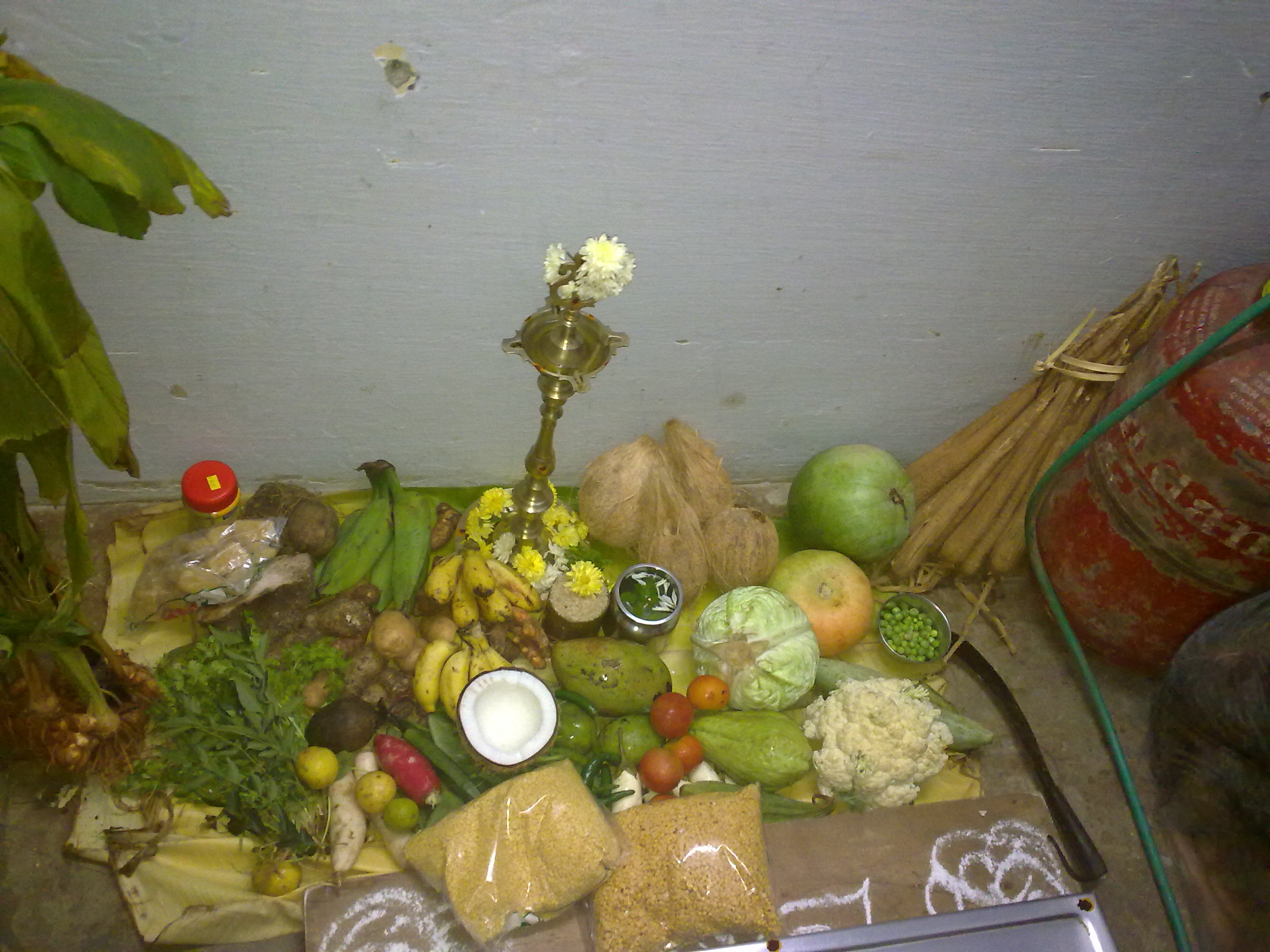
| | [[File:Pongal offerings.jpg|thumb|Pongal offering to Gods]] | ||
| | |||
}} | Pongal is a multi-day [[Hindu]] [[harvest festival]] celebrated by [[Tamils]].<ref name="Brittanica"/><ref name="Robinson">{{cite book|author1=Denise Cush|author2=Catherine A. Robinson|author3=Michael York|title=Encyclopedia of Hinduism|url=https://books.google.com/books?id=i_T0HeWE-EAC|year=2008|publisher=Psychology Press|isbn=978-0-70071-267-0|pages=610–611|access-date=30 October 2019|archive-date=21 April 2023|archive-url=https://web.archive.org/web/20230421115354/https://books.google.com/books?id=i_T0HeWE-EAC|url-status=live}}</ref><ref name="Ramaswamy"/> The three days of the Pongal festival are called [[Bhogi]], Thai Pongal, and [[Mattu Pongal]].<ref name="Mathews">{{cite book|first1=A|last1=Mani|first2=Pravin|last2=Prakash|first3=Shanthini|last3=Selvarajan|editor=Mathew Mathews|title=Singapore Ethnic Mosaic, The: Many Cultures, One People|url=https://books.google.com/books?id=Y4RIDwAAQBAJ|year=2017|publisher=World Scientific Publishing Company, Singapore|isbn=978-9-81323-475-8|pages=207–211|access-date=30 October 2019|archive-date=21 April 2023|archive-url=https://web.archive.org/web/20230421115401/https://books.google.com/books?id=Y4RIDwAAQBAJ|url-status=live}}</ref> Some Tamils celebrate a fourth day of Pongal known as Kanum Pongal.<ref name="Ramaswamy"/> While the festival is observed for three or four days in [[Tamil Nadu]], but for one or two days in urban locations and by the [[Tamil diaspora]] outside [[South Asia]].<ref name="Brittanica"/><ref name="Ramaswamy">{{cite book|author=Vijaya Ramaswamy|title=Historical Dictionary of the Tamils|url=https://books.google.com/books?id=ALUvDwAAQBAJ&pg=PA274|year=2017|publisher=Rowman & Littlefield Publishers|isbn=978-1-53810-686-0|pages=274–275|access-date=30 October 2019|archive-date=21 April 2023|archive-url=https://web.archive.org/web/20230421115406/https://books.google.com/books?id=ALUvDwAAQBAJ&pg=PA274|url-status=live}}</ref> | ||
=== Bhogi === | |||
{{main|Bhogi}} | |||
Bhogi marks the first day of the Pongal festivities and is celebrated on the last day of the [[Tamil calendar]] month [[Agrahayana|Marghazhi]].<ref name="Kasturi"/> On this day people discard old belongings and celebrate new possessions. The people assemble and light a bonfire in order to burn the heaps of discards.<ref name="Maithily"/> Houses are cleaned, painted and decorated to give a festive look.<ref name="Mathews"/> Prayers are offered to [[Indra]], the king of Gods with thanks and hopes for plentiful rains in the year ahead.<ref name="Mathews"/> Kaappu kattu is a tradition of tying leaves of [[Azadirachta indica]], [[Senna auriculata]] and [[Aerva lanata]] in the roofs of houses and residential areas that is widely practiced in the [[Kongu Nadu]] region.<ref>{{cite book|title=Madras District Gazetteers: Tiruchirappalli (pt. 1-2)|first=B. S.|last=Baliga (Rao Bahadur.)|year=1998|page=338|publisher=Superintendent, Government Press}}</ref><ref>{{cite magazine|title=Kaapu kattu is not just a ritual|url=https://www.vikatan.com/oddities/miscellaneous/147093-kappu-kattu-not-just-a-ritual-medical-knowledge-of-ancient-tamils|access-date=14 January 2023|magazine=Vikatan|language=ta}}</ref> Bhogi is observed on the same day in the South Indian states of Tamil Nadu, [[Karnataka]], [[Andhra Pradesh]] and [[Telangana]].<ref>{{cite news|last=Murthy|first=Neeraja|date=13 January 2020|title=Citizens speak about the change they would want to see this Bhogi|newspaper=[[The Hindu]]|url=https://www.thehindu.com/society/a-few-hyderabadis-speak-about-the-change-they-would-want-to-see-in-their-life-and-in-society/article30557580.ece|access-date=13 January 2022|issn=0971-751X}}</ref> Fruits of the harvest are collected along with flowers of the season and a mixture of treats along with money is given to children, who then separate and collect the money and sweet fruits.<ref>{{cite web|date=13 January 2022|title=Happy Bhogi 2022: Significance & History Of This Festival In South India|url=https://news.abplive.com/tamil-nadu/happy-bhogi-2022-significance-history-of-this-festival-in-south-india-1506090|access-date=14 January 2022|work=ABP News|archive-date=14 January 2022|archive-url=https://web.archive.org/web/20220114181233/https://news.abplive.com/tamil-nadu/happy-bhogi-2022-significance-history-of-this-festival-in-south-india-1506090|url-status=live}}</ref> | |||
==Pongal | === Thai Pongal === | ||
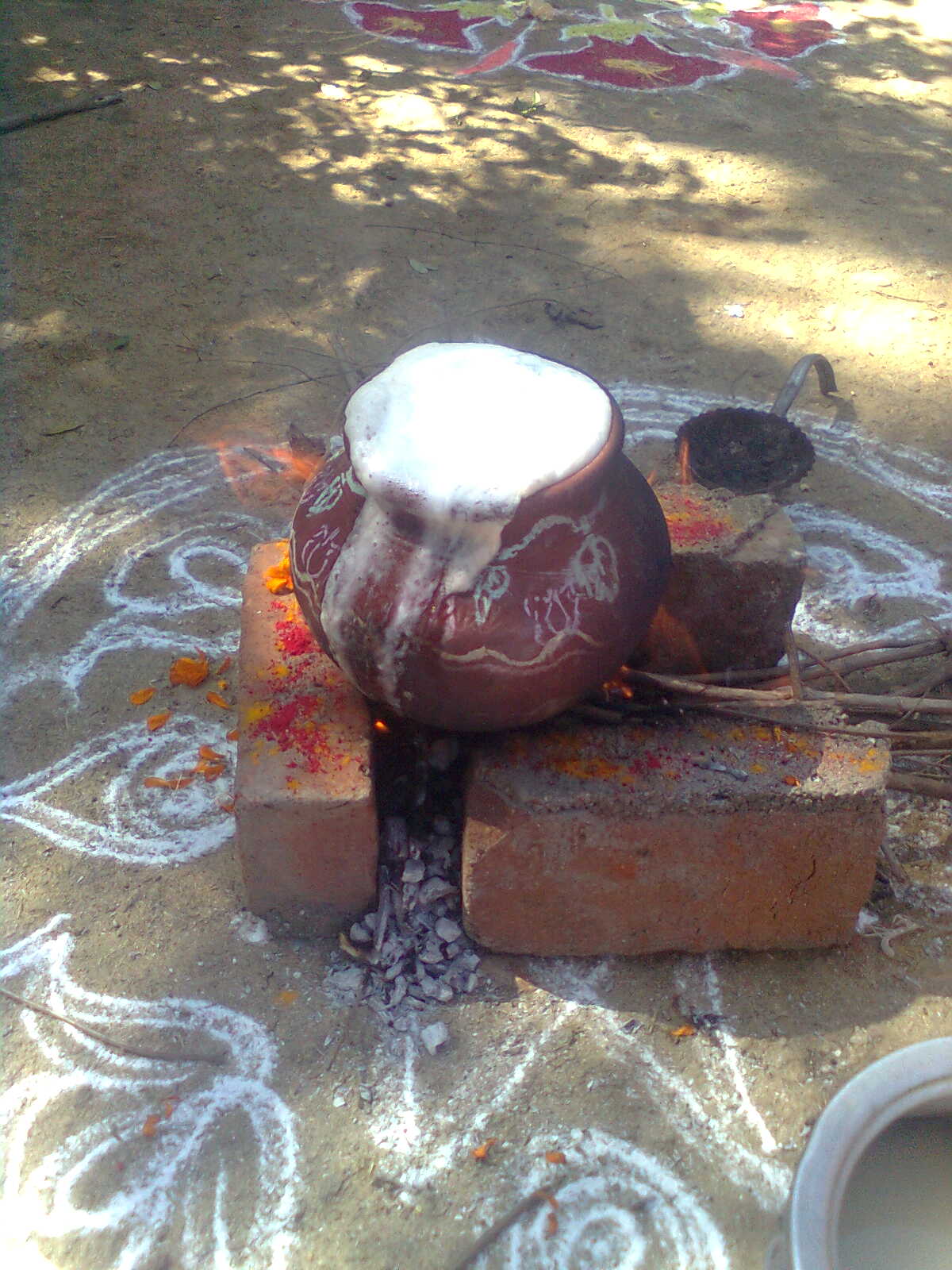
[[File:Pongum pongal.jpg|thumb|upright=0.8|Pongal in earthern pot]] | |||
Thai Pongal is the main festive day, celebrated on the next day of Bhogi.<ref name="Mathews"/><ref name="Maithily">{{cite book|first=Maithily|last=Jagannathan|title=South Indian Hindu Festivals and Traditions|url=https://books.google.com/books?id=xcIrkKUJH9QC|year=2005|publisher=Abhinav Publications|isbn=978-81-7017-415-8|pages=139–141}}</ref> It is observed on the first day of the Tamil calendar month of [[Thai (month)|Thai]], and usually falls on 14 or 15 January as per the [[Gregorian calendar]].<ref name="Beteille">{{cite journal|last=Beteille|first=Andre|title=89. A Note on the Pongal Festival in a Tanjore Village|journal=Man|publisher=Royal Anthropological Institute of Great Britain and Ireland|volume=64|year=1964|issn=0025-1496|doi=10.2307/2797924|pages=73–75|jstor=2797924}}</ref> It is dedicated to the [[Sun deity]] [[Surya]] and corresponds to [[Makar Sankranti]], the harvest festival under various regional names celebrated throughout India.<ref>{{cite book|first=R|last=Abbas|title=History of People and Their Environs|url=https://books.google.com/books?id=crxUQR_qBXYC|year=2011|publisher=Bharathi Puthakalayam|isbn=978-9-38032-591-0|pages=751–752|access-date=30 October 2019|archive-date=21 April 2023|archive-url=https://web.archive.org/web/20230421115350/https://books.google.com/books?id=crxUQR_qBXYC|url-status=live}}</ref><ref name="Melton">{{cite book|author=J. Gordon Melton|title=Religious Celebrations: An Encyclopedia of Holidays, Festivals, Solemn Observances, and Spiritual Commemorations|url=https://books.google.com/books?id=lD_2J7W_2hQC|year=2011|publisher=ABC-CLIO|isbn=978-1-59884-206-7|pages=547–548}}</ref><ref name="Hamilton">{{cite book|author1=Roy W. Hamilton|author2=Aurora Ammayao|title=The art of rice: spirit and sustenance in Asia|url=https://books.google.com/books?id=yyQoAQAAMAAJ|year=2003|publisher=University of California Press|isbn=978-0-930741-98-3|pages=156–157|access-date=30 October 2019|archive-date=21 April 2023|archive-url=https://web.archive.org/web/20230421115348/https://books.google.com/books?id=yyQoAQAAMAAJ|url-status=live}}</ref> According to tradition, the festival marks the end of [[winter solstice]], and the start of the sun's six-month-long journey northwards when the sun enters the [[Capricorn (astrology)|Capricorn]], also called as [[Uttarayana]].<ref name="Brittanica"/> | |||
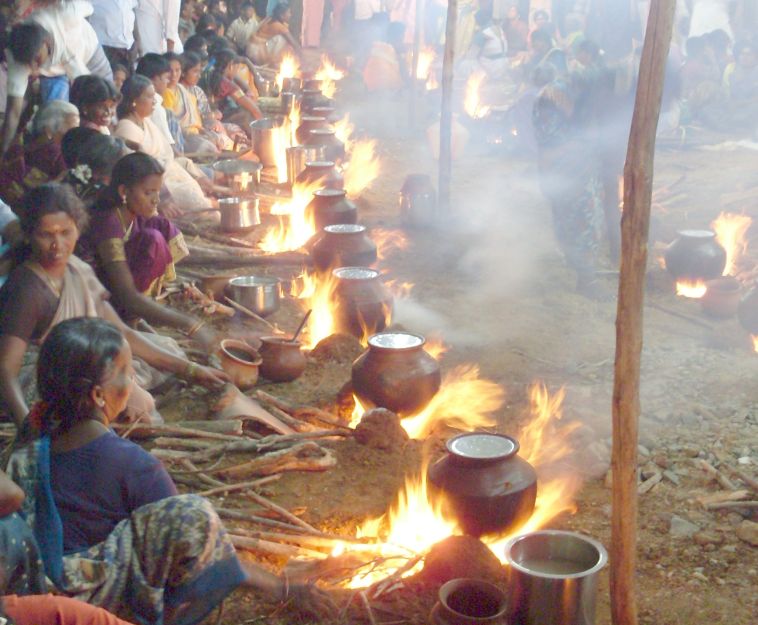
Dedicated to Surya, it is celebrated with family and friends with new clothes worn and the preparation of the traditional pongal dish in an earthen pot.<ref name="Ramaswamy"/> The pot is typically decorated by tying a turmeric plant or flower garland and placed in the sun along with [[sugarcane]] stalks.<ref name="Ramaswamy"/> The homes are decorated with banana and mango leaves, decorative florals and kolams.<ref name="Ramaswamy"/> Relatives and friends are invited and when the pongal starts to boil and overflow out of the vessel, participants blow a [[conch]] or make sounds while shouting "Pongalo Pongal" ("may this rice boil over").<ref>{{cite web|url=http://www.pongalfestival.org/the-harvest-festival.html|title=Pongal Harvest Festival|access-date=3 January 2013|archive-date=9 January 2013|archive-url=https://web.archive.org/web/20130109095249/http://www.pongalfestival.org/the-harvest-festival.html|url-status=live}}</ref> In rural areas, people sing traditional songs while the pongal dish is cooking.<ref name="Robinson"/> The Pongal dish is first offered to Surya and [[Ganesha]], and then shared with the gathered friends and family.<ref>{{cite book|author=James G. Lochtefeld|title=The Illustrated Encyclopedia of Hinduism, Volume 2|url=https://books.google.com/books?id=g6FsB3psOTIC|year=2001|publisher=The Rosen Publishing Group|isbn=978-0-8239-3180-4|pages=514–515|access-date=31 October 2019|archive-date=2 February 2023|archive-url=https://web.archive.org/web/20230202001200/https://books.google.com/books?id=g6FsB3psOTIC|url-status=live}}</ref> People traditionally offer prayers to the sun in the open and then proceed to eat their meal.<ref name="Gough">{{cite book|first=Kathleen|last=Gough|title=Rural Society in Southeast India|url=https://books.google.com/books?id=GZwD7EqLcAUC&pg=PA230|year=2008|publisher=Cambridge University Press|isbn=978-0-521-04019-8|pages=230–231|access-date=30 October 2019|archive-date=21 April 2023|archive-url=https://web.archive.org/web/20230421115357/https://books.google.com/books?id=GZwD7EqLcAUC&pg=PA230|url-status=live}}</ref> A community Pongal is an event where families gather at a public place for a ceremonial worship.<ref>{{cite web|url=https://www.deccanchronicle.com/entertainment/kollywood/150119/pongalo-pongal-1.html|title=Pongalo pongal|newspaper=[[Deccan Chronicle]]|access-date=1 December 2023|date=14 January 2021|archive-date=26 January 2021|archive-url=https://web.archive.org/web/20210126024231/https://www.deccanchronicle.com/entertainment/kollywood/150119/pongalo-pongal-1.html|url-status=dead}}</ref><ref>{{cite news|date=18 January 2019|title=Village celebrates Pongal as one community|url=https://timesofindia.indiatimes.com/city/trichy/village-celebrates-pongal-as-one-community/articleshow/67579830.cms|access-date=27 April 2021|newspaper=[[The Times of India]]|archive-date=19 January 2019|archive-url=https://web.archive.org/web/20190119005616/https://timesofindia.indiatimes.com/city/trichy/village-celebrates-pongal-as-one-community/articleshow/67579830.cms|url-status=live}}</ref> | |||
== | === Mattu Pongal === | ||
{{main|Mattu Pongal}} | |||
[[File:"Maatu pongal kolam".JPG|thumb|A traditional kolam depicting a cow on [[Mattu Pongal]]]] | |||
Mattu Pongal ("Madu" meaning cow in Tamil) is the third day of the festival meant for the celebration of [[cattle]].<ref name="Robinson"/> The cattle is regarded as sources of wealth as it is a means for [[dairy|dairy products]] and [[fertilizer]]s, used for [[transportation]] and agriculture.<ref name="Ramaswamy"/><ref name="Gough"/> The cattle are bathed, their horns are polished and painted in bright colors with garlands of flowers placed around their necks and taken for processions.<ref>{{cite journal|title= Food for the Gods in South India: An Exposition of Data|author= G. Eichinger Ferro-Luzzi|journal= Zeitschrift für Ethnologie|volume = Bd. 103, H. 1|year= 1978|issue= 1|pages= 86–108|publisher= Dietrich Reimer Verlag GmbH|jstor=25841633}}</ref> Some decorate their cows with [[turmeric]] water and apply [[shikakai]] and [[kumkum|kumkuma]] to their foreheads. The cattle are fed sweets including pongal, jaggery, honey, banana and other fruits. People may prostrate before them with words of thanks for the help with the harvest.<ref name="Gough"/> | |||
=== | === Kanum Pongal === | ||
{{ | {{Main|Kaanum Pongal}} | ||
}} | |||
Kanum Pongal or Kanu Pongal is the fourth day of the festival and marks the end of Pongal festivities for the year.<ref>{{cite news|url=https://www.indiatoday.in/fyi/story/pongal-tamil-nadu-harvest-festival-bhogi-mattu-kaanum-thai-303924-2016-01-15|title=What is Pongal? Learn some amazing facts about this harvest festival|access-date=25 February 2020|work=India Today|date=15 January 2016}}</ref> The word ''kanum'' in the context means "to visit" and families hold reunions on this day. Communities organize social events to strengthen mutual bonds and consume food and sugarcane during social gatherings.<ref name="Mathews"/><ref>{{cite book|author1=K.R. Gupta|author2=Amita Gupta|title=Concise Encyclopaedia of India|url=https://books.google.com/books?id=9dNOT9iYxcMC&pg=PA987|year=2006|publisher=Atlantic Publishers|isbn=978-81-269-0639-0|pages=986–987|access-date=31 October 2019|archive-date=21 April 2023|archive-url=https://web.archive.org/web/20230421115350/https://books.google.com/books?id=9dNOT9iYxcMC&pg=PA987|url-status=live}}</ref> Young people visit elders to pay respects and seek blessings, with elders giving gifts to the visiting children.<ref name="Mathews"/><ref>{{cite book|author=M. N. Pushpa|title=An Ethnographic Study of the Urikara Naicken Community of Taminadu|url=https://books.google.com/books?id=3BIvtZopHlcC|year=2012|publisher=Government Museum|page=59|access-date=31 October 2019|archive-date=21 April 2023|archive-url=https://web.archive.org/web/20230421115407/https://books.google.com/books?id=3BIvtZopHlcC|url-status=live}}</ref> | |||
== Traditions and practices == | |||
[[File:COW PONGAL FESTIVAL KOLAM.jpg|thumb|A traditional [[kolam]] decoration]] | |||
Pongal is traditionally an occasion for decorating, offering prayers in the home, temples, getting together with family and friends, and exchanging gifts to renew social bonds of solidarity.<ref name="Beteille"/><ref name="Good"/> It is viewed more as a "social festival" since the contemporary celebrations do not necessarily link it to temple rituals.<ref name="Ramaswamy"/> Temples and cultural centers organize the ritual cooking of Pongal dish, along with fairs (''Pongal mela'') with handicrafts, crafts, pottery, sarees, ethnic jewelry for sale. These sites hold traditional community sports such as ''Uri Adithal'' ("breaking a hanging mud pot while blindfolded"), ''[[Pallanguzhi]]'' and ''[[Kabbadi]]'', as well as group dance and music performances in major cities and towns.<ref>{{cite news|url=https://www.thehindu.com/news/cities/Madurai/Pongal-mela-on-Sunday/article13364757.ece|title=Pongal mela on Sunday|access-date=7 March 2021|newspaper=[[The Hindu]]|date=15 January 2012}}</ref><ref>{{cite news|url=https://www.newindianexpress.com/cities/chennai/2018/jan/16/a-celebration-of-harvest-1755430.html|title=A Celebration of Harvest|access-date=31 October 2019|newspaper=[[The New Indian Express]]|date=15 January 2018}}</ref> | |||
The festival is marked with colorful [[kolam]] artwork. Kolam is a form of traditional decorative art that is drawn by using [[rice flour]] often along with natural or synthetic color powders.<ref>{{cite web|url=http://www.indian-heritage.org/alangaram/kolams/kolams.htm|title=Traditional customs and practices - Kolams|work=Indian Heritage|access-date=13 January 2012}}</ref> It includes geometrical line drawings composed of straight lines, curves and loops, drawn around a grid pattern of dots.<ref>{{cite web|url=http://www.cmi.ac.in/gift/Kolam.htm|title=Kolam|author=Gift Siromoney|work=Chennai Mathematical Institute|access-date=12 January 2012}}</ref> | |||
=== | === Cuisine === | ||
{{ | {{Main|Pongal (dish)}} | ||
[[File:Sarkarai Pongal.JPG|thumb|[[Pongal (dish)|Pongal]] dish made from [[rice]] boiled with [[cow milk]] and [[jaggery]]]] | |||
The festival is named after the "Pongal" dish, which forms the festival's most significant practice. The dish is prepared by boiling freshly harvested [[rice]] in [[cow milk]] and raw [[jaggery|cane sugar]].<ref name="Brittanica"/> Additional ingredients such as [[coconut]] and [[ghee]] along with spices such as [[cardamom]], [[raisin]]s and [[cashew]]s are also used.<ref name="Gutierrez"/><ref name="Mathews"/> The cooking is done in a [[clay pot]] that is often garlanded with leaves or flowers, sometimes tied with a piece of turmeric root. It is either cooked at home, or in community gatherings such as in temples or village open spaces.<ref name="Gutierrez"/><ref name="Gaia"/> The cooking is done in sunlight, usually in a porch or courtyard and the dish is dedicated to the Sun god, Surya. After it is traditionally offered to the gods and goddesses first, followed sometimes by cows, then to friends and family gathered.<ref>{{cite journal|title=Food for the Gods in South India: An Exposition of Data|author=G. Eichinger Ferro-Luzzi|journal= Zeitschrift für Ethnologie|volume= Bd. 103, H. 1|year= 1978|issue=1|pages= 86–108|jstor=25841633}}</ref> Temples and communities organize free kitchen prepared by volunteers to all those who gather.<ref name="Beteille"/><ref>{{cite journal|title= The Logic of South Indian Food Offerings|author= Gabriella Eichinger Ferro-Luzzi|journal= Anthropos|volume= Bd. 72, H. 3/4|year= 1977|issue= 3/4|pages= 529–556|jstor= 40459138}}</ref> Portions of the sweet pongal dish (''Sakkarai Pongal'') are distributed as the ''prasadam'' in temples.<ref name="Mathews"/> | |||
The dish and the process of its preparation is a part of the symbolism, both conceptually and materially.<ref name="Robinson"/><ref name="Good">{{cite journal|last=Good|first=Anthony|title=A Symbolic Type and Its Transformations: The Case of South Indian Ponkal|journal=Contributions to Indian Sociology|publisher=SAGE Publications|volume=17|issue=2|year=1983|doi=10.1177/0069966783017002005|pages=223–244|s2cid=145809405}}</ref> It celebrates the harvest and the cooking symbolizes the transformation of the gift of [[agriculture]] into nourishment for the gods and the community on a day that when the sun god is believed to start the journey north.<ref name="Robinson"/> The dish "boiling over" is believed to symbolically mark the blessing by [[Parvati]].<ref name="Gaia">{{cite book|author=Susan de-Gaia|title=Encyclopedia of Women in World Religions: Faith and Culture across History|url=https://books.google.com/books?id=jt91DwAAQBAJ|year=2018|publisher=Abc-Clio|isbn=978-1-4408-4850-6|pages=336–337|access-date=30 October 2019|archive-date=21 April 2023|archive-url=https://web.archive.org/web/20230421115353/https://books.google.com/books?id=jt91DwAAQBAJ|url-status=live}}</ref> It is the ritual dish, along with many other courses prepared from seasonal foods for the gathering. | |||
[[File: | === Jallikattu === | ||
[[File:Madurai-alanganallur-jallikattu.jpg|thumb|[[Jallikattu]], a traditional bull taming event held during Pongal]] | |||
= | The day marks a ritual visit to nearby temples where communities hold processions by parading icons from the sanctum of the temple in wooden chariots, drama-dance performances encouraging social gatherings and renewal of community bonds.<ref name="Gough"/> Other events during Pongal include community sports and games such as [[Jallikattu]] or bull fighting.<ref name="Gough"/> Jallikattu is a traditional event held during the period attracting huge crowds in which a bull is released into a crowd of people, and multiple human participants attempt to grab the large hump on the bull's back with both arms and hang on to it while the bull attempts to escape.<ref>{{cite news|url=http://www.thehindu.com/news/national/tamil-nadu/Governor-clears-ordinance-on-%E2%80%98jallikattu%E2%80%99/article17074093.ece|title=Governor clears ordinance on 'jallikattu'|last=Ramakrishnan|first=T.|newspaper=[[The Hindu]]|access-date=1 December 2023|date=26 February 2017}}</ref> Kanu Pidi is a tradition observed on Mattu Pongal by women and young girls where they place a leaf of turmeric plant outside their home, and feed pongal dish and food to the birds, particularly [[crow]] and pray for their brothers' well being.<ref name="Ramaswamy"/><ref name="Gough"/> Brothers pay special tribute to their married sisters by giving gifts as affirmation of their filial love.<ref name="Mathews"/> | ||
[[ | |||
==Contemporary practices | == Contemporary practices == | ||
[[File:Cpongal.jpg|thumb|Pongal in a community gathering]] | |||
In [[ | Pongal is observed by Tamil community in [[Kerala]], and it is a local holiday in [[Idukki district|Idukki]], [[Palakkad district|Palakkad]], [[Pathanamthitta district|Pathanamthitta]], [[Thiruvananthapuram district|Thiruvananthapuram]], and [[Wayanad district]]s.<ref>{{cite news|url=https://www.thehindu.com/news/national/kerala/Holiday-declared-for-Pongal-in-Kerala/article15516663.ece|title=Holiday declared for Pongal in Kerala|date=15 January 2021|newspaper=[[The Hindu]]|access-date=1 December 2023}}</ref> In [[Attukal Temple]] near Thiruvanathapuram, [[Attukal Pongala]] is celebrated in the month of February–March.<ref>{{cite journal|title=Attukal "Pongala": The "Everydayness" in a Religious Space|first=Darshana|last=Sreedhar Mini|journal= Journal of Ritual Studies|volume=30|number=1|year=2016|pages= 63–73|jstor= 44737780}}</ref><ref>{{cite journal|last=Jenett|first=Dianne|title=A Million Shaktis Rising: Pongala, a Women's Festival in Kerala, India|journal=Journal of Feminist Studies in Religion|publisher=Indiana University Press|volume=21|issue=1|year=2005|doi=10.1353/jfs.2005.0009|pages=35–55|doi-access=free}}</ref> This similarly named celebration of [[Pongala]] includes dance ([[Kathakali]]) and musical performances, and processions featuring the temple goddess.<ref>{{cite book|author=Norbert C. Brockman|title=Encyclopedia of Sacred Places, 2nd Edition|url=https://books.google.com/books?id=ZNZ15Oow8XcC|year=2011|publisher=ABC-CLIO|isbn=978-1-59884-655-3|page=22}}</ref> | ||
In [[Karnataka]], the festival is celebrated over several days similar to Pongal, and the dish prepared is called "ellu". Decorations and social visits are common during the festivities.<ref>{{cite book|first1=K.R.|last1=Gupta|first2=Amita|last2=Gupta|title=Concise Encyclopaedia of India|url=https://books.google.com/books?id=9dNOT9iYxcMC&pg=PA987|year=2006|publisher=Atlantic Publishers|isbn=978-81-269-0639-0|page=987|access-date=31 October 2019|archive-date=21 April 2023|archive-url=https://web.archive.org/web/20230421115350/https://books.google.com/books?id=9dNOT9iYxcMC&pg=PA987|url-status=live}}</ref> Pongal festivities coincide with Makara Sankranthi, [[Maghi]] and [[Bihu]] celebrated across various parts of India.<ref>{{cite book|first=Kim|last=Knott|title=Hinduism: A Very Short Introduction|url=https://books.google.com/books?id=-Ts6CwAAQBAJ&pg=PA58|year=2016|publisher=Oxford University Press|isbn=978-0-19-874554-9|page=58|access-date=3 January 2020|archive-date=21 April 2023|archive-url=https://web.archive.org/web/20230421115352/https://books.google.com/books?id=-Ts6CwAAQBAJ&pg=PA58|url-status=live}}</ref><ref>{{cite book|first=H.S.|last=Singha|title=Sikh Studies|url=https://books.google.com/books?id=nRodBu9seiIC|year=2005|publisher=Hemkunt Press|isbn=978-81-7010-245-8|pages=101–102}}</ref><ref>{{cite book|author=Nikita Desai|title=A Different Freedom: Kite Flying in Western India; Culture and Tradition|url=https://books.google.com/books?id=5VsaBwAAQBAJ|year=2010|publisher=Cambridge Scholars|isbn=978-1-4438-2310-4|pages=28–33|access-date=5 January 2020|archive-date=21 April 2023|archive-url=https://web.archive.org/web/20230421115351/https://books.google.com/books?id=5VsaBwAAQBAJ|url-status=live}}</ref> | |||
=== Sri Lanka === | |||
In Sri Lanka, Pongal is celebrated by the [[Sri Lankan Tamils]] and the Pongal festivities last two days, essentially focused on Thai Pongal day. The custom of cooking Pukkai, a dish similar to Pongal, and made of [[red rice]], [[Mung bean|mung beans]] and milk, is carried out on the first day.<ref>{{cite book |last=McGilvray |first=Dennis |title=The Anthropologists' Cookbook |date=2012 |publisher=Taylor and Francis |isbn=978-0-7103-0543-5 |editor-last=Kuper |editor-first=Jessica |location=Hoboken |pages=200-203 |chapter=Pukkai |oclc=}}</ref><ref>{{cite web |last=Indrakumar |first=Menaka |date=14 January 2021 |title=Thai Pongal: The Harvest Festival |url=https://archives1.dailynews.lk/2021/01/14/features/238757/thai-pongal-harvest-festival |access-date=20 January 2024 |work=[[Daily News (Sri Lanka)|Daily News]] }}</ref><ref>{{Cite news |last=Faizer |first=Shaheid |date=12 January 2025 |title=Thai Pongal: Red rice shortage hits celebrations? |url=https://www.themorning.lk/articles/AZ10EA0bQdeq1LahrlGG |access-date=25 July 2025 |work=[[The Morning]]}}</ref> | |||
| | |||
| | |||
| | |||
|- | |||
| | |||
|- | |||
| | |||
|- | |||
| [[ | |||
|- | |||
| [[ | |||
== | == Geography == | ||
The festival is observed by the Tamil diaspora worldwide,<ref | Pongal is one of the major festivals celebrated by Tamil people across various religions in Tamil Nadu.<ref>{{cite news|url=http://www.thehindu.com/todays-paper/tp-national/tp-tamilnadu/meaning-of-thai-pongal/article1178529.ece|title=Meaning of 'Thai Pongal'|newspaper=[[The Hindu]]|date=14 January 2008|access-date=4 July 2015|archive-date=24 July 2016|archive-url=https://web.archive.org/web/20160724103600/http://www.thehindu.com/todays-paper/tp-national/tp-tamilnadu/meaning-of-thai-pongal/article1178529.ece|url-status=live}}</ref><ref>{{Cite book|last=Painadath|first=Sebastian|title=Inculturation in Christian Liturgy|year=2024|publisher=Springer|pages=449–452|quote=Christians in Tamil Nadu use their common native language which is Tamil. In dress, food habits, social customs and relationships, common festivals, and so on, Christianity in Tamil Nadu has a shared identity of its own with all the people of the State. Many Christians are well-versed in Tamil music which is profusely used in their worship or celebration of cultural events. Festivals like Pongal are celebrated together. There are paradigms of inculturation.}}</ref> It is also celebrated in other parts of [[South India]],<ref>{{cite news|date=14 January 2021|title=Telangana celebrates Sankranti with traditional fervour|url=https://telanganatoday.com/telangana-celebrates-sankranti-with-traditional-fervour|access-date=24 October 2021|newspaper=Telangana Today|archive-date=24 October 2021|archive-url=https://web.archive.org/web/20211024131803/https://telanganatoday.com/telangana-celebrates-sankranti-with-traditional-fervour|url-status=live}}</ref> and is a major Tamil festival in [[Sri Lanka]].<ref>{{cite news|url=https://timesofindia.indiatimes.com/short-videos/news/grand-pongal-celebration-organised-in-sri-lankas-trincomalee/shorttakes/106637978.cms|title=Grand Pongal celebration organized in Sri Lanka|date=9 January 2024|newspaper=[[The Times of India]]|access-date=12 January 2024}}</ref> It is observed by the Tamil diaspora worldwide,<ref>{{cite web|url=http://www.tamilguardian.com/article.asp?articleid=13552|title=Thai Pongal celebrated across the globe|access-date=4 July 2015|archive-date=5 July 2015|archive-url=https://web.archive.org/web/20150705051513/http://www.tamilguardian.com/article.asp?articleid=13552|url-status=live}}</ref><ref>{{cite book|last=Richmond|first=Simon|title=Malaysia, Singapore and Brunei|url=https://books.google.com/books?id=9a02sRJKFhMC&pg=PA490|access-date=3 January 2012|date=15 January 2007|publisher=[[Lonely Planet]]|isbn=978-1-74059-708-1|page=490}}</ref> including those in [[Malaysia]],<ref>{{cite web|url=http://www.ndtv.com/world-news/malaysian-prime-minister-greets-ethnic-tamils-on-pongal-727321|title=Malaysian Prime Minister Greets Ethnic Tamils on Pongal|date=15 January 2015|work=[[NDTV]]|access-date=4 July 2015|archive-date=5 July 2015|archive-url=https://web.archive.org/web/20150705124034/http://www.ndtv.com/world-news/malaysian-prime-minister-greets-ethnic-tamils-on-pongal-727321|url-status=live}}</ref> [[Mauritius]],<ref>{{cite news|url=https://www.airmauritius.com/plan/travel-inspirations/mauritius-celebrates-thai-pongal-in-style|title=Mauritius celebrates Thai Pongal in style|work=[[Air Mauritius]]|access-date=1 December 2023}}</ref> [[South Africa]],<ref>{{cite web|url=http://tamilelibrary.org/teli/diaspora2.html|title=History of the Tamil Diaspora|first=V.|last=Sivasupramaniam|access-date=4 July 2015|archive-date=10 February 2012|archive-url=https://web.archive.org/web/20120210054227/http://tamilelibrary.org/teli/diaspora2.html|url-status=live}}</ref> [[Singapore]],<ref>{{cite news|url=https://eresources.nlb.gov.sg/newspapers/digitised/page/straitstimes19370114-1.1.5|title=Hindus celebrate Thai Pongal|date=14 January 1937|newspaper=Straits Times|access-date=4 July 2015|archive-date=5 July 2015|archive-url=https://web.archive.org/web/20150705190525/http://eresources.nlb.gov.sg/newspapers/Digitised/Page/straitstimes19370114-1.1.5.aspx|url-status=live}}</ref> [[United States]],<ref name="USA"/> [[United Kingdom]],<ref>{{cite news|url=https://www.harrowtimes.co.uk/news/11733392.community-celebrates-thai-pongal-harvest-festival/|title=Community celebrates Thai Pongal harvest festival|work=Harrow Times|date=19 January 2015|access-date=4 July 2015|archive-date=5 July 2015|archive-url=https://web.archive.org/web/20150705025902/http://www.harrowtimes.co.uk/news/11733392.Community_celebrates_Thai_Pongal_harvest_festival/?ref=mr|url-status=live}}</ref> [[Canada]],<ref>{{cite news|url=https://liberal.ca/statement-by-liberal-party-of-canada-leader-justin-trudeau-on-thai-pongal/|title=Statement by Liberal Party of Canada Leader Justin Trudeau on Thai Pongal|date=14 January 2015|work=Liberal Canada|access-date=4 July 2015|archive-date=5 July 2015|archive-url=https://web.archive.org/web/20150705151059/https://www.liberal.ca/statement-by-liberal-party-of-canada-leader-justin-trudeau-on-thai-pongal/|url-status=live}}</ref> and the [[Gulf countries]].<ref>{{cite news|url=https://gulfnews.com/uae/bls-services-india-visa-passport-services-open-seven-days-a-week-in-dubai-and-sharjah-1.93352504|title=BLS services: India visa, passport services open seven days a week in Dubai and Sharjah|date=20 January 2023|access-date=1 December 2023|work=Gulf Times}}</ref> In 2017, Delegate [[David Bulova]] introduced a joint resolution HJ573 in the [[Virginia House of Delegates]] to designate January 14 of each year as Pongal Day.<ref name="USA">{{cite news|last=Ramakrishnan|first=Deepa H.|date=20 April 2017|title=Virginia passes resolution designating Pongal Day|newspaper=[[The Hindu]]|url=https://www.thehindu.com/news/national/tamil-nadu/virginia-passes-resolution-designating-pongal-day/article18158198.ece|access-date=14 January 2022|issn=0971-751X|archive-date=15 January 2022|archive-url=https://web.archive.org/web/20220115062744/https://www.thehindu.com/news/national/tamil-nadu/virginia-passes-resolution-designating-pongal-day/article18158198.ece|url-status=live}}</ref> | ||
==See also== | ==See also== | ||
* [[List of Harvest Festivals]] | * [[List of Harvest Festivals]] | ||
==References== | ==References== | ||
{{Reflist | {{Reflist}} | ||
==External links== | ==External links== | ||
{{commons category|Pongal}} | {{commons category|Pongal}} | ||
{{HinduFestivals}} | {{HinduFestivals}} | ||
| Line 184: | Line 129: | ||
[[Category:Harvest festivals in India]] | [[Category:Harvest festivals in India]] | ||
[[Category:Hindu festivals in India]] | [[Category:Hindu festivals in India]] | ||
[[Category:Winter solstice]] | |||
Latest revision as of 13:46, 3 January 2026
| Pongal | |
|---|---|
 Pongal dish cooked for the occasion of the festival | |
| Observed by | Primarily Tamil Hindus in India, Sri Lanka, Malaysia, United States, Indonesia, Mauritius, Singapore, UK, South Africa, Canada, Australia, Gulf countries |
| Type | Hindu[1][2] |
| Significance | Harvest festival, Winter Solstice. Worship of the Solar deity for agricultural abundance, and celebration of cattle. |
| Celebrations | Preparation of Pongal, decorations, home coming, prayers, processions, gift giving[3] |
| Date | Last day of the ninth Tamil calendar month of Margazhi (Bhogi) First day of the tenth month of Thai (Thai Pongal) and next one or two days (Mattu Pongal and Kaanum Pongal) |
| 2025 date | 13-16 January[4] |
| Frequency | Annual |
| Related to | Makar Sankranti, Magh Bihu, Uttarayana, Maghi, Maghe Sankranti, Shakrain |
Template:Tamil transliteration Pongal is a multi-day Hindu harvest festival celebrated by Tamils. The festival is celebrated over three or four consecutive days, which are named Bhogi, Thai Pongal, Mattu Pongal and Kaanum Pongal, beginning on the last day of the Tamil calendar month of Margazhi. Thai Pongal is observed on the first day of the Tamil calendar month of Thai and usually falls on 14 or 15 January in the Gregorian calendar.
According to tradition, the festival marks the end of winter solstice, and the start of the Sun's six-month-long journey northwards called Uttarayana when the Sun enters Capricorn. It is dedicated to the solar deity Surya and corresponds to Makar Sankranti, the Hindu observance celebrated under various regional names across the Indian subcontinent.
The festival is named after the ceremonial "Pongal", which means "boiling over" or "overflow" in Tamil language and refers to the traditional dish prepared by boiling rice with milk and jaggery. Mattu Pongal is meant for celebration of cattle, and the cattle are bathed, their horns polished and painted in bright colors with garlands of flowers placed around their necks and processions on the day. The festival is traditionally an occasion for decorating with rice-powder based kolam artworks, offering prayers at home, visiting temples, getting together with family and friends, and exchanging gifts to renew social bonds of solidarity.
Pongal is also referred to as Tamizhar thirunal ("festival of Tamils") and is one of the major festivals celebrated by the Tamil people across various religions. It is observed by the Tamil diaspora in the Indian state of Tamil Nadu, parts of South India, Sri Lanka and other parts of the world with significant Tamil population.
Etymology[edit | edit source]
Thai Pongal is a combination of two Tamil language words: Thai (Tamil: 'தை') referring to the tenth month of the Tamil calendar and Pongal (from pongu) meaning "boiling over" or "overflow." Pongal also refers to a sweet dish of rice boiled with milk and jaggery that is ritually prepared and consumed on the day.[5] It is also referred to as Tamizhar thirunal ("the festival of Tamil people").[6]
History[edit | edit source]
The principal theme of Pongal is thanking the Sun god Surya, the forces of nature, and the farm animals and people who support agriculture. The festival is mentioned in an inscription found at the Veeraraghava Swamy Temple. Attributed to the Chola king Kulottunga I (1070–1122 CE), the inscription describes a grant of land to the temple for celebrating the annual Pongal festivities.[7] The ninth century Shaiva Bhakti text Tiruvempavai by Manikkavacakar details the festival.[7] It appears in Tamil texts and inscriptions with variant spellings such as ponakam, tiruponakam, and ponkal. Temple inscriptions from the Chola and Vijayanagara periods detail recipes similar to pongal recipes of the modern era with variations in seasonings and relative amounts of the ingredients. The terms ponakam, ponkal and its prefixed variants might also indicate the festive pongal dish as a prasadam (religious offering) which were given as a part of the meals served by free community kitchens in South Indian Hindu temples either as festival food or to pilgrims every day.[8]
Observance[edit | edit source]

Pongal is a multi-day Hindu harvest festival celebrated by Tamils.[1][5][9] The three days of the Pongal festival are called Bhogi, Thai Pongal, and Mattu Pongal.[10] Some Tamils celebrate a fourth day of Pongal known as Kanum Pongal.[9] While the festival is observed for three or four days in Tamil Nadu, but for one or two days in urban locations and by the Tamil diaspora outside South Asia.[1][9]
Bhogi[edit | edit source]
Bhogi marks the first day of the Pongal festivities and is celebrated on the last day of the Tamil calendar month Marghazhi.[7] On this day people discard old belongings and celebrate new possessions. The people assemble and light a bonfire in order to burn the heaps of discards.[11] Houses are cleaned, painted and decorated to give a festive look.[10] Prayers are offered to Indra, the king of Gods with thanks and hopes for plentiful rains in the year ahead.[10] Kaappu kattu is a tradition of tying leaves of Azadirachta indica, Senna auriculata and Aerva lanata in the roofs of houses and residential areas that is widely practiced in the Kongu Nadu region.[12][13] Bhogi is observed on the same day in the South Indian states of Tamil Nadu, Karnataka, Andhra Pradesh and Telangana.[14] Fruits of the harvest are collected along with flowers of the season and a mixture of treats along with money is given to children, who then separate and collect the money and sweet fruits.[15]
Thai Pongal[edit | edit source]

Thai Pongal is the main festive day, celebrated on the next day of Bhogi.[10][11] It is observed on the first day of the Tamil calendar month of Thai, and usually falls on 14 or 15 January as per the Gregorian calendar.[3] It is dedicated to the Sun deity Surya and corresponds to Makar Sankranti, the harvest festival under various regional names celebrated throughout India.[16][17][18] According to tradition, the festival marks the end of winter solstice, and the start of the sun's six-month-long journey northwards when the sun enters the Capricorn, also called as Uttarayana.[1]
Dedicated to Surya, it is celebrated with family and friends with new clothes worn and the preparation of the traditional pongal dish in an earthen pot.[9] The pot is typically decorated by tying a turmeric plant or flower garland and placed in the sun along with sugarcane stalks.[9] The homes are decorated with banana and mango leaves, decorative florals and kolams.[9] Relatives and friends are invited and when the pongal starts to boil and overflow out of the vessel, participants blow a conch or make sounds while shouting "Pongalo Pongal" ("may this rice boil over").[19] In rural areas, people sing traditional songs while the pongal dish is cooking.[5] The Pongal dish is first offered to Surya and Ganesha, and then shared with the gathered friends and family.[20] People traditionally offer prayers to the sun in the open and then proceed to eat their meal.[21] A community Pongal is an event where families gather at a public place for a ceremonial worship.[22][23]
Mattu Pongal[edit | edit source]

Mattu Pongal ("Madu" meaning cow in Tamil) is the third day of the festival meant for the celebration of cattle.[5] The cattle is regarded as sources of wealth as it is a means for dairy products and fertilizers, used for transportation and agriculture.[9][21] The cattle are bathed, their horns are polished and painted in bright colors with garlands of flowers placed around their necks and taken for processions.[24] Some decorate their cows with turmeric water and apply shikakai and kumkuma to their foreheads. The cattle are fed sweets including pongal, jaggery, honey, banana and other fruits. People may prostrate before them with words of thanks for the help with the harvest.[21]
Kanum Pongal[edit | edit source]
Kanum Pongal or Kanu Pongal is the fourth day of the festival and marks the end of Pongal festivities for the year.[25] The word kanum in the context means "to visit" and families hold reunions on this day. Communities organize social events to strengthen mutual bonds and consume food and sugarcane during social gatherings.[10][26] Young people visit elders to pay respects and seek blessings, with elders giving gifts to the visiting children.[10][27]
Traditions and practices[edit | edit source]

Pongal is traditionally an occasion for decorating, offering prayers in the home, temples, getting together with family and friends, and exchanging gifts to renew social bonds of solidarity.[3][28] It is viewed more as a "social festival" since the contemporary celebrations do not necessarily link it to temple rituals.[9] Temples and cultural centers organize the ritual cooking of Pongal dish, along with fairs (Pongal mela) with handicrafts, crafts, pottery, sarees, ethnic jewelry for sale. These sites hold traditional community sports such as Uri Adithal ("breaking a hanging mud pot while blindfolded"), Pallanguzhi and Kabbadi, as well as group dance and music performances in major cities and towns.[29][30]
The festival is marked with colorful kolam artwork. Kolam is a form of traditional decorative art that is drawn by using rice flour often along with natural or synthetic color powders.[31] It includes geometrical line drawings composed of straight lines, curves and loops, drawn around a grid pattern of dots.[32]
Cuisine[edit | edit source]

The festival is named after the "Pongal" dish, which forms the festival's most significant practice. The dish is prepared by boiling freshly harvested rice in cow milk and raw cane sugar.[1] Additional ingredients such as coconut and ghee along with spices such as cardamom, raisins and cashews are also used.[8][10] The cooking is done in a clay pot that is often garlanded with leaves or flowers, sometimes tied with a piece of turmeric root. It is either cooked at home, or in community gatherings such as in temples or village open spaces.[8][33] The cooking is done in sunlight, usually in a porch or courtyard and the dish is dedicated to the Sun god, Surya. After it is traditionally offered to the gods and goddesses first, followed sometimes by cows, then to friends and family gathered.[34] Temples and communities organize free kitchen prepared by volunteers to all those who gather.[3][35] Portions of the sweet pongal dish (Sakkarai Pongal) are distributed as the prasadam in temples.[10]
The dish and the process of its preparation is a part of the symbolism, both conceptually and materially.[5][28] It celebrates the harvest and the cooking symbolizes the transformation of the gift of agriculture into nourishment for the gods and the community on a day that when the sun god is believed to start the journey north.[5] The dish "boiling over" is believed to symbolically mark the blessing by Parvati.[33] It is the ritual dish, along with many other courses prepared from seasonal foods for the gathering.
Jallikattu[edit | edit source]

The day marks a ritual visit to nearby temples where communities hold processions by parading icons from the sanctum of the temple in wooden chariots, drama-dance performances encouraging social gatherings and renewal of community bonds.[21] Other events during Pongal include community sports and games such as Jallikattu or bull fighting.[21] Jallikattu is a traditional event held during the period attracting huge crowds in which a bull is released into a crowd of people, and multiple human participants attempt to grab the large hump on the bull's back with both arms and hang on to it while the bull attempts to escape.[36] Kanu Pidi is a tradition observed on Mattu Pongal by women and young girls where they place a leaf of turmeric plant outside their home, and feed pongal dish and food to the birds, particularly crow and pray for their brothers' well being.[9][21] Brothers pay special tribute to their married sisters by giving gifts as affirmation of their filial love.[10]
Contemporary practices[edit | edit source]

Pongal is observed by Tamil community in Kerala, and it is a local holiday in Idukki, Palakkad, Pathanamthitta, Thiruvananthapuram, and Wayanad districts.[37] In Attukal Temple near Thiruvanathapuram, Attukal Pongala is celebrated in the month of February–March.[38][39] This similarly named celebration of Pongala includes dance (Kathakali) and musical performances, and processions featuring the temple goddess.[40]
In Karnataka, the festival is celebrated over several days similar to Pongal, and the dish prepared is called "ellu". Decorations and social visits are common during the festivities.[41] Pongal festivities coincide with Makara Sankranthi, Maghi and Bihu celebrated across various parts of India.[42][43][44]
Sri Lanka[edit | edit source]
In Sri Lanka, Pongal is celebrated by the Sri Lankan Tamils and the Pongal festivities last two days, essentially focused on Thai Pongal day. The custom of cooking Pukkai, a dish similar to Pongal, and made of red rice, mung beans and milk, is carried out on the first day.[45][46][47]
Geography[edit | edit source]
Pongal is one of the major festivals celebrated by Tamil people across various religions in Tamil Nadu.[48][49] It is also celebrated in other parts of South India,[50] and is a major Tamil festival in Sri Lanka.[51] It is observed by the Tamil diaspora worldwide,[52][53] including those in Malaysia,[54] Mauritius,[55] South Africa,[56] Singapore,[57] United States,[58] United Kingdom,[59] Canada,[60] and the Gulf countries.[61] In 2017, Delegate David Bulova introduced a joint resolution HJ573 in the Virginia House of Delegates to designate January 14 of each year as Pongal Day.[58]
See also[edit | edit source]
References[edit | edit source]
- ↑ 1.0 1.1 1.2 1.3 1.4 "Pongal (Hindu festival)". Britannica. 2016. Retrieved 15 January 2023.
- ↑ "Religious Festivals". Government of India. Retrieved 1 October 2022.
- ↑ 3.0 3.1 3.2 3.3 Beteille, Andre (1964). "89. A Note on the Pongal Festival in a Tanjore Village". Man. 64. Royal Anthropological Institute of Great Britain and Ireland: 73–75. doi:10.2307/2797924. ISSN 0025-1496. JSTOR 2797924.
- ↑ Agnihotri, Akanksha (13 January 2025). "Pongal 2025: When is Pongal? Know date, history, significance and all about 4 days of the festival". The Hindustan Times. Retrieved 13 January 2025.
- ↑ 5.0 5.1 5.2 5.3 5.4 5.5 Denise Cush; Catherine A. Robinson; Michael York (2008). Encyclopedia of Hinduism. Psychology Press. pp. 610–611. ISBN 978-0-70071-267-0. Archived from the original on 21 April 2023. Retrieved 30 October 2019.
- ↑ Béteille, André (1964). "A Note on the Pongal Festival in a Tanjore Village". Man. 64 (2): 74. doi:10.2307/2797924. JSTOR 2797924.
It is now viewed by an increasing number of people as a symbol of all that is local and indigenous to Tamilnad. In many quarters it is celebrated today as thamizhar thirunal: the day auspicious to Tamils.
- ↑ 7.0 7.1 7.2 Kasturi, Prema; Madhavan, Chithra (2007). South India heritage: an introduction. East West Books. p. 223. ISBN 978-8-18866-164-0. Archived from the original on 21 April 2023. Retrieved 30 October 2019.
- ↑ 8.0 8.1 8.2 Gutiérrez, Andrea (2018). "Jewels Set in Stone: Hindu Temple Recipes in Medieval Cōḻa Epigraphy". Religions. 9 (9): 279–281, context: 270–303. doi:10.3390/rel9090270. ISSN 2077-1444.
- ↑ 9.0 9.1 9.2 9.3 9.4 9.5 9.6 9.7 9.8 Vijaya Ramaswamy (2017). Historical Dictionary of the Tamils. Rowman & Littlefield Publishers. pp. 274–275. ISBN 978-1-53810-686-0. Archived from the original on 21 April 2023. Retrieved 30 October 2019.
- ↑ 10.0 10.1 10.2 10.3 10.4 10.5 10.6 10.7 10.8 Mani, A; Prakash, Pravin; Selvarajan, Shanthini (2017). Mathew Mathews (ed.). Singapore Ethnic Mosaic, The: Many Cultures, One People. World Scientific Publishing Company, Singapore. pp. 207–211. ISBN 978-9-81323-475-8. Archived from the original on 21 April 2023. Retrieved 30 October 2019.
- ↑ 11.0 11.1 Jagannathan, Maithily (2005). South Indian Hindu Festivals and Traditions. Abhinav Publications. pp. 139–141. ISBN 978-81-7017-415-8.
- ↑ Baliga (Rao Bahadur.), B. S. (1998). Madras District Gazetteers: Tiruchirappalli (pt. 1-2). Superintendent, Government Press. p. 338.
- ↑ "Kaapu kattu is not just a ritual". Vikatan (in தமிழ்). Retrieved 14 January 2023.
- ↑ Murthy, Neeraja (13 January 2020). "Citizens speak about the change they would want to see this Bhogi". The Hindu. ISSN 0971-751X. Retrieved 13 January 2022.
- ↑ "Happy Bhogi 2022: Significance & History Of This Festival In South India". ABP News. 13 January 2022. Archived from the original on 14 January 2022. Retrieved 14 January 2022.
- ↑ Abbas, R (2011). History of People and Their Environs. Bharathi Puthakalayam. pp. 751–752. ISBN 978-9-38032-591-0. Archived from the original on 21 April 2023. Retrieved 30 October 2019.
- ↑ J. Gordon Melton (2011). Religious Celebrations: An Encyclopedia of Holidays, Festivals, Solemn Observances, and Spiritual Commemorations. ABC-CLIO. pp. 547–548. ISBN 978-1-59884-206-7.
- ↑ Roy W. Hamilton; Aurora Ammayao (2003). The art of rice: spirit and sustenance in Asia. University of California Press. pp. 156–157. ISBN 978-0-930741-98-3. Archived from the original on 21 April 2023. Retrieved 30 October 2019.
- ↑ "Pongal Harvest Festival". Archived from the original on 9 January 2013. Retrieved 3 January 2013.
- ↑ James G. Lochtefeld (2001). The Illustrated Encyclopedia of Hinduism, Volume 2. The Rosen Publishing Group. pp. 514–515. ISBN 978-0-8239-3180-4. Archived from the original on 2 February 2023. Retrieved 31 October 2019.
- ↑ 21.0 21.1 21.2 21.3 21.4 21.5 Gough, Kathleen (2008). Rural Society in Southeast India. Cambridge University Press. pp. 230–231. ISBN 978-0-521-04019-8. Archived from the original on 21 April 2023. Retrieved 30 October 2019.
- ↑ "Pongalo pongal". Deccan Chronicle. 14 January 2021. Archived from the original on 26 January 2021. Retrieved 1 December 2023.
- ↑ "Village celebrates Pongal as one community". The Times of India. 18 January 2019. Archived from the original on 19 January 2019. Retrieved 27 April 2021.
- ↑ G. Eichinger Ferro-Luzzi (1978). "Food for the Gods in South India: An Exposition of Data". Zeitschrift für Ethnologie. Bd. 103, H. 1 (1). Dietrich Reimer Verlag GmbH: 86–108. JSTOR 25841633.
- ↑ "What is Pongal? Learn some amazing facts about this harvest festival". India Today. 15 January 2016. Retrieved 25 February 2020.
- ↑ K.R. Gupta; Amita Gupta (2006). Concise Encyclopaedia of India. Atlantic Publishers. pp. 986–987. ISBN 978-81-269-0639-0. Archived from the original on 21 April 2023. Retrieved 31 October 2019.
- ↑ M. N. Pushpa (2012). An Ethnographic Study of the Urikara Naicken Community of Taminadu. Government Museum. p. 59. Archived from the original on 21 April 2023. Retrieved 31 October 2019.
- ↑ 28.0 28.1 Good, Anthony (1983). "A Symbolic Type and Its Transformations: The Case of South Indian Ponkal". Contributions to Indian Sociology. 17 (2). SAGE Publications: 223–244. doi:10.1177/0069966783017002005. S2CID 145809405.
- ↑ "Pongal mela on Sunday". The Hindu. 15 January 2012. Retrieved 7 March 2021.
- ↑ "A Celebration of Harvest". The New Indian Express. 15 January 2018. Retrieved 31 October 2019.
- ↑ "Traditional customs and practices - Kolams". Indian Heritage. Retrieved 13 January 2012.
- ↑ Gift Siromoney. "Kolam". Chennai Mathematical Institute. Retrieved 12 January 2012.
- ↑ 33.0 33.1 Susan de-Gaia (2018). Encyclopedia of Women in World Religions: Faith and Culture across History. Abc-Clio. pp. 336–337. ISBN 978-1-4408-4850-6. Archived from the original on 21 April 2023. Retrieved 30 October 2019.
- ↑ G. Eichinger Ferro-Luzzi (1978). "Food for the Gods in South India: An Exposition of Data". Zeitschrift für Ethnologie. Bd. 103, H. 1 (1): 86–108. JSTOR 25841633.
- ↑ Gabriella Eichinger Ferro-Luzzi (1977). "The Logic of South Indian Food Offerings". Anthropos. Bd. 72, H. 3/4 (3/4): 529–556. JSTOR 40459138.
- ↑ Ramakrishnan, T. (26 February 2017). "Governor clears ordinance on 'jallikattu'". The Hindu. Retrieved 1 December 2023.
- ↑ "Holiday declared for Pongal in Kerala". The Hindu. 15 January 2021. Retrieved 1 December 2023.
- ↑ Sreedhar Mini, Darshana (2016). "Attukal "Pongala": The "Everydayness" in a Religious Space". Journal of Ritual Studies. 30 (1): 63–73. JSTOR 44737780.
- ↑ Jenett, Dianne (2005). "A Million Shaktis Rising: Pongala, a Women's Festival in Kerala, India". Journal of Feminist Studies in Religion. 21 (1). Indiana University Press: 35–55. doi:10.1353/jfs.2005.0009.
- ↑ Norbert C. Brockman (2011). Encyclopedia of Sacred Places, 2nd Edition. ABC-CLIO. p. 22. ISBN 978-1-59884-655-3.
- ↑ Gupta, K.R.; Gupta, Amita (2006). Concise Encyclopaedia of India. Atlantic Publishers. p. 987. ISBN 978-81-269-0639-0. Archived from the original on 21 April 2023. Retrieved 31 October 2019.
- ↑ Knott, Kim (2016). Hinduism: A Very Short Introduction. Oxford University Press. p. 58. ISBN 978-0-19-874554-9. Archived from the original on 21 April 2023. Retrieved 3 January 2020.
- ↑ Singha, H.S. (2005). Sikh Studies. Hemkunt Press. pp. 101–102. ISBN 978-81-7010-245-8.
- ↑ Nikita Desai (2010). A Different Freedom: Kite Flying in Western India; Culture and Tradition. Cambridge Scholars. pp. 28–33. ISBN 978-1-4438-2310-4. Archived from the original on 21 April 2023. Retrieved 5 January 2020.
- ↑ McGilvray, Dennis (2012). "Pukkai". In Kuper, Jessica (ed.). The Anthropologists' Cookbook. Hoboken: Taylor and Francis. pp. 200–203. ISBN 978-0-7103-0543-5.
- ↑ Indrakumar, Menaka (14 January 2021). "Thai Pongal: The Harvest Festival". Daily News. Retrieved 20 January 2024.
- ↑ Faizer, Shaheid (12 January 2025). "Thai Pongal: Red rice shortage hits celebrations?". The Morning. Retrieved 25 July 2025.
- ↑ "Meaning of 'Thai Pongal'". The Hindu. 14 January 2008. Archived from the original on 24 July 2016. Retrieved 4 July 2015.
- ↑ Painadath, Sebastian (2024). Inculturation in Christian Liturgy. Springer. pp. 449–452.
Christians in Tamil Nadu use their common native language which is Tamil. In dress, food habits, social customs and relationships, common festivals, and so on, Christianity in Tamil Nadu has a shared identity of its own with all the people of the State. Many Christians are well-versed in Tamil music which is profusely used in their worship or celebration of cultural events. Festivals like Pongal are celebrated together. There are paradigms of inculturation.
- ↑ "Telangana celebrates Sankranti with traditional fervour". Telangana Today. 14 January 2021. Archived from the original on 24 October 2021. Retrieved 24 October 2021.
- ↑ "Grand Pongal celebration organized in Sri Lanka". The Times of India. 9 January 2024. Retrieved 12 January 2024.
- ↑ "Thai Pongal celebrated across the globe". Archived from the original on 5 July 2015. Retrieved 4 July 2015.
- ↑ Richmond, Simon (15 January 2007). Malaysia, Singapore and Brunei. Lonely Planet. p. 490. ISBN 978-1-74059-708-1. Retrieved 3 January 2012.
- ↑ "Malaysian Prime Minister Greets Ethnic Tamils on Pongal". NDTV. 15 January 2015. Archived from the original on 5 July 2015. Retrieved 4 July 2015.
- ↑ "Mauritius celebrates Thai Pongal in style". Air Mauritius. Retrieved 1 December 2023.
- ↑ Sivasupramaniam, V. "History of the Tamil Diaspora". Archived from the original on 10 February 2012. Retrieved 4 July 2015.
- ↑ "Hindus celebrate Thai Pongal". Straits Times. 14 January 1937. Archived from the original on 5 July 2015. Retrieved 4 July 2015.
- ↑ 58.0 58.1 Ramakrishnan, Deepa H. (20 April 2017). "Virginia passes resolution designating Pongal Day". The Hindu. ISSN 0971-751X. Archived from the original on 15 January 2022. Retrieved 14 January 2022.
- ↑ "Community celebrates Thai Pongal harvest festival". Harrow Times. 19 January 2015. Archived from the original on 5 July 2015. Retrieved 4 July 2015.
- ↑ "Statement by Liberal Party of Canada Leader Justin Trudeau on Thai Pongal". Liberal Canada. 14 January 2015. Archived from the original on 5 July 2015. Retrieved 4 July 2015.
- ↑ "BLS services: India visa, passport services open seven days a week in Dubai and Sharjah". Gulf Times. 20 January 2023. Retrieved 1 December 2023.
External links[edit | edit source]
| Major festivals | ||
|---|---|---|
| Other important festivals | ||
| Regional New Year |
| |
| Holy days |
| |
| Holy periods | ||

_name_of_the_God_as_per_the_Vedas.svg)