



>GreenC bot Rescued 2 archive links; reformat 2 links. Wayback Medic 2.5 |
adjusted section as per guidelines |
||
| Line 19: | Line 19: | ||
| year_completed = circa 957–970 CE | | year_completed = circa 957–970 CE | ||
}} | }} | ||
'''Dhenupureeswarar Temple''' (also "Dhenupurisvara" and "Thiripureeswarar") | '''Dhenupureeswarar Temple''' (also "Dhenupurisvara" and "Thiripureeswarar") is a [[Shiva]] temple located in [[Madambakkam]], a suburb of [[Chennai]], [[India]]. Dhenupureeswarar is the local name for the [[Hinduism|Hindu]] deity [[Shiva]].<ref name="chola">{{cite news |author=Chitra Madhavan |title=Ancient Chola temple at Madambakkam |url=http://www.hindu.com/fr/2003/09/26/stories/2003092601940800.htm |archive-url=https://web.archive.org/web/20031206191220/http://www.hindu.com/fr/2003/09/26/stories/2003092601940800.htm |url-status=dead |archive-date=6 December 2003 |date=26 September 2003 |work=[[The Hindu]] |access-date=2014-07-23 }}</ref> | ||
==Religious significance== | ==Religious significance== | ||
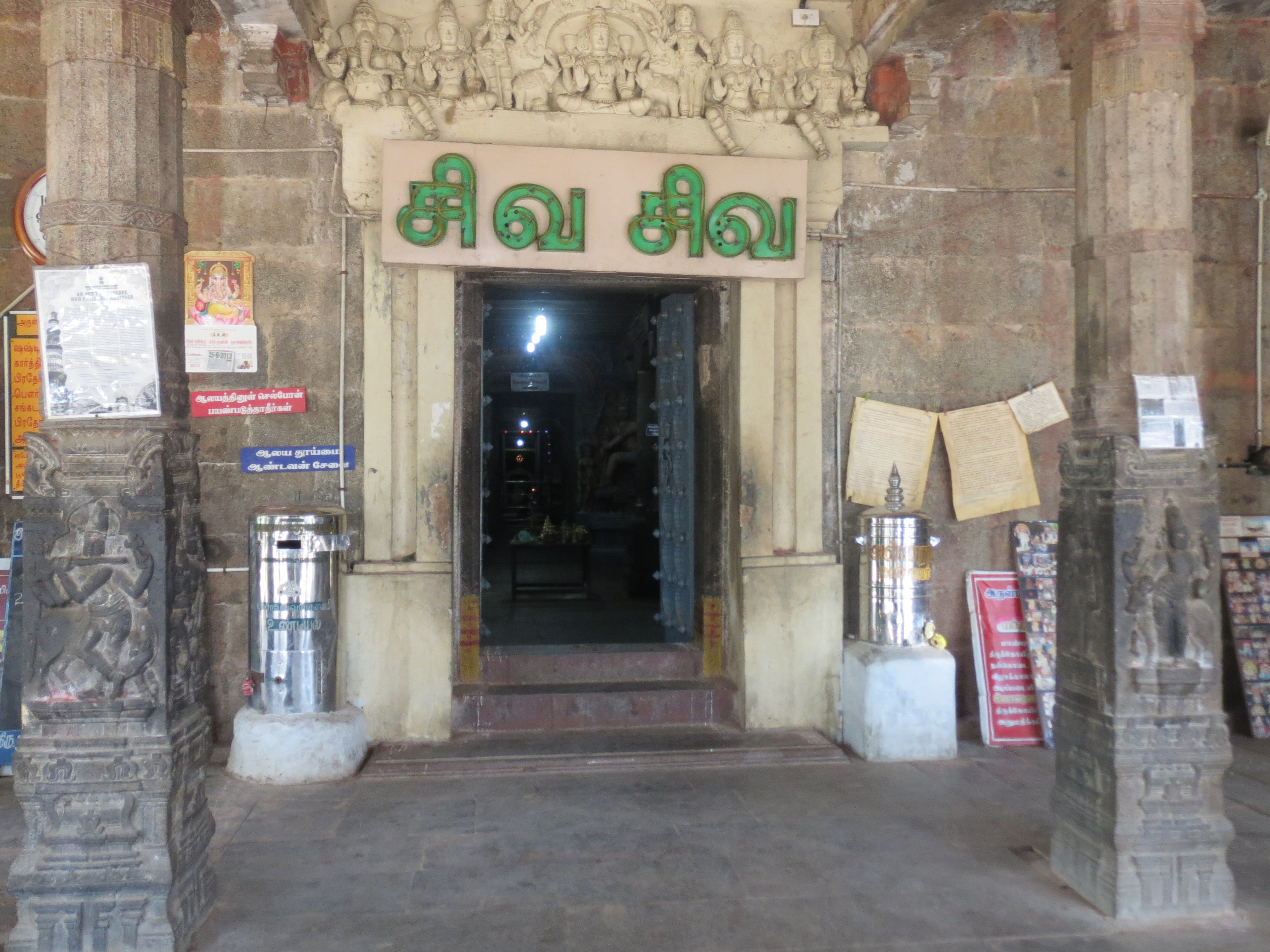
[[File:Thenubureeswarar_temple_madambakkam.jpg|thumb|250px|View of the main entrance to the temple]] | |||
[[File:Interior view-Thenupureeswarar koil.jpg|left|thumb|The sanctum sanctorum of the temple]] | |||
[[File:Thenupureeswarar koil kodimaram.jpg|left|thumb|The kodimaram (sacred pole) of the temple]] | |||
Dhenupureeswarar's consort here is Dhenukambal. The main building of the temple, which contains the statue of Dhenupureeswara in linga form, faces east and his consort faces south in a separate sanctum.<ref name="chola"/> The Shiva lingam is [[Swayambhu]] Lingam or | Dhenupureeswarar got his name because he gave [[moksha]] to a cow ({{langx|sa|Dhenu}}).{{citation needed|date=July 2014}} Sage Kapila is said to have been reborn as a cow for his sin of having improperly worshiped a Shiva [[lingam]] using his left hand. The cow continued to worship Shiva by pouring milk on a Shiva lingam buried in the ground. The cowherd initially punished the cow for wasting the milk, but when the villagers unearthed the Shiva lingam, Shiva appeared and granted moksha (liberation) to Kapila and forgave the cowherd who had mistreated him.<ref name="legend">{{cite news |author=J. V. Siva Prasanna Kumar |title=1,000-year-old Chola legacy draws devotees |url=http://archive.asianage.com/chennai/1000-year-old-chola-legacy-draws-devotees-412 |work=The Asian Age |date=3 August 2012 |access-date=2014-07-24 }}</ref> Legend has it that the king had a dream of this occurrence at this site and had the temple built to commemorate it.<ref name="kapila"/> | ||
Dhenupureeswarar's consort here is Dhenukambal. The main building of the temple, which contains the statue of Dhenupureeswara in linga form, faces east and his consort faces south in a separate sanctum.<ref name="chola"/> The Shiva lingam is [[Swayambhu]] Lingam or self-manifested Lingam.{{citation needed|date=July 2014}} | |||
It is an interesting story of how the temple was discovered from its ruins. One of the Bhakts approached Maha Periyava Sri Chandra Sekarendra Saraswathi Swamigal and sought His blessings for his new built home at Selaiyur. Maha Periyava blessed him, and told him that there is an old Siva temple lying in ruins at a nearby village called Madambakkam. In those days, even Selaiyur was a distant suburb, and no one had heard of Madambakkam, even in Selaiyur. The Bhakt gathered some more men, and went in search of the temple. They cleared the bushes near the agricultural fields, and found an astounding temple in Chola architecture. They renovated it, performed Kumbabhishekam, and commenced daily pujas. The temple is now attracting thousands of people from nearby locations.{{citation needed|date=July 2020}} | It is an interesting story of how the temple was discovered from its ruins. One of the Bhakts approached Maha Periyava Sri Chandra Sekarendra Saraswathi Swamigal and sought His blessings for his new built home at Selaiyur. Maha Periyava blessed him, and told him that there is an old Siva temple lying in ruins at a nearby village called Madambakkam. In those days, even Selaiyur was a distant suburb, and no one had heard of Madambakkam, even in Selaiyur. The Bhakt gathered some more men, and went in search of the temple. They cleared the bushes near the agricultural fields, and found an astounding temple in Chola architecture. They renovated it, performed Kumbabhishekam, and commenced daily pujas. The temple is now attracting thousands of people from nearby locations.{{citation needed|date=July 2020}} | ||
| Line 31: | Line 35: | ||
==Construction== | ==Construction== | ||
The temple was built during the reign of the [[Chola]] king, [[Parantaka Chola II]], father of [[Raja Raja Chola I]], who constructed the famous [[Brihadeeswarar Temple]] in [[Thanjavur]]. The main sanctum ({{ | The temple was built between 956 and 973 CE during the reign of the [[Chola]] king, [[Parantaka Chola II]], father of [[Raja Raja Chola I]], who constructed the famous [[Brihadeeswarar Temple]] in [[Thanjavur]]. The main sanctum ({{langx|sa|[[garbha griha]]}}), like some other Chola temples in and around Chennai, is [[apsidal]] in shape (Sanskrit: gajaprishta vimana) (also described as shaped like the back of a sleeping elephant), unlike most Hindu shrines, which are square or rectangular.<ref name="chola"/><ref name="kapila"/> | ||
The temple is thought to have been consolidated with stones during the reign of [[Kulothunga Chola I]].<ref name="kapila">{{cite news |author=Rohini Ramakrishnan |title=Walking through history |url=http://www.thehindu.com/todays-paper/tp-features/tp-youngworld/walking-through-history/article478650.ece |work=The Hindu |date=22 June 2010 |access-date=2014-07-24 }}</ref> | The temple is thought to have been consolidated with stones during the reign of [[Kulothunga Chola I]].<ref name="kapila">{{cite news |author=Rohini Ramakrishnan |title=Walking through history |url=http://www.thehindu.com/todays-paper/tp-features/tp-youngworld/walking-through-history/article478650.ece |work=The Hindu |date=22 June 2010 |access-date=2014-07-24 }}</ref> | ||
| Line 57: | Line 61: | ||
==See also== | ==See also== | ||
*[[List of Monuments of National Importance in Kanchipuram district]] | *[[List of Monuments of National Importance in Kanchipuram district]] | ||
*[[Heritage structures in Chennai]] | |||
==References== | ==References== | ||
| Line 69: | Line 74: | ||
{{List of Hindu temples in Tamil Nadu}} | {{List of Hindu temples in Tamil Nadu}} | ||
[[Category:Hindu temples in | [[Category:Hindu temples in Chengalpattu district]] | ||
[[Category:Shiva temples in | [[Category:Shiva temples in Chengalpattu district]] | ||
Latest revision as of 08:55, 18 March 2025
| Dhenupureeswarar Temple | |
|---|---|
| Religion | |
| Affiliation | Hinduism |
| Deity | Dhenupureeswarar(Shiva), Dhenukambal(Parvati) |
| Festivals | Pradosha, Panguni Uttiram, Navarathri |
| Location | |
| Location | Madambakkam, Chennai |
| State | Tamil Nadu |
| Country | India |
  Location in Tamil Nadu | |
| Coordinates | 12°53′55″N 80°09′36″E / 12.89861°N 80.16000°E |
| Architecture | |
| Type | Dravidian |
| Completed | circa 957–970 CE |
Direction of façade | East |
Dhenupureeswarar Temple (also "Dhenupurisvara" and "Thiripureeswarar") is a Shiva temple located in Madambakkam, a suburb of Chennai, India. Dhenupureeswarar is the local name for the Hindu deity Shiva.[1]
Religious significance[edit | edit source]


Dhenupureeswarar got his name because he gave moksha to a cow (Script error: The function "langx" does not exist.).[citation needed] Sage Kapila is said to have been reborn as a cow for his sin of having improperly worshiped a Shiva lingam using his left hand. The cow continued to worship Shiva by pouring milk on a Shiva lingam buried in the ground. The cowherd initially punished the cow for wasting the milk, but when the villagers unearthed the Shiva lingam, Shiva appeared and granted moksha (liberation) to Kapila and forgave the cowherd who had mistreated him.[2] Legend has it that the king had a dream of this occurrence at this site and had the temple built to commemorate it.[3]
Dhenupureeswarar's consort here is Dhenukambal. The main building of the temple, which contains the statue of Dhenupureeswara in linga form, faces east and his consort faces south in a separate sanctum.[1] The Shiva lingam is Swayambhu Lingam or self-manifested Lingam.[citation needed]
It is an interesting story of how the temple was discovered from its ruins. One of the Bhakts approached Maha Periyava Sri Chandra Sekarendra Saraswathi Swamigal and sought His blessings for his new built home at Selaiyur. Maha Periyava blessed him, and told him that there is an old Siva temple lying in ruins at a nearby village called Madambakkam. In those days, even Selaiyur was a distant suburb, and no one had heard of Madambakkam, even in Selaiyur. The Bhakt gathered some more men, and went in search of the temple. They cleared the bushes near the agricultural fields, and found an astounding temple in Chola architecture. They renovated it, performed Kumbabhishekam, and commenced daily pujas. The temple is now attracting thousands of people from nearby locations.[citation needed]

Construction[edit | edit source]
The temple was built between 956 and 973 CE during the reign of the Chola king, Parantaka Chola II, father of Raja Raja Chola I, who constructed the famous Brihadeeswarar Temple in Thanjavur. The main sanctum (Script error: The function "langx" does not exist.), like some other Chola temples in and around Chennai, is apsidal in shape (Sanskrit: gajaprishta vimana) (also described as shaped like the back of a sleeping elephant), unlike most Hindu shrines, which are square or rectangular.[1][3]
The temple is thought to have been consolidated with stones during the reign of Kulothunga Chola I.[3]
Well-preserved Chola sculptures and carved pillar bases are present in and around both sanctums.[1]
A number of fine inscriptions and sculptures dating to the Vijayanagara Empire are also preserved.[1]

Restoration[edit | edit source]
The temple is one of a number of sites that have been conserved and restored under the auspices of the Archaeological Survey of India.[4][5] Improvements included removing the damaged thick weathering course (roof surface) of the front mandapa and Amman Shrine and relaying with fresh weathering course.[6]
The ASI states that the temple has been declared a monument of national importance under the Ancient Monuments and Archaeological Sites and Remains (amendment and validation) 2010 Act.[2]
The temple is a National Monuments Authority notified site upon which construction is banned.[7]

Cultural significance[edit | edit source]
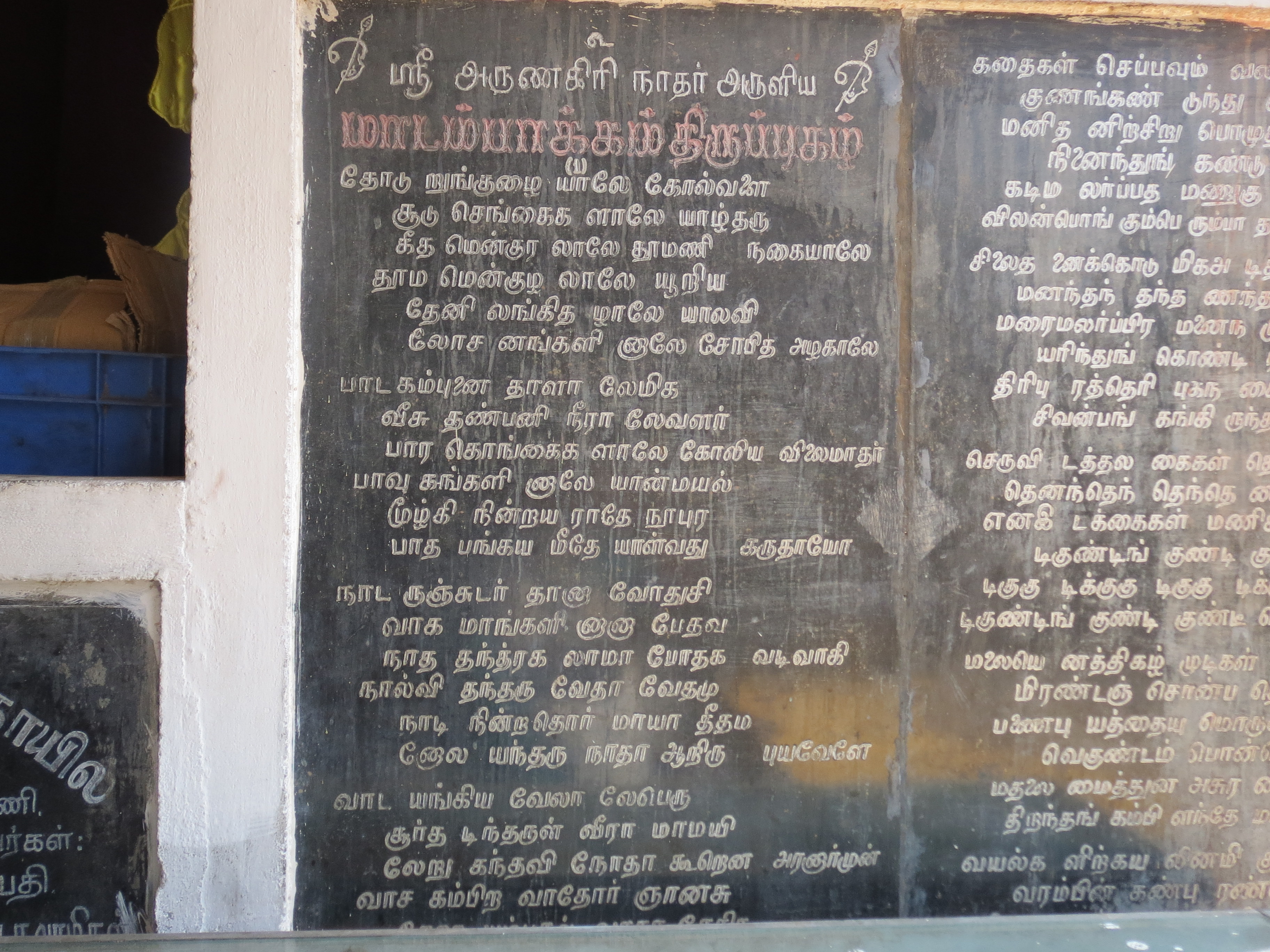
The 15th century Tamil poet Arunagirinathar's work contains a line mentioning the temple.[3]
A number of religious festivals are celebrated at the temple, including Pradosha, Panguni Uttiram and during Navarathri, devotees visit to offer special pujas.[1]
See also[edit | edit source]
References[edit | edit source]
- ↑ 1.0 1.1 1.2 1.3 1.4 1.5 Chitra Madhavan (26 September 2003). "Ancient Chola temple at Madambakkam". The Hindu. Archived from the original on 6 December 2003. Retrieved 23 July 2014.
- ↑ 2.0 2.1 J. V. Siva Prasanna Kumar (3 August 2012). "1,000-year-old Chola legacy draws devotees". The Asian Age. Retrieved 24 July 2014.
- ↑ 3.0 3.1 3.2 3.3 Rohini Ramakrishnan (22 June 2010). "Walking through history". The Hindu. Retrieved 24 July 2014.
- ↑ T. Ramakrishnan (2 October 2001). "Restoring past glory". The Hindu. Archived from the original on 22 January 2002. Retrieved 23 July 2014.
- ↑ Nirmala Lakshman (12 September 2013). Degree Coffee by the Yard: A Short Biography of Madras. Aleph Book Company. p. 50. ISBN 9789383064403.
- ↑ "Indian Archaeology 1999-2000 -A Review" (PDF). Archaeological Survey of India. 2005. p. 296. Retrieved 23 July 2014.
- ↑ D. Madhavan (20 December 2012). "National Institute of Siddha modifies expansion plan". The Hindu. Retrieved 23 July 2014.
External links[edit | edit source]


| Temples |
|
|---|---|
| Churches |
|
| Mosques | |
| Jain temples | |
| Buddhist temples | |
| Gurudwaras | |
| Parsi temples | |

