

robot: Update article (please report if you notice any mistake or error in this edit) |
fix references further and added references after review |
||
| Line 1: | Line 1: | ||
{{short description|Hindu philosopher}} | {{short description|Hindu philosopher (1478–1530)}} | ||
{{ | {{Use British English|date=March 2014}} | ||
{{Use dmy dates|date=March | {{Use dmy dates|date=March 2014}} | ||
{{Infobox Hindu leader | {{Infobox Hindu leader | ||
| name = | | name = Vallabha | ||
| image = Shri_mahaprabhuji.jpg | | image = Shri_mahaprabhuji.jpg | ||
| caption = | | caption = | ||
| religion = [[Hinduism]] | | religion = [[Hinduism]] ([[Vaishnavism]]) | ||
| birth_date = | | birth_date = May 7, 1478{{refn|group=note|All [[Vikram Samvat]] life event dates in this article have been converted into the Gregorian calendar using https://www.harysdalvi.com/calcalc .}} | ||
| | | birth_place = | ||
| death_date = | | death_date = {{Death date and age|1530|07|07|1478|05|07}} | ||
| death_place = [[Banaras]] (now in [[Uttar Pradesh]], India) | | death_place = [[Banaras|Vārāṇasī]] (now in [[Uttar Pradesh]], India) | ||
| philosophy = [[Shuddhadvaita | | father = Lakṣmaṇa Bhaṭṭa | ||
| founder = [[Pushtimarg | | mother = Illammāgārū | ||
| spouse = {{Plainlist| | |||
* {{Marriage|Mahālakṣmī|1502}} | |||
}} | |||
| philosophy = [[Shuddhadvaita|Śuddhādvaita]] | |||
| founder = [[Pushtimarg|Puṣṭimārga]] | |||
| order = [[Vedanta]] | | order = [[Vedanta]] | ||
| children = | | children = {{Plainlist| | ||
*Gopīnātha | |||
*[[Gusainji|Viṭṭhalanātha]] | |||
}} | |||
| background = orange | |||
}} | }} | ||
'''Vallabha''', also known as '''Vallabhācārya''' or '''Vallabha Dīkṣita'''{{sfn|Shastri|p=35|1961}}{{refn|group=note|"Vallabha calls himself just 'Dīkṣita'"{{sfn|Shastri|1961|p=35}}}} (May 7, 1478 – July 7, 1530 CE), was the founder of the [[Krishna|Kr̥ṣṇa]]-centered [[Pushtimarg|Puṣṭimārga]] sect of [[Vaishnavism]], and propounded the philosophy of [[Shuddhadvaita|Śuddhādvaita]]. | |||
His biography is depicted in several sectarian Puṣṭimārga hagiographies. Born into a [[Telugu Brahmin]] family, Vallabha studied Hindu philosophy from early age, then traveled throughout the [[Indian subcontinent]], particularly the [[Braj]] (Vraja) region, for over 20 years. He became one of the important leaders of the devotional [[Bhakti movement]]. He won many philosophical scholarly debates against the followers of [[Advaita Vedanta|Advaita Vedānta]]. He began the institutional worship of [[Shrinathji|Śrī Nāthajī]] on [[Govardhana Hill]]. He acquired many followers in the [[Indo-Gangetic Plain|Gangetic plain]] and [[Gujarat]]. After his death, the leadership of his sampradāya passed to his elder son Gopīnātha. | |||
He | Vallabha's philosophy promoted the householder lifestyle over asceticism, suggesting that through loving devotion to the deity Kr̥ṣṇa, any householder could achieve salvation. He authored many texts including but not limited to, the ''Aṇubhāṣya'' (his commentary on the ''[[Brahma Sutras]]''), ''[[Shodash Granth|Ṣoḍaśa Grantha]]'' or sixteen tracts and several commentaries on the ''[[Bhagavata Purana|Bhāgavata Purāṇa]].'' | ||
==Life== | |||
=== Sources and Dating === | |||
Events from Vallabha's life are recounted in several sectarian Puṣṭimārga texts. Among the [[Braj Bhasha]] sources include the ''[[Chaurashi Vaishnavan ki Varta|Caurāsī Vaiṣṇavan kī Vārtā]]'', ''Śrī Nāthajī Prākaṭya kī Vārtā'', and ''Caurāsī Baiṭhak Caritra''. According to Barz the most important [[Sanskrit]] source is the ''Śrīvallabhadigvijaya''.{{Sfn|Barz|2018}} | |||
According to [[Alan Entwistle]], the ''Caurāsī Baiṭhak Caritra'' is a post-early 18th century text, due to internal references to other sectarian texts.{{Sfn|Entwistle|1987|p=263}} According to Saha and Hawley, the ''Caurāsī Baiṭhak Caritra'' dates to the mid-18th century.{{Sfn|Saha|2004|p=107}}{{Sfn|Hawley|2013|p=82}} Ṭaṁḍana, Bachrach, and several Puṣṭimārga leaders state the work was composed in the 19th century. Ṭaṁḍana also considers the ''Gharu Vārtā'', ''Nija Vārtā'', and ''Śrī Ācāryajī kī Prākaṭya Vārtā'' to be 19th century texts which were based on the older ''Caurāsī Vaiṣṇavana kī Vārtā'' and ''Do Sau Bāvana Vaiṣṇavana kī Vārtā''.{{Sfn|Bachrach|2014|pp=59, 64-65}} Bhatt states the ''Nija Vārtā'' is "full of interpolations and shows the lack of historical sense", and if it was in fact originally the work of the traditionally accepted author, Vallabha's grandson [[Gokulanatha|Gokulanātha]], it was far removed from the original text.{{Sfn|Bhatt|1940|p=601}} The ''Caurāsī Baiṭhak Caritra'' (attributed to Harirāya) enumerates the 84 ''baiṭhak''s ("seats") of Vallabha across India where he sat and preached Puṣṭimarga tenets. According to Saha, the text seeks to promote Vallabha as an exceptional philosopher and miracle worker who acquires converts wherever; the text does this by portraying Vallabha as a ''digvijayin'' ("world-conqueror") who establishes the superiority of his philosophy in the [[Char Dham]].{{Sfn|Saha|2004|p=107-108}} | |||
The ''Śrī Nāthajī kī Prākaṭya Vārtā'' in its current form was likely written in the 1860s, although its contents were orally known prior to the 19th century. The ''Vallabha Digvijaya'' or ''Yadunātha Digvijaya'' claims to have been composed in 1610, however modern scholars state the text was composed around the turn of the 20th century.<ref>{{cite thesis |last=Bachrach |first=Emilia |date=2014 |title=Reading the Medieval in the Modern: The Living Tradition of Hagiography in the Vallabh Sect of Contemporary Gujarat |url= |degree=PhD |chapter= |publisher=University of Texas at Austin |docket= |oclc= |access-date= |pages=127–130}}</ref>{{Sfn|Śāstrī|1977|pp=8–9}} | |||
Other Sanskrit texts include Gadādhara Dviveda's ''Sampradāya-Pradīpa'' (colophon states A.D. 1552–53, but according to Hawley, actually from the latter half of the 1600s),{{sfn|Hawley|2013|page=88-93}} Muralīdharadāsa's ''Śrīvallabhācāryacarita'' (c. 1573), ''Prabhucaritaciṁtāmaṇi'' (attributed to Devakīnaṁdana, which is baseless according to Bhatt),{{Sfn|Bhatt|1940|p=596}} and the Gujarati poem ''Vallabhākhyāna'' by Gopāladāsa (c. 1580). Another Braj Bhasha work, ''Saṁpradāyakalpadruma'', which is claimed to be composed by Viṭṭhalanātha Bhaṭṭa (a grandson of [[Vitthalanatha|Viṭṭhalanātha's]] second daughter Yamunā)<ref>{{Cite book |last=Devasthali |first=G.V. |title=Śr̥ṅgāra-rasa-maṇḍana of Śrī Viṭṭhaleśa |publisher=Bhandarkar Oriental Research Institute |year=1977 |series=Research Unit Publications |location=Poona |pages=X |trans-title= |issue=3}}</ref> cannot be stated to be of old origin according to Śāstrī. Other texts by Gokulanātha's followers include Kalyāṇa Bhaṭṭa's ''Kallola'', Keśavadāsa's Gujarati ''Vallabhavela'', and Gopāladāsa Vyārāvāḷā's Gujarati ''Prākaṭya-Siddhāṁta''.{{Sfn|Śāstrī|1977|pp=8–9}} | |||
According to scholars, the life of Vallabha as depicted in traditional sources contains many miracles, supernatural events, and "patently implausible features". Vallabha is considered by followers of the Puṣṭimārga to be an ideal divine incarnation who was born for a supernatural purpose, and his hagiographies mean to portray a living intimate relationship with Kr̥ṣṇa to serve as an example to devotees. Barz (1992) gives biographical account of Vallabha which includes these traditional elements. His biography has been criticized by [[Charlotte Vaudeville|Vaudeville]] for relying solely on English and Hindi Vallabhite sources and a lack of critical analysis of them typical of a Western Indologist.{{Sfn|Barz|1992|p=21}}<ref>{{Cite journal |last=Vaudeville |first=Ch. |year=1979 |title=The Bhakti Sect of Vallabhācārya Richard Barz |journal=Indo-Iranian Journal |volume=21 |issue=1 |pages=55–56}}</ref>{{Sfn|Barz|2018}} Śāstrī, commenting on the presence of miracles in Vallabha's biographies, notes that the texts authored by the followers of [[Gokulanatha|Gokulanātha]], a grandson of Vallabha, contain no mention of miracles in relation to Vallabha and his second son [[Vitthalanatha|Viṭṭhalanātha]] (Gokulanātha's father) making them valuable sources. This is due to the fact that these followers instead consider Gokulanātha to be God in human form, with Vallabha and Viṭṭhalanātha only being revered ''ācārya''s. No single text contains a full biography of Vallabha, and different sources contain inconsistent and contradictory information, likely due to internal fragmentation of the religious community from the 17th to 19th centuries.{{Sfn|Bachrach|2014|pp=60–61}}{{Sfn|Śāstrī|1977|pp=9–10}} | |||
===Childhood=== | |||
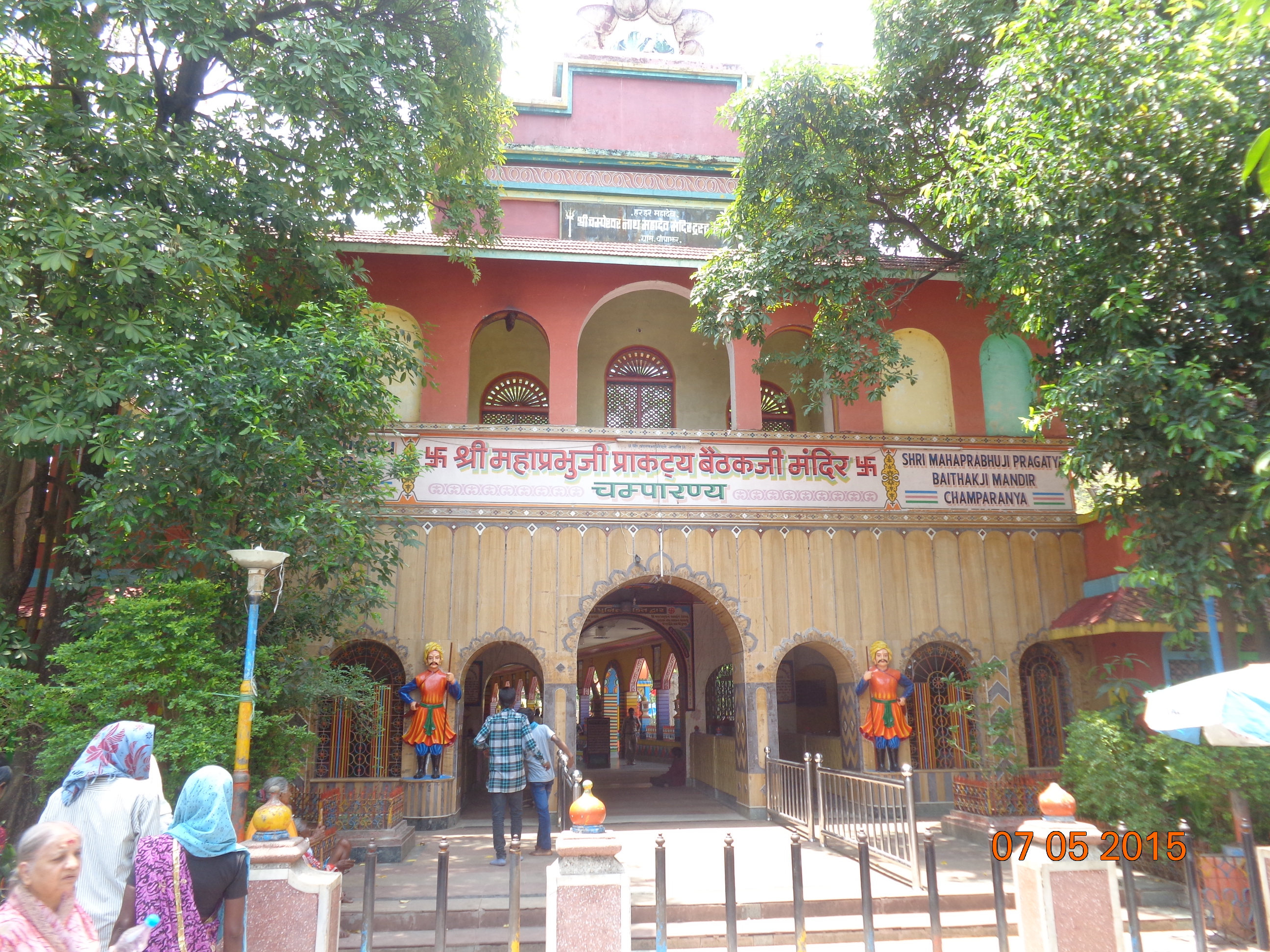
[[File:Prakatya baithakji mandir.JPG|thumb|Site worshipped as the birthplace of Vallabha in Campāraṇya, identified in the late 19th century.{{Sfn|Barz|1992|p=24}}]] | |||
According to tradition, Vallabha's family were Velanāṭa or Vellanāḍu [[Telugu Brahmin]]s who belonged to the [[Bharadvaja|Bhāradvāja gotra]] and the [[Taittiriya Shakha|''Taittirīya'']] branch of the ''[[Yajurveda]]''. Their ancestral village was Kāṅkaravāḍa on the southern bank of the [[Godavari River|Godāvarī River]].{{Sfn|Barz|1992|p=23}} Keśvararāma Kāśīrāma Śāstrī identifies the village of Kāṁkara ([[Kanker, Chhattisgarh]]) with Kāṁkarapāṁḍhu or Kāṁkaravāḍa.{{Sfn|Śāstrī|1977|p=43}} | |||
== | According to some sources such as the ''Śrīvallabhadigvijaya'', Vallabha's birth occurred in the forests of Campāraṇya, due to his parents fleeing Vārāṇasī in fear of Muslim invasion. These sources depict his birth as miraculous, with his parents initially leaving the seemingly still-born infant beneath a ''[[Prosopis cineraria|śamī]]'' tree, before being recalled by a supernatural voice to see Vallabha alive and surrounded by fire. According to other hagiographies such as ''Śrī Nāthajī Prākaṭya kī Vārtā'', Vallabha appeared in the Agnikuṇḍ ("Pool of Fire") in [[Mathura|Mathurā]].{{Sfn|Barz|2018}}{{Sfn|Barz|1992|pp=23–25}}{{Sfn|Hawley|2015|pp=187, 364}} | ||
Most hagiographies date Vallabha's birth to Vaiśākha vada 11, 1535 [[Vikram Samvat|V.S.]] (May 7, 1478 CE). Though conversion of this date into the Gregorian calendar is disputed among scholars (with some putting Vallabha's birth in 1478 and some in 1479), Hawley confirms the year 1478 after adjusting for the calendar used in Braj.{{Sfn|Barz|2018}}{{Sfn|Barz|1992|pp=23–25}}{{Sfn|Hawley|2015|pp=187, 364}} The followers of [[Gokulanatha|Gokulanātha]], one of Vallabha's grandsons, consider Vallabha's year of birth to be 1473 CE. G.H. Bhatt, on comparing the two dates, states that the year 1473 CE is correct. In his view, the sources mentioning 1473 CE are older and more authentic than those mentioning 1478 CE.<ref>{{Cite journal |last=Bhatt |first=G.H. |date=1940 |title=The Birthdate of Vallabhācārya, the Advocate of the Śuddhādvaita Vedānta |journal=Proceedings and Transactions of the Ninth All-India Oriental Conference, Trivandrum, December 20th to 22th 1937 |location=Trivandrum |publisher=Government Press}}</ref> | |||
Soon after Vallabha's birth his family moved back to Vārāṇasī. His education consisted of learning Sanskrit texts such as the [[Upaniṣads|''Upaniṣad''s]], [[Vedas|''Veda''s]], and [[Puranas|''Purāṇa''s]].{{Sfn|Barz|2018}}{{Sfn|Saha|2004|p=98}} | |||
According to the ''Śrī Govardhananāthajī ke Prākaṭya kī Vārtā'' (19th century),{{Sfn|Bachrach|2014|p=127}}<ref>{{Cite journal |last1=Pauwels |first1=Heidi |last2=Bachrach |first2=Emilia |date=July 2018 |title=Aurangzeb as Iconoclast? Vaishnava Accounts of the Krishna images' Exodus from Braj |journal=Journal of the Royal Asiatic Society |series=Third Series |publisher=Cambridge University Press |volume=28 |issue=3 |pages=489–492}}</ref> [[Madhavendra Puri|Mādhavendra Purī]] (c. 1420–1490) taught Vallabha in [[Varanasi]], however this is considered "highly improbable" by [[Alan Entwistle|Entwistle]] due to the dates of Vallabha's birth and Mādhavendra's death. When asked what he would like as a fee for teaching Vallabha, Mādhavendra asked to serve [[Shrinathji|Śrī Nāthajī]], as he had a premonition that Vallabha would establish the formal worship of the deity. When Mādhavendra Purī arrived at Govardhan Hill, the image was being already being worshipped as a snake deity by the local villagers, and as Kr̥ṣṇa by Saddu Pāṇḍe. Mādhavendra Purī adorned Śrī Nāthajī with a garland and turban decoration, and offered him milk (he was told by Śrī Nāthajī that he would only accept solid food when Vallabha arrived). The text also claims that Mādhavendra was appointed ''mukhiyā'' of the Bengali priests, which is also considered unlikely by Entwistle since the Śrī Nāthajī temple was built after his lifetime. Mādhavendra Purī later went to South India to get sandalwood, from which he never returned.<ref>{{cite thesis |last=Entwistle |first=Alan William |title=The Rāsa Māna ke Pada of Kevalarāma: A Medieval Hindi Text of the Eighth Gaddī of the Vallabha Sect |date=1982 |access-date= |degree=PhD |publisher=University of London |url= |oclc= |page=56 |chapter= |docket=}}</ref>{{Sfn|Entwistle|1987|pp=138-140}}{{Sfn|Haberman|2020|p=41}}{{Sfn|Barz|2018}}<ref>{{Cite journal |last=Hardy |first=Friedhelm |date=1974 |title=Mādhavêndra Purī: A Link between Bengal Vaiṣṇavism and South Indian "Bhakti" |url=https://www.jstor.org/stable/25203503 |journal=The Journal of the Royal Asiatic Society of Great Britain and Ireland |publisher=Cambridge University Press |volume=1 |page=31 |jstor=25203503}}</ref> Other Puṣṭimārga texts and texts othe [[Gauḍīya Vaiṣṇava]] tradition posit contrasting narratives surrounding the identity of Mādhavendra Puri's students and the establishment of the Kr̥ṣṇa image on Govardhana Hill.{{Sfn|Entwistle|1987|p=138}}<ref>{{Cite book |last=Valpey |first=Kenneth Russel |title=Attending Kṛṣṇa's Image: Caitanya Vaiṣṇava mūrtī-sevā as devotional truth |publisher=Routledge |year=2006 |pages=66}}</ref><ref>{{Cite book |last=Haberman |first=David L. |title=Loving Stones: Making the Impossible Possible in the Worship of Mount Govardhan |publisher=Oxford University Press |year=2020 |pages=41–42}}</ref><ref>{{Cite book |title=Caitanya Caritāmṛta of Kṛṣṇadāsa Kavirāja: A Translation and Commentary |publisher=Department of Sanskrit and Indian Studies, Harvard University |year=1999 |editor-last=Steward |editor-first=Tony K. |series=Harvard Oriental Series 56 |pages=382 |translator-last=Dimock |translator-first=Edward C. Jr.}}</ref>{{Sfn|Entwistle|1987|pp=138–140}}{{Sfn|Śāstrī|1977|p=54}} | |||
=== | === First pilgrimage === | ||
Nearing the end of his life, Lakṣmaṇa Bhaṭṭa decided to take his wife and 10-year-old son along on a pilgrimage to southern India. They first stopped at the Vaishnava [[Jagannath Temple, Puri|temple]] of [[Jagannath|Jagannātha]] in [[Puri|Purī]] in 1489. The local ruler was sponsoring a great philosophical debate where four questions were posed to scholars: "What is the foremost scripture? Who is the foremost deity? Which is the most effective ''mantra''? What is the easiest and best action?", to which Vallabha responded with the ''[[Bhagavad Gita|Bhagavad Gītā]]'', Kr̥ṣṇa, any of Kr̥ṣṇa's names, and [[sevā]] (service) to Kr̥ṣṇa, whereupon Jagannātha wrote a [[shloka|śloka]] in support of his response and condemning the supporters of [[Advaita Vedanta|Advaita Vedānta]].{{Sfn|Barz|1992|pp=26–27}} | |||
In 1490, they reached the [[Venkateswara Temple, Tirumala|temple]] of [[Venkateswara|Veṅkaṭeśvara]] at [[Tirupati]], where Lakṣmaṇa Bhaṭṭa died, and Illammāgārū began to live with her brother in [[Vijayanagara]].{{Sfn|Barz|1992|p=27}} | |||
===Grand | ===Grand victory at Vijayanagara=== | ||
When Vallabha was living in his ancestral village of Kāṅkaravāḍa, he heard of a philosophical debate (''[[shastrartha|śāstrārtha]]'') being held in at the court of King [[Krishnadevaraya|Kr̥ṣṇadevarāya]] of [[Vijayanagara Empire|Vijayanagara]], and that the Vaiṣṇava schools of thought were being beaten by [[Advaita Vedanta|Advaita Vedānta]] philosophers. Vallabha immediately went to Vijayanagara to join the debate, and entered the Vaiṣṇava camp led by [[Vyasatirtha|Vyāsatīrtha]] of the [[Dvaita Vedanta|Mādhva school]]. Vallabha through his erudition and debate skills defeated the Advaita philosophers, and was rewarded by [[Krishnadevaraya|Kr̥ṣṇadevarāya]] with large amounts of gold (most of which he distributed among Brahmins).{{Sfn|Barz|1992|pp=43–45}} | |||
Vallabha was also offered the prestigious title of ''[[acharya|ācārya]]'' from the [[Sadh Vaishnavism|Mādhva sampradāya]] and the [[Rudra Sampradaya|Viṣṇusvāmī sampradāya]]. Vallabha chose to become ''ācārya'' of the Viṣṇusvāmī school. Very little is known of the Viṣṇusvāmī school, and by Vallabha's time its followers were few. The majority view among sectarian followers is that Vallabha chose to become ''ācārya'' of that school in order to make his own doctrines more prestigious, and that there is likely no real connection between the ideas of [[Vishnuswami|Viṣṇusvāmī]] and Vallabha. A minority of followers believe there is a connection between the philosophies of Viṣṇusvāmī and Vallabha. Modern scholars hold there is no legitimate connection between the two philosophies.{{Sfn|Barz|1992|pp=43–45}} According to Keśvararāma Kāśīrāma Śāstrī, Vallabha himself did not claim to belong to Viṣṇusvāmī's school. He notes that in the ''Subodhini'', Vallabha claims Viṣṇusvāmī's devotional path belongs to the tamāsa guṇa, while his own is nirguṇa. Only later writers such as Gosvāmī Puruṣottama, Yogī Gopeśvara, and Gadādharadāsa link Vallabha's and Lakṣmaṇa Bhaṭṭa's philosophical school to Viṣṇusvāmī. It is also stated in traditional biographies that Bilavamaṁgala (a scholar of Viṣṇusvāmī's school) waited 700 years for Vallabha to take his seat. Rather Vallabha himself states that despite Bilvamaṁgala's Māyāvāda tendencies, through his devotion he can achieve ''mokṣa''.{{sfn|Śāstrī|1977|loc=Śrīviṣṇusvāmīno sampradāya}} | |||
= | According to sectarian literature, this debate occurred shortly after Lakṣmaṇa Bhaṭṭa's death in 1490 when Vallabha was only 13 years old;{{Sfn|Saha|2004|pp=107–108}} however, Kr̥ṣṇadevarāya only became king of Vijayanagara in 1509.{{Sfn|Barz|1992|pp=43–45}} | ||
The debate is mentioned in the ''Caurāsī Baiṭhak Caritra'' and but is not found in independent historical sources. According to Saha, the Vijayanagara episode is meant to portray "the image of a victorious Vallabha winning the subcontinent for Kr̥ṣṇa".{{Sfn|Saha|2004|pp=107–108}} It is also mentioned in the ''Sampradāya-Pradīpa'', whose narrative is described as "clearly counterfactual" by Hawley who posits the episode was written for the purpose of furthering the interests of the Puṣṭimārga in the late 17th century.{{Sfn|Hawley|2013|page=88-93}} | |||
=== | === Reception of the Brahmasambandha mantra and installation of Śrī Nāthajī === | ||
[[File: | [[File:Varta of Damodardas Harsani painting (closeup).jpg|thumb|Vallabha giving Kr̥ṣṇa a sacred thread after receiving the Brahmasambandha mantra. Dāmodaradāsa Harasānī on the right.]] | ||
In 1493, Vallabha is said to have had a dream where Kr̥ṣṇa ordered him to go to [[Govardhan Hill|Govardhana Hill]] and establish proper service (sevā) to his image (''svarūpa'') that had appeared there years ago. When he arrived in Gokula in 1494, Vallabha had a vision where Kr̥ṣṇa appeared before him and bestowed upon him the ''Brahmasambandha [[mantra]]'', which was to be used to clean the flaws of a human soul. The next morning, Vallabha administered the mantra to his companion [[Chaurashi Vaishnavan ki Varta#Damodardas Harsani|Dāmodaradāsa Harasānī]], who became the first member of the [[Pushtimarg|Puṣṭimārga]] (Vallabha Sampradaya).{{Sfn|Barz|2018}}{{Sfn|Barz|1992|pp=17–20, 28–29}} Most sources state these events occurred in Gokula, except the ''Śrī Nāthajī Prākaṭya kī Vārtā'' which states it happened in [[Jharkhand]].{{Sfn|Entwistle|1987|p=31}} | |||
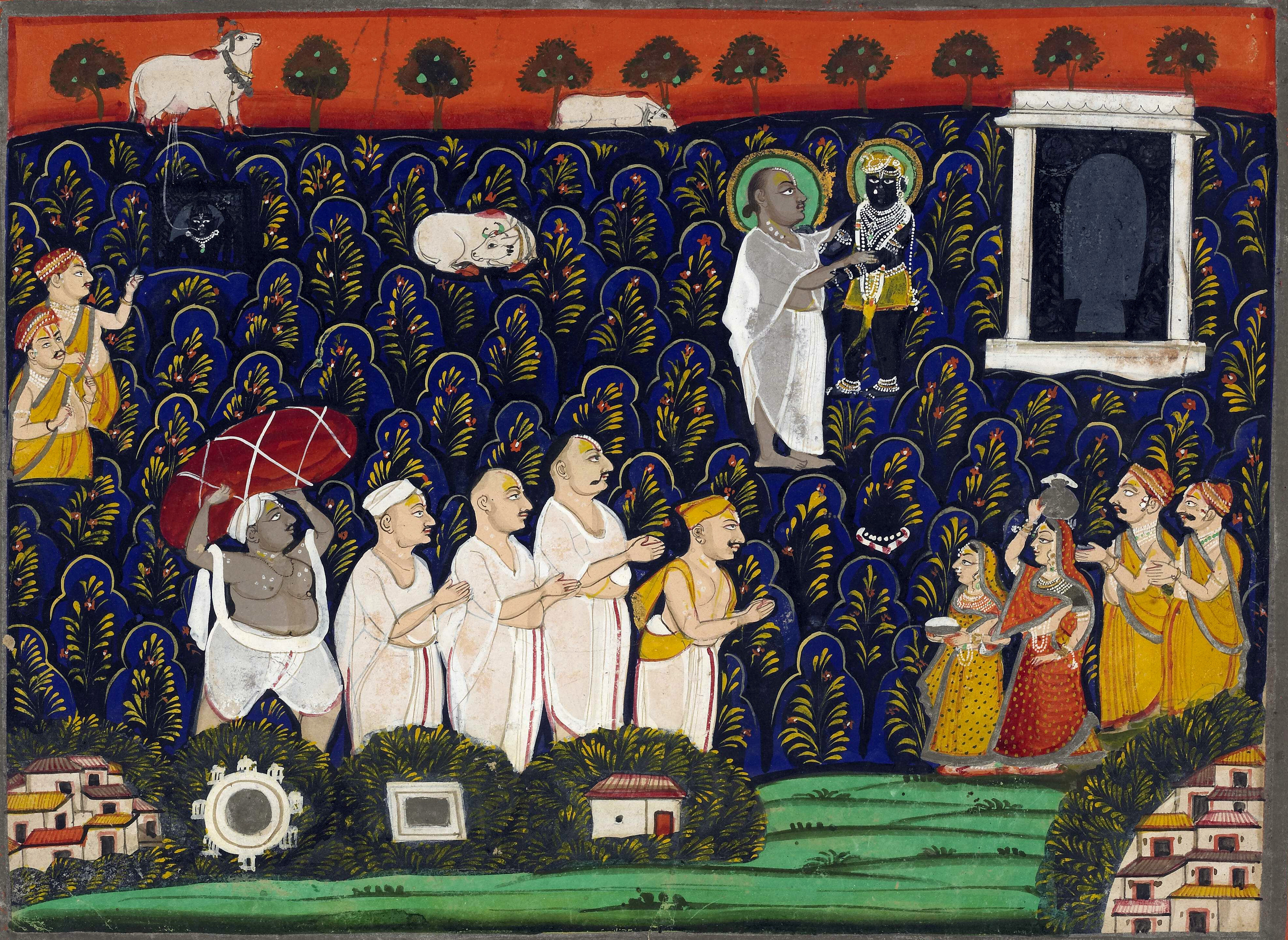
[[File:Shrinathji discovered.jpg|thumb|The discovery of Śrīnāthajī by Saddū Pāṇḍe (far left) and Vallabha's later meeting with the company of followers (dressed in white) and local Braj folk (bottom right).]] | |||
When Vallabha came to Govardhana Hill, he went to the house of Saḍḍu Pāṇḍe. Saḍḍu Pāṇḍe had received a vision from Kr̥ṣṇa years earlier that told him a stone that had appeared on Govardhana Hill was his own svarūpa and that he should give offerings to it. The image was known as Devadamana; Vallabha announced that it was actually the svarupa of Śrī Govardhananāthajī (shortened to [[Shrinathji|Śrī Nāthajī]]) and initiated an ascetic named Rāmdās Chauhān to perform the regular worship.{{Sfn|Barz|2018}}{{Sfn|Barz|1992|pp=28–29}} In 1499 a wealthy merchant from [[Ambala|Ambālā]] named Pūrṇamalla Khatrī began building a temple for Srī Nāthajī.{{Sfn|Barz|2018}}{{Sfn|Barz|1992|pp=28–29}} | |||
===Personal life=== | |||
Vallabha may have intended to remain a lifelong celibate [[Brahmacharya|brahmacārī]], but during his second pilgrimage of India between 1501 and 1503, he had gone to [[Pandharpur|Paṁḍḥarapura]] to view the god [[Vithoba|Viṭṭhala]] or Viṭhobā (a form of Kr̥ṣṇa). There Vallabha was ordered by Viṭṭhala to marry. Some sectarian sources assert this was because Viṭṭhala wanted to take birth as his son, and others say it was to create a line of descendants to preserve and promote Vallabha's version of [[Bhakti yoga|bhakti-mārga]].{{Sfn|Barz|2018}}{{Sfn|Barz|1992|p=29}} This episode is mentioned in the ''Vallabhākhyāna'', ''Nija Vārtā'', and ''Sampradāya Kalpadruma'' and according to Entwistle is a later myth.{{Sfn|Entwistle|1987|p=163}} | |||
}} | |||
Following his caste traditions and practices, Vallabha married Mahālakṣmī (aka Akkājī)<ref>{{Cite journal |last=Mallison |first=Françoise |date=1986 |title=Les Chants Dhoḷa au Gujarāt et Leur Usage pour la Dévotion Vallabhite |journal=Bulletin de l'École française d'Extrême-Orient |volume=75 |page=89 |doi=10.3406/befeo.1986.1701 |jstor=43731333|language=fr }}</ref> sometime between 1502 and 1504, a Vārāṇasī girl of his own caste who began living with him upon maturity c. 1510–1512.<ref name="Bryant2007">{{cite book |author=Edwin Francis Bryant |url=https://books.google.com/books?id=0z02cZe8PU8C&pg=PA482 |title=Krishna: A Sourcebook |publisher=Oxford University Press |year=2007 |isbn=978-0-19-803400-1 |location=New York |page=482 |author-link=Edwin Bryant (author)}}</ref><ref>{{cite journal |author=Kincaid, C. |date=January 1933 |title=Review: Imperial Farmans by K. M. Jhaveri |journal=Journal of the Royal Asiatic Society of Great Britain and Ireland |issue=1 |pages=131–132 |doi=10.1017/S0035869X00072543 |jstor=25194699 |s2cid=163921774}}{{Subscription required}}</ref>{{Sfn|Barz|1992|p=38}} Vallabha had two houses, one at Aṛaila on the [[Yamuna river|Yamunā river]] across [[Prayagraj|Prayāgarāja]], and at Caranāṭa near Vārāṇasī. According to Saha, the location of his home provided a central location which allowed him to access to preach and convert{{Clarify|date=July 2025}} throughout northern and central India.{{Sfn|Saha|2004|pp=111–112}}{{Sfn|Barz|1992|p=52}} | |||
His first son, Gopīnātha, was born in 1512 at Aṛaila and according to sectarian tradition was the [[avatar|avatāra]] of [[Balarama|Balarāma]], elder brother of Kr̥ṣṇa. His second son, [[Vitthalanatha|Viṭṭhalanātha]], was born in 1515 at Caranāṭa, and is considered the avatar of Viṭṭhala.{{Sfn|Barz|2018}}{{Sfn|Barz|1992|p=38}} | |||
He | ===Pilgrimages and preaching tours of India=== | ||
Vallabha made three pilgrimages throughout India which are documented in later sectarian sources. These pilgrimages are stated to have taken place between 1479 and 1530, although Saha doubts the accuracy of the dates. At pilgrimage sites such as [[Dwarka|Dvārakā]], [[Kannauj]]a, [[Puri|Purī]], [[Mathura|Mathurā]], [[Gokul]]a, and [[Govardhan]]a, Vallabha had theological debates and attracted followers and devotees. He made extensive conversion campaigns in the [[Indo-Gangetic Plain|Gangetic Plain]] and [[Gujarat]], where he attracted converts from various castes including [[Bhumihar]]s, [[Rajput]]s, [[Gurjar]]s, [[Ahir]]s, [[Kurmi]]s, and [[Vaniyan|Vaniyas]], [[Bhatia caste|Bhatias]], [[Patidar|Kanbis]], and [[Patidar]]s respectively.{{Sfn|Barz|1992|pp=91, 140}} In the ''Caurāsī Vaiṣṇavan kī Vārtā'', the lives of eighty-four of Vallabha's most notable devotees are narrated. Of the 84 devotees, 39 were [[Brahmin]]s, 36 were mercantile or landowning [[Kshatriya]]s, 5 were [[Vaishya]]s, and 6 were [[Shudra]]s.{{Sfn|Saha|2004|pp=107–114}} | |||
Only scholarly theory for why Vallabha's theology was attractive to these groups was that of social mobility. For agrarian castes, particularly in Gujarat, the emphasis on purity gave higher status. For mercantile castes, purity as well as the emphasis on restraint and frugality in daily life elevated their status, while wealth could then be funnelled toward religiously meritorious [[sevā]] to Kr̥ṣṇa.{{Sfn|Saha|2004|pp=113–117}} | |||
Another reason was that Vallabha promoted a househoulder life-affirming, socially conservative view that appealed to castes that depended on social and political stability for their livelihoods, notably in the context of splintering Muslim sultanates in India.{{Sfn|Saha|2004|pp=113–117}} | |||
===Death=== | ===Death=== | ||
In 1530, Vallabha took a vow of [[Sannyasa|renunciation]] and withdrew to the banks on the [[Ganges|Gaṅgā river]] in Vārāṇasī. After a month, he summoned his sons Gopīnātha and Viṭṭhalanatha, and designated the 18 or 19 year old Gopīnātha as his successor. According to sectarian accounts, he walked in the Gaṅgā and vanished in a flash of light.{{Sfn|Barz|2018}}<ref>{{Cite journal |last=Bhatt |first=G.H. |year=1942 |title=The Last Message of Vallabhācārya |journal=Annals of the Bhandarkar Oriental Research Institute |volume=23 |issue=1 |pages=67–70}}</ref> This event is said to have occurred on [[Asadha|Āṣāḍha]] suda 3, 1587 [[Vikram Samvat|V.S.]] (July 7, 1530).<ref>{{cite thesis |last=Shah |first=Kokila A |date=2013 |title=Shri Vallabhacharyas Shuddhadvaita philosophy of Vedanta |url=https://shodhganga.inflibnet.ac.in/handle/10603/582847 |degree=PhD |chapter=2 |publisher=University of Mumbai |docket= |oclc= |access-date= |pages=48 |hdl=10603/582847 }}</ref> | |||
==Works== | |||
Vallabha composed several texts during his lifetime (all in [[Sanskrit]]) most notable of which are:{{Sfn|Barz|2018}}<ref>{{Cite book |last=Bhatt |first=Govindlal Hargovind |title=The Cultural Heritage of India |publisher=The Ramakrishna Mission Institute of Culture |year=1953 |edition=2nd |volume=III: The Philosophies |pages=349–350 |chapter=The School of Vallabha |orig-date=1937}}</ref> | |||
* ''Aṇubhāṣya'', a partial commentary on the ''[[Brahma Sutras|Brahma Sūtra-s]]'' up to III.23 | |||
* ''Subodhini'', a partial commentary on the ''[[Bhagavata Purana|Bhāgavata Purāṇa]]'' (full commentary on ''skandha''s 1-3 and 10, and partial commentary on ''skandha''s 4,7, and 11) | |||
* ''Tattvārthadīpanibandha'', a text interpreting existing Hindu scriptures through Vallabha's philosophy of Śuddhādvaita | |||
* ''Tattvārthadīpanibandhaprakāśa'', a partial commentary on the ''Tattvārthadīpanibandha'' (full commentary for parts 1-2 and partial for part 3) | |||
* ''[[Ṣoḍaśa Grantha|Ṣoḍaśagrantha]]'', sixteen treatises on important facets of Śuddhādvaita and theology of the Puṣṭimārga | |||
There are also other texts attributed to Vallabha some of which are considered to be either lost or not actually composed by him. These includes ''Jaiminīyasūtrabhāṣya'', ''Pātrāvalambanam'', ''Śrīpuruṣottamanāmasahasram'', ''Trividhanāmāvalī'', ''Premāmr̥tam'', ''Parivr̥ddhāṣṭakam'', and ''Madhurāṣṭakam''. Smith notes that it is possible for Vallabha's work to have been lost in the first twenty years after his death, as his family became embroiled in disputes until Viṭṭhalanātha's final accession as head of the family and sect after the deaths of Gopīnātha and his son Puruṣottama.{{sfn|Smith|2022}} | |||
=== ''Aṇubhāṣya'' === | |||
In the ''Aṇubhāṣya'' Vallabha provides formal philosophical proof for Śuddhādvaita; the text is highly intellectual in nature. Vallabha argues that the ''jīva'' ("individual soul") is inseparable from ''akṣarabrahman'' ("the absolute all-encompassing universe") yet dependent on God's grace. He argues that ''jīva''s due to their ''svabhāva'' ("personal nature") and ''adhikāri'' ("eligibility") are either attracted to the religious path of knowledge or of devotion. He states the fruit of knowledge is ''mokṣa'', union with an abstract, absolute, impersonal ''akṣarabrahman''. In contrast, the higher fruit of devotion is entrance into ''nityalīlā'' (both in life or after death), which is the state of observing and participating in God's spontaneous and creative nature.{{sfn|Smith|2022}} | |||
=== ''Tattvārthadīpanibandha'' === | |||
This text is divided into three sections: ''Śāstrārtha'', ''Sarvanirṇaya'', and ''Bhāgavatārtha''. In the ''Śāstrārthaprakaraṇa'', Vallabha gives his view on the contents of the ''Bhagavad Gītā'', which he considers to be highest śāstra due to it embodying the words of Kr̥ṣṇa. He discusses various topics including the nature of the universe and God and argues that ''bhakti'' ("devotion") is based on knowledge of Kr̥ṣṇa as depicted in the ''Bhagavad Gītā'' and ''Bhāgavata Purāṇa''. In the ''Sarvanirṇayaprakaraṇa'', Vallabha surveys the philosophies of rival schools and asserts the superiority of his own views on devotion and the nature of souls to the universe. In the ''Bhāgavatārthaprakaraṇa'', Vallabha gives his view on the ''Bhāgavata Purāṇa'' as an entire text, its ''skandha''s ("canto"), ''prakaraṇa''s ("topical division"), and ''adhyāya''s ("chapter").{{sfn|Smith|2022}} | |||
=== ''Subhodinī'' === | |||
This commentary on the ''Bhāgavata Purāṇa'' is Vallabha's most esoteric work, and provides commentary on the text at a deeper level than the ''Bhāgavatārthaprakaraṇa'' down to the ''vākya'' (sentence"), ''pada'' ("word"), and ''akṣara'' ("syllable"). In this text Vallabha uses [[Alankara Shastra|''Alaṃkāraśāstra'']] (classical Indian aesthetic theory) to analyze devotional experiences.{{sfn|Smith|2022}} | |||
== | === ''Śoḍaśagrantha'' === | ||
This text has 16 short treatises.{{sfn|Smith|2022}} | |||
# ''Yamunāṣṭakam'': esoteric hymn to the river goddess Yamunā which is recited daily by followers | |||
# ''Bālabodha'': explains the ''[[puruṣārtha]]'' (four goals of a human life) according to rival schools of thought | |||
# ''Siddhāntamuktāvalī'': explains the value of Kr̥ṣṇa sevā on the terrestrial, spiritual, and celestial planes as well as different types of worship depending on an individual's ability | |||
# ''Puṣṭipravāhamaryādābheda'': describes the three types of ''jīva''s: ''puṣṭi'', ''maryādā'', and ''pravāha'' | |||
# ''Siddhāntarahasya'': Vallabha's account of Kr̥ṣṇa's instructions to him on ''Brahmasambandha'' | |||
# ''Navaratna'': a hymn in which Vallabha urges devotees to shun distresses as they distract from Kr̥ṣṇa sevā and to treat them as a part of ''līlā'' | |||
# ''Antaḥkaraṇaprabodha'': Vallabha urges his own heart to be free of worry and have singleminded devotion to Kr̥ṣṇa | |||
# ''Vivekadhairyāśraya'': summarizes Vallabha's views on discrimination, patience, and divine refuge | |||
# ''Catuḥślokī'': four verse hymn that explains the ''puruṣārtha'' as devotional acts appropriate to the Puṣṭimārga | |||
# ''Śrīkr̥ṣṇāśraya'': explains why Kr̥ṣṇa should be the sole refuge for devotees, why he is superior to other deities, and why devotion to him is the only salvation from [[Kali Yuga]], which it also describes | |||
# ''Bhaktivardhinī'': explains the how devotion silently increases through various stages and explains the different qualities of lifestyles with respect to devotion | |||
# ''Jalabhedha'': classifies the 20 kinds of devotees who differ based on ''[[Bhāva (Hinduism)|bhāva]]'' ("emotional disposition") and spiritual capabilities by using water as an analogy | |||
# ''Pañcapadyāni'': classifies the different kind of listeners to Kr̥ṣṇa's stories and praises | |||
# ''Saṃnyāsanirṇayaḥ'': Vallabha explains the conditions for renunciation of worldly life and how renunciates dedicated to ''bhakti'' differ from those dedicated to ''jñāna'' | |||
# ''Nirodhalakṣaṇa'': describes the concept of ''nirodha'', living disengagement from wordly life and single minded dedication to Kr̥ṣṇa, which Vallabha states he has achieved | |||
# ''Sevāphalam'': describes the (post-death) rewards of Kr̥ṣṇa devotion, with a description of the otherworldly gifts that allow love of Kr̥ṣṇa to flourish in a graced mortal body | |||
== Philosophy == | |||
{{Hindu philosophy}} | |||
{{Vaishnavism}} | |||
Vallabha formulated the philosophy of [[Shuddhadvaita|Śuddhādvaita]], in response to Śaṅkara's [[Advaita Vedanta|Ādvaita Vedānta]], which he called Maryādā Mārga or Path of Limitations. Vallabha asserted that religious disciplines focusing on Vedic sacrifices, temple rituals, [[Puja (Hinduism)|puja]], meditation, and yoga held limited value. Additionally Vallabha rejected the concept of [[Māyā]], stating that the world was a manifestation of the Supreme Absolute and could neither be tainted nor change.{{Sfn|Saha|2004|pp=98–106}} The school rejects the ascetic lifestyle and cherishes householder lifestyle, wherein followers see themselves as participants and companions of Kr̥ṣṇa, viewing their daily lives as an ongoing ''[[raslila]].''<ref name="lochtefeldpushti">{{cite book |last=Lochtefeld |first=James G |url=https://archive.org/details/illustratedencyc0000loch |title=The Illustrated Encyclopedia of Hinduism: N–Z |publisher=Rosen Publishing |year=2002 |isbn=978-0823931804 |pages=[https://archive.org/details/illustratedencyc0000loch/page/539 539–540]}}</ref> | |||
=== | === Brahman === | ||
According to Vallabha, [[Brahman]] consists of existence, consciousness, and bliss (s''at-cit-ānanda''), and when manifested completely, as [[Krishna|Kr̥ṣṇa]] himself. The purpose of this tradition is to perform [[sevā]] (selfless service) out of love for Kr̥ṣṇa. According to Vallabha, through single minded religiosity, a devotee would achieve awareness that there is nothing in the world that is not Kr̥ṣṇa.{{Sfn|Saha|2004|pp=98-106}} | |||
=== | === Puṣṭi === | ||
According to Vallabha there are three kinds of souls: ''puṣṭi'', ''maryāda'', and ''pravāha''. The ''puṣṭi'' and ''maryāda'' souls are divine souls that have potential of upliftment or salvation. The ''puṣṭi'' ("complete" or "well-nourished") souls rely on Kr̥ṣṇa's grace as the sole effective means to achieve devotion, and other efforts are insignificant without God's grace.{{Sfn|Marfatia|1967|pp=70–75}}{{Sfn|Barz|1992|pp=71–73}} | |||
Vallabha distinguishes between two aspects of devotion: the ''maryāda'' and the ''puṣṭi''. ''Maryāda'' followers rely on their actions and God's judgment for spiritual rewards, aligning with scriptural injunctions. In contrast, ''Puṣṭi'' followers rely solely on God's grace, prioritizing complete devotion and surrender without personal effort, embodying unconditional love and faith towards God. Vallabha also emphasizes that the path of ''pusti'' is open to all, regardless of caste or gender. He cautions against seeing this path as too focused on pleasure, saying it is about pure, divine devotion without being attached to worldly desires.{{Sfn|Marfatia|1967|pp=72–74}} | |||
=== Jagat === | |||
Vallabha viewed the world (''jagat'') as intricately linked to the belief that the world is an expression and manifestation of Brahman. He accepts the idea that Brahman manifested itself as both the individual souls (''jivas'') and the world. Vallabha argued that Brahman desired to become many to express His playful nature (''lila'') and hence created the world. Vallabha emphasizes that the world is not illusory but as real as Brahman itself, which manifests by temporarily suppressing its attributes of bliss and consciousness. When ''jivas'', through ignorance, misunderstand or misinterpret the world as distinctly real and plural, they fall into the trap of ''samsara'', which is unreal.{{Sfn|Marfatia|1967|pp=29–30}} | |||
== Postage stamp == | |||
The [[India Post|Indian postal department]] of the [[Government of India]] issued a commemorative stamp bearing the image of Vallabhācārya on April 14, 1977.<ref>{{Cite web |title=Mahaprabhu Vallabhacharya Commemorative Stamp 1977 {{!}} Philcent #937 SG #846, MJ No. 720 |url=https://www.mintageworld.com/stamp/detail/920/ |access-date=2024-10-10 |website=Mintage World |language=en}}</ref><ref>{{Cite web |title=Commemorative postage stamps of India |url=https://postagestamps.gov.in/CommemorativePostageStamps.aspx |access-date=2024-10-10 |website=postagestamps.gov.in}}</ref> | |||
==See also== | ==See also== | ||
{{div col|colwidth= | {{div col|colwidth=10em}} | ||
*[[Bhagavata]] | * [[Bhagavata]] | ||
*[[Vyasa]] | * [[Vyasa]] | ||
*[[Champaran (Chhattisgarh)]] | * [[Champaran (Chhattisgarh)]] | ||
*[[Krishna]] | * [[Krishna]] | ||
*[[Shrinathji]] | * [[Shrinathji]] | ||
*[[Para Brahman]] | * [[Para Brahman]] | ||
*[[Pushtimarg]] | * [[Pushtimarg]] | ||
*[[Ramanuja]] | * [[Ramanuja]] | ||
*[[Madhvacharya]] | * [[Madhvacharya]] | ||
*[[Nimbarka]] | * [[Nimbarka]] | ||
*[[Shuddhadvaita]] | * [[Shuddhadvaita]] | ||
*[[Brahma Sutras]]{{div col end}} | * [[Brahma Sutras]]{{div col end}} | ||
== Notes == | |||
{{reflist|group=note}} | |||
== References == | == References == | ||
{{reflist|30em}} | {{reflist}} | ||
== Sources == | |||
=== English === | |||
{{Refbegin|30em}} | |||
* {{Cite book |last=Barz |first=Richard K. |url=https://books.google.com/books?id=Ss7QxQEACAAJ |title=The Bhakti Sect of Vallabhācārya |date=1992 |orig-date=1976 |publisher=Munshiram Manoharlal |location=New Delhi |language=en}} | |||
* {{Cite book |last=Barz |first=Richard |title=Brill's Encyclopedia of Hinduism Online |publisher=Brill |year=2018 |editor-last=Jacobsen |editor-first=Knut A. |chapter=Vallabha |editor-last2=Basu |editor-first2=Helene |editor-last3=Malinar |editor-first3=Angelika |editor-last4=Narayanan |editor-first4=Vasudha}} | |||
* {{Cite book |last=Entwistle |first=Alan W. |url=https://brill.com/view/title/24047 |title=Braj, Centre of Krishna Pilgrimage |date=1987 |publisher=Egbert Forsten |isbn=978-90-6980-016-5 |doi=10.1163/9789004646599 |location=Groningen}} | |||
* {{Cite book |last=Hawley |first=John Stratton |title=Krishnadevaraya and His Times |publisher=K R Cama Oriental Institute |year=2013 |editor-last=Verghese |editor-first=Anila |location=Mumbai|chapter=How Vallabhacharya Met Krishnadevaraya}} | |||
* {{Cite book |last=Hawley |first=John Stratton |url=https://books.google.com/books?id=AhS9BgAAQBAJ |title=A Storm of Songs: India and the Idea of the Bhakti Movement |date=2015 |publisher=Harvard University Press |isbn=978-0-674-18746-7 |language=en}} | |||
* {{Cite book |last=Marfatia |first=Mrudula I. |url=https://books.google.com/books?id=0xQgAAAAMAAJ |title=The Philosophy of Vallabhācārya |date=1967 |publisher=Munshiram Manharlal |isbn=978-81-215-0406-5 |language=en |location=Delhi}} | |||
* {{cite thesis |last=Saha |first=Shandip |date=2004 |title=Creating a Community of Grace: A History of the Pusti Marga in Northern and Western India (1493–1905) |url=https://www.academia.edu/9013858 |publisher=University of Ottawa}} | |||
* {{cite thesis |last= Shastri|first= Arunchandra D.|date=1961 |title= Puruṣottamajī: A Study|url=https://shodhganga.inflibnet.ac.in/handle/10603/59207 |degree= PhD|chapter= |publisher= Maharaja Sayajirao University of Baroda|hdl= 10603/59207|docket= |oclc= |access-date=}} | |||
* {{cite book |last=Smith|first=F.M.|chapter=Vallabhācārya|title=Hinduism and Tribal Religions. Encyclopedia of Indian Religions|editor-last1=Long|editor-first1=J.D.|editor-last2=Sherma|editor-first2=R.D.|editor-last3=Jain|editor-first3=P.|editor-last4=Khanna|editor-first4=M.|date=2022|pages=1698–1707 |publisher=Springer|location=Dordrecht|doi=10.1007/978-94-024-1188-1_813 |isbn=978-94-024-1187-4 }} | |||
{{Refend}} | |||
=== Gujarati === | |||
{{Refbegin|30em}} | |||
* {{Cite book |last=[[Keshavram Kashiram Shastri|Śāstrī]] |first=Keśavarāma Kāśīrāma |url= |title=Śrīvallabhācārya mahāprabhujī : aitihyamūlaka jīvanī |date=1977 |publisher=[[Maharaja Sayajirao University of Baroda|Prācyavidyā Mandira, Mahārājā Sayājīrāva Viśvavidyālaya]] |location=Vaḍodarā |series=Śrī Sayājī Sāhityamāḷā |issue=319 |language=gu}} | |||
{{Refend}} | |||
==External links== | ==External links== | ||
* {{Internet Archive author |sname=Vallabhacharya}} | * {{Internet Archive author |sname=Vallabhacharya}} | ||
* [https://www.britannica.com/biography/Vallabha Vallabha] at ''Encyclopædia Britannica'' | * [https://www.britannica.com/biography/Vallabha Vallabha] at ''Encyclopædia Britannica'' | ||
* [https://www.wisdomlib.org/hinduism/book/a-history-of-indian-philosophy-volume-4/d/doc73874.html The Philosophy of Vallabha], Surendranath Dasgupta, 1940 | * [https://www.wisdomlib.org/hinduism/book/a-history-of-indian-philosophy-volume-4/d/doc73874.html The Philosophy of Vallabha], Surendranath Dasgupta, 1940 | ||
* [https://www.pushtipedia.com Pushtipedia.com] at ''Encyclopedia on Pushtimarga'' | |||
{{Authority control}} | {{Authority control}} | ||
| Line 181: | Line 219: | ||
[[Category:People from Raipur, Chhattisgarh]] | [[Category:People from Raipur, Chhattisgarh]] | ||
[[Category:Telugu people]] | [[Category:Telugu people]] | ||
[[Category:Sanskrit poets]] | |||
Latest revision as of 10:56, 27 January 2026
Vallabha | |
|---|---|
 | |
| Personal | |
| Born | May 7, 1478[note 1] |
| Died | July 7, 1530 (aged 52) Vārāṇasī (now in Uttar Pradesh, India) |
| Religion | Hinduism (Vaishnavism) |
| Spouse | Mahālakṣmī ( m. 1502) |
| Children |
|
| Parents |
|
| Order | Vedanta |
| Founder of | Puṣṭimārga |
| Philosophy | Śuddhādvaita |
Vallabha, also known as Vallabhācārya or Vallabha Dīkṣita[1][note 2] (May 7, 1478 – July 7, 1530 CE), was the founder of the Kr̥ṣṇa-centered Puṣṭimārga sect of Vaishnavism, and propounded the philosophy of Śuddhādvaita.
His biography is depicted in several sectarian Puṣṭimārga hagiographies. Born into a Telugu Brahmin family, Vallabha studied Hindu philosophy from early age, then traveled throughout the Indian subcontinent, particularly the Braj (Vraja) region, for over 20 years. He became one of the important leaders of the devotional Bhakti movement. He won many philosophical scholarly debates against the followers of Advaita Vedānta. He began the institutional worship of Śrī Nāthajī on Govardhana Hill. He acquired many followers in the Gangetic plain and Gujarat. After his death, the leadership of his sampradāya passed to his elder son Gopīnātha.
Vallabha's philosophy promoted the householder lifestyle over asceticism, suggesting that through loving devotion to the deity Kr̥ṣṇa, any householder could achieve salvation. He authored many texts including but not limited to, the Aṇubhāṣya (his commentary on the Brahma Sutras), Ṣoḍaśa Grantha or sixteen tracts and several commentaries on the Bhāgavata Purāṇa.
Life[edit | edit source]
Sources and Dating[edit | edit source]
Events from Vallabha's life are recounted in several sectarian Puṣṭimārga texts. Among the Braj Bhasha sources include the Caurāsī Vaiṣṇavan kī Vārtā, Śrī Nāthajī Prākaṭya kī Vārtā, and Caurāsī Baiṭhak Caritra. According to Barz the most important Sanskrit source is the Śrīvallabhadigvijaya.[2]
According to Alan Entwistle, the Caurāsī Baiṭhak Caritra is a post-early 18th century text, due to internal references to other sectarian texts.[3] According to Saha and Hawley, the Caurāsī Baiṭhak Caritra dates to the mid-18th century.[4][5] Ṭaṁḍana, Bachrach, and several Puṣṭimārga leaders state the work was composed in the 19th century. Ṭaṁḍana also considers the Gharu Vārtā, Nija Vārtā, and Śrī Ācāryajī kī Prākaṭya Vārtā to be 19th century texts which were based on the older Caurāsī Vaiṣṇavana kī Vārtā and Do Sau Bāvana Vaiṣṇavana kī Vārtā.[6] Bhatt states the Nija Vārtā is "full of interpolations and shows the lack of historical sense", and if it was in fact originally the work of the traditionally accepted author, Vallabha's grandson Gokulanātha, it was far removed from the original text.[7] The Caurāsī Baiṭhak Caritra (attributed to Harirāya) enumerates the 84 baiṭhaks ("seats") of Vallabha across India where he sat and preached Puṣṭimarga tenets. According to Saha, the text seeks to promote Vallabha as an exceptional philosopher and miracle worker who acquires converts wherever; the text does this by portraying Vallabha as a digvijayin ("world-conqueror") who establishes the superiority of his philosophy in the Char Dham.[8]
The Śrī Nāthajī kī Prākaṭya Vārtā in its current form was likely written in the 1860s, although its contents were orally known prior to the 19th century. The Vallabha Digvijaya or Yadunātha Digvijaya claims to have been composed in 1610, however modern scholars state the text was composed around the turn of the 20th century.[9][10]
Other Sanskrit texts include Gadādhara Dviveda's Sampradāya-Pradīpa (colophon states A.D. 1552–53, but according to Hawley, actually from the latter half of the 1600s),[11] Muralīdharadāsa's Śrīvallabhācāryacarita (c. 1573), Prabhucaritaciṁtāmaṇi (attributed to Devakīnaṁdana, which is baseless according to Bhatt),[12] and the Gujarati poem Vallabhākhyāna by Gopāladāsa (c. 1580). Another Braj Bhasha work, Saṁpradāyakalpadruma, which is claimed to be composed by Viṭṭhalanātha Bhaṭṭa (a grandson of Viṭṭhalanātha's second daughter Yamunā)[13] cannot be stated to be of old origin according to Śāstrī. Other texts by Gokulanātha's followers include Kalyāṇa Bhaṭṭa's Kallola, Keśavadāsa's Gujarati Vallabhavela, and Gopāladāsa Vyārāvāḷā's Gujarati Prākaṭya-Siddhāṁta.[10]
According to scholars, the life of Vallabha as depicted in traditional sources contains many miracles, supernatural events, and "patently implausible features". Vallabha is considered by followers of the Puṣṭimārga to be an ideal divine incarnation who was born for a supernatural purpose, and his hagiographies mean to portray a living intimate relationship with Kr̥ṣṇa to serve as an example to devotees. Barz (1992) gives biographical account of Vallabha which includes these traditional elements. His biography has been criticized by Vaudeville for relying solely on English and Hindi Vallabhite sources and a lack of critical analysis of them typical of a Western Indologist.[14][15][2] Śāstrī, commenting on the presence of miracles in Vallabha's biographies, notes that the texts authored by the followers of Gokulanātha, a grandson of Vallabha, contain no mention of miracles in relation to Vallabha and his second son Viṭṭhalanātha (Gokulanātha's father) making them valuable sources. This is due to the fact that these followers instead consider Gokulanātha to be God in human form, with Vallabha and Viṭṭhalanātha only being revered ācāryas. No single text contains a full biography of Vallabha, and different sources contain inconsistent and contradictory information, likely due to internal fragmentation of the religious community from the 17th to 19th centuries.[16][17]
Childhood[edit | edit source]

According to tradition, Vallabha's family were Velanāṭa or Vellanāḍu Telugu Brahmins who belonged to the Bhāradvāja gotra and the Taittirīya branch of the Yajurveda. Their ancestral village was Kāṅkaravāḍa on the southern bank of the Godāvarī River.[19] Keśvararāma Kāśīrāma Śāstrī identifies the village of Kāṁkara (Kanker, Chhattisgarh) with Kāṁkarapāṁḍhu or Kāṁkaravāḍa.[20]
According to some sources such as the Śrīvallabhadigvijaya, Vallabha's birth occurred in the forests of Campāraṇya, due to his parents fleeing Vārāṇasī in fear of Muslim invasion. These sources depict his birth as miraculous, with his parents initially leaving the seemingly still-born infant beneath a śamī tree, before being recalled by a supernatural voice to see Vallabha alive and surrounded by fire. According to other hagiographies such as Śrī Nāthajī Prākaṭya kī Vārtā, Vallabha appeared in the Agnikuṇḍ ("Pool of Fire") in Mathurā.[2][21][22]
Most hagiographies date Vallabha's birth to Vaiśākha vada 11, 1535 V.S. (May 7, 1478 CE). Though conversion of this date into the Gregorian calendar is disputed among scholars (with some putting Vallabha's birth in 1478 and some in 1479), Hawley confirms the year 1478 after adjusting for the calendar used in Braj.[2][21][22] The followers of Gokulanātha, one of Vallabha's grandsons, consider Vallabha's year of birth to be 1473 CE. G.H. Bhatt, on comparing the two dates, states that the year 1473 CE is correct. In his view, the sources mentioning 1473 CE are older and more authentic than those mentioning 1478 CE.[23]
Soon after Vallabha's birth his family moved back to Vārāṇasī. His education consisted of learning Sanskrit texts such as the Upaniṣads, Vedas, and Purāṇas.[2][24]
According to the Śrī Govardhananāthajī ke Prākaṭya kī Vārtā (19th century),[25][26] Mādhavendra Purī (c. 1420–1490) taught Vallabha in Varanasi, however this is considered "highly improbable" by Entwistle due to the dates of Vallabha's birth and Mādhavendra's death. When asked what he would like as a fee for teaching Vallabha, Mādhavendra asked to serve Śrī Nāthajī, as he had a premonition that Vallabha would establish the formal worship of the deity. When Mādhavendra Purī arrived at Govardhan Hill, the image was being already being worshipped as a snake deity by the local villagers, and as Kr̥ṣṇa by Saddu Pāṇḍe. Mādhavendra Purī adorned Śrī Nāthajī with a garland and turban decoration, and offered him milk (he was told by Śrī Nāthajī that he would only accept solid food when Vallabha arrived). The text also claims that Mādhavendra was appointed mukhiyā of the Bengali priests, which is also considered unlikely by Entwistle since the Śrī Nāthajī temple was built after his lifetime. Mādhavendra Purī later went to South India to get sandalwood, from which he never returned.[27][28][29][2][30] Other Puṣṭimārga texts and texts othe Gauḍīya Vaiṣṇava tradition posit contrasting narratives surrounding the identity of Mādhavendra Puri's students and the establishment of the Kr̥ṣṇa image on Govardhana Hill.[31][32][33][34][35][36]
First pilgrimage[edit | edit source]
Nearing the end of his life, Lakṣmaṇa Bhaṭṭa decided to take his wife and 10-year-old son along on a pilgrimage to southern India. They first stopped at the Vaishnava temple of Jagannātha in Purī in 1489. The local ruler was sponsoring a great philosophical debate where four questions were posed to scholars: "What is the foremost scripture? Who is the foremost deity? Which is the most effective mantra? What is the easiest and best action?", to which Vallabha responded with the Bhagavad Gītā, Kr̥ṣṇa, any of Kr̥ṣṇa's names, and sevā (service) to Kr̥ṣṇa, whereupon Jagannātha wrote a śloka in support of his response and condemning the supporters of Advaita Vedānta.[37]
In 1490, they reached the temple of Veṅkaṭeśvara at Tirupati, where Lakṣmaṇa Bhaṭṭa died, and Illammāgārū began to live with her brother in Vijayanagara.[38]
Grand victory at Vijayanagara[edit | edit source]
When Vallabha was living in his ancestral village of Kāṅkaravāḍa, he heard of a philosophical debate (śāstrārtha) being held in at the court of King Kr̥ṣṇadevarāya of Vijayanagara, and that the Vaiṣṇava schools of thought were being beaten by Advaita Vedānta philosophers. Vallabha immediately went to Vijayanagara to join the debate, and entered the Vaiṣṇava camp led by Vyāsatīrtha of the Mādhva school. Vallabha through his erudition and debate skills defeated the Advaita philosophers, and was rewarded by Kr̥ṣṇadevarāya with large amounts of gold (most of which he distributed among Brahmins).[39]
Vallabha was also offered the prestigious title of ācārya from the Mādhva sampradāya and the Viṣṇusvāmī sampradāya. Vallabha chose to become ācārya of the Viṣṇusvāmī school. Very little is known of the Viṣṇusvāmī school, and by Vallabha's time its followers were few. The majority view among sectarian followers is that Vallabha chose to become ācārya of that school in order to make his own doctrines more prestigious, and that there is likely no real connection between the ideas of Viṣṇusvāmī and Vallabha. A minority of followers believe there is a connection between the philosophies of Viṣṇusvāmī and Vallabha. Modern scholars hold there is no legitimate connection between the two philosophies.[39] According to Keśvararāma Kāśīrāma Śāstrī, Vallabha himself did not claim to belong to Viṣṇusvāmī's school. He notes that in the Subodhini, Vallabha claims Viṣṇusvāmī's devotional path belongs to the tamāsa guṇa, while his own is nirguṇa. Only later writers such as Gosvāmī Puruṣottama, Yogī Gopeśvara, and Gadādharadāsa link Vallabha's and Lakṣmaṇa Bhaṭṭa's philosophical school to Viṣṇusvāmī. It is also stated in traditional biographies that Bilavamaṁgala (a scholar of Viṣṇusvāmī's school) waited 700 years for Vallabha to take his seat. Rather Vallabha himself states that despite Bilvamaṁgala's Māyāvāda tendencies, through his devotion he can achieve mokṣa.[40]
According to sectarian literature, this debate occurred shortly after Lakṣmaṇa Bhaṭṭa's death in 1490 when Vallabha was only 13 years old;[41] however, Kr̥ṣṇadevarāya only became king of Vijayanagara in 1509.[39]
The debate is mentioned in the Caurāsī Baiṭhak Caritra and but is not found in independent historical sources. According to Saha, the Vijayanagara episode is meant to portray "the image of a victorious Vallabha winning the subcontinent for Kr̥ṣṇa".[41] It is also mentioned in the Sampradāya-Pradīpa, whose narrative is described as "clearly counterfactual" by Hawley who posits the episode was written for the purpose of furthering the interests of the Puṣṭimārga in the late 17th century.[11]
Reception of the Brahmasambandha mantra and installation of Śrī Nāthajī[edit | edit source]
.jpg)
In 1493, Vallabha is said to have had a dream where Kr̥ṣṇa ordered him to go to Govardhana Hill and establish proper service (sevā) to his image (svarūpa) that had appeared there years ago. When he arrived in Gokula in 1494, Vallabha had a vision where Kr̥ṣṇa appeared before him and bestowed upon him the Brahmasambandha mantra, which was to be used to clean the flaws of a human soul. The next morning, Vallabha administered the mantra to his companion Dāmodaradāsa Harasānī, who became the first member of the Puṣṭimārga (Vallabha Sampradaya).[2][42] Most sources state these events occurred in Gokula, except the Śrī Nāthajī Prākaṭya kī Vārtā which states it happened in Jharkhand.[43]

When Vallabha came to Govardhana Hill, he went to the house of Saḍḍu Pāṇḍe. Saḍḍu Pāṇḍe had received a vision from Kr̥ṣṇa years earlier that told him a stone that had appeared on Govardhana Hill was his own svarūpa and that he should give offerings to it. The image was known as Devadamana; Vallabha announced that it was actually the svarupa of Śrī Govardhananāthajī (shortened to Śrī Nāthajī) and initiated an ascetic named Rāmdās Chauhān to perform the regular worship.[2][44] In 1499 a wealthy merchant from Ambālā named Pūrṇamalla Khatrī began building a temple for Srī Nāthajī.[2][44]
Personal life[edit | edit source]
Vallabha may have intended to remain a lifelong celibate brahmacārī, but during his second pilgrimage of India between 1501 and 1503, he had gone to Paṁḍḥarapura to view the god Viṭṭhala or Viṭhobā (a form of Kr̥ṣṇa). There Vallabha was ordered by Viṭṭhala to marry. Some sectarian sources assert this was because Viṭṭhala wanted to take birth as his son, and others say it was to create a line of descendants to preserve and promote Vallabha's version of bhakti-mārga.[2][45] This episode is mentioned in the Vallabhākhyāna, Nija Vārtā, and Sampradāya Kalpadruma and according to Entwistle is a later myth.[46]
Following his caste traditions and practices, Vallabha married Mahālakṣmī (aka Akkājī)[47] sometime between 1502 and 1504, a Vārāṇasī girl of his own caste who began living with him upon maturity c. 1510–1512.[48][49][50] Vallabha had two houses, one at Aṛaila on the Yamunā river across Prayāgarāja, and at Caranāṭa near Vārāṇasī. According to Saha, the location of his home provided a central location which allowed him to access to preach and convert[clarification needed] throughout northern and central India.[51][52]
His first son, Gopīnātha, was born in 1512 at Aṛaila and according to sectarian tradition was the avatāra of Balarāma, elder brother of Kr̥ṣṇa. His second son, Viṭṭhalanātha, was born in 1515 at Caranāṭa, and is considered the avatar of Viṭṭhala.[2][50]
Pilgrimages and preaching tours of India[edit | edit source]
Vallabha made three pilgrimages throughout India which are documented in later sectarian sources. These pilgrimages are stated to have taken place between 1479 and 1530, although Saha doubts the accuracy of the dates. At pilgrimage sites such as Dvārakā, Kannauja, Purī, Mathurā, Gokula, and Govardhana, Vallabha had theological debates and attracted followers and devotees. He made extensive conversion campaigns in the Gangetic Plain and Gujarat, where he attracted converts from various castes including Bhumihars, Rajputs, Gurjars, Ahirs, Kurmis, and Vaniyas, Bhatias, Kanbis, and Patidars respectively.[53] In the Caurāsī Vaiṣṇavan kī Vārtā, the lives of eighty-four of Vallabha's most notable devotees are narrated. Of the 84 devotees, 39 were Brahmins, 36 were mercantile or landowning Kshatriyas, 5 were Vaishyas, and 6 were Shudras.[54]
Only scholarly theory for why Vallabha's theology was attractive to these groups was that of social mobility. For agrarian castes, particularly in Gujarat, the emphasis on purity gave higher status. For mercantile castes, purity as well as the emphasis on restraint and frugality in daily life elevated their status, while wealth could then be funnelled toward religiously meritorious sevā to Kr̥ṣṇa.[55]
Another reason was that Vallabha promoted a househoulder life-affirming, socially conservative view that appealed to castes that depended on social and political stability for their livelihoods, notably in the context of splintering Muslim sultanates in India.[55]
Death[edit | edit source]
In 1530, Vallabha took a vow of renunciation and withdrew to the banks on the Gaṅgā river in Vārāṇasī. After a month, he summoned his sons Gopīnātha and Viṭṭhalanatha, and designated the 18 or 19 year old Gopīnātha as his successor. According to sectarian accounts, he walked in the Gaṅgā and vanished in a flash of light.[2][56] This event is said to have occurred on Āṣāḍha suda 3, 1587 V.S. (July 7, 1530).[57]
Works[edit | edit source]
Vallabha composed several texts during his lifetime (all in Sanskrit) most notable of which are:[2][58]
- Aṇubhāṣya, a partial commentary on the Brahma Sūtra-s up to III.23
- Subodhini, a partial commentary on the Bhāgavata Purāṇa (full commentary on skandhas 1-3 and 10, and partial commentary on skandhas 4,7, and 11)
- Tattvārthadīpanibandha, a text interpreting existing Hindu scriptures through Vallabha's philosophy of Śuddhādvaita
- Tattvārthadīpanibandhaprakāśa, a partial commentary on the Tattvārthadīpanibandha (full commentary for parts 1-2 and partial for part 3)
- Ṣoḍaśagrantha, sixteen treatises on important facets of Śuddhādvaita and theology of the Puṣṭimārga
There are also other texts attributed to Vallabha some of which are considered to be either lost or not actually composed by him. These includes Jaiminīyasūtrabhāṣya, Pātrāvalambanam, Śrīpuruṣottamanāmasahasram, Trividhanāmāvalī, Premāmr̥tam, Parivr̥ddhāṣṭakam, and Madhurāṣṭakam. Smith notes that it is possible for Vallabha's work to have been lost in the first twenty years after his death, as his family became embroiled in disputes until Viṭṭhalanātha's final accession as head of the family and sect after the deaths of Gopīnātha and his son Puruṣottama.[59]
Aṇubhāṣya[edit | edit source]
In the Aṇubhāṣya Vallabha provides formal philosophical proof for Śuddhādvaita; the text is highly intellectual in nature. Vallabha argues that the jīva ("individual soul") is inseparable from akṣarabrahman ("the absolute all-encompassing universe") yet dependent on God's grace. He argues that jīvas due to their svabhāva ("personal nature") and adhikāri ("eligibility") are either attracted to the religious path of knowledge or of devotion. He states the fruit of knowledge is mokṣa, union with an abstract, absolute, impersonal akṣarabrahman. In contrast, the higher fruit of devotion is entrance into nityalīlā (both in life or after death), which is the state of observing and participating in God's spontaneous and creative nature.[59]
Tattvārthadīpanibandha[edit | edit source]
This text is divided into three sections: Śāstrārtha, Sarvanirṇaya, and Bhāgavatārtha. In the Śāstrārthaprakaraṇa, Vallabha gives his view on the contents of the Bhagavad Gītā, which he considers to be highest śāstra due to it embodying the words of Kr̥ṣṇa. He discusses various topics including the nature of the universe and God and argues that bhakti ("devotion") is based on knowledge of Kr̥ṣṇa as depicted in the Bhagavad Gītā and Bhāgavata Purāṇa. In the Sarvanirṇayaprakaraṇa, Vallabha surveys the philosophies of rival schools and asserts the superiority of his own views on devotion and the nature of souls to the universe. In the Bhāgavatārthaprakaraṇa, Vallabha gives his view on the Bhāgavata Purāṇa as an entire text, its skandhas ("canto"), prakaraṇas ("topical division"), and adhyāyas ("chapter").[59]
Subhodinī[edit | edit source]
This commentary on the Bhāgavata Purāṇa is Vallabha's most esoteric work, and provides commentary on the text at a deeper level than the Bhāgavatārthaprakaraṇa down to the vākya (sentence"), pada ("word"), and akṣara ("syllable"). In this text Vallabha uses Alaṃkāraśāstra (classical Indian aesthetic theory) to analyze devotional experiences.[59]
Śoḍaśagrantha[edit | edit source]
This text has 16 short treatises.[59]
- Yamunāṣṭakam: esoteric hymn to the river goddess Yamunā which is recited daily by followers
- Bālabodha: explains the puruṣārtha (four goals of a human life) according to rival schools of thought
- Siddhāntamuktāvalī: explains the value of Kr̥ṣṇa sevā on the terrestrial, spiritual, and celestial planes as well as different types of worship depending on an individual's ability
- Puṣṭipravāhamaryādābheda: describes the three types of jīvas: puṣṭi, maryādā, and pravāha
- Siddhāntarahasya: Vallabha's account of Kr̥ṣṇa's instructions to him on Brahmasambandha
- Navaratna: a hymn in which Vallabha urges devotees to shun distresses as they distract from Kr̥ṣṇa sevā and to treat them as a part of līlā
- Antaḥkaraṇaprabodha: Vallabha urges his own heart to be free of worry and have singleminded devotion to Kr̥ṣṇa
- Vivekadhairyāśraya: summarizes Vallabha's views on discrimination, patience, and divine refuge
- Catuḥślokī: four verse hymn that explains the puruṣārtha as devotional acts appropriate to the Puṣṭimārga
- Śrīkr̥ṣṇāśraya: explains why Kr̥ṣṇa should be the sole refuge for devotees, why he is superior to other deities, and why devotion to him is the only salvation from Kali Yuga, which it also describes
- Bhaktivardhinī: explains the how devotion silently increases through various stages and explains the different qualities of lifestyles with respect to devotion
- Jalabhedha: classifies the 20 kinds of devotees who differ based on bhāva ("emotional disposition") and spiritual capabilities by using water as an analogy
- Pañcapadyāni: classifies the different kind of listeners to Kr̥ṣṇa's stories and praises
- Saṃnyāsanirṇayaḥ: Vallabha explains the conditions for renunciation of worldly life and how renunciates dedicated to bhakti differ from those dedicated to jñāna
- Nirodhalakṣaṇa: describes the concept of nirodha, living disengagement from wordly life and single minded dedication to Kr̥ṣṇa, which Vallabha states he has achieved
- Sevāphalam: describes the (post-death) rewards of Kr̥ṣṇa devotion, with a description of the otherworldly gifts that allow love of Kr̥ṣṇa to flourish in a graced mortal body
Philosophy[edit | edit source]
| Part of a series on | |
| Hindu philosophy | |
|---|---|
 | |
| Orthodox | |
|
|
|
| Heterodox | |
|
|
|
| Part of a series on |
| Vaishnavism |
|---|
 |
 Hinduism portal Hinduism portal |
Vallabha formulated the philosophy of Śuddhādvaita, in response to Śaṅkara's Ādvaita Vedānta, which he called Maryādā Mārga or Path of Limitations. Vallabha asserted that religious disciplines focusing on Vedic sacrifices, temple rituals, puja, meditation, and yoga held limited value. Additionally Vallabha rejected the concept of Māyā, stating that the world was a manifestation of the Supreme Absolute and could neither be tainted nor change.[60] The school rejects the ascetic lifestyle and cherishes householder lifestyle, wherein followers see themselves as participants and companions of Kr̥ṣṇa, viewing their daily lives as an ongoing raslila.[61]
Brahman[edit | edit source]
According to Vallabha, Brahman consists of existence, consciousness, and bliss (sat-cit-ānanda), and when manifested completely, as Kr̥ṣṇa himself. The purpose of this tradition is to perform sevā (selfless service) out of love for Kr̥ṣṇa. According to Vallabha, through single minded religiosity, a devotee would achieve awareness that there is nothing in the world that is not Kr̥ṣṇa.[62]
Puṣṭi[edit | edit source]
According to Vallabha there are three kinds of souls: puṣṭi, maryāda, and pravāha. The puṣṭi and maryāda souls are divine souls that have potential of upliftment or salvation. The puṣṭi ("complete" or "well-nourished") souls rely on Kr̥ṣṇa's grace as the sole effective means to achieve devotion, and other efforts are insignificant without God's grace.[63][64]
Vallabha distinguishes between two aspects of devotion: the maryāda and the puṣṭi. Maryāda followers rely on their actions and God's judgment for spiritual rewards, aligning with scriptural injunctions. In contrast, Puṣṭi followers rely solely on God's grace, prioritizing complete devotion and surrender without personal effort, embodying unconditional love and faith towards God. Vallabha also emphasizes that the path of pusti is open to all, regardless of caste or gender. He cautions against seeing this path as too focused on pleasure, saying it is about pure, divine devotion without being attached to worldly desires.[65]
Jagat[edit | edit source]
Vallabha viewed the world (jagat) as intricately linked to the belief that the world is an expression and manifestation of Brahman. He accepts the idea that Brahman manifested itself as both the individual souls (jivas) and the world. Vallabha argued that Brahman desired to become many to express His playful nature (lila) and hence created the world. Vallabha emphasizes that the world is not illusory but as real as Brahman itself, which manifests by temporarily suppressing its attributes of bliss and consciousness. When jivas, through ignorance, misunderstand or misinterpret the world as distinctly real and plural, they fall into the trap of samsara, which is unreal.[66]
Postage stamp[edit | edit source]
The Indian postal department of the Government of India issued a commemorative stamp bearing the image of Vallabhācārya on April 14, 1977.[67][68]
See also[edit | edit source]
Notes[edit | edit source]
- ↑ All Vikram Samvat life event dates in this article have been converted into the Gregorian calendar using https://www.harysdalvi.com/calcalc .
- ↑ "Vallabha calls himself just 'Dīkṣita'"[1]
References[edit | edit source]
- ↑ 1.0 1.1 Shastri 1961, p. 35.
- ↑ 2.00 2.01 2.02 2.03 2.04 2.05 2.06 2.07 2.08 2.09 2.10 2.11 2.12 Barz 2018.
- ↑ Entwistle 1987, p. 263.
- ↑ Saha 2004, p. 107.
- ↑ Hawley 2013, p. 82.
- ↑ Bachrach 2014, pp. 59, 64-65.
- ↑ Bhatt 1940, p. 601.
- ↑ Saha 2004, p. 107-108.
- ↑ Bachrach, Emilia (2014). Reading the Medieval in the Modern: The Living Tradition of Hagiography in the Vallabh Sect of Contemporary Gujarat (PhD thesis). University of Texas at Austin. pp. 127–130.
- ↑ 10.0 10.1 Śāstrī 1977, pp. 8–9.
- ↑ 11.0 11.1 Hawley 2013, p. 88-93.
- ↑ Bhatt 1940, p. 596.
- ↑ Devasthali, G.V. (1977). Śr̥ṅgāra-rasa-maṇḍana of Śrī Viṭṭhaleśa. Research Unit Publications. Poona: Bhandarkar Oriental Research Institute. pp. X.
- ↑ Barz 1992, p. 21.
- ↑ Vaudeville, Ch. (1979). "The Bhakti Sect of Vallabhācārya Richard Barz". Indo-Iranian Journal. 21 (1): 55–56.
- ↑ Bachrach 2014, pp. 60–61.
- ↑ Śāstrī 1977, pp. 9–10.
- ↑ Barz 1992, p. 24.
- ↑ Barz 1992, p. 23.
- ↑ Śāstrī 1977, p. 43.
- ↑ 21.0 21.1 Barz 1992, pp. 23–25.
- ↑ 22.0 22.1 Hawley 2015, pp. 187, 364.
- ↑ Bhatt, G.H. (1940). "The Birthdate of Vallabhācārya, the Advocate of the Śuddhādvaita Vedānta". Proceedings and Transactions of the Ninth All-India Oriental Conference, Trivandrum, December 20th to 22th 1937. Trivandrum: Government Press.
- ↑ Saha 2004, p. 98.
- ↑ Bachrach 2014, p. 127.
- ↑ Pauwels, Heidi; Bachrach, Emilia (July 2018). "Aurangzeb as Iconoclast? Vaishnava Accounts of the Krishna images' Exodus from Braj". Journal of the Royal Asiatic Society. Third Series. 28 (3). Cambridge University Press: 489–492.
- ↑ Entwistle, Alan William (1982). The Rāsa Māna ke Pada of Kevalarāma: A Medieval Hindi Text of the Eighth Gaddī of the Vallabha Sect (PhD thesis). University of London. p. 56.
- ↑ Entwistle 1987, pp. 138-140.
- ↑ Haberman 2020, p. 41.
- ↑ Hardy, Friedhelm (1974). "Mādhavêndra Purī: A Link between Bengal Vaiṣṇavism and South Indian "Bhakti"". The Journal of the Royal Asiatic Society of Great Britain and Ireland. 1. Cambridge University Press: 31. JSTOR 25203503.
- ↑ Entwistle 1987, p. 138.
- ↑ Valpey, Kenneth Russel (2006). Attending Kṛṣṇa's Image: Caitanya Vaiṣṇava mūrtī-sevā as devotional truth. Routledge. p. 66.
- ↑ Haberman, David L. (2020). Loving Stones: Making the Impossible Possible in the Worship of Mount Govardhan. Oxford University Press. pp. 41–42.
- ↑ Steward, Tony K., ed. (1999). Caitanya Caritāmṛta of Kṛṣṇadāsa Kavirāja: A Translation and Commentary. Harvard Oriental Series 56. Translated by Dimock, Edward C. Jr. Department of Sanskrit and Indian Studies, Harvard University. p. 382.
- ↑ Entwistle 1987, pp. 138–140.
- ↑ Śāstrī 1977, p. 54.
- ↑ Barz 1992, pp. 26–27.
- ↑ Barz 1992, p. 27.
- ↑ 39.0 39.1 39.2 Barz 1992, pp. 43–45.
- ↑ Śāstrī 1977, Śrīviṣṇusvāmīno sampradāya.
- ↑ 41.0 41.1 Saha 2004, pp. 107–108.
- ↑ Barz 1992, pp. 17–20, 28–29.
- ↑ Entwistle 1987, p. 31.
- ↑ 44.0 44.1 Barz 1992, pp. 28–29.
- ↑ Barz 1992, p. 29.
- ↑ Entwistle 1987, p. 163.
- ↑ Mallison, Françoise (1986). "Les Chants Dhoḷa au Gujarāt et Leur Usage pour la Dévotion Vallabhite". Bulletin de l'École française d'Extrême-Orient (in français). 75: 89. doi:10.3406/befeo.1986.1701. JSTOR 43731333.
- ↑ Edwin Francis Bryant (2007). Krishna: A Sourcebook. New York: Oxford University Press. p. 482. ISBN 978-0-19-803400-1.
- ↑ Kincaid, C. (January 1933). "Review: Imperial Farmans by K. M. Jhaveri". Journal of the Royal Asiatic Society of Great Britain and Ireland (1): 131–132. doi:10.1017/S0035869X00072543. JSTOR 25194699. S2CID 163921774.(subscription required)
- ↑ 50.0 50.1 Barz 1992, p. 38.
- ↑ Saha 2004, pp. 111–112.
- ↑ Barz 1992, p. 52.
- ↑ Barz 1992, pp. 91, 140.
- ↑ Saha 2004, pp. 107–114.
- ↑ 55.0 55.1 Saha 2004, pp. 113–117.
- ↑ Bhatt, G.H. (1942). "The Last Message of Vallabhācārya". Annals of the Bhandarkar Oriental Research Institute. 23 (1): 67–70.
- ↑ Shah, Kokila A (2013). "2". Shri Vallabhacharyas Shuddhadvaita philosophy of Vedanta (PhD thesis). University of Mumbai. p. 48. hdl:10603/582847.
- ↑ Bhatt, Govindlal Hargovind (1953) [1937]. "The School of Vallabha". The Cultural Heritage of India. Vol. III: The Philosophies (2nd ed.). The Ramakrishna Mission Institute of Culture. pp. 349–350.
- ↑ 59.0 59.1 59.2 59.3 59.4 Smith 2022.
- ↑ Saha 2004, pp. 98–106.
- ↑ Lochtefeld, James G (2002). The Illustrated Encyclopedia of Hinduism: N–Z. Rosen Publishing. pp. 539–540. ISBN 978-0823931804.
- ↑ Saha 2004, pp. 98-106.
- ↑ Marfatia 1967, pp. 70–75.
- ↑ Barz 1992, pp. 71–73.
- ↑ Marfatia 1967, pp. 72–74.
- ↑ Marfatia 1967, pp. 29–30.
- ↑ "Mahaprabhu Vallabhacharya Commemorative Stamp 1977 | Philcent #937 SG #846, MJ No. 720". Mintage World. Retrieved 10 October 2024.
- ↑ "Commemorative postage stamps of India". postagestamps.gov.in. Retrieved 10 October 2024.
Sources[edit | edit source]
English[edit | edit source]
- Barz, Richard K. (1992) [1976]. The Bhakti Sect of Vallabhācārya. New Delhi: Munshiram Manoharlal.
- Barz, Richard (2018). "Vallabha". In Jacobsen, Knut A.; Basu, Helene; Malinar, Angelika; Narayanan, Vasudha (eds.). Brill's Encyclopedia of Hinduism Online. Brill.
- Entwistle, Alan W. (1987). Braj, Centre of Krishna Pilgrimage. Groningen: Egbert Forsten. doi:10.1163/9789004646599. ISBN 978-90-6980-016-5.
- Hawley, John Stratton (2013). "How Vallabhacharya Met Krishnadevaraya". In Verghese, Anila (ed.). Krishnadevaraya and His Times. Mumbai: K R Cama Oriental Institute.
- Hawley, John Stratton (2015). A Storm of Songs: India and the Idea of the Bhakti Movement. Harvard University Press. ISBN 978-0-674-18746-7.
- Marfatia, Mrudula I. (1967). The Philosophy of Vallabhācārya. Delhi: Munshiram Manharlal. ISBN 978-81-215-0406-5.
- Saha, Shandip (2004). Creating a Community of Grace: A History of the Pusti Marga in Northern and Western India (1493–1905) (Thesis). University of Ottawa.
- Shastri, Arunchandra D. (1961). Puruṣottamajī: A Study (PhD thesis). Maharaja Sayajirao University of Baroda. hdl:10603/59207.
- Smith, F.M. (2022). "Vallabhācārya". In Long, J.D.; Sherma, R.D.; Jain, P.; Khanna, M. (eds.). Hinduism and Tribal Religions. Encyclopedia of Indian Religions. Dordrecht: Springer. pp. 1698–1707. doi:10.1007/978-94-024-1188-1_813. ISBN 978-94-024-1187-4.
Gujarati[edit | edit source]
- Śāstrī, Keśavarāma Kāśīrāma (1977). Śrīvallabhācārya mahāprabhujī : aitihyamūlaka jīvanī. Śrī Sayājī Sāhityamāḷā (in ગુજરાતી). Vaḍodarā: Prācyavidyā Mandira, Mahārājā Sayājīrāva Viśvavidyālaya.
External links[edit | edit source]
- Works by or about Vallabha at Internet Archive
- Vallabha at Encyclopædia Britannica
- The Philosophy of Vallabha, Surendranath Dasgupta, 1940
- Pushtipedia.com at Encyclopedia on Pushtimarga