


->RA0808 m Reverted edits by 2401:4900:4148:D4E8:592B:2D83:3446:E03B (talk): not providing a reliable source (WP:CITE, WP:RS) (HG) (3.4.10) |
Ilushiklom (talk | contribs) brief expand citations also and improved wording |
||
| Line 1: | Line 1: | ||
{{Use dmy dates|date=December | {{Short description|Indigenous (scheduled) tribe from India}} | ||
{{Use Indian English|date=December | {{Use dmy dates|date=December 2024}} | ||
{{Use Indian English|date=December 2024}} | |||
{{Infobox ethnic group | {{Infobox ethnic group | ||
| group = | | group = Oraon | ||
| native_name = | | native_name = Kurukh | ||
| image = Kurukh dance of Oraons .jpg | | image = Kurukh dance of Oraons .jpg | ||
| image_caption = Kurukh in traditional clothes performing dance | | image_caption = Kurukh in traditional clothes performing dance | ||
| total = 3 | | total = 3.8 million | ||
| total_year = 2011 | | total_year = 2011 | ||
| region1 = | | region1 = India | ||
| pop1 = | | pop1 = 3,696,899 | ||
| ref1 = <ref>{{Cite web|url=http://www.censusindia.gov.in/2011census/PCA/ST.html|title=A-11 Individual Scheduled Tribe Primary Census Abstract Data and its Appendix|publisher=Office of the Registrar General & Census Commissioner, India|website= | | ref1 = <ref>{{Cite web|url=http://www.censusindia.gov.in/2011census/PCA/ST.html|title=A-11 Individual Scheduled Tribe Primary Census Abstract Data and its Appendix|publisher=Office of the Registrar General & Census Commissioner, India|website=censusindia.gov.in|access-date=3 November 2017}}</ref> | ||
| region2 = {{spaces|3}}[[Jharkhand]] | | region2 = {{spaces|3}}[[Jharkhand]] | ||
| pop2 = 1,716,618 | | pop2 = 1,716,618 | ||
| Line 23: | Line 24: | ||
| pop6 = 144,472 | | pop6 = 144,472 | ||
| region7 = {{spaces|3}}[[Assam]] | | region7 = {{spaces|3}}[[Assam]] | ||
| pop7 = | | pop7 = 39,739 (1921) | ||
| ref7 = <ref>{{Cite web|url=http://www.censusindia.gov.in/2011Census/Language_MTs.html|title=Statement 1: Abstract of speakers' strength of languages and mother tongues - 2011|publisher=Office of the Registrar General & Census Commissioner, India|website=www.censusindia.gov.in|access-date=2018 | | ref7 = <ref>{{cite web|title=Estimated Population by Castes, 5. Assam – Census 1951 |year=1954 |url=https://censusindia.gov.in/nada/index.php/catalog/30196/download/33377/44094_1951_POP.pdf |publisher=Office of the Registrar General, India |page=9}}</ref> | ||
| | | region8 = {{spaces|3}}[[Tripura]] | ||
| | | pop8 = 12,011 | ||
| | | ref8 = <ref>{{Cite web|url=http://www.censusindia.gov.in/2011Census/Language_MTs.html|title=Statement 1: Abstract of speakers' strength of languages and mother tongues - 2011|publisher=Office of the Registrar General & Census Commissioner, India|website=www.censusindia.gov.in|access-date=7 July 2018}}</ref> | ||
| | | region9 = [[Bangladesh]] | ||
| | | pop9 = 85,846 | ||
| | | ref9 = <ref>{{Cite web|url=http://bbs.portal.gov.bd/sites/default/files/files/bbs.portal.gov.bd/page/b343a8b4_956b_45ca_872f_4cf9b2f1a6e0/2022-07-28-14-31-b21f81d1c15171f1770c661020381666.pdf|title=Table 1.4 Ethnic Population by Group and Sex|year=2021|publisher=Bangladesh Bureau of Statistics|page=33|language=bn}}</ref> | ||
| | | region10 = [[Nepal]] | ||
| | | pop10 = 37,424 | ||
| | | ref10 = <ref>{{Cite journal|title=National Population and Housing Census 2011: Social Characteristics Tables|url=https://cbs.gov.np/wp-content/upLoads/2018/12/Volume05Part02.pdf|journal=Nepal Census|via=Government of Nepal|archive-date=14 March 2023|access-date=4 March 2021|archive-url=https://web.archive.org/web/20230314170005/https://cbs.gov.np/wp-content/upLoads/2018/12/Volume05Part02.pdf|url-status=dead}}</ref> | ||
| languages = [[Kurukh language|Kurukh]]{{*}}[[ | | region11 = [[Bhutan]] | ||
| religions = | | pop11 = 4,200 | ||
| related = {{hlist|[[Dravidian peoples|Dravidian people]]|[[ | | ref11 = <ref>{{Cite news|url=https://www.peoplegroups.org/Explore/groupdetails.aspx?peid=1235|title=Oraon of Bhutan|work=PeopleGroups|access-date=28 January 2020|language=en}}</ref> | ||
| languages = [[Kurukh language|Kurukh]]{{*}}[[Sadri language|Sadri]]{{*}}[[Odia language|Odia]]{{*}}[[Hindi]]{{*}}[[Bengali language|Bengali]] | |||
| religions = [[Hinduism]], [[Christianity]], [[Sarnaism]]<ref name="Winston2006" /> | |||
| related = {{hlist|[[Dravidian peoples|Dravidian people]]|[[Malto people]]}} | |||
| native_name_lang = | | native_name_lang = | ||
}} | }} | ||
The '''Kurukh''' or '''Oraon''' ([[Kurukh language|Kurukh]]: '' | The '''Kurukh''' or '''Oraon''', also spelt '''Uraon''' or '''Dhangad''',<ref name="guyanachronicle.com">{{Cite news |title=The Long Journey: From India to Guyana |url=https://guyanachronicle.com/2014/05/05/the-long-journey-from-india-to-guyana/ |work=Guyana Chronicle |date=5 May 2014}}</ref> ([[Kurukh language|Kurukh]]: ''Karḵẖ'' and ''Oṛāō<sup>n</sup>'') are a [[Dravidian languages|Dravidian]] speaking [[ethnolinguistic group]] inhabiting [[Chota Nagpur Plateau|Chhotanagpur Plateau]] and adjoining areas - mainly the Indian states of [[Jharkhand]], [[Odisha]], [[Chhattisgarh]], and [[West Bengal]].<ref>{{Cite book |last=Hasnain |first=Nadeem |title=Tribal India |publisher=Palaka Prakashan |year=2021 |edition=7th |location=Delhi |pages=136 |language=English}}</ref> They predominantly speak [[Kurukh language|Kurukh]] as their native language, which belongs to the [[Dravidian languages|Dravidian language family]].<ref name="auto">{{Cite book |url=https://books.google.com/books?id=TmDRNTYw49EC&pg=PA256|title=Encyclopaedic Profile of Indian Tribes, Volume 1 |isbn=9788171412983|last1=Prasad|first1=R. R.|year=1996|publisher=Discovery Publishing House }}</ref> In [[Maharashtra]], Oraon people are also known as Dhangad.<ref>{{cite book|last3=Anthropological Survey of India| last2 = Mehta| first2 = B. V.| last1 = Singh | first1= Kumar Suresh|title=Maharashtra Part 3|year=2004|publisher=Anthropological Survey of India|page=1585| isbn = 9788179911020| url=https://books.google.com/books?id=4bfmnmsBfQ4C}}</ref><ref>{{cite report |author=Ministry of Tribal Affairs, Government of India |date= December 2002 |title=27th report of Standing Committee on Labour and Welfare with regards to SCs and STs order (Second Amendment) Bill, 2002 |url=https://eparlib.nic.in/bitstream/123456789/65979/1/13_Labour_27.pdf |archive-url= https://web.archive.org/web/20201024014153/https://eparlib.nic.in/bitstream/123456789/65979/1/13_Labour_27.pdf |archive-date= 24 October 2020}}</ref> | ||
Traditionally, Oraons depended on the forest and farms for their ritual and | Traditionally, Oraons depended on the forest and farms for their ritual practices and livelihoods, but in recent times, they have become mainly settled agriculturalists. Many Oraon migrated to tea gardens of [[Assam]], [[West Bengal]] and Bangladesh as well as to countries like [[Fiji]], [[Guyana]], [[Trinidad and Tobago]] and [[Mauritius]] during [[British Raj|British rule]], where they were known as '''''Hill Coolies'''''.<ref name="guyanachronicle.com"/><ref>{{Cite web |url=http://www.encyclopedia.com/humanities/encyclopedias-almanacs-transcripts-and-maps/oraons |title=Oraons - Dictionary definition of Oraons |website=Encyclopedia.com |language=en |access-date=14 October 2017}}</ref> They are listed as a [[Scheduled Tribe]] in seven Indian states for the purpose of the [[Reservation in India|reservation system]].<ref name="list">{{cite web|url=http://censusindia.gov.in/Tables_Published/SCST/ST%20Lists.pdf|title=List of notified Scheduled Tribes|publisher=Census India|archive-url=https://web.archive.org/web/20131107225208/http://censusindia.gov.in/Tables_Published/SCST/ST%20Lists.pdf|archive-date=7 November 2013|url-status=dead|access-date=9 February 2019}}</ref> | ||
==Etymology== | ==Etymology== | ||
"Oraon" is an exonym assigned by | According to [[Edward Tuite Dalton]], "Oraon" is an [[exonym]] assigned by neighbouring [[Munda people]], meaning "to roam". They call themselves Kurukh.<ref>Dalton E. T. ''The Oraons: Descriptive Ethnology of Bengal''. 1872. Section 1, page 215.</ref> According to [[Sten Konow]], Uraon will mean ''man'' as in the Dravidian [[Kurukh language]], the word Urapai, Urapo and Urang means ''Man''. The word Kurukh may be derived from the word ''Kur'' or ''Kurcana'' means "shout" and "stammer". So Kurukh will mean 'a speaker'.<ref>{{Cite book|url=https://books.google.com/books?id=K4I3l9WL4BIC&pg=PR11|title=Grammar of the Kurukh Language|publisher=Mittal Publications|author=Ferdinand Hahn|page=xii|year=1985|access-date=29 November 2022}}</ref> | ||
==History== | |||
According to the [[Indian Anthropological Society]], [[Konkan]] is said to be the original home of the Kurukh tribes from where they migrated to the [[Chota Nagpur Plateau]].<ref name=IAS>{{cite book|last=Indian Anthropological Society|title=Journal of the Indian Anthropological Society, Volumes 21-22|year=1986|publisher=Indian Anthropological Society|pages=See page 75}}</ref> The group is said to have settled in the [[Chota Nagpur Plateau]] by 100 CE.<ref>{{Cite journal|last=Singh|first=Anjana|date=August 2018|title=Linguistic Politics and Kurukh Language Movement of the Oraons in Jharkhand|url=https://www.academia.edu/39717683|journal=Journal of Adivasi and Indigenous Studies|volume=8|pages=37–50|via=Academia.edu}}</ref> | |||
There are three opinions of scholars about the origin of Kurukh people. According to [[Sarat Chandra Roy]], Kurukh people might have migrated from [[Coorg State|Coorg]] in [[South India]]. In 1987, Elefenbein proposed Baloch's hypothesis, in which he proposed the [[Brahui people|Brahui]] tribe migrated from [[Balochistan|Baluchistan]] to [[Sindh]] where [[Brahui language|Brahui]] is still spoken, and the Rohtasgarh and Rajmahal hills. Those who migrated to [[Rohtasgarh]] were Kurukh and those venturing to [[Rajmahal hills|Rajmahal]] hills were [[Malto people|Malto]]. According to another opinion, Kurukh people were living in [[Indus Valley Civilisation]], then they migrated to South and Central India after the decline of the Indus Valley Civilisation due to droughts and floods in 2500 BCE.<ref>{{Cite web|url=https://www.researchgate.net/publication/319297968|title=Vitality and Endangerment of Contemporary Kurukh|author=Alisha Vandana Lakra, Md. Mojibur Rahman|date=August 2017|access-date=5 September 2022}}</ref> | |||
According to the writings of Colonel [[Edward Tuite Dalton]], Oraon claimed that they were settled in [[Gujarat]], until they were expelled from there. Then they settled in [[Kalinjar]], where they fought with ''Lowrik Sowrik'' of Palipiri and were defeated. Then they came to [[Rohtasgarh]] and were driven out by Muslims during the reign of Akbar. Then they settled in Chotanagpur. According to Dalton, Oraon were settled in Chotanagpur before the reign of [[Akbar]] and possibly some Oraon were in Rohtas hills when Rohtasgarh fort was constructed by Muslims. According to him the Oraon language is similar to [[Tamil language|Tamil]], but some words spoken by Oraon are of Sanskrit origin due to their living with [[Sanskrit]] and [[Prakrit]] speaking people in the past. The physical features of Oraon are the darkest but those who live in mixed settlements have varieties of features.<ref name="academia.edu">{{Cite journal|url=https://www.academia.edu/42298290|title=Pages from the Old Records: A Note on 'The "Kols" of Chota-Nagpore' by E.T. Dalton|author=Sanjay Nath|website=academia.edu|pages=15–22|year=2015|access-date=25 October 2022}}</ref> | |||
===Colonial rule === | |||
[[File:Oraons.jpg|thumb|Dalton's painting of Oraons in 1872]] | |||
During the British rule, Kurukh people rebelled against the British [[East India Company]] authority and local Zamindars against tax imposition. The [[Budhu Bhagat]] led the Lakra rebellion which is also known as the [[Kol uprising]] in 1832.<ref>{{cite news|url=https://www.dailypioneer.com/2016/state-editions/governor-pays-tribute-to-veer-budhu-bhagat.html|title=Governor pays tribute to Veer Budhu Bhagat|work=Daily Pioneer|date=23 August 2016|access-date=5 September 2022}}</ref> | |||
[[Jatra Bhagat]] led civil disobedience movement [[Tana Bhagat Movement]] from 1914 to 1920.<ref>{{cite journal |last1=Kumar |first1=Sanjay |title=The Tana Bhagat Movement in Chotanagpur (1914-1920) |journal=Proceedings of the Indian History Congress |date=2008 |volume=69 |pages=723–731 |jstor=44147236 |url=https://www.jstor.org/stable/44147236 |access-date=5 September 2022 |issn=2249-1937}}</ref> After independence of India, they were listed as a [[Scheduled Tribe]] for the purpose of [[Reservation in India|India's reservation system]].<ref name="list"/> | |||
==Society== | ==Society== | ||
The Kurukh | The Kurukh tribe is patrilocal and patrilineal. Kurukhs are divided into many exogamous clans. Clans names among the Kurukh are taken from plants, animals and objects. These clan names are also used in Oraon people's last names. Some important clans are:<ref>{{Cite news |title=Tradition of Clan names and conservation among the Oraons of Chhattishgarh |website=niscair.res.in |url=https://www.niscair.res.in/ScienceCommunication/ResearchJournals/rejour/ijtk/Fulltextsearch/2006/April%202006/IJTK-vol%205(2)-April%202006-pp%20224-226.htm |access-date=5 September 2019}}</ref><ref>{{Cite book|url=https://books.google.com/books?id=khemzjElrc0C&pg=PA374|title=Totemism and Exogamy|publisher=Psychology Press|author=James George Frazer|year=2000|page=374|isbn=978-0700713387}}</ref><ref>{{Cite web |title=आदिवासी गोत्र |url=http://hi.vikaspedia.in/social-welfare/92d93e930924-915940-91c92891c93e92493f92f93e901/90692693f93593e938940-93890293894d91594392493f-914930-92a93092e94d92a93093e/90692693f93593e938940-91794b92494d930 |access-date=18 September 2019 |website=vikaspedia}}</ref> | ||
{{div col|colwidth=10em}} | |||
* Addo (ox) | |||
* Aind (a fish) | * Aind (a fish) | ||
* Alla (dog) | |||
* Bakula (Heron) | * Bakula (Heron) | ||
* Bara ( | * Bando (wild cat) | ||
* Bara (Banyan) | |||
* Barwa (wild dog) | * Barwa (wild dog) | ||
* Beck (Salt) | * Beck (Salt) | ||
* Chidra ( | * Chidra (Squirrel) | ||
* | * Edgo (Mouse) | ||
* | * Ekka or kachhap (Turtle) | ||
* | * Gari (monkey) | ||
* Gede ( | * Gede (Duck) | ||
* Gidhi (vulture) | |||
* Halman (langur) | * Halman (langur) | ||
* Keond (a fruit) | |||
* Khoya (wild dog) | * Khoya (wild dog) | ||
* Kinduar (a fish) | |||
* Kindo (a fish) | |||
* Kosuar (a fish) | |||
* Kiro (a fruit) | * Kiro (a fruit) | ||
* | * Kissi (pig) | ||
* Kerketta (Hedge- sparrow) | * Kerketta (Hedge-sparrow) | ||
* Kujur ( | * Kokro (cock) | ||
* Lakra ( | * Kujur (A medicinal plant) | ||
* Lakra (Tiger) | |||
* Minz (a fish) | * Minz (a fish) | ||
* Nag (Cobra) | * Khetta or Nag (Cobra) | ||
* Panna (Iron) | * Panna (Iron) | ||
* Tido (a fish) | * Tido (a fish) | ||
* Tirkuar (tithio bird) | |||
* Tirkey (an eagle) | * Tirkey (an eagle) | ||
* Toppo ( | * Toppo (Woodpecker) | ||
* Tigga ( | * Tigga (Monkey) | ||
* Xalxo (pigeon) | * Xalxo (pigeon) | ||
* Xaxa ( | * Xaxa (Crow) | ||
* Xess (Paddy) | * Xess or Dhan (Paddy) | ||
* Halko or khalkho (fish) | |||
{{div col end}} | |||
==Culture== | ==Culture== | ||
===Language=== | ===Language=== | ||
Kurukh are traditional speakers of [[Kurukh language|Kurukh]], which belongs to the northern branch of the [[Dravidian languages|Dravidian]] family. | Kurukh are traditional speakers of [[Kurukh language|Kurukh]], which belongs to the northern branch of the [[Dravidian languages|Dravidian]] family. Just under half still speak this language as their mother tongue. Many have adopted the local ''lingua franca''s, [[Sadri language|Sadri]] and [[Odia language|Odia]], as their first languages. This shift to regional languages, especially Sadri, has been most pronounced in [[West Bengal]], [[Bangladesh]], [[Assam]] and [[Tripura]], where the Kurukh are mainly tea garden workers and Sadri is the main link language.<ref name="auto"/> | ||
=== Festivals === | === Festivals === | ||
The Kurukh celebrate all traditional festivals of the Chota Nagpur plateau: [[ | The Kurukh celebrate all traditional festivals of the Chota Nagpur plateau: [[Sarhul]], [[Karam (festival)|Karma]], Dhanbuni, Harihari, [[Nawakhani]], Khariyani etc.<ref>{{Cite news|url=http://www.etribaltribune.com/index.php/volume-1/issue-7/marriage-customs-among-the-oraons|title=Marriage Customs among The Oraons|website=etribaltribune.com}}</ref> | ||
=== Music and dance === | === Music and dance === | ||
Since time immemorial The Oraon people have a rich range of folk songs, dances and tales,<ref name="Hahn1906">{{cite book|author=Ferdinand Hahn|title=Blicke in die Geisteswelt der heidnischen Kols: Sammlung von Sagen, Märchen und Liedern der Oraon in Chota Nagpur|url=https://books.google.com/books?id=NLrYAAAAMAAJ|access-date=25 August 2012|year=1906|publisher=C. Bertelsmann}}</ref> as well as traditional musical instruments. Both men and women participate in dances, which are performed at social events and festivals. The Mandar, [[Naqareh|Nagara]] and Kartal are the main musical instruments. In Kurukh, song is known as "Dandi". Some Kurukh folk dances are war dances (between two Parhas), [[Karma dance]] (Karam dandi), Khaddi or Sarhul dance, Phagu, Jadur, jagra, Matha, Benja Nalna (wedding dance) and Chali (courtyard dance).<ref name="auto"/> | Since time immemorial The Oraon people have a rich range of folk songs, dances and tales,<ref name="Hahn1906">{{cite book|author=Ferdinand Hahn|title=Blicke in die Geisteswelt der heidnischen Kols: Sammlung von Sagen, Märchen und Liedern der Oraon in Chota Nagpur|url=https://books.google.com/books?id=NLrYAAAAMAAJ|access-date=25 August 2012|year=1906|publisher=C. Bertelsmann}}</ref> as well as traditional musical instruments. Both men and women participate in dances, which are performed at social events and festivals. The Mandar, [[Naqareh|Nagara]] and Kartal are the main musical instruments. In Kurukh, song is known as "Dandi". Some Kurukh folk dances are war dances (between two Parhas), [[Karma dance]] (Karam dandi), Khaddi or Sarhul dance, Phagu, Jadur, jagra, Matha, Benja Nalna (wedding dance) and Chali (courtyard dance).<ref name="auto"/> | ||
[[File:Sarhul dance.jpg|thumb|Sarhul dance known as Khaddi]] | |||
===Marriage tradition=== | ===Marriage tradition=== | ||
Marriage among Kurukhs is usually arranged by the parents. The parents negotiate a bride price, after which the wedding can take place. On the wedding day, the groom arrives with his friends to the bride's house, and they hold a dance. A ''pandal'' is constructed in front of the bride's father's house, and the bride and groom stand on a stone, under which is grain above a plough yoke. A cloth is then thrown over the couple, who are doubly screened by the groom's friends. Then the ''sindoordaan'' is done: the groom applies ''sindoor'' to the bride's forehead, which is sometimes returned. Afterwards, water is poured over the couple and they return to a separate area of the house to change. When they are emerged, they are considered married. During this entire time, the rest of the party continue to dance.<ref name=":1">{{Cite journal|last=Hewitt|first=J. F.|date=April 1893|title=Art. VII.–The Tribes and Castes of Bengal, by H. H. Risley. Vols. I. and II. Ethnographic Glossary, Vols. I. and II. Anthropometric Data|url=http://dx.doi.org/10.1017/s0035869x00022395|journal=Journal of the Royal Asiatic Society of Great Britain & Ireland|volume=25|issue=2|pages=237–300|doi=10.1017/s0035869x00022395|issn=0035-869X}}</ref> | Marriage among Kurukhs is usually arranged by the parents. The parents negotiate a bride price, after which the wedding can take place. On the wedding day, the groom arrives with his friends to the bride's house, and they hold a dance. A ''pandal'' is constructed in front of the bride's father's house, and the bride and groom stand on a stone, under which is grain above a plough yoke. A cloth is then thrown over the couple, who are doubly screened by the groom's friends. Then the ''sindoordaan'' is done: the groom applies ''sindoor'' to the bride's forehead, which is sometimes returned. Afterwards, water is poured over the couple and they return to a separate area of the house to change. When they are emerged, they are considered married. During this entire time, the rest of the party continue to dance.<ref name=":1">{{Cite journal|last=Hewitt|first=J. F.|date=April 1893|title=Art. VII.–The Tribes and Castes of Bengal, by H. H. Risley. Vols. I. and II. Ethnographic Glossary, Vols. I. and II. Anthropometric Data|url=http://dx.doi.org/10.1017/s0035869x00022395|journal=Journal of the Royal Asiatic Society of Great Britain & Ireland|volume=25|issue=2|pages=237–300|doi=10.1017/s0035869x00022395|s2cid=163011123 |issn=0035-869X|url-access=subscription}}</ref> | ||
=== Dress === | === Dress === | ||
[[File:Oraon House at | [[File:Oraon House at 'State Tribal Fair-2020' Bhubaneswar,India.jpg|thumb|Oraon House at 'State Tribal Fair-2020' Bhubaneswar, India]] | ||
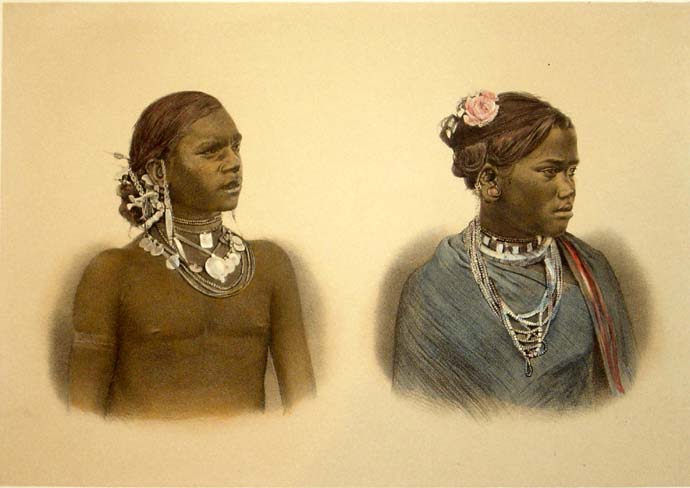
At the turn of the 20th century, Kurukh men wore a loincloth tied around the hips, while women less influenced by other communities would wear a cloth reaching to just above the knee, covering the chest.<ref name=":1" /> Today, women traditionally a wear thick cotton sari with detailed stitched borders of purple or red thread. Traditional tattoos include elaborate symmetrical patterns around their forearms, ankles, and chest. Men wear a thick cloth with similar detailed borders as a [[dhoti]] or [[lungi]].<ref name="Winston2006" /> | |||
=== Livelihood === | === Livelihood === | ||
Originally, the Oraons relied on the forest and its goods for an economic livelihood. Unlike many other communities of Jharkhand which practice ''jhum'', the Kurukh community uses plough agriculture. At the turn of the 20th century however, due to the policies of the [[British Raj|British colonial government]], most of the tribe worked as agricultural labourers for the ''[[Zamindar]]s'' on their own lands.<ref name=":1" /> However, recently many have become settled agriculturists, while others became migrant workers.<ref name=" | Originally, the Oraons relied on the forest and its goods for an economic livelihood. Unlike many other communities of Jharkhand which practice ''jhum'', the Kurukh community uses plough agriculture. At the turn of the 20th century however, due to the policies of the [[British Raj|British colonial government]], most of the tribe worked as agricultural labourers for the ''[[Zamindar]]s'' on their own lands.<ref name=":1" /> However, recently many have become settled agriculturists, while others became migrant workers.<ref name="Winston2006">{{Cite book |editor-last=Winston |editor-first=Robert |year=2006 |orig-year=First published 2004 |title=Human |publisher=[[Dorling Kindersley]] |page=439 |isbn=0-7566-1901-7 |quote=Oraons ... '''Beliefs''' Hinduism, Christianity, Sarna (a form of animism)}}</ref> | ||
=== Administration=== | |||
In a Kurukh village, the village level political organisation is called ''Parha'' which consists of post such as ''[[Pahan]]'' (village priest), ''Panibharwa'' (water-bearer of Pahan), ''Pujar'' (assistant of Pahan), ''Bhandari'' and ''Chowkidar'' (watchman). Each has a particular role in religious ceremonies, festivals and solving disputes in the village. The traditional informal educational institution [[tribal youth dormitory|youth dormitory]] is called ''Dhumkuria''. The public and common meeting place is Akhra where people meet for the purpose of discussion and solving disputes.<ref name="admin">{{cite AV media |url=https://www.youtube.com/watch?v=g_uVr9TtVyk |archive-url=https://ghostarchive.org/varchive/youtube/20211213/g_uVr9TtVyk |archive-date=13 December 2021 |url-status=live|title=Tribes of India, PESA Act & Padaha system of Oraon tribe |date=16 May 2016|last=Team |first=Mai Bhi Bharat |medium=Television production |language=hi |publisher=[[Rajya Sabha TV|RSTV]] |series=Mai Bhi Bharat}}{{cbignore}}</ref> | |||
Twelve to thirty villages form a Parha council. Each village has a village council, member of village council act as the members of Parha council in the headship of Parha chief. One of the villages in Parha is called Raja (King) village, another {{transliteration|kru|dewan}} (prime minister) village, another {{transliteration|kru|panrey}} (clerk of the village), a fourth {{transliteration|kru|kotwar}} (orderly) village and remaining village are called {{transliteration|kru|praja}} (subject) village. Raja village has highest social status because headman of this village presides at the meeting of a Parha Panchayat.<ref name="admin"/> | |||
The Kurukh are patrilocal and patrilineal. Clan name descends from father to son. The major lineage is known as ''Bhuinhari Khunt''. Bhuinhari means owner of the land. Khunt has two sub groups: the ''Pahan Khunt'' and ''Mahato Khunt''. Pahan and Mahato are two main office of Bhuinhari lineage.<ref name="auto" /> | |||
==Religion== | ==Religion== | ||
{{Pie chart|thumb=right| | {{More citations needed|date=April 2025}}{{Pie chart | ||
The Oraon follow their traditional religion ([[Sarnaism]]), which is based on nature worship. Some of the groups started following Sarnaism in a Hindu style, as the sects of the Bishnu Bhagats, Bacchinda Bhagats, Karmu Bhagats and Tana Bhagats. The Oraons have established several Sarna sects. Oraons worship Sun as biri (a name given for Dharmesh). Kurukhar also believe in Animism. | |caption=Religion of Kurukh people, 2011 census | ||
|thumb=right | |||
|label1=[[Hinduism]] | |||
|value1=36.37 | |||
|color1=darkorange | |||
|label2=[[Christianity]] | |||
|value2=30.24 | |||
|color2=dodgerblue | |||
|label3=[[Sarnaism]] | |||
|value3=29.2 | |||
|color3=maroon | |||
|label4=Adi Dharam | |||
|value4=1.95 | |||
|color4=Red | |||
|label5=Addi Bassi | |||
|value5=0.98 | |||
|label6=Adi | |||
|value6=0.48 | |||
|label7=Not stated | |||
|value7=0.25 | |||
|other=yes | |||
|other-color=Green | |||
|footer=''*Statistics of the religion of the Kurukh population in Jharkhand, West Bengal, Odisha, Chhattisgarh, Bihar, and Tripura, where they are classified as Scheduled Tribes.''}} | |||
According to the 2011 census, the Scheduled Tribes Kurukh population in India numbers 3,623,512. Among them, 36.37% are followers of [[Hinduism]], 30.24% follow [[Christianity]], 29.2% practice [[Sarnaism|Sarna]], 1.95% follow Adi Dharam, 0.98% adhere to Addi Bassi, and 0.48% follow Adi, while 0.25% did not state any religious affiliation. Additionally, there are smaller numbers of [[Muslims]] (7,459), [[Buddhism|Buddhists]] (1,904), [[Tana Bhagats]] (978), Oraons (770), [[Sikhs]] (423), and others, with 5,381 individuals returning some unclassified religion. | |||
The Oraon follow their traditional religion ([[Sarnaism]]), which is based on nature worship. Some of the groups started following Sarnaism in a Hindu style, as the sects of the Bishnu Bhagats, Bacchinda Bhagats, Karmu Bhagats and Tana Bhagats. The Oraons have established several Sarna sects. Oraons worship Sun as biri (a name given for Dharmesh). Kurukhar also believe in Animism.{{citation needed|date=September 2023}} | |||
Most of population is [[Sarnaism|Sarna]], which is a religion that is indigenous to [[Adivasi]]s in the [[Chota Nagpur Plateau]]. Sarna perform religious rituals under the shade of a sacred grove. They worship the sun as Biri and the moon as Chando, and call the earth Dharti Aayo (Earth as mother). Chando Biri are the words which are used in Sarna pujas. Dharmesh is their supreme almighty god.<ref>{{cite book|title=History and Culture of the Oraon Tribe : Some Aspects of Their Social Life|last=Ghosh|first=Abhik|publisher=Mohit|year=2003|isbn=81-7445-196-X|page=237}}</ref> | Most of population is [[Sarnaism|Sarna]], which is a religion that is indigenous to [[Adivasi]]s in the [[Chota Nagpur Plateau]]. Sarna perform religious rituals under the shade of a sacred grove. They worship the sun as Biri and the moon as Chando, and call the earth Dharti Aayo (Earth as mother). Chando Biri are the words which are used in Sarna pujas. Dharmesh is their supreme almighty god.<ref>{{cite book|title=History and Culture of the Oraon Tribe : Some Aspects of Their Social Life|last=Ghosh|first=Abhik|publisher=Mohit|year=2003|isbn=81-7445-196-X|page=237}}</ref> | ||
| Line 116: | Line 170: | ||
The Tana Bhagat was formed by Oraon saints Jatra Bhagat and Turia Bhagat. Tana Bhagats opposed the taxes imposed on them by the British and staged a [[Satyagraha]] movement even before [[Mahatma Gandhi]]. All Tana Bhagats were followers of Gandhi during the Independence movement. Tana Bhagats still wear a khadi kurta, dhoti and Gandhi topi (cap) with tricoloured flag in their topi. All Tana Bhagats perform puja to the Mahadeo and the tricolour with a chakra symbol on it, which is fixed at their courtyard. | The Tana Bhagat was formed by Oraon saints Jatra Bhagat and Turia Bhagat. Tana Bhagats opposed the taxes imposed on them by the British and staged a [[Satyagraha]] movement even before [[Mahatma Gandhi]]. All Tana Bhagats were followers of Gandhi during the Independence movement. Tana Bhagats still wear a khadi kurta, dhoti and Gandhi topi (cap) with tricoloured flag in their topi. All Tana Bhagats perform puja to the Mahadeo and the tricolour with a chakra symbol on it, which is fixed at their courtyard. | ||
Among Christian Oraons, there are Roman | Among Christian Oraons, there are [[Roman Catholic]]s and [[Protestant]]s, the latter of which having several denominations. | ||
==In popular culture== | ==In popular culture== | ||
In 1957, film-maker [[Ritwik Ghatak]] shot a preparatory test film named ''Oraon'' on the life of the [[Adivasi]]s of the [[Ranchi]] region in [[Jharkhand]] and on the Oraons of Rani Khatanga Village in Jharkhand.<ref>[http://ir.nmu.org.ua/bitstream/handle/123456789/133612/85b69f83ea77c6c93361a503b826c134.pdf?sequence=1 Cinema & I pg.116] {{webarchive |url=https://web.archive.org/web/20151125040537/http://ir.nmu.org.ua/bitstream/handle/123456789/133612/85b69f83ea77c6c93361a503b826c134.pdf?sequence=1 |date=25 November 2015 }}</ref> | In 1957, film-maker [[Ritwik Ghatak]] shot a preparatory test film named ''Oraon'' on the life of the [[Adivasi]]s of the [[Ranchi]] region in [[Jharkhand]] and on the Oraons of Rani Khatanga Village in Jharkhand.<ref>[http://ir.nmu.org.ua/bitstream/handle/123456789/133612/85b69f83ea77c6c93361a503b826c134.pdf?sequence=1 Cinema & I pg.116] {{webarchive |url=https://web.archive.org/web/20151125040537/http://ir.nmu.org.ua/bitstream/handle/123456789/133612/85b69f83ea77c6c93361a503b826c134.pdf?sequence=1 |date=25 November 2015 }}</ref> | ||
== Notable people == | == Notable people == | ||
<!---♦♦♦ Only add a person to this list if they already have their own article on the English Wikipedia ♦♦♦---> | |||
<!---♦♦♦ Please keep the list in alphabetical order by LAST NAME ♦♦♦---> | |||
{{refimprove section|date=March 2025}} | |||
*[[Joachim Baxla]], Member of Parliament | |||
*[[Ignace Beck]], Member of Parliament | |||
*[[Budhu Bhagat]], freedom fighter | *[[Budhu Bhagat]], freedom fighter | ||
*[[Indra Nath Bhagat]], Member of Parliament | |||
*[[Jatra Bhagat]], freedom fighter and social reformist | *[[Jatra Bhagat]], freedom fighter and social reformist | ||
*[[Sudarshan Bhagat]], Member of Parliament | *[[Sudarshan Bhagat]], Member of Parliament, central minister Government of india | ||
*[[Albert Ekka]], recipient of India's highest wartime gallantry award [[Param Vir Chakra]] | *[[Sukhdeo Bhagat]], Member of Legislative Assembly [[Government of Jharkhand]], Member of Parliament And President [[Jharkhand Pradesh Congress Committee]] | ||
*[[Albert Ekka]], recipient of India's highest wartime gallantry award [[Param Vir Chakra]] | |||
*[[Anosh Ekka]], Minister [[Government of Jharkhand]] | |||
*[[Deep Grace Ekka]], Indian hockey player | *[[Deep Grace Ekka]], Indian hockey player | ||
*[[Madhu Mansuri Hasmukh]], singer and activist | |||
*[[Rajesh Kachhap]], Member of Legislative Assembly [[Government of Jharkhand]] | |||
*[[Jacinta Kerketta]], journalist and poet | |||
*[[Michael Kindo]], hockey player | |||
*[[Animesh Kujur]], Animesh Kujur (born 2 June 2003) is an Indian sprinter. He is the current national record holder for 100 metres, 200 metres and 4 × 100 metres relay. | |||
*[[Renee Kujur]], model | *[[Renee Kujur]], model | ||
*[[Santiuse Kujur]], MP of [[Assam]] | *[[Santiuse Kujur]], MP of [[Assam]] | ||
*[[Birendra Lakra]], Indian hockey player | *[[Birendra Lakra]], Indian hockey player | ||
*[[Provat Lakra]], Football player of [[West Bengal]] | *[[Provat Lakra]], Football player of [[West Bengal]] | ||
*[[Sawna Lakra]], Member of Legislative Assembly [[Government of Bihar]] and [[Government of Jharkhand]] | |||
*[[Sunita Lakra]], Indian hockey player | *[[Sunita Lakra]], Indian hockey player | ||
*[[ | *[[Chamra Linda]], Minister [[Government of Jharkhand]] | ||
*[[Nirmal Minz]], | *[[Nirmal Minz]], scholar | ||
*[[Lilima Minz]], Indian hockey player | *[[Lilima Minz]], Indian hockey player | ||
*[[Mukut Minz]], Mukut Minz is an Indian doctor. In 2017, he was awarded the Padma Shri by the Indian Government for his contribution in medicine. | |||
*[[Sonajharia Minz]], vice-chancellor to the [[Sido Kanhu Murmu University]] | |||
*[[Jual Oram]], [[Ministry of Tribal Affairs]], India | *[[Jual Oram]], [[Ministry of Tribal Affairs]], India | ||
*[[Dinesh Oraon]], | *[[Dinesh Oraon]], Indian politician currently serving as speaker of Jharkhand legislative assembly and a leader of [[Bharatiya Janata Party]] from Jharkhand | ||
*[[Kartik Oraon]], Member of Parliament, [[Lok Sabha]] | *[[Kartik Oraon]], Member of Parliament, [[Lok Sabha]] cabinet minister Government of India, founder, president Akhil Bharatiya Adivasi Vikash Parishad & kendriya sarna samiti Bharat. | ||
*[[Rameshwar Oraon]], former IPS officer and politician | *[[Rameshwar Oraon]], former IPS officer and politician, cabinet minister Government of India, cabinet minister Government of Jharkhand, President Jharkhand Pradesh Congress commity, president National commission of scheduled tribe Government of India | ||
*[[Sameer Oraon]]. Former Member of Rajya Sabha and National President [[Bharatiya Janata Party]] ST Morcha | |||
*[[Simon Oraon]], environmentalist & [[Padma Shri]] awardee | *[[Simon Oraon]], environmentalist & [[Padma Shri]] awardee | ||
*[[Manisa Panna]], football player | |||
*[[Manoj Tigga]], Member of Parliament [[Alipurduar]] | |||
*[[Simon Tigga]], politician | *[[Simon Tigga]], politician | ||
*[[ | *[[Bandhu Tirkey]], Minister [[Government of Jharkhand]] | ||
*[[Bhushan Tirkey]], Member of Legislative Assembly [[Government of Jharkhand]] | |||
*[[Dasrath Tirkey]], Member of Parliament | |||
*[[Dilip Tirkey]], President of the Hockey India<ref name=":2">{{Cite news |date=6 February 2012 |title=Asunta Lakra, a symbol for tribal hope |work=The Times of India |url=https://timesofindia.indiatimes.com/sports/hockey/top-stories/asunta-lakra-a-symbol-for-tribal-hope/articleshow/11772062.cms |access-date=3 April 2023 |issn=0971-8257}}</ref> | |||
*[[Ignace Tirkey]], hockey player | *[[Ignace Tirkey]], hockey player | ||
*[[ | *[[Manohar Tirkey]], politician | ||
*[[Pius Tirkey]], Member of Parliament | |||
*[[Rupa Rani Tirkey]], lawn ball player | |||
*[[Shilpi Neha Tirkey]], Minister [[Government of Jharkhand]] | |||
*[[Biju Toppo]], documentary filmmaker | *[[Biju Toppo]], documentary filmmaker | ||
*[[Binita Toppo]], hockey player | |||
*[[Namita Toppo]], Indian hockey player | *[[Namita Toppo]], Indian hockey player | ||
*[[Telesphore Toppo]], Cardinal | *[[Telesphore Toppo]], Cardinal | ||
*[[ | *[[Abhay Xaxa]] (1983–2020), Human rights activist, poet, and social anthropologist<ref>{{Cite magazine |last=Sushmita |date=27 June 2020 |title=Remembering scholar and activist Abhay Xaxa, whose death is an irreparable loss to Adivasi movements |url=https://caravanmagazine.in/communities/remembering-abhay-xaxa-whose-death-is-a-loss-to-adivasi-movements |magazine=[[The Caravan]] |access-date=13 May 2025 |quote=Xaxa belonged to Kurukh or Oraon tribe and was a native of Chhattisgarh.}}</ref> | ||
* | *[[Pyari Xaxa]], football player | ||
<!---♦♦♦ Only add a person to this list if they already have their own article on the English Wikipedia ♦♦♦---> | |||
<!---♦♦♦ Please keep the list in alphabetical order by LAST NAME ♦♦♦---> | |||
==See also== | ==See also== | ||
| Line 158: | Line 239: | ||
==External links== | ==External links== | ||
{{Commons category|Kurukh people}} | |||
*[https://kurukhworld.com/portray/social,%20culture%20&%20economical%20dimension/index.html kurukhworld.com] | *[https://kurukhworld.com/portray/social,%20culture%20&%20economical%20dimension/index.html kurukhworld.com] | ||
''This article includes material from the 1995 [[public domain]] [[Library of Congress Country Studies|Library of Congress Country Study]] on India.'' | |||
{{Ethnic groups in Bangladesh}} | {{Ethnic groups in Bangladesh}} | ||
{{Bhutanese society}} | {{Bhutanese society}} | ||
| Line 166: | Line 250: | ||
{{Scheduled tribes of India}} | {{Scheduled tribes of India}} | ||
{{Authority control}} | {{Authority control}} | ||
[[Category:Ethnic groups in Bangladesh]] | [[Category:Ethnic groups in Bangladesh]] | ||
[[Category:Adivasi]] | |||
[[Category:Dravidian peoples]] | [[Category:Dravidian peoples]] | ||
[[Category:Social groups of Delhi]] | [[Category:Social groups of Delhi]] | ||
[[Category:Scheduled Tribes of Odisha]] | [[Category:Scheduled Tribes of Odisha]] | ||
[[Category:Scheduled Tribes of Jharkhand]] | |||
[[Category:Scheduled Tribes of Bihar]] | |||
[[Category:Scheduled Tribes of West Bengal]] | |||
[[Category:Scheduled Tribes of Chhattisgarh]] | |||
Latest revision as of 08:33, 28 March 2026
Kurukh | |
|---|---|
 Kurukh in traditional clothes performing dance | |
| Total population | |
| 3.8 million (2011) | |
| Regions with significant populations | |
| India | 3,696,899[1] |
| Jharkhand | 1,716,618 |
| Chhattisgarh | 748,739 |
| West Bengal | 643,510 |
| Odisha | 358,112 |
| Bihar | 144,472 |
| Assam | 39,739 (1921)[2] |
| Tripura | 12,011[3] |
| Bangladesh | 85,846[4] |
| Nepal | 37,424[5] |
| Bhutan | 4,200[6] |
| Languages | |
| Kurukh • Sadri • Odia • Hindi • Bengali | |
| Religion | |
| Hinduism, Christianity, Sarnaism[7] | |
| Related ethnic groups | |
The Kurukh or Oraon, also spelt Uraon or Dhangad,[8] (Kurukh: Karḵẖ and Oṛāōn) are a Dravidian speaking ethnolinguistic group inhabiting Chhotanagpur Plateau and adjoining areas - mainly the Indian states of Jharkhand, Odisha, Chhattisgarh, and West Bengal.[9] They predominantly speak Kurukh as their native language, which belongs to the Dravidian language family.[10] In Maharashtra, Oraon people are also known as Dhangad.[11][12]
Traditionally, Oraons depended on the forest and farms for their ritual practices and livelihoods, but in recent times, they have become mainly settled agriculturalists. Many Oraon migrated to tea gardens of Assam, West Bengal and Bangladesh as well as to countries like Fiji, Guyana, Trinidad and Tobago and Mauritius during British rule, where they were known as Hill Coolies.[8][13] They are listed as a Scheduled Tribe in seven Indian states for the purpose of the reservation system.[14]
Etymology[edit | edit source]
According to Edward Tuite Dalton, "Oraon" is an exonym assigned by neighbouring Munda people, meaning "to roam". They call themselves Kurukh.[15] According to Sten Konow, Uraon will mean man as in the Dravidian Kurukh language, the word Urapai, Urapo and Urang means Man. The word Kurukh may be derived from the word Kur or Kurcana means "shout" and "stammer". So Kurukh will mean 'a speaker'.[16]
History[edit | edit source]
According to the Indian Anthropological Society, Konkan is said to be the original home of the Kurukh tribes from where they migrated to the Chota Nagpur Plateau.[17] The group is said to have settled in the Chota Nagpur Plateau by 100 CE.[18]
There are three opinions of scholars about the origin of Kurukh people. According to Sarat Chandra Roy, Kurukh people might have migrated from Coorg in South India. In 1987, Elefenbein proposed Baloch's hypothesis, in which he proposed the Brahui tribe migrated from Baluchistan to Sindh where Brahui is still spoken, and the Rohtasgarh and Rajmahal hills. Those who migrated to Rohtasgarh were Kurukh and those venturing to Rajmahal hills were Malto. According to another opinion, Kurukh people were living in Indus Valley Civilisation, then they migrated to South and Central India after the decline of the Indus Valley Civilisation due to droughts and floods in 2500 BCE.[19]
According to the writings of Colonel Edward Tuite Dalton, Oraon claimed that they were settled in Gujarat, until they were expelled from there. Then they settled in Kalinjar, where they fought with Lowrik Sowrik of Palipiri and were defeated. Then they came to Rohtasgarh and were driven out by Muslims during the reign of Akbar. Then they settled in Chotanagpur. According to Dalton, Oraon were settled in Chotanagpur before the reign of Akbar and possibly some Oraon were in Rohtas hills when Rohtasgarh fort was constructed by Muslims. According to him the Oraon language is similar to Tamil, but some words spoken by Oraon are of Sanskrit origin due to their living with Sanskrit and Prakrit speaking people in the past. The physical features of Oraon are the darkest but those who live in mixed settlements have varieties of features.[20]
Colonial rule[edit | edit source]

During the British rule, Kurukh people rebelled against the British East India Company authority and local Zamindars against tax imposition. The Budhu Bhagat led the Lakra rebellion which is also known as the Kol uprising in 1832.[21]
Jatra Bhagat led civil disobedience movement Tana Bhagat Movement from 1914 to 1920.[22] After independence of India, they were listed as a Scheduled Tribe for the purpose of India's reservation system.[14]
Society[edit | edit source]
The Kurukh tribe is patrilocal and patrilineal. Kurukhs are divided into many exogamous clans. Clans names among the Kurukh are taken from plants, animals and objects. These clan names are also used in Oraon people's last names. Some important clans are:[23][24][25]
- Addo (ox)
- Aind (a fish)
- Alla (dog)
- Bakula (Heron)
- Bando (wild cat)
- Bara (Banyan)
- Barwa (wild dog)
- Beck (Salt)
- Chidra (Squirrel)
- Edgo (Mouse)
- Ekka or kachhap (Turtle)
- Gari (monkey)
- Gede (Duck)
- Gidhi (vulture)
- Halman (langur)
- Keond (a fruit)
- Khoya (wild dog)
- Kinduar (a fish)
- Kindo (a fish)
- Kosuar (a fish)
- Kiro (a fruit)
- Kissi (pig)
- Kerketta (Hedge-sparrow)
- Kokro (cock)
- Kujur (A medicinal plant)
- Lakra (Tiger)
- Minz (a fish)
- Khetta or Nag (Cobra)
- Panna (Iron)
- Tido (a fish)
- Tirkuar (tithio bird)
- Tirkey (an eagle)
- Toppo (Woodpecker)
- Tigga (Monkey)
- Xalxo (pigeon)
- Xaxa (Crow)
- Xess or Dhan (Paddy)
- Halko or khalkho (fish)
Culture[edit | edit source]
Language[edit | edit source]
Kurukh are traditional speakers of Kurukh, which belongs to the northern branch of the Dravidian family. Just under half still speak this language as their mother tongue. Many have adopted the local lingua francas, Sadri and Odia, as their first languages. This shift to regional languages, especially Sadri, has been most pronounced in West Bengal, Bangladesh, Assam and Tripura, where the Kurukh are mainly tea garden workers and Sadri is the main link language.[10]
Festivals[edit | edit source]
The Kurukh celebrate all traditional festivals of the Chota Nagpur plateau: Sarhul, Karma, Dhanbuni, Harihari, Nawakhani, Khariyani etc.[26]
Music and dance[edit | edit source]
Since time immemorial The Oraon people have a rich range of folk songs, dances and tales,[27] as well as traditional musical instruments. Both men and women participate in dances, which are performed at social events and festivals. The Mandar, Nagara and Kartal are the main musical instruments. In Kurukh, song is known as "Dandi". Some Kurukh folk dances are war dances (between two Parhas), Karma dance (Karam dandi), Khaddi or Sarhul dance, Phagu, Jadur, jagra, Matha, Benja Nalna (wedding dance) and Chali (courtyard dance).[10]

Marriage tradition[edit | edit source]
Marriage among Kurukhs is usually arranged by the parents. The parents negotiate a bride price, after which the wedding can take place. On the wedding day, the groom arrives with his friends to the bride's house, and they hold a dance. A pandal is constructed in front of the bride's father's house, and the bride and groom stand on a stone, under which is grain above a plough yoke. A cloth is then thrown over the couple, who are doubly screened by the groom's friends. Then the sindoordaan is done: the groom applies sindoor to the bride's forehead, which is sometimes returned. Afterwards, water is poured over the couple and they return to a separate area of the house to change. When they are emerged, they are considered married. During this entire time, the rest of the party continue to dance.[28]
Dress[edit | edit source]

At the turn of the 20th century, Kurukh men wore a loincloth tied around the hips, while women less influenced by other communities would wear a cloth reaching to just above the knee, covering the chest.[28] Today, women traditionally a wear thick cotton sari with detailed stitched borders of purple or red thread. Traditional tattoos include elaborate symmetrical patterns around their forearms, ankles, and chest. Men wear a thick cloth with similar detailed borders as a dhoti or lungi.[7]
Livelihood[edit | edit source]
Originally, the Oraons relied on the forest and its goods for an economic livelihood. Unlike many other communities of Jharkhand which practice jhum, the Kurukh community uses plough agriculture. At the turn of the 20th century however, due to the policies of the British colonial government, most of the tribe worked as agricultural labourers for the Zamindars on their own lands.[28] However, recently many have become settled agriculturists, while others became migrant workers.[7]
Administration[edit | edit source]
In a Kurukh village, the village level political organisation is called Parha which consists of post such as Pahan (village priest), Panibharwa (water-bearer of Pahan), Pujar (assistant of Pahan), Bhandari and Chowkidar (watchman). Each has a particular role in religious ceremonies, festivals and solving disputes in the village. The traditional informal educational institution youth dormitory is called Dhumkuria. The public and common meeting place is Akhra where people meet for the purpose of discussion and solving disputes.[29]
Twelve to thirty villages form a Parha council. Each village has a village council, member of village council act as the members of Parha council in the headship of Parha chief. One of the villages in Parha is called Raja (King) village, another dewan (prime minister) village, another panrey (clerk of the village), a fourth kotwar (orderly) village and remaining village are called praja (subject) village. Raja village has highest social status because headman of this village presides at the meeting of a Parha Panchayat.[29] The Kurukh are patrilocal and patrilineal. Clan name descends from father to son. The major lineage is known as Bhuinhari Khunt. Bhuinhari means owner of the land. Khunt has two sub groups: the Pahan Khunt and Mahato Khunt. Pahan and Mahato are two main office of Bhuinhari lineage.[10]
Religion[edit | edit source]
 | This article needs additional citations for verification. (April 2025) |
Religion of Kurukh people, 2011 census
*Statistics of the religion of the Kurukh population in Jharkhand, West Bengal, Odisha, Chhattisgarh, Bihar, and Tripura, where they are classified as Scheduled Tribes.
According to the 2011 census, the Scheduled Tribes Kurukh population in India numbers 3,623,512. Among them, 36.37% are followers of Hinduism, 30.24% follow Christianity, 29.2% practice Sarna, 1.95% follow Adi Dharam, 0.98% adhere to Addi Bassi, and 0.48% follow Adi, while 0.25% did not state any religious affiliation. Additionally, there are smaller numbers of Muslims (7,459), Buddhists (1,904), Tana Bhagats (978), Oraons (770), Sikhs (423), and others, with 5,381 individuals returning some unclassified religion.
The Oraon follow their traditional religion (Sarnaism), which is based on nature worship. Some of the groups started following Sarnaism in a Hindu style, as the sects of the Bishnu Bhagats, Bacchinda Bhagats, Karmu Bhagats and Tana Bhagats. The Oraons have established several Sarna sects. Oraons worship Sun as biri (a name given for Dharmesh). Kurukhar also believe in Animism.[citation needed]
Most of population is Sarna, which is a religion that is indigenous to Adivasis in the Chota Nagpur Plateau. Sarna perform religious rituals under the shade of a sacred grove. They worship the sun as Biri and the moon as Chando, and call the earth Dharti Aayo (Earth as mother). Chando Biri are the words which are used in Sarna pujas. Dharmesh is their supreme almighty god.[30]
Kamru Bhagats (Oraon or Munda devotees) originated when Oraons acquired special powers after making a pilgrimage to Kamakhya in Assam to pay respect to Durga.[31]
The Tana Bhagat was formed by Oraon saints Jatra Bhagat and Turia Bhagat. Tana Bhagats opposed the taxes imposed on them by the British and staged a Satyagraha movement even before Mahatma Gandhi. All Tana Bhagats were followers of Gandhi during the Independence movement. Tana Bhagats still wear a khadi kurta, dhoti and Gandhi topi (cap) with tricoloured flag in their topi. All Tana Bhagats perform puja to the Mahadeo and the tricolour with a chakra symbol on it, which is fixed at their courtyard.
Among Christian Oraons, there are Roman Catholics and Protestants, the latter of which having several denominations.
In popular culture[edit | edit source]
In 1957, film-maker Ritwik Ghatak shot a preparatory test film named Oraon on the life of the Adivasis of the Ranchi region in Jharkhand and on the Oraons of Rani Khatanga Village in Jharkhand.[32]
Notable people[edit | edit source]
| This section needs additional citations for verification. (March 2025) |
- Joachim Baxla, Member of Parliament
- Ignace Beck, Member of Parliament
- Budhu Bhagat, freedom fighter
- Indra Nath Bhagat, Member of Parliament
- Jatra Bhagat, freedom fighter and social reformist
- Sudarshan Bhagat, Member of Parliament, central minister Government of india
- Sukhdeo Bhagat, Member of Legislative Assembly Government of Jharkhand, Member of Parliament And President Jharkhand Pradesh Congress Committee
- Albert Ekka, recipient of India's highest wartime gallantry award Param Vir Chakra
- Anosh Ekka, Minister Government of Jharkhand
- Deep Grace Ekka, Indian hockey player
- Madhu Mansuri Hasmukh, singer and activist
- Rajesh Kachhap, Member of Legislative Assembly Government of Jharkhand
- Jacinta Kerketta, journalist and poet
- Michael Kindo, hockey player
- Animesh Kujur, Animesh Kujur (born 2 June 2003) is an Indian sprinter. He is the current national record holder for 100 metres, 200 metres and 4 × 100 metres relay.
- Renee Kujur, model
- Santiuse Kujur, MP of Assam
- Birendra Lakra, Indian hockey player
- Provat Lakra, Football player of West Bengal
- Sawna Lakra, Member of Legislative Assembly Government of Bihar and Government of Jharkhand
- Sunita Lakra, Indian hockey player
- Chamra Linda, Minister Government of Jharkhand
- Nirmal Minz, scholar
- Lilima Minz, Indian hockey player
- Mukut Minz, Mukut Minz is an Indian doctor. In 2017, he was awarded the Padma Shri by the Indian Government for his contribution in medicine.
- Sonajharia Minz, vice-chancellor to the Sido Kanhu Murmu University
- Jual Oram, Ministry of Tribal Affairs, India
- Dinesh Oraon, Indian politician currently serving as speaker of Jharkhand legislative assembly and a leader of Bharatiya Janata Party from Jharkhand
- Kartik Oraon, Member of Parliament, Lok Sabha cabinet minister Government of India, founder, president Akhil Bharatiya Adivasi Vikash Parishad & kendriya sarna samiti Bharat.
- Rameshwar Oraon, former IPS officer and politician, cabinet minister Government of India, cabinet minister Government of Jharkhand, President Jharkhand Pradesh Congress commity, president National commission of scheduled tribe Government of India
- Sameer Oraon. Former Member of Rajya Sabha and National President Bharatiya Janata Party ST Morcha
- Simon Oraon, environmentalist & Padma Shri awardee
- Manisa Panna, football player
- Manoj Tigga, Member of Parliament Alipurduar
- Simon Tigga, politician
- Bandhu Tirkey, Minister Government of Jharkhand
- Bhushan Tirkey, Member of Legislative Assembly Government of Jharkhand
- Dasrath Tirkey, Member of Parliament
- Dilip Tirkey, President of the Hockey India[33]
- Ignace Tirkey, hockey player
- Manohar Tirkey, politician
- Pius Tirkey, Member of Parliament
- Rupa Rani Tirkey, lawn ball player
- Shilpi Neha Tirkey, Minister Government of Jharkhand
- Biju Toppo, documentary filmmaker
- Binita Toppo, hockey player
- Namita Toppo, Indian hockey player
- Telesphore Toppo, Cardinal
- Abhay Xaxa (1983–2020), Human rights activist, poet, and social anthropologist[34]
- Pyari Xaxa, football player
See also[edit | edit source]
References[edit | edit source]
- ↑ "A-11 Individual Scheduled Tribe Primary Census Abstract Data and its Appendix". censusindia.gov.in. Office of the Registrar General & Census Commissioner, India. Retrieved 3 November 2017.
- ↑ "Estimated Population by Castes, 5. Assam – Census 1951" (PDF). Office of the Registrar General, India. 1954. p. 9.
- ↑ "Statement 1: Abstract of speakers' strength of languages and mother tongues - 2011". www.censusindia.gov.in. Office of the Registrar General & Census Commissioner, India. Retrieved 7 July 2018.
- ↑ "Table 1.4 Ethnic Population by Group and Sex" (PDF) (in Bengali). Bangladesh Bureau of Statistics. 2021. p. 33.
- ↑ "National Population and Housing Census 2011: Social Characteristics Tables" (PDF). Nepal Census. Archived from the original (PDF) on 14 March 2023. Retrieved 4 March 2021 – via Government of Nepal.
- ↑ "Oraon of Bhutan". PeopleGroups. Retrieved 28 January 2020.
- ↑ 7.0 7.1 7.2 Winston, Robert, ed. (2006) [First published 2004]. Human. Dorling Kindersley. p. 439. ISBN 0-7566-1901-7.
Oraons ... Beliefs Hinduism, Christianity, Sarna (a form of animism)
- ↑ 8.0 8.1 "The Long Journey: From India to Guyana". Guyana Chronicle. 5 May 2014.
- ↑ Hasnain, Nadeem (2021). Tribal India (7th ed.). Delhi: Palaka Prakashan. p. 136.
- ↑ 10.0 10.1 10.2 10.3 Prasad, R. R. (1996). Encyclopaedic Profile of Indian Tribes, Volume 1. Discovery Publishing House. ISBN 9788171412983.
- ↑ Singh, Kumar Suresh; Mehta, B. V.; Anthropological Survey of India (2004). Maharashtra Part 3. Anthropological Survey of India. p. 1585. ISBN 9788179911020.
- ↑ Ministry of Tribal Affairs, Government of India (December 2002). 27th report of Standing Committee on Labour and Welfare with regards to SCs and STs order (Second Amendment) Bill, 2002 (PDF) (Report). Archived from the original (PDF) on 24 October 2020.
- ↑ "Oraons - Dictionary definition of Oraons". Encyclopedia.com. Retrieved 14 October 2017.
- ↑ 14.0 14.1 "List of notified Scheduled Tribes" (PDF). Census India. Archived from the original (PDF) on 7 November 2013. Retrieved 9 February 2019.
- ↑ Dalton E. T. The Oraons: Descriptive Ethnology of Bengal. 1872. Section 1, page 215.
- ↑ Ferdinand Hahn (1985). Grammar of the Kurukh Language. Mittal Publications. p. xii. Retrieved 29 November 2022.
- ↑ Indian Anthropological Society (1986). Journal of the Indian Anthropological Society, Volumes 21-22. Indian Anthropological Society. pp. See page 75.
- ↑ Singh, Anjana (August 2018). "Linguistic Politics and Kurukh Language Movement of the Oraons in Jharkhand". Journal of Adivasi and Indigenous Studies. 8: 37–50 – via Academia.edu.
- ↑ Alisha Vandana Lakra, Md. Mojibur Rahman (August 2017). "Vitality and Endangerment of Contemporary Kurukh". Retrieved 5 September 2022.
- ↑ Sanjay Nath (2015). "Pages from the Old Records: A Note on 'The "Kols" of Chota-Nagpore' by E.T. Dalton". academia.edu: 15–22. Retrieved 25 October 2022.
- ↑ "Governor pays tribute to Veer Budhu Bhagat". Daily Pioneer. 23 August 2016. Retrieved 5 September 2022.
- ↑ Kumar, Sanjay (2008). "The Tana Bhagat Movement in Chotanagpur (1914-1920)". Proceedings of the Indian History Congress. 69: 723–731. ISSN 2249-1937. JSTOR 44147236. Retrieved 5 September 2022.
- ↑ "Tradition of Clan names and conservation among the Oraons of Chhattishgarh". niscair.res.in. Retrieved 5 September 2019.
- ↑ James George Frazer (2000). Totemism and Exogamy. Psychology Press. p. 374. ISBN 978-0700713387.
- ↑ "आदिवासी गोत्र". vikaspedia. Retrieved 18 September 2019.
- ↑ "Marriage Customs among The Oraons". etribaltribune.com.
- ↑ Ferdinand Hahn (1906). Blicke in die Geisteswelt der heidnischen Kols: Sammlung von Sagen, Märchen und Liedern der Oraon in Chota Nagpur. C. Bertelsmann. Retrieved 25 August 2012.
- ↑ 28.0 28.1 28.2 Hewitt, J. F. (April 1893). "Art. VII.–The Tribes and Castes of Bengal, by H. H. Risley. Vols. I. and II. Ethnographic Glossary, Vols. I. and II. Anthropometric Data". Journal of the Royal Asiatic Society of Great Britain & Ireland. 25 (2): 237–300. doi:10.1017/s0035869x00022395. ISSN 0035-869X. S2CID 163011123.
- ↑ 29.0 29.1 Team, Mai Bhi Bharat (16 May 2016). Tribes of India, PESA Act & Padaha system of Oraon tribe (Television production). Mai Bhi Bharat (in हिन्दी). RSTV. Archived from the original on 13 December 2021.
- ↑ Ghosh, Abhik (2003). History and Culture of the Oraon Tribe : Some Aspects of Their Social Life. Mohit. p. 237. ISBN 81-7445-196-X.
- ↑ Jha, P. 41 India and Nepal
- ↑ Cinema & I pg.116 Archived 25 November 2015 at the Wayback Machine
- ↑ "Asunta Lakra, a symbol for tribal hope". The Times of India. 6 February 2012. ISSN 0971-8257. Retrieved 3 April 2023.
- ↑ Sushmita (27 June 2020). "Remembering scholar and activist Abhay Xaxa, whose death is an irreparable loss to Adivasi movements". The Caravan. Retrieved 13 May 2025.
Xaxa belonged to Kurukh or Oraon tribe and was a native of Chhattisgarh.
External links[edit | edit source]
This article includes material from the 1995 public domain Library of Congress Country Study on India.
Template:Ethnic groups in Bangladesh Template:Bhutanese society