



->SalamAlayka added Category:Bangladeshi people of Arab descent using HotCat |
enhanced citations to improve readability per standard format |
||
| Line 1: | Line 1: | ||
{{short description| | {{short description|Prime Minister of Pakistan from 1953 to 1955}} | ||
{{about|third prime minister of Pakistan|his successor prime minister| | {{about|the third prime minister of Pakistan|his successor prime minister|Chaudhri Muhammad Ali}} | ||
{{Other people|Mohammad Ali|Mohammad Ali (disambiguation)}} | {{Other people|Mohammad Ali|Mohammad Ali (disambiguation)}} | ||
{{ | {{Use British English|date=September 2014}} | ||
{{Use dmy dates|date= | {{Use dmy dates|date=May 2025}} | ||
{{Infobox officeholder | {{Infobox officeholder | ||
| | | honorific_prefix = [[Sahibzada]] | ||
| name | | name = Mohammad Ali Bogra | ||
| | | native_name = {{lang|bn|মোহাম্মদ আলী বগুড়া}}<br />{{lang|ur|محمد علی بوگڑا}} | ||
| honorific_suffix = | |||
| image = Pakistani Prime Minister Bogra with Eisenhower (cropped).png | |||
| image_upright | | image_upright = | ||
| caption = Bogra in 1954 | |||
| caption | | order = 3rd | ||
| order | | office = Prime Minister of Pakistan | ||
| office | | term_start = 17 April 1953 | ||
| term_start | | term_end = 12 August 1955 | ||
| term_end | | monarch = [[Elizabeth II]] | ||
| governor_general = [[Malik Ghulam Muhammad]]<br />[[Iskandar Ali Mirza]] | |||
| monarch | | predecessor = [[Khawaja Nazimuddin]] | ||
| successor = [[Chaudhry Muhammad Ali|Muhammad Ali]] | |||
| governor_general | | order2 = 3rd & 7th | ||
| | | office2 = Minister of Foreign Affairs (Pakistan){{!}}Minister of Foreign Affairs | ||
| term_start2 = 13 June 1962 | |||
| | | term_end2 = 23 January 1963 | ||
| | | president2 = [[Ayub Khan|Muhammad Ayub Khan]] | ||
| | | deputy2 = S.K. Dehlavi<br />([[Foreign Secretary (Pakistan)|Foreign Secretary]]) | ||
| | | predecessor2 = [[Manzur Qadir]] | ||
| successor2 = [[Zulfikar Ali Bhutto]] | |||
| | <!-------------------------------------------------------------------------------------------->| term_start3 = 24 October 1954 | ||
| | | term_end3 = 12 August 1955 | ||
| deputy3 = [[Jalaludin Abdur Rahim|J.A. Rahim]]<br />([[Foreign Secretary (Pakistan)|Foreign Secretary]]) | |||
| predecessor3 = [[Muhammad Zafarullah Khan|M. Zafarullah Khan]] | |||
| successor3 = [[Hamidul Huq Choudhury]] | |||
| | <!-------------------------------------------------------------------------------------------->| office4 = [[Minister of Defence (Pakistan)|Minister of Defence]] | ||
| term_start4 = 17 April 1953 | |||
| | | term_end4 = 24 October 1954 | ||
| deputy4 = [[Akhter Husain]]<br />([[Defence Secretary (Pakistan)|Defence Secretary]]) | |||
| predecessor4 = [[Khawaja Nazimuddin]] | |||
| successor4 = General [[Ayub Khan (Field Marshal)|Ayub Khan]] | |||
<!-------------------------------------------------------------------------------------------->| order5 = | |||
| ambassador_from5 = Pakistan | |||
| country5 = Japan | |||
| term_start5 = 1959 | |||
| term_end5 = 1962 | |||
| predecessor5 = [[Omar Hayat Malik]] | |||
| successor5 = K. M. Sheikh | |||
| president5 = [[Ayub Khan (general)|Ayub Khan]] | |||
<!-------------------------------------------------------------------------------------------->| order6 = | |||
| ambassador_from6 = Pakistan | |||
| country6 = the United States | |||
| term_start6 = November 1955 | |||
| | | term_end6 = March 1959 | ||
| | | predecessor6 = [[Syed Amjad Ali]] | ||
| | | successor6 = [[Aziz Ahmed (civil servant)|Aziz Ahmed]] | ||
| | | president6 = [[Iskander Mirza]] | ||
| | <!-------------------------------------------------------------------------------------------->| order7 = | ||
| | | ambassador_from7 = | ||
<!-------------------------------------------------------------------------------------------->| | | country7 = | ||
| | | term_start7 = 27 February 1952 | ||
| term_end7 = 16 April 1953 | |||
| | | predecessor7 = [[Abul Hassan Isphani|A. H. Isphani]] | ||
| | | successor7 = [[Syed Amjad Ali|Amjad Ali]] | ||
| governor_general7 = [[Malik Ghulam Muhammad|Malik Ghulam]] | |||
<!-------------------------------------------------------------------------------------------->| order8 = [[High Commission of Pakistan, Ottawa#List of High Commissioners in Canada|High Commissioner of Pakistan to Canada]] | |||
| country8 = | |||
| term_start8 = 1949 | |||
| term_end8 = 1952 | |||
| | | predecessor8 = | ||
| | | successor8 = | ||
| | | governor_general8 = [[Khawaja Nazimuddin]] | ||
<!-------------------------------------------------------------------------------------------->| order9 = [[Myanmar–Pakistan relations|Pakistani Ambassador to Burma]] | |||
| country9 = | |||
| term_start9 = 1948 | |||
| | | term_end9 = 1949 | ||
| | | predecessor9 = [[Shamsuddin Ahmed (Pakistani politician)|Shamsuddin Ahmed]] | ||
| | | successor9 = | ||
| | | governor_general9 = [[Muhammad Ali Jinnah]]<br />(1948)<br />[[Khawaja Nazimuddin]]<br />(1948–1949) | ||
| | <!------------------------------------------------------------------------------------------------------------->| order10 = [[Muslim League (Pakistan)|President of Pakistan Muslim League]] | ||
| | | term_start10 = 17 April 1953 | ||
| | | term_end10 = 12 August 1955 | ||
<!-------------------------------------------------------------------------------------------->| | | predecessor10 = [[Khawaja Nazimuddin]] | ||
| | | successor10 = [[Chaudhri Muhammad Ali|Muhammad Ali]] | ||
| | <!------------------------------------------------------------------------------------------------------------->| pronunciation = | ||
| | | birth_name = Syed Mohammad Ali Chowdhury | ||
| | | birth_date = {{birth date|df=yes|1909|10|19}} | ||
| | | birth_place = [[Backergunge District]], [[Eastern Bengal and Assam]], British India | ||
| | | death_date = {{death date and age|df=yes|1963|1|23|1909|10|19}} | ||
| | | death_place = [[Dhaka|Dacca]], [[East Pakistan]], Pakistan | ||
<!-------------------------------------------------------------------------------------------->| | | resting_place = [[Bogra Nawab Palace|Nawab Palace]], [[Bogra]], Bangladesh | ||
| | |||
| | |||
| | |||
| | |||
| | |||
| | |||
<!-------------------------------------------------------------------------------------------->| | |||
| | |||
| | |||
| | |||
| | |||
| | |||
| | |||
<!------------------------------------------------------------------------------------------------------------->| | |||
| | |||
| | |||
| | |||
| | |||
<!------------------------------------------------------------------------------------------------------------->| pronunciation | |||
| birth_name | |||
| birth_date | |||
| birth_place | |||
| death_date | |||
| death_place | |||
| resting_place_coordinates = | | resting_place_coordinates = | ||
| citizenship = [[British | | citizenship = [[British Subject|British Raj]]<br />(1909–1947)<br />[[Pakistani|Pakistan]] (1947–1963) | ||
| party | | party = [[Convention Muslim League|PMLC]] | ||
| otherparty | | otherparty = [[Muslim League (Pakistan)|PML]] (1947–1958)<br />[[All-India Muslim League|AIML]] (pre-1947) | ||
| height | | height = <!-- "X cm", "X m" or "X ft Y in" plus optional reference (conversions are automatic) --> | ||
| spouse | | spouse = [[Hamida Mohammad Ali|Hameeda Begum]]<ref name="dawn8Sep2015" /> <br /> Aliya Begum<ref name="dawn8Sep2015"/> | ||
| partner | | partner = <!--For those with a domestic partner and not married--> | ||
| children = | |||
| children | | mother = <!-- may be used (optionally with father parameter) in place of parents parameter (displays "Parent(s)" as label) --> | ||
| father = [[Altaf Ali Chowdhury]] | |||
| mother | | relatives = [[Syed Nawab Ali Chowdhury|Nawab Ali Chowdhury]] (grandfather)<br />[[Syed Hasan Ali Chowdhury|Hasan Ali Chowdhury]] (uncle)<br />[[Syeda Ashiqua Akbar]] (cousin) | ||
| father | | education = [[Bachelor of Arts|B.A.]] | ||
| relatives | | alma_mater = [[University of Calcutta]] | ||
| | | occupation = | ||
| profession = | |||
| known_for = [[#Bogra formula|Bogra formula]] | |||
| occupation | | salary = | ||
| profession | | net_worth = <!-- Net worth should be supported with a citation from a reliable source --> | ||
| known_for | | cabinet = [[#Prime Minister of Pakistan (1953–1955)|Bogra administration]] | ||
| salary | | portfolio = | ||
| net_worth | | awards = <!-- For civilian awards - appears as "Awards" if |mawards= is not set --> | ||
| cabinet | | data1 = | ||
| portfolio | | data2 = | ||
| awards | | blank5 = | ||
| data1 | | signature = | ||
| data2 | | signature_alt = | ||
| blank5 | | footnotes = | ||
| signature | |||
| signature_alt | |||
| footnotes | |||
}} | }} | ||
'''Syed Mohammad Ali Chowdhury Bogra'''{{Efn|{{langx|bn|বগুড়া সৈয়দ মোহাম্মদ আলী চৌধুরী}}<br />{{langx|ur|{{Nastaliq|سید محمد علی چوہدری بوگرا}}}}}} (19 October 1909 – 23 January 1963) was a Pakistani politician and diplomat who served as the third [[prime minister of Pakistan]] from 1953 to 1955. He was appointed in this capacity in 1953 until he [[Turnover (employment)|stepped down]] in 1955 in favour of his federal finance minister [[Chaudhri Muhammad Ali]].{{efn|Sources:<ref>{{cite web |title=Former Prime Ministers |url=http://pmo.gov.pk/former_pms.php |access-date=1 March 2015 |publisher=Prime Minister's Office Islamabad}}</ref><ref>{{cite web |last=Burki |first=Shahid Javed |author-link=Shahid Javed Burki |date=5 March 2015 |title=Mohammed Ali Bogra |url=https://www.britannica.com/biography/Muhammad-Ali-Bogra |access-date=1 March 2015 |website=Encyclopædia Britannica}}</ref><ref>{{Cite web |title=Chaudhury, Mohammad Ali |url=https://en.banglapedia.org/index.php?title=Chaudhury,_Mohammad_Ali |access-date=18 August 2021 |website=Banglapedia |language=en}}</ref><ref>{{Cite web |script-title=bn:বাঙালি মোহাম্মদ আলী বগুড়া ছিলেন ২ বার পাকিস্তানের প্রধানমন্ত্রী |url=https://www.usbnews24.com/?p=16486 |access-date=18 August 2021 |website=usbnews24.com |date=23 May 2019 |language=bn |archive-date=18 August 2021 |archive-url=https://web.archive.org/web/20210818061144/https://www.usbnews24.com/?p=16486 |url-status=dead}}</ref><ref name="ds19Oct2009">{{cite news |author=Syed Hamde Ali |date=19 October 2009 |title=Mohammed Ali of Bogra |url=https://www.thedailystar.net/news-detail-110424 |access-date=13 February 2015 |work=The Daily Star}}</ref>}} | |||
After | After his education at the [[Presidency University, Kolkata|Presidency College]] at the [[University of Calcutta]], he started his political career on [[All-India Muslim League|Muslim League]]'s platform and joined the [[Bengal Presidency|Bengal]]'s provincial cabinet of then-Prime Minister [[H. S. Suhrawardy]] in the 1940s. After the independence of Pakistan in 1947, he joined the foreign ministry as a diplomat and briefly tenured as Pakistan's ambassador to [[Myanmar–Pakistan relations|Burma]] (1948), High Commissioner to [[Canada–Pakistan relations|Canada]] (1949–1952), twice as ambassador to the [[Pakistan Ambassador to the United States|United States]], and as ambassador to [[Japan–Pakistan relations|Japan]] (1959–1962).<ref>{{cite web |url=https://www.pakistanembassytokyo.com/content/ambassador-pakistan-embassy-tokyo |title=Ambassador of Pakistan Embassy, Tokyo |work=Embassy of Pakistan in Tokyo |accessdate=27 April 2022 |archive-date=6 December 2024 |archive-url=https://web.archive.org/web/20241206125146/https://www.pakistanembassytokyo.com/content/ambassador-pakistan-embassy-tokyo |url-status=dead}}</ref> | ||
After he was recalled in 1953 from his services to [[Pakistan]] from the United States, he replaced [[Khawaja Nazimuddin|Sir Khwaja Nazimuddin]] as Prime Minister in an appointment approved by then-[[Governor-General of Pakistan|Governor-General]] Sir [[Malik Ghulam Muhammad|Malik Ghulam]]. His foreign policy strongly pursued the [[U.S. - Pakistan relations|strengthening of bilateral relations]] between Pakistan and the United States, while downplaying [[Pakistan-Soviet Union relations|relations]] with the [[Soviet Union]]. He also pushed for a stronger military to achieve peace with India and took personal initiatives to prioritize [[China pak relations|relations]] with China. At home front, he successfully proposed the popular [[Bogra Formula|political formula]] that laid the foundation of the [[Constitution of Pakistan|constitution]] in [[Constitution of Pakistan of 1956|1956]] which made Pakistan a [[Federal republic|federal]] [[parliamentary republic]]. Despite his popular initiatives, he lost his support to then-acting governor-general [[Iskandar Ali Mirza]] who re-appointed him as Pakistani Ambassador to the United States which he served until 1959. | |||
In 1962, he joined President [[Ayub Khan|Muhammad Ayub Khan]]'s [[President Ayub Khan|administration]] as the [[Foreign Minister of Pakistan]] until his death in 1963. | |||
=== | == Early life and education == | ||
Mohammad Ali was born in [[Backergunge District|Backerganj]] (now [[Barisal]]), [[Eastern Bengal and Assam|East Bengal]], [[British Indian Empire|British India]], on 19 October 1909.<ref name="Hannan1967p5">{{cite book |last1=Hannan |first1=Muhammad Abdul |title=Mohammed Ali (Bogra): A Biographical Sketch |year=1967 |location=Bogra, East Pakistan |publisher=Sahitya Kutir |oclc=87468 |page=5}}</ref> He was born into an elite and wealthy [[Aristocracy|aristocrat]] family who were known as the [[Dhanbari Nawab family|Nawabs of Dhanbari]].<ref>{{cite book |last1=Singh |first1=Nagendra Kumar |title=Encyclopaedia of Muslim Biography: India, Pakistan, Bangladesh |volume=II |year=2001 |publisher=A.P.H. Publishing Corporation |location=New Delhi |isbn=81-7648-232-3 |page=194}}</ref> The [[prefix]], ''[[Sahibzada]]'' (lit. Prince) is added before his name to represent the [[Nawabs of Bengal|Bengali royalty]] which is customary to give to individuals in India.<ref name="Sahitya Kutir, Hannan">{{cite book |last1=Hannan |first1=Muhammad Abdul |title=Mohammed Ali (Bogra): A Biographical Sketch |year=1967 |location=Bogra, East Pakistan |publisher=Sahitya Kutir |oclc=87468 |page=159}}</ref> | |||
His father, [[Nawab]]zada [[Altaf Ali Chowdhury]], educated at the [[St Xavier's college, Calcutta|St Xavier's College in Calcutta]], was a prominent figure in [[Dacca]] and was also a local politician who served as the Vice-President of the [[All-India Muslim League|Muslim League]]'s East Bengal faction.<ref name="Anthem Press, Gupta">{{cite book |last1=Gupta |first1=Nilanjana |last2=Banerjee |first2=Himadri |last3=Mukherjee |first3=Sipra |title=Calcutta Mosaic: Essays and Interviews on the Minority Communities of Calcutta |year=2009 |publisher=Anthem Press |isbn=978-81-905835-5-8 |url=https://books.google.com/books?id=0RrOpM9L5xMC&q=muhammad+ali+bogra+nawab&pg=PA128 |page=128 |access-date=4 July 2017 |language=en}}</ref> His father, Altaf Ali Chowdhury, was fond of [[Horse racing in India|horse races]], dog shows, and sports.<ref name="Hannan1967p5" /> His grandfather, [[Syed Nawab Ali Chowdhury|Nawab Ali Chowdhury]], was also a politician who served as the first [[Islam in Bangladesh|Bengali Muslim]] to be appointed as minister, and played a pioneering role in founding the [[Dhaka University]] along with Nawab Sir Khwaja Salimullah Bahadur of Dhaka.<ref name=Today>{{cite news |last1=Salam |first1=Muhammad Abdus |title=In Memory of Nawab Bahadur Syed Nawab Ali Chowdhury |url=http://www.newstoday.com.bd/?option=details&news_id=2411411&date=2015-05-17 |access-date=8 July 2015 |work=The News Today |date=17 April 2015 |archive-date=9 July 2015 |archive-url=https://web.archive.org/web/20150709144504/http://www.newstoday.com.bd/?option=details&news_id=2411411&date=2015-05-17 |url-status=dead}}</ref> | |||
Mohammad Ali Bogra grew up in [[Bogra]], having studied first at the local Hastings House and then educated at the local ''[[madrassa]]'' in [[Calcutta]].<ref name="ds19Oct2009" /> After his [[Matriculation in Pakistan|matriculation]], Bogra went to attend the [[Presidency University, Kolkata|Presidency College]] of the [[Calcutta University]] where he secured his graduation with a [[Bachelor of Arts|BA degree]] in [[political science]] in 1930.<ref name="Cambridge University Press, Jennings">{{cite book |last1=Jennings |first1=Ivor |author-link=Ivor Jennings |title=Constitution-Maker |year=2015 |publisher=Cambridge University Press |isbn=978-1-107-09111-5 |url=https://books.google.com/books?id=A853CgAAQBAJ&q=muhammad+ali+bogra+grandfather&pg=PA244 |page=244 |access-date=5 July 2017 |language=en |chapter=Mohammad Ali [Bogra] and Mohammad Ali [Chaudhury]}}</ref><ref name="ds19Oct2009"/> | |||
Mohammad Ali | He was married twice: his first wife was [[Hamida Mohammad Ali|Begum Hamida Mohammad Ali]], with whom he had two sons.<ref name="corbis"/> He later married Aliya Saddy in 1955.<ref name="corbis">[http://www.corbisimages.com/stock-photo/rights-managed/U1066957/portrait-of-mohammed-ali-and-his-wife Mohammad Ali and Hamide.] corbis 1955 Retrieved 15 December 2012</ref> His second marriage led to widespread protests against [[Polygamy in Pakistan|polygamy]] by [[Aurat Foundation|women organizations]] in the country.<ref>{{cite journal |last1=Ansari |first1=Sarah |author1-link=Sarah Ansari |title=Polygamy, Purdah and Political Representation: Engendering citizenship in 1950s Pakistan |journal=Modern Asian Studies |date=November 2009 |volume=43 |issue=6 |pages=1421–1461 |doi=10.1017/S0026749X08003776}}</ref> | ||
==Early political career (1930–1947)== | |||
Before his entrance in the politics, the Bogra family were influential [[Zamindar of Natore#Nawabs of Bogra and Dhanbari (North of Natore)|Nawabs]] active in Bengali politics and [[All India Muslim League|Muslim League]] as a [[Partisan (political)|party worker]] in 1930.<ref name="Bradt Travel Guides, Leung&Meggitt">{{cite book |last1=Leung |first1=Mikey |last2=Meggitt |first2=Belinda |title=Bradt Travel Guide – Bangladesh |year=2012 |publisher=Bradt Travel Guides |isbn=978-1-84162-409-9 |chapter-url=https://books.google.com/books?id=cdkILWIONLQC&q=muhammad+ali+bogra+nawab&pg=PA338 |page=338 |access-date=5 July 2017 |language=en |chapter=Nawab Palace Grounds}}</ref> In the [[1937 Indian provincial elections]] he was elected to the [[Bengal Legislative Assembly]]. His uncle, [[Syed Hasan Ali Chowdhury|Hasan Ali Chowdhury]] was also elected to the assembly, but from an opposing party.<ref name="Hannan1967p9">{{cite book |last1=Hannan |first1=Muhammad Abdul |title=Mohammed Ali (Bogra): A Biographical Sketch |year=1967 |location=Bogra, East Pakistan |publisher=Sahitya Kutir |oclc=87468 |page=9}}</ref> | |||
== | In 1938, he was elected chairman of the Bogra District Board, a position he retained until June 1942.<ref name="Hannan1967p9" /> He served in the opposition until 1943 when the Muslim League had gained political support and he was made parliamentary secretary to then-Chief Minister [[Khawaja Nazimuddin]].<ref name="Scarecrow Press, Rahman">{{cite book |last1=Rahman |first1=Syedur |year=2010 |title=Historical Dictionary of Bangladesh |url=https://books.google.com/books?id=bJfcCPUr0OoC&pg=PA54 |publisher=Scarecrow Press |page=54 |isbn=978-0-8108-7453-4}}</ref><ref name="pt24Jan2013">{{Cite news |title=Ex-PM Bogra remembered |url=http://www.pakistantoday.com.pk/2013/01/24/city/karachi/ex-pm-bogra-remembered/ |work=Pakistan Today |date=24 January 2013 |access-date=4 April 2016 |archive-url=https://web.archive.org/web/20180726040948/https://www.pakistantoday.com.pk/2013/01/24/ex-pm-bogra-remembered/ |archive-date=2018-07-26}}</ref> In 1946, he was asked by [[H. S. Suhrawardy|Husyn Suhrawardy]] to join his cabinet and subsequently held ministerial portfolio of [[health minister|health]], [[finance minister|finance]], and local government.<ref name="Scarecrow Press, Rahman"/> As health minister, he founded the [[Dhaka Medical College]] and the Calcutta Lake Medical College.<ref name="ds19Oct2009"/> | ||
Bogra supported the Muslim League's call for [[Lahore Resolution|creation]] of Pakistan through the [[Indian partition|partition]] of [[British India]] and successfully defended his constituency in the [[1945 Indian general election|general elections]] held in 1945.<ref name="ds19Oct2009"/> In 1947, he joined the first [[Constituent Assembly of Pakistan|Constituent Assembly]].<ref name="Scarecrow Press, Rahman"/> While in Dacca in 1948, he received Governor-General [[Muhammad Ali Jinnah]] and reportedly dissented on the issue of populist [[Bengali language movement|language movement]] being excluded as an official state language of Pakistan.<ref name="ds19Oct2009"/> He strongly advised Chief Minister Sir Khawaja Nazimuddin to restrain Jinnah from announcing the measure, but was rebuked.<ref name="ds19Oct2009"/> | |||
==Diplomatic career (1947–1952)== | |||
==Diplomatic | |||
{{Main|Anti-Sovietism}} | {{Main|Anti-Sovietism}} | ||
In 1948, Bogra was asked by Prime Minister [[Liaquat Ali Khan]] to be appointed | In 1948, Bogra was asked by Prime Minister [[Liaquat Ali Khan]] to be appointed the [[List of diplomatic missions of Pakistan|Pakistan ambassador]] to the [[Kingdom of Egypt]] to head the Pakistani diplomatic mission in [[Cairo]], which Bogra declined.<ref name="ds19Oct2009"/> Instead, he chose the diplomatic assignment in neighboring [[Burma]] and presented his credentials in [[Rangoon]] in 1948.<ref name="ds19Oct2009"/> Soon after becoming Pakistan Ambassador to Burma, his political philosophy reflected a [[Conservatism in Pakistan|conservative mindset]] and took an [[Anti-communism|anti-communist]] stance when he supported the [[Union of Burma|Burma]]'s military [[Communist insurgency in Myanmar|operations against the communists]].<ref name="Springer, Cheema"/> In 1948, he showed concerns of [[Communist Party of Bangladesh|communist expansion]] in Pakistan when he reportedly told Pakistani journalists that: "even [sic] if the Burmese Government succeed in suppressing the communists, it is possible they may shift the centre of communist efforts to Pakistan."<ref name="Springer, Cheema">{{cite book |last1=Cheema |first1=Pervaiz I. |author1-link=Pervaiz Iqbal Cheema |last2=Riemer |first2=Manuel |title=Pakistan's Defence Policy 1947–58 |year=1990 |publisher=Springer |isbn=978-1-349-20942-2 |url=https://books.google.com/books?id=CX6xCwAAQBAJ&q=muhammad+ali+bogra+burma&pg=PA198 |page=198 |access-date=5 July 2017 |language=en}}</ref> | ||
In 1949, he left Burma to become [[High Commissioners of Pakistan to Canada|high commissioner to Canada]], a position he held until 1952. In February 1952, he was made ambassador to the United States.<ref name="pt24Jan2013" /><ref>{{cite book |last1=Hannan |first1=Muhammad Abdul |title=Mohammed Ali (Bogra): A Biographical Sketch |year=1967 |location=Bogra, East Pakistan |publisher=Sahitya Kutir |oclc=87468 |page=11}}</ref> | |||
Watching the [[1952 United States presidential election|campaign for the 1952 United States presidency]], Bogra conjectured, according to [[Husain Haqqani]], that Pakistan could obtain economic and military aid from the United States by casting itself as a front line state in the battle to [[Containment|contain Soviet communism]]. He vigorously lobbied anticommunists in Washington, D.C. to that end.<ref name="Haqqani2013">{{cite book |last1=Haqqani |first1=Hussain |author-link=Husain Haqqani |title=Magnificent Delusions: Pakistan, the United States, and an Epic History of Misunderstanding |url=https://books.google.com/books?id=VNAiBQAAQBAJ&pg=PA59 |year=2013 |publisher=PublicAffairs |page=59 |isbn=978-1-61039-317-1}}</ref> In Pakistan's political circle, he was seen as extremely having pro-American views and had fondness of the country, the United States.<ref>{{cite book |last1=Thomas |first1=Lowell Jr. |author1-link=Lowell Thomas Jr. |last2=Freedman |first2=Lew |title=Lowell Thomas Jr.: Flight to Adventure, Alaska and Beyond |year=2013 |publisher=Graphic Arts Books |isbn=978-0-88240-983-2 |url=https://books.google.com/books?id=9rzCCQAAQBAJ&q=muhammad+ali+bogra+U.S.&pg=PT101 |access-date=6 July 2017 |language=en}}</ref> He also helped negotiate the United States' officer [[Military Assistance Advisory Group|assistance advisory]] to be dispatch to Pakistan, in an agreement he signed with the [[United States government]] in 1952.<ref name="Mr. Books, Rehman">{{cite book |last1=Rehman |first1=Shahid-ur |author-link=Shahid-ur Rehman |title=Pakistan Sovereignty Lost |year=2006 |publisher=Mr. Books |location=Islamabad |isbn=978-969-8500-01-6 |url=https://books.google.com/books?id=S8DsAAAAMAAJ&q=muhammad+ali+bogra+U.S.+ambassador |access-date=6 July 2017 |language=en}}</ref>{{rp|36}} | |||
In the [[Foreign Service of Pakistan|Foreign Service society]] of Pakistan, Bogra gained a reputation of "a man who was known for his [[wikt:Americophile|excessive praise of everything American.]]"<ref name="Columbia University Press, McMahon">{{cite book |last1=McMahon |first1=Robert J. |author-link=Robert J. McMahon |title=The Cold War on the Periphery: The United States, India, and Pakistan |year=2010 |publisher=Columbia University Press |isbn=978-0-231-51467-5 |chapter-url=https://books.google.com/books?id=Deq32J9P4ZMC&q=muhammad+ali+bogra+U.S.+ambassador&pg=PA162 |page=162 |access-date=6 July 2017 |language=en |chapter=Forging an Alliance}}</ref> Pakistani historians held him widely responsibly as one of the principal personalities putting Pakistan in the alliance of the United States against the Soviet Union.<ref name="Mr. Books, Rehman"/>{{rp|41–59}} He was a little-known pro-American political outsider when [[Malik Ghulam Muhammad|Ghulam Muhammad]] chose him in 1953 to replace Khawaja Nazimuddin as prime minister.<ref name="Abbas2005">{{cite book |last1=Abbas |first1=Hassan |author-link=Hassan Abbas (scholar) |title=Pakistan's Drift Into Extremism: Allah, the Army, and America's War on Terror |url=https://books.google.com/books?id=GiKm-ahTpS8C&pg=PA26 |year=2005 |publisher=M. E. Sharpe |isbn=0-7656-1496-0 |pages=25–26}}</ref> | |||
==Premiership (1953–1955)== | |||
The issue of the [[Bengali Language Movement]] in East in 1952, the rise of the [[Pakistan Socialist Party]], and the [[1953 Lahore riots|riots in Lahore]] against the [[Ahmadi]] in 1953 were the defining factors that led to the dismissal of Prime Minister [[Khawaja Nazimuddin]] by Governor-General [[Malik Ghulam Muhammad|Ghulam Muhammad]] on 17 April 1953.<ref name="Rex Bookstore, Inc.">{{cite book |last1=Ongsotto |first1=Rebecca Ramillo |last2=Ongsotto |first2=Reena R. |last3=Ramilo |first3=Raynoldo Castro |title=Asian History Module-based Learning Ii' 2002 Ed |year=2002 |publisher=Rex Bookstore, Inc. |isbn=978-971-23-3124-4 |page=329 |url=https://books.google.com/books?id=ZssaJIVdJI8C&q=muhammad+ali+bogra+prime+minister&pg=PA329 |access-date=6 July 2017 |language=en}}</ref> | |||
Bogra was recalled to [[Karachi]] from Washington, D.C. for further consultation, but Governor-General Ghulam Muhammad moved to appoint him as the new prime minister and the [[Muslim League (Pakistan)|President of the Muslim League]], which the party had accepted.<ref name="Springer, Rizvi">{{cite book |last1=Rizvi |first1=H. |author-link1=Hasan Askari Rizvi |title=Military, State and Society in Pakistan |year=2000 |publisher=Springer |location=London, U.K. |isbn=978-0-230-59904-8 |chapter-url=https://books.google.com/books?id=ZwGIDAAAQBAJ&q=Mohammad+ali+bogra+prime+minister&pg=PA72 |page=72 |access-date=7 July 2017 |language=en |chapter=Civilian institutions and the Military}}</ref> Under pressure he accepted the new appointment from Ghulam Muhammad.<ref name="tns.thenews.com.pk">{{Cite news |last=Mahmood |first=Nazir |title=History in a nutshell (II) |url=https://www.thenews.com.pk/tns/detail/557396-pakistan-history-in-a-nutshell |work=The News on Sunday |date=2 November 2014 |language=en-US |access-date=4 April 2016}}</ref><ref name="dawn8Sep2015">{{Cite news |url=http://www.dawn.com/news/1205473 |title=The Pakistani Prime Minister who drove a locomotive |last=Balouch |first=Akhtar |date=8 September 2015 |work=Dawn |access-date=4 April 2016}}</ref> Initially, he kept the [[List of Federal Government Ministries of Pakistan|federal ministries]] of [[Ministry of Foreign Affairs (Pakistan)|foreign affairs]] and [[Ministry of Defence (Pakistan)|defence]] until appointing a new cabinet.<ref name="Rex Bookstore, Inc."/> Upon taking over the government, Bogra dismissed the elected [[Government of East Pakistan|East Bengali government]] of [[A. K. Fazlul Huq|A.K. Fazlul Huq]] on 30 May 1954 for "treasonable activities."<ref name="Rowman & Littlefield, Burki">{{cite book |last1=Burki |first1=Shahid Javed |author-link=Shahid Javed Burki |title=Historical Dictionary of Pakistan |year=2015 |publisher=Rowman & Littlefield |isbn=978-1-4422-4148-0 |chapter-url=https://books.google.com/books?id=rk-sBwAAQBAJ&q=bogra+dismissed&pg=PR26 |page=xxvi |access-date=10 July 2017 |language=en |chapter=Chronology}}</ref><ref name="APH Publishing, Ahmed">{{cite book |last1=Ahmed |first1=Salahuddin |title=Bangladesh: Past and Present |year=2004 |publisher=APH Publishing |isbn=978-81-7648-469-5 |chapter-url=https://books.google.com/books?id=Szfqq7ruqWgC&q=bogra+dismissed&pg=PA141 |pages=141–142 |access-date=10 July 2017 |language=en |chapter=Governor's Rule}}</ref> He appointed then-defence secretary [[Iskander Mirza]] as the [[Governor of East Pakistan|Governor of East Bengal]], but this appointment only lasted a couple of months.<ref name="Rowman & Littlefield, Burki"/> | |||
Bogra's new cabinet—known as the "Ministry of Talents"<ref name="Nazaria-e-Pakistan Trust Biography">{{cite web |title=Muhammad Ali Bogra: Former Prime Minister of Pakistan & Ambassador to U. S. A |url=http://storyofpakistan.com/muhammad-ali-bogra/ |website=Story Of Pakistan |publisher=Nazaria-e-Pakistan Trust |access-date=7 July 2017 |date=1 June 2003}}</ref><ref>{{cite book |last1=Rahman |first1=Syedur |year=2010 |title=Historical Dictionary of Bangladesh |url=https://books.google.com/books?id=bJfcCPUr0OoC&pg=PA35 |publisher=Scarecrow Press |page=35 |isbn=978-0-8108-7453-4}}</ref>—included [[Commander-in-Chief of the Pakistan Army]] [[Ayub Khan]] as [[Defence Minister of Pakistan|Defence Minister]] and Governor [[Iskander Ali Mirza]] as [[Interior Minister of Pakistan|Interior Minister]] and [[Ministry of States and Frontier Regions (Pakistan)|Minister of States and Frontier Regions]].<ref name="Nazaria-e-Pakistan Trust Biography"/> | |||
===Bogra | After Bogra's appointment, U.S. President [[Dwight Eisenhower]] ordered the shipment of thousands of tons of wheat to Pakistan.<ref name="Infobase Publishing, Wynbrandt">{{cite book |last1=Wynbrandt |first1=James |title=A Brief History of Pakistan |year=2009 |publisher=Facts on File |isbn=978-0-8160-6184-6 |page=176 |url=https://books.google.com/books?id=xQGwgJnCPZgC&q=Muhammad+ali+bogra+wheat&pg=PA176 |access-date=7 July 2017 |language=en}}</ref> Bogra was eager to strengthen military ties with the United States; however, the U.S. moved cautiously to not [[Indo-US Relations|damage their relations]] with India.<ref name="Rowman & Littlefield, Cashman">{{cite book |last1=Cashman |first1=Greg |last2=Robinson |first2=Leonard C. |title=An Introduction to the Causes of War: Patterns of Interstate Conflict from World War I to Iraq |url=https://books.google.com/books?id=x7K2GYnXRngC&q=Bogra+eager&pg=PA226 |year=2007 |publisher=Rowman & Littlefield |page=226 |isbn=978-0-7425-5510-5 |access-date=9 July 2017 |language=en}}</ref> He signed several agreement with the United States, most notably the [[Mutual Defense Assistance Act|Mutual Defense Assistance Agreement]] in 1954, which provided U.S. military assistance to Pakistan.<ref name="tns.thenews.com.pk"/> During Bogra's premiership, Pakistan also joined the [[Southeast Asia Treaty Organization]] in 1955.<ref>{{Cite journal |date=September 1954 |title=Seato and Pakistan |url=https://www.jstor.org/stable/41392615 |journal=Pakistan Horizon |volume=7 |issue=3 |pages=138–149 |issn=0030-980X}}</ref> | ||
[[File:Nehru, Naguib and Bogra.jpg|thumb|Bogra with Indian Prime Minister [[Jawaharlal Nehru]] and Egyptian President [[Mohamed Naguib]], 1954]] | |||
His foreign policy was noted for strong "[[anti-Soviet agitation]]" because he viewed the [[Soviet Union]] as "imperialist", but did not label the same for China despite both being [[Sino-Soviet relations|ideologically close]].<ref name="Woodrow Wilson Center Press, Kux">{{cite book |last1=Kux |first1=Dennis |title=The United States and Pakistan, 1947–2000: Disenchanted Allies |year=2001 |publisher=Woodrow Wilson Center Press |isbn=978-0-8018-6572-5 |url=https://books.google.com/books?id=LFzbDYmWVpwC&q=Bogra+and+Soviet+union&pg=PA71 |access-date=9 July 2017 |language=en}}</ref>{{rp|71}} In 1955, Bogra helped organize and attended the [[Bandung Conference]] in Indonesia, expressing his approval for greater Afro-Asian cooperation and opposition to [[European colonialism]].<ref>{{Cite journal |last=Quinton-Brown |first=Patrick |year=2017 |title=Bandung, 1955 |url=https://hhr-atlas.ieg-mainz.de/articles/quinton-brown-bandung |journal=Online Atlas on the History of Humanitarianism and Human Rights |language=en |issn=2509-8152}}</ref> | |||
[[File:Bogra and Nehru.jpg|thumb|Bogra with Indian Prime Minister [[Jawaharlal Nehru]] in Karachi, 1953]] | |||
[[File:Pakistani Prime Minister Bogra with Eisenhower.png|thumb|Bogra with U.S. President [[Dwight D. Eisenhower]] in the [[Oval Office]], October 1954]] | |||
Bogra sought to address and resolve the [[Kashmir conflict]] with India. In 1953, he met with Indian Prime Minister [[Jawaharlal Nehru]] on the sidelines of the [[Coronation of Queen Elizabeth II]] in London.<ref name="Schofield2000">{{cite book |last1=Schofield |first1=Victoria |author-link=Victoria Schofield |title=Kashmir in Conflict: India, Pakistan and the Unending War |year=2000 |publisher=I.B.Tauris |isbn=978-1-86064-898-4 |chapter-url=https://books.google.com/books?id=rkTetMfI6QkC |page=85 |access-date=9 July 2017 |language=en |chapter=Special Status}}</ref> Bogra also received Nehru when he paid an official visit to Karachi, and Nehru reciprocated during Bogra's visit to New Delhi shortly after.<ref name="Schofield2000" /> Bogra enjoyed warm relations with Nehru, as both eventually agreed on a [[plebiscite]] in Kashmir. However, this plebiscite was not achieved due to Bogra losing support from the [[Socialism in Pakistan|left-wing sphere]] in Pakistan.<ref name="Schofield2000" /> | |||
As a part of his approach towards India, Bogra pushed for a [[Peace through strength|stronger military to achieve peace]] in the [[Indian subcontinent|subcontinent]], arguing: "[w]hen there is more equality of military strength, then I am sure that there will be a greater chance of settlement."<ref>{{Cite news |last=Pande |first=Aparna |url=http://www.thefridaytimes.com/beta3/tft/article.php?issue=20120720&page=6 |title=Pakistan's eternal quest for 'strategic balance' |work=The Friday Times |date=20–26 July 2012 |access-date=4 April 2016 |archive-date=22 July 2012 |archive-url=https://web.archive.org/web/20120722040226/http://www.thefridaytimes.com/beta3/tft/article.php?issue=20120720&page=6 |url-status=dead}}</ref> | |||
The | ===Bogra formula=== | ||
The Bogra Formula was a political compromise presented and proposed by Bogra on 7 October 1953 before the [[Constituent Assembly of Pakistan|Constituent Assembly]].<ref name="Story of Pakistan Bogra Formula">{{cite web |title=Bogra Formula |url=http://storyofpakistan.com/bogra-formula/ |website=Story Of Pakistan |access-date=10 July 2017 |date=1 June 2003}}</ref> Upon taking the control of the [[Prime Minister's Secretariat (Pakistan)|Prime Minister's Secretariat]], Bogra announced that drafting of the codified [[Constitution of Pakistan|Constitution]] was his primary target, and within six months, he announced a proposal that leads to the drafting of the constitution writ.<ref name="Story of Pakistan Bogra Formula"/> | |||
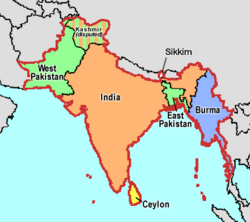
The framework proposed the establishment of more effective [[Bicameralism|bicameral]] [[Parliament of Pakistan|parliament]] that would be composed of a 300-seat [[National Assembly of Pakistan|National Assembly]] with proportionate representation based on population, alongside a [[Senate of Pakistan|Senate]] with equal representation for the [[Provinces of Pakistan|five provinces]]: [[West Punjab]], the [[North-West Frontier Province]], [[Sind Province (1936–1955)|Sind]], [[Baluchistan (Chief Commissioner's Province)|Baluchistan]], and [[East Bengal]].<ref name="Story of Pakistan Bogra Formula" /> | |||
Under this framework, the largest number of [[Constituencies of Pakistan|constituencies]] for the National Assembly were given to East Bengal—with 165 reserved seats—followed by West Punjab with 75 seats, the North-West Frontier Province with 24 seats, Sind with 19 seats, and Baluchistan with 17 seats.<ref name="Story of Pakistan Bogra Formula"/> The [[Federally Administered Tribal Areas]], [[Federal Capital Territory (Pakistan)|Federal Capital Territory]], [[Bahawalpur (princely state)|Bahawalpur]], [[Khairpur (princely state)|Khairpur]], and [[Baluchistan States Union]], were given a combined representation of 24 reserved seats.<ref name="Story of Pakistan Bogra Formula"/> East Bengal was given more seats due to its [[Homogeneity and heterogeneity#Sociology|social homogeneity]] in the National Assembly, in contrast to the reserved seats for the other provinces which were all were socially heterogeneous and ethnically diverse.<ref name="Story of Pakistan Bogra Formula" /> However, the combined the reserved seats for the West Pakistani provinces were in balance with East Bengal in the bicameral parliament.<ref name="Story of Pakistan Bogra Formula" /> Both the houses were given equal power, and in case of a conflict between the two houses, the issue was to be presented before a joint session.<ref name="Story of Pakistan Bogra Formula" /> | |||
The Bogra framework also | The Bogra framework also created [[check and balance]]s to avoid permanent domination by any of the five provinces, in which a provision was made that if the president was elected from the four provinces of West Pakistan, then the prime minister was to be elected from East Bengal, and ''[[vice versa]]''.<ref name="Story of Pakistan Bogra Formula" /> The president was to be elected for a term of 5 years through an [[Electoral College (Pakistan)|Electoral College]] formed by both houses.<ref name="Story of Pakistan Bogra Formula" /> | ||
The [[Supreme Court of Pakistan]] was to be given more power and institutional [[judicial independence]] that would permanently replace the [[Council of Islamic Ideology|Islamic clergy]] to decide if a law was in accordance with | The [[Supreme Court of Pakistan|Supreme Court]] was to be given more power and institutional [[judicial independence]] that would permanently replace the [[Council of Islamic Ideology|Islamic clergy]] to decide if a law was in accordance with ''[[Sharia]]''.<ref name="Story of Pakistan Bogra Formula" /> | ||
The Bogra | The Bogra formula was highly popular and widely welcomed by the people as opposed to the [[Basic Principles Committee]] led by former Prime Minister Nazimuddin, as it was seen with great enthusiasm amongst the masses because it could bridge the differences between the two wings of Pakistan and act as a source of unity.<ref name="Story of Pakistan Bogra Formula" /> | ||
[[File:Partition of India.PNG|right|290px|thumb|In 1955, the [[One Unit|One Unit Scheme]] integrated the four provinces of the western wing of Pakistan into a single province | [[File:Partition of India.PNG|right|290px|thumb|In 1955, the [[One Unit|One Unit Scheme]] integrated the four provinces of the western wing of Pakistan into a single province: [[West Pakistan]].<ref name="Story of Pakistan Bogra Formula" /><ref name="ABC-CLIO, Lyon">{{cite book |last1=Lyon |first1=Peter |year=2008 |title=Conflict Between India and Pakistan: An Encyclopedia |url=https://books.google.com/books?id=vLwOck15eboC&pg=PA9 |publisher=ABC-CLIO |page=9 |isbn=978-1-57607-712-2 |quote=Choudhury Muhammad Ali ... in October 1955 succeeded Mohammad Ali Bogra as prime minister. He presided over the introduction of the One Unit Scheme."}}</ref><ref name="Oxford University Press, Sardar">{{cite journal |last=Ahmad |first=Mahvish |date=October–December 2012 |title=Quetta Divisions |url=https://books.google.com/books?id=yQ_RCwAAQBAJ&pg=PA90 |journal=Critical Muslim |volume=4 |isbn=978-1-84904-223-9 |issn=2048-8475 |page=90 |quote=In 1954, Pakistan's then Prime Minister Mohammad Ali Bogra announced what he called the One Unit Province policy in which then West Pakistan's provinces were merged into one.}}</ref>]] | ||
Despite its public popularity, Governor-General Ghulam Muhammad, threatened by a curbing of his powers, dissolved the Constituent Assembly in 1954 with the support of the [[Pakistani establishment|Pakistani civil and military establishment]].<ref name="Edward Elgar Publishing, He">{{cite book |last1=He |first1=Baogang |last2=Galligan |first2=Brian |last3=Inoguchi |first3=Takashi |title=Federalism in Asia |year=2009 |publisher=Edward Elgar Publishing |isbn=978-1-84720-702-9 |chapter-url=https://books.google.com/books?id=nXf9C2xbKsYC&q=bogra+formula&pg=PA105 |page=105 |access-date=10 July 2017 |language=en |chapter=Federalism in Pakistan}}</ref><ref>{{Cite news |last1=Sharaf |first1=Samson Simon |last2=Hussain |first2=Hamid |title=Ther<!--sic--> great betrayal: 1947–71 |url=https://www.nation.com.pk/12-Dec-2015/ther-great-betrayal-1947-71 |work=The Nation |date=12 December 2015 |language=en-US |access-date=4 April 2016}}</ref> | |||
===One Unit=== | ===One Unit policy=== | ||
{{Main|One Unit}} | {{Main|One Unit}} | ||
Following the failure | Following the failure to implement a constitutional formula, Bogra began working towards the controversial One Unit scheme that integrated the four West Pakistani provinces into a single province. He justified this scheme when he stated: | ||
{{ | {{blockquote|There will be no Bengalis, no Punjabis, no Sindhis, no Pathans, no Balochis, no Bahawalpuris, no Khairpuris. The disappearance of these groups will strengthen the integrity of Pakistan...|Prime Minister M. A. Bogra, presenting the One Unit on 22 November 1954<ref>{{cite book |last1=Kelly |first1=Nigel |title=The History and Culture of Pakistan |year=2010 |publisher=Peak Publ |location=London |isbn=978-1-901458-67-1}}</ref>}}The scheme was ultimately implemented by his successor, [[Chaudhri Muhammad Ali]], in October 1955.<ref>{{Cite news |last=Hussain |first=Ijaz A. Qureshi {{!}} Nadeem |date=2022-07-03 |title=The False Promise of One Unit |url=https://www.dawn.com/news/1697958 |access-date=2025-10-04 |work=Dawn |language=en}}</ref> | ||
===Dismissal and | === Dismissal === | ||
On 4 August 1955, the Cabinet accepted Governor-General Malik Ghulam Muhammad's request for a [[leave of absence]] due to ill health. They chose Interior Minister Iskander Mirza to replace him, and Mirza was sworn in as acting governor-general three days later.<ref>{{cite news |last=Callahan |first=John P. |date=4 August 1955 |title=Gen. Mirza Picked to Head Pakistan |url=https://www.nytimes.com/1955/08/05/archives/gen-mirza-picked-to-head-pakistan-karachi-cabinet-asks-queen-to.html |work=The New York Times |page=2 |publication-date=5 August 1955}}</ref><ref>{{cite news |last=Callahan |first=John P. |date=6 August 1955 |title=Mirza Takes Oath in Karachi Today |url=https://www.nytimes.com/1955/08/07/archives/mirza-takes-oath-in-karachi-today-general-will-succeed-ailing.html |work=The New York Times |page=14 |publication-date=7 August 1955}}</ref><ref name="Gupta1974">{{cite book |last1=Gupta |first1=Jyoti Sen |title=History of Freedom Movement in Bangladesh, 1943–1973: Some Involvement |publisher=Naya Prokash |year=1974 |location=Calcutta |page=73 |oclc=213786943 |quote=On 7 August, Major-General Iskander Mirza vacated the post of Interior Minister and assumed charge as the Acting Governor-General.}}</ref> | |||
Soon after the appointment, Mirza confronted Bogra on regional disparity despite the fact that both men were [[Bengalis]], and forced Bogra to resign from the prime ministership.<ref name="storyofpakistan">{{cite web |date=1 June 2003 |title=Muhammad Ali Bogra |url=http://storyofpakistan.com/muhammad-ali-bogra/ |access-date=13 February 2015 |publisher=Story of Pakistan}}</ref><ref name="dailytimes.com.pk">{{Cite news |last=Waheed |first=Asef |title=Shaheed Zulfikar Ali Bhutto, in the eyes of history |url=http://www.dailytimes.com.pk/national/04-Apr-2015/shaheed-zulfikar-ali-bhutto-in-the-eyes-of-history |work=Daily Times |location=Pakistan |date=4 April 2015 |archive-url=https://web.archive.org/web/20150706192644/http://dailytimes.com.pk/national/04-Apr-2015/shaheed-zulfikar-ali-bhutto-in-the-eyes-of-history |archive-date=6 July 2015 |access-date=4 April 2016}}</ref> Mirza also dismissed Malik Ghulam Muhammad and sent a letter of notification to inform him of the political developments.<ref name="Story of Pakistan (Mirza became Governor General)">{{cite web |title=Iskander Mirza Becomes Governor General [1955] |url=http://www.storyofpakistan.com/articletext.asp?artid=A059 |url-status=dead |archive-url=https://web.archive.org/web/20120202042923/http://www.storyofpakistan.com/articletext.asp?artid=A059 |archive-date=2 February 2012 |access-date=2 February 2012 |publisher=Story of Pakistan (Mirza became Governor-General) |date=1 June 2003}}</ref> | |||
== Ambassador to the United States (1955–1959) == | |||
After his dismissal, Bogra was appointed the Pakistani Ambassador to the United States<ref name="Gupta1974" /> when he recalled [[Amjad Ali (civil servant)|Amjad Ali]], who was appointed [[Finance Minister of Pakistan|Finance Minister]]. | |||
== Foreign Minister (1962–63) == | |||
[[File:JFK with Mohammad Ali of Bogra.jpg|thumb|Bogra with U.S. President [[John F. Kennedy]] at the [[White House]], 1962]] | |||
In 1959, he left the ambassadorial assignment after the then-Chief Martial Law Administrator [[Ayub Khan (general)|Ayub Khan]] took control of the government from President [[Iskander Mirza]] in 1958. Ayub appointed Bogra [[Foreign Minister of Pakistan|foreign minister]].{{citation needed|date=October 2023}} | |||
===Foreign | Soon after his appointment, he visited China where he continued talks with the Chinese leadership that eventually led to a [[Sino-Pakistan Agreement|settlement with China]] regarding the [[China–Pakistan border]].<ref name="Harvard University Press, Guha">{{cite book |last1=Guha |first1=Ramachandra |author-link=Ramachandra Guha |title=Makers of Modern Asia |year=2014 |publisher=Harvard University Press |page=278 |isbn=978-0-674-36541-4 |url=https://books.google.com/books?id=MWmABAAAQBAJ&q=appointed+Foreign+minister+Bogra+1962&pg=PA278 |access-date=12 July 2017 |language=en}}</ref> As foreign minister, he guided a pro-Western policy but made efforts to improve relations with the [[Soviet Union]] after witnessing the [[European Union|Western]] and American support India during the [[Sino-Indian War|Chinese-Indian War]] in 1962.<ref name="Anthem Press, Jaffrelot"/> After visiting Soviet Union with President Ayub, Bogra quoted: There was no such thing as friends forever or enemies forever– only national interests count.<ref name="Anthem Press, Jaffrelot">{{cite book |last1=Jaffrelot |first1=Christophe |author-link=Christophe Jaffrelot |title=A History of Pakistan and Its Origins |year=2004 |publisher=Anthem Press |isbn=978-1-84331-149-2 |url=https://books.google.com/books?id=Q9sI_Y2CKAcC&q=Foreign+minister+Bogra+Soviet+Union+1962&pg=PA102 |page=102 |access-date=12 July 2017 |language=en}}</ref> | ||
During this time, his health became a serious issue and illness caused him to miss out the meeting over Kashmir but his deputy [[Zulfikar Ali Bhutto]] attended in the United States on 26 December 1962.<ref name="Woodrow Wilson Center Press, Kux"/>{{rp|136}} In 1963, Bogra died while staying in [[Dacca]] and was buried at the Bogra Nawab Palace in [[East Pakistan]], now [[Bangladesh]].<ref name="dailytimes.com.pk"/><ref name="bogra.org">{{cite web |author=Mir Monaz Haque |title=Mohammed Ali Bogra |url=http://www.bogra.org/bogra1.html |access-date=1 March 2015 |website=bogra.org |archive-date=11 August 2015 |archive-url=https://web.archive.org/web/20150811102143/http://bogra.org/bogra1.html |url-status=dead}}</ref> | |||
During this time, his health became a serious issue and illness caused him to miss out the meeting over Kashmir but his deputy [[Zulfikar Ali Bhutto]] attended in the United States on 26 December 1962.<ref name="Woodrow Wilson Center Press, Kux"/>{{rp|136}} In 1963, Bogra died while staying in [[Dacca]] and was buried | |||
== Personal life == | == Personal life == | ||
Ali was married twice; his first wife was Begum [[Hamida Mohammed Ali]],<ref name=" | Ali was married twice; his first wife was Begum [[Hamida Mohammed Ali]],<ref name="ds19Oct2009" /> and his second wife was a Lebanese lady, Aliya Begum.<ref name="dawn8Sep2015"/> This marriage was controversial because it constituted [[polygamy]], which was uncommon among the elites of Pakistan.<ref name="dawn8Sep2015" /><ref>{{Cite news |url=http://www.thehindu.com/features/magazine/suhasini-haidar-on-stories-from-rashtrapati-bhavan-in-the-book-abode-under-the-dome/article8285698.ece |title=Room for a relationship |date=27 February 2016 |newspaper=The Hindu |language=en-IN |issn=0971-751X |access-date=4 April 2016}}</ref> | ||
==Death== | ==Death== | ||
Bogra died on 23 January 1963 in | Bogra died on 23 January 1963 in Dacca. Politician [[Ajmal Ali|Ajmal Ali Choudhury]] offered condolences and felt "deep sorrow" for the sudden death.<ref>{{cite book |last1=Hannan |first1=Muhammad Abdul |title=Mohammed Ali (Bogra): A Biographical Sketch |year=1967 |location=Bogra, East Pakistan |publisher=Sahitya Kutir |oclc=87468 |page=46}}</ref> | ||
== Notes == | |||
{{Notelist}} | |||
==References== | ==References== | ||
| Line 304: | Line 258: | ||
{{PakistaniPMs}} | {{PakistaniPMs}} | ||
{{Foreign Minister of Pakistan}} | {{Foreign Minister of Pakistan}} | ||
{{Ambassadors of Pakistan to the United States}} | |||
{{Authority control}} | {{Authority control}} | ||
| Line 310: | Line 265: | ||
[[Category:1963 deaths]] | [[Category:1963 deaths]] | ||
[[Category:People from Barisal]] | [[Category:People from Barisal]] | ||
[[Category:People from Bogra | [[Category:People from Bogra]] | ||
[[Category:Bengali Muslims]] | [[Category:Bengali Muslims]] | ||
[[Category:University of Calcutta alumni]] | [[Category:University of Calcutta alumni]] | ||
[[Category:Nawabs of Bengal | [[Category:Titular Nawabs of Bengal]] | ||
[[Category:Pakistan Muslim League politicians]] | [[Category:Pakistan Muslim League politicians]] | ||
[[Category:Pakistani anti-communists]] | [[Category:Pakistani anti-communists]] | ||
| Line 320: | Line 274: | ||
[[Category:Conservatism in Pakistan]] | [[Category:Conservatism in Pakistan]] | ||
[[Category:Ambassadors of Pakistan to Myanmar]] | [[Category:Ambassadors of Pakistan to Myanmar]] | ||
[[Category:High | [[Category:High commissioners of Pakistan to Canada]] | ||
[[Category: | [[Category:Ambassadors of Pakistan to Japan]] | ||
[[Category:Ambassadors of Pakistan to the United States]] | [[Category:Ambassadors of Pakistan to the United States]] | ||
[[Category:Prime | [[Category:Prime ministers of Pakistan]] | ||
[[Category: | [[Category:Ministers for foreign affairs of Pakistan]] | ||
[[Category:20th-century Pakistani politicians]] | [[Category:20th-century Pakistani politicians]] | ||
[[Category:20th-century diplomats]] | [[Category:20th-century diplomats]] | ||
[[Category:Bogra family|Muhammad Ali]] | [[Category:Bogra family|Muhammad Ali]] | ||
[[Category:Pakistan Cricket Board | [[Category:Pakistan Cricket Board presidents and chairmen]] | ||
[[Category:20th-century | [[Category:20th-century Bengali people]] | ||
[[Category: | [[Category:Bengal MLAs 1937–1945]] | ||
[[Category:Bengal MLAs 1946–1947]] | |||
[[Category:East Bengal MLAs 1947–1954]] | |||
[[Category:United Bengal activists]] | |||
Latest revision as of 10:05, 24 March 2026
Mohammad Ali Bogra | |
|---|---|
| মোহাম্মদ আলী বগুড়া محمد علی بوگڑا | |
.png) Bogra in 1954 | |
| 3rd Prime Minister of Pakistan | |
| In office 17 April 1953 – 12 August 1955 | |
| Monarch | Elizabeth II |
| Governor General | Malik Ghulam Muhammad Iskandar Ali Mirza |
| Preceded by | Khawaja Nazimuddin |
| Succeeded by | Muhammad Ali |
| 3rd & 7th Minister of Foreign Affairs | |
| In office 13 June 1962 – 23 January 1963 | |
| President | Muhammad Ayub Khan |
| Deputy | S.K. Dehlavi (Foreign Secretary) |
| Preceded by | Manzur Qadir |
| Succeeded by | Zulfikar Ali Bhutto |
| In office 24 October 1954 – 12 August 1955 | |
| Deputy | J.A. Rahim (Foreign Secretary) |
| Preceded by | M. Zafarullah Khan |
| Succeeded by | Hamidul Huq Choudhury |
| Minister of Defence | |
| In office 17 April 1953 – 24 October 1954 | |
| Deputy | Akhter Husain (Defence Secretary) |
| Preceded by | Khawaja Nazimuddin |
| Succeeded by | General Ayub Khan |
| Pakistan Ambassador to Japan | |
| In office 1959–1962 | |
| President | Ayub Khan |
| Preceded by | Omar Hayat Malik |
| Succeeded by | K. M. Sheikh |
| Pakistan Ambassador to the United States | |
| In office November 1955 – March 1959 | |
| President | Iskander Mirza |
| Preceded by | Syed Amjad Ali |
| Succeeded by | Aziz Ahmed |
| In office 27 February 1952 – 16 April 1953 | |
| Governor General | Malik Ghulam |
| Preceded by | A. H. Isphani |
| Succeeded by | Amjad Ali |
| High Commissioner of Pakistan to Canada | |
| In office 1949–1952 | |
| Governor General | Khawaja Nazimuddin |
| Pakistani Ambassador to Burma | |
| In office 1948–1949 | |
| Governor General | Muhammad Ali Jinnah (1948) Khawaja Nazimuddin (1948–1949) |
| Preceded by | Shamsuddin Ahmed |
| President of Pakistan Muslim League | |
| In office 17 April 1953 – 12 August 1955 | |
| Preceded by | Khawaja Nazimuddin |
| Succeeded by | Muhammad Ali |
| Personal details | |
| Born | Syed Mohammad Ali Chowdhury 19 October 1909 Backergunge District, Eastern Bengal and Assam, British India |
| Died | 23 January 1963 (aged 53) Dacca, East Pakistan, Pakistan |
| Resting place | Nawab Palace, Bogra, Bangladesh |
| Citizenship | British Raj (1909–1947) Pakistan (1947–1963) |
| Political party | PMLC |
| Other political affiliations | PML (1947–1958) AIML (pre-1947) |
| Spouse(s) | Hameeda Begum[1] Aliya Begum[1] |
| Parent(s) |
|
| Relatives | Nawab Ali Chowdhury (grandfather) Hasan Ali Chowdhury (uncle) Syeda Ashiqua Akbar (cousin) |
| Education | B.A. |
| Alma mater | University of Calcutta |
| Known for | Bogra formula |
| Cabinet | Bogra administration |
Syed Mohammad Ali Chowdhury Bogra[lower-alpha 1] (19 October 1909 – 23 January 1963) was a Pakistani politician and diplomat who served as the third prime minister of Pakistan from 1953 to 1955. He was appointed in this capacity in 1953 until he stepped down in 1955 in favour of his federal finance minister Chaudhri Muhammad Ali.[lower-alpha 2]
After his education at the Presidency College at the University of Calcutta, he started his political career on Muslim League's platform and joined the Bengal's provincial cabinet of then-Prime Minister H. S. Suhrawardy in the 1940s. After the independence of Pakistan in 1947, he joined the foreign ministry as a diplomat and briefly tenured as Pakistan's ambassador to Burma (1948), High Commissioner to Canada (1949–1952), twice as ambassador to the United States, and as ambassador to Japan (1959–1962).[7]
After he was recalled in 1953 from his services to Pakistan from the United States, he replaced Sir Khwaja Nazimuddin as Prime Minister in an appointment approved by then-Governor-General Sir Malik Ghulam. His foreign policy strongly pursued the strengthening of bilateral relations between Pakistan and the United States, while downplaying relations with the Soviet Union. He also pushed for a stronger military to achieve peace with India and took personal initiatives to prioritize relations with China. At home front, he successfully proposed the popular political formula that laid the foundation of the constitution in 1956 which made Pakistan a federal parliamentary republic. Despite his popular initiatives, he lost his support to then-acting governor-general Iskandar Ali Mirza who re-appointed him as Pakistani Ambassador to the United States which he served until 1959.
In 1962, he joined President Muhammad Ayub Khan's administration as the Foreign Minister of Pakistan until his death in 1963.
Early life and education[edit | edit source]
Mohammad Ali was born in Backerganj (now Barisal), East Bengal, British India, on 19 October 1909.[8] He was born into an elite and wealthy aristocrat family who were known as the Nawabs of Dhanbari.[9] The prefix, Sahibzada (lit. Prince) is added before his name to represent the Bengali royalty which is customary to give to individuals in India.[10]
His father, Nawabzada Altaf Ali Chowdhury, educated at the St Xavier's College in Calcutta, was a prominent figure in Dacca and was also a local politician who served as the Vice-President of the Muslim League's East Bengal faction.[11] His father, Altaf Ali Chowdhury, was fond of horse races, dog shows, and sports.[8] His grandfather, Nawab Ali Chowdhury, was also a politician who served as the first Bengali Muslim to be appointed as minister, and played a pioneering role in founding the Dhaka University along with Nawab Sir Khwaja Salimullah Bahadur of Dhaka.[12]
Mohammad Ali Bogra grew up in Bogra, having studied first at the local Hastings House and then educated at the local madrassa in Calcutta.[6] After his matriculation, Bogra went to attend the Presidency College of the Calcutta University where he secured his graduation with a BA degree in political science in 1930.[13][6]
He was married twice: his first wife was Begum Hamida Mohammad Ali, with whom he had two sons.[14] He later married Aliya Saddy in 1955.[14] His second marriage led to widespread protests against polygamy by women organizations in the country.[15]
Early political career (1930–1947)[edit | edit source]
Before his entrance in the politics, the Bogra family were influential Nawabs active in Bengali politics and Muslim League as a party worker in 1930.[16] In the 1937 Indian provincial elections he was elected to the Bengal Legislative Assembly. His uncle, Hasan Ali Chowdhury was also elected to the assembly, but from an opposing party.[17]
In 1938, he was elected chairman of the Bogra District Board, a position he retained until June 1942.[17] He served in the opposition until 1943 when the Muslim League had gained political support and he was made parliamentary secretary to then-Chief Minister Khawaja Nazimuddin.[18][19] In 1946, he was asked by Husyn Suhrawardy to join his cabinet and subsequently held ministerial portfolio of health, finance, and local government.[18] As health minister, he founded the Dhaka Medical College and the Calcutta Lake Medical College.[6]
Bogra supported the Muslim League's call for creation of Pakistan through the partition of British India and successfully defended his constituency in the general elections held in 1945.[6] In 1947, he joined the first Constituent Assembly.[18] While in Dacca in 1948, he received Governor-General Muhammad Ali Jinnah and reportedly dissented on the issue of populist language movement being excluded as an official state language of Pakistan.[6] He strongly advised Chief Minister Sir Khawaja Nazimuddin to restrain Jinnah from announcing the measure, but was rebuked.[6]
Diplomatic career (1947–1952)[edit | edit source]
In 1948, Bogra was asked by Prime Minister Liaquat Ali Khan to be appointed the Pakistan ambassador to the Kingdom of Egypt to head the Pakistani diplomatic mission in Cairo, which Bogra declined.[6] Instead, he chose the diplomatic assignment in neighboring Burma and presented his credentials in Rangoon in 1948.[6] Soon after becoming Pakistan Ambassador to Burma, his political philosophy reflected a conservative mindset and took an anti-communist stance when he supported the Burma's military operations against the communists.[20] In 1948, he showed concerns of communist expansion in Pakistan when he reportedly told Pakistani journalists that: "even [sic] if the Burmese Government succeed in suppressing the communists, it is possible they may shift the centre of communist efforts to Pakistan."[20]
In 1949, he left Burma to become high commissioner to Canada, a position he held until 1952. In February 1952, he was made ambassador to the United States.[19][21]
Watching the campaign for the 1952 United States presidency, Bogra conjectured, according to Husain Haqqani, that Pakistan could obtain economic and military aid from the United States by casting itself as a front line state in the battle to contain Soviet communism. He vigorously lobbied anticommunists in Washington, D.C. to that end.[22] In Pakistan's political circle, he was seen as extremely having pro-American views and had fondness of the country, the United States.[23] He also helped negotiate the United States' officer assistance advisory to be dispatch to Pakistan, in an agreement he signed with the United States government in 1952.[24]:36
In the Foreign Service society of Pakistan, Bogra gained a reputation of "a man who was known for his excessive praise of everything American."[25] Pakistani historians held him widely responsibly as one of the principal personalities putting Pakistan in the alliance of the United States against the Soviet Union.[24]:41–59 He was a little-known pro-American political outsider when Ghulam Muhammad chose him in 1953 to replace Khawaja Nazimuddin as prime minister.[26]
Premiership (1953–1955)[edit | edit source]
The issue of the Bengali Language Movement in East in 1952, the rise of the Pakistan Socialist Party, and the riots in Lahore against the Ahmadi in 1953 were the defining factors that led to the dismissal of Prime Minister Khawaja Nazimuddin by Governor-General Ghulam Muhammad on 17 April 1953.[27]
Bogra was recalled to Karachi from Washington, D.C. for further consultation, but Governor-General Ghulam Muhammad moved to appoint him as the new prime minister and the President of the Muslim League, which the party had accepted.[28] Under pressure he accepted the new appointment from Ghulam Muhammad.[29][1] Initially, he kept the federal ministries of foreign affairs and defence until appointing a new cabinet.[27] Upon taking over the government, Bogra dismissed the elected East Bengali government of A.K. Fazlul Huq on 30 May 1954 for "treasonable activities."[30][31] He appointed then-defence secretary Iskander Mirza as the Governor of East Bengal, but this appointment only lasted a couple of months.[30]
Bogra's new cabinet—known as the "Ministry of Talents"[32][33]—included Commander-in-Chief of the Pakistan Army Ayub Khan as Defence Minister and Governor Iskander Ali Mirza as Interior Minister and Minister of States and Frontier Regions.[32]
After Bogra's appointment, U.S. President Dwight Eisenhower ordered the shipment of thousands of tons of wheat to Pakistan.[34] Bogra was eager to strengthen military ties with the United States; however, the U.S. moved cautiously to not damage their relations with India.[35] He signed several agreement with the United States, most notably the Mutual Defense Assistance Agreement in 1954, which provided U.S. military assistance to Pakistan.[29] During Bogra's premiership, Pakistan also joined the Southeast Asia Treaty Organization in 1955.[36]

His foreign policy was noted for strong "anti-Soviet agitation" because he viewed the Soviet Union as "imperialist", but did not label the same for China despite both being ideologically close.[37]:71 In 1955, Bogra helped organize and attended the Bandung Conference in Indonesia, expressing his approval for greater Afro-Asian cooperation and opposition to European colonialism.[38]


Bogra sought to address and resolve the Kashmir conflict with India. In 1953, he met with Indian Prime Minister Jawaharlal Nehru on the sidelines of the Coronation of Queen Elizabeth II in London.[39] Bogra also received Nehru when he paid an official visit to Karachi, and Nehru reciprocated during Bogra's visit to New Delhi shortly after.[39] Bogra enjoyed warm relations with Nehru, as both eventually agreed on a plebiscite in Kashmir. However, this plebiscite was not achieved due to Bogra losing support from the left-wing sphere in Pakistan.[39]
As a part of his approach towards India, Bogra pushed for a stronger military to achieve peace in the subcontinent, arguing: "[w]hen there is more equality of military strength, then I am sure that there will be a greater chance of settlement."[40]
Bogra formula[edit | edit source]
The Bogra Formula was a political compromise presented and proposed by Bogra on 7 October 1953 before the Constituent Assembly.[41] Upon taking the control of the Prime Minister's Secretariat, Bogra announced that drafting of the codified Constitution was his primary target, and within six months, he announced a proposal that leads to the drafting of the constitution writ.[41]
The framework proposed the establishment of more effective bicameral parliament that would be composed of a 300-seat National Assembly with proportionate representation based on population, alongside a Senate with equal representation for the five provinces: West Punjab, the North-West Frontier Province, Sind, Baluchistan, and East Bengal.[41]
Under this framework, the largest number of constituencies for the National Assembly were given to East Bengal—with 165 reserved seats—followed by West Punjab with 75 seats, the North-West Frontier Province with 24 seats, Sind with 19 seats, and Baluchistan with 17 seats.[41] The Federally Administered Tribal Areas, Federal Capital Territory, Bahawalpur, Khairpur, and Baluchistan States Union, were given a combined representation of 24 reserved seats.[41] East Bengal was given more seats due to its social homogeneity in the National Assembly, in contrast to the reserved seats for the other provinces which were all were socially heterogeneous and ethnically diverse.[41] However, the combined the reserved seats for the West Pakistani provinces were in balance with East Bengal in the bicameral parliament.[41] Both the houses were given equal power, and in case of a conflict between the two houses, the issue was to be presented before a joint session.[41]
The Bogra framework also created check and balances to avoid permanent domination by any of the five provinces, in which a provision was made that if the president was elected from the four provinces of West Pakistan, then the prime minister was to be elected from East Bengal, and vice versa.[41] The president was to be elected for a term of 5 years through an Electoral College formed by both houses.[41]
The Supreme Court was to be given more power and institutional judicial independence that would permanently replace the Islamic clergy to decide if a law was in accordance with Sharia.[41]
The Bogra formula was highly popular and widely welcomed by the people as opposed to the Basic Principles Committee led by former Prime Minister Nazimuddin, as it was seen with great enthusiasm amongst the masses because it could bridge the differences between the two wings of Pakistan and act as a source of unity.[41]

Despite its public popularity, Governor-General Ghulam Muhammad, threatened by a curbing of his powers, dissolved the Constituent Assembly in 1954 with the support of the Pakistani civil and military establishment.[44][45]
One Unit policy[edit | edit source]
Following the failure to implement a constitutional formula, Bogra began working towards the controversial One Unit scheme that integrated the four West Pakistani provinces into a single province. He justified this scheme when he stated:
There will be no Bengalis, no Punjabis, no Sindhis, no Pathans, no Balochis, no Bahawalpuris, no Khairpuris. The disappearance of these groups will strengthen the integrity of Pakistan...
— Prime Minister M. A. Bogra, presenting the One Unit on 22 November 1954[46]
The scheme was ultimately implemented by his successor, Chaudhri Muhammad Ali, in October 1955.[47]
Dismissal[edit | edit source]
On 4 August 1955, the Cabinet accepted Governor-General Malik Ghulam Muhammad's request for a leave of absence due to ill health. They chose Interior Minister Iskander Mirza to replace him, and Mirza was sworn in as acting governor-general three days later.[48][49][50]
Soon after the appointment, Mirza confronted Bogra on regional disparity despite the fact that both men were Bengalis, and forced Bogra to resign from the prime ministership.[51][52] Mirza also dismissed Malik Ghulam Muhammad and sent a letter of notification to inform him of the political developments.[53]
Ambassador to the United States (1955–1959)[edit | edit source]
After his dismissal, Bogra was appointed the Pakistani Ambassador to the United States[50] when he recalled Amjad Ali, who was appointed Finance Minister.
Foreign Minister (1962–63)[edit | edit source]

In 1959, he left the ambassadorial assignment after the then-Chief Martial Law Administrator Ayub Khan took control of the government from President Iskander Mirza in 1958. Ayub appointed Bogra foreign minister.[citation needed]
Soon after his appointment, he visited China where he continued talks with the Chinese leadership that eventually led to a settlement with China regarding the China–Pakistan border.[54] As foreign minister, he guided a pro-Western policy but made efforts to improve relations with the Soviet Union after witnessing the Western and American support India during the Chinese-Indian War in 1962.[55] After visiting Soviet Union with President Ayub, Bogra quoted: There was no such thing as friends forever or enemies forever– only national interests count.[55]
During this time, his health became a serious issue and illness caused him to miss out the meeting over Kashmir but his deputy Zulfikar Ali Bhutto attended in the United States on 26 December 1962.[37]:136 In 1963, Bogra died while staying in Dacca and was buried at the Bogra Nawab Palace in East Pakistan, now Bangladesh.[52][56]
Personal life[edit | edit source]
Ali was married twice; his first wife was Begum Hamida Mohammed Ali,[6] and his second wife was a Lebanese lady, Aliya Begum.[1] This marriage was controversial because it constituted polygamy, which was uncommon among the elites of Pakistan.[1][57]
Death[edit | edit source]
Bogra died on 23 January 1963 in Dacca. Politician Ajmal Ali Choudhury offered condolences and felt "deep sorrow" for the sudden death.[58]
Notes[edit | edit source]
References[edit | edit source]
- ↑ 1.0 1.1 1.2 1.3 1.4 Balouch, Akhtar (8 September 2015). "The Pakistani Prime Minister who drove a locomotive". Dawn. Retrieved 4 April 2016.
- ↑ "Former Prime Ministers". Prime Minister's Office Islamabad. Retrieved 1 March 2015.
- ↑ Burki, Shahid Javed (5 March 2015). "Mohammed Ali Bogra". Encyclopædia Britannica. Retrieved 1 March 2015.
- ↑ "Chaudhury, Mohammad Ali". Banglapedia. Retrieved 18 August 2021.
- ↑ বাঙালি মোহাম্মদ আলী বগুড়া ছিলেন ২ বার পাকিস্তানের প্রধানমন্ত্রী. usbnews24.com (in Bengali). 23 May 2019. Archived from the original on 18 August 2021. Retrieved 18 August 2021.
- ↑ 6.00 6.01 6.02 6.03 6.04 6.05 6.06 6.07 6.08 6.09 Syed Hamde Ali (19 October 2009). "Mohammed Ali of Bogra". The Daily Star. Retrieved 13 February 2015.
- ↑ "Ambassador of Pakistan Embassy, Tokyo". Embassy of Pakistan in Tokyo. Archived from the original on 6 December 2024. Retrieved 27 April 2022.
- ↑ 8.0 8.1 Hannan, Muhammad Abdul (1967). Mohammed Ali (Bogra): A Biographical Sketch. Bogra, East Pakistan: Sahitya Kutir. p. 5. OCLC 87468.
- ↑ Singh, Nagendra Kumar (2001). Encyclopaedia of Muslim Biography: India, Pakistan, Bangladesh. Vol. II. New Delhi: A.P.H. Publishing Corporation. p. 194. ISBN 81-7648-232-3.
- ↑ Hannan, Muhammad Abdul (1967). Mohammed Ali (Bogra): A Biographical Sketch. Bogra, East Pakistan: Sahitya Kutir. p. 159. OCLC 87468.
- ↑ Gupta, Nilanjana; Banerjee, Himadri; Mukherjee, Sipra (2009). Calcutta Mosaic: Essays and Interviews on the Minority Communities of Calcutta. Anthem Press. p. 128. ISBN 978-81-905835-5-8. Retrieved 4 July 2017.
- ↑ Salam, Muhammad Abdus (17 April 2015). "In Memory of Nawab Bahadur Syed Nawab Ali Chowdhury". The News Today. Archived from the original on 9 July 2015. Retrieved 8 July 2015.
- ↑ Jennings, Ivor (2015). "Mohammad Ali [Bogra] and Mohammad Ali [Chaudhury]". Constitution-Maker. Cambridge University Press. p. 244. ISBN 978-1-107-09111-5. Retrieved 5 July 2017.
- ↑ 14.0 14.1 Mohammad Ali and Hamide. corbis 1955 Retrieved 15 December 2012
- ↑ Ansari, Sarah (November 2009). "Polygamy, Purdah and Political Representation: Engendering citizenship in 1950s Pakistan". Modern Asian Studies. 43 (6): 1421–1461. doi:10.1017/S0026749X08003776.
- ↑ Leung, Mikey; Meggitt, Belinda (2012). "Nawab Palace Grounds". Bradt Travel Guide – Bangladesh. Bradt Travel Guides. p. 338. ISBN 978-1-84162-409-9. Retrieved 5 July 2017.
- ↑ 17.0 17.1 Hannan, Muhammad Abdul (1967). Mohammed Ali (Bogra): A Biographical Sketch. Bogra, East Pakistan: Sahitya Kutir. p. 9. OCLC 87468.
- ↑ 18.0 18.1 18.2 Rahman, Syedur (2010). Historical Dictionary of Bangladesh. Scarecrow Press. p. 54. ISBN 978-0-8108-7453-4.
- ↑ 19.0 19.1 "Ex-PM Bogra remembered". Pakistan Today. 24 January 2013. Archived from the original on 26 July 2018. Retrieved 4 April 2016.
- ↑ 20.0 20.1 Cheema, Pervaiz I.; Riemer, Manuel (1990). Pakistan's Defence Policy 1947–58. Springer. p. 198. ISBN 978-1-349-20942-2. Retrieved 5 July 2017.
- ↑ Hannan, Muhammad Abdul (1967). Mohammed Ali (Bogra): A Biographical Sketch. Bogra, East Pakistan: Sahitya Kutir. p. 11. OCLC 87468.
- ↑ Haqqani, Hussain (2013). Magnificent Delusions: Pakistan, the United States, and an Epic History of Misunderstanding. PublicAffairs. p. 59. ISBN 978-1-61039-317-1.
- ↑ Thomas, Lowell Jr.; Freedman, Lew (2013). Lowell Thomas Jr.: Flight to Adventure, Alaska and Beyond. Graphic Arts Books. ISBN 978-0-88240-983-2. Retrieved 6 July 2017.
- ↑ 24.0 24.1 Rehman, Shahid-ur (2006). Pakistan Sovereignty Lost. Islamabad: Mr. Books. ISBN 978-969-8500-01-6. Retrieved 6 July 2017.
- ↑ McMahon, Robert J. (2010). "Forging an Alliance". The Cold War on the Periphery: The United States, India, and Pakistan. Columbia University Press. p. 162. ISBN 978-0-231-51467-5. Retrieved 6 July 2017.
- ↑ Abbas, Hassan (2005). Pakistan's Drift Into Extremism: Allah, the Army, and America's War on Terror. M. E. Sharpe. pp. 25–26. ISBN 0-7656-1496-0.
- ↑ 27.0 27.1 Ongsotto, Rebecca Ramillo; Ongsotto, Reena R.; Ramilo, Raynoldo Castro (2002). Asian History Module-based Learning Ii' 2002 Ed. Rex Bookstore, Inc. p. 329. ISBN 978-971-23-3124-4. Retrieved 6 July 2017.
- ↑ Rizvi, H. (2000). "Civilian institutions and the Military". Military, State and Society in Pakistan. London, U.K.: Springer. p. 72. ISBN 978-0-230-59904-8. Retrieved 7 July 2017.
- ↑ 29.0 29.1 Mahmood, Nazir (2 November 2014). "History in a nutshell (II)". The News on Sunday. Retrieved 4 April 2016.
- ↑ 30.0 30.1 Burki, Shahid Javed (2015). "Chronology". Historical Dictionary of Pakistan. Rowman & Littlefield. p. xxvi. ISBN 978-1-4422-4148-0. Retrieved 10 July 2017.
- ↑ Ahmed, Salahuddin (2004). "Governor's Rule". Bangladesh: Past and Present. APH Publishing. pp. 141–142. ISBN 978-81-7648-469-5. Retrieved 10 July 2017.
- ↑ 32.0 32.1 "Muhammad Ali Bogra: Former Prime Minister of Pakistan & Ambassador to U. S. A". Story Of Pakistan. Nazaria-e-Pakistan Trust. 1 June 2003. Retrieved 7 July 2017.
- ↑ Rahman, Syedur (2010). Historical Dictionary of Bangladesh. Scarecrow Press. p. 35. ISBN 978-0-8108-7453-4.
- ↑ Wynbrandt, James (2009). A Brief History of Pakistan. Facts on File. p. 176. ISBN 978-0-8160-6184-6. Retrieved 7 July 2017.
- ↑ Cashman, Greg; Robinson, Leonard C. (2007). An Introduction to the Causes of War: Patterns of Interstate Conflict from World War I to Iraq. Rowman & Littlefield. p. 226. ISBN 978-0-7425-5510-5. Retrieved 9 July 2017.
- ↑ "Seato and Pakistan". Pakistan Horizon. 7 (3): 138–149. September 1954. ISSN 0030-980X.
- ↑ 37.0 37.1 Kux, Dennis (2001). The United States and Pakistan, 1947–2000: Disenchanted Allies. Woodrow Wilson Center Press. ISBN 978-0-8018-6572-5. Retrieved 9 July 2017.
- ↑ Quinton-Brown, Patrick (2017). "Bandung, 1955". Online Atlas on the History of Humanitarianism and Human Rights. ISSN 2509-8152.
- ↑ 39.0 39.1 39.2 Schofield, Victoria (2000). "Special Status". Kashmir in Conflict: India, Pakistan and the Unending War. I.B.Tauris. p. 85. ISBN 978-1-86064-898-4. Retrieved 9 July 2017.
- ↑ Pande, Aparna (20–26 July 2012). "Pakistan's eternal quest for 'strategic balance'". The Friday Times. Archived from the original on 22 July 2012. Retrieved 4 April 2016.
- ↑ 41.00 41.01 41.02 41.03 41.04 41.05 41.06 41.07 41.08 41.09 41.10 41.11 41.12 "Bogra Formula". Story Of Pakistan. 1 June 2003. Retrieved 10 July 2017.
- ↑ Lyon, Peter (2008). Conflict Between India and Pakistan: An Encyclopedia. ABC-CLIO. p. 9. ISBN 978-1-57607-712-2.
Choudhury Muhammad Ali ... in October 1955 succeeded Mohammad Ali Bogra as prime minister. He presided over the introduction of the One Unit Scheme."
- ↑ Ahmad, Mahvish (October–December 2012). "Quetta Divisions". Critical Muslim. 4: 90. ISBN 978-1-84904-223-9. ISSN 2048-8475.
In 1954, Pakistan's then Prime Minister Mohammad Ali Bogra announced what he called the One Unit Province policy in which then West Pakistan's provinces were merged into one.
- ↑ He, Baogang; Galligan, Brian; Inoguchi, Takashi (2009). "Federalism in Pakistan". Federalism in Asia. Edward Elgar Publishing. p. 105. ISBN 978-1-84720-702-9. Retrieved 10 July 2017.
- ↑ Sharaf, Samson Simon; Hussain, Hamid (12 December 2015). "Ther great betrayal: 1947–71". The Nation. Retrieved 4 April 2016.
- ↑ Kelly, Nigel (2010). The History and Culture of Pakistan. London: Peak Publ. ISBN 978-1-901458-67-1.
- ↑ Hussain, Ijaz A. Qureshi | Nadeem (3 July 2022). "The False Promise of One Unit". Dawn. Retrieved 4 October 2025.
- ↑ Callahan, John P. (4 August 1955). "Gen. Mirza Picked to Head Pakistan". The New York Times (published 5 August 1955). p. 2.
- ↑ Callahan, John P. (6 August 1955). "Mirza Takes Oath in Karachi Today". The New York Times (published 7 August 1955). p. 14.
- ↑ 50.0 50.1 Gupta, Jyoti Sen (1974). History of Freedom Movement in Bangladesh, 1943–1973: Some Involvement. Calcutta: Naya Prokash. p. 73. OCLC 213786943.
On 7 August, Major-General Iskander Mirza vacated the post of Interior Minister and assumed charge as the Acting Governor-General.
- ↑ "Muhammad Ali Bogra". Story of Pakistan. 1 June 2003. Retrieved 13 February 2015.
- ↑ 52.0 52.1 Waheed, Asef (4 April 2015). "Shaheed Zulfikar Ali Bhutto, in the eyes of history". Daily Times. Pakistan. Archived from the original on 6 July 2015. Retrieved 4 April 2016.
- ↑ "Iskander Mirza Becomes Governor General [1955]". Story of Pakistan (Mirza became Governor-General). 1 June 2003. Archived from the original on 2 February 2012. Retrieved 2 February 2012.
- ↑ Guha, Ramachandra (2014). Makers of Modern Asia. Harvard University Press. p. 278. ISBN 978-0-674-36541-4. Retrieved 12 July 2017.
- ↑ 55.0 55.1 Jaffrelot, Christophe (2004). A History of Pakistan and Its Origins. Anthem Press. p. 102. ISBN 978-1-84331-149-2. Retrieved 12 July 2017.
- ↑ Mir Monaz Haque. "Mohammed Ali Bogra". bogra.org. Archived from the original on 11 August 2015. Retrieved 1 March 2015.
- ↑ "Room for a relationship". The Hindu. 27 February 2016. ISSN 0971-751X. Retrieved 4 April 2016.
- ↑ Hannan, Muhammad Abdul (1967). Mohammed Ali (Bogra): A Biographical Sketch. Bogra, East Pakistan: Sahitya Kutir. p. 46. OCLC 87468.
External links[edit | edit source]
| Diplomatic posts | ||
|---|---|---|
| Preceded by Abol Hassan Ispahani |
Ambassador to the United States 1952–1953 |
Succeeded by Amjad Ali |
| Preceded by Amjad Ali |
Ambassador to the United States 1955–1959 |
Succeeded by Aziz Ahmed |
| Political offices | ||
| Preceded by Khawaja Nazimuddin |
Prime Minister of Pakistan 1953–1955 |
Succeeded by Chaudhry Muhammad Ali |
| Minister of Defence 1953–1954 |
Succeeded by Ayub Khan | |
| Preceded by Sir Muhammad Zafarullah Khan |
Minister of Foreign Affairs 1954–1955 |
Succeeded by Hamidul Huq Choudhury |
| Preceded by Manzur Qadir |
Minister of Foreign Affairs 1962–1963 |
Succeeded by Zulfikar Ali Bhutto |
Template:PakistaniPMs Template:Foreign Minister of Pakistan Template:Ambassadors of Pakistan to the United States
- Pages using the JsonConfig extension
- 1909 births
- 1963 deaths
- People from Barisal
- People from Bogra
- Bengali Muslims
- University of Calcutta alumni
- Titular Nawabs of Bengal
- Pakistan Muslim League politicians
- Pakistani anti-communists
- Pakistani people of Bengali descent
- Conservatism in Pakistan
- Ambassadors of Pakistan to Myanmar
- High commissioners of Pakistan to Canada
- Ambassadors of Pakistan to Japan
- Ambassadors of Pakistan to the United States
- Prime ministers of Pakistan
- Ministers for foreign affairs of Pakistan
- 20th-century Pakistani politicians
- 20th-century diplomats
- Bogra family
- Pakistan Cricket Board presidents and chairmen
- 20th-century Bengali people
- Bengal MLAs 1937–1945
- Bengal MLAs 1946–1947
- East Bengal MLAs 1947–1954
- United Bengal activists