



imported>Whakayis No edit summary |
Indussource (talk | contribs) m corrected page additionally and fixed typos after review |
||
| Line 1: | Line 1: | ||
{{Short description|Culture of North India}} | |||
{{EngvarB|date=November 2015}} | {{EngvarB|date=November 2015}} | ||
{{Use dmy dates|date=November 2015}} | {{Use dmy dates|date=November 2015}} | ||
The '''culture of [[North India]]''' encompasses North Indian classical music or [[Hindustani classical music|Hindustani music]], the [[Indian classical dance]] of [[kathak]] and other [[List of Indian folk dances|folk dances]], [[Clothing in India|traditional North Indian clothing]], [[Architecture of India|North Indian architecture]] and [[North Indian cuisine]] among other aspects. | |||
== | ==Clothing== | ||
{{Main|Clothing in India}} | |||
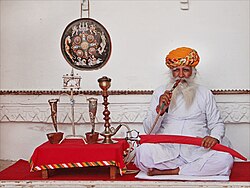
[[File:Rajput (Jodhpur) (8411728143).jpg|thumb|200px|left|Man in traditional dress smoking hookah, [[Rajasthan]], India.]] | [[File:Rajput (Jodhpur) (8411728143).jpg|thumb|200px|left|Man in traditional dress smoking hookah, [[Rajasthan]], India.]] | ||
Women traditionally wear [[ | Women traditionally wear [[shalwar kameez]], [[ghagra choli]], [[sari]] and [[pheran]]. [[Dupatta]] is worn to complete the outfit. Men traditionally wear [[kurta]], [[achkan]], kameez and [[sherwani]] for upper garment, lower garment includes [[dhoti]], [[churidar]], and [[shalwar]]. [[Pagri (turban)|Pagri]] is usually worn around the head to complete the outfit, especially in rural areas. In states like [[Uttarakhand]] and [[Himachal Pradesh]], women usually wear ghaghra and a full sleeved blouse or kurta salwar adorning a coat and an orni (headscarf). The men usually wear kurta and pants or shirt) coat with a [[Himachali cap]]. In the states of [[Punjabi clothing|Punjab]], [[Jammu and Kashmir (union territory)|Jammu and Kashmir]], Himachal Pradesh and [[Haryana]], the traditional dress is shalwar kameez. In the states of [[Rajasthan]], [[Uttar Pradesh]], and southern Haryana, it is ghagra choli. [[Pagri (turban)|Pagri]] is worn in various region styles and is the symbol which shows one's status and the respect in which one is held. In urban centres and as well as rural areas western influence can easily be seen nowadays. | ||
==Cuisine== | |||
{{Main|North Indian cuisine}} | |||
[[File:Annapurna Naan.jpg|thumb|200px|[[Naan]] is popular form of flatbread eaten in Northern India.]] | [[File:Annapurna Naan.jpg|thumb|200px|[[Naan]] is popular form of flatbread eaten in Northern India.]] | ||
[[Wheat]] forms the staple diet of North India | [[Wheat]], along with [[rice]] and [[millet]]s forms the staple diet of North India. Wheat is usually served in the form of [[roti]] or [[chapatis]] along with [[saag]], ''[[bhaaji]]'', ''[[tarkari]]'' or ''saalan'' (vegetarian curry dishes). Other wheat breads include: deep fried [[Puri (food)|puris]] and shallow fried [[paratha]]s. During winters, flatbreads made of millets like [[Pearl millet|bajra]] and [[maize]] are common.<ref>{{Cite book |last1=Goyal |first1=Megh R. |author-link=Megh R. Goyal |url=https://books.google.com/books?id=n7UxEAAAQBAJ |title=Cereals and Cereal-Based Foods: Functional Benefits and Technological Advances for Nutrition and Healthcare |last2=Kaur |first2=Kamaljit |last3=Kaur |first3=Jaspreet |author-link3=Jaspreet Kaur |date=2021-07-29 |publisher=[[CRC Press]] |isbn=978-1-000-16429-9 |language=en}}</ref> Rice dishes called ''[[Dal bhat|bhaat]]'' are generally paired with lentil and bean dishes. Various varieties of rice dishes like ''[[jeera bhaat]]'', ''khaare chawal, matar chawal, [[Sweet rice|meethe chawal]], [[Saffron rice|kesariya bhaat]]'' form part of North Indian cuisine. | ||
''Dal Roti'' (lentil and flatbread) and ''dal chawal'' (lentil and rice) are common vegetarian combos in North Indian cuisine.<ref>{{Cite book |last=Sen |first=Colleen Taylor |author-link=Colleen Taylor Sen |url=https://books.google.com/books?id=YIyV_5wrplMC |title=Food Culture in India |date=2004 |publisher=[[Greenwood Publishing Group]] |isbn=978-0-313-32487-1 |language=en}}</ref><ref>{{Cite book |last=Aggarwal |first=Uma |url=https://books.google.com/books?id=IPsfCwAAQBAJ |title=The Exquisite World of Indian Cuisine |date=2009 |publisher=Allied Publishers |isbn=978-81-8424-474-8 |language=en}}</ref> Vegetarian diet is prevalent except in Jammu and Kashmir and the [[Indian Himalayan Region|hilly regions]], however, the non-vegetarian food is also popular. [[Mughlai cuisine]], especially that of [[Lucknow]] and [[Delhi]], is known for non-vegetarian dishes with a distinctive aroma, taste and with a different style of cooking. [[Vaishnavism|Vaishno]] [[Dhaba|dhabas]] serving [[Sattvic diet|satvik cuisine]] can be found all over North Indian region.<ref>{{Cite book |last1=Abram |first1=David |author-link=David Abram |url=https://books.google.com/books?id=MYGtAAAAQBAJ |title=The Rough Guide to India |last2=Edwards |first2=Nick |author-link2=Nick Edwards |last3=Ford |first3=Mike |last4=Jacobs |first4=Daniel |last5=Meghji |first5=Shafik |last6=Sen |first6=Devdan |last7=Thomas |first7=Gavin |date=2013-10-01 |publisher=[[Rough Guides UK]] |isbn=978-1-4093-4261-8 |language=en}}</ref> | |||
Milk and its by-products along with leguminous food products like lentils and beans are abundantly used in North Indian cuisine. Some of the popular lentil dishes ([[dal]]s) from North India include ''[[Chickpea|chana dal]], [[Mung bean|moong dal]], [[Pigeon pea|arhar dal]], [[masur dal]], mothh dal'' and [[Vigna mungo|urad dal]] (which in restaurant is served with butter and is branded by name [[dal makhani]]). Other bean dishes include [[rajma]], [[Black-eyed pea|lobia]], [[kala chana]] and [[Kabuli chana]]. [[Rajma chawal]] is particularly popular throughout India.<ref>{{Cite book |last=Brien |first=Charmaine O' |url=https://books.google.com/books?id=BGhBAgAAQBAJ |title=The Penguin Food Guide to India |date=2013-12-15 |publisher=[[Penguin UK]] |isbn=978-93-5118-575-8 |language=en}}</ref> Kala Chana (along with [[Halwa puri|halwa and puri]]) is cooked during the [[Ashtami]] day of [[Navaratri|Navratri]] festival. [[Gram flour|Besan]] (Indian gram flour) is particularly used to prepare number of North Indian dishes like [[kadhi]], [[Pakora|pakodas]], ''missi roti etc.'' | |||
[[Rajasthani cuisine]] is famous for its dishes like [[dal bati]], [[churma]], etc. | |||
A variety of desserts can be found in North India, like [[jalebi]] (a crispy sugary circular dessert) which also comes in another variant called [[imarti]], [[Halva|halwa]] , [[ghevar]] and [[Gujhia|gujia]], [[kheer]] (Indian [[rice pudding]]), [[petha]], [[mathura peda]], [[bal mithai]] (from [[Kumaoni cuisine|Kumaon]]), to name but a few. | |||
== Music and dance == | |||
{{main|Hindustani classical music|Indian classical dance|List of Indian folk dances}} | |||
[[Hindustani classical music]] or Shastriya Sangeet is the classical music of North India. Around the 12th-century, Hindustani classical music diverged from what eventually came to be identified as [[Carnatic music]] of [[South India]]. The central notion in both these systems is that of a melodic mode or [[raga]], sung to a rhythmic cycle or [[Tala (music)|tala]]. Indian classical music has seven basic notes, [[Svara|Sa Re Ga Ma Pa Dha Ni]], with five interspersed half-notes, resulting in a 12-note scale. The rhythmic organization is based on rhythmic patterns called tala. The melodic foundations are called ragas. Noted representatives of Shastriya Sangeet with a worldwide acclaim are [[Pandit]] [[Ravi Shankar]] and [[Ustad]] [[Ali Akbar Khan]]. | |||
[[ | |||
Many different folk dance styles of North India include [[Bhangra (dance)|bhangra]] and [[giddha]] from [[Punjabi dance|Punjab]], [[kathak]] in Uttar Pradesh, [[ghoomar]] and [[kalbelia]] from Rajasthan, [[Nati (dance)|nati]] from Himachal Pradesh, [[Jagar (ritual)|jagars]] and [[Pandav Lila|Pandva Nritya]] from Uttarakhand. | |||
[[ | Kud dance of [[Jammu and Kashmir (union territory)|Jammu and Kashmir]] is the way to thank local deities in the night of rainy season with the beats of drum like instrument [[narsingha]]. [[Kathak]] is one of the [[Indian classical dance|eight Indian classical dance]] forms as conferred by [[Sangeet Natak Akademi]]. This dance form traces its origins to the nomadic bards of ancient northern India, known as kathaks, or storytellers. Some believe it evolved from god [[Krishna]]'s [[Raslila|raas lilas]], forms of which have also evolved into the popular [[Garba (dance)|garba]]-style dances popular in other parts of the region and [[Gujarat]] in western India. Raas lilas portrays the love stories of lord [[Krishna]]. A dance form which depicts the eternal love. It was quintessential theatre, using instrumental and vocal music along with stylized gestures, to enliven the stories. | ||
==Architecture and art== | |||
{{Main|Architecture of India|Indian art|Indo-Islamic architecture|Maru-Gurjara architecture}} | |||
[[File:Taj Mahal.jpg|thumb|200px|[[Taj Mahal]] is one of [[List of World Heritage Sites in India|UNESCO world heritage sites in the region]] and regarded as one of the [[seven wonders of the world]].]] | |||
Out of [[List of World Heritage Sites in India|twenty-three cultural world heritage sites in India]] which have been declared by [[UNESCO]], ten are in North India.<ref>[https://whc.unesco.org/en/statesparties/in World Cultural Heritage Listed Sites in India]. [[UNESCO]]. URl accessed on August 25, 2011.</ref> The [[Taj Mahal]], the quintessential [[Indo-Islamic architecture]], is one of the [[Wonders of the World|seven wonders of the world]]. The [[Mahabodhi Temple|Mahabodhi Temple complex]] at [[Bodh Gaya]], [[Bihar]] built by [[List of Maurya emperors|Mauryan emperor]] [[Ashoka]] in 260 BC, marks the enlightenment of [[Buddha]]. [[Khajuraho Group of Monuments|Khajuraho temple]] and [[Sanchi Stupa|Buddhist monuments of Sanchi]] in [[Madhya Pradesh]] finds itself in the list of world heritage sites. Other renowned architectural and holy sites are the [[Golden Temple]] in [[Amritsar]] ([[Punjab, India|Punjab]]), [[List of Le Corbusier buildings|Urban and Architectural Work of Le Corbusier]] in [[Chandigarh]], [[Dilwara Temples]] of [[Mount Abu]]([[Rajasthan]]) to name a few. A different genre of paintings evolved in North India especially the miniature paintings. [[Rajput painting]] a style of Indian painting that evolved and flourished during the 18th-century, in the royal courts of [[Rajputana]]. Rajput paintings depict a number of themes, events of epics like the ''[[Ramayana]]'' and the ''[[Mahabharata]]'', [[Krishna]]'s life, beautiful landscapes, and humans. | |||
One of the best-known examples of North Indian sculpture is the [[Lion Capital of Ashoka]], [[Sarnath]]. It is the source for the [[State Emblem of India|national emblem of India]] and hints at the richness and grandeur of the ancient [[Mauryan Empire]]. The [[Rampurva capitals|Rampurva bull capital]] is one of the best specimens of animal sculpture. | |||
Two different schools of art namely the [[Gandhara art|Gandhara]] and [[Mathura art|Mathura]] schools of art evolved in ancient times which represented the developments in sculptures, stucco, and clay as well as in mural paintings. The Kushana emperors, particularly [[Kanishka]], encouraged the Gandhara artists to sculpture themes from [[Life of Buddha in art|Buddha's life]] and the [[Jataka tales|Jatakas]]. The distinctive school of art which grew here is called the Gandhara school of art. A large number of the images of the Buddha and the [[Bodhisattva|Bodhisattvas]] were produced. Mathura art, however, reached its peak during the [[Gupta art|Gupta period]]. The human figure reached its most sublime representation in the Gupta classical phase when divine images, conceived and rendered in human shape, attained a superhuman aspect and manifested great spiritual import. The sculptures were marked by sharp and beautiful features, graceful and slim bodies, with many folds of transparent drapery and a new style of coiffure. | |||
==Literature== | |||
{{Main|Indian literature}} | |||
[[File:Utka Nayika. A lady awaits her lover in the forest. 1775-1780. Kangra, British Museum, London.jpg|thumb|200px|left|[[Ashta Nayika|Utka Nayika]] awaits her lover in the forest. [[Kangra painting]], c. 1775-1780 CE.]] | [[File:Utka Nayika. A lady awaits her lover in the forest. 1775-1780. Kangra, British Museum, London.jpg|thumb|200px|left|[[Ashta Nayika|Utka Nayika]] awaits her lover in the forest. [[Kangra painting]], c. 1775-1780 CE.]] | ||
North India was the birthplace of [[Kalidasa]], who wrote classic [[Sanskrit]] | North India was the birthplace of [[Kalidasa]], who wrote classic [[Indian classical drama|Sanskrit plays]] like ''[[Mālavikāgnimitram]], [[Abhijñānaśākuntalam]]'' and ''[[Vikramōrvaśīyam]]'' and poems like ''[[Raghuvaṃśa]], [[Kumārasambhava]], [[Ṛtusaṃhāra]] and [[Meghadūta]]'' in which the use of imagination and similes remains unequaled by any other literary work. Apart from these Sanskrit dramas, [[Pāṇini]]'s ''[[Ashtadhyayi]]'' standardized Sanskrit grammar and phonetics and left an indelible mark on these aspects of Sanskrit. | ||
Medieval North India had great literary scholars like [[Tulsidas]], [[Surdas]], [[Chand Bardai]], [[Amir | [[Medieval India|Medieval North India]] had great literary scholars like [[Tulsidas]], [[Surdas]], [[Chand Bardai]], [[Amir Khusrau]]<nowiki/>whose works ''[[Ramcharitmanas]], [[Sur-Sagar|Sur Sagar]], [[Prithviraj Raso|Prithiviraj Raso]] and [[Khamsa of Amir Khusrau]]'' respectively contributed to the richness of literature. By the 19th-century onwards [[Hindi]] and [[Urdu]] ([[Register (sociolinguistics)|registers]] of the [[Hindustani language]]) had become the lingua franca of northern India. | ||
Hindi was popularized by the writings of [[Dayananda Saraswati]], [[Bharatendu Harishchandra]] and others. Other important writers of this period are [[Munshi]] [[Premchand]], [[Mahavir Prasad Dwivedi]], [[Maithilisharan Gupt]]. Premchand's Hindi-Urdu works, such as ''[[Godaan]]'' and [[Gaban (novel)|''Gaban'']] have been translated into various languages, and are known for their subtlety and depiction of human psychology and emotions. | |||
==See also== | ==See also== | ||
{{div col|colwidth=13em}} | {{div col|colwidth=13em}} | ||
*[[Culture of India]] | *[[Culture of India]] | ||
*[[ | *[[Culture of Jammu and Kashmir]] | ||
*[[Culture of Himachal Pradesh]] | |||
*[[Culture of Punjab, India]] | |||
*[[Himachal Pradesh]] | *[[Culture of Chandigarh]] | ||
*[[Punjab, India | *[[Culture of Haryana]] | ||
*[[Chandigarh]] | *[[Culture of Uttarakhand]] | ||
*[[Haryana]] | *[[Culture of Delhi]] | ||
*[[Uttarakhand]] | *[[Culture of Rajasthan]] | ||
*[[Delhi]] | *[[Culture of Uttar Pradesh]] | ||
*[[Rajasthan]] | *[[Culture of Madhya Pradesh]] | ||
*[[Uttar Pradesh]] | *[[Culture of Chhattisgarh]] | ||
{{div col end}} | {{div col end}} | ||
| Line 63: | Line 72: | ||
{{commons category|Culture of North India}} | {{commons category|Culture of North India}} | ||
{{refbegin}} | {{refbegin}} | ||
* | * ''Flavours of India''. [[North Zone Cultural Centre]], [[Ministry of Culture (India)|Ministry of Culture, Government of India]]. | ||
* Puran Chand Sharma. | * Puran Chand Sharma. ''Sanskriti ke Stambh''. North Zone Cultural Centre, Ministry of Culture, Government of India. | ||
* Kālidāsa; Johnson | * Kālidāsa; [[W. J. Johnson|Johnson, W. J.]] (editor). ''The Recognition of Śakuntalā: A Play in Seven Acts''. 2001. Oxford and New York: [[Oxford University Press]]. {{ISBN|978-0-19-283911-4}} | ||
* MacDonell, Arthur Anthony | * MacDonell, Arthur Anthony. ''A History of Sanskrit Literature''. 2004. [[Kessinger Publishing]]. {{ISBN|1-4179-0619-7}} | ||
* Massey, Reginald | * Massey, Reginald. ''India's Dances''. 2006. Abhinav Publications.{{ISBN|81-7017-434-1}} | ||
* Thapar, Romila | * [[Romila Thapar|Thapar, Romila]]. ''A History of India''. Vol. 1. .1990. New Delhi and London: [[Penguin Books]]. {{ISBN|0-14-013835-8}} | ||
{{refend}} | {{refend}} | ||
{{DEFAULTSORT:North Indian Culture}} | {{DEFAULTSORT:North Indian Culture}} | ||
[[Category:North India|c]] | [[Category:North India|c]] | ||
[[Category: | [[Category:Culture of India]] | ||
Latest revision as of 21:03, 23 March 2026
The culture of North India encompasses North Indian classical music or Hindustani music, the Indian classical dance of kathak and other folk dances, traditional North Indian clothing, North Indian architecture and North Indian cuisine among other aspects.
Clothing[edit | edit source]
_(8411728143).jpg)
Women traditionally wear shalwar kameez, ghagra choli, sari and pheran. Dupatta is worn to complete the outfit. Men traditionally wear kurta, achkan, kameez and sherwani for upper garment, lower garment includes dhoti, churidar, and shalwar. Pagri is usually worn around the head to complete the outfit, especially in rural areas. In states like Uttarakhand and Himachal Pradesh, women usually wear ghaghra and a full sleeved blouse or kurta salwar adorning a coat and an orni (headscarf). The men usually wear kurta and pants or shirt) coat with a Himachali cap. In the states of Punjab, Jammu and Kashmir, Himachal Pradesh and Haryana, the traditional dress is shalwar kameez. In the states of Rajasthan, Uttar Pradesh, and southern Haryana, it is ghagra choli. Pagri is worn in various region styles and is the symbol which shows one's status and the respect in which one is held. In urban centres and as well as rural areas western influence can easily be seen nowadays.
Cuisine[edit | edit source]

Wheat, along with rice and millets forms the staple diet of North India. Wheat is usually served in the form of roti or chapatis along with saag, bhaaji, tarkari or saalan (vegetarian curry dishes). Other wheat breads include: deep fried puris and shallow fried parathas. During winters, flatbreads made of millets like bajra and maize are common.[1] Rice dishes called bhaat are generally paired with lentil and bean dishes. Various varieties of rice dishes like jeera bhaat, khaare chawal, matar chawal, meethe chawal, kesariya bhaat form part of North Indian cuisine.
Dal Roti (lentil and flatbread) and dal chawal (lentil and rice) are common vegetarian combos in North Indian cuisine.[2][3] Vegetarian diet is prevalent except in Jammu and Kashmir and the hilly regions, however, the non-vegetarian food is also popular. Mughlai cuisine, especially that of Lucknow and Delhi, is known for non-vegetarian dishes with a distinctive aroma, taste and with a different style of cooking. Vaishno dhabas serving satvik cuisine can be found all over North Indian region.[4]
Milk and its by-products along with leguminous food products like lentils and beans are abundantly used in North Indian cuisine. Some of the popular lentil dishes (dals) from North India include chana dal, moong dal, arhar dal, masur dal, mothh dal and urad dal (which in restaurant is served with butter and is branded by name dal makhani). Other bean dishes include rajma, lobia, kala chana and Kabuli chana. Rajma chawal is particularly popular throughout India.[5] Kala Chana (along with halwa and puri) is cooked during the Ashtami day of Navratri festival. Besan (Indian gram flour) is particularly used to prepare number of North Indian dishes like kadhi, pakodas, missi roti etc.
Rajasthani cuisine is famous for its dishes like dal bati, churma, etc.
A variety of desserts can be found in North India, like jalebi (a crispy sugary circular dessert) which also comes in another variant called imarti, halwa , ghevar and gujia, kheer (Indian rice pudding), petha, mathura peda, bal mithai (from Kumaon), to name but a few.
Music and dance[edit | edit source]
Hindustani classical music or Shastriya Sangeet is the classical music of North India. Around the 12th-century, Hindustani classical music diverged from what eventually came to be identified as Carnatic music of South India. The central notion in both these systems is that of a melodic mode or raga, sung to a rhythmic cycle or tala. Indian classical music has seven basic notes, Sa Re Ga Ma Pa Dha Ni, with five interspersed half-notes, resulting in a 12-note scale. The rhythmic organization is based on rhythmic patterns called tala. The melodic foundations are called ragas. Noted representatives of Shastriya Sangeet with a worldwide acclaim are Pandit Ravi Shankar and Ustad Ali Akbar Khan.
Many different folk dance styles of North India include bhangra and giddha from Punjab, kathak in Uttar Pradesh, ghoomar and kalbelia from Rajasthan, nati from Himachal Pradesh, jagars and Pandva Nritya from Uttarakhand. Kud dance of Jammu and Kashmir is the way to thank local deities in the night of rainy season with the beats of drum like instrument narsingha. Kathak is one of the eight Indian classical dance forms as conferred by Sangeet Natak Akademi. This dance form traces its origins to the nomadic bards of ancient northern India, known as kathaks, or storytellers. Some believe it evolved from god Krishna's raas lilas, forms of which have also evolved into the popular garba-style dances popular in other parts of the region and Gujarat in western India. Raas lilas portrays the love stories of lord Krishna. A dance form which depicts the eternal love. It was quintessential theatre, using instrumental and vocal music along with stylized gestures, to enliven the stories.
Architecture and art[edit | edit source]

Out of twenty-three cultural world heritage sites in India which have been declared by UNESCO, ten are in North India.[6] The Taj Mahal, the quintessential Indo-Islamic architecture, is one of the seven wonders of the world. The Mahabodhi Temple complex at Bodh Gaya, Bihar built by Mauryan emperor Ashoka in 260 BC, marks the enlightenment of Buddha. Khajuraho temple and Buddhist monuments of Sanchi in Madhya Pradesh finds itself in the list of world heritage sites. Other renowned architectural and holy sites are the Golden Temple in Amritsar (Punjab), Urban and Architectural Work of Le Corbusier in Chandigarh, Dilwara Temples of Mount Abu(Rajasthan) to name a few. A different genre of paintings evolved in North India especially the miniature paintings. Rajput painting a style of Indian painting that evolved and flourished during the 18th-century, in the royal courts of Rajputana. Rajput paintings depict a number of themes, events of epics like the Ramayana and the Mahabharata, Krishna's life, beautiful landscapes, and humans.
One of the best-known examples of North Indian sculpture is the Lion Capital of Ashoka, Sarnath. It is the source for the national emblem of India and hints at the richness and grandeur of the ancient Mauryan Empire. The Rampurva bull capital is one of the best specimens of animal sculpture.
Two different schools of art namely the Gandhara and Mathura schools of art evolved in ancient times which represented the developments in sculptures, stucco, and clay as well as in mural paintings. The Kushana emperors, particularly Kanishka, encouraged the Gandhara artists to sculpture themes from Buddha's life and the Jatakas. The distinctive school of art which grew here is called the Gandhara school of art. A large number of the images of the Buddha and the Bodhisattvas were produced. Mathura art, however, reached its peak during the Gupta period. The human figure reached its most sublime representation in the Gupta classical phase when divine images, conceived and rendered in human shape, attained a superhuman aspect and manifested great spiritual import. The sculptures were marked by sharp and beautiful features, graceful and slim bodies, with many folds of transparent drapery and a new style of coiffure.
Literature[edit | edit source]

North India was the birthplace of Kalidasa, who wrote classic Sanskrit plays like Mālavikāgnimitram, Abhijñānaśākuntalam and Vikramōrvaśīyam and poems like Raghuvaṃśa, Kumārasambhava, Ṛtusaṃhāra and Meghadūta in which the use of imagination and similes remains unequaled by any other literary work. Apart from these Sanskrit dramas, Pāṇini's Ashtadhyayi standardized Sanskrit grammar and phonetics and left an indelible mark on these aspects of Sanskrit.
Medieval North India had great literary scholars like Tulsidas, Surdas, Chand Bardai, Amir Khusrauwhose works Ramcharitmanas, Sur Sagar, Prithiviraj Raso and Khamsa of Amir Khusrau respectively contributed to the richness of literature. By the 19th-century onwards Hindi and Urdu (registers of the Hindustani language) had become the lingua franca of northern India.
Hindi was popularized by the writings of Dayananda Saraswati, Bharatendu Harishchandra and others. Other important writers of this period are Munshi Premchand, Mahavir Prasad Dwivedi, Maithilisharan Gupt. Premchand's Hindi-Urdu works, such as Godaan and Gaban have been translated into various languages, and are known for their subtlety and depiction of human psychology and emotions.
See also[edit | edit source]
Notes[edit | edit source]
- ↑ Goyal, Megh R.; Kaur, Kamaljit; Kaur, Jaspreet (29 July 2021). Cereals and Cereal-Based Foods: Functional Benefits and Technological Advances for Nutrition and Healthcare. CRC Press. ISBN 978-1-000-16429-9.
- ↑ Sen, Colleen Taylor (2004). Food Culture in India. Greenwood Publishing Group. ISBN 978-0-313-32487-1.
- ↑ Aggarwal, Uma (2009). The Exquisite World of Indian Cuisine. Allied Publishers. ISBN 978-81-8424-474-8.
- ↑ Abram, David; Edwards, Nick; Ford, Mike; Jacobs, Daniel; Meghji, Shafik; Sen, Devdan; Thomas, Gavin (1 October 2013). The Rough Guide to India. Rough Guides UK. ISBN 978-1-4093-4261-8.
- ↑ Brien, Charmaine O' (15 December 2013). The Penguin Food Guide to India. Penguin UK. ISBN 978-93-5118-575-8.
- ↑ World Cultural Heritage Listed Sites in India. UNESCO. URl accessed on August 25, 2011.
References and bibliography[edit | edit source]
- Flavours of India. North Zone Cultural Centre, Ministry of Culture, Government of India.
- Puran Chand Sharma. Sanskriti ke Stambh. North Zone Cultural Centre, Ministry of Culture, Government of India.
- Kālidāsa; Johnson, W. J. (editor). The Recognition of Śakuntalā: A Play in Seven Acts. 2001. Oxford and New York: Oxford University Press. ISBN 978-0-19-283911-4
- MacDonell, Arthur Anthony. A History of Sanskrit Literature. 2004. Kessinger Publishing. ISBN 1-4179-0619-7
- Massey, Reginald. India's Dances. 2006. Abhinav Publications.ISBN 81-7017-434-1
- Thapar, Romila. A History of India. Vol. 1. .1990. New Delhi and London: Penguin Books. ISBN 0-14-013835-8