


>GreaterPonce665 →See also: irrelevant |
m added info |
||
| Line 1: | Line 1: | ||
{{Use dmy dates|date=January 2019}} | {{Use dmy dates|date=January 2019}} | ||
{{Use Indian English|date=June 2016}} | {{Use Indian English|date=June 2016}} | ||
{{Infobox bilateral relations| | {{Infobox bilateral relations|India–Myanmar|India|Myanmar|map=India Burma locator.svg|mission1=High Commission of Myanmar, [[New Delhi]]|mission2=[[Embassy of India, Yangon]]|envoytitle1=[[List of ambassadors of Myanmar to India|High Commissioner]]|envoytitle2=[[List of ambassadors of India to Myanmar|Ambassador]]|envoy1= Moe Kyaw Aung |envoy2=Vinay Kumar}} | ||
'''India–Myanmar relations''', also known as the '''Indo–Burmese relations''', are the [[Bilateralism|bilateral relations]] between the [[Republic of India]] and the [[Republic of the Union of Myanmar]]. These relations encompass the political, economic and socio-cultural relations that exist between the two neighboring [[Asia]]n countries. Political relations have improved considerably since 1993, overcoming tensions related to [[drug trafficking]], the suppression of democracy and the rule of the [[State Peace and Development Council|military junta]] in Myanmar.<ref>{{Cite journal|last=Egreteau|first=Renaud|date=2008|title=India's Ambitions in Burma: More Frustration than Success?|url=https://online.ucpress.edu/as/article/48/6/936/24229/India-s-Ambitions-in-Burma-More-Frustration-Than|journal=Asian Survey|language=en|volume=48|issue=6|pages=936–957|doi=10.1525/as.2008.48.6.936|url-access=subscription}}</ref> [[Politician|Political leaders]] from both countries meet regularly on a bilateral basis and within the [[ASEAN#ASEAN Plus Three and ASEAN Plus Six|ASEAN Plus Six]] community. Economic relations are considerable with India representing Myanmar's 4th largest export market and the country's 5th largest import partner. | |||
'''India–Myanmar relations''' | |||
The {{convert|1600|km|abbr=on}} [[India–Myanmar border]] separates the Indian states of [[Mizoram]], [[Manipur]], [[Nagaland]] and [[Arunachal Pradesh]] in [[Northeast India]] from [[Kachin State]], [[Sagaing Region]] and [[Chin State]] in Myanmar/Burma. In addition to the long land border, India and Myanmar also share a maritime border along India's [[Andaman Islands]].<ref name="VJ">{{cite web|url=http://www.atimes.com/reports/CB21Ai01.html#top5|archive-url=https://web.archive.org/web/20010522142628/http://atimes.com/reports/CB21Ai01.html#top5|url-status=unfit|archive-date=22 May 2001|title=Asia Times: Myanmar shows India the road to Southeast Asia|access-date=2 April 2016}}</ref> | The {{convert|1600|km|abbr=on}} [[India–Myanmar border]] separates the Indian states of [[Mizoram]], [[Manipur]], [[Nagaland]] and [[Arunachal Pradesh]] in [[Northeast India]] from [[Kachin State]], [[Sagaing Region]] and [[Chin State]] in Myanmar/Burma. In addition to the long land border, India and Myanmar also share a maritime border along India's [[Andaman Islands]].<ref name="VJ">{{cite web|url=http://www.atimes.com/reports/CB21Ai01.html#top5|archive-url=https://web.archive.org/web/20010522142628/http://atimes.com/reports/CB21Ai01.html#top5|url-status=unfit|archive-date=22 May 2001|title=Asia Times: Myanmar shows India the road to Southeast Asia|access-date=2 April 2016}}</ref> | ||
== History == | == History == | ||
{{See|Manipuri–Burmese wars of 1717 to 1749|Manipuri history in Myanmar}} | |||
{{Infobox bilateral relations|Indo-Burmese|British India|British Burma}} | |||
[[File:Burmese ambassadors at Calcutta in 1882.jpg|thumb|Burmese ambassadors at Calcutta in 1882]] | [[File:Burmese ambassadors at Calcutta in 1882.jpg|thumb|Burmese ambassadors at Calcutta in 1882]] | ||
India–Myanmar/Burmese relations date to antiquity and cultural exchanges included [[Buddhism in Myanmar|Buddhism]] and the [[Burmese script]], which was based on the Indian [[Grantha alphabet|Grantha script]]. In particular, [[Theravada Buddhism]] has tremendously influenced Burmese society and culture for millennia, with around 90% of Burma's population continuing to follow the religion. | |||
The [[Meiteis]] from [[Manipur]], [[northeast India]], introduced [[polo]] and [[hockey]] in the Burmese court.<ref>{{Cite book|url=https://books.google.com/books?id=-CzSQKVmveUC&dq=meitei+Myanmar&pg=PA96|title=Manipur, Past and Present: The Heritage and Ordeals of a Civilization|last=Sanajaoba|first=Naorem|date=1988|publisher=Mittal Publications|isbn=978-81-7099-853-2|pages=96|language=en}}</ref> They introduced the science of [[astrology]] to the Burmese and the rest of the [[South East Asia]]ns.<ref>{{Cite book|url=https://books.google.com/books?id=-CzSQKVmveUC&dq=meitei+Myanmar&pg=PA101|title=Manipur, Past and Present: The Heritage and Ordeals of a Civilization|last=Sanajaoba|first=Naorem|date=1988|publisher=Mittal Publications|isbn=978-81-7099-853-2|pages=101|language=en}}</ref> | |||
When Burmese King [[Alaungpaya]] invaded [[Siam]] ([[Thailand]]), he had 500 [[Manipuri people|Manipuri]] ([[Meitei people|Meitei]]) horsemen with him. [[Meitei Brahmin]]s worked as [[astrologer]]s and [[priest]]s for the Burmese royalties.<ref>{{Cite book|url=https://books.google.com/books?id=-CzSQKVmveUC&dq=meitei+Myanmar&pg=PA19|title=Manipur, Past and Present: The Heritage and Ordeals of a Civilization|last=Sanajaoba|first=Naorem|date=1988|publisher=Mittal Publications|isbn=978-81-7099-853-2|pages=19|language=en}}</ref> | |||
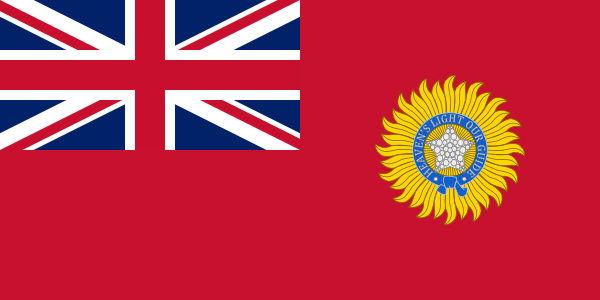
Burma was [[British rule in Burma|made a province]] of British India in 1886. In 1937, the Burma Province was separated from British India and made a distinct colony.<ref>{{Cite web |last=Kamalakaran |first=Ajay |date=2024-01-13 |title=Why Burma was separated from British India |url=https://scroll.in/magazine/1062050/why-burma-was-separated-from-british-india |access-date=2026-03-19 |website=Scroll.in |language=en}}</ref> It was in [[Japanese occupation of Burma|Japanese-occupied Burma]] that [[Indian independence movement|Indian nationalist]] [[Subhas Chandra Bose]] delivered his "Give me blood and I will give you freedom!" slogan, and [[Prime Minister of India|Prime Minister]] [[Narendra Modi]] highlighted Burma's role in the Indian independence movement.<ref>{{cite news |url=http://www.hindustantimes.com/india-news/on-final-day-of-tour-pm-modi-visits-shwedagon-pagoda-in-myanmar-s-yangon/story-Rg1PCi8YgvlWLZxL8FXKbL.html |newspaper=[[The Hindustan Times]] |quote=Emphasising Myanmar’s value in India’s freedom struggle, Prime Minister Modi said that this is the sacred land from where Netaji Subhash Chandra Bose gave the slogan of 'give me blood and I will give you freedom'. |title=PM Modi visits Shwedagon Pagoda, grave of Bahadur Shah Zafar in Myanmar |date=7 September 2017}}</ref> | |||
{{Infobox bilateral relations|Indo-Burmese|India|Burma|flagvariant2=1948|map=India Burma locator.svg}} | |||
[[File:Nehru with U Win.jpg|thumb|[[:w:Jawaharlal Nehru|Jawaharlal Nehru]] with U Win, Burmese High Commissioner in [[:w:India|India]], on October 23, 1947.]] | [[File:Nehru with U Win.jpg|thumb|[[:w:Jawaharlal Nehru|Jawaharlal Nehru]] with U Win, Burmese High Commissioner in [[:w:India|India]], on October 23, 1947.]] | ||
India established diplomatic relations after Myanmar's independence from [[United Kingdom|Britain]] in 1948. For many years, Indo-Burmese relations were strong due to Myanmar previously having been a province of India, due to cultural links, flourishing commerce, common interests in regional affairs and the presence of a significant [[Burmese Indians|Indian community]] in Myanmar.<ref name="VJ"/> India provided considerable support when Myanmar struggled with regional [[insurgency|insurgencies]]. However, the overthrow of the democratic government by the [[Military of Myanmar]] led to strains in ties. Along with much of the world, India condemned the suppression of democracy and Myanmar ordered the [[Burmese Indians|expulsion]] of the [[Burmese Indians|Burmese Indian]] community, increasing its own | India established diplomatic relations after Myanmar's independence from [[United Kingdom|Britain]] in 1948. For many years, Indo-Burmese relations were strong due to Myanmar previously having been a province of India, due to cultural links, flourishing commerce, common interests in regional affairs and the presence of a significant [[Burmese Indians|Indian community]] in Myanmar.<ref name="VJ"/> India provided considerable support when Myanmar struggled with regional [[insurgency|insurgencies]]. However, the 1962 overthrow of the democratic government by the [[Military of Myanmar]] led to strains in ties. Along with much of the world, India condemned the suppression of democracy and Myanmar ordered the [[Burmese Indians|expulsion]] of the [[Burmese Indians|Burmese Indian]] community, increasing its own isolation from the world.<ref name="VJ"/><ref name="VQR">{{cite news|url=https://query.nytimes.com/gst/fullpage.html?res=940DE4DA163AF937A15754C0A96E948260|title=Years of Isolation Produced Intensely Poor Nation|work=The New York Times |date=24 July 1988|access-date=2 April 2016|last1=Erlanger |first1=Steven }}</ref> Only [[China]] maintained close links with Myanmar while India supported the [[National League for Democracy|pro-democracy movement]].<ref name="VJ"/><ref name="G">{{cite news|url=https://news.bbc.co.uk/2/hi/south_asia/7013975.stm|title=BBC NEWS - South Asia - Explaining India's silence over Burma|date=26 September 2007|access-date=2 April 2016}}</ref><ref name="VO">[http://www.financialexpress.com/old/fe_full_story.php?content_id=42065 Realism in India-Myanmar relations] {{webarchive|url=https://web.archive.org/web/20130515034744/http://www.financialexpress.com/old/fe_full_story.php?content_id=42065 |date=15 May 2013 }}</ref> | ||
[[File:Prime Minister Narendra Modi and Myanmar President Thein Sein.jpg|thumb|Prime Minister Narendra Modi and Myanmar President Thein Sein, 2014]] | [[File:Prime Minister Narendra Modi and Myanmar President Thein Sein.jpg|thumb|Prime Minister Narendra Modi and Myanmar President Thein Sein, 2014]] | ||
A major breakthrough occurred in 1987 when the then-[[Indian Prime Minister]] [[Rajiv Gandhi]] visited Myanmar, but relations worsened after the military junta's [[8888 Uprising|reaction towards pro-democracy movements]] in 1988, which resulted in an influx of Burmese refugees into India.<ref name="VJ"/><ref name="G"/> However, since 1993 the governments of the [[Indian Prime Minister]]s [[P. V. Narasimha Rao]] and [[Atal Bihari Vajpayee]] changed course and began to establish warmer relations between the two nations, as part of a wider foreign policy of increasing India's participation and influence in [[Southeast Asia]], in light of the growing influence of the People's Republic of China, an India-Myanmar joint operation destroyed several militant camps of Arakan Army on the Indo-Myanmar border. | A major breakthrough occurred in 1987 when the then-[[Indian Prime Minister]] [[Rajiv Gandhi]] visited Myanmar, but relations worsened after the military junta's [[8888 Uprising|reaction towards pro-democracy movements]] in 1988, which resulted in an influx of Burmese refugees into India.<ref name="VJ"/><ref name="G"/> However, since 1993 the governments of the [[Indian Prime Minister]]s [[P. V. Narasimha Rao]] and [[Atal Bihari Vajpayee]] changed course and began to establish warmer relations between the two nations, as part of a wider foreign policy of increasing India's participation and influence in [[Southeast Asia]], in light of the growing influence of the People's Republic of China, an India-Myanmar joint operation destroyed several militant camps of Arakan Army on the Indo-Myanmar border. | ||
The action averted a possible threat to the ambitious Kaladan transit and transport project which is important for improving the connectivity in the Northeast. | The action averted a possible threat to the ambitious Kaladan transit and transport project which is important for improving the connectivity in the Northeast. | ||
In September 2024, the [[Indian Council of World Affairs]] invited representatives of the [[National Unity Government of Myanmar]], [[Arakan Army]], [[Chin National Front]], and [[Kachin Independence Army]] to participate in a mid-November seminar on "Constitutionalism and Federalism." It is currently unknown whether the [[State Administration Council|SAC]] junta was invited to this seminar.<ref> [https://www.reuters.com/world/asia-pacific/india-extends-unprecedented-invite-myanmars-anti-junta-forces-sources-say-2024-09-23/ Exclusive: India extends unprecedented invite to Myanmar's anti-junta forces, sources say]. [[Reuters]]. September 23, 2024. Wa Lone and Devjyot Ghoshal {{Webarchive|url=https://ghostarchive.org/archive/eCSKZ|date=September 24, 2024}}</ref> India also took part in the [[Wilmington Declaration]] with Japan, the United States, and Australia to discourage the flow of jet fuel and other military items to the SAC junta.<ref> [https://bidenwhitehouse.archives.gov/briefing-room/statements-releases/2024/09/21/the-wilmington-declaration-joint-statement-from-the-leaders-of-australia-india-japan-and-the-united-states/ The Wilmington Declaration Joint Statement from the Leaders of Australia, India, Japan, and the United States] September 21, 2024. [[whitehouse.gov]]</ref> | |||
==Economic relations== | ==Economic relations== | ||
| Line 30: | Line 35: | ||
{{main|India–Myanmar–Thailand Trilateral Highway}} | {{main|India–Myanmar–Thailand Trilateral Highway}} | ||
India and Myanmar have agreed to a 4-lane, 3200 km triangular highway connecting [[India]], [[Myanmar]] and [[Thailand]]. The route, which is expected to have completed during 2016, runs from India's northeastern states into Myanmar, where over 1,600 km of roads were built or improved. | |||
The route begins from [[Guwahati]] in India and connects to [[Mandalay]] in [[Myanmar]], route continues to [[Yangon]] in [[Myanmar]] and then to [[Mae Sot]] in [[Thailand]], which then continues to [[Bangkok]]. | The route begins from [[Guwahati]] in India and connects to [[Mandalay]] in [[Myanmar]], route continues to [[Yangon]] in [[Myanmar]] and then to [[Mae Sot]] in [[Thailand]], which then continues to [[Bangkok]]. | ||
| Line 39: | Line 44: | ||
====Kaladan Multi-modal Transit Route==== | ====Kaladan Multi-modal Transit Route==== | ||
The [[Kaladan Multi-Modal Transit Transport Project]] will connect the eastern Indian seaport of [[Kolkata]] with [[Sittwe]] seaport in [[Myanmar]] by sea; it will then link [[Sittwe]] seaport to [[Lashio]] in [[Myanmar]] via [[Kaladan river]] boat route and then from [[Lashio]] on to [[Mizoram]] in [[India]] by road transport. The project was scheduled to be completed by 2014 according to [[Governor of Mizoram]] [[Vakkom Purushothaman]].,<ref>{{cite news|last=Purushothaman|first=Vakkom|title=Kaladan Multi Modal Transit Transport Project to link sea route in Myanmar with Mizoram|url=http://tntmagazine.in/news/mizoram/kaladan-multi-modal-transit-transport-project-to-link-sea-route-in-myanmar-with-mizoram/|access-date=11 August 2012|newspaper=The Northeast Times|url-status=dead|archive-url=https://web.archive.org/web/20120415053036/http://tntmagazine.in/news/mizoram/kaladan-multi-modal-transit-transport-project-to-link-sea-route-in-myanmar-with-mizoram/|archive-date=15 April 2012|df=dmy-all}}</ref> but | The [[Kaladan Multi-Modal Transit Transport Project]] will connect the eastern Indian seaport of [[Kolkata]] with [[Sittwe]] seaport in [[Myanmar]] by sea; it will then link [[Sittwe]] seaport to [[Lashio]] in [[Myanmar]] via [[Kaladan river]] boat route and then from [[Lashio]] on to [[Mizoram]] in [[India]] by road transport. The project was scheduled to be completed by 2014 according to [[Governor of Mizoram]] [[Vakkom Purushothaman]].,<ref>{{cite news|last=Purushothaman|first=Vakkom|title=Kaladan Multi Modal Transit Transport Project to link sea route in Myanmar with Mizoram|url=http://tntmagazine.in/news/mizoram/kaladan-multi-modal-transit-transport-project-to-link-sea-route-in-myanmar-with-mizoram/|access-date=11 August 2012|newspaper=The Northeast Times|url-status=dead|archive-url=https://web.archive.org/web/20120415053036/http://tntmagazine.in/news/mizoram/kaladan-multi-modal-transit-transport-project-to-link-sea-route-in-myanmar-with-mizoram/|archive-date=15 April 2012|df=dmy-all}}</ref> but there have been delays and the project was completed till the road component from [[Lashio]] to [[Mizoram]], the project was again expected to be finished by December 2023 but was again slowed due to security problems in Myanmar .<ref name="livemint.com">{{cite web|url=http://www.livemint.com/Politics/lXLGGeFzlUmlc3p5hIuKMP/Highway-linking-India-to-Myanmar-Thailand-likely-by-2016-V.html|title=Highway linking India to Myanmar, Thailand likely by 2016: VK Singh|author=Elizabeth Roche|date=14 August 2014|publisher=livemint|access-date=2 April 2016}}</ref><ref>{{Cite news |last=Bhattacherjee |first=Kallol |date=2024-02-08 |title=India's Kaladan project 'almost dead' after Paletwa fell to Arakan Army: senior Myanmar Opposition leader |url=https://www.thehindu.com/news/international/indias-kaladan-project-almost-dead-after-paletwa-fell-to-arakan-army-senior-myanmar-opposition-leader/article67825130.ece?response_id=SARnKMeQgYtS22rKAvFZHPO6pRzMU56mDk07cTSJAdkysmdxwt&internal_redirect_uri=https://www.thehindu.com/news/international/indias-kaladan-project-almost-dead-after-paletwa-fell-to-arakan-army-senior-myanmar-opposition-leader/article67825130.ece |access-date=2024-11-03 |work=The Hindu |language=en-IN |issn=0971-751X}}</ref> | ||
===Visas=== | ===[[Travel visa|Visas]]=== | ||
During a 2017 visit to [[Nay Pyi Taw]], [[Narendra Modi|Prime Minister Modi]] announced that India would offer gratis/no-cost [[Travel visa|visas]] to all Myanmar citizens visiting India.<ref>{{cite news |url=http://www.ndtv.com/india-news/india-to-grant-gratis-visa-to-myanmarese-citizens-pm-narendra-modi-1746810 |quote="I am pleased to announce that we have decided to grant gratis (no-cost) visa to all the citizens of Myanmar who want to visit India," Prime Minister Modi said. |publisher=[[NDTV]] |title=India To Grant Gratis Visa To Myanmarese Citizens: PM Narendra Modi |author=Press Trust of India |author-link=Press Trust of India |date=6 September 2017}}</ref><ref>{{cite news |url=http://www.thehindu.com/news/international/india-to-grant-free-visa-to-myanmar-citizens-modi/article19630531.ece |newspaper=[[The Hindu]] |title=India to grant free visa to Myanmar citizens: Modi |date=6 September 2017}}</ref> | During a 2017 visit to [[Nay Pyi Taw]], [[Narendra Modi|Prime Minister Modi]] announced that India would offer gratis/no-cost [[Travel visa|visas]] to all Myanmar citizens visiting India.<ref>{{cite news |url=http://www.ndtv.com/india-news/india-to-grant-gratis-visa-to-myanmarese-citizens-pm-narendra-modi-1746810 |quote="I am pleased to announce that we have decided to grant gratis (no-cost) visa to all the citizens of Myanmar who want to visit India," Prime Minister Modi said. |publisher=[[NDTV]] |title=India To Grant Gratis Visa To Myanmarese Citizens: PM Narendra Modi |author=Press Trust of India |author-link=Press Trust of India |date=6 September 2017}}</ref><ref>{{cite news |url=http://www.thehindu.com/news/international/india-to-grant-free-visa-to-myanmar-citizens-modi/article19630531.ece |newspaper=[[The Hindu]] |title=India to grant free visa to Myanmar citizens: Modi |date=6 September 2017}}</ref> | ||
==Strategic cooperations== | ==Strategic cooperations== | ||
India's move to forge close relations with Myanmar are motivated by a desire to counter [[China]]'s growing influence as a regional leader{{dubious|date=June 2013}} and enhance its own influence and standing.<ref name="VJ"/><ref name="G"/><ref name="TIME">{{cite magazine|url=http://www.time.com/time/world/article/0,8599,1666859,00.html?xid=feed-cnn-topics|archive-url=https://web.archive.org/web/20080522052532/http://www.time.com/time/world/article/0,8599,1666859,00.html?xid=feed-cnn-topics|url-status=dead|archive-date=22 May 2008|title=India's Burma Silence Says Volumes|date=29 September 2007|magazine=[[Time (magazine)|Time]]|access-date=2 April 2016}}</ref> Concerns and tensions increased in India over China's extensive military involvement in developing ports, naval and intelligence facilities and industries, specifically the upgrading of a naval base in [[Sittwe]], a major seaport located close to the eastern Indian city of [[Kolkata]].<ref name="VJ"/> India's engagement of the Burmese military junta has helped ease the regime's [[international isolation]] and lessen Burma's reliance on China.<ref name="VJ"/> Both nations sought to cooperate to counteract drug trafficking and insurgent groups operating in the border areas.<ref name="G"/> India and Myanmar are leading members of [[BIMSTEC]] and the [[Mekong-Ganga Cooperation]], along with [[Vietnam]], [[Laos]], [[Cambodia]] and [[Thailand]], helping India develop its influence and ties amongst [[Southeast Asia]]n nations.<ref name="VJ"/> | |||
In 2013, India provided a loan of about US$500 million.<ref>[http://elevenmyanmar.com/business/3197-myanmar-to-use-indian-bank-loans-for-development Myanmar to use Indian bank loans for development] {{webarchive|url=https://web.archive.org/web/20131215004659/http://elevenmyanmar.com/business/3197-myanmar-to-use-indian-bank-loans-for-development |date=15 December 2013 }}</ref> to [[Myanmar]] for its development; India and Myanmar have also agreed to cooperate militarily in order to help modernize Myanmar's military.{{citation needed|date=September 2017}} | |||
In 2013, India provided a loan of about US$ | |||
In 2020, India gifted the [[Myanmar Navy | In 2020, India gifted the [[Myanmar Navy]] its first ever submarine, a [[Kilo-class submarine|kilo class]] ([[INS Sindhuvir (S58)|INS Sindhuvir]]) attack submarine which has been refurbished and modernised by [[Hindustan Shipyard|Hindustan Shipyard Limited]].<ref>{{Cite news|last=Bhattacharjee|first=Kallol|date=2020-10-16|title=India to handover Kilo class attack submarine to Myanmar|language=en-IN|work=The Hindu|url=https://www.thehindu.com/news/national/india-to-handover-kilo-class-attack-submarine-to-myanmar/article32866535.ece|access-date=2020-10-20|issn=0971-751X}}</ref> | ||
==Security ties== | ==Security ties== | ||
Indian and Myanmar troops carried out jointly Operation Sunrise | Indian and Myanmar troops carried out jointly [[Operation Sunrise (2019)|Operation Sunrise]] in 2019 in their respective territories to destroy several insurgent camps. However the threat to the [[Kaladan River|Kaladan]] multi-modal transit transport project, India's gateway to [[Southeast Asia]] continues.<ref>{{Cite web|url=https://www.financialexpress.com/defence/operation-sunrise-2-several-insurgent-camps-destroyed-along-indo-myanmar-border-myanmar-army-suffers-losses/1610987/|archive-url = https://web.archive.org/web/20190619131007/https://www.financialexpress.com/defence/operation-sunrise-2-several-insurgent-camps-destroyed-along-indo-myanmar-border-myanmar-army-suffers-losses/1610987/|archive-date = 19 June 2019|title = Operation Sunrise 2: Several insurgent camps destroyed along Indo-Myanmar border; Myanmar Army suffers losses| date=18 June 2019 }}</ref> In January 2023 operations by the [[Myanmar Air Force]] in a sparsely populated area along the border were carried out; proximity of local populations resulted in their disquiet.<ref>{{Cite web |last1=Hassan |first1=Aakash |last2=Ellis-Petersen |first2=Hannah |date=2023-01-11 |title=Myanmar junta hit Indian territory during strike on rebel camp, say witnesses |url=https://www.theguardian.com/world/2023/jan/11/myanmar-junta-hit-indian-territory-during-strike-on-rebel-camp-say-witnesses |access-date=2023-01-12 |website=The Guardian |language=en}}</ref><ref>{{Cite web |last1=Agarwala |first1=Tora |last2=Dutta |first2=Amrita Nayak |date=2023-01-12 |title=Myanmar air strikes target rebel camp near border, panic in Mizoram village |url=https://indianexpress.com/article/cities/guwahati/myanmar-air-strikes-target-rebel-camp-near-border-panic-in-mizoram-village-8376595/ |url-access=subscription |access-date=2023-01-12 |website=The Indian Express |language=en}}</ref> | ||
India has also supported Myanmar in its efforts to combat Rohingya insurgent groups like the [[Arakan Rohingya Salvation Army|Arakan Rohingya Salvation Army (ARSA)]] and Aqa Mul Mujahideen (AMM),<ref>{{cite news |last= Dutta|first= Prakash K|date=8 September 2017|title=Rohingyas in India and terror threat: How jihadi forces may have infiltrated persecuted Muslims of Myanmar|url=https://www.indiatoday.in/india/story/rohingya-muslims-terror-jammu-myanmar-narendra-modi-1040795-2017-09-08|newspaper=India Today}}</ref><ref>{{cite news |last= Bhaumik|first= Subir|date=18 Oct 2017|title=Why do China, India back Myanmar over the Rohingya crisis?|url=https://www.scmp.com/week-asia/geopolitics/article/2115839/why-do-china-india-back-myanmar-over-rohingya-crisis|newspaper=South China Morning Post}}</ref> after Indian intelligence agencies found the ARSA and AMM to have links with terror groups like the [[Lashkar-e-Taiba|Lashkar-e-Taiba (LeT)]] and [[Jaish-e-Mohammed|Jaish-e-Mohammed (JeM)]] as well as reported Rohingya terrorists fighting alongside Pakistani extremists in Kashmir.<ref>{{cite news |last= Chaudhury|first= Dipanjan Roy|date=12 July 2018|title=Rohingya terrorists linked to pro-Pak terror groups in Jammu & Kashmir|url=https://economictimes.indiatimes.com/news/defence/rohingya-terrorists-linked-to-pro-pak-terror-groups-in-jammu-kashmir/articleshow/55046910.cms|newspaper=Economic Times}}</ref> | India has also supported Myanmar in its efforts to combat Rohingya insurgent groups like the [[Arakan Rohingya Salvation Army|Arakan Rohingya Salvation Army (ARSA)]] and Aqa Mul Mujahideen (AMM),<ref>{{cite news|date=20 February 2018|title=India Opens Probe into Rohingya Militant Group Aqa Mul Mujahidin |url=https://www.rfa.org/english/news/myanmar/india-rohingya-02202018181722.html|publisher=[[Radio Free Asia]]}} </ref><ref>{{cite news |last= Dutta|first= Prakash K|date=8 September 2017|title=Rohingyas in India and terror threat: How jihadi forces may have infiltrated persecuted Muslims of Myanmar|url=https://www.indiatoday.in/india/story/rohingya-muslims-terror-jammu-myanmar-narendra-modi-1040795-2017-09-08|newspaper=India Today}}</ref><ref>{{cite news |last= Bhaumik|first= Subir|date=18 Oct 2017|title=Why do China, India back Myanmar over the Rohingya crisis?|url=https://www.scmp.com/week-asia/geopolitics/article/2115839/why-do-china-india-back-myanmar-over-rohingya-crisis|newspaper=South China Morning Post}}</ref> after Indian intelligence agencies found the ARSA and AMM to have links with terror groups like the [[Lashkar-e-Taiba|Lashkar-e-Taiba (LeT)]] and [[Jaish-e-Mohammed|Jaish-e-Mohammed (JeM)]] as well as reported Rohingya terrorists fighting alongside Pakistani extremists in Kashmir.<ref>{{cite news |last= Chaudhury|first= Dipanjan Roy|date=12 July 2018|title=Rohingya terrorists linked to pro-Pak terror groups in Jammu & Kashmir|url=https://economictimes.indiatimes.com/news/defence/rohingya-terrorists-linked-to-pro-pak-terror-groups-in-jammu-kashmir/articleshow/55046910.cms|newspaper=Economic Times}}</ref> | ||
==Disaster relief== | ==Disaster relief== | ||
India responded promptly and effectively in rendering assistance after natural disaster in Myanmar such as the earthquake in Shan state (2010) Cyclone Mora (2017), | India responded promptly and effectively in rendering assistance after natural disaster in Myanmar such as the earthquake in Shan state (2010), [[Cyclone Mora]] (2017), [[Cyclone Komen]] (2015), and notably for [[2025 Myanmar earthquake]] under [[Operation Brahma]]. India offered to help in capacity building in [[disaster risk mitigation]] as well as strengthening Myanmar's National Disaster Response Mechanism. | ||
== Covid-19 vaccines == | === Covid-19 vaccines === | ||
India granted 1.7 million | India granted 1.7 million COVID-19 vaccines to Myanmar in the months of January and February 2021.<ref>{{Cite web|title=Vaccine Supply|url=https://www.mea.gov.in/vaccine-supply.htm|access-date=2021-06-12|website=www.mea.gov.in}}</ref> | ||
==Human rights== | ==Human rights== | ||
India was hesitant in reacting to the [[2007 Burmese anti-government protests]] that had drawn overwhelming international condemnation.<ref name="TIME"/> India also declared that it had no intention of interfering in Burma's internal affairs and that the [[Bamar|Burmese people]] would have to achieve [[democracy]] by themselves as it respects the sovereignty of Myanmar.<ref name="G"/> This low-key response has been widely criticised both within India and abroad as weakening India's credentials as a leading democratic nation.<ref name="VJ"/><ref name="G"/><ref name="TIME"/> | |||
In contrast to much of the international community, [[Narendra Modi|Prime Minister Modi]] declined to criticize [[Aung San Suu Kyi|Suu Kyi]]'s handling of the [[2016–17 Northern Rakhine State clashes]] or Myanmar's government's treatment of its [[Rohingya people]].<ref>{{cite news |url=https://www.telegraphindia.com/1170907/jsp/frontpage/story_171295.jsp |archive-url=https://web.archive.org/web/20170908020046/https://www.telegraphindia.com/1170907/jsp/frontpage/story_171295.jsp |url-status=dead |archive-date=8 September 2017 |newspaper=[[The Telegraph (Calcutta)|The Telegraph]] |title=Modi stands by Suu Kyi |first=Charu Sudan |last=Kasturi |date=6 September 2017}}</ref><ref>{{cite news |url=http://www.cnn.com/2017/09/06/asia/modi-india-myanmar-rohingya/index.html |publisher=[[CNN]] |title=Indian Prime Minister blames Rohingya violence on extremists |first=Huizhong |last=Wu |date=7 September 2017}}</ref> | |||
In contrast to much of the international community, [[Narendra Modi|Prime Minister Modi]] declined to criticize [[Aung San Suu Kyi|Suu Kyi]]'s handling of the [[2016–17 Northern Rakhine State clashes]] or Myanmar's government's treatment of its [[Rohingya people]].<ref>{{cite news |url=https://www.telegraphindia.com/1170907/jsp/frontpage/story_171295.jsp |newspaper=[[The Telegraph (Calcutta)|The Telegraph]] |title=Modi stands by Suu Kyi |first=Charu Sudan |last=Kasturi |date=6 September 2017}}</ref><ref>{{cite news |url=http://www.cnn.com/2017/09/06/asia/modi-india-myanmar-rohingya/index.html |publisher=[[CNN]] |title=Indian Prime Minister blames Rohingya violence on extremists |first=Huizhong |last=Wu |date=7 September 2017}}</ref> | |||
India also announced plans to [[Deportation|deport]] its Rohingya refugee population. Minister of State for Home Affairs [[Kiren Rijiju]] described the refugees as "illegal immigrants", echoing the Myanmar government position.<ref name="ft">{{cite | India also announced plans to [[Deportation|deport]] its Rohingya refugee population. Minister of State for Home Affairs [[Kiren Rijiju]] described the refugees as "illegal immigrants", echoing the Myanmar government position.<ref name="ft">{{cite news|url=https://www.ft.com/content/6df8f4ea-946e-11e7-a9e6-11d2f0ebb7f0|newspaper=[[The Financial Times]] |title=India's Rohingya refugees face new deportation threat |date=10 September 2017 |archive-url=https://archive.today/20170911162055/https://www.ft.com/content/6df8f4ea-946e-11e7-a9e6-11d2f0ebb7f0 |archive-date=September 11, 2017 |quote=Police across India have been instructed by New Delhi to step up surveillance of Rohingya or anyone suspected of being from the minority as a preparatory step. “They are illegal immigrants in India,” Kiren Rijiju, minister of state for home affairs, told reporters last week. “As per law, they stand to be deported.”|last1=Kazmin |first1=Amy }}</ref><ref name="thehindu">{{cite news|url=http://www.thehindu.com/news/national/rohingya-are-illegal-immigrants-who-need-to-be-deported-says-kiren-rijiju/article19625459.ece|title=Rohingya are illegal immigrants who need to be deported, says Kiren Rijiju|website=The Hindu|date=5 September 2017|access-date=14 September 2017|last1=Phukan|first1=Sandeep}}</ref> Although the Rohingya have fought deportation in the Indian courts (partly on humanitarian grounds), in September 2017 the Indian government responded that India did not sign the [[Convention Relating to the Status of Refugees|1951 Refugee Convention]] and most Rohingya arrived in India before the August 2017 violence. Some Indian media have reported that the country's intelligence agencies suspect militant Royhinga leaders of conspiring with Pakistani terrorists and planning to incite violence in India.<ref name="varun_gandhi_2017_09_26_ndtv">[https://www.ndtv.com/india-news/varun-gandhi-view-on-rohingya-is-anti-national-says-union-minister-1755345 "Varun Gandhi's View On Rohingya Draws Big Put-Down From Government"] 26 September 2017, [[NDTV]].com, retrieved 26 September 2017</ref> | ||
==See also== | ==See also== | ||
{{Portal|India|Myanmar}} | |||
* [[Foreign relations of Burma]] | * [[Foreign relations of Burma]] | ||
* [[ | * [[Foreign relations of India]] | ||
* [[India–Myanmar barrier]] | * [[India–Myanmar barrier]] | ||
* [[India–Myanmar border]] | * [[India–Myanmar border]] | ||
== References == | == References == | ||
| Line 96: | Line 97: | ||
* Amit Singh, "Emerging Trends in India-Myanmar Relations," ''Maritime Affairs: Journal of the National Maritime Foundation of India,'' Vol. 8, No. 2, (Dec 2012) Pages: 25-47 DOI:10.1080/09733159.2012.742650 | * Amit Singh, "Emerging Trends in India-Myanmar Relations," ''Maritime Affairs: Journal of the National Maritime Foundation of India,'' Vol. 8, No. 2, (Dec 2012) Pages: 25-47 DOI:10.1080/09733159.2012.742650 | ||
{{Foreign relations of India}} | |||
{{Foreign relations of Myanmar}} | {{Foreign relations of Myanmar}} | ||
{{DEFAULTSORT:India-Myanmar relations}} | {{DEFAULTSORT:India-Myanmar relations}} | ||
Latest revision as of 02:12, 20 March 2026
 | |
 India |
 Myanmar |
|---|---|
| Diplomatic mission | |
| High Commission of Myanmar, New Delhi | Embassy of India, Yangon |
| Envoy | |
| High Commissioner Moe Kyaw Aung | Ambassador Vinay Kumar |
India–Myanmar relations, also known as the Indo–Burmese relations, are the bilateral relations between the Republic of India and the Republic of the Union of Myanmar. These relations encompass the political, economic and socio-cultural relations that exist between the two neighboring Asian countries. Political relations have improved considerably since 1993, overcoming tensions related to drug trafficking, the suppression of democracy and the rule of the military junta in Myanmar.[1] Political leaders from both countries meet regularly on a bilateral basis and within the ASEAN Plus Six community. Economic relations are considerable with India representing Myanmar's 4th largest export market and the country's 5th largest import partner.
The 1,600 km (990 mi) India–Myanmar border separates the Indian states of Mizoram, Manipur, Nagaland and Arunachal Pradesh in Northeast India from Kachin State, Sagaing Region and Chin State in Myanmar/Burma. In addition to the long land border, India and Myanmar also share a maritime border along India's Andaman Islands.[2]
History[edit | edit source]
 India |
 Burma |
|---|---|

India–Myanmar/Burmese relations date to antiquity and cultural exchanges included Buddhism and the Burmese script, which was based on the Indian Grantha script. In particular, Theravada Buddhism has tremendously influenced Burmese society and culture for millennia, with around 90% of Burma's population continuing to follow the religion.
The Meiteis from Manipur, northeast India, introduced polo and hockey in the Burmese court.[3] They introduced the science of astrology to the Burmese and the rest of the South East Asians.[4]
When Burmese King Alaungpaya invaded Siam (Thailand), he had 500 Manipuri (Meitei) horsemen with him. Meitei Brahmins worked as astrologers and priests for the Burmese royalties.[5]
Burma was made a province of British India in 1886. In 1937, the Burma Province was separated from British India and made a distinct colony.[6] It was in Japanese-occupied Burma that Indian nationalist Subhas Chandra Bose delivered his "Give me blood and I will give you freedom!" slogan, and Prime Minister Narendra Modi highlighted Burma's role in the Indian independence movement.[7]
| |
India |
 Burma |
|---|---|

India established diplomatic relations after Myanmar's independence from Britain in 1948. For many years, Indo-Burmese relations were strong due to Myanmar previously having been a province of India, due to cultural links, flourishing commerce, common interests in regional affairs and the presence of a significant Indian community in Myanmar.[2] India provided considerable support when Myanmar struggled with regional insurgencies. However, the 1962 overthrow of the democratic government by the Military of Myanmar led to strains in ties. Along with much of the world, India condemned the suppression of democracy and Myanmar ordered the expulsion of the Burmese Indian community, increasing its own isolation from the world.[2][8] Only China maintained close links with Myanmar while India supported the pro-democracy movement.[2][9][10]

A major breakthrough occurred in 1987 when the then-Indian Prime Minister Rajiv Gandhi visited Myanmar, but relations worsened after the military junta's reaction towards pro-democracy movements in 1988, which resulted in an influx of Burmese refugees into India.[2][9] However, since 1993 the governments of the Indian Prime Ministers P. V. Narasimha Rao and Atal Bihari Vajpayee changed course and began to establish warmer relations between the two nations, as part of a wider foreign policy of increasing India's participation and influence in Southeast Asia, in light of the growing influence of the People's Republic of China, an India-Myanmar joint operation destroyed several militant camps of Arakan Army on the Indo-Myanmar border. The action averted a possible threat to the ambitious Kaladan transit and transport project which is important for improving the connectivity in the Northeast.
In September 2024, the Indian Council of World Affairs invited representatives of the National Unity Government of Myanmar, Arakan Army, Chin National Front, and Kachin Independence Army to participate in a mid-November seminar on "Constitutionalism and Federalism." It is currently unknown whether the SAC junta was invited to this seminar.[11] India also took part in the Wilmington Declaration with Japan, the United States, and Australia to discourage the flow of jet fuel and other military items to the SAC junta.[12]
Economic relations[edit | edit source]
India is Burma's 4th largest trading partner after Thailand, China and Singapore, and second largest export market after Thailand, absorbing 25 percent of its total exports.[13] India is also the seventh most important source of Burma's imports. The governments of India and Myanmar had set a target of achieving $1 billion and bilateral trade reached US$1.3 billion by 2017.[13] The Indian government has worked to extend air, land and sea routes to strengthen trade links with Myanmar and establish a gas pipeline.[9][13] While the involvement of India's private sector has been low and growing at a slow pace, both governments are proceeding to enhance cooperation in agriculture, telecommunications, information technology, steel, oil, natural gas, hydrocarbons and food processing.[9][13] The bilateral border trade agreement of 1994 provides for border trade to be carried out from three designated border points, one each in Manipur, Mizoram and Nagaland.[13]
Infrastructure initiatives[edit | edit source]
On 13 February 2001 India and Myanmar inaugurated 250 kilometre Tamu-Kalewa-Kalemyo highway, popularly called the Indo-Myanmar Friendship Road, built mainly by the Indian Army's Border Roads Organisation and aimed to provide a major strategic and commercial transport route connecting North-East India, and South Asia as a whole, to Southeast Asia.[2]
India-Myanmar-Thailand Friendship Highway[edit | edit source]
India and Myanmar have agreed to a 4-lane, 3200 km triangular highway connecting India, Myanmar and Thailand. The route, which is expected to have completed during 2016, runs from India's northeastern states into Myanmar, where over 1,600 km of roads were built or improved.
The route begins from Guwahati in India and connects to Mandalay in Myanmar, route continues to Yangon in Myanmar and then to Mae Sot in Thailand, which then continues to Bangkok.
India is undertaking two sections of the Trilateral Highway namely, (i) construction of Kalewa-Yagyi road section in Myanmar, and (ii) construction of 69 bridges on the Tamu-Kyigone-Kalewa (TKK) road section in Myanmar. The work on both these sections has been awarded on Engineering, Procurement and Construction mode and is underway since May 2018 for Kalewa-Yagyi section and November 2017 for the TKK section.[14]
The first phase connecting Guwahati to Mandalay will eventually be extended to Cambodia and Vietnam under Mekong-Ganga Cooperation within the wider framework of Asian Highway Network. This is aimed at creating a new economic zone ranging from Kolkata on the Bay of Bengal to Ho Chi Minh City on the South China Sea.[15]
Kaladan Multi-modal Transit Route[edit | edit source]
The Kaladan Multi-Modal Transit Transport Project will connect the eastern Indian seaport of Kolkata with Sittwe seaport in Myanmar by sea; it will then link Sittwe seaport to Lashio in Myanmar via Kaladan river boat route and then from Lashio on to Mizoram in India by road transport. The project was scheduled to be completed by 2014 according to Governor of Mizoram Vakkom Purushothaman.,[16] but there have been delays and the project was completed till the road component from Lashio to Mizoram, the project was again expected to be finished by December 2023 but was again slowed due to security problems in Myanmar .[17][18]
Visas[edit | edit source]
During a 2017 visit to Nay Pyi Taw, Prime Minister Modi announced that India would offer gratis/no-cost visas to all Myanmar citizens visiting India.[19][20]
Strategic cooperations[edit | edit source]
India's move to forge close relations with Myanmar are motivated by a desire to counter China's growing influence as a regional leader[dubious ] and enhance its own influence and standing.[2][9][21] Concerns and tensions increased in India over China's extensive military involvement in developing ports, naval and intelligence facilities and industries, specifically the upgrading of a naval base in Sittwe, a major seaport located close to the eastern Indian city of Kolkata.[2] India's engagement of the Burmese military junta has helped ease the regime's international isolation and lessen Burma's reliance on China.[2] Both nations sought to cooperate to counteract drug trafficking and insurgent groups operating in the border areas.[9] India and Myanmar are leading members of BIMSTEC and the Mekong-Ganga Cooperation, along with Vietnam, Laos, Cambodia and Thailand, helping India develop its influence and ties amongst Southeast Asian nations.[2]
In 2013, India provided a loan of about US$500 million.[22] to Myanmar for its development; India and Myanmar have also agreed to cooperate militarily in order to help modernize Myanmar's military.[citation needed]
In 2020, India gifted the Myanmar Navy its first ever submarine, a kilo class (INS Sindhuvir) attack submarine which has been refurbished and modernised by Hindustan Shipyard Limited.[23]
Security ties[edit | edit source]
Indian and Myanmar troops carried out jointly Operation Sunrise in 2019 in their respective territories to destroy several insurgent camps. However the threat to the Kaladan multi-modal transit transport project, India's gateway to Southeast Asia continues.[24] In January 2023 operations by the Myanmar Air Force in a sparsely populated area along the border were carried out; proximity of local populations resulted in their disquiet.[25][26]
India has also supported Myanmar in its efforts to combat Rohingya insurgent groups like the Arakan Rohingya Salvation Army (ARSA) and Aqa Mul Mujahideen (AMM),[27][28][29] after Indian intelligence agencies found the ARSA and AMM to have links with terror groups like the Lashkar-e-Taiba (LeT) and Jaish-e-Mohammed (JeM) as well as reported Rohingya terrorists fighting alongside Pakistani extremists in Kashmir.[30]
Disaster relief[edit | edit source]
India responded promptly and effectively in rendering assistance after natural disaster in Myanmar such as the earthquake in Shan state (2010), Cyclone Mora (2017), Cyclone Komen (2015), and notably for 2025 Myanmar earthquake under Operation Brahma. India offered to help in capacity building in disaster risk mitigation as well as strengthening Myanmar's National Disaster Response Mechanism.
Covid-19 vaccines[edit | edit source]
India granted 1.7 million COVID-19 vaccines to Myanmar in the months of January and February 2021.[31]
Human rights[edit | edit source]
India was hesitant in reacting to the 2007 Burmese anti-government protests that had drawn overwhelming international condemnation.[21] India also declared that it had no intention of interfering in Burma's internal affairs and that the Burmese people would have to achieve democracy by themselves as it respects the sovereignty of Myanmar.[9] This low-key response has been widely criticised both within India and abroad as weakening India's credentials as a leading democratic nation.[2][9][21]
In contrast to much of the international community, Prime Minister Modi declined to criticize Suu Kyi's handling of the 2016–17 Northern Rakhine State clashes or Myanmar's government's treatment of its Rohingya people.[32][33]
India also announced plans to deport its Rohingya refugee population. Minister of State for Home Affairs Kiren Rijiju described the refugees as "illegal immigrants", echoing the Myanmar government position.[34][35] Although the Rohingya have fought deportation in the Indian courts (partly on humanitarian grounds), in September 2017 the Indian government responded that India did not sign the 1951 Refugee Convention and most Rohingya arrived in India before the August 2017 violence. Some Indian media have reported that the country's intelligence agencies suspect militant Royhinga leaders of conspiring with Pakistani terrorists and planning to incite violence in India.[36]
See also[edit | edit source]

References[edit | edit source]
- ↑ Egreteau, Renaud (2008). "India's Ambitions in Burma: More Frustration than Success?". Asian Survey. 48 (6): 936–957. doi:10.1525/as.2008.48.6.936.
- ↑ 2.00 2.01 2.02 2.03 2.04 2.05 2.06 2.07 2.08 2.09 2.10 "Asia Times: Myanmar shows India the road to Southeast Asia". Archived from the original on 22 May 2001. Retrieved 2 April 2016.
- ↑ Sanajaoba, Naorem (1988). Manipur, Past and Present: The Heritage and Ordeals of a Civilization. Mittal Publications. p. 96. ISBN 978-81-7099-853-2.
- ↑ Sanajaoba, Naorem (1988). Manipur, Past and Present: The Heritage and Ordeals of a Civilization. Mittal Publications. p. 101. ISBN 978-81-7099-853-2.
- ↑ Sanajaoba, Naorem (1988). Manipur, Past and Present: The Heritage and Ordeals of a Civilization. Mittal Publications. p. 19. ISBN 978-81-7099-853-2.
- ↑ Kamalakaran, Ajay (13 January 2024). "Why Burma was separated from British India". Scroll.in. Retrieved 19 March 2026.
- ↑ "PM Modi visits Shwedagon Pagoda, grave of Bahadur Shah Zafar in Myanmar". The Hindustan Times. 7 September 2017.
Emphasising Myanmar's value in India's freedom struggle, Prime Minister Modi said that this is the sacred land from where Netaji Subhash Chandra Bose gave the slogan of 'give me blood and I will give you freedom'.
- ↑ Erlanger, Steven (24 July 1988). "Years of Isolation Produced Intensely Poor Nation". The New York Times. Retrieved 2 April 2016.
- ↑ 9.0 9.1 9.2 9.3 9.4 9.5 9.6 9.7 "BBC NEWS - South Asia - Explaining India's silence over Burma". 26 September 2007. Retrieved 2 April 2016.
- ↑ Realism in India-Myanmar relations Archived 15 May 2013 at the Wayback Machine
- ↑ Exclusive: India extends unprecedented invite to Myanmar's anti-junta forces, sources say. Reuters. September 23, 2024. Wa Lone and Devjyot Ghoshal Archived September 24, 2024, at ghostarchive.org [Error: unknown archive URL]
- ↑ The Wilmington Declaration Joint Statement from the Leaders of Australia, India, Japan, and the United States September 21, 2024. whitehouse.gov
- ↑ 13.0 13.1 13.2 13.3 13.4 "India-Myanmar trade relations". Archived from the original on 12 February 2012. Retrieved 2 April 2016.
- ↑ "QUESTION NO.1127 STATUS OF TRILATERAL HIGHWAY PROJECT". mea.gov.in. Retrieved 20 December 2018.
- ↑ "India to open super highway to Burma and Thailand". Telegraph.co.uk. 29 May 2012. Retrieved 2 April 2016.
- ↑ Purushothaman, Vakkom. "Kaladan Multi Modal Transit Transport Project to link sea route in Myanmar with Mizoram". The Northeast Times. Archived from the original on 15 April 2012. Retrieved 11 August 2012.
- ↑ Elizabeth Roche (14 August 2014). "Highway linking India to Myanmar, Thailand likely by 2016: VK Singh". livemint. Retrieved 2 April 2016.
- ↑ Bhattacherjee, Kallol (8 February 2024). "India's Kaladan project 'almost dead' after Paletwa fell to Arakan Army: senior Myanmar Opposition leader". The Hindu. ISSN 0971-751X. Retrieved 3 November 2024.
- ↑ Press Trust of India (6 September 2017). "India To Grant Gratis Visa To Myanmarese Citizens: PM Narendra Modi". NDTV.
"I am pleased to announce that we have decided to grant gratis (no-cost) visa to all the citizens of Myanmar who want to visit India," Prime Minister Modi said.
- ↑ "India to grant free visa to Myanmar citizens: Modi". The Hindu. 6 September 2017.
- ↑ 21.0 21.1 21.2 "India's Burma Silence Says Volumes". Time. 29 September 2007. Archived from the original on 22 May 2008. Retrieved 2 April 2016.
- ↑ Myanmar to use Indian bank loans for development Archived 15 December 2013 at the Wayback Machine
- ↑ Bhattacharjee, Kallol (16 October 2020). "India to handover Kilo class attack submarine to Myanmar". The Hindu. ISSN 0971-751X. Retrieved 20 October 2020.
- ↑ "Operation Sunrise 2: Several insurgent camps destroyed along Indo-Myanmar border; Myanmar Army suffers losses". 18 June 2019. Archived from the original on 19 June 2019.
- ↑ Hassan, Aakash; Ellis-Petersen, Hannah (11 January 2023). "Myanmar junta hit Indian territory during strike on rebel camp, say witnesses". The Guardian. Retrieved 12 January 2023.
- ↑ Agarwala, Tora; Dutta, Amrita Nayak (12 January 2023). "Myanmar air strikes target rebel camp near border, panic in Mizoram village". The Indian Express. Retrieved 12 January 2023.
- ↑ "India Opens Probe into Rohingya Militant Group Aqa Mul Mujahidin". Radio Free Asia. 20 February 2018.
- ↑ Dutta, Prakash K (8 September 2017). "Rohingyas in India and terror threat: How jihadi forces may have infiltrated persecuted Muslims of Myanmar". India Today.
- ↑ Bhaumik, Subir (18 October 2017). "Why do China, India back Myanmar over the Rohingya crisis?". South China Morning Post.
- ↑ Chaudhury, Dipanjan Roy (12 July 2018). "Rohingya terrorists linked to pro-Pak terror groups in Jammu & Kashmir". Economic Times.
- ↑ "Vaccine Supply". www.mea.gov.in. Retrieved 12 June 2021.
- ↑ Kasturi, Charu Sudan (6 September 2017). "Modi stands by Suu Kyi". The Telegraph. Archived from the original on 8 September 2017.
- ↑ Wu, Huizhong (7 September 2017). "Indian Prime Minister blames Rohingya violence on extremists". CNN.
- ↑ Kazmin, Amy (10 September 2017). "India's Rohingya refugees face new deportation threat". The Financial Times.
Police across India have been instructed by New Delhi to step up surveillance of Rohingya or anyone suspected of being from the minority as a preparatory step. "They are illegal immigrants in India," Kiren Rijiju, minister of state for home affairs, told reporters last week. "As per law, they stand to be deported."
{{cite news}}: CS1 maint: deprecated archival service (link) - ↑ Phukan, Sandeep (5 September 2017). "Rohingya are illegal immigrants who need to be deported, says Kiren Rijiju". The Hindu. Retrieved 14 September 2017.
- ↑ "Varun Gandhi's View On Rohingya Draws Big Put-Down From Government" 26 September 2017, NDTV.com, retrieved 26 September 2017
Further reading[edit | edit source]
- Daigorō Chihara (1996). Hindu-Buddhist Architecture in Southeast Asia. BRILL. ISBN 90-04-10512-3.
- Cœdès, George (1968). Walter F. Vella (ed.). The Indianized States of Southeast Asia. trans.Susan Brown Cowing. University of Hawaii Press. ISBN 978-0-8248-0368-1.
- Lokesh, Chandra, & International Academy of Indian Culture. (2000). Society and culture of Southeast Asia: Continuities and changes. New Delhi: International Academy of Indian Culture and Aditya Prakashan.
- R. C. Majumdar, Study of Sanskrit in South-East Asia
- R. C. Majumdar, Ancient Indian colonisation in South-East Asia.
- R. C. Majumdar, Champa, Ancient Indian Colonies in the Far East, Vol.I, Lahore, 1927. ISBN 0-8364-2802-1
- R. C. Majumdar, Suvarnadvipa, Ancient Indian Colonies in the Far East, Vol.II, Calcutta,
- R. C. Majumdar, Kambuja Desa or an Ancient Hindu Colony in Cambodia, Madras, 1944
- R. C. Majumdar, India and South-East Asia, I.S.P.Q.S. History and Archaeology Series Vol. 6, 1979, ISBN 81-7018-046-5.
- R. C. Majumdar, History of the Hindu Colonization and Hindu Culture in South-East Asia
- Amit Singh, "Emerging Trends in India-Myanmar Relations," Maritime Affairs: Journal of the National Maritime Foundation of India, Vol. 8, No. 2, (Dec 2012) Pages: 25-47 DOI:10.1080/09733159.2012.742650

