





Ajay Kumar (talk | contribs) Created a new article |
Josefa1802 (talk | contribs) No edit summary |
||
| Line 1: | Line 1: | ||
{{Short description| | {{Short description|Overview of colonialism}} | ||
{{ | {{Redirect|European colonialism|evaluation of European colonialism|Analysis of European colonialism and colonization}} | ||
{{Use American English|date = March 2019}} | {{Use American English|date=March 2019}} | ||
{{Use dmy dates|date=August 2022}} | {{Use dmy dates|date=August 2022}} | ||
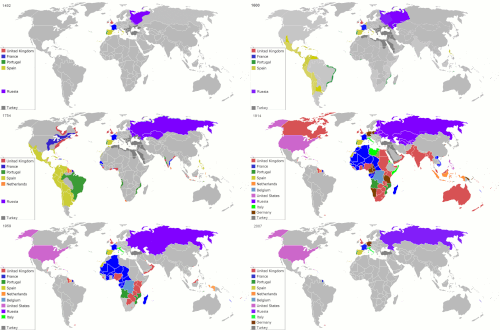
[[File:Colonisation2.gif|thumb| | [[File:Colonisation2.gif|thumb|300px|Extent of colonization by European, Ottoman, American, and Japanese powers, 1492–2007]] | ||
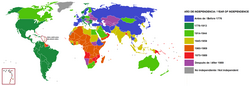
[[File:Descolonización - Decolonization.png|thumb|right|300px|Map of the year each country achieved [[List of sovereign states by date of formation|independence]]]] | |||
Colonialism | [[Colonialism]] is a phenomenon that has occurred throughout human history across the world. [[Colonies]] were established by many prominent ancient and medieval civilizations, such as the [[Phoenicia|Phoenicians]], the [[Babylonia|Babylonians]], the [[Ancient Iran|Persians]], the [[Greek colonisation|Greeks]], the [[Roman people|Romans]], the [[Han Chinese]], and the [[Arabs]], among others. The [[High Middle Ages]] saw a variety of European civilizations moving west, north, east, and south out of their continent.<ref>{{cite book |last1=Bartlett |first1=Robert |author-link1=Robert Bartlett (historian) |date=27 February 2003 |orig-date=1993 |title=The Making of Europe: Conquest, Colonization and Cultural Change 950 - 1350 |url=https://books.google.com/books?id=9R0fmcWVJAgC |edition=reprint |publication-place=London |publisher=Penguin UK |isbn=9780141927046 |access-date=19 July 2025 |quote=This book approaches the history of Europe in the High Middle Ages [...] by concentrating on conquest, colonization and associated cultural change in Europe and the Mediterranean in the period 950-1350. It analyzes the establishment of states by conquest and the peopling of distant countries by immigrants along the peripheries of the continent: English colonialism in the [[Celtic countries|Celtic world]], the [[Ostsiedlung|movement of Germans into eastern Europe]], the Spanish [[Reconquista|Reconquest]] and the activities of [[crusade]]rs and colonists in the eastern Mediterranean.}}</ref> The [[Crusader states]] in the [[Levant]] exemplify some colonial features similar to those of ancient colonies.<ref>{{cite book |last1=Constable |first1=Giles |author-link1=Giles Constable |editor-last1=Laiou |editor-first1=Angeliki E. |editor-link1=Angeliki Laiou |editor-last2=Mottahedeh |editor-first2=Roy Parviz |editor-link2=Roy Mottahedeh |year=2001 |chapter=The Historiography of the Crusades |title=The Crusades from the Perspective of Byzantium and the Muslim World |url=https://books.google.com/books?id=YTAhPw3SjxIC |series=Dumbarton Oaks Other Titles in Byzantine Studies |publication-place=Washington, D.C. |publisher=Dumbarton Oaks Research Library and Collection |page=20 |isbn=9780884022770 |access-date=19 July 2025 |quote=[[Joshua Prawer|Prawer]] [...] remarked on the shift of interest from 'the crusades as a movement to the history of Crusader establishments in the East' and to 'the European colonies on the eastern shores of the Mediterranean' [...]. [...] there has been a vigorous debate over the question of whether or not the [[Outremer | Latin states]] should be regarded as colonies in the modern (and characteristically pejorative) sense of the term.}}</ref> | ||
The beginning of the "[[Age of Discovery]]" around 1418 marked a new phase of European colonialism led by the [[Kingdom of Portugal|Portuguese]], who became increasingly expansionist following the [[Portuguese conquest of Ceuta|conquest of Ceuta]] in 1415. Portugal aimed to control navigation routes through the [[Strait of Gibraltar]], to spread Christianity, to amass wealth and plunder, and to suppress predation on Portuguese populations by Muslim [[Barbary pirates]], who operated as part of a long-running [[Slavery in Africa|African slave trade]]<ref>{{Cite web |title=Page:Cambridge Modern History Volume 1.djvu/46 - Wikisource, the free online library |url=https://en.wikisource.org/wiki/Page:Cambridge_Modern_History_Volume_1.djvu/46 |access-date=2025-06-17 |website=en.wikisource.org |language=en}}</ref> that the Portuguese would soon [[Slavery in Portugal|reverse and surpass]]. Around 1450, [[Iberian ship development, 1400–1600|the Portuguese developed]] a lighter ship—the [[caravel]]—based on North African fishing boats.{{cn|date=July 2025}} Caravels could sail further and faster than previous vessels,<ref>{{cite book |first1=John |isbn=978-0-87951-397-9 |last1=Merson |location=Woodstock, New York |pages=[https://archive.org/details/geniusthatwaschi0000mers/page/72 72] |publisher=The Overlook Press |title=The Genius That Was China: East and West in the Making of the Modern World |url=https://archive.org/details/geniusthatwaschi0000mers |url-access=registration |year=1990}} A companion to the PBS Series ''The Genius That Was China''</ref> were highly maneuverable, and had the capability of [[sailing into the wind]]. | |||
Enabled by new maritime technology, and with the added incentive to find an alternative "[[Silk Road]]" after the [[Ottoman conquest of Constantinople]] effectively closed profitable trade routes between Asia and Europe in 1453, early [[European exploration of Africa]] was followed by the Spanish exploration of the Americas, further exploration along the coasts of Africa, and explorations of West Asia (also known as the [[Middle East]]), South Asia, and East Asia. | |||
The | The [[conquest of the Canary Islands]] by the [[Crown of Castile]], from 1402 to 1496, was an early instance of European [[settler colonialism]] in Africa.<ref>{{cite book |author1=Igor Pérez Tostado |editor-last1=Kiernan |editor-first1=Ben |editor-link1=Ben Kiernan |editor-last2=Lemos |editor-first2=T. M. |editor-last3=Taylor |editor-first3=Tristan S. |year=2023 |chapter=The Spanish Destruction of the Canary Islands: A Template for the Caribbean Genocide |title=The Cambridge World History of Genocide: Volume 1, Genocide in the Ancient, Medieval and Premodern Worlds |url=https://books.google.com/books?id=LrbHEAAAQBAJ |volume=1 |publication-place=Cambridge |publisher=Cambridge University Press |page=https://books.google.com/books?id=LrbHEAAAQBAJ&pg=PT676 |isbn=9781108640343 |access-date=19 July 2025 |quote=The conquest of the Canary Islands was the learning ground and laboratory of European settler colonialism, later developed on a far larger scale in the Americas, starting in the Caribbean.}}</ref> In 1462 the Portuguese established the [[History of Cape Verde|first European settlement in the tropics]] by peopling the previously uninhabited [[Cape Verde|Cape Verde archipelago]], which thereafter became a site of [[History of the Jews in Cape Verde|Jewish exile]] during the height of the [[Portuguese Inquisition|Portuguese]] and [[Spanish Inquisition]]s in the 1490s; the Portuguese soon also brought slaves from the [[West Africa]]n coast. Because of the [[Plantation economy|economics of plantations]], especially [[History of sugar|sugar]], much European colonial expansion and [[slavery]] would remain linked into the 19th century. The use of [[exile]] to [[Penal colony|penal colonies]] would also continue. | ||
The | The European "discovery" of the [[New World]] (as named by [[Amerigo Vespucci]] in 1503) opened another colonial chapter, beginning with the [[History of the Caribbean|colonization of the Caribbean]] in 1493 with [[Hispaniola]] (later to become [[Haiti]] and the [[Dominican Republic]]). The [[Portuguese Empire|Portuguese]] and [[Spanish Empire]]s were the first trans-oceanic [[List of largest empires|global empires]]: they were the first to stretch across different continents (discounting [[Eurasia]]n empires<!-- from [[extreme points of Eurasia]]: "Mainland Eurasia crosses 200° of longitude and 76° of latitude north to south" which is roughly half the Northern Hemisphere--> and those with land in Africa along the Mediterranean), covering vast territories around the globe. Between 1580 and 1640, the Portuguese and Spanish Empires were both ruled by the [[Monarchy of Spain|Spanish monarchs]] in [[Iberian Union|personal union]]. During the late 16th and 17th centuries, [[Kingdom of England|England]], [[Kingdom of France|France]], and the [[Dutch Republic]] also established their own overseas empires, each in direct competition with the other European expansionists. Meanwhile the [[Tsardom of Russia]] expanded overland: Russian [[Russian Turkestan|Central Asian]] and [[History of Siberia|North Asian]] colonies eventually extended to [[Russian colonization of North America|Alaska]] and [[Fort Ross, California|California]]. | ||
The [[ | The end of the 18th and mid-19th century saw the first era of [[decolonization]], when most of the European colonies in the Americas, notably those of Spain, [[New France]], and the [[Thirteen Colonies]], gained their independence from their respective [[metropole]]s. The [[Kingdom of Great Britain]] (uniting [[Kingdom of Scotland|Scotland]] and England), France, Portugal, and the Dutch turned their attention to the Old World, particularly South Asia and Southeast Asia, where coastal [[Enclave and exclave|enclaves]] had already been established. | ||
In the 19th century, the [[Second Industrial Revolution]] led to what has been termed the era of [[New Imperialism]], when the pace of colonization rapidly accelerated, the height of which was the [[Scramble for Africa]], in which Belgium, Germany, and Italy also participated. The newly westernized [[Empire of Japan]] established the [[Japanese colonial empire]] in eastern Asia (notably [[Taiwan under Japanese rule |Taiwan]], [[Korea under Japanese rule|Korea]], and [[Manchukuo]]) from the late 19th century. [[Nazi Germany]] pursued the ''[[Lebensraum]]'' concept of settler colonialism in Eastern Europe, and [[Fascist Italy]] [[Italian imperialism under fascism|pursued colonialism in Africa]]. All three are viewed as [[causes of World War II]]. | |||
There were deadly battles between colonizing states and revolutions in colonized areas, shaping areas of control and establishing independent nations. During the 20th century, the colonies of the defeated [[Central Powers]] of [[World War I]] were distributed amongst the victors as [[League of Nations mandate|mandates]], but it was not until after the end of [[World War II]] that the second phase of decolonization began in earnest. | |||
[[File:Colonisation2.gif|400px | ==Periodization== | ||
[[File:Colonisation2.gif|thumb|400px|Colonial powers and their expansion since 1492]] | |||
Some commentators identify three waves of European colonialism.<ref> | Some commentators identify three waves of European colonialism.<ref>{{cite book |last1=Gilmartin |first1=Mary |chapter=9: Colonialism/imperialism |editor1-last=Gallaher |editor1-first=Carolyn |editor1-link=Carolyn Gallaher |editor2-last=Dahlman |editor2-first=Carl T. |editor3-last=Gilmartin |editor3-first=Mary |editor4-last=Mountz |editor4-first=Alison |editor5-last=Shirlow |editor5-first=Peter |title=Key Concepts in Political Geography |url=https://books.google.com/books?id=XpBJclVnVdQC |series=Key Concepts in Human Geography |location=London |publisher=SAGE |date=2009 |page=115 |isbn=9781446243541 |access-date=2017-08-09 |quote=Commentators have identified three broad waves of European colonial and imperial expansion, connected with specific territories. The first targeted the Americas, North and South, as well as the Caribbean. The second focused on Asia, while the third wave extended European control into Africa.}}</ref> | ||
{{cite book | |||
| last1 = Gilmartin | |||
| first1 = Mary | |||
| chapter = 9: Colonialism/imperialism | |||
| editor1-last = Gallaher | |||
| editor1-first = Carolyn | |||
| editor1-link = Carolyn Gallaher | |||
| editor2-last = Dahlman | |||
| editor2-first = Carl T. | |||
| editor3-last = Gilmartin | |||
| editor3-first = Mary | |||
| editor4-last = Mountz | |||
| editor4-first = Alison | |||
| editor5-last = Shirlow | |||
| editor5-first = Peter | |||
| title = Key Concepts in Political Geography | |||
| url = https://books.google.com/books?id=XpBJclVnVdQC | |||
| series = Key Concepts in Human Geography | |||
| location = London | |||
| publisher = SAGE | |||
| date = 2009 | |||
| page = 115 | |||
| isbn = 9781446243541 | |||
| access-date = 2017-08-09 | |||
| quote = Commentators have identified three broad waves of European colonial and imperial expansion, connected with specific territories. The first targeted the Americas, North and South, as well as the Caribbean. The second focused on Asia, while the third wave extended European control into Africa. | |||
}} | |||
</ref> | |||
The two main countries in the [[First wave of European colonization|first wave of European colonialism]] were [[Portuguese Empire|Portugal]] and [[Spanish Empire|Spain]].<ref>Thomas Benjamin, ed., ''Encyclopedia of Western Colonialism Since 1450'' (2006) 1: xiv–xvi.</ref> The Portuguese started the long age of European colonization with the conquest of Ceuta, Morocco in 1415, and the conquest and discovery of other African territories and islands, this would also start the movement known as the Age of Discoveries. The Spanish and Portuguese launched the [[European colonization of the Americas|colonization of the Americas]], basing their territorial claims on the [[Treaty of Tordesillas]] of 1494. This treaty demarcated the respective spheres of influence of Spain and Portugal.<ref>Gilmartin, et al. p. 115</ref> | The two main countries in the [[First wave of European colonization|first wave of European colonialism]] were [[Portuguese Empire|Portugal]] and [[Spanish Empire|Spain]].<ref>Thomas Benjamin, ed., ''Encyclopedia of Western Colonialism Since 1450'' (2006) 1: xiv–xvi.</ref> The Portuguese started the long age of European colonization with the conquest of Ceuta, Morocco in 1415, and the conquest and discovery of other African territories and islands, this would also start the movement known as the Age of Discoveries. The Spanish and Portuguese launched the [[European colonization of the Americas|colonization of the Americas]], basing their territorial claims on the [[Treaty of Tordesillas]] of 1494. This treaty demarcated the respective spheres of influence of Spain and Portugal.<ref>Gilmartin, et al. p. 115</ref> | ||
The expansion achieved by Spain and Portugal caught the attention of Britain, France, and the Netherlands.<ref>Jonathan Hart, ''Representing the New World: the English and French uses of the Example of Spain'' (2001). pp 85–86.</ref> The entrance of these three powers into the Caribbean and North America perpetuated European colonialism in these regions.<ref name="Gilmartin">Gilmartin, M. (2009). Colonialism/Imperialism. In ''Key concepts in political geography'' | The expansion achieved by Spain and Portugal caught the attention of Britain, France, and the Netherlands.<ref>Jonathan Hart, ''Representing the New World: the English and French uses of the Example of Spain'' (2001). pp 85–86.</ref> The entrance of these three powers into the Caribbean and North America perpetuated European colonialism in these regions.<ref name="Gilmartin">Gilmartin, M. (2009). Colonialism/Imperialism. In ''Key concepts in political geography'' London: SAGE pp. 115–123.</ref> | ||
The second wave of European colonialism commenced with Britain's involvement in Asia in support of the [[East India Company|British East India Company]]; other countries such as France, Portugal and the Netherlands also had involvement in European expansion in Asia.<ref>Gilmartin, et al. p. 115</ref><ref>[[Tonio Andrade]], | The second wave of European colonialism commenced with Britain's involvement in Asia in support of the [[East India Company|British East India Company]]; other countries such as France, Portugal and the Netherlands also had involvement in European expansion in Asia.<ref>Gilmartin, et al. p. 115</ref><ref>[[Tonio Andrade]], "Beyond Guns, Germs, and Steel: European Expansion and Maritime Asia, 1400–1750." ''Journal of Early Modern History'' 14.1–2 (2010): 165–186.</ref> | ||
The [[New Imperialism|third wave]] ("New Imperialism") consisted of the [[Scramble for Africa]] regulated by the terms of the [[Berlin Conference]] of 1884–1885. The conference effectively divided Africa among the European powers. Vast regions of Africa came under the sway of Britain, France, Germany, Portugal, Belgium, Italy and Spain.<ref>George Shepperson, | The [[New Imperialism|third wave]] ("New Imperialism") consisted of the [[Scramble for Africa]] regulated by the terms of the [[Berlin Conference]] of 1884–1885. The conference effectively divided Africa among the European powers. Vast regions of Africa came under the sway of Britain, France, Germany, Portugal, Belgium, Italy and Spain.<ref>George Shepperson, "The Centennial of the West African Conference of Berlin, 1884–1885." ''Phylon'' 46.1 (1985): 37–48.</ref><ref>Peter J. Cain, and Anthony G. Hopkins, "Gentlemanly capitalism and British expansion overseas II: New imperialism, 1850‐1945." ''Economic History Review'' 40.1 (1987): 1–26. [https://www.jstor.org/stable/2596293 online] {{Webarchive|url=https://web.archive.org/web/20210308103419/https://www.jstor.org/stable/2596293 |date=8 March 2021 }}</ref> | ||
Gilmartin argues that these three waves of colonialism were linked to [[capitalism]]. The first wave of European expansion involved exploring the world to find new revenue and perpetuating European [[feudalism]]. The second wave focused on developing the [[ | Gilmartin argues that these three waves of colonialism were linked to [[capitalism]]. The first wave of European expansion involved exploring the world to find new revenue and perpetuating European [[feudalism]]. The second wave focused on developing the [[Mercantilism|mercantile]] capitalism system and the manufacturing industry in Europe. The last wave of European colonialism solidified all capitalistic endeavors by providing new markets and raw materials.<ref>Gilmartin, et al. pp. 115–16</ref> | ||
As a result of these waves of European colonial expansion, only thirteen present-day independent countries escaped formal colonization by European powers: [[Afghanistan]], [[Bhutan]], [[ | As a result of these waves of European colonial expansion, only thirteen present-day independent countries escaped formal colonization by European powers: [[Emirate of Afghanistan|Afghanistan]], [[Bhutan]], [[Qajar Iran|Iran]], [[Empire of Japan|Japan]], [[Liberia]], [[Bogd Khanate of Mongolia|Mongolia]], [[Kingdom of Nepal|Nepal]], [[Qing dynasty|China]], [[North Korea]], [[Saudi Arabia]], [[South Korea]], [[Rattanakosin Kingdom (1782–1932)|Thailand]], and [[Turkey]]{{efn|Some scholars consider the [[Ottoman Empire]] to have been a colonial power.<ref>{{Cite journal |last=Deringil |first=Selim |date=2003 |title="They Live in a State of Nomadism and Savagery": The Late Ottoman Empire and the Post-Colonial Debate |url=https://www.cambridge.org/core/journals/comparative-studies-in-society-and-history/article/abs/they-live-in-a-state-of-nomadism-and-savagery-the-late-ottoman-empire-and-the-postcolonial-debate/9EEC03ACFA6B1ACD1AED2FFE1104122D |journal=Comparative Studies in Society and History |language=en |volume=45 |issue=2 |pages=311–342 |doi=10.1017/S001041750300015X |issn=1475-2999 |url-access=subscription}}</ref><ref>{{Cite journal |last=Kechriotis |first=Vangelis |date=2013-05-27 |title=Postcolonial criticism encounters late Ottoman studies |url=https://ejournals.epublishing.ekt.gr/index.php/historein/article/view/2256 |journal=Historein |language=en |volume=13 |pages=39–46 |doi=10.12681/historein.183 |issn=2241-2816 |doi-access=free}}</ref><ref>{{Cite book |last1=Michael |first1=Michalis N. |url=https://books.google.com/books?id=2rT8DwAAQBAJ&dq=ottoman+colonialism&pg=PA5 |title=Religious Communities and Modern Statehood: The Ottoman and post-Ottoman World at the Age of Nationalism and Colonialism |last2=Verdeil |first2=Chantal |last3=Anastassiadis |first3=Tassos |date=2020-08-10 |publisher=Walter de Gruyter GmbH & Co KG |isbn=978-3-11-220914-1 |language=en}}</ref>}} as well as [[Kingdom of Yemen|North Yemen]].<ref>Marcin Solarz, ''The Language of Global Developmen. A Misleading Geography.'' (2014), p. 18</ref> | ||
== | ==Colonialism in ancient times (3200 BC – 7th century AD)==<!--I'm sure there are other examples outside of Europe--> | ||
{{Main|Greek colonisation|Colonies in antiquity|Africa (Roman province)|Phoenician settlement of North Africa|Four Commanderies of Han|Sabaean colonization of Africa}} | |||
{{ | {{Empty section|date=March 2025}} | ||
==Portuguese and Spanish colonial hegemony: the Americas (15th century–1770)== | |||
{{Main|Portuguese Empire|Portugal in the Age of Discovery|Spanish colonization of the Americas}} | |||
[[File:Lázaro Luis 1563.jpg|thumb|A map with [[Elmina Castle]] ("Mina"), Ghana, one in a chain of about fifty fortified [[factory (trading post)|factories]] to enforce Portuguese trade rule along the coast, 1563.]] | |||
[[File:Cortes builds brigantines in preparation for the Siege of Tenochtitlan.jpg|thumb|Preparations before the [[Fall of Tenochtitlan]], [[Codex Durán]].]] | |||
European colonization of both [[Eastern Hemisphere|Eastern]] and [[Western Hemisphere]]s has its roots in Portuguese exploration. There were financial and religious motives behind this exploration. By finding the source of the lucrative [[spice trade]], the Portuguese could reap its profits for themselves. They would also be able to probe the existence of the fabled Christian kingdom of [[Prester John]], with an eye to encircling the Islamic [[Ottoman Empire]], itself gaining territories and colonies in Eastern Europe. The first foothold outside of Europe was gained with the conquest of [[Ceuta]] in 1415. During the 15th century, Portuguese sailors discovered the Atlantic islands of [[Madeira]], [[Azores]], and [[Cape Verde]], which were duly populated, and pressed progressively further along the west African coast until [[Bartolomeu Dias]] demonstrated it was possible to sail around Africa by rounding the [[Cape of Good Hope]] in 1488, paving the way for [[Vasco da Gama]] to reach India in 1498.<ref>Charles R. Boxer, ''The Portuguese Seaborne Empire 1415–1825'' (1969).</ref> | European colonization of both [[Eastern Hemisphere|Eastern]] and [[Western Hemisphere]]s has its roots in Portuguese exploration. There were financial and religious motives behind this exploration. By finding the source of the lucrative [[spice trade]], the Portuguese could reap its profits for themselves. They would also be able to probe the existence of the fabled Christian kingdom of [[Prester John]], with an eye to encircling the Islamic [[Ottoman Empire]], itself gaining territories and colonies in Eastern Europe. The first foothold outside of Europe was gained with the conquest of [[Ceuta]] in 1415. During the 15th century, Portuguese sailors discovered the Atlantic islands of [[Madeira]], [[Azores]], and [[Cape Verde]], which were duly populated, and pressed progressively further along the west African coast until [[Bartolomeu Dias]] demonstrated it was possible to sail around Africa by rounding the [[Cape of Good Hope]] in 1488, paving the way for [[Vasco da Gama]] to reach India in 1498.<ref>Charles R. Boxer, ''The Portuguese Seaborne Empire 1415–1825'' (1969).</ref> | ||
Portuguese successes led to Spanish financing of a mission by [[Christopher Columbus]] in 1492 to explore an alternative route to Asia, by sailing west. When Columbus eventually made landfall in the Caribbean [[Antilles]] he believed he had reached the coast of India, and that the people he encountered there were Indians with red skin. This is why [[Native Americans in the United States|Native Americans]] have been called Indians or red-Indians. In truth, Columbus had arrived on a continent that was new to the Europeans, the [[Americas]]. After Columbus' first trips, competing Spanish and Portuguese claims to new territories and sea routes were solved with the [[Treaty of Tordesillas]] in 1494, which divided the world outside of Europe in two areas of trade and exploration, between the Iberian kingdoms of Castile and Portugal along a north-south meridian, 370 leagues west of [[Cape Verde]]. According to this international agreement, the larger part of the Americas and the [[Pacific Ocean]] were open to Spanish exploration and colonization, while Africa, the [[Indian Ocean]], and most of Asia were assigned to Portugal.<ref>Lyle N. McAlister, ''Spain and Portugal in the New World, 1492–1700'' (1984).</ref> | Portuguese successes led to Spanish financing of a mission by [[Christopher Columbus]] in 1492 to explore an alternative route to Asia, by sailing west. When Columbus eventually made landfall in the Caribbean [[Antilles]] he believed he had reached the coast of India, and that the people he encountered there were Indians with red skin. This is why [[Native Americans in the United States|Native Americans]] have been called Indians or red-Indians. In truth, Columbus had arrived on a continent that was new to the Europeans, the [[Americas]]. After Columbus' first trips, competing Spanish and Portuguese claims to new territories and sea routes were solved with the [[Treaty of Tordesillas]] in 1494, which divided the world outside of Europe in two areas of trade and exploration, between the Iberian kingdoms of Castile and Portugal along a north-south meridian, 370 leagues west of [[Cape Verde]]. According to this international agreement, the larger part of the Americas and the [[Pacific Ocean]] were open to Spanish exploration and colonization, while Africa, the [[Indian Ocean]], and most of Asia were assigned to Portugal.<ref>Lyle N. McAlister, ''Spain and Portugal in the New World, 1492–1700'' (1984).</ref> | ||
In 1521, the [[Portuguese Empire|Portuguese]] took control of [[Bahrain]] under the command of [[Portuguese invasion of Bahrain|António Correia]], making it the first country in the [[Middle East]] to be fully colonised by any European power. During the same year of 1521, the boundaries specified by the Treaty of Tordesillas were put to the test in 1521 when [[Ferdinand Magellan]] and his Spanish sailors (among other Europeans), sailing for the Spanish Crown became the first European to cross the Pacific Ocean,<ref>{{cite web |last1=Staff |first1=history.com |title=Ferdinand Magellan |url=http://www.history.com/topics/exploration/ferdinand-magellan |website=history.com |publisher=A+E Networks |access-date=14 December 2017 |date=2009 |archive-date=4 March 2021 |archive-url=https://web.archive.org/web/20210304182558/https://www.history.com/topics/exploration/ferdinand-magellan |url-status=live}}</ref> reaching [[Guam]] and the Philippines, parts of which the Portuguese had already explored, sailing from the Indian Ocean. The two by now global empires, which had set out from opposing directions, had finally met on the other side of the world. The conflicts that arose between both powers were finally solved with the [[Treaty of Zaragoza]] in 1529, which defined the areas of Spanish and Portuguese influence in Asia, establishing the anti-meridian, or line of demarcation on the other side of the world.<ref>Melvin E. Page, ''Colonialism: An International Social, Cultural, and Political Encyclopedia'' (2003) 1:361–2.</ref> | |||
During the 16th century the Portuguese continued to press both eastwards and westwards into the Oceans. Towards Asia they made the first direct contact between Europeans and the peoples inhabiting present day countries such as [[Mozambique]], [[Madagascar]], [[Sri Lanka]], [[Malaysia]], [[Indonesia]], [[East Timor]] (1512), China, and finally Japan. In the opposite direction, the Portuguese colonized the huge territory that eventually became Brasil, and the Spanish [[conquistador]]s established the vast Viceroyalties of [[New Spain]] and [[Viceroyalty of Peru|Peru]], and later of [[Viceroyalty of the Río de la Plata|Río de la Plata]] (Argentina) and [[Viceroyalty of New Granada|New Granada]] (Colombia). In Asia, the Portuguese encountered ancient and well populated societies, and established a seaborne empire consisting of armed coastal trading posts along their trade routes (such as [[Goa]], [[Malacca]] and [[Macau]]), so they had relatively little cultural impact on the societies they engaged. In the Western Hemisphere, the European colonization involved the emigration of large numbers of settlers, soldiers and administrators intent on owning land and exploiting the apparently primitive (as perceived by Old World standards) [[ | During the 16th century, the Portuguese continued to press both eastwards and westwards into the Oceans. Towards Asia they made the first direct contact between Europeans and the peoples inhabiting present day countries such as [[Mozambique]], [[Madagascar]], [[Sri Lanka]], [[Malaysia]], [[Indonesia]], [[East Timor]] (1512), China, and finally Japan. In the opposite direction, the Portuguese colonized the huge territory that eventually became Brasil, and the Spanish [[conquistador]]s established the vast Viceroyalties of [[New Spain]] and [[Viceroyalty of Peru|Peru]], and later of [[Viceroyalty of the Río de la Plata|Río de la Plata]] (Argentina) and [[Viceroyalty of New Granada|New Granada]] (Colombia). In Asia, the Portuguese encountered ancient and well populated societies, and established a seaborne empire consisting of armed coastal trading posts along their trade routes (such as [[Old Goa|Goa]], [[Fort Nossa Senhora da Conceição|Hormuz]], [[Portuguese Malacca|Malacca]], and [[Portuguese Macau|Macau]]), so they had relatively little cultural impact on the societies they engaged. In the Western Hemisphere, the European colonization involved the emigration of large numbers of settlers, soldiers and administrators intent on owning land and exploiting the apparently primitive (as perceived by Old World standards) [[Indigenous peoples of the Americas]]. The result was that the colonization of the New World was catastrophic: native peoples were no match for European technology, ruthlessness, or their diseases which decimated the [[Population history of indigenous peoples of the Americas|Indigenous population]].<ref>Page, ''Colonialism'' 2: 770–781.</ref> | ||
Spanish treatment of the indigenous populations caused a fierce debate, the [[Valladolid Controversy]], over whether Indians possessed souls and if so, whether they were entitled to the basic rights of mankind. [[Bartolomé de Las Casas]], author of ''[[A Short Account of the Destruction of the Indies]]'', championed the cause of the native peoples, and was opposed by [[Juan Ginés de Sepúlveda|Sepúlveda]], who claimed [[Amerindians]] were "natural slaves".<ref>Daniel R. Brunstetter, and Dana Partner. "Just war against barbarians: revisiting the Valladolid debates between Sepúlveda and Las Casas." ''Political Studies'' 59.3 (2011): 733–752.</ref> | Spanish treatment of the indigenous populations caused a fierce debate, the [[Valladolid Controversy]], over whether Indians possessed souls and if so, whether they were entitled to the basic rights of mankind. [[Bartolomé de Las Casas]], author of ''[[A Short Account of the Destruction of the Indies]]'', championed the cause of the native peoples, and was opposed by "Juan Ginés de [[Juan Ginés de Sepúlveda|Sepúlveda]]", who claimed [[Amerindians]] were "natural slaves".<ref>Daniel R. Brunstetter, and Dana Partner. "Just war against barbarians: revisiting the Valladolid debates between Sepúlveda and Las Casas." ''Political Studies'' 59.3 (2011): 733–752.</ref> | ||
The [[Catholic Church|Roman Catholic Church]] played a large role in Spanish and Portuguese overseas activities. The [[Dominican Order|Dominicans]], [[Jesuits]], and [[Franciscans]], notably [[Francis Xavier]] in Asia and [[Junípero Serra]] in North America | The [[Catholic Church|Roman Catholic Church]] played a large role in Spanish and Portuguese overseas activities. The [[Dominican Order|Dominicans]], [[Jesuits]], and [[Franciscans]], notably [[Francis Xavier]] in Asia and [[Junípero Serra]] in North America were particularly active in this endeavor. Many buildings erected by the Jesuits still stands. Buildings such as the [[Cathedral of Saint Paul in Macau]] and the [[La Santisima Trinidad de Paraná|Santisima Trinidad de Paraná]] in [[Paraguay]], the latter an example of the [[Jesuit Reductions]]. The Dominican and Franciscan buildings of [[Spanish missions in California|California's missions]] and [[Spanish missions in New Mexico|New Mexico's missions]] stand restored, such as [[Mission Santa Barbara]] in [[Santa Barbara, California]] and [[San Francisco de Asis Mission Church]] in [[Ranchos de Taos, New Mexico]].<ref>John Frederick Schwaller, ''The history of the Catholic Church in Latin America: From conquest to revolution and beyond'' (2011) ch 1–3.</ref> | ||
[[File:Colonization of the Americas 1750.PNG|thumb|200px|Map indicating the territories colonized by the European powers over the Americas in 1750 (mainly Spain, Portugal, and France at the time).]] | [[File:Colonization of the Americas 1750.PNG|thumb|200px|Map indicating the territories colonized by the European powers over the Americas in 1750 (mainly Spain, Portugal, and France at the time).]] | ||
As characteristically happens in any colonialism, European or not, previous or subsequent, both Spain and Portugal profited handsomely from their newfound overseas colonies: the Spanish from gold and silver from mines such as [[Potosí]] and [[Zacatecas, Zacatecas|Zacatecas]] in [[New Spain]], the Portuguese from the huge markups they enjoyed as trade intermediaries, particularly during the [[Nanban trade|Nanban]] [[Japanese history|Japan]] trade period. The influx of precious metals to the Spanish monarchy's coffers allowed it to finance costly [[religious war]]s in Europe which ultimately proved its economic undoing: the supply of metals was not infinite and the large inflow caused inflation and debt, and subsequently affected the rest of Europe.<ref>Levack, Muir, Veldman, Maas, Brian (2007). The West: Encounters and Transformations, Atlas Edition, Volume 2 (since 1550) (2nd Edition). England: Longman. p. 96. {{ISBN|9780205556984}}.</ref> | As characteristically happens in any colonialism, European or not, previous or subsequent, both Spain and Portugal profited handsomely from their newfound overseas colonies: the Spanish from gold and silver from mines such as [[Potosí]] and [[Zacatecas, Zacatecas|Zacatecas]] in [[New Spain]], the Portuguese from the huge markups they enjoyed as trade intermediaries, particularly during the [[Nanban trade|Nanban]] [[Japanese history|Japan]] trade period. The influx of precious metals to the Spanish monarchy's coffers allowed it to finance costly [[religious war]]s in Europe which ultimately proved its economic undoing: the supply of metals was not infinite and the large inflow caused inflation and debt, and subsequently affected the rest of Europe.<ref>Levack, Muir, Veldman, Maas, Brian (2007). The West: Encounters and Transformations, Atlas Edition, Volume 2 (since 1550) (2nd Edition). England: Longman. p. 96. {{ISBN|9780205556984}}.</ref> | ||
| Line 104: | Line 69: | ||
Whereas Spanish colonialism was based on the religious conversion and exploitation of local populations via [[encomienda]]s (many Spaniards emigrated to the Americas to elevate their social status, and were not interested in manual labor), Northern European colonialism was bolstered by those emigrating for religious reasons (for example, the ''[[Mayflower]]'' voyage). The motive for emigration was not to become an aristocrat or to spread one's faith but to start a new society afresh, structured according to the colonist's wishes. The most populous emigration of the 17th century was that of the English, who after a series of wars with the Dutch and French came to dominate the [[Thirteen Colonies]] on the eastern coast of the present-day United States and other colonies such as Newfoundland and [[Rupert's Land]] in what is now Canada.<ref>Walter Hixson, ''American settler colonialism: A history'' (2013).</ref> | Whereas Spanish colonialism was based on the religious conversion and exploitation of local populations via [[encomienda]]s (many Spaniards emigrated to the Americas to elevate their social status, and were not interested in manual labor), Northern European colonialism was bolstered by those emigrating for religious reasons (for example, the ''[[Mayflower]]'' voyage). The motive for emigration was not to become an aristocrat or to spread one's faith but to start a new society afresh, structured according to the colonist's wishes. The most populous emigration of the 17th century was that of the English, who after a series of wars with the Dutch and French came to dominate the [[Thirteen Colonies]] on the eastern coast of the present-day United States and other colonies such as Newfoundland and [[Rupert's Land]] in what is now Canada.<ref>Walter Hixson, ''American settler colonialism: A history'' (2013).</ref> | ||
However, the English, French and Dutch were no more averse to making a profit than the Spanish and Portuguese, and whilst their areas of settlement in the Americas proved to be devoid of the precious metals found by the Spanish, trade in other commodities and products that could be sold at a massive profit in Europe provided another reason for crossing the Atlantic, in particular, furs from Canada, tobacco, and cotton grown in [[Virginia]] and sugar in the islands of the Caribbean and Brazil. Due to the massive depletion of indigenous labor, plantation owners had to look elsewhere for manpower for these | However, the English, French, and Dutch were no more averse to making a profit than the Spanish and Portuguese, and whilst their areas of settlement in the Americas proved to be devoid of the precious metals found by the Spanish, trade in other commodities and products that could be sold at a massive profit in Europe provided another reason for crossing the Atlantic, in particular, furs from Canada, tobacco, and cotton grown in [[Virginia]] and sugar in the islands of the Caribbean and Brazil. Due to the massive depletion of indigenous labor, plantation owners had to look elsewhere for manpower for these labor- intensive crops. They turned to the centuries-old slave trade of west Africa and began transporting Africans across the Atlantic on a massive scale – historians estimate that the [[Atlantic slave trade]] brought between 10 and 12 million black African slaves to the New World. The islands of the Caribbean soon came to be populated by slaves of African descent, ruled over by a white minority of plantation owners interested in making a fortune and then returning to their home country to spend it.<ref>Phyllis Raybin Emert, ed., ''Colonial Triangular Trade: An Economy Based on Human Misery'' (1995).</ref> | ||
===Role of companies in early colonialism=== | ===Role of companies in early colonialism=== | ||
| Line 112: | Line 77: | ||
===European colonies in India=== | ===European colonies in India=== | ||
{{Main|Colonial India}} | {{Main|Colonial India}} | ||
[[File:Lord Clive meeting with Mir Jafar after the Battle of Plassey.jpg|thumb|[[Lord Clive]] meeting with [[Mir Jafar]] at the [[Battle of Plassey]] in 1757, painted by [[Francis Hayman]]]] | |||
In May 1498, the [[Portuguese Empire|Portuguese]] set foot in [[Kozhikode]] in [[Kerala]], making them the first Europeans to sail to India. Rivalry among reigning European powers saw the entry of the [[Dutch Empire|Dutch]], [[English overseas possessions|English]], [[French India|French]], [[Danish India|Danish]] and others. The kingdoms of [[History of India|India]] were gradually taken over by the Europeans and indirectly controlled by puppet rulers. In 1600, Queen [[Elizabeth I]] accorded a [[charter]], forming the [[East India Company]] to trade with India and eastern Asia. The English landed in India in [[Surat]] in 1612. By the 19th century, they had assumed [[British India|direct]] and [[Princely states|indirect]] control over most of India. | In May 1498, the [[Portuguese Empire|Portuguese]] set foot in [[Kozhikode]] in [[Kerala]], making them the first Europeans to sail to India. Rivalry among reigning European powers saw the entry of the [[Dutch Empire|Dutch]], [[English overseas possessions|English]], [[French India|French]], [[Danish India|Danish]] and others. The kingdoms of [[History of India|India]] were gradually taken over by the Europeans and indirectly controlled by puppet rulers. In 1600, Queen [[Elizabeth I]] accorded a [[charter]], forming the [[East India Company]] to trade with India and eastern Asia. The English landed in India in [[Surat]] in 1612. By the 19th century, they had assumed [[British India|direct]] and [[Princely states|indirect]] control over most of India. | ||
==Independence in the Americas (1770–1820)== | ==Colonialism within Europe (16th–20th century)== | ||
{{Main|History of Ireland|Sámi history|Danish overseas colonies#Europe|Crown Colony of Malta|History of Gibraltar|British Cyprus|Genoese colonies}} | |||
{{Expand section|date=March 2025}} | |||
==Imperial Russia: Central Asia and Siberia (16th–20th century)== | |||
{{Further|Territorial evolution of Russia|Russian imperialism}} | |||
[[File:Growth of Russia 1547-1725.png|thumb|right|300px|Territorial evolution of Russia from 1547 to 1725]] | |||
After [[Time of Troubles|a period of political instability]], the [[Romanovs]] came to power in 1613 and the expansion-colonization process of [[Tsardom of Russia|Russia]] continued. While western Europe colonized the New World, Russia expanded overland – to the east, north and south. This continued for centuries; by the end of the 19th century, the [[Russian Empire]] reached from the [[Black Sea]] to the Pacific Ocean, and for some time [[Russian colonization of the Americas|included]] colonies in the [[Russian America|Alaska]] (1732–1867) and a short-lived [[Sagallo|unofficial colony in Africa]] (1889) in present-day [[Djibouti]].<ref>John Channon, ''The Penguin historical atlas of Russia'' (1995) pp 8–12, 44–75.</ref> | |||
The acquisition of new territories, especially in the Caucasus, had an invigorating effect on the rest of Russia. According to two Russian historians: | |||
: the culture of Russia and that of the Caucasian peoples interacted in a reciprocally beneficial manner. The turbulent tenor of life in the Caucasus, the mountain peoples' love of freedom, and their willingness to die for independence were felt far beyond the local interaction of the Caucasian peoples and coresident Russians: they injected a potent new spirit into the thinking and creative work of Russia's progressives, strengthened the liberationist aspirations of Russian writers and exiled [[Decembrist revolt|Decembrists]], and influenced distinguished Russian democrats, poets, and prose writers, including [[Alexander Griboyedov]], [[Alexander Pushkin]], [[Mikhail Lermontov]], and [[Leo Tolstoy]]. These writers, who generally supported the Caucasian fight for liberation, went beyond the chauvinism of the colonial autocracy and rendered the Caucasian peoples' cultures accessible to the Russian intelligentsia. At the same time, Russian culture exerted an influence on Caucasian cultures, bolstering positive aspects while weakening the impact of the Caucasian peoples' reactionary feudalism and reducing the internecine fighting between tribes and clans.<ref>G. L. Bondarevskii, and G. N. Kolbaia, "The Caucasus and Russian Culture." ''Russian Studies in History'' 41.2 (2002): 10–15.</ref> | |||
===Expansion into the East=== | |||
The first stage to 1650 was an expansion eastward from the [[Ural Mountains]] to the Pacific Ocean.<ref>James R. Gibson, "Russian expansion in Siberia and America." ''Geographical Review'' (1980) 70#2: 127–136. [https://www.jstor.org/stable/214435 online] {{Webarchive|url=https://web.archive.org/web/20170215130754/https://www.jstor.org/stable/214435 |date=15 February 2017 }}</ref><ref>George Lensen, ed. ''Russia's Eastward Expansion'' (1964) is a short history that uses excerpts from primary sources.</ref> Geographical expeditions mapped much of Siberia. The second stage from 1785 to 1830 looked south to the areas between the [[Black Sea]] and the [[Caspian Sea]]. The key areas were [[Armenia]] and [[Georgia (country)|Georgia]], with some better penetration of the Ottoman Empire, and [[Qajar Iran|Persia]]. By 1829, Russia controlled all of the [[Caucasus]] as shown in the [[Treaty of Adrianople (1829)|Treaty of Adrianople]] of 1829. The third era, 1850 to 1860, was a brief interlude jumping to the East Coast, annexing the region from the [[Amur|Amur River]] to [[Manchuria]]. The fourth era, 1865 to 1885 incorporated Turkestan, and the northern approaches to India, sparking British fears of a threat to India in the [[Great Game]].<ref>Martina Winkler, "From ruling people to owning land: Russian concepts of imperial possession in the North Pacific, 18th and early 19th centuries." ''Jahrbücher für Geschichte Osteuropas'' (2011) 59#3: 321–353, [https://www.jstor.org/stable/41302564 online in English] {{Webarchive|url=https://web.archive.org/web/20210328110305/https://www.jstor.org/stable/41302564 |date=28 March 2021 }}.</ref> | |||
==Maritime Southeast Asia and the Dutch East India Company (16th–20th century)== | |||
{{Main|European colonisation of Southeast Asia|Dutch East Indies|History of the Philippines (1565–1898)|History of Malaysia#Colonial era|History of Indonesia#Colonial era}} | |||
{{Expand section|date=March 2025}} | |||
==First decolonization: Independence in the Americas (1770–1820)== | |||
{{Main|Decolonization of the Americas}} | {{Main|Decolonization of the Americas}} | ||
{{See also|Colonization of Canada}} | {{See also|Colonization of Canada}} | ||
During the five decades following 1770, Britain, France, Spain, and Portugal lost many of their possessions in the Americas. | During the five decades following 1770, Britain, France, Spain, and Portugal lost many of their possessions in the Americas. | ||
| Line 125: | Line 110: | ||
{{Main|Thirteen Colonies|American Revolution|American Revolutionary War|United States Declaration of Independence}} | {{Main|Thirteen Colonies|American Revolution|American Revolutionary War|United States Declaration of Independence}} | ||
After the conclusion of the [[Seven Years' War]] in 1763, Britain had emerged as the world's dominant power but found itself mired in debt and struggling to finance the Navy and Army necessary to maintain a global empire. The [[Parliament of Great Britain|British Parliament]] | After the conclusion of the [[Seven Years' War]] in 1763, Britain had emerged as the world's dominant power but found itself mired in debt and struggling to finance the Navy and Army necessary to maintain a global empire. The [[Parliament of Great Britain|British Parliament]] attempt to raise taxes from North American colonists raised fears among the Americans that their rights as "Englishmen", and particularly their rights of self-government, were in danger.<ref>Brendan Simms, ''Three Victories and a Defeat: The Rise And Fall of the First British Empire'' (2008)</ref> | ||
From 1765, a series of disputes with Parliament over taxation led to the [[American Revolution]], first to informal [[committees of correspondence]] among the colonies, then to coordinated protest and resistance, with an important event in 1770, the [[Boston Massacre]]. A [[standing army]] was formed by the [[Thirteen Colonies|United Colonies]], and [[United States Declaration of Independence|independence was declared]] by the Second [[Continental Congress]] on 4 July 1776. A new nation was born, the [[the United States|United States of America]], and all royal officials were expelled. | From 1765, a series of disputes with Parliament over taxation led to the [[American Revolution]], first to informal [[committees of correspondence]] among the colonies, then to coordinated protest and resistance, with an important event in 1770, the [[Boston Massacre]]. A [[standing army]] was formed by the [[Thirteen Colonies|United Colonies]], and [[United States Declaration of Independence|independence was declared]] by the Second [[Continental Congress]] on 4 July 1776. A new nation was born, the [[the United States|United States of America]], and all royal officials were expelled. On their own the Patriots captured a British Invasion army and France recognized the new nation, formed a military alliance, declared war on Britain, and left the superpower without any major ally. The [[American War of Independence]] continued until 1783 when the [[Treaty of Paris (1783)|Treaty of Paris]] was signed. Britain recognized the sovereignty of the United States over the territory bounded by the [[British possessions]] to the North, [[Florida]] to the South, and the Mississippi River to the west.<ref>Stephen Conway, ''The War of American Independence 1775–1783'' (1995).</ref> | ||
===France and the Haitian Revolution (1791–1804)=== | ===France and the Haitian Revolution (1791–1804)=== | ||
The [[Haitian Revolution]], a slave revolt led by [[Toussaint L'Ouverture]] in the French colony of [[Saint-Domingue]], established [[Haïti]] as a free, black [[republic]], the first of its kind. Haiti became the second independent nation that was a former European colony in the [[Western Hemisphere]] after the United States. Africans and people of African ancestry freed themselves from slavery and colonization by taking advantage of the conflict among whites over how to implement the reforms of the [[French Revolution]] in this slave society. Although independence was declared in 1804, it was not until 1825 that it was formally recognized by [[King Charles X of France]].<ref>Franklin W. Knight, | The [[Haitian Revolution]], a slave revolt led by [[Toussaint L'Ouverture]] in the French colony of [[Saint-Domingue]], established [[Haïti]] as a free, black [[republic]], the first of its kind. Haiti became the second independent nation that was a former European colony in the [[Western Hemisphere]] after the United States. Africans and people of African ancestry freed themselves from slavery and colonization by taking advantage of the conflict among whites over how to implement the reforms of the [[French Revolution]] in this slave society. Although independence was declared in 1804, it was not until 1825 that it was formally recognized by [[Charles X of France|King Charles X of France]].<ref>Franklin W. Knight, "The Haitian Revolution." ''American Historical Review'' 105.1 (2000): 103–115.</ref> | ||
===Spain and the Wars of Independence in Latin America=== | ===Spain and the Wars of Independence in Latin America=== | ||
{{Main|Spanish American wars of independence}} | |||
[[File:Independence in the Americas c.1830.png|thumb|Independent states in the Americas, c. 1830.]] | [[File:Independence in the Americas c.1830.png|thumb|Independent states in the Americas, c. 1830.]] | ||
The gradual decline of Spain as an imperial power throughout the 17th century was hastened by the [[War of the Spanish Succession]] (1701–14), as a result of which it lost its European imperial possessions. The death knell for the Spanish Empire in the Americas was Napoleon's invasion of the Iberian peninsula in 1808. With the installation of his brother [[Joseph Bonaparte|Joseph]] on the Spanish throne, the main tie between the metropole and its colonies in the Americas, the Spanish monarchy, had been cut, leading the colonists to question their continued subordination to a declining and distant country. | The gradual decline of Spain as an imperial power throughout the 17th century was hastened by the [[War of the Spanish Succession]] (1701–14), as a result of which it lost its European imperial possessions. The death knell for the Spanish Empire in the Americas was Napoleon's invasion of the Iberian peninsula in 1808. With the installation of his brother [[Joseph Bonaparte|Joseph]] on the Spanish throne, the main tie between the metropole and its colonies in the Americas, the Spanish monarchy, had been cut, leading the colonists to question their continued subordination to a declining and distant country. With an eye on the events of the American Revolution forty years earlier, revolutionary leaders began bloody wars of independence against Spain, whose armies were ultimately unable to maintain control. By 1831, Spain had been ejected from the mainland of the Americas, leaving a collection of independent republics that stretched from Chile and Argentina in the south to Mexico in the north. Spain's colonial possessions were reduced to [[Cuba]], [[Puerto Rico]], the Philippines, and a number of small islands in the Pacific, all of which she was to lose to the United States in the 1898 [[Spanish–American War]] or sell to Germany shortly thereafter.<ref>Timothy Anna, ''Spain & the Loss of Empire'' (1983).</ref> | ||
===Portugal and Brazil=== | ===Portugal and Brazil=== | ||
Brazil was the only country in Latin America to gain its independence without bloodshed.{{ | Brazil was the only country in Latin America to gain its independence without bloodshed.<ref>{{Cite web |title=Brazil {{!}} Britannica |url=https://www.britannica.com/place/Brazil/additional-info |access-date=2025-06-17 |website=www.britannica.com |language=en}}</ref> The invasion of Portugal by Napoleon in 1808 had forced King [[João VI]] to escape to Brazil and establish his court in Rio de Janeiro. For thirteen years, Portugal was ruled from Brazil (the only instance of such a reversal of roles between colony and metropole) until his return to Portugal in 1821. His son, [[Pedro I of Brazil|Dom Pedro]], was left in charge of Brazil and in 1822 he declared independence from Portugal and himself the Emperor of Brazil. Unlike Spain's former colonies which had abandoned the monarchy in favor of republicanism, Brazil, therefore retained its links with its monarchy, the [[House of Braganza]]. | ||
== | ==Indian subcontinent and the British Raj (18th century–1947)== | ||
{{ | {{Further|Colonial India|Western imperialism in Asia}} | ||
[[Vasco da Gama]]'s maritime success to discover for Europeans a new sea route to India in 1498 paved the way for direct Indo-European commerce.<ref>{{cite web|url=http://www.fordham.edu/halsall/mod/1497degama.html|access-date=7 May 2007|date=June 1998|publisher=Paul Halsall|title=Vasco da Gama: Round Africa to India, 1497–1498 CE|work=Internet Modern History Sourcebook|archive-date=28 August 2011|archive-url=https://web.archive.org/web/20110828160915/http://www.fordham.edu/halsall/mod/1497degama.html|url-status=live}} From: Oliver J. Thatcher, ed., The Library of Original Sources (Milwaukee: University Research Extension Co., 1907), Vol. V: 9th to 16th Centuries, pp. 26–40.</ref> The Portuguese soon set up trading-posts in [[Goa]], [[Daman District, India|Daman]], [[Diu, India|Diu]] and [[Bombay]]. The next to arrive were the [[Netherlands|Dutch]], the [[English overseas possessions|English]]—who set up a trading post in the west-coast port of [[Surat]] in 1619—and the French. The internal conflicts among Indian Kingdoms gave opportunities to the European traders to gradually establish political influence and appropriate lands. Although these continental European powers were to control various regions of southern and eastern India during the ensuing century, they would eventually lose all their territories in India to the British, with the exception of the French outposts of [[Pondicherry (city)|Pondicherry]] and [[Chandannagar|Chandernagore]], the Dutch port in [[Travancore]], and the Portuguese colonies of [[Goa]], [[Daman, India|Daman]], and [[Diu, India|Diu]]. | |||
[[Vasco da Gama]]'s maritime success to discover for Europeans a new sea route to India in 1498 paved the way for direct Indo-European commerce.<ref>{{cite web |url=http://www.fordham.edu/halsall/mod/1497degama.html |access-date=7 May 2007 |date=June 1998 |publisher=Paul Halsall |title=Vasco da Gama: Round Africa to India, 1497–1498 CE |work=Internet Modern History Sourcebook |archive-date=28 August 2011 |archive-url=https://web.archive.org/web/20110828160915/http://www.fordham.edu/halsall/mod/1497degama.html |url-status=live}} From: Oliver J. Thatcher, ed., The Library of Original Sources (Milwaukee: University Research Extension Co., 1907), Vol. V: 9th to 16th Centuries, pp. 26–40.</ref> The Portuguese soon set up trading-posts in [[Goa]], [[Daman District, India|Daman]], [[Diu, India|Diu]] and [[Bombay]]. The next to arrive were the [[Netherlands|Dutch]], the [[English overseas possessions|English]]—who set up a trading post in the west-coast port of [[Surat]] in 1619—and the French. The internal conflicts among Indian Kingdoms gave opportunities to the European traders to gradually establish political influence and appropriate lands. Although these continental European powers were to control various regions of southern and eastern India during the ensuing century, they would eventually lose all their territories in India to the British, with the exception of the French outposts of [[Pondicherry (city)|Pondicherry]] and [[Chandannagar|Chandernagore]], the Dutch port in [[Travancore]], and the Portuguese colonies of [[Goa]], [[Daman, India|Daman]], and [[Diu, India|Diu]]. | |||
===The British in India=== | ===The British in India=== | ||
{{Main|Company rule in India|British Raj}} | {{Main|Company rule in India|British Raj}} | ||
[[File:BritishIndianEmpireandEnvirons2.jpg|thumb|left|The [[British Indian Empire]] and surrounding countries in 1909]] | [[File:BritishIndianEmpireandEnvirons2.jpg|thumb|left|The [[British Indian Empire]] and surrounding countries in 1909]] | ||
The [[East India Company|English East India Company]] had been given permission by the Mughal emperor [[Jahangir]] in 1617 to trade in India.<ref>{{cite web| url = http://www.fordham.edu/halsall/india/1617englandindies.html| title = The Great Moghul Jahangir: Letter to James I, King of England, 1617 A.D.| access-date = 7 May 2007| date = June 1998| work = Indian History Sourcebook: England, India, and The East Indies, 1617 CE| publisher = Internet Indian History Sourcebook, Paul Halsall| archive-date = 18 August 2014| archive-url = https://web.archive.org/web/20140818010509/http://www.fordham.edu/halsall/india/1617englandindies.html| url-status = live}} From: [[James Harvey Robinson]], ed., Readings in European History, 2 Vols. (Boston: Ginn and Co., 1904–1906), Vol. II: From the opening of the Protestant Revolt to the Present Day, pp. 333–335.</ref> Gradually the company's increasing influence led the ''[[de jure]]'' Mughal emperor [[Farrukh Siyar]] to grant them ''[[Dastak (trade permit)|dastaks]]'' or permits for duty-free trade in [[Bengal]] in 1717.<ref>{{cite web| url = http://www.calcuttaweb.com/history.shtml| title = KOLKATA (CALCUTTA) : HISTORY| access-date = 7 May 2007| publisher = Calcuttaweb.com| url-status = dead| archive-url = https://web.archive.org/web/20070510193408/http://www.calcuttaweb.com/history.shtml| archive-date = 10 May 2007}}</ref> The [[Nawab of Bengal]] [[Siraj Ud Daulah]], the ''[[de facto]]'' ruler of [[Bengal Subah|Mughal Bengal]], opposed British attempts to use these permits. This led to the [[Battle of Plassey]] in 1757, in which the [[Presidency armies|armies]] of the East India Company, led by [[Robert Clive]], defeated the Nawab's forces. This was the first political foothold with territorial implications that the British had acquired in India. Clive was appointed by the company as its first Governor of Bengal in 1757.<ref>{{cite encyclopedia | |||
| url = http://www.historyofwar.org/articles/people_cliveofindia.html| title = Robert Clive, Baron Clive, 'Clive of India', 1725–1774| access-date = 7 May 2007| last = Rickard| first = J.| date = 1 November 2000| encyclopedia = Military History Encyclopedia on the Web| publisher = historyofwar.org | The [[East India Company|English East India Company]] had been given permission by the Mughal emperor [[Jahangir]] in 1617 to trade in India.<ref>{{cite web |url=http://www.fordham.edu/halsall/india/1617englandindies.html |title=The Great Moghul Jahangir: Letter to James I, King of England, 1617 A.D. |access-date=7 May 2007 |date=June 1998 |work=Indian History Sourcebook: England, India, and The East Indies, 1617 CE |publisher=Internet Indian History Sourcebook, Paul Halsall |archive-date=18 August 2014 |archive-url=https://web.archive.org/web/20140818010509/http://www.fordham.edu/halsall/india/1617englandindies.html |url-status=live}} From: [[James Harvey Robinson]], ed., Readings in European History, 2 Vols. (Boston: Ginn and Co., 1904–1906), Vol. II: From the opening of the Protestant Revolt to the Present Day, pp. 333–335.</ref> Gradually the company's increasing influence led the ''[[de jure]]'' Mughal emperor [[Farrukh Siyar]] to grant them ''[[Dastak (trade permit)|dastaks]]'' or permits for duty-free trade in [[Bengal]] in 1717.<ref>{{cite web |url=http://www.calcuttaweb.com/history.shtml |title=KOLKATA (CALCUTTA) : HISTORY |access-date=7 May 2007 |publisher=Calcuttaweb.com |url-status=dead |archive-url=https://web.archive.org/web/20070510193408/http://www.calcuttaweb.com/history.shtml |archive-date=10 May 2007}}</ref> The [[Nawab of Bengal]] [[Siraj Ud Daulah]], the ''[[de facto]]'' ruler of [[Bengal Subah|Mughal Bengal]], opposed British attempts to use these permits. This led to the [[Battle of Plassey]] in 1757, in which the [[Presidency armies|armies]] of the East India Company, led by [[Robert Clive]], defeated the Nawab's forces. This was the first political foothold with territorial implications that the British had acquired in India. Clive was appointed by the company as its first Governor of Bengal in 1757.<ref>{{cite encyclopedia |url=http://www.historyofwar.org/articles/people_cliveofindia.html |title=Robert Clive, Baron Clive, 'Clive of India', 1725–1774 |access-date=7 May 2007 |last=Rickard |first=J. |date=1 November 2000 |encyclopedia=Military History Encyclopedia on the Web |publisher=historyofwar.org}}</ref> This was combined with British victories over the French at [[Siege of Madras|Madras]], [[Battle of Wandiwash|Wandiwash]] and [[Siege of Pondicherry (1760)|Pondicherry]] that, along with wider [[Great Britain in the Seven Years War|British successes during the Seven Years' War]], reduced French influence in India. After the [[Battle of Buxar]] in 1764, the company acquired the civil rights of administration in Bengal from the Mughal Emperor [[Shah Alam II]]; it marked the beginning of its formal rule, which was to engulf eventually most of India and extinguish the [[Mughal dynasty|Moghul rule and dynasty]] itself in less than a century.<ref>{{cite web |url=http://www.lse.ac.uk/collections/economicHistory/GEHN/GEHN%20PDF/Transformation%20from%20a%20Pre-Colonial%20-%20Om%20Prakash.pdf |title=The Transformation from a Pre-Colonial to a Colonial Order: The Case of India |access-date=7 May 2007 |last=Prakash |first=Om |work=Global Economic History Network |publisher=Economic History Department, [[London School of Economics]] |pages=3–40 |archive-date=26 August 2011 |archive-url=https://web.archive.org/web/20110826043851/http://www2.lse.ac.uk/economicHistory/home.aspx |url-status=live}}</ref> | ||
}}</ref> This was combined with British victories over the French at [[Siege of Madras|Madras]], [[Battle of Wandiwash|Wandiwash]] and [[Siege of Pondicherry (1760)|Pondicherry]] that, along with wider [[Great Britain in the Seven Years War|British successes during the Seven Years' War]], reduced French influence in India. After the [[Battle of Buxar]] in 1764, the company acquired the civil rights of administration in Bengal from the Mughal Emperor [[Shah Alam II]]; it marked the beginning of its formal rule, which was to engulf eventually most of India and extinguish the [[Mughal dynasty|Moghul rule and dynasty]] itself in less than a century.<ref>{{cite web| url = http://www.lse.ac.uk/collections/economicHistory/GEHN/GEHN%20PDF/Transformation%20from%20a%20Pre-Colonial%20-%20Om%20Prakash.pdf| title = The Transformation from a Pre-Colonial to a Colonial Order: The Case of India| access-date = 7 May 2007| last = Prakash| first = Om| work = Global Economic History Network| publisher = Economic History Department, [[London School of Economics]]| pages = 3–40| archive-date = 26 August 2011| archive-url = https://web.archive.org/web/20110826043851/http://www2.lse.ac.uk/economicHistory/home.aspx| url-status = live}}</ref> | |||
The East India Company monopolized the trade of Bengal. They introduced a land taxation system called the [[Permanent Settlement]] which introduced a [[Feudalism|feudal-like]] structure (See ''[[Zamindar]]'') in the [[Bengal Presidency]]. By the 1850s, the East India Company controlled most of the [[Indian subcontinent]], which included present-day Pakistan and [[Bangladesh]]. Their policy was sometimes summed up as [[Divide and Rule]], taking advantage of the enmity festering between various princely states and social and religious groups. | The East India Company monopolized the trade of Bengal. They introduced a land taxation system called the [[Permanent Settlement]] which introduced a [[Feudalism|feudal-like]] structure (See ''[[Zamindar]]'') in the [[Bengal Presidency]]. By the 1850s, the East India Company controlled most of the [[Indian subcontinent]], which included present-day Pakistan and [[Bangladesh]]. Their policy was sometimes summed up as [[Divide and Rule]], taking advantage of the enmity festering between various princely states and social and religious groups. | ||
The first major movement against the British Company's high-handed rule resulted in the [[Indian Rebellion of 1857]], also known as the "Indian Mutiny" or "Sepoy Mutiny" or the "First War of Independence". After a year of turmoil, and reinforcement of the East India Company's troops with [[British Army]] soldiers, the Company overcame the rebellion. The nominal leader of the uprising, the last Mughal emperor [[Bahadur Shah Zafar]], was exiled to Burma, his children were beheaded and the Moghul line was abolished. In the aftermath all power was transferred from the East India Company to the [[British Crown]], which began to administer most of India as a colony; the company's lands were controlled directly and the rest through the rulers of what it called the [[Princely states]]. There were 565 princely states when the Indian subcontinent gained independence from Britain in August 1947.<ref>[http://news.bbc.co.uk/2/hi/south_asia/1762146.stm Kashmir: The origins of the dispute] {{Webarchive|url=https://web.archive.org/web/20100911222545/http://news.bbc.co.uk/2/hi/south_asia/1762146.stm |date=11 September 2010 }}, BBC News, 16 January 2002</ref> | The first major movement against the British Company's high-handed rule resulted in the [[Indian Rebellion of 1857]], also known as the "Indian Mutiny" or "Sepoy Mutiny" or the "First War of Independence". After a year of turmoil, and reinforcement of the East India Company's troops with [[British Army]] soldiers, the Company overcame the rebellion. The nominal leader of the uprising, the last Mughal emperor [[Bahadur Shah Zafar]], was exiled to Burma, his children were beheaded and the Moghul line was abolished. In the aftermath all power was transferred from the East India Company to the [[British Crown]], which began to administer most of India as a colony; the company's lands were controlled directly and the rest through the rulers of what it called the [[Princely states]]. There were 565 princely states when the Indian subcontinent gained independence from Britain in August 1947.<ref>[http://news.bbc.co.uk/2/hi/south_asia/1762146.stm Kashmir: The origins of the dispute] {{Webarchive|url=https://web.archive.org/web/20100911222545/http://news.bbc.co.uk/2/hi/south_asia/1762146.stm |date=11 September 2010 }}, BBC News, 16 January 2002</ref> | ||
During period of the [[British Raj]], [[ | During period of the [[British Raj]], [[Famine in India|famines in India]], often attributed to [[El Niño|El Nino]] droughts and failed government policies, were some of the worst ever recorded, including the [[Great Famine of 1876–78]], in which 6.1 million to 10.3 million people died and the [[Indian famine of 1899–1900]], in which 1.25 to 10 million people died.<ref name=mikedavis173>Davis, Mike. Late Victorian Holocausts. 1. Verso, 2000. p. 173</ref> The [[Third plague pandemic|Third Plague Pandemic]] started in China in the middle of the 19th century, spreading plague to all inhabited continents and killing 10 million people in India alone.<ref>[https://web.archive.org/web/20060324121935/http://www.who.int/vaccine_research/diseases/zoonotic/en/index4.html Plague]. World Health Organization.</ref> Despite persistent diseases and famines, however, the population of the [[Indian subcontinent]], which stood at about 125 million in 1750, had reached 389 million by 1941.<ref>[http://www.petersoninstitute.org/publications/chapters_preview/98/1iie2806.pdf Reintegrating India with the World Economy] {{Webarchive|url=https://web.archive.org/web/20120304085740/http://www.petersoninstitute.org/publications/chapters_preview/98/1iie2806.pdf |date=4 March 2012 }}. ''Peterson Institute for International Economics.''</ref> | ||
=== Other European empires in India === | ===Other European empires in India=== | ||
{{Main|Colonial India|French India|Portuguese India}} | {{Main|Colonial India|French India|Portuguese India}} | ||
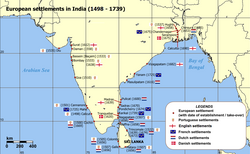
[[ | [[File:European settlements in India 1501-1739.png|thumb|European settlements in India (1501–1739)]] | ||
Like the other European colonists, the French began their colonization via commercial activities, starting with the establishment of a factory in Surat in 1668. The French started to settle down in India in 1673, beginning with the purchase of land at Chandernagore from the Mughal Governor of Bengal, followed by the acquisition of Pondicherry from the Sultan of Bijapur the next year. Both became the centers of the maritime commercial activities that the French conducted in India.<ref>{{Cite news|url=http://www.thehindu.com/books/a-french-colony-that-fought-the-british/article3595158.ece|title=A French colony that fought the British|last=Ganesan|first=V. B.|date=2012-07-02|work=The Hindu|access-date=2017-11-04|language=en-IN|issn=0971-751X|archive-date=28 February 2021|archive-url=https://web.archive.org/web/20210228144746/https://www.thehindu.com/books/a-french-colony-that-fought-the-british/article3595158.ece|url-status=live}}</ref> The French also had trading posts in Mahe, [[Karaikal district|Karikal]] and [[Yanaon]]. Similar to the situation in [[Tahiti]] and [[Martinique]], the French colonial administrative area was insular, but, in India, the French authority was isolated on the peripheries of a British-dominated territory.<ref>{{Cite book|url=https://books.google.com/books?id=50ZWAgAAQBAJ&q=french+colonization+in+india&pg=PA69|title=Narratives of the French Empire: Fiction, Nostalgia, and Imperial Rivalries, 1784 to the Present|last=Marsh|first=Kate|date=2013-08-28|publisher=Lexington Books|isbn=9780739176573|language=en|access-date=12 November 2020|archive-date=28 June 2023|archive-url=https://web.archive.org/web/20230628172512/https://books.google.com/books?id=50ZWAgAAQBAJ&q=french+colonization+in+india&pg=PA69|url-status=live}}</ref> | |||
Like the other European colonists, the French began their colonization via commercial activities, starting with the establishment of a factory in Surat in 1668. The French started to settle down in India in 1673, beginning with the purchase of land at Chandernagore from the Mughal Governor of Bengal, followed by the acquisition of Pondicherry from the Sultan of Bijapur the next year. Both became the centers of the maritime commercial activities that the French conducted in India.<ref>{{Cite news |url=http://www.thehindu.com/books/a-french-colony-that-fought-the-british/article3595158.ece |title=A French colony that fought the British |last=Ganesan |first=V. B. |date=2012-07-02 |work=The Hindu |access-date=2017-11-04 |language=en-IN |issn=0971-751X |archive-date=28 February 2021 |archive-url=https://web.archive.org/web/20210228144746/https://www.thehindu.com/books/a-french-colony-that-fought-the-british/article3595158.ece |url-status=live}}</ref> The French also had trading posts in Mahe, [[Karaikal district|Karikal]] and [[Yanaon]]. Similar to the situation in [[Tahiti]] and [[Martinique]], the French colonial administrative area was insular, but, in India, the French authority was isolated on the peripheries of a British-dominated territory.<ref>{{Cite book |url=https://books.google.com/books?id=50ZWAgAAQBAJ&q=french+colonization+in+india&pg=PA69 |title=Narratives of the French Empire: Fiction, Nostalgia, and Imperial Rivalries, 1784 to the Present |last=Marsh |first=Kate |date=2013-08-28 |publisher=Lexington Books |isbn=9780739176573 |language=en |access-date=12 November 2020 |archive-date=28 June 2023 |archive-url=https://web.archive.org/web/20230628172512/https://books.google.com/books?id=50ZWAgAAQBAJ&q=french+colonization+in+india&pg=PA69 |url-status=live}}</ref> | |||
By the early eighteenth century, the French had become the chief European rivals of the British. During the eighteenth century, it was highly possible for the Indian subcontinent to have succumbed to French control, but the defeat inflicted on them in the Seven Years War (1756–1763) permanently curtailed French ambitions. The [[Treaty of Paris (1763)|Treaty of Paris]] of 1763 restored the original five to the French while making it clear that France could not expand its control beyond these areas.<ref>{{Cite book |url=https://books.google.com/books?id=50ZWAgAAQBAJ&q=french+colonization+in+india&pg=PA69 |title=Narratives of the French Empire: Fiction, Nostalgia, and Imperial Rivalries, 1784 to the Present |last=Marsh |first=Kate |date=2013-08-28 |publisher=Lexington Books |isbn=9780739176573 |language=en |access-date=12 November 2020 |archive-date=28 June 2023 |archive-url=https://web.archive.org/web/20230628172512/https://books.google.com/books?id=50ZWAgAAQBAJ&q=french+colonization+in+india&pg=PA69 |url-status=live}}</ref> | |||
The beginning of the Portuguese occupation of India can be traced back to the arrival of Vasco da Gama near Calicut on 20 May 1498. Soon after this, other explorers, traders and missionaries followed. By 1515, the Portuguese were the strongest naval power in the Indian Ocean and the [[Malabar Coast]] was dominated by them.<ref>{{Cite journal |last=Parker |first=R. H. |date=1955-10-01 |title=The French and Portuguese Settlements in India |journal=The Political Quarterly |language=en |volume=26 |issue=4 |pages=389–398 |doi=10.1111/j.1467-923X.1955.tb02588.x |issn=1467-923X}}</ref> | |||
==Colonization of Oceania and the Pacific Islands (18th–20th century)== | |||
{{Main|Colonisation of Australia|Colonisation of New Zealand|History of the Pacific Islands}} | |||
{{Expand section|date=March 2025}} | |||
==New Imperialism (1870–1914)== | ==New Imperialism: Africa and East Asia (1870–1914)== | ||
{{Main|New Imperialism}} | {{Main|New Imperialism}} | ||
[[File:World empires and colonies around World War I.png|thumb|right|270px|Empires of the world in 1910]] | [[File:World empires and colonies around World War I.png|thumb|right|270px|Empires of the world in 1910]] | ||
The policy and ideology of European colonial expansion between the 1870s (circa opening of [[Suez Canal]] and [[Second Industrial Revolution]]) and the outbreak of [[World War I]] in 1914 are often characterized as the "[[New Imperialism]]. | The policy and ideology of European colonial expansion between the 1870s (circa opening of [[Suez Canal]] and [[Second Industrial Revolution]]) and the outbreak of [[World War I]] in 1914 are often characterized as the "[[New Imperialism]]". The period is distinguished by an unprecedented pursuit of what has been termed "empire for empire's sake," aggressive competition for overseas territorial acquisitions, and the emergence in colonizing countries of doctrines of racial superiority which denied the fitness of subjugated peoples for self-government.<ref>Harrison M. Wright, ed. ''The "New Imperialism": Analysis of Late Nineteenth Century Expansion'' (1976).</ref><ref>Hugh Seton-Watson, ''The new imperialism'' (1971)</ref> | ||
During this period, Europe's powers added nearly 8,880,000 square miles (23,000,000 km<sup>2</sup>) to their overseas colonial possessions. As it was mostly unoccupied by the Western powers as late as the 1880s, Africa became the primary target of the "new" imperialist expansion (known as the [[Scramble for Africa]]), although conquest took place also in other areas – notably south-east Asia and the East Asian seaboard, where Japan joined the European powers' scramble for territory.<ref>Parker Thomas Moon, ''Imperialism and world politics'' (1926), online.</ref> | During this period, Europe's powers added nearly 8,880,000 square miles (23,000,000 km<sup>2</sup>) to their overseas colonial possessions. As it was mostly unoccupied by the Western powers as late as the 1880s, Africa became the primary target of the "new" imperialist expansion (known as the [[Scramble for Africa]]), although conquest took place also in other areas – notably south-east Asia and the East Asian seaboard, where Japan joined the European powers' scramble for territory.<ref>Parker Thomas Moon, ''Imperialism and world politics'' (1926), online.</ref> | ||
| Line 175: | Line 166: | ||
The [[Berlin Conference]] (1884–1885) mediated the imperial competition among Britain, France, and Germany, defining "effective occupation" as the criterion for international recognition of colonial claims and codifying the imposition of [[wikt: direct rule|direct rule]], accomplished usually through armed force. | The [[Berlin Conference]] (1884–1885) mediated the imperial competition among Britain, France, and Germany, defining "effective occupation" as the criterion for international recognition of colonial claims and codifying the imposition of [[wikt: direct rule|direct rule]], accomplished usually through armed force. | ||
In Germany, rising [[pan-Germanism]] was coupled to imperialism in the ''[[Alldeutsche Verband]]'' (" | In Germany, rising [[pan-Germanism]] was coupled to imperialism in the ''[[Alldeutsche Verband]]'' ("Pan-Germanic League"), which argued that Britain's world power position gave the British unfair advantages on international markets, thus limiting Germany's economic growth and threatening its security.<ref>Volker Rolf Berghahn, "German Colonialism and Imperialism from Bismarck to Hitler" ''German Studies Review'' 40#1 (2017) pp. 147–162 [https://doi.org/10.1353/gsr.2017.0007 Online] {{Webarchive|url=https://web.archive.org/web/20200807113350/https://muse.jhu.edu/article/649233 |date=7 August 2020 }}</ref> | ||
Asking whether colonies paid, economic historian Grover Clark argues an emphatic "No!" | Asking whether colonies paid, economic historian Grover Clark argues an emphatic "No!" He reports that in every case the support cost, especially the military system necessary to support and defend the colonies outran the total trade they produced. Apart from the British Empire, they have not favored destinations for the immigration of surplus populations.<ref>Raymond Leslie Buell, "Do Colonies Pay?" ''The Saturday Review,'' 1 August 1936 p 6</ref> | ||
===The Scramble for Africa=== | ===The Scramble for Africa=== | ||
{{Main|Scramble for Africa}} | |||
{{See also|History of Africa#Colonial period}} | |||
[[File:Colonial Africa 1913 map.svg|thumb|European territories in Africa, 1914, following the [[Scramble for Africa]].]] | [[File:Colonial Africa 1913 map.svg|thumb|European territories in Africa, 1914, following the [[Scramble for Africa]].]] | ||
[[File:The modern civilization of Europeː France in Morocco & England in in Egypt A.H. Zaki.jpg|thumb|Satirical drawing: "The modern civilization of Europe: France in Morocco & England in Egypt", A. H. Zaki, 1908–1914]] | |||
Africa was the target of the third wave of European colonialism, after that of the Americas and Asia.<ref>Thomas Pakenham, ''The scramble for Africa: The White Man's conquest of the Dark Continent from 1876 to 1912'' (2003)</ref> Many European statesmen and industrialists wanted to accelerate the [[Scramble for Africa]], securing colonies before they strictly needed them. As a champion of [[Realpolitik]], [[Otto von Bismarck|Bismarck]] disliked colonies and thought they were a waste of time, but his hand was forced by pressure from both the elites and the general population which considered the colonization a necessity for German prestige. German colonies in [[Togo]]land, [[Samoa]], [[South-West Africa]], and [[New Guinea]] had corporate commercial roots, while the equivalent German-dominated areas in East Africa and China owed more to political motives. The British also took an interest in Africa, using the [[East Africa Company]] to take over what is now Kenya and Uganda. The British crown formally took over in 1895 and renamed the area the East Africa Protectorate. | |||
[[Leopold II of Belgium]] personally owned the [[Congo Free State]] from 1885 to 1908, under his rule [[Atrocities in the Congo Free State|many atrocities]] were committed.<ref>{{Cite book |last=Hochschild |first=Adam |title=King Leopold's Ghost A Story of Greed, Terror, and Heroism in Colonial Africa |publisher=Mariner Books |year=1998 |isbn=9780547525730}}</ref> Round after round of international scandal regarding the brutal treatment of native workers forced the Belgium government to take full ownership and responsibility. | |||
The [[Dutch colonial empire|Dutch Empire]] continued to hold the [[Dutch East Indies]], which was one of the few profitable overseas colonies. | |||
In the same manner, [[Italian Empire|Italy]] tried to conquer its "[[place in the sun]], | In the same manner, [[Italian Empire|Italy]] tried to conquer its "[[place in the sun]]", acquiring [[Somaliland]] in 1899–1890, [[Eritrea]] and 1899, and, taking advantage of the "[[Sick man of Europe]]", the [[Ottoman Empire]], also conquered [[Tripolitania]] and [[Cyrenaica]] (modern [[Libya]]) with the 1911 [[Italo–Turkish War]]. The conquest of [[Ethiopia]], which had remained the last African independent territory, had to wait until the [[Second Italo–Abyssinian War]] in 1935–1936 (the [[First Italo–Ethiopian War]] in 1895–96 had ended in defeat for Italy). | ||
The [[Portuguese colonial empire|Portuguese]] and [[Spanish colonial empire]] were smaller, mostly legacies of past colonization. Most of their colonies had acquired independence during the [[ | The [[Portuguese colonial empire|Portuguese]] and [[Spanish colonial empire]] were smaller, mostly legacies of past colonization. Most of their colonies had acquired independence during the [[Spanish American wars of independence|Latin American revolutions]] at the beginning of the 19th century. | ||
===Imperialism in Asia=== | ===Imperialism in Asia=== | ||
| Line 196: | Line 191: | ||
In Asia, the [[Great Game]], which lasted from 1813 to 1907, opposed the [[British Empire]] against [[Imperial Russia]] for supremacy in [[Central Asia]]. [[History of China|China]] was opened to Western influence starting with the [[First Opium War|First]] and [[Second Opium War]]s (1839–1842; 1856–1860). After the visits of Commodore [[Matthew C. Perry|Matthew Perry]] in 1852–1854, Japan opened itself to the Western world during the [[Meiji period]] (1868–1912). | In Asia, the [[Great Game]], which lasted from 1813 to 1907, opposed the [[British Empire]] against [[Imperial Russia]] for supremacy in [[Central Asia]]. [[History of China|China]] was opened to Western influence starting with the [[First Opium War|First]] and [[Second Opium War]]s (1839–1842; 1856–1860). After the visits of Commodore [[Matthew C. Perry|Matthew Perry]] in 1852–1854, Japan opened itself to the Western world during the [[Meiji period]] (1868–1912). | ||
Imperialism also took place in [[British rule in Burma|Burma]], | Imperialism also took place in [[British rule in Burma|Burma]], [[Dutch East Indies|Indonesia]], [[British Malaya|Malaya]] and the [[Spanish East Indies|Philippines]]. Burma had been under British rule for nearly a hundred years, however, it was always considered an "imperial backwater". This accounts for the fact that Burma does not have an obvious colonial legacy and is not a part of the Commonwealth. In the beginning, in the mid-1820s, Burma was administered from Penang in Britain's [[Straits Settlements]]. However, it was soon brought within British India, of which it remained a part until 1937.<ref>{{Cite book |url=https://books.google.com/books?id=H5qxOL6w5p4C&q=%2C+in+the+mid-1820s%2C+Burma+was+administered+from+Penang+in+Britain%E2%80%99s+Straits+Settlements&pg=PA26 |title=Burma Redux: Global Justice and the Quest for Political Reform in Myanmar |last=Holliday |first=Ian |date=2012-03-06 |publisher=Columbia University Press |isbn=9780231504249 |language=en |access-date=12 November 2020 |archive-date=30 March 2021 |archive-url=https://web.archive.org/web/20210330160738/https://books.google.com/books?id=H5qxOL6w5p4C&q=%2C+in+the+mid-1820s%2C+Burma+was+administered+from+Penang+in+Britain%E2%80%99s+Straits+Settlements&pg=PA26 |url-status=live}}</ref> Burma was governed as a province of India, not considered very important, and barely any accommodation was made to Burmese political culture or sensitivities. As reforms began to move India towards independence, Burma was simply dragged along.<ref>{{Cite news |url=https://www.telegraph.co.uk/comment/3558192/The-shared-history-of-Britain-and-Burma.html |archive-url=https://ghostarchive.org/archive/20220112/https://www.telegraph.co.uk/comment/3558192/The-shared-history-of-Britain-and-Burma.html |archive-date=12 January 2022 |url-access=subscription |url-status=live |title=The shared history of Britain and Burma |last=Myint-U |first=Thant |newspaper=The Daily Telegraph |location=London |date=2008-05-10 |access-date=2017-11-04 |language=en-GB |issn=0307-1235}}{{cbignore}}</ref> | ||
==Interwar period ( | ===Ottoman colonialism=== | ||
{{Expand section|date=March 2025}} | |||
==Interwar period and World War II (1918–1945)== | |||
{{Further|Aftermath of World War I|Interwar period|League of Nations mandate}} | {{Further|Aftermath of World War I|Interwar period|League of Nations mandate}} | ||
The colonial map was redrawn following the defeat of the [[German Empire]] and the [[Ottoman Empire]] after the [[World War I]] (1914–18). Colonies from the defeated empires were transferred to the newly founded [[League of Nations]], which itself redistributed it to the victorious powers as [[League of Nations Mandate|"mandates"]]. | The colonial map was redrawn following the defeat of the [[German Empire]] and the [[Ottoman Empire]] after the [[World War I]] (1914–18). Colonies from the defeated empires were transferred to the newly founded [[League of Nations]], which itself redistributed it to the victorious powers as [[League of Nations Mandate|"mandates"]]. The secret 1916 [[Sykes–Picot Agreement]] partitioned the Middle East between Britain and France. French mandates included [[French mandate of Syria|Syria]] and [[French mandate of Lebanon|Lebanon]], whilst the British were granted [[Mandatory Iraq|Iraq]] and [[Mandatory Palestine|Palestine]]. The bulk of the [[Arabian Peninsula]] became the independent Kingdom of [[Saudi Arabia]] in 1922. The discovery of the world's largest easily accessible crude oil deposits led to an influx of Western [[oil companies]] that dominated the region's economies until the 1970s, and making the emirs of the oil states immensely rich, enabling them to consolidate their hold on power and giving them a stake in preserving Western hegemony over the region. During the 1920 and 1930s [[Iraq]], [[Syria]] and [[Egypt]] moved towards independence, although the British and French did not formally depart the region until they were forced to do so after World War II.<ref>William L. Cleveland and Martin Bunton, ''A History of the Modern Middle East'' (2016) pp 161–224.</ref> | ||
===Japanese imperialism=== | ===Japanese imperialism=== | ||
{{Main|Japanese imperialism|Empire of Japan}} | {{Main|Japanese imperialism|Empire of Japan}} | ||
[[File:Pacific Area - The Imperial Powers 1939 - Map.svg|thumb|270px|The [[ | [[File:Pacific Area - The Imperial Powers 1939 - Map.svg|thumb|270px|The [[Empire of Japan]] in 1939]] | ||
For Japan, the second half of the nineteenth century was a period of internal turmoil succeeded by a period of rapid development.<ref>{{Cite journal|last=Vinacke|first=Harold M.|date=1933|title=Japanese Imperialism|jstor=1875849|journal=The Journal of Modern History|volume=5|issue=3|pages=366–380|doi=10.1086/236034|s2cid=222437929}}</ref> After being closed for centuries to Western influence, Japan was forced by the United States to open itself to the West during the [[Meiji Era]] (1868–1912), characterized by swift modernization and borrowings from European culture (in law, science, etc.) This, in turn, helped make Japan the modern power that it is now, which was symbolized as soon as the 1904–1905 [[ | |||
For Japan, the second half of the nineteenth century was a period of internal turmoil succeeded by a period of rapid development.<ref>{{Cite journal |last=Vinacke |first=Harold M. |date=1933 |title=Japanese Imperialism |url=https://archive.org/details/sim_journal-of-modern-history_1933-09_5_3/page/366 |jstor=1875849 |journal=The Journal of Modern History |volume=5 |issue=3 |pages=366–380 |doi=10.1086/236034 |s2cid=222437929}}</ref> After being closed for centuries to Western influence, Japan was forced by the United States to open itself to the West during the [[Meiji Era]] (1868–1912), characterized by swift modernization and borrowings from European culture (in law, science, etc.) This, in turn, helped make Japan the modern power that it is now, which was symbolized as soon as the 1904–1905 [[Russo–Japanese War]]: this war marked the first victory of an Asian power against a European imperial power, and led to widespread fears among European populations. During the first part of the 20th century, while China was still subject to various European imperialisms, Japan became an imperialist power, conquering what it called a "[[Greater East Asia Co-Prosperity Sphere]]". | |||
With the final revision of treaties in 1894, Japan may be considered to have joined the family of nations on a basis of equality with the western states. From this same time imperialism became a dominant motive in Japanese policy. | With the final revision of treaties in 1894, Japan may be considered to have joined the family of nations on a basis of equality with the western states. From this same time imperialism became a dominant motive in Japanese policy. | ||
Imperial Japan won conflicts against the [[Qing dynasty]] and gained control of Korea and Taiwan when the [[Treaty of Shimonoseki]] was concluded in 1895. In 1910, Korea was formally annexed by the [[Empire of Japan | Imperial Japan won conflicts against the [[Qing dynasty]] and gained control of Korea and Taiwan when the [[Treaty of Shimonoseki]] was concluded in 1895. In 1910, Korea was formally annexed by the [[Empire of Japan]]. The [[Korea under Japanese rule|Japanese colonization of Korea]] saw rapid modernization of the peninsula and there was brutal treatment of civilians such as Korean [[comfort women]] who were forced to serve in brothels for the [[Imperial Japanese Armed Forces]].<ref>{{cite journal |last=Ki-Jung |first=Kim |title=The Road to Colonization: Korea Under Imperialism, 1897–1910 |journal=Korea Journal |date=1998-01-01 |volume=38 |issue=4 |pages=36–64}}</ref> | ||
In 1931 Japanese army units based in [[Manchuria]] seized control of the region and created the puppet state of [[Manchukuo]]. [[Second Sino-Japanese War|Full-scale war with China]] followed in 1937, drawing Japan toward an overambitious bid for Asian hegemony (Greater East Asia Co-Prosperity Sphere), which ultimately led to defeat and the loss of all its overseas territories after World War II (see Japanese expansionism and Japanese nationalism). The [[Imperial Japanese Army]] committed atrocities exemplified by the Nanjing Massacre.<ref>Sandra Wilson, | In 1931, Japanese army units based in [[Manchuria]] seized control of the region and created the puppet state of [[Manchukuo]]. [[Second Sino-Japanese War|Full-scale war with China]] followed in 1937, drawing Japan toward an overambitious bid for Asian hegemony (Greater East Asia Co-Prosperity Sphere), which ultimately led to defeat and the loss of all its overseas territories after World War II (see Japanese expansionism and Japanese nationalism). The [[Imperial Japanese Army]] committed atrocities exemplified by the Nanjing Massacre.<ref>Sandra Wilson, "Rethinking the 1930s and the '15-Year War' in Japan." ''Japanese Studies'' 21.2 (2001): 155–164.</ref> | ||
==Second decolonization (1945–1999)== | ===Nazi Germany=== | ||
{{Excerpt|Lebensraum}} | |||
===Fascist Italy=== | |||
{{Excerpt|Italian imperialism under fascism}} | |||
==Second decolonization: Worldwide (1945–1999)== | |||
{{Main|Decolonization}} | |||
[[File:Africa independence dates.svg|thumb|Dates of [[Decolonization of Africa|independence of African countries]].]] | [[File:Africa independence dates.svg|thumb|Dates of [[Decolonization of Africa|independence of African countries]].]] | ||
In 1945, the [[United Nations]] (UN) was founded when 50 nations signed the [[Charter of the United Nations|UN Charter]],<ref>{{Cite web|url=http://www.un.org/en/decolonization/charter.shtml|title=The United Nations and Decolonization|publisher=United Nations|language=EN|access-date=2017-10-27|archive-date=27 March 2019|archive-url=https://web.archive.org/web/20190327163301/https://www.un.org/en/decolonization/charter.shtml|url-status=live}}</ref> which included a statement of its basis in the respect for the principle of equal rights and self-determination of peoples. In 1952, demographer [[Alfred Sauvy]] coined the term "[[Third World]]" in reference to the French [[Estates General (France)|Third Estate]].<ref>{{Cite news|url= | Anti-colonialist movements had begun to gain momentum after the close of World War I, which had seen colonial troops fight alongside those of the metropole, and U.S. President [[Woodrow Wilson]]'s speech on the [[Fourteen Points]]. However, it was not until the end of World War II that they were fully mobilized. British Prime Minister [[Winston Churchill]] and U.S. President [[Franklin D. Roosevelt]]'s 1941 [[Atlantic Charter]] declared that the signatories would "respect the right of all peoples to choose the form of government under which they will live". Though Churchill subsequently claimed this applied only to those countries under Nazi occupation, rather than the British Empire, the words were not so easily retracted: for example, the legislative assembly of Britain's most important colony, India, passed a resolution stating that the Charter should apply to it too.<ref>{{Cite book |url=https://books.google.com/books?id=boimCgAAQBAJ&q=india+resolution+atlantic+charter&pg=PT249 |title=India's War: The Making of Modern South Asia, 1939–1945 |last=Raghavan |first=Srinath |date=2016-03-31 |publisher=Penguin Books Limited |isbn=9781846145438 |language=en |access-date=12 November 2020 |archive-date=28 June 2023 |archive-url=https://web.archive.org/web/20230628172514/https://books.google.com/books?id=boimCgAAQBAJ&q=india+resolution+atlantic+charter&pg=PT249 |url-status=live}}</ref> | ||
In 1945, the [[United Nations]] (UN) was founded when 50 nations signed the [[Charter of the United Nations|UN Charter]],<ref>{{Cite web |url=http://www.un.org/en/decolonization/charter.shtml |title=The United Nations and Decolonization |publisher=United Nations |language=EN |access-date=2017-10-27 |archive-date=27 March 2019 |archive-url=https://web.archive.org/web/20190327163301/https://www.un.org/en/decolonization/charter.shtml |url-status=live}}</ref> which included a statement of its basis in the respect for the principle of equal rights and self-determination of peoples. In 1952, demographer [[Alfred Sauvy]] coined the term "[[Third World]]" in reference to the French [[Estates General (France)|Third Estate]].<ref>{{Cite news |url=https://www.economist.com/international/2010/06/10/seeing-the-world-differently |title=Seeing the world differently |date=2010-06-10 |newspaper=The Economist |access-date=2017-10-27 |issn=0013-0613 |archive-date=4 February 2018 |archive-url=https://web.archive.org/web/20180204120818/http://www.economist.com/node/16329442 |url-status=live}}</ref> The expression distinguished nations that aligned themselves with neither the [[Western world|West]] nor the [[Soviet Bloc]] during the [[Cold War]]. In the following decades, decolonization would strengthen this group which began to be represented at the United Nations. The Third World's first international move was the [[Bandung Conference|1955 Bandung Conference]], led by [[Jawaharlal Nehru]] for [[History of India|India]], [[Gamal Abdel Nasser]] for [[History of Egypt|Egypt]] and [[Josip Broz Tito]] for [[History of Yugoslavia|Yugoslavia]]. The Conference, which gathered 29 countries representing over half the world's population, led to the creation of the [[Non-Aligned Movement]] in 1961.<ref>{{Cite web |url=https://history.state.gov/milestones/1953-1960/bandung-conf |title=Milestones: 1953–1960 – Office of the Historian |website=history.state.gov |language=en |access-date=2017-10-27 |archive-date=25 March 2021 |archive-url=https://web.archive.org/web/20210325100857/https://history.state.gov/milestones/1953-1960/bandung-conf |url-status=live}}</ref> | |||
[[File:Colonization 1945.png|thumb|right|300px|World map of colonization at the end of the Second World War in 1945]] | [[File:Colonization 1945.png|thumb|right|300px|World map of colonization at the end of the Second World War in 1945]] | ||
Although the U.S. had first opposed itself to colonial empires, the Cold War concerns about Soviet influence in the Third World caused it to downplay its advocacy of popular sovereignty and decolonization. France thus received financial support in the [[First Indochina War]] (1946–54) and the U.S. did not interfere in the [[Algerian War of Independence]] (1954–62). Decolonization itself was a seemingly unstoppable process. In 1960, after a number countries gained independence, the UN had reached 99 members states: the [[decolonization of Africa]] was almost complete. In 1980, the UN had 154 member states, and in 1990, after [[Namibia]]'s independence, 159 states.<ref>{{cite web|title=Growth in United Nations Membership, 1945–2005 |publisher=United Nations |year=2000 |access-date=8 October 2006 |url=https://www.un.org/Overview/growth.htm |url-status=dead |archive-url=https://web.archive.org/web/20160117212320/http://www.un.org/Overview/growth.htm |archive-date=17 January 2016 }}</ref> [[Hong Kong]] and [[Macau]] transferred sovereignty to [[China]] in 1997 and 1999 finally marked the end of European colonial era. | |||
Although the U.S. had first opposed itself to colonial empires, the Cold War concerns about Soviet influence in the Third World caused it to downplay its advocacy of popular sovereignty and decolonization. France thus received financial support in the [[First Indochina War]] (1946–54) and the U.S. did not interfere in the [[Algerian War of Independence]] (1954–62). Decolonization itself was a seemingly unstoppable process. In 1960, after a number countries gained independence, the UN had reached 99 members states: the [[decolonization of Africa]] was almost complete. In 1980, the UN had 154 member states, and in 1990, after [[Namibia]]'s independence, 159 states.<ref>{{cite web |title=Growth in United Nations Membership, 1945–2005 |publisher=United Nations |year=2000 |access-date=8 October 2006 |url=https://www.un.org/Overview/growth.htm |url-status=dead |archive-url=https://web.archive.org/web/20160117212320/http://www.un.org/Overview/growth.htm |archive-date=17 January 2016}}</ref> [[Hong Kong]] and [[Macau]] transferred sovereignty to [[China]] in 1997 and 1999 finally marked the end of European colonial era. | |||
===Role of the Soviet Union and China=== | ===Role of the Soviet Union and China=== | ||
The [[Soviet Union]] was a main supporter of decolonization movements and communist parties across the world that denounced imperialism and colonization.<ref>Yahia H. Zoubir, "The United States, the Soviet Union and Decolonization of the Maghreb, 1945–62." ''Middle Eastern Studies'' 31.1 (1995): 58–84.</ref> While the [[Non-Aligned Movement]], created in 1961 following the [[Bandung Conference|Bandung 1955 Conference]], was supposedly neutral, the "Third World" being opposed to both the "First" and the "Second" Worlds, [[geopolitics|geopolitical]] concerns, as well as the refusal of the U.S. to support decolonization movements against its NATO European allies, led the national liberation movements to look increasingly toward the East. However, China's appearance on the world scene, under the leadership of [[Mao Zedong]], created a rupture between the Soviet and Chinese factions in Communist parties around the world, all of which opposed imperialism.<ref>Chen Jian, | The [[Soviet Union]] was a main supporter of decolonization movements and communist parties across the world that denounced imperialism and colonization.<ref>Yahia H. Zoubir, "The United States, the Soviet Union and Decolonization of the Maghreb, 1945–62." ''Middle Eastern Studies'' 31.1 (1995): 58–84.</ref> While the [[Non-Aligned Movement]], created in 1961 following the [[Bandung Conference|Bandung 1955 Conference]], was supposedly neutral, the "Third World" being opposed to both the "First" and the "Second" Worlds, [[geopolitics|geopolitical]] concerns, as well as the refusal of the U.S. to support decolonization movements against its NATO European allies, led the national liberation movements to look increasingly toward the East. However, China's appearance on the world scene, under the leadership of [[Mao Zedong]], created a rupture between the Soviet and Chinese factions in Communist parties around the world, all of which opposed imperialism.<ref>Chen Jian, "Bridging Revolution and Decolonization: The 'Bandung Discourse' in China's Early Cold War Experience." ''Chinese Historical Review'' 15.2 (2008): 207–241.</ref> [[Cuba]], with Soviet financing, send combat troops to help left-wing independence movements in [[Angola]] and [[Mozambique]].<ref>Pamela S. Falk, "Cuba in Africa." ''Foreign Affairs'' 65.5 (1987): 1077–1096.</ref> | ||
Globally, the non-aligned movement, led by [[Jawaharlal Nehru]] (India), [[Josip Broz Tito]] (Yugoslavia) and [[Gamal Abdel Nasser]] (Egypt) tried to create a block of nations powerful enough to be dependent on neither the United States nor the Soviet Union, but finally tilted towards the Soviet Union, while smaller independence movements, both by strategic necessity and ideological choice, were supported either by Moscow or by Beijing. Few independence movements were totally independent of foreign aid.<ref>Gerard McCann, "From diaspora to the third world and the United Nations: India and the politics of decolonizing Africa." ''Past & Present'' 218.suppl_8 (2013): 258–280.</ref> In the 1960s and 1970s, [[Leonid Brezhnev]] and [[Mao Zedong]] gave influential support to those newly African governments which many became one-party socialist states. | Globally, the non-aligned movement, led by [[Jawaharlal Nehru]] (India), [[Josip Broz Tito]] (Yugoslavia) and [[Gamal Abdel Nasser]] (Egypt) tried to create a block of nations powerful enough to be dependent on neither the United States nor the Soviet Union, but finally tilted towards the Soviet Union, while smaller independence movements, both by strategic necessity and ideological choice, were supported either by Moscow or by Beijing. Few independence movements were totally independent of foreign aid.<ref>Gerard McCann, "From diaspora to the third world and the United Nations: India and the politics of decolonizing Africa." ''Past & Present'' 218.suppl_8 (2013): 258–280.</ref> In the 1960s and 1970s, [[Leonid Brezhnev]] and [[Mao Zedong]] gave influential support to those newly African governments which many became one-party socialist states. | ||
== Postcolonialism == | ==Public awareness== | ||
{{Expand section|date=May 2024}} | |||
According to Dietmar Rothermund, there is a lack of public awareness about the colonial history in Britain and France.<ref>{{Cite journal |last=Rothermund |first=Dietmar |date=2011 |title=The Self-consciousness of Post-imperial Nations: A cross-national Comparison |url=https://www.jstor.org/stable/45073035 |journal=India Quarterly |volume=67 |issue=1 |pages=1–18 |doi=10.1177/097492841006700101 |jstor=45073035 |issn=0974-9284 |url-access=subscription}}</ref> | |||
==Postcolonialism== | |||
{{Main|Postcolonialism}} | {{Main|Postcolonialism}} | ||
[[File: | [[File:EU OCT and OMR map en.png|thumb|250px|Map of the European Union in the world, with [[Special member state territories and the European Union#Overseas countries and territories|Overseas Countries and Territories]] and [[Special member state territories and the European Union#Outermost regions|Outermost Regions]]]] | ||
[[Postcolonialism]] is a term used to recognize the continued and troubling presence and influence of colonialism within the period designated as after-the-colonial. It refers to the ongoing effects that colonial encounters, dispossession and power have in shaping the familiar structures (social, political, spatial, uneven global interdependencies) of the present world. Postcolonialism, in itself, questions the end of colonialism.<ref>{{Cite journal|last=Jazeel|first=Tariq|date=2012|title=Postcolonialism: Orientalism and the geographical imagination|jstor=24412174|journal=Geography|volume=97|issue=1|pages=4–11|doi=10.1080/00167487.2012.12094331}}</ref> | |||
[[Postcolonialism]] is a term used to recognize the continued and troubling presence and influence of colonialism within the period designated as after-the-colonial. It refers to the ongoing effects that colonial encounters, dispossession and power have in shaping the familiar structures (social, political, spatial, uneven global interdependencies) of the present world. Postcolonialism, in itself, questions the end of colonialism.<ref>{{Cite journal |last=Jazeel |first=Tariq |date=2012 |title=Postcolonialism: Orientalism and the geographical imagination |jstor=24412174 |journal=Geography |volume=97 |issue=1 |pages=4–11 |doi=10.1080/00167487.2012.12094331}}</ref> | |||
==Neocolonialism== | |||
{{Excerpt|Neocolonialism}} | |||
==See also== | ==See also== | ||
* [[ | * [[Settler colonialism]] | ||
* [[Analysis of Western European colonialism and colonization]] | * [[Analysis of Western European colonialism and colonization]] | ||
* [[Western imperialism in Asia]] | |||
* [[Historiography of the British Empire]] | * [[Historiography of the British Empire]] | ||
* [[Neocolonialism]] | * [[Neocolonialism]] | ||
* [[Soviet | * [[American imperialism]] | ||
* [[ | * [[Soviet empire]] | ||
* [[Zionism as settler colonialism]] | |||
==Notes== | |||
{{Notelist}} | |||
==References== | ==References== | ||
{{Reflist}} | {{Reflist}} | ||
== Bibliography == | ==Bibliography== | ||
* Benjamin, Thomas, ed. ''Encyclopedia of Western Colonialism Since 1450'' (3 vol 2006) | * Benjamin, Thomas, ed. ''Encyclopedia of Western Colonialism Since 1450'' (3 vol 2006) | ||
* Boxer, C.R. '' The Dutch Seaborne Empire: 1600–1800'' (1966) | * Boxer, C. R. '' The Dutch Seaborne Empire: 1600–1800'' (1966) | ||
* Boxer, Charles R. ''The Portuguese Seaborne Empire, 1415–1825'' (1969) | * Boxer, Charles R. ''The Portuguese Seaborne Empire, 1415–1825'' (1969) | ||
* Brendon, Piers. "A Moral Audit of the British Empire", ''History Today'' (October 2007), Vol. 57, Issue 10, pp. 44–47, online at [[EBSCO]] | * Brendon, Piers. "A Moral Audit of the British Empire", ''History Today'' (October 2007), Vol. 57, Issue 10, pp. 44–47, online at [[EBSCO Information Services|EBSCO]] | ||
* Brendon, Piers. ''The Decline and Fall of the British Empire, 1781–1997'' (2008), wide-ranging survey | * Brendon, Piers. ''The Decline and Fall of the British Empire, 1781–1997'' (2008), wide-ranging survey | ||
* Ferro, Marc, ''Colonization: A Global History'' (1997) | * Ferro, Marc, ''Colonization: A Global History'' (1997) | ||
* Gibbons, H.A. ''The New Map of Africa (1900–1916): A History of European Colonial Expansion and Colonial Diplomacy'' (1916) [https://archive.org/details/newmapafricaahi00gibbgoog/page/n11 online free] | * Gibbons, H. A. ''The New Map of Africa (1900–1916): A History of European Colonial Expansion and Colonial Diplomacy'' (1916) [https://archive.org/details/newmapafricaahi00gibbgoog/page/n11 online free] | ||
* Hopkins, Anthony G., and Peter J. Cain. ''British Imperialism: 1688–2015'' | * Hopkins, Anthony G., and Peter J. Cain. ''British Imperialism: 1688–2015'' (Routledge, 2016). | ||
* Mackenzie, John, ed. ''The Encyclopedia of Empire'' (4 vol 2016) | * Mackenzie, John, ed. ''The Encyclopedia of Empire'' (4 vol 2016) | ||
* Maltby, William. ''The Rise and Fall of the Spanish Empire'' (2008). | * Maltby, William. ''The Rise and Fall of the Spanish Empire'' (2008). | ||
| Line 260: | Line 281: | ||
* Osterhammel, Jürgen: ''Colonialism: A Theoretical Overview'', (M. Wiener, 1997). | * Osterhammel, Jürgen: ''Colonialism: A Theoretical Overview'', (M. Wiener, 1997). | ||
* Page, Melvin E. et al. eds. ''Colonialism: An International Social, Cultural, and Political Encyclopedia'' (3 vol 2003) | * Page, Melvin E. et al. eds. ''Colonialism: An International Social, Cultural, and Political Encyclopedia'' (3 vol 2003) | ||
* [[K. M. Panikkar|Panikkar, K. M.]] | * [[K. M. Panikkar|Panikkar, K. M.]] ''Asia and Western dominance, 1498–1945'' (1953) | ||
* Porter, Andrew N. ''European Imperialism, 1860–1914'' (Macmillan International Higher Education, 2016). | * Porter, Andrew N. ''European Imperialism, 1860–1914'' (Macmillan International Higher Education, 2016). | ||
* Priestley, Herbert Ingram. ''France overseas: a study of modern imperialism'' (Routledge, 2018). | * Priestley, Herbert Ingram. ''France overseas: a study of modern imperialism'' (Routledge, 2018). | ||
| Line 275: | Line 296: | ||
{{DEFAULTSORT:History of Colonialism}} | {{DEFAULTSORT:History of Colonialism}} | ||
[[Category: History of colonialism| ]] | [[Category:History of colonialism| ]] | ||
[[Category:Western culture]] | [[Category:Western culture]] | ||
Latest revision as of 08:50, 27 March 2026


Colonialism is a phenomenon that has occurred throughout human history across the world. Colonies were established by many prominent ancient and medieval civilizations, such as the Phoenicians, the Babylonians, the Persians, the Greeks, the Romans, the Han Chinese, and the Arabs, among others. The High Middle Ages saw a variety of European civilizations moving west, north, east, and south out of their continent.[1] The Crusader states in the Levant exemplify some colonial features similar to those of ancient colonies.[2]
The beginning of the "Age of Discovery" around 1418 marked a new phase of European colonialism led by the Portuguese, who became increasingly expansionist following the conquest of Ceuta in 1415. Portugal aimed to control navigation routes through the Strait of Gibraltar, to spread Christianity, to amass wealth and plunder, and to suppress predation on Portuguese populations by Muslim Barbary pirates, who operated as part of a long-running African slave trade[3] that the Portuguese would soon reverse and surpass. Around 1450, the Portuguese developed a lighter ship—the caravel—based on North African fishing boats.[citation needed] Caravels could sail further and faster than previous vessels,[4] were highly maneuverable, and had the capability of sailing into the wind.
Enabled by new maritime technology, and with the added incentive to find an alternative "Silk Road" after the Ottoman conquest of Constantinople effectively closed profitable trade routes between Asia and Europe in 1453, early European exploration of Africa was followed by the Spanish exploration of the Americas, further exploration along the coasts of Africa, and explorations of West Asia (also known as the Middle East), South Asia, and East Asia.
The conquest of the Canary Islands by the Crown of Castile, from 1402 to 1496, was an early instance of European settler colonialism in Africa.[5] In 1462 the Portuguese established the first European settlement in the tropics by peopling the previously uninhabited Cape Verde archipelago, which thereafter became a site of Jewish exile during the height of the Portuguese and Spanish Inquisitions in the 1490s; the Portuguese soon also brought slaves from the West African coast. Because of the economics of plantations, especially sugar, much European colonial expansion and slavery would remain linked into the 19th century. The use of exile to penal colonies would also continue.
The European "discovery" of the New World (as named by Amerigo Vespucci in 1503) opened another colonial chapter, beginning with the colonization of the Caribbean in 1493 with Hispaniola (later to become Haiti and the Dominican Republic). The Portuguese and Spanish Empires were the first trans-oceanic global empires: they were the first to stretch across different continents (discounting Eurasian empires and those with land in Africa along the Mediterranean), covering vast territories around the globe. Between 1580 and 1640, the Portuguese and Spanish Empires were both ruled by the Spanish monarchs in personal union. During the late 16th and 17th centuries, England, France, and the Dutch Republic also established their own overseas empires, each in direct competition with the other European expansionists. Meanwhile the Tsardom of Russia expanded overland: Russian Central Asian and North Asian colonies eventually extended to Alaska and California.
The end of the 18th and mid-19th century saw the first era of decolonization, when most of the European colonies in the Americas, notably those of Spain, New France, and the Thirteen Colonies, gained their independence from their respective metropoles. The Kingdom of Great Britain (uniting Scotland and England), France, Portugal, and the Dutch turned their attention to the Old World, particularly South Asia and Southeast Asia, where coastal enclaves had already been established.
In the 19th century, the Second Industrial Revolution led to what has been termed the era of New Imperialism, when the pace of colonization rapidly accelerated, the height of which was the Scramble for Africa, in which Belgium, Germany, and Italy also participated. The newly westernized Empire of Japan established the Japanese colonial empire in eastern Asia (notably Taiwan, Korea, and Manchukuo) from the late 19th century. Nazi Germany pursued the Lebensraum concept of settler colonialism in Eastern Europe, and Fascist Italy pursued colonialism in Africa. All three are viewed as causes of World War II.
There were deadly battles between colonizing states and revolutions in colonized areas, shaping areas of control and establishing independent nations. During the 20th century, the colonies of the defeated Central Powers of World War I were distributed amongst the victors as mandates, but it was not until after the end of World War II that the second phase of decolonization began in earnest.
Periodization[edit | edit source]
Some commentators identify three waves of European colonialism.[6]
The two main countries in the first wave of European colonialism were Portugal and Spain.[7] The Portuguese started the long age of European colonization with the conquest of Ceuta, Morocco in 1415, and the conquest and discovery of other African territories and islands, this would also start the movement known as the Age of Discoveries. The Spanish and Portuguese launched the colonization of the Americas, basing their territorial claims on the Treaty of Tordesillas of 1494. This treaty demarcated the respective spheres of influence of Spain and Portugal.[8]
The expansion achieved by Spain and Portugal caught the attention of Britain, France, and the Netherlands.[9] The entrance of these three powers into the Caribbean and North America perpetuated European colonialism in these regions.[10]
The second wave of European colonialism commenced with Britain's involvement in Asia in support of the British East India Company; other countries such as France, Portugal and the Netherlands also had involvement in European expansion in Asia.[11][12]
The third wave ("New Imperialism") consisted of the Scramble for Africa regulated by the terms of the Berlin Conference of 1884–1885. The conference effectively divided Africa among the European powers. Vast regions of Africa came under the sway of Britain, France, Germany, Portugal, Belgium, Italy and Spain.[13][14]
Gilmartin argues that these three waves of colonialism were linked to capitalism. The first wave of European expansion involved exploring the world to find new revenue and perpetuating European feudalism. The second wave focused on developing the mercantile capitalism system and the manufacturing industry in Europe. The last wave of European colonialism solidified all capitalistic endeavors by providing new markets and raw materials.[15]
As a result of these waves of European colonial expansion, only thirteen present-day independent countries escaped formal colonization by European powers: Afghanistan, Bhutan, Iran, Japan, Liberia, Mongolia, Nepal, China, North Korea, Saudi Arabia, South Korea, Thailand, and Turkey[lower-alpha 1] as well as North Yemen.[19]
Colonialism in ancient times (3200 BC – 7th century AD)[edit | edit source]
![[icon]](/wiki/File:Wiki_letter_w_cropped.svg) | This section is empty. You can help by adding to it. (March 2025) |
Portuguese and Spanish colonial hegemony: the Americas (15th century–1770)[edit | edit source]


European colonization of both Eastern and Western Hemispheres has its roots in Portuguese exploration. There were financial and religious motives behind this exploration. By finding the source of the lucrative spice trade, the Portuguese could reap its profits for themselves. They would also be able to probe the existence of the fabled Christian kingdom of Prester John, with an eye to encircling the Islamic Ottoman Empire, itself gaining territories and colonies in Eastern Europe. The first foothold outside of Europe was gained with the conquest of Ceuta in 1415. During the 15th century, Portuguese sailors discovered the Atlantic islands of Madeira, Azores, and Cape Verde, which were duly populated, and pressed progressively further along the west African coast until Bartolomeu Dias demonstrated it was possible to sail around Africa by rounding the Cape of Good Hope in 1488, paving the way for Vasco da Gama to reach India in 1498.[20]
Portuguese successes led to Spanish financing of a mission by Christopher Columbus in 1492 to explore an alternative route to Asia, by sailing west. When Columbus eventually made landfall in the Caribbean Antilles he believed he had reached the coast of India, and that the people he encountered there were Indians with red skin. This is why Native Americans have been called Indians or red-Indians. In truth, Columbus had arrived on a continent that was new to the Europeans, the Americas. After Columbus' first trips, competing Spanish and Portuguese claims to new territories and sea routes were solved with the Treaty of Tordesillas in 1494, which divided the world outside of Europe in two areas of trade and exploration, between the Iberian kingdoms of Castile and Portugal along a north-south meridian, 370 leagues west of Cape Verde. According to this international agreement, the larger part of the Americas and the Pacific Ocean were open to Spanish exploration and colonization, while Africa, the Indian Ocean, and most of Asia were assigned to Portugal.[21]
In 1521, the Portuguese took control of Bahrain under the command of António Correia, making it the first country in the Middle East to be fully colonised by any European power. During the same year of 1521, the boundaries specified by the Treaty of Tordesillas were put to the test in 1521 when Ferdinand Magellan and his Spanish sailors (among other Europeans), sailing for the Spanish Crown became the first European to cross the Pacific Ocean,[22] reaching Guam and the Philippines, parts of which the Portuguese had already explored, sailing from the Indian Ocean. The two by now global empires, which had set out from opposing directions, had finally met on the other side of the world. The conflicts that arose between both powers were finally solved with the Treaty of Zaragoza in 1529, which defined the areas of Spanish and Portuguese influence in Asia, establishing the anti-meridian, or line of demarcation on the other side of the world.[23]
During the 16th century, the Portuguese continued to press both eastwards and westwards into the Oceans. Towards Asia they made the first direct contact between Europeans and the peoples inhabiting present day countries such as Mozambique, Madagascar, Sri Lanka, Malaysia, Indonesia, East Timor (1512), China, and finally Japan. In the opposite direction, the Portuguese colonized the huge territory that eventually became Brasil, and the Spanish conquistadors established the vast Viceroyalties of New Spain and Peru, and later of Río de la Plata (Argentina) and New Granada (Colombia). In Asia, the Portuguese encountered ancient and well populated societies, and established a seaborne empire consisting of armed coastal trading posts along their trade routes (such as Goa, Hormuz, Malacca, and Macau), so they had relatively little cultural impact on the societies they engaged. In the Western Hemisphere, the European colonization involved the emigration of large numbers of settlers, soldiers and administrators intent on owning land and exploiting the apparently primitive (as perceived by Old World standards) Indigenous peoples of the Americas. The result was that the colonization of the New World was catastrophic: native peoples were no match for European technology, ruthlessness, or their diseases which decimated the Indigenous population.[24]
Spanish treatment of the indigenous populations caused a fierce debate, the Valladolid Controversy, over whether Indians possessed souls and if so, whether they were entitled to the basic rights of mankind. Bartolomé de Las Casas, author of A Short Account of the Destruction of the Indies, championed the cause of the native peoples, and was opposed by "Juan Ginés de Sepúlveda", who claimed Amerindians were "natural slaves".[25]
The Roman Catholic Church played a large role in Spanish and Portuguese overseas activities. The Dominicans, Jesuits, and Franciscans, notably Francis Xavier in Asia and Junípero Serra in North America were particularly active in this endeavor. Many buildings erected by the Jesuits still stands. Buildings such as the Cathedral of Saint Paul in Macau and the Santisima Trinidad de Paraná in Paraguay, the latter an example of the Jesuit Reductions. The Dominican and Franciscan buildings of California's missions and New Mexico's missions stand restored, such as Mission Santa Barbara in Santa Barbara, California and San Francisco de Asis Mission Church in Ranchos de Taos, New Mexico.[26]

As characteristically happens in any colonialism, European or not, previous or subsequent, both Spain and Portugal profited handsomely from their newfound overseas colonies: the Spanish from gold and silver from mines such as Potosí and Zacatecas in New Spain, the Portuguese from the huge markups they enjoyed as trade intermediaries, particularly during the Nanban Japan trade period. The influx of precious metals to the Spanish monarchy's coffers allowed it to finance costly religious wars in Europe which ultimately proved its economic undoing: the supply of metals was not infinite and the large inflow caused inflation and debt, and subsequently affected the rest of Europe.[27]
Northern European challenges to the Iberian hegemony[edit | edit source]
It was not long before the exclusivity of Iberian claims to the Americas was challenged by other up and coming European powers, primarily the Netherlands, France and England: the view taken by the rulers of these nations is epitomized by the quotation attributed to Francis I of France demanding to be shown the clause in Adam's will excluding his authority from the New World. This challenge initially took the form of piratical attacks (such as those by Francis Drake) on Spanish treasure fleets or coastal settlements.[28] Later the Northern European countries began establishing settlements of their own, primarily in areas that were outside of Spanish interests, such as what is now the eastern seaboard of the United States and Canada, or islands in the Caribbean, such as Aruba, Martinique, and Barbados, that had been abandoned by the Spanish in favor of the mainland and larger islands.[29]
Whereas Spanish colonialism was based on the religious conversion and exploitation of local populations via encomiendas (many Spaniards emigrated to the Americas to elevate their social status, and were not interested in manual labor), Northern European colonialism was bolstered by those emigrating for religious reasons (for example, the Mayflower voyage). The motive for emigration was not to become an aristocrat or to spread one's faith but to start a new society afresh, structured according to the colonist's wishes. The most populous emigration of the 17th century was that of the English, who after a series of wars with the Dutch and French came to dominate the Thirteen Colonies on the eastern coast of the present-day United States and other colonies such as Newfoundland and Rupert's Land in what is now Canada.[30]
However, the English, French, and Dutch were no more averse to making a profit than the Spanish and Portuguese, and whilst their areas of settlement in the Americas proved to be devoid of the precious metals found by the Spanish, trade in other commodities and products that could be sold at a massive profit in Europe provided another reason for crossing the Atlantic, in particular, furs from Canada, tobacco, and cotton grown in Virginia and sugar in the islands of the Caribbean and Brazil. Due to the massive depletion of indigenous labor, plantation owners had to look elsewhere for manpower for these labor- intensive crops. They turned to the centuries-old slave trade of west Africa and began transporting Africans across the Atlantic on a massive scale – historians estimate that the Atlantic slave trade brought between 10 and 12 million black African slaves to the New World. The islands of the Caribbean soon came to be populated by slaves of African descent, ruled over by a white minority of plantation owners interested in making a fortune and then returning to their home country to spend it.[31]
Role of companies in early colonialism[edit | edit source]
From its very outset, Western colonialism was operated as a joint public-private venture. Columbus' voyages to the Americas were partially funded by Italian investors, but whereas the Spanish state maintained a tight rein on trade with its colonies (by law, the colonies could only trade with one designated port in the mother country and treasure was brought back in special convoys), the English, French and Dutch granted what were effectively trade monopolies to joint-stock companies such as the East India Companies and the Hudson's Bay Company.[32]
Imperial Russia had no state-sponsored expeditions or colonization in the Americas, but did charter the first Russian joint-stock commercial enterprise, the Russian America Company, which did sponsor those activities in its territories.[33]
European colonies in India[edit | edit source]

In May 1498, the Portuguese set foot in Kozhikode in Kerala, making them the first Europeans to sail to India. Rivalry among reigning European powers saw the entry of the Dutch, English, French, Danish and others. The kingdoms of India were gradually taken over by the Europeans and indirectly controlled by puppet rulers. In 1600, Queen Elizabeth I accorded a charter, forming the East India Company to trade with India and eastern Asia. The English landed in India in Surat in 1612. By the 19th century, they had assumed direct and indirect control over most of India.
Colonialism within Europe (16th–20th century)[edit | edit source]
| This section needs expansion. You can help by adding to it. (March 2025) |
Imperial Russia: Central Asia and Siberia (16th–20th century)[edit | edit source]

After a period of political instability, the Romanovs came to power in 1613 and the expansion-colonization process of Russia continued. While western Europe colonized the New World, Russia expanded overland – to the east, north and south. This continued for centuries; by the end of the 19th century, the Russian Empire reached from the Black Sea to the Pacific Ocean, and for some time included colonies in the Alaska (1732–1867) and a short-lived unofficial colony in Africa (1889) in present-day Djibouti.[34] The acquisition of new territories, especially in the Caucasus, had an invigorating effect on the rest of Russia. According to two Russian historians:
- the culture of Russia and that of the Caucasian peoples interacted in a reciprocally beneficial manner. The turbulent tenor of life in the Caucasus, the mountain peoples' love of freedom, and their willingness to die for independence were felt far beyond the local interaction of the Caucasian peoples and coresident Russians: they injected a potent new spirit into the thinking and creative work of Russia's progressives, strengthened the liberationist aspirations of Russian writers and exiled Decembrists, and influenced distinguished Russian democrats, poets, and prose writers, including Alexander Griboyedov, Alexander Pushkin, Mikhail Lermontov, and Leo Tolstoy. These writers, who generally supported the Caucasian fight for liberation, went beyond the chauvinism of the colonial autocracy and rendered the Caucasian peoples' cultures accessible to the Russian intelligentsia. At the same time, Russian culture exerted an influence on Caucasian cultures, bolstering positive aspects while weakening the impact of the Caucasian peoples' reactionary feudalism and reducing the internecine fighting between tribes and clans.[35]
Expansion into the East[edit | edit source]
The first stage to 1650 was an expansion eastward from the Ural Mountains to the Pacific Ocean.[36][37] Geographical expeditions mapped much of Siberia. The second stage from 1785 to 1830 looked south to the areas between the Black Sea and the Caspian Sea. The key areas were Armenia and Georgia, with some better penetration of the Ottoman Empire, and Persia. By 1829, Russia controlled all of the Caucasus as shown in the Treaty of Adrianople of 1829. The third era, 1850 to 1860, was a brief interlude jumping to the East Coast, annexing the region from the Amur River to Manchuria. The fourth era, 1865 to 1885 incorporated Turkestan, and the northern approaches to India, sparking British fears of a threat to India in the Great Game.[38]
Maritime Southeast Asia and the Dutch East India Company (16th–20th century)[edit | edit source]
| This section needs expansion. You can help by adding to it. (March 2025) |
First decolonization: Independence in the Americas (1770–1820)[edit | edit source]
During the five decades following 1770, Britain, France, Spain, and Portugal lost many of their possessions in the Americas.
Britain and the Thirteen Colonies[edit | edit source]
After the conclusion of the Seven Years' War in 1763, Britain had emerged as the world's dominant power but found itself mired in debt and struggling to finance the Navy and Army necessary to maintain a global empire. The British Parliament attempt to raise taxes from North American colonists raised fears among the Americans that their rights as "Englishmen", and particularly their rights of self-government, were in danger.[39]
From 1765, a series of disputes with Parliament over taxation led to the American Revolution, first to informal committees of correspondence among the colonies, then to coordinated protest and resistance, with an important event in 1770, the Boston Massacre. A standing army was formed by the United Colonies, and independence was declared by the Second Continental Congress on 4 July 1776. A new nation was born, the United States of America, and all royal officials were expelled. On their own the Patriots captured a British Invasion army and France recognized the new nation, formed a military alliance, declared war on Britain, and left the superpower without any major ally. The American War of Independence continued until 1783 when the Treaty of Paris was signed. Britain recognized the sovereignty of the United States over the territory bounded by the British possessions to the North, Florida to the South, and the Mississippi River to the west.[40]
France and the Haitian Revolution (1791–1804)[edit | edit source]
The Haitian Revolution, a slave revolt led by Toussaint L'Ouverture in the French colony of Saint-Domingue, established Haïti as a free, black republic, the first of its kind. Haiti became the second independent nation that was a former European colony in the Western Hemisphere after the United States. Africans and people of African ancestry freed themselves from slavery and colonization by taking advantage of the conflict among whites over how to implement the reforms of the French Revolution in this slave society. Although independence was declared in 1804, it was not until 1825 that it was formally recognized by King Charles X of France.[41]
Spain and the Wars of Independence in Latin America[edit | edit source]

The gradual decline of Spain as an imperial power throughout the 17th century was hastened by the War of the Spanish Succession (1701–14), as a result of which it lost its European imperial possessions. The death knell for the Spanish Empire in the Americas was Napoleon's invasion of the Iberian peninsula in 1808. With the installation of his brother Joseph on the Spanish throne, the main tie between the metropole and its colonies in the Americas, the Spanish monarchy, had been cut, leading the colonists to question their continued subordination to a declining and distant country. With an eye on the events of the American Revolution forty years earlier, revolutionary leaders began bloody wars of independence against Spain, whose armies were ultimately unable to maintain control. By 1831, Spain had been ejected from the mainland of the Americas, leaving a collection of independent republics that stretched from Chile and Argentina in the south to Mexico in the north. Spain's colonial possessions were reduced to Cuba, Puerto Rico, the Philippines, and a number of small islands in the Pacific, all of which she was to lose to the United States in the 1898 Spanish–American War or sell to Germany shortly thereafter.[42]
Portugal and Brazil[edit | edit source]
Brazil was the only country in Latin America to gain its independence without bloodshed.[43] The invasion of Portugal by Napoleon in 1808 had forced King João VI to escape to Brazil and establish his court in Rio de Janeiro. For thirteen years, Portugal was ruled from Brazil (the only instance of such a reversal of roles between colony and metropole) until his return to Portugal in 1821. His son, Dom Pedro, was left in charge of Brazil and in 1822 he declared independence from Portugal and himself the Emperor of Brazil. Unlike Spain's former colonies which had abandoned the monarchy in favor of republicanism, Brazil, therefore retained its links with its monarchy, the House of Braganza.
Indian subcontinent and the British Raj (18th century–1947)[edit | edit source]
Vasco da Gama's maritime success to discover for Europeans a new sea route to India in 1498 paved the way for direct Indo-European commerce.[44] The Portuguese soon set up trading-posts in Goa, Daman, Diu and Bombay. The next to arrive were the Dutch, the English—who set up a trading post in the west-coast port of Surat in 1619—and the French. The internal conflicts among Indian Kingdoms gave opportunities to the European traders to gradually establish political influence and appropriate lands. Although these continental European powers were to control various regions of southern and eastern India during the ensuing century, they would eventually lose all their territories in India to the British, with the exception of the French outposts of Pondicherry and Chandernagore, the Dutch port in Travancore, and the Portuguese colonies of Goa, Daman, and Diu.
The British in India[edit | edit source]

The English East India Company had been given permission by the Mughal emperor Jahangir in 1617 to trade in India.[45] Gradually the company's increasing influence led the de jure Mughal emperor Farrukh Siyar to grant them dastaks or permits for duty-free trade in Bengal in 1717.[46] The Nawab of Bengal Siraj Ud Daulah, the de facto ruler of Mughal Bengal, opposed British attempts to use these permits. This led to the Battle of Plassey in 1757, in which the armies of the East India Company, led by Robert Clive, defeated the Nawab's forces. This was the first political foothold with territorial implications that the British had acquired in India. Clive was appointed by the company as its first Governor of Bengal in 1757.[47] This was combined with British victories over the French at Madras, Wandiwash and Pondicherry that, along with wider British successes during the Seven Years' War, reduced French influence in India. After the Battle of Buxar in 1764, the company acquired the civil rights of administration in Bengal from the Mughal Emperor Shah Alam II; it marked the beginning of its formal rule, which was to engulf eventually most of India and extinguish the Moghul rule and dynasty itself in less than a century.[48] The East India Company monopolized the trade of Bengal. They introduced a land taxation system called the Permanent Settlement which introduced a feudal-like structure (See Zamindar) in the Bengal Presidency. By the 1850s, the East India Company controlled most of the Indian subcontinent, which included present-day Pakistan and Bangladesh. Their policy was sometimes summed up as Divide and Rule, taking advantage of the enmity festering between various princely states and social and religious groups.
The first major movement against the British Company's high-handed rule resulted in the Indian Rebellion of 1857, also known as the "Indian Mutiny" or "Sepoy Mutiny" or the "First War of Independence". After a year of turmoil, and reinforcement of the East India Company's troops with British Army soldiers, the Company overcame the rebellion. The nominal leader of the uprising, the last Mughal emperor Bahadur Shah Zafar, was exiled to Burma, his children were beheaded and the Moghul line was abolished. In the aftermath all power was transferred from the East India Company to the British Crown, which began to administer most of India as a colony; the company's lands were controlled directly and the rest through the rulers of what it called the Princely states. There were 565 princely states when the Indian subcontinent gained independence from Britain in August 1947.[49]
During period of the British Raj, famines in India, often attributed to El Nino droughts and failed government policies, were some of the worst ever recorded, including the Great Famine of 1876–78, in which 6.1 million to 10.3 million people died and the Indian famine of 1899–1900, in which 1.25 to 10 million people died.[50] The Third Plague Pandemic started in China in the middle of the 19th century, spreading plague to all inhabited continents and killing 10 million people in India alone.[51] Despite persistent diseases and famines, however, the population of the Indian subcontinent, which stood at about 125 million in 1750, had reached 389 million by 1941.[52]
Other European empires in India[edit | edit source]

Like the other European colonists, the French began their colonization via commercial activities, starting with the establishment of a factory in Surat in 1668. The French started to settle down in India in 1673, beginning with the purchase of land at Chandernagore from the Mughal Governor of Bengal, followed by the acquisition of Pondicherry from the Sultan of Bijapur the next year. Both became the centers of the maritime commercial activities that the French conducted in India.[53] The French also had trading posts in Mahe, Karikal and Yanaon. Similar to the situation in Tahiti and Martinique, the French colonial administrative area was insular, but, in India, the French authority was isolated on the peripheries of a British-dominated territory.[54]
By the early eighteenth century, the French had become the chief European rivals of the British. During the eighteenth century, it was highly possible for the Indian subcontinent to have succumbed to French control, but the defeat inflicted on them in the Seven Years War (1756–1763) permanently curtailed French ambitions. The Treaty of Paris of 1763 restored the original five to the French while making it clear that France could not expand its control beyond these areas.[55]
The beginning of the Portuguese occupation of India can be traced back to the arrival of Vasco da Gama near Calicut on 20 May 1498. Soon after this, other explorers, traders and missionaries followed. By 1515, the Portuguese were the strongest naval power in the Indian Ocean and the Malabar Coast was dominated by them.[56]
Colonization of Oceania and the Pacific Islands (18th–20th century)[edit | edit source]
| This section needs expansion. You can help by adding to it. (March 2025) |
New Imperialism: Africa and East Asia (1870–1914)[edit | edit source]

The policy and ideology of European colonial expansion between the 1870s (circa opening of Suez Canal and Second Industrial Revolution) and the outbreak of World War I in 1914 are often characterized as the "New Imperialism". The period is distinguished by an unprecedented pursuit of what has been termed "empire for empire's sake," aggressive competition for overseas territorial acquisitions, and the emergence in colonizing countries of doctrines of racial superiority which denied the fitness of subjugated peoples for self-government.[57][58]
During this period, Europe's powers added nearly 8,880,000 square miles (23,000,000 km2) to their overseas colonial possessions. As it was mostly unoccupied by the Western powers as late as the 1880s, Africa became the primary target of the "new" imperialist expansion (known as the Scramble for Africa), although conquest took place also in other areas – notably south-east Asia and the East Asian seaboard, where Japan joined the European powers' scramble for territory.[59]
The Berlin Conference (1884–1885) mediated the imperial competition among Britain, France, and Germany, defining "effective occupation" as the criterion for international recognition of colonial claims and codifying the imposition of direct rule, accomplished usually through armed force.
In Germany, rising pan-Germanism was coupled to imperialism in the Alldeutsche Verband ("Pan-Germanic League"), which argued that Britain's world power position gave the British unfair advantages on international markets, thus limiting Germany's economic growth and threatening its security.[60]
Asking whether colonies paid, economic historian Grover Clark argues an emphatic "No!" He reports that in every case the support cost, especially the military system necessary to support and defend the colonies outran the total trade they produced. Apart from the British Empire, they have not favored destinations for the immigration of surplus populations.[61]
The Scramble for Africa[edit | edit source]


Africa was the target of the third wave of European colonialism, after that of the Americas and Asia.[62] Many European statesmen and industrialists wanted to accelerate the Scramble for Africa, securing colonies before they strictly needed them. As a champion of Realpolitik, Bismarck disliked colonies and thought they were a waste of time, but his hand was forced by pressure from both the elites and the general population which considered the colonization a necessity for German prestige. German colonies in Togoland, Samoa, South-West Africa, and New Guinea had corporate commercial roots, while the equivalent German-dominated areas in East Africa and China owed more to political motives. The British also took an interest in Africa, using the East Africa Company to take over what is now Kenya and Uganda. The British crown formally took over in 1895 and renamed the area the East Africa Protectorate.
Leopold II of Belgium personally owned the Congo Free State from 1885 to 1908, under his rule many atrocities were committed.[63] Round after round of international scandal regarding the brutal treatment of native workers forced the Belgium government to take full ownership and responsibility.
The Dutch Empire continued to hold the Dutch East Indies, which was one of the few profitable overseas colonies.
In the same manner, Italy tried to conquer its "place in the sun", acquiring Somaliland in 1899–1890, Eritrea and 1899, and, taking advantage of the "Sick man of Europe", the Ottoman Empire, also conquered Tripolitania and Cyrenaica (modern Libya) with the 1911 Italo–Turkish War. The conquest of Ethiopia, which had remained the last African independent territory, had to wait until the Second Italo–Abyssinian War in 1935–1936 (the First Italo–Ethiopian War in 1895–96 had ended in defeat for Italy).
The Portuguese and Spanish colonial empire were smaller, mostly legacies of past colonization. Most of their colonies had acquired independence during the Latin American revolutions at the beginning of the 19th century.
Imperialism in Asia[edit | edit source]
In Asia, the Great Game, which lasted from 1813 to 1907, opposed the British Empire against Imperial Russia for supremacy in Central Asia. China was opened to Western influence starting with the First and Second Opium Wars (1839–1842; 1856–1860). After the visits of Commodore Matthew Perry in 1852–1854, Japan opened itself to the Western world during the Meiji period (1868–1912).
Imperialism also took place in Burma, Indonesia, Malaya and the Philippines. Burma had been under British rule for nearly a hundred years, however, it was always considered an "imperial backwater". This accounts for the fact that Burma does not have an obvious colonial legacy and is not a part of the Commonwealth. In the beginning, in the mid-1820s, Burma was administered from Penang in Britain's Straits Settlements. However, it was soon brought within British India, of which it remained a part until 1937.[64] Burma was governed as a province of India, not considered very important, and barely any accommodation was made to Burmese political culture or sensitivities. As reforms began to move India towards independence, Burma was simply dragged along.[65]
Ottoman colonialism[edit | edit source]
| This section needs expansion. You can help by adding to it. (March 2025) |
Interwar period and World War II (1918–1945)[edit | edit source]
The colonial map was redrawn following the defeat of the German Empire and the Ottoman Empire after the World War I (1914–18). Colonies from the defeated empires were transferred to the newly founded League of Nations, which itself redistributed it to the victorious powers as "mandates". The secret 1916 Sykes–Picot Agreement partitioned the Middle East between Britain and France. French mandates included Syria and Lebanon, whilst the British were granted Iraq and Palestine. The bulk of the Arabian Peninsula became the independent Kingdom of Saudi Arabia in 1922. The discovery of the world's largest easily accessible crude oil deposits led to an influx of Western oil companies that dominated the region's economies until the 1970s, and making the emirs of the oil states immensely rich, enabling them to consolidate their hold on power and giving them a stake in preserving Western hegemony over the region. During the 1920 and 1930s Iraq, Syria and Egypt moved towards independence, although the British and French did not formally depart the region until they were forced to do so after World War II.[66]
Japanese imperialism[edit | edit source]

For Japan, the second half of the nineteenth century was a period of internal turmoil succeeded by a period of rapid development.[67] After being closed for centuries to Western influence, Japan was forced by the United States to open itself to the West during the Meiji Era (1868–1912), characterized by swift modernization and borrowings from European culture (in law, science, etc.) This, in turn, helped make Japan the modern power that it is now, which was symbolized as soon as the 1904–1905 Russo–Japanese War: this war marked the first victory of an Asian power against a European imperial power, and led to widespread fears among European populations. During the first part of the 20th century, while China was still subject to various European imperialisms, Japan became an imperialist power, conquering what it called a "Greater East Asia Co-Prosperity Sphere".
With the final revision of treaties in 1894, Japan may be considered to have joined the family of nations on a basis of equality with the western states. From this same time imperialism became a dominant motive in Japanese policy.
Imperial Japan won conflicts against the Qing dynasty and gained control of Korea and Taiwan when the Treaty of Shimonoseki was concluded in 1895. In 1910, Korea was formally annexed by the Empire of Japan. The Japanese colonization of Korea saw rapid modernization of the peninsula and there was brutal treatment of civilians such as Korean comfort women who were forced to serve in brothels for the Imperial Japanese Armed Forces.[68]
In 1931, Japanese army units based in Manchuria seized control of the region and created the puppet state of Manchukuo. Full-scale war with China followed in 1937, drawing Japan toward an overambitious bid for Asian hegemony (Greater East Asia Co-Prosperity Sphere), which ultimately led to defeat and the loss of all its overseas territories after World War II (see Japanese expansionism and Japanese nationalism). The Imperial Japanese Army committed atrocities exemplified by the Nanjing Massacre.[69]
Nazi Germany[edit | edit source]
Fascist Italy[edit | edit source]
Second decolonization: Worldwide (1945–1999)[edit | edit source]

Anti-colonialist movements had begun to gain momentum after the close of World War I, which had seen colonial troops fight alongside those of the metropole, and U.S. President Woodrow Wilson's speech on the Fourteen Points. However, it was not until the end of World War II that they were fully mobilized. British Prime Minister Winston Churchill and U.S. President Franklin D. Roosevelt's 1941 Atlantic Charter declared that the signatories would "respect the right of all peoples to choose the form of government under which they will live". Though Churchill subsequently claimed this applied only to those countries under Nazi occupation, rather than the British Empire, the words were not so easily retracted: for example, the legislative assembly of Britain's most important colony, India, passed a resolution stating that the Charter should apply to it too.[70]
In 1945, the United Nations (UN) was founded when 50 nations signed the UN Charter,[71] which included a statement of its basis in the respect for the principle of equal rights and self-determination of peoples. In 1952, demographer Alfred Sauvy coined the term "Third World" in reference to the French Third Estate.[72] The expression distinguished nations that aligned themselves with neither the West nor the Soviet Bloc during the Cold War. In the following decades, decolonization would strengthen this group which began to be represented at the United Nations. The Third World's first international move was the 1955 Bandung Conference, led by Jawaharlal Nehru for India, Gamal Abdel Nasser for Egypt and Josip Broz Tito for Yugoslavia. The Conference, which gathered 29 countries representing over half the world's population, led to the creation of the Non-Aligned Movement in 1961.[73]

Although the U.S. had first opposed itself to colonial empires, the Cold War concerns about Soviet influence in the Third World caused it to downplay its advocacy of popular sovereignty and decolonization. France thus received financial support in the First Indochina War (1946–54) and the U.S. did not interfere in the Algerian War of Independence (1954–62). Decolonization itself was a seemingly unstoppable process. In 1960, after a number countries gained independence, the UN had reached 99 members states: the decolonization of Africa was almost complete. In 1980, the UN had 154 member states, and in 1990, after Namibia's independence, 159 states.[74] Hong Kong and Macau transferred sovereignty to China in 1997 and 1999 finally marked the end of European colonial era.
Role of the Soviet Union and China[edit | edit source]
The Soviet Union was a main supporter of decolonization movements and communist parties across the world that denounced imperialism and colonization.[75] While the Non-Aligned Movement, created in 1961 following the Bandung 1955 Conference, was supposedly neutral, the "Third World" being opposed to both the "First" and the "Second" Worlds, geopolitical concerns, as well as the refusal of the U.S. to support decolonization movements against its NATO European allies, led the national liberation movements to look increasingly toward the East. However, China's appearance on the world scene, under the leadership of Mao Zedong, created a rupture between the Soviet and Chinese factions in Communist parties around the world, all of which opposed imperialism.[76] Cuba, with Soviet financing, send combat troops to help left-wing independence movements in Angola and Mozambique.[77]
Globally, the non-aligned movement, led by Jawaharlal Nehru (India), Josip Broz Tito (Yugoslavia) and Gamal Abdel Nasser (Egypt) tried to create a block of nations powerful enough to be dependent on neither the United States nor the Soviet Union, but finally tilted towards the Soviet Union, while smaller independence movements, both by strategic necessity and ideological choice, were supported either by Moscow or by Beijing. Few independence movements were totally independent of foreign aid.[78] In the 1960s and 1970s, Leonid Brezhnev and Mao Zedong gave influential support to those newly African governments which many became one-party socialist states.
Public awareness[edit | edit source]
| This section needs expansion. You can help by adding to it. (May 2024) |
According to Dietmar Rothermund, there is a lack of public awareness about the colonial history in Britain and France.[79]
Postcolonialism[edit | edit source]

Postcolonialism is a term used to recognize the continued and troubling presence and influence of colonialism within the period designated as after-the-colonial. It refers to the ongoing effects that colonial encounters, dispossession and power have in shaping the familiar structures (social, political, spatial, uneven global interdependencies) of the present world. Postcolonialism, in itself, questions the end of colonialism.[80]
Neocolonialism[edit | edit source]
See also[edit | edit source]
- Settler colonialism
- Analysis of Western European colonialism and colonization
- Western imperialism in Asia
- Historiography of the British Empire
- Neocolonialism
- American imperialism
- Soviet empire
- Zionism as settler colonialism
Notes[edit | edit source]
- ↑ Some scholars consider the Ottoman Empire to have been a colonial power.[16][17][18]
References[edit | edit source]
- ↑ Bartlett, Robert (27 February 2003) [1993]. The Making of Europe: Conquest, Colonization and Cultural Change 950 - 1350 (reprint ed.). London: Penguin UK. ISBN 9780141927046. Retrieved 19 July 2025.
This book approaches the history of Europe in the High Middle Ages [...] by concentrating on conquest, colonization and associated cultural change in Europe and the Mediterranean in the period 950-1350. It analyzes the establishment of states by conquest and the peopling of distant countries by immigrants along the peripheries of the continent: English colonialism in the Celtic world, the movement of Germans into eastern Europe, the Spanish Reconquest and the activities of crusaders and colonists in the eastern Mediterranean.
- ↑ Constable, Giles (2001). "The Historiography of the Crusades". In Laiou, Angeliki E.; Mottahedeh, Roy Parviz (eds.). The Crusades from the Perspective of Byzantium and the Muslim World. Dumbarton Oaks Other Titles in Byzantine Studies. Washington, D.C.: Dumbarton Oaks Research Library and Collection. p. 20. ISBN 9780884022770. Retrieved 19 July 2025.
Prawer [...] remarked on the shift of interest from 'the crusades as a movement to the history of Crusader establishments in the East' and to 'the European colonies on the eastern shores of the Mediterranean' [...]. [...] there has been a vigorous debate over the question of whether or not the Latin states should be regarded as colonies in the modern (and characteristically pejorative) sense of the term.
- ↑ "Page:Cambridge Modern History Volume 1.djvu/46 - Wikisource, the free online library". en.wikisource.org. Retrieved 17 June 2025.
- ↑ Merson, John (1990). The Genius That Was China: East and West in the Making of the Modern World. Woodstock, New York: The Overlook Press. pp. 72. ISBN 978-0-87951-397-9. A companion to the PBS Series The Genius That Was China
- ↑ Igor Pérez Tostado (2023). "The Spanish Destruction of the Canary Islands: A Template for the Caribbean Genocide". In Kiernan, Ben; Lemos, T. M.; Taylor, Tristan S. (eds.). The Cambridge World History of Genocide: Volume 1, Genocide in the Ancient, Medieval and Premodern Worlds. Vol. 1. Cambridge: Cambridge University Press. p. https://books.google.com/books?id=LrbHEAAAQBAJ&pg=PT676. ISBN 9781108640343. Retrieved 19 July 2025.
The conquest of the Canary Islands was the learning ground and laboratory of European settler colonialism, later developed on a far larger scale in the Americas, starting in the Caribbean.
- ↑ Gilmartin, Mary (2009). "9: Colonialism/imperialism". In Gallaher, Carolyn; Dahlman, Carl T.; Gilmartin, Mary; Mountz, Alison; Shirlow, Peter (eds.). Key Concepts in Political Geography. Key Concepts in Human Geography. London: SAGE. p. 115. ISBN 9781446243541. Retrieved 9 August 2017.
Commentators have identified three broad waves of European colonial and imperial expansion, connected with specific territories. The first targeted the Americas, North and South, as well as the Caribbean. The second focused on Asia, while the third wave extended European control into Africa.
- ↑ Thomas Benjamin, ed., Encyclopedia of Western Colonialism Since 1450 (2006) 1: xiv–xvi.
- ↑ Gilmartin, et al. p. 115
- ↑ Jonathan Hart, Representing the New World: the English and French uses of the Example of Spain (2001). pp 85–86.
- ↑ Gilmartin, M. (2009). Colonialism/Imperialism. In Key concepts in political geography London: SAGE pp. 115–123.
- ↑ Gilmartin, et al. p. 115
- ↑ Tonio Andrade, "Beyond Guns, Germs, and Steel: European Expansion and Maritime Asia, 1400–1750." Journal of Early Modern History 14.1–2 (2010): 165–186.
- ↑ George Shepperson, "The Centennial of the West African Conference of Berlin, 1884–1885." Phylon 46.1 (1985): 37–48.
- ↑ Peter J. Cain, and Anthony G. Hopkins, "Gentlemanly capitalism and British expansion overseas II: New imperialism, 1850‐1945." Economic History Review 40.1 (1987): 1–26. online Archived 8 March 2021 at the Wayback Machine
- ↑ Gilmartin, et al. pp. 115–16
- ↑ Deringil, Selim (2003). ""They Live in a State of Nomadism and Savagery": The Late Ottoman Empire and the Post-Colonial Debate". Comparative Studies in Society and History. 45 (2): 311–342. doi:10.1017/S001041750300015X. ISSN 1475-2999.
- ↑ Kechriotis, Vangelis (27 May 2013). "Postcolonial criticism encounters late Ottoman studies". Historein. 13: 39–46. doi:10.12681/historein.183. ISSN 2241-2816.
- ↑ Michael, Michalis N.; Verdeil, Chantal; Anastassiadis, Tassos (10 August 2020). Religious Communities and Modern Statehood: The Ottoman and post-Ottoman World at the Age of Nationalism and Colonialism. Walter de Gruyter GmbH & Co KG. ISBN 978-3-11-220914-1.
- ↑ Marcin Solarz, The Language of Global Developmen. A Misleading Geography. (2014), p. 18
- ↑ Charles R. Boxer, The Portuguese Seaborne Empire 1415–1825 (1969).
- ↑ Lyle N. McAlister, Spain and Portugal in the New World, 1492–1700 (1984).
- ↑ Staff, history.com (2009). "Ferdinand Magellan". history.com. A+E Networks. Archived from the original on 4 March 2021. Retrieved 14 December 2017.
- ↑ Melvin E. Page, Colonialism: An International Social, Cultural, and Political Encyclopedia (2003) 1:361–2.
- ↑ Page, Colonialism 2: 770–781.
- ↑ Daniel R. Brunstetter, and Dana Partner. "Just war against barbarians: revisiting the Valladolid debates between Sepúlveda and Las Casas." Political Studies 59.3 (2011): 733–752.
- ↑ John Frederick Schwaller, The history of the Catholic Church in Latin America: From conquest to revolution and beyond (2011) ch 1–3.
- ↑ Levack, Muir, Veldman, Maas, Brian (2007). The West: Encounters and Transformations, Atlas Edition, Volume 2 (since 1550) (2nd Edition). England: Longman. p. 96. ISBN 9780205556984.
- ↑ Violet Barbour, "Privateers and pirates of the West Indies." American Historical Review 16.3 (1911): 529–566.
- ↑ John H. Elliott, Empires of the Atlantic World: Britain and Spain in America 1492–1830 (2007).
- ↑ Walter Hixson, American settler colonialism: A history (2013).
- ↑ Phyllis Raybin Emert, ed., Colonial Triangular Trade: An Economy Based on Human Misery (1995).
- ↑ Bob Moore, and Henk van Nierop. Colonial Empires Compared: Britain and the Netherlands, 1750–1850 (2017).
- ↑ Anatole G. Mazour, "The Russian-American Company: Private or Government Enterprise?." Pacific Historical Review 13.2 (1944): 168–173.
- ↑ John Channon, The Penguin historical atlas of Russia (1995) pp 8–12, 44–75.
- ↑ G. L. Bondarevskii, and G. N. Kolbaia, "The Caucasus and Russian Culture." Russian Studies in History 41.2 (2002): 10–15.
- ↑ James R. Gibson, "Russian expansion in Siberia and America." Geographical Review (1980) 70#2: 127–136. online Archived 15 February 2017 at the Wayback Machine
- ↑ George Lensen, ed. Russia's Eastward Expansion (1964) is a short history that uses excerpts from primary sources.
- ↑ Martina Winkler, "From ruling people to owning land: Russian concepts of imperial possession in the North Pacific, 18th and early 19th centuries." Jahrbücher für Geschichte Osteuropas (2011) 59#3: 321–353, online in English Archived 28 March 2021 at the Wayback Machine.
- ↑ Brendan Simms, Three Victories and a Defeat: The Rise And Fall of the First British Empire (2008)
- ↑ Stephen Conway, The War of American Independence 1775–1783 (1995).
- ↑ Franklin W. Knight, "The Haitian Revolution." American Historical Review 105.1 (2000): 103–115.
- ↑ Timothy Anna, Spain & the Loss of Empire (1983).
- ↑ "Brazil | Britannica". www.britannica.com. Retrieved 17 June 2025.
- ↑ "Vasco da Gama: Round Africa to India, 1497–1498 CE". Internet Modern History Sourcebook. Paul Halsall. June 1998. Archived from the original on 28 August 2011. Retrieved 7 May 2007. From: Oliver J. Thatcher, ed., The Library of Original Sources (Milwaukee: University Research Extension Co., 1907), Vol. V: 9th to 16th Centuries, pp. 26–40.
- ↑ "The Great Moghul Jahangir: Letter to James I, King of England, 1617 A.D." Indian History Sourcebook: England, India, and The East Indies, 1617 CE. Internet Indian History Sourcebook, Paul Halsall. June 1998. Archived from the original on 18 August 2014. Retrieved 7 May 2007. From: James Harvey Robinson, ed., Readings in European History, 2 Vols. (Boston: Ginn and Co., 1904–1906), Vol. II: From the opening of the Protestant Revolt to the Present Day, pp. 333–335.
- ↑ "KOLKATA (CALCUTTA) : HISTORY". Calcuttaweb.com. Archived from the original on 10 May 2007. Retrieved 7 May 2007.
- ↑ Rickard, J. (1 November 2000). "Robert Clive, Baron Clive, 'Clive of India', 1725–1774". Military History Encyclopedia on the Web. historyofwar.org. Retrieved 7 May 2007.
- ↑ Prakash, Om. "The Transformation from a Pre-Colonial to a Colonial Order: The Case of India" (PDF). Global Economic History Network. Economic History Department, London School of Economics. pp. 3–40. Archived from the original on 26 August 2011. Retrieved 7 May 2007.
- ↑ Kashmir: The origins of the dispute Archived 11 September 2010 at the Wayback Machine, BBC News, 16 January 2002
- ↑ Davis, Mike. Late Victorian Holocausts. 1. Verso, 2000. p. 173
- ↑ Plague. World Health Organization.
- ↑ Reintegrating India with the World Economy Archived 4 March 2012 at the Wayback Machine. Peterson Institute for International Economics.
- ↑ Ganesan, V. B. (2 July 2012). "A French colony that fought the British". The Hindu. ISSN 0971-751X. Archived from the original on 28 February 2021. Retrieved 4 November 2017.
- ↑ Marsh, Kate (28 August 2013). Narratives of the French Empire: Fiction, Nostalgia, and Imperial Rivalries, 1784 to the Present. Lexington Books. ISBN 9780739176573. Archived from the original on 28 June 2023. Retrieved 12 November 2020.
- ↑ Marsh, Kate (28 August 2013). Narratives of the French Empire: Fiction, Nostalgia, and Imperial Rivalries, 1784 to the Present. Lexington Books. ISBN 9780739176573. Archived from the original on 28 June 2023. Retrieved 12 November 2020.
- ↑ Parker, R. H. (1 October 1955). "The French and Portuguese Settlements in India". The Political Quarterly. 26 (4): 389–398. doi:10.1111/j.1467-923X.1955.tb02588.x. ISSN 1467-923X.
- ↑ Harrison M. Wright, ed. The "New Imperialism": Analysis of Late Nineteenth Century Expansion (1976).
- ↑ Hugh Seton-Watson, The new imperialism (1971)
- ↑ Parker Thomas Moon, Imperialism and world politics (1926), online.
- ↑ Volker Rolf Berghahn, "German Colonialism and Imperialism from Bismarck to Hitler" German Studies Review 40#1 (2017) pp. 147–162 Online Archived 7 August 2020 at the Wayback Machine
- ↑ Raymond Leslie Buell, "Do Colonies Pay?" The Saturday Review, 1 August 1936 p 6
- ↑ Thomas Pakenham, The scramble for Africa: The White Man's conquest of the Dark Continent from 1876 to 1912 (2003)
- ↑ Hochschild, Adam (1998). King Leopold's Ghost A Story of Greed, Terror, and Heroism in Colonial Africa. Mariner Books. ISBN 9780547525730.
- ↑ Holliday, Ian (6 March 2012). Burma Redux: Global Justice and the Quest for Political Reform in Myanmar. Columbia University Press. ISBN 9780231504249. Archived from the original on 30 March 2021. Retrieved 12 November 2020.
- ↑ Myint-U, Thant (10 May 2008). "The shared history of Britain and Burma". The Daily Telegraph. London. ISSN 0307-1235. Archived from the original on 12 January 2022. Retrieved 4 November 2017.
- ↑ William L. Cleveland and Martin Bunton, A History of the Modern Middle East (2016) pp 161–224.
- ↑ Vinacke, Harold M. (1933). "Japanese Imperialism". The Journal of Modern History. 5 (3): 366–380. doi:10.1086/236034. JSTOR 1875849. S2CID 222437929.
- ↑ Ki-Jung, Kim (1 January 1998). "The Road to Colonization: Korea Under Imperialism, 1897–1910". Korea Journal. 38 (4): 36–64.
- ↑ Sandra Wilson, "Rethinking the 1930s and the '15-Year War' in Japan." Japanese Studies 21.2 (2001): 155–164.
- ↑ Raghavan, Srinath (31 March 2016). India's War: The Making of Modern South Asia, 1939–1945. Penguin Books Limited. ISBN 9781846145438. Archived from the original on 28 June 2023. Retrieved 12 November 2020.
- ↑ "The United Nations and Decolonization". United Nations. Archived from the original on 27 March 2019. Retrieved 27 October 2017.
- ↑ "Seeing the world differently". The Economist. 10 June 2010. ISSN 0013-0613. Archived from the original on 4 February 2018. Retrieved 27 October 2017.
- ↑ "Milestones: 1953–1960 – Office of the Historian". history.state.gov. Archived from the original on 25 March 2021. Retrieved 27 October 2017.
- ↑ "Growth in United Nations Membership, 1945–2005". United Nations. 2000. Archived from the original on 17 January 2016. Retrieved 8 October 2006.
- ↑ Yahia H. Zoubir, "The United States, the Soviet Union and Decolonization of the Maghreb, 1945–62." Middle Eastern Studies 31.1 (1995): 58–84.
- ↑ Chen Jian, "Bridging Revolution and Decolonization: The 'Bandung Discourse' in China's Early Cold War Experience." Chinese Historical Review 15.2 (2008): 207–241.
- ↑ Pamela S. Falk, "Cuba in Africa." Foreign Affairs 65.5 (1987): 1077–1096.
- ↑ Gerard McCann, "From diaspora to the third world and the United Nations: India and the politics of decolonizing Africa." Past & Present 218.suppl_8 (2013): 258–280.
- ↑ Rothermund, Dietmar (2011). "The Self-consciousness of Post-imperial Nations: A cross-national Comparison". India Quarterly. 67 (1): 1–18. doi:10.1177/097492841006700101. ISSN 0974-9284. JSTOR 45073035.
- ↑ Jazeel, Tariq (2012). "Postcolonialism: Orientalism and the geographical imagination". Geography. 97 (1): 4–11. doi:10.1080/00167487.2012.12094331. JSTOR 24412174.
Bibliography[edit | edit source]
- Benjamin, Thomas, ed. Encyclopedia of Western Colonialism Since 1450 (3 vol 2006)
- Boxer, C. R. The Dutch Seaborne Empire: 1600–1800 (1966)
- Boxer, Charles R. The Portuguese Seaborne Empire, 1415–1825 (1969)
- Brendon, Piers. "A Moral Audit of the British Empire", History Today (October 2007), Vol. 57, Issue 10, pp. 44–47, online at EBSCO
- Brendon, Piers. The Decline and Fall of the British Empire, 1781–1997 (2008), wide-ranging survey
- Ferro, Marc, Colonization: A Global History (1997)
- Gibbons, H. A. The New Map of Africa (1900–1916): A History of European Colonial Expansion and Colonial Diplomacy (1916) online free
- Hopkins, Anthony G., and Peter J. Cain. British Imperialism: 1688–2015 (Routledge, 2016).
- Mackenzie, John, ed. The Encyclopedia of Empire (4 vol 2016)
- Maltby, William. The Rise and Fall of the Spanish Empire (2008).
- Merriman, Roger Bigelow. The rise of the Spanish Empire in the Old World and in the New (3 vol 1918) online free
- Ness, Immanuel and Zak Cope, eds. The Palgrave Encyclopedia of Imperialism and Anti-Imperialism (2 vol, 2015), 1456pp
- Osterhammel, Jürgen: Colonialism: A Theoretical Overview, (M. Wiener, 1997).
- Page, Melvin E. et al. eds. Colonialism: An International Social, Cultural, and Political Encyclopedia (3 vol 2003)
- Panikkar, K. M. Asia and Western dominance, 1498–1945 (1953)
- Porter, Andrew N. European Imperialism, 1860–1914 (Macmillan International Higher Education, 2016).
- Priestley, Herbert Ingram. France overseas: a study of modern imperialism (Routledge, 2018).
- Stern, Jacques. The French Colonies (1944) online, comprehensive history
- Thomas, Hugh. Rivers of Gold: The Rise of the Spanish Empire (2010)
- Townsend, Mary Evelyn. European colonial expansion since 1871 (1941).
Primary sources[edit | edit source]
- Melvin E. Page, ed. Colonialism: An International Social, Cultural, and Political Encyclopedia (2003) vol 3 pp 833–1209 contains major documents.
- Bonnie G. Smith, ed. Imperialism: A History in Documents (2000) for middle and high schools