



robot: Create/update articles. If there is a mistake please report on my talk page. |
Saurabh pal (talk | contribs) added info |
||
| Line 1: | Line 1: | ||
{{Short description|Building in India}} | |||
{{EngvarB|date=September 2013}} | {{EngvarB|date=September 2013}} | ||
{{Use dmy dates|date= | {{Use dmy dates|date=July 2024}} | ||
{{Infobox military installation | {{Infobox military installation | ||
|name = Salimgarh Fort | |name = Salimgarh Fort | ||
| Line 14: | Line 15: | ||
|code = | |code = | ||
|built = 1546 AD | |built = 1546 AD | ||
|builder = [[Islam Shah Suri]] of [[Sur | |builder = [[Islam Shah Suri]] of the [[Sur Empire|Sur dynasty]] | ||
|materials = Stones and Bricks | |materials = Stones and Bricks | ||
|height = | |height = | ||
| Line 23: | Line 24: | ||
|open_to_public = Yes | |open_to_public = Yes | ||
|controlledby = {{noflag}}[[Sur Empire]] <small>(1546–1555)</small><br />{{noflag}}[[Mughal Empire]] <small>(1555–1857)</small><br />{{flagcountry|United Kingdom}} | |controlledby = {{noflag}}[[Sur Empire]] <small>(1546–1555)</small><br />{{noflag}}[[Mughal Empire]] <small>(1555–1857)</small><br />{{flagcountry|United Kingdom}} | ||
* {{flagicon image|British Raj Red Ensign.svg}} [[ | * {{flagicon image|British Raj Red Ensign.svg}} [[British Raj|Indian Empire]] (<small>1857–1947</small>) | ||
{{flagcountry|India}} (<small>1947–</small>) | {{flagcountry|India}} (<small>1947–</small>) | ||
|garrison = | |garrison = | ||
| Line 29: | Line 30: | ||
|commanders = | |commanders = | ||
|occupants = Museum as Swatantrata Senani Smarak | |occupants = Museum as Swatantrata Senani Smarak | ||
|battles = [[ | |battles = [[Sur Empire]] siege of [[Delhi]] & British War against the [[Indian Rebellion of 1857]] | ||
|events = | |events = | ||
|image2 = [[File:Bahadur Shah Gate linking Red Fort with Salimgarh FortJPG.jpg|300px]] | |image2 = [[File:Bahadur Shah Gate linking Red Fort with Salimgarh FortJPG.jpg|300px]] | ||
| Line 35: | Line 36: | ||
}} | }} | ||
'''Salimgarh Fort''' ( | '''Salimgarh Fort''' (also known as Salim's Fort) was built in 1546 CE in [[Old Delhi]], on what was then an island of the [[Yamuna River]], by [[Islam Shah Suri|Salim Shah Suri]], the son of [[Sher Shah Suri]]. The fort was constructed during a period when the [[Mughal Empire]] had been temporarily overthrown; in 1540 CE, Sher Shah Suri had defeated the [[Mughal emperor]] [[Humayun]] and established the rule of the [[Sur Empire]] rule in [[Delhi]]. The Surid dynasty continued until 1555 CE, when Humayun regained control by defeating Sikandar Suri, the last ruler of the dynasty. | ||
{{cite web|url=http://asi.nic.in/PDF_data/detailed_proposal.pdf|title=Commonwealth Games-2010, Conservation, Restoration and Upgradation of Public Amenities at Protected Monuments|work=Red Fort & Salimgarh Fort|pages=37–38 & 40|publisher=Archaeological Survey of India, Delhi Circle|year=2006|access-date=5 June 2009|archive-url=https://web.archive.org/web/20111011160921/http://asi.nic.in/PDF_data/detailed_proposal.pdf|archive-date=11 October 2011|url-status=dead | |||
During the Mughal period, particularly in later years, Salimgarh Fort continued to be of strategic significance. While constructing the [[Red Fort]] and the city of [[Shahjahanbad]], several Mughal rulers, including Emperor [[Shah Jahan]]—who completed Shahjahanabad in 1639 CE—are believed to have camped at the fort. It is also said that Humayun camped there for three days before launching his successful campaign to recapture Delhi.<ref name="heritage">{{cite web|url=http://asi.nic.in/PDF_data/red_fort.pdf|title=Press Release on Inscription of the Red Fort in the World Heritage List −2007|access-date=28 May 2009|publisher=Archaeological Survey of India|archive-url=https://web.archive.org/web/20090410034319/http://asi.nic.in/PDF_data/red_fort.pdf|archive-date=10 April 2009|url-status=dead}}</ref><ref name="fanshaw">{{Cite book|author= Fanshawe. H.C|title= Delhi, Past and Present|access-date=28 May 2009|url=https://books.google.com/books?id=vJ4HFt5S8CcC&dq=Salimgarh+Fort&pg=PA1|work =Salimgarh Fort|pages =1 to 3|publisher= Asian Educational Services|year=1998|isbn= 978-81-206-1318-8}}</ref><ref name="baksi">{{Cite book|author= Shiri Ram Bakshi|title= Delhi Through Ages |url=https://books.google.com/books?id=-7yEG1eBKxkC&dq=Salimgarh+Fort&pg=PA213|work=Salimgarh Fort|page=213|publisher= Anmol Publications PVT. LTD|year=1995|isbn= 978-81-7488-138-0|display-authors=etal}}</ref><ref name="Arch">{{Cite book|title=Delhi and its Neighbourhood|author=Y.D.Sharma|work=Salimgarh and Lal-Qila or Redfort|pages=148–149|access-date=31 May 2009|publisher=Archaeological Survey of India|location=New Delhi|year=2001|url=http://www.indiaclub.com/Shop/SearchResults.asp?ProdStock=8780|url-status=dead|archive-url=https://web.archive.org/web/20050831215230/http://www.indiaclub.com/shop/SearchResults.asp?ProdStock=8780|archive-date=31 August 2005}}</ref><ref name="Lucy">{{Cite book|title= Delhi – A thousand years of Building|author=Lucy Peck|work=Salimgarh|pages=135, 181, & 241|publisher=Roli Books Pvt Ltd.|location=New Delhi|year=2005|isbn=81-7436-354-8|url=https://www.vedamsbooks.com/no43813.htm|access-date=31 May 2009}}</ref><ref name="asi"> | |||
{{cite web|url=http://asi.nic.in/PDF_data/detailed_proposal.pdf|title=Commonwealth Games-2010, Conservation, Restoration and Upgradation of Public Amenities at Protected Monuments|work=Red Fort & Salimgarh Fort|pages=37–38 & 40|publisher=Archaeological Survey of India, Delhi Circle|year=2006|access-date=5 June 2009|archive-url=https://web.archive.org/web/20111011160921/http://asi.nic.in/PDF_data/detailed_proposal.pdf|archive-date=11 October 2011|url-status=dead}} | |||
</ref> | </ref> | ||
[[Aurangzeb]] | The Mughal emperor [[Aurangzeb]] later converted the fort into a prison, a practice that was continued by the British after they took control of the fort in 1857. Salimgarh Fort is now part of the [[Red Fort Complex]]. The complex was declared a [[UNESCO World Heritage Site]] in 2007, obligating the [[Archaeological Survey of India]] (ASI) to undertake well-planned conservation measures for its preservation.<ref name="heritage" /><ref name="salim">{{Cite book|author=Patrick Horton |author2=Richard Plunkett |author3=Hugh Finlay|title= Delhi|access-date=28 May 2009|url=https://books.google.com/books?id=Ee1HTcplZS0C&dq=Salimgarh+Fort&pg=PA93|work=Salimgarh Fort|page=93|publisher= Lonely Planet|year=2002|isbn= 978-1-86450-297-8}}</ref> | ||
==History== | ==History== | ||
The location chosen for building the fortification was in the Delhi plains | The location chosen for building the fortification was in the Delhi plains, with an elevation ranging between {{convert|80|-|110|ft|m}}, bordered by the Yamuna River on one side and the northern spur of the [[Aravalli Range|Aravalli]] range on the other. This topography—with exposed rock formations at the fort site, proximity to the northeast-trending ridge, and alignment with the [[Jama Masjid]]—was seen as ideal for protection against erosion by the Yamuna. Moreover, the combination of a river on one side and a mountain ridge on the other provided a natural defensive barrier, compelling any invading force to follow the river course. Considering these strategic advantages, Salimgarh Fort was constructed in 1546.<ref name=fanshaw/><ref name=baksi/><ref name=mohan/> | ||
After regaining his empire, Humayun renamed Salimgarh Fort as Nurghar, since Sher Shah Suri—the founder of the Sur Empire and father of Salim Shah Suri, who built the fort—had earlier ousted Humayun from his kingdom in 1540 CE. As a result, Humayun decreed that the fort's original name should not be used in his court.<ref name=fred>{{Cite book|author= Alfred Frederick|author2=Pollock Harcourt |title= The New Guide to Delhi|year= 1866|access-date=5 June 2009|work=The Fort of salimgarh|page =[https://archive.org/details/newguidetodelhi01harcgoog/page/n99 79]|url=https://archive.org/details/newguidetodelhi01harcgoog|quote= Travelogue by Finch 1611 Gates of Delhi.|publisher= PaperbackshopUS|isbn= 0-559-47419-9}}</ref> | |||
[[File:Yamuna River with railway bridge in the background.JPG|left|250px|thumb|View of the [[Yamuna River]] from Salimgarh Fort, with the railway bridge in the background]] | |||
During British rule, the [[Indian Rebellion of 1857]], which was eventually suppressed by 1858, led to significant activity at the fort. The last Mughal emperor, [[Bahadur Shah Zafar II]], was taken prisoner at Humayun's Tomb. During the rebellion, Salimgarh Fort became a centre of wartime operations. From the British perspective, [[Bahadur Shah Zafar]]'s "complicity with the mutinous soldiers was obvious." He is said to have operated from this fort and convened meetings in August and early September 1857 to discuss war strategy. He reportedly observed artillery fire against the [[British Indian Army]] from the fort's ramparts. | |||
On one occasion, when approached by army officers requesting their salaries, he made a symbolic gesture by offering to pawn his crown jewels and even sacrifice his life for the cause. The officers declined his offer, trusting the Emperor's sincerity. Subsequently, proclamations were issued declaring that the Emperor would lead an assault against the British and urging people of all castes and creeds to join the resistance. | |||
By mid-September 1857, however, British troops were advancing on the fort. At that point, Bahadur Shah's trusted aide, Bakht Khan, advised him to retreat and prepare for guerrilla warfare in the open countryside. The Emperor, however, refused to flee. While he permitted his forces to evacuate, he himself relocated to Humayun's Tomb. The British Fourth Infantry eventually entered Salimgarh Fort through a single entry point. Similar circumstances were reported when the [[Punjab region|Punjab]] Fourth [[infantry regiment|Infantry Regiment]] had earlier entered the Red Fort via the [[Lahori Gate, Red Fort, Delhi|Lahore Gate]].<ref name="maulvi">{{Cite book|author=Gordon Sanderson|author2=Maulvi Shuaib |title=Delhi Fort|access-date=28 May 2009|url=https://books.google.com/books?id=e_5ZeiDxdDAC&dq=Salimgarh+Fort&pg=PA78|pages=80, 81 & 82|publisher= Asia Publication Services|year=2000|isbn=81-206-1532-8}}</ref> | |||
After the rebellion was | After the rebellion was quelled, the British initially used Salimgarh Fort as a military camp, housing [[artillery]] units. From 1945 onwards, it was repurposed as a penitentiary to hold prisoners of the [[Indian National Army]] (INA).<ref name="baksi" /><ref name="mohan" /><ref name="smith" /> | ||
==Structure== | ==Structure== | ||
[[File:The Arch Bridge that links Red Fort with Salimgarh Fort.JPG|thumb|right|250px|View of Salimgarh Fort with | [[File:The Arch Bridge that links Red Fort with Salimgarh Fort.JPG|thumb|right|250px|View of Salimgarh Fort with the arch bridge linking it to the [[Red Fort]]]] | ||
Salimgarh Fort has a triangular layout, with thick walls constructed using [[rubble]] [[masonry]]. The fort features circular [[bastions]] and has undergone multiple phases of repair and restoration since its construction. | |||
An arch bridge connects the fort to the Red Fort on its northeastern side. This bridge was built during the reign of Bahadur Shah Zafar, and the gate at this point is known as the Bahadur Shah Gate. The gate is constructed primarily of brick masonry, with selective use of red [[sandstone]]. | |||
During British rule, a railway line was laid through the area after the demolition of an earlier bridge. This construction divided Salimgarh Fort from the Red Fort and damaged a portion of the latter, an act that was at the time regarded as insensitive and detrimental to heritage preservation. The railway line effectively truncated the fort.<ref name="Arch" /><ref name="Lucy" /><ref name="salim" /> | |||
==As a prison== | ==As a prison== | ||
During Aurangzeb | During the reign of Aurangzeb, Salimgarh Fort was first converted into a prison. Aurangzeb imprisoned his brother [[Murad Bakhsh|Murad Baksh]] —who had supported him in his conflict against their elder brother [[Dara Shikoh]]—at this fort. Murad Baksh was reportedly captured while asleep after a drinking binge at Mathura. The official reason for his imprisonment was cited as "apostasy for abandoning the fundamental tenets of Islam". He was later transferred to [[Gwalior]], where he was executed. | ||
It is also said that Aurangzeb imprisoned his eldest daughter, [[Zeb-un-Nissa|Zebunnisa]], at Salimgarh Fort for 21 years until her death. Zebunnisa, known for her poetry and interest in music, was reportedly confined for engaging in pursuits that clashed with Aurangzeb's orthodox and austere beliefs. Her sympathy towards her brother Muhammad Akbar, who had fallen out of favour with the emperor, is also believed to have contributed to her imprisonment.<ref name="baksi" /><ref name="Zebu">{{Cite book|author=Annie Krieger Krynick|author2=Enjum Hamid |title= Captive Princess; Zebunissa, Daughter of Emperor Aurangzeb|url= http://www.ecampus.com/book/0195798376/|access-date=31 May 2009|quote= The book revolves around Princess Zebunissa (1638–1702) who is defined as the symbol of female power of the Mughal dynasty and portrays their stature in the court life in the seventeenth century...For her the name signified a life dramatically suppressed, cut off from the world. Her mysterious and unexpected imprisonment is also described in this book: Zebunissa's fate changed drastically when she was sent to prison by her father Aurangzeb, where she died leaving a landmark near the Red Fort of Delhi.}}</ref><ref name="trial">{{cite web|url=http://www.buxtoninitiative.org/resources/media/the-trial-of-dara-shikoh.pdf|title=The Trial of Dara Shikoh:A Play in Three Acts|author=Dr. Akbar Ahmed|publisher=The Buxton Readings|page=53|url-status=dead|archive-url=https://web.archive.org/web/20120223141853/http://www.buxtoninitiative.org/resources/media/the-trial-of-dara-shikoh.pdf|archive-date=23 February 2012}}</ref><ref>{{cite web|url=http://www.indianexpress.com/oldStory/70761/|title= Memories of Ferghana|date= 22 May 2005|access-date=31 May 2009|quote= MUSIC and dance? But wasn’t that ‘'unIslamic'’ in a country celebrating an Islamic revival, I’d thought back then, as I twirled at an Uzbek soiree at Kokand in the Ferghana Valley. My hostess had snatched up a daf (dafli in India) and was dancing slowly to a sad Persian song by Zebunissa 'Makhfi', an Uzbek-Tajik favourite. She was a princess of Delhi via Ferghana; Aurangzeb’s daughter, whom he jailed for 20 years in Salimgarh, next to the Red Fort, because of her Sufi sympathies. Aurangzeb had killed music in his realm. Zebunissa’s voice sang in her ancestral homeland, though lost to Delhi.}}</ref> | |||
Following the Indian Rebellion of 1857, the British briefly detained the last Mughal emperor, Bahadur Shah Zafar II, at this fort after capturing him at Humayun's Tomb. He was later exiled to [[Yangon|Rangoon]] (present-day Yangon), Burma. Due to its use for detaining political prisoners, the fort has often been compared to the [[Tower of London]] in England, where many state prisoners were held and, in some cases, executed or left to die. | |||
Before India | Before India attained independence from British rule, Salimgarh Fort was again used as a prison. From 1945 until August 1947, prisoners of the [[Indian National Army]] (INA) were held here. In recognition of those who died in the prison, the fort has since been renamed Swatantrata Senani Smarak (Freedom Fighters' Memorial).<ref name="smith">{{Cite book|author=Ronald Villiam Smith|title= The Delhi that no-one knows|access-date=1 June 2009|work=Salimgarh|page =101|url=https://books.google.com/books?id=f70gjLC5chgC&dq=Salimgarh+Fort+RV+Smith&pg=PA104|publisher= Orient Blackswan|year=2005|isbn= 978-81-8028-020-7}}</ref><ref>{{Cite book|author= Renuka Nath|title= Notable Mughal and Hindu women in the 16th and 17th centuries A.D.|url=https://books.google.com/books?id=isoKAQAAIAAJ&q=Zebunnisa+imprisoned+at+Salimgarh+Fort|publisher= Inter-India Publications|year=1990|isbn= 978-81-210-0241-7|page=161|quote= She spent most of her time in her library, when she was imprisoned in the fort of Salimgarh. No doubt at that time her books were her only companion to console her.}}</ref> | ||
There are also several legends associated with the fort, particularly regarding paranormal activity. One of the more well-known stories involves the spirit of [[Zeb-un-Nissa|Zebunnisa]], veiled in black, said to sing her poems on [[Moonlight|moonlit]] nights. Another tale recounts the sounds of moaning and groaning—believed to be those of INA soldiers who were tortured and died in captivity—heard in the area.<ref name="ghost">{{cite web|url=https://www.sd24th.com/2019/12/salimgarh-fort.html|title=मुस्लिम विरासत : स्वतंत्रता सेनानी स्मारक ..सलीम गढ़ किला|publisher=sd24th.com|date=29 December 2019|access-date=29 December 2019|trans-title=Muslim Heritage: Freedom Fighter Memorial. Salim Garh Fort}}</ref> These narratives have contributed to the fort's symbolic link between the Mughal and British eras in India's history.<ref name="red">{{cite web|url=http://articles.timesofindia.indiatimes.com/2006-06-25/india/27818992_1_comprehensive-conservation-management-plan-red-fort-c-babu-rajeev|archive-url=https://web.archive.org/web/20121024015454/http://articles.timesofindia.indiatimes.com/2006-06-25/india/27818992_1_comprehensive-conservation-management-plan-red-fort-c-babu-rajeev|url-status=dead|archive-date=24 October 2012|title= Red Fort to reveal its secrets|access-date=30 May 2009|author=Maneesh pandey|work=[[The Times of India]]|date=25 June 2006}}</ref> | |||
==Fort conservation measures== | ==Fort conservation measures== | ||
[[File:View from outside of Salimgarh Fort.JPG|thumb|right|250px|An impressive view from the main road | [[File:View from outside of Salimgarh Fort.JPG|thumb|right|250px|An impressive view of Salimgarh Fort from the main road, showing its circular bastions]] | ||
Salimgarh Fort was continuously occupied by military forces from the time of the First War of Independence in 1857 until 2005. Initially, it was under the control of the British Army, which established artillery units and used the fort as a prison. After India attained independence on 15 August 1947, the fort came under the control of the [[Indian Army]]. Over the years, several other government agencies, including the Archaeological Survey of India (ASI), were also involved in its maintenance. | |||
This overlapping administrative control created difficulties for the ASI, particularly when it approached [[UNESCO]] in 1992 to propose the fort’s inclusion on the World Heritage List. Due to the lack of full administrative control, the ASI had to withdraw its application. The situation hindered effective conservation and preservation efforts for Salimgarh Fort, the Red Fort, and other monuments within the Red Fort Complex. | |||
The ASI submitted an affidavit to the courts stating: "It is impossible to maintain these portions of the fort unless and until they are completely vacated and handed over to the ASI for proper assessment of the damage already caused." The ASI further stated that the Ministry of Tourism, [[Government of India]], would re-approach UNESCO for World Heritage status once full jurisdiction was transferred and restoration work was completed. | |||
In December 2003, the Indian Army officially handed over the fort to the ASI. Subsequently, in 2006, the ASI submitted a fresh proposal for World Heritage listing. The World Heritage Committee approved the Government of India's request during its session held from 23 to 27 June 2007 in [[Christchurch]], New Zealand. A press release issued by the ASI following the inscription stated:<ref name="heritage" /><ref name="milli">{{cite web|url=http://www.milligazette.com/Archives/2004/16-31May04-Print-Edition/1605200405.htm|title= Centre to secure world heritage status for Red Fort |access-date=30 May 2009|publisher= Milligazette Muslim Newspaper of India}}</ref><blockquote>"The core zone of about 50 hectares includes the Red Fort and Salimgarh Fort, while the buffer zone measuring over 40 hectares includes the immediate surroundings of the Red Fort and Salimgarh Fort. The Red Fort Complex, Delhi is classified as a cultural property with outstanding universal value. The inscription of the Red Fort on the World Heritage List is very significant for Delhi, as the Red Fort Complex becomes the third World Heritage Site in the city—an honour that no other single location in the country can claim."</blockquote> | |||
Following the listing, and under the direction of the [[Supreme Court of India]], the ASI prepared a draft Comprehensive Conservation Management Plan (CCMP) based on a detailed assessment of the site's historical and cultural significance. The plan accounted for the roles and responsibilities of various departments and agencies previously operating within the fort. It also proposed the restoration of the historic bridge linking the Red Fort to Salimgarh Fort, recognising its symbolic value as a link between the Mughal and British periods.<ref name="heritage" /><ref name="red" /> | |||
Pending formal approval of the CCMP and prioritisation of its proposals, the ASI initiated several restoration works. These included conservation efforts in the Red Fort at an estimated cost of ₹27.5 million (approximately US$0.55 million), and in Salimgarh Fort at a cost of ₹8 million (approximately US$160,000), with the aim of completing them before the [[2010 Commonwealth Games]].<ref name="asi" /> | |||
==Museum== | ==Museum== | ||
[[File:Plaque at entrance to Salimgarh Fort.JPG|right|thumb|250px| | [[File:Plaque at entrance to Salimgarh Fort.JPG|right|thumb|250px|Salimgarh Fort, named as Swatantrata Senani Smarak]] | ||
The Swatantra Sangram Museum | The Swatantra Sangram Museum (Museum of the Freedom Struggle), located within the Salimgarh Fort precincts of the Red Fort Complex, was opened to the public on 2 October 1995. The site was chosen as it served as a prison where members of the Indian National Army (INA) were incarcerated by the British from 1945 until India’s independence on 15 August 1947. Many of the INA prisoners reportedly died within the fort's jail premises. | ||
" | |||
</blockquote> On this occasion, a section on [[Mahatma Gandhi]] was also proposed | The initial identification of the museum's location was based on information provided by Colonel [[Gurbaksh Singh Dhillon]], who had indicated the area where the British conducted the INA trials for treason in 1945. However, after the museum was established, Colonel Dhillon later clarified that the actual site of the trial was in a different building adjacent to the existing museum. | ||
In 2007, marking the 60th year of India’s independence, the Archaeological Survey of India (ASI) decided to relocate the museum to this newly identified site. The upgraded museum was planned to include: <blockquote> | |||
"more documents for the new galleries, apart from providing better lighting, panelling, and displays for existing structures." | |||
</blockquote> On this occasion, a new section on [[Mahatma Gandhi]] was also proposed, featuring full-scale depictions of significant events such as the [[Jallianwala Bagh]] massacre and the [[Dandi March|Salt Satyagraha]]. | |||
Following an intervention by the Prime Minister, the premises of Salimgarh Fort and the museum were formally opened to the public. To enhance visitor engagement, ASI introduced tourist guides at the Red Fort entrance to direct visitors to Salimgarh Fort, which remained relatively unknown compared to the more prominent Red Fort. Additionally, the long walking distance from the Red Fort gate to the museum had earlier discouraged public interest, a challenge that is now being addressed through improved signage and guided tours.<ref name="mahatma">{{cite web|url=http://www.expressindia.com/latest-news/india-at-60-red-fort-war-museum-to-get-gallery-on-mahatma/223342/.|title=India at 60: Red Fort war museum to get gallery on Mahatma|access-date=30 May 2009|author=Neha Sinha|publisher=Express India|date=2 October 2007|url-status=dead|archive-url=https://web.archive.org/web/20120925185320/http://www.expressindia.com/latest-news/india-at-60-red-fort-war-museum-to-get-gallery-on-mahatma/223342/|archive-date=25 September 2012}}</ref> | |||
==Access== | ==Access== | ||
[[File:Reminiscences of Imperial Delhi View of the Delhi palace from Metcalfe House.png|thumb|Salimgarh Fort (on the left) and [[Red Fort]] separated by the [[Yamuna River]] spill | [[File:Reminiscences of Imperial Delhi View of the Delhi palace from Metcalfe House.png|thumb|Salimgarh Fort (on the left) and [[Red Fort]], separated by the [[Yamuna River]] spill channel (now closed and converted into a road), connected by an arched bridge, as viewed from Metcalfe's townhouse, 1843.<ref name="fort">{{cite book |last=Verma |first=Amrit |title=Forts of India |publisher=The Director of Publication Division, Ministry of Information and Broadcasting, Government of India |year=1985 |isbn=81-230-1002-8 |location=New Delhi |page=9}}</ref>]]In the early years, Salimgarh Fort could only be accessed by boat. A bridge linking the Red Fort to Salimgarh Fort is believed to have been constructed by Emperor [[Jahangir]], father of Shah Jahan. However, some sources attribute its construction to Farid Khan, who held the fort as a [[Jagir|''jagir'']] (land grant).<ref name=baksi/> This original bridge was later replaced by a railway bridge at the same location. At present, an arched overbridge connects Salimgarh Fort to the Red Fort from its northeastern end. From this vantage point, the fort offers a commanding view of the Red Fort, the Yamuna River, and the surrounding areas. | ||
The East India Railway was | |||
However, the area is often noisy due to the continuous flow of heavy traffic along the arterial roads surrounding the complex, as well as vehicular movement over the steel bridge across the Yamuna nearby.<ref name="mohan">{{Cite book|author=Mohan|title= The world of walled cities: conservation, environmental pollution, urban renewal and developmental prospects|access-date=28 May 2009|url=https://books.google.com/books?id=2RrrCdhQNNwC&dq=Salimgarh+Fort&pg=PA23|work=6.Saimgarh Fort |page =23|publisher= Mittal Publications|year=1992|isbn= 978-81-7099-462-6}}</ref> | |||
The East India Railway was extended to Delhi through Salimgarh Fort. The railway line passed over part of the fort structure and was later extended to connect with the Rajputana Railway.<ref name="smith" /> | |||
==Gallery== | ==Gallery== | ||
| Line 89: | Line 117: | ||
File:Colour Painting of salimgarh Fort linked to Red Fort.jpg|A colour painting showing Salimgarh Fort linked to Red Fort | File:Colour Painting of salimgarh Fort linked to Red Fort.jpg|A colour painting showing Salimgarh Fort linked to Red Fort | ||
</gallery> | </gallery> | ||
==See also== | |||
* Capital forts/palaces in Delhi, oldest first | |||
** [[Purana Qila]], earliest Hindu rulers | |||
*** [[Purana Qila#Indraprastha|Indraprastha]], earlier than 1000 BCE | |||
*** [[Ashokan Edicts in Delhi|Edicts & additions by Ashoka the Great]] (r. 268 to 232 BCE) of Maurya Empire | |||
** [[Anangpur]], by Anangpal I of Tomara dynasty (r. 736-1152 CE) | |||
** [[Qila Rai Pithora]] | |||
*** Lal Kot, by Tomara dynasty (1152-1177 CE) as capital | |||
*** Qila Rai Pithora, the Lal Kot expended by Prithviraj Chauhan (also called Rai Pithora, r. 1177–92 CE) of Chauhan dynasty | |||
** [[Siri Fort]], by Alauddin Khalji (r. 1296–1316), second ruler of Khalji Dynasty | |||
** [[Tughlaqabad Fort]], by Ghiyassudin Tughluq (r. 1320-25 CE) of Tughluq dynasty | |||
** [[Feroz Shah Kotla]], by Feroz Shah Tughluq (r. 1351-88 CE) of Tughluq dynasty | |||
** Salimgarh Fort, in 1546 CE by Salim Shah Suri (r. 1545-54 CE), son of Sher Shah Suri | |||
** [[Red fort]], built in 1639-48 CE by Mughal emperor Shah Jahan when he moved his capital from Agra to Delhi | |||
** [[Rashtrapati Bhavan, New Delhi|Rashtrapati Bhavan]], built in 1912–29 by colonial British raj | |||
* [[History of Delhi]] | |||
** [[Anangpur#Paleo|Paleolithic sites in & around Tughlaqabad Fort]] | |||
** [[Baolis of Mehrauli#Stepwells|Stepwells of Delhi]] | |||
==References== | ==References== | ||
{{Reflist | {{Reflist}} | ||
==External links== | ==External links== | ||
| Line 101: | Line 149: | ||
{{Mughal Empire|state=collapsed}} | {{Mughal Empire|state=collapsed}} | ||
[[Category:Sur Empire]] | [[Category:Sur Empire]] | ||
[[Category:Forts in Delhi]] | [[Category:Forts in Delhi]] | ||
[[Category:Indian National Army trials]] | [[Category:Indian National Army trials]] | ||
[[Category:1546 establishments in India]] | [[Category:1546 establishments in India]] | ||
[[Category:Populated places established in 1546]] | [[Category:Populated places established in 1546]] | ||
[[Category:Monuments of National Importance in Delhi]] | [[Category:Monuments of National Importance in Delhi]] | ||
Latest revision as of 20:11, 15 March 2026
| Salimgarh Fort | |
|---|---|
| Part of Delhi | |
| New Delhi, India | |
 Entrance Gate to Salimgarh Fort | |
 View of Bahadur Shah Gate at head of Arched bridge linking Salimgarh Fort and Red Fort | |
  Salimgarh Fort | |
| Coordinates | 28°39′40″N 77°14′24″E / 28.661°N 77.240°E |
| Type | Fort and Prison |
| Site information | |
| Owner | Government of India |
| Controlled by | Sur Empire (1546–1555) Mughal Empire (1555–1857)  United Kingdom United Kingdom
 India (1947–) India (1947–) |
| Open to the public | Yes |
| Condition | UNESCO World Heritage Site in Red Fort Complex |
| Site history | |
| Built | 1546 AD |
| Built by | Islam Shah Suri of the Sur dynasty |
| Materials | Stones and Bricks |
| Battles/wars | Sur Empire siege of Delhi & British War against the Indian Rebellion of 1857 |
| Garrison information | |
| Occupants | Museum as Swatantrata Senani Smarak |

Salimgarh Fort (also known as Salim's Fort) was built in 1546 CE in Old Delhi, on what was then an island of the Yamuna River, by Salim Shah Suri, the son of Sher Shah Suri. The fort was constructed during a period when the Mughal Empire had been temporarily overthrown; in 1540 CE, Sher Shah Suri had defeated the Mughal emperor Humayun and established the rule of the Sur Empire rule in Delhi. The Surid dynasty continued until 1555 CE, when Humayun regained control by defeating Sikandar Suri, the last ruler of the dynasty.
During the Mughal period, particularly in later years, Salimgarh Fort continued to be of strategic significance. While constructing the Red Fort and the city of Shahjahanbad, several Mughal rulers, including Emperor Shah Jahan—who completed Shahjahanabad in 1639 CE—are believed to have camped at the fort. It is also said that Humayun camped there for three days before launching his successful campaign to recapture Delhi.[1][2][3][4][5][6]
The Mughal emperor Aurangzeb later converted the fort into a prison, a practice that was continued by the British after they took control of the fort in 1857. Salimgarh Fort is now part of the Red Fort Complex. The complex was declared a UNESCO World Heritage Site in 2007, obligating the Archaeological Survey of India (ASI) to undertake well-planned conservation measures for its preservation.[1][7]
History[edit | edit source]
The location chosen for building the fortification was in the Delhi plains, with an elevation ranging between 80–110 feet (24–34 m), bordered by the Yamuna River on one side and the northern spur of the Aravalli range on the other. This topography—with exposed rock formations at the fort site, proximity to the northeast-trending ridge, and alignment with the Jama Masjid—was seen as ideal for protection against erosion by the Yamuna. Moreover, the combination of a river on one side and a mountain ridge on the other provided a natural defensive barrier, compelling any invading force to follow the river course. Considering these strategic advantages, Salimgarh Fort was constructed in 1546.[2][3][8]
After regaining his empire, Humayun renamed Salimgarh Fort as Nurghar, since Sher Shah Suri—the founder of the Sur Empire and father of Salim Shah Suri, who built the fort—had earlier ousted Humayun from his kingdom in 1540 CE. As a result, Humayun decreed that the fort's original name should not be used in his court.[9]

During British rule, the Indian Rebellion of 1857, which was eventually suppressed by 1858, led to significant activity at the fort. The last Mughal emperor, Bahadur Shah Zafar II, was taken prisoner at Humayun's Tomb. During the rebellion, Salimgarh Fort became a centre of wartime operations. From the British perspective, Bahadur Shah Zafar's "complicity with the mutinous soldiers was obvious." He is said to have operated from this fort and convened meetings in August and early September 1857 to discuss war strategy. He reportedly observed artillery fire against the British Indian Army from the fort's ramparts.
On one occasion, when approached by army officers requesting their salaries, he made a symbolic gesture by offering to pawn his crown jewels and even sacrifice his life for the cause. The officers declined his offer, trusting the Emperor's sincerity. Subsequently, proclamations were issued declaring that the Emperor would lead an assault against the British and urging people of all castes and creeds to join the resistance.
By mid-September 1857, however, British troops were advancing on the fort. At that point, Bahadur Shah's trusted aide, Bakht Khan, advised him to retreat and prepare for guerrilla warfare in the open countryside. The Emperor, however, refused to flee. While he permitted his forces to evacuate, he himself relocated to Humayun's Tomb. The British Fourth Infantry eventually entered Salimgarh Fort through a single entry point. Similar circumstances were reported when the Punjab Fourth Infantry Regiment had earlier entered the Red Fort via the Lahore Gate.[10]
After the rebellion was quelled, the British initially used Salimgarh Fort as a military camp, housing artillery units. From 1945 onwards, it was repurposed as a penitentiary to hold prisoners of the Indian National Army (INA).[3][8][11]
Structure[edit | edit source]

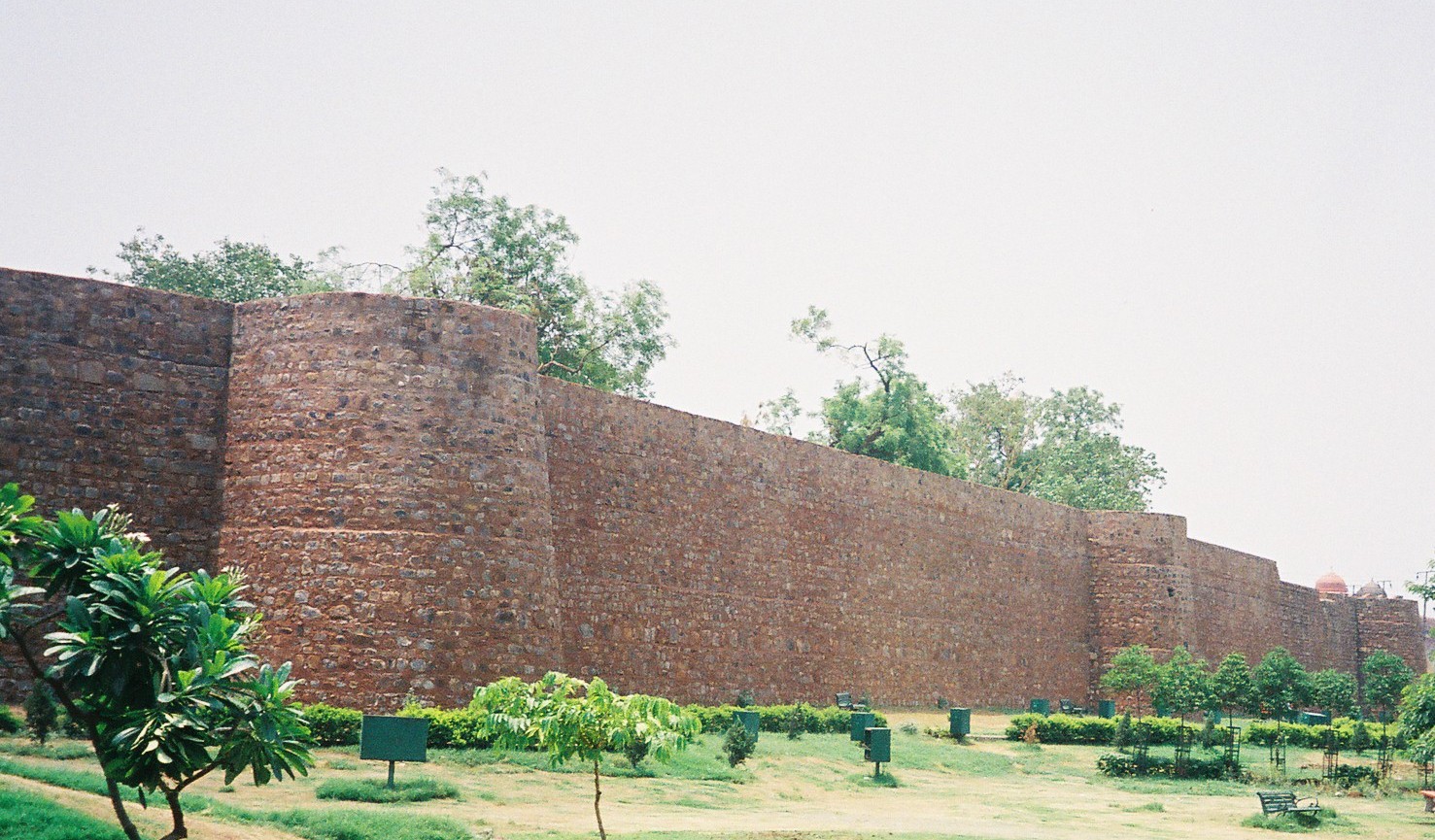
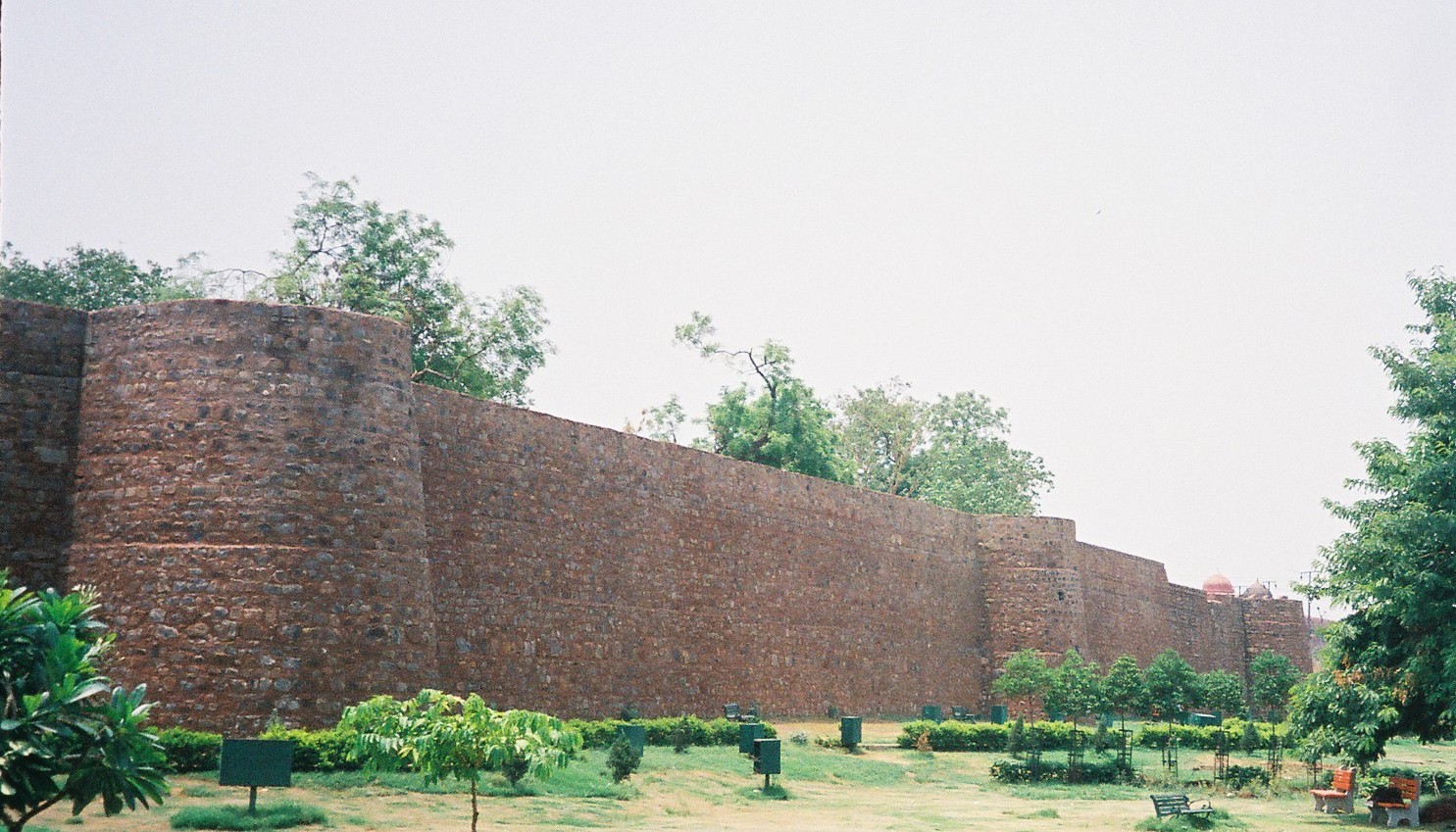
Salimgarh Fort has a triangular layout, with thick walls constructed using rubble masonry. The fort features circular bastions and has undergone multiple phases of repair and restoration since its construction.
An arch bridge connects the fort to the Red Fort on its northeastern side. This bridge was built during the reign of Bahadur Shah Zafar, and the gate at this point is known as the Bahadur Shah Gate. The gate is constructed primarily of brick masonry, with selective use of red sandstone.
During British rule, a railway line was laid through the area after the demolition of an earlier bridge. This construction divided Salimgarh Fort from the Red Fort and damaged a portion of the latter, an act that was at the time regarded as insensitive and detrimental to heritage preservation. The railway line effectively truncated the fort.[4][5][7]
As a prison[edit | edit source]
During the reign of Aurangzeb, Salimgarh Fort was first converted into a prison. Aurangzeb imprisoned his brother Murad Baksh —who had supported him in his conflict against their elder brother Dara Shikoh—at this fort. Murad Baksh was reportedly captured while asleep after a drinking binge at Mathura. The official reason for his imprisonment was cited as "apostasy for abandoning the fundamental tenets of Islam". He was later transferred to Gwalior, where he was executed.
It is also said that Aurangzeb imprisoned his eldest daughter, Zebunnisa, at Salimgarh Fort for 21 years until her death. Zebunnisa, known for her poetry and interest in music, was reportedly confined for engaging in pursuits that clashed with Aurangzeb's orthodox and austere beliefs. Her sympathy towards her brother Muhammad Akbar, who had fallen out of favour with the emperor, is also believed to have contributed to her imprisonment.[3][12][13][14]
Following the Indian Rebellion of 1857, the British briefly detained the last Mughal emperor, Bahadur Shah Zafar II, at this fort after capturing him at Humayun's Tomb. He was later exiled to Rangoon (present-day Yangon), Burma. Due to its use for detaining political prisoners, the fort has often been compared to the Tower of London in England, where many state prisoners were held and, in some cases, executed or left to die.
Before India attained independence from British rule, Salimgarh Fort was again used as a prison. From 1945 until August 1947, prisoners of the Indian National Army (INA) were held here. In recognition of those who died in the prison, the fort has since been renamed Swatantrata Senani Smarak (Freedom Fighters' Memorial).[11][15]
There are also several legends associated with the fort, particularly regarding paranormal activity. One of the more well-known stories involves the spirit of Zebunnisa, veiled in black, said to sing her poems on moonlit nights. Another tale recounts the sounds of moaning and groaning—believed to be those of INA soldiers who were tortured and died in captivity—heard in the area.[16] These narratives have contributed to the fort's symbolic link between the Mughal and British eras in India's history.[17]
Fort conservation measures[edit | edit source]

Salimgarh Fort was continuously occupied by military forces from the time of the First War of Independence in 1857 until 2005. Initially, it was under the control of the British Army, which established artillery units and used the fort as a prison. After India attained independence on 15 August 1947, the fort came under the control of the Indian Army. Over the years, several other government agencies, including the Archaeological Survey of India (ASI), were also involved in its maintenance.
This overlapping administrative control created difficulties for the ASI, particularly when it approached UNESCO in 1992 to propose the fort’s inclusion on the World Heritage List. Due to the lack of full administrative control, the ASI had to withdraw its application. The situation hindered effective conservation and preservation efforts for Salimgarh Fort, the Red Fort, and other monuments within the Red Fort Complex.
The ASI submitted an affidavit to the courts stating: "It is impossible to maintain these portions of the fort unless and until they are completely vacated and handed over to the ASI for proper assessment of the damage already caused." The ASI further stated that the Ministry of Tourism, Government of India, would re-approach UNESCO for World Heritage status once full jurisdiction was transferred and restoration work was completed.
In December 2003, the Indian Army officially handed over the fort to the ASI. Subsequently, in 2006, the ASI submitted a fresh proposal for World Heritage listing. The World Heritage Committee approved the Government of India's request during its session held from 23 to 27 June 2007 in Christchurch, New Zealand. A press release issued by the ASI following the inscription stated:[1][18]
"The core zone of about 50 hectares includes the Red Fort and Salimgarh Fort, while the buffer zone measuring over 40 hectares includes the immediate surroundings of the Red Fort and Salimgarh Fort. The Red Fort Complex, Delhi is classified as a cultural property with outstanding universal value. The inscription of the Red Fort on the World Heritage List is very significant for Delhi, as the Red Fort Complex becomes the third World Heritage Site in the city—an honour that no other single location in the country can claim."
Following the listing, and under the direction of the Supreme Court of India, the ASI prepared a draft Comprehensive Conservation Management Plan (CCMP) based on a detailed assessment of the site's historical and cultural significance. The plan accounted for the roles and responsibilities of various departments and agencies previously operating within the fort. It also proposed the restoration of the historic bridge linking the Red Fort to Salimgarh Fort, recognising its symbolic value as a link between the Mughal and British periods.[1][17]
Pending formal approval of the CCMP and prioritisation of its proposals, the ASI initiated several restoration works. These included conservation efforts in the Red Fort at an estimated cost of ₹27.5 million (approximately US$0.55 million), and in Salimgarh Fort at a cost of ₹8 million (approximately US$160,000), with the aim of completing them before the 2010 Commonwealth Games.[6]
Museum[edit | edit source]

The Swatantra Sangram Museum (Museum of the Freedom Struggle), located within the Salimgarh Fort precincts of the Red Fort Complex, was opened to the public on 2 October 1995. The site was chosen as it served as a prison where members of the Indian National Army (INA) were incarcerated by the British from 1945 until India’s independence on 15 August 1947. Many of the INA prisoners reportedly died within the fort's jail premises.
The initial identification of the museum's location was based on information provided by Colonel Gurbaksh Singh Dhillon, who had indicated the area where the British conducted the INA trials for treason in 1945. However, after the museum was established, Colonel Dhillon later clarified that the actual site of the trial was in a different building adjacent to the existing museum.
In 2007, marking the 60th year of India’s independence, the Archaeological Survey of India (ASI) decided to relocate the museum to this newly identified site. The upgraded museum was planned to include:
"more documents for the new galleries, apart from providing better lighting, panelling, and displays for existing structures."
On this occasion, a new section on Mahatma Gandhi was also proposed, featuring full-scale depictions of significant events such as the Jallianwala Bagh massacre and the Salt Satyagraha.
Following an intervention by the Prime Minister, the premises of Salimgarh Fort and the museum were formally opened to the public. To enhance visitor engagement, ASI introduced tourist guides at the Red Fort entrance to direct visitors to Salimgarh Fort, which remained relatively unknown compared to the more prominent Red Fort. Additionally, the long walking distance from the Red Fort gate to the museum had earlier discouraged public interest, a challenge that is now being addressed through improved signage and guided tours.[19]
Access[edit | edit source]

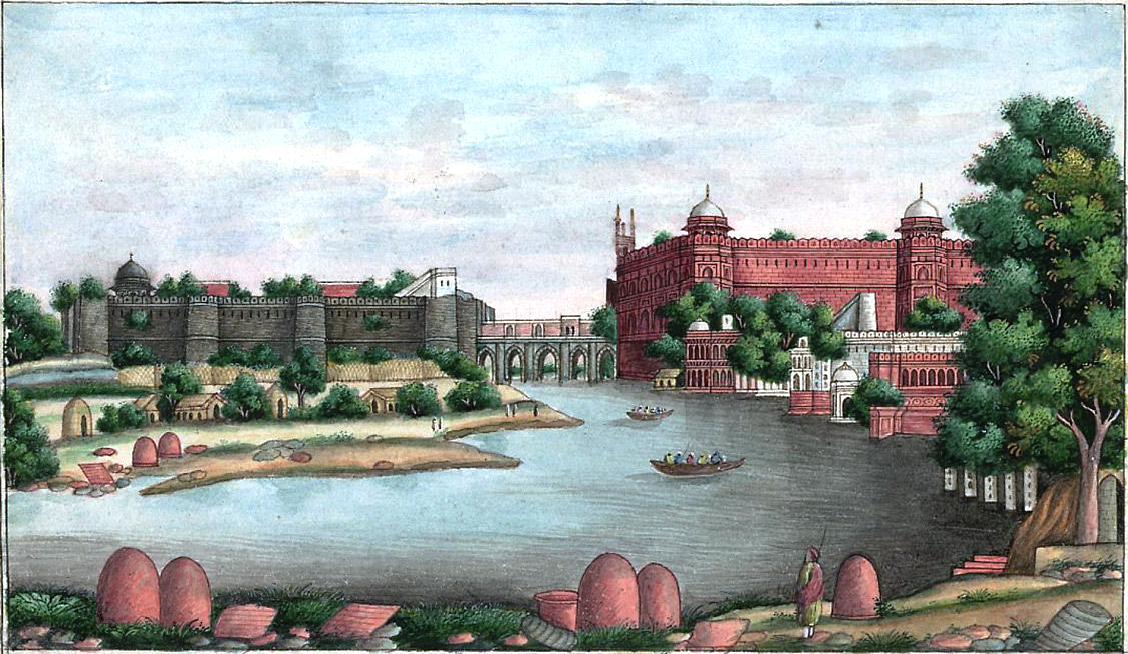
In the early years, Salimgarh Fort could only be accessed by boat. A bridge linking the Red Fort to Salimgarh Fort is believed to have been constructed by Emperor Jahangir, father of Shah Jahan. However, some sources attribute its construction to Farid Khan, who held the fort as a jagir (land grant).[3] This original bridge was later replaced by a railway bridge at the same location. At present, an arched overbridge connects Salimgarh Fort to the Red Fort from its northeastern end. From this vantage point, the fort offers a commanding view of the Red Fort, the Yamuna River, and the surrounding areas.
However, the area is often noisy due to the continuous flow of heavy traffic along the arterial roads surrounding the complex, as well as vehicular movement over the steel bridge across the Yamuna nearby.[8] The East India Railway was extended to Delhi through Salimgarh Fort. The railway line passed over part of the fort structure and was later extended to connect with the Rajputana Railway.[11]
Gallery[edit | edit source]
-
 Another view of Salimgarh Fort
 -
 View showing buildings inside the fort
 -
 View of Gate entry to bridge between Red Fort and Salimgarh Fort with a plaque declaring it as Swatantrata Senani Smarak
 -
 Arched bridge linking Salimgarh and Red Forts on former Yamuna River channel now closed and converted into the main thoroughfare
 -
 Salimgarh Fort and the Red Fort palace
 -
 A colour painting showing Salimgarh Fort linked to Red Fort


See also[edit | edit source]
- Capital forts/palaces in Delhi, oldest first
- Purana Qila, earliest Hindu rulers
- Indraprastha, earlier than 1000 BCE
- Edicts & additions by Ashoka the Great (r. 268 to 232 BCE) of Maurya Empire
- Anangpur, by Anangpal I of Tomara dynasty (r. 736-1152 CE)
- Qila Rai Pithora
- Lal Kot, by Tomara dynasty (1152-1177 CE) as capital
- Qila Rai Pithora, the Lal Kot expended by Prithviraj Chauhan (also called Rai Pithora, r. 1177–92 CE) of Chauhan dynasty
- Siri Fort, by Alauddin Khalji (r. 1296–1316), second ruler of Khalji Dynasty
- Tughlaqabad Fort, by Ghiyassudin Tughluq (r. 1320-25 CE) of Tughluq dynasty
- Feroz Shah Kotla, by Feroz Shah Tughluq (r. 1351-88 CE) of Tughluq dynasty
- Salimgarh Fort, in 1546 CE by Salim Shah Suri (r. 1545-54 CE), son of Sher Shah Suri
- Red fort, built in 1639-48 CE by Mughal emperor Shah Jahan when he moved his capital from Agra to Delhi
- Rashtrapati Bhavan, built in 1912–29 by colonial British raj
- Purana Qila, earliest Hindu rulers
- History of Delhi
References[edit | edit source]
- ↑ 1.0 1.1 1.2 1.3 "Press Release on Inscription of the Red Fort in the World Heritage List −2007" (PDF). Archaeological Survey of India. Archived from the original (PDF) on 10 April 2009. Retrieved 28 May 2009.
- ↑ 2.0 2.1 Fanshawe. H.C (1998). Delhi, Past and Present. Asian Educational Services. pp. 1 to 3. ISBN 978-81-206-1318-8. Retrieved 28 May 2009.
{{cite book}}:|work=ignored (help) - ↑ 3.0 3.1 3.2 3.3 3.4 Shiri Ram Bakshi; et al. (1995). Delhi Through Ages. Anmol Publications PVT. LTD. p. 213. ISBN 978-81-7488-138-0.
{{cite book}}:|work=ignored (help) - ↑ 4.0 4.1 Y.D.Sharma (2001). Delhi and its Neighbourhood. New Delhi: Archaeological Survey of India. pp. 148–149. Archived from the original on 31 August 2005. Retrieved 31 May 2009.
{{cite book}}:|work=ignored (help) - ↑ 5.0 5.1 Lucy Peck (2005). Delhi – A thousand years of Building. New Delhi: Roli Books Pvt Ltd. pp. 135, 181, & 241. ISBN 81-7436-354-8. Retrieved 31 May 2009.
{{cite book}}:|work=ignored (help) - ↑ 6.0 6.1 "Commonwealth Games-2010, Conservation, Restoration and Upgradation of Public Amenities at Protected Monuments" (PDF). Red Fort & Salimgarh Fort. Archaeological Survey of India, Delhi Circle. 2006. pp. 37–38 & 40. Archived from the original (PDF) on 11 October 2011. Retrieved 5 June 2009.
- ↑ 7.0 7.1 Patrick Horton; Richard Plunkett; Hugh Finlay (2002). Delhi. Lonely Planet. p. 93. ISBN 978-1-86450-297-8. Retrieved 28 May 2009.
{{cite book}}:|work=ignored (help) - ↑ 8.0 8.1 8.2 Mohan (1992). The world of walled cities: conservation, environmental pollution, urban renewal and developmental prospects. Mittal Publications. p. 23. ISBN 978-81-7099-462-6. Retrieved 28 May 2009.
{{cite book}}:|work=ignored (help) - ↑ Alfred Frederick; Pollock Harcourt (1866). The New Guide to Delhi. PaperbackshopUS. p. 79. ISBN 0-559-47419-9. Retrieved 5 June 2009.
Travelogue by Finch 1611 Gates of Delhi.
{{cite book}}:|work=ignored (help) - ↑ Gordon Sanderson; Maulvi Shuaib (2000). Delhi Fort. Asia Publication Services. pp. 80, 81 & 82. ISBN 81-206-1532-8. Retrieved 28 May 2009.
- ↑ 11.0 11.1 11.2 Ronald Villiam Smith (2005). The Delhi that no-one knows. Orient Blackswan. p. 101. ISBN 978-81-8028-020-7. Retrieved 1 June 2009.
{{cite book}}:|work=ignored (help) - ↑ Annie Krieger Krynick; Enjum Hamid. Captive Princess; Zebunissa, Daughter of Emperor Aurangzeb. Retrieved 31 May 2009.
The book revolves around Princess Zebunissa (1638–1702) who is defined as the symbol of female power of the Mughal dynasty and portrays their stature in the court life in the seventeenth century...For her the name signified a life dramatically suppressed, cut off from the world. Her mysterious and unexpected imprisonment is also described in this book: Zebunissa's fate changed drastically when she was sent to prison by her father Aurangzeb, where she died leaving a landmark near the Red Fort of Delhi.
- ↑ Dr. Akbar Ahmed. "The Trial of Dara Shikoh:A Play in Three Acts" (PDF). The Buxton Readings. p. 53. Archived from the original (PDF) on 23 February 2012.
- ↑ "Memories of Ferghana". 22 May 2005. Retrieved 31 May 2009.
MUSIC and dance? But wasn't that unIslamic in a country celebrating an Islamic revival, I'd thought back then, as I twirled at an Uzbek soiree at Kokand in the Ferghana Valley. My hostess had snatched up a daf (dafli in India) and was dancing slowly to a sad Persian song by Zebunissa 'Makhfi', an Uzbek-Tajik favourite. She was a princess of Delhi via Ferghana; Aurangzeb's daughter, whom he jailed for 20 years in Salimgarh, next to the Red Fort, because of her Sufi sympathies. Aurangzeb had killed music in his realm. Zebunissa's voice sang in her ancestral homeland, though lost to Delhi.
- ↑ Renuka Nath (1990). Notable Mughal and Hindu women in the 16th and 17th centuries A.D. Inter-India Publications. p. 161. ISBN 978-81-210-0241-7.
She spent most of her time in her library, when she was imprisoned in the fort of Salimgarh. No doubt at that time her books were her only companion to console her.
- ↑ "मुस्लिम विरासत : स्वतंत्रता सेनानी स्मारक ..सलीम गढ़ किला" [Muslim Heritage: Freedom Fighter Memorial. Salim Garh Fort]. sd24th.com. 29 December 2019. Retrieved 29 December 2019.
- ↑ 17.0 17.1 Maneesh pandey (25 June 2006). "Red Fort to reveal its secrets". The Times of India. Archived from the original on 24 October 2012. Retrieved 30 May 2009.
- ↑ "Centre to secure world heritage status for Red Fort". Milligazette Muslim Newspaper of India. Retrieved 30 May 2009.
- ↑ Neha Sinha (2 October 2007). "India at 60: Red Fort war museum to get gallery on Mahatma". Express India. Archived from the original on 25 September 2012. Retrieved 30 May 2009.
- ↑ Verma, Amrit (1985). Forts of India. New Delhi: The Director of Publication Division, Ministry of Information and Broadcasting, Government of India. p. 9. ISBN 81-230-1002-8.
External links[edit | edit source]
| North |  | |
|---|---|---|
| East | ||
| Northeast | ||
| South | ||
| Central | ||
| West | ||