













No edit summary |
IgnacioElem3 (talk | contribs) small adjusted layout per sources and cleaned formatting for accuracy |
||
| Line 1: | Line 1: | ||
{{ | {{Short description|Social-cultural system}} | ||
[[File: | {{hatnote group| | ||
{{about|a cultural system of behaviors, practices and ethics|other uses}} | |||
{{redirect|Religious|the term describing a type of monk or nun|Religious (Western Christianity)||}} | |||
{{distinguish|Religious denomination}} | |||
}} | |||
{{pp|small=yes}} | |||
{{if mobile|tag=div| | |||
[[File:16 religionist symbols.png|thumb|Religious symbols from left to right, top to bottom: [[Christianity]], [[Islam]], [[Hinduism]], [[Buddhism]], [[Judaism]], the [[Baháʼí Faith]], [[Eckankar]], [[Sikhism]], [[Jainism]], [[Wicca]], [[Unitarian Universalism]], [[Shinto]], [[Taoism]], [[Thelema]], [[Tenrikyo]], and [[Zoroastrianism]]]]| | |||
{{Religion sidebar}} | |||
{{Spirituality sidebar|expanded=religion}} | |||
}} | |||
{{Use dmy dates|date=March 2022}}{{CS1 config|mode=cs1}} | |||
'''Religion''' is a range of [[social system|social]]-[[cultural system]]s, including designated [[religious behaviour|behaviors]] and practices, [[Ethics in religion|ethics]], [[morals]], [[belief]]s, [[worldview]]s, [[religious text|texts]], [[sanctified places]], [[prophecies]], or [[religious organization|organizations]], that generally relate humanity to [[supernatural]], [[transcendence (religion)|transcendental]], and [[spirituality|spiritual]] elements<ref>{{cite web|url=https://www.merriam-webster.com/dictionary/religion|title=Religion – Definition of Religion by Merriam-Webster|access-date=16 December 2019|archive-date=12 March 2021|archive-url=https://web.archive.org/web/20210312024948/https://www.merriam-webster.com/dictionary/religion|url-status=live}}</ref>—although there is no scholarly consensus over what precisely constitutes a religion.<ref>{{cite book |last1=Morreall |first1=John |last2=Sonn |first2=Tamara |title=50 Great Myths of Religion |chapter=Myth 1: All Societies Have Religions |date=2013 |publisher=[[John Wiley & Sons|Wiley]]-Blackwell|isbn=978-0-470-67350-8 |pages=12–17}}</ref><ref name="Nongbri" /> It is an [[essentially contested concept]].<ref>{{cite journal |last1=Astor |first1=Avi |title=Religion and its Modifiers: Making Sense of the Definition and Subtypification of a Contested Concept |journal=Theory and Society |date=1 March 2022 |volume=51 |issue=2 |pages=213–232 |doi=10.1007/s11186-021-09447-z |language=en |issn=1573-7853}}</ref> Different religions may or may not contain various elements ranging from the [[divine]],{{sfn|James|1902|p=31}} [[sacredness]],{{sfn|Durkheim|1915|p=}} [[faith]],<ref name="Tillich, P. 1957 p.1">Tillich, P. (1957) ''Dynamics of faith''. Harper Perennial; (p. 1).</ref> and a supernatural being or beings.<ref name="vergote" /> | |||
= | The origin of religious belief is an open question, with possible explanations including awareness of individual death, a sense of community, and dreams.<ref name=Zeigler/> Religions have [[sacred histories]], [[narrative]]s, and [[mythologies]], preserved in oral traditions, [[sacred texts]], [[Religious symbol|symbols]], and [[holy places]], that may attempt to explain the [[origin of life]], the [[religious cosmology|universe]], and other phenomena. Religious practice may include [[ritual]]s, [[sermon]]s, commemoration or veneration (of [[deities]] or [[saint]]s), [[sacrifice]]s, [[Religious festival|festivals]], [[feast]]s, [[trance]]s, [[initiation]]s, [[matrimonial]] and [[funerary]] services, [[meditation]], [[prayer]], [[Religious music|music]], [[Religious art|art]], [[Religious dance|dance]], or [[public service]].<ref>{{Cite book |title=Worldmark encyclopedia of religious practices |date=2015 |publisher=Gale, Cengage Learning |isbn=978-1-4144-9870-6 |editor-last=Riggs |editor-first=Thomas |location=Farmington Hills, Mich}}</ref> | ||
There are an estimated 10,000 distinct religions worldwide,<ref>{{cite book |author1= African Studies Association|author2=University of Michigan|title=History in Africa |date=2005 |page=119 |volume= 32}}</ref> though nearly all of them have regionally based, relatively small followings. Four religions—[[Christianity]], [[Islam]], [[Hinduism]], and [[Buddhism]]—account for over 77% of the world's population, and 92% of the world either follows one of those four religions or identifies as [[nonreligious]],<ref name="EB2012">{{cite web |url=https://www.pewforum.org/2012/12/18/global-religious-landscape-exec/ |title=The Global Religious Landscape |access-date=18 December 2012 |date=18 December 2012 |archive-date=19 July 2013 |archive-url=https://web.archive.org/web/20130719060225/http://www.pewforum.org/global-religious-landscape.aspx |url-status=live }}</ref> meaning that the vast majority of remaining religions account for only 8% of the population combined. The religiously unaffiliated demographic includes those who do not identify with any particular religion, [[atheists]], and [[agnostics]], although many in the demographic still have various religious beliefs.<ref name="Pew Global Unaffiliated 12/2012">{{cite web |date=18 December 2012 |title=Religiously Unaffiliated |url=https://www.pewforum.org/global-religious-landscape-unaffiliated.aspx |url-status=live |archive-url=https://web.archive.org/web/20130730043126/http://www.pewforum.org/global-religious-landscape-unaffiliated.aspx |archive-date=30 July 2013 |access-date=16 February 2022 |work=The Global Religious Landscape |publisher=[[Pew Research Center]]: Religion & Public Life |quote=The religiously unaffiliated include atheists, agnostics and people who do not identify with any particular religion in surveys. However, many of the religiously unaffiliated have some religious beliefs.}}</ref> Many [[world religions]] are also [[organized religion]]s, most definitively including the [[Abrahamic religions]] Christianity, Islam, [[Judaism]], and the [[Baháʼí Faith]], while others are arguably less so, in particular [[folk religion]]s, [[indigenous religion]]s, and some [[Eastern religions]]. A portion of the world's population are members of [[new religious movement]]s.<ref name="barker1999">[[Eileen Barker]], 1999, "New Religious Movements: their incidence and significance", ''New Religious Movements: challenge and response'', Bryan Wilson and Jamie Cresswell editors, [[Routledge]] {{ISBN|0-415-20050-4}}</ref> Scholars have indicated that [[Desecularization|global religiosity may be increasing]] due to religious countries having generally higher birth rates.<ref name="CambridgeZuckerman">{{cite book |last=Zuckerman |first=Phil |title=The Cambridge Companion to Atheism |date=2006 |isbn=978-1-13900-118-2|editor1-last=Martin |editor1-first=Michael |pages=47–66 |chapter=3 – Atheism: Contemporary Numbers and Patterns |doi=10.1017/CCOL0521842700.004}}</ref> | |||
The [[study of religion]] comprises a wide variety of academic disciplines, including [[theology]], [[philosophy of religion]], [[comparative religion]], and social scientific studies. [[Theories about religion]] offer various explanations for its origins and workings, including the [[ontological]] foundations of religious [[being]] and belief.<ref>{{cite book | year= 2018 | last1= James | first1= Paul | author-link1= Paul James (academic) | chapter= What Does It Mean Ontologically to Be Religious? | title= Religion in a Secular Age: The Struggle for Meaning in an Abstracted World | editor= Stephen Ames | editor2= Ian Barns | editor3= John Hinkson | editor4= Paul James | editor5= Gordon Preece | editor6= Geoff Sharp | chapter-url= https://www.academia.edu/37278937 | publisher= Arena Publications | pages= 56–100 | access-date= 23 August 2018 | archive-date= 14 December 2021 | archive-url= https://web.archive.org/web/20211214151335/https://www.academia.edu/37278937 | url-status= live }}</ref> | |||
[[ | |||
==Etymology and history of the concept of "religion"== | |||
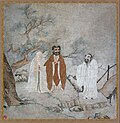
[[File:Sakyamuni, Lao Tzu, and Confucius - Google Art ProjectFXD.jpg|thumb|The [[Buddha]], [[Laozi]], and [[Confucius]] – founders of [[Buddhism]], [[Taoism]] (Daoism) and [[Confucianism]] – in a [[Ming dynasty]] painting]] | |||
===Etymology=== | |||
{{See also|History of religion}} | |||
=== | The term ''religion'' comes from both [[Old French]] and [[Anglo-Norman language|Anglo-Norman]] (1200s [[Common Era|CE]]) and means respect for sense of right, moral obligation, sanctity, what is sacred, reverence for the gods.<ref>{{OEtymD|religion}}</ref><ref>"Religion" Oxford English Dictionary https://www.oed.com/viewdictionaryentry/Entry/161944 {{Webarchive|url=https://web.archive.org/web/20211003070115/https://www.oed.com/viewdictionaryentry/Entry/161944 |date=3 October 2021 }}</ref> It is ultimately derived from the [[Latin]] word {{lang|la|[[religio|religiō]]}}. According to Roman philosopher [[Cicero]], {{lang|la|religiō}} comes from {{lang|la|relegere}}: {{lang|la|re}} (meaning 'again') + {{lang|la|lego}} (meaning 'read'), where {{lang|la|lego}} is in the sense of 'go over', 'choose', or 'consider carefully'. Contrarily, some modern scholars such as [[Tom Harpur]] and [[Joseph Campbell]] have argued that {{lang|la|religiō}} is derived from {{lang|la|religare}}: {{lang|la|re}} (meaning 'again') + {{lang|la|ligare}} ('bind' or 'connect'), which was made prominent by [[Augustine of Hippo|St. Augustine]] following the interpretation given by [[Lactantius]] in {{lang|la|Divinae institutiones}}, IV, 28.<ref>In ''The Pagan Christ: Recovering the Lost Light.'' Toronto. Thomas Allen, 2004. {{ISBN|0-88762-145-7}}</ref><ref>In ''[[The Power of Myth]],'' with Bill Moyers, ed. Betty Sue Flowers, New York, Anchor Books, 1991. {{ISBN|0-385-41886-8}}</ref> The medieval usage alternates with ''order'' in designating bonded communities like those of [[monastic orders]]: "we hear of the 'religion' of the [[Order of the Golden Fleece|Golden Fleece]], of a knight 'of the [[Order of Aviz|religion of Avys]]'."<ref name="Huizinga Middle">{{cite book |last1=Huizinga |first1=Johan |title=The Waning of the Middle Ages |date=1924 |publisher=Penguin Books |page=86|title-link=The Autumn of the Middle Ages }}</ref> | ||
==== {{lang|la|Religiō}} ==== | |||
{{Main|Religio}} | |||
In classic antiquity, {{lang|la|religiō}} broadly meant [[conscientiousness]], sense of [[righteousness|right]], moral [[obligation]], or [[duty]] to anything.<ref>{{cite web |title=Religio |url=https://www.perseus.tufts.edu/hopper/text?doc=Perseus%3Atext%3A1999.04.0060%3Aentry%3Dreligio |website=Latin Word Study Tool |publisher=Tufts University |access-date=21 February 2021 |archive-date=24 February 2021 |archive-url=https://web.archive.org/web/20210224155206/http://www.perseus.tufts.edu/hopper/text?doc=Perseus%3Atext%3A1999.04.0060%3Aentry%3Dreligio |url-status=live }}</ref> In the ancient and medieval world, the etymological Latin root {{lang|la|religiō}} was understood as an individual virtue of [[worship]] in mundane contexts; never as [[doctrine]], practice, or actual source of [[knowledge]].<ref name="Harrison Territories" /><ref name="Roberts Jon">{{cite book|last1=Roberts|first1=Jon|editor1-last=Shank|editor1-first=Michael|editor2-last=Numbers|editor2-first=Ronald|editor3-last=Harrison|editor3-first=Peter|title=Wrestling with Nature: From Omens to Science|date=2011|publisher=University of Chicago Press|location=Chicago|isbn=978-0-226-31783-0|page=254|chapter=10. Science and Religion}}</ref> In general, {{lang|la|religiō}} referred to broad social obligations towards anything including family, neighbors, rulers, and even towards [[God]].<ref name="50 great" /> {{lang|la|Religiō}} was most often used by the [[ancient Romans]] not in the context of a relation towards gods, but as a range of general emotions which arose from heightened attention in any mundane context such as [[hesitation]], caution, [[anxiety]], or [[fear]], as well as feelings of being bound, restricted, or inhibited.<ref name="religio roman">{{cite book |last1=Barton |first1=Carlin |last2=Boyarin |first2=Daniel |title=Imagine No Religion : How Modern Abstractions Hide Ancient Realities |date=2016 |publisher=Fordham University Press |isbn=978-0-8232-7120-7 |chapter=1. 'Religio' without "Religion" |pages=15–38}}</ref> The term was also closely related to other terms like {{lang|la|scrupulus}} (which meant "very precisely"), and some Roman authors related the term {{lang|la|superstitio}} (which meant too much fear or anxiety or shame) to {{lang|la|religiō}} at times.<ref name="religio roman" /> When {{lang|la|religiō}} came into [[English language|English]] around the 1200s as religion, it took the meaning of "life bound by monastic vows" or monastic orders.<ref name="Huizinga Middle" /><ref name="50 great" /> The compartmentalized concept of religion, where religious and [[worldly]] things were separated, was not used before the 1500s.<ref name="50 great" /> The concept of religion was first used in the 1500s to distinguish the domain of the [[Catholic Church|church]] and the domain of [[civil authorities]]; the [[Peace of Augsburg]] marks such an instance,<ref name="50 great">{{cite book |last1=Morreall |first1=John |last2=Sonn |first2=Tamara |title=50 Great Myths about Religions |date=2013 |publisher=Wiley-Blackwell |isbn=978-0-470-67350-8 |pages=12–17 |chapter=Myth 1: All Societies Have Religions }}</ref> which has been described by [[Christian Reus-Smit]] as "the first step on the road toward a European system of [[sovereign state]]s."<ref>{{cite journal |last=Reus-Smit |first=Christian |date=April 2011 |title=Struggles for Individual Rights and the Expansion of the International System |url=https://www.cambridge.org/core/journals/international-organization/article/abs/struggles-for-individual-rights-and-the-expansion-of-the-international-system/9D4AB3695056FA85DCDE1D90D3C551B3 |journal=International Organization |language=en |volume=65 |issue=2 |pages=207–242 |doi=10.1017/S0020818311000038 |s2cid=145668420 |issn=1531-5088 |archive-date=25 September 2022 |access-date=6 August 2022 |archive-url=https://web.archive.org/web/20220925085215/https://www.cambridge.org/core/journals/international-organization/article/abs/struggles-for-individual-rights-and-the-expansion-of-the-international-system/9D4AB3695056FA85DCDE1D90D3C551B3 |url-status=live }}</ref> | |||
Roman general [[Julius Caesar]] used {{lang|la|religiō}} to mean 'obligation of an oath' when discussing captured soldiers making an oath to their captors.<ref>{{cite book |last1=Caesar |first1=Julius |translator-last1=McDevitte |translator-first1=W.A. |translator-first2=W.S. |translator-last2=Bohn |title=The Works of Julius Caesar: Parallel English and Latin |date=2007 |publisher=Forgotten Books |isbn=978-1-60506-355-3 |pages=377–378 |chapter=Civil Wars – Book 1|quote={{native name|la|Sic terror oblatus a ducibus, crudelitas in supplicio, nova religio iurisiurandi spem praesentis deditionis sustulit mentesque militum convertit et rem ad pristinam belli rationem redegit.}} – "Thus the terror raised by the generals, the cruelty and punishments, the new obligation of an oath, removed all hopes of surrender for the present, changed the soldiers' minds, and reduced matters to the former state of war." )}}</ref> Roman naturalist [[Pliny the Elder]] used the term {{lang|la|religiō}} to describe the apparent respect given by elephants to the [[night sky]].<ref>{{cite book |author1=Pliny the Elder |chapter=Elephants; Their Capacity |title=The Natural History, Book VIII |chapter-url=https://www.perseus.tufts.edu/hopper/text?doc=Perseus%3Atext%3A1999.02.0137%3Abook%3D8%3Achapter%3D1 |publisher=Tufts University |language=en |quote={{lang|la|maximum est elephans proximumque humanis sensibus, quippe intellectus illis sermonis patrii et imperiorum obedientia, officiorum quae didicere memoria, amoris et gloriae voluptas, immo vero, quae etiam in homine rara, probitas, prudentia, aequitas, religio quoque siderum solisque ac lunae veneratio."}} – "The elephant is the largest of them all, and in intelligence approaches the nearest to man. It understands the language of its country, it obeys commands, and it remembers all the duties which it has been taught. It is sensible alike of the pleasures of love and glory, and, to a degree that is rare among men even, possesses notions of honesty, prudence, and equity; it has a religious respect also for the stars, and a veneration for the sun and the moon." |access-date=21 February 2021 |archive-date=7 May 2021 |archive-url=https://web.archive.org/web/20210507142052/https://www.perseus.tufts.edu/hopper/text?doc=Perseus%3Atext%3A1999.02.0137%3Abook%3D8%3Achapter%3D1 |url-status=live }}</ref> Cicero used {{lang|la|religiō}} as being related to {{lang|la|cultum deorum}} (worship of the gods).<ref>Cicero, ''De natura deorum'' Book II, Section 8.</ref> | |||
==== {{transliteration|grc|Threskeia}} ==== | |||
In [[Ancient Greece]], the Greek term {{transliteration|grc|threskeia}} ({{lang|grc|θρησκεία}}) was loosely translated into Latin as {{lang|la|religiō}} in [[late antiquity]]. {{transliteration|grc|Threskeia}} was sparsely used in classical Greece but became more frequently used in the writings of [[Josephus]] in the 1st century CE. It was used in mundane contexts and could mean multiple things from respectful fear to excessive or harmfully distracting practices of others, to cultic practices. It was often contrasted with the Greek word {{transliteration|grc|deisidaimonia}}, which meant too much fear.<ref name="threskeia greece">{{cite book |last1=Barton |first1=Carlin |last2=Boyarin |first2=Daniel |title=Imagine No Religion : How Modern Abstractions Hide Ancient Realities |date=2016 |publisher=Fordham University Press |isbn=978-0-8232-7120-7 |chapter=8. Imagine No 'Threskeia': The Task of the Untranslator |pages=123–134}}</ref> | |||
===History of the concept of "religion"=== | |||
{{For timeline|Timeline of religion}} | |||
Religion is a modern concept<ref>{{cite book |last1=Pasquier |first1=Michael |title=Religion in America: The Basics |date=2023 |publisher=Routledge |isbn=978-0367691806 |pages=2–3 |quote=Religion is a modern concept. It is an idea with a history that developed, most scholars would agree, out of the social and cultural disruptions of Renaissance and Reformation Europe. From the fourteenth to the seventeenth century, at a time of unprecedented political transformation and scientific innovation, it became possible for people to differentiate between things religious and things not religious. Such a dualistic understanding of the world was simply not available in such clear terms to ancient and medieval Europeans, to say nothing of people from the continents of North America, South America, Africa, and Asia.}}</ref> and not a universal concept across history, cultures or languages.<ref>{{cite book |last1=Nongbri |first1=Brent |title=Before Religion: A History of a Modern Concept |chapter=2. Lost in Translation: Inserting "Religion" into Ancient Texts |date=2013 |publisher=Yale University Press |isbn=978-0-300-15416-0}}</ref><ref>{{cite book|last1=Morreall|first1=John|last2=Sonn|first2=Tamara|title=50 Great Myths about Religions|date=2013|publisher=Wiley-Blackwell|isbn=978-0-470-67350-8|page=13|quote=Many languages do not even have a word equivalent to our word 'religion'; nor is such a word found in either the Bible or the Qur'an.}}</ref> The concept was invented recently in the English language and is found in texts from the 17th century due to events such as the splitting of [[Christendom]] during the [[Protestant Reformation]] and [[globalization]] in the [[Age of Exploration]], which involved contact with numerous foreign cultures with non-European languages.<ref name="Harrison Territories">{{cite book |last1=Harrison |first1=Peter |title=The Territories of Science and Religion |date=2015 |publisher=University of Chicago Press |isbn=978-0-226-18448-7}}</ref><ref name="Roberts Jon" /><ref name="Religion enlightenment">{{cite book|last1=Harrison|first1=Peter|title='Religion' and the Religions in the English Enlightenment|date=1990|publisher=Cambridge University Press|location=Cambridge|isbn=978-0-521-89293-3}}</ref> Some argue that regardless of its definition, it is not appropriate to apply the term religion to non-Western cultures,<ref name=dubuisson>{{cite book|first1=Daniel|last1=Dubuisson|title=The Western Construction of Religion: Myths, Knowledge, and Ideology|date=2007|publisher=Johns Hopkins University Press|location=Baltimore, Md.|isbn=978-0-8018-8756-7}}</ref><ref name="Fitzgerald" /> while some followers of various faiths rebuke using the word to describe their own belief system.<ref>{{cite book |last1=Smith |first1=Wilfred Cantwell |url=https://archive.org/details/meaningendofre00smit/page/125/mode/2up |title=The Meaning and End of Religion |publisher=MacMillan |year=1963 |location=New York |pages=125–126 |author-link1=Wilfred Cantwell Smith}}</ref> | |||
The concept of "ancient religion" stems from modern interpretations of a range of practices that conform to a modern concept of religion, influenced by early modern and 19th century Christian discourse.<ref>{{cite book |last1=Rüpke |first1=Jörg |title=Religion: Antiquity and its Legacy |date=2013 |publisher=Oxford University Press |isbn=9780195380774 |pages=7–8| url=https://books.google.com/books?id=q-cwmAEACAAJ}}</ref> The concept of religion was formed in the 16th and 17th centuries,<ref name=Nongbri1>{{cite book |last1=Nongbri |first1=Brent |title=Before Religion: A History of a Modern Concept|page=152 |quote=Although the Greeks, Romans, Mesopotamians, and many other peoples have long histories, the stories of their respective religions are of recent pedigree. The formation of ancient religions as objects of study coincided with the formation of religion itself as a concept of the sixteenth and seventeenth centuries.|date=2013 |publisher=Yale University Press |isbn=978-0-300-15416-0}}</ref><ref name="Religion enlightenment1">{{cite book|last1=Harrison|first1=Peter|title='Religion' and the Religions in the English Enlightenment|url=https://archive.org/details/religionreligion00harr|url-access=limited|date=1990|publisher=Cambridge University Press|location=Cambridge|page=[https://archive.org/details/religionreligion00harr/page/n11 1]|isbn=978-0-521-89293-3|quote=That there exist in the world such entities as 'the religions' is an uncontroversial claim...However, it was not always so. The concepts 'religion' and 'the religions', as we presently understand them, emerged quite late in Western thought, during the Enlightenment. Between them, these two notions provided a new framework for classifying particular aspects of human life.}}</ref> despite the fact that ancient sacred texts like the [[Bible]], the [[Quran]], and others did not have a word or even a concept of religion in the original languages and neither did the people or the cultures in which these sacred texts were written.<ref>{{cite book |last1=Nongbri |first1=Brent |title=Before Religion: A History of a Modern Concept |chapter=2. Lost in Translation: Inserting "Religion" into Ancient Texts |date=2013 |publisher=Yale University Press |isbn=978-0-300-15416-0}}</ref><ref>{{cite book|last1=Morreall|first1=John|last2=Sonn|first2=Tamara|title=50 Great Myths about Religions|date=2013|publisher=Wiley-Blackwell|isbn=978-0-470-67350-8|page=13|quote=Many languages do not even have a word equivalent to our word 'religion'; nor is such a word found in either the Bible or the Qur'an.}}</ref><ref name="Enc Qur" /> For example, there is no precise equivalent of religion in Hebrew, and [[Judaism]] does not distinguish clearly between religious, national, racial, or ethnic identities.<ref>{{cite book |author1=Pluralism Project, Harvard University |title=Judaism - Introductory Profiles |date=2015 |publisher=Harvard University |page=2 |url=https://rpl.hds.harvard.edu/files/rpl/files/judaism_pluralism_project_harvard_university_religious_literacy_project_harvard_divinity_school_march_24_2015.pdf?m=1660591091#:~:text=In%20the%20English%2Dspeaking%20Western,and%20practices%20associated%20with%20a |quote=In the English-speaking Western world, "Judaism" is often considered a "religion," but there are no equivalent words for "Judaism" or for "religion" in Hebrew; there are words for "faith," "law," or "custom" but not for "religion" if one thinks of the term as meaning solely the beliefs and practices associated with a relationship with God or a vision of transcendence. |archive-date=28 October 2023 |access-date=28 October 2023 |archive-url=https://web.archive.org/web/20231028181906/https://rpl.hds.harvard.edu/files/rpl/files/judaism_pluralism_project_harvard_university_religious_literacy_project_harvard_divinity_school_march_24_2015.pdf?m=1660591091#:~:text=In%20the%20English%2Dspeaking%20Western,and%20practices%20associated%20with%20a |url-status=live }}</ref><ref>{{cite web |title=God, Torah, and Israel |url=https://pluralism.org/god-torah-and-israel |website=Pluralism Project - Judaism |publisher=Harvard University |language=en |access-date=28 October 2023 |archive-date=28 October 2023 |archive-url=https://web.archive.org/web/20231028182713/https://pluralism.org/god-torah-and-israel |url-status=live }}</ref><ref>Hershel Edelheit, Abraham J. Edelheit, [https://www.questia.com/library/book/history-of-zionism-a-handbook-and-dictionary-by-abfaham-j-edelheit-hershel-edelheit.jsp History of Zionism: A Handbook and Dictionary] {{Webarchive|url=https://web.archive.org/web/20110624015852/http://www.questia.com/library/book/history-of-zionism-a-handbook-and-dictionary-by-abfaham-j-edelheit-hershel-edelheit.jsp|date=24 June 2011}}, p. 3, citing [[Solomon Zeitlin]], ''The Jews. Race, Nation, or Religion?'' (Philadelphia: Dropsie College Press, 1936).</ref> One of its central concepts is {{transliteration|he|[[halakha]]}}, meaning the walk or path sometimes translated as law, which guides religious practice and belief and many aspects of daily life.<ref name="WhitefordII2008">{{cite book |last1=Whiteford |first1=Linda M. |last2=Trotter II |first2=Robert T. |title=Ethics for Anthropological Research and Practice |url=https://books.google.com/books?id=ZeokAAAAQBAJ&pg=PA22 |year=2008 |publisher=Waveland Press |isbn=978-1-4786-1059-5 |page=22 |access-date=28 November 2015 |archive-date=10 June 2016 |archive-url=https://web.archive.org/web/20160610090106/https://books.google.com/books?id=ZeokAAAAQBAJ&pg=PA22 |url-status=live }}</ref> Even though the beliefs and traditions of Judaism are found in the ancient world, ancient Jews saw [[Jewish identity]] as being about an ethnic or national identity and did not entail a compulsory belief system or regulated rituals.<ref name="Burns Jewish">{{cite book|last1=Burns|first1=Joshua Ezra|editor1-last=Omar|editor1-first=Irfan|editor2-last=Duffey|editor2-first=Michael|title=Peacemaking and the Challenge of Violence in World Religions|publisher=Wiley-Blackwell|isbn=978-1-118-95342-6|chapter=3. Jewish ideologies of Peace and Peacemaking|pages=86–87|date= 2015}}</ref> In the 1st century CE, Josephus had used the Greek term {{transliteration|grc|ioudaismos}} (Judaism) as an ethnic term and was not linked to modern abstract concepts of religion or a set of beliefs.<ref name=Nongbri /> The very concept of "Judaism" was invented by the [[Christian Church]],<ref>{{cite book |last1=Boyarin |first1=Daniel |title=Judaism: The Genealogy of a Modern Notion |date=2019 |publisher=Rutgers University Press |isbn=978-0-8135-7161-4}}</ref> and it was in the 19th century that Jews began to see their ancestral culture as a religion analogous to Christianity.<ref name="Burns Jewish" /> The Greek word {{transliteration|grc|threskeia}}, which was used by Greek writers such as [[Herodotus]] and Josephus, is found in the [[New Testament]]. {{transliteration|grc|Threskeia}} is sometimes translated as "religion" in today's translations, but the term was understood as generic "worship" well into the [[medieval period]].<ref name=Nongbri>{{cite book |last1=Nongbri |first1=Brent |title=Before Religion: A History of a Modern Concept |date=2013 |publisher=Yale University Press |isbn=978-0-300-15416-0}}</ref> In the Quran, the [[Arabic]] word {{transliteration|ar|[[Din (Arabic)|din]]}} is often translated as religion in modern translations, but up to the mid-1600s translators expressed {{transliteration|ar|din}} as "law."<ref name=Nongbri /> According to the Encyclopaedia of the Qur'ān, prior to the 20th century, "English word “religion” had no direct equivalent in Arabic nor had the Arabic word dīn in English".<ref name="Enc Qur">{{cite web |title=Religion |url=https://referenceworks.brill.com/display/entries/EQO/EQCOM-00170.xml |website=Encyclopaedia of the Qur'ān |publisher=Brill |access-date=21 March 2026 |quote=Prior to the twentieth century, the English word “religion” had no direct equivalent in Arabic nor had the Arabic word dīn in English. They became partially synonymous only in the course of the twentieth century as a result of increased English-Arabic encounters and the need for consistency in translation (see translations of the qurʾān ).}}</ref> | |||
The [[Sanskrit]] word [[dharma]], sometimes translated as religion,<ref name="14.1A: The Nature of Religion">{{cite web |title=14.1A: The Nature of Religion |url=https://socialsci.libretexts.org/Bookshelves/Sociology/Book%3A_Sociology_(Boundless)/14%3A_Religion/14.01%3A_The_Nature_of_Religion/14.1A%3A_The_Nature_of_Religion#:~:text=For%20example%2C%20the%20Sanskrit%20word,and%20ceremonial%20and%20practical%20traditions.&text=Some%20religions%20place%20an%20emphasis%20on%20belief%20while%20others%20emphasize%20practice. |website=Social Sci LibreTexts |access-date=10 January 2021 |language=en |date=15 August 2018 |archive-date=12 January 2021 |archive-url=https://web.archive.org/web/20210112070302/https://socialsci.libretexts.org/Bookshelves/Sociology/Book:_Sociology_(Boundless)/14:_Religion/14.01:_The_Nature_of_Religion/14.1A:_The_Nature_of_Religion#:~:text=For%20example%2C%20the%20Sanskrit%20word,and%20ceremonial%20and%20practical%20traditions.&text=Some%20religions%20place%20an%20emphasis%20on%20belief%20while%20others%20emphasize%20practice. |url-status=live }}</ref> also means law. Throughout classical [[South Asia]], the [[Dharmaśāstra|study of law]] consisted of concepts such as [[Prāyaścitta|penance through piety]] and [[Ācāra|ceremonial as well as practical traditions]]. Medieval Japan at first had a similar union between imperial law and universal or Buddha law, but these later became independent sources of power.<ref>{{cite journal |first=Toshio |last=Kuroda |author-link=Toshio Kuroda (Shinto professor)|translator1-link=Jacqueline Stone |translator=Jacqueline I. Stone |url=https://www.nanzan-u.ac.jp/SHUBUNKEN/publications/jjrs/pdf/477.pdf |title=The Imperial Law and the Buddhist Law |access-date=28 May 2010 |archive-url=https://web.archive.org/web/20030323095019/https://www.nanzan-u.ac.jp/SHUBUNKEN/publications/jjrs/pdf/477.pdf |archive-date=23 March 2003 |journal=Japanese Journal of Religious Studies |pages= 23.3–4 |date=1996}}</ref><ref>Neil McMullin. ''Buddhism and the State in Sixteenth-Century Japan''. Princeton, N.J. : Princeton University Press, 1984.</ref> | |||
Though traditions, sacred texts, and practices have existed throughout time, most cultures did not align with Western conceptions of religion since they did not separate everyday life from the sacred. In the 18th and 19th centuries, the terms Buddhism, Hinduism, Taoism, Confucianism, and [[world religions]] first entered the English language.<ref>{{cite book |last1=Harrison |first1=Peter |title=The Territories of Science and Religion |date=2015|page=101 |quote=The first recorded use of "Boudhism" was 1801, followed by "Hindooism" (1829), "Taouism" (1838), and "Confucianism" (1862) (see figure 6). By the middle of the nineteenth century these terms had secured their place in the English lexicon, and the putative objects to which they referred became permanent features of our understanding of the world. |publisher=University of Chicago Press |isbn=978-0-226-18448-7}}</ref><ref name="Josephson 2">{{cite book |last1=Josephson |first1=Jason Ananda |title=The Invention of Religion in Japan |date=2012 |page=12|quote=The early nineteenth century saw the emergence of much of this terminology, including the formation of the terms Boudhism (1801), Hindooism (1829), Taouism (1839), Zoroastri-anism (1854), and Confucianism (1862). This construction of "religions" was not merely the production of European translation terms, but the reification of systems of thought in a way strikingly divorced from their original cultural milieu. The original discovery of religions in different cultures was rooted in the assumption that each people had its own divine "revelation," or at least its own parallel to Christianity. In the same period, however, European and American explorers often suggested that specific African or Native American tribes lacked religion altogether. Instead these groups were reputed to have only superstitions and as such they were seen as less than human.|publisher=University of Chicago Press |isbn=978-0-226-41234-4}}</ref><ref>{{cite book|last1=Morreall|first1=John|last2=Sonn|first2=Tamara|title=50 Great Myths about Religions|date=2013|publisher=Wiley-Blackwell|isbn=978-0-470-67350-8|page=12|quote=The phrase "World Religions" came into use when the first Parliament of the World's Religions was held in Chicago in 1893. Representation at the Parliament was not comprehensive. Naturally, Christians dominated the meeting, and Jews were represented. Muslims were represented by a single American Muslim. The enormously diverse traditions of India were represented by a single teacher, while three teachers represented the arguably more homogenous strains of Buddhist thought. The indigenous religions of the Americas and Africa were not represented. Nevertheless, since the convening of the Parliament, Judaism, Christianity, Islam, Hinduism, Buddhism, Confucianism, and Taoism have been commonly identified as World Religions. They are sometimes called the "Big Seven" in Religious Studies textbooks, and many generalizations about religion have been derived from them.}}</ref> Native Americans were also thought of as not having religions and also had no word for religion in their languages either.<ref name="Josephson 2" /><ref>{{cite journal |last1=Rhodes |first1=John |title=An American Tradition: The Religious Persecution of Native Americans |journal=Montana Law Review |date=January 1991 |volume=52 |issue=1 |pages=13–72 |quote=In their traditional languages, Native Americans have no word for religion. This absence is very revealing.}}</ref> No one self-identified as a Hindu or Buddhist or other similar terms before the 1800s.<ref>{{cite book|last1=Morreall|first1=John|last2=Sonn|first2=Tamara|title=50 Great Myths about Religions|date=2013|publisher=Wiley-Blackwell|isbn=978-0-470-67350-8|page=14|quote=Before the British colonized India, for example, the people there had no concept "religion" and no concept "Hinduism." There was no word "Hindu" in classical India, and no one spoke of "Hinduism" until the 1800s. Until the introduction of that term, Indians identified themselves by any number of criteria—family, trade or profession, or social level, and perhaps the scriptures they followed or the particular deity or deities upon whose care they relied in various contexts or to whom they were devoted. But these diverse identities were united, each an integral part of life; no part existed in a separate sphere identified as "religious." Nor were the diverse traditions lumped together under the term "Hinduism" unified by sharing such common features of religion as a single founder, creed, theology, or institutional organization.}}</ref> "Hindu" has historically been used as a geographical, cultural, and later religious identifier for people indigenous to the [[Indian subcontinent]].<ref name=brian111>{{citation|last=Pennington|first=Brian K.|title=Was Hinduism Invented?: Britons, Indians, and the Colonial Construction of Religion|url=https://books.google.com/books?id=7drluePK-acC&pg=PA111|year=2005|publisher=Oxford University Press|isbn=978-0-19-803729-3|pages=111–118|access-date=5 August 2018|archive-date=17 December 2019|archive-url=https://web.archive.org/web/20191217044908/https://books.google.com/books?id=7drluePK-acC&pg=PA111|url-status=live}}</ref><ref>{{cite book|author=Lloyd Ridgeon|title=Major World Religions: From Their Origins to the Present|url=https://books.google.com/books?id=HFKBAgAAQBAJ |year= 2003|publisher= Routledge|isbn=978-1-134-42935-6|pages=10–11|quote=It is often said that Hinduism is very ancient, and in a sense this is true ... . It was formed by adding the English suffix -ism, of Greek origin, to the word ''Hindu'', of Persian origin; it was about the same time that the word ''Hindu'', without the suffix -ism, came to be used mainly as a religious term. ... The name ''Hindu'' was first a geographical name, not a religious one, and it originated in the languages of Iran, not of India. ... They referred to the non-Muslim majority, together with their culture, as 'Hindu'. ... Since the people called Hindu differed from Muslims most notably in religion, the word came to have religious implications, and to denote a group of people who were identifiable by their Hindu religion. ... However, it is a religious term that the word ''Hindu'' is now used in English, and Hinduism is the name of a religion, although, as we have seen, we should beware of any false impression of uniformity that this might give us.}}</ref> Throughout its long history, Japan had no concept of religion since there was no corresponding Japanese word, nor anything close to its meaning, but when [[Perry Expedition|American warships appeared off the coast of Japan]] in 1853 and forced the Japanese government to sign treaties demanding, among other things, [[freedom of religion]], the country had to contend with this idea.<ref name="Invention Japan">{{cite book |last1=Josephson |first1=Jason Ananda |title=The Invention of Religion in Japan |date=2012 |pages=1, 11–12 |publisher=University of Chicago Press |isbn=978-0-226-41234-4}}</ref><ref name="japan Galen">{{cite book|last1=Zuckerman|first1=Phil|last2=Galen|first2=Luke|last3=Pasquale|first3=Frank|title=The Nonreligious: Understanding Secular People and Societies|date=2016|publisher=Oxford University Press|isbn=978-0-19-992494-3|pages=39–40|chapter=2. Secularity around the World|quote=It was only in response to Western cultural contact in the late nineteenth century that a Japanese word for religion (shukyo) came into use. It tends to be associated with foreign, founded, or formally organized traditions, particularly Christianity and other monotheisms, but also Buddhism and new religious sects.}}</ref> | |||
According to the [[philologist]] [[Max Müller]] in the 19th century, the root of the English word religion, the Latin {{lang|la|religiō}}, was originally used to mean only reverence for God or the gods, careful pondering of divine things, [[pietas|piety]] (which Cicero further derived to mean diligence).<ref>[[Max Müller]], ''Natural Religion'', p. 33, 1889</ref><ref>{{cite web| url = https://www.perseus.tufts.edu/hopper/text?doc=Perseus%3Atext%3A1999.04.0059%3Aentry%3D%2340976| title = Lewis & Short, ''A Latin Dictionary''| access-date = 21 February 2021| archive-date = 26 February 2021| archive-url = https://web.archive.org/web/20210226000346/http://www.perseus.tufts.edu/hopper/text?doc=Perseus%3Atext%3A1999.04.0059%3Aentry%3D%2340976| url-status = live}}</ref> Müller characterized many other cultures around the world, including Egypt, Persia, and India, as having a similar power structure at this point in history. What is called ancient religion today, they would have only called law.<ref>{{cite book|author=[[Max Müller]] | title=Introduction to the Science of Religion: Four Lectures Delivered at the Royal Institution with Two Essays on False Analogies, and the Philosophy of Mythology | year=1870 |url=https://books.google.com/books?id=aM0FAAAAQAAJ&pg=PA28 |page=28 }}</ref> | |||
====History of "nonreligion" and "secular"==== | |||
Accordingly, other concepts like the "secular", "nonreligion", and "atheism" have been called into question since they are, like religion, not universal concepts as they are not found in many other cultures.<ref>{{cite journal |last1=G. Alexander |first1=Nathan |title=Rethinking histories of atheism, unbelief, and nonreligion: An interdisciplinary perspective |journal=Global Intellectual History |date=2 January 2021 |volume=6 |issue=1 |pages=95–104 |doi=10.1080/23801883.2019.1657640}}</ref> Anthropologically, this is also the case where Western terms and concepts like "religion" and "secular" do not exist in other cultures.<ref>{{cite journal |last1=Eller |first1=David |title=Varieties of Secular Experience |journal=The Oxford Handbook of Secularism |date=2017 |pages=500–501, 512 |url=https://www.jimmunol.org/edited-volume/28028/chapter-abstract/211860078?redirectedFrom=fulltext |publisher=Oxford University Press|quote=It is commonplace today to note that the term "secular" is of Western origin—and not originally antagonistic to religion ("secular priests" were hardly averse to religion). Frankly, "secular" is not inherently related to religion at all: denoting "of the current age" or "of the present generation," it could apply to any subject...Some societies, as anthropology has discovered, do not even have a term or concept for "religion" and therefore obviously do not have a concept akin to our "secular." For the purposes of the present chapter, they do not have "secular experience" at all, since "the secular"—like religion—is nowhere and everywhere...What investigators can and should do is discover how particular groups, institutions, and societies talk about and practice secularism—if in fact they do at all—rather than to impose a speciously unified concept, derived from one society's experience, on all places and times.}}</ref> Sociologists and demographers have noted that outside the West, concepts of "religion" or "the secular" are not always rooted in local culture and may not even be present.<ref>{{Cite book|title=The Nonreligious: Understanding Secular People and Societies|last1=Zuckerman|first1=Phil|author-link1=Phil Zuckerman|last2=Galen|first2=Luke W.|last3=Pasquale|first3=Frank L.|date=24 March 2016|publisher=[[Oxford University Press]]|isbn=978-0-19-992495-0|pages=31–34}}</ref> Other studies indicate that religion and nonreligion are not necessarily mutually exclusive experiences since there is overlap in individuals regular lives.<ref>{{cite book |last1=Blankholm |first1=Joseph |title=The Secular Paradox : On the Religiosity of the Not Religious |date=2022 |publisher=New York University Press |isbn=9781479809509 |location=New York |page=3,8}}</ref><ref>{{cite journal |last1=Fuller |first1=Robert C. |title=Secular Spirituality |journal=The Oxford Handbook of Secularism |date=2017 |pages=571–586 |url=https://academic.oup.com/edited-volume/28028/chapter/211861053 |publisher=Oxford University Press |language=en}}</ref> | |||
== Definition == | |||
{{Main|Definition of religion}} | |||
Scholars have failed to agree on a definition of religion. There are, however, two general definition systems: the sociological/functional and the phenomenological/philosophical.<ref>Vgl. Johann Figl: ''Handbuch Religionswissenschaft: Religionen und ihre zentralen Themen.'' Vandenhoeck & Ruprecht, 2003, {{ISBN|3-7022-2508-0}}, S. 65.</ref><ref>Julia Haslinger: ''Die Evolution der Religionen und der Religiosität,'' s. [[#Religionsgeschichte|Literatur Religionsgeschichte]]{{Broken anchor|date=2025-08-02|bot=User:Cewbot/log/20201008/configuration|target_link=#Religionsgeschichte|reason= }}, S. 3–4, 8.</ref><ref>Johann Figl: ''Handbuch Religionswissenschaft: Religionen und ihre zentralen Themen.'' Vandenhoeck & Ruprecht, 2003, {{ISBN|3-7022-2508-0}}, S. 67.</ref><ref>Peter Antes: ''Religion, religionswissenschaftlich.'' In: EKL Bd. 3, Sp. 1543. S. 98.</ref> | |||
=== Modern Western === | |||
The concept of religion originated in the [[modern era]] in the [[Western culture|West]].<ref name="Fitzgerald">{{cite book|first=Timothy|last=Fitzgerald|title=Discourse on Civility and Barbarity|url=https://archive.org/details/discourseoncivil00fitz|url-access=limited|publisher=Oxford University Press|year=2007|pages=[https://archive.org/details/discourseoncivil00fitz/page/n57 45]–46|isbn=978-0-19-530009-3}}</ref> Parallel concepts are not found in many current and past cultures; there is no equivalent term for religion in many languages.<ref name="Nongbri" /><ref name="50 great" /> Scholars have found it difficult to develop a consistent definition, with some giving up on the possibility of a definition.<ref>McKinnon, AM. 2002. [https://aura.abdn.ac.uk/bitstream/2164/3073/1/McKinnon_Definition_of_Religion_author_version_no_format.pdf "Sociological Definitions, Language Games and the 'Essence' of Religion"] {{Webarchive|url=https://web.archive.org/web/20160304070842/http://aura.abdn.ac.uk/bitstream/2164/3073/1/McKinnon_Definition_of_Religion_author_version_no_format.pdf|date=4 March 2016}}. ''Method & Theory in the Study of Religion'', vol 14, no. 1, pp. 61–83.</ref><ref>Josephson, Jason Ānanda. (2012) ''The Invention of Religion in Japan.'' Chicago: University of Chicago Press, p. 257</ref> Others argue that regardless of its definition, it is not appropriate to apply it to non-Western cultures.<ref name="dubuisson" /><ref name="Fitzgerald" /> | |||
An increasing number of scholars have expressed reservations about ever defining the essence of religion.<ref>{{cite journal | last=McKinnon | first=A.M. | date=2002 | title=Sociological definitions, language games, and the 'essence' of religion | journal=Method & Theory in the Study of Religion | volume=14 | issue=1 | issn=0943-3058 | doi=10.1163/157006802760198776 | pages=61–83 | hdl=2164/3073 | url=https://aura.abdn.ac.uk/bitstream/2164/3073/1/McKinnon_Definition_of_Religion_author_version_no_format.pdf | access-date=20 July 2017 | citeseerx=10.1.1.613.6995 | archive-date=4 March 2016 | archive-url=https://web.archive.org/web/20160304070842/http://aura.abdn.ac.uk/bitstream/2164/3073/1/McKinnon_Definition_of_Religion_author_version_no_format.pdf | url-status=live }}</ref> They observe that the way the concept today is used is a particularly modern construct that would not have been understood through much of history and in many cultures outside the West (or even in the West until after the [[Peace of Westphalia]]).<ref>{{cite book |last=Smith |first=Wilfred Cantwell |date=1978 |title=The Meaning and End of Religion |location=New York |publisher=Harper and Row}}</ref> The MacMillan Encyclopedia of Religions states: | |||
{{blockquote|The very attempt to define religion, to find some distinctive or possibly unique essence or set of qualities that distinguish the religious from the remainder of human life, is primarily a Western concern. The attempt is a natural consequence of the Western speculative, intellectualistic, and scientific disposition. It is also the product of the dominant Western religious mode, what is called the Judeo-Christian climate or, more accurately, the theistic inheritance from Judaism, Christianity, and Islam. The theistic form of belief in this tradition, even when downgraded culturally, is formative of the [[dichotomy|dichotomous]] Western view of religion. That is, the basic structure of theism is essentially a distinction between a transcendent deity and all else, between the creator and his creation, between God and man.<ref>{{cite encyclopedia |last=King |first=W.L. |date=2005 |article=Religion (First Edition) |editor-link=Mircea Eliade |editor-first=Mircea |editor-last=Eliade |title=The Encyclopedia of Religion |publisher=[[Gale (publisher)|MacMillan Reference US]] |edition=2nd |page=7692}}</ref>}} | |||
The anthropologist [[Clifford Geertz]] defined religion as a: | |||
{{blockquote|... system of symbols which acts to establish powerful, pervasive, and long-lasting moods and motivations in men by formulating conceptions of a general order of existence and clothing these conceptions with such an aura of factuality that the moods and motivations seem uniquely realistic.{{sfn|Geertz|1993|pp=87–125}}}} | |||
Alluding perhaps to Tylor's "deeper motive", Geertz remarked that: | |||
{{blockquote|... we have very little idea of how, in empirical terms, this particular miracle is accomplished. We just know that it is done, annually, weekly, daily, for some people almost hourly; and we have an enormous ethnographic literature to demonstrate it.{{sfn|Geertz|1993|p=90}}}} | |||
The theologian [[Antoine Vergote]] took the term supernatural simply to mean whatever transcends the powers of nature or human agency. He also emphasized the cultural reality of religion, which he defined as: | |||
{{blockquote|... the entirety of the linguistic expressions, emotions and, actions and signs that refer to a supernatural being or supernatural beings.<ref name="vergote">Vergote, A. (1996) ''Religion, Belief and Unbelief. A Psychological Study'', Leuven University Press. (p. 16)</ref>}} | |||
[[Peter Mandaville]] and [[Paul James (academic)|Paul James]] intended to get away from the modernist dualisms or dichotomous understandings of immanence/transcendence, spirituality/materialism, and sacredness/secularity. They define religion as: | |||
{{blockquote|... a relatively-bounded system of beliefs, symbols and practices that addresses the nature of existence, and in which communion with others and Otherness is ''lived'' as if it both takes in and spiritually transcends socially-grounded ontologies of time, space, embodiment and knowing.<ref name="Paul James and Peter Mandaville 2010">{{cite book |last1=James |first1=Paul |last2=Mandaville |first2=Peter |year=2010 |name-list-style=amp |title=Globalization and Culture, Vol. 2: Globalizing Religions |url=https://www.academia.edu/4416072 |publisher=Sage Publications |location=London |access-date=1 May 2014 |archive-date=25 December 2019 |archive-url=https://web.archive.org/web/20191225133622/https://www.academia.edu/4416072 |url-status=live }}</ref>}} | |||
According to the ''MacMillan Encyclopedia of Religions'', there is an experiential aspect to religion which can be found in almost every culture: | |||
{{blockquote|... almost every known culture [has] a depth dimension in cultural experiences ... toward some sort of ultimacy and transcendence that will provide norms and power for the rest of life. When more or less distinct patterns of behavior are built around this depth dimension in a culture, this structure constitutes religion in its historically recognizable form. Religion is the organization of life around the depth dimensions of experience—varied in form, completeness, and clarity in accordance with the environing culture.<ref>MacMillan Encyclopedia of religions, ''Religion'', p. 7695</ref>}} | |||
Anthropologists Lyle Steadman and Craig T. Palmer emphasized the communication of supernatural beliefs, defining religion as: | |||
{{blockquote|... the communicated acceptance by individuals of another individual's "supernatural" claim, a claim whose accuracy is not verifiable by the senses.<ref>{{cite book |last1=Steadman |first1=Lyle |last2=Palmer |first2=Craig T. |title=The Supernatural and Natural Selection |date=2008 |publisher=Paradigm |isbn=978-1-59451-565-1 |page=ix |url=https://www.researchgate.net/publication/291523214}}</ref>}} | |||
=== Classical === | |||
[[File:Будажап Цыреторов.JPG|thumb|Budazhap Shiretorov (Будажап Цыреторов), the head shaman of the religious community Altan Serge (Алтан Сэргэ) in [[Buryatia]]]] | |||
[[Friedrich Schleiermacher]] in the late 18th century defined religion as ''das schlechthinnige Abhängigkeitsgefühl'', commonly translated as "the feeling of absolute dependence".<ref>{{cite journal |doi=10.1017/S0034412504007462|title='Feeling of absolute dependence' or 'absolute feeling of dependence'? A question revisited|journal=Religious Studies|volume=41|pages=81–94|year=2005|last1=Finlay|first1=Hueston E.|s2cid=170541390 | issn = 0034-4125 }}</ref> | |||
His contemporary [[Georg Wilhelm Friedrich Hegel]] disagreed thoroughly, defining religion as "the Divine Spirit becoming conscious of Himself through the finite spirit."<ref>[[Max Müller]]. "Lectures on the origin and growth of religion."</ref>{{better source needed|date=October 2023}} | |||
[[Edward Burnett Tylor]] defined religion in 1871 as "the belief in spiritual beings".<ref name="archive.org">Tylor, E.B. (1871) ''[https://archive.org/stream/primitiveculture1tylouoft#page/424/mode/2up Primitive Culture: Researches Into the Development of Mythology, Philosophy, Religion, Art, and Custom. Vol. 1]''. London: John Murray; (p. 424).</ref> He argued that narrowing the definition to mean the belief in a supreme deity or judgment after death or [[idolatry]] and so on, would exclude many peoples from the category of religious, and thus "has the fault of identifying religion rather with particular developments than with the deeper motive which underlies them." He also argued that the belief in spiritual beings exists in all known societies. | |||
In his book ''[[The Varieties of Religious Experience]]'', the psychologist [[William James]] defined religion as "the feelings, acts, and experiences of individual men in their solitude, so far as they apprehend themselves to stand in relation to whatever they may consider the divine."{{sfn|James|1902|p=31}} By the term divine James meant "any object that is god''like'', whether it be a concrete deity or not"{{sfn|James|1902|p=34}} to which the individual feels impelled to respond with solemnity and gravity.{{sfn|James|1902|p=38}} | |||
Sociologist [[Émile Durkheim]], in his seminal book ''[[The Elementary Forms of the Religious Life]]'', defined religion as a "unified system of beliefs and practices relative to sacred things".{{sfn|Durkheim|1915|p=}} By sacred things he meant things "set apart and forbidden—beliefs and practices which unite into one single moral community called a Church, all those who adhere to them." [[Sacred|Sacred things]] are not, however, limited to gods or spirits.<ref group=note>That is how, according to Durkheim, Buddhism is a religion. "In default of gods, Buddhism admits the existence of sacred things, namely, the [[Four Noble Truths|four noble truths]] and the practices derived from them" {{harvnb|Durkheim|1915|p=}}</ref> On the contrary, a sacred thing can be "a rock, a tree, a spring, a pebble, a piece of wood, a house, in a word, anything can be sacred."{{sfn|Durkheim|1915|p=37}} Religious beliefs, myths, dogmas and legends are the representations that express the nature of these sacred things, and the virtues and powers which are attributed to them.{{sfn|Durkheim|1915|pp=40–41}} | |||
Echoes of James' and Durkheim's definitions are to be found in the writings of, for example, [[Frederick Ferré]] who defined religion as "one's way of valuing most comprehensively and intensively".<ref>Frederick Ferré, F. (1967) ''Basic modern philosophy of religion''. Scribner, (p. 82).</ref> Similarly, for the theologian [[Paul Tillich]], faith is "the state of being ultimately concerned",<ref name="Tillich, P. 1957 p.1" /> which "is itself religion. Religion is the substance, the ground, and the depth of man's spiritual life."<ref>Tillich, P. (1959) ''Theology of Culture''. Oxford University Press; (p. 8).</ref> | |||
When religion is seen in terms of sacred, divine, intensive valuing, or ultimate concern, then it is possible to understand why scientific findings and philosophical criticisms (e.g., those made by [[Richard Dawkins]]) do not necessarily disturb its adherents.<ref>Pecorino, P.A. (2001) [https://www2.sunysuffolk.edu/pecorip/scccweb/etexts/phil_of_religion_text/CHAPTER_10_DEFINITION/The-Definition-of-Religion.htm ''Philosophy of Religion. Online Textbook''] {{webarchive|url=https://web.archive.org/web/20130619213234/https://www2.sunysuffolk.edu/pecorip/scccweb/etexts/phil_of_religion_text/CHAPTER_10_DEFINITION/The-Definition-of-Religion.htm |date=19 June 2013 }}. Philip A. Pecorino.</ref> | |||
== Aspects == | |||
=== Beliefs === | |||
{{Main|Religious beliefs}} | |||
The origin of religious belief is an open question, with possible explanations including awareness of individual death, a sense of community, and dreams.<ref name=Zeigler>{{cite magazine |last=Zeigler |first=David |date=January–February 2020 |title=Religious Belief from Dreams? |magazine=[[Skeptical Inquirer]] |location=Amherst, NY |publisher=[[Center for Inquiry]] |volume=44 |issue=1 |pages=51–54}}</ref> Traditionally, [[faith]], in addition to [[reason]], has been considered a source of religious beliefs. The interplay between faith and reason, and their use as perceived support for religious beliefs, have been a subject of interest to philosophers and theologians.<ref name="iep.utm.edu">{{cite web|last=Swindal|first=James|date=April 2010|title=Faith and Reason|url=https://iep.utm.edu/faith-re/|url-status=live|archive-url=https://web.archive.org/web/20220131073503/https://iep.utm.edu/faith-re/|archive-date=31 January 2022|access-date=16 February 2022|publisher=[[Internet Encyclopedia of Philosophy]]|language=en-US}}</ref> | |||
=== Mythology === | |||
{{Main|Mythology}} | |||
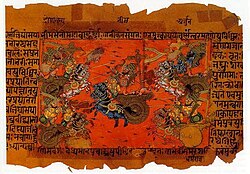
[[File:Kurukshetra.jpg|thumb|A manuscript depicting the climactic [[Kurukshetra War]] in [[Hindu epic]] ''[[Mahabharata]]''. The ''Mahabharata'' is the longest epic poem known and a key source of [[Hindu mythology]].]] | |||
The word ''myth'' has several meanings: | |||
# A traditional story of ostensibly historical events that serves to unfold part of the world view of a people or explain a practice, belief, or natural phenomenon; | |||
# A person or thing having only an imaginary or unverifiable existence; or | |||
# A metaphor for the spiritual potentiality in the human being.<ref>Joseph Campbell, ''The Power of Myth'', p. 22 {{ISBN|0-385-24774-5}}</ref> | |||
Ancient [[polytheistic]] religions, such as those of Greece, [[Ancient Rome|Rome]], and [[Scandinavia]], are usually categorized under the heading of [[mythology]]. Religions of pre-industrial peoples, or [[culture]]s in development, are similarly called myths in the [[anthropology of religion]]. The term myth can be used pejoratively by both religious and non-religious people. By defining another person's religious stories and beliefs as mythology, one implies that they are less real or true than one's own religious stories and beliefs. [[Joseph Campbell]] remarked, "Mythology is often thought of as ''other people's'' religions, and religion can be defined as misinterpreted mythology."<ref>Joseph Campbell, ''Thou Art That: Transforming Religious Metaphor''. Ed. Eugene Kennedy. New World Library {{ISBN|1-57731-202-3}}.</ref> | |||
In sociology, however, the term myth has a non-pejorative meaning. There, myth is defined as a story that is important for the group, whether or not it is objectively or provably true.<ref>{{cite web|url=https://www.britannica.com/topic/myth|title=myth|website=Encyclopædia Britannica|access-date=24 April 2016|archive-date=13 September 2021|archive-url=https://web.archive.org/web/20210913072251/https://www.britannica.com/topic/myth|url-status=live}}</ref> Examples include the [[resurrection]] of their real-life founder [[Jesus]], which, to Christians, explains the means by which they are freed from sin, is symbolic of the power of life over death, and is also said to be a historical event. But from a mythological outlook, whether or not the event actually occurred is unimportant. Instead, the [[symbol]]ism of the death of an old life and the start of a new life is most significant. Religious believers may or may not accept such symbolic interpretations. | |||
=== Practices === | |||
{{Main|Religious behaviour|Cult (religious practice)}} | |||
The practices of a religion may include [[ritual]]s, [[sermon]]s, commemoration or veneration of a [[deity]] (god or [[goddess]]), [[sacrifice]]s, [[festival]]s, [[Banquet|feasts]], [[trance]]s, [[initiation]]s, [[funeral|funerary services]], [[matrimony|matrimonial services]], [[meditation]], [[prayer]], [[religious music]], [[religious art]], [[sacred dance]], [[Community service|public service]], or other aspects of human culture.<ref name="OD">[https://oxforddictionaries.com/definition/english/mythology Oxford Dictionaries] {{Webarchive|url=https://web.archive.org/web/20160908182513/http://www.oxforddictionaries.com/definition/english/mythology |date=8 September 2016 }} mythology, retrieved 9 September 2012</ref> | |||
=== Social organisation === | |||
Religions have a societal basis, either as a living tradition which is carried by lay participants, or with an organized [[clergy]], and a definition of what constitutes adherence or membership. | |||
== Academic study == | |||
{{Main|Religious studies|Classifications of religious movements}} | |||
A number of disciplines study the phenomenon of religion: [[theology]], [[comparative religion]], [[history of religion]], [[evolutionary origin of religions]], [[anthropology of religion]], [[psychology of religion]] (including [[neurotheology|neuroscience of religion]] and [[evolutionary psychology of religion]]), [[law and religion]], and [[sociology of religion]]. | |||
Daniel L. Pals mentions eight classical theories of religion, focusing on various aspects of religion: [[animism]] and [[Magic (paranormal)|magic]], by [[Edward Burnett Tylor|E.B. Tylor]] and [[J.G. Frazer]]; the [[Psychoanalysis|psycho-analytic]] approach of [[Sigmund Freud]]; and further [[Émile Durkheim]], [[Karl Marx]], [[Max Weber]], [[Mircea Eliade]], [[E.E. Evans-Pritchard]], and [[Clifford Geertz]].{{sfn|Pals|2006}} | |||
[[Michael Stausberg]] gives an overview of contemporary theories of religion, including [[Cognitive science of religion|cognitive]] and biological approaches.{{sfn|Stausberg|2009}} | |||
=== Theories === | |||
{{Main|Theories of religion}} | |||
[[Sociology of religion|Sociological]] and [[Anthropology of religion|anthropological]] theories of religion generally attempt to explain the [[origin of religion|origin]] and [[social function|function of religion]].<ref>{{harvnb|Segal|2005|p=49}}</ref> These theories define what they present as universal characteristics of [[religious belief]] and [[Religious behaviour|practice]]. | |||
==== Origins and development ==== | |||
{{Main|History of religion}} | |||
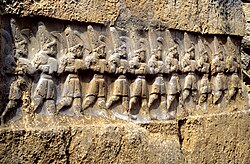
[[File:Yazilikaya B 12erGruppe.jpg|thumb|upright=1.15|The [[Yazılıkaya]] sanctuary in [[Turkey]], with the twelve gods of the underworld]] | |||
The origin of religion is uncertain. There are a number of theories regarding the subsequent origins of religious practices. | |||
According to [[anthropologists]] John Monaghan and Peter Just, "Many of the great world religions appear to have begun as revitalization movements of some sort, as the vision of a charismatic prophet fires the imaginations of people seeking a more comprehensive answer to their problems than they feel is provided by everyday beliefs. Charismatic individuals have emerged at many times and places in the world. It seems that the key to long-term success—and many movements come and go with little long-term effect—has relatively little to do with the prophets, who appear with surprising regularity, but more to do with the development of a group of supporters who are able to institutionalize the movement."<ref>{{cite book |title=Social & Cultural Anthropology |url=https://archive.org/details/socialculturalan00mona |url-access=limited |last1=Monaghan |first1=John |last2=Just |first2=Peter |year=2000 |publisher=Oxford University Press |location=New York |isbn=978-0-19-285346-2 |page=[https://archive.org/details/socialculturalan00mona/page/n136 126]}}</ref> | |||
The [[development of religion]] has taken different forms in different cultures. Some religions place an emphasis on belief, while others emphasize practice. Some religions focus on the subjective experience of the religious individual, while others consider the activities of the religious community to be most important. Some religions claim to be universal, believing their [[law]]s and [[cosmology]] to be binding for everyone, while others are intended to be practiced only by a closely defined or localized group. In many places, religion has been associated with public institutions such as [[education]], [[hospital]]s, the [[family]], [[government]], and [[politics|political]] hierarchies.<ref name=autogenerated1>{{cite book |title=Social & Cultural Anthropology |url=https://archive.org/details/socialculturalan00mona |url-access=limited |last1=Monaghan |first1=John |last2=Just |first2=Peter |year=2000 |publisher=Oxford University Press |location=New York |isbn=978-0-19-285346-2 |page=[https://archive.org/details/socialculturalan00mona/page/n134 124]}}</ref> | |||
Anthropologists John Monoghan and Peter Just state that, "it seems apparent that one thing religion or belief helps us do is deal with problems of human life that are significant, persistent, and intolerable. One important way in which religious beliefs accomplish this is by providing a set of ideas about how and why the world is put together that allows people to accommodate anxieties and deal with misfortune."<ref name=autogenerated1 /> | |||
==== Cultural system ==== | |||
While religion is difficult to define, one standard model of religion, used in [[religious studies]] courses, was proposed by [[Clifford Geertz]], who simply called it a "cultural system".<ref>Clifford Geertz, ''Religion as a Cultural System'', 1973</ref> A critique of Geertz's model by [[Talal Asad]] categorized religion as "an [[anthropology|anthropological]] category".<ref>Talal Asad, ''The Construction of Religion as an Anthropological Category'', 1982.</ref> Richard Niebuhr's (1894–1962) five-fold classification of the relationship between Christ and culture, however, indicates that religion and culture can be seen as two separate systems, though with some interplay.<ref>Richard Niebuhr, ''Christ and Culture'' (San Francisco: Harper & Row, 1951) as cited by Domenic Marbaniang, "The Gospel and Culture: Areas of Conflict, Consent, and Conversion", ''Journal of Contemporary Christian'' Vol. 6, No. 1 (Bangalore: CFCC, Aug 2014), {{ISSN|2231-5233}} pp. 9–10</ref> | |||
==== Social constructionism ==== | |||
{{Main|Theories about religions#Social constructionism|l1=Social constructionism}} | |||
One modern academic theory of religion, [[social constructionism]], says that religion is a modern concept that suggests all [[spirituality|spiritual]] practice and [[worship]] follows a model similar to the [[Abrahamic religions]] as an orientation system that helps to interpret reality and define human beings.<ref name="vergote 89">Vergote, Antoine, ''Religion, belief and unbelief: a psychological study'', Leuven University Press, 1997, p. 89</ref> Among the main proponents of this theory of religion are Daniel Dubuisson, Timothy Fitzgerald, Talal Asad, and Jason Ānanda Josephson. The social constructionists argue that religion is a modern concept that developed from Christianity and was then applied inappropriately to non-Western cultures. | |||
==== Cognitive science ==== | |||
{{Main|Cognitive science of religion}} | |||
{{Further|Religion and schizophrenia}} | |||
Cognitive science of religion is the study of religious thought and behavior from the perspective of the cognitive and evolutionary sciences.<ref>{{cite journal |last1=Barrett |first1=Justin L. |title=Cognitive Science of Religion: What Is It and Why Is It? |url=https://onlinelibrary.wiley.com/doi/abs/10.1111/j.1749-8171.2007.00042.x |journal=Religion Compass |access-date=10 January 2021 |pages=768–786 |language=en |doi=10.1111/j.1749-8171.2007.00042.x |date=2007 |volume=1 |issue=6 |archive-date=12 January 2021 |archive-url=https://web.archive.org/web/20210112011855/https://onlinelibrary.wiley.com/doi/abs/10.1111/j.1749-8171.2007.00042.x |url-status=live }}</ref> The field employs methods and theories from a very broad range of disciplines, including: [[cognitive psychology]], [[evolutionary psychology]], [[cognitive anthropology]], [[artificial intelligence]], [[cognitive neuroscience]], [[neurobiology]], [[zoology]], and [[ethology]]. Scholars in this field seek to explain how human minds acquire, generate, and transmit religious thoughts, practices, and schemas by means of ordinary cognitive capacities. | |||
[[Hallucination]]s and [[Religious delusion|delusions related to religious content]] occurs in about 60% of people with [[schizophrenia]]. While this number varies across cultures, this had led to theories about a number of influential religious phenomena and possible relation to psychotic disorders. A number of prophetic experiences are consistent with psychotic symptoms, although [[Retrospective diagnosis|retrospective diagnoses]] are practically impossible.<ref>{{cite journal|last1=Nicholson|first1=PT|title=Psychosis and paroxysmal visions in the lives of the founders of world religions.|journal=The Journal of Neuropsychiatry and Clinical Neurosciences|volume=26|issue=1|date=2014|pages=E13–14|doi=10.1176/appi.neuropsych.12120412|pmid=24515692}}</ref><ref>{{cite journal|last1=Murray|first1=ED|last2=Cunningham|first2=MG|last3=Price|first3=BH|title=The role of psychotic disorders in religious history considered.|journal=The Journal of Neuropsychiatry and Clinical Neurosciences|volume=24|issue=4|date=2012|pages=410–426|doi=10.1176/appi.neuropsych.11090214|pmid=23224447|s2cid=207654711}}</ref><ref>{{cite journal|last1=Weber|first1=SR|last2=Pargament|first2=KI|title=The role of religion and spirituality in mental health.|journal=Current Opinion in Psychiatry|date=September 2014|volume=27|issue=5|pages=358–363|doi=10.1097/YCO.0000000000000080|pmid=25046080|s2cid=9075314}}</ref> Schizophrenic episodes are also experienced by people who do not have belief in gods.<ref>{{cite journal|last1=Reina|first1=Aaron|title=Faith Within Atheism|journal=Schizophrenia Bulletin|date=July 2014|volume=40|issue=4|pages=719–720|doi=10.1093/schbul/sbt076|pmid=23760918|pmc=4059423}}</ref> | |||
Religious content is also common in [[temporal lobe epilepsy]], and [[obsessive–compulsive disorder|obsessive-compulsive disorder]].<ref>{{cite book|last1=Favazza|first1=A|editor1-last=Sadock|editor1-first=B|editor2-last=Sadock|editor2-first=V|editor3-last=Ruiz|editor3-first=P|title=Kaplan and Sadocks Comprehensive Textbook of Psychiatry|publisher=Wolters Kluwer|edition=10th|chapter=Psychiatry and Spirituality}}</ref><ref>{{cite journal|last1=Altschuler|first1=EL|title=Temporal lobe epilepsy in the priestly source of the Pentateuch|journal=South African Medical Journal|date=2004|volume=11|issue=94|page=870|pmid=15587438}}</ref><ref>{{Cite book |last=Sapolsky |first=Robert M. |author-link=Robert Sapolsky |chapter=Circling the Blanket for God |title=The Trouble with Testosterone: and Other Essays on the Biology of the Human Predicament |publisher=A Touchstone Book, Simon & Schuster |location=New York |year=1998 |pages=263–269 |isbn=978-0-684-83409-2 |url-access=registration |url=https://archive.org/details/troublewithtesto00sapo}}</ref> Atheistic content is also found to be common with temporal lobe epilepsy.<ref name="Heilman">{{cite book|last1=Heilman|first1=Kenneth M.|last2=Valenstein|first2=Edward |title=Clinical Neuropsychology|date=2011|publisher=Oxford University Press|language=en|isbn=978-0-19-538487-1|page=488|quote=Studies that claim to show no difference in emotional makeup between temporal lobe and other epileptic patients (Guerrant et al., 1962; Stevens, 1966) have been reinterpreted (Blumer, 1975) to indicate that there is, in fact, a difference: those with temporal lobe epilepsy are more likely to have more serious forms of emotional disturbance. This typical personality of temporal lobe epileptic patient has been described in roughly similar terms over many years (Blumer & Benson, 1975; Geschwind, 1975, 1977; Blumer, 1999; Devinsky & Schachter, 2009). These patients are said to have a deepening of emotions; they ascribe great significance to commonplace events. This can be manifested as a tendency to take a cosmic view; hyperreligiosity (or intensely professed atheism) is said to be common.}}</ref> | |||
=== Comparativism === | |||
{{Main|Comparative religion}} | |||
Comparative religion is the branch of the [[study of religions]] concerned with the systematic comparison of the doctrines and practices of the world's religions. In general, the comparative study of religion yields a deeper understanding of the fundamental philosophical concerns of religion such as [[ethics]], [[metaphysics]], and the nature and form of [[salvation]]. Studying such material is meant to give one a richer and more sophisticated understanding of human beliefs and practices regarding the [[sacred]], [[numinous]], [[spirituality|spiritual]] and [[Divinity|divine]].<ref>"Human beings' relation to that which they regard as holy, sacred, spiritual, and divine" [[Encyclopædia Britannica]] (online, 2006), cited after {{cite web |url=https://www.religionfacts.com/religion/quotes.htm |title=Definitions of Religion |website=Religion facts |access-date=16 February 2022 |archive-date=12 October 2014 |archive-url=https://web.archive.org/web/20141012135217/http://www.religionfacts.com/religion/quotes.htm |url-status=live }}</ref> | |||
In the field of comparative religion, a common geographical classification<ref name="EB" /> of the [[Major religious groups|main world religions]] includes [[Middle Eastern religions]] (including [[Zoroastrianism]] and [[Iranian religions]]), [[Indian religions]], [[East Asian religions]], African religions, American religions, Oceanic religions, and classical Hellenistic religions.<ref name="EB">{{cite encyclopedia| url = https://www.britannica.com/EBchecked/topic/497215/classification-of-religions/38029/Normative| title = Charles Joseph Adams, ''Classification of religions: geographical'', Encyclopædia Britannica| encyclopedia = Encyclopedia Britannica| access-date = 16 February 2022| archive-date = 7 November 2014| archive-url = https://web.archive.org/web/20141107202404/http://www.britannica.com/EBchecked/topic/497215/classification-of-religions/38029/Normative| url-status = live}}</ref> | |||
== Classification == | |||
{{Main|History of religion}} | |||
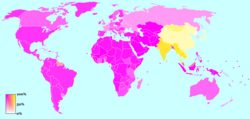
[[File:Prevailing religious population by country percentage.svg|thumb|upright=2|A map of [[List of religious populations|major denominations and religions of the world]]{{Needs update|date=June 2025|reason=Information from the source from 2015 and is therefore 10 years old, the map needs an update}}]] | |||
In the 19th and 20th centuries, the academic practice of [[comparative religion]] divided religious belief into philosophically defined categories called world religions. Some academics [[Study of religion|studying the subject]] have divided religions into three broad categories: | |||
# [[World religions]], a term which refers to [[Transculturation|transcultural]], international religions; | |||
# [[Indigenous religions]], which refers to smaller, culture-specific or nation-specific religious groups; and | |||
# [[New religious movements]], which refers to recently developed religions.<ref>[[Graham Harvey (religious studies scholar)|Harvey, Graham]] (2000). ''Indigenous Religions: A Companion''. (Ed: Graham Harvey). London and New York: Cassell. p. 6.</ref> | |||
Some recent scholarship has argued that not all types of religion are necessarily separated by mutually exclusive philosophies, and furthermore that the utility of ascribing a practice to a certain philosophy, or even calling a given practice religious, rather than cultural, political, or social in nature, is limited.<ref name="pennington">Brian Kemble Pennington ''Was Hinduism Invented?'' New York: Oxford University Press US, 2005. {{ISBN|0-19-516655-8}}</ref><ref>Russell T. McCutcheon. ''Critics Not Caretakers: Redescribing the Public Study of Religion''. Albany: SUNY Press, 2001.</ref><ref>Nicholas Lash. ''The beginning and the end of 'religion'.'' Cambridge University Press, 1996. {{ISBN|0-521-56635-5}}</ref> The current state of psychological study about the nature of religiousness suggests that it is better to refer to religion as a largely invariant phenomenon that should be distinguished from cultural norms (i.e. religions).<ref>Joseph Bulbulia. "Are There Any Religions? An Evolutionary Explanation." ''Method & Theory in the Study of Religion'' 17.2 (2005), pp. 71–100</ref>{{clarify|What is meant here by "i.e. religions"? To what does it refer?|date=August 2022}} | |||
=== Morphological classification === | |||
Some [[Religious studies|religion scholars]] classify religions as either ''[[Universalizing religion|universal religions]]'' that seek worldwide acceptance and actively look for new [[Religious conversion|converts]], such as the Baháʼí Faith, Buddhism, Christianity, Islam, and Jainism, while ''[[ethnic religion]]s'' are identified with a particular ethnic group and do not seek converts.<ref name="Hinnells">{{cite book |first=Chris |last=Park |chapter=Religion and Geography |title=The Routledge companion to the study of religion |editor-last=Hinnells |editor-first=John R. |year=2005 |publisher=Routledge |isbn=978-0-415-33311-5 |pages=439–440 |url=https://books.google.com/books?id=IGspjXKxIf8C |access-date=7 September 2020 |archive-date=9 May 2016 |archive-url=https://web.archive.org/web/20160509023830/https://books.google.com/books?id=IGspjXKxIf8C |url-status=live }}</ref><ref>{{cite journal |first=Peter |last=Flügel |title=The Invention of Jainism: A Short History of Jaina Studies |journal=International Journal of Jaina Studies |volume=1 |issue=1 |year=2005 |pages=1–14 |url=https://www.soas.ac.uk/ijjs/archive/file32517.pdf |access-date=8 March 2019 |archive-date=1 December 2017 |archive-url=https://web.archive.org/web/20171201182630/https://www.soas.ac.uk/ijjs/archive/file32517.pdf |url-status=live }}</ref> Others reject the distinction, pointing out that all religious practices, whatever their philosophical origin, are ethnic because they come from a particular culture.<ref>Timothy Fitzgerald. ''The Ideology of Religious Studies''. New York: Oxford University Press US, 2000.</ref><ref>Craig R. Prentiss. ''Religion and the Creation of Race and Ethnicity''. New York: NYU Press, 2003. {{ISBN|0-8147-6701-X}}</ref><ref>Tomoko Masuzawa. ''The Invention of World Religions, or, How European Universalism Was Preserved in the Language of Pluralism''. Chicago: University of Chicago Press, 2005. {{ISBN|0-226-50988-5}}</ref> | |||
=== Demographic classification === | |||
{{Main|Major religious groups|List of religious populations}} | |||
{{multipleimage | |||
| perrow = 2 | |||
| total_width = 335 | |||
| footer = Example of followers of popular and [[world religions]], from top-left: [[Christians]], [[Muslims]], [[Hindus]], [[Buddhism|Buddhists]], [[Sikhs]], and [[Jews]]. | |||
| image1 = Via Dolorosa, Jerusalem.jpg | |||
| image2 = The Umayyad Mosque, Muslim Women, Damascus, Syria.jpg | |||
| image3 = Hindu marriage ceremony offering.jpg | |||
| image4 = Incense-LE.jpg | |||
| image5 = Sikh people.jpg | |||
| image6 = Western Wall, Jerusalem, (16037897867).jpg | |||
}} | |||
The five largest religious groups by world population, estimated to account for 5.8 billion people and 84% of the population, are Christianity, Islam, Buddhism, Hinduism (with the relative numbers for Buddhism and Hinduism dependent on the extent of [[syncretism]]), and traditional folk religions. | |||
{| class="wikitable sortable" | |||
|- | |||
! Five largest religions | |||
! 2015 (billion)<ref>{{cite web |title=Christians are the largest religious group in 2015 |url=https://www.pewresearch.org/religion/2017/04/05/the-changing-global-religious-landscape/pf_17-04-05_projectionsupdate_grl310px/ |website=Pew Research Center |access-date=8 July 2022 |archive-date=8 July 2022 |archive-url=https://web.archive.org/web/20220708123444/https://www.pewresearch.org/religion/2017/04/05/the-changing-global-religious-landscape/pf_17-04-05_projectionsupdate_grl310px/ |url-status=live }}</ref> | |||
! 2015 (%) | |||
! Demographics | |||
|- | |||
| [[Christianity]] | |||
| 2.3 | |||
| 31% | |||
| [[Christianity by country]] | |||
|- | |||
| [[Islam]] | |||
| 1.8 | |||
| 24% | |||
| [[Islam by country]] | |||
|- | |||
| [[Hinduism]] | |||
| 1.1 | |||
| 15% | |||
| [[Hinduism by country]] | |||
|- | |||
| [[Buddhism]] | |||
| 0.5 | |||
| 6.9% | |||
| [[Buddhism by country]] | |||
|- | |||
| [[Folk religion]] | |||
| 0.4 | |||
| 5.7% | |||
| | |||
|- | |||
| Total | |||
| 6.1 | |||
| 83% | |||
| [[Religions by country]] | |||
|} | |||
[[File:Abraham Dharma.png|thumb|A rough split of the world among belief systems: [[Abrahamic religions|Abrahamic]] in pink, [[Indian religions|Indian]] in yellow.]] | |||
A global poll in 2012 surveyed 57 countries and reported that 59% of the world's population identified as religious, 23% as [[Irreligion|not religious]], 13% as convinced [[Atheism|atheists]], and also a 9% decrease in identification as religious when compared to the 2005 average from 39 countries.<ref name="gia">{{cite web |url= https://www.wingia.com/web/files/richeditor/filemanager/Global_INDEX_of_Religiosity_and_Atheism_PR__6.pdf |title= Global Index of Religiosity and Atheism |publisher= WIN-Gallup International |date= 27 July 2012 |access-date= 24 August 2012 |url-status=dead |archive-url= https://web.archive.org/web/20120906165952/https://www.wingia.com/web/files/richeditor/filemanager/Global_INDEX_of_Religiosity_and_Atheism_PR__6.pdf |archive-date= 6 September 2012}}</ref> A follow-up poll in 2015 found that 63% of the globe identified as religious, 22% as not religious, and 11% as convinced atheists.<ref name="GallupInt2015">{{cite web|title=Losing our Religion? Two-Thirds of People Still Claim to be Religious|url=https://www.wingia.com/web/files/news/290/file/290.pdf|website=WIN/Gallup International|date=13 April 2015|url-status=dead|archive-url=https://web.archive.org/web/20150430232945/https://www.wingia.com/web/files/news/290/file/290.pdf|archive-date=30 April 2015}}</ref> On average, women are more religious than men.<ref>{{cite web|url=https://www.livescience.com/7689-women-religious-men.html|title=Women More Religious Than Men|work=Live Science|date=28 February 2009|access-date=14 July 2013|archive-date=8 July 2013|archive-url=https://web.archive.org/web/20130708085942/http://www.livescience.com/7689-women-religious-men.html|url-status=live}}</ref> Some people follow multiple religions or multiple religious principles at the same time, regardless of whether or not the religious principles they follow traditionally allow for [[syncretism]].<ref>''Soul Searching: The Religious and Spiritual Lives of American Teenagers'' – p. 77, Christian Smith, Melina Lundquist Denton – 2005</ref><ref>"Christ in Japanese Culture: Theological Themes" in Shusaku Endo's ''Literary Works'', Emi Mase-Hasegawa – 2008</ref><ref>[https://www.christianpost.com/news/new-poll-reveals-how-churchgoers-mix-eastern-new-age-beliefs-42215/ New poll reveals how churchgoers mix eastern new age beliefs] {{Webarchive|url=https://web.archive.org/web/20220122041129/https://www.christianpost.com/news/new-poll-reveals-how-churchgoers-mix-eastern-new-age-beliefs-42215/ |date=22 January 2022 }} retrieved 26 July 2013</ref> Unaffiliated populations are projected to drop, even when taking disaffiliation rates into account, due to differences in birth rates.<ref>{{cite news |title=Islam set to become world's largest religion by 2075, study suggests |url=https://www.theguardian.com/world/2017/apr/05/muslim-population-overtake-christian-birthrate-20-years |access-date=20 March 2021 |work=The Guardian |date=5 April 2017 |language=en |archive-date=14 April 2021 |archive-url=https://web.archive.org/web/20210414064511/https://www.theguardian.com/world/2017/apr/05/muslim-population-overtake-christian-birthrate-20-years |url-status=live }}</ref><ref>{{cite news |title=The Changing Global Religious Landscape |url=https://www.pewforum.org/2017/04/05/the-changing-global-religious-landscape/ |access-date=21 March 2021 |work=[[Pew Research Center]]'s Religion & Public Life Project |date=5 April 2017 |archive-date=28 September 2021 |archive-url=https://web.archive.org/web/20210928225648/http://www.pewforum.org/2017/04/05/the-changing-global-religious-landscape/ |url-status=live }}</ref> | |||
Scholars have indicated that [[Desecularization|global religiosity may be increasing]] due to religious countries having higher birth rates in general.<ref name="CambridgeZuckerman2">{{cite book |last=Zuckerman |first=Phil |title=The Cambridge Companion to Atheism |date=2006 |isbn=978-1139001182 |editor1-last=Martin |editor1-first=Michael |pages=47–66 |chapter=3 - Atheism: Contemporary Numbers and Patterns |doi=10.1017/CCOL0521842700.004}}</ref> | |||
== Specific religions == | |||
{{Main|List of religions and spiritual traditions}} | |||
[[File:2020+ Proportion of people in world religions.svg |thumb |Global percentage of adherents by religion<ref name=Pew_20250609>{{cite web |last1=Hackett |first1=Conrad |last2=Stonawski |first2=Marcin |last3=Tong |first3=Yunping |last4=Kramer |first4=Stephanie |last5=Shi |first5=Anne |last6=Fahmy |first6=Dalia |title=How the Global Religious Landscape Changed From 2010 to 2020 |url=https://www.pewresearch.org/religion/2025/06/09/how-the-global-religious-landscape-changed-from-2010-to-2020/ |publisher=Pew Research Center |archive-url=https://web.archive.org/web/20260222070137/https://www.pewresearch.org/religion/2025/06/09/how-the-global-religious-landscape-changed-from-2010-to-2020/ |archive-date=22 February 2026 |date=9 June 2025 |url-status=live |quote=Source: Pew Research Center estimates based on more than 2,700 censuses and surveys. "How the Global Religious Landscape Changed From 2010 to 2020"}}</ref>]] | |||
=== Abrahamic === | |||
[[File:Molnár Ábrahám kiköltözése 1850.jpg|thumb|The patriarch [[Abraham]] (by [[József Molnár (painter)|József Molnár]])]] | |||
[[Abrahamic religions]] are [[monotheistic]] religions which believe they descend from [[Abraham]]. | |||
==== Judaism ==== | |||
{{Main|Judaism}} | |||
[[File:Open Torah and pointer.jpg|thumb|left|The [[Torah]] is the primary sacred text of Judaism.]] | |||
[[Judaism]] is the oldest Abrahamic religion, originating in the people of [[History of ancient Israel and Judah|ancient Israel and Judah]].<ref name="britannica.com">{{cite web |title=Judaism {{!}} Definition, Origin, History, Beliefs, & Facts |url=https://www.britannica.com/topic/Judaism |website=Encyclopedia Britannica |access-date=10 January 2021 |language=en |archive-date=1 January 2021 |archive-url=https://web.archive.org/web/20210101160152/https://www.britannica.com/topic/Judaism |url-status=live }}</ref> The [[Torah]] is its foundational text, and is part of the larger text known as the [[Tanakh]] or [[Hebrew Bible]]. It is supplemented by oral tradition, set down in written form in later texts such as the [[Midrash]] and the [[Talmud]]. Judaism includes a wide corpus of texts, practices, theological positions, and forms of organization. Within Judaism there are a variety of movements, most of which emerged from [[Rabbinic Judaism]], which holds that God revealed his laws and [[613 Mitzvot|commandments]] to [[Moses]] on [[Biblical Mount Sinai|Mount Sinai]] in the form of both the [[Torah|Written]] and [[Oral Torah]]; historically, this assertion was challenged by various groups. The [[Jewish people]] were scattered after the destruction of the [[Temple in Jerusalem]] in 70 CE. Today there are about 13 million Jews, about 40 per cent living in Israel and 40 per cent in the United States.<ref>{{cite web |url=https://www.cbs.gov.il/shnaton61/st02_27.pdf |title=Info |website=www.cbs.gov.il |access-date=22 March 2011 |archive-url=https://web.archive.org/web/20111026202909/https://www.cbs.gov.il/shnaton61/st02_27.pdf |archive-date=26 October 2011 |url-status=dead }}</ref> The largest [[Jewish religious movements]] are [[Orthodox Judaism]] ([[Haredi Judaism]] and [[Modern Orthodox Judaism]]), [[Conservative Judaism]] and [[Reform Judaism]].<ref name="britannica.com" /> | |||
==== Christianity ==== | |||
[[File:ISR-2013-Jerusalem-Holy Sepulchre-dome.jpg|thumb|Jesus is the central figure of Christianity.]] | |||
[[Christianity]] is based on the life and teachings of [[Jesus]] of Nazareth (1st century) as presented in the New Testament.<ref name="Christianity">{{cite web |title=Christianity {{!}} Definition, Origin, History, Beliefs, Symbols, Types, & Facts |url=https://www.britannica.com/topic/Christianity |website=Encyclopedia Britannica |access-date=10 January 2021 |language=en |archive-date=1 November 2014 |archive-url=https://web.archive.org/web/20141101193717/http://www.britannica.com/EBchecked/topic/115240/Christianity/67592/Forms-of-Christian-education |url-status=live }}</ref> The Christian faith is essentially faith in Jesus as the [[Christ]],<ref name="Christianity" /> the [[Son of God (Christianity)|Son of God]], and as [[Messiah|Savior]] and Lord. Almost all Christians believe in the [[Trinity]], which teaches the unity of [[God the Father|Father]], [[God the Son|Son]] (Jesus Christ), and [[Holy Spirit in Christianity|Holy Spirit]] as three persons in [[Godhead in Christianity|one Godhead]]. Most Christians can describe their faith with the [[Nicene Creed]]. As the religion of [[Byzantine Empire]] in the first millennium and of [[Western Europe]] during the time of colonization, Christianity has been propagated throughout the world via [[Christian mission|missionary work]].<ref name="Spread">{{cite book|url = https://books.google.com/books?id=g2AtOlJMPTUC&pg=PA52|title = Muslim-Christian Relations|publisher = Amsterdam University Press|quote = The enthusiasm for evangelization among the Christians was also accompanied by the awareness that the most immediate problem to solve was how to serve the huge number of new [[Conversion to Christianity|converts]]. Simatupang said, if the number of the Christians were double or triple, then the number of the ministers should also be doubled or tripled and the role of the laity should be maximized and Christian service to society through schools, universities, hospitals and orphanages, should be increased. In addition, for him the Christian mission should be involved in the struggle for justice amid the process of modernization.|access-date = 18 October 2007|isbn = 978-90-5356-938-2|year = 2006|archive-date = 20 June 2013|archive-url = https://web.archive.org/web/20130620150610/http://books.google.com/books?id=g2AtOlJMPTUC&pg=PA52|url-status = live}}</ref><ref name="Charity">{{cite book|url = https://books.google.com/books?id=WmuV6g0yR3sC&pg=PA77|page = 77|author = Fred Kammer|title = Doing Faith Justice|publisher = [[Paulist Press]]|quote = Theologians, bishops, and preachers urged the Christian community to be as compassionate as their God was, reiterating that creation was for all of humanity. They also accepted and developed the identification of Christ with the poor and the requisite Christian duty to the poor. Religious congregations and individual charismatic leaders promoted the development of a number of helping institutions-hospitals, hospices for [[Christian pilgrimage|pilgrims]], orphanages, shelters for unwed mothers-that laid the foundation for the modern "large network of hospitals, orphanages and schools, to serve the poor and society at large."|access-date = 18 October 2007|isbn = 978-0-8091-4227-9|date = 2004|archive-date = 26 January 2021|archive-url = https://web.archive.org/web/20210126184216/https://books.google.com/books?id=WmuV6g0yR3sC&pg=PA77|url-status = live}}</ref><ref name="Service">{{cite book|url = https://books.google.com/books?id=dz_EM2ofIb4C&pg=PA132|title = Christian Church Women: Shapers of a Movement|publisher = Chalice Press|quote = In the central provinces of India they established schools, orphanages, hospitals, and churches, and spread the gospel message in zenanas.|access-date = 18 October 2007|isbn = 978-0-8272-0463-8|date = March 1994|archive-date = 20 June 2013|archive-url = https://web.archive.org/web/20130620110214/http://books.google.com/books?id=dz_EM2ofIb4C&pg=PA132|url-status = live}}</ref> It is the [[Major religious groups|world's largest religion]], with about 2.3 billion followers as of 2015.<ref>{{cite web|url=https://www.pewresearch.org/fact-tank/2017/04/05/christians-remain-worlds-largest-religious-group-but-they-are-declining-in-europe/|title=World's largest religion by population is still Christianity|website=Pew Research Center|date=5 April 2017 |language=en-US|access-date=27 February 2019|archive-date=24 November 2019|archive-url=https://web.archive.org/web/20191124021738/https://www.pewresearch.org/fact-tank/2017/04/05/christians-remain-worlds-largest-religious-group-but-they-are-declining-in-europe/|url-status=live}}</ref> The main divisions of Christianity are, according to the number of adherents:<ref name="history.com">{{cite web |title=Christianity |url=https://www.history.com/topics/religion/history-of-christianity#:~:text=Christianity%20is%20broadly%20split%20into,Catholic%20bishops%20around%20the%20world. |website=HISTORY | date=13 October 2017 |access-date=10 January 2021 |language=en |archive-date=11 January 2021 |archive-url=https://web.archive.org/web/20210111205557/https://www.history.com/topics/religion/history-of-christianity#:~:text=Christianity%20is%20broadly%20split%20into,Catholic%20bishops%20around%20the%20world. |url-status=live }}</ref> | |||
* The [[Catholic Church]], led by the [[Bishop of Rome]] and the bishops worldwide in communion with him, is a [[Communion (Christian)|communion]] of 24 Churches ''[[sui iuris]]'', including the [[Latin Church]] and 23 [[Eastern Catholic Churches|Eastern Catholic churches]], such as the [[Maronite]] Catholic Church.<ref name="history.com" /> | |||
* [[Eastern Christianity]], which include [[Eastern Orthodoxy]], [[Oriental Orthodoxy]], and the [[Church of the East]]. | |||
* [[Protestantism]], separated from the Catholic Church in the 16th-century [[Protestant Reformation]] and is split into thousands of [[Religious denomination|denominations]]. Major branches of Protestantism include [[Anglicanism]], [[Baptists]], [[Calvinism]], [[Lutheranism]], and [[Methodism]], though each of these contain many different denominations or groups.<ref name="history.com" /> | |||
There are also smaller groups, including: | |||
* [[Restorationism]], the belief that Christianity should be restored (as opposed to reformed) along the lines of what is known about the [[Apostolic Age|apostolic early church]]. | |||
* [[Latter-day Saint movement]], founded by [[Joseph Smith]] in the late 1820s. | |||
* [[Jehovah's Witnesses]], founded in the late 1870s by [[Charles Taze Russell]]. | |||
==== Islam ==== | |||
[[File:The Kaaba during Hajj - edited.jpg|alt=|thumb|220x220px|[[Muslim]]s [[Tawaf|circumambulating]] the [[Kaaba]] in [[Mecca]], [[Saudi Arabia]], the [[Holiest sites in Islam|most sacred site]] in [[Islam]]]] | |||
[[Islam]] is a [[Monotheism|monotheistic]]<ref name="Islam">{{cite web |title=Islam |url=https://www.history.com/topics/religion/islam#:~:text=The%20word%20%E2%80%9CIslam%E2%80%9D%20means%20%E2%80%9C,of%20complete%20submission%20to%20Allah. |website=HISTORY | date=5 January 2018 |access-date=10 January 2021 |language=en |archive-date=3 May 2020 |archive-url=https://web.archive.org/web/20200503051151/https://www.history.com/topics/religion/islam#:~:text=The%20word%20%E2%80%9CIslam%E2%80%9D%20means%20%E2%80%9C,of%20complete%20submission%20to%20Allah. |url-status=live }}</ref> religion based on the [[Quran]],<ref name="Islam" /> one of the [[Islamic holy books|holy books]] considered by Muslims to be [[Wahy|revealed]] by [[God in Islam|God]], and on the [[Hadith|teachings (hadith)]] of the [[Prophets of Islam|Islamic prophet]] [[Muhammad]], a major political and religious figure of the 7th century CE. Islam is based on the unity of all religious philosophies and accepts all of the [[Abrahamic religions|Abrahamic]] prophets of Judaism, Christianity and other Abrahamic religions before [[Muhammad]]. It is the most widely practiced religion of [[Southeast Asia]], [[North Africa]], [[Western Asia]], and [[Central Asia]], while [[Muslim-majority countries]] also exist in parts of [[South Asia]], [[Sub-Saharan Africa]], and [[Southeast Europe]]. There are also several [[Islamic republic]]s, including [[Iran]], [[Pakistan]], [[Mauritania]], and [[Afghanistan]]. With about 1.8 billion followers (2015), almost a quarter of [[world population|earth's population]] are [[Muslims]].<ref>{{cite web|url=http://www.pewforum.org/2017/04/05/the-changing-global-religious-landscape/|website=Pew Research Center|date=5 April 2017|title=The Changing Global Religious Landscape|access-date=20 October 2018|archive-date=6 April 2017|archive-url=https://web.archive.org/web/20170406033738/http://www.pewforum.org/2017/04/05/the-changing-global-religious-landscape/|url-status=live}}</ref> | |||
* [[Sunni Islam]] is the largest denomination within Islam and follows the Qur'an, the ahadith (plural of Hadith) which record the [[sunnah]], whilst placing emphasis on the [[sahabah]]. | |||
* [[Shia Islam]] is the second largest denomination of Islam and its adherents believe that [[Ali]] succeeded Muhammad and further places emphasis on Muhammad's family. | |||
* There are also Muslim revivalist movements such as [[Muwahhidism]] and [[Salafism]]. | |||
Other denominations of Islam include [[Nation of Islam]], [[Ibadi]], [[Sufism]], [[Quranism]], [[Mahdavia]], [[Ahmadiyya]] and [[non-denominational Muslims]]. [[Wahhabism]] is the dominant Muslim [[Maddhab|schools of thought]] in the [[Kingdom of Saudi Arabia]]. | |||
==== Other ==== | |||
Judaism, Christianity, and Islam are the three most popular Abrahamic faiths, however there are smaller and newer traditions that lay claim to the designation of Abrahamic as well.<ref>{{harvnb|Massignon|1949|pp=20–23}}</ref> | |||
[[File:Lotus Temple in New Delhi 03-2016.jpg|thumb|The [[Baháʼí Faith|Baháʼí]] Lotus Temple in Delhi]] | |||
For example, the [[Baháʼí Faith]], though often called a [[new religious movement]], claims to be a world religion from the line of major Abrahamic religions, while recognizing the Indo-Iranian traditions (Hinduism, Buddhism, Zoroastrianism). Founded in 19th-century Iran, it teaches the unity of all great religious traditions as the progressive unfolding of one religion<ref name="bahai.org">{{cite web |title=What Bahá'ís Believe {{!}} The Bahá'í Faith |url=https://www.bahai.org/beliefs/ |website=www.bahai.org |access-date=11 January 2021 |archive-date=13 April 2021 |archive-url=https://web.archive.org/web/20210413230539/https://www.bahai.org/beliefs/ |url-status=live }}</ref> and accepts all of the prophets of Judaism, Christianity, and Islam as well as additional prophets (Krishna, Buddha, Zoroaster), including its founder [[Bahá'u'lláh]]. Its initial phase as [[Bábism]] forms an integral part of its history.<ref>{{cite book |last=Stockman |first=Robert H. |date=2013 |title=The Bahá'í Faith: A Guide for the Perplexed |location=London |publisher=Bloomsbury |page=31-43 |isbn=9781441192011}}</ref> | |||
[[File:PikiWiki Israel 45144 Nabi Shuayb.JPG|thumb|The shrine of [[Nabi Shu'ayb]] complex is revered as the foremost religious site in the [[Druze]] religion]] | |||
Even smaller regional Abrahamic groups also exist, including [[Samaritanism]] (primarily in Israel and the [[State of Palestine]]), the [[Rastafari movement]] (primarily in Jamaica), and [[Druze]] (primarily in [[Druze in Syria|Syria]], [[Druze in Lebanon|Lebanon]], and [[Druze in Israel|Israel]]). | |||
The Druze faith originally developed out of [[Isma'ilism]], and it has sometimes been considered an [[Islamic schools and branches|Islamic school]] by some Islamic authorities, but Druze themselves do not identify as [[Muslims]].<ref name="Incorporated-1996">{{cite book|author=[[James R. Lewis (scholar)|James Lewis]]|title=The Encyclopedia of Cults, Sects, and New Religions|url=https://books.google.com/books?isbn=1615927387|access-date=13 May 2015|year=2002|publisher=[[Prometheus Books]]}}</ref><ref>{{cite web |title=Are the Druze People Arabs or Muslims? Deciphering Who They Are |url=https://www.arabamerica.com/are-the-druze-people-arabs-or-muslims-deciphering-who-they-are/ |website=Arab America |access-date=13 April 2020 |language=en |date=8 August 2018 |archive-date=20 October 2019 |archive-url=https://web.archive.org/web/20191020060455/https://www.arabamerica.com/are-the-druze-people-arabs-or-muslims-deciphering-who-they-are/ |url-status=live }}</ref><ref>{{cite book|title= The Political Role of Minority Groups in the Middle East|first=Ronald|last= De McLaurin|year= 1979| isbn= 978-0-03-052596-4| page =114 |publisher=Michigan University Press|quote= Theologically, one would have to conclude that the Druze are not Muslims. They do not accept the five pillars of Islam. In place of these principles the Druze have instituted the seven precepts noted above.}}</ref><ref>{{cite book|title=The Middle East Today: Political, Geographical and Cultural Perspectives| first=Dona|last= J. Stewart|year=2008| isbn=9781135980795| page = 33|publisher=Routledge|quote= Druze do not consider themselves Muslim. Historically they faced much persecution and keep their religious beliefs secrets.}}</ref> Scholars classify the Druze faith as an independent Abrahamic religion because it developed its own unique doctrines and eventually separated from both Isma'ilism and Islam altogether.<ref>{{cite journal |last=Poonawala |first=Ismail K. |date=July–September 1999 |title=Review: ''The Fatimids and Their Traditions of Learning'' by Heinz Halm |journal=[[Journal of the American Oriental Society]] |publisher=[[American Oriental Society]] |volume=119 |issue=3 |page=542 |doi=10.2307/605981 |issn=0003-0279 |jstor=605981 |lccn=12032032 |oclc=47785421}}</ref><ref>{{cite web|url=https://rpl.hds.harvard.edu/faq/druze-syria|title=Druze in Syria|date=|publisher=Harvard University|quote=The Druze are an ethnoreligious group concentrated in Syria, Lebanon, and Israel with around one million adherents worldwide. The Druze follow a millenarian offshoot of Isma'ili Shi'ism. Followers emphasize Abrahamic monotheism but consider the religion as separate from Islam.|access-date=13 July 2024|archive-date=21 October 2020|archive-url=https://web.archive.org/web/20201021033846/https://rpl.hds.harvard.edu/faq/druze-syria|url-status=dead}}</ref> One of these doctrines includes the belief that [[Al-Hakim bi-Amr Allah|Al-Ḥākim bi-Amr Allāh]] was an [[Incarnation|incarnation of God]].<ref>{{cite journal | last = Bryer | first = David R. W. | title = The Origins of the Druze Religion (Fortsetzung) | journal = [[Der Islam]] | year = 1975 | volume = 52 | issue = 2 | pages = 239–262 | doi = 10.1515/islm.1975.52.2.239 | s2cid = 162363556 | url = https://doi.org/10.1515/islm.1975.52.2.239 | issn = 1613-0928 | ref = {{harvid|Bryer|1975b}} | archive-date = 8 December 2022 | access-date = 13 July 2024 | archive-url = https://web.archive.org/web/20221208041734/https://doi.org/10.1515%2Fislm.1975.52.2.239 | url-status = live }}</ref> | |||
[[Mandaeism]], sometimes also known as Sabianism (after the mysterious [[Sabians]] mentioned in the Quran, a name historically claimed by several religious groups),<ref>{{cite encyclopedia|last1=De Blois|first1=François|year=1960–2007|title=Ṣābiʾ|editor1-last=Bearman|editor1-first=P.|editor1-link=Peri Bearman|editor2-last=Bianquis|editor2-first=Th.|editor2-link=Thierry Bianquis|editor3-last=Bosworth|editor3-first=C.E.|editor3-link=Clifford Edmund Bosworth|editor4-last=van Donzel|editor4-first=E.|editor4-link=Emeri Johannes van Donzel|editor5-last=Heinrichs|editor5-first=W.P.|editor5-link=Wolfhart Heinrichs|encyclopedia=Encyclopaedia of Islam, Second Edition|doi=10.1163/1573-3912_islam_COM_0952}} {{cite book|last1=Van Bladel|first1=Kevin|year=2017|title=From Sasanian Mandaeans to Ṣābians of the Marshes|location=Leiden|publisher=Brill|doi=10.1163/9789004339460|isbn=978-90-04-33943-9|url=https://brill.com/view/title/34389|access-date=19 June 2022|archive-date=1 June 2022|archive-url=https://web.archive.org/web/20220601074236/https://brill.com/view/title/34389|url-status=live}} p. 5.</ref> is a [[Gnosticism|Gnostic]], [[monotheistic]] and [[ethnic religion]].<ref name="Mandaens">{{cite book |last=Buckley |first=Jorunn Jacobsen |author-link= |year=2002 |chapter=Part I: Beginnings – Introduction: The Mandaean World |chapter-url=https://books.google.com/books?id=I9G-zLZRMLQC&pg=PA3 |title=The Mandaeans: Ancient Texts and Modern People |location=[[New York City|New York]] |publisher=[[Oxford University Press]] on behalf of the [[American Academy of Religion]] |doi=10.1093/0195153855.003.0001 |pages=1–20 |isbn=978-0-19-515385-9 |oclc=57385973 |access-date=17 December 2021 |archive-date=8 December 2021 |archive-url=https://web.archive.org/web/20211208175543/https://books.google.com/books?id=I9G-zLZRMLQC&pg=PA3 |url-status=live }}</ref>{{rp|4}}<ref name=Ginza>{{cite book|title=[[Ginza Rabba]]|translator1-last=Al-Saadi |translator1-first=Qais |translator2-last=Al-Saadi |translator2-first=Hamed |edition=2nd |place=Germany |year=2019 |publisher=Drabsha}}</ref>{{rp|1}} Its adherents, the [[Mandaeans]], consider [[John the Baptist]] to be their chief prophet.<ref name="Mandaens" /> Mandaeans are the last surviving Gnostics from antiquity.<ref name=McGrath>{{Citation|last=McGrath|first=James|title=The First Baptists, The Last Gnostics: The Mandaeans|website=YouTube-A lunchtime talk about the Mandaeans by Dr. James F. McGrath at Butler University|date=23 January 2015|url=https://www.youtube.com/watch?v=gvv6I02MNlc|access-date=16 December 2021|archive-date=4 November 2021|archive-url=https://web.archive.org/web/20211104131705/https://www.youtube.com/watch?v=gvv6I02MNlc|url-status=live}}</ref> | |||
=== East Asian === | |||
{{Main|East Asian religions}} | |||
East Asian religions (also known as Far Eastern religions or Taoic religions) consist of several religions of East Asia which make use of the concept of Tao (in Chinese), Dō (in Japanese or Korean) or Đạo (in Vietnamese). They include: | |||
==== Taoism and Confucianism ==== | |||
[[File:Beijing China Hall-of-Prayer-for-Good-Harvests-01.jpg|thumb|The [[Temple of Heaven]], a Taoist [[temple]] complex in Beijing]] | |||
* [[Taoism]] and [[Confucianism]], as well as Korean, Vietnamese, and Japanese religion influenced by Chinese thought. | |||
==== Folk religions ==== | |||
[[Chinese folk religion]]: the indigenous religions of the [[Han Chinese]], or, by [[metonymy]], of all the populations of the [[Chinese cultural sphere]]. It includes the syncretism of [[Confucianism]], [[Taoism]] and [[Buddhism]], [[Wuism]], as well as many new religious movements such as [[Chen Tao (UFO religion)|Chen Tao]], [[Falun Gong]] and [[Yiguandao]]. | |||
Other folk and new religions of [[East Asia]] and [[Southeast Asia]] such as [[Korean shamanism]], [[Chondogyo]], and [[Jeung San Do]] in Korea; [[indigenous Philippine folk religions]] in the [[Philippines]]; [[Shinto]], [[Shugendo]], [[Ryukyuan religion]], and [[Japanese new religions]] in Japan; [[Satsana Phi]] in Laos; [[Vietnamese folk religion]], and [[Cao Đài]], [[Hòa Hảo]] in Vietnam. | |||
=== Indian religions === | |||
[[Indian religions]] are practiced or were founded in the [[Indian subcontinent]]. They are sometimes classified as the ''dharmic religions'', as they all feature [[dharma]], the specific law of reality and duties expected according to the religion.<ref>{{cite book |last=Mittal |first=Sushil |title=Surprising Bedfellows: Hindus and Muslims in Medieval and Early Modern India |year=2003 |publisher=Lexington Books |isbn=978-0-7391-0673-0 |page=103}}</ref> | |||
==== Hinduism ==== | |||
[[File:Sree Padmanabhaswamy temple Thiruvananthapuram, kerala.jpg|thumb|The [[Padmanabhaswamy Temple]] is a significant temple of the Hindu god [[Vishnu]] in [[Thiruvananthapuram]], India.]][[Hinduism]] is also called ''Vaidika Dharma'', the ''[[dharma]]'' of the [[Vedas]],<ref name="Klostermaier2010">{{cite book|author=Klaus K. Klostermaier|title=Survey of Hinduism, A: Third Edition|url=https://books.google.com/books?id=8CVviRghVtIC|date=2010|publisher=SUNY Press|isbn=978-0-7914-8011-3|page=15|access-date=22 August 2018|archive-date=31 March 2019|archive-url=https://web.archive.org/web/20190331192043/https://books.google.com/books?id=8CVviRghVtIC|url-status=live}}</ref> although many practitioners refer to their religion as ''[[Sanātana Dharma]]'' ("the Eternal Dharma") which refers to the idea that its origins lie beyond [[human history]]. ''Vaidika Dharma'' is a [[synecdoche]] describing the similar philosophies of [[Vaishnavism]], [[Shaivism]], and [[Hindu denominations|related groups]] practiced or founded in the [[Indian subcontinent]]. Concepts most of them share in common include [[karma]], [[caste]], [[reincarnation]], [[mantra]]s, [[yantra]]s, and [[darśana]].<ref group="note">Hinduism is variously defined as a religion, set of religious beliefs and practices, religious tradition etc. For a discussion on the topic, see: "Establishing the boundaries" in Gavin Flood (2003), pp. 1–17. [[René Guénon]] in his'' [[Introduction to the Study of the Hindu doctrines]]'' (1921 ed.), Sophia Perennis, {{ISBN|0-900588-74-8}}, proposes a definition of the term religion and a discussion of its relevance (or lack of) to Hindu doctrines (part II, chapter 4, p. 58).</ref> Deities in Hinduism are referred to as [[Deva (Hinduism)|Deva]] (masculine) and [[Devi]] (feminine).<ref name="monierdevi">Monier Monier-Williams, A Sanskrit-English Dictionary" Etymologically and Philologically Arranged to cognate Indo-European Languages, Motilal Banarsidass, p. 496</ref><ref>John Stratton Hawley and Donna Marie Wulff (1998), Devi: Goddesses of India, Motilal Banarsidass, {{ISBN|978-8120814912}}, p. 2</ref><ref>William K Mahony (1997), The Artful Universe: An Introduction to the Vedic Religious Imagination, State University of New York Press, {{ISBN|978-0791435809}}, p. 18</ref> Major deities include [[Vishnu]], [[Lakshmi]], [[Shiva]], [[Parvati]], [[Brahma]] and [[Saraswati]]. These deities have distinct and complex personalities yet are often viewed as aspects of the same Ultimate Reality called [[Brahman]].<ref name=":2">[[:no:Knut A. Jacobsen|Knut Jacobsen]] (2008), Theory and Practice of Yoga : 'Essays in Honour of Gerald James Larson, Motilal Banarsidass, {{ISBN|978-8120832329}}, pp. 77–78</ref>{{refn|[a] {{cite book|title=Achieving Cultural Competency|first1=Lisa|last1=Hark|first2=Horace|last2=DeLisser|publisher=John Wiley & Sons|year=2011|quote=Three gods, Brahma, Vishnu, and Shiva, and other deities are considered manifestations of and are worshipped as incarnations of Brahman.}} | |||
<br>[b] {{harvnb|Toropov|Buckles|2011}}: The members of various Hindu sects worship a dizzying number of specific deities and follow innumerable rites in honor of specific gods. Because this is Hinduism, however, its practitioners see the profusion of forms and practices as expressions of the same unchanging reality. The panoply of deities are understood by believers as symbols for a single transcendent reality. | |||
<br>[d] {{cite book|year=2007|title=An Introductory Dictionary of Theology and Religious Studies|author=Orlando O. Espín, James B. Nickoloff|publisher=Liturgical Press|quote=While Hindus believe in many devas, many are monotheistic to the extent that they will recognise only one Supreme Being, a God or Goddess who is the source and ruler of the devas.}}|name=avatars|group=note}} Hinduism is one of the most ancient of still-active religious belief systems,<ref>p. 434 ''Merriam-Webster's Encyclopedia of World Religions'' By Wendy Doniger, M. Webster, Merriam-Webster, Inc</ref><ref>p. 219 ''Faith, Religion & Theology'' By Brennan Hill, Paul F. Knitter, William Madges</ref> with origins perhaps as far back as prehistoric times.<ref>p. 6 ''The World's Great Religions'' By Yoshiaki Gurney Omura, Selwyn Gurney Champion, Dorothy Short</ref> Therefore, Hinduism has been called the oldest religion in the world. | |||
==== Jainism ==== | |||
[[File:Shravanabelagola Bahubali wideframe.jpg|thumb|The 10th century [[Gommateshwara statue]] in [[Karnataka]]]][[Jainism]], taught primarily by [[Rishabhanatha]] (the founder of [[ahimsa]]) is an ancient Indian religion that prescribes a path of [[non-violence]], [[truth]] and [[anekantavada]] for all forms of living beings in this universe; which helps them to eliminate all the [[Karma in Jainism|Karmas]], and hence to attain freedom from the cycle of birth and death ([[Saṃsāra (Jainism)|saṃsāra]]), that is, achieving [[Moksha (Jainism)|nirvana]]. Jains are found mostly in India. According to Dundas, outside of the Jain tradition, historians date the [[Mahavira]] as about contemporaneous with the [[Buddha]] in the 5th-century BCE, and accordingly the historical [[Parshvanatha]], based on the c. 250-year gap, is placed in 8th or 7th century BCE.{{sfn|Dundas|2002|pp=30–31}} | |||
* [[Digambara]] Jainism (or sky-clad) is mainly practiced in South India. Their holy books are [[Pravachanasara]] and [[Samayasara]] written by their Prophets [[Kundakunda]] and [[Amritchandra]] as their [[Jain Agamas (Digambara)|original canon]] is lost. | |||
* [[Shwetambara]] Jainism (or white-clad) is mainly practiced in Western India. Their holy books are [[Jain Agamas (Śvētāmbara)|Jain Agamas]], written by their Prophet [[Sthulibhadra]]. | |||
==== Buddhism ==== | |||
[[File:Open front door over Wat Mixay and praying bhikkhus, Vientiane, Laos.jpg|thumb|Wat Mixay Buddhist shrine in [[Vientiane]], Laos]][[Buddhism]] was founded by [[Gautama Buddha|Siddhartha Gautama]] in the 5th century BCE. Buddhists generally agree that Gotama aimed to help [[Sentient beings (Buddhism)|sentient beings]] end their [[dukkha|suffering (dukkha)]] by understanding the [[dharma|true nature of phenomena]], thereby escaping the cycle of suffering and rebirth ([[Saṃsāra (Buddhism)|saṃsāra]]), that is, achieving [[Nirvana (Buddhism)|nirvana]]. | |||
* [[Theravada]] Buddhism, which is practiced mainly in [[Sri Lanka]] and Southeast Asia alongside folk religion, shares some characteristics of Indian religions. It is based in a large collection of texts called the [[Pali Canon]]. | |||
* [[Mahayana]] Buddhism (or the Great Vehicle) under which are a multitude of doctrines that became prominent [[Buddhism in China|in China]] and are still relevant [[Buddhism in Vietnam|in Vietnam]], [[Buddhism in Korea|Korea]], [[Buddhism in Japan|Japan]] and to a lesser extent [[Buddhism in the West|in Europe and the United States]]. Mahayana Buddhism includes such disparate teachings as [[Zen]] or [[Pure Land Buddhism|Pure Land]]. | |||
* [[Vajrayana]] Buddhism first appeared in India in the 3rd century CE.<ref>Williams, Paul; Tribe, Anthony (2000), ''Buddhist Thought: A complete introduction to the Indian tradition'', Routledge, {{ISBN|0-203-18593-5}} p. 194</ref> It is currently most prominent in the Himalaya regions<ref>Smith, E. Gene (2001). Among Tibetan Texts: History and Literature of the Himalayan Plateau. Boston: Wisdom Publications. {{ISBN|0-86171-179-3}}</ref> and extends across all of Asia<ref>''Kenkyusha's New Japanese-English Dictionary'', {{ISBN|4-7674-2015-6}}</ref> (cf. [[Mikkyō]]). | |||
* Two notable new Buddhist sects are [[Hòa Hảo]] and the [[Navayana]] ([[Dalit Buddhist movement]]), which were developed separately in the 20th century. | |||
==== Sikhism ==== | |||
[[File:Miniature of Guru Nanak from Astronomical treatise.jpg|thumb|An 1840 miniature of [[Guru Nanak]]]][[Sikhism]] is a [[panentheistic]] religion founded on the teachings of [[Guru Nanak]] and ten successive [[Sikh gurus]] in 15th-century [[Punjab region|Punjab]]. It is the [[Major religious groups|fifth-largest]] [[organized religion]] in the world, with approximately 30 million Sikhs.<ref>{{cite news|title=Sikhism: What do you know about it?|url=https://www.washingtonpost.com/national/on-faith/sikhism-what-do-you-know-about-it/2012/08/06/19131ef6-dff1-11e1-8fc5-a7dcf1fc161d_gallery.html|access-date=13 December 2012|newspaper=The Washington Post|archive-date=11 August 2012|archive-url=https://web.archive.org/web/20120811193301/http://www.washingtonpost.com/national/on-faith/sikhism-what-do-you-know-about-it/2012/08/06/19131ef6-dff1-11e1-8fc5-a7dcf1fc161d_gallery.html|url-status=live}}</ref><ref>{{cite news |last=Zepps |first=Josh |title=Sikhs in America: What You Need To Know About The World's Fifth-Largest Religion |url=https://www.huffingtonpost.com/2012/08/06/sikhs-in-america_n_1748125.html |access-date=13 December 2012 |newspaper=Huffington Post |date=6 August 2012 |archive-date=10 August 2012 |archive-url=https://web.archive.org/web/20120810040309/http://www.huffingtonpost.com/2012/08/06/sikhs-in-america_n_1748125.html |url-status=live }}</ref> [[Sikh]]s are expected to embody the qualities of a ''Sant-Sipāhī''—a saint-soldier, have control over one's internal [[Five Thieves|vices]] and be able to be constantly immersed in virtues clarified in the [[Guru Granth Sahib]]. The principal beliefs of Sikhi are faith in ''[[Waheguru]]''—represented by the phrase ''[[ik Onkar|ik ōaṅkār]]'', one cosmic divine actioner (God), who prevails in everything, along with a [[praxis (process)|praxis]] in which the Sikh is enjoined to engage in social reform through the pursuit of justice for all human beings. | |||
=== Indigenous and folk === | |||
[[File:Chickasaw Stomp Dance Demonstration.jpg|thumb|Chickasaw Native cultural/religious dancing]] | |||
[[File:Image from page 976 of "Bulletin" (1901).jpg|thumb|Peyotists with their ceremonial tools]] | |||
[[File:SB - Altay shaman with drum.jpg|thumb|upright=.8|Altay shaman in Siberia]] | |||
[[File:文澳 城隍廟.jpg|thumb|Temple to the [[City God (China)|city god]] of Wenao in [[Magong]], Taiwan]] | |||
[[Indigenous religions]] or [[ethnic religion|folk religions]] refers to a broad category of traditional religions that can be characterised by [[shamanism]], [[animism]] and [[ancestor worship]], where traditional means "indigenous, that which is aboriginal or foundational, handed down from generation to generation...".<ref>J.O. Awolalu (1976) [https://www.studiesincomparativereligion.com/uploads/ArticlePDFs/268.pdf What is African Traditional Religion?] {{Webarchive|url=https://web.archive.org/web/20211022153258/http://www.studiesincomparativereligion.com/uploads/ArticlePDFs/268.pdf |date=22 October 2021 }} Studies in Comparative Religion Vol. 10, No. 2. (Spring, 1976).</ref> These are religions that are closely associated with a particular group of people, ethnicity or tribe; they often have no formal creeds or sacred texts.<ref name="pew global">Pew Research Center (2012) [https://www.pewforum.org/global-religious-landscape.aspx The Global Religious Landscape. A Report on the Size and Distribution of the World's Major Religious Groups as of 2010] {{Webarchive|url=https://web.archive.org/web/20130719060225/http://www.pewforum.org/global-religious-landscape.aspx |date=19 July 2013 }}. The Pew Forum on Religion & Public Life.</ref> Some religions are [[syncretic]], fusing diverse religious beliefs and practices.<ref name="CIA">{{cite web |url=https://www.cia.gov/library/publications/the-world-factbook/fields/2122.html |title=Religions |author=Central Intelligence Agency |work=World Factbook |access-date=3 January 2013 |archive-date=20 December 2018 |archive-url=https://web.archive.org/web/20181220203407/https://www.cia.gov/library/publications/the-world-factbook/fields/2122.html |url-status=dead }}</ref> | |||
* [[Australian Aboriginal mythology|Australian Aboriginal religions]]. | |||
* Folk religions of the Americas: [[Native American religion]]s | |||
Folk religions are often omitted as a category in surveys even in countries where they are widely practiced, e.g., in China.<ref name="pew global" /> | |||
=== Traditional African === | |||
[[File:Brooklyn Museum 1992.133.4 Figure of Shango on Horseback.jpg|thumb|[[Shango]], the [[Orisha]] of fire, lightning, and thunder, in the [[Yoruba religion]], depicted on horseback]] | |||
{{Main|Traditional African religion}} | |||
{{Further|African diasporic religions}} | |||
[[Traditional African religion|African traditional religion]] encompasses the traditional religious beliefs of people in Africa. In West Africa, these religions include the [[Akan religion]], [[Dahomey mythology|Dahomey (Fon) mythology]], [[Efik mythology]], [[Odinani]], [[Serer religion|Serer religion (A ƭat Roog)]], and [[Yoruba religion]], while [[Bushongo mythology]], [[Mbuti mythology|Mbuti (Pygmy) mythology]], [[Lugbara mythology]], [[Dinka religion]], and [[Lotuko mythology]] come from central Africa. Southern African traditions include [[Akamba mythology]], [[Masai mythology]], [[Malagasy mythology]], [[San religion]], [[Lozi mythology]], [[Tumbuka mythology]], and [[Zulu mythology]]. [[Bantu mythology]] is found throughout central, southeast, and southern Africa. In north Africa, these traditions include [[traditional Berber religion|Berber]] and [[ancient Egyptian religion|ancient Egyptian]]. | |||
There are also notable [[African diasporic religions]] practiced in the Americas, such as [[Santeria]], [[Candomble]], [[Haitian Vodun|Vodun]], [[Lucumi religion|Lucumi]], [[Umbanda]], and [[Macumba]]. | |||
[[File:Templo de fuego, Baku, Azerbaiyán, 2016-09-27, DD 34.jpg|thumb|Sacred flame at the [[Ateshgah of Baku]]]] | |||
=== Iranian === | |||
[[Iranian religions]] are ancient religions whose roots predate the [[Islamization]] of [[Greater Iran]]. Nowadays these religions are practiced only by minorities. | |||
[[Zoroastrianism]] is based on the teachings of prophet [[Zoroaster]] in the 6th century BCE. Zoroastrians worship the [[Creator deity|creator]] [[Ahura Mazda]]. In Zoroastrianism, good and evil have distinct sources, with evil trying to destroy the creation of Mazda, and good trying to sustain it. | |||
[[Religion in Kurdistan|Kurdish religions]] include the traditional beliefs of the [[Yazidi]],<ref>{{cite book|url=https://books.google.com/books?id=hVVsBAAAQBAJ&pg=PAPR8|title=The Religion of the Peacock Angel: The Yezidis and Their Spirit World|last1=Asatrian|first1=Garnik S.|last2=Arakelova|first2=Victoria|year=2014|publisher=Routledge|isbn=978-1-317-54429-6|language=en|access-date=4 September 2020|archive-date=25 February 2020|archive-url=https://web.archive.org/web/20200225223929/https://books.google.com/books?id=hVVsBAAAQBAJ&pg=PAPR8|url-status=live}}</ref><ref name="Birgül">{{cite book|url=https://books.google.com/books?id=ql4BAwAAQBAJ&pg=PA71|title=The Yezidis: The History of a Community, Culture and Religion|last=Açikyildiz|first=Birgül|date= 2014|publisher=I.B. Tauris|isbn=978-0-85772-061-0|language=en|access-date=4 September 2020|archive-date=26 February 2020|archive-url=https://web.archive.org/web/20200226032745/https://books.google.com/books?id=ql4BAwAAQBAJ&pg=PA71|url-status=live}}</ref> [[Alevi]], and [[Ahl-e Haqq]]. Sometimes these are labeled [[Yazdânism]]. | |||
=== New religious movements === | |||
{{Main|New religious movement}} | |||
{{See also|List of new religious movements}} | |||
* The [[Baháʼí Faith]] teaches the unity of all religions.<ref name="bahai.org" /> | |||
* [[Cao Đài]] is a [[Syncretism|syncretistic]], [[Monotheism|monotheistic]] religion, established in [[Vietnam]] in 1926.<ref>{{cite web |title=Cao Dai {{!}} Vietnamese religion |url=https://www.britannica.com/topic/Cao-Dai |website=Encyclopedia Britannica |access-date=11 January 2021 |language=en |archive-date=7 January 2019 |archive-url=https://web.archive.org/web/20190107010729/https://www.britannica.com/topic/Cao-Dai |url-status=live }}</ref> | |||
* [[Eckankar]] is a [[Pantheism|pantheistic]] religion with the purpose of making God an everyday reality in one's life.<ref>{{cite web |title=What is Eckankar? Eckankar is Love, Wisdom and Freedom |url=https://www.eckankar.org/explore/what-is-eckankar/ |website=Eckankar |access-date=11 January 2021 |archive-date=19 January 2021 |archive-url=https://web.archive.org/web/20210119133411/http://www.eckankar.org/explore/what-is-eckankar/ |url-status=live }}</ref> | |||
* [[Epicureanism]] is a Hellenistic philosophy that is considered by many of its practitioners as a type of (sometimes non-theistic) religious identity. It has its own scriptures, a monthly "feast of reason" on the Twentieth and considers friendship to be holy. | |||
* [[Hindu reform movements]], such as [[Ayyavazhi]], [[Swaminarayan Faith]] and [[Ananda Marga]], are examples of new religious movements within Indian religions. | |||
* [[Japanese new religions]] ''(shinshukyo)'' is a general category for a wide variety of religious movements founded in Japan since the 19th century. These movements share almost nothing in common except the place of their founding. The largest religious movements centered in Japan include [[Soka Gakkai]], [[Tenrikyo]], and [[Seicho-No-Ie]] among hundreds of smaller groups.<ref>{{cite web |title=New Religious Movements: New Religious Movements in Japan {{!}} Encyclopedia.com |url=https://www.encyclopedia.com/environment/encyclopedias-almanacs-transcripts-and-maps/new-religious-movements-new-religious-movements-japan |website=www.encyclopedia.com |access-date=11 January 2021 |archive-date=14 April 2021 |archive-url=https://web.archive.org/web/20210414042229/https://www.encyclopedia.com/environment/encyclopedias-almanacs-transcripts-and-maps/new-religious-movements-new-religious-movements-japan |url-status=live }}</ref> | |||
* [[Jehovah's Witnesses]], a [[Nontrinitarianism|non-trinitarian]] [[Christians|Christian]] Reformist movement sometimes described as [[millenarian]].<ref>{{cite web|url=https://www.thearda.com/timeline/movements/movement_23.asp|title=Movements | Millenarian Movement | Timeline | The Association of Religion Data Archives|website=www.thearda.com|access-date=16 February 2022|archive-date=1 August 2021|archive-url=https://web.archive.org/web/20210801202241/https://www.thearda.com/timeline/movements/movement_23.asp|url-status=live}}</ref> | |||
* [[Neo-Druidism]] is a religion promoting harmony with nature,<ref>{{cite book |title=World Druidry: A Globalizing Path of Nature Spirituality |first=Larisa A. |last=White |year=2021 |publisher=Larisa A. White |location=Belmont, California |isbn=978-1-7367792-0-0 |pages=253–255}}</ref> named after but not necessarily connected to the Iron Age [[druid]]s.<ref>{{cite web |url=http://www.thebritishmuseum.ac.uk/explore/highlights/article_index/d/the_druids.aspx |publisher=The British Museum |title=The Druids |access-date=15 January 2022 |archive-url=https://archive.today/20121223123600/http://www.thebritishmuseum.ac.uk/explore/highlights/article_index/d/the_druids.aspx |archive-date=23 December 2012 |url-status=dead }}</ref> | |||
* [[Modern pagan]] movements attempting to reconstruct or revive ancient [[pagan]] practices, such as [[Heathenry (new religious movement)|Heathenry]], [[Hellenism (religion)|Hellenism]], [[Reconstructionist Roman religion|Roman Traditionalism]], and [[Kemeticism]].<ref>{{cite web |title=Neo-Paganism {{!}} religion |url=https://www.britannica.com/topic/Neo-Paganism |website=Encyclopedia Britannica |access-date=11 January 2021 |language=en |archive-date=1 January 2021 |archive-url=https://web.archive.org/web/20210101105558/https://www.britannica.com/topic/Neo-Paganism |url-status=live }}</ref> | |||
* [[Noahidism]] is a monotheistic ideology based on the [[Seven Laws of Noah]],<ref>{{cite web |title=7 Noahide Laws » Judaism Humanity Noahidism |url=https://noahideworldcenter.org/7/ |website=The Seven Noahide Laws |access-date=11 January 2021 |archive-date=16 February 2022 |archive-url=https://web.archive.org/web/20220216060611/https://noahideworldcenter.org/7-commandments/ |url-status=live }}</ref> and on their traditional interpretations within Rabbinic Judaism. | |||
* Some forms of [[parody religion]] or fiction-based religion<ref name=Davidsen2013>{{cite journal | doi=10.1080/14755610.2013.838798|title = Fiction-based religion: Conceptualising a new category against history-based religion and fandom| journal=Culture and Religion| volume=14| issue=4| pages=378–395|year = 2013|last1 = Davidsen|first1 = Markus Altena|hdl = 1887/48123|s2cid = 143778202|hdl-access=free}}</ref> like [[Jediism]], [[Pastafarianism]], [[Dudeism]], "Tolkien religion",<ref name=Davidsen2013 /> and others often develop their own writings, traditions, and cultural expressions, and end up behaving like traditional religions. | |||
* [[Satanism]] is a broad category of religions that, for example, worship Satan as a deity ([[Theistic Satanism]]) or use Satan as a symbol of carnality and earthly values ([[LaVeyan Satanism]] and [[The Satanic Temple]]).<ref>{{cite web |title=Satanism |url=https://www.history.com/topics/1960s/satanism |website=HISTORY |date=27 September 2019 |access-date=11 January 2021 |language=en |archive-date=30 December 2020 |archive-url=https://web.archive.org/web/20201230201320/https://www.history.com/topics/1960s/satanism |url-status=live }}</ref> | |||
* [[Scientology]] is characterised by scholarship in psychology and behavioral sciences as a [[confidence trick|scam]] or a [[Scientology as a business|commercial business]].<ref name=Bei03>{{cite journal|last=Beit-Hallahmi|first=Benjamin|title=Scientology: Religion or Racket?|author-link=Benjamin Beit-Hallahmi|journal=[[Marburg Journal of Religion]]|volume=8|number=1|date=September 2003|pages=1–56|publisher=[[University of Marburg]]|doi=10.17192/mjr.2003.8.3724|doi-access=free}}</ref><ref>{{cite journal|last=Halupka |first=Max |title=The Church of Scientology: Legitimacy through Perception Management |journal=Politics and Religion |volume=7 |issue=3 |year=2014 |pages=613–630 |doi=10.1017/S1755048314000066 |s2cid=143524953 |quote=its characterization as a cult stemmed from its implementation of several contentious practices, including: forced labor; brainwashing; and the excommunication of ex-member ... the Church of Scientology has demonstrated the effectiveness of business structure and tactics in the pursuit of legitimization through legal recognition}}</ref><ref name=She20>{{cite book|last=Shermer|first=Michael|chapter=The Curious Case of Scientology|title=Giving the Devil his Due|publisher=[[Cambridge University Press]]|url=https://www.cambridge.org/gb/academic/subjects/psychology/psychology-general-interest/giving-devil-his-due-reflections-scientific-humanist?format=HB|isbn=9781108489782|location=Cambridge|pages=93–103|year=2020|archive-date=7 March 2023|access-date=18 June 2023|archive-url=https://web.archive.org/web/20230307000436/https://www.cambridge.org/gb/academic/subjects/psychology/psychology-general-interest/giving-devil-his-due-reflections-scientific-humanist?format=HB|url-status=live}}</ref><ref>{{Cite journal |last1=Passas |first1=Nikos |last2=Castillo |first2=Manuel Escamilla |title=Scientology and its 'Clear' Business |journal=[[Behavioral Sciences & the Law]]|publisher=[[John Wiley & Sons|Wiley]]|date=1992 |volume=10 |issue=1 |pages=103–116 |doi=10.1002/bsl.2370100110}}</ref> News sources, politicians and [[Anti-cult movement|counter-cult]] organisations have characterised it in similar terms, or as a [[cult]].<ref name=timecult2>{{cite magazine|title=[[The Thriving Cult of Greed and Power]]|last=Behar|first=Richard|author-link=Richard Behar|magazine=[[Time (magazine)|TIME]] |location=New York|date=May 6, 1991}}</ref><ref name=ECRec1178>{{Cite book | last = Espersen | first = Søren | author-link = Søren Espersen | title = Parliamentary Assembly of the Council of Europe, 1992 session | chapter = Debate on Recommendation 1178 (1992): ''Sects and New Religious Movements'' | date = 5 February 1992 | publisher = Council of Europe | isbn = 978-92-871-2274-2 | chapter-url = https://books.google.com/books?id=JRPz4_u7AxMC&pg=PA668 | quote = It is a cool, cynical, manipulating business and nothing else. | access-date = 1 December 2025}}</ref><ref name="Westbrook18">{{cite journal |last1=Westbrook |first1=Donald A. |title=The Art of PR War: Scientology, the Media, and Legitimation Strategies for the 21st Century |journal=[[Studies in Religion|Studies in Religion/Sciences Religieuses]] |publisher=[[SAGE Publishing]]|date=August 10, 2018 |volume=47 |issue=3 |pages=373–395 |doi=10.1177/0008429818769404|s2cid=149581057 |quote=Since the mid-1990s, the Internet has become ... a platform for a series of grassroots counter-cult movements directed against the Church of Scientology ... These efforts qualify as "counter-cult," "anti-cult," or "cult-awareness" because the individuals in question regularly use the term "cult" to describe the beliefs and practices of Scientology}}</ref> Academics who study religious movements classify it as a new religious movement or religion.<ref name="p970">{{cite book |last=Willms|first=Gerald|title=Scientology|chapter=Scientology: "Modern Religion" or "Religion of Modernity"?|publisher=Oxford University Press|date=2009-03-11|doi=10.1093/acprof:oso/9780195331493.003.0013|pages=245–266 |isbn=978-0-19-533149-3 |quote=this claim [being a religion] seems to be supported by the majority of the (mainly Anglo-Saxon) scientific community}}</ref><ref name="k930">{{cite web | title=Religion Dictionary | website=[[Association of Religion Data Archives|ARDA]]| date=2001-09-11 | url=https://www.thearda.com/research/religion-dictionary#Scientology | access-date=2025-12-01 | quote=A new religious movement}}</ref><ref name="w308">{{cite book |last=Westbrook|first=Donald|title=Among the Scientologists|publisher=Oxford University Press|date=2018-12-20|isbn=978-0-19-066497-8|doi=10.1093/oso/9780190664978.001.0001|quote=one of the most recognizable American-born new religious movements}}</ref> Its mythological framework is similar to a [[UFO cult]] and includes references to [[Extraterrestrial life|aliens]], but it is kept secret from most followers. It charges a fee for its central activity, on the basis of which it has been characterised as a commercial enterprise.<ref name="Bei03" /><ref name="She20" /> | |||
* [[UFO Religion]]s in which extraterrestrial entities are an element of belief, such as [[Raëlism]], [[Aetherius Society]], and [[Marshall Vian Summers]]'s ''New Message from God.'' | |||
* [[Unitarian Universalism]] is a religion characterized by support for a free and responsible search for truth and meaning, and has no accepted [[creed]] or [[theology]].<ref>{{cite web |title=Unitarianism and Universalism – English Unitarianism |url=https://www.britannica.com/topic/Unitarianism/English-Unitarianism |website=Encyclopedia Britannica |access-date=11 January 2021 |language=en |archive-date=22 January 2021 |archive-url=https://web.archive.org/web/20210122200949/https://www.britannica.com/topic/Unitarianism/English-Unitarianism |url-status=live }}</ref> | |||
* [[Wicca]] is a neo-pagan religion first popularised in 1954 by British civil servant [[Gerald Gardner]], involving the worship of a God and Goddess.<ref>{{cite web |title=Wicca {{!}} History, Beliefs, & Facts |url=https://www.britannica.com/topic/Wicca |website=Encyclopedia Britannica |access-date=11 January 2021 |language=en |archive-date=27 January 2021 |archive-url=https://web.archive.org/web/20210127210741/https://www.britannica.com/topic/Wicca |url-status=live }}</ref> | |||
== Related aspects == | |||
=== Law === | |||
{{Main|Law and religion}} | |||
The study of law and religion is a relatively new field, with several thousand scholars involved in law schools, and academic departments including political science, religion, and history since 1980.<ref>{{cite journal |last1=Witte |first1=John |year=2012 |title=The Study of Law and Religion in the United States: An Interim Report |journal=Ecclesiastical Law Journal |volume=14 |issue=3 |pages=327–354 |doi=10.1017/s0956618x12000348|s2cid=145170469 |url=https://papers.ssrn.com/sol3/Delivery.cfm/SSRN_ID2705602_code685174.pdf?abstractid=2705602&mirid=3 }}</ref> Scholars in the field are not only focused on strictly legal issues about religious freedom or non-establishment, but also study religions as they are qualified through judicial discourses or legal understanding of religious phenomena. Exponents look at canon law, natural law, and state law, often in a comparative perspective.<ref>Norman Doe, ''Law and Religion in Europe: A Comparative Introduction'' (2011).</ref><ref>W. Cole Durham and Brett G. Scharffs, eds., ''Law and religion: national, international, and comparative perspectives'' (Aspen Pub, 2010).</ref> Specialists have explored themes in Western history regarding Christianity and justice and mercy, rule and equity, and discipline and love.<ref>John Witte Jr. and Frank S. Alexander, eds., ''Christianity and Law: An Introduction'' (Cambridge U.P. 2008)</ref> Common topics of interest include marriage and the family<ref>John Witte Jr., ''From Sacrament to Contract: Marriage, Religion, and Law in the Western Tradition'' (1997).</ref> and human rights.<ref>John Witte, Jr., ''The Reformation of Rights: Law, Religion and Human Rights in Early Modern Calvinism'' (2008).</ref> Outside of Christianity, scholars have looked at law and religion links in the Muslim Middle East<ref>{{cite journal |last1=Elizabeth Mayer |first1=Ann |year=1987 |title=Law and Religion in the Muslim Middle East |journal=American Journal of Comparative Law |volume=35 |issue=1 |pages=127–184 |jstor=840165 |doi=10.2307/840165}}</ref> and pagan Rome.<ref>Alan Watson, ''The state, law, and religion: pagan Rome'' (University of Georgia Press, 1992).</ref> | |||
Studies have focused on [[secularization]].<ref>{{cite journal |last1=Ferrari |first1=Silvio |year=2012 |title=Law and Religion in a Secular World: A European Perspective |journal=Ecclesiastical Law Journal |volume=14 |issue=3 |pages=355–370 |doi=10.1017/s0956618x1200035x|s2cid=145347158 }}</ref><ref>{{cite journal |last1=Palomino |first1=Rafael |year=2012 |title=Legal dimensions of secularism: challenges and problems |url=https://eprints.ucm.es/12247/ |journal=Contemporary Readings in Law and Social Justice |volume=2 |pages=208–225 |access-date=16 February 2022 |archive-date=6 August 2020 |archive-url=https://web.archive.org/web/20200806153405/http://eprints.ucm.es/12247/ |url-status=live }}</ref> In particular, the issue of wearing religious symbols in public, such as headscarves that are banned in French schools, have received scholarly attention in the context of human rights and feminism.<ref>{{cite journal |last1=Bennoune |first1=Karima |year=2006 |title=Secularism and human rights: A contextual analysis of headscarves, religious expression, and women's equality under international law |journal=Columbia Journal of Transnational Law |volume=45 |page=367 }}</ref> | |||
=== Science === | |||
{{Main|Faith and rationality|Relationship between religion and science|Epistemology}} | |||
[[Science]] acknowledges reason and [[empirical evidence]]; and religions include [[revelation]], [[faith]] and [[sacredness]] whilst also acknowledging philosophical and [[metaphysical]] explanations with regard to the study of the universe. Both science and religion are not monolithic, timeless, or static because both are complex social and cultural endeavors that have changed through time across languages and cultures.<ref>{{cite book |last1=Stenmark |first1=Mikael |title=How to Relate Science and Religion: A Multidimensional Model |date=2004 |publisher=W.B. Eerdmans Pub. Co. |location=Grand Rapids, Mich. |isbn=978-0-8028-2823-1}}</ref> | |||
The concepts of science and religion are a recent invention: the term religion emerged in the 17th century in the midst of colonization and globalization and the Protestant Reformation.<ref name=Nongbri /><ref name="Harrison Territories" /> The term science emerged in the 19th century out of [[natural philosophy]] in the midst of attempts to narrowly define those who studied nature ([[natural science]]),<ref name="Harrison Territories" /><ref name="Cahan Natural Philosophy">{{cite book|editor1-last=Cahan|editor1-first=David|title=From Natural Philosophy to the Sciences: Writing the History of Nineteenth-Century Science|date=2003|publisher=University of Chicago Press|location=Chicago|isbn=978-0-226-08928-7}}</ref><ref name="WSACM">{{cite book|editor1-last=Numbers|editor1-first=Ronald|editor2-last=Lindberg|editor2-first=David|title=When Science and Christianity Meet|date=2003|publisher=University of Chicago Press|location=Chicago|isbn=978-0-226-48214-9}}</ref> and the phrase religion and science emerged in the 19th century due to the reification of both concepts.<ref name="Harrison Territories" /> It was in the 19th century that the terms Buddhism, Hinduism, Taoism, and Confucianism first emerged.<ref name="Harrison Territories" /> In the ancient and medieval world, the etymological Latin roots of both science (''scientia'') and religion (''religio'') were understood as inner qualities of the individual or virtues, never as doctrines, practices, or actual sources of knowledge.<ref name="Harrison Territories" /> | |||
In general, the [[scientific method]] gains knowledge by testing hypotheses to develop [[theories]] through elucidation of facts or evaluation by [[experiment]]s and thus only answers [[physical cosmology|cosmological]] questions about the [[universe]] that can be observed and measured. It develops [[theory|theories]] of the world which best fit physically observed evidence. All scientific knowledge is subject to later refinement, or even rejection, in the face of additional evidence. Scientific theories that have an overwhelming preponderance of favorable evidence are often treated as ''[[de facto]]'' verities in general parlance, such as the theories of [[general relativity]] and [[natural selection]] to explain respectively the mechanisms of [[gravity]] and [[evolution]]. | |||
Religion does not have a method per se partly because religions emerge through time from diverse cultures and it is an attempt to find meaning in the world, and to explain humanity's place in it and relationship to it and to any posited entities. In terms of Christian theology and ultimate truths, people rely on reason, experience, scripture, and tradition to test and gauge what they experience and what they should believe. Furthermore, religious models, understanding, and metaphors are also revisable, as are scientific models.<ref>{{cite web |last1=Tolman |first1=Cynthia |title=Methods in Religion |url=https://akbar.marlboro.edu/~mahoney/vhs/SciRelCourse/Religion_methods.html |website=Malboro College |url-status=dead |archive-url=https://web.archive.org/web/20150904013431/https://akbar.marlboro.edu/~mahoney/vhs/SciRelCourse/Religion_methods.html |archive-date=4 September 2015}}</ref> | |||
Regarding religion and science, [[Albert Einstein]] states (1940): "For science can only ascertain what is, but not what should be, and outside of its domain value judgments of all kinds remain necessary.<ref name="The New Republic">{{cite magazine |last1=Coyne |first1=Jerry A. |title=Einstein's Famous Quote About Science and Religion Didn't Mean What You Were Taught |url=https://newrepublic.com/article/115821/einsteins-famous-quote-science-religion-didnt-mean-taught |access-date=11 January 2021 |magazine=The New Republic |date=5 December 2013 |archive-date=29 November 2020 |archive-url=https://web.archive.org/web/20201129011430/https://newrepublic.com/article/115821/einsteins-famous-quote-science-religion-didnt-mean-taught |url-status=live }}</ref> Religion, on the other hand, deals only with evaluations of human thought and action; it cannot justifiably speak of facts and relationships between facts<ref name="The New Republic" />...Now, even though the realms of religion and science in themselves are clearly marked off from each other, nevertheless there exist between the two strong reciprocal relationships and dependencies. Though religion may be that which determine the goals, it has, nevertheless, learned from science, in the broadest sense, what means will contribute to the attainment of the goals it has set up."<ref>{{cite journal |title=Personal God Concept Causes Science-Religion Conflict |journal=The Science News-Letter |date=21 September 1940 |first=Albert |last=Einstein |volume=38 |issue=12 |pages=181–182 |jstor=3916567 |doi=10.2307/3916567}}</ref> | |||
=== Morality === | === Morality === | ||
" | {{Main|Morality and religion}} | ||
Many religions have value frameworks regarding personal behavior meant to guide adherents in determining between right and wrong. These include the [[Five Vows]] of Jainism, Judaism's [[halakha]], Islam's [[sharia]], Catholicism's [[Canon law (Catholic Church)|canon law]], Buddhism's [[Noble Eightfold Path]], and Zoroastrianism's [[Theological Aspects of the Avesta|good thoughts, good words, and good deeds]] concept, among others.<ref>{{cite book|title=Good Without God: What a Billion Nonreligious People Do Believe|last=Esptein|first=Greg M.|publisher=HarperCollins|year=2010|isbn=978-0-06-167011-4|location=New York|page=[https://archive.org/details/goodwithoutgodwh00epst/page/117 117]|url=https://archive.org/details/goodwithoutgodwh00epst/page/117}}</ref> | |||
Religion and morality are not synonymous. While it is often assumed in Christian thought that morality is ultimately based in religion, it can also have a [[Secular morality|secular basis]].<ref name="The Elements of Moral Philosophy">{{Cite book |title=The Elements of Moral Philosophy |publisher=McGraw-Hill |year=2011 |isbn=978-0-078-03824-2 |editor-last=Rachels |editor-first=James |edition=7th |location=New York |pages=62–63 |editor-last2=Rachels |editor-first2=Stuart}}</ref> | |||
The study of religion and morality can be contentious due to ethnocentric views on morality, failure to distinguish between in group and out group altruism, and inconsistent definitions of religiosity. | |||
=== Politics === | |||
==== Impact ==== | |||
{{Main|Religion in politics}} | |||
Religion has had a significant impact on the political system in many countries.<ref>{{cite web |title=Religion and Politics {{!}} Internet Encyclopedia of Philosophy |url=https://iep.utm.edu/rel-poli/ |access-date=11 January 2021 |archive-date=18 January 2021 |archive-url=https://web.archive.org/web/20210118103032/https://iep.utm.edu/rel-poli/ |url-status=live }}</ref> Notably, most Muslim-majority countries adopt various aspects of [[sharia]], the Islamic law.<ref>{{cite web |title=Sharia Law |url=https://www.mpvusa.org/sharia-law |website=Muslims for Progressive Values |access-date=11 January 2021 |archive-date=11 November 2020 |archive-url=https://web.archive.org/web/20201111200521/https://www.mpvusa.org/sharia-law |url-status=live }}</ref> Some countries even define themselves in religious terms, such as [[Iran|The Islamic Republic of Iran]]. The sharia thus affects up to 23% of the global population, or 1.57 billion people who are [[Muslim world|Muslims]]. However, religion also affects political decisions in many western countries. For instance, in the [[United States]], 51% of voters would be less likely to vote for a presidential candidate who did not believe in God, and only 6% more likely.<ref>[https://www.economist.com/blogs/economist-explains/2016/02/economist-explains-18?cid1=cust/noenew/n/n/n/20160229n/owned/n/n/nwl/n/n/NA/email The Economist explains: The role of religion in America's presidential race] {{Webarchive|url=https://web.archive.org/web/20170809213140/https://www.economist.com/blogs/economist-explains/2016/02/economist-explains-18?cid1=cust%2Fnoenew%2Fn%2Fn%2Fn%2F20160229n%2Fowned%2Fn%2Fn%2Fnwl%2Fn%2Fn%2FNA%2Femail |date=9 August 2017 }}, ''The Economist'', 25 February 2016</ref> Christians made up 92% of members of the US Congress, compared with 71% of the general public (in 2014). At the same time, while 23% of US adults are religiously unaffiliated, only one former member of Congress ([[Kyrsten Sinema]], Arizona), or 0.2% of that body, claims no religious affiliation.<ref>{{cite web|url=https://www.pewresearch.org/fact-tank/2015/08/27/10-facts-about-religion-in-america/|title=10 facts about religion in America|last=Lipka|first=Michael|date=27 August 2015|publisher=Pew Research Center|access-date=9 July 2016|archive-date=25 November 2020|archive-url=https://web.archive.org/web/20201125032511/http://www.pewresearch.org/fact-tank/2015/08/27/10-facts-about-religion-in-america/|url-status=live}}</ref> In most European countries, however, religion has a much smaller influence on politics<ref>[https://www.economist.com/blogs/erasmus/2014/04/europe-religion-and-politics Europe, religion and politics:Old world wars] {{Webarchive|url=https://web.archive.org/web/20170809212902/https://www.economist.com/blogs/erasmus/2014/04/europe-religion-and-politics |date=9 August 2017 }}, The Economist, 22 April 2014</ref> although it used to be much more important. For instance, [[same-sex marriage]] and [[abortion]] were illegal in many European countries until recently, following Christian (usually [[Catholicism|Catholic]]) doctrine. Several [[List of atheists in politics and law|European leaders are atheists]] (e.g., [[France]]'s former president [[François Hollande|Francois Hollande]] or Greece's prime minister [[Alexis Tsipras]]). In Asia, the role of religion differs widely between countries. For instance, [[India]] is still one of the most religious countries and religion still has a strong impact on politics, given that Hindu nationalists have been targeting minorities like the Muslims and the Christians, who historically{{when|date=August 2021}} belonged to the lower castes.<ref>Lobo, L. 2000 [https://americamagazine.org/issue/276/article/religion-and-politics-india Religion and Politics in India] {{Webarchive|url=https://web.archive.org/web/20161210120920/http://www.americamagazine.org/issue/276/article/religion-and-politics-india |date=10 December 2016 }}, ''America Magazine'', 19 February 2000</ref> By contrast, countries such as [[Religion in China|China]] or [[Religion in Japan|Japan]] are largely secular and thus religion has a much smaller impact on politics. | |||
==== Secularism ==== | |||
{{Main|Secularism| Secularization}} | |||
[[File:Ranjitsingh.gif|thumb|upright|[[Ranjit Singh]] established [[Ranjit Singh#Secular Sikh rule|secular rule]] over [[Punjab region|Punjab]] in the early 19th century.]] | |||
Secularization is the transformation of the politics of a society from close identification with a particular religion's values and institutions toward nonreligious values and [[secular]] institutions. The purpose of this is frequently modernization or protection of the population's religious diversity. | |||
=== Economics === | |||
{{Main|Economics of religion}} | |||
{{Further|Religion and business|Wealth and religion}} | |||
[[File:Religion economy.png|thumb|upright=1.6|Average income correlates negatively with (self-defined) religiosity.<ref name="gia" />]] | |||
One study has found there is a negative correlation between self-defined religiosity and the wealth of nations.<ref name=WIN-Gallup>{{cite web |last=WIN-Gallup |title=Global Index of religion and atheism. |url=https://www.wingia.com/web/files/news/14/file/14.pdf |access-date=12 July 2016 |url-status=dead |archive-url=https://web.archive.org/web/20131021065544/https://www.wingia.com/web/files/news/14/file/14.pdf |archive-date=21 October 2013}}</ref> In other words, the richer a nation is, the less likely its inhabitants to call themselves religious, whatever this word means to them (Many people identify themselves as part of a religion (not irreligion) but do not self-identify as religious).<ref name="WIN-Gallup" /> | |||
Sociologist and political economist [[Max Weber]] has argued that Protestant Christian countries are wealthier because of their [[Protestant work ethic]].<ref>Max Weber, [1904] 1920. ''[[The Protestant Ethic and the Spirit of Capitalism]]''</ref> According to a study from 2015, [[Christians]] hold the largest amount of wealth (55% of the total world wealth), followed by [[Muslims]] (5.8%), [[Hindus]] (3.3%) and [[Jews]] (1.1%). According to the same study it was found that adherents under the classification [[Irreligion]] or other religions hold about 34.8% of the total global wealth (while making up only about 20% of the world population, see section on classification).<ref>{{cite web|url=https://www.deccanherald.com/content/453467/christians-hold-largest-percentage-global.html6|title=Christians hold largest percentage of global wealth: Report|publisher=deccanherald.com|date=14 January 2015|access-date=16 February 2022|archive-date=14 June 2018|archive-url=https://web.archive.org/web/20180614021411/https://www.deccanherald.com/content/453467/christians-hold-largest-percentage-global.html6|url-status=live}}</ref> | |||
=== Health === | |||
{{Main|Religion and health}} | |||
== | [[Mayo Clinic]] researchers examined the association between religious involvement and spirituality, and physical health, mental health, health-related quality of life, and other health outcomes.<ref>{{cite journal |last1=Mueller |first1=Paul S. |last2=Plevak |first2=David J. |last3=Rummans |first3=Teresa A. |title=Religious Involvement, Spirituality, and Medicine: Implications for Clinical Practice |url=https://www.mayoclinicproceedings.org/article/S0025-6196(11)62799-7/fulltext |journal=Mayo Clinic Proceedings |access-date=11 January 2021 |pages=1225–1235 |language=English |doi=10.4065/76.12.1225 |date=1 December 2001 |volume=76 |issue=12 |pmid=11761504 |doi-access=free |archive-date=9 August 2021 |archive-url=https://web.archive.org/web/20210809205018/https://www.mayoclinicproceedings.org/article/S0025-6196%2811%2962799-7/fulltext |url-status=live }}</ref> The authors reported that: "Most studies have shown that religious involvement and spirituality are associated with better health outcomes, including greater longevity, coping skills, and health-related quality of life (even during terminal illness) and less anxiety, depression, and suicide."<ref name="Religion and Medicine">{{cite journal |first1=Paul S. |last1=Mueller |first2=David J. |last2=Plevak |first3=Teresa A. |last3=Rummans |title=Religious Involvement, Spirituality, and Medicine: Implications for Clinical Practice |journal=Mayo Clinic Proceedings |volume=76 |issue=12 |pages=1225–1235 |url=https://www.mayoclinicproceedings.org/article/S0025-6196(11)62799-7/pdf |quote=We reviewed published studies, meta-analyses, systematic reviews, and subject reviews that examined the association between religious involvement and spirituality and physical health, mental health, health-related quality of life, and other health outcomes. We also reviewed articles that provided suggestions on how clinicians might assess and support the spiritual needs of patients. Most studies have shown that religious involvement and spirituality are associated with better health outcomes, including greater longevity, coping skills, and health-related quality of life (even during terminal illness) and less anxiety, depression, and suicide |access-date=13 November 2010 |doi=10.4065/76.12.1225 |pmid=11761504 |year=2001 |doi-access=free |archive-date=8 November 2019 |archive-url=https://web.archive.org/web/20191108220203/https://www.mayoclinicproceedings.org/article/S0025-6196(11)62799-7/pdf |url-status=live }}</ref> | ||
=== | |||
=== | The authors of a subsequent study concluded that the influence of religion on health is largely beneficial, based on a review of related literature.<ref>{{cite journal |last2=Hill |first2=Peter C. |title=The Role of Religion and Spirituality in Mental and Physical Health |journal=Current Directions in Psychological Science |date=February 2001 |first1=Kevin S. |last1=Seybold |volume=10 |issue=1 |pages=21–24 |doi=10.1111/1467-8721.00106|s2cid=144109851 }}</ref> According to academic James W. Jones, several studies have discovered "positive correlations between religious belief and practice and mental and physical health and longevity."<ref>{{cite journal |title=Religion, Health, and the Psychology of Religion: How the Research on Religion and Health Helps Us Understand Religion |journal=Journal of Religion and Health |year=2004 |first=James W. |last=Jones |volume=43 |issue=4 |pages=317–328 |doi=10.1007/s10943-004-4299-3 |s2cid=33669708 |url=https://dergipark.gov.tr/bilimname/issue/3501/47580 |access-date=16 February 2022 |archive-date=2 March 2021 |archive-url=https://web.archive.org/web/20210302181542/http://dergipark.gov.tr/bilimname/issue/3501/47580 |url-status=live }}</ref> | ||
An analysis of data from the 1998 US General Social Survey, whilst broadly confirming that religious activity was associated with better health and well-being, also suggested that the role of different dimensions of spirituality/religiosity in health is rather more complicated. The results suggested "that it may not be appropriate to generalize findings about the relationship between spirituality/religiosity and health from one form of spirituality/religiosity to another, across denominations, or to assume effects are uniform for men and women.<ref>{{cite journal |doi=10.1016/j.socscimed.2005.11.008|pmid=16359765|title=Gender differences in religious practices, spiritual experiences and health: Results from the US General Social Survey|journal=Social Science & Medicine|volume=62|issue=11|pages=2848–2860|year=2006|last1=Maselko|first1=Joanna|author2-link=Laura Kubzansky|last2=Kubzansky|first2=Laura D.}}</ref> | |||
=== Violence === | |||
{{Main|Religious violence}} | |||
{{See also|Islam and violence|Christianity and violence|Judaism and violence}} | |||
Critics such as [[Hector Avalos]],<ref>{{cite book |title=Fighting Words: The Origins of Religious Violence |first=Hector |last=Avalos |publisher=Prometheus Books |location=Amherst, New York |year=2005}}</ref> [[Regina Schwartz]],<ref name=ReginaSchwartz>{{cite book |title=The Curse of Cain: The Violent Legacy of Monotheism By Regina M. Schwartz |url=https://archive.org/details/curseofcainviole00schw |url-access=registration |publisher=University of Chicago Press |year=1998}}</ref> [[Christopher Hitchens]],<ref name="Hitchens 2007">{{cite book |last=Hitchens |first=Christopher |title=God is not Great |publisher=Twelve |year=2007|isbn=9780446579803}}</ref>{{Page needed|date=September 2010}} and [[Richard Dawkins]]<ref name="Dawkins 2006">{{cite book |last=Dawkins |first=Richard |title=The God Delusion |publisher=Bantam Books |year=2006|isbn=0593055489}}</ref>{{Page needed|date=September 2010}} have argued that religions are inherently violent and harmful to society by using violence to promote their goals, in ways that are endorsed and exploited by their leaders. | |||
Anthropologist Jack David Eller asserts that religion is not inherently violent, arguing "religion and violence are clearly compatible, but they are not identical." He asserts that "violence is neither essential to nor exclusive to religion" and that "virtually every form of religious violence has its nonreligious corollary."<ref name="CruelCreeds1">{{cite book |last=Eller |first=Jack David |title=Cruel Creeds, Virtuous Violence: Religious Violence Across Culture and History |year=2010 |publisher=Prometheus Books |isbn=978-1-61614-218-6 |quote=As we have insisted previously, religion is not inherently and irredeemably violent; it certainly is not the essence and source of all violence.}}</ref><ref name="CruelCreeds2">{{cite book |last=Eller |first=Jack David |title=Cruel Creeds, Virtuous Violence: Religious Violence Across Culture and History |year=2010 |publisher=Prometheus Books |isbn=978-1-61614-218-6 |quote=Religion and violence are clearly compatible, but they are not identical. Violence is one phenomenon in human (and natural existence), religion is another, and it is inevitable that the two would become intertwined. Religion is complex and modular, and violence is one of the modules—not universal, but recurring. As a conceptual and behavioral module, violence is by no means exclusive to religion. There are plenty of other groups, institutions, interests, and ideologies to promote violence. Violence is, therefore, neither essential to nor exclusive to religion. Nor is religious violence all alike... And virtually every form of religious violence has its nonreligious corollary.}}</ref> | |||
=== | ==== Animal sacrifice ==== | ||
{{Main|Animal sacrifice|l1=Animal sacrifice}} | |||
Some (but not all) religions practise [[animal sacrifice]], the [[ritual]] killing and offering of an animal to appease or maintain favour with a [[deity]]. It has been banned in [[India]].<ref>{{cite news |url=https://www.theguardian.com/world/2014/sep/02/india-court-bans-animal-sacrifice-hindu-temples |title=Indian court bans animal sacrifice |agency=Agence France-Presse |newspaper=The Guardian |date=2 September 2014 |access-date=17 December 2016 |archive-date=27 August 2016 |archive-url=https://web.archive.org/web/20160827053603/https://www.theguardian.com/world/2014/sep/02/india-court-bans-animal-sacrifice-hindu-temples |url-status=live }}</ref> | |||
=== Superstition === | |||
{{Further|Superstition|Magical thinking|Magic and religion}} | |||
Greek and Roman pagans, who saw their relations with the gods in political and social terms, scorned the man who constantly trembled with fear at the thought of the gods (''deisidaimonia''), as a slave might fear a cruel and capricious master. The Romans called such fear of the gods ''superstitio''.<ref>{{cite book |editor=Veyne, Paul |title=A History of Private Life I: From Pagan Rome to Byzantium |date=1987 |page=211}}</ref> Ancient Greek historian [[Polybius]] described superstition in [[ancient Rome]] as an ''[[instrumentum regni]]'', an instrument of maintaining the cohesion of the [[Roman Empire|Empire]].<ref>Polybius, [[The Histories (Polybius)|The Histories]], VI 56.</ref> | |||
=== | Superstition has been described as the non-rational establishment of cause and effect.<ref>{{cite journal |name-list-style=amp |url=https://www.people.fas.harvard.edu/~kfoster/FosterKokko2008%20Proc%20B%20superstition.pdf |author=Kevin R. Foster |author2=Hanna Kokko |title=The evolution of superstitious and superstition-like behaviour |journal=Proc. R. Soc. B |volume=276 |date=2009 |issue=1654 |pages=31–37 |doi=10.1098/rspb.2008.0981 |pmid=18782752 |pmc=2615824 |orig-date=Published online 9 September 2008 |url-status=dead |archive-url=https://web.archive.org/web/20100728042608/https://www.people.fas.harvard.edu/~kfoster/FosterKokko2008%20Proc%20B%20superstition.pdf |archive-date=28 July 2010 }}</ref> Religion is more complex and is often composed of social institutions and has a moral aspect. Some religions may include superstitions or make use of magical thinking. Adherents of one religion sometimes think of other religions as superstition.<ref>{{cite book |title=Religion Explained |last=Boyer |first=Pascal |year=2001 |chapter=Why Belief |author-link=Pascal Boyer |chapter-url=https://books.google.com/books?id=wreF80OHTicC&q=%22fang+too+were+quite+amazed%22&pg=PA297 |title-link=Religion Explained |publisher=Basic Books |isbn=978-0-465-00696-0 }}{{Dead link|date=August 2023 |bot=InternetArchiveBot |fix-attempted=yes }}</ref> Some [[atheists]], [[deists]], and [[skeptics]] regard religious belief as superstition. | ||
The Roman Catholic Church considers superstition to be sinful in the sense that it denotes a lack of trust in the divine providence of God and, as such, is a violation of the first of the Ten Commandments. The [[Catechism of the Catholic Church]] states that superstition "in some sense represents a perverse excess of religion" (para. #2110). "Superstition", it says, "is a deviation of religious feeling and of the practices this feeling imposes. It can even affect the worship we offer the true God, e.g., when one attributes an importance in some way magical to certain practices otherwise lawful or necessary. To attribute the efficacy of prayers or of sacramental signs to their mere external performance, apart from the interior dispositions that they demand is to fall into superstition. Cf. Matthew 23:16–22" (para. #2111) | |||
[[ | |||
=== Agnosticism and atheism === | |||
{{Main|Atheism|Agnosticism|Irreligion|Humanism}} | |||
The terms [[atheist]] (lack of belief in gods) and agnostic (belief in the unknowability of the existence of gods), though specifically contrary to theistic (e.g., Christian, Jewish, and Muslim) religious teachings, do not by definition mean the opposite of religious. The true opposite of religious is the word irreligious. [[Irreligion]] describes an absence of any religion; [[antireligion]] describes an active opposition or aversion toward religions in general. There are religions (including Buddhism and Taoism) that classify some of their followers as agnostic, atheistic, or [[nontheism|nontheistic]]. For example, in ancient India, there were large atheistic movements and traditions ([[Hindu atheism|Nirīśvaravāda]]) that rejected the [[Vedas]], such as the atheistic [[Ājīvika]] and the [[Ajñana]] which taught agnosticism. | |||
=== | === Interfaith cooperation === | ||
{{Main|Interfaith dialogue}} | |||
Because religion continues to be recognized in Western thought as a universal impulse, many religious practitioners<ref>{{cite web |last1=Raja Juli |first1=Antoni |title=The Role of Religion in Peacebuilding in Conflict-Torn Society in Southeast Asia |url=https://espace.library.uq.edu.au/data/UQ_345401/s4187186_phd_sumbmission.pdf?Expires=1610295553&Key-Pair-Id=APKAJKNBJ4MJBJNC6NLQ&Signature=hUJPv-OD7l7Jpt4ccMX7BNlW4QFHnj8-GboiYteu5igkrj5sG4AkHix54sEaPg1oo8y7JSVMxwJL~A~09lqYk5VZSsCsLGG5IdiBquOyIyNX8LtILuovzgJe9Fta1uQWoTsrpQlxb~XgW5Zc2b1GdzBxHYGNj62-mNpflOVRltbgemo8IeIot75xdcQr03KIX8L57V4sspfryKXa7aWdbe6QR7NId7VVrhsD-CRp6JDo-s-jnxKYhionmqASyeryiUCYwCpBzyqaMXPQ~fLccofFFJFVkfPd2wazbxO4AIcEbW8MHb4oiOavkqwG9SUrbQ-D8mkIbJsQ6xEAdGRDJA__ |publisher=The University of Queensland, Australia |access-date=10 January 2021}}</ref> have aimed to band together in [[Interfaith dialogue|interfaith]] dialogue, cooperation, and [[Religion and peacebuilding|religious peacebuilding]]. The first major dialogue was the [[Parliament of the World's Religions]] at the 1893 [[World's Columbian Exposition|Chicago World's Fair]], which affirmed universal values and recognition of the diversity of practices among different cultures.<ref>{{cite web |title=1893 Chicago {{!}} parliamentofreligions.org |url=https://parliamentofreligions.org/parliament/1893-chicago |website=parliamentofreligions.org |access-date=10 January 2021 |language=en |archive-date=27 January 2021 |archive-url=https://web.archive.org/web/20210127075956/https://parliamentofreligions.org/parliament/1893-chicago |url-status=live }}</ref> The 20th century has been especially fruitful in use of interfaith dialogue as a means of solving ethnic, political, or even religious conflict, with [[Christian–Jewish reconciliation]] representing a complete reverse in the attitudes of many Christian communities towards Jews.<ref>{{cite book |last1=Miles |first1=Leroyce |title=Introduction to the Study of Religion |date=2018 |publisher=EDTECH |isbn=978-1-83947-363-0 |page=6 |url=https://books.google.com/books?id=A-TEDwAAQBAJ&dq=The+20th+century+has+been+especially+fruitful+in+use+of+interfaith+dialogue+as+a+means+of+solving+ethnic,+political,+or+even+religious+conflict,+with+Christian%E2%80%93Jewish+reconciliation+representing+a+complete+reverse+in+the+attitudes+of+many+Christian+communities+towards+Jews&pg=PA6 |access-date=10 January 2021 |archive-date=16 February 2022 |archive-url=https://web.archive.org/web/20220216060614/https://www.google.co.in/books/edition/Introduction_to_the_Study_of_Religion/A-TEDwAAQBAJ?hl=en&gbpv=1&dq=The+20th+century+has+been+especially+fruitful+in+use+of+interfaith+dialogue+as+a+means+of+solving+ethnic%2C+political%2C+or+even+religious+conflict%2C+with+Christian%E2%80%93Jewish+reconciliation+representing+a+complete+reverse+in+the+attitudes+of+many+Christian+communities+towards+Jews&pg=PA6&printsec=frontcover |url-status=live }}</ref> | |||
Recent interfaith initiatives include A Common Word, launched in 2007 and focused on bringing Muslim and Christian leaders together,<ref>{{cite web|url=https://acommonword.com/|title=A Common Word Between Us and You|work=acommonword.com|access-date=16 February 2022|archive-date=10 February 2022|archive-url=https://web.archive.org/web/20220210054700/https://www.acommonword.com/|url-status=live}}</ref> the "C1 World Dialogue",<ref>{{cite web|url=https://www.c1worlddialogue.com/|title=konsoleH :: Login|work=c1worlddialogue.com|url-status=usurped|archive-url=https://web.archive.org/web/20110128195027/https://www.c1worlddialogue.com/|archive-date=28 January 2011}}</ref> the Common Ground initiative between Islam and Buddhism,<ref>{{cite web|url=https://islambuddhism.com/|title=Islam and Buddhism|work=islambuddhism.com|access-date=16 February 2022|archive-date=20 January 2022|archive-url=https://web.archive.org/web/20220120075808/https://www.islambuddhism.com/|url-status=live}}</ref> and a [[United Nations]] sponsored "World Interfaith Harmony Week".<ref>{{cite web|title=Home|url=https://worldinterfaithharmonyweek.com/|access-date=8 August 2020|website=World Interfaith Harmony Week|language=en-US|archive-date=7 August 2020|archive-url=https://web.archive.org/web/20200807190033/https://worldinterfaithharmonyweek.com/|url-status=live}}</ref><ref>{{cite web|url=https://worldinterfaithharmonyweek.com/world-interfaith-harmony-week-resolution/|title=» World Interfaith Harmony Week UNGA Resolution A/65/PV.34|work=worldinterfaithharmonyweek.com|access-date=16 February 2022|archive-date=21 September 2017|archive-url=https://web.archive.org/web/20170921082633/http://worldinterfaithharmonyweek.com/world-interfaith-harmony-week-resolution/|url-status=live}}</ref> | |||
== | === Culture === | ||
Culture and religion have usually been seen as closely related.<ref name="14.1A: The Nature of Religion" /> [[Paul Tillich]] looked at religion as the soul of culture and culture as the form or framework of religion.<ref>Edward L. Queen, ''Encyclopedia of American Religious History, Volume 1'' Facts on File, 1996. p. vi.</ref> In his own words: | |||
* [[List of | <blockquote>Religion as ultimate concern is the meaning-giving substance of culture, and culture is the totality of forms in which the basic concern of religion expresses itself. In abbreviation: religion is the substance of culture, culture is the form of religion. Such a consideration definitely prevents the establishment of a dualism of religion and culture. Every religious act, not only in organized religion, but also in the most intimate movement of the soul, is culturally formed.<ref>Paul Tillich, ''Theology of Culture'', Robert C. Kimball (ed), (Oxford University Press, 1959). p.42</ref></blockquote> | ||
* [[ | [[Ernst Troeltsch]], similarly, looked at culture as the soil of religion and thought that, therefore, transplanting a religion from its original culture to a foreign culture would kill it in the same manner that transplanting a plant from its natural soil to an alien soil would kill it.<ref>Eric J. Sharpe, "Religion and Cultures", An inaugural lecture delivered on 6 July 1977 by Eric J. Sharpe, Professor of Religious Studies in the University of Sydney. Accessed at [https://openjournals.library.sydney.edu.au/index.php/ART/article/download/5496/6167 Openjournals] {{Webarchive|url=https://web.archive.org/web/20200414095017/https://openjournals.library.sydney.edu.au/index.php/ART/article/download/5496/6167 |date=14 April 2020 }} on 22 June 2018</ref> However, there have been many attempts in the modern pluralistic situation to distinguish culture from religion.<ref>See Taslima Nasreen, [https://www.outlookindia.com/magazine/story/i-say-three-cheers-for-ayaan/232289 "I Say, Three Cheers For Ayaan"] {{Webarchive|url=https://web.archive.org/web/20180622192721/https://www.outlookindia.com/magazine/story/i-say-three-cheers-for-ayaan/232289 |date=22 June 2018 }}, ''Outlook, The Magazine'' 28 August 2006. Also, Nemani Delaibatiki, [https://fijisun.com.fj/2017/07/08/religion-and-the-vanua/ "Religion and the Vanua"] {{Webarchive|url=https://web.archive.org/web/20210506215535/https://fijisun.com.fj/2017/07/08/religion-and-the-vanua/ |date=6 May 2021 }} ''Fiji Sun'' 8 July 2017 in which the distinctive elements of culture against religion are taken from Domenic Marbaniang, [https://philpapers.org/bbs/thread.pl?tId=959 "Difference Between Culture and Religion: A Proposal Requesting Response"] {{Webarchive|url=https://web.archive.org/web/20180622165520/https://philpapers.org/bbs/thread.pl?tId=959 |date=22 June 2018 }}, 12 October 2014.</ref> Domenic Marbaniang has argued that elements grounded on beliefs of a metaphysical nature (religious) are distinct from elements grounded on nature and the natural (cultural). For instance, language (with its grammar) is a cultural element while sacralization of language in which a particular religious scripture is written is more often a religious practice. The same applies to music and the arts.<ref>Domenic Marbaniang, "The Gospel and Culture: Areas of Conflict, Consent, and Conversion", ''Journal of Contemporary Christian'' Vol. 6, No. 1 (Bangalore: CFCC, Aug 2014), {{ISSN|2231-5233}} pp. 7–17</ref> | ||
* [[ | |||
* [[ | == Criticism == | ||
{{Main|Criticism of religion}} | |||
Criticism of religion is [[criticism]] of the ideas, the truth, or the practice of religion, including its political and social implications.<ref>{{cite book| last=Beckford|first=James A.|title=Social Theory and Religion| url=https://archive.org/details/socialtheoryreli00beck| url-access=limited| page=[https://archive.org/details/socialtheoryreli00beck/page/n11 2]| year=2003| publisher=Cambridge University Press|location=Cambridge|isbn=978-0-521-77431-4}}</ref> | |||
== See also == | |||
{{portal|Religion}} | |||
{{col div|colwidth=20em}} | |||
* {{anl|Cosmogony}} | |||
* {{anl|Cult}} | |||
* {{anl|Index of religion-related articles}} | |||
* {{anl|Life stance}} | |||
* [[List of foods with religious symbolism]] | |||
* [[List of religion-related awards]] | |||
* [[List of religious texts]] | |||
* {{anl|Matriarchal religion}} | |||
* {{anl|Nontheistic religions}} | |||
* {{anl|Outline of religion}} | |||
* {{anl|Priest}} | |||
* [[Religion and happiness]] | |||
* {{anl|Religious conversion}} | |||
* {{anl|Religious discrimination}} | |||
* {{anl|Social conditioning}} | |||
* {{anl|Socialization}} | |||
* {{anl|Theocracy}} | |||
* [[Theology of religions]] | |||
{{colend}} | |||
== Notes == | |||
{{Reflist|group=note|30em}} | |||
== References == | == References == | ||
{{reflist| | {{reflist|22em}} | ||
== Sources == | |||
{{refbegin|30em}} | |||
;Primary | |||
* Lao Tzu; ''Tao Te Ching'' (Victor H. Mair translator); Bantam (1998). | |||
* ''The Holy Bible'', King James Version; New American Library (1974). | |||
* ''The Koran''; Penguin (2000), {{ISBN|0-14-044558-7}}. | |||
* ''The Origin of Live & Death'', African Creation Myths; Heinemann (1966). | |||
* ''Poems of Heaven and Hell from Ancient Mesopotamia''; Penguin (1971). | |||
* ''Selected Work'' Marcus Tullius Cicero | |||
== | ;Secondary | ||
{{ | * Yves Coppens, ''Origines de l'homme – De la matière à la conscience'', De Vive Voix, Paris, 2010 | ||
* | * Yves Coppens, ''La preistoria dell'uomo'', Jaca Book, Milano, 2011 | ||
* Descartes, René; ''Meditations on First Philosophy''; Bobbs-Merrill (1960), {{ISBN|0-672-60191-5}}. | |||
* Dow, James W. (2007), ''[https://www.anpere.net/2007/2.pdf A Scientific Definition of Religion] {{Webarchive|url=https://web.archive.org/web/20211022153443/http://www.anpere.net/2007/2.pdf |date=22 October 2021 }}'' | |||
* {{citation |last=Dundas |first=Paul |author-link=Paul Dundas |title=The Jains |url=https://books.google.com/books?id=X8iAAgAAQBAJ |edition=Second |date=2002 |orig-date=1992 |publisher=[[Routledge]] |isbn=978-0-415-26605-5 |access-date=17 March 2018 |archive-date=22 January 2017 |archive-url=https://web.archive.org/web/20170122135027/https://books.google.com/books?id=X8iAAgAAQBAJ |url-status=live }} | |||
* Durant, Will (& Ariel (uncredited)); ''Our Oriental Heritage''; MJF Books (1997), {{ISBN|1-56731-012-5}}. | |||
* Durant, Will (& Ariel (uncredited)); ''Caesar and Christ''; MJF Books (1994), {{ISBN|1-56731-014-1}} | |||
* Durant, Will (& Ariel (uncredited)); ''The Age of Faith''; Simon & Schuster (1980), {{ISBN|0-671-01200-2}}. | |||
* {{cite book|last=Durkheim|first=Emile|date=1915|url=https://archive.org/details/elementaryformso00durkrich|title=The Elementary Forms of the Religious Life|location=London|publisher=George Allen & Unwin}} | |||
* {{cite book|last=Geertz|first=Clifford|date=1993|chapter=Religion as a cultural system|title=The interpretation of cultures: selected essays, Geertz, Clifford|location=London|publisher=Fontana Press|pages=87–125}} | |||
* [[Marija Gimbutas]] 1989. ''The Language of the Goddess''. Thames and Hudson New York | |||
* Gonick, Larry; ''The Cartoon History of the Universe''; Doubleday, vol. 1 (1978) {{ISBN|0-385-26520-4}}, vol. II (1994) {{ISBN|0-385-42093-5}}, W.W. Norton, vol. III (2002) {{ISBN|0-393-05184-6}}. | |||
* Haisch, Bernard ''The God Theory: Universes, Zero-point Fields, and What's Behind It All''—discussion of science vs. religion ([https://archive.today/20121204150309/https://www.thegodtheory.com/preface.html Preface]), Red Wheel/Weiser, 2006, {{ISBN|1-57863-374-5}} | |||
* {{cite book|last=James|first=William|date=1902|url=https://archive.org/details/varietiesreligi02jamegoog|title=The Varieties of Religious Experience. A Study in Human Nature|publisher=Longmans, Green, and Co.}} | |||
* Khanbaghi, A., ''The Fire, the Star and the Cross: Minority Religions in Medieval and Early Modern Iran'' (IB Tauris; 2006) 268 pages. Social, political and cultural history of religious minorities in Iran, c. 226–1722 AD. | |||
* King, Winston, ''Religion'' [First Edition]. In: ''Encyclopedia of Religion''. Ed. Lindsay Jones. Vol. 11. 2nd ed. Detroit: Macmillan Reference US, 2005. pp. 7692–7701. | |||
* [[Andrey Korotayev|Korotayev, Andrey]], ''World Religions and Social Evolution of the Old World Oikumene Civilizations: A Cross-cultural Perspective'', [[Lewiston, New York]]: [[Edwin Mellen Press]], 2004, {{ISBN|0-7734-6310-0}}. | |||
* McKinnon, Andrew M. (2002), [https://aura.abdn.ac.uk/bitstream/2164/3073/1/McKinnon_Definition_of_Religion_author_version_no_format.pdf "Sociological Definitions, Language Games and the 'Essence' of Religion"] {{Webarchive|url=https://web.archive.org/web/20160304070842/http://aura.abdn.ac.uk/bitstream/2164/3073/1/McKinnon_Definition_of_Religion_author_version_no_format.pdf |date=4 March 2016 }}. Method & theory in the study of religion, vol 14, no. 1, pp. 61–83. | |||
* {{cite journal |last=Massignon |first=Louis |author-link=Louis Massignon |title=Les trois prières d'Abraham, père de tous les croyants |journal=Dieu Vivant |volume=13 |year=1949 |pages=20–23 }} | |||
* Palmer, Spencer J., ''et al.''. ''Religions of the World: a Latter-day Saint [Mormon] View''. 2nd general ed., tev. and enl. Provo, Utah: Brigham Young University, 1997. xv, 294 p., ill. {{ISBN|0-8425-2350-2}} | |||
* {{Citation |last=Pals |first=Daniel L. |year=2006 |title=Eight Theories of Religion |publisher=Oxford University Press}} | |||
* Ramsay, Michael, ''Abp.'' ''Beyond Religion?'' Cincinnati, Ohio: Forward Movement Publications, (cop. 1964). | |||
* Saler, Benson; ''Conceptualizing Religion: Immanent Anthropologists, Transcendent Natives, and Unbounded Categories'' (1990), {{ISBN|1-57181-219-9}} | |||
* Schuon, Frithjof. ''The Transcendent Unity of Religions'', in series, ''Quest Books.'' 2nd Quest ... rev. ed. Wheaton, Ill.: Theosophical Publishing House, 1993, cop. 1984. xxxiv, 173 p. {{ISBN|0-8356-0587-6}} | |||
* {{cite encyclopedia | first=Robert A | last=Segal | title=Theories of Religion | editor-first=John R. | editor-last=Hinnells| encyclopedia=The Routledge Companion to the Study of Religion | year=2005 | location=London; New York | publisher=Routledge | pages=49–60}} | |||
* {{Citation |last=Stausberg |first=Michael |year=2009 |title=Contemporary Theories of religion |publisher=Routledge}} | |||
* {{cite book |last1=Toropov |first1=Brandon |last2=Buckles |first2=Luke |date=2011 |title=Guide to World Religions |publisher=Penguin}} | |||
* [[Anthony F. C. Wallace|Wallace, Anthony F.C.]] 1966. ''Religion: An Anthropological View''. New York: [[Random House]]. (pp. 62–66) | |||
* ''The World Almanac'' (annual), World Almanac Books, {{ISBN|0-88687-964-7}}. | |||
* ''The World Almanac'' (for numbers of adherents of various religions), 2005 | |||
{{refend}} | |||
== Further reading == | |||
{{Refbegin|30em|indent=yes}} | |||
;Encyclopedias | |||
* {{cite encyclopedia |title=Britannica Encyclopedia of World Religions |url={{Google books|id=IDsk47MeksAC|plainurl=y|page=|keywords=|text=}} |editor-surname=Doniger |editor-given=Wendy |editor-link=Wendy Doniger |publisher=[[Encyclopaedia Britannica]] |year=2006 |isbn=978-1593392666}} | |||
* {{cite encyclopedia|year=2004 |editor-surname=Jones |editor-given=Lindsay |title=Encyclopedia of Religion |edition=2 |place=New York |publisher=MacMillan Reference |volume=1–15 |isbn=0029094801}} | |||
* {{cite encyclopedia |editor-surname=Juergensmeyer |editor-given=Mark |editor-link=Mark Juergensmeyer |editor-surname2=Roof |editor-given2=Wade Clark |year=2012 |title=Encyclopedia of Global Religion |url={{Google books|id=B105DQAAQBAJ|plainurl=y|page=|keywords=|text=}} |place=Los Angeles, Ca |publisher=SAGE Publ. |volume=1 |isbn=978-0-7619-2729-7}} | |||
* {{cite encyclopedia|year=2010 |editor-surname1=Melton |editor-given1=J. Gordon |editor-surname2=Baumann |editor-given2=Martin |editor-link1=J. Gordon Melton |title=Religions of the world: a comprehensive encyclopedia of beliefs and practices |edition=2nd |place=Santa Barbara, Cal.; Denver, Colo.; Oxford |publisher=ABC-Clio |volume=1–6 |url={{Google books|id=v2yiyLLOj88C|plainurl=y|page=|keywords=|text=}} |isbn=978-1-59884-203-6}} | |||
* Rigg, Thomas, ed. ''Worldmark encyclopedia of religious practices''. 3 vols. Detroit, Mich.: Thomson/Gale, 2006. | |||
* Smith, Jonathan Z., et al., eds. ''HarperCollins Dictionary of Religion''. San Francisco, Cal.: HarperSanFrancisco, 1995. | |||
* {{cite encyclopedia |year=2004 |editor1=Walter, Mariko Namba |editor2=Neumann Fridman |editor3=Eva Jane |title=Shamanism: An Encyclopedia of World Beliefs, Practices, and Culture |place=Santa Barbara, Ca; Denver, Co; Oxford |publisher=ABC-Clio |volume=1 |isbn=9781576076453}} | |||
;Handbooks | |||
* Barrett, Justin L., ed. ''The Oxford handbook of the cognitive science of religion''. NY: Oxford University Press, 2022. | |||
* Clayton, Philip, ed. ''The Oxford Handbook of Religion and Science''. Oxford: Oxford University Press, 2008. | |||
* Corrigan, John, ed. ''The Oxford Handbook of Religion and Emotion''. Oxford: Oxford University Press, 2016. | |||
* Gottlieb, Roger S., ed. ''The Oxford Handbook of Religion and Ecology''. Oxford: Oxford University Press, 2006. | |||
* Hinnells, John, ed. ''The Penguin handbook of the world's living religions'', rev. edn. London: Penguin, 2010. | |||
* Jenkins, Willis, et al., eds. ''Routledge Handbook of Religion and Ecology''. Abingdon: Routledge, 2018. | |||
* Juergensmeyer, Mark, Margo Kitts, & Michael Jerryson, eds. ''The Oxford Handbook of Religion and Violence''. Oxford: Oxford University Press, 2015. | |||
* Narayanan, Vasudha, ed. ''The Wiley Blackwell companion to religion and materiality''. Hoboken, NJ: Wiley Blackwell, 2020. | |||
* Paloutzian, Raymond & Crystal L. Park, eds. ''Handbook of the psychology of religion and spirituality'', 2nd edn. NY: Guilford, 2013. | |||
;Monographs | |||
* {{cite book|chapter=[[s:Sermons from the Latins/Sermon 48|Sermon 48: The Necessity of Religion.]] |title=Sermons from the Latins|year=1902|publisher= Benziger Brothers |first=Robert |last=Bellarmine|author-link=Robert Bellarmine}} | |||
* Bloesch, Sarah J. & Meredith Minister, eds. ''Cultural approaches to studying religion: an introduction to theories and methods''. London/NY: Bloomsbury Academic, 2019. | |||
* Cox, James L. ''An introduction to the phenomenology of religion''. London: Continuum, 2010. | |||
* Day, Matthew. ''No bosses, no gods: Marx, Engels, and the twenty-first century study of religion''. Berlin: De Gruyter, 2023. | |||
* Hedges, Paul. ''Understanding religion: theories and methods for studying religiously diverse societies''. Oakland, Cal.: University of California Press, 2021. | |||
* [[Ronald F. Inglehart|Inglehart, Ronald F.]], "Giving Up on God: The Global Decline of Religion", ''[[Foreign Affairs]]'', vol. 99, no. 5 (September / October 2020), pp. 110–118. | |||
* {{cite book |last1=James |first1=Paul |last2=Mandaville |first2=Peter |year=2010 |name-list-style=amp |title=Globalization and Culture, Vol. 2: Globalizing Religions |location=London |url=https://www.academia.edu/4416072 |publisher=Sage Publ.}} | |||
* Kessler, Gary. ''Fifty key thinkers on religion''. Abingdon: Routledge, 2012. | |||
* Kunin, Seth Daniel. ''Religion: The Modern Theories''. Baltimore, MD: The Johns Hopkins University Press, 2003. | |||
* Lang, Andrew (1909). [https://archive.org/details/makingofreligion00languoft/ The Making of Religion]. 3rd ed. Longmans, Green, and Co. | |||
* {{cite book |last=Levy |first=Gabriel |title=Beyond Heaven and Earth: A Cognitive Theory of Religion |publisher=[[MIT Press]] |isbn=9780262367684 |year=2022 |url=https://direct.mit.edu/books/oa-monograph/5257/Beyond-Heaven-and-EarthA-Cognitive-Theory-of}} | |||
* Livingston, John. ''Anatomy of the Sacred: An Introduction to Religion'', 6th edn. Upper Saddle River, NJ: Prentice-Hall, 2009. | |||
* Luhmann, Niklas. ''A systems theory of religion''. Trans. by David A. Brenner & Adrian Hermann. Stanford, Cal.: Stanford University Press, 2013. | |||
* Marx, Karl & Friedrich Engels. ''On Religion''. Compiled by Saul Kussiel Padover. Moscow: Foreign Languages Publishing House, 1957. 384 p. (repr. Mineola, NY: Dover, 2008) | |||
* [[Moojan Momen|Momen, Moojan]]. ''The Phenomenon of Religion: A Thematic Approach''. Oxford: Oneworld, 1999 (repr. 2009). | |||
* Monk, Robert C., et al. ''Exploring religious meaning'', 6th edn. Upper Saddle River, NJ: Prentice Hall, 2003. | |||
* Noss, John B. (1980). ''Man's Religions'', 6th edn.; New York: Macmillan. ''N.B''.: The first ed. appeared in 1949, {{ISBN|978-0-02-388430-6}}. {{OCLC|4665144}}. | |||
* Pals, Daniel L. ''Ten theories of religion'', 4th edn. NY: Oxford University Press, 2022. | |||
* Raines, John, ed. ''Marx on Religion''. Philadelphia, Penn.: Temple University Press, 2002. | |||
* [[Ninian Smart|Smart, Ninian]]. ''The Religious Experience'', 5th edn. Upper Saddle River, NJ: Prentice Hall, 1996. | |||
* Strenski, Ivan. ''Understanding theories of religion: an introduction'', 2nd edn. Chichester: Wiley-Blackwell, 2015. | |||
* Vásquez, Manuel A. ''More than belief: a materialist theory of religion''. Oxford: Oxford University Press, 2011. | |||
{{refend}} | |||
== External links == | == External links == | ||
* [ | {{Commons category|Religion}} | ||
* [http://www. | {{Wikiquote|Religion}} | ||
{{Wikivoyage|Religion and spirituality}} | |||
{{Wikiversity|at=Real Good Religion}} | |||
{{Library resources box|onlinebooks=yes}} | |||
* {{Sep entry|concept-religion|The Concept of Religion|Kevin Schilbrack}} | |||
* [https://web.archive.org/web/20160110065737/https://ucblibraries.colorado.edu/govpubs/us/religion.htm Religion Statistics] from ''UCB Libraries GovPubs'' | |||
* {{usurped|[https://web.archive.org/web/20110422093857/https://www.adherents.com/Religions_By_Adherents.html Major Religions of the World Ranked by Number of Adherents]}} by Adherents.com August 2005 | |||
* [https://www.as.ua.edu/rel/studyingreligion.html Studying Religion] {{Webarchive|url=https://web.archive.org/web/20120229191224/http://www.as.ua.edu/rel/studyingreligion.html |date=29 February 2012 }} – Introduction to the methods and scholars of the academic study of religion | |||
* [https://www.marxists.org/archive/marx/works/1843/critique-hpr/intro.htm#05 A Contribution to the Critique of Hegel's Philosophy of Right] – Marx's original reference to religion as the ''opium of the people''. | |||
* [https://web.archive.org/web/20120215004018/https://www.law.harvard.edu/students/orgs/hrj/iss16/gunn.shtml The Complexity of Religion and the Definition of "Religion" in International Law] – Harvard Human Rights Journal article from the President and Fellows of Harvard College (2003) | |||
* [https://www.sociologyofreligion.net/ Sociology of Religion Resources] | |||
{{Religion topics|state=expanded}} | |||
{{World view}} | |||
{{ | {{Authority control}} | ||
[[Category:Religion| ]] | [[Category:Religion| ]] | ||
[[Category: | [[Category:Main topic articles]] | ||
Revision as of 22:34, 21 March 2026
| Part of a series on |
| Spirituality |
|---|
| Influences |
| Research |

Religion is a range of social-cultural systems, including designated behaviors and practices, ethics, morals, beliefs, worldviews, texts, sanctified places, prophecies, or organizations, that generally relate humanity to supernatural, transcendental, and spiritual elements[1]—although there is no scholarly consensus over what precisely constitutes a religion.[2][3] It is an essentially contested concept.[4] Different religions may or may not contain various elements ranging from the divine,[5] sacredness,[6] faith,[7] and a supernatural being or beings.[8]
The origin of religious belief is an open question, with possible explanations including awareness of individual death, a sense of community, and dreams.[9] Religions have sacred histories, narratives, and mythologies, preserved in oral traditions, sacred texts, symbols, and holy places, that may attempt to explain the origin of life, the universe, and other phenomena. Religious practice may include rituals, sermons, commemoration or veneration (of deities or saints), sacrifices, festivals, feasts, trances, initiations, matrimonial and funerary services, meditation, prayer, music, art, dance, or public service.[10]
There are an estimated 10,000 distinct religions worldwide,[11] though nearly all of them have regionally based, relatively small followings. Four religions—Christianity, Islam, Hinduism, and Buddhism—account for over 77% of the world's population, and 92% of the world either follows one of those four religions or identifies as nonreligious,[12] meaning that the vast majority of remaining religions account for only 8% of the population combined. The religiously unaffiliated demographic includes those who do not identify with any particular religion, atheists, and agnostics, although many in the demographic still have various religious beliefs.[13] Many world religions are also organized religions, most definitively including the Abrahamic religions Christianity, Islam, Judaism, and the Baháʼí Faith, while others are arguably less so, in particular folk religions, indigenous religions, and some Eastern religions. A portion of the world's population are members of new religious movements.[14] Scholars have indicated that global religiosity may be increasing due to religious countries having generally higher birth rates.[15]
The study of religion comprises a wide variety of academic disciplines, including theology, philosophy of religion, comparative religion, and social scientific studies. Theories about religion offer various explanations for its origins and workings, including the ontological foundations of religious being and belief.[16]
Etymology and history of the concept of "religion"

Etymology
The term religion comes from both Old French and Anglo-Norman (1200s CE) and means respect for sense of right, moral obligation, sanctity, what is sacred, reverence for the gods.[17][18] It is ultimately derived from the Latin word religiō. According to Roman philosopher Cicero, religiō comes from relegere: re (meaning 'again') + lego (meaning 'read'), where lego is in the sense of 'go over', 'choose', or 'consider carefully'. Contrarily, some modern scholars such as Tom Harpur and Joseph Campbell have argued that religiō is derived from religare: re (meaning 'again') + ligare ('bind' or 'connect'), which was made prominent by St. Augustine following the interpretation given by Lactantius in Divinae institutiones, IV, 28.[19][20] The medieval usage alternates with order in designating bonded communities like those of monastic orders: "we hear of the 'religion' of the Golden Fleece, of a knight 'of the religion of Avys'."[21]
Religiō
In classic antiquity, religiō broadly meant conscientiousness, sense of right, moral obligation, or duty to anything.[22] In the ancient and medieval world, the etymological Latin root religiō was understood as an individual virtue of worship in mundane contexts; never as doctrine, practice, or actual source of knowledge.[23][24] In general, religiō referred to broad social obligations towards anything including family, neighbors, rulers, and even towards God.[25] Religiō was most often used by the ancient Romans not in the context of a relation towards gods, but as a range of general emotions which arose from heightened attention in any mundane context such as hesitation, caution, anxiety, or fear, as well as feelings of being bound, restricted, or inhibited.[26] The term was also closely related to other terms like scrupulus (which meant "very precisely"), and some Roman authors related the term superstitio (which meant too much fear or anxiety or shame) to religiō at times.[26] When religiō came into English around the 1200s as religion, it took the meaning of "life bound by monastic vows" or monastic orders.[21][25] The compartmentalized concept of religion, where religious and worldly things were separated, was not used before the 1500s.[25] The concept of religion was first used in the 1500s to distinguish the domain of the church and the domain of civil authorities; the Peace of Augsburg marks such an instance,[25] which has been described by Christian Reus-Smit as "the first step on the road toward a European system of sovereign states."[27]
Roman general Julius Caesar used religiō to mean 'obligation of an oath' when discussing captured soldiers making an oath to their captors.[28] Roman naturalist Pliny the Elder used the term religiō to describe the apparent respect given by elephants to the night sky.[29] Cicero used religiō as being related to cultum deorum (worship of the gods).[30]
Threskeia
In Ancient Greece, the Greek term threskeia (θρησκεία) was loosely translated into Latin as religiō in late antiquity. Threskeia was sparsely used in classical Greece but became more frequently used in the writings of Josephus in the 1st century CE. It was used in mundane contexts and could mean multiple things from respectful fear to excessive or harmfully distracting practices of others, to cultic practices. It was often contrasted with the Greek word deisidaimonia, which meant too much fear.[31]
History of the concept of "religion"
Religion is a modern concept[32] and not a universal concept across history, cultures or languages.[33][34] The concept was invented recently in the English language and is found in texts from the 17th century due to events such as the splitting of Christendom during the Protestant Reformation and globalization in the Age of Exploration, which involved contact with numerous foreign cultures with non-European languages.[23][24][35] Some argue that regardless of its definition, it is not appropriate to apply the term religion to non-Western cultures,[36][37] while some followers of various faiths rebuke using the word to describe their own belief system.[38]
The concept of "ancient religion" stems from modern interpretations of a range of practices that conform to a modern concept of religion, influenced by early modern and 19th century Christian discourse.[39] The concept of religion was formed in the 16th and 17th centuries,[40][41] despite the fact that ancient sacred texts like the Bible, the Quran, and others did not have a word or even a concept of religion in the original languages and neither did the people or the cultures in which these sacred texts were written.[42][43][44] For example, there is no precise equivalent of religion in Hebrew, and Judaism does not distinguish clearly between religious, national, racial, or ethnic identities.[45][46][47] One of its central concepts is halakha, meaning the walk or path sometimes translated as law, which guides religious practice and belief and many aspects of daily life.[48] Even though the beliefs and traditions of Judaism are found in the ancient world, ancient Jews saw Jewish identity as being about an ethnic or national identity and did not entail a compulsory belief system or regulated rituals.[49] In the 1st century CE, Josephus had used the Greek term ioudaismos (Judaism) as an ethnic term and was not linked to modern abstract concepts of religion or a set of beliefs.[3] The very concept of "Judaism" was invented by the Christian Church,[50] and it was in the 19th century that Jews began to see their ancestral culture as a religion analogous to Christianity.[49] The Greek word threskeia, which was used by Greek writers such as Herodotus and Josephus, is found in the New Testament. Threskeia is sometimes translated as "religion" in today's translations, but the term was understood as generic "worship" well into the medieval period.[3] In the Quran, the Arabic word din is often translated as religion in modern translations, but up to the mid-1600s translators expressed din as "law."[3] According to the Encyclopaedia of the Qur'ān, prior to the 20th century, "English word “religion” had no direct equivalent in Arabic nor had the Arabic word dīn in English".[44]
The Sanskrit word dharma, sometimes translated as religion,[51] also means law. Throughout classical South Asia, the study of law consisted of concepts such as penance through piety and ceremonial as well as practical traditions. Medieval Japan at first had a similar union between imperial law and universal or Buddha law, but these later became independent sources of power.[52][53]
Though traditions, sacred texts, and practices have existed throughout time, most cultures did not align with Western conceptions of religion since they did not separate everyday life from the sacred. In the 18th and 19th centuries, the terms Buddhism, Hinduism, Taoism, Confucianism, and world religions first entered the English language.[54][55][56] Native Americans were also thought of as not having religions and also had no word for religion in their languages either.[55][57] No one self-identified as a Hindu or Buddhist or other similar terms before the 1800s.[58] "Hindu" has historically been used as a geographical, cultural, and later religious identifier for people indigenous to the Indian subcontinent.[59][60] Throughout its long history, Japan had no concept of religion since there was no corresponding Japanese word, nor anything close to its meaning, but when American warships appeared off the coast of Japan in 1853 and forced the Japanese government to sign treaties demanding, among other things, freedom of religion, the country had to contend with this idea.[61][62]
According to the philologist Max Müller in the 19th century, the root of the English word religion, the Latin religiō, was originally used to mean only reverence for God or the gods, careful pondering of divine things, piety (which Cicero further derived to mean diligence).[63][64] Müller characterized many other cultures around the world, including Egypt, Persia, and India, as having a similar power structure at this point in history. What is called ancient religion today, they would have only called law.[65]
History of "nonreligion" and "secular"
Accordingly, other concepts like the "secular", "nonreligion", and "atheism" have been called into question since they are, like religion, not universal concepts as they are not found in many other cultures.[66] Anthropologically, this is also the case where Western terms and concepts like "religion" and "secular" do not exist in other cultures.[67] Sociologists and demographers have noted that outside the West, concepts of "religion" or "the secular" are not always rooted in local culture and may not even be present.[68] Other studies indicate that religion and nonreligion are not necessarily mutually exclusive experiences since there is overlap in individuals regular lives.[69][70]
Definition
Scholars have failed to agree on a definition of religion. There are, however, two general definition systems: the sociological/functional and the phenomenological/philosophical.[71][72][73][74]
Modern Western
The concept of religion originated in the modern era in the West.[37] Parallel concepts are not found in many current and past cultures; there is no equivalent term for religion in many languages.[3][25] Scholars have found it difficult to develop a consistent definition, with some giving up on the possibility of a definition.[75][76] Others argue that regardless of its definition, it is not appropriate to apply it to non-Western cultures.[36][37]
An increasing number of scholars have expressed reservations about ever defining the essence of religion.[77] They observe that the way the concept today is used is a particularly modern construct that would not have been understood through much of history and in many cultures outside the West (or even in the West until after the Peace of Westphalia).[78] The MacMillan Encyclopedia of Religions states:
The very attempt to define religion, to find some distinctive or possibly unique essence or set of qualities that distinguish the religious from the remainder of human life, is primarily a Western concern. The attempt is a natural consequence of the Western speculative, intellectualistic, and scientific disposition. It is also the product of the dominant Western religious mode, what is called the Judeo-Christian climate or, more accurately, the theistic inheritance from Judaism, Christianity, and Islam. The theistic form of belief in this tradition, even when downgraded culturally, is formative of the dichotomous Western view of religion. That is, the basic structure of theism is essentially a distinction between a transcendent deity and all else, between the creator and his creation, between God and man.[79]
The anthropologist Clifford Geertz defined religion as a:
... system of symbols which acts to establish powerful, pervasive, and long-lasting moods and motivations in men by formulating conceptions of a general order of existence and clothing these conceptions with such an aura of factuality that the moods and motivations seem uniquely realistic.[80]
Alluding perhaps to Tylor's "deeper motive", Geertz remarked that:
... we have very little idea of how, in empirical terms, this particular miracle is accomplished. We just know that it is done, annually, weekly, daily, for some people almost hourly; and we have an enormous ethnographic literature to demonstrate it.[81]
The theologian Antoine Vergote took the term supernatural simply to mean whatever transcends the powers of nature or human agency. He also emphasized the cultural reality of religion, which he defined as:
... the entirety of the linguistic expressions, emotions and, actions and signs that refer to a supernatural being or supernatural beings.[8]
Peter Mandaville and Paul James intended to get away from the modernist dualisms or dichotomous understandings of immanence/transcendence, spirituality/materialism, and sacredness/secularity. They define religion as:
... a relatively-bounded system of beliefs, symbols and practices that addresses the nature of existence, and in which communion with others and Otherness is lived as if it both takes in and spiritually transcends socially-grounded ontologies of time, space, embodiment and knowing.[82]
According to the MacMillan Encyclopedia of Religions, there is an experiential aspect to religion which can be found in almost every culture:
... almost every known culture [has] a depth dimension in cultural experiences ... toward some sort of ultimacy and transcendence that will provide norms and power for the rest of life. When more or less distinct patterns of behavior are built around this depth dimension in a culture, this structure constitutes religion in its historically recognizable form. Religion is the organization of life around the depth dimensions of experience—varied in form, completeness, and clarity in accordance with the environing culture.[83]
Anthropologists Lyle Steadman and Craig T. Palmer emphasized the communication of supernatural beliefs, defining religion as:
... the communicated acceptance by individuals of another individual's "supernatural" claim, a claim whose accuracy is not verifiable by the senses.[84]
Classical

Friedrich Schleiermacher in the late 18th century defined religion as das schlechthinnige Abhängigkeitsgefühl, commonly translated as "the feeling of absolute dependence".[85]
His contemporary Georg Wilhelm Friedrich Hegel disagreed thoroughly, defining religion as "the Divine Spirit becoming conscious of Himself through the finite spirit."[86][better source needed]
Edward Burnett Tylor defined religion in 1871 as "the belief in spiritual beings".[87] He argued that narrowing the definition to mean the belief in a supreme deity or judgment after death or idolatry and so on, would exclude many peoples from the category of religious, and thus "has the fault of identifying religion rather with particular developments than with the deeper motive which underlies them." He also argued that the belief in spiritual beings exists in all known societies.
In his book The Varieties of Religious Experience, the psychologist William James defined religion as "the feelings, acts, and experiences of individual men in their solitude, so far as they apprehend themselves to stand in relation to whatever they may consider the divine."[5] By the term divine James meant "any object that is godlike, whether it be a concrete deity or not"[88] to which the individual feels impelled to respond with solemnity and gravity.[89]
Sociologist Émile Durkheim, in his seminal book The Elementary Forms of the Religious Life, defined religion as a "unified system of beliefs and practices relative to sacred things".[6] By sacred things he meant things "set apart and forbidden—beliefs and practices which unite into one single moral community called a Church, all those who adhere to them." Sacred things are not, however, limited to gods or spirits.[note 1] On the contrary, a sacred thing can be "a rock, a tree, a spring, a pebble, a piece of wood, a house, in a word, anything can be sacred."[90] Religious beliefs, myths, dogmas and legends are the representations that express the nature of these sacred things, and the virtues and powers which are attributed to them.[91]
Echoes of James' and Durkheim's definitions are to be found in the writings of, for example, Frederick Ferré who defined religion as "one's way of valuing most comprehensively and intensively".[92] Similarly, for the theologian Paul Tillich, faith is "the state of being ultimately concerned",[7] which "is itself religion. Religion is the substance, the ground, and the depth of man's spiritual life."[93]
When religion is seen in terms of sacred, divine, intensive valuing, or ultimate concern, then it is possible to understand why scientific findings and philosophical criticisms (e.g., those made by Richard Dawkins) do not necessarily disturb its adherents.[94]
Aspects
Beliefs
The origin of religious belief is an open question, with possible explanations including awareness of individual death, a sense of community, and dreams.[9] Traditionally, faith, in addition to reason, has been considered a source of religious beliefs. The interplay between faith and reason, and their use as perceived support for religious beliefs, have been a subject of interest to philosophers and theologians.[95]
Mythology

The word myth has several meanings:
- A traditional story of ostensibly historical events that serves to unfold part of the world view of a people or explain a practice, belief, or natural phenomenon;
- A person or thing having only an imaginary or unverifiable existence; or
- A metaphor for the spiritual potentiality in the human being.[96]
Ancient polytheistic religions, such as those of Greece, Rome, and Scandinavia, are usually categorized under the heading of mythology. Religions of pre-industrial peoples, or cultures in development, are similarly called myths in the anthropology of religion. The term myth can be used pejoratively by both religious and non-religious people. By defining another person's religious stories and beliefs as mythology, one implies that they are less real or true than one's own religious stories and beliefs. Joseph Campbell remarked, "Mythology is often thought of as other people's religions, and religion can be defined as misinterpreted mythology."[97]
In sociology, however, the term myth has a non-pejorative meaning. There, myth is defined as a story that is important for the group, whether or not it is objectively or provably true.[98] Examples include the resurrection of their real-life founder Jesus, which, to Christians, explains the means by which they are freed from sin, is symbolic of the power of life over death, and is also said to be a historical event. But from a mythological outlook, whether or not the event actually occurred is unimportant. Instead, the symbolism of the death of an old life and the start of a new life is most significant. Religious believers may or may not accept such symbolic interpretations.
Practices
The practices of a religion may include rituals, sermons, commemoration or veneration of a deity (god or goddess), sacrifices, festivals, feasts, trances, initiations, funerary services, matrimonial services, meditation, prayer, religious music, religious art, sacred dance, public service, or other aspects of human culture.[99]
Social organisation
Religions have a societal basis, either as a living tradition which is carried by lay participants, or with an organized clergy, and a definition of what constitutes adherence or membership.
Academic study
A number of disciplines study the phenomenon of religion: theology, comparative religion, history of religion, evolutionary origin of religions, anthropology of religion, psychology of religion (including neuroscience of religion and evolutionary psychology of religion), law and religion, and sociology of religion.
Daniel L. Pals mentions eight classical theories of religion, focusing on various aspects of religion: animism and magic, by E.B. Tylor and J.G. Frazer; the psycho-analytic approach of Sigmund Freud; and further Émile Durkheim, Karl Marx, Max Weber, Mircea Eliade, E.E. Evans-Pritchard, and Clifford Geertz.[100]
Michael Stausberg gives an overview of contemporary theories of religion, including cognitive and biological approaches.[101]
Theories
Sociological and anthropological theories of religion generally attempt to explain the origin and function of religion.[102] These theories define what they present as universal characteristics of religious belief and practice.
Origins and development

The origin of religion is uncertain. There are a number of theories regarding the subsequent origins of religious practices.
According to anthropologists John Monaghan and Peter Just, "Many of the great world religions appear to have begun as revitalization movements of some sort, as the vision of a charismatic prophet fires the imaginations of people seeking a more comprehensive answer to their problems than they feel is provided by everyday beliefs. Charismatic individuals have emerged at many times and places in the world. It seems that the key to long-term success—and many movements come and go with little long-term effect—has relatively little to do with the prophets, who appear with surprising regularity, but more to do with the development of a group of supporters who are able to institutionalize the movement."[103]
The development of religion has taken different forms in different cultures. Some religions place an emphasis on belief, while others emphasize practice. Some religions focus on the subjective experience of the religious individual, while others consider the activities of the religious community to be most important. Some religions claim to be universal, believing their laws and cosmology to be binding for everyone, while others are intended to be practiced only by a closely defined or localized group. In many places, religion has been associated with public institutions such as education, hospitals, the family, government, and political hierarchies.[104]
Anthropologists John Monoghan and Peter Just state that, "it seems apparent that one thing religion or belief helps us do is deal with problems of human life that are significant, persistent, and intolerable. One important way in which religious beliefs accomplish this is by providing a set of ideas about how and why the world is put together that allows people to accommodate anxieties and deal with misfortune."[104]
Cultural system
While religion is difficult to define, one standard model of religion, used in religious studies courses, was proposed by Clifford Geertz, who simply called it a "cultural system".[105] A critique of Geertz's model by Talal Asad categorized religion as "an anthropological category".[106] Richard Niebuhr's (1894–1962) five-fold classification of the relationship between Christ and culture, however, indicates that religion and culture can be seen as two separate systems, though with some interplay.[107]
Social constructionism
One modern academic theory of religion, social constructionism, says that religion is a modern concept that suggests all spiritual practice and worship follows a model similar to the Abrahamic religions as an orientation system that helps to interpret reality and define human beings.[108] Among the main proponents of this theory of religion are Daniel Dubuisson, Timothy Fitzgerald, Talal Asad, and Jason Ānanda Josephson. The social constructionists argue that religion is a modern concept that developed from Christianity and was then applied inappropriately to non-Western cultures.
Cognitive science
Cognitive science of religion is the study of religious thought and behavior from the perspective of the cognitive and evolutionary sciences.[109] The field employs methods and theories from a very broad range of disciplines, including: cognitive psychology, evolutionary psychology, cognitive anthropology, artificial intelligence, cognitive neuroscience, neurobiology, zoology, and ethology. Scholars in this field seek to explain how human minds acquire, generate, and transmit religious thoughts, practices, and schemas by means of ordinary cognitive capacities.
Hallucinations and delusions related to religious content occurs in about 60% of people with schizophrenia. While this number varies across cultures, this had led to theories about a number of influential religious phenomena and possible relation to psychotic disorders. A number of prophetic experiences are consistent with psychotic symptoms, although retrospective diagnoses are practically impossible.[110][111][112] Schizophrenic episodes are also experienced by people who do not have belief in gods.[113]
Religious content is also common in temporal lobe epilepsy, and obsessive-compulsive disorder.[114][115][116] Atheistic content is also found to be common with temporal lobe epilepsy.[117]
Comparativism
Comparative religion is the branch of the study of religions concerned with the systematic comparison of the doctrines and practices of the world's religions. In general, the comparative study of religion yields a deeper understanding of the fundamental philosophical concerns of religion such as ethics, metaphysics, and the nature and form of salvation. Studying such material is meant to give one a richer and more sophisticated understanding of human beliefs and practices regarding the sacred, numinous, spiritual and divine.[118]
In the field of comparative religion, a common geographical classification[119] of the main world religions includes Middle Eastern religions (including Zoroastrianism and Iranian religions), Indian religions, East Asian religions, African religions, American religions, Oceanic religions, and classical Hellenistic religions.[119]
Classification

In the 19th and 20th centuries, the academic practice of comparative religion divided religious belief into philosophically defined categories called world religions. Some academics studying the subject have divided religions into three broad categories:
- World religions, a term which refers to transcultural, international religions;
- Indigenous religions, which refers to smaller, culture-specific or nation-specific religious groups; and
- New religious movements, which refers to recently developed religions.[120]
Some recent scholarship has argued that not all types of religion are necessarily separated by mutually exclusive philosophies, and furthermore that the utility of ascribing a practice to a certain philosophy, or even calling a given practice religious, rather than cultural, political, or social in nature, is limited.[121][122][123] The current state of psychological study about the nature of religiousness suggests that it is better to refer to religion as a largely invariant phenomenon that should be distinguished from cultural norms (i.e. religions).[124][clarification needed]
Morphological classification
Some religion scholars classify religions as either universal religions that seek worldwide acceptance and actively look for new converts, such as the Baháʼí Faith, Buddhism, Christianity, Islam, and Jainism, while ethnic religions are identified with a particular ethnic group and do not seek converts.[125][126] Others reject the distinction, pointing out that all religious practices, whatever their philosophical origin, are ethnic because they come from a particular culture.[127][128][129]
Demographic classification
The five largest religious groups by world population, estimated to account for 5.8 billion people and 84% of the population, are Christianity, Islam, Buddhism, Hinduism (with the relative numbers for Buddhism and Hinduism dependent on the extent of syncretism), and traditional folk religions.
| Five largest religions | 2015 (billion)[130] | 2015 (%) | Demographics |
|---|---|---|---|
| Christianity | 2.3 | 31% | Christianity by country |
| Islam | 1.8 | 24% | Islam by country |
| Hinduism | 1.1 | 15% | Hinduism by country |
| Buddhism | 0.5 | 6.9% | Buddhism by country |
| Folk religion | 0.4 | 5.7% | |
| Total | 6.1 | 83% | Religions by country |

A global poll in 2012 surveyed 57 countries and reported that 59% of the world's population identified as religious, 23% as not religious, 13% as convinced atheists, and also a 9% decrease in identification as religious when compared to the 2005 average from 39 countries.[131] A follow-up poll in 2015 found that 63% of the globe identified as religious, 22% as not religious, and 11% as convinced atheists.[132] On average, women are more religious than men.[133] Some people follow multiple religions or multiple religious principles at the same time, regardless of whether or not the religious principles they follow traditionally allow for syncretism.[134][135][136] Unaffiliated populations are projected to drop, even when taking disaffiliation rates into account, due to differences in birth rates.[137][138]
Scholars have indicated that global religiosity may be increasing due to religious countries having higher birth rates in general.[139]
Specific religions

Abrahamic

Abrahamic religions are monotheistic religions which believe they descend from Abraham.
Judaism

Judaism is the oldest Abrahamic religion, originating in the people of ancient Israel and Judah.[141] The Torah is its foundational text, and is part of the larger text known as the Tanakh or Hebrew Bible. It is supplemented by oral tradition, set down in written form in later texts such as the Midrash and the Talmud. Judaism includes a wide corpus of texts, practices, theological positions, and forms of organization. Within Judaism there are a variety of movements, most of which emerged from Rabbinic Judaism, which holds that God revealed his laws and commandments to Moses on Mount Sinai in the form of both the Written and Oral Torah; historically, this assertion was challenged by various groups. The Jewish people were scattered after the destruction of the Temple in Jerusalem in 70 CE. Today there are about 13 million Jews, about 40 per cent living in Israel and 40 per cent in the United States.[142] The largest Jewish religious movements are Orthodox Judaism (Haredi Judaism and Modern Orthodox Judaism), Conservative Judaism and Reform Judaism.[141]
Christianity

Christianity is based on the life and teachings of Jesus of Nazareth (1st century) as presented in the New Testament.[143] The Christian faith is essentially faith in Jesus as the Christ,[143] the Son of God, and as Savior and Lord. Almost all Christians believe in the Trinity, which teaches the unity of Father, Son (Jesus Christ), and Holy Spirit as three persons in one Godhead. Most Christians can describe their faith with the Nicene Creed. As the religion of Byzantine Empire in the first millennium and of Western Europe during the time of colonization, Christianity has been propagated throughout the world via missionary work.[144][145][146] It is the world's largest religion, with about 2.3 billion followers as of 2015.[147] The main divisions of Christianity are, according to the number of adherents:[148]
- The Catholic Church, led by the Bishop of Rome and the bishops worldwide in communion with him, is a communion of 24 Churches sui iuris, including the Latin Church and 23 Eastern Catholic churches, such as the Maronite Catholic Church.[148]
- Eastern Christianity, which include Eastern Orthodoxy, Oriental Orthodoxy, and the Church of the East.
- Protestantism, separated from the Catholic Church in the 16th-century Protestant Reformation and is split into thousands of denominations. Major branches of Protestantism include Anglicanism, Baptists, Calvinism, Lutheranism, and Methodism, though each of these contain many different denominations or groups.[148]
There are also smaller groups, including:
- Restorationism, the belief that Christianity should be restored (as opposed to reformed) along the lines of what is known about the apostolic early church.
- Latter-day Saint movement, founded by Joseph Smith in the late 1820s.
- Jehovah's Witnesses, founded in the late 1870s by Charles Taze Russell.
Islam

Islam is a monotheistic[149] religion based on the Quran,[149] one of the holy books considered by Muslims to be revealed by God, and on the teachings (hadith) of the Islamic prophet Muhammad, a major political and religious figure of the 7th century CE. Islam is based on the unity of all religious philosophies and accepts all of the Abrahamic prophets of Judaism, Christianity and other Abrahamic religions before Muhammad. It is the most widely practiced religion of Southeast Asia, North Africa, Western Asia, and Central Asia, while Muslim-majority countries also exist in parts of South Asia, Sub-Saharan Africa, and Southeast Europe. There are also several Islamic republics, including Iran, Pakistan, Mauritania, and Afghanistan. With about 1.8 billion followers (2015), almost a quarter of earth's population are Muslims.[150]
- Sunni Islam is the largest denomination within Islam and follows the Qur'an, the ahadith (plural of Hadith) which record the sunnah, whilst placing emphasis on the sahabah.
- Shia Islam is the second largest denomination of Islam and its adherents believe that Ali succeeded Muhammad and further places emphasis on Muhammad's family.
- There are also Muslim revivalist movements such as Muwahhidism and Salafism.
Other denominations of Islam include Nation of Islam, Ibadi, Sufism, Quranism, Mahdavia, Ahmadiyya and non-denominational Muslims. Wahhabism is the dominant Muslim schools of thought in the Kingdom of Saudi Arabia.
Other
Judaism, Christianity, and Islam are the three most popular Abrahamic faiths, however there are smaller and newer traditions that lay claim to the designation of Abrahamic as well.[151]

For example, the Baháʼí Faith, though often called a new religious movement, claims to be a world religion from the line of major Abrahamic religions, while recognizing the Indo-Iranian traditions (Hinduism, Buddhism, Zoroastrianism). Founded in 19th-century Iran, it teaches the unity of all great religious traditions as the progressive unfolding of one religion[152] and accepts all of the prophets of Judaism, Christianity, and Islam as well as additional prophets (Krishna, Buddha, Zoroaster), including its founder Bahá'u'lláh. Its initial phase as Bábism forms an integral part of its history.[153]

Even smaller regional Abrahamic groups also exist, including Samaritanism (primarily in Israel and the State of Palestine), the Rastafari movement (primarily in Jamaica), and Druze (primarily in Syria, Lebanon, and Israel).
The Druze faith originally developed out of Isma'ilism, and it has sometimes been considered an Islamic school by some Islamic authorities, but Druze themselves do not identify as Muslims.[154][155][156][157] Scholars classify the Druze faith as an independent Abrahamic religion because it developed its own unique doctrines and eventually separated from both Isma'ilism and Islam altogether.[158][159] One of these doctrines includes the belief that Al-Ḥākim bi-Amr Allāh was an incarnation of God.[160]
Mandaeism, sometimes also known as Sabianism (after the mysterious Sabians mentioned in the Quran, a name historically claimed by several religious groups),[161] is a Gnostic, monotheistic and ethnic religion.[162]:4[163]:1 Its adherents, the Mandaeans, consider John the Baptist to be their chief prophet.[162] Mandaeans are the last surviving Gnostics from antiquity.[164]
East Asian
East Asian religions (also known as Far Eastern religions or Taoic religions) consist of several religions of East Asia which make use of the concept of Tao (in Chinese), Dō (in Japanese or Korean) or Đạo (in Vietnamese). They include:
Taoism and Confucianism

- Taoism and Confucianism, as well as Korean, Vietnamese, and Japanese religion influenced by Chinese thought.
Folk religions
Chinese folk religion: the indigenous religions of the Han Chinese, or, by metonymy, of all the populations of the Chinese cultural sphere. It includes the syncretism of Confucianism, Taoism and Buddhism, Wuism, as well as many new religious movements such as Chen Tao, Falun Gong and Yiguandao.
Other folk and new religions of East Asia and Southeast Asia such as Korean shamanism, Chondogyo, and Jeung San Do in Korea; indigenous Philippine folk religions in the Philippines; Shinto, Shugendo, Ryukyuan religion, and Japanese new religions in Japan; Satsana Phi in Laos; Vietnamese folk religion, and Cao Đài, Hòa Hảo in Vietnam.
Indian religions
Indian religions are practiced or were founded in the Indian subcontinent. They are sometimes classified as the dharmic religions, as they all feature dharma, the specific law of reality and duties expected according to the religion.[165]
Hinduism

Hinduism is also called Vaidika Dharma, the dharma of the Vedas,[166] although many practitioners refer to their religion as Sanātana Dharma ("the Eternal Dharma") which refers to the idea that its origins lie beyond human history. Vaidika Dharma is a synecdoche describing the similar philosophies of Vaishnavism, Shaivism, and related groups practiced or founded in the Indian subcontinent. Concepts most of them share in common include karma, caste, reincarnation, mantras, yantras, and darśana.[note 2] Deities in Hinduism are referred to as Deva (masculine) and Devi (feminine).[167][168][169] Major deities include Vishnu, Lakshmi, Shiva, Parvati, Brahma and Saraswati. These deities have distinct and complex personalities yet are often viewed as aspects of the same Ultimate Reality called Brahman.[170][note 3] Hinduism is one of the most ancient of still-active religious belief systems,[171][172] with origins perhaps as far back as prehistoric times.[173] Therefore, Hinduism has been called the oldest religion in the world.
Jainism

Jainism, taught primarily by Rishabhanatha (the founder of ahimsa) is an ancient Indian religion that prescribes a path of non-violence, truth and anekantavada for all forms of living beings in this universe; which helps them to eliminate all the Karmas, and hence to attain freedom from the cycle of birth and death (saṃsāra), that is, achieving nirvana. Jains are found mostly in India. According to Dundas, outside of the Jain tradition, historians date the Mahavira as about contemporaneous with the Buddha in the 5th-century BCE, and accordingly the historical Parshvanatha, based on the c. 250-year gap, is placed in 8th or 7th century BCE.[174]
- Digambara Jainism (or sky-clad) is mainly practiced in South India. Their holy books are Pravachanasara and Samayasara written by their Prophets Kundakunda and Amritchandra as their original canon is lost.
- Shwetambara Jainism (or white-clad) is mainly practiced in Western India. Their holy books are Jain Agamas, written by their Prophet Sthulibhadra.
Buddhism

Buddhism was founded by Siddhartha Gautama in the 5th century BCE. Buddhists generally agree that Gotama aimed to help sentient beings end their suffering (dukkha) by understanding the true nature of phenomena, thereby escaping the cycle of suffering and rebirth (saṃsāra), that is, achieving nirvana.
- Theravada Buddhism, which is practiced mainly in Sri Lanka and Southeast Asia alongside folk religion, shares some characteristics of Indian religions. It is based in a large collection of texts called the Pali Canon.
- Mahayana Buddhism (or the Great Vehicle) under which are a multitude of doctrines that became prominent in China and are still relevant in Vietnam, Korea, Japan and to a lesser extent in Europe and the United States. Mahayana Buddhism includes such disparate teachings as Zen or Pure Land.
- Vajrayana Buddhism first appeared in India in the 3rd century CE.[175] It is currently most prominent in the Himalaya regions[176] and extends across all of Asia[177] (cf. Mikkyō).
- Two notable new Buddhist sects are Hòa Hảo and the Navayana (Dalit Buddhist movement), which were developed separately in the 20th century.
Sikhism

Sikhism is a panentheistic religion founded on the teachings of Guru Nanak and ten successive Sikh gurus in 15th-century Punjab. It is the fifth-largest organized religion in the world, with approximately 30 million Sikhs.[178][179] Sikhs are expected to embody the qualities of a Sant-Sipāhī—a saint-soldier, have control over one's internal vices and be able to be constantly immersed in virtues clarified in the Guru Granth Sahib. The principal beliefs of Sikhi are faith in Waheguru—represented by the phrase ik ōaṅkār, one cosmic divine actioner (God), who prevails in everything, along with a praxis in which the Sikh is enjoined to engage in social reform through the pursuit of justice for all human beings.
Indigenous and folk

.jpg)


Indigenous religions or folk religions refers to a broad category of traditional religions that can be characterised by shamanism, animism and ancestor worship, where traditional means "indigenous, that which is aboriginal or foundational, handed down from generation to generation...".[180] These are religions that are closely associated with a particular group of people, ethnicity or tribe; they often have no formal creeds or sacred texts.[181] Some religions are syncretic, fusing diverse religious beliefs and practices.[182]
- Australian Aboriginal religions.
- Folk religions of the Americas: Native American religions
Folk religions are often omitted as a category in surveys even in countries where they are widely practiced, e.g., in China.[181]
Traditional African

African traditional religion encompasses the traditional religious beliefs of people in Africa. In West Africa, these religions include the Akan religion, Dahomey (Fon) mythology, Efik mythology, Odinani, Serer religion (A ƭat Roog), and Yoruba religion, while Bushongo mythology, Mbuti (Pygmy) mythology, Lugbara mythology, Dinka religion, and Lotuko mythology come from central Africa. Southern African traditions include Akamba mythology, Masai mythology, Malagasy mythology, San religion, Lozi mythology, Tumbuka mythology, and Zulu mythology. Bantu mythology is found throughout central, southeast, and southern Africa. In north Africa, these traditions include Berber and ancient Egyptian.
There are also notable African diasporic religions practiced in the Americas, such as Santeria, Candomble, Vodun, Lucumi, Umbanda, and Macumba.

Iranian
Iranian religions are ancient religions whose roots predate the Islamization of Greater Iran. Nowadays these religions are practiced only by minorities.
Zoroastrianism is based on the teachings of prophet Zoroaster in the 6th century BCE. Zoroastrians worship the creator Ahura Mazda. In Zoroastrianism, good and evil have distinct sources, with evil trying to destroy the creation of Mazda, and good trying to sustain it.
Kurdish religions include the traditional beliefs of the Yazidi,[183][184] Alevi, and Ahl-e Haqq. Sometimes these are labeled Yazdânism.
New religious movements
- The Baháʼí Faith teaches the unity of all religions.[152]
- Cao Đài is a syncretistic, monotheistic religion, established in Vietnam in 1926.[185]
- Eckankar is a pantheistic religion with the purpose of making God an everyday reality in one's life.[186]
- Epicureanism is a Hellenistic philosophy that is considered by many of its practitioners as a type of (sometimes non-theistic) religious identity. It has its own scriptures, a monthly "feast of reason" on the Twentieth and considers friendship to be holy.
- Hindu reform movements, such as Ayyavazhi, Swaminarayan Faith and Ananda Marga, are examples of new religious movements within Indian religions.
- Japanese new religions (shinshukyo) is a general category for a wide variety of religious movements founded in Japan since the 19th century. These movements share almost nothing in common except the place of their founding. The largest religious movements centered in Japan include Soka Gakkai, Tenrikyo, and Seicho-No-Ie among hundreds of smaller groups.[187]
- Jehovah's Witnesses, a non-trinitarian Christian Reformist movement sometimes described as millenarian.[188]
- Neo-Druidism is a religion promoting harmony with nature,[189] named after but not necessarily connected to the Iron Age druids.[190]
- Modern pagan movements attempting to reconstruct or revive ancient pagan practices, such as Heathenry, Hellenism, Roman Traditionalism, and Kemeticism.[191]
- Noahidism is a monotheistic ideology based on the Seven Laws of Noah,[192] and on their traditional interpretations within Rabbinic Judaism.
- Some forms of parody religion or fiction-based religion[193] like Jediism, Pastafarianism, Dudeism, "Tolkien religion",[193] and others often develop their own writings, traditions, and cultural expressions, and end up behaving like traditional religions.
- Satanism is a broad category of religions that, for example, worship Satan as a deity (Theistic Satanism) or use Satan as a symbol of carnality and earthly values (LaVeyan Satanism and The Satanic Temple).[194]
- Scientology is characterised by scholarship in psychology and behavioral sciences as a scam or a commercial business.[195][196][197][198] News sources, politicians and counter-cult organisations have characterised it in similar terms, or as a cult.[199][200][201] Academics who study religious movements classify it as a new religious movement or religion.[202][203][204] Its mythological framework is similar to a UFO cult and includes references to aliens, but it is kept secret from most followers. It charges a fee for its central activity, on the basis of which it has been characterised as a commercial enterprise.[195][197]
- UFO Religions in which extraterrestrial entities are an element of belief, such as Raëlism, Aetherius Society, and Marshall Vian Summers's New Message from God.
- Unitarian Universalism is a religion characterized by support for a free and responsible search for truth and meaning, and has no accepted creed or theology.[205]
- Wicca is a neo-pagan religion first popularised in 1954 by British civil servant Gerald Gardner, involving the worship of a God and Goddess.[206]
Related aspects
Law
The study of law and religion is a relatively new field, with several thousand scholars involved in law schools, and academic departments including political science, religion, and history since 1980.[207] Scholars in the field are not only focused on strictly legal issues about religious freedom or non-establishment, but also study religions as they are qualified through judicial discourses or legal understanding of religious phenomena. Exponents look at canon law, natural law, and state law, often in a comparative perspective.[208][209] Specialists have explored themes in Western history regarding Christianity and justice and mercy, rule and equity, and discipline and love.[210] Common topics of interest include marriage and the family[211] and human rights.[212] Outside of Christianity, scholars have looked at law and religion links in the Muslim Middle East[213] and pagan Rome.[214]
Studies have focused on secularization.[215][216] In particular, the issue of wearing religious symbols in public, such as headscarves that are banned in French schools, have received scholarly attention in the context of human rights and feminism.[217]
Science
Science acknowledges reason and empirical evidence; and religions include revelation, faith and sacredness whilst also acknowledging philosophical and metaphysical explanations with regard to the study of the universe. Both science and religion are not monolithic, timeless, or static because both are complex social and cultural endeavors that have changed through time across languages and cultures.[218]
The concepts of science and religion are a recent invention: the term religion emerged in the 17th century in the midst of colonization and globalization and the Protestant Reformation.[3][23] The term science emerged in the 19th century out of natural philosophy in the midst of attempts to narrowly define those who studied nature (natural science),[23][219][220] and the phrase religion and science emerged in the 19th century due to the reification of both concepts.[23] It was in the 19th century that the terms Buddhism, Hinduism, Taoism, and Confucianism first emerged.[23] In the ancient and medieval world, the etymological Latin roots of both science (scientia) and religion (religio) were understood as inner qualities of the individual or virtues, never as doctrines, practices, or actual sources of knowledge.[23]
In general, the scientific method gains knowledge by testing hypotheses to develop theories through elucidation of facts or evaluation by experiments and thus only answers cosmological questions about the universe that can be observed and measured. It develops theories of the world which best fit physically observed evidence. All scientific knowledge is subject to later refinement, or even rejection, in the face of additional evidence. Scientific theories that have an overwhelming preponderance of favorable evidence are often treated as de facto verities in general parlance, such as the theories of general relativity and natural selection to explain respectively the mechanisms of gravity and evolution.
Religion does not have a method per se partly because religions emerge through time from diverse cultures and it is an attempt to find meaning in the world, and to explain humanity's place in it and relationship to it and to any posited entities. In terms of Christian theology and ultimate truths, people rely on reason, experience, scripture, and tradition to test and gauge what they experience and what they should believe. Furthermore, religious models, understanding, and metaphors are also revisable, as are scientific models.[221]
Regarding religion and science, Albert Einstein states (1940): "For science can only ascertain what is, but not what should be, and outside of its domain value judgments of all kinds remain necessary.[222] Religion, on the other hand, deals only with evaluations of human thought and action; it cannot justifiably speak of facts and relationships between facts[222]...Now, even though the realms of religion and science in themselves are clearly marked off from each other, nevertheless there exist between the two strong reciprocal relationships and dependencies. Though religion may be that which determine the goals, it has, nevertheless, learned from science, in the broadest sense, what means will contribute to the attainment of the goals it has set up."[223]
Morality
Many religions have value frameworks regarding personal behavior meant to guide adherents in determining between right and wrong. These include the Five Vows of Jainism, Judaism's halakha, Islam's sharia, Catholicism's canon law, Buddhism's Noble Eightfold Path, and Zoroastrianism's good thoughts, good words, and good deeds concept, among others.[224]
Religion and morality are not synonymous. While it is often assumed in Christian thought that morality is ultimately based in religion, it can also have a secular basis.[225]
The study of religion and morality can be contentious due to ethnocentric views on morality, failure to distinguish between in group and out group altruism, and inconsistent definitions of religiosity.
Politics
Impact
Religion has had a significant impact on the political system in many countries.[226] Notably, most Muslim-majority countries adopt various aspects of sharia, the Islamic law.[227] Some countries even define themselves in religious terms, such as The Islamic Republic of Iran. The sharia thus affects up to 23% of the global population, or 1.57 billion people who are Muslims. However, religion also affects political decisions in many western countries. For instance, in the United States, 51% of voters would be less likely to vote for a presidential candidate who did not believe in God, and only 6% more likely.[228] Christians made up 92% of members of the US Congress, compared with 71% of the general public (in 2014). At the same time, while 23% of US adults are religiously unaffiliated, only one former member of Congress (Kyrsten Sinema, Arizona), or 0.2% of that body, claims no religious affiliation.[229] In most European countries, however, religion has a much smaller influence on politics[230] although it used to be much more important. For instance, same-sex marriage and abortion were illegal in many European countries until recently, following Christian (usually Catholic) doctrine. Several European leaders are atheists (e.g., France's former president Francois Hollande or Greece's prime minister Alexis Tsipras). In Asia, the role of religion differs widely between countries. For instance, India is still one of the most religious countries and religion still has a strong impact on politics, given that Hindu nationalists have been targeting minorities like the Muslims and the Christians, who historically[when?] belonged to the lower castes.[231] By contrast, countries such as China or Japan are largely secular and thus religion has a much smaller impact on politics.
Secularism

Secularization is the transformation of the politics of a society from close identification with a particular religion's values and institutions toward nonreligious values and secular institutions. The purpose of this is frequently modernization or protection of the population's religious diversity.
Economics

One study has found there is a negative correlation between self-defined religiosity and the wealth of nations.[232] In other words, the richer a nation is, the less likely its inhabitants to call themselves religious, whatever this word means to them (Many people identify themselves as part of a religion (not irreligion) but do not self-identify as religious).[232]
Sociologist and political economist Max Weber has argued that Protestant Christian countries are wealthier because of their Protestant work ethic.[233] According to a study from 2015, Christians hold the largest amount of wealth (55% of the total world wealth), followed by Muslims (5.8%), Hindus (3.3%) and Jews (1.1%). According to the same study it was found that adherents under the classification Irreligion or other religions hold about 34.8% of the total global wealth (while making up only about 20% of the world population, see section on classification).[234]
Health
Mayo Clinic researchers examined the association between religious involvement and spirituality, and physical health, mental health, health-related quality of life, and other health outcomes.[235] The authors reported that: "Most studies have shown that religious involvement and spirituality are associated with better health outcomes, including greater longevity, coping skills, and health-related quality of life (even during terminal illness) and less anxiety, depression, and suicide."[236]
The authors of a subsequent study concluded that the influence of religion on health is largely beneficial, based on a review of related literature.[237] According to academic James W. Jones, several studies have discovered "positive correlations between religious belief and practice and mental and physical health and longevity."[238]
An analysis of data from the 1998 US General Social Survey, whilst broadly confirming that religious activity was associated with better health and well-being, also suggested that the role of different dimensions of spirituality/religiosity in health is rather more complicated. The results suggested "that it may not be appropriate to generalize findings about the relationship between spirituality/religiosity and health from one form of spirituality/religiosity to another, across denominations, or to assume effects are uniform for men and women.[239]
Violence
Critics such as Hector Avalos,[240] Regina Schwartz,[241] Christopher Hitchens,[242][page needed] and Richard Dawkins[243][page needed] have argued that religions are inherently violent and harmful to society by using violence to promote their goals, in ways that are endorsed and exploited by their leaders.
Anthropologist Jack David Eller asserts that religion is not inherently violent, arguing "religion and violence are clearly compatible, but they are not identical." He asserts that "violence is neither essential to nor exclusive to religion" and that "virtually every form of religious violence has its nonreligious corollary."[244][245]
Animal sacrifice
Some (but not all) religions practise animal sacrifice, the ritual killing and offering of an animal to appease or maintain favour with a deity. It has been banned in India.[246]
Superstition
Greek and Roman pagans, who saw their relations with the gods in political and social terms, scorned the man who constantly trembled with fear at the thought of the gods (deisidaimonia), as a slave might fear a cruel and capricious master. The Romans called such fear of the gods superstitio.[247] Ancient Greek historian Polybius described superstition in ancient Rome as an instrumentum regni, an instrument of maintaining the cohesion of the Empire.[248]
Superstition has been described as the non-rational establishment of cause and effect.[249] Religion is more complex and is often composed of social institutions and has a moral aspect. Some religions may include superstitions or make use of magical thinking. Adherents of one religion sometimes think of other religions as superstition.[250] Some atheists, deists, and skeptics regard religious belief as superstition.
The Roman Catholic Church considers superstition to be sinful in the sense that it denotes a lack of trust in the divine providence of God and, as such, is a violation of the first of the Ten Commandments. The Catechism of the Catholic Church states that superstition "in some sense represents a perverse excess of religion" (para. #2110). "Superstition", it says, "is a deviation of religious feeling and of the practices this feeling imposes. It can even affect the worship we offer the true God, e.g., when one attributes an importance in some way magical to certain practices otherwise lawful or necessary. To attribute the efficacy of prayers or of sacramental signs to their mere external performance, apart from the interior dispositions that they demand is to fall into superstition. Cf. Matthew 23:16–22" (para. #2111)
Agnosticism and atheism
The terms atheist (lack of belief in gods) and agnostic (belief in the unknowability of the existence of gods), though specifically contrary to theistic (e.g., Christian, Jewish, and Muslim) religious teachings, do not by definition mean the opposite of religious. The true opposite of religious is the word irreligious. Irreligion describes an absence of any religion; antireligion describes an active opposition or aversion toward religions in general. There are religions (including Buddhism and Taoism) that classify some of their followers as agnostic, atheistic, or nontheistic. For example, in ancient India, there were large atheistic movements and traditions (Nirīśvaravāda) that rejected the Vedas, such as the atheistic Ājīvika and the Ajñana which taught agnosticism.
Interfaith cooperation
Because religion continues to be recognized in Western thought as a universal impulse, many religious practitioners[251] have aimed to band together in interfaith dialogue, cooperation, and religious peacebuilding. The first major dialogue was the Parliament of the World's Religions at the 1893 Chicago World's Fair, which affirmed universal values and recognition of the diversity of practices among different cultures.[252] The 20th century has been especially fruitful in use of interfaith dialogue as a means of solving ethnic, political, or even religious conflict, with Christian–Jewish reconciliation representing a complete reverse in the attitudes of many Christian communities towards Jews.[253]
Recent interfaith initiatives include A Common Word, launched in 2007 and focused on bringing Muslim and Christian leaders together,[254] the "C1 World Dialogue",[255] the Common Ground initiative between Islam and Buddhism,[256] and a United Nations sponsored "World Interfaith Harmony Week".[257][258]
Culture
Culture and religion have usually been seen as closely related.[51] Paul Tillich looked at religion as the soul of culture and culture as the form or framework of religion.[259] In his own words:
Religion as ultimate concern is the meaning-giving substance of culture, and culture is the totality of forms in which the basic concern of religion expresses itself. In abbreviation: religion is the substance of culture, culture is the form of religion. Such a consideration definitely prevents the establishment of a dualism of religion and culture. Every religious act, not only in organized religion, but also in the most intimate movement of the soul, is culturally formed.[260]
Ernst Troeltsch, similarly, looked at culture as the soil of religion and thought that, therefore, transplanting a religion from its original culture to a foreign culture would kill it in the same manner that transplanting a plant from its natural soil to an alien soil would kill it.[261] However, there have been many attempts in the modern pluralistic situation to distinguish culture from religion.[262] Domenic Marbaniang has argued that elements grounded on beliefs of a metaphysical nature (religious) are distinct from elements grounded on nature and the natural (cultural). For instance, language (with its grammar) is a cultural element while sacralization of language in which a particular religious scripture is written is more often a religious practice. The same applies to music and the arts.[263]
Criticism
Criticism of religion is criticism of the ideas, the truth, or the practice of religion, including its political and social implications.[264]
See also
- Cosmogony
- Cult
- Index of religion-related articles
- Life stance
- List of foods with religious symbolism
- List of religion-related awards
- List of religious texts
- Matriarchal religion
- Nontheistic religions
- Outline of religion
- Priest
- Religion and happiness
- Religious conversion – Adoption of religious beliefs
- Religious discrimination
- Social conditioning
- Socialization
- Theocracy
- Theology of religions
Notes
- ↑ That is how, according to Durkheim, Buddhism is a religion. "In default of gods, Buddhism admits the existence of sacred things, namely, the four noble truths and the practices derived from them" Durkheim 1915
- ↑ Hinduism is variously defined as a religion, set of religious beliefs and practices, religious tradition etc. For a discussion on the topic, see: "Establishing the boundaries" in Gavin Flood (2003), pp. 1–17. René Guénon in his Introduction to the Study of the Hindu doctrines (1921 ed.), Sophia Perennis, ISBN 0-900588-74-8, proposes a definition of the term religion and a discussion of its relevance (or lack of) to Hindu doctrines (part II, chapter 4, p. 58).
- ↑ [a] Hark, Lisa; DeLisser, Horace (2011). Achieving Cultural Competency. John Wiley & Sons.
Three gods, Brahma, Vishnu, and Shiva, and other deities are considered manifestations of and are worshipped as incarnations of Brahman.
[b] Toropov & Buckles 2011: The members of various Hindu sects worship a dizzying number of specific deities and follow innumerable rites in honor of specific gods. Because this is Hinduism, however, its practitioners see the profusion of forms and practices as expressions of the same unchanging reality. The panoply of deities are understood by believers as symbols for a single transcendent reality.
[d] Orlando O. Espín, James B. Nickoloff (2007). An Introductory Dictionary of Theology and Religious Studies. Liturgical Press.While Hindus believe in many devas, many are monotheistic to the extent that they will recognise only one Supreme Being, a God or Goddess who is the source and ruler of the devas.
References
- ↑ "Religion – Definition of Religion by Merriam-Webster". Archived from the original on 12 March 2021. Retrieved 16 December 2019.
- ↑ Morreall, John; Sonn, Tamara (2013). "Myth 1: All Societies Have Religions". 50 Great Myths of Religion. Wiley-Blackwell. pp. 12–17. ISBN 978-0-470-67350-8.
- ↑ 3.0 3.1 3.2 3.3 3.4 3.5 Nongbri, Brent (2013). Before Religion: A History of a Modern Concept. Yale University Press. ISBN 978-0-300-15416-0.
- ↑ Astor, Avi (1 March 2022). "Religion and its Modifiers: Making Sense of the Definition and Subtypification of a Contested Concept". Theory and Society. 51 (2): 213–232. doi:10.1007/s11186-021-09447-z. ISSN 1573-7853.
- ↑ 5.0 5.1 James 1902, p. 31.
- ↑ 6.0 6.1 Durkheim 1915.
- ↑ 7.0 7.1 Tillich, P. (1957) Dynamics of faith. Harper Perennial; (p. 1).
- ↑ 8.0 8.1 Vergote, A. (1996) Religion, Belief and Unbelief. A Psychological Study, Leuven University Press. (p. 16)
- ↑ 9.0 9.1 Zeigler, David (January–February 2020). "Religious Belief from Dreams?". Skeptical Inquirer. Vol. 44, no. 1. Amherst, NY: Center for Inquiry. pp. 51–54.
- ↑ Riggs, Thomas, ed. (2015). Worldmark encyclopedia of religious practices. Farmington Hills, Mich: Gale, Cengage Learning. ISBN 978-1-4144-9870-6.
- ↑ African Studies Association; University of Michigan (2005). History in Africa. Vol. 32. p. 119.
- ↑ "The Global Religious Landscape". 18 December 2012. Archived from the original on 19 July 2013. Retrieved 18 December 2012.
- ↑ "Religiously Unaffiliated". The Global Religious Landscape. Pew Research Center: Religion & Public Life. 18 December 2012. Archived from the original on 30 July 2013. Retrieved 16 February 2022.
The religiously unaffiliated include atheists, agnostics and people who do not identify with any particular religion in surveys. However, many of the religiously unaffiliated have some religious beliefs.
- ↑ Eileen Barker, 1999, "New Religious Movements: their incidence and significance", New Religious Movements: challenge and response, Bryan Wilson and Jamie Cresswell editors, Routledge ISBN 0-415-20050-4
- ↑ Zuckerman, Phil (2006). "3 – Atheism: Contemporary Numbers and Patterns". In Martin, Michael (ed.). The Cambridge Companion to Atheism. pp. 47–66. doi:10.1017/CCOL0521842700.004. ISBN 978-1-13900-118-2.
- ↑ James, Paul (2018). "What Does It Mean Ontologically to Be Religious?". In Stephen Ames; Ian Barns; John Hinkson; Paul James; Gordon Preece; Geoff Sharp (eds.). Religion in a Secular Age: The Struggle for Meaning in an Abstracted World. Arena Publications. pp. 56–100. Archived from the original on 14 December 2021. Retrieved 23 August 2018.
- ↑ Harper, Douglas. "religion". Online Etymology Dictionary.
- ↑ "Religion" Oxford English Dictionary https://www.oed.com/viewdictionaryentry/Entry/161944 Archived 3 October 2021 at the Wayback Machine
- ↑ In The Pagan Christ: Recovering the Lost Light. Toronto. Thomas Allen, 2004. ISBN 0-88762-145-7
- ↑ In The Power of Myth, with Bill Moyers, ed. Betty Sue Flowers, New York, Anchor Books, 1991. ISBN 0-385-41886-8
- ↑ 21.0 21.1 Huizinga, Johan (1924). The Waning of the Middle Ages. Penguin Books. p. 86.
- ↑ "Religio". Latin Word Study Tool. Tufts University. Archived from the original on 24 February 2021. Retrieved 21 February 2021.
- ↑ 23.0 23.1 23.2 23.3 23.4 23.5 23.6 Harrison, Peter (2015). The Territories of Science and Religion. University of Chicago Press. ISBN 978-0-226-18448-7.
- ↑ 24.0 24.1 Roberts, Jon (2011). "10. Science and Religion". In Shank, Michael; Numbers, Ronald; Harrison, Peter (eds.). Wrestling with Nature: From Omens to Science. Chicago: University of Chicago Press. p. 254. ISBN 978-0-226-31783-0.
- ↑ 25.0 25.1 25.2 25.3 25.4 Morreall, John; Sonn, Tamara (2013). "Myth 1: All Societies Have Religions". 50 Great Myths about Religions. Wiley-Blackwell. pp. 12–17. ISBN 978-0-470-67350-8.
- ↑ 26.0 26.1 Barton, Carlin; Boyarin, Daniel (2016). "1. 'Religio' without "Religion"". Imagine No Religion : How Modern Abstractions Hide Ancient Realities. Fordham University Press. pp. 15–38. ISBN 978-0-8232-7120-7.
- ↑ Reus-Smit, Christian (April 2011). "Struggles for Individual Rights and the Expansion of the International System". International Organization. 65 (2): 207–242. doi:10.1017/S0020818311000038. ISSN 1531-5088. S2CID 145668420. Archived from the original on 25 September 2022. Retrieved 6 August 2022.
- ↑ Caesar, Julius (2007). "Civil Wars – Book 1". The Works of Julius Caesar: Parallel English and Latin. Translated by McDevitte, W.A.; Bohn, W.S. Forgotten Books. pp. 377–378. ISBN 978-1-60506-355-3.
Sic terror oblatus a ducibus, crudelitas in supplicio, nova religio iurisiurandi spem praesentis deditionis sustulit mentesque militum convertit et rem ad pristinam belli rationem redegit. (Latin) – "Thus the terror raised by the generals, the cruelty and punishments, the new obligation of an oath, removed all hopes of surrender for the present, changed the soldiers' minds, and reduced matters to the former state of war." )
- ↑ Pliny the Elder. "Elephants; Their Capacity". The Natural History, Book VIII. Tufts University. Archived from the original on 7 May 2021. Retrieved 21 February 2021.
maximum est elephans proximumque humanis sensibus, quippe intellectus illis sermonis patrii et imperiorum obedientia, officiorum quae didicere memoria, amoris et gloriae voluptas, immo vero, quae etiam in homine rara, probitas, prudentia, aequitas, religio quoque siderum solisque ac lunae veneratio." – "The elephant is the largest of them all, and in intelligence approaches the nearest to man. It understands the language of its country, it obeys commands, and it remembers all the duties which it has been taught. It is sensible alike of the pleasures of love and glory, and, to a degree that is rare among men even, possesses notions of honesty, prudence, and equity; it has a religious respect also for the stars, and a veneration for the sun and the moon."
- ↑ Cicero, De natura deorum Book II, Section 8.
- ↑ Barton, Carlin; Boyarin, Daniel (2016). "8. Imagine No 'Threskeia': The Task of the Untranslator". Imagine No Religion : How Modern Abstractions Hide Ancient Realities. Fordham University Press. pp. 123–134. ISBN 978-0-8232-7120-7.
- ↑ Pasquier, Michael (2023). Religion in America: The Basics. Routledge. pp. 2–3. ISBN 978-0367691806.
Religion is a modern concept. It is an idea with a history that developed, most scholars would agree, out of the social and cultural disruptions of Renaissance and Reformation Europe. From the fourteenth to the seventeenth century, at a time of unprecedented political transformation and scientific innovation, it became possible for people to differentiate between things religious and things not religious. Such a dualistic understanding of the world was simply not available in such clear terms to ancient and medieval Europeans, to say nothing of people from the continents of North America, South America, Africa, and Asia.
- ↑ Nongbri, Brent (2013). "2. Lost in Translation: Inserting "Religion" into Ancient Texts". Before Religion: A History of a Modern Concept. Yale University Press. ISBN 978-0-300-15416-0.
- ↑ Morreall, John; Sonn, Tamara (2013). 50 Great Myths about Religions. Wiley-Blackwell. p. 13. ISBN 978-0-470-67350-8.
Many languages do not even have a word equivalent to our word 'religion'; nor is such a word found in either the Bible or the Qur'an.
- ↑ Harrison, Peter (1990). 'Religion' and the Religions in the English Enlightenment. Cambridge: Cambridge University Press. ISBN 978-0-521-89293-3.
- ↑ 36.0 36.1 Dubuisson, Daniel (2007). The Western Construction of Religion: Myths, Knowledge, and Ideology. Baltimore, Md.: Johns Hopkins University Press. ISBN 978-0-8018-8756-7.
- ↑ 37.0 37.1 37.2 Fitzgerald, Timothy (2007). Discourse on Civility and Barbarity. Oxford University Press. pp. 45–46. ISBN 978-0-19-530009-3.
- ↑ Smith, Wilfred Cantwell (1963). The Meaning and End of Religion. New York: MacMillan. pp. 125–126.
- ↑ Rüpke, Jörg (2013). Religion: Antiquity and its Legacy. Oxford University Press. pp. 7–8. ISBN 9780195380774.
- ↑ Nongbri, Brent (2013). Before Religion: A History of a Modern Concept. Yale University Press. p. 152. ISBN 978-0-300-15416-0.
Although the Greeks, Romans, Mesopotamians, and many other peoples have long histories, the stories of their respective religions are of recent pedigree. The formation of ancient religions as objects of study coincided with the formation of religion itself as a concept of the sixteenth and seventeenth centuries.
- ↑ Harrison, Peter (1990). 'Religion' and the Religions in the English Enlightenment. Cambridge: Cambridge University Press. p. 1. ISBN 978-0-521-89293-3.
That there exist in the world such entities as 'the religions' is an uncontroversial claim...However, it was not always so. The concepts 'religion' and 'the religions', as we presently understand them, emerged quite late in Western thought, during the Enlightenment. Between them, these two notions provided a new framework for classifying particular aspects of human life.
- ↑ Nongbri, Brent (2013). "2. Lost in Translation: Inserting "Religion" into Ancient Texts". Before Religion: A History of a Modern Concept. Yale University Press. ISBN 978-0-300-15416-0.
- ↑ Morreall, John; Sonn, Tamara (2013). 50 Great Myths about Religions. Wiley-Blackwell. p. 13. ISBN 978-0-470-67350-8.
Many languages do not even have a word equivalent to our word 'religion'; nor is such a word found in either the Bible or the Qur'an.
- ↑ 44.0 44.1 "Religion". Encyclopaedia of the Qur'ān. Brill. Retrieved 21 March 2026.
Prior to the twentieth century, the English word "religion" had no direct equivalent in Arabic nor had the Arabic word dīn in English. They became partially synonymous only in the course of the twentieth century as a result of increased English-Arabic encounters and the need for consistency in translation (see translations of the qurʾān ).
- ↑ Pluralism Project, Harvard University (2015). Judaism - Introductory Profiles (PDF). Harvard University. p. 2. Archived (PDF) from the original on 28 October 2023. Retrieved 28 October 2023.
In the English-speaking Western world, "Judaism" is often considered a "religion," but there are no equivalent words for "Judaism" or for "religion" in Hebrew; there are words for "faith," "law," or "custom" but not for "religion" if one thinks of the term as meaning solely the beliefs and practices associated with a relationship with God or a vision of transcendence.
- ↑ "God, Torah, and Israel". Pluralism Project - Judaism. Harvard University. Archived from the original on 28 October 2023. Retrieved 28 October 2023.
- ↑ Hershel Edelheit, Abraham J. Edelheit, History of Zionism: A Handbook and Dictionary Archived 24 June 2011 at the Wayback Machine, p. 3, citing Solomon Zeitlin, The Jews. Race, Nation, or Religion? (Philadelphia: Dropsie College Press, 1936).
- ↑ Whiteford, Linda M.; Trotter II, Robert T. (2008). Ethics for Anthropological Research and Practice. Waveland Press. p. 22. ISBN 978-1-4786-1059-5. Archived from the original on 10 June 2016. Retrieved 28 November 2015.
- ↑ 49.0 49.1 Burns, Joshua Ezra (2015). "3. Jewish ideologies of Peace and Peacemaking". In Omar, Irfan; Duffey, Michael (eds.). Peacemaking and the Challenge of Violence in World Religions. Wiley-Blackwell. pp. 86–87. ISBN 978-1-118-95342-6.
- ↑ Boyarin, Daniel (2019). Judaism: The Genealogy of a Modern Notion. Rutgers University Press. ISBN 978-0-8135-7161-4.
- ↑ 51.0 51.1 "14.1A: The Nature of Religion". Social Sci LibreTexts. 15 August 2018. Archived from the original on 12 January 2021. Retrieved 10 January 2021.
- ↑ Kuroda, Toshio (1996). "The Imperial Law and the Buddhist Law" (PDF). Japanese Journal of Religious Studies. Translated by Jacqueline I. Stone: 23.3–4. Archived from the original (PDF) on 23 March 2003. Retrieved 28 May 2010.
- ↑ Neil McMullin. Buddhism and the State in Sixteenth-Century Japan. Princeton, N.J. : Princeton University Press, 1984.
- ↑ Harrison, Peter (2015). The Territories of Science and Religion. University of Chicago Press. p. 101. ISBN 978-0-226-18448-7.
The first recorded use of "Boudhism" was 1801, followed by "Hindooism" (1829), "Taouism" (1838), and "Confucianism" (1862) (see figure 6). By the middle of the nineteenth century these terms had secured their place in the English lexicon, and the putative objects to which they referred became permanent features of our understanding of the world.
- ↑ 55.0 55.1 Josephson, Jason Ananda (2012). The Invention of Religion in Japan. University of Chicago Press. p. 12. ISBN 978-0-226-41234-4.
The early nineteenth century saw the emergence of much of this terminology, including the formation of the terms Boudhism (1801), Hindooism (1829), Taouism (1839), Zoroastri-anism (1854), and Confucianism (1862). This construction of "religions" was not merely the production of European translation terms, but the reification of systems of thought in a way strikingly divorced from their original cultural milieu. The original discovery of religions in different cultures was rooted in the assumption that each people had its own divine "revelation," or at least its own parallel to Christianity. In the same period, however, European and American explorers often suggested that specific African or Native American tribes lacked religion altogether. Instead these groups were reputed to have only superstitions and as such they were seen as less than human.
- ↑ Morreall, John; Sonn, Tamara (2013). 50 Great Myths about Religions. Wiley-Blackwell. p. 12. ISBN 978-0-470-67350-8.
The phrase "World Religions" came into use when the first Parliament of the World's Religions was held in Chicago in 1893. Representation at the Parliament was not comprehensive. Naturally, Christians dominated the meeting, and Jews were represented. Muslims were represented by a single American Muslim. The enormously diverse traditions of India were represented by a single teacher, while three teachers represented the arguably more homogenous strains of Buddhist thought. The indigenous religions of the Americas and Africa were not represented. Nevertheless, since the convening of the Parliament, Judaism, Christianity, Islam, Hinduism, Buddhism, Confucianism, and Taoism have been commonly identified as World Religions. They are sometimes called the "Big Seven" in Religious Studies textbooks, and many generalizations about religion have been derived from them.
- ↑ Rhodes, John (January 1991). "An American Tradition: The Religious Persecution of Native Americans". Montana Law Review. 52 (1): 13–72.
In their traditional languages, Native Americans have no word for religion. This absence is very revealing.
- ↑ Morreall, John; Sonn, Tamara (2013). 50 Great Myths about Religions. Wiley-Blackwell. p. 14. ISBN 978-0-470-67350-8.
Before the British colonized India, for example, the people there had no concept "religion" and no concept "Hinduism." There was no word "Hindu" in classical India, and no one spoke of "Hinduism" until the 1800s. Until the introduction of that term, Indians identified themselves by any number of criteria—family, trade or profession, or social level, and perhaps the scriptures they followed or the particular deity or deities upon whose care they relied in various contexts or to whom they were devoted. But these diverse identities were united, each an integral part of life; no part existed in a separate sphere identified as "religious." Nor were the diverse traditions lumped together under the term "Hinduism" unified by sharing such common features of religion as a single founder, creed, theology, or institutional organization.
- ↑ Pennington, Brian K. (2005). Was Hinduism Invented?: Britons, Indians, and the Colonial Construction of Religion. Oxford University Press. pp. 111–118. ISBN 978-0-19-803729-3. Archived from the original on 17 December 2019. Retrieved 5 August 2018.
- ↑ Lloyd Ridgeon (2003). Major World Religions: From Their Origins to the Present. Routledge. pp. 10–11. ISBN 978-1-134-42935-6.
It is often said that Hinduism is very ancient, and in a sense this is true ... . It was formed by adding the English suffix -ism, of Greek origin, to the word Hindu, of Persian origin; it was about the same time that the word Hindu, without the suffix -ism, came to be used mainly as a religious term. ... The name Hindu was first a geographical name, not a religious one, and it originated in the languages of Iran, not of India. ... They referred to the non-Muslim majority, together with their culture, as 'Hindu'. ... Since the people called Hindu differed from Muslims most notably in religion, the word came to have religious implications, and to denote a group of people who were identifiable by their Hindu religion. ... However, it is a religious term that the word Hindu is now used in English, and Hinduism is the name of a religion, although, as we have seen, we should beware of any false impression of uniformity that this might give us.
- ↑ Josephson, Jason Ananda (2012). The Invention of Religion in Japan. University of Chicago Press. pp. 1, 11–12. ISBN 978-0-226-41234-4.
- ↑ Zuckerman, Phil; Galen, Luke; Pasquale, Frank (2016). "2. Secularity around the World". The Nonreligious: Understanding Secular People and Societies. Oxford University Press. pp. 39–40. ISBN 978-0-19-992494-3.
It was only in response to Western cultural contact in the late nineteenth century that a Japanese word for religion (shukyo) came into use. It tends to be associated with foreign, founded, or formally organized traditions, particularly Christianity and other monotheisms, but also Buddhism and new religious sects.
- ↑ Max Müller, Natural Religion, p. 33, 1889
- ↑ "Lewis & Short, A Latin Dictionary". Archived from the original on 26 February 2021. Retrieved 21 February 2021.
- ↑ Max Müller (1870). Introduction to the Science of Religion: Four Lectures Delivered at the Royal Institution with Two Essays on False Analogies, and the Philosophy of Mythology. p. 28.
- ↑ G. Alexander, Nathan (2 January 2021). "Rethinking histories of atheism, unbelief, and nonreligion: An interdisciplinary perspective". Global Intellectual History. 6 (1): 95–104. doi:10.1080/23801883.2019.1657640.
- ↑ Eller, David (2017). "Varieties of Secular Experience". The Oxford Handbook of Secularism. Oxford University Press: 500–501, 512.
It is commonplace today to note that the term "secular" is of Western origin—and not originally antagonistic to religion ("secular priests" were hardly averse to religion). Frankly, "secular" is not inherently related to religion at all: denoting "of the current age" or "of the present generation," it could apply to any subject...Some societies, as anthropology has discovered, do not even have a term or concept for "religion" and therefore obviously do not have a concept akin to our "secular." For the purposes of the present chapter, they do not have "secular experience" at all, since "the secular"—like religion—is nowhere and everywhere...What investigators can and should do is discover how particular groups, institutions, and societies talk about and practice secularism—if in fact they do at all—rather than to impose a speciously unified concept, derived from one society's experience, on all places and times.
- ↑ Zuckerman, Phil; Galen, Luke W.; Pasquale, Frank L. (24 March 2016). The Nonreligious: Understanding Secular People and Societies. Oxford University Press. pp. 31–34. ISBN 978-0-19-992495-0.
- ↑ Blankholm, Joseph (2022). The Secular Paradox : On the Religiosity of the Not Religious. New York: New York University Press. p. 3,8. ISBN 9781479809509.
- ↑ Fuller, Robert C. (2017). "Secular Spirituality". The Oxford Handbook of Secularism. Oxford University Press: 571–586.
- ↑ Vgl. Johann Figl: Handbuch Religionswissenschaft: Religionen und ihre zentralen Themen. Vandenhoeck & Ruprecht, 2003, ISBN 3-7022-2508-0, S. 65.
- ↑ Julia Haslinger: Die Evolution der Religionen und der Religiosität, s. Literatur Religionsgeschichte[broken anchor], S. 3–4, 8.
- ↑ Johann Figl: Handbuch Religionswissenschaft: Religionen und ihre zentralen Themen. Vandenhoeck & Ruprecht, 2003, ISBN 3-7022-2508-0, S. 67.
- ↑ Peter Antes: Religion, religionswissenschaftlich. In: EKL Bd. 3, Sp. 1543. S. 98.
- ↑ McKinnon, AM. 2002. "Sociological Definitions, Language Games and the 'Essence' of Religion" Archived 4 March 2016 at the Wayback Machine. Method & Theory in the Study of Religion, vol 14, no. 1, pp. 61–83.
- ↑ Josephson, Jason Ānanda. (2012) The Invention of Religion in Japan. Chicago: University of Chicago Press, p. 257
- ↑ McKinnon, A.M. (2002). "Sociological definitions, language games, and the 'essence' of religion" (PDF). Method & Theory in the Study of Religion. 14 (1): 61–83. CiteSeerX 10.1.1.613.6995. doi:10.1163/157006802760198776. hdl:2164/3073. ISSN 0943-3058. Archived (PDF) from the original on 4 March 2016. Retrieved 20 July 2017.
- ↑ Smith, Wilfred Cantwell (1978). The Meaning and End of Religion. New York: Harper and Row.
- ↑ King, W.L. (2005). "Religion (First Edition)". In Eliade, Mircea (ed.). The Encyclopedia of Religion (2nd ed.). MacMillan Reference US. p. 7692.
- ↑ Geertz 1993, pp. 87–125.
- ↑ Geertz 1993, p. 90.
- ↑ James, Paul & Mandaville, Peter (2010). Globalization and Culture, Vol. 2: Globalizing Religions. London: Sage Publications. Archived from the original on 25 December 2019. Retrieved 1 May 2014.
- ↑ MacMillan Encyclopedia of religions, Religion, p. 7695
- ↑ Steadman, Lyle; Palmer, Craig T. (2008). The Supernatural and Natural Selection. Paradigm. p. ix. ISBN 978-1-59451-565-1.
- ↑ Finlay, Hueston E. (2005). "'Feeling of absolute dependence' or 'absolute feeling of dependence'? A question revisited". Religious Studies. 41: 81–94. doi:10.1017/S0034412504007462. ISSN 0034-4125. S2CID 170541390.
- ↑ Max Müller. "Lectures on the origin and growth of religion."
- ↑ Tylor, E.B. (1871) Primitive Culture: Researches Into the Development of Mythology, Philosophy, Religion, Art, and Custom. Vol. 1. London: John Murray; (p. 424).
- ↑ James 1902, p. 34.
- ↑ James 1902, p. 38.
- ↑ Durkheim 1915, p. 37.
- ↑ Durkheim 1915, pp. 40–41.
- ↑ Frederick Ferré, F. (1967) Basic modern philosophy of religion. Scribner, (p. 82).
- ↑ Tillich, P. (1959) Theology of Culture. Oxford University Press; (p. 8).
- ↑ Pecorino, P.A. (2001) Philosophy of Religion. Online Textbook Archived 19 June 2013 at the Wayback Machine. Philip A. Pecorino.
- ↑ Swindal, James (April 2010). "Faith and Reason". Internet Encyclopedia of Philosophy. Archived from the original on 31 January 2022. Retrieved 16 February 2022.
- ↑ Joseph Campbell, The Power of Myth, p. 22 ISBN 0-385-24774-5
- ↑ Joseph Campbell, Thou Art That: Transforming Religious Metaphor. Ed. Eugene Kennedy. New World Library ISBN 1-57731-202-3.
- ↑ "myth". Encyclopædia Britannica. Archived from the original on 13 September 2021. Retrieved 24 April 2016.
- ↑ Oxford Dictionaries Archived 8 September 2016 at the Wayback Machine mythology, retrieved 9 September 2012
- ↑ Pals 2006.
- ↑ Stausberg 2009.
- ↑ Segal 2005, p. 49
- ↑ Monaghan, John; Just, Peter (2000). Social & Cultural Anthropology. New York: Oxford University Press. p. 126. ISBN 978-0-19-285346-2.
- ↑ 104.0 104.1 Monaghan, John; Just, Peter (2000). Social & Cultural Anthropology. New York: Oxford University Press. p. 124. ISBN 978-0-19-285346-2.
- ↑ Clifford Geertz, Religion as a Cultural System, 1973
- ↑ Talal Asad, The Construction of Religion as an Anthropological Category, 1982.
- ↑ Richard Niebuhr, Christ and Culture (San Francisco: Harper & Row, 1951) as cited by Domenic Marbaniang, "The Gospel and Culture: Areas of Conflict, Consent, and Conversion", Journal of Contemporary Christian Vol. 6, No. 1 (Bangalore: CFCC, Aug 2014), ISSN 2231-5233 pp. 9–10
- ↑ Vergote, Antoine, Religion, belief and unbelief: a psychological study, Leuven University Press, 1997, p. 89
- ↑ Barrett, Justin L. (2007). "Cognitive Science of Religion: What Is It and Why Is It?". Religion Compass. 1 (6): 768–786. doi:10.1111/j.1749-8171.2007.00042.x. Archived from the original on 12 January 2021. Retrieved 10 January 2021.
- ↑ Nicholson, PT (2014). "Psychosis and paroxysmal visions in the lives of the founders of world religions". The Journal of Neuropsychiatry and Clinical Neurosciences. 26 (1): E13–14. doi:10.1176/appi.neuropsych.12120412. PMID 24515692.
- ↑ Murray, ED; Cunningham, MG; Price, BH (2012). "The role of psychotic disorders in religious history considered". The Journal of Neuropsychiatry and Clinical Neurosciences. 24 (4): 410–426. doi:10.1176/appi.neuropsych.11090214. PMID 23224447. S2CID 207654711.
- ↑ Weber, SR; Pargament, KI (September 2014). "The role of religion and spirituality in mental health". Current Opinion in Psychiatry. 27 (5): 358–363. doi:10.1097/YCO.0000000000000080. PMID 25046080. S2CID 9075314.
- ↑ Reina, Aaron (July 2014). "Faith Within Atheism". Schizophrenia Bulletin. 40 (4): 719–720. doi:10.1093/schbul/sbt076. PMC 4059423. PMID 23760918.
- ↑ Favazza, A. "Psychiatry and Spirituality". In Sadock, B; Sadock, V; Ruiz, P (eds.). Kaplan and Sadocks Comprehensive Textbook of Psychiatry (10th ed.). Wolters Kluwer.
- ↑ Altschuler, EL (2004). "Temporal lobe epilepsy in the priestly source of the Pentateuch". South African Medical Journal. 11 (94): 870. PMID 15587438.
- ↑ Sapolsky, Robert M. (1998). "Circling the Blanket for God". The Trouble with Testosterone: and Other Essays on the Biology of the Human Predicament. New York: A Touchstone Book, Simon & Schuster. pp. 263–269. ISBN 978-0-684-83409-2.
- ↑ Heilman, Kenneth M.; Valenstein, Edward (2011). Clinical Neuropsychology. Oxford University Press. p. 488. ISBN 978-0-19-538487-1.
Studies that claim to show no difference in emotional makeup between temporal lobe and other epileptic patients (Guerrant et al., 1962; Stevens, 1966) have been reinterpreted (Blumer, 1975) to indicate that there is, in fact, a difference: those with temporal lobe epilepsy are more likely to have more serious forms of emotional disturbance. This typical personality of temporal lobe epileptic patient has been described in roughly similar terms over many years (Blumer & Benson, 1975; Geschwind, 1975, 1977; Blumer, 1999; Devinsky & Schachter, 2009). These patients are said to have a deepening of emotions; they ascribe great significance to commonplace events. This can be manifested as a tendency to take a cosmic view; hyperreligiosity (or intensely professed atheism) is said to be common.
- ↑ "Human beings' relation to that which they regard as holy, sacred, spiritual, and divine" Encyclopædia Britannica (online, 2006), cited after "Definitions of Religion". Religion facts. Archived from the original on 12 October 2014. Retrieved 16 February 2022.
- ↑ 119.0 119.1 "Charles Joseph Adams, Classification of religions: geographical, Encyclopædia Britannica". Encyclopedia Britannica. Archived from the original on 7 November 2014. Retrieved 16 February 2022.
- ↑ Harvey, Graham (2000). Indigenous Religions: A Companion. (Ed: Graham Harvey). London and New York: Cassell. p. 6.
- ↑ Brian Kemble Pennington Was Hinduism Invented? New York: Oxford University Press US, 2005. ISBN 0-19-516655-8
- ↑ Russell T. McCutcheon. Critics Not Caretakers: Redescribing the Public Study of Religion. Albany: SUNY Press, 2001.
- ↑ Nicholas Lash. The beginning and the end of 'religion'. Cambridge University Press, 1996. ISBN 0-521-56635-5
- ↑ Joseph Bulbulia. "Are There Any Religions? An Evolutionary Explanation." Method & Theory in the Study of Religion 17.2 (2005), pp. 71–100
- ↑ Park, Chris (2005). "Religion and Geography". In Hinnells, John R. (ed.). The Routledge companion to the study of religion. Routledge. pp. 439–440. ISBN 978-0-415-33311-5. Archived from the original on 9 May 2016. Retrieved 7 September 2020.
- ↑ Flügel, Peter (2005). "The Invention of Jainism: A Short History of Jaina Studies" (PDF). International Journal of Jaina Studies. 1 (1): 1–14. Archived (PDF) from the original on 1 December 2017. Retrieved 8 March 2019.
- ↑ Timothy Fitzgerald. The Ideology of Religious Studies. New York: Oxford University Press US, 2000.
- ↑ Craig R. Prentiss. Religion and the Creation of Race and Ethnicity. New York: NYU Press, 2003. ISBN 0-8147-6701-X
- ↑ Tomoko Masuzawa. The Invention of World Religions, or, How European Universalism Was Preserved in the Language of Pluralism. Chicago: University of Chicago Press, 2005. ISBN 0-226-50988-5
- ↑ "Christians are the largest religious group in 2015". Pew Research Center. Archived from the original on 8 July 2022. Retrieved 8 July 2022.
- ↑ 131.0 131.1 "Global Index of Religiosity and Atheism" (PDF). WIN-Gallup International. 27 July 2012. Archived from the original (PDF) on 6 September 2012. Retrieved 24 August 2012.
- ↑ "Losing our Religion? Two-Thirds of People Still Claim to be Religious" (PDF). WIN/Gallup International. 13 April 2015. Archived from the original (PDF) on 30 April 2015.
- ↑ "Women More Religious Than Men". Live Science. 28 February 2009. Archived from the original on 8 July 2013. Retrieved 14 July 2013.
- ↑ Soul Searching: The Religious and Spiritual Lives of American Teenagers – p. 77, Christian Smith, Melina Lundquist Denton – 2005
- ↑ "Christ in Japanese Culture: Theological Themes" in Shusaku Endo's Literary Works, Emi Mase-Hasegawa – 2008
- ↑ New poll reveals how churchgoers mix eastern new age beliefs Archived 22 January 2022 at the Wayback Machine retrieved 26 July 2013
- ↑ "Islam set to become world's largest religion by 2075, study suggests". The Guardian. 5 April 2017. Archived from the original on 14 April 2021. Retrieved 20 March 2021.
- ↑ "The Changing Global Religious Landscape". Pew Research Center's Religion & Public Life Project. 5 April 2017. Archived from the original on 28 September 2021. Retrieved 21 March 2021.
- ↑ Zuckerman, Phil (2006). "3 - Atheism: Contemporary Numbers and Patterns". In Martin, Michael (ed.). The Cambridge Companion to Atheism. pp. 47–66. doi:10.1017/CCOL0521842700.004. ISBN 978-1139001182.
- ↑ Hackett, Conrad; Stonawski, Marcin; Tong, Yunping; Kramer, Stephanie; Shi, Anne; Fahmy, Dalia (9 June 2025). "How the Global Religious Landscape Changed From 2010 to 2020". Pew Research Center. Archived from the original on 22 February 2026.
Source: Pew Research Center estimates based on more than 2,700 censuses and surveys. "How the Global Religious Landscape Changed From 2010 to 2020"
- ↑ 141.0 141.1 "Judaism | Definition, Origin, History, Beliefs, & Facts". Encyclopedia Britannica. Archived from the original on 1 January 2021. Retrieved 10 January 2021.
- ↑ "Info" (PDF). www.cbs.gov.il. Archived from the original (PDF) on 26 October 2011. Retrieved 22 March 2011.
- ↑ 143.0 143.1 "Christianity | Definition, Origin, History, Beliefs, Symbols, Types, & Facts". Encyclopedia Britannica. Archived from the original on 1 November 2014. Retrieved 10 January 2021.
- ↑ Muslim-Christian Relations. Amsterdam University Press. 2006. ISBN 978-90-5356-938-2. Archived from the original on 20 June 2013. Retrieved 18 October 2007.
The enthusiasm for evangelization among the Christians was also accompanied by the awareness that the most immediate problem to solve was how to serve the huge number of new converts. Simatupang said, if the number of the Christians were double or triple, then the number of the ministers should also be doubled or tripled and the role of the laity should be maximized and Christian service to society through schools, universities, hospitals and orphanages, should be increased. In addition, for him the Christian mission should be involved in the struggle for justice amid the process of modernization.
- ↑ Fred Kammer (2004). Doing Faith Justice. Paulist Press. p. 77. ISBN 978-0-8091-4227-9. Archived from the original on 26 January 2021. Retrieved 18 October 2007.
Theologians, bishops, and preachers urged the Christian community to be as compassionate as their God was, reiterating that creation was for all of humanity. They also accepted and developed the identification of Christ with the poor and the requisite Christian duty to the poor. Religious congregations and individual charismatic leaders promoted the development of a number of helping institutions-hospitals, hospices for pilgrims, orphanages, shelters for unwed mothers-that laid the foundation for the modern "large network of hospitals, orphanages and schools, to serve the poor and society at large."
- ↑ Christian Church Women: Shapers of a Movement. Chalice Press. March 1994. ISBN 978-0-8272-0463-8. Archived from the original on 20 June 2013. Retrieved 18 October 2007.
In the central provinces of India they established schools, orphanages, hospitals, and churches, and spread the gospel message in zenanas.
- ↑ "World's largest religion by population is still Christianity". Pew Research Center. 5 April 2017. Archived from the original on 24 November 2019. Retrieved 27 February 2019.
- ↑ 148.0 148.1 148.2 "Christianity". HISTORY. 13 October 2017. Archived from the original on 11 January 2021. Retrieved 10 January 2021.
- ↑ 149.0 149.1 "Islam". HISTORY. 5 January 2018. Archived from the original on 3 May 2020. Retrieved 10 January 2021.
- ↑ "The Changing Global Religious Landscape". Pew Research Center. 5 April 2017. Archived from the original on 6 April 2017. Retrieved 20 October 2018.
- ↑ Massignon 1949, pp. 20–23
- ↑ 152.0 152.1 "What Bahá'ís Believe | The Bahá'í Faith". www.bahai.org. Archived from the original on 13 April 2021. Retrieved 11 January 2021.
- ↑ Stockman, Robert H. (2013). The Bahá'í Faith: A Guide for the Perplexed. London: Bloomsbury. p. 31-43. ISBN 9781441192011.
- ↑ James Lewis (2002). The Encyclopedia of Cults, Sects, and New Religions. Prometheus Books. Retrieved 13 May 2015.
- ↑ "Are the Druze People Arabs or Muslims? Deciphering Who They Are". Arab America. 8 August 2018. Archived from the original on 20 October 2019. Retrieved 13 April 2020.
- ↑ De McLaurin, Ronald (1979). The Political Role of Minority Groups in the Middle East. Michigan University Press. p. 114. ISBN 978-0-03-052596-4.
Theologically, one would have to conclude that the Druze are not Muslims. They do not accept the five pillars of Islam. In place of these principles the Druze have instituted the seven precepts noted above.
- ↑ J. Stewart, Dona (2008). The Middle East Today: Political, Geographical and Cultural Perspectives. Routledge. p. 33. ISBN 9781135980795.
Druze do not consider themselves Muslim. Historically they faced much persecution and keep their religious beliefs secrets.
- ↑ Poonawala, Ismail K. (July–September 1999). "Review: The Fatimids and Their Traditions of Learning by Heinz Halm". Journal of the American Oriental Society. 119 (3). American Oriental Society: 542. doi:10.2307/605981. ISSN 0003-0279. JSTOR 605981. LCCN 12032032. OCLC 47785421.
- ↑ "Druze in Syria". Harvard University. Archived from the original on 21 October 2020. Retrieved 13 July 2024.
The Druze are an ethnoreligious group concentrated in Syria, Lebanon, and Israel with around one million adherents worldwide. The Druze follow a millenarian offshoot of Isma'ili Shi'ism. Followers emphasize Abrahamic monotheism but consider the religion as separate from Islam.
- ↑ Bryer, David R. W. (1975). "The Origins of the Druze Religion (Fortsetzung)". Der Islam. 52 (2): 239–262. doi:10.1515/islm.1975.52.2.239. ISSN 1613-0928. S2CID 162363556. Archived from the original on 8 December 2022. Retrieved 13 July 2024.
- ↑ De Blois, François (1960–2007). "Ṣābiʾ". In Bearman, P.; Bianquis, Th.; Bosworth, C.E.; van Donzel, E.; Heinrichs, W.P. (eds.). Encyclopaedia of Islam, Second Edition. doi:10.1163/1573-3912_islam_COM_0952. Van Bladel, Kevin (2017). From Sasanian Mandaeans to Ṣābians of the Marshes. Leiden: Brill. doi:10.1163/9789004339460. ISBN 978-90-04-33943-9. Archived from the original on 1 June 2022. Retrieved 19 June 2022. p. 5.
- ↑ 162.0 162.1 Buckley, Jorunn Jacobsen (2002). "Part I: Beginnings – Introduction: The Mandaean World". The Mandaeans: Ancient Texts and Modern People. New York: Oxford University Press on behalf of the American Academy of Religion. pp. 1–20. doi:10.1093/0195153855.003.0001. ISBN 978-0-19-515385-9. OCLC 57385973. Archived from the original on 8 December 2021. Retrieved 17 December 2021.
- ↑ Ginza Rabba. Translated by Al-Saadi, Qais; Al-Saadi, Hamed (2nd ed.). Germany: Drabsha. 2019.
- ↑ McGrath, James (23 January 2015). "The First Baptists, The Last Gnostics: The Mandaeans". YouTube-A lunchtime talk about the Mandaeans by Dr. James F. McGrath at Butler University. Archived from the original on 4 November 2021. Retrieved 16 December 2021.
- ↑ Mittal, Sushil (2003). Surprising Bedfellows: Hindus and Muslims in Medieval and Early Modern India. Lexington Books. p. 103. ISBN 978-0-7391-0673-0.
- ↑ Klaus K. Klostermaier (2010). Survey of Hinduism, A: Third Edition. SUNY Press. p. 15. ISBN 978-0-7914-8011-3. Archived from the original on 31 March 2019. Retrieved 22 August 2018.
- ↑ Monier Monier-Williams, A Sanskrit-English Dictionary" Etymologically and Philologically Arranged to cognate Indo-European Languages, Motilal Banarsidass, p. 496
- ↑ John Stratton Hawley and Donna Marie Wulff (1998), Devi: Goddesses of India, Motilal Banarsidass, ISBN 978-8120814912, p. 2
- ↑ William K Mahony (1997), The Artful Universe: An Introduction to the Vedic Religious Imagination, State University of New York Press, ISBN 978-0791435809, p. 18
- ↑ Knut Jacobsen (2008), Theory and Practice of Yoga : 'Essays in Honour of Gerald James Larson, Motilal Banarsidass, ISBN 978-8120832329, pp. 77–78
- ↑ p. 434 Merriam-Webster's Encyclopedia of World Religions By Wendy Doniger, M. Webster, Merriam-Webster, Inc
- ↑ p. 219 Faith, Religion & Theology By Brennan Hill, Paul F. Knitter, William Madges
- ↑ p. 6 The World's Great Religions By Yoshiaki Gurney Omura, Selwyn Gurney Champion, Dorothy Short
- ↑ Dundas 2002, pp. 30–31.
- ↑ Williams, Paul; Tribe, Anthony (2000), Buddhist Thought: A complete introduction to the Indian tradition, Routledge, ISBN 0-203-18593-5 p. 194
- ↑ Smith, E. Gene (2001). Among Tibetan Texts: History and Literature of the Himalayan Plateau. Boston: Wisdom Publications. ISBN 0-86171-179-3
- ↑ Kenkyusha's New Japanese-English Dictionary, ISBN 4-7674-2015-6
- ↑ "Sikhism: What do you know about it?". The Washington Post. Archived from the original on 11 August 2012. Retrieved 13 December 2012.
- ↑ Zepps, Josh (6 August 2012). "Sikhs in America: What You Need To Know About The World's Fifth-Largest Religion". Huffington Post. Archived from the original on 10 August 2012. Retrieved 13 December 2012.
- ↑ J.O. Awolalu (1976) What is African Traditional Religion? Archived 22 October 2021 at the Wayback Machine Studies in Comparative Religion Vol. 10, No. 2. (Spring, 1976).
- ↑ 181.0 181.1 Pew Research Center (2012) The Global Religious Landscape. A Report on the Size and Distribution of the World's Major Religious Groups as of 2010 Archived 19 July 2013 at the Wayback Machine. The Pew Forum on Religion & Public Life.
- ↑ Central Intelligence Agency. "Religions". World Factbook. Archived from the original on 20 December 2018. Retrieved 3 January 2013.
- ↑ Asatrian, Garnik S.; Arakelova, Victoria (2014). The Religion of the Peacock Angel: The Yezidis and Their Spirit World. Routledge. ISBN 978-1-317-54429-6. Archived from the original on 25 February 2020. Retrieved 4 September 2020.
- ↑ Açikyildiz, Birgül (2014). The Yezidis: The History of a Community, Culture and Religion. I.B. Tauris. ISBN 978-0-85772-061-0. Archived from the original on 26 February 2020. Retrieved 4 September 2020.
- ↑ "Cao Dai | Vietnamese religion". Encyclopedia Britannica. Archived from the original on 7 January 2019. Retrieved 11 January 2021.
- ↑ "What is Eckankar? Eckankar is Love, Wisdom and Freedom". Eckankar. Archived from the original on 19 January 2021. Retrieved 11 January 2021.
- ↑ "New Religious Movements: New Religious Movements in Japan | Encyclopedia.com". www.encyclopedia.com. Archived from the original on 14 April 2021. Retrieved 11 January 2021.
- ↑ "Movements | Millenarian Movement | Timeline | The Association of Religion Data Archives". www.thearda.com. Archived from the original on 1 August 2021. Retrieved 16 February 2022.
- ↑ White, Larisa A. (2021). World Druidry: A Globalizing Path of Nature Spirituality. Belmont, California: Larisa A. White. pp. 253–255. ISBN 978-1-7367792-0-0.
- ↑ "The Druids". The British Museum. Retrieved 15 January 2022.
{{cite web}}: CS1 maint: deprecated archival service (link) - ↑ "Neo-Paganism | religion". Encyclopedia Britannica. Archived from the original on 1 January 2021. Retrieved 11 January 2021.
- ↑ "7 Noahide Laws » Judaism Humanity Noahidism". The Seven Noahide Laws. Archived from the original on 16 February 2022. Retrieved 11 January 2021.
- ↑ 193.0 193.1 Davidsen, Markus Altena (2013). "Fiction-based religion: Conceptualising a new category against history-based religion and fandom". Culture and Religion. 14 (4): 378–395. doi:10.1080/14755610.2013.838798. hdl:1887/48123. S2CID 143778202.
- ↑ "Satanism". HISTORY. 27 September 2019. Archived from the original on 30 December 2020. Retrieved 11 January 2021.
- ↑ 195.0 195.1 Beit-Hallahmi, Benjamin (September 2003). "Scientology: Religion or Racket?". Marburg Journal of Religion. 8 (1). University of Marburg: 1–56. doi:10.17192/mjr.2003.8.3724.
- ↑ Halupka, Max (2014). "The Church of Scientology: Legitimacy through Perception Management". Politics and Religion. 7 (3): 613–630. doi:10.1017/S1755048314000066. S2CID 143524953.
its characterization as a cult stemmed from its implementation of several contentious practices, including: forced labor; brainwashing; and the excommunication of ex-member ... the Church of Scientology has demonstrated the effectiveness of business structure and tactics in the pursuit of legitimization through legal recognition
- ↑ 197.0 197.1 Shermer, Michael (2020). "The Curious Case of Scientology". Giving the Devil his Due. Cambridge: Cambridge University Press. pp. 93–103. ISBN 9781108489782. Archived from the original on 7 March 2023. Retrieved 18 June 2023.
- ↑ Passas, Nikos; Castillo, Manuel Escamilla (1992). "Scientology and its 'Clear' Business". Behavioral Sciences & the Law. 10 (1). Wiley: 103–116. doi:10.1002/bsl.2370100110.
- ↑ Behar, Richard (6 May 1991). "The Thriving Cult of Greed and Power". TIME. New York.
- ↑ Espersen, Søren (5 February 1992). "Debate on Recommendation 1178 (1992): Sects and New Religious Movements". Parliamentary Assembly of the Council of Europe, 1992 session. Council of Europe. ISBN 978-92-871-2274-2. Retrieved 1 December 2025.
It is a cool, cynical, manipulating business and nothing else.
- ↑ Westbrook, Donald A. (10 August 2018). "The Art of PR War: Scientology, the Media, and Legitimation Strategies for the 21st Century". Studies in Religion/Sciences Religieuses. 47 (3). SAGE Publishing: 373–395. doi:10.1177/0008429818769404. S2CID 149581057.
Since the mid-1990s, the Internet has become ... a platform for a series of grassroots counter-cult movements directed against the Church of Scientology ... These efforts qualify as "counter-cult," "anti-cult," or "cult-awareness" because the individuals in question regularly use the term "cult" to describe the beliefs and practices of Scientology
- ↑ Willms, Gerald (11 March 2009). "Scientology: "Modern Religion" or "Religion of Modernity"?". Scientology. Oxford University Press. pp. 245–266. doi:10.1093/acprof:oso/9780195331493.003.0013. ISBN 978-0-19-533149-3.
this claim [being a religion] seems to be supported by the majority of the (mainly Anglo-Saxon) scientific community
- ↑ "Religion Dictionary". ARDA. 11 September 2001. Retrieved 1 December 2025.
A new religious movement
- ↑ Westbrook, Donald (20 December 2018). Among the Scientologists. Oxford University Press. doi:10.1093/oso/9780190664978.001.0001. ISBN 978-0-19-066497-8.
one of the most recognizable American-born new religious movements
- ↑ "Unitarianism and Universalism – English Unitarianism". Encyclopedia Britannica. Archived from the original on 22 January 2021. Retrieved 11 January 2021.
- ↑ "Wicca | History, Beliefs, & Facts". Encyclopedia Britannica. Archived from the original on 27 January 2021. Retrieved 11 January 2021.
- ↑ Witte, John (2012). "The Study of Law and Religion in the United States: An Interim Report" (PDF). Ecclesiastical Law Journal. 14 (3): 327–354. doi:10.1017/s0956618x12000348. S2CID 145170469.
- ↑ Norman Doe, Law and Religion in Europe: A Comparative Introduction (2011).
- ↑ W. Cole Durham and Brett G. Scharffs, eds., Law and religion: national, international, and comparative perspectives (Aspen Pub, 2010).
- ↑ John Witte Jr. and Frank S. Alexander, eds., Christianity and Law: An Introduction (Cambridge U.P. 2008)
- ↑ John Witte Jr., From Sacrament to Contract: Marriage, Religion, and Law in the Western Tradition (1997).
- ↑ John Witte, Jr., The Reformation of Rights: Law, Religion and Human Rights in Early Modern Calvinism (2008).
- ↑ Elizabeth Mayer, Ann (1987). "Law and Religion in the Muslim Middle East". American Journal of Comparative Law. 35 (1): 127–184. doi:10.2307/840165. JSTOR 840165.
- ↑ Alan Watson, The state, law, and religion: pagan Rome (University of Georgia Press, 1992).
- ↑ Ferrari, Silvio (2012). "Law and Religion in a Secular World: A European Perspective". Ecclesiastical Law Journal. 14 (3): 355–370. doi:10.1017/s0956618x1200035x. S2CID 145347158.
- ↑ Palomino, Rafael (2012). "Legal dimensions of secularism: challenges and problems". Contemporary Readings in Law and Social Justice. 2: 208–225. Archived from the original on 6 August 2020. Retrieved 16 February 2022.
- ↑ Bennoune, Karima (2006). "Secularism and human rights: A contextual analysis of headscarves, religious expression, and women's equality under international law". Columbia Journal of Transnational Law. 45: 367.
- ↑ Stenmark, Mikael (2004). How to Relate Science and Religion: A Multidimensional Model. Grand Rapids, Mich.: W.B. Eerdmans Pub. Co. ISBN 978-0-8028-2823-1.
- ↑ Cahan, David, ed. (2003). From Natural Philosophy to the Sciences: Writing the History of Nineteenth-Century Science. Chicago: University of Chicago Press. ISBN 978-0-226-08928-7.
- ↑ Numbers, Ronald; Lindberg, David, eds. (2003). When Science and Christianity Meet. Chicago: University of Chicago Press. ISBN 978-0-226-48214-9.
- ↑ Tolman, Cynthia. "Methods in Religion". Malboro College. Archived from the original on 4 September 2015.
- ↑ 222.0 222.1 Coyne, Jerry A. (5 December 2013). "Einstein's Famous Quote About Science and Religion Didn't Mean What You Were Taught". The New Republic. Archived from the original on 29 November 2020. Retrieved 11 January 2021.
- ↑ Einstein, Albert (21 September 1940). "Personal God Concept Causes Science-Religion Conflict". The Science News-Letter. 38 (12): 181–182. doi:10.2307/3916567. JSTOR 3916567.
- ↑ Esptein, Greg M. (2010). Good Without God: What a Billion Nonreligious People Do Believe. New York: HarperCollins. p. 117. ISBN 978-0-06-167011-4.
- ↑ Rachels, James; Rachels, Stuart, eds. (2011). The Elements of Moral Philosophy (7th ed.). New York: McGraw-Hill. pp. 62–63. ISBN 978-0-078-03824-2.
- ↑ "Religion and Politics | Internet Encyclopedia of Philosophy". Archived from the original on 18 January 2021. Retrieved 11 January 2021.
- ↑ "Sharia Law". Muslims for Progressive Values. Archived from the original on 11 November 2020. Retrieved 11 January 2021.
- ↑ The Economist explains: The role of religion in America's presidential race Archived 9 August 2017 at the Wayback Machine, The Economist, 25 February 2016
- ↑ Lipka, Michael (27 August 2015). "10 facts about religion in America". Pew Research Center. Archived from the original on 25 November 2020. Retrieved 9 July 2016.
- ↑ Europe, religion and politics:Old world wars Archived 9 August 2017 at the Wayback Machine, The Economist, 22 April 2014
- ↑ Lobo, L. 2000 Religion and Politics in India Archived 10 December 2016 at the Wayback Machine, America Magazine, 19 February 2000
- ↑ 232.0 232.1 WIN-Gallup. "Global Index of religion and atheism" (PDF). Archived from the original (PDF) on 21 October 2013. Retrieved 12 July 2016.
- ↑ Max Weber, [1904] 1920. The Protestant Ethic and the Spirit of Capitalism
- ↑ "Christians hold largest percentage of global wealth: Report". deccanherald.com. 14 January 2015. Archived from the original on 14 June 2018. Retrieved 16 February 2022.
- ↑ Mueller, Paul S.; Plevak, David J.; Rummans, Teresa A. (1 December 2001). "Religious Involvement, Spirituality, and Medicine: Implications for Clinical Practice". Mayo Clinic Proceedings. 76 (12): 1225–1235. doi:10.4065/76.12.1225. PMID 11761504. Archived from the original on 9 August 2021. Retrieved 11 January 2021.
- ↑ Mueller, Paul S.; Plevak, David J.; Rummans, Teresa A. (2001). "Religious Involvement, Spirituality, and Medicine: Implications for Clinical Practice". Mayo Clinic Proceedings. 76 (12): 1225–1235. doi:10.4065/76.12.1225. PMID 11761504. Archived from the original on 8 November 2019. Retrieved 13 November 2010.
We reviewed published studies, meta-analyses, systematic reviews, and subject reviews that examined the association between religious involvement and spirituality and physical health, mental health, health-related quality of life, and other health outcomes. We also reviewed articles that provided suggestions on how clinicians might assess and support the spiritual needs of patients. Most studies have shown that religious involvement and spirituality are associated with better health outcomes, including greater longevity, coping skills, and health-related quality of life (even during terminal illness) and less anxiety, depression, and suicide
- ↑ Seybold, Kevin S.; Hill, Peter C. (February 2001). "The Role of Religion and Spirituality in Mental and Physical Health". Current Directions in Psychological Science. 10 (1): 21–24. doi:10.1111/1467-8721.00106. S2CID 144109851.
- ↑ Jones, James W. (2004). "Religion, Health, and the Psychology of Religion: How the Research on Religion and Health Helps Us Understand Religion". Journal of Religion and Health. 43 (4): 317–328. doi:10.1007/s10943-004-4299-3. S2CID 33669708. Archived from the original on 2 March 2021. Retrieved 16 February 2022.
- ↑ Maselko, Joanna; Kubzansky, Laura D. (2006). "Gender differences in religious practices, spiritual experiences and health: Results from the US General Social Survey". Social Science & Medicine. 62 (11): 2848–2860. doi:10.1016/j.socscimed.2005.11.008. PMID 16359765.
- ↑ Avalos, Hector (2005). Fighting Words: The Origins of Religious Violence. Amherst, New York: Prometheus Books.
- ↑ The Curse of Cain: The Violent Legacy of Monotheism By Regina M. Schwartz. University of Chicago Press. 1998.
- ↑ Hitchens, Christopher (2007). God is not Great. Twelve. ISBN 9780446579803.
- ↑ Dawkins, Richard (2006). The God Delusion. Bantam Books. ISBN 0593055489.
- ↑ Eller, Jack David (2010). Cruel Creeds, Virtuous Violence: Religious Violence Across Culture and History. Prometheus Books. ISBN 978-1-61614-218-6.
As we have insisted previously, religion is not inherently and irredeemably violent; it certainly is not the essence and source of all violence.
- ↑ Eller, Jack David (2010). Cruel Creeds, Virtuous Violence: Religious Violence Across Culture and History. Prometheus Books. ISBN 978-1-61614-218-6.
Religion and violence are clearly compatible, but they are not identical. Violence is one phenomenon in human (and natural existence), religion is another, and it is inevitable that the two would become intertwined. Religion is complex and modular, and violence is one of the modules—not universal, but recurring. As a conceptual and behavioral module, violence is by no means exclusive to religion. There are plenty of other groups, institutions, interests, and ideologies to promote violence. Violence is, therefore, neither essential to nor exclusive to religion. Nor is religious violence all alike... And virtually every form of religious violence has its nonreligious corollary.
- ↑ "Indian court bans animal sacrifice". The Guardian. Agence France-Presse. 2 September 2014. Archived from the original on 27 August 2016. Retrieved 17 December 2016.
- ↑ Veyne, Paul, ed. (1987). A History of Private Life I: From Pagan Rome to Byzantium. p. 211.
- ↑ Polybius, The Histories, VI 56.
- ↑ Kevin R. Foster & Hanna Kokko (2009) [Published online 9 September 2008]. "The evolution of superstitious and superstition-like behaviour" (PDF). Proc. R. Soc. B. 276 (1654): 31–37. doi:10.1098/rspb.2008.0981. PMC 2615824. PMID 18782752. Archived from the original (PDF) on 28 July 2010.
- ↑ Boyer, Pascal (2001). "Why Belief". Religion Explained. Basic Books. ISBN 978-0-465-00696-0.[permanent dead link]
- ↑ Raja Juli, Antoni. "The Role of Religion in Peacebuilding in Conflict-Torn Society in Southeast Asia" (PDF). The University of Queensland, Australia. Retrieved 10 January 2021.
- ↑ "1893 Chicago | parliamentofreligions.org". parliamentofreligions.org. Archived from the original on 27 January 2021. Retrieved 10 January 2021.
- ↑ Miles, Leroyce (2018). Introduction to the Study of Religion. EDTECH. p. 6. ISBN 978-1-83947-363-0. Archived from the original on 16 February 2022. Retrieved 10 January 2021.
- ↑ "A Common Word Between Us and You". acommonword.com. Archived from the original on 10 February 2022. Retrieved 16 February 2022.
- ↑ "konsoleH :: Login". c1worlddialogue.com. Archived from the original on 28 January 2011.
- ↑ "Islam and Buddhism". islambuddhism.com. Archived from the original on 20 January 2022. Retrieved 16 February 2022.
- ↑ "Home". World Interfaith Harmony Week. Archived from the original on 7 August 2020. Retrieved 8 August 2020.
- ↑ "» World Interfaith Harmony Week UNGA Resolution A/65/PV.34". worldinterfaithharmonyweek.com. Archived from the original on 21 September 2017. Retrieved 16 February 2022.
- ↑ Edward L. Queen, Encyclopedia of American Religious History, Volume 1 Facts on File, 1996. p. vi.
- ↑ Paul Tillich, Theology of Culture, Robert C. Kimball (ed), (Oxford University Press, 1959). p.42
- ↑ Eric J. Sharpe, "Religion and Cultures", An inaugural lecture delivered on 6 July 1977 by Eric J. Sharpe, Professor of Religious Studies in the University of Sydney. Accessed at Openjournals Archived 14 April 2020 at the Wayback Machine on 22 June 2018
- ↑ See Taslima Nasreen, "I Say, Three Cheers For Ayaan" Archived 22 June 2018 at the Wayback Machine, Outlook, The Magazine 28 August 2006. Also, Nemani Delaibatiki, "Religion and the Vanua" Archived 6 May 2021 at the Wayback Machine Fiji Sun 8 July 2017 in which the distinctive elements of culture against religion are taken from Domenic Marbaniang, "Difference Between Culture and Religion: A Proposal Requesting Response" Archived 22 June 2018 at the Wayback Machine, 12 October 2014.
- ↑ Domenic Marbaniang, "The Gospel and Culture: Areas of Conflict, Consent, and Conversion", Journal of Contemporary Christian Vol. 6, No. 1 (Bangalore: CFCC, Aug 2014), ISSN 2231-5233 pp. 7–17
- ↑ Beckford, James A. (2003). Social Theory and Religion. Cambridge: Cambridge University Press. p. 2. ISBN 978-0-521-77431-4.
Sources
- Primary
- Lao Tzu; Tao Te Ching (Victor H. Mair translator); Bantam (1998).
- The Holy Bible, King James Version; New American Library (1974).
- The Koran; Penguin (2000), ISBN 0-14-044558-7.
- The Origin of Live & Death, African Creation Myths; Heinemann (1966).
- Poems of Heaven and Hell from Ancient Mesopotamia; Penguin (1971).
- Selected Work Marcus Tullius Cicero
- Secondary
- Yves Coppens, Origines de l'homme – De la matière à la conscience, De Vive Voix, Paris, 2010
- Yves Coppens, La preistoria dell'uomo, Jaca Book, Milano, 2011
- Descartes, René; Meditations on First Philosophy; Bobbs-Merrill (1960), ISBN 0-672-60191-5.
- Dow, James W. (2007), A Scientific Definition of Religion Archived 22 October 2021 at the Wayback Machine
- Dundas, Paul (2002) [1992]. The Jains (Second ed.). Routledge. ISBN 978-0-415-26605-5. Archived from the original on 22 January 2017. Retrieved 17 March 2018.
- Durant, Will (& Ariel (uncredited)); Our Oriental Heritage; MJF Books (1997), ISBN 1-56731-012-5.
- Durant, Will (& Ariel (uncredited)); Caesar and Christ; MJF Books (1994), ISBN 1-56731-014-1
- Durant, Will (& Ariel (uncredited)); The Age of Faith; Simon & Schuster (1980), ISBN 0-671-01200-2.
- Durkheim, Emile (1915). The Elementary Forms of the Religious Life. London: George Allen & Unwin.
- Geertz, Clifford (1993). "Religion as a cultural system". The interpretation of cultures: selected essays, Geertz, Clifford. London: Fontana Press. pp. 87–125.
- Marija Gimbutas 1989. The Language of the Goddess. Thames and Hudson New York
- Gonick, Larry; The Cartoon History of the Universe; Doubleday, vol. 1 (1978) ISBN 0-385-26520-4, vol. II (1994) ISBN 0-385-42093-5, W.W. Norton, vol. III (2002) ISBN 0-393-05184-6.
- Haisch, Bernard The God Theory: Universes, Zero-point Fields, and What's Behind It All—discussion of science vs. religion (Preface), Red Wheel/Weiser, 2006, ISBN 1-57863-374-5
- James, William (1902). The Varieties of Religious Experience. A Study in Human Nature. Longmans, Green, and Co.
- Khanbaghi, A., The Fire, the Star and the Cross: Minority Religions in Medieval and Early Modern Iran (IB Tauris; 2006) 268 pages. Social, political and cultural history of religious minorities in Iran, c. 226–1722 AD.
- King, Winston, Religion [First Edition]. In: Encyclopedia of Religion. Ed. Lindsay Jones. Vol. 11. 2nd ed. Detroit: Macmillan Reference US, 2005. pp. 7692–7701.
- Korotayev, Andrey, World Religions and Social Evolution of the Old World Oikumene Civilizations: A Cross-cultural Perspective, Lewiston, New York: Edwin Mellen Press, 2004, ISBN 0-7734-6310-0.
- McKinnon, Andrew M. (2002), "Sociological Definitions, Language Games and the 'Essence' of Religion" Archived 4 March 2016 at the Wayback Machine. Method & theory in the study of religion, vol 14, no. 1, pp. 61–83.
- Massignon, Louis (1949). "Les trois prières d'Abraham, père de tous les croyants". Dieu Vivant. 13: 20–23.
- Palmer, Spencer J., et al.. Religions of the World: a Latter-day Saint [Mormon] View. 2nd general ed., tev. and enl. Provo, Utah: Brigham Young University, 1997. xv, 294 p., ill. ISBN 0-8425-2350-2
- Pals, Daniel L. (2006). Eight Theories of Religion. Oxford University Press.
- Ramsay, Michael, Abp. Beyond Religion? Cincinnati, Ohio: Forward Movement Publications, (cop. 1964).
- Saler, Benson; Conceptualizing Religion: Immanent Anthropologists, Transcendent Natives, and Unbounded Categories (1990), ISBN 1-57181-219-9
- Schuon, Frithjof. The Transcendent Unity of Religions, in series, Quest Books. 2nd Quest ... rev. ed. Wheaton, Ill.: Theosophical Publishing House, 1993, cop. 1984. xxxiv, 173 p. ISBN 0-8356-0587-6
- Segal, Robert A (2005). "Theories of Religion". In Hinnells, John R. (ed.). The Routledge Companion to the Study of Religion. London; New York: Routledge. pp. 49–60.
- Stausberg, Michael (2009). Contemporary Theories of religion. Routledge.
- Toropov, Brandon; Buckles, Luke (2011). Guide to World Religions. Penguin.
- Wallace, Anthony F.C. 1966. Religion: An Anthropological View. New York: Random House. (pp. 62–66)
- The World Almanac (annual), World Almanac Books, ISBN 0-88687-964-7.
- The World Almanac (for numbers of adherents of various religions), 2005
Further reading
- Encyclopedias
- Doniger, Wendy, ed. (2006). Britannica Encyclopedia of World Religions. Encyclopaedia Britannica. ISBN 978-1593392666.
- Jones, Lindsay, ed. (2004). Encyclopedia of Religion. Vol. 1–15 (2 ed.). New York: MacMillan Reference. ISBN 0029094801.
- Juergensmeyer, Mark; Roof, Wade Clark, eds. (2012). Encyclopedia of Global Religion. Vol. 1. Los Angeles, Ca: SAGE Publ. ISBN 978-0-7619-2729-7.
- Melton, J. Gordon; Baumann, Martin, eds. (2010). Religions of the world: a comprehensive encyclopedia of beliefs and practices. Vol. 1–6 (2nd ed.). Santa Barbara, Cal.; Denver, Colo.; Oxford: ABC-Clio. ISBN 978-1-59884-203-6.
- Rigg, Thomas, ed. Worldmark encyclopedia of religious practices. 3 vols. Detroit, Mich.: Thomson/Gale, 2006.
- Smith, Jonathan Z., et al., eds. HarperCollins Dictionary of Religion. San Francisco, Cal.: HarperSanFrancisco, 1995.
- Walter, Mariko Namba; Neumann Fridman; Eva Jane, eds. (2004). Shamanism: An Encyclopedia of World Beliefs, Practices, and Culture. Vol. 1. Santa Barbara, Ca; Denver, Co; Oxford: ABC-Clio. ISBN 9781576076453.
- Handbooks
- Barrett, Justin L., ed. The Oxford handbook of the cognitive science of religion. NY: Oxford University Press, 2022.
- Clayton, Philip, ed. The Oxford Handbook of Religion and Science. Oxford: Oxford University Press, 2008.
- Corrigan, John, ed. The Oxford Handbook of Religion and Emotion. Oxford: Oxford University Press, 2016.
- Gottlieb, Roger S., ed. The Oxford Handbook of Religion and Ecology. Oxford: Oxford University Press, 2006.
- Hinnells, John, ed. The Penguin handbook of the world's living religions, rev. edn. London: Penguin, 2010.
- Jenkins, Willis, et al., eds. Routledge Handbook of Religion and Ecology. Abingdon: Routledge, 2018.
- Juergensmeyer, Mark, Margo Kitts, & Michael Jerryson, eds. The Oxford Handbook of Religion and Violence. Oxford: Oxford University Press, 2015.
- Narayanan, Vasudha, ed. The Wiley Blackwell companion to religion and materiality. Hoboken, NJ: Wiley Blackwell, 2020.
- Paloutzian, Raymond & Crystal L. Park, eds. Handbook of the psychology of religion and spirituality, 2nd edn. NY: Guilford, 2013.
- Monographs
- Bellarmine, Robert (1902). . Sermons from the Latins. Benziger Brothers.
- Bloesch, Sarah J. & Meredith Minister, eds. Cultural approaches to studying religion: an introduction to theories and methods. London/NY: Bloomsbury Academic, 2019.
- Cox, James L. An introduction to the phenomenology of religion. London: Continuum, 2010.
- Day, Matthew. No bosses, no gods: Marx, Engels, and the twenty-first century study of religion. Berlin: De Gruyter, 2023.
- Hedges, Paul. Understanding religion: theories and methods for studying religiously diverse societies. Oakland, Cal.: University of California Press, 2021.
- Inglehart, Ronald F., "Giving Up on God: The Global Decline of Religion", Foreign Affairs, vol. 99, no. 5 (September / October 2020), pp. 110–118.
- James, Paul & Mandaville, Peter (2010). Globalization and Culture, Vol. 2: Globalizing Religions. London: Sage Publ.
- Kessler, Gary. Fifty key thinkers on religion. Abingdon: Routledge, 2012.
- Kunin, Seth Daniel. Religion: The Modern Theories. Baltimore, MD: The Johns Hopkins University Press, 2003.
- Lang, Andrew (1909). The Making of Religion. 3rd ed. Longmans, Green, and Co.
- Levy, Gabriel (2022). Beyond Heaven and Earth: A Cognitive Theory of Religion. MIT Press. ISBN 9780262367684.
- Livingston, John. Anatomy of the Sacred: An Introduction to Religion, 6th edn. Upper Saddle River, NJ: Prentice-Hall, 2009.
- Luhmann, Niklas. A systems theory of religion. Trans. by David A. Brenner & Adrian Hermann. Stanford, Cal.: Stanford University Press, 2013.
- Marx, Karl & Friedrich Engels. On Religion. Compiled by Saul Kussiel Padover. Moscow: Foreign Languages Publishing House, 1957. 384 p. (repr. Mineola, NY: Dover, 2008)
- Momen, Moojan. The Phenomenon of Religion: A Thematic Approach. Oxford: Oneworld, 1999 (repr. 2009).
- Monk, Robert C., et al. Exploring religious meaning, 6th edn. Upper Saddle River, NJ: Prentice Hall, 2003.
- Noss, John B. (1980). Man's Religions, 6th edn.; New York: Macmillan. N.B.: The first ed. appeared in 1949, ISBN 978-0-02-388430-6. OCLC 4665144.
- Pals, Daniel L. Ten theories of religion, 4th edn. NY: Oxford University Press, 2022.
- Raines, John, ed. Marx on Religion. Philadelphia, Penn.: Temple University Press, 2002.
- Smart, Ninian. The Religious Experience, 5th edn. Upper Saddle River, NJ: Prentice Hall, 1996.
- Strenski, Ivan. Understanding theories of religion: an introduction, 2nd edn. Chichester: Wiley-Blackwell, 2015.
- Vásquez, Manuel A. More than belief: a materialist theory of religion. Oxford: Oxford University Press, 2011.
External links
| Library resources about Religion |
- Template:Sep entry
- Religion Statistics from UCB Libraries GovPubs
- Major Religions of the World Ranked by Number of Adherents[usurped] by Adherents.com August 2005
- Studying Religion Archived 29 February 2012 at the Wayback Machine – Introduction to the methods and scholars of the academic study of religion
- A Contribution to the Critique of Hegel's Philosophy of Right – Marx's original reference to religion as the opium of the people.
- The Complexity of Religion and the Definition of "Religion" in International Law – Harvard Human Rights Journal article from the President and Fellows of Harvard College (2003)
- Sociology of Religion Resources

