



m Removed empty portal template using script |
improved structure after review per sources |
||
| Line 1: | Line 1: | ||
{{Short description|Eurasian multilateral security organization}} | {{Short description|Eurasian multilateral security organization}} | ||
{{ | {{Use British English|date=July 2015}} | ||
{{Use dmy dates}} | {{Use dmy dates|date=July 2023}} | ||
{{Infobox organization | {{Infobox organization | ||
| name | | name = Shanghai Cooperation Organization | ||
| native name | | native name = {{lang-zh|s=上海合作组织}}<br />{{langx|ru|Шанхайская Организация Сотрудничества}} | ||
| image | | image = | ||
| caption | | caption = | ||
| logo | | logo = SCO logo.svg | ||
| logo_size | | logo_size = | ||
| map | | map = Shanghai Cooperation Organization (orthographic projection).svg | ||
| msize | | msize = | ||
| map_caption | | map_caption = {{legend2|#316730|Members}} {{legend2|#309d9b|Partners}} {{legend2|#00FF00|Disputed territories}} | ||
| abbreviation | | abbreviation = SCO | ||
| motto | | motto = | ||
| predecessor | | predecessor = Shanghai Five | ||
| formation | | formation = {{start date and age|2001|06|15|df=yes}} | ||
| extinction | | extinction = | ||
| type | | type = Mutual security, political, and economic cooperation | ||
| status | | status = Regional cooperation forum<ref>{{cite web |author1=Lars Erslev Andersen |title=Shanghai Cooperation Organization |date=4 November 2022 |url=https://www.diis.dk/en/research/shanghai-cooperation-organisation#:~:text=The%20Shanghai%20Cooperation%20Organisation%20has%20been%20described%20in,forum%20for%20cooperation%20that%20includes%20security%20policy%20issues. |publisher=Danish Institute for International Studies |access-date=4 November 2022 |quote=However, it is not an alliance but rather a forum for cooperation that includes security policy issues.}}</ref> | ||
| purpose | | purpose = | ||
| headquarters | | headquarters = [[Beijing]], China (Secretariat)<br />[[Tashkent]], Uzbekistan (RATS Executive Committee) | ||
| location | | location = | ||
| membership | | membership = {{collapsible list | ||
{{ | |titlestyle = text-align:left; font-weight:bold; | ||
|title = Member states | |||
|{{flag|Belarus}} | |||
|{{flag|China}} | |{{flag|China}} | ||
|{{flag|India}} | |{{flag|India}} | ||
|{{flag|Iran}} | |||
|{{flag|Kazakhstan}} | |{{flag|Kazakhstan}} | ||
|{{flag|Kyrgyzstan}} | |{{flag|Kyrgyzstan}} | ||
| Line 31: | Line 34: | ||
|{{flag|Russia}} | |{{flag|Russia}} | ||
|{{flag|Tajikistan}} | |{{flag|Tajikistan}} | ||
|{{flag|Uzbekistan}} | |{{flag|Uzbekistan}}}} | ||
}} | {{collapsible list | ||
|titlestyle =text-align:left;font-weight:bold; | |||
{{ | |title = SCO partners | ||
| | |{{flag|Afghanistan}}{{efn|Inactive since September 2021 following the aftermath of the [[Fall of Kabul (2021)|Taliban takeover of Afghanistan]].}}| | ||
| | |||
|{{flag| | |||
|{{flag|Armenia}} | |{{flag|Armenia}} | ||
|{{flag|Azerbaijan}} | |{{flag|Azerbaijan}} | ||
|{{flag|Bahrain}} | |||
|{{flag|Cambodia}} | |{{flag|Cambodia}} | ||
|{{flag|Egypt}} | |{{flag|Egypt}} | ||
|{{flag|Kuwait}} | |{{flag|Kuwait}} | ||
|{{flag|Laos}} | |||
|{{flag|Maldives}} | |{{flag|Maldives}} | ||
|{{flag|Mongolia}} | |||
|{{flag|Myanmar}} | |{{flag|Myanmar}} | ||
|{{flag|Nepal}} | |{{flag|Nepal}} | ||
| Line 53: | Line 53: | ||
|{{flag|Saudi Arabia}} | |{{flag|Saudi Arabia}} | ||
|{{flag|Sri Lanka}} | |{{flag|Sri Lanka}} | ||
|{{flag| | |{{flag|Turkiye}} | ||
|{{flag|United Arab Emirates}} | |{{flag|United Arab Emirates}}}} | ||
}} | {{collapsible list | ||
|titlestyle = text-align:left; font-weight:bold; | |||
|title = Guest attendees | |||
|{{flag|ASEAN}} | |{{flag|ASEAN}} | ||
|{{flag|CIS}} | |{{flag|CIS}} | ||
|{{flag|Turkmenistan}} | |{{flag|Turkmenistan}} | ||
|{{flag|UN}} | |{{flag|UN}}}} | ||
}} | | language = {{hlist|[[Standard Chinese|Chinese]]|[[Russian language|Russian]]<ref name="about-sco" />}} | ||
| language | | leader_title = Secretary-General | ||
| leader_title | | leader_name = [[Nurlan Yermekbayev]] | ||
| leader_name | | leader_title2 = Deputy Secretaries-General | ||
| leader_title2 | | leader_name2 = {{ubl|Ahmad Saidmurodzoda|{{ill|Batir Tursunov|uz|Botir Tursunov}}|Oleg Kopylov|{{ill|Piao Yangfan|zh|朴扬帆}}|Shri Janesh Kain|Sohail Khan}} | ||
| leader_name2 | | leader_title3 = RATS<br />Executive Committee Director | ||
| leader_title3 | | leader_name3 = [[Ularbek Sharsheev]]<ref>{{cite web |url=https://ecrats.org/en/about/management/ |title=ABOUT SCO RATS - MANAGEMENT |access-date=2 August 2025}}</ref> | ||
| leader_name3 | | main_organ = | ||
| main_organ | | parent_organization = | ||
| parent_organization = | | affiliations = | ||
| affiliations | | budget = | ||
| budget | | staff = | ||
| staff | | staff_year = | ||
| staff_year | | volunteers = | ||
| volunteers | | volunteers_year = | ||
| volunteers_year | | website = {{official URL}} | ||
| website | | remarks = | ||
| remarks | |||
}} | }} | ||
The '''Shanghai Cooperation | The '''Shanghai Cooperation Organization''' ('''SCO''') is a [[Eurasia]]n [[politics|political]], [[economy|economic]] and [[international security]] organisation of ten member states. It focuses on political, economic, security and counter-terrorism cooperation. | ||
It is the world's largest [[regional organization|regional organisation]] in terms of [[geography|geographic scope]] and [[world population|population]], covering at least 24% of the world's total area (65% of Eurasia)<ref>{{cite journal | url=https://www.tandfonline.com/doi/full/10.1080/13567888.2018.1495424 | doi=10.1080/13567888.2018.1495424 | title=The evolution of the Shanghai Cooperation Organisation | journal=Strategic Comments | date=2018 | volume=24 | issue=5 | pages=vii-ix | s2cid=219696506 | url-access=subscription }}</ref> and 42% of the world population. As of 2024, its combined nominal [[Gross domestic product|GDP]] accounts for around 23%, while its [[Gross domestic product|GDP]] based on [[Purchasing power parity|PPP]] comprises approximately 36% of the world's total. | |||
The SCO is the successor to the | The SCO is the successor to the Shanghai Five, formed in 1996 between [[China]], [[Kazakhstan]], [[Kyrgyzstan]], [[Russia]], and [[Tajikistan]]. In June 2001, the leaders of these nations and [[Uzbekistan]] met in [[Shanghai]] to announce the SCO, a new organisation with deeper political and economic cooperation. In June 2017, it expanded to eight states, with [[India]] and [[Pakistan]]. [[Iran]] joined the group in July 2023, and [[Belarus]] in July 2024. Several countries are engaged as observers or dialogue partners. Its most recent meeting was held in [[2025 Tianjin SCO summit|September 2025]] in [[Tianjin, China]]. | ||
The SCO is governed by the Heads of State Council (HSC), its supreme decision-making body, which meets once a year. | The SCO is governed by the Heads of State Council (HSC), its supreme decision-making body, which meets once a year. The organisation also contains the [[Regional Anti-Terrorist Structure]] (RATS). | ||
==Origins== | ==Origins== | ||
=== The Shanghai Five === | === The Shanghai Five === | ||
The Shanghai Five group was created on 26 April 1996 | The Shanghai Five group was created on 26 April 1996 when the heads of states of China, Kazakhstan, Kyrgyzstan, Russia and Tajikistan signed the Treaty on Deepening Military Trust in Border Regions in [[Shanghai]].<ref name="cfr">{{Cite web |last=Albert |first=Eleanor |date=14 October 2015 |title=The Shanghai Cooperation Organization |url=https://www.cfr.org/backgrounder/shanghai-cooperation-organization |url-status=live |archive-url=https://web.archive.org/web/20181016032848/https://www.cfr.org/backgrounder/shanghai-cooperation-organization |archive-date=16 October 2018 |access-date=15 October 2018 |website=Council on Foreign Relations}}</ref><ref name=":1" /> | ||
[[ | On 24 April 1997 the same countries signed the Treaty on Reduction of Military Forces in Border Regions in a meeting in [[Moscow]], Russia.<ref>{{Cite journal|last=Al-Qahtani|first=Mutlaq|title=The Shanghai Cooperation Organization and the Law of International Organizations|journal=Chinese Journal of International Law|year=2006|volume=5|issue=1|page=130|publisher=Oxford University Press|issn=1540-1650|doi=10.1093/chinesejil/jml012}}</ref> On 20 May 1997, [[President of Russia|Russian President]] [[Boris Yeltsin]] and [[Paramount leader|Chinese leader]] [[Jiang Zemin]] signed a declaration on a "[[Polarity (international relations)|multipolar world]]".<ref>{{cite web|url=http://www.un.org/documents/ga/docs/52/plenary/a52-153.htm|title=Russian-Chinese Joint Declaration on a Multipolar World and the Establishment of a New International Order|website=United Nations General Assembly|archive-url=https://web.archive.org/web/20170623154322/http://www.un.org/documents/ga/docs/52/plenary/a52-153.htm|archive-date=23 June 2017|url-status=live}}</ref> | ||
Subsequent annual summits of the Shanghai Five group occurred in [[Almaty]], Kazakhstan in 1998, in [[Bishkek]], Kyrgyzstan in 1999, and in [[Dushanbe]], Tajikistan in 2000. At the Dushanbe summit, members agreed to "oppose intervention in other countries' internal affairs on the reason of 'humanitarianism' and 'protecting human rights;' and support the efforts of one another in safeguarding the five countries' national independence, sovereignty, territorial integrity, and social stability."<ref name=":1">{{cite web |last1=Gill | | Subsequent annual summits of the Shanghai Five group occurred in [[Almaty]], Kazakhstan in 1998, in [[Bishkek]], Kyrgyzstan in 1999, and in [[Dushanbe]], Tajikistan in 2000. At the Dushanbe summit, members agreed to "oppose intervention in other countries' internal affairs on the reason of 'humanitarianism' and 'protecting human rights;' and support the efforts of one another in safeguarding the five countries' national independence, sovereignty, territorial integrity, and social stability."<ref name=":1">{{cite web |last1=Gill |first1=Bates |date=30 November 2001 |title=Shanghai Five: An Attempt to Counter U.S. Influence in Asia? |url=http://www.brookings.edu/research/opinions/2001/05/04china-gill |url-status=live |archive-url=https://web.archive.org/web/20150503173641/http://www.brookings.edu/research/opinions/2001/05/04china-gill |archive-date=3 May 2015 |access-date=26 April 2015 |publisher=Brookings}}</ref> The Shanghai Five structure helped speed up the members' resolution of border disputes, agree on military deployments in border areas, and address security threats.<ref name=":7">{{Cite book |last=Proń |first=Elżbieta |url= |title=China and Eurasian Powers in a Multipolar World Order 2.0: Security, Diplomacy, Economy and Cyberspace |date=2023 |publisher=[[Routledge]] |others=Mher Sahakyan |isbn=978-1-003-35258-7 |edition= |location=New York |chapter=China in Central Asia: New Developments in 2013-2021 |doi=10.4324/9781003352587-11 |oclc=1353290533}}</ref>{{Rp|page=95}} | ||
=== Developing institutional forms === | === Developing institutional forms === | ||
In | In 2001, the annual summit returned to Shanghai and the group was institutionalised.<ref name=":7" />{{Rp|page=95}} The five member nations first admitted [[Uzbekistan]] in the Shanghai Five mechanism.<ref name=":7" />{{Rp|page=95}} On 15 June 2001, all six heads of state signed the ''Declaration of Shanghai Cooperation Organisation'', praising the role played thus far by the Shanghai Five mechanism and aiming to transform it to a higher level of cooperation.<ref name="about-sco" /> From 2001 to 2008, the SCO developed rapidly, establishing a number of permanent bodies and ''ad hoc'' initiatives dealing with economic and security matters.<ref name=":7" />{{Rp|page=95}} | ||
In | In June 2002, the heads of the SCO member states met in [[Saint Petersburg]], Russia and signed the ''SCO Charter'' which expounded on the organisation's purposes, principles, structures and forms of operation. It entered into force on 19 September 2003.<ref>{{cite web |title=The Shanghai Cooperation Organisation |url=http://eng.sectsco.org/about_sco/20170109/190857.html |publisher=Shanghai Cooperation Organization Secretariat. |access-date=5 July 2023 |archive-date=5 July 2023 |archive-url=https://web.archive.org/web/20230705162001/http://eng.sectsco.org/about_sco/20170109/190857.html |url-status=dead }}</ref> By 2003, a Council of Heads of State, a Council of Heads of Government and a Council of Foreign Ministers, as well as a permanent Secretariat based in Beijing was formed.<ref name=":8">{{Cite book |last=Snow |first=Philip |title=China and Russia: Four Centuries of Conflict and Concord |date=2023 |isbn=978-0300166651 |location=New Haven}}</ref>{{Rp|page=500}} | ||
By 2007 the SCO had initiated over twenty large-scale projects related to transportation, energy and telecommunications and held regular meetings of security, military, defence, foreign affairs, economic, cultural, banking, and other officials from its member states.<ref>{{Cite journal|last1=Agostinis|first1=Giovanni|last2=Urdinez|first2=Francisco|title=The Nexus between Authoritarian and Environmental Regionalism: An Analysis of China's Driving Role in the Shanghai Cooperation Organization|url=https://doi.org/10.1080/10758216.2021.1974887|journal=Problems of Post-Communism|volume=69 |issue=4–5 |pages=330–344|doi=10.1080/10758216.2021.1974887|s2cid=239486136|issn=1075-8216}}</ref> | In July 2005, at the summit in [[Astana]], Kazakhstan, with representatives of India, Iran, [[Mongolia]] and Pakistan attending an SCO summit for the first time, [[Nursultan Nazarbayev]], the president of the Kazakhstan, greeted the guests in words that had never been used before in any context: "The leaders of the states sitting at this negotiation table are representatives of half of humanity".<ref>Kazinform, 5 July 2005.</ref> By 2007, the SCO had initiated over twenty large-scale projects related to transportation, energy and telecommunications and held regular meetings of security, military, defence, foreign affairs, economic, cultural, banking, and other officials from its member states.<ref>{{Cite journal|last1=Agostinis|first1=Giovanni|last2=Urdinez|first2=Francisco|date=20 October 2021|title=The Nexus between Authoritarian and Environmental Regionalism: An Analysis of China's Driving Role in the Shanghai Cooperation Organization|url=https://doi.org/10.1080/10758216.2021.1974887|journal=Problems of Post-Communism|volume=69 |issue=4–5 |pages=330–344|doi=10.1080/10758216.2021.1974887|s2cid=239486136|issn=1075-8216|hdl=11585/909383|hdl-access=free}}</ref> | ||
In July 2015 in [[Ufa]], Russia, the SCO decided to admit India and Pakistan as full members. | In July 2015, in [[Ufa]], Russia, the SCO decided to admit India and Pakistan as full members. In June 2016 in [[Tashkent]], both signed the memorandum of obligations, thereby starting the process of joining the SCO.<ref name=IndPakMemo>{{cite news|url=http://tribune.com.pk/story/1129533/india-pakistan-edge-closer-joining-sco-security-bloc/|title=India, Pakistan edge closer to joining SCO security bloc|date=24 June 2016|access-date=24 June 2016|agency=Agence France-Presse|via=[[The Express Tribune]]|archive-url=https://web.archive.org/web/20160625124459/http://tribune.com.pk/story/1129533/india-pakistan-edge-closer-joining-sco-security-bloc/|archive-date=25 June 2016|url-status=live}}</ref> In June 2017, at a summit in Kazakhstan, India and Pakistan officially joined SCO as full members.<ref>{{Cite news |last=Bhattacherjee |first=Kallol |date=9 June 2017 |title=India, Pakistan become full members of SCO |language=en-IN |work=The Hindu |url=https://www.thehindu.com/news/national/india-pakistan-become-full-members-of-shanghai-cooperation-organisation-sco/article62067467.ece |access-date=11 April 2023 |issn=0971-751X}}</ref><ref>{{Cite web |title=Pakistan's Membership of the Shanghai Cooperation Organization (SCO) – Ministry of Foreign Affairs |date=9 June 2017 |url=https://mofa.gov.pk/pakistans-membership-of-the-shanghai-cooperation-organization-sco/ |access-date=11 April 2023 |language=en-US}}</ref> | ||
In 2004, the SCO established relations with the [[United Nations]] (where it is an observer in the [[United Nations General Assembly|General Assembly]]), the [[Commonwealth of Independent States]] in 2005, the [[Association of Southeast Asian Nations]] (ASEAN) in 2005, the [[Collective Security Treaty Organization]] in 2007, the [[Economic Cooperation Organization]] in 2007, the [[United Nations Office on Drugs and Crime]] in 2011, the [[Conference on Interaction and Confidence-Building Measures in Asia]] (CICA) in 2014, and the [[United Nations Economic and Social Commission for Asia and the Pacific]] (ESCAP) in 2015.<ref>{{cite web|url=http://eng.sectsco.org/cooperation/|title=External communication|publisher=Shanghai Cooperation Organisation|access-date=9 June 2017|archive-url=https://web.archive.org/web/20170605174306/http://eng.sectsco.org/cooperation/|archive-date=5 June 2017|url-status=live}}</ref> in 2018, SCO [[Regional Anti-Terrorist Structure]] (RATS) has established relations with the [[African Union]]'s African Centre for the Study and Research on Terrorism (ACSRT).<ref>{{cite web|url=https://timesofislamabad.com/12-Dec-2018/au-sco-anti-terror-organs-sign-cooperation-deal-on-fighting-terrorism|title=AU, SCO anti-terror organs sign cooperation deal on fighting terrorism|work=Times of Islamabad|access-date=16 December 2018|date=12 December 2018}}</ref> | |||
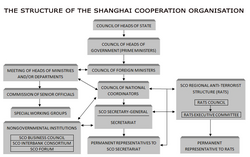
== Organisational structure == | == Organisational structure == | ||
[[File:Structure of the SCO.png|center|550px]] | [[File:Structure of the SCO.png|center|550px]] | ||
As of 2020, the Council of Heads of State was the top decision-making body in the SCO, meeting at the annual SCO summits in one of the member states' capital cities. Because of their government structure, the prime ministers of the parliamentary democracies of India and Pakistan attend the SCO Council of Heads of State summits, as their responsibilities are similar to the presidents of other SCO nations.<ref name="thehindu28nov20">{{cite news |last1=Haidar |first1=Suhasani |title=India to host SCO Heads of Government meet; Modi, Imran to skip |url=https://www.thehindu.com/news/national/six-pms-to-attend-sco-heads-of-government-summit-hosted-by-india/article33201037.ece |website=The Hindu |publisher=THG PUBLISHING PVT LTD. |access-date=15 June 2021 |date=28 November 2020}}</ref> | |||
As of the 1 September 2025 meeting, the Council of Heads of State consists of: | |||
* [[Aleksandr Lukashenko]] (Belarus) | |||
* [[Xi Jinping]] (China) | * [[Xi Jinping]] (China) | ||
* [[Narendra Modi]] (India) | * [[Narendra Modi]] (India) | ||
* [[Masoud Pezeshkian]] (Iran) | |||
* [[Kassym-Jomart Tokayev]] (Kazakhstan) | * [[Kassym-Jomart Tokayev]] (Kazakhstan) | ||
* [[Sadyr Japarov]] (Kyrgyzstan) | * [[Sadyr Japarov]] (Kyrgyzstan) | ||
| Line 127: | Line 127: | ||
* [[Shavkat Mirziyoyev]] (Uzbekistan) | * [[Shavkat Mirziyoyev]] (Uzbekistan) | ||
The Council of Heads of Government is the second-highest council in the organisation. This council also holds annual summits, at which time members discuss issues of multilateral cooperation | The Council of Heads of Government is the second-highest council in the organisation. This council also holds annual summits, at which time members discuss issues of multilateral cooperation and approves the organisation's budget.<ref>{{cite web |title=The Council of Heads of Government (Prime Ministers) |url=http://eng.sectsco.org/about_sco/20220810/909124.html |publisher=Shanghai Cooperation Organization Secretariat |access-date=5 July 2023 |archive-date=5 July 2023 |archive-url=https://web.archive.org/web/20230705163130/http://eng.sectsco.org/about_sco/20220810/909124.html |url-status=dead }}</ref> As of the 1 November 2022 meeting, Council of Heads of Government consists of:<ref>{{cite web |title=21st SCO Heads of Government Council meeting |url=http://eng.sectsco.org/economy/20221101/921909/21st-SCO-Heads-of-Government-Council-meeting-.html |publisher=Shanghai Cooperation Organization Secretariat |access-date=5 July 2023 |archive-date=5 July 2023 |archive-url=https://web.archive.org/web/20230705163130/http://eng.sectsco.org/economy/20221101/921909/21st-SCO-Heads-of-Government-Council-meeting-.html |url-status=dead }}</ref> | ||
* [[Aleksandr Turchin]] (Belarus) | |||
* [[Li Qiang]] (China) | * [[Li Qiang]] (China) | ||
* [[Narendra Modi]] (India) (usually sends a deputy, such as [[Minister of External Affairs (India)|EAM]] [[Subrahmanyam Jaishankar]] at the 2021 summit)<ref>{{cite web | url=https://www.business-standard.com/article/current-affairs/eam-s-jaishankar-to-represent-india-at-sco-heads-of-govt-meeting-121112401424_1.html | title=EAM S Jaishankar to represent India at SCO heads of govt meeting | date=25 November 2021 }}</ref> | * [[Narendra Modi]] (India) (usually sends a deputy, such as [[Minister of External Affairs (India)|EAM]] [[Subrahmanyam Jaishankar]] at the 2021 summit)<ref>{{cite web | url=https://www.business-standard.com/article/current-affairs/eam-s-jaishankar-to-represent-india-at-sco-heads-of-govt-meeting-121112401424_1.html | title=EAM S Jaishankar to represent India at SCO heads of govt meeting | date=25 November 2021 }}</ref> | ||
| Line 137: | Line 138: | ||
* [[Abdulla Aripov]] (Uzbekistan) | * [[Abdulla Aripov]] (Uzbekistan) | ||
As of 2007, the Council of Foreign Ministers also held regular meetings, where they discussed the current international situation and interaction with other international organisations.<ref>{{cite press release | url = http://www.malaysia.mid.ru/press2007/e_22.html | title = Session of the Council of Foreign Ministers from Member States of the Shanghai Cooperation Organisation | publisher = Embassy of the Russian Federation in Malaysia | location = Kuala Lumpur | date = 9 July 2007 | archive-url = https://web.archive.org/web/20120208154821/http://www.malaysia.mid.ru/press2007/e_22.html | archive-date = 8 February 2012}}</ref> As of 2021, the Council of National Coordinators coordinated the multilateral cooperation of member states within the framework of the SCO's charter.<ref>{{cite web |last1=Embassy of the Republic of Tajikistan in the Islamic Republic of Pakistan |title=The First SCO Council of National Coordinators Meeting Chaired by Tajikistan |url=https://mfa.tj/en/islamabad/view/7076/the-first-sco-council-of-national-coordinators-meeting-chaired-by-tajikistan |website=mfa.tj |publisher=Embassy of the Republic of Tajikistan in the Islamic Republic of Pakistan |access-date=15 June 2021 |date=29 January 2021}}</ref> | |||
{| class="wikitable floatright" style="margin-left:1em" | {| class="wikitable floatright" style="margin-left:1em; margin-top:0" | ||
|+ Directors of SCO RATS Executive Committee | |+ Directors of SCO RATS Executive Committee | ||
! Years in office !! Name | ! Years in office !! Name | ||
|- | |- | ||
| 15 June 2004 – 2006 || {{flagicon|Uzbekistan}} Vyacheslav Kasymov | | 15 June 2004 – 2006 || {{flagicon|Uzbekistan}} Vyacheslav Kasymov | ||
|- | |- | ||
| 2007–2009 || {{flagicon|Kyrgyzstan}} [[Myrzakan Subanov]] | | 2007–2009 || {{flagicon|Kyrgyzstan}} [[Myrzakan Subanov]] | ||
|- | |- | ||
| 2010–2012 || {{flagicon|Kazakhstan}} | | 2010–2012 || {{flagicon|Kazakhstan}} Dzhenisbek Dzhumanbekov | ||
|- | |- | ||
| 2013–2015 || {{flagicon|China}} [[Zhang Xinfeng]] | | 2013–2015 || {{flagicon|China}} [[Zhang Xinfeng]] | ||
|- | |- | ||
| 2016–2018 || {{flagicon|Russia}} | | 2016–2018 || {{flagicon|Russia}} Yevgeniy Sysoev | ||
|- | |- | ||
| 2019–2021 || {{flagicon|Tajikistan}} Jumakhon Giyosov | | 2019–2021 || {{flagicon|Tajikistan}} Jumakhon Giyosov | ||
|- | |- | ||
| | | 2022–2024 || {{flagicon|Uzbekistan}} Ruslan Mirzaev | ||
|- | |||
| 2025–present || {{flagicon|Kyrgyzstan}} [[Ularbek Sharsheev]] | |||
|} | |} | ||
| Line 182: | Line 179: | ||
| 2016–2018 || {{flagicon|Tajikistan}} [[Rashid Alimov]] | | 2016–2018 || {{flagicon|Tajikistan}} [[Rashid Alimov]] | ||
|- | |- | ||
| 2019–2021|| {{flagicon|Uzbekistan}} [[Vladimir Norov]] | | 2019–2021 || {{flagicon|Uzbekistan}} [[Vladimir Norov]] | ||
|- | |||
| 2022–2024 || {{flagicon|China}} [[Zhang Ming]] | |||
|- | |- | ||
| | | 2025–present || {{flagicon|Kazakhstan}} [[Nurlan Yermekbayev]] | ||
|} | |} | ||
The Secretariat of the SCO, headquartered in [[Beijing]], China, is the primary executive body of the organisation. It serves to implement organisational decisions and decrees, drafts proposed documents (such as declarations and agendas), function as a document depository for the organisation, arranges specific activities within the SCO framework, and promotes and disseminates information about the SCO. The SCO | The Secretariat of the SCO, headquartered in [[Beijing]], China, is the primary executive body of the organisation. It serves to implement organisational decisions and decrees, drafts proposed documents (such as declarations and agendas), function as a document depository for the organisation, arranges specific activities within the SCO framework, and promotes and disseminates information about the SCO. The SCO secretary-general is elected to a three-year term.<ref name="FreshMCQs">{{Cite web |author1=Freshmcqs |title=Who is the current Secretary General SCO? |url=https://freshmcqs.com/secretary-general-sco/ |access-date=28 July 2023 |website=Fresh MCQs|date=11 December 2022 }}</ref> [[Nurlan Yermekbayev]] of Kazakhstan became the current secretary-general on 1 January 2025. | ||
The Regional Anti-Terrorist Structure (RATS) Executive Committee, headquartered in [[Tashkent]], Uzbekistan, is a permanent organ of the SCO which serves to promote cooperation of member states against the [[three evils]] of [[terrorism]], [[separatism]] and [[extremism]]. The Director of SCO RATS Executive Committee is elected to a three-year term. | The [[Regional Anti-Terrorist Structure]] (RATS) Executive Committee, headquartered in [[Tashkent]], Uzbekistan, is a permanent organ of the SCO which serves to promote cooperation of member states against the [[three evils]] of [[terrorism]], [[separatism]] and [[extremism]]. The Director of SCO RATS Executive Committee is elected to a three-year term. [[Ularbek Sharsheev]] of Kyrgyzstan became the current Director on 1 January 2025. Each member state also sends a permanent representative to RATS.<ref>{{cite web | url = http://www.sectsco.org/fk-03.html | title = Information on Regional Anti-Terrorist Structure of Shanghai Cooperation Organisation | publisher = Shanghai Cooperation Organisation | archive-url = https://web.archive.org/web/20081211154326/http://www.sectsco.org/fk-03.html | archive-date = 11 December 2008}}</ref> | ||
The official languages of the SCO are [[Standard Chinese|Chinese]] and [[Russian language|Russian]].<ref name="about-sco"/> | The official languages of the SCO are [[Standard Chinese|Chinese]] and [[Russian language|Russian]].<ref name="about-sco"/> | ||
The SCO has a youth group, which is entitled the '''Score Foundation'''.<ref name="ig1">{{cite news |url=https://www.instagram.com/p/DCUHCy2Iaug/?api=毛里求斯路易港怎么找小姐服务v信8764603▷毛里求斯路易港怎么找小姐全套特殊服务▷毛里求斯路易港怎么找小姐上门服务▷毛里求斯路易港怎么找小姐联系方式▷毛里求斯路易港怎么找小姐上课约服务.ghkj&hl=kn | title=Instagram }}</ref> | |||
== Membership == | == Membership == | ||
| Line 197: | Line 198: | ||
{{Horizontal timeline | {{Horizontal timeline | ||
|from=1994 | |from=1994 | ||
|to= | |to=2026 | ||
|inc= | |inc=2 | ||
|axis-nudge=-0.5em | |axis-nudge=-0.5em | ||
|axis-1994= | |axis-1994= | ||
|axis-marker-1994 | |axis-marker-1994= | ||
|styleDefault-fontsize=0.8em | |styleDefault-fontsize=0.8em | ||
| Line 212: | Line 211: | ||
|styleDefault-2-border=none; | |styleDefault-2-border=none; | ||
|styleDefault-3-border=none; | |styleDefault-3-border=none; | ||
|styleDefault-4-border=none; | |||
|styleMemberShanghaiFive-boxcolour=#CCCCCC | |styleMemberShanghaiFive-boxcolour=#CCCCCC | ||
| Line 231: | Line 231: | ||
|row2-2-to=2001.45 | |row2-2-to=2001.45 | ||
|row2-2-style=styleMemberShanghaiFive | |row2-2-style=styleMemberShanghaiFive | ||
|row2-3-to= | |row2-3-to=2026 | ||
|row2-3-style=styleMember | |row2-3-style=styleMember | ||
| Line 240: | Line 240: | ||
|row3-2-to=2001.45 | |row3-2-to=2001.45 | ||
|row3-2-style=styleMemberShanghaiFive | |row3-2-style=styleMemberShanghaiFive | ||
|row3-3-to= | |row3-3-to=2026 | ||
|row3-3-style=styleMember | |row3-3-style=styleMember | ||
| Line 249: | Line 249: | ||
|row4-2-to=2001.45 | |row4-2-to=2001.45 | ||
|row4-2-style=styleMemberShanghaiFive | |row4-2-style=styleMemberShanghaiFive | ||
|row4-3-to= | |row4-3-to=2026 | ||
|row4-3-style=styleMember | |row4-3-style=styleMember | ||
| Line 258: | Line 258: | ||
|row5-2-to=2001.45 | |row5-2-to=2001.45 | ||
|row5-2-style=styleMemberShanghaiFive | |row5-2-style=styleMemberShanghaiFive | ||
|row5-3-to= | |row5-3-to=2026 | ||
|row5-3-style=styleMember | |row5-3-style=styleMember | ||
| Line 267: | Line 267: | ||
|row6-2-to=2001.45 | |row6-2-to=2001.45 | ||
|row6-2-style=styleMemberShanghaiFive | |row6-2-style=styleMemberShanghaiFive | ||
|row6-3-to= | |row6-3-to=2026 | ||
|row6-3-style=styleMember | |row6-3-style=styleMember | ||
| Line 274: | Line 274: | ||
|row7-1-text=Uzbekistan | |row7-1-text=Uzbekistan | ||
|row7-1-to=2001.45 | |row7-1-to=2001.45 | ||
|row7-2-to= | |row7-2-to=2026 | ||
|row7-2-style=styleMember | |row7-2-style=styleMember | ||
| Line 283: | Line 283: | ||
|row8-2-to=2017.44 | |row8-2-to=2017.44 | ||
|row8-2-style=styleObserver | |row8-2-style=styleObserver | ||
|row8-3-to= | |row8-3-to=2026 | ||
|row8-3-style=styleMember | |row8-3-style=styleMember | ||
| Line 292: | Line 292: | ||
|row9-2-to=2017.44 | |row9-2-to=2017.44 | ||
|row9-2-style=styleObserver | |row9-2-style=styleObserver | ||
|row9-3-to= | |row9-3-to=2026 | ||
|row9-3-style=styleMember | |row9-3-style=styleMember | ||
|row10=timeline | |row10=timeline | ||
|row10-style=styleDefault | |row10-style=styleDefault | ||
|row10-1-text= | |row10-1-text=Iran | ||
|row10-1-to= | |row10-1-to=2005.51 | ||
|row10-2-to=2023 | |row10-2-to=2023.6 | ||
|row10-2-style=styleObserver | |row10-2-style=styleObserver | ||
|row10-3-to=2026 | |||
|row10-3-style=styleMember | |||
|row11=timeline | |row11=timeline | ||
|row11-style=styleDefault | |row11-style=styleDefault | ||
|row11-1-text= | |row11-1-text=Belarus | ||
|row11-1-to= | |row11-1-to=2010.32 | ||
|row11-2-to= | |row11-2-to=2015.52 | ||
|row11-2-style=styleObserver | |row11-2-style=styleDialoguePartner | ||
|row11-3-to=2024.51 | |||
|row11-3-style=styleObserver | |||
|row11-4-to=2026 | |||
|row11-4-style=styleMember | |||
|row12=timeline | |row12=timeline | ||
|row12-style=styleDefault | |row12-style=styleDefault | ||
|row12-1-text= | |row12-1-text=Mongolia | ||
|row12-1-to= | |row12-1-to=2004.54 | ||
|row12-2-to= | |row12-2-to=2026 | ||
|row12-2-style=styleObserver | |row12-2-style=styleObserver | ||
|row13=timeline | |row13=timeline | ||
|row13-style=styleDefault | |row13-style=styleDefault | ||
|row13-1-text= | |row13-1-text=Sri Lanka | ||
|row13-1-to=2010. | |row13-1-to=2010.35 | ||
|row13-2-to= | |row13-2-to=2026 | ||
|row13-2-style=styleDialoguePartner | |row13-2-style=styleDialoguePartner | ||
|row14=timeline | |row14=timeline | ||
|row14-style=styleDefault | |row14-style=styleDefault | ||
|row14-1-text= | |row14-1-text=Turkey | ||
|row14-1-to= | |row14-1-to=2013.32 | ||
|row14-2-to= | |row14-2-to=2026 | ||
|row14-2-style=styleDialoguePartner | |row14-2-style=styleDialoguePartner | ||
|row15=timeline | |row15=timeline | ||
|row15-style=styleDefault | |row15-style=styleDefault | ||
|row15-1-text= | |row15-1-text=Cambodia | ||
|row15-1-to= | |row15-1-to=2015.73 | ||
|row15-2-to= | |row15-2-to=2026 | ||
|row15-2-style=styleDialoguePartner | |row15-2-style=styleDialoguePartner | ||
|row16=timeline | |row16=timeline | ||
|row16-style=styleDefault | |row16-style=styleDefault | ||
|row16-1-text= | |row16-1-text=Azerbaijan | ||
|row16-1-to= | |row16-1-to=2016.20 | ||
|row16-2-to= | |row16-2-to=2026 | ||
|row16-2-style=styleDialoguePartner | |row16-2-style=styleDialoguePartner | ||
|row17=timeline | |row17=timeline | ||
|row17-style=styleDefault | |row17-style=styleDefault | ||
|row17-1-text= | |row17-1-text=Nepal | ||
|row17-1-to=2016. | |row17-1-to=2016.22 | ||
|row17-2-to= | |row17-2-to=2026 | ||
|row17-2-style=styleDialoguePartner | |row17-2-style=styleDialoguePartner | ||
|row18=timeline | |row18=timeline | ||
|row18-style=styleDefault | |row18-style=styleDefault | ||
|row18-1-text= | |row18-1-text=Armenia | ||
|row18-1-to=2016. | |row18-1-to=2016.29 | ||
|row18-2-to= | |row18-2-to=2026 | ||
|row18-2-style=styleDialoguePartner | |row18-2-style=styleDialoguePartner | ||
|row19=timeline | |row19=timeline | ||
|row19-style=styleDefault | |row19-style=styleDefault | ||
|row19-1-text= | |row19-1-text=Egypt | ||
|row19-1-to= | |row19-1-to=2022.70 | ||
|row19-2-to= | |row19-2-to=2026 | ||
|row19-2-style=styleDialoguePartner | |row19-2-style=styleDialoguePartner | ||
|row20=timeline | |row20=timeline | ||
|row20-style=styleDefault | |row20-style=styleDefault | ||
|row20-1-text= | |row20-1-text=Qatar | ||
|row20-1-to=2022.70 | |row20-1-to=2022.70 | ||
|row20-2-to= | |row20-2-to=2026 | ||
|row20-2-style=styleDialoguePartner | |row20-2-style=styleDialoguePartner | ||
|row21=timeline | |row21=timeline | ||
|row21-style=styleDefault | |row21-style=styleDefault | ||
|row21-1-text= | |row21-1-text=Saudi Arabia | ||
|row21-1-to=2022.70 | |row21-1-to=2022.70 | ||
|row21-2-to= | |row21-2-to=2026 | ||
|row21-2-style=styleDialoguePartner | |row21-2-style=styleDialoguePartner | ||
|row22=timeline | |row22=timeline | ||
|row22-style=styleDefault | |row22-style=styleDefault | ||
|row22-1-text= | |row22-1-text=Kuwait | ||
|row22-1-to= | |row22-1-to=2023.40 | ||
|row22-2-to= | |row22-2-to=2026 | ||
|row22-2-style=styleDialoguePartner | |row22-2-style=styleDialoguePartner | ||
|row23=scale | |row23=timeline | ||
|row23-style=styleDefault | |||
|row23-1-text=Maldives | |||
|row23-1-to=2023.40 | |||
|row23-2-to=2026 | |||
|row23-2-style=styleDialoguePartner | |||
|row24=timeline | |||
|row24-style=styleDefault | |||
|row24-1-text=Myanmar | |||
|row24-1-to=2023.40 | |||
|row24-2-to=2026 | |||
|row24-2-style=styleDialoguePartner | |||
|row25=timeline | |||
|row25-style=styleDefault | |||
|row25-1-text=UAE | |||
|row25-1-to=2023.40 | |||
|row25-2-to=2026 | |||
|row25-2-style=styleDialoguePartner | |||
|row26=timeline | |||
|row26-style=styleDefault | |||
|row26-1-text=Bahrain | |||
|row26-1-to=2023.55 | |||
|row26-2-to=2026 | |||
|row26-2-style=styleDialoguePartner | |||
|row27=timeline | |||
|row27-style=styleDefault | |||
|row27-1-text=Laos | |||
|row27-1-to=2025.67 | |||
|row27-2-to=2026 | |||
|row27-2-style=styleDialoguePartner | |||
|row28=timeline | |||
|row28-style=styleDefault | |||
|row28-1-text=Afghanistan (Islamic Republic) | |||
|row28-1-to=2012.43 | |||
|row28-2-to=2021.62 | |||
|row28-2-style=styleObserver | |||
|row28-3-to=2026 | |||
|row28-3-style=styleDefault | |||
|row29=scale | |||
|caption={{small|{{legend inline|#346733|Member}}{{quad}}{{legend inline|#00FF00|Observer}}{{quad}}{{legend inline|#FFFF00|Dialogue partner}}}} | |caption={{small|{{legend inline|#346733|Member}}{{quad}}{{legend inline|#00FF00|Observer}}{{quad}}{{legend inline|#FFFF00|Dialogue partner}}}} | ||
}} | }} | ||
=== Member states === | === Member states === | ||
{{Supranational Asian Bodies|align=right|size=380px}} | |||
{| class="wikitable" | {| class="wikitable" | ||
|- | |- | ||
! Country !! Accession started !! Member since | ! Country !! Accession started !! Member since | ||
|- | |- | ||
| {{flag|China}} || rowspan=6 | — || rowspan=6 | 15 June 2001{{efn|China, Kazakhstan, Kyrgyzstan, Russia and Tajikistan were members of the Shanghai Five mechanism since 26 April 1996. Uzbekistan was included in the Shanghai Five mechanism on 14 June 2001.<ref>{{cite web |url=http://kremlin.ru/supplement/3404 |script-title=ru:Совместное заявление глав государств Республики Казахстан, Китайской Народной Республики, Кыргызской Республики, Российской Федерации, Республики Таджикистан, Республики Узбекистан |trans-title=Joint statement of heads of state of Republic of Kazakhstan, People's Republic of China, Kyrgyz Republic, Russian Federation, Republic of Tajikistan, Republic of Uzbekistan |date=14 June 2001 |website=President of Russia |language=Russian}}</ref> The six states then signed a declaration establishing the Shanghai Cooperation Organisation on 15 June 2001.<ref>{{cite web |url=http://kremlin.ru/events/president/news/41570 |script-title=ru:Главы государств «Шанхайского форума» приняли Декларацию о создании нового объединения – Шанхайской организации сотрудничества |trans-title="Shanghai Forum" heads of state have adopted the Declaration on creation of a new association – the Shanghai Cooperation Organisation |website=President of Russia |language=Russian}}</ref>}} | | {{flag|China}} || rowspan=6 | — || rowspan=6 | 15 June 2001{{efn|China, Kazakhstan, Kyrgyzstan, Russia and Tajikistan were members of the Shanghai Five mechanism since 26 April 1996. Uzbekistan was included in the Shanghai Five mechanism on 14 June 2001.<ref>{{cite web |url=http://kremlin.ru/supplement/3404 |script-title=ru:Совместное заявление глав государств Республики Казахстан, Китайской Народной Республики, Кыргызской Республики, Российской Федерации, Республики Таджикистан, Республики Узбекистан |trans-title=Joint statement of heads of state of Republic of Kazakhstan, People's Republic of China, Kyrgyz Republic, Russian Federation, Republic of Tajikistan, Republic of Uzbekistan |date=14 June 2001 |website=President of Russia |language=Russian}}</ref> The six states then signed a declaration establishing the Shanghai Cooperation Organisation on 15 June 2001.<ref>{{cite web |url=http://kremlin.ru/events/president/news/41570 |script-title=ru:Главы государств «Шанхайского форума» приняли Декларацию о создании нового объединения – Шанхайской организации сотрудничества |trans-title="Shanghai Forum" heads of state have adopted the Declaration on creation of a new association – the Shanghai Cooperation Organisation |date=15 June 2001 |website=President of Russia |language=Russian}}</ref>}} | ||
|- | |- | ||
| {{flag|Kazakhstan}} | | {{flag|Kazakhstan}} | ||
| Line 413: | Line 461: | ||
|- | |- | ||
| {{flag|Pakistan}} | | {{flag|Pakistan}} | ||
|- | |- | ||
|{{flag|Iran}} | |{{flag|Iran}} | ||
|17 September 2021 | |17 September 2021 | ||
|4 July 2023<ref>{{Cite news|url=https:// | |4 July 2023<ref>{{Cite news|url=https://www.bloomberg.com/news/articles/2023-07-04/iran-joins-sco-the-china-founded-regional-security-grouping|title=Iran Joins SCO, the China-Founded Regional Security Grouping|newspaper=Bloomberg |date=4 July 2023 }}</ref> | ||
|- | |- | ||
|{{flag|Belarus}} | |{{flag|Belarus}} | ||
|16 September 2022 | |16 September 2022 | ||
| | | 4 July 2024<ref>{{Cite web|url=https://www.btimesonline.com/articles/167333/20240703/china-and-russia-lead-efforts-to-expand-influence-with-belarus-addition-to-sco.htm|title=China and Russia Lead Efforts to Expand Influence with Belarus' Addition to SCO|first=Larry|last=Lee|date=3 July 2024|website=Business Times}}</ref> | ||
|} | |} | ||
=== | === SCO partners === | ||
{| class=wikitable | |||
! Country !! Former status !! Date of older status !! Date of new status | |||
|- | |||
| {{flag|Mongolia}} | |||
| Observer | |||
| 2004 | |||
| 1 September 2025 | |||
|- | |||
| {{flag|Sri Lanka}} | |||
| Dialogue Partner | |||
| 6 May 2010 | |||
| 1 September 2025 | |||
|- | |||
| {{flag|Afghanistan}} | |||
| Observer | |||
| 7 June 2012 | |||
| 1 September 2025 | |||
|- | |||
| {{flag|Turkey}} | |||
| Dialogue Partner | |||
| 26 April 2013 | |||
| 1 September 2025 | |||
|- | |||
| {{flag|Cambodia}} | |||
| Dialogue Partner | |||
| 24 September 2015 | |||
| 1 September 2025 | |||
|- | |||
| {{flag|Azerbaijan}} | |||
| Dialogue Partner | |||
| 14 March 2016 | |||
| 1 September 2025 | |||
|- | |||
| {{flag|Nepal}} | |||
| Dialogue Partner | |||
| 22 March 2016 | |||
| 1 September 2025 | |||
|- | |||
| {{flag|Armenia}} | |||
| Dialogue Partner | |||
| 16 April 2016 | |||
| 1 September 2025 | |||
|- | |||
| {{flag|Egypt}} | |||
| Dialogue Partner | |||
| 14 September 2022 | |||
| 1 September 2025 | |||
|- | |||
| {{flag|Qatar}} | |||
| Dialogue Partner | |||
| 14 September 2022 | |||
| 1 September 2025 | |||
|- | |||
| {{flag|Saudi Arabia}} | |||
| Dialogue Partner | |||
| 14 September 2022 | |||
| 1 September 2025 | |||
|- | |||
| {{flag|Kuwait}} | |||
| Dialogue Partner | |||
| 5 May 2023 | |||
| 1 September 2025 | |||
|- | |||
| {{flag|Maldives}} | |||
| Dialogue Partner | |||
| 5 May 2023 | |||
| 1 September 2025 | |||
|- | |||
| {{flag|Myanmar}} | |||
| Dialogue Partner | |||
| 5 May 2023 | |||
| 1 September 2025 | |||
|- | |||
| {{flag|United Arab Emirates}} | |||
| Dialogue Partner | |||
| 5 May 2023 | |||
| 1 September 2025 | |||
|- | |||
| {{flag|Bahrain}} | |||
| Dialogue Partner | |||
| 15 July 2023 | |||
| 1 September 2025 | |||
|- | |||
| {{flag|Laos}} | |||
| Dialogue Partner | |||
| 1 September 2025 | |||
| 1 September 2025 | |||
|} | |||
=== Current and former observer states === | |||
Afghanistan | {| class=wikitable | ||
! Country !! Status granted | |||
|- | |||
| {{flag|Mongolia}} | |||
| 2004<ref name=":0">{{Cite book |last=Zhao |first=Suisheng |title=The dragon roars back : transformational leaders and dynamics of Chinese foreign policy |date=2023 |publisher=[[Stanford University Press]] |isbn=978-1-5036-3415-2 |location=Stanford, California |pages=70 |oclc=1332788951}}</ref> | |||
|- | |||
| {{flag|Afghanistan|}}{{efn|Since the overthrow of the [[Islamic Republic of Afghanistan]] and the reinstatement of the [[Islamic Emirate of Afghanistan]] on 15 August 2021, [[Taliban]] representatives have not been participating in SCO meetings.<ref name="Taliban">{{cite web |first=Eva |last=Seiwert |title=The Shanghai Cooperation Organization Will Not Fill Any Vacuum in Afghanistan |url=https://www.fpri.org/article/2021/09/the-shanghai-cooperation-organization-will-not-fill-any-vacuum-in-afghanistan/ |website=[[Foreign Policy Research Institute]] |access-date=24 July 2022 |date=30 September 2021 |quote=So far, the SCO has not officially recognized the Taliban regime and did not invite its representatives to the summit in Dushanbe in mid-September.}}</ref>}} || 7 June 2012<ref name="AFGTUR" /> (inactive September 2021–1 September 2025) | |||
|- | |||
| colspan="2" |'''Former observers''' | |||
|- | |||
| {{flag|India}} || rowspan=3 | 5 July 2005<ref name=":0" /> | |||
|- | |||
| {{flag|Pakistan}} | |||
|- | |||
| {{flag|Iran}} | |||
|- | |||
| {{flag|Belarus}} || 2015<ref name=":0" /> | |||
|} | |||
The status of dialogue partner was created in 2008.<ref>{{cite web|url=http://www.sectsco.org/EN/show.asp?id=64 |title=Regulations on the Status of Dialogue Partner of the Shanghai Cooperation Organisation |publisher=The Shanghai Cooperation Organisation |access-date=11 June 2016 |url-status=dead |archive-url=https://web.archive.org/web/20120214203708/http://www.sectsco.org/EN/show.asp?id=64 |archive-date=14 February 2012}}</ref> | === Current and former dialogue partners === | ||
The status of dialogue partner was created in 2008.<ref>{{cite web|url=http://www.sectsco.org/EN/show.asp?id=64 |title=Regulations on the Status of Dialogue Partner of the Shanghai Cooperation Organisation |date=28 August 2008 |publisher=The Shanghai Cooperation Organisation |access-date=11 June 2016 |url-status=dead |archive-url=https://web.archive.org/web/20120214203708/http://www.sectsco.org/EN/show.asp?id=64 |archive-date=14 February 2012}}</ref> | |||
{| class=wikitable | {| class=wikitable | ||
! Country !! Status approved !! Status granted{{efn|A country officially becomes a SCO dialogue partner after its minister of foreign affairs and SCO Secretary-General sign a memorandum granting the status.}} | ! Country !! Status approved !! Status granted{{efn|A country officially becomes a SCO dialogue partner after its minister of foreign affairs and SCO Secretary-General sign a memorandum granting the status.}} | ||
|- | |- | ||
| {{flag|Sri Lanka}} || 15 or 16 June 2009<ref name="defence.lk">{{cite news |url=http://defence.lk/new.asp?fname=20090618_05 |title=Sri Lanka gains partnership in SCO members welcome end to terror in country |archive-url=https://web.archive.org/web/20160304083026/http://defence.lk/new.asp?fname=20090618_05 |archive-date=4 March 2016 |publisher=Ministry of Defence, Democratic Socialist Republic of Sri Lanka}}</ref><ref name="IANS1">{{cite news |url=http://www.indianmuslims.info/news/2007/jun/02/sri_lanka_turns_pakistan_china_military_needs.html |first=Rahul |last=Bedi |title=Sri Lanka turns to Pakistan, China for military needs |publisher=Urdustan.com Network |work=IANS |access-date=2 June 2007 |url-status= | | {{flag|Sri Lanka}} || 15 or 16 June 2009<ref name="defence.lk">{{cite news |url=http://defence.lk/new.asp?fname=20090618_05 |title=Sri Lanka gains partnership in SCO members welcome end to terror in country |date=30 December 2010 |archive-url=https://web.archive.org/web/20160304083026/http://defence.lk/new.asp?fname=20090618_05 |archive-date=4 March 2016 |publisher=Ministry of Defence, Democratic Socialist Republic of Sri Lanka}}</ref><ref name="IANS1">{{cite news |url=http://www.indianmuslims.info/news/2007/jun/02/sri_lanka_turns_pakistan_china_military_needs.html |first=Rahul |last=Bedi |title=Sri Lanka turns to Pakistan, China for military needs |date=2 June 2007 |publisher=Urdustan.com Network |work=IANS |access-date=2 June 2007 |url-status=usurped |archive-url=https://web.archive.org/web/20070604170848/http://www.indianmuslims.info/news/2007/jun/02/sri_lanka_turns_pakistan_china_military_needs.html |archive-date=4 June 2007}}</ref> || 6 May 2010<ref>{{cite news |url=https://www.mid.ru/en/foreign_policy/news/-/asset_publisher/cKNonkJE02Bw/content/id/250874 |title=Russian MFA Spokesman Andrei Nesterenko Response to Media Question about the Signing of a Memorandum Granting the Status of SCO Dialogue Partner to Sri Lanka |date=12 May 2010 |work=Ministry of Foreign Affairs (Russia)}}</ref> | ||
|- | |- | ||
| {{flag|Turkey}} || 7 June 2012<ref name="AFGTUR">{{cite news |url=http://english.peopledaily.com.cn/90883/7839137.html |title=SCO accepts Afghanistan as observer, Turkey dialogue partner |agency=[[Xinhua News Agency]] |via=''People's Daily'' |access-date=2012 | | {{flag|Turkey}} || 7 June 2012<ref name="AFGTUR">{{cite news |url=http://english.peopledaily.com.cn/90883/7839137.html |title=SCO accepts Afghanistan as observer, Turkey dialogue partner |agency=[[Xinhua News Agency]] |via=''People's Daily'' |date=7 June 2012 |access-date=7 June 2012 |archive-url=https://web.archive.org/web/20121128073821/http://english.peopledaily.com.cn/90883/7839137.html |archive-date=28 November 2012 |url-status=live}}</ref> || 26 April 2013<ref>{{cite web |url=https://www.mfa.gov.tr/no_-123_-26-april_-2013_-press-release-concerning-the-signing-of-a-memorandum-with-the-shanghai-cooperation-organization.en.mfa |title=No: 123, 26 April 2013, Press Release Concerning the Signing of a Memorandum with the Shanghai Cooperation Organization |date=26 April 2013 |work=Ministry of Foreign Affairs (Turkey)}}</ref> | ||
|- | |- | ||
| {{flag|Cambodia}} || rowspan=4 | 10 July 2015<ref>{{cite web|last=Kucera|first=Joshua|title=SCO Summit Provides Few Concrete Results, But More Ambitious Goals|url=https://eurasianet.org/sco-summit-provides-few-concrete-results-but-more-ambitious-goals|access-date=2021 | | {{flag|Cambodia}} || rowspan=4 | 10 July 2015<ref>{{cite web|last=Kucera|first=Joshua|date=10 July 2015|title=SCO Summit Provides Few Concrete Results, But More Ambitious Goals|url=https://eurasianet.org/sco-summit-provides-few-concrete-results-but-more-ambitious-goals|access-date=16 October 2021|website=[[Eurasianet]]}}</ref>|| 24 September 2015<ref>{{cite news |url=https://tass.com/economy/823294 |title=Cambodia becomes dialogue partner in SCO |date=24 September 2015 |work=TASS}}</ref> | ||
|- | |- | ||
| {{flag|Azerbaijan}} || 14 March 2016<ref>{{cite news |url=https://mfa.gov.az/en/news/xarici-isler-naziri-elmar-memmedyarov-cin-xalq-respublikasina-isguzar-seferi-cercivesinde-sanxay-emekdasliq-teskilatinin-bas-katibi-resid-alimov-ile-gorusub |title=Foreign Minister Elmar Mammadyarov met with Rashid Alimov, Secretary General of the Shanghai Cooperation Organization within his working visit to the People's Republic of China |work=Ministry of Foreign Affairs (Azerbaijan)}}</ref> | | {{flag|Azerbaijan}} || 14 March 2016<ref>{{cite news |url=https://mfa.gov.az/en/news/xarici-isler-naziri-elmar-memmedyarov-cin-xalq-respublikasina-isguzar-seferi-cercivesinde-sanxay-emekdasliq-teskilatinin-bas-katibi-resid-alimov-ile-gorusub |title=Foreign Minister Elmar Mammadyarov met with Rashid Alimov, Secretary General of the Shanghai Cooperation Organization within his working visit to the People's Republic of China |date=14 March 2016 |work=Ministry of Foreign Affairs (Azerbaijan)}}</ref> | ||
|- | |- | ||
| {{flag|Nepal}} || 22 March 2016<ref>{{cite web |url=https://mofa.gov.np/press-release-issued-embassy-nepal-beijing/ |title=Press Release issued by Embassy of Nepal, Beijing on Nepal officially joined the Shanghai Cooperation Organization (SCO) as a dialogue partner. |publisher=Government of Nepal – Ministry of Foreign Affairs |archive-url=https://web.archive.org/web/20180804103547/https://mofa.gov.np/press-release-issued-embassy-nepal-beijing/ |archive-date=4 August 2018 |url-status=live |access-date=4 August 2018 |ref=44}}</ref> | | {{flag|Nepal}} || 22 March 2016<ref>{{cite web |url=https://mofa.gov.np/press-release-issued-embassy-nepal-beijing/ |title=Press Release issued by Embassy of Nepal, Beijing on Nepal officially joined the Shanghai Cooperation Organization (SCO) as a dialogue partner. |date=22 March 2016 |publisher=Government of Nepal – Ministry of Foreign Affairs |archive-url=https://web.archive.org/web/20180804103547/https://mofa.gov.np/press-release-issued-embassy-nepal-beijing/ |archive-date=4 August 2018 |url-status=live |access-date=4 August 2018 |ref=44}}</ref> | ||
|- | |- | ||
| {{flag|Armenia}} || 16 April 2016<ref>{{cite web |url=https://www.mfa.am/en/press-releases/2016/04/16/sco-dial-part/6038 |title=Armenia was granted a status of dialogue partner in the Shanghai Cooperation Organisation |work=Ministry of Foreign Affairs (Armenia)}}</ref> | | {{flag|Armenia}} || 16 April 2016<ref>{{cite web |url=https://www.mfa.am/en/press-releases/2016/04/16/sco-dial-part/6038 |title=Armenia was granted a status of dialogue partner in the Shanghai Cooperation Organisation |date=16 April 2016 |work=Ministry of Foreign Affairs (Armenia)}}</ref> | ||
|- | |- | ||
| {{flag|Egypt}} || rowspan=3 | 16 September 2021 || rowspan=3 | 14 September 2022<ref>{{cite web |title=SCO member states signed memorandums on granting SCO dialogue partner status to the Arab Republic of Egypt and the State of Qatar |url=http://eng.sectsco.org/politics/20220916/912890/SCO-member-states-signed-memorandums-on-granting-SCO-dialogue-partner-status-to-the-Arab-Republic.html |website=Shanghai Cooperation Organization |access-date=16 September 2022}}</ref><ref name="Xi2022Meeting"/> | | {{flag|Egypt}} || rowspan=3 | 16 September 2021 || rowspan=3 | 14 September 2022<ref>{{cite web |title=SCO member states signed memorandums on granting SCO dialogue partner status to the Arab Republic of Egypt and the State of Qatar |url=http://eng.sectsco.org/politics/20220916/912890/SCO-member-states-signed-memorandums-on-granting-SCO-dialogue-partner-status-to-the-Arab-Republic.html |website=Shanghai Cooperation Organization |access-date=16 September 2022 |archive-date=29 September 2022 |archive-url=https://web.archive.org/web/20220929072943/http://eng.sectsco.org/politics/20220916/912890/SCO-member-states-signed-memorandums-on-granting-SCO-dialogue-partner-status-to-the-Arab-Republic.html |url-status=dead }}</ref><ref name="Xi2022Meeting"/> | ||
|- | |- | ||
| {{flag|Qatar}} | | {{flag|Qatar}} | ||
| Line 467: | Line 605: | ||
| {{flag|Saudi Arabia}} | | {{flag|Saudi Arabia}} | ||
|- | |- | ||
| {{flag|Kuwait}}|| rowspan=5 | 16 September 2022<ref name="Xi2022Meeting">{{cite web |title=President Xi Jinping Attends the 22nd Meeting of the SCO Council of Heads of State and Delivers Important Remarks|url=https://www.fmprc.gov.cn/eng/zxxx_662805/202209/t20220916_10767162.html |website=Ministry of Foreign Affairs, PRC|access-date=16 September 2022}}</ref>|| rowspan="4" | 5 May 2023<ref name="New SCO dialogue partners">{{cite web|title=New SCO dialogue partners|url=http://eng.sectsco.org/politics/20230506/942021/-New-SCO-dialogue-partners.html|website=Shanghai Cooperation Organization Secretariat|access-date=6 May 2023|archive-date=22 May 2023|archive-url=https://web.archive.org/web/20230522162243/http://eng.sectsco.org/politics/20230506/942021/-New-SCO-dialogue-partners.html|url-status=dead}}</ref> | |||
| {{flag|Kuwait}}|| rowspan=5 | 16 September 2022 <ref name="Xi2022Meeting">{{cite web |title=President Xi Jinping Attends the 22nd Meeting of the SCO Council of Heads of State and Delivers Important Remarks|url=https://www.fmprc.gov.cn/eng/zxxx_662805/202209/t20220916_10767162.html |website=Ministry of Foreign Affairs, PRC|access-date=16 September 2022}}</ref>|| rowspan=" | |||
|- | |- | ||
| {{flag|Maldives}} | | {{flag|Maldives}} | ||
| Line 476: | Line 613: | ||
| {{nowrap|{{flag|United Arab Emirates}}}} | | {{nowrap|{{flag|United Arab Emirates}}}} | ||
|- | |- | ||
| {{flag|Bahrain}} ||15 July 2023<ref>{{Cite web|url=https://www.bna.bh/en/BahraingrantedthestatusofSCOdialoguepartner.aspx|title=Bahrain granted the status of SCO dialogue partner|website=www.bna.bh}}{{dead link|date=July 2024}}</ref><ref>{{cite web | url=http://eng.sectsco.org/politics/20230718/951659/The-SCO-signs-a-memorandum-on-granting-the-Kingdom-of-Bahrain-the-status-of-dialogue-partner.html | title=Shanghai Cooperation Organisation | SCO | access-date=23 August 2023 | archive-date=16 August 2023 | archive-url=https://web.archive.org/web/20230816191931/http://eng.sectsco.org/politics/20230718/951659/The-SCO-signs-a-memorandum-on-granting-the-Kingdom-of-Bahrain-the-status-of-dialogue-partner.html | url-status=dead }}</ref> | |||
|- | |- | ||
| {{flag| | | {{flag|Laos}}|| | 1 September 2025<ref>{{Cite web|url=https://www.thehindu.com/news/international/laos-accepted-as-dialogue-partner-of-the-sco/article69999119.ece|title=Laos accepted as dialogue partner of the SCO|publisher=The Hindu Bureau|date=1 September 2025|via=www.thehindu.com}}</ref>|| | ||
|- | |- | ||
| colspan=3 |'''Former dialogue partners''' | |||
|- | |- | ||
| {{flag|Belarus}} || 15 or 16 June 2009 || 28 April 2010 | | {{flag|Belarus}} || 15 or 16 June 2009 || 28 April 2010 | ||
|} | |} | ||
=== Guest | === Guest attendees === | ||
{{Expand section|dates of first meeting attended of all organisations/countries in lists below|date=September 2025}} | |||
Multiple international organisations and one country are guest attendances to SCO summits. | Multiple international organisations and one country are guest attendances to SCO summits. | ||
{| class="wikitable" | |||
|+Organisation guest attendees | |||
!Organisation | |||
!Organisation Type | |||
!First Meeting Attended | |||
|- | |||
|{{Flag|Association of Southeast Asian Nations}} | |||
|[[International organization|International union]] | |||
|1 September 2025<ref>[https://asean.org/wp-content/uploads/2024/01/Overview-of-ASEAN-SCO-as-of-Jan-2024.pdf Overview of ASEAN-SCO Relations]. ''[[ASEAN|Association of Southeast Asian Nations]]'' (January 2024). Accessed 20 September 2025.</ref><ref>{{Cite news |date=1 September 2025 |title=Secretary-General of ASEAN participates in the SCO Plus Meeting 2025 in Tianjin, China |url=https://asean.org/secretary-general-of-asean-participates-in-the-sco-plus-meeting-2025-in-tianjin-china/ |access-date=20 September 2025 |work=[[Association of Southeast Asian Nations]]}}</ref> | |||
|- | |||
|{{Flag|Commonwealth of Independent States}} | |||
|[[International organization|International union]] | |||
| | |||
|- | |||
|{{Flag|United Nations}} | |||
|[[International organization|International union]] | |||
| | |||
|- | |||
|[[Collective Security Treaty Organization]] | |||
|[[Military alliance]] | |||
| | |||
|- | |||
|[[Eurasian Economic Union]] | |||
|[[Economic union]] | |||
| | |||
|- | |||
|[[Economic Cooperation Organization]] | |||
|[[Economic union]] | |||
| | |||
|- | |||
|[[Conference on Interaction and Confidence-Building Measures in Asia]] | |||
|[[International organization|International union]] | |||
| | |||
|- | |||
|[[Asian Infrastructure Investment Bank]] | |||
|[[International banking|International bank]] | |||
| | |||
|} | |||
{| class="wikitable" | |||
|+Country guest attendees | |||
!Country | |||
!First Meeting Attended | |||
|- | |||
|{{Flag|Turkmenistan}} | |||
| | |||
|} | |||
[[Turkmenistan]] has previously declared itself a permanently [[neutral country]], which was recognised by a resolution adopted by the [[United Nations General Assembly]] in 1995,<ref>{{UN doc |docid=A/RES/50/80 |body=A |session=90 |type=R |resolution_number=50/80 |title=Maintenance of international security |date=12 December 1995 |access-date=26 September 2024}}</ref> thus ostensibly precluding its membership in the SCO.<ref>{{cite web|url=https://www.oneindia.com/feature/sco-summit-2018-why-turkmenistan-is-not-part-of-the-eurasia-security-bloc-2711428.html|title=SCO Summit 2018: Why Turkmenistan is not part of the Eurasia security bloc|last=Shubham|date=7 June 2018|website=oneindia.com|access-date=19 February 2019|archive-url=https://web.archive.org/web/20190220002956/https://www.oneindia.com/feature/sco-summit-2018-why-turkmenistan-is-not-part-of-the-eurasia-security-bloc-2711428.html|archive-date=20 February 2019|url-status=live}}</ref> At the same time, Turkmenistan is a member of the [[Economic Cooperation Organization]] since 1992 and an observer of the [[Organization of Turkic States]] since 2021. Turkmenistan's head of state has been attending SCO summits since 2007 as a guest attendee. | |||
=== Future membership possibilities === | === Future membership possibilities === | ||
{{ | Suspected fears about new members weaking the organisation have stalled the addition of members over its existence. Instead, countries are added to various categories{{Em dash}}observers, guests, and dialogue partners{{Em dash}}to allow them to participate at summits.<ref>{{Cite web |last=Bosco |first=David |date=2025-10-02 |title=The Shanghai Cooperation Organization's expansion dilemma |url=https://foreignpolicy.com/2011/11/15/the-shanghai-cooperation-organizations-expansion-dilemma/ |archive-url=https://archive.today/20230802090821/https://foreignpolicy.com/2011/11/15/the-shanghai-cooperation-organizations-expansion-dilemma/ |archive-date=2 August 2023 |access-date=20 September 2025 |website=Foreign Policy |language=en-US}}</ref> | ||
==== List of potential observers, guests, or dialogue partners ==== | |||
{| class=wikitable | |||
! Country !! Status applied for !! Date | |||
|- | |||
| {{flag|Bangladesh}} | |||
| Observer | |||
| 2012<ref name="AzeriDaily">{{cite web |url=http://azeridaily.com/politics/957 |title=Azerbaijan asks to join a new alliance of China and Russia |work=Azeri Daily |date=15 September 2012 |author=Moskovskij Komsomolets |access-date=22 December 2014 |archive-url=https://web.archive.org/web/20141222201738/http://azeridaily.com/politics/957 |archive-date=22 December 2014}}</ref><ref>{{Cite web |date=2022-08-21 |title=Why the Shanghai Cooperation Organization matters |url=https://arab.news/5c83v |access-date=2024-06-25 |website=Arab News |language=en}}</ref> | |||
|- | |||
| <!--Not with that flag-->Syria | |||
| Dialogue partner{{efn|Syria has initially applied for observer status, but "it was explained that first it is necessary to become a dialogue partner of the organization".<ref name="Interfax" />}} | |||
| 2015<ref name="Interfax">{{cite news|date=23 June 2016 |url=http://www.interfax.com/newsinf.asp?id=683491 |title=Syria, Israel, Egypt willing to join SCO's activity – president's special envoy |agency=[[Interfax]] |access-date=23 June 2016 |archive-url=https://web.archive.org/web/20160816144553/http://www.interfax.com/newsinf.asp?id=683491 |archive-date=16 August 2016}}</ref><ref>{{cite news|url=http://tass.ru/en/world/806320|title=Egypt applies to become dialogue partner of Shanghai security bloc – Kremlin aide|date=6 July 2015|access-date=15 August 2015|agency=[[TASS]]|archive-url=https://web.archive.org/web/20150820191812/http://tass.ru/en/world/806320|archive-date=20 August 2015|url-status=live}}</ref> | |||
|- | |||
| {{flag|Israel}} | |||
| Dialogue partner | |||
| 2016<ref name="Interfax" /> | |||
|- | |||
| {{flag|Iraq}} | |||
| Dialogue partner | |||
| 2019<ref>{{cite news |date=5 September 2019 |title='SCO family' widening? Many candidates share 'Shanghai spirit', but expansion not a goal |url=https://tass.com/world/1076750 |work=[[TASS]] |access-date=6 August 2022 |archive-url=https://web.archive.org/web/20190906165359/https://tass.com/world/1076750 |archive-date=6 September 2019 |url-status=live}}</ref> | |||
|- | |||
| {{flag|Algeria}} | |||
| Observer | |||
| July 2023<ref>{{Cite news |date=21 June 2023 |title=Algeria Submits an Application to Join the SCO |work=Echorouk |url=https://www.echoroukonline.com/algeria-submits-an-application-to-join-the-sco}}</ref><ref>{{Cite news |date=21 June 2023 |title=L'Algérie veut intégrer le capital de la banque des BRICS et l'organisation de Shanghai |work=L'Algérie Audjourd'hui |url=https://lalgerieaujourdhui.dz/lalgerie-veut-integrer-le-capital-de-la-banque-des-brics-et-lorganisation-de-shanghai/}}</ref> | |||
|- | |||
|} | |||
==== Countries showing interest in joining the SCO ==== | |||
In 2011, [[ | ===== Turkey ===== | ||
In 2010, the SCO approved a procedure for admitting new members.<ref>{{Cite web|url=https://www.mfa.gov.cn/eng/wjdt_665385/2649_665393/201006/t20100625_679309.html|website=Ministry of Foreign Affairs, the People's Republic of China|title=Declaration of the 10th Meeting of The Council of Heads of State of the SCO Member States Tashkent, 10-11 June 2010|date=11 June 2010|access-date=7 July 2024}}</ref> In 2011, [[Turkey]] applied for dialogue partner status,<ref name="TheHindu">{{cite news |last=Radyuhin |first=Vladimir |date=2 December 2011 |title=Vietnam bids to join SCO |url=https://www.thehindu.com/news/international/vietnam-bids-to-join-sco/article2681358.ece |work=[[The Hindu]] |location=Moscow |access-date=6 August 2022}}</ref> which it obtained in 2013. At the same time, Turkey is a [[NATO]] member and the [[European Union]] candidate country. Turkish prime minister [[Recep Tayyip Erdoğan]] has stated that he has discussed the possibility of abandoning Turkey's candidacy of [[Accession of Turkey to the European Union|accession to the]] [[European Union]] in return for full membership in the Shanghai Cooperation Organisation.<ref>{{cite web|url = http://www.thenewturkey.org/turkey-between-shanghai-and-brussels |title = Turkey between Shanghai and Brussels|date = 14 May 2013|website = The New Turkey|last=Dalay|first= Galip|translator-last=Öz|translator-first=Handan|access-date = 1 July 2013|url-status = dead|archive-url = https://web.archive.org/web/20160206085447/http://www.thenewturkey.org/turkey-between-shanghai-and-brussels/|archive-date = 6 February 2016}}</ref> This was reinforced again on 21 November 2016, after the [[European Parliament]] voted unanimously to suspend accession negotiations with Turkey.<ref>{{cite news| url = https://www.reuters.com/article/us-turkey-europe-erdogan-idUSKBN13F0CY| title = Fed up with EU, Erdogan says Turkey could join Shanghai Group| date = 21 November 2016| work = Reuters| last = Butler| first = Daren| access-date = 21 November 2016| archive-url = https://web.archive.org/web/20170621032937/http://www.reuters.com/article/us-turkey-europe-erdogan-idUSKBN13F0CY| archive-date = 21 June 2017| url-status = live}}</ref> Two days later, on 23 November 2016, Turkey was granted the chairmanship of SCO energy club for the 2017 period. That made Turkey the first country to chair a club in the organisation without full membership status. In 2022, at the 22nd summit of the SCO, the Turkish president said that Turkey would seek full SCO membership status.<ref>{{Cite news |title=Turkey Seeks to Be First NATO Member to Join China-Led SCO |url=https://www.bloomberg.com/news/articles/2022-09-17/turkey-seeks-china-led-bloc-membership-in-threat-to-nato-allies?srnd=fixed-income |access-date=17 September 2022 |newspaper=Bloomberg.com| date=17 September 2022 }}</ref> On 11 July 2024, Turkish president [[Recep Tayyip Erdoğan]] stated in a statement to the U.S. ''[[Newsweek]]'' magazine that they did not consider Turkey's membership in NATO as an alternative to the Shanghai Cooperation Organisation and [[BRICS]].<ref>{{Cite web |date=2024-07-11 |title=Exclusive: Why Turkey's Erdogan Is Breaking With Biden on Ukraine and Gaza |url=https://www.newsweek.com/exclusive-why-turkeys-erdogan-breaking-biden-ukraine-gaza-1923595 |website=Newsweek |language=en-US}}</ref> | |||
In | ===== Vietnam ===== | ||
In 2011, [[Vietnam]] expressed interest in obtaining observer status (but has not applied for it).<ref name="TheHindu" /> Vietnamese PM Pham Minh Chinh attended the largest-ever Shanghai Cooperation Organization (SCO) summit in history in Tianjian from August 31 to September 1, 2025.<ref name="VietnamNews" /> | |||
In 2012, [[Ukraine]] expressed interest in obtaining observer status | ===== Ukraine ===== | ||
In 2012, [[Ukraine]] expressed interest in obtaining observer status. However, since the deposition of President [[Viktor Yanukovych]] and [[Russo-Ukrainian War|increased tensions with Russia]], no application has been submitted and there are no current plans to incorporate Ukraine into the organisation.<ref>{{cite news |date=25 August 2012 |title=Yanukovych Tells Putin Kyiv Wants SCO Observer Status |url=https://www.rferl.org/a/yanukovych-tells-putin-kyiv-wants-sco-observer-status/24687868.html |work=Radio Free Europe/Radio Liberty |access-date=6 August 2022}}</ref><ref>{{cite web |url=http://infoshos.ru/en/?idn=10558 |title=Why Ukraine wants to become SCO's partner |last=Grigoryan |first=Gurgen |date=8 October 2012 |website=InfoSCO |access-date=6 August 2022}}</ref> | |||
===== Azerbaijan ===== | |||
[[Azerbaijan]] expects to receive observer status according to Azerbaijani Foreign Ministry spokesperson Aykhan Hajizada. Azerbaijan will probably become a full member of the SCO in a little while, President of the Republic of Kazakhstan Kassym-Jomart Tokayev said during his meeting with President of the Republic of Azerbaijan Ilham Aliyev on 3 July 2024 in Astana.<ref>{{Cite web|url=https://interfax.com/newsroom/top-stories/104014/|title=Azerbaijan expects to become SCO observer - Foreign Ministry|website=interfax.com}}</ref><ref>{{cite web | url=https://en.apa.az/foreign-policy/kazakh-president-azerbaijan-will-probably-become-a-full-member-of-the-sco-in-a-little-while-441777 | title=Kazakh President: Azerbaijan will probably become a full member of the SCO in a little while }}</ref> | |||
===== Myanmar ===== | |||
During [[2025 Tianjin SCO summit]], [[General Secretary of the Chinese Communist Party|CCP general secretary]] [[Xi Jinping]] met [[State Security and Peace Commission|Burmese military ruler]] [[Min Aung Hlaing]] to express his support to promote [[Myanmar]] to be a full member.<ref>{{Cite web |title=China's Xi Offers Backing for Myanmar's SCO Membership Bid |url=https://www.bloomberg.com/news/articles/2025-08-30/china-s-xi-offers-backing-for-myanmar-s-sco-membership-bid |website=Bloomberg.com |date=2025-08-30 |last=Kyaw |first=Khine Lin |archive-url=https://archive.today/20250830172613/https://www.bloomberg.com/news/articles/2025-08-30/china-s-xi-offers-backing-for-myanmar-s-sco-membership-bid |archive-date=2025-08-30 |access-date=2025-08-31}}</ref> | |||
[[ | |||
== Activities == | == Activities == | ||
===Cooperation on security=== | ===Cooperation on security=== | ||
As of 2023, the SCO is primarily centred on security-related concerns, describing the main threats it confronts as being [[terrorism]], [[separatism]] and [[extremism]]. It has addressed regional [[human trafficking]] and [[Arms trafficking|weapons trafficking]] and created terrorist blacklists.<ref name=":7" />{{Rp|page=96}} | |||
At SCO summit, held in Tashkent, Uzbekistan, on 16–17 June 2004, the Regional Anti-Terrorist Structure (RATS) was established. On 21 April 2006, the SCO announced plans to fight cross-border drug crimes under the counter-terrorism rubric.<ref>{{cite news | url = http://news.xinhuanet.com/english/2006-04/22/content_4459199.htm | title = SCO to intensify fight against cross-border drug crimes | date = 22 April 2006 | location = Beijing | editor-last= Luan |editor-first=Shanglin | agency = [[Xinhua News Agency]] | access-date = 11 June 2016 | url-status = dead | archive-url = https://web.archive.org/web/20150515211539/http://news.xinhuanet.com/english/2006-04/22/content_4459199.htm | archive-date = 15 May 2015}}</ref> | At SCO summit, held in Tashkent, Uzbekistan, on 16–17 June 2004, the Regional Anti-Terrorist Structure (RATS) was established. On 21 April 2006, the SCO announced plans to fight cross-border drug crimes under the counter-terrorism rubric.<ref>{{cite news | url = http://news.xinhuanet.com/english/2006-04/22/content_4459199.htm | title = SCO to intensify fight against cross-border drug crimes | date = 22 April 2006 | location = Beijing | editor-last= Luan |editor-first=Shanglin | agency = [[Xinhua News Agency]] | access-date = 11 June 2016 | url-status = dead | archive-url = https://web.archive.org/web/20150515211539/http://news.xinhuanet.com/english/2006-04/22/content_4459199.htm | archive-date = 15 May 2015}}</ref> | ||
| Line 528: | Line 727: | ||
In October 2007, the SCO signed an agreement with the [[Collective Security Treaty Organization]] (CSTO), in the Tajik capital of Dushanbe, to broaden cooperation on issues such as security, crime, and drug trafficking.<ref>{{cite news | url = http://fp.brecorder.com/2007/10/20071006634365/ | title = Security alliances led by Russia, China link up | date = 6 October 2007 | work = Business Recorder | location = Dushanbe | access-date = 4 August 2018 | archive-url = https://web.archive.org/web/20180804170100/http://fp.brecorder.com/2007/10/20071006634365/ | archive-date = 4 August 2018 | url-status = live }}</ref> | In October 2007, the SCO signed an agreement with the [[Collective Security Treaty Organization]] (CSTO), in the Tajik capital of Dushanbe, to broaden cooperation on issues such as security, crime, and drug trafficking.<ref>{{cite news | url = http://fp.brecorder.com/2007/10/20071006634365/ | title = Security alliances led by Russia, China link up | date = 6 October 2007 | work = Business Recorder | location = Dushanbe | access-date = 4 August 2018 | archive-url = https://web.archive.org/web/20180804170100/http://fp.brecorder.com/2007/10/20071006634365/ | archive-date = 4 August 2018 | url-status = live }}</ref> | ||
As of 2010, the organisation was opposing [[cyberwarfare]], saying that the dissemination of information "harmful to the spiritual, moral and cultural spheres of other states" should be considered a "security threat". An accord adopted in 2009 defined "[[information warfare|information war]]", in part, as an effort by a state to undermine another's "political, economic, and social systems".<ref>{{cite news | |||
| url=https://www.npr.org/templates/story/story.php?storyId=130052701 | | url=https://www.npr.org/templates/story/story.php?storyId=130052701 | ||
| title=Seeing The Internet As An 'Information Weapon' | | title=Seeing The Internet As An 'Information Weapon' | ||
| Line 535: | Line 734: | ||
| last=Gjelten | | last=Gjelten | ||
| date=23 September 2010 | | date=23 September 2010 | ||
| access-date=23 September 2010 | |||
| archive-url=https://web.archive.org/web/20100924110725/http://www.npr.org/templates/story/story.php?storyId=130052701 | |||
| archive-date=24 September 2010 | | archive-date=24 September 2010 | ||
| url-status=live | |||
}}</ref> ''[[The Diplomat]]'' reported in 2017 that SCO has foiled 600 terror plots and extradited 500 terrorists through RATS.<ref>{{Cite news|last=Desai|first=Suyash|url=https://thediplomat.com/2017/12/indias-sco-challenge/|title=India's SCO Challenge|work=The Diplomat|access-date=2019 | }}</ref> ''[[The Diplomat (magazine)|The Diplomat]]'' reported in 2017 that SCO has foiled 600 terror plots and extradited 500 terrorists through RATS.<ref>{{Cite news|last=Desai|first=Suyash|url=https://thediplomat.com/2017/12/indias-sco-challenge/|title=India's SCO Challenge|work=The Diplomat|date=5 December 2017|access-date=16 June 2019|archive-url=https://web.archive.org/web/20180406230817/https://thediplomat.com/2017/12/indias-sco-challenge/|archive-date=6 April 2018|url-status=live}}</ref> The 36th meeting of the Council of the RATS decided to hold a joint anti-terror exercise, Pabbi-Antiterror-2021, in Pakistan in 2021.<ref>{{cite web|last=PTI|date=21 March 2021|title=India, Pakistan, China to participate in SCO joint anti-terrorism exercise|url=https://theprint.in/diplomacy/india-pakistan-china-to-participate-in-sco-joint-anti-terrorism-exercise/625869/|access-date=27 March 2021|website=ThePrint|language=en-US}}</ref> | ||
At the summit in [[Astana]], Kazakhstan, in July 2024, the SCO called for the creation of a fair, multipolar world order based on the key role of the United Nations, international law and the aspiration of sovereign states towards a mutually beneficial partnership.<ref>{{Cite web |title=Putin: Treba stvoriti multipolarni svjetski poredak |url=https://www.index.hr/clanak.aspx?id=2579497 |access-date=2024-07-27 |website=www.index.hr |language=hr}}</ref> | |||
===Military activities=== | ===Military activities=== | ||
[[File:Putin and Hu JintaoPeace Mission 2007.jpg|thumb|left|SCO leaders at Peace Mission 2007. [[Hu Jintao]], [[Vladimir Putin]], [[Nursultan Nazarbayev]] and [[Islam Karimov]]]] | [[File:Putin and Hu JintaoPeace Mission 2007.jpg|thumb|left|SCO leaders at Peace Mission 2007. [[Hu Jintao]], [[Vladimir Putin]], [[Nursultan Nazarbayev]] and [[Islam Karimov]]]] | ||
As of 2023, the SCO had not provided military support in any actual conflicts.<ref name=":7" />{{Rp|page=100}} However, military exercises | As of 2009, the organisation's activities expanded to include increased military cooperation, [[intelligence sharing]], and [[counterterrorism]].<ref>{{cite web|url=http://www.cfr.org/publication/10883/|title=The Shanghai Cooperation Organization|publisher=Council on Foreign Relations|last=Scheineson|first=Andrew |date=24 March 2009|access-date=21 July 2015|url-status=dead|archive-url=https://web.archive.org/web/20100511042105/http://www.cfr.org/publication/10883/|archive-date=11 May 2010}}</ref> At the same time, leaders of SCO states repeatedly stated that the SCO was not a military alliance.<ref>{{cite journal |last=Tugsbilguun |first=Tumurkhuleg |date=2008–2009 |title=Does the Shanghai Cooperation Represent an Example of a Military Alliance? |url=https://www.mongoliajol.info/index.php/MJIA/article/download/32/32 |journal=The Mongolian Journal of International Affairs |volume=15–16 |pages=59–107 |access-date=6 August 2022 |quote=In contrast, the political leaders and most analysts in the SCO member states, especially those in its two most influential members, Russia and China, have repeatedly emphasized that the SCO is not a military alliance, since it is not directed against a third party and is only interested in combating threats posed by terrorism, separatism and extremism.}}</ref> | ||
As of 2023, the SCO had not provided military support in any actual conflicts.<ref name=":7" />{{Rp|page=100}} However, as of 2017, military exercises have regularly been conducted among members to promote cooperation and coordination against terrorism and other external threats, and to maintain regional peace and stability.<ref name="about-sco">{{cite web|url=http://eng.sectsco.org/about_sco/|title=About SCO|publisher=Shanghai Cooperation Organisation|url-status=live|archive-url=https://web.archive.org/web/20171028182720/http://eng.sectsco.org/about_sco/|archive-date=28 October 2017|access-date=9 June 2017}}</ref> There have been a number of SCO joint military exercises. The first of these was held in 2003, with the first phase taking place in Kazakhstan and the second in China. Since then China and Russia have teamed up for large-scale war games in [[Peace Mission 2005]], Peace Mission 2007 and Peace Mission 2009, under the auspices of the Shanghai Cooperation Organisation. More than 4,000 soldiers participated at the joint military exercises in Peace Mission 2007, which took place in [[Chelyabinsk]], Russia near the [[Ural Mountains]], as was agreed upon in April 2006 at a meeting of SCO defence ministers.<ref>{{Cite news|last=Hutzler|first=Charles|url=http://www.highbeam.com/doc/1P1-122597957.html|archive-url=https://web.archive.org/web/20150904133349/http://www.highbeam.com/doc/1P1-122597957.html|url-status=dead|archive-date=4 September 2015|title=China, Russia, Others to Hold Joint Drills|agency=Associated Press|date=26 April 2006|access-date=12 June 2015|url-access=subscription |via=[[HighBeam Research]]}}</ref><ref>{{Cite news|last=Yu|first=Bin|url=https://www.nytimes.com/2007/10/17/opinion/17iht-edbin.1.7927841.html?_r=0|title=Common exercise, different goals|newspaper=The New York Times|date=17 October 2007|access-date=12 June 2015|archive-url=https://web.archive.org/web/20150614172225/http://www.nytimes.com/2007/10/17/opinion/17iht-edbin.1.7927841.html?_r=0|archive-date=14 June 2015|url-status=live}}</ref> In 2010, Russian defence minister [[Sergei Ivanov]] said that the exercises would be transparent and open to media and the public. Following the war games' successful completion, Russian officials began speaking of India joining such exercises in the future and the SCO taking on a military role. Peace Mission 2010, conducted 9–25 September at Kazakhstan's Matybulak training area, saw over 5,000 personnel from China, Russia, Kazakhstan, Kyrgyzstan and Tajikistan conduct joint planning and operational maneuvers.<ref>{{citation | last = Boland | first = Julie | url = http://www.brookings.edu/opinions/2010/1029_asia_war_games_boland.aspx | title = Learning From The Shanghai Cooperation Organization's 'Peace Mission-2010' Exercise" | publisher = [[The Brookings Institution]] | date = 29 October 2010 | url-status = dead | archive-url = https://web.archive.org/web/20110628085252/http://www.brookings.edu/opinions/2010/1029_asia_war_games_boland.aspx | archive-date = 28 June 2011}}</ref> | |||
The SCO has served as a platform for larger military announcements by members. During the 2007 war games in Russia, with leaders of SCO member states in attendance including Chinese | The SCO has served as a platform for larger military announcements by members. During the 2007 war games in Russia, with leaders of SCO member states in attendance including Chinese leader [[Hu Jintao]], Russia's president [[Vladimir Putin]] used the occasion to take advantage of a captive audience. Russian strategic bombers, he said, would resume regular long-range patrols for the first time since the [[Cold War]]. "Starting today, such tours of duty will be conducted regularly and on the strategic scale", Putin said. "Our pilots have been grounded for too long. They are happy to start a new life".<ref>{{Cite web |date=2007-08-17 |title=Russia to revive long-range bomber patrols |url=https://www.nbcnews.com/id/wbna20318458 |url-status=live |archive-url=https://web.archive.org/web/20230129114325/https://www.nbcnews.com/id/wbna20318458 |archive-date=January 29, 2023 |access-date=2024-08-10 |website=[[NBC News]] |language=en |agency=Associated Press}}</ref><ref>{{Cite web |date=2007-08-17 |title=Russia To Resume Long-Range Bomber Patrols |url=https://www.cbsnews.com/news/russia-to-resume-long-range-bomber-patrols/ |archive-url=https://web.archive.org/web/20240807105608/https://www.cbsnews.com/news/russia-to-resume-long-range-bomber-patrols/ |archive-date=August 7, 2024 |access-date=2024-08-10 |website=[[CBS News]] |language=en-US |agency=Associated Press}}</ref> | ||
In June 2014, in the Tajik capital Dushanbe, the idea was brought up to merge the SCO with the [[Collective Security Treaty Organization]]. However, as of late 2022, in the wake of [[Russian invasion of Ukraine]] in 2022, many SCO and even CSTO members had distanced themselves from military cooperation with Russia.<ref name="alj">{{Cite news |last=Hess |first=Maximilian |date=9 October 2022 |title=Putin is fighting alone |language=en |url=https://www.aljazeera.com/opinions/2022/10/9/putin-is-increasingly-fighting-alone |access-date=5 July 2023}}</ref> | |||
===Economic cooperation=== | ===Economic cooperation=== | ||
In September 2003, a Framework Agreement to enhance economic cooperation was signed by the SCO member states. At the same meeting the [[Premier of the People's Republic of China|premier of China]], [[Wen Jiabao]], proposed a long-term objective to establish a [[free trade area]] in the SCO, while other more immediate measures would be taken to improve the flow of goods in the region.<ref>{{cite web | url = http://www.thefreelibrary.com/LEAD%3A+Central+Asian+powers+agree+to+pursue+free-trade+zone.-a0108316611 | title = LEAD: Central Asian powers agree to pursue free-trade zone. | date = 23 September 2003 | location = Beijing | author = Kyodo News | publisher = Kyodo News International, Inc. | access-date = 21 July 2015 | archive-url = https://web.archive.org/web/20150717215118/http://www.thefreelibrary.com/LEAD%3a+Central+Asian+powers+agree+to+pursue+free-trade+zone.-a0108316611 | archive-date = 17 July 2015 | url-status = live }}</ref><ref>{{cite web |url=http://www.ictsd.org/weekly/03-10-01/story3.htm |title= China Intensifies Regional Trade Talks |archive-url=https://web.archive.org/web/20071024121832/http://www.ictsd.org/weekly/03-10-01/story3.htm |archive-date=24 October 2007 }} International Centre for Trade and Sustainable Development (ICTSD)</ref> A follow-up plan with 100 specific actions was signed one year later, on 23 September 2004.<ref>{{cite press release | url = http://www.shaps.hawaii.edu/fp/russia/2004/20040923_sco_jc.html | title = Joint Communique of the Council of the Governmental Heads (Prime Ministers) of Shanghai Cooperation Organisation Member States | date = 23 September 2004 | author = China Foreign Ministry | archive-url = https://web.archive.org/web/20090330053454/http://www.shaps.hawaii.edu/fp/russia/2004/20040923_sco_jc.html | archive-date = 30 March 2009}}</ref> | |||
In October 2005, during the Moscow Summit of the SCO, the Secretary General of the Organisation said that the SCO would prioritise joint energy projects; including in the oil and gas sector, the exploration of new [[hydrocarbon]] reserves, and joint use of water resources. The creation of the [[SCO Interbank Consortium]] was also agreed upon in order to fund future joint projects. In February 2006, the first meeting of the SCO Interbank Association was held in Beijing.<ref>{{cite news | url = http://www.jamestown.org/edm/article.php?article_id=2370411 | title = Shanghai Cooperation Organisation Eyes Economic, Security Cooperation | work = Eurasia Daily Monitor | publisher = The Jamestown Foundation | first = Sergei | last = Blagov | date = 31 October 2005 | archive-url = https://web.archive.org/web/20071101021114/http://www.jamestown.org/edm/article.php?article_id=2370411 | archive-date = 1 November 2007}}</ref><ref>{{cite web|url=http://eng.nbu.com/news/read.php?id=421 |title=SCO Ministers of Foreign Economic Activity and Trade to meet in Tashkent |publisher=National Bank of Uzbekistan |url-status=dead |archive-url=https://web.archive.org/web/20110815171922/http://eng.nbu.com/news/read.php?id=421 |archive-date=15 August 2011 }}</ref> In November 2006, at ''The SCO: Results and Perspectives'', an international conference held in Almaty, the representative of the [[Russian Foreign Ministry]] announced that Russia was developing plans for an SCO "Energy Club".<ref>{{cite news | url = http://eng.gazeta.kz/art.asp?aid=84086 | title = Russia's Foreign Ministry develops concept of SCO Energy Club | work = Kazakhstan Today | publisher = Gazeta.kz Internet Agency | date = 1 December 2006 | location = [[Almaty]], Kazakhstan | access-date = 3 December 2006 | archive-url = https://web.archive.org/web/20071007075148/http://eng.gazeta.kz/art.asp?aid=84086 | archive-date = 7 October 2007 | url-status = live }}</ref> in November 2007, Moscow reiterated the need for this "energy club" at an SCO summit. Other SCO members, however, did not commit themselves to the idea.<ref>{{cite news | url = http://www.eurasianet.org/departments/insight/articles/eav110707a.shtml | title = Russia Urges Formation of Central Asian Energy Club | work = Eurasianet | date = 6 November 2007 | first = Sergei | last = Blagov | publisher = The Open Society Institute | access-date = 11 June 2016 | archive-url = https://web.archive.org/web/20160304063714/http://www.eurasianet.org/departments/insight/articles/eav110707a.shtml | archive-date = 4 March 2016 | url-status = dead }}</ref> During the 2008 summit it was stated that "Against the backdrop of a slowdown in the growth of world economy pursuing a responsible currency and financial policy, control over the capital flowing, ensuring food and [[energy security]] have been gaining special significance".<ref>{{cite web | url = http://www.sectsco.org/html/00030.html | title = Chronicle of Main Events of 'Shanghai Five' and Shanghai Cooperation Organisation | publisher = The Shanghai Cooperation Organisation | year = 2008 | archive-url = https://web.archive.org/web/20081014132514/http://www.sectsco.org/html/00030.html | archive-date = 14 October 2008}}</ref>{{failed verification|date=June 2016}} | |||
At the 2007 SCO summit Iranian | At the 2007 SCO summit, Iranian vice president [[Parviz Davoodi]] addressed an initiative that had been garnering greater interest when he said, "The Shanghai Cooperation Organisation is a good venue for designing a new banking system which is independent from international banking systems".<ref>Mehr News Agency, 31 October 2008.</ref>{{better source needed|date=July 2023}} | ||
President Putin included these comments: | |||
<blockquote> | <blockquote> | ||
We now clearly see the defectiveness of the monopoly in world finance and the policy of economic selfishness. To solve the current problem Russia will take part in changing the global financial structure so that it will be able to guarantee stability and prosperity in the world and to ensure progress. | We now clearly see the defectiveness of the monopoly in world finance and the policy of economic selfishness. To solve the current problem Russia will take part in changing the global financial structure so that it will be able to guarantee stability and prosperity in the world and to ensure progress. | ||
| Line 569: | Line 769: | ||
</blockquote> | </blockquote> | ||
[[File:SCO Summit Ekaterinburg 2009.jpg|thumb|Leaders present at the SCO summit in [[Yekaterinburg]], Russia in 2009 | [[File:SCO Summit Ekaterinburg 2009.jpg|thumb|Leaders present at the SCO summit in [[Yekaterinburg]], Russia in 2009]] | ||
In June 2009, at the Yekaterinburg Summit, China announced plans to provide a US$10 billion loan to other SCO member states to shore up the struggling economies of its members affected by the [[2008 financial crisis]].<ref>{{cite news | url=http://news.xinhuanet.com/english/2009-06/16/content_11552439.htm | title=China to provide 10-billion-dollar loan to SCO members | editor-last=Deng |editor-first=Shasha | date=16 June 2009 | location=[[Yekaterinburg, Russia]] | agency=[[Xinhua News Agency]] | access-date=21 July 2015 | url-status=dead | archive-url=https://web.archive.org/web/20160304073311/http://news.xinhuanet.com/english/2009-06/16/content_11552439.htm | archive-date = 4 March 2016}}</ref> The summit was held together with the [[1st BRIC summit|first BRIC summit]], and the China–Russia joint statement said that they want a bigger quota in the [[International Monetary Fund]].<ref>{{cite news |editor=Yan |title=China, Russia sign five-point joint statement |date=18 June 2009 |access-date=23 June 2009 |quote=They also said that a new round of the IMF quota formula review and the reform schemes of the World Bank should be completed on time and that the emerging markets and developing countries should have a bigger say and broader representation in the international financial institutions. |url=http://news.xinhuanet.com/english/2009-06/18/content_11558133.htm |agency=[[Xinhua News Agency]] |url-status=dead |archive-url=https://web.archive.org/web/20090620111314/http://news.xinhuanet.com/english/2009-06/18/content_11558133.htm |archive-date=20 June 2009}}</ref> | |||
In 2014, the [[Eurasian Economic Union]] was founded in which Russia, Kazakhstan and Kyrgyzstan are members. | |||
During the 2019 Bishkek summit, [[Pakistani Prime Minister]] [[Imran Khan]] suggested taking steps to trade in local currencies instead of U.S. dollars and setting up financial institutions including an SCO bank.<ref>{{cite web|url=https://www.aa.com.tr/en/asia-pacific/shanghai-cooperation-organization-summit-kicks-off-in-bishkek/1504148|title=Shanghai Cooperation Organization summit kicks off in Bishkek|website=www.aa.com.tr|access-date=29 September 2019|archive-url=https://web.archive.org/web/20190929213418/https://www.aa.com.tr/en/asia-pacific/shanghai-cooperation-organization-summit-kicks-off-in-bishkek/1504148|archive-date=29 September 2019|url-status=live}}</ref> | |||
In June 2022, Iran's Deputy Foreign Minister for Economic Diplomacy Mehdi Safari suggested creating a single SCO currency to facilitate trade and financial transactions among SCO members.<ref>{{cite web |url=http://www.tabnak.ir/fa/news/1122205 |language=fa |script-title=fa:پیشنهاد ایران به سازمان شانگهای برای ایجاد پول واحد | |||
|trans-title=Iran's proposal to the Shanghai Cooperation Organisation to create a single currency |date=2 June 2022 |website=TABNAK |access-date=12 July 2022}}</ref> | |||
As part of the SCO's economic agenda, it has established a relatively successful student exchange program called the SCO University.<ref name=":7" />{{Rp|page=95}} | As part of the SCO's economic agenda, it has established a relatively successful student exchange program called the SCO University.<ref name=":7" />{{Rp|page=95}} | ||
=== Cultural cooperation === | === Cultural cooperation === | ||
Culture ministers of the SCO met for the first time in Beijing on 12 April 2002, signing a joint statement for continued cooperation. The third meeting of the Culture Ministers took place in Tashkent, Uzbekistan, on 27–28 April 2006.<ref>{{cite news |url = http://english.people.com.cn/200204/13/eng20020413_93954.shtml |title = Culture Ministers of SCO Member States Meet in Beijing |date = 13 April 2002 |newspaper = People's Daily |publisher = People's Daily Online |access-date = 11 June 2016 |archive-url = https://web.archive.org/web/20130426094709/http://english.people.com.cn/200204/13/eng20020413_93954.shtml |archive-date = 26 April 2013 |url-status = live }}</ref><ref>{{cite news |url = http://eng.gazeta.kz/art.asp?aid=74059 |title = SCO Culture Ministers to Meet in Tashkent | work = Kazakhstan Today | publisher = Gazeta.kz Internet Agency |date = 17 April 2006 |location = [[Almaty]], Kazakhstan |archive-url = https://web.archive.org/web/20090418125956/http://eng.gazeta.kz/art.asp?aid=74059 |archive-date = 18 April 2009}}</ref> | |||
An SCO Arts Festival and Exhibition was held for the first time during the Astana Summit in 2005. Kazakhstan suggested an SCO [[folk dance]] festival to take place in 2008, in Astana.<ref>{{cite news |url = http://www.inform.kz/eng/article/2141605 |title = Kazakhstan Backs Promotion of SCO Cultural Ties |work = KazInform |agency = [[Telegraph Agency of the Soviet Union|KazInform]] International News Agency |url-status = dead |archive-url = https://web.archive.org/web/20160303195124/http://www.inform.kz/eng/article/2141605 |archive-date = 3 March 2016 }}</ref> | |||
===SCO+=== | |||
The SCO+ forum format was initiated by the [[United Russia]] party in October 2020. This format includes inter-party interaction not only of the countries of the Shanghai Cooperation Organization (members, observers, candidates) but also of the [[Commonwealth of Independent States|CIS]] and [[BRICS]] countries. | |||
It was first used during the SCO+ international inter-party forum "Economy for People" on 22–23 October 2020.<ref>{{Cite web |url=https://iiip.online/shos.html |title=Официальный сайт форума ШОС+ |trans-title=Official website of the SCO+ forum |access-date=2020-11-04 |archive-date=2020-11-23 |archive-url=https://web.archive.org/web/20201123161140/https://iiip.online/shos.html |url-status=live}}</ref> The forum was attended by speakers from 25 countries, including the chairman of the United Russia party, [[Dmitry Medvedev]], ministers of the SCO countries, Serbian president [[Aleksandar Vučić]], and ambassadors and diplomats of the CIS and BRICS countries. Russian president [[Vladimir Putin]] sent greetings to the forum participants.<ref>{{Cite web |url=https://rg.ru/2020/10/22/putin-napravil-privetstvie-uchastnikam-mezhpartijnogo-foruma-shos.html |title=Путин направил приветствие участникам межпартийного форума ШОС+ |trans-title=Putin sent a greeting to the participants of the SCO+ inter-party forum |website=Rossiyskaya Gazeta |date=22 October 2020 |accessdate=2020-11-04 |archive-date=2020-11-01 |archive-url=https://web.archive.org/web/20201101113858/https://rg.ru/2020/10/22/putin-napravil-privetstvie-uchastnikam-mezhpartijnogo-foruma-shos.html |url-status=live}}</ref> | |||
==RATS Military exercises== | |||
In December 2025 for the first time ever Iran held its first military excerises with 6 other member states nations on Iranian soil post-war of Israel-Iran dubbed Sahand 2025 drills.<ref>{{cite web|title=Iran's First SCO Military Exercise Solidifies Ties with China and Russia |url=https://thediplomat.com/2025/12/irans-first-sco-military-exercise-solidifies-ties-with-china-and-russia/}}</ref><ref>{{cite web|title=تهران زیر چتر پکن و مسکو؛ تحلیل نشریه ژاپنی از حضور نظامیان چینی و روسی در ایران |date=19 December 2025 |url=https://parsi.euronews.com/2025/12/19/irans-first-sco-military-exercise-solidifies-ties-with-china-and-russia}}</ref> | |||
==Summits== | ==Summits== | ||
| Line 592: | Line 800: | ||
{{Multiple image | {{Multiple image | ||
|align=center | | align = center | ||
|direction=horizontal | | direction = horizontal | ||
|total_width = 720 | | total_width = 720 | ||
|image1=Shanghai Cooperation Organisation Summit Bishkek 2007.jpg | | image1 = Shanghai Cooperation Organisation Summit Bishkek 2007.jpg | ||
|caption1=Summit of [[Bishkek]] ([[Kyrgyzstan]]) in 2007 | | caption1 = Summit of [[Bishkek]] ([[Kyrgyzstan]]) in 2007 | ||
|image2=SCO summit (2018-06-10) 1.jpg | | image2 = SCO summit (2018-06-10) 1.jpg | ||
|caption2=Heads of state of member states at the 2018 summit in [[Qingdao]], [[Shandong]], China | | caption2 = Heads of state of member states at the 2018 summit in [[Qingdao]], [[Shandong]], China | ||
|image3=Meeting of SCO leaders - 20190614 - 01.jpg | | image3 = Meeting of SCO leaders - 20190614 - 01.jpg | ||
|caption3= Heads of states and governments of the member states at the 2019 summit | | caption3 = Heads of states and governments of the member states at the 2019 summit | ||
|image4=SCO meeting (2022-09-16).jpg | | image4 = SCO meeting (2022-09-16).jpg | ||
|caption4= Heads of states and governments of the member states at the [[2022 SCO summit|2022 summit]] in [[Samarkand]], Uzbekistan | | caption4 = Heads of states and governments of the member states at the [[2022 SCO summit|2022 summit]] in [[Samarkand]], Uzbekistan | ||
}} | }} | ||
===List of summits=== | ===List of summits=== | ||
{| class="wikitable"" | {| class="wikitable" style="float:left; margin-right:1em" | ||
|+ Summits of heads of state | |+ Summits of heads of state | ||
|- | |- | ||
| Line 629: | Line 837: | ||
| style="text-align:right" | 15–16 June 2009 || {{RUS}} || [[Yekaterinburg]] | | style="text-align:right" | 15–16 June 2009 || {{RUS}} || [[Yekaterinburg]] | ||
|- | |- | ||
| style="text-align:right" | 10–11 June 2010 || {{UZB}} || [[Tashkent]]<ref name=yekat>{{ | | style="text-align:right" | 10–11 June 2010 || {{UZB}} || [[Tashkent]]<ref name="yekat">{{Cite web |title=Joint Communiqué of Meeting of the Council of the Heads of the Member States of the Shanghai Cooperation Organisation |url=http://www.sectsco.org/EN/show.asp?id=88 |url-status=dead |archive-url=https://web.archive.org/web/20140710232015/http://www.sectsco.org/EN/show.asp?id=88 |archive-date=10 July 2014 |publisher=Shanghai Cooperation Organisation}}</ref> | ||
|- | |- | ||
| style="text-align:right" | 14–15 June 2011 || {{KAZ}} || [[Astana]]<ref>{{ | | style="text-align:right" | 14–15 June 2011 || {{KAZ}} || [[Astana]]<ref>{{Cite news |date=11 June 2010 |title=SCO vows to strengthen cooperation with its observers, dialogue partners |agency=[[Xinhua News Agency]] |location=[[Tashkent]], Uzbekistan |editor-last=Tang |editor-first=Danlu |url=http://news.xinhuanet.com/english2010/china/2010-06/11/c_13345841.htm |url-status=dead |access-date=11 June 2016 |archive-url=https://web.archive.org/web/20121106123408/http://news.xinhuanet.com/english2010/china/2010-06/11/c_13345841.htm |archive-date=6 November 2012}}</ref> | ||
|- | |- | ||
| style="text-align:right" | [[2012 SCO summit|6–7 June 2012]] || {{CHN}} || [[Beijing]] | | style="text-align:right" | [[2012 Beijing SCO summit|6–7 June 2012]] || {{CHN}} || [[Beijing]] | ||
|- | |- | ||
| style="text-align:right" | 13 September 2013 || {{KGZ}} || [[Bishkek]] | | style="text-align:right" | 13 September 2013 || {{KGZ}} || [[Bishkek]] | ||
|- | |- | ||
| style="text-align:right" | [[2014 SCO summit|11–12 September 2014]] || {{TJK}} || [[Dushanbe]] | | style="text-align:right" | [[2014 Dushanbe SCO summit|11–12 September 2014]] || {{TJK}} || [[Dushanbe]] | ||
|- | |- | ||
| style="text-align:right" | 9–10 July 2015 || {{RUS}} || [[Ufa]] | | style="text-align:right" | 9–10 July 2015 || {{RUS}} || [[Ufa]] | ||
|- | |- | ||
| style="text-align:right" | 23–24 June 2016 || {{UZB}} || [[Tashkent]]<ref>{{ | | style="text-align:right" | 23–24 June 2016 || {{UZB}} || [[Tashkent]]<ref>{{Cite news |last=Song Miou |date=10 July 2015 |title=Uzbekistan to host 16th SCO summit in 2016 |agency=[[Xinhua News Agency]] |location=[[Ufa]], Russia |url=http://news.xinhuanet.com/english/2015-07/10/c_134401944.htm |url-status=dead |access-date=11 June 2016 |archive-url=https://web.archive.org/web/20151003103344/http://news.xinhuanet.com/english/2015-07/10/c_134401944.htm |archive-date=3 October 2015}}</ref> | ||
|- | |||
| style="text-align:right" | [[2017 Astana SCO summit|8–9 June 2017]] || {{KAZ}} || [[Astana]] | |||
|- | |- | ||
| style="text-align:right" | [[ | | style="text-align:right" | [[2018 Qingdao SCO summit|9–10 June 2018]]|| {{CHN}} || [[Qingdao]] | ||
|- | |- | ||
| style="text-align:right" | {{ | | style="text-align:right" | 14–15 June 2019 || {{KGZ}} || [[Bishkek]]<ref>{{Cite news |date=11 January 2019 |title=Kyrgyzstan to host SCO summit in June 2019 |publisher=AKIpress News Agency |url=https://akipress.com/news:615057/ |url-status=live |url-access=subscription |access-date=24 April 2019 |archive-url=https://web.archive.org/web/20190424151843/https://akipress.com/news:615057/ |archive-date=24 April 2019}}</ref> | ||
|- | |- | ||
| style="text-align:right" | | | style="text-align:right" | 10 November 2020 || {{RUS}} || ''Video conference''<ref>{{Cite web |title=Заседание Совета глав государств – членов ШОС |date=10 November 2020 |url=http://kremlin.ru/events/president/news/64385 |website=kremlin.ru |access-date=10 November 2020}}</ref> | ||
|- | |- | ||
| style="text-align:right" | | | style="text-align:right" | 16–17 September 2021 || {{TJK}} || [[Dushanbe]]<ref>{{Cite web |date=26 August 2021 |title=PM to attend SCO head of states meeting in Dushanbe |url=https://www.brecorder.com/news/40115796 |website=Business Recorder }}</ref> | ||
|- | |- | ||
| style="text-align:right" | | | style="text-align:right" | [[2022 Samarkand SCO summit|15–16 September 2022]]|| {{UZB}} || [[Samarkand]] | ||
|- | |- | ||
| style="text-align:right" | | | style="text-align:right" | 4 July 2023 || {{IND}} || ''Video conference''<ref>{{Cite web |publisher=Indian Ministry of External Affairs |type=press release |date=30 May 2023 |title=SCO Summit under India's Chairmanship |url=https://mea.gov.in/press-releases.htm?dtl/36622/SCO_Summit_under_Indias_Chairmanship |access-date=5 July 2023 |language=english}}</ref><ref name="nyt">{{Cite news |last1=Pierson |first1=David |last2=Kurmanaev |first2=Anatoly |last3=Yasir |first3=Sameer |date=4 July 2023 |title=Putin, Xi and Modi Meet on Camera, but With No Signs of Greater Unity |language=en-US |work=The New York Times |url=https://www.nytimes.com/2023/07/04/world/asia/putin-xi-modi-shanghai-summit.html |url-access=subscription |access-date=5 July 2023 |issn=0362-4331 |url-status=live |archive-url=https://web.archive.org/web/20230705021029/https://www.nytimes.com/2023/07/04/world/asia/putin-xi-modi-shanghai-summit.html |archive-date=5 July 2023 }}</ref> | ||
|- | |- | ||
| style="text-align:right" | | | style="text-align:right" | [[2024 Astana SCO summit|3–4 July 2024]] || {{KAZ}} || [[Astana]] | ||
|- | |||
| style="text-align:right" | [[2025 Tianjin SCO summit|31 August – 1 September 2025]] || {{CHN}} || [[Tianjin]]<ref>{{Cite web |date=7 March 2025 |title=Wang: China to help SCO embark on a new journey |url=https://en.tj.gov.cn/Updates/News/202503/t20250307_6876940.html |website=Tianjin Municipal People's Government}}</ref> | |||
|- | |||
| style="text-align:right" | 2026 || {{KGZ}} || [[Bishkek]] | |||
|- | |||
| style="text-align: right;" |2027 || {{PAK}} || [[Islamabad]]<ref>{{Cite web |title=SCO Summit Highlights: PM Modi Returns To Delhi After Concluding Summit In China |url=https://www.news18.com/world/pm-modi-sco-summit-2025-live-updates-narendra-modi-china-visit-today-xi-jinping-vladimir-putin-tianjin-trump-tariffs-india-latest-news-liveblog-9540313.html |access-date=2025-09-01 |website=News18 |language=en}}</ref> | |||
|} | |} | ||
{| class="wikitable" | {| class="wikitable" style="float:left" | ||
|+ Summits of heads of government | |+ Summits of heads of government | ||
|- | |- | ||
| Line 679: | Line 895: | ||
| style="text-align:right" | 30 October 2008 || {{KAZ}} || [[Astana]] | | style="text-align:right" | 30 October 2008 || {{KAZ}} || [[Astana]] | ||
|- | |- | ||
| style="text-align:right" | 14 October 2009 || {{CHN}} || [[Beijing]]<ref>{{ | | style="text-align:right" | 14 October 2009 || {{CHN}} || [[Beijing]]<ref>{{Cite news |last=Ho |first=Stephanie |date=14 October 2009 |title=Shanghai Cooperation Organization Summit Concludes in Beijing |publisher=[[Voice of America]] |location=Beijing |url=http://www.voanews.com/english/2009-10-14-voa14.cfm |access-date=11 June 2016 |archive-url=https://web.archive.org/web/20091026210050/http://www.voanews.com/english/2009-10-14-voa14.cfm |archive-date=26 October 2009}}</ref> | ||
|- | |- | ||
| style="text-align:right" | 25 November 2010 || {{TJK}} || [[Dushanbe]]<ref>{{ | | style="text-align:right" | 25 November 2010 || {{TJK}} || [[Dushanbe]]<ref>{{Cite news |date=25 November 2010 |title=Wen arrives in Tajikistan for SCO meeting |work=[[China Daily]] |agency=Xinhua News Agency |location=Dushanbe, Tajikistan |url=http://www.chinadaily.com.cn/china/2010-11/25/content_11607534.htm |url-status=live |access-date=11 June 2016 |archive-url=https://web.archive.org/web/20160807200114/http://www.chinadaily.com.cn/china/2010-11/25/content_11607534.htm |archive-date=7 August 2016}}</ref> | ||
|- | |- | ||
| style="text-align:right" | 7 November 2011 || {{RUS}} || [[Saint Petersburg]] | | style="text-align:right" | 7 November 2011 || {{RUS}} || [[Saint Petersburg]] | ||
|- | |- | ||
| style="text-align:right" | 5 December 2012 || {{KGZ}} || [[Bishkek]]<ref>{{ | | style="text-align:right" | 5 December 2012 || {{KGZ}} || [[Bishkek]]<ref>{{Cite news |date=2 December 2012 |title=SCO Meeting Expected to Boost Cooperation Among Members |work=The Gazette of Central Asia |publisher=Satrapia |url=http://www.satrapia.com/news/article/sco-meeting-expected-to-boost-cooperation-among-members/}}</ref> | ||
|- | |- | ||
| style="text-align:right" | 29 November 2013 || {{UZB}} || [[Tashkent]] | | style="text-align:right" | 29 November 2013 || {{UZB}} || [[Tashkent]] | ||
| Line 701: | Line 917: | ||
| style="text-align:right" | 1–2 November 2019 || {{UZB}} || [[Tashkent]] | | style="text-align:right" | 1–2 November 2019 || {{UZB}} || [[Tashkent]] | ||
|- | |- | ||
|style="text-align:right" | 30 November 2020 || {{IND}} || '' | |style="text-align:right" | 30 November 2020 || {{IND}} || ''Video conference'' | ||
|- | |||
|style="text-align:right" | 25 November 2021 || {{KAZ}} || ''Video conference'' | |||
|- | |||
|style="text-align:right" | 1 November 2022 || {{CHN}} || ''Video conference'' | |||
|- | |||
|style="text-align:right" | 26 Oсtober 2023 || {{KGZ}} || [[Bishkek]] | |||
|- | |||
|style="text-align:right" | [[2024 Islamabad SCO summit|15–16 October 2024]]|| {{PAK}}|| [[Islamabad]]<ref>{{cite news |last=Sajjad |first=Baqir |date=5 July 2024 |title=Pakistan to host SCO leaders in October |url=https://www.dawn.com/news/1843888/pakistan-to-host-sco-leaders-in-october |access-date=5 July 2024 |website=Dawn}}</ref> | |||
|- | |- | ||
|style="text-align:right" | | |style="text-align:right" | 18 November 2025 || {{RUS}} || [[Moscow]] | ||
|- | |- | ||
|style="text-align:right" | | |style="text-align:right" | 2026 || {{TJK}}||TBD<ref>{{cite web | title=On the Meeting of the Council of Heads of Government of the SCO Member States | date=18 November 2025 | url=https://eng.sectsco.org/20251118/2057714.html }}</ref> | ||
|} | |} | ||
{{clear left}} | |||
==Analysis== | ==Analysis== | ||
===Relations with the West=== | ===Relations with the West=== | ||
The [[United States]] applied for observer status in the SCO, but was rejected in 2005.<ref>{{cite news | url = https://www.theguardian.com/commentisfree/2006/jun/16/shanghaisurprise | title = Shanghai surprise: The summit of the Shanghai Cooperation Organisation reveals how power is shifting in the world | first = Dilip | last = Hiro | date = 16 June 2006 | website = The Guardian | access-date = 2019 | The [[United States]] applied for observer status in the SCO, but was rejected in 2005.<ref>{{cite news | url = https://www.theguardian.com/commentisfree/2006/jun/16/shanghaisurprise | title = Shanghai surprise: The summit of the Shanghai Cooperation Organisation reveals how power is shifting in the world | first = Dilip | last = Hiro | date = 16 June 2006 | website = The Guardian | access-date = 19 June 2019 | archive-url = https://web.archive.org/web/20140923025607/http://www.theguardian.com/commentisfree/2006/jun/16/shanghaisurprise | archive-date = 23 September 2014 | url-status = live }}</ref> | ||
At the Astana summit in July 2005, with the wars in Afghanistan and Iraq foreshadowing an indefinite presence of U.S. forces in Uzbekistan and Kyrgyzstan, the SCO requested the U.S. to set a clear timetable for withdrawing its troops from SCO member states. Shortly afterwards, Uzbekistan requested the U.S. leave the [[Karshi-Khanabad Air Base|K2 air base]].<ref>{{cite news | url = http://www.hindu.com/2005/07/08/stories/2005070800711400.htm | title = Central Asia: China and Russia up the ante | first = Siddharth | last = Varadarajan | date = 8 July 2005 | access-date = 13 December 2007 | archive-url = https://web.archive.org/web/20090529184633/http://www.hindu.com/2005/07/08/stories/2005070800711400.htm | archive-date = 29 May 2009 | website = [[The Hindu]] | url-status = dead }}</ref> | At the Astana summit in July 2005, with the wars in Afghanistan and Iraq foreshadowing an indefinite presence of U.S. forces in Uzbekistan and Kyrgyzstan, the SCO requested the U.S. to set a clear timetable for withdrawing its troops from SCO member states. Shortly afterwards, Uzbekistan requested the U.S. leave the [[Karshi-Khanabad Air Base|K2 air base]].<ref>{{cite news | url = http://www.hindu.com/2005/07/08/stories/2005070800711400.htm | title = Central Asia: China and Russia up the ante | first = Siddharth | last = Varadarajan | date = 8 July 2005 | access-date = 13 December 2007 | archive-url = https://web.archive.org/web/20090529184633/http://www.hindu.com/2005/07/08/stories/2005070800711400.htm | archive-date = 29 May 2009 | website = [[The Hindu]] | url-status = dead }}</ref> | ||
| Line 717: | Line 943: | ||
A report in 2007 noted that the SCO has made no direct comments against the U.S. or its military presence in the region; however, some indirect statements at the past summits have been viewed by Western media outlets as "thinly veiled swipes at Washington".<ref>{{cite news | url = http://www.eurasianet.org/departments/insight/articles/eav082007a.shtml | title = Shanghai Cooperation Organisation Summiteers Take Shots at US Presence in Central Asia | website = Eurasianet | date = 19 August 2007 | first = Joshua | last = Kucera | publisher = The Open Society Institute | access-date = 11 June 2016 | archive-url = https://web.archive.org/web/20160304083232/http://www.eurasianet.org/departments/insight/articles/eav082007a.shtml | archive-date = 4 March 2016 | url-status = dead }}</ref> | A report in 2007 noted that the SCO has made no direct comments against the U.S. or its military presence in the region; however, some indirect statements at the past summits have been viewed by Western media outlets as "thinly veiled swipes at Washington".<ref>{{cite news | url = http://www.eurasianet.org/departments/insight/articles/eav082007a.shtml | title = Shanghai Cooperation Organisation Summiteers Take Shots at US Presence in Central Asia | website = Eurasianet | date = 19 August 2007 | first = Joshua | last = Kucera | publisher = The Open Society Institute | access-date = 11 June 2016 | archive-url = https://web.archive.org/web/20160304083232/http://www.eurasianet.org/departments/insight/articles/eav082007a.shtml | archive-date = 4 March 2016 | url-status = dead }}</ref> | ||
From 2001 to 2008, the Western reaction to the SCO was generally skepticism of the | From 2001 to 2008, the Western reaction to the SCO was generally skepticism of the organisation's goals.<ref name=":7" />{{Rp|page=95}} By the 2010s, however, the West increasingly began to view the SCO as a potential contributor to stability in the region, particularly with regards to Afghanistan.<ref name=":7" />{{Rp|page=96}} | ||
In September 2023, the [[United Nations]] approved United Nations resolution A/77/L.107, titled "Cooperation between the United Nations and the Shanghai Cooperation Organization." The result of the vote was 80 in favour to 2 against with 47 abstentions.<ref>{{cite web | url=https://press.un.org/en/2023/ga12523.doc.htm | title=General Assembly Adopts 5 Resolutions, 3 Decisions, including Text Urging States to Consider Need for Woman Secretary-General | UN Press }}</ref><ref>{{cite web | url=https://media.un.org/en/asset/k1y/k1y1t01783 | title=General Assembly: 99th Plenary Meeting, 77th session | UN Web TV | date=September 2023 | access-date=2 September 2023 | archive-date=2 September 2023 | archive-url=https://web.archive.org/web/20230902184815/https://media.un.org/en/asset/k1y/k1y1t01783 | url-status=dead }}</ref> The United States and Israel were the only countries to vote against the resolution. | |||
Although the [[European Council on Foreign Relations]] dubbed the SCO an "anti NATO alliance" in 2022,<ref name=ecfr>{{Cite web |last1=Aydıntaşbaş |first1=Aslı |last2=Dumoulin |first2=Marie |last3=Geranmayeh |first3=Ellie |last4=Oertel |first4=Janka |date=16 September 2022 |title=Rogue NATO: The new face of the Shanghai Cooperation Organisation |url=https://ecfr.eu/article/rogue-nato-the-new-face-of-the-shanghai-cooperation-organisation/ |access-date=4 July 2023 |website=ECFR |language=en-GB}}</ref> apparent inconsistencies among its member states have prevented it from becoming an effective geopolitical alliance.<ref>{{Cite web |last=Kaleji |first=Vali |date=13 November 2021 |title=The Shanghai Cooperation Organization Is No 'New Warsaw' or 'Eastern NATO' |url=https://nationalinterest.org/feature/shanghai-cooperation-organization-no-%E2%80%98new-warsaw%E2%80%99-or-%E2%80%98eastern-nato%E2%80%99-196138 |access-date=4 July 2023 |website=The National Interest |language=en}}</ref> As of July 2023, India and Central Asian countries maintained friendly cooperation with both the West and Russia, India has had fierce conflicts with Pakistan and its ally China at the same time, which has been limiting the possibility of China and Russia forming the group into an anti-Western bloc.<ref name="nikkei">{{Cite news |last1=SHARMA |first1=KIRAN |last2=TAN |first2=CK |date=4 July 2023 |title=Putin claims unity, Xi slams decoupling at India-hosted SCO talks |language=en-GB |work=Nikkei Asia |url=https://asia.nikkei.com/Politics/International-relations/Putin-claims-unity-Xi-slams-decoupling-at-India-hosted-SCO-talks |access-date=5 July 2023}}</ref> Academics Simon Curtis and Ian Klaus write that although SCO has sometimes been compared to NATO, unlike NATO, SCO does not create a collective security alliance.<ref name=":02">{{Cite book |last1=Curtis |first1=Simon |title=The Belt and Road City: Geopolitics, Urbanization, and China's Search for a New International Order |last2=Klaus |first2=Ian |publisher=[[Yale University Press]] |isbn=9780300266900 |location=New Haven and London |publication-date=2024 |pages=167 |doi=10.2307/jj.11589102 |jstor=jj.11589102}}</ref> | |||
===Geopolitical aspects=== | ===Geopolitical aspects=== | ||
[[File:2015 Summit of the Shanghai Cooperation Organization 05.jpg|thumb|SCO summit in [[Ufa]], Russia in 2015]] | [[File:2015 Summit of the Shanghai Cooperation Organization 05.jpg|thumb|SCO summit in [[Ufa]], Russia in 2015]] | ||
[[File:SCO and NATO.svg|thumb|right|SCO and NATO Member States]] | [[File:SCO and NATO.svg|thumb|right|SCO and NATO Member States]] | ||
At a 2005 summit in Kazakhstan the SCO issued a Declaration of Heads of Member States of the SCO which said: "The heads of the member states point out that, against the backdrop of a contradictory process of [[Globalization|globalisation]], multilateral cooperation, which is based on the principles of equal right and mutual respect, non-intervention in internal affairs of sovereign states, non-confrontational way of thinking and consecutive movement towards democratisation of international relations, contributes to overall peace and security, and call upon the international community, irrespective of its differences in ideology and social structure, to form a new concept of security based on mutual trust, mutual benefit, equality and interaction."<ref>{{cite web|title=The Shanghai Cooperation Organisation |date=13 July 2005 |url=http://www.sectsco.org/news_detail.asp?id=407&LanguageID=2 |url-status=dead |archive-url=https://web.archive.org/web/20140804191808/http://www.sectsco.org/news_detail.asp?id=407&LanguageID=2 |archive-date=4 August 2014 }}</ref> | |||
In November 2005 Russian Foreign Minister [[Sergey Lavrov]] reiterated that the "Shanghai Cooperation Organisation (SCO) is working to establish a rational and just world order" and that "The Shanghai Cooperation Organisation provides us with a unique opportunity to take part in the process of forming a fundamentally new model of geopolitical integration".<ref>UzReport, 28 November 2005</ref> | |||
In 2007, Matthew Brummer tracked the implications of SCO expansion into the [[Persian Gulf]].<ref>Journal of International Affairs. 2007. The Shanghai Cooperation Organisation and Iran: A Power-full Union. Matthew Brummer</ref>{{Full citation needed|date=July 2023}} In 2008, one aim of SCO was to ensure that [[liberal democracy]] could not gain ground in these countries, according to political scientist [[Thomas Ambrosio]].<ref>{{cite journal|date=October 2008|title=Catching the 'Shanghai Spirit': How the Shanghai Cooperation Organization Promotes Authoritarian Norms in Central Asia|journal=Europe-Asia Studies|volume=60|issue=8|last1=Ambrosio|pages=1321–1344| doi=10.1080/09668130802292143|s2cid=153557248}}</ref> In 2016, political scientist Thomas Fingar wrote that China took the lead in establishing the Shanghai Five primarily to limit Russia's ability to reassert its influence in Central Asia.<ref>{{Cite book |last=Fingar |first=Thomas |url= |title=The new great game : China and South and Central Asia in the era of reform |date=2016 |publisher=[[Stanford University Press]] |others=Thomas Fingar |isbn=978-0-8047-9764-1 |location=Stanford, California |pages=41 |chapter=China's Goals in South Asia |oclc=939553543 |author-link=Thomas Fingar}}</ref> | |||
During the [[Russo-Georgian War|2008 Russo-Georgian war]], China opposed Russia's infringement on Georgia's sovereignty.<ref name=":05">{{Cite book |last=Lampton |first=David M. |title=Living U.S.-China Relations: From Cold War to Cold War |date=2024 |publisher=[[Rowman & Littlefield]] |isbn=978-1-5381-8725-8 |location=Lanham, MD |pages= |author-link=David M. Lampton}}</ref>{{Rp|page=347}} Citing principles of sovereignty, territorial integrity, and global order, China used its influence in the SCO to prevent the organisation from supporting Russia.<ref name=":05" />{{Rp|page=347}} | |||
In 2008, Iranian writer [[Hamid Golpira]] had this to say on the topic: "According to [[Zbigniew Brzezinski]]'s theory, control of the [[Eurasia]]n landmass is the key to global domination and control of [[Central Asia]] is the key to control of the Eurasian landmass....Russia and China have been paying attention to Brzezinski's theory, since they formed the Shanghai Cooperation Organisation in 2001, ostensibly to curb extremism in the region and enhance border security, but most probably with the real objective of counterbalancing the activities of the United States and the rest of the [[NATO]] alliance in [[Central Asia]]".<ref>{{Cite news |url=http://www.tehrantimes.com/news/182891/Iraq-smoke-screen |title=Iraq smoke screen |last=Golpira |first=Hamid |date=20 November 2008 |work=Tehran Times |access-date=4 August 2018 |archive-url=https://web.archive.org/web/20180804105127/http://www.tehrantimes.com/news/182891/Iraq-smoke-screen |archive-date=4 August 2018 |url-status=live}}</ref> | |||
In | In 2008, the ''[[People's Daily]]'' wrote: "The Declaration points out that the SCO member countries have the ability and responsibility to safeguard the security of the Central Asian region, and calls on Western countries to leave Central Asia. That is the most noticeable signal given by the Summit to the world".<ref>{{citation | url = http://en.people.cn/200507/08/eng20050708_194907.html | title = Opinion: SCO sends strong signals for West to leave Central Asia | work = People's Daily | date = 8 July 2008 | author = People's Daily Online | access-date = 11 June 2016 | archive-url = https://web.archive.org/web/20160809060939/http://en.people.cn/200507/08/eng20050708_194907.html | archive-date = 9 August 2016 | url-status = live }}</ref> | ||
In January 2023, India as SCO chair, invited Pakistan's Foreign Affairs Minister and Chief justice to attend a meeting in Goa in May 2023.<ref>{{Cite web |date=25 January 2023 |title=India invites Pak FM Bilawal Bhutto, Chief Justice for SCO meet |url=https://www.hindustantimes.com/india-news/india-invites-pak-fm-bilawal-bhutto-chief-justice-for-sco-meet-101674629291592.html |access-date=26 January 2023 |website=Hindustan Times |language=en}}</ref> As of May 2023, [[India–Pakistan relations|India and Pakistan]] continued to spar over terrorism,<ref>{{Cite web |title=India sends Pakistan a message, Russia slams West at SCO meeting |url=https://asia.nikkei.com/Politics/International-relations/India-sends-Pakistan-a-message-Russia-slams-West-at-SCO-meeting |access-date=9 May 2023 |website=Nikkei Asia |language=en-GB}}</ref> while Central Asian members [[2022 Kyrgyzstan–Tajikistan clashes|Kyrgyzstan and Tajikistan have erupted in armed conflict]] over border disputes.<ref>{{Cite web |title=Clash erupts between Kyrgyzstan and Tajikistan border guards |url=https://www.aljazeera.com/news/2022/9/14/clash-erupts-between-kyrgyzstan-and-tajikistan-border-guards |access-date=4 July 2023 |website=Al jazeera |language=en}}</ref> The SCO was not a platform for resolving bilateral issues, and its members were also reluctant to mediate disputes multilaterally.<ref>{{Cite news |title=The Shanghai Cooperation Organization's Limited Role In Easing Tensions Between China and India |language=en-US |work=Jamestown |url=https://jamestown.org/program/the-shanghai-cooperation-organizations-limited-role-in-easing-tensions-between-china-and-india/ |access-date=5 July 2023}}</ref><ref>{{Cite web |last=Alexei |first=Kupriyanov |date=8 December 2020 |title=The SCO and the conflict between India and Pakistan |url=https://www.orfonline.org/expert-speak/sco-conflict-between-india-pakistan/?amp |publisher=ORF}}</ref> Due to the widely divergent agendas among member states, Indian commentators even called it the "Shanghai Contradiction Organisation".<ref>{{Cite web |title=A Shanghai Contradiction Organisation – Let's call it what it is |url=https://www.moneycontrol.com/europe/news/opinion/sco-shanghai-contradiction-organisation-lets-call-it-what-it-is-10913571.html |access-date=7 July 2023 |website=Moneycontrol}}</ref> | |||
Members of the SCO remained neutral in the [[Russo-Ukrainian war]], they also strengthened cooperation with the Russian Federation.<ref>{{cite web |author1=Krzysztof Strachota |author2=Katarzyna Chawryło |author3=Michał Bogusz |author4=Marek Menkiszak |title=Against the backdrop of war. The Shanghai Cooperation Organisation summit in Samarkand |date=20 September 2022 |url=https://www.osw.waw.pl/en/publikacje/analyses/2022-09-20/against-backdrop-war-shanghai-cooperation-organisation-summit |publisher=Centre for Eastern Studies |access-date=2022-09-20}}</ref> Analysis in 2024 points out that the SCO has generally facilitated amicable [[China–Russia relations|China-Russia relations]].<ref name=":13">{{Cite book |last=Garlick |first=Jeremy |title=Advantage China: Agent of Change in an Era of Global Disruption |date=2024 |publisher=[[Bloomsbury Academic]] |isbn=978-1-350-25231-8}}</ref>{{Rp|page=82}} | |||
In | In June 2025, India refused to endorse a joint statement at the Shanghai Cooperation Organisation (SCO) defence ministers’ meeting in [[Qingdao]], China, citing concerns that it did not reflect its position on terrorism. India objected to the omission of the 22 April [[2025 Pahalgam attack]], in which 26 Indian tourists were killed, while the statement referenced militant activity in Balochistan. Defence Minister [[Rajnath Singh]] argued that the statement aligned with Pakistan's narrative and urged the SCO to hold accountable those who use “cross-border terrorism as an instrument of policy.” India maintained that such omissions made the statement unacceptable.<ref>{{Cite web |date=2025-06-27 |title=SCO: India refuses to sign joint statement at the summit |url=https://www.bbc.com/news/articles/czxe48njkxwo |access-date=2025-06-30 |website=www.bbc.com |language=en-GB}}</ref><ref>{{Cite web |date=2025-06-26 |title=India refuses to sign SCO statement over claims of pro-Pakistan bias |url=https://www.euronews.com/2025/06/26/india-rejects-shanghai-cooperation-organisation-statement-over-claims-it-favoured-pakistan |access-date=2025-06-30 |website=euronews |language=en}}</ref><ref name=":2">{{Cite web |date=2025-06-26 |title=India rejects signing Shanghai Cooperation Organization statement seen as pro-Pakistan |url=https://apnews.com/article/china-india-meeting-statement-refusal-67bfc09a329e93b9c721029c36e31176 |access-date=2025-06-30 |website=AP News |language=en}}</ref> India's foreign ministry spokesman [[Randhir Jaiswal]] expressed that India wanted “concerns on terrorism to be reflected in the SCO document, which was not acceptable to one particular country, and therefore the statement was not adopted.”<ref name=":2" /> Subsequently, at the SCO Council of Foreign Ministers’ Meeting on 15 July 2025, India's External Affairs Minister [[S. Jaishankar]] described the Pahalgam attack as a deliberate attempt to undermine Jammu and Kashmir's tourism and incite religious division. He emphasised the need for the SCO to uphold its founding principles by maintaining an uncompromising stance against terrorism, separatism, and extremism.<ref>{{Cite web |title=S Jaishankar's Sharp Message On Terrorism In First China Visit In 5 Years |url=https://www.ndtv.com/world-news/pahalgam-attack-deliberate-s-jaishankar-at-key-sco-meet-8879173 |access-date=2025-08-01 |website=NDTV |language=en}}</ref> | ||
= | |||
{{ | |||
In July | In July 2025, Minister Jaishankar also raised concerns over China's construction of the [[Medog Hydropower Station]] on the Yarlung Tsangpo River. He emphasised the potential downstream impacts on water security and ecological stability, and called for greater transparency, meaningful consultation with affected countries, and the resumption of suspended hydrological data sharing.<ref>{{Cite web |date=2025-08-11 |title=India voices concern over China's mega dam project on Yarlung Tsangpo in Tibet |url=https://www.firstpost.com/world/india-voices-concern-over-chinas-mega-dam-project-on-yarlung-tsangpo-in-tibet-13923209.html |access-date=2025-08-11 |website=Firstpost |language=en-us}}</ref> | ||
=== Other analysis === | === Other analysis === | ||
A 2015 [[European Parliamentary Research Service]] paper concludes, "The SCO's main achievement thus far is to have offered its members a cooperative forum to balance their conflicting interests and to ease bilateral tensions. It has built up joint capabilities and has agreed on common approaches in the fight against terrorism, separatism and extremism. However, major shortcomings, such as institutional weaknesses, a lack of common financial funds for the implementation of joint projects and conflicting national interests have prevented the SCO from achieving a higher level of regional cooperation in other areas."<ref>{{cite web |last=Grieger |first=Gisela |title=The Shanghai Cooperation Organisation |url=http://www.europarl.europa.eu/RegData/etudes/BRIE/2015/564368/EPRS_BRI(2015)564368_EN.pdf |url-status=live |archive-url=https://web.archive.org/web/20190527103951/http://www.europarl.europa.eu/RegData/etudes/BRIE/2015/564368/EPRS_BRI(2015)564368_EN.pdf |archive-date=27 May 2019 |access-date=14 January 2018 |website=European Parliament Think Tank |page=1}}</ref> | A 2015 [[European Parliamentary Research Service]] paper concludes, "The SCO's main achievement thus far is to have offered its members a cooperative forum to balance their conflicting interests and to ease bilateral tensions. It has built up joint capabilities and has agreed on common approaches in the fight against terrorism, separatism and extremism. However, major shortcomings, such as institutional weaknesses, a lack of common financial funds for the implementation of joint projects and conflicting national interests have prevented the SCO from achieving a higher level of regional cooperation in other areas."<ref>{{cite web |last=Grieger |first=Gisela |date=26 June 2015 |title=The Shanghai Cooperation Organisation |url=http://www.europarl.europa.eu/RegData/etudes/BRIE/2015/564368/EPRS_BRI(2015)564368_EN.pdf |url-status=live |archive-url=https://web.archive.org/web/20190527103951/http://www.europarl.europa.eu/RegData/etudes/BRIE/2015/564368/EPRS_BRI(2015)564368_EN.pdf |archive-date=27 May 2019 |access-date=14 January 2018 |website=European Parliament Think Tank |page=1}}</ref> | ||
== | == Gallery of heads of state (members) == | ||
<!--WARNING 1: Do not put successors of the current heads of states until he or she takes office.--> | <!--WARNING 1: Do not put successors of the current heads of states until he or she takes office.--> | ||
<!--WARNING 2: This section lists THE LEADERS of the states, NOT THE HEADS of the states. For example, the head of state of India is the President of India; however, the leader of India is the Prime Minister of India. --> | <!--WARNING 2: This section lists THE LEADERS of the states, NOT THE HEADS of the states. For example, the head of state of India is the President of India; however, the leader of India is the Prime Minister of India. --> | ||
<gallery class="center" widths="150" classes="center"> | <gallery class="center" widths="150" classes="center"> | ||
File:Xi Jinping | File:Александр Лукашенко - 08 (14-03-2025).jpg|{{flagicon|BLR}} '''[[Belarus|Republic of Belarus]]'''<br />[[Alexander Lukashenko]]<br />[[President of Belarus]] | ||
File: | File:Xi Jinping meets Keir Starmer Jan 2026.jpg|{{flagicon|PRC}} '''[[China|People's Republic of China]]'''<br />[[Xi Jinping]]<br />[[General Secretary of the Chinese Communist Party|CCP General Secretary]] and [[President of China]]{{efn|name="chinaleader"|The ''de jure'' [[head of government]] of China is the [[Premier of the People's Republic of China|premier]]. The [[President of the People's Republic of China|president of China]] is legally a [[figurehead|ceremonial office]] and has no real power in China's [[Politics of China|political system]]. However, the [[general secretary of the Chinese Communist Party]] (''de facto'' leader) has always held this office since 1993 except for the months of [[Succession of power in China|transition]], and the [[paramount leader]] is [[Xi Jinping]].}} | ||
File:Kassym | File:Droupadi Murmu POI official portrait.jpg|{{flagicon|IND}} '''[[India|Republic of India]]'''<br />[[Droupadi Murmu]]<br />[[President of India]] | ||
File:President of | File:Mojtaba Khamenei 2024.jpg|{{flagicon|IRN}} '''[[Iran|Islamic Republic of Iran]]''' <br />[[Mojtaba Khamenei]]<br />[[Supreme Leader of Iran]] | ||
File: | File:WIPO Director General Meets President of Kazakhstan Kassym Jomart Tokayev 2025 (cropped).jpg|{{flagicon|KAZ}} '''[[Kazakhstan|Republic of Kazakhstan]]'''<br />[[Kassym-Jomart Tokayev]]<br />[[President of Kazakhstan]] | ||
File: | File:Official Photo of the President of the Kyrgyz Republic H.E. Mr. Sadyr Zhaparov.jpg|{{flagicon|KGZ}} '''[[Kyrgyzstan|Kyrgyz Republic]]'''<br />[[Sadyr Japarov]]<br />[[President of Kyrgyzstan]] | ||
File:Emomali Rahmon | File:Asif Ali Zardari - 2024 (3x4 cropped).jpg|'''{{Flag|Islamic Republic of Pakistan}}''' <br /> [[Asif Ali Zardari]]<br /> [[President of Pakistan]]|alt=Islamic Republic of Pakistan Asif Ali Zardari President of Pakistan | ||
File:Владимир Путин (08-03-2024) (cropped) (higher res).jpg|{{flagicon|RUS}} '''[[Russia|Russian Federation]]'''<br />[[Vladimir Putin]]<br />[[President of Russia]] | |||
File:Vladimir Putin and Emomali Rahmon made statements for the press (cropped).jpg|{{flagicon|TJK}} '''[[Tajikistan|Republic of Tajikistan]]'''<br />[[Emomali Rahmon]]<br />[[President of Tajikistan]] | |||
File:Shavkat Mirziyoyev official portrait (cropped 2).jpg|{{flagicon|UZB}} '''[[Uzbekistan|Republic of Uzbekistan]]'''<br />[[Shavkat Mirziyoyev]]<br />[[President of Uzbekistan]] | File:Shavkat Mirziyoyev official portrait (cropped 2).jpg|{{flagicon|UZB}} '''[[Uzbekistan|Republic of Uzbekistan]]'''<br />[[Shavkat Mirziyoyev]]<br />[[President of Uzbekistan]] | ||
</gallery> | |||
== Gallery of Heads of Government members) == | |||
<!--WARNING 1: Do not put successors of the current heads of states until he or she takes office.--> | |||
<!--WARNING 2: This section lists THE LEADERS of the states, NOT THE HEADS of the states. For example, the head of state of India is the President of India; however, the leader of India is the Prime Minister of India. --> | |||
<gallery class="center" widths="150" classes="center"> | |||
File:Александр Турчин (07-04-2025).jpg|{{flagicon|BLR}} '''[[Belarus|Republic of Belarus]]'''<br />[[Aleksandr Turchin]]<br />[[Prime Minister of Belarus]] | |||
File:Li Qiang meets Keir Starmer Jan 2026.jpg|{{flagicon|PRC}} '''[[China|People's Republic of China]]'''<br />[[Li Qiang]]<br />[[Premier of China|Premier]] | |||
File:The official portrait of Shri Narendra Modi, the Prime Minister of the Republic of India.jpg|{{flagicon|IND}} '''[[India|Republic of India]]'''<br />[[Narendra Modi]]<br />[[Prime Minister of India]] | |||
File:Masoud Pezeshkian 2025 (cropped).jpg|{{flagicon|IRN}} '''[[Iran|Islamic Republic of Iran]]''' <br />[[Masoud Pezeshkian]]<br />[[President of Iran]] | |||
File:Olzhas Bektenov (cropped).jpg|{{flagicon|KAZ}} '''[[Kazakhstan|Republic of Kazakhstan]]'''<br />[[Oljas Bektenov]]<br />[[Prime Minister of Kazakhstan]] | |||
File:Adylbek Kasymaliev (2024-14-05).jpg|{{flagicon|KGZ}} '''[[Kyrgyzstan|Kyrgyz Republic]]'''<br />[[Adylbek Kasymaliev]]<br />[[Chairman of the Cabinet of Ministers of Kyrgyzstan]] | |||
File:Shehbaz Sharif in 2024.jpg|alt=IslamicRepublicofPakistanShehbaz SharifPrime Minister of Pakistan|'''{{Flag|Islamic Republic of Pakistan}}''' <br /> [[Shehbaz Sharif]] <br /> [[Prime Minister of Pakistan]] | |||
File:Mikhail Mishustin (2026-02-25).jpg|{{flagicon|RUS}} '''[[Russia|Russian Federation]]'''<br />[[Mikhail Mishustin]]<br />[[Prime Minister of Russia]] | |||
File:Кохир Расулзада (17-05-2023).jpg|{{flagicon|TJK}} '''[[Tajikistan|Republic of Tajikistan]]'''<br />[[Kokhir Rasulzoda]]<br />[[Prime Minister of Tajikistan]] | |||
File:Abdulla Aripov (2021) (cropped).jpg|{{flagicon|UZB}} '''[[Uzbekistan|Republic of Uzbekistan]]'''<br />[[Abdulla Aripov]]<br />[[Prime Minister of Uzbekistan]] | |||
</gallery> | </gallery> | ||
== See also == | == See also == | ||
{{Portal|Politics|Asia|Europe}} | |||
* | * {{anl|Asia Cooperation Dialogue}} | ||
* | * {{anl|Asia–Europe Meeting}} | ||
* | * {{anl|Association of Southeast Asian Nations}} | ||
* | * {{anl|Bay of Bengal Initiative for Multi-Sectoral Technical and Economic Cooperation}} | ||
* | * {{anl|Belt and Road Initiative}} | ||
* | * {{anl|Collective Security Treaty Organization}} | ||
* | * {{anl|Conference on Interaction and Confidence-Building Measures in Asia}} | ||
* {{anl|Continental union}} | |||
* | * {{anl|Eurasian Economic Union}} | ||
* {{anl|Eurasianism}} | |||
* | * {{anl|Global East}} | ||
* {{anl|South Asian Association for Regional Cooperation}} | |||
== Notes == | == Notes == | ||
| Line 784: | Line 1,036: | ||
* Adıbelli, Barış (2007). [http://www.barisadibelli.com/ ''The Eurasia Strategy of China'']. Istanbul: IQ Publishing House. | * Adıbelli, Barış (2007). [http://www.barisadibelli.com/ ''The Eurasia Strategy of China'']. Istanbul: IQ Publishing House. | ||
* Adıbelli, Barış (2008). ''The Great Game in Eurasian Geopolitics''. Istanbul: IQ Publishing House. | * Adıbelli, Barış (2008). ''The Great Game in Eurasian Geopolitics''. Istanbul: IQ Publishing House. | ||
* Chabal, Pierre (2019), La coopération de Shanghai : conceptualiser la nouvelle Asie, Presses de l'Université de Liège, 308 p; 2019 – [ | * Chabal, Pierre (2019), La coopération de Shanghai : conceptualiser la nouvelle Asie, Presses de l'Université de Liège, 308 p; 2019 – [https://pressesuniversitairesdeliege.be/produit/la-cooperation-de-shanghai/ La coopération de Shanghai] | ||
* Chabal, Pierre (2016), [https://web.archive.org/web/20160205211755/http://www.peterlang.com/download/datasheet/90256/datasheet_574297.pdf L'Organisation de Coopération de Shanghai et la construction de "la nouvelle Asie"], Brussels: Peter Lang, 492 p. | * Chabal, Pierre (2016), [https://web.archive.org/web/20160205211755/http://www.peterlang.com/download/datasheet/90256/datasheet_574297.pdf L'Organisation de Coopération de Shanghai et la construction de "la nouvelle Asie"], Brussels: Peter Lang, 492 p. | ||
* Chabal, Pierre (2015), [https://web.archive.org/web/20160205210548/http://www.peterlang.com/download/datasheet/89167/datasheet_574277.pdf Concurrences Interrégionales Europe-Asie au 21ème siècle], Brussels: Peter Lang, 388 p. | * Chabal, Pierre (2015), [https://web.archive.org/web/20160205210548/http://www.peterlang.com/download/datasheet/89167/datasheet_574277.pdf Concurrences Interrégionales Europe-Asie au 21ème siècle], Brussels: Peter Lang, 388 p. | ||
* Cohen, Dr. Ariel. (18 July 2001). [https://web.archive.org/web/20100307024438/http://www.heritage.org/research/russiaandeurasia/bg1459.cfm "The Russia-China Friendship and Cooperation Treaty: A Strategic Shift in Eurasia?"]. [[The Heritage Foundation]]. | * Cohen, Dr. Ariel. (18 July 2001). {{unfit|1=[https://web.archive.org/web/20100307024438/http://www.heritage.org/research/russiaandeurasia/bg1459.cfm "The Russia-China Friendship and Cooperation Treaty: A Strategic Shift in Eurasia?"]}}. [[The Heritage Foundation]]. | ||
* Cohen, Dr. Ariel. (24 October 2005). [https://web.archive.org/web/20100302231849/http://www.heritage.org/Research/RussiaandEurasia/hl901.cfm "Competition over Eurasia: Are the U.S. and Russia on a Collision Course?"]. The Heritage Foundation. | * Cohen, Dr. Ariel. (24 October 2005). {{unfit|1=[https://web.archive.org/web/20100302231849/http://www.heritage.org/Research/RussiaandEurasia/hl901.cfm "Competition over Eurasia: Are the U.S. and Russia on a Collision Course?"]}}. The Heritage Foundation. | ||
* Colson, Charles. (5 August 2003). [http://www.rferl.org/features/2003/08/05082003154708.asp "Central Asia: Shanghai Cooperation Organisation Makes Military Debut"]. ''[[Radio Free Europe/Radio Liberty]]''. | * Colson, Charles. (5 August 2003). [http://www.rferl.org/features/2003/08/05082003154708.asp "Central Asia: Shanghai Cooperation Organisation Makes Military Debut"]. ''[[Radio Free Europe/Radio Liberty]]''. | ||
* Daly, John. (19 July 2001). [http://www.janes.com/security/international_security/news/jtsm/jtsm010719_1_n.shtml "'Shanghai Five' expands to combat Islamic radicals"]. ''[[Jane's Information Group|Jane's]] Terrorism & Security Monitor''. | * Daly, John. (19 July 2001). [http://www.janes.com/security/international_security/news/jtsm/jtsm010719_1_n.shtml "'Shanghai Five' expands to combat Islamic radicals"]. ''[[Jane's Information Group|Jane's]] Terrorism & Security Monitor''. | ||
* Douglas, John Keefer; Matthew B. Nelson, and Kevin Schwartz; {{cite web|url= http://www.uscc.gov/researchpapers/2006/China_ME_FINAL.pdf |archive-url= https://web.archive.org/web/20121212004708/http://www.uscc.gov/researchpapers/2006/China_ME_FINAL.pdf |url-status= dead |archive-date= 2012 | * Douglas, John Keefer; Matthew B. Nelson, and Kevin Schwartz; {{cite web |url=http://www.uscc.gov/researchpapers/2006/China_ME_FINAL.pdf |archive-url=https://web.archive.org/web/20121212004708/http://www.uscc.gov/researchpapers/2006/China_ME_FINAL.pdf |url-status=dead |archive-date=12 December 2012 |title="Fueling the Dragon's Flame: How China's Energy Demands Affect its Relationships in the Middle East".}} {{small|(162 [[Kibibyte|KiB]])}}, United States–China Economic and Security Review Commission, October 2006. | ||
* Fels, Enrico (2009), ''Assessing Eurasia's Powerhouse. An Inquiry into the Nature of the Shanghai Cooperation Organisation'', Winkler Verlag: Bochum. {{ISBN|978- | * Fels, Enrico (2009), ''Assessing Eurasia's Powerhouse. An Inquiry into the Nature of the Shanghai Cooperation Organisation'', Winkler Verlag: Bochum. {{ISBN|978-1-5292-4692-6}} | ||
* Gill, Bates and Oresman, [https://web.archive.org/web/20061129202941/http://www.csis.org/component/option,com_csis_pubs/task,view/id,15/ | * Gill, Bates and Oresman, Matthew. [https://web.archive.org/web/20061129202941/http://www.csis.org/component/option,com_csis_pubs/task,view/id,15/ "China's New Journey to the West: Report on China's Emergence in Central Asia and Implications for U.S. Interests"], CSIS Press, August 2003 | ||
* Kalra, Prajakti and Saxena, Siddharth [https://web.archive.org/web/20150716174240/http://www.turkishpolicy.com/images/stories/2007-02-centraleurasia/TPQ2007-2-kalra%2Bsaxena.pdf "Shanghai Cooperation Organisation and Prospects of Development in Eurasia Region"] Turkish Policy Quarterly, Vol 6. No. 2, 2007 | * Kalra, Prajakti and Saxena, Siddharth [https://web.archive.org/web/20150716174240/http://www.turkishpolicy.com/images/stories/2007-02-centraleurasia/TPQ2007-2-kalra%2Bsaxena.pdf "Shanghai Cooperation Organisation and Prospects of Development in Eurasia Region"] Turkish Policy Quarterly, Vol 6. No. 2, 2007 | ||
* Plater-Zyberk, Henry; Monaghan, Andrew (2014). [https://www.jstor.org/stable/resrep11392 ''Strategic Implications of the Evolving Shanghai Cooperation Organization'']. Strategic Studies Institute and U.S. Army War College Press. | * Plater-Zyberk, Henry; Monaghan, Andrew (2014). [https://www.jstor.org/stable/resrep11392 ''Strategic Implications of the Evolving Shanghai Cooperation Organization'']. Strategic Studies Institute and U.S. Army War College Press. | ||
* Oresman, Matthew, {{cite web|url= http://www.ndu.edu/ctnsp/tamerlane/Tamerlane-Chapter19.pdf |archive-url= https://web.archive.org/web/20100326123906/http://www.ndu.edu/ctnsp/tamerlane/Tamerlane-Chapter19.pdf |url-status= dead |archive-date= 2010 | * Oresman, Matthew, {{cite web |url=http://www.ndu.edu/ctnsp/tamerlane/Tamerlane-Chapter19.pdf |archive-url=https://web.archive.org/web/20100326123906/http://www.ndu.edu/ctnsp/tamerlane/Tamerlane-Chapter19.pdf |url-status=dead |archive-date=26 March 2010 |title=Beyond the Battle of Talas: China's Re-emergence in Central Asia}} {{small|(4.74 [[Mebibyte|MiB]])}}, National Defence University Press, August 2004 | ||
* Seiwert, Eva (2025). ''The Shanghai Cooperation Organization and China’s Vision of International Relations''. Bristol: Bristol University Press, ISBN 978-1-5292-4692-6. | |||
* Sznajder, Ariel Pablo, [https://web.archive.org/web/20150615224847/http://irps.ucsd.edu/assets/004/5367.pdf "China's Shanghai Cooperation Organisation Strategy"], [[University of California Press]], May 2006 | * Sznajder, Ariel Pablo, [https://web.archive.org/web/20150615224847/http://irps.ucsd.edu/assets/004/5367.pdf "China's Shanghai Cooperation Organisation Strategy"], [[University of California Press]], May 2006 | ||
* Yom, Sean L. (2002). [https://web.archive.org/web/20160304053738/http://www.asiaquarterly.com/content/view/129/5 "Power Politics in Central Asia: The Future of the Shanghai Cooperation Organisation"]. ''Harvard Asia Quarterly'' '''6''' (4) 48–54. | * Yom, Sean L. (2002). [https://web.archive.org/web/20160304053738/http://www.asiaquarterly.com/content/view/129/5 "Power Politics in Central Asia: The Future of the Shanghai Cooperation Organisation"]. ''Harvard Asia Quarterly'' '''6''' (4) 48–54. | ||
| Line 802: | Line 1,055: | ||
==External links== | ==External links== | ||
{{Commons category}} | |||
* {{Official website}} | * {{Official website}} | ||
| Line 810: | Line 1,064: | ||
{{International relations}} | {{International relations}} | ||
{{International power}} | {{International power}} | ||
{{Asia topics}} | {{Asia topics}} | ||
{{Eastern world}} | |||
{{navboxes bottom}} | {{navboxes bottom}} | ||
{{Authority control}} | |||
[[Category:Shanghai Cooperation Organisation| ]] | [[Category:Shanghai Cooperation Organisation| ]] | ||
Revision as of 13:17, 28 March 2026
 | |
.svg) Members Partners Disputed territories | |
| Abbreviation | SCO |
|---|---|
| Predecessor | Shanghai Five |
| Formation | 15 June 2001 |
| Type | Mutual security, political, and economic cooperation |
| Legal status | Regional cooperation forum[1] |
| Headquarters | Beijing, China (Secretariat) Tashkent, Uzbekistan (RATS Executive Committee) |
Membership | Member states
SCO partners
Guest attendees
|
Official language | |
Secretary-General | Nurlan Yermekbayev |
Deputy Secretaries-General |
|
RATS Executive Committee Director | Ularbek Sharsheev[3] |
| Website | {{URL|example.com|optional display text}} |
The Shanghai Cooperation Organization (SCO) is a Eurasian political, economic and international security organisation of ten member states. It focuses on political, economic, security and counter-terrorism cooperation.
It is the world's largest regional organisation in terms of geographic scope and population, covering at least 24% of the world's total area (65% of Eurasia)[4] and 42% of the world population. As of 2024, its combined nominal GDP accounts for around 23%, while its GDP based on PPP comprises approximately 36% of the world's total.
The SCO is the successor to the Shanghai Five, formed in 1996 between China, Kazakhstan, Kyrgyzstan, Russia, and Tajikistan. In June 2001, the leaders of these nations and Uzbekistan met in Shanghai to announce the SCO, a new organisation with deeper political and economic cooperation. In June 2017, it expanded to eight states, with India and Pakistan. Iran joined the group in July 2023, and Belarus in July 2024. Several countries are engaged as observers or dialogue partners. Its most recent meeting was held in September 2025 in Tianjin, China.
The SCO is governed by the Heads of State Council (HSC), its supreme decision-making body, which meets once a year. The organisation also contains the Regional Anti-Terrorist Structure (RATS).
Origins
The Shanghai Five
The Shanghai Five group was created on 26 April 1996 when the heads of states of China, Kazakhstan, Kyrgyzstan, Russia and Tajikistan signed the Treaty on Deepening Military Trust in Border Regions in Shanghai.[5][6]
On 24 April 1997 the same countries signed the Treaty on Reduction of Military Forces in Border Regions in a meeting in Moscow, Russia.[7] On 20 May 1997, Russian President Boris Yeltsin and Chinese leader Jiang Zemin signed a declaration on a "multipolar world".[8]
Subsequent annual summits of the Shanghai Five group occurred in Almaty, Kazakhstan in 1998, in Bishkek, Kyrgyzstan in 1999, and in Dushanbe, Tajikistan in 2000. At the Dushanbe summit, members agreed to "oppose intervention in other countries' internal affairs on the reason of 'humanitarianism' and 'protecting human rights;' and support the efforts of one another in safeguarding the five countries' national independence, sovereignty, territorial integrity, and social stability."[6] The Shanghai Five structure helped speed up the members' resolution of border disputes, agree on military deployments in border areas, and address security threats.[9](p95)
Developing institutional forms
In 2001, the annual summit returned to Shanghai and the group was institutionalised.[9](p95) The five member nations first admitted Uzbekistan in the Shanghai Five mechanism.[9](p95) On 15 June 2001, all six heads of state signed the Declaration of Shanghai Cooperation Organisation, praising the role played thus far by the Shanghai Five mechanism and aiming to transform it to a higher level of cooperation.[2] From 2001 to 2008, the SCO developed rapidly, establishing a number of permanent bodies and ad hoc initiatives dealing with economic and security matters.[9](p95)
In June 2002, the heads of the SCO member states met in Saint Petersburg, Russia and signed the SCO Charter which expounded on the organisation's purposes, principles, structures and forms of operation. It entered into force on 19 September 2003.[10] By 2003, a Council of Heads of State, a Council of Heads of Government and a Council of Foreign Ministers, as well as a permanent Secretariat based in Beijing was formed.[11](p500)
In July 2005, at the summit in Astana, Kazakhstan, with representatives of India, Iran, Mongolia and Pakistan attending an SCO summit for the first time, Nursultan Nazarbayev, the president of the Kazakhstan, greeted the guests in words that had never been used before in any context: "The leaders of the states sitting at this negotiation table are representatives of half of humanity".[12] By 2007, the SCO had initiated over twenty large-scale projects related to transportation, energy and telecommunications and held regular meetings of security, military, defence, foreign affairs, economic, cultural, banking, and other officials from its member states.[13]
In July 2015, in Ufa, Russia, the SCO decided to admit India and Pakistan as full members. In June 2016 in Tashkent, both signed the memorandum of obligations, thereby starting the process of joining the SCO.[14] In June 2017, at a summit in Kazakhstan, India and Pakistan officially joined SCO as full members.[15][16]
In 2004, the SCO established relations with the United Nations (where it is an observer in the General Assembly), the Commonwealth of Independent States in 2005, the Association of Southeast Asian Nations (ASEAN) in 2005, the Collective Security Treaty Organization in 2007, the Economic Cooperation Organization in 2007, the United Nations Office on Drugs and Crime in 2011, the Conference on Interaction and Confidence-Building Measures in Asia (CICA) in 2014, and the United Nations Economic and Social Commission for Asia and the Pacific (ESCAP) in 2015.[17] in 2018, SCO Regional Anti-Terrorist Structure (RATS) has established relations with the African Union's African Centre for the Study and Research on Terrorism (ACSRT).[18]
Organisational structure

As of 2020, the Council of Heads of State was the top decision-making body in the SCO, meeting at the annual SCO summits in one of the member states' capital cities. Because of their government structure, the prime ministers of the parliamentary democracies of India and Pakistan attend the SCO Council of Heads of State summits, as their responsibilities are similar to the presidents of other SCO nations.[19]
As of the 1 September 2025 meeting, the Council of Heads of State consists of:
- Aleksandr Lukashenko (Belarus)
- Xi Jinping (China)
- Narendra Modi (India)
- Masoud Pezeshkian (Iran)
- Kassym-Jomart Tokayev (Kazakhstan)
- Sadyr Japarov (Kyrgyzstan)
- Shehbaz Sharif (Pakistan)
- Vladimir Putin (Russia)
- Emomali Rahmon (Tajikistan)
- Shavkat Mirziyoyev (Uzbekistan)
The Council of Heads of Government is the second-highest council in the organisation. This council also holds annual summits, at which time members discuss issues of multilateral cooperation and approves the organisation's budget.[20] As of the 1 November 2022 meeting, Council of Heads of Government consists of:[21]
- Aleksandr Turchin (Belarus)
- Li Qiang (China)
- Narendra Modi (India) (usually sends a deputy, such as EAM Subrahmanyam Jaishankar at the 2021 summit)[22]
- Alihan Smaiylov (Kazakhstan)
- Akylbek Japarov (Kyrgyzstan)
- Shehbaz Sharif (Pakistan) (usually sends a deputy, such as Parliamentary Secretary for Foreign Affairs Andleeb Abbas at the 2020 summit)[19]
- Mikhail Mishustin (Russia)
- Qohir Rasulzoda (Tajikistan)
- Abdulla Aripov (Uzbekistan)
As of 2007, the Council of Foreign Ministers also held regular meetings, where they discussed the current international situation and interaction with other international organisations.[23] As of 2021, the Council of National Coordinators coordinated the multilateral cooperation of member states within the framework of the SCO's charter.[24]
| Years in office | Name |
|---|---|
| 15 June 2004 – 2006 |  Vyacheslav Kasymov Vyacheslav Kasymov
|
| 2007–2009 |  Myrzakan Subanov Myrzakan Subanov
|
| 2010–2012 |  Dzhenisbek Dzhumanbekov Dzhenisbek Dzhumanbekov
|
| 2013–2015 |  Zhang Xinfeng Zhang Xinfeng
|
| 2016–2018 |  Yevgeniy Sysoev Yevgeniy Sysoev
|
| 2019–2021 |  Jumakhon Giyosov Jumakhon Giyosov
|
| 2022–2024 | Ruslan Mirzaev
|
| 2025–present | Ularbek Sharsheev
|
| Years in office | Name |
|---|---|
| Executive Secretary | |
| 15 January 2004 – 2006 | Zhang Deguang
|
| Secretaries-General | |
| 2007–2009 | Bolat Nurgaliyev
|
| 2010–2012 | Muratbek Imanaliyev
|
| 2013–2015 | Dmitry Mezentsev
|
| 2016–2018 | Rashid Alimov
|
| 2019–2021 | Vladimir Norov
|
| 2022–2024 | Zhang Ming
|
| 2025–present | Nurlan Yermekbayev
|
The Secretariat of the SCO, headquartered in Beijing, China, is the primary executive body of the organisation. It serves to implement organisational decisions and decrees, drafts proposed documents (such as declarations and agendas), function as a document depository for the organisation, arranges specific activities within the SCO framework, and promotes and disseminates information about the SCO. The SCO secretary-general is elected to a three-year term.[25] Nurlan Yermekbayev of Kazakhstan became the current secretary-general on 1 January 2025.
The Regional Anti-Terrorist Structure (RATS) Executive Committee, headquartered in Tashkent, Uzbekistan, is a permanent organ of the SCO which serves to promote cooperation of member states against the three evils of terrorism, separatism and extremism. The Director of SCO RATS Executive Committee is elected to a three-year term. Ularbek Sharsheev of Kyrgyzstan became the current Director on 1 January 2025. Each member state also sends a permanent representative to RATS.[26]
The official languages of the SCO are Chinese and Russian.[2]
The SCO has a youth group, which is entitled the Score Foundation.[27]
Membership
Member states
Template:Supranational Asian Bodies
| Country | Accession started | Member since |
|---|---|---|
| China |
— | 15 June 2001[lower-alpha 2] |
| Kazakhstan
| ||
| Kyrgyzstan
| ||
| Russia
| ||
| Tajikistan
| ||
| Uzbekistan
| ||
 India India |
10 June 2015 | 9 June 2017 |
 Pakistan Pakistan
| ||
 Iran Iran
|
17 September 2021 | 4 July 2023[30] |
 Belarus Belarus
|
16 September 2022 | 4 July 2024[31] |
SCO partners
| Country | Former status | Date of older status | Date of new status |
|---|---|---|---|
 Mongolia Mongolia
|
Observer | 2004 | 1 September 2025 |
 Sri Lanka Sri Lanka
|
Dialogue Partner | 6 May 2010 | 1 September 2025 |
| File:Flag of Afghanistan.svg Afghanistan | Observer | 7 June 2012 | 1 September 2025 |
 Turkey Turkey
|
Dialogue Partner | 26 April 2013 | 1 September 2025 |
 Cambodia Cambodia
|
Dialogue Partner | 24 September 2015 | 1 September 2025 |
 Azerbaijan Azerbaijan
|
Dialogue Partner | 14 March 2016 | 1 September 2025 |
 Nepal Nepal
|
Dialogue Partner | 22 March 2016 | 1 September 2025 |
 Armenia Armenia
|
Dialogue Partner | 16 April 2016 | 1 September 2025 |
 Egypt Egypt
|
Dialogue Partner | 14 September 2022 | 1 September 2025 |
 Qatar Qatar
|
Dialogue Partner | 14 September 2022 | 1 September 2025 |
 Saudi Arabia Saudi Arabia
|
Dialogue Partner | 14 September 2022 | 1 September 2025 |
 Kuwait Kuwait
|
Dialogue Partner | 5 May 2023 | 1 September 2025 |
 Maldives Maldives
|
Dialogue Partner | 5 May 2023 | 1 September 2025 |
 Myanmar Myanmar
|
Dialogue Partner | 5 May 2023 | 1 September 2025 |
 United Arab Emirates United Arab Emirates
|
Dialogue Partner | 5 May 2023 | 1 September 2025 |
 Bahrain Bahrain
|
Dialogue Partner | 15 July 2023 | 1 September 2025 |
 Laos Laos
|
Dialogue Partner | 1 September 2025 | 1 September 2025 |
Current and former observer states
| Country | Status granted |
|---|---|
| Mongolia
|
2004[32] |
| File:Flag of Afghanistan.svg Afghanistan[lower-alpha 3] | 7 June 2012[34] (inactive September 2021–1 September 2025) |
| Former observers | |
| India |
5 July 2005[32] |
| Pakistan
| |
| Iran
| |
| Belarus |
2015[32] |
Current and former dialogue partners
The status of dialogue partner was created in 2008.[35]
| Country | Status approved | Status granted[lower-alpha 4] |
|---|---|---|
| Sri Lanka |
15 or 16 June 2009[36][37] | 6 May 2010[38] |
| Turkey |
7 June 2012[34] | 26 April 2013[39] |
| Cambodia |
10 July 2015[40] | 24 September 2015[41] |
| Azerbaijan |
14 March 2016[42] | |
| Nepal |
22 March 2016[43] | |
| Armenia |
16 April 2016[44] | |
| Egypt |
16 September 2021 | 14 September 2022[45][46] |
| Qatar
| ||
| Saudi Arabia
| ||
| Kuwait |
16 September 2022[46] | 5 May 2023[47] |
| Maldives
| ||
| Myanmar
| ||
| United Arab Emirates
| ||
| Bahrain |
15 July 2023[48][49] | |
| Laos |
1 September 2025[50] | |
| Former dialogue partners | ||
| Belarus |
15 or 16 June 2009 | 28 April 2010 |
Guest attendees
![[icon]](/wiki/File:Wiki_letter_w_cropped.svg) | This section needs expansion with: dates of first meeting attended of all organisations/countries in lists below. You can help by adding to it. (September 2025) |
Multiple international organisations and one country are guest attendances to SCO summits.
| Organisation | Organisation Type | First Meeting Attended |
|---|---|---|
 Association of Southeast Asian Nations Association of Southeast Asian Nations
|
International union | 1 September 2025[51][52] |
| Template:Country data Commonwealth of Independent States | International union | |
 United Nations United Nations
|
International union | |
| Collective Security Treaty Organization | Military alliance | |
| Eurasian Economic Union | Economic union | |
| Economic Cooperation Organization | Economic union | |
| Conference on Interaction and Confidence-Building Measures in Asia | International union | |
| Asian Infrastructure Investment Bank | International bank |
| Country | First Meeting Attended |
|---|---|
 Turkmenistan Turkmenistan
|
Turkmenistan has previously declared itself a permanently neutral country, which was recognised by a resolution adopted by the United Nations General Assembly in 1995,[53] thus ostensibly precluding its membership in the SCO.[54] At the same time, Turkmenistan is a member of the Economic Cooperation Organization since 1992 and an observer of the Organization of Turkic States since 2021. Turkmenistan's head of state has been attending SCO summits since 2007 as a guest attendee.
Future membership possibilities
Suspected fears about new members weaking the organisation have stalled the addition of members over its existence. Instead, countries are added to various categories—observers, guests, and dialogue partners—to allow them to participate at summits.[55]
List of potential observers, guests, or dialogue partners
| Country | Status applied for | Date |
|---|---|---|
 Bangladesh Bangladesh
|
Observer | 2012[56][57] |
| Syria | Dialogue partner[lower-alpha 5] | 2015[58][59] |
 Israel Israel
|
Dialogue partner | 2016[58] |
 Iraq Iraq
|
Dialogue partner | 2019[60] |
 Algeria Algeria
|
Observer | July 2023[61][62] |
Countries showing interest in joining the SCO
Turkey
In 2010, the SCO approved a procedure for admitting new members.[63] In 2011, Turkey applied for dialogue partner status,[64] which it obtained in 2013. At the same time, Turkey is a NATO member and the European Union candidate country. Turkish prime minister Recep Tayyip Erdoğan has stated that he has discussed the possibility of abandoning Turkey's candidacy of accession to the European Union in return for full membership in the Shanghai Cooperation Organisation.[65] This was reinforced again on 21 November 2016, after the European Parliament voted unanimously to suspend accession negotiations with Turkey.[66] Two days later, on 23 November 2016, Turkey was granted the chairmanship of SCO energy club for the 2017 period. That made Turkey the first country to chair a club in the organisation without full membership status. In 2022, at the 22nd summit of the SCO, the Turkish president said that Turkey would seek full SCO membership status.[67] On 11 July 2024, Turkish president Recep Tayyip Erdoğan stated in a statement to the U.S. Newsweek magazine that they did not consider Turkey's membership in NATO as an alternative to the Shanghai Cooperation Organisation and BRICS.[68]
Vietnam
In 2011, Vietnam expressed interest in obtaining observer status (but has not applied for it).[64] Vietnamese PM Pham Minh Chinh attended the largest-ever Shanghai Cooperation Organization (SCO) summit in history in Tianjian from August 31 to September 1, 2025.[69]
Ukraine
In 2012, Ukraine expressed interest in obtaining observer status. However, since the deposition of President Viktor Yanukovych and increased tensions with Russia, no application has been submitted and there are no current plans to incorporate Ukraine into the organisation.[70][71]
Azerbaijan
Azerbaijan expects to receive observer status according to Azerbaijani Foreign Ministry spokesperson Aykhan Hajizada. Azerbaijan will probably become a full member of the SCO in a little while, President of the Republic of Kazakhstan Kassym-Jomart Tokayev said during his meeting with President of the Republic of Azerbaijan Ilham Aliyev on 3 July 2024 in Astana.[72][73]
Myanmar
During 2025 Tianjin SCO summit, CCP general secretary Xi Jinping met Burmese military ruler Min Aung Hlaing to express his support to promote Myanmar to be a full member.[74]
Activities
Cooperation on security
As of 2023, the SCO is primarily centred on security-related concerns, describing the main threats it confronts as being terrorism, separatism and extremism. It has addressed regional human trafficking and weapons trafficking and created terrorist blacklists.[9](p96)
At SCO summit, held in Tashkent, Uzbekistan, on 16–17 June 2004, the Regional Anti-Terrorist Structure (RATS) was established. On 21 April 2006, the SCO announced plans to fight cross-border drug crimes under the counter-terrorism rubric.[75]
In October 2007, the SCO signed an agreement with the Collective Security Treaty Organization (CSTO), in the Tajik capital of Dushanbe, to broaden cooperation on issues such as security, crime, and drug trafficking.[76]
As of 2010, the organisation was opposing cyberwarfare, saying that the dissemination of information "harmful to the spiritual, moral and cultural spheres of other states" should be considered a "security threat". An accord adopted in 2009 defined "information war", in part, as an effort by a state to undermine another's "political, economic, and social systems".[77] The Diplomat reported in 2017 that SCO has foiled 600 terror plots and extradited 500 terrorists through RATS.[78] The 36th meeting of the Council of the RATS decided to hold a joint anti-terror exercise, Pabbi-Antiterror-2021, in Pakistan in 2021.[79]
At the summit in Astana, Kazakhstan, in July 2024, the SCO called for the creation of a fair, multipolar world order based on the key role of the United Nations, international law and the aspiration of sovereign states towards a mutually beneficial partnership.[80]
Military activities

As of 2009, the organisation's activities expanded to include increased military cooperation, intelligence sharing, and counterterrorism.[81] At the same time, leaders of SCO states repeatedly stated that the SCO was not a military alliance.[82]
As of 2023, the SCO had not provided military support in any actual conflicts.[9](p100) However, as of 2017, military exercises have regularly been conducted among members to promote cooperation and coordination against terrorism and other external threats, and to maintain regional peace and stability.[2] There have been a number of SCO joint military exercises. The first of these was held in 2003, with the first phase taking place in Kazakhstan and the second in China. Since then China and Russia have teamed up for large-scale war games in Peace Mission 2005, Peace Mission 2007 and Peace Mission 2009, under the auspices of the Shanghai Cooperation Organisation. More than 4,000 soldiers participated at the joint military exercises in Peace Mission 2007, which took place in Chelyabinsk, Russia near the Ural Mountains, as was agreed upon in April 2006 at a meeting of SCO defence ministers.[83][84] In 2010, Russian defence minister Sergei Ivanov said that the exercises would be transparent and open to media and the public. Following the war games' successful completion, Russian officials began speaking of India joining such exercises in the future and the SCO taking on a military role. Peace Mission 2010, conducted 9–25 September at Kazakhstan's Matybulak training area, saw over 5,000 personnel from China, Russia, Kazakhstan, Kyrgyzstan and Tajikistan conduct joint planning and operational maneuvers.[85]
The SCO has served as a platform for larger military announcements by members. During the 2007 war games in Russia, with leaders of SCO member states in attendance including Chinese leader Hu Jintao, Russia's president Vladimir Putin used the occasion to take advantage of a captive audience. Russian strategic bombers, he said, would resume regular long-range patrols for the first time since the Cold War. "Starting today, such tours of duty will be conducted regularly and on the strategic scale", Putin said. "Our pilots have been grounded for too long. They are happy to start a new life".[86][87]
In June 2014, in the Tajik capital Dushanbe, the idea was brought up to merge the SCO with the Collective Security Treaty Organization. However, as of late 2022, in the wake of Russian invasion of Ukraine in 2022, many SCO and even CSTO members had distanced themselves from military cooperation with Russia.[88]
Economic cooperation
In September 2003, a Framework Agreement to enhance economic cooperation was signed by the SCO member states. At the same meeting the premier of China, Wen Jiabao, proposed a long-term objective to establish a free trade area in the SCO, while other more immediate measures would be taken to improve the flow of goods in the region.[89][90] A follow-up plan with 100 specific actions was signed one year later, on 23 September 2004.[91]
In October 2005, during the Moscow Summit of the SCO, the Secretary General of the Organisation said that the SCO would prioritise joint energy projects; including in the oil and gas sector, the exploration of new hydrocarbon reserves, and joint use of water resources. The creation of the SCO Interbank Consortium was also agreed upon in order to fund future joint projects. In February 2006, the first meeting of the SCO Interbank Association was held in Beijing.[92][93] In November 2006, at The SCO: Results and Perspectives, an international conference held in Almaty, the representative of the Russian Foreign Ministry announced that Russia was developing plans for an SCO "Energy Club".[94] in November 2007, Moscow reiterated the need for this "energy club" at an SCO summit. Other SCO members, however, did not commit themselves to the idea.[95] During the 2008 summit it was stated that "Against the backdrop of a slowdown in the growth of world economy pursuing a responsible currency and financial policy, control over the capital flowing, ensuring food and energy security have been gaining special significance".[96][failed verification]
At the 2007 SCO summit, Iranian vice president Parviz Davoodi addressed an initiative that had been garnering greater interest when he said, "The Shanghai Cooperation Organisation is a good venue for designing a new banking system which is independent from international banking systems".[97][better source needed]
President Putin included these comments:
We now clearly see the defectiveness of the monopoly in world finance and the policy of economic selfishness. To solve the current problem Russia will take part in changing the global financial structure so that it will be able to guarantee stability and prosperity in the world and to ensure progress.
The world is seeing the emergence of a qualitatively different geo-political situation, with the emergence of new centers of economic growth and political influence.
We will witness and take part in the transformation of the global and regional security and development architectures adapted to new realities of the 21st century, when stability and prosperity are becoming inseparable notions.[98]

In June 2009, at the Yekaterinburg Summit, China announced plans to provide a US$10 billion loan to other SCO member states to shore up the struggling economies of its members affected by the 2008 financial crisis.[99] The summit was held together with the first BRIC summit, and the China–Russia joint statement said that they want a bigger quota in the International Monetary Fund.[100]
In 2014, the Eurasian Economic Union was founded in which Russia, Kazakhstan and Kyrgyzstan are members.
During the 2019 Bishkek summit, Pakistani Prime Minister Imran Khan suggested taking steps to trade in local currencies instead of U.S. dollars and setting up financial institutions including an SCO bank.[101]
In June 2022, Iran's Deputy Foreign Minister for Economic Diplomacy Mehdi Safari suggested creating a single SCO currency to facilitate trade and financial transactions among SCO members.[102]
As part of the SCO's economic agenda, it has established a relatively successful student exchange program called the SCO University.[9](p95)
Cultural cooperation
Culture ministers of the SCO met for the first time in Beijing on 12 April 2002, signing a joint statement for continued cooperation. The third meeting of the Culture Ministers took place in Tashkent, Uzbekistan, on 27–28 April 2006.[103][104]
An SCO Arts Festival and Exhibition was held for the first time during the Astana Summit in 2005. Kazakhstan suggested an SCO folk dance festival to take place in 2008, in Astana.[105]
SCO+
The SCO+ forum format was initiated by the United Russia party in October 2020. This format includes inter-party interaction not only of the countries of the Shanghai Cooperation Organization (members, observers, candidates) but also of the CIS and BRICS countries.
It was first used during the SCO+ international inter-party forum "Economy for People" on 22–23 October 2020.[106] The forum was attended by speakers from 25 countries, including the chairman of the United Russia party, Dmitry Medvedev, ministers of the SCO countries, Serbian president Aleksandar Vučić, and ambassadors and diplomats of the CIS and BRICS countries. Russian president Vladimir Putin sent greetings to the forum participants.[107]
RATS Military exercises
In December 2025 for the first time ever Iran held its first military excerises with 6 other member states nations on Iranian soil post-war of Israel-Iran dubbed Sahand 2025 drills.[108][109]
Summits
According to the Charter of the SCO, summits of the Council of Heads of State shall be held annually at alternating venues. The locations of these summits follow the alphabetical order of the member state's name in Russian.[110] The charter also dictates that the Council of Heads of Government (that is, the Prime Ministers) shall meet annually in a place decided upon by the council members. The Council of Foreign Ministers is supposed to hold a summit one month before the annual summit of Heads of State. Extraordinary meetings of the Council of Foreign Ministers can be called by any two member states.[110]

_1.jpg)

.jpg)
List of summits
| Date | Country | Location |
|---|---|---|
| 14 September 2001 | Kazakhstan |
Almaty |
| — | — | — |
| 23 September 2003 | China |
Beijing |
| 23 September 2004 | Kyrgyzstan |
Bishkek |
| 26 October 2005 | Russia |
Moscow |
| 15 September 2006 | Tajikistan |
Dushanbe |
| 2 November 2007 | Uzbekistan |
Tashkent |
| 30 October 2008 | Kazakhstan |
Astana |
| 14 October 2009 | China |
Beijing[121] |
| 25 November 2010 | Tajikistan |
Dushanbe[122] |
| 7 November 2011 | Russia |
Saint Petersburg |
| 5 December 2012 | Kyrgyzstan |
Bishkek[123] |
| 29 November 2013 | Uzbekistan |
Tashkent |
| 14–15 December 2014 | Kazakhstan |
Astana |
| 14–15 December 2015 | China |
Zhengzhou |
| 2–3 November 2016 | Kyrgyzstan |
Bishkek |
| 30 November 2017 | Russia |
Sochi |
| 11–12 October 2018 | Tajikistan |
Dushanbe |
| 1–2 November 2019 | Uzbekistan |
Tashkent |
| 30 November 2020 | India |
Video conference |
| 25 November 2021 | Kazakhstan |
Video conference |
| 1 November 2022 | China |
Video conference |
| 26 Oсtober 2023 | Kyrgyzstan |
Bishkek |
| 15–16 October 2024 | Pakistan |
Islamabad[124] |
| 18 November 2025 | Russia |
Moscow |
| 2026 | Tajikistan |
TBD[125] |
Analysis
Relations with the West
The United States applied for observer status in the SCO, but was rejected in 2005.[126]
At the Astana summit in July 2005, with the wars in Afghanistan and Iraq foreshadowing an indefinite presence of U.S. forces in Uzbekistan and Kyrgyzstan, the SCO requested the U.S. to set a clear timetable for withdrawing its troops from SCO member states. Shortly afterwards, Uzbekistan requested the U.S. leave the K2 air base.[127]
A report in 2007 noted that the SCO has made no direct comments against the U.S. or its military presence in the region; however, some indirect statements at the past summits have been viewed by Western media outlets as "thinly veiled swipes at Washington".[128]
From 2001 to 2008, the Western reaction to the SCO was generally skepticism of the organisation's goals.[9](p95) By the 2010s, however, the West increasingly began to view the SCO as a potential contributor to stability in the region, particularly with regards to Afghanistan.[9](p96)
In September 2023, the United Nations approved United Nations resolution A/77/L.107, titled "Cooperation between the United Nations and the Shanghai Cooperation Organization." The result of the vote was 80 in favour to 2 against with 47 abstentions.[129][130] The United States and Israel were the only countries to vote against the resolution.
Although the European Council on Foreign Relations dubbed the SCO an "anti NATO alliance" in 2022,[131] apparent inconsistencies among its member states have prevented it from becoming an effective geopolitical alliance.[132] As of July 2023, India and Central Asian countries maintained friendly cooperation with both the West and Russia, India has had fierce conflicts with Pakistan and its ally China at the same time, which has been limiting the possibility of China and Russia forming the group into an anti-Western bloc.[133] Academics Simon Curtis and Ian Klaus write that although SCO has sometimes been compared to NATO, unlike NATO, SCO does not create a collective security alliance.[134]
Geopolitical aspects


At a 2005 summit in Kazakhstan the SCO issued a Declaration of Heads of Member States of the SCO which said: "The heads of the member states point out that, against the backdrop of a contradictory process of globalisation, multilateral cooperation, which is based on the principles of equal right and mutual respect, non-intervention in internal affairs of sovereign states, non-confrontational way of thinking and consecutive movement towards democratisation of international relations, contributes to overall peace and security, and call upon the international community, irrespective of its differences in ideology and social structure, to form a new concept of security based on mutual trust, mutual benefit, equality and interaction."[135]
In November 2005 Russian Foreign Minister Sergey Lavrov reiterated that the "Shanghai Cooperation Organisation (SCO) is working to establish a rational and just world order" and that "The Shanghai Cooperation Organisation provides us with a unique opportunity to take part in the process of forming a fundamentally new model of geopolitical integration".[136]
In 2007, Matthew Brummer tracked the implications of SCO expansion into the Persian Gulf.[137][full citation needed] In 2008, one aim of SCO was to ensure that liberal democracy could not gain ground in these countries, according to political scientist Thomas Ambrosio.[138] In 2016, political scientist Thomas Fingar wrote that China took the lead in establishing the Shanghai Five primarily to limit Russia's ability to reassert its influence in Central Asia.[139]
During the 2008 Russo-Georgian war, China opposed Russia's infringement on Georgia's sovereignty.[140](p347) Citing principles of sovereignty, territorial integrity, and global order, China used its influence in the SCO to prevent the organisation from supporting Russia.[140](p347)
In 2008, Iranian writer Hamid Golpira had this to say on the topic: "According to Zbigniew Brzezinski's theory, control of the Eurasian landmass is the key to global domination and control of Central Asia is the key to control of the Eurasian landmass....Russia and China have been paying attention to Brzezinski's theory, since they formed the Shanghai Cooperation Organisation in 2001, ostensibly to curb extremism in the region and enhance border security, but most probably with the real objective of counterbalancing the activities of the United States and the rest of the NATO alliance in Central Asia".[141]
In 2008, the People's Daily wrote: "The Declaration points out that the SCO member countries have the ability and responsibility to safeguard the security of the Central Asian region, and calls on Western countries to leave Central Asia. That is the most noticeable signal given by the Summit to the world".[142]
In January 2023, India as SCO chair, invited Pakistan's Foreign Affairs Minister and Chief justice to attend a meeting in Goa in May 2023.[143] As of May 2023, India and Pakistan continued to spar over terrorism,[144] while Central Asian members Kyrgyzstan and Tajikistan have erupted in armed conflict over border disputes.[145] The SCO was not a platform for resolving bilateral issues, and its members were also reluctant to mediate disputes multilaterally.[146][147] Due to the widely divergent agendas among member states, Indian commentators even called it the "Shanghai Contradiction Organisation".[148]
Members of the SCO remained neutral in the Russo-Ukrainian war, they also strengthened cooperation with the Russian Federation.[149] Analysis in 2024 points out that the SCO has generally facilitated amicable China-Russia relations.[150](p82)
In June 2025, India refused to endorse a joint statement at the Shanghai Cooperation Organisation (SCO) defence ministers’ meeting in Qingdao, China, citing concerns that it did not reflect its position on terrorism. India objected to the omission of the 22 April 2025 Pahalgam attack, in which 26 Indian tourists were killed, while the statement referenced militant activity in Balochistan. Defence Minister Rajnath Singh argued that the statement aligned with Pakistan's narrative and urged the SCO to hold accountable those who use “cross-border terrorism as an instrument of policy.” India maintained that such omissions made the statement unacceptable.[151][152][153] India's foreign ministry spokesman Randhir Jaiswal expressed that India wanted “concerns on terrorism to be reflected in the SCO document, which was not acceptable to one particular country, and therefore the statement was not adopted.”[153] Subsequently, at the SCO Council of Foreign Ministers’ Meeting on 15 July 2025, India's External Affairs Minister S. Jaishankar described the Pahalgam attack as a deliberate attempt to undermine Jammu and Kashmir's tourism and incite religious division. He emphasised the need for the SCO to uphold its founding principles by maintaining an uncompromising stance against terrorism, separatism, and extremism.[154]
In July 2025, Minister Jaishankar also raised concerns over China's construction of the Medog Hydropower Station on the Yarlung Tsangpo River. He emphasised the potential downstream impacts on water security and ecological stability, and called for greater transparency, meaningful consultation with affected countries, and the resumption of suspended hydrological data sharing.[155]
Other analysis
A 2015 European Parliamentary Research Service paper concludes, "The SCO's main achievement thus far is to have offered its members a cooperative forum to balance their conflicting interests and to ease bilateral tensions. It has built up joint capabilities and has agreed on common approaches in the fight against terrorism, separatism and extremism. However, major shortcomings, such as institutional weaknesses, a lack of common financial funds for the implementation of joint projects and conflicting national interests have prevented the SCO from achieving a higher level of regional cooperation in other areas."[156]
Gallery of heads of state (members)
.jpg)
![People's Republic of China Xi Jinping CCP General Secretary and President of China[lower-alpha 6]](/wiki/File:Xi_Jinping_meets_Keir_Starmer_Jan_2026.jpg)


.jpg)

.jpg)
_(cropped)_(higher_res).jpg)
.jpg)
.jpg)
Gallery of Heads of Government members)
.jpg)


.jpg)
.jpg)
.jpg)

.jpg)
.jpg)
_(cropped).jpg)

See also
- Template:Anl
- Template:Anl
- Template:Anl
- Template:Anl
- Template:Anl
- Template:Anl
- Template:Anl
- Template:Anl
- Template:Anl
- Template:Anl
- Template:Anl
- Template:Anl
Notes
- ↑ Inactive since September 2021 following the aftermath of the Taliban takeover of Afghanistan.
- ↑ China, Kazakhstan, Kyrgyzstan, Russia and Tajikistan were members of the Shanghai Five mechanism since 26 April 1996. Uzbekistan was included in the Shanghai Five mechanism on 14 June 2001.[28] The six states then signed a declaration establishing the Shanghai Cooperation Organisation on 15 June 2001.[29]
- ↑ Since the overthrow of the Islamic Republic of Afghanistan and the reinstatement of the Islamic Emirate of Afghanistan on 15 August 2021, Taliban representatives have not been participating in SCO meetings.[33]
- ↑ A country officially becomes a SCO dialogue partner after its minister of foreign affairs and SCO Secretary-General sign a memorandum granting the status.
- ↑ Syria has initially applied for observer status, but "it was explained that first it is necessary to become a dialogue partner of the organization".[58]
- ↑ The de jure head of government of China is the premier. The president of China is legally a ceremonial office and has no real power in China's political system. However, the general secretary of the Chinese Communist Party (de facto leader) has always held this office since 1993 except for the months of transition, and the paramount leader is Xi Jinping.
References
- ↑ Lars Erslev Andersen (4 November 2022). "Shanghai Cooperation Organization". Danish Institute for International Studies. Retrieved 4 November 2022.
However, it is not an alliance but rather a forum for cooperation that includes security policy issues.
- ↑ 2.0 2.1 2.2 2.3 "About SCO". Shanghai Cooperation Organisation. Archived from the original on 28 October 2017. Retrieved 9 June 2017.
- ↑ "ABOUT SCO RATS - MANAGEMENT". Retrieved 2 August 2025.
- ↑ "The evolution of the Shanghai Cooperation Organisation". Strategic Comments. 24 (5): vii–ix. 2018. doi:10.1080/13567888.2018.1495424. S2CID 219696506.
- ↑ Albert, Eleanor (14 October 2015). "The Shanghai Cooperation Organization". Council on Foreign Relations. Archived from the original on 16 October 2018. Retrieved 15 October 2018.
- ↑ 6.0 6.1 Gill, Bates (30 November 2001). "Shanghai Five: An Attempt to Counter U.S. Influence in Asia?". Brookings. Archived from the original on 3 May 2015. Retrieved 26 April 2015.
- ↑ Al-Qahtani, Mutlaq (2006). "The Shanghai Cooperation Organization and the Law of International Organizations". Chinese Journal of International Law. 5 (1). Oxford University Press: 130. doi:10.1093/chinesejil/jml012. ISSN 1540-1650.
- ↑ "Russian-Chinese Joint Declaration on a Multipolar World and the Establishment of a New International Order". United Nations General Assembly. Archived from the original on 23 June 2017.
- ↑ 9.0 9.1 9.2 9.3 9.4 9.5 9.6 9.7 9.8 Proń, Elżbieta (2023). "China in Central Asia: New Developments in 2013-2021". China and Eurasian Powers in a Multipolar World Order 2.0: Security, Diplomacy, Economy and Cyberspace. Mher Sahakyan. New York: Routledge. doi:10.4324/9781003352587-11. ISBN 978-1-003-35258-7. OCLC 1353290533.
- ↑ "The Shanghai Cooperation Organisation". Shanghai Cooperation Organization Secretariat. Archived from the original on 5 July 2023. Retrieved 5 July 2023.
- ↑ Snow, Philip (2023). China and Russia: Four Centuries of Conflict and Concord. New Haven. ISBN 978-0300166651.
{{cite book}}: CS1 maint: location missing publisher (link) - ↑ Kazinform, 5 July 2005.
- ↑ Agostinis, Giovanni; Urdinez, Francisco (20 October 2021). "The Nexus between Authoritarian and Environmental Regionalism: An Analysis of China's Driving Role in the Shanghai Cooperation Organization". Problems of Post-Communism. 69 (4–5): 330–344. doi:10.1080/10758216.2021.1974887. hdl:11585/909383. ISSN 1075-8216. S2CID 239486136.
- ↑ "India, Pakistan edge closer to joining SCO security bloc". Agence France-Presse. 24 June 2016. Archived from the original on 25 June 2016. Retrieved 24 June 2016 – via The Express Tribune.
- ↑ Bhattacherjee, Kallol (9 June 2017). "India, Pakistan become full members of SCO". The Hindu. ISSN 0971-751X. Retrieved 11 April 2023.
- ↑ "Pakistan's Membership of the Shanghai Cooperation Organization (SCO) – Ministry of Foreign Affairs". 9 June 2017. Retrieved 11 April 2023.
- ↑ "External communication". Shanghai Cooperation Organisation. Archived from the original on 5 June 2017. Retrieved 9 June 2017.
- ↑ "AU, SCO anti-terror organs sign cooperation deal on fighting terrorism". Times of Islamabad. 12 December 2018. Retrieved 16 December 2018.
- ↑ 19.0 19.1 Haidar, Suhasani (28 November 2020). "India to host SCO Heads of Government meet; Modi, Imran to skip". The Hindu. THG PUBLISHING PVT LTD. Retrieved 15 June 2021.
- ↑ "The Council of Heads of Government (Prime Ministers)". Shanghai Cooperation Organization Secretariat. Archived from the original on 5 July 2023. Retrieved 5 July 2023.
- ↑ "21st SCO Heads of Government Council meeting". Shanghai Cooperation Organization Secretariat. Archived from the original on 5 July 2023. Retrieved 5 July 2023.
- ↑ "EAM S Jaishankar to represent India at SCO heads of govt meeting". 25 November 2021.
- ↑ "Session of the Council of Foreign Ministers from Member States of the Shanghai Cooperation Organisation" (Press release). Kuala Lumpur: Embassy of the Russian Federation in Malaysia. 9 July 2007. Archived from the original on 8 February 2012.
- ↑ Embassy of the Republic of Tajikistan in the Islamic Republic of Pakistan (29 January 2021). "The First SCO Council of National Coordinators Meeting Chaired by Tajikistan". mfa.tj. Embassy of the Republic of Tajikistan in the Islamic Republic of Pakistan. Retrieved 15 June 2021.
- ↑ Freshmcqs (11 December 2022). "Who is the current Secretary General SCO?". Fresh MCQs. Retrieved 28 July 2023.
- ↑ "Information on Regional Anti-Terrorist Structure of Shanghai Cooperation Organisation". Shanghai Cooperation Organisation. Archived from the original on 11 December 2008.
- ↑ "Instagram".
- ↑ Совместное заявление глав государств Республики Казахстан, Китайской Народной Республики, Кыргызской Республики, Российской Федерации, Республики Таджикистан, Республики Узбекистан [Joint statement of heads of state of Republic of Kazakhstan, People's Republic of China, Kyrgyz Republic, Russian Federation, Republic of Tajikistan, Republic of Uzbekistan]. President of Russia (in Russian). 14 June 2001.
{{cite web}}: CS1 maint: unrecognized language (link) - ↑ Главы государств «Шанхайского форума» приняли Декларацию о создании нового объединения – Шанхайской организации сотрудничества ["Shanghai Forum" heads of state have adopted the Declaration on creation of a new association – the Shanghai Cooperation Organisation]. President of Russia (in Russian). 15 June 2001.
{{cite web}}: CS1 maint: unrecognized language (link) - ↑ "Iran Joins SCO, the China-Founded Regional Security Grouping". Bloomberg. 4 July 2023.
- ↑ Lee, Larry (3 July 2024). "China and Russia Lead Efforts to Expand Influence with Belarus' Addition to SCO". Business Times.
- ↑ 32.0 32.1 32.2 Zhao, Suisheng (2023). The dragon roars back : transformational leaders and dynamics of Chinese foreign policy. Stanford, California: Stanford University Press. p. 70. ISBN 978-1-5036-3415-2. OCLC 1332788951.
- ↑ Seiwert, Eva (30 September 2021). "The Shanghai Cooperation Organization Will Not Fill Any Vacuum in Afghanistan". Foreign Policy Research Institute. Retrieved 24 July 2022.
So far, the SCO has not officially recognized the Taliban regime and did not invite its representatives to the summit in Dushanbe in mid-September.
- ↑ 34.0 34.1 "SCO accepts Afghanistan as observer, Turkey dialogue partner". Xinhua News Agency. 7 June 2012. Archived from the original on 28 November 2012. Retrieved 7 June 2012 – via People's Daily.
- ↑ "Regulations on the Status of Dialogue Partner of the Shanghai Cooperation Organisation". The Shanghai Cooperation Organisation. 28 August 2008. Archived from the original on 14 February 2012. Retrieved 11 June 2016.
- ↑ "Sri Lanka gains partnership in SCO members welcome end to terror in country". Ministry of Defence, Democratic Socialist Republic of Sri Lanka. 30 December 2010. Archived from the original on 4 March 2016.
- ↑ Bedi, Rahul (2 June 2007). "Sri Lanka turns to Pakistan, China for military needs". IANS. Urdustan.com Network. Archived from the original on 4 June 2007. Retrieved 2 June 2007.
- ↑ "Russian MFA Spokesman Andrei Nesterenko Response to Media Question about the Signing of a Memorandum Granting the Status of SCO Dialogue Partner to Sri Lanka". Ministry of Foreign Affairs (Russia). 12 May 2010.
- ↑ "No: 123, 26 April 2013, Press Release Concerning the Signing of a Memorandum with the Shanghai Cooperation Organization". Ministry of Foreign Affairs (Turkey). 26 April 2013.
- ↑ Kucera, Joshua (10 July 2015). "SCO Summit Provides Few Concrete Results, But More Ambitious Goals". Eurasianet. Retrieved 16 October 2021.
- ↑ "Cambodia becomes dialogue partner in SCO". TASS. 24 September 2015.
- ↑ "Foreign Minister Elmar Mammadyarov met with Rashid Alimov, Secretary General of the Shanghai Cooperation Organization within his working visit to the People's Republic of China". Ministry of Foreign Affairs (Azerbaijan). 14 March 2016.
- ↑ "Press Release issued by Embassy of Nepal, Beijing on Nepal officially joined the Shanghai Cooperation Organization (SCO) as a dialogue partner". Government of Nepal – Ministry of Foreign Affairs. 22 March 2016. Archived from the original on 4 August 2018. Retrieved 4 August 2018.
- ↑ "Armenia was granted a status of dialogue partner in the Shanghai Cooperation Organisation". Ministry of Foreign Affairs (Armenia). 16 April 2016.
- ↑ "SCO member states signed memorandums on granting SCO dialogue partner status to the Arab Republic of Egypt and the State of Qatar". Shanghai Cooperation Organization. Archived from the original on 29 September 2022. Retrieved 16 September 2022.
- ↑ 46.0 46.1 "President Xi Jinping Attends the 22nd Meeting of the SCO Council of Heads of State and Delivers Important Remarks". Ministry of Foreign Affairs, PRC. Retrieved 16 September 2022.
- ↑ "New SCO dialogue partners". Shanghai Cooperation Organization Secretariat. Archived from the original on 22 May 2023. Retrieved 6 May 2023.
- ↑ "Bahrain granted the status of SCO dialogue partner". www.bna.bh.[dead link]
- ↑ "Shanghai Cooperation Organisation | SCO". Archived from the original on 16 August 2023. Retrieved 23 August 2023.
- ↑ "Laos accepted as dialogue partner of the SCO". The Hindu Bureau. 1 September 2025 – via www.thehindu.com.
- ↑ Overview of ASEAN-SCO Relations. Association of Southeast Asian Nations (January 2024). Accessed 20 September 2025.
- ↑ "Secretary-General of ASEAN participates in the SCO Plus Meeting 2025 in Tianjin, China". Association of Southeast Asian Nations. 1 September 2025. Retrieved 20 September 2025.
- ↑ Template:UN doc
- ↑ Shubham (7 June 2018). "SCO Summit 2018: Why Turkmenistan is not part of the Eurasia security bloc". oneindia.com. Archived from the original on 20 February 2019. Retrieved 19 February 2019.
- ↑ Bosco, David (2 October 2025). "The Shanghai Cooperation Organization's expansion dilemma". Foreign Policy. Retrieved 20 September 2025.
{{cite web}}: CS1 maint: deprecated archival service (link) - ↑ Moskovskij Komsomolets (15 September 2012). "Azerbaijan asks to join a new alliance of China and Russia". Azeri Daily. Archived from the original on 22 December 2014. Retrieved 22 December 2014.
- ↑ "Why the Shanghai Cooperation Organization matters". Arab News. 21 August 2022. Retrieved 25 June 2024.
- ↑ 58.0 58.1 58.2 "Syria, Israel, Egypt willing to join SCO's activity – president's special envoy". Interfax. 23 June 2016. Archived from the original on 16 August 2016. Retrieved 23 June 2016.
- ↑ "Egypt applies to become dialogue partner of Shanghai security bloc – Kremlin aide". TASS. 6 July 2015. Archived from the original on 20 August 2015. Retrieved 15 August 2015.
- ↑ "'SCO family' widening? Many candidates share 'Shanghai spirit', but expansion not a goal". TASS. 5 September 2019. Archived from the original on 6 September 2019. Retrieved 6 August 2022.
- ↑ "Algeria Submits an Application to Join the SCO". Echorouk. 21 June 2023.
- ↑ "L'Algérie veut intégrer le capital de la banque des BRICS et l'organisation de Shanghai". L'Algérie Audjourd'hui. 21 June 2023.
- ↑ "Declaration of the 10th Meeting of The Council of Heads of State of the SCO Member States Tashkent, 10-11 June 2010". Ministry of Foreign Affairs, the People's Republic of China. 11 June 2010. Retrieved 7 July 2024.
- ↑ 64.0 64.1 Radyuhin, Vladimir (2 December 2011). "Vietnam bids to join SCO". The Hindu. Moscow. Retrieved 6 August 2022.
- ↑ Dalay, Galip (14 May 2013). "Turkey between Shanghai and Brussels". The New Turkey. Translated by Öz, Handan. Archived from the original on 6 February 2016. Retrieved 1 July 2013.
- ↑ Butler, Daren (21 November 2016). "Fed up with EU, Erdogan says Turkey could join Shanghai Group". Reuters. Archived from the original on 21 June 2017. Retrieved 21 November 2016.
- ↑ "Turkey Seeks to Be First NATO Member to Join China-Led SCO". Bloomberg.com. 17 September 2022. Retrieved 17 September 2022.
- ↑ "Exclusive: Why Turkey's Erdogan Is Breaking With Biden on Ukraine and Gaza". Newsweek. 11 July 2024.
- ↑ Cite error: Invalid
<ref>tag; no text was provided for refs namedVietnamNews - ↑ "Yanukovych Tells Putin Kyiv Wants SCO Observer Status". Radio Free Europe/Radio Liberty. 25 August 2012. Retrieved 6 August 2022.
- ↑ Grigoryan, Gurgen (8 October 2012). "Why Ukraine wants to become SCO's partner". InfoSCO. Retrieved 6 August 2022.
- ↑ "Azerbaijan expects to become SCO observer - Foreign Ministry". interfax.com.
- ↑ "Kazakh President: Azerbaijan will probably become a full member of the SCO in a little while".
- ↑ Kyaw, Khine Lin (30 August 2025). "China's Xi Offers Backing for Myanmar's SCO Membership Bid". Bloomberg.com. Retrieved 31 August 2025.
{{cite web}}: CS1 maint: deprecated archival service (link) - ↑ Luan, Shanglin, ed. (22 April 2006). "SCO to intensify fight against cross-border drug crimes". Beijing. Xinhua News Agency. Archived from the original on 15 May 2015. Retrieved 11 June 2016.
- ↑ "Security alliances led by Russia, China link up". Business Recorder. Dushanbe. 6 October 2007. Archived from the original on 4 August 2018. Retrieved 4 August 2018.
- ↑ Gjelten, Tom (23 September 2010). "Seeing The Internet As An 'Information Weapon'". National Public Radio. Archived from the original on 24 September 2010. Retrieved 23 September 2010.
- ↑ Desai, Suyash (5 December 2017). "India's SCO Challenge". The Diplomat. Archived from the original on 6 April 2018. Retrieved 16 June 2019.
- ↑ PTI (21 March 2021). "India, Pakistan, China to participate in SCO joint anti-terrorism exercise". ThePrint. Retrieved 27 March 2021.
- ↑ "Putin: Treba stvoriti multipolarni svjetski poredak". www.index.hr (in hrvatski). Retrieved 27 July 2024.
- ↑ Scheineson, Andrew (24 March 2009). "The Shanghai Cooperation Organization". Council on Foreign Relations. Archived from the original on 11 May 2010. Retrieved 21 July 2015.
- ↑ Tugsbilguun, Tumurkhuleg (2008–2009). "Does the Shanghai Cooperation Represent an Example of a Military Alliance?". The Mongolian Journal of International Affairs. 15–16: 59–107. Retrieved 6 August 2022.
In contrast, the political leaders and most analysts in the SCO member states, especially those in its two most influential members, Russia and China, have repeatedly emphasized that the SCO is not a military alliance, since it is not directed against a third party and is only interested in combating threats posed by terrorism, separatism and extremism.
- ↑ Hutzler, Charles (26 April 2006). "China, Russia, Others to Hold Joint Drills". Associated Press. Archived from the original on 4 September 2015. Retrieved 12 June 2015 – via HighBeam Research.
- ↑ Yu, Bin (17 October 2007). "Common exercise, different goals". The New York Times. Archived from the original on 14 June 2015. Retrieved 12 June 2015.
- ↑ Boland, Julie (29 October 2010), Learning From The Shanghai Cooperation Organization's 'Peace Mission-2010' Exercise", The Brookings Institution, archived from the original on 28 June 2011
- ↑ "Russia to revive long-range bomber patrols". NBC News. Associated Press. 17 August 2007. Archived from the original on 29 January 2023. Retrieved 10 August 2024.
- ↑ "Russia To Resume Long-Range Bomber Patrols". CBS News. Associated Press. 17 August 2007. Archived from the original on 7 August 2024. Retrieved 10 August 2024.
- ↑ Hess, Maximilian (9 October 2022). "Putin is fighting alone". Retrieved 5 July 2023.
- ↑ Kyodo News (23 September 2003). "LEAD: Central Asian powers agree to pursue free-trade zone". Beijing: Kyodo News International, Inc. Archived from the original on 17 July 2015. Retrieved 21 July 2015.
- ↑ "China Intensifies Regional Trade Talks". Archived from the original on 24 October 2007. International Centre for Trade and Sustainable Development (ICTSD)
- ↑ China Foreign Ministry (23 September 2004). "Joint Communique of the Council of the Governmental Heads (Prime Ministers) of Shanghai Cooperation Organisation Member States" (Press release). Archived from the original on 30 March 2009.
- ↑ Blagov, Sergei (31 October 2005). "Shanghai Cooperation Organisation Eyes Economic, Security Cooperation". Eurasia Daily Monitor. The Jamestown Foundation. Archived from the original on 1 November 2007.
- ↑ "SCO Ministers of Foreign Economic Activity and Trade to meet in Tashkent". National Bank of Uzbekistan. Archived from the original on 15 August 2011.
- ↑ "Russia's Foreign Ministry develops concept of SCO Energy Club". Kazakhstan Today. Almaty, Kazakhstan: Gazeta.kz Internet Agency. 1 December 2006. Archived from the original on 7 October 2007. Retrieved 3 December 2006.
- ↑ Blagov, Sergei (6 November 2007). "Russia Urges Formation of Central Asian Energy Club". Eurasianet. The Open Society Institute. Archived from the original on 4 March 2016. Retrieved 11 June 2016.
- ↑ "Chronicle of Main Events of 'Shanghai Five' and Shanghai Cooperation Organisation". The Shanghai Cooperation Organisation. 2008. Archived from the original on 14 October 2008.
- ↑ Mehr News Agency, 31 October 2008.
- ↑ Russia Today, 30 October 2008
- ↑ Deng, Shasha, ed. (16 June 2009). "China to provide 10-billion-dollar loan to SCO members". Yekaterinburg, Russia. Xinhua News Agency. Archived from the original on 4 March 2016. Retrieved 21 July 2015.
- ↑ Yan, ed. (18 June 2009). "China, Russia sign five-point joint statement". Xinhua News Agency. Archived from the original on 20 June 2009. Retrieved 23 June 2009.
They also said that a new round of the IMF quota formula review and the reform schemes of the World Bank should be completed on time and that the emerging markets and developing countries should have a bigger say and broader representation in the international financial institutions.
- ↑ "Shanghai Cooperation Organization summit kicks off in Bishkek". www.aa.com.tr. Archived from the original on 29 September 2019. Retrieved 29 September 2019.
- ↑ پیشنهاد ایران به سازمان شانگهای برای ایجاد پول واحد [Iran's proposal to the Shanghai Cooperation Organisation to create a single currency]. TABNAK (in فارسی). 2 June 2022. Retrieved 12 July 2022.
- ↑ "Culture Ministers of SCO Member States Meet in Beijing". People's Daily. People's Daily Online. 13 April 2002. Archived from the original on 26 April 2013. Retrieved 11 June 2016.
- ↑ "SCO Culture Ministers to Meet in Tashkent". Kazakhstan Today. Almaty, Kazakhstan: Gazeta.kz Internet Agency. 17 April 2006. Archived from the original on 18 April 2009.
- ↑ "Kazakhstan Backs Promotion of SCO Cultural Ties". KazInform. KazInform International News Agency. Archived from the original on 3 March 2016.
- ↑ "Официальный сайт форума ШОС+" [Official website of the SCO+ forum]. Archived from the original on 23 November 2020. Retrieved 4 November 2020.
- ↑ "Путин направил приветствие участникам межпартийного форума ШОС+" [Putin sent a greeting to the participants of the SCO+ inter-party forum]. Rossiyskaya Gazeta. 22 October 2020. Archived from the original on 1 November 2020. Retrieved 4 November 2020.
- ↑ "Iran's First SCO Military Exercise Solidifies Ties with China and Russia".
- ↑ "تهران زیر چتر پکن و مسکو؛ تحلیل نشریه ژاپنی از حضور نظامیان چینی و روسی در ایران". 19 December 2025.
- ↑ 110.0 110.1 "Charter of the Shanghai Cooperation Organisation". Shanghai Cooperation Organisation. Archived from the original on 13 July 2014.
- ↑ "Joint Communiqué of Meeting of the Council of the Heads of the Member States of the Shanghai Cooperation Organisation". Shanghai Cooperation Organisation. Archived from the original on 10 July 2014.
- ↑ Tang, Danlu, ed. (11 June 2010). "SCO vows to strengthen cooperation with its observers, dialogue partners". Tashkent, Uzbekistan. Xinhua News Agency. Archived from the original on 6 November 2012. Retrieved 11 June 2016.
- ↑ Song Miou (10 July 2015). "Uzbekistan to host 16th SCO summit in 2016". Ufa, Russia. Xinhua News Agency. Archived from the original on 3 October 2015. Retrieved 11 June 2016.
- ↑ "Kyrgyzstan to host SCO summit in June 2019". AKIpress News Agency. 11 January 2019. Archived from the original on 24 April 2019. Retrieved 24 April 2019.
- ↑ "Заседание Совета глав государств – членов ШОС". kremlin.ru. 10 November 2020. Retrieved 10 November 2020.
- ↑ "PM to attend SCO head of states meeting in Dushanbe". Business Recorder. 26 August 2021.
- ↑ "SCO Summit under India's Chairmanship" (press release). Indian Ministry of External Affairs. 30 May 2023. Retrieved 5 July 2023.
- ↑ Pierson, David; Kurmanaev, Anatoly; Yasir, Sameer (4 July 2023). "Putin, Xi and Modi Meet on Camera, but With No Signs of Greater Unity". The New York Times. ISSN 0362-4331. Archived from the original on 5 July 2023. Retrieved 5 July 2023.
- ↑ "Wang: China to help SCO embark on a new journey". Tianjin Municipal People's Government. 7 March 2025.
- ↑ "SCO Summit Highlights: PM Modi Returns To Delhi After Concluding Summit In China". News18. Retrieved 1 September 2025.
- ↑ Ho, Stephanie (14 October 2009). "Shanghai Cooperation Organization Summit Concludes in Beijing". Beijing: Voice of America. Archived from the original on 26 October 2009. Retrieved 11 June 2016.
- ↑ "Wen arrives in Tajikistan for SCO meeting". China Daily. Dushanbe, Tajikistan. Xinhua News Agency. 25 November 2010. Archived from the original on 7 August 2016. Retrieved 11 June 2016.
- ↑ "SCO Meeting Expected to Boost Cooperation Among Members". The Gazette of Central Asia. Satrapia. 2 December 2012.
- ↑ Sajjad, Baqir (5 July 2024). "Pakistan to host SCO leaders in October". Dawn. Retrieved 5 July 2024.
- ↑ "On the Meeting of the Council of Heads of Government of the SCO Member States". 18 November 2025.
- ↑ Hiro, Dilip (16 June 2006). "Shanghai surprise: The summit of the Shanghai Cooperation Organisation reveals how power is shifting in the world". The Guardian. Archived from the original on 23 September 2014. Retrieved 19 June 2019.
- ↑ Varadarajan, Siddharth (8 July 2005). "Central Asia: China and Russia up the ante". The Hindu. Archived from the original on 29 May 2009. Retrieved 13 December 2007.
- ↑ Kucera, Joshua (19 August 2007). "Shanghai Cooperation Organisation Summiteers Take Shots at US Presence in Central Asia". Eurasianet. The Open Society Institute. Archived from the original on 4 March 2016. Retrieved 11 June 2016.
- ↑ "General Assembly Adopts 5 Resolutions, 3 Decisions, including Text Urging States to Consider Need for Woman Secretary-General | UN Press".
- ↑ "General Assembly: 99th Plenary Meeting, 77th session | UN Web TV". September 2023. Archived from the original on 2 September 2023. Retrieved 2 September 2023.
- ↑ Aydıntaşbaş, Aslı; Dumoulin, Marie; Geranmayeh, Ellie; Oertel, Janka (16 September 2022). "Rogue NATO: The new face of the Shanghai Cooperation Organisation". ECFR. Retrieved 4 July 2023.
- ↑ Kaleji, Vali (13 November 2021). "The Shanghai Cooperation Organization Is No 'New Warsaw' or 'Eastern NATO'". The National Interest. Retrieved 4 July 2023.
- ↑ SHARMA, KIRAN; TAN, CK (4 July 2023). "Putin claims unity, Xi slams decoupling at India-hosted SCO talks". Nikkei Asia. Retrieved 5 July 2023.
- ↑ Curtis, Simon; Klaus, Ian (2024). The Belt and Road City: Geopolitics, Urbanization, and China's Search for a New International Order. New Haven and London: Yale University Press. p. 167. doi:10.2307/jj.11589102. ISBN 9780300266900. JSTOR jj.11589102.
- ↑ "The Shanghai Cooperation Organisation". 13 July 2005. Archived from the original on 4 August 2014.
- ↑ UzReport, 28 November 2005
- ↑ Journal of International Affairs. 2007. The Shanghai Cooperation Organisation and Iran: A Power-full Union. Matthew Brummer
- ↑ Ambrosio (October 2008). "Catching the 'Shanghai Spirit': How the Shanghai Cooperation Organization Promotes Authoritarian Norms in Central Asia". Europe-Asia Studies. 60 (8): 1321–1344. doi:10.1080/09668130802292143. S2CID 153557248.
- ↑ Fingar, Thomas (2016). "China's Goals in South Asia". The new great game : China and South and Central Asia in the era of reform. Thomas Fingar. Stanford, California: Stanford University Press. p. 41. ISBN 978-0-8047-9764-1. OCLC 939553543.
- ↑ 140.0 140.1 Lampton, David M. (2024). Living U.S.-China Relations: From Cold War to Cold War. Lanham, MD: Rowman & Littlefield. ISBN 978-1-5381-8725-8.
- ↑ Golpira, Hamid (20 November 2008). "Iraq smoke screen". Tehran Times. Archived from the original on 4 August 2018. Retrieved 4 August 2018.
- ↑ People's Daily Online (8 July 2008), "Opinion: SCO sends strong signals for West to leave Central Asia", People's Daily, archived from the original on 9 August 2016, retrieved 11 June 2016
- ↑ "India invites Pak FM Bilawal Bhutto, Chief Justice for SCO meet". Hindustan Times. 25 January 2023. Retrieved 26 January 2023.
- ↑ "India sends Pakistan a message, Russia slams West at SCO meeting". Nikkei Asia. Retrieved 9 May 2023.
- ↑ "Clash erupts between Kyrgyzstan and Tajikistan border guards". Al jazeera. Retrieved 4 July 2023.
- ↑ "The Shanghai Cooperation Organization's Limited Role In Easing Tensions Between China and India". Jamestown. Retrieved 5 July 2023.
- ↑ Alexei, Kupriyanov (8 December 2020). "The SCO and the conflict between India and Pakistan". ORF.
- ↑ "A Shanghai Contradiction Organisation – Let's call it what it is". Moneycontrol. Retrieved 7 July 2023.
- ↑ Krzysztof Strachota; Katarzyna Chawryło; Michał Bogusz; Marek Menkiszak (20 September 2022). "Against the backdrop of war. The Shanghai Cooperation Organisation summit in Samarkand". Centre for Eastern Studies. Retrieved 20 September 2022.
- ↑ Garlick, Jeremy (2024). Advantage China: Agent of Change in an Era of Global Disruption. Bloomsbury Academic. ISBN 978-1-350-25231-8.
- ↑ "SCO: India refuses to sign joint statement at the summit". www.bbc.com. 27 June 2025. Retrieved 30 June 2025.
- ↑ "India refuses to sign SCO statement over claims of pro-Pakistan bias". euronews. 26 June 2025. Retrieved 30 June 2025.
- ↑ 153.0 153.1 "India rejects signing Shanghai Cooperation Organization statement seen as pro-Pakistan". AP News. 26 June 2025. Retrieved 30 June 2025.
- ↑ "S Jaishankar's Sharp Message On Terrorism In First China Visit In 5 Years". NDTV. Retrieved 1 August 2025.
- ↑ "India voices concern over China's mega dam project on Yarlung Tsangpo in Tibet". Firstpost. 11 August 2025. Retrieved 11 August 2025.
- ↑ Grieger, Gisela (26 June 2015). "The Shanghai Cooperation Organisation" (PDF). European Parliament Think Tank. p. 1. Archived (PDF) from the original on 27 May 2019. Retrieved 14 January 2018.
Further reading
- Adıbelli, Barış (2006). "Greater Eurasia Project". Istanbul: IQ Publishing House.
- Adıbelli, Barış (2007). Turkey–China Relations since the Ottoman Period. Istanbul: IQ Publishing House.
- Adıbelli, Barış (2007). The Shanghai Cooperation Organisation Dream of Turkey. Istanbul: Cumhuriyet Strateji.
- Adıbelli, Barış (2007). The Eurasia Strategy of China. Istanbul: IQ Publishing House.
- Adıbelli, Barış (2008). The Great Game in Eurasian Geopolitics. Istanbul: IQ Publishing House.
- Chabal, Pierre (2019), La coopération de Shanghai : conceptualiser la nouvelle Asie, Presses de l'Université de Liège, 308 p; 2019 – La coopération de Shanghai
- Chabal, Pierre (2016), L'Organisation de Coopération de Shanghai et la construction de "la nouvelle Asie", Brussels: Peter Lang, 492 p.
- Chabal, Pierre (2015), Concurrences Interrégionales Europe-Asie au 21ème siècle, Brussels: Peter Lang, 388 p.
- Cohen, Dr. Ariel. (18 July 2001). Template:Unfit. The Heritage Foundation.
- Cohen, Dr. Ariel. (24 October 2005). Template:Unfit. The Heritage Foundation.
- Colson, Charles. (5 August 2003). "Central Asia: Shanghai Cooperation Organisation Makes Military Debut". Radio Free Europe/Radio Liberty.
- Daly, John. (19 July 2001). "'Shanghai Five' expands to combat Islamic radicals". Jane's Terrorism & Security Monitor.
- Douglas, John Keefer; Matthew B. Nelson, and Kevin Schwartz; ""Fueling the Dragon's Flame: How China's Energy Demands Affect its Relationships in the Middle East"" (PDF). Archived from the original (PDF) on 12 December 2012.
(162 KiB), United States–China Economic and Security Review Commission, October 2006.
- Fels, Enrico (2009), Assessing Eurasia's Powerhouse. An Inquiry into the Nature of the Shanghai Cooperation Organisation, Winkler Verlag: Bochum. ISBN 978-1-5292-4692-6
- Gill, Bates and Oresman, Matthew. "China's New Journey to the West: Report on China's Emergence in Central Asia and Implications for U.S. Interests", CSIS Press, August 2003
- Kalra, Prajakti and Saxena, Siddharth "Shanghai Cooperation Organisation and Prospects of Development in Eurasia Region" Turkish Policy Quarterly, Vol 6. No. 2, 2007
- Plater-Zyberk, Henry; Monaghan, Andrew (2014). Strategic Implications of the Evolving Shanghai Cooperation Organization. Strategic Studies Institute and U.S. Army War College Press.
- Oresman, Matthew, "Beyond the Battle of Talas: China's Re-emergence in Central Asia" (PDF). Archived from the original (PDF) on 26 March 2010.
(4.74 MiB), National Defence University Press, August 2004
- Seiwert, Eva (2025). The Shanghai Cooperation Organization and China’s Vision of International Relations. Bristol: Bristol University Press, ISBN 978-1-5292-4692-6.
- Sznajder, Ariel Pablo, "China's Shanghai Cooperation Organisation Strategy", University of California Press, May 2006
- Yom, Sean L. (2002). "Power Politics in Central Asia: The Future of the Shanghai Cooperation Organisation". Harvard Asia Quarterly 6 (4) 48–54.
External links
{{URL|example.com|optional display text}}
- Shanghai Cooperation Organisation
- 1996 establishments in Asia
- Organizations established in 1996
- Intergovernmental organizations established by treaty
- International military organizations
- International organizations based in Asia
- Chinese economic policy
- United Nations General Assembly observers
- China–India relations
- China–Pakistan relations
- China–Russia relations
- India–Russia relations
- Kazakhstan–Kyrgyzstan relations
- Kazakhstan–Russia relations
- Kazakhstan–Uzbekistan relations
- Kyrgyzstan–Russia relations
- Kyrgyzstan–Tajikistan relations
- Kyrgyzstan–Uzbekistan relations
- Pakistan–Russia relations
- Russia–Tajikistan relations
- Russia–Uzbekistan relations
- Tajikistan–Uzbekistan relations
- Multilateral relations of China
- Multilateral relations of Pakistan
- Multilateral relations of Russia
- China–India military relations
- India–Pakistan relations
- India–Pakistan military relations
- India–Kazakhstan relations
- India–Kyrgyzstan relations
- India–Tajikistan relations
- India–Uzbekistan relations