



No edit summary |
|||
| Line 1: | Line 1: | ||
{{Short description|none}} | |||
{{Use dmy dates|date=March 2022}} | |||
{{More citations needed|date=June 2019}} | {{More citations needed|date=June 2019}} | ||
[[Goa]] is a state of [[India]]. [[Goans]] are commonly said to be born with [[music]] and [[Association football|football]] in their blood because both are deeply entrenched in Goan culture.<ref>{{cite news |last1=Siqueira |first1=Abigail |title=Is hospitality management a sinking ship? |url=https://www.heraldgoa.in/Cafe/Is-hospitality-management-a-sinking-ship/190275 |access-date=26 December 2022 |work=oHeraldo |date=7 Jun 2022}}</ref><ref>{{cite web |title=Goan Art And Culture Services |url=https://www.indiamart.com/proddetail/goan-art-and-culture-services-14609568688.html |website=indiamart.com |access-date=26 December 2022 |language=en}}</ref><ref>{{cite web |last1=Saxena |first1=Ayush |title=Tourism Scenario of Goa |url=https://issuu.com/arenaleo123/docs/3b9724d4-3b5e-4722-ade7-e7c4babe9b7 |access-date=26 December 2022 |language=en}}</ref> | |||
==Religion== | ==Religion== | ||
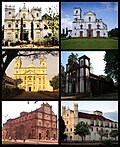
[[File: | [[File:Churches in Old Goa.jpg|thumb|[[Old Goa|Velha Goa]] is considered to be the heart of [[Goan]] culture and religion.]] | ||
According to the 1909 statistics in the '''''Catholic Encyclopedia''''', the total Catholic population was 293,628 out of a total population 365,291 (80.33%).<ref>{{cite book | |||
According to the 1909 statistics in the Catholic Encyclopedia, the total Catholic population was 293,628 out of a total population 365,291 (80.33%).<ref>{{cite book | |||
|chapter=Archdiocese of Goa | |chapter=Archdiocese of Goa | ||
|author=Ernest Hull | |author=Ernest Hull | ||
| Line 11: | Line 12: | ||
|date=1909 | |date=1909 | ||
|publisher=Robert Appleton Company | |publisher=Robert Appleton Company | ||
|location=New York}}</ref> Within Goa, there has been a steady decline of Christianity due to Goan emigration, and a steady rise of other religions, due to non-Goan immigration. Conversion seems to play little role in the demographic change. | |location=New York}}</ref> Within Goa, there has been a steady decline of Christianity due to Goan emigration, and a steady rise of other religions, due to massive non-Goan immigration since the [[Annexation of Goa]]. Native Goans are outnumbered by non-Goans in Goa, but Christianity remains prevalent in the state, with a higher percentage of Christians than the national average. <ref>{{cite news | ||
|first=Vivek | |||
|last=Menezes | |||
|title=Who belongs to Goa? This question resurfaces as the State battles the raging pandemic | |||
|url=https://www.thehindu.com/society/who-belongs-to-goa-this-question-resurfaces-as-the-state-battles-the-raging-pandemic/article34554870.ece | |||
|date=15 May 2021 | |||
|work=[[The Hindu]]}}</ref> Conversion seems to play little role in the demographic change. According to the 2011 census, in a population of 1,458,545 people, 66.1% were [[Hindu]], 25.1% were [[Christians|Christian]], 8.3% were [[Muslim]] and 0.1% were [[Sikh]].<ref name="THReligion">{{cite news | |||
|url = http://www.thehindu.com/news/national/religious-communities-census-2011-what-the-numbers-say/article7582284.ece | |||
|title = India's religions by numbers | |||
|date = 29 March 2016 | |||
|publication-date = 26 August 2015 | |||
|work = [[The Hindu]] | |||
|access-date = 6 September 2017 | |||
|archive-url = https://web.archive.org/web/20160110201326/http://www.thehindu.com/news/national/religious-communities-census-2011-what-the-numbers-say/article7582284.ece | |||
|archive-date = 10 January 2016 | |||
|url-status = live | |||
}}</ref> | |||
==Festivals== | ==Festivals== | ||
The most popular celebrations in the Indian state of Goa | The most popular celebrations in the Indian state of Goa include the [[Goa Carnival]], (Konkani: ''Intruz''), [[Shigmo]] and [[Sao Joao Festival in Goa|São João]] (Feast of John the Baptist).<ref>{{Cite web|url=http://www.goatourism.gov.in/festivals/christian-festivals/201-sao-joao|title=Department of Tourism, Government of Goa, India - SAO JOAO|last=Administrator|website=www.goatourism.gov.in|language=en-gb|access-date=27 November 2018}}</ref> The most popular festivals in Goa include [[Ganesh Chaturthi]] (Konkani: ''Chavath''),<ref>{{Cite web|url=http://www.goatourism.gov.in/festivals/hindu-festivals/184-ganesh-chaturthi-or-chovoth|title=Department of Tourism, Government of Goa, India - GANESH CHATURTHI or CHOVOTH|last=Administrator|website=www.goatourism.gov.in|language=en-gb|access-date=27 November 2018}}</ref> [[Diwali]],<ref>{{Cite web|url=http://www.goatourism.gov.in/festivals/hindu-festivals/185-diwali|title=Department of Tourism, Government of Goa, India - DIWALI|last=Administrator|website=www.goatourism.gov.in|language=en-gb|access-date=27 November 2018}}</ref> [[Christmas]] (Konkani: ''Natalam''),<ref>{{Cite web|url=http://www.goatourism.gov.in/festivals/christian-festivals/195-christmas|title=Department of Tourism, Government of Goa, India - CHRISTMAS|last=Administrator|website=www.goatourism.gov.in|language=en-gb|access-date=27 November 2018}}</ref> [[Easter]] (Konkani: ''Paskanchem Fest''), Samvatsar Padvo or Sanvsar Padvo and the feast of St. [[Francis Xavier]], who is known as ''Goencho Saib'' by the Catholic Community in Goa.<ref>{{Cite book|url=https://books.google.com/books?id=Ot6BAAAAMAAJ|title=Feasts, festivals, and observances of Goa|author-link=Maria de Lourdes Bravo da Costa Rodrigues|last=Bravo da Costa Rodrigues|first=Maria de Lourdes|publisher=L & L Publications|year=2004|location=Goa|pages=43–74}}</ref><ref>{{Cite web|url=http://www.goatourism.gov.in/festivals/christian-festivals/203-feast-of-st-francis-xavier|title=Department of Tourism, Government of Goa, India - FEAST OF ST FRANCIS XAVIER|last=Administrator|website=www.goatourism.gov.in|language=en-gb|access-date=27 November 2018}}</ref> | ||
==Education== | ==Education== | ||
| Line 21: | Line 38: | ||
==Cuisine== | ==Cuisine== | ||
{{main|Goan cuisine}} | {{main|Goan cuisine}} | ||
[[Rice]] with [[Fish (food)|fish]] [[curry]] (''Xit kodi'' in [[Konkani language|Konkani]]) is the staple diet in Goa.<ref>{{Cite news|url=https://timesofindia.indiatimes.com/travel/eating-out/food-travel-soul-stirring-seafood-in-india/as66630323.cms|title=Food travel: soul-stirring seafood in India|last=Chowdhury|first=Arka Roy|date= | [[Rice]] with [[Fish (food)|fish]] [[curry]] (''Xit kodi'' in [[Konkani language|Konkani]]) is the staple diet in Goa.<ref>{{Cite news|url=https://timesofindia.indiatimes.com/travel/eating-out/food-travel-soul-stirring-seafood-in-india/as66630323.cms|title=Food travel: soul-stirring seafood in India|last=Chowdhury|first=Arka Roy|date=14 November 2018|work=Times of India Travel|access-date=27 November 2018}}</ref> [[Goan cuisine]] is renowned for its rich variety of fish dishes cooked with elaborate recipes. [[Coconut]] and [[coconut oil]] is widely used in [[Goan]] cooking along with [[chili pepper]]s, [[spice]]s and [[vinegar]] giving the food a unique flavour. [[Pork]] and beef dishes such as [[Vindalho]],<ref>{{Cite web|url=https://www.bbc.co.uk/food/0/24432750|title=BBC Food - Curry: Where did it come from?|last=Taylor|first=Anna-Louise|date=11 October 2013|website=BBC Food|archive-url=https://web.archive.org/web/20141211232211/http://www.bbc.co.uk/food/0/24432750|archive-date=11 December 2014|url-status=dead|access-date=27 November 2018}}</ref><ref>{{Cite web|url=http://www.thetiffinbox.ca/2011/11/vindalho-de-galinha-chicken-vindaloo.html|title=Indian Classics - Vindalho de Galinha (Chicken Vindaloo)|website=www.thetiffinbox.ca|access-date=27 November 2018}}</ref> [[Xacuti]] and [[Sorpotel]] are cooked for major occasions among the Catholics. An exotic [[Goan]] vegetable stew, known as [[Khatkhate]], is a very popular dish during the celebrations of festivals, Hindu and Christian alike. Khatkhate contains at least five vegetables, fresh coconut, and special [[Goan]] spices that add to the aroma. A rich [[egg (food)|egg]]-based multi-layered sweet dish known as [[bebinca]] is a favourite at [[Christmas]].<ref>{{Cite news|url=https://www.mid-day.com/articles/goa-government-readies-to-brand-feni-as-heritage-brew/16890188|title=Goa government readies to brand Feni as heritage brew|date=23 January 2016|work=Mid-Day|access-date=27 November 2018|language=en}}</ref> Cashew feni is made from the fermentation of the fruit of the cashew tree, while coconut [[Goan Feni|feni]] is made from the sap of toddy palms. | ||
==Architecture== | ==Architecture== | ||
{{Main|Architecture of Goan Catholics}} | {{Main|Architecture of Goan Catholics}} | ||
[[File: | [[File:Panaji, nostra signora dell'immacolata concezione, esterno 03.jpg|thumb|[[Our Lady of the Immaculate Conception Church, Goa|Our Lady of the Immaculate Conception Church]] at [[Panaji|Panjim]].]] | ||
The architecture of Goa shows a distinct [[Portugal|Portuguese]] influence. [[Fontainhas (quarter)|Fontainhas]] in Panaji has been declared a cultural quarter, showcasing the life, architecture and culture of Goa.<ref>{{Cite news|url=https://www.thehindu.com/features/metroplus/travel/the-quiet-goa-fontainhas/article4105686.ece|title=The quiet Goa: Fontainhas|last=Datta|first=Sravasti|date=2012 | The architecture of Goa shows a distinct [[Portugal|Portuguese]] influence. [[Fontainhas (quarter)|Fontainhas]] in Panaji has been declared a cultural quarter, showcasing the life, architecture and culture of Goa.<ref>{{Cite news|url=https://www.thehindu.com/features/metroplus/travel/the-quiet-goa-fontainhas/article4105686.ece|title=The quiet Goa: Fontainhas|last=Datta|first=Sravasti|date=18 November 2012|work=The Hindu|access-date=27 November 2018|language=en-IN|issn=0971-751X}}</ref> | ||
The [[Churches and convents of Goa|Churches and Convents of Goa]] are a group of six churches that are a [[World Heritage | The [[Churches and convents of Goa|Churches and Convents of Goa]] are a group of six churches that are a [[World Heritage Site|UNESCO World Heritage Site]].<ref>{{Cite web|url=https://whc.unesco.org/en/list/234/|title=Churches and Convents of Goa|website=UNESCO World Heritage Centre|language=en|access-date=6 December 2018}}</ref> The [[Basilica of Bom Jesus]] holds the mortal remains of [[St. Francis Xavier]], the [[patron saint]] of Goa.<ref>{{cite news | ||
| | |url=https://m.tribuneindia.com/news/archive/nation/casket-housing-st-xavier-relics-in-goa-to-undergo-restoration-687837 | ||
|title=Casket housing St Xavier relics in Goa to undergo restoration | |title=Casket housing St Xavier relics in Goa to undergo restoration | ||
|date=23 November 2018 | |date=23 November 2018 | ||
|work=[[The Tribune (Chandigarh)]]}}</ref> Once every ten years, the body is taken down for veneration and for public viewing. The last such event was conducted in | |work=[[The Tribune (Chandigarh)]]}}</ref> Once every ten years, the body is taken down for veneration and for public viewing. The last such event was conducted in 2024.<ref>{{cite news | ||
| | |url=https://timesofindia.indiatimes.com/city/goa/Exposition-of-St-Francis-Xaviers-relics-ends-on-January-4/articleshow/45730692.cms | ||
|title=Exposition of St. Francis Xavier's relics ends on January 4 | |title=Exposition of St. Francis Xavier's relics ends on January 4 | ||
|first=Paul | |first=Paul | ||
| Line 40: | Line 57: | ||
|work=[[Times of India]]}}</ref> | |work=[[Times of India]]}}</ref> | ||
Influences from other eras ([[Kadambas of Goa]], [[Maratha Empire]]) are visible in some of Goa's temples, notably the [[Mahadev Temple, Tambdi Surla|Mahadev Temple]]<ref>[http://www.goa-india-tourism.com/goa-temples/mahadevatemple.html Mahadev Temple, Tambdi Surla] {{webarchive|url=https://web.archive.org/web/20090107105533/http://www.goa-india-tourism.com/goa-temples/mahadevatemple.html |date=2009 | Influences from other eras ([[Kadambas of Goa]], [[Maratha Empire]]) are visible in some of Goa's temples, notably the [[Mahadev Temple, Tambdi Surla|Mahadev Temple]]<ref>[http://www.goa-india-tourism.com/goa-temples/mahadevatemple.html Mahadev Temple, Tambdi Surla] {{webarchive|url=https://web.archive.org/web/20090107105533/http://www.goa-india-tourism.com/goa-temples/mahadevatemple.html |date=7 January 2009 }}</ref> and [[Saptakoteshwar Temple]].<ref>{{cite book| | ||
last1=Esteves|first1=Sarto |last2=de Sousa|first2=Vatsala | last1=Esteves|first1=Sarto |last2=de Sousa|first2=Vatsala | ||
|title=This is Goa |year=1983 | |title=This is Goa |year=1983 | ||
| Line 47: | Line 64: | ||
==Sports== | ==Sports== | ||
{{see also|Goans in sports}} | {{see also|Goans in sports}} | ||
[[Association football|Football]] is the most popular sport in Goa | [[Association football|Football]] is the most popular sport in Goa along with [[Cricket]].<ref>{{Cite news|url=http://englishnews.thegoan.net/story.php?id=32509|title=Craze for football has doubled since ISL: Aaren|work=The Goan|access-date=27 November 2018}}</ref> [[Athletics (sport)|Athletics]], [[chess]], [[Field hockey|hockey]], [[human swimming|swimming]], [[table tennis]] and [[basketball]] are other popular sports in Goa. [[Fishing]] is also a popular recreational activity. | ||
==Science== | ==Science== | ||
| Line 56: | Line 73: | ||
===Music=== | ===Music=== | ||
{{main|Music of Goa}} | {{main|Music of Goa}} | ||
[[Mando (music)|Mando]] and [[ | Goan Catholics have been performing [[Western classical music]] since the 1500s, because it is an integral part of the [[Catholic liturgy]]. [[Mando (music)|Mando]], [[dekhnni]], [[dulpod]] and [[tiatr]] are traditional Goan musical forms in [[Konkani language|Konkani]] developed from Western Music. | ||
Goan [[Hindu]]s are very fond of [[Natak]], [[Bhajan]] and [[Kirtan]]. Many famous [[Indian classical music|Indian Classical]] singers hail from Goa, such as, [[Kishori Amonkar]], [[Kesarbai Kerkar]], [[Jitendra Abhisheki]], [[Prabhakar Karekar]]. | Goan [[Hindu]]s are very fond of [[Natak]], [[Bhajan]] and [[Kirtan]]. Many famous [[Indian classical music|Indian Classical]] singers hail from Goa, such as, [[Kishori Amonkar]], [[Kesarbai Kerkar]], [[Jitendra Abhisheki]], [[Prabhakar Karekar]]. | ||
[[File:Fugdi Dancers from South Goa.jpg|thumb|Fugdi Dancers from South Goa]] | |||
===Dance=== | ===Dance=== | ||
Some traditional Goan dance forms are [[dekhnni]], [[fugdi]], [[corridinho]] and [[ | Some traditional Goan dance forms are [[dekhnni]], [[fugdi]], [[corridinho]] and [[Mando (music)|mando]]. [[Ballroom dancing|Western social dancing]] is a part of most celebrations. | ||
===Theatre=== | ===Theatre=== | ||
| Line 75: | Line 92: | ||
==Language== | ==Language== | ||
The majority of Goans speak Konkani as their first language, while the remaining speak other languages, like Hindi, Portuguese or Marathi as their primary language.{{cn|date=February 2025}} However, practically all Goans can speak and understand Konkani. Konkani is an important part of the Goan identity that binds together all Goans. | |||
==Tourism== | ==Tourism == | ||
{{main|Tourism in Goa}} | {{main|Tourism in Goa}} | ||
Goa developed an international reputation in the 1960s as one of the prime stops on the legendary India-Nepal "[[hippie trail]]". In the mid-1960s, several Westerners, including "[[Eight Finger Eddie]]" walked over the hill to Calangute, and decided to create a community for Westerners. In the early years, Calangute and Baga were the center of this scene, but it grew over the years to include other nearby cities like Anjuna Beach, which became, and arguably still is, the center of the Western youth culture of Goa. By the mid-1980s, there were over 8000 Westerners living in Goa, mostly from Western Europe. The scene was marked by drug culture, trance music and free love. Goa remains today an international center of youth culture. | Goa developed an international reputation in the 1960s as one of the prime stops on the legendary India-Nepal "[[hippie trail]]". In the mid-1960s, several Westerners, including "[[Eight Finger Eddie]]" walked over the hill to Calangute, and decided to create a community for Westerners. In the early years, Calangute and Baga were the center of this scene, but it grew over the years to include other nearby cities like Anjuna Beach, which became, and arguably still is, the center of the Western youth culture of Goa. By the mid-1980s, there were over 8000 Westerners living in Goa, mostly from Western Europe. The scene was marked by drug culture, trance music and free love. Goa remains today an international center of youth culture. | ||
Starting in the late 1990s, Goa began to attract a more "upscale" audience, which in turn drove prices up, which in turn drove many in the "hippie" community to other less-expensive areas. | Starting in the late 1990s, Goa began to attract a more "upscale" audience, which in turn drove prices up, which in turn drove many in the "hippie" community to other less-expensive areas. Arambol the beach community furthest away from "civilization", like electricity and running water—became the center of a battle between those wanting to turn Goa into a more traditional upscale resort area, and those wanting Goa to retain its traditional rustic counterculture appeal. | ||
==See also== | ==See also== | ||
* [[Culture of Goan Catholics]] | |||
* [[Goans in Hindi film music composition]] | * [[Goans in Hindi film music composition]] | ||
* [[LGBTQ rights in Goa]] | |||
==References== | ==References== | ||
{{Reflist}} | {{Reflist}} | ||
== Further reading == | |||
* {{cite journal |last1=Davidson |first1=Sarah |first2=Eleanor |last2=Phelps |title=Folk Tales from New Goa, India |journal=The Journal of American Folklore |volume=50 |issue=195 |date=1937 |pages=1–51 |doi=10.2307/535980}} | |||
* {{Cite book |title=Konkani Folk Tales |series=Folklore of India |editor=Olivinho Gomes |publisher=National Book Trust |date=2007 |isbn=9788123750835}} | |||
* {{cite book |last=Rodrigues |first=Lucio |date=2020 |title=The Wise Fools of Moira... and Other Goan Folk Tales |location=Goa |publisher=Goa, 1556 |isbn=978-81-940107-7-7}} | |||
* {{cite book |title=Whispers and Reflections: Folk Tales from Goa |editor=Sharmila Pais |date=2024 |publisher=Goa, 1556 |isbn=978-93-95795-56-2}} | |||
==External links== | ==External links== | ||
Latest revision as of 00:56, 1 March 2026
 | This article needs more citations. (June 2019) |
Goa is a state of India. Goans are commonly said to be born with music and football in their blood because both are deeply entrenched in Goan culture.[1][2][3]
Religion[edit | edit source]

According to the 1909 statistics in the Catholic Encyclopedia, the total Catholic population was 293,628 out of a total population 365,291 (80.33%).[4] Within Goa, there has been a steady decline of Christianity due to Goan emigration, and a steady rise of other religions, due to massive non-Goan immigration since the Annexation of Goa. Native Goans are outnumbered by non-Goans in Goa, but Christianity remains prevalent in the state, with a higher percentage of Christians than the national average. [5] Conversion seems to play little role in the demographic change. According to the 2011 census, in a population of 1,458,545 people, 66.1% were Hindu, 25.1% were Christian, 8.3% were Muslim and 0.1% were Sikh.[6]
Festivals[edit | edit source]
The most popular celebrations in the Indian state of Goa include the Goa Carnival, (Konkani: Intruz), Shigmo and São João (Feast of John the Baptist).[7] The most popular festivals in Goa include Ganesh Chaturthi (Konkani: Chavath),[8] Diwali,[9] Christmas (Konkani: Natalam),[10] Easter (Konkani: Paskanchem Fest), Samvatsar Padvo or Sanvsar Padvo and the feast of St. Francis Xavier, who is known as Goencho Saib by the Catholic Community in Goa.[11][12]
Education[edit | edit source]
Cuisine[edit | edit source]
Rice with fish curry (Xit kodi in Konkani) is the staple diet in Goa.[13] Goan cuisine is renowned for its rich variety of fish dishes cooked with elaborate recipes. Coconut and coconut oil is widely used in Goan cooking along with chili peppers, spices and vinegar giving the food a unique flavour. Pork and beef dishes such as Vindalho,[14][15] Xacuti and Sorpotel are cooked for major occasions among the Catholics. An exotic Goan vegetable stew, known as Khatkhate, is a very popular dish during the celebrations of festivals, Hindu and Christian alike. Khatkhate contains at least five vegetables, fresh coconut, and special Goan spices that add to the aroma. A rich egg-based multi-layered sweet dish known as bebinca is a favourite at Christmas.[16] Cashew feni is made from the fermentation of the fruit of the cashew tree, while coconut feni is made from the sap of toddy palms.
Architecture[edit | edit source]

The architecture of Goa shows a distinct Portuguese influence. Fontainhas in Panaji has been declared a cultural quarter, showcasing the life, architecture and culture of Goa.[17]
The Churches and Convents of Goa are a group of six churches that are a UNESCO World Heritage Site.[18] The Basilica of Bom Jesus holds the mortal remains of St. Francis Xavier, the patron saint of Goa.[19] Once every ten years, the body is taken down for veneration and for public viewing. The last such event was conducted in 2024.[20]
Influences from other eras (Kadambas of Goa, Maratha Empire) are visible in some of Goa's temples, notably the Mahadev Temple[21] and Saptakoteshwar Temple.[22]
Sports[edit | edit source]
Football is the most popular sport in Goa along with Cricket.[23] Athletics, chess, hockey, swimming, table tennis and basketball are other popular sports in Goa. Fishing is also a popular recreational activity.
Science[edit | edit source]
Arts[edit | edit source]
Music[edit | edit source]
Goan Catholics have been performing Western classical music since the 1500s, because it is an integral part of the Catholic liturgy. Mando, dekhnni, dulpod and tiatr are traditional Goan musical forms in Konkani developed from Western Music.
Goan Hindus are very fond of Natak, Bhajan and Kirtan. Many famous Indian Classical singers hail from Goa, such as, Kishori Amonkar, Kesarbai Kerkar, Jitendra Abhisheki, Prabhakar Karekar.

Dance[edit | edit source]
Some traditional Goan dance forms are dekhnni, fugdi, corridinho and mando. Western social dancing is a part of most celebrations.
Theatre[edit | edit source]
Goans are very fond of theatre and acting. Kalo and dashavatar were popular art forms. Marathi Nataks have been very popular among Hindus in Goa for the past two centuries. Tiatr is the major Goan form of theatre common amongst Catholics and is the most commercial offering as it has entertained Goans not only in Goa but also in Mumbai and Pune (which are major cities of India and have a sizeable Goan population) and in the Gulf regions of UAE, Kuwait and so on.
Cinema[edit | edit source]
Literature[edit | edit source]
Language[edit | edit source]
The majority of Goans speak Konkani as their first language, while the remaining speak other languages, like Hindi, Portuguese or Marathi as their primary language.[citation needed] However, practically all Goans can speak and understand Konkani. Konkani is an important part of the Goan identity that binds together all Goans.
Tourism[edit | edit source]
Goa developed an international reputation in the 1960s as one of the prime stops on the legendary India-Nepal "hippie trail". In the mid-1960s, several Westerners, including "Eight Finger Eddie" walked over the hill to Calangute, and decided to create a community for Westerners. In the early years, Calangute and Baga were the center of this scene, but it grew over the years to include other nearby cities like Anjuna Beach, which became, and arguably still is, the center of the Western youth culture of Goa. By the mid-1980s, there were over 8000 Westerners living in Goa, mostly from Western Europe. The scene was marked by drug culture, trance music and free love. Goa remains today an international center of youth culture.
Starting in the late 1990s, Goa began to attract a more "upscale" audience, which in turn drove prices up, which in turn drove many in the "hippie" community to other less-expensive areas. Arambol the beach community furthest away from "civilization", like electricity and running water—became the center of a battle between those wanting to turn Goa into a more traditional upscale resort area, and those wanting Goa to retain its traditional rustic counterculture appeal.
See also[edit | edit source]
References[edit | edit source]
- ↑ Siqueira, Abigail (7 June 2022). "Is hospitality management a sinking ship?". oHeraldo. Retrieved 26 December 2022.
- ↑ "Goan Art And Culture Services". indiamart.com. Retrieved 26 December 2022.
- ↑ Saxena, Ayush. "Tourism Scenario of Goa". Retrieved 26 December 2022.
- ↑ Ernest Hull (1909). "Archdiocese of Goa". Catholic Encyclopedia, Vol. 6. New York: Robert Appleton Company.
- ↑ Menezes, Vivek (15 May 2021). "Who belongs to Goa? This question resurfaces as the State battles the raging pandemic". The Hindu.
- ↑ "India's religions by numbers". The Hindu (published 26 August 2015). 29 March 2016. Archived from the original on 10 January 2016. Retrieved 6 September 2017.
- ↑ Administrator. "Department of Tourism, Government of Goa, India - SAO JOAO". www.goatourism.gov.in. Retrieved 27 November 2018.
- ↑ Administrator. "Department of Tourism, Government of Goa, India - GANESH CHATURTHI or CHOVOTH". www.goatourism.gov.in. Retrieved 27 November 2018.
- ↑ Administrator. "Department of Tourism, Government of Goa, India - DIWALI". www.goatourism.gov.in. Retrieved 27 November 2018.
- ↑ Administrator. "Department of Tourism, Government of Goa, India - CHRISTMAS". www.goatourism.gov.in. Retrieved 27 November 2018.
- ↑ Bravo da Costa Rodrigues, Maria de Lourdes (2004). Feasts, festivals, and observances of Goa. Goa: L & L Publications. pp. 43–74.
- ↑ Administrator. "Department of Tourism, Government of Goa, India - FEAST OF ST FRANCIS XAVIER". www.goatourism.gov.in. Retrieved 27 November 2018.
- ↑ Chowdhury, Arka Roy (14 November 2018). "Food travel: soul-stirring seafood in India". Times of India Travel. Retrieved 27 November 2018.
- ↑ Taylor, Anna-Louise (11 October 2013). "BBC Food - Curry: Where did it come from?". BBC Food. Archived from the original on 11 December 2014. Retrieved 27 November 2018.
- ↑ "Indian Classics - Vindalho de Galinha (Chicken Vindaloo)". www.thetiffinbox.ca. Retrieved 27 November 2018.
- ↑ "Goa government readies to brand Feni as heritage brew". Mid-Day. 23 January 2016. Retrieved 27 November 2018.
- ↑ Datta, Sravasti (18 November 2012). "The quiet Goa: Fontainhas". The Hindu. ISSN 0971-751X. Retrieved 27 November 2018.
- ↑ "Churches and Convents of Goa". UNESCO World Heritage Centre. Retrieved 6 December 2018.
- ↑ "Casket housing St Xavier relics in Goa to undergo restoration". The Tribune (Chandigarh). 23 November 2018.
- ↑ Fernandes, Paul (2 January 2015). "Exposition of St. Francis Xavier's relics ends on January 4". Times of India.
- ↑ Mahadev Temple, Tambdi Surla Archived 7 January 2009 at the Wayback Machine
- ↑ Esteves, Sarto; de Sousa, Vatsala (1983). This is Goa. p. 19.
- ↑ "Craze for football has doubled since ISL: Aaren". The Goan. Retrieved 27 November 2018.
Further reading[edit | edit source]
- Davidson, Sarah; Phelps, Eleanor (1937). "Folk Tales from New Goa, India". The Journal of American Folklore. 50 (195): 1–51. doi:10.2307/535980.
- Olivinho Gomes, ed. (2007). Konkani Folk Tales. Folklore of India. National Book Trust. ISBN 9788123750835.
- Rodrigues, Lucio (2020). The Wise Fools of Moira... and Other Goan Folk Tales. Goa: Goa, 1556. ISBN 978-81-940107-7-7.
- Sharmila Pais, ed. (2024). Whispers and Reflections: Folk Tales from Goa. Goa, 1556. ISBN 978-93-95795-56-2.
